PARIS, France (23 October 2025) — The organisers unveiled the fifth edition of the Tour de France Femmes avec Zwift on Thursday evening at the Palais des Congrès, revealing a route that continues the race’s pilgrimage through France’s most iconic climbs. After conquering the Super Planche des Belles Filles, the Col du Tourmalet, Alpe d’Huez and the Col de la Madeleine in previous editions, the peloton will now face Mont Ventoux, where the Yellow Jersey could change hands.
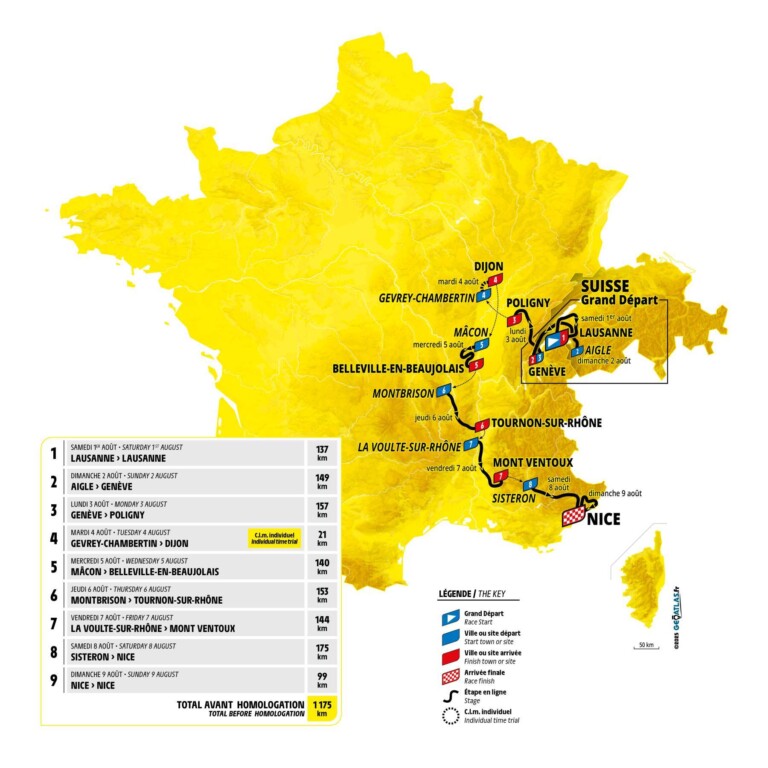
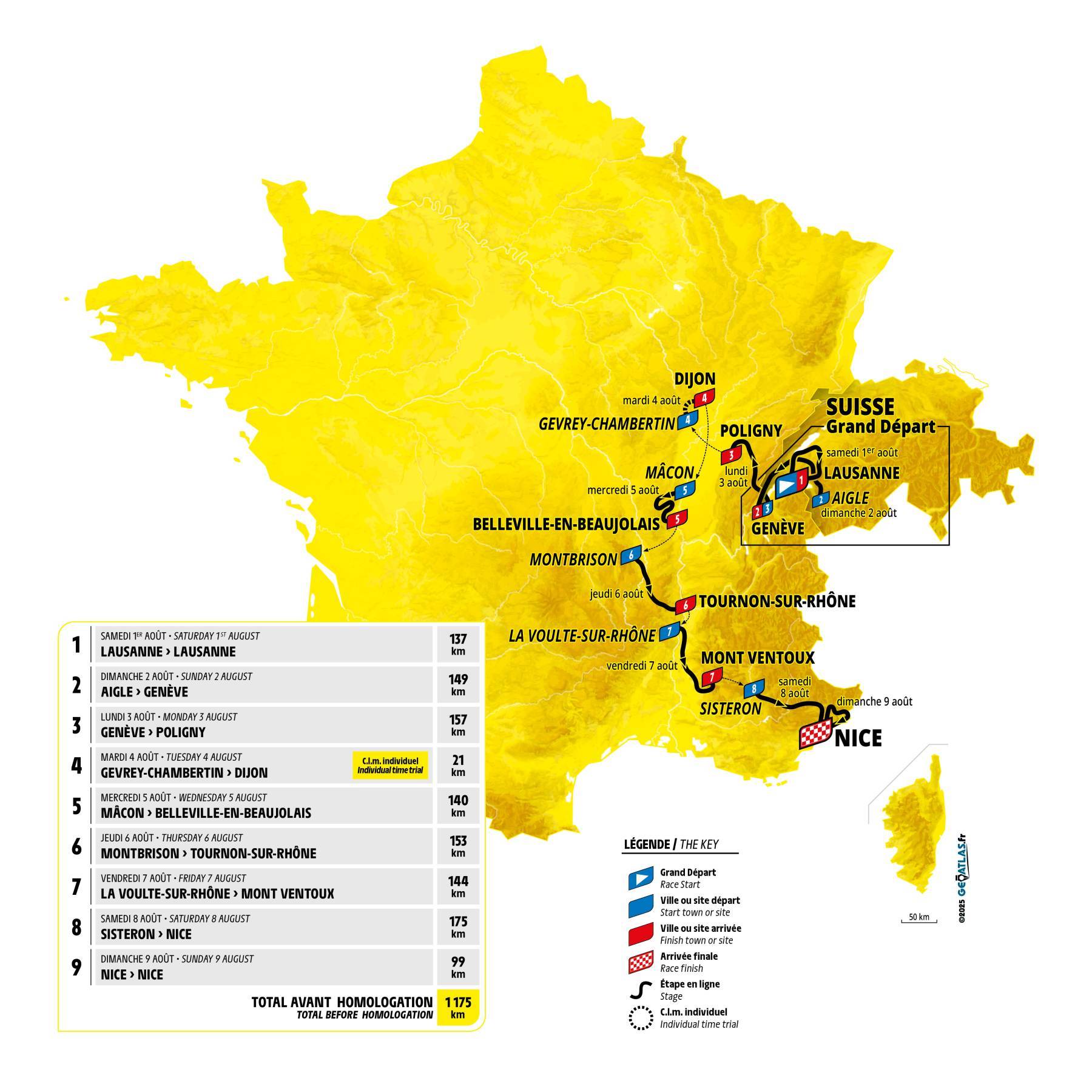
Map of the 2026 Tour de France Femmes. Image courtesy A.S.O
The 1,175-kilometre route—the longest since the race’s rebirth—runs from 1 to 9 August, opening in Switzerland before building toward the Giant of Provence and concluding with two stages into Nice.
Switzerland hosts the Grand Départ with contrasting challenges. Stage one circles Lausanne over 137 kilometres, a parcours designed for the puncheurs. The sprinters get their chance the following day on the 149-kilometre run from Aigle to Geneva. Stage three crosses back into France, covering 157 kilometres from Geneva to Poligny.
The time triallists take centre stage in Burgundy on stage four, a 21-kilometre race against the clock from Gevrey-Chambertin to Dijon that should separate genuine contenders from pretenders. The peloton catches its breath the following day with 140 kilometres through the Beaujolais hills from Mâcon to Belleville-en-Beaujolais.
Stage six runs 153 kilometres from Montbrison to Tournon-sur-Rhône, positioning the race for its defining moment. On 7 August, stage seven departs La Voulte-sur-Rhône and passes through Bédoin before tackling the 15.7-kilometre ascent to the weather station atop Mont Ventoux—144 kilometres total that could crown a champion.
But the Bald Mountain may not deliver the final verdict. Two stages finish in Nice, either of which could reshuffle the general classification. Stage eight covers 175 kilometres from Sisteron, while the finale on stage nine loops 99 kilometres around Nice, climbing the Col d’Èze four times before descending to the Promenade des Anglais.
The route traces a compelling narrative across five editions. Annemiek van Vleuten’s masterclass on the Super Planche des Belles Filles in 2022, Demi Vollering’s riposte on the Col du Tourmalet in 2023, their breathless duel on Alpe d’Huez in 2024, and Pauline Ferrand-Prévot’s decisive attack on the Col de la Madeleine in 2025 set the stage for another high-mountain battle. The five editions combined now span 67 stage towns and cities across most of France’s metropolitan regions, plus three foreign countries, visiting cycling’s most hallowed ground where champions have delivered sporting gems—with more to come.
L’Étape du Tour de France Femmes avec Zwift will tackle a modified version of stage seven on 6 August, departing Vaison-la-Romaine and joining the professional route approximately 70 kilometres from the finish. The amateur riders will sharpen their legs around the Dentelles de Montmirail before ascending Mont Ventoux from Bédoin, its most daunting approach. Registration opens 23 October.
Zwift, the race’s title sponsor, has extended its partnership through 2029, confirming its commitment to women’s cycling development. The partnership enabled the race’s rebirth in 2022 and now holds a prime position on the international calendar. Through its Watch The Femmes movement, Zwift works to increase visibility and participation for women in cycling—a commitment already reflected in record audiences and rising numbers of female cyclists on its platform.
PARIS, France (23 October 2025) — The organisers pulled back the curtain on the 113th Tour de France on Thursday evening, presenting a route that builds toward a savage Alpine finale like Maurice Ravel’s Boléro gathering momentum toward its thunderous conclusion. Nearly 3,500 spectators packed the Palais des Congrès to glimpse the challenge awaiting the world’s best riders from 4 to 26 July.
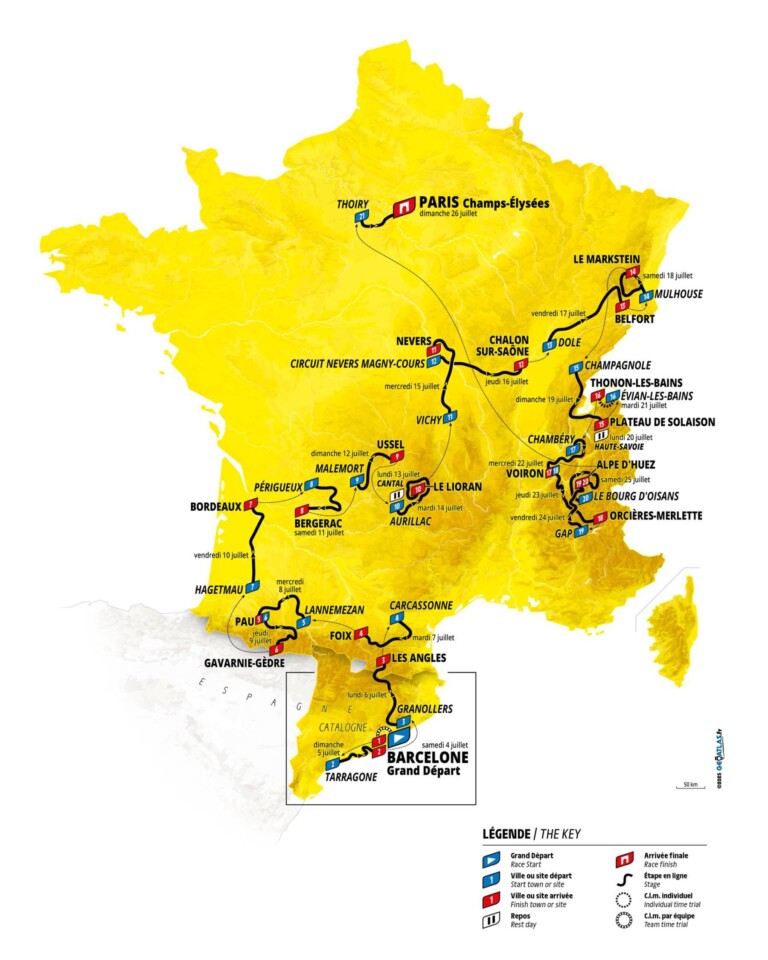
Map of the 2026 Tour de France. Image courtesy A.S.O
Barcelona will host the Grand Départ, opening with a 19-kilometre team time trial in the Paris-Nice mould. The riders will parade past the newly completed tower of the Sagrada Família, Antoni Gaudí’s architectural vision finally realised—though respecting his wish that it not surpass Montjuïc as Barcelona’s highest point. That Olympic hill will serve up stage two’s finish, a punchy parcours from Tarragone designed to expose the favourites with nowhere to hide.
The race wastes little time hitting the Pyrenees, but the early mountain stages look tailored for breakaway specialists rather than general classification warfare. Les Angles welcomes the peloton after 196 kilometres on stage three, while the Cirque de Gavarnie—a Tour debutant as a finish—crowns stage six’s 186-kilometre journey from Pau.
The sprinters get their chances. Pau opens the door on stage five, followed by opportunities in Bordeaux, Bergerac, Nevers and Chalon-sur-Saône. But they’ll share the limelight with escape artists circling Ussel on stage nine and Belfort on stage 13 in red marker.
The Massif Central muscles into the narrative on Bastille Day, when 167 kilometres through the Cantal culminate at Le Lioran. The Jura and Vosges follow, building pressure through stages 13 to 15. New climbs proliferate: the Col du Haag debuts on stage 14’s 155-kilometre sufferfest to Le Markstein, while the Plateau de Solaison—arriving immediately after the Col du Salève on stage 15—could fracture the race as decisively as any Alpine giant.
The only individual time trial runs 26 kilometres along Lake Geneva’s shore from Évian-les-Bains to Thonon-les-Bains on stage 16, offering one final chance to reshuffle the general classification before the Alps deliver their verdict.
Orcières-Merlette on stage 18 serves as overture. Then Alpe d’Huez delivers the knockout punch—twice. Stage 19 covers a relatively civilised 128 kilometres from Gap. But stage 20 unleashes hell: 171 kilometres and 5,600 metres of climbing, the only stage to breach 5,000 metres of elevation gain. The riders will grapple with the Col de la Croix de Fer, Col du Télégraphe and Galibier—at 2,642 metres the roof of the race—before ascending Alpe d’Huez via the Col de Sarenne, an approach the Tour has never before used.
After that vertigo-inducing challenge, one final twist awaits: the peloton must crest Montmartre before rolling onto the Champs-Élysées for stage 21’s traditional finale.
The 3,333-kilometre route accumulates 54,450 metres of vertical gain across 21 stages, visiting all five French mountain ranges in geographical progression: Pyrenees, Massif Central, Vosges, Jura and Alps.
Amateur cyclists will tackle stage 20’s course on 19 July at L’Étape du Tour de France, giving 16,000 riders the chance to conquer the Col de Sarenne descent to Alpe d’Huez a week before the professionals. Registration opens 3 November. L’Étape du Tour de France Femmes avec Zwift will pit riders against Mont Ventoux on 6 August.
Colorado’s biggest bike sale returns November 1 with deals, demos, and community vibes
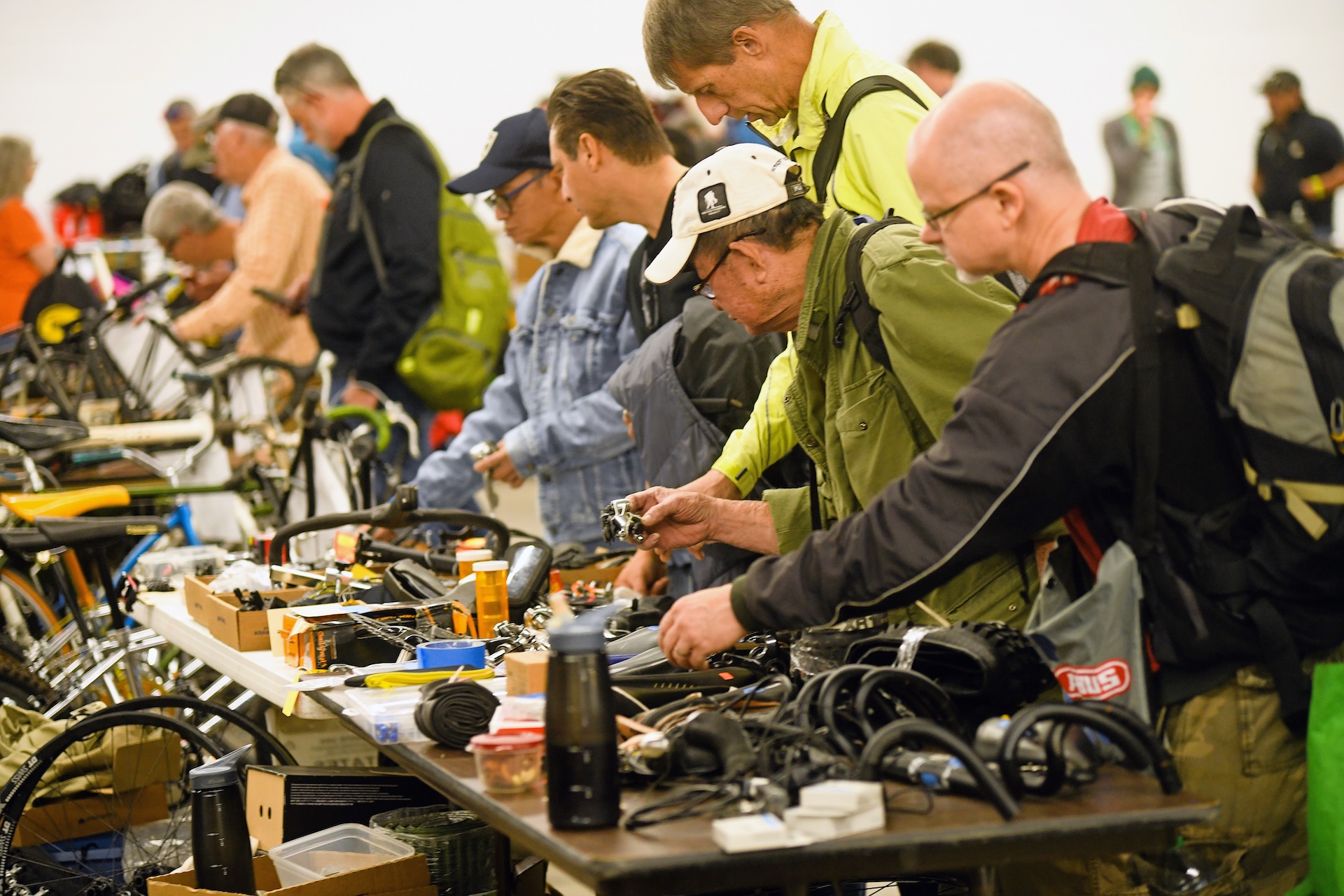
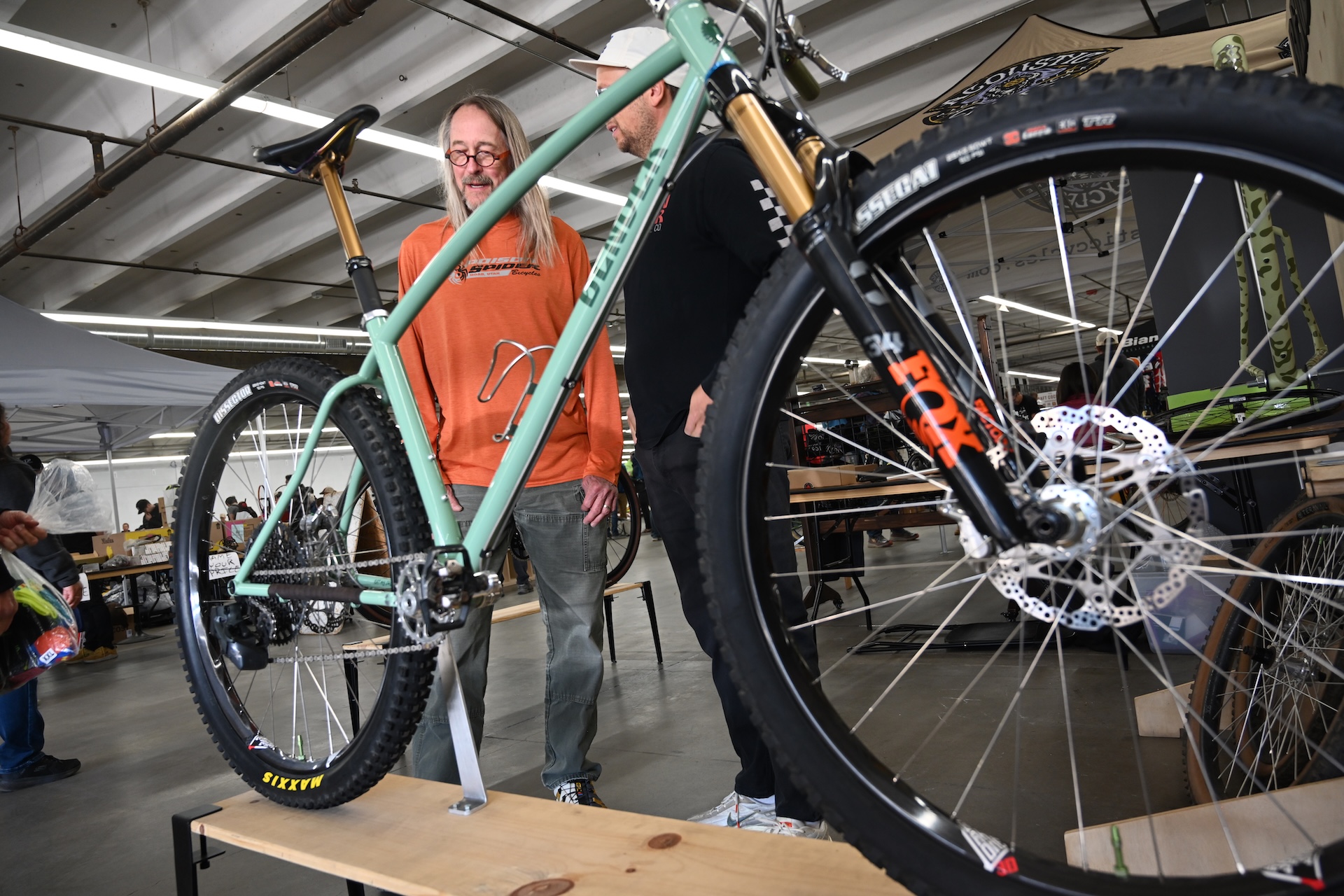
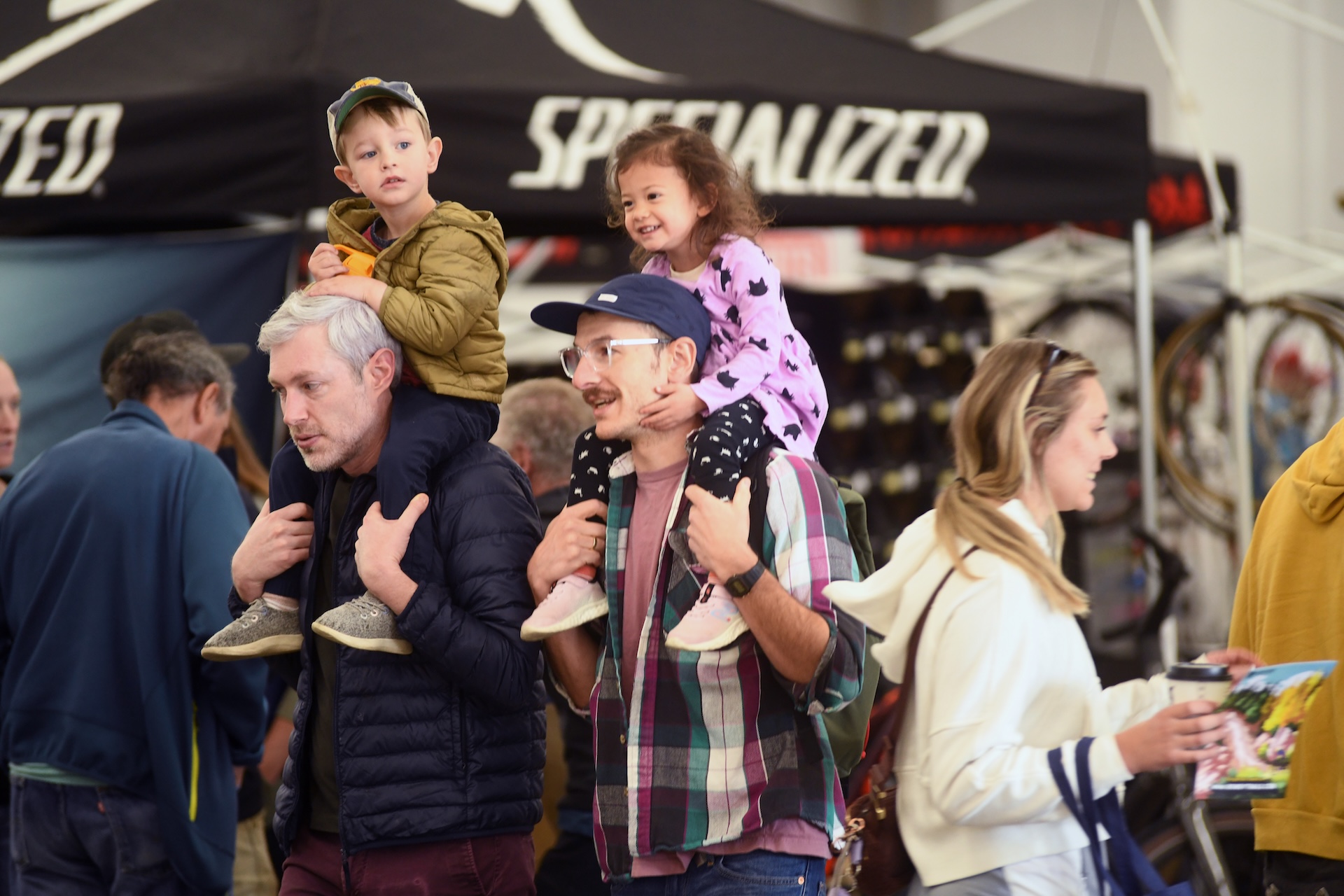
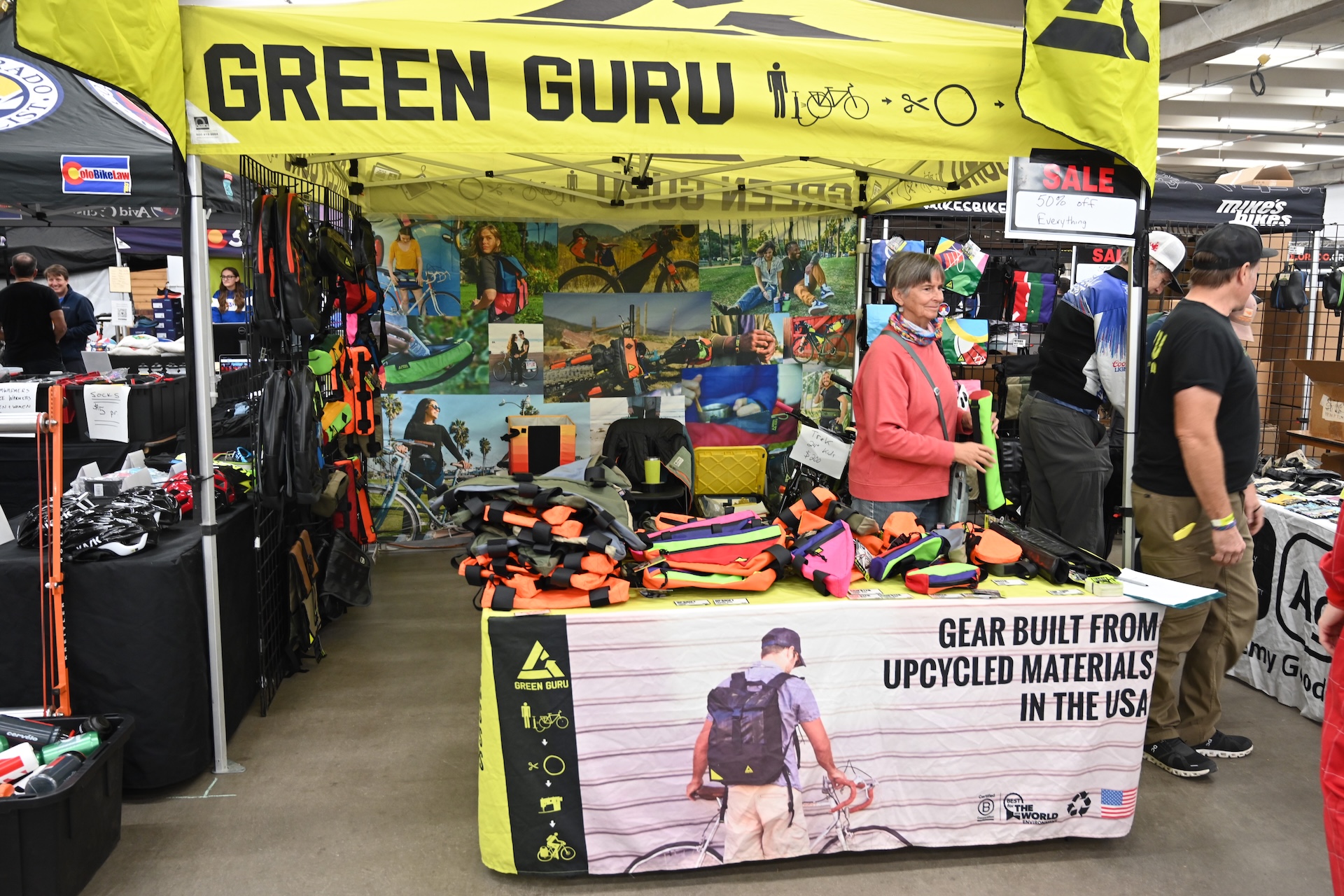
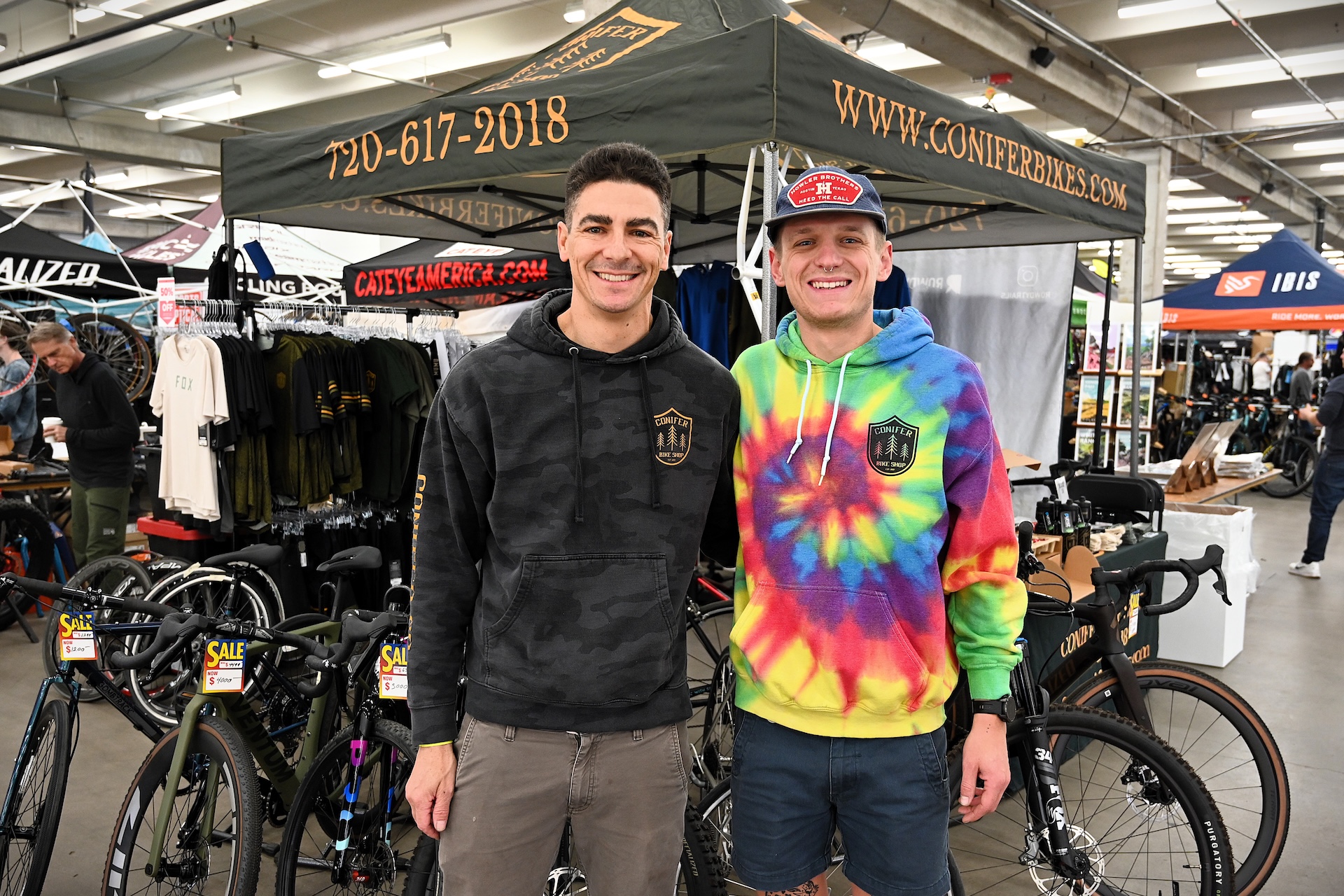
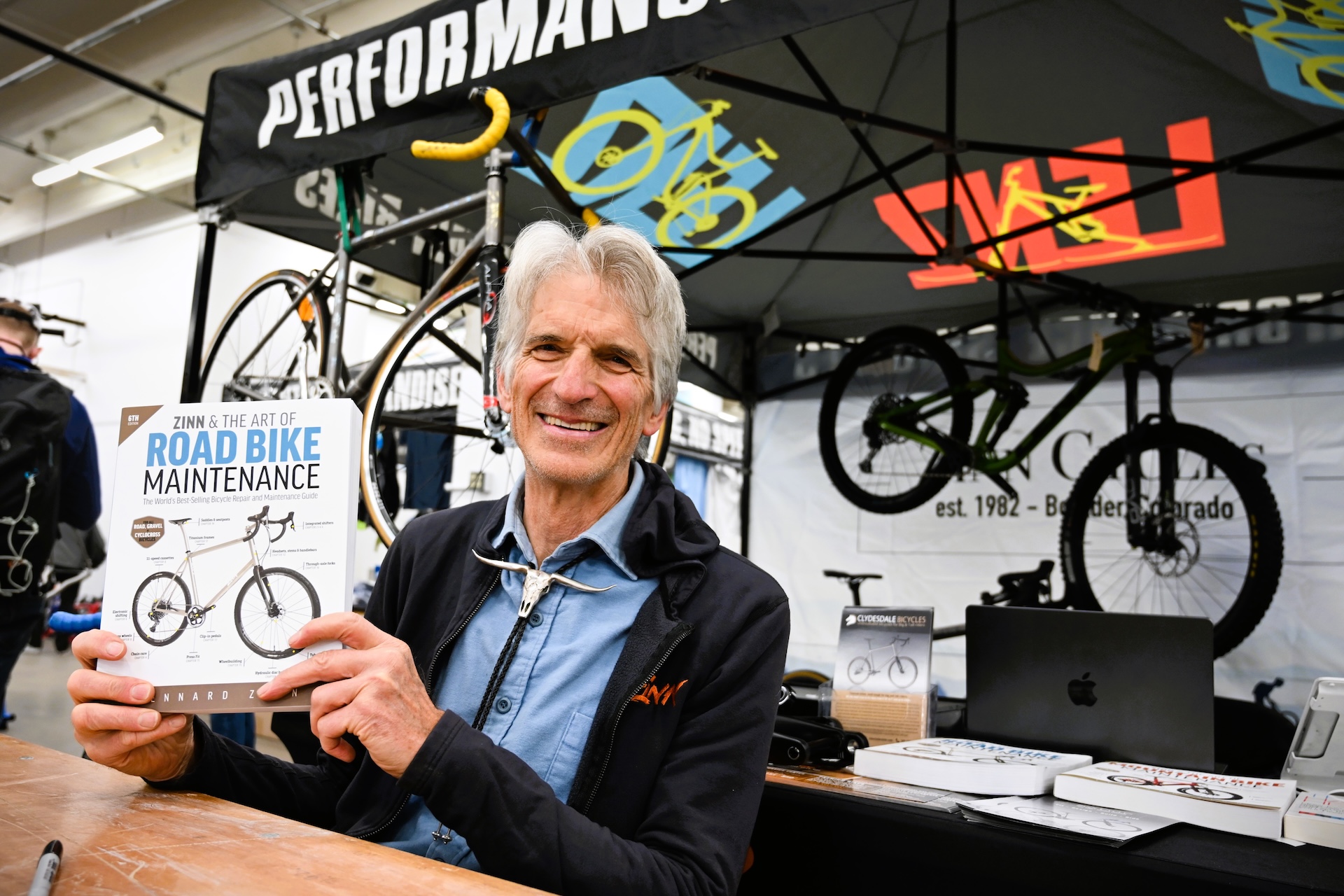
DENVER, Colorado — Bargain hunters, collectors, and casual riders alike will converge once again at the National Western Complex on November 1 as VeloSwap celebrates its 33rd year as Colorado’s largest bicycle expo. The one-day event, organized by Bicycle Colorado, brings together more than 250 local and national vendors offering everything from high-end road frames and mountain bike components to vintage finds and one-off curiosities.
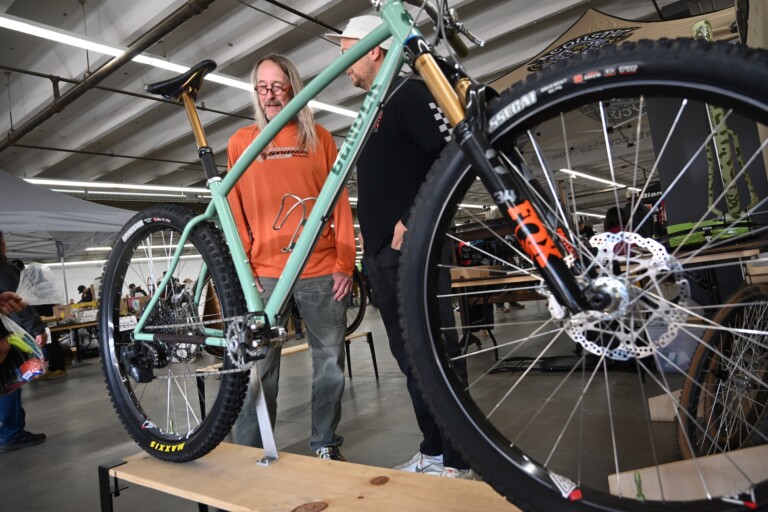
VeloSwap, photo by Ryan Muncy, courtesy of VeloSwap
For many riders, VeloSwap marks the unofficial end of the cycling season—a final chance to score gear, connect with fellow enthusiasts, and swap stories before winter sets in. “VeloSwap is more than a sale—it’s a celebration of Colorado’s bike culture,” says Pete Piccolo, Executive Director of Bicycle Colorado. “Every dollar raised helps us make riding safer and more accessible statewide.”
VeloSwap, photo by Ryan Muncy, courtesy of VeloSwap
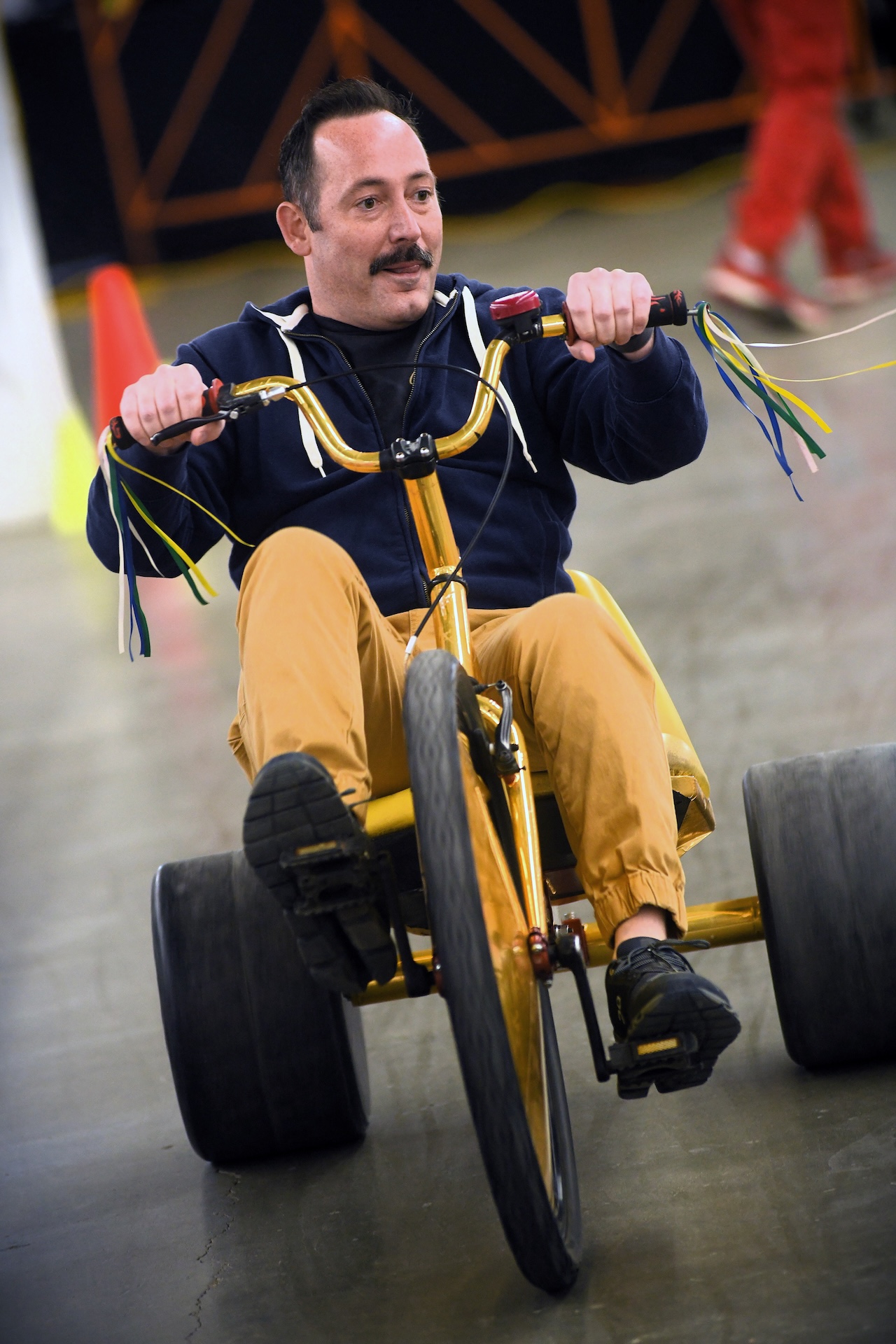
This year’s lineup features well-known names like CatEye, Feedback Sports, Tailwind Nutrition, Green Guru, and The Ride Collective, alongside community mainstays such as Denver Century Ride and ProVelo Bicycles. Families can enjoy a kids’ zone with a bike rodeo and face painting from 10 a.m. to 2 p.m., while curious competitors can test their speed at the International Bicycle Flat Tire World Series from 11 a.m. to noon.
VeloSwap, photo by Ryan Muncy, courtesy of VeloSwap
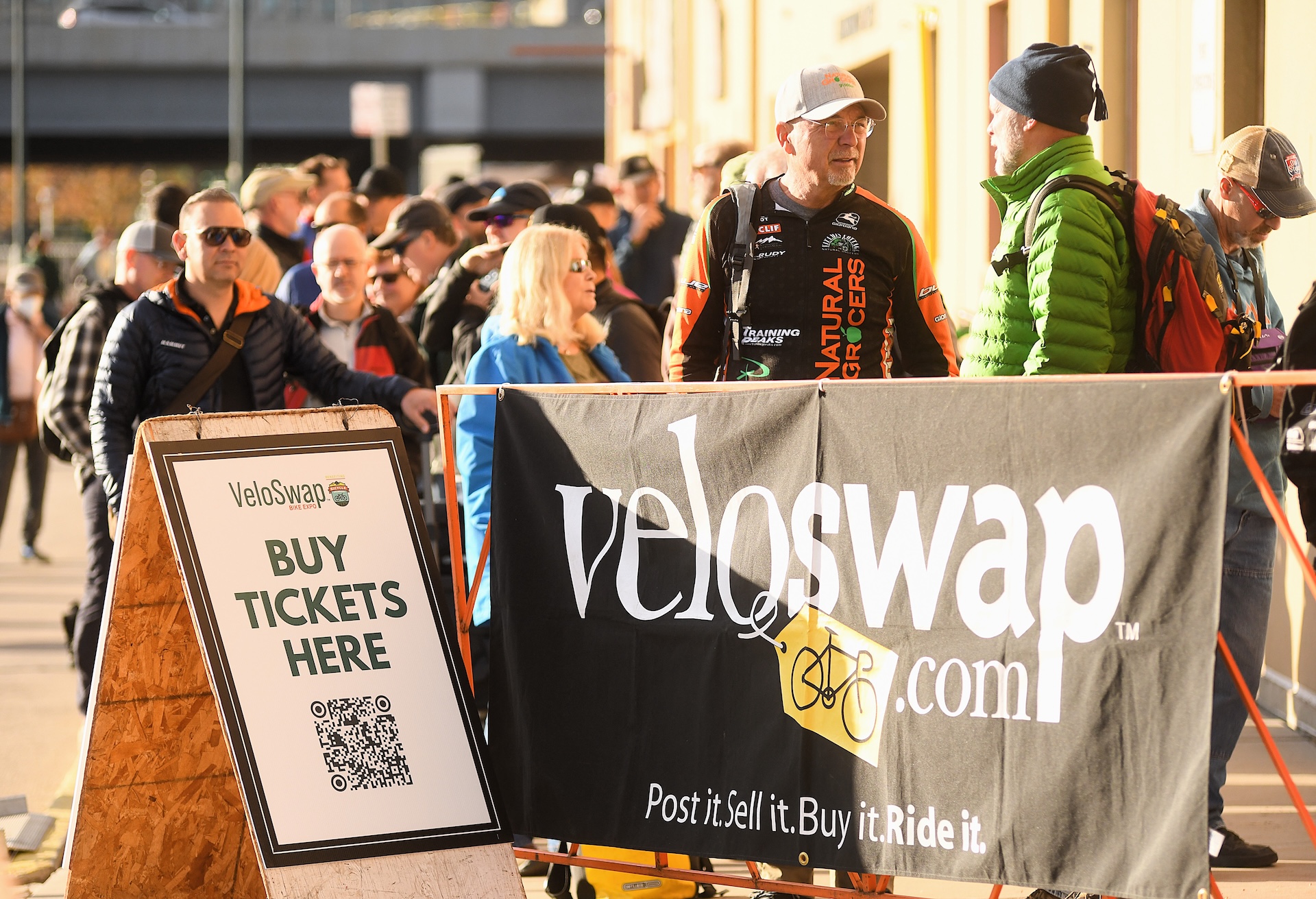
Doors open at 8:30 a.m. for Bicycle Colorado members and at 9:00 a.m. for the general public. Tickets will be available online and at the door. Whether you’re after a new ride, a replacement derailleur, or just the nostalgia of an indoor swap meet packed with two-wheeled treasures, VeloSwap remains one of the region’s most beloved cycling traditions.
Event Details
When: Saturday, November 1, 9 a.m.–3 p.m. Where: National Western Complex, 4655 Humboldt St., Denver, CO More info: www.veloswap.com
VeloSwap, photo by Ryan Muncy, courtesy of VeloSwapVeloSwap, photo by Ryan Muncy, courtesy of VeloSwapVeloSwap, photo by Ryan Muncy, courtesy of VeloSwapVeloSwap, photo by Ryan Muncy, courtesy of VeloSwapVeloSwap, photo by Ryan Muncy, courtesy of VeloSwap
SACRAMENTO, California (Oct 14, 2025) – The California Mobility Fund, a 501(c)3 and sibling organization of the California Bicycle Coalition, has convened the California Independent Electric Mobility Council, a first-of-its-kind statewide working group. The mission of the council is to bring order and vision to the fast-changing landscape of e-bikes and other small electric mobility devices, so that they can be safely and fairly integrated into California’s networks of streets, bikeways, and shared-use paths.
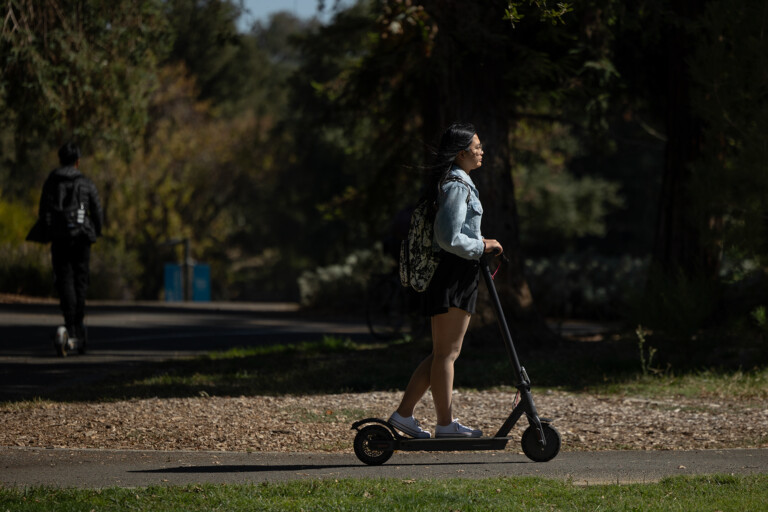
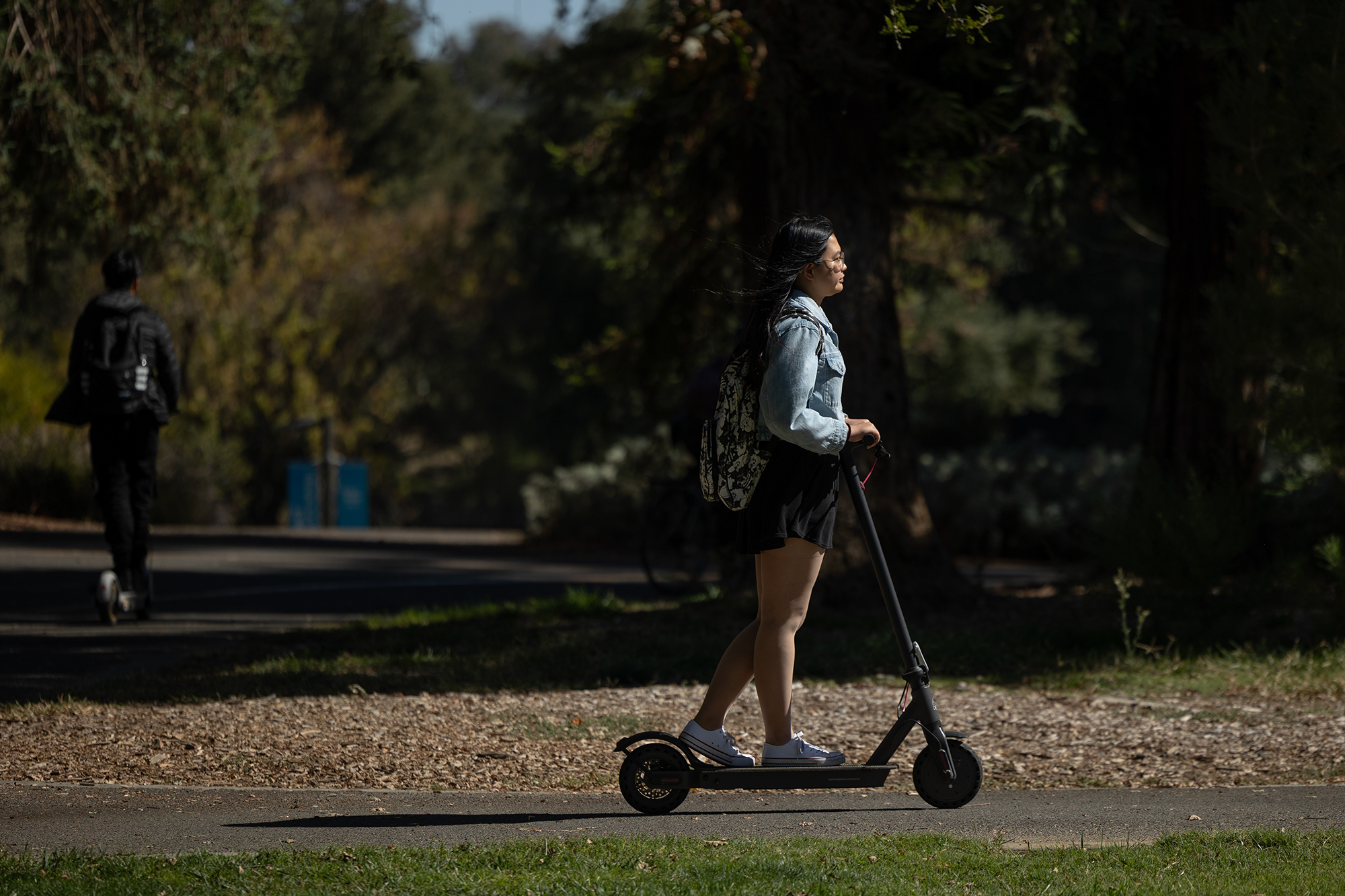
Students ride their electric scooters through campus at the University of California, Davis on Oct. 3, 2023. Photo by Miguel Gutierrez Jr., CalMatters
The California Mobility Fund focuses on educational and research-oriented work to advance bicycling and safe streets. Paired with the advocacy efforts of 501(c)4, the California Bicycle Coalition, the two organizations are known collectively as CalBike.
Concerns about unregulated e-mobility devices sold in California, such as e-bikes and e-motos, have led to a hodgepodge of local and state legislation, but the state lacks a unifying voice to bring the full range of concerns to the table and offer actionable solutions. Concerns about “e-bikes” traveling faster than the 28-mph top speed allowed under California law are understandable. But regulations that broadly limit e-bikes may negatively affect those using legal e-bikes and other devices for shorter commute distances and climate-friendly transportation.
“We need a better way to approach e-mobility regulation,” said CalBike Executive Director Kendra Ramsey. “The first step is to bring all the stakeholders together. That’s the purpose of the California Independent Electric Mobility Council.”
The Independent Electric Mobility Council represents a diverse group of transportation, safety, and public health experts. Over the next nine months, the Council will work to develop updated guidance, policy recommendations, and educational resources to address this complex mix of electric mobility devices.
In conjunction with the Council, CalBike will implement a statewide communications campaign to dispel misconceptions, share safety practices, and educate road users and California decision-makers alike.
Members of the Council include representatives from the California Emergency Nurses Association, the Motorcycle Industry Council, the Mineta Transportation Institute, Ecology Action, PeopleForBikes, the City of Santa Cruz, the California DMV and Department of Public Health, Alta Planning + Design, Lyft Urban Solutions, the Marin County Bicycle Coalition, Streets Are For Everyone, and VoltVerified. The program is funded by a contribution from Honda.
CalBike responds to a changing e-bike landscape
CalBike has long taken the lead in helping Californians adopt sustainable, low-cost, active transportation. Our work was key to securing funding for the statewide e-bike incentive program for low-income Californians that has given out hundreds of vouchers in its first year.
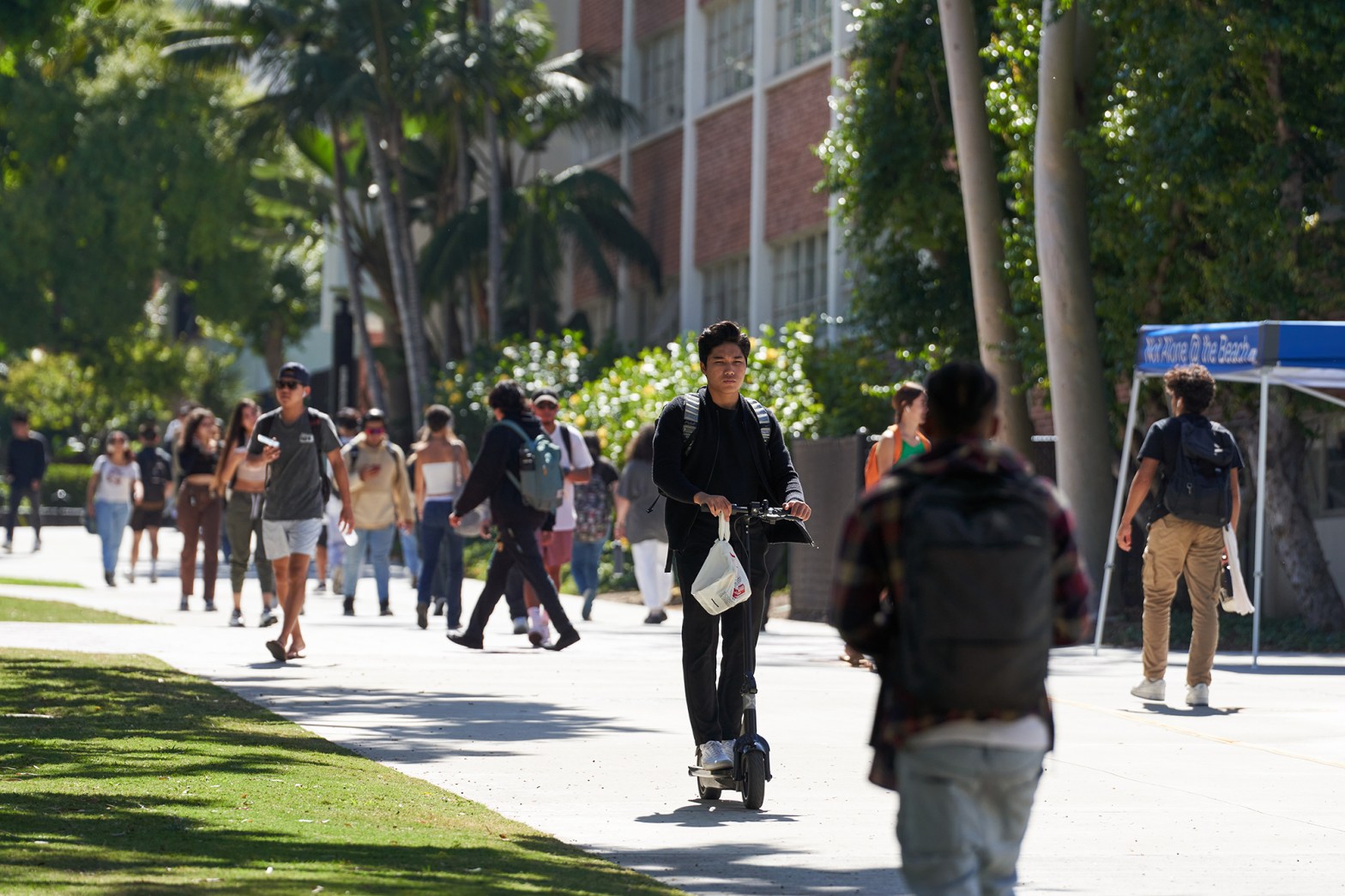
A student rides his scooter among walkers at Cal State Long Beach on Oct. 4, 2023. Photo by Lauren Justice for CalMatters
But in recent years, we’ve also seen new vehicles enter the bike lane — small electric mopeds, e-dirt bikes, e-unicycles, electric scooters and skateboards, and electric autonomous delivery bots, just to name a few. Numerous communities across California have passed measures to restrict and regulate who can ride which devices and where they can ride them.
This piecemeal effort opens the door for local police to target youth of color, and writing tickets on the bike path doesn’t address the bigger issues of education for all road users and the need for safe spaces to ride and recreate. All too often, regular folks riding bikes pay the price, with their access to safe off-street trails and paths restricted.
With the creation of the California Independent Electric Mobility Council, CalBike seeks to remedy this and provide models for e-mobility regulation that can be used across California.
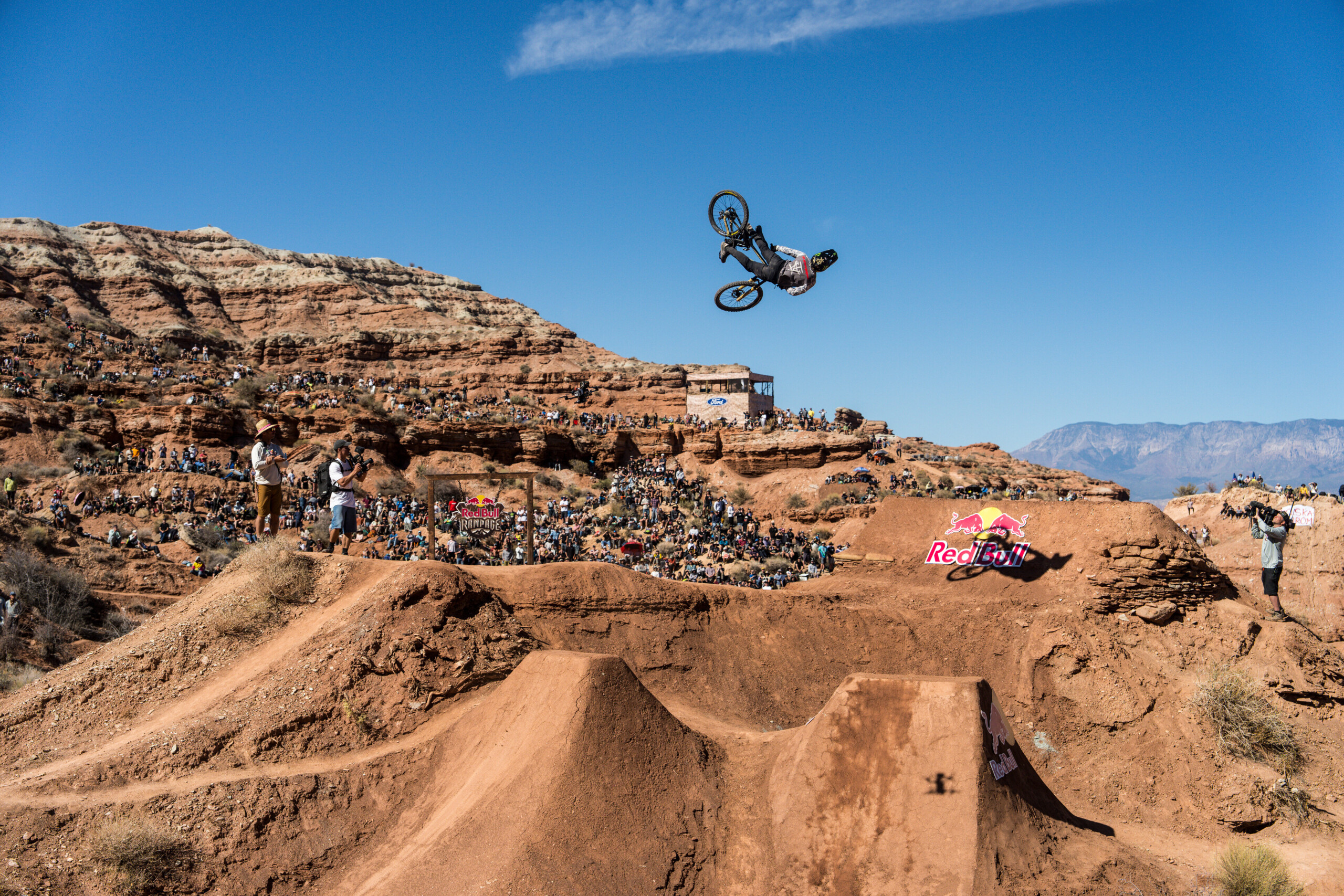
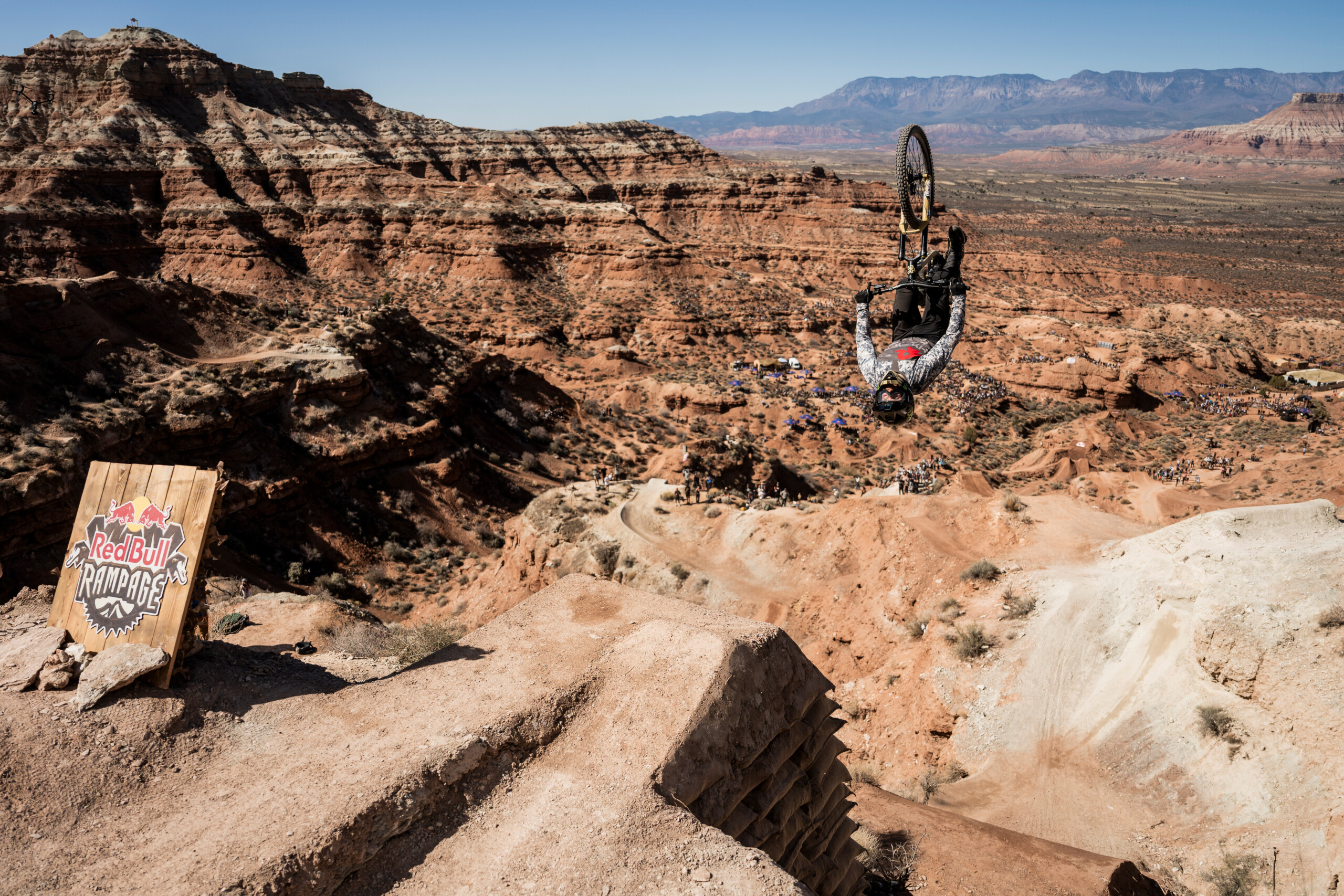
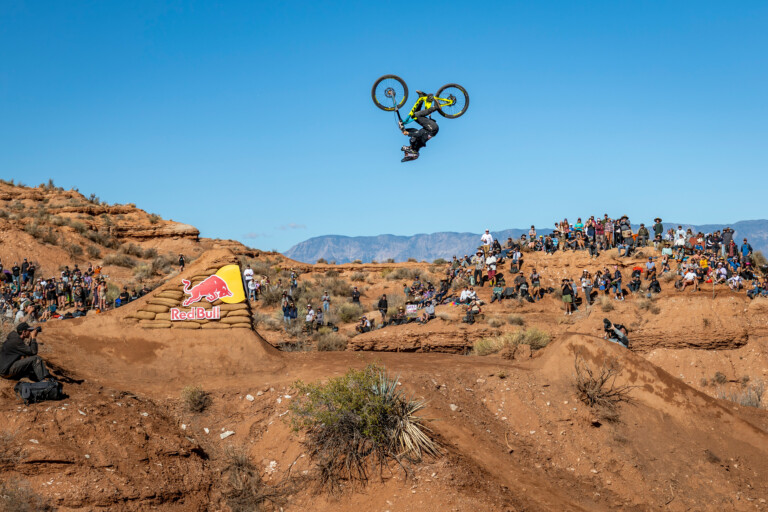
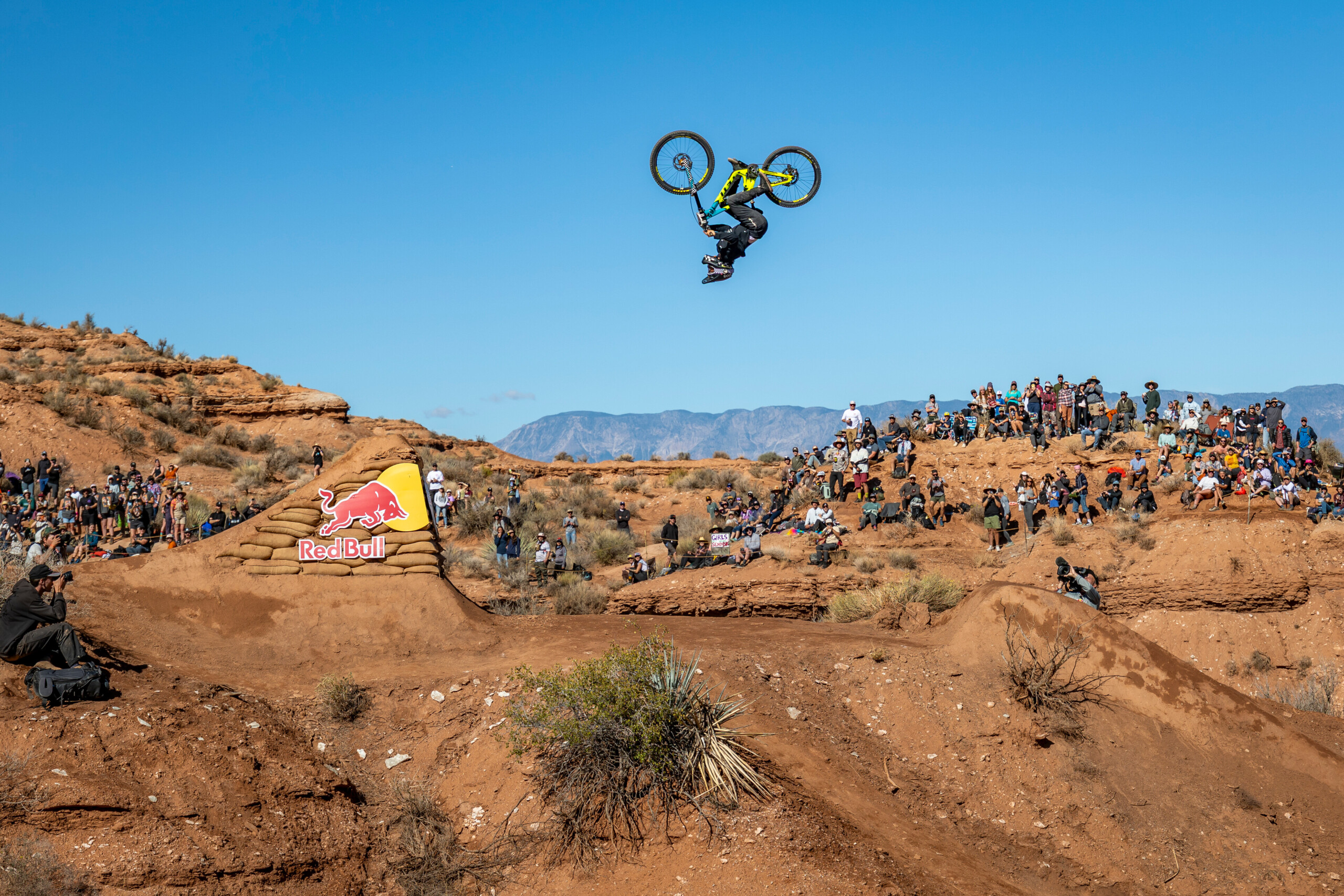
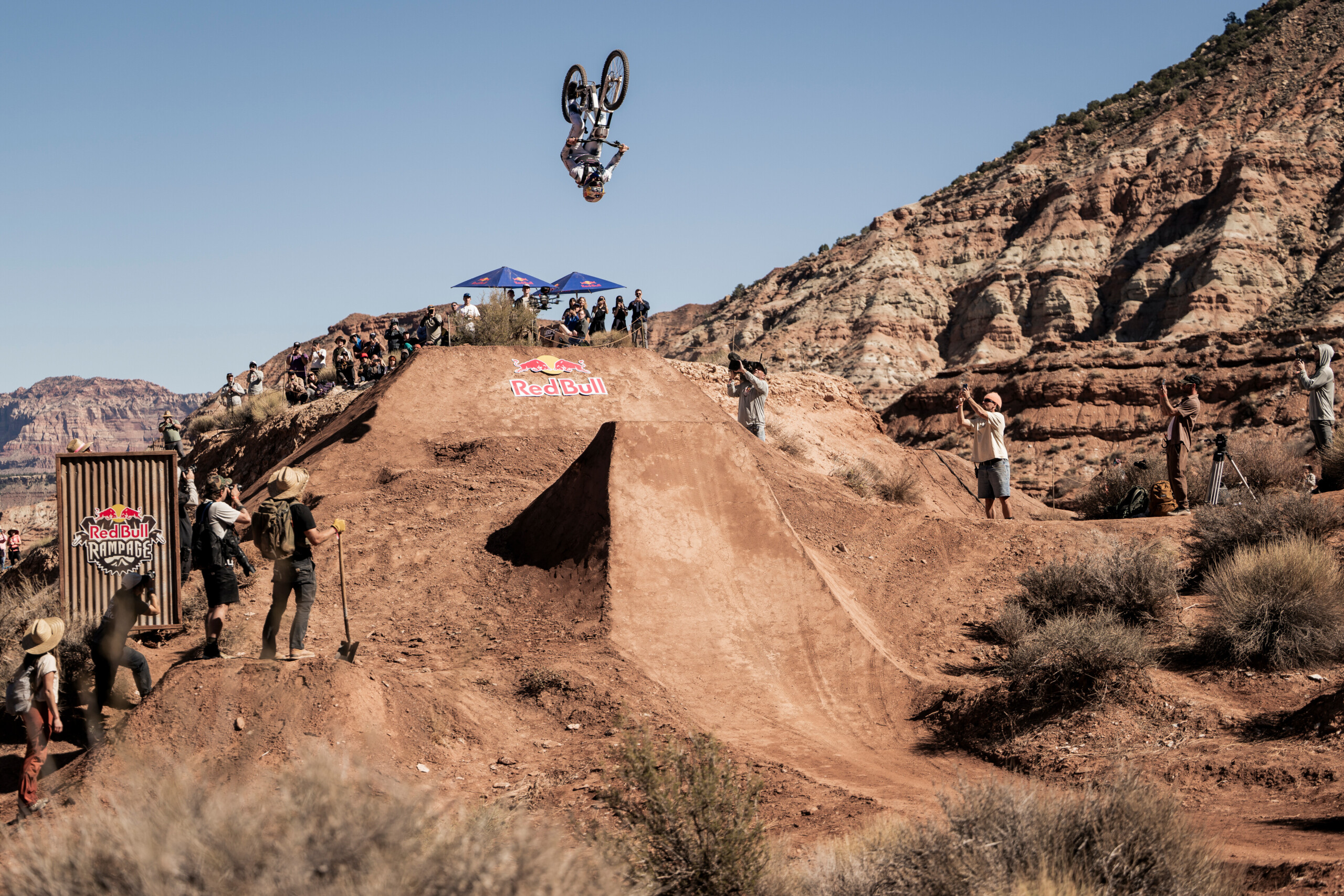
VIRGIN, Utah (October 19, 2025) — Red Bull Rampage is the pinnacle of big-mountain freeride – a contest that tests creativity, control and courage on the most demanding terrain on Earth. The 2025 edition brought two days of world-class freeriding to the Utah desert, with athletes taking on the raw sandstone ridgelines and near-vertical chutes that define the event.
On Friday, October 17, the women’s competition saw New Zealand’s Robin Goomes claim a second successive victory at the second women’s edition of Red Bull Rampage, landing two Backflips and Suicide No-Handers on a incredibly exposed line that showcased progression and precision across Utah’s iconic cliffs.
Two days later, the men’s elite returned to Virgin to push freeride performance to its limits. First-time competitor Hayden Zablotny of Canada delivered a sensational second run after crashing during his first attempt, securing victory at the 2025 Red Bull Rampage and overcoming fierce competition from the world’s best big-mountain riders.
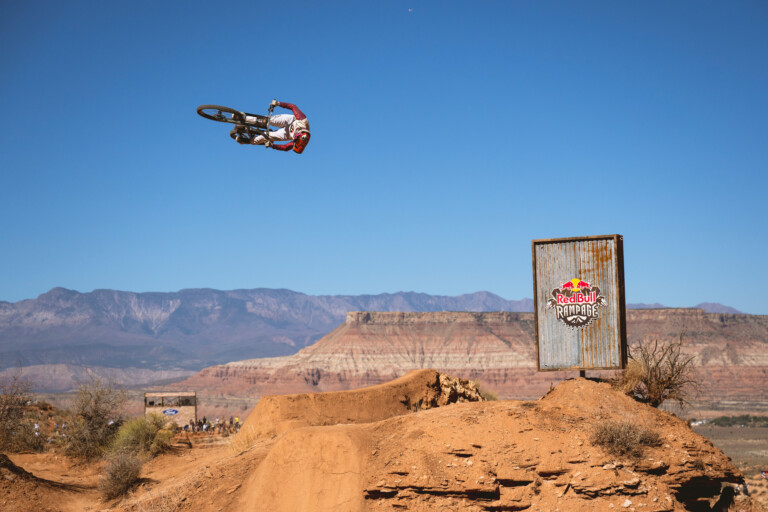
Hayden Zablotny competes at Red Bull Rampage in Virgin, Utah, USA on October 19, 2025 // Bartek Wolinski / Red Bull Content Pool // SI202510200085 // Usage for editorial use only //
A Rookie’s Historic Victory
The 2025 Red Bull Rampage Men’s Competition showcased the next evolution of freeride mountain biking, as athletes carved bold, creative lines across one of Utah’s most iconic big-mountain venues. Often referred to as the Super Bowl of mountain biking, Red Bull Rampage is the world’s premier big-mountain freeride competition, first held in 2001 in Virgin, Utah, challenging the world’s best riders to build and ride their own lines down some of the planet’s most rugged desert terrain.
This year’s course returned to an area used in 2016, 2017 and 2021, and featured steep sandstone faces, exposed ridgelines and massive natural gaps – demanding absolute precision and power. Riders spent days sculpting their lines using only hand tools alongside two-person dig teams, shaping the mountain into a stage for world-class performance.
17 of the world’s best freeriders dropped-in for finals in this invite-only event where riders build and ride their own line, scored by judges on difficulty, execution, flow, amplitude, and tricks. But it was a Red Bull Rampage rookie who walked away with an historic victory. 22-year-old Canadian Hayden Zablotny crashed on a trick jump during his first run, but delivered a sensational second run to score 96.00 points from the judges and become the first rookie winner since record Red Bull Rampage champion Brandon Semenuk.
Hayden Zablotny competes at Red Bull Rampage in Virgin, Utah, USA on October 19, 2025 // Bartek Wolinski / Red Bull Content Pool // SI202510200084 // Usage for editorial use only //
Starting his run with a unique and incredible technical double drop directly from the start platform, Zablotny landed two 360 Flatspins, a huge Flat Drop Backflip, Suicide No-Hander and a final Opposite 360 Flatspin during his winning run. “I was trying to stay as calm as possible and keep my nerves under control,” said Zablotny after his victory. “I just wanted to build something that would showcase my building and riding style – and something I’d be stoked on riding as well.”
Hayden Zablotny wins at Red Bull Rampage in Virgin, Utah, USA on 19 October, 2025. // Paris Gore / Red Bull Content Pool // SI202510200051 // Usage for editorial use only //
Zablotny’s team also won the Digger Award for the line they sculpted out of the mountainside, while local favourite Jaxson Riddle won both the GoPro Moment and Best Trick Awards for a huge Backflip Heel Clicker.
A Veteran’s Long-Awaited Breakthrough
Finishing 1.65 points behind Zablotny on 94.35, Red Bull Rampage veteran Thomas Genon of Belgium scored his first-ever podium in his 12th appearance. After losing points for running off his line during run one, Genon rebounded by landing a 360 on exceptionally exposed first drop – one of the biggest tricks of the day – to start his second run and rode a fast, stylish line to score his first podium after three fifth place finishes in previous years.
Thomas Genon competes at Red Bull Rampage in Virgin, Utah, USA on October 19, 2025. // Christian Pondella / Red Bull Content Pool // SI202510200049 // Usage for editorial use only //
“I realised that the first spin drop was going to be the point decider,” said Genon. “I had one more trick in mind and I didn’t pull the trigger because I didn’t want to throw it all away. It’s cliché, but I’ve been working at this for so long and started to think I probably wouldn’t get a podium. I advise everyone to keep pushing.”
Thomas Genon competes at Red Bull Rampage in Virgin, Utah, USA on October 19, 2025 // Bartek Wolinski / Red Bull Content Pool // SI202510200050 // Usage for editorial use only //
Another Red Bull Rampage veteran, Canada’s Tom Van Steenbergen, completed the podium on 94.00 points, just 0.35 behind Genon. The two-time previous podium finisher also made the podium with his second run performance, which started with his signature Caveman Drop, where he dropped into his line with his bike in his hands, mounting it in mid-air.
Tom Van Steenbergen competes at Red Bull Rampage in Virgin, Utah, USA on October 19, 2025. // Christian Pondella / Red Bull Content Pool // SI202510200128 // Usage for editorial use only //
“I knew in my first run the exact mistake I made and the adjustment that needed to happen,” said Van Steenbergen. “I was so relieved and I have a lot of bad history at this venue, so I’m beyond stoked to get a podium.”
Tom Van Steenbergen competes at Red Bull Rampage in Virgin, Utah, USA on October 19, 2025 // Bartek Wolinski / Red Bull Content Pool // SI202510200099 // Usage for editorial use only //
The Ultimate Test of Skill and Courage
Each year at Red Bull Rampage, athletes are judged on difficulty, execution, flow, amplitude, and creativity, making it the ultimate test of skill, imagination, and courage on two wheels. Set against Utah’s iconic sandstone cliffs, it has become the benchmark for progression in mountain biking — a proving ground where innovation, artistry, and athleticism collide.
For a select few of the world’s best mountain bikers, Red Bull Rampage is the event that defines careers — the one every pro dreams of riding and every fan stops to watch. It’s the pinnacle of freeride mountain biking, where athletes descend near-vertical cliffs, perform world-first tricks, and craft their own lines through the most technical terrain on Earth.
Since its debut in 2001, Red Bull Rampage has shaped the evolution of mountain biking, driving the sport from remote desert cliffs to a global audience. The 2025 edition marked the 19th Red Bull Rampage since its inaugural event, reaffirming its place as the ultimate showcase of creativity, courage, and human potential — a competition that continues to inspire riders and redefine the boundaries of big-mountain freeride.
Both the men’s and women’s events were broadcast live on Red Bull TV and the Red Bull Bike YouTube channel, with the men’s event airing Sunday, October 19. The Men’s Red Bull Rampage 2025 replay is now available on Red Bull TV and the Red Bull Bike YouTube channel, alongside the Women’s Red Bull Rampage 2025 replay, featuring Robin Goomes and the world’s top female freeriders tackling Utah’s sandstone cliffs in spectacular style.
By Daniel Romm, McGill University — Montréal is often hailed as the most “biking-friendly” city in North America. But our research has found that only 2.3 per cent of the city’s roadways are allocated to bike infrastructure, with car infrastructure occupying the remaining 97.7 per cent of road space.
We measured the street space allocated to transport infrastructures across Montréal, and contrasted it with traveller counts by travel mode. We found a wide discrepancy: comparing bike travellers with car travellers, bikes represent 4.9 per cent of trips to 95.1 per cent for cars.
Montreal is filled with cyclists. Photo by Dave Iltis
Proposals for new or expanded bike lanes are often met with fiercebacklash, in a phenomenon dubbed “bikelash,” with car drivers reluctant to lose any street space.
After all, a key advantage of bicycles is their incredible space-efficiency. Even if all the bike infrastructure space in the city were to double, the proportion of roadway given to cars would not fall below 90 per cent in any borough.
Sharing space
Our research, with a focus on improving communication about street space use, presents several measures of spatial allocation. The first, and simplest measure, is the space allocated to a specific transport infrastructure.
Maps of indicators of bike infrastructure space per traveller in Montréal, per borough. (D. Romm)
We found that 97.7 per cent of road space was dedicated to cars, and 2.3 per cent to bicycles. When we included sidewalks, 79.6 per cent of space was taken up by cars, 18.8 per cent to sidewalks and just 1.6 per cent for bikes.
Boroughs typically associated with cycling tended to have the greatest proportion of space given to bike infrastructure. In Montréal, Le Plateau-Mont-Royal, a neighbourhood viewed as trendy and bike-friendly, leads with 4.7 per cent.
Proportions allocated
The second measure we used in our research is space per traveller per mode of travel.
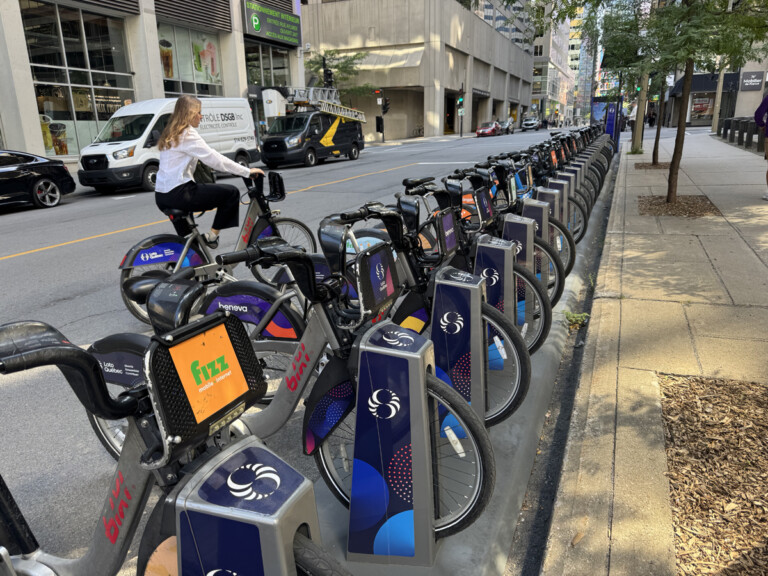
BIXI bike share bicycles are everywhere in Montreal. Here, a cyclist rides one in the Plateau Mont Royal neighborhood. Photo by Dave Iltis
In Le Plateau Mont-Royal, where 21.9 per cent of trips started in that borough are by bicycle, we find that drivers are given 3.4 square metres per traveller, while bike travellers are allocated 1.5 square metres per traveller. This measure can be used to understand the relationship between infrastructure space and traveller counts.
We can also present this as the difference between the space allocated to bike infrastructure and the percentage of cyclists, which shows the discrepancy between space and travel across the city.
A cyclist on a BIXI bike in Ville Marie, Montreal. Photo by Dave Iltis
We developed the Equal Infrastructure Allocation (EIA) score to understand how the space per traveller for one mode compares to that for another. We used the EIA to compare the bike space per traveller to the space per traveller for those in cars: when the EIA is zero, car and bike travellers are allocated the same amount of space per traveller. When the EIA falls below zero, space is biased in favour of the automobile.
Using the EIA, we found that nine of Montréal’s 19 boroughs present spatial inequality in favour of cars; Le Plateau had the worst score at -0.55.
Doubling lanes
These measures can also be modelled for prospective changes to infrastructure, such as installing a new series of bike lanes, to better communicate about how such projects would affect the space.
BIXI bike share stations are everywhere in Montreal making it super easy to get around the city without a car. Photo by Dave Iltis
In April 2024, Montréal’s BIXI bikeshare system had more than 11,000 bikes at over 900 stations. That’s a lot of bikes, but because they’re so space-efficient, the total space used by BIXI in Montréal is just 0.021 square kilometres. If BIXI were to double the number of bikes and stations, the amount of car space per traveller would decrease by 0.003 square metres.
We modelled what would happen if we were to double all the bike infrastructure in Montréal. We found that space would increase for bikes by 4.4 square metres per traveller; meanwhile, the space for someone travelling by car would decrease by 0.2 square metres.
In Le Plateau, drivers would lose just 0.15 square metres per traveller, and across the city, all but two boroughs would have positive EIA scores.
Maps of the effect of doubling all bike infrastructure space in Montréal on indicators, per borough. (D. Romm), CC BY
The current imbalance of space per traveller is so far in favour of cars that bike infrastructure projects improve the spatial picture for cyclists to a far greater extent than they worsen spatial allocation for drivers.
There are many well-established reasons for improving bike infrastructure and encouraging sustainable travel modes, including reducing reducing car fatalities.
Our findings corroborate this, finding a strong correlation between more bike infrastructure with decreased collision rates of cars with bikes.
Addressing opposition
Bike infrastructure projects often face intense, entrenched opposition. Our research provides tools for planners, policymakers, advocates and researchers to evaluate the current spatial picture, and to illustrate what the effects of alternative infrastructure would look like.
In our study of Montréal’s streets, we found that even with bike infrastructure improvements at a scale dramatically larger than anything proposed today, street space still remains biased in favour of cars.
VIRGIN, Utah (October 17, 2025) – Red Bull Rampage is the premier big mountain freeride event and one of the toughest action sports competitions in the world. A contest that tests creativity, control and courage on the most demanding terrain on Earth. The 2025 edition continued the event’s evolution with the second women’s competition on the legendary cliffs of southwest Utah, where riders faced raw sandstone ridgelines and near-vertical chutes in a showcase of power, precision and progression.
Defending champion Robin Goomes of New Zealand made it two wins from two appearances at the second women’s edition of Red Bull Rampage on Friday, October 17. Goomes delivered a standout run featuring two Backflips on a highly exposed line that secured her place in freeride history, as the world’s top female mountain bikers carved creative new lines and redefined what’s possible on the Utah cliffs.
Red Bull Rampage 2025 marks a new era for the event, expanding into two adrenaline-filled days of competition: the women’s event on Friday, October 17 and the men’s event on Sunday, October 19, streamed live on Red Bull TV and the Red Bull Bike YouTube channel.
A Defining Moment in Freeride History
The 2025 Women’s Red Bull Rampage marked another defining moment in freeride history as the world’s top female mountain bikers returned to Utah’s iconic sandstone cliffs for the sport’s biggest stage. First held in 2001 in Virgin, Utah, Red Bull Rampage has become the world’s premier big-mountain freeride competition, challenging the world’s best riders to build and ride their own lines down some of the planet’s most rugged desert terrain.
Held on the 2014–15 venue – the same landscape that hosted Red Bull Formation in 2019 and 2022 – the women’s event built on the foundation that helped establish female freeride at the highest level. Returning riders such as Hannah Bergemann and Harriet Burbidge-Smith were joined by a new generation of athletes ready to carve their own lines and push progression further.
“This terrain has so much opportunity for creative riding,” said Hannah Bergemann. “It’s amazing to see how far women’s freeride has come and to be part of this second Red Bull Rampage women’s competition feels surreal.”
Each competitor and their two-person dig team spent several days sculpting creative, technical lines using only hand tools – a process that tested precision and imagination as much as strength. When finals day arrived, riders faced exposed ridgelines, massive step-downs and sheer chutes in runs that demanded both control and commitment. The invite-only event format requires riders to build and ride their own line, with judges scoring on difficulty, execution, flow, amplitude and tricks.
Championship Performance
The seven riders who dropped in for finals took the level up considerably compared to the first year’s competition, both in terms of the lines built and the riding they delivered. Despite some last minute changes to their lines for winner Robin Goomes and runner-up Hannah Bergemann, both delivered brilliant performances on their first runs that locked-in their 1–2 finishes.
Robin Goomes competes during Red Bull Rampage in Virgin, Utah, USA on 17 October, 2025. // Long Nguyen / Red Bull Content Pool // SI202510171859 // Usage for editorial use only //
Riding a true freeride line that featured the only natural scree chute, defending champion Goomes added in two Suicide No-Handers off drops, a Crankflip and two big Backflips during her opening run to score 89.50 points from the judges. It was a score that none of her rivals could match and makes her only the second back-to-back winner of Red Bull Rampage after record men’s winner Brandon Semenuk.
“I was really proud of my first run,” said Goomes after her victory. “The main goal is to ride your run well. Obviously, I wanted to win, but all you can do is ride your best and if you can do that, you have a good chance.”
Hannah Bergemann at Red Bull Rampage in Virgin, Utah, USA on October 17, 2025. // Bartek Wolinski / Red Bull Content Pool // SI202510180118 // Usage for editorial use only //
Making her Red Bull Rampage debut after missing the 2024 event through injury, Bergemann took over the injured Vaea Verbeeck’s incredibly exposed line at the last minute and calmly handled the big chutes and drops. She then Backflipped a big double jump further down the course to come up just short of Goomes’s winning score, but the 89.33 from the judges handed her a first Red Bull Rampage podium.
Bergemann was also unanimously voted the winner of the athlete-voted McGazza Spirit Award, with riders noting that she always maintained a positive attitude and high stoke during the event. “The score was so tight I felt like I needed to try any little thing to change the score,” Bergemann reflected. “I’m still so happy with how I rode and how everyone rode. My goal is completed and it’s a cherry on top to be on the podium.”
Battle for the Podium
The battle for third place pitched the calm precision of 2024 runner-up Georgia Astle against the attacking agression of Argentina’s Cami Nogueira. Despite Nogueira sending her drops farther than anyone, a No-Hander on the last big drop into the finish arena just put Astle on the podium for the second year in a row with 87.66 points to 87.33.
Georgia Astle competes in women’s finals at Red Bull Rampage in Virgin, Utah, USA on October 17, 2025. // Christian Pondella / Red Bull Content Pool // SI202510180346 // Usage for editorial use only //
“I’m so relieved for all of the girls,” said Astle after securing third place. “We all got two runs in. There was no wind and I’m hyped for us. I was excited to get through my second run.”
After dislocating her elbow in a crash during training and losing a day of practice, Nogueira’s commitment in finals was even more impressive and she was duly awarded the BFGoodrich Tires Toughness Award while Red Bull Rampage rookie Kirsten Van Horne grabbed the Utah Sports Commission Best Trick Award for her gutsy Suicide No-Hander on her big drop.
A Growing Legacy
Each year at Red Bull Rampage, athletes are judged on difficulty, execution, flow, amplitude, and creativity, making it the ultimate test of skill, imagination, and courage on two wheels. Set against Utah’s iconic sandstone cliffs, it has become the benchmark for progression in mountain biking, a proving ground where innovation, artistry, and athleticism collide.
The 2025 event celebrates another major milestone for women’s freeride, expanding into two days of high-adrenaline action that honour both the pioneers and the next generation of riders. The women’s event aired Friday, October 17 at 10:30am MT (18:30CEST) on Red Bull TV and the Red Bull Bike YouTube channel, with the men’s event scheduled for Sunday, October 19 at 10:30am MT (18:30 CEST).
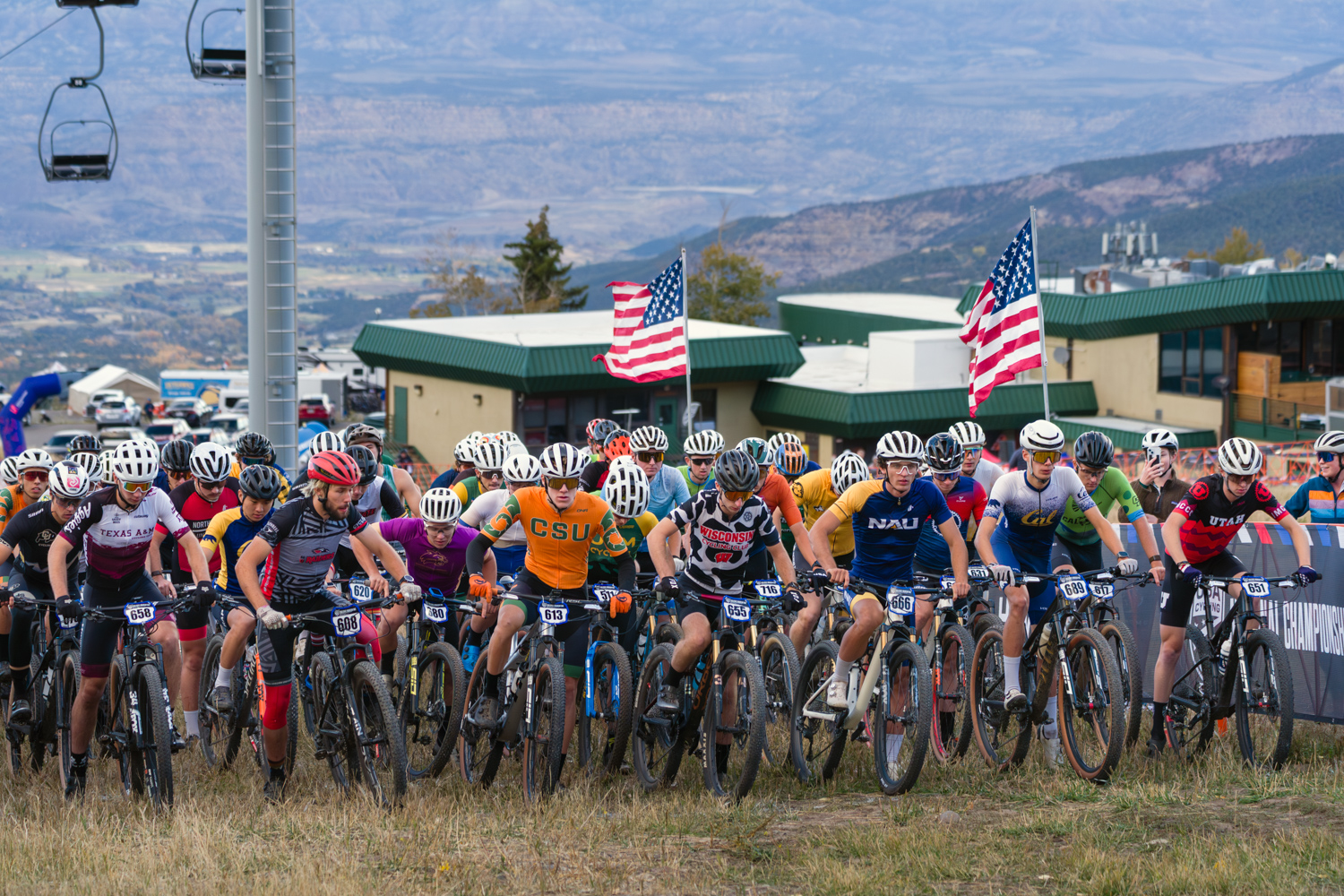
GRAND JUNCTION, Colo. – October 14, 2025 — The 2025 USA Cycling Collegiate Mountain Bike National Championships wrapped up Sunday after three days of racing at Powderhorn Mountain Resort. Despite shifting weather and a packed schedule, riders from across the country battled for national titles across all four disciplines. Colorado Mesa University and Colorado School of Mines earned the Varsity and Club Team Omnium titles, respectively.
USA Cycling Collegiate MTB National Championships: Club Male Cross-Country Short Circuit (XCC) race at Powderhorn Mountain Resort near Grand Junction, Colorado, USA on October 09, 2025. (Photo: Craig Huffman / Trek Zero Media)
Short Track
Racing opened Thursday with Short Track. In the Club Men’s event, Ben Stokes (Norwalk, Conn.; Colorado School of Mines) rode to victory ahead of Preston Johnson (Springville, Utah; University of Utah) and Jack Lootens (Flagstaff, Ariz.; Northern Arizona University Cycling).
In the Club Women’s race, Mahika Peterson (Boise, Idaho; Colorado School of Mines) outsprinted Elin Hartmann (Minneapolis, Minn.; Colorado State University) for the win, while teammate Anna Haemer (Greenwood Village, Colo.) completed the podium.
Colorado Mesa University swept the Varsity Men’s podium, with Ivan Sippy (Grand Junction, Colo.) taking the win ahead of teammates Colin O’Neil and Jack Spranger. In Varsity Women, Makena Kellerman (Grand Junction, Colo.; Colorado Mesa University) secured the national title in 19:52, followed by Nicole Bradbury (Brevard, N.C.; Brevard College) and Jette Aelken (Savannah, Ga.; Savannah College of Art and Design).
Cross-Country
Heavy rain in the forecast forced officials to move the Cross-Country races to Thursday. The Club Men’s race came down to a sprint between Justin Peck (Los Gatos, Calif.; UC Berkeley) and Preston Johnson, with Peck edging out the win. Stokes claimed bronze.
Sippy doubled up in the Varsity Men’s event, claiming his second Stars and Stripes jersey of the day ahead of Owen Clark (Brevard, N.C.; Brevard College) and O’Neil. Hartmann captured the Club Women’s title in 1:20:29, with Peterson and Haemer rounding out the podium.
In Varsity Women, Bailey Cioppa (Durango, Colo.; Fort Lewis College) rode away solo to win by more than three minutes. Kellerman and Elisabeth Knight (Grand Junction, Colo.; Colorado Mesa University) finished second and third.
Team Relay
Thursday closed with the Team Relay. Colorado Mesa University took top honors in the Varsity event, with Brevard College second and Fort Lewis College third. Colorado School of Mines claimed the Club title ahead of California Polytechnic-San Luis Obispo and Colorado State University.
Downhill
To avoid incoming storms, the Downhill competition was held Friday. Defending champion Gwen Ramsey (San Luis Obispo, Calif.; California Polytechnic-San Luis Obispo) repeated in the Club Women’s race, clocking 8:01.597 to beat Avah Cherry (Knoxville, Tenn.; University of Tennessee) and Aila Harmala (Silverthorne, Colo.; Colorado School of Mines).
In Varsity Women, Colorado Mesa’s Maylei Leaneagh (8:06.751) and Tai-Lee Smith (8:07.312) went one-two, with Mya Dixon (Brevard, N.C.; Brevard College) third.
Aaron Bailey (Ashland, Ore.; Southern Oregon University) topped a 55-rider Club Men’s field in 7:17.923, followed by Peck and Lucian Rodriguez (Boulder, Colo.; University of Colorado Boulder). The Varsity Men’s win went to Carson Beard (Durango, Colo.; Fort Lewis College) with a run of 6:51.509, ahead of Matthew Leliveld (Brevard, N.C.; Brevard College) and Spranger.
Dual Slalom
Sunday’s Dual Slalom finals closed out the weekend. Cherry added to her medal haul, winning the Club Women’s race over Haydn Hludzinski (Boulder, Colo.; University of Utah) and Gillian Millar (San Luis Obispo, Calif.; California Polytechnic-San Luis Obispo).
In Varsity Women, Breanna Winter (Indianapolis, Ind.; Marian University) successfully defended her title, with Oona Nelson (Durango, Colo.; Fort Lewis College) second and Lily-Rose Marois (Brevard, N.C.; Brevard College) third.
Andrew Driscoll (Bow, N.H.; University of Vermont) captured the Club Men’s national title, finishing ahead of Ben Mackenzie (Golden, Colo.; Colorado School of Mines) and Josh Billow (Bow, N.H.; Clarkson University). Grant Lampson (Grand Junction, Colo.; Colorado Mesa University) won the Varsity Men’s event, with Jordan Callum (Indianapolis, Ind.; Marian University) and Dominic Mudry (Banner Elk, N.C.; Lees-McRae College) rounding out the podium.
Omniums
The Individual and Team Omniums recognized the best all-around riders and programs from the week.
Club Women’s Individual Omnium
Avah Cherry (Knoxville, Tenn.; University of Tennessee)
Gwen Ramsey (San Luis Obispo, Calif.; California Polytechnic-San Luis Obispo)
Gillian Millar (San Luis Obispo, Calif.; California Polytechnic-San Luis Obispo)
Varsity Women’s Individual Omnium
Nicole Bradbury (Brevard, N.C.; Brevard College)
Lily-Rose Marois (Brevard, N.C.; Brevard College)
Oona Nelson (Durango, Colo.; Fort Lewis College)
Club Men’s Individual Omnium
Justin Peck (Los Gatos, Calif.; UC Berkeley)
Luke Leavitt (Boulder, Colo.; Colorado State University)
Simon Phipps (Norwich, Vt.; California Polytechnic-San Luis Obispo)
Varsity Men’s Individual Omnium
Jack Spranger (Grand Junction, Colo.; Colorado Mesa University)
Carson Beard (Durango, Colo.; Fort Lewis College)
Ian Schwing (Savannah, Ga.; Savannah College of Art and Design)
Varsity Team Omnium
Colorado Mesa University – 676 points
Brevard College – 635 points
Fort Lewis College – 612 points
Club Team Omnium
Colorado School of Mines – 621 points
California Polytechnic-San Luis Obispo – 593 points
By Nancy Clark MS RD CSSD — Listening to podcasts while exercising can be a convenient opportunity to educate yourself about all-things-nutrition. Nutrition podcasts can not only entertain you during yet-another long run, erg session, or workout at the gym, but also teach you how to fuel better so you can enjoy better results from your workouts.
To help you choose trustworthy podcast selections, I have listed below a few options with topics of potential interest to athletes—health, energy, eating disorders, injury repair, current food-controversies, plus more. I hope you will take advantage of these opportunities to learn from these top-notch nutrition researchers and clinicians from around the globe.
Image: Public domain.
Given many sports nutritionists do not have their own podcasts, you might also want to google podcasts with ___. Fill in the blank with respected clinicians and exercise physiologists such as Louise Burke, Stu Phillips, Asker Jeukendrup, and Trent Stellingwerff. You’ll be able to listen to these guests on someone else’s podcast.
Sound Bites with registered dietitian (RD) Melissa Joy Dobbins.
Posted 2/month; ~ 60 minutes. Melissa’s information is popular with both dietitians and the general public. You’ll learn about topics related to your daily diet, with a focus on current trends and controversies. For example:
Posted 2/month; 30-45 minutes. Joan, a RD and nutrition professor at Boston University, covers timely nutrition topics. In her lively style, she interviews top experts who offer practical health and wellness information. For example:
Posted 1/week, ~30 minutes. Designed to address medical and nutrition questions, Colleen provides practical guidance on how to manage food for health. You’ll find food guidance that bridges the gap between medicine and nutrition.
Posted 1-2/month; ~60 min. Alan, a sports dietitian, nutrition researcher, and lecturer at Australia’s Monash University, addresses a rich variety of topics based on questions that athletes ask him as a dietitian for endurance athletes.
Posted 1/week,~60+ min. This podcast out of the Institute of Performance Nutrition features a wide variety of leading guest experts who are clinicians and/or scientists with expertise in sports and exercise nutrition or other related/relevant fields. They take a deep dive into current trends and hot topics.
Posted 1/week, ~30 minutes. The hosts take close looks at the science on health-related topics that may be a source of controversy. They debunk health myths and clarify the confusion with facts.
Posted 1/week; ~60 minutes. Hosted by mental skills coach Carrie Jackson and health/fitness journalist and runner Cindy Kuma, this podcast offers support to athletes dealing with sports injuries. The podcast creates a community that offers hope to help make the recovery journey easier. The hosts interview athletes who have recovered from an injury, if not an injury after injury after injury.
After having listened to Why Should I Trust You?, I now better understand why so many people today mistrust messages related to food additives, ultra-processed foods, seed oils and other public health issues. One answer: Too many nutrition scientists need to offer clearer messages to the public. Two sources of clear messaging are Dr. Andrea Love PhD and Dr. Jessica Knurick PhD. They can help you better understand facts vs. hype You can follow @dr.AndreaLove and @drJessicaKnurick on social media channels such as Instagram and substack.
May these sources of science-based nutrition and health information address your questions and food concerns, enhance your health and athletic performance, resolve nutrition confusion, and add listening enjoyment to your long workouts.
Partnership with SCOTT Sports expands summer offerings and cements local ties
SNOWBASIN, Utah (October 16, 2025) — Snowbasin Resort is set to break ground on a new lift-served mountain bike park in summer 2026, part of a multi-year partnership with SCOTT Sports, which has also been named the resort’s official helmet and eyewear partner.
A mountain biker at Snowbasin. They plan on opening a new bike park in 2026. Photo by Jimmie/Snowbasin
The new bike park “Powered by SCOTT” will be located off the Littlecat Express and debut with four to five trails designed to accommodate riders of all skill levels. Plans include beginner-friendly terrain with mellow grades, dirt berms, and wooden skill features, as well as intermediate and advanced flow trails packed with berms, tabletops, and wooden features. The park will be built with room to expand in future seasons, positioning Snowbasin as a major summer destination for mountain biking in Northern Utah.
To complement the new trails, SCOTT bike rentals will be available at the Grizzly Center beginning in 2027, integrating the brand’s equipment into the resort’s growing summer operations.
“SCOTT is a brand we trust with gear we trust, and as a 4-season brand, it makes sense to bring great gear to our guests all year round,” said Davy Ratchford, General Manager at Snowbasin Resort. “It’s also a hometown partnership in the truest sense. With our mountains and their headquarters just miles apart, the connection is both strategic and deeply personal.”
“Partnering with Snowbasin is an exciting and authentic step for SCOTT,” added Hap Seliga, CEO of SCOTT USA. “This mountain is part of our local culture and a place where many of our employees, athletes, and customers ride year-round. We’re thrilled to bring our helmet and eyewear expertise to a resort that shares our passion for performance and innovation.”
Based in Ogden, just minutes from Snowbasin, SCOTT will also supply helmets, goggles, and eyewear for the resort’s winter and summer operations. Employees and pass holders will receive special pricing and exclusive product benefits through the partnership.
The collaboration highlights a growing focus on year-round recreation at Snowbasin, blending world-class skiing with new mountain biking opportunities backed by a global outdoor brand with deep local roots.
No Exit Bike Cartoon by Andy Singer: A city engineer explains that they don’t need to put bike lanes on Main Street because there’s a nearby parallel route and he shows a map of a convoluted, complex, absurdly long parallel bike route.
By Andrew Phillips, Esq. – The right hook happens when a motorist makes a right turn across the path of a cyclist who is riding in the same direction as the motor vehicle.
In last month’s column, I discussed the Left Hook. Another common and dangerous cycling vs car collision is the Right Hook. By knowing what the right hook is, you can be better prepared to avoid being “knocked out” by one while on a ride.
The right hook happens when a motorist makes a right turn across the path of a cyclist who is riding in the same direction as the motor vehicle. Graphic courtesy Andrew Phillips
Here is a Right Hook scenario:
A cyclist is riding straight ahead on the right side of the road or in a designated bike lane. A motorist who is travelling in the same direction passes the cyclist on the left and then turns right in front of cyclist’s path cutting them off. The cyclist is left with a few options: brake hard to avoid crashing, get hit by the motorist that has just turned in front of them, get forced into the curb or off the road, collide with a stationary object like a car or pole that is to their right.
Right hooks happen because the motorist doesn’t see the cyclist on the right as they prepare to turn or the driver assumes the cyclist will stop or yield, even though the cyclist has the right of way.
How to Avoid or Reduce the Risk of a Right Hook Collision:
Avoid the “death zone”. Don’t ride along side a vehicle that may potentially turn right. Even though you have the right of way, does not mean the motorist will respect your space or that they have even seen you. Let the vehicle pass, slow down, and be on your hoods and assume that they just might turn into your lane.
Control your position when entering an intersection. If you have enough time and an upcoming vehicle is not traveling at light speed, move towards the center of the lane to make yourself more visible and to discourage the car from passing and turning in front of you.
Watch for turn signals, body language and other cues. Turn signals, although not used by all motorists, allow you to react accordingly. Additionally, watch a driver’s head to see if they look to the right in preparation for their upcoming turn. Finally, pay attention to see if the vehicle is slowing or starting to creep into your path. These small actions can give you enough time to avoid a collision.
Be Extremely Cautious at Intersections and Driveways. When approaching a driveway or intersection be proactive and ride as if a vehicle on your left is going to turn into you. Be vigilant and always on the offensive.
Be Visible and Predictable. Use a bright rear light that grabs the attention of a motorist, a highly visible kit or shirt, or reflective gear. Far too often a driver’s response after hitting a cyclist is, “I just didn’t see them. They came out of nowhere.” In addition, ride predictively. Signal your intentions and ride a steady line to avoid confusing motorists.
By Lee Waldman — Cyclocross season began here in Colorado on September 3. Normally I would be writing about what I’m looking forward to, what my goals are and what my plans are. I might even be dispensing some advice to the OGs who follow me. Advice focuses on what we can do as aging athletes to continue to be competitive. But that’s not what I’m writing about today. Cross season did start on the third, but for the first time ever, I’m not prepared to begin racing. I am, however, prepared to get rid of the leg brace and crutches I’ve been dragging around for the past 6 weeks.
I initially injured myself on July 5 in a gravel race in Colorado. It seemed minor at the time. A fall on my hip when my front wheel slid out on a loose off camber traverse. Driving home from the race I just thought that I had badly bruised my hip and glutes. It didn’t get better. It kept hanging on until one day my wife suggested that I might have a hairline fracture. Being to “warrior” that I am, I refused to even explore the possibility. We just happened to be on an Alaska cruise at the time. I continued to ignore the nagging pain and discomfort, telling myself that I was getting better.
Lee Waldman racing cyclocross. Photo courtesy Lee Waldman
Fast forward a few days. We’re home from the cruise and I’m out on the road again. I stopped to make a quick shifter adjustment, stepped off the bike wrong, went down on the very same hip and immediately knew that I had done something. A trip to the ER confirmed a femur fracture. Another trip to an orthopedic doc further confirmed the fracture and sentenced me to at least 6 weeks in a brace and on crutches. I now had to deal with the fact that I wasn’t going to line up on September 3 for my first race of the season, but that I might not be racing at all.
I didn’t start writing this column to invite you to my personal pity. I’m writing to share some of the thinking I was forced to do as a result. The question that I’ve been struggling with is one that some of you might also be struggling with now. It may be one that some of you younger racers will have to explore in the future. Because guess what … we all get older. Our bodies start to wear out. Bones become brittle. Mentally we may get tired of the grind of hard training. For me it’s been the result of having had to recover from 2 significant injuries and another 5 days in intensive care over the last 2 plus years. It’s left me worn down in a way that I never have experienced before.
But despite the physical and emotional fog, I’ve never stopped looking forward to the day I can throw my leg over the top tube and roll out of my driveway onto the road. And, in some sort of masochistic urging I look forward to the pain that goes with every cyclocross start where I’m redlined from the gun. I can’t wait for the day when I spend every second of a race looking for a better line, trying to rail the next corner, making that next transition smoother and faster than the last one. Therein is the beauty of cyclocross for me. It’s not the winning because those moments are fleeting at best. It’s the challenge that I face every time I’m on my cross bike. The challenge to be better, smoother, more graceful than the last.
Other types of bike racing have their own inherent beauty. The sound of a peloton rolling along at 20 mph is exhilarating. The true suffering of an individual time trial is addicting. But the dancelike quality that I’ve discovered and tried to hone over the past few decades is what motivates me. Cyclocross is not gravel. There aren’t those endless stretches of road or never-ending climbs that challenge me in a different way. The grace and beauty are missing. Do I love to race gravel? Absolutely. Does it fill my bucket in the same way that cross does? Sorry, no.
Since I began writing this column, my leg has healed enough that I’ve been given the go ahead to ride on the road. It’s been almost 3 months, and I need it. It will be a few more weeks before I can pin a number on again, but I can see the end of this journey. For all of the reasons I’ve tried to share with you, I can’t wait. I may suffer. I may end up riding in the back. But I’ll be there, and I’ll be working on my “dance steps” in and endless effort to achieve something resembling grace. I hope that this column has helped you understand why you yourself race cyclocross. Or maybe it’s gotten you interested in the sport. Either way, I wish you luck.
Lee Waldman is a dyed in the wool cyclist and writer. He’s held a USAC racing license for 45 years and has raced road, mtb., gravel and his love – cyclocross. He’s a “recovering” middle school teacher and writer, having written for CX magazine for over 10 years. Most importantly, Lee is the proud grandfather of 5 grandchildren. Between training, racing, writing and being a grandpa, he’s pretty busy. Lee has two things to share. He says that he was a pretty good dad, but he’s a REALLY GOOD grandpa. He also lives by this quote from Satchel Paige: “How old would you be if you didn’t know how old you are?”
Tadej Pogačar makes history with unprecedented Monument dominance as Il Lombardia crowns its king once more
BERGAMO, Italy (10 October 2025) — The autumn light faded over Lombardy’s high passes when Tadej Pogačar did what he has now done five times in succession—what no rider in the 119-year history of the Monument Classics had ever managed before. On the savage slopes of the Passo di Ganda, with 37 kilometers still separating him from Bergamo, the double world champion in the rainbow jersey simply rode away from the last vestiges of opposition, leaving even Remco Evenepoel—his eternal rival—to chase shadows through the falling leaves.
When Pogačar crossed the line on the Via Vittorio Emanuele II after 5 hours, 45 minutes and 53 seconds of racing, he had carved out a gap of 1’48” to Evenepoel and written his name into cycling folklore in letters that may never be erased. Five consecutive victories in a Monument. Five editions entered, five editions won. The feat eluded Fausto Coppi, Eddy Merckx, and every other giant who has graced this sport.
Tadej Pogačar wins a record-setting 5th consecutive Il Lombardia. Fausto Coppi also won 5, but not consecutively. Photo La Presse/Pool
“To win Il Lombardia five times in a row, every time I started, it feels like this race really suits me,” Pogačar said seconds after dismounting. His voice carried the tremor of emotion that only arrives when history happens in real time. “But at the same time I have such a good team around me, we could pull it and I owe a big thank you to my team-mates. Domen [Novak] did a fantastic job, then Pavel [Sivakov] was also really impressive today in the chase and all the guys protecting me in the final climb, it was a top class work, just impressive from all my team-mates.”
During the 119th edition of the Il Lombardia, Tour of Lombardy cycling race, a 247 km one day race from Como to Bergamo on October 11, 2025, Italy. (Photo by Marco Alpozzi/LaPresse)
THE OPENING SALVOS
The 119th edition of Il Lombardia presented by Crédit Agricole promised 241 kilometers of suffering from Como to Bergamo—4,400 meters of climbing strung together with barely a meter of flat road between. Big crowds filled Como’s Piazza Cavour as 166 riders rolled out toward kilometer zero at 11:05 on a crisp Saturday morning. Donovan Grondin of Arkéa-B&B Hotels did not start.
The route laid out a cavalcade of Lombardian brutality: Ghisallo, Roncola, Berbenno, Dossena, Zambla Alta, and finally the Passo di Ganda, each one sharpening the selection, each one testing the mettle of the peloton.
Quinn Simmons attacked almost immediately after the flag dropped. Ten riders gained a gap, then Mattia Bais bridged up to make it eleven. By the 20-kilometer mark, the lead group had swelled to 14 riders. A chasing trio tried to make contact but the peloton swallowed them back.
Sepp Kuss crashed early. Behind, Primož Roglič’s Red Bull-Bora-Hansgrohe team moved to the front as the riders approached the Madonna del Ghisallo, the spiritual home of Italian cycling.
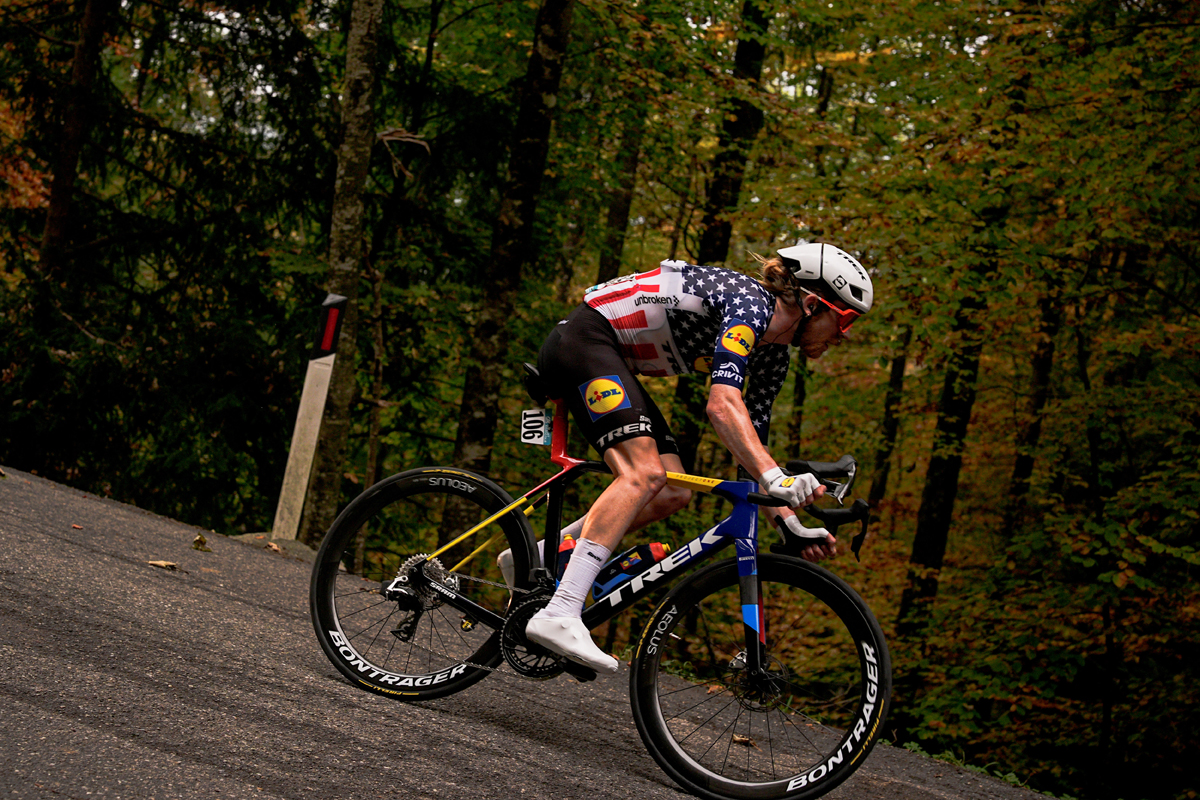
Quinn SImmons was out front alone for most of the day during the 119th edition of the Il Lombardia, Tour of Lombardy cycling race, a 247 km one day race from Como to Bergamo on October 11, 2025, Italy. (Photo by Marco Alpozzi/LaPresse)
GHISALLO AND THE FIRST SELECTION
The breakaway hit the Ghisallo with a 2’15” advantage. UAE Team Emirates and Bora-Hansgrohe controlled the peloton, keeping the gap manageable. Thomas Pidcock slid out on a corner, then suffered shoe issues that forced him to fix his equipment while the race continued.
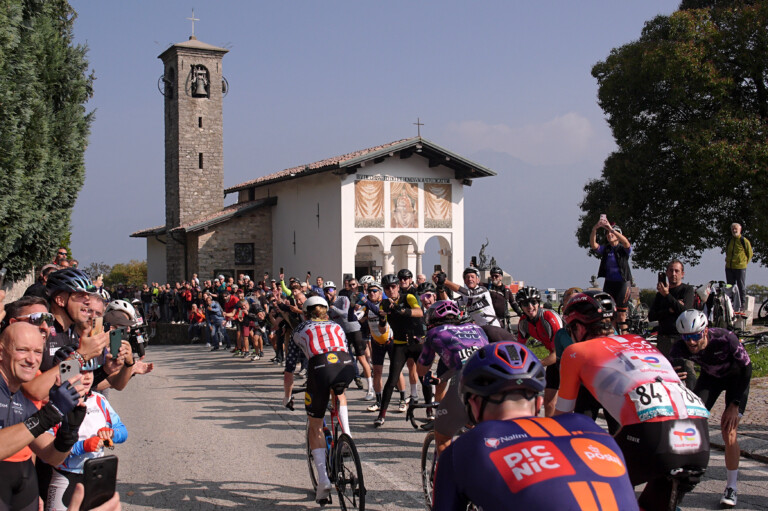
The peloton approach Il Santuario Madonna del Ghisallo, Il Lombardia 10 October 2025, Photo: La Presse/Pool
The beauty of Ghisallo unfolded around them—the legendary chapel perched above Lake Como, the hairpins snaking through autumn-touched trees, the crowds six and seven deep along the roadside. Two former winners sat in the peloton, biding their time.
“People think it’s easy for me to win, but it’s not,” Pogačar had said before the race. Roglič had added: “If Pogačar’s in, it’s always tough.” Ben Healy hoped he had “the same legs as at the Worlds,” while Paul Seixas promised to “give it everything I’ve got.” Christian Scaroni admitted: “It’s a tough one for us Italians today.” Evenepoel declared simply: “If I’m here, it’s because I want to win.” Pidcock reflected: “You can feel the history in the air here.”
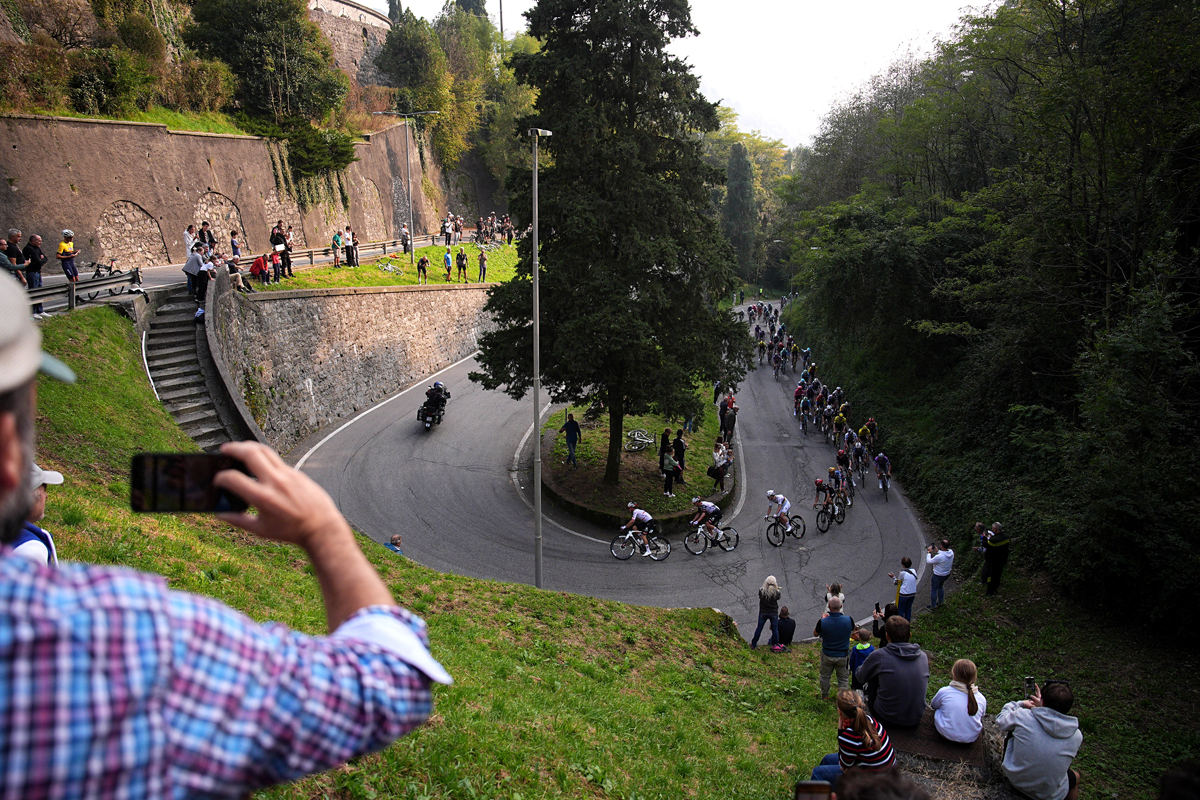
The riders crested the Ghisallo and plunged toward the next challenge. The Roncola climb began with gradients reaching 17% at the Valico di Valpiana. The breakaway’s gap held at 2’18”. Marc Hirschi lost contact on the steep gradients. The leaders crested the summit and began the technical descent. Thibault Guernalec and Andreas Hellemose dropped from the breakaway on the way down.
At the bottom, the riders hit Berbenno. Filippo Ganna pulled the breakaway group as they tackled the next climb. With 100 kilometers remaining, UAE Team Emirates looked firmly in control. Two more riders—Glivar and Langellotti—dropped from the lead group.
During the 119th edition of the Il Lombardia, Tour of Lombardy cycling race, a 247 km one day race from Como to Bergamo on October 11, 2025, Italy. (Photo by Marco Alpozzi/LaPresse)
THE RACE IGNITES
The peloton crossed flat ground before the Passo della Crocetta. Jai Hindley crashed but remounted. Rafal Majka—riding his final professional race—pedaled through his last kilometers at the front of the bunch, knowing his career would end where it had flourished, helping Tadej Pogačar win.
The riders climbed toward the Passo della Crocetta. Simmons accelerated from the breakaway, opening a 15-second gap that grew to 45 seconds, then 1’15”. Sivakov and Majka set the tempo behind, utterly unshakable in their mission.
UAE Team Emirates still had strong numbers with Pogačar as Simmons climbed strongly ahead. Ben Healy began to struggle. Hindley dropped back through the gruppetto.
The descent toward Passo di Ganda began. The peloton clawed back time on Simmons. Teams jockeyed for position before the decisive climb. UAE cranked up the pace, blistering the peloton and shedding riders quickly.
During the 119th edition of the Il Lombardia, Tour of Lombardy cycling race, a 247 km one day race from Como to Bergamo on October 11, 2025, Italy. (Photo by Marco Alpozzi/LaPresse)
GANDA: WHERE HISTORY HAPPENED
Six riders remained: Jay Vine, Pogačar, Isaac Del Toro, Evenepoel, Michael Storer, and Paul Seixas. The Passo di Ganda—15 kilometers of climbing with an average gradient of 7%—rose before them.
Pogačar attacked.
The acceleration looked smooth, almost casual, yet it proved so devastating that none could respond. The double world champion put 35 seconds into Simmons within minutes, then caught and dropped the American. The gap to the chasers grew to 1’05” as Pogačar crested the climb solo, his rainbow jersey disappearing over the summit.
Pogacar at the moment he dropped Quinn Simmons on his way to victory, during the 119th edition of the Il Lombardia, Tour of Lombardy cycling race, a 247 km one day race from Como to Bergamo on October 11, 2025, Italy. (Photo by Marco Alpozzi/LaPresse)
“Tadej’s team was going quite fast already from the bottom of Passo Ganda,” Evenepoel explained afterward. “We were only five or six guys left, then he attacked. At that moment, it was just about finding my own rhythm and ride as fast as possible. I tried but in the end, Tadej was the strongest again.”
Richard Carapaz crashed on the descent. Pogačar extended his advantage on the technical roads dropping toward Bergamo. With 20 kilometers remaining, Evenepoel dropped Storer from the chase group. Del Toro joined Simmons, the two pursuing the podium places.
THE FINAL RECKONING
Pogačar entered Bergamo with history within his grasp. The final climb to Bergamo Alta began—through the narrow streets of the upper city, across 200 meters of pebble paving at Largo Aperto, gradients never falling below 10% and reaching 12% in places.
The rainbow jersey flew through the ancient Porta Sant’Agostino with 1,800 meters remaining. The road bent wide to the left after the flamme rouge. The home stretch—800 meters long on 7.5-meter-wide asphalt—ran initially downward before leveling out.
Tadej Pogačar wins a record-setting 5th consecutive Il Lombardia. Fausto Coppi also won 5, but not consecutively. Photo La Presse/Pool
Pogačar crossed the finish line alone, arms spread wide, his fifth consecutive Lombardia victory complete. Evenepoel finished second at 1’48”. Storer took third at 3’14”, becoming only the second Australian on the Lombardia podium, 39 years after Phil Anderson. Simmons rolled in fourth at 3’39”, his bold breakaway rewarded with the Gazzetta dello Sport’s Pier Luigi Todisco memorial prize for first over the Ghisallo. Del Toro completed the top five at 4’16”.
THE WORDS OF CHAMPIONS
“I had goose bumps during the race,” Pogačar said during the winner’s press conference. “There was an amazing atmosphere. This is how it should be done by the cycling fans. It was beautiful to ride in Italy today. Il Lombardia is one of the longest and toughest races of the year. Isaac Del Toro also deserved his chance to play his cards. All the other guys managed to do all the work so he could follow the wheels. He came really close to the podium. He has a bright future ahead of him. This fifth victory is quite special because Rafal Majka retires. He’s been my mentor and my big brother in cycling for the last five years. To win today was also his dream. After the amazing career he’s had, he guided me amazingly again today. [Bike manufacturer] Ernesto Colnago was here at the finish and Eddy Merckx called him so we talked and it was really cool, but I don’t like to be compared with others. Everyone is unique in his own way. Milano-Sanremo and Paris-Roubaix will be my next big goals but I want to relax before I think about next year. I’m happy with the way I finished it off this year.”
Remco Evenepoel. Photo courtesy La Presse/Pool
Evenepoel accepted his runner-up position with grace: “Second to Tadej Pogacar seems again the best result for me. My legs were feeling pretty good again, I’m just happy with the result and to end my season on a high level like this. Tadej’s team was going quite fast already from the bottom of Passo Ganda. We were only five or six guys left, then he attacked. At that moment, it was just about finding my own rhythm and ride as fast as possible. I tried but in the end, Tadej was the strongest again. It was really nice to see such a big and enthusiastic crowd. It’s amazing to see so many people on the road for us. Even if I switch team, I’m not letting the other team down, I gave my best again, I’ve finished as high as possible. I’m very happy with that way to end this chapter. I’ll take all the memories with me for the rest of my life. I’m very grateful to have been the leader of this team. Now it’s time for something new.”
Michael Storer savored his career-defining result: “It’s extremely special for me to stand on the podium of Il Lombardia along with Tadej Pogačar and Remco Evenepoel. I think it’s the most important result of my career. It’s the best way to top off what has already been a really great season for me. I’m just super happy and I’m proud of how the race went today. The team have always supported me. It’s great to be able to deliver such a big result. Tadej just rode away from everyone. He paced super hard from the bottom of the climb of Passo Ganda and I was just trying to survive to the top. My legs were broken towards the end. I could hardly turn the pedal straight anymore. Il Lombardia is a very important race, it’s a monument, it’s really special to be only the second Australian on the podium [39 years after Phil Anderson].”
HISTORY WRITTEN
The victory brought Pogačar’s 2025 Monument tally to three—the Tour of Flanders and Liège-Bastogne-Liège already in his palmares—and made him the first rider in history to reach the podium of all five Monuments in a single season. He won two, finished second at Paris-Roubaix, and third at Milano-Sanremo. Only Eddy Merckx, in 1969, 1971, 1972, and 1975, had previously won three Monuments in one year.
Pogačar now equals Coppi’s record of five Lombardia victories, though the Italian’s came over a longer span—four consecutively from 1946 to 1949, then a fifth in 1954. No rider had ever won any Monument five times consecutively.
The victory marks Pogačar’s 20th win of 2025, his 10th Monument—half of them in Lombardia alone. He becomes the first rider to win this race twice while wearing the rainbow jersey.
“Seven years in a row I’ve said this is my best season so far and I can say it again today,” he confirmed, the smile evident in his voice.
For Evenepoel, the day marked an ending of a different sort. His move to Red Bull-Bora-Hansgrohe now official, this race represented his farewell to the Quick-Step colors he has worn since turning professional.
The day also marked farewells for several other riders: Simone Petilli, Louis Meintjes, and Pieter Serry all concluded their professional careers on the roads of Lombardy. But Majka’s retirement resonated most deeply, the Polish climber having helped deliver one final Monument to the rider he mentored.
Tadej Pogačar tackling the cobbles on the Colle Aperto in Bergamo, Italy. Photo courtesy La Presse/Pool
As the sun set over Bergamo’s Città Alta, where the race had climbed through narrow streets and over cobblestones before the final descent to the finish, one fact remained inescapable: in the history of cycling’s greatest one-day races, no rider has ever dominated a Monument as Pogačar now dominates Il Lombardia. Five starts, five victories, and counting.
The leaves will fall again next October. And somewhere, Tadej Pogačar will be waiting.
By Charles Pekow — How about a statewide micromobility guide? New Jersey developed one that tells everything you need to know about riding any kind of bike, scooter, roller skate, etc. in the Garden State. Micromobilty has become so popular in recent years and people don’t know the rules, so the state came out with the guide. It could be a model for other states.
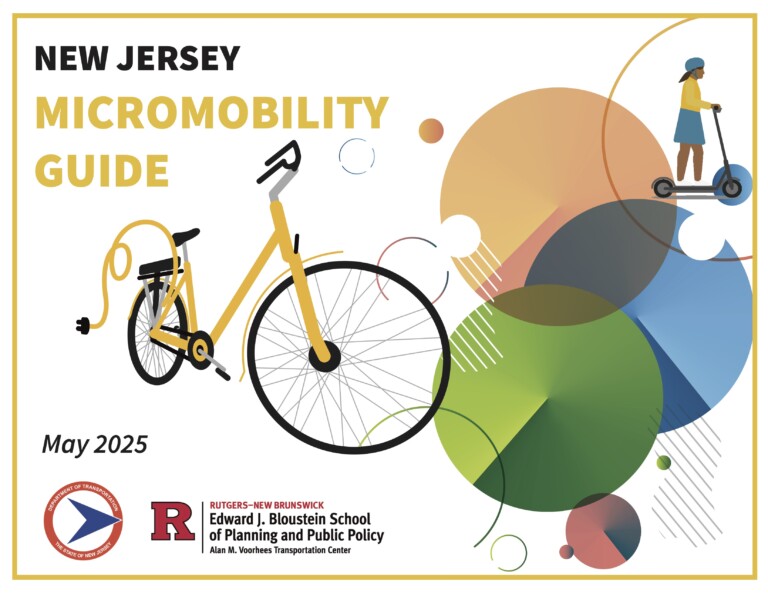
The 50-page New Jersey Micromobility Guide, put out by the New Jersey Department of Transportation Bicycle and Pedestrian Resource Center, includes sections on the rules for each type of vehicle and how they vary by different type of bicycle, safety tips, bikes on mass transit, secure parking, etc. It tells you where it’s legal to ride what and what’s left up to local governments.