I have reliably utilized the Kryptonite Evolution Series 4 1090 and 1055 locks for different purposes over the last five years. These locks differ in their usage. For securing a factory made bicycle with a rigid front fork I prefer the Kryptonite Evolution Series 4 1055 Mini Integrated Chain; while I prefer the longer Kryptonite Evolution Series 4 1090 Integrated Chain to secure my handmade bicycle with a front shock on the streets of Salt Lake City, Utah. I have used these styles of locks for about five years and I have had the peace of mind a lock is supposed to give one after locking it to a secured bike rack.
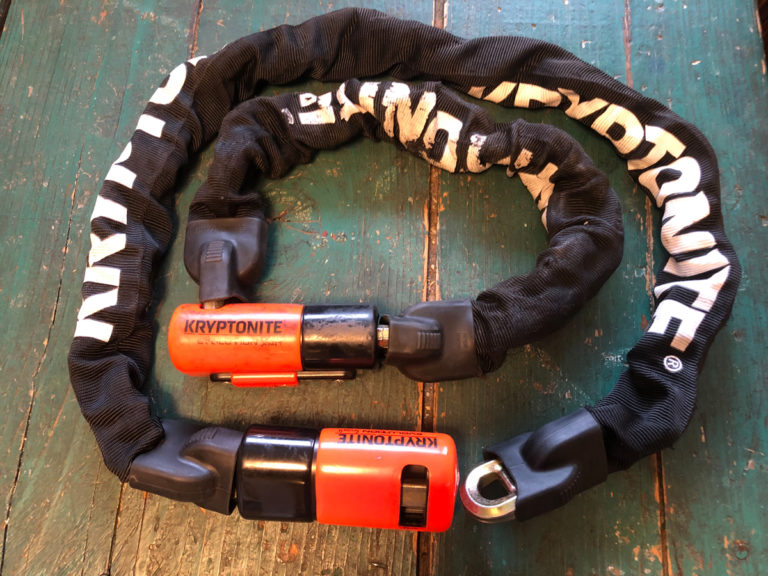
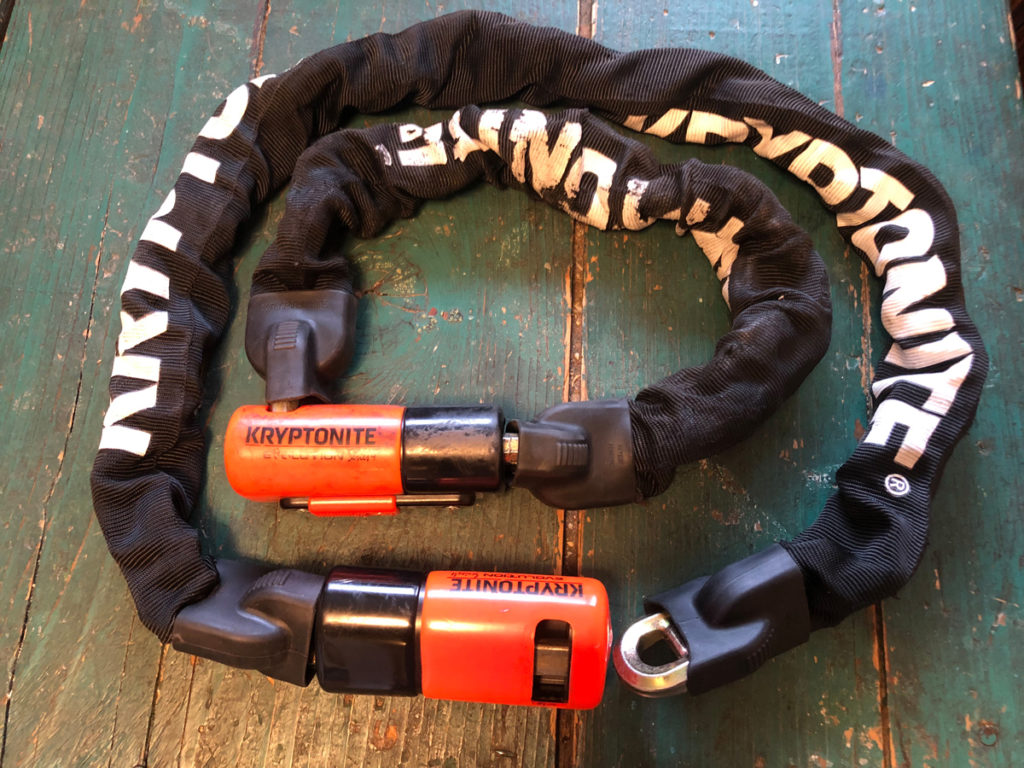
The Kryptonite Evolution Series 4 1090 Integrated Chain (outer lock) and the Kryptonite Evolution Series 4 1055 Mini Integrated Chain (inner lock). Photo by Dave Iltis
The Kryptonite Evolution Series 4 1090 Integrated Chain along with the 1055 Mini Integrated Chain are made of manganese steel. Manganese steel is wear-resistant and maintains its theft resistant features from a process known as work hardening.1 This process is performed by applying an adequate load amount to the manganese steel until the material changes its shape. This is done within a temperature one can work or ride in. Each style of chain comes with a dust-cover to protect the lock from freezing during extreme weather. It is important to note that when the weather gets below freezing the dust-cover needs to be closed to preserve the ease of locking and unlocking. Additionally, each lock comes with a nylon chain cover to prevent scratches from forming on your self-powered machine.
I have used the Kryptonite Evolution Series 4 1055 Mini Integrated Chain for the majority of my last five years of bike commuting. I stored this chain on my factory made bike frame by wrapping it around the top tube. It is the optimum length for locking the front wheel and frame of a rigid fork bike to a bike rack. I specifically remember locking my bike up at Nostalgia Café on first south in downtown Salt Lake City with this Mini Integrated Chain along with a fellow cyclist. After a few hours of studying, I exited to find my bike intact while the other had all the parts removed except the frame. This costly experience for my fellow cyclist was a lesson to me. Thieves don’t prefer to tamper with Kryptonite Integrated Chain locks.
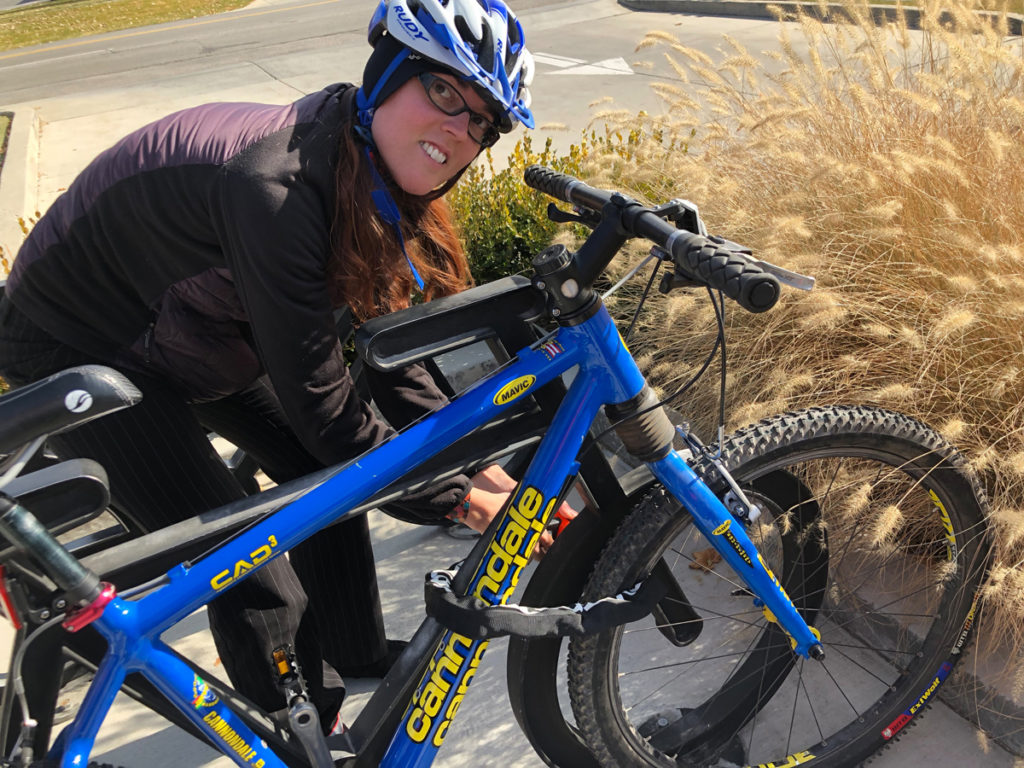
Lisa using the Kryptonite Evolution Series 4 1090 Integrated Chain to lock her bike. Photo by Dave Iltis
While camping, I choose to bring my Kryptonite Mini Integrated Chain to lock my factory made bike to a lamp post or bolted picnic table. Each time I have left the bicycle for up to 24 hours. Once I returned with a small tear in the nylon chain cover. It was obvious that the thief decided the time it would take to saw through the steel was not worth jeopardizing their incognito identity.
The Kryptonite Evolution Series 4 1090 Integrated Chain is quite long and I would recommend the use of this when locking a bike equipped with a front shock. The location of the down tube in relation to the wheel is often exceptionally wide and requires the use of a longer chain. The lock is significantly heavier by 139%. However, because my bike is made of aluminum and my factory made bike is made of steel, it makes the use of this longer Integrated Chain worth the weight.
Over the years, I have started to take advantage of the security I feel when locking up my bike. This is a feeling I have started to realize is due to the engineering and careful attention to detail Kryptonite takes while designing and implementing innovative security ideas. Do yourself a favor and checkout the size of Kryptonite Evolution Series 4 that is right for your bike and security needs!
Kryptonite Evolution Series 4 1055 Mini Integrated Chain, Retail: $75.95, length 21.5”, weight 4.4 pounds
Outerbike Adds Four New Experiential Event Destinations, Activating ‘See Try Buy’ in Seven Iconic Riding Locations in 2020
MOAB, Utah (February 6, 2020) —Outerbike, the premier three-day experiential consumer event dedicated to helping mountain bikers find their perfect bike and gear, celebrates a decade of successful partnership connecting specialty bike brands with qualified, enthusiast riders in 2020.
To mark the anniversary, Mark Sevenoff and Ashley Korenblat, founders of Outerbike, are launching four new venues to the 2020 lineup: Deer Valley, UT; Duluth, MN; South Lake Tahoe, CA; and Killington, VT. The four new locations will supplement perennial Outerbike favorites Crested Butte, CO; Bentonville, AR; and Moab, UT.
Riders demoing bikes at the 2019 Outerbike event in Moab, Utah. Photo courtesy Outerbike
Along with the seven total venues, Outerbike will also debut new marketing tools for brand exhibitors created to power connection between brands and the qualified, enthusiast consumers Outerbike counts in its expanding audience. The new marketing programs will bolster ROI for exhibitors by enabling them to connect with consumers before, during, and after the events. These programs will deliver brand experiences to riders, create shareable brand content, and obtain IRL (In Real Life) brand and product feedback.
“Outerbike is trusted to bring together the best mountain bike brands in the world with qualified, avid riders, early adopters and devoted cyclists who are intent on finding their next bike,” said co-founder Ashley Korenblat. “We want each Outerbike event to be a unique and authentic platform for brands to serve consumers as they navigate their purchase decision. Outerbike works with our venues to host a VIP experience for consumers, while our brand partners enable them to try the best bikes available on the most thrilling and iconic riding terrain.”
Yeti Cycles President, Chris Conroy, committed to six out of seven of the 2020 Outerbike events, and views Outerbike as a way to stay close to the brand’s target rider.
“Outerbike riders are all about seeking out great riding experiences and immersing themselves in the culture of mountain biking – they share the same DNA as we do at Yeti, and that’s why Outerbike gives us a great opportunity to grow our Tribe,” Conroy said.
Outerbike events give consumers an opportunity to explore, progress, and experience mountain biking from an insider’s perspective, taking the “see, try, buy” from a concept to reality.
“The goal when Outerbike was founded 10 years ago was to create a consumer experience that melded incredible brands and products with best-in-class riding destinations,” said Outerbike CEO Ken Meidell. “Our goal is still centered on hosting and serving qualified consumers to a completely unique on-dirt ‘shopping experience,’ and our additional venues increase accessibility for more riders to find their ideal bike while connecting directly and more deeply with the brands they’re considering.”
The dates for 2020 Outerbike events are:
Deer Valley, UT – June 19-21, 2020
Killington, VT – July 24-26, 2020
Crested Butte, CO – August 14-16, 2020
Duluth, MN – August 28-30, 2020
South Lake Tahoe, CA – September 18-20, 2020
Moab, UT – October 2-4, 2020
Bentonville, AR – October 23-25, 2020
“I always go right before it’s time for me to buy a new bike,” said Bryce Randle, a veteran of multiple Outerbike events. “But whether I’m actively looking or just want to be surrounded by others that share the same passion, Outerbike is where it’s at.”
“Outerbike isn’t just about being able to demo different bikes,” said first-time attendee of last year’s Crested Butte, CO, Outerbike event, Grace Guryan. “There is a communal vibe: Everyone is there to ride, and it makes for a truly unique three-day destination event. But the sheer range of bikes I was able to demo for what it would cost to demo 2-3 at my local shop definitely made me feel like a kid in a candy store.”
For more information on each of Outerbike’s destinations, pass types, and to register, please visit www.outerbike.com.
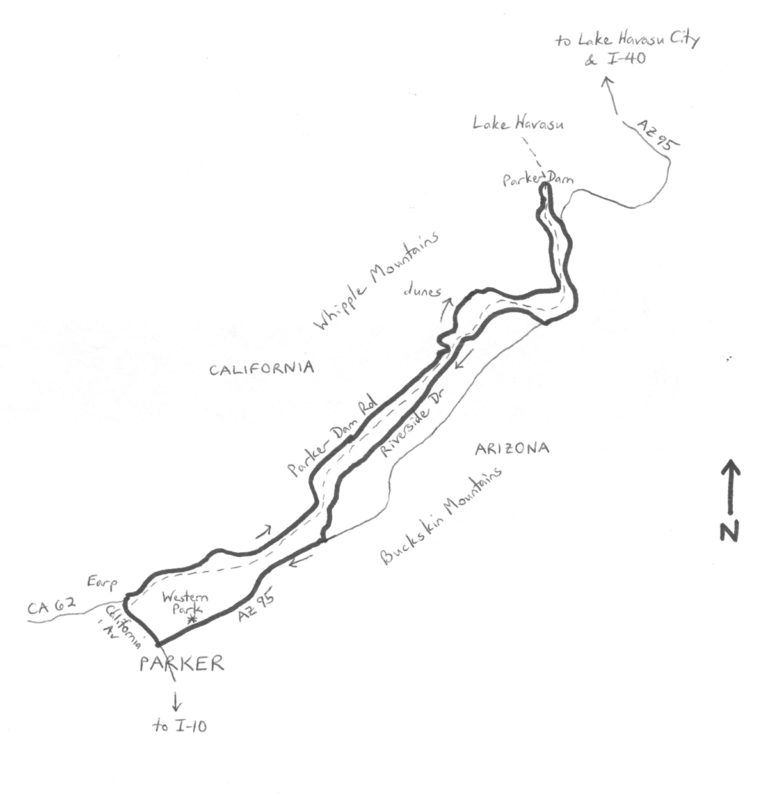
By Wayne Cottrell — As winter sets in, especially in northern Utah, it is best to head south for warmer weather, and conditions that are more suitable for road biking. Of course, one can road bike in just about any weather, with proper clothing and equipment, but mild to warm temperatures are admittedly more comfortable. Most of Arizona, for example, is great for wintertime cycling. South of Salt Lake City – 600 miles, in fact – is Parker, Arizona (180 miles south of Las Vegas). This city of 3,100 residents is located 155 miles west northwest of Phoenix, along the Colorado River (and the California border). A town was established here in 1871 as a kind of headquarters for the nearby Colorado River Indian Reservation, and as a place to drop off cargo and personnel (a railroad bridge across the river was nearby). The city of Parker incorporated in 1909. Later, during the 1930s, Parker Dam was built to the north of the city. The dam facilitates hydroelectric power generation, and is the southern end of Lake Havasu, which the dam created. The concrete arch-gravity dam is 320 feet high, but 235 feet are below the riverbed, making it the deepest dam in the world. The old dam access road – Parker Dam Road – is a scenic, backcountry byway (in California – the dam is in California). This ride incorporates the scenic byway, which is part of the Bureau of Land Management’s network of scenic and historical backcountry roads.
A Map of the Parker Dam Ramble ride in Arizona. Map by Wayne Cottrell
To get to Parker, head south on I-15. In Las Vegas, transfer to U.S. 95 south, which enters California. Next, transfer to I-40 eastbound, entering Arizona. Finally, head south on Arizona State Highway 95 (AZ 95). Note that AZ 95 is different from U.S. 95. AZ 95 passes through Lake Havasu City, on its way to Parker.
The Parker Dam Ramble starts in Parker at Western Park, located at Riverside Drive (AZ 95) and Desert Avenue. The park’s GPS coordinates are at the end of the article. The 32.8-mile ride is not particularly long, but be sure to bring plenty of fluids with you. In fact, one article notes that Parker can get “dangerously hot” during the summer months – a wintertime ride should help you to avoid summer temperatures that can exceed 110 degrees. The lowest elevation is 371 feet, and the highest is 500 feet – there are a few hills, but no long, extended climbs. Head southwest on AZ 95; turn right at the traffic signal, onto the aptly-named California Avenue. Indeed, the road enters California after a short stretch, crossing the Colorado River. Got your passport? Well, you won’t need it, but you may need to reset your watch, as California and Arizona are not in the same time zone! After passing under a railroad bridge, and experiencing a number change – you are now on CA 62 – the road comes to an abrupt end (T-intersection) at Parker Dam Road. Turn right here, at mile 1.65, and head northeast. This is the most scenic segment of the ride, so enjoy! There are a few riverside developments as you ride along, on your right, including camp sites, mobile home parks, lodges, and resort communities. You may also see some wild burros near and along the road. This segment of the ride is mostly flat until mile 12, where a short climb (less than one-half mile; 5% grade) takes you to the highest elevation of the route (500 feet). If you cannot always see the Colorado River, which is to your right, then you can certainly see the Copper Basin Dunes, which are to your left. In places, the dunes practically encroach upon the road. Enter the tiny community of Parker Dam at mile 16.8, as the dam itself comes into view. There are some great photo ops as the dam gets close. Stay to the left at the large pullout area on the right. The road rolls right over the dam (mile 17.4). The signing suggested that there were some restrictions on bicycles for the short dam segment, but I rode across with no issues.
Continue beyond the dam as the road curves to the right, and descends gently, now heading south. You are back in Arizona (La Paz County); be sure to reset your timepiece. Merge onto AZ 95, which will be coming in from the left, at mile 18.1. Traffic slows as you pass through the small River Lodge Resort community. The highway climbs (3% grade) from here, with the Buckskin Mountains on the left. There are rumble strips on the shoulder, making this segment awkward for a cyclist. River Island State Park is on your right at mile 21 – a great place to stop if you are out of water. Bear right onto Riverside Drive, taking you off of AZ 95, at mile 22.3. Another State park, Buckskin Mountain, is to the right, just beyond the turn. Both of the parks border the Colorado River. Riverside Drive is a pleasant alternative to the state highway, passing through a number of riverside communities and resort developments. You are now heading in a southwesterly direction. There are a few, short hills and descents along the way. La Paz County Park is on the right at mile 25. All of the communities and developments through which the road passes have a Parker address, although the main city of Parker is several miles to the southwest of here. Return to AZ 95 at mile 28.85; turn right to continue heading southwest. Access to the Blue Water Resort (and Casino) is on the right at mile 31.75. If you are in Parker, you go to Blue Water. It’s what you do. From here, it is just another mile to Western Park, where the ride ends.
GPS coordinates of Western Park: 34.153217oN 114.282806oW
For more rides, see Road Biking Utah, Best Bike Rides Los Angeles, and Best Bike Rides San Francisco (all from Falcon Guides), written by avid cyclist Wayne Cottrell. Each book features descriptions of approximately 40 road bike rides. The ride lengths range from 14 to 106 miles. Each ride description features information about the suggested start-finish location, length, mileposts, terrain, traffic conditions and, most importantly, sights. The text is rich in detail about each route, including history, folklore, flora, fauna and, of course, scenery.
Wayne Cottrell is a former Utah resident who conducted extensive research while living here – and even after moving – to develop the content for the book.
AIGLE, Switzerland (January 23, 2020) — As part of the introduction of the eight UCI Women’s WorldTeams – the equivalent to the premier division of the UCI Women’s WorldTour and a key aspect of the reorganisation of women’s professional road cycling in 2020 – the Union Cycliste Internationale (UCI) has decided as of this season to make more resources available through the anti-doping programme set up for this new team category. Developed and implemented by the Cycling Anti-Doping Foundation (CADF), the programme will see teams and the UCI step up their financial commitment:
UCI Women’s WorldTeams: EUR 10,000 per team;
UCI: EUR 10,000 per UCI Women’s WorldTeam.
As a result, each UCI Women’s WorldTeam will be provided with an overall budget of EUR 20,000. This significant growth in financial resources should lead to a sizeable increase in the number of riders included in the UCI Registered Testing Pool (RTP).
In 2020, the total number of women road riders in the RTP will rise to 53, on the basis of a minimum of three athletes per registered UCI Women’s WorldTeam, as opposed to 29 last year and 90 tests being taken (in line with the most recent figures).
Riders in the RTP provide whereabouts information that allows random tests to be carried out, a key feature of the anti-doping programme. These tests can be combined with those conducted by the National Anti-Doping Organisations (NADOs).
Beyond 2020, the number of athletes in the RTP will continue to grow as a result of the increase in the number of UCI Women’s WorldTeams registered for the competition:
12 UCI Women’s WorldTeams in 2021, leading to a minimum of 65 riders in the RTP;
15 UCI Women’s WorldTeams in 2022, leading to a minimum of 74 riders in the RTP.
Growth in the number of women road riders in the RTP (2019-2022):
Year
Minimum number of
riders in the RTP
Change (%)
on 2019
2019
29
2020
53
+ 82 %
2021
65
+ 124 %
2022
74
+ 155 %
Further measures consolidating the programme for UCI Women’s WorldTeams include the following:
Tests conducted throughout the UCI Women’s WorldTour (21 events in ten countries, amounting to 46 days of racing);
Blood tests conducted before and during competitions for the Athlete Biological Passport (ABP);
Tests carried out at training camps;
Long-term storage of samples taken.
From an operational viewpoint, and with a view to ensuring these additional measures are effectively implemented, the CADF will continue to pursue its strategy of coordinating and pooling resources with the NADOs.
“The significant increase in resources for supporting the UCI Women’s WorldTeams, the newly created premier division of women’s professional road cycling, is an important new phase in the UCI’s commitment to clean sport and the stance our Federation is taking in leading the fight against drug cheats,” said UCI President David Lappartient. “Safeguarding cycling’s integrity and reputation has a cost but not a price.”
Colorado’s Highway of Legends is the backdrop for 25-, 50- and 102-mile routes.
LA VETA, Colo. (February 12, 2020) — Many people commit to resolutions as the New Year launches, whereas bicyclists begin planning what rides and races to do in summer and fall. Spanish Peaks Cycling Association invites bike enthusiasts to save Saturday, Aug. 8 for the 17th annual Stonewall Century Ride, a 102-mile out-and-back ride between the southeast Colorado towns of La Veta and Segundo on State Highway 12, also known as the scenic Highway of Legends.
Colorado State Highway 12, also known as the scenic “Highway of Legends”. Photo courtesy Stonewall Century Ride
Online registration has officially opened on www.active.com for the century ride, which also has 25- and 50-mile options. Or print off a registration form at www.spcycling.org and mail it in by June 1 to benefit from early-bird rates.
The Beautiful Route
The ride follows the Scenic Highway of Legends (State Highway 12) that ties Walsenburg, La Veta, Cuchara, Stonewall, Segundo, Trinidad and Aguilar together with a ribbon of paved road that journeys through some of the United State’s most beautiful national forests, state parks, wildlife areas and mountain ranges. It was designated a Colorado State Byway in 1987 and a National Forest Byway in 1988 for good reason as the route is home to unique geological, cultural and historic features and includes a myriad of legends from the Native Americans, Spanish conquistadors, pioneers, miners, trappers and ranchers who explored and settled the region.
Cyclists start in La Veta (elevation of 7,013 feet), climb to the top of Cuchara Pass (9,945 feet) and descend to 8,400 feet before a slight climb again to the second aid station at North Lake (8,600 feet). The route continues to descend to the beautiful town of Stonewall and on to the lunch stop at Segundo, where the route reverses and returns, climbing along Highway 12.
One of the biggest highlights are numerous geologic formations known as dikes, which are sheets of rock formed in a fracture of pre-existing rock body. Up to 400 of these rock formations dot the route and are easily spotted as they extend up from the earth like spokes on a wheel.
“Much of the ride is steady, moderate climbing and descending, however the approaches to Cuchara Pass are steep and challenging. The total elevation gain for the 102-mile ride is approximately 7,500 feet,” says Kent Hay, race organizer. “The unusual stonewalls, beautiful forests, and majestic mountain views will blow you away. Many of our riders consider this ride one of the most scenic rides in Colorado.”
The Delicious Details
There is a reason that the ride’s slogan is “Challenging, Scenic, Delicious.” Regarding the delicious part, friendly volunteers are posted at the aid stations, assisting riders and serving the ride’s famous homemade goodies along with Skratch drink, pickle juice and water. Stonewall Fire Protection District Auxiliary prepares the lunch in Segundo, and post-ride meal in La Veta features barbecue, beer and more.
“We have homemade cookies, brownies, and other goodies at each aid station. Gluten-free treats also are available,” Hay notes.
In addition, La Veta’s town park will be filled with art vendors on the day of the ride, and commemorative 2020 Stonewall Century Ride mugs hand-crafted by a local potter will be available for purchase along with Primal bicycling jerseys. Jerseys should be pre-ordered by June 15.
Lodging options include B&Bs, cabins and RV parks. Plus, Stonewall Century Ride is one of the few bike events where community members open their homes to riders and ask only for a donation to the local library in return.
The early-bird cost is $70 when registering by June 1. Standard registration from June 1 – July 15 is $75 and late registration from July 16 to Aug. 8 is $85. The fee includes six aid/feed stations, a mid-ride lunch and post-ride meal, mechanical assistance, SAG vehicles, and an event T-shirt. A Friday night meal also is available at an extra cost. Proceeds from the ride benefit the La Veta and Stonewall Fire Protection Districts, and donations also are made to La Veta Public Library and La Veta Public School District.
For more information, visit the Spanish Peaks Cycling Association website at www.spcycling.org.
SAN DIEGO (Feb. 13, 2020) — Monuments of Cycling, a premier cycling events producer, announced a Tripel Crown of Gravel Series with two new Belgian Waffle Ride (BWR) locations in 2020. The first stop is in Asheville, NC, on August 30. The second ride is in Cedar City, UT, on October 17. The third and final event of the Tripel Crown is the massive Canyon BWR in San Diego, scheduled May 2, 2021.
Monuments of Cycling is known for putting on the most unique cycling event in the United States, the Canyon BWR. Online registration for all events, including the Tripel Crown of Gravel Series, opens February 18, 2020, at 9 a.m. (PT) at BelgianWaffleRide.Bike.
For the first time, the iconic BWR will be staged outside of California. The Asheville race will provide professional and amateur cyclists access to the most coveted roads and off-road sectors around the beautiful Blue Ridge Mountains. Hosted by Sierra Nevada Brewing Company at their iconic Mills River location, the event’s start, finish and expo will take place on the scenic brewery grounds. The route features rolling mountain passes, rough and rocky outcroppings, lake views, dense forests and rivers and waterfalls. Riders will get a bit of everything thrown at them: hard-packed, flat, loose, rocky, uphill and downhill gravel over a 144-mile route punctuated by 20 off-road sectors that give the event a unique and challenging complexion.
The first BWR at elevation follows in the scenic and rugged West Desert of Southern Utah. This is a true gravel edition of the BWR punctuated with the most coveted decomposed granite roads and off-road sectors throughout the region. The event is being hosted by the town of Cedar City and the Policy Kings Brewery. The 137-mile route features sectors through the famous Red Hills, the Parowan Gap along Little Salt Lake, Coal and Whitney Canyons, and Granite Mountain. Cedar Mountains and Dixie National Forest provide the eastern backdrop.
Each venue will have a local bike-minded charity. BWR planners will raise funds and awareness for community causes in each location, much as it does the San Diego Mountain Biking Association (SDMBA) in San Diego.
Created as an extremely challenging race in the spirit of the great European one-day Spring Classics, BWR is an unusually difficult race. There will be two distances in both new locations: the long Waffle route and a half-distance Wafer option for those looking to get a taste of the fun without the life-changing commitment of the Waffle distance.
Each BWR will offer a prize purse to top-five finishers, female and male. The Tripel Crown will offer a separate prize purse to the top three men and women overall across the three events based on their cumulative times. An age group competition will award top riders in each five-year age bracket with Tripel Crown of Gravel honors.
BWR sponsors for the Tripel Crown of Gravel Series include Canyon Bikes, IRC Tire, Eliel Cycling, 100% Eyewear, Science in Sport, ENVE Wheels, Monster Hydro, Wahoo Fitness, Wend Performance and VeloFix.
EVERGREEN, Colo. (February 4, 2020) — Two legendary Colorado-based cycling events (The Triple Bypass Ride and the Bob Cook Memorial / Mt. Evans Hill Climb) will have “partner status” with the National Gran Fondo Series for the 2020 season. Both events will now offer the opportunity to earn Gran Fondo National Series Points and qualify for the USA Cycling Gran Fondo National Championship event.
The Triple Bypass and the Mt. Evans Hill Climb are both produced by Team Evergreen — the largest, longest-running cycling club in Colorado. In addition to these events, Team Evergreen has also recently added the Beti Bike Bash to its 2020 event calendar. Invested deeply in the cycling/trail community — all proceeds, over $3 million to date, of Team Evergreen events are donated to a variety of charitable organizations.
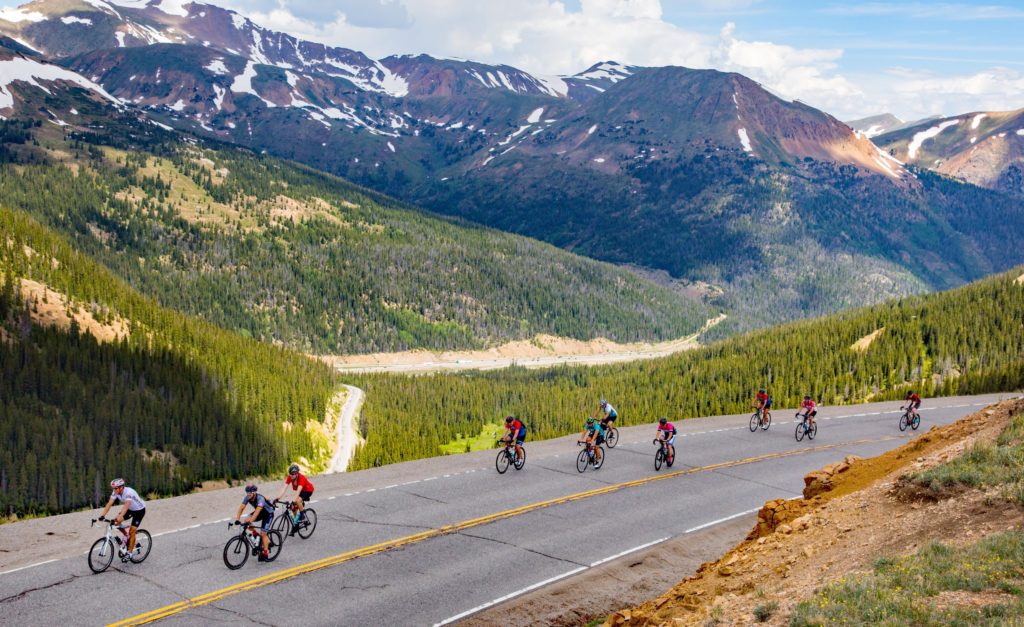
Above the treeline at the Triple Bypass. Photo courtesy Team Evergreen
In true “Fondo fashion”, The Triple Gran Fondo will not be a start-to-finish race. A participant’s overall time from start to finish does not matter for this competition. Only the timed segments count. Rankings are determined by your KOM/QOM standings for each pass as well as the combined time for all timed segments. The Triple Gran Fondo is what climbing dreams are made of. Leaving from Avon Colorado, timed segments are on the uphill portions of the passes of the Triple – Vail, Loveland and Squaw.
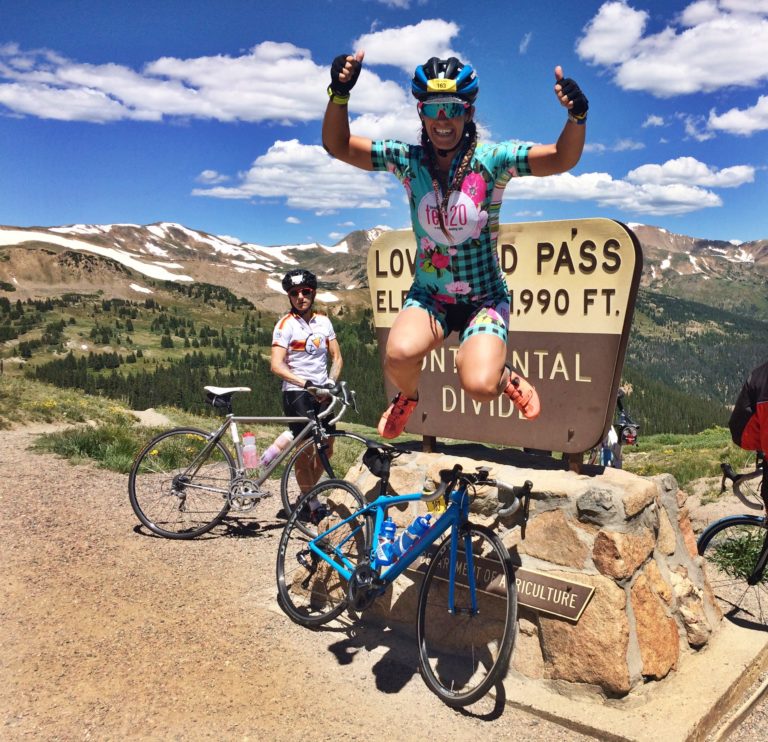
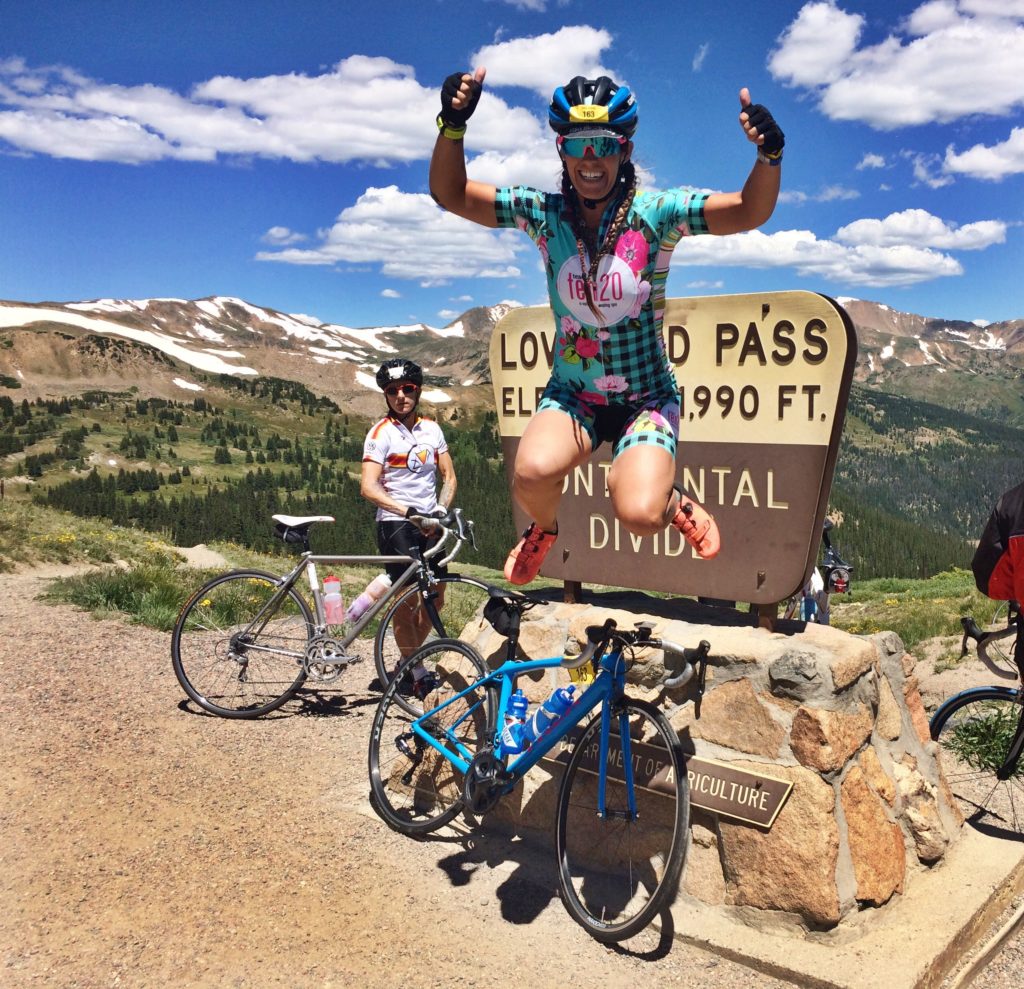
Pure joy at the summit of Loveland Pass. Photo courtesy Team Evergreen
“The Triple Bypass has been a bucket-list event for over 30 years so we are proud to collaborate with the Gran Fondo National Series to bring it to a new level for 2020,” said Jen Barbour, Executive director of Team Evergreen. “Timing riders up three mountain passes over a 120-mile course is sure to create one of the most challenging and rewarding events in the country.”
And while racing from Idaho Springs to the summit of Mt. Evans (14,130’) has always been an epic feat, this will allow participants to race on the same course as those that have made it to the highest level of cycling. The Bob Cook Memorial / Mt. Evans Gran Fondo starts in the historic mining town of Idaho Springs and finishes just below the summit of Mt. Evans. The race is a mass start and is 28 miles in length and climbs over 6,600 feet.
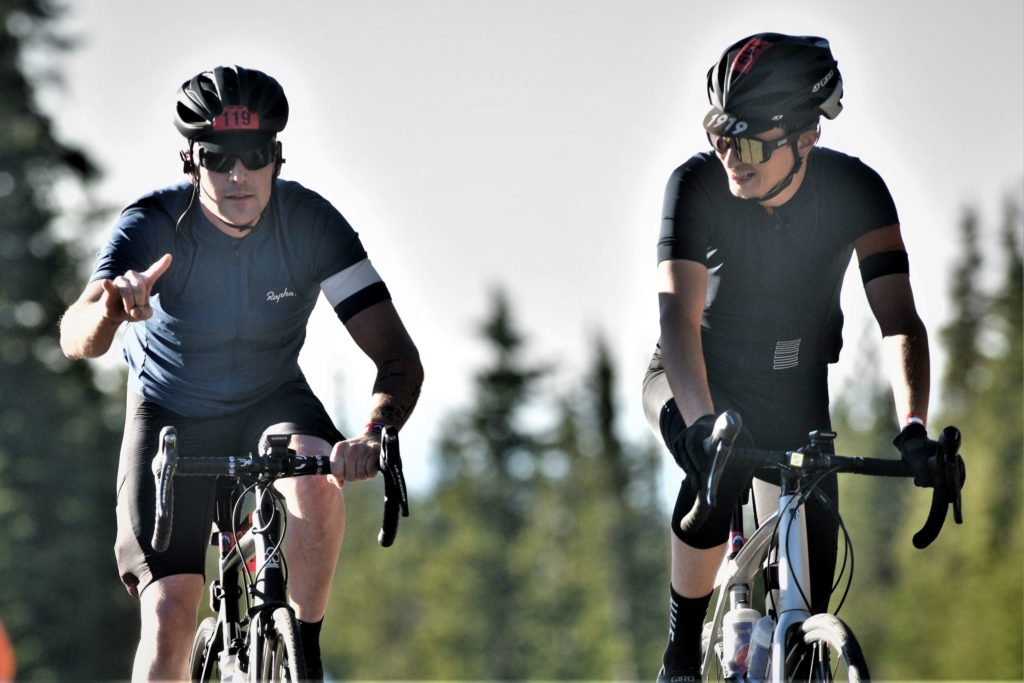
Photo courtesy Team Evergreen
“We’re excited to work with Team Evergreen cycling to include the Bob Cook Memorial / Mt Evans Hill Climb and the Triple Gran Fondo as Series events, and as qualifiers for the USA Cycling Gran Fondo National Championship,” said Reuben Kline, series director.
“This partnership allows us to offer more series points events in the region; while the Golden Gran Fondo has been part of the Series for the last seven years, Golden has been the only accessible Series event for those who live in the Colorado / Rocky Mountain region. This new relationship will allow riders to take part in three events within geographic proximity and score points in the Series standings. Both [Mt. Evans and the Triple Fondo] are very well organized and fit beautifully in the Series. They promote the same positive energy to grow cycling, share the primary goal of giving cyclists an opportunity to participate and compete at their personal level and have a great time doing so!”
DENVER, Colo. (February 13, 2020) — The Colorado Classic presented by VF Corporation today announced the continuation of its innovative TV streaming model and the launch of a new 2020 video series to celebrate and empower female athletes while furthering conversations about social change.
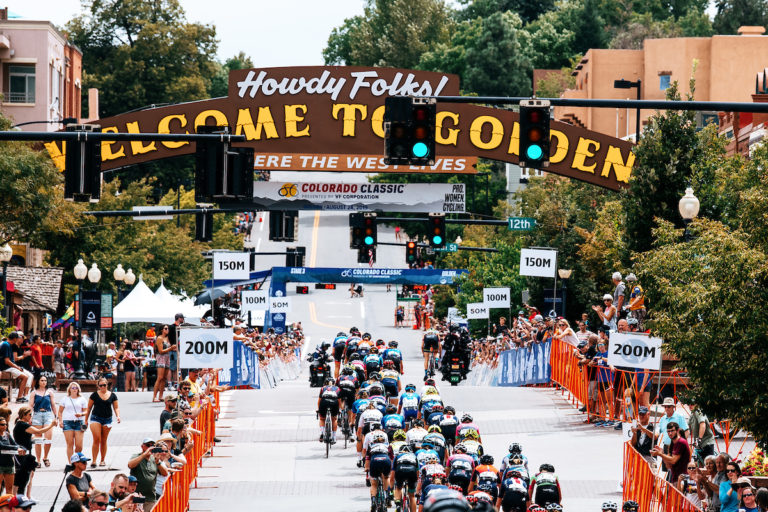
Photo courtesy Colorado Classic
“We believe that the key to advancing the business opportunities and consumer engagements for women’s cycling is through increased exposure,” said Lucy Diaz, CEO of RPM Events Group, the organizers of the Colorado Classic.
“As we continue to develop the defining elements of the Colorado Classic and the supporting media platform, broadcast coverage is a major focus — in a way that is both free and readily accessible for the consumer while also financially sustainable for the race.”
Ahead of its women’s only debut in 2019, the Colorado Classic set out to explore and invest in new ways to create and stream content. Pioneered and put to the test last season, the race organizers used cutting-edge and cost-efficient bonded cellular technology to capture the live coverage, which was streamed for free each day in its entirety, from the start line through the awards ceremonies.
The multi-dimensional live stream was distributed through 30 different outlets —including social media, strategic partners like Global Cycling Network, Altitude Sports, Kiswe simulcasts and the event’s TourTracker mobile app— and received more than 350,000 views from fans in 144 countries. When viewed on social media, the live feeds had more than 35,000 engagements as fans liked, commented and shared the live coverage.
Not only did fans get to see the live content when, how and where they wanted it, this model also eliminated costly airtime on networks. In 2019, the total production costs of the race broadcast were approximately one-third the cost of the TV production and distribution of past races.
“By applying these new cost-efficient cellular technologies to capture the live coverage, and then streaming it through a strategic network of partners and social media outlets, we’re able to put our race on a global stage for a fraction of the cost,” said Rob Simon, Executive Producer and CMO of RPM Events Group. “This approach makes cycling events more financially viable and sustainable while giving our fans a high-definition, immersive and social TV experience.”
To put it in numbers, in year one of the Colorado Classic (2017), the cost-per-view was $3.10 while in 2019 the cost-per-view was five times less expensive, at only $.63 per view.
The Colorado Classic will continue to evolve this model in 2020 and is committed to sharing their learnings with the industry to help reduce financial barriers for the broadcast of fan-based athletics everywhere.
Additionally, a custom content video series titled “HERoes” will be released throughout the year, profiling women cyclists, teams and staff as they tell their real and unfiltered stories about the sport.
“We realize it’s not enough to just provide four days of competition, we have to develop a platform that celebrates the sport, the athlete and creates meaningful connections in the community,” said Diaz. “We are committed to telling the stories beyond the race and will amplify our original content HERoes video series.”
All this is part of a year-long initiative the Colorado Classic will launch in the spring, which takes their commitment to women’s cycling far beyond its four-day race. Centered around the pillars of exposure, opportunity and equity, the initiative will include media appearances, community engagements, corporate dialogs, a Women’s Advisory Committee, targeted engagements with business and community leaders, and this innovative global streaming network.
“Change doesn’t happen because someone wants it. Change happens when people commit all their energy to getting the world to take notice. Our entire organization and business is focused on delivering and demonstrating our message of opportunity and equity,” said Diaz. “We are proud to lead the charge and will look to like-minded organizations and individuals to join us in this powerful change to culture.”
STEAMBOAT SPRINGS, Colo. (February 4, 2020) — Racers who have been coming to ride the spectacular paved roads at the Steamboat Springs Stage Race for the past 11 years will now have the new Steamboat Roubaix to test their skills in spring conditions over a mix of variable pavé and pavement surfaces.
Steamboat Roubaix “Hell of the High Rockies” will kick off from Steamboat Springs in the early hours of Sunday May 31st with staggered start waves for 21 categories split by gender and ability level, riding a 36, 53, or 70 mile course. USA Cycling category divisions allow participants to start and race alongside riders of the same gender and ability level in a good ol’ fashioned peloton, with group options for everyone including Juniors, Pro Men & Women, and Masters (40+) groups.
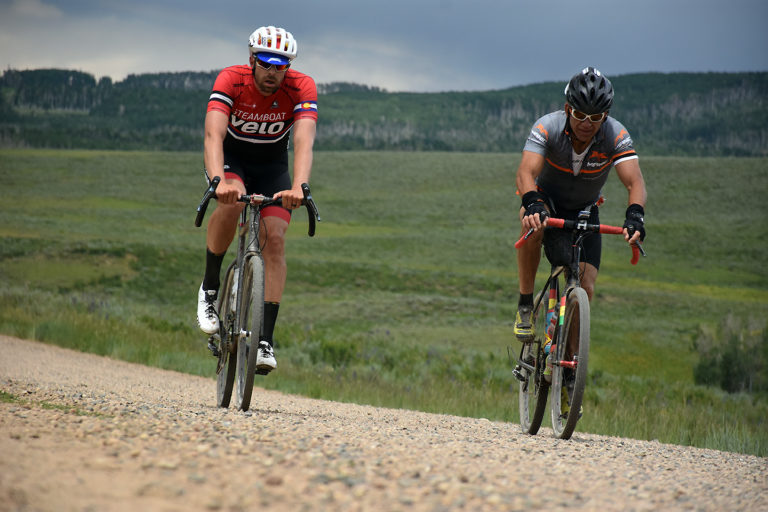
“Steamboat Roubaix is perfect for riders who want an exciting race experience set against stunning and leg crushing terrain with fair racing rules and ability groupings,” says Race Director Corey Piscopo, who has been behind the Steamboat Springs Stage Race for the past 11 years along with running local race team Steamboat Velo. “Steamboat Roubaix isn’t ‘ultra’ or a mass start Gran Fondo; instead it follows a traditional and sanctioned format of Pro-Am road racing, which is a blast to participate in.”
Photo courtesy Steamboat Roubaix
The course terrain, potential for gnarly spring weather, and opportunity for team tactics, are what make Steamboat Roubaix unique. Paying homage to Paris-Roubaix, riders will see between 3 and 5 dirt “sectors” depending on their course length, and conditions could range from smooth and fast to wet slop. Roubaix will surely test all of the skills that make a good bike racer — speed, handling, power, tactics, teamwork, equipment, and grit. Riders will have to monitor updates on the dirt conditions in the weeks ahead of the event and make the call on race day which equipment to run ensuring speed, traction, and sufficient durability.
Photo courtesy Steamboat Roubaix
Registration for the event is now open at a bargain price of $65 for all competitive groups as well as a $55 option to ride the course at your own speed just for fun. Racers on course will have the support of USA Cycling Moto referees, neutral support, and medical services. Full event details and registration are viewable at www.bikesteamboat.com
The Steamboat Roubaix is promoted by local cycling club Steamboat Velo and will again be donating a portion of proceeds from the event to local nonprofits including Lift-up Food Bank, Routt County Humane Society, and Bicycle Colorado in addition to supporting local race program Steamboat Velo.
Unless you’re also a cyclist, I imagine it is quite difficult for you to understand what it is like to ride a bicycle on Utah roads amongst traffic. It is a vulnerable feeling riding along with 3,000-pound vehicles speeding past you. I’m sure you have seen incidents of dangerous cycling, and am equally as confident you’ve witnessed dangerous drivers put cyclists in harm’s way. Some may use this to justify an increasing level of aggression between drivers and cyclists, but for the most part I have found that only in rare situations do the drivers have a real malice towards cyclists. In most instances, drivers simply lack the consideration and appreciation for the plight of cyclists.
Cyclists are parents, children, teachers, doctors, students, and tax-paying citizens just like you. We love exercising amongst the backdrop of our majestic mountains, but our ultimate goal (just like you as a driver) is to return home safely to our loved ones. The text or Instagram feed loses importance when you consider this ultimate goal, doesn’t it? Drivers need to see cyclists. We try our best to be seen by wearing bright colors and using flashing lights, but none of that will help if drivers are distracted or unaware of their surroundings.
Cycling is one of the fastest growing sports and mode of transportation in the United States – especially among women. Road biking is not a passing fad – it is here to stay. So the quicker we embrace and adapt, the better it will be for everyone. But for bike safety to be sustainable, I ask you – and all other drivers – to recognize these key rules and recommendations:
It is against the law for a Utah driver to be within 3 feet of a cyclist. If the cyclist is riding in the middle of the lane, it means it isn’t safe to pass and he/she will move over when there is enough room for both of you.
Cyclists take much longer to stop than cars do. If you pass us and turn immediately in front of us, we’re going to be a in a very bad situation.
We can legally ride two-abreast as long as you can safely go around us and we’re not impeding traffic.
You can legally cross over a double yellow line to pass a cyclist and make sure there is plenty of room between your car and the cyclist.
Cyclists often use the left turn lane when turning left. This is legal, and often the safest option. Keep an eye out for us and slow down when we are moving over from the right-hand shoulder.
A cyclist may be in your lane of travel to avoid unsafe conditions in the shoulder, to pass another bicycle, vehicle or object on the shoulder, or to travel straight through an intersection just left of vehicles turning right. Please be patient.
When parking, check your door mirror and look behind you before opening the door to make sure a cyclist isn’t approaching.
When stopped at an intersection, you may see cyclists utilize the shoulder of the roadway to pass the line of cars and stop at the front of the intersection. The law allows this and ensures that cars see the cyclists crossing the intersection. It also keeps drivers from having to wait behind cyclists that take much longer to get up to speed once the light turns green.
Please remember that if you collide with a cyclist, the likely result is scratches or dents on your car. For the cyclist, a collision could mean losing his/her life.
As citizens, we are greatly concerned with our air quality and congested roads. Cycling helps with both these. It is also beneficial in addressing our nation’s health crisis, as cycling helps fight obesity and heart disease. So when you see a cyclist, instead of becoming frustrated or impatient, applaud them for doing their part to achieve these goals that are important to all of us.
We can all make a difference on the road if, instead of clashing, we look out for and communicate with one another. And that comes down to being respectful. As cyclists, if someone we are riding with does something dangerous, we have a word with them. Often, they don’t even realize they have done it and nine times out of ten, they apologize. I hope you, and other drivers, will offer cyclists the same courtesy.
In the end, we should see everyone as a person, not as a “crazy cyclist” or a “dumb driver” or whatever. We must respect each and treat each other with courtesy – because like it or not, we are ultimately sharing the road together.
[Editor’s Note: Some of the laws mentioned above only apply in Utah, but the message for drivers is the same everywhere.]
Ken Christensen and Russ Hymas are avid cyclists and Utah attorneys at UtahBicycleLawyers.com. Their legal practice is devoted to helping cyclists injured in collisions with motor vehicles. They are authors of the Utah Bicycle Accident Handbook and are nationally recognized legal experts on cycling laws and safety.
By Robert Wilson — “Our wheels clatter up the cobblestone streets, cresting as we reach the Piazza where the pigeons -whoosh! – take off in unison over the church bell tower, clanging in the 12 o’clock lunch hour. Two old men, arm in arm, taking slow and loving steps toward the trattoria, smile amusingly at us as we circle around and park our bikes beside the café tables set outside.”
Decisions, decisions….oh! there it is….Barolo. Photo by Robert Wilson
Yup. That’s what happened on our bike trip in Italy. Over and over again. If you’re reading Cycling West, I guess you already knew the secret access to magic that a bike can bring you in a foreign country. But join me nonetheless as I’m writing for the few souls out there like me, that had never traveled by bike, and had no clue what they were missing.
First of all, and oddly, the magic of bike trips have really nothing to do with the bike. I mean, sure the bike is a key ingredient, but after even a half a day pedaling around, you just forget about it. Your butt can get sore, your legs heavy, but trust me dear biking trip virgin, you exist above it all, your attention mesmerized by the magic suddenly made available to you.
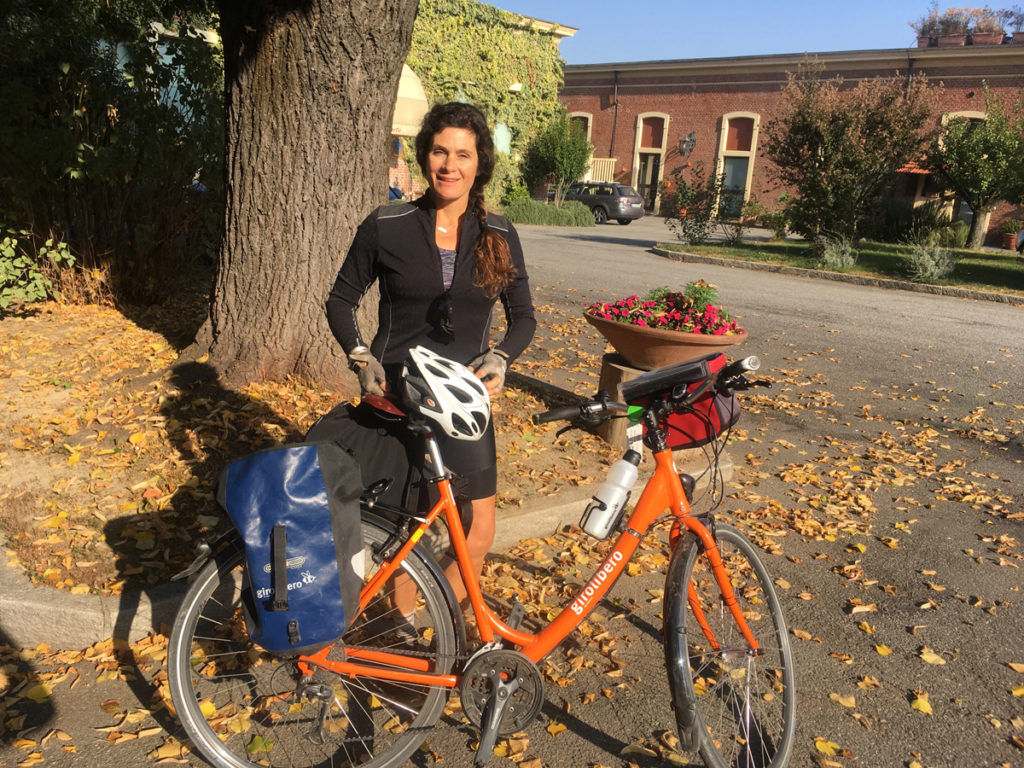
Jenny high on espresso, ready to leave this morning from Casale Monferrato. Nice look at the kind of bike you will be using. Photo by Robert Wilson
Ok, do we all know what magic is on a trip? It’s the moment you leave the trip your mind thought you wanted and get the trip your heart wanted. All the silly planning you did before hand, the Trip Advisor reviews, the Great Airfare Hunt, the ridiculous outfit selections to match the vistas you’ve never seen…all of it melts away when the magic hits and your eyes are opened to the delicious details you wanted in your travels, both big and small- that have evaded your hurried demands for entertainment, and only now come out to be with you in your more slow, vulnerable, and attentive state. This is biking through a country. Not driving.
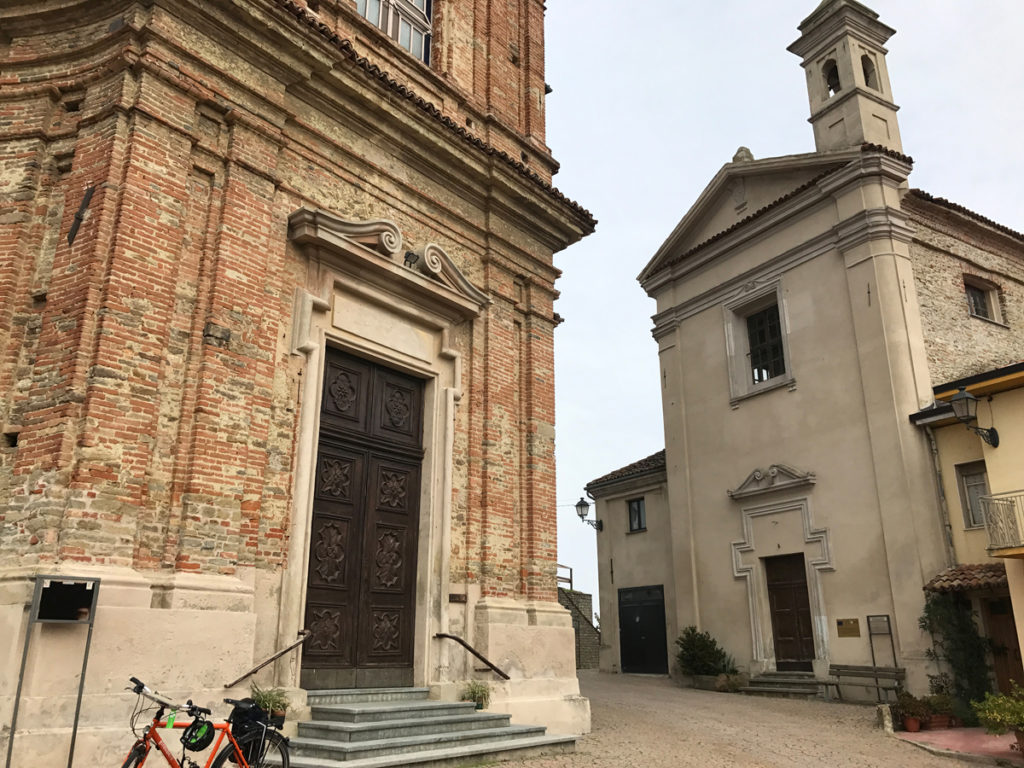
Dueling church bells at noon in the tiny and perfect village of Rochetta Palafea. Photo by Robert Wilson
Our trip was coordinated by a company called Cyclomundo. Their deal is simple. They give you a bike, a great map, and transfer your luggage each day to the next village on the trip they create for you. That’s it! And you see, the map is really the most beautiful part of what they give you. This tour company clearly has spent precious time creating the most loving and soulful way to get from point A to point B. And here is where the importance of a bike comes in: None of where you are going would really make sense if you were driving. The trip is arranged to follow a slower, smaller and more winding road toward a collection of villages you may otherwise just zoom through. For us, it turns out that this was where we found our real Italy.
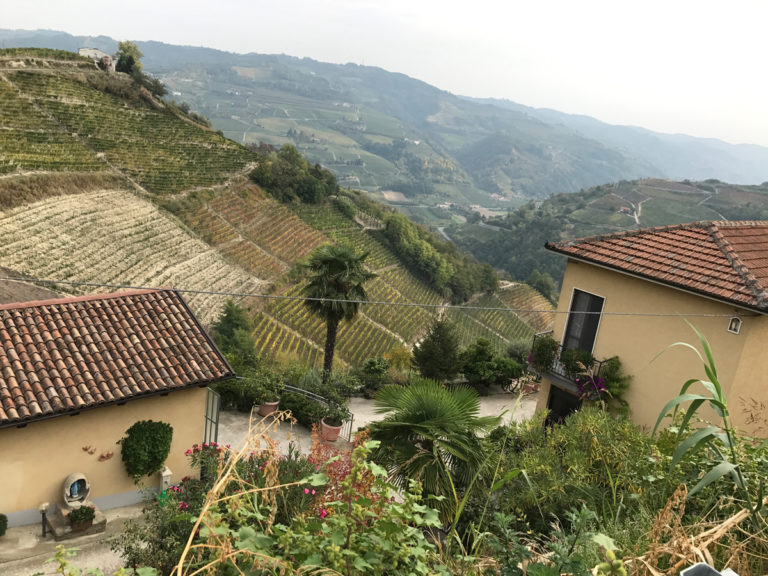
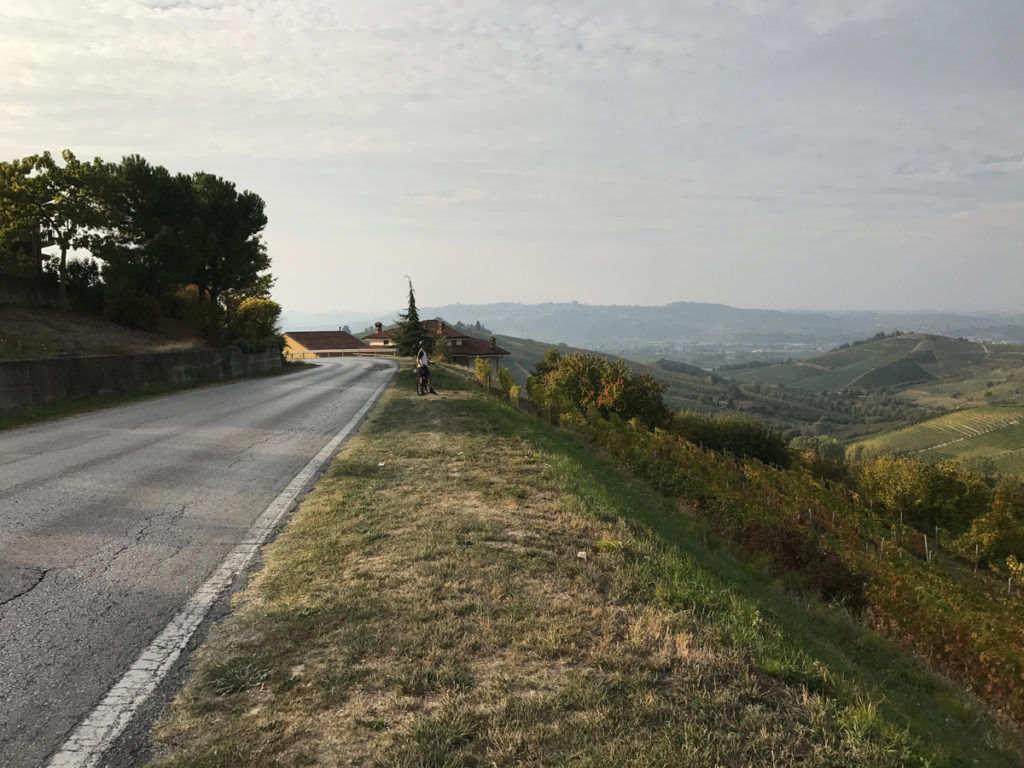
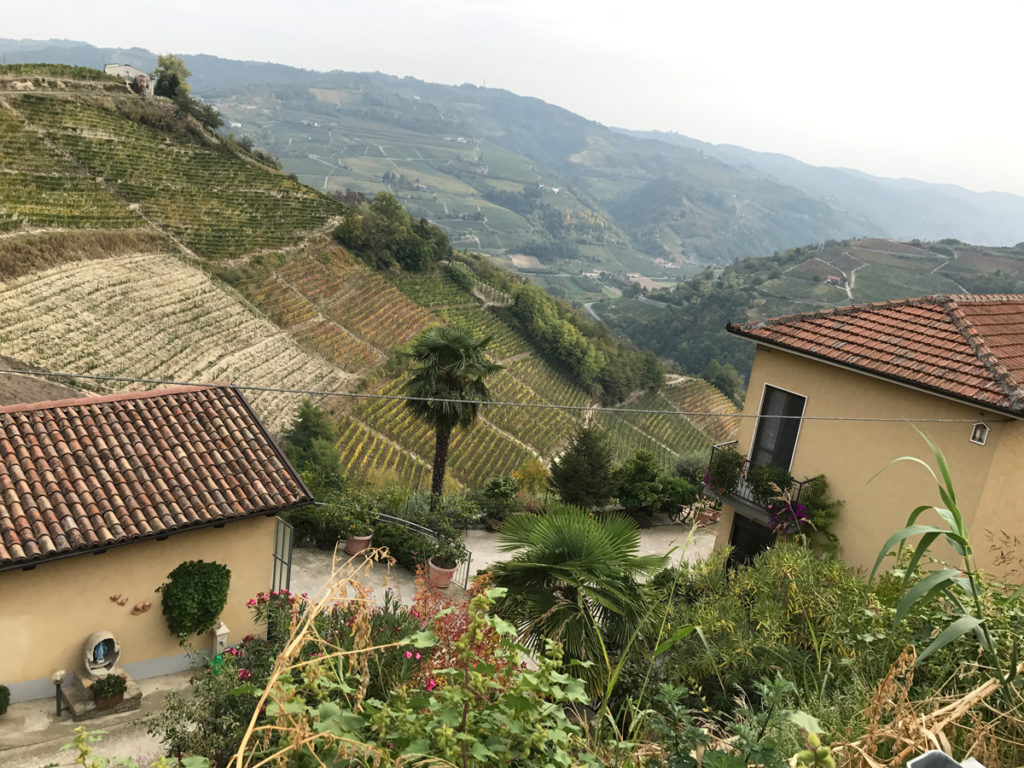
Contemplating leaving it all and working on an Italian vineyard the rest of my days, Valley of San Vito. Photo by Jenny Wilson
Countless times the map, in harmony with the abilities of a bike, would take us on tiny detours that were little gems in an Italy I thought didn’t even exist anymore. We ended up following farmers in their old tractors up the vineyard roads, both of us smiling with the glow of another Italian sunset in our faces. We descended from forgotten hilltop villages, noticing only the occasional stray cat hiding in the weeds along the side of the road purring as our sweaty brows cooled in the wind. We rolled into our villages right at passeggiata, which is when the whole town, after work, strolls the Via Cavour, gossiping, laughing, flirting. Us in our ridiculous lycra and a cold presecco, the teenagers showing off in their best James Dean and cigarette look.
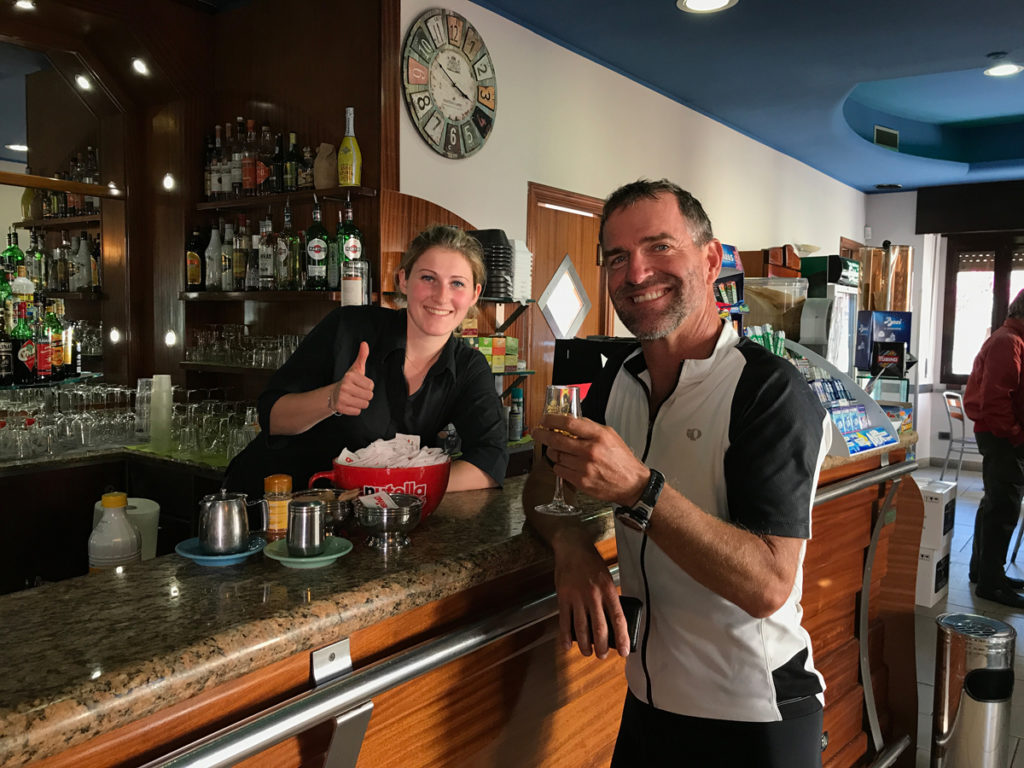
Enjoying a drink of grappa after the ride. Province of Alessandria. Photo by Robert Wilson
We drank whole bottles of wine at lunch, lurching and laughing and dizzy as we resumed cranking up to the next of what seemed endless hilltop villages. Each time we stopped to check the map (I am good at, and enjoy being lost), an opportunity for my wife to saddle up beside me and high five me, a look of “Are you kidding me?!” silently crossing both our faces.
Cobblestone and Brick. All day everyday. Province of Cuneo. Photo by Jenny Wilson
On one occasion, as we arrived in a famous wine town, we rolled along side a hulking tour bus, its crowded inhabitants looking down through their windows at us, as curious as to our freedom as we their captivity. We made a point that day to savor our sitting arrangements: My wife in her seat, on her bike in the wind!, and me in mine. We both agreed we had the best seat in the country.
Ahh….Endless vineyards. These are in Montabone. Photo by Robert Wilson
So please, all who wander and wish to be lost, consider a bike trip the next time you want to travel. You think you know what you want in your next trip, now let a bike surprise you with how much more your heart really wanted. It wants magic!
Trip Details:
Cyclomundo presented this trip called “Treasures of the Piedmont”. It was a self guided 7 night/8 day tour through the foothills of the Dolomites (The Piedmont Region) visiting such towns as Acqui Terme, Asti, Alba and Casale Monferrato.
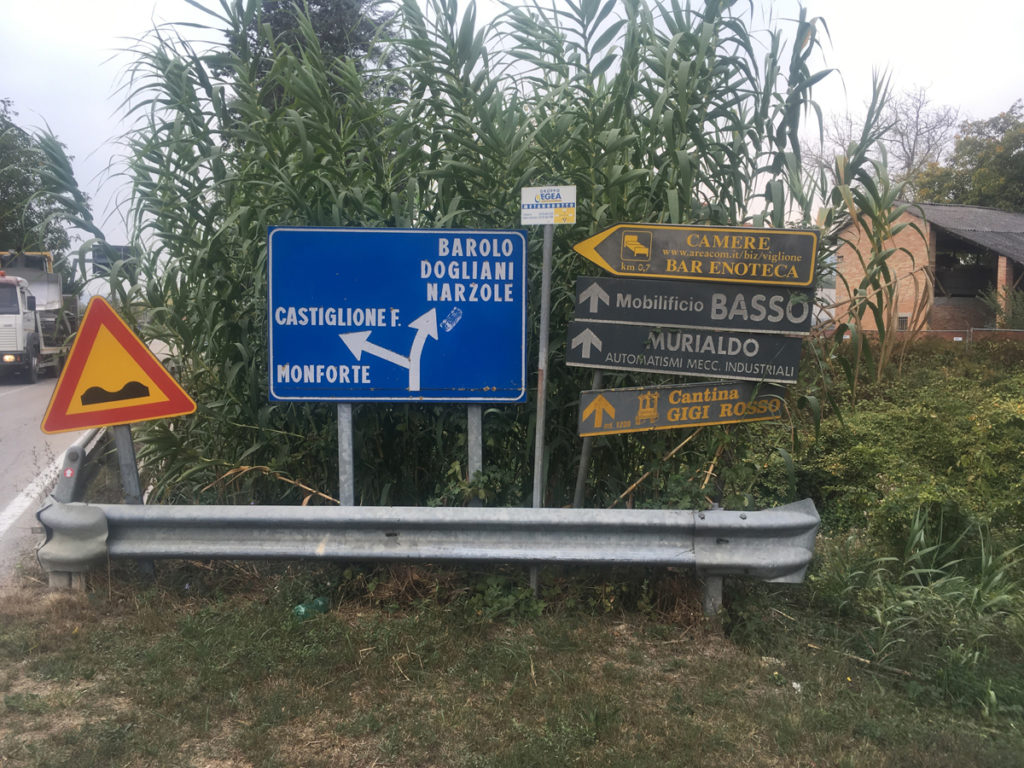
It travels extensively through the wine country which makes this region famous, most notably the Barolo.
We went October 1st-8th, which was the last week they offer this trip, and probably why it was so free of tourists. This tour has quite a bit of dirt roads/rough roads, so they give you a sturdy (though heavy) city cruiser bike with wider wheels than a typical road bike.
The tour company has 5 different levels of difficulty for their tours, 1 being the easiest and 5 being 10,000 ft a day climbing marathons which mimic what Tour riders face. This tour was rated a 2/3.
We rode about 40 miles a day and climbed about 2500 ft. a day. Not too bad, though tougher than you think on a heavy bike, loaded with wine you just bought from a hidden gem winery you find along the way!
Beauty and the Dork, just outside of Alba. Photo by Jenny Wilson
It is important to remember this is a self guided tour. You’re on your own to make good decisions. Of course they have an emergency contact you can call the whole time if you need assistance, but it for sure is designed around more European sensibilities of self reliance and adventure.
On our trip, we never once saw a Cyclomundo representative, but our bags were always, magically, delivered to the next town and waiting for us in the lobby of the hotel they arrange for you.
For more information on Cyclomundo bicycle tours, visit cyclomundo.com
There is nothing like new stuff. Don’t get me wrong. I take care of my things, and am proud when something lasts well. I have an old ski parka from when I was a teenager that I still wear when working outside during the winter. And my 1998 4Runner now has in excess of 260,000 miles.
But getting something new is nice. You get all the new technology, it is attractive and unmarred, and it makes you feel good. And of all the new things you can get, nothing beats a new bike.
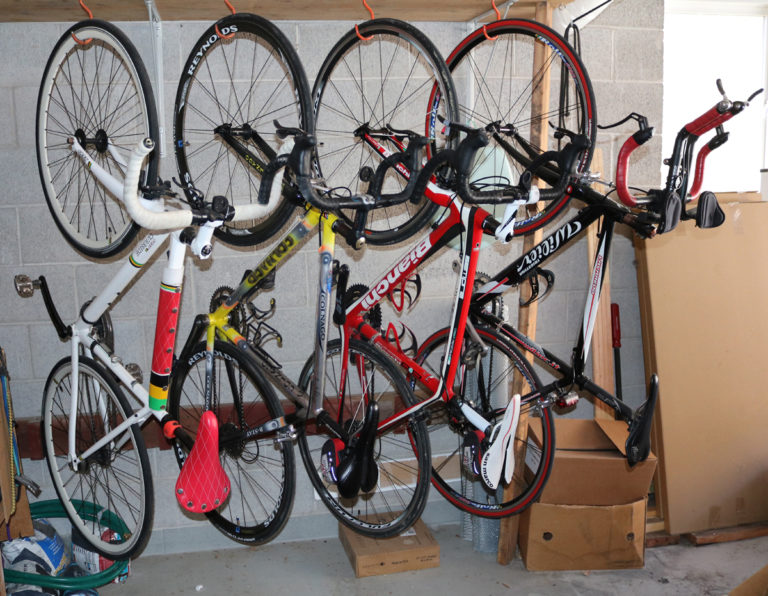
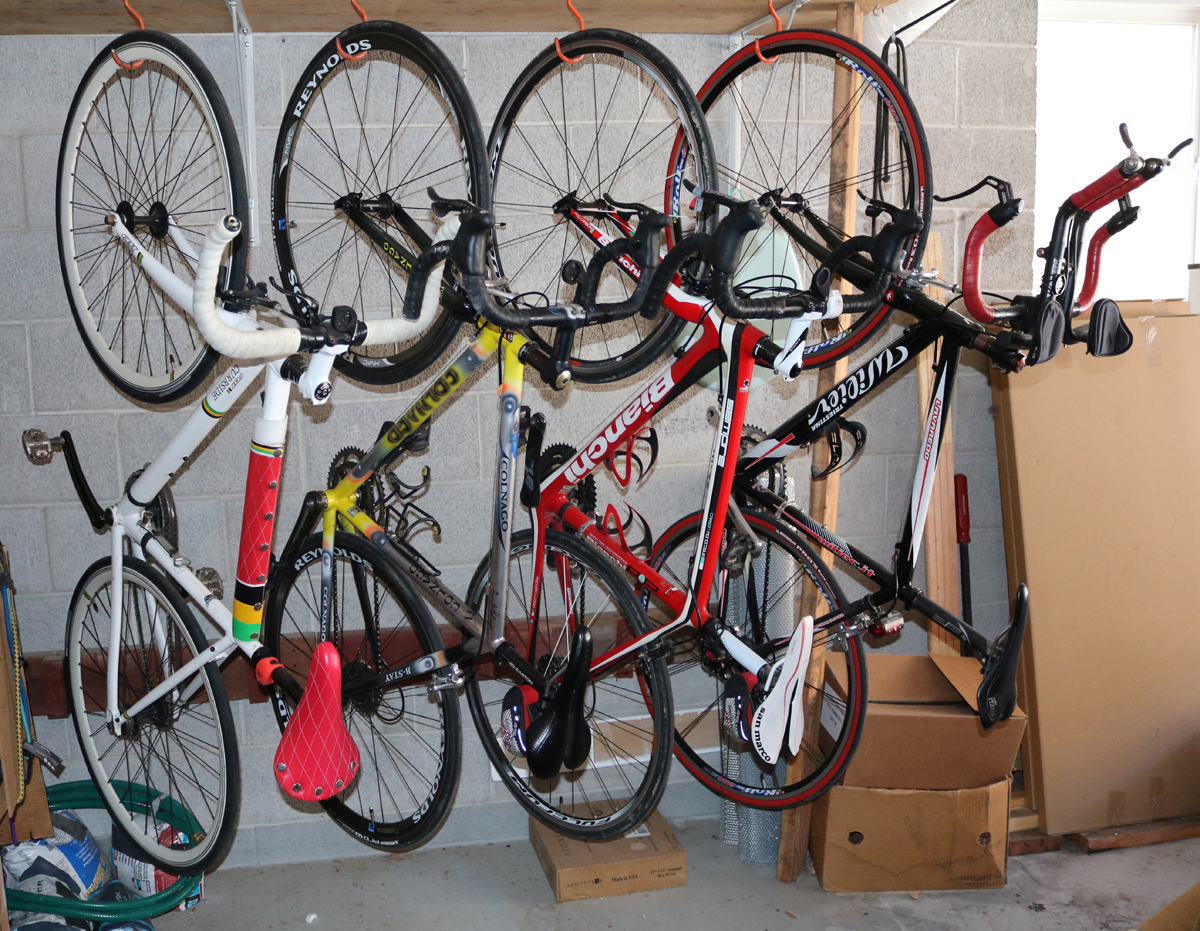
The current stable. Photo by David Ward
My first new bike was a gift from Santa back in 1956, a beautiful red and cream colored Schwinn Spitfire. I put a lot of miles on that bike, and had many adventures, including nearly having it confiscated by the Fort Hall Indian Reservation police. Thanks to my tears and pleas, I managed to hang onto my ride.
I purchased my next new bike, a French made Motobécane, 15 years later when serving as a missionary in France for my church, the Church of Jesus Christ of Latter Day Saints. Bikes were how we got around. This bike was purple with white trim, and had a headlight and taillight powered by a small generator with a rotor that, with the flip of a switch, pushed against and was propelled by the wheel as I road. I went through a lot of rear tires that way.
In 1973, just off my mission and a student at Brigham Young University (BYU), I purchased a bike (brand unknown) from some entrepreneur who had managed to buy a bunch of these bikes really cheap. And though he sold it to me cheap, I soon realized it was way too big for me. Still, it sufficed for my commutes to and from campus. I was relieved of that bike, however, by someone who permanently borrowed it from a bike rack on the BYU campus later that year.
Up next was another Motobécane. The year was 1974, I was newly married, and my wife and I were taking a cycling class for PE credit at BYU. I scored a great deal at $125, and rode, toured and commuted on that Motobécane Mirage for the next 9 years. It was white with red highlights, and came equipped with double brake levers for each brake, the standard one on the front curve of the bars, and a second one just under the top of the bars. That was a bad idea and a safety hazard as they never worked well. It also had the shifters on the bar stem, also a bad idea. I modified both of these by eliminating the under the bar brake levers, and replacing the shifters with standard (then) down tube shifters. I loved that bike, and it still hangs in my basement, a nostalgic reminder from the past.
Around 1984, I learned that they actually had bike racing in Salt Lake. After scoping out a couple of races, my competitive instincts flared. That was when I made a huge leap in bikes. I purchased a marvelous Trek 760, made of Reynolds 531 steel tubing, and equipped with a Campagnolo Victory gruppo. I remember after picking the bike up and taking it home, I got on to go for a ride. It was so light and responsive that at first I had a difficult time riding along smoothly. But it only took about a mile, and I was on the sweetest ride I had ever experienced.
The years get a little fuzzy here, but I trained and raced, and won quite a few races, on that bike for the next 8-10 years. It was stable yet responsive in the fastest, tightest crits, and accelerated like crazy in a sprint. I loved racing on it.
But the buying bug hit again, prompted by the new line of LeMond bicycles. I bought a LeMond Maillot Jaune with a blue, yellow and pink color scheme that took bike beauty to a new level. I remember in one of my first races after I purchased it a fellow racer remarked, “That’s the prettiest bike I’ve seen.” And it was pretty. But I soon realized it was not quite as responsive or as fast in a sprint as my old Trek. Still, I rode and raced on it for several years.
Then came along carbon fiber. I gave it a couple of years to develop the technology and then purchased a Trek OCLV 5200. Naturally, it was lighter than my LeMond (or my Trek 760 for that matter), and also very responsive. A sparkling copper color, it was my ride and race steed till 2003.
That’s when I started itching for a true Italian made racing machine, and Colnago was producing the most beautiful ones around. I opted for the CT1, with a titanium frame, carbon fiber forks and seat and chain stays, and a Campagnolo Record gruppo. Silver and yellow with decorative painted artwork including a racer with his arm up in a victory salute on the top tube, it is a work of art. On top of that, it is the most comfortable bike I have ever ridden, while still being very responsive.
Of a truth, by this time, I was no longer racing much, just the LOTOJA each year. So this purchase was more for my own pleasure and to satisfy my new bike urge. But Jeff Louder was racing on a Colnago CT1, so you know it was a true racing machine.
Well, I thought that might be my last new bike purchase. I was 52, and I could see myself riding this bike till I rode off in the sunset. But in 2012, the bug hit again, and this time it was another Italian stallion, a red and white full carbon Bianchi Sempre equipped with a SRAM Red gruppo. I immediately noticed how quickly it responded, even better than my Colnago, and probably better than my old Trek 760, which I feel was more responsive, but my aging of 30 years between the two bikes likely skews that perception.
Somewhere in there, probably around 2005, I got a screaming deal on a black with red trim aluminum Wilier Lavaredo which I purchased specifically for use, and had it set up, as a time trial bike. It is not nearly as smooth a ride, but I love getting down on the TT bars and cranking it up. Again, I don’t race it, I just ride it for fun.
About 2010, I also bought a Felt Curbside fixed gear bike. Man, what a different experience. Since it was mostly flat between my home and office, I commuted on it a lot. I have to say, I really came to love riding it. A fixie has a technique and feel all its own. Now that I live up a canyon, I rarely ride it. I commuted on it once, and the ride back up the canyon was so painful, and left me so sore, that I did that no more. But occasionally, I take it down in the valley and ride it around. I still love the sensation of riding my fixie.
Around 1990, I also bought a Santana tandem. Riding a tandem is like driving a 1960s Cadillac, big and heavy. No fast corners, and you have to learn to coordinate with your partner. It really takes time to perfect that. But we have had a lot of fun on our tandem. In fact, I have ridden the Seattle to Portland (STP) event on a tandem with my wife and each of my five children. It is a great equalizer when you and your partner have different levels of strength and fitness. You can both enjoy the ride, rather than having one of you trying to be patient and the other feeling like he or she is holding you up. I really recommend it to couples who want to enjoy riding together.
Well, that’s it. All my new bike purchases. (Except for my mountain bikes, but I’m not going there. Anyway, there were only three of those.). And where are all these bikes now? Except for my original Schwinn which disappeared sometime in my teenage years, and my missionary Motobécane which I sold to another missionary when I came home, I still have them all. My Trek 760 also still hangs in my basement along with my Motobécane and nostalgia warms my heart each time I see it. Who knows? I may tune it up and take it out for a ride again.
The LeMond is at my daughter’s home in Texas, and my Trek OCLV 5200 is at my daughter’s home in Phoenix. Very convenient for when I go to visit. The Colnago, Bianchi, Wilier and Felt all hang in my garage, waiting to see which of them I will choose for my next ride. I alternate regularly between the Colnago and Bianchi, and occasionally get out on the Wilier and Felt. Nice to have a good stable.
I am pretty sure I am done now with new bike purchases, though my wife doesn’t believe me. But at age 66, and with a Colnago, Bianchi, Wilier and Felt to ride, each of which like any good bike can last forever, I think they will do me till I can no longer ride.
But who knows? New bikes are pretty, they have all the latest tech, and they make me feel good. And I have always wanted a Bianchi painted Bianchi green . . .
February 10, 2020 – Cottonwood Heights, Utah is hosting an open house to investigate new possibilities for the Bonneville Shoreline Trail in the city. The open house will be held on February 20, 2020 from 6-8 pm in Cottonwood Heights City Hall – Community Room, 2277 Bengal Blvd, Cottonwood Heights, Utah 84121
The Bonneville Shoreline Trail is a planned 280 mile off-road dirt biking and hiking trail from Nephi, Utah to Idaho. The trail travels along the shoreline of prehistoric Lake Bonneville, and so far about 100 miles have been completed.
According the city’s web page, the plan will address the following:
The city is working to develop a plan that addresses proper access to the Bonneville Shoreline Trail in Cottonwood Heights. All residents and members of the public interested in the future of the Bonneville Shoreline Trail are invited to attend a public open house on Thursday, February 20th, from 6-8 p.m. at City Hall to provide feedback and direction on potential Bonneville Shoreline access points.
The Bonneville Shoreline Trail is a regional recreation amenity planned throughout the Wasatch Front. A portion of its potential alignment crosses through the eastern portion of Cottonwood Heights in the foothills of the mountains. Proper access is critical to the success of any future trail, and until now no formal study of trail access has been completed. The city would like to better understand types of access required for regional trail systems, possible locations for those access points, and the impacts of trail access to the nearby area. To address these things, the city is preparing an access master plan to better understand future trail accessibility, and its accompanying opportunities and challenges.
A view from the Bonneville Shoreline Trail – Dry Creek to City Creek Loop (not in Cottonwood Heights, but similar to the trail in that city).
$900 million in BUILD Transportation Grants (Better Utilizing Investments to Leverage Development) were awarded this fall from the U.S. Department of Transportation. Two of the grants will help build and improve bicycle infrastructure in Mountain West states. The grants require a non-federal share.Aurora, CO got a $25 million grant as part of a $56 million I-70/Picadilly Interchange Project to reconstruct Picadilly Road and construct a new bridge and interchange over I-70, including a bike/ped path to “provide safe and accessible infrastructure for the northeast Denver metro area and…improve safety and quality of life for non-motorized users,” according to the grants announcement. The city expects to complete the project in 2023.
And Missoula County, MT received $13 million as part of the $28.372 million Mullan BUILD: Proactively and Collaboratively Building a Better Missoula effort, which will create 3.7 miles of new trails as part of an effort to better connect the area.
Preventative maintenance. We do it all the time, often without knowing it. Things like brushing our teeth, changing the oil in the car and cleaning out the roof gutters fall into that category. To me, bicycle preventative maintenance means washing my bike, lubricating the chain and inflating the tires properly. While road bikes haven’t changed much (if anything electronics makes it easier), mountain bikes are much more complex than decades ago. Overall, however, a bicycle is still a very simple machine. What is required is knowing what needs to be maintained, how often, and then making a schedule.
Before bicycles had suspension and hydraulic disc brakes, there were two things I stressed serviced regularly; chain and cables. My rule of thumb back in those days was a new chain after 1000 miles for mountain bikes and 1500 miles for road. Depending on a person’s riding habits, it’s probably about a season’s worth for dirt and a half or less for road. Changing the chain often retains good shifting performance, reduces cassette wear and rolls both smoother and quieter.
Replacing cables is important for both performance and safety. They don’t break often, but if they do it can be a little more than inconvenient. For example, if a shifting cable breaks it just means limping home on a bike in the wrong gear. When a brake cable comes apart there will be trouble ahead because cables don’t break unless there is a high force upon it; like trying to slow down in a hurry. To be safe, replace those brake cables at every couple years. Plus, they’re cheap!
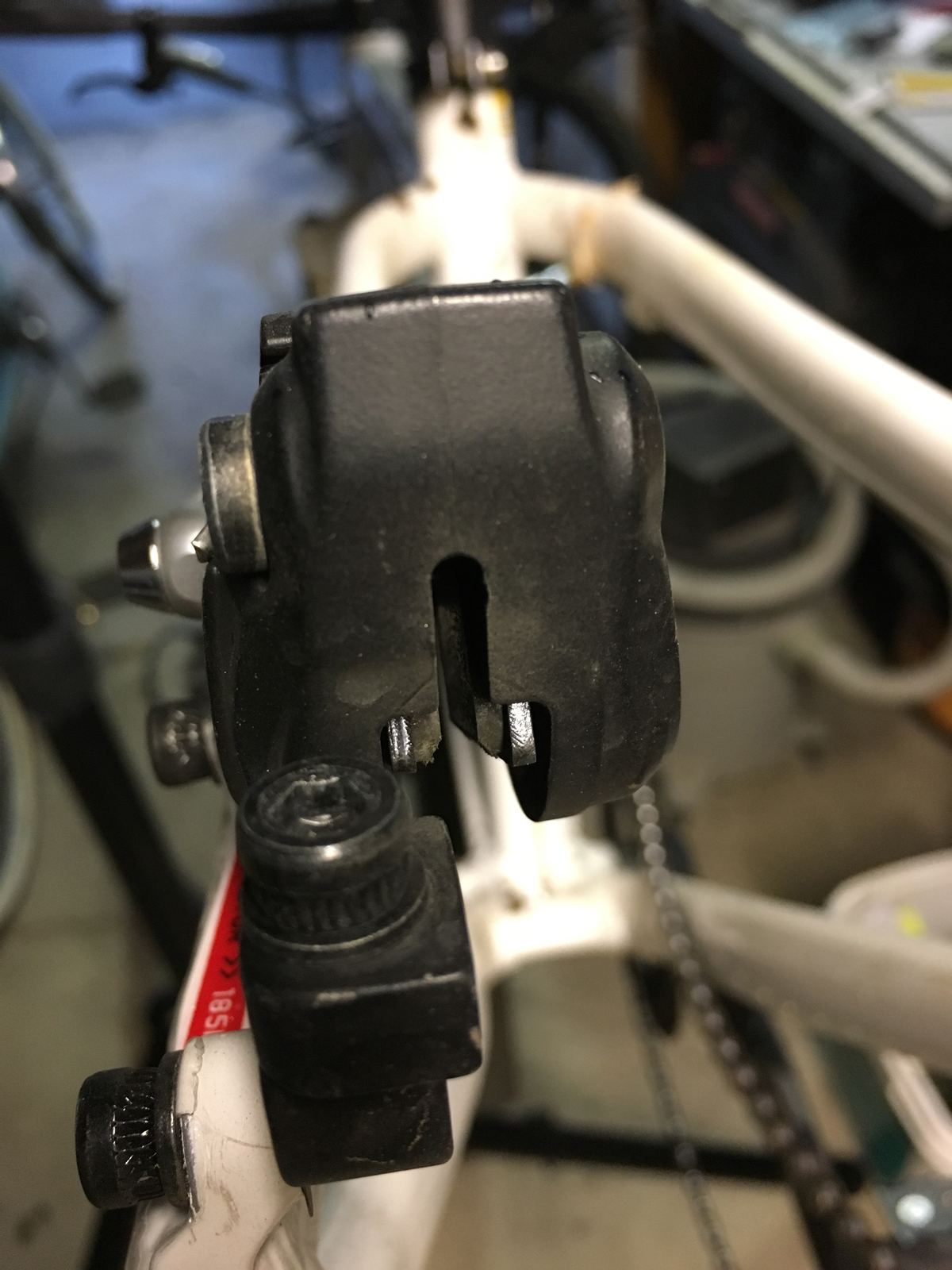
Take your wheel out to get a better view of your brake pads. Photo by Tom Jow
Mountain bike hydraulic brakes don’t have cables but they still need regular service. Check the brake pads any time the wheels are out. The pads are self adjusting, so if you don’t inspect them you won’t know if they need replacing until they don’t work anymore. Just grab a flashlight and look inside the brake caliper. If the brake pad material is 2mm thick or less, replace them. Also, the hydraulic brake fluid should be changed occasionally. There are two reasons to do this. One, dirt and brake pad material sneak past the caliper piston seals to contaminate the fluid. Second, for brakes using DOT brake fluid, the fluid is “hygroscopic” meaning it absorbs water. Water in the brake line boils faster than the brake fluid, therefore expanding and creating inconsistent braking performance. There are several types of DOT brake fluid so be sure to follow the manufacturer’s recommendation. Mineral oil brake fluid does not absorb water, however, should still be changed occasionally. Again, only use the manufacturer’s recommended brake fluid.
There are two other hydraulic systems on bicycles. One is the adjustable (dropper) seatpost. These seatposts have oil, air and rubber seals to contain both. This component operates under high pressure and if the seals are not up to the task of containing said oil and air, the post will fail. How often does the dropper post need to be serviced? According to SRAM, the RockShox Reverb should be serviced at every 100 and 200 hours of use. The manufacturer KS Lev recommends their post be serviced every 3 months. See your owner’s manual or the manufacturer’s website for more details.
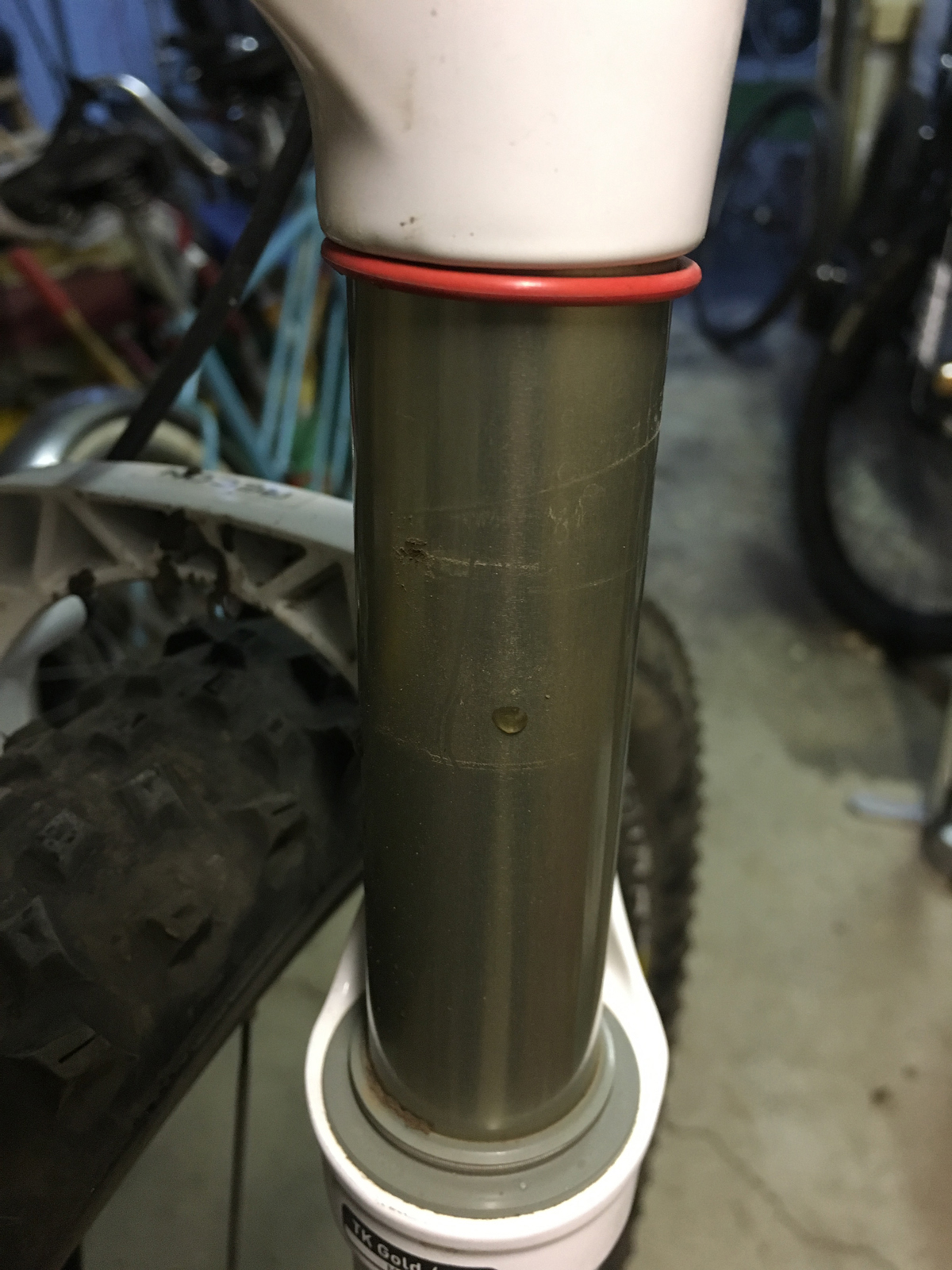
Keep you fork tubes cleaner than this. Photo by Tom Jow
The other hydraulic system on a mountain bike is the suspension. The first line of defense is keeping those things clean. Before or after every ride, wipe the stanchion tubes (the one that slides inside the seal) with a rag. Dirt is the enemy to your suspension. For this reason it is important to have the seals checked and oils changed on schedule. For years, Fox recommended lower leg and oil service every 50 hours of riding. That time constraint has gradually increased so that for current forks major service is every 200 hours. RockShox suggests lower leg service every 50 hours and full service and oil change at 100 hours. For the rear shock, Fox recommends their rear shocks should have a seal service at between 8 hours (wet conditions) and 40 hours (dry). RockShox suggests service at approximately 100 hours of use. Be aware that these service recommendations are condition dependent. The wetter and dirtier the riding conditions, the shorter the service interval.
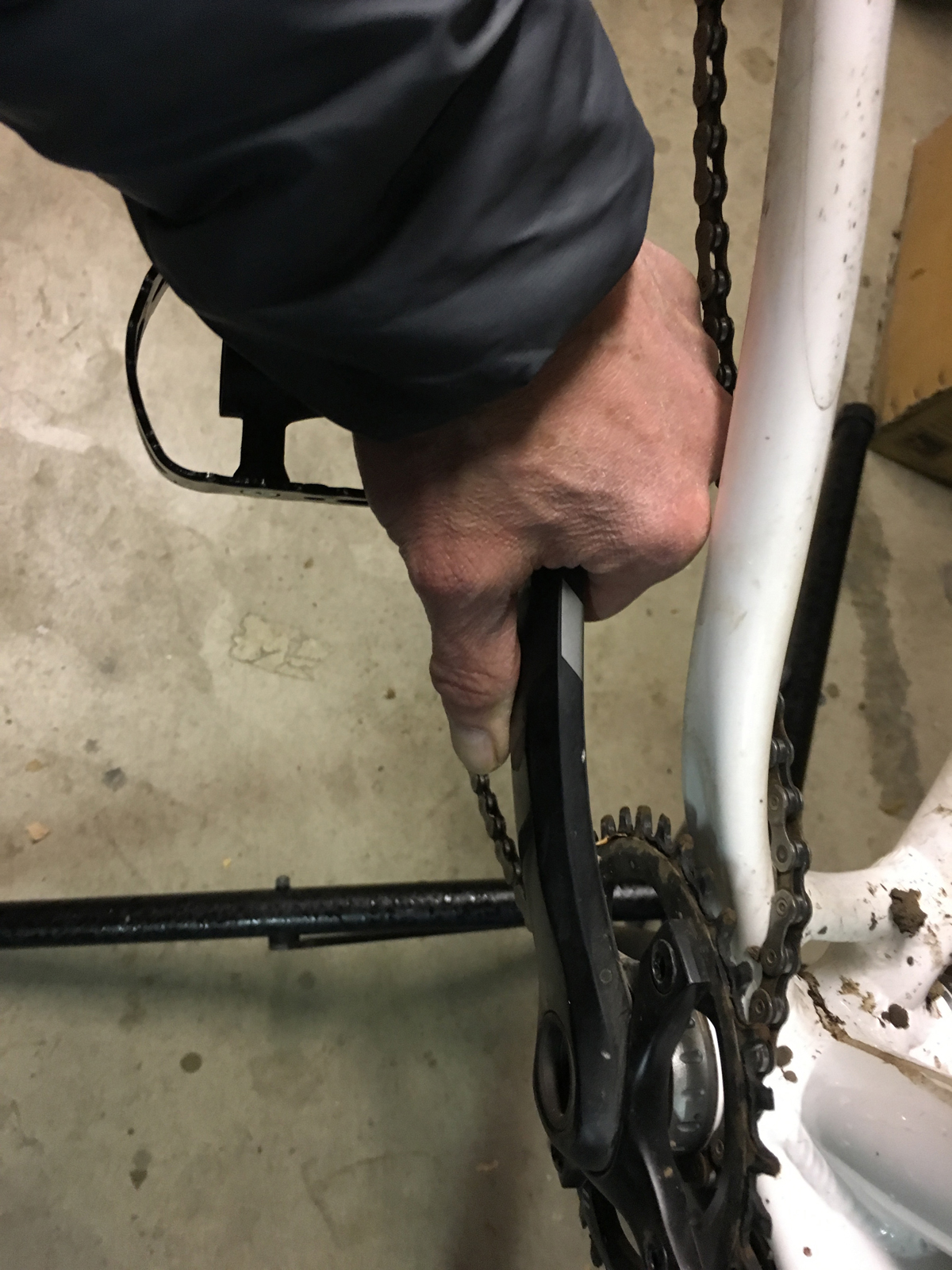
Grab a crank arm and wiggle to find out if the bottom bracket is loose. Photo by Tom Jow
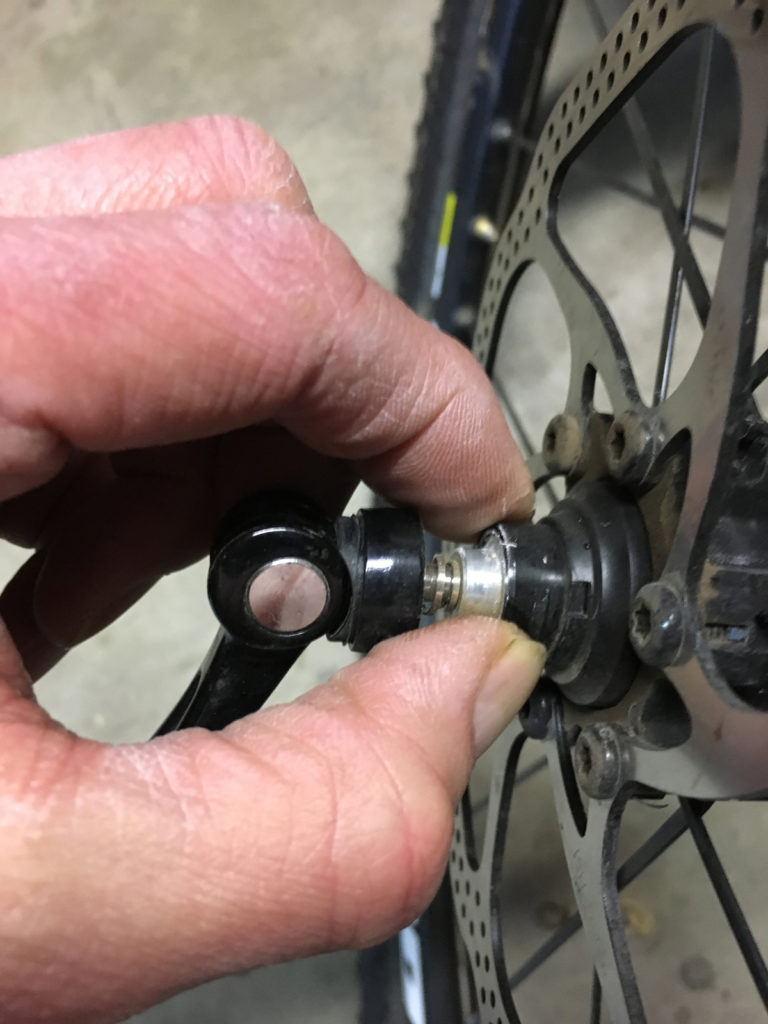
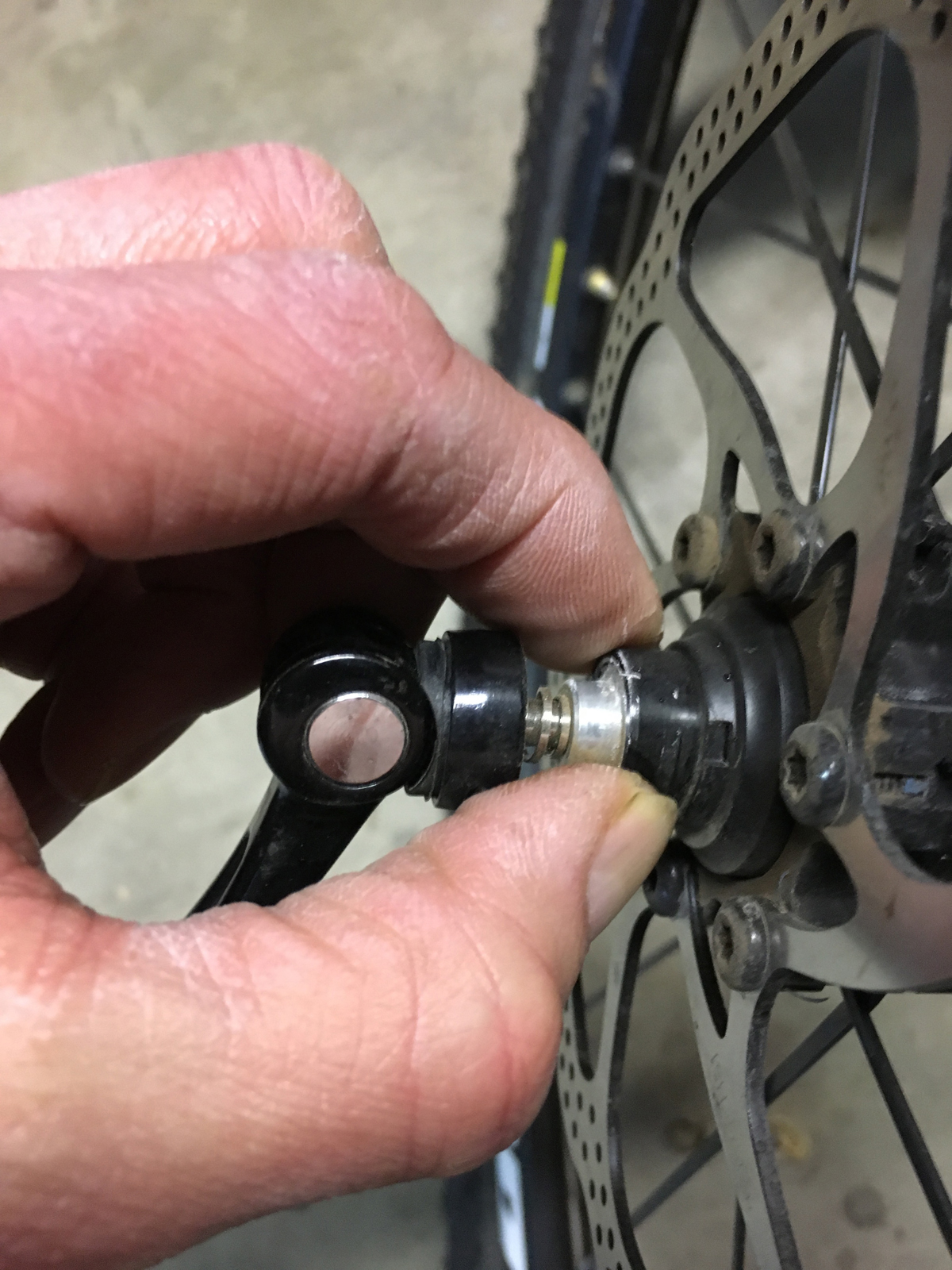
After taking care of all the aforementioned components, don’t forget about your wheels and bottom bracket. Spin the wheels and make sure they are true. If not, look for broken or loose spokes. Give the tires a looking over. Inspect the sidewalls and tread for cuts and abrasions. On mountain bike tires, the knobs get torn off sometimes. After the tires, check the bearings. Almost all hubs and bottom brackets are using sealed cartridge bearings these days. These bearing spin great but they usually don’t have too much grease inside. Check the hub bearings by removing the wheels and spin the axle with your fingers. Good ones feel smooth, with just a little wet feeling resistance. Dry ones may be smooth and spin really free. Bad ones feel crunchy or have high resistance to movement. These indications apply also to the bottom bracket. Remove the chain from the chainrings and give it a little spin.
Give your axles a spin to check the condition of the bearings. Photo by Tom Jow
Performing preventative maintenance on a bicycle is actually a pretty easy thing to do. The hardest part is figuring out what needs to be looked at and when. One way to keep track is the appointment calendar. Another way is to make notes in the training log. Some of the online apps have a place to indicate what equipment was used for the day’s workout. The important thing about preventative maintenance is to do it. Because the alternative is to have a bike that doesn’t work when you most want to ride it.
Tom’s tl;dr Guide to Bike Maintenance
As necessary: Lubricate chain
Every ride: Tire pressure, wipe suspension
Every couple rides: Wash bike, tire condition, check brake pads (the wheels are out)