Home Blog Page 172

Teton Gravity Research Announces Feature-Length MTB Film “Accomplice”

Teton Gravity Research, in collaboration with legendary director Jeremy Grant, recently announced their second feature-length mountain bike film: ACCOMPLICE.

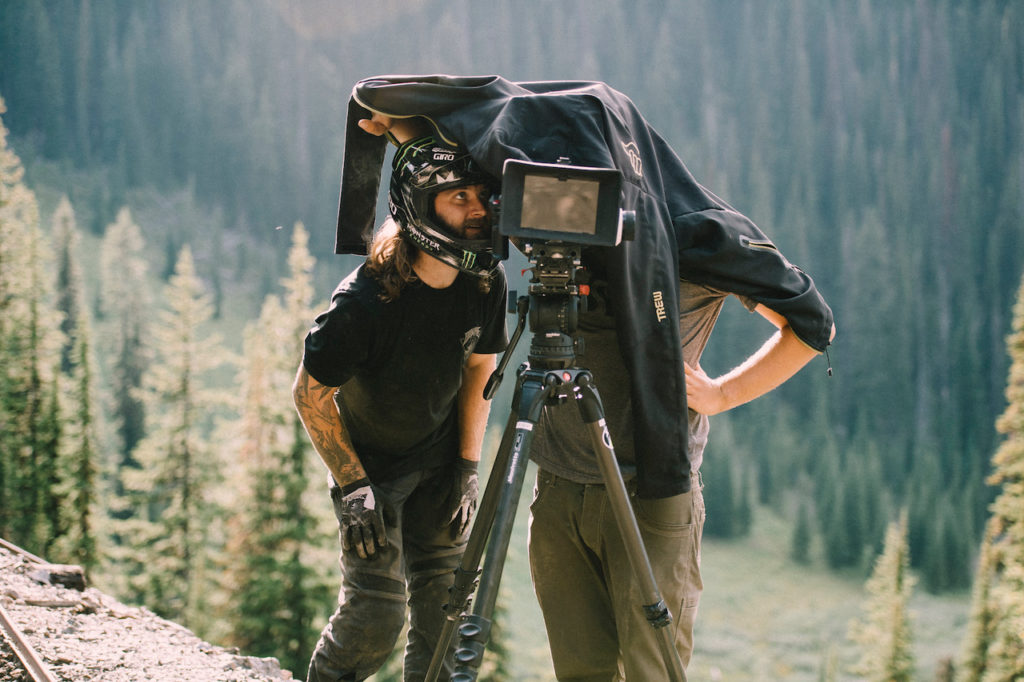
Graham Aggasiz at Retallack. Photo courtesy Teton Gravity Research/Paris Gore

With Grant’s experience from directing classics like Where the Trail Ends and North of Nightfall, they’ve brought to the stage a new vision that follows some of the sport’s most progressive riders across the globe.

The movie touts a cinematic journey starring Graham Agassiz, Nico Vink, Kurt Sorge, Garett Buehler, Andreu Lacondeguy, Hannah Bergemann, Veronique Sandler, Cameron Zink, Tom van Steenbergen, Ethan Nell, Jaxson Riddle, Paul Basagoitia, Carson Storch, Cam McCaul, Tyler McCaul, Erik Fedko, and Brandon Semenuk.

More information at www.tetongravity.com/accomplice


The Athlete’s Kitchen: How To Gain Weight Healthfully

  • “No matter what I eat, I can’t seem to gain weight…”
  • “What about those weight gain powders … do they work?”
  • “How much more protein should I eat to help me bulk up?”

By Nancy Clark, MS RD CSSD — Although two-thirds of Americans are overweight or obese, a handful of skinny people—including many athletes—feel very frustrated by their seeming inability to gain weight. Their struggle to bulk up is on par with that of over-fat folks who work hard to lose weight. Add in rigorous training for a marathon, soccer team, or other sport, and scrawny athletes can feel at a disadvantage, fearing that no matter how much they eat, they’ll get even skinnier.

Clearly, genetics plays a powerful role in why some athletes have so much trouble not only gaining weight, but also maintaining any weight they manage to add. “Hard gainers” tend to be fidgety. They rarely sit, to say nothing of sit still. They are constantly puttering around, or when sitting, they are tapping their fingers, swinging their legs, twirling their hair, and shifting around in the chair. All of these activities burn calories that commonly end up in the midriff of calmer people who can sit motionless for hours.

If you are a hard gainer, you might have been told that consuming an extra 500 to 1,000 calories per day will lead to gaining 1 to 2 pounds per week. Unfortunately, Nature often confounds this mathematical approach. For example, in a weight gain study where the subjects were overfed by 1,000 calories per day for 100 days, some subjects gained only 9 pounds, whereas others gained 29 pounds (1).

How could that be? The answer likely relates to Non-Exercise Activity Thermogenesis (N.E.A.T.), the technical term for spontaneous movements that naturally occur in fidgety people. When you overfeed a fidgety person, they can become even more active, as if Nature wants them to burn off those calories.

Seven Tips to Gain Weight Healthfully

Fret not; even very lean people can gain some weight when they systematically enhance their diet. Although they cannot change their genetics and their tendency to fidget, they can boost their calorie intake. If you are a scrawny athlete, have a teenage eating-machine who wants to weigh more, or are trying to bulk up for football, here are some tips to help you gain weight healthfully.

  1. Eat consistently. Do not skip meals; doing so means you’ll miss out on important calories needed to reach your goal. Every day, enjoy a breakfast, an early lunch, a later lunch, dinner, and a bedtime meal. This might mean breakfast at 7:00, lunch at 11:00, second lunch at 3:00, dinner at 7:00, and a protein-rich bedtime snack at 10:00.
  2. Eat larger than normal portions. Instead of having one sandwich for lunch, have two. Enjoy a taller glass of milk, bigger bowl of cereal, and larger piece of fruit.
  3. Select higher calorie foods. Read food labels to discover which wholesome foods offer more calories. For example, cranapple juice has more calories than orange juice (170 vs. 110 calories per 8 ounces); granola has more calories than Cheerios (500 vs. 100 calories per cup); corn more calories than green beans (140 vs. 40 calories per cup).
  4. Drink lots of 100% fruit juice and low-fat (chocolate) milk. Instead of quenching your thirst with water, choose calorie-containing fluids. By having milk with each meal, you can easily add 300 to 600 wholesome calories a day. One high school soccer player gained 13 pounds over the summer by simply quenching his thirst with six glasses of cranapple juice instead of water (1,000 vs. 0 calories). He consumed the fluid he needed (juice is 98% water) and bonus of more carbohydrates to refuel his depleted muscles, plus a good dose of vitamin C to enhance healing.
  5. Enjoy peanut butter, nuts, avocado, and olive oil. These foods are high in (health-promoting) fats. They’re a positive addition to your sports diet; they help knock down inflammation. Their high fat content means they’re calorie-dense. To boost good fats, add almonds to cereal & salads, spread extra peanut butter on the PB&J sandwich, dive into the guacamole with baked chips, and add extra olive oil dressing to your salads. That’s an easy extra 500+ calories/day.
  6. Do strengthening exercise as well as some cardio. Weight lifting and push-ups stimulate muscle growth so that you bulk-up instead of fatten up. Plus, exercise stimulates your appetite and, sooner or later, you’ll want to eat more. Exercise also increases thirst, so you will want to drink extra juices and caloric fluids. Take note: You will not build bigger muscles by eating extra protein. While you want to target a protein-rich food with 20-30 grams protein at each meal (and 10-15/snack), having more will not build bigger muscles. Resistance exercise builds muscles. To have the energy to do the muscle-building training, you need extra carbs. That’s where drinking more 100% fruit juice and chocolate milk offer benefits; you’ll be better-fueled & better able to lift heavier weights.
  7. Don’t bother to buy expensive weight gain drinks. A hefty PB&J with a tall glass of chocolate milk adds about 1,000 calories for about $2.00. You would spend at least $10 get-ting those calories from Muscle Milk.

Conclusion: By following these tips, you should see progress, but honor your genetics. Most people do gain weight with age as they become less active, more mellow, and have more time to eat. Granted, that information doesn’t help you today, but it offers optimism (or a warning) for your future physique!

References:

1) Bouchard, C. 1990. Heredity and the path to overweight and obesity. Med Sci Sports Exerc 23(3):285-291.

Nancy Clark, MS, RD, CSSD (Board Certified Specialist in Sports Dietetics) counsels both casual and competitive athletes at her office in Newton, MA (617-795-1875). Her best selling Sports Nutrition Guidebook and food guides for marathoners, cyclists and soccer players offer additional information. They are available at www.NancyClarkRD.com. For her popular online workshop, see www.NutritionSportsExerciseCEUs.com.

Titan Tropic Cuba – Racing in the Land That Time Forgot

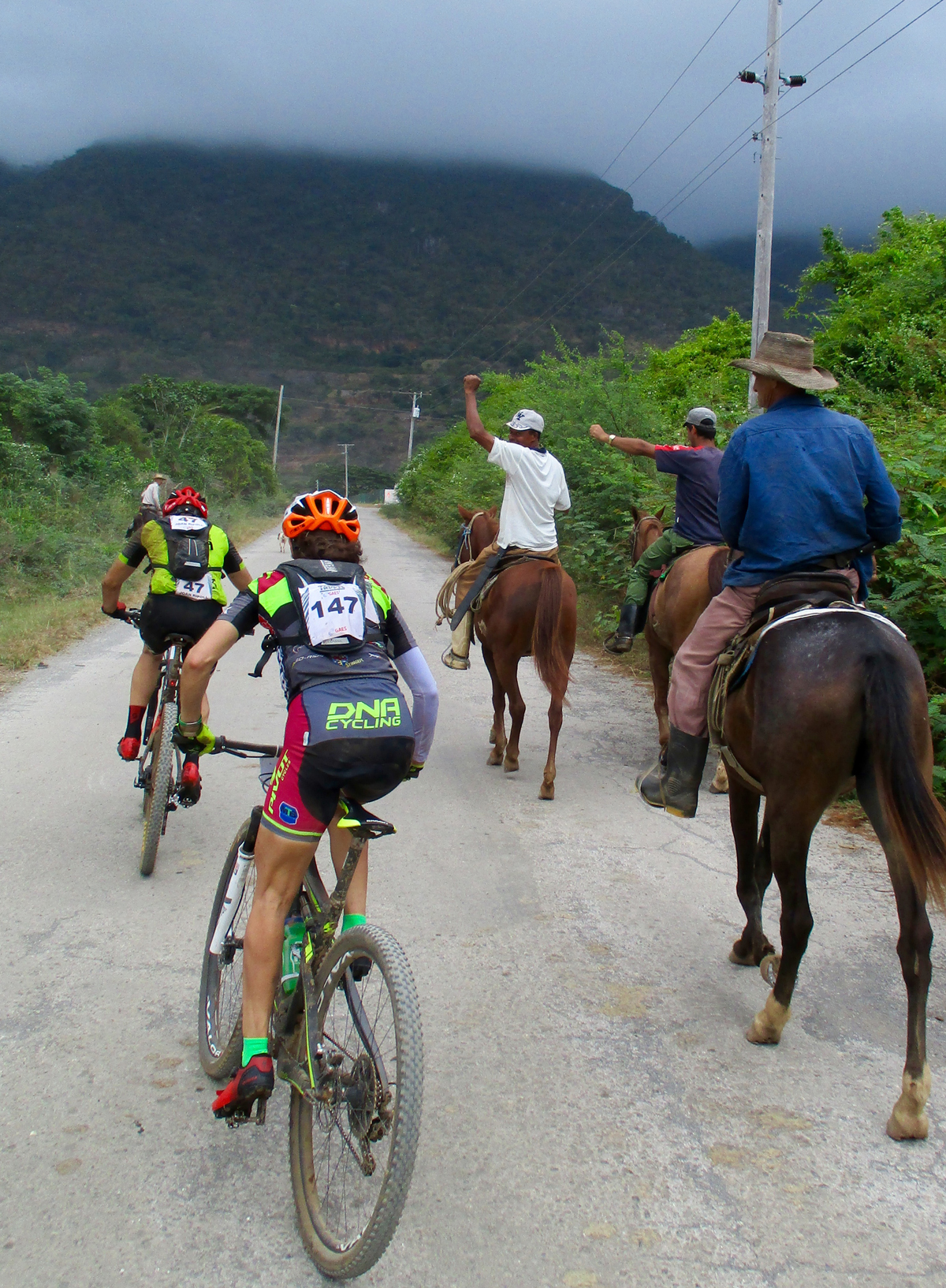
By Shannon Boffeli — The moment my wife Jen Hanks and I learned about Titan Tropic Cuba we knew it would be an unforgettable experience. Whether in Chile, Austria, Italy, or Canada we’ve discovered mountain bike stage racing is an unparalleled way to see and experience a new country. These events will take you to places unknown to even the best tour guides. Now image having this experience on a tropical island where no Americans have legally traveled for over 50 years and that’s Titan Tropic.

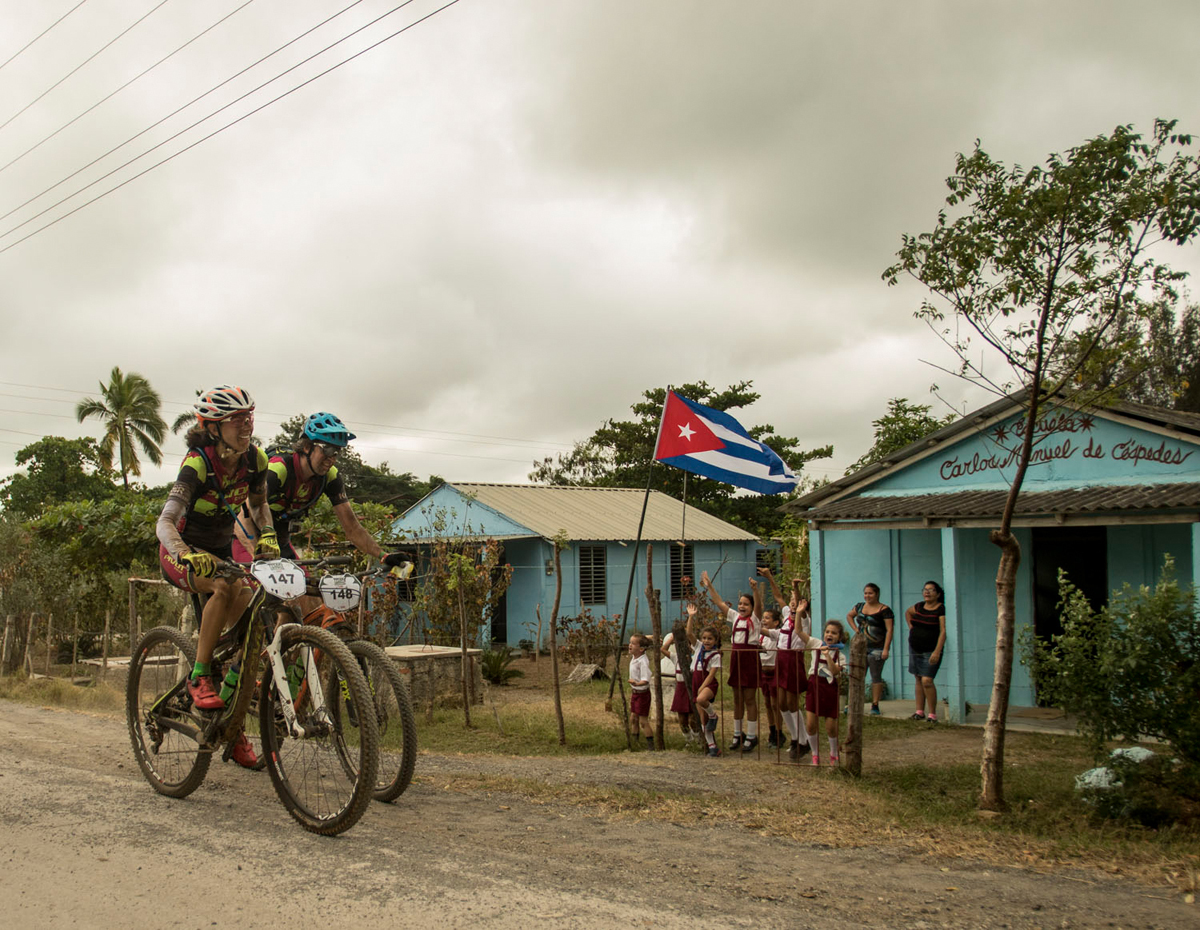
Shannon Boffeli and Jen Hanks racing Cuba’s Titan Tropic. Photo by Cristian Casal, courtesy Titan Tropic

Even the flight to Cuba was an experience. After more than 50 years of travel ban to the Caribbean’s largest island, boarding a commercial flight in Miami and landing in Havana, just 45 minutes later, is something few Americans have experienced since JFK was president.

Leave the high rises, glitz, and glamour of Miami and in less than an hour you’re transported to a different time. The plane flies over miles and miles of unmaintained dirt roads that slowly weave between fields full of ox and cattle before touching down at Jose Marti International airport in Havana. Travelers disembark on the runway, and catch a cab that’s most likely a 50s-era Chevy completing the sensation that you’ve been transported back in time. While just 90 miles south of the United States, Cuba feels light years away.

Just days before leaving for Cuba we heard the news that our trip would hold even greater significance, the death of longtime Cuban dictator Fidel Castro. When we arrived, the country was in the midst of a nine-day mourning period that would impact our first two days of racing.

Sadly, the prologue stage, a 30 km bike tour through the heart of old Havana was canceled and stage 1 would have to be neutralized, as celebrations of any kind were not permitted in the time of mourning.

We made the best of the situation doing our own bike tour through the city and along the waterfront that was soaked in the purple and blue of the setting sun.

Cuba is an incredible country with surprises around every corner. We were looking forward to our week of adventure.

The island is just opening up to the world of biking. Road bike touring in Cuba is just starting to gain a foothold as some private businesses have started offering their services in recent years but mountain biking is almost unheard. Until very recently, it just hasn’t existed in Cuba but the raw materials of exceptional terrain and endless natural beauty are abundant and virtually ensure that the sport is going to quickly take off.

The route our 5-day, 271-mile stage race took us on headed southwest of the Cuban capital before circling back north and finishing on the pristine white sand beaches of Cayo Jutias, that despite being named after giant indigenous tree rats, is a protected national treasure of unmatched beauty.

Our first day of riding treated us to more of Havana as we rolled through town passing by various Ernest Hemingway hangouts and near the sprawling compound inhabited by President Raul Castro. Miles and miles of rolling hills and sugar cane fields eventually brought us to the foot of the mountains we would be racing in the next four days.

We finished the first stage in the small mountain town of Soroa, the “Rainbow of Cuba”, named so because of the vast living orchid collection that lives there numbering over 700 different breeds.

Soroa was our first night staying in a camp. A unique feature of Titan Tropic is that everyone was required to stay in the camp from the fastest rider to the slowest. We had all the members of the Cuban national team sleeping in tents right next to us.

Each rider had their own 1-person tent and race organizers would transport your luggage from camp to camp.

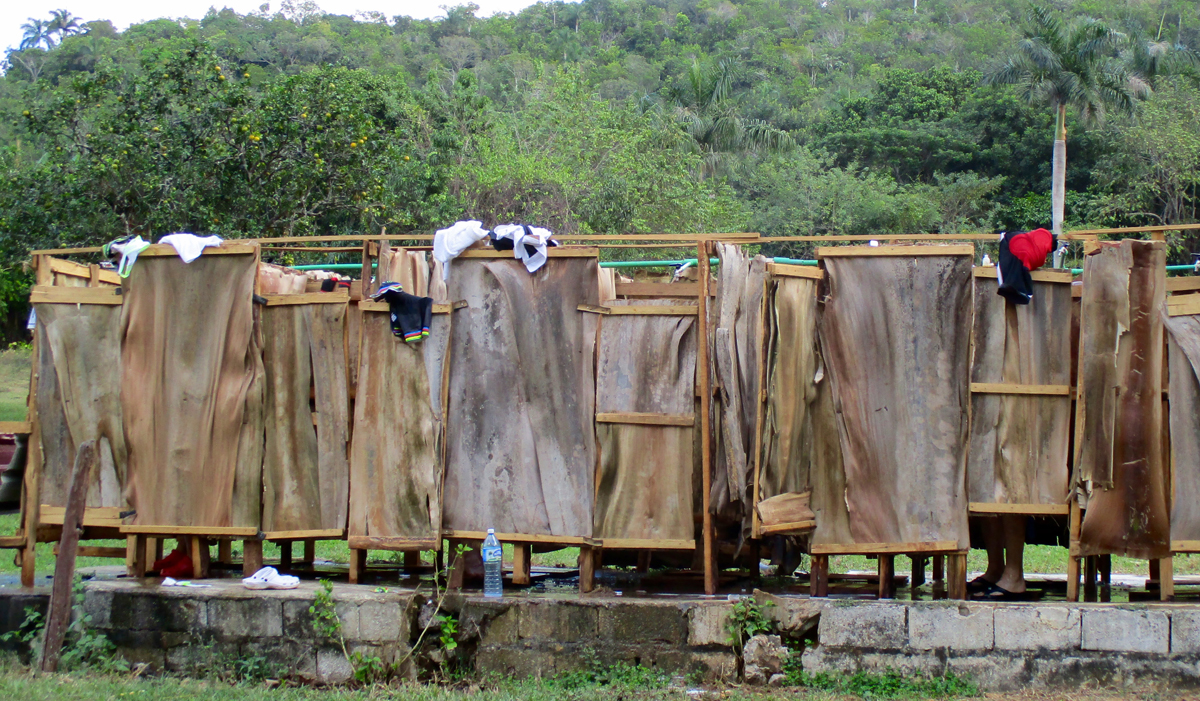
The showers. Photo by Shannon Boffeli

The shower facilities could be described as spartan at best. Like a scene from Gilligan’s Island, the showers were basically a stall, made from palm fronds, with a hose connected to a shower head above you. Cold water would pour onto you as you try and set a personal record for fastest shampoo job. On hot days the showers were surprisingly refreshing.

We also learned that Cuba lacks one major staple of international bike racing; the porta-potty. The details our porta-potty substitutes are too unpleasant to discuss but imagine a hole in the ground, a wood pallet with no center, and a nail to hang toilet paper on.

While some of life in the camp was a challenge the Titan organizers spared no expense when it came to food. Three meals a day with an assortment of food to fit every diet, and lots of desserts.

Each camp had an outdoor pool that was perfect for cooling off, recovery, and socializing. One of the best aspects of the camp-style stage races is the amazing camaraderie riders build throughout a week of shared suffering. Lifetime friendships are formed with every race.

Day two was our first day of real racing completing a challenging circuit around Soroa finishing back at camp for a second night.

Day three is when we really started to see the heart of Cuba. We left Soroa and traveled to Vinales following rock-strewn, beaten, forest tracks, cross cut by streams and muddy fords traveled over hundreds of years by nothing but horses and ox-drawn wagons. These ancient dirt tracks now provided passage for 150 lycra-clad mountain bikers.

Racing through Cuba. Photo by Shannon Boffeli

Dropping deeper and deeper into the interior of Cuba we passed homes that rarely see visitors and must have thought the alien invasion was surely happening as gaunt beings in brightly-colored spandex, steadily streamed by. If indeed they thought the aliens were upon them, they were exceedingly nice about.

After the dirt ended, we climbed to a high ridge that traversed endless valleys. An absolutely marvelous road that feels like you’re riding the Blue Ridge Parkway in Virginia with forests of palms taking the place of the old growth hardwoods of North America.

Finally, we dropped into the Vinales Valley with its 1,000 foot mogotes, giant haystack shaped mountains with sheer limestone walls, standing guard. A more unique and varied landscape would be difficult to imagine as lush greenery and palm trees sit atop limestone monoliths with sheer-vertical walls on all sides. It’s no surprise Vinales is a UNESCO world heritage site.

We spent two nights in Vinales taking in all the sights that surround this amazing valley. Vinales is currently a hotspot for road cycling tours in Cuba and it’s no surprise; endless miles of roads ramble along ridgelines and wind between majestic mogotes, caves, and natural springs. Riding for hours without seeing a car. Outside the big cities, cars are scarce in Cuba. Too expensive for most citizens, cars are a luxury here as most people still travel by horse or on foot.

Sadly, our week of racing eventually had to end as we left the interior forests of Cuba for the beaches of Cayo Jutias and a well-deserved dip in the clear blue Atlantic.

After the finish we returned again to Havana. The mourning period for Fidel Castro had now passed and the rollicking nightlife Havana is known for had returned. The whole city was suddenly alive as every restaurant, club, and hotel had live music, dancing, and the best mojitos on the planet.

The Titan Tropic was like nothing we had done before. The unrivaled cultural experience of Cuba, fused with a week of bike racing and the excellent support of the Titan Tropic promoters combined to make a wicked stew of challenge, enjoyment, and unforgettable memories. 


SWICA Announces Meeting to Elect Board Members on February 10, 2020

BOISE, Idaho (February 5, 2020) — The Southwestern Idaho Cycling Association (SWICA), which serves as the USA Cycling Local Association for the region, has announced that it will be holding a meeting to elect new members to the Board. 

The meeting will be held at Bob’s Bicycles, 6681 W Fairview Ave, Boise, ID 83704 at 6:00 pm on Monday, February 10, 2020.

According to an email sent by John Rogers to the SWICA mailing list:

“For many years SWICA has been run by one or two individuals with little help from others.  There is only so much one unpaid person can do before he must ask, “Can’t someone else help?”  A big part of keeping competitive cycling healthy in Idaho, is being involved in that community.  I know life is busy and we dedicate a lot of time to training to be physically fit for races. Sometimes we forget that it takes planning and lots of behind the scenes stuff to make race day happen. The more hands we have pitching in to help, the better job we can all do to help the sport of cycling grow.”

If the meeting and election do not generate enough interest from the bicycle racing public in Southwest Idaho, it is likely that moves will be taken to fold SWICA and shift governance over the region back to USA Cycling, rather than continuing to be administered locally.


Life on One Wheel: Tips for Unicycling

By Jamie Morningstar — As a proud mom, I’ll tell you that my son Ben has always been a quick study on a bicycle.

Take, for example, a chilly April morning nine years ago when a five-year-old Ben announced that he was ready to shed the training wheels. Knowing it’s a sin to squelch any child’s bicycle-related ambitions, I immediately acquiesced, grabbed a socket wrench, and removed the training wheels. It was a little chilly out, so I told Ben I was running in to get a sweater and would come right back out to help him get started.

I got a warmer layer and walked back outside to find Ben was zipping around the driveway shouting, “I am the Master of Awesomeness!” He had mastered life on two wheels in the time it took me to grab a sweater.

Fast forward a few years to last summer when Ben’s stated ambition for the summer was to learn to cycle really, really well without hands. By the end of the summer he has perfected riding around our entire block while patting his head and rubbing his tummy. And a germ of an idea sprouted in my head – Ben clearly needed a unicycle for Christmas.

Ben’s first afternoon on his unicycle. Photo by Jamie Morningstar

I have a policy about gift-giving: all truly great presents are risky. I mean, where’s the thrill if you get somebody exactly what they asked for? A perfect gift often involves choosing a present they would have never thought of, but now can’t imagine life without. Of course, a gift like that that could fall totally flat on its face; or could be simply brilliant.

And so Ben found a unicycle under the tree Christmas morning.

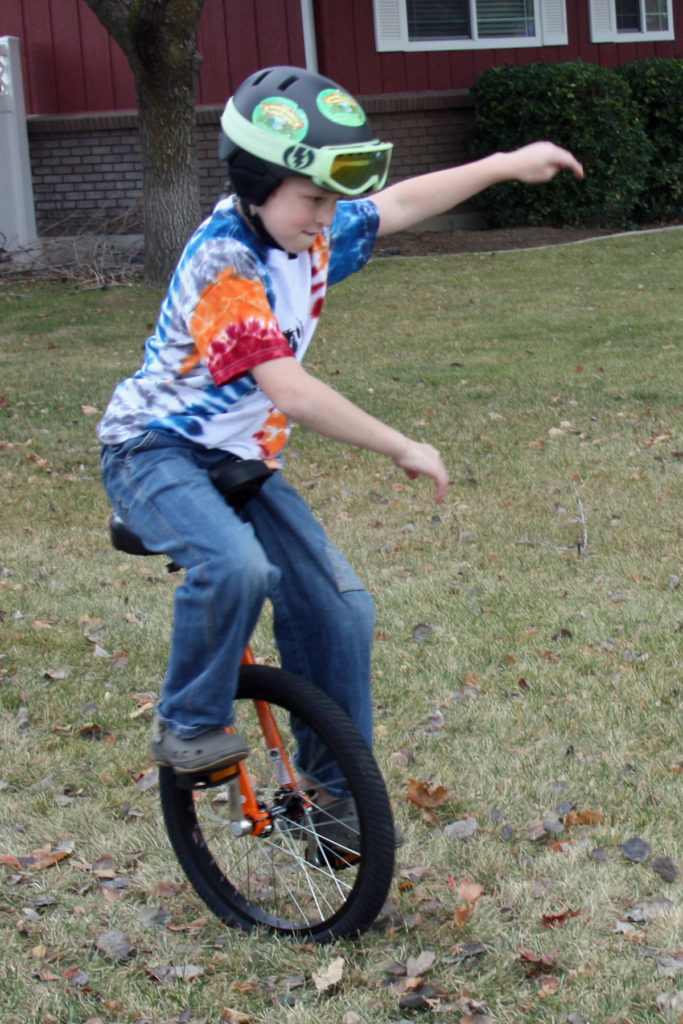
He refused to watch the YouTube videos we had pre-scouted. Reading a how-to guide was out of the question. Ben just wanted to get out and ride.

By the end of Christmas Day he could ride 2 pedal rotations before falling.

By the middle of January he could ride from one end of his grandmother’s kitchen to the other (Grammy has tile floors and a far more generous outlook on unicycling in the house than Mom and Dad).

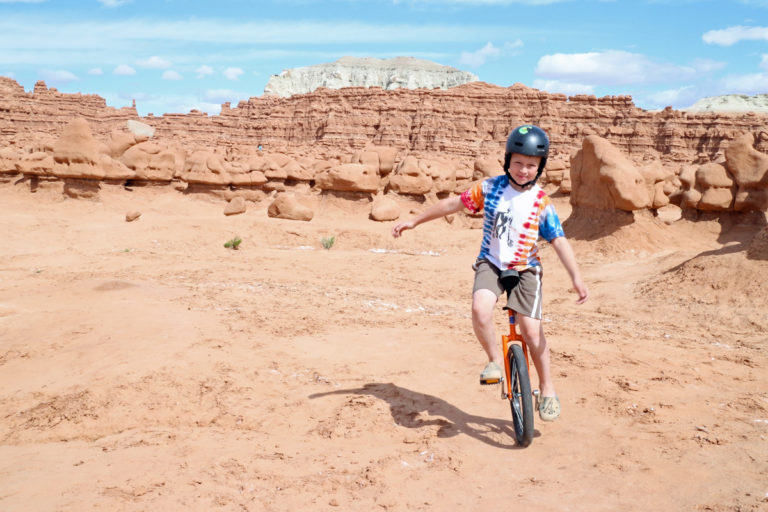
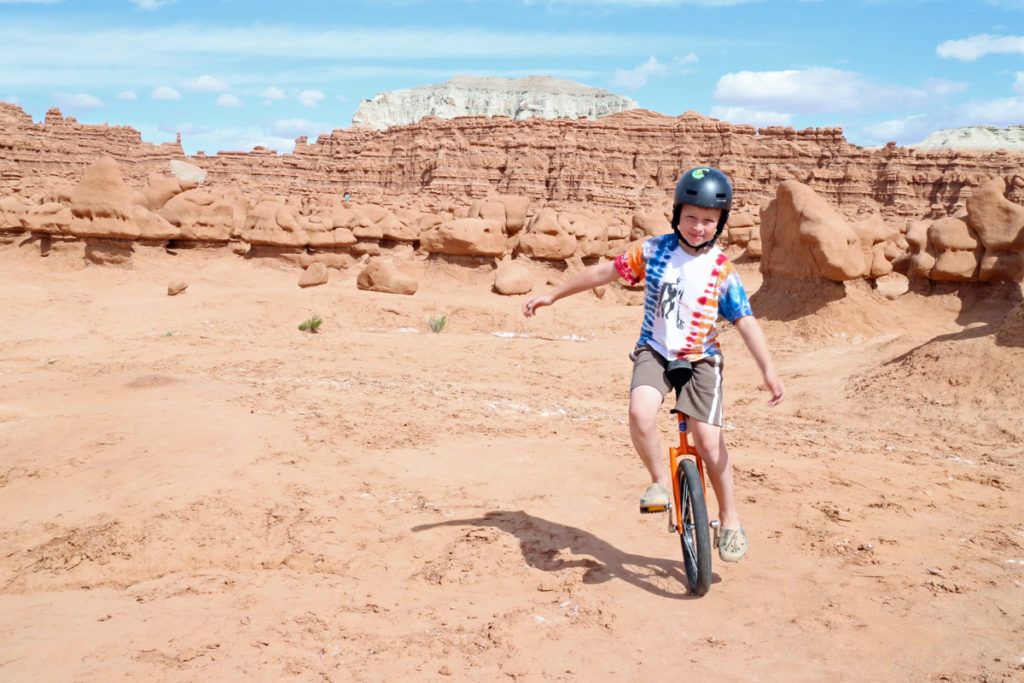
After 5 months of practice Ben was getting pretty darn good on the unicycle. He insisted on bringing the unicycle on a camping trip to Southern Utah, May 2015. Photo by Jamie Morningstar

And by May, the boy was unstoppable. The unicycle was his constant companion. It carried him to the grocery store on allowance day to purchase the week’s allotment of candy. He rode it to school, brought it to church youth group. He was always riding.

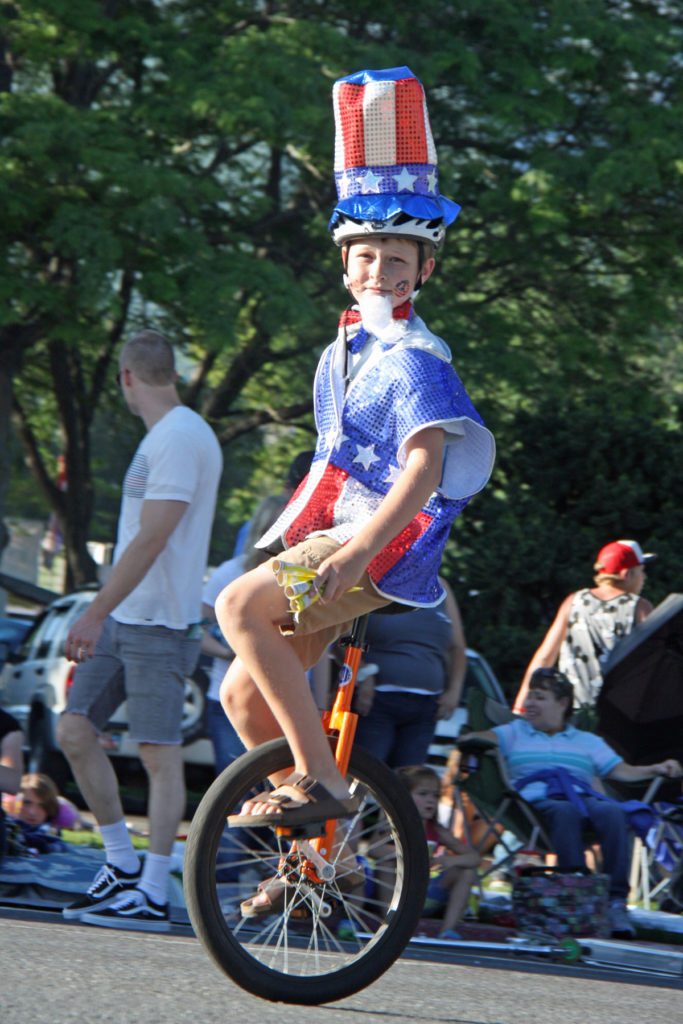
Ben practiced long and hard to be ready for the Orem Summerfest Children’s Parade, 6 months after receiving his unicycle for Christmas.
Photo by Jamie Morningstar

Ben’s Tips for Learning to Ride:

There are great videos out there to learn. Watch a bunch of stuff on YouTube.

Start with a 20” wheel, even if you’re taller than I am. It’s a lot easier to learn with a smaller wheel. Eventually if you want to go longer distances you’re going to want a 24” or bigger, but start small.

Don’t get the cheapest unicycle out there. The cheapest ones go for about $60 but I started with a Club. If you spend a little bit more, the whole unicycle feels more stable, even now after years of use. With Club the seat is more comfortable that the ones on really cheap unicycles, and the seat has a handle in front, which is pretty nice.

Learn to fall forward. Starting unicycling is really just falling practice. With accidental falling, you fall forward a lot more often than you fall backwards. Plus it’s easier to catch yourself safely if you fall forward. So before you even worry about learning to ride, learn to fall forward. You’ll feel a lot less scared when you start riding if you’ve practiced getting off quickly and safely.

Beyond Beginning

A kid’s interests usually change faster than Utah weather, but Ben’s love for unicycling is steadfast. He’s been riding consistently now for almost three years. Ben’s unicycle is still his primary mode of transportation and he’s added curb hopping and other small tricks to the repertoire.

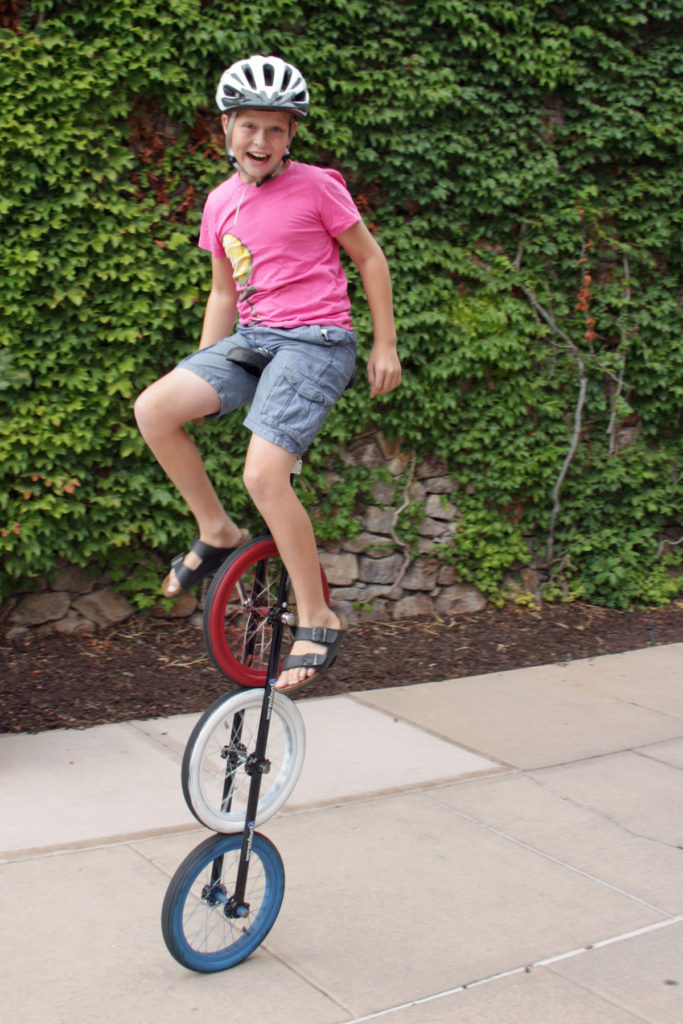
Last Christmas Ben decided it was time to up the ante and get a giraffe. “Giraffe” unicycles are tall unicycles with a saddle on a long seat post and a chain connecting pedals to the wheel rather than the usual direct-drive arrangement on most unicycles. But a normal giraffe still wasn’t cool enough for Ben. He requested a unique arrangement – a triple-decker unicycle.

Ben shows off his increasing unicycle confidence on his Tricycle. Photo by Jamie Morningstar

Ben’s “tricycle” has three 16-inch wheels stacked on top of each other. Pedaling the first wheel forward drives the second backward, which drives the third wheel (and the whole unicycle) forward. It’s quite the contraption, and always earns Ben the admiration of passers by. As he puts it, “I ride my tricycle when I want to show off more than usual.”

Ben says, “The most frequently asked question is what it’s called. I don’t have a preference – the website says it’s a 3 Wheeler, which seems kind of lame. I’ve heard it been called a tricycle or and a tri-unicycle. One of my favorite names for it was when I had it painted in patriotic colors for a parade – we called it a “Red, White, and Blunicycle”.

He goes on to say that the next most common question he gets is, “How do you get on that thing?” He explains the process like this: “You want to stick your dominant leg on the bottom wheel so it doesn’t roll and you have a place to step. Hold on to something tall with your dominant hand and pull up. With the pedal at 6 o’clock, put your non-dominant foot on the pedal, get your butt on the seat, and then swing your other foot over on to the other pedal.”

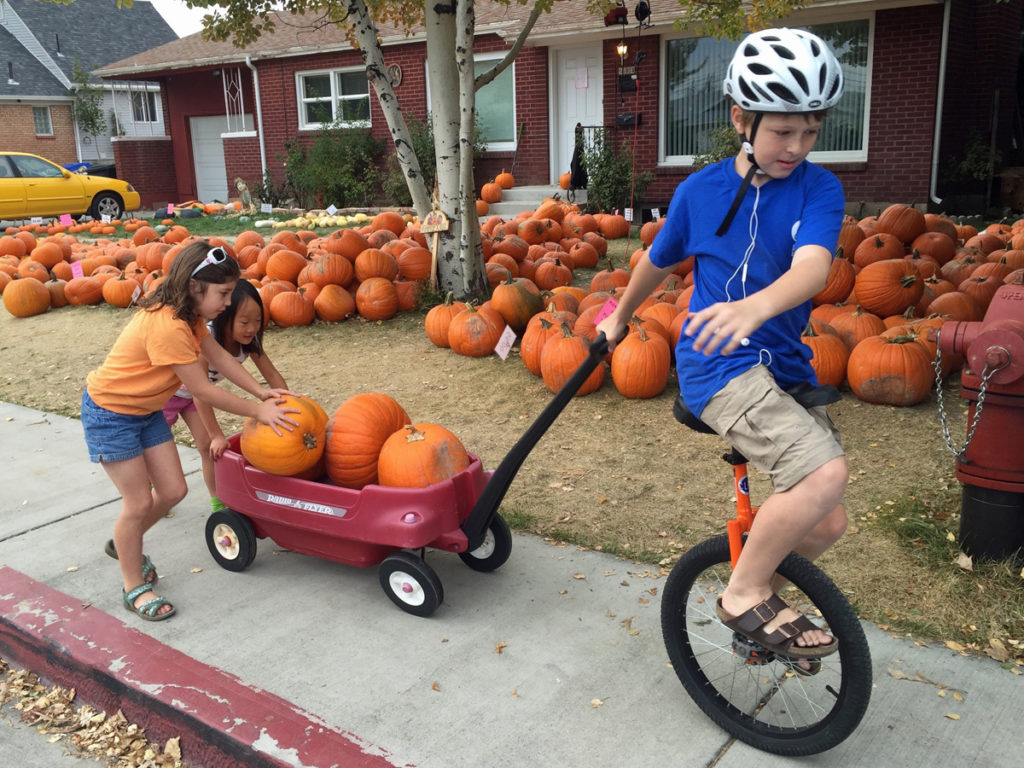
Once he got proficient, Ben rode his unicycle everywhere, including a trip to the pumpkin patch to pick up Halloween jack-o-lanterns, October 2015. Photo by Jamie Morningstar

Mounting his giraffe unicycle solo is as complicated as it sounds, and it took Ben several months to be able to mount and dismount confidently on his own. But the admiration and attention he gets when riding it more than make up for the steep learning curve.

It’s been a blast seeing the unicycle become a part of Ben’s identity. He’s invested countless hours into riding, practicing tricks, and building his confidence on one wheel. Seeing a kid work hard and persevere through learning a really tough skill is such a fulfilling experience. I’m so glad that Ben has discovered a passion for unicycling. Now I’m just hoping we can find some college unicycling scholarships out there!


USA Cycling Announces 2020 Pro Mountain Bike Calendars

By Bouker Pool — COLORADO SPRINGS, Colo. (January 31, 2020) — USA Cycling announced today the calendars for the 2020 Pro Cross-Country Tour (Pro XCT) and National Downhill Series (formerly called the Pro GRT). Downhill and cross-country mountain bikers will have the chance to compete in these internationally and domestically ranked races spanning coast-to-coast.

The Pro XCT and the National DH Series are comprised of the top mountain bike events in the U.S. and track the standings for elite riders in their respective fields. Most events will also carry amateur categories providing an environment for amateurs to watch their heroes race the same tracks and courses. Individual elite series champions are crowned at the conclusion of the calendar.

This year, the Pro Gravity Tour (GRT) has been renamed the National DH Series and is comprised of five competitions beginning March 6, 2020 with the Tennessee National in Oak Ridge, Tenn. and concluding in October with the FOX US Open of Mountain Biking in Big Bear Lake, Calif., “2020 marks the first year the Fox US Open will be included in the National Series and as the season finale. We are eager to add our brand of US racing heritage to the other great events on the calendar”, says Clay Harper, US Open co-founder. Although the look of the series will be different, the races will continue to be high caliber events in which riders can expect great competition and exciting tracks.

Reigning Pro Men’s Downhill National Champion Neko Mullaly (Pisgah Forest, N.C.; Intense Factory Racing) is looking forward to this year’s racing, “I’m excited to see the US National Downhill Series include five big races for 2020. I think we have a diverse range of races spaced out nicely through the season. Things are going in the right direction.”

The 2020 Pro XCT will kick off at Vail Lake on March 15, 2020 with the U.S. Cup and then will remain in California through April 19 for the second week of the U.S. Cup and the Sea Otter Classic. Racing will conclude with a Wild West bang in Missoula, Mont. The Pro XCT includes a new stop in Fall River, Wisc. at the Englewood Open for fast and bumpy elite and junior racing.

“We’re excited to implement the National DH Series this year, showcasing amateur racing as well as the Pro athletes. We are looking forward to continued excellent competition throughout all the Pro XCT and National DH races. We’re seeing internationally renowned athletes such as Loic Bruni, Neko Mulally, Jill Kintner, Caroline Washam, Kate Courtney, Annika Langvad, Christopher Blevins, and more competing in these series. Many of these races will provide our athletes with the opportunity to prepare for the upcoming 2020 Tokyo Olympics and 2020 World Championships in Germany and Austria,” said Tara McCarthy, USA Cycling Director of National Events. 

2020 Pro XCT Calendar:

 Date Event Location Classification
March 15, 2020 US Cup – Vail Lake National & Junior Series Temecula, Calif. XCO HC & XCO Jr HC
March 21, 2020 US Cup – Bonelli Park XCO & Junior Series San Dimas, Calif. XCO Elite HC & XCO Jr HC
April 16, 2020 Sea Otter Classic p/b Continental Monterey, Calif. XCO Elite HC
April 18, 2020 Sea Otter Classic p/b Continental – XCC Monterey, Calif. XCC Elite C3
April 19, 2020 Sea Otter Classic p/b Continental – XCO Monterey, Calif. XCO Elite C3
May 2, 2020 Englewood Open Fall River, Wisc. XCO C2 & XCO Jr
June 6, 2020 Missoula XCO & Junior Series Missoula, Mont. XCO C2 & XCO Jr


2020 National DH Series Calendar: 

 Date Event Location Classification
March 6-8, 2020 Tennessee National Oak Ridge, Tenn. DHI Elite 1
April 10-12, 2020 NW Cup #1 Dry Hill National Port Angeles, Wash. DHI Elite 2
May 22-24, 2020 Mountain Creek Spring National  Vernon, N.J. DHI Elite 3
June 12-14, 2020 NW Cup Tamarack National Donnelly, Idaho USAC
October 1-4, 2020 The Fox US Open of Mountain Biking Big Bear Lake, Calif. USAC

The 2019 National DH Series champions were Neko Mulally for the Pro Men and Caroline Washam (Mooresville, N.C.) for the Pro Women. The 2019 Pro XCT individual champions were Keegan Swenson (Heber City, Utah) for the Elite Men, while Erin Huck (Boulder, Colo.) and Sofia Gome-Villafane (Heber City, Utah) tied for first in the Elite Women’s category.

USA Cycling works with race directors from across the country to create various calendars and series that feature bike racing across several disciplines and ability levels. These calendars often include event support, rankings tabulation and additional promotion. For a full schedule of events and updated standings throughout the season, click here.

Tour of Utah Opens Registration for “Summer of Cycling” Community Events

SALT LAKE CITY, Utah (February 4, 2020) — The Larry H. Miller Tour of Utah has begun registration for its Summer of Cycling community membership program that gives participants exclusive access and discounts to public rides, invitations to special events, custom gear, and training opportunities.

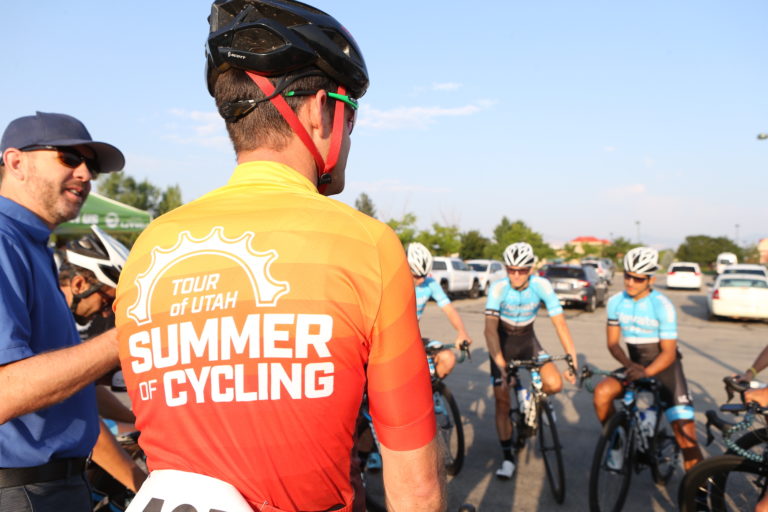
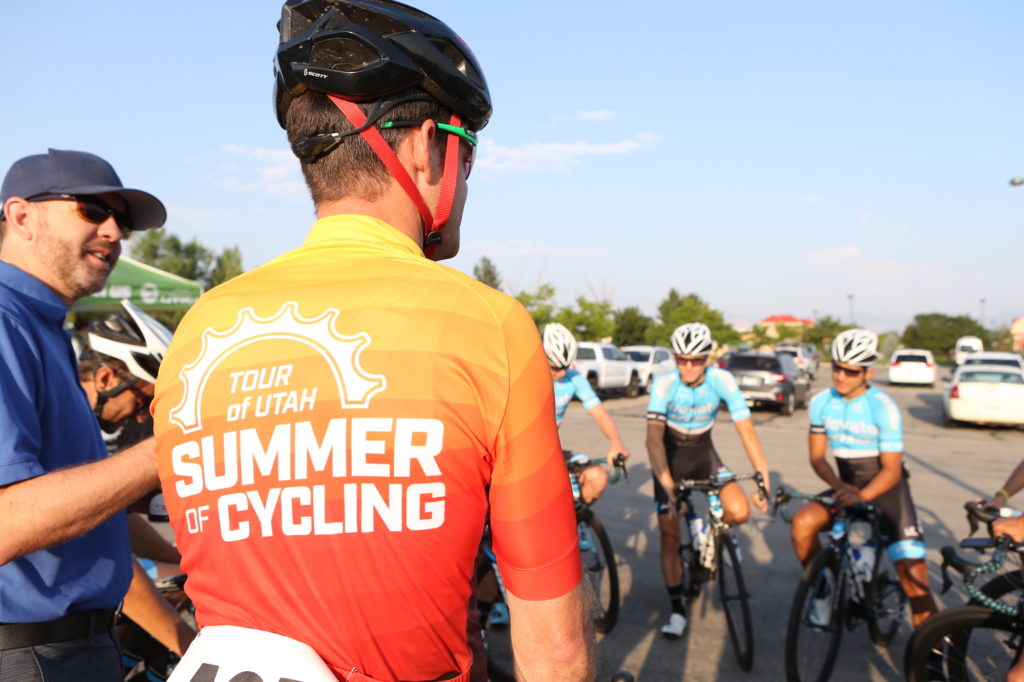
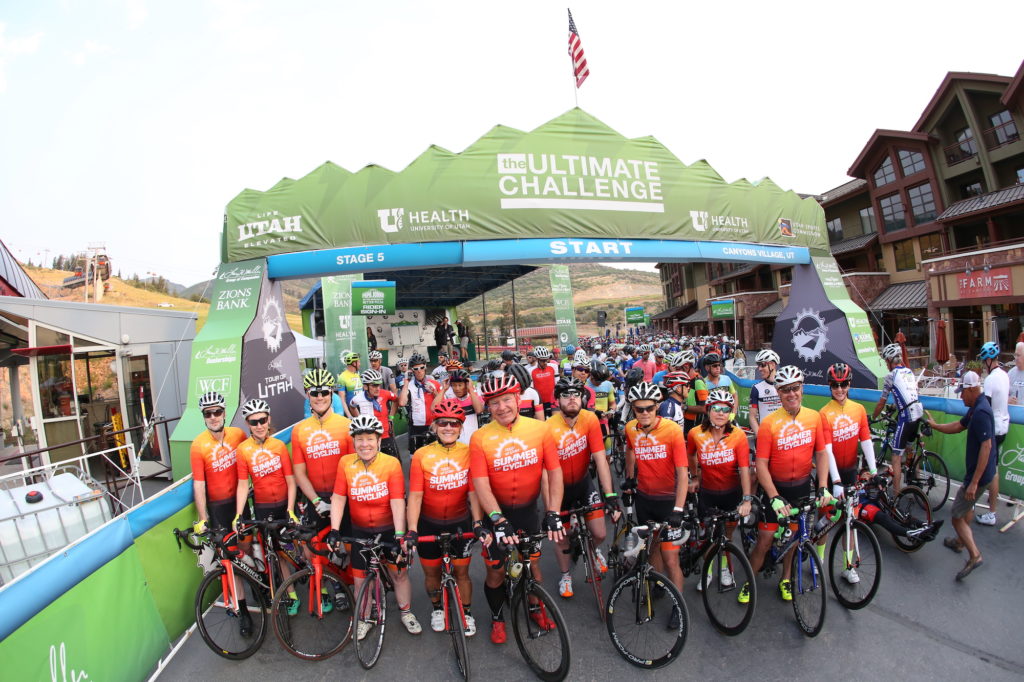
Photo courtesy Larry H. Miller Tour of Utah/Melissa Majchrzak

Now in its third year, the Summer of Cycling signature events include the Salt Lake City Marathon Bike Tour on April 18, Huntsman 140 on June 20, Cache Valley Gran Fondo on July 11 and the Ultimate Challenge presented by University of Utah Health on Aug. 8 during the Tour of Utah.

A Summer of Cycling membership fee of $50 will provide a 40 percent discount on entry fees for the four signature events and 20 percent off other events such as the Little Cottonwood Canyon Hill Climb, Salt Lake Century, Bike Utah XC MTB Series, East Canyon Echo Road Race/Fun Ride and St. George Century rides.

More details on the program and links to registration are available at www.tourofutah.com/summerofcycling.

“The Larry H. Miller Tour of Utah is actively engaging the cycling community with a program that encourages people at all levels to share their passion for this great sport,” said John Kimball, managing director of the Tour of Utah. “Membership in the Summer of Cycling is designed to provide the support, motivation and opportunities for recreational cyclists to have their best year of riding thanks to a partnership with these classic rides.”

The Summer of Cycling program begins April 16 with a Kick-Off Party at DNA Cycling. Participants will receive a Tour of Utah/Summer of Cycling T-shirt and hat. In an effort to connect cycling enthusiasts, they will also be invited to organized VIP rides, charity events and other group experiences.

Photo courtesy Larry H. Miller Tour of Utah

The main event in the Summer of Cycling is the Ultimate Challenge, the non-competitive, gran fondo-style bicycle ride in conjunction with the Tour of Utah. The one-day cycling challenge allows participants to ride a similar route as the pros, as well as offering riders a great spot to watch the finishing sprints for Stage 6 of the Tour of Utah.

The 16th edition of the Tour of Utah will be held on Monday, Aug. 3 through Sunday, Aug. 9. Now recognized as the only multi-day race in North America on the UCI ProSeries, the Tour of Utah will start in Herriman City at the Zions Bank Real Academy and finish on historic Main Street in Park City. Additional host cities or venues are dōTERRA, Provo, Payson, Woodward Park City, Snowbird Resort, Ogden, Canyons Village at Park City Mountain Resort, and Park City.

Advocacy Alert: Input Wanted on Walking and Bicycling in North Davis County, Utah

0

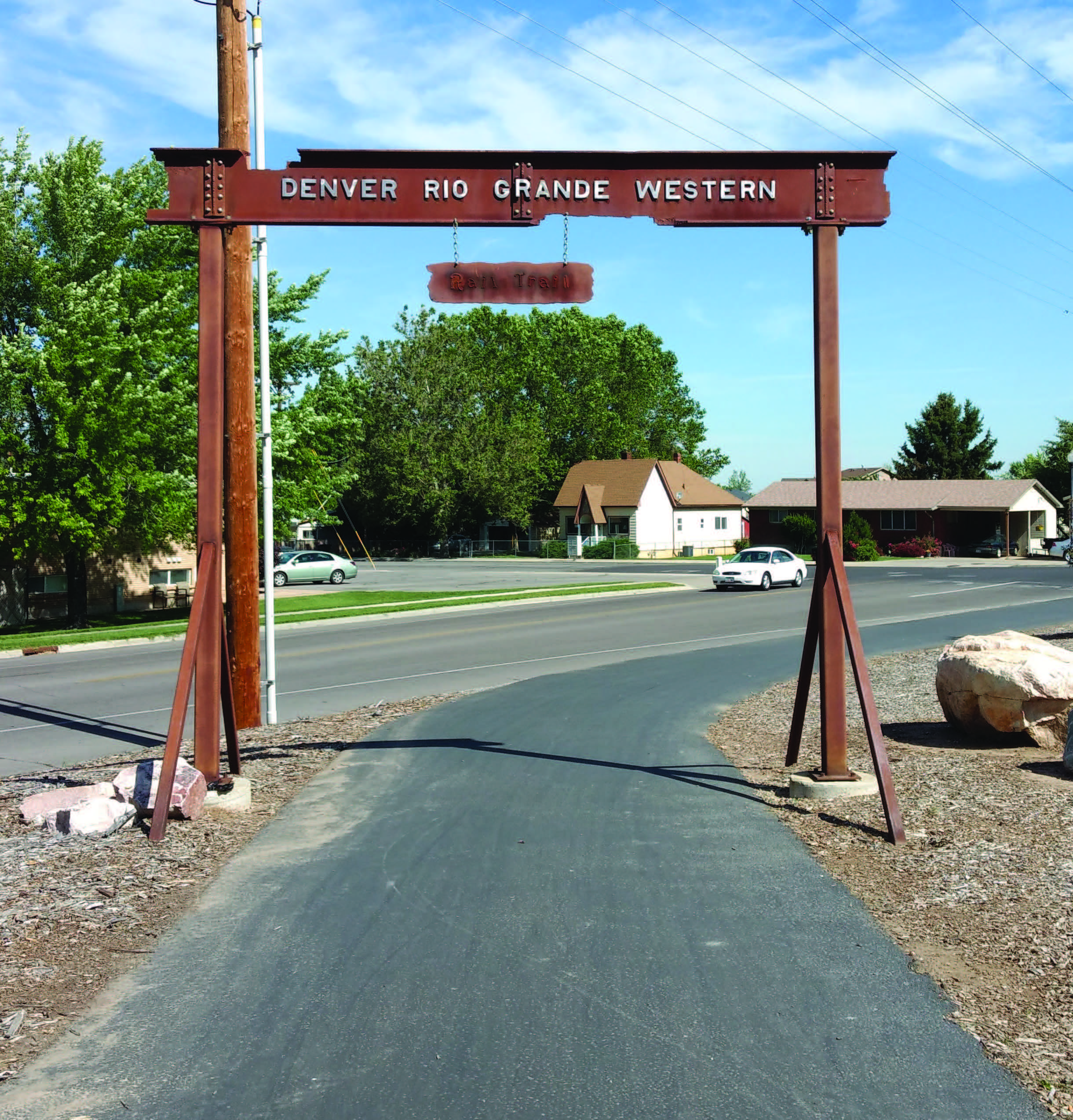
The Cities of Clearfield, Clinton, Sunset, Syracuse, and West Point, Utah are making plans together to improve walking and bicycling with the North Davis County Active Transportation Plan. The County is seeking comment from residents and interested parties who can help shape the recommendations of this plan. 

Trail users are encouraged to take a moment to provide thoughts by clicking on the trails used on the interactive map at: https://northdavisatp.altaplanning.cloud.

The deadline for public input is March 16, 2020.

The entrance to one section of rail trail in North Davis County. Photo courtesy North Davis Country Active Transportation Plan


In Praise of Riding with Ladies

By Lukas Brinkerhoff — The rock juts up at about a 45-degree angle for just shy of 4 feet. At the bottom, there’s a six-inch curb size lip one must negotiate to even begin to attempt to climb this obstacle. It’s not the hardest one you’ve seen, but most riders will dab once, twice or not even try. It’s a strength move that requires multiple different body angle adjustments with the bike to navigate the entire thing without putting a foot down.

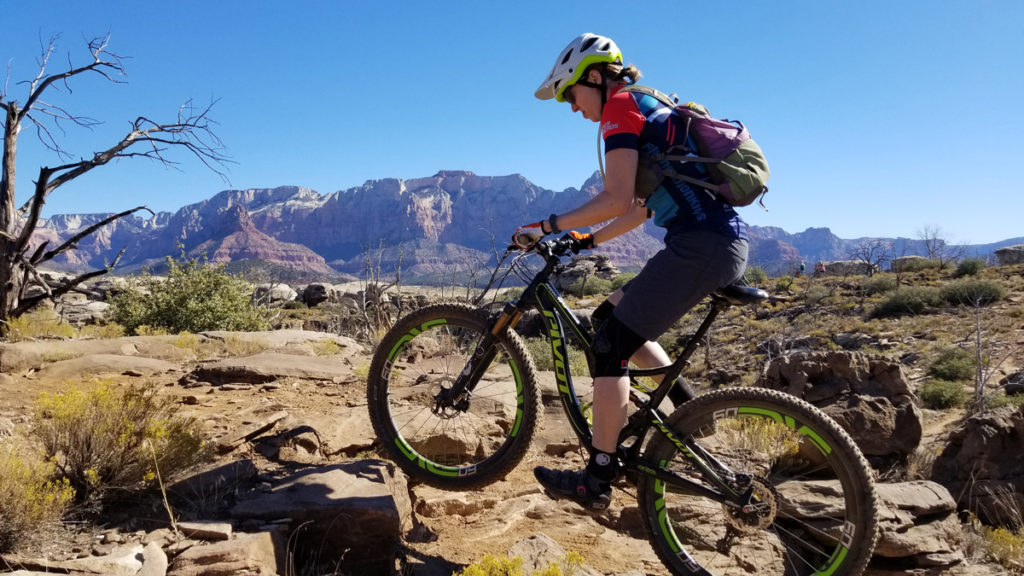
Heather Gilbert cleaning an up move. Photo by Lukas Brinkerhoff

There’s some grunting. There may have been an expletive or two or three. The bike’s front wheel is expertly lifted over the lip followed by a surge of speed so the rear one follows as hoped. Once that rear wheel is on the slab, the pedals are mashed, once, twice, three times lifting the front wheel just slightly off the ground as the pressure is maintained. The front tire makes it over the upper lip, one more pedal stroke and the rear one follows. The grunting subsides, there’s some adrenaline induces screaming, some high fives and other words and expressions of the success.

I walked over threw up my hand for a high five and then gave my wife a hug.

Kathleen Berglund cleaning a rarely ridden section of Little Creek Mesa. Photo by Lukas Brinkerhoff

Over the course of the past three or four years, I have slowly begun riding with ladies more and more and with the dudes less and less. This happened partially due to the riding partners that my wife, Kathleen and I have, and partly because it’s more fun to ride with girls.

The reasons why became apparent to me about three years ago. Heather Gilbert, Lynda Wallenfels, Kathleen and I all went for a girl’s trip to Moab. Yes, that might sound a bit strange, but I grew up with four sisters, no brothers, and not only was it not strange, it was one of the most fun trips to Moab I have ever had.

And before all the dudebros start being all, like, no way man, the chicks can’t ride, they can’t shred the gnar. Let me say yes they can, and give me a chance to break down why I would rather shred with the ladies than all you dudes.

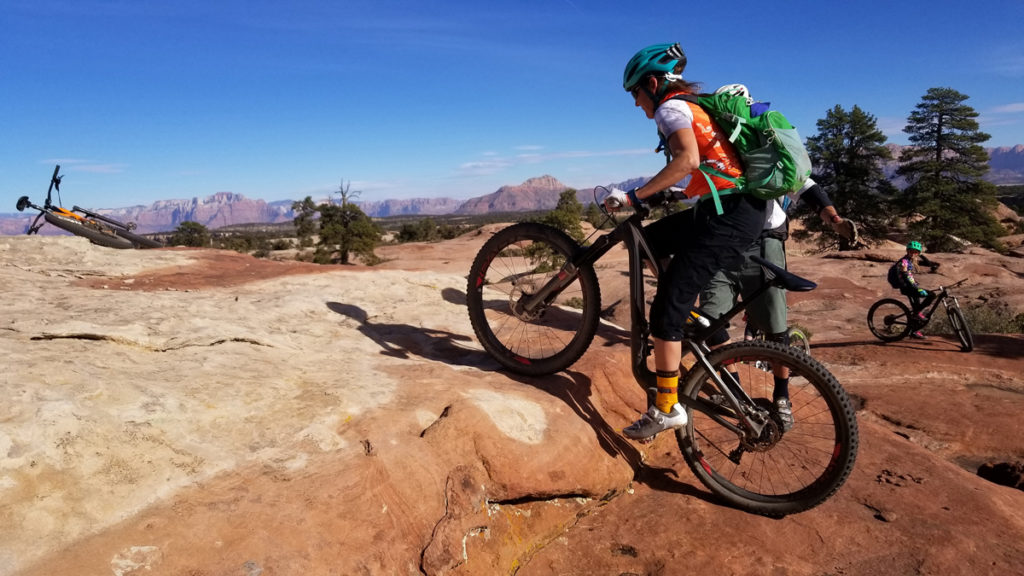
Heather Gilbert cleaning a 4 foot up move on Gooseberry Mesa for the first time. Photo by Lukas Brinkerhoff

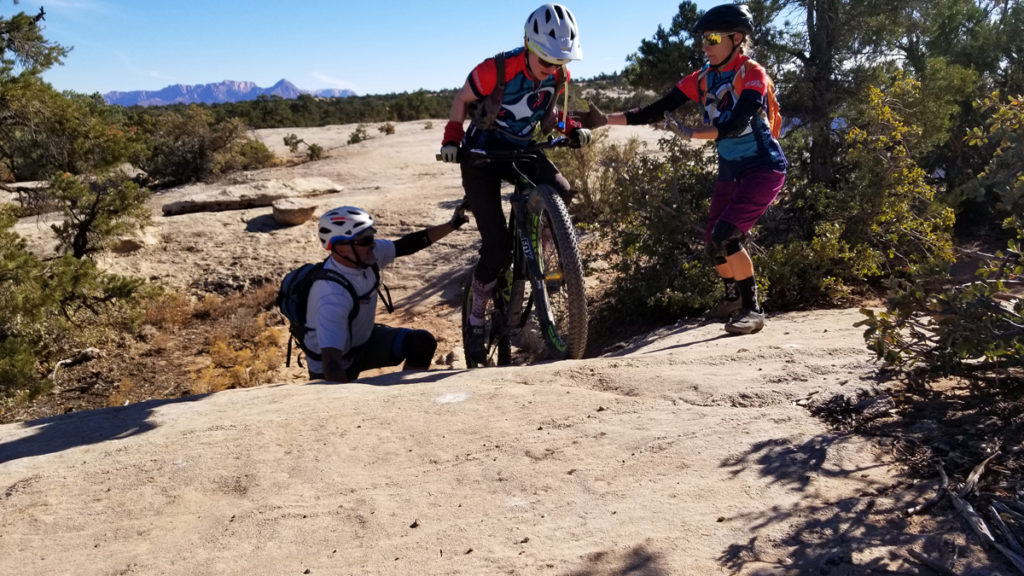
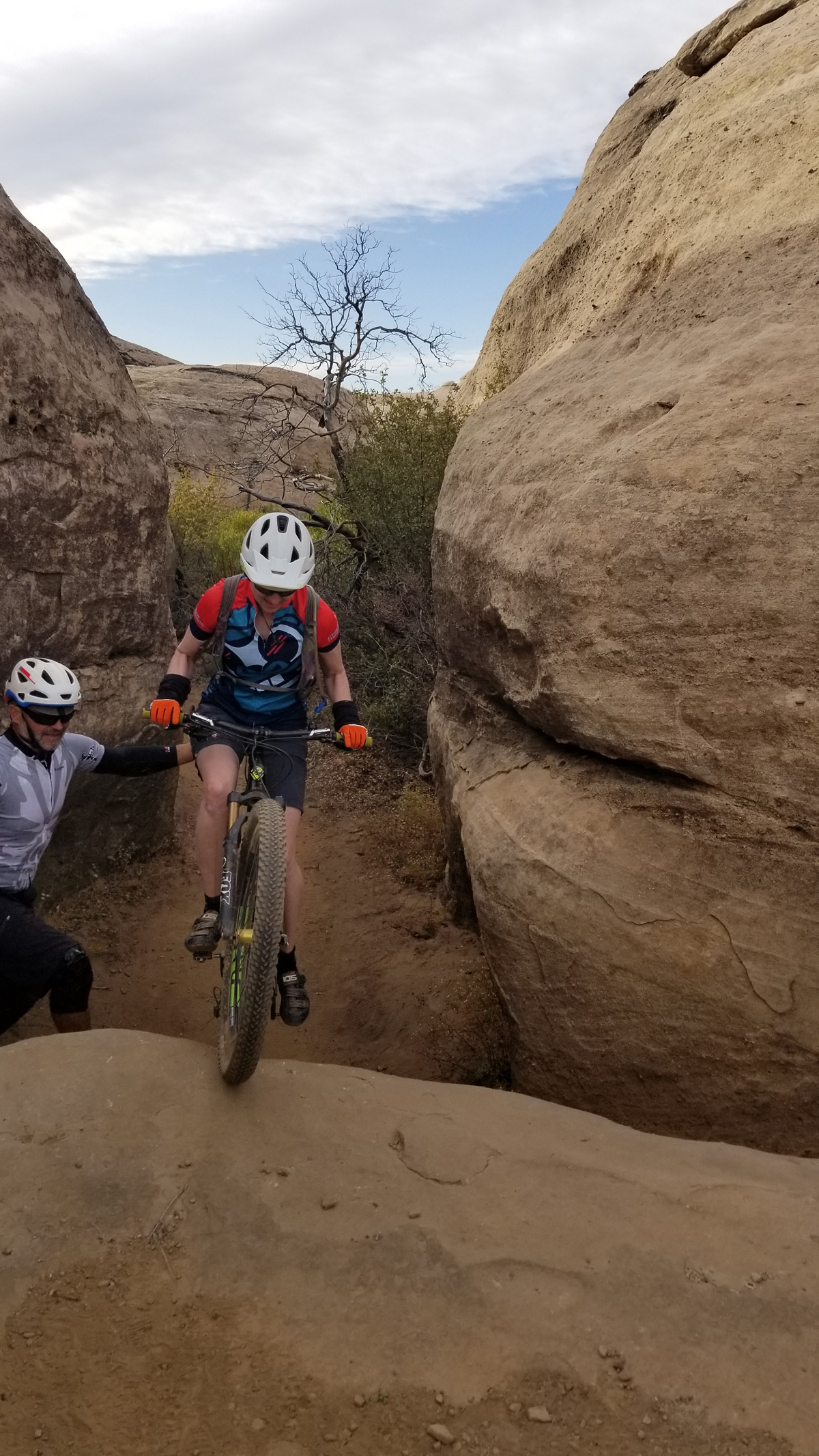
First and foremost, the level of collaboration between the riders is far greater. During our trip to Moab, we rode some hard trails, not all the hard trails, we were only there three days, but the ones that I feel give you the most bang for your buck. As we encountered obstacles on the trails that caused either a dab or a second look to figure out, there was tons of mutually given and accepted advice. Once one rider figured it out, they would help and encourage the other one to get the same move. Everyone has their strengths and their weaknesses, but when you can draw on the strengths of your co-riders, it seems easier to clean the trail.

Second, the level of “we’re just here to ride, nobody needs to get upset or go crazy” is far beyond anything I have experienced when riding with a bunch of guys. While I have seen ladies be extremely competitive, I have not personally seen anyone get up in someone else’s grill over being bested. Rather, a sense of comradery and encouragement replaces the high-strung insecurity. It’s just chill.

I have also found there seems to be a higher expectation of certain trail etiquette when the ladies are in the group. Instead of the almost race-like jockeying for place that can occur, there is an easy- going, whoever happens to want to go, can go. In fact, most of the time the only arguing that happens is to determine who gets to follow whose line. It’s nice to have a polite line of riders heading down a trail instead of being pushed out of the way by someone trying to prove they are faster.

And of course, as I already mentioned, they can shred.

Heather riding right up a wall on Guacamole Mesa. Photo by Lukas Brinkerhoff

During our Moab Girls + Moose Trip, it was not uncommon for us to be sessioning a section and have a group of dudebros come through bobbling the move and take off. We would finish our session with everyone cleaning the obstacle and catch up to the group down the trail and blow past them while they walked a section.

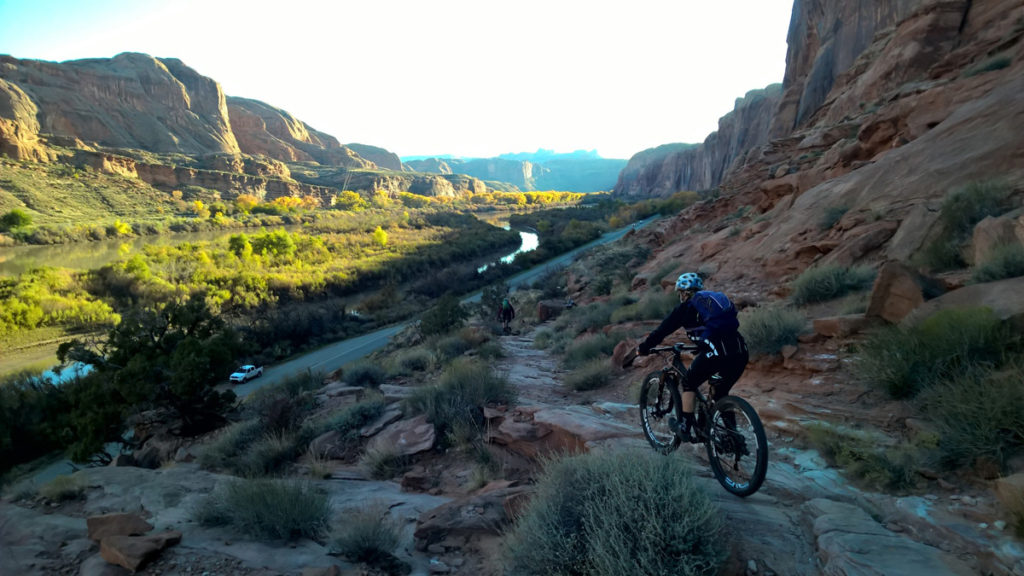
Lynda Wallenfels drops into the Portal in Moab during the Moab Girls + Moose Trip. Photo by Lukas Brinkerhoff

One instance happened on Captain Ahab. There is a left turn that is somewhat challenging. To get through it you have to lift the front wheel and almost immediately lift it again while maintaining power and momentum to negotiate the turn. We were in the process of figuring it out when a group of about 6 guys came raging through. Every single one dabbed, but instead of taking the time to figure it out, they jumped off and ran to keep their momentum going to continue. We graciously let them ride through without saying anything. Once we had all figured out the regular route, I noticed a rock that could allow us to go straight up instead of having to struggle up the gut of the turn. It’s skinny with a good drop if you overshoot it. We all got that one and headed down the trail.

We caught back up to the dudes after a mile or so as the sat at the top of a drop eyeballing the best way down. We looked to see what it was all about and then all four of us dropped down never seeing the guys again.

Yes, I get that not everyone is the same and I’m sure there are some ladies out there that don’t fit into the experiences that I have had. There are also a lot of dudes that I still really enjoy riding with and there are often a few on my rides. But given the opportunity, I have found it’s always more fun to ride with the ladies.

Lukas Brinkerhoff blogs about mountain biking and life at mooseknuckleralliance.org.

Connected Bicycles Could Increase Bike Commuting

Wireless communication devices used by bicyclists could potentially increase the level of ridership and safety. So suggests a new study from the National Institute for Transportation and Communities at Portland State University in Oregon. But we need to improve the connected vehicle (CV) technology and study its implications a lot more, says the report, How Technology Can Affect the Demand for Bicycle Transportation: The State of Technology and Projected Applications of Connected Bicycles.

“In conducting this research, it has become evident that there is a lack of consideration of bicyclists in the U.S. DOT, state DOTs’, and local DOTs’ CV initiatives, but also in city bicycle planning and Vision Zero,” the report states. “The U.S. DOT has spent many years developing more than three dozen CV applications, yet none of them directly acknowledge the presence of bicyclists on the road.”

The study defines a connected bicycle as one “equipped with devices, which enable wireless communication between internal and external entities, supporting vehicle-to-vehicle, vehicle-to-infrastructure and vehicle-to-everything communications.” Some autos have had the equipment since the 1990s but only in the last decade did they start to be attached to bicycles. Some involve apps to help cyclists get where they’re going. A few use sensors or other technology to tell cyclists everything from their heart rate to tire pressure. Some can even warn cyclists of approaching vehicles, using, for instance, radar attached to taillights. Others can use light as turn signals, which allows cyclists to keep both hands on the handlebars.

Some devices can even detect a crash and ask the rider if he wishes to have an emergency alert sent – if it gets no response, it will automatically send one. Possibilities appear endless.

But demand will have to come. “If bicycling is not considered a competitive transportation option within communities, it is unlikely that the mode share will increase. Governments are often looked upon to address this challenge; however, private actors such as bicycle manufacturers and technology companies also play an integral role” in developing and promoting the technologies for bicyclists.

Note: The report doesn’t mention bicycling advocates, who certainly could spur demand.

See the report at https://trid.trb.org/view/1662694


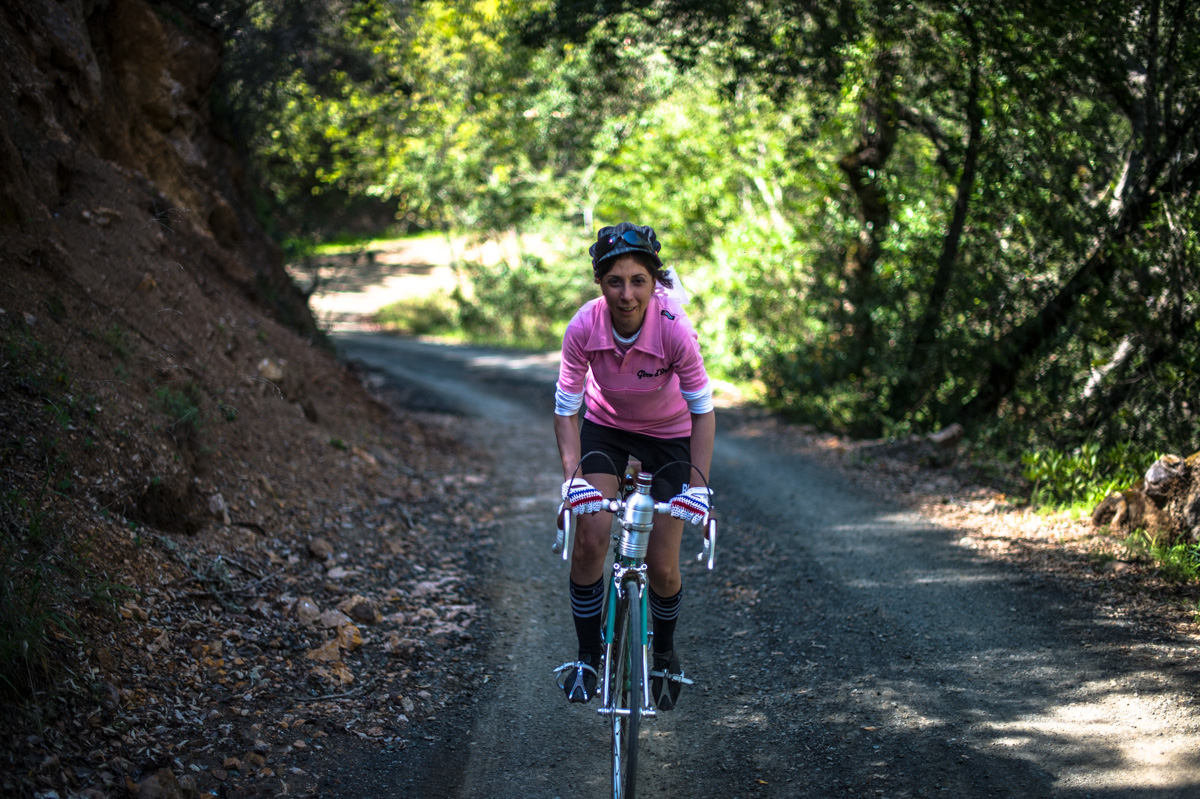
Nova Eroica and Classic Eroica Return to Cambria, California

Nova Eroica adds a second shorter ride option, and makes the long course even longer. Early Bird Registration through January 31, 2020

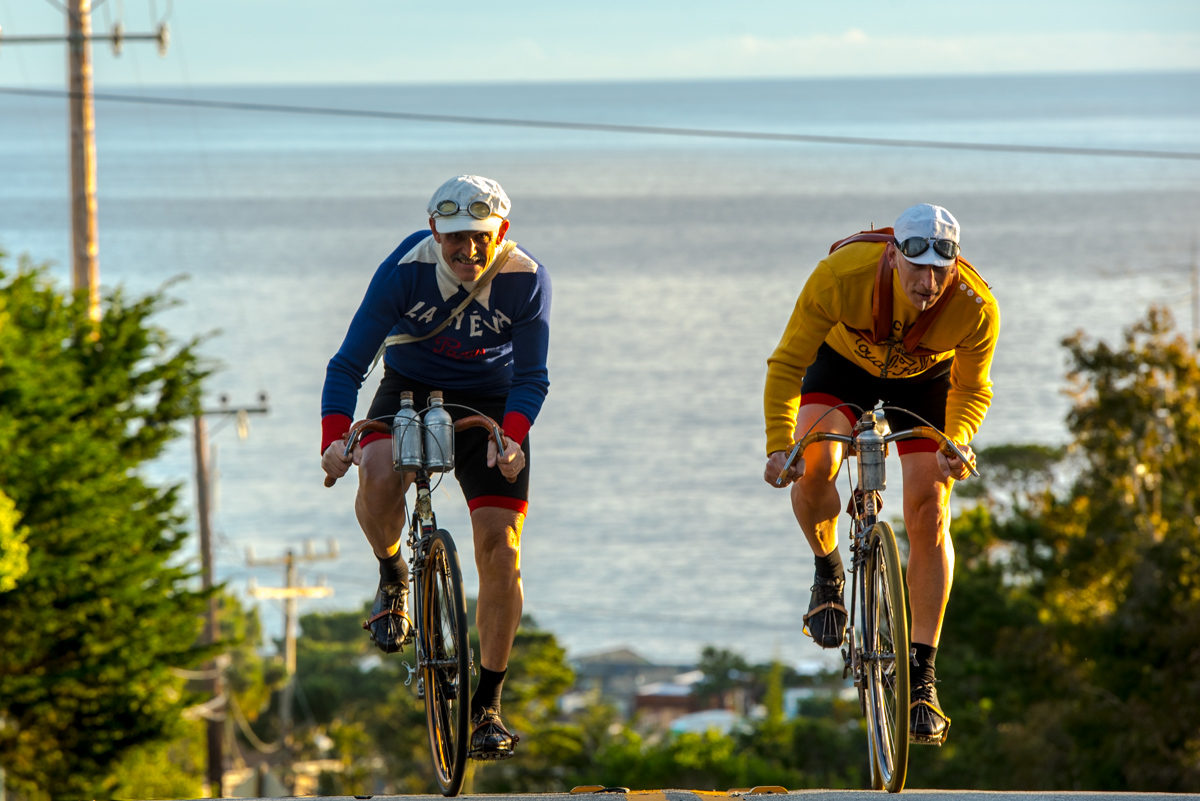
CAMBRIA, Calif. (29 January 2020) – For the second year in a row, Cambria, California will host Nova Eroica and Classic Eroica California, two separate and distinct rides on April 04 and 05. The Saturday, April 04 Nova Eroica ride is a modern day road cycling event that includes gravel sections and is designed to challenge the staunchest of cyclists. The Sunday, April 05, Classic Eroica is ridden on vintage pre-1987 bicycles.

Photo courtesy Nova Eroica

Now a global series consisting of eight events, Classic Eroica originated in Gaiole Italy in 1997, called L’Eroica. Today, that annual October event still attracts 8000 riders from around the world lured by the strade bianche – the white roads of Italy. Eroica California – the vintage ride that, like original Gaoile event, sought to reawaken a taste for adventure, is the only Classic Eroica in North America.

Photo courtesy Nova Eroica

From vintage to modern

It might be said that L’Eroica paved the way for what is now modern day ‘gravel riding’. Ten years after the launch of the Gaiole event, ‘the southern most Northern Classic’, the Strade Bianche race was added to the pro peloton schedule on the very roads traversed by L’Eroica participants. The race put the concept of gravel riding and racing on modern day bicycles in the international spotlight and in 2017 Nova Eroica was introduced.

Photo courtesy Nova Eroica

On Saturday April 04, Cambria and Cayucos, California will share hosting duties for the 2020 Nova Eroica event. Cyclists, riding either road or drop bar gravel bikes, have the option of two courses: 72 or 97 miles. The 72-mile loop features 6000 feet of climbing, 56 miles of pavement and 16 miles of gravel. The 97-mile option features 7535 feet of elevation with 58 miles of pavement and approximately 30 miles of gravel.

Photo courtesy Classic Eroica

Early bird pricing ends this Friday January 31 at midnight. Prices for both Nova Eroica and Classic Eroica are $130 through January 31! On Feb 01, pricing jumps to $150 through March 31. Register here for Nova Eroica California and here for Classic Eroica California.

Photo courtesy Classic Eroica

36th Annual Redlands Bicycle Classic Shifts to April for 2020

0

REDLANDS, Calif. (January 30, 2020) — The Redlands Bicycle Classic will shift from its traditional dates in March to April starting in 2020, according to a press release dated January 30, in order to better fit in USA Cycling’s professional racing calendar. 

For 2020, the race will be held from April 22-26, after which racers are anticipated to head directly to New Mexico for the Tour of the Gila.

While course details have yet to be announced, the time trial will be held at a new venue, most likely in the mountains near Wrightwood.

The new dates in April offer a number of advantages over previous years, including what will likely be better weather, as well as the opportunity for on-campus visits to various schools by participating teams, since the race will no longer coincide with the Redlands School District’s two-week annual spring break.

The Redlands Bicycle Classic dates back to 1985 when Thurlow Rogers won the first-ever event.

In 2019, Semper Porro cyclist Cory Lockwood, who trailed by 1:08 heading into the final Sunset stage, beat Hagens-Berman Axeon’s Kevin Vermaerke to take the yellow jersey of the overall winner on March 18, winning by 1:25.

Amber Neben, who was presented with the Redlands Bicycle Classic’s annual Legends Award during the 2019 event, notched her fourth career overall triumph equalling the mark set by Chris Horner, another Legends honoree, who has also won the event four times.

The five-stage, five-day stage race covers about 350 total miles. The 5-stage 2020 edition will open in the city of Highland on Wednesday, April 22, followed by Thursday’s time trial stage, and a mountain road stage to Oak Glen on Friday. The race will be capped off by the downtown Redlands Criterium on Saturday, and the Sunset Road Race on Sunday.


Vaughters and Gaimon Offer a Revealing Look Inside Clean Pro Cycling

By Don Scheese —

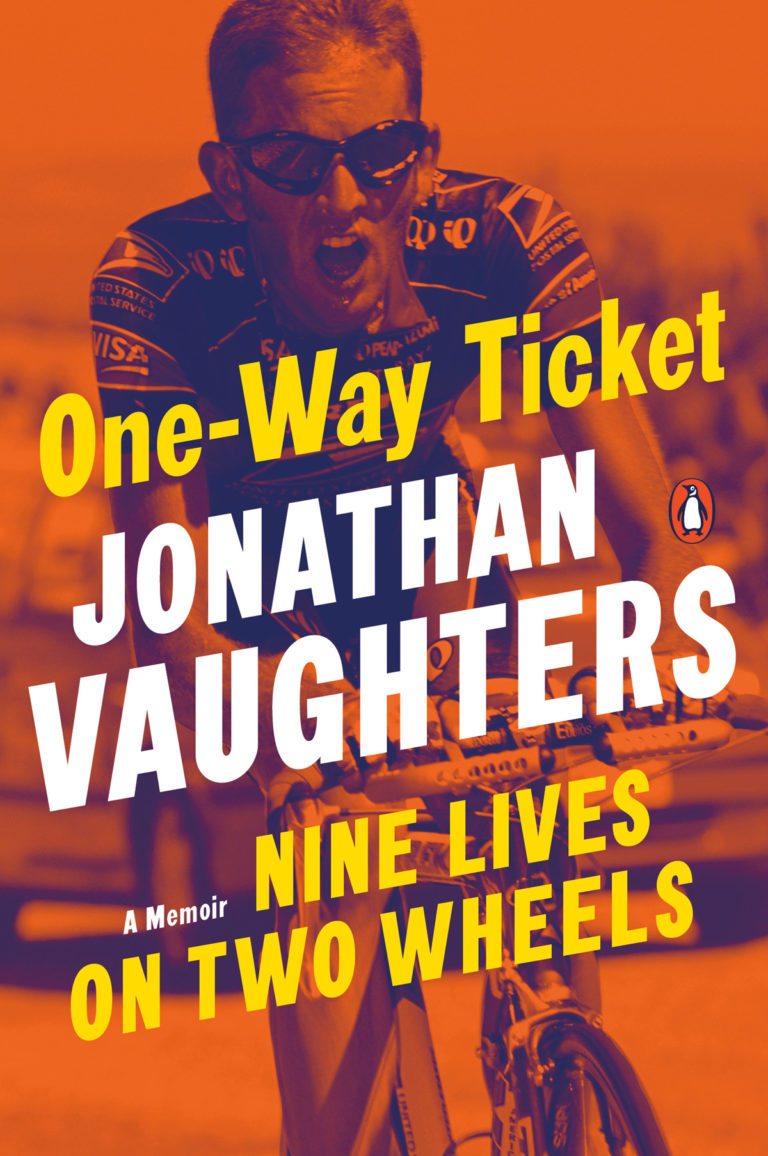
Draft Animals: Living the Pro Cycling Dream (Once in a While) by Phil Gaimon. New York: Penguin, 2017. 320 pp. $17.00 paperback.One-Way Ticket: Nine Lives on Two Wheels by Jonathan Vaughters. New York: Penguin, 2019. 339 pp. $17.00 paperback.

If, like me, you follow pro cycling and are a fan of EF Education First (as well as its previous iterations), maybe even proudly wear some or all of the team’s kit, then these books are for you. Jonathan Vaughters rode professionally in the 1990s and 2000s, including a stint with U.S. Postal and Lance Armstrong, was a decent rider in his own right (once setting the record for the time trial up Mont Ventoux), then gradually fell out of the sport after witnessing and participating in the epidemic of EPO usage in the peloton. Feeling morally compromised, but still in love with cycling, he then decided to try to organize and run a “clean” team, originally called Slipstream. Vaughters went on to play a key role in bringing down Armstrong in 2012 as part of the damning testimony for the United States Anti-Doping Agency (USADA) investigation, rocking the cycling and sporting worlds.
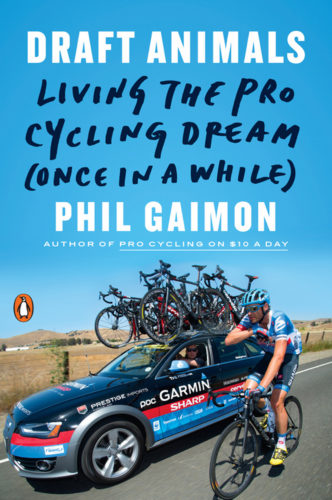
Phil Gaimon was one of the many young new beneficiaries of Vaughters’ and others’ efforts in helping to clean up the sport. Riding in what he refers to as the “post-dopacalypse” (3) era following Armstrong’s downfall, Gaimon achieved some impressive results at the Pro-Continental level (including winning the Redlands Classic) before being signed by Vaughters to race in 2014 and 2015. However, in the wake of Armstrong’s demise, money was much harder to come by as sponsorship dollars dried up, teams folded, and the competition for fewer spots on teams grew ever tighter. Gaimon rode for Vaughters for only two years and has some very unkind—though seemingly justified—criticisms of his former employer.

Let’s start with the better of the two books (more on that later). Gaimon was an outspoken critic of doping, proudly sporting his “CLEAN” tattoo and regularly lamenting on the internet and social media the financial doldrums into which professional cycling plunged in his era. As a rider in the World Tour Gaimon mainly rode as a domestique, with crashes, illness, bad luck and (at times) his own self-described stupidity preventing him from achieving more impressive results. In fact, one of the main themes of his book is the realization that “everyone’s not a winner” (200). Many (most?) of us don’t realize our greatest dreams and have to settle for a less impressive victory or goal. Gaining more experience in the pro peloton for Vaughters’ team, Gaimon recognizes what he calls “Real Talent”—teammates like Dan Martin and Michael Woods, for example, riders whose VO2 max is just a bit higher and whose results are thus just more impressive. One of the more interesting—let’s say juicier—aspects of his book is the differentiation Gaimon makes between not only Real and Mediocre Talents, but between Good Guys and Bad Guys. Martin and Woods, along with other teammates like Andrew Talansky, Tyler Farrar, and Alex Howes, clearly are Good Guys, while Andy and Frank Schleck, Fabian Cancellara, David Millar, Rohan Dennis, and Chris Horner definitely fall into the Bad Guy category (you have to read the book to find out why).

More challenging for Gaimon to classify are former dopers like Tom Danielson and Thomas Dekker. He wants to dislike and dismiss riders like these from the EPO era, but upon becoming teammates and experiencing them as Real People finds it hard to do so. Each guy proves to be a good teammate, especially Danielson, who trains with and helps Gaimon keep the yellow jersey after Gaimon wins the first stage of his very first World Tour race, the Tour de San Luis in Colombia (finishing second overall by the end). And some of the book’s funniest moments involve Dekker, whom Gaimon finds “warm and inviting…. [someone who ] always said the right thing.” “He’d been a bad boy,” says Gaimon, “but he seemed like a good man” (113). Even when Dekker, the shell of a racer he once was when on EPO and living a lavish lifestyle, meets and falls in love with a woman from LA who happens to be a billionaire, Gaimon, relationship-challenged though he may have been, never expresses jealousy, only a plaintive “if only that were me” kind of lament. (Warning to all prospective pro cyclists: a theme in both books is how hard the cycling life is on relationships with the opposite sex.)

Draft Animals reminded me a lot of Ball Four as I was reading it, Jim Bouton’s pathbreaking “tell-all” memoir published in the 1960s that sent tectonic shivers through the baseball, and sportswriting, worlds. Like Bouton, Gaimon provides an insider’s view of a sport, with titillating anecdotes about the sexual lives of pro athletes, the outlandish pranks of jocks, and the Machiavellian tactics of team owners during contract negotiations. Here’s where Jonathan Vaughters, as co-founder, sports director (at times), and CEO of Slipstream clearly comes across as another Bad Guy. If Gaimon can be believed (and I have no reason not to think this is a totally honest memoir), “JV” (as Vaughters is called) not only lowballs Gaimon in negotiations, he reneges on dollar figures once offered and leaves Gaimon (as well as other riders) hanging for an unconscionable length of time near season’s end when diminishing slots on rival teams are fast disappearing. And when Gaimon finally comes to the end of the 2016 season without a contract, all he gets from Vaughters’ team is a form letter from an assistant stating his services would no longer be needed. Gaimon bitterly concludes: “Vaughters is an evil hypocrite” and doubts that “JV has any real friends [because] he only goes out of his way when something’s in it for him” (311).

I’m probably prejudiced because I read Gaimon’s book first, and thus my impressions of Vaughters were already formed before I even picked up his book. But even after reading One-Way Ticket and getting JV’s point of view, I find it hard to like him or his book. As I was reading Vaughters’ memoir I kept wondering, had he read Gaimon’s book? Tellingly, Vaughters never mentions Gaimon, not once. I suppose this could be justified in the sense that Gaimon was a “lesser” talent and rider on his team, during a decade or so during which he signed and managed many riders. But as someone who perhaps more than any other young rider in the post-Lance era personified the “Riding Clean” credo and gave cycling fans hope for a doping-free sport, one would think that Gaimon would have been the Perfect Spokesperson for Vaughters.

Even more telling is another omission: the failure to mention Tom Danielson’s bust for testosterone usage during the Tour of Utah in 2016. Vaughters had once promised to dissolve his team if any rider of his had had a positive test, and surely readers would have loved to know what went through his mind upon learning of Danielson’s banishment. Obviously the team did not dissolve, and we are left wondering why not.

Vaughters deserves respect, though, for his determination, his smarts, his courage in taking on Armstrong, and his ingenuity and business acumen in promoting a “clean team” at the very moment the sport needed it most. As a skinny, anti-social, nerdy kid growing up in Denver frequently bullied and ostracized for getting involved in a fringe sport, Vaughters tells of finishing dead last in his very first race, only to come back and win the Mt. Evans race a couple years later as a junior cyclist. He goes on to become the #1 rider in Colorado, and makes the US National team competing against Armstrong and George Hincapie. He then gains his first pro contract with a Spanish team, where in his initial race he finishes last again (this time with a Belgian rider named Johan Bruyneel). It was in Europe, of course, where he would be introduced to the world of doping, quickly learning that in order to keep up with the new EPO generation he would be forced to make a tough moral choice. As in other cycling memoirs by former dopers such as David Millar (see his Racing Through the Dark), the decision to dope or not involves a gradual descent down a slippery slope. First comes injectable vitamins and “recovery drugs,” then testosterone and human growth hormone, followed by the real performance-booster, EPO, which could result in as much as a 10% gain in performance. In the 1990s and early 2000s, a naïve young American rider comes to realize that “EPO was the only way to succeed, even survive” (131), ultimately leading him to conclude, “Doping suddenly seemed like the right choice” (152).

Once on US Postal, Vaughters witnesses first hand Armstrong injecting EPO, and feels like he has no choice, if he wants to remain on the team, of following suit. But after winning the time trial up Mont Ventoux in the 1999 Tour de France, he sees his achievement as a hollow victory, even “a joke” (185). He becomes increasingly apprehensive about getting caught, especially after the governing body of the sport, the UCI, develops a test for EPO, and is horrified and terrified when his urine turns purple after being injected with various PEDs. But he continues to use EPO, off and on, until 2002, when riding for a French team, he suddenly quits with two years left on his contract. This gutsy decision ultimately would lead to his founding of a new kind of cycling team.

Vaughters had always been fascinated with the math and physics of cycling, and claims to be one of the earliest pros to use a power meter and interval training in his workouts. Always the analytical type, he figures out that often a race will come down to certain “power moments,” minutes when the winner can generate an extraordinary amount of watts at a crucial moment to take the victory. It was this kind of thinking that helped convince a deep pockets cycling fan, Doug Ellis, to initially fund team Slipstream, convincing Ellis that “maybe clean cycling was a better business model” (230) in the post-Lance era. Another crucial realization of his was that to start a clean team after two decades of EPO use meant that to be competitive, one had no choice but to sign former dopers such as David Millar and Thomas Dekker (but not Floyd Landis, about whom Vaughters says was more concerned with revenge on the sport than winning performances). Their confessions gave authorities insight into the culture of doping as well as the riders a chance to redeem themselves. .And Vaughters deserves much credit, not only for starting a team committed to clean cycling, but also for his courage to speak out about doping. He anonymously confirmed Frankie Andreu’s confession about doping on the US Postal team in 2010, then came out in defense of Landis after the aggrieved rider publicly revealed his and Postal’s doping the same year. And of course Vaughters eventually became a key witness in the USADA investigation into Armstrong and the epidemic of doping in the sport.

Vaughters presents his Good Guys and Bad Guys too, and clearly falling into the latter category are Bradley Wiggins and Dave Brailsford, team director of Team Sky (now INEOS). If JV can be believed, Wiggins, whom he recognized before anyone else as a track cyclist who could be successfully converted into a Tour de France contender, essentially abandoned Garmin after coming in fourth in the 2009 Tour because he was constantly wooed by Brailsford representing a new British entity in the peloton, even though he had years remaining on his contract. (JV also accused Armstrong, in an act of revenge against him, of helping to convince Wiggins that he’d be much better off on Sky.) I found this section of the book to be one of most fascinating sections of One-Way Ticket.

The final chapters deal with Vaughters’ desperate attempts to save the team following the pull outs of principle sponsors Cervelo then Cannondale. At one point he even resorted, in a last ditch attempt to save the franchise, to starting a crowdfunding campaign (“#SaveArgyle”) to keep the team afloat for another year. But in stepped EF Education First to save the day, though it meant that long-time owner Ellis would have to agree to sell the team to this new organization.

As I’ve made clear, Draft Animals is by far the better book. Here’s why: Gaimon was an English major in college who took creative writing classes, and it shows. His writing style is fluent and polished, and the book is laugh-out-loud funny throughout. (This is his third book:

the first was Pro Cycling on $10 a Day, published in 20I4; the second Ask a Pro, 2017.) In contrast, Vaughters’ style is wooden, his frequent pop-culture allusions are ineffective and annoying, and his attempts at humor mostly fall flat. In the contest of personalities Gaimon is the clear winner (how do you not like a guy who gives his excess cookies to the homeless?)

Reading these books caused me to reflect on the state of pro cycling today. On the one hand, with the advent of the biological passport and more professional testing by the UCI, the sport seems cleaner than ever. But then four-time winner of the Tour, two-timer winner of the Vuelta, and one-time winner of the Giro Chris Froome of Team Sky registers an excessive level of an asthma drug following his second Vuelta victory, and once again—no matter how many doctors, medical studies and euros Sky throws at the findings to convince the UCI he didn’t do anything wrong—the sport is enveloped in a cloud of doubt following the bust of one of its biggest names. And then we have NBC Sports featuring as Tour commentators ex-dopers such as Christian Vandevelde and Chris Horner—as well as inviting none other than Lance Armstrong himself for occasional guest commentary! I don’t know about you, but I’m a bit confused, and still suspicious, about the state of cycling’s cleanliness in the year 2019.

Still, Vaughters and Gaimon deserve lots of credit for their efforts to transform the sport, and there is no doubt that cycling is cleaner as a result. Read these books to find out why.

Don Scheese is an avid cyclist and retired professor of American Studies who once taught, among other things, courses on Lance Armstrong and Sport in American Culture.

Winter Training: Posture before Power

While we can thank global warming for extending the outdoor cycling season in the Intermountain West, it’s likely that many of you will soon be take your riding indoors, either in your home or at a venue offering a structured winter training program. Often the training focus during winter is on developing greater power output.

But where does that power come from? There may be plenty you have read, heard about or know with regard to training plans, intervals, lactate threshold, cadence, metabolic efficiency, strength training, power/weight ratio and other factors affecting power output, but what about your riding position?

Yes – your riding position is going to influence how you generate power and transfer it to the pedals. Force is applied at the pedals, having being transferred through levers (leg bones) that are activated by muscles (hip extensors and knee extensors), which are stabilized by the pelvis and trunk. Force that is applied at the lower end of the body is initiated in the upper body. So there is more to power output than bigger, stronger quads!

Think of your riding position as your on-bike posture. Poor posture on the bike is all too common and can result from simply transferring your posture from sitting/driving/typing /slumping from other parts of your life to the bike. It can also result from not actively practicing an “athletic position” on the bike, or by compensating for a bike fit that is not optimal. Good on-bike posture results in better power production by creating a stable base from which the levers can generate force. That stable base is the pelvis, spine and shoulders, held in place by muscles of the core.
Good posture is really the same for any athletic pursuit. An erect yet neutral spine, subtle core muscle engagement, and an open airway allowing full breathing both in and out. Trying to ride a bike well while your body is slouched over it is like trying to escape a house fire while maintaining your Netflix posture. It’s going to be hard to move fast.
A good cycling posture is going to result from a combination of a good bike fit and awareness about how you are holding yourself on the bike. Elements of a good bike fit will include a saddle of suitable width and profile to support your pelvis, and a handlebar position that allows for a straight back and relaxed shoulders. While a good bike fit allows for good posture, it does not automatically create good posture. You have to do that.

So back to the winter training. Being trapped in a stationary trainer and riding on the spot usually results in a good dose of neurological boredom because you don’t have to navigate, balance, or steer. Use those idle neurons to focus on your riding position and improve your on-bike posture.

Here are a few things you can pay attention to:

  • Notice your connection to your saddle. Are you well anchored and stable on it? Can you drive your sit bones into it? Experiment with tilting your pelvis forward and back. Can you find neutral?
  • Are your shoulders plugged in and relaxed, or hunched up or rounded forward? Lift and extend from your sit bones to your sternum. Notice a contraction in your abdomen and an expansion in your chest cavity. Can you breathe more fully, both in and out? Slump down and try that deep breathing again. Notice a difference?
  • Load up the resistance and explore how you feel in different positions. What feedback is your power meter giving you?

Assume the position…focus on your posture, and you will be setting yourself up for better power output, improved efficiency and a stellar season. Enjoy your ride.

John Higgins wants to elevate your cycling experience. He operates BikeFitr – an independent bike fitting studio, and Fit Kit Systems – supplying equipment and education to bike retailers and fitters. Contact: [email protected]

Old Vegas-to-LA Highway Ride

The corridor between Las Vegas and Los Angeles is one of the heaviest-traveled long-distance routes in the country. Most Vegas-L.A. travelers drive the route, using the I-15 freeway. Long before the speedy and sleek Interstate was built, though, travelers drove along the old, two-lane Las Vegas-Los Angeles highway, which today is parallel to I-15. Portions of the old highway still exist, and are ripe for bike riding. As for bicycling from Las Vegas to Los Angeles – if one were to attempt the 250-mile-or-so ride – the rider would actually head south from Vegas on U.S. Highway 95, toward Laughlin, and then junction to historic U.S. Route 66.

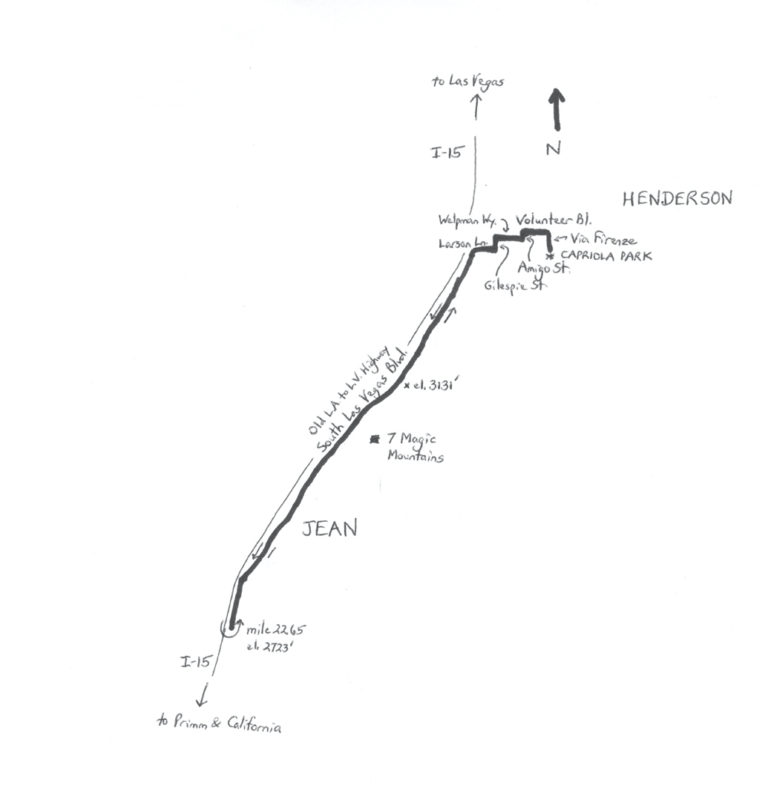
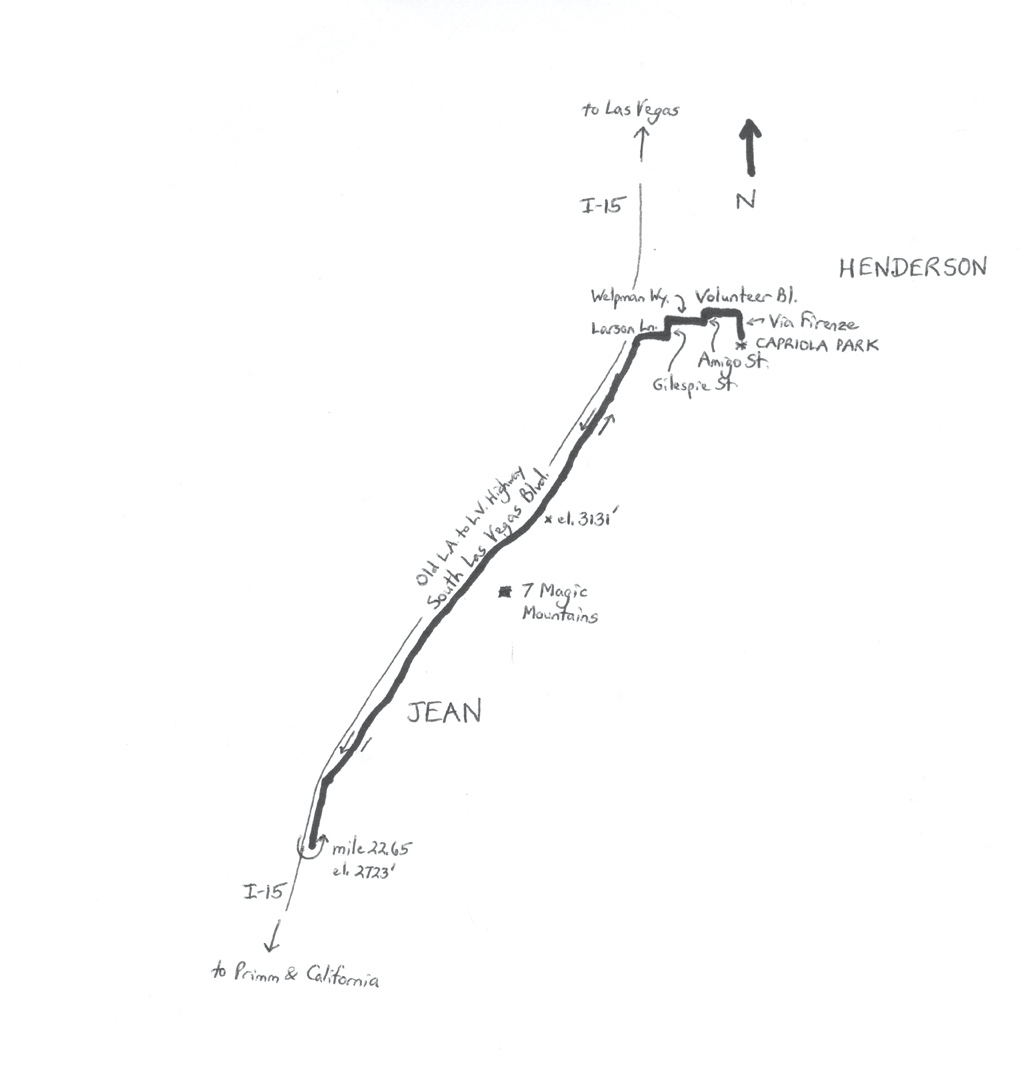
Map of the Old Vegas-to-LA Highway Ride. Map by Wayne Cottrell

This ride does not follow that route, and won’t take you to Los Angeles, but it does follow the old Vegas to L.A. highway until the pavement literally ends. The 45.3-mile out-and-back ride is not particularly long, but the potential desert heat and dryness, along with some long, gradual climbs (just over 1,200 feet of total climbing), and maybe some wind, offer decent challenges to the cyclist. Although the scenery is marred somewhat by the constant presence of I-15, there are plenty of wonderful sights in the Las Vegas and Ivanpah Valleys.

Start the ride at Capriola Park (elevation 2,591 feet), located at 2155 Via Firenze in the city of Henderson, located about 10 miles southeast of central Las Vegas. To get to the park, head south on I-15 to the St. Rose Parkway, which is the southernmost Las Vegas Valley interchange. Head east on St. Rose, followed by a right turn onto South Las Vegas Boulevard, and then a left turn onto Volunteer Boulevard. At Via Firenze, turn right and head south – continue past Solista Park to Capriola Park. Henderson had a population of 285,667 in 2015, making it the second-largest city in Nevada. While Vegas has all of the glitz and glamor, Henderson is comparatively residential and quiet, with several planned communities. The city has been ranked as one of the safest places to live in the U.S. Henderson may be best known, however, for the 1988 PEPCON blast. The PEPCON plant produced ammonium perchlorate (AP), which was an oxidizer found in solid propellant rocket boosters, such as those used in the Space Shuttle. Because the Shuttle had been grounded, some 4,500 metric tons of AP were stored at the site. On May 4th, 1988, an industrial fire started, possibly caused by repairs that involved welding. The fire spread rapidly through fiberglass materials in the buildings, and AP residue. Once the stored AP ignited, a massive explosion occurred, followed by six smaller ones. The first explosion had the force of a kiloton of TNT, roughly the equivalent of a nuclear weapon. The smaller explosions produced earthquakes registering 3.0 and 3.5 on the Richter scale. There were two plant worker fatalities (the others had quickly evacuated), and numerous broken windows and damaged motor vehicles within a several-mile radius. The plant’s buildings, and a nearby factory, were leveled. A nearby moving vehicle was literally separated from its chassis by the blast, killing the driver.

Thankfully, little evidence remains of the disaster. PEPCON relocated to a site outside of Cedar City, Utah (where another explosion occurred in 1997). A university and auto dealerships now occupy the old site. With you perhaps thinking about blasting off on this bike ride, head north from the park on Via Firenze. Solista Trail (bike path), in the median of Via Firenze, is an alternative, but the path is not paved. After passing Solista Park, Via Firenze ends at Volunteer Boulevard. Turn left here and head west to friendly Amigo Street; here, turn left, 2.1 miles into the ride. Amigo bends to the right, becoming Welpman Way, at the lowest elevation of the ride (2,461 feet). At the end of Welpman, turn left onto Gilespie Street and head south. At Larson Street, turn right to head west once again. You reach the featured segment of the ride, South Las Vegas Boulevard, at mile 3.75. Turn left here and head south (no, not north to The Strip!). Las Vegas Boulevard leaves the Las Vegas Valley, climbing gradually across the mostly barren landscape. Although Henderson’s city limits stretch southward of here, there is little development, except for I-15. The last sign of civilization, other than some industrial operations, is the Speed Vegas racetrack, on your left at mile six. Yet, farther out and appearing out of nowhere, just off the road, are seven stacks of brightly-colored boulders, situated in the middle of the desert landscape. The outdoor artwork is entitled “Seven Magic Mountains,” the creation of Swiss artist Ugo Rondinone. The sculpture “opened” in May 2016 for a two-year display.

The high elevation of the ride (3,131 feet) comes at mile 10.65. From here, it is gradually downhill to Jean (elevation 2,846 feet, mile 18.65). Jean is a commercial town with no residential population, but with the striking Gold Strike Casino, post office, and other facilities. The former Nevada Landing Casino, on the opposite side of I-15 from the Gold Strike, was demolished several years ago. Jean Conservation Camp, on the slopes to the west of Jean, is a minimum-security women’s prison. In fact, in December 2015, a prisoner simply walked away – minimum security indeed! Continue past Jean, passing the Jean Aviation Center, which is used for skydiving. From here, you may be able to see Primm, off in the distance, on the California border. The paved road does not go all the way there, though, turning to dirt exactly four miles outside of Jean. Turn around here (mile 22.65, elevation 2,723 feet).

The return ride features a gradual climb of 408 feet, to the ride’s highest point (3,131 feet, at mile 34.65), followed by gradual descending (670 feet). Turn right onto Larson Street at mile 41.55 to continue the return ride to Henderson. After Welpman Way bends to the left, becoming Amigo Street, it is a gradual climb to the finish, at Capriola Park.

GPS coordinates (Capriola Park, Henderson): 35.944986oN 115.124500oW

For more rides, see Road Biking Utah, Best Bike Rides Los Angeles, and Best Bike Rides San Francisco (all from Falcon Guides), written by avid cyclist Wayne Cottrell. Each book features descriptions of approximately 40 road bike rides. The ride lengths range from 14 to 106 miles. Each ride description features information about the suggested start-finish location, length, mileposts, terrain, traffic conditions and, most importantly, sights. The text is rich in detail about each route, including history, folklore, flora, fauna and, of course, scenery.

Wayne Cottrell is a former Utah resident who conducted extensive research while living here – and even after moving – to develop the content for the book.