SALT LAKE CITY – On March 3 the Salt Lake City Council formally adopted its first Foothills Trail System Master Plan.
The primary objectives of the now-approved plan are to: (1) Provide detailed layout, design and management recommendations for a comprehensive non-motorized foothill recreational trail system that is safe, enjoyable, accessible, connected, and sustainable; and (2) Provide information to guide strategic implementation of the trail system over a 10-year time horizon. This plan covers the area between Salt Lake City’s northern boundary and Emigration Canyon. A future update to the plan will address the area between Emigration and Parleys Canyons.
“Our system of trails is one of the things residents and visitors alike find incredible about Salt Lake City. Our foothills trail system is so close to our downtown core, making it accessible for many people, and this master plan will help to ensure its current use while also looking ahead and planning for future needs,” said Mayor Erin Mendenhall.
Under the direction of the Mayor’s administration, the City’s Trails and Natural Lands Division created the plan after a public input process that began in the summer of 2016 and continued through 2018. Feedback gathered from thousands of residents and stakeholders during that time helped guide plan development and will influence trail development projects, including trail alignments and the timing of individual improvements.
Key partners that were involved in the creation of this plan include Trails Utah, the Bonneville Shoreline Trail Committee, the University of Utah, Salt Lake Valley Trails Society, Salt Lake City Watershed Division, and many others. Alta Planning & Design was the lead consultant for the project.
“We are proud of the effort and engagement that went into this planning process,” said Trails and Natural Lands Director Lewis Kogan. “Our city is growing and trail use is only going to increase. We’re excited to finally have a roadmap to creating a really high-quality trail system that can accommodate the demand, provide really fun opportunities for trail users, and also help protect the sensitive foothills ecosystem.”
Approximately 15 miles of trail improvements identified in this Master Plan recently went out for bid, with construction expected to occur in 2020. These include new hiking and biking trails in the Avenues including a route up the ‘Avenues Twin Peaks,’ a new mountain bike trail descending into City Creek, a hiking trail above Memory Grove, and new hiking and biking trails near Popperton Park.
We finished 7.5 miles of cross-country skiing around the Brimstone and Antelope Loop trails, had finished our dinner and were relaxing in front of the fire playing a game of Quiddler. It was then I recalled I needed to write my article for this year’s first issue of Cycling Utah. Bicycling, I thought? But I am still in the midst of my winter mode.
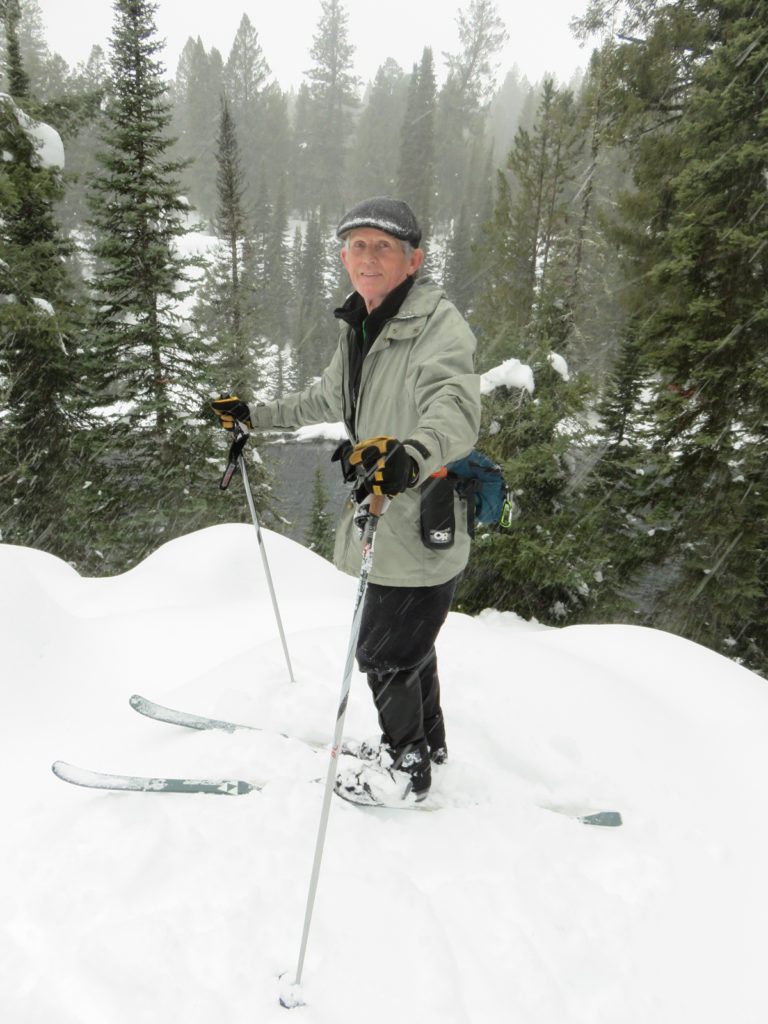
David Ward enjoying a cross country ski outing near Island Park, Idaho over President’s Day weekend, 2016. Photo by Jerry Allred
In the Intermountain West, we have the luxury of four truly distinct seasons: Spring, as we and our surroundings emerge from the blanket of snow and cold that has been enveloping us; summer, to luxuriate and sweat in the sun and heat; fall, as the leaves turn brilliant colors and we scent the approaching winter; and winter, where we can choose to either hibernate or engage in the activities that make winter a sensational season.
Frankly, I have always loved winter best. I was raised on a dairy, and summers usually meant days, including Saturdays, washing bottles and bottling milk (in addition to fixing fence, digging out ditches and cutting thistle). But winters meant skiing. Sure, I had school Monday through Friday, but that was only to get me to Saturdays when we would arise very early, get our day’s work done, and by 8 – 9 a.m., be on our way to the local ski area.
I distinctly remember 3rd grade. Our classroom was on the east side of the school, and I could see the mountains out the window. I would spend long periods of time just gazing at the mountains, gauging the snow fall, and looking forward to Saturdays.
My love of skiing and winter became so intense, that in my teens I decided there was no way I could take two years of my life to serve as a missionary for my church when I turned 19. For a good Mormon boy, that was heresy.
Well, I matured, thankfully and, also thankfully, did my missionary service. But my love of winter and skiing persisted, and the rest of the year was really just filler between winters and ski season. Until, that is, I took up cycling.
As a child, I biked a lot. I couldn’t drive, and living in the country meant long distances to get anywhere. My bike was my key to freedom and exploration. But as a teenager, that was replaced by a car. While serving my mission in France, though, a bicycle again became my main mode of transportation, and the fun of cycling returned.
In college, I bought a bicycle for transportation and recreation, and over time, cycling began to occupy a larger part of my life. A few years later, I learned that bike racing existed in Salt Lake, and thereafter training and racing filled the other three seasons of the year.
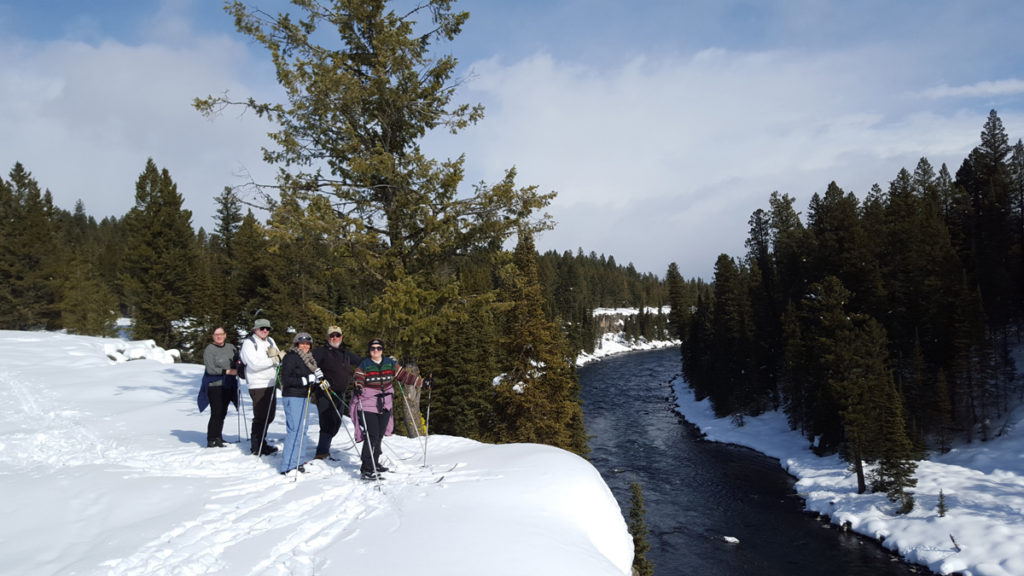
Karma Ward (right) and friends cross country skiing near Island Park, Idaho. Photo by David Ward
Now, I no longer spend the time between ski seasons pining for winter. I do not race anymore, but my love of cycling has endured, and those months between ski seasons are spent on the saddle of a bike. Still, spring brings an overlapping of the ski and biking seasons, and for me a tug of war. As winter begins to wain, and the smell of spring starts to freshen the air, I find myself torn between the call of my skis and board, and that of my bike.
Here it is late February, and already spring is springing. For several months, I have been biking indoors on a stationary bike to maintain fitness, and now the weather is drawing me outside. The itch to spend my Saturdays in the saddle is asserting itself, and I will soon be biking up and down my beloved Emigration Canyon. I will also be perusing Cycling Utah’s Calendar of Events to plan out my biking season. Yes, biking season I nearly here, and the excitement of a new cycling season is upon me.
But, I will also still be gazing at the mountains, and feeling the urge to be at a ski area, stepping into my skis and strapping on my snowboard. The spring time struggle will be seething in my soul.
Though not really. Biking is a wonderful sport. It has brought me a lifetime of fitness, and has made the period between ski seasons another exciting season for me, cycling season. I now have two passions that span the entire year. But the spring struggle will always be won by my skis and board.
Skiing has been a part of my life for as long as I can remember, and the love of winter is ingrained in my very nature. Bicycling is also now a part of my soul, but the spring time choice between hitting the slopes or the road will always be won by the slopes.
But make no mistake. I am feeling the urge to be on the bike, turning the pedals and enjoying the freshness and excitement of the outdoors as I ride my bicycle. I am excited for the upcoming cycling season, and while still on the slopes, will be looking forward to many months and miles on the road.
By Heather Nielson — In part 1 of “what to expect in your first season” of serious riding in the April 2016 issue of Cycling West / Cycling Utah, I went over the basic logistics of competing and participating in organized events. If you don’t plan for contingencies, they can cost you that big win or an enjoyable day! In this second part, I go over some deeper, more mental, and physical aspects of competition.
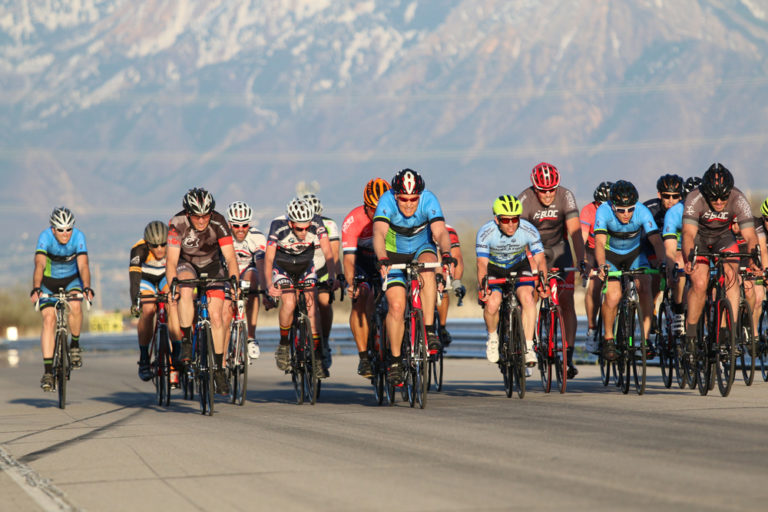
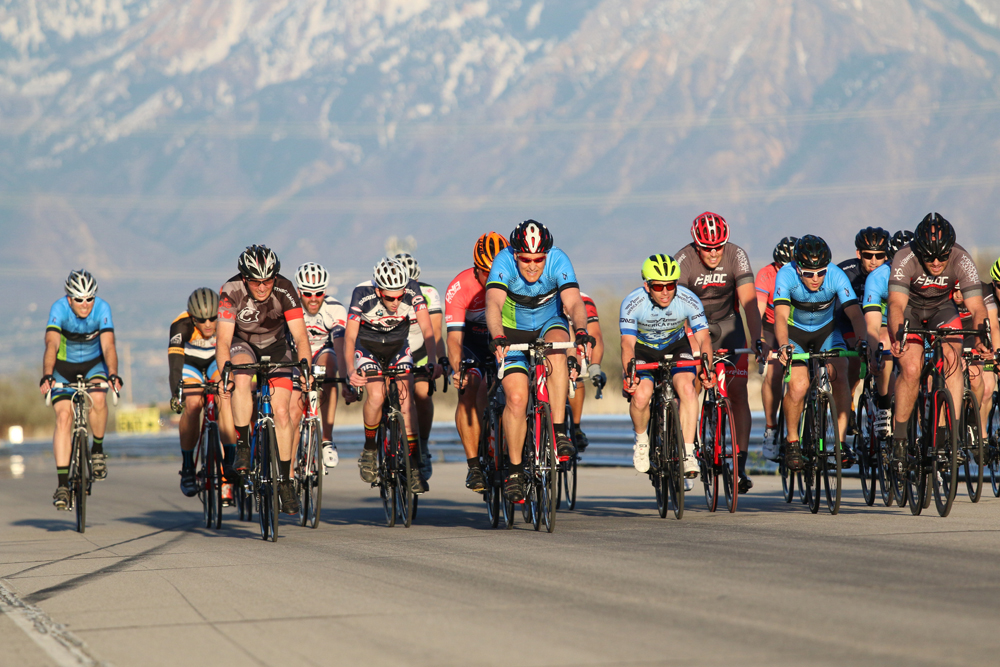
The Rocky Mountain Raceways Criterium is a great place to learn bike racing techniques and tactics. The C flite is shown here on 4-19-2016. Photo by Dave Iltis
Expect to ‘lose’
Ok, I admit this is a negative headline, but I want to get across the reality of endurance sports competition. Whether you’re a runner, triathlete, mountain biker, recreational/century/gran fondo cyclist or bike racer, the odds of winning are not 50/50 like in a football or basketball game. I would strongly encourage you before you participate in your event, to write down some very specific goals. It can be one or it can be several (though I suggest limiting your list to three or less).
There are so many things to learn every time you compete that if you are only focused on winning and not on being present in every moment, you will miss out on so many opportunities to get better as an athlete and vastly improve your chances of success in your next competition, or even one you’re in the process of competing in.
For example: let’s say you’re doing your first event, and you know that you need to work on your group awareness to better understand how to navigate among your competitors – who to pay attention to, when to respond to a move, when to use features on the course to your advantage, etc. Use that first race to practice moving smoothly around and up in the group, staying safe, communicating to those around you, adjusting your position smoothly instead of reacting when there’s a crash or a sudden move around you, getting comfortable competing closely next to and behind other riders, and pacing yourself during long efforts. Honestly, these skills take years to master, so don’t get discouraged if you’re not the smoothest, most efficient and tactical athlete in your first event! I’m not saying don’t try to win; of course you want to win! Just remember, if you’re doing all of those things right, you’re setting yourself up for a better chance to succeed than if you only focused on winning in the end. ‘Be’ in every moment of the race.
Expect to adjust your goals
The previous subject leads perfectly into this one: adjusting your goals. Learn to adjust your goals all the time; not just after an event! If you are truly living in the moment, reading the other athletes around you, their strengths and weaknesses, dealing with changing weather conditions, accidents, and changes in terrain, you should be constantly adjusting your goal(s). You need to always be asking yourself: “Am I in the position I need to be in right now to reach my goal?” If you need to conserve energy, are you taking a break when you should be, or are you constantly reacting to everyone around you, thereby using more energy than necessary to get a ‘result’? How do you want to be positioned before and in the middle of key moments on the course, given your strengths and weaknesses versus those of your competitors? Utilize your strengths and use others’ weaknesses to your advantage.
Following your event, I would still recomment a mental debriefing of some sort. Refer back to your written goals and assess honestly whether you reached them or not, what you would do differently, what you would change, and what you need to do for next time. Writing things down is a very powerful yet vastly underutilized tool in helping to ‘re-wire’ neural pathways in learning, development and behavior. Do more than just visualize or talk about things, and do a written review after you’ve spoken to your coach, team director and/or team captain. Do it within a few days after your event, but not necessarily right away, in order to allow for perspective, and to allow inflamed emotions to subside. Then leave it…in the past. Onward.
Expect to be nervous
I remember my first season of bike racing; I would be nervous the entire week before an event. Now I’m only nervous the hour before, and I try to keep that nervousness at the optimum level of intensity (yes there is such a thing as optimal nervousnss). You don’t want to be too relaxed or overconfident, and you don’t want to be so nervous that your whole body is shaking on the start line.
Looking back, I believe that the main reason athletes get nervous is because of all the unknowns. I would suggest spending some time the week(s) before your event preparing yourself for what to expect. The more you know about what to expect, the less nervous you’ll be, the more realistic you’ll be with your goals and expectations, and the less reactive you’ll be in the middle of the race. That way, you can make decisions clearly and at the right moments, and quite frankly the more you’ll actually enjoy participating!
Research the details of an event: time, distance, location, number of participants, level of competition, course profile, when and where on the course lie the main ‘features,’ such as climbs, turns, descents, etc. Start thinking about how your strengths and weaknesses as an athlete match up to the course and the other competitors, as well as how you need to compete in order to give yourself the best chance at getting a ‘result.’ The ‘result’ you want is, again, up to you, and will be a goal you need to set beforehand.
I hope both these articles help you stay positive and focused during your first season. And remember, there is always something to learn, always someone faster, and always another goal to reach. Learn to enjoy the journey without getting obsessed with the ‘end,’ because competition in sports and life doesn’t end after the finish line; it ends when you quit.
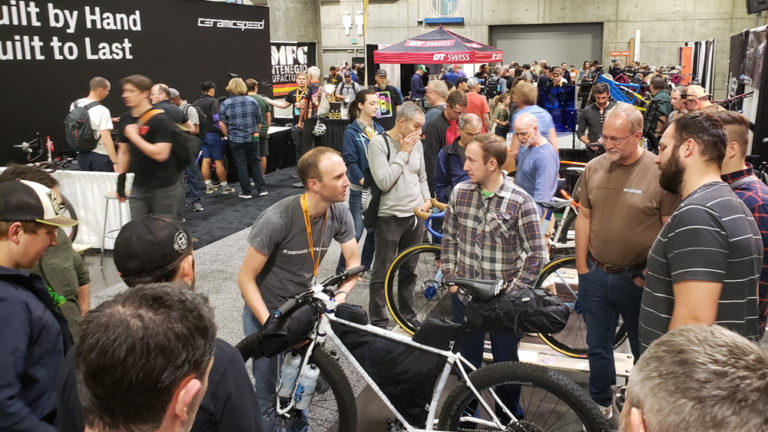
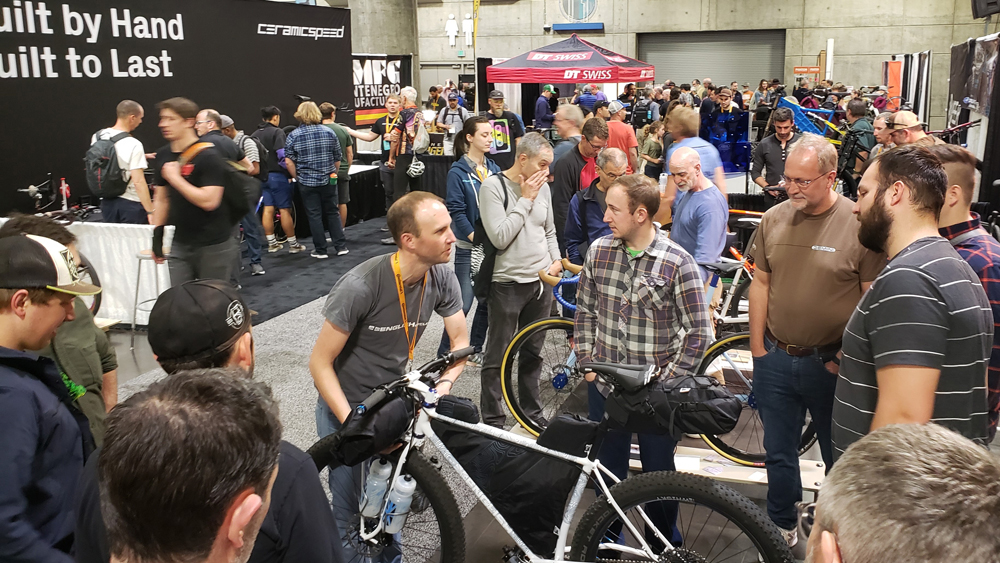
March 3, 2020 – The North American Handmade Bicycle Show, a yearly celebration of handmade bicycles and gear, has been postponed until August 21-23, 2020 in Dallas, Texas due to concerns about the novel COVID-19 coronavirus. The show was scheduled to take place March 20-22. The show features handmade bicycle builders from around the world, and is one filled with positive bicycle energy.
A view of the floor from the English Bicycles booth. 2019 NAHBS. Photo by Patrick Walsh
Show director Don Walker sent the following in an email today to the NAHBS community explaining the decision:
To the NAHBS community,
As I sit here watching the news, there is nothing positive about the state of the world in light of the coronavirus (COVID-19). Its grasp on the planet is ever strengthening as it continues to spread globally, including Europe, Asia, and now here in the USA.
Based on current news reports and travel restrictions, and in talking to many NAHBS exhibitors, media, and partners over the past week, I’ve made the difficult decision to postpone NAHBS and reschedule this year’s show. As a global show that attracts people from all parts of the world, and in evaluating the current variables and public health risks, I feel this is in everyone’s best interest.
The new dates for NAHBS 2020 are Friday August 21st – Sunday August 23rd at the Kay Bailey Hutchison Convention Center. Move in date for exhibitors will be Thursday August 20th.
Exhibitor booth space purchased for the March 20 – 22 show dates will be carried over to the August 21 – 23 dates. We’ll provide each exhibitor a new contract reflecting new show dates in the coming days. For any one that has any questions or concerns, or that is unable to attend NAHBS 2020 in August, please contact me at [email protected] or by phone at 502-424-2225.
This was an extremely hard decision to make, as I know we’ve all been preparing throughout the winter and early spring for this gathering of our industry. I understand all of the sacrifices and expenses that have been incurred and understand the inconvenience of this situation for everyone. But my primary priority is to protect the health and safety of our amazing community and feel postponing the show is in our best interest.
I’m praying diligently that everyone in our industry remains safe and healthy, and I look forward to seeing everyone in August. Thank you for your patience and understanding.
Sincerely,
Don Walker
NAHBS, Founder & President
NAHBS is described as follows by the show organizers: “Established in 2005, the North American Handmade Bicycle Show is the largest and most widely accessible destination for frame builders to share their passion with cycling enthusiasts and supporters. It aims to be a meeting point – both online and in person – for frame builders and consumers looking for custom-made bikes, for the sharing of ideas, and the promotion of a special industry with a rich history dating back to 1819. NAHBS moves from city to city each year.”
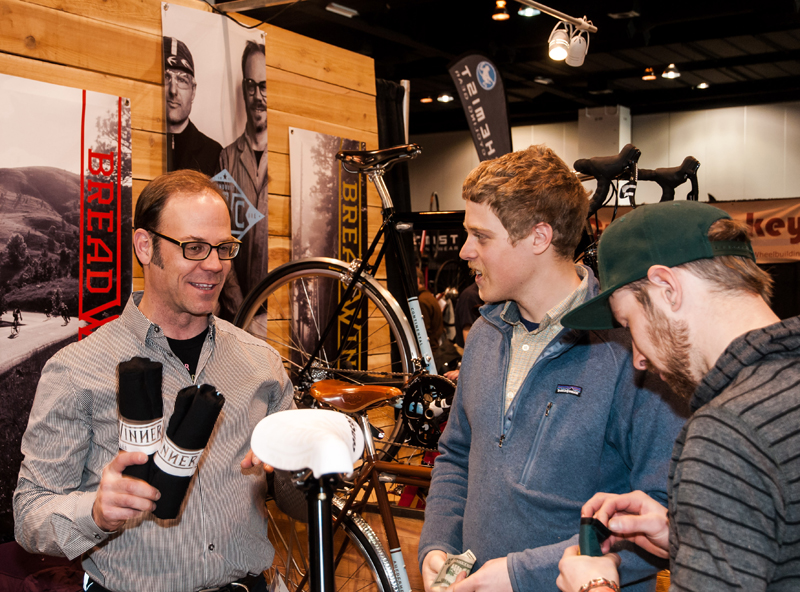
Tony Pereira (left) launched Breadwinner at the NAHBS. Photos: Chris See.
By Heather Nielson — I get asked by a lot of athletes participating in their first season of competition what pieces of advice I would give them and what to expect. I find that the details below apply to all endurance sports including road and mountain races and events, triathlon, and any organized bike ride (most of which I’ve participated in). I hope that it helps you.
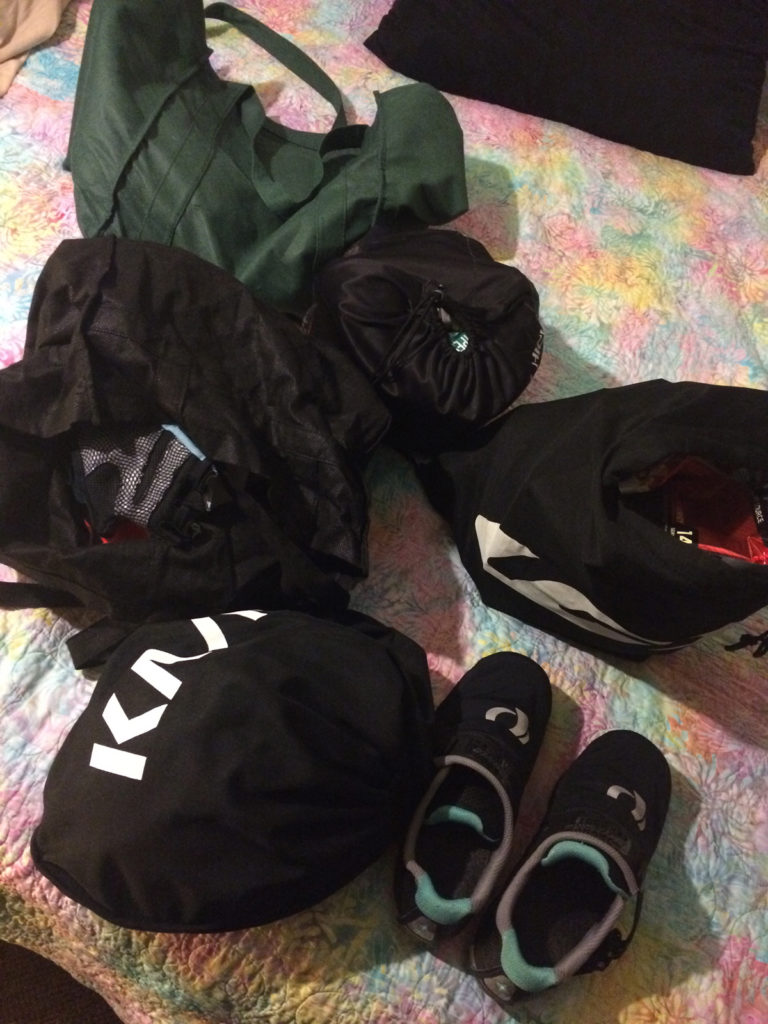
Having a check list helps you to remember everything to bring on the day of your race or ride. Photo by Heather Nielson
In this first part, I talk about basic logistics that if not handled properly can ruin your race or ride before you even get to the start!
Expect to forget something!
I remember very distinctly the morning of a race in late summer in Northern California showing up plenty early (as I’ve learned to do!) and realizing I’d forgotten my cycling shoes. This is no small thing to forget. It’s not like I forgot my socks or even sunglasses. I could not race without my shoes. Fortunately, I didn’t live that far away, and the race was running behind (#longliveVeloPromo) and since I’d arrived early, I quickly did the math in my head and realized that if I drove fast (I’ll neither confirm nor deny the breaking of any speed limit rules), all the way home and back, I might…just might make it back in time. I did, in fact, arrive back 15 minutes before the start time. I’ve also never forgotten my shoes since.
Over the past 10 years of bike racing, I’ve curated a racing checklist that also includes an overnight section and bad weather section. All I need to do the day before and the morning of while packing for a race is go through that checklist and I know I’ll have everything I need. If you need any ideas or a starting point, I’ll provide my personal list below. One of the items listed below is ‘baggies for separate stuff’. I have found that in the chaos that is bike racing, things can get lost/mixed up/in a heap in a hurry; and if you’re carpooling with others this idea can be a stress saver. I put categories of items in separate bags and all those bags in ONE bike racing bag. For example: I’ll have my jersey, bibs, baselayer(s) in one bag and gloves, socks, arm and knee warmers in another bag, nutrition in another bag, chamois cream, baby wipes, sunscreen, sunglasses in another bag; you get the idea. If you always keep those same items in the same bags, preparation and clean-up afterwards is far less stressful. This may not seem like a big deal but you’ll find that any amount of extra/unnecessary stress before competition will tax you during your event.
The Checklist:
Regular Races and Events
Bike (seems obvious I know but…)
Helmet
Eyewear
Wheels
Spare wheels/wheel bags (Remember personal info on your wheels)
Bags for separate stuff
Shoes
Toe cover/shoe covers
Socks (extra socks!)
Gloves
Arm warmers
Knee/leg warmers
Jersey
Shorts
Podium hat/cap
Pump
Tool kit
Spare cleats
Chamois cream
Sunscreen
Baby wipes
Dirty clothes bag (to keep your clean clothes separate from your dirty ones)
Clothes to change in to afterwards
Changing skirt/towel
Water bottles
Race food
Recovery food
Trainer and front wheel block
Racing license
Bib number (pin it)
Power meter computer/watch
Triathlon Additional Miscellaneous
Wet suit
Running shoes
Body Lube
Compression socks and/or sleeves
Tri suit
Cap and goggles
Running hat or visor
Mountain Bike Additional Miscellaneous
Tire sealant
Armor All for tire sidewalls when it’s muddy
Hydration pack and tools
Mini-pump and/or CO2
Bike stand
Overnight/stage races:
Cards to pin race/bib #’s to wheel bags for support vehicles & a sharpie pen
Plastic utensils (you’ll be grateful for this on the road)
Tool box
Extra tubes & tires
Spare wheels
Multitool
Extra cassette
Extra cleats
Overnight clothes
If you’re flying:
Zip ties
Multi-tool
Plastic gloves
Electrical tape
Pedal wrench
Scissors
Cleaning rags
Bike measurements
Measuring tape
Severe weather gear:
Panty hose for ice cubes
Multiple gloves
Multiple shoe covers
Multiple socks
Towel
Newspaper (not for reading material while racing silly, to soak up water from your shoes after racing in the rain!)
Rain cape
Plastic bags
Sunscreen
Multiple sunglasses lenses
Multiple cycling caps/head covers
Extra arm warmers
Extra leg/knee warmers
Expect to get lost
Actually, this one is probably far less likely for you than it is for me. If there is ONE thing I am professional at, it’s getting lost. By foot, car, bus, bike…you name it. My biggest pieces of advice when traveling to your event: allow for extra time, check your maps (multiple times), make sure you know of alternative routes and use the ‘show traffic’ option on your handy google map app to account for bad traffic/crashes. Or you can do what I do, carpool as much as you can and have someone else drive and split the gas because 9 times out of 10, they’ll get there faster and without getting lost better than I ever will.
In part 2, I will talk more about the mental and physical parts of preparing yourself for your first season.
By Lukas Brinkerhoff — No one has ever accused me of being mentally stable. Drop me in a room with a bunch of other people and suddenly, I feel like a deer in the headlights desperately looking for a way to avoid being ran over. Much in the same way, one on one conversations with folks I don’t know, the kind of conversations that require small talk and getting to know each other are things of nightmares. Or leave me alone in a mall and I will proceed to get lost upon walking into my first store. And then there’s my phobia of house cats. No, you wouldn’t refer to me as a well-rounded member of society. Well, maybe my mom would.
If you want trails, you have to build them. Photo by Lukas Brinkerhoff
As they say the first step to solving a problem is recognizing it. I might be a little crazy but I can recognize when things are taking me to a place that is going to result in me, a bottle of bourbon and a bed for extended periods of time. It’s a twitch, a twinge in the back of my neck that is hardly noticeable, but once it rears its ugly head, there is only one thing left to do, escape.
My medicine escape can be found all around St. George, it’s kind of the reason I live here. It can be a quick lap on the Kentucky Lucky Chicken trail or just wandering around up there and letting the wind blow across my face. Sometimes it takes a little more effort and can be a 45+ mile loop on the Turkey Farm Road taking me between the Pine Valley and the Cottonwood Wilderness Areas. And my favorite, a quick overnighter camped on the rim of Gooseberry Mesa watching the towers flicker on Smith Mesa and the stars pass overhead followed by a long hard day riding the mesa.
The first half of the last decade, I spent residing in Santiago, Chile. Not only were there people always in my face, but open spaces were at a premium, at least in the city. There were two places that gave me some sort of solace and respite.
My “job” during this time in my life was teaching English to executives in downtown. I had classes in the morning and then a break till lunch. I would walk the few miles to get to Providencia where my next students would be waiting. Along the way was the Parque Forestal which was a city park by all definitions. There were a bunch of trees, benches, grass and plenty of people to watch. I would sit down and write descriptions of things I saw and breath the dirtiest air ever for an hour or so just to feel some semblance of an escape.
Red Cliffs. Let’s not a put a road through here. K. Thanks. Photo by Lukas Brinkerhoff
The second spot was behind the small community I lived in and was known as El Cerro Renca. There was a giant cross on top and it was entirely surrounded by people. Luckily, the couple mile rule is applicable even in South America and a jaunt up its steep slopes would leave me alone to ponder how loud the city was and to gather my thoughts. The cross was a bit rickety, but the peak was always the objective when I would head that direction. Once on top, I would just sit and listen. I would often be rebuked upon returning home for overstaying my time and missing obligations that I didn’t care about. While I lived in Santiago, there was never a time of more than a couple of months that I didn’t make it to the top of that hill.
To say that public lands are important to me would be understating one of the most obvious parts of my life. Almost everything that I feel passionate about has to do with using and visiting open spaces. And before anyone accuses me of being an outsider, I’m as Utahan as they come. Born and raised right here in St. Geezy. I can remember the frustration of hunting with my dad and not being able to access certain pieces of land thanks to private ownership, probably my earliest memories of open spaces and one of the reasons I feel so strongly about keeping public lands public.
If we were to say there was a problem with public lands, we would have to recognize the Tragedy of the Commons (don’t know what that is, Google it). Managing open spaces is to attempt to create spaces where each user group’s demands can be met without damaging the experience of the others.
The latest mesa built by the BLM and designed by the DMBTA. (Wire Mesa) Photo by Lukas Brinkerhoff
Over the past decade or so, I’ve worked with multiple land managers from the Forest Service, BLM, State and local municipalities. Each experience was unique for sure, but they all had the underlying theme of wanting to work with me, with the exception of the State. Sure, there are restrictions and parameters within which they must operate, rules that help ensure that all interests are brought to the table. The one thing I’ve learned over the years is, that like most public workers, these folks are overworked, under-thanked and often not properly compensated for the time and passion they put into their work.
The most important take-away from my years of trying to get mountain bike trails built on public lands would come in the form of trying. I’ve found that most of us would love for trails to just appear, or for land managers to put them in without any effort on our part. However, as cliché as it is, the squeaky wheel will get the oil. If you want a certain type of trail or activity to be available for you on public lands, you need to get involved. Offer to help, bring plans, do what you can to make their job easier. In my experience that is all it takes to get what you want.
As I sit here typing, having just returned from yet another escape into the Red Cliffs Desert Reserve (a place local county officials would love to build a giant road through) to ride my bike and clear my head, I can’t imagine living anywhere else. And at the same time, I can’t imagine living in my home town if the spaces that I grew up with were lost. If there were homes on top of the red rocks that I ride, if there were roads through the wilderness areas that are my sanctuaries or if the mesas that are my cathedrals were drilled for oil extraction. One thing’s for sure, I will be doing everything within my power to make sure my sacred places stay open.
Lukas Brinkerhoff blogs about mountain biking and life at mooseknuckleralliance.org.
Little Creek. One of those places that we get to ride thanks to our public lands. Photo by Lukas Brinkerhoff
By Tom Diegel — When one thinks of great bike touring destinations, there are some big classics: Tuscany, Provence, the Alps, Neew England, the Great Divide trail, Bike Centennial transcontinental, coast highway 101, the Pyrenees, northern Ethiopia…wait a minute! Northern Ethiopia? In Africa?! Riding on goat paths and staying in mud huts?!!? Classic?!
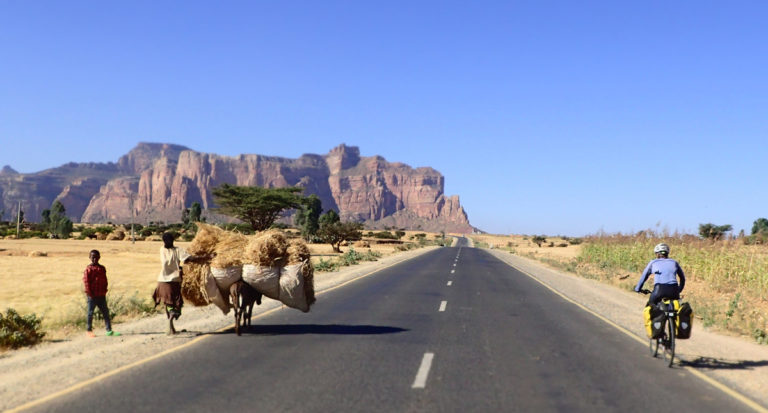
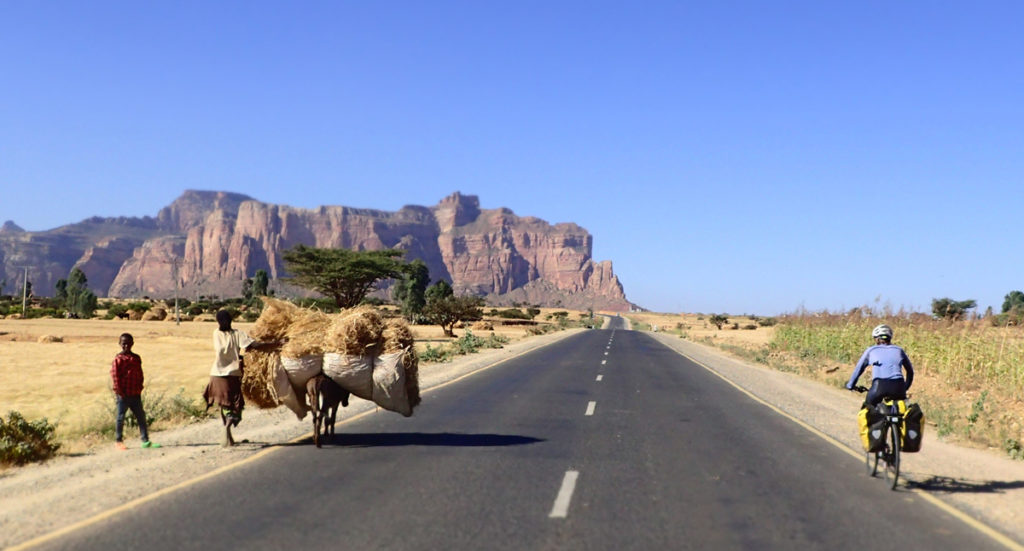
Ashley on the road with Zion-esque walls in the background, a typical northern Ethiopian traffic jam. Photo by Tom Diegel
Well, while Ethiopia may not yet be known as a classic cycling destination yet, it has all the elements in place: a rich culture, mountainous terrain, incredible food, super friendly people, a fascinating history, winding lonely roads, very little traffic and a tolerable level of adventure. All that is needed for a great cycling destination.
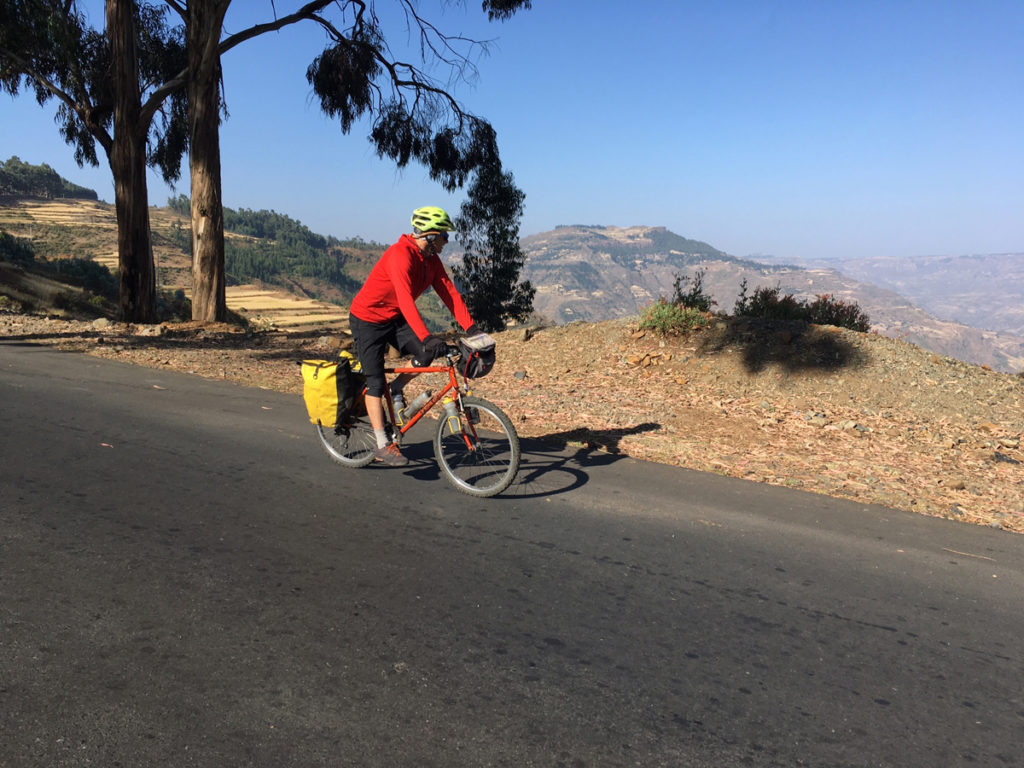
Tom Diegel cruising past eucalyptus trees on a scenic ridgeline at 10,000 feet. Photo by Ashley Patterson
Our journey to ride in Ethiopia started on a river trip; I had an opportunity to float down the Blue Nile river as it makes its way from Lake Tana (about half the size of the Great Salt Lake, in a good year) south and then west into Sudan before meeting the White Nile and becoming The Nile. It’s a long ways to Africa (the flights involve going to Europe first and then carrying on from there) and it seemed warmer there in November than the typical early winter doldrums in Utah, so we decided to look into doing a bike tour as well. Tadele Travel is owned by Richard, a former Olympic marathoner for England who became friends with Haile Gebreslassie, who is almost-inarguably the best distance runner of all time and an Ethiopian national hero. Haile had invited Richard to Ethiopia and he became enamored with the country and wanted to introduce more people to its unique culture, and since he was an athlete we knew that we could take his word if the routes he suggested would be fun and challenging. And soon enough Richard delivered us a document with a suggested route in the northern part of the country.
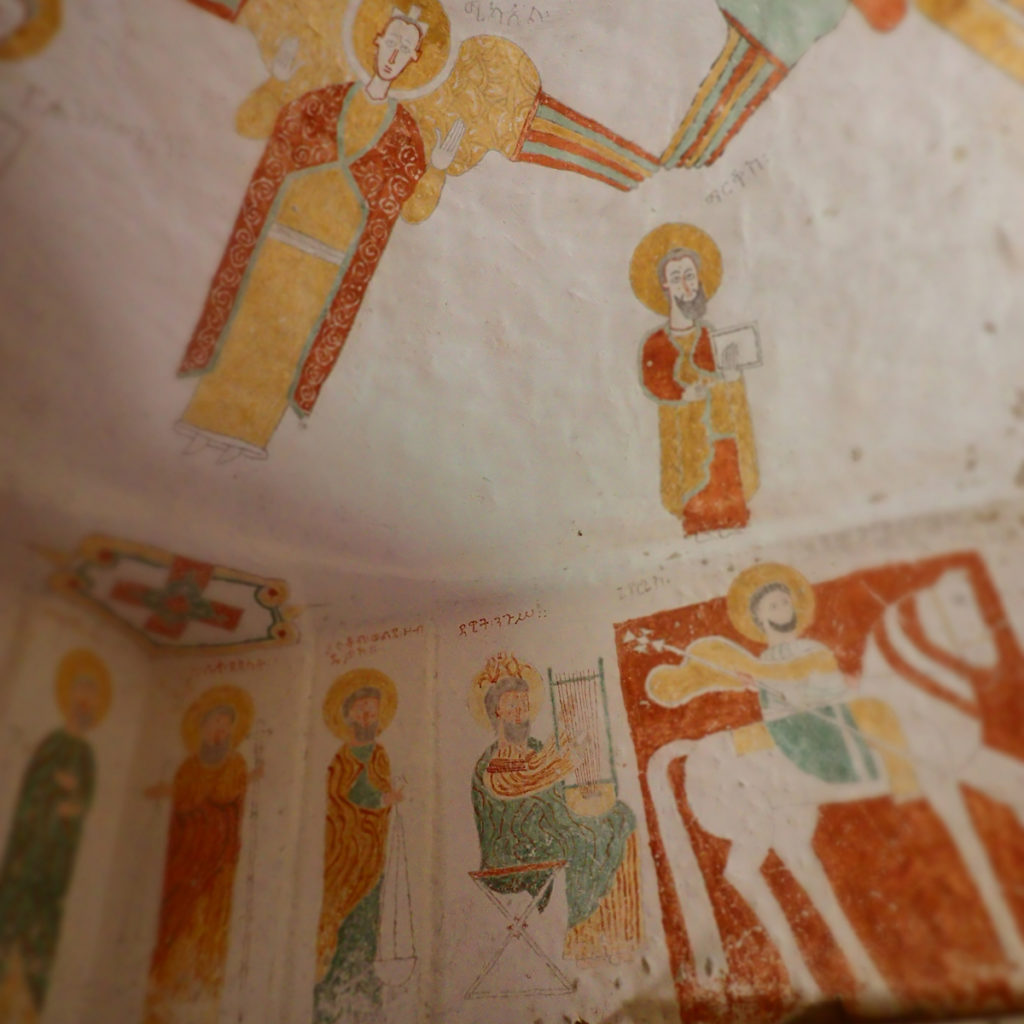
1500 year old Christian paintings stay well-preserved deep inside sandstone cave churches. Photo by Tom Diegel
Ethiopia is big: about the size of Utah, Colorado, Nevada, and Arizona combined. Most of the south is pretty low elevation and is thus pretty hot, but the northern highlands are in the 5000-8000 foot range and thus are pleasantly cool, and like the Intermountain West has its “monsoon” season at the same time as ours, and beyond that it’s predictably dry. And it has an incredible network of roads: even though Ethiopia is one of the few African countries that wasn’t colonized by European countries, the one that tried – Italy, twice – did have enough influence there that it built a great network of roads, using Italian mountain road mastery. And while the original northern roads were gravel, over the last 10 years the “benevolence” of the Chinese government interested in improving infrastructure in resource-rich Africa resulted in all those gravel roads getting paved, but there are very few cars that travel the wonderful Sino-Italian roads, which makes for incredible cycling.
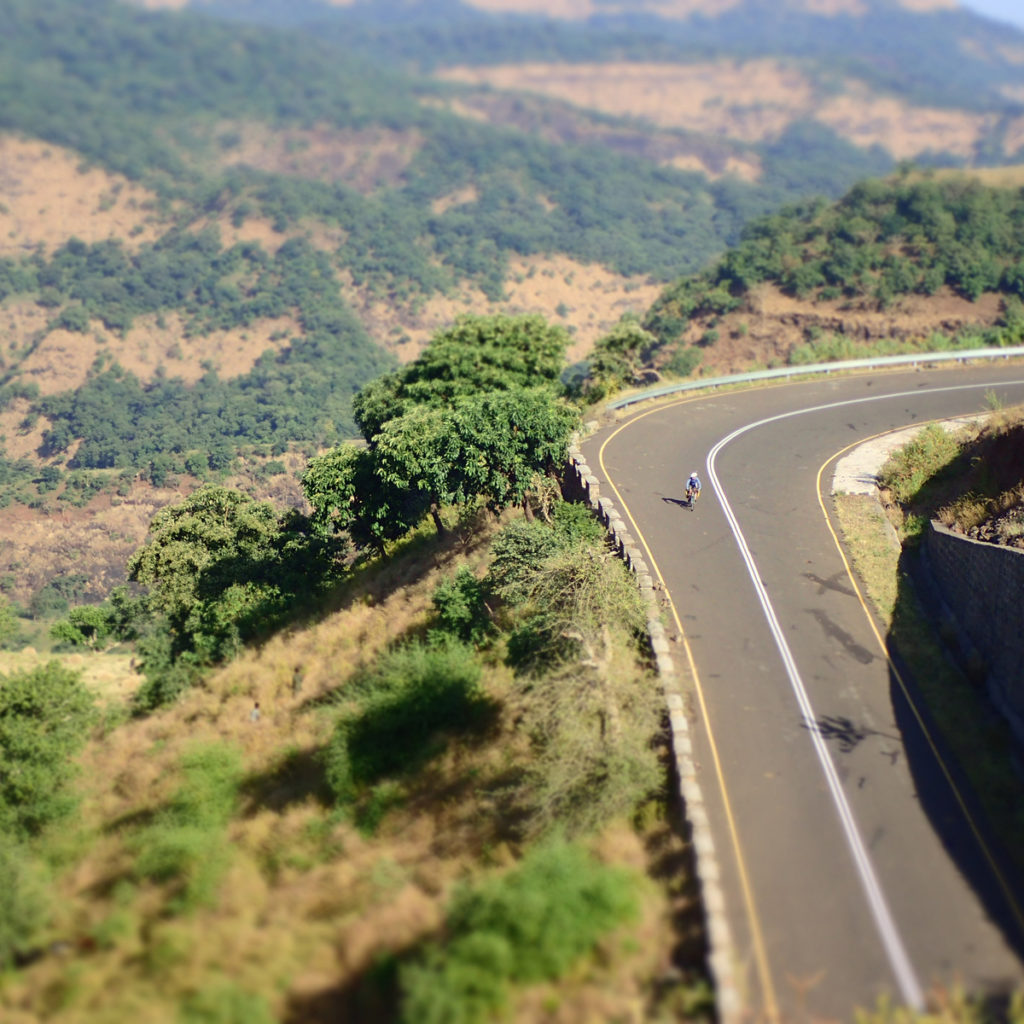
Long windy descents (and climbs) are the norm in the northern highlands. Photo by Tom Diegel
My wife Ashley made the long journey from the states to meet me in the capital city of Addis Ababa, toting both her bike and mine, and we transitioned to a domestic flight to take us to Makele, the gateway to the northern state of Tigray. Tigray is the region in the far north of Ethiopia, and it is famous for its natural beauty that comes from big sandstone walls and mountains that are quite reminiscent of Utah’s own redrock desert.
After an afternoon and night of rest for Ashley to bust out of jet lag, we rolled out of Makele. A little ways up the first climb we were surprised to see a small pack of full-on roadie guys doing intervals on the 1000′ climb on the outskirts of town. And even more surprised to see another posse, and then another. Apparently Makele is a hotbed of road cycling, and it was odd to see these kitted-out guys on sweet bikes amongst the other rattletrap bikes that plied the town roads. I tried to get a pic but they flew past us in both directions too fast for me to grab my camera!
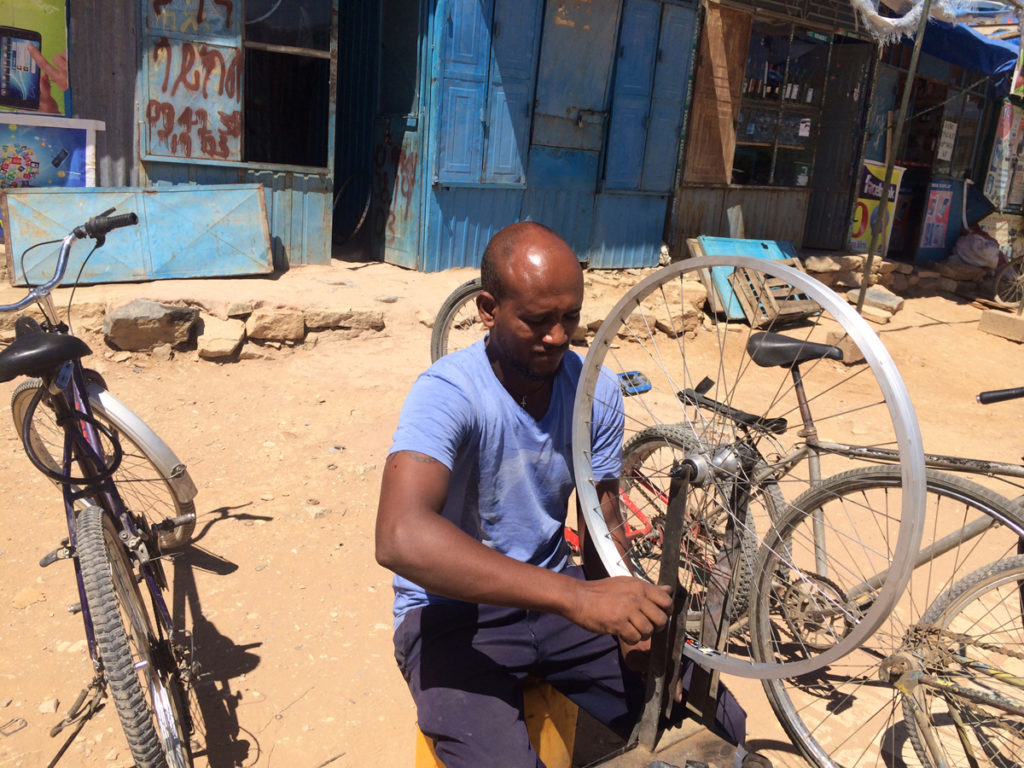
Bike shop: a guy, a chair, a homemade truing stand, and a few tools. Photo by Tom Diegel
It is not a solid Ash and Tom bike tour without a major mechanical issue to happen in the first bit (broken derailleur in Boulder, UT, a fallen-off crank near Price, a frozen freehub in Vietnam), and this adventure began accordingly. I was rolling along when suddenly my rear wheel skidded to a stop, almost throwing me over the bars. I glanced back and my heart sank: a split rim.
Old school (i.e. non-disk) brakes wear down rims – especially in places like sandy southern Utah – and I hadn’t noticed before the trip that my rim was deeply grooved. The only fix was a new wheel, and the weight of being in Africa with a blown rim at the beginning of our trip crashed down on me pretty hard, but as I was lamenting my misfortune Ashley was flagging down a passing pickup. This was to become our first experience with the legendary Ethiopian graciousness; these locals were happy to give us a ride to the next town, even as I was pessimistic that we could find wheel-building salvation. However, with our new friends as translators, we were able to find the town’s local bike mechanic who took one look and said “no problem.” The next thing I knew he was stripping my wheel of spokes. I’ve seen other people tape the new rim to the old and move spokes over, but apparently that’s not the Ethiopian way. Once he had it stripped he leapt on his bike, raced off, and a few minutes later returned with a brand new rim. An hour later it was laced up and ready to go. To be sure, it took a lot of finessing and I still have a bit of a lump-lump in the wheel – which didn’t help a butt that had its saddle-toughness after a month+ off the bike – but it spun, and that’s all I needed. And I guess one gets what one pays for; the whole deal was about $10, and I was a happy customer pedaling on to our next destination.
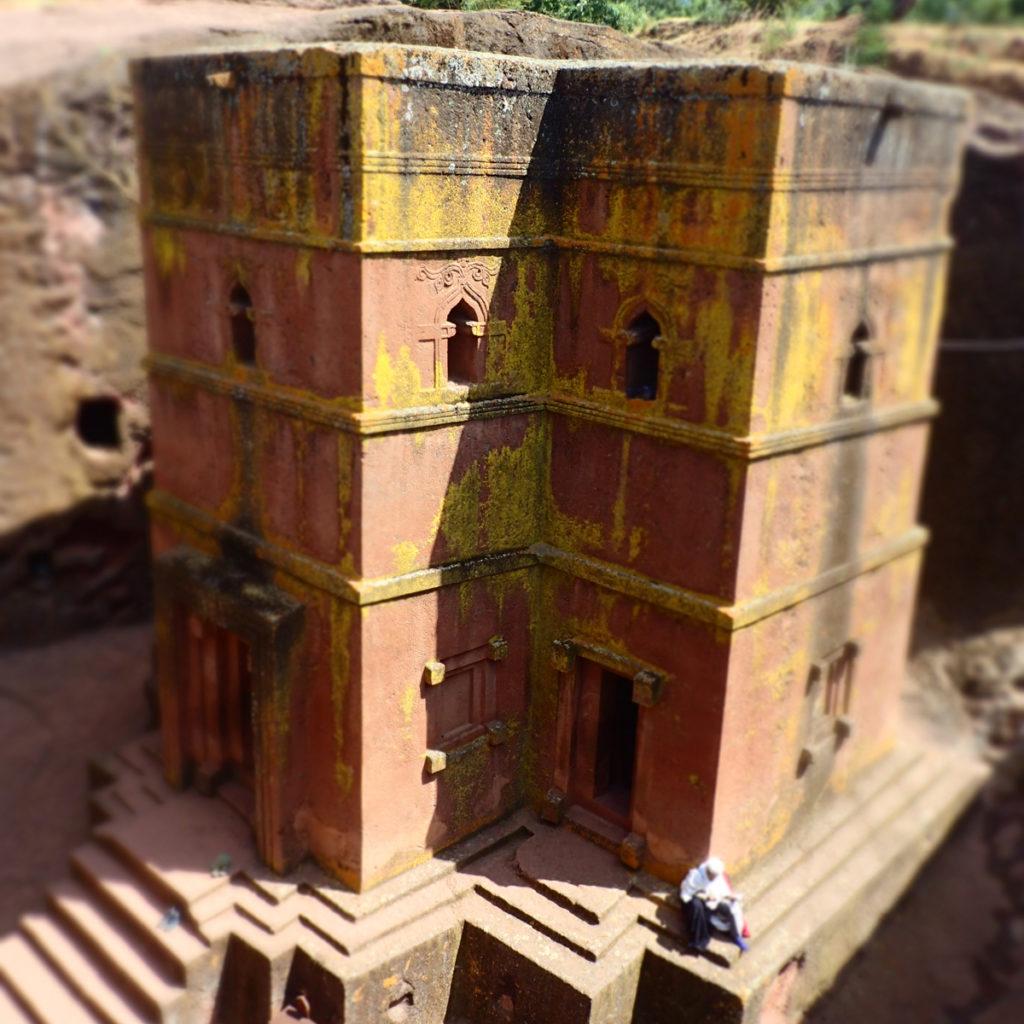
The churches were essentially excavated out of a solid hillside of basalt. Photo by Tom Diegel
Tigray is famous for it’s “rock hewn” churches. While some folks say that the outdoors is their church, the Ethiopians of the 6th century decided to take that concept literally; instead of putting up houses of worship in the desert they actually carved entire churches into walls, with some requiring a thousand-foot climb to get there! Hiking to a handful of churches made for a great active rest day off the bikes, and though it may seem a bit out of character, we found two European-owned lodges in the area that were as nice in every way as American BnB’s.
Richard had suggested that we spend the bulk of our trip in the Tigray region since that’s where he runs his tours, but as we pored over the maps we realized that by doing so we’d miss the Simien mountains, one of the most prominent ranges in Africa well known for vast views and as a refuge for mountain baboons, ibex, and African wolves. Talking with locals, however, we realized that there was a bit of a catch; while the vast majority of the roads that we’d be on would still be the great Ethiopian rolling new pavement, there was a 5000 foot climb on gravel road of unknown condition to reach the national park. But we decided to give it a go.
Richard also likes to run his trips in the north to avoid rock-throwing kids. Surfing the internet we saw that adolescent boys had a tendency to throw rocks at cyclists, but Richard correctly told us that in “his” zone they didn’t do this. However, because we made the conscious decision to make a big modification to the recommended route we moved out of the typical tourist zones and got into rural areas where indeed we had some young boys throw rocks at us, but we realized that it was more annoying than dangerous. I actually got hit once, and in a rage I surprised the kids by veering of the road and chasing them on my bike through a field (which they thought was hilarious) and when I caught back up with Ash she told me about her interaction with one kid: he was running alongside her grabbing at her rack so she veered into him, he turned to dash into the adjacent field but didn’t take into account that Ethiopians tend to build (very effective) “fences” out of super-thorny acacia tree branches, and the kid did a full-on belly flop onto a pile of acacia (which he thought was as hilarious as we did).
After a few more days of excellent riding we finally arrived at The Big Climb into the Simien Mountains, and it was on this long, grinder that we had another memorable experience with the Ethiopian hospitality. Knowing that I rarely let a bike tour go by without at least one day of solid bonkage and dehydration I tried to camel up on food and water, but to no avail; I was fading down the rabbit hole about two-thirds of the way up the climb. We stopped for a rest and I tried to hammer down more water, but within a few minutes I was pedaling squares again. As fate would have it, we came upon a fresh water spring; one of the only springs we saw on the trip. However, this didn’t cut it. I needed more than water, and things were a bit grim; there was almost no traffic so it wasn’t very hitchable, we still had a ways to go, it was getting late, and my legs were cramping from my ass to my feet. A car came along with two Ethiopian couples who stopped to also water up at the spring, and of course asked if we were ok (since I was pretty much pale as a ghost and collapsed on the ground) and Ash said “Do you happen to have any Cokes?” Alas they did not, and drove off. I tried to ride again, cramped, and retreated back to the cool shade of the spring, while Ash tried to figure out the next move. But suddenly, about 20 minutes later, the car we had seen earlier came barreling back down the road, the guy leaped out, and in his hand were…..two ice cold Cokes! Such great people, and within 5 minutes I was able to leap onto my steed and rage up the last third of the climb!
The town of Lalibela is a staple on the Ethiopian tourist circuit, and it was our ultimate destination as well. A beautiful town tucked into the mountains, it is also famous for its own rock-hewn Christian churches, but instead of digging into the softer sandstone as the Tigray churches were, Lalibela’s churches were excavated out of hard basalt hillsides in the 12th/13th century by people beholden to King Lalibela – the king of the Ethiopia region at that time – who wanted to make Ethiopia’s churches more impressive than those in Jordan. The ability to create these full-size temples is mind boggling even considering today’s available technology, much less what they were able to accomplish 800 years ago. And according to local lore it took “only” 20 years to build a dozen churches!
And while Lalibela is very much a tourist-oriented town, there’s very little hustle associated with it and as noted the Ethiopians are very gracious hosts. As such, we decided that to be best appreciate the coolness of Lalibela we’d get a guide, and thus we were introduced to Getay, who indeed proved to be not only a wealth of information about Lalibela as we expected, but he was also very willing to talk about life, politics, and warfare in Ethiopia, which was rare; as well as helping to navigate the local market. Getay was a soldier in two different wars (the first against the ruthless communist Derge, who created the infamous famine in the 80’s, and the second against the Eritreans), loves Lalibela, and is taking steps to start a new solar panel business, which has a lot of potential in the high desert. Getay took us to several churches that were off the beaten path, including one that had a locals-only once-per-year festival, and another that houses over 5000 mummies of worshippers who wanted to spend their eternities interred on the surface next to the church. And Getay was kind enough to take us on a dawn patrol hike into the mountains the morning of our flight home; a nice way to complete our Ethiopian adventure.
Yes, there are many places to experience by bike both near and far, and flying over idyllic western Europe to ride in eastern Africa seems a bit unlikely, yet a bike tour in northern Ethiopia is an unusual and worthy adventure, and you’re sure to meet some of the world’s nicest people.
During a recent group ride, a motorist started honking and yelling at us because we were riding in the road. We had to ride in the road, but we were going slower than traffic. When is it allowable for a cyclist to “take the lane,” and when is it not? – Rick S., Highland, UT
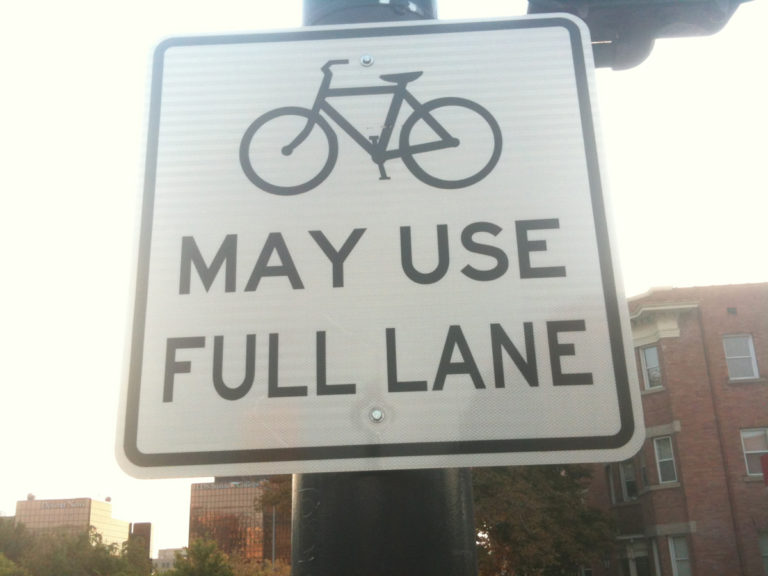
“Take the lane” is a common phrase among cyclists. It’s the catch-all term that explains how cyclists are legally allowed to move away from the far right side of the road and use the lane.
Bikes may use the full lane, when necessary. Photo by Dave Iltis.
In Utah, cyclists riding slower than the flow of traffic must ride as close to the right-hand edge of the roadway as practicable. But, there are some exceptions to this rule. Cyclists are allowed to (and should for our personal safety) “take the lane” and impede traffic only in the following circumstances:
When overtaking and passing another bicycle or vehicle
When preparing for a left turn
Riding straight through an intersection just to the left of vehicles turning right
Where a lane is too narrow to share safely with another vehicle
To avoid any condition that makes it unsafe to continue along the right-hand curb or edge
Every cyclist has the legal right and responsibility to make reasonable use of the roadway to protect their own safety. You may take as much of the lane as is practical to create a safe space around yourself and leave no doubt that the motorist does not have enough room to share the lane with you.
Cyclists riding single file, as near to the right as practicable. Photo by Dave Iltis.
We assume you were using the lane for one of the reasons listed above. In that case, the motorist had no basis for honking and becoming hostile with you. However, we’ve all seen cyclists spill out into the lane on group rides. Cycling is a sport that gives us enormous opportunity to spend time with friends. We feel safer on group rides and are more visible to motorists. We love the camaraderie, the short strong pulls at the front of a pace line, and the easy drifting out as a peloton. You can ride two abreast in Utah, as long as you do not impede traffic. If your group cannot fit on the shoulder of the roadway, then you must ride single file, and cannot “take the lane” unless you are in one of the five situations listed above.
Taking the lane is necessary at times, but causes problems because drivers think you’re being actively hostile. When necessary, give proper notice, take the lane, and then return to the right-hand edge of the roadway as quickly as possible. As cyclists, we can legally take the lane, but that doesn’t mean we can keep it.
Ken Christensen and Russ Hymas are avid cyclists and Utah attorneys at UtahBicycleLawyers.com. Their legal practice is devoted to helping cyclists injured in collisions with motor vehicles. They are authors of the Utah Bicycle Accident Handbook and are nationally recognized legal experts on cycling laws and safety.
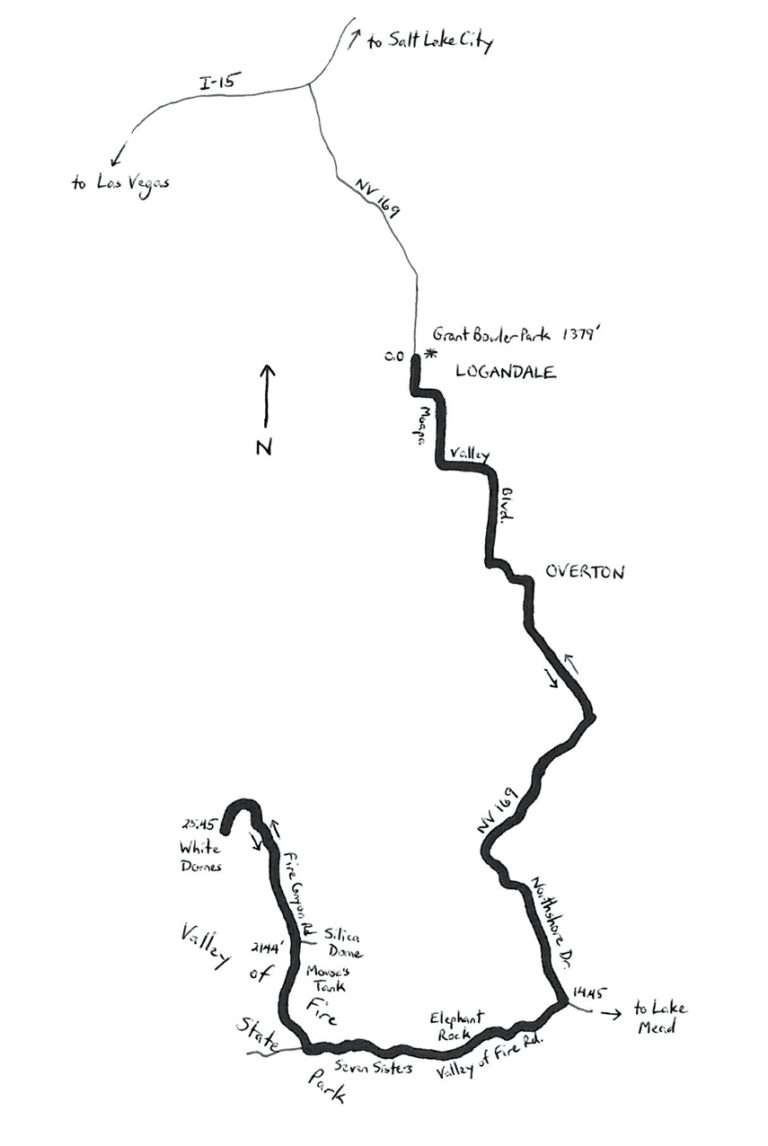
The Moapa Valley Ride on Fire is a 50.9-mile out-and-back route, taking the cyclist from Logandale, Nevada to Valley of Fire State Park, and back. While Logandale is in Clark County, of which Las Vegas is the seat, Logandale and the Moapa Valley are worlds away from the hubbub of the Strip. Las Vegans may journey to Logandale every year for the Clark County Fair, and several other events, but the Moapa Valley is generally a quiet alternative, located 55 miles northeast of Vegas, and 35 miles southwest of Mesquite. Take the Overton exit from I-15, and head south on Nevada Highway (NV) 169.
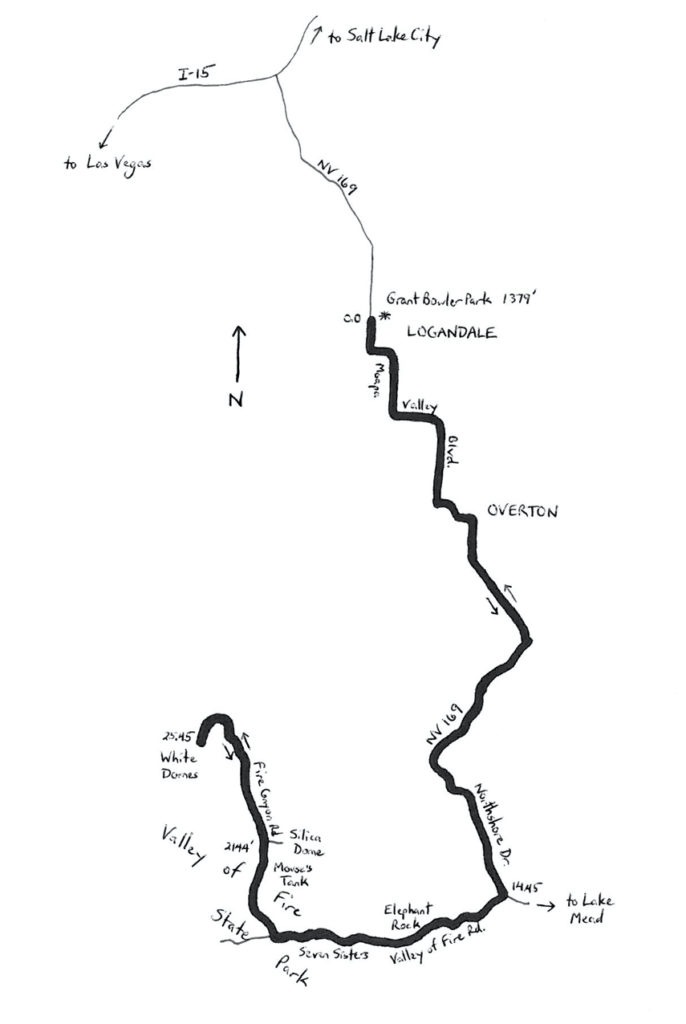
The Moapa Valley Ride on Fire is a 50.9-mile out-and-back route, taking the cyclist from Logandale, Nevada to Valley of Fire State Park, and back. Map by Wayne Cottrell
The ride starts at Grant M. Bowler Park in Logandale, located at 3280 North Moapa Valley Boulevard (NV 169). The GPS coordinates are listed at the end of the article. Grant Bowler was a local high school teacher, and director of the Clark County Fair. Head south on NV 169, through the agricultural-ranch community of Logandale. The community was originally named Logan, but the name was changed to avoid confusion with Logan, Utah. South of Logandale, enter the larger, agricultural-ranch community of Overton. NV 169 makes several right-angle bends as it makes its way southeast-ward across the Moapa Valley. South of Overton, the highway passes by the Lost City Museum, which is built on the site of the Pueblo Grande de Nevada, an ancient Anasazi city. By the time Mormon settlers made their way out here, in the 1860s, the Pueblo Anasazi were gone, and had been replaced by the Paiute. The Mormon settlers successfully colonized the valley, transforming it into its current form. The word is that residents who need to excavate, for whatever reason, often uncover ancient Anasazi artifacts. The route is gradually downhill from Logandale (elevation 1,379 feet), though Overton (elevation 1,244 feet).
Leave the Logandale-Overton community at mile 8, and enter a mostly barren, desert landscape. You are now on Northshore Road, skirting the edge of Lake Mead National Recreation Area. The road climbs gradually to the Valley of Fire Wash. After crossing the wash, the road climbs at a 4% gradient for one and three-quarter miles, before descending gradually. Leave the Lake Mead environs at mile 14.45 with a right turn onto Valley of Fire Road, which is a Nevada Scenic Byway. Enter the State Park at mile 15. There is an entrance station, which may be unmanned, with a nominal (possibly self-service) fee for bicycles. The valley is, of course, not literally on fire, nor did the formations come from fiery, volcanic action. Rather, the spectacular formations here were developed from hundreds of millions of years of sands deposited by desert winds. The sands are not soft, but have been hardened, weathered and chiseled by the sun, some water, and chemistry. The Valley of Fire name refers to the fire-red appearance of the rocks. The tour through the park starts off with the stunning Elephant Rock, which actually does resemble an old, molten elephant, forever hardened in place. The Seven Sisters are the next series of formations. At mile 19.75, turn right onto Mouse’s Tank Road, also known as White Domes Road. You may have been enjoying the scenery so much, that you may not have realized that the road has climbed to 1,947 feet. The park’s Visitor Center is at the intersection — it is worth a stop to see the demonstration garden, along with the indoor displays and exhibits.
Continue northward on Mouse’s Tank (White Domes) Road, heading deeper into the park. Mouse’s Tank refers to a fugitive Native-American named Mouse, who hid in this area during the 1890s. The “tank” is a basin that fills when it rains. The road passes a trailhead that provides hiking access to the basin. Stay left at the junction north of the trailhead, to remain on White Domes. This is a newer road, not completed until the 1990s, that winds, twists and rolls its way across the fiery, rocky landscape. Note that, other than this extension of the road, most of the facilities in the park were built during the 1930s by the Civilian Conservation Corps. While a motorcyclist might be able to catch some air on this road’s undulations, the average cyclist will be trying to hold a pace, as the road undulates between 1,865 and 2,144 feet above sea level. Be sure not to burn all of your energy heading outward, since the ride returns along this road. At mile 25, White Domes Road curves sharply to the left, as it head towards an endpoint at White Domes. Before heading back, it is worth a stop to ogle and gape at the folds and formations in the bright white rock. You are now 25.45 miles from the starting point in Logandale. The outbound route featured about 1,350 feet of climbing, and a positive net elevation change of 665 feet. While there is 675 feet of climbing on the return ride, the net elevation change is negative. If there is time, be certain to visit the Lost City Museum, just south of Overton, on the way back.
GPS coordinates of start-finish: 36.600125oN 114.483781oW
For more rides, see Road Biking Utah (Falcon Guides), written by avid cyclist Wayne Cottrell. Road Biking Utah features descriptions of 40 road bike rides in Utah. The ride lengths range from 14 to 106 miles, and the book’s coverage is statewide: from Wendover to Vernal, and from Bear Lake to St. George to Bluff. Each ride description features information about the suggested start-finish location, length, mileposts, terrain, traffic conditions and, most importantly, sights. The text is rich in detail about each route, including history, folklore, flora, fauna and, of course, scenery.
Wayne Cottrell is a former Utah resident who conducted extensive research while living here – and even after moving – to develop the content for the book.
February 25, 2020 — Bike racer and author Phil Gaimon suffered an awful bike crash during a track race in 2019. He broke 11 bones including his ribs on one side of his body and scapula. While the crash was shattered his Olympic dreams, the ensuing debacle with hospitals and health insurance is “the worst part.” The crash and surgeries left him $250,000 in debt despite having good health insurance, and backup cycling insurance. Gaimon is in the midst of the appeals process and decided to go public with his story in hopes of helping others.
In the Youtube video, Gaimon asks that donations be made to his favorite charity, rather than reverting to crowdfunding his medical bills (link below). Gaimon states:
I was brought to an ER unconscious and I still don’t know why that bill isn’t covered for $150,000. I think a lot about the moment where I went to a different hospital which seemed to be the only place they could fix my broken shoulderblade. I knew it would be out of network and expensive, but I’d been rolling around in unbearable pain and on heavy narcotics for three days, I was told that they would cover extenuating circumstances and that’s what extenuating feels like, but I was far from a sound mind, and now I owe another $100,000. Like someone being tortured, I would have said anything to stop the pain, and I knew there’d be a hassle later. Now I’m feeling better, but $250,000 in debt, and the months of fighting have gotten to me. I’m not sure how, but I hope this story helps someone.
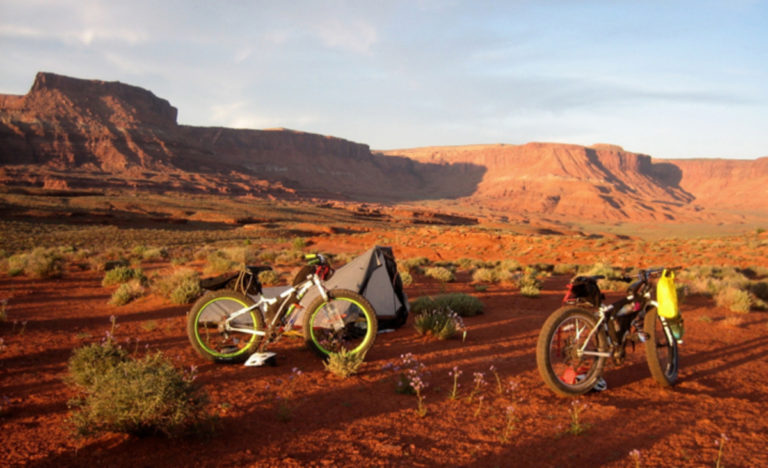
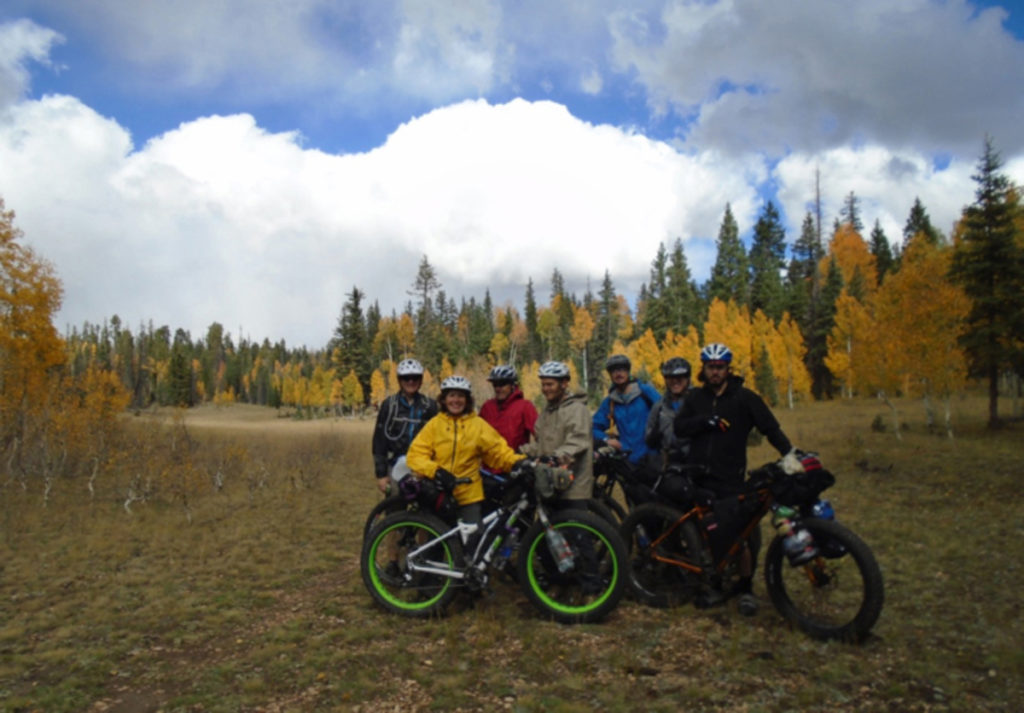
By Becka Roolf — We’ve pedaled through desert basins, traversed mountain ridges, and explored deep forests and volcanic landscapes – carrying all our camping gear. We’ve camped on high ledges, next to alpine lakes, near desert rivers, and in many spectacular places where we were the only humans for miles.
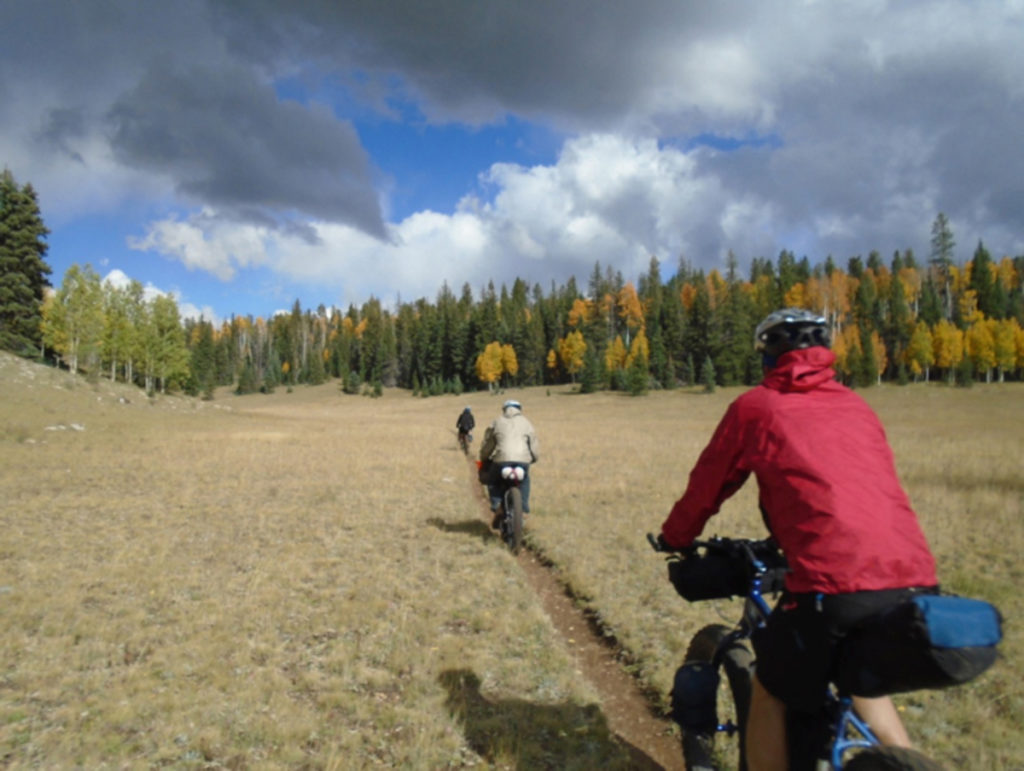
The Salt Lake City Bikepacking Meetup Group on the Arizona Trail, Kaibab Plateau at the North Rim of the Grand Canyon. Photo by Becka Roolf
While this is often the stuff of epic quit-your-job adventures, these are mostly overnight or long-weekend trips, hosted by the SLC Bicycle Touring & Bikepacking Meet-Up group.
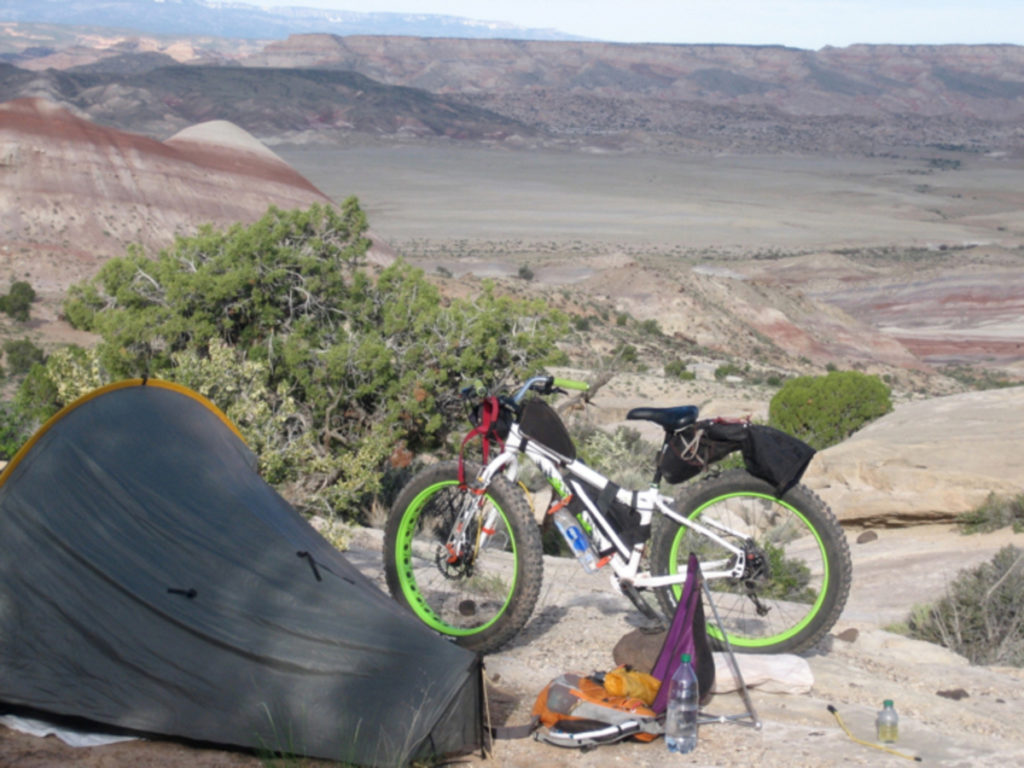
Bikepacking can take you to beautiful places such as Capitol Reef. Photo by Becka Roolf
Meet-Up is a website that turns on-line connections into real-life adventures. It’s less formal than traditional “outdoors clubs” but more formal than just connecting on Facebook. We have regular socials in the Salt Lake area, and frequent overnight and weekend bikepacking trips. Most of our trips are on mountain bikes, using ultra-light frame bags instead of panniers.
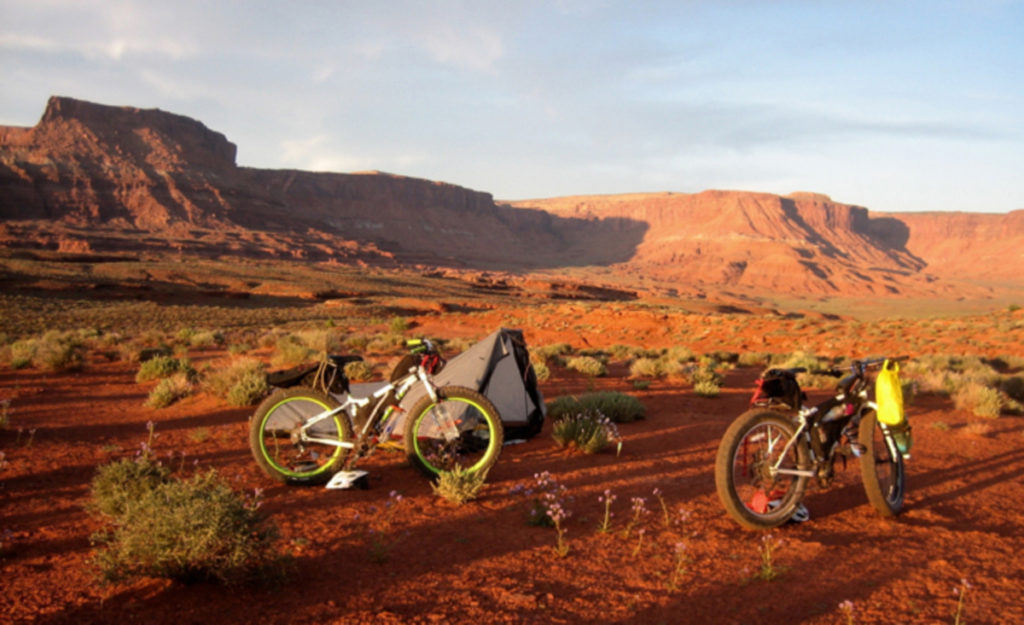
Bikepacking in Lockhart Basin, southwest of Moab, Utah. Photo by Becka Roolf
“Bikepacking” is different than road touring. More like backpacking, there are often no services. We wild camp, pack in our food, and treat drinking water from springs, ponds, or mud puddles – or carry water for the weekend when there is literally none along the route. Any type of mountain bike will do; we’ve ranged from sub-$100 used hardtails to carbon-fiber 29+ wonder machines, even on the same trip!
The Salt Lake City Bikepacking Meetup Group meets monthly to plan trips and socialize. Photo by Becka Roolf
These are not guided trips: the trip host provides a route but participants carry their own gear, navigate using map or GPS, and generally take self-responsibility for the adventure.
Join us in exploring Utah’s diverse landscapes – and bring your sense of adventure!
Want to Try Bikepacking?
An introductory class is offered each spring and fall semester through Lifelong Learning Program of the University of Utah, taught by the lead organizer of the Meet-Up.
Four evening classes will draw on lessons learned from our 8 years of trips, and walk you through everything you need to know for your first bikepack adventures, including overview of essential gear and organization, bike selection, route finding and map making, carrying water (for desert trips), and preparedness. A beginner-suitable overnight trip is offered on a weekend soon after the class.
Becka Roolf is the lead organizer of the SLC Bicycle Touring & Bikepacking Meet-up. Her day job is the Bicycle/Pedestrian Coordinator for the Salt Lake City Transportation Division.
By Joss DeWaele — As a mechanic, when a customer comes in with a set of carbon bike wheels with seized spoke nipples, this presents a problem.
Due to an excessive build up of what is likely aluminum oxide, your customer’s aluminum alloy spoke nipples will no longer turn on the spoke threads, making it impossible to adjust the tension on the spokes. But there are feelings to consider, and you’re about to hurt some of them.
Carbon wheels need care and cleaning to stay in good shape. Photo by Clearskiesahead.com/Courtesy Reynolds Cycling.
If the spokes are in relatively even tension, and if the tension on the spokes is still reasonably high, your customer can likely ride the wheel for a bit longer. How much longer is tough to tell. Nipples with heavy corrosion have a tendency to fail, especially when under tension.
If the rim has a noticeable wobble of hop, or if the spoke tension varies widely, your customer’s only choice is to rebuild the wheel—preferably with new spokes.
“But I just bought those wheels last year,” your customer says. “I paid a lot of money for those wheels.”
She (or he) is right. They did. “Surely this is a defective product,” they say. “Isn’t this covered under warranty?”
Perhaps. It’s always worth checking with the manufacturer.
From a wheel builder’s perspective, every wheel should be built with brass nipples.
From a product development perspective, one must consider that the first number anyone will look at when considering a purchase of a new, pre-built wheel set is that wheel set’s overall weight. Using brass nipples can change that overall weight by 30-90 grams of rotating mass. While that 30-90 grams might not seem like a lot of weight, it is a significant amount of weight when one is tasked with building a wheel for competition at the highest level, which is also what most people are looking for when considering a purchase. What are the top athletes running?
So let’s use the automobile analogy because we’re in America and everyone can relate. In comparison with cars, any bicycle with carbon wheels is an extremely high performance machine. Let’s call it a Ferrari, because that’s fun.
When you buy a Ferrari, there’s a certain understanding that more regular maintenance comes along with owning a high performance machine, leading to higher maintenance costs during ownership. No one ever says, “I paid two hundred thousand dollars for that car, how come I have to replace the tires already.”
Strangely, with bikes, there is often an assumption that higher costs will bring less maintenance. In reality, racing bikes with racing components are designed under a competing assumption, which is that the machine will receive regular cleaning and fine tuning.
The cause of aluminum alloy nipple corrosion is beyond the scope of this article, but a video digestion by Bill Mould of a University of Denver Doctoral Thesis titled, “Galvanic Corrosion of Aluminum/Carbon Composite Systems” can be found on YouTube by searching for Bill Mould and aluminum nipple corrosion. Caution: it’s boring. Bill Mould is a wheel builder, and from his perspective, every wheel should either be built with brass nipples, or a washer between the nipple and rim.
So for everyone out there riding a set of carbon composite rimmed bicycle racing wheels, here is a short list of suggestions on how to best care for your wheels and protect your investment. The suggestions below also apply to any other bicycle wheels, regardless of cost.
Check spoke tension with every new set of tires. The strength of the wire wheel is dependent on the uniformity of tension on the spokes.
When you ride in wet conditions, apply the smallest amount of chain lube possible each spoke nipple. Caution: don’t get lube on your brake track.
Clean the brake track regularly with isopropyl alcohol. You don’t have to go nuts with this; clean the brake track every time you clean and lube the drivetrain.
A clean bike is a happy bike. Going back to the automobile analogy, you wouldn’t drive a dirty Ferrari, right?
To quote timeless wisdom, an ounce of prevention is worth a pound of cure.
Joss DeWaele managed bike shops for ten years before slinging ink for a short stint with Decline and Road magazines. He currently works for Reynolds Cycling in Sandy, Utah.
By John Higgins — As back pain is one of the most common medical problems in the USA, it’s not surprising that quite a few cyclists experience this problem during a ride. Usually back pain is felt as a broad ache from tension or fatigue, but sometimes it can be a localized and sharp pain. So what are the common causes and is there a remedy?
If you only experience back pain during or immediately after a ride, then there is likely to be a high correlation between the pain and the activity.
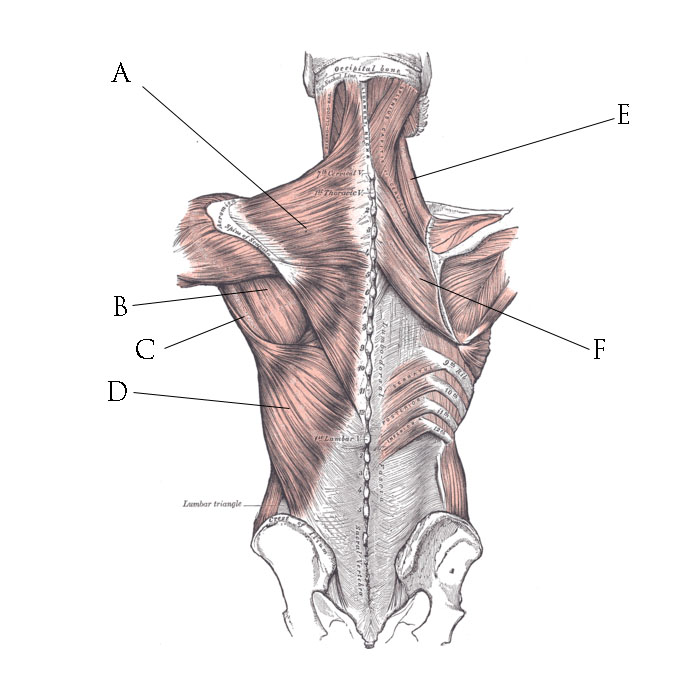
Posterior view of muscles connecting the upper extremity to the vertebral column. A – Trapezius, B – Teres Major, C – Teres Minor, D – Latissimus Dorsi, E – Levator Scapulae, F – Rhomboid Major. Source: Gray’s Anatomy of the Human Body, 20th Edition (1918), Public Domain
Possible Causes
Pre-existing back conditions: If you have suffered trauma resulting in disc compression, herniation or lumbar fractures, then you will already have a good understanding of this cause. But older cyclists can also have disc degeneration or arthritic conditions that contribute to back pain – and these issues may not yet have been diagnosed.
Leg Length discrepancy: Unless you are riding on flat pedals, you are mechanically attached to the bike under your feet. Therefore if one leg is a bit shorter than the other, your back experiences an asymmetrical tug each pedal stroke. There are two types of leg length discrepancy: Structural – in which a leg bone on one side is a different length to the other; and Functional – which could result from a muscle imbalance or foot pronation.
Effort exceeds capacity: Often a back ache is from fatigue, and fatigue can come from riding further, harder, or over rougher terrain than you are accustomed to. As well as your leg muscles running out of steam, so can your core and back muscles, which play a key role in stabilizing your pelvis and countering the forces generated by your leg muscles as they power the pedals. As these muscles fatigue they have to work even harder to provide stability, and so the problem worsens. You get the idea.
Weak Core: This is closely related to the above point. Cycling uses core muscles to support the back and stabilize the pelvis, but cycling on its own doesn’t develop and strengthen core muscles. If you have a flabby core you are going to be more prone to back ache.
Positional compensation: If your position and posture on your bike are not ideal, this will show up in various areas, including your back. Common compensations that impact your back include:
A saddle too narrow can result in sitting skew-wonkas on the saddle to get at least one sit bone firmly planted, twisting your pelvis and demanding more support from the back, or there is not enough real estate under your butt to offer structural support for the pelvis so the back has to work harder to compensate for this.
A saddle causing perineal problems (pressure, numbness) can lead to a subconscious pelvic roll back to relieve soft tissue pressure and solve one problem but create another in the form of a rounded thoracic area spine and increased strain on the lower back muscles to hold a riding position.
A saddle too high may cause pelvic rocking to help reach the bottom of the pedal stroke, adding unnecessary activity to the lower back, leading to back muscle overuse, fatigue and tension.
A handlebar too far away requires extra extension to reach the bars, and consequent back tension to counter the over-reach.
If you are sitting too upright on the bike and trying to generate power, you are trying to fire an arrow without drawing the bow. There is insufficient tension in your kinetic chain to anchor the pelvis and activate the legs. So why does not enough tension create too much back tension? All the parts aren’t working together so the lower back takes on victim status and carries the load that should be more evenly shared.
Back Relief
Pre-existing back conditions are actually a common reason people take up cycling due to the low impact nature of the sport. However careful consideration needs to be given to the bike fit position so as not to protect the back and not add further aggravation.
Functional leg length discrepancy is best corrected by a body work specialist like a PT or chiropractor. Structural leg length discrepancy needs to be confirmed with a standing AP X-ray, with a diagnosed difference greater than 1cm to warrant correction. This may be achieved through the use of an orthotic, but due to the low volume of cycling shoes it is more commonly corrected by use of external cleat shims.
Strength and conditioning training is often recommended to cyclists, but not so commonly practiced. It is the best way to protect your back from the demands of cycling and to increase your capacity to expend greater effort. Particular attention to core work is important for generating power without creating undue back strain.
Positional compensations can be hard to diagnose on your own, as they are usually sub-conscious. Start by paying attention to how your back feels while riding, and experiment with adjustments and postural changes to see if you can effect improvement. The external perspective of a professional bike fitter is often required to firstly identify and then reduce any compensations through changes to your equipment and riding position.
Cycling should be experienced without undue or persistent back pain. If you do get back pain while riding there are usually identifiable reasons for it, and corresponding remedies. Seek advice, and do your core work!
John Higgins wants to elevate your cycling experience. He operates BikeFitr – an independent bike fitting studio, and Fit Kit Systems – supplying equipment and education to bike retailers and fitters. Contact: [email protected]
New racing company to bring human-powered racing and healthy living initiatives to the West Desert.
WENDOVER, Utah (February 20, 2020) — Founded by Wendover native John Hernandez and West Desert buffs Becky Spillman Benson and Bobby Kennedy, Salty & Stupid Cycling, LLC has announced that they will host, together with USA Cycling, Wendover’s first-ever gravel races this year: the Salty Lizard 100 in May and the Stupid Pony in October. Along with the races, the company plans to host healthy living initiatives aimed at Wendover’s youths.
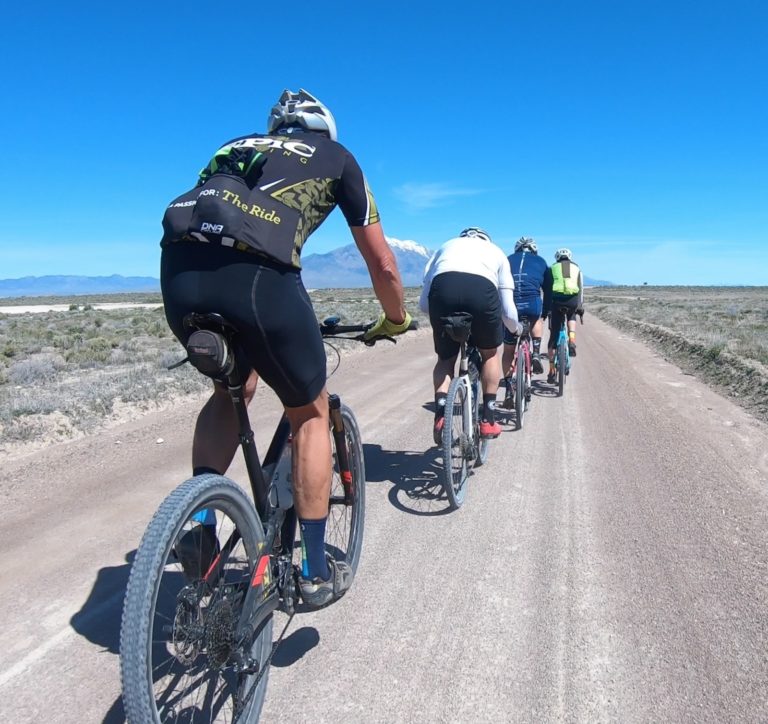
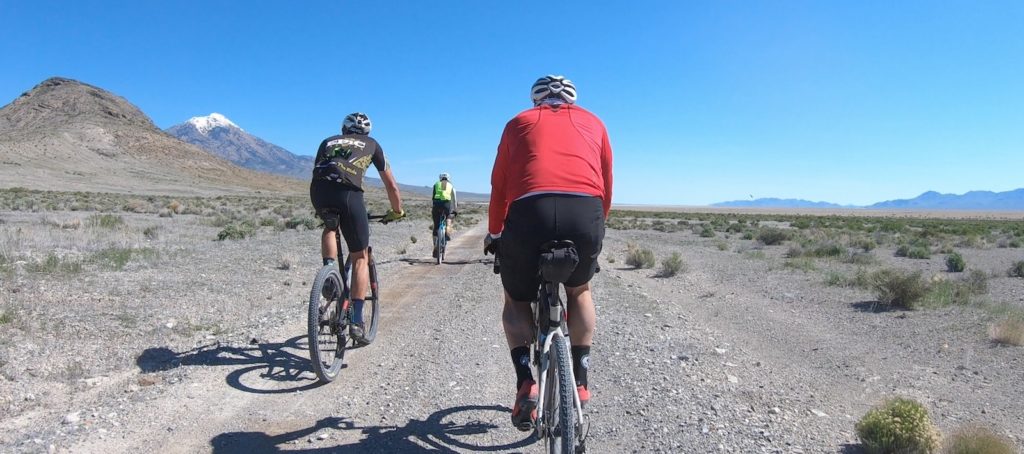
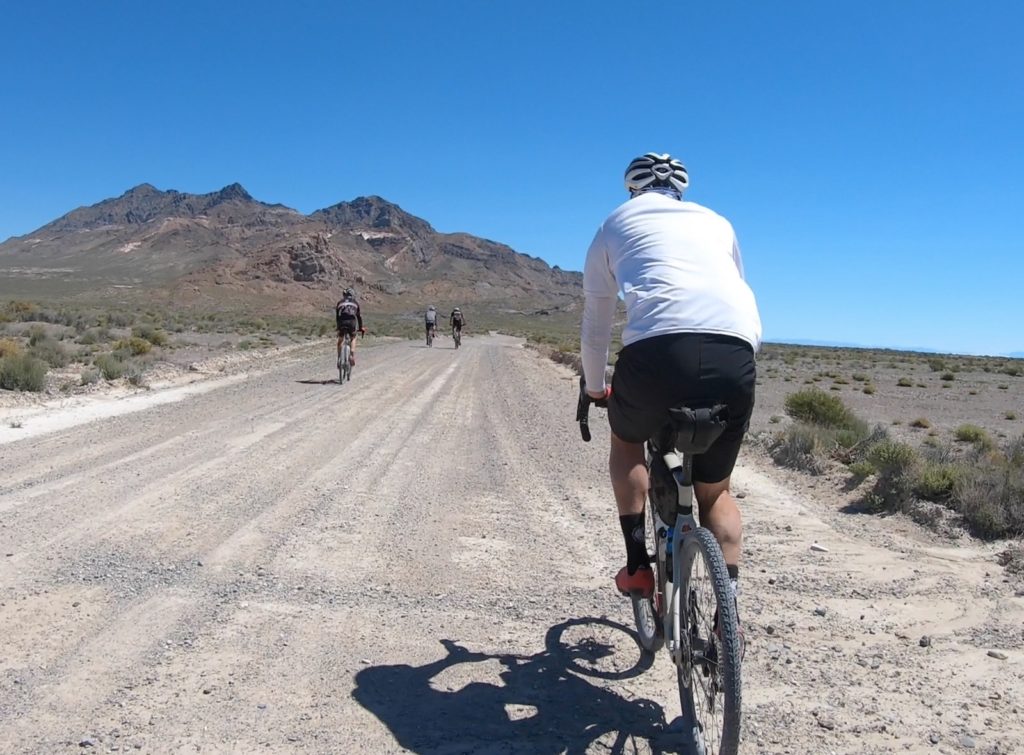
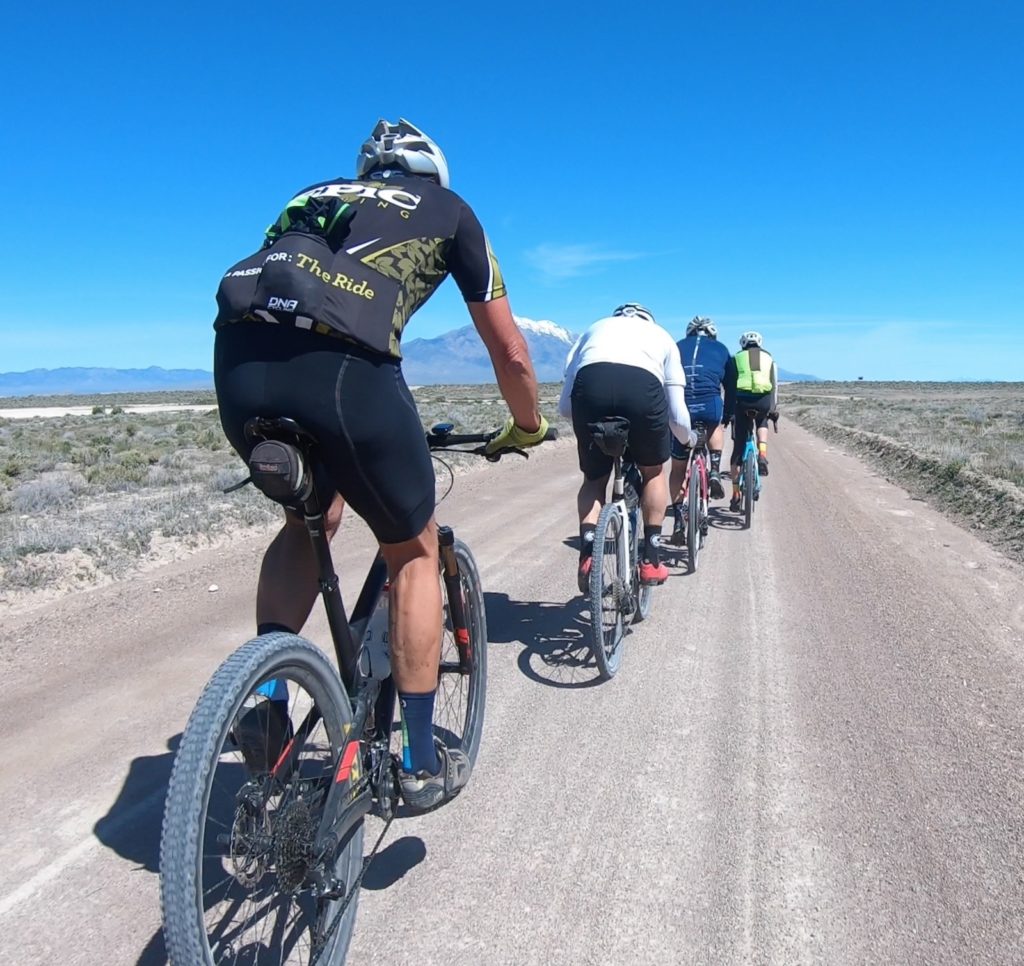
Tony Craig riding north towards Pilot. Photo courtesy Salty & Stupid Cycling
Gravel racing, where participants ride long distances on dirt roads, is the most popular new genre of cycling in the US, with the number of rides and races exploding across the country. With the Salty Lizard 100 and the Stupid Pony, Salty & Stupid Cycling hopes to both give Wendoverians a taste of human-powered competition and also give back to the community. Both rides will donate a portion of their proceeds to Wendover’s and West Wendover’s high schools and elementary schools and the company is partnering with Free Bikes 4 Kidz Utah to host a “bike drive” where people can donate used kid’s bikes at Wasatch Touring in Salt Lake City to get refurbished and distributed to Wendover kids the night before the Salty Lizard 100.
Tony boy and Silver Island start. Photo courtesy Salty & Stupid Cycling
“We want to introduce people to the beauty of the West Desert but also showcase the town – Wendover has some of the nicest people on the planet,” says company co-founder, John Hernandez, who taught and coached sports at Wendover High School for nine years. According to Salty & Stupid Cycling’s social media manager, Bobby Kennedy, “Wendover’s this jewel of gravel riding with fantastic roads, zero traffic, and absurdly pretty views wrapped up in a really vicious rain shadow. There’s nowhere else within two hours of the Wasatch Front where you can ride all year round on dirt.”
Paceline riding east with Pilot Peak. Photo courtesy Salty & Stupid Cycling
The inaugural Salty Lizard 100 (May 15-16) will feature three lengths of race, with 100-mile, 60-mile, and 40-mile options and age group categories for women and men, as well as singlespeed and tandem open categories for the 100-miler. The course takes in dirt roads southwest of West Wendover and the Silver Island Mountains Scenic Back Country Byway. For the second year, the Stupid Pony (October 2-3) will start in Eagle Mountain and participants will ride on the Pony Express National Historic Trail all 200+ miles to the Wendover Airfield Museum in a single sitting.
Nearly $200,000 in Trail Planning Will Transform Communities in Arizona, California, Nevada, New Mexico, Utah, and West Virginia
BOULDER, Colo., (January 24, 2020) — The International Mountain Bicycling Association (IMBA) is pleased to award its third round of Trail Accelerator grants to eight recipients in six states, putting $91,000 into new trails in communities across the country. Trail Accelerator grants will be matched with local support to put nearly $200,000 into community trail plans. These locations join seven Trail Accelerator grant recipients in Arkansas, Nebraska, Tennessee, and Wisconsin where trail planning is underway.
“At IMBA, we know that nothing transforms a community like close-to-home trails and nothing advances trail projects more quickly than a professional plan. We’re grateful for the support IMBA has received to increase our Trail Accelerator grant funding and look forward to working closely with these eight locations for months and years to come,” said Dave Wiens, IMBA Executive Director. “Nearly every project will benefit National Interscholastic Cycling Association (NICA) teams and youth riding programs, which will lead to happier, healthier and more prosperous communities with more life-long riders.”
Image courtesy IMBA
IMBA’s Trail Accelerator grant is a competitive grant offering for communities who need extra support to realize their vision of transformational trail systems. A professionally, strategically planned sustainable trail system can serve as a model and as inspiration for an entire mountain biking region. Awardees provide matching funds and receive professional trail planning and consultation services from IMBA Trail Solutions to launch trail development efforts, which can help leverage more interest and investment for community trail projects. Projects must show strong partnerships between local leaders, government entities, land managers, property owners, community groups, and IMBA Local partners.
This third round of Trail Accelerator grants in Arizona, California, New Mexico, Nevada, Utah, and West Virginia range from site-specific bike park plans to city-wide trail systems. Several locations are seeking more beginner-friendly trails to make their trail systems more accessible and complement existing intermediate and advanced trail offerings. See more detail on individual projects below.
“We are so excited about being awarded the IMBA Trail Accelerator grant for Morgantown. We have world-class whitewater and rock climbing here, but our mountain biking trails are mostly technical. We’re excited to use this grant toward building more accessible trails. We plan to engage students, faculty, staff, and community in the project. We want to use this project as one of the catalysts to continue to grow the outdoor economy in West Virginia,” said Greg Corio, Assistant Dean, Strategic Youth Development Initiatives, West Virginia University.
The next round of Trail Accelerator grants will be awarded in fall 2020. Applications will be accepted April 1-May 31, 2020. For interested applicants, IMBA Trail Labs are a great introduction to help get started planning for trails. Nine of the 15 current Trail Accelerator grant recipients have attended an IMBA Trail Lab. The next Trail Lab is April 7-8, 2020, in Bentonville, Arkansas. IMBA will also host two webinars in March and April 2020 to cover the details of Trail Accelerator grants. Webinar attendees can learn more about grant criteria and eligibility on the IMBA grant webpage. Read about the progress of current Trail Accelerator grant recipients on the IMBA blog.
Round three Trail Accelerator grant recipients:
Page, Arizona – Chains Trail Loop: $5,000 grant
The Chains Trail Loop will roll along slickrock terrain on the border of Glen Canyon National Recreation Area, connecting to several miles of existing trails and spectacular scenic overlooks such as Horseshoe Bend, while helping protect the fragile desert landscape. The new trail, along with campgrounds and other recreation-based businesses, will support economic growth and diversification in Page and on the surrounding Navajo Nation. Glen Canyon National Recreation Area, the city of Page, Glen Canyon Conservancy, Navajo YES!, Kane County, and Coconino County have all collaborated on these plans.
Prescott, Arizona – Prescott Flow Trail Development Project: $10,000 grant
With more than 400 miles of trails and 2 million trail visitors per year in Prescott, one may see riders from eight to 80 years old enjoying the trails—like the seven local NICA teams or the Over the Hill Gang trail building volunteers. To address the rapid growth of youth racing and riding, meet the demands of new and future mountain bike riders, and add a trail type not currently available in the area, the Prescott Flow Trail Development Project will add several miles of new gravity trails to the system. Prescott National Forest, the city of Prescott, and Prescott Mountain Bike Alliance are partners on this project.
Escondido, California – Daley Ranch Trail System: $15,000 grant
Daley Ranch borders Escondido city limits with 3,200 acres of open space. The current 20 miles of trail are poorly aligned, and a trail master plan will guide trail realignment, maintenance, and new trails. This will encourage positive trail user experiences, increase access for residents of all abilities, and protect the diverse Daley Ranch habitat. Trailheads are within pedaling distance of four schools and serve five NICA teams. The trail committee includes the city of Escondido, Friends of Daley Ranch, The Escondido Creek Conservancy, Valley Center Trails Association, and San Diego Mountain Biking Association.
Taos, New Mexico – Talpa Traverse Trail System: $8,000 grant
The Talpa Traverse Trail project is an unparalleled opportunity for a diverse, multi-user trail system close to the town of Taos that would benefit the local community through increased access to trails on 3,000 acres of land, with potential for an additional 2,000 acres. The area nestles close to homes, businesses and schools where kids participate in after-school mountain bike programs, and provides a gateway to the Carson National Forest to connect the community to public lands. Partners include Enchanted Circle Trails Association, Taos Mountain Bike Association, Taos Saddle Club, and Carson National Forest.
Ely, Nevada – Garnet Hill Trail System: $10,000 grant
Downtown Ely is the city’s official trailhead, connecting local and visiting riders of all abilities to more than 30 miles of singletrack loops in community parks and state parks. This project will add mountain bike trails in the Garnet Hill Recreation Area on Bureau of Land Management (BLM) land, which is adjacent to Ely and offers a nearly 2,000-vertical-foot descent back to town via Squaw Peak. Ely’s new NICA team, White Pine Composite, will love these longer, technical miles to train. The trail planning committee includes staff from the BLM, Great Basin Trails Alliance, and White Pine County Tourism and Recreation.
Farmington, Utah – The Farm Bike Park: $8,000 grant
The vision for The Farm Bike Park combines 44 acres of city land with 15 acres of connecting Forest Service land along the Wasatch Front, to rival the country’s largest bike parks. It will bring trails close to home in Farmington and serve the 3 million residents within an hour’s drive. A trail master plan would reclaim social trails and design climbing trails to provide rides for beginner and intermediate mountain bikers through short loops, downhill trails, flow trails, and skills features. The city of Farmington, Farmington Trails Committee, and Farmington High Mountain Bike Team are partners on this project.
Berkeley Springs, West Virginia – Cacapon State Park Mountain Bike Trail Plan: $10,000 grant
This project will plan a series of beginner loops on the southern side of Cacapon Resort State Park. The park currently has 18 miles of intermediate and advanced trails, which were used in the inaugural 2019 Cacapon Enduro race, but lacks trails suitable for new riders and for a race course to host the area’s two NICA teams. New trails will dip through white oak and shagbark hickory trees, explore three ridgelines, and use Cacapon Mountain’s 1,500 feet of elevation gain. Cacapon Resort State Park Foundation is working with local mountain bikers and NICA team leaders on this plan.
Morgantown, West Virginia – West Virginia University Sustainable Trails Initiative: $25,000 grant
Within a 20-mile radius of downtown Morgantown, there are more than 23,000 acres of public land with climbing, paddling, cave access, and trail mileage that any town would envy. But Morgantown has just one bike-optimized natural surface trail. This grant will include a partnership with West Virginia University faculty and students to create a master plan and site-specific plans that link this recreation together, prioritizing access to schools and introducing beginner-friendly, bike-optimized trails. The University and the city of Morgantown are partnering to further a recreation-based economy and improve local health.

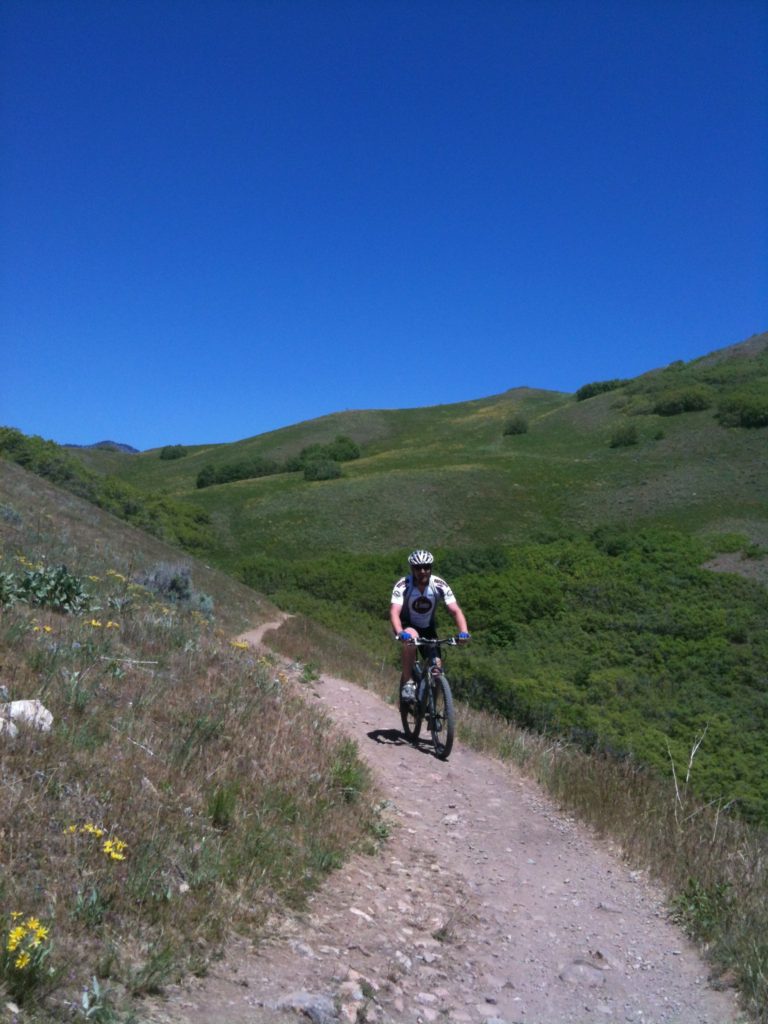
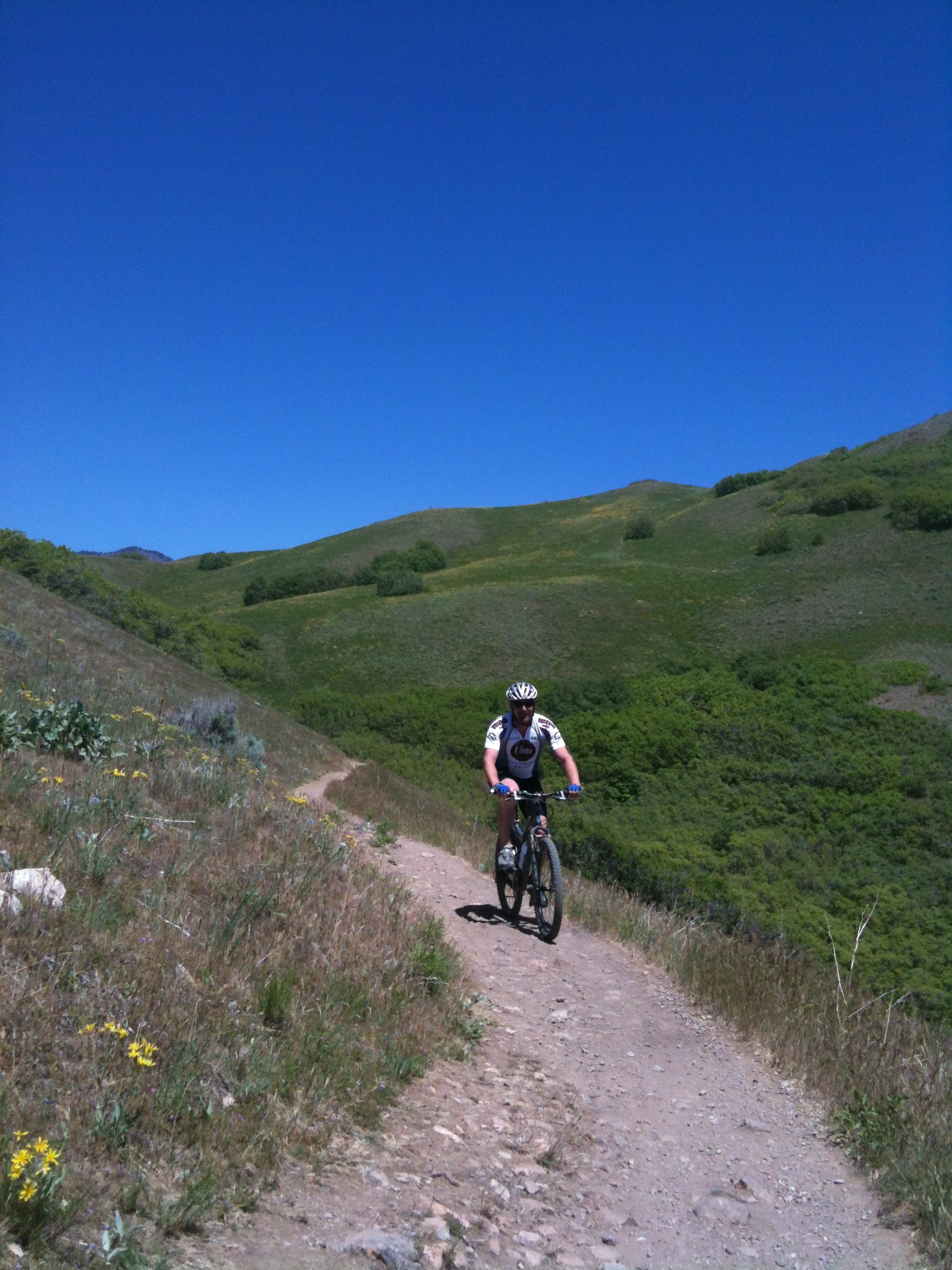 The primary objectives of the now-approved plan are to: (1) Provide detailed layout, design and management recommendations for a comprehensive non-motorized foothill recreational trail system that is safe, enjoyable, accessible, connected, and sustainable; and (2) Provide information to guide strategic implementation of the trail system over a 10-year time horizon. This plan covers the area between Salt Lake City’s northern boundary and Emigration Canyon. A future update to the plan will address the area between Emigration and Parleys Canyons.