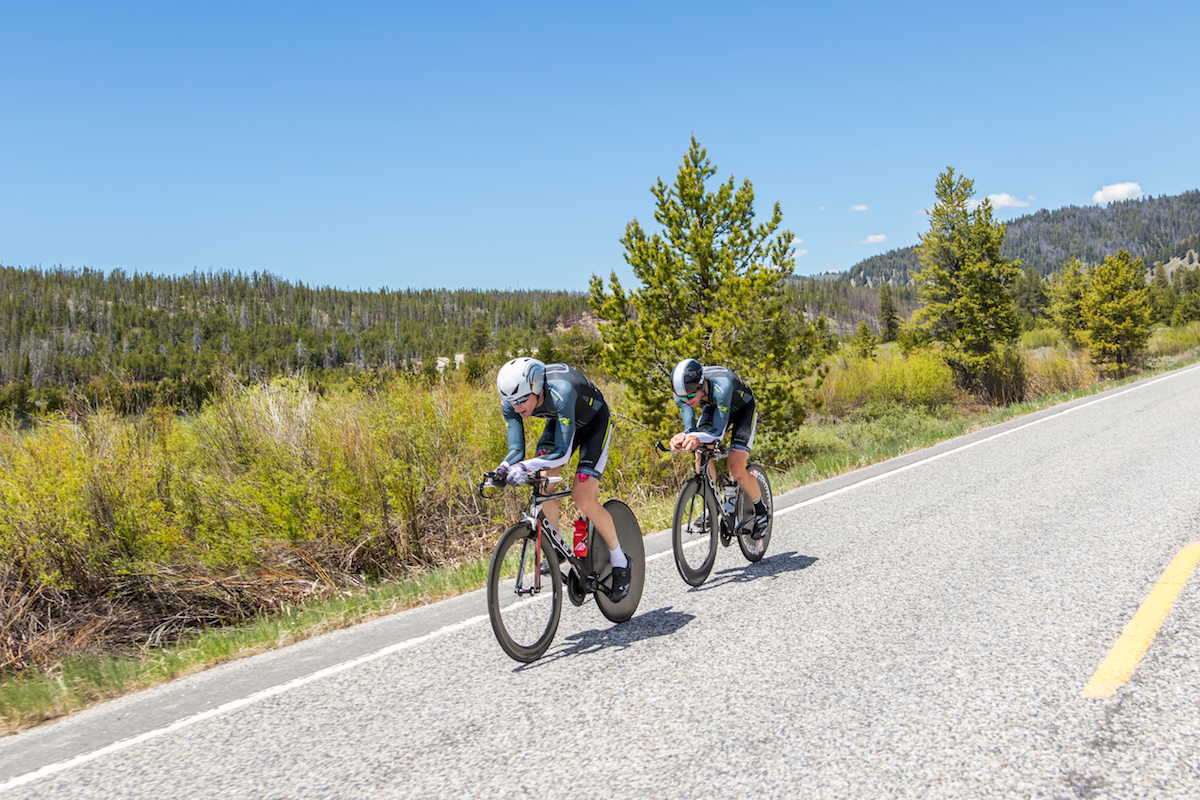
The Drift is a 13, 28, or 100-mile on-snow adventure race for cyclists, runners, or skiers in the Wind River area of Wyoming. In its third year, the race will be held on March 13-15, 2020 near Pinedale, Wyoming on groomed trails. We asked organizer Keri Hull about the event.
Cycling West: Describe the event. Are there race and ride options?
The Drift: The Drift is a run, fat bike or ski race. We offer 13, 28, and new this year 100-mile distances. We don’t offer a ride option, however, the cut off for the 100-mile course is 48 hours. Racers could approach it as more of a ride or stage race.
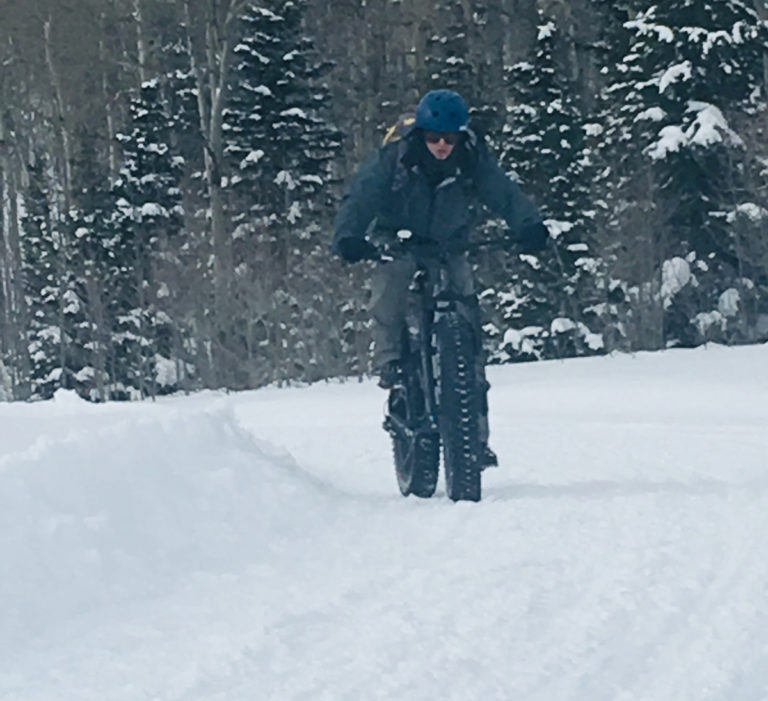
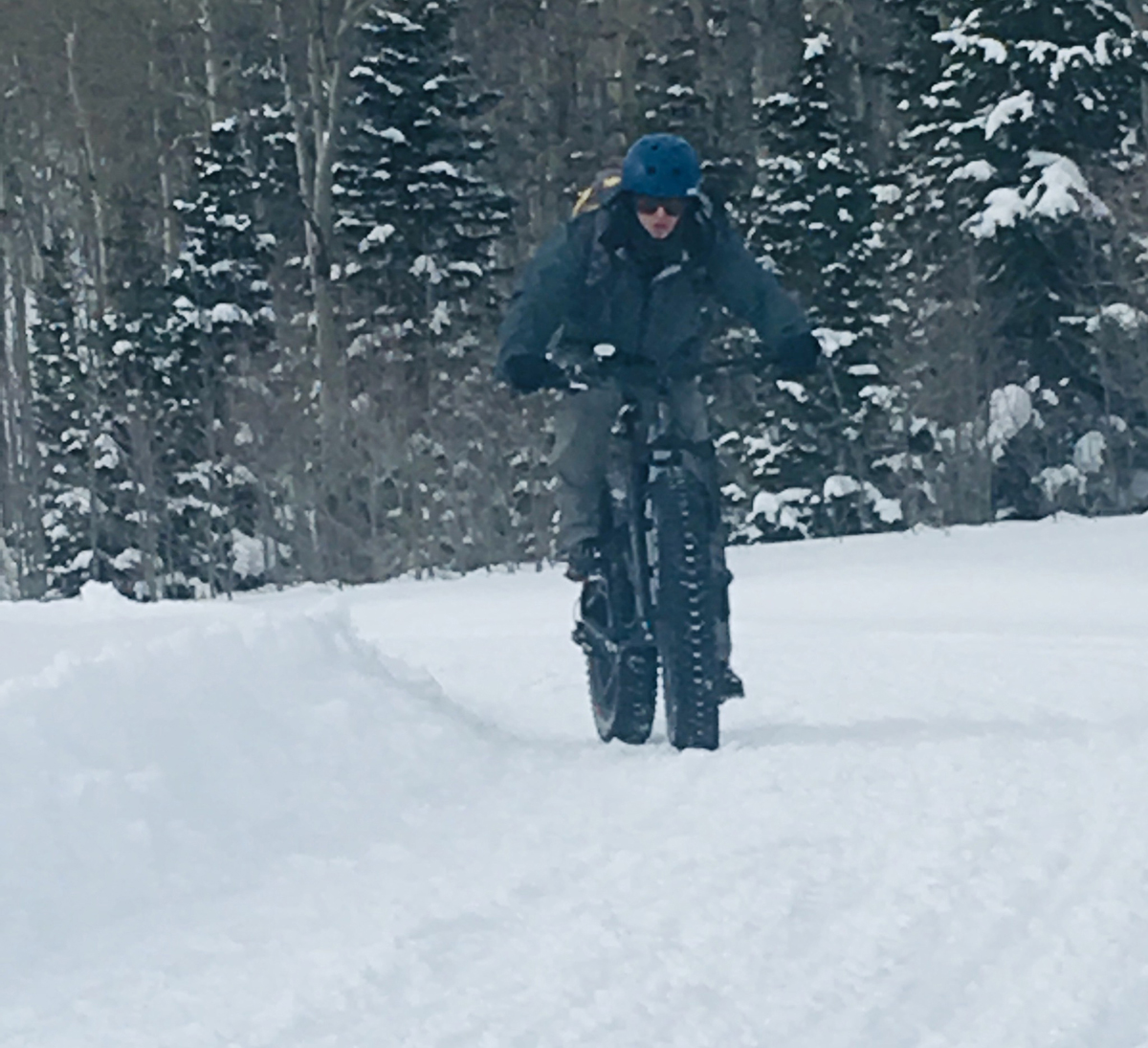
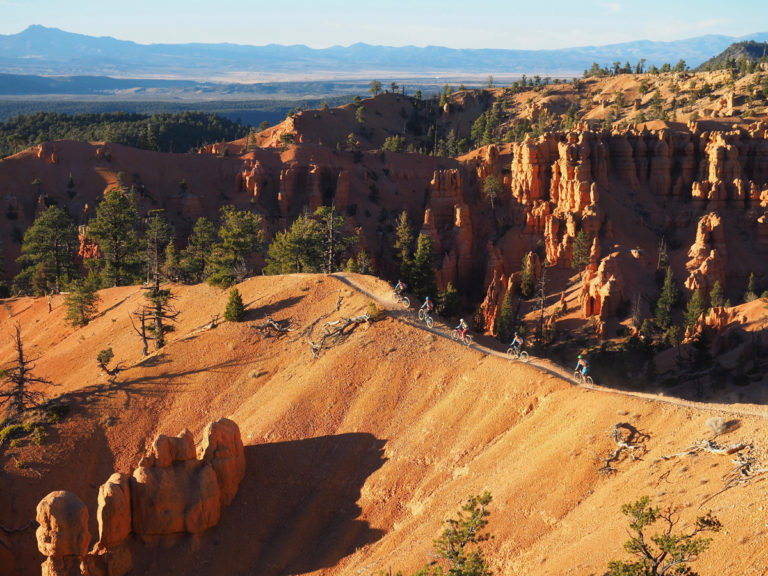
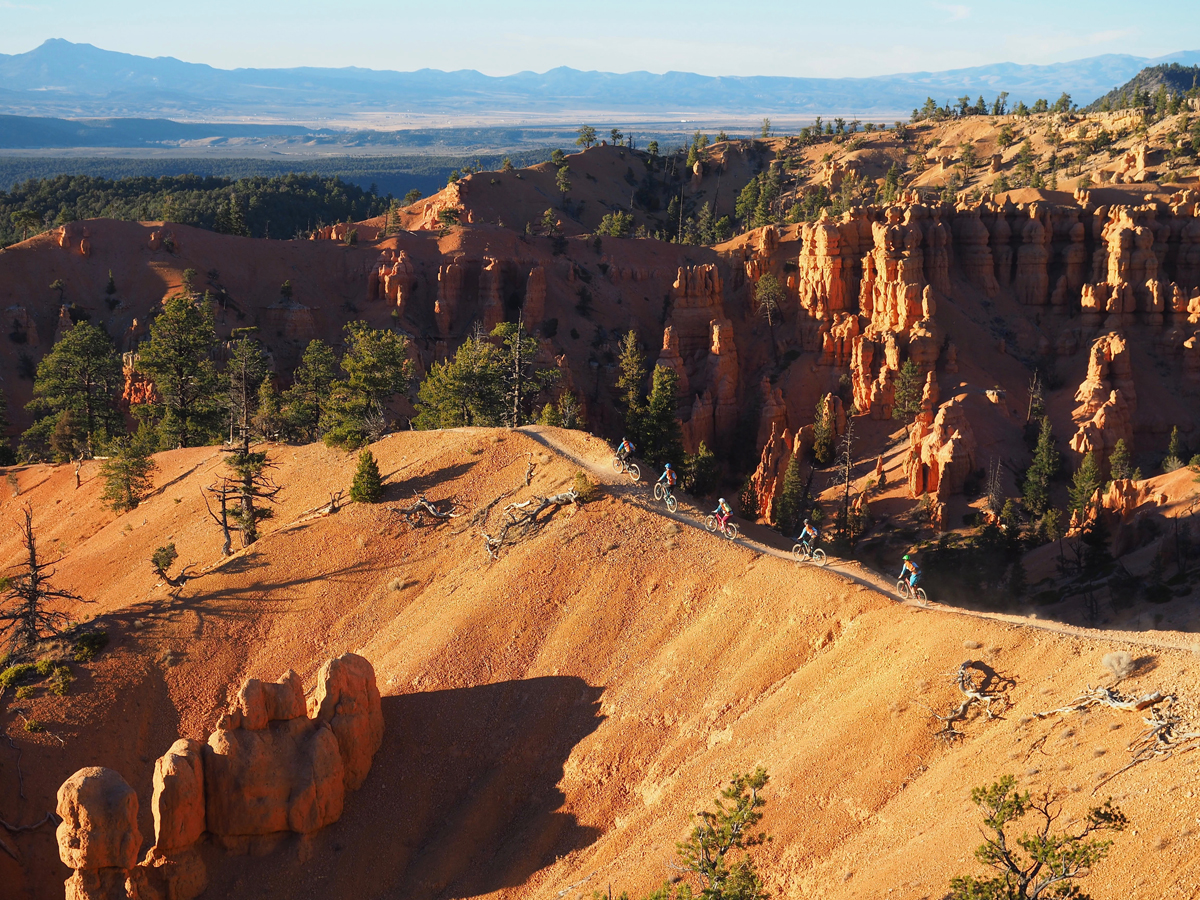
A biker climbing on the 28 mile course. Photo by Darren Hull
CW: Tell us about the course. What can riders expect? What are the distance options? Will the race cross the Continental Divide?
TD: All three races start in the Upper Green River valley. The 13-mile course is a relatively flat and fast out-and-back that is great for beginners. The 28-mile course offers a fast start followed by a climb, rolling hills and a fast descent to the finish, with just over 2000 feet total elevation gain.
This will be the first year we have offered the 100-mile distance. It offers a little of everything. 7400 feet of total elevation gain over 101 miles of primarily groomed double track, except for a short 3-mile section of single (snowmachine) track, with the altitude topping out just shy of 10,000 feet.
Nearly half of the 100-mile course is along the Continental Divide (bike) trail. Racers will cross over the Continental Divide five times during the race, as well as following it for about 5 miles.
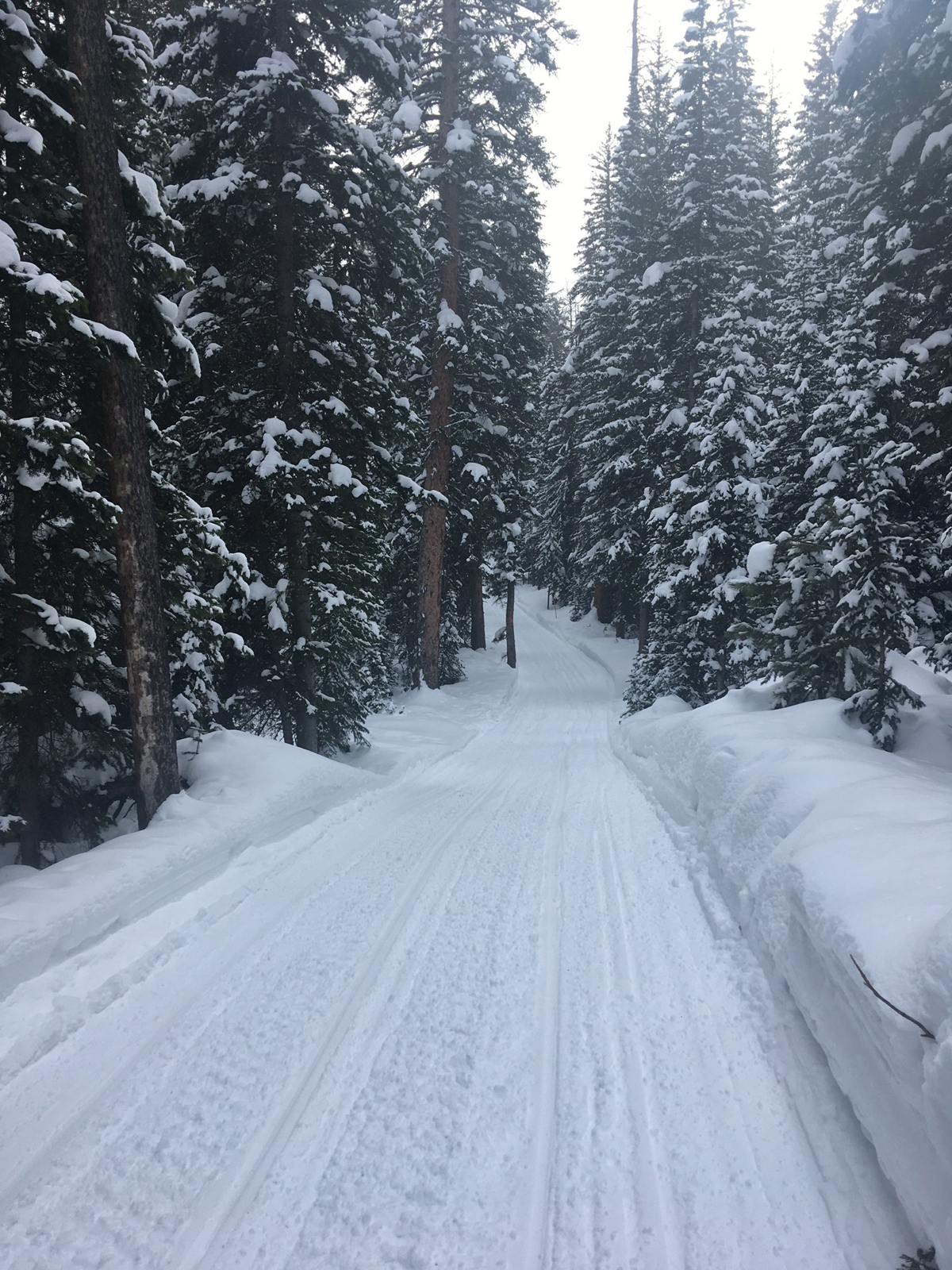
A section of trail on the 28 mile course in The Drift. Photo by Darren Hull
CW: What safety precautions and checks will you have? Will riders need to bring shelter or stoves to melt snow?
TD: All races have snowmachine sweep and support and can evacuate racers if needed. The 13-mile course has an aid station at the turnaround. The 28-miler has 2 aid stations.
We will have four manned and heated aid stations stocked with hot food and snacks along the 100-mile course. There will also be unmanned tents in a couple of more exposed spots along the 100-mile course such as on Union Pass.
There is a mandatory gear list for all 100-mile racers that includes sleeping bag, shelter, and stove, similar to Susitna or Arrowhead. Racers should be self-sufficient. 100-mile racers will also carry trackers.
CW: The race is in the Wind River Range. Tell us a little about the natural history of the area.
TD: The Wind River Range stretches 100 miles north-to-south in western Wyoming. It houses 19 of the tallest 20 Wyoming mountains including Gannett Peak – the state’s high point and the headwaters of the Green River. The race course traverses west to east at the very north end of the Wind River Range tucked between Gros Ventre and Bridger Wilderness.
Our race’s namesake, the historic Green River Drift, is one of the nations longest and oldest cattle drives takes place in the upper Green. For the past 100 years ranchers have herded cattle out of the mountains back to their ranches for the winter. Cows want nothing to do with this winter wonderland.
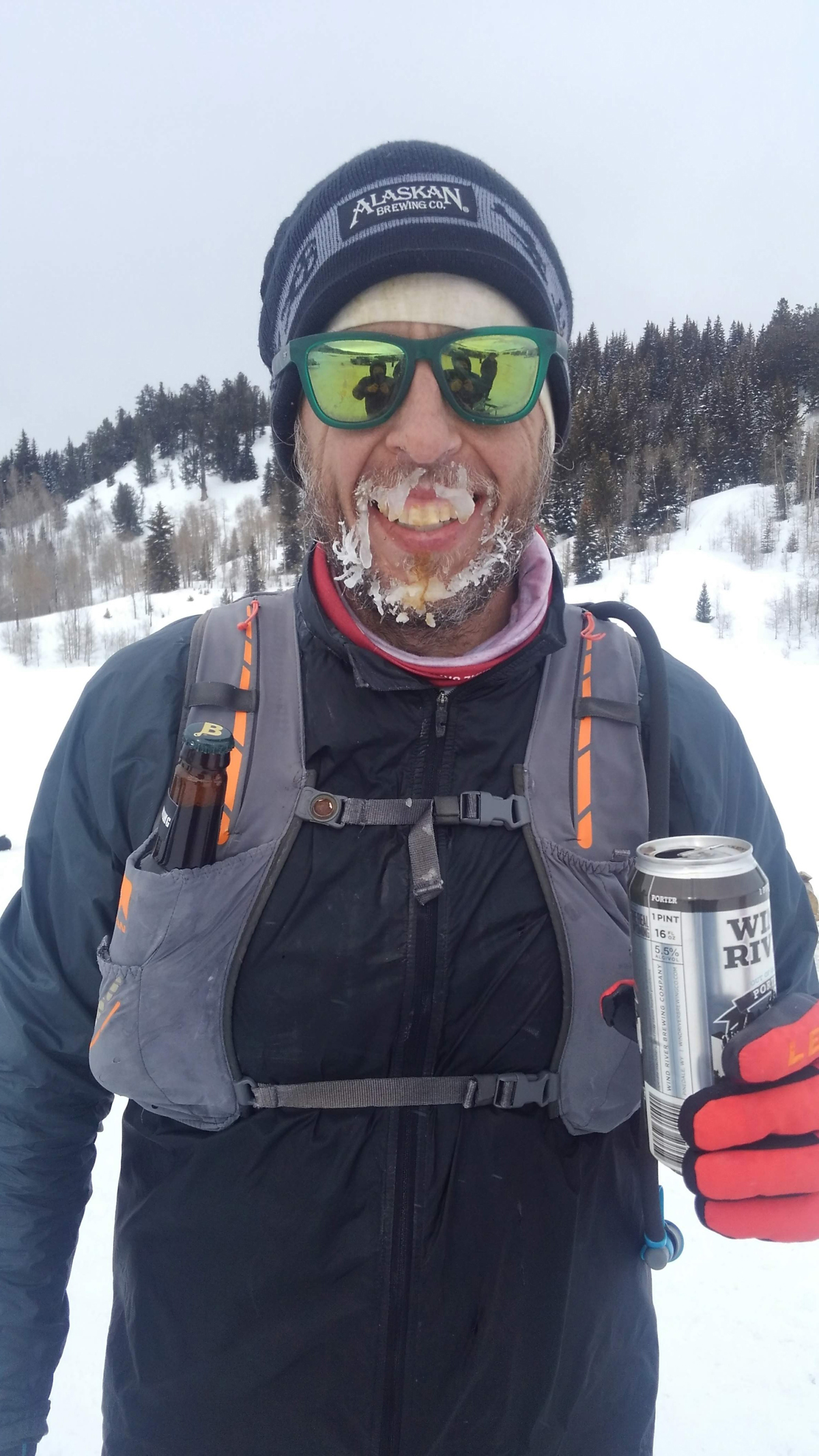
Kevin Mack enjoys a Wind River beer after running the 28 mile course in The Drift. Photo by Keri Hull
CW: Where can people stay? Are there motels nearby? And, for the cold-acclimated, is there camping?
TD: Kendall Valley Lodge is hosting the Drift 100 finish. It is a quarter-mile from the start. Space is limited, rooms should be booked now.
There are many lodging options in Pinedale, 25 miles from the race start.
Hampton Inn and Suites, Chamber House Bed & Breakfast, and The Log Cabin Inn have all offered discounts to racers.
The area offers phenomenal dispersed camping in the summer, but the snow would make it a little challenging to car camp. All designated campgrounds in the area are closed for the winter.
CW: Is there anything else that you would like to add?
TD: We are also in need of volunteers. Contact us if you are interested.
Event Details:
March 13-15 — The Drift Fat Bike, Pinedale, WY, 13 or 28 miles, and 100 mile run, bike, or ski, Upper Green River Valley, held on a groomed trail in the Wind River Range in the area of the Continental Divide Trail, Keri Hull, 907-306-9806, [email protected], thedrift100.com
How can we minimize delays and conflicts among bicycles, buses and other right-turning vehicles at corners? Portland State University in Oregon took a look at interactions between the three classes on a corridor in its home town. The site in question included a bus stop, bike lane and bike box, and a lane reserved for buses and right-turning motor vehicles.
It seems that if cyclists rested in or behind the box (such as when the box is filled with other cyclists), they didn’t interfere with buses. Nor did they if they crossed the intersection ahead of a bus. Most boxes are painted green and since cyclists in them wait in front of the turn lane, they don’t interfere with those turning. The report says “it is a welcome finding that they do not burden bus flow.”
By Aaron Crowder, HIGHLINERSmtb — HIGHLINERSmtb is a subgroup of the western region cycling community. Our mission is simple. Enduro, Community, and Good Times. Call us a team. Call us a club. Call us a bunch of dirtbags who seemingly only care about rolling around on dirt with likeminded people. We have a competitive elite racing side to our team that intends to compete and push the local limits of the Enduro discipline. Equally important is our community driven, beer, and burrito fueled club level which only exists to have fun, ride with friends and help drive the cycling community. The demographics include male, female, pro, expert, intermediate, young, old, and all wheel sizes. Our passion is driven by the people we meet and ride with every day. We facilitate group rides, skills clinics, Enduro racing, BBQ’s, and shenanigans. Needless to say, if you like to ride MTB, you are welcome to ride with us anytime.
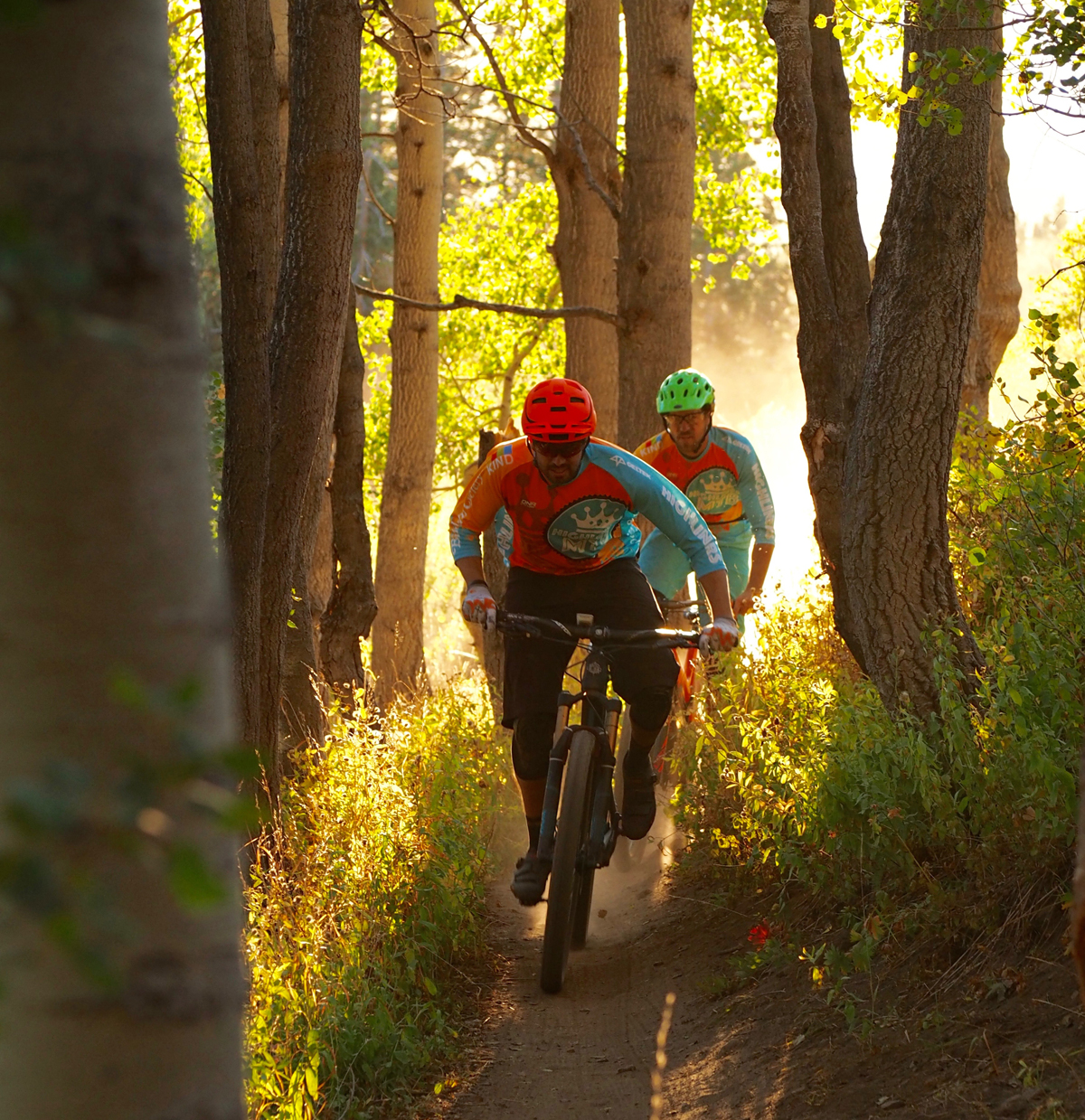
The HIGHLINERSmtb team enjoying a beautiful group ride through Thunder Mountains beautiful landscape. A pit-stop heading home after a team camp trip near Zion National Park. Photo by Eric Kramer
The most important aspect of HIGHLINERSmtb is our sense of community and engagement in local events and needs. On the rise in Utah, where we are based, is the Salt Lake Valley Trails Society. Their mission is to educate about, promote, develop and maintain bike trails in the Greater Salt Lake Valley. HIGHLINERSmtb and one of our supporting sponsors, Bingham Cyclery has partnered with and helped build the Salt Lake Valley Trails Society to boost community involvement, sustain, and enhance bike trails. The importance of trail maintenance, trail etiquette, and trail development at all levels becomes increasingly more evident as the cycling community grows. With that surfaces opportunity to engage and connect new members of this community to the needs of the longer term developments and housekeeping of all those trails we enjoy every day. Without community involvement, interest, and action, growth and sustainment will not happen. We at HIGHLINERSmtb care deeply about these efforts.
Aaron Crowder and Steve Sadler on one of many fall team Wasatch Crest Trail rides. Photo by Eric Kramer
We also care about ripping fun and fast trail against the clock. The Western Region offers several Enduro race series which our team partakes in. California Enduro Series, Big Mountain Enduro Series, Montana Enduro Series, Enduro Cup Series and many smaller grassroots races are all on the menu for 2017. One of our favorite races each year just happens to be the longest running Enduro in the USA. Fears, Tears, and Beers Enduro is hosted in the unique town of Ely, NV and offers plenty of good times and competition for all ages and abilities. Of those who race for HIGHLINERSmtb, several are at the professional level with specific goals to succeed on the national and global stage. We have up-and-comers Bryn Bingham and Lauren Bingham who are already well accomplished at the national level. Most of our race team is built with expert level riders who still care to compete at a higher level but don’t care to commit to the demands of the pro class. All of our experienced racers lead group rides, skills clinics and weekend get-a-ways for any and all team/club HIGHLINERSmtb members and friends. We want everyone on the team to be able to benefit from and feed off of one another in efforts to progress on the bike and have a network of great friends to ride with.
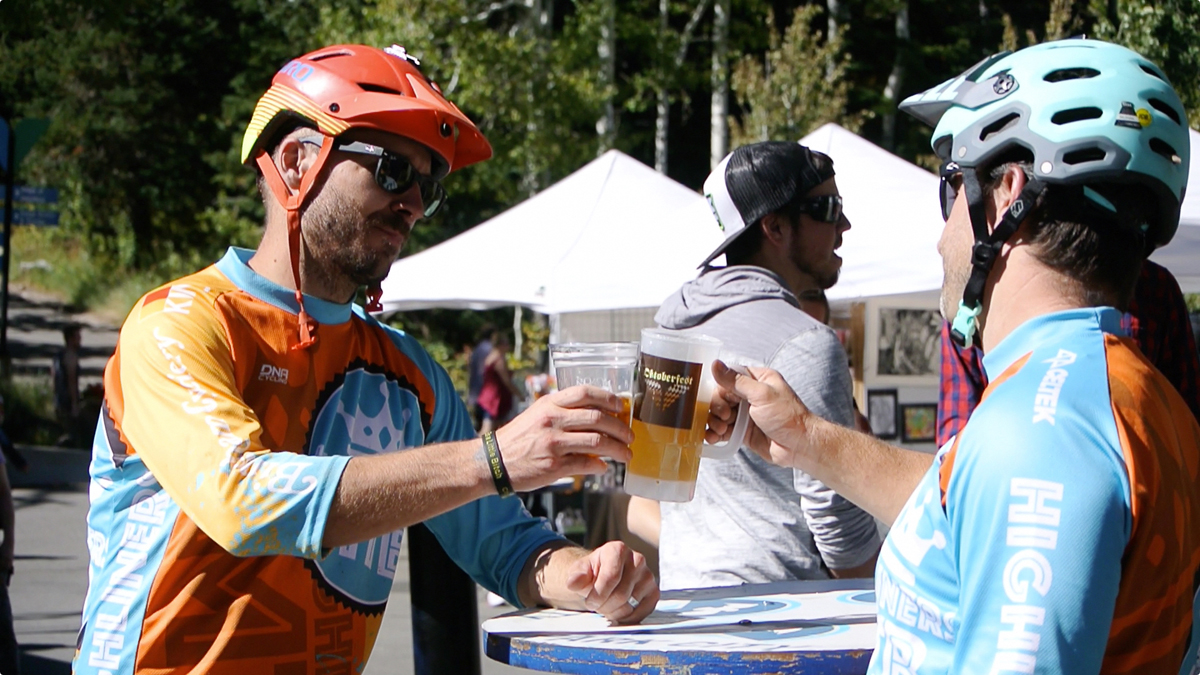
Ali Goulet and Mike Saltsman enjoying a cold brew after some trail riding at Snowbird. Photo by Eric Kramer
HIGHLINERSmtb formed mid-2016 and attended our first race as a team in Ely, NV at the Fears, Tears, and Beers Enduro, our favorite race of the year. The 2016 race was on rain delay for 24hrs which gave us plenty of time to fill a cooler full of beer and head back to the Jailhouse Casino Hotel to craft our website and recruitment strategy. We sat here for hours watching the rain come down and chatting about the Western Region Cycling community. Its competitive and offers plenty of racing, which was our initial passion. It’s also filled with great community, good breweries and the best trail around. All of this was familiar, important and exercised by us in the past. From that day forward we knew we wanted to be about Enduro, Community and Good Times so we made that our mission. We are fortunate to have great support from Bingham Cyclery, KIND Snacks, Celtek Bike Gloves, DNA Cycling, DAKINE, and SMITH Optics.
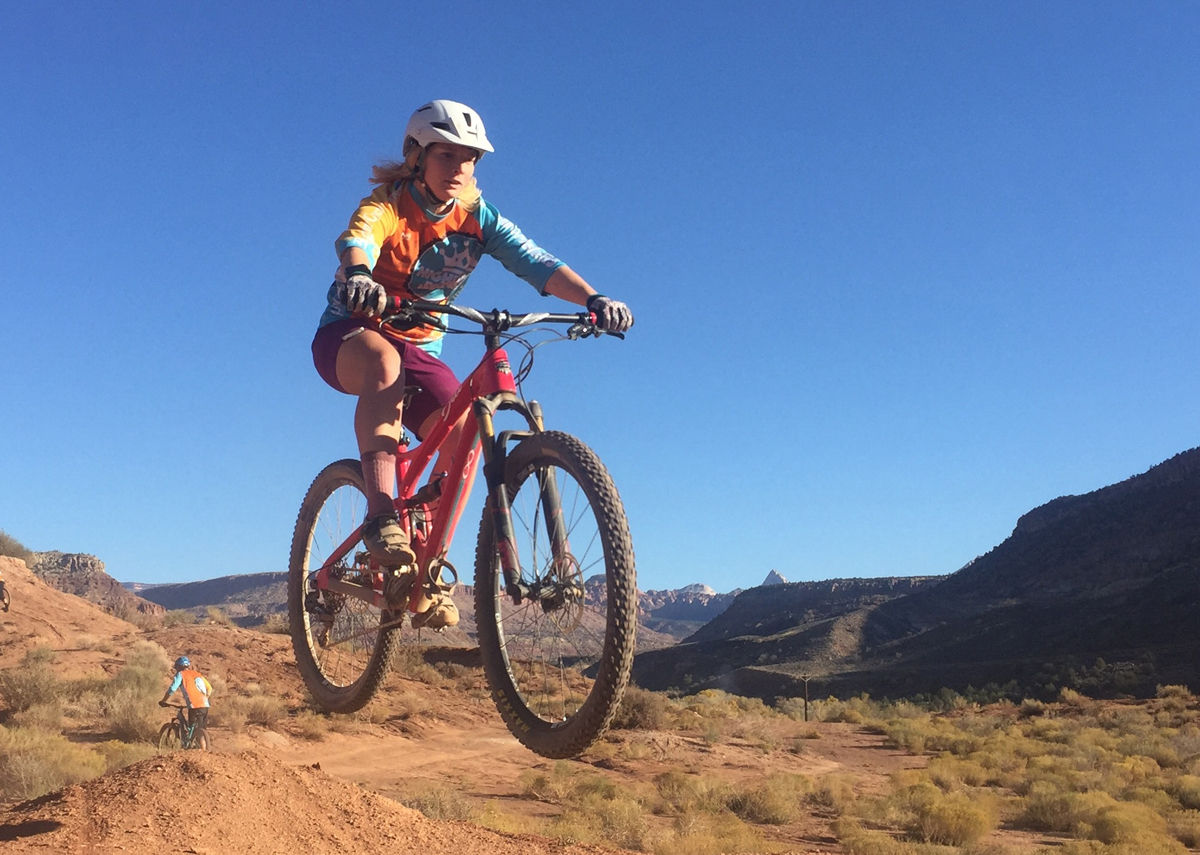
One of HIGHLINERSmtb female riders, Piper Sadler, taking flight off a jump the morning of a team camp trip in Springdale, Utah. Photo: Aaron Crowder
Beyond all of the community relations, group rides and racing, we spend a great deal of time on social media. Sure we have the standard Facebook and Instagram accounts. We also have a website www.HIGHLINERSmtb.com that consistently pushes media out to the information superhighway. We have bike/product reviews, blogs on adventure/lifestyle/travels, and a feed of photos homegrown from some of our talented photographers on the team. We focus a lot on the lifestyle of our team and the supporters who back us. Above all of that, we push the fact we have an open door policy and want nothing more than to invite likeminded people to join us and engage in the cycling community to help us sustain and improve the land access, trail networks and voice of the western region mountain biker.
For more information on how you can join HIGHLINERSmtb or get involved in the local community, please go to our website at www.HIGHLINERSmtb.com and click “Join Us”. We would love to hear from you.
ATHENS, Georgia (January 23rd, 2020) — 2020 marks the 14th year of the USA CRITS Series, the premiere cycling series in the United States. Criteriums are the most spectator-friendly and enduring form of bicycle racing in America. USA CRITS brings forward a team concept and the ability for fans to engage with the sport through live streaming of each event.
The 2020 Series season will once again feature Birmingham, Alabama at the Birmingham Hammerfest fueled by BOLT24. The Hammerfest provides a pre-season showcase for USA CRITS D1 Teams as well as amateur racers. On Friday prior to the racing, D1 Teams will assemble to produce the season’s media content. Saturday features a D1 Team race format that is the pilot model for future USA CRITS events. On Sunday, fans can join D1 Teams and former Olympian Frankie Andreu, on a supported training ride.
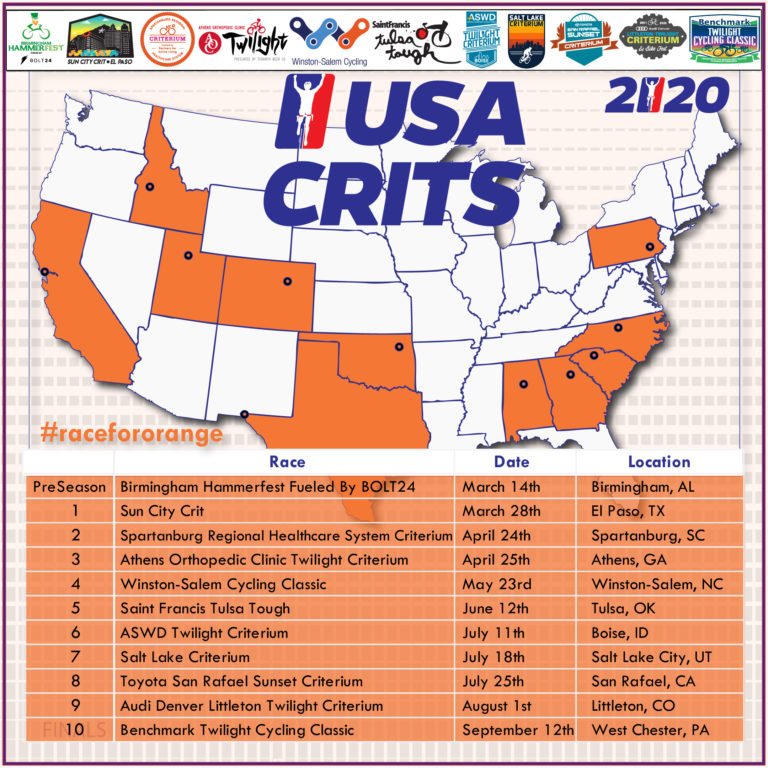
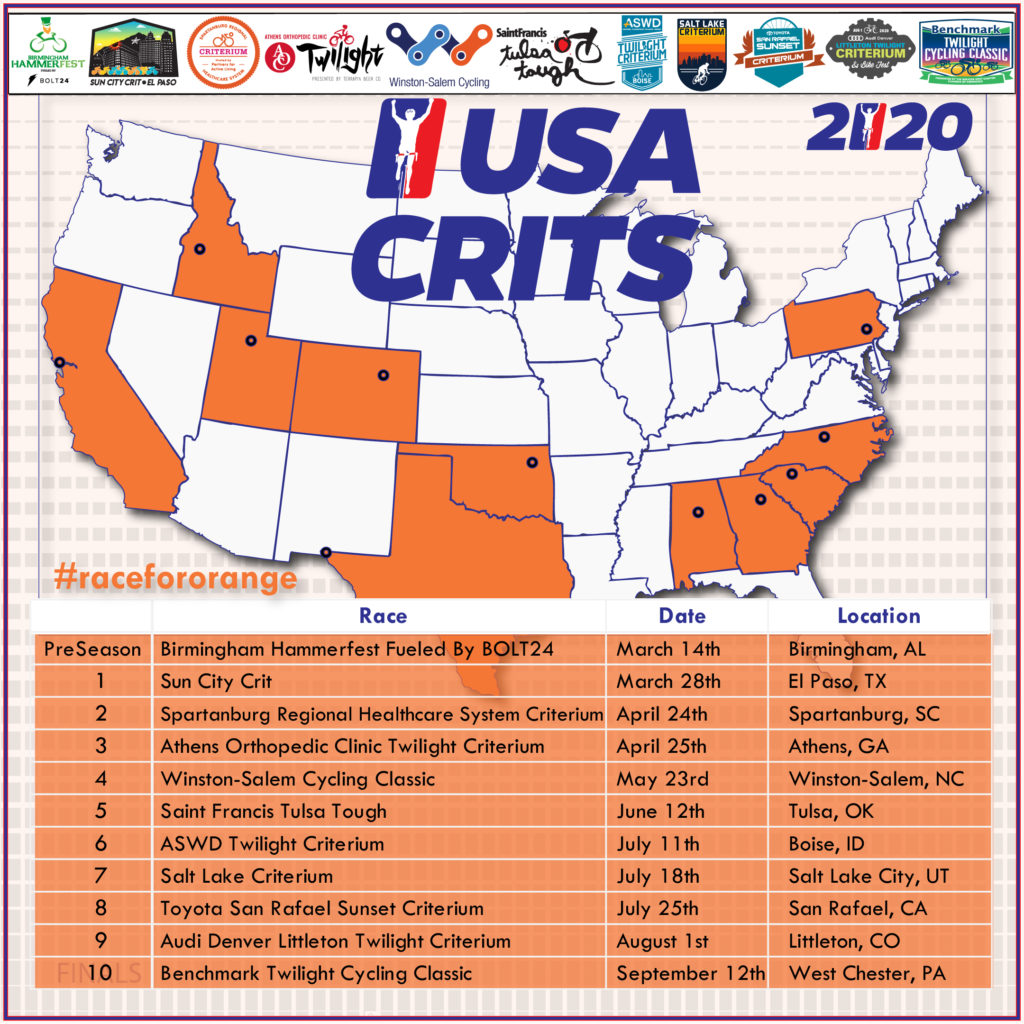
Ten events across the United States will make up the 2020 USA CRITS points calendar, landing in many of the country’s major cycling markets. The Colavita #racefororange will kick off racing for the 2nd year in El Paso, Texas at the Sun City Crit. The Series then ventures back east to Spartanburg, South Carolina and the Spartanburg Regional Healthcare System Criterium followed by the Athens Orthopedic Clinic Twilight Criterium in Athens, Georgia. Both events are USA CRITS back-to-back points races and will also serve as the kick-off the annual Speed Week in the Southeast.
The middle of the season features two of America’s most dynamic cycling events. The Winston-Salem Cycling Classic in Winston-Salem, North Carolina which includes a music festival over Memorial Weekend. Winston-Salem also hosts America’s only single-day UCI road race for men and women held on Memorial Day. The Saturday criterium has been labeled the hardest of the Series as international UCI teams coming for the road race get a taste of American criterium racing. Saint Francis Tulsa Tough in Tulsa, Oklahoma is a racer favorite and closes out the middle of the season with three days of racing and the Friday USA CRITS showcase held in the Blue Dome district.
The western swing of four back to back races has proven a brutal test for teams as these events decide who is in control headed into the finals. ASWD Boise Twilight kicks off the set and will also serve as the final event for challenged athletes before the Tokyo Olympics. Boise will also feature America’s only UCI time trial event, the Chrono Kristin Armstrong, on Friday. The Salt Lake Criterium returns for the 2nd year racing through the middle of The Gateway, a unique open-air commercial development. Next up is the Toyota San Rafael Sunset Criterium, celebrating 20 years and its prominence as California’s largest criterium. The western events wrap up with the Audi Denver Littleton Twilight Criterium. The Denver area boasts one of the strongest regional cycling communities in the country and draws one of the largest crowds of the Series.
The Benchmark Twilight Cycling Classic in West Chester, Pennsylvania will play host to the final event of the Series. The conclusion of the Series will determine the final standings for leaders’ jerseys and teamcompetitions in this vibrant downtown setting. “The Benchmark” which attracts thousands of fans, serves as a benchmark for American criterium racing and its new date as the Finals.
USA CRITS will again be partnering with USA Cycling to promote the Series. As part of this partnership, the top four USA CRITS Series D1 Teams on the Colavita Leaderboard after Tulsa will be given automatic invites to USAC’s June National Championships in Knoxville.
2020 USA CRITS Calendar
Race
Date
Location
Preseason
Birmingham HammerFest Fueled By BOLT24
March 14th
Birmingham, AL
1
Sun City Crit
March 28th
El Paso, TX
2
Spartanburg Regional Healthcare System Criterium
April 24th
Spartanburg, SC
3
Athens Orthopedic Clinic Twilight Criterium
April 25th
Athens, GA
4
Winston-Salem Cycling Classic
May 23rd
Winston-Salem, NC
5
Saint Francis Tulsa Tough
June 12th
Tulsa, OK
6
ASWD Twilight Criterium
July 11th
Boise, ID
7
Salt Lake Criterium
July 18th
Salt Lake City, UT
8
Toyota San Rafael Sunset Criterium
July 25th
San Rafael, CA
9
Audi Denver Littleton Twilight Criterium
August 1st
Littleton, CO
10
Benchmark Twilight Cycling Classic
September 12th
West Chester, PA
Twenty-one teams, including both of last year’s champions, have committed to joining the D1 ranks and racing across the national calendar. “A major goal of the Series has been sustainability. Seeing a dynamic increasein D1 Team participation and 100% of our 2019 calendar returning points to great progress being made for the sport,” said Scott Morris, USA CRITS Director of Development.
Combined, the Series will have over $240,000 available to teams as they compete for the D1 Team overall competition and three leaders’ jerseys. Each event scores the top four riders from each team based on laps led, in race sprints, and final event finish placement. New for 2020 will be a final prime at each event known asthe Give Back Prime. This prime will allow fans to better engage the sport and support racers while also giving back to a local Ronald McDonald House in each market.
All 2020 USA CRITS events will be streamed live for free. This exciting change comes thanks to increased support from events and sponsors. “We are expecting well over one million live event views for 2020,” said Morris. “This is great for our teams, events and sponsors.” All events will be available on USACRITS.tv which will be going through a transformation to allow viewers to support efforts to grow the sport and gain access to 2020 Series replays and over 70 previous events. Additional details on a new viewing format and access to video-on-demand content will be made available in February.
The Marin Headlands Excursion is an exciting and reasonably challenging 22.7-mile ride in southern Marin County in northern California’s Bay Area. It covers an extremely popular road cycling route; a similar ride has even been written up in the revered Huffington Post. The ride is also featured in my Best Bike Rides San Francisco book, although my versions do not include a crossing of Golden Gate Bridge. My forthcoming Best Easy Bike Rides San Francisco will include the crossing, though. The reader is referred to these books for more detailed descriptions. This article provides enough information for a cyclist who wants to ride here, though. The ride tours the roads of the Marin Headlands, which is a hilly peninsula area located just north of San Francisco. Except for some old U.S. military facilities, and some current park buildings, the Headlands remain mostly undeveloped. The highest point is Hawk Hill, at 920 feet. The ocean coastline is generally rugged. The Headlands has its own microclimate that ranges from clear and calm, to foggy with fog drip condensation, to cloudy and rainy, to windy with gale force gusts. There are clear days during all seasons of the year, though, so take a chance and get out here!
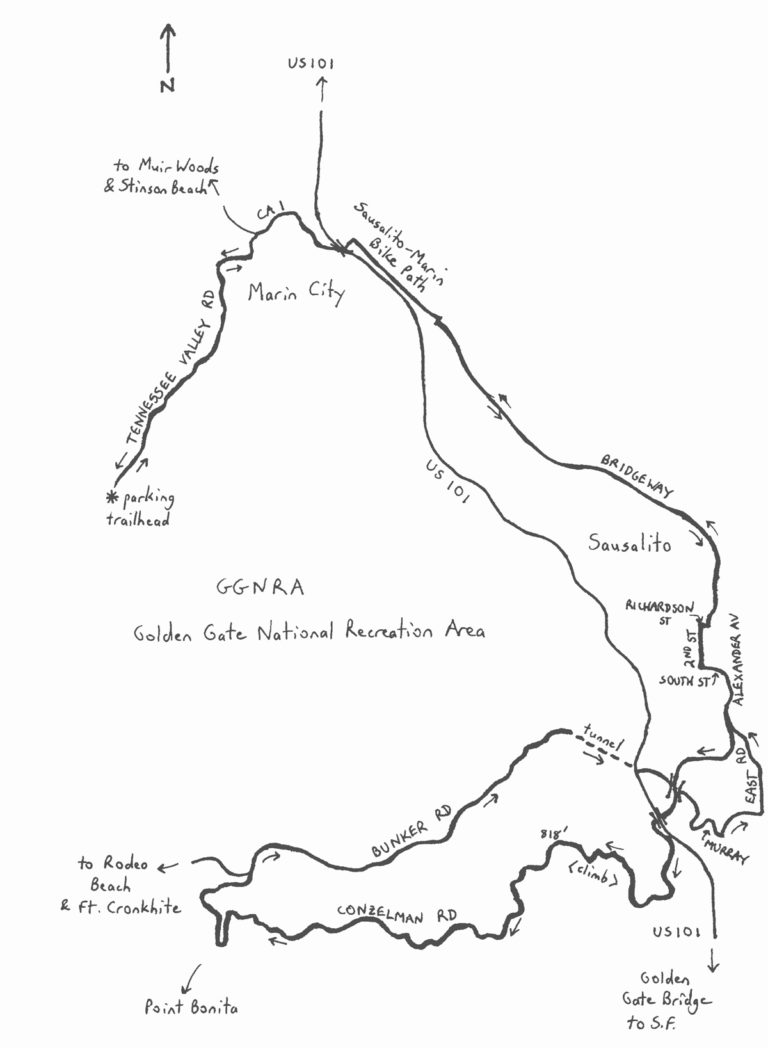
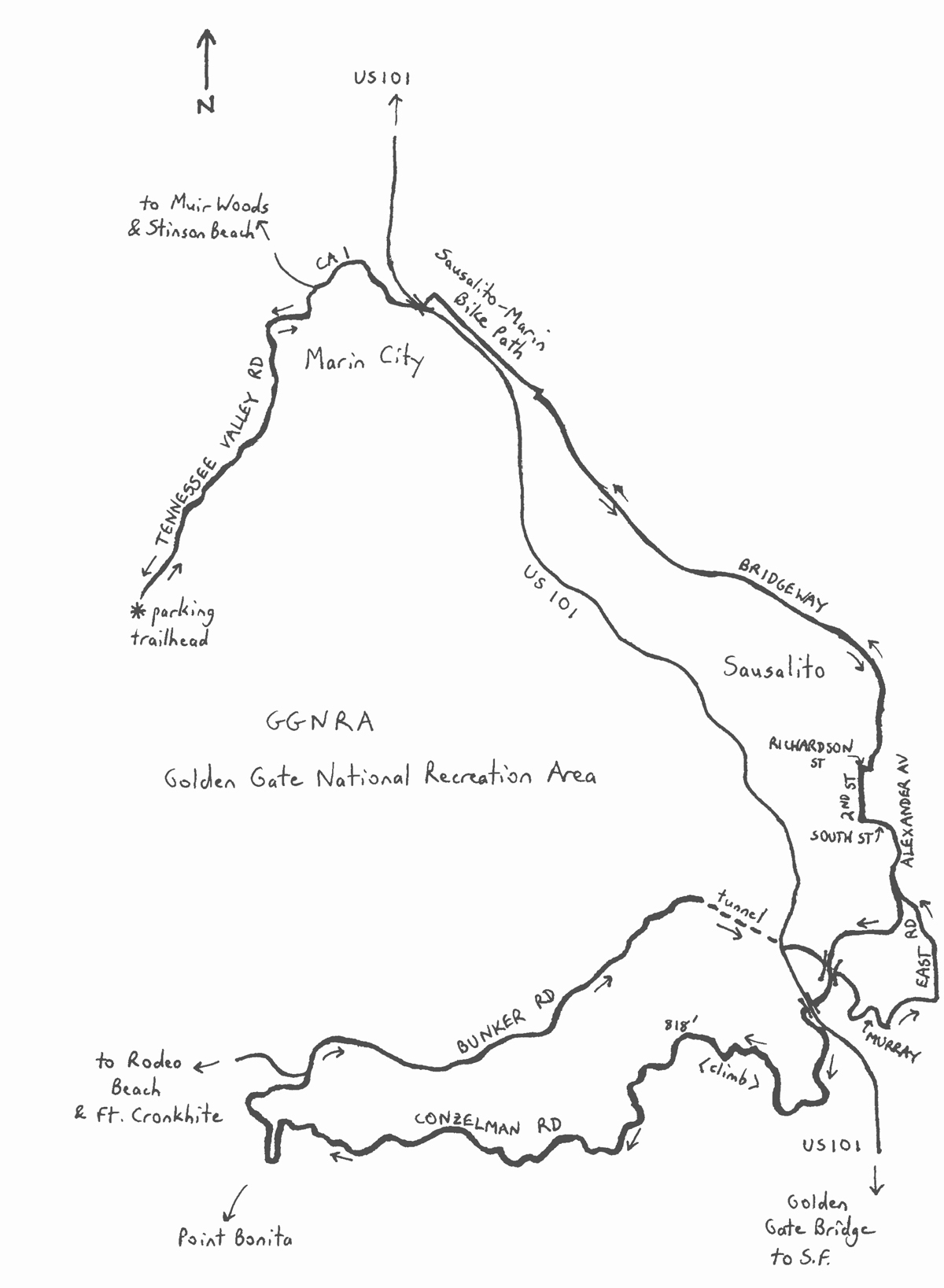
The Marin Headlands Excursion is a 22.7 mile ride through the beautiful coastal area just north of San Francisco. Map by Wayne Cottrell
This version of the ride differs from others in that it starts on the north side of the Marin Headlands, in Tennessee Valley. Tennessee Valley Road comes to a dead end, with a large parking area, at a popular trailhead, making this is a logical starting point for a road ride. While most others here will be headed onto the trails, you will be the maverick heading in the opposite direction, onto Tennessee Valley Road. The staging area is one of numerous such points in the massive Golden Gate National Recreation Area (GGNRA). The GGNRA covers over 82,000 acres, contains 19 different ecosystems, and is larger than the city of San Francisco. The GGNRA, which is really a large urban park, stretches from southern San Mateo County, well south of San Francisco, to northern Marin County, well to the north, along the ocean and reaching inland. Many of the GGNRA’s lands were formerly owned by the U.S. military, so it is pleasing that there has been a transition to peaceful uses. Tennessee Valley Road (two lanes) descends from the parking area at the trailhead into the southeast corner of Tamalpais Valley, near Tamalpais Valley Junction. Tennessee Valley – the actual valley – heads in the opposite direction of the road, toward the ocean. (So, the road does not pass through Tennessee Valley). At the end of the road, after a few undulations and exciting curves, turn right onto California Highway 1 (CA 1). This is a busy segment of highway, carrying 32,500 motor vehicles per day in only two lanes. When traffic is really heavy, queues form, and you may happily whiz by the stacked-up vehicles. Continue on CA 1 under U.S. 101, curving to the right. At the signal, turn left, onto Pohono Street, and then immediately turn right onto the Mill Valley-Sausalito bike path. This is a heavily used bike connector between points south and points north. There is no alternative to the bike path between Pohono Street and the next street, which is North Bridge Boulevard.
Turn right onto North Bridge Boulevard, and then turn left immediately, at the traffic signal, onto Bridgeway Boulevard. Only in rare circumstances would you be the only rider executing this maneuver! Watch for traffic, nonetheless. Bridgeway Boulevard heads south, streaking into the city of Sausalito via a series of false flats and traffic signals. Sausalito had a population of 7,100 in 2018. The city was isolated until the introduction of an auto-ferry from San Francisco in 1926, and then the completion of the Golden Gate Bridge in 1937. On the left, near the northern limits of the city’s commercial district, is the Bay Model. This is a working replica of the San Francisco Bay and the Delta region farther to the east. The model is indoors, and includes exhibits and tours. As you enter the commercial district, your speed reduces amidst the motor vehicle, bicycle and pedestrian traffic. All along Bridgeway and a few side streets are notable restaurants, bars and inns. Plus, the waterfront features outstanding views of San Francisco and Angel Island. There can be a constant stream of cyclists pedaling through here.
As you leave the commercial district, the road bends sharply to the right, becoming Richardson Street. The street climbs to 2nd Street, at which a left turn keeps you on the main route. While climbing, take a look up at some of Sausalito’s hillside residences. William Randolph Hearst’s hillside mansion “Sea Point,” which was never completed, inspired his San Simeon castle. 2nd Street takes a dip to Main Street, then climbs sharply to South Street. Turn left here to continue on the main route. South Street stays level briefly, and then climbs, bending to the right to become Alexander Avenue. This street continues to climb, leaving Sausalito’s development and entering the undeveloped fringes of the GGNRA. After crossing over Bunker Road (you will return this way), continue through the often-windy gap between the two knolls. Be especially cautious at the “T” intersection with Danes Drive just prior to the gap – my experience is that motorists (many of whom are probably tourists) often seem unaware of cyclists’ movements and intentions here. Continue underneath the U.S. 101 freeway – the passage is narrow and dark, so be especially alert. On the other side, bear right onto Conzelman Road (continuing straight puts you on U.S. 101 and the Golden Gate Bridge, in freeway traffic).
Conzelman Road is a gateway to the Marin Headlands. The road rapidly leaves the busy Golden Gate Bridge environs, climbing at an average gradient of 10% to an elevation of 430 feet, and a fabulous overlook of the Golden Gate Bridge. It can be equally as busy up here as it is down at the bridge, as the viewpoint is very popular. Continue as Conzelman winds its way high above the water. Continue through the traffic circle; the road steepens beyond here. The climb finally eases at Hawk Hill, the highest elevation of the entire ride (818 feet), adjacent some old World War II infrastructure. A large number of raptors are attracted to this hill, in part because of updrafts and thermals that enable the birds to fly very efficiently. Continue on Conzelman as it descends sharply toward the ocean below, on a one-way road. This is an unsurpassed view of the ocean, and is not to be missed! If it is foggy, then plan on doing this ride again on a clear day. The Conzelman descent continues for a couple of miles. The road is one way, and there is usually very little traffic. Conzelman begins to undulate toward the end of the descent, as it passes by, then curves away from Bonita Cove. Point Bonita, well to the left, represents the last gateway between the San Francisco Bay and the Pacific Ocean. California’s oldest lighthouse and fog signal are located out here. Despite the beacon and audible warnings, hundreds of ships have run aground near the Golden Gate.
As Conzelman curves to the right, the road passes by a series of batteries, some built before World War I, and others from World War II. All of the military sites have been decommissioned. Once around the curve, you are on Field Road. After another fast descent, the Marin Headlands Visitor Center appears on the left. At the base of the descent, bear right onto Bunker Road. Note that, to the left, Bunker Road continues to Rodeo Lagoon and, just beyond it, Rodeo Beach. The beach is one mile away, and is unique in California for the red and green pebbles that comprise its surface, as opposed to sand. Swells form offshore, making the beach suitable for surfing. When the beach is inundated, usually during winter months, Rodeo Lagoon empties directly into the ocean. Across from the lagoon is Fort Cronkhite, which was active from 1941 to 1974, and is now on the National Register of Historic Places.
Back on Bunker Road, this is the main “valley” road, heading eastbound, gradually climbing through the Headlands. The road is narrow, with some pavement damage when I rode this. Side streets along the way, to your right, return to the ridge and Conzelman Road. The dirt trails to the left penetrate Gerbode Valley, and provide access to other valleys within the Headlands. Bunker Road crests at the mouth of a half-mile long, one-lane tunnel that cuts through the ridge and underneath U.S. 101. Only one lane? Right – traffic flow in the tunnel is controlled by a signal that lets only one platoon of vehicles in one direction through at a time. Bicyclists need not wait for the signal, however. A separate pushbutton for cyclists, located at the entrance to the tunnel, alerts motorists to the presence of a bike in the tunnel. The tunnel is designed to accommodate two-way bicycle flow. Tunnel lighting is adequate but, once inside, it might seem longer than one-half mile!
Exit the tunnel, and turn left at the “T” intersection to continue on Bunker Road. The road curves to the right and descends rapidly, passing underneath Alexander Avenue, to Fort Baker. The fort is deactivated, and is now the home of the Bay Area Discovery Museum, a popular spot for families. To navigate Fort Baker’s roads, turn right at the stop sign onto Murray Circle. Next, turn left at the stop sign onto East Road, just up the road from Horseshoe Bay. East Road passes by the Museum, which is on the right, and then climbs gradually, adjacent San Francisco Bay, to intersect with Alexander Avenue. Turn right here, and begin the descent into Sausalito. Note that cyclists coming directly from the Golden Gate Bridge will have started their downhills upstream of here, and may possess quite a bit more speed than you. So, do not be alarmed if a number of riders go zooming past! You are now riding in the reverse direction of the outbound route. Continue via Alexander, South, 2nd, Richardson, Bridgeway, North Bridge, and the Mill Valley-Sausalito bike path, generally following the prevailing pattern of flow. Turn left at Pohono, and then right on CA 1. The busiest segments of the return ride will be along CA 1, followed by the left turn onto Tennessee Valley Road – use caution here. The return ride on Tennessee Valley Road is uphill, getting steeper toward the end, to the unpaved parking area and the end of the ride.
Starting & ending point coordinates: 37.860175oN 122.535978oW
For more rides in the Bay Area, see Best Bike Rides San Francisco (Falcon Guides), written by avid cyclist Wayne Cottrell. Best Bike Rides San Francisco features descriptions of 40 road and off-road rides in the Bay Area. The ride lengths range from 4 to 60 miles, with rides in San Francisco, the East Bay, and Marin County. Each ride description features information about the suggested start-finish location, length, mileposts, terrain, traffic conditions and, most importantly, sights. The text is rich in detail about each route, including history, folklore, flora, fauna and, of course, scenery. For additional rides in California, all written by Wayne Cottrell, please also see the Best Bike Rides books on Los Angeles and Orange County, as well as the forthcoming Best Easy Bike Rides books on Los Angeles, Orange County, and San Francisco. Wayne Cottrell is a former Bay Area and Utah resident, and current southern California resident, who continues to conduct extensive research in these places, and elsewhere, to develop the content for bike books.
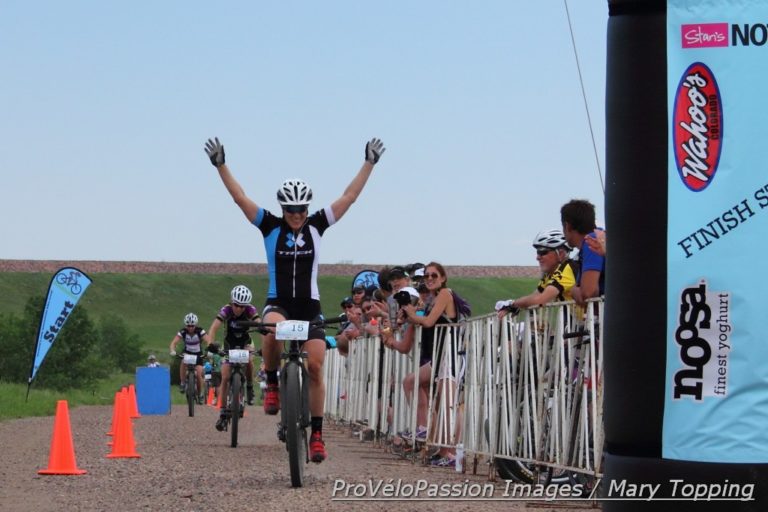
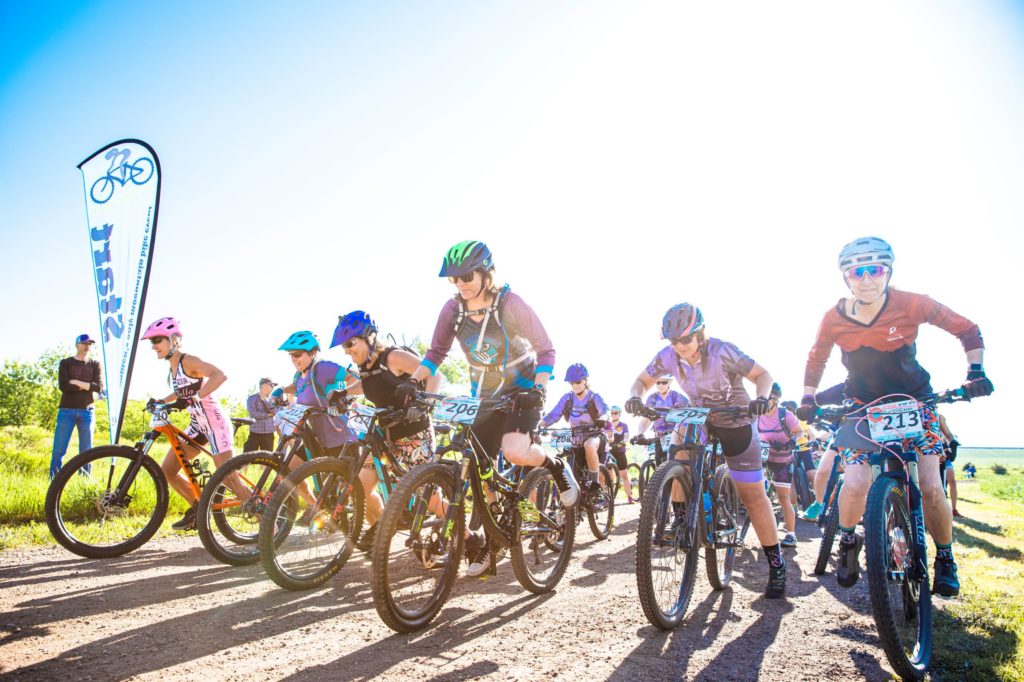
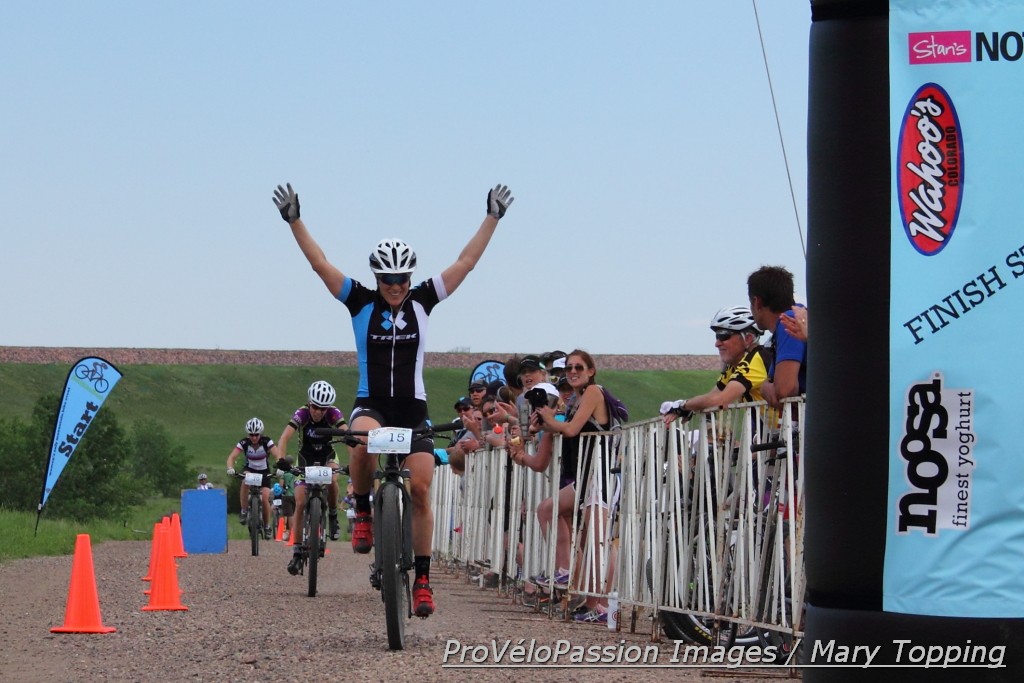
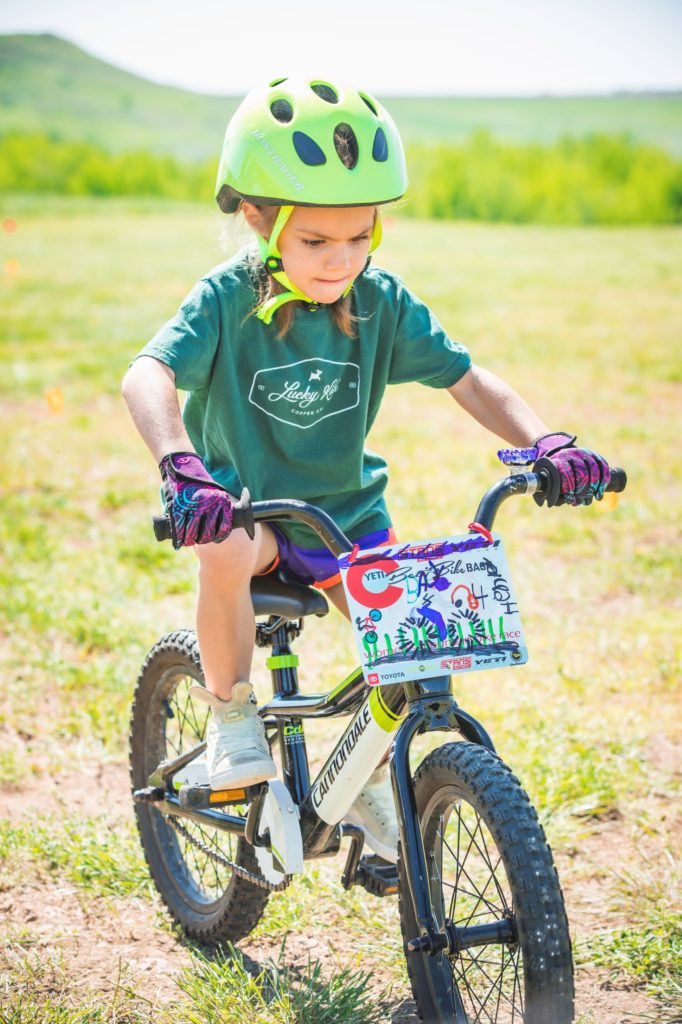
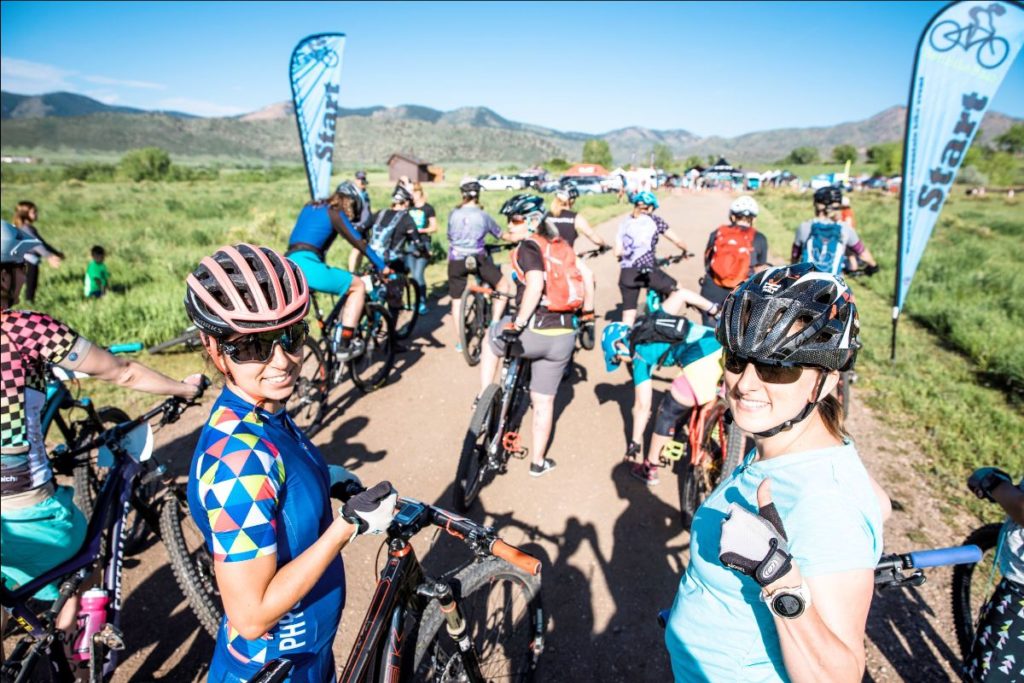
EVERGREEN, CO, January 23, 2020 — Team Evergreen Cycling and Beti Bus Productions are teaming up for the 11th annual Beti Bike Bash on May 31, 2020. The largest women’s mountain bike event in the world, the Beti Bike Bash prides itself on bringing together the cycling community in a unique and supportive environment, including categories such as “7 and Unders”, Juniors, “Never-Ever’s”, “New Moms”, all the way up to the seasoned professionals.
Image courtesy Team Evergreen.
“The Beti Bike Bash is an event every girl and woman on the front range should make an effort to get to, either to race or simply to have a great time cheering and supporting friends and family,” said Katie Compton, professional bike racer and 15-time National Cyclocross Champion. “The race is held on an inviting course that suits all abilities of riders and makes for a fun race. Whether it’s your first mountain bike race ever or you’re a seasoned veteran, you’ll end the day with a smile on your face and happy you spent the day with some great women and girls.”
Image courtesy Team Evergreen.
In addition to the race itself, the 2020 Beti Bike Bash also offers several ancillary events for the weekend. On Saturday, May 30, the VIDA MTB Series will host a race-specific clinic, designed to help participants with principles such as body positioning, race etiquette, and technique under the guidance of VIDA’s highly qualified and friendly coaches.
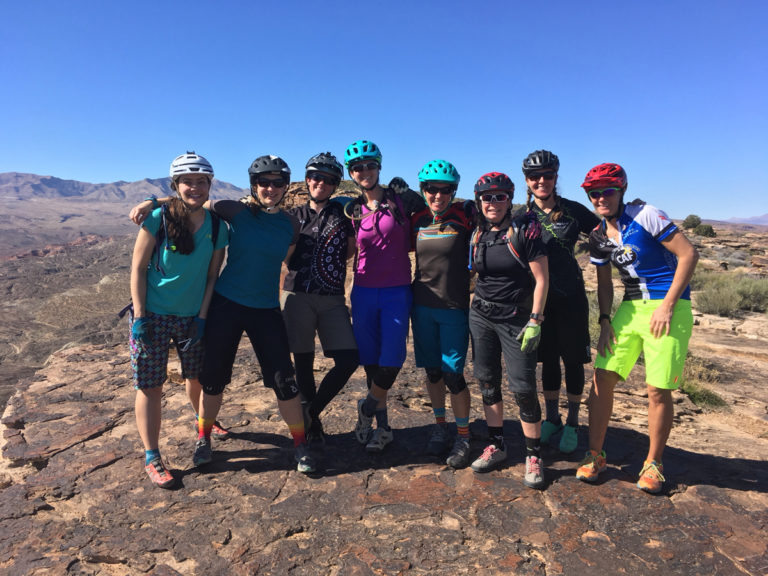
Image courtesy Team Evergreen.
For the younger crowd, the legendary Little Bellas will be onsite both days, to offer a one- or two-day bike camp designed to get young girls hooked on the sport.
As the largest cycling club in Colorado, Team Evergreen is no stranger to the cycling community and event promotion. In addition to the 2020 Beti Bike Bash, their popular cycling events include The Triple Bypass Ride and the Bob Cook Memorial / Mt. Evans Hill Climb — all proceeds of which are donated to a variety of charitable organizations (over 3 million dollars to date).
Image courtesy Team Evergreen.
“We’re thrilled to partner with Team Evergreen to continue offering the annual Beti Bike Bash,” said Amy Thomas, co-founder and BBB Race Director. “Going into our 11th year, we were up against several setbacks and a bleak future with most of our industry partners pulling out, despite soaring participation in women’s mountain biking. With this partnership and the continued support from Yeti Cycles, our tried and true continual sponsor, we will be able to bring over 400 women and girls together again on May 31, 2020.”
Jen Barbour, Executive Director of Team Evergreen added, “We’re so excited to bring the Beti Bike Bash into our line of events. We see a big and bright future – not just for the event itself, but for all the women who continue to come out year after year to grow the sport.”
PORTLAND, OR (January 22, 2020) — Leading bicycle shipping service BikeFlights.com is pleased to introduce its Brand Ambassadors for the 2020 season, including nine individuals and five teams.
“We are honored to have such talented and enthusiastic cyclists as our BikeFlights.com Brand Ambassadors,” said Sue George, Vice President at BikeFlights.com. “And we can’t wait to see what they will get up to this year and how they will inspire us to achieve and adventure.”
Now in its sixth year, the BikeFlights.com Brand Ambassador Program makes it easy for Ambassadors to get their bikes, wheels and bike-related gear to, from and between training camps and events in exchange for help spreading the word about how convenient, reliable and affordable it is to ship with BikeFlights.com. Ambassadors include gravel riders, mountain bikers, road riders, trackies, triathletes and cyclocrossers from all over the U.S. and range from developing young junior riders to Olympians.
Expect to see BikeFlights.com Brand Ambassadors in action at gravel events like the Mid South, Dirty Kanza, Steamboat Gravel and Rebecca’s Private Idaho and at mountain bike events like the U.S. Mountain Bike National Championships and Iceman Cometh. They’ll also be many other USA Cycling National Championships events like those held for road, track and cyclocross disciplines.
Individuals
Alexey Vermeulen (Privateer) – Pinckney, MI
Ashton Lambie (Privateer) – Lincoln, NE
Ayesha McGowen (Liv Racing) – Decatur, GA
Christina Birch (Team USA & Privateer) – Los Angeles CA
Kerry Werner (Kona Maxxis Shimano) – Winston Salem, NC
Kristin Fleschner (Privateer) – Terre Haute, IN
Liza Rachetto (DNA Cycling) – Boise, ID
Rebecca Rusch (Privateer) – Ketchum, ID
Sarah Sturm (Specialized Gravel) – Durango, CO
Teams
Stan’s-Pivot Pro Mountain Bike Team (including Chloe Woodruff, Keegan Swenson and Rose Grant)
Dirt Camp Devo Team (including Carson Beckett, Jerry Dufour, Eli Kranefuss and Sandy Floren)
Squid Squad (including Emily Kachorek, Benjamin Gomez Villafane, Chris Nabma and Samantha Runnels)
Team S&M CX (including Clara Honsinger, Sophie Russenberger and Brenna Wrye-Simpson)
Bear Development Team (including Paul Leo Fabian, Caleb Swartz, Alexander Sugarman, Brennon Peterson, Daxton Mock, Spencer Ciammitti, Dylan Anthony Fryer, Chris Mehlman, Colton Sacket, Katja Freeburn, Madeline Joanna Robbins, Lauren Lackman, Alexis Bobbitt, Bjorn Riley, Riley Amos, Brayden Johnson, Ryan Campbell, Devin Douglas DeBruhl, Sean Middleton, Robert Douglas Day, Gabrielle Richardson, Mahala Helene Randel, Ruth Holcomb, Tai-Lee Blaiz Smith, Cassidy Hickey, Lily Reynolds Vitt, Cayden Matthew Parker, Liam Baartman, John Robert Mizzoni, Truett Samuel Bennett, Margaret Holcomb, Ava Geneva Ahlberg, Kaya Musgrave, Vaila Heinemann, Cameron Adams, Finn Melton, Isabella Heinemann, Santiago Scuiti, Tobias Coughlan, Lila Hoeh, Clodagh Niamh Mellett and Stella Sisneros)
Regardless of your perspective on the relative amount or lack of snow this winter, it has allowed us to get outside to ride more comfortably than we are typically used to this time of year. Though I recommend taking time off the bike at some point during the winter, if you are preparing for early season events, you will want to get back to consistent bike training a couple of months prior. For MTB racers, we are lucky to have several great early season races here in Utah to dust off the cobwebs on our winter legs! True Grit, 6 Hours of Frog Hollow and the first couple stops on the Intermountain Cup calendar are great opportunities (or excuses) to head south and ride dry singletrack in the desert. For those riders who live in warm, dry climates, this is your chance to shine. For those of us in winter climates, there is plenty we can do to prepare with off-the-bike training, riding on the road and occasionally on the trainer.
Group rides and trips south are perfect for getting ready for the spring race season. Photo by Angela Wright
Though the general seasonal training outline for MTB racers will be similar to that of roadies, the specific demands of offroad riding are unique and can be difficult to replicate when we are confined to riding on the road and (even more so) on the trainer. The same general guidelines apply; developing aerobic base through the winter months with less specificity, gradually adding intensity, transitioning to more on the bike training and race specific efforts. Training at zone 3 (or tempo zone) through the winter is a great way to develop aerobic base. This level of intensity is a useful conduit for aerobic base building in the absence of 4-6 hour, low intensity traditional base building rides.
As True Grit and other early season offroad goals approach, you will want to develop the intermittent power that is unique to MTB riding. There are a few workouts that can be performed on the road to achieve this when trails are not accessible. While performing tempo intervals, add in some 10 second sprints to simulate the bursts of power required to clear technical sections of trail. Try to return to tempo power/effort without dropping your effort to recover from the burst. If you are on the trainer, it is not possible to recreate the sharp burst of power required for a 10 second sprint. So in this case, instead use a 30 seconds surge. In a similar vein of mimicking offroad riding, during longer endurance rides, try doing a short (5-10 seconds) sprint every five minutes, decreasing to every two minutes as your fitness develops. Do this on rides of one to two hours.
Fat biking is a great way to stay in shape during the winter. Photo by Rae Sutherland
If you are lucky enough to live where there is lots of fluffy white snow, enjoy skiing or snowboarding to maintain your technical edge while you can’t ride trails. Consider, the same skills are in use; handling your body at speed, balance, reaction time, proprioception, etc. Most skiers and snowboarders transition pretty easily to MTBing as the foundation is already there. Skiing and snowboarding are also fun strength workouts. Bonus points if you skin up to add endurance training.
Of course if you are not a skier or you just need a singletrack fix, Moab, St. George, Hurricane and Las Vegas are close for most of us and dry trails await. Dial in the race courses for True Grit, Frog Hollow and the Intermountain Cups or develop MTB specific fitness without having to throw sprints into your road rides! Enjoy the dirt.
Winter is a great time to focus on strength work (besides skiing and snowboarding). Yoga is a helpful way to combine isometric strength work with stretching and body work, as well as mental training and meditation. Stay tuned, I will be offering yoga for cyclists classes in upcoming months.
No matter the weather, there are ways to prepare yourself to smash early season MTB race and ride goals. It may take some creativity. A coach will be able to provide a lot of guidance about how to be most effective for each individual’s current fitness and goals.
Sarah Kaufmann is the owner of K Cycling Coaching. She is an elite level XC and CX racer based in Salt Lake City, UT and can be reached at [email protected] or 413-522-3180.
By Steve Stauffer — “Bike Lane” is a 9×12 oil on linen panel.
It was painted en Plein Air in the Holladay Plein Air 2019 show in September. This community and others that surround it are making a huge effort to create safe riding and bike lanes are a big part of it. I thought this piece sent a fun, but important message.
Safety and perceptions of safety keep women from cycling. At least in San Francisco. A survey done by the Safe Transportation Research and Education Center at the University of California, Why Don’t Women Cycle? A Case Study of Women’s Perceptions of Cycling in San Francisco (https://safetrec.berkeley.edu/sites/default/files/whydontwomencycle_9.3_v2.pdf), found only 29 percent of survey respondents were women – a number consistent with other research in the USA. While some women cited matters such as family responsibilities, their biggest problem was perceived danger.
Not only were women more worried about safety in general, “Women of color are more likely to take safety into account when making travel decisions than White Non-Hispanic women,” the survey found.
Women cited a variety of fears, ranging from poor road conditions to drop-offs to construction and pinch points at right turns and bus stops.
The researchers note that they only looked at weekday cyclists, probably largely commuters; and that more research is needed on weekend and recreational riders. But they said that more protected bike lanes and complete connections could ease women’s concerns. Additionally, the report calls for more studies like this move towards gender-equitable cycling cities.
Active transportation (biking, walking, etc.) could potentially give the U.S economy a boost of $138.5 billion a year – if we invest in it. So concludes a study by the Rails-to-Trails Conservancy, (RTC). The investment will require a major overhaul of federal transportation policy and a major change away from a sedentary lifestyle.
The nation invested in a railway system in the 19th Century, then an Interstate highway network in the 20th. “Congress must now invest federal dollars in a national active transportation system so every American might realize the transformative benefits this infrastructure can bring, concludes Active Transportation Transforms America: The Case for Increased Public Investment in Walking and Biking Connectivity (https://www.railstotrails.org/media/847675/activetransport_2019-report_finalreduced.pdf).
Specifically, trails investment can boost rural economies. The natural surface Whitefish Trail in Whitefish, MT gets more than 73,000 visits a year, for instance, bringing in almost “$3.6 million in spending on accommodations, restaurants, groceries, retail, gas, transportation, licenses and entrance fees, outfitters/guides and farmers markets, in that order, from 22,000 visitors,” the report states.
Concurrent with the report’s release, RTC conducted a webinar on the topic. “It’s hard to overestimate the positive impact to our communities in Montana,” said webinar participant Martha Williams, director of Montana Fish, Wildlife and Parks. “We are seeing the benefits to all communities, whether large or small, urban or rural.” Connecting communities is the greatest advantage; “it’s not just recreation,” she said. While “trails in Butte had a really strong positive impact, rural communities benefited in a different way. “I am thinking of (trails) around more rural towns where people still use them for transportation,” Williams said.
While federal and RTC support helps, “all trails we work on are joint efforts,” Williams added. “Every trail project involved many partners.” Some involved motorized as well as non-motorized transit.
In that spirit, the Great American Rail-Trail project is sponsoring a series of “catalyst initiatives,” or efforts along the way designed not only to fill gaps but to spur communities to add onto them. One such effort focuses on a 52-mile segment in Montana from Livingston south through Emigrant to Gardiner, the gateway to the north side of Yellowstone National Park. The plan involves converting the Old Yellowstone Trail, an abandoned rail line that used to take tourists to the park. “Park County has always been interested in turning it into a trail,” says RTC Trail Planner Kevin Belanger.
The partners are first focusing on the 22-mile segment between Livingston and Emigrant, where they have completed a feasibility study and are working on engineering. The remaining 30 miles to the south needs a feasibility study, Belanger says. The newly enacted Trails and Recreational Facilities Account and Grant Program started in Montana this year, funded by vehicle registration fees, is helping finance the trail. See: https://www.cyclingwest.com/advocacy/mountain-advocacy/montana-trails-to-see-new-trail-grants/
Another catalyst project: completing a trial in Wyoming between Glenrock and Evansville, just east of Casper. RTC is working with the Friends of the Platte River Trails to build a trail of about 5.5 miles from Casper to Edness K. Wilkins State Park, a popular site for boating, birding, fishing, swimming, etc. All the project needs now is funding. Extending it east to Glenrock is trickier: “We don’t know the ownership status of all the land. It needs more research on local ownership and making sure it’ is a viable option to use,” Belanger says.
Filmed by Bike, Portland, Oregon’s famed bicycle-themed film festival is making a stop at the Egyptian Theatre tonight, Friday, January 17, 2020.
The traveling festival features more than 15 films from all over the world. The Boise showing will be divided into two parts; Bike Love and Adventure Shorts. Presented by the Idaho Walk Bike Alliance, the festival raises funds for walk and bike advocacy across the state. Boise’s Filmed by Bike event is the largest one in the nation outside of the Portland area. Last year, a nearly sold out crowd of 697 people attended and the energy was palpable! This event brings people together from throughout the Treasure Valley to celebrate the adventures, both physical and spiritual, that are possible when riding a bike.
Tickets are available through the Egyptian Theatre website (http://egyptiantheatre.net/), $15 in advance and $20 the day of the show. This is an all-ages show. Beer and wine available with ID and there will be a raffle.
Filmed by Bike: The World’s Best Bike Movies
Friday January 17, 2020, doors at 5:00 p.m. Films at 6:30 p.m.
Egyptian Theatre, 700 W Main Street, Boise Tickets: $15 in advance $20 on the day of show.
This is a plastic-free event. We encourage attendees to either bring a metal cup from another event, purchase one at the movie for $10, or “rent” one for free. People who bring a cup will be given a raffle ticket.
We will collect donated hats, gloves, scarves or socks in exchange for raffle tickets. These items will be distributed to those in need by Max Giving.
SALT LAKE CITY, Utah (January 15, 2020) — The Third Edition of the 5 Canyons Bike Challenge will tackle all five of Salt Lake Valley’s canyons in One Day, on August 29, 2020!
Wheels of Justice announced that the third edition of the 5 Canyons Bike Challenge will take place in Salt Lake City, Utah on August 29, 2020.
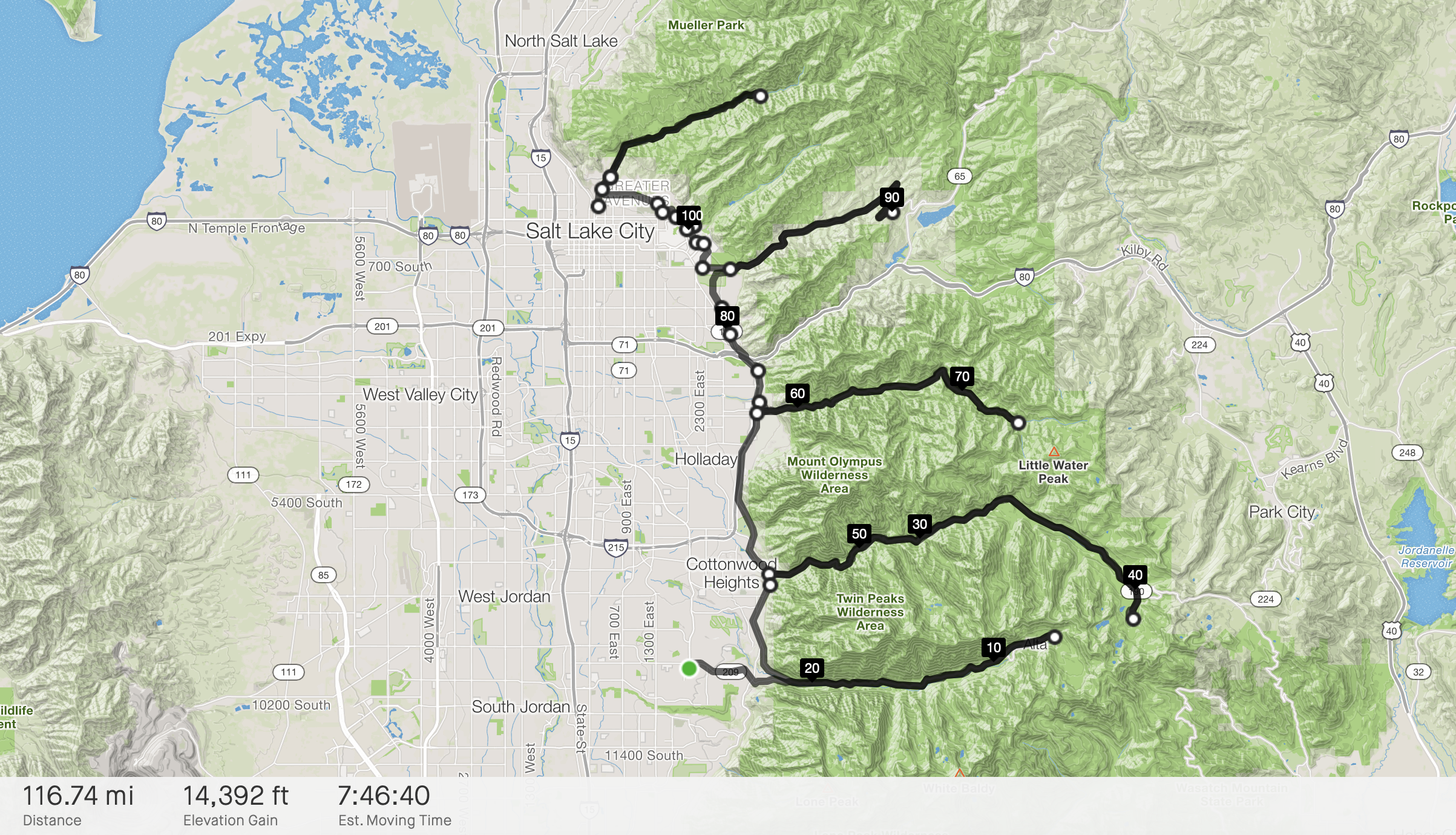
The 5 Canyons Bike Challenge is one of the most difficult cycling challenges in the United States, climbing more than 14,000 feet through five of major canyons in the area, over its 116 mile total distance, all in one day. Three of the climbs are rated hors categorie, while the other two are rated as category 2. This challenge is designed for those who love the challenge of climbing, followed by screaming descents..
For comparison, Mount Whitney, the tallest peak in the lower 48 states, tops out at 14,505 feet, but only has a prominence of 10,075 feet from its base. The ride first tackles Little Cottonwood Canyon, then moves on to Big Cottonwood Canyon, Millcreek Canyon, Emigration Canyon, and finally finishes in City Creek Canyon in the heart of Salt Lake City.
The beauty and serenity of an early morning canyon ride is unmatched, and nowhere are there more beautiful canyons concentrated in such close proximity as along the Wasatch Front.
https://www.strava.com/routes/13107262
Help End Childhood Trauma
Nicknamed Ain’t No Mountain High Enough, this challenge shows that no mountain is too high to keep us from protecting and helping children, as well as proving that that people can overcome any challenge facing them.
All proceeds benefit four incredible charities—Prevent Child Abuse Utah (“PCAU”), Friends of the Salt Lake County Children’s Justice Center (“Friends of the CJC”), Operation Underground Railroad (“O.U.R.”), and the Utah Domestic Violence Coalition (“UDVC”)—working to put an end to childhood trauma.
All who complete the challenge will not only earn some serious bragging rights, but will accomplish major good in the world.
If you think you have what it takes, rally your friends and join the Challenge this August! Riders registering before August 17, 2020 will receive a cool schwag bag, including a water bottle, a race t-shirt, and a finisher’s medal!
Riders can also purchase the additional Summit Entry, which includes meal tickets for the pre- and post-ride meals, a $100 credit for the silent auction, and a Wheels of Justice t-shirt.
About Wheels of Justice
Wheels of Justice is a cycling club dedicated to putting an end to childhood trauma.
For more information, please visit: teamwheelsofjustice.org
ATHENS, Georgia (January 14th, 2020) — Two years ago, USA CRITS announced a goal of developing a more sustainable race environment for cycling. Making the sport of criterium racing more watchable, and as part of that, more of a team based sport. In 2019, there was a 15% increase in D1 team participation at the eleven races that make up the nationwide season. For 2020, the most teams ever have committed and all Series races will be streaming for free on USACRITS.tv.
D1 is the nomenclature used by USA CRITS to identify Series teams. Teams agree to promote and race the Series and in return USA CRITS provides benefits to the teams. The largest of these benefits being the ability to race on a live stream production and in front of the largest crowds in American cycling. The top four finishers in each race qualify for season team points and individuals earn the same points in the three season long jersey competitions.
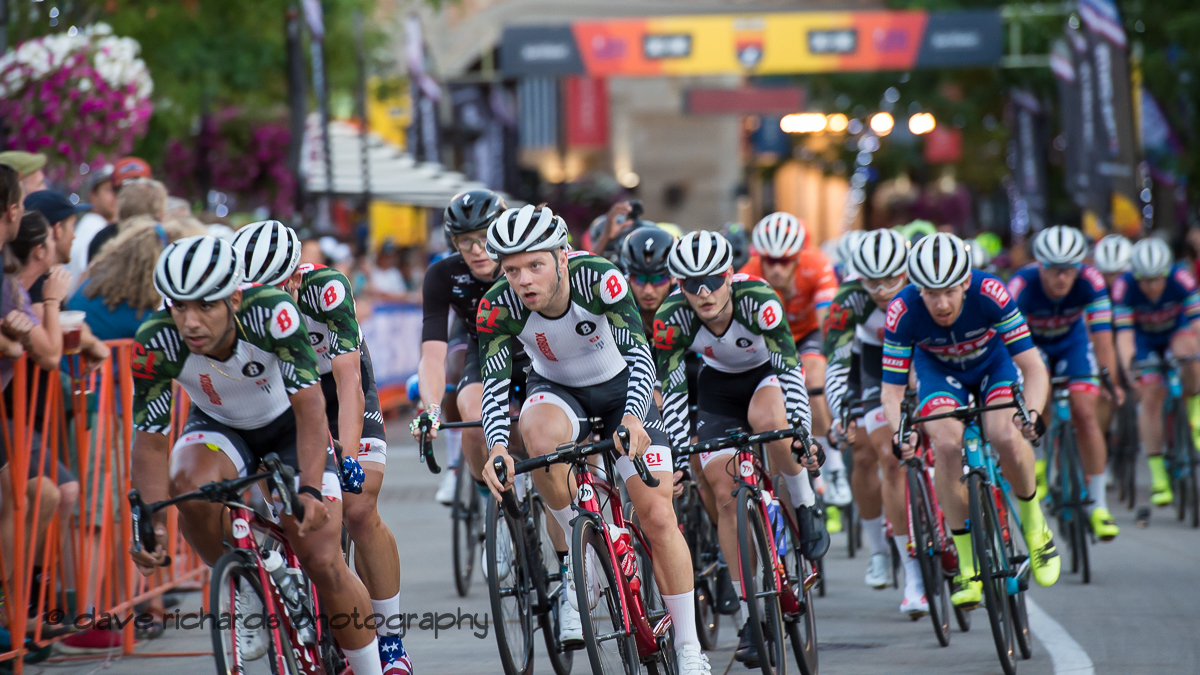
ButcherBox Cycling riders lead the pack past the fans during the Salt Lake Criterium, USA CRITS series held at the Gateway Mall (Photo by Dave Richards, daverphoto.com)
2019 Series team champions ButcherBox Cycling (men) and Colavita/Cavaliere d’Oro Women’s Pro Cycling (women) will return to defend their 2019 team titles. They will be joined by nine new teams and four teams racing both male and female squads bringing a new dynamic for fans to engage. The 2020 race calendar has been shared with teams and will be announced to the public on January 23rd. The Series will once again begin with the Hammerfest pre-season event in Birmingham, Alabama, on March 14th.
“Seeing new teams develop with the sole purpose of racing the Series and existing teams gaining new sponsors because they are getting exposure from our broadcasts is exciting. The creation of season long team and rider storylines is what the sport needs. We are making progress toward our goals,” said Scott Morris, USA CRITS Development Director.
BOISE, Idaho (January 3, 2020) — George’s Cycles and OmniGo! announce the continuation of the Lyle Pearson 200 for the year 2020. For thirteen years the successful cycling event from Boise to Sun Valley has challenged cyclists in both team and individual categories.
Mike Cooley, the founder of the event and co-owner of George’s Cycles, was looking to step down as director but wanted the event itself to continue. OmniGo!, a local Boise event timing company, has accepted the challenge and looks forward to continuing the tradition. “The LP 200 is a one of a kind classic but it is time to breathe some fresh air into it,” remarked Mike “and OmniGo! has that capability”.
2020 will be a transition year with Mike working closely with OmniGo! The timing company is no foreigner to the LP 200 having timed it for the last three years. In addition, OmniGo!’s co-founder Katie Hedrich has over a decade of experience directing cycling events. “We are excited to work with Mike and are already discussing ways we can enhance the experience for participants while keeping the original spirit of the event” says Hedrich. Although a young company founded in 2017, OmniGo! already has a sound reputation for bringing innovative solutions to events throughout the west and looks forward to applying that experience to the LP 200.
Riders taking in the mountain views during the 2015 LP 200. Photo courtesy OmniGo!
Upcoming Dates
The 2020 Lyle Peasron will once again take place the weekend after Memorial Day on May 30 with registration opening January 3, 2020. To register, visit bikereg.com/lp200
The Lyle Pearson 200 road cycling event was founded in 2006. The 200 mile route, for teams of 4 to 6 cyclists, includes 5 major climbs and over 12,000 feet of climbing, while the 100 mile route, for 2 person teams and solos includes 6,000 feet of climbing and 2 major climbs. Both distances follow one of the most scenic northern routes showcasing Idaho from Boise to Sun Valley.
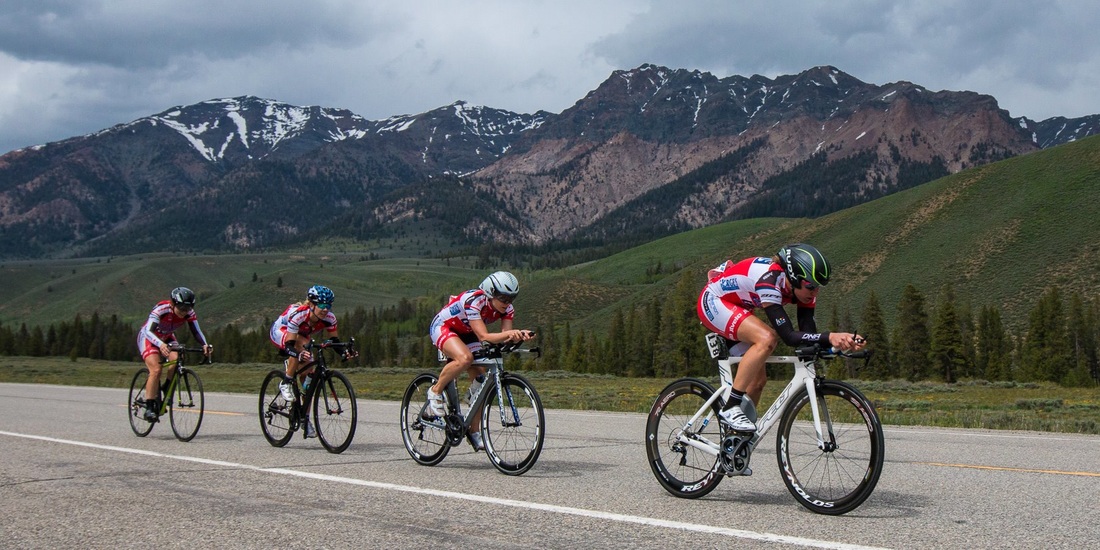
Riders participating in the 2019 LP 200. Photo courtesy OmniGo!
George’s Cycles was established in Boise in 1971 and became one of the first ‘pro’ cycling shops in the area. Mike Cooley and partner Tom Platt took over the store in 1981 and are responsible for the success of the chain of shops throughout Boise today. George’s Cycles offers bicycles and a full range of goods for all disciplines of cycling. Mike Cooley has been the backbone for many of Boise’s well known cycling events including the Lyle Pearson 200, Twilight Criterium and the Bogus Basin Hillclimb.
OmniGo! is a Boise founded timing company that supports timing and results for a variety of athletic events. Its signature cloud-based system allows for real-time results no matter what timing process is used including manual scoring, RFID chips, and/or finish line cameras. Results are posted live online and upon request, on large monitors moments after participants cross the finish line making the results tent a popular area at an event. OmniGo! also goes beyond the basic timing needs and is capable of customizing unique requests such as timing the “beer chugging” portion of 10 Barrel’s Bogus to the Barrel cycling event!