The steep entry to the Horseshoe Trail network around Driggs, ID should become easier for less advanced riders. Mountain Bike the Tetons (MBT), the local advocacy group, just received a $4,500 grant from People for Bikes (PFB) to make the 1.3-mile route less steep and easier to sustain.
The MTB Project of REI Coop describes the trail as a “very steep climb with only a small downhill section at the end. The trail can get pretty steep in places for those who aren’t used to climbing” (https://www.mtbproject.com/trail/5575799/bovine).
MBT budgeted about $20,000 in all for the project as PFB likes grantees to pay at least half of project costs, says Zoe Kircos, PFB director of grants and partnerships. The plan calls for MBT to complete the improvements by the 2020 riding season, she says.
You will be able to ride an electric bicycle on federal lands where a regular bike can go. Interior Secretary David Bernhardt issued an order Aug. 30 instructing managers of federal recreational land to allow e-bike use. The order is “intended to increase recreational opportunities for all Americans, especially those with physical limitations…”
The order applies to e-bikes that can only go less than 20 mph, known as Class 1 (without a throttle) and Class 2 (with a throttle so people can ride them without pedaling) bikes, and, additionally Class 3 bikes that can travel up to 28 mph. Bernhardt’s memo states that “(u)ncertainty about the regulatory status of e-bikes has led the federal land management agencies to impose restrictive access policies treating e-bikes as motor vehicles, often inconsistent with state and local regulations for adjacent areas.”
The order applies in lands operated by the National Park Service, Fish and Wildlife Service, Bureau of Reclamation and Bureau of Land Management. It does not apply in national forests or grasslands, which are operated by the U.S. Department of Agriculture (USDA).
People for Bikes (PFB), which pushed for the change, lauded the move, issuing a statement saying “(t)his secretarial order will help get public lands visitors out of their cars and beyond congested visitor centers and parking lots and enable better experiences for people of all ages. It will promote health-building physical activity that is non-polluting, quiet and sustainable. Too many Americans see our national parks only with their noses pressed against the windows of their cars. We need to get people outside and moving.” People for Bikes also requested the move in national forests but USDA hasn’t responded yet.
A coalition of conservation and recreation organizations, who opposed the idea from the start, issued a statement blasting the decision. “Trail advocates and conservation groups point out that the order undermines agency regulations and management rules, fails to consider impacts to hikers, mountain bikers, horse riders and other recreationists, and may signal the beginning of the end for non-motorized backcountry trails, all while not including the public in the decision-making process,” reads a statement signed by the American Hiking Society, Back Country Horsemen of America, National Parks Conservation Association, Wilderness Society and Pacific Crest Trail Association.
Bernhardt instructed land managers to develop an interim policy within two weeks, consistent with current law and regulations. By the first of October, agencies are instructed to report on any regulations that may inhibit the order and commence a public comment period regarding changing them to comply.
Superintendents can restrict e-bikes from certain areas for reasons such as public health or resource protection. Managers and superintendents of each federal agency can come up with their own rules after considering public input. You’re likely to see them allowed on roadways and paved bike trails. “It gets a bit more iffy on single-track dirt trails,” notes PFB Federal Affairs Manager Noa Banayan. “There’ll be a diversity of policies. We’re not advocating for a top-down policy.”
Canyonlands and Arches national parks in Utah, for instance, are working on implementing guidance, Kate Cannon, spokesperson for the parks, said in early September. All bicycles there are allowed on dirt and paved roads but not off-road trails. Park staff plan to put out info via signage, radio, press release, etc. to let people know about the rule, she said.
Meanwhile, as of June, 22 states had developed policies recognizing the three classes of e-bikes, according to PFB. Arizona, for instance, officially allowed local governments to permit e-bikes on trails starting this year.
Subsequently, the Flagstaff City Council passed an ordinance in June allowing Class 1 and 2 bikes on most of the 56-mile Flagstaff Urban Trail System. The council approved it at a late night session after one councilmember who doesn’t like e-bikes insisted they not be allowed on the busiest segments. “It was a nonsensical thing a politician did,” says Anthony Quintile, a board member of Flagstaff Biking Organization. “Frankly, there’ll probably be no enforcement of the ban.”
Park City, Utah has also started the process to allow ebikes on its trails. A recently passed ordinance will allow those over 65 to use ebikes immediately on the trails, and to begin a pilot program for other trails in 2020.
By John Shafer – The 11th Red Bull Rampage was held in mid-October in Southern Utah, near Zion National Park. For anyone who doesn’t know what Red Bull Rampage is, it’s a one of a kind, invite-only mountain bike freeride competition featuring huge jumps, massive drops and sketchy billy-goat lines – all on super-exposed Southern Utah cliffs. Most people think it’s just plain insane. Even if you don’t know it by name, you’ve probably seen some viral videos on Facebook or YouTube. With the best freeriders in the world going all-out in the fantastic Southern Utah landscape, there’s no other mountain bike event that even comes close to matching the spectacle and drama of Red Bull Rampage.
[Editor’s note: this article originally appeared in the Winter 2016/2017 issue of Cycling Utah. References to dates and timeframes should keep that in mind. With the 14th Annual Red Bull Rampage coming up on October 25, 2019, we felt it was a good time to repost.]
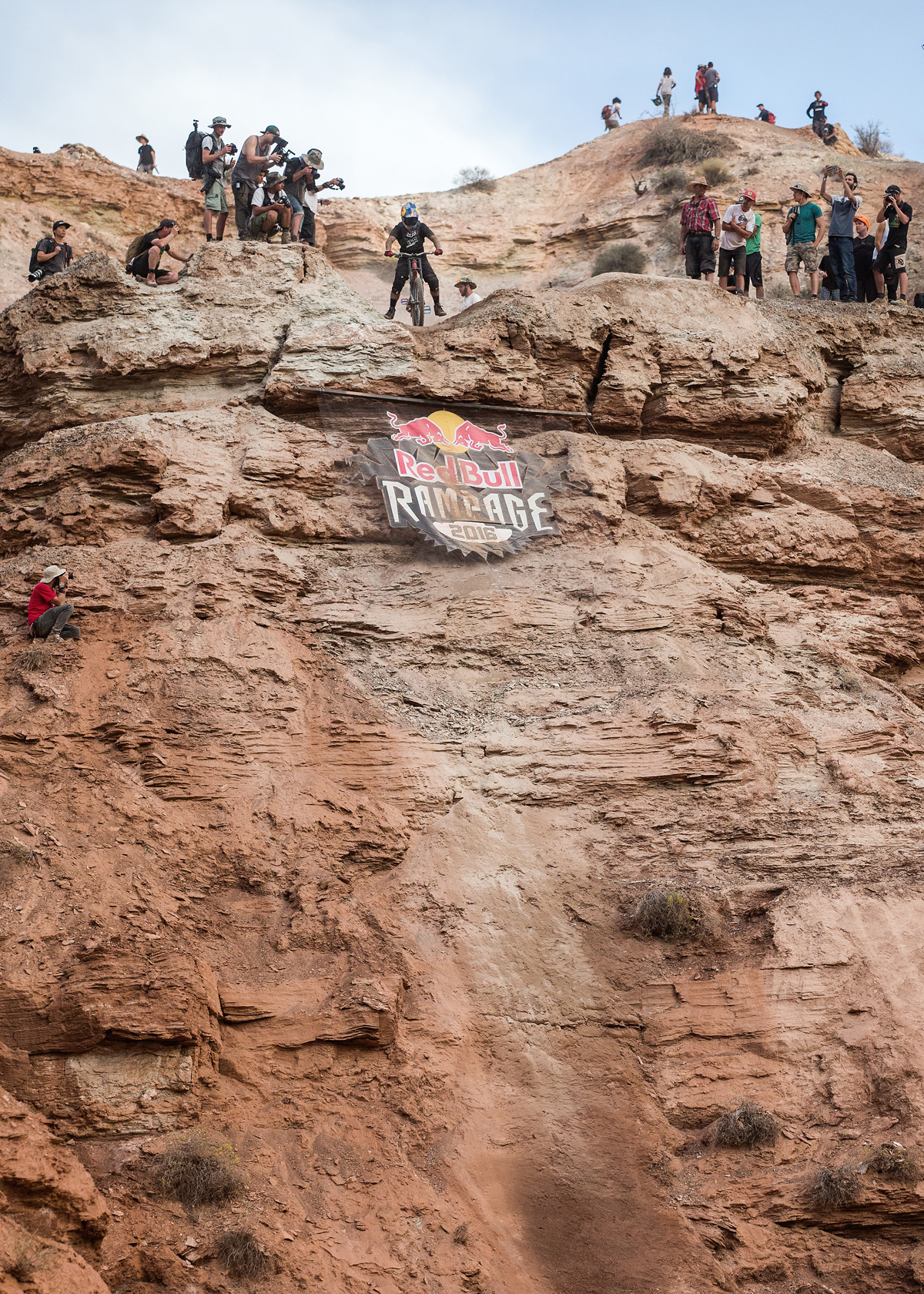
Andreu Lacondeguy, sizing up a big drop during Wednesday practice. 2016 Red Bull Rampage. Photo by Photo John.
If you’re expecting a ride-by-ride report – this isn’t it. The real intent of this article is to talk about whether or not Rampage riders are as crazy as people think they are. I’ll also detail some of the new format changes made to address all the controversy that followed Red Bull Rampage, last year. Don’t worry, though – we won’t completely ignore the riding (or crashing). Toward the end of the article there’s a section with some highlights and descriptions of the winning runs. But if you really just want to know who won and what kind of tricks and carnage occurred, that stuff is all over the web. I recommend going straight to the Red Bull Rampage web page and checking out the videos of the winners. That’s a much better way to experience Rampage than reading some hack writers report.
Are Red Bull Rampage Competitors Crazy?
According to most social media headlines and viral video comments, Red Bull Rampage competitors are completely nuts – suicidal, even. That’s a totally understandable reaction. It couldn’t be further from the truth, though. If all you’ve seen are a few photos and a couple of videos, you only know a tiny bit of the story. As a long-time Rampage attendee (I’ve been attending as a photographer since 2002) who even calls a few ex-competitors friends, I have a very different view of the event. I’ve watched the athletes, the lines and the event coverage evolve from rough and scrappy to polished and mass market. I’ve spent days at each event watching the riders scout, sculpt and practice their lines and I know how much hard work and analysis happens before each rider drops in for the final run you watch on your computer or TV.
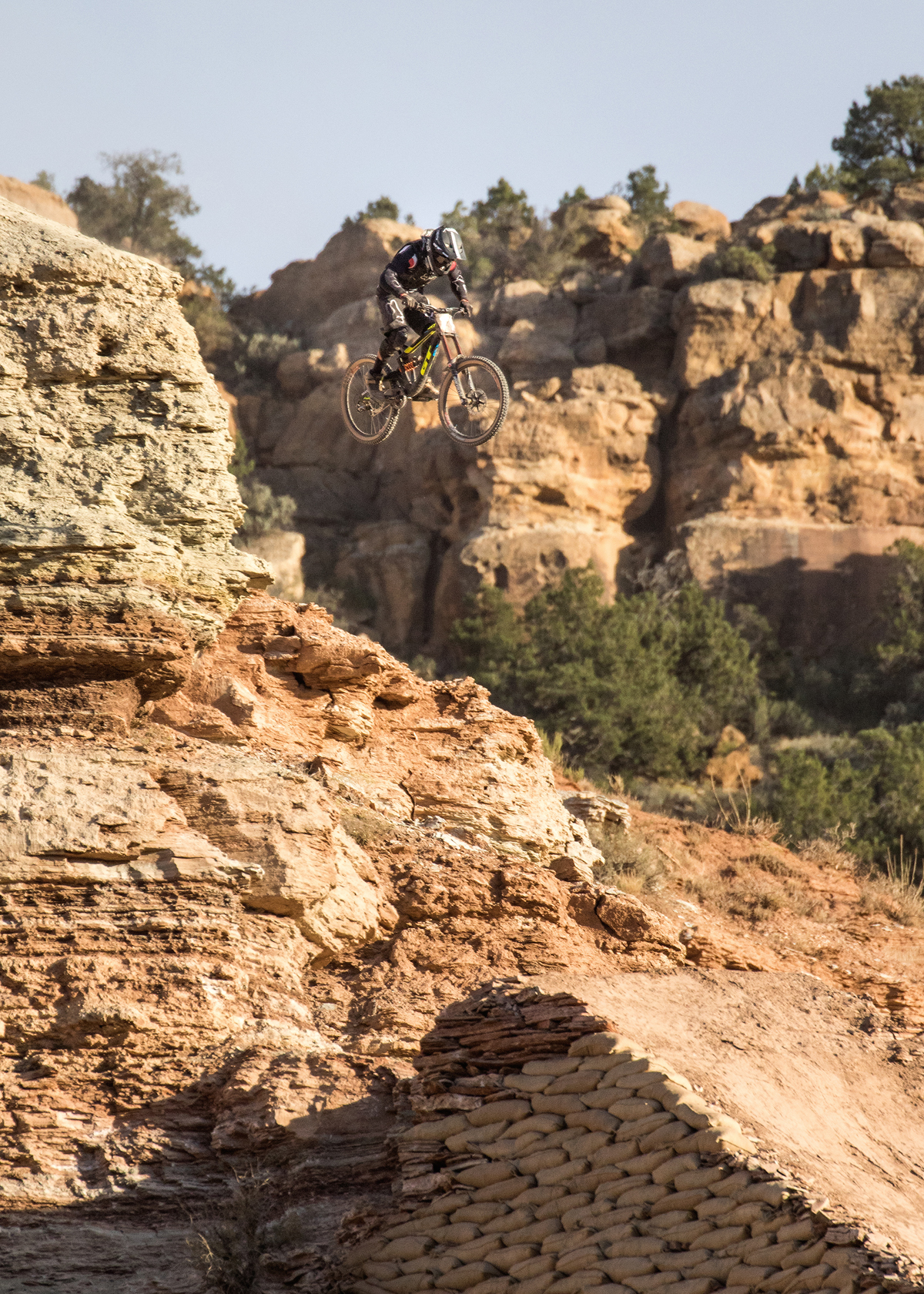
Tyler McCaul, sending the “Green Goblin stepdown during practice on Thursday. 2016 Red Bull Rampage. Photo by Photo John.
Red Bull Rampage is high-risk – there’s no denying that. That’s part of what makes it such a great spectator event. But the competitors are anything but reckless. They’re supremely fit, experienced and very calculating. After reading comments on photos I shared on Instagram and Facebook during this year’s Rampage, I realized most people have no idea what’s really involved. So I posted a photo of 2014 winner Andreu Lacondeguy, stopping at the top of a huge drop (see photo, below) toward the end of Wednesday’s practice session. Andreu rolled up on this drop for over an hour, stopping each time right at the brink. It was pretty scary to watch. He’d drop in from above, get up to speed and stop at the last fraction of a second. Then he’d get off the bike and stare over the edge. Sometimes he’d toss a rock over and watch it fall. Once, he grabbed a shovel, climbed down the cliff to the landing zone and smoothed out a bit he wasn’t happy with.
This kind of behind-the-scenes action is something you only witness if you’re there for a few days. In fact, if you’re on-site while they build and practice, you watch it over and over again, with every rider. Nobody just builds a line and sends it. That would be suicidal. There’s no doubt competitors are nervous about the bigger drops and stunts – they should be. There can be life-changing consequences if things go wrong – the chance of serious injury or even death when you’re 30 feet above the ground is very real. The one Utah competitor, St. George local and 2012 third place finisher Logan Binggeli, crashed on a huge drop during Thursday’s practice and missed the finals due to a concussion.
My point here isn’t actually about fear or consequences, though – it’s about data collection. Red Bull Rampage competitors aren’t crazy – they’re scientists. I don’t think that’s hyperbole, either. I mean it quite literally. The reason Rampage looks crazy to the average person is they have no comprehension of what it takes to be able to ride this stuff with confidence and control. It takes tons of experience and experience is data. Everything the Rampage riders do before they drop in for their final run is data collection. Every practice run is a speed test. Every time they stop and look over a cliff or toss a rock down to a landing, they’re estimating how much speed and what angle of entry they need to safely land. You don’t just show up in Virgin and huck your meat off a cliff. Every rider comes to the event with years of freeride mountain bike experience, which they apply to the new, bigger problems Rampage presents.
When Andreu Lacondeguy finally did hit that drop – about twenty minutes after the sun had set – he landed it perfectly and everyone cheered.
Format Changes
To say there was a huge amount of controversy following last year’s Rampage would be an understatement. After Paul Basagoitia was paralyzed crashing on a huge stepdown, fears and concerns that had publicly gone unspoken for years exploded to the surface. It seemed like every magazine and web site ran some sort of article about risk, athlete compensation and Red Bull responsibility and accountability. Red Bull took a lot of heat and to their credit they made a bunch of changes to try to make the event safer.
The most obvious difference this year was a new location, which turned out to be just the next mesa over – only a few hundred yards to the east of last year’s Rampage site. At first, the new site didn’t appear to me to be that different or special – in fact, to my eye it looked almost the same as the 2013 site. I did notice the huge canyon gaps and big wooden structures of the past few years were missing. With the exception of some sandbag fortifications, everything was cut and built from natural materials found on-site. It turns out one of the changes this year was a limit on construction. Aside from shovels and a limited number of sandbags, no other tools or building materials were permitted and each competitor was allowed just two diggers to help build their line.
The main intent of the Rampage format changes was to make the event safer. To that end, the number of athletes was limited to 21 – the top 12 riders from last year’s competition plus 9 wild card riders. There was no qualifying – just building, practicing and two final runs per rider on Friday. To make sure everyone was fresh, a mandatory rest day was added between the four-day build period and the official start of practice, on Wednesday. To address complaints about unfair results in previous Rampages, this year’s judges were all past competitors.
It’s hard to say whether the changes actually made this year’s Rampage safer. The lack of huge manmade wooden structures made it appear that way. But the new site looks more exposed and steeper at the top and riders were building some really tight, technical lines that required absolute precision. On the other hand, I did feel athletes were being extra careful and calculated about building and testing their lines. Not that they weren’t careful in the past. But it seemed like it took them longer to get around to guinea-pigging the really big stuff.
2016 Red Bull Rampage Finals & Results
As I said earlier, this article isn’t a play-by-play of the event. If you want to see it all, watching the videos on the Red Bull web site or the full show on Red Bull TV is a better way to do that. I will give you a short overview of the lines, highlights and top finishers, though.
There were three clear line sections off the top of the Rampage site – rider’s left, down the middle of the butte and rider’s right. Competitors were allowed two runs in Friday’s finals and rider order in the finals was left to right. Since riders were only allowed two diggers, the build teams worked together for efficiency and there was a lot of line sharing. Of course, no two riders rode the exact same line. Each competitor built something unique and kept some tricks up their sleeve for Friday’s finals. The building cooperation did ensure there weren’t any complaints about line poaching as there have been in previous years.
The left line was shared by Rampage veteran Darren “Bearclaw” Berrecloth, young gun Carson Storch and Tyler McCaul. The top of that line is ridiculously steep and exposed and it was scary to watch them drop in and billy-goat their way down to the massive “Green Goblin” stepdown gap (see photo, below). After the Green Goblin, they rode an exposed ridge with a couple of big jumps before their lines diverged. All three riders had huge drops after the ridge, after which they dropped into the huge jumps trick jumps at the bottom of the course.
Carson Storch is just 23 and this was his third year at Rampage. He made a big impression at his first Rampage in 2014 with big lines, lots of tricks and a couple of huge crashes that didn’t seem to faze him. This year everything came together for him. He rode the steep, exposed “Impassable Route” on rider’s-left with style, confidence and amplitude. A perfectly-executed 360 stepdown off the ridge got a huge cheer from the crowd and earned him this year’s best trick award. He wrapped up his run with a monster flat 360 on the bottom trick jump to land himself a third place podium spot.
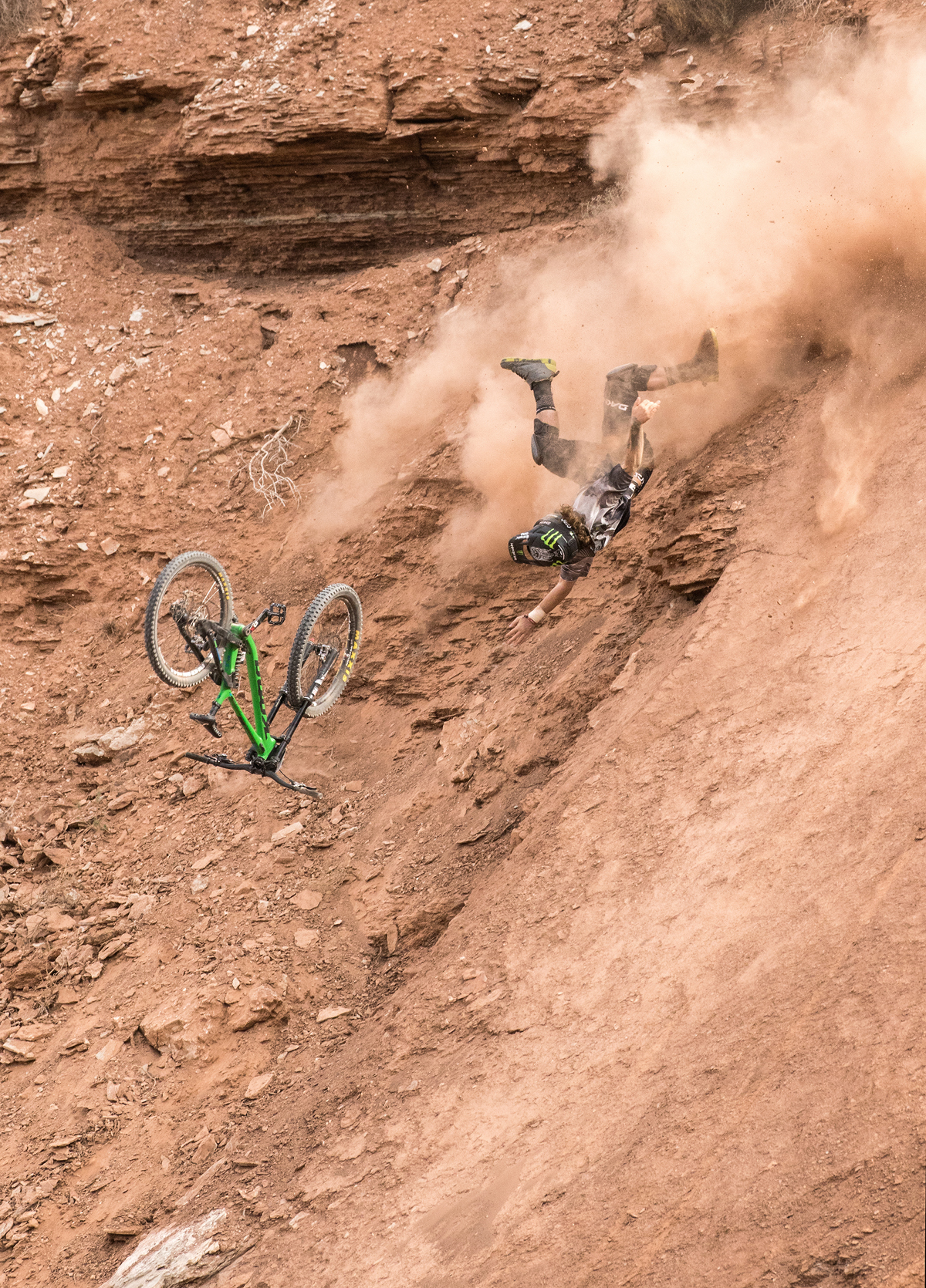
Graham Agassiz’s terrifying crash during Friday’s finals. He broke his pelvis and should recover just fine. 2016 Red Bull Rampage. Photo by Photo John.
Only two riders, Graham Agassiz and James Doerfling, took the middle line off the top – rolling down the throat of the butte on a straight elevator drop line. It was hard to take pictures that did this section justice but it was one of the most intimidating-looking lines of the competition because it was so steep and fast. Agassiz, a crowd favorite, was having an awesome first run, stomping the top section then going big and fast across the main ridge. But in the middle of his run he 360’d a huge step-down drop and missed his landing. It was, hands-down, the nastiest crash (see photo, below) of the competition – exactly the kind of thing we don’t want to see at Rampage. It was a very scary moment but he was taken away conscious and moving. Apparently he broke his pelvis, which is terrible. But he will have a full recovery. If he’d landed that 360 it probably would have put him on the podium – maybe even the top spot.
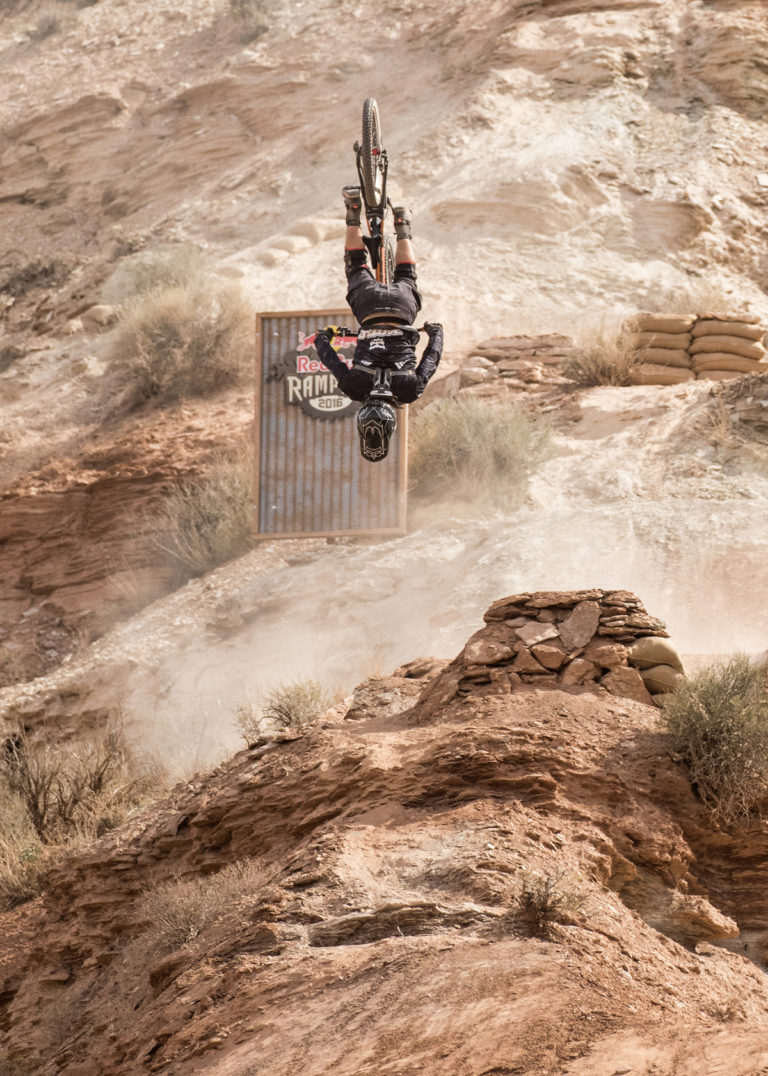
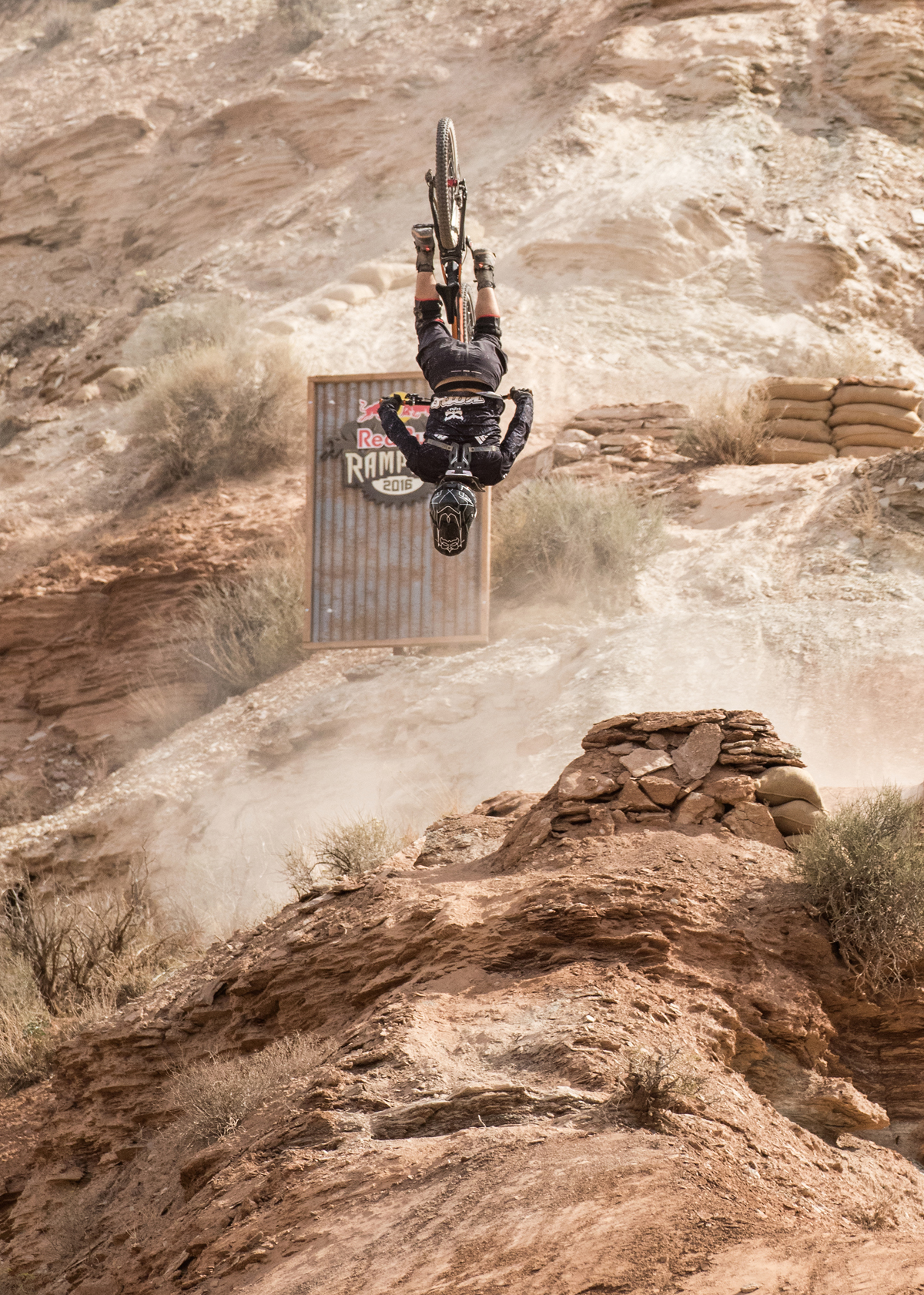
A huge backflip in finals by this year’s second place finisher, Antoine Bizet. 2016 Red Bull Rampage. Photo by Photo John.
The rest of the competitors started rider’s right with two huge, steep, exposed drops followed by a high ridge that led to two descending ridges with big stepdown jumps. French rider Antoine Bizet rode the first two drops smoothly then dropped to the middle ridgeline where he crushed a big backflip stepdown followed by a huge, fast drop. According to Rampage announcer Cam McCaul, Bizet has wanted to do a double backflip at Rampage for some time; and he had done one in practice. So there was a lot of expectation as he hit the last big drop that sets riders up for the big trick jump at the bottom of the course. And he stomped it – two full rotations for a double backflip – the first ever at Red Bull Rampage. That earned Bizet his second second-place spot at Rampage. He also took second in 2012.
Brandon Semenuk, this year’s winner, also rode the main line, dropping in on rider’s right. Always a fan favorite, Semenuk is a technical slopestyle specialist. But he’s also comfortable on the big, raw Rampage terrain and already had a 2008 win under his belt. So expectations were high as he dropped in. He built his own line off the ridge with a huge, technical double drop (see photo, below). He also tricked nearly every lip he hit, including a flat spin 360 on a step up, a super technical flat backflip off a hip and a huge backflip on the bottom trick jump. It was well-deserved win. He combined lots of speed, control, confidence and a big bag of tricks to join a very small club of two-time Rampage winners.
It wouldn’t be right to forget Conor MacFarlane, the winner of the first Red Bull Rampage Kelly McGarry Spirit Award. Given to the rider that best exemplifies the joyful, positive spirit of everyone’s favorite freerider, Kelly McGarry, Conor was the obvious choice for the award. Not only is he from New Zealand, just like Kelly, but he refused to give in to adversity. Scabby, bloody and bandaged, Conor crashed and crashed and crashed – but he never quit. There’s no doubt Kelly would have approved of giving him the award.
Conclusion
To summarize – Red Bull Rampage is nuts. But the competitors aren’t. It just looks crazy if you have no knowledge of the rider’s skills, care and calculation.
As far as safety goes, I’m not sure this year’s format changes actually made the event safer. It looked to me like there was more exposure and the competitors certainly weren’t being conservative in their line choices. There were a few scary crashes but luckily the worst injury was Graham Agassiz’s broken pelvis. I do think there’s more sensitivity to rider safety, though. Rampage is a super exciting event that’s great for spectators, TV and increasing interest in mountain biking. That’s great, as long as it’s not at the expense of competitors’ bodies or lives.
By Madison Baumann – After months of training, my riding partner Laura Dusold and I were finally hitting the pavement for our 50-mile Summit Challenge tandem ride. We started early, just after the sun came up, hoping to beat the heat later in the day. It could have been our nerves – or the cold – but as we set out on the first 16 miles of our 50-mile route, hardly a word was spoken.
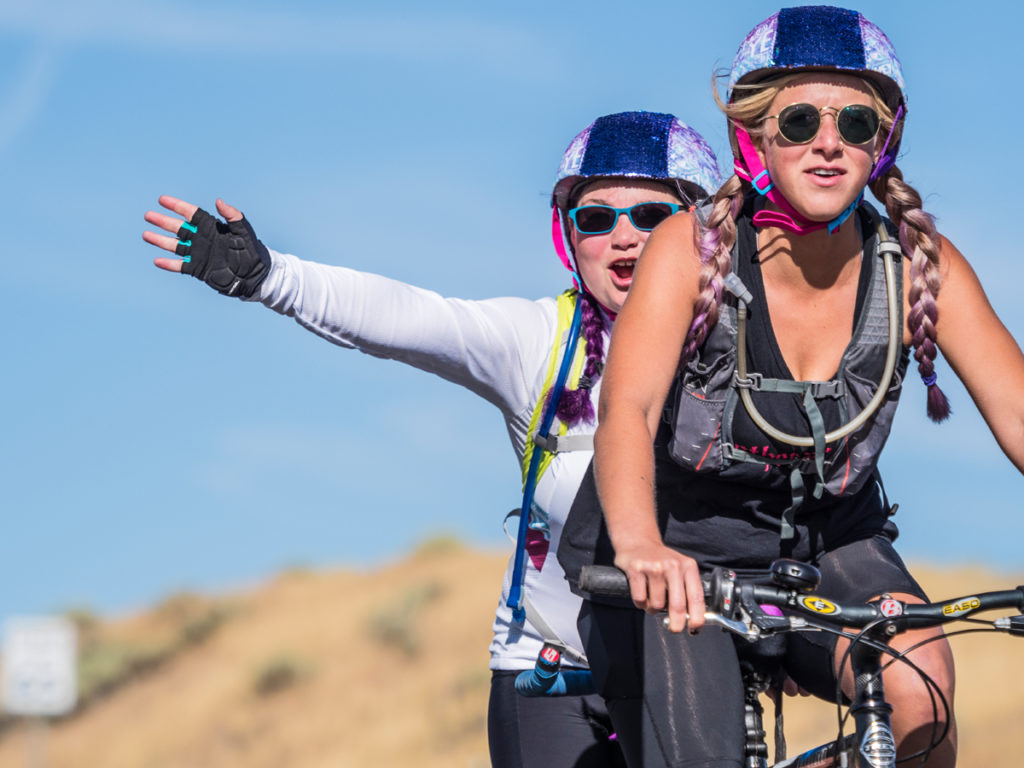
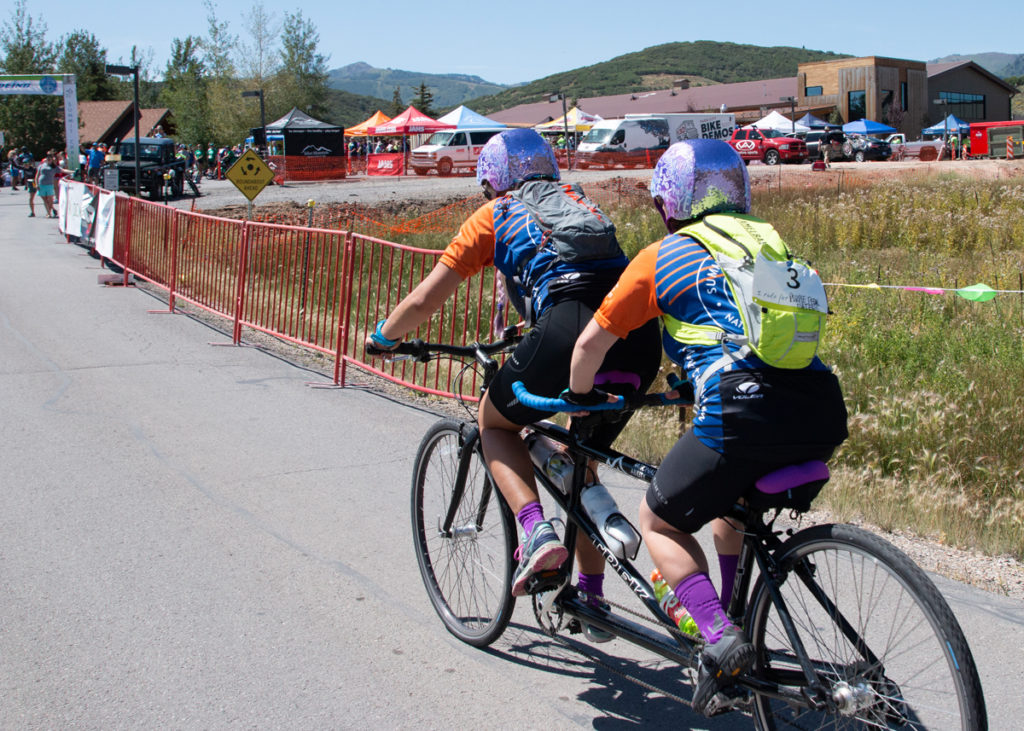
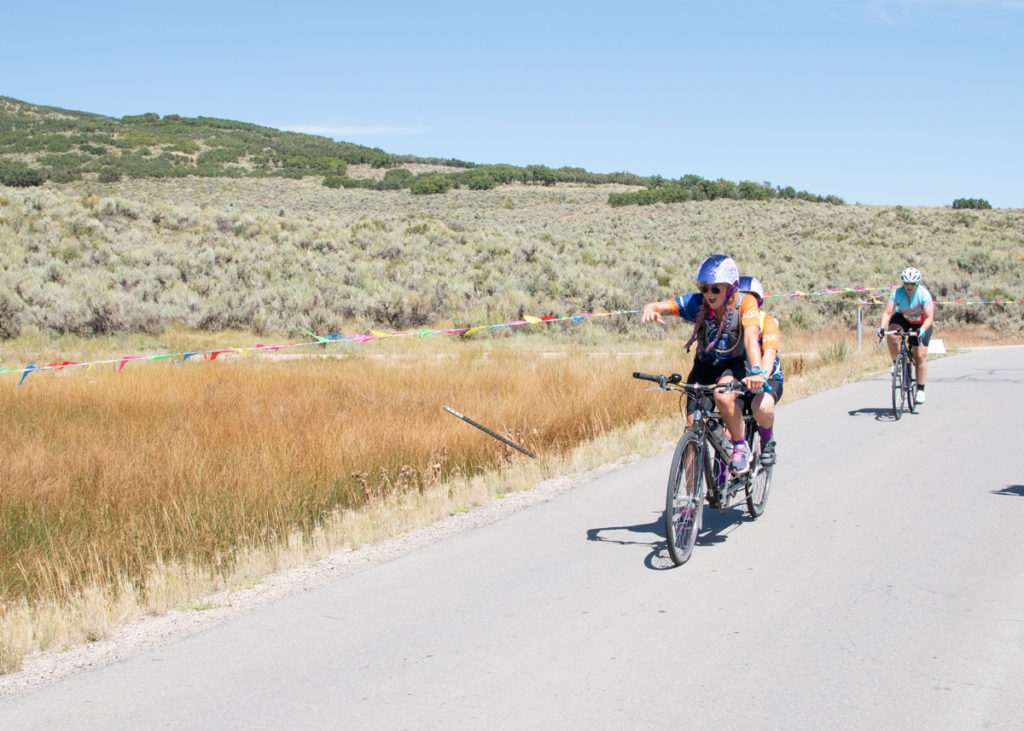
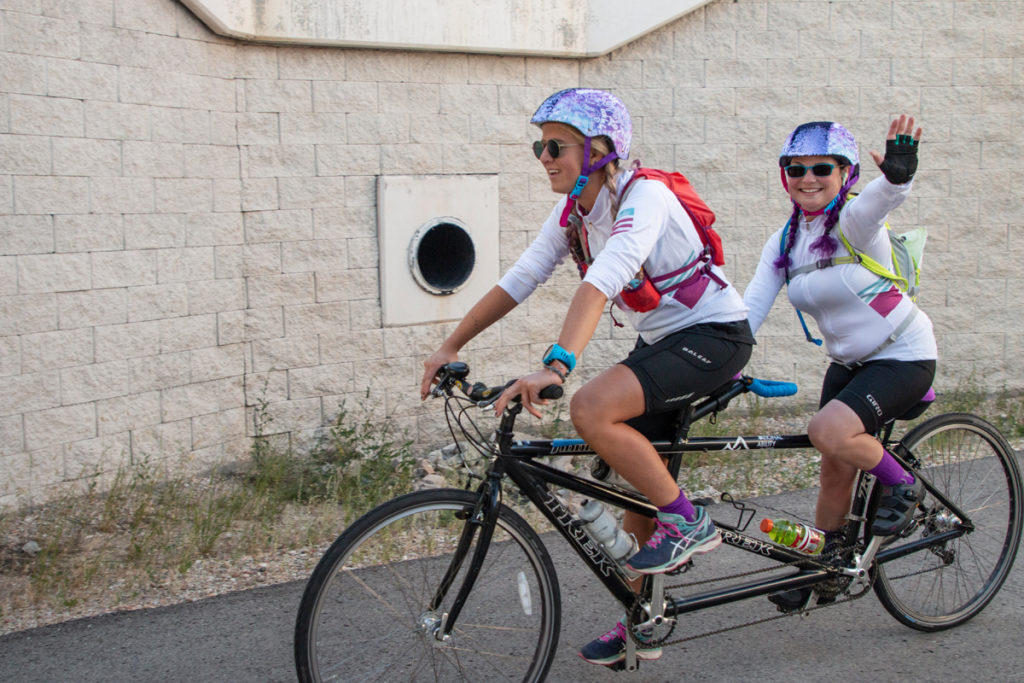
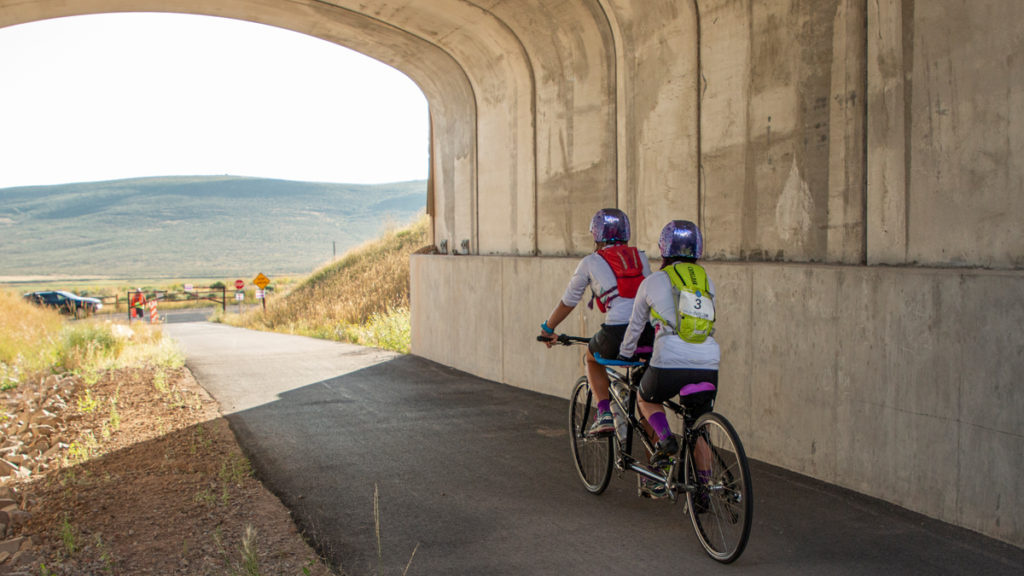
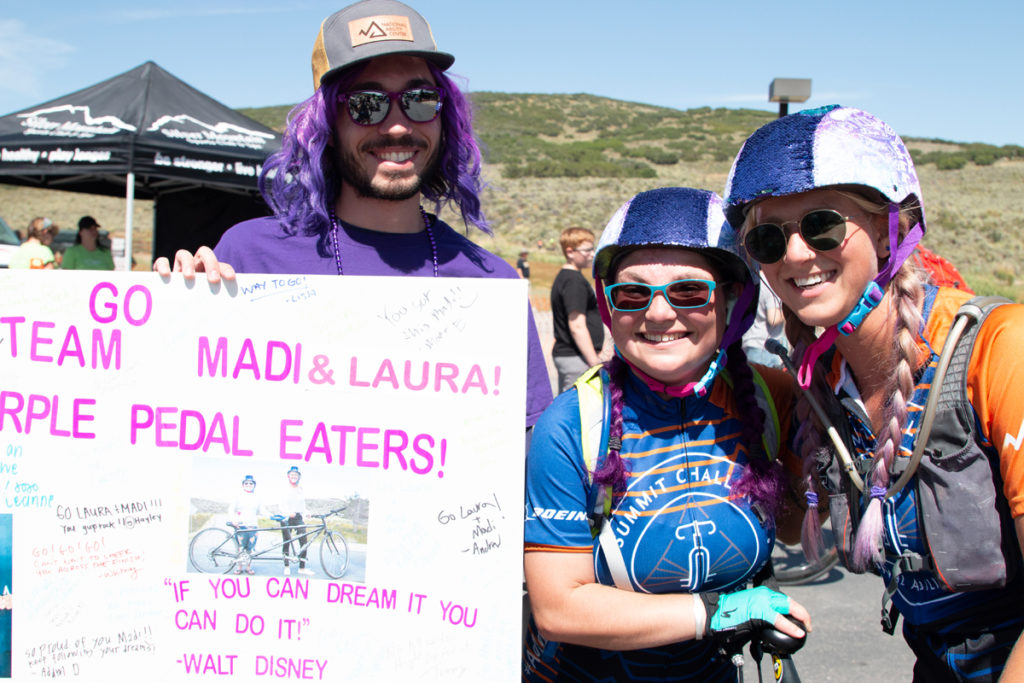
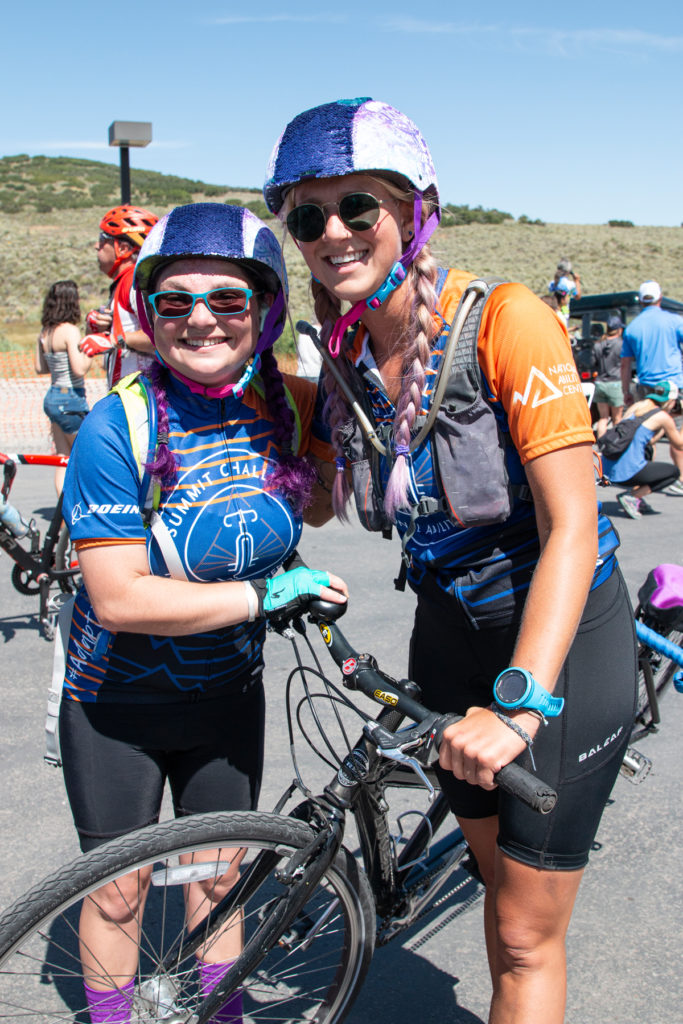
Madison Baumann (left) and Laura Dusold completed the Summit Challenge 50 Mile ride on a tandem. Photo by Jon Scarlet
Since we started our ride ahead of most, we had the first portion of the course to ourselves along with a few hand-cyclists. who had also set out. Getting a jump start is an awesome option for any adaptive rider in the Summit Challenge who might require a bit more time or need to avoid the crowds of the main field.
You see, this wasn’t an ordinary ride, where chatting is more difficult than silence and you only factor in one person’s cadence, psychology, pacing and fatigue. I am a visually impaired athlete, so I ride a tandem with my cycling partner, Laura who acts as my eyes. We must pedal at the same time, rest at the same time and trust in one another as we take on this new challenge. If one of us bonks, we’re both in trouble.
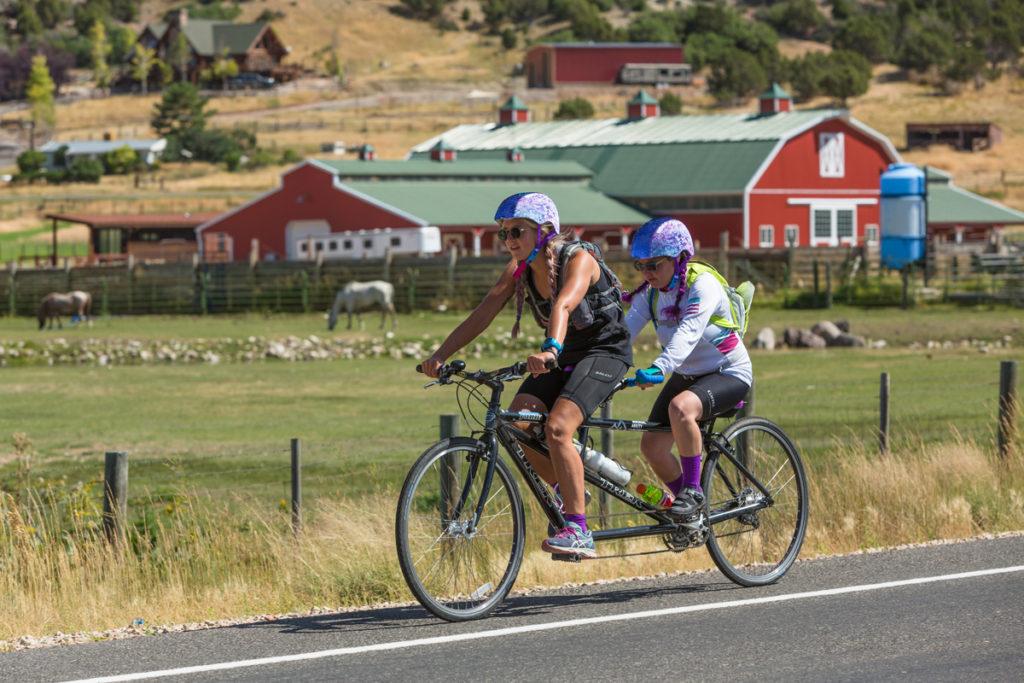
PARK CITY, UT – August 24, 2019: Madison Baumann (right) and Laura Dusold in the National Ability Center Summit Challenge. National Ability Center Summit Challenge @ Browns Canyon 50/80/100-Mile Route (Photo by Don Cook)
The quiet roads made for easy pedaling and we soon found ourselves completing the 16-mile course and flying up the first major climb of the 50 mile route heading towards Kamas and flanked by the Jordanelle Reservoir. At this point, the fastest Summit Challenge 80-mile riders began making their way by us.
Sometimes being passed on a climb can be disheartening, but we were together, riding our tandem in matching jerseys and purple sequined helmet covers. Our team name was the Purple Pedal Eaters, hence all the purple. So, as riders passed, they cracked jokes about how if this were a downhill race, we’d be in the top five. Some even asked if there was room for a third on our bike. With each passing rider, our motivation grew, and we found it easy to hammer to the top of the climb.
The payoff? A great decent and cruise through the Kamas Valley. With Laura as my eyes, we easily navigated the downhills, laughing our way past cows, pastures and mountains. We even got to chat with a friend of ours who lives along the route and happened to be outside gardening as we rode by.
Then came Brown’s Canyon. Towards the end of the ride and at the hottest part of our day, this climb had lingered in the back of our minds throughout our months of training. A week before Summit Challenge, we tried this exact climb and we almost didn’t make it to the top. But this time, as we headed into the final push of the canyon, when Laura turned her head and said to me, “Madi, we’re going,” I knew we would make it to the summit.
It wasn’t long before we had left Brown’s Canyon in the background and found ourselves pedaling up Ability Way and into the finish line at the National Ability Center where our friends, coworkers and fellow riders cheered us along through the final mile, with music blaring!
We celebrated with burgers and a cold beer in the event village. The feeling of accomplishment was well worth it. Every training ride we almost canceled but went on anyway. We thankfully only encountered one fall during our months of training which helped me learn to trust Laura as my eyes, steering and tandem partner along the way even more. Next year, Laura and I have decided to up the ante and take on the Summit Challenge 80-mile route together. See you there in August 2020!
A benefit for the National Ability Center, the 12th annual Summit Challenge took place on Saturday, August 24, 2019 tracing many favorite road rides throughout the Park City, Kamas and Heber areas. This fully-supported ride offers several options including a 1-mile Discovery Loop, a 16-mile, 50-mile, 80-mile and 100-mile route. The event supports adaptive cycling, mountain bike and winter fat biking programs at the National Ability Center and also invites adaptive riders to participate in the Summit Challenge at no cost. The National Ability Centerprovides buddy riders, adaptive equipment like tandems, recumbent bikes and handcycles for adaptive cyclists in the Summit Challenge and offers ongoing NAC cycling programs. To learn more about the National Ability Center or becoming a volunteer, visit discovernac.org.
Editor’s Note: See part one of Riding Blind in the Late Summer 2019 issue of Cycling West, online at cyclingwest.com
Madison Baumann and Laura Dusold were Team Purple People Eaters. They completed the 50 mile ride on a tandem in the 2019 Summit Challenge. Photo by Bailey Edelstein.Madison Baumann and Laura Dusold were Team Purple People Eaters. They completed the 50 mile ride on a tandem in the 2019 Summit Challenge. Photo by Bailey Edelstein.Madison Baumann and Laura Dusold were Team Purple People Eaters. They completed the 50 mile ride on a tandem in the 2019 Summit Challenge. Photo by Bailey Edelstein.Madison Baumann and Laura Dusold were Team Purple People Eaters. They completed the 50 mile ride on a tandem in the 2019 Summit Challenge. Photo by Bailey Edelstein.Madison Baumann and Laura Dusold were Team Purple People Eaters. They completed the 50 mile ride on a tandem in the 2019 Summit Challenge. Photo by Bailey Edelstein.Madison Baumann and Laura Dusold were Team Purple People Eaters. They completed the 50 mile ride on a tandem in the 2019 Summit Challenge. Photo by Bailey Edelstein.
New Research Finds Public Investment in Trails, Walking and Biking Infrastructure Delivers Potential Economic Benefits of $138.5 Billion Annually. Rails-to-Trails Conservancy’s newest study, “Active Transportation Transforms America,” provides nation’s most comprehensive analysis of the quantifiable health, climate, mobility and economic impacts of public investments in trails, walking and biking
WASHINGTON, Oct. 15, 2019 /PRNewswire/ — Rails-to-Trails Conservancy (RTC) has released findings from “Active Transportation Transforms America,” the nation’s most comprehensive analysis of the quantifiable impact of trails, walking and biking on the places we live.
The study, which aggregated data about the health cost savings, climate protection, mobility and direct economic value of trails and active transportation, found that currently active transportation infrastructure contributes more than $34.1 billion to the U.S. economy annually. As infrastructure connectivity improves, the economic contribution of active transportation infrastructure has the potential to be more than $138.5 billion each year, a return that’s nearly seven times greater every year than the cumulative investment of $20 billion that’s been made in trails and walking and biking projects via federal programs over the past three decades.
“The findings of Active Transportation Transforms America are motivating,” said Kevin Mills, RTC’s vice president of policy. “RTC first analyzed the potential economic benefits of trails, walking and biking more than 10 years ago, and while those numbers were promising, we didn’t have the data or the methodology to truly understand the economics of trails at a national scale. Now we can prove what we’ve always known. Connecting trails and walking and biking infrastructure can change our communities—urban, suburban and rural—for the better. And as the connectivity of trail networks improves, so does the health of people and places.”
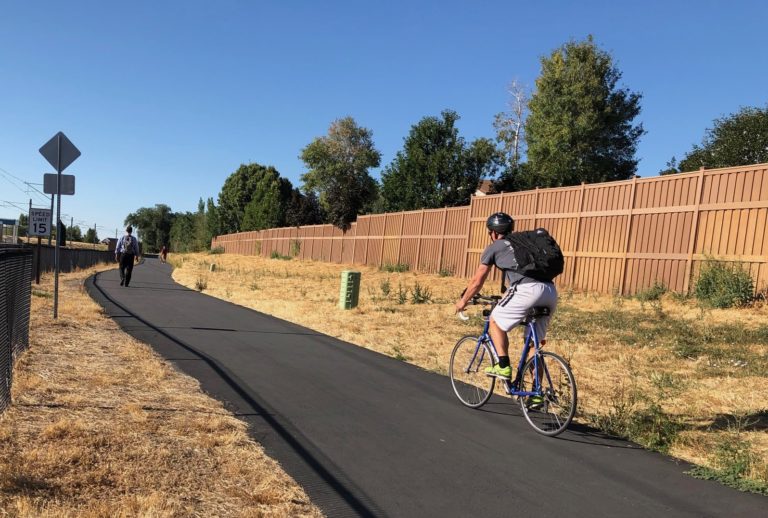
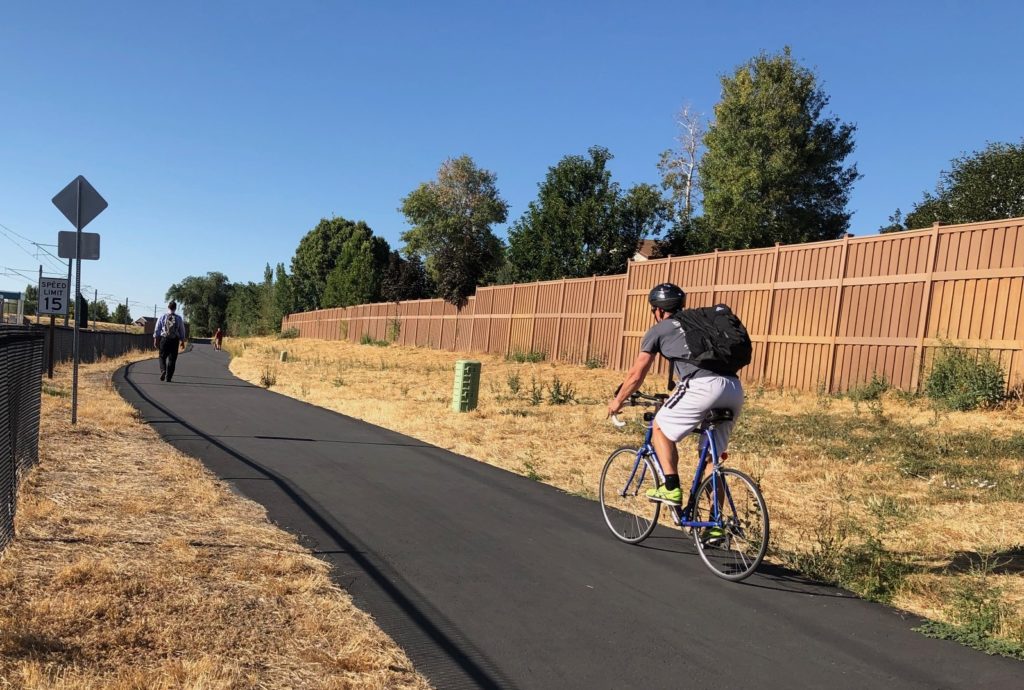
Pathways, such as the Porter Rockwell Trail in Sandy, Utah shown here, have a great return on investment for health, economic impact, and the environment. Photo by Dave Iltis
RTC released its findings during a webinar on October 15, 2019, where Mills was joined by Leslie Richards, secretary of the Pennsylvania Department of Transportation; Martha Williams, director of Montana Fish, Wildlife and Parks; and Jim Kolb, partner at Summit Strategies. The panel addressed issues of transportation reform, provided examples of effective state and local implementation, and explored key report findings that outline the transformative power of connected trail and active transportation networks.
During the webinar, RTC demonstrated the discrepancies between demand for active transportation infrastructure and investments made. The majority of trips taken in this country are within a 20-minute bike ride or less, more than one in four trips are within a 20-minute walk or less, and 11.5% of all trips are made by walking and biking. Yet, current federal transportation policy only invests less than 2% of funds in bicycle and pedestrian projects. At the same time, bicyclist and pedestrian injuries and fatalities are skyrocketing while other vehicle-related fatalities are on the decline. RTC’s report and the findings come as Congress takes up debate to reauthorize the nation’s federal transportation bill, a critical juncture that will define federal spending on active transportation for years to come.
“The time is now for Congress to be bold to pass a transformative transportation bill that invests in a balanced system that meets America’s evolving transportation needs,” said Mills. “We have the evidence that demonstrates how essential active transportation can be to our communities, but we’ll only realize that potential when we treat trail and active transportation networks as necessary components of our transportation system.”
Key findings from the report that provide quantitative evidence underscoring the value that active transportation delivers and the power of every dollar invested in active transportation infrastructure include:
Return on investment (ROI): The current ROI of active transportation infrastructure, which accounts for fuel savings, CO2 reduction, net spending impact of rail-trails and health cost savings, is $34.1 billion annually and has the potential to grow to $138.5 billion annually.
Mode shift and environmental benefits: The value of fuel savings from shifting short car trips to walking and bicycling trips, using walking and bicycling to access public transit, inducing mixed use, and reducing congestion is currently $3.3 billion annually, which could increase to nearly $22 billion annually.
The amount of CO2 saved annually could grow from 13 million tons to 54 million tons annually.
Calculations of economic impact: The total local spending impact of the nation’s 2,218 rail-trails is $10.6 billion annually, which could grow to as much as $21 billion annually.
Health cost savings: Health cost savings from increased physical activity due to active transportation is currently $20 billion annually and could grow to nearly $92 billion annually.
According to RTC, focused public investment in connecting active transportation infrastructure is key to realizing the most substantial benefits for the nation. RTC is calling on Congress to double active transportation funding by growing Transportation Alternatives and curbing transfers so that meaningful opportunities are provided in all states to develop safe places to walk and bike; tripling funding for the Recreational Trails Program, the only federal funding source that supports trail maintenance, to reflect recreational fuel taxes and ensure good repair as trails age; and establishing focused funding for connectivity that invests in active transportation networks—which ensure that people can safely travel within their communities, and between residences and routine destinations such as jobs, schools, commercial centers and transit—and spine trails, which connect between communities and states.
Rails-to-Trails Conservancy is the nation’s largest trails organization—with a grassroots community more than 1 million strong—dedicated to connecting people and communities by creating a nationwide network of public trails, many from former rail lines. Connect with RTC at railstotrails.org and @railstotrails on Facebook, Twitter and Instagram.
UPDATE: 10/7/2019 – Due to early season valley snow in Cache County, the opening of the Bridger Bike Park is being rescheduled for October 16, 2019.
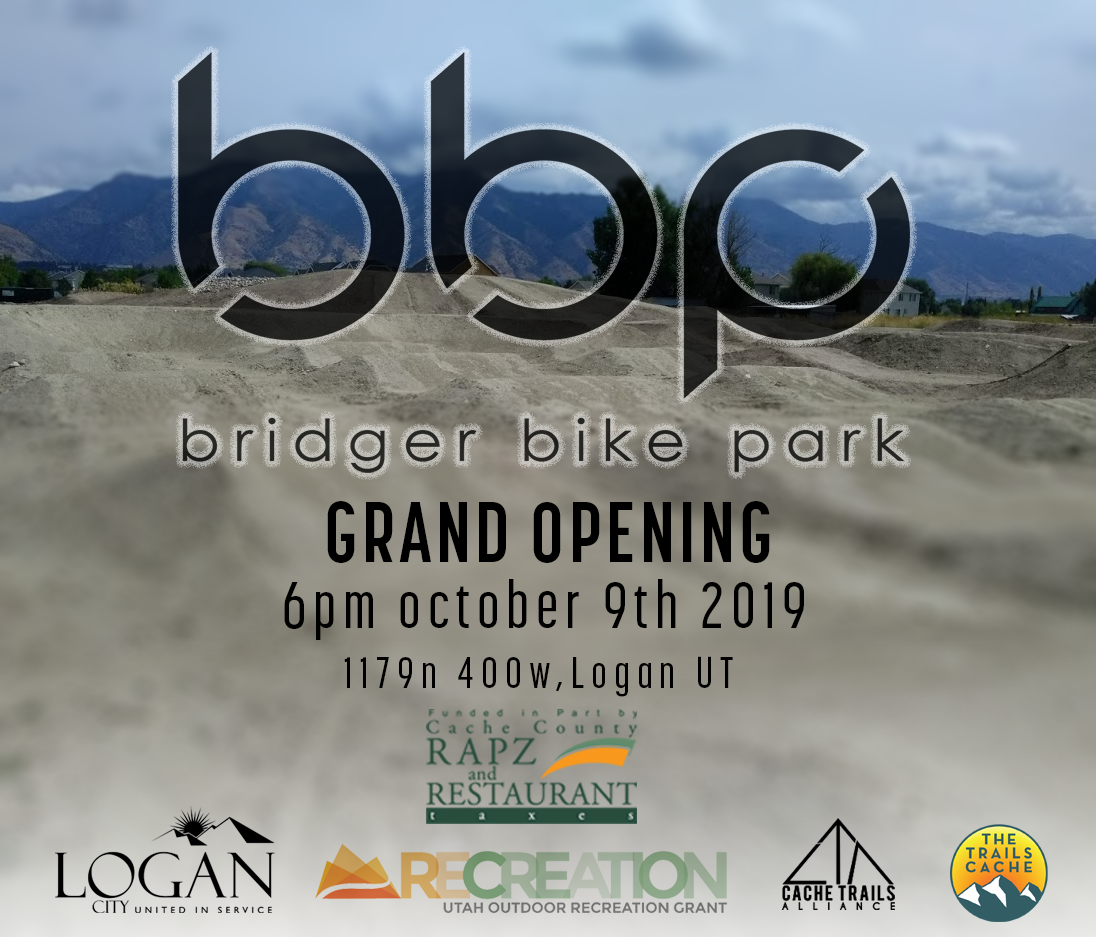
The Cache Metropolitan Planning Organization’s (CMPO) Bicycle Planning Advisory Committee (BPAC) is excited to announce that on October 9th, 2019, at 6pm, the City of Logan, Utah will unveil the brand new Bridger Bike Park. The Committee invites all residents of the area to come out to explore the park and meet the community that has worked so hard over the last 3 years to make this happen.
Designed with many challenging features, cyclists of all skill levels should be able to find enjoyment at the park, but users should be aware that not all features are suitable for all riders. Children must be supervised, and helmets will be required at all times.
Located at 1179 North 400 West, just west of Bridger Elementary, the facility is being built through collaborations between Logan City funding, community fundraising, the Cache County RAPZ tax and Utah Outdoor Recreation Grant.
Please note that the park is closed until the Grand Opening due to ongoing construction. The Committee requests that the public refrain from accessing or using the park beforehand for the safety of residents and construction workers alike.
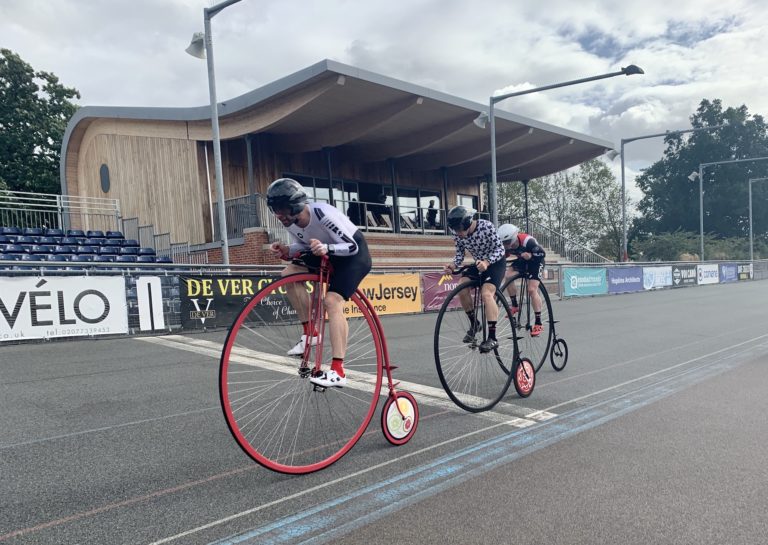
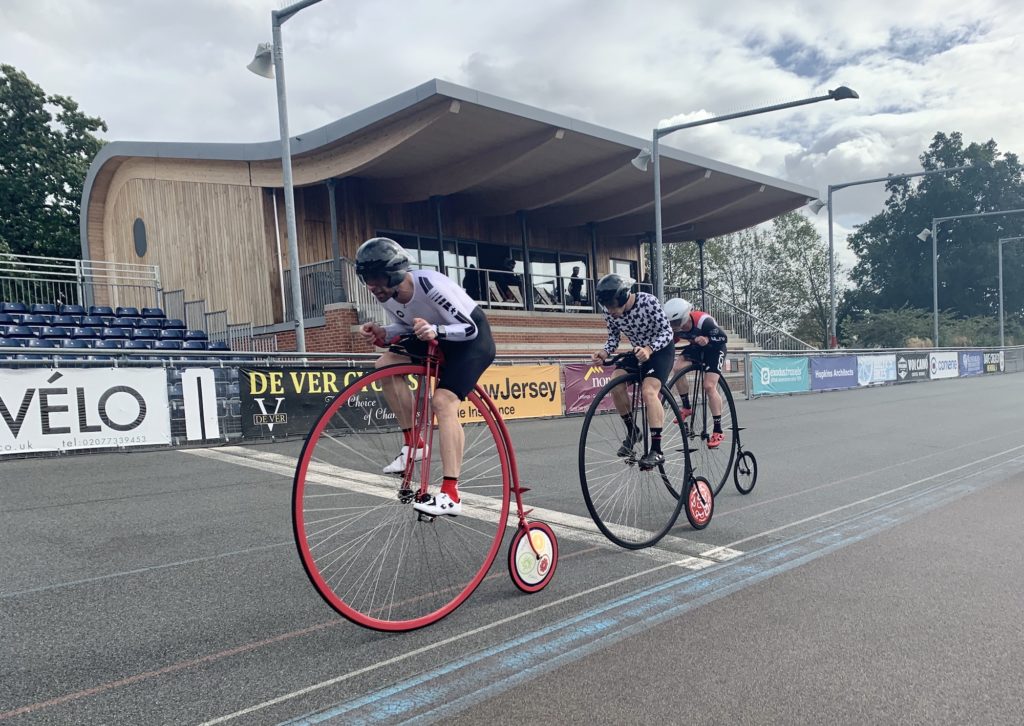
BATH, UK (October 15, 2019): Chris Opie is the new holder of the Penny Farthing World Hour Record, having broken the historical mark at Herne Hill Velodrome, London, UK. Opie beat the previous distance, which had stood for 133 years, with the aid of two pace setters: Around-the-World Cycling Record holder Mark Beaumont and James Lowsley-Williams.
Photo courtesy Play Sports Group
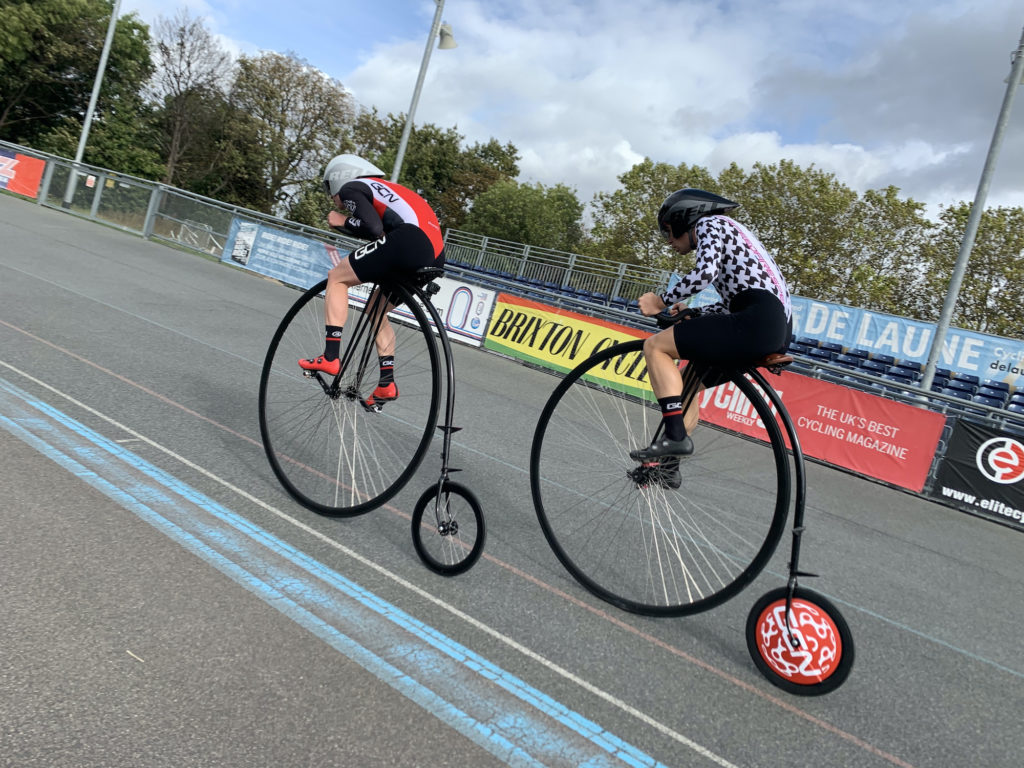
Riding authentic penny farthing bikes – using technology from the Victorian era – the three riders took to the track on Thursday 10th October to take on the unusual challenge. The team averaged around 35kph – a huge level of effort to hold over 60 minutes and a staggering achievement, with Opie setting the new distance of 35.743km (or 22 miles and 369 yards, as the 19th-Century statisticians would have recorded it).
The previous World Record was set by WA Rowe in 1886 – when Queen Victoria was on the British throne and Grover Cleveland was in his first tenure as President of the United States. Electricity had been invented by this point but most homes wouldn’t have access for another 50 years. Karl Benz had created a motor vehicle with an internal combustion engine – yet the Model T Ford was still nearly 30 years away. It was 105 years after Rowe’s record that the first-ever web page went live on the World Wide Web.
Before the invention of the conventional bicycle form that we still recognise today, penny farthings had a massive wheel at the front, a tiny one at the back, no gears, no suspension, and as the GCN presenters recently learned, it was a wise precaution to employ a support crew even to get on and off of them.
A formidable athlete, Rowe was one of the first great American sporting heroes. He was portrayed on cigarette cards and used sponsored kit: by contemporary standards, he was a professional rider. He first broke the Penny Farthing World Hour on October 1885 with a distance of 20 miles and 1025 yards (33.124km) at the Springfield track in Massachusetts, returning a year later to extend his own record twice at the same meet. His last mark of 22 miles and 150 yards (35.542km), achieved with three pace setters, put the record on the shelf for almost 133 years until the GCN team of Opie, Beaumont and Lowsley-Williams took to their ‘high-wheelers’.
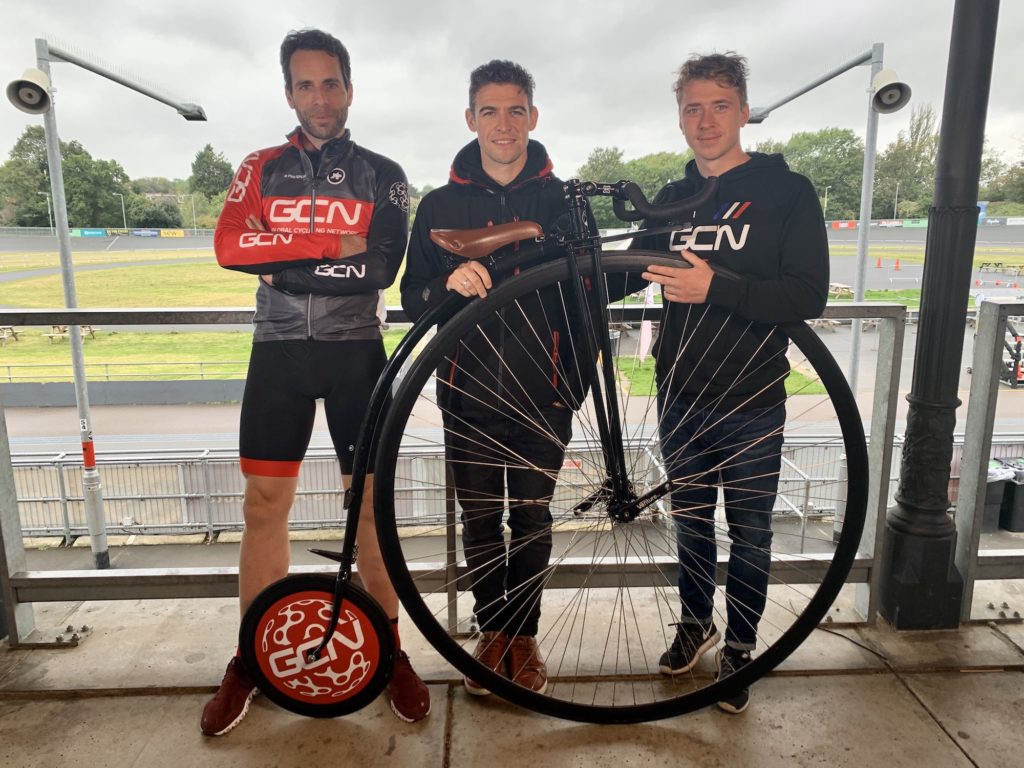
L-R Mark Beaumont, Chris Opie, James Lowsley-Williams. Photo courtesy Play Sports Group
Setting the new Penny Farthing World Hour Record has taken some preparation. In June 2018 Mark Beaumont set a new British record at the World Cycling Revival Festival, also at Herne Hill. The hour challenge may have been shorter than the Around-the-World exploits Beaumont is most famous for, but it proved just as tough and he fell 290 yards – just over a lap – short of Rowe’s.
Beaumont and Opie and Lowsley-Williams joined forces more recently to set the inaugural World Indoor Penny Farthing Hour Record at Derby Velodrome in September 2019.
The three riders each made individual attempts, and it was Opie who went fastest, setting the record by riding a distance of 34.547km (21 miles and 821 yards). Perfect preparation for the ‘outdoor’ ride.
For the record-breaking ride at Herne Hill – a shallow concrete bowl measuring approximately 450m with the steepest banking 18° – the penny farthings were provided by Neil Laughton, Secretary of the Penny Farthing Club, who has also supported the previous attempts. A British Cycling official ran all the hour timings and calculations to adjudicate the ride.
The successful attempt was a team effort with all the three riders working together to achieve record pace. Opie was first across the line, breaking Rowe’s previous record by 200m. This equates to the team riding with a power difference of + 3.9w, and finishing 20 seconds faster.
Photo courtesy Play Sports Group
Around-the-World Cycling Guinness World Record holder Mark Beaumont said: “This World Record has been two years in the making for me, a decade in the making for Neil Laughton and 133 years in the making since William Rowe set down the gauntlet. I have absolutely loved reliving the very earliest history of the cycle sport, realising the grit, power and downright speed of those Victorian heroes.”
New Guinness Indoor World Penny Farthing Hour Record holder Chris Opie said: “It is a really special and unique experience to have ridden and raced these historic contraptions. Without the help and support of Mark and James we wouldn’t have been able to set a new World Record; being part of that team effort is what really set this record apart!”
Neil Laughton, Founder of the Penny Farthing Club, said: “I am immensely proud to have brought penny farthing riding to the attention of GCN’s elite pro riders and facilitated this magnificent hard-won World Record. Mark, James and Chris have returned to Britain a historic sporting record that has been revered in America for 133 years. It’s a phenomenal achievement.”
Simon Wear, Founder and CEO of Play Sports Group, said: “We’re so proud to have broken yet another World Record – on a penny farthing, no less. It’s another great challenge and although the bikes look comical and lots of fun to ride, these guys are incredible athletes and the hard work they put into winning the record cannot be overlooked or outweighed. It was great to have Mark join us once again for this challenge and we can’t wait to see what James, Chris and the other GCN presenters have lined up for more record-breaking achievements.”
Beaumont, Lowsley-Williams and Opie’s Penny Farthing World Hour record attempt will be featured in a future Global Cycling Network Show.
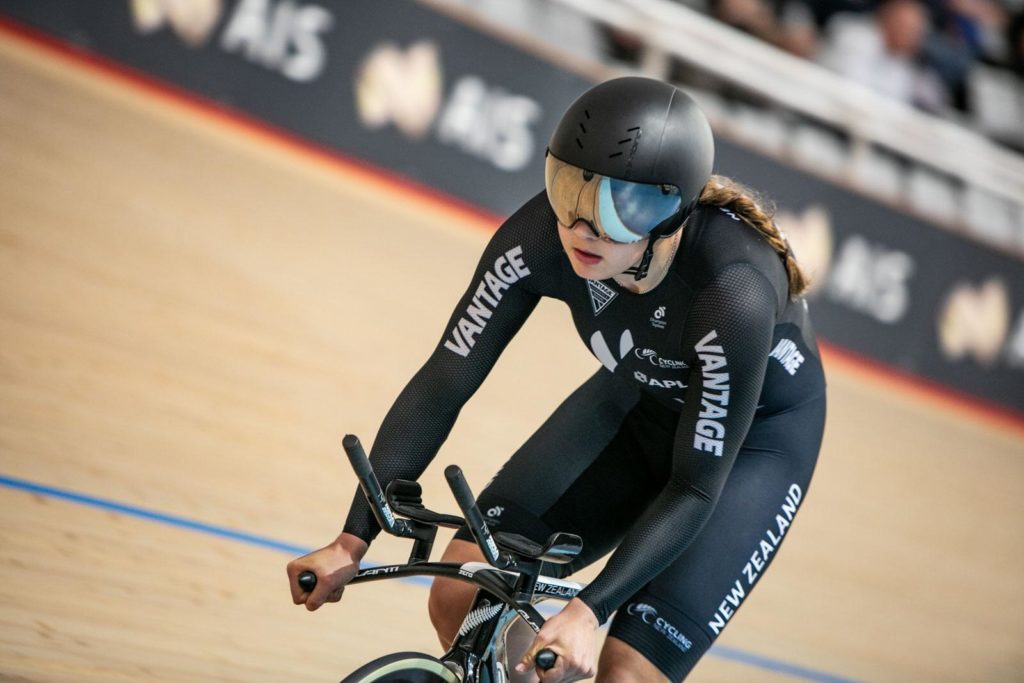
SALT LAKE CITY, UT (October 15, 2019) – The DNA Pro Cycling team is happy to announce the signing of Maggie Coles-Lyster from Canada and Nicole Shields from New Zealand for the 2020 season. Both are 20 years of age with track backgrounds, racing for their respective national teams. Notching substantial results on the velodrome, which include a UCI Junior World Championship and an Oceania Championship, the pair are sure to add excitement to road racing competitions in North America.
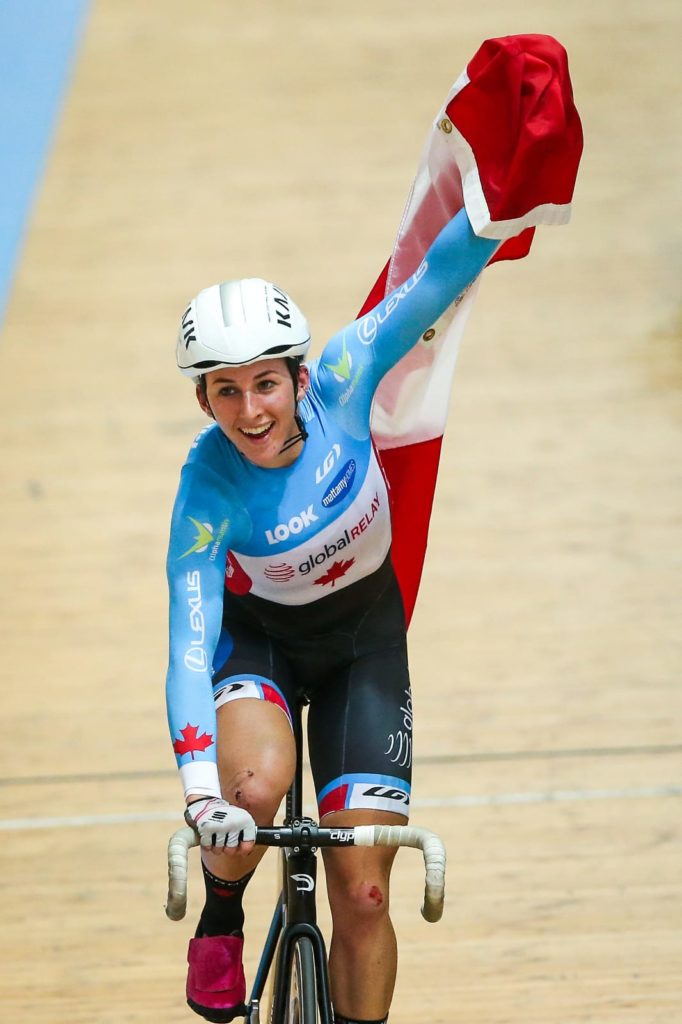
Canada’s Maggie Coles-Lyster joins DNA Pro Cycling 2020. Photo courtesy DNA Pro Cycling Team
Based in British Columbia, Maggie Coles-Lyster began racing at the age of 8. After testing her legs across all disciplines of cycling, she found herself excelling in both track and on the road. An advocate for women’s equality in sport, she is hoping to have the opportunity to represent her country in future Olympic Games.
A tactical all-rounder, Coles-Lyster earned the rainbow stripes becoming the 2017 Junior Track World Champion in the points race, she was also second in the omnium. This season she took first at the Tour of Somerville, first in the scratch race at the UCI US Sprint GP, and silver medals at the Pan Am Games in team pursuit and the madison. She finished second in the downtown criterium at the 2019 Tour of the Gila while racing for Team Canada, behind stage winner Chloé Dygert-Owen.
New Zealand’s Nicole Shields joins DNA Pro Cycling 2020. Photo courtesy DNA Pro Cycling Team
Raised in a small town in the South Island, Nicole Shields moved to Cambridge to pursue cycling with New Zealand’s national track team. After reaching the podium in 2017 at junior worlds in the team pursuit, she also hopes her development on the road will act as an important stepping-stone towards her Olympic dreams.
As a U19 rider, Shields took first place in both New Zealand’s Individual Pursuit Track Nationals and the Team Pursuit at the Oceania Championships. This year she took first in the madison at the UCI Fastest Women on Wheels race (with Michaela Drummond) and first in the omnium at the UCI Keirin Cup.
“We are really excited for next seasons’ completed roster,” said Cathy Fegan-Kim, director sportif for the team. “We have a strong variety of riders from climbers to all-rounders to sprinters with a range of experience from up-and-coming talent to seasoned pros. We are confident that we will maximize our opportunities in the women’s side of the sport, hoping to be competitive, inspire, and contribute to the future of women’s racing.”
For southern Nevada travelers, Pioche and Lincoln County are promoted as getaway alternatives to the glitter and heat of Las Vegas and Mesquite. While those cities are 150 to 200 miles away from Pioche, Cedar City and St. George, in Utah, are actually closer, at 90 to 110 miles away. Pioche is located along U.S. Highway 93, but it is somewhat out of the way; in fact, some annals claim that U.S. 93 is even quieter than U.S. 50, the latter of which is promoted as the “Loneliest Road in America.” If you can get out here, then you have an opportunity to visit one of the old West’s most notoriously lawless towns. Historians put Pioche in the same class as Bodie and Tombstone, as the roughest, most violent old West towns. The town cemetery, Boot Hill, serves as a memorial to all of the rowdies who died in gun battles.
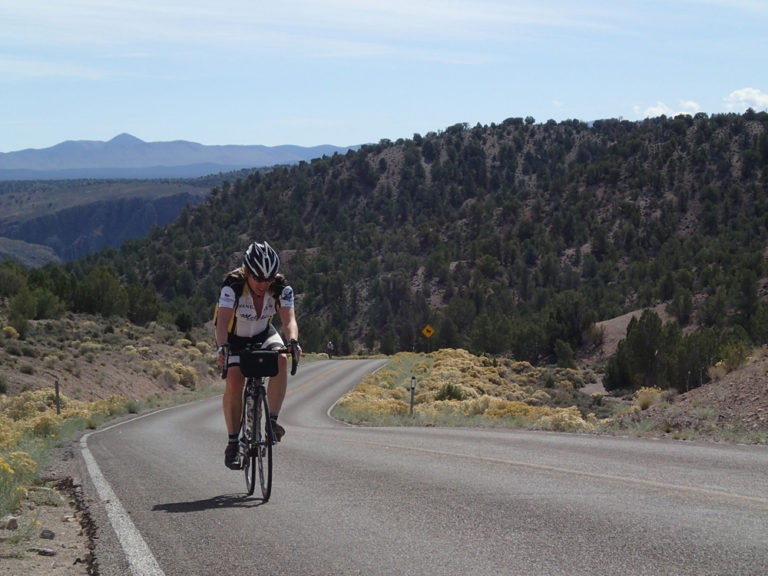
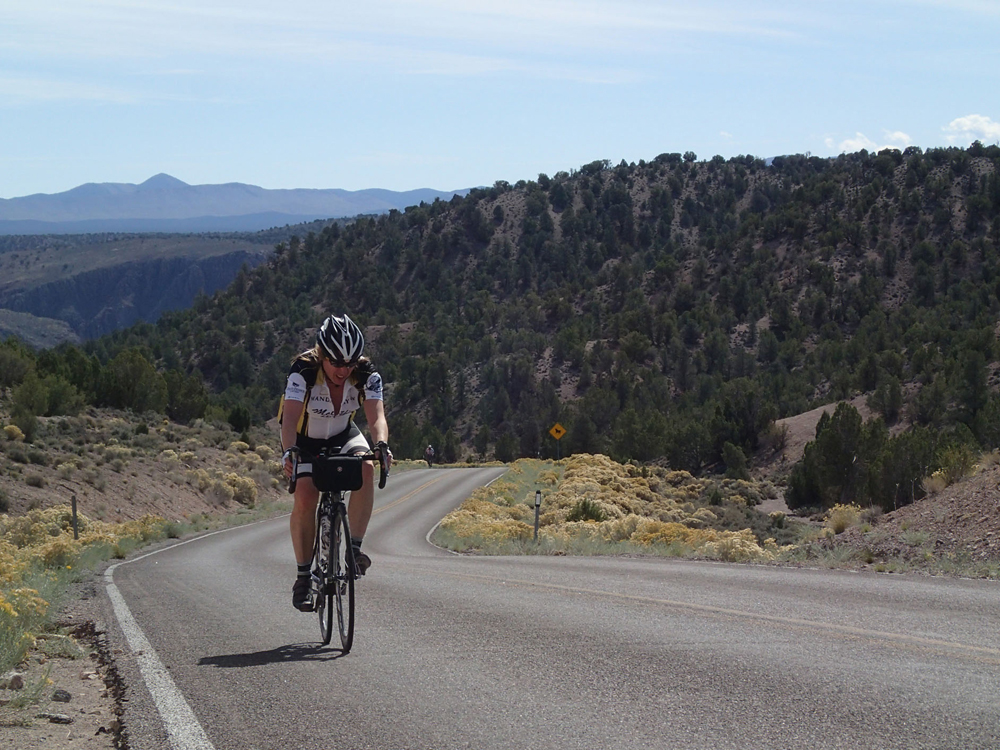
On Highway 322 near Pioche, Nevada in the Park to Pedal Extreme ride in the Fall. Photo by Dawn Andone
Things are much tamer today – the heydays of silver mining in the mid-19th century, and manganese, tungsten and lead-zinc mining in the mid-20th century, are long past. The population of Pioche maxed at about 12,000 in the 1870s; today’s population is about 1,000. As one might expect, there is quite a bit of history in town that is worth exploring, such as the “Million Dollar” Courthouse, the Lincoln County Historical Museum, and an aerial tramway (formerly carrying buckets of ore) that is still intact around town. There is also some history at Pioche Town Park, such as some refurbished railroad cars, where the ride starts. The starting elevation is 5,930 feet. So, although Pioche is located at the edge of the Great Basin Desert, the high altitude keeps things cooler than in the cities to the south.
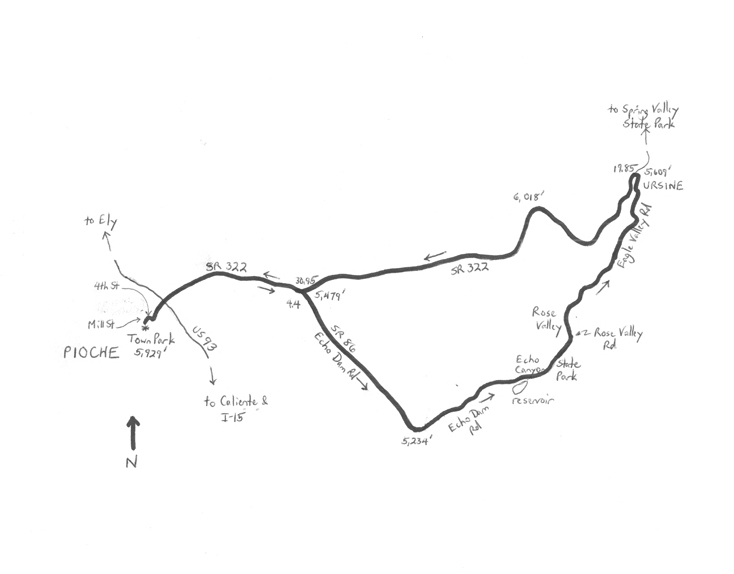
The Pioche Backcountry Cruise is a 35.35 mile “lollipop”-shaped route that starts and finishes at the town park. The scenery is mostly that of open desert, but there are a few pastoral and canyon segments, giving the ride a pleasant variety. There are no long climbs, and the elevation differential is just under 800 feet (highest elevation reached: 6,018 feet). Part of the ride incorporates the Mount Wilson Backcountry Byway; hence the ride’s name. The annual Park to Park Pedal has featured some of the roads in this ride. From the northeast corner of Pioche Town Park (4th and Mill Streets), head east on 4th Street. Turn right onto Main Street, followed by an immediate left onto State Route (SR) 322. This lightly-used highway heads downhill, crossing US 93 to leave Pioche, and on into Lake Valley. Although this is the Mount Wilson Backcountry Byway, the road goes nowhere near Mount Wilson, which is to the north of here. The highway passes a mill, prison (minimum security), and recreational park on the outskirts of Pioche, before entering open, undeveloped high desert. After gradually descending about 450 feet over four miles, the highway levels. Turn right at Echo Dam Road (SR 86) at mile 4.4, and head southeast. Patterson Wash, usually dry, and an abandoned railroad right-of-way, are to your right. SR 86 curves to the left after five miles, rounding a knoll, to enter Dry Valley. The lowest elevation of the ride is adjacent the knoll, at 5,234 feet.
“Dry” Valley is a misnomer, as the local alfalfa fields are surprisingly green and verdant. The road passes by a few ranch properties as it heads toward Echo Canyon. Enter the canyon at mile 12.4; Echo Canyon Reservoir and an earthen dam are at the canyon’s mouth. This is also the entrance to Echo Canyon State Park, so there is some signing. The next stretch presents a dramatic change in scenery, with 100-foot high canyon walls to your left and right. The white sandstone, eroded pinnacles, and parallel stream are markedly more eye-catching than desert sagebrush! Cross the stream at mile 13.4, and enter pretty Rose Valley. The stretch beyond the canyon is as pastoral as the previous road segment, before you entered the canyon. You are now on Rose Valley Road. At the T-intersection (mile 15.2), turn right onto Eagle Valley Road. The road enters another canyon – not quite as dramatic as Echo Canyon – and then exits to serene Eagle Valley.
After a sharp curve to the left, turn right at mile 19.05 to remain on Eagle Valley Road. Enter the tiny community of Ursine (population 91). This quaint town has a warm presence, and a few tidy, cozy homes. White it seems remote, you have actually taken the back way to get here, as the town is just off of SR 322 (which is where you are headed). There are some provisions in town, in case you are in need. After making a left at the edge of town, turn left again, onto SR 322 (mile 19.85). Note that, to your right, SR 322 continues into Spring Valley State Park (about two miles away) – a side trip may be worthwhile. Otherwise, head west on SR 322. The highway returns to Pioche. The amazing scenery is behind you, unfortunately. A point of interest, though, is that the road makes a steady, gradual climb out of Ursine (elevation 5,562 feet) to the highest elevation of the ride (6,018 feet) at mile 24.0. SR 322 descends from here to Echo Dam Road (SR 86), which you took on the way out. After crossing Patterson Wash (elevation 5,443 feet), it is a steady, 3.8-mile climb back into Pioche. After crossing U.S. 93, turn right onto Main Street, followed by a left turn on 4th, and a left on Mill to return to the town park.
GPS coordinates of Pioche Town Park: 37.936925oN 114.452819oW
A map of the Pioche Backcountry Ride in Pioche, Nevada. Map by Wayne Cottrell.
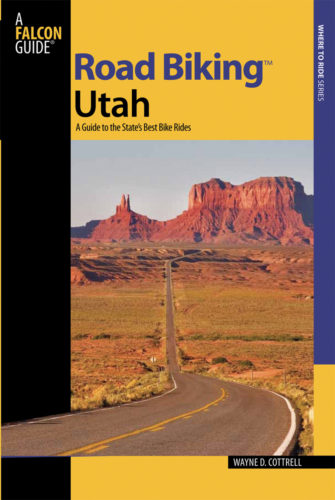
For more rides, see Road Biking Utah (Falcon Guides), written by avid cyclist Wayne Cottrell. Road Biking Utah features descriptions of 40 road bike rides in Utah. The ride lengths range from 14 to 106 miles, and the book’s coverage is statewide: from Wendover to Vernal, and from Bear Lake to St. George to Bluff. Each ride description features information about the suggested start-finish location, length, mileposts, terrain, traffic conditions and, most importantly, sights. The text is rich in detail about each route, including history, folklore, flora, fauna and, of course, scenery.
Wayne Cottrell is a former Utah resident who conducted extensive research while living here – and even after moving – to develop the content for the book.
Late Saturday evening, California Governor Gavin Newsom vetoed the Complete Streets for Active Living Bill (SB 127) championed by State Senator Scott Wiener, and which had the support of 70 communities and other organizations, including the City of Los Angeles, City of Oakland, City of Sacramento, the City & County of San Francisco, the American Lung Association, the Rails-to-Trails Conservancy, the Sierra Club, and the Trust for Public Land, amongst many others.
Fewer bike lanes will be built on state roads in California following Gov. Newsom’s veto of SB127 the Complete Streets Bill. Photo by Dave Iltis
The California Bicycle Coalition (CALBIKE) released the following statement:
The bill would have required the California Department of Transportation (Caltrans) to consider bicycle and pedestrian safety improvements when it repairs or repaves state routes that serve as local streets. This bill aimed to ensure state roads that run through local communities (e.g. 19th Avenue in San Francisco, Santa Monica Boulevard in Los Angeles, San Pablo Avenue in the East Bay, Santa Rosa Street in San Luis Obispo) are safe for people to walk, bike and use wheelchairs along those routes.
The Complete Streets for Active Living Bill had strong and widespread support. A recent poll found that 78% of California voters support a policy requiring safety improvements when improving a road. They want children to be able to safely walk or bike to school. Hundreds of schools exist within a half-mile of a California State Route and these streets remain some of the deadliest in the state.
Linda Khamoushian, California Bicycle Coalition:
Gov. Newsom’s decision blatantly ignores the immense support for this critical policy change. People risk their lives every day just to walk or bike along dangerous state-owned streets. Without more aggressive complete streets policies, our transportation system will continue to operate business as usual. SB 127 was a rare opportunity to create livable streets for everyone. This decision was ill-informed by the faulty cost estimates from Caltrans that were proven illogical based on actual practice, and unfortunately will only perpetuate distrust without resolution. Communities demanded better from the Governor, but now are left in the dust.
Jamie Morgan, Government Relations Regional Lead, American Heart Association:
Californians want safer, more livable streets that support local businesses and local jobs. They want the ability to walk and bike safely. By vetoing SB 127, Gov. Newsom missed out on the opportunity to create more livable streets for our children, our residents and our communities.
Tony Dang, California Walks, Executive Director:
We are appalled by Governor Newsom’s decision to derail SB 127 despite overwhelming support by the public and the Legislature. Families and children deserve to be able to walk, bike, and cross their community’s local and main streets without fear–the veto of SB127 lets Caltrans off the hook and leaves the safety of our vulnerable residents to chance.
Margo Pedroso, Safe Routes Partnership, Deputy Director:
The Safe Routes Partnership is so disappointed that Governor Newsom vetoed the Complete Streets for Active Living Bill into law. As SB 127 made its way through the legislative process, it became clear that legislators understood this bill would create safe routes for everyone when Caltrans repaired state highways in populated areas. This legislation was a common-sense and cost-effective way to get more kids and families walking and biking to school safely when those schools are located next to state highways.
COMPLETE STREETS BACKGROUND
In California from 2007-2013, nearly 1.7 million people were injured in traffic incidents, including 95,758 while walking along or across the street. In those crashes, 22,117 people were killed, with pedestrians accounting for one-fifth of the total persons killed. The problem is often concentrated around Caltrans roads that go through low-income neighborhoods where more people get around via transit, biking and walking.
Caltrans often claims to make streets safer when they repair them. But in practice, they prioritize fast traffic over the communities demanding more livable streets almost every single time. The Complete Streets for Active Living Bill would have brought safety improvements necessary to stop the killing and maiming on state-owned roads.
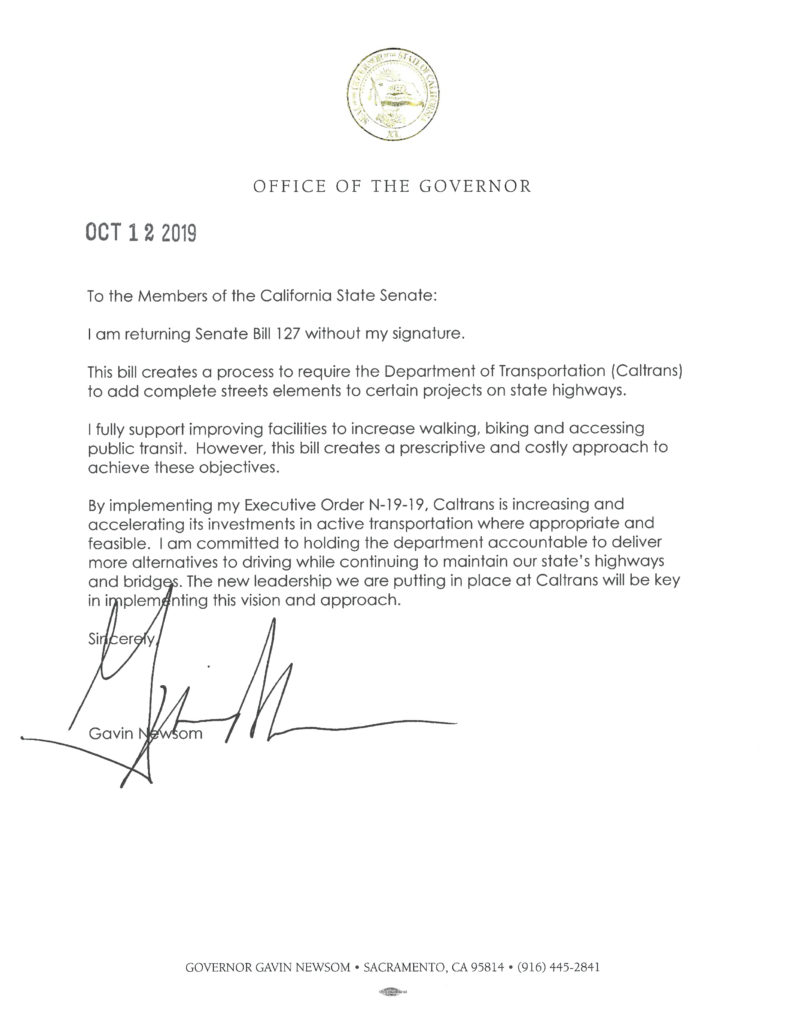
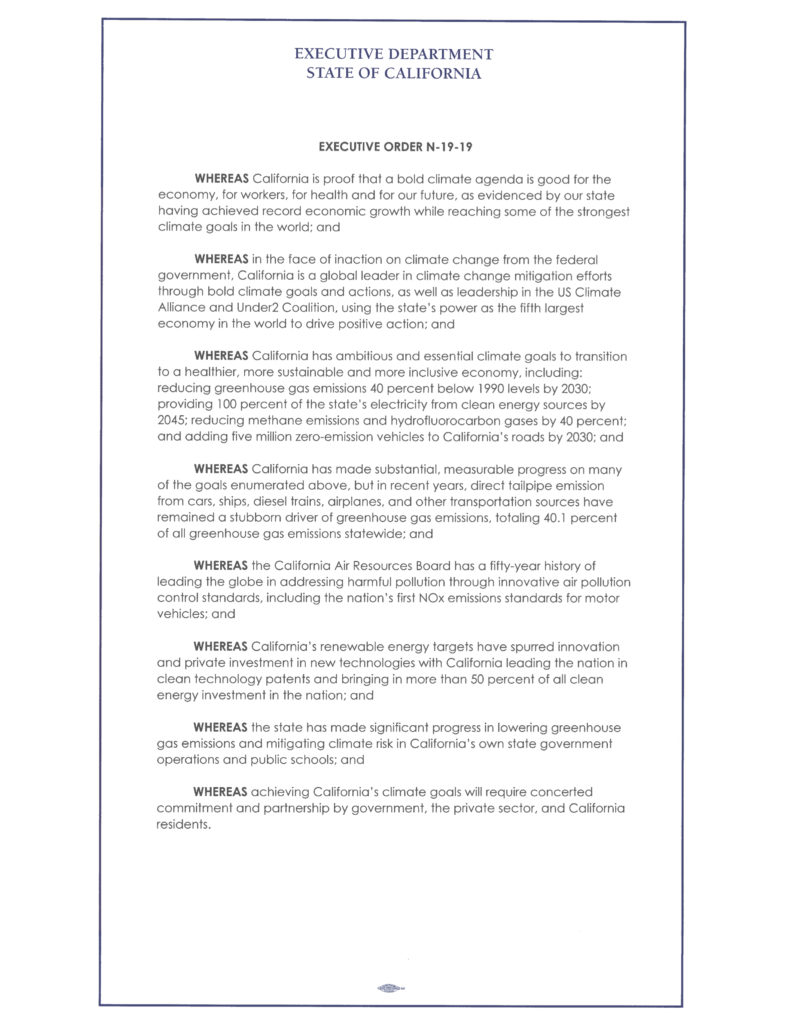
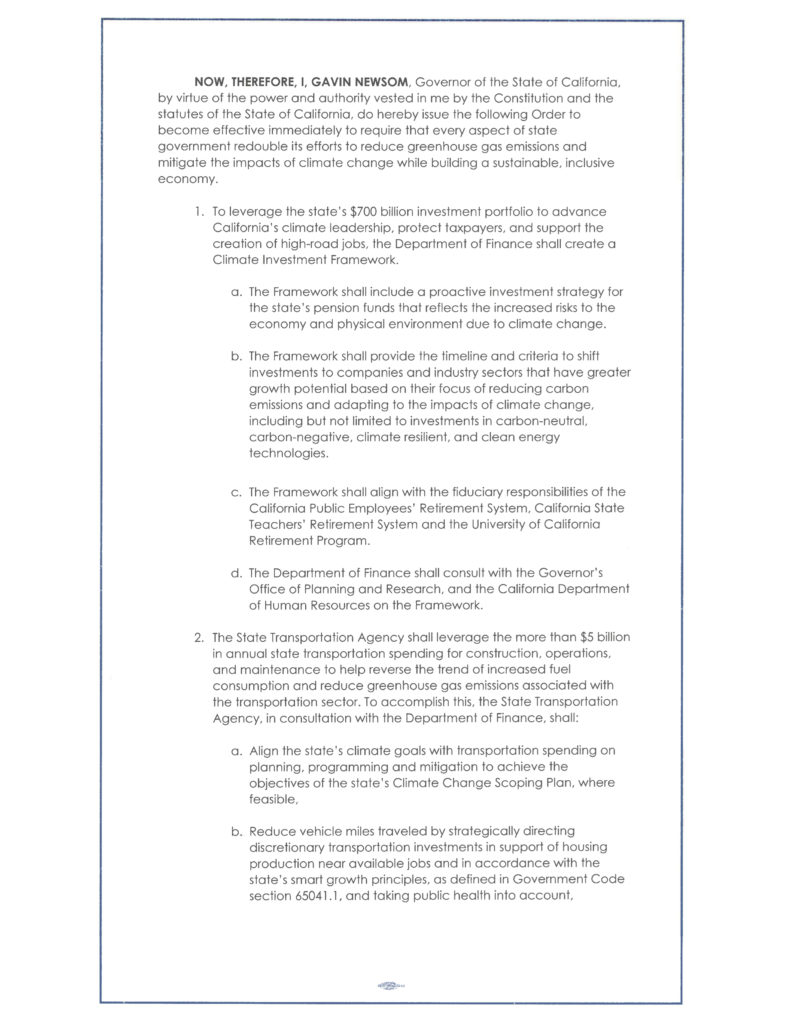
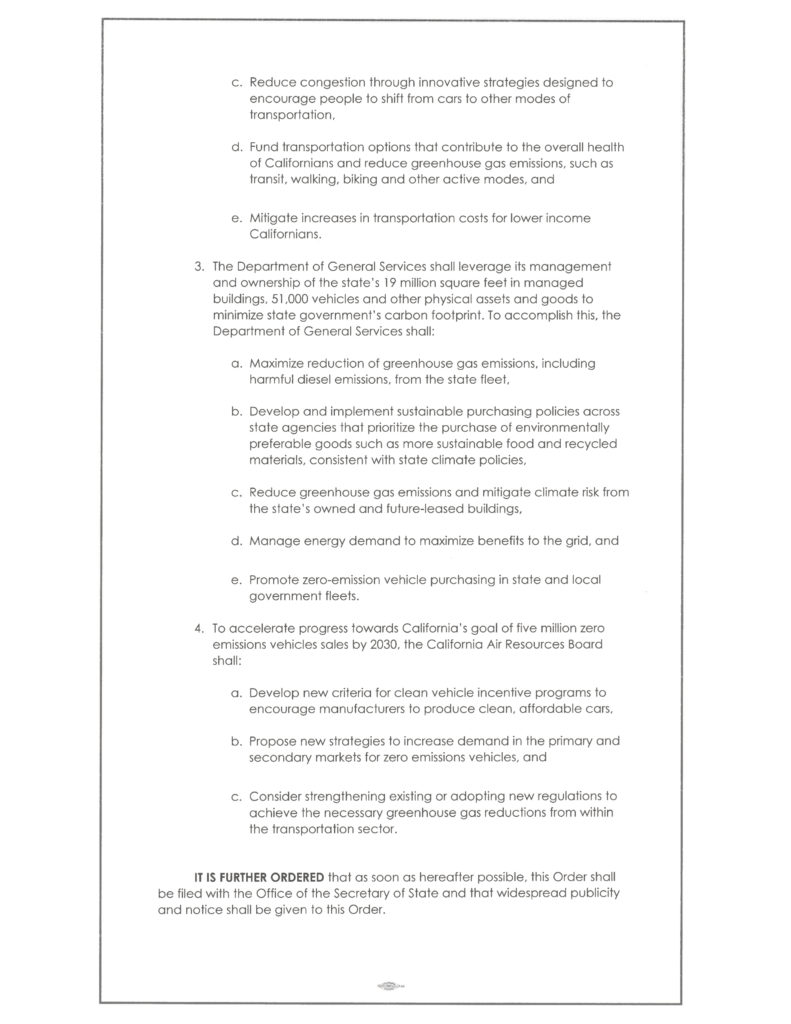
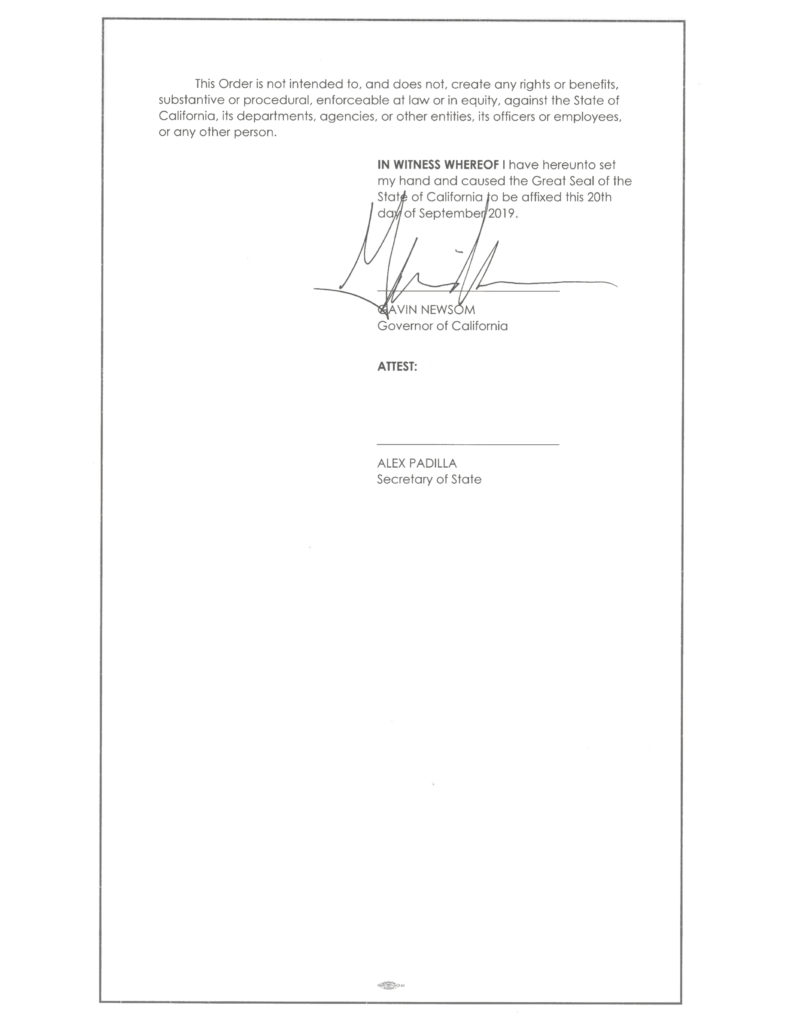
In his Veto Letter (see below), Governor Newsom indicates that he is committed to improving facilities for pedestrians and cyclists, but that this bill “creates a prescriptive and costly approach to achieve these objectives.” His letter goes on to assert that under his Executive Order N-19-19, signed on September 20, 2019 (see further below), that Caltrans is already “increasing investments in active transportation where appropriate and feasible” and that new Caltrans leadership “will be key in implementing this vision and approach.”
Caltrans has an annual budget of over $5 billion dollars, and has been tasked with reducing traffic congestion by funding and encouraging people to use alternate forms of transportation, such as public transit, cycling, walking, and other active modes. Caltrans set an internal goal in 2015 (prior to Governor Newsom’s 2018 election) of tripling the number of bicycle use from 1.5% of total transportation trips in 2014 to 4.5% of total trips throughout the state by the end of 2020. It is unknown at this time how successful Caltrans has been at achieving this goal.
The bill did pass both the California State Senate and Assembly with seemingly veto-proof 70% and 73% votes in favor of the bill. Overriding a veto requires a 2/3 (66.7%) majority vote in both houses of the Legislature, however no bill that has been vetoed by the Governor has been successfully overridden since 1979. The vast majority of vetoed bills in California never come up for a revote to override the veto.
While Cycling West applauds Governor Newsom’s commitment to safer streets as a matter of policy rather than law, it remains to be seen how policy will be implemented and if it will go far enough.
U.S. Route 50 in the Tahoe area will be getting some new and improved bike lanes in both Nevada and California. Federal, state and local authorities approved a project to realign the highway after it passed environmental reviews.
The plan calls for a cycletrack between Park Avenue and Lake Parkway in the tourist area, and auto lanes would be reduced to one in each direction. The plan also calls for a connecting bike path between the state line and Round Hill Pines Beach Resort in Zephyr Cove, NV. Plans call for an eventual Stateline-to-Stateline Bikeway around the entire Nevada side of Lake Tahoe, connecting to the Route 50 track and the Linear Park trail. The latter trail may need to be closed or rerouted during construction. Construction still requires funding to be allocated.
The project can only be stopped legally if challenged in court before January 31, 2020.
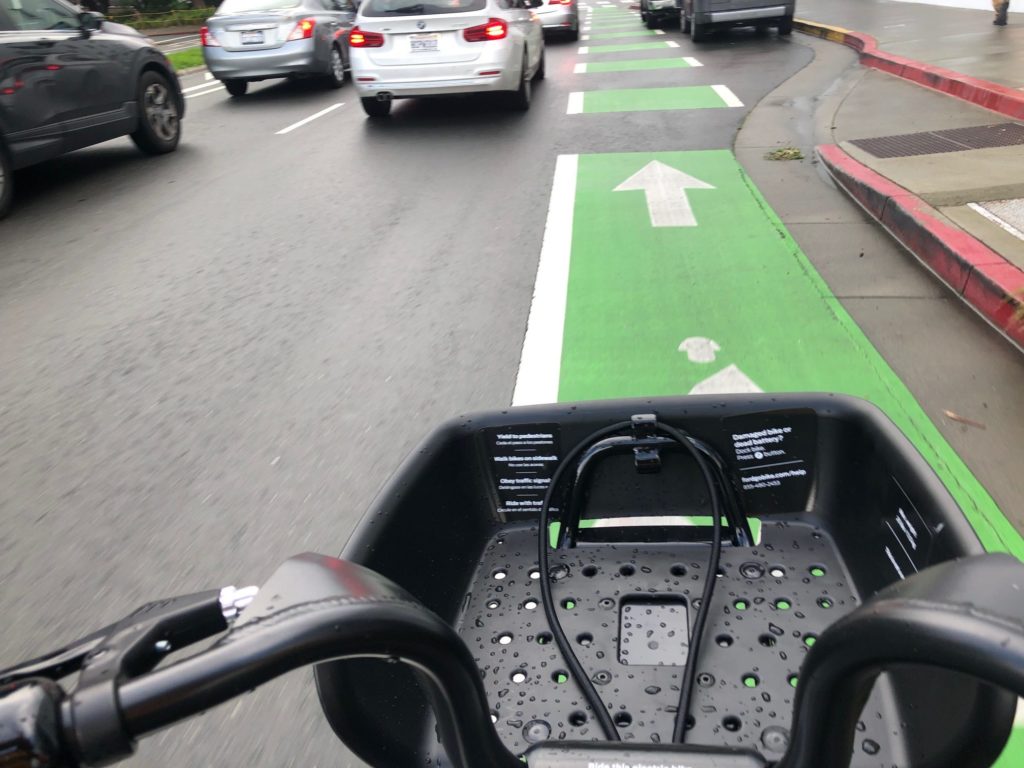
Protected bike lanes are probably the safest places to ride in busy areas. But they’re not perfect and some have proved safer than others, says a new study from the Insurance Institute for Highway Safety. They encourage people to ride and work best on bridges and road stretches without many intersections or driveways. And two-way cycletracks on busy streets are less safe, as they put unique demands on drivers, who need to look both ways. Streetcar and train tracks also increased risks to riders.
The institute did its study by examining cases of 604 cyclists injured in a crash or fall while riding in Washington, DC; New York City and Portland, OR. The researchers concluded you’re better off biking on a conventional bike lane than on a road without one. But “(p)rotected bike lanes vary in how well they shield riders from crashes and falls,” says the study, titled Not All Protected Bike Lanes Are the Same: Infrastructure and Risk of Cyclist Collisions and Falls Leading to Emergency Department Visits in three U.S. Cities.
“Planners should minimize conflict points when choosing where to place protected bike lanes and should implement countermeasures to increase visibility at these locations when they are unavoidable,” the authors advise.
Note: Researchers based the study on interviews of those taken to emergency rooms and some of the victims misidentified the type of facility they were riding on. (And, obviously, it doesn’t include the stories of cyclists killed while riding or incidents that don’t wind up in emergency rooms, major potholes in the data.)
Two-way cycletracks proved safer if at a raised elevation from the road. Riders on cycletracks in New York got into fewer collisions with cars than did those in Washington because Washington’s cyclists had to deal with many drivers coming out of driveways and alleys and New York streets don’t have many of those.
Autos do not account for all the crashes. Cyclists also got into collisions with pedestrians in the lane or crashed trying to avoid them: either walking, crossing, waiting or getting in or out of a car. When it comes to bike/pedestrian collisions, protected lanes proved less safe because pedestrians were more likely to wind up in them. The study didn’t examine why.
By Russ Hymas and Ken Christensen – “Every week you work with cyclists who have been injured – often seriously – by a driver’s carelessness. How do you keep riding?” We’ve been asked this question many times, and it’s understandable. As bicycle accident attorneys, we are constantly reminded of the dangers associated with biking alongside 3,000 lb. vehicles. However, in our experience, the benefits of cycling far outweigh the risks.
Like many cyclists, the reasons we started riding, and the reasons we keep riding, are not exactly the same. That is one of the great things about cycling – it can pay off in so many different ways!
We both started cycling primarily because of its health benefits. Like most desk jobs, a lawyer’s daily routine is quite sedentary. And while we still thought of ourselves as young and vibrant, Father Time’s curse of a slowing metabolism was coming to fruition. Work would drain us mentally and physically, leaving us exhausted at the end of the work day with very little energy for our wives and children. We recognized the need for exercise, and found a type of exercise we both enjoyed! Cycling allowed us to both lose weight and lead to more rewarding, energetic lifestyles at home and at work.
Once we started riding, we couldn’t stop. After fighting through the first few weeks of misery as our bodies tried to convince us we may not survive through the end of the ride, we felt that first rush of serotonin while breathing in the morning air. Like so many others, we were hooked.
We soon discovered that cycling provided much more than just physical benefits. Many cyclists ride to clear their minds and relieve stress. The clarity we have found – and continue to find – on our rides makes us more productive at home and in the office. There are few things more gratifying than cycling through fresh air and the beautiful Utah landscape.
Cycling also allows us to enjoy some friendly competition, which helps motivate us to set and achieve goals. We ride regularly together and with friends, and love to challenge each other to ride farther and faster.
Finally, our own experiences with cycling opened our eyes to the dangers cyclists face (on a much more consistent basis than we had envisioned). We saw firsthand how serious bike accidents can be, and were disturbed to learn that many cyclists had not protected themselves by ensuring they had adequate insurance coverage for such an event.
As personal injury attorneys, we saw a unique opportunity to serve our friends and others within Utah’s cycling community. We sensed that cyclists were an underrepresented group when it came to accident and injury cases, and decided to do something about it. Thus, UtahBicycleLawyers.com was born.
Representing many in Utah’s cycling community has been a rewarding experience, and an important reason why we keep riding. We will continue our efforts to help cyclists protect themselves from bike accidents, and to be prepared in the unfortunate instance that an accident takes place. We hope to see you on the road or on the trail soon. Ride safely out there!
Ken Christensen and Russ Hymas are avid cyclists and Utah attorneys at UtahBicycleLawyers.com. Their legal practice is devoted to helping cyclists injured in collisions with motor vehicles. They are authors of the Utah Bicycle Accident Handbook and are nationally recognized legal experts on cycling laws and safety.
The California Bicycle Coalition announced on October 11, 2019 that the the California Bicycle Summit will be held in Los Angeles, California from October 15-17, 2019.
The California Bicycle Summit attracts some of the most influential planners, policymakers, and advocates in California. Highlights include: Seleta Reynolds, LADOT’s General Manager; and Ryan Russo, Director of Oakland DOT on active transportation; managers from Bird, Lyft, and Uber on the micro-mobility revolution; and Caltrans district directors, who will provide updates on Caltrans district plans.
Elected officials, including Senator Tom Umberg and Assemblymembers Chris Holden and Laura Friedman, will welcome attendees.
The bicycle advocacy community will be front and center in workshops and plenaries. Breakout sessions include examples of successful bicycle advocacy from California and around the world, trainings on policy strategy, discussions of shared mobility, and much more.
This year’s theme is “intersections,” referring not only to actual intersections in our communities that should be safe places to walk and bike, but also to the ways in which bicycling intersects with issues such as land use, housing, and the climate crisis. Understanding how race and class have impacted transportation justice will be a central theme woven through many sessions.
The summit will feature breakout sessions on the micro-mobility revolution, quick-build bike facilities, the health benefits of bicycling for the elderly, and strategies for organizing to mitigate the climate crisis. It will offer participants networking opportunities, including bicycle and walking tours, films, and social gatherings.
WHO: California Bicycle Coalition, urban planning professionals, government officials, agency staff, and bicycle advocates from every region of California.
SALT LAKE CITY (Oct. 10, 2019) – The Union Cycliste Internationale (UCI) announced today that the Larry H. Miller Tour of Utah has been selected to join the new men’s professional road cycling UCI ProSeries. The international cycling federation also revealed that the race in Utah will take place from Aug. 3-9, 2020.
“The Tour of Utah has been recognized for its international racing stature with its inclusion in the UCI ProSeries,” said John Kimball, managing director. “We are thrilled for this designation by cycling’s governing body among its prestigious one-day races and stage races. Our placement on the calendar of events will better allow us to attract top-tier riders and WorldTour teams. We look forward to organizing a race of the highest standard.”
Ben Hermans (Israel Cycling Academy) attacks on the final climb of Eagle Ridge to take his second consecutive stage win. Stage 3, 2019 Tour of Utah. Hermans would go on to win the overall GC. Photo by Steven L. Sheffield
The UCI has reorganized its men’s professional road racing structure into three separate divisions: UCI WorldTour, UCI ProSeries and UCI Continental Circuits. The new UCI ProSeries, which includes the best HC and Class 1 races such as the Tour of Utah, will strengthen the second division by ensuring an optimal fit with the UCI WorldTour schedule.
“The Larry H. Miller Tour of Utah has proven over the years that it has earned the opportunity to be included in the new UCI ProSeries, which will feature many of the best races and historic events from around the world,” said Sean Petty, UCI Road Commission member. “The consistent quality of the race, the start-to-finish streaming of each stage and the incredibly challenging and picturesque courses that showcase Utah are second to none.”
The Tour of Utah is the only UCI ProSeries stage race and one of only two events based in North America on the 54-race UCI road calendar. Baltimore is hosting a one-day Maryland Cycling Classic in September. Other multi-day UCI ProSeries events include the OVO Energy Tour of Britain (GBR), Tour of the Alps (ITA), Le Tour de Langkawi (Malaysia) and Skoda Tour of Luxembourg (LUX).
“We’re excited that the Tour of Utah has been designated as a UCI ProSeries event,” said Chuck Hodge, USA Cycling Chief of Racing and Events. “
As a crowd favorite and one of the most successful races on U.S. soil, elevating the event to this level will provide great opportunities for U.S. riders and reward a very supportive cycling community.”
Now in its 16th year, the week-long Tour of Utah has earned the reputation as “America’s Toughest Stage Race.” The 2019 event crowned Ben Hermans of the Israel Cycling Academy as its champion, and EF Education First captured the team title after covering 477 miles of racing and 37,882 feet of elevation gain.
Past General Classification champions have included Sepp Kuss (2018), Rob Britton (2017), Lachlan Morton (2016) and Joe Dombrowski (2015) along with stage winners such as Tejay Van Garderen, Cadel Evans, Chris Horner, Travis McCabe, Brent Bookwalter, Marco Canola, Giulio Ciccone, Rob Carpenter and Levi Leipheimer through the years.
The Tour of Utah has been sanctioned as a 2.HC-rated stage race by the UCI for the past five years, making it one of the premier events in North America. In 2019, the field featured 115 riders from 17 teams, attracting 400,000 spectators during race week, 21 hours of national television coverage and reaching more than 400 million homes via broadcast around the world.
The host venues for 2020 will be announced at a later date. Last year, the race route traversed the scenic roadways around the host venues of Snowbird Resort, North Logan City, Brigham City, Powder Mountain Resort, Antelope Island State Park, North Salt Lake, Salt Lake City, Canyons Village at Park City Mountain, and Park City.
More information about the Tour of Utah can be found by visiting www.tourofutah.com as well as social channels Facebook (tourofutah), Twitter (tourofutah), Instagram (thetourofutah) and YouTube (tourofutah).