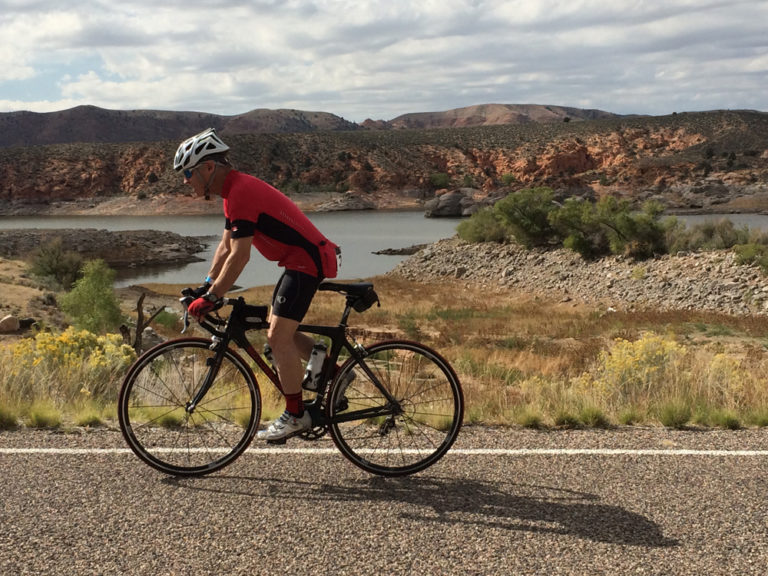
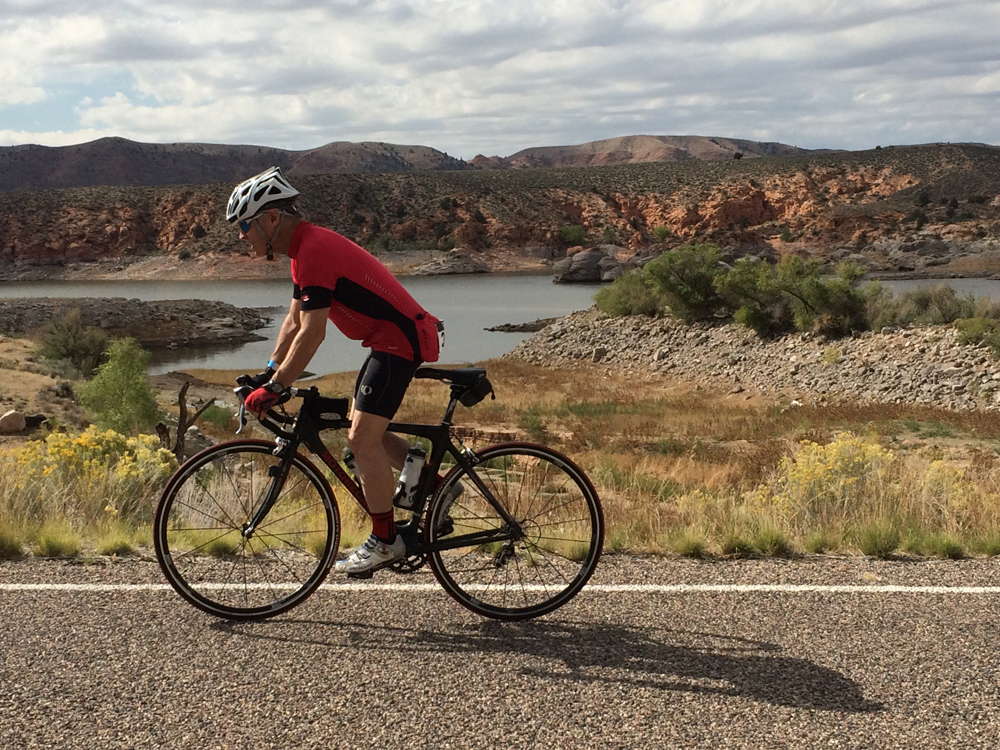
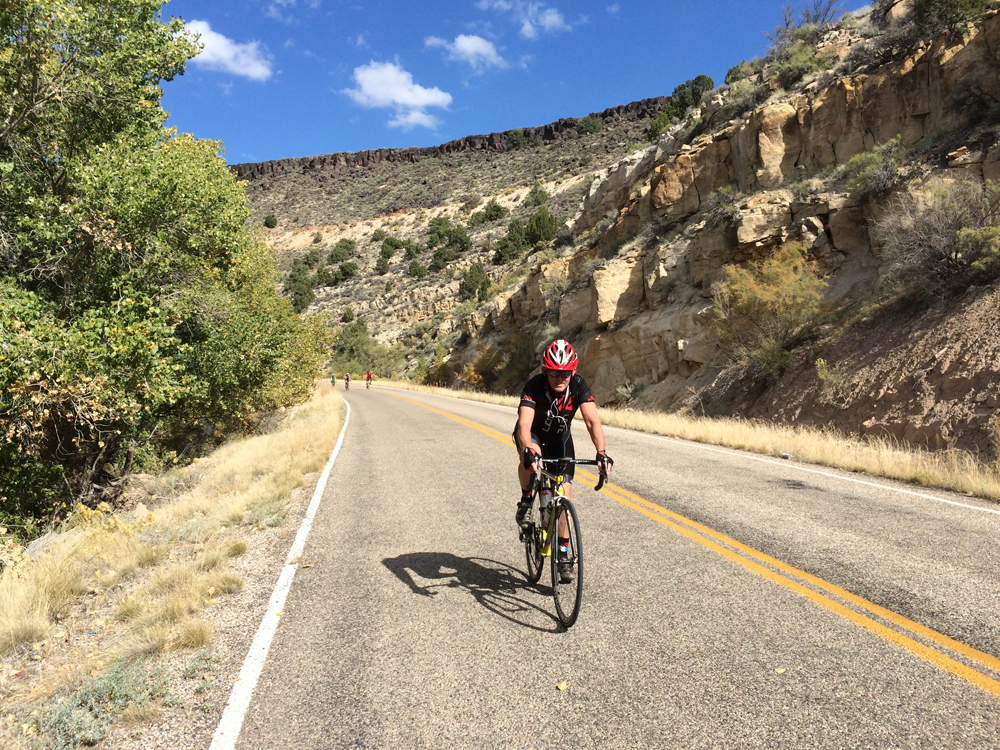
Heber Valley may be Utah’s most scenic, with a picturesque backdrop of the Wasatch Mountains to the west, the West Hills to the north, the Uinta Mountains to the east, and Hogsback Ridge and Wallsburg Rise to the south. One author has noted that the title “Switzerland of America” is overused, with a number of places making that claim. But a number of Swiss immigrants actually did settle in Heber Valley during the 1860s because of its resemblance to home. Charleston to Wallsburg via Deer Creek is a 27.85-mile, out-and-back ride with a 996-foot net elevation change, and just over 1,100 feet of climbing overall. The climbing is gradual, rather than steep.
Utah’s Charleston to Wallsburg via Deer Creek is a 27.85-mile, out-and-back ride with a 996-foot net elevation change, and just over 1,100 feet of climbing overall. Map by Wayne Cottrell
The ride is somewhat unusual in that it visits two communities – Charleston and Wallsburg – that have actually lost population since their turn-of-the-20th-century heydays. Weep not for the two towns’ losses, though, as both are small and pleasant, with stable economies and attractive country lifestyles.
Start the ride at the Charleston Day Use Area in Deer Creek State Park, located just off State Highway 113 (UT 113) near the northern border of Charleston, just south of Charleston Bridge. Charleston is located directly south of Midway, and southwest of Heber City. The starting elevation is 5,428 feet. Charleston was settled in 1859 by Mormon families, and reached its peak population of 524 in 1910. As of 2016, the population was 471, and was gradually growing. The town was known for its Hereford cattle, which were raised here. A portion of the town was flooded, intentionally, with the beginning of construction of Deer Creek Reservoir, in 1938. The dam and reservoir were not completed until after World War II. Exit the Day Use Area, and turn right to head south on UT 113. This two-lane highway is narrow, but traffic volumes are low.
Just under a mile and a half into the ride, UT 113 ends at U.S. 189. Turn right, and head southwest, adjacent Deer Creek Reservoir and Deer Creek State Park. Note that the name of the park is a bit of a misnomer, as the featured attraction is the reservoir, rather than a creek; also, the reservoir’s main inflow-outflow is the Provo River, rather than Deer Creek.
U.S. 189 travels immediately adjacent the shore of the reservoir, curving to conform to the edge of the lake. Like UT 113, the highway is narrow (but scenic!), until mile four, where there is a widening to four lanes. Depending on the season, you may see sailboats, jet skis, other water activities, and camping. Fishing is year-round, even when the lake is iced over. The highway climbs gradually to 5,568 feet, and then descends at a 2.9% grade. At mile 5.55, veer away from the lake by making a left turn onto Main Canyon Road.
Welcome to Round Valley; this is the road to Wallsburg, with Wallsburg Ridge on the right, and the Wallsburg Wildlife Management Area on the left. After a short, very gradual descent, the road begins to climb gradually. Enter the outskirts of Wallsburg three miles up the canyon. The town of Wallsburg was settled in 1862, and its population peaked in 1900 (528). The town’s population as of 2016 was 340, and was gradually growing. Main Canyon Road curves to the right at mile 8.5, becoming Main Street. Here, the road begins to climb at a mild but steady 2.0% grade. After curving to the left, enter the heart of Wallsburg. Turn right at the Center Street intersection, followed by a left turn onto 200 South. 200 South then curves to the right, becoming 200 East. After a short stretch, 200 East curves to the left, and you are on Main Canyon Road once again. You are now at 5,697 feet, as the gradient increases to 3.0%. Development becomes sparser, as the road climbs above 6,000 feet. Leave civilization altogether at mile 13.1, as the road narrows (elevation 6,227 feet). You are now on Forest Road 046 (enter Uinta National Forest). The narrow road has a low-grade surface, and the gradient increases to 4.6%. The pavement ends at mile 13.9, at the highest elevation of the ride (6,424 feet).
Turn around here, and begin the trip back to Charleston. The road through Wallsburg and Round Valley is downhill, gradually leveling, almost all the way back to U.S. 189. Turn right at U.S. 189 (mile 22.25). Note that the highway narrows from four lanes to two after a mile and a-half. Exercise caution as you navigate the curves, adjacent the lake, along U.S. 189’s two-lane segment. Note that, to the left at mile 25.8, is Deer Creek Island. On the mainland, across from the island, is Island Beach, for yet another lake activity. Bear left onto UT 113 at mile 26.4. Head north, returning to Charleston. The Day Use Area will be on the left, just south of Charleston Bridge.
Starting point coordinates: 40.473700oN 111.473250oW
For more rides, see Road Biking Utah (Falcon Guides), written by avid cyclist Wayne Cottrell. Road Biking Utah features descriptions of 40 road bike rides in Utah. The ride lengths range from 14 to 106 miles, and the book’s coverage is statewide: from Wendover to Vernal, and from Bear Lake to St. George to Bluff. Each ride description features information about the suggested start-finish location, length, mileposts, terrain, traffic conditions and, most importantly, sights. The text is rich in detail about each route, including history, folklore, flora, fauna and, of course, scenery.
Wayne Cottrell is a former Utah resident who conducted extensive research while living here – and even after moving – to develop the content for the book.
SALT LAKE CITY (Oct. 2, 2019) — The DNA Pro Cycling Team is proud to announce plans to return for the 2020 season registered as a UCI Women’s Continental team for the first time since 2017. Celebrating their 8th racing season, the race calendar will include a broad range of events including UCI stage races, one-day classics and the USA CRITS Series. The team will also continue to compete on the dirt for epic gravel and mountain bike events.
The UCI women’s roster boasts riders with diverse backgrounds and disciplines, multiple national champions and past Olympians, to kick-off a winning campaign.
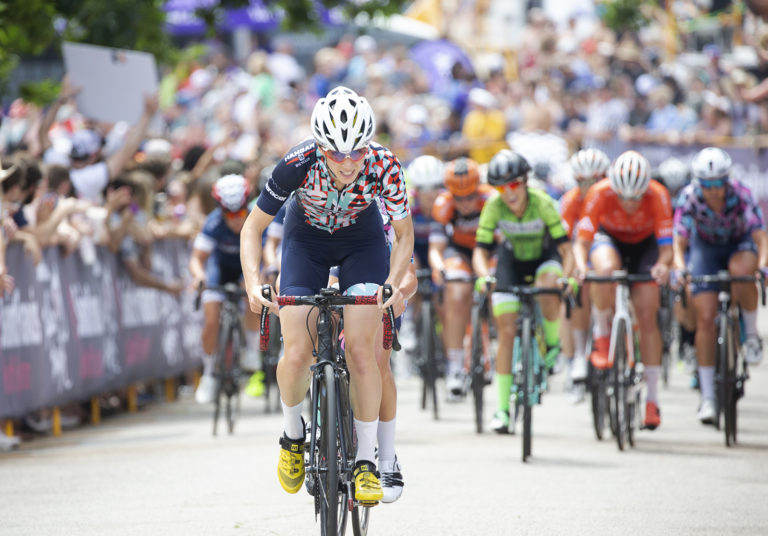
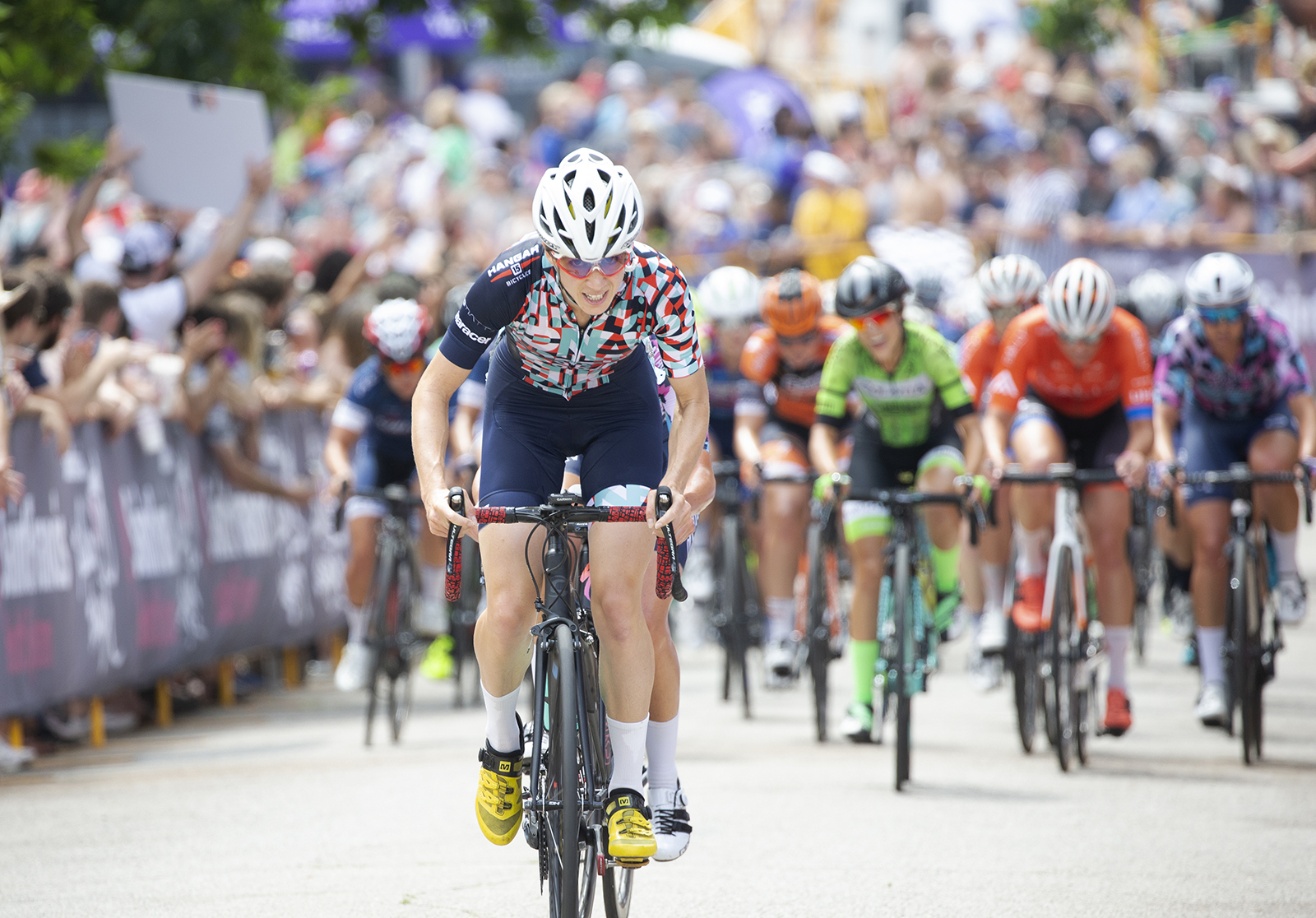
Team captain Heather Fischer smashing her way up Cry Baby Hill, 2019 Tulsa Tough. Photo by Cathy Fegan-Kim/DNA Pro Cycling
Leading the team as captain on the road will be rouleur Heather Fischer, racing her seventh professional season. Fischer was the recent winner of the Most Badass jersey at the Colorado Classic this summer, and a past winner of the Downtown Silver City crit at the Tour of the Gila, and D1 Collegiate National Championship. Working alongside her will be Michaela Drummond, former Junior World Champion on the track and a 2020 Olympic hopeful for New Zealand. Celebrating her 18th birthday this past August and graduating from junior gears, 26-time National Champion Katie Clouse will be racing her fourth year with the program. After proving her strengths in all three disciplines of mountain biking, cyclocross, and road, Clouse will join the team early next spring after another full cyclocross campaign this winter with Cannondale p/b Cyclocrossworld.
American Mia Kilburg (formerly Manganello), returns after a hiatus from professional cycling, winning a medal in long track speed skating at the 2018 Pyeong Chang Winter Olympics. Prior to her return to the ice in 2017, Kilburg had scored a collection of points classification jerseys at Cascade Cycling Classic, Redlands, and San Dimas.
The complete roster will be finalized in the coming weeks. Other new signings include collegiate national champion and climbing specialist Margot Clyne of Boulder, Colorado, and Liza Rachetto. Rachetto will bring a wealth of knowledge and experience earned after racing for the past 16 seasons in the top races of the world, including finishing the Giro Rosa three times. Earlier this season she spent several months racing in France and Belgium with her previous team.
“Women’s racing in 2020 will be exciting, challenging and rewarding; we’re eager for all of it,” Director Sportif Cathy Fegan-Kim said. “Bringing in sponsors, supporting our athletes and succeeding in each race is increasingly competitive, but we believe nothing meaningful has ever been easy.”
Fegan-Kim is one of only a handful of women in the world officially certified as a UCI sports director, alongside Carmen Small and Rachel Heal to name a few. She earned her certification in Switzerland in 2018 through a scholarship.
“The momentum in women’s racing is growing in North America with the Colorado Classic, AMGEN Tour of California, a robust criterium scene that includes USA CRITS, and Team USA’s success winning multiple rainbow jerseys at Worlds. We are ready to join once again in becoming a UCI team, racing hard, developing more women athletes and putting on a show for cycling fans.”
Elliot Morris enjoying the scenery in the Fall Tour de St. George. Photo by David Ward.
Back in 2015, for the first time in over 25 years, I found the cycling season winding down without having ridden a single century ride. Indeed, the longest ride I had done was a 53 miler from my home in Salt Lake to the Brighton Ski Resort at the top of Big Cottonwood Canyon.
So it was that when I noticed the Tour de St. George Fall Century was set for October 25th, I saw a last opportunity to get in at least one century ride this year. I contacted my friend, Elliot Morris, who I knew did this event regularly. He confirmed he was going to ride it this year, so I tentatively planned to join him. Riding a bike is always fun, but riding with a good friend or group of friends is even better.
I say I tentatively planned to join him because, until the day before, I was still undecided. As I had ridden the LOTOJA as part of a relay team and not solo as I usually do, I had not trained for long distances. Indeed, I had not really trained at all. I just rode.
Having decided I might ride the Tour de St. George, I intended to get in a few rides of longer distance in order to prepare. However, work and life kept getting in the way. Finally, in early October, I got in my second ride this year of over 50 miles, a flat-lander of 53 miles while visiting my daughter in Fort Worth, TX. I say flat, but was surprised at the end of the ride to find my Garmin 510 had calculated over 2000 feet of climbing. Of course, compared to our mountains here, those rollers in Texas all seem pretty flat. Over 50 miles, though, they tend to add up.
Finally, the day before St. George, I decided for certain to go, but hedged by saying I might opt for the shorter 79 mile ride if I was not feeling up to the entire century. That would have also had the advantage of cutting out a good portion, and the longest section, of climbing included in the century ride.
The morning of the ride dawned clear, cool and blue, and at 8 a.m. we set off. For the next 100 miles, I had what I have to consider my most enjoyable and pleasant ride of the year. SpinGeeks, the folks who organized and put on this event, did a great job. Feed stops were well-placed and well-stocked (including home-made peanut butter and honey sandwiches, my main food source that day), the registration and support people were always friendly and seemed excited to serve, and the course, which had about 5500 feet of climbing, was well-laid out, signed and marked.
Indeed, the best part of the course was saved for last, and thankfully I was feeling good that day and did not opt for the 79 mile ride. Instead, I made the long climb to Veyo for which I was rewarded with one of the most beautiful sections of road for riding a bike, the stretch dropping from Veyo and winding down the canyon through Gunlock, past Gunlock Reservoir and on to the mouth of this stunningly scenic canyon.
The Tour de St. George is a great century ride, and a good way to finish off your century season, even if it is both your first and last one of the year. Elliot and I made the journey there and home again together. It was a real treat to spend time with a good friend traveling to and participating in an event doing something we both love: Riding our bikes.
Note: The fall Tour de St. George will be held again on October 26, 2019. The spring Tour de St. George will be held in April, 2020 (date TBA). For more information, visit http://ridesouthernutah.com.
David Ward completed the century option of the Fall Tour de St. George. Photo by Elliot Morris.
The annual Medicine of Cycling Bike Fit Symposium took place at the USA Cycling headquarters in Colorado Springs in mid-August, bringing together a highly regarded group of bike fitters from around the USA, and further afield.
Presenters included sports medicine and bike fit advisor to Specialized Bicycles, Andy Pruitt; sports medicine and bike fit advisor to Trek Bicycles, Mark Timmerman; strength and conditioning coach, Greg Choat; Physical Therapists, fitters and educators Curtis Cramblett, Greg Robidoux and Brian Adams; Bike fitter since year 1, Happy Freedman; Californian fitter of note, Steve Carre; and the legendary John Cobb. Topics covered included overuse injuries of the lower limb; foot evaluation and intervention; pelvic, trunk and core assessment, influence of crank length on aerodynamic positioning; case studies and more.
Attendees encompassed bike shop owners, physical therapists, orthopaedic specialists, independent bike fitters, athletic trainers, and cycling coaches, making for a diverse gathering with a common interest. And that common interest is helping you – the cyclist – have a positive relationship with your bicycle. This relationship encompasses everything from injury prevention to aerodynamic advantage, including comfort, efficiency, power generation, and bike handling.
Here are a few notes of interest and relevance to share, to encourage you to think about your own bike-body relationship.
Saddle
You can’t fire a cannon from a canoe. Generating force and applying it to the pedals can only happen from a stable foundation, and that foundation is the bicycle saddle. If you are not stable and well supported by the saddle, you are not able to effectively generate power. Although force is applied at the pedals, it starts at the saddle (and with the core: muscles and fascia). A bike fit is saddle specific. If you change your saddle to a different one, you have just changed your fit position.
Shoes
The only place you are mechanically attached to the bike is at the pedals. Shoe selection, in-shoe support, and cleat position are all important for not just foot comfort, but also knee protection. The number one issue with cycling shoes is their width, or lack of. Cycling shoes need to be wide enough for your feet, and sized for your arch length. The correct in-shoe support (semi custom or custom cycling orthotics) can do wonders for both foot and knee comfort by securing, stabilizing and supporting your foot in the shoe, resulting in positive effects up the kinetic chain. Insoles for cycling are not the same as insoles for running or hiking. The biomechanics of what the feet are doing are very different, and the support requirements are different.
Hands
If you get numb hands riding, and the numbness goes away after the ride, it’s due to temporary nerve compression from too much weight on the hands. This can be from bars being either too far away and too low, the opposite! Aim for a light touch on the bars so that you are not being held up by the bars, nor pushing yourself back off them. Handlebar width is more critical for woman than men, and generally woman are riding on bars too wide. Shopping for gloves? Foam padding is better than gel padding for comfort, even though gel padding is marketed as being superior. Same for cycling chamois selection.
Fitness
Your overall strength and conditioning can be limiting you a lot more on the bike than you think. Improving core strength, range of motion, and stability (control through motion) off the bike all help when you are on the bike. Deadlifts are superior to squats for developing cycling power. You can’t stretch the IT band, but you can strengthen your glutes.
Aerodynamics
For time trial riders and triathletes, aerodynamics is very important, and a lower torso is generally more aerodynamic. However the ability to get lower AND maintain power generation is constrained by the hip angle (femur to torso). If you get low but lose the ability to generate power in doing so, you may in fact be going slower. The best way to get low and keep an open hip angle to generate power is to use short crank arms, e.g. 135mm – 155mm. When changing to significantly shorter cranks, increase the size of the chain-rings to maintain pedaling load feedback. There is no evidence to suggest a correlation between a cyclist’s height and their crank length, and there is no correlation between crank length and power output. A side benefit of shorter cranks is to reduce the development of external iliac arterial fibrosis – a condition causing pain and weakness in one or both legs that has ended the career of quite a few cyclists.
Please contact me if you have any questions about this annual conference, or want to know more about the topics presented here.
John Higgins operates BikeFitr – an independent bike fitting studio, and Fit Kit Systems – which provides bike sizing and fitting solutions to bicycle retailers and fitters. Contact: [email protected]
By David Ward – “It’s just relentless.” So said Ryan as we approached Kamas. We still had 25 miles, and one big climb, left of the 2016 Summit Challenge. But we already felt like we had been worked over.
With 16, 52 and 102 mile options for this event, I had specifically talked my riding partners, Ryan and my brother, Nick, into riding the102 mile option of the Summit Challenge as our final prep ride for the LOTOJA, just two weeks later. With almost as much climbing, in half the distance, it would benefit us as we finished off our training for the LOTOJA, and it would benefit the people served by the National Ability Center (“NAC”), the non-profit promoting the event as a fund raiser.
Nick Ward on the top of the climb by the Jordanelle Reservoir. Photo by David Ward.
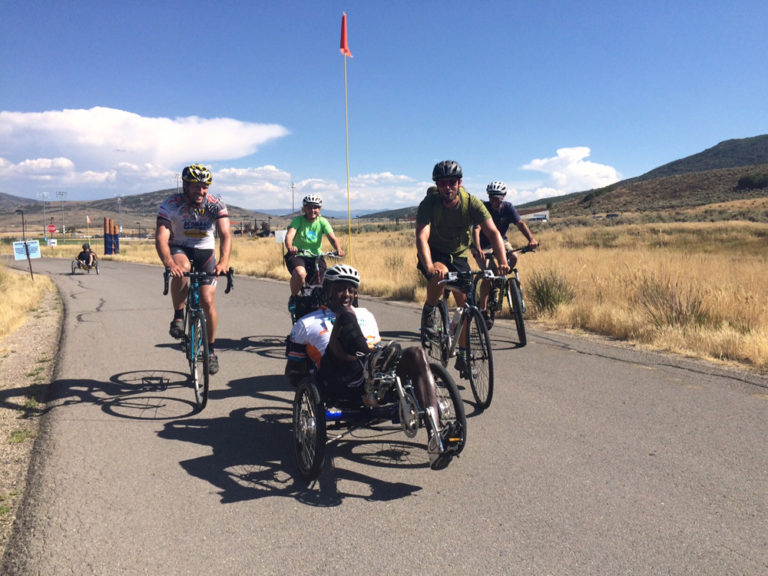
As stated on its website, NAC is “a global leader in adaptive recreation” and “provides more than a dozen adaptive recreational programs specifically designed for participants with varied limitations.” Such individuals were appropriately given free registration to this event, and it was great to be sharing this Challenge with them
Beginning at NAC’s center in Park City, this ride piles on climb after climb until, after 102 miles, one has climbed over 6800 feet. It seems like you just reach one summit and then, after a short descent or flat, the road kicks up again, with little recovery time in between. Sometimes, even when you think it is flat, you find you are still gradually climbing.
The truth is, though there is just as much descent as ascent in this ride (since one starts and finishes at the same place), you are spending probably 80% of your total riding time laboring uphill. That is a lot of hours pushing your bike and body up these slopes.
A few miles after the start, there is a fast descent down to the edge of the Jordanelle Reservoir, and then a long climb back up. This is a deceptive climb because several times during the ascent, you think you see the summit only to have the road wind to bring more uphill into view. Once you do finally top out, there is a fast descent into the Kamas valley through which you then roll for several miles before you hit the queen climb of this ride, the slog up the private roads of the exclusive Wolf Creek Ranch.
And I mean slog. There is a short, steep pitch right after you pass the gate into the Ranch, followed by a couple of miles of rollers. Then hell appears. You make a turn and the road looks like a freaking wall, with all the riders, except for those taking the “no shame shuttle” up this stretch, serpentining back and forth across the road.
Being too proud for my own good, I tackled the first stretch of this climb straight up. Then, after stopping to strip off some outer layers, I headed up again. It only took a few short yards for my pride to evaporate, and I, too, was doing the snake dance up this road. This stretch is probably less than a mile long, but with my weaving back and forth I probably did several miles before reaching the switchback where the slope eased off sufficiently to allow me to point the point wheel straight ahead once again to ride the last couple of miles to the top.
The Summit Challenge and the National Ability Center provide opportunities to disabled people to participate in outdoor activities. Michael Ray, who is recovering from a stroke, is on his way to finishing the 52 mile ride in the 2016 Summit Challenge. NAC Staff member Alex Mendelson is his left and Reid Wycoff is on his right. Photo by Dave Iltis
It was in this last stretch that I finally caught a man I had kept in my sites and used as my pace man up this steep monster. As I finally reeled him in, I saw that he had an artificial left leg. He is truly representative of the people served by NAC and of the manner and success with which they face their challenges. I was too breathless to get his name, but his image and determination will rest in my memory.
After reaching the top of this climb, and anticipating a nice, long downhill, I only found a couple of miles of gradual descent before the road kicked up again, though much more manageably so, for several miles till we hit a short descent to the feed stop.
From there, we had our reward for all that climbing: Several miles of fast, winding descent (with a couple of short uphill kickers thrown in for good measure) and then a flat run in to Midway and on to Soldier Hollow where we were required to do a short, steep climb up to the lunch stop. You know, there is just something wrong about having to climb to your lunch, but somehow this seems fitting for this ride.
After wolfing down some roast beef sandwich, a banana and a few other goodies and refilling our water bottles, we rolled for several miles through Midway before hitting the next major challenge, a four mile climb up the slopes on the south side of the Jordanelle Reservoir. Then, after our quick descent down the other side, it was the seemingly flat but in reality gradual uphill climb along the Provo River that really began to wear us out.
Finally, we made a left hand turn and, after short climb out of the river bottoms, had a flat and fast run to the rest stop, “Larry’s House”, located at mile 75. Our group voted this the best stop of the ride. With friendly faces, veggie wraps, chunks of fried and salted potato, and full strength, cold Coca-Cola, it was like a gift from heaven.
Refreshed and refueled, we forged on to the final rest stop at mile 88 where I once again reloaded with a can of cold Coke, and then we rode on to the final challenge of the day, the climb up Brown’s Canyon. Thanks to the last two strategically placed and stocked fuel stops, we were ready for this, kicked the legs into gear and made the climb to the top.
From thence, we rode the final few miles back to the NAC with it last few hundred yards of ascent to the finish, where we were greeted with cowbells and cheers for a ride well-ridden. My riding partners later thanked me for pushing them to ride this event. There was certainly a sense of satisfaction and achievement upon our completion of this Challenge.
I was very impressed with the people who volunteered to assist with this event. Friendly, encouraging people greeted us at each rest stop. Our calves were stamped with a “SUMMIT” stamp at the rest stop following the queen climb, volunteers would take and either park or hold our bikes for us as we foraged and ate and, except for the first rest stop and the finish, each was well-stocked with the types of food and refreshment cyclists typically are seeking. I was somewhat disappointed that the first stop had run out of many of their offerings, and more disappointed to find that after finishing the ride, the food had already been put away and the finish area was in the process of being taken down. We were some of the last to finish, it is true. But they had a time cut, and we made that. We should have been accorded the same benefit and consideration as those finishing earlier.
But that criticism aside, I was impressed with how well the event was run, the course marked, the food and refreshment provided, and the amazing volunteers who made this event such a great success. This ride showcases why organized rides can be so much fun.
The Summit Challenge, which Cycling Utah named its event of the year in 2013, is aptly titled. With its many climbs and summits and over 6800 feet of climbing, it lives up to its name. And it is also an apt metaphor for the people for whom NAC exists.
By Tom Jow – Labor day has passed and I’m sorry to say it, summer is coming to a close. However, there are a couple of good things going on in September, the beginning of the fall riding season and Labor Day sales. This is the time when you can find some great deals on components to service or upgrade your bike. Maybe some drivetrain parts need to be replaced. If you’re going to replace them, might as well install better ones. Or maybe you’ve been coveting a pair of carbon wheels. You deserve them. Now, the price is right to improve the quality of your ride. What follows are what I feel are good value performance upgrades with reasons why, and what to watch out for before making the purchase.
One component that is nearly always worth upgrading is the wheel set. Whether you ride road or mountain, having a lightweight, wheel set is a big improvement. Lighter wheels are advantageous because not only do they reduce the overall mass of the bike, they accelerate faster due to their lower rotating mass. For road riding, aerodynamics is also an important factor. If your average speed is above 15 miles per hour and your rides do not often involve long, steep climbs, an aerodynamic wheelset is worth considering. Deep dish wheels with a profile greater than 50 millimeters are pretty specialized, but many all-around wheels with a rim profile less than that are available.
A big design change for both road and mountain bikes is the width of rims and tires. The benefit of this increased width is more comfort and better traction. For road, tires 25 millimeters wide are becoming the norm and 28 millimeter width is not uncommon. Mountain bikes, in addition to having a new plus size, are equipped more often with tires 2.3 – 2.5 inches wide. Mountain bike riders really benefit from wider rims because they reduce flex of the tire casing and square the “edge” of the tire to increase cornering traction.
When purchasing wheels, be sure to pay close attention to the type of axle required. Currently the standard of thru-axles is in a state of flux. Some road and cyclocross bikes with disc brakes started out using 15 millimeter front axles with quick-release in the rear. Some incorporated mountain bike standard rear of 12 millimeter x 142 millimeter. Now some manufacturers have decided to use a 12 millimeter front thru-axle. On the mountain bike side, there is a new axle standard called “boost.” This features a 15 millimeter x 110 millimeter front axle and 12 millimeter x 148 millimeter rear axle. There was a short time when bikes were equipped with boost front axles and standard rear axles. A wheel purchase could get confusing because many wheelsets are not sold mixed boost and not boost.
Parts that wear out are always a good target for upgrading. Weight savings and performance gains can be made by replacing the cassette and rear derailleur. For example, many mid-priced bikes are equipped with a low end, all steel cassette. These units are quite heavy. Upper end cassettes are built with an aluminum carrier with just the load carrying cog teeth being made of heavier steel. Some of the best cassettes will use aluminum or titanium for the largest cogs. If that large cog is not quite low enough, there are many companies making kits to add a larger cog to your current cassette (See https://www.cyclingwest.com/tech/mechanics-corner/how-to-do-it-yourself-1x-drivetrain-conversion/).
Be aware that cassette brands do not mix well. Campagnolo only fits Campagnolo. Operationally Shimano and SRAM cassettes are compatible but Shimano mountain cassettes do not fit the SRAM XD freehub (the part the cassette mounts to). In addition, 11 speed Shimano mountain freehub bodies are being phased out since the mountain cassette is narrower and will fit the standard road freehub body with a 2.5 millimeter spacer behind.
A part that does not really wear out, but is a good candidate for an upgrade is handlebars. The best reason to purchase a new handlebar is to customize our fit. Another reason is to improve the ride. A good carbon handlebar dampens vibration better than aluminum, thus making the ride more comfortable. It is also a good way to make our bike a little lighter. Even a good mid-level bike comes with a pretty heavy aluminum bar. Also, if the bars are heavy, the stem is probably heavy too. Similar to handlebars, upgrading the stem can both improve our fit, the quality of the ride and again, reduce the weight of the bike. When purchasing handlebars or stem, be sure to match the handlebar clamp diameter. Road bars have pretty much settled on a standard size, but mountain bikes are currently developing a new standard. Mountain bike handlebar width is important as well, not because they are too wide, but many bars have a minimum width.
For a more comprehensive mountain bike upgrade, try a 1x set-up. Removing the front derailleur and parts is a significant weight savings and also makes shifting much simpler. A 2 x 10 can easily become a 1 x 10 (Cycling Utah, June 2015). A 2 x 11 can become a 1 x 11 with just the removal of some parts and a new chainring. If you are really interested in having 12 speeds and a 50t cassette, the SRAM 1 x 11 can be upgraded to the new Eagle by purchasing a shifter, rear derailleur and cassette.
I can go on and on about upgrades. I am always wondering what is the best value for performance gain. It may sound small, 4 ounces lighter. But twice 4 ounces equals a half pound. A half pound is significant in my book. As well as making our bike lighter, we are improving our fit, our comfort, and performing regular maintenance. And with it being sale season, who doesn’t like getting a good deal on bike parts. Just be sure to take the time to find the compatible components to fit your needs and your bike.
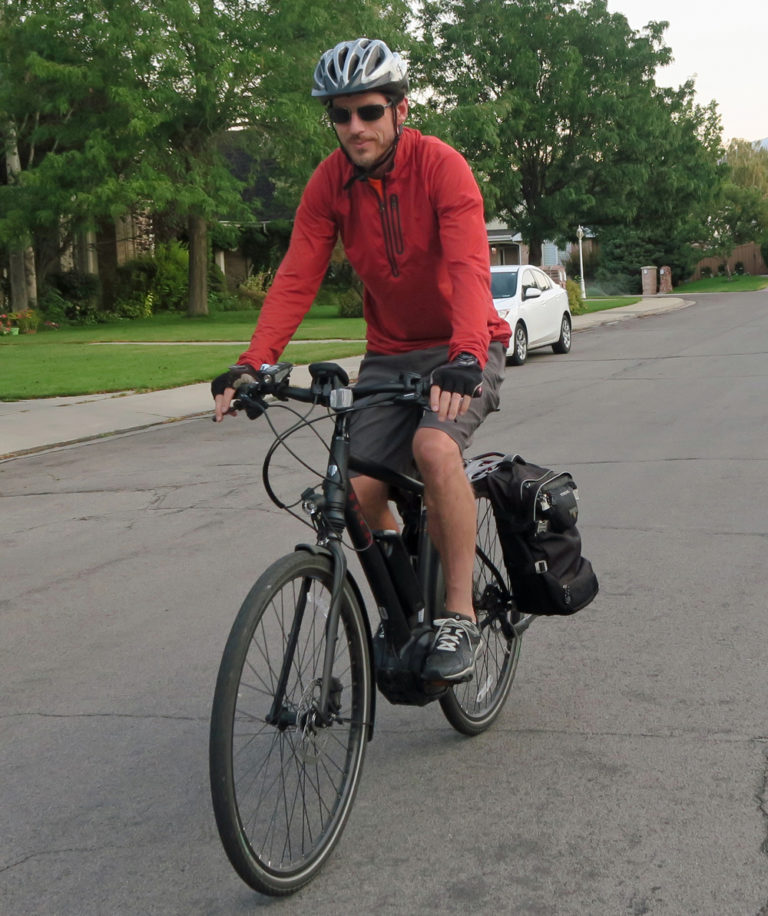
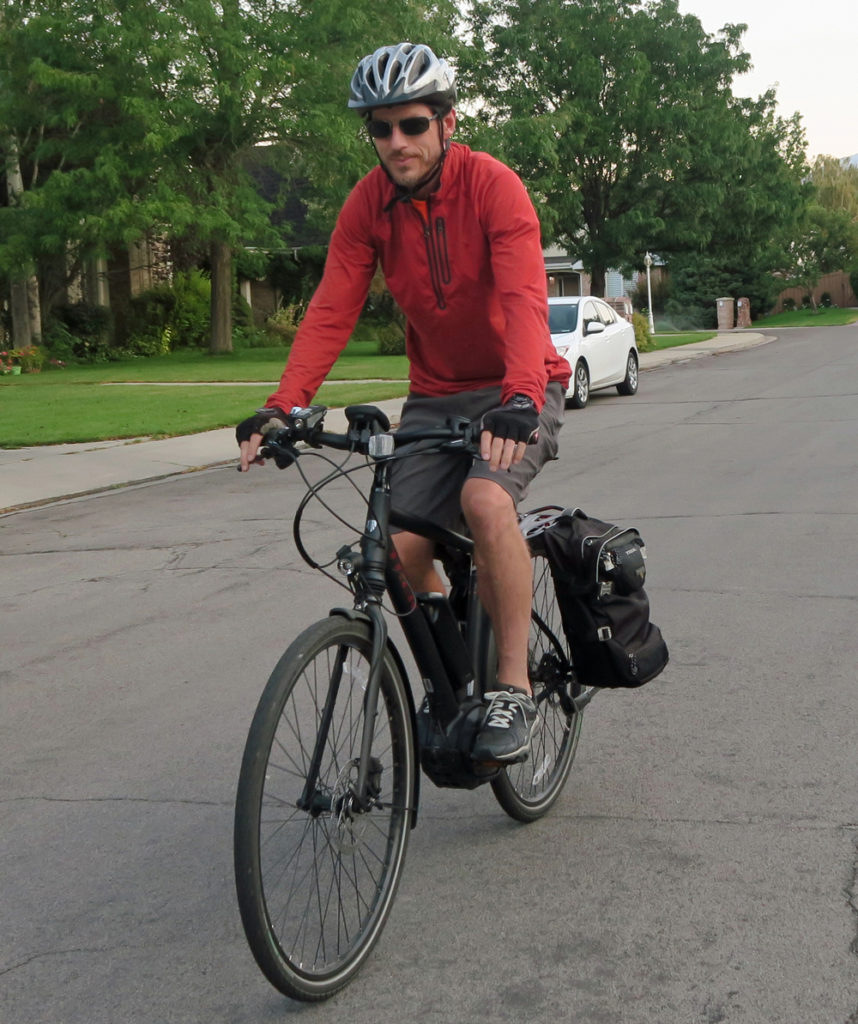
By Jamie Morningstar – Kenny Freestone is a Product Director at AncestryDNA. To balance out the inactivity of the of average desk job, Kenny started cycling to work over a decade ago. Kenny faced a new commuting challenge when AncestryDNA relocated to Lehi, about 20 miles from his house. He now uses a pedal-assist eBike to make his 38-mile daily cycle commute possible.
[Editor’s Note: This article was originally published in the September 2017 issue of Cycling Utah, and details herein may no longer be accurate.]
Kenny Freestone commutes 38 miles each day on his pedal-assist eBike. Photo by Jill Freestone
CW: What’s your cycling background? When did you begin cycle commuting?
KF: I’ve enjoyed riding bikes for as long as I can remember. Since elementary school I have ridden both for fun and transportation. I remember riding my bike three blocks down the street to Cascade Elementary School in Orem because it was faster and more fun than walking. After school my friends and I would go ride in the dirt fields around the neighborhood. We built jumps in the dirt, measured how far we could jump, and then would take turns laying down in the dirt so we could jump over each other. It’s a miracle we never sustained injuries more traumatic than skinned knees and elbows.
In high school, I got into mountain biking. The nearby mountain trails were endlessly exciting to explore in almost any weather. I didn’t have a car of my own, so I also frequently rode my bike to school. While commuting to high school I learned the importance of securing my bike – my seat was stolen more than once. High school and college commuting also helped me get used to cold-weather bike commuting. In my early 20’s I took a long break from school to do volunteer work in Italy for my church. I quickly learned the value of helmets when my front wheel separated itself from my bike while riding home one night.
When I was young, I cycle commuted out of necessity. Now I ride my bike because I value the exercise, I like saving money by decreasing my dependency on my car, and I also feel a responsibility to reduce (in however small my way) the air pollution in Utah County.
CW: What is your daily commute like?
KF: A year ago my company relocated to Lehi and my bike commute changed from 3 miles to 19. By car, the new commute is about 15 miles each way, mostly on the freeway. The congestion isn’t too bad for most of the commute, but when the freeway drops to 4 lanes from 6 in Lehi there is often a slow-down. I realized early on that driving in crowded traffic is super lame, plus I-15 is also the state’s deadliest road; it’s a road I like to avoid when possible.
My bike commute route follows the wonderful Murdock Canal Trail for 16 of the 19 miles. The canal trail is mostly flat, but the Ancestry office sits high on a hillside, so my morning commute concludes with a pretty steep climb. The Murdock Canal Trail is perfect for commuting – whenever it intersects a major road there is a bicycle underpass, which means better safety and no stoplights!
Last year I made the 38-mile round-trip commute on my regular unassisted commuter bike, a 2007 Jamis Coda outfitted with a rear rack, panniers, lights, and fenders. The unassisted commute was about 75 minutes door-to-door and was pretty challenging. Because it took so long, I only rode about once per week. I wanted to ride more frequently, and since work wasn’t going to move closer to me, in March 2017 I bought an electric pedal-assist bike to see if the assisted ride would help me ride more frequently.
CW: How did you choose which pedal-assist bike to purchase?
KF: I explored a range of electric bike options, and found some excellent options out there. I also explored buying an electric conversion kit to turn my Jamis commuter into an electric commuter. I was looking for a bike that could be fast, safe, and have the battery range to go at least twenty miles on a single charge. Conversion kits can support most of this, but I had concerns about the bike’s brakes, wheels, and fork being able to hold up to the higher speed.
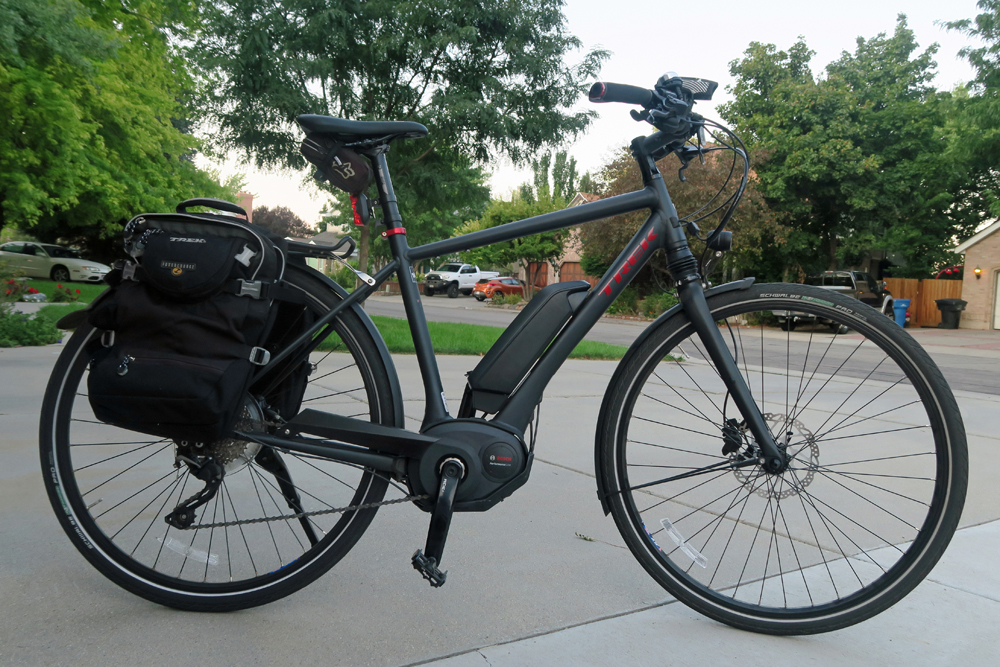
After lots of shopping and research, I chose the Trek XM7000+. There were lots of factors to consider when making my decision. First, I wanted to buy from an established brand to make sure I would get a trustworthy mechanical quality and safety at speed. Secondly, I was looking for good speed and range. And lastly I was looking for a good value.
The Trek XM7000+ turned a 75 minute ride into a 55 minute ride and made commuting to work a little easier. Photo by Jill Freestone
The Trek has been a good mix of those priorities. I can ride at between 25 and 27 mph for my entire 19-mile commute. The motor has 5 speed options (off through high). The battery can run the bike at its highest speed for my entire commute. The motor is what they call a pedal-assist motor – it only works as you pedal and there is no throttle option. When you hit 28 mph it stops assisting and you ride on only your own power. The Trek bike was not the cheapest option available, but it was a good choice for me. At around $3,500 it is by far the most I’ve ever paid for a bike.
CW: How does a pedal-assist commute compare to an unassisted ride?
KF: My pedal-assist bike has made it possible to do my daily 38-mile round-trip commute on two wheels. My commute time was reduced from 75-minutes each way on my unassisted commuter bike to about 55-minutes door-to-door, which is only about 30 minutes longer than it would take me in a car. Also, rather than arriving to work sweaty and tired, I’m able to sustain an average speed of about 27 mph with the same effort as a fast walk. It’s still a light workout, but nowhere near the effort of riding unassisted.
The speed of my Trek XM7000+ also took some getting used to. A sustained 27 mph is really fast! It is super fun, but is a different riding experience. For example, the wind is very loud at that speed. I used to put one earbud in and listen to a podcast on the way to work, but that’s no longer feasible because of the wind noise of my pedal-assist bike. Similarly, because I don’t work as hard on the ride I don’t generate as much body heat, so between my higher speed and lower heart rate, those cool 35-degree mornings feel a lot colder than on my unassisted bike.
The electric bike has a few peculiarities that took some getting used to. The chain has fallen off the front sprocket a few times when down-shifting while pedaling, and it took a trip to the bike shop to realize how to correct that. Also, the battery range varies based on wind and temperature. On cooler mornings the range is about 20 miles, and in the warmer afternoons the range can up to 25 miles. Lastly, since the charge lasts about 20 miles, I have to remember to bringing a charger cord with me to the office in addition to my clothes and laptop.
CW: How do other cyclists and trail users react to your pedal-assist bike?
KF: I’ve gotten some curious questions about my bike while on the Murdock Canal Trail, but I’ve never gotten any dirty looks or rude comments. Whatever bike I’m on, I try to be a safe and courteous rider, and my pedal-assist bike is no exception.
The Murdock Canal Trail is a mixed-use trail, and sometimes I have to be patient and wait for joggers and other cyclists to space out a little before passing them. My speed is similar to that of a fast road bike, and like any other faster rider I sometimes have to slow down when the trail gets congested.
CW: What advice would you give to someone considering cycle commuters?
KF: My advice to a new commuter is that commuting is easier than you might think. Regardless of the length or difficulty of your ride, you don’t have to be in Tour de France shape to ride to work. Just allow for extra time until you learn the ins and outs of it all. And if your commute is exceptionally long, there are some great alternatives out there to help you get to work faster and less sweaty, like I discovered with my pedal-assist bike.
You’ll also probably find that things are just better on a bike. For me, the electric bike has changed my approach to transportation. It has made it easier (and funner) to do errands by bike, even just going to the bank or the grocery store.
If you have a suggestion for a commuter profile, have a commuter question, or other comments, please send it to [email protected].
Americans went for a recreational bike ride about 2.4 billion times in 2016, estimates the Outdoor Foundation, a Washington-DC based non-profit sponsored by the Outdoor Industry Association. Those who ride for fun went out an average of 53 times each, according to its 2017 Outdoor Participation Report. The foundation released the participation report along with a parallel Outdoor Recreation Economy report, designed to showcase the importance of playing outdoors to the nation’s financial well-being.
Figures apply to Americans ages six and older. The numbers include those who went for road or trail rides, mountain bike excursions and BMX track escapades. Biking ranked third in popularity as an outdoor participatory activity, with 15 percent or 45.8 million Americans cycling at least once. More people enjoyed running and fishing, though.
But when it came to frequency, cycling came in second, as those who drop bait in the water didn’t do so nearly as often as those who went for a jog or spin.
But when it comes to kids, cycling tops. Among those aged six to 17, 25 percent (12.9 million riders) took to the pedals, more than those who ran. Within the next age bracket (18-24), biking fell to fourth , as (14 percent, 4.2 million) participated. More young adults preferred running, hiking and some sort of camping (tent or RV). But those in that age bracket who biked did so an average of 86 times that year.
Among all citizens, blacks biked at a much lower rate (10 percent) than those defined as white, Hispanic or Asian (15 or 16 percent.) Asked about the difference, foundation Deputy Director Ivan Levin wrote in an email “advocates needs to think about their programming, who their audience is, and do a better job programming for specific populations versus applying blanket programming approaches.”
The economy report doesn’t say much about bicycling but names it as one of the major job and spending forces, along with birdwatching and hiking. It notes that Americans spend half again as much on cycling and skateboarding a year ($97 billion) than on video games ($61 billion), citing Digital Entertainment Group numbers for the latter figure.
“Going outdoors to hike, bike, camp, fish, hunt or just walk around the neighborhood orients us to the natural world,” says the report.
But how accurate can the data be? The foundation says it extrapolated the figures based on 24,134 online interviews in taken last year when people and households were asked about their activities. The report says its sample “provides a high degree of statistical accuracy.”
The data reflect what people recall and if they were taken last year, which the report says, the results couldn’t have included the whole year. Also, how can you possibly recall in an survey how many times you rode a bike last year? The report says respondents were selected from the “the US Online Panel of over one million people operated by Synovate/IPSOS,” a market research company. But any such panel only includes people who sign up to receive surveys which may or may not be an accurate reflection of the U.S. Population.
Asked about accuracy, Levin referred us to the back of the report (cited above) and said he referred the questions to the technical team, which hadn’t responded by deadline.
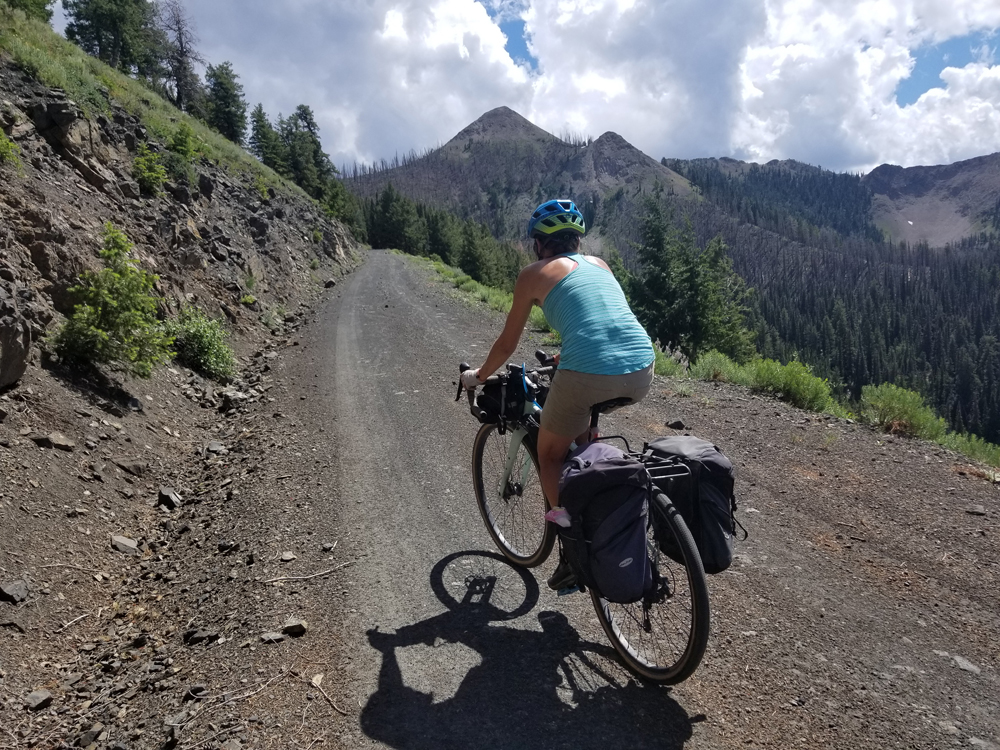
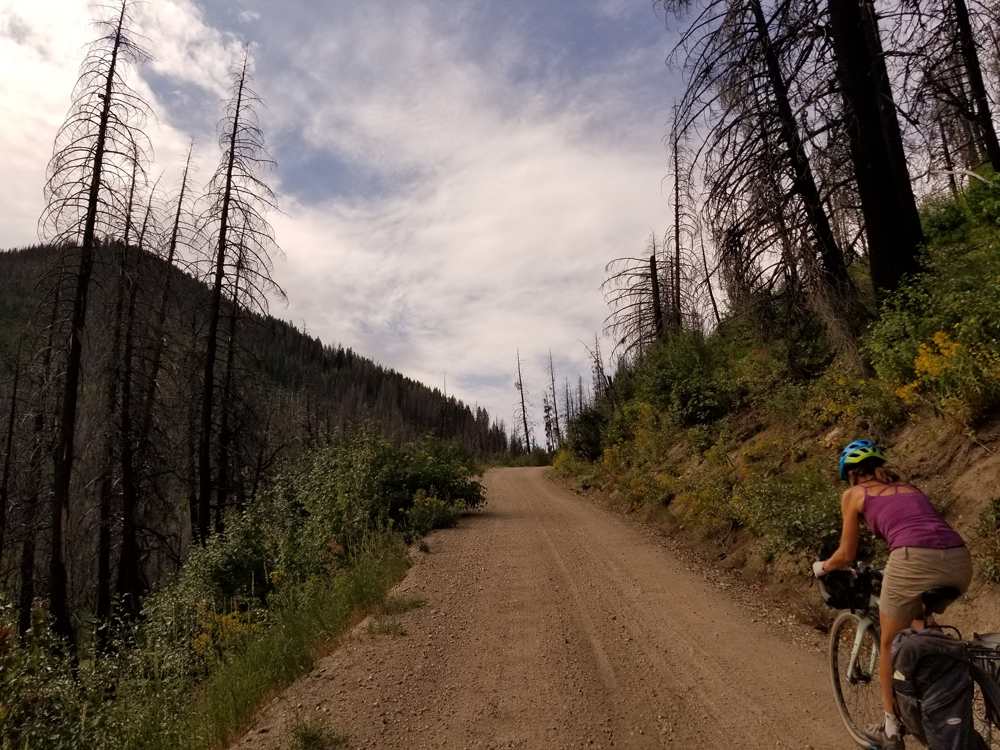
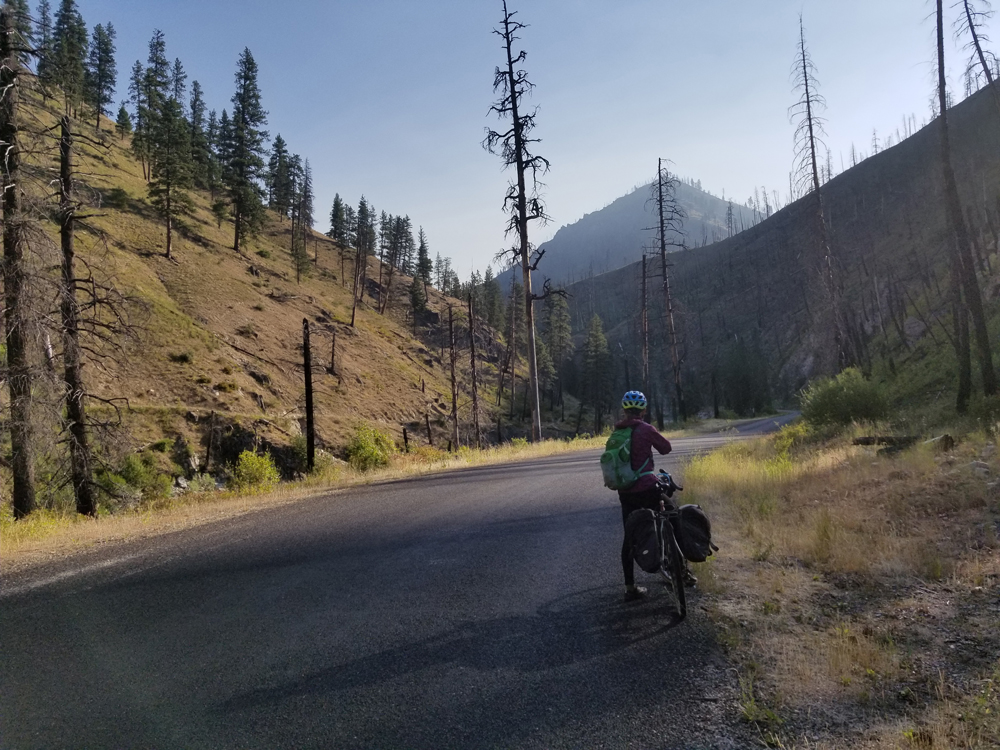
By Lukas Brinkerhoff – Day 8. It’s hot. We’ve just wasted well over an hour waiting to be able to soak in a hot spring only to be told by some of the scariest people I’ve ever seen that that won’t be happening. Slightly dejected, we buy a couple of beers, gather our bikes and head back out onto the dusty, bumpy road.
Kathleen on the way to Dollar Hide Summit. Our highest summit and our longest day. Photo by Lukas Brinkerhoff
We started the day with a big climb. As far as climbs go, it wasn’t the worst. We had shade, the grades were a little steep, but all told we got over it. The challenge of Day 8, as we were learning, wouldn’t be elevation gain, rather it would be the temperatures and the fact that we had already been doing this for 7 days and the end was still hundreds of miles away.
I could tell that Kathleen was not enjoying herself like she had the days prior. We stopped at a couple of hot springs and she didn’t even want to get in. Our objective for the day was still another 17 miles away and would put us at the bottom of our next climb. We left Lotus Springs and within a few minutes, it was clear we just needed to find a place to camp. A couple miles more in the blasted heat and a spot just off the river with some almost flat spots became our home for the night.
Just keep pedaling, it’s the only way to the top. Photo by Lukas Brinkerhoff
We were done. Or at least as done as we could be in the middle of a 550-mile ride.
Several years ago, as I was preparing for my first multi-day tour, a good friend told me that there would be a day that the only thing I would want would be to give up. He told me that every tour had that one day. Sometimes it will come early, like 2 hours into the first day. Other times, it will sneak up on you. Just when you think you have found the rhythm of the road, there will be some obstacle that you know you can get over, you just don’t want to. The secret is to just not give up.
Our lives are made up of decisions that lead us down paths that become our story. When we recognize that we write that story each day, each choice taken, the logical conclusion is to begin constructing that story to be what we want it to be. It’s easy to determine what you “want” to be. Like a child in elementary school dreaming of being an astronaut, I’m sure that each of us has a semblance of an idea of what would be our ideal story, the perfect version of ourselves.
The reason we aren’t that perfect version of ourselves is because change is hard. It is much easier to continue on the same trajectory than to make a 90 degree turn and begin something new. Some may call it inertia, but it’s just life. Just because we realize we have some semblance of control over where we are going, doesn’t mean that we can abandon ship, swim for shore and everything is going to be hunky dory. No, that rarely happens. Life is hard and we tend to give up and return to our normal, way too easy.
Day 10 was my day. I don’t have the space to enumerate all the struggles of that day, but let’s say we peaked out on Dollar Hide Summit, the tallest peak on our entire ride somewhere around mile 50 of the day. Those 50 miles had included two hike-a-bikes, three river crossings and not the kind that involve bridges, all before the biggest climb of our 11 day trip. At the top, I was both broken and ecstatic. We were nearing the end, the point where we could say, “We did it!” and we had a bunch of miles of coasting ahead of us.
At the top! Photo by Lukas Brinkerhoff
We had planned to camp just outside of Ketchum around our mile 65. As we coasted and pedaled toward the end of the day, the dirt turned to gravel and then to pavement. Mile 65 came and went and we had no where to camp. Soon houses were everywhere and we found ourselves on a bike path mere miles from downtown Ketchum. It was late. We had pedaled 69 miles in 12.5 hours. The only thing that kept my pedals turning was the fact that I had no other choice. We stopped and found the closest brewery. There was a bike rack out front, but I was really surprised they didn’t ask us to leave the moment they saw us. We had a full day’s worth of grime and nastiness covering us and we had to smell worse than the bum who was chilling on the corner. Luckily, we were able to sit outside and enjoyed some fresh vegetables and a couple of triple IPAs. This all sounds awesome, except we still had nowhere to stay. Some texts to friends that might have friends who might let us stay, a dozen or so checks of Warmshowers, finding one hotel room at $425/night and we were no closer to having a place to stay than when we sat down. Our food was gone and we both knew that ordering another beer would result in us not being able to find a place to camp.
At 14 hours of being up and working on moving forward, we were, once again, moving forward. I was ready to throw in the towel and find a dumpster to sleep behind. I was done. If you’ve never bonked, recovered, bonked again, got drunk and then tried to find a place to camp, you really don’t know what being “spent” is really like. 12 miles later, we found a campground with one campsite left.
Bike tours are finished or abandoned based on decisions. Do you turn around and coast back to the bottom of the hill and put up a thumb? Or do you just keep slogging your way to the top? The only difference between the two is giving up and not. And such is life.
SACRAMENTO (September 26, 2019) – 70 organizations have signed a support letter sent to Governor Gavin Newsom, asking for his signature on SB 127, the Complete Streets for Active Living Bill. The letter highlights the ways in which this law will support California’s climate and transportation goals.
In particular, this bill aligns closely with the Governor’s recent Executive Order and gives a direct action step to the goals listed, including reducing vehicle miles traveled and “funding transportation options that contribute to the overall health of Californians and reduce greenhouse gas emissions, such as transit, walking, biking, and other active modes.”
The Complete Streets for Active Living Bill requires Caltrans to add features that benefit people who walk or bike when it repairs or repaves a local street. If a project can’t include Complete Streets, the bill requires more transparency from Caltrans on why the department can’t provide such features. SB 127 is a cost-effective, common sense way to build the green infrastructure California needs.
The organizations supporting the Complete Streets for Active Living Bill represent a range of interests including seniors, environmental groups, bicycle advocates, pedestrian advocates, and more.
Cycling West would also like to encourage its readers residing in California as well as outside the state to contact Governor Newsom to express support for this bill. Please call the Governor’s Office at (916) 445-2841 and ask him to sign SB 127, the Complete Streets for Active Living Bill. Non-California residents should indicate how bicycle infrastructure and safe streets influence their decisions on where to vacation.
Nearly all of the cyclists throughout the mountain states are most grateful for the wonderful weather we have had since the lifts closed. But as fall weather arrives, a great percentage of the riders are thinking more and more about skiing. Precisely, what can they do to start the ski season in relatively good physical condition? Many ask, “Will continuing to ride throughout the fall, keep me in top shape so I’ll be ready to ski when winter arrives?”
I have sought the expertise of a professional ski instructor at Snowbird who also specializes in training amateur athletes for triathlons.
Before we get to her advice I thought it might be fun to analyze a few thought provoking comments I researched while reading EPICSKI On the Snow Skiing Forums (epicski.com).
In the General Skiing Discussions, one forum participant offered his opinion. “In preparation for the upcoming ski season,“ he said, “I’ve been spending a lot of time on the saddle, with road and mountain bikes as well as spinning classes. This works really well for me to build leg strength, quickness, stamina and overall conditioning. But I question whether biking will completely do it as far as building the strength and stamina I will need for skiing? Or is more training required?”
Another forum writer offered his opinion. “I am no expert,“ he explained, “but I am an avid skier and bike rider. Since riding the bike is not weight bearing, and skiing is to an amplified extent, and because of momentum, you need to do other training. Trail running or hiking, particularly downhill helps strengthen the muscles used for skiing. In addition, trail running forces me to use my legs and ankles at constantly changing angles, which improves strength and balance. For what it’s worth, Franz Klammer was big on downhill running for training.”
“It all depends,” someone else wrote, “on what kind of biking and what kind of skiing we are talking about. I’d recommend some kind of stretching regiment regardless of what other off-season activities we do to stay in shape for skiing. Being flexible really prevents injuries when falling or almost falling.”
The thread continued with a comment that road biking builds great strength for skiing. A skier noted that one year all he did was lift weights prior to the season and the first days of skiing always made his legs extremely sore. Now, after a summer/fall regiment of lots of cycling he reported no soreness at all from skiing, even the first few days.
In my research, I found that most ski teams mix in a lot of weight training and plyometrics, a form of exercise that involves rapid and repeated stretching and contracting of the muscles, designed to increase strength. For example, when Hermann Maier came back from his leg injury, his primary exercise was riding the bike.
An interesting angle featured in the forum was the avid cyclist who put in 3,500 miles each year on his road bike but he agreed that it wasn’t enough to get his legs in shape for skiing. For the past few years, he transitioned to hiking in the fall and he found that doing that really helped his skiing stamina.
A Ski Instructor and Triathlon Coach’s Perspective
Jo Garuccio, a Professional Ski Instructor of America (PSIA) at Snowbird and a USA Triathlon Level 2, and a USA Cycling Level 3 trainer for cyclists and athletes who compete in triathlons, wasted no time voicing her opinion on the value of riding the bicycle in concert with skiing. “Cycling certainly does build leg strength and stamina,” Jo exclaimed. “My advice is to definitely keep cycling until it’s too white to do so!”
She was asked to address the issue of weight bearing while skiing versus non-weight bearing on the bicycle. “The one key factor that a couple of participants in the forum alluded to,” she explained, “is the fact that cycling is non-weight bearing while alpine and cross country skiing are most definitely weight bearing. The most important piece to the equation is the type of muscle contraction utilized in skiing versus cycling. When cycling, muscles contract concentrically, i.e., the muscle shortens as it contracts. In alpine skiing, muscles contract eccentrically. They get longer as they contract and resist gravity. This is what causes early season muscle soreness if you haven’t supplemented your bike riding with things like squats, deadlifts, and lunges.”
Jo also suggested that other sports could make this more palatable for those gym phobic guys (and gals). This would include hiking, running, especially downhill running, Cyclo-Cross because you mix in running with a weight, albeit the bike and MTB to a somewhat lesser extent. She added that proper descending skills on a mountain bike require that you stand and constantly flex your legs to aid with absorption and bike control.
When told this story would be in the September issue, Jo happily added, “It doesn’t take a lot of time to give your muscles the protection and training necessary for eccentric contraction. Just doing something 2-3 times per week would do it. If you are really into performance, power and quickness, then add plyometric exercises to the mix. Plyometric exercises are more prevalent amongst the running crowd and those who have had a block of strength training, but they can also help your explosiveness on a bike.”
The bottom line is similar to the combination of what it takes to have a great ski season. We must get cold weather coupled with a plethora of snowstorms. In order to be in top condition, skiers benefit by combining time on the saddle of their bike with cross-training activities.
On Wednesday, September 18, 2019, family, friends and the mountain bike community felt a tremendous loss with the passing of Don West.
Donald Marcus West was born January 22, 1976 to Mary Louise Nicholson and Danny Hugh West in Fayetteville, Arkansas.
Don West, trailbuilder, passed away on September 18, 2019. Photo courtesy Jenny West
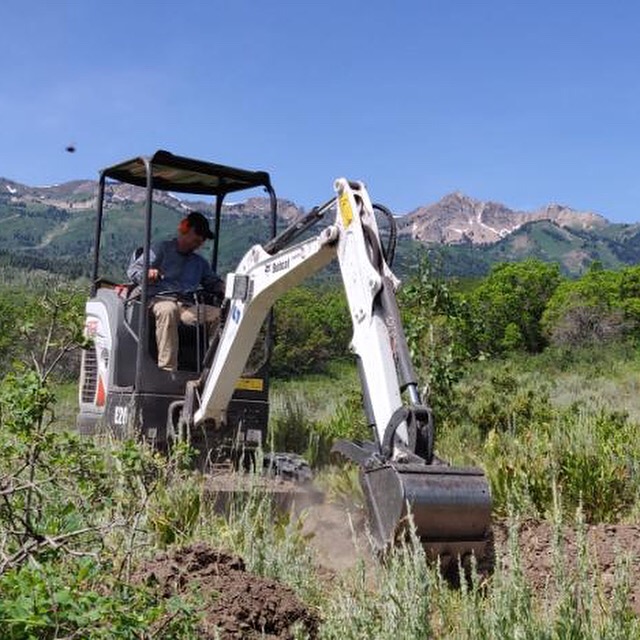
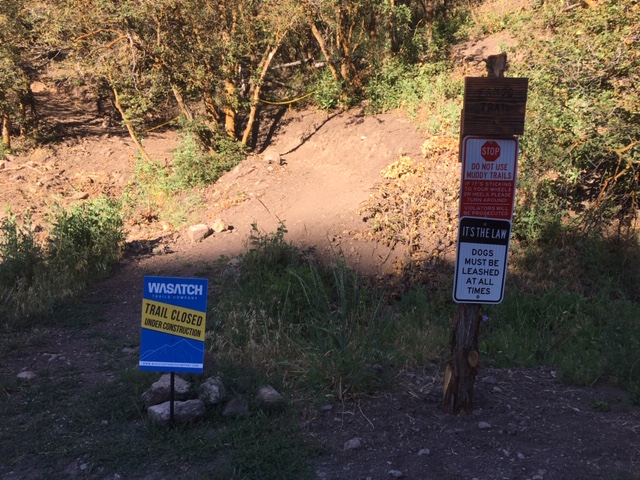
Don was the proud owner of Wasatch Trails Company and was passionate about designing and building the trails we all love to ride. If you ever rode a Don West trail, chances are you had a smile on your face.
He was a true outdoorsman who was happiest surrounded by nature. Mountain biking, road biking, climbing, backcountry skiing, fishing, kayaking and camping with family and friends was how Don preferred to spend his time. He was adventurous and found pleasure in exploring, camping and biking with his wife in the desert and mountains of Utah.
He was extremely intelligent, kind hearted, free spirited and loved to tease. Above all else, Don was genuine.
Don moved from Arkansas to Utah in 2011 where he met his wife Jenny Mitton West, married September 14, 2013 in Big Cottonwood Canyon. He is survived by his wife, Jenny, her two children Canyon and Sage and his daughter Megan. He is also survived by his mother Mary (Bob), father Danny (Carolyn), brother Adam, and sister Jacque and many other family members and close friends. Don was preceded in death by sister, Regina Diane Nicholson.
A celebration of life open house will be held Sunday, September 29, 2019 from Noon-3pm
Bring your best Don West story
2229 E Powderkeg Dr. Sandy, UT
“May your trails be crooked, winding, lonesome, dangerous, leading to the most amazing view.” Edward Abbey
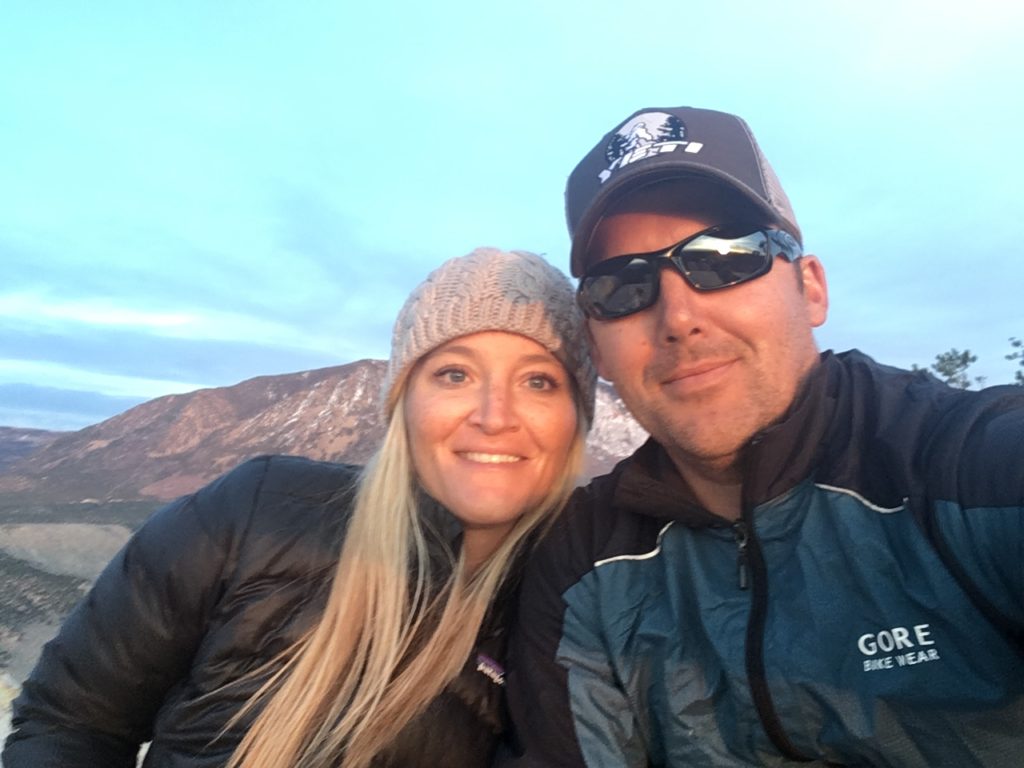
Don and Jenny West. Photo courtesy Jenny WestDon West, trailbuilder. Photo courtesy Jenny WestOne of the many trails that Don built. Photo courtesy Jenny WestDon West, trailbuilder. Photo courtesy Jenny WestDon West, trailbuilder. Photo courtesy Jenny WestDon West riding.. Photo courtesy Jenny West
By Lia Westermann – My first enduro race was actually a year ago, at USA Cycling Mountain Bike nationals in 2015. Honestly, I had no idea what I was getting myself into. I went there to only race cross country, but then I heard about enduro and thought I’d give it a go.
[Editor’s Note: this article was originally written in 2016, and appeared in the September 2016 issue. All references to time should take that into consideration. Lia Westerman is currently a 2-time National Champion racing for Pivot Cycles.]
It ended up being one of the most fun races I had done, in the beginning. About ¾ of the way through the third stage I pinched my tire and got a flat, and rode it down the rest of the way. I put a tube in my tire for the last stage, and started on the stage, hoping for the best. About 10 seconds after the start of the stage, I got another flat, but decided to ride it all the way down.
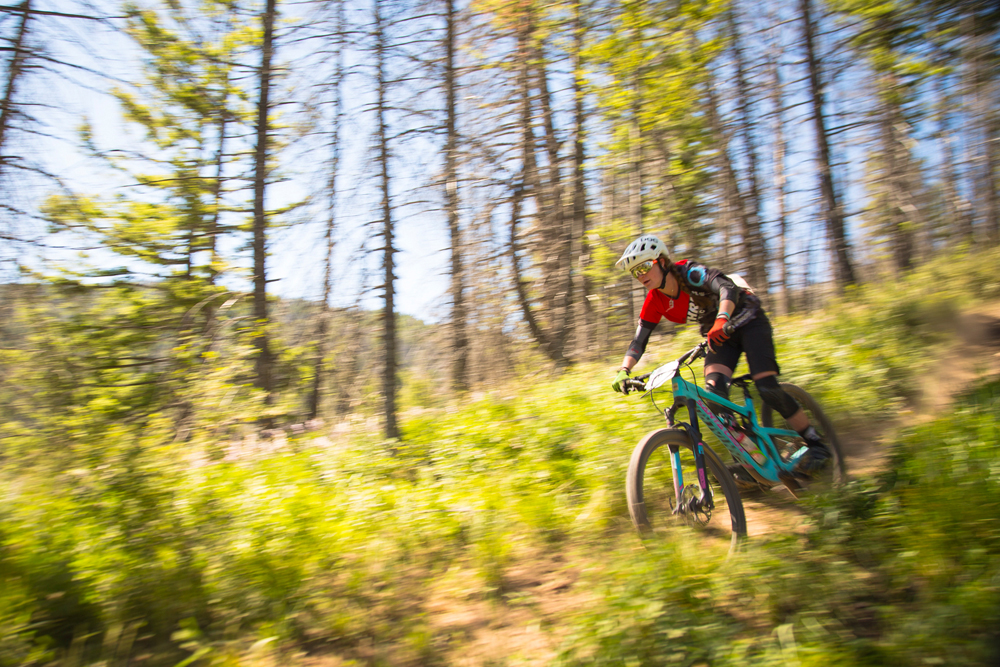
Lia Westermann ripping it in the Ride Sun Valley Scott Enduro Cup. The then 17 year-old finished 2nd overall in the Pro category. Photo by Noah Wetzel
Afterwards I was absolutely devastated. Yes, I got third place and it was my first ever enduro, but I was ahead after the second stage by about 40 seconds. I thought I had it. Lesson learned, the race is not over until it’s over.
After the race, I cried. A lot. I was so close and then I lost it, I kept thinking to myself.
A couple of days later, I contemplated what had happened. It’s bike racing and it wasn’t in my control that I got a flat. It’s bike racing and it happens. It’s bike racing and anything can happen.
That next fall, winter, and spring, I trained the hardest I’ve ever trained. I went to different gyms, rode in the freezing snow up in Park City during the winter, and did specific weekly workouts. I could never stop thinking of what had happened at Nationals, and I pushed myself harder and harder, saying I’m gonna get it next year. I have to.
Flashing forward about six months, I started to race in the Scott Enduro Cup series and I qualified to race in an Enduro World Series Race in Aspen, Colorado. I had no idea that I would’ve progressed this far in only a year. All the races were so exciting and fun! All of them had such an amazing atmosphere with such interesting people. I decided I would race pro in the Scott Enduro Cup to push myself.
At the first Enduro Cup race in Moab, I had a blast! It was my first ever pro race, so I just wanted to have fun with it and push myself a little bit out of my comfort zone, but not enough that I crashed. However, in the first stage on the very first turn, I decided to do exactly the opposite and go as hard as I could, which did not turn out well. I crashed. It was just a stupid little thing, but afterwards I picked myself up and kept on going, thinking Wow that was dumb, let’s not do that again.
The next three stages (there were four total) went extremely better. Mostly because I took it back a notch and decided to go with my first idea of not going 100%. This way I could remember stages as I went down them, and I could focus on my technique.
The last stage of the race, which was a pro only stage, was my favorite by far. It was the stage that had the most vertical descent in the shortest amount of time, so the trail was very straight with some technical sections of slickrock.
At the end of the day, I was exhausted. I was waiting anxiously for the results to find out how I placed. I hoped to get at least top five. When the results came, I found out that I had gotten fourth place! I was stoked, and I knew this was a great start to the rest of my racing season.
The rest of the races went extremely well except for the final race at Deer Valley. The second and third stops in the Enduro Cup series were at Angel Fire and Sun Valley, some of the prettiest places I’ve ever ridden my bike. Angel Fire had all kinds of riding in the backcountry and at the bike park. Rocky, rooty, loamy, steep trails, you name it. At this race I just tried to keep it smooth and controlled, which I ended up doing, and getting 5th at that race.
Sun Valley was absolutely breathtaking: the views were spectacular and the trails were in prime condition. This enduro was split into two days: lift day and backcountry day. The first day could not have gone better. I kept it smooth and safe, which ended up being the right thing to do. However, the second day, I hit a tree and went off the course – twice. Nevertheless, I was stoked to still have taken the third spot in the pro category in Idaho.
The rest of the year went pretty solid: racing in enduros in Whistler, California, and my home state. There weren’t any major problems in any of the races- no big crashes, mechanicals, or any other issues; except for the last stop in the Scott Enduro Cup series at Deer Valley. Being the first pro woman to start, I went off, and within about 10 seconds from the beginning of the first stage, I got a pinch flat. I kept thinking No this can’t be happening. But, unfortunately, learning from previous experiences, it was happening. I chose to keep racing that stage with a flat and got down safely. That was the end of my season, which I was proud of overall.
I ended up racing internationally, getting second overall in the Enduro Cup series, and increasing my skillset and meeting new people all along the way. I was happy with how it turned out, and I am excited to continue on next year.
By Bill Roland – There are many riders who love to feel the cool autumn breeze hit their face while they are on their bikes whether it is around the neighborhood or on a 60-mile venture with dozens of friends in a peloton. Unfortunately, there are quite a few men and women who have been extremely active throughout their lives and suddenly face tremendous pain in one or both of their knees which may bring a halt to enjoying one of their favorite hobbies. Eventually they go to their orthopedic surgeon, explain the situation and ask the Doctor, “Will I ever be able to ride again?”
Each patient has a unique set of circumstances concerning the patella and the surrounding bone, tissues, cartilage and tendons but in nearly every case after a thorough exam by an orthopedic surgeon, they are informed, “knee replacement surgery will give you the opportunity to return to riding.” The major causes of debilitating pain include meniscus tears, cartilage defects and ligament tears. In general the surgery consists of replacing the diseased or damaged joint surfaces of the knee with metal and plastic components shaped to allow motion of the knee. In most cases, there is a great deal of pain, sacrifice, and attention to therapy necessary to achieve full recovery.
An Experienced Athlete/Surgeon Shares His Views
Eric Heiden M.D. was a five-time gold medal winner in speed skating at the 1980 Winter Olympic Games in Lake Placid, NY. Six-years later he was a member of the 7-11 team in the 1986 Tour de France. Following that he attended Stanford Medical School, earned his M.D. in 1991 and currently he is an orthopedic surgeon who specializes in sports medicine with emphasis on knee and shoulder surgery. He and his wife, Dr. Karen Heiden, have offices in Salt Lake City and Park City. As an orthopedic surgeon, he finds that his experiences in skating and cycling help him form a unique connection with his patients, many of whom are injured athletes. Recently, Dr. Heiden was kind enough to give Cycling West an exclusive interview and discuss openly the issues of knee replacement surgery and whether patients can continue to enjoy riding the bicycle after surgery.
Assessment
When asked whether X-rays or MRI (magnetic resonance imaging) determined the primary factors if knee replacement surgery is necessary, Dr. Heiden explained the value of each. “In almost all cases,” he said, “X-rays are more important than MRI because X-rays give us a better indication of how much articular cartilage is left. MRI’s provide incidental information but the X-rays, standing views, give us a good estimate of the situation regarding articular cartilage and that is important.”
In addition to articular cartilage, he also addressed the importance of the pain tolerance the patient is feeling in his or her knee, “Actually, it is a combination of subjective and clinical findings to see if the patient will benefit with knee surgery. A big determining factor is the patient’s expectations along with what we see in the X-rays. If an athletic patient tells us that he wants to run marathons or ski the bumps, it is the physician’s role to temper their expectations. These devices are wonderful but there are limitations so we must know how active the patient plans to be in the future.”
Preparation
Assuming the doctor and the patient have decided the surgery is a “go”, Dr. Heiden said there is one important factor before the patient is rolled into the operating room. “I think it is important,” he explained, “that the patient tries to prepare himself/herself by getting in as good a cardio-vascular condition as possible. It is important for rehab to go into the procedure as fit as possible.”
Rehabilitation
Many patients go into the surgery and have heard that post surgery exercises are important but many are not quite sure what they should do. Dr. Heiden wasted no time in articulating the importance of post surgery exercises. “In general,” he commented, “the patient has to be very dedicated to the post operative outcome. Obviously, it is highly important to have the right procedure planned, but 90 percent of a good outcome is due to the rehabilitation and physical therapy. They must spend time every day working with the knee. On my part, it is important that I give them a good idea before surgery of what they are getting themselves into. I also tell my patients that the progression is slow, but with dedication and commitment they will have a good outcome.”
In most cases, the patient tries to ease off pain medication, withstand the swelling and pain, and begin light stretching. Within a week, most are walking with a cane and gradually putting weight on the leg that was operated upon. Dr. Heiden expressed his thoughts about the preferred exercises. “The very best exercise is riding a bicycle or a stationary bike following surgery,” he advised. “When it comes to knee rehabilitation, there is nothing better. For recovery of soft tissues, bicycles are a great rehab device. Other excellent exercises are swimming and a rowing machine, but first by a long shot is the bicycle or the stationary bike.”
Dr. Heiden was asked about how soon a patient should get back into these physical therapy workout sessions following surgery. “In general,” he suggested, “the first six weeks it is important to work on range of motion rather than strength and conditioning. By that I mean pedaling at a slow rpm and a very light resistance. At this stage, heavy resistance is out of the question. There are goals that you set and time periods. To meet that goal, it is important to get that knee to bend and move as freely as possible. Following the first six weeks, it’s time to get back to more of an rpm that is consistent with your regular riding but I would recommend adding light resistance. After three months, the patient reaches the point where he or she should be able to get back to riding and working out at a pace they like and will enable them to get back into shape again. After six months, riders should be pretty darn close to complete knee recovery.”
Outcomes
As the interview came to a close, Dr. Heiden was asked if there was anything else he would like to add. “This procedure is very successful,” he said, “and to be successful you have to make sure you are dedicated and committed to that perioperative period following surgery.” Now that sounds like good advice from a highly successful orthopedic surgeon who happens to have five gold medals and a resume that includes riding in the Tour de France.
She Was Determined to Ride in the 2016 Pelotonia
In order to provide the readers with more information, I talked with two patients who have had this surgery. This reporter recently moved to Salt Lake City from Columbus, OH where I was an active rider. Many bicycle enthusiasts in the Western states may not be aware but for the last eight years there has been an extremely popular and noteworthy event home-based in Columbus called The Pelotonia. Each year on or about the first weekend in August, thousands of bicycle riders participate in a ride that was founded in 2009 with the objective to fund life saving cancer research. Each rider who participates in the 100-mile ride on Saturday and the 80-mile return to Columbus on Sunday is responsible to accumulate $2,500 in donations from friends, relatives, business associates or anyone willing to donate toward the cause to cure cancer. One hundred percent of the funds raised go directly to cancer research at the Ohio State University Comprehensive Cancer Center – Arthur G. James Cancer Hospital. Since the advent of the Pelotonia ride in 2008, the cyclists have raised over $121 million; this year there were 7,749 riders participating and over $15 million has been donated.
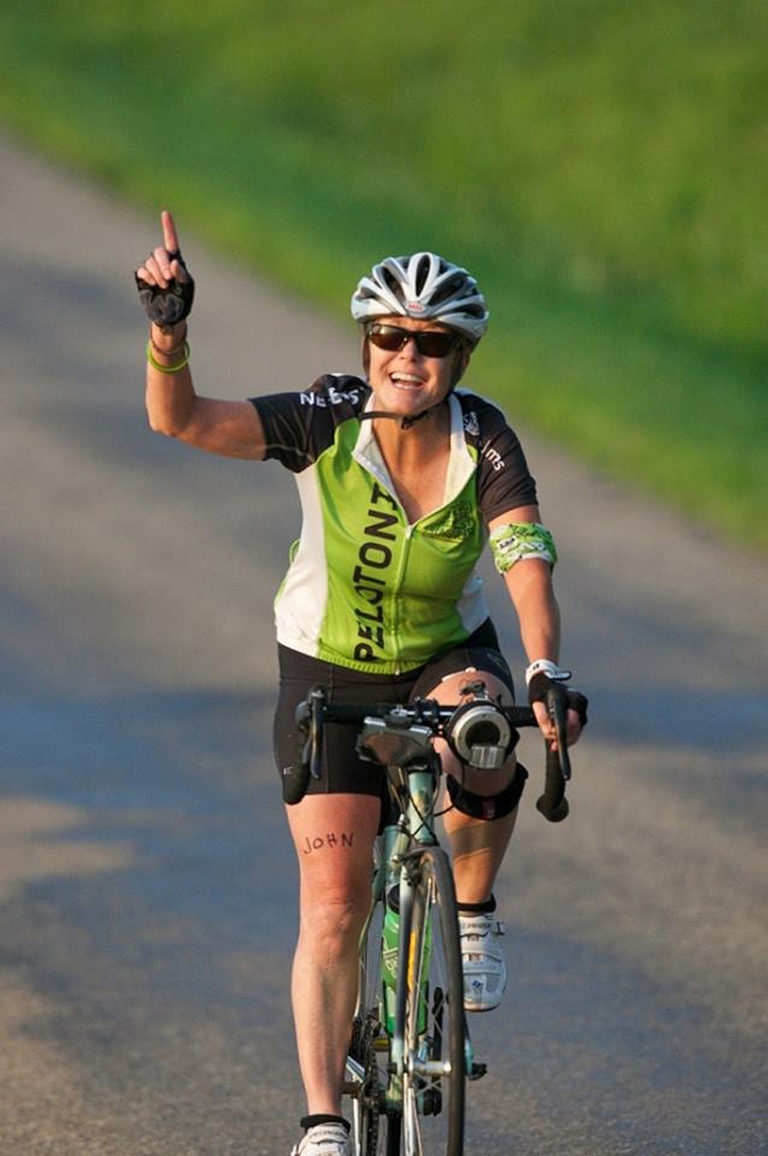
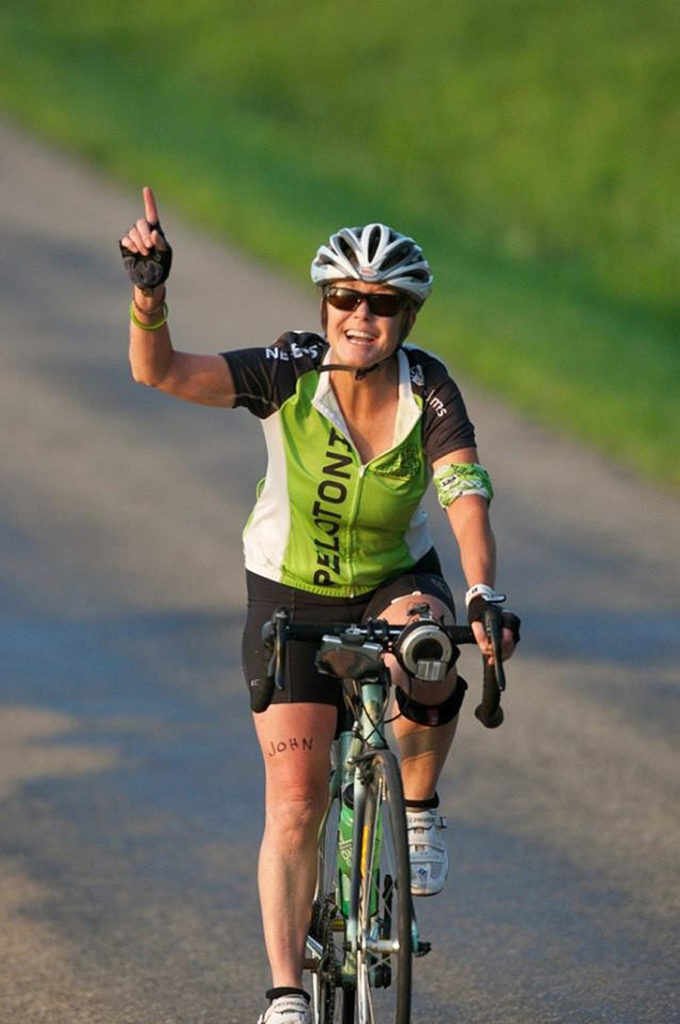
Cathi Nelson in the Pelotonia Ride just seven months after undergoing knee replacement surgery. Photo by Kris Chick
One avid cyclist in particular is a cancer survivor named Cathi Nelson of Galena, OH. She had been a participant in all seven of the Pelotonia rides since its inception but in the fall of 2015 the pain in her right knee became unbearable. After extensive testing (X-rays and Synvisc-One injections) under the guidance of Kurt Unverferth, M.D., Cathi remembers the advice she was given. “Dr. Unverferth,” she recalled, “said that because it was bone on bone, and the knee joint was deteriorating, the only solution was to have a complete knee replacement. He said it would continue to deteriorate and the pain would not subside. At that time, a good night’s sleep was hard to achieve.”
It was decided to have the procedure done on Friday, January 29, 2016. Cathi found the post surgery to be tolerable at first but within a few days, it was extremely painful. “I really started to doubt whether I would ever get back on my bike. The swelling was intense, the rotation of my knee was nil and it was locked straight. I wondered if I would regain my mobility in time to begin training for the Pelotonia.”
As spring approached, Cathi realized she might not be able to ride the 180 miles on August 6-7. “During March and April, I started pushing myself, doing twice the amount of physical therapy recommended, in the hopes of getting back on the bike as soon as I possibly could. I did not have full rotation of the pedals until the end of May. I didn’t start going up measurable hills until July.”
By early July, Cathi had progressed to the point where she knew that she would be ready for the challenge of riding 180 miles in two days. “I just spent a lot of hours in the saddle spinning it out,” she remembered. “As a matter of fact, the more I rode the bike, the better my knee felt. It wasn’t as tight or restricted as it had been previously. At that point, I knew I could grind it out.”
Following the two-day event in early August, Cathi reflected about undergoing knee replacement surgery in January and in just over six months she had successfully accomplished her goal. “I am really looking ahead to having a year under my belt, although I still have some restrictions with my knee. My doctor reassures me it takes close to one full year to acquire total healing. I look forward to have the opportunity to participate in many activities without pain. Cycling is at the top of the list.”
An Aggressive Athlete Survived Many Operations
Another patient of knee replacement surgery is Dave Richards, resident of Salt Lake City. Dave is a 64-year-old life long cyclist, a successful architect, and a professional photographer who has provided many excellent photographs that have appeared on the pages of Cycling Utah / Cycling West. Dave’s background is filled with a plethora of sports and physical activities that indicate he has truly demanded a lot out of his body, especially his knees.
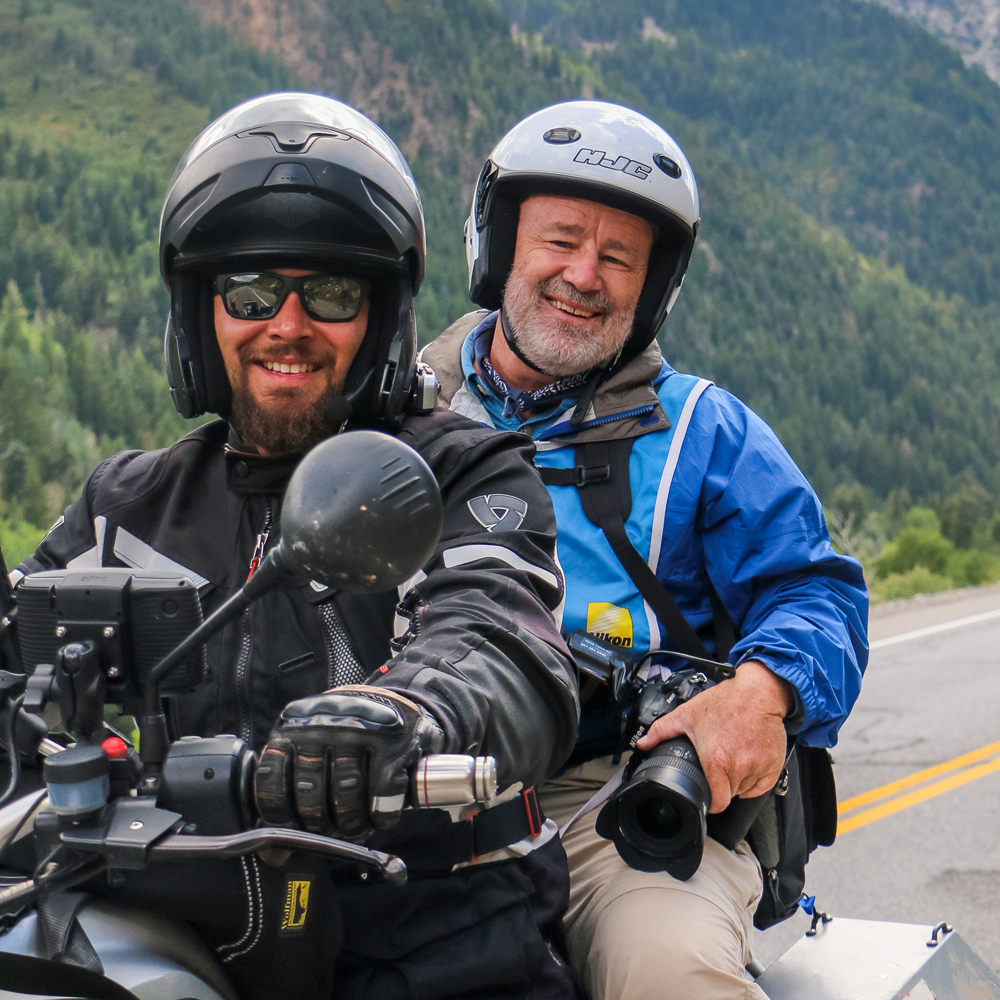
Dave Richards covering the 2015 Larry H. Miller Tour of Utah from the back of a moto piloted by the ever capable Mike Love. Dave has had both knees replaced and still cycles and regularly covers cycling events. Photo by Dave Iltis
“Basically I have participated in many sports,” he explained, “and I was never one to go lightly. I have had eight surgical procedures on my knees, the first one when I was 13 years old. My first knee replacement, the left one, was in 2001 when I was 49. At that time, knee replacement surgery was more common with people much older. I imagine most of the patients were in their retirement years. The hardest part was finding a surgeon who understood that I had a need to be very active. At that time, there were different knee designs. Some were based on adhesive cement while others were based on a combination of adhesion and a mechanical fit. Stryker Corporation out of Kalamazoo, MI designed both of my prosthesis. They have holes in them for bone embedment and the bone grows into it. The other designs, for the senior folks, would rely on adhesive material whereas the mechanical fit was supplemented with adhesive material.”
Dave’s right knee was replaced in 2005 but fortunately the procedure was not as complicated due to the fact there was far less damage than the left knee. “I raced in college,” Dave said, “and I still ride recreationally. After long, hard rides the knees might be sore and occasionally I ice them, but generally not too much pain from riding. Skiing is a lot harder on both of my knees. Sometimes it’s the right or the left; it varies a bit.”
Regarding advice to someone with pain in one or both of their knees, Dave said that he was big on getting information to find out what is going on. Rather than ignore it, he always wanted to know why he was feeling a certain pain in either knee. “I’ve been a knee patient since I was 13,” he chuckled, “believe me, it wasn’t by choice. For cyclists, if they are having pain, it’s worth going to a doctor to find out why. I would also recommend a proper bike fit. I think that is critical. A good bike fit will help your knees, whereas a bad bike fit will damage them. For example, if the saddle is too low and the rider has a tendency to push big gears, that would put a lot of strain on the patella at the top of the pedal stroke. Proper bike fit and proper technique are important.”
Although he has always been active in many sports, Dave identifies the one that has helped him recover from his operations. “As far as recovering from knee surgery,” he said, “I totally agree with Dr. Eric Heiden. Cycling is the best exercise most patients can do following knee surgery. I heard a story that Tiger Woods had knee surgery in Park City years ago and his surgeon, Dr. Tom Rosenberg, recommended that he should spend extensive time riding a stationary bike. Months following surgery, there were rumors out that a golf writer asked Tiger how things were going with the rehab exercises on his knee. Tiger responded with a great one-liner, ‘I feel as though I’m going to win the Tour de France!’ “
Dave continued to point out the advantages of cycling as a major exercise following a knee replacement surgery. “The great thing about cycling,” he explained, “is that it is a low impact exercise. The patient is not pounding the knee, and it continually flexes the joint, which circulates the synovial fluid around, which lubricates the joint. My advice to most fellow patients would be to prepare a list of questions for the doctor prior to the appointment. That enables the doctor to better understand the patient’s expectations and concerns.”
There have been many alterations regarding the construction of the knee prosthesis and how it assists different patients. “Replacement surgery has changed quite a bit since I had mine in 2001 and 2005,” Dave recalled. “More patients demand to remain active and the newer designs of the implants have allowed a bigger range of motion than the older ones. Getting your range of motion back is probably the most important part of a successful rehab. Everybody struggles with that and the faster you are at getting your range of motion back, the happier you will be overall.”
If you are a candidate for knee replacement surgery or you know someone who is having severe pain, please know there is a solution to your problem and your days of riding your bike in that cool, fresh air are far from over.
Bill Roland is an avid bicycle rider who recently transferred from Columbus, Ohio to Salt Lake City. In the 1980’s he was the editor of The Golf Traveler Magazine published here in Salt Lake City. Two years ago he published a biography entitled, “Champagne Tony Lema:Triumph to Tragedy.”
In the summer of 2018, musician and poet Ben Weaver along with filmmaker Keenan DesPlanques pedaled the Great Divide Mountain Bike Route, 3,000 miles from Banff, Alberta, Canada to Antelope Wells, New Mexico to document the Music For Free tour.
On Wednesday, September 25, 2019, Saturday Cycles of Salt Lake City will present a screening of the film at Fisher Brewing Co., along with a meet-and-greet with Ben Weaver, who will be on hand to introduce the film and sing a few songs.

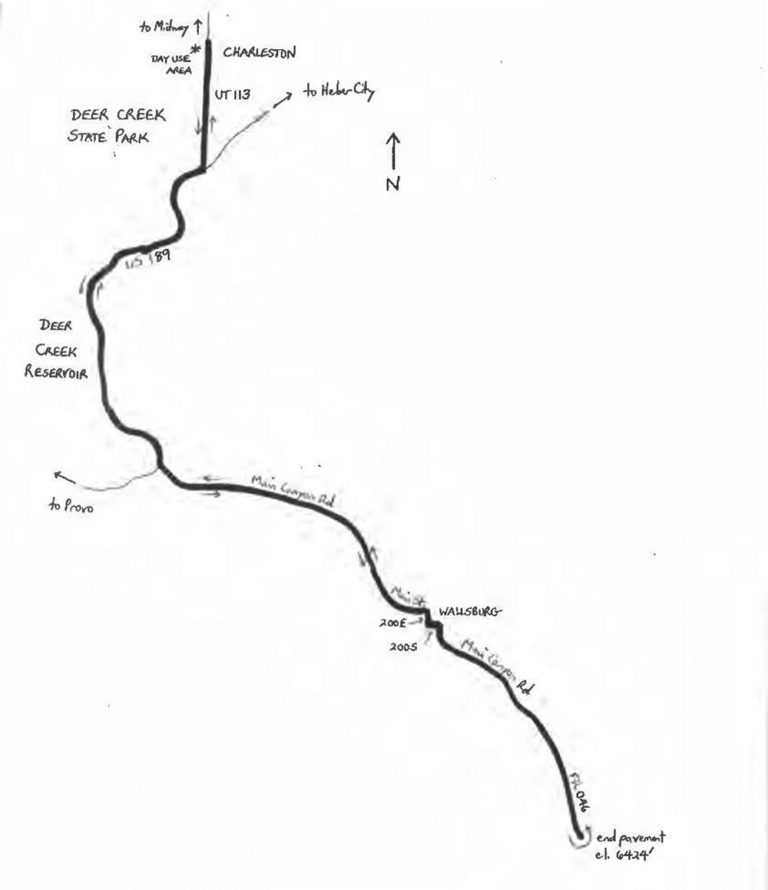
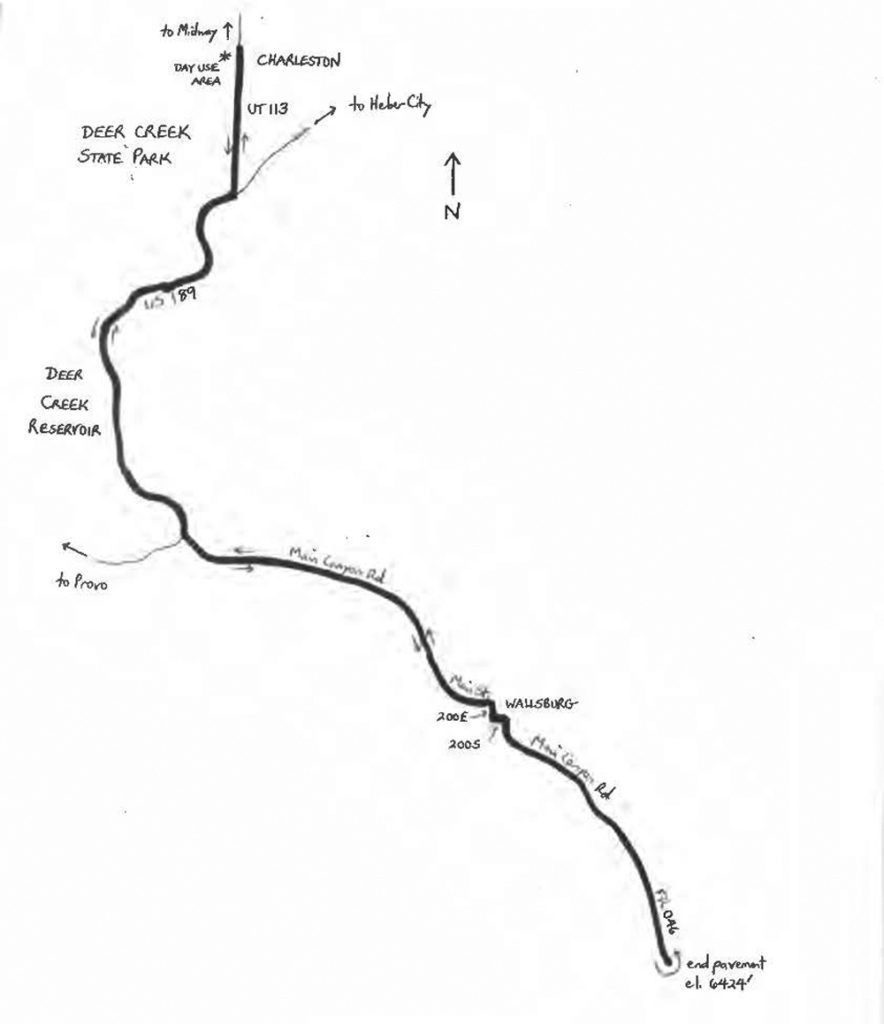
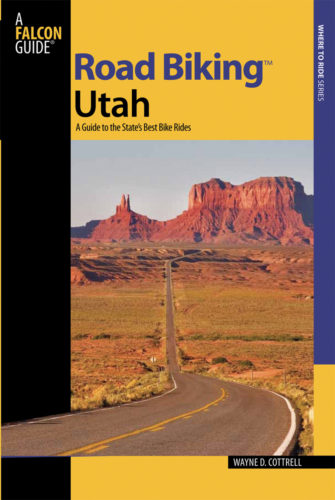 Just under a mile and a half into the ride, UT 113 ends at U.S. 189. Turn right, and head southwest, adjacent Deer Creek Reservoir and Deer Creek State Park. Note that the name of the park is a bit of a misnomer, as the featured attraction is the reservoir, rather than a creek; also, the reservoir’s main inflow-outflow is the Provo River, rather than Deer Creek.