Because of the dangers inherent in cycling alongside 3,000-lb vehicles, most cyclists become much more well-versed on the laws governing their conduct than their motorist counterparts. In fact, many cyclists have even found themselves in the awkward situation of educating law enforcement officials on some of the more recent cycling laws!
Are you a cycling-law scholar? Take the quiz below to test your knowledge. Keep in mind that some of the laws below are specific to Utah. So if you’re a cyclist in another state, be sure to check your local laws for the rules that apply to you.
TRUE OR FALSE:
Motor vehicles may not park in bicycle lanes.
False. Utah, like most other states, does not prohibit parking a car in a bicycle lane.
In Utah, bicycles may ride “three abreast.”
False. It is only legal for two cyclists to ride side by side as long as they do not impede traffic. If you slow down the cars behind you riding side by side, it’s not only courteous but required that you ride single file.
You must wear a helmet when riding a bike.
False. Utah, Wyoming, and Idaho do not have laws requiring cyclists to wear helmets.
It is illegal in Utah to ride your bike with no hands.
True. Utah Code 41-6a-1112 specifically states that all cyclists must have at least one hand on the handle bars at all times.
A person under the age of 18 can ride their bike on a sidewalk in Utah.
True. Until last year, it was illegal in some Utah cities to ride a bike on a sidewalk. Last year, the Utah legislature changed the law so children can ride on sidewalks anywhere in the state.
Drivers pay for roads, so they should get priority.
False. Drivers are not the only ones paying for road. Cars and cyclists have equal rights to the road. They should mutually share the road and obey the laws to create a safe environment for all.
You can run a red light as a cyclist after waiting 30 seconds.
False. If you are 16 years old or older, you can ride through a red light only if 1) the traffic sensors have not sensed you after waiting 90 seconds, and 2) there are no cars or pedestrians with the right-of-way near the intersection.
You are approaching an intersection where four cars traveling in your same direction are waiting at a red light. You can legally pass the waiting cars on the right using the shoulder of the road, and proceed to the front of the intersection to wait for the light to change.
True. Until May of 2013, it was illegal for a cyclist to pass cars on the right while riding up to the front of an intersection. But our attorneys, Ken Christensen and Russ Hymas, wrote legislation (HB324) that became law making it legal for a cyclist to pass cars on the right.
Utah passed the “Idaho stop” law this year allowing cyclists to treat stop signs as yield signs.
False. HB58 passed the House of Representatives, but was not heard in the Senate before the end of the 2018 legislative session.
Cyclists can make a claim under their car insurance if they are hit by a car.
True. Many cyclists erroneously think their car insurance does not apply if they’re not in their own vehicle when injured. The opposite is true – coverages such as uninsured motorist (UM), underinsured motorist (UIM) and personal injury protection (PIP) benefits often provide the greatest safety net for cyclists when hit by a car.Cyclists can make a claim under their car insurance if they are hit by a car.
Ken Christensen and Russ Hymas are avid cyclists and Utah attorneys at UtahBicycleLawyers.com. Their legal practice is devoted to helping cyclists injured in collisions with motor vehicles. They are authors of the Utah Bicycle Accident Handbook and are nationally recognized legal experts on cycling laws and safety.
By Chris Blinzinger – John and I have been touring together for almost 5 years and in that time we have enjoyed taking other people with us on our adventures. We have not necessarily been Tour Leaders, but have gone on trips with people of varying degrees of touring experience. We are certainly not world travelers but have had the opportunity to tour in semi-extreme, semi-remote areas in the deserts and mountains of the West. When planning trips, we throw out an invitation for anyone interested in accompanying us.
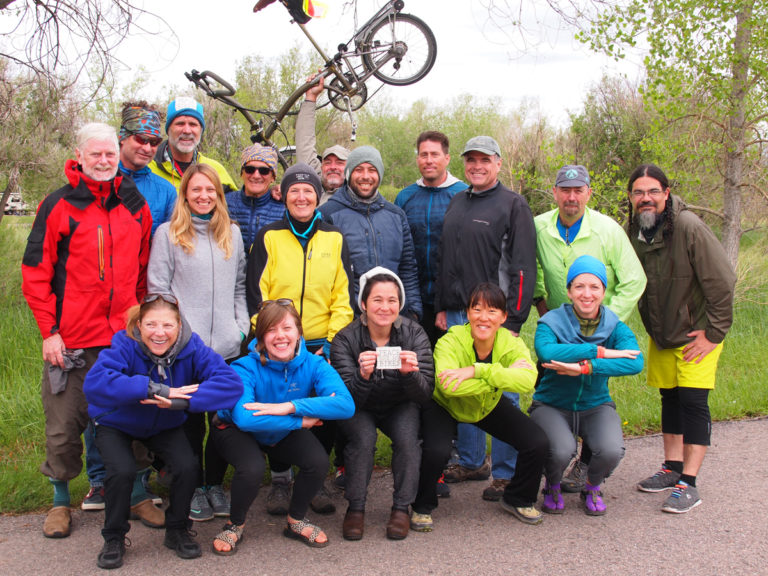
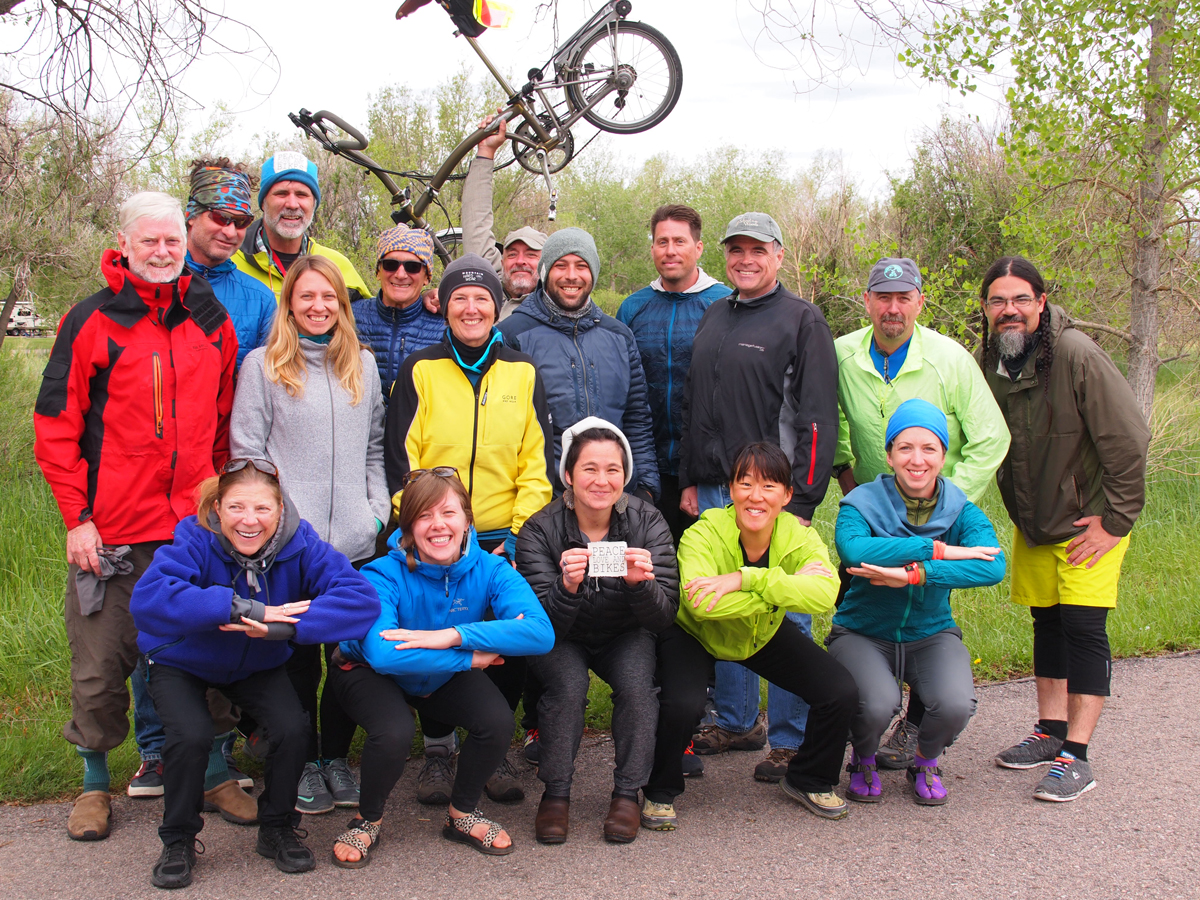
The 2019 ACA LTC participants. Photo by Barbara Wade
We have thrown around the idea of creating a touring company to accomplish a couple objectives. 1. To provide an opportunity for interested touring-minded people to have a supported/guided tour. 2. To use it as an opportunity to spend more time on our passion of bike touring and share it with others. I spotted the Leadership Training Course (LTC) (https://www.adventurecycling.org/guided-tours/educational-tours/) on the Adventure Cycling tour page https://www.adventurecycling.org/guided-tours/ and sent it to John for consideration about doing it. We agreed that it may offer some information about how to conduct a guided tour and another benefit was that it was a requirement to become an Adventure Cycling tour leader. We decided to do it and registered for the course in Denver scheduled for June 6-9, 2019.
We decided to use the train again to get us and our bikes to Denver and back. We had used it before and it is convenient when using to bike roll-on service for $20 each way. Before the LTC we received maps and information about the tour, how to prepare, what to bring and some of the expectations of the participants. All participants were included in a Google email group so introductions and coordination were facilitated easily. It’s interesting how reading the introductions prior to meeting participants offers one perception and then when meeting reality, perceptions change. We boarded the train in Salt Lake City at 3:30 AM on the day of our departure.
I was excited for the views through the mountains. When we rode back from Grand Junction two years ago we departed in the evening and did not have much daylight as darkness quickly set in after or departure. The train is very comfortable and the seats are wide and recline to facilitate sleeping. We both slept well until the sun was up. We were just coming out of Price Canyon when I stirred enough to look out the window. The train has an observation car where seats are not assigned and it’s a first come first served. It was a great car with big windows and great views. We stopped in Glenwood Springs and Winter Park long enough to get out and stretch the legs. These were designated smoke breaks as the other stops were not long enough to get off the train. Between Grand Junction and Denver, there are 28 tunnels that the train goes through. The longest is 6 miles long. The mountain views are awesome. There are areas with no other access than the Train in steep canyons with raging rivers at the bottom. The train is slow and if you’re in a hurry, it may not be the best option but for some time away and enjoying the journey rather than the destination, it is a good option. The train does not have Wi-Fi. Cell service is spotty in the remote areas of the mountains on the route. For those who can’t tolerate not being connected, it may not be a good option.
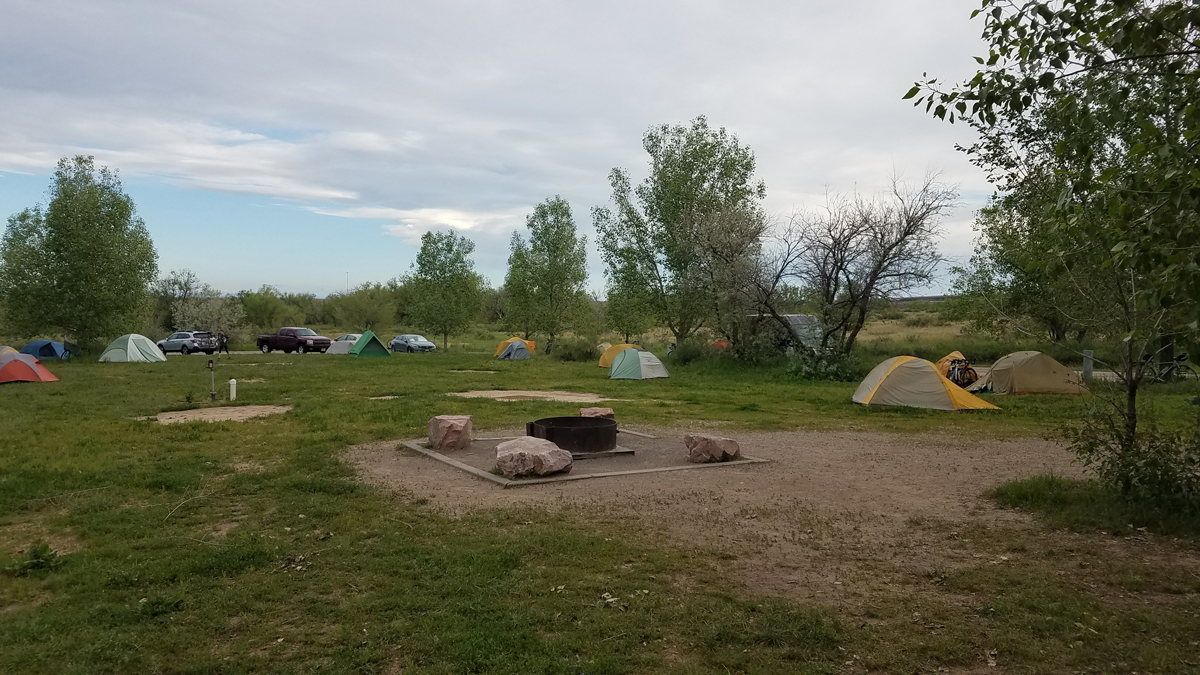
The group camp at Cherry Creek. Photo by Chris Blinzinger
We arrived in Denver in the evening and quickly found the Cherry Creek bike path downtown that would lead us the 15 miles out to our Campground at Cherry Creek State Park. The path is great and pretty much follows the creek for most of the way. It is signed well and had we printed the map sent in the email from ACA, we may have had an easier time knowing whether to say right or left at the forks. One minor detour for a couple miles was easily signed and no problem. We arrived on Wednesday evening and the course did not start until the following late afternoon so we met a few other early arrivals and quickly set up camp at the group site as darkness was falling fast. John carries a pocket projector and a few movies on his tablet and always game to set up his small screen and show a biking movie. He uses a folded piece of corrugated plastic that levels out the ground below his air pad that doubles as a small movie screen.
The following day we rode around the park with Becca from Kansas City, one of the early arriving LTC participants. The weather was nice and typical for this year’s ongoing Spring weather. Riding required as least bringing an extra layer. Cherry Creek State Park is large with a big lake and walk/bike paths that go all the way around and marina, swim beach, huge dog park and bird viewing area. It is in the Southeast area of Metro Denver.
We greeted participants as they arrived and set up camp. Participants represented the states: SC, NC, D.C., NY, MO, MI, OH, CA, UT, TX, CO, OR, WY, IL. The course started at 16:00 with intro from course director Lynn and the three other leaders then all participants introduced themselves. It was great to see like-minded tourers and we were excited for the coming days. This course was designed to be run like a regular ACA tour without all the cycling miles. We were quickly split into four groups and assigned a leader. This allowed us to have a 4:1 participant-leader ratio and allowed for an excellent span of control. Some meetings were everyone (all 17) while others were the smaller groups. We were assigned chores that all self-supported tours include like cooking and food buying responsibilities. We would all have to ride to the store and buy food to stay within the budget and cook for the group. This is how it works on ACA self-supported tours. Each participant carries a portion of the “Group Gear” that includes small stoves, fuel bottles, utensils, French press (perhaps the most important) and a few other items.
When considering self-supported tours, I imagined that everyone would carry their own stove and pots. Not on ACA tours. Each participant is asked to leave 20% space available in their bags to carry a portion of the Group Gear. This makes total sense. John and I may have too much duplication when we tour together, but I also call it redundancy. Either way, each participant must carry some of the gear. Two people assigned for dinner and two for breakfast/lunch. Meals are included in the cost of the tour.
The participants in our LTC came from varying backgrounds and touring experience. Several had done cross country tours, some had never carried their own gear, and some had only done self-supported while others rode pedal assist bikes. There are so many variables with bike touring gear and experience. They all seem to work and I think whatever your preference, you can make it work one way or another. Learning the ACA way of doing business and company concepts were helpful. Not just from a bike touring perspective, but from a Leadership professional development perspective. Have you ever been on a tour and run into trouble. Whether it is with gear, weather or a conflict between people, we’ve all experienced it. How do you get through it and resolve it? John and I had a guy on one of our trips bail after the third day. This was another reason we wanted to participate, to know what we could do to avoid it happening again or avoid it in the first place. We participated in Role Plays. For me, most these have been less than helpful in training throughout my life so I was not looking forward to them. I was surprised how helpful they were. We were given scenarios (each that has occurred on a previous ACA tour) and had to work through it using the concepts of leadership and ACA procedures to resolve them. They were very realistic and helpful. I appreciated the diversity of our group with the single “Bike Touring” interest in common.
Breakfast was a 7 and class started at 8. We were usually done by 15:30 in the afternoon to give those responsible time for shopping and meal prep. One valuable tool when “Hangry” occurs is to tell people to eat. Number one rule for food is quantity. Have plenty to feed hungry cyclists. What do you cook for a 16 member cycling group? Whatever you are good at. One Leader suggested to have one solid recipe. There is a recipe book (I think it can be found on their website) that can provide good menu items but food is a plenty on ACA bike tours. I believe them when they say food is plentiful.
One of the main principles for an ACA tour leader is the Hands-Off principle. This means to make important decisions when they are necessary but to not micromanage the tour. This is meant to allow each cyclist to “Ride their own ride” and prevent each leader from getting unnecessarily bogged down details. I like this principle and believe it is my style.
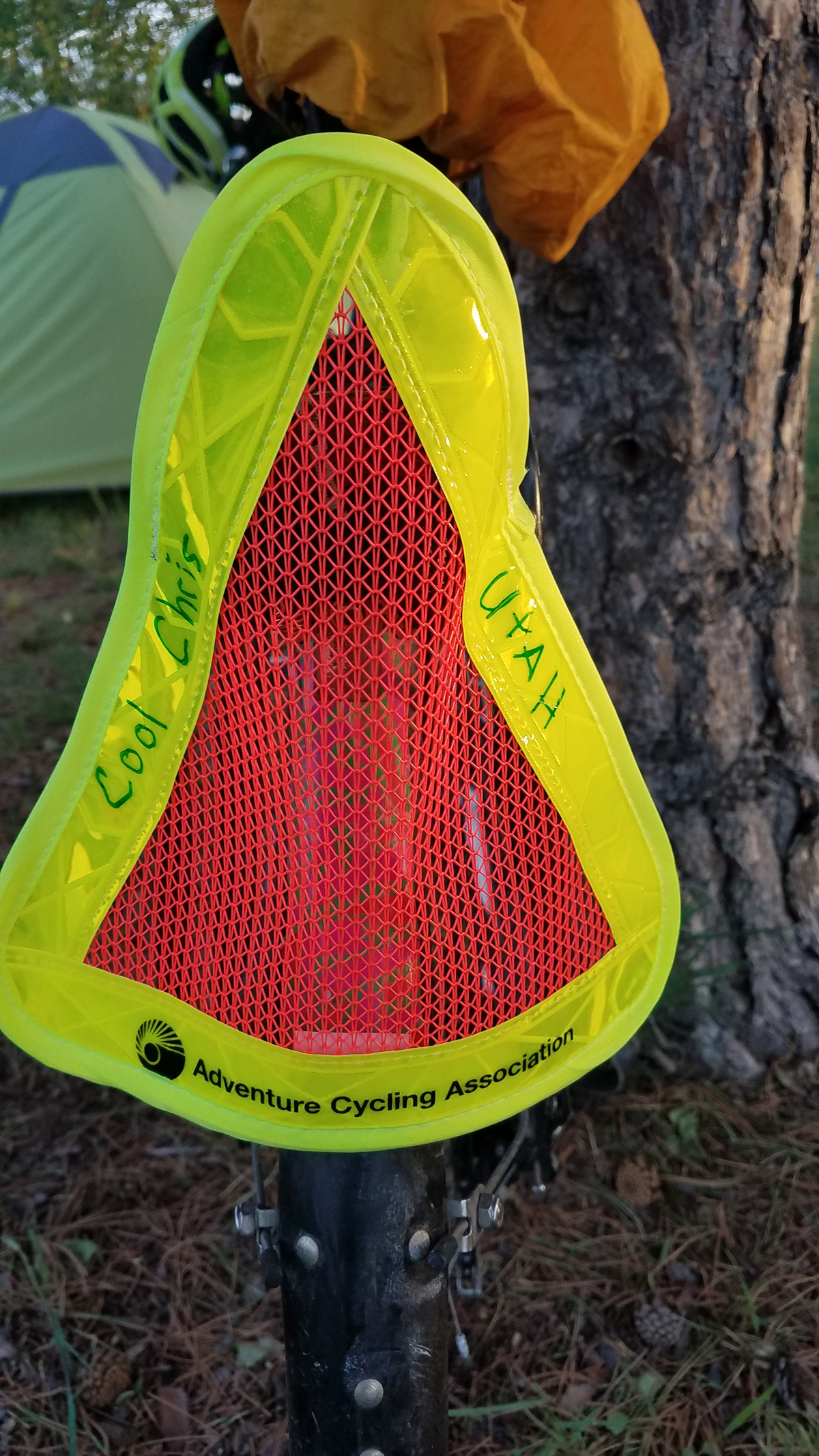
Communication is important while touring with another or others. A golden rule is to wear a helmet whilst on the bike and…wear a reflective triangle (provided with cost of tour) that can be worn around the waist or strapped to the rear rack. This can be left roadside when someone is off the course. This lets the sweeper know that someone has stopped. They carry a few extra just in case. I like this idea as John and I ride together but the whole concept of leaving something on the side of the road if you’ve pulled off is a great communication tool.
The Safety Triangle is a helpful addition to any bike touring setup. Photo by Chris Blinzinger
We did not have much bike riding opportunity although the time spent in the course was valuable. I enjoyed meeting and working with all the participants and hope to see them again on rode in the future. I am better for participating and looking forward to a self-supported ACA tour next year. I am interested in becoming an ACA tour leader and perhaps I will have the opportunity someday. I have looked at and considered an ACA tour in the past but was uncertain of its value, now I have a new perspective and look forward participating because of the diverse like-minded cyclists and doing it in a part of the country away from home. John and I were put in separate groups during the week to which John said “I’m glad we didn’t spend a lot of time together”. His point, to which I agreed is that we had an opportunity to spend time and mingle with bike tourists from around the country. We took full advantage of that.
We stayed an extra night and left early Monday morning. It was great to leave having developed friendships over the week with people I hope to see somewhere down the road. The train was several hours late and the ride home was long. I sleep fine in a tent but the train is slow and it turned into a very long day. I arrived home with many plans percolating about when and where to take the next tour. Looks like Idaho Hot Springs in the Fall, but my desire to tour other regions of the country can be accomplished on my own or with an ACA tour. Bike touring is my hobby, I will always dream of far off lands but there is so much to see right here in the good ole USA? I will continue to work on becoming an ACA tour leader.
The ride home from Denver to Salt Lake City. Photo by Chris Blinzinger
Whether you are interested in leading tours on your own or for ACA, the LTC can be valuable to understand the importance of group dynamics and give new perspective on tour leader responsibilities. LTC’s are offered each year around the country.
Becoming a Adventure Cycling Association Tour Leader
From the ACA website, the first step to becoming a tour leader is to take the Leadership Training Course as described above. Additionally, tour leaders must take CPR and have a First Aid Certification. Tour leaders need a recommendation from the LTC, followed by a phone interview. The next step is to staff or co-lead an ACA tour, followed by becoming an independent tour leader. For more information, see: https://www.adventurecycling.org/guided-tours/become-a-tour-leader/
Chris Blinzinger is an avid cyclist, commuter and tourer. He is a member of the Provo Bike Committee and advocate for active transportation. He tours with friends and family and hopes to ride back to his home state of Indiana in the near future.
Riding a bike as often as possible is by far the best thing one can do to build a world changed by and adapted to two wheeled travel. But it’s not the only thing that creates a more bike friendly community.
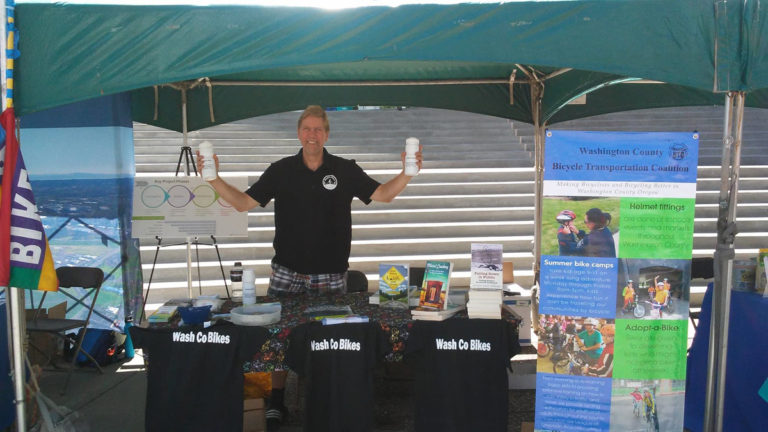
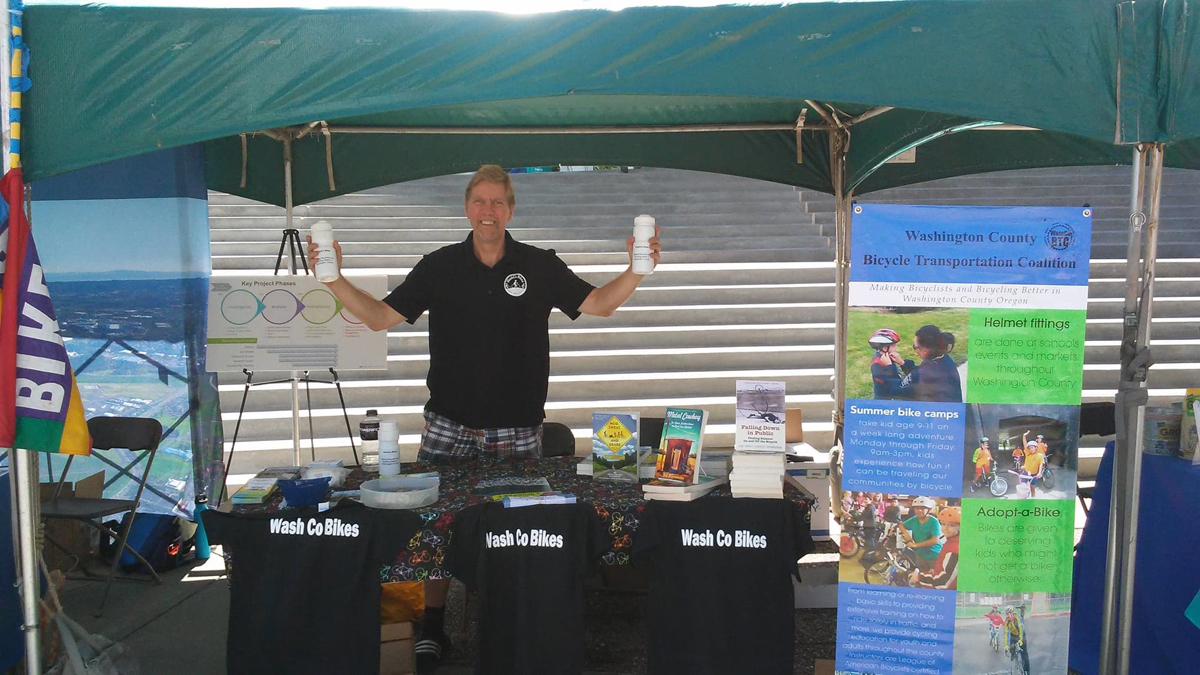
Joe Kurmaskie, the new director of WashCo Bikes, tabling and meeting the public at Hillsboro Days Celebrations. Photo courtesy Joe Kurmaskie
When I was down for the count with illness that I thought would end me, I had quality time to ponder, study and research what influences communities. Why some become bike friendly and others death gauntlets for commuters, recreational riders and everyone in between?
It boils down to bringing bikes onto the roads day in and day out, planning and building safe, users friendly shared and separate spaces for bikes and the often missing ingredient; bike culture. In other words – not only do we need to follow the Field of Dreams model – Build IT And They Will Come, but we must come as we are and have fun on bikes in the here and now! Only with this two pronged approach will communities across the country become places where biking is not only normalized but a choice for transportation that everyone will feel comfortable using.
Because I’m hard to kill (world touring cyclists are like that) I managed to right my personal health ship, regain my old energy, marry it to new perspectives and take on daunting challenges such as trying to bring bike culture, infrastructure and education to the county just west of the country’s bike Mecca, Portland, Oregon. As the new Executive Director of Washington County, Oregon’s 16 city/communities bicycle coalition: Rebranded as WashCo Bikes, I’m pumped to invigorate the suburbs ( places where big SUVs roll along with bumper stickers which read: One Less Bike) and outlying communities west of Portland with exciting new programs while expanding quality existing ones.
The plan includes:
Rebrand and expand our summer bike camps.
Create a Freewheeling Festival Of The Bike around our adopt a bike program, including a Bike Craft Gift Fair, awards weekend and holiday rides and expanded bike donations to families, homeless and Vets.
Bring a Sunday Parkways series to all of Washington County.
Expand and grow our community bicycle shop in Hillsboro and bring new shops/presence countywide.
Create a Minority Mechanics/Minorities scholarship and internship program.
Expand our advocacy and safety classes, clinics, safe routes and education.
Expand our 4 week kid s summer bike camp to 12 weeks with offering for adults( big kids) and families.
My background in bike advocacy: I bring several decades of work in bike advocacy as well as having directed successful arts and social service organizations. I’m also a bestselling author and an internationally known presenter. I’m pumped to invigorate the suburbs and outlying communities west of Portland with exciting new programs while expanding quality existing ones.
Yes, this is an uphill, herculean challenge that I absolutely relish. Having sat with serious illness for a time, I stared down death and said, “Not today, you cheap, dimestore dream crusher.” I’m back, John Snow strong and terminator tough.
I’ve been a bike advocate all of my adult life. After my first cross country tour in 1986 I ran a bicycle and canoe touring company. I went on to direct summer camps , bike trip programs and participate in local bike and transportation activism. In 2007 I helped organized the “We Are All Traffic” rally, following the deaths of Tracey Sparling and Brett Jarolimek. In 2009 I was also the organizer of rallies to bring down the Columbia River Crossing Project. Once I was diagnosed, I started IronItOut.org, an effort to increase awareness of hemochromatosis, a genetic disorder I suffered from that leads to an overload of iron in the body.
Joe Kurmaskie is a journalist, syndicated columnist, and contributor to numerous magazines including Outside, Bicycling Magazine, Men’s Journal and Parenting. He’s a bike advocate, activist, found of Cadence Press, and a Random House author of seven books including Metal Cowboy, Mud, Sweat and Gears and A Guide To Falling Down In Public.
My plan was, upon arriving at the base of Little Cottonwood Canyon for the climb to Snowbird, to just ride on home. However, when I reached that point, my legs, though queasy, had not cramped, and the lure and bravado of completing the Ultimate Challenge was too much to resist.
[Editor’s Note: This article is about the 2011 Ultimate Challenge, a ride that mirrors a stage of the Tour of Utah, and originally appeared in the September 2011 issue of Cycling Utah.]
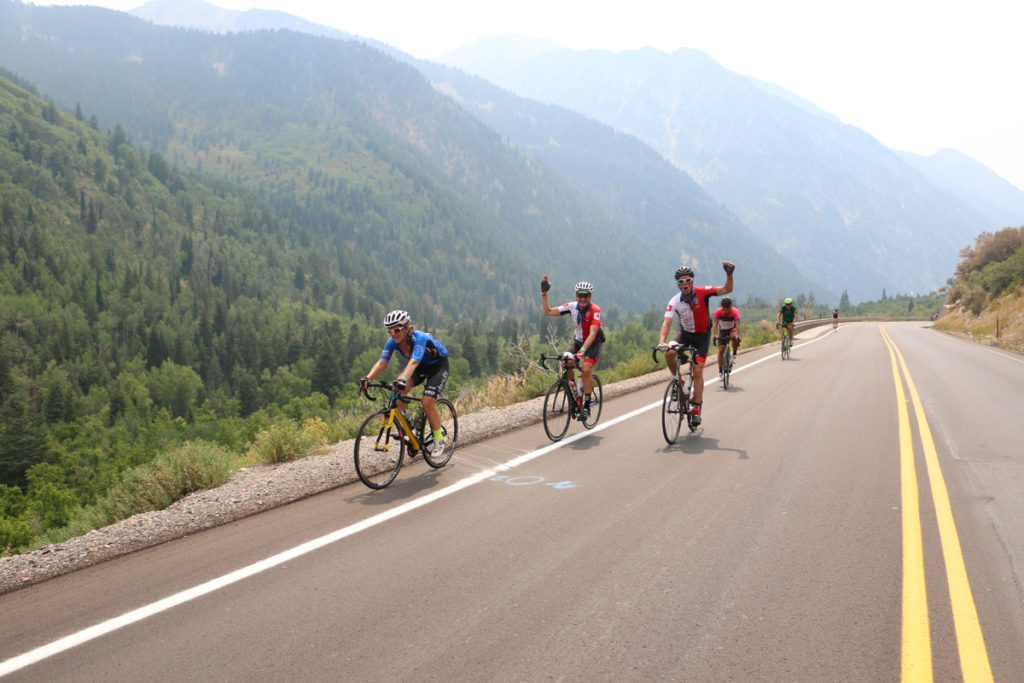
A group of riders waves to the camera above Tanners Flat in the Ultimate Challenge, just before Stage 5 of the 2018 Tour of Utah. Little Cottonwood Canyon. Photo by Dave Iltis
I had wanted for a long time to do this ride, The Ultimate Challenge presented by UnitedHealthcare, but the demands on my time had left me extremely short on training, and particularly climbing, considering this event’s 10,880 feet of vertical gain. So as the Challenge approached, I was torn. I still wanted to do it, but was certain that, after having already climbed over 7000 before even starting the final climb to Snowbird, I would be toast.
So I compromised. I would ride the Challenge, but eliminate that last major climb, opting to head home instead. So it was that on the morning of August 6, my friend Elliot and I found ourselves rolling out from the start in Kimball Junction.
It was an open start, from 6 a.m. to 7 a.m. Knowing how slow my climbing would be, Elliot and I should have been at the start right at 6 a.m. However, feeling for Elliot who had to drive in from Tooele, particularly since I collared him into doing this, I agreed to a somewhat later start, and it was nearly 6:45 a.m. when we pushed off.
It was very nippy for the first few miles. Elliot and I were each hugging ourselves for warmth and were glad to quickly come upon a few rollers to get the blood flowing. It was a refreshing ride to the first feed in Kamas. The support for this ride was excellent. Except for running short on energy drink, there was an abundance of everything else. And the signage for the route was the best I have experienced.
The first real climbing came after leaving Kamas and skirting around the left side of the Jordanelle Reservoir. Just a leg-warmer compared to what was to come, but a precursor of how slow I would be on the climbs. We descended into Midway and made our way to the second feed located on the east end of Deer Creek reservoir.
From there, we rode around the reservoir and down Provo Canyon. About one mile before the turnoff to the Sundance Ski Resort and the Alpine Loop, Elliot had the first of two flats. Aftering stopping for that, and cognizant of our late start, we figured we were close to being the last riders on the road.
By the turnoff to Sundance, we had logged 50 miles, half of the days total. In terms of climbing, though, we were just getting started. Elliot and I have this agreement. When we hit the climbs, we each go our own pace and whoever arrives at the top first waits. In practice, this means that Elliot always waits for me. But he is gracious, and willingly does so.
The first few miles up the Alpine Loop let me know what I was in for. It kicks up quickly, and Elliot was soon moving off around the bend and out of sight. I settled in to a nice rhythm, though, and actually felt I was doing alright.
About halfway up, however, I came upon Elliot, stalled on the road with his second flat. I wanted to keep riding, viscerally feeling it served him right for being so much faster than me. j/k as the texters say. Wanting to be certain he had no problems getting his flat fixed, I waited and helped. During this time, I was certain the last few riders did passed us.
We got started again and headed to the top, with Elliot again disappearing into the bends ahead of me. Soon, though, I was at the top where the next feed, and a nice ham and cheese sandwich and a large cookie, awaited me.
Refreshed and fattened, we began the descent. What I lose while climbing, I gain back descending. I love a fast descent and am fairly decent at it. Elliot, meanwhile, is a little tepid, and I had quickly moved out of his sight on this long, steep and winding descent. This was the only time all day I waited for Elliot, and my only real gratification.
After reaching the bottom, we wound through Alpine and came to the next feed. It was, in truth, too soon, but I appreciated the fact they had cold Coca-Cola there, and I took the time to stock up on a supply of sugar and caffeine for the climb over Traverse Ridge. I then slogged it up this climb, again watching Elliot put time and distance on me.
After descending from Traverse Ridge into the Salt Lake Valley, we wound through South Mountain, Draper and Sandy on the way to Little Cottonwood Canyon. Tucked in here, though, is a half mile climb up Wasatch Boulevard that is a real challenge. It was here I began to feel the drain. I had been feeling quite well up to this point, and had been figuring I could make the climb to Snowbird. On this short but steep leg-bender, I began to reconsider.
I wound my way to the base of Little Cottonwood Canyon and the last feed. Elliot was again awaiting me, and I settled into a comfortable camping chair with a bottle of water and can of Coke . I was fatigued. My legs were tired, but surprisingly had not cramped. My mind said, “Go home”, but my heart and my pride, always more compelling, said, “Push on!”
I have climbed a lot of the famous cols from the Tour de France. I even climbed Mont Ventoux, the toughest climb I think I have ever ridden, at the end of the 102-mile Etape du Tour. Little Cottonwood has nothing to apologize for. It ranks right up there in difficulty. And on this day, it challenged me more than it ever had.
After pushing myself out of the camp chair and getting started, I rode the first three of the last six miles without stopping. Typically, I make it a goal to ride up this canyon without stopping. But after three miles, I was gassed. I stopped in the shade of a tree, leaned over my bike, ate some GU, downed some Coke (yes, I had filled my water bottle with Coke) and waited for my heart to stop racing.
Back on the bike, I kept going for another mile till I was headed up the Seven Sisters section. About halfway up, I had to stop again. Same routine, and I pushed onward a second time. Shortly after this, the broom wagon came by and asked how I was doing. I am too proud. “I’m fine”, I said.
I was not fine. In a short distance, I hit the half mile section just before the Tanner’s Flat campground., Being the toughest part of this canyon, I wondered if I could make it. I checked my speedometer, and it read under 3 mph. I was going so slow, I feared I would pull myself over with a hard push on my crank.
But I finally made it to the campground, and stopped again to recover. My head was spinning slightly. In a minute or two, I was joined by a couple of ladies with whom I had been leap-frogging, and together we gasped for air. They recovered first and were off. I waited a few more minutes before heading upward once more.
The nice thing is, at this point, the grade actually eases a little. It was enough that, instead of using everything just to turn the crank over, I could actually get back into a decent rhythm. Soon, the broom wagon came by again, and told me I only had a mile to go. She was trying to be encouraging, but I thought I only had about one-third of a mile, and I had to bolster my resolve while my heart was sinking.
I know this canyon well, and in my right mind, I would have known she was wrong. But I was just surviving, and just continued to push one crank after another. Indeed, after about a third of a mile, I saw the first Snowbird entrance. I thought this was the finish, but could see no finish banner. Thinking then that the finish was at the next entrance, thus the lady in the broom wagon saying I had another mile, I again resolved to keep pushing onward.
But as I began to rise above this first entrance, I looked down and saw barricades and an announcer’s booth. There was no announcer (he had apparently gone home), and the barricades were being taken down. But it was the finish, and that was all I cared about. I turned around and headed into the finish where Elliot awaited me. I was cooked, but I had made it.
In fact, I was not last. One person finished behind me. I am still not certain how to feel about that. In the Tour, you know, it is a hot competition to finish last and still finish. But then this was not a race, and in the end, I was only trying to just make it.
The Challenge is a great ride. It is a great test, and though not prepared, I passed. This is the first time I have ever climbed over 10,000 feet in a single day. I have come close on several occasions, logging around 9000 – 9500 feet. I hope to be better prepared next year, and to have a more enjoyable ride.
I was surprised not more people accepted this challenge, there being 200-300 who signed up. In 2009, I rode the Etape du Tour, an event which, like the Ultimate Challenge, takes riders on the exact stage to be ridden by the professionals just a few days later. In 2009, the Etape drew 10,000 riders, including several current and former professional riders. A timed ride, much like a gran fondo, it has become so popular that this year two separate Etapes were staged.
I would like to see the Challenge develop in this same way. I am hoping the promoters will continue with the Challenge, developing ways to draw more riders. And I hope local and regional riders will become excited about the Challenge, and bolster its numbers. It is an event that deserves to be continued and to continue to be the “ultimate challenge”.
PRESS RELEASE – Salt Lake County (August 1, 2019) – Salt Lake County Parks and Recreation invites residents to provide input on an update to the countywide Regional Trails Master Plan in series of open houses across the valley this August. The first update to the plan since 1993, the project will result in a new strategy for greater multi-use trail connections in Salt Lake County.
Salt Lake County Encourages Input on Regional Trails Plan. Photo by Dave Iltis
“These trails enhance our quality of life and connect our communities,” said Mayor Jenny Wilson. “We have heard from residents loud and clear that investing in trails should be a top priority. The County is in a unique position to lead this effort toward a complete trail system and I encourage residents to be a part of this important project.”
The project will result in an inventory of all existing and planned regional trails in the Salt Lake Valley. It will identify gaps within the trail network and create an implementation plan to complete trail connections throughout the county. Trail data will be collected from all municipalities within Salt Lake County and agencies such as the Utah Department of Transportation, U.S. Forest Service, Utah Transit Authority and Wasatch Front Regional Council. To learn more about the project go to https://slco.org/parks-recreation/planning/.
Open House Dates
Monday, August 5, 7-8:30 pm
Dimple Dell Recreation Center
10670 S. 1000 E., Sandy
Tuesday, August 6, 6:30-8 pm
Northwest Recreation Center
1255 W. Clark Ave, Salt Lake City
Tuesday, August 20, 6:30-8 pm
Gene Fullmer Recreation Center
8015 S. 2200 W., West Jordan
Thursday, August 22, 6:30-8 pm
JL Sorenson Recreation Center
5350 W. Herriman Main Street, Herriman
PRESS RELEASE (HEBER CITY, Utah – August 1, 2019) – Ventum, maker of high-performance racing bicycles and the Official Global Bike Partner of IRONMAN, today announced that it has raised a round of funding and that it is moving to Heber City, Utah. Proceeds from the investment round will be used to fund Ventum’s ongoing growth and new product development. Over the next five years, Ventum projects to increase sales to over 40,000 bikes across road cycling and triathlon as well as new market segments, driving revenues of $50MM.
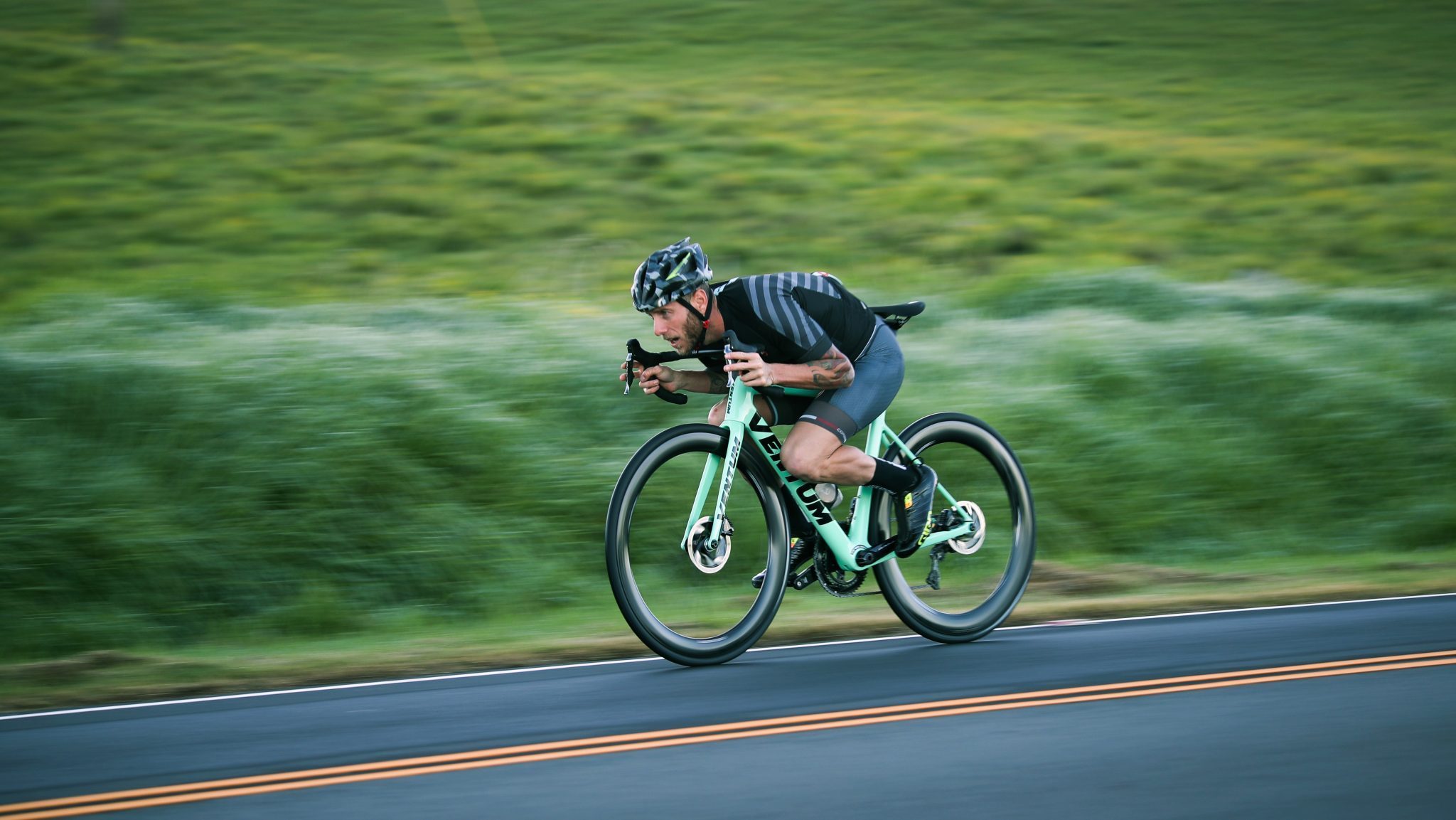
Photo courtesy of Ventum.
To support that growth, Ventum is moving to a new corporate headquarters in Utah, where it plans to hire 32 additional employees this year. All Ventum bikes sold in the United States will be assembled at the new location. Ventum is also exploring moving some of its manufacturing operations to Utah from overseas. Components used in building Ventum bikes are currently sourced from all over the world, including from Utah, as well as Switzerland, Japan, and Denmark.
“Our decision to move Ventum HQ to Utah comes after years of searching, trying out, and negotiating with candidate locations” explained Diaa Nour, Ventum CEO. “Founding the company in Miami was a simple decision. That’s where I lived, so that’s where we started. This time around, it was a strategic decision. We needed to find a location where we could be close to our customers, hire great people to join our team, and have room to grow. Our new home in Utah meets all of those criteria, plus having the mountains and trails right outside is going to come in handy for the bikes we’re working on next.”
In 2015, Ventum released the Ventum One, a triathlon bike with an unconventional design. The Ventum One demonstrated significantly better aerodynamic performance (24% less drag) than the closest competing bicycle in Ventum’s wind tunnel testing. In 2016 and 2017, athletes riding Ventum bikes in the IRONMAN® World Championship finished the bike portion of the race an average of 18 minutes faster (according to data collected and analyzed by IRONMAN comparing athletes racing on 25 different bicycle brands, each with at least 20 bikes in the race). In 2018 Ventum became the first ever Official Global Bike Partner of IRONMAN as well as the Official Bike Supplier of the IRONMAN and IRONMAN 70.3® World Championships.
“When we released the Ventum One, there were a lot of skeptics. But once they saw the Ventum One’s performance, other bike companies rushed to create non-traditional, non-UCI-legal triathlon bikes too” Nour recalled. “This year, we just released our first road-racing bike, the Ventum NS1. We combined the most advanced materials and manufacturing processes available to create a road bike that is both aerodynamic and lightweight. Some people thought we were only a triathlon company, but the early reviews of the NS1 have been phenomenal. And we’re just getting started… Ultimately, our mission is to create class-leading bikes that help to push the industry forward.”
Ventum bicycles are available worldwide through the company’s dealer network and at https://ventumracing.com.
The Marsh Valley Cruise is a 40.1-mile, clockwise loop tour of Idaho’s Marsh Valley. The valley is a lightly-populated agricultural region, with its northern end located 15 miles south of Pocatello. There is plenty of movement through the valley, along the I-15 freeway. But, with I-15 as a speedy alternative, traffic is light on the valley’s surface streets, making them ideal for bike riding. The elevation differential is only 253 feet, although a combination of false flats and wind can add some difficulty to the pedaling. The route remains within the corridor between the Portneuf Range on the east, and Scout Mountain (and other high points) of the Caribou National Forest on the west. The starting elevation is 4,779 feet.
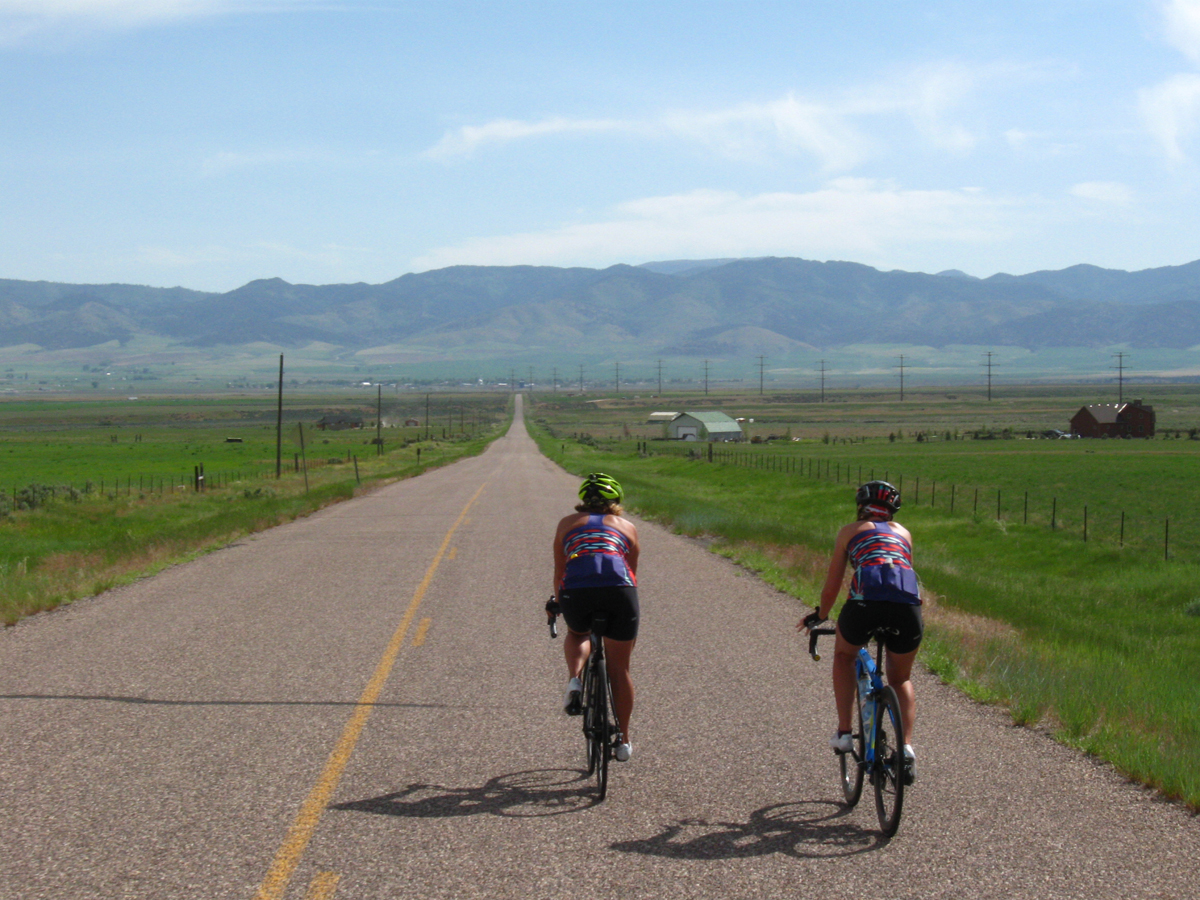
Riders in Marsh Valley in Southeast Idaho. Photo by Steve Sullivan
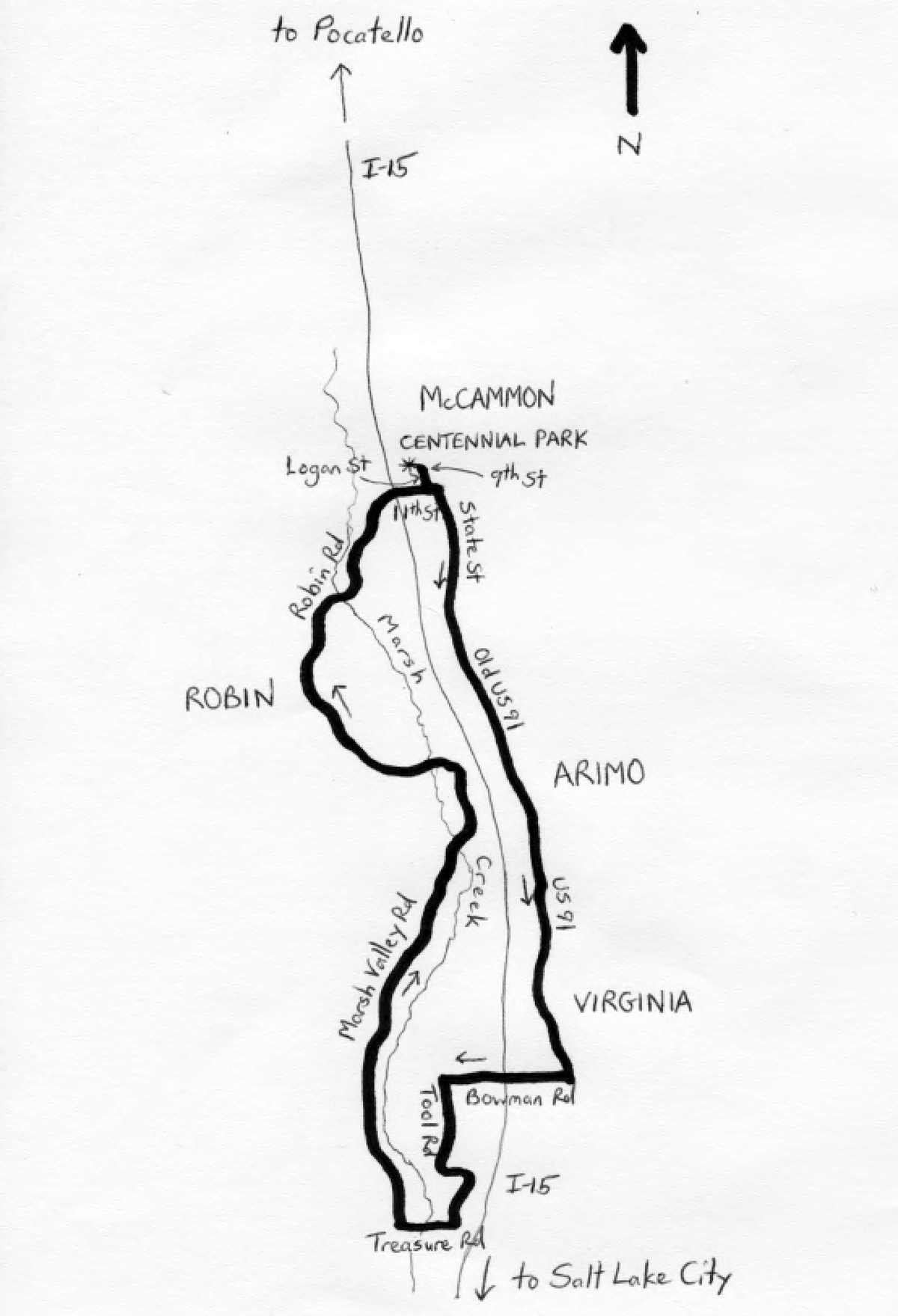
Start the ride in McCammon. With a population of just 810 in 2010, McCammon is actually the largest settlement along the entire ride. So, get that urban feeling here before venturing off onto the valley roads. From Centennial Park – the address is listed as “Bannock Street,” but the park is accessed from Logan Street, at 9th street – turn right onto Logan and head south. At the end of Logan, turn left onto 11th Street, followed by a right turn onto State Street. State merges with Center Street at the 2.15-mile mark, remaining as State Street, and then becoming Old U.S. Highway 91. The ride leaves McCammon and enters the rural valley. Most of the ride is admittedly nondescript, passing a mix of cultured and undeveloped fields. The best scenery is of the mountains on either side of the valley, and of Marsh Creek, which the route crosses. As for Old U.S. 91, this was the predecessor of U.S. 91, which, in turn, was the predecessor of I-15. The old route is no longer through, merging with U.S. 91 in places; but, segments of the old highway exist in Idaho and Utah.
Enter Arimo at mile 6.05. With a population of 355 in 2010, this is the second-largest city along the route. You will be in and out of Arimo very quickly, as you head south on the old highway. Bear right onto County Road at mile 10.45. At the end of County (mile 10.6), turn left onto U.S. 91, and continue heading south. The highway has a wide shoulder. Enter and leave the tiny community of Virginia. At mile 12.35, turn right onto Bowman Road and head west. Bowman passes over I-15 at mile 13.1. At the end of Bowman (mile 14.15), turn left onto Tool Road and head south. Tool curves left, and then right, eventually running immediately adjacent I-15. At the end of Tool (mile 17.85), turn right onto Treasure Lane and head west. At the end of Treasure (mile 19.2), turn right onto Marsh Valley Road and head north. You are now heading back, although this road’s curves and small rolling hills make it a more interesting ride than that along 91. Cross Marsh Creek at mile 27.6. At mile 29.8, turn left onto Arimo Road and head west. Cross over Marsh Creek again at mile 30.05, and begin a gradual climb (2.6% grade) that continues for the next mile or so. Arimo descends, and then climbs again, gradually. At the highest elevation of the ride (4,877 feet; mile 33.65), avoid going too far west by turning right onto Robin Road. Robin continues the northward trek.
Robin descends gradually (1.6% grade) for the next three miles, to the ride’s lowest elevation (4,624 feet; mile 36.4) – cross over Marsh Creek. Be sure to stay on Robin Road as it curves northward and eastward, through the valley. Stay left at mile 38.1 to remain on Robin. Cross under I-15 at 39.25. Enter McCammon just beyond the freeway. Robin curves to the right, becoming 11th Street. Turn left onto Logan Street; as you head north, look for Centennial Park on the left. End the ride here. History buffs may be interested in visiting a couple of buildings in McCammon which are on the National Register of Historic Places: the McCammon State Bank Building at 206 Center Street, and the H.O. Harkness State Building, at 105 South Railroad Avenue. Both are located to the northeast of Centennial Park.
Starting & ending point coordinates: 42.647569oN 112.194267oW
The Marsh Valley Cruise is a 40.1-mile, clockwise loop tour of Idaho’s Marsh Valley. Map by Wayne Cottrell
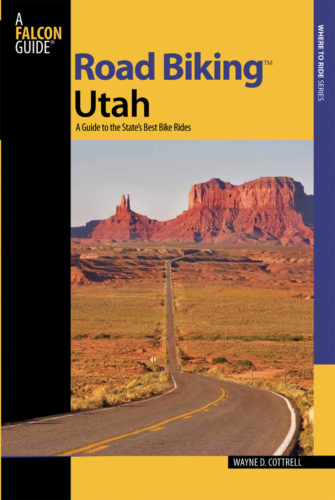
For more rides, see Road Biking Utah (Falcon Guides), written by avid cyclist Wayne Cottrell. Road Biking Utah features descriptions of 40 road bike rides in Utah. The ride lengths range from 14 to 106 miles, and the book’s coverage is statewide: from Wendover to Vernal, and from Bear Lake to St. George to Bluff. Each ride description features information about the suggested start-finish location, length, mileposts, terrain, traffic conditions and, most importantly, sights. The text is rich in detail about each route, including history, folklore, flora, fauna and, of course, scenery.
Wayne Cottrell is a former Utah resident who conducted extensive research while living here – and even after moving – to develop the content for the book.
SALT LAKE CITY (July 31, 2019) – Preliminary rosters have been announced for the 2019 Larry H. Miller Tour of Utah, as 17 teams, featuring a total of 117 athletes from 24 countries, are expected to battle across 477 miles of northern Utah roads. The weeklong stage race begins Monday, Aug. 12 at Snowbird Resort with a Prologue time trial, and concludes Sunday, Aug. 18 in Park City. Known as “America’s Toughest Stage Race,” the Tour of Utah features 37,882 feet of elevation gain over the seven day competition.
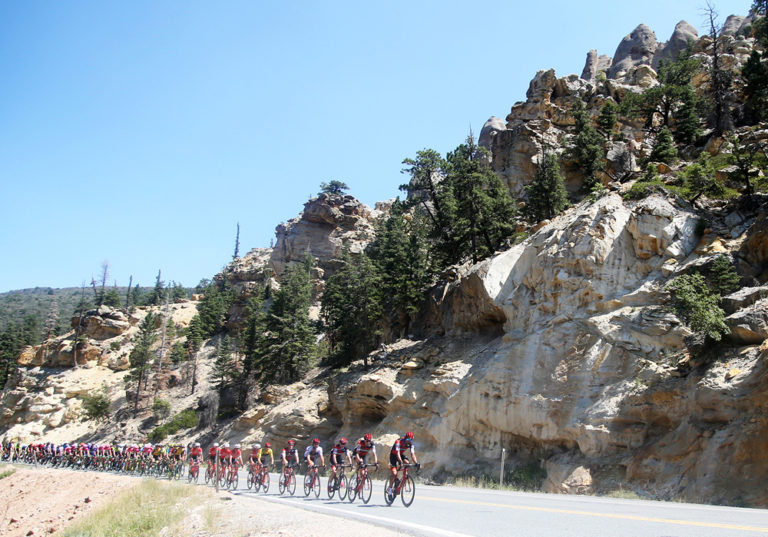
The peloton. 2018 Tour of Utah Stage 1, August 7, 2018, Cedar City, Utah. Photo by Cathy Fegan-Kim, cottonsoxphotography.net
The UCI 2.HC-sanctioned stage race boasts an all-star field composed of national champions, Grand Tour veterans and Tour of Utah winners. A total of 22 athletes have proven themselves as national champions in road racing disciplines. Seventeen athletes have competed in one or more of the three-week Grand Tours of professional cycling — the Tour de France, Giro d’Italia or Vuelta a España. Eight of these riders raced at this year’s Giro, including 24-year-old Italian Giulio Ciccone of Trek-Segafredo, who captured a Stage 16 victory and claimed the King of the Mountain (KOM) classification title. Ciccone also held the yellow jersey at the 2019 Tour de France for two days after finishing second on the mountainous Stage 6 to La Planche des Belles Filles.
Ten riders have accounted for 18 stage wins and nine classification titles at the Tour of Utah since 2011, the year the event was first sanctioned internationally by the Union Cycliste Internationale (UCI). Among the Tour of Utah alumni are three General Classification (G.C.) champions with 2015 winner Joe Dombrowski (USA) and 2016 winner Lachlan Morton (Australia), both currently racing with EF Education First; along with 2017 winner Rob Britton (Canada) currently racing for Rally UHC Cycling.
The field of riders also includes two Utah natives. Taylor “TJ” Eisenhart of Arapahoe-Hincapie powered by BMC returns for a fourth time. His best finish in the Tour of Utah was seventh overall in 2016. The Lehi native finished 20th on G.C. last year. Park City’s Tanner Putt returns to the Tour of Utah for a fifth time after a two-year absence, last racing in his home state in 2016 with UnitedHealthcare Pro Cycling. Putt had a top-10 finish on Stage 1 of that year’s event.
“The Tour of Utah is a world-class sporting event as evident by the impressive field of riders from 24 countries,” said John Kimball, managing director of the Tour of Utah. “The resumé of the peloton includes former Tour of Utah overall champions and stage winners, road racing national champions and riders who have competed internationally in the Grand Tours of professional cycling. Fresh off the finish of the Tour de France, we are poised to host an exciting, highly-competitive cycling event in scenic Utah.”
2019 TOUR OF UTAH TEAMS:
303 Project (USA)
Arapahoe-Hincapie powered by BMC (USA)
Aevolo (USA)
Canel’s-Specialized (Mexico)
Dauner-AKKON (Germany)
DC Bank Pro Cycling Team (Canada)
EF Education First (USA)
Elevate-KHS Pro Cycling (USA)
Hagens Berman-Axeon (USA)
Israel Cycling Academy (Israel)
Neri Sottoli-Selle Italia-KTM (Italy)
NIPPO-Vini Fantini-Faizanè (Italy)
Rally UHC Cycling (USA)
Trek-Segafredo (USA)
Team BridgeLane (Australia)
Wildlife Generation Pro Cycling presented by Maxxis (USA)
Worthy Pro Cycling (Canada)
ROSTER HIGHLIGHTS:
UCI WorldTeams
EF Education First features two past Tour of Utah champions Dombrowski and Morton among a stacked seven-rider roster. Past Tour of Utah standouts include Americans Alex Howes, the Best Young Rider at the 2009 Tour of Utah and reigning U.S. Pro Road Race national champion, and Tejay van Garderen, a two-time stage winner including last year’s Prologue in St. George. Van Garderen, who turns 31 on August 12, will be looking to celebrate his birthday with another Prologue win. Dani Martínez, the reigning individual time trial (ITT) champion of Colombia, was the Best Young Rider at the 2015 Tour of Utah, competing for Team Colombia.
Trek-Segafredo brings a total of six riders, led by the Italian Giulio Ciccone. Ciccone scored a Stage 6 win at Snowbird Resort at the 2017 Tour of Utah, finishing sixth in the G.C. that year. Supporting Ciccone will be Americans Kiel Reijnen (USA) and Peter Stetina. Reijnen is a two-time stage winner in Utah and finished third on Stage 4 in Salt Lake City in 2018. Stetina rode to a third-place finish on Stage 5 last year, vaulting him to 10th on G.C.
UCI Pro Continental Teams
Rally UHC Cycling is led by 2017 winner Rob Britton. All seven riders have past experience in Utah, including Americans Gavin Mannion and Ty Magner. Mannion, riding for UnitedHealthcare, finished second overall at the Tour of Utah in 2017, while Magner, representing Holowesko-Citadel, captured the Stage 1 victory that same year.
Israel Cycling Academy returns to Utah for a third year. Former Colombian Road Race champion Edwin Avila Vanegas is a featured climber, who grabbed two third-place finishes at the 2018 Tour of Utah. All-rounder Ben Hermans of Belgium finished second overall at last year’s Tour of Utah, as well as fourth overall in 2014 when he was racing for BMC Racing Team. Reigning ITT champion of Israel, Guy Niv, is one of two riders fresh off the Giro d’Italia.
Neri Sottoli-Selle Italia-KTM will be racing in Utah for the first time. On its seven-rider roster are several riders with Grand Tour experience, including Italian Edoardo Zardini. Finishing fourth on G.C. at this year’s Tour of Hungary, he previously raced at the 2015 Tour of Utah for Bardiani-CSF. A 2017 Utah alumnus is Italian Simone Velasco, who captured a big win at the one-day UCI Trofeo Laigueglia in Italy. Colombian Dayer Quintana, the younger brother of Giro and Vuelta champion Nairo Quintana, moved from the Movistar Team to the Neri Sottoli squad this season. He finished seventh on G.C. at the 2019 Giro di Sicilia.
Hagens Berman-Axeon will be led by 21-year-old João Almeida of Portugal. He is the reigning Under-23 national champion in both the road race and ITT. The team also features the youngest rider in this year’s race, 19-year-old American Kevin Vermaerke. Coming off a 2018 season where he finished eighth overall in the men’s Junior Road Race world championships, he took the U23 crown at this year’s prestigious Liège-Bastogne-Liège.
NIPPO-Vini Fantini-Faizanè brings two Italian riders who have had previous success in Utah. Marco Canola, who had two Top 10 finishes at the Giro d’Italia this year, was a stage winner in Salt Lake City in 2017. His teammate, Ivan Santaromita, who also raced the Giro in May, finished 18th on G.C. at the 2017 Tour of Utah. Sho Hatsuyama, a former road race champion of Japan, returns to Utah for a second time.
UCI Continental Teams
Worthy Pro Cycling, which raced three times in Utah as Silber Pro Cycling, features American sprinter Travis McCabe, who captured two stage victories in Utah in 2019. He has earned the most hardware from the Tour of Utah since 2016, with a total of four stage wins and two overall Sprint titles. He also is the reigning U.S. Pro Criterium national champion. Among his teammates who have finished high in the G.C. at Utah are Serghei Tvetcov (Romania), third overall in 2017 with Jelly Belly and 14th overall in 2018 with UHC; Jonny Clarke (Australia), seventh overall in 2017 with UHC; and Keegan Swirbul (USA), seventh overall in 2018 with Jelly Belly.
Elevate-KHS Pro Cycling is led by Canadian James Piccoli, who won this year’s G.C. title at the Tour of the Gila. He finished 10th overall at the 2017 Tour of Utah. American Eric Young, who took the silver medal at this year’s U.S. Pro Criterium championships, has won two stages in Utah (2014, 15). Mexican riders Ulises Castillo and Alfredo Rodriguez have both earned podium spots in Utah. Castillo finished second on Stage 1 in 2018, and second overall in the Sprint classification. Rodriguez finished second on Stage 4 in 2017.
Canel’s-Specialized, the only Mexican squad with a Continental license, makes its inaugural appearance in Utah. The team will be led by Óscar Eduardo Sánchez Guarin, who won the KOM title at the 2019 Tour de Beauce. The team also features several national champions representing Mexico, including the reigning Road Race national champion Ignacio Prado Juarez. He also finished second in the ITT championship.
Aevolo has the youngest roster in Utah, with the average age of 19.7 years for its seven riders. Only one rider, 21-year-old American Alex Hoehn, has previously raced in Utah. In the Best Young Rider classification, he finished fourth in 2017 and 2018. Last year, racing as the U23 Road Race national champion, he finished 17th in the G.C. American teammate Cade Bickmore won a 2019 U.S. Collegiate Varsity national title in the road race for Marian University. Nineteen-year-old Gabriel Francisco is the reigning U23 ITT champion of Costa Rica.
Wildlife Generation Pro Cycling presented by Maxxis, previously known as Jelly Belly Pro Cyclign, is the longest-running professional bicycle racing team in the U.S. Competing for a seventh time in Utah, the team features an All-American roster. The lone rider with Tour of Utah experience is Stephen Bassett, who rode previously for Jamis and Silber pro teams. This year, Bassett won the G.C. and KOM titles at the Joe Martin Stage Race and took the silver medal at the U.S. Pro Road Race championship in his hometown of Knoxville, Tenn. He will be joined by Samuel Boardman, who placed third on G.C. at the 2019 San Dimas Stage Race, and Quinten Kirby, who won a silver medal at 2018 U.S. U23 Criterium championships.
Arapahoe-Hincapie powered by BMC features the two Utahns, Eisenhart and Putt. American Brendan Rhim took the G.C. crown and Sprint classification title at the 2019 Tour de Beauce, and was sixth overall at the 2019 U.S. Pro Road Race championship. Former Latvian ITT champion Andzs Flaksis finished third this year in his country’s Road Race championship.
Team BridgeLane returns for a second year, featuring seven riders from Australia and New Zealand. Only Hayden McCormick has seen action in Utah riding with One Pro Cycling in 2016. He won the bronze medal at this year’s New Zealand ITT championships, and was sixth in the road race event. Teammate Chris Harper, who took second in the 2019 Australian Road Race championship, captured G.C. titles this year at the Tour of Japan and Le Tour de Savoie Mont Blanc.
303 Project returns with six of its seven riders having experience at the Tour of Utah. South African Johann van Zyl was third in the KOM classification in 2015 racing for MTN-Qhubeka. Flavio de Luna, a former Mexican ITT champion, finished 19th overall at the 2015 Tour of Utah for Team Smartstop.
DC Bank Pro Cycling Team makes its first appearance in Utah. Former U.S. Pro Road Race champion Greg Daniel won the KOM classification at the 2015 Tour of Utah while riding for Axeon-Hagens Berman. At the 2017 Tour of Utah, Eder Frayre of Mexico finished 17th on G.C. riding for Elevate-KHS. This year, American Matthew Zimmer has been on form with second overall at the Grand Prix Cycliste de Saguenay and fourth overall at the Joe Martin Stage Race.
Dauner-AKKON also makes its debut at the Tour of Utah. Six of the seven riders are from Germany, including 36-year-old veteran Philipp Mamos, the oldest rider in the Tour. The other five German riders are 23 years old and younger, led by Dominik Bauer, who was fourth in the 2019 U23 Road Race national championships. The lone American is 26 year-old Oliver Flautt, who won the AutoBahn Country Club Road Race at the 2018 Intelligentsia Cup.
The Larry H. Miller Tour of Utah is free to all spectators, making professional cycling one of the most unique professional sports in the world today. It remains a 2.HC-rated stage race on the UCI America Tour, making it one of the premier events for professional cycling teams in North America. The Tour is also part of the USA Cycling Pro Road Tour. More information about the Larry H. Miller Tour of Utah can be found by visiting www.tourofutah.com, as well as social channels Facebook (tourofutah), Twitter (@tourofutah), Instagram (@thetourofutah) and YouTube (Tour of Utah).
The major market for bicycles should be adults. No – children, mainly boys. People who need to get to work. No, recreational enthusiasts. Men. Women. The upper classes. The common worker.
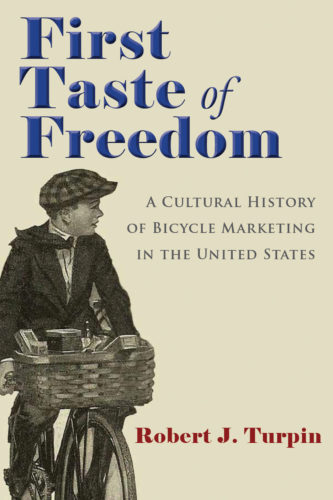
Of course, all of the above ride bicycles. But the main market that the industry tried to sell to changed with economic conditions to emphasize these different audiences in different eras of American history since bicycle manufacturers got serious about selling them in the United States, circa 1868. The history of the selling of the bicycle to the public in this country is documented in a new book called First Taste of Freedom: A Cultural History of Bicycle Marketing in the United States by Robert Turpin, a history professor at Lees-McRae College in Banner Elk, NC.
A few people were riding bikes here in the 1830s, but the two-wheeler didn’t become a cultural phenomenon until after the Civil War. The book takes us on a tour of how changes in society (and somewhat advances in vehicle design) repeatedly caused the industry to adapt and change the market it went after. The author writes of a few corporate execs, including the heads of Schwinn and its predecessors. But the book remains devoid of any understanding of the personalities of bicycle promoters. It provides more of an informative than an exciting read.
As Turpin puts it, the “bicycle has long been a part of American culture but its image and significance have been ever changing.” In the 1800s, manufactures plied them as transportation for adults. As the automobile became more and more popular, bike makers had to find other ways to sell.
Like many other innovations, from the telephone to the Internet, it took a generation or so for the bike to catch on. Even without cars, people got around fine with horses. Early on, the closest many people came to seeing a bicycle was watching racing as a spectator sport, often an indoor one to boot. A bike race could draw seven times as many people than a professional baseball game at one point. Back in the 1890s, several million Americans owned bikes and made-in-America bike sales topped a million a year at its peak in 1899. About 250 factories in the country made bikes back then.
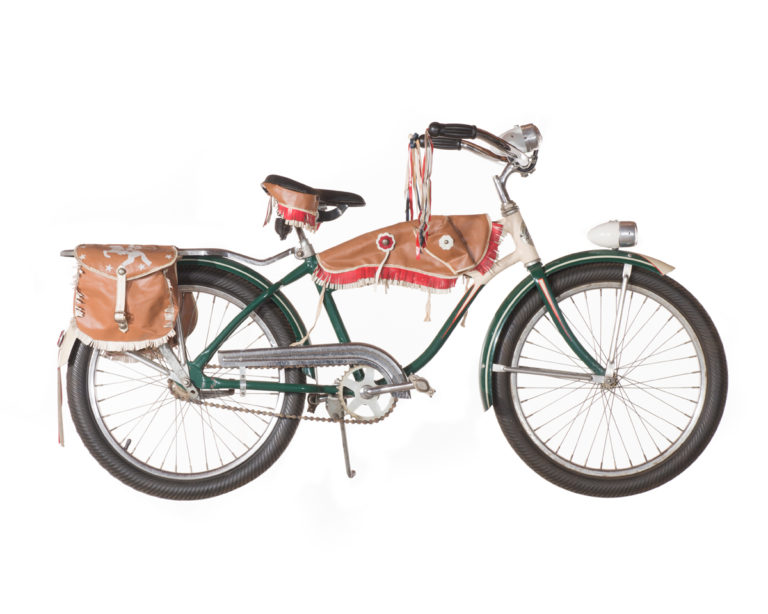
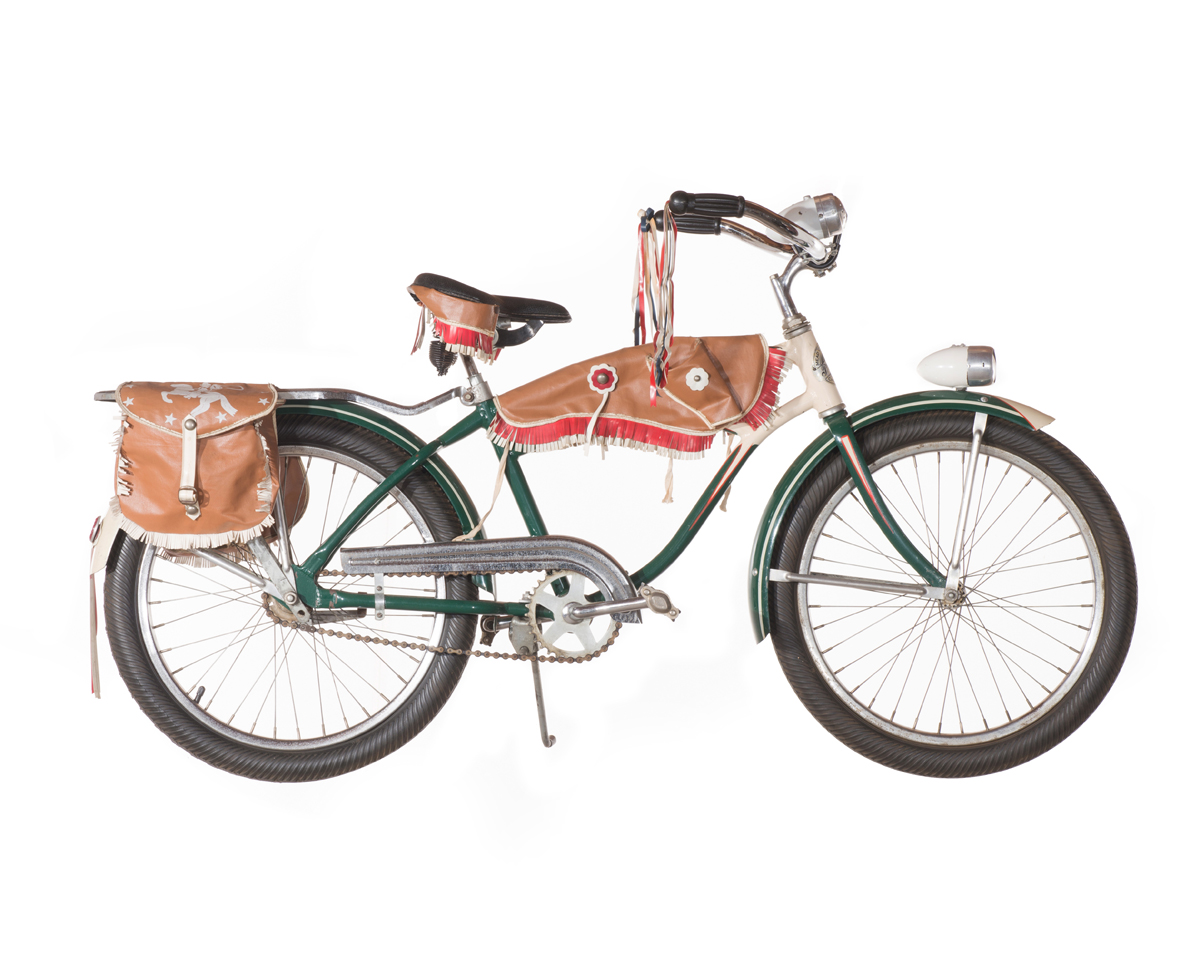
The 1953 Mead “Juvenile Ranger” came with cap guns and a design made to look like a cowboy’s horse. Photo courtesy of the Bicycle Museum of America.
But with the rise of the automobile, the main market, the well-do-do white male, lost interest after the turn of the 20th Century. But each attempt to find a new market turned off the previous one. Selling bikes to the middle-class made the wealthy consider riding at all (instead of just the saddle) beneath them. And marketing bikes to women turned off men who saw the bike as a masculine activity. And turning to children made adults consider cycles as toys to be outgrown.
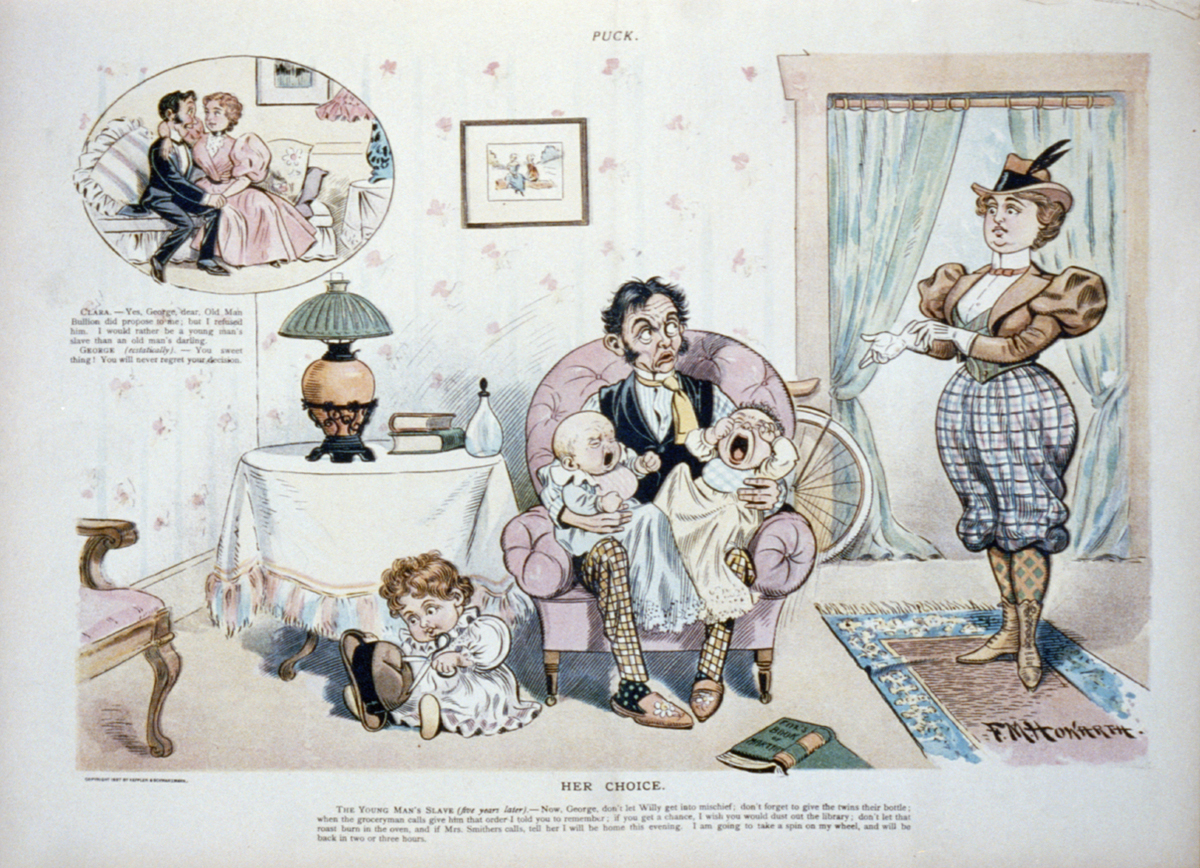
Concurrent with the women’s suffrage movement, industry marketed to women as a way to sell more bikes and women saw cycling as a way to show their independence – it allowed them to get further away from home and family surveillance. But the idea ran into some resistance as the “bicycle’s ability to free women from their homes to enjoy the same spirit of adventurism as men enjoyed was a privilege that men were often reluctant to share,” the book reminds us.
But as more women attended college, they became a bigger target of the industry – a bicycle gave a college student more freedom, not necessarily to get around campus (most of which were rather small) but to get off it and around and out of town for a break. The bicycle became a vehicle for the liberated woman.
An advertisement from 1897 marketing bicycles to women: “I’m going to take a spin on my wheel, and will be back in two or three hours.” Her Choice. The Young Man’s Slave (Five Years Later). Print-lithograph, illustration in Puck, July 7, 1897, 16. Courtesy of the Library of Congress.
Another theme throughout the history of selling bicycles that reoccurs in the book involves the growth of automobiles competing with or living alongside the demand for cycles. “In the 1910s, bicycle boosters continued promoting the bicycle as a curative for the ill effects of overmechanization and urbanization,” the book tells us. This came after the growth of the auto industry in the early 20th Century coincided with a dramatic drop in bike sales.
And yes, Donald Trump’s tariffs weren’t the first ones to cause harm to the bike industry: the book shows that when import and export restrictions on bicycles and parts thereof were reduced, sales soared. Someone always profits from wars (let’s face it; otherwise why would we fight them?) and World War I helped the bicycle industry recover as during the war, trade restrictions were lifted. Also, a PR campaign encouraged civilians to do their part for the war effort by saving gas; ride a bike.
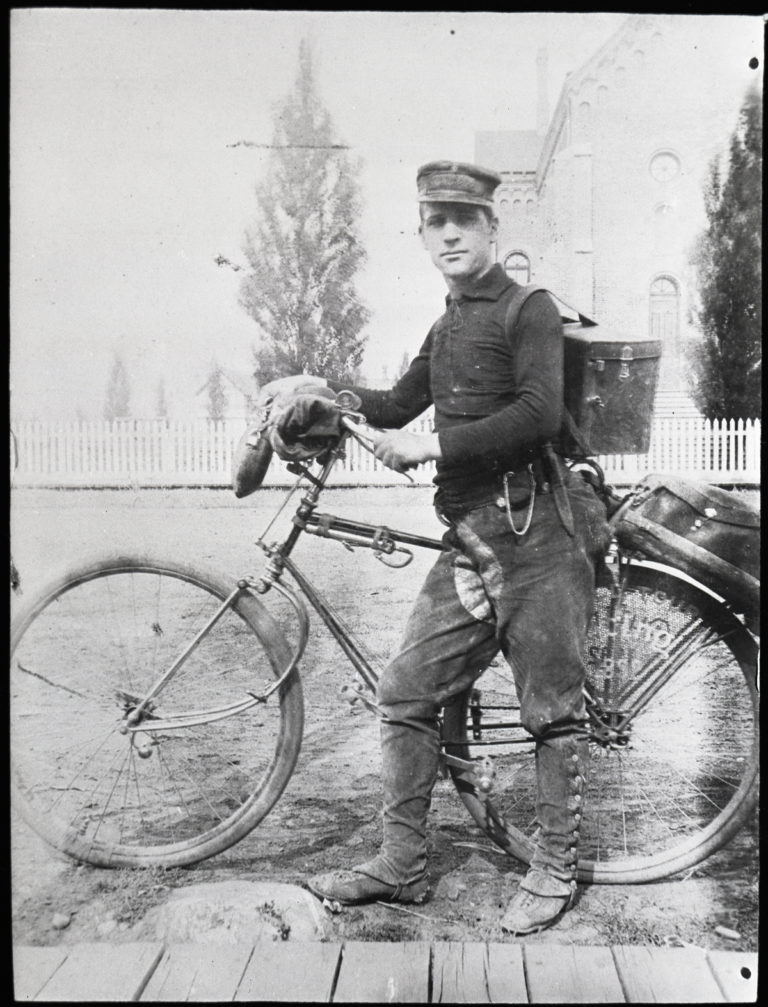
But when the war ended, the industry had to find other reasons to sell bikes, such as business. Governments used them for everything from mail delivery to police patrols. Doctors used them for house calls and messengers to deliver everything from documents to groceries.
And you don’t see much of this today (unless you count the ebike boom), but at one point it was common for a cycle shop to sell both motorcycles and bicycles, which created confusion about which they would promote. One way out consisted of a store trying to sell a motorcycles to a father and convince him to buy a non-motorized vehicle for his son.
The book also talks a lot about of design changes to attract children. Sometimes makers designed children’s bikes to look like cars, motorcycles and even airplanes so kids could play adult. Children, especially boys, became a major market and ads touted “A bike is the birthright of every American Boy” and “Boyhood without a bicycle is like a summer without flowers.” Ironically, the industry promoted bicycles for kids as the perfect Christmas present, since it was the one great gift-giving occasion of the year, though it was hardly peak riding season in most of the country.
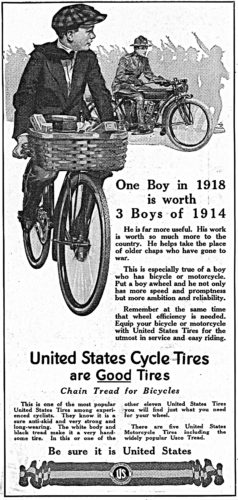
One Boy in 1918 Is Worth 3 Boys in 1914. U.S. Rubber Company’s advertisement, Boy’s Life, April 1918, 50.
While the book includes 55 pages of footnotes and bibliography, the quotes and illustrations largely consist of ads in trade journals to tell us what the industry was thinking. It gets redundant after while, going on and on throughout the book about the conflict of marketing to adults vs. children, for instance. But it seems that was a major issue in most of the industry that seems to have been resolved by now. The growth of the suburbs made cycling more attractive to children but less so to adults, who thus had too long a commute by bike. So when the industry did sell bikes to adults, it had to shift the focus from transportation to exercise and recreation.
As bicycle accident rates soared, it had to address safety. It was often reluctant to do so, however. Cycle Trades of America (CTA), once the major trade association, ignored the issue, much as automobile manufacturers did for too long. Turpin writes that in the 1920s, the “CTA downplayed the safety concerns altogether. Instead, it instructed their two touring bicycle advocates – whose primary job was to visit schools and talk to children about bicycles – to refrain from talking about safety issues for fear that it would become the focus of the conversation.”
And, if you believe the book, we still need to pedal up mountains to enhance the image of the cyclists. Even today, “adults who regularly ride bicycle are still often considered odd, or at least unconventional. Many Americans associate the bicycle with transportation for those unable to afford a car.”
The history book takes us through the Depression and World War II. The former didn’t seem to have depressed the growth of the bicycle – more because people needed cheap recreation than transportation. And even back then New York City made a point of building bike paths in its parks, though cities back then didn’t think of adding a lot of bike lanes for transportation purposes as they do today.
Then after the war, as the nation grew in affluence, children became such a market that manufacturers “began creating bicycles that were literally toys, equipping them with holsters for cap guns, and donning them with the insignia of child television stars and comic book heroes or even cartoon characters such as Donald Duck.” The 1953 Mead Juvenile Ranger, for instance came with cap guns and a design made to look like a cowboy’s horse. The industry also set up kids’ bike clubs (today largely the province of adults). While producers once promoted the bike as a means of independence, it later tired to promote groups.
Federal policy, however hampered growth of the bicycle, the author says, first by the War Production Board’s decision to limit bicycle manufacturing in World War II and post-war by building the Interstate highway system, which further encouraged adults to drive rather than bike.
Adults didn’t start getting interested in biking again until the 1970s but the book can’t explain why, with the gasoline shortages of the era and the economic doldrums of the early 1980s only minor factors. Much of the increase consisted of interest int BMX and mountain bikes, and later hybrids, the stuff of recreation.
Though the book was published this year, recent history gets short shrift. It says the first bikeshare program launched in Tulsa, OK in 2007 and quickly became a phenomenon –but the subject gets only one paragraph. And the narrative stops in 2012. But if you want to know how the industry marketed and sold bicycles to the American public in generations before you even tried a tricycle, the book will probably constitute as good a chance as any to learn. It’s easy and fun enough to read. And you can probably relate to at least part of it personally since you’ve probably ridden a bike as a child, feminist, commuter or other marketing target. And you can see how the industry saw the other types of people.
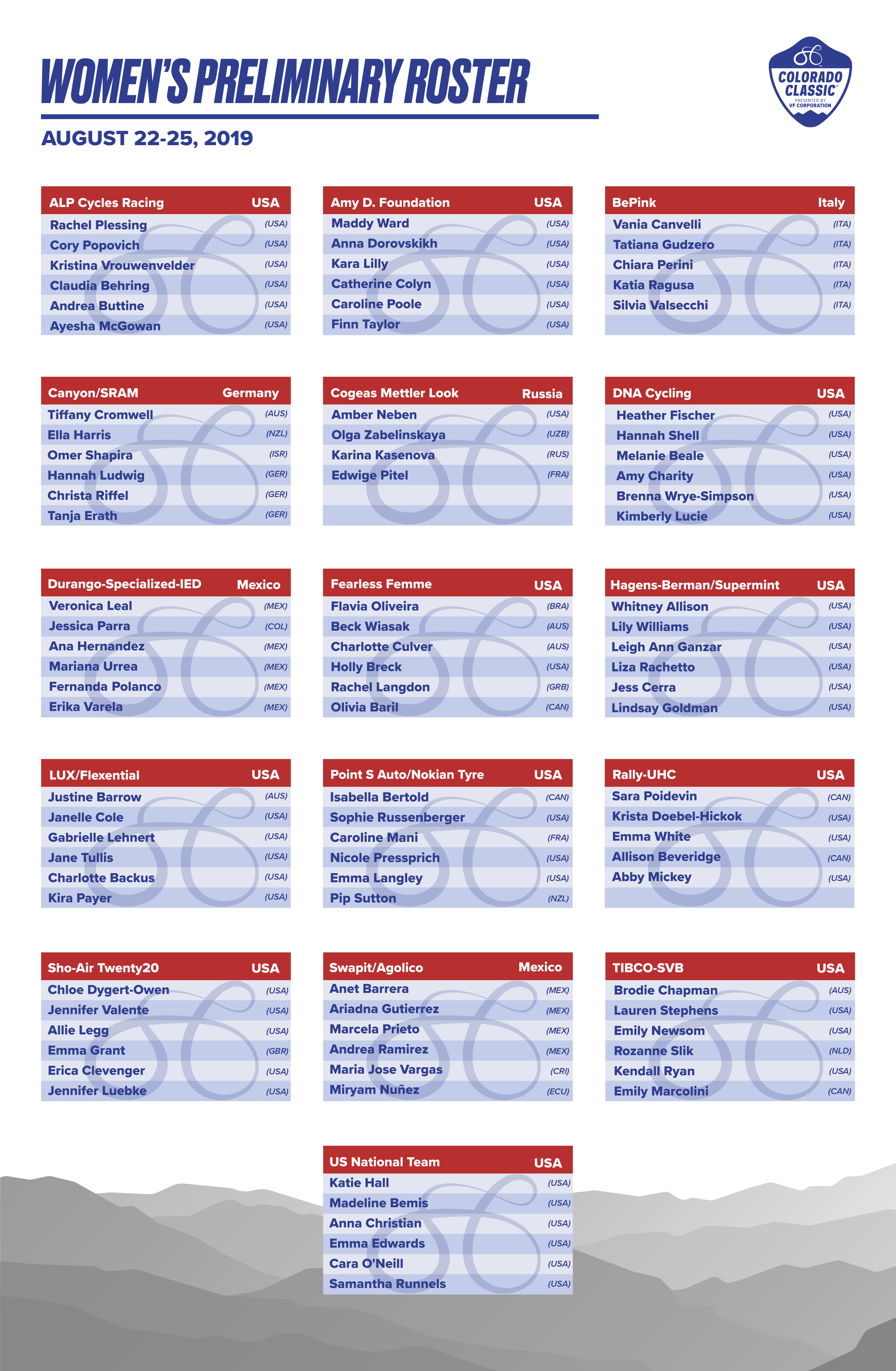
PRESS RELEASE – (DENVER, CO—July 31, 2019) – The 2019 Colorado Classic® presented by VF Corporation today released its most international and competitive roster of riders in the race’s history, including past Colorado Classic champions, Olympic medal winners and world champions.
“This is the deepest field and certainly the field with the most international riders,” said Sean Petty, Colorado Classic Race Director. “There are riders who have major international results and accolades behind their names. We have our two previous Colorado Classic champions with Katie Hall and Sara Poidevin who’ve proven their ability to climb well and win at this altitude in Colorado. And the sprint finishes expected in stages 1, 3 and 4 will feature some of the fastest women in the world. It should be a really exciting race with an extremely high level of racing.”
Headlining the field are defending champion, Katie Hall (USA) of the U.S. National Team; 2009 World Champion and Olympic Bronze Medalist Tatiana Gudzero (ITA) of BePink; Amber Neben (USA) of Cogeas Mettler Look; 2017 Colorado Classic champion, Sara Poidevin (CAN) of Rally/UHC; and track super-star and multiple-time world champion, Chloe Dygert-Owen (USA) from Sho-Air Twenty20.
At least 96 world-class riders are expected for the four-stage, UCI 2.1 category race which will run August 22-25 through challenging courses in Steamboat Springs, Avon, Golden and Denver.
“I think [the Colorado Classic] is a step forward for us,” said 2019 Colorado Classic competitor and 2018 stage-winner, Kendall Ryan (USA) from TIBCO-SVB. “It’s amazing that they want to create races just for women. And I think it’s really special that it’s happening in the U.S. And Colorado is smack-dab in the middle and it’s really special that they’re creating that platform for us.”
Star cyclists to watch at this year’s race include:
Katie Hall (USA) from the U.S. National Team- Hall is the 2018 Colorado Classic winner and 2018 Amgen Tour of California winner. In 2019, Hall has already placed second at the Amgen Tour of California and 7th at the Giro Rosa, the toughest women’s stage race featuring the best riders in the world.
Tiffany Cromwell (AUS) from Canyon/SRAM- Cromwell is a longtime UCI pro who has won stages at the prestigious Giro Rosa. Cromwell won the Belgium Classic: Omloop Het Nieuwsblad.
Amber Neben (USA) from Cogeas Mettler Look- Neben is a two-time world time trial champion, two-time national road race champion, three-time national time trial champion, two-time Pan-American time trial champion, and one-time team time trial world champion.
Omer Shapira (ISR) from Canyon/SRAM- Shapira is a two-time Israeli national road racing champion.
Tanja Erath (GER) from Canyon/SRAM- Erath won the Zwift challenge in 2017 and was awarded a pro contract for 2018.
Tatiana Gudzero (ITA) from BePink- Gudzero was the 2009 road race World Champion and the bronze medalist at the 2008 Summer Olympic Games in the road race. She was also second in the road race at the 2004 World Championships and third in the road race at the 2018 World Championships. She is a 2004 European time trial champion and an 8-time national champion in the time trial and track disciplines.
Chloe Dygert-Owen (USA) from Sho-Air Twenty20- One of America’s biggest rising stars, Chloe has already set various world records on the track, has five UCI Track Cycling World Championship titles, and pocketed a silver medal at the 2016 Olympic Games in Rio. On the road, she won the junior road race and time trial at the 2015 UCI Road World Championships.
Jennifer Valente (USA) from Sho-Air Twenty20- As part of the successful American team pursuit squad, Valente has amassed numerous medals including three UCI Track Cycling World Championship titles, and a silver medal at the 2016 Olympic Games. As a junior racer, Valente has won 12 national titles, one world junior title and three world championship medals.
Sara Poidevin (CAN) from Rally/UHC- Poidevin is the winner of the 2017 Colorado Classic.
Ayesha McGowan (USA) from ALP Cycles Racing – McGowan’s goal is to become the first African-American pro road cyclist.
Edwidge Pitel (FRA) from Cogeas Mettler Look- At 52, Pitel is the oldest woman in the Colorado Classic. She won the climber’s jersey at the 2018 Tour of the Gila and won the French National Roadrace Championships in 2016. Pitel was also the winner of the 2003 ITU Duathlon World Championships.
Krista Doebel-Hickok (USA) from Rally/UHC – Doebel-Hickok has turned in an impressive year so far, finishing fourth overall at the 2019 Tour of the Gila and top-10 in two Women’s UCI WorldTour races – seventh overall at the 2019 Amgen Tour of California and 4th at the 2019 Santos Women’s Tour Down Under to start the season.
Emma White (USA) from Rally/UHC- Cyclocross racer with a rising road and track career. In June, White became the youngest woman to win the U.S. Pro Women’s Criterium national champion title. At the 2018 U23 national championships, she won the stars-and-stripes jersey in the road race, criterium and time trial. As a junior, she won seven national champion jerseys and two silver World Championship medals.
Allison Beveridge (CAN) from Rally/UHC- Beveridge was part of the highly successful Canadian team pursuit track team. Beveridge has amassed numerous accolades including a bronze medal at the 2016 Rio Olympics, four medals at the track world championships, a gold medal at the 2015 Pan American games in the team pursuit, six medals at the Pan American track championships, and a bronze medal at the 2015 Pan American games in Toronto on the roads.
Anet Barrera (MEX) from Swapit/Agolico – Barrera is the 2019 Mexican national road race champion.
Brodie Chapman (AUS) from TIBCO-SVB- Chapman is the Australian national road race champion.
Colorado cyclists to watch include:
Erica Clevenger (USA) from Sho-Air Twenty20
Abby Mickey (USA) from Rally/UHC
Liza Rachetto (USA) from Hagens-Berman/Supermint- Rachetto was born in Colorado
Heather Fischer (USA) from DNA Cycling
Hannah Shell (USA) from DNA Cycling
Melanie Beale (USA) from DNA Cycling
Amy Charity (USA) from DNA Cycling
Charlotte Backus (USA) from LUX/Flexential
The roster of 16 teams for the 2019 Colorado Classic will bring five international and four top-20 UCI women’s elite teams as well as the top-four domestic teams in USA Cycling’s Pro Road Tour rankings. This year’s international field includes riders from the United States, Canada, Mexico, Italy, Colombia, Chile, Russia, Uzbekistan, New Zealand, Switzerland, France, Finland, Cyprus and several other countries.
The team roster for the 2019 Colorado Classic includes:
ALP Cycles Racing (USA)
Amy D. Foundation (USA)
BePink (ITA)*
Canyon//SRAM (GER)*
Cogeas Mettler Look Pro Cycling (RUS)*
DNA Cycling (USA)
Durango-Specialized-IED (MEX)
Fearless Femme (USA)
Hagens Berman / Supermint (USA)*
LUX/Flexential (USA)
Point S Auto/Nokian Tyre
Rally/UHC (USA)*
Sho-Air Twenty20 (USA)*
Swapit Agolico (MEX)*
TIBCO-Silicon Valley Bank (USA)*
U.S. National Team (USA)
* Indicates UCI registered women’s team
The Colorado Classic and USA Cycling have also partnered to form this year’s U.S. National Team providing an opportunity for rising stars from the USA Cycling Collegiate Program to compete in the 2019 race. The U.S. National Team will be led and mentored by former college champion and Colorado Classic champion, Katie Hall.
The Colorado Classic has become increasingly important on the women’s world race calendar and demand for team and rider entry into the race has been highly competitive. The race earned a Union Cycliste Internationale (UCI) 2.1 category designation, one of only 13 women’s races in the world to do so, which enables riders to earn points for team and individual UCI rankings and country qualification for the upcoming Olympics. The race is also on the USA Cycling Pro Road Tour (PRT), which showcases the premier domestic road calendar events in the U.S.
More than a race, the Colorado Classic is also a movement, helping to create opportunity in female professional cycling. RPM Events Group LLC, organizers of the Colorado Classic, is offering unprecedented financial support to female athletes at the 2019 event, including a higher prize purse, along with support for team expenses. With start-to-finish live video streaming coverage each day of the race, the Colorado Classic will put women’s cycling and Colorado on a global stage like never before. The live stream and on-demand replays will be syndicated to fans around the world through cycling and partner websites as well as though Facebook and the race’s Tour Tracker mobile app.
To learn more about the Colorado Classic presented by VF Corporation, visit coloradoclassic.com or follow @coloradoclassicpro on Instagram and Facebook for the latest updates.
Intuitively, you’d think the more alternatives to single-occupant autos, the less crowded the streets and the safer for bicyclists. It ain’t necessarily so, a new study warns. “Shared ride services such as UberPOOL, Uber Express POOL and Lyft Shared Rides, while touted as reducing traffic, in fact add mileage to city streets,” states The New Automobility: Lyft, Uber & the Future of American Cities, a report from Schaller Consulting of New York City, a transportation consulting firm (http://www.schallerconsult.com/rideservices/automobility.htm).
The trouble with shared ride services: while you’d think they’d get people out of their own cars; 60 percent of users are forgoing riding bikes, walking, taking public transit or staying home. This means more cars on the street and less safety for those who are bicycling, or so the study suggests. The catch is that people find the shared autos more comfortable, convenient and faster than the other modes – but not so for driving themselves or taking a taxi.
Only 12-24 percent of shared ride users would have walked or biked instead, according to surveys in large cities, including Denver. And the study warns that if driverless cars catch on, they will provide another alternative and could make the roads even less safe and pleasant for bicyclists.
On the other hand, in some cases, people may take a shared ride and at another time of the day use bikeshare, since they probably don’t have an auto with them.
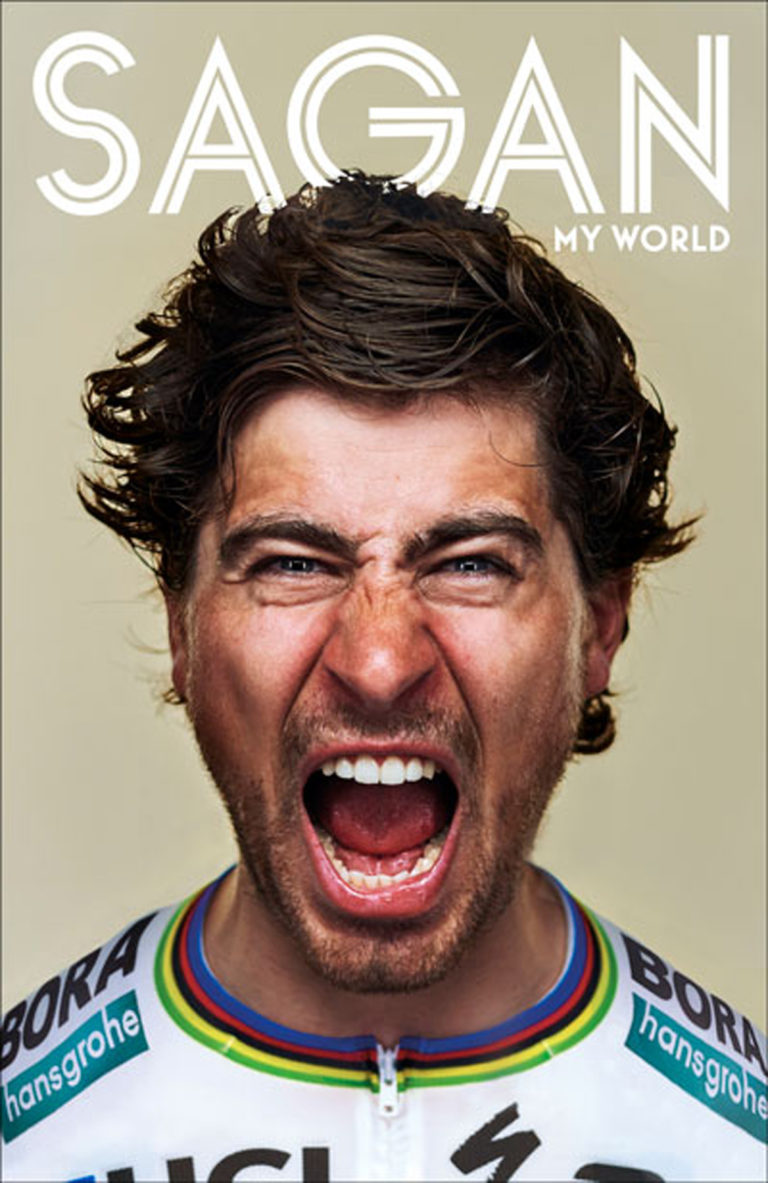
By David Ward – Peter Sagan’s book, My World, is a great read for a bicycle racing fan. It is interesting because of the insight into and story of Sagan’s life, but was really enjoyable for the professional bike racing context in which it is set and on which it focuses.
Peter Sagan’s My World is a great book for bike racing fans.
I expect there will be a lot of different takes on this book. It effectively covers a lot of themes and territory in a relatively short number of pages. Well, 293 pages, but large print and wide line spacing. But my take is this: It is a great book because of the excitement it generates and Sagan’s thoughtfulness and intelligence exhibited as he relates his story of the racing his book describes.
It is divided into three parts, each one titled for one of his three consecutive world championship road race victories (Richmond, Doha, and Bergen), the only man to have accomplished that feat. It ends with an epilogue describing his victory in the 2018 Paris-Roubaix classic. Written with co-author John Deering, who of course did most of the actual writing, the book reads quickly and smoothly, and in an entertaining manner that makes it hard to put down. Or, as in my case, hit the pause button, since I actually listened to most of the book (thanks to my subscription to Audible.com) while riding my own bike, no less.
In reading this book, you get the sense at how well grounded Sagan is. Two themes running through the book bring this out. He emphasizes the idea that for each race there are “a hundred different stories”, and his is only one of them. He is often asked about planning and strategy for a race, and he is quite open about the fact that, while a plan is made, it rarely plays out that way. Rather, a race is a fluid, living thing in which you have to be alert and able to react. He is honest that winning often comes down to good luck. He is keen to point out that each rider has his own story about how each race played out.
Early in his career, Sagan adopted (from his perception of Australians) the mantra, “Why so serious?”, the second theme illustrating how grounded he is. This is referred to repeatedly throughout the book. It is a theme that has served him well. I recall how, during a year with Tinkoff he kept placing second in so many important races, and even came under criticism from his team owner, Oleg Tinkoff who threatened to negotiate his contract down. During this period, I remember Sagan making comments that reflected his fall back on this attitude. Nevertheless, he does make clear in his book how this stretch was so frustrating to him. While sitting in second place in the green points jersey standings in the Tour de France during this stretch, he says, “I was thinking of getting a new jersey made. Most second places. The brown jersey, maybe.”
And speaking of Oleg Tinkoff, it was fascinating to read Sagan’s account of riding on Oleg’s team. I suspect many people are like me, with a not very favorable view of the man. But Sagan, while speaking frankly of Tinkoff, also speaks positively overall of him. What Sagan seemed to appreciate most about Tinkoff was his frankness. If he was happy with you, he told you. If he was upset with you, he told you, and then he was over it. “You were shit today, Peter. But you tried, so f___ it, let’s go eat. Do you fancy caviar” He summarizes Tinkoff with these words, “As you can imagine, his capacity to offend is limitless, but he is also fantastic, engaging, and provocative company.”
Sagan makes clear that he recognizes bike racing as entertainment. Those who have followed him since he burst onto the pro racing scene, which is most of us pro cycling fans, know what an entertainer he is. He describes throughout the book his efforts to embrace this role.
Sagan also spends time describing a number of his adversaries, quickly making clear that he mostly knows them as cyclists. He discusses their styles and strengths, particularly the sprinters whom of course he knows best because they are the ones he mostly competes against. But it is impressive is that he never speaks ill of anyone. He praises and complements certain riders, and is muted and restrained on the things he might be inclined to criticize. He would clearly have liked Mark Cavendish to come to his defense following Cavendish’s spectacular crash during the finish line sprint into Vittel during the 2017 Tour de France for which Sagan was blamed and criticized, and then tossed from the Tour. In the end, it was a bad decision, and most of us came to recognize that. On Cavendish’s failure to speak up, Sagan says, “I was really hoping that Mark might go on Twitter to tell the world that it was a bit of joke, but that was his decision to make. Not mine, and I respect that. It would also have obviously been in opposition to his team’s position, which is never a good place to be.”
Finally, one race that epitomizes Sagan for me was stage 11 of the 2016 Tour de France from Carcasonne to Montpelier. Battered by crosswinds toward the end of the stage and the peloton forming into echelons, Sagan made certain to stay at the front. With 11 kilometers to go and feeling good, he pushed the pace and, joined by his teammate, Maciej Bodnar, opened a small gap.
Another alert leader also staying close to the front, Chris Froome, saw the gap form and Sagan at the lead. He bridged, as then did Geraint Thomas. “I thought at first he was trying to close me down, which would be fair enough. But a quick look and a word between us established that we had seen the same opportunity: ‘Let’s do it’”. As Sagan explains, [W]e slipped into team trial mode immediately. . . . We smashed it for 10 kilometers . . . [W]hen that break is comprised of the race leader, the points leader, and two of the strongest teammates . . . good luck.” Sagan won and Froome took second and gained precious bonus seconds.
This win illustrates intelligent racing, good preparation and talent which allowed Sagan and Froome to be in key places at a critical time, and luck in their favor with crosswinds battering and splitting any possible chase. I remember watching this stage and how exciting it was. This is Sagan, and pro racing, at its finest.
I really enjoyed this book, as will any fan of professional road racing. It provided a small view into Sagan’s personal life, a detailed view into his professional racing life, an understanding of his personal and inner character, and exciting tales of professional bike racing.
My World by Peter Sagan, Hardcover with two 8-page color photo sections., 6″ x 9″, 320 pp., $24.95, ISBN: 9781937715946, Velopress, Boulder, Colorado, 2018
We’ve heard it our whole lives, whether it was from our mothers or in adult lives as we strive to eat perfectly. That line has always stuck with me. In fact anyone who knows me will tell you that you can catch me with a green smoothie every morning and a “trough” of a salad every night. Healthy food is my job though, so maybe it’s easier for me to keep up on my nutrition… Nope, it takes work! I totally understand that it’s not easy to eat like a rabbit all day every day. Our lives are busy, plain and simple, so we turn to supplements to help us get all of the essential nutrients.
As a registered dietitian nutritionist (RDN), when making recommendations for supplement use, I want to be sure to emphasize that we should get as much nutrition from real food as we can. More specifically, endurance athlete’s bodies demand more vitamins and minerals than the average person in order to keep up with the massive hours of training. Therefore we turn to supplements to maintain performance and also recover properly. Note that by definition supplements are meant to make up for what may lack in our regular diet.
Choosing nutrient dense foods will help you perform better, feel stronger, and lend to your long-term health. The simplest tip I can give is to eat in COLOR. If your plate is full of a variety of colors, you are more likely to be getting most your necessary nutrients. But again, you may still need supplements to get essential nutrients that you just can’t get enough of from your dinner salad. You may be asking yourself, “how do I know if I need supplements?” or “how do I apply this idea to my everyday life choices?”
I’ve personally been using a product called SP2 Life that bridges the gap between green supplements and real food. Spirulina is an ultimate superfood, and it’s the ONLY ingredient packed into an easy to use pod, delivered to you in a box of ice cubes. A single serving of SP2, provides a complete plant-based protein, A B C D E vitamins, and high concentrations of vital minerals such as potassium, calcium, chromium, copper, magnesium, manganese, phosphorus, selenium, sodium, zinc and bio-available iron. All of these are essential for athletes, so why not get them from a real food source rather than always having to take pills. I’m not saying that your multi-vitamin is obsolete, or that you shouldn’t use supplements, but this is a really cool option. I know I appreciate any time I can find a supplement that has the right food science, especially when it adds to the quality of my everyday food.
The take-away message today is that a body well-fueled with spirulina will undoubtedly perform better. Supplement use is a complex web on information, so talk with a dietitian before changing your diet or buying a bunch of bottles of pills/powders/potions. Instead, use real food (in this case a supplement comprised solely of real food) to fuel your machine of a body and help reach your ultimate potential.
Note: Want to try SP2 Life??!! It’s almost too easy to pack this superfood into your normal routine. I add a cube to my recovery smoothie every day and absolutely love it. Learn more and order yours at sp2life.com and use promo code “PLAN7” to get 10% off!
Breanne Nalder, MS, RDN has a Master’s degree in nutrition with an emphasis in sports dietetics from the University of Utah. A recently retired professional road cyclist, she still competes in road racing and gravel grinding as a coach at PLAN7 Endurance Coaching. For customized coaching, contact [email protected].
[Editor’s Note: The following is a commentary on and an account of Frank D. Lenz’s ride through Yellowstone Park in 1892 during his attempt at an around the world bicycle tour. It has been reprinted in its entirety from Through Early Yellowstone: Adventuring by Bicycle, Covered Wagon, Foot, Horseback, and Skis (Granite Peak Publications, 2016), pp. 163-177. Janet Chapple, author of Yellowstone Treasures, compiled the accounts, historical photos, and watercolors in the anthology during a decade of research for her guidebook. If you are interested purchasing the book, visit YellowstoneTreasures.com]
Through Early Yellowstone: Adventuring by Bicycle, Covered Wagon, Foot, Horseback, and Skis (Granite Peak Publications, 2016) by Janet Chapple, available from YellowstoneTreasures.com
“Rapid transit of some kind . . . will reverse the present order of having to ride in a continuous cloud of dust over a road so rutted and cut up by ten thousand wheels that if you have a weak spot in any part of the vertebral column the jerks will find it out.” — YNP guide George L. Henderson, Yellowstone Park: Past, Present, and Future, 1891, p. 12.
Frank Lenz’s account of cycling through Yellowstone in 1892 is only a small part of his extensive report of a planned solo world bicycle tour. Installments of his report appeared in Outing magazine every month from August 1892 through July 1896.1
Lenz set out on his trip on June 4, 1892, leaving from New York City, where, as he wrote, people “crowded around me in such numbers that I found it impossible to mount my wheel, much less make the start.”2 Before reaching Yellowstone in late August, he had cycled some 1,700 miles. When possible, he followed wagon roads or railroad tracks—even bumping over the ties at times. In North Dakota’s Badlands, cactus needles punctured both his tires. Nearing Montana, he was invited to spend a day at the Eaton Brothers’ ranch,3 where he rode a horse but did not enjoy the jolting, apparently finding bicycle riding to be smoother.
Frank D. Lenz and his safety bicycle. (Courtesy of Archives and Special Collections, Mansfield Library, University of Montana: 11926)
A few days later Lenz rode along the Yellowstone River toward Yellowstone Park. He passed through the town of Billings, still one of the starting points for tours of Yellowstone—and dear to the heart of this anthologist, who lived her first eighteen years there.
It is not surprising that Lenz makes quite a few errors of geography while whizzing through the park in five days, since he could not have had time to take many notes. He did not allow himself to tarry in the geyser basins, and his tour included only the road segments from Gardiner to Norris and what is now called the Southern Loop of the Grand Loop Road. The present segments between Canyon and Tower junctions and between Tower and Mammoth Hot Springs were not yet completed.
Lenz was not the first man to tour Yellowstone by bicycle. W. O. Owen and two other members of the Laramie Bicycle Club claimed that honor in an account appearing in the June 1891 issue of Outing and reproduced in Paul Schullery’s collection, Old Yellowstone Days.
Lenz must have been in superb physical shape, since he mentions several times the abysmal condition of the roads and acknowledges late in his account that the ride through Yellowstone was not a pleasant one. He writes of two places with elevation changes of around one thousand feet but mentions only that one is “a continuous up-grade and the road very dusty” and the other has “heavy sand and continual up-grade.” Another cyclist, Lyman B. Glover, detailed his complaints about Yellowstone’s roads in 1896:
The mountain road laid with obsidian sand, filled in with powdered geyserite, plowed into impassable furrows by the wheels of the stagecoach and the hunter’s outfit, is a proposition calculated to make the stoutest heart quail. Upon such a footing the cyclist can neither ride up nor down hill. The shifting obsidian sand skews his wheel about and the gaping precipice at the side contents him to walk laboriously up or down the steep incline, happy if a firmer interval of bench land permits the luxury of riding for a little while.4
If Lenz made rather a large number of factual errors in his telegraphed reports, it is not surprising. He could not have carried many maps or guidebooks nor could he connect to the Internet!
Frank Lenz entered history—or at least the part now preserved in the New York Times archives—when, as captain of the Allegheny Cyclers of Pittsburgh, he cycled to New Orleans in 1891. The next year, he headed west alone, launched on what was to become more than 14,000 miles of a world tour “a-wheel,” with Outing magazine and the Victor Bicycle Company sponsoring his tour.5 Lenz managed to send reports from telegraph stations, even from remotest China and Persia, and Outing continued publishing his story just as he had sent it.
By autumn 1896 Lenz was missing in Asiatic Turkey, but Outing’s publisher kept up hopeful reports through January 1897, implying that Lenz would soon report further. The New York Times became interested in what had happened to him and printed reports over a period of eighteen months that varied in their details as to place, nationality, and number of assailants. One story had it that “he had been seen by two Turkish soldiers riding along an Armenian road on his machine, and a dispute arose between them as to whether the strange object was man or devil. To settle the controversy they fired at the cyclist and he fell from his wheel.” Another: “The natives thought his wheel was of silver, and murdered him and broke up his bicycle and divided the different parts.” It was finally determined that Lenz was indeed murdered in rural Turkey. Compared to his tragic end, his difficulties riding through Montana and Yellowstone were minor!
Lenz’s World Tour Awheel (1893, by Frank D. Lenz, born Philadelphia, Pennsylvania, 1868, died Turkey, 1896)
Original in Outing magazine, volumes 20, 21, 1892-1893.
From Miles City to Yellowstone Park
I struck the Valley of the Yellowstone at Glendon.6 Had not this valley become famous as the gateway to the wonders of our great National Park, it would to all time be memorable for its associations. The arena in which was worked out what was probably the last act in the great drama that brought the land of the red man under the developing influences of civilization, the battlefields and resting-places of Custer and many of his gallant band, the region which Sitting Bull fired, like Moscow,7 but failed to hold, must ever touch the chords of sentiment and patriotism. Nor, indeed, does the fame of the Valley of the Yellowstone rest either upon the great marvel-land to which it leads or its historic associations; for it bears, in the great railroad which threads its sinuous course, the towns which dot its river, and the myriad cattle which it sustains, evidences of the enterprise and industry of our nation.
Who would think, standing beneath the shadow of the handsome court-house of Miles City, surrounded by its schools, bank and hotels, that a few years ago all its great surrounding pastures and rich valleys were the home of the once countless buffalo, and that from the ashes of the destruction of that traffic Miles City should rise, phoenix-like, to become probably the greatest cattle center in the world. It is named after General Miles, whose brilliant campaign in 1877 against the Nez Percés opened up so much of the valley to settlement. He built Fort Keogh, about two miles and a half west of here. I visited the Fort in company with Claude U. Potter as escort. It is the most important post in the Northwest, is delightfully situated, and affords ample accommodation to about one thousand officers and men. An excellent brass band furnishes music, and on certain evenings in the week gives concerts.
Miles City, like all Western cities however remote, has its bicycle club. Fifteen wheelmen, most entertaining, make a thoroughly sociable club.
On the morning of August 17th I had my wheel nicely cleaned to continue the journey West along the banks of Yellowstone River. The wind was blowing with terrific force, and when I reached the ferry, where I intended to cross, the wife of the ferryman informed me that the wind was too strong to risk the boat across. I sat down and patiently waited for an hour for the wind to subside. At last a lull came on, and I was soon shoving my machine up a steep and deep gravel road to the top of the hill on the north bank; once the top reached, the wind fairly whistled from the west. The headwind I rode against for thirty-eight miles at Leamington, Canada, along the north shore of Lake Erie, was steady, but to-day’s wind came in tremendous puffs, carrying me clear off the road, and my eyes kept filling with dust. Many miles of this would surely exhaust any wheelman.
The first ranch that hove in sight I stopped at, tired out, only ten miles west of Miles City [italics original]. The occupant was a bachelor, cooking, sleeping and living in one room. But E. C. Stoneing was a hospitable man, and had lived here for years. He was formerly a government scout and courier, and at one time was companion to Buffalo Bill. Many interesting stories he told as the wind blew outside, until sundown. The old fellow kindly gave me his bed, while he slept on the floor. The coarse straw in the mattress and pillow kept working through the muslin during the night, annoying me not a little, but I was also kept awake by the coyotes howling dismally without.
Arising early, I partook that morning of a plain breakfast, prepared by the old man, and then started west at 7:30. The air was cool and calm. The road continues following in sight of the Yellowstone River. The hard wind the day before had blown the dust and sand off the road. The bearing of the wheel now being cleaned, it seemed to run easily. I quickly passed ranches, with herds of horses and cattle, which usually stampeded off at sight of me. By noon I reached Cold Spring Sheep Ranch, and by sundown Rancher P. O., eighty miles for the day. The road was mostly level and good riding—only three hills in the entire stretch. Up these the roads followed the gravel beds of dried-up streams, which made it impossible to ride.
The road next day improved to Junction City, a small village on the Yellowstone. Here I ferried across the river to the Crow Indian reservation, as usual waiting an hour for the ferryman. The Crows are good-natured Indians, and have always been the best of friends with the whites. They ford the Yellowstone on their horses, and daily come to settlements on the north side of the river. Some of them make good farmers, raising cattle and horses in large numbers. I met an old buck and his squaw, who motioned to me to stop, to enable them to examine the wheel more closely; and I don’t know what feature of it astonished them most. The spring fork saddle, the adjustable gearing and the brake specially interested the buck, and I shall never forget the blank astonishment of these red people when I took out the pump and proceeded to pump up. “The Victor” fairly raised the phlegm of the buck, and that is an achievement indeed; it takes something akin to the marvelous to do that.
The road now follows along the N. P. R. R. [Northern Pacific Railroad] through the reservation, sometimes running inside the fence, along the track; at other times through some fenced ranges, making it quite frequently necessary to let down poles and open gates. At Bull Mountain the road winds along some cliffs, one of the most picturesque spots on the Yellowstone River. The hills or buttes are now sparsely covered with small pines, showing that the long prairie would soon end.
From Bull Mountain to Pompey’s Pillar is another flat stretch. Pompey’s Pillar, a mass of yellow sandstone rising abruptly to a height of 400 feet, and with its base covering nearly an acre of ground, has quite an interesting history. Capt. Meriwether Lewis and Capt. Wm. Clark, U.S.A., on their three years’ exploration of this territory for the government in 1804–1807, then known as the “Louisiana purchase,” because it was acquired of Napoleon Bonaparte by payment of $15,000,000, stopped here. Their colored cook, named Pompey, died while at this point and was buried on the top of this rock, which, curiously enough, is covered with quite a deep soil. This rock has a very striking appearance, looking at a distance like a huge pillar. The inscription and date (July 25, 1806) still remain.8
The sun was just setting as I wheeled up to the Huntley section-house for the night. The road next morning started up a hill four miles long. From the top I had a splendid view of the valley. A spur of the Rockies could be faintly seen in the distance, fifty miles away. A short distance farther the road joins the Fort Custer trail to Billings, a town just ten years old and containing already a population of 3,000 souls. It is a supply town for a radius of about 100 miles, including valuable mines, and is quite a wool market.
From Billings west the road is on the north side of the Yellowstone again. The scenery now is all grandeur and beauty, such as we hope to get in wheeling through Switzerland. Through Laurel Park City, to within four miles of Stillwater, is level bottom, making excellent wheeling, although somewhat dusty—or rather it would be excellent wheeling were it not for bridgeless irrigating ditches, which frequently cross the road and necessitate dismounting. Near Stillwater the road turns up a ravine, and a mile’s walk up a steep hill and a terribly steep ride down the other side over layers of rock prepared my appetite for a good supper.
Laurel and Park City are two separate towns west of Billings.
Next day I reached Big Timber, at the confluence of Big Boulder and Big Lumber Creeks with the Yellowstone. Continuing along the Yellowstone River, the valley road is excellent to Merrill. To keep the valley it is necessary to cross over the river on the railroad bridge to Reed’s Point section-house. From here Crazy Mountains can be distinctly seen in the distance, thirty miles away, the tops partly covered with snow. They became more and more distinct from Greycliff to Big Timber on the Boulder River. This stream is well named. Round boulders of every size simply cover everything, including the town itself. But there is a wheelman even there. After riding 1,200 miles of dreary prairie this is like entering a new country. Mountains are visible within twenty miles of here—west and north and south. The riding next day to Livingston, through the valley of the gate of the mountains, was very good. In some places there were many loose stones, however, and within four miles of Livingston it was very stony until the Yellowstone was crossed into town. Livingston, although only ten years old, is a very thriving town. It is situated at the base of the mountains, 4,600 feet above the sea-level.
Big Boulder and Big Lumber Creeks: The Boulder River enters the Yellowstone from the south, and Big Timber Creek enters it from the north at the town of Big Timber, Montana.
The Gate of the Mountains. Painted for Outing by Albert Hencke. Page 287, Outing Magazine, Vol. 21, 1893
Two wheelmen accompanied me from Livingston to the first cañon. The wind was blowing through here at a tremendous rate against us. I had so far been riding my wheel geared to fifty-four inches, but I had my wheel arranged to gear down to forty-five inches for mountainous country. The strong wind compelled me to change it. Bidding the Livingston wheelmen good-by, I continued on a good road down the valley through the mountains along the Yellowstone River. Several ranchmen have settled in this happy valley [Paradise Valley], where the soil is good for raising crops and cattle, and the mountain scenery changes at every bend in the river. Emigrant is a small hamlet twenty-four miles from Livingston, where the hungry wheelman can satisfy the inner man. The long dry seasons thoroughly dry up the road, and in some places the dust lies two to four inches thick.
Continuing on comes another cañon, much narrower than the first ones, called “Yankee Jim Cañon,” after an old Indian fighter, scout, guide and hunter who settled in the valley in 1871.9 Yankee Jim is an interesting character—very enterprising. He constructed a wagon-road through this rocky path and for years collected toll from everybody passing into the park. He still has the gates across the road, and collects toll; for many people go through the park in camping outfits, spending two and three weeks there. Wheelmen are exempt from this toll. The old fellow informed me he thought it hard labor “working them damn’d old velocipedes all day.” He turned out to be a congenial companion for the night. His stories of frontier life would fill a good-sized volume. He is a bachelor and a splendid cook.
Yankee Jim Cañon. Painted for Outing by Albert Hencke. Page 288, Outing Magazine, Vol. 21, 1893
Nature has endowed many countries with fair scenes; but we have in the Yellowstone—as it were, snatched pure and undefiled from the hand of the Creator—one of His very gems, and mean to preserve it in all its pristine loveliness.
All around the teeming multitude is transfiguring the earth, turning it to man’s use, and in too many cases marring its features; but “Yellowstone,” by the fiat of the nation, is to remain to us a thing of beauty and a joy forever.
It has nothing more than a figurative relation to a gem, however, for its area would make a respectable kingdom in some parts of the world, and its attractiveness, not to say productiveness would provide a princely revenue. It taxes the memory to recall—even in the works of those somewhat fervid and overwrought inventors of marvels, the early travelers—any other portion of the world presenting a greater diversity of character than do the rivers and mountains, torrents and waterfalls, hills and valleys of the Yellowstone.
The verdure of abundant nature and the blanched and alkali-withered desert blend their effects into a phantasmagoria of unequaled grandeur and unexcelled attraction to the cyclist, if he have the good sense to provide himself with a pneumatic, and the good fortune to have in it as honest and trusty a friend as my “Victor” has proved to me. It has often been remarked that between the cyclist and his wheel a more than sentimental friendship springs up. Of a verity I can indorse this, so far as the wheel that has borne my burden and cheered my pilgrimage is concerned. It has been a steadfast friend indeed, and that in direst need too. What other wheel could have withstood the wear and tear to which I have subjected my safety pneumatic “Victor?” These journeys over railroad ties and prairie grass have put it to a crucial test, and, as was my purpose, the question whether the pneumatic safety will stand the strain of a wheelman’s world tour over rough and rugged wayside is forever and most favorably settled now.10
Yellowstone Park
Eureka! I have girdled the great wonderland of our continent, and put behind me the greatest temptation to deviate from my onward track. I would by no means have missed it, though it has cost me five precious days. There are many wonderlands in store for me in Asia and in Europe, but will there be any quite like this one in the Rockies? Think of an area of fifty-five miles in width from east to west, and sixty-five miles in length from north to south, covering about 3,575 square miles, laid out as a national park! How “little Rhody” [Rhode Island] and “peach Delaware” must swell into pride when told that the Yellowstone Park reminds [one] of them. When compared in size to any of the States, these two are usually cited as being together just large enough to be comfortably accommodated within the “park.” It should be added, however, that such a disposition of the two States would leave still a margin of over 200 square miles for a national playground. But, aside from its selection as a national playground, the Yellowstone would be noteworthy, for from the slopes of these highlands spring the rills which grow into the mightiest rivers of the United States. The springs of the Missouri-Mississippi system, as well as those of the Columbia and the Colorado, take life here, and “from the summit of Mount Washburn, the highest point of observation embraced by the park, may be seen the grim and towering walls which partition a complex of waters, forcing the flow either eastward, by way of the Gulf of Mexico, into the Atlantic, or westward into the Pacific Ocean.”11
The tourists coming into the park from Livingston take the branch road to Cinnabar. There they are compelled to enter the stage-coach for an eight-mile ride to the Mammoth Hot Springs Hotel [a climb of nearly a thousand feet]. Of course I did nothing of the sort. My “Victor” was a good enough vehicle for me, though, I confess, it proved a pretty hard pull. It is almost a continuous up-grade and the road very dusty. Writing of dusty roads brings back the strange impressions the various travelers made upon me. I could easily distinguish by their dusty clothing and begrimed and sunburned faces those who had “made” the park from the tidily dressed and fair-complexioned new arrivals. It does not take a very long stay within these natural pleasure precincts to change one to a backwoodsman. As for myself, I must have been a sight when I dismounted at the hotel. My face and nose and ears were not only brown but peeling off, and my trusty wheel bore signs of many a gallant league’s work over the alkali roads.
I topped my first day by a ride over the hill through the forest and up a terrible steep and dusty grade through the Golden Gate [another thousand-foot climb], where the west branch of the Gardiner River [Glen Creek] falls over a series of moss-grown cascades with sinuous courses, creating the exquisitely formed and splendidly colored Minerva Terrace by its magic alchemy.12 The roadway through the “Golden Gate” is very appropriately named. Though less than a mile in length, I was told that it cost Uncle Sam $15,000 to build it.
After leaving the Golden Gate gorge the road continues along the top of the mountain, and its even surface is a great relief after the tremendous pull up from the Mammoth Hotel to the famous Obsidian Cliff or Glass Mountain, which rises, basalt-like, in almost vertical columns, from the eastern shores of Beaver Lake to a height of from 150 to 250 feet, and is probably unequaled in the world. The volcanic glass glistens like jet, but is quite opaque. Sometimes it is variegated with streaks of red and yellow. The material lends itself to the formation of a perfect road-bed. It successfully resists drills and giant powder, and only disintegrates under a process of heating by fire and then rapidly cools. No wonder that its fame and use spread wide among the aborigines, for the continent does not produce another natural substance capable of such an edge as flaked obsidian. The sacrificial knives o£ the Aztec priests, and other tools, were made from it.
My rendezvous for the night was to be Norris Geyser Basin,13 a short ride for a day for me; but then there had been so much to see en route, and after arrival there would still be the geysers to see. This was to be my initiation into the mysteries of the great geyser system which Yellowstone marks as its own, at once its pride and its terror. Who can stand upon the trembling earth, with evidences all around of the mighty buried forces of nature scarce slumbering skin-deep beneath one’s feet, without a sense of the mighty powers of imprisoned chaos?
Next morning I started down the road which winds through the Elk and Johnson parks,14 and thence through the four miles of Gibbon Cañon, a narrow, rocky defile, with scarce width sufficient for road and river. The wild grandeur of this rocky chasm is, like so much else in this wonder-working district, difficult of portrayal. On one side the cliffs rise with precipice abruptness a thousand feet, on the other they are clothed with the somber pine to their tops. Here the air is filled with the fumes from subterranean caldrons, not too pleasant in aroma; there the crystal water, fresh from the snow-clad heights, pours through the hundred obstructions in its way, with swish and swirl, and glint of many colors.
Fortunately the road is all down-grade and very good for nine miles to the Fire Hole River, which one must perforce ford.15 After that there is, by way of compensation, a succession of steep and dusty hills, almost impassable for a wheel in some places, until the Lower Geyser Basin, the midway basin, and the Upper Geyser Basin successively arrest your attention and claim your too short hours.
In the Lower Geyser Basin alone there are nearly 700 hot springs, and nigh a score of the greater giants that lay claim to the higher distinction of geysers, whilst collectively those of the three basins seem to defy computation. Suffice to note the more important in their order—the “Excelsior,” of the midway basin, the sleeping monster who, when he wakes, sends forth a voice that can be heard for miles, and a volume of water that turns the adjacent river into a seething torrent, with boiling water from his raging maw.
I did not stop to see this myself, but passed onward to the Oblong Geyser, not so much because of its power, but because its formation permits a closer and better inspection than usual of the masses of crystal which, in liquid form, are ever being ejected from this or the other hundred mouths direct from nature’s laboratory. Wondrous in delicacy, color and formation are these gems, laces and fairy frost-work, if such a term can be applied to creations in which fire plays the principal part.
Ejected: Geyserite eggs, knobs, and biscuits are actually aggregated from silicon dioxide precipitated from the hot spring waters.
“Old Faithful” holds the post of honor in point of popularity, somewhat probably from its position in contiguity to one of the hotels, but mainly from the reliability of the exhibition of his powers; for day and night through all the year round, at intervals of about an hour, he raises his graceful column, to be wind-wafted with feather-like grace, a height of 150 feet.
From the lower to the upper basin, some nine miles, the road is level enough, but I found it sandy and dusty. Here a fellow wheelman, who had rashly partaken of a drink of the pellucid but treacherous water, with results more enduring than pleasant, left me to return to Billings, his home. It is a venture, and a dangerous one, to drink from any stream in this neighborhood.
The next morning I started for fair Shoshone Lake and over the divide to Yellowstone Lake, following the course of Fire Hole River a short distance; but even in that short way had to ford the stream three times, not a very pleasant experience, for, though its name is fire, its waters are icy cold. Once more clear of the water, the road turns up a newly made ravine,16 fairly good riding in at the start, but after the first eight miles it grew from bad to worse, and the best-natured wheel in the world would have refused to move over the heavy sand and continual up-grade which lasted to within four and a half miles of the lake, where the road improves again and is good as far as the lunch station on the lake side.
This lunch station [at West Thumb] is presided over by a jolly Irishman, who keeps the guests thoroughly amused by his humor and his yarns.
The Irishman Larry Mathews managed various lunch stations in the park over many years and is mentioned frequently as a convivial host.
It is curious to see, right on the borders of the lake, bubbling hot springs; indeed in one case the cone of the geyser is within the lake and the hot water within is only separated from the cold water without by the thinnest of partitions. I had of necessity to forego much that I should very much liked to have seen. I would gladly have gone over into the Red Mountain Range and followed the Lewis [River] from the lake downward over Sherman’s trail;17 but time has its limitations, and I could not even afford the lesser excursion southward round the West Bay Thumb of Yellowstone Lake.
I had lingered already longer than I could well afford, and had yet before me the Grand Cañon, which was sure to overpower the scruples of conscience and chain me a votary. True, I could have taken from here a steamer to the Lower Lake Hotel, as do most explorers, even those who have hitherto enjoyed the less toilsome stage, but that was foreign to my mission. Though most of the wheelmen who have hitherto done the park have availed themselves of the steamer at this stage, it was denied to me, for I would not ride by water wherever possible for a wheel to carry me—or, if needs be, be pushed—and I knew that where the stage went, and often where it did not go, there the Victor would carry me. I do not blame the wheelmen—indeed, after my experience, I think in the ordinary course of a pleasure trip they are to be commended for their wisdom, for the ride will tire even the most hardened.
After lunch I continued on round the lake for a good twenty miles to the hotel, and it took me nearly four hours to do it. Here I again set my face north, and next morning started down the valley with the intention of reaching the falls, eighteen miles off, and thence facing westward, back to Norris Geyser Basin and out again, by Yankee Jim’s, to resume my greater journey.
The road from the outlet down the valley is, as roads in the late summer go, not a very bad one, though in some places very sandy and, need I say, dusty. However, it was infinitely better than those over which I had toiled for the past two days, and I was congratulating myself upon having passed through the most uncomfortable portion of my trip when I espied it raining on the opposite side of the river, and soon the icy-cold spray reached me. When within half a mile of a government engineer’s camp, what was my surprise to see the rain change into snow. As it blew up quite strong, I made for the cook’s tent for shelter, and here for three hours I thawed out my fingers and feet, which were nearly frozen. The thermometer dropped from 60° to 39° in three hours. The snow continued to fall until the grass and trees were thickly covered. Anxious to reach the hotel but four miles away, I started out, but stopped at two camps to warm up before reaching there. This was a nice state of affairs—snow-bound in the Yellowstone Park, and yet in the valley, 3,000 feet below, all was warm and dry. Some one has said of Yellowstone Park that “nature puts forth all her powers, and her moods are ever changing from ‘grave to gay, from lively to severe.’”18 I had the full opportunity of approving this writer. Surely, if my trip through the park was not a pleasant one, it was at least a memorable one, and I had seen nature changing from “lively to severe.”
Next morning the sky slowly cleared, but as it was impossible to start with the wheel in this mud, I had ample time to overhaul my machine, which again was the center of attraction to the guests. I also improved the time to make a visit to the Great Falls and Grand Cañon of the Yellowstone. The best point of view for the falls is Lookout Point, a rugged precipice extending out in the cañon; but Inspiration Point, about two miles below, affords another splendid view of the cañon, both up and down. The wonders of the Grand Cañon have been told by abler pens than mine. The truth is, language fails to do it justice.
The falls are two in number, the upper and lower; the former some hundred feet or more, and the latter 350 feet. It is not, however, either in the depth of the falls or the volume of the water which passes over them that their charm exists, but in the wonderful setting in which nature has placed them, every form of rock, every color in nature’s palette, every hue of foliage, every play of light and shade, every variety of grouping, every effect which it seems possible for sun, air, water and earth to produce, is spread with lavish hand, and placed and posed with an artistic effect that almost bespeaks design. Yet the hand of man is conspicuous only by its absence here; nature, reveling in her own strength and drawing on her own resources, has planned the vista and spread the canvas; the emblazoned walls, the tessellated floor, the canopy of matchless blue, all are hers, and never can we be too grateful to those who, in a decade often scoffed at as prosaic, utilitarian, and uneducated in matters merely esthetic, could provide the funds and the protection which alike were needed to save this masterpiece of nature from the destroying vandal, the vulgar advertiser, and the pot-hunting man of the world.
“Alone in this great sanctuary of nature.” Painted for Outing by Albert Hencke. Page 379, Outing Magazine, Vol. 21, 1893
While photographing the falls from Lookout Point, my cap went over the precipice sixty feet below on a ledge of rock. It was a dangerous task, but I climbed down and succeeded in getting it and returning alive. An old tourist standing above actually sat down overcome by the sight of seeing me climbing up. A misstep and I would have been precipitated 1,500 feet below into the Yellowstone River rushing through the cañon.
The next morning everything was covered by a heavy frost, the thermometer was below freezing-point, and there was a dense fog everywhere. I was determined, however, to get off that day, if possible, and although the frozen dirt road was rather rough riding it had no terrors to the rider of a pneumatic.
As far as Norris Geyser Basin it was mostly down grade, and I progressed fairly well (thirteen miles in two hours). Then the sun shone warmly; the road, improved by the snow and rain of the two days before, dried up, and I briskly wheeled off the twenty miles to the Hot Springs, the end of the circuit. My cyclometer showed just 139 miles around the park.
I should not advise wheelmen visiting the park to make the entire circuit, as from Norris Basin to the Upper Basin, and across to the lake and thence up the cañon, it is mostly poor wheeling. Work is being pushed with all possible speed, but it will be some time before this stretch can be called a good road. But those desiring to see, at least, the most important portions of the park, can wheel from Mammoth Hot Springs to the Norris Geyser Basin, over twenty miles of fairly good road, thence cross to the Grand Cañon and Great Falls thirteen miles farther, and by returning over the same route can make a pleasant and not too fatiguing tour. Adding in the sixteen miles from Cinnabar to the Mammoth Hot Springs and return, this would make a total of eighty-two miles, and to all wheelmen in search of a holiday amid the fairest and most wonderful of nature’s handiwork I say, Take your pneumatic and see the Yellowstone Park awheel as I did.
Manifold as are the beauties and attractions of the Yellowstone, as seen by the every-day tourist and written of in the most accessible books of travel, it is startling, but true, that two-thirds of its area is practically unknown. Here and there an occasional enthusiast with time on his hands and the needy hardihood [robustness], some mountain climber, lone fisherman, hunter or geologist have penetrated its remoter waterways and mountains, but their stories do not reach far beyond the camp-fire and the hotel corridor, unless indeed, as is sometimes happily the case, they make their way into the pages of OUTING, like the story of Mr. Owen and his companions awheel there, and Mr. Guptill’s graphic narrative.*
[Footnote in the original: *In Outing, July 1890 and June 1891.]19 The latter, I remember, says that in the northeastern portions of the park, where I did not go, there are vast areas strewn with the fossilized remains of animal and vegetable life, and huge trunks and fragments of petrified trees, many still standing erect, preserving much of their old form and outline, deep down among the roots of which may be found clustering deposits of the most brilliant and beautiful crystallizations, varying in color from delicate shades of pink to deep cherry, while colorless amethyst and yellow quartz lie scattered in profusion. Then, again, between the Passamaria fork of the Big Horn [now called the North Fork of the Shoshone River] and the east fork of the Yellowstone [the Lamar River] is the celebrated Hoodoo Region, or Goblin Land, designations which in nowise belie the character and appearance of the locality—a region in which volcanic action and erosion have seemingly striven to outvie each other in the production of fantastic forms and shapes. To the superstitious Indian it was the abode of evil spirits; to the white man, roused from his slumbers by the weird mutterings of the voiceless air, the region presented an enigma solved by the term “Hoodoo.”
In an annual report, Supt. Norris (1877–82) mentioned his exploration of the Hoodoos. He wrote that prospector Adam Miller and two companions discovered and named Hoodoo or Goblin Land in 1870 and continued:
“In shape they are unlike any elsewhere known, being a cross between the usual spire and steeple form, and the slender-based, and flat, tottering, table-topped sandstone monuments near the Garden of the Gods, in Colorado; and while lacking the symmetry and beauty of these, surpass both in wild, weird fascination. . . .” (Norris, Report for 1880, 6–8).
The story of a slightly later trip to the Hoodoos by E. V. Wilcox appears on page XXX.
From Yellowstone Park to Bearmouth20
Even such marvelous attractions of superb scenery and weird phenomena as fairly riot in mine Uncle Sam’s unrivaled national playground, cannot hold, magnetic though they be, a lone wheelman who has yet full three-fourths of the world to girdle. Regretfully, therefore, I was compelled to bind myself by most solemn covenant to start once more upon my long pursuit of the sun westward.
There were many charming and curious features which I had not seen; but no traveler, unless his travels are to end in that wonderland, can hope to see all of the marvels of Yellowstone Park, and I know from my brief experience that I might dally an entire year and then go on unsatisfied. So I prepared my faithful steel courser for another stage forthwith. There was a choice of routes northward out of the park. A new one would surely have revealed much to repay the venture, but my run south over the Valley Road had proved its excellence for wheeling, and, as it is unquestionably the best route, I decided to travel north by it, though really re-covering the line already traveled.
The fifty-one-mile run back to old “Yankee Jim’s” was accomplished comfortably and without special incident. The old boy appeared really pleased to see me again, and when we got settled down for a chat he fired off story after story, all savoring strongly of the strange, free, breezy West.
Next morning I bade him final farewell, and went on through the Yellowstone Valley. Imposing panoramas of peak and crag were disclosed as I wheeled steadily forward—scenes that pen cannot describe nor brush portray; for eyes, and eyes alone, can rightly convey to the spirit of these mountain pictures. Passing the grand bulk of Emigrant Peak, I noticed with pleasure that the grim old sentinel had received a shining silver helmet of new-fallen snow, and so I bore away another delightful memory of him. . . .
Notes
Lenz, “Lenz’s World Tour Awheel,” Outing 21, nos. 4 and 5, 286–90; 378–83.
Lenz, “Lenz’s World Tour Awheel,” Outing 20, no. 6, 482.
From 1879 through 1903, the Eaton family ran a horse and cattle ranch near Medora, North Dakota, and soon began to take in paying guests. They moved the ranch to its location near Sheridan, Wyoming, in 1904 and became well known for taking horseback parties from there to Yellowstone.
Quoted from “Cycling through Yellowstone Park,” in Whittlesey and Watry, Ho! for Wonderland, 174.
See David V. Herlihy, The Lost Cyclist (2010), for the complete story of Lenz’s adventure and the stories of other nineteenth-century world-circling cyclists.
Lenz entered eastern Montana Territory near Glendive. Barely settled in 1880, it grew to a fair-sized town in 1881, when the Northern Pacific tracks reached it.
Lenz refers to Chief Sitting Bull of the Hunkpapa Lakota Sioux tribe, who was a spiritual and political leader (not a warrior) at the time of Custer’s 1876 defeat in southeastern Montana. This battle, formerly called Custer’s Last Stand, is now called the Battle of the Little Bighorn. The “firing” of Moscow refers to the famous fire of 1571, when a Turkish khan set the city ablaze, and tens of thousands of people died.
Lenz (or his editor) had the wrong story about Pompey’s Pillar. William Clark named the huge, unique rock along the Yellowstone River near Huntley for the son of the expedition’s only woman, Sacajawea. Clark called the boy Pomp or Pompy (DeVoto, Journals of Lewis and Clark, 451). The only black man on the Lewis and Clark Expedition was York, Clark’s slave.
James George (“Yankee Jim”) took over and improved an existing road through what was then called the Second Canyon of the Yellowstone, making it passable for wagons. He lived and collected tolls there from 1874 until about 1910. He is described as a loquacious old character in many early travel accounts.
The safety bicycle, with two equal-sized wheels, had by 1890 become more popular than the ordinary or penny-farthing bicycle, which had a large wheel in front and a smaller one in back—a dangerous vehicle. Pneumatic tires had been used on bicycles for only a few years when Lenz made his tour.
This quote is not credited but came from Henry Jacob Winser’s guidebook The Yellowstone National Park, 5.
Here Lenz seems to be confusing the cold water falling over Rustic Falls of Glen Creek with the hot spring water of a terrace that is nearly three miles north of the falls and originates from deep below the surface.
When Lenz arrived at Norris Geyser Basin in summer of 1892, a temporary tent hotel had been erected to replace the Norris Hotel that had stood near the basin since 1887 but had burned down that May (Whittlesey, “History of the Norris Area,” 15–19). Lenz seems to have spent very little time visiting Norris Geyser Basin.
The name Elk Park is still used, but “Johnson Park” is not. According to Whittlesey, it may be the same as Gibbon Meadows. The name was probably applied by Superintendent Norris for N. D. Johnson, whom he tried (unsuccessfully) to have appointed as U.S. Commissioner to help control crime—especially poaching—in the park.
The road in 1892 left the Gibbon River and headed southwest, bypassing Madison Junction and the Firehole Canyon (both passed along today’s main road) before continuing south.
The new 1892 road left the Firehole River and turned east up the steep Spring Creek grade to cross the continental divide and descend to Yellowstone Lake. Culpin, Road System, 231.
Gen. William T. Sherman did visit Yellowstone (in 1877), but it was Gen. Philip H. Sheridan’s party who, on an 1882 visit, cut the trail from Jackson Hole to Yellowstone Lake. It became a road only in 1895.
Winser, The Yellowstone National Park, 7.
Owen was the first cyclist who recorded a trip through Yellowstone. The June 1891 issue of Outing contains Owen’s cycling report. The 1890 Outing article is a strong tribute to and plug for travel to the park, written by A. B. Guptill, an employee of Yellowstone photographer and concessionaire Frank J. Haynes.
This conclusion of the Yellowstone section of Lenz’s world tour narrative appeared in Outing 21, no. 6 (March 1893), 444–45.
Credit
Excerpted from Through Early Yellowstone: Adventuring by Bicycle, Covered Wagon, Foot, Horseback, and Skis (Granite Peak Publications, 2016), pp. 163-177. Janet Chapple, author of Yellowstone Treasures, compiled the accounts, historical photos, and watercolors in the anthology during a decade of research for her guidebook.
Bibliography
Guptill, A. B. “Yellowstone,” Outing: An Illustrated Monthly Magazine of Recreation 16, no. 4, July 1890; 18, no. 3, June 1891.
Henderson, George L. Yellowstone Park: Past, Present, and Future, Facts for the Consideration of the Committee on Territories for 1891, and Future Committees. Washington, DC: Gibson Brothers, 1891.
Herlihy, David V. The Lost Cyclist: The Epic Tale of an American Adventurer and His Mysterious Disappearance. New York: Houghton Miflin Harcourt, 2010.
Lenz, Frank D. “Lenz’s World Tour Awheel,” Parts 1, 4, 5, and 6. Outing: An Illustrated Monthly Magazine of Recreation 20, no. 6 (September 1892): 482; Outing 21, no. 4 (January 1893): 286–90; 21, no. 5 (February 1893): 378–83; 21, no. 6 (March 1893): 444–45.
Owen, W. O. “The First Bicycle Tour of the Yellowstone National Park,” Outing: An Illustrated Monthly Magazine of Recreation 18, no. 3 (June 1891), 191–95.
Whittlesey, Lee, H. “A Post-1872 History of the Norris Area: Cultural Sites Past and Present,” National Park Service, unpublished document, Yellowstone Heritage and Research Center Library, Yellowstone National Park, Wyoming, 2005, with additions 2007).
——— Yellowstone Place Names, 1st ed., Helena, MT: Montana Historical Society Press, 1988; 2nd ed., Gardiner, MT: Wonderland Publishing, 2006.
Whittlesey, Lee H., and Elizabeth Watry. Ho! For Wonderland: Travelers’ Accounts of Yellowstone, 1872–1914. Albuquerque, NM: University of New Mexico Press, 2009.
Winser, Henry Jacob. The Yellowstone National Park: A Manual for Tourists. New York: G. D. Putnam’s Sons, 1883.
From the Notes on the Illustrations:
Albert Hencke (1865–1936) contributed three paintings to the Lenz Outing articles about Yellowstone. He was born and studied art in St. Louis, Missouri, then studied in California and New York City. He was a book and magazine illustrator, known especially for children’s paintings and pen-and-ink drawings.
(July 28, 2019 – WINTER PARK, Colorado) – Saturday saw the Pro Cross-Country titles contested at the USA Cycling Mountain Bike National Championships. For the first year since 2017 we saw two new Elite National Champions crowned with Chloe Woodruff (Prescott, Ariz.; Stans NoTubes-Pivot) and Keegan Swenson (Park City, Utah; Stans NoTubes-Pivot) taking the titles.
Evelyn Dong (Stan’s NoTubes) finishes second behind Chloe Woodruff (Stan’s NoTubes-Pivot) in the Cross Country event. Photo courtesy USA Cycling.
In the Women’s Race, Woodruff immediately went off the front joined by an unexpected competitor in U.S. Pro National Road Race Champion, Ruth Winder (Boulder, Colo.; Trek-Segafredo) quickly gaining a 35 second gap on the field through the first lap. A crash in the middle of the second lap caused Winder to withdraw from the race but Woodruff pushed on. She crossed the line at 1:47.01, one minute and 16 seconds faster than silver medalist Evelyn Dong (Heber City, Utah; Stan’s NoTubes). Two-Time Olympian Lea Davison (Jericho, Vt.; Sho-Air TWENTY20) rounded out the podium to take the bronze medal.
Keegan Swenson (Stan’s NoTubes-Pivot) wins his first Elite National Championship in the Cross Country race. Photo courtesy USA Cycling.
“I went to the front and just set a sustained pace. There was kind of a big group there, and I wanted to break it up a little bit, and whittle it down to just myself and someone else if possible, or hopefully just myself. I just didn’t want that big of a group going into the last lap,” Swenson said about the big move he and Howard Grotts (Durango, Colo.; Specialized) made with two laps to go, pulling away from a group of six. Swenson would finish in a time of 1:50:26, and Grotts would finish 29-seconds behind him to take the second step of the podium. In third was Russell Finterwald (Colorado Springs, Colo.; Clif Pro Team) who finished in a time of 1:52:08.