Front derailleurs have a very critical function when it comes to riding. When it’s time to make the shift into the big ring, it’s something that is supposed to work correctly. If you don’t have a properly adjusted front derailleur, this could be a huge let down on your next ride. As your friends pull away on the flats, you’re spinning your gears stuck in the small chainring.
The front derailleur derails by simply pushing the chain into or off of the next chainring. The majority of the shift happens because of the chainring itself. (This has been discussed in previous articles in Cycling West during the 2018 riding season.) But first, the chain has to be pressed into the chainring by a properly adjusted derailleur.
In order to adjust a front derailleur, I’ve outlined 5 simple steps. Note that these adjustments apply quite loosely to SRAM’s Yaw front derailleurs. SRAM provides detailed instructions to installing and configuring Yaw front derailleurs.
Step 1 – Front Derailleur Alignment
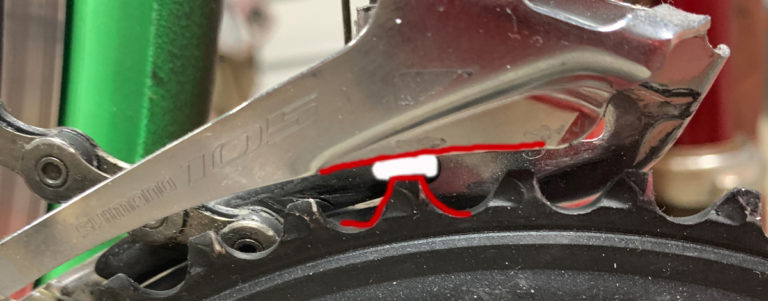
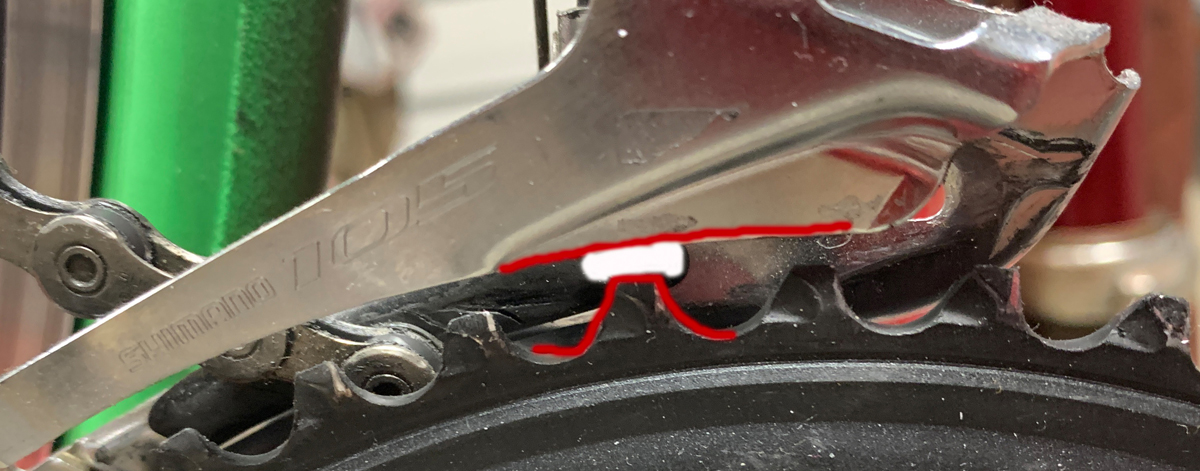
Vertical alignment: The gap between the bottom of the outer derailleur plate and the top of the teeth of the big chainring should be 1-3mm (gap indicated by white space). Photo by Eric Ramirez
To simplify the alignment, it can help to remove the chain from the bike, but this is not completely necessary. Then, detach the shift cable, and loosely install the front derailleur on the frame. Now, align the derailleur so that the shifting plates are parallel to the chainrings. This is easiest done by turning the “L” (low) limit screw several turns and pushing the derailleur away from the mount. I like to make the outer plate flush – or on the same plane – with the outer chainring. From this point it is easy to correct any bad angle.
It is also time to set the vertical alignment. Shimano, Sram, and Campagnolo (for the most part) agree that the bottom of the outer plate should be 1-3 millimeters from the tops of the large chainring’s teeth. Move the derailleur around and make it so.
Clamp the derailleur into place on the frame by tightening the clamp bolt to about 4 Nm. This prevents twist and shouldn’t mess with your paint.
Step 2 – Low Limit and Chain
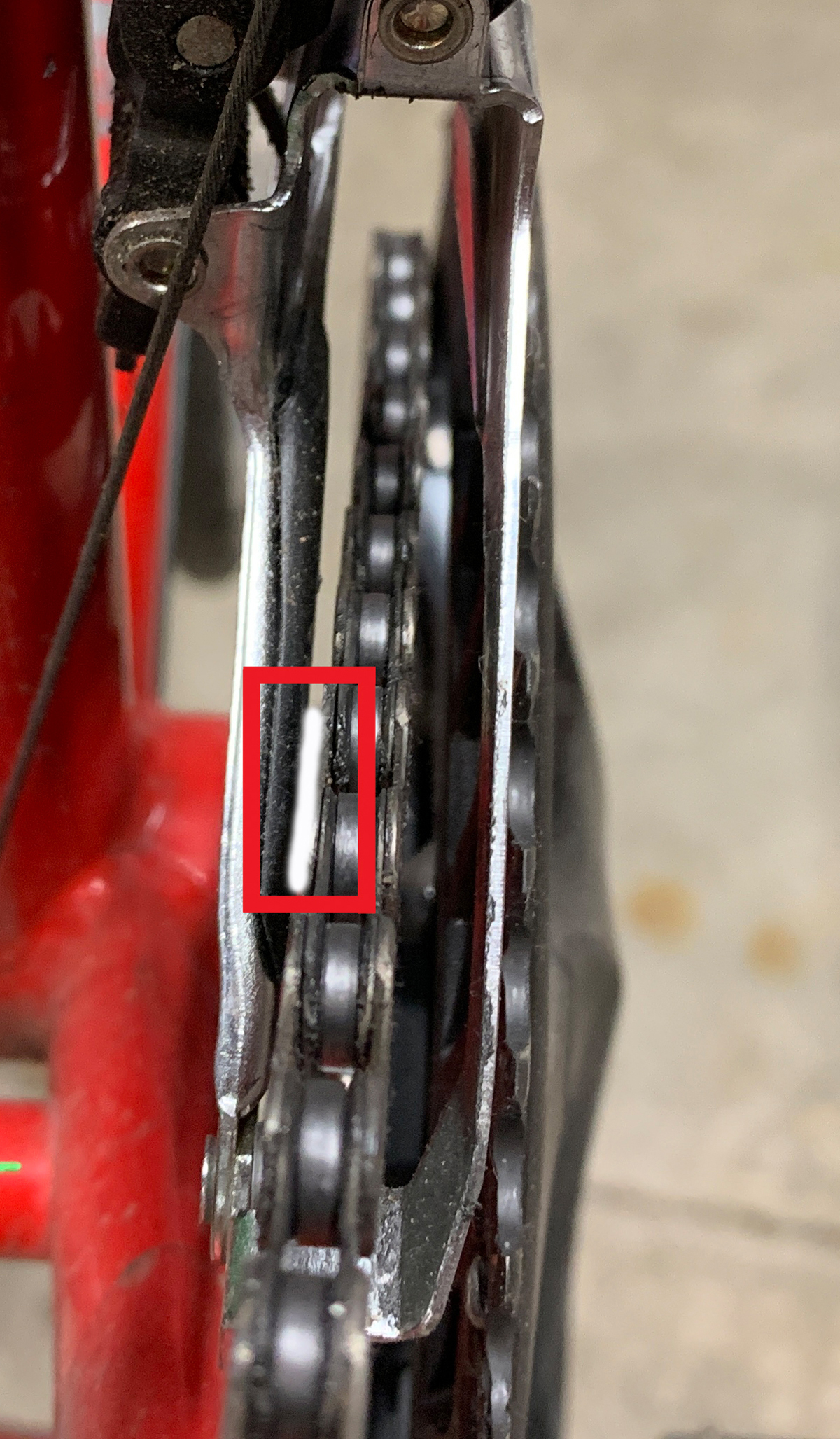
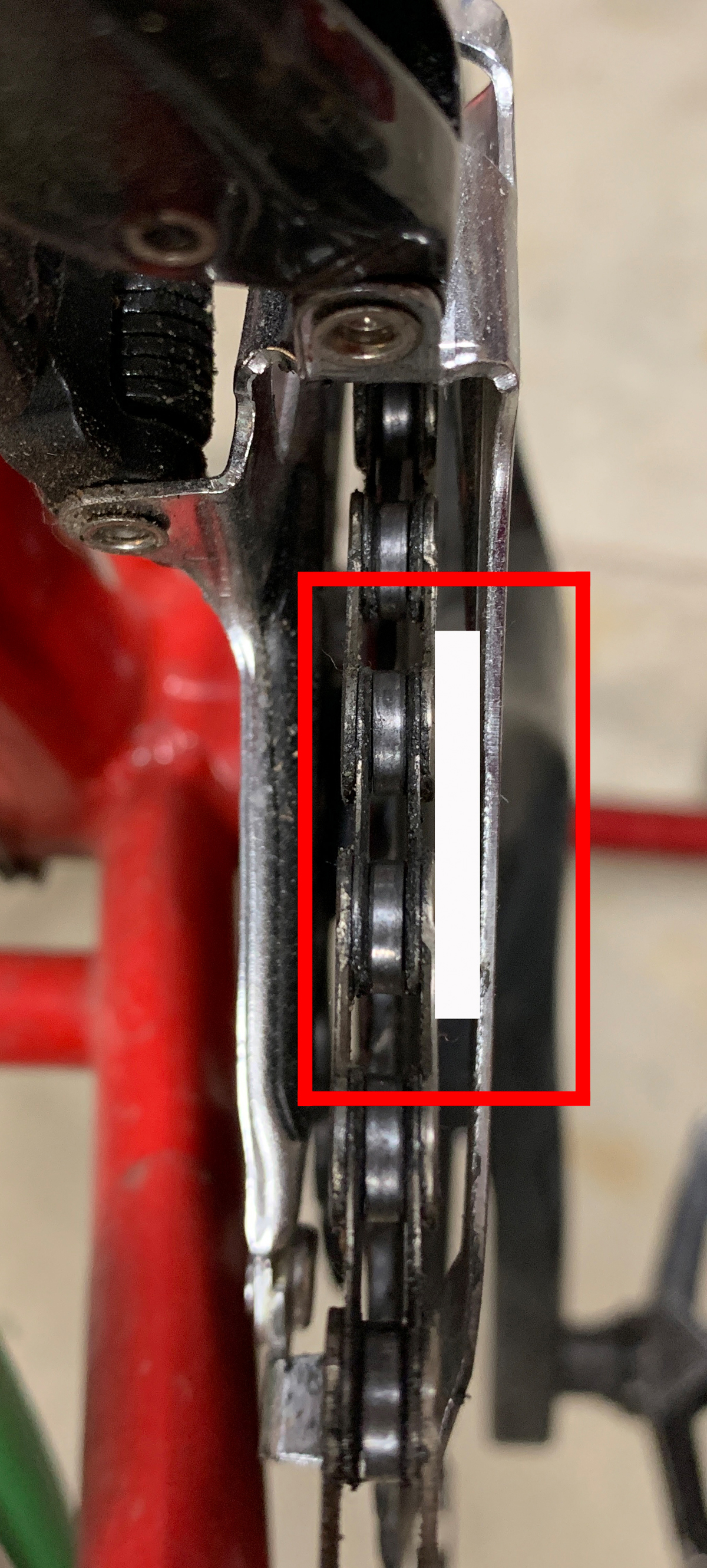
Low Limit Gap: The low limit gap (white space) between the inner face of the inside derailleur plate and chain should be roughly 2mm. Photo by Eric Ramirez
With the derailleur properly aligned, setting the low limit is easy. Unscrew the “L” or low limit adjustment until the inside of the inner front derailleur plate is back over the small chainring. Now, if you have removed your chain, then reinstall it. Shift the chain into the “lowest,” or climbing, gear in the rear. Take a look at the space between the chain and the inside of the inner plate of the front derailleur.
Is there a gap? Is the chain rubbing? What we should see here is a 1.5 – 2.0 millimeter gap. (picture 1.2). If there is no gap or the gap is too large, adjust the low limit accordingly. Once this is set, it rarely needs to be readjusted.
Step 3 – Cable Attachment
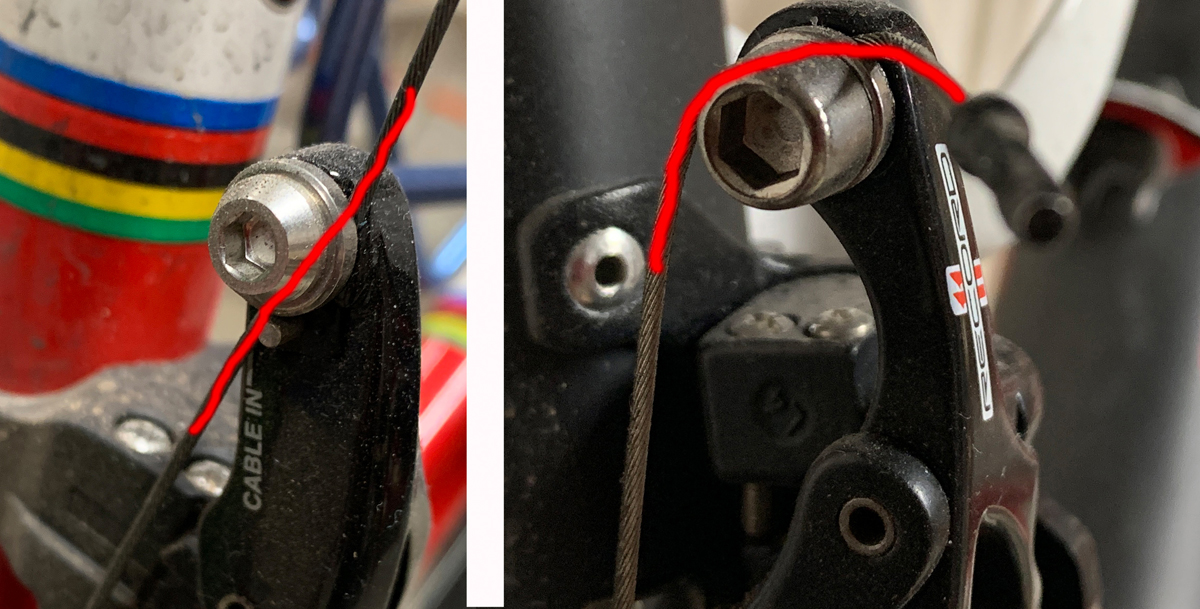
Cable Install: (left) Shimano Gen 2 Cable fixation; (right) Campagnolo cable fixation. Photo by Eric Ramirez
Make sure that the front shifter is in the lowest gear setting so that no extra cable is in the shifter. At this point, pull the cable taut and clamp it in the pinch-bolt fixing point. Make sure that the cable is installed to manufacturer specification. Not all derailleurs affix the cable in the same manner or routing.
Newer generations of Shimano derailleurs do not have very intuitive cable mounting configurations. Find out and don’t make an assumption. There are specific instructions for these systems.
Step 4 – High Limit
High Limit Gap: 2-3mm (white space) – Notice the chain sitting on the chainring is also parallel to the derailleur plates. Photo by Eric Ramirez
Start turning the pedals, assuming the bike is hanging from the saddle or in a work stand. Shift the rear into the 3rd cog. Now, shift the front derailleur onto the big chainring. This should happen easily. Once there, shift the rear derailleur into the smallest cog, usually the 11-tooth. The outside of the chain should have about a 2-millimeter gap to the inside of the outer front derailleur plate.
Adjust the “H” or high limit so that the chain does not rub but also allows this gap. Be sure that the high limit stops the derailleur from moving beyond that gap, as this will send the chain off the chainring. This is the baseline for front derailleur high limit adjustment.
Step 5 – Test Ride
Certain chainrings can easily push the chain to the outside and off and will require even the best derailleur to be adjusted further in (closer to the big chainring) at the high limit. If your shifter has trim (smaller shifts that don’t move the chain) then test that.
Take the bike out of the work stand and give it a spin around the block. Make the necessary cable tension adjustments to dial in the shift, paying close attention to chain rubbing – there should not be any. If the chain isn’t going onto the big ring after a couple turns of the barrel adjuster, then there might be some wear on the chainring that needs to be addressed (time for a new chainring).
These are the fundamental adjustments of a front derailleur. Sometimes your derailleur will need some customized attention. The final result should be a smooth and crisp shift, with minimal noise.
If you were getting dropped on the group ride because you couldn’t get to the big ring, you won’t be able to use that excuse anymore!
Eric has 20 years experience working on bikes, starting in Park City. Today he’s a head technician at a shop and maintains a blog about wrenching and adventures at angrybikemechanic.com
You don’t have to pay any entrance fee when biking into federal recreational land – as long as a fourth-grader goes with you. President Donald Trump signed into law a comprehensive natural resources management act officially known as the John D. Dingell, Jr. Conservation, Management & Recreation Act (S. 47) that includes among its provisions, the Every Kid Outdoors Act, which provides that fourth-graders can bike into national parks, wildlife refuges, etc. without paying entrance fees – along with up to three adults as long as they come on bikes too (https://www.congress.gov/bill/116th-congress/senate-bill/47/text).
The same legislation also contains specific provisions that can expand biking opportunities in Utah’s San Rafael Swells and McCoy Flats areas operated by the Bureau of Land Management (BLM). [More about that in the companion piece to this story.]
Each student would have to get a pass, though, which would be good for all American fourth-graders and home-schooled 10-year-olds, starting on Sept. 1 and running through the following August. President Donald Trump signed the law March 21.
The law requires the involved agencies (National Park Service (NPS), Bureau of Reclamation, Fish & Wildlife Service, U.S. Forest Service, et. al.) to promote the program on their websites. The park service has made it easy by offering a voucher to print that students can take to a park – once they’ve played a little online game to give them some info on the parks (https://www.nps.gov/kids/features/2015/everyKid.cfm). The can exchange the printed voucher at a park for a more durable pass.
Sounds like a great opportunity to promote youth and family cycling. So what are national bike advocates doing to promote it? Not much, so far. ‘We aren’t working in that area currently,” says Saara Snow, travel initiatives coordinator for the Adventure Cycling Association, a non-profit that promotes bicycle travel. “That’s probably an area we could promote through our tours,” Snow says but adds “it’s something we haven’t really talked about as an organization.”
People for Bikes helped push the measure into law but thus far hasn’t followed up. President Tim Blumenthal told this reporter “I don’t know what we’re doing now. You make a good point; we probably need to get on it.”
The law gives the affected agencies the option to work with the U.S. Department of Education and outside groups to promote the program. Since 2016, NPS has been allowing passes for students through its Every Kid in a Park pass program, which is now being merged into this new program.
The legislation encourages but does not require state public land agencies to participate and for federal agencies to encourage states to. “Many state park systems honor the Every Kid in a Park Pass, including Nevada, Wyoming, Idaho, Indiana, New Mexico (in certain locations), New York, and Maryland. Many other state and county parks have adopted the concept for their own use, such as Colorado, Texas, and Michigan,” NPS Public Affairs Specialist Kathy Kupper wrote in an email. “The Every Kid Outdoors Pass will be publicized through a press release, events, websites, partner organizations, and multiple department, agency, and park social media platforms.”
The legislation sunsets the program in seven years. But each agency is required to report to Congress annually on the number of passes it gives and geographical distribution. If the cycling community wants to keep it going, it would sure help to encourage people to use it.
2019 marks a number of milestones in the history of the Tour de France. It is the 30th anniversary of Greg LeMond’s 58-second defeat of Laurent Fignon in the final time trial on the Champs-Élysées to win the 1989 Tour by 8 seconds, the slimmest margin in the history of the race.
It is also the 50th anniversary of Eddy Merckx’s first of five Tour de France victories in 1969. In his début appearance, Merckx took the first 6 of his 34 stage wins and wore the maillot jaune as leader of the race for 18 stages in the process. By the time the race finished in Paris 3 weeks later, Merckx had also clinched the Points and King of the Mountains competitions on his way to an overwhelming 17’54” victory over second-place finisher Roger Pingeon, with third-place finisher Raymond Poulider at 22’13”.
Most importantly, 2019 also marks the 100th anniversary of the introduction of the maillot jaune, the yellow jersey, to signify the leader of the race, and that is a story in itself.
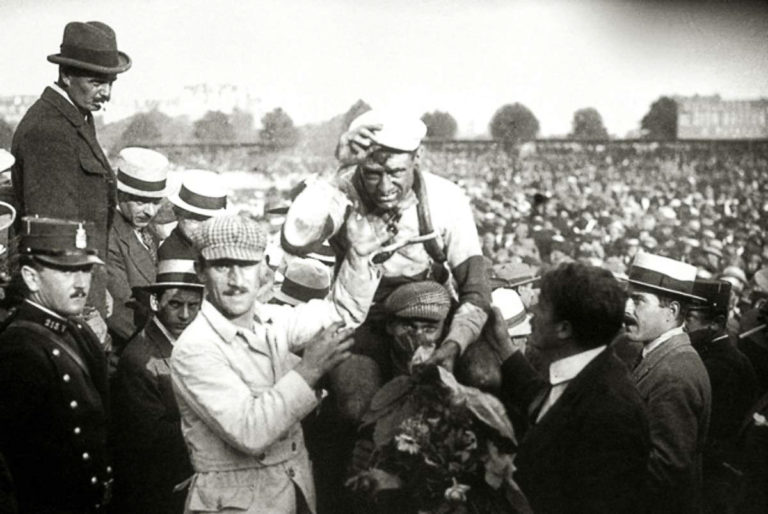
Eugène Christophe sporting the first maillot jaune, 1919 Tour de France. PC: Unknown, Public Domain
The 1919 Tour de France, which had been suspended from 1915 to 1918 due to The Great War, was announced in L’Auto in November 1918, just days after the Armistice bringing a halt to fighting was signed; however the Treaty of Versailles, officially ending the war was not subsequently signed until June 28, 1919, just one day before the start of the Tour.
Many of the pre-war stars of the Tour de France were killed in the fighting. Luxembourger François Faber, the winner of the 1909 Tour, joined the French Foreign Legion and was killed during the Battle of Artois in 1915. Octave Lapize, winner of the 1910 Tour, became a fighter pilot during the war, and was shot down in July 1917, subsequently dying from his injuries in hospital. Lucien Petit-Breton, winner of the 1907 and 1908 editions of the Tour was killed in December 1917 while driving for the French Army. In total, over 60 professional riders, on both sides, were killed during the course of the war.
While the Armistice did bring a cessation to hostilities, since the war did not officially end until the Treaty of Versailles was signed, the French army only demobilized soldiers over the age of 30 over the winter. Younger soldiers were kept in service in case the armistice fell apart and fighting resumed. While this did not happen, by the time the Tour did start on June 29, 1919, there were only 67 entries; 43 professional riders and 24 isolés (unsponsored amateur riders), almost all of whom were over the age of 30.
France was devastated during the war, especially in the North where much of the fighting had been concentrated. The 1919 Tour avoided the worst of the battle-scarred regions, unlike the ill-fated Circuit des Champs de Bataille (Tour of the Battlefields) whose solitary edition happened just a few months earlier in April 1919. However, by the summer of 1919 road conditions were still not ideal for a bicycle race. When the race reached Paris on July 27, only 11 riders remained, 10 of whom were professionals. Of these, Frenchman Paul Duboc was later disqualified for accepting a ride in a car early in the race.
Many stars of the peloton who had survived the war were not able to survive the brutal conditions of the race, abandoning along the way. Riders dropping out included the French Pélissier brothers, Henri and Francis; the Belgian Buysse brothers, Lucien and Marcel; and the Belgian winner of the 1913 and 1914 editions of the Tour, Philippe Thys. All of the amateur riders, save one, also dropped out of the event along the way.
Jules Nempon, the last remaining isolé, thus earned the honor of a 10th place finish as well as taking the prize for being the lanterne rouge, the last rider in the process. Henri Pélissier would eventually go on to win the Tour de France in 1923, while Lucien Buysse would do the same in 1926.
Amongst the 10 official finishers was the Frenchman Eugène Christophe. Christophe was already well known for his tragicomic experiences in the pre-war Tours de France of 1912 and 1913, but 1919 sealed his place in Tour de France history.
A scandal-ridden race in 1904 had threatened to derail the legitimacy of the Tour de France, so from 1905 through 1912 in an effort to reduce cheating by the riders, the Tour was scored on points instead of time.
In 1912, Christophe won three consecutive stages in the mountains, opening up quite a large time gap to his rivals, most notably the Belgian Odile Defraye. Defraye was primarily known for his sprint, but he was able to limit his time losses in the mountains. Christophe, on the other hand, did not have a strong sprint, and would generally finish further down the order on the flat stages when several riders came in at the same time.
By the end of the 1912 Tour, Christophe had the lowest overall time, but because the Tour was scored on points, the overall victory went to his Belgian rival. This was the last year overall victory in the Tour was decided on points, although the competition was reintroduced in 1953 as a secondary classification.
In the 1913 Tour de France, Christophe’s fork broke while descending the Col du Tourmalet as the leader on the road, after he was hit by a race vehicle. In those early races, riders were responsible for carrying out all repairs on their own, except at a few officially designated checkpoints. Since Christophe was not near one of these checkpoints, he was forced to hike 10km down the mountain to the village of Ste-Marie-de-Campan followed by one of the race commissaires.
He then had to find a blacksmith with a working forge, and repair his own fork, then climb back up the mountain to the site of his mishap to resume his race nearly 4 hours later. Adding insult to injury, he was fined an additional 10 minutes by the commissaire for allowing a village boy to operate the bellows on the forge while he conducted his repairs. Christophe ultimately finished the 1913 Tour in 7th place, a little over 14 hours behind the winner, Philippe Thys.
By Stage 10 of the 1919 Tour, Christophe was once again the general classification leader of the Tour de France. However, spectators and the press had problems distinguishing one rider from another on the road, as most were wearing the grey woolen jerseys of La Sportive, a conglomeration of bicycle manufacturers whose businesses survived the war. Until this point, the leader of the race was designated by wearing a small green armband, which could easily be missed in a fast-moving peloton, especially in wet and muddy conditions.
Members of the press suggested to Henri Desgrange, L’Auto’s publisher and organizer of the Tour, that the general classification leader be given a special jersey to wear so that he could be easily picked out of a group of riders. Desgrange approved of the idea, and a yellow jersey was found and given to Christophe to wear starting with Stage 11 on July 19; whether the color of the jersey was inspired by the yellow paper on which L’Auto was printed, or was simply the only color available due to postwar shortages is up for debate.
Eugène Christophe, for his part, was initially none too pleased about being asked to wear the yellow jersey, claiming that he was mocked by the other riders for looking like a canary.
Unfortunately for Christophe, he would not be able to wear the yellow jersey into Paris. On the penultimate Stage 14, on July 25 on cobbled roads near Valenciennes, he once again broke his fork. This time, he only had to travel one kilometer to find a bike shop with a forge, but as in 1913 he had to conduct his own repairs, losing about 2.5 hours in the process to stage and eventual overall winner Firmin Lambot. Christophe ultimately finished the 1919 Tour de France in third place.
Christophe’s story captured the imaginations of L’Auto’s readership, and Henri Desgrange launched a subscription to raise money to award him for his perseverance; ultimately Christophe’s prize of 13,310 francs was nearly triple the 5,000 francs awarded to Firmin Lambot for winning the overall race.
Sadly, Christophe’s bad luck would continue, and in 1922, once again he was forced to hike out of the mountains, this time off the Col du Galibier, with a broken fork. In 11 total participations in the Tour, Eugène Christophe would finish a total of 8 times including his final attempt in 1925 at the age of 40, spending a total of 13 days in yellow in 1919 and 1922. He would finish twice on the final podium, in 1912 and 1919, but never as the overall winner.
Eugène Christophe, July 1, 1925 on the montée d’Aubisque in the Tour de France. This was his last Tour at age 40. He finished 18th. Photo by Agence Rol, Source gallica.bnf.fr – National Library of France.
Nonetheless, the rider who was mocked for looking like a canary had the honor of wearing the first official maillot jaune in the history of the Tour de France, which is still one of the sport’s most coveted prizes 100 years later.
1919 Tour de France Final General Classification
Rank
Rider
Category
Time
1
Firmin Lambot (BEL)
A
231h 07′ 15″
2
Jean Alavoine (FRA)
A
+ 1h 42′ 54″
3
Eugène Christophe (FRA)
A
+ 2h 26′ 31″
4
Léon Scieur (BEL)
A
+ 2h 52′ 15″
5
Honoré Barthélemy (FRA)
A
+ 4h 14′ 22″
6
Jacques Coomans (BEL)
A
+ 15h 21′ 34″
7
Luigi Lucotti (ITA)
A
+ 16h 01′ 12″
8
Joseph Van Daele (BEL)
A
+ 18h 23′ 02″
9
Alfred Steux (BEL)
A
+ 20h 29′ 01″
10
Jules Nempon (FRA)
B
+ 21h 44′ 12″
For more on the 1919 Tour, We Rode All Day: The Story of the 1919 Tour de France, by Gareth Cartman is a great book. Imagined and told from the perspectives of the riders and organizers, this is not a typical historical recap of the race, but attempts to take the reader into the minds of those who made the event special. 236 pages.
Celebrating the Maillot Jaune at the 2019 Tour de France
The 2019 Tour de France starts on Saturday, July 6, 2019 in Brussels, Belgium to commemorate the 50th anniversary of Eddy Merckx’s first participation and victory. The anniversary of the maillot jaune will be celebrated during the Stage 13 time trial in Pau on July 19, 100 years to the day after the first maillot jaune was awarded to Eugène Christophe.
Throughout this year’s race, an individual jersey design will be awarded to the general classification leader featuring an appropriate image for that day’s stage. The jersey issued after Stage 1 (to be worn on Stage 2) will feature the Atomium, to commemorate the race start in Brussels. Stage 2’s jersey will highlight Eddy Merckx, in honor of the 50th anniversary of his 1969 vicotry. The jersey to be worn during the Stage 13 time trial memorializes Eugène Christophe, the first wearer of the maillot jaune in 1919. The final jersey issued after Stage 20 will feature Paris’s iconic Arc de Triomphe on the Champs-Élysées, which has hosted the grand finale of the Tour de France every year since 1975.
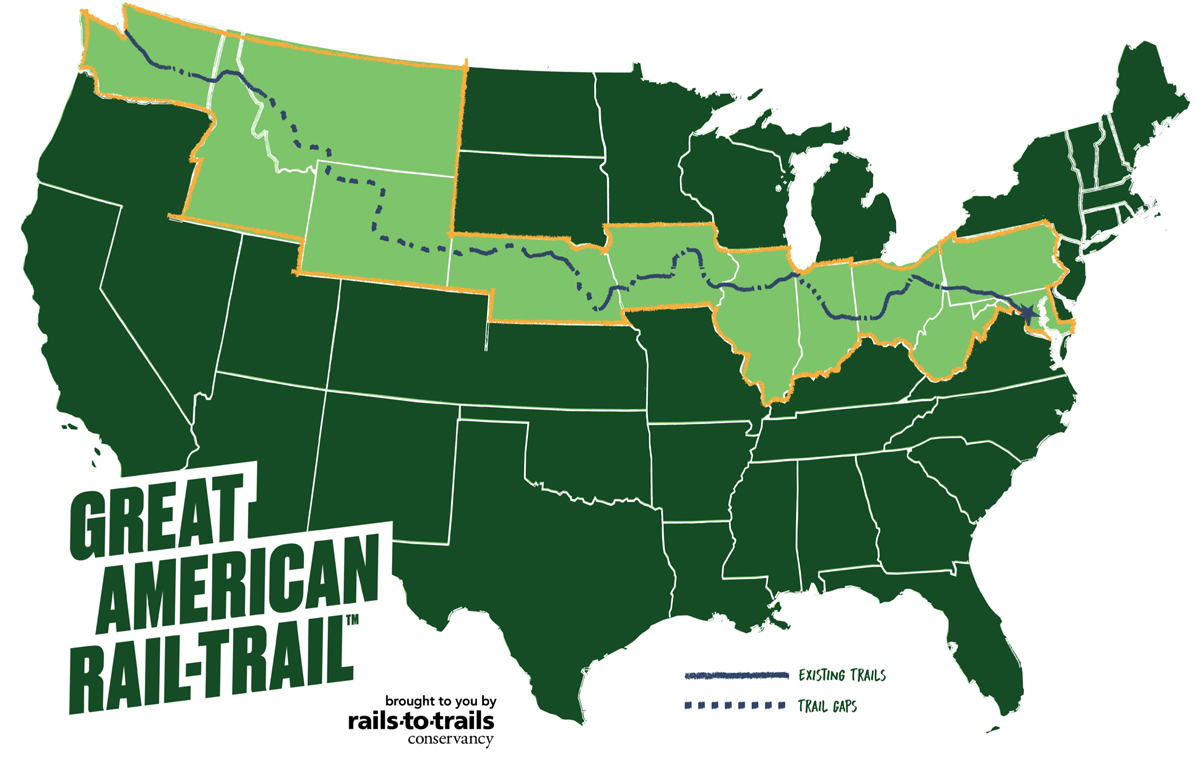
Imagine taking a bicycle trip from Seattle to Washington DC – all on car-free designated bike lanes. It won’t remain a pipe dream. The Great American Rail-Trail going almost all the way across the country has been planned – and in fact is already more than half-built. The Rails-to-Trails Conservancy (RTC) unveiled the plan with the blessing of the U.S. Department of the Interior (DoI) at a May ceremony at the terminus (or beginning) of the trail, in Washington, DC, right in front of the U.S. Capitol. So you can ride across the country and deliver a message to Congress on the need for bike facilities as soon as you arrive!
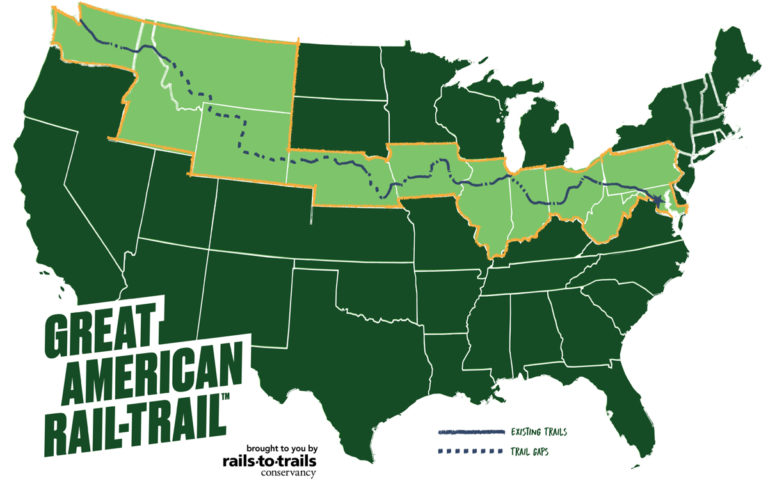
The Great American Rail Trail would provide car free cycling across the United States, running 3700 miles from Washington DC to Washington State. Graphic courtesy Rails to Trails Conservancy
I’m a member of RTC and attended the ceremony. The trail will cover more than 3,700 miles. It would run through Washington state, the Idaho panhandle, Wyoming, Nebraska, Iowa, Illinois, Indiana, Ohio, the northern tip of West Virginia, Pennsylvania, Maryland and the District of Columbia. According to RTC, almost 50 million people live within 50 miles of the route (greatamericanrailtrail.org).
RTC acknowledges, however, that the trial “will take several decades to complete.” While the trail is already nearly complete in Washington state and Idaho, it hasn’t been built or even completely mapped in Montana or Wyoming and several other states. In fact, more than 90 gaps between the dozen major and 113 smaller existing trail segments need to be filled. RTC says that initially, up to 20 percent of the route may have to be shared with autos while the rest is built.
Ryan Chao, who became RTC president in January, called the project “30 years in the making” and “the dream of our founders,” who started the organization in 1986. He said at the ceremony that RTC hopes to pick up a million supporters for the trail.
Rick May, senior adviser to the U.S. Secretary of the Interior for recreation attended the event and announced that DoI “stands by you as a partner in this endeavor.”
In Idaho, the trail will consist largely of the NorPac Trail and the Trail of the Coeur d’Alenes. All it needs is a 10.5-mile connection between the city of Plummer and the Washington state line. Farmers and other landowners possess some of the potential route.
But the project needs to work with state and local officials to build 344 miles in Montana. RTC wants the trail to go through Livingston, Bozeman, Three Forks, Butte and Missoula. But much of the hoped-for real estate remains privately owned. Only 83 miles, or 19.4 percent of the total, is built.
Wyoming also presents a challenge because of its geography. RTC’s Route Assessment Report acknowledges “there are not significant miles of multi-use trail available to route a trail across the state. As a result, Wyoming has more trail gaps to develop—at 500 miles—than any other state along the Great American route.” RTC hopes to go through Casper and Yellowstone National Park. Only 8.1 miles – or 1.6 percent of what’s needed – already is bikeable.
RTC reported that it met with state and local officials in Wyoming in January and identified several possible routes.
Building through public lands will require a lengthy process of public comment periods, environmental studies, etc.
“How can we go over the Rockies and keep the elevation relatively low for people of all abilities?” is a question Interior is working on, May said. But using railway right of way will prove a good method because old trains couldn’t do the steep mountains so the tracks were built to avoid the steepest climbs,he pointed out. “We’ll find a way around them,” May promised.
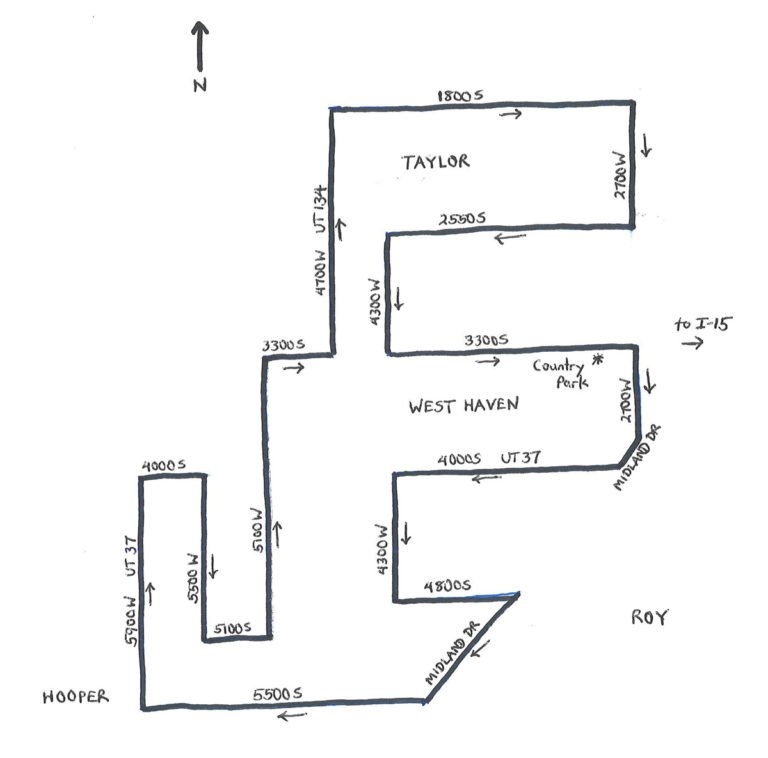
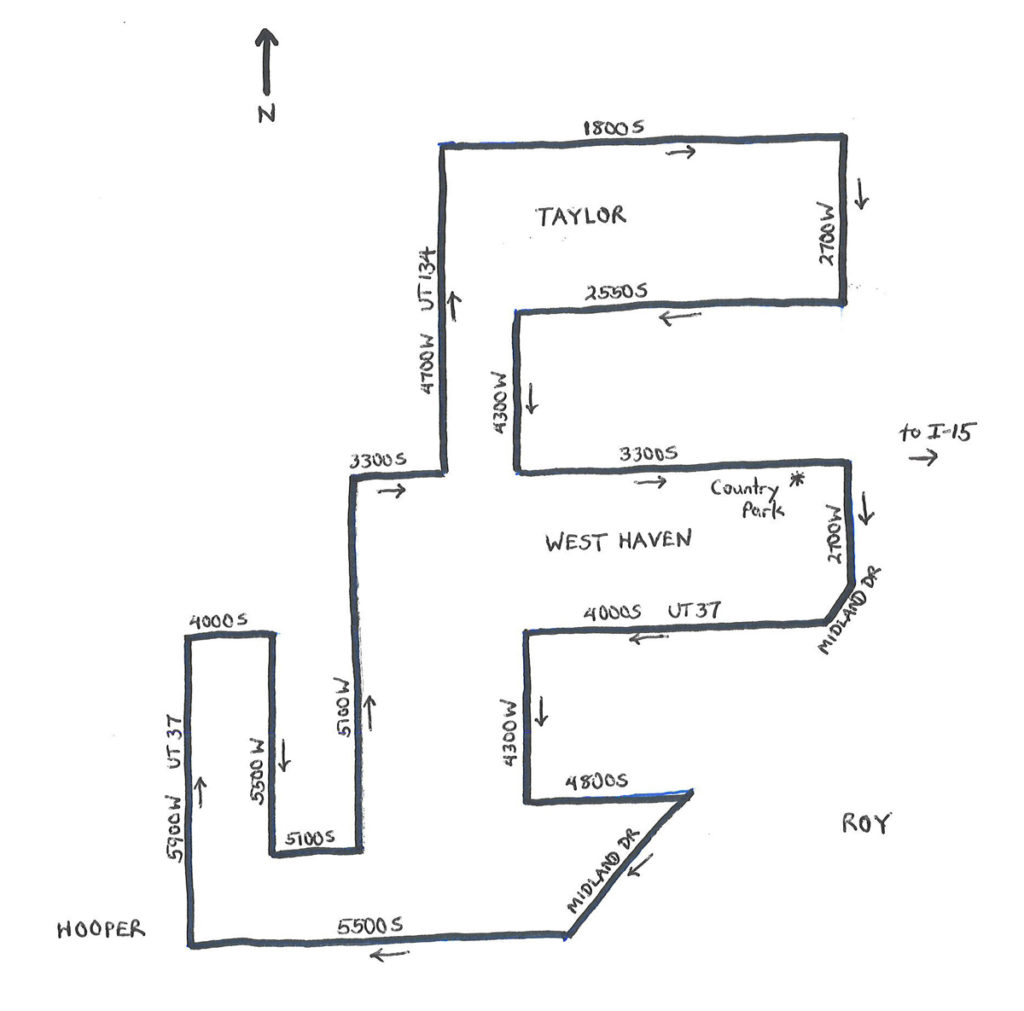
The West of Roy Roads Ride is a 25.7-mile tour of nearly flat roads in extreme southwest Weber County, Utah. The ride is on roads west of the city of Roy, passing through the cities of West Haven and Hooper, as well as the community of Taylor. The route follows a clockwise star-like pattern that is designed to maximize the mileage and coverage of the area. For those of you who are familiar with Utah’s road naming convention, the entire ride is confined between 1800 South and 5500 South on the north and south, and between 2700 West and 5900 West on the east and west. Actually, some familiarity with the convention may be useful, given that the ride makes a number of turns; keeping track of one’s direction (north or south, east or west) would help. Just remember that, if you are on a “West” road, then you are moving north or south; and, if you are on a “South” road, then you are moving east or west. Got it?
The route is entirely west of 2700 West, as a way of avoiding the busier, central areas of Weber County (such as Roy and Ogden). But, get out here soon, as the communities mentioned above continue to grow. West Haven, which became a city in 1991, combining the communities of Kanesville and Wilson, had a population of 12,330 in 2016, up 20% since 2010, and a whopping 468% since 2000. Similarly, Hooper’s population of 8670, in 2017, had more than doubled since 2000. Yet, these cities are still small enough for their roads to have light traffic volumes – fine for cycling. Roadway shoulders tend to be narrow along the route. The heaviest volumes are on the State routes, with the highest, at just over 10,000 vehicles per day, on UT 37 and UT 97 near 2700 West and Midland Drive, respectively.
Start the ride at Country Park in West Haven, located at 2850 West 3300 South. The park entrance is off of 3300 South. The starting elevation is 4,271 feet. The net climb along the route is 185 feet, with a highest elevation of 4,308 feet, and a low of 4,226 feet. Start by heading east on 3300 South. Turn right at 2700 West and head south. Regarding the route, there are seven left and 12 right turns along the way. The sequence is two right turns, followed by two lefts, three rights, two lefts, five rights, two lefts, and then right-left-right. Simple, eh?
Continue south on 2700 West to Midland Drive. Turn right here; Midland is the only road with a diagonal orientation along the entire route. After just one-quarter mile, turn right onto 4000 South (Utah State Route 37, or UT 37) to head west, now 1.2 miles into the ride. Just past mile 3, turn left onto 4300 West to head south, for one mile. Next, turn left onto 4800 South and head east, returning to Midland Drive. Turn right on Midland (sharp right) to head southwest. After a little over one mile on Midland, turn right on 5500 South (UT 97) and head west. This is a 2.2-mile stretch, taking you to 5900 West, which is part of UT 37. Welcome to Hooper! Hooper has been settled since 1854, but did not become a city until 2000. Turn right here and head north. At 4000 South (just past mile 10), turn right and head east. Another right turn follows at 5500 West. At 5100 South (mile 12), turn left and head west. Just down the road (not actually along the route), near 5500 West, is the Muskrat Springs historical marker. A plaque commemorates the spring site, which supplied fresh water to the area’s early settlers. In fact, Hooper was formerly named Muskrat Springs, before being renamed Hooperville, and then Hooper. William Henry Hooper was a Congressional delegate, back when Utah was still a territory. Back to the ride, at 5100 West, turn left to head north. Continue to 3300 South, where some traditional, agrarian-style homesteads are mixed in with newer, suburban-style residences. Turn right and head east on 3300 South to 4700 West, which is UT 134. Turn left to continue heading north. You are now entering the unincorporated community of Taylor. Continue northward to 1800 South; make a right here. Continue heading east to 2700 West (just before mile 20). Turn right here to head south, returning to West Haven.
Yes – welcome back to West Haven! Most notable about West Haven is that it is the home of the confluence of the Ogden and Weber Rivers. The Weber, at 125 miles in length, is longer than the Ogden, which is 35 miles. Both rivers form in the mountains to the east, with the Weber forming in the Uintas, and the Ogden forming in the Wasatch Range. After the Ogden River merges with the Weber River, in the northeastern corner of the city, the latter flows westward to empty into the Great Salt Lake. (The ride does not cross either river). At 2550 South, turn right to head west one more time. The road leaves West Haven, returning to the rural areas west of the city. At 4300 West, turn left, followed by another left onto 3300 South. Once on 3300 South, the route is on its final segment, heading east to return to West Haven. Look for Country Park on the right at 2850 West. The ride ends here.
Starting & ending point coordinates: 41.204992N 112.049100W
A map of the West of Roy (Utah) ride. Map by Wayne Cottrell
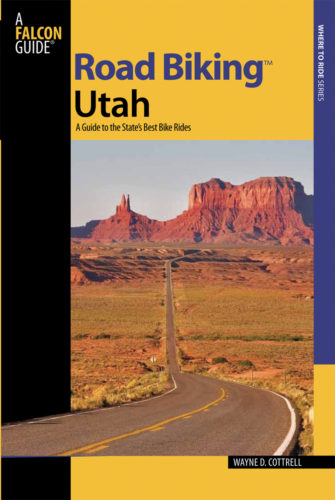
For more Utah rides, see Road Biking Utah (Falcon Guides), written by avid cyclist Wayne Cottrell. Road Biking Utah features descriptions of 40 road bike rides in Utah. The ride lengths range from 14 to 106 miles, and the book’s coverage is statewide: from Wendover to Vernal, and from Bear Lake to St. George to Bluff. Each ride description features information about the suggested start-finish location, length, mileposts, terrain, traffic conditions and, most importantly, sights. The text is rich in detail about each route, including history, folklore, flora, fauna and, of course, scenery.
Wayne Cottrell is a former Utah resident who conducted extensive research while living here – and even after moving – to develop the content for the book.
By Nancy Clark MS, RD, CSSD — As an athlete, you have two jobs. One is to eat wisely to perform well. The other is to stay well: get enough sleep, eat foods that promote good health, live according to your values. Wellness was the focus of the 35th Annual Symposium of the Sports and Cardiovascular Nutrition dietary practice group (www.SCANdpg.org) of the Academy of Nutrition and Dietetics (www.eatright.org) Here are some highlights that offer food for thought:
Knowledge does not lead to behavior change. According to Dr. Chris Wharton PhD of Arizona State University, people make changes based on their values. For example, those who eat plant-based diets tend to value health and animal rights. They may also express concern about the environment. The question arises: Can we create public health campaigns that focus on values, so that individuals will choose to bike more, waste less food, and choose fewer foods in single-serve plastic wrappers?
Eating disorders and disordered eating affects about 60% of female athletes and 30% of male athletes. Yet, these athletes may wait 10 to 15 years to seek help. (“I’m not THAT sick.”) Sometimes they are too ashamed and embarrassed by their inability to just eat normally; other times they might be afraid the treatment plan will deny them the ability to exercise and maintain a lean body. The GOALS Program at Walden Behavioral Care in the Boston-area helps athletes learn how to fuel for performance (as opposed to sabotage their performance by dieting and using unhelpful weight management techniques). During the 8-week treatment program (3 nights a week), disordered eating behaviors decreased—and weight remained relatively stable.
Butter is not back. The conclusion of the often-quoted study (Siri-Tarino et al, 2010) should have been “Saturated fat, refined carbs and added sugars are equally bad for risk of heart disease.” By using poly- and mono-unsaturated fat (avocado, nuts, olive oil) instead of saturated fat (butter), the change in total mortality drops by 15-25%
The health claims made about coconut oil are misleading and made by marketing gurus using research based on medium chain triglyceride (MCT) oil, not coconut oil. Coconut oil contains primarily lauric acid, an MCT, but it behaves like a long chain saturated fat in terms of digestion and metabolism. Lauric acid raises bad (LDL) cholesterol, inflammation, coagulation and insulin resistance. (Eyres. L. 2016). If you want to lower your cholesterol, use coconut oil sparingly! One tablespoon has 13.5 grams saturated fat. Given the recommendation to consume less than 7% of total calories from saturated fat, the limit for a person eating 2,000 calories/day is only 15.5 grams/day of saturated fat.
Cardiovascular disease (CVD) is the leading cause of death in the USA and globally. 70% of people aged 60 to 79 have CVD, as do more than 80% of people over 80 years of age. The good news is functional foods such as blueberries, avocado, beets, and tea can help curb the negative health effects associated with aging. For example, the polyphenols (bio-active compounds) in a daily cup of blueberries can reduce blood pressure, improve blood vessel health, and reduce the risk of CVD.
While we have been lead to believe that drinking 1 to 2 glasses of wine can offer positive health benefits, that belief can be questioned. There are 25 alcohol-related diseases, to say nothing of the associations between alcohol and certain cancers, CVD, intestinal issues, unintended injuries from accidents, and intended injuries from suicide. Unless you are among the estimated 35% of Americans who reportedly abstain from alcohol, the least harmful way to include alcohol in a diet is to limit alcohol to to one (women) or two (men) drinks only 3 to 4 times a week (not daily). And be sure that “one drink” is actually just one “standard drink” (6 oz wine, 12 oz beer, 1.5 oz spirits),
Lutein (found in egg yolk, spinach, and other dark green and yellow/orange foods) is important for eye health (reduces age-related macular degeneration). What is good for your eyes (lutein) is good for your brain. Adults with normal brain function have three times more lutein than those with cognitive impairment. To easily get the recommended 6 to 10 mg lutein per day from your food, eat avocado, oranges, eggs and spinach.
Herbs and spices are known to not only make food taste yummier but also to lower inflammation and joint pain associated with arthritis. For curcumin (a part of turmeric), you need supplements to get an effective dose (~1,000 mg curcumin/day, the amount in ~2 tablespoons turmeric). Ginger has the potential to aid in morning sickness, vertigo nausea, and the pain and disability of osteoarthritis. The dose of 1 gram (1/2 tsp. powered ginger) 2 or 3 times a day is do-able through food. Cinnamon has mixed and modest findings for improving blood glucose levels in individuals with pre-diabetes. One-half teaspoon per day may or may not be helpful.
People who overeat often do so mindlessly. One way to be more mindful is to pause before you overeat and think POUR: Pause, Observe (Am I hungry or am I stressed?), Understand (I am stressed and tired) and Respond (I need to take a nap more than I need to eat.). Physical barriers can also helpful save a lot of calories: pre-portion the cereal into appropriate servings and keep them out of sight.
We lose sleep by going to bed too late, drinking too much coffee, having sleep apnea and needing to urinate during the night (a normal part of aging). Sleep loss is associated with accidents, increased risk for diabetes and metabolic disorders, weight gain, and hunger (due to increases in the hormone grehlin). Exercise doesn’t protect against he harmful effects of sleep deprivation. Is dragging yourself out of bed in the morning to fit in your workout a wise plan? The goal is to get at least 7 hours of sleep a night to avoid sleep deprivation.
To help maintain muscle mass, people (over 40 yo) need to eat enough protein (1.0 to 1.2 g pro/kg/day) and do resistance exercise (lift weights, do push ups) if they want to have quality of life as they age. This strong protein intake will not lead to lose bone mass, kidney failure, or cancer. Rather, it will help them be able to have more fun in the last 10 years of their lives.
Research shows that being physically fit is more important than being lean. People who live in large bodies are better off adding on exercise than self-inflicting rigid diets that “backfire.” The pattern of losing weight only to regain it has a negative impact on overall health.
What one thing can you do, no matter how small, to begin moving in the direction of the health you desire?
References:
1) Eyres L. et al. “Coconut oil consumption and cardiovascular risk factors in humans.” Nutr Rev. 74(4):267-80, 2016
Nancy Clark, MS, RD counsels both casual and competitive athletes at her office in Newton, MA (617-795-1875). Her best selling Sports Nutrition Guidebook and Food Guide for Soccer offer additional information. Visit NancyClarkRD.com. For her popular online workshop, see NutritionSportsExerciseCEUs.com.
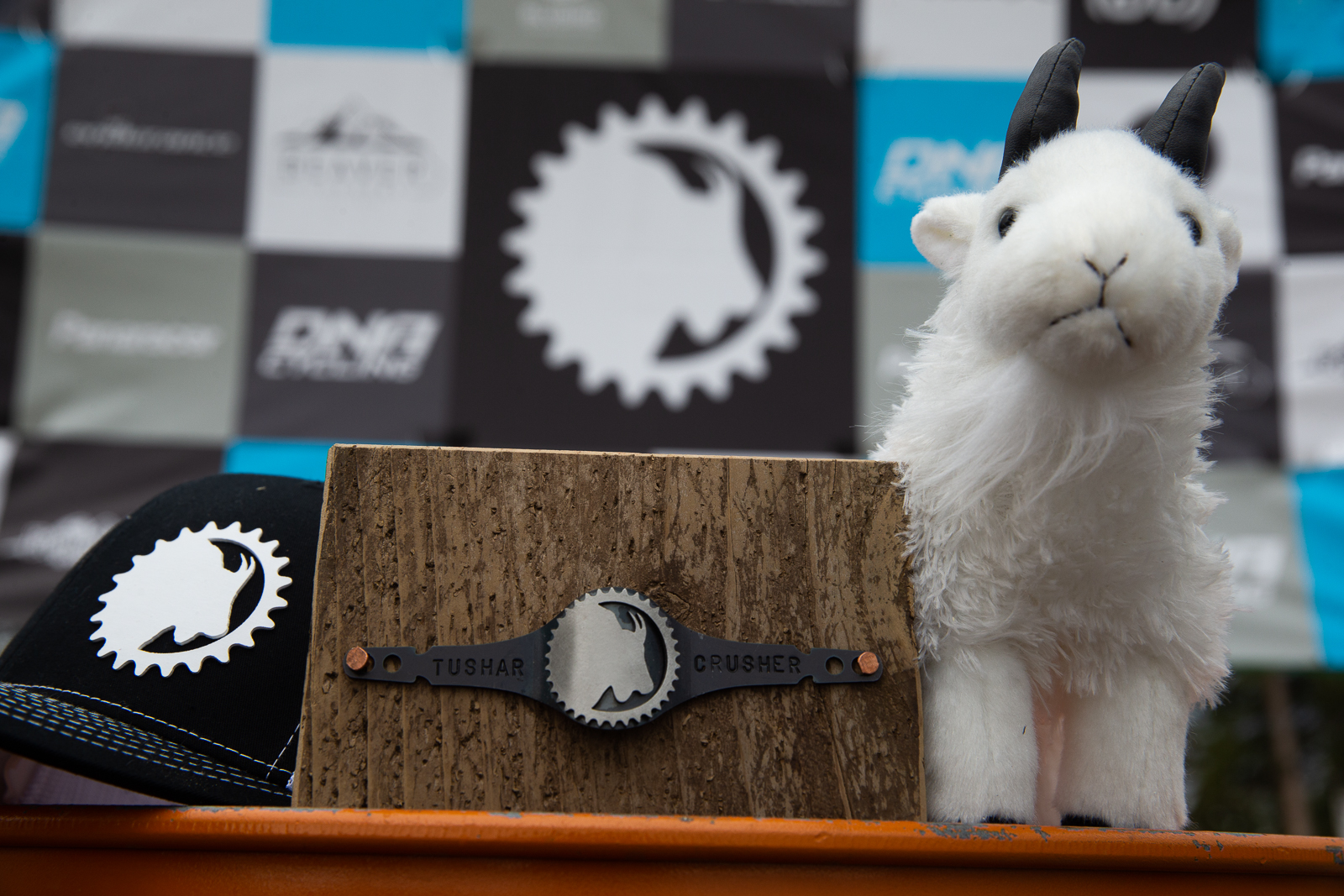
Cycling West presents a photo gallery by Catherine Fegan-Kim of the 2019 Crusher in the Tushar, held in Beaver, Utah on July 13, 2019.
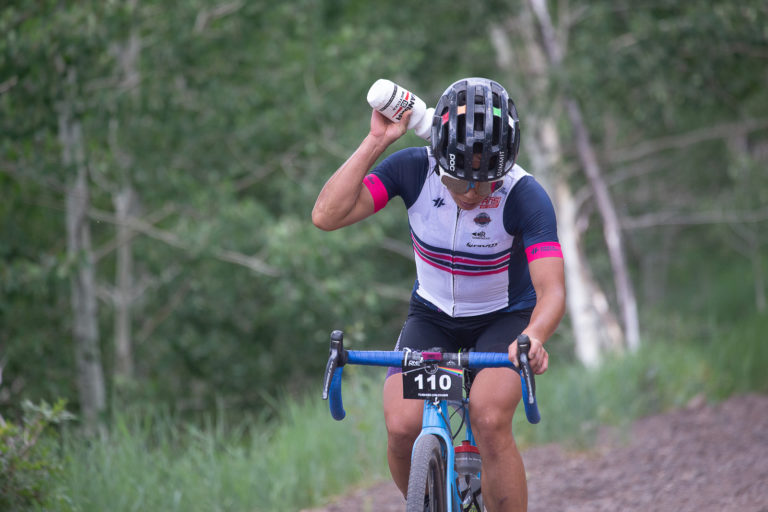
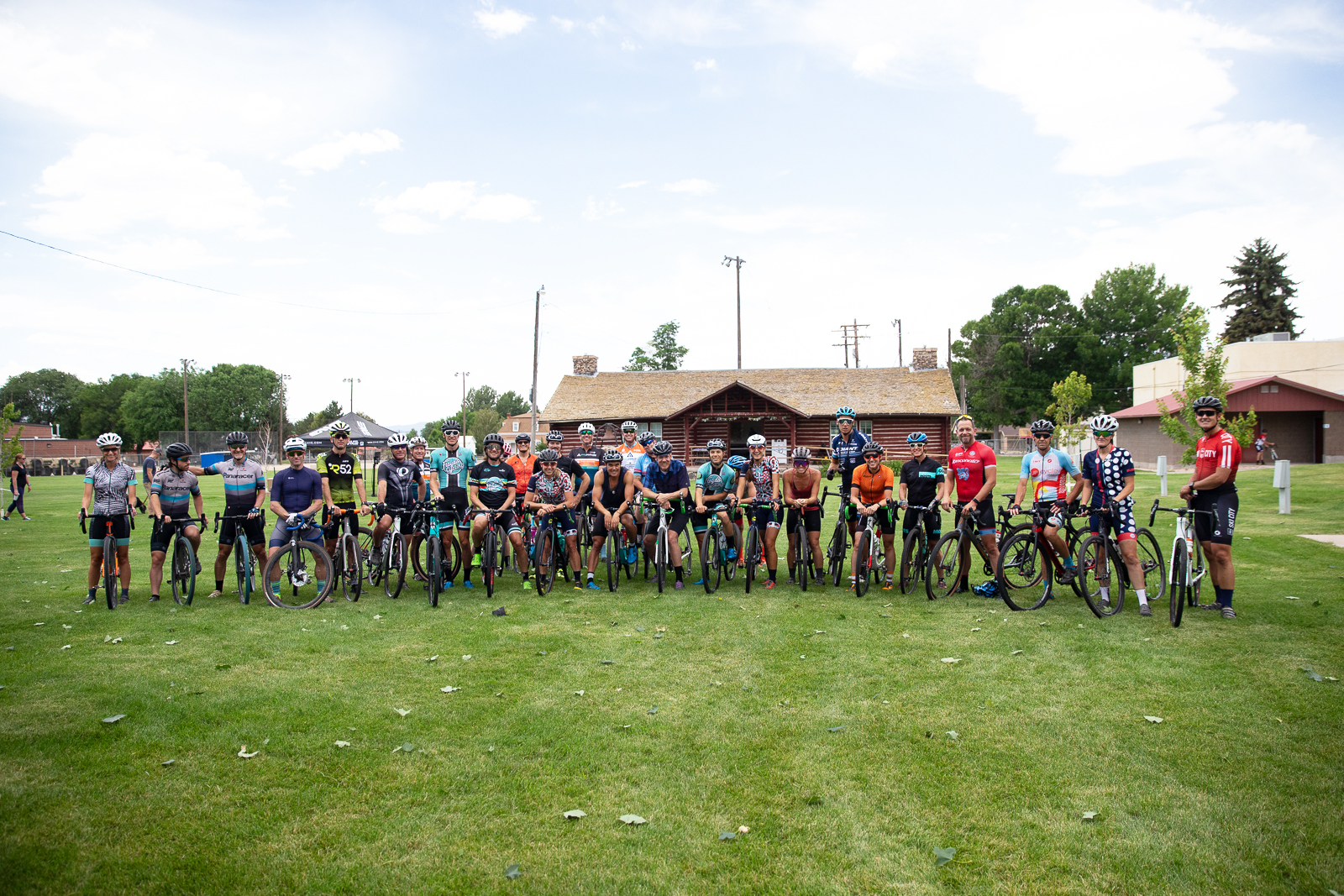
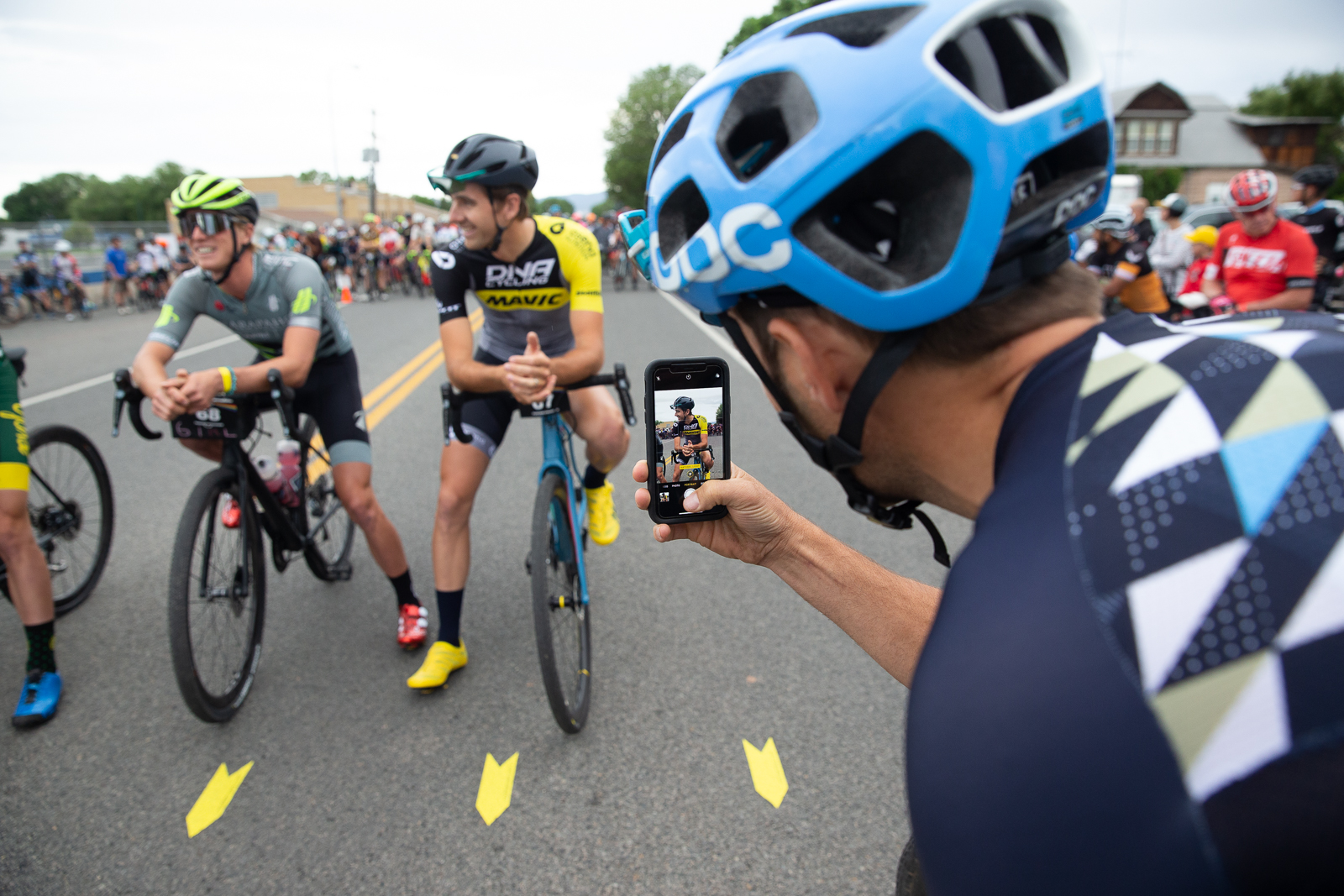
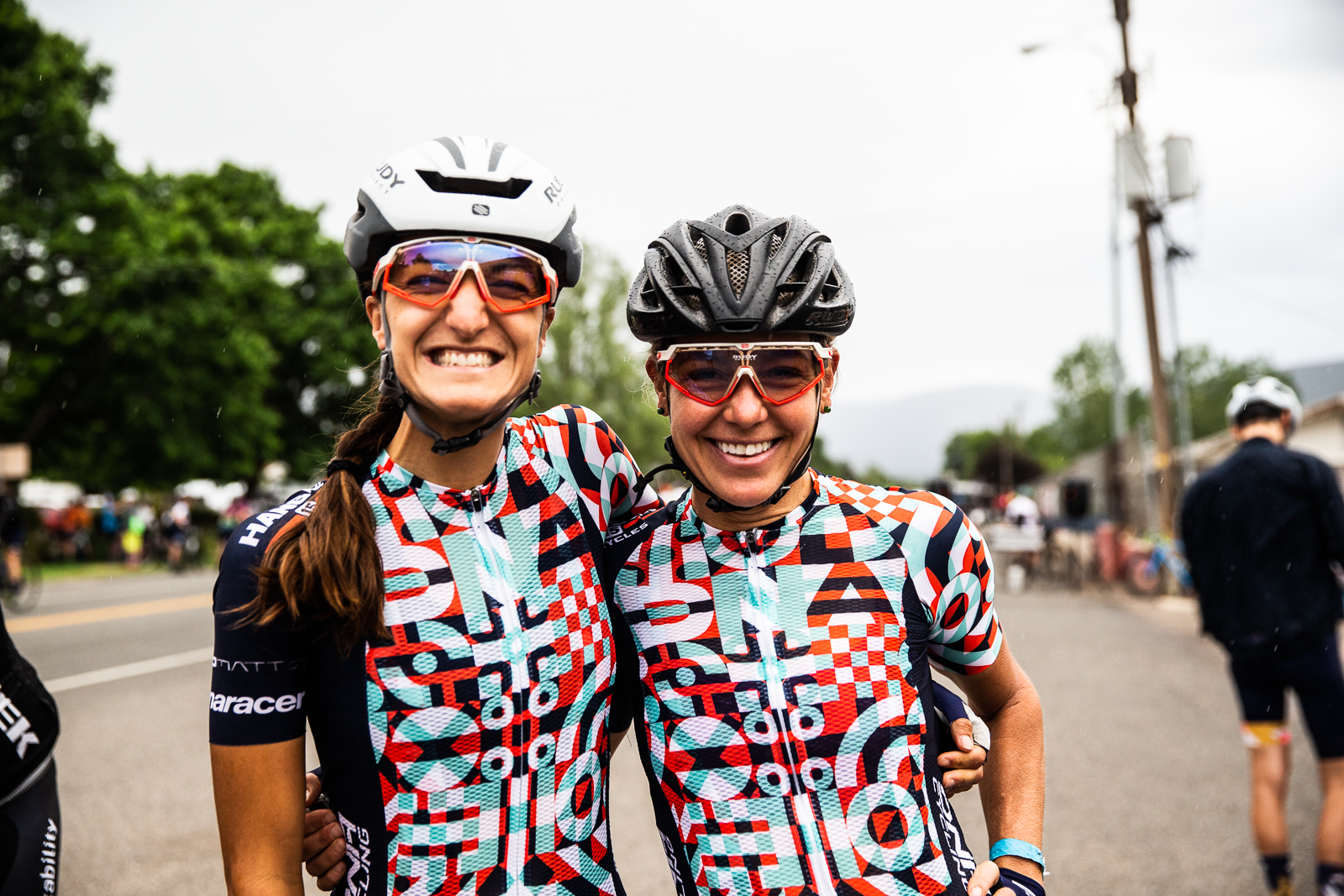
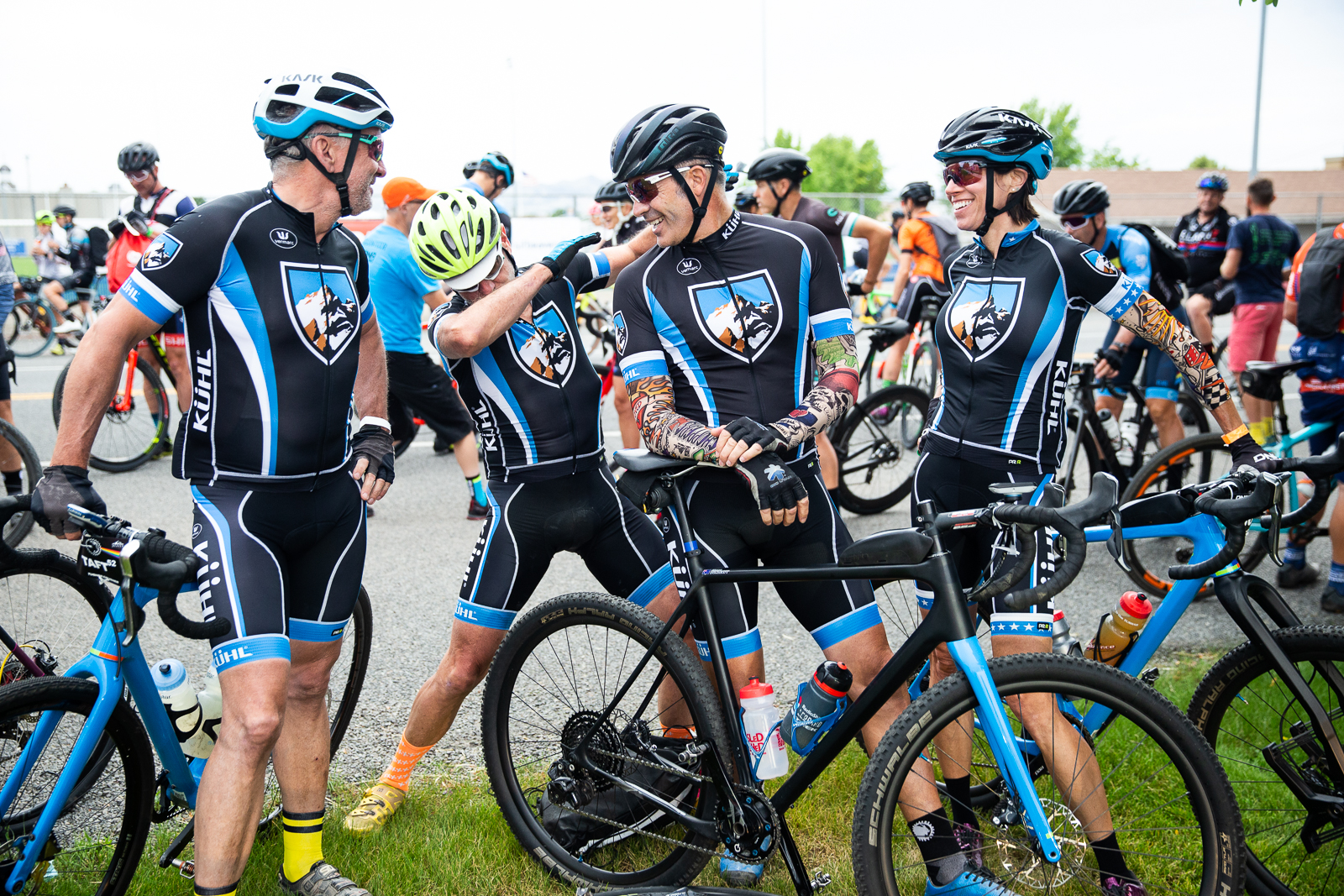
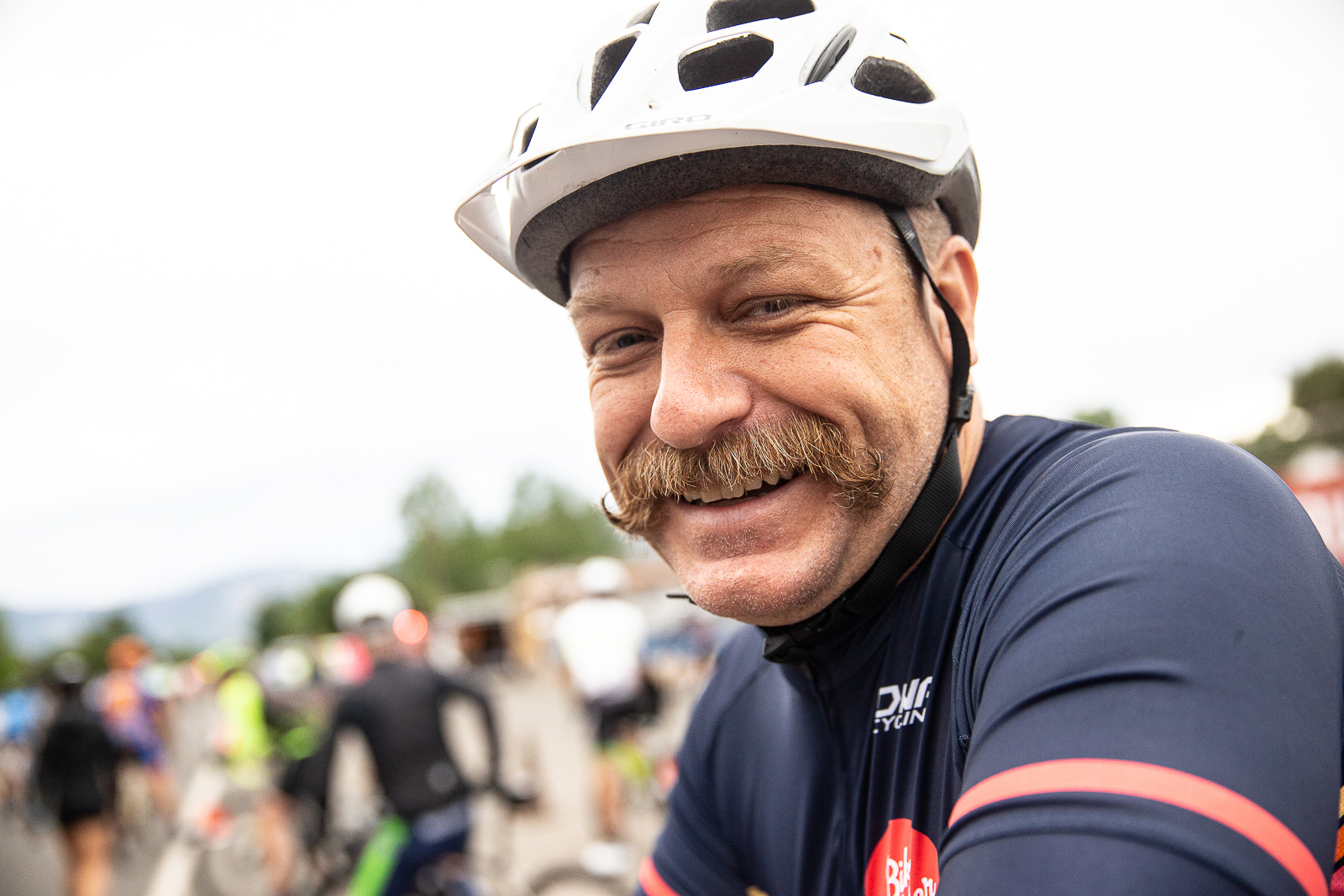
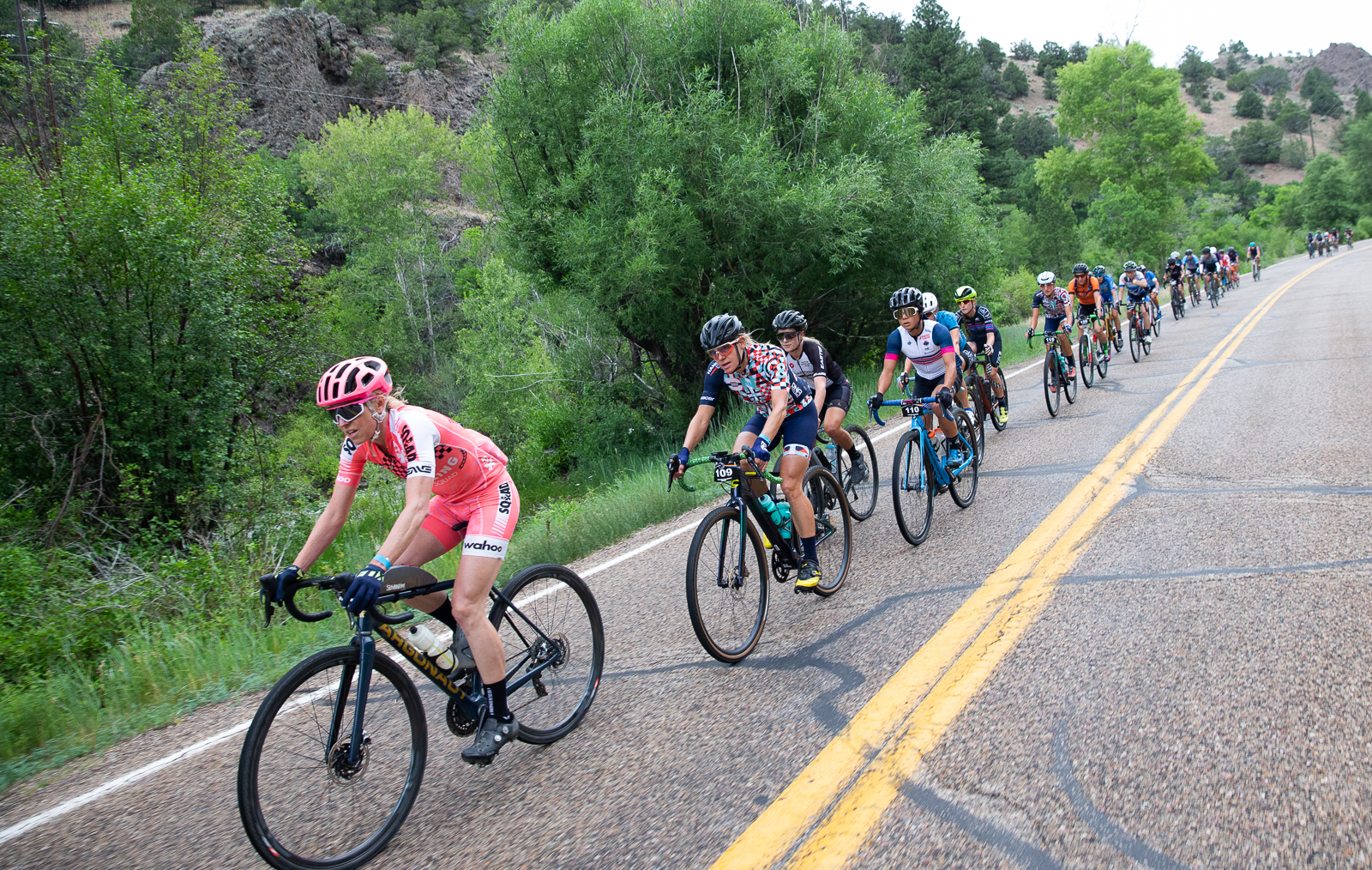
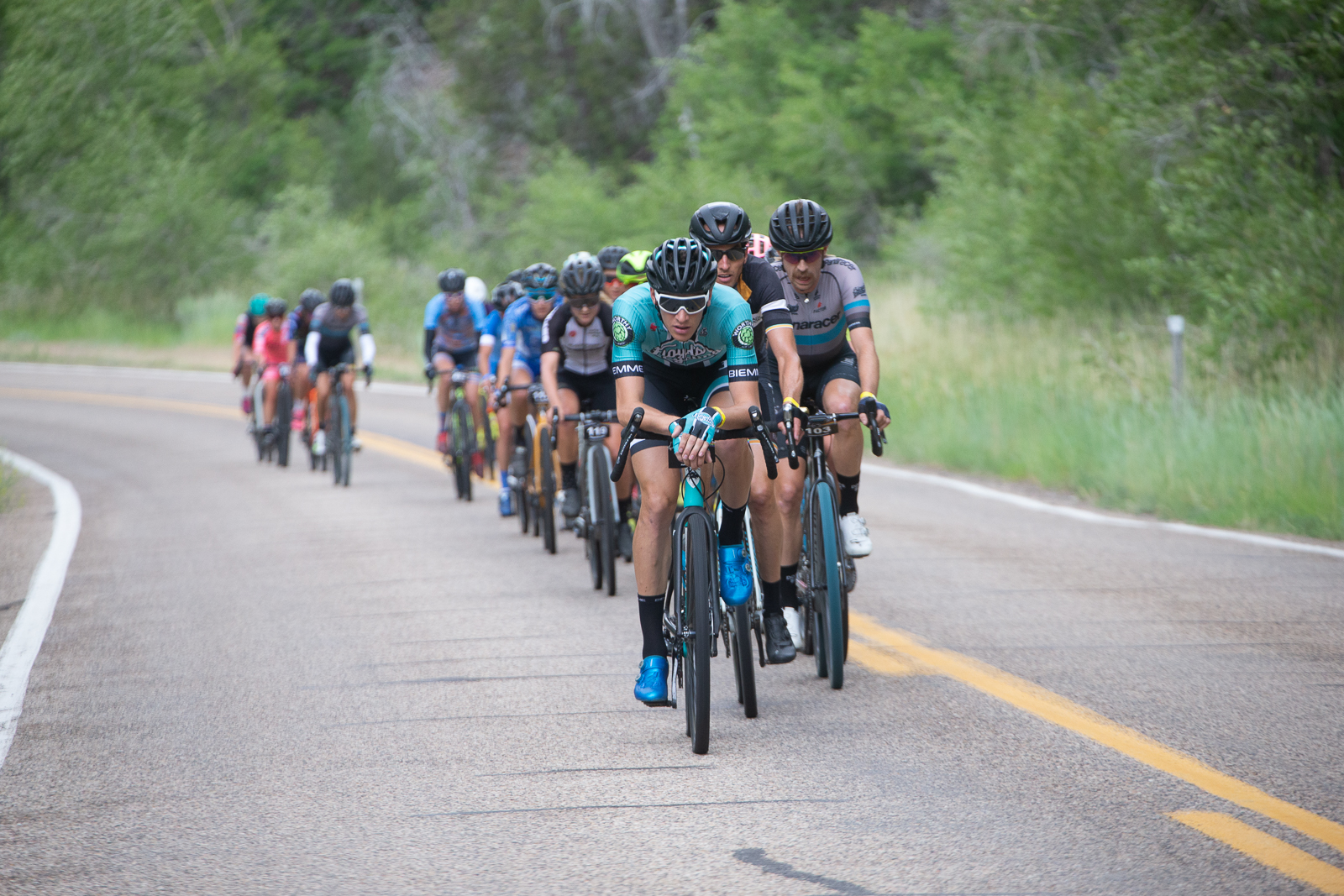
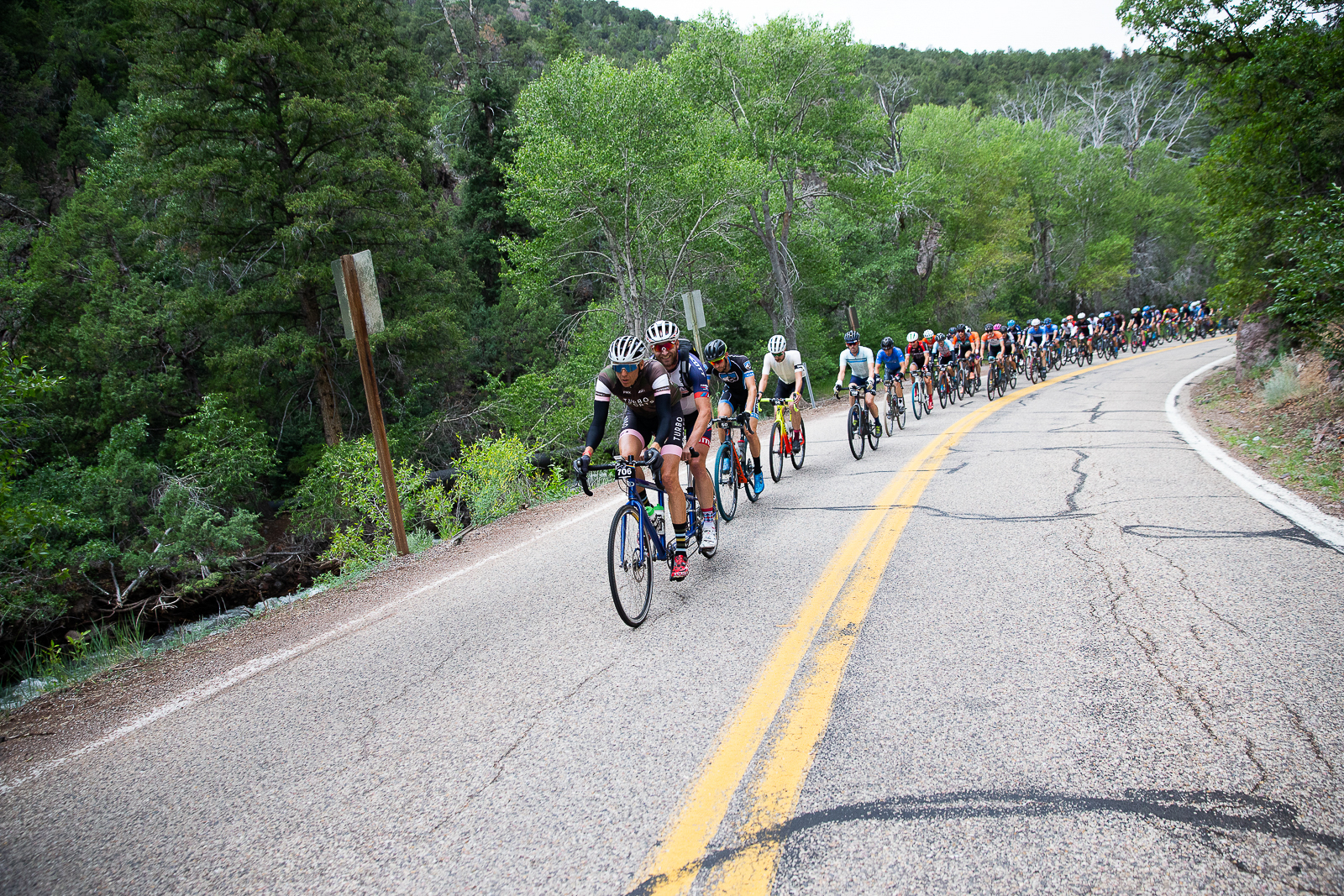
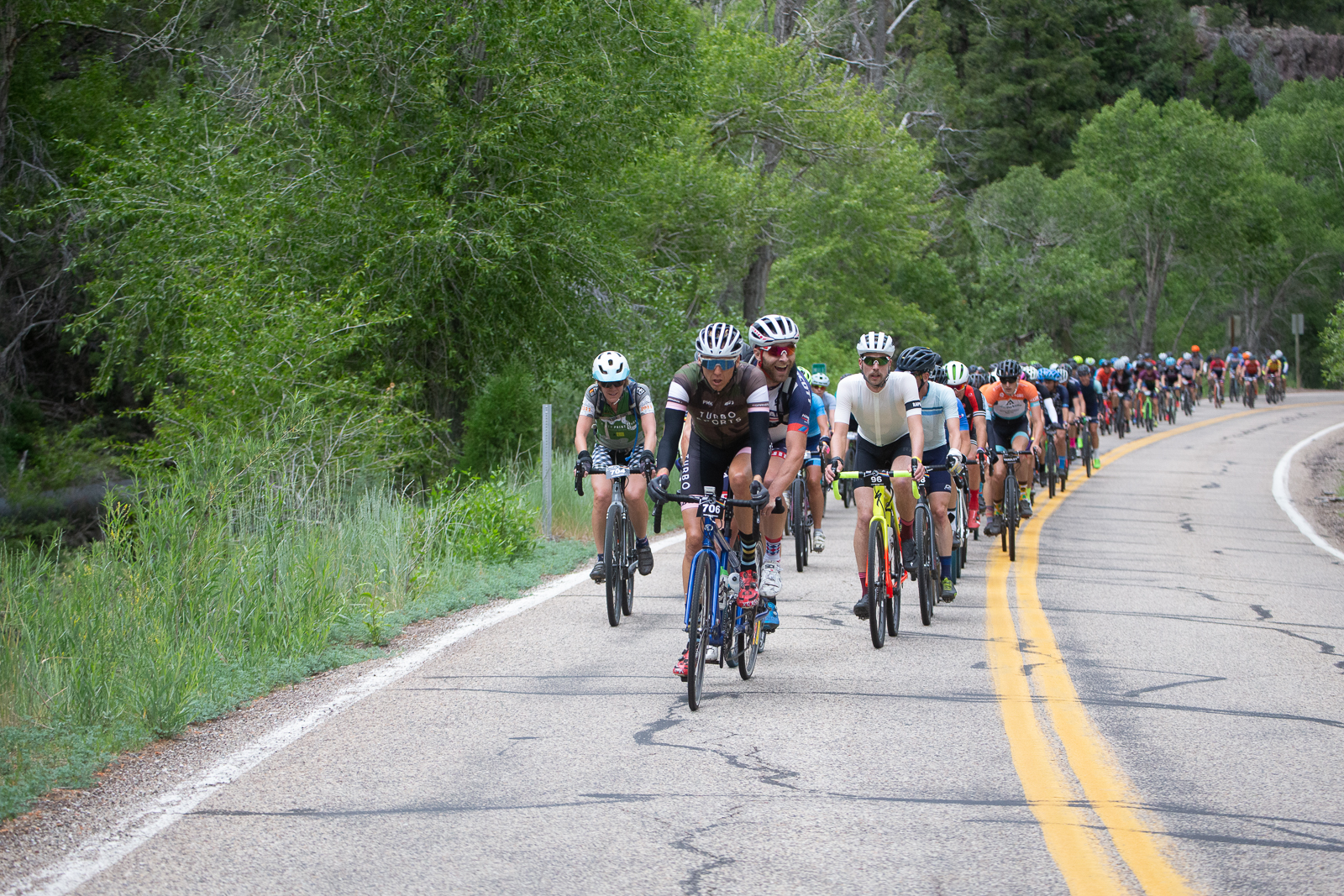
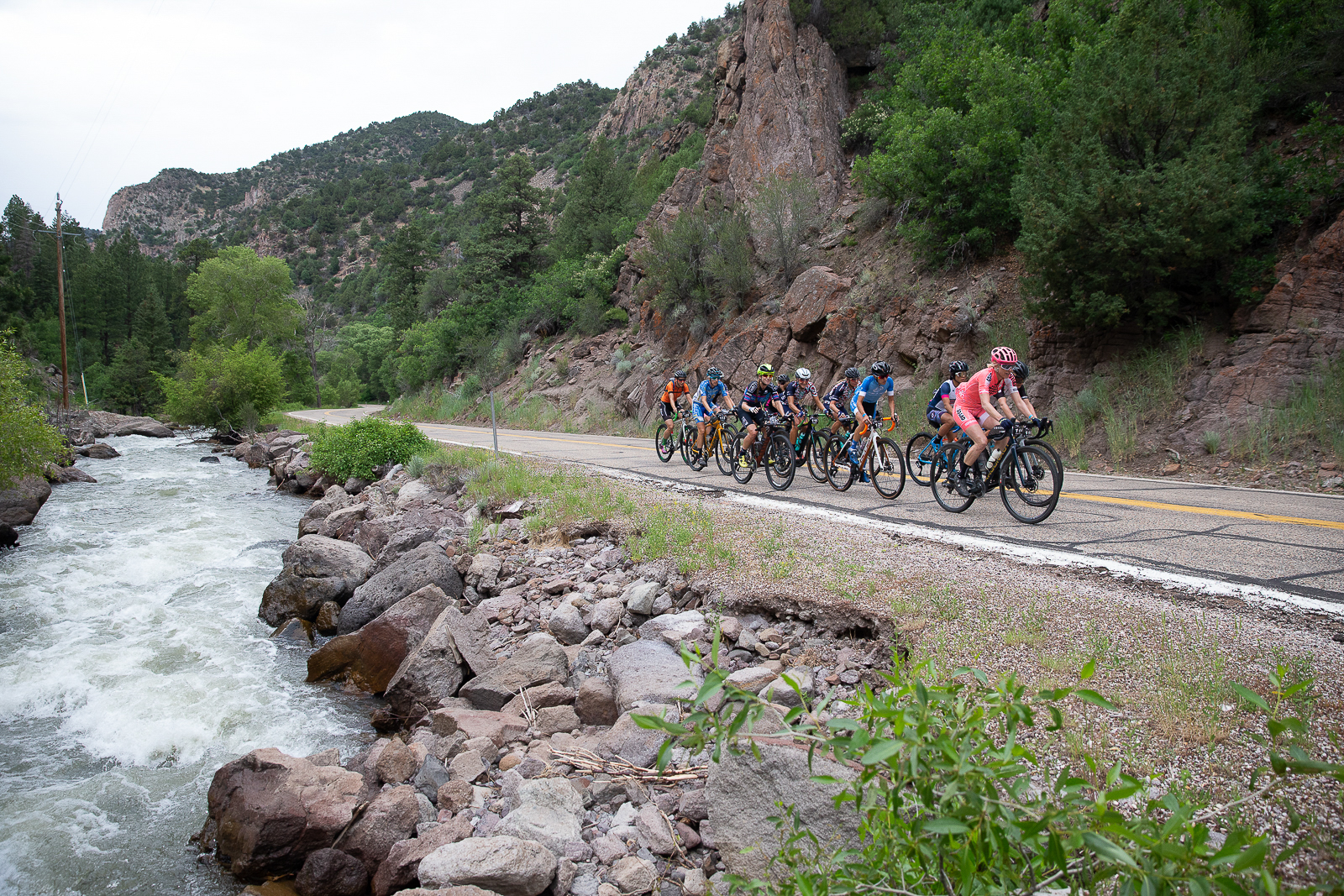
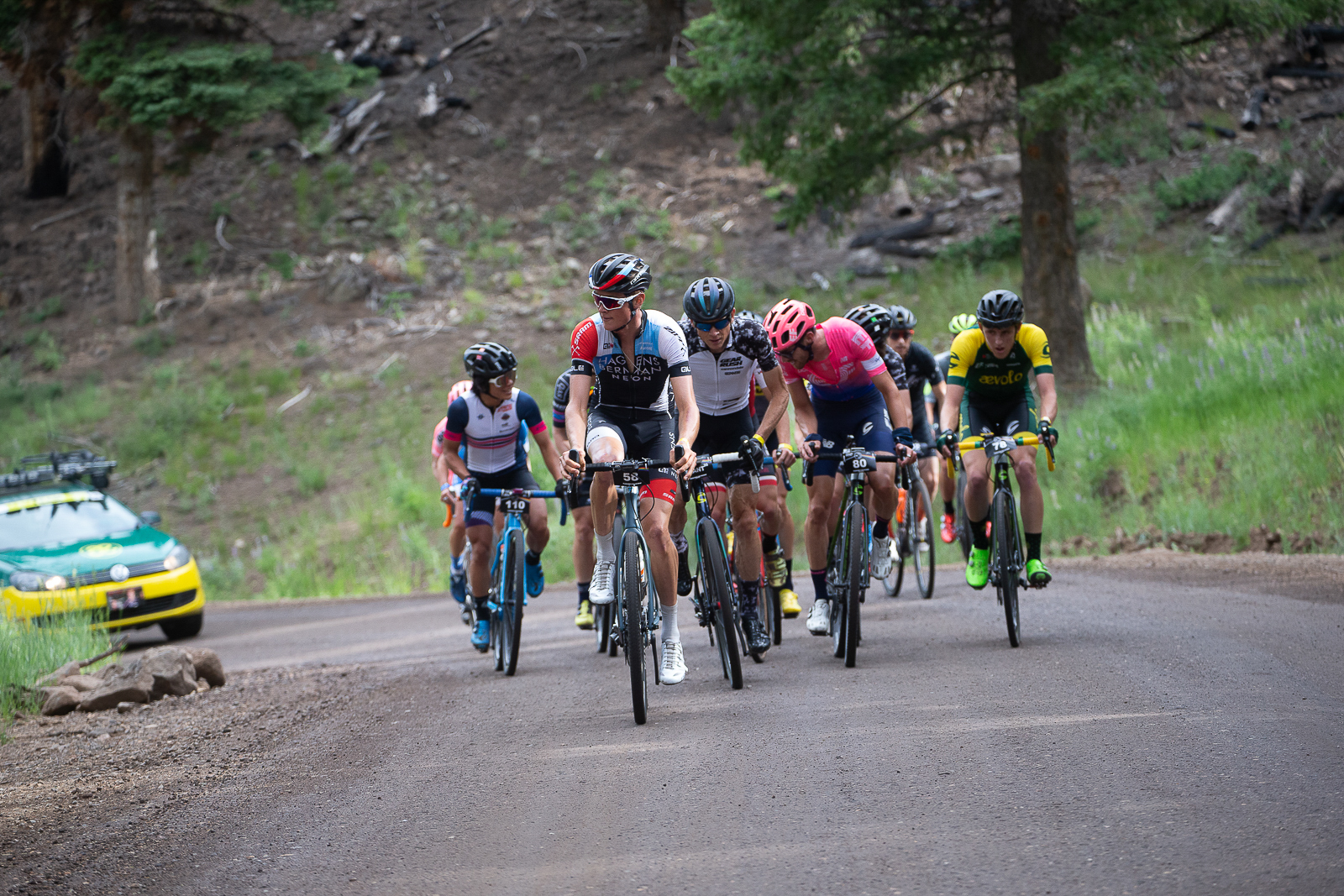
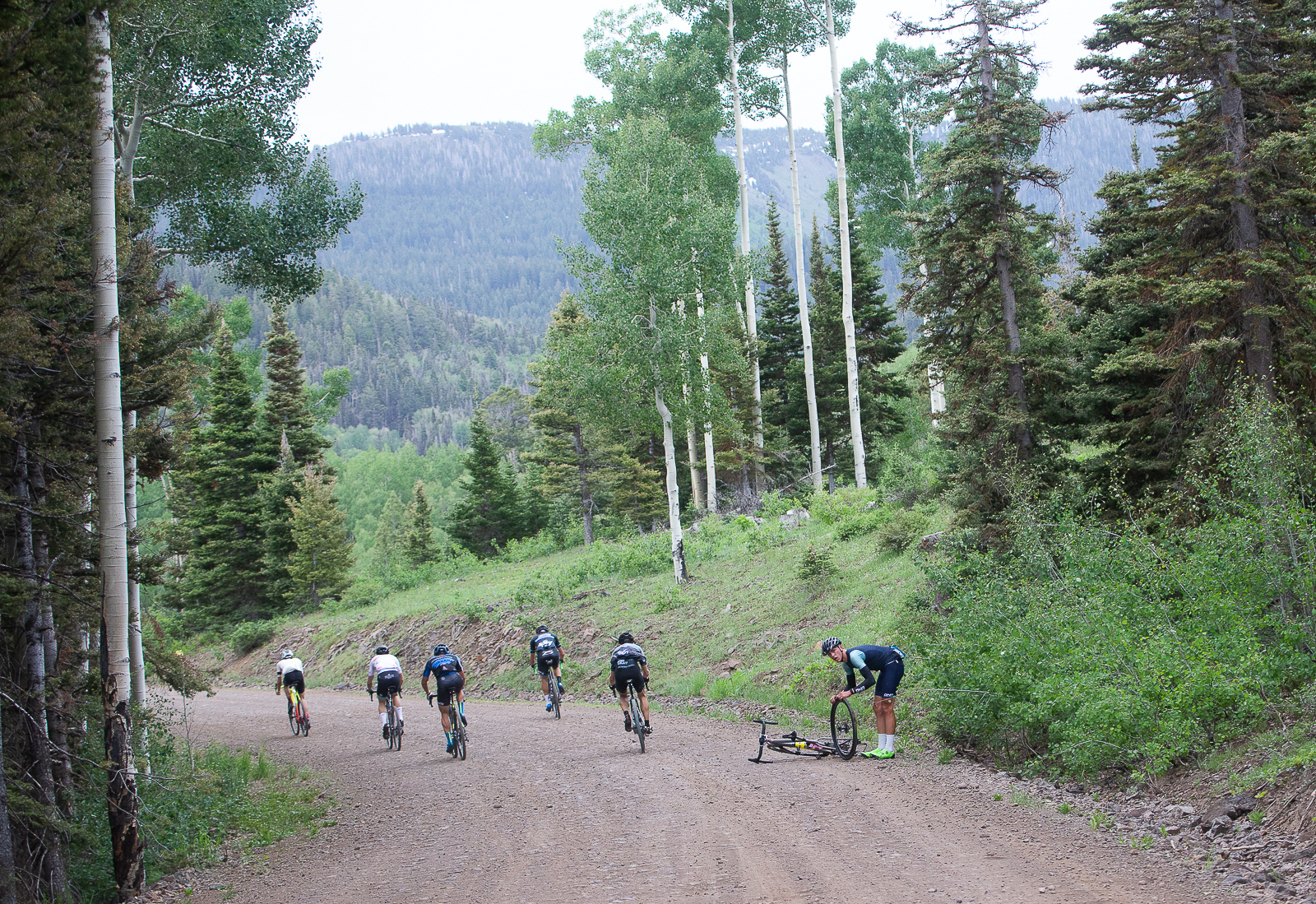
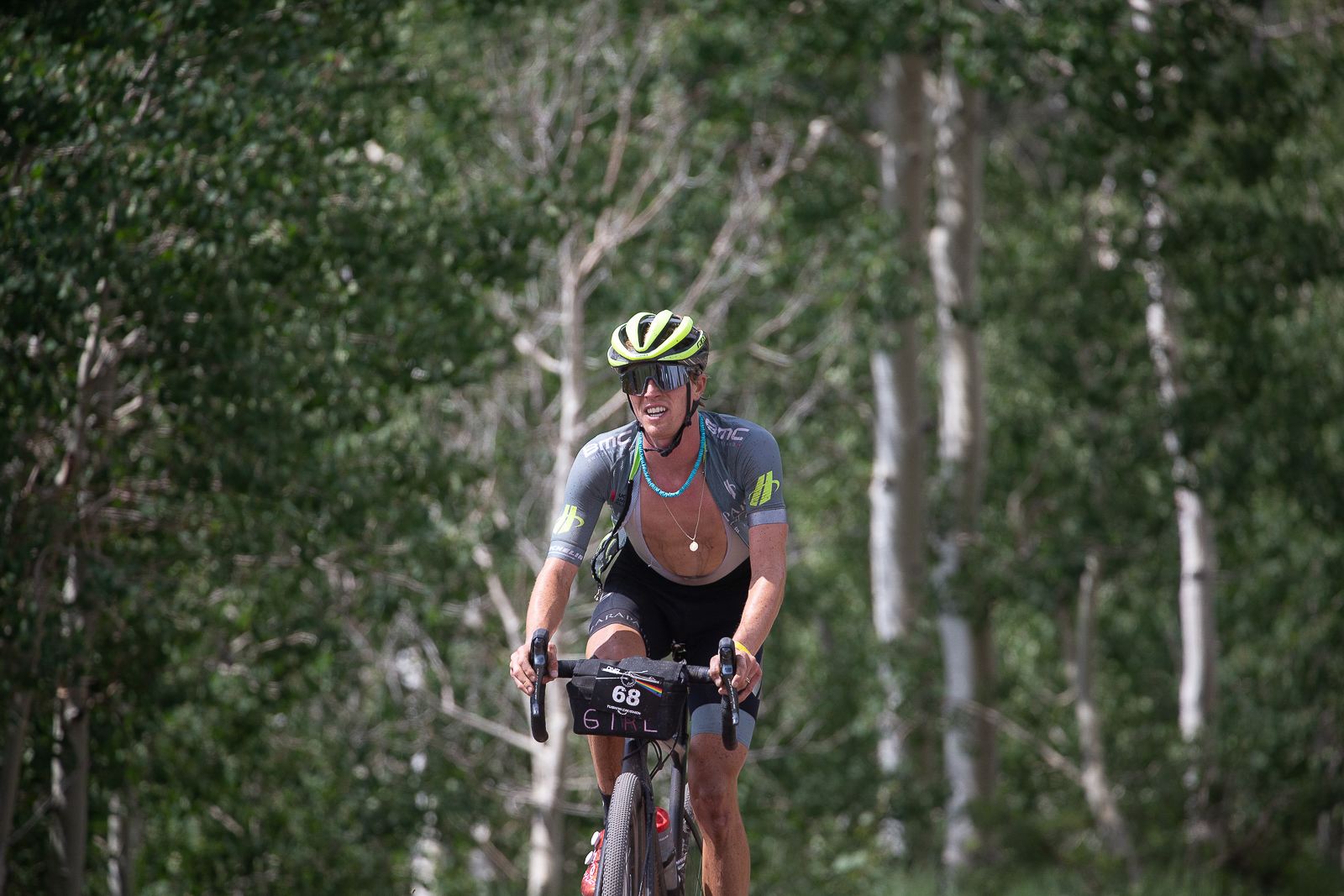
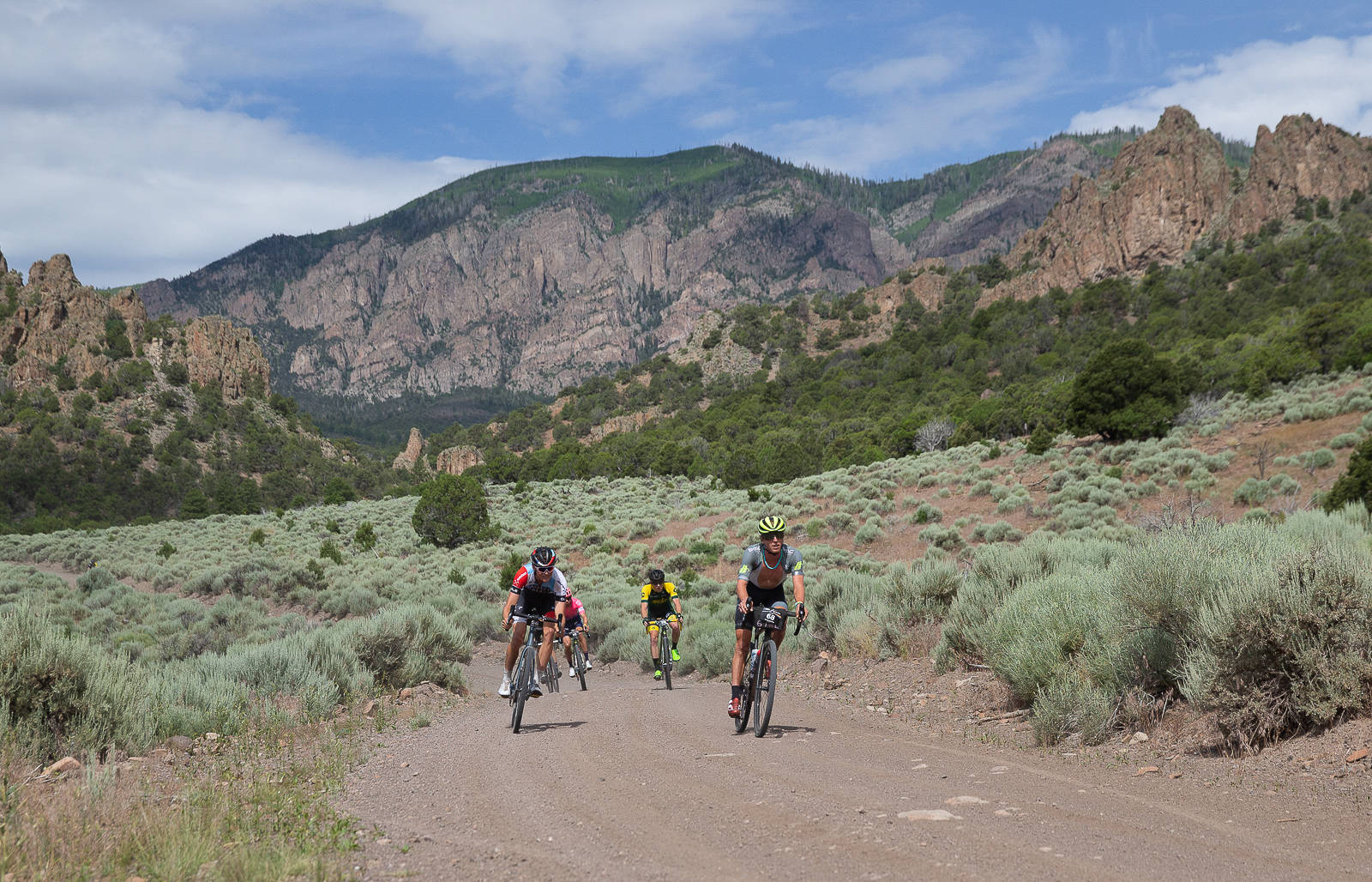
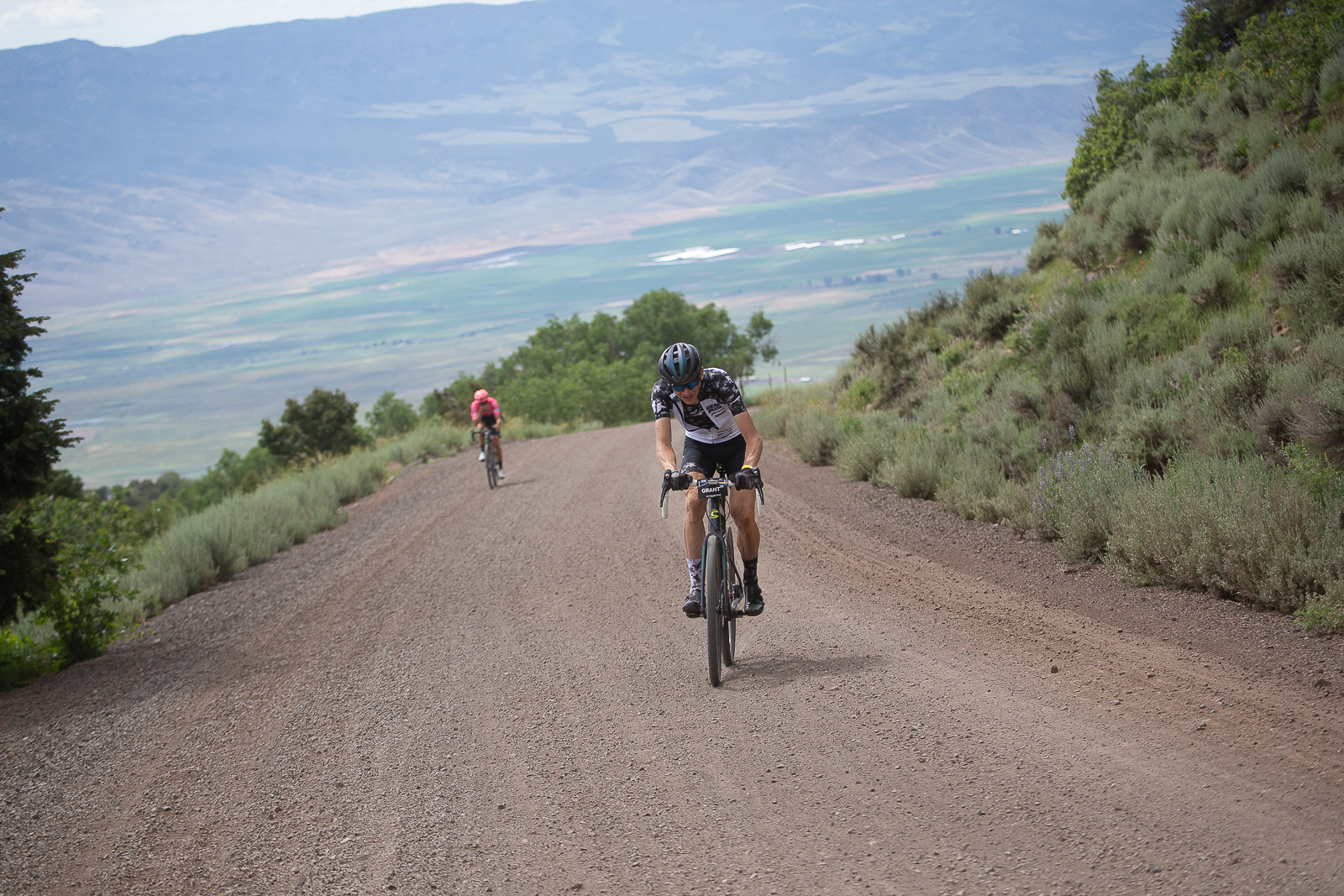
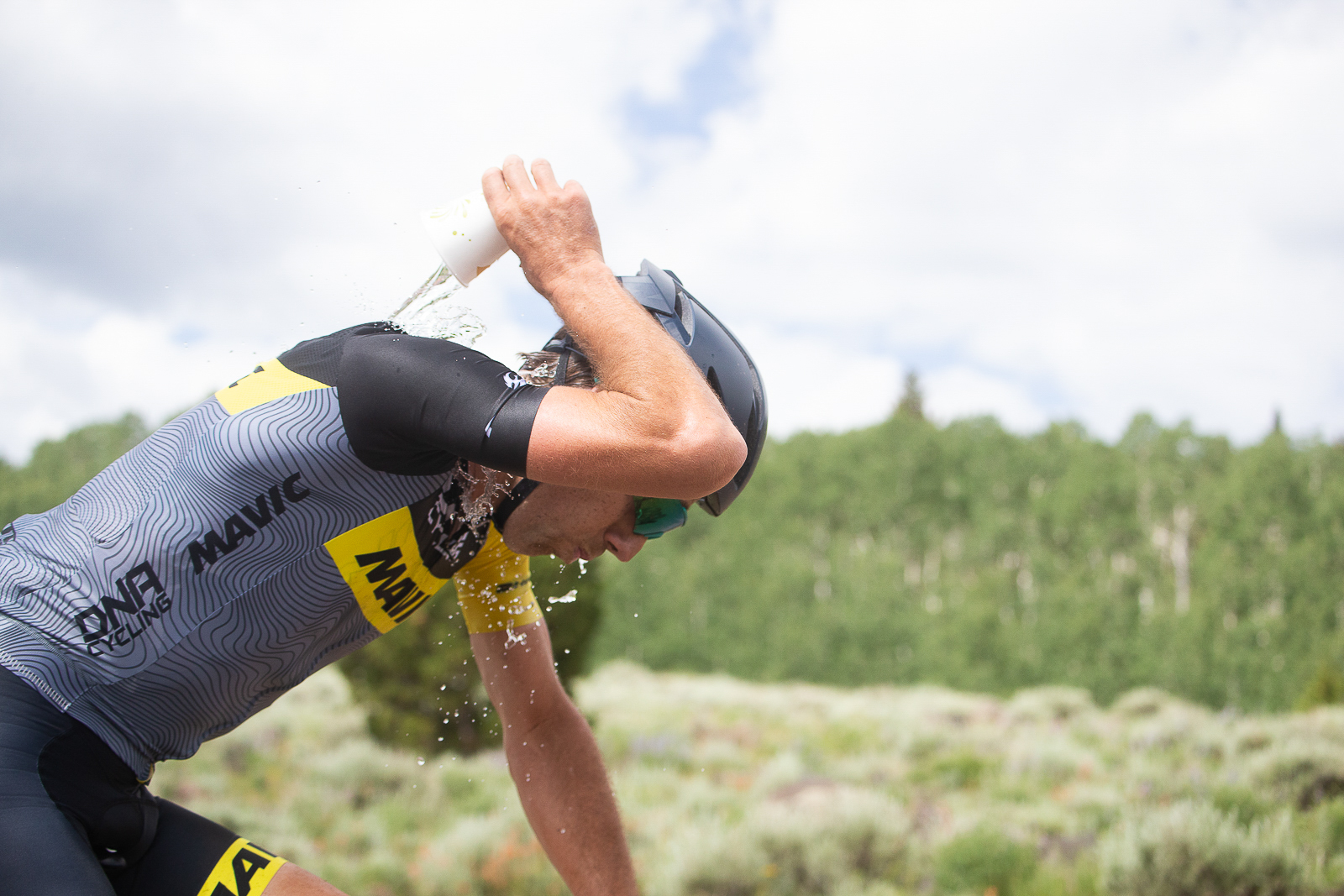
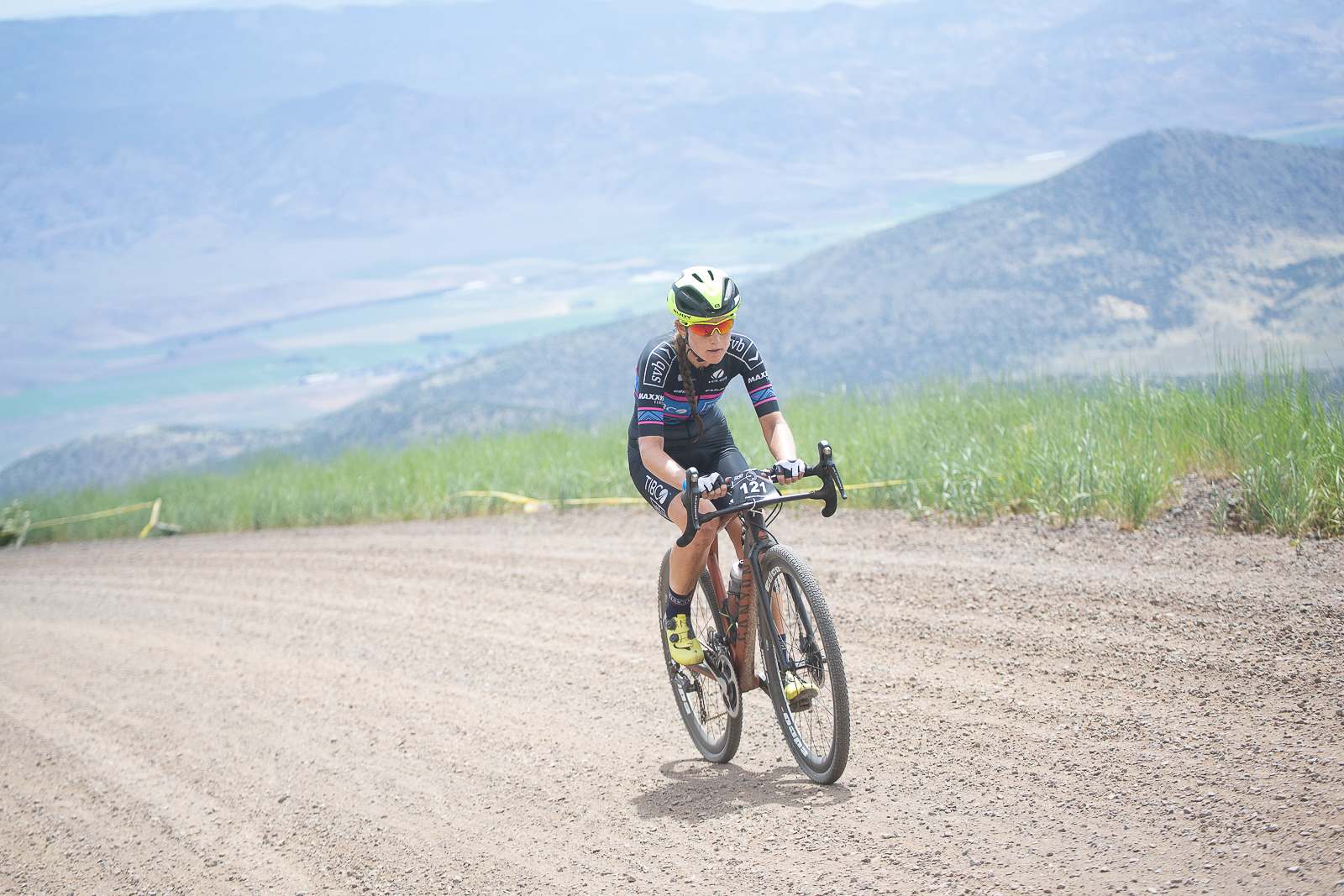
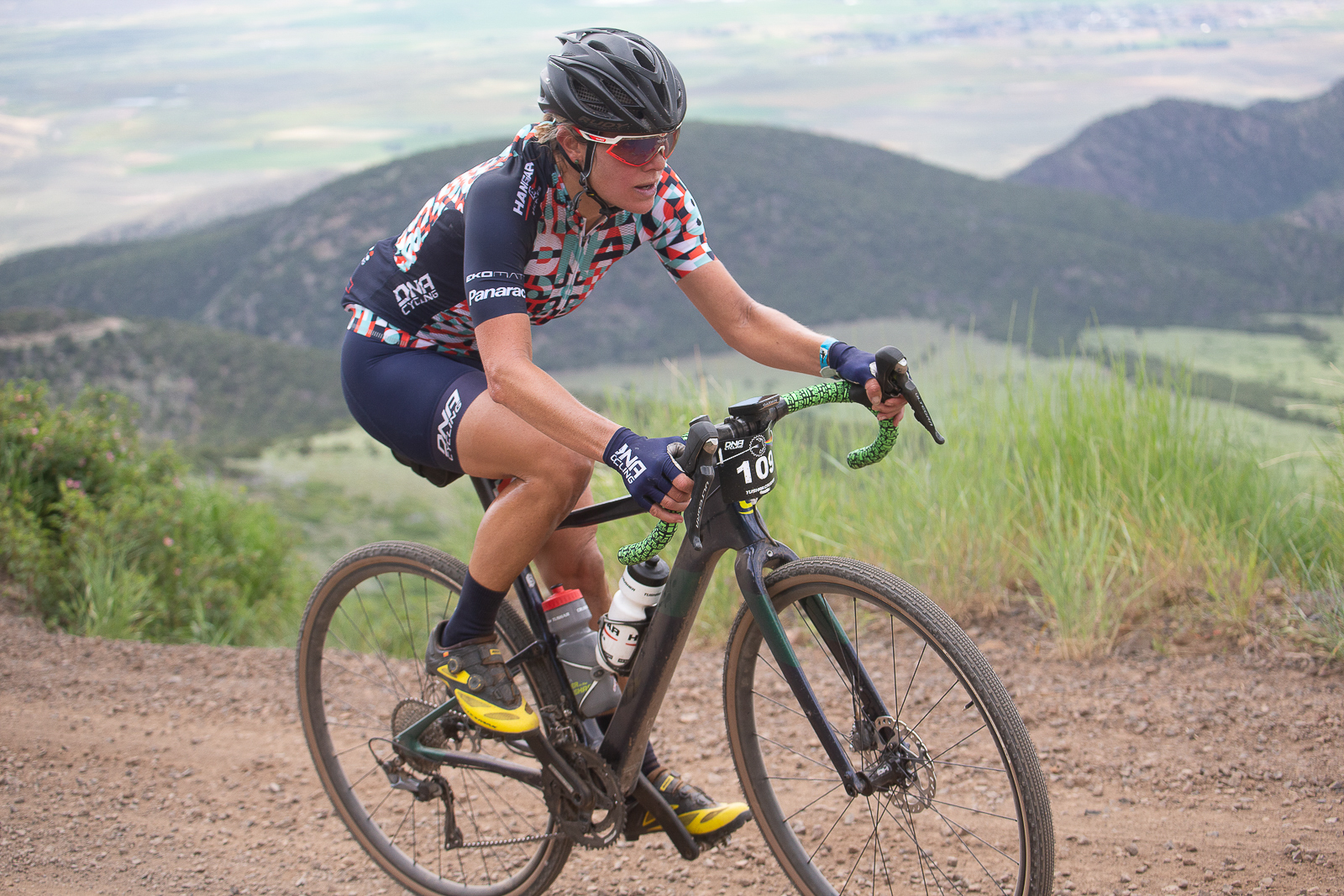
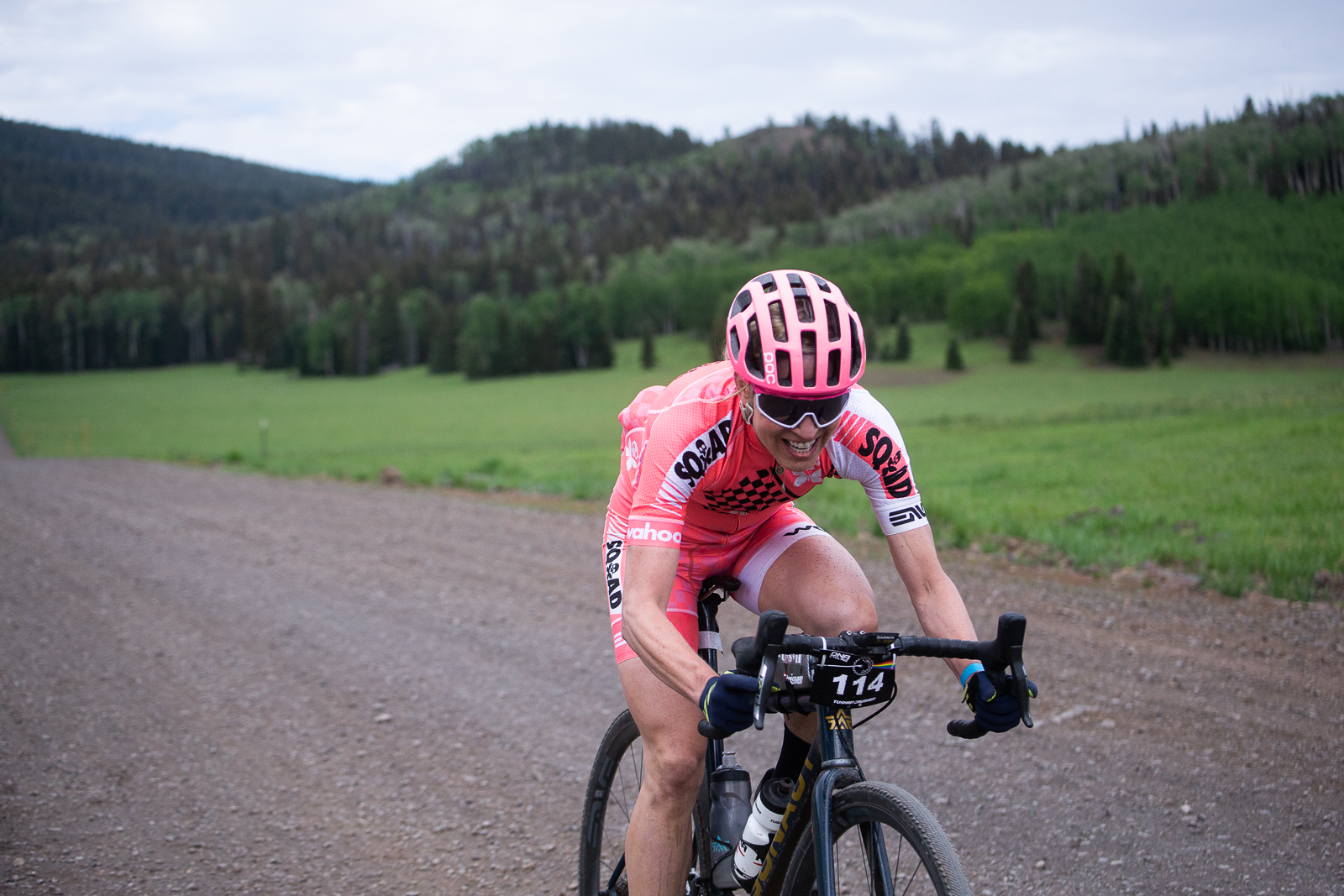
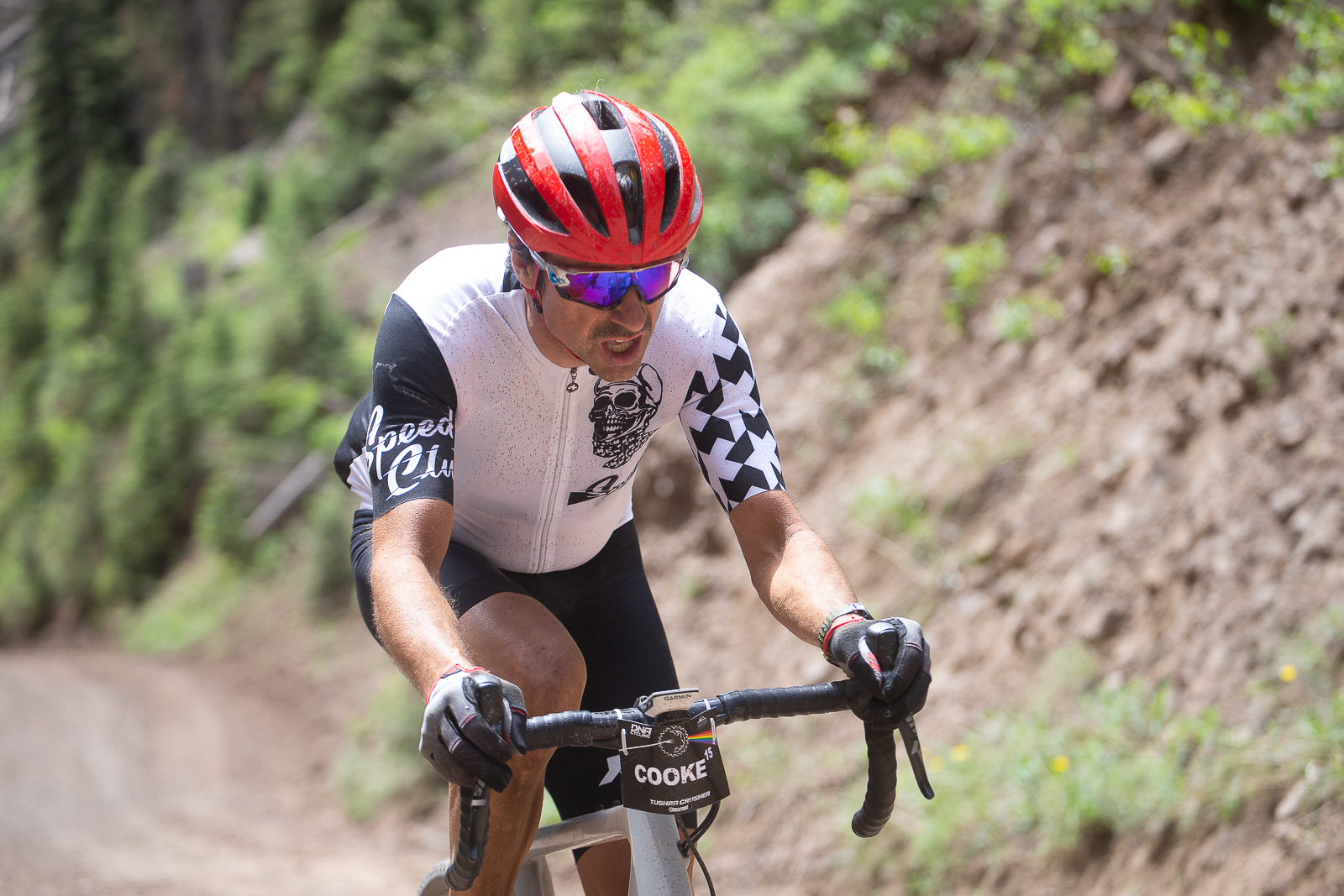
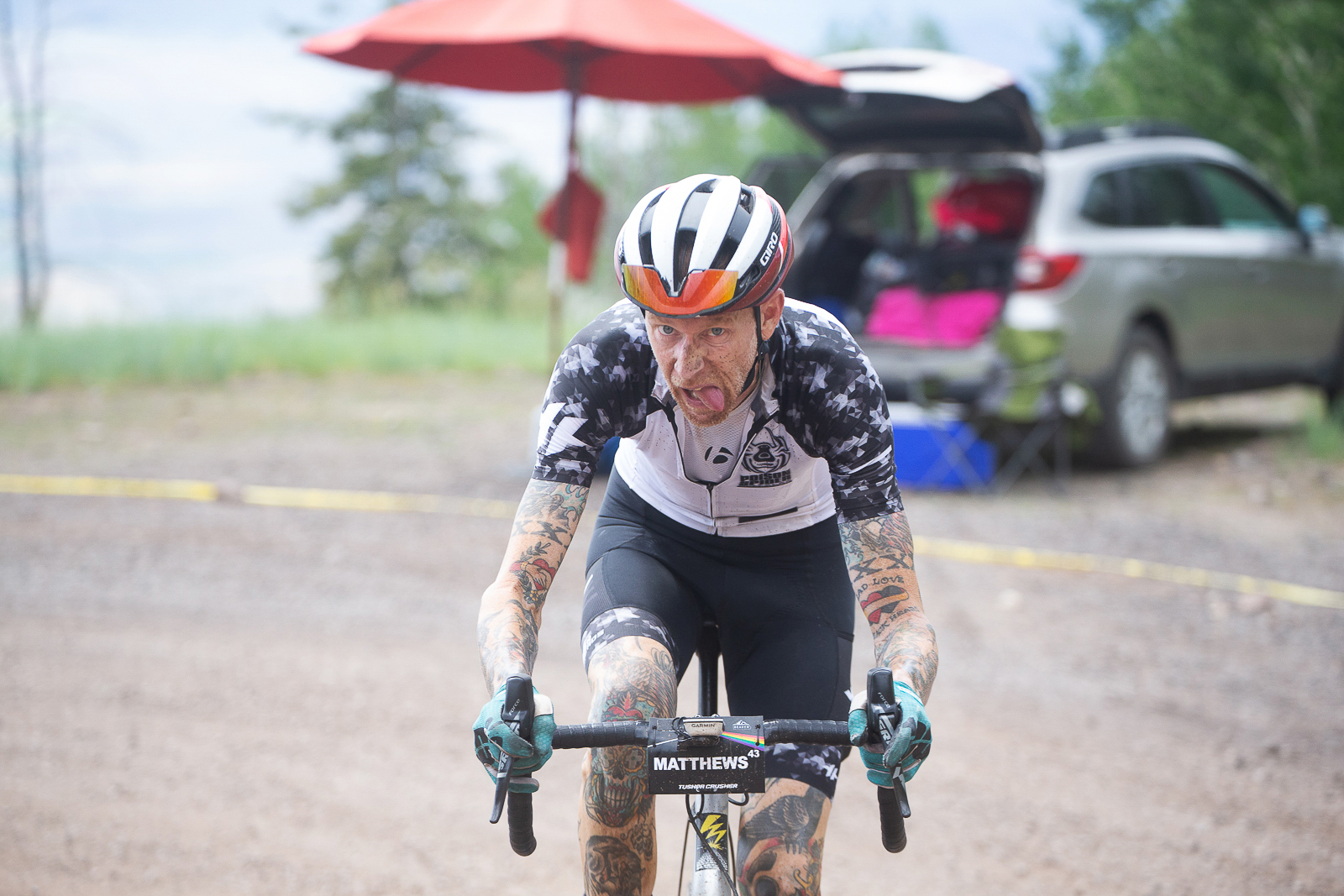
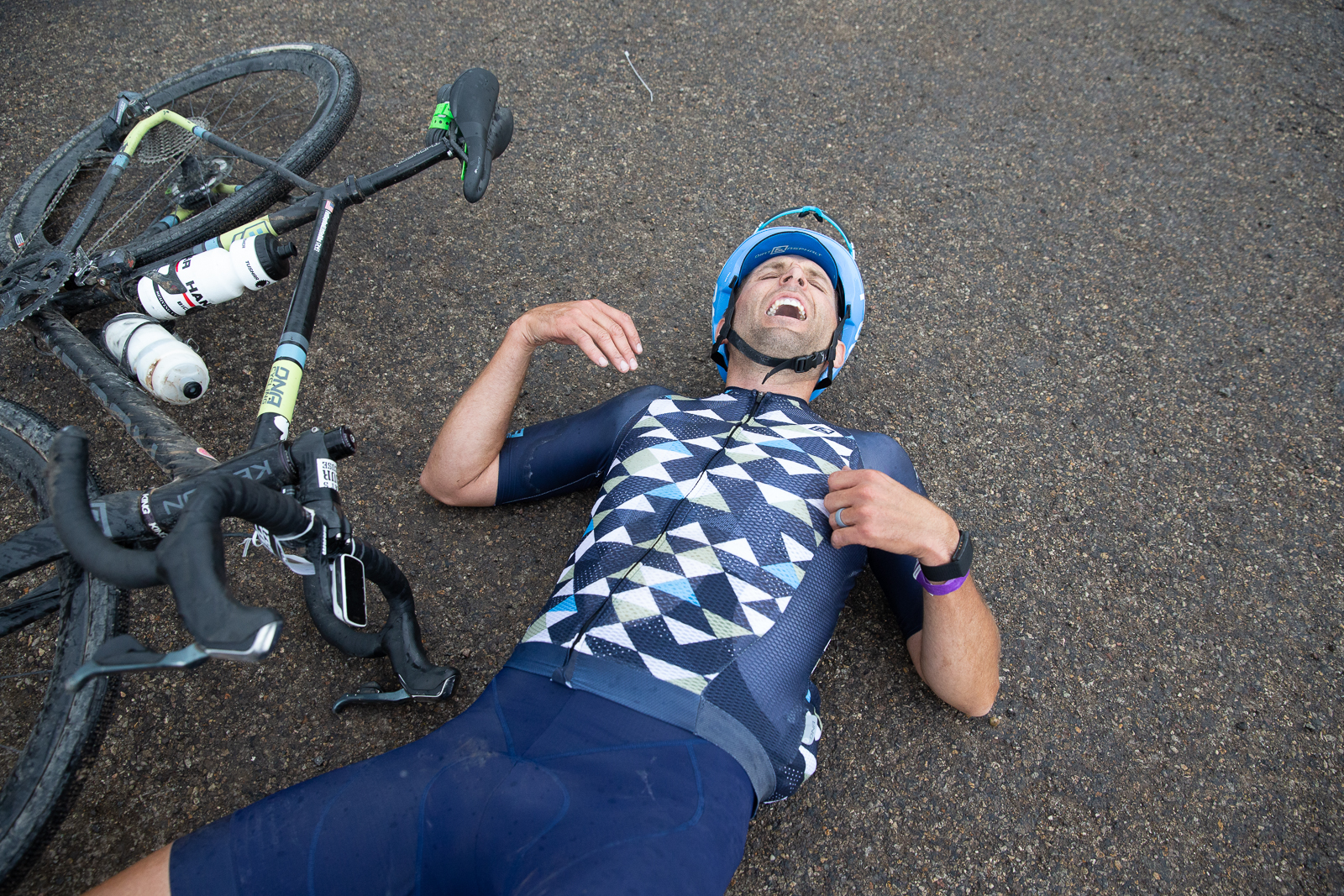
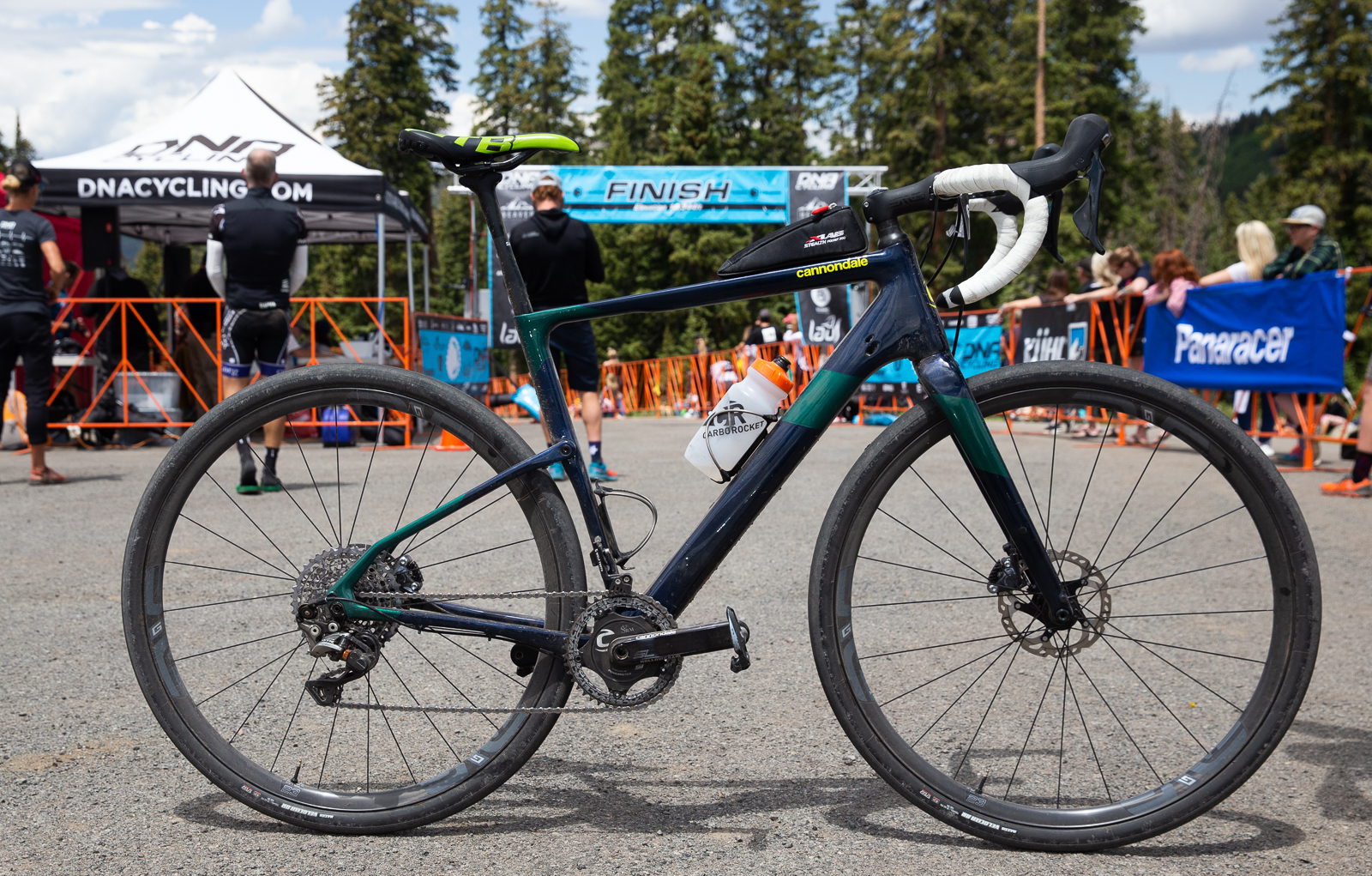
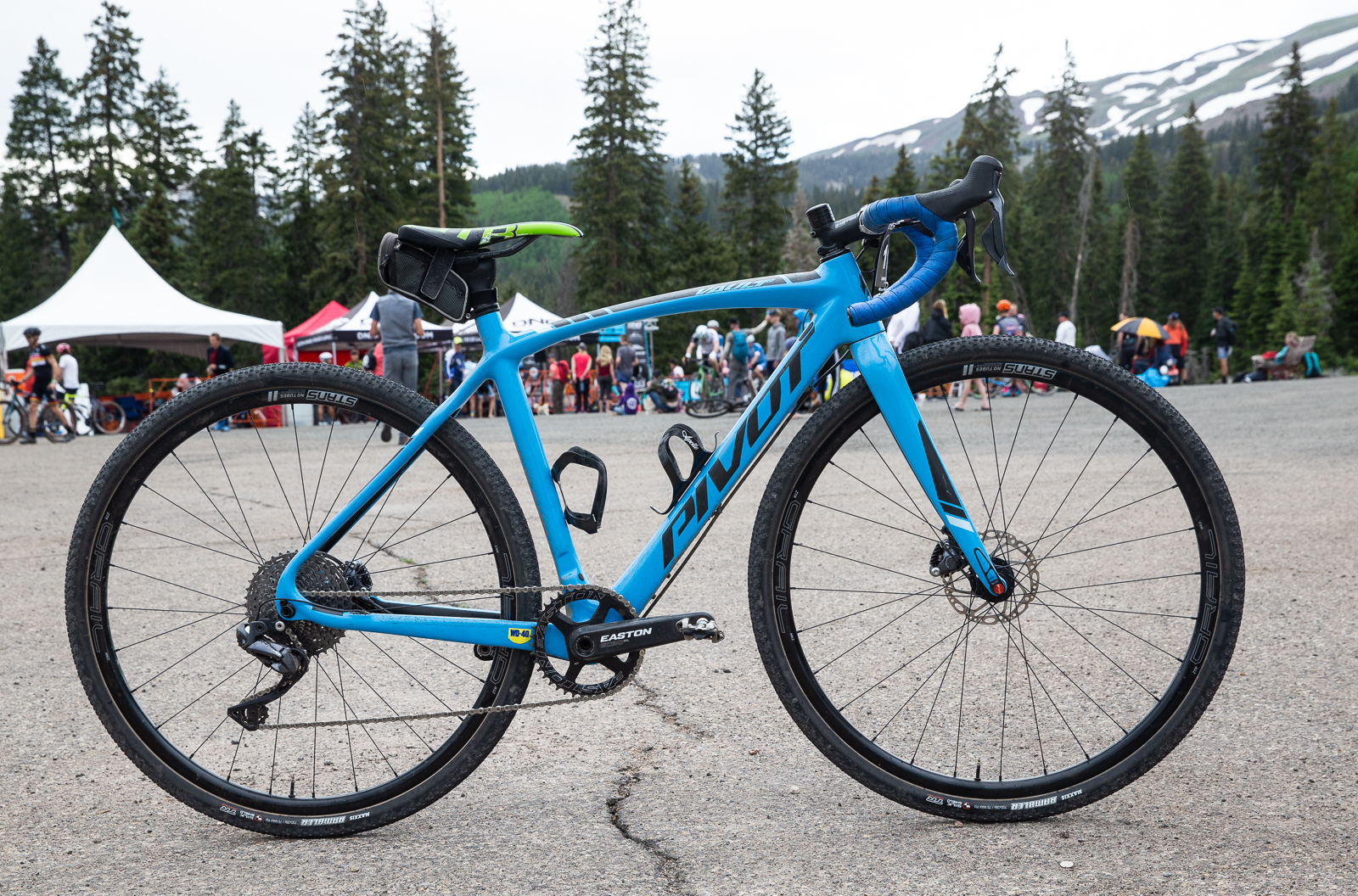
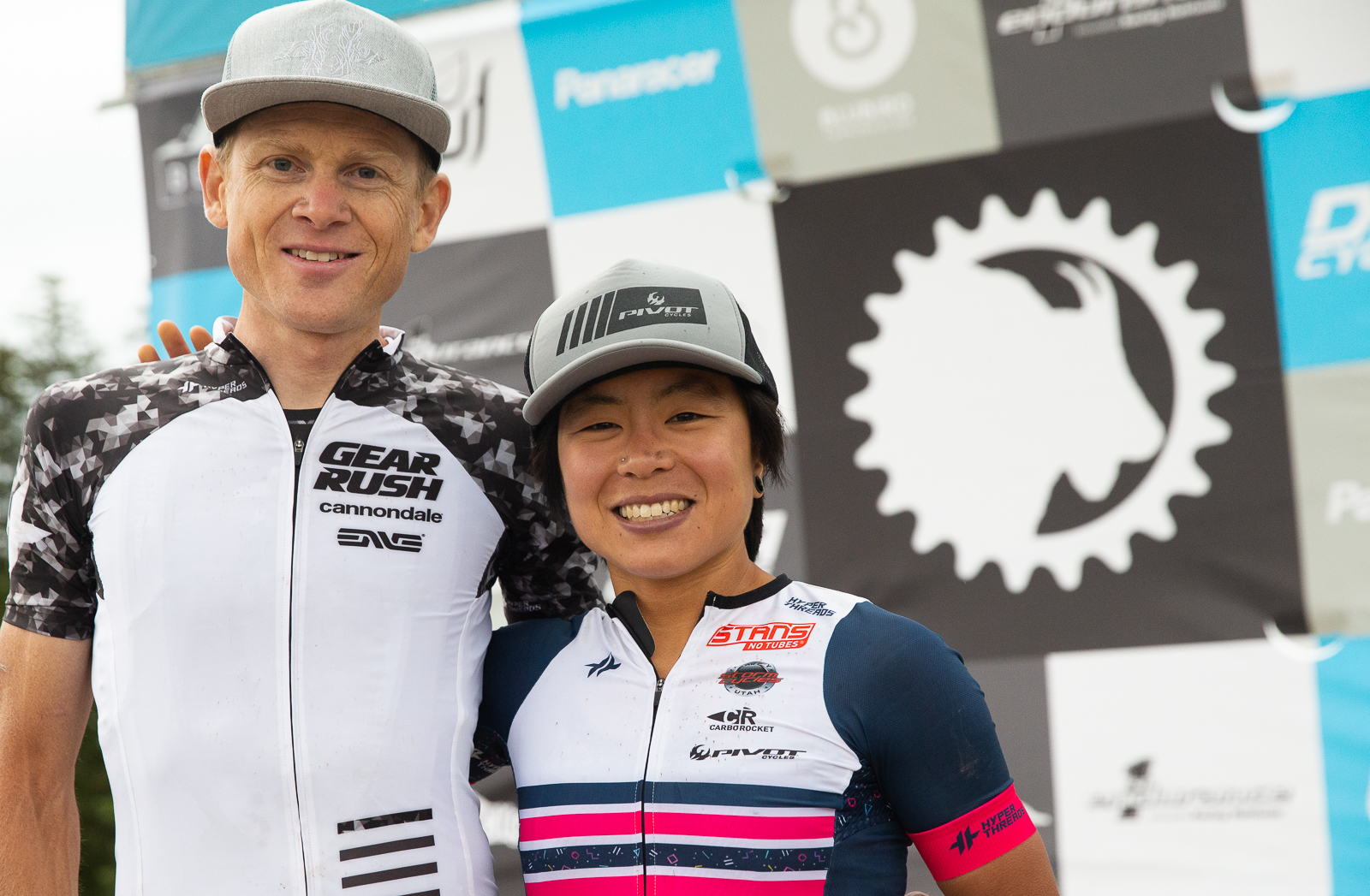
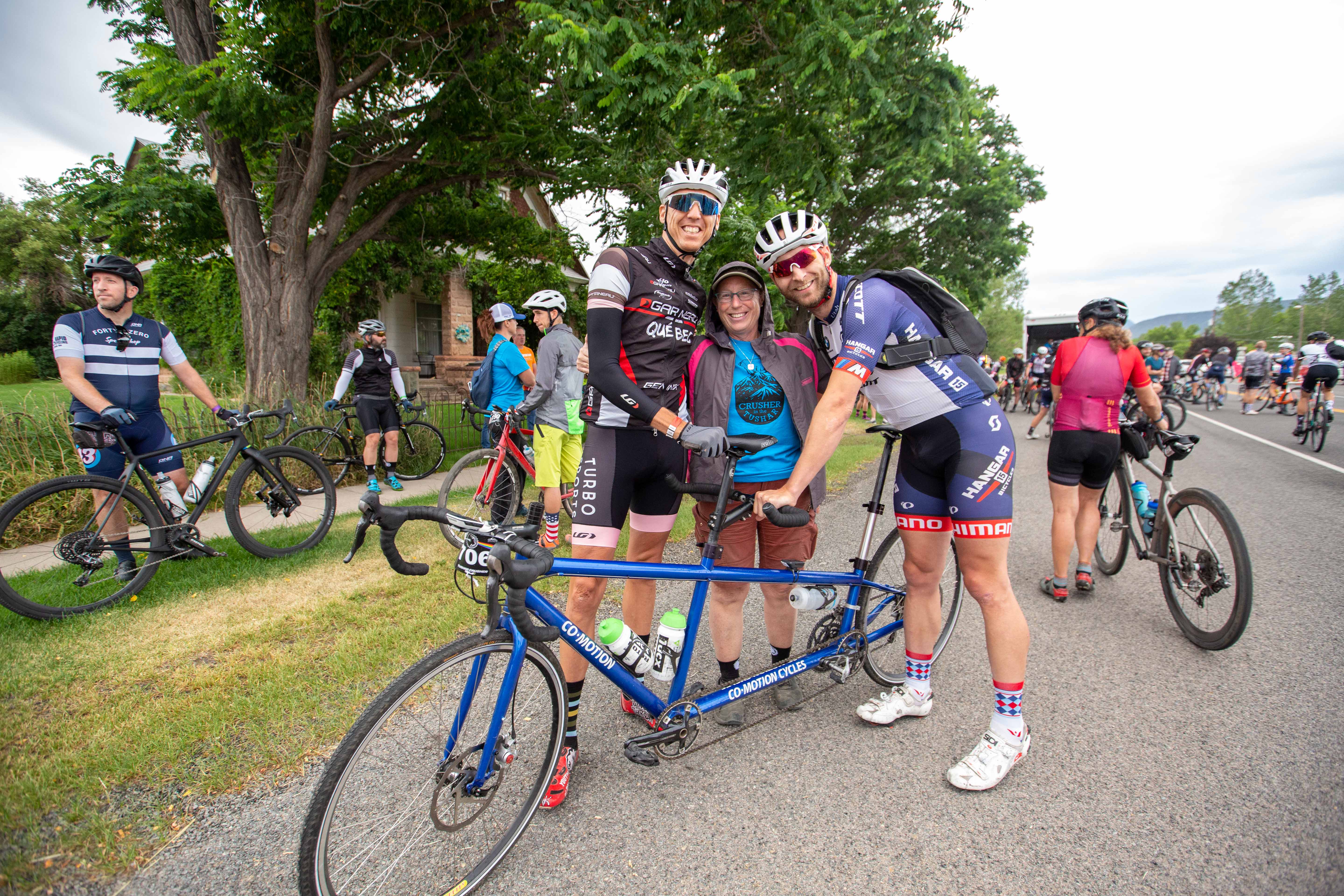
Floyd’s Shake Out Ride with Dave Zabriskie Photo: Catherine Fegan-KimStart line vid clips. Photo: Catherine Fegan-KimSmiles for miles for the DNA Pro Cycling riders, Hanna Muegge and Amy Charity Photo: Catherine Fegan-KimThe Kühl squad and the dab. Photo: Catherine Fegan-KimDefending “Crustache” Champion Joshua McCarrel back for another episode of Crusher. Photo: Catherine Fegan-KimThe Pro Women peloton. Photo: Catherine Fegan-KimCrusher 2019 Photo: Catherine Fegan-KimTandem pulls a massive peloton up Beaver Canyon. Photo: Catherine Fegan-KimCrusher 2019 Photo: Catherine Fegan-KimLead women heading up to the dirt. Photo: Catherine Fegan-KimEvelyn Dong chats with riders in the Pro Men’s field. Photo: Catherine Fegan-KimFlats happen. Photo: Catherine Fegan-KimTJ Eisenhart Photo: Catherine Fegan-KimRiders charged through the Sarlacc Pit. Photo: Catherine Fegan-KimGrant attacks Howes half way up Col d’ Crush. Photo: Catherine Fegan-KimBy the half way point of Col d’ Crush, Grant starts to increase the gap to Howes. Photo: Catherine Fegan-KimAlex Grant crushes the climb on Cannondale’s recently launched gravel bike – the Topstone. Photo: Catherine Fegan-KimHydration station. Photo: Catherine Fegan-KimDriscoll diesels on up the Col d’ Crush. Photo: Catherine Fegan-KimCol D’ Crush temps got toasty. Photo: Catherine Fegan-KimStephens sets a steady yet super fast pace up the Col d’ Crush. Photo: Catherine Fegan-KimCharity climbs Col d’ Crush. Photo: Catherine Fegan-KimSarah Max cruises through the meadow segment. Photo: Catherine Fegan-KimThe last few miles of climbing to the Finish. Photo: Catherine Fegan-KimWithin the last 10 miles Evelyn Dong catches sight of Lauren Stephens as she comes around a corner. Photo: Catherine Fegan-KimLast 10 miles of the race did not go Stephens way. Photo: Catherine Fegan-KimEvelyn Dong’s final 10 miles of Crusher. Photo: Catherine Fegan-KimThomas Cooke crushes another Crusher In The Tushar in his age group. Photo: Catherine Fegan-KimCrush. Photo: Catherine Fegan-KimCrushed. Photo: Catherine Fegan-KimCrusher in the Tushar. Photo: Catherine Fegan-KimAlex Grant’s Cannondale Topstone Crusher bike. Photo: Catherine Fegan-KimEvelyn Dong – Pro Women winner’s Crusher bike. Photo: Catherine Fegan-KimYour 2019 Crusher in the Tushar winners. Photo: Catherine Fegan-Kim
My eyes explode open. There is nothing but darkness and the hum from the fan on the wood burning stove heating the house form the front room. My body is tense. I’m perspiring. I glance at the phone charging on the nightstand. It’s 2:13 AM. Typical. I know I won’t be able to fall back to sleep till around 4:30, about the time that Kathleen gets up.
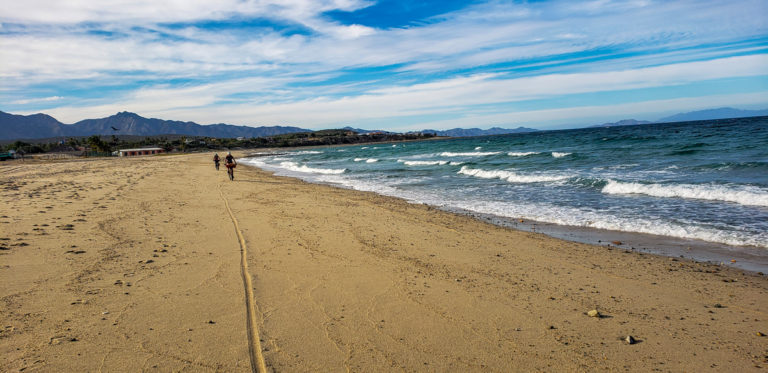
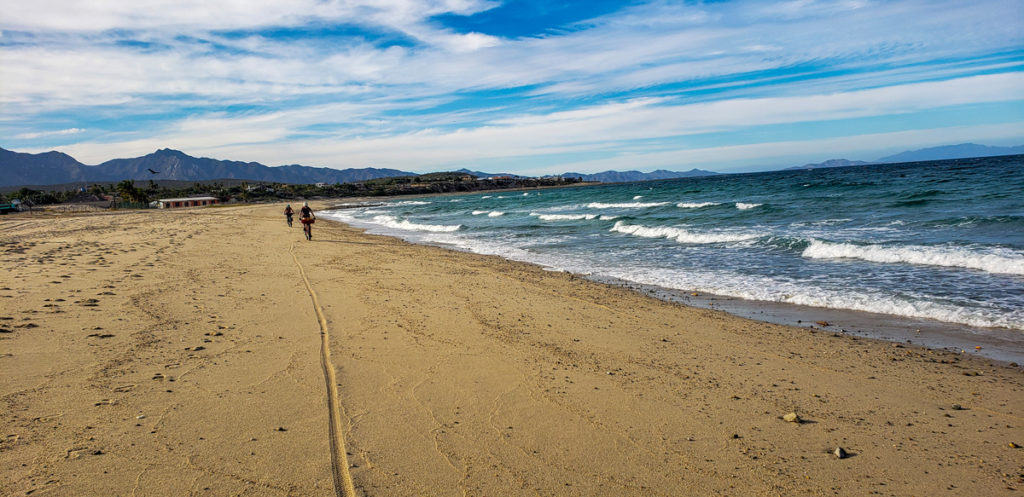
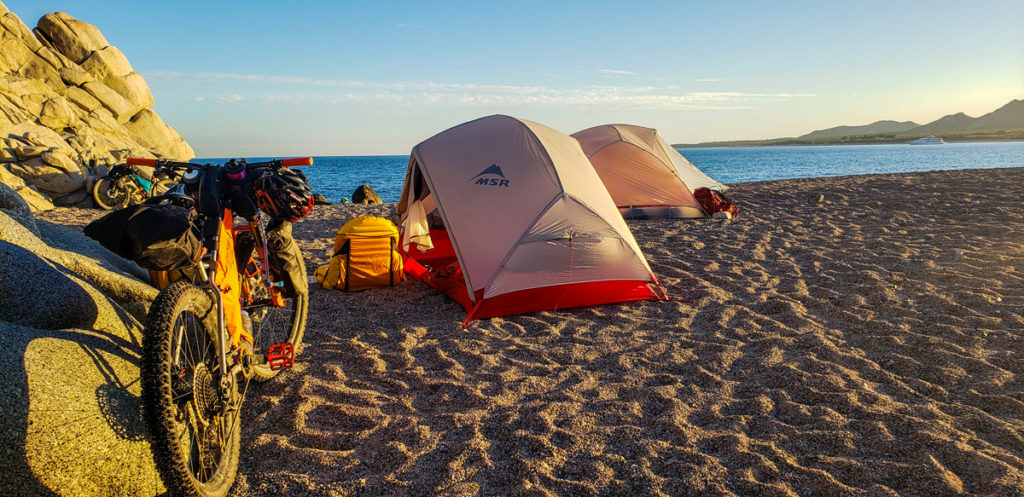
Waves, bikes, camping on beaches, not a care in the world. Photo by Lukas Brinkerhoff
My mind wanders through the cavity of my head on an adventure to find all my insecurities. The moment it finds one, I worry about it. I roll over trying to put it to sleep. It hops off that train and immediately runs for another. I roll back onto my back, arms and legs crossed because feeling like I’m in my mummy bag is the most comfortable position for me. My head itches, I resist until my brain won’t leave it alone. I itch it.
This particular night is leading up to our trip to Baja. The endless possibilities of things that could go wrong and ruin everything are on shuffle and repeat. What if the airplane is too small for our bike boxes? What if one of our bikes just doesn’t show up? What if a forget my one chamois I plan to wear for the whole week? What if I get saddle sores that bleed? What if my Spanish absolutely disappears the moment I step off the plane? What if our passports for some reason get us blocked out of the country?
For three weeks leading up to our trip to ride the Cape Loop, this strand of endless, illogical worries keeps me up for hours every night. The only thing that is out of the ordinary is the focus on Mexico.
40 million adults in the United States are affected by anxiety according to the Anxiety and Depression Association of America (ADAA). That equals out to about 35% of us walking around and 1/3 of you reading these words. It isn’t any comfort that I am not alone and I assume it doesn’t help you keep your mind from reeling to know that there is a good chance the dude next to you is dealing with the same mental struggles.
Fast forward a few weeks. It’s 7ish PM. The sun has dropped below the horizon and twilight is quickly fading into a long winter night on the peninsula. Mama Bear has been asleep for an hour already. Typical. It’s been a couple of days since we attempted to make it to a normal time to go to bed. The conversation dies, those of us still awake waddle around and make our way into our sleeping bags.
Normally, I’d be sure to stay awake well into the night to ensure that I can sleep through the night. It might seem a bit redundant, but I get anxious about going to bed because I always wake up worrying about stuff. That fear faded after day two.
I lie down. After jotting down some notes for the day, reading a few pages from Prison Memoirs of an Anarchist, my eyelids get heavy. I turn my phone off to save the battery and I close my eyes. The next thing I know, it’s 6 in the morning. The first light of the day is thinking about peaking over the tops of the trees. I roll over and get the stove going for coffee and force my way out of bed. I may have slept on the ground, but it was some of the best sleep I’ve ever had.
If I was to be honest with myself, I would have to admit that a good part of the motivation to move under my own power for extended periods of time is the ability to sleep.
The ADAA recommends regular exercise to help manage stress and anxiety. They cite studies that show that exercise, in some instances, can be as effective as medication in controlling anxiety and depression. They claim, “One vigorous exercise session can help alleviate symptoms for hours, and a regular schedule may significantly reduce them over time.”
Works for me.
About a week prior to our departure, I got an email from the airline we had booked flights with. They informed me that the flight they had sold me no longer existed. We had two options, cancel the trip or fly back via a different airport that was about 100 miles south of where we would be ending. After arguing in Spanish and English, calling various times and wasting about an hour of my life, we had to accept the change.
Outside of making some inquiries on possible reservations and taxi rides, the fact that we would be ending our ride and then have to get to a completely different town, never bothered me or my sleep. It was just something in the future that I would have to deal with. In stark contrast to the weeks leading up to our trip, my worries were at bay. Held behind a dam that I can only attribute to moving all day, every day. I slept wonderfully, almost always on the ground.
For ten days, we pedaled from La Paz around the tip of the Baja Peninsula and back to La Paz riding over 300 miles almost entirely on dirt. We camped on beaches, slipped through small towns where the store was someone’s garage with only a few things for sale and drank our fair share of watery Mexican beer. The only fear that had kept me awake that came to fruition was the bleeding saddle sores. Caused by what was a bad batch of chamois cream, it made the ride interesting, but you couldn’t have slapped the smile off my face for those ten days.
Once home, the only thing that kept me out of the deepest of despair was knowing I would be doing it again soon.
Notes:
The Cape Loop is a 283 mile circuit around the tip of the Baja Peninsula and is part of the Baja Divide. The route was created by Nicholas Carman and Lael Wilcox and is provided free of charge at https://bajadivide.com/
For info and tips about managing anxiety and depression visit the Anxiety and Depression Association of America at https://adaa.org/
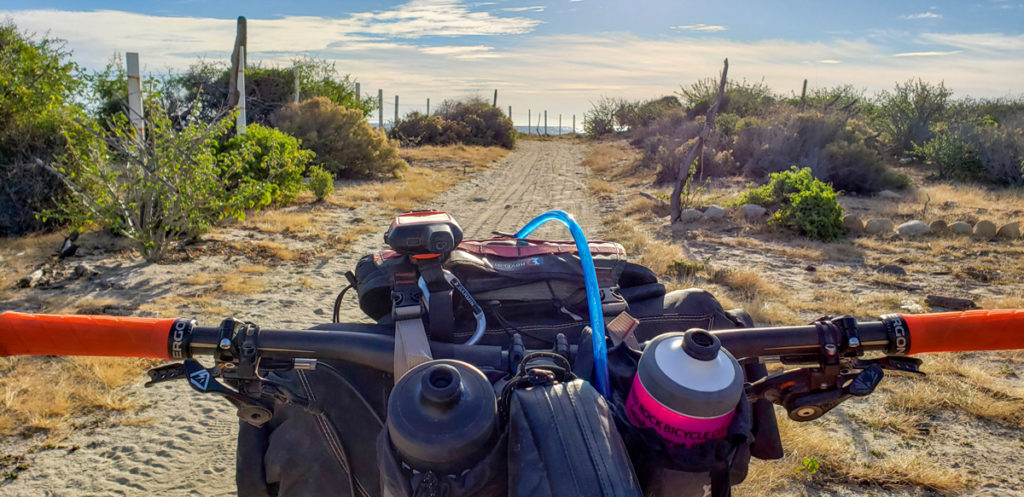
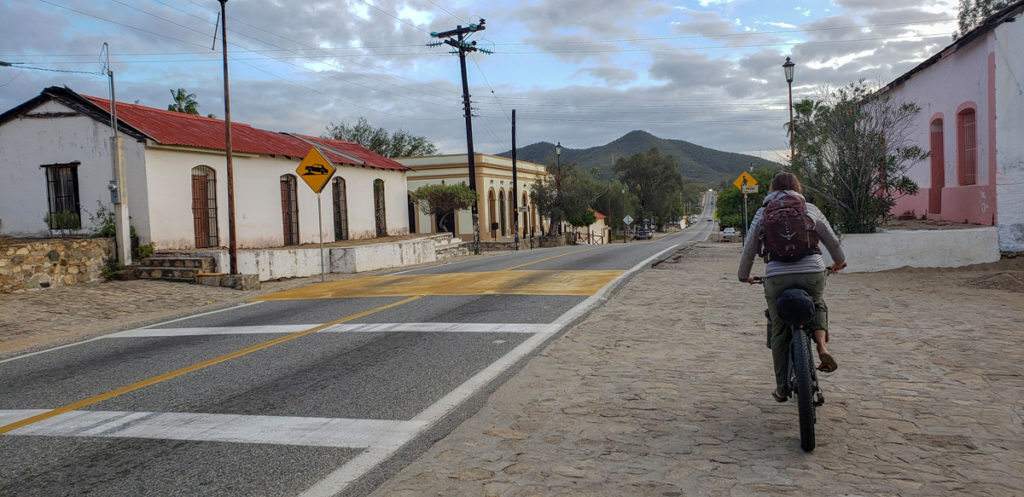
Just a thought, but I’m guessing I would be way more anxious if I was on that yacht (on the far right in the ocean). Photo by Lukas BrinkerhoffJust the open, sandy road. Photo by Lukas BrinkerhoffKathleen getting a resupply in El Triunfo. Photo by Lukas BrinkerhoffFeeling quite relaxed and at home camping in a wash with a million Daddy Long Legs. Photo by Lukas Brinkerhoff
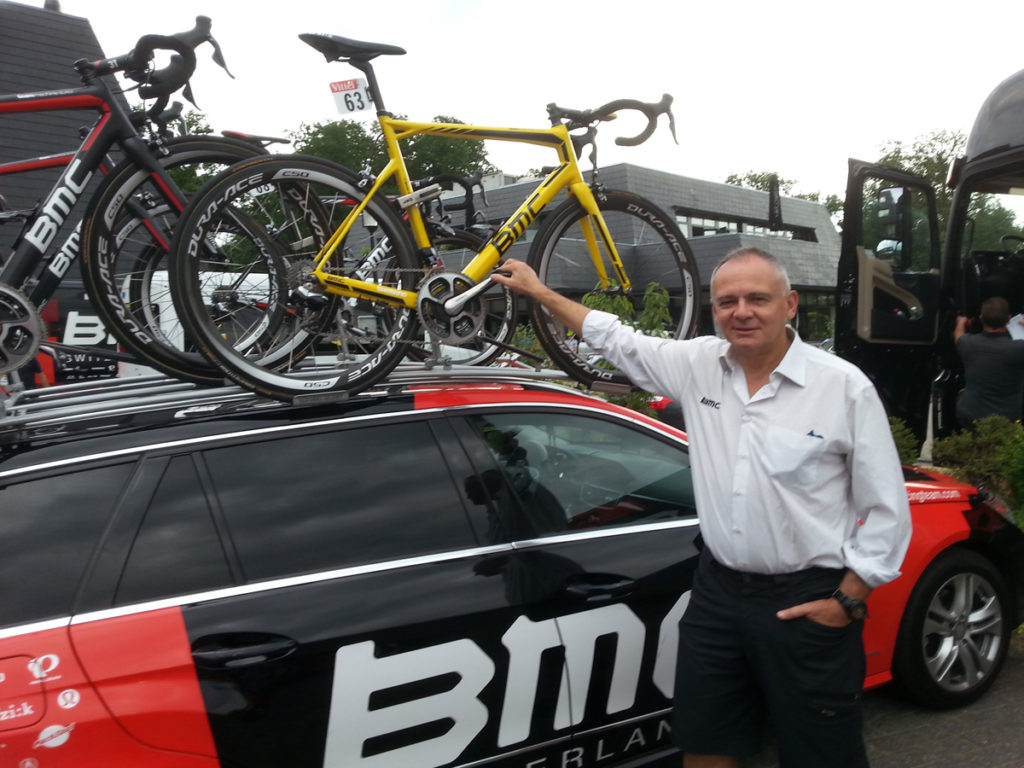
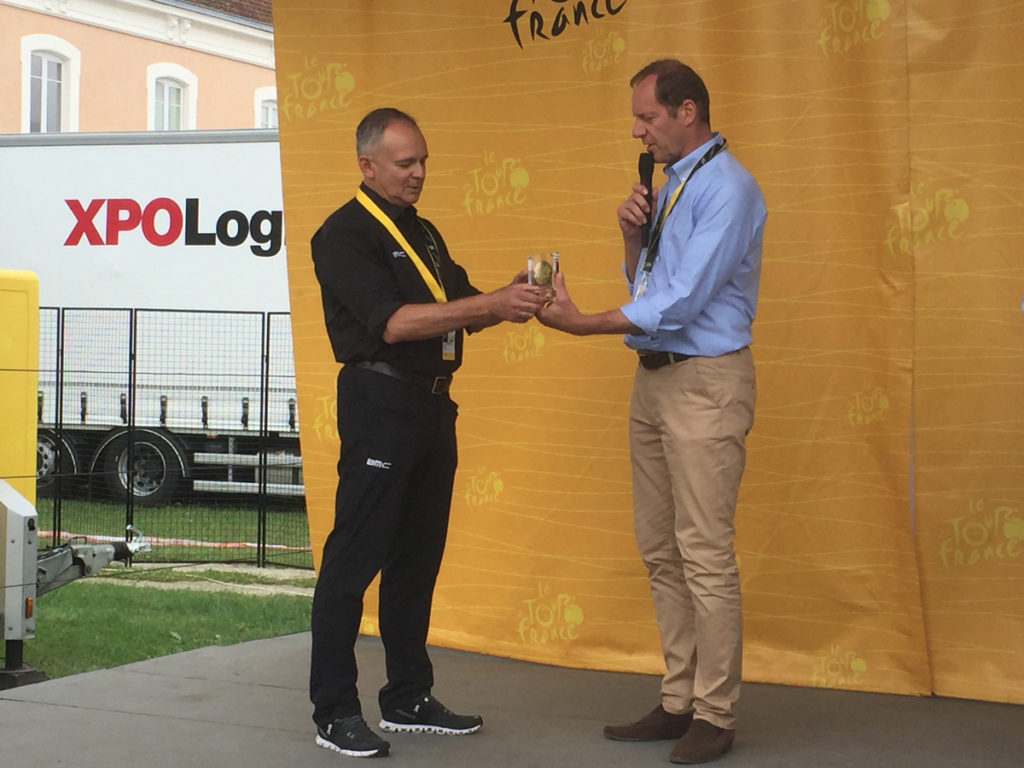
Dr. Max Testa in 2017 with his award for 25 years of participation in the Tour de France as a team doctor. Photo courtesy Max Testa
By Bill Roland –
From July 6–28, 2019, Dr. Massimo “Max” Testa, 63, of Park City, Utah will be “riding” along in his 27th or 28th consecutive Tour de France. Your first question might be, “Omigosh, a rider of that age in the Tour! What team is he on and how can he keep up with those superb athletes?”
Perhaps I should clarify his role in the Tour de France. Dr. Max Testa lives in Park City but every year he serves as the team doctor for a major cycling team that competes in the Tour de France. For the past 12 years he has been with the powerful BMC team. Prior to that he was affiliated with the Motorola and 7-Eleven teams. His responsibilities include everything physical and medical that will keep the riders in top condition to survive riding 2,150 miles in 21 stages over the most beautiful and challenging terrain in France. Dr.Testa is a native of Italy and received his medical degree from the Universita degli Studi di Pavia in 1982. He has been practicing Physical Medicine, Rehabilitation, and Neuromuscular Medicine for more than two decades. Dr. Testa is a physiatrist, a physician who focuses on rehabilitation, restoration of function, and a return to a high quality of life. Dr. Testa’s practice centers on sport and exercise medicine.
At his Cycling Services at the LiVe Well Centers in Park City and Salt Lake City, Dr. Max Testa has worked with professional and recreational cyclists for over 25 years. He not only works with the best professional cyclists in the world but he can show the recreational cyclist how to get faster, ride comfortably, improve power, prevent injuries, train more efficiently, and be properly fitted to their bike. In this article, Max will share with you the inside decisions made by the team managers. He will explain and define what it takes to make the jump from a serious recreational cyclist to one of the top professionals in the world. Basically, you will learn the physical attributes these riders possess and how they are able to withstand such a grueling event. He will provide you with an insight to the strategy of breakaways, the value of domestique riders and what it takes to sprint like Mark Cavendish or fly down the mountain roads in the Alps at more than 60 miles per hour.
A Cycling Team’s Doctor is One Busy Man
A few weeks ago, prior to flying to this year’s Tour de France, Max sat down and explained some intricacies concerning the Tour and exactly what his role will be for the team CCC. “This will be my 27th or 28th Tour de France, I stopped counting a while ago,” he quipped, “I talk to people who watch the Tour de France on television, they focus on the race, but everybody thinks it’s a vacation. Many times, I come back and friends ask, ‘Hey Doc, how was your vacation at the Tour de France?’ It’s not quite a vacation, especially for the staff. You have long days that start very early in the morning and you go all day, sometimes past midnight. You have to transfer every day, from finishing point to the next hotel. On occasion it’s a two or three hour drive. You may have dinner at 9:00-10:00, then you have to go see the riders and change the dressing and take care of any injuries. Sometimes they wake you up in the middle of the night for doping control tests. They may select one or two riders, then you have to go wake the riders, go down to the first floor to the doping control room. Then they might say, we need two more riders, and we go through the whole process all over again. They don’t tell you how many riders are going to be tested or when. Sometimes, you are awake all night assisting the doping control committee. Before you know it, it’s six in the morning, time to wake up the riders, go to breakfast, prepare, transfer the riders two-three hours to the starting point for that day’s stage. There are days, I don’t have time to open the suitcase in my room. I go to bed, wake up, take a shower, boom, out of there.”
At that point, I was exhausted listening to Max’s agenda, but he continued with more interesting detail. “Actually, the doctors have one of the easiest jobs,” he explained. “Especially if there has not been a recent crash. Think about the massage therapists; they have to move all the luggage from one hotel to the next, then give four or five massages at the end of the day. Sometimes starting after dinner. Then they have to prepare two hundred bottles of water for the next day. They work through the night. They make bottles of electrolyte, water, carbohydrate mix, and it depends on the temperature of the next day, the length of the ride and the amount of vertical involved. They modify the water depending on the environmental changes. On average, each rider needs about three gallons of water during each stage. Plus you have to have enough water for each car. Sometimes cars are stuck behind the breakaway and you must have a sufficient number of bottles in the second car.”
Team Managers, What Do They Do?
That was a perfect segue for my next question. I asked Max to explain how many cars are used for each team and what were the responsibilities of those in the cars. “There are three cars per team,” he described. “In the first car, you have two sports directors. One is driving, the other is communicating with the riders. He has the map in front of him, tells the riders if the wind is going to change, you’ll be on a narrow road for five kilometers, then big turn to the right, then you’re going to have a cross wind, and so forth. We have a car ahead on the course and he tells the sports director what the conditions will be in an hour. For example, if there’s a rainstorm ahead and the road will be slippery, he tells the sports director so he can have one or two riders drop back and get rain jackets even though they are miles from the storms. The third car is the service car and I am there with another sports director and the mechanic. If there is a breakaway, we pass the peloton and go behind the breakaway. If there is a bad crash, they drop me out and then they jump in the ambulance with the rider. That’s what happened last year with Richie Porte when I was with the BMC team.”
Dr. Max Testa was with BMC for 12 years. Before that he was the team doctor for Motorola, and prior to that he was with the 7-Eleven team. The CCC is comprised of about 30% of last year’s BMC team. Needless to say, over the last 28 years he has provided quite a bit of medical attention to many riders in the Tour de France. The CCC team existed on the continental level and BMC had the UCI World Tour license and joined forces with them this season. CCC is a Polish phrase that means “The price makes miracles.” It was a logo used by a company that manufactured leather products, primarily purses and shoes. The team is co-owned by American Jim Ochowicz, who founded the 7-Eleven Cycling Team and is presently the team manager. Although the first stage of this year’s Tour de France is on Saturday, July 6, Max will fly over on Tuesday July 2. He must be there three-four days ahead for the anti-doping tests for the team. Normally the doctor is there witnessing the doping control of his team. There are reports and paper work to get in order.
Tour Riders versus You: What’s the Difference?
Max was asked what the main difference was between recreational riders and those professionals competing in the Tour de France. “Power is the main difference between those who ride the Tour and everyday riders,” he explained, “or even serious competitive cyclists who are not on the same level. We look at strength and talent as the number of watts you can push for a given amount of time, and the ratio between weight and power. For example, you take the amount of watts you push for a climb that takes 30-40 minutes, then you divide by body weight and you have watts per kilo. That’s what makes your speed going uphill.
“So you take the winners of the Tour de France, and they win mostly on the climbs. In comparison, take a Cat 1 cyclist, who trains 15-20 hours a week and imagine he is on a major climb after four or five hours on the bike. He can average 4.5 to 5.5 watts per kilo while a fit recreational rider will average 2 to 3 watts per kilo. So if a Cat 1 rider, the fittest guy locally, averages 4.5 to 5.5 watts per kilo, the Tour de France top riders are between 6.3 and 6.8. So they can go up about 10 per cent faster than a good local regional level cyclist. Pretty much a Tour de France rider climbs double the speed of a good, well fit recreational serious rider. They can go up a steep grade at 15-18 miles an hour.”
When asked, what is the ratio of watts to kilos, he responded, “Say a rider is pushing 420-440 watts for 45 minutes, then you divide by body weight, which is about 65 kilos, and that number determines how fast they can climb. The higher the number, the faster you go up. So you take a good cyclist that pushes 250-300 watts, say you divide by 75 kilos, or 165 pounds, the ratio is much lower. It’s like a big engine mounted on a light frame.” In simpler terms, watts measure how hard you work. For example, six-time Tour de France stage winner Andre Greipel, can generate a charge of 1,900 watts of power in a single sprint. Mark Cavendish says he sprints at 1,500 watts. Most pro cyclists produce close to 300 watts on average during a four-hour tour stage.
I was anxious to hear about how these Tour de France riders became so strong, fit, and skilled. “The condition of these riders is genetically determined,” Max explained. “They are born with this gift. On top of that, they have training and a career and have been racing since they were 8-9 years-old. So they have the skills, they know how to envision the race and everything that comes with learning the techniques. They understand the race; one day you have to chase and attack and the next day you don’t. For example the gift that a 7-footer has on the basketball court is visible. But the gift these guys have, that they have been born with, it’s in the quality of their lungs, the quality of their heart, the quality of their muscle, their ability to generate power in the mitochondria, an organelle in the cytoplasm of cells that functions in energy production. In a good way, they are a freak of nature. Some of these people deliver 70-80 milliliter of oxygen every minute per kilo of body weight.The normal person has 25-40. These young people can process oxygen at double the normal speed. Training can contribute 10-15 per cent of VO2 Max (milliliters of oxygen per kilo of body weight) the amount of oxygen they can deliver to the muscles. It’s just that they have a different engine. It’s like having a furnace that runs at double the normal speed. When I was in Milan, we tested 800 juniors every year when they were 12. And when they were 14-15 you could see the ones that were 70 plus VO2. You could see who would become good professionals. In the ten years we brought a lot of juniors to become pro because we have monitored them since age 12. It was a pipeline.”
Tips on Staying Healthy
As far as recreational riders are concerned, I asked Max if he had some advice so riders could avoid time off the bike during the season and stay healthy. “If the pain is a series of aches,” he surmised, “moderate your training so that you have enough recovery days especially if you are older than 40 or 50. Because as you grow older, recovery takes longer. You can still train hard but you might need two or three light days before you train hard again. Stretching can help but one of the first pieces of advice is to make sure your position on the bike is correct. Because if you are sitting in the wrong position, too low or too far forward, you many have more knee or quad pain. If you are sitting too far back, you may have more hamstring or glute pain. It’s important to start with a good bike fitting. If the position is correct, work on your training organization so you have days that you train hard but days when you can recover. Another thing is to do everything you can do to optimize your recovery. Stretching is one, sometimes a cold bath after a long ride could help. Also, make sure you have good nutrition for recovery, so after you are done you have your shake with protein and carbohydrates, in order to speed up recovery. These are good recommendations but everything starts with a good bike fitting and a good training program.
“Then there are complicated cases where you have the person that does everything right but he or she has a bad knee that happened playing football, tennis, or an assortment of sports injuries and they have chronic knee pain. Sometimes, we do what we call ‘medical bike fitting.’ We do anywhere between 300-500 a year right here. Some people come in with their bike, not because they have a wrong position in terms of fitting but because they have knee or neck pain. So we adjust the position to reduce the load on the knee or the achilles or the neck or whatever. So we put together the medical condition of the patient, their flexibility, with the position. That may prevent them from being a super fast rider but allow them to ride without a lot of pain.”
Intervals
Regarding training, I looked forward to hear Max’s opinion on the role intervals play for professional cyclists and recreational riders. “I think intervals are more important for recreational riders than pros,” he explained, “because the pros race or train 20-25 hours a week. They ride over all kinds of terrain, so naturally intervals are included. The intervals tend to give the rider more in return for the time invested in training than steady training. Steady training is good for recovery days or training for a long event. Intervals are good but as you get older, you tend to lose the top end. You can still go long but people my age prefer riding long and steady because it feels natural. It’s easier than riding hard. But I do recommend that seniors in good condition, should introduce intervals in their training at least one or twice a week.”
Peter Sagan, Paul Sherwen, and Bob Roll
Max mentioned that Peter Sagan had been up here training for two weeks in Park City. Pete just left in early June, 3-4 days before the Tour of Switzerland, and by the time we did this interview he had already won a stage. “He comes here a couple times a year,” Max recalled, “Peter rides all around the Park City area, six hours a day and that includes many canyons here on the Wasatch Front. He spends a lot of time on a mountain bike, that’s his background and a major part of his training.”
While talking about his time with the Motorola Team from 1991-1996, Max mentioned that for five seasons he was a roommate with Paul Sherwen, who at that time was the PR-Media Representative for Motorola. As many readers know, Paul Sherwin died suddenly at age 62 of a heart attack in early December at his home in South Africa. Following his time with Motorola, Sherwen became affiliated with Phil Liggett and the duo became professional cycling’s best television broadcasters by a long shot. I asked Max about his friendship with Paul Sherwin. “I got to know Paul very well and like everyone I appreciated his friendship,” Max recalled, “but he was much more than a nice guy. He was super smart, a very good rider in the 80’s but extremely passionate about the sport. He knew so much about the culture of cycling, riders from the past and the present and his memory was unbelievable. He could have been a great Sport Director or Coach because he really understood the sport.”
During the same time in the 90’s, Bob Roll was a rider for Motorola and Max was the Doctor for the 7-Eleven team. Once a year Bob comes to Park City to get his physical for insurance purposes. Max recalled that a few years ago after Bob turned 50, Max asked him when he had his last physical. Bob’s reply was, “When was the last time we were together during the Tour de France?” That was some 20 years ago but now he gets his physical annually. Max reassured me that the humor Bob Roll shares on television is not designed solely for the camera. “That’s Bob,” Max reiterated, “he’s very genuine, has a sense of humor, sometimes hard to understand or pick up but he’s a fun guy to be around. We ride together every November; a weekend with a group from Colorado in the Moab area. He’s still a very strong rider, he can keep together with the young guys.”
The Peloton’s “Domestique Riders” are Invaluable
Despite an avid viewer of pro tour racing, this writer never thoroughly understood the role “domestique” riders provide to each team and how they are selected. The dictionary defines a domestique as a member of a bicycle-racing team who assists the leader by setting a pace, preventing breakaways by other teams, or supplying food and water to team members. It took Max no more than a split second to define the importance of the domestique rider. “Cycling is a team sport,” he described, “even though there is a perception there is a winner, but most of the time, the winner could not reach that plateau without the support of the other riders. What happens in the pro peloton, is that by a certain phase of your pro career, you realize that you are good enough to be a leader, so that you can deliver on the day of the big races. You can be an overall prospect for stage races, or a one day specialist. If you’re not quite there, maybe shy by only two-three percent, you realize you can be a domestique. They play an amazing role. Some keep their teams leaders out of the wind, they go back to the car and get bottles (sometimes more than eight or ten) of water or electrolyte drinks, jackets if a rainstorm is coming, and of course they make sure their teammates have food and fluid throughout the race. One time we had a rider who was a domestique but because other teammates were injured, he rode out front and finished second in the Tour of Switzerland and tenth in the Tour de France. If you are a team manager and build a team, you identify your team leaders but you also find those strong riders who can play the role of being a helpful and successful domestique. Each team looks for the best domestique rider and it’s no surprise, they are in high demand. For example, you take last year’s SKY team. Of the eight riders on the tour team, you have six that could be leaders on any other team. Those six riders, cost more than the budget of most of the other teams. The budgets are really different between the intermediate level teams compared to those at the top.”
How Does the Peloton Catch up with the Breakaway Riders?
I posed that question to Max and it took him less time to reply than it takes many of us to change gears. “Maybe they don’t have a precise mathematical formula,” he explained, “but by rule of thumb, you know how much you can gain every 10 kilometers if you have two riders pulling, or three, or even four riders. Normally, the strategy is to let the breakaway go, knowing there may be more than one team motivated to chase. Maybe the riders in the breakaway can bother more than one team for overall, for intermediate sprints or whatever the situation. If there are three or four teams in the peloton that want to bring the breakaway riders back, most of these teams have sprinters and they want the race to finish with a sprint. Another situation is that a rider in the breakaway might be in position to pass the overall leader. A rule of thumb, as I said, is that the peloton can gain one minute every ten kilometers (that’s 6.2 miles). Despite the number of riders in the breakaway, say there are 12, not every rider is necessarily working, doing his part, taking pulls. Sometimes only five riders are working because a rider might know that if this breakaway works, my teammate, who is currently in sixth position, may fall back to eighth. So they stay passive in the breakaway. If they pull, they do the minimum so not to be kicked out of the breakaway.”
If the breakaway fails, let’s use the term dissolves, with just a few kilometers remaining, sometimes the body language of a rider who has been in this breakaway, speaks volumes. Needless to say, Max had the perfect response. “In the Tour de France, you are happy to be in the breakaway for 100 miles, even if they catch you,” Max replied. “First of all, the rider will be on television for two-three hours, the sponsor is happy because the camera keeps showing the jersey, the rider’s name has been mentioned over and over, so it’s nice to have your name mentioned many times on the international stage.”
The Tour Riders Descend So Fast? Yikes!
After watching the Tour de France riders climb a most challenging mountain in the Alps or the Pyrenees that lasted quite some time, our first reaction is to breath a sigh of relief even though most of us have no idea how difficult that ascent really was nor do we feel the pain that every rider is going through at that very moment. But we have some idea what lies ahead because the commentators have briefed us that the descent may be in the 5-7 mile category and these riders will be approaching 60 mph or more. How do they do it?
“First of all,” Max remarked with a smile, “this is second nature to many of these riders. They have been descending mountains like this since they were 8-10 years old. Sometimes, you see a big difference in skill going downhill. Some are not very good and make square turns rather that making the turns as straight as they can. This comes with practice. Also, using the brakes properly is very important. A tip is not to hold too long on the brakes because you can heat up the wheels, especially the carbon fiber wheels that heat up quickly. Let the bike go; you can sit up or even stand to allow your body mass to slow you down. Make sure you use the brakes progressively and not lock things up. And when you are getting out of a turn, let the brakes cool down a little so you’ll be ready for the next turn. For the recreational cyclist, I recommend not to increase your speed even more when you know you have a steep pitch right ahead and you’re going to need your brakes again. Disc brakes are a good option if you are coming down a lot of steep canyons. These pros on the tour try to limit the overuse of their brakes and they go with the flow of the riders in front of them. My recommendation is to be aware of your skill level and not try to go too fast for your ability and avoid over using the brakes. Be cautious, practice in training, maybe on the low grade hills first, that are not so steep. Learn to shift your weight a little more on the inside like the motorcycle riders do.”
As the interview came to a close, we shook hands, thanked each other for the time, but I felt it necessary to share one message with Dr. Max Testa. “Max, have a great experience during this year’s Tour de France, but I hope you never have to get out of the car and help a rider who had an accident.” His response was short and right to the point. “Bill, that’s our goal, every year!”
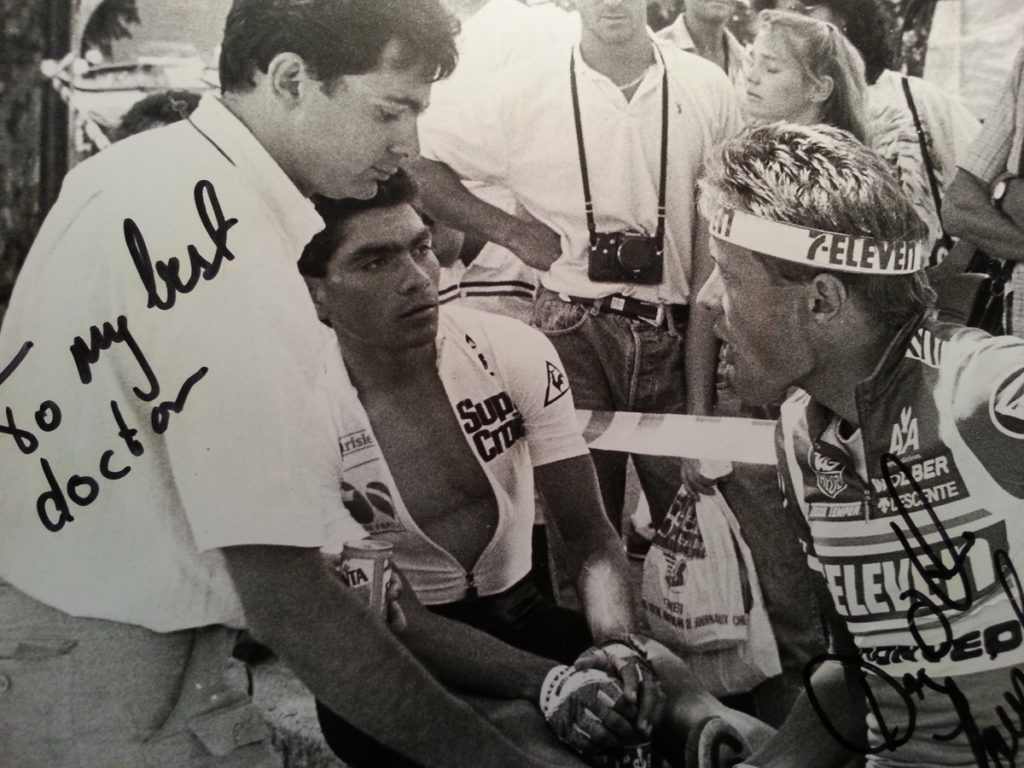
Dr. Max Testa in one of his first tours in 1986 or 1987 with my friend Bob Roll (now a television commentator at the Tour). Photo courtesy Max TestaDr. Max Testa on the day of the 20 year anniversary of the death of Olympic gold medalist Fabio Casartelli. He died during the 1995 Tour, on the col de Portet d’ Aspet. I was there when it happened. I was his team doctor, and his coach. He was from my hometown of Como, Italy. The monument is there where he crashed, in Memory. In the picture I am with his son Marco (born 1 month before his father died), Fabio’s Mom, and widow, Annalisa. The Tour had a stage on the same mountain in 2015, in memory. Photo courtesy Max TestaDr. Max Testa with Greg Avermaet’s yellow bike after wearing the yellow jersey. Photo courtesy Max TestaDr. Max Testa in one of his first tours in 1986 or 1987 with Raul Alcala (winner of best young rider), and Dag Otto Lauritzen (winner of the stage of Luz Ardidens). Photo courtesy Max TestaDr. Max Testa in 2017 receiving his award from Tour director Christian Prudhomme for 25 years of participation in the Tour de France as a team doctor. Photo courtesy Max Testa
Cycling West presents a photo gallery by Angie Harker of the 2019 Crusher in the Tushar, held in Beaver, Utah on July 13, 2019.
[Editor’s Note: All photos by Angie Harker. Curated and captioned by Steven Sheffield.]
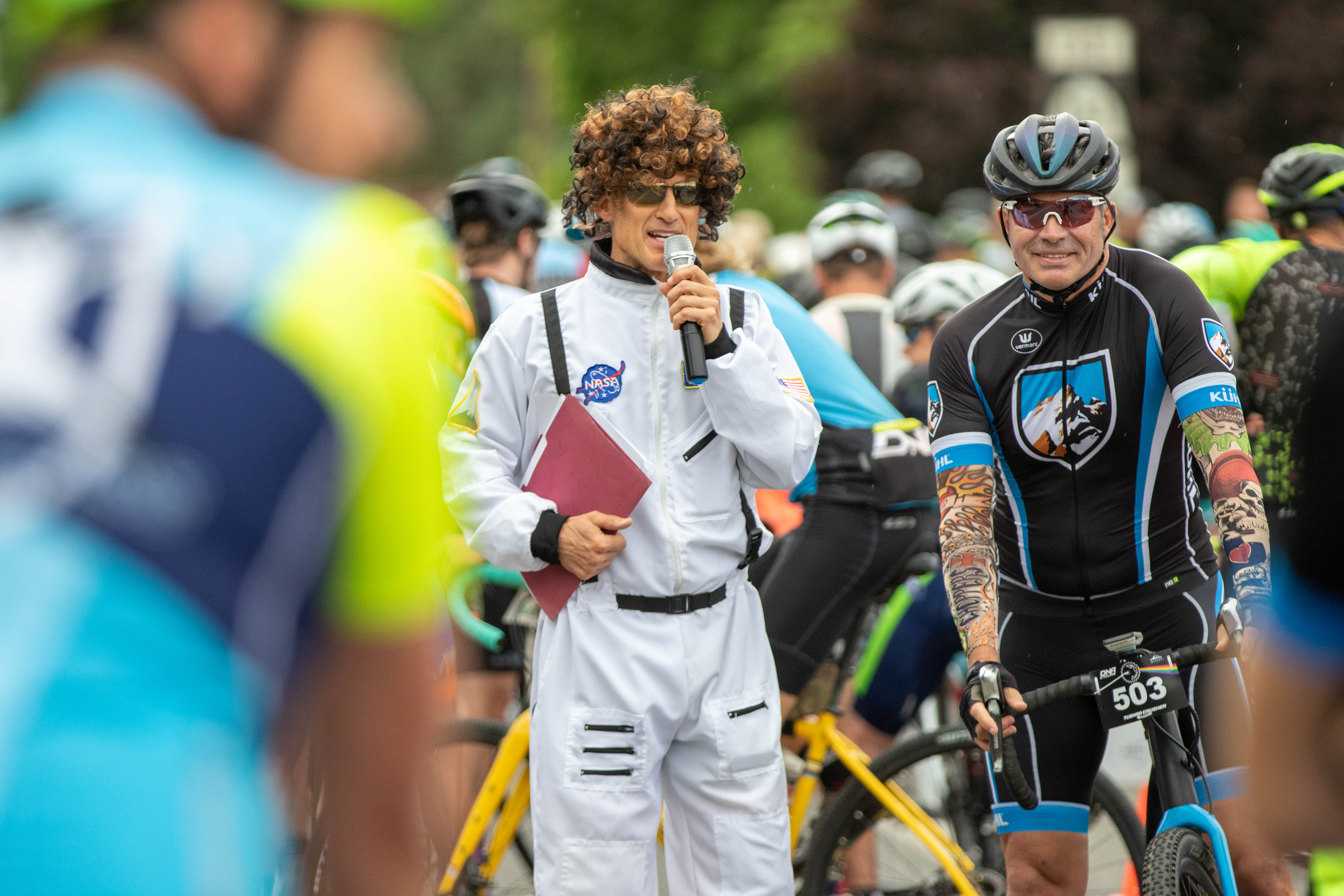
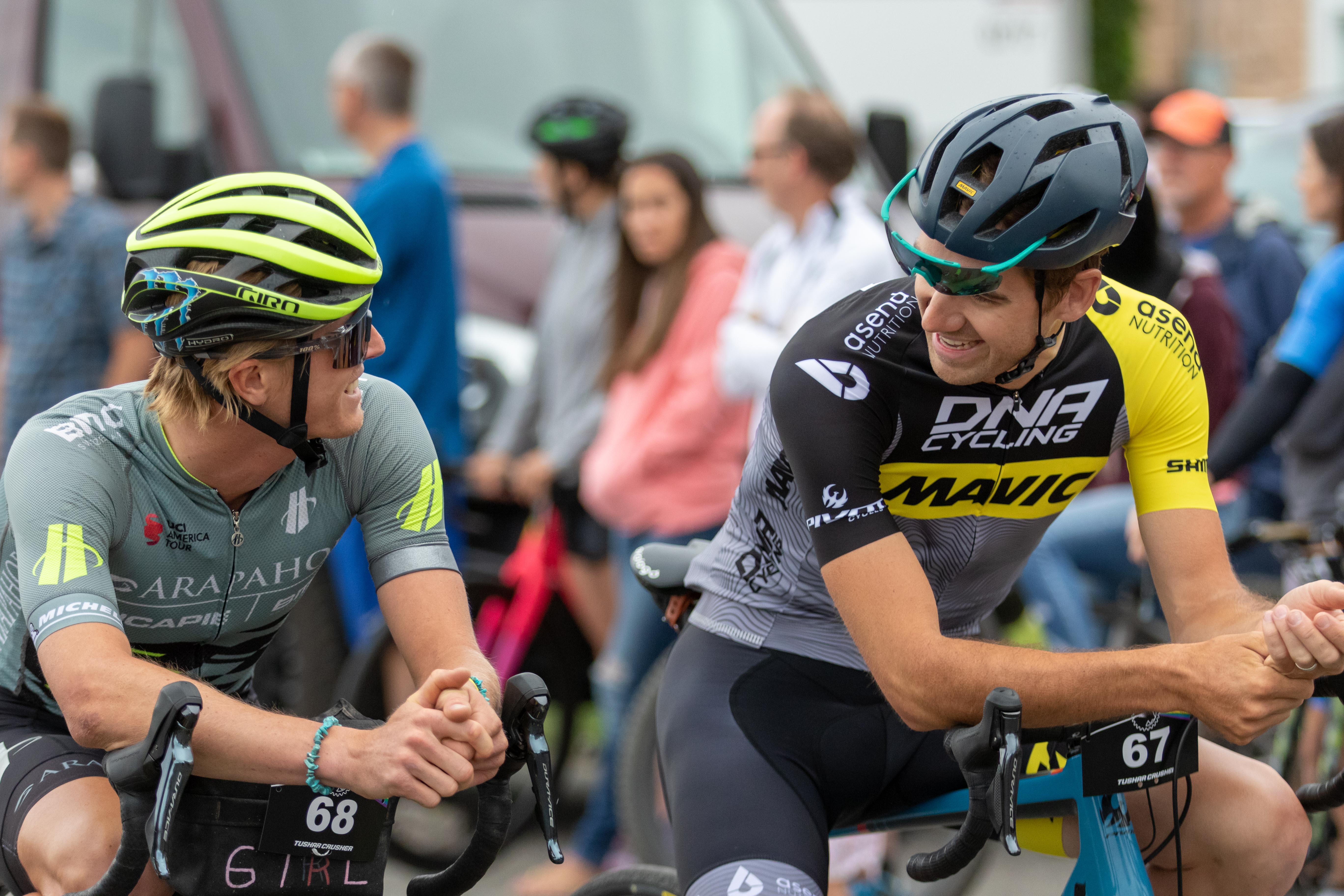
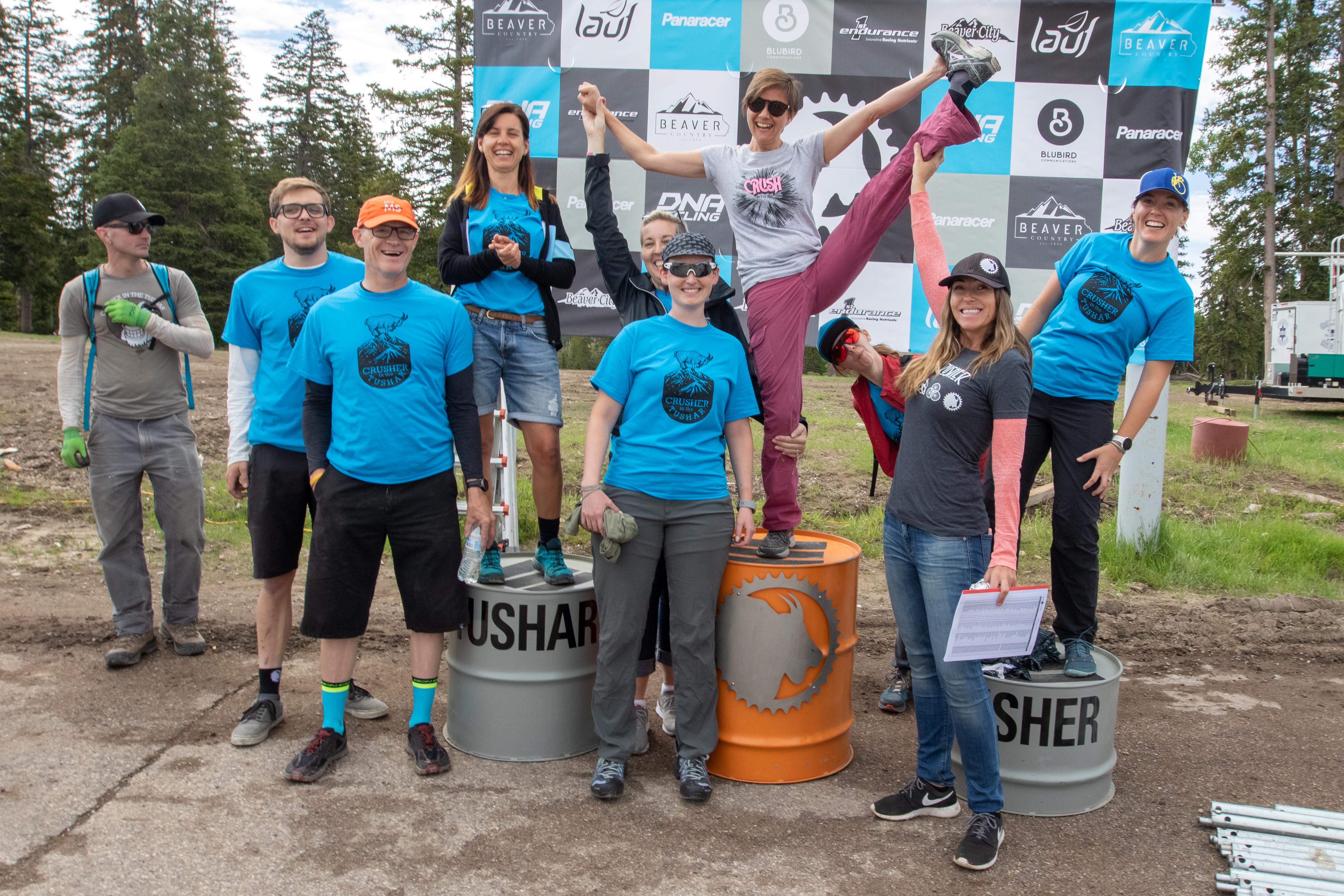
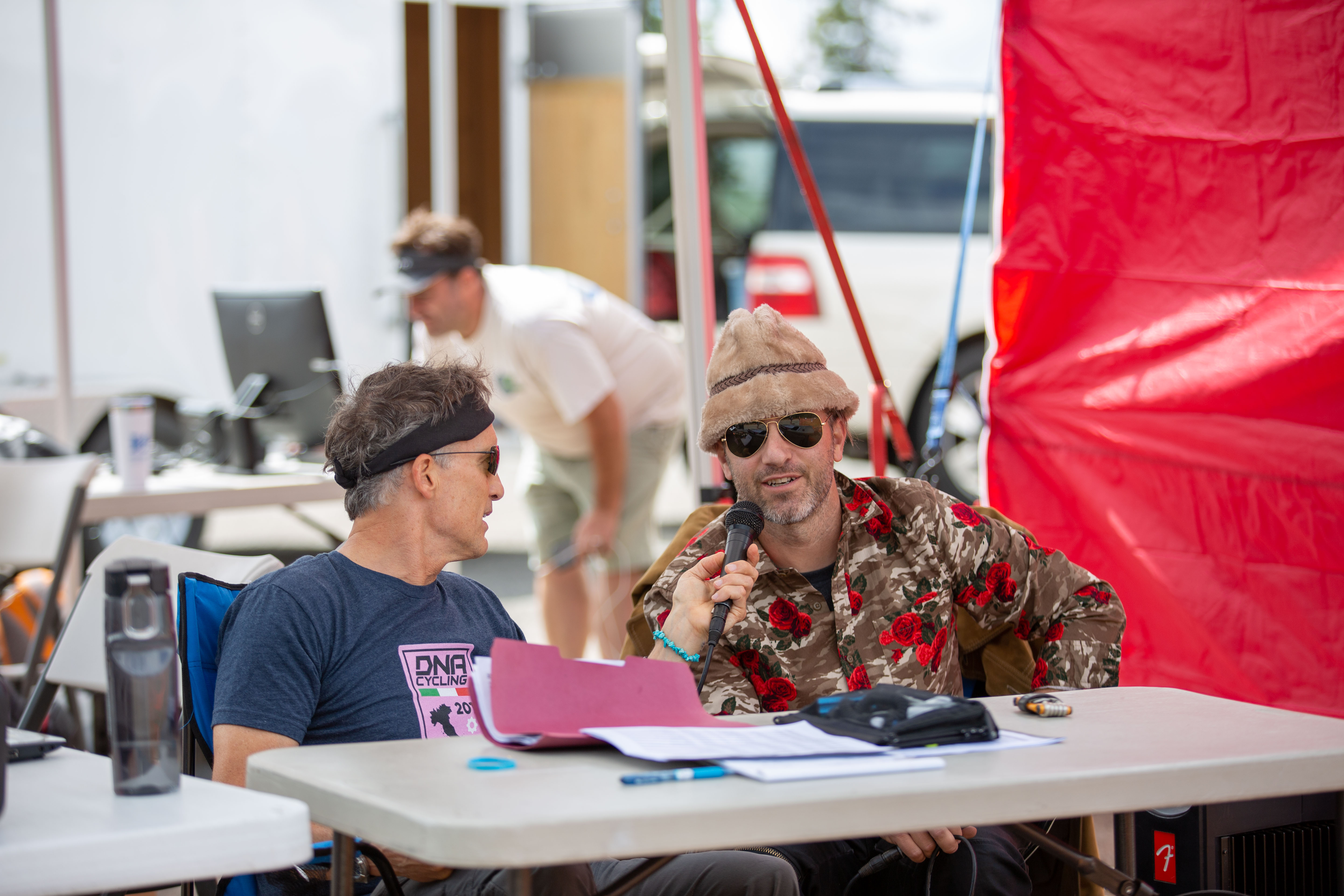
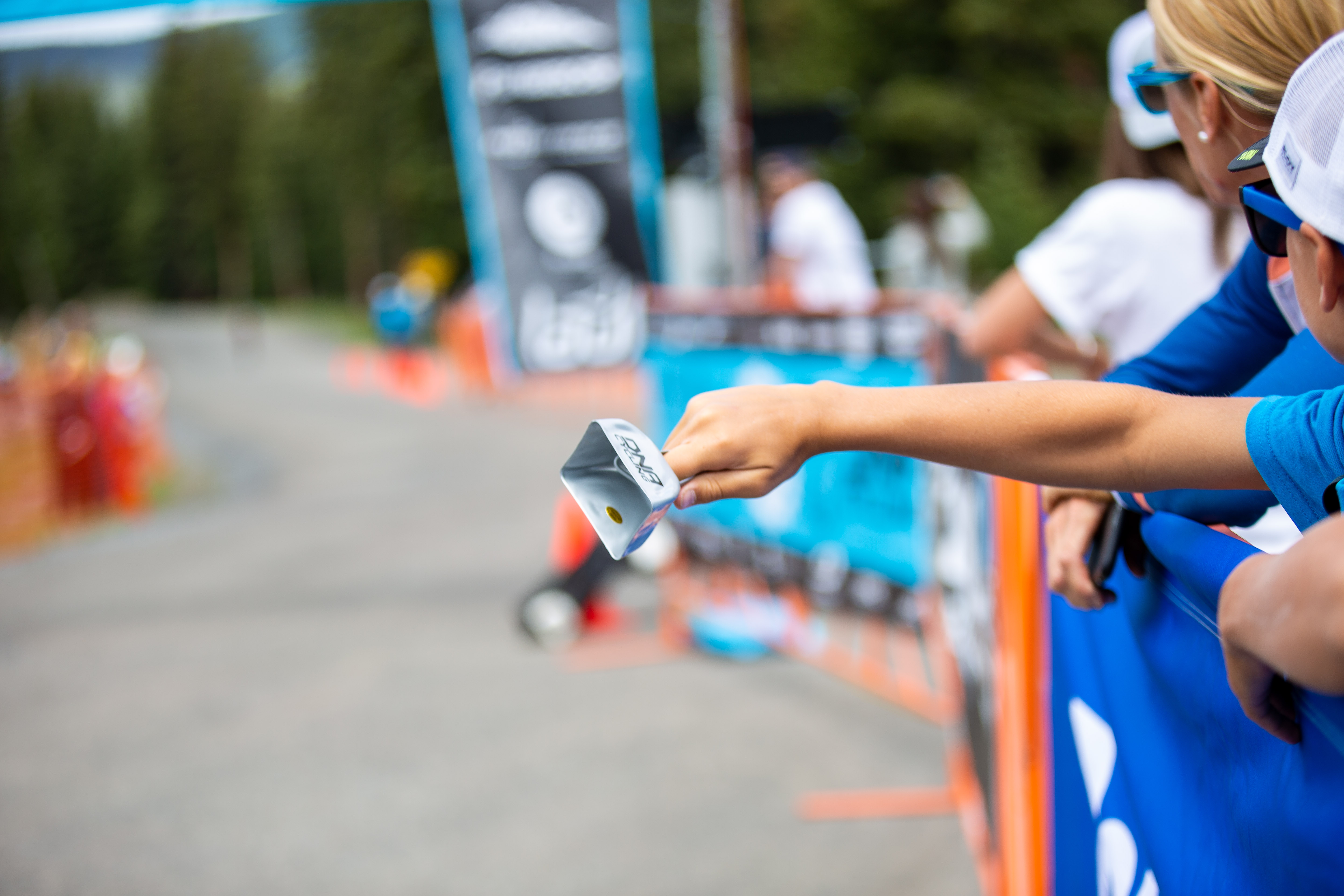
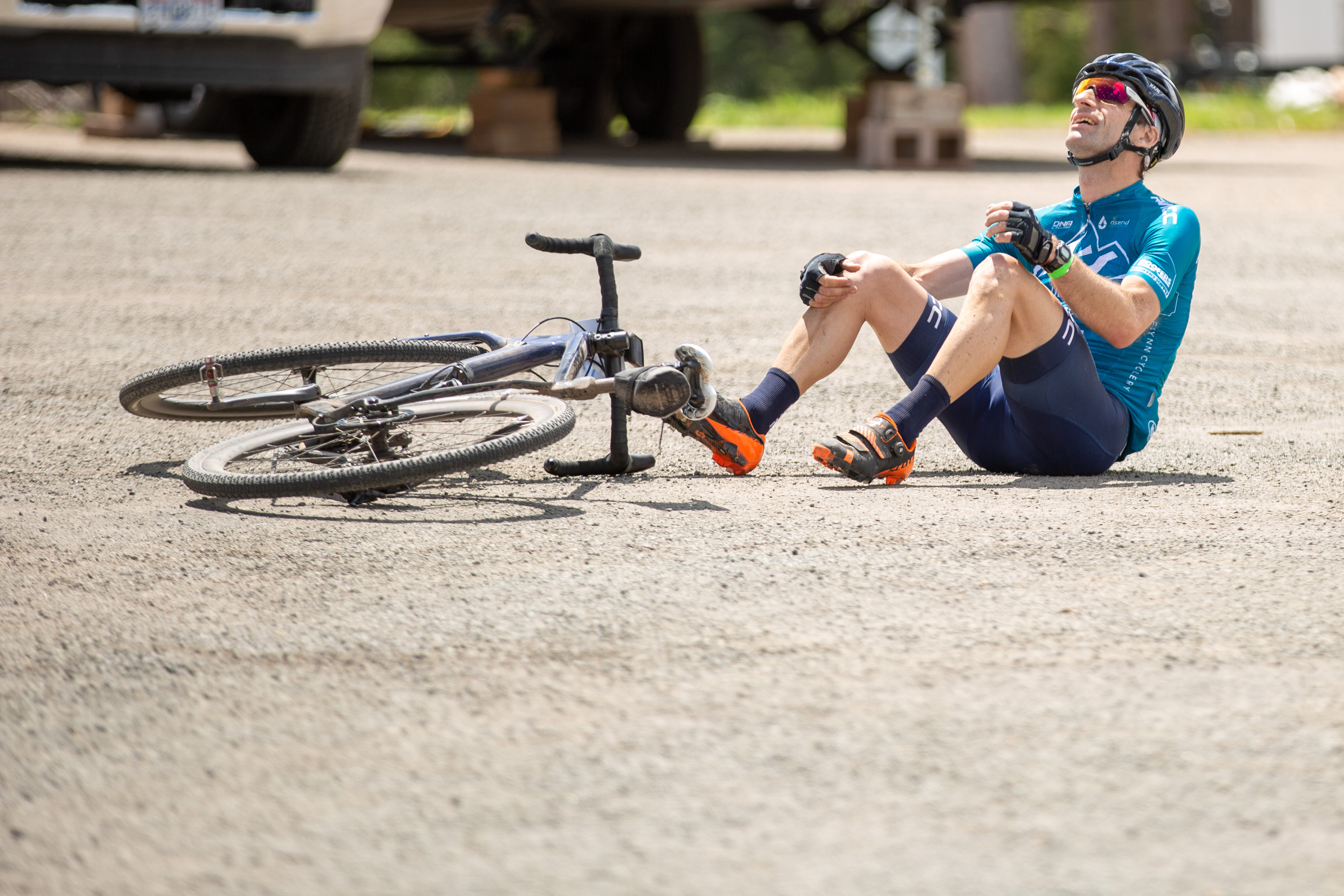
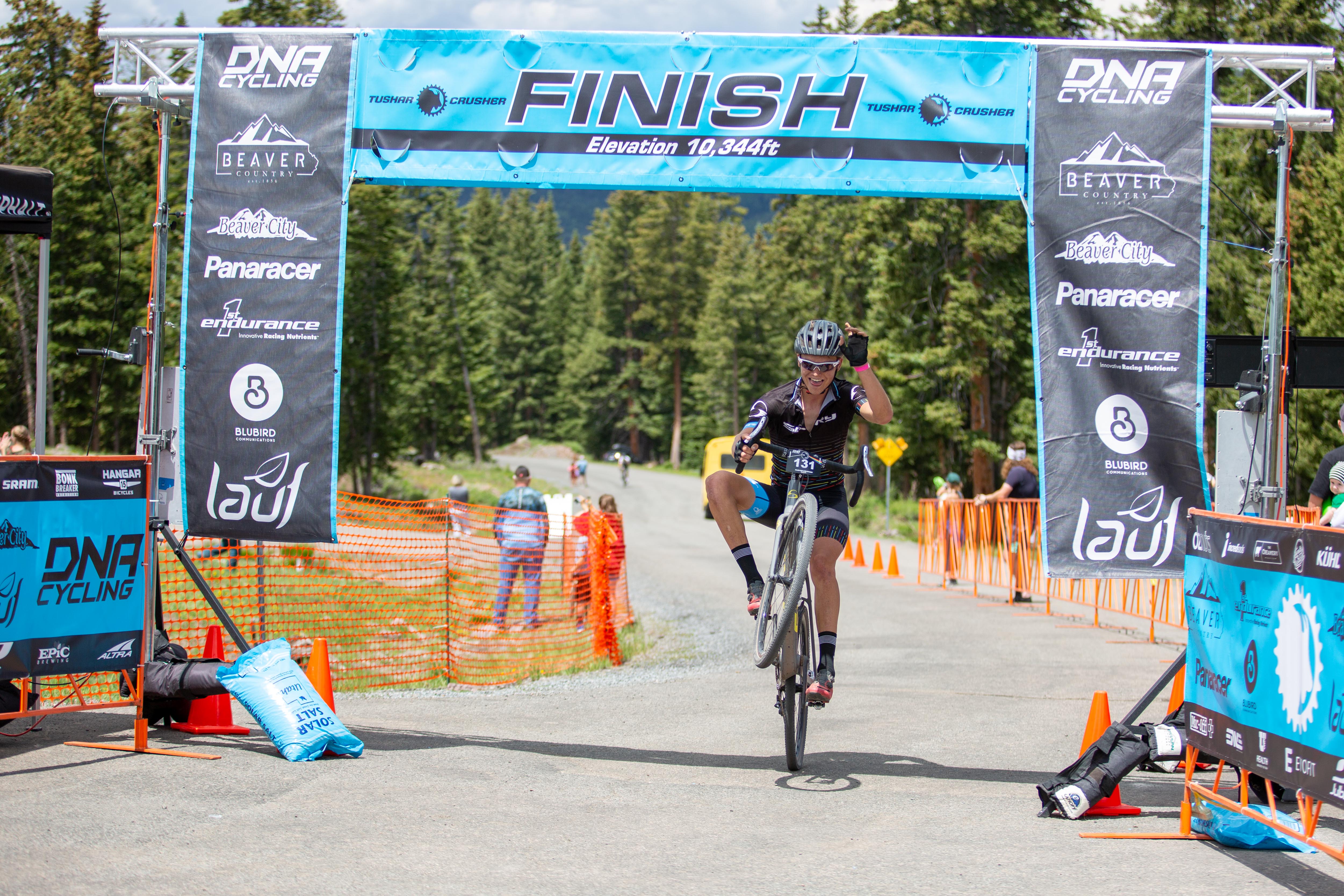
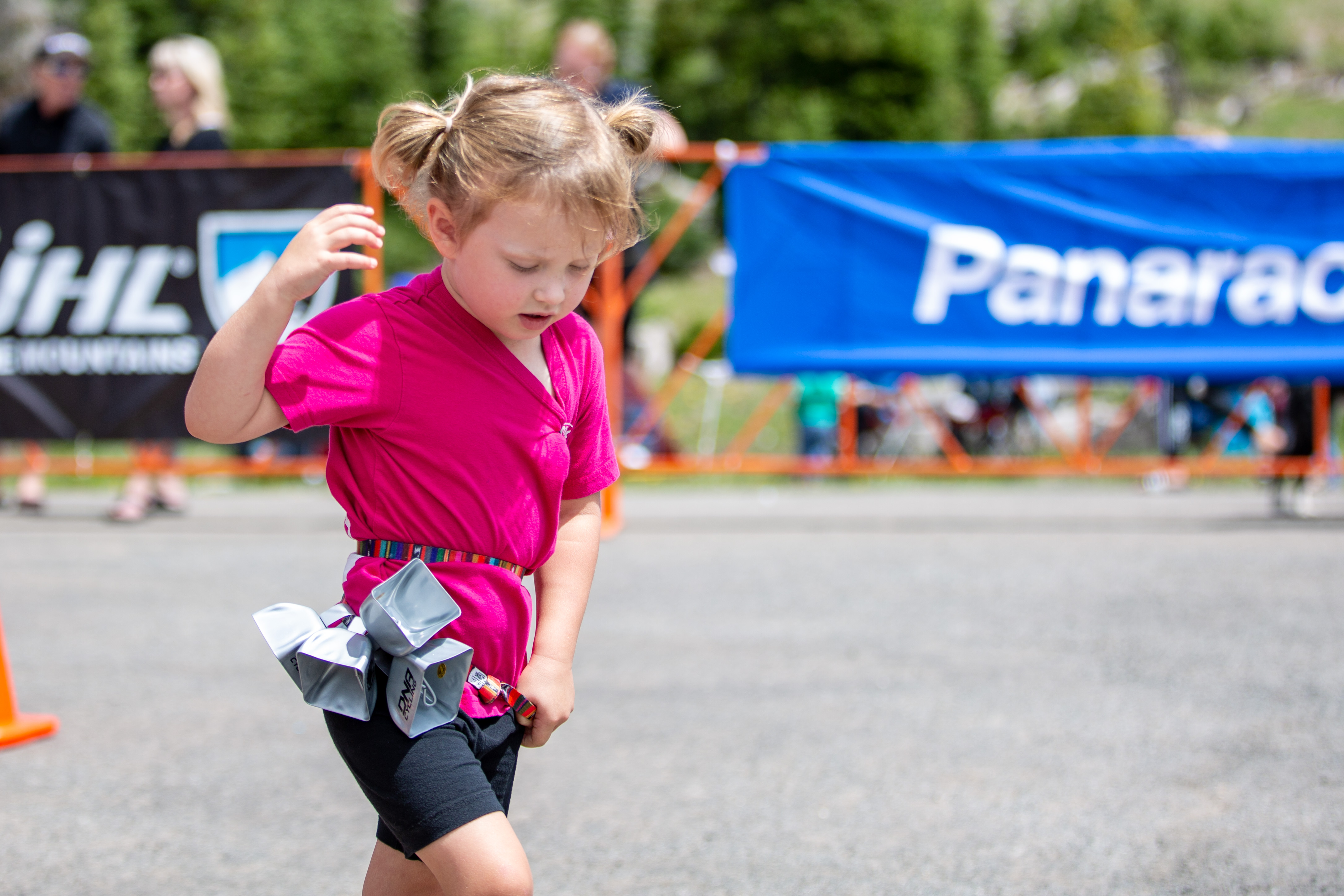
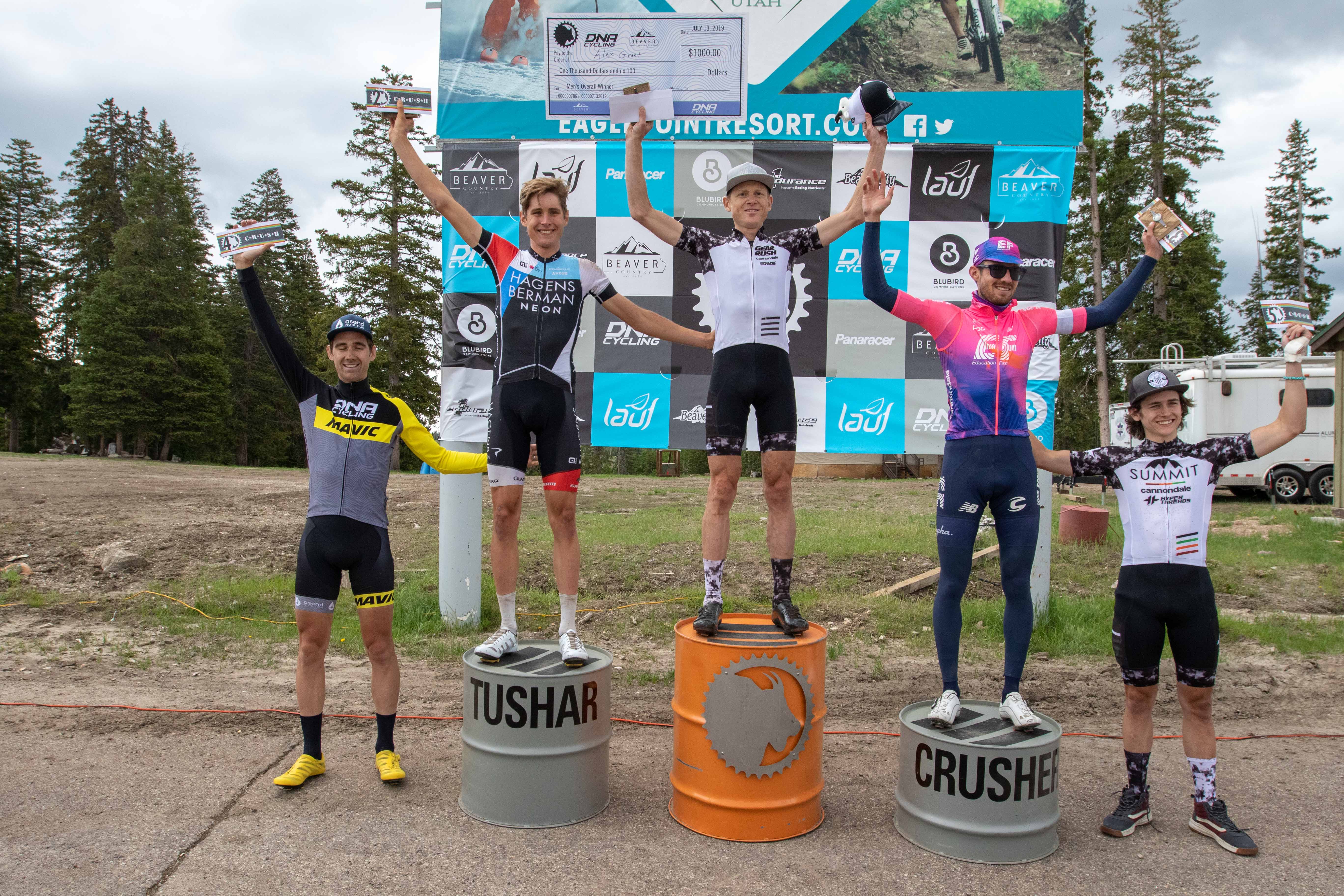
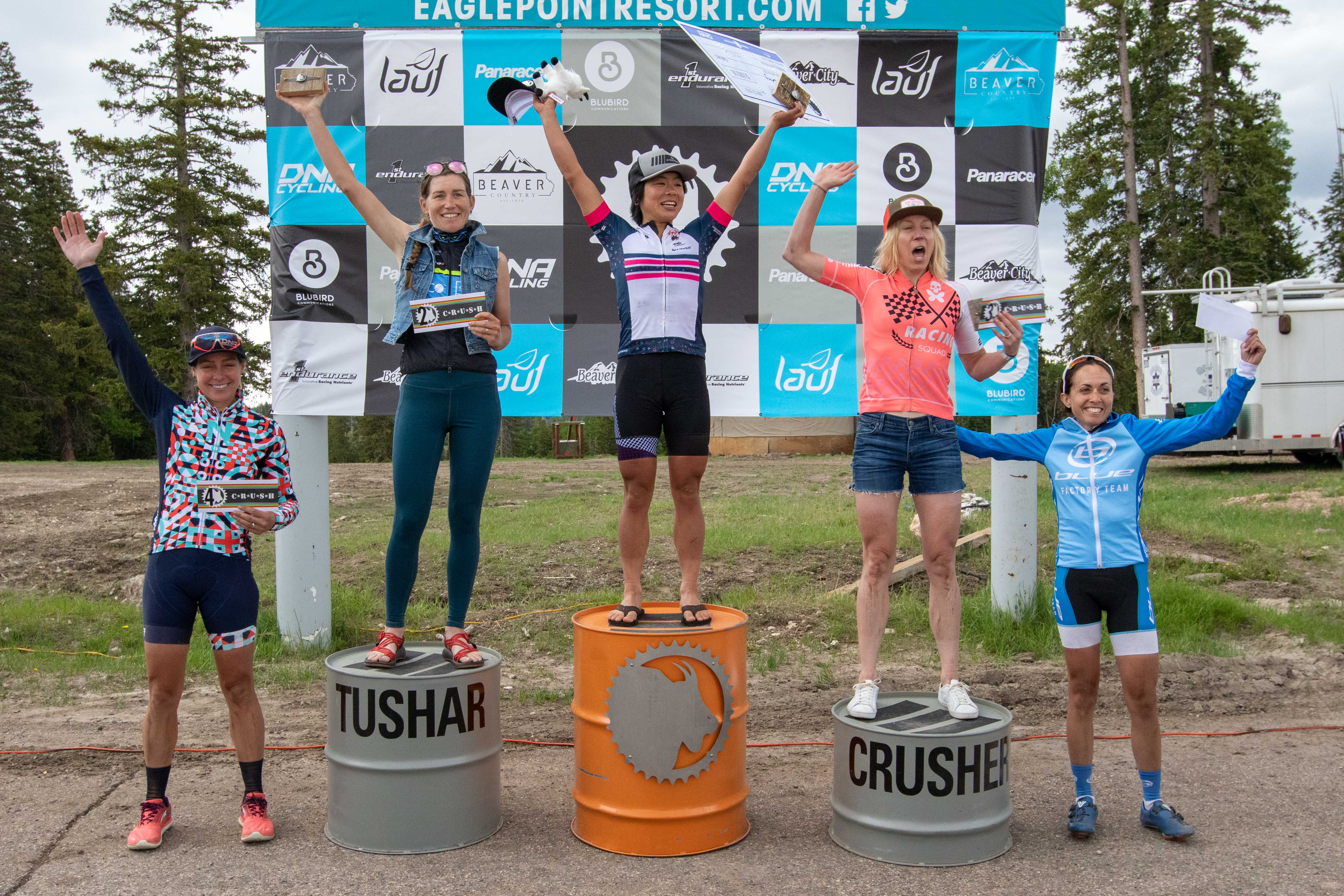
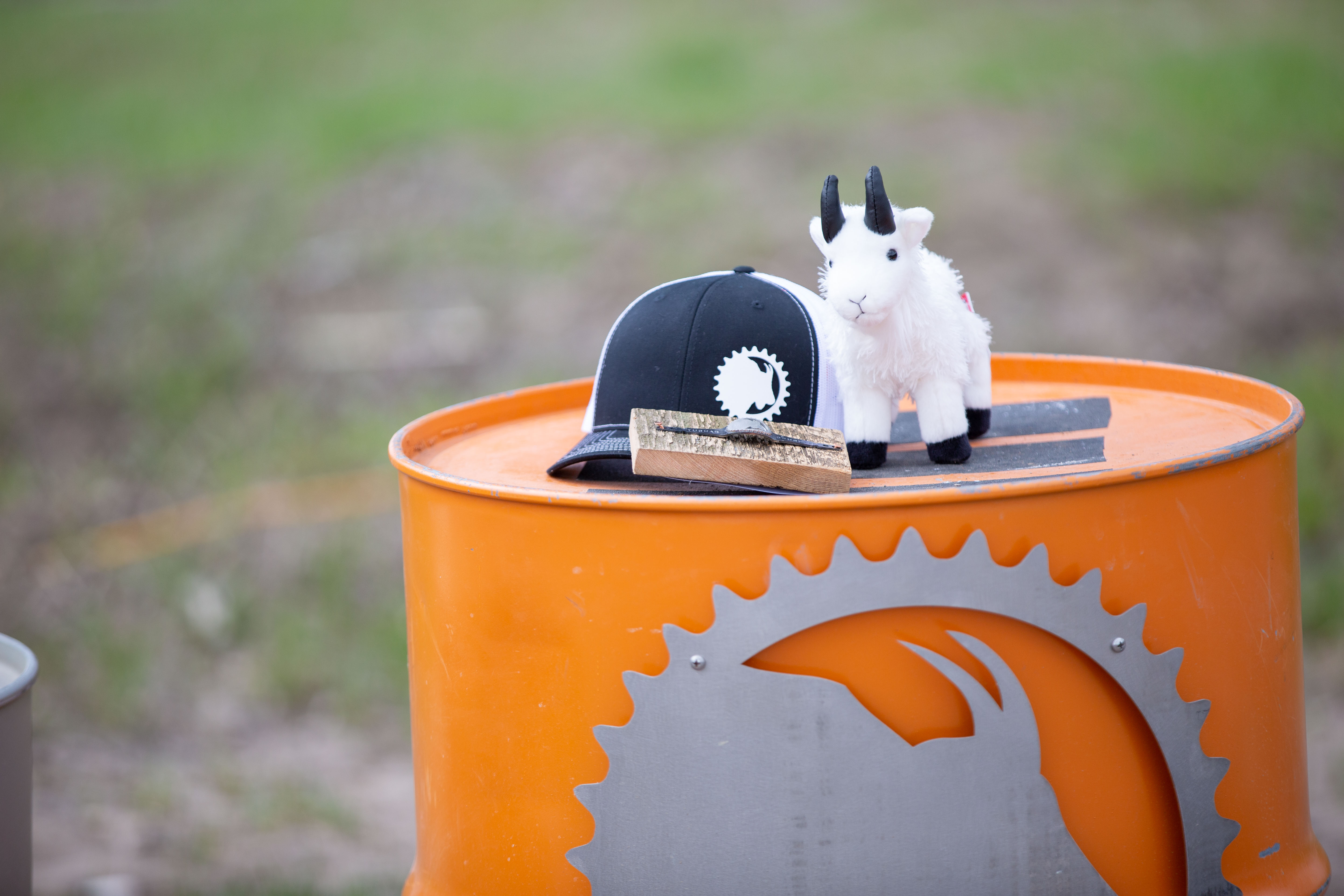
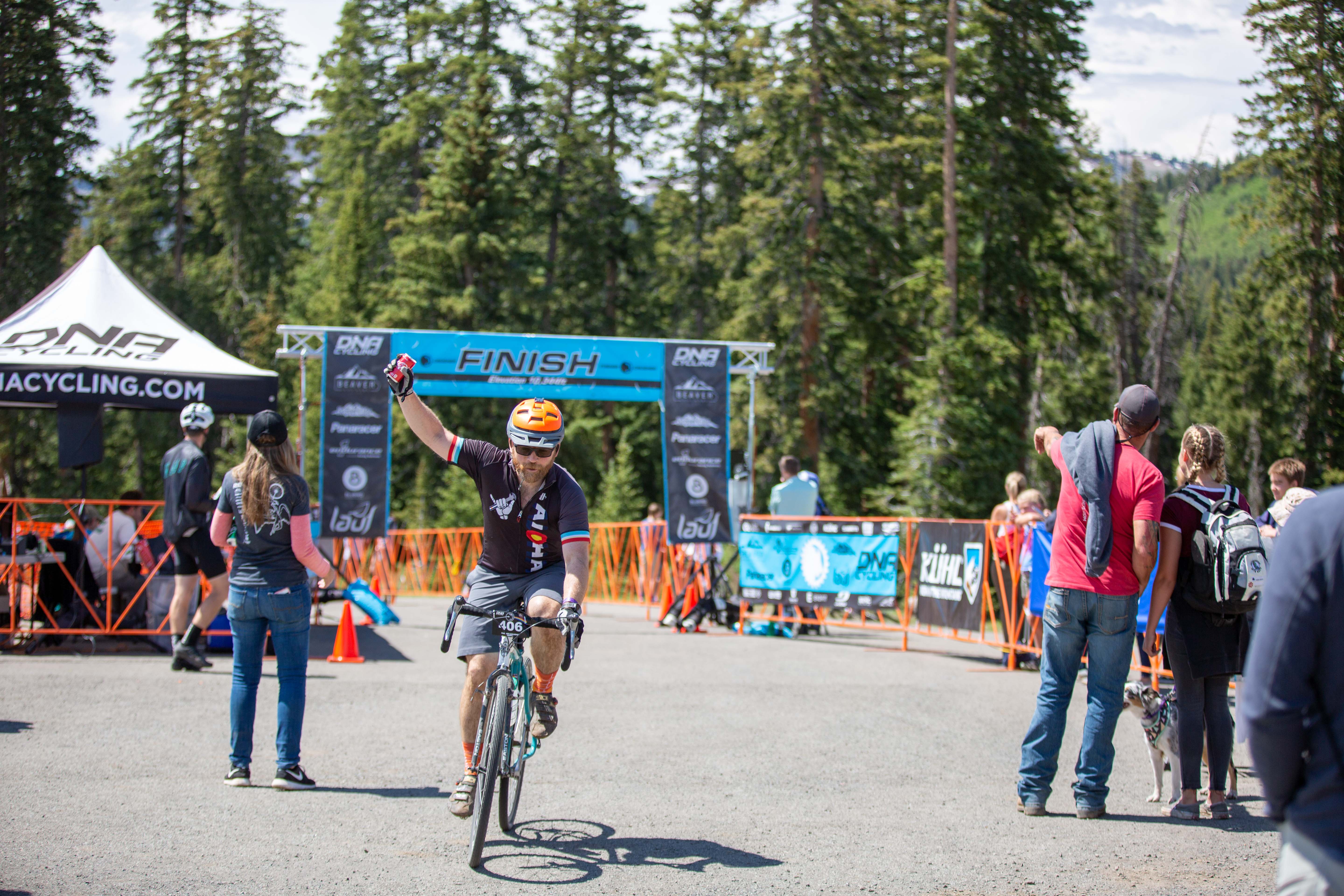
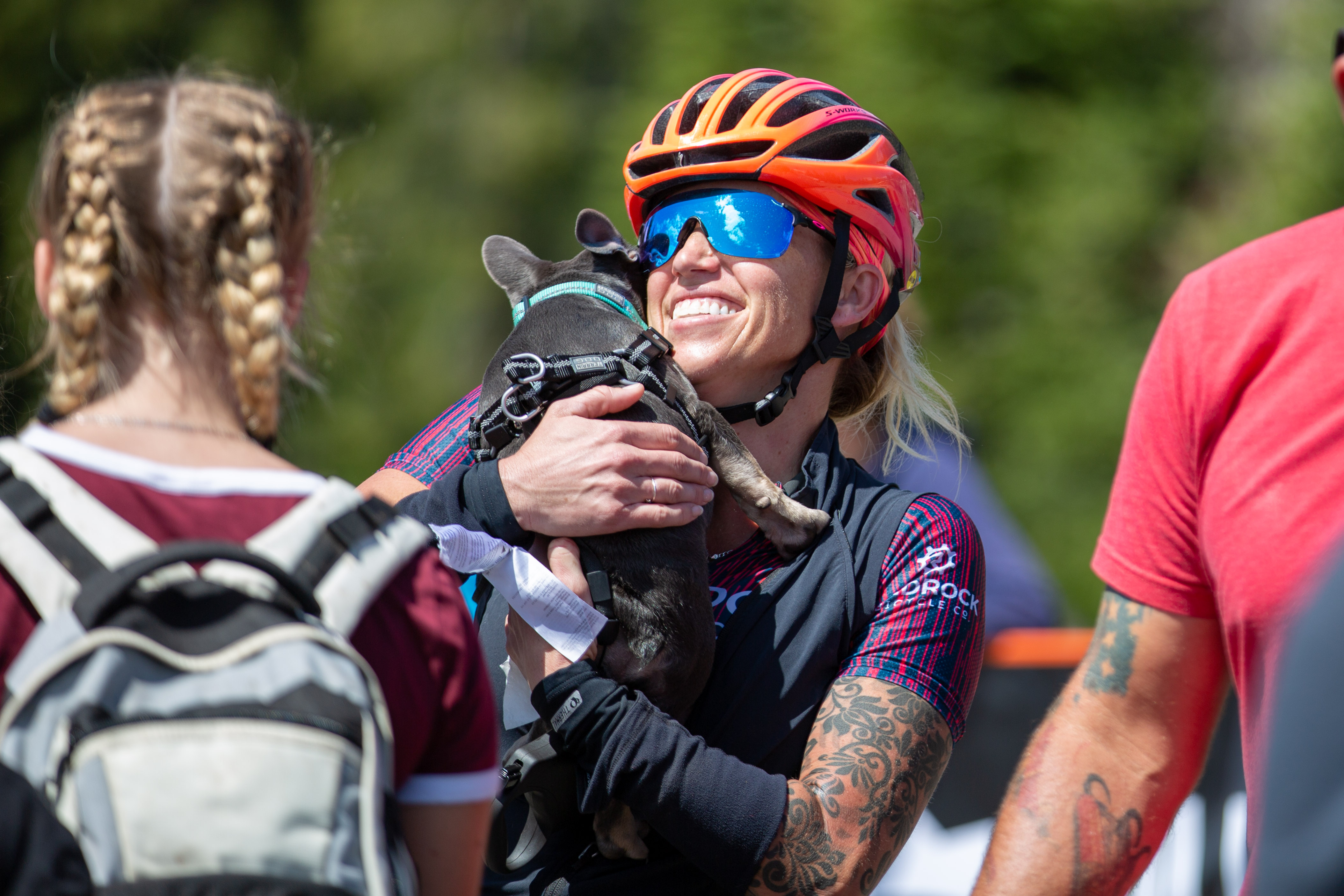
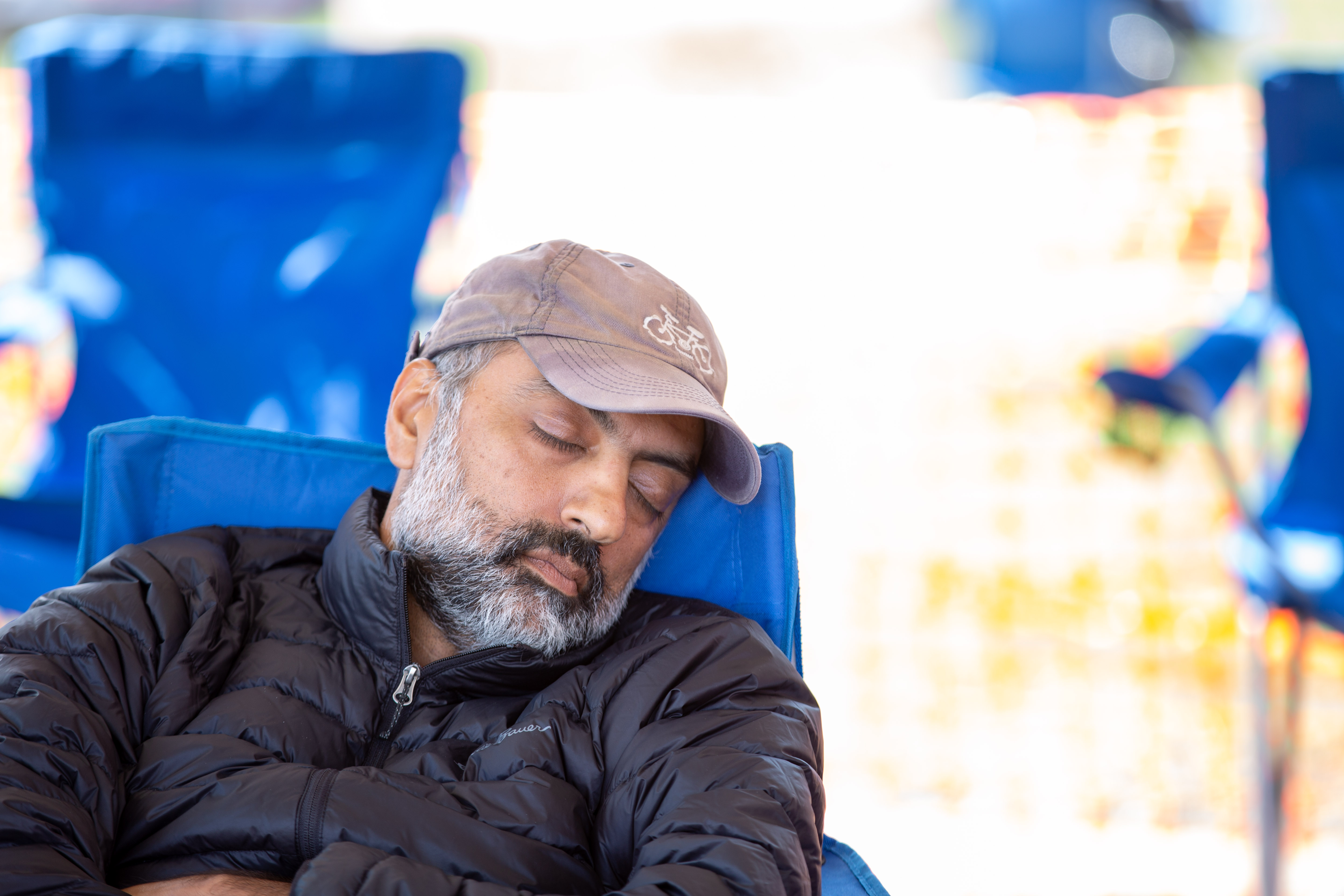
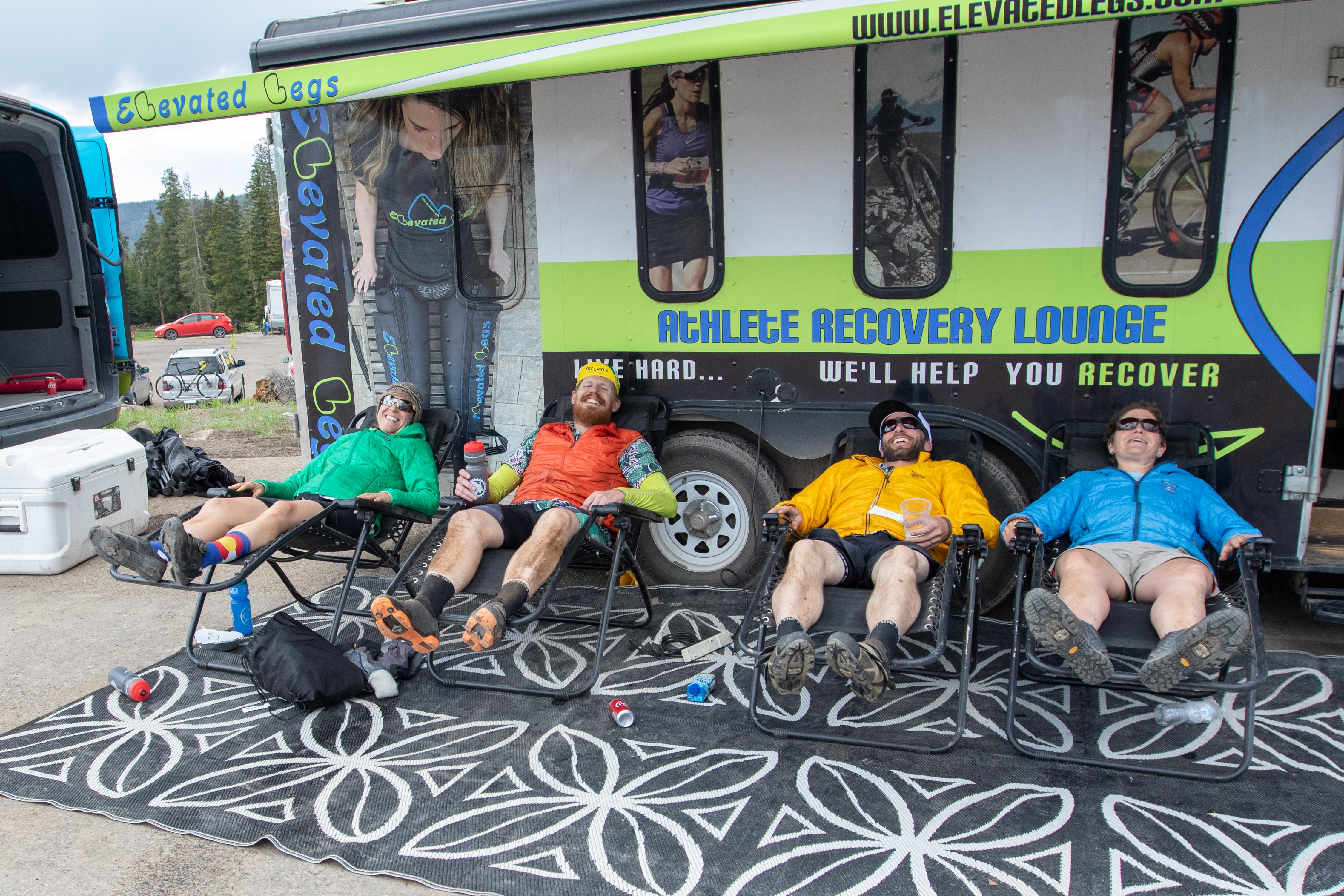
Ryan “Turbo” Barrett and Rob Smallman getting ready to crush the field at the 2019 Crusher in the Tushar. Unfortunately, the Tushars ultimately crushed them. Photo: Angie Harker.Race Announcer Bruce Bilodeau dons one of his many costumes for pre-race call-ups. Photo: Angie Harker.Utah favorites TJ Eisenhart and Jamey Driscoll having a little pre-race chat. Photo: Angie Harker.Tiffany Swindlehurst stands atop the podium with some of the many volunteers who make the Crusher a success every year. The volunteers are the true champions of this event. Photo: Angie Harker.Announcers Bruce Bilodeau and Ali Goulet do a great job keeping the crowd at the finish line entertained while waiting for the racers to come in. Photo: Angie Harker.A young fan rings a cowbell at the finish line. Photo: Angie Harker.Erik Harrington, winner of the 40-44 age group and the first age grouper to finish. His time would have placed him 15th in the Pro/Open field. Photo: Angie Harker.18-year old Andrew Conover pops a wheelie coming across the line to win the 29 and Under age group. Photo: Angie Harker.“I got a fever, and the only prescription is more cowbell!” Photo: Angie Harker.Pro Men’s Podium. Photo: Angie Harker.Pro Women’s Podium. Photo: Angie Harker.Sometimes it’s about the goats. Photo: Angie Harker.Sometimes it’s about the post-finish Coca-Cola. Photo: Angie Harker.Sometimes it’s about puppy kisses. Photo: Angie Harker.Sometimes it’s about a post-race nap … Photo: Angie Harker.… or putting your legs up, and laughing with friends. Photo: Angie Harker.Sometimes, even when you’re the last rider on the road like Josh McCarrel, it’s about finishing your ninth consecutive Crusher in the Tushar … Photo: Angie Harker.… and the hug waiting for you across the line. Congratulations Josh. You make us all proud. Photo: Angie Harker.
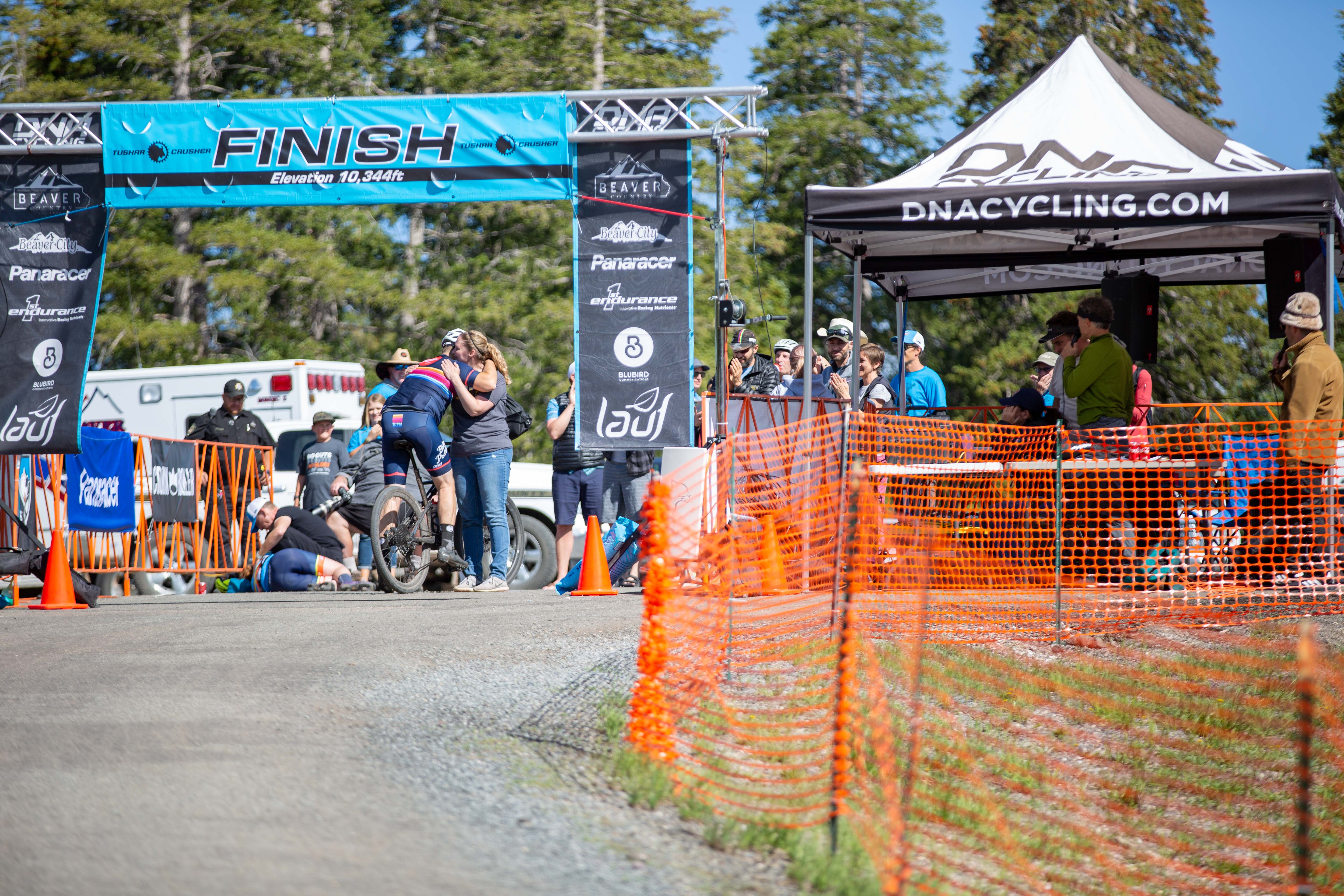
Beaver, Utah (July 13, 2019) — More than 600 riders, including a number of current and former U.S. professional national champions, descended on Utah’s Tushar Mountains for the ninth annual Crusher in the Tushar gravel race. 69 miles and 10,500 feet of climbing later, after one of the fastest races to date it was professional mountain bikers Alex Grant (Gear Rush) and Evelyn Dong (Pivot-Stan’s No Tubes) who crossed the finish line first ahead of their respective Pro/Open fields that were particularly stacked this year with notable road cycling talent.
[Editor’s Note: Tim LeRoy at the Lyman Agency contributed to this report.]
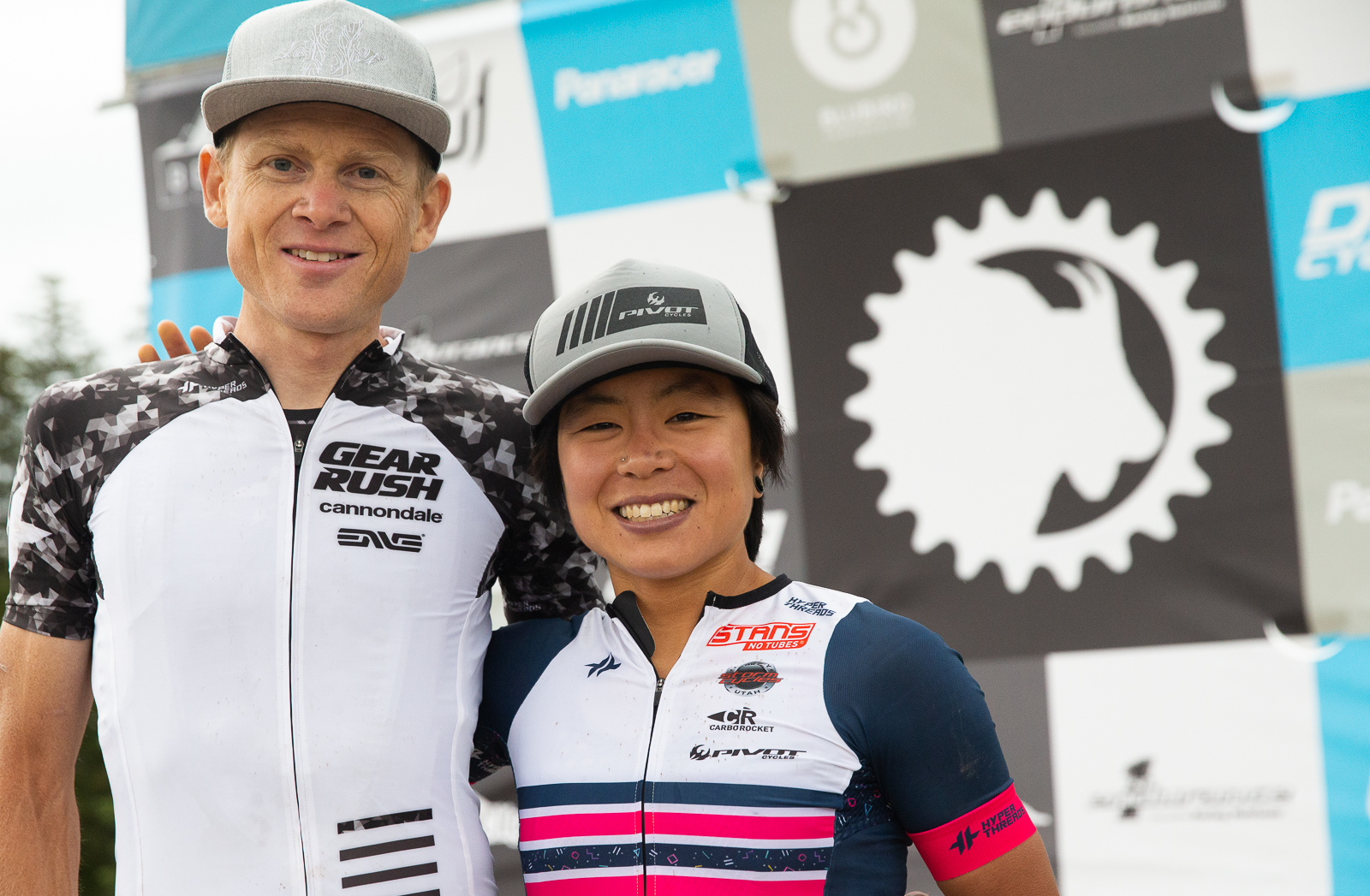
Your 2019 Crusher in the Tushar winners. Photo: Cathy Fegan-Kim
Those fields included recently crowned U.S. national road champions Alex Howes (Education First Pro Cycling), Travis McCabe (Floyd’s Pro Cycling) and Lance Haidet (Aevolo Cycling) and perennial favorites Alex Grant (Gear Rush) and Jamey Driscoll (DNA Cycling-Mavic), along with 2018 winner Zach Calton (Summit Bike Club) and three-time winner Rob Squire (Hangar 15). The women’s field was also stacked with talent including Team Tibco’s Laurens Stephens and reigning “Queen of Kanza”, Amity Rockwell, along with Hanna Muegge and Amy Charity, both of whom race for the Utah-based DNA Pro Cycling Team.
Pro-Open Men’s Race
LeRoy Popowski (Juwi Solar) went for the early flyer as has been his style every year that he has done the race, along with Noah Granigan (Floyd’s Pro Cycling) and Mat Stephens (Panaracer), opening a good gap on the rest of men’s field by the time they reach the top of the first climb at Betenson Flat.
The main contenders stayed together for the first climb, but the group started to splinter on the descent of the Col d’Crush, reeling in Popowski and Stephens in the process. By the time the riders reached the pavement at the bottom of the Col d’Crush descent into Junction, there were several groups on the road.
Once the leaders hit Circleville, the various lead groups had merged back into one large group heading onto Doc Springs Road, also known as “the Sarlacc Pit”. Through the Pit, riders dropped out of the group one by one, until there were only six riders still together making the turn back onto the Col d’Crush for the climb: Alex Grant, Alex Howes, Eddie Anderson (Axeon-Hagens Berman), Zach Calton (Summit Bike Club), T.J. Eisenhart (Araphoe-Hincapie), and Lance Haidet (Aevolo).
Once again, the men’s race came down to the aptly dubbed “Col d’Crush”. Just after the climb started, Haidet and Eisenhart were dropped. Shortly thereafter, Driscoll was also gapped off the lead group but managed to keep them in sight. Grant launched the decisive attack about halfway up the 2500 ft. climb, dropping fellow leaders Howes and Anderson.
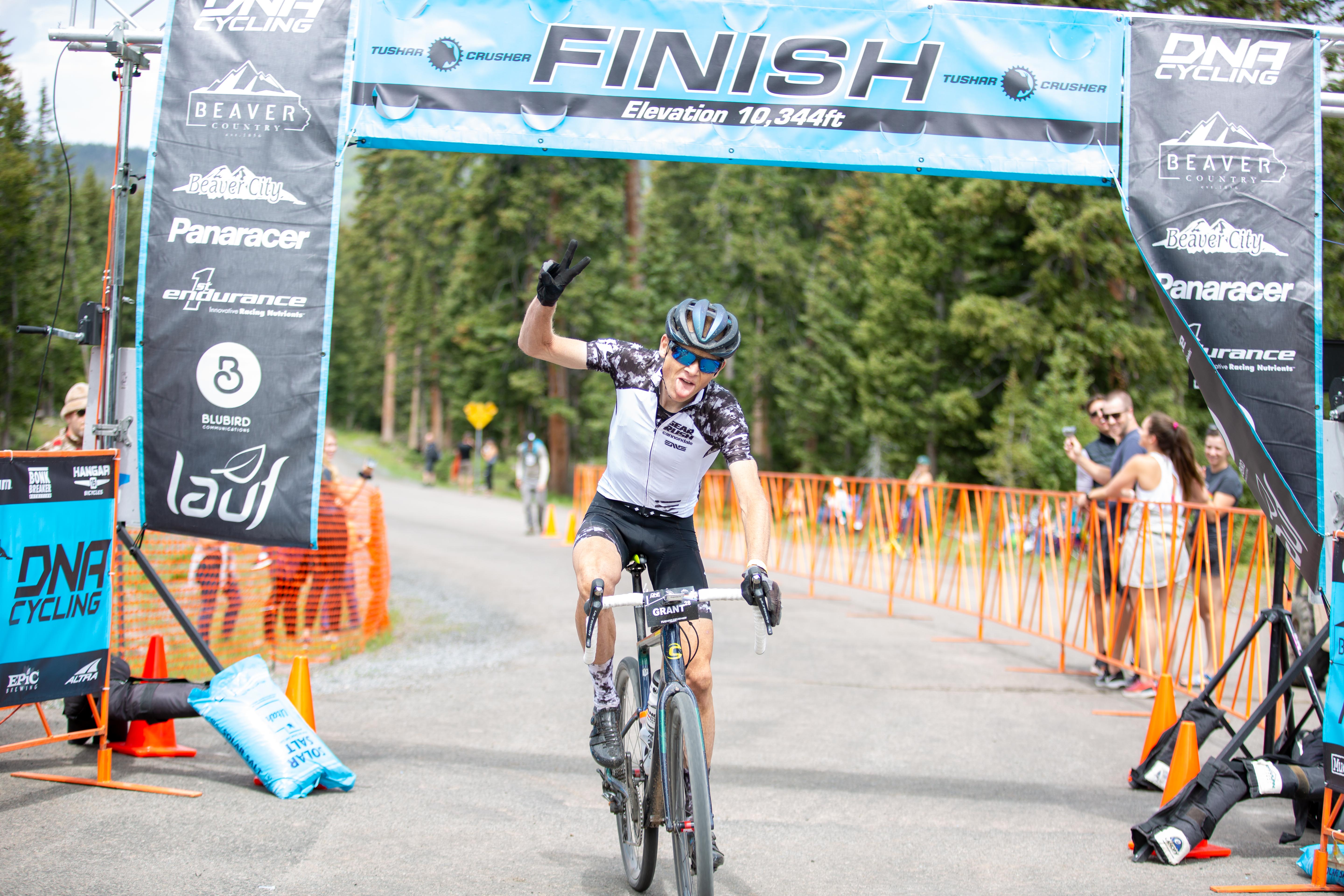
Alex Grant crosses the line officially, after originally going up the wrong side of the fencing and having to backtrack. Photo by Angie Harker.
39 year-old Grant, a stalwart of the US professional mountain bike scene, sealed the deal on the Col’s steep upper switchbacks, opening up a lead of more than a minute and a half at the KOM/QOM line. Still 13 miles and several climbs from the finish line Grant continued to twist the knife, coming across with a finishing time of 4:15:08, after initially going up the wrong side of the finish chute fencing, and having to backtrack to officially cross the line, some three minutes before Eddie Anderson (in 4:18:08) and with Howes a further minute adrift in 4:19:19.
Rounding out the 5 rider podium was James Driscoll in fourth, and Zach Calton in fifth.
“Two years I’ve done [the Crusher] I’ve had flats, two years I’ve had catastrophic bonks, and last year I had a pretty good year,” said Grant. “This is my sixth time racing, and I finally got the win. Honestly, this was like a dream, like ‘maybe I’ll win the Crusher someday, maybe not.’ I’m so pumped to win it, it was a super-fast day out there, tons of strong riders.”
“That was a war of attrition all day. Lived up to expectations would be an understatement, I think it exceeded them for sure. It was really hard, doing 10,000 feet of climbing in really only two climbs is no joke, said Anderson. “On the last climb of the Col d’Crush, Alex (Grant) & Alex (Howes) sort of rode away from me and I knew I couldn’t hold that tempo so I just rode my own pace, and eventually bridged back up to Alex (Howes), and just kept throttling it to the finish.”
“Oh man, it was tough,” said freshly-crowned U.S. road champion Howes. “I was down at sea level before this, so coming back [to altitude], at the bottom of the Col d’Crush, I was feeling like a real champion, and then we hit a certain altitude and I just detonated. I’m actually pretty surprised I held on for third. It’s a funny thing at altitude, it’s like a bad dream. You just watch people ride away, and there’s just nothing you can do. Hats off to Eddie and Alex, both of them rode great.”
Pro-Open Women’s Race
The women’s race took shape when Lauren Stephens, who set a blistering early pace, latched on to the Pro Men’s group as they passed the women’s field, and stayed away for most of the day.
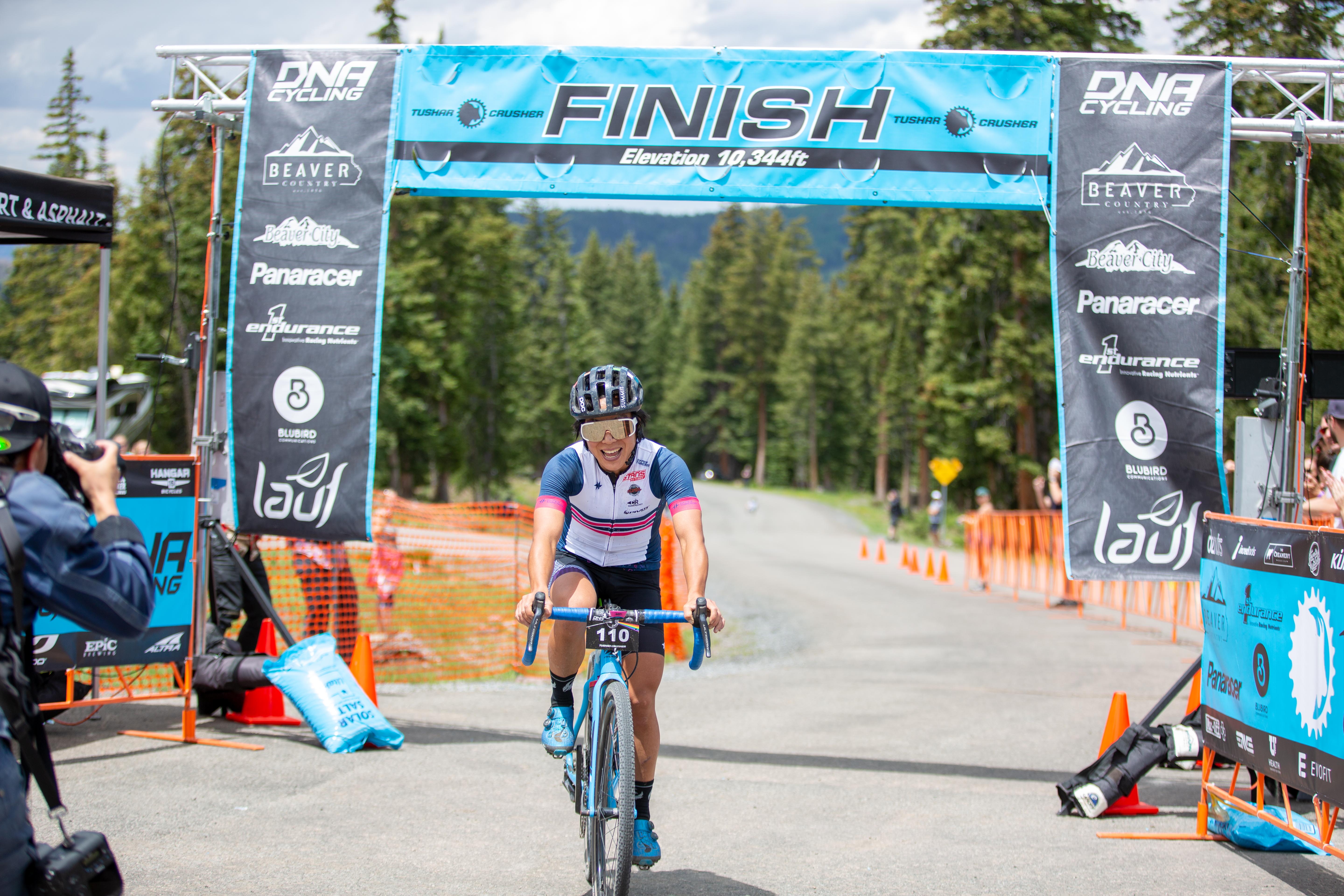
Feeling the efforts of her early work, Stephens started fading back just after cresting the race’s notorious KOM/QOM. Stephens was eventually caught by Evelyn Dong after the final feed zone with 10 miles to go, From there, Dong cruised to the win, opening up an eight minute gap over the course’s final miles, to finish in 5:02:14. Stephens had done enough to secure second in 5:10:18, with Sarah Max (Argonaut-ENVE) following in third, three minutes later in 5:13:27.
Rounding out the women’s podium was Amy Charity (DNA Pro Cycling Team) in fourth and Aimee Vasse (Blue Factory Team) in fifth.
Evelyn Dong (Pivot-Stan’s NoTubes) crosses the line in 5:02 to take the women’s race in her first attempt. Photo by Angie Harker.
“I definitely didn’t expect to win coming into this, having never ridden this course before,” said Dong. “It’s my first time. A lot of my training is like this, high altitude riding, this is what I love to do. In that sense, this pretty much feels like home.”
“It’s an absolute honor and thrill to have some of the country’s top pro riders add the Crusher to their schedules,” said race founder and director Burke Swindlehurst after the race. “But what really fills me with pride and gets me emotional is seeing the weekend warriors–some of whom walked many of the climbs–come across the line hours after the pros have finished. I have crazy respect for anyone who crosses that finish line, and it’s seeing those folks achieve their goals that is the most rewarding part of this job.”
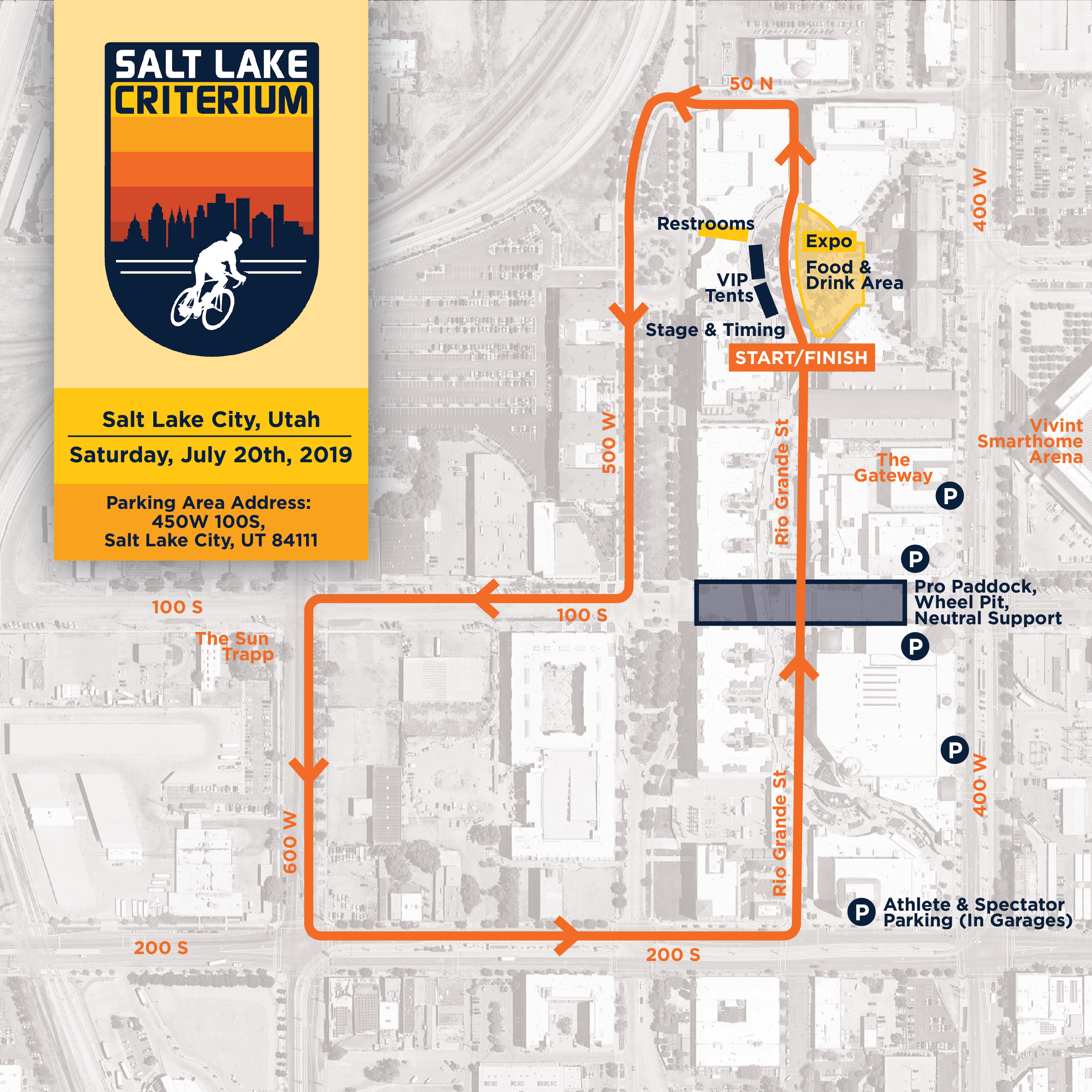
PRESS RELEASE – SALT LAKE (July 9, 2019) – The inaugural Salt Lake Criterium will roar through The Gateway and surrounding neighborhoods on Saturday, July 20, 2019 from 1 until 9:30 p.m. The race course will provide big excitement for the bicycle racers and spectators alike with world-class and local favorite competitors lapping a fast-paced, short 1.1-mile multi-circuit through downtown Salt Lake. This is the first time USA CRITS Series, the premier cycling series in the United states, is bringing the race to Salt Lake.
The Salt Lake Criterium is a crowd-pleasing cycling race featuring the top criterium (or crit) racers in the world and local amateurs, spectacular viewing areas from above and a beer garden and festival area around the start/finish line near the Olympic Legacy Plaza. Ample parking is available, but everyone is encouraged to take public transportation. The Gateway has two easily accessible TRAX Stations.
America has a rich history of criterium racing, a unique form of cycling that stresses high-speed races contested amidst a thriving urban atmosphere. Criteriums are the most spectator-friendly and enduring form of bicycle racing in America. Locally originated events combine the highest levels of cycling with community gatherings and street festivals, while showcasing some of America’s most vibrant downtown districts.
“The last time a professional criterium of this level came to Utah was in 2014 and 2015 during the Tour of Utah Women’s Edition, an event for professional women criterium racers,” said Eric Gardiner, Salt Lake CRIT race director. “The Salt Lake Criterium will feature pro men and pro women’s fields with equal prize money ($7,500 each).”
Twenty of America’s elite men’s and women’s cycling teams from 14 different states have been invited to participate as USA CRITS D1 teams. The nationwide series offers a season ending prize purse for teams and individuals while streaming all the races on usacrits.tv.
Local professionals include Park City resident, Katie Clouse who at the age of 17 has 26 national championships in road, mountain biking, and cyclocross. This year she placed third at the Athens Twilight Criterium, which is one of the longest standing criterium races in the US and part of the USA CRITS series. She races for the locally based DNA Pro Cycling Team.
AJ Turner, another Utah resident and employee of Ogden-based ENVE composites will be featured in the men’s professional race that starts at 8pm, riding for the Team Clif Bar Cycling. AJ Recently won the Utah State Criterium Championship held at Sugarhouse Park in May.
“We are so excited to welcome these elite riders and our local favorites to The Gateway,” said Jacklyn Briggs, marketing director. “It’s exciting to host this caliber of race and The Gateway is the perfect space to do it, with its multiple viewing areas from the upper or lower level, there is no better place to see and feel the excitement of a crit race.”
Sponsors: Returning to support the Series for 2019 is Bikereg.com, the official registration and results partner, as well as Specialized and Colavita. New industry sponsors include Jakroo, Feedback Sports, and DeFeet.
Local Sponsors: Visit Salt Lake, DNA Cycling, Rotor Bike, Kuhl Clothing, Your Favorite Bartender, Markosian Auto, ENVE Composites.
Fire, Water and the Solar Eclipse: Bike Touring North Central Idaho.
By: Louis Melini
Lou and Julie Melini on one of their many bike tours. Photo by Robin Perkins
Ketchum, Stanley, Salmon, & McCall are some of the better-known towns that encompass North Central Idaho. I have written about Idaho bike travels (Mountain Bike Hot Springs tour) and Idaho tours have been ridden and reported in Cycling Utah/Cycling West recently by Tom Diegel and Roger Crandall. The residents of Idaho should be very familiar with people traveling on bikes and for good reason as the riding and scenery is great. There are also enough towns and services to keep traveling cyclists supplied and lodged.
Planning
For this 13-day road trip, Julie and I joined 4 others, her first extended tour with a group. Katie Slack and Rusty Gardner were the trip planners doing another remarkable job of planning. I fondly remember the Yellowstone trip I did with them 3 years ago. Robin Perkins was the group photographer and Kevin Earl led the way with his strong riding capability. Kevin rode 67-miles (with loaded panniers) by noon to secure the last 2 sites at a forest service first come/first serve campground.
The solar eclipse is coming! The solar eclipse is coming! Katie and Rusty wisely changed the dates of the trip early in their planning to avoid the potential of crowded roads and campgrounds. The locals weren’t sure what to expect, but they knew there was going to be a lot of people. One campground owner had a request as far away as Japan. With everyone coming to that part of Idaho for the eclipse on the 21st of August, we had relatively calm roads during our travels from the 5th to the 17th.
To start the tour we drove to the Elk Mt. RV resort, about 4.5 miles west of Stanley. Ribs were the special at the RV park restaurant. Safely parking a vehicle at the start of a tour is always a challenge. The management allowed us to store the 2 vehicles there though the fee was $10/vehicle/day for a total of $260 for the 2 vehicles.
Stanley – Challis
The first morning of our ride gave us a surprise. We were used to the 70°+ morning temperatures in Salt Lake City but in Stanley, we awoke to a very chilly 32°. Wearing my full rain suit to stay warm, I had numb fingers and headed into Stanley to the breakfast café. The weather warmed after breakfast, but I didn’t take off my long sleeved jersey until well after lunch. On this first day of riding we followed route 75 downstream along the Salmon River throughout the day for a relatively relaxed 62 miles. Challis was the destination, a small town with 2 grocery stores & a couple of restaurants within walking distance of the campground.
Challis – Salmon
The morning of our 2nd day was thankfully warmer than the first. Above us, the skies were hazy from the fires to the north. We heard rumors of evacuation warnings further along our planned route, but that was the extent of the fire concerns. We were unsure about the level of smoke we would hit. It turned out that our ride north on route 93 out of Challis was clear of smoke except for some lingering haze above us. We again rode downstream along the Salmon River through scenic canyons to the Century 2 campground and RV park in Salmon. The small town of Salmon is very nice. It seems to be trying to become an outdoor recreation town; it just hasn’t turned the corner yet. Following rivers downstream was a great way to start the tour as our average miles/hour was 13.6 and 12.9 for the first 2 days of riding even with the mild to moderate headwinds we had most of the time.
Salmon – Darby
Day 3 was our challenging days as we had 76 miles to ride including over 3500 feet of elevation gain over Chief Joseph pass, most of it during the final 6 miles of the steady 26-miles of uphill. The road had a number of switchbacks, making the ride to the top tolerable. With 50 miles of downhill to Darby we thought the afternoon would be easy. A very strong headwind during the final 30 miles cooked us. Forming a pace-line during a tour is not always a great idea, but it was essential on this day. We rolled into Darby, Montana 6 hours and 45 minutes (of riding time) from our morning start.
Darby – Lolo
Upon leaving Darby the next morning, the group rode Hwy 93 and the adjoining bike trail to Hamilton. Julie & I however, took an 8-mile detour on a side road, 5-miles of it being packed gravel that was devoid of traffic and very scenic. This side road took us to the bike trail south of Hamilton where a second breakfast was calling.
After that breakfast we hopped back on the bike trail on the sidewalks of Hamilton then on the separate bike path as we exited town. The bike path is only about 30 feet or so adjacent to Hwy 93 but a pleasant alternate to the highway shoulder on our ride to Lolo, Montana. Lolo has changed from my first trip through town as part of my cross-country ride in 1975. I remember it as a small town. It just so happened to be the 4th of July. Somehow I ended up riding at the back of the parade with my loaded touring bike.
Lolo – Lochsa Lodge
Our destination for the night was about 3 miles west of Lolo, Montana; the Lolo Dance Center RV Park. The Lolo Peak fire was centered near this area but one would not know that with the skies rather clear compared to previous days. However, about 10 days or so after our stay at this campground, route 12 was shut down and parts of the area were evacuated due to the fire. Within the confines of the campground I had my only flat tire, and the only one of the group during the tour.
Day 5 was a short 43-mile day, but it started with a climb over Lolo summit followed by a long downhill. We ended the day at Lochsa Lodge crossing or following a multitude of streams and rivers. We camped at a Forest Service campground next to the Lodge. The Lodge is isolated from any services but for us it provided food and a place to buy a shower.
Lochsa Lodge – Lowell
Kevin Earl received the “great effort” award on day 6 for his herculean ride to Goose Creek Campground in the very, very small town of Lowell. Julie and I averaged 15.6 mph for this mostly downhill 68-mile day. Kevin, however, reached the campsite and reserved the final 2 sites more than 1.5 hours ahead of us. He chased off a multitude of cars that asked if he was staying or leaving. The campsite is popular as it has a nice “beach” along the river that our group took advantage of.
Lowell – Grangeville
Day 7 was 19 miles shorter than day 6 but it took us 11 minutes longer on this day. We had a long steady 5-6% grade to ride followed by a series of short hills to tackle before arriving in Grangeville. Julie and I pack riding clothes for 4 days so this being the 4th day of riding since our riding clothing was last cleaned, we were excited to have a full service campground to do some needed laundry.
Grangeville – Riggins
Riggins was our destination for day 8. We rode into town with the skies cleared of smoke. We were able to bypass nearly 20 miles of hwy 95 by detouring on Old Hwy 95, a road without trucks and very low traffic in general though with scenery changing to very dry vegetation. This was one stretch we did not ride along a river. We climbed up and then had a spectacular view of the area before racing down the switchbacks to reconnect with the real Hwy 95 and another branch of the Salmon River and a host of rapids. A few miles before we entered town we had to take a break. Eagle eyed Kevin had spotted blackberry bushes, specifically one large patch near the road but on a rather steep slope. Julie and I ate handful after handful for quite some time though I was the one with scratches up and down my arms and legs. The berries were huge!
Riggins – McCall
Rain! Whoopee it rained today! The rain was a bit annoying but refreshing. By noon it stopped and so did we to eat at Subway before the final push to McCall and the dreaded Route 55. Until now, the quality of the road shoulder that we rode on was OK throughout our ride, some areas better than others but we usually had a tolerable width of shoulder to ride on. In addition, traffic had been extremely friendly throughout our ride. Route 55 changed that as we endured the 10 plus miles into McCall on Route 55, as there are no alternative side roads. Julie and I had no problems but one or 2 in our group had a couple of cars squeeze past on a section of road without a shoulder and serious erosion of the road itself.
McCall Rest Day
McCall was a layover day for us. Half of the group stayed in a timeshare condo that Robin was able to acquire while Katie, Julie and I decided to keep the reservations that were made for Ponderosa State Park, a true gem of a state park. If you ever go to McCall make Ponderosa your destination, but be sure to make reservations well in advance. Julie and I did a 3-hour hike within the confines of the park coming within 10 feet or so of a grazing deer that seemed not to care that we were walking past. I also got to enjoy watching a deer graze in our campsite from the comfort of my camp chair. I have mixed feelings about the town of McCall. I was given a chainring bolt that managed to come loose and fall off Julie’s bike at one bike rental place. The owner was friendly and didn’t seem to be rushed. On the other hand, I went to 2 outdoor stores, one being a bike shop, in search of a canister of fuel. Both sent me to May’s Hardware that turned out to be the name of the owner of the Ace Hardware branch in McCall. The first 3 employees I asked didn’t have a clue as to what I was asking. The 4th employee knew what a backpacking stove was and the required canister fuel but said they didn’t sell it. I mentioned that it could be a problem as outdoor oriented stores were sending customers to them in search of fuel.
McCall – Crouch
Riding out of McCall was much more pleasant as we spent 18 miles on side roads and trails south of town. At this point, traffic was lighter and we rode into the small town of Cascade for lunch and where I was able to purchase a fuel canister at the True Value hardware store from a knowledgeable sales clerk. Leaving town, the group stayed on 55 but Julie and I left 55 for on an 8-mile side road, half of it being dirt with many sections of washboard. It was slow but also nice to have a short respite from traffic on this 80-mile day. We followed the Payette River for most of the afternoon ending in Crouch, a town in need of a quality campground.
Crouch – Bonneville Campground
Our final full day of riding and camping was only 45 miles following the south fork of the Payette River to another Forest Service campground. This campsite, as opposed to the Lowell forest service campground, had several open first come/first served, (non-reservable) campsites. The campsite we picked was large enough for our group to spread out the 5 tents. The campground was noted for hot springs that provided us a soothing and relaxing bath. It was a nice, relaxing day.
Bonneville Campground – Stanley
Our tour of North Central Idaho was over on the 13th day with a mere 36 miles to ride back to Stanley. This was not as easy as it sounds as the day started with a nearly 3000-foot elevation gain up and over Banner Summit. After a brief R & R at the summit we glided the rest of the way to Stanley aided by a 1200-foot descent.
Overview
If you like rivers, this is the trip for you as we followed rivers nearly every day of our travels. We rode along 4 major rivers, the Salmon, Lochsa, Clearwater, and Payette, and their related forks. In addition we rode along several other creeks and streams, apparently too small to call a river.
We were a bit apprehensive due to the forest fires but fortunately the fires were not a factor in our travels. We did see multiple areas of burnt forest and grasslands during our ride. The only active flames we saw were large grassland fires on the drive up to Stanley.
The riding route was generally very good. There was an adequate amount of shoulder for the great majority of the route. Our initial concerns of no shoulders and lots trucks pulling trailers with rafts turned out to not be a factor. Traffic was very friendly though there were few instances of unfriendly driving reported by the group, mostly during the final few miles to McCall. The locals were very accommodating to us. We rode approximately 662 miles over 13 days and had 4 major summits to cross. It is a ride that I would consider doing again.
Kevin Earl on the climb to Grimes Pass. Photo by Robin PerkinsLou and Julie Melini on one of the bridges. Photo by Robin PerkinsLeft to right: Lou Melini, Robin Perkins, Kevin Earl, Rusty Gardner, Katie Slack, Julie Melini at Chief Joseph Pass on the Idaho-Montana border. Photo by Robin Perkins
In 2016, Bike Utah launched our Wasatch Bike Plan with a goal of every community in the four Wasatch Front counties (Davis, Salt Lake, Utah, and Weber), developing and adopting bicycle and pedestrian master plans (also known as active transportation plans). We started this campaign because our lives don’t stop at municipal boundaries and neither should bicycle routes. In order to make bicycling a reasonable transportation and recreation choice for everyone along the Wasatch Front, every community needs to be engaged. When this campaign was launched, only 13% of the communities in the four counties had adopted active transportation plans.
Over the course of this campaign, we worked with numerous partners:
Metropolitan planning organizations, such as Wasatch Front Regional Council and Mountainland Association of Governments provide technical and financial support in development of the plans.
County staff provide technical assistance and connections to communities interested in developing plans.
The Utah Department of Transportation, local health departments, municipal staff, bicycle advocates, and the general public contribute valuable insights so the plans are as comprehensive and useful as possible.
The Wasatch Front Regional Council recently announced the projects awarded funding in 2019. We are pleased to report that all of the communities that requested Active Transportation Plan Funding this year have received it. The communities are: Sandy, Draper, Millcreek, Midvale, Murray, Taylorsville, Holladay, Clearfield, Sunset, Syracuse, Clinton, and West Point.
This means that of the four counties that make up the Wasatch Front, 63% of the communities have a plan adopted or funded. 84% of the population in these 4 counties live in a community that now has a plan adopted or funded.
In the adjacent map, the GREEN communities have adopted plans and should be in the process of implementing them. The YELLOW communities have the funding to create an active transportation plan and are in the plan development process.
Here’s how you can get involved:
If you live in a community with an adopted plan, you can follow up with your community about what they are doing to implement the plan. Feel free to reach out to us at Bike Utah if you don’t know who to contact.
If you live in a community with a plan that is funded or in process, you can get involved in that planning process to ensure that it is meeting the bicycling and walking needs of your community. Feel free to reach out to us at Bike Utah if you don’t know who to contact.
If you live in a community without a plan, send us an email and we can help get the process rolling.
If you live outside of the Wasatch Front, we are still able to connect you to resources to get a plan going in your community. Send us a message.
The Youth Bicycle Education and Safety Training (BEST) Program is Utah’s only statewide effort to educate youth about riding bicycles. By getting more kids and their families riding, we are working to get people physically active, improving air quality, and making communities better places to live. In addition, getting physical activity each day even helps to improve academic performance among students.
The Youth BEST Program is a 5-hour, on-bike program that teaches students how to safely and confidently get around by bicycle. The program is administered at schools and targets students in the 5th to 7th grade range. The course takes place for one-hour per day over the course of five consecutive days.
During the Youth BEST Program, students will learn:
The benefits of riding a bicycle
Rules of the road
Helmet fitting
Bicycle safety checks
Navigating intersections
Right of Avoiding hazards
There is no cost for any school or student to participate. Bike Utah provides trained instructors, bicycles, helmets, and all other necessary equipment for the duration of the program. The program is mobile and can be brought to schools around the state. To date, almost 6,000 students from across Utah have participated in the program. They are increasing their knowledge of safe bicycling, their own interest in riding, and their families are more interested in riding as a result of their student’s participation.
Scheduling for the 2019-2020 school year is going on right now. If you know of schools or teachers who might be interested in having the Youth BEST Program at their school, send an email to [email protected]