Ever have those days where you feel like you are 90? I know I have. Everything hurts and it doesn’t ever seem like it will be ok again, but usually it is. But as we grow older it takes longer and longer to bounce back from injuries and those setbacks. That is why it is important, no matter your age, to get your body in a place where it is healthy enough to get through those injuries that will happen. Dwight Chapin, MD defines age by four factors: age, current level of physical fitness, nutritional health, and genetics. Two of those factors we can control, and it is important to focus improving those as we age. Dr. Chapin gives some tips 1) listen to your body. If you are in pain, figure out why. Often times we just turn off the fire alarm and don’t find out where the fire is. If you range of motion is terrible – work on it. Often, poor range of motion leads to other problems down the road. Also, find a clinician who can help with musculoskeletal problems before they become a bigger issue. 2) The body is made for motion. Exercise! Just get out and do something every day. 3) Lean muscle mass works for you. Not only does strength training help with muscles but it also makes your bones stronger. It doesn’t take a lot of weight either, find a program that works for you and stick with it. 4) Good exercise doesn’t have to be high impact. If running hurts too much, try swimming or biking. Find something that works for you and do it. The time for planning for the future is now, your body will thank you.
Wayne Hansen, D.C. is a Chiropractic Physician practicing at Solutions Clinic in Cottonwood Heights. He specializes in treatment of athletes, particularly cyclists. [email protected]
Alya Hopkins and Matt Passey of Salt Lake eBikes opened their shop in 2017. Their new shop is located across the street from Liberty Park and is one of the few shops to rent eBikes. When we asked Matt on why they opened the shop, he exclaimed, “They’re fun! And they just took off!” The shop sells Magnum, Eco, Yuba, and Faraday Bikes. They also convert regular bikes to e-bikes through installation of a conversion kit.
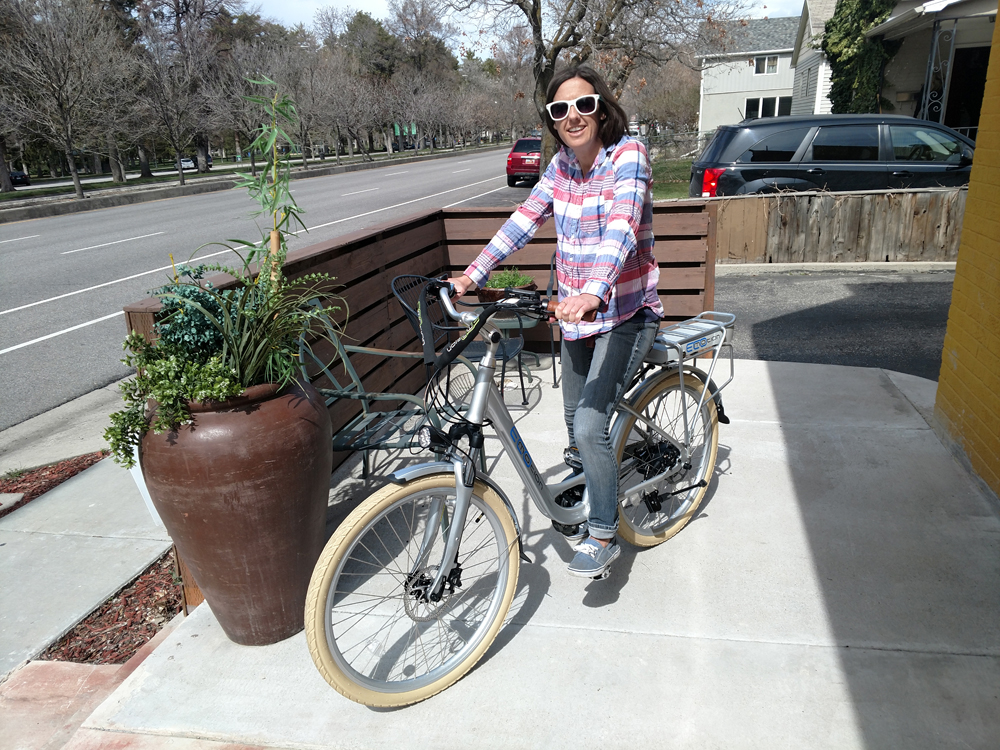
Alya Hopkins is an owner of Salt Lake eBikes. Photo courtesy Salt Lake eBikes
Cycling West recently interviewed them to ask them about current e-bike news and issues , and on their commuting experience with e-bikes.
Cycling West: The Wall Street Journal reported on March 24, 2018 on an 800-person study conducted by the University of Tennessee that stated e-bike owners rode (perhaps commuting) 3.6 days/week compared to 2.7 days/week by those riding conventional bikes. What has your experience been in regards to people purchasing e-bikes for commuting? Do you have clientele that have put away conventional bikes to purchase e-bikes for commuting? Does this transition represent a significant impact on sales?
Salt Lake eBikes: Yes, in fact one of our very first customers was commuting from North Salt Lake to downtown Salt Lake on a conventional pedal bike. He bought one of our electric bikes and hasn’t looked back. There have been other customers as well who have said they commute by bike already but would like to make their trip faster. It seems like most people who purchase an e-bike to commute have mainly been commuting by car or public transportation but recently discovered the possibilities with an electric bike.
CW: One of the arguments against e-bikes is speed and safety. The article quoted a New York City bike courier stating that e-bikes “typically reach 20-28 mph” with an “uptick in accidents involving e-bikes and pedestrians”. It is my understanding that e-bikes come in various “classes” and that Class 1 e-bikes typically are governed to have a maximum assist of 20 mph. Can you explain the various classes of e-bikes (assuming I am using the correct technology) and speeds relative to each class. What is the general trend with e-bike acceptance and speeds? What is legal in Utah and perhaps other states? At what point does and e-bike become a motor scooter?
Salt Lake eBikes: I can see the concern with e-bikes and pedestrians. In our business we haven’t personally seen anything. We do let our renters and customers know about bicycle etiquette and speed limits on bike paths. [Note: Municipalities in Utah may regulate e-bikes on sidewalks and paths]. Maybe there should be a statewide education course. There are avid bikers who are used to going 20 mph but you get the average biker who casually pedals then gets that power and they don’t necessarily know how to control that.
There are 3 classes of e-bikes designating their speed and whether pedaling is used or only the motor. Different states have different laws. The federal law defines an e-bike as not exceeding 750 watts or 20 MPH. Utah, however, defines an e-bike as a conventional bike not exceeding 750 watts and a max speed of 20 MPH (motor only), or 28 MPH (motor and pedaling) on a flat surface. [See Utah Code: 41-6a-102] Other than that I haven’t been able to see much research or new laws behind e-bikes. I’m sure they’re coming though. I know California has stricter laws with e-bikes.
CW: The argument against e-bikes included a discussion of batteries (3-year longevity was stated). What has your experience been with battery longevity and regular use by a bike commuter? Does this matter to the person that is achieving the benefits of an assist for their commuting needs?
Salt Lake eBikes: Batteries are surprisingly getting better, lasting longer, more powerful, and getting less expensive. If you’re using an electric bike as a commuter, just think of how much your saving versus driving a car. No gas, no oil changes, sure you have regular maintenance and the battery replacement after a few years but the cost is still lower than owning and driving a car.
CW: The New York Times (March 17, 2018) reported the confiscation of e-bikes by the city from delivery riders. The article pointed out that this was particularly harmful to older (40ish) immigrant delivery riders that needed to support their family. What are some of the Utah laws governing e-bikes? What constitutes legal? Are pedal assist bikes for delivery riders and pedicabs becoming more common in Utah? Could the New York situation happen here in Utah to delivery riders?
Salt Lake eBikes: Every pedicab [in Utah] is electric. You can’t really compare Salt Lake to New York. We have so much more space and less pedestrians. I’ve seen some delivery services starting to use electric and I honestly don’t know why more aren’t using electric. What happened in New York would not happen here for a very long time. We have so much more space than New York. We also don’t have as many “walking neighborhoods”. Most people get in their car to go to the store, take kids to school, and to go to work.
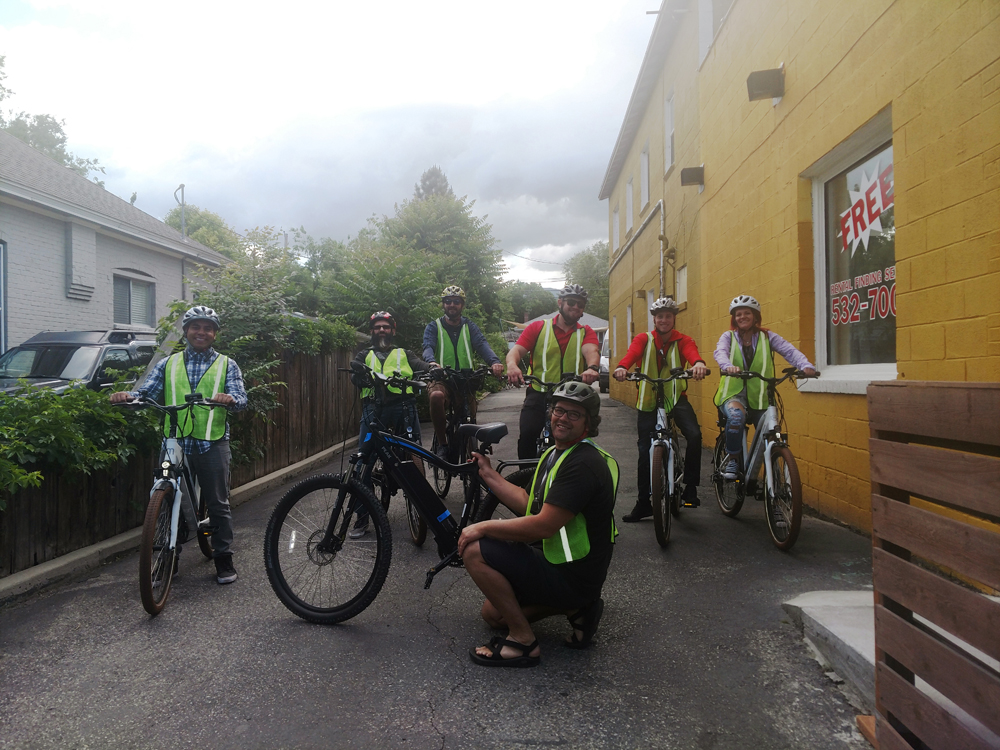
Matt Passey about to lead a ride for Salt Lake eBikes. Photo by Alya Hopkins
E-Bike Commuter Questions
CW: When did you first become interested in e-bikes and when did it become a business for you?
Matt Passey: 3 years ago I converted my Cannondale to electric. I started riding it every day and stopped using my car as much. I was excited in the morning to get out on the road on my bike. When my wife saw my enthusiasm for riding electric we started questioning why more people aren’t commuting on e-bikes. She started doing research in other cities and discovered Salt Lake was behind the times on the e-bikes movement. Most other major cities had several e-bikes rental shops and had tons of commuters on e-bikes. That’s when we decided to open up shop. Our city is beautiful and unique and what better way to explore it then renting an e-bikes. We also cringe at our air quality here in the valley. We do what we can to do our part in not contributing to it but it wasn’t enough. We thought if we could get even just a few people to ditch their cars and commute on an e-bikes then we have done good for our air.
CW: How much time do you save commuting by e-bike vs. a conventional bike?
MP: My commute is about 7 miles each way. I was not an avid biker before I went electric. If I were to ride a conventional bike it would take probably twice as long. Those bike lanes like on 7th East are where you can really open it up and get some speed under your belt.
CW: How would you compare your transportation choices such as running errands before and since using an e-bike? For example, do you use your car less now that you have an e-bike or have you downsized the number of cars that you (or your family) own?
MP: Errands are way more fun on an e-bike. If I get in my car and its nice outside i’ll start driving and I immediately regret not riding my bike. Sometimes I’ll turn the car around and go get my bike instead. So ya, I use my car way less now that I have an e-bike. We actually have downsized the number of cars in our family since I mostly use a bike.
CW: Are there any routine maintenance needs specific to e-bikes compared to a standard bike? For example is chain wear and tire wear more excessive and need replacing more than a standard bike. (I know, a “it depends” type of question but do the best you can).
MP: Not really, you have the big battery change after a few years other than that the brakes, the gears, the tires all wear about the same. I guess the only difference would be the maintenance comes quicker because you generally put more miles on the e-bike than a conventional.
CW: What would you suggest to a customer that comes to you for an e-bike? What are some of the questions you would ask that customer to assist them with e-bike choices?
MP: I would find out what kind of riding they want to do. My first question to them is “are you ready to have fun?” What’s your level of biking. You basically just listen to the customer about what they want, their capabilities, their restrictions and things like that.
CW: What are the demographics of your customers that come to purchase an e-bike to commute to work? Are they cyclists that previously used a conventional bike or are they previous non-cyclists that seek a bike with ane assist from a battery?
MP: Usually avid bikers. A lot of the times it’s people who used to bike and stopped for whatever reason and they’re looking to get back into it.
MP: (Question for himself) Why is the conventional bike community so critical of a pedal assist bikes?
MP: It’s all the same. We’re all bikers wanting to get outside, take on that trail, get some exercise, feel the wind in our hair.
Shop Information
Salt Lake eBikes
1035 S. 700 E.
Salt Lake City, UT 84105
801-997-0002 saltlakeebikes.com
If you have a suggestion for a commuter profile, especially from Idaho, Montana, Nevada, Wyoming, W. CO, and N. AZ, have a commuter question, or other comments, please send it to [email protected]
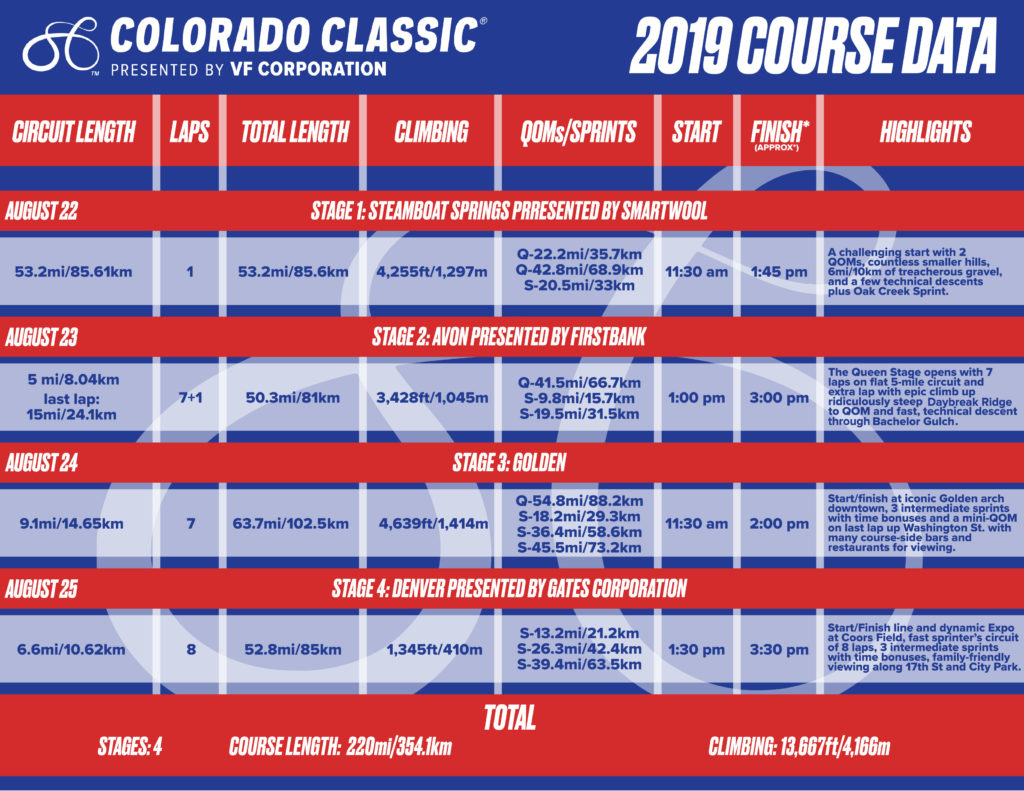
PRESS RELEASE (DENVER, CO—JULY 12, 2019) – The 2019 Colorado Classic® presented by VF Corporation (August 22-25) has released its most challenging course yet with a mix of tough mountain and swift urban circuit routes through Steamboat Springs, Avon, Golden, and Denver, organizers of the race announced today.
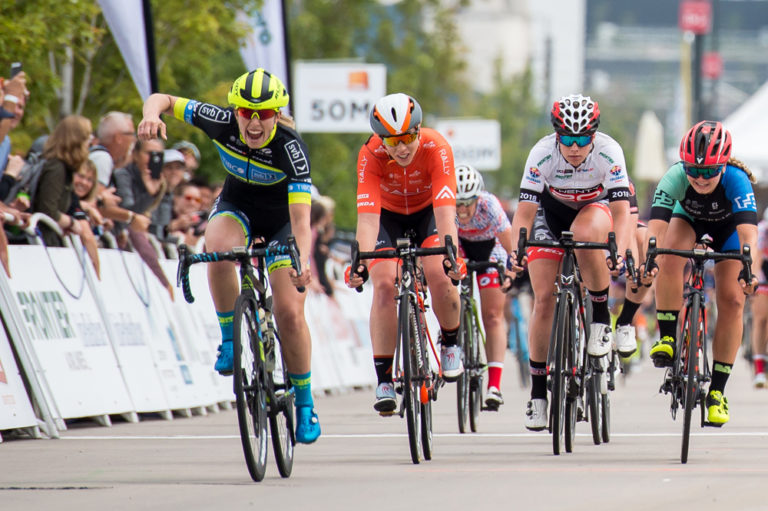
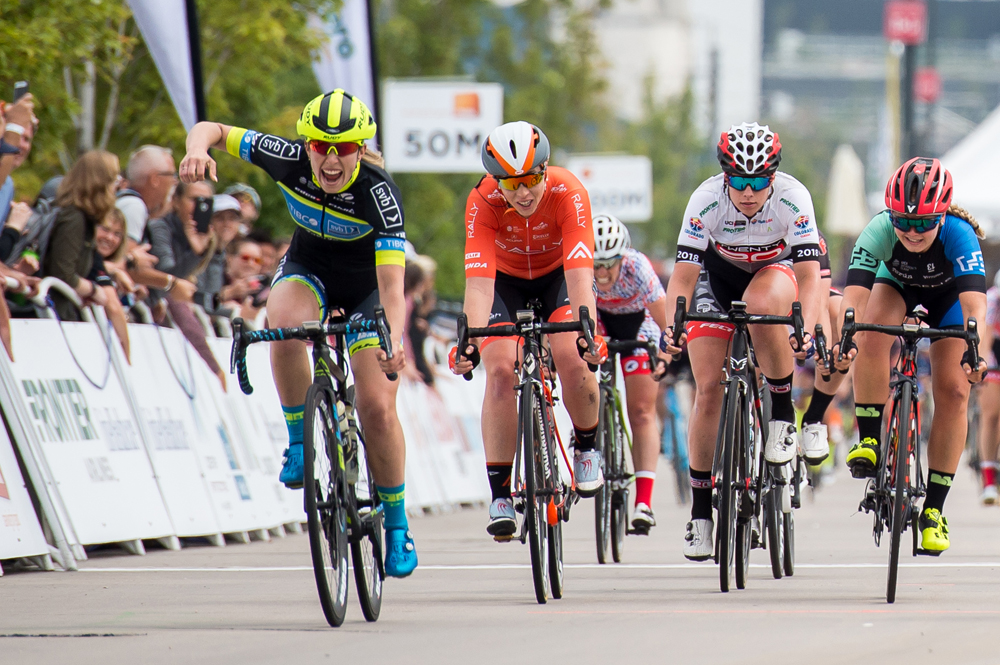
Jennifer Valente (Twenty20 p/b Sho-Air) raises her arm in victory after winning the bunch sprint to take Women’s Stage Four, a 4 lap circuit race around downtown Denver. 2018 Colorado Classic cycling race. Photo by Dave Richards, daverphoto.com
The circuit routes for the women’s-only pro road race will have something for every racer and fan, with high-altitude QOMs, breakneck sprints, six-miles of gravel, tight technical street racing and one of the most treacherous climbs in Colorado. The course will cover a total of 220 miles (354kms) with 13,667 feet (4,166m) of climbing while showcasing Colorado’s iconic terrain.
There will be a free Colorado Classic Expo near each host’s Start/Finish celebrating cycling, health, fitness, and women’s empowerment with a curated array of exhibitors, events, and food and beverage experiences.
“This will be, by far, the most challenging course we’ve had for the women’s Colorado Classic and this year’s route provides something for everyone,” said Sean Petty, Colorado Classic Race Director. “The courses offer two incredible days in the mountains, starting with over 4,000 feet of climbing in Steamboat Springs and a brutal climb will be featured before the finale on Stage 2 in Avon. And, we’ll have opportunities for the sprinters in Stages 3 and 4 in Golden and Denver.”
2019 Colorado Classic Routes
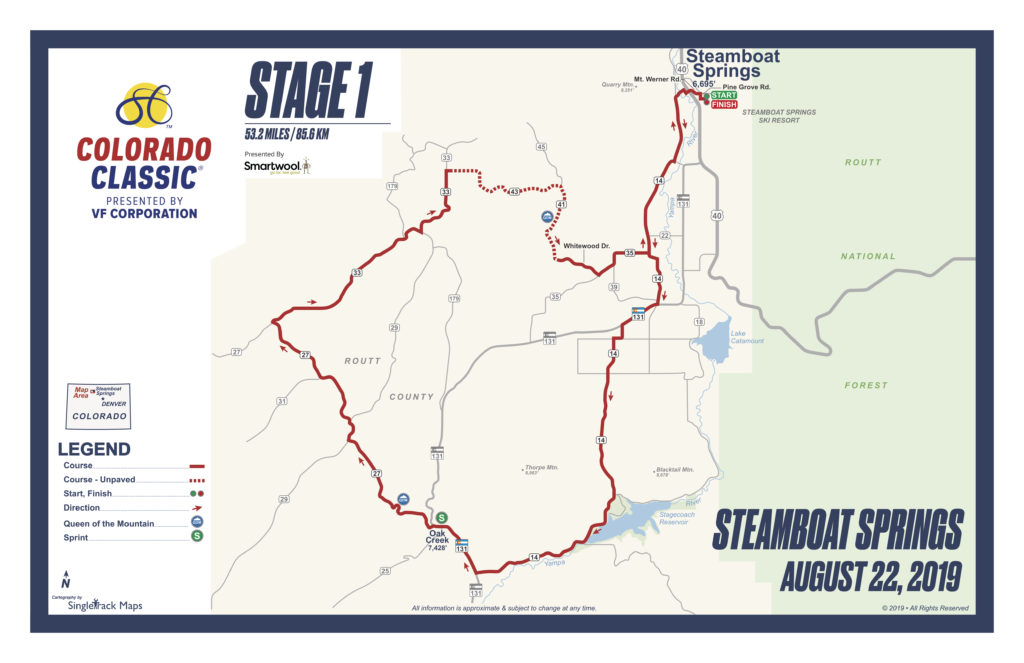
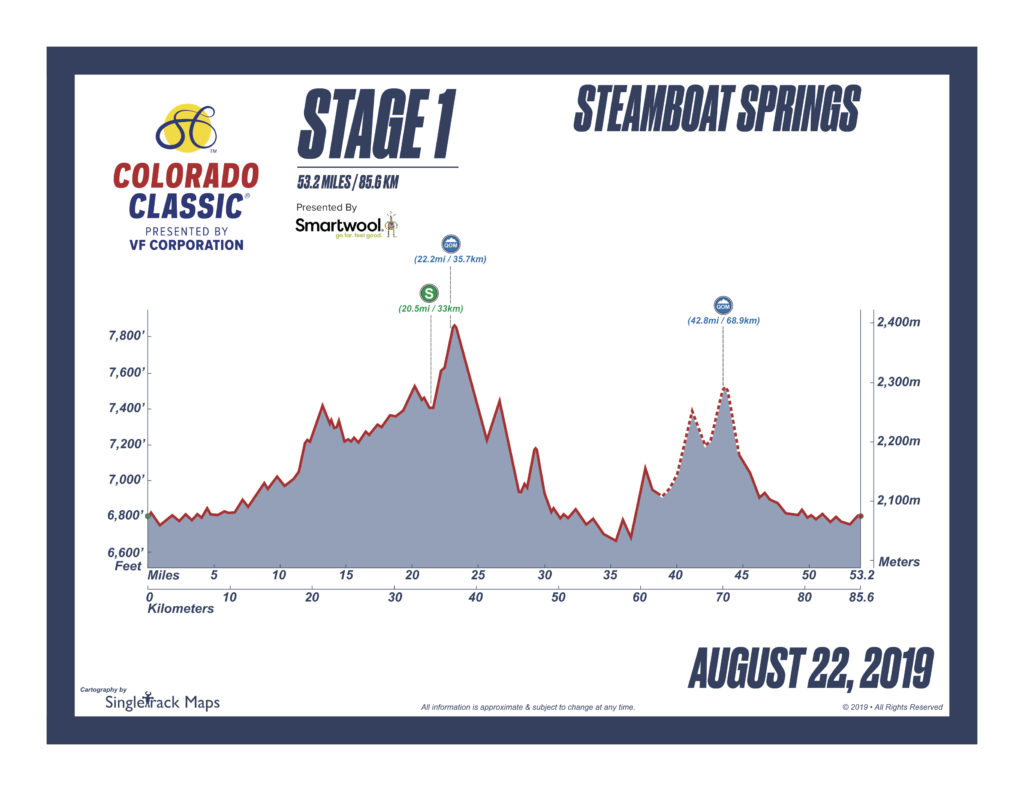
Stage 1 presented by Smartwool begins in northwest Colorado at Steamboat Springs on August 22 with riders tackling high-altitude climbing, six miles of exciting gravel and technical descents.
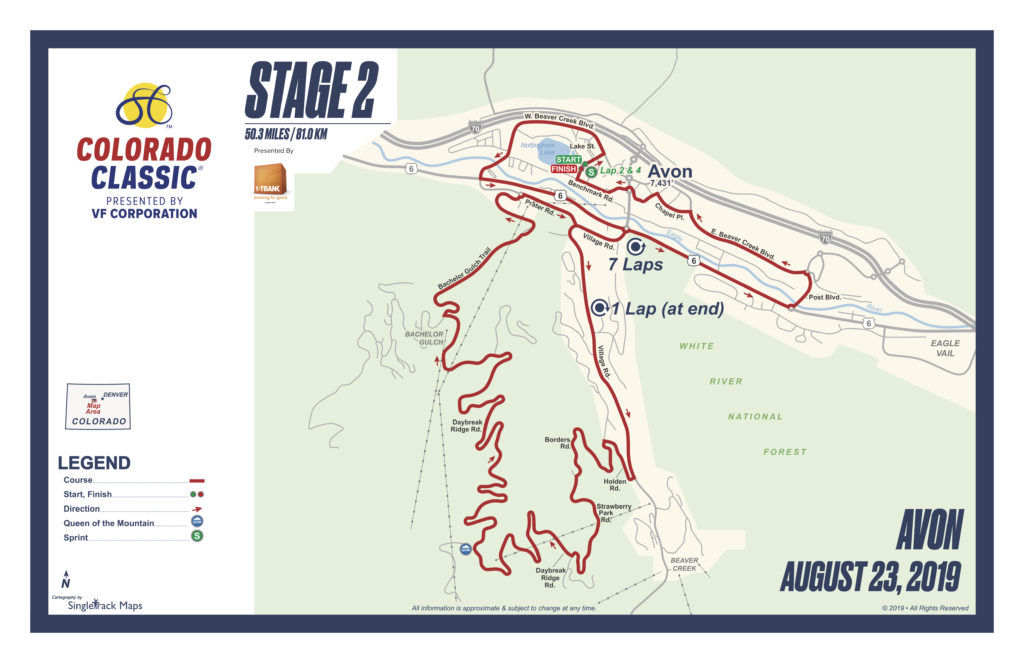
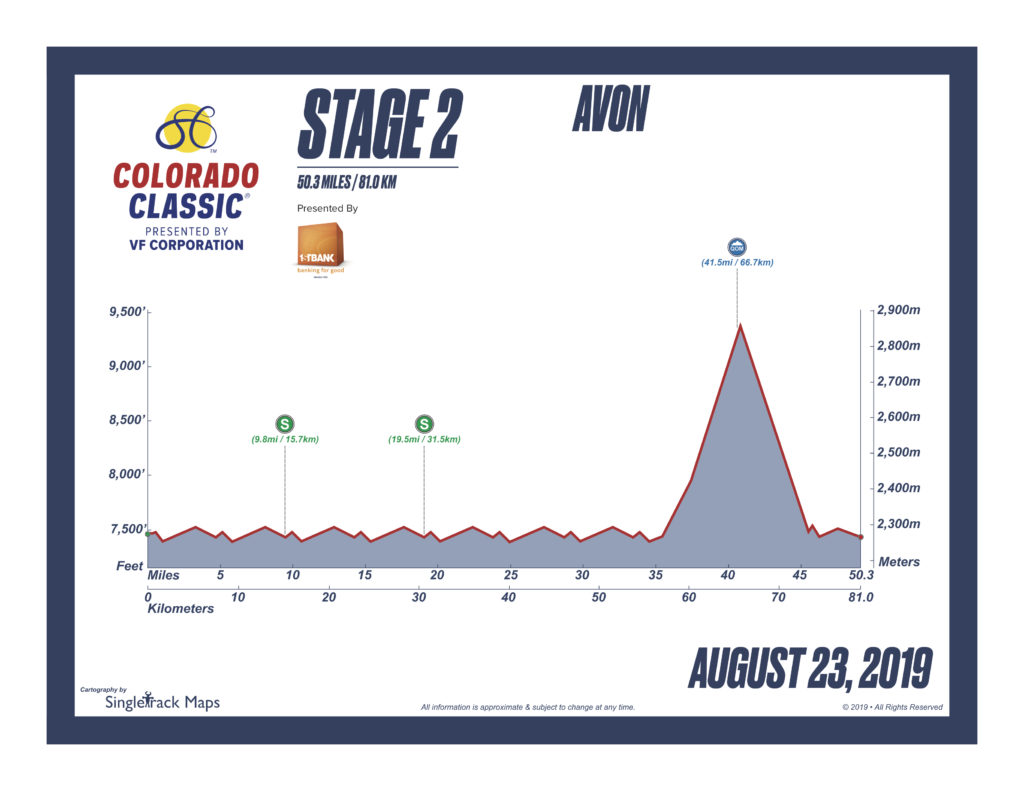
Stage 2 presented by FirstBank moves to Avon with seven exciting laps around town and then an extra lap with a brutal ascent up the infamous Daybreak Ridge in Beaver Creek. This high-altitude climb will be the decisive moment of the Queen Stage, as the field fights to the top before bombing back to town on a technical descent through Bachelor Gulch.
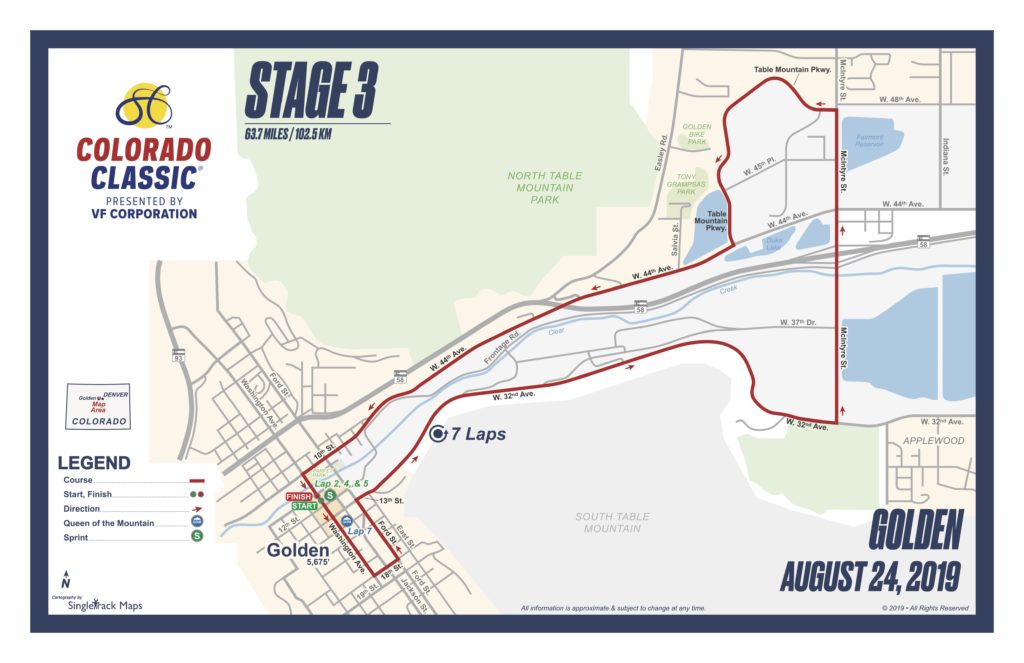
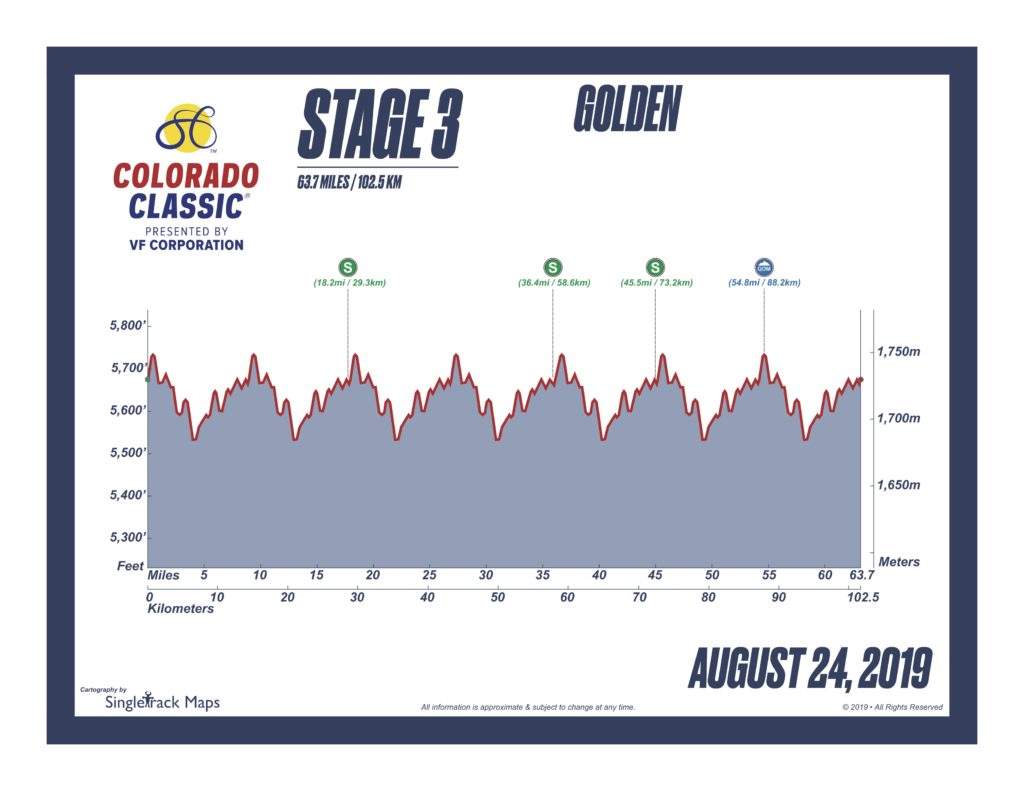
Stage 3 through Golden will feature three sprints and seven swift laps of a nine-mile circuit including a mini-QOM up Washington St. and a start/finish under the iconic Golden arch.
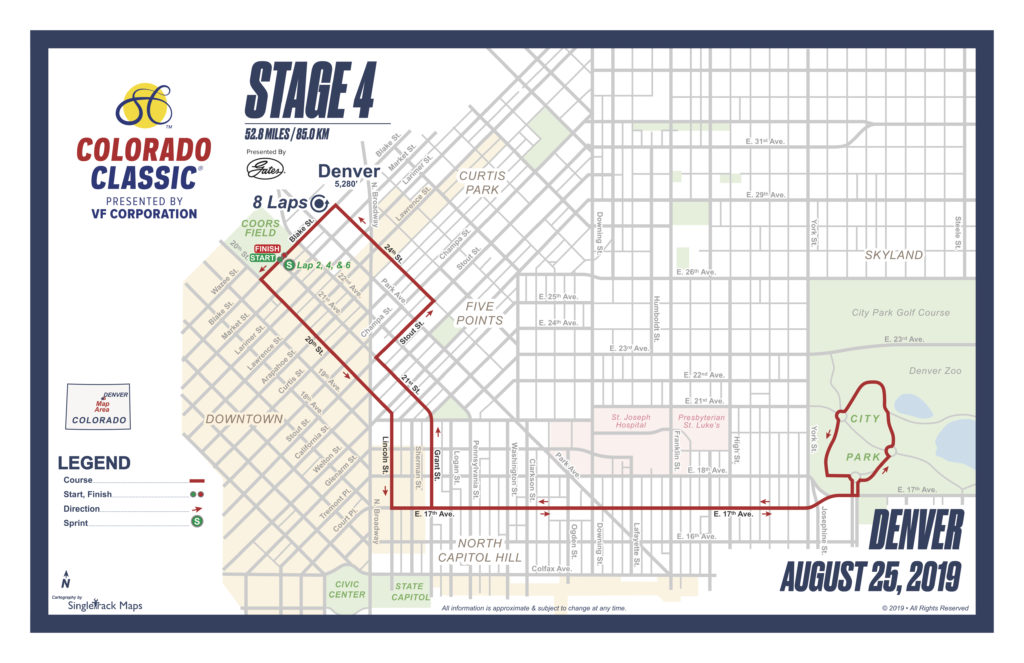
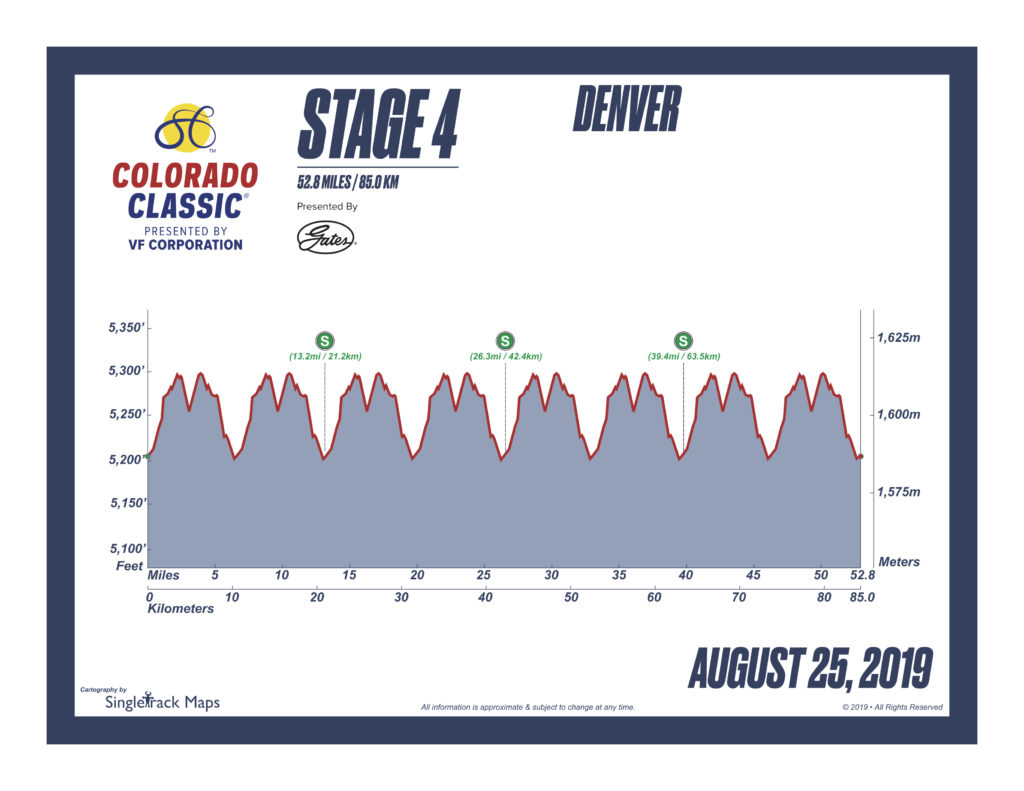
The Colorado Classic concludes on August 25 with Stage 4 presented by Gates Corporation, which features eight laps of a technical and dynamic circuit, starting and finishing in front of Coors Field in Downtown Denver and going through the perennially fan-friendly 17th Avenue and City Park.
Now in its third year, the Colorado Classic has attracted 16 world-class teams with 96 riders, representing its most international and competitive field yet with five international and four top-20 UCI women’s elite teams. The top-four domestic teams in USA Cycling’s Pro Road Tour rankings also will be coming to the race. Racers include WorldTour race winners, Olympians, previous Colorado Classic podium winners, collegiate champions and up-and-coming stars.
The standalone women’s stage race is on the Union Cycliste Internationale (UCI) calendar as a 2.1 race and is a USA Cycling Pro Road Tour race.
Stage 1 – Steamboat Springs presented by Smartwool – August 22
There will be no gentle opening for the 2019 Colorado Classic. With 2 QOMs, countless smaller hills, 6mi/10km of treacherous gravel, a sprint down Oak Creek and a few technical descents, this will be a rude awakening for many racers. The Steamboat Springs course shapes up as a grab bag that anyone can win. Can a climber get away on the short punch hills and hold an advantage? Can a sprinter hang on over the hills for a crack at the line? Or will a dirt specialist surprise everyone? Stage 1 of the race will have a start/finish at the Meadows Lot and will start at 11:30am MT.
Stage 2 – Avon presented by FirstBank – August 23
Stage 2, the Queen Stage, is really two stages in one. The opening 35 miles on a flat 5 mile circuit for 7 laps will run off fast and technical like a criterium. Then an extra lap of 15 miles will tackle one of Colorado’s most notorious climbs, the ridiculously steep Daybreak Ridge (fan accessible by bike or foot only). This climb up Daybreak Ridge through Beaver Creek to a QOM hits grades of 14%, and then features a fast, technical descent through Bachelor Gulch. Watch the best female climbers in the world, many in their native Colorado terrain. Stage 2 will have a start/finish on Lake Street near Nottingham Park and starts at 1:00pm MT.
Stage 3 – Golden – August 24
On paper, Stage 3 in Golden looks like a sprinter’s delight with three sprints and seven swift laps of a nine-mile circuit that starts and finishes under the iconic Golden arch downtown. But don’t be fooled as the short steep climb up the historic Washington Street is enough for a mini-QOM on the last lap, combined with additional rollers, adding up to over 4,000’ of vertical climbing. Look for breakaway attempts and sprint trains after the non-climbers have waited for two days to get on terrain that suits them. Stage 3 will have a start/finish on Washington St. and 12th and start at 11:30am MT.
Stage 4 – Denver presented by Gates Corporation – August 25
Pro racing returns to Denver for a third year on a course with some new and some traditional features. This sprint-friendly course sees the Colorado Classic move its Start/Finish line to Coors Field, but keeps the familiar highlights of crowd-friendly 17th Street and City Park. Look for fast racing with three sprints and large crowds as sprinters battle for wins and contenders for bonus seconds in the conclusion of the first women’s-only Colorado Classic. Stage 4 will have a start/finish at Coors Field on 21st and Blake St. and start at 1:30pm MT.
More than a race, the Colorado Classic is becoming a movement, helping to create equity in female professional cycling while inspiring and empowering women of all ages to transform the world through sports.
To learn more about the Colorado Classic presented by VF Corporation and this year’s race routes, visit coloradoclassic.com or follow @coloradoclassicpro on Instagram and Facebook for the latest updates.
Many cyclists don’t know what a bike fit is, haven’t had one, or don’t know if it’s for them. Recently I had 3 customers in quick succession who had never heard of a bike fit until being advised that they should get one, and were either referred directly to me or advised to go get a bike fit and found my services by searching the web.
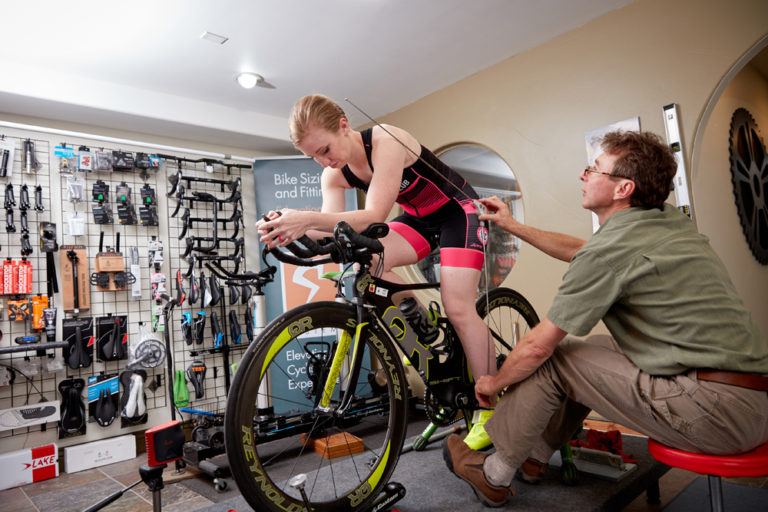
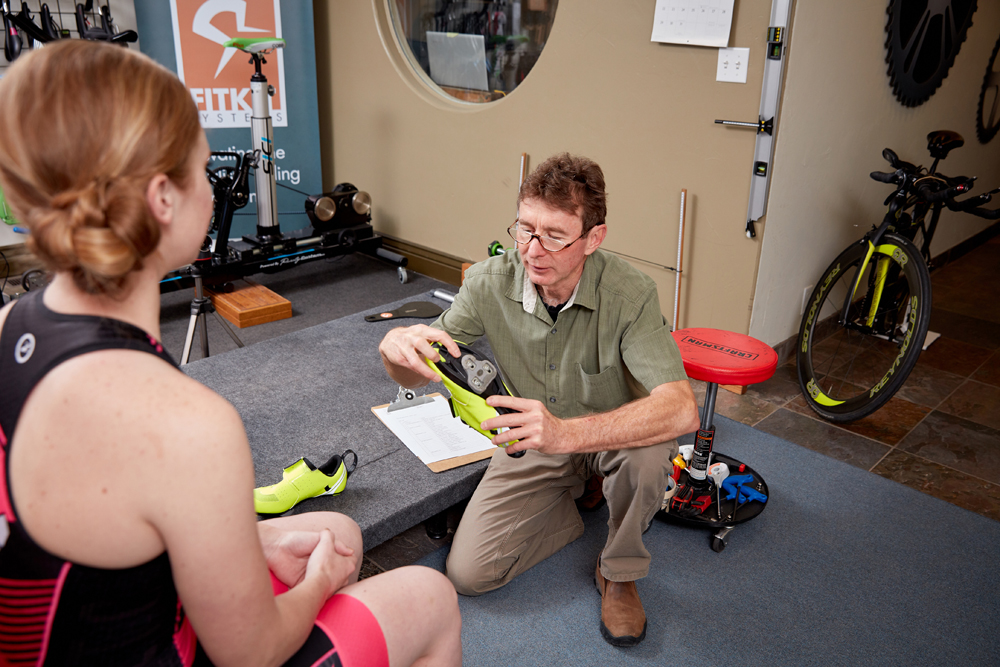
John Higgins takes measurements during a bike fit at the Bike Fitr studio. Photo by Derek Israelsen Photography
For those that are aware of bike fitting, a common myth-perception is that is just for pros. Not so. It’s for anybody that rides a bike – or intends to ride a decent amount, be they novices or enthusiasts; racers or weekend warriors; and commuters, tourers, triathletes and mountain bikers. It can be relevant and beneficial for any cyclist of any experience level.
What is a bike fit? Simply put, a bike fit is a process of adjusting your bicycle to prevent or alleviate discomfort, or increase riding efficiency. Why is this needed? A bike out of a bike shop or out of a box or out of the classifieds is not optimized for you from the outset, which can cause problems. The first step in buying a new bike is getting the right size and geometry, but assuming this is done well (See John’s article on buying a new bike that fits: Cycling Utah March 2016 issue online: https://www.cyclingwest.com/news/cycling-utahs-march-2016-issue-is-now-available/), that doesn’t mean the bike fits you and is awesome to ride as is. It just means a good fit can be achieved, and a good fit is about finding harmony between you and the machine.
A product manager working for a bike brand will specify a handlebar and saddle for a particular bike model and size. That specification may not be appropriate for your anatomy, so part of the bike fit process is assessing the “contact points” of shoes, pedals, saddle and handlebars to see that the size selection and style is a good match for you. If it is not, a bike fit will involve recommending and replacing one or more items. Expect to pay for some parts as well as the service.
Another part of the fit process is adjusting the relationship between these contact points, such as setting the seat height and the handlebar position so that you are comfortable, powerful and efficient on the bike. Anything that is “off” will cause a chain reaction of compensations in how you ride your bike. These compensations can show up as numb hands, achy knees, a sore back, restricted breathing or other niggles that detract from rather than enhance your riding experience. Additional small adjustments that can have a big impact is the angle of the handlebars, the position of the hoods / grips or extensions, and the reach to the brake levers. Yes – you should be able to reach the brake levers.
Most bikes shops will endeavor to rough in the saddle height for you and do a quick visual assessment of you on your new bike before you roll it out the door. You may think this is a bike fit. It partly is, but it mostly isn’t. A full bike fit takes 2 – 4 hours, so if your bike fit took 10 minutes, you got what you paid for, which is a bicycle not a bicycle fit. Some bike stores pay more attention to offering fit services than others, which will be evidenced by a dedicated fitting area and equipment, and one or two people who are trained and practiced in fitting protocols and processes.
Fitting is a specialized service requiring specialized skills. As not all staff in a bike shop are mechanics, even less are trained and experienced as fitters. Bike shops might appear to be the obvious place to go to for a bike fit but you can also find bike fitters who are doctors, cycling coaches, physical therapists, athletic trainers, or simply just bike fitters! It is a thing, and most cities have one or more specialty fitters serving the local cycling community. A proper bike fit will involve a scheduled appointment, fee for service, and an uninterrupted focus on you and your bicycle.
Why might you consider getting a bike fit, or be advised to get one?
You buy a new bike, and want to get it set up to prevent problems.
You are feeling at odds with your bike, and are fidgeting around on it never quite getting comfortable.
Your saddle sucks.
You experience numbness in the feet, genitals, or hands and/or unreasonable tension in the back, shoulders or neck.
You have had a significant change to your body in fitness, weight, or experienced an accident requiring surgery and rehab.
Someone suggested it to you because of how you present on the bike.
Riding is important to you and you want to optimize your experience.
Should every cyclist get a bike fit? Probably. Would every cyclist benefit from a bike fit? Not necessarily. Some cyclists tinker with their own adjustments and quickly find riding harmony. They wonder why anyone would spend money on a bike fit. Others consider it poor decision making to spend a few thousand dollars on a bike, but not to spend a few hundred to get it fitted to make the most of it.
You can give up one 3 hour ride to get a bike fit so you can ride happily thereafter, or ride for 3 hours complaining to your group about how uncomfortable you are, and keep repeating that experience. Your bike, your body. Enjoy!
John Higgins wants to elevate your cycling experience. He operates BikeFitr – an independent bike fitting studio, and Fit Kit Systems – supplying equipment and education to bike retailers and fitters. Contact: [email protected]
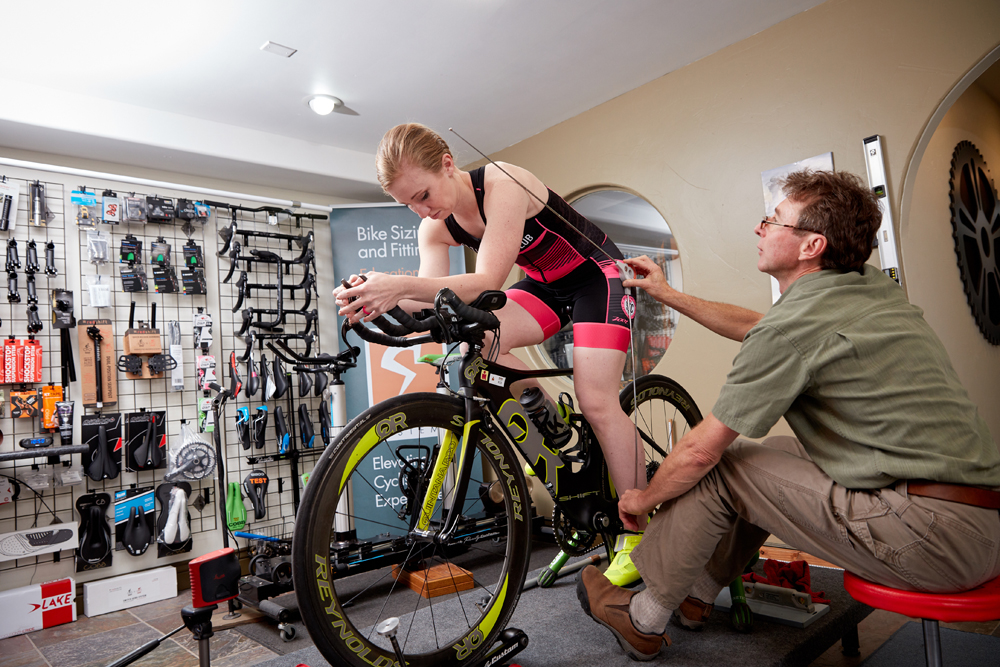
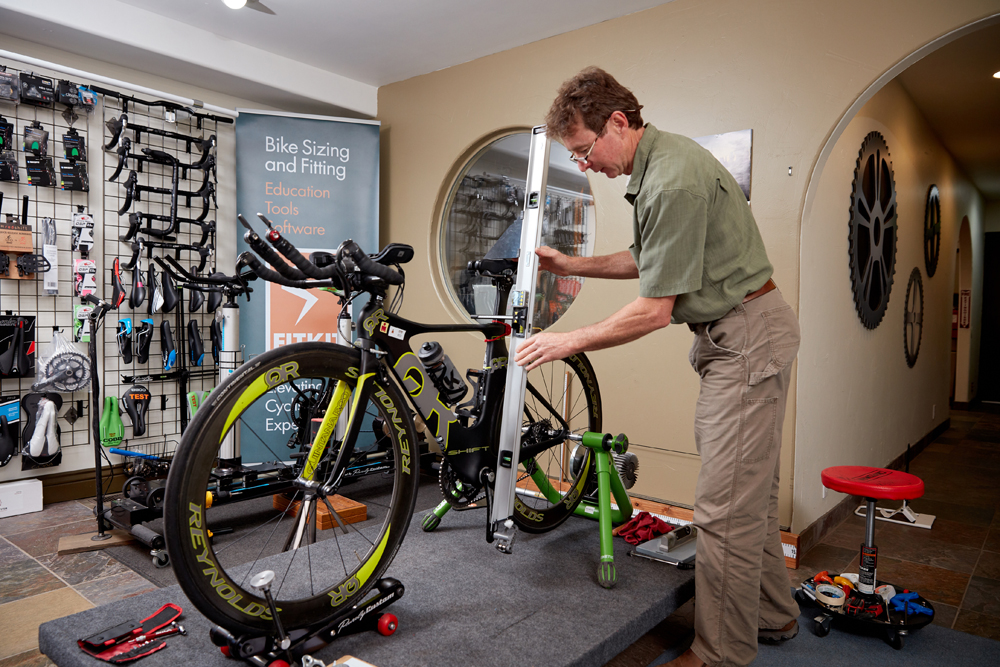
John Higgins measures saddle height at the Bike Fitr studio. Photo by Derek Israelsen PhotographyJohn Higgins works through a bike fit at the Bike Fitr studio. Photo by Derek Israelsen Photography
After five and a half years in the position, I will be stepping down as Executive Director later this summer. My wife has accepted a position out of state and we will be moving in the coming months.
Serving as Bike Utah’s Executive Director has truly been my honor and I couldn’t be more proud of our progress.
Phil Sarnoff has been the executive director of Bike Utah since 2014. Photo courtesy Bike Utah
We have come a long way in the last five years. Together we have:
Grown from an organization of one full-time staff member to seven full-time employees, allowing us to expand our reach across Utah
Educated more than 9,000 children around the state through the Youth BEST Program
Increased the percentage of Wasatch Front communities with Bicycle Master Plans from 13% to 63%
Launched the 1,000 Miles Campaign with the Governor to build 1,000 miles of new family-friendly bike lanes, paths, and trails by 2027
Engaged thousands of mountain bikers through the Mid Week MTB Series
Passed numerous laws to improve bicycle safety and increase funding for bicycle infrastructure
Put countless communities on track for building more bike lanes, paths, and trails for transportation and recreation
It has never been an easy road (or path or trail), but it has been much easier knowing that thousands of people around Utah are supporting our efforts. The organization is in great hands with an outstanding board of directors and a phenomenal staff team.
We still have a long way to go until everyone can ride regardless of age, ability, or income and we need your help to make sure that all of our current efforts stay on track.
I have one important request as we move forward in making Utah a better place to ride. We are opening up the search for a new Executive Director and there are numerous qualified, passionate candidates out there that will take Bike Utah’s efforts to the next level. Help us find those great people by sharing our posting and referring any great candidates.
The position description can be found at bikeutah.org. The application deadline is July 14, 2019.
Thank you again for all of the support and for helping to make Utah a better place to ride.
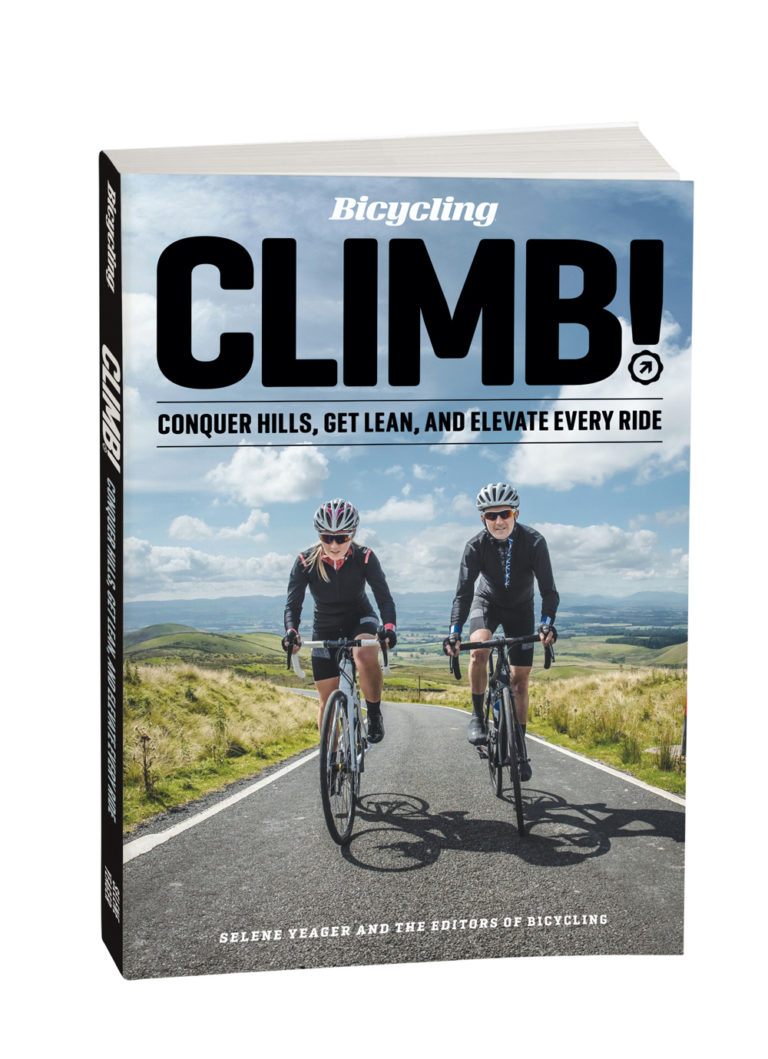
Climb!, a recently written book by Bicycling Magazine’s fitness columnist Selene Yeager, is filled with facts, opinions, and suggested training plans that will undoubtedly help you become a better climber. She states in the introduction, “I have made it much of my life’s work to learn as much about climbing as possible. Climb! is the culmination of 20 years of studying, training, racing, coaching, interviewing, absorbing, seemingly endless rambling and ruminating, and ultimately accumulating all the climbing know-how I could.”
She shares not only her hard-earned expertise but also wisdom and advice from exercise physiologists, cycling coaches, nutrition experts, and widely known amateur and professional climbers to help riders from all capacities make a marked improvement in their ability and confidence to conquer the art of climbing hills on their bicycles.
Selene gets right to the point in the first chapter by stating that the more you climb, the greater the rewards—on and off the bike. She breaks down what’s happening to your body on a climb. Your average 15-minute climb is the equivalent of doing 1,200 leg presses to the top. Your heart has to work harder to supply oxygen and blood where it’s needed. This allows your muscle cells to have all the blood they need to get ample amounts of oxygen and nutrients to produce energy. All the oxygen being used by your energy-producing furnaces has to come from somewhere, and that somewhere is your respiratory system. Selene explains that climbing is as much mental training as it is physical. She devotes an entire chapter on brain-training techniques such as self-talk, visualization, and focus.
Selene offers a presentation of the physics involved in pedaling uphill – basically what must be done to counter gravity. She explains when and how to climb both seated and out of the saddle. Cadence is a toss-up between legs versus your lungs. Selene shows the difference between bigger gear, slower pedaling and lower gear, high speed spinning style. She also explains the four types of climbs and how to attack them.
Perhaps the most influential climbing information in the book is the various interval drills that will help riders of every classification. There are steady-style, threshold, and climbing intervals to name just a few.
She also presents a variety of stretching and weight-training drills that can be done in the riding season or during the winter months. In the high-intensity interval training (HIIT) category, the reader will learn about fast acting, punchy ups, full-recovery full throttle, hill and power surges, big gear acceleration and ramp intervals. The selection allows riders a variety of training methods to choose from – boredom will never be a factor.
In addition to gear ratio and rationales, the writer provides information and tips on how to set up your bicycle. Next, she tells us how to eat on and off the bike and why not to get hung up on weight.
A section entitled “Get Hill Strong” gives riders some drills that include “hill repeats” which will address all of our hill-climbing needs. And she doesn’t forget to include some valuable tips on how to descend the hills that we have conquered. Despite keeping the reader focused on the task of becoming a better climber, Selene inserted some humor at just the right time. After thousands of miles ascending on her bicycle and hundreds of hours putting her thoughts on paper, Selene realized that a chuckle here and there will keep the reader on the right trail.
The final chapter focuses on training plans and climbing challenges. Included are four, eight, and twelve-week plans that give riders suggested training rides for each day. Selene summed up the entire message in her book while she was describing different intervals. She wrote, “It’s a no-brainer. If you want to get better at climbing, you climb!”
Climb! was extremely well written and covered all the aspects of ‘how to climb.’ As a matter of fact, that could have very well been the title since it was definitely a ‘how to’ book. Whether the reader is a newcomer to cycling or someone who has been riding for 20 years, all riders will pick up a few pearls that will make ascending up hills a little bit more comfortable and a lot more enjoyable.
Climb! By Selene Yeager, Publisher: Hearst Magazines Inc., New York, New York, 2018. ISBN: 978-1-63565-209-3
[Editor’s Note: This article was originally written and published in the June 2014 issue of Cycling Utah; references to dates and events are in accordance with that timeframe.]
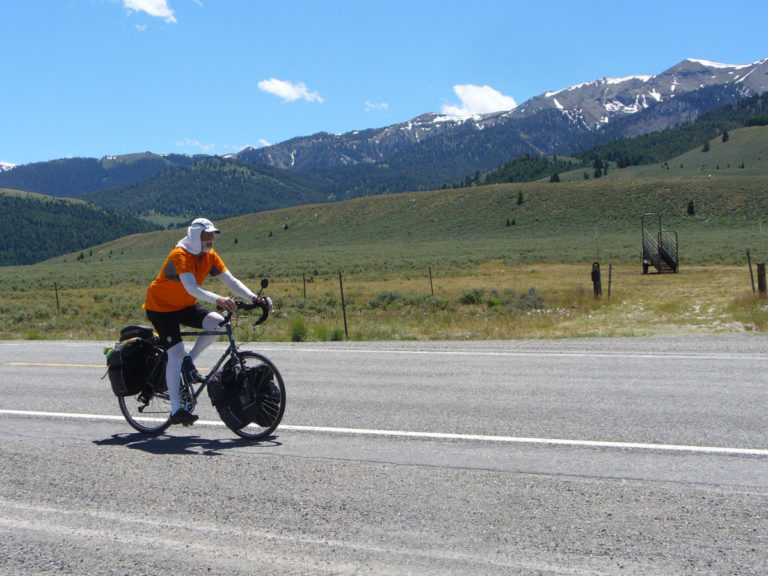
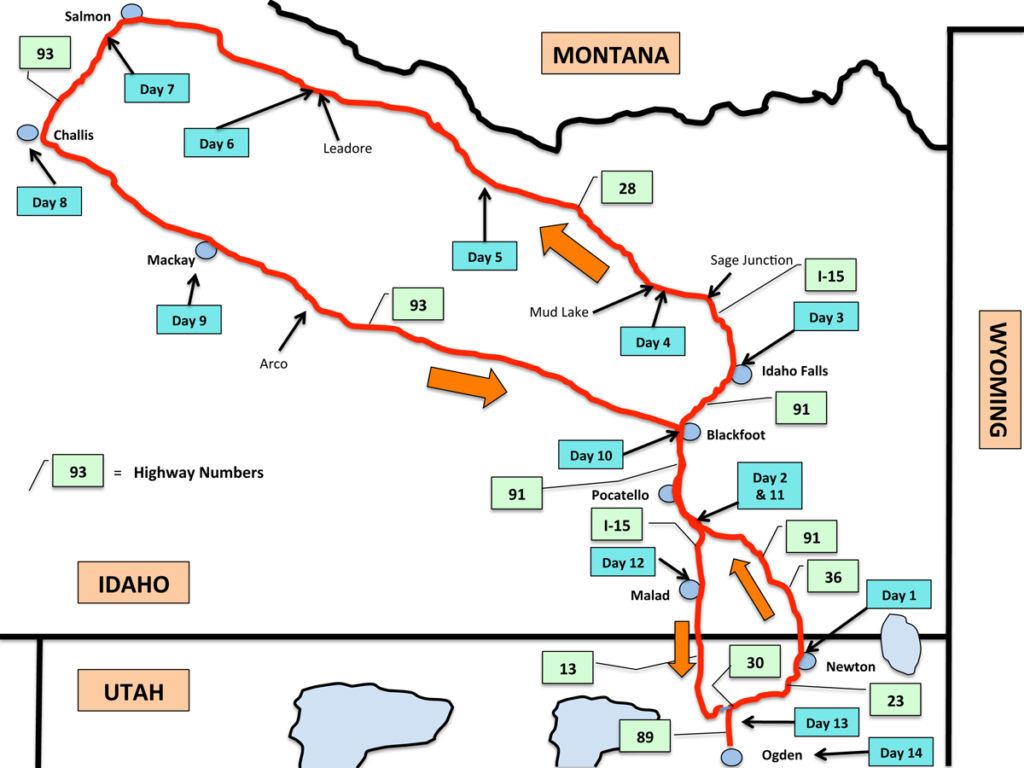
By Mel Bashore — Two years ago, I set out on a solo loop ride from Ogden to Salmon, Idaho, and back. That was the year of the massive Mustang Complex wildfire in the Salmon-Challis National Forest in central Idaho. When I left my home in Utah, I knew about the fire, but there seemed to be little cause for concern. However when I reached Pocatello, I learned to my dismay that the fire was coming close to Salmon. Reports stated that the town was threatened with possible evacuation. There was heavy smoke in the area. It didn’t look good. On the fly I decided to divert from my plan to ride to Salmon and instead ride my bike to Yellowstone. It turned out to be a great alternative (see my article in Cycling Utah, March 2013 – download on cyclingwest.com).
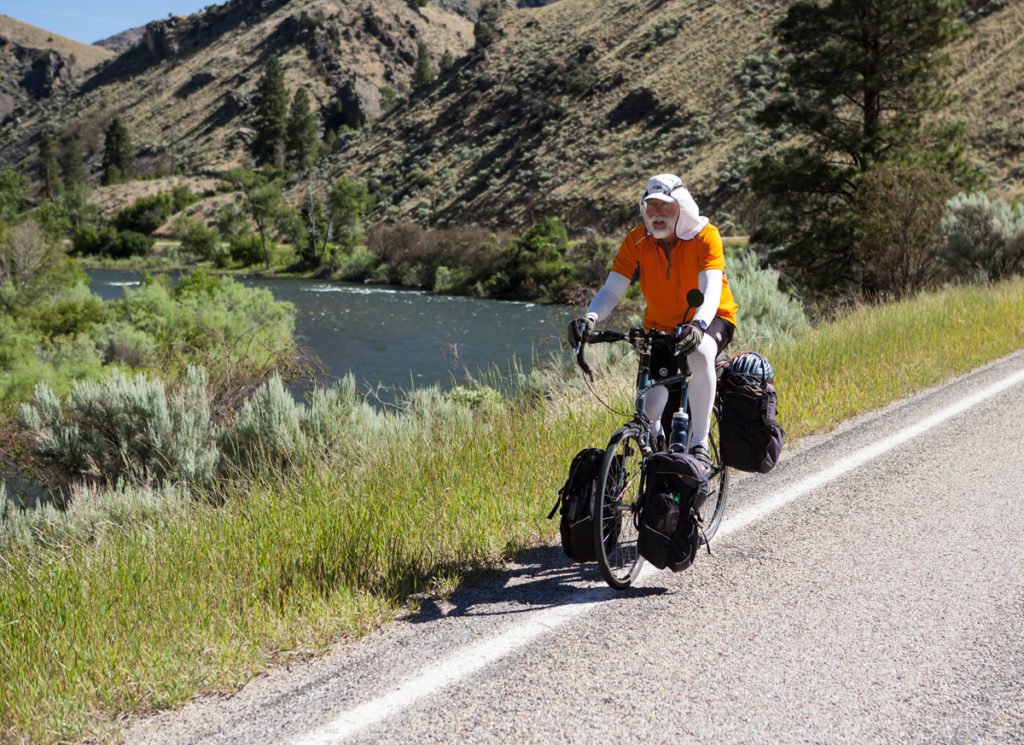
Biking along the Salmon River. Photo by Robert Bower.
While I enjoyed other rides in the intervening months, I kept thinking about this ride that I was forced to abandon in 2012. I was drawn to it like a raven to road kill. I had never been to that part of central Idaho. I had previously planned the route to take me on roads and to places where I had never been. In that way, it would be an adventure. And I love adventure.
To get to Salmon, I had concocted this route that would take me north on little-traveled Idaho State Highway 28, passing between the Beaverhead Mountains and the Lemhi Range. After reaching Salmon, I would turn south, traveling through the Salmon-Challis National Forest on U.S. Highway 93.
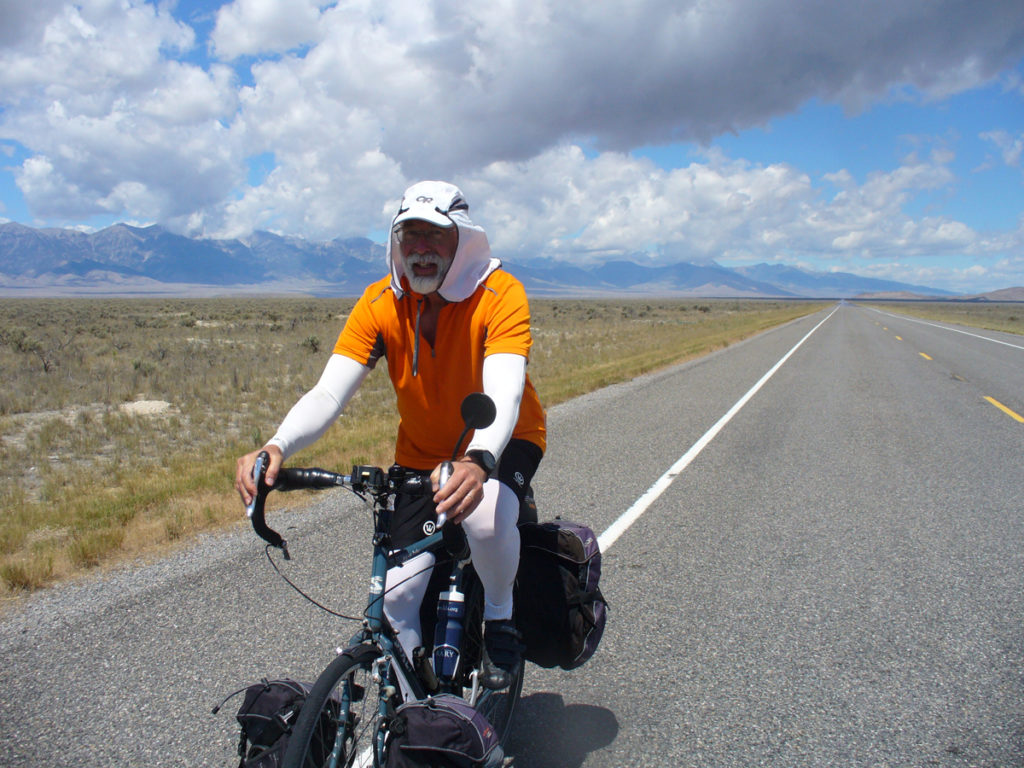
Although I would have preferred to begin the ride in late May for cooler riding conditions, I really wanted to attend my 50th high school reunion, so I had to delay my departure until late June. That later departure posed challenges and resulted in a couple of hard, hot days. But I also experienced some of the best biking days I have ever enjoyed—ever. And in talking with the locals, long distance bike tourers are a rarity on some of the prettiest and best biking parts of the journey. Thus follows an account of my two-week, 750-mile journey on roads less traveled in central Idaho.
Day 1—Ogden to Newton, Utah (64 miles)
I followed my 2012 route north from Ogden, traveling up the “Fruit Way” on Highway 89 through Willard and Perry to Brigham City.
I stopped for lunch at my favorite burger joint, the Dixie Grill. That has become a tradition for me for several long rides, which have taken me through northern Utah. I have become friends with the owners, Terry and Esther Davis. Besides serving really good barbecue, they enjoy seeing me and hearing about my long rides. When I pulled up to the order window, Esther said, “Where are you headed off to now?” I told her and said to look for me to return in about two weeks.
After a good lunch, I headed north through Honeyville and Deweyville to Collinston on State Highway 38. The volume of traffic on that back road is increasing, but it is still safe and reasonable on weekdays.
When I reached State Highway 30 just north of Collinston, instead of turning west to head to Malad, Idaho, like I did in 2012, I turned east and humped over Collinston Hill into Cache Valley. I decided to make my entry into Idaho through Cache Valley because I really enjoy the roads and quality biking conditions around that border crossing. They also pose less uphill than other approaches from Utah into Idaho.
After scooting down the east side of Collinston Hill, I turned north on State Highway 23. Bucking slight headwinds, I stopped in Newton’s town park for my first road camp.
Day 2—Newton, Utah, to McCammon, Idaho (66 miles)
After leaving Newton, I made my way north on State Highway 23 through the northern Utah towns of Trenton and Cornish. This is the kind of road where birds sing, people wave, and field sprinklers cool you down on a warm day. Delightful. After crossing the Utah-Idaho border, I traveled on Idaho State Highway 36 (or Westside Highway) through the friendly rural towns of Weston, Dayton, Clifton, and Oxford.
A few miles north of Oxford, the agricultural fields became more infrequent and isolated. The rural road stubbed into U.S. Highway 91, passing Downata Hot Springs and the retiring town of Downey, the latter humbled by its now-distant location from the stream of interstate freeway traffic several miles to the west. Highway 91 was nicely improved with wide bike shoulders all the way to the farming town of Virginia, Idaho. At Virginia, because it was getting on toward evening, I opted to travel on the I-15 freeway to my next road camp rather than take the old Highway 91 north. I had taken that old highway two years earlier. But in traveling on the freeway I could see the old highway essentially paralleled the freeway. In my foggy memory, I remembered it as not being so direct. I really didn’t need to have taken the freeway. The old highway would have worked just as well.
Nonetheless, I pulled into McCammon to look for a place to bed down. In asking around at its city park, someone remembered seeing passing bicyclists on occasion sleeping at a Mormon Church covered pavilion south of town. This sounded good as I had ridden through McCammon in 2012 and knew that lots of noisy trains passed through the town. It would be quieter at the church, which was more distant from the railroad tracks than the city park. That’s where I headed and was grateful for the overhead cover when it rained that night.
Day 3—McCammon to Idaho Falls, Idaho (78 miles)
In leaving McCammon, I simply followed the same back-road route I had taken in 2012. Just outside of town, on the north side of McCammon, I went east a short distance to Old Highway 91. I stopped at an Idaho Department of Transportation facility on the highway to make sure I was traveling on the right road that would take me north to Pocatello. One of the workers saw me pulling into their back lot and told his co-workers that it looked like the same biker he remembered seeing a few years earlier. If true, this speaks to how few bike tourers ride these roads—and to the memory of that man. They assured me that I was indeed on the right back road. They also wanted to make sure I had enough water and even wanted to give me an Idaho road crew florescent vest.
The morning ride through Inkom and Black Forge to Pocatello was as pleasurable as ever. The ride north from Pocatello to Chubbuck on Yellowstone Avenue (Highway 91) was as unsafe as I remembered. Two years ago I rode on the sidewalk because of the lack of shoulder, but this year orange barriers on the sidewalk prevented me from doing that for several miles. Fortunately weekday traffic was fairly light and I negotiated the stretch safely. As usual, dogs at houses in the Fort Hall Indian Reservation gave chase when I passed.
I reached Idaho Falls toward evening and found plenty of camping spots to pick from at the nice free grassy tourist park on the bank of the Snake River where I had camped before.
I was greeted by another fellow bike tourer also camped there. Jack Frost (his real name) was a disabled American veteran who hadn’t let his physical disabilities (seven failed knee surgeries and a bad back) prevent him from touring steadily for the past thirteen years on his bike. On this current stint, he had started eight months before from Key West, Florida, riding from there to San Diego, then to Bellingham, Washington, then to Portland, and from there to Idaho Falls. He had undergone three heart attacks and been a diabetic prior to taking up bike touring, but those health problems had been quashed. I camped next to him.
Day 4—Idaho Falls to Terreton, Idaho (42 miles)
Today I was pummeled all afternoon by heavy rain, wind, and hail. It was far from pleasant. When I left the tourist park, it was drizzling off and on. I ventured north on Yellowstone Avenue, turning west (left) on Broadway, passing through town and crossing the Snake River whereupon I turned north (right) on Utah Avenue. I had scoped out this road as a good way to venture northward and stay off the interstate. It was a good choice, giving me nice views of the Snake River and verdant farms for several miles. Passing cars were very infrequent. It was easy to follow despite the name changes to the road (Lindsay Blvd., North River Road, N3145 E., and Bassett Road) all the way to the small town of Roberts. At this place, I ate at a small café prior to getting on the I-15 freeway.
I had the option of taking a meandering frontage road on the west side of the interstate instead, but it would have been difficult to follow and quite lengthy. With the wind picking up and dark skies overhead, the short eight-mile freeway ride seemed the best choice.
As I set out, the rainstorm quickly developed in intensity. I was soaked before reaching a protecting overpass. I waited almost an hour for the rain to lessen before pushing ahead to Sage Junction. I exited the freeway here and headed west on State Highway 28. From there it was another race to search for shelter before the next wave of rain struck. I didn’t make it. I halted at a park across the street from the Mud Lake Market in Terreton. I camped that night under a leaky park pavilion, still grateful for some shelter.
Day 5—Terreton to Kaufman Camp Ground, along Birch Creek, Idaho (43 miles)
I took considerable time to dry things out before setting out in mid-morning. During the first couple of miles to the next town of Mud Lake, I saw two more covered pavilions that would have given good shelter. At Mud Lake, I veered right (northwest), continuing on State Highway 28. I left the farm fields behind in favor of dry sagebrush-covered ground spotted with periodic rodent mounds. One time I saw a badger run for cover into one of these ground holes. A passing local bicyclist told me that I was fortunate to not be faced that day with a headwind as that was common there. The road was mostly a gentle uphill climb.
Near the end of my riding day, I did face some strong headwinds in the draws above and below Lone Pine where I found a small café. Just north of those draws, the vista opened up again to the high 11-12,000-foot high mountains to the east and west of me. Many still had vestiges of melting snow on their north exposures.
That night I was the only person camped in the lush grasses of pretty Birch Creek at the Kaufman BLM camp—and it was a weekend. So far I had slept in some pretty comfortable locations, but this beat the band. I usually sleep in what I term “ditches”—and sometimes they really are. I must be getting soft in my old age.
Day 6—Kaufman Camp Ground to Leadore, Idaho (41 miles)
It was not easy leaving such a nice camp in this beautiful mountain setting. The road continued to climb with some long rollers, but it was not strenuous. All in all, the elevation gain from Mud Lake to Gilmore Summit, the highest point on Highway 28, was about 2,400 feet.
At the top of the summit, I halted to eat an apple and enjoy the view. While gazing about, an SUV pulled up. A mother (Shannon) and her son from Idaho Falls brought me an ice-cold bottle of water. How kind. She was also a bicyclist. She knew. There is a big difference in having plenty of water with you on bike tours and drinking water that is cold. A world of difference! I polished off the whole bottle of water before their vehicle was out of sight. I followed them at speed down the road. At one point on the descent, I got sideways on the gravel shoulder, just fishtailing my way back onto the pavement. Not good, but fortune smiled on me that time. Memo to Mel: Keep alert, attentive, and don’t get cocky.
After so many miles of good shoulders, the roughness of the road as it neared the town of Leadore was somewhat disagreeable. But that was forgotten after the enjoyable dinner I had in a bar in town (the best food is often served in bars in Idaho).
While there, a local rancher told me that bike tourers like me were rarely seen. He told me that the Mustang Complex fire didn’t get entirely squelched until deep into winter in December. He said that sometimes Idaho wilderness fires would burn underground in the roots all the way through winter and then burst into flame again in the spring. After eating, I went to their city park west of town where I camped for a nominal fee.
Day 7—Leadore to Shoup Bridge Recreation Site, south of Salmon, Idaho (54 miles)
This has to have been one of my best all-time biking days—ever! Perfect temperature. Perfect scenery. Perfect road. Perfect level of road—flat or slightly downhill. Cowboys out driving a herd of several hundred Angus cattle waving to me. But where were “my people” (my wife’s characterization of other long distance tourers sporting panniers)? Surely this couldn’t be a secret! It was too good—too biking good! This was one of those biking days you want to bottle up and repeatedly repeat, forever and ever. It didn’t hurt that the route was dripping in history: the national historic trails of Lewis and Clark and Nez Perce and the 1855 mission of Mormons sent to establish a fort in the Lemhi River valley.
To celebrate my 68th birthday on this day, I enjoyed a wonderful meal in Bertram’s Brewery, in an old building with an exquisite pressed-tin ceiling, in Salmon. It was all the best of the best.
After the meal, I turned south from Salmon on U.S. Highway 93, going five miles to Shoup Bridge Recreation Site, a small BLM camp next to the Salmon River. Before tucking myself in for the night, I took a chilly, but refreshing swim in the river. What a day!
Day 8—Shoup Bridge to Challis, Idaho (54 miles)
Another day in paradise! I traveled beside the Salmon River for almost forty miles. Shoulders were adequate, if not as wide as during my previous days’ rides. It was probably good that it was a weekday. I saw only two river rafters, but I imagine on weekends it presents a different picture.
The riding couldn’t have been more pleasant. Rack up two straight days of wonderful biking.
When the day heated up, I simply stopped at one of the many river access places, took off my shoes and socks and waded into the river. I stripped off my jersey and soaked it in the river. Voilà! I had air conditioning for the next twenty minutes.
After riding about forty miles, the vista opened up, the river not visible from the road any more. At Challis, I enjoyed a good meal and visit with a couple of ranchers and their wives at the Y-Inn café. They had seen me coming and going on their outing downriver that day to Salmon and back. My standard retort when people mentioned seeing me on the road was to ask, “Was I riding or walking?” They told me that on occasion they saw touring cyclists bedding down in the Challis city park. That is where I went.
Before bedding down I enjoyed visiting with a man who had brought his little dog to enjoy the evening at the park. Frank Burgess, whose family was then living in Moab, worked construction jobs on the road. He was a heavy equipment crane operator, then working on a bridge on the road to Stanley, Idaho. He told me what I could expect on the road ahead. He also said that he would be driving home to Utah the next day to be with his family for the July 4th holiday. He would look out for me on the road. If I wanted or needed help, he would be happy to put my bike in his truck and drop me off in Salt Lake. On that note, we parted for the evening.
Day 9—Challis to Mackay, Idaho (54 miles)
This turned out to be a hard day. It was a tougher, steeper ascent to hump Willow Creek Summit, twenty-five miles south of Challis, than Gilmore Summit that I did two days before. One of the more interesting parts of this ride to the summit came as I wound my way through Grand View Canyon, a cut through an old lava flow.
After getting to the summit, there was only a quick descent on the south side before I had to buck very strong hot, dry headwinds around the high range of mountains on my left. Idaho’s highest mountain, Borah Peak (elev. 12,662) loomed over me. By the time Frank Burgess caught up with me, I was still ten miles from the town of Mackay. I was gassed, beat up by the headwinds. All the fun of the previous days of riding were a distant memory. I took him up on his offer to haul me the rest of the way to Mackay. Thank you, Frank. It was a good decision.
In Mackay, the winds calmed. I enjoyed a good meal and slept in their free tourist park south of town. There were lots of others also camped there, mostly biker motorcyclist types. A couple of biker chicks came over by my camp to discuss the relative merits of their machetes. Most of the motorbike partiers went to the bars in town, leaving me in peace and quiet in the shade of the trees. I slept like a baby.
Day 10—Mackay to Blackfoot, Idaho (90 miles)
This day began well, but ended hard. Not one of my better riding days. But in life, you’ve got to take the good with the bad. I knew it was going to be a long day so I started early. The 26-mile stretch from Mackay to Arco was most enjoyable. Lightly forested areas bordering the road, deer frolicking, birds singing. A Mr. Hyde morning.
Halfway to Arco, I met Max, a 24-year old touring cyclist from Salt Lake. He was the only other long-distance tourer that I saw on the road in two weeks. He had saved his money, quit his job, and was heading north to Alaska. Good for him. Go Max.
After Arco, Dr. Jekyll reared his ugly head. Gone were the forests, farms, and birds. Arco was the first city in the world to receive its electricity from nuclear power. This energy was developed in the remote desert south of town in the 1950s. The Idaho National Laboratory is still developing and building nuclear reactors in that desert, a thriving business for Idaho. My wife hoped that I wouldn’t come home as a glowing humanoid. I just hoped that I could make it across the desert to civilization.
My tongue was hanging out as I got within sight of the valley of the Snake River. All I wanted was a cold slushy. I needed a brain freeze bad. I had originally planned on veering off to Moreland and the small farming communities north of the American Falls Reservoir. I planned on returning to Utah via remote and isolated State Highway 37 south of American Falls. But my overwhelming desire for a cold slushy caused me to change plans. I passed the Moreland turn-off and headed south to Blackfoot and its sure convenience stores.
After the lifesaving slushy, I tucked my tongue back into my skull, and sought out a place to bed down. Several said I should go to Jensen Grove Park. It was near dusk when I found that park. It had a large man-made lake, but on outward appearances, didn’t seem like it would be welcoming to a bike camper. Without much time before dark, I sought out my more normal “ditch” accommodations on scabby land on the edge of a golf course north of the lake.
Day 11—Blackfoot to McCammon, Idaho (53 miles)
After packing my gear in the panniers, I visited the Jensen Grove restrooms for a bit of a spit bath. When bedding down away from facilities, I always wipe the sweat off each day with baby wipes. They aren’t as refreshing as a shower, but better than nothing. This morning I also refreshed myself by wading in the lake.
I had lost track of the days and asked a park worker if this happened to be July 4th. He told me it was and said that thousands would be packing the shores of the lake that evening to watch the big fireworks show. Drats. My timing was poor. That would have been fun. But with the day heating up, I needed to push on. My change in plans would cause me to repeat some parts of my route. The dogs again chased me as I rode through the Fort Hall Indian Reservation again. But when I reached Chubbuck I asked around about a safer way to get to Pocatello. I learned that if I took Pole Line Road, I would bypass all the sidewalk construction and avoid the shoulder-less Yellowstone Avenue. I did and it worked well. Remember that. It was in the high 90s when I got to Pocatello. But Mother Nature smiled on me when I set out to head south from Pocatello.
Dark clouds and occasional cooling rain accompanied me all the way to McCammon on Old Highway 91. On the way, I stopped in Inkom’s city park to have a bit of rest and watch their horseshoe pitching competition at their July 4th celebration. A few miles outside of Inkom, my rear tire (of course, it’s always the rear) started going flat. I knew I was close to McCammon and hoped I could nurse it into that town, but it simply wouldn’t hold air for more than a minute. I was on a section of rollers, so I began walking the bike to find a shady place to change the tire. I pulled into a dirt parking area at a forest trailhead. While swapping out the tube, Ernie Long and his family, from McCammon, pulled into the trailhead parking area on their horse cart. They had passed me going the other way earlier when I was walking the bike. I half suspected them to yell out, “Get a horse.” Ernie and I passed the time of day while I did the repair work. It made an otherwise discouraging time quite bearable. When I reached McCammon, I decided to just bed down in the Marsh Valley Rodeo Arena next to the park. It was a rather noisy night hearing people shooting off fireworks and passing trains. But eventually I dropped off to sleep despite the racket.
Day 12—McCammon to Malad, Idaho (39 miles)
This was another hot day, made more difficult by having to climb the Malad Summit. I chose to take the more direct route from Downey to the summit on the I-15 freeway. Two years before I had taken back roads to avoid the freeway. I knew that back route would have been much longer and been fraught with numerous steep climbs. The freeway seemed the lesser of two evils. I especially enjoyed the rest area near the top of the summit with its shade and cool drinking water.
I had a good downhill run from the top, taking the Weston exit (number 17) to take the back road into Malad. It led me on the road that I remembered where there were boots atop each fence post flanking me on either side of the road. People do funny things. As before, I halted unannounced at the house of my friends, Merrill and Sharon, in Malad. Two years ago, I rang their doorbell at the first stop of my journey to Salmon. On that day, Merrill peered out the door at me and yelled, “Sharon! Call the police! There’s a bum at our door!” Merrill, always the jokester. We again enjoyed a wonderful visit. I enjoyed a cleansing and relaxing bath in their Jacuzzi bathtub—the first real body cleaning in twelve days. I was getting a bit crusty. Sleeping in a real bed also felt heavenly.
Day 13—Malad, Idaho to Crystal Hot Springs, Honeyville, Utah (45 miles)
Merrill suggested I take breakfast at KJ’s, where some of the members of his high priest quorum began their mornings with a cup of coffee. He introduced me to a table of them. They mostly thought I was nuts for undertaking this ride. No argument there. I took the old highway south out of Malad all the way to Plymouth, Utah. At that point, I was on State Highway 13. I made rest stops in the park and convenience store in Riverside. Strangely I ran into Spencer H., one of my nearby neighbors who was having a bite to eat at the convenience store. He was on an outing with his family. I followed my old route over to Collinston, stopping at the nice park in Deweyville to enjoy their cool water and rest in the shade. I also enjoyed an interesting hour-long conversation with Brent C., who lived near the park. Then it was off to Crystal Hot Springs where I lingered in their hot mineral pools for a few hours. I was the only tent camper there that night.
Day 14—Honeyville to Ogden, Utah (35 miles)
My final day on this two-week trip was uneventful except for my traditional celebration meal at the Dixie Grill in Brigham City. Esther had stayed home from work so I missed seeing her, but Tony was manning the order window. He came out to get a picture with me and help celebrate the completion of my trip to central Idaho. I’d do it again. But the next time I would begin my trip across the desert from Arco rather than Mackay. I’d also undertake the trip in May or late September.
Nuts and Bolts
My bike of choice was my trusty Surly Long Haul Trucker, with Axiom panniers front and rear.
I carried my usual complement of MREs (from Emergency Essentials), Fig Newtons and Nutella (for breakfast), but generally ate at burger joints and convenience stores. I lost twelve pounds on the ride, which equates with my usual weight loss of fifteen pounds for every 1,000 mile tour.
I made some discoveries on this ride. I carried five water bottles. The water in the bottles that I wrapped in plastic grocery bags that I stuffed in my panniers was noticeably cooler than the water in bottles hanging out in the exterior holders.
I also reconfirmed my preference for my own ingredients to reduce chafing on my backside. Although I’ve had success using commercial chamois creams on short tours, I find them sorely (no pun intended) lacking on longer tours. Instead I’ve developed my own recipe for reducing friction and promoting backside comfort in the saddle, albeit being a bit on the greasy side. I wear three layers of shorts. Next to the skin are boxer type undershorts, then Bike tight briefs, and padded bike shorts on the outside. The ingredients of my butt lubricant include Vaseline, an over-the-counter product called Butt Aid, and a prescription topical for pain called Voltaren gel.
To ward off the sun’s burning rays, I used Pearl Izumi leggings and sleeves and an Outdoor Research sun runner cap on top of the noggin.
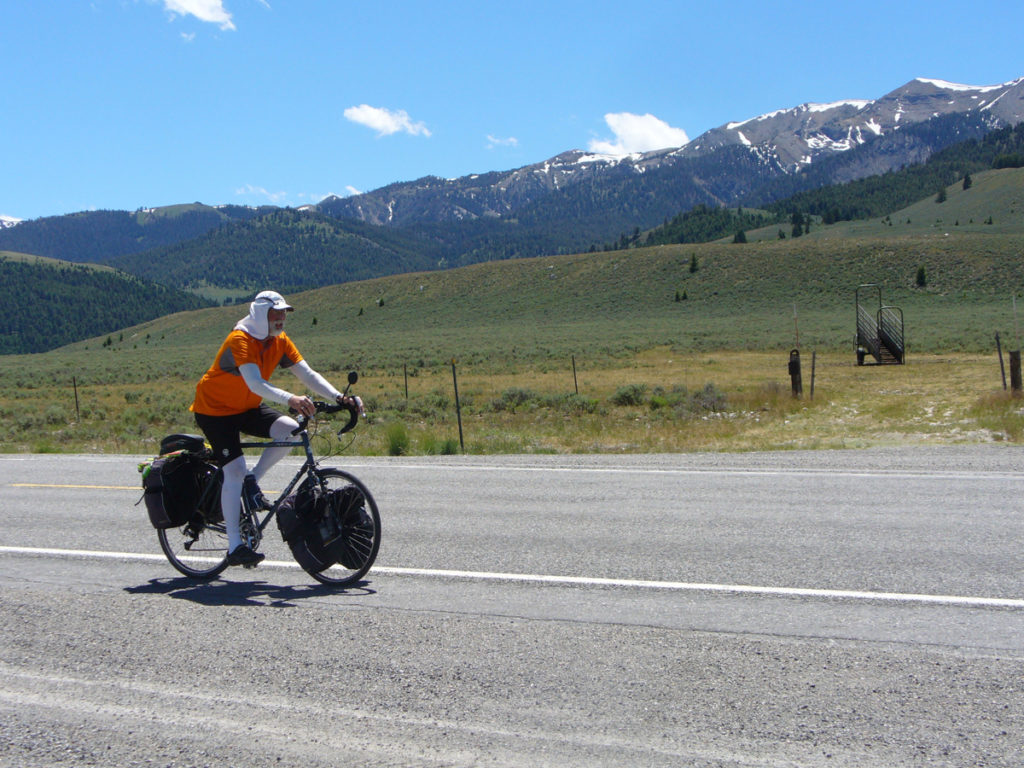
Highway 28, northwest of Mud Lake. Photo courtesy Mel Bashore.Gilmore Summit near Leadore, Idaho. It’s the highest point on Highway 28. Photo courtesy Mel Bashore
The Arizona Heritage Trail got a go-ahead. The Bureau of Reclamation plans to solicit construction bids for the 3.6-mile bike and hike trail to connect Bullhead City, AZ and Laughlin, NV with the Lake Mead National Recreation Area along the Colorado River south of Lake Mojave in northwest Arizona. The plan calls for the city of Bullhead and Mohave County to operate the trail through agreements with the bureau and National Park Service.
“We’re in the design stage. No timeframe. It’s at least a year or two out, probably,” says bureau Contract Specialist Diane Rodriguez.
Since 1999, Bullhead has been working on creating bicycle connections to the Colorado River Heritage Greenway Trail.
This upcoming hard-surface trail will run from the top of Davis Dam south to Laughlin Bridge, paralleling Arizona St. Rt. 68. The plan calls for trailheads at Davis Dam and Davis Camp. The trail will be 12 feet wide with three eight-foot wide access spurs; plus spots for fishing and launching kayaks. The trailheads will include everything from maps and interpretive panels to solar lighting, bike racks, trash cans, restrooms and doggy poop bag dispensers.
The trail will run from the dam to the Laughlin/Bullhead City Highway 163 Bridge that leads to Nevada, along an existing transmission line right-of-way. Those who want to climb a hill could use a planned spur to a scenic overlook with views of the Colorado River Valley, the dam, and Laughlin and Bullhead skylines. The proposed overlook would include a bench and shelter.
The bureau figures spending between $200,000 and $500,000 on construction.
I have a list of the most annoying sounds in the world. It goes something like this:
Bicycle bells
Babies crying
Whiny dogs
Alarms
It’s 5:05 AM. My alarm is sounding and my all too natural reaction is to just turn off the annoying sound. Which I do. This is promptly followed by the sound of my wife’s voice asking me if we’re going riding. My natural response is to roll over and groan. Which I do. She gets up and the sounds of coffee being made begin to echo through the house. I roll back over. My eyes wide open. It’s not like this is my first rodeo. With the dramatics of a teenage girl, I will my feet out of bed and let them drop over the edge forcing my torso upright. I rub the sleep from my eyes.
Why 5:05 AM? Why not just make it 5? I need the extra 5 minutes, ok?
Our destination on this early morning, summer ride? City Creek and Owen’s Loop. Two trails you’ve probably never heard of because in the beauty of Southern Utah, they rank well down on the list of trails you should ride. They’re short. Combined the two make up about 4 miles of dirt. Dirt that is a combination of overgrown service roads and singletrack. Their appeal to me is threefold.
They provide some beautiful views of St. George as the trails take you around the top of the red cliffs that sit above town.
No one rides them. They are devoid of people despite how close they are to town.
They are close to town.
The kettle whistle is blowing. Through the haze of my early morning mind, I find my way to the dresser and start banging around trying to find my riding gear. Chamois, shorts, jersey. Check and check. I drop them on the floor as if the coffee had suddenly yelled my name and completely interrupted the conversation I was having. I pour the coffee, but don’t drink any suddenly remembering that I need to put my clothes on. Coffee is placed on the table, I return to the bedroom and put my clothes on.
My coffee remains immobile on the table waiting as I begin to click through the mental checklist of getting ready. Bike – tire pressure checked, brakes work. Water bottles – filled and placed on bike. Oops, forgot my helmet. Oh look, coffee.
The gate creaks as we push our bikes out of the backyard. The city is quiet. I feel the need to be stealthy so I don’t wake it up. The click of my cleats entering the pedals is so loud I’m sure that the neighbors will complain. We begin pedaling toward the bike lane. The bike lane takes us to the paved bike path which leads us right to the trailhead.
And just like that we are on dirt, no cars involved.
Every mountain biker has their “local” trail. It’s the trail where you hold the equivalent of home court advantage. You know the trail in a way that the casual rider will never know. You immediately notice when a rock is added or moved. You can tell that someone was too heavy on the brakes going into the corner and you feel the change in the trail. If you were to be dropped, blindfolded onto the trail you would know where you were by the distinct sounds. It’s the trail that you often find yourself lost in the chasms of your mind because you could probably ride it asleep.
We don’t tend to think of riding trails as practice, but that’s what we do. Each ride is a practice on that trail. Whether that means you are practicing to be faster or to clean the whole trail, regardless you are practicing. And as cliché as it is to say, practicing does move you toward perfection. Which is why you are a local and this is your home court. You’ve practiced it till it hurts with perfection, knowing exactly which rocks to launch, which to roll, where to add some heat and where to drag the brakes.
The rain from the night before has changed the trail. The ten minute spin to the trail woke me up and now I’m stoked to ride. There’s a few new ruts on the steep road sections and a couple of rocks have moved. We climb with the sounds of an awakening city getting louder as the sun starts to climb above the horizon. Then the trail leads us back down and being able to descend quickly on my rigid bike requires a constant dance between staying loose and not letting go of the handlebars. I let the brakes go just a little too long and almost miss the sharp left. Mental note taken for the next ride.
We top out and then a quick drop brings us to the edge providing a view of St. George proper. The city is awake now and has worked itself up to a dull roar. We stop to take advantage of the morning light dancing across the city and to ready ourselves mentally for the descent. The trail drags us down toward the bike path we rode in on lacing its way through sage brush and sandstone providing almost every type of trail condition within ¼ mile. We hit sand, rock, flowy trail, chunky trail and then onto a sandstone slab right before the chute. The chute drops us off the rock on onto a somewhat flowy singletrack that rips right down to the bike path.
And just like that, we are back on pavement and coasting toward home. The gate creaks when we open it but we don’t notice. The routine of riding our trail has already given way to the thoughts of readying ourselves for the day. The euphoria of having snuck in a ride early erases the memories of getting up early and reminds me to reset that annoying sound so we can do it all again tomorrow.
Lukas Brinkerhoff blogs about mountain biking and life at mooseknuckleralliance.org. This article was originally published in the May 2015 print edition of Cycling Utah.
PRESS RELEASE, SALT LAKE CITY (July 9, 2019) – Four international teams accepted the final slots for this year’s Larry H. Miller Tour of Utah on Aug. 12-18, rounding out the men’s field for a total of 17 professional squads. Three teams will make their first appearances at the Tour of Utah with Canel’s-Specialized Cycling (Mexico), Dauner l AKKON Pro Cycling (Germany), and DC Bank Pro Cycling Team (Canada). Worthy Pro Cycling (Canada) raced three times in Utah under the Silber Pro Cycling banner. All four squads have UCI Continental status.
A view from the rear of the peloton. Stage 1, 2018 Tour of Utah. Photo by Steven L. Sheffield
Both Canadian teams have new title sponsors and have Tour of Utah alumni on their rosters. Through an agreement between team sponsors, Floyd’s Pro Cycling will race under the name Worthy Pro Cycling at the Tour of Utah. The team features sprinter Travis McCabe (USA), who has amassed four stage wins in Utah in the past three years. He is the reigning USA Cycling Pro Criterium National Champion, having won this title for a second time on June 28. Among his teammates who scored top honors at the 2017 Tour of Utah are Serghei Tvetcov (Romania), who finished third on the General Classification (G.C.) riding for Jelly Belly Pro Cycling, and Jonny Clarke (Australia), who was seventh on G.C. riding for UnitedHealthcare Pro Cycling.
Adam Roberge on the Mount Nebo climb. Stage 2, 2018 Tour of Utah. The former Silber team (currently racing as Floyd’s Pro Cycling) will be racing under the Worthy Pro Cycling banner in 2019. Photo by Steven L. Sheffield.
Participating on DC Bank Pro Cycling, which had been H&R Block Pro Cycling, is former U.S. Pro Road Race national champion Greg Daniel, who won the King of the Mountains classification at the 2015 Tour of Utah while riding for Axeon-Hagens Berman. Dauner l AKKON Pro Cycling has riders from four countries, with the lone American being Oliver Flautt, who has had success in the U.S. riding last year for the Domestic Elite team Cyclus Sports. Canel’s-Specialized Cycling is the only Mexican club with a Continental license. Last year the team finished sixth overall in the UCI America Tour rankings, and this year features 10 riders representing Chile, Colombia and Mexico.
“We have attracted a talented international field for this year’s Tour of Utah with teams representing seven countries,” said John Kimball, managing director of the Larry H. Miller Tour of Utah. “We anticipate a great week of racing among these 17 teams and about 120 riders. It’s a special opportunity for us to bring world-class cycling to Utah and share this unique sports event with different host communities.”
2019 TOUR OF UTAH TEAMS
303 Project (USA)
Arapahoe l Hincapie presented by BMC (USA)
Aevolo Pro Cycling (USA)
Canel’s-Specialized Cycling (Mexico)
Dauner l AKKON Pro Cycling (Germany)
DC Bank Pro Cycling Team (Canada)
EF Education Pro Cycling (USA)
Elevate – KHS Pro Cycling (USA)
Hagens Berman Axeon (USA)
Israel Cycling Academy (Israel)
Neri Sottoli-Selle Italia-KTM (Italy)
NIPPO-Vini Fantini-Faizanè (Italy)
Rally UHC Cycling (USA)
Trek-Segafredo (USA)
Team BridgeLane (Australia)
Wildlife Generation Pro Cycling presented by Maxxis (USA)
Worthy Pro Cycling (Canada)
Among the riders on the rosters of these 17 teams, they have a combined total of 42 stage victories and classification titles at the Tour of Utah since 2011, the year the Tour was elevated internationally by the Union Cycliste Internationale (UCI). Teams can carry up to seven riders on each roster, with the projected lineup of athletes to be announced in early August.
The UCI Pro Continental team Manzana Postobon (Colombia) was announced in April as participating at the Tour of Utah. The team has discontinued operations for the 2019 season and will not take part in any UCI races.
The Tour of Utah will begin on Aug. 12 at Snowbird Resort for a prologue (short time trial), one of four ski resorts that is part of the event. The Tour will conclude on Aug. 18 in Park City. Additional host venues are North Logan City, Brigham City, Powder Mountain Resort, Antelope Island State Park, North Salt Lake, Salt Lake City, and Canyons Village at Park City Mountain.
The Larry H. Miller Tour of Utah is free to all spectators, making professional cycling one of the most unique professional sports in the world today. It remains a 2.HC-rated stage race on the UCI America Tour, making it one of the premier events for professional cycling teams in North America. The Tour is also part of the USA Cycling Pro Road Tour. More information about the Larry H. Miller Tour of Utah can be found by visiting www.tourofutah.com, as well as social channels Facebook (tourofutah), Twitter (@tourofutah), Instagram (@thetourofutah) and YouTube (Tour of Utah).
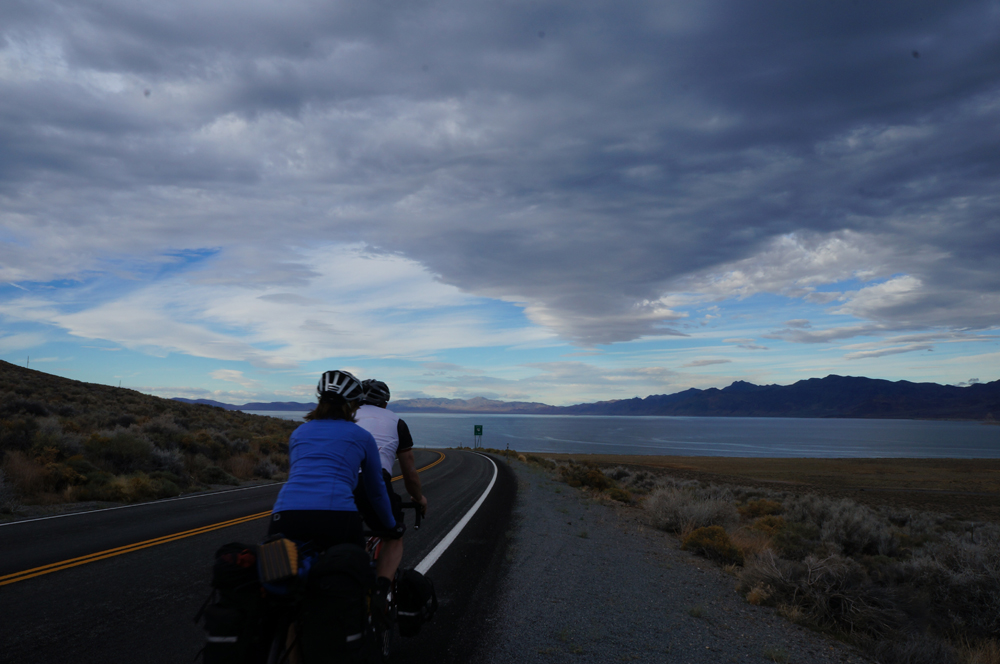
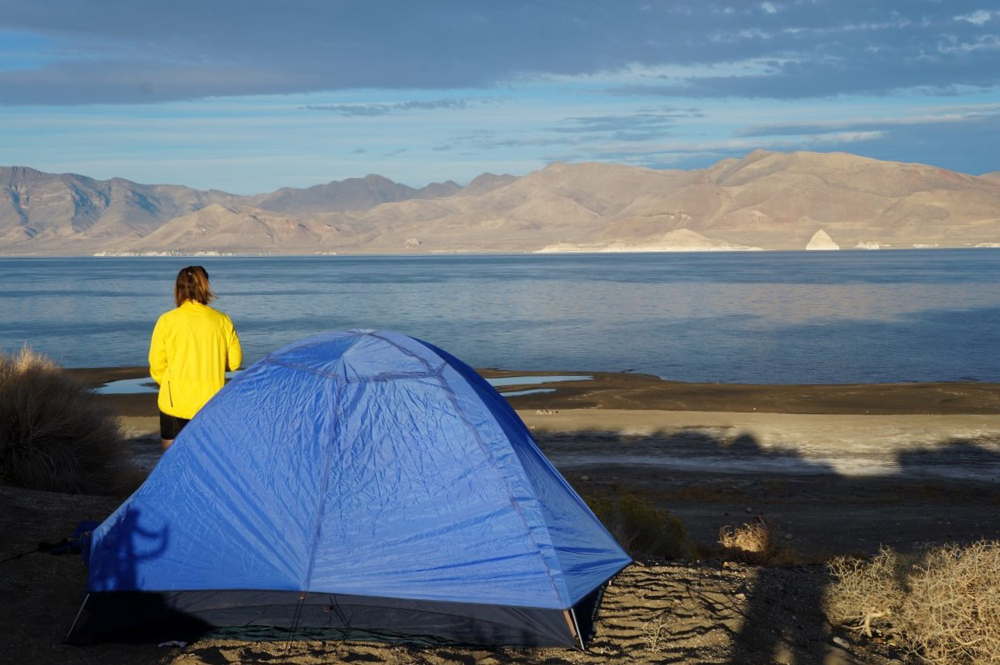
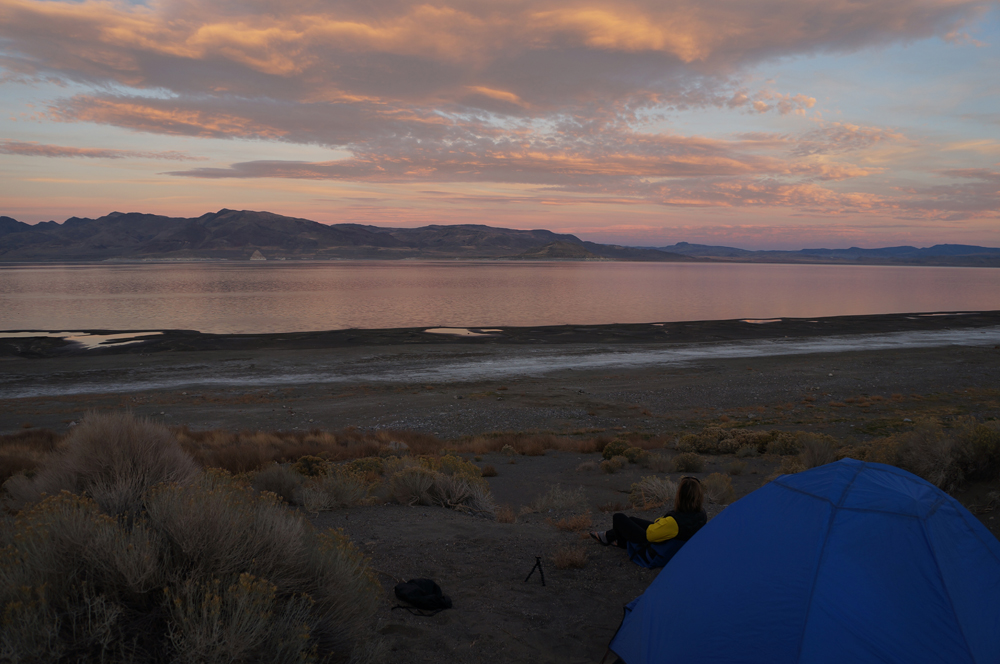
Sometimes a place needs to be watched, the light and color evolving to show you what you missed on prior visits. I had been to Pyramid Lake before by car and by bicycle but had not connected with it like other places in the region. I thought it was pretty but washed out by mid-day sun; I had in fact simply missed it. On this trip, with perfect fall weather we saw the lake turn from blue to bright pink to purple and finally black as the sun slowly set. The cold water reflected abundant clouds and nearby rock formations. Fisherman, first on ladders and eventually near shore tried to land one of the famous Lahontan trout, largest of the cutthroat subspecies and found only in Great Basin lakes and tributaries. The fish are a holdover from the ice age when Lake Lahontan covered 8,500 square miles. You can even see old Lake Lahontan shorelines high above dry lakebeds left behind in valley floors. The fishermen used tall ladders to extend their cast to reach a shelf, below which the trout feed. I did not see them catch any, but I am certain they were enjoying the sunset as much as we were.
Pyramid Lake on a tandem rewards with beautiful views. Photo by Patrick Walsh
There are several options for overnight rides from Reno. For pavement, Pyramid Lake is the perfect distance and is least hilly. More importantly it has nice distributed camping with great views of the lake and a nearby store for water and supplies. It was perfect for our first tandem overnight with camping gear (on tandem tours we usually opt for paid accommodations.) The 40-mile ride is mostly on Pyramid Highway (Nevada 445), a low-traffic approach with rolling hills that hide the lake until you are within about mile. A dramatic overlook provides the first view of the lake as well as the triangular tufa formation for which it is named. Camping and day use are allowed with a permit that can be obtained at the Pyramid Marina. The lake and the last part of the ride are within the Pyramid Piute Reservation, who restrict access to certain parts of the lake. There is an alternatively-routed Tahoe-Pyramid Bikeway in the works, with mostly dedicated bike paths. Unfortunately, that route is stalled between Sparks and Wadsworth. For now, Pyramid Highway is the best option for riding to the lake and taking in the scenery and recreational activities.
This trip was a good reminder for us to slow down, sit still, and watch scenery unfold as opposed to riding or even walking through it at a glance. Since then, we have (occasionally) heeded that advice and looked for other opportunities to focus on landscape transformation during diurnal cycles and even seasonal cycles in our local parks. Every year we enjoy Nevada’s pink and orange fall sunsets, snowy winter peaks, the return of wildflowers and red wing blackbirds in the spring, and high-country vistas in the summer. Photography encourages me to look more closely sometimes, but there are many days when I forego it in favor of taking it all in. In any case, we are planning many more bike overnights.
Notes on Pyramid Lake (From Wikipedia, en.wikipedia.org/wiki/Pyramid_Lake_(Nevada)):
Pyramid Lake is located in southeastern Washoe County in western Nevada. It is in an elongated intermontane basin between the Lake Range on the east, the Virginia Mountains on the west and the Pah Rah Range on the southwest. The Fox Range and the Smoke Creek Desert lie to the north.
A remnant of the Pleistocene Lake Lahontan (~890 feet deep), the lake area was inhabited by the 19th-century Paiute, who fished the Tui chub and Lahontan cutthroat trout from the lake. The former is now endangered and the latter is threatened. The lake was first mapped in 1844 by John C. Frémont, the American discoverer of the lake who also gave it its English title.
tahoepyramidtrail.org (Several sections are not completed, and the route currently requires riding on I-80 for at least 20 miles).
Enjoying the sunrise from a lakeside camp on Pyramid Lake, Nevada. Photo by Patrick WalshPyramid Lake on a tandem rewards with beautiful views. Photo by Patrick WalshEnjoying the sunset on the shores of Pyramid Lake, Nevada on a bicycle overnight tour. Photo by Patrick Walsh
Cycling West and Cycling Utah Magazine’s Summer – July 2019 Issue is now available as a free download (8 mb download), Pick up a copy at your favorite Utah, Idaho, Wyoming, Nevada, Montana, W. Colorado, N. Arizona, and N. California bike shop or other location!
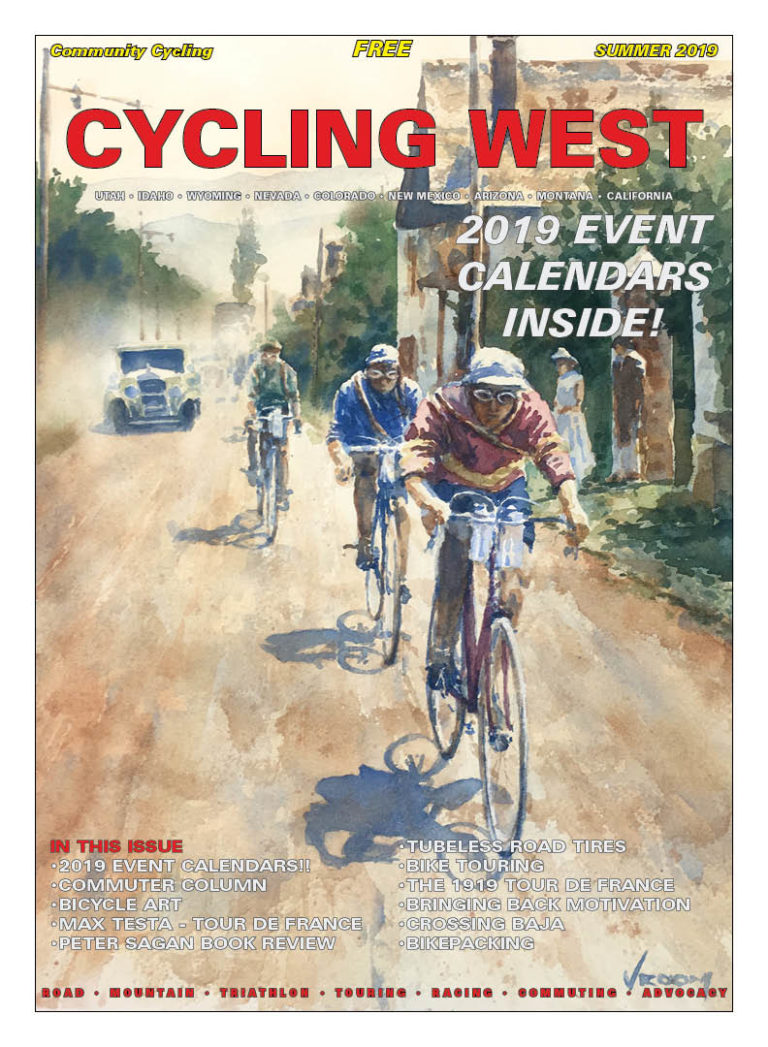
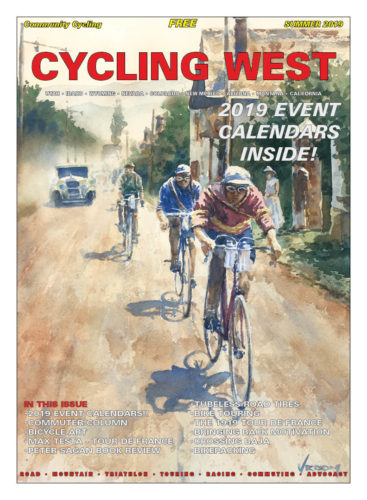
Cycling West Summer 2019 Issue Cover Art: 1921 Tour de France. Watercolor by Richard Vroom. Follow Richard on Instagram: @richvroom
Contents
Dr. Massimo Testa Shares His Experience as a Team Doctor in the Tour de France –page – 3
CYCLING WEST page – 3
Adventure Cycling’s Alex Strickland:Helping You Commute Across Town and Travel Around the World –page – 4
Bringing Back Motivation to Your Cycling –page – 6
I recently moved to Salt Lake City, Utah eight months ago and as a former professional mountain biker, I love the many stores, biking trails, and the opportunity to ride road forever. I enjoy going into stores with people that road bike and to ride the canyons with current pros. I even love how many cyclists ride for commuting as well, which is much safer to do, than in most big cities.
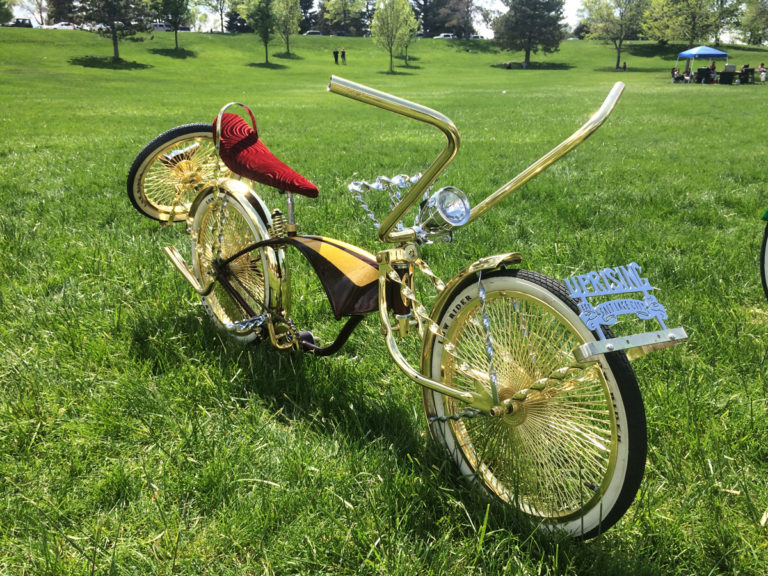
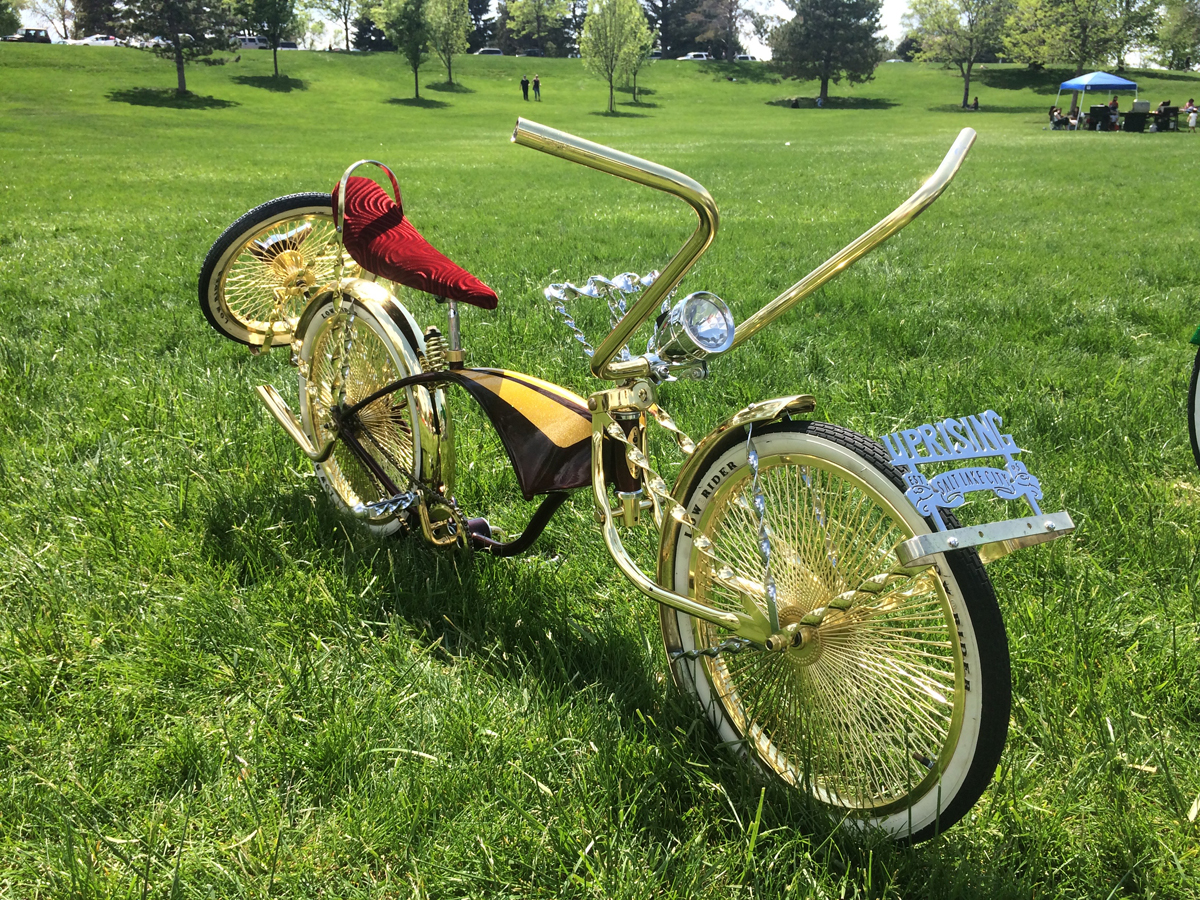
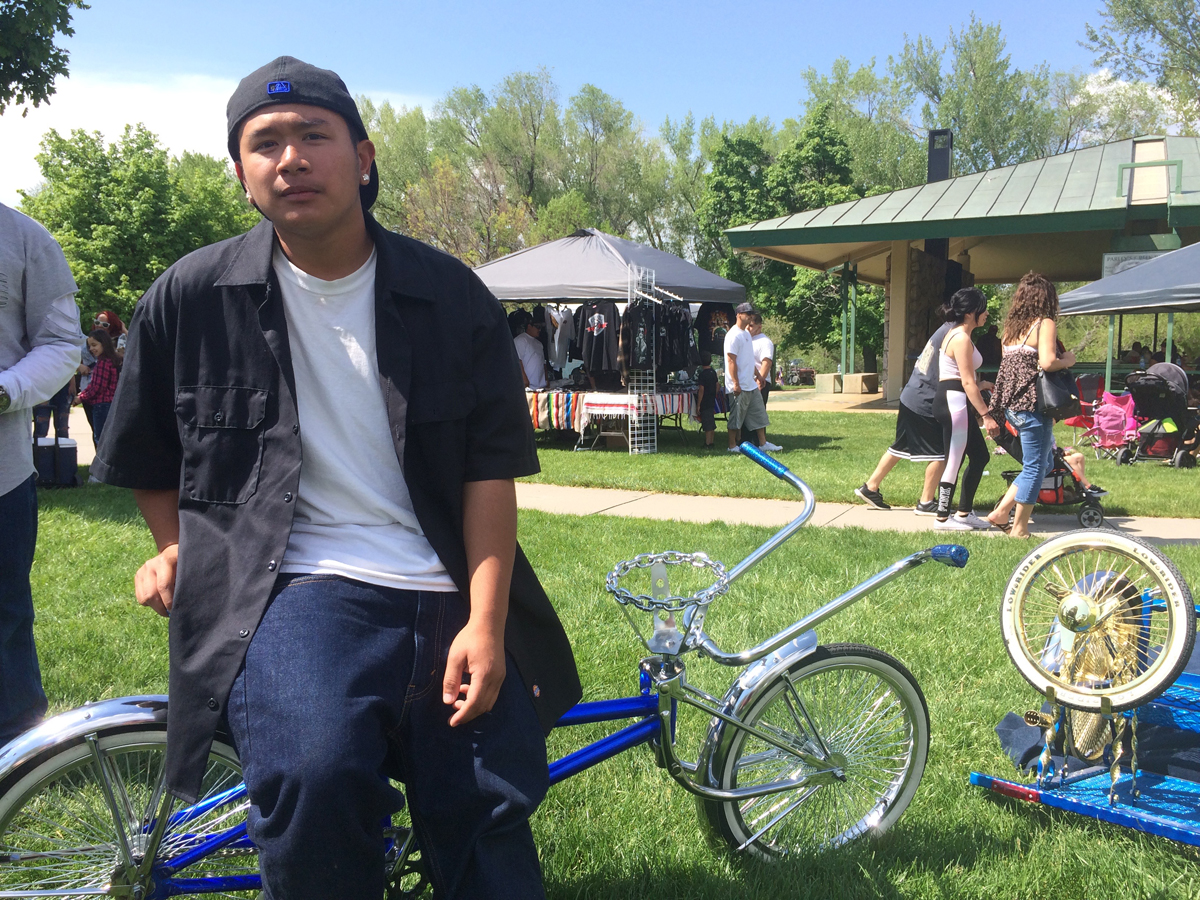
One of the Uprising Car and Bike Club’s bikes. Photo by Dave Iltis
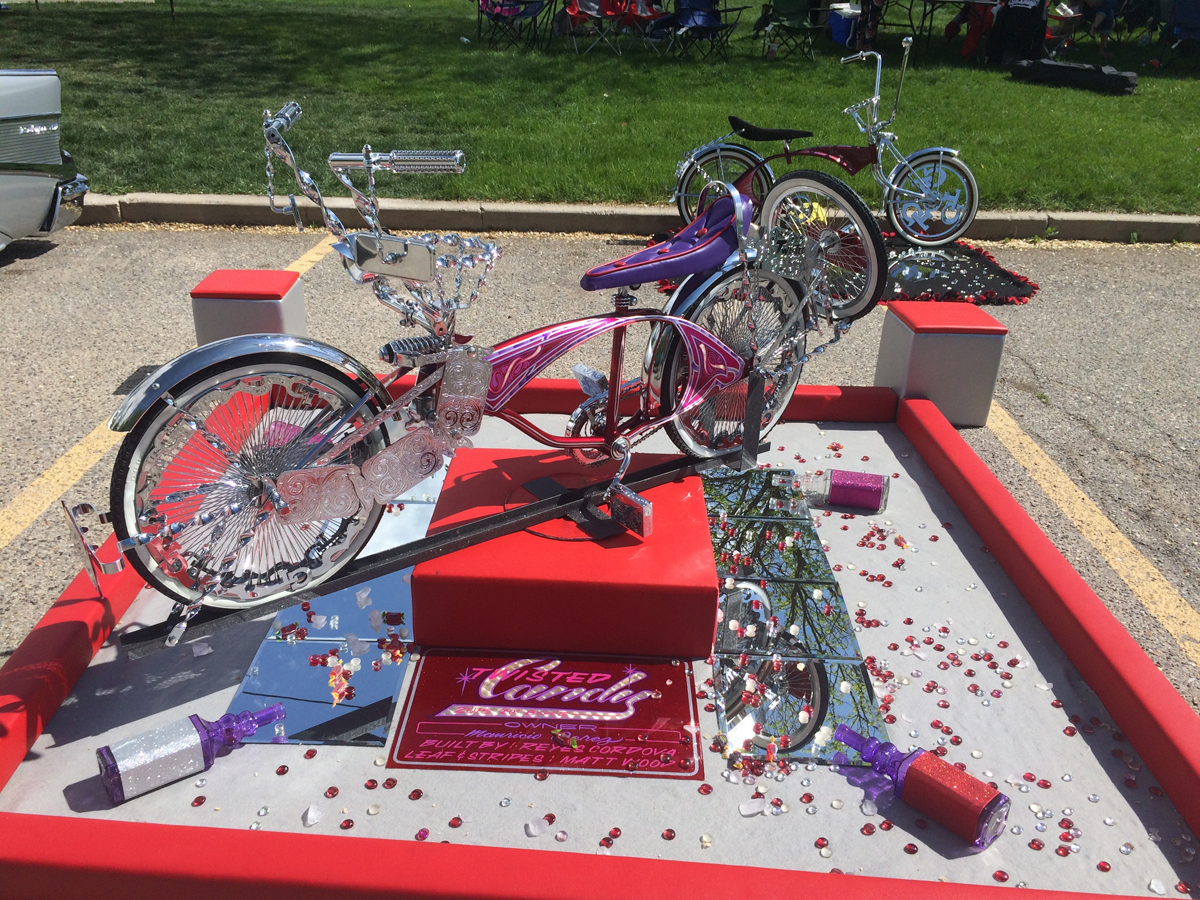
As I went store to store and flipped through the Cycling Utah Newspaper, I did not see one type of bike. I saw almost every bike on my tour of shops – cyclocross, BMX, unicycle, fat bikes, gravel bikes, tricycles, tandems, and even classic bicycles. What I did not see was the lowrider bicycle.
As I write this, I know people are rolling their eyes and saying that is not even part of the cycling industry and those are cheap bikes. On the contrary, there is a major magazine, shows, competitions, and big money prizes. It is a culture and guess what, it is huge in Salt Lake City.
There is a gathering almost every weekend at Sugarhouse Park and about ten lowrider clubs with cars and of course bicycles. The bikes values start at about three hundred dollars and go up to about ten thousand dollars. If you open your eyes roadies and mountain bikers, you will truly connect with another bike culture and fall in love.
I have three lowriders and am part of a club, Dreamkeeperz in Utah. My main lowrider bicycle is a 1968 Iverson Charger with a three speed internal rear hub that includes an external oil dropper.
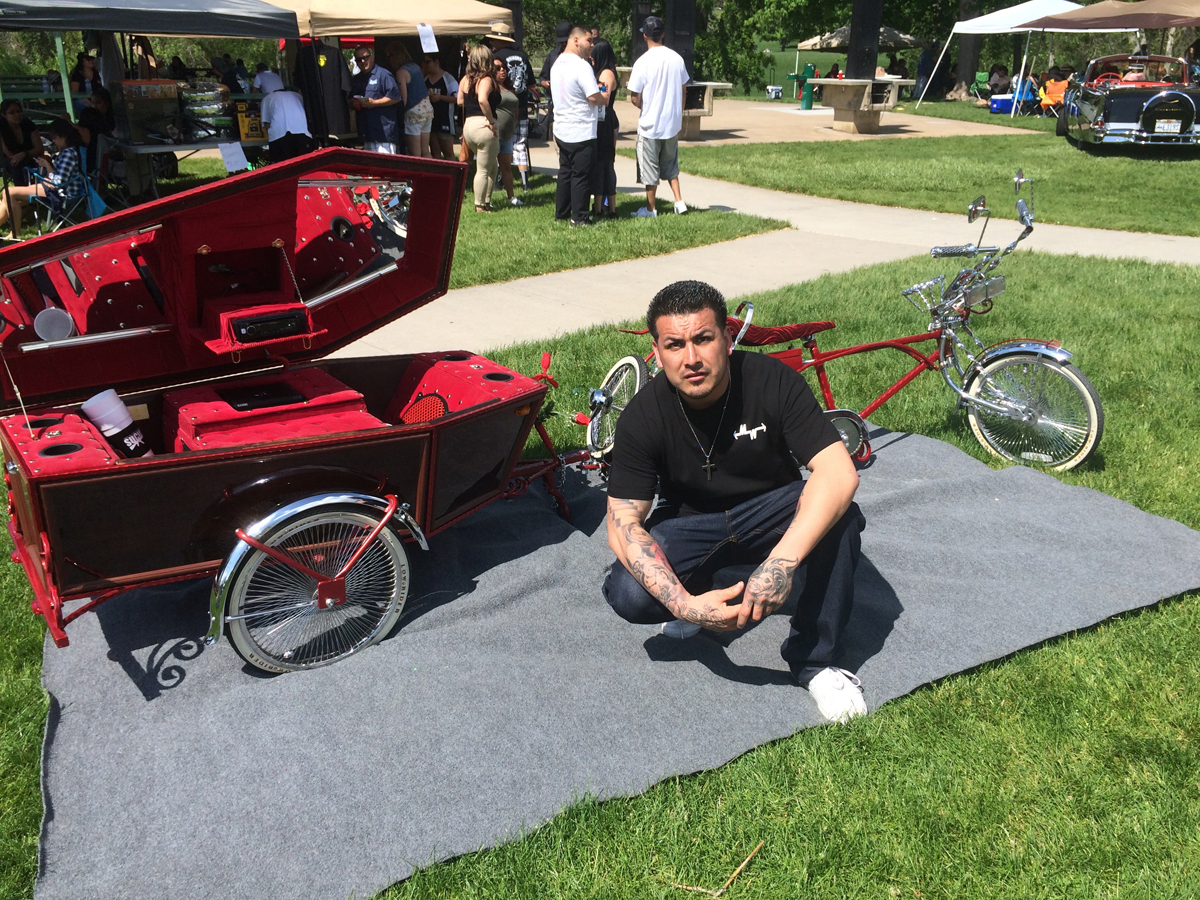
The lowrider culture started in Los Angeles, California by godfather of lowrider bicycles, Joe Manny Silva. The bicycles are painted amazingly with chrome and gold parts including engraving and velvet seats. Some of the bicycles even have hydraulics. The culture prides itself on being welcoming to families, children, and former gang members. The culture, rooted in Chicana/os and Cholo/as, promotes music, dancing, food, peace, and nonviolence.
Lowriders and Hip Hop have a lot in common, founded by communities of color and out of violence and for self-expression.
The problem is they have been ignored and avoided by many bicycle shops around the country, which are also owned, serviced, and marketed mostly by white and well-off individuals. It might just because many cycles are not introduced to lowriders, but it also might be something deeper. For a long time the bicycle industry did not cater to women and people with disabilities, but that is changing and we see more and more Black and Latinx pro cyclists globally as well.
Case in point, I last year went into one of the premier bicycle shops in Colorado, (where pro mountain bikers go regularly) with my lowrider bicycle. I went up to bicycle mechanic and asked him to install the crank for me as I did not have my tools. He said, “We do not work on those bicycles” and him and other mechanics laughed at the bike and joked how ridiculous it was.
Even if shops are still mostly employing white men and the advertising is mostly that as well, we can become more welcoming to all people.
I think the bicycle industry should take another look and become more inclusive to a beautiful bicycle and even may I dare say bicycle shops sponsoring contents and shows and even, if the location of the bike shop is suitable, strategically sell a few products such as lowrider tires, pedals, and grips. Well, I hope to see you at the next lowrider show in Salt Lake.
Note: Lowrider Magazine is a good resource: lowrider.com. Also, follow the Uprising Car and Bike Club on Facebook for information on upcoming lowrider car and bike shows. Follow the Dreamkeeperz Lowrider Club at facebook.com/Dreamkeeperz-Utah-Lowrider-Club-2033100226757615/
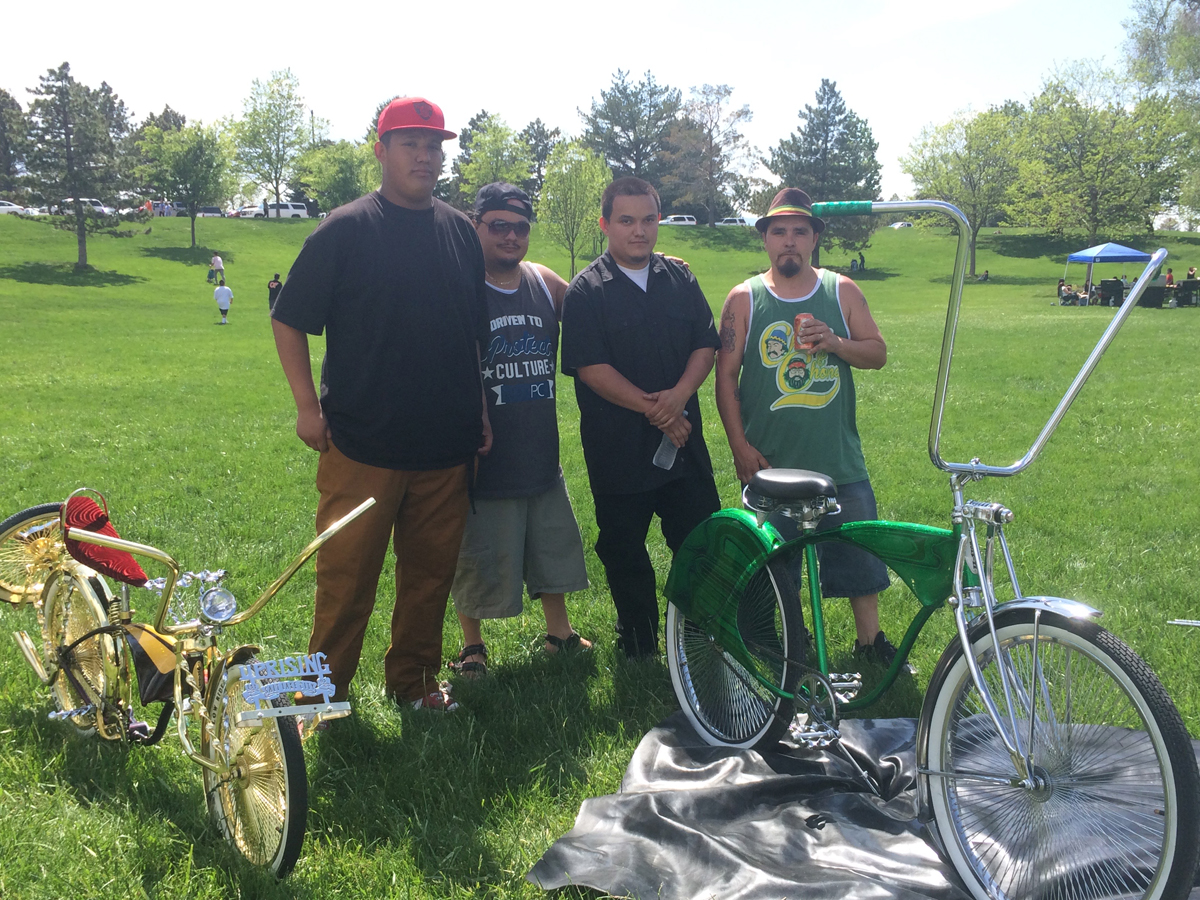
Uprising Car and Bike Club lowrider enthusiasts Don, Gale, Leonard and Robert at the Lowrider bike and car show in Sugarhouse Park, May 7, 2017. Photo by Dave IltisReyes Cordova’s Twisted Candy bike At the Lowrider bike and car show in Sugarhouse Park, May 7, 2017. Photo by Dave IltisCarlos with his coffin bike at the Lowrider bike and car show in Sugarhouse Park, May 7, 2017. Photo by Dave IltisAt the Lowrider bike and car show in Sugarhouse Park, May 7, 2017. Photo by Dave Iltis
It has been a few years since I wrote my first article “New Road Racing Adventures of a 43 year old Mom” when I wrote about that first terrifying crit race at RMR and my first tentative steps into the world of competitive cycling. Since that day, I have raced countless more times, pedaled my bike to amazing places that I never thought I would be, met incredible people, joined a club, gotten significantly stronger on the bike, almost finished a solo Lotoja, crashed several times, lived to ride again and learned a ton. Below are a handful of things I have learned. None of them will likely make you finish faster. That is still not my strength. They might be of use to the newbie just considering rolling up to a starting line as well as the seasoned cyclist who is finding themself in need of remembering a few things.
Kelly McPherson in the City Creek Bike Sprint. Photo by Dave Iltis
Weight is important. I am a heavier cyclist. I have been trying to lose weight since I started cycling, but really haven’t had a ton of success. It is frustrating to Strava-stalk people after a ride to compare power measurements and find that I am generating 30% more power than those around me while they are riding easy and I am doing everything I can just to hang on. More weight equals more mass to move as well as more for my heart and lungs to support. It is simple physics. I saw a girl go from back of the pack to front of the pack in one season, just by losing a few pounds. As one of my teammates recently pointed out, it is sad that you can line girls up by weight and often that is the order they will finish in. If you want to be faster, be lighter.
Weight isn’t everything. While it is important to be light, you can make up some of the difference by being more experienced, smarter or more skilled. Knowing that the attack won’t last forever, how to corner well and how to fuel and hydrate properly can make the difference between staying with the pack or getting dropped. Last summer, I beat a lighter girl at a DLD crit because I realized that she didn’t know how to corner or descend well. I used that to my advantage to put as much distance as possible between me and her so she couldn’t make up too much ground on the climb, where I am weaker. Of course, the next time I raced her, she figured out how to corner and so beat me instead.
Get help, when you need it. I don’t care how long you have been an athlete, you don’t know everything. Oftentimes, I see athletes who started in another sport try cycling with lots of athletic ability get frustrated and quit because they aren’t used to losing. Don’t quit! Get help and learn what you need to do to get where you want to go. A good coach is worth their weight in gold, even if you only use them for a short time. A nutrition clinic could give you that one tip you need to solve your GI issues. That question you post to the Facebook group isn’t proof that you are stupid. It’s proof that you are smart enough to learn wherever you can. Keep reading. Keep asking. Keep yourself inquisitive about your sport.
It isn’t always about the win. I had a teammate ask me why I continue to race crits even though I almost always come in last. I have learned that if the only reason you race is because you win, you will likely stop racing when you stop winning. Someone has to be the one in back. If only the winners continue to race, then that becomes a very small race. Everyone races for their own reasons and I would strongly suggest that you find your “why” other than winning. For me, there are several reasons, but mostly it is to continue to overcome the overweight, type II diabetic, non-vegetable eating, sugarholic that I used to be. That isn’t me anymore, but I have to fight for that each and every day. I could probably do that with regular casual century rides, but I don’t feel the drive to improve with those like I do with racing. It is this desire to improve that keeps me focused on power kale salads, interval work and consistent daily workouts toward my goals. It is this craving for improvement which keeps me focused on the healthy behavior changes that have led to measureable physiological changes that show I am winning my war against the diabetes, stroke and heart disease that plagues my family and sets a strong positive example for my children.
Don’t watch the Youtube crash videos. For every video of a race going smoothly, there are 100 videos of someone crashing spectacularly. For every crash, there are at least 100 races that don’t have a crash. Youtube videos unfairly represent how dangerous cycling really is. Yes, racing has its risks, but most of the time no one crashes. If you are scared of racing because you don’t want to crash, stop watching crash videos! Instead, watch the videos that give good instruction on how to ride in a group effectively, how to lead attacks or how to support another rider. Those would be a much more productive use of your time.
Cycling friends are more valuable than your bike. I don’t care how valuable your bike is or how good of a rider you are, all on your own. Cycling friends are the ones who will get you back on the road when you have lost your motivation, encourage you to try again when you have had a bad race, give that one tip that you needed to overcome a barrier and even help you win a race that you wouldn’t have otherwise been able to win on your own. Finding those friends often means the difference between staying in the sport or leaving it. Find a team that fits who you are and get involved. Ride the group rides. Give kudos on Strava. Comment on the message threads. Consistently and regularly give support to others whether or not they might be able to help you at some point. I cannot tell you how many times a well-placed comment or word of encouragement has gotten me back on track. I hope I am doing the same for others.
Consistency is King … or Queen. Go for the long game. Small habits consistently performed over time will have a greater impact than massive efforts in the short term. This is true no matter the area of life, cycling or otherwise. You will have up days and down days. The true and most significant gains are made when you are consistent for a long period of time. Keep it up!
There is always more hill. Once you get to the top of the hill, there is always another one. Continue to set goals that excite you. I have been training to complete Lotoja for 6 years. Yes, that is a long training plan and it has sometimes been a struggle to stay excited about it. The first year I rode it, I finished 159 miles before it got dark. The 2nd year, I didn’t get in, but continued to train. The 3rd year, I successfully rode it with a relay. The 4th year, I broke my wrist 4 weeks before the race, got my cast off 2 days beforehand and finished 185 miles before it got dark. Last year, I got a nasty concussion in May that kept me off my bike until almost July and then got shingles in mid-August. I finished the entire course, but 15 minutes too late to count as a finish. I am positive, if I can stay rubber-side-down, that I will finish Lotoja before 8:30PM this year. My training is good and I am stronger than I ever have been in my life. This will be the year that I finally complete the goal that proves to me that I am no longer that overweight mom that I was many years ago, that I have finally completed the transformation into a new, healthier person. Am I done? What will I do next year once I have accomplished this? Not quit, of course! I am not sure yet. . . but I have been plotting a route on Google Maps from Washington DC to Lincoln City, Oregon. Hmmm. . . maybe? Anyone want to join me?
Kelly McPherson is a 40+ cyclist who lives in South Jordan UT with her husband of 27 years and 5 kids. She has a BS in Health Education from the University of Utah and loves to stay healthy and fit and take as many people with her as she can.