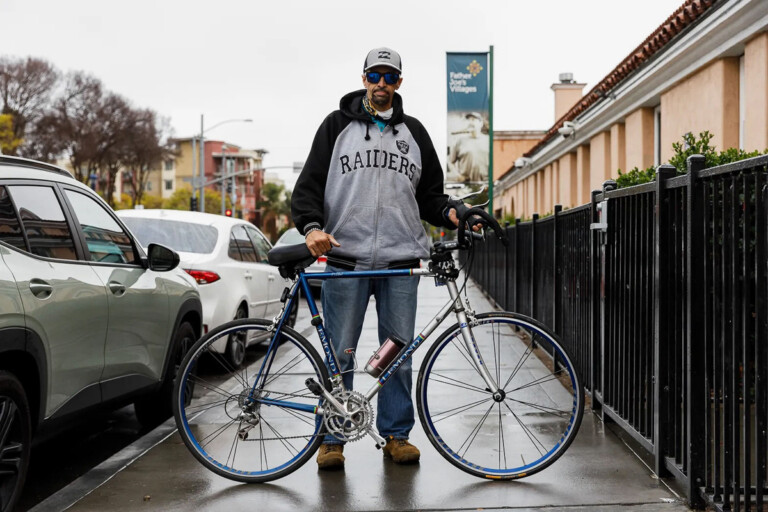
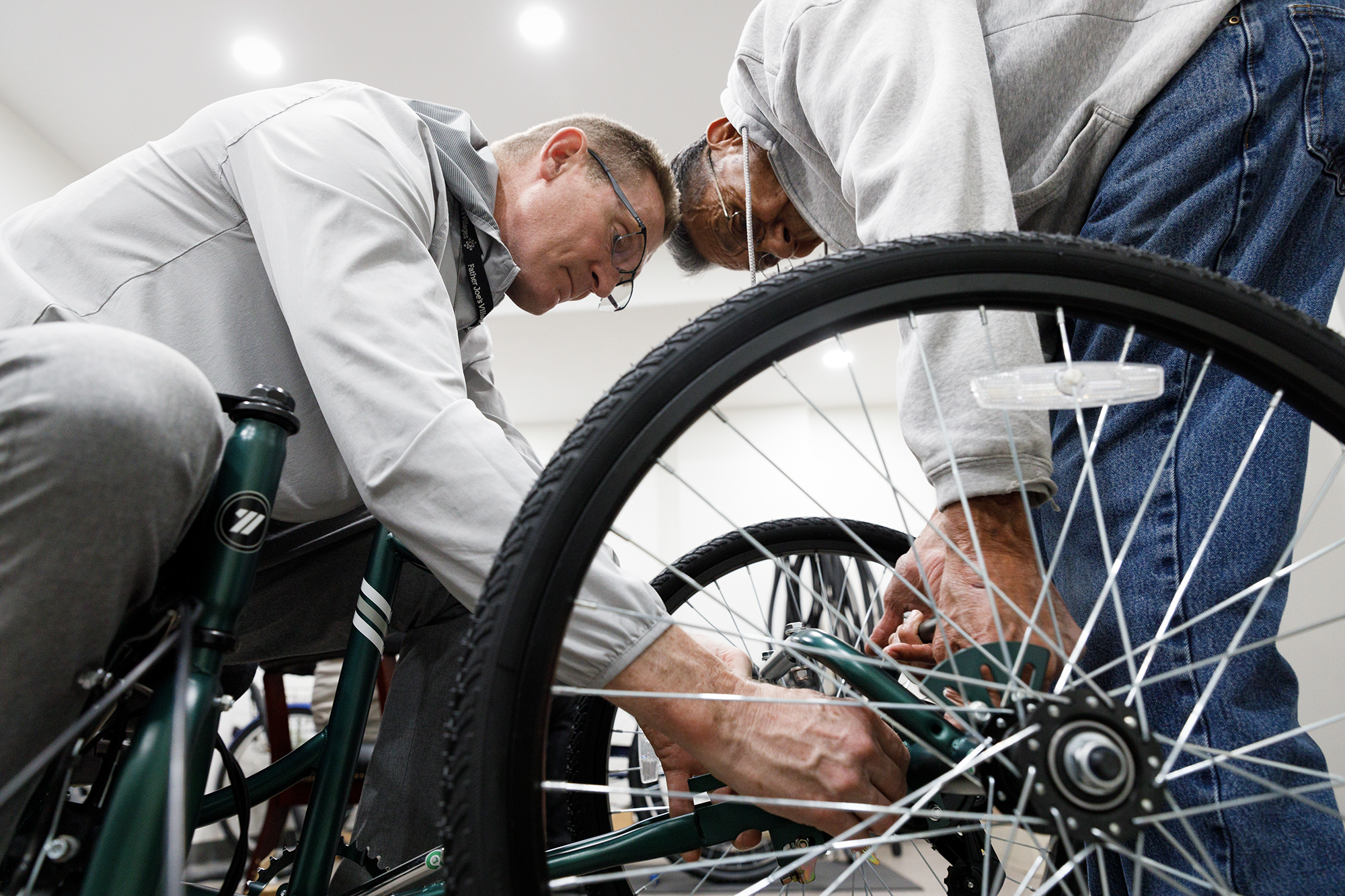
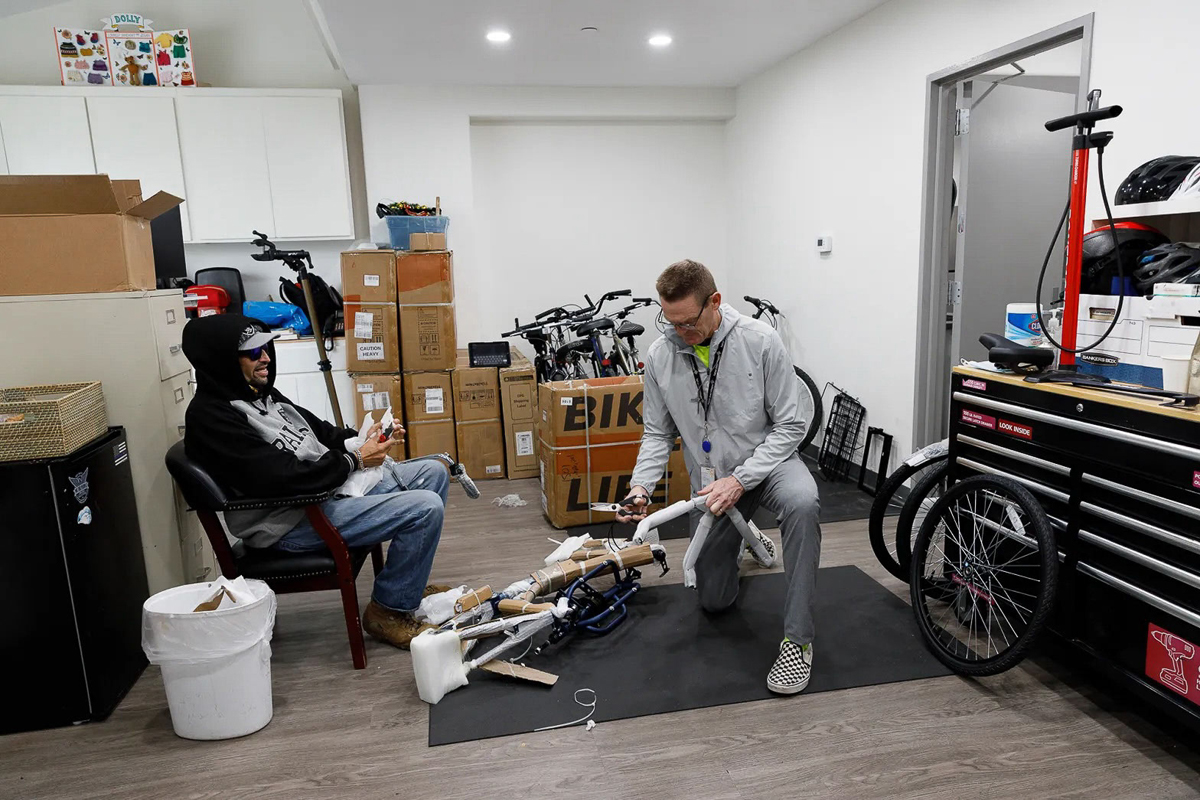
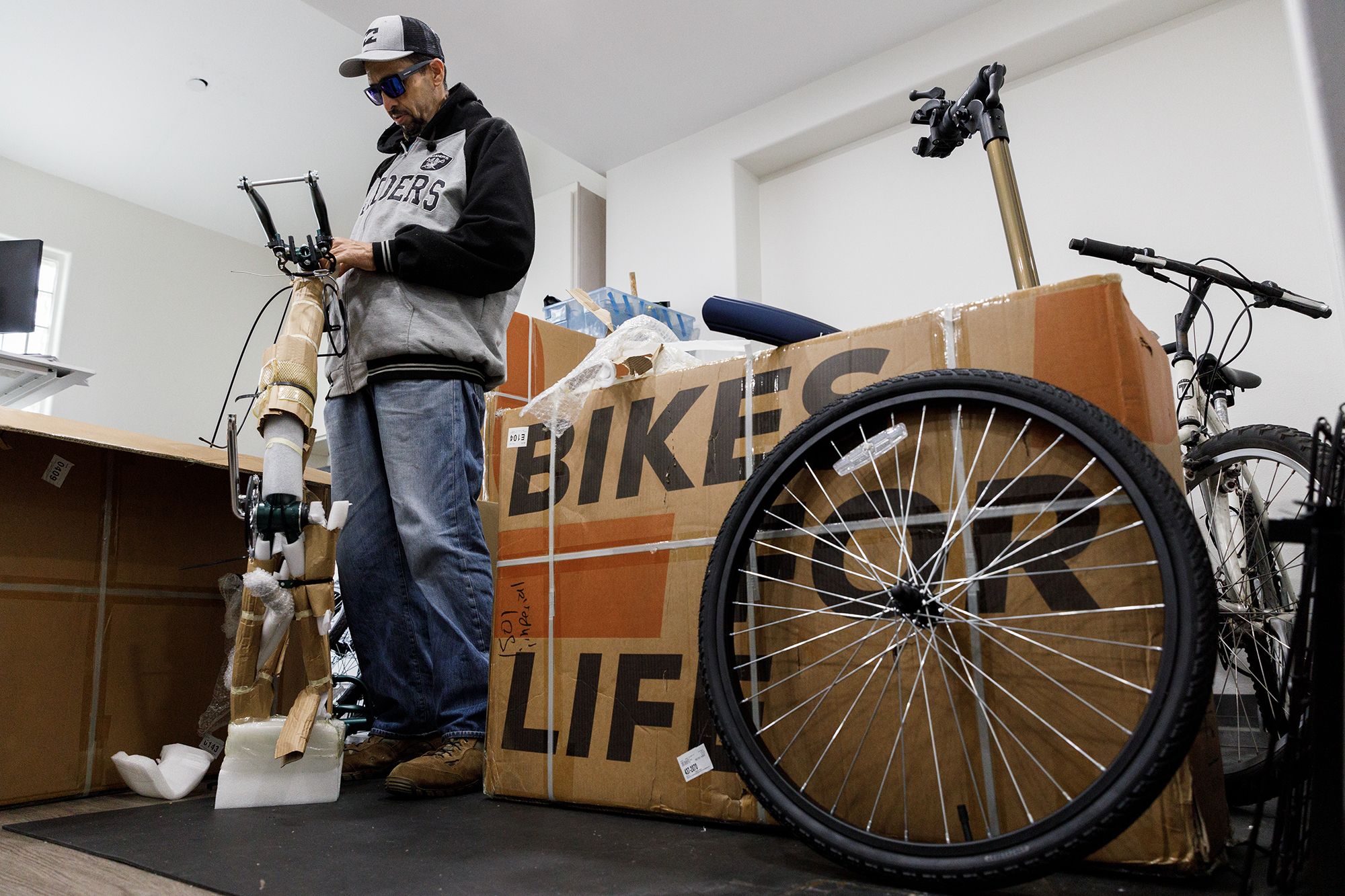
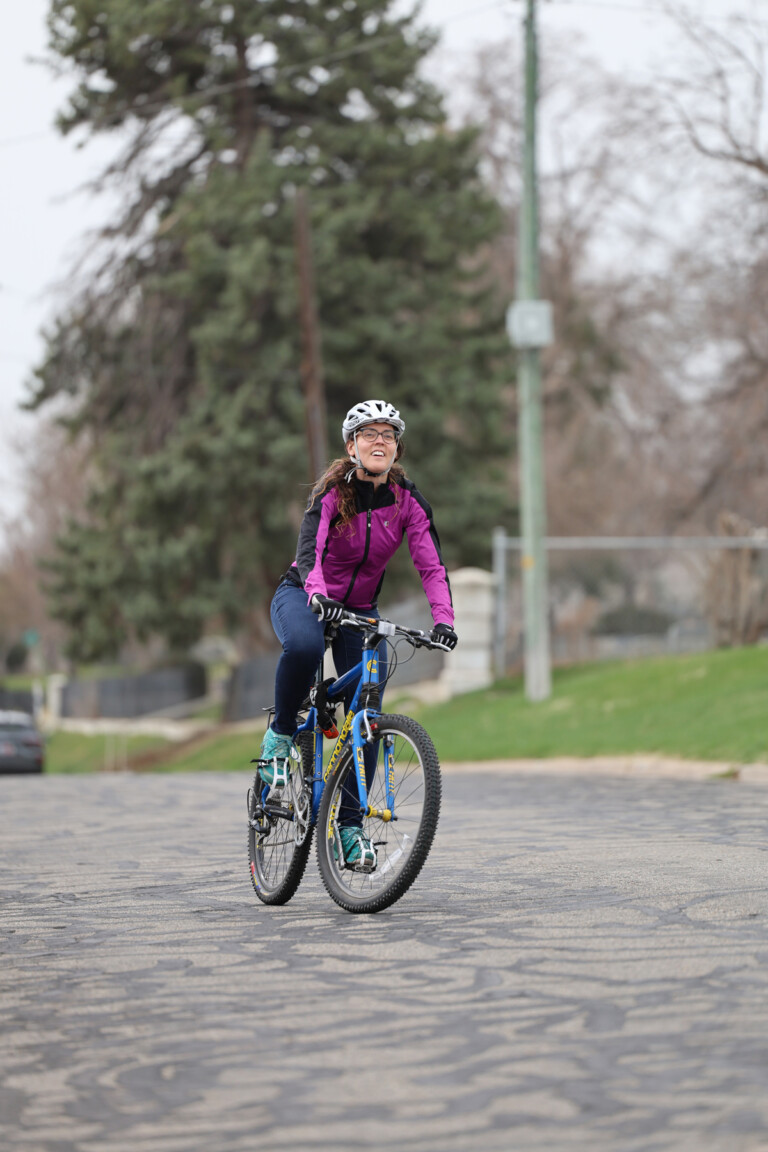
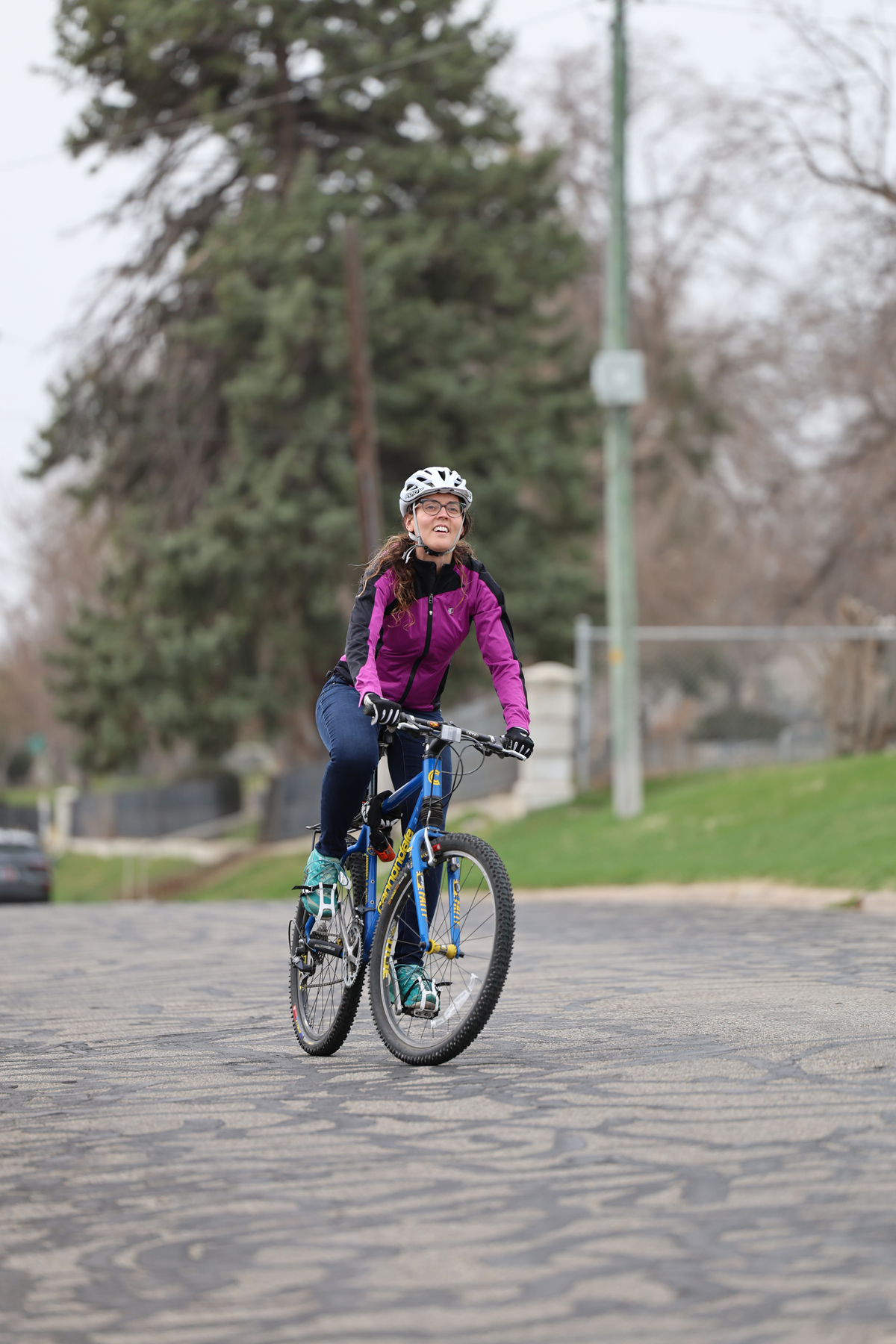
Deacon John Roberts and volunteer Carlos Valenzuela assemble an adult tricycle at Father Joe’s Villages in San Diego on Feb. 13, 2025. Photo by Kristian Carreon for CalMatters
Robert Brown had tried everything for his pain, from acupuncture to massage to chiropractors.
A 59-year-old Army veteran who spent decades living on the street, Brown has a crushed disk in his spine and nerve damage to his thigh. What finally helped him feel better wasn’t medication or traditional physical therapy.
It was a weekly 20-mile bike ride with other homeless and formerly homeless San Diegans.
“I’m telling all my providers at La Jolla hospital I’m feeling better than I felt in a decade,” he said, “and they all say it’s the bike.”
Brown rides nearly every Thursday morning with a cycling program started by homeless services provider Father Joe’s Villages. It’s part of a handful of programs run by a variety of different organizations, all aimed at getting unhoused Californians — who are statistically more likely to have health problems — to exercise with a community. The Skid Row Running Club in Los Angeles organizes regular early-morning runs for people at risk of homelessness and addiction. Back on My Feet organizes runs for unhoused people across the country, including in Los Angeles and San Francisco. And Street Soccer USA offers soccer programs to people who are homeless, in recovery or living at or below the poverty line in cities including Los Angeles, Oakland, Sacramento, San Diego and San Francisco.
Deacon John Roberts leads the San Diego bike rides, and said while biking on its own doesn’t get people into housing, it’s the best way he’s found to help people feel better physically and mentally as they navigate the arduous road out of homelessness.
“Bike riding, it gives people…physical, mental, spiritual, all of that well-being,” he said. “And it’s social.”
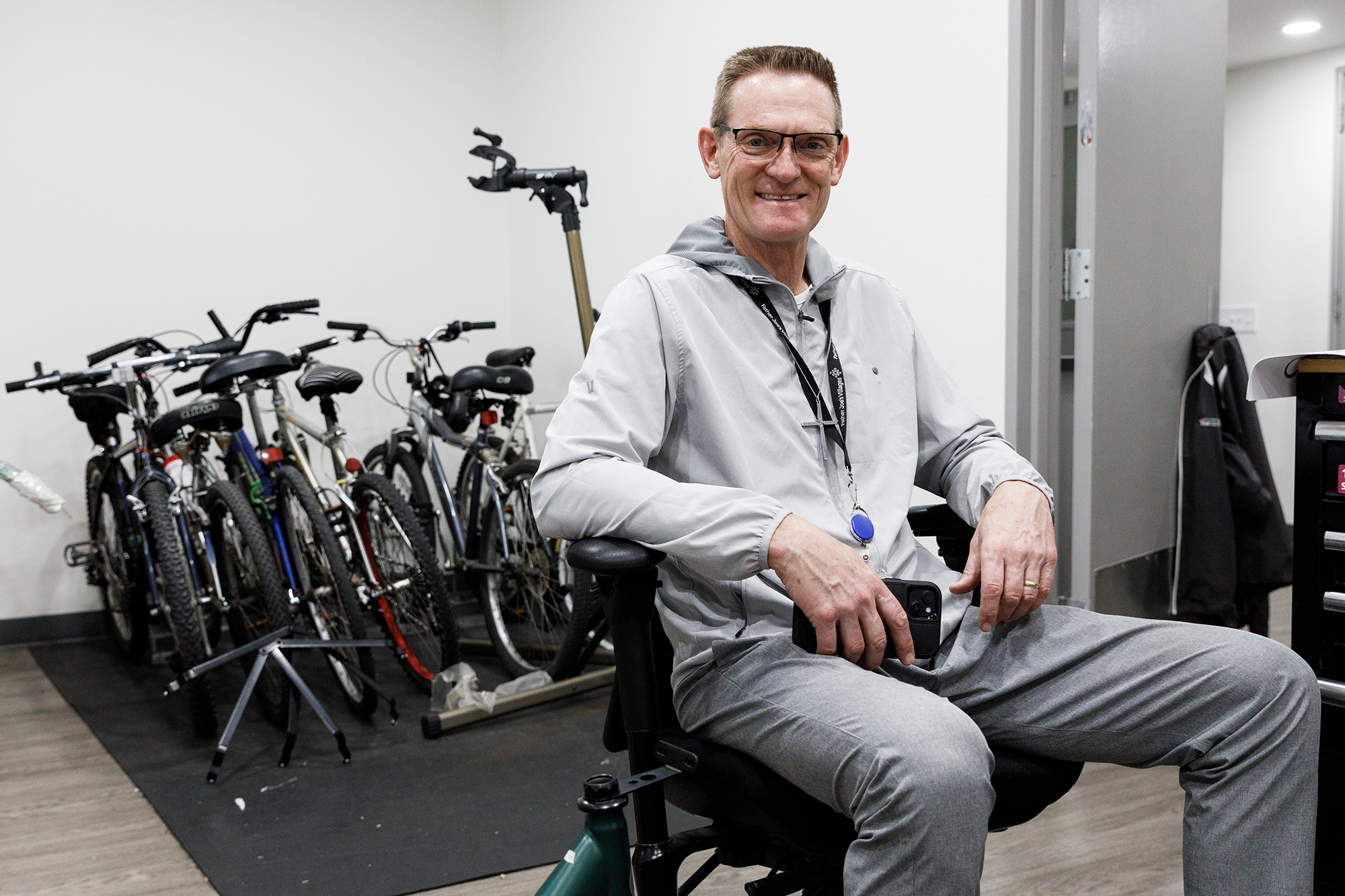
Deacon John Roberts, leader of the cycling program, at Father Joe’s Villages in San Diego on Feb. 13, 2025. Photo by Kristian Carreon for CalMatters
Living on the streets is hard on the body, and people without housing are less likely to get proper medical care. Nearly half of the unhoused Californians surveyed by the UCSF Benioff Homelessness and Housing Initiative in 2023 described their health as fair or poor, and 60% reported having at least one chronic health condition. Among the most common chronic health problems were hypertension, asthma, heart conditions and diabetes.
But exercise programs geared toward homeless participants are few and far between, and research on their outcomes is limited. A U.K. study looking at the benefits of exercise among unhoused people found the majority of participants improved their mental health and blood pressure.
Robin Petering led yoga classes for homeless young people in the Los Angeles area for about four years, before her classes came to a halt at the start of the COVID-19 pandemic in 2020.
Petering, who serves as executive director of youth homelessness organization Young People to the Front, aimed to make yoga inclusive for everyone. She wanted to quash the stereotype that it’s for “the rich white lady in her Lululemons,” and wasn’t fazed if her classes were in noisy buildings or her clients were wearing skinny jeans. They focused on gentle stretching and breathing techniques. If clients couldn’t or didn’t want to get on the floor, they spent the class sitting in a chair.
Young people who are homeless often experience trauma and violence, Petering said, which can cause them to have poor impulse control and be quick to get into fights. That can hurt their chances of getting out of homelessness — fighting may lead to getting kicked out of a shelter.
That’s where yoga helps, Petering said. She and her team studied 58 homeless young people who started practicing yoga, and found that after two months their mindfulness increased (judged by their answers to questions such as “I criticize myself for having irrational or inappropriate emotions”) and the number of fights they reported getting into decreased.
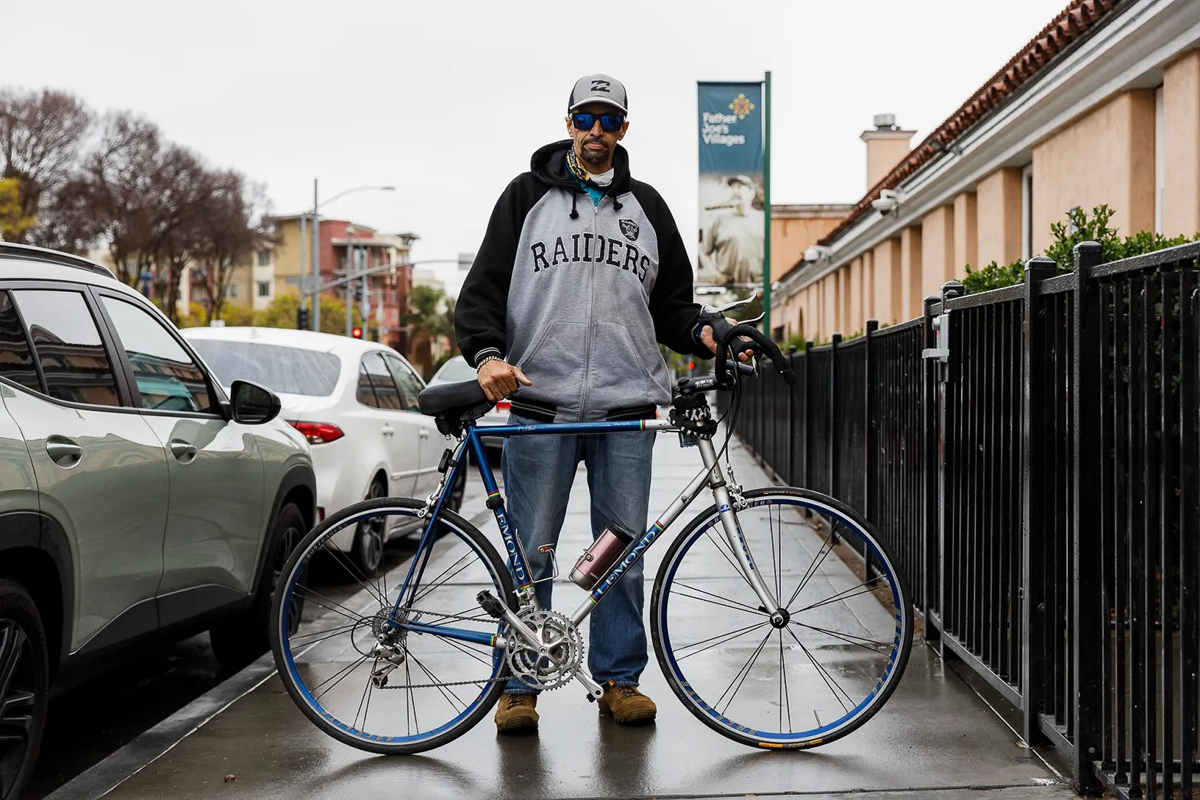
Arturo Ramos, 51, with the bicycle he earned from a cycling program at Father Joe’s Villages in San Diego on Feb. 13, 2025. Photo by Kristian Carreon for CalMatters
Yoga by itself doesn’t end young people’s homelessness, Petering said. But, she said, if it can help them learn better self control, it can make it easier for them to get into housing.
Deacon John Roberts, right, and Arturo Ramos begin assembling an adult tricycle at Father Joe’s Villages in San Diego on Feb. 13, 2025. Photo by Kristian Carreon for CalMatters
Most of the people who participate in the San Diego biking program hear about it because they already receive other services from Father Joe’s, whether they live on the street or in the nonprofit’s shelters and housing facilities. A typical ride has between six and 10 riders, Roberts said, and always includes a stop for lunch — often at In-N-Out Burger. Father Joe’s lends everyone a bike, and after each participant rides 100 miles — which usually takes about five weeks — Father Joe’s gives that rider a donated bike, helmet and lock to keep. After another 100 miles, each rider gets a bus pass. So far, the program has given away more than 70 bikes.
Arturo Ramos takes out tricycle parts for assembly at Father Joe’s Villages in San Diego on Feb. 13, 2025. Ramos has been participating in the bike ride program for two months and received a bicycle. He was homeless for six years before obtaining housing in September. Photo by Kristian Carreon for CalMatters
“The idea then is you have the freedom to ride whenever you want, to go wherever you want,” Roberts said. Most of their riders don’t have a car.
The rides started nearly a decade ago, but paused early in the pandemic. Roberts took over and re-launched the rides in the fall of 2020, and also added the earn-a-bike program.
Brown started riding with the group in 2022.
“I hadn’t been on a bike in 20 years,” he said. “It was absolutely horrendous and just not my cup of tea. I’m a weightlifter, slow-moving type of guy.”
Now, he’s logged nearly 2,000 miles. He’s maintained his subsidized housing at a Father Joe’s building where he pays 30% of his income in rent, he’s not drinking, and he’s going to therapy.
“I feel a lot better now than I did then,” he said.
Mexican Prodigy Claims Pink as Race Serves Up Five Different Leaders in Nine Days
SIENA, Italy (May 18, 2025) — The 108th Giro d’Italia has unfolded as a spectacular showcase of cycling’s unpredictable nature, with the race’s first nine days producing a narrative worthy of Italian opera: five different riders wearing the coveted maglia rosa, breakthrough performances from young talents, and veterans demonstrating their enduring class across Italy’s diverse landscapes.
The race, which began in Albania before transferring to southern Italy, has traversed the peninsula’s varied terrain, from flat coastal roads to the punishing white gravel sectors of Tuscany. Each day has added new chapters to an evolving story that has captivated cycling fans worldwide.
What began as a display of dominance by Danish powerhouse Mads Pedersen has transformed into a platform for cycling’s next generation, with 21-year-old Mexican Isaac Del Toro now leading the race as both the youngest Giro leader this century and the first from his nation to don the iconic pink jersey.
Stage 4: Dutch Rookie Announces Arrival With Maiden Victory
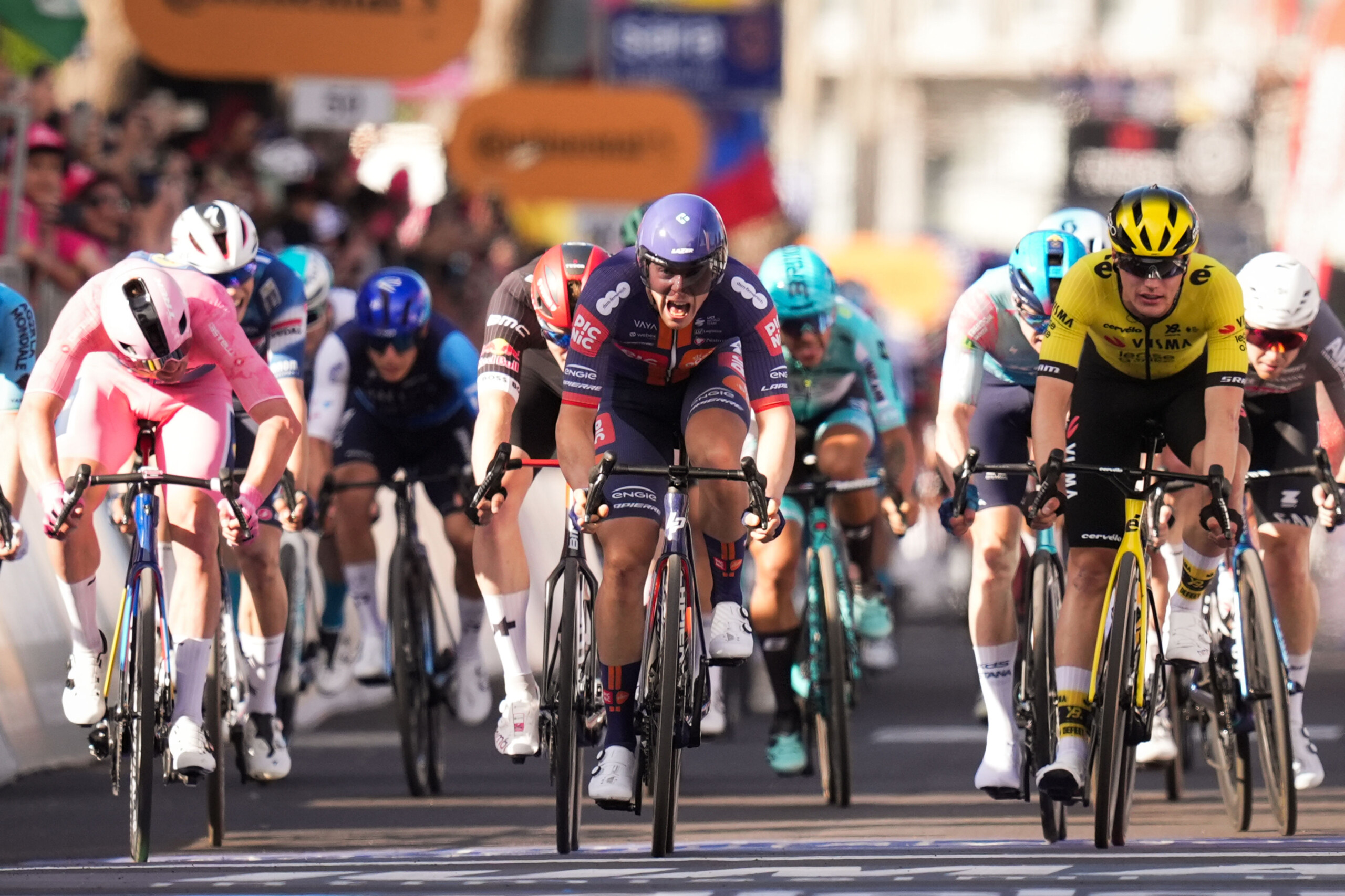
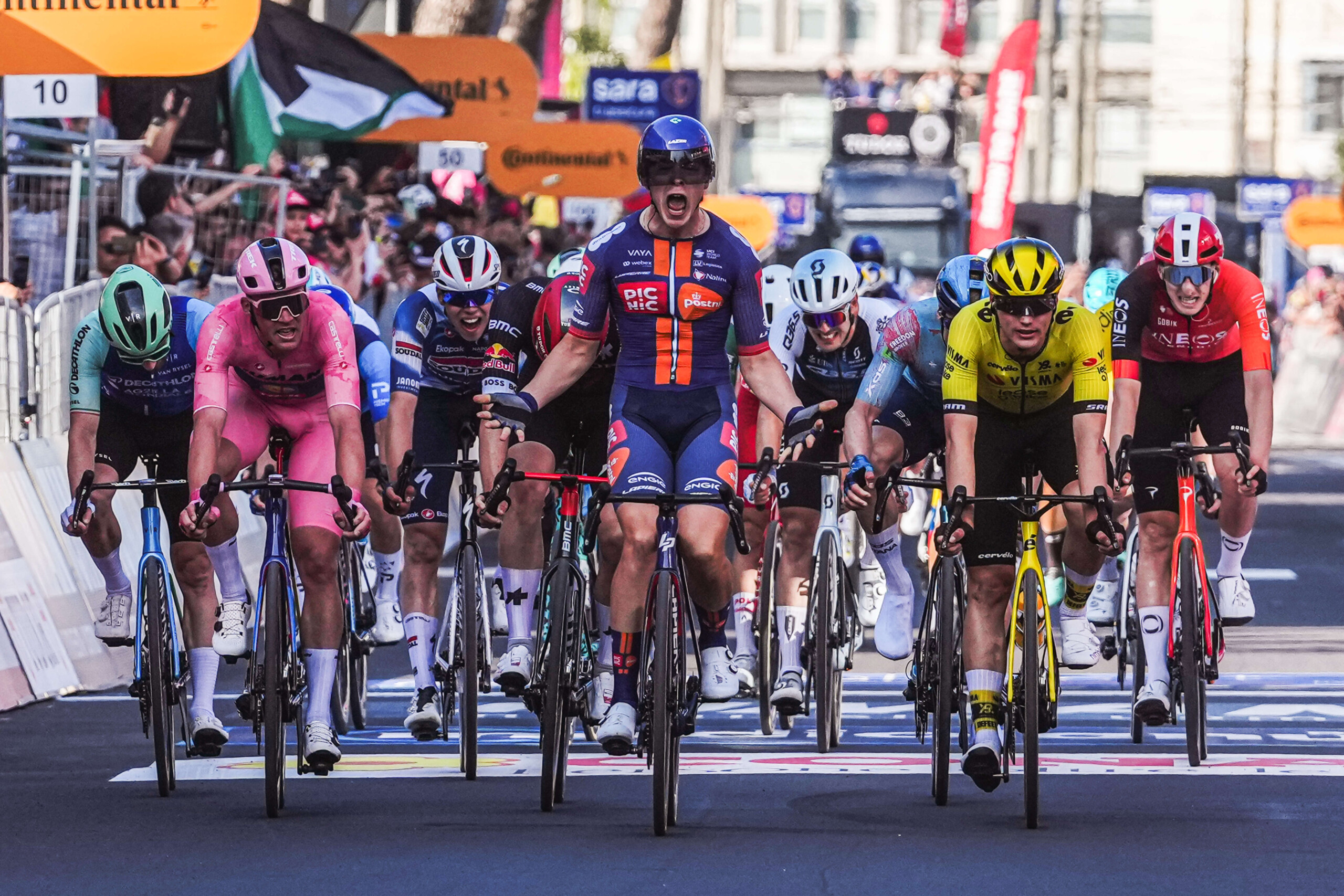
LECCE, Italy — The cycling world witnessed the emergence of a promising new talent on May 13 when 23-year-old Dutch rookie Casper Van Uden (Team Picnic PostNL) claimed victory in Stage 4, the first Grand Tour stage win of his career. In a remarkable display of national dominance, Van Uden led an all-Dutch podium in Lecce, besting compatriots Olav Kooij (Team Visma | Lease a Bike) and Maikel Zijlaard (Tudor Pro Cycling Team).
The 189-kilometer stage from Alberobello (Pietramadre) to Lecce unfolded as a classic sprinter’s day, with teams carefully controlling the early breakaway before the tension ratcheted up in the closing kilometers. Team Picnic PostNL delivered their young sprinter to the front with perfect timing, allowing Van Uden to unleash a powerful finishing kick that neither Kooij nor Zijlaard could match.
Casper Van Uden of Team Picnic Postnl winner of the stage during the stage 4 of the Giro dÕItalia from Alberobello (Pietramadre) to Lecce, Italy – Tuesday, May 13, 2025. Sport – cycling. (Photo by Massimo Paolone/LaPresse)Casper Van Uden of Team Picnic Postnl winner of the stage during the stage 4 of the Giro dÕItalia from Alberobello (Pietramadre) to Lecce, Italy – Tuesday, May 13, 2025. Sport – cycling. (Photo by Gian Mattia D’Alberto/LaPresse)
“I didn’t do it alone. I did it with the whole team, all the boys here, the staff, the HQ as well,” an elated Van Uden said moments after crossing the finish line. “I know I have a good long sprint. We did a good job with the lead out since the beginning of the season.”
The significance of the moment was not lost on the young Dutchman, who reflected on his breakthrough during the press conference: “When you’ve done it once, you know it’s possible so you can keep fighting for it. Sometimes it takes longer for someone to reach a win at this level.”
Denmark’s Mads Pedersen (Lidl-Trek) retained the maglia rosa despite finishing fourth in the stage, maintaining his overall lead in the general classification ahead of pre-race favorite Primož Roglič (Red Bull – Bora – Hansgrohe).
“It was special to wear the maglia rosa in a road race today and not in a time trial that lasted fifteen minutes or so on Saturday,” Pedersen said, acknowledging the significance of the race’s iconic leader’s jersey. “This jersey is so special for Italy. It’s an incredible experience.”
Stage 4 Results:
Casper Van Uden (Team Picnic PostNL) – 189km in 4h02’21”, average speed 46.792 km/h
Olav Kooij (Team Visma | Lease a Bike) s.t.
Maikel Zijlaard (Tudor Pro Cycling Team) s.t.
General Classification After Stage 4:
Mads Pedersen (Lidl-Trek)
Primož Roglič (Red Bull – Bora – Hansgrohe) at 7″
Mathias Vacek (Lidl-Trek) at 14″
Official Jerseys After Stage 4:
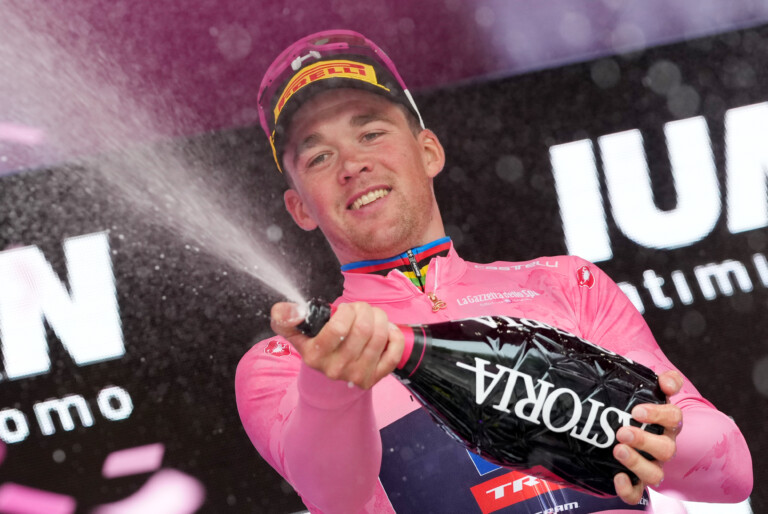
Maglia Rosa (Pink Jersey), leader of the General Classification, sponsored by IUMAN – Intimissimi Uomo – Mads Pedersen (Lidl-Trek)
Maglia Ciclamino (Cyclamen Jersey), leader of the Points Classification, in collaboration with Ministero degli Affari Esteri e della Cooperazione Internazionale and ITA Italian Trade Agency – Mads Pedersen (Lidl-Trek)
Maglia Azzurra (Blue Jersey), leader of the Gran Premio della Montagna (KOM), sponsored by Banca Mediolanum – Lorenzo Fortunato (XDS Astana Team)
Maglia Bianca (White Jersey), Best Young Rider, born after 01/01/2000, sponsored by Conad – Mathias Vacek (Lidl-Trek)
Stage 5: Pedersen Cements Authority With Uphill Sprint Mastery
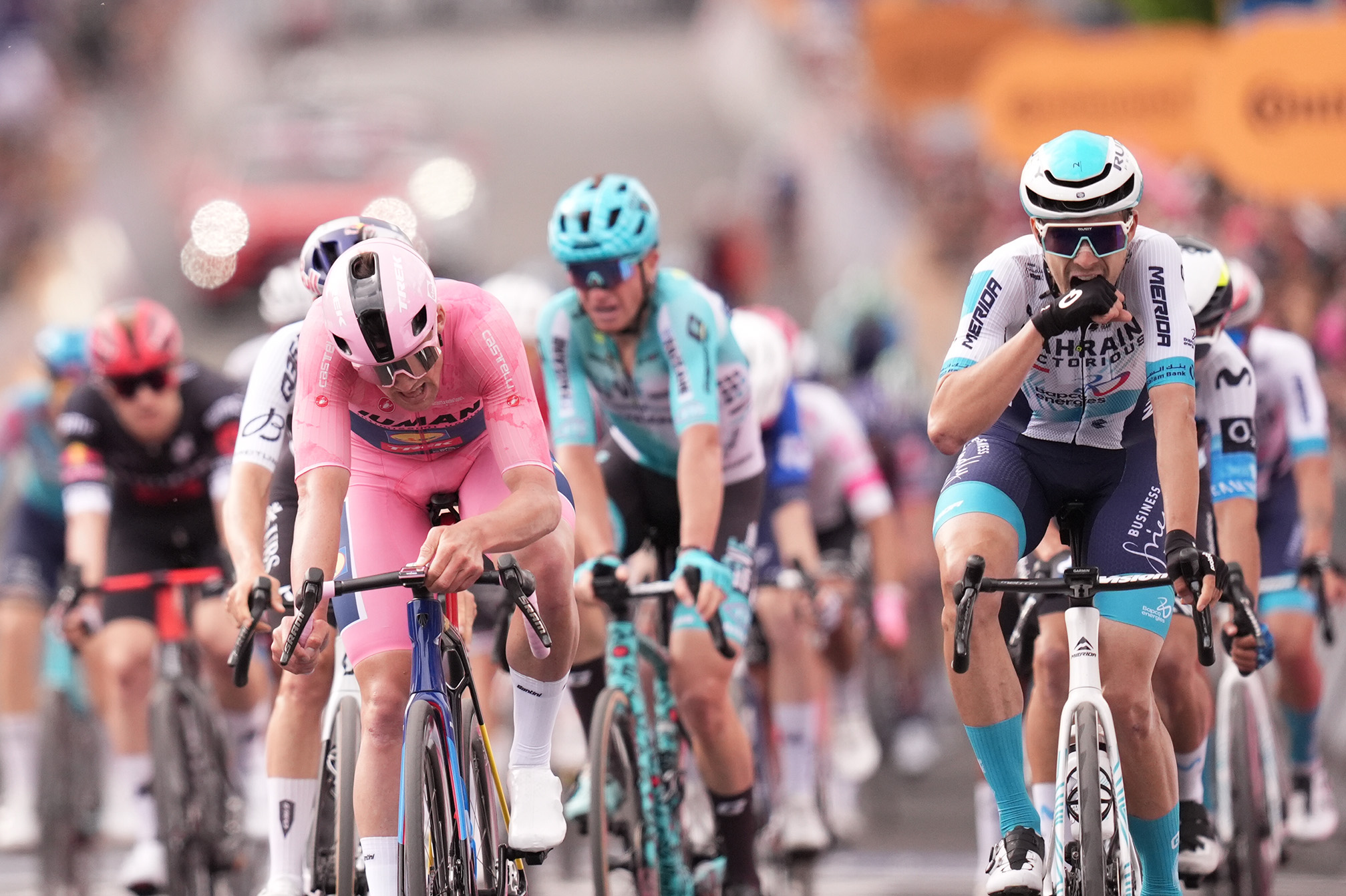
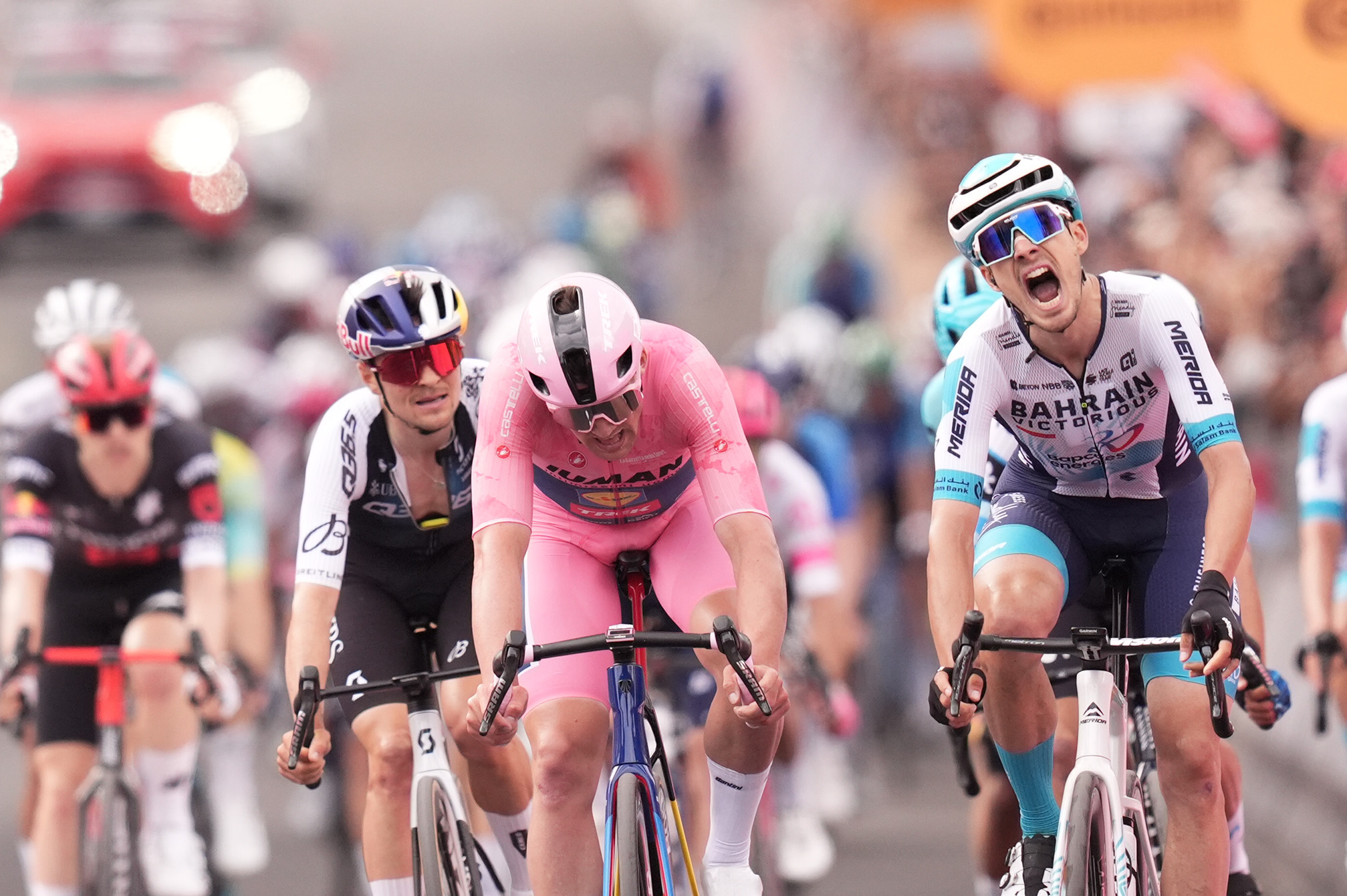
MATERA, Italy — If there were any doubts about Mads Pedersen’s versatility, the Danish champion silenced them with an impressive uphill sprint victory in Stage 5. The Lidl-Trek rider narrowly defeated Edoardo Zambanini (Bahrain Victorious) and Thomas Pidcock (Q36.5 Pro Cycling Team) in a finish that tested the riders’ endurance after a challenging final 20 kilometers.
The 151-kilometer stage from Ceglie Messapica to Matera played into Pedersen’s strengths as a powerful sprinter who can handle punchy climbs. As the road tilted upward in the ancient city of Matera, known for its unique cave dwellings, Pedersen unleashed a perfectly timed acceleration that his rivals could not match.
Mads Pedersen (Lidl-Trek) wins the sprint over Edoardo Zambanini (Bahrain Victorious) during the stage 5 of the Giro d’Italia from Ceglie Messapica to Matera, Italy – Wednesday, May 14, 2025. Sport – cycling. (Photo by Massimo Paolone/LaPresse)Mads Pedersen (Lidl-Trek) wins the sprint over Edoardo Zambanini (Bahrain Victorious) during the stage 5 of the Giro d’Italia from Ceglie Messapica to Matera, Italy – Wednesday, May 14, 2025. Sport – cycling. (Photo by Massimo Paolone/LaPresse)Mads Pedersen (Lidl-Trek) wins the sprint over Edoardo Zambanini (Bahrain Victorious) during the stage 5 of the Giro d’Italia from Ceglie Messapica to Matera, Italy – Wednesday, May 14, 2025. Sport – cycling. (Photo by Massimo Paolone/LaPresse)
“I wasn’t sure at all if I had won. It was incredibly hard in the last 20km. I suffered a lot,” Pedersen admitted after securing his third win in five stages. “Three wins in five stages and winning with the maglia rosa is insane. It’s way more than I have ever dreamt of.”
The victory extended Pedersen’s lead in the general classification to 17 seconds over Primož Roglič and 24 seconds over his teammate Mathias Vacek, consolidating Lidl-Trek’s dominant start to the race.
At the press conference, Pedersen acknowledged the strength of his team: “We wanted to be as good as possible and wear the maglia rosa in Albania. Now with three wins out of five stages, it’s bigger than our dream. It makes me super proud of the team that were so committed to make it possible.”
With this victory, Pedersen became the first rider to win three stages out of the first five since Mario Cipollini in 1997, raising the possibility that he could match Learco Guerra’s 1934 record of four victories in the first six stages.
Stage 5 Results:
Mads Pedersen (Lidl-Trek) – 151km in 3h27’31”, average speed 43.659 km/h
Edoardo Zambanini (Bahrain Victorious) s.t.
Thomas Pidcock (Q36.5 Pro Cycling Team) s.t.
General Classification After Stage 5:
Mads Pedersen (Lidl-Trek)
Primož Roglič (Red Bull – Bora – Hansgrohe) at 17″
Mathias Vacek (Lidl-Trek) at 24″
Official Jerseys After Stage 5:
Maglia Rosa (Pink Jersey), leader of the General Classification, sponsored by IUMAN – Intimissimi Uomo – Mads Pedersen (Lidl-Trek)
Maglia Ciclamino (Cyclamen Jersey), leader of the Points Classification, in collaboration with Ministero degli Affari Esteri e della Cooperazione Internazionale and ITA Italian Trade Agency – Mads Pedersen (Lidl-Trek)
Maglia Azzurra (Blue Jersey), leader of the Gran Premio della Montagna (KOM), sponsored by Banca Mediolanum – Lorenzo Fortunato (XDS Astana Team)
Maglia Bianca (White Jersey), Best Young Rider, born after 01/01/2000, sponsored by Conad – Mathias Vacek (Lidl-Trek)
Stage 6: Chaos and Controversy as Groves Triumphs in Neutralized Race
NAPLES, Italy — Stage 6 to Naples was marred by drama of a different kind when a massive crash with 72 kilometers remaining led race officials to make the controversial decision to neutralize the race. The incident, which occurred on slippery roads during a high-speed descent, sent numerous riders tumbling to the asphalt, including 2022 champion Jai Hindley and race leader Mads Pedersen.
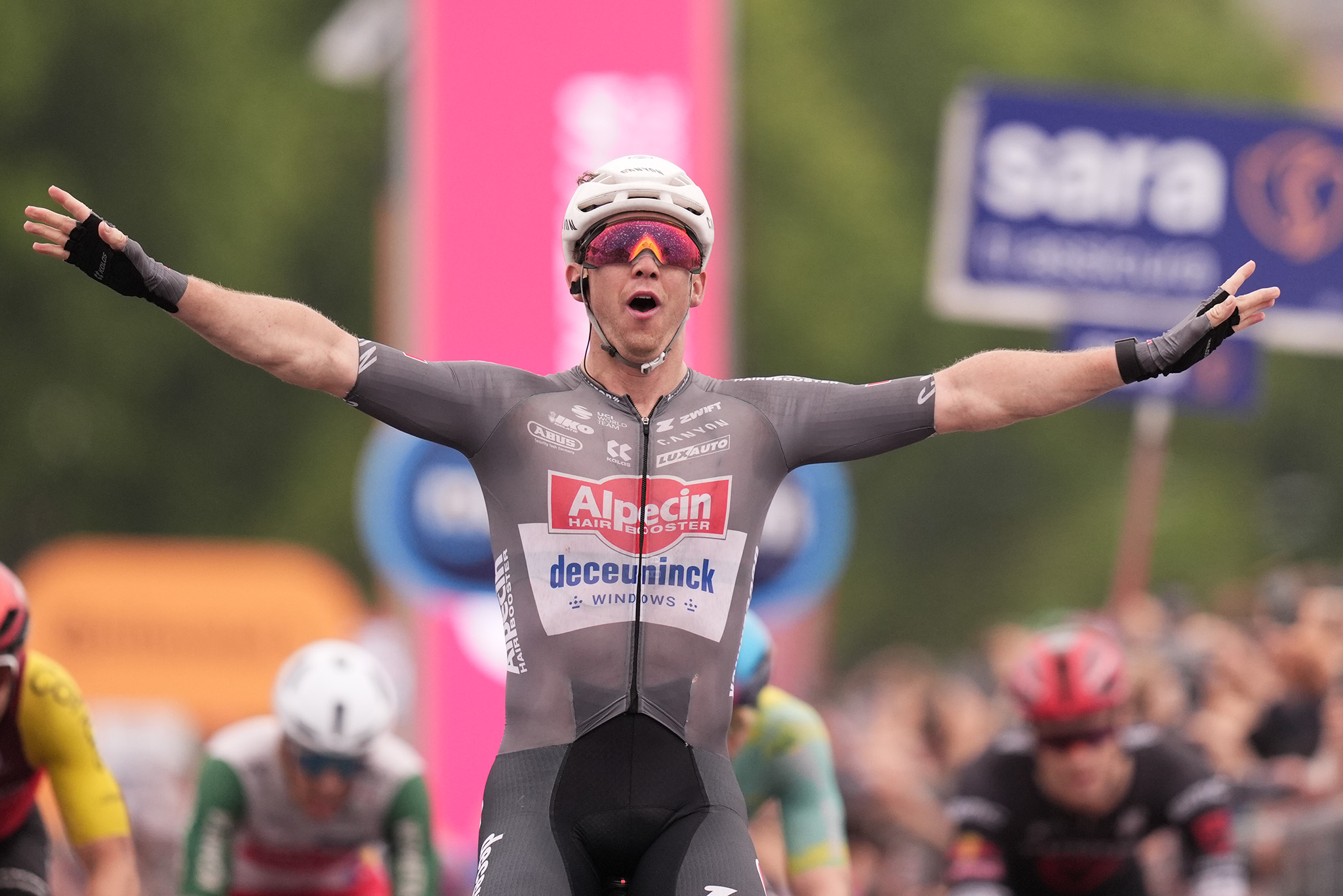
The chaotic scene prompted race directors to temporarily halt competitive racing, allowing injured riders to receive medical attention and regain contact with the peloton. When racing resumed under more controlled conditions, Australia’s Kaden Groves (Alpecin-Deceuninck) outsprinted Milan Fretin (Cofidis) and Paul Magnier (Soudal Quick-Step) for his first win of the season.
Kaden Groves (Alpecin-Deceuninck) wins the stage 6 of the Giro d’Italia from Potenza to Napoli, Italy – Thursday, May 15, 2025. Sport – cycling. (Photo by Massimo Paolone/LaPresse)
“First win of the year, it’s a big relief,” Groves said after the stage. “The team has believed in me. It hasn’t been a great start of the season. With the injury I missed a lot of racing.”
For Groves, who had struggled with form and fitness early in the season, the victory represented a welcome return to the winner’s circle and highlighted his resilience in navigating the day’s challenging circumstances.
Race leader Pedersen, sporting visible wounds at the press conference, described the harrowing crash: “I had better days, to say like this. It’s never nice to crash in a downhill like this at 70kph. There were bikes everywhere, I lost mine as well. It happened in a fraction of a second.”
Despite the crash, Pedersen maintained the maglia rosa, with the general classification remaining unchanged due to the neutralization. The decision sparked debate among teams and riders, but most acknowledged that safety had to be the primary concern given the severity of the crash.
Stage 6 Results:
Kaden Groves (Alpecin-Deceuninck) – 217.5km in 4h59’52”, average speed 43.519 km/h
Milan Fretin (Cofidis) s.t.
Paul Magnier (Soudal Quick-Step) s.t.
General Classification After Stage 6:
Mads Pedersen (Lidl-Trek)
Primož Roglič (Red Bull – Bora – Hansgrohe) at 17″
Mathias Vacek (Lidl-Trek) at 24″
Official Jerseys After Stage 6:
Maglia Rosa (Pink Jersey), leader of the General Classification, sponsored by IUMAN – Intimissimi Uomo – Mads Pedersen (Lidl-Trek)
Maglia Ciclamino (Cyclamen Jersey), leader of the Points Classification, in collaboration with Ministero degli Affari Esteri e della Cooperazione Internazionale and ITA Italian Trade Agency – Mads Pedersen (Lidl-Trek)
Maglia Azzurra (Blue Jersey), leader of the Gran Premio della Montagna (KOM), sponsored by Banca Mediolanum – Lorenzo Fortunato (XDS Astana Team)
Maglia Bianca (White Jersey), Best Young Rider, born after 01/01/2000, sponsored by Conad – Mathias Vacek (Lidl-Trek)
Stage 7: Ayuso Claims Maiden Grand Tour Win as Roglič Seizes Pink
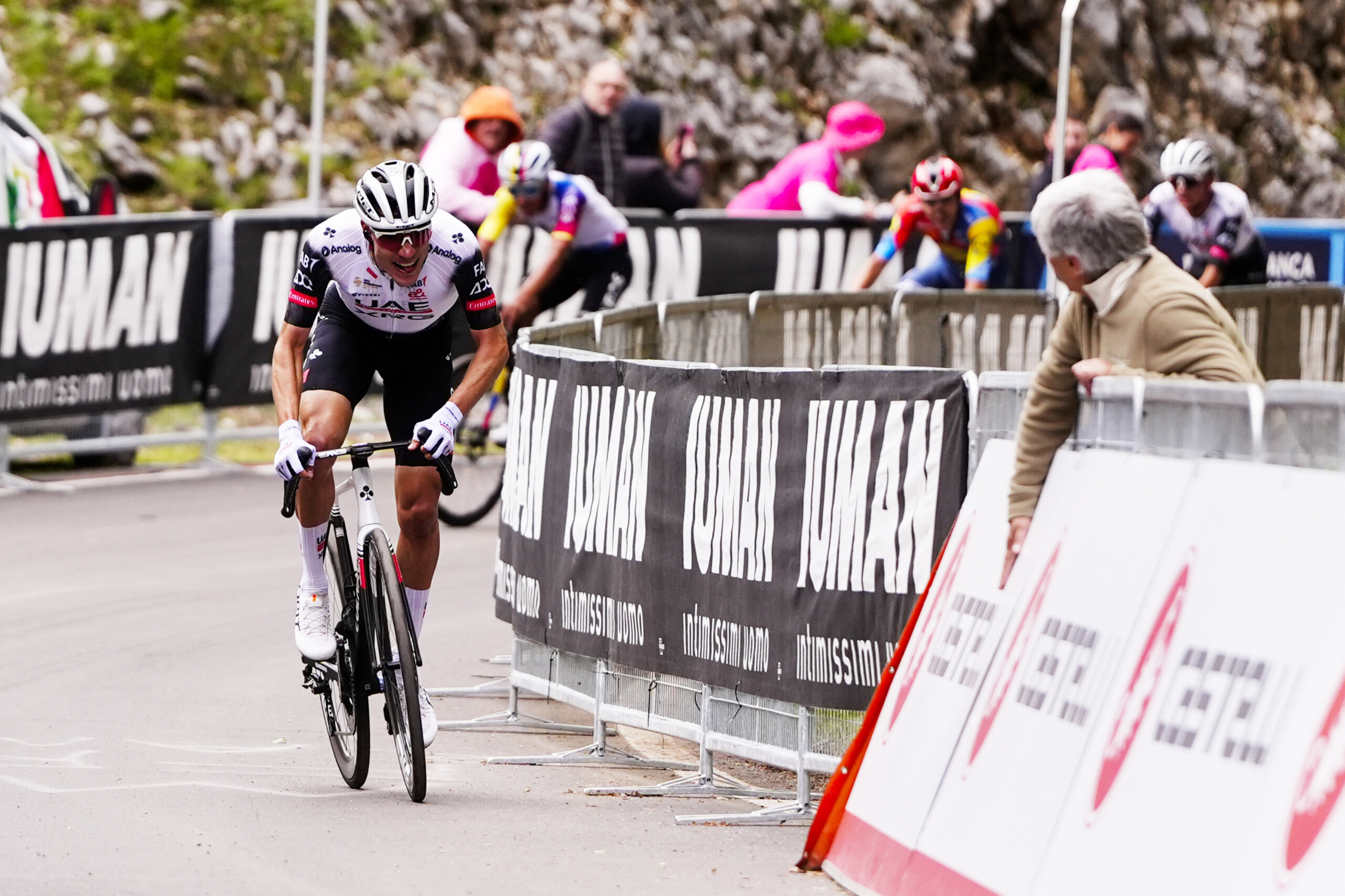
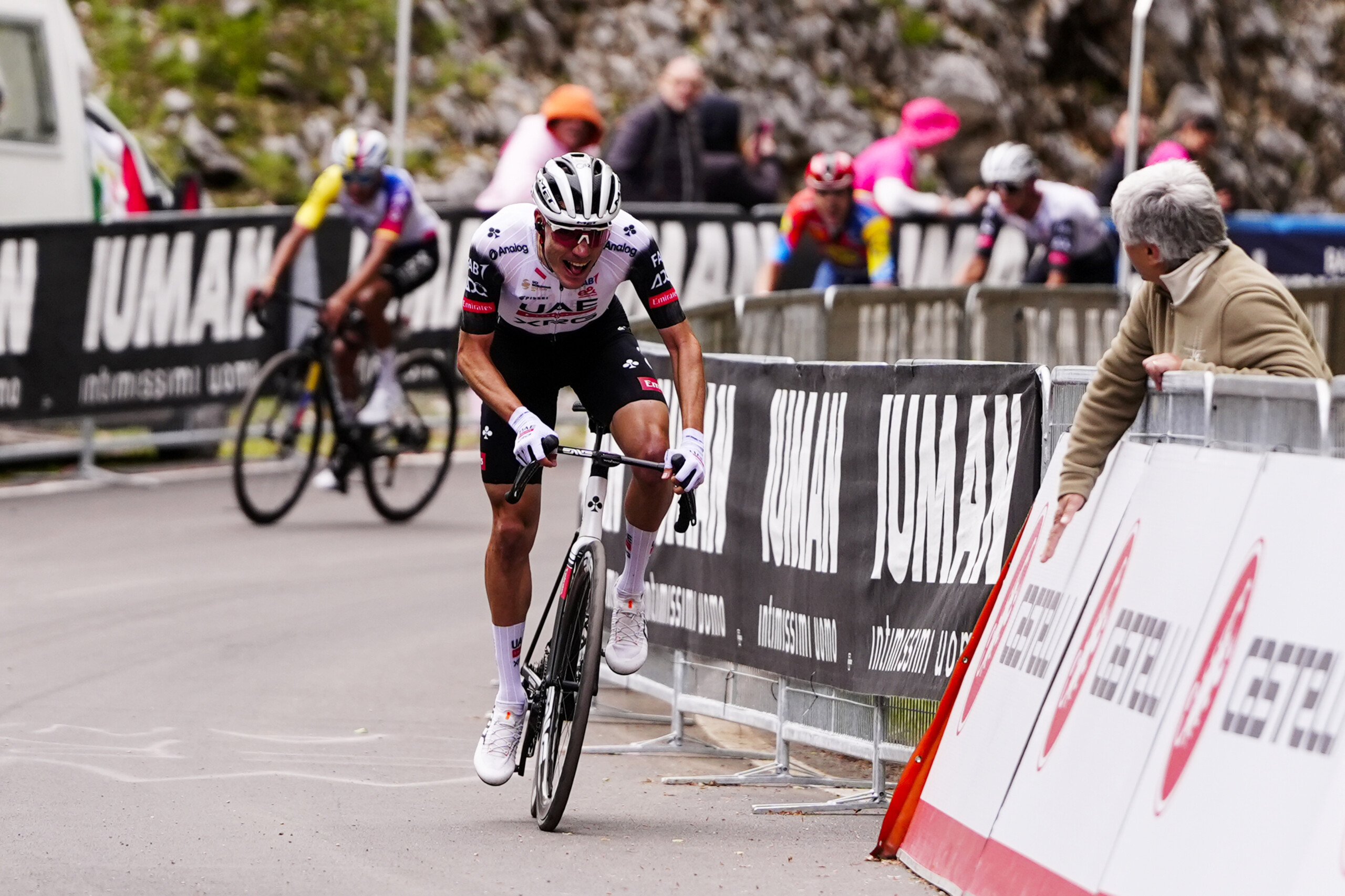
TAGLIACOZZO, Italy — The race’s complexion changed dramatically on Stage 7 to Tagliacozzo, where rising Spanish talent Juan Ayuso (UAE Team Emirates XRG) showcased his immense potential with a perfectly timed attack on the first uphill finish of the race. The 22-year-old prodigy’s explosive acceleration in the final kilometer proved decisive, catapulting him to his maiden Grand Tour victory.
The 168-kilometer stage from Castel di Sangro to Tagliacozzo featured undulating terrain that gradually sapped the energy from the riders’ legs before the testing final climb. As the gradient steepened, Ayuso launched a devastating attack that none of his rivals could answer, crossing the line four seconds ahead of his teammate Isaac Del Toro, with former Tour de France champion Egan Bernal (Ineos Grenadiers) claiming third place.
Juan Ayuso Pesquera of UAE Team Emirates XRG attack during the stage 7 of the Giro d’Italia from Castel di Sangro to Tagliacozzo, Italy – Friday, May 16, 2025. Sport – cycling. (Photo by Fabio Ferrari/LaPresse)
Juan Ayuso Pesquera of UAE Team Emirates XRG winner of the stage during the stage 7 of the Giro d’Italia from Castel di Sangro to Tagliacozzo, Italy – Friday, May 16, 2025. Sport – cycling. (Photo by Gian Mattia D’Alberto/LaPresse)
Juan Ayuso Pesquera of UAE Team Emirates XRG attack during the stage 7 of the Giro d’Italia from Castel di Sangro to Tagliacozzo, Italy – Friday, May 16, 2025. Sport – cycling. (Photo by Fabio Ferrari/LaPresse)
“This is not only a victory, it’s my first in a Grand Tour. I’ll always remember it,” an emotional Ayuso said after the stage. “I knew I had space for a 30 to 45 seconds maximum effort.”
The stage marked the end of Mads Pedersen’s grip on the maglia rosa, with Slovenian pre-race favorite Primož Roglič taking over the race lead after a strong performance that limited his losses to the stage winner. For Roglič, the three-time Vuelta a España champion seeking his first Giro title, the pink jersey represented another milestone in his illustrious career.
“I always want to win but today I still have the maglia rosa and I enjoy it. We never know when it’s the last one,” Roglič said philosophically. “I won’t do ten more Giro… I already knew that Juan Ayuso was a fast guy and that he’d be a tough opponent but it’s only the beginning of the Giro, life goes on.”
The general classification underwent significant restructuring, with Roglič now leading Ayuso by four seconds and Del Toro by nine seconds, setting up a fascinating battle between experience and youth as the race progressed.
Stage 7 Results:
Juan Ayuso (UAE Team Emirates XRG) – 168km in 4h20’25”, average speed 38.707 km/h
Isaac Del Toro (UAE Team Emirates XRG) at 4″
Egan Bernal (Ineos Grenadiers) s.t.
General Classification After Stage 7:
Primož Roglič (Red Bull – Bora – Hansgrohe)
Juan Ayuso (UAE Team Emirates XRG) at 4″
Isaac Del Toro (UAE Team Emirates XRG) at 9″
Official Jerseys After Stage 7:
Maglia Rosa (Pink Jersey), leader of the General Classification, sponsored by IUMAN – Intimissimi Uomo – Primož Roglič (Red Bull – Bora – Hansgrohe)
Maglia Ciclamino (Cyclamen Jersey), leader of the Points Classification, in collaboration with Ministero degli Affari Esteri e della Cooperazione Internazionale and ITA Italian Trade Agency – Mads Pedersen (Lidl-Trek)
Maglia Azzurra (Blue Jersey), leader of the Gran Premio della Montagna (KOM), sponsored by Banca Mediolanum – Lorenzo Fortunato (XDS Astana Team)
Maglia Bianca (White Jersey), Best Young Rider, born after 01/01/2000, sponsored by Conad – Juan Ayuso (UAE Team Emirates XRG)
Stage 8: Plapp Solos to Glory as Italian Veteran Claims Pink
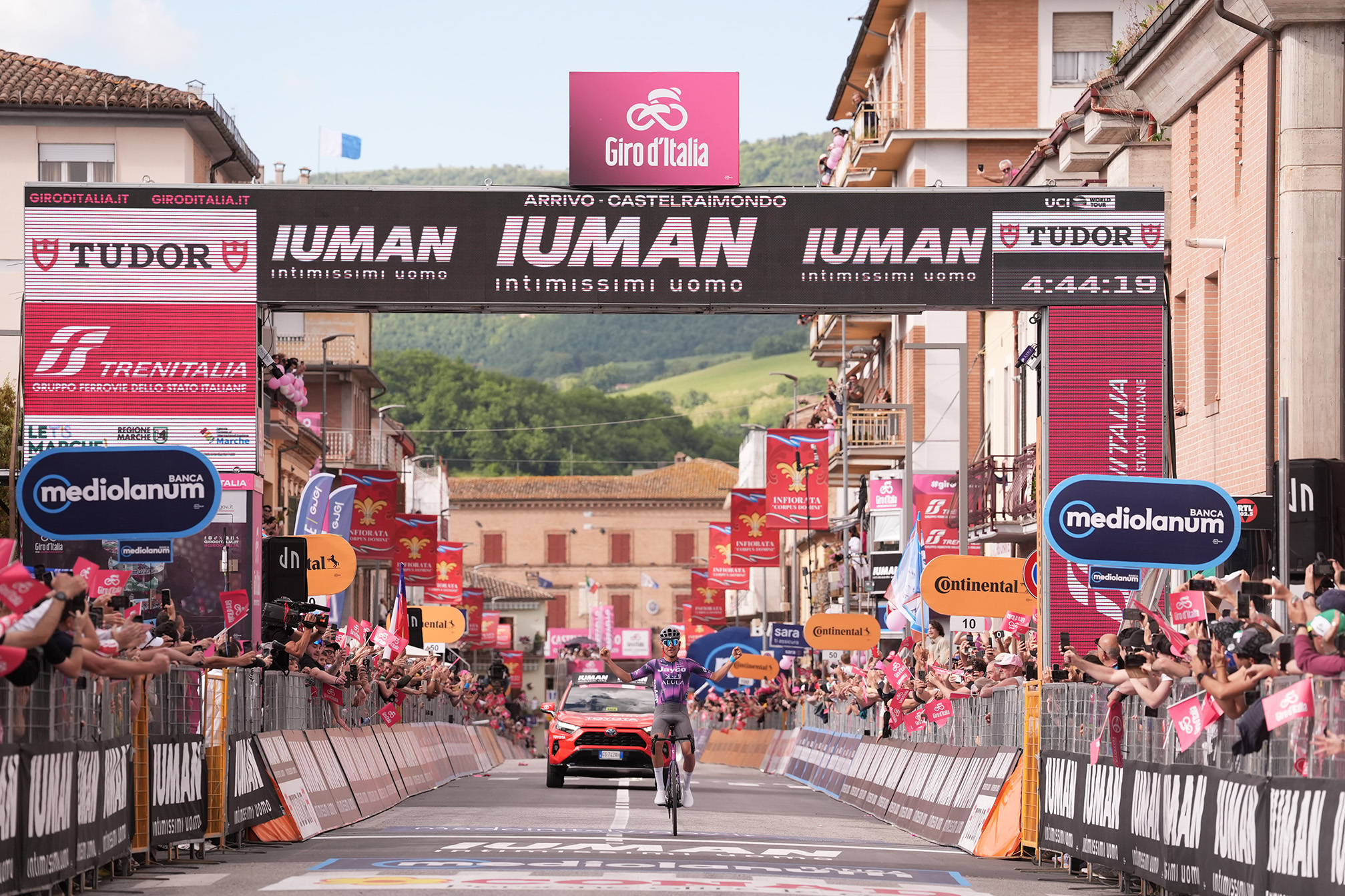
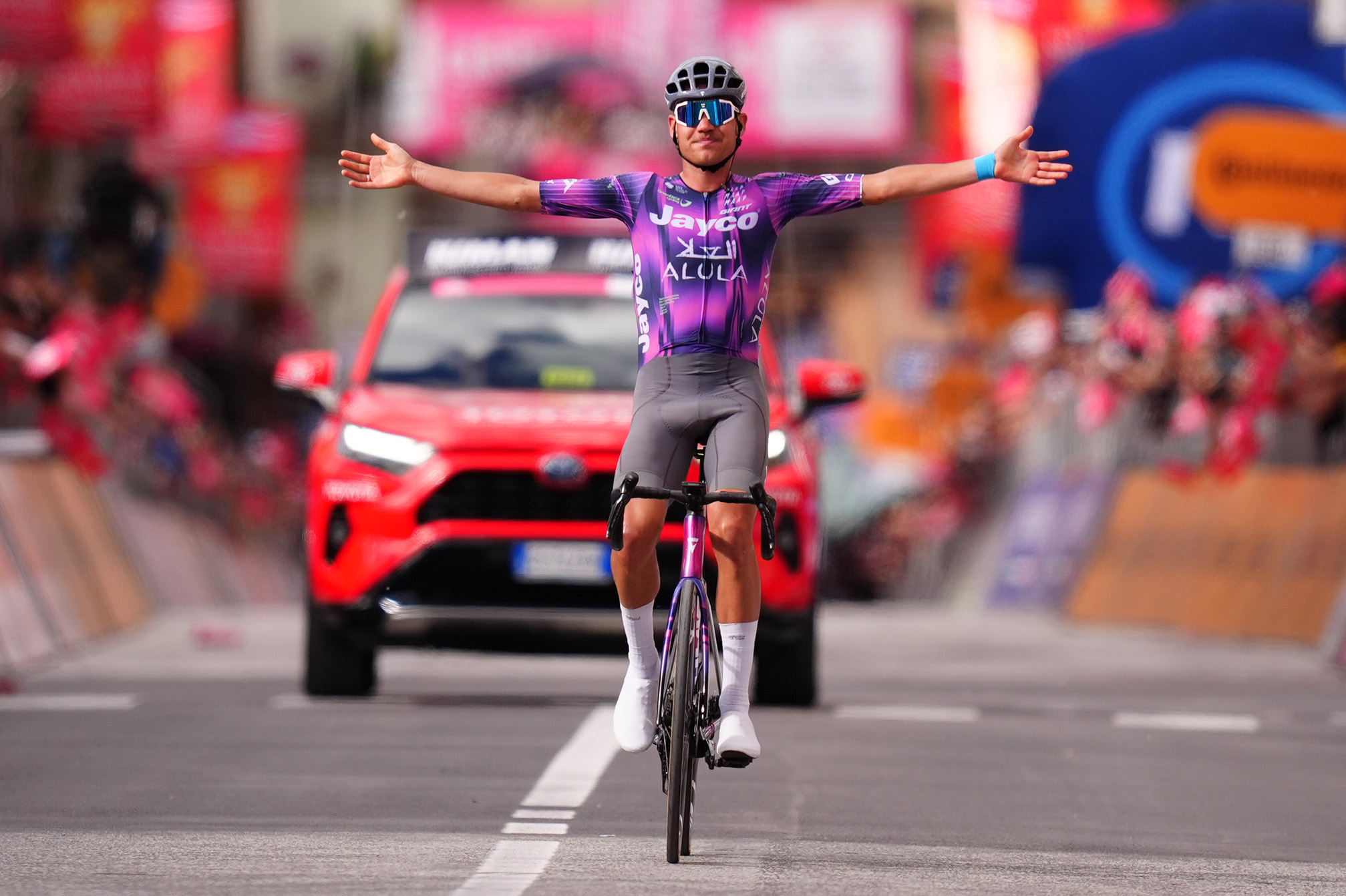
CASTELRAIMONDO, Italy — The Giro’s unpredictable nature continued to assert itself on Stage 8 to Castelraimondo, where Australian Luke Plapp (Team Jayco AlUla) delivered a masterclass in solo riding to secure an impressive victory. The Olympic track medalist turned road professional demonstrated his immense engine by attacking from the breakaway with 45 kilometers remaining and holding off a determined chase to claim the win.
The 197-kilometer stage from Giulianova to Castelraimondo featured rolling terrain that proved perfect for a breakaway, with Plapp making the decisive move on a mid-stage climb that caught his fellow escapees by surprise. Riding with the power and poise that has marked him as a future Grand Tour contender, the Australian maintained a steady advantage over the chasing peloton to finish 38 seconds ahead of Wilco Kelderman (Team Visma | Lease a Bike) and Diego Ulissi (XDS Astana Team).
Plapp Lucas of Team Jayco Alula during the stage 8 of the Giro d’Italia from Giulianova to Castelraimondo, Italy – Saturday, May 17, 2025. Sport – cycling. (Photo by Massimo Paolone/LaPresse)Plapp Lucas of Team Jayco Alula during the stage 8 of the Giro d’Italia from Giulianova to Castelraimondo, Italy – Saturday, May 17, 2025. Sport – cycling. (Photo by Fabio Ferrari/LaPresse)
“It’s crazy. I can’t believe it to be honest,” an emotional Plapp said after crossing the finish line. “I feel like it’s been a long time coming, just targeting the Aussie summer and not being able to make a result happen in Europe.”
For Plapp, whose early promise had yet to translate into major European victories, the win represented a significant breakthrough and confirmation of his talent on cycling’s biggest stages.
Behind Plapp, the battle for general classification positions produced yet another leadership change, with 35-year-old Italian veteran Diego Ulissi taking the maglia rosa for the first time in his career. The XDS Astana rider’s ascension to race leadership ended a four-year drought for Italian riders in the maglia rosa, sending the home fans into raptures.
“I don’t easily let myself taken by emotions but when I was presented with the maglia rosa and saw XDS Astana stamped on it, I became emotional,” Ulissi said. “I’m 35, soon 36 years of age, I’ve had nice satisfactions in my cycling career with eight stage wins at the Giro, I’ve built a nice family with three daughters, so when I first saw this jersey, I’ve thought of all my family members, especially those who took me to races when I was a kid.”
Ulissi’s unexpected rise to the race lead highlighted the Giro’s capacity for romantic narratives, with the experienced Italian now leading the general classification by 12 seconds over teammate Lorenzo Fortunato and 17 seconds over former leader Primož Roglič.
Stage 8 Results:
Luke Plapp (Team Jayco AlUla) – 197 km in 4h44’20”, average speed 41.571 km/h
Wilco Kelderman (Team Visma | Lease a Bike) at 38″
Diego Ulissi (XDS Astana Team) s.t.
General Classification After Stage 8:
Diego Ulissi (XDS Astana Team)
Lorenzo Fortunato (XDS Astana Team) at 12″
Primož Roglič (Red Bull – Bora – Hansgrohe) at 17″
Official Jerseys After Stage 8:
Maglia Rosa (Pink Jersey), leader of the General Classification, sponsored by IUMAN – Intimissimi Uomo – Diego Ulissi (XDS Astana Team)
Maglia Ciclamino (Cyclamen Jersey), leader of the Points Classification, in collaboration with Ministero degli Affari Esteri e della Cooperazione Internazionale and ITA Italian Trade Agency – Mads Pedersen (Lidl-Trek)
Maglia Azzurra (Blue Jersey), leader of the Gran Premio della Montagna (KOM), sponsored by Banca Mediolanum – Lorenzo Fortunato (XDS Astana Team)
Maglia Bianca (White Jersey), Best Young Rider, born after 01/01/2000, sponsored by Conad – Juan Ayuso (UAE Team Emirates XRG)
Stage 9: Van Aert Masters Tuscany’s White Roads as Del Toro Makes History
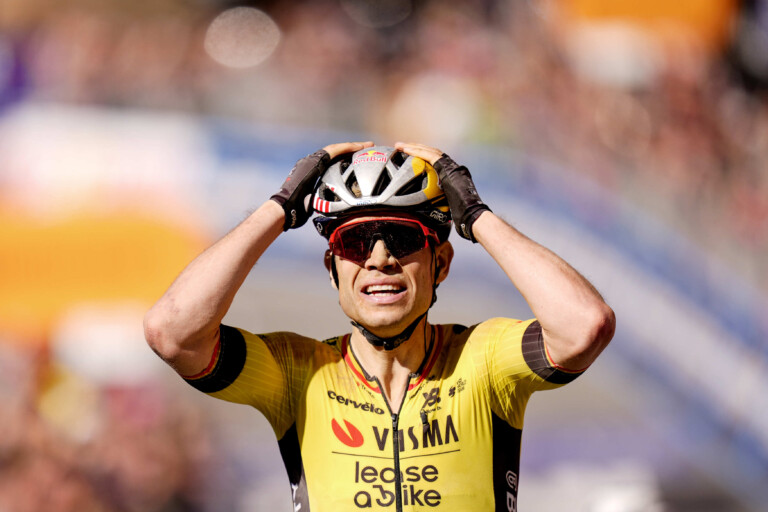
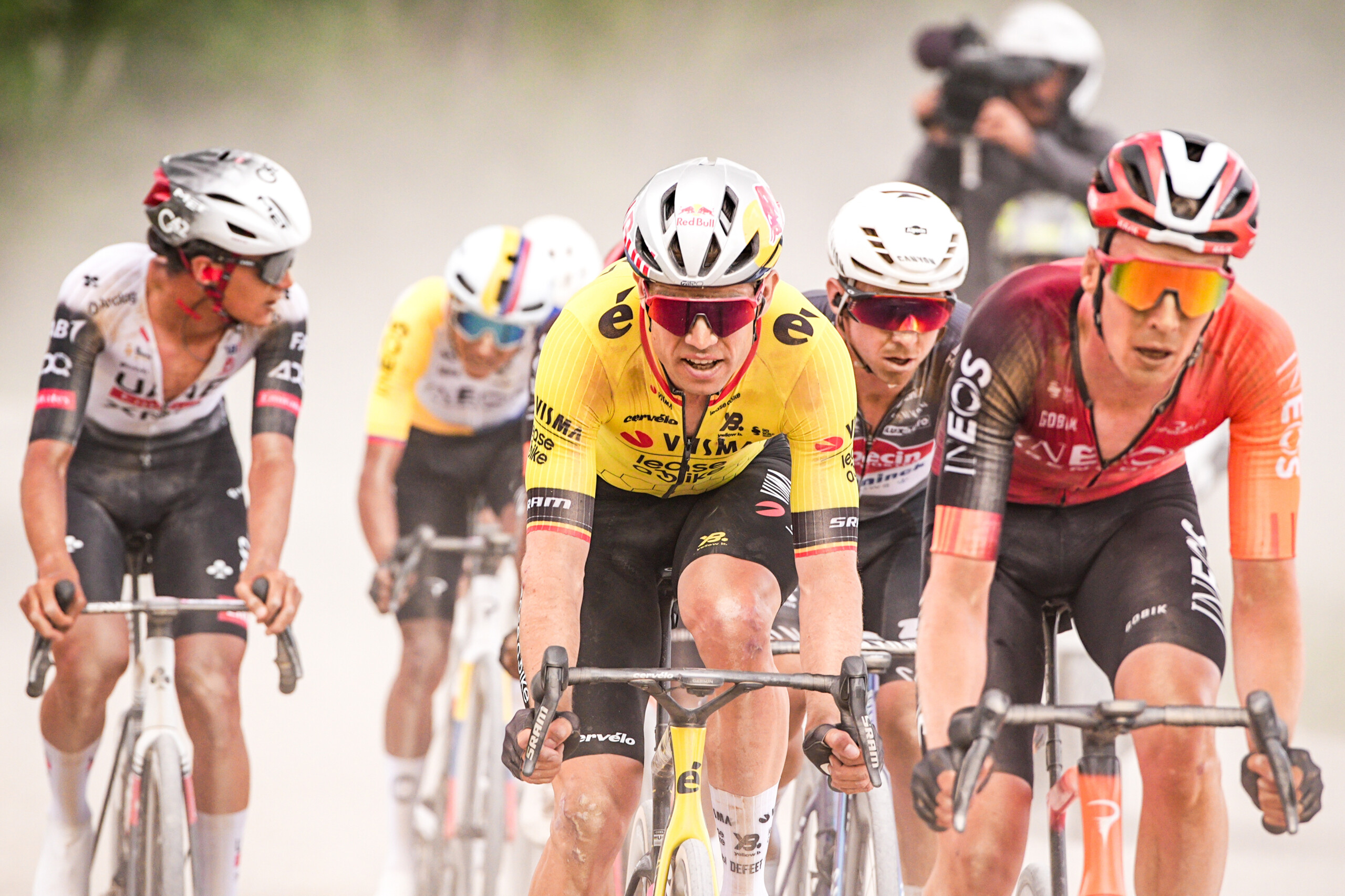
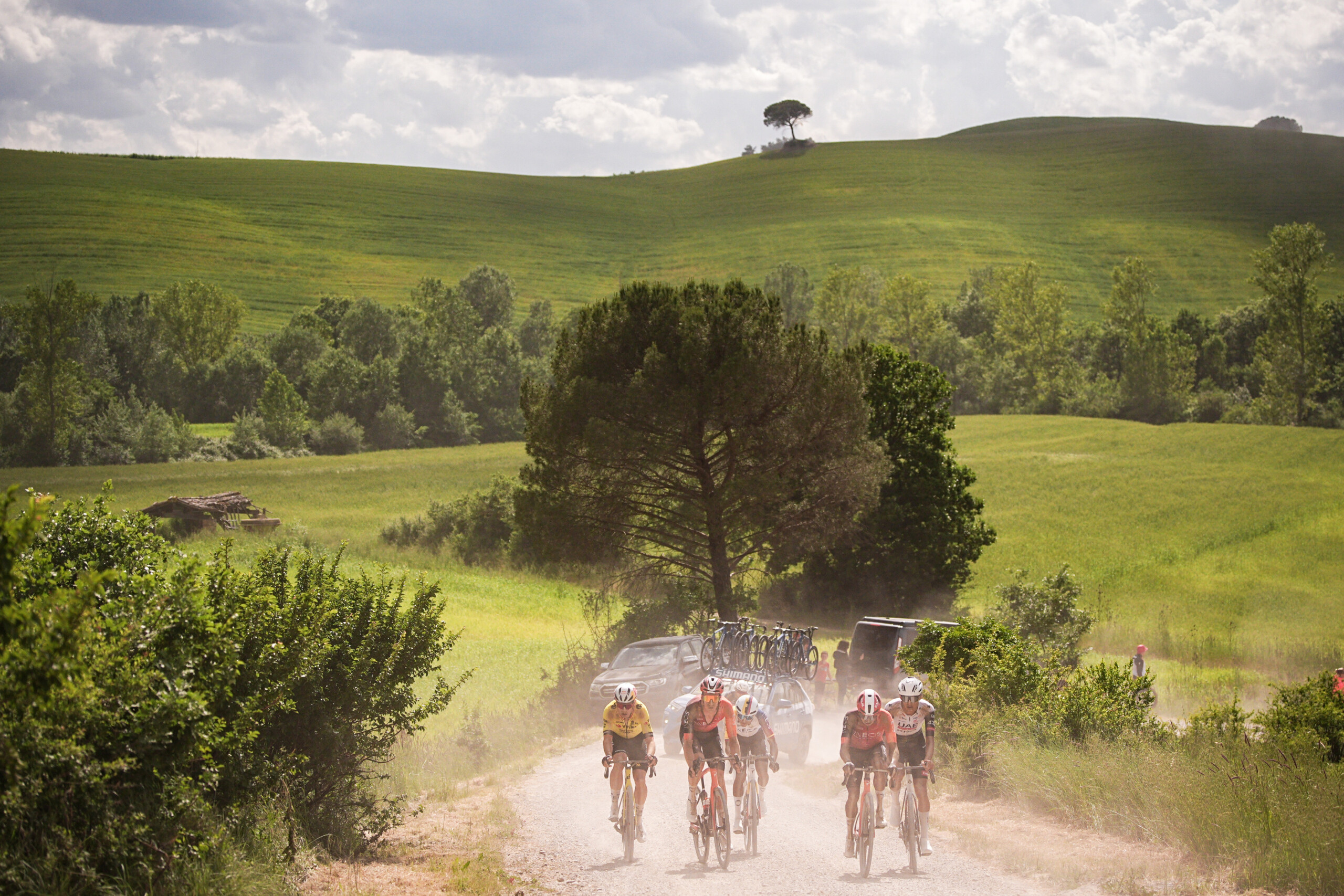
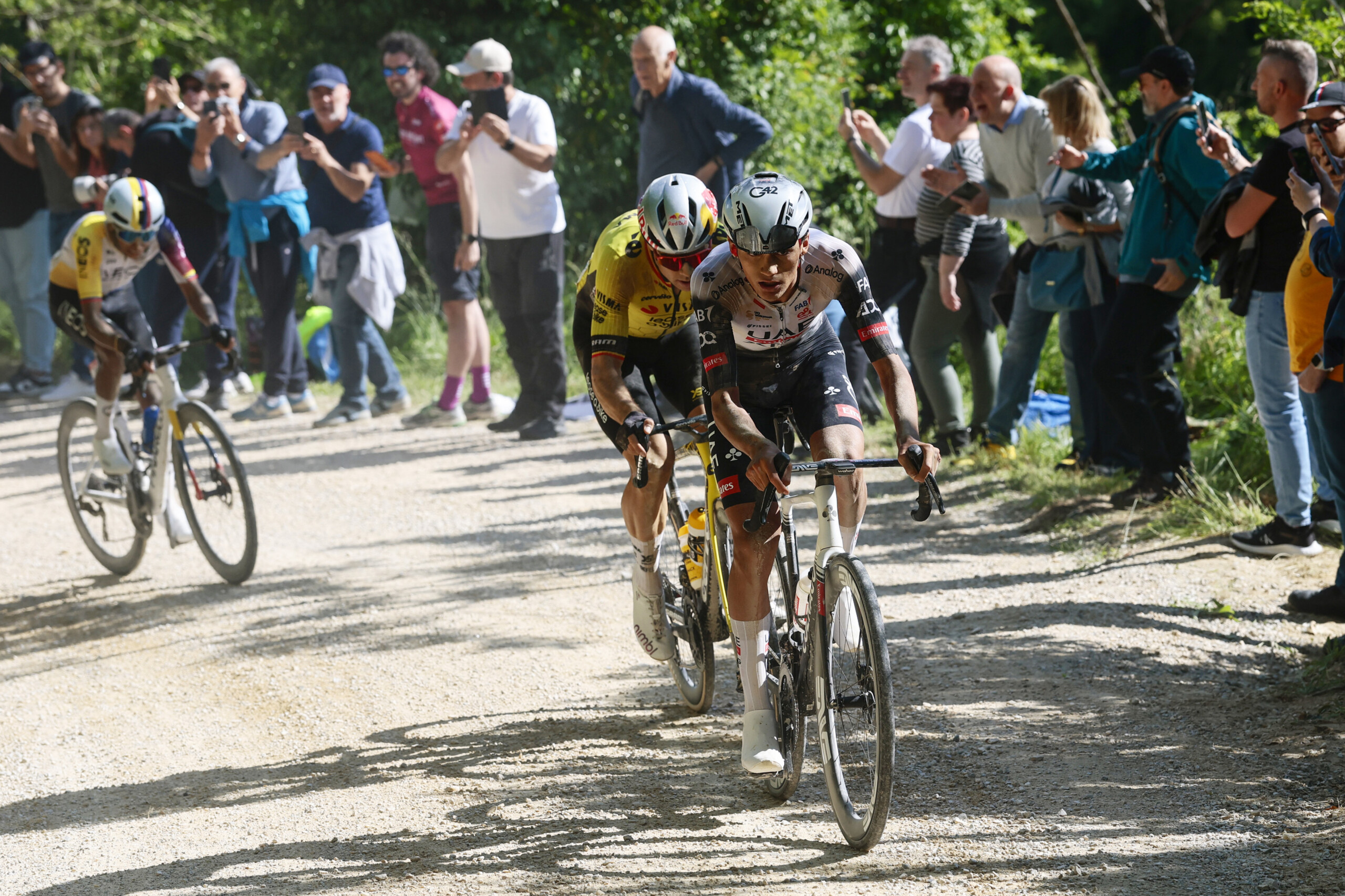
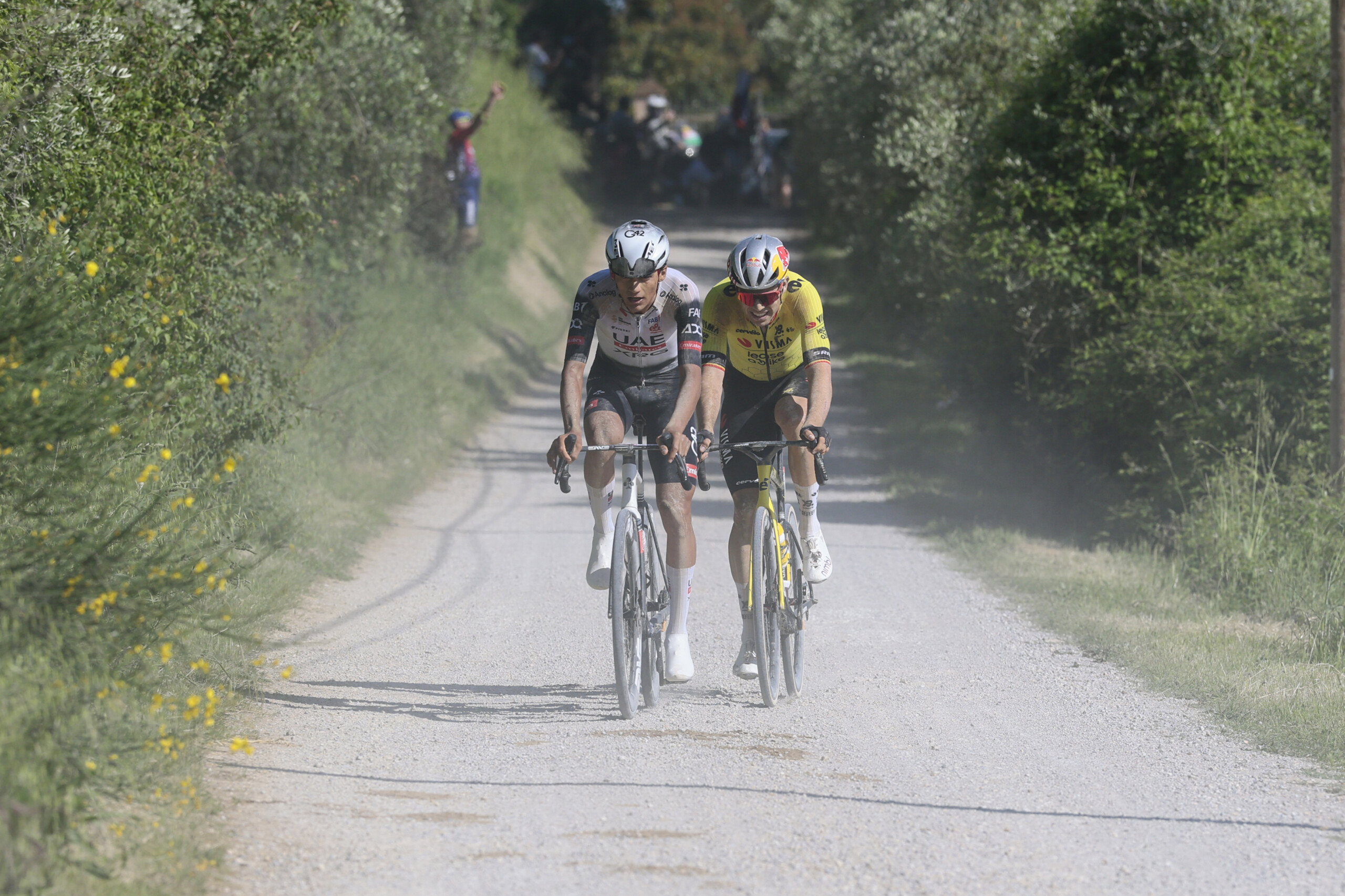
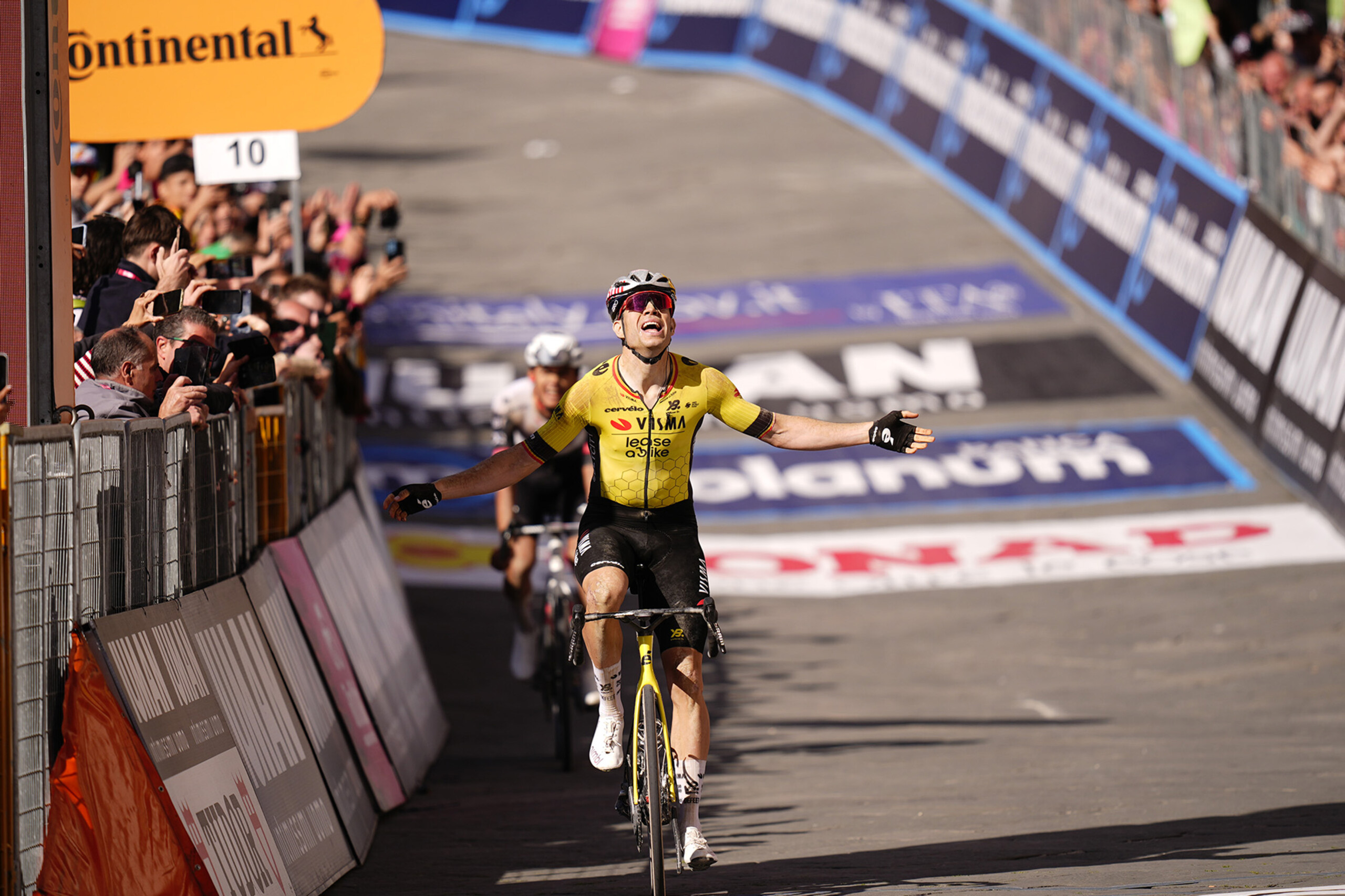
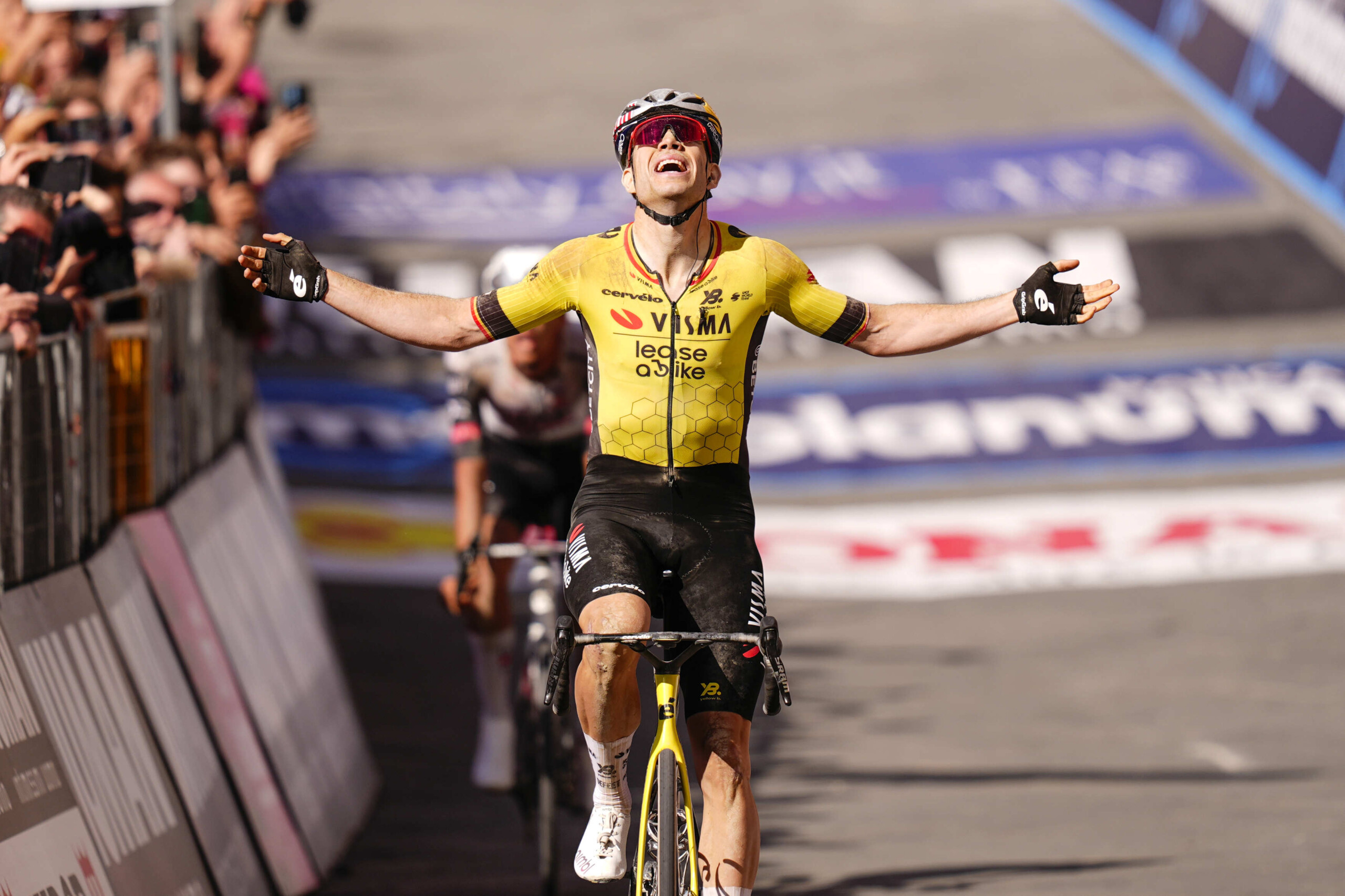
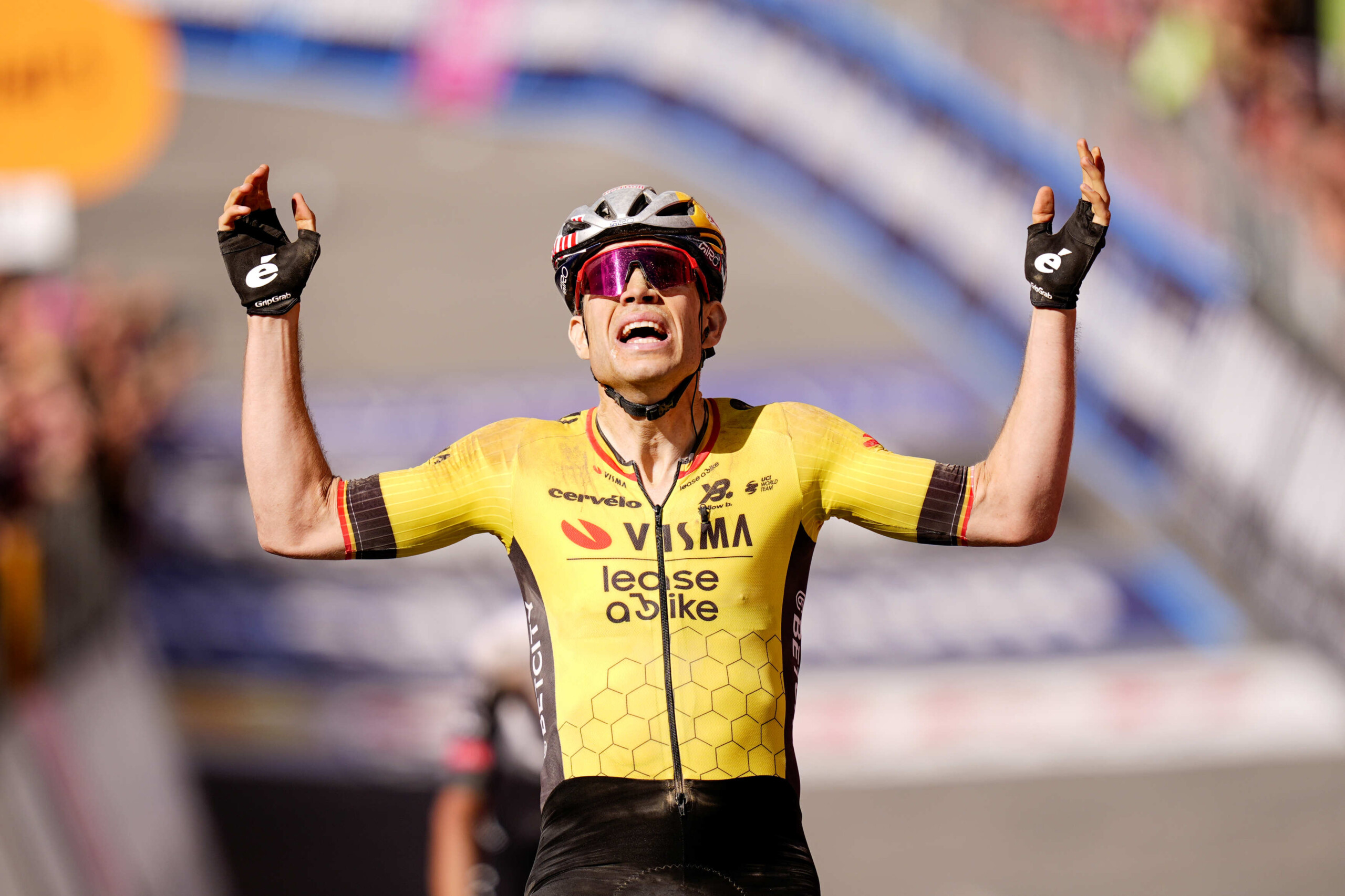
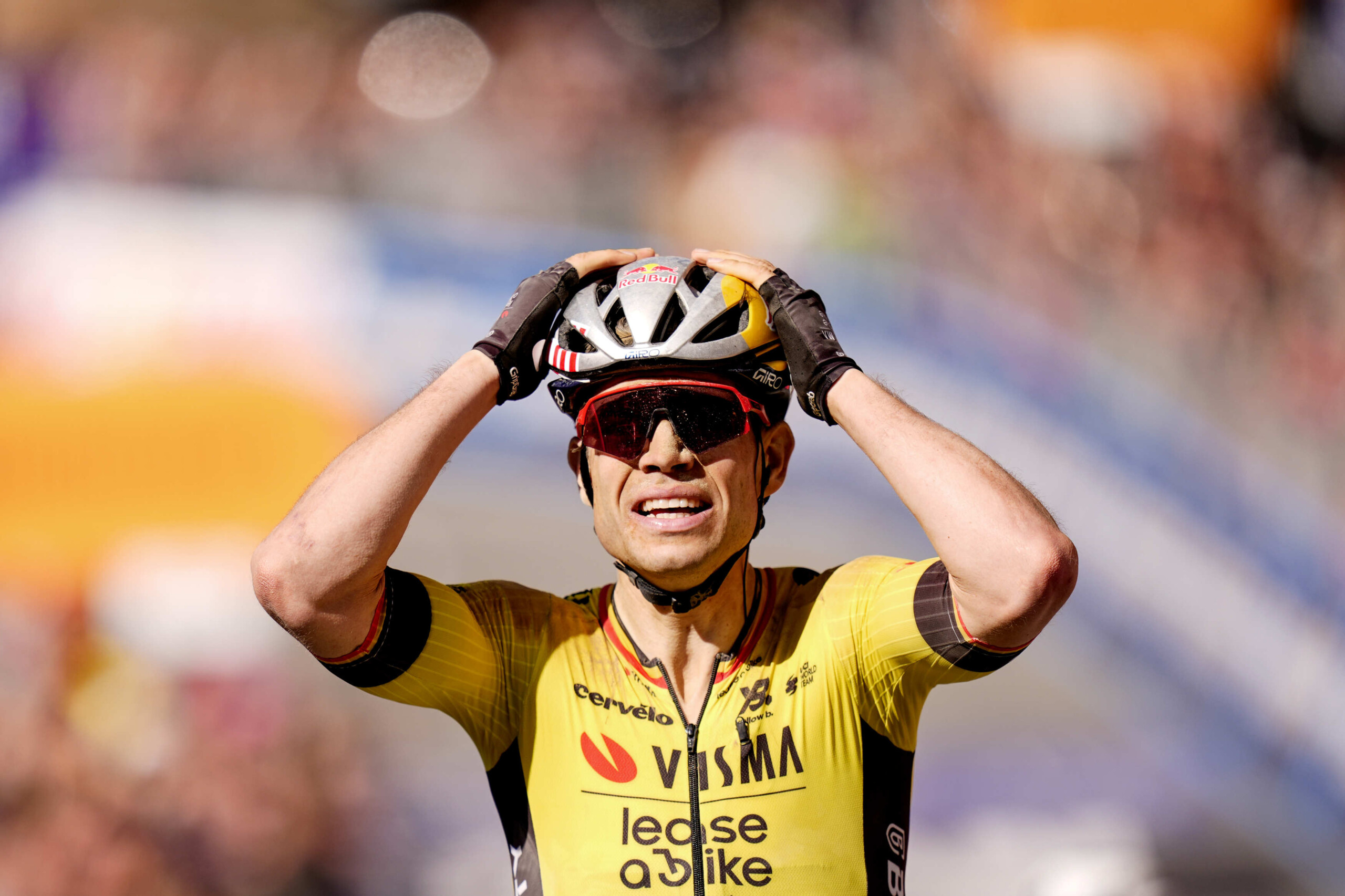
SIENA, Italy — The dramatic first week of the Giro d’Italia concluded on the iconic white gravel roads of Tuscany with Stage 9 to Siena, where Belgian superstar Wout Van Aert (Team Visma | Lease a Bike) secured his first Giro d’Italia stage victory and completed his collection of stage wins in all three Grand Tours. The versatile rider outsprinted Mexican sensation Isaac Del Toro at the finish in Siena’s magnificent Piazza del Campo, with Italian climber Giulio Ciccone (Lidl-Trek) crossing the line in third place 58 seconds later.
Wout Van Aert (Team Visma | Lease a Bike) during the stage 9 of the Giro d’Italia from Gubbio to Siena, Italy – Sunday, May 18, 2025. Sport – cycling. (Photo by Marco Alpozzi/Lapresse)The lead group during the stage 9 of the Giro d’Italia from Gubbio to Siena, Italy – Sunday, May 18, 2025. Sport – cycling. (Photo by Marco Alpozzi/Lapresse)
The 181-kilometer stage from Gubbio to Siena, featuring sections of the famous “strade bianche” or white roads that have become a signature of Tuscan cycling, provided a fitting finale to an unpredictable opening week. The challenging terrain and dusty gravel sectors created a natural selection among the riders, with Van Aert and Del Toro emerging as the strongest after a day of attritional racing.
Wout Van Aert (Team Visma | Lease a Bike) and Isaac Del Toro (UAE Team Emirates XRG) on the white roads of Tuscany during the stage 9 of the Giro d’Italia from Gubbio to Siena, Italy – Sunday, May 18, 2025. Sport – cycling. (Photo by Luca Bettini/POOL)Wout Van Aert (Team Visma | Lease a Bike) and Isaac Del Toro (UAE Team Emirates XRG) on the white roads of Tuscany during the stage 9 of the Giro d’Italia from Gubbio to Siena, Italy – Sunday, May 18, 2025. Sport – cycling. (Photo by Luca Bettini/POOL)
“It’s without saying that to win a stage of the Giro after a long period with no win feels very good,” Van Aert, who had endured a difficult start to the season, said in the press conference. “I’m an emotional person. A lot of emotions passed through my mind when I got this victory. Siena is almost the best place to finish a bike race.”
Wout van Aert (Visma-Lease a Bike) wins the stage 9 of the Giro d’Italia from Gubbio to Siena, Italy – Sunday, May 18, 2025. Sport – cycling. (Photo by Fabio Ferrari/LaPresse)Wout van Aert (Visma-Lease a Bike) wins the stage 9 of the Giro d’Italia from Gubbio to Siena, Italy – Sunday, May 18, 2025. Sport – cycling. (Photo by Fabio Ferrari/LaPresse)Wout van Aert (Visma-Lease a Bike) wins the stage 9 of the Giro d’Italia from Gubbio to Siena, Italy – Sunday, May 18, 2025. Sport – cycling. (Photo by Fabio Ferrari/LaPresse)Wout van Aert (Visma-Lease a Bike) wins the stage 9 of the Giro d’Italia from Gubbio to Siena, Italy – Sunday, May 18, 2025. Sport – cycling. (Photo by Fabio Ferrari/LaPresse)
For Van Aert, victory in the storied surroundings of Siena’s shell-shaped piazza represented a welcome return to winning ways after an uncharacteristic drought that had prompted questions about his form. The Belgian’s triumph also underscored his extraordinary versatility, having now won Grand Tour stages in time trials, bunch sprints, and challenging classics-style finishes.
While Van Aert celebrated stage honors, the day produced yet another seismic shift in the general classification. Twenty-one-year-old Mexican Isaac Del Toro became both the youngest leader of the Giro and the first Mexican ever to wear the maglia rosa, creating cycling history and triggering celebrations throughout his home country.
“It’s unbelievable, it’s so difficult to describe my feelings. It was a childhood dream to lead a Grand Tour. It’s insane,” an incredulous Del Toro said after donning the pink jersey. “I just kept going after a crash. I found myself in a group with Egan [Bernal] and I told them I couldn’t push because I had team-mates behind.”
The stage resulted in a complete reshuffling of the general classification, with Del Toro now leading teammate Juan Ayuso by 1 minute 13 seconds and Italy’s Antonio Tiberi (Bahrain Victorious) by 1 minute 30 seconds. Previous race leader Diego Ulissi dropped out of the top positions after struggling on the punishing white roads.
Stage 9 Results:
Wout Van Aert (Team Visma | Lease a Bike) – 181 km in 4h15’08”, average speed 42.565 km/h
Isaac Del Toro (UAE Team Emirates XRG) s.t.
Giulio Ciccone (Lidl-Trek) at 58″
General Classification After Stage 9:
Isaac Del Toro (UAE Team Emirates XRG)
Juan Ayuso (UAE Team Emirates XRG) at 1’13”
Antonio Tiberi (Bahrain Victorious) at 1’30”
Official Jerseys After Stage 9:
Maglia Rosa (Pink Jersey), leader of the General Classification, sponsored by IUMAN – Intimissimi Uomo – Isaac Del Toro (UAE Team Emirates XRG)
Maglia Ciclamino (Cyclamen Jersey), leader of the Points Classification, in collaboration with Ministero degli Affari Esteri e della Cooperazione Internazionale and ITA Italian Trade Agency – Mads Pedersen (Lidl-Trek)
Maglia Azzurra (Blue Jersey), leader of the Gran Premio della Montagna (KOM), sponsored by Banca Mediolanum – Lorenzo Fortunato (XDS Astana Team)
Maglia Bianca (White Jersey), Best Young Rider, born after 01/01/2000, sponsored by Conad – Isaac Del Toro (UAE Team Emirates XRG)
A Week of Upheaval Sets the Stage for Even More Drama
As the Giro d’Italia pauses in Perugia for its first rest day, the race has already defied expectations. In just nine stages, five different riders have worn the maglia rosa, underscoring the volatile nature of this year’s edition and upending pre-race predictions that cast Primož Roglič as the inevitable dominator.
Instead, a new generation has surged to the fore. Young riders like Isaac Del Toro, Juan Ayuso, and Casper Van Uden have injected the race with energy and unpredictability, while veterans such as Mads Pedersen, Wout van Aert, and Roglič have shown flashes of brilliance amid the chaos. Del Toro, now in possession of both the pink jersey and the white jersey for best young rider, faces a daunting task: defending his lead through the Giro’s mountainous second and third weeks.
For Pedersen, who has slipped down the general classification but remains the leader in the points competition with the maglia ciclamino, the goal will be to seize any remaining sprint opportunities. Meanwhile, Lorenzo Fortunato’s grip on the maglia azzurra as mountains classification leader will be tested severely as the peloton ascends into the high Alps.
The next phase begins with a critical individual time trial on Stage 10, followed by the race’s first genuine high-mountain stages in the Apennines. These will offer a stern test of Del Toro’s credentials and an opportunity for seasoned contenders like Roglič to begin clawing back lost time.
After a week of surprise and spectacle, the only constant is uncertainty. With the toughest terrain still ahead, the battle for the final maglia rosa in Rome remains wide open. The Giro, true to form, continues to live up to its reputation as cycling’s most capricious Grand Tour.
Tactical Crossroads: Youthful Bravado vs. Veteran Strategy
The first week of racing has laid bare a shifting tactical landscape, pitting the exuberance of rising stars against the steadiness of established powers. UAE Team Emirates XRG, the team of current race leader Del Toro and runner-up Ayuso, has embraced an aggressive, risk-taking style that has forced more traditional squads onto the back foot.
Lidl-Trek, guided by the consistent brilliance of Mads Pedersen, relied early on a conventional Grand Tour formula: control the race, keep the leader safe, and win key moments. That strategy paid dividends through Stage 6, but once the terrain began to bite, the limitations of backing a sprinter in the overall classification became clear.
Red Bull–Bora–Hansgrohe, supporting pre-race favorite Roglič, has so far played a patient game. Their conservative approach hints at a strategy built around the high mountains, where Roglič’s climbing pedigree will be most valuable. Though his time in pink was brief, the Slovenian remains very much in the hunt.
XDS–Astana, meanwhile, provided the week’s most unexpected twist. Diego Ulissi’s brief stint in the maglia rosa after Stage 8 highlighted the power of opportunism. Though fleeting, it was a moment that validated their aggressive tactics—placing riders in breakaways and capitalizing on the race’s inherent unpredictability.
The current standings, with UAE’s youthful tandem perched atop the GC, mark a clear departure from traditional Grand Tour hierarchies. Whether their form can endure the attrition of a full three-week campaign remains to be seen. But their willingness to animate the race has already forced rivals to adapt.
As the second week begins, expect the more experienced teams to test the young duo’s depth and resilience. The Stage 10 time trial will offer the first clear indication of whether Del Toro can defend his lead against more specialized threats.
On the Horizon: Mountains to Decide Del Toro’s Fate
With the flat and rolling stages of week one now in the rearview, the Giro shifts decisively upward. Stage 10’s individual time trial presents an immediate and unforgiving challenge for Del Toro, whose abilities against the clock remain largely unproven at this level.
As a relatively unproven time trialist at the WorldTour level, his performance will reveal whether he can defend the maglia rosa against stronger specialists. This stage could expose vulnerabilities or reinforce his credibility as a legitimate Grand Tour contender.
Juan Ayuso, currently second overall and a more accomplished time trialist, has a prime opportunity to take time on his teammate and possibly seize the race lead—introducing potential tactical tension within UAE Team Emirates XRG.
For Primož Roglič, the time trial is a key chance to begin his comeback. Known for his time trial strength, especially in Grand Tours, a strong performance could vault him back into serious contention and justify his team’s patient strategy.
The subsequent mountain stages in the Apennines will begin to shape the climbing hierarchy. Roglič, still within reach of the lead despite a subdued start, will look to assert himself as the road begins to tilt skyward. His proven endurance and tactical acumen could be decisive as the race grows more selective.
For Ayuso, the next block of racing presents an opportunity to step out of his teammate’s shadow. Having already claimed a breakthrough stage win, the young Spaniard now finds himself in the curious position of being both ally and potential rival to Del Toro—a dynamic that could reshape the race in the days to come.
Fatigue will increasingly factor into the equation. The cumulative toll of racing begins to separate true Grand Tour contenders from those chasing stages or classifications. Del Toro’s ability to recover and respond to pressure will be under constant scrutiny as the Giro enters its defining stretch.
Nine days in, the Giro has already delivered plot twists worthy of a final week. With its most brutal tests still ahead, the race for pink remains gloriously unpredictable. The only thing we know for sure: the best—and the hardest—is still to come.
by Ky Plaskon, Nevada Current (May 19, 2025) — Friday May 16, 2025 was deadline day – the day hundreds of good bills died at the hands of committee chairs in the legislature. Since our legislature only meets every few years and is limited to 120 days to consider 1,174 bills this year – legislators run up against a deadline. They can’t possibly examine almost 10 bills a day and pretend to make informed decisions. So, they kill bills at extreme expense to Nevadans. In the case of one bike safety bill, killed on Friday, the arbitrary deadline will cost more lives on our roads and discourage cycling for years.
Nevada failed to pass their Stop as Yield bill in 2025 due to missing a deadline. Photo by Dave Iltis
What is the point of the arbitrary deadline and what are its impacts? Some say it is about efficiency.
But when we dig down, it’s extremely inefficient and contributes to ill-informed decision-making on the part of legislators, leaving Nevada in the dark ages, unable to make real progress.
Assembly Bill 168 flew through the Assembly nearly unopposed. It allows cyclists to go through stop signs and stop lights if there are no other cars. We call it Stop-As-Yield and you can learn about it and how it’s working in other states in this video.
The bill had the backing of local transportation officials, federal experts at the Highway Administration, and even the Governor’s Bicycle and Pedestrian Advisory Board. Police agencies testified in neutral, not opposed. Why? Forty years of data in other states shows that these same safety measures save lives immediately once enacted.
Reno cyclist and realtor Misty Carter speaks in support of improving bike safety through Assembly Bill 168 at the Senate Growth and Infrastructure committee on May 7th. Photo courtesy Ky Plaskson
The bill would not have even cost taxpayers any money.
But Friday, AB168 hit a roadblock for no reason — or at least no readily identifiable reason — other than Nevada’s arbitrary legislative time limits. Bills had to make it out of the “second house” committee by Friday, or die.
AB168 had sailed through its “first house,” passing on the Assembly floor by vote of 41 to 1.
It died at the hands of one person. The chair of each committee has the power to forward bills to the full Senate and Assembly. But they had to do it by Friday. Democratic Sen. Rochelle Nguyen, chair of the Senate Growth and Infrastructure Committee, was in that hot seat on Friday, facing a deadline with lots of bill sponsors like us struggling to meet with her to try to get past the deadline. But, she said she would not let the bike bill move forward because she has an unspecified “concern.” She has offered no additional explanation despite repeated requests.
Because of the deadline, there is no opportunity to meet with Nguyen or educate her to address her concern, whatever it is. In the 120 day session, her committee had an average of only 2 days to consider each of the 52 bills in front of them. The Senate Growth and Infrastructure Committee passed 75% of its bills, half of which they waited until the last week to act on. Ten of their bills weren’t even heard, including one from the Nevada Highway Patrol, S.B. 38, that would have prohibited and penalized road rage in Nevada. That’s something cyclists experience on the road every day and we will now need to continue to endure it because the committee failed to act on that bill which was backed by law enforcement.
These are no-brainer bills but they don’t make it past committee because of these arbitrary deadlines.
Law enforcement and bike advocates will now need to wait another two years before trying again on road rage and our Stop-As-Yield bike bill. We will go through the process all over – volunteering countless hours of time, energy and money with the possibility of unceremoniously being whacked by one committee chair who is running up against an arbitrary deadline and doesn’t have time to thoroughly consider the facts. This is extremely discouraging.
If good policy that is backed by public safety experts, works in other states, modernizes our roads, saves lives and punishes violent criminals doesn’t make it over the finish line in the Senate Growth and Infrastructure Committee, it makes me wonder what are the common factors that do get a bill over the tight finish line.
For instance, AB 527 barely made it over the finish line at the last minute in the committee. It authorizes cameras to be installed on school buses to catch drivers who blast through school bus stop signs. The video of drivers almost killing children is alarming. That’s not the kind of bill that should have to wait years either, let alone until the last minute to pass because of arbitrary deadlines. Maybe a common factor that contributes to passage of bills is alarming and sensational video that grabs legislator’s attention and is an easy sell.
Here is another common factor in bills that pass and it points to another serious problem posed by Nevada’s arbitrary deadline. Similar to the bike bill, AB 527 is already working in other states to save lives according to the proponents. Because of their time crunch, Nevada legislators are more likely to just pass things that are already working in other states, but they take a lot longer to do it and ask a lot of questions as if the bill is a novel idea or they ask no questions at all, like they did with the bike bill. Since they spend their time on bills that already work in other states, they are less likely to innovate and come up with laws specific to Nevada.
If they had more time, they would not only pass the laws that are already working to protect residents in other states but they would probably come up with great new and innovative laws for Nevadans. Legislators are sharp, well educated and probably want more time too.
With more time for lawmakers to research, Nevada could make leaps on many levels, not just transportation. But because of the arbitrary deadlines, legislators are killing bills without regard for facts or what their own local experts say. They don’t even have time to explain to their constituents.
Most bill proponents don’t speak out about this, for fear of retribution – that legislators will kill their bills just because they spoke out. It’s time to seriously ask ourselves if arbitrary deadlines are worth the consequences. Now the consequences mean years of more unnecessary deaths on our roads.
I am confident that the Stop-As-Yield bill would have been ultimately signed by the governor. Over the years thousands of good policy bills have likely died this way, never to be visited again. The result is that Nevada is at or near the top of nearly every bad list in the nation, clawing its way at the bottom behind every other state.
It’s not just bills that died on Friday. Hope for change on our roads died.
The solution is simple: longer and more frequent legislative sessions so that we pass important bills and catch up with the rest of the nation.
Nevada Current is part of States Newsroom, a nonprofit news network supported by grants and a coalition of donors as a 501c(3) public charity. Nevada Current maintains editorial independence. Contact Editor Hugh Jackson for questions: [email protected].
Sam Long (USA) and Colin Szuch (USA) complete the men’s professional podium, while Danielle Lewis (USA) and Jackie Hering (USA) secure second and third places respectively in the female professional race
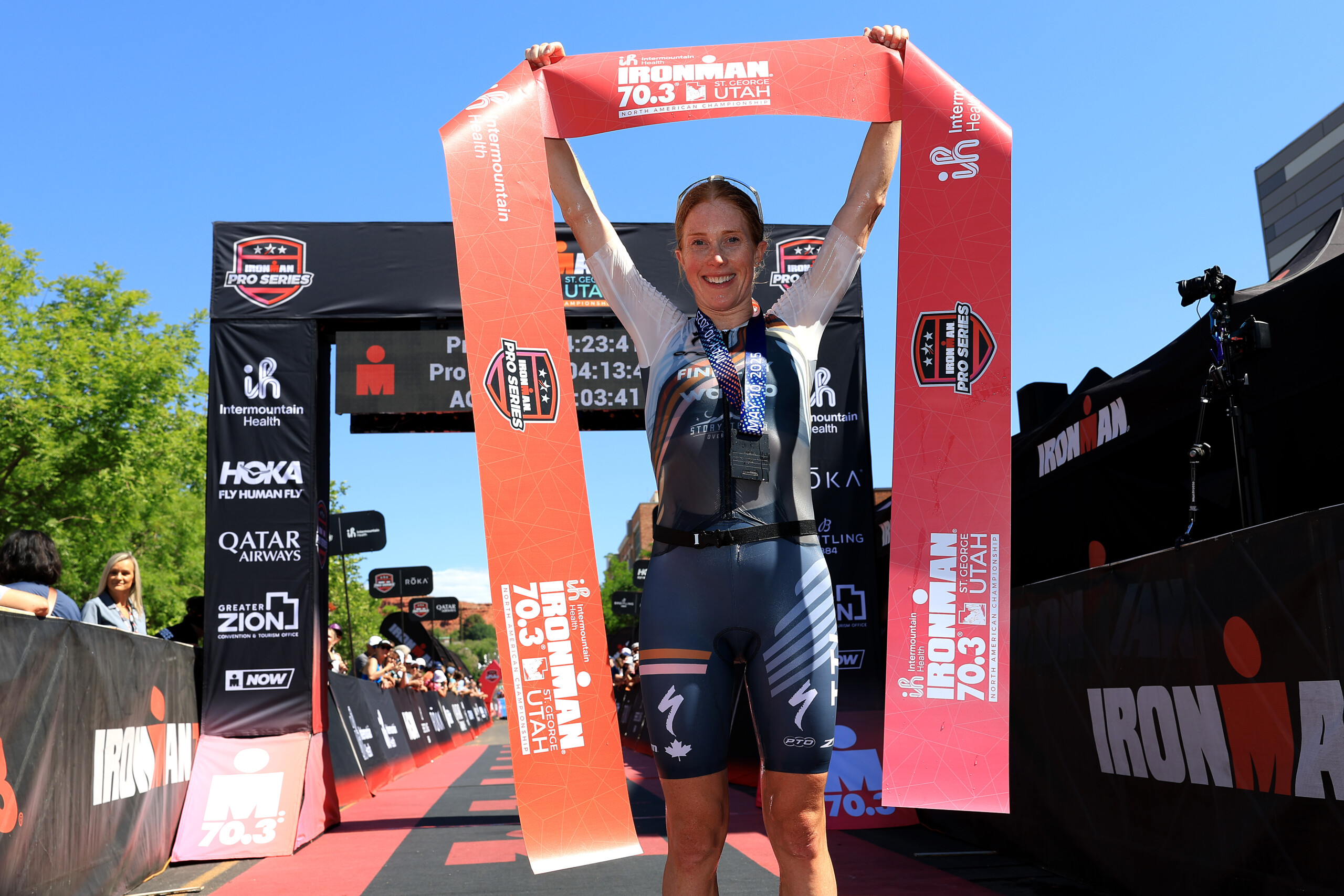
ST. GEORGE, Utah (May 10, 2025) – For the final time, stunning St. George and Southwestern Utah provided the perfect, picturesque backdrop for the Intermountain Health IRONMAN 70.3 St. George North American Championship triathlon and the sixth race of the 2025 IRONMAN Pro Series. In a finale worthy of the Land of Endurance, it was Lionel Sanders (CAN) in the men’s professional field and Paula Findlay (CAN) in the women’s professional race who took the tape in downtown St. George, replicating their Canadian sweep from Oceanside in April.
In the men’s race, Seth Rider (USA) was first out of the water, closely followed by Mark Dubrick (USA), and a large chase pack that included Kevin McDowell (USA), Justin Riele (USA), Max Neumann (AUS), Jake Birtwhistle (AUS), and Robert Wilkowiecki (POL), among others. One of the race favourites leading into Saturday’s contest, Magnus Ditlev (DEN), exited the water 11th, putting him in prime position to take an early lead. Lionel Sanders (CAN) and two-time defending champion Sam Long (USA) would exit the water 2:45 and 3:17 behind Rider.
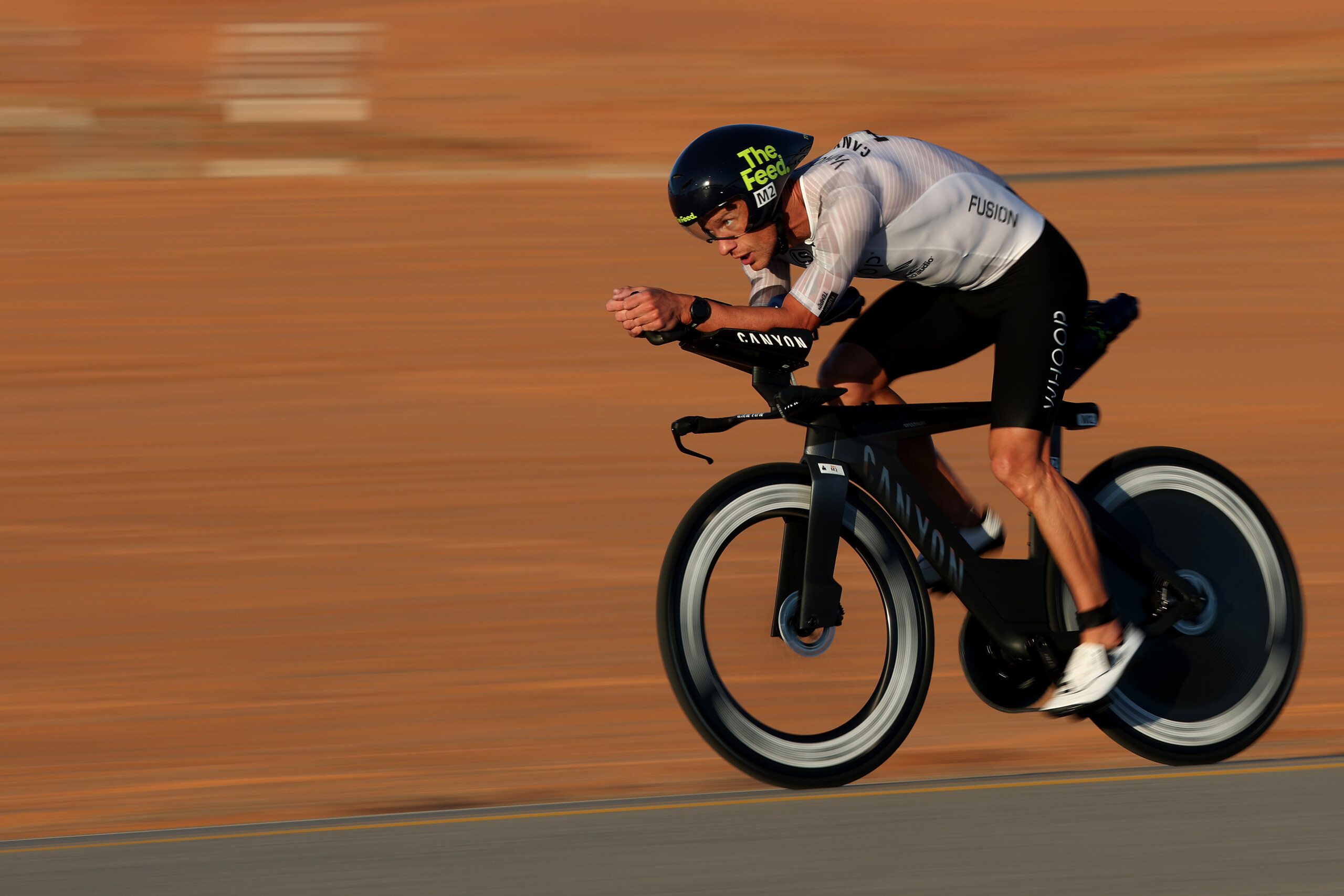
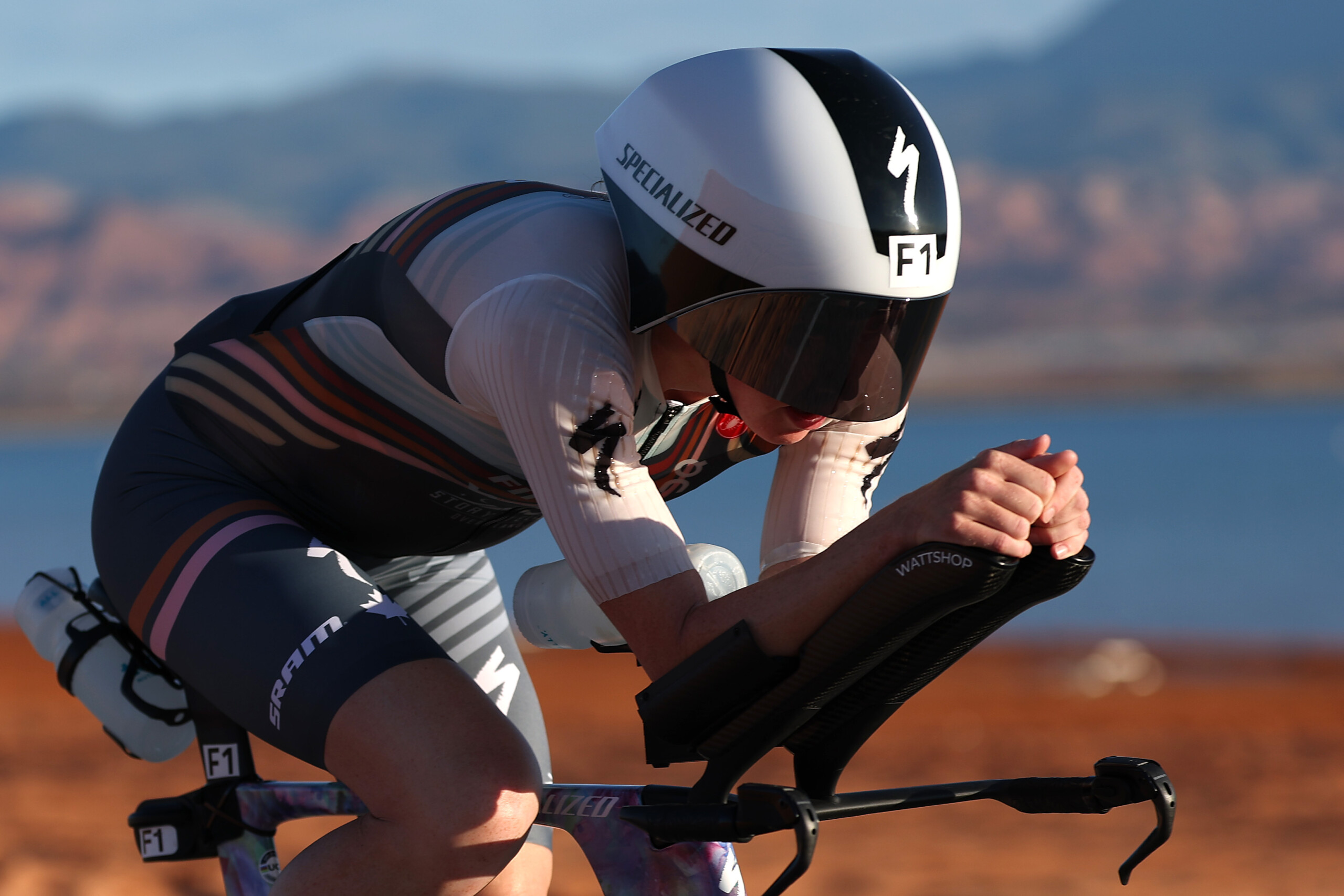
ST GEORGE, UTAH – MAY 10: Lionel Sanders of Canada competes in the bike portion of the 2025 IRONMAN 70.3 St. George North American Championship on May 10, 2025 in St George, Utah. (Photo by Sean M. Haffey/Getty Images for IRON MAN)
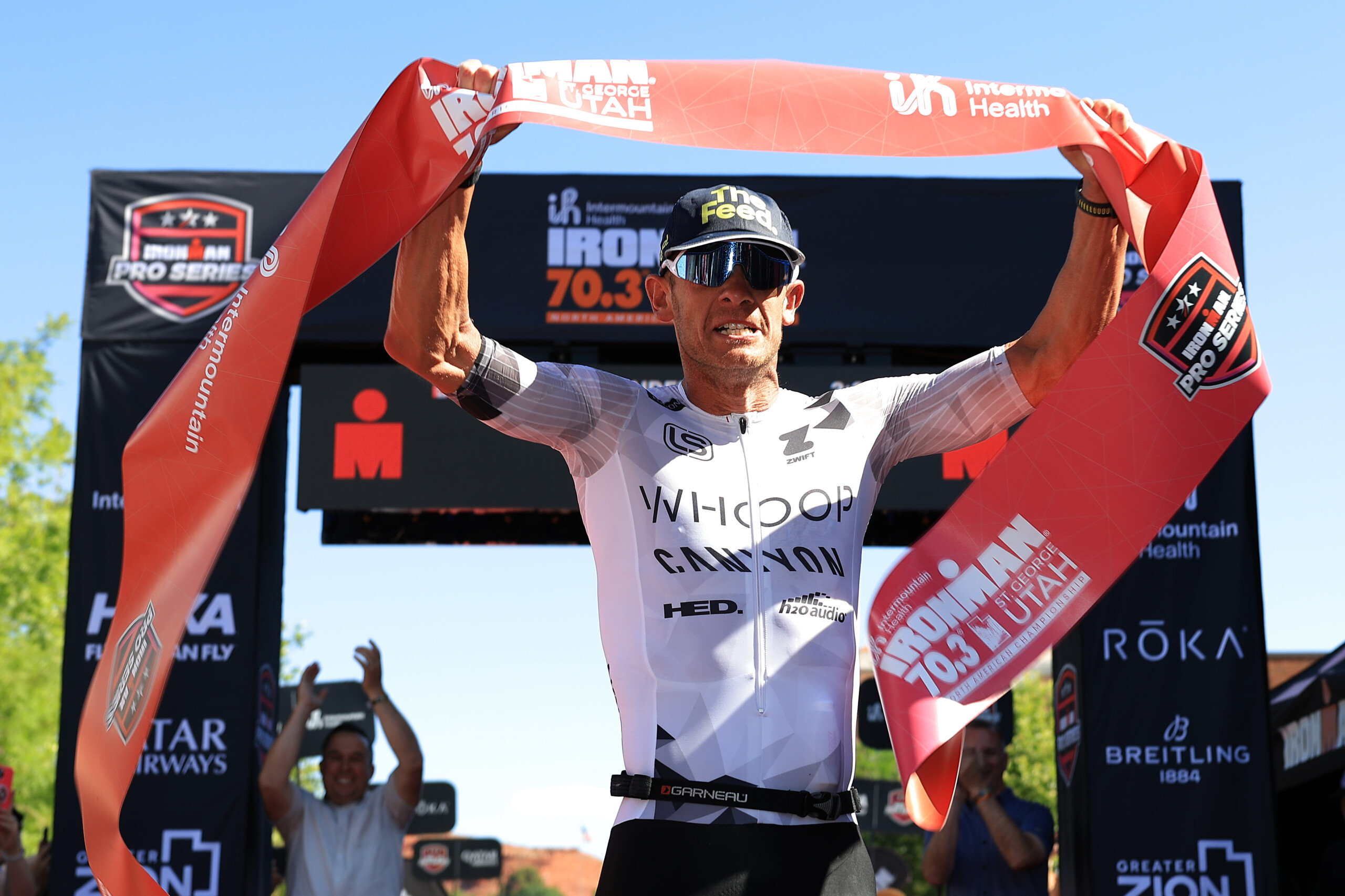
The chase was on as Ditlev would move into the lead early in the bike leg. However, a puncture for Ditlev gave opportunity for a charging Lionel Sanders to eventually take control and enter the iconic Snow Canyon climb alone before pulling into T2 in downtown St. George and surging out onto the HOKA Run Course. Sam Long followed into T2 2:30 behind and immediately put down the gas in an attempt to catch his rival, but ultimately the Canadian’s pace proved too strong, and Sanders would soar on to take his fourth win in St. George in a time of 3:37:54. Long would follow behind finishing in 3:40:08 while Colin Szuch (USA) would round out the men’s podium with a time of 3:44:04.
ST GEORGE, UTAH – MAY 10: Lionel Sanders of Canada reacts after finishing first place in the 2025 IRONMAN 70.3 St. George North American Championship on May 10, 2025 in St George, Utah. (Photo by Sean M. Haffey/Getty Images for IRON MAN)
In the women’s race, it would be Brazil’s two-time Olympian Vittoria Lopes who would surprise the field, exiting the water first in a time of 24:35, over 20 seconds ahead of the Netherlands’ Lotte Wilms. Defending champion Paula Findlay (CAN) would finish the swim over 1:20 behind. While Lopes would take a strong lead onto the bike, Findlay managed to chase down the Brazilian and after the 30 mile mark the two created an exciting pursuit for the remainder of the bike leg. Findlay entered T2 first, but Lopes, who followed just behind, would immediate sprint ahead and onto the HOKA Run Course. Unfortunately, she would soon falter with a recurring foot injury.
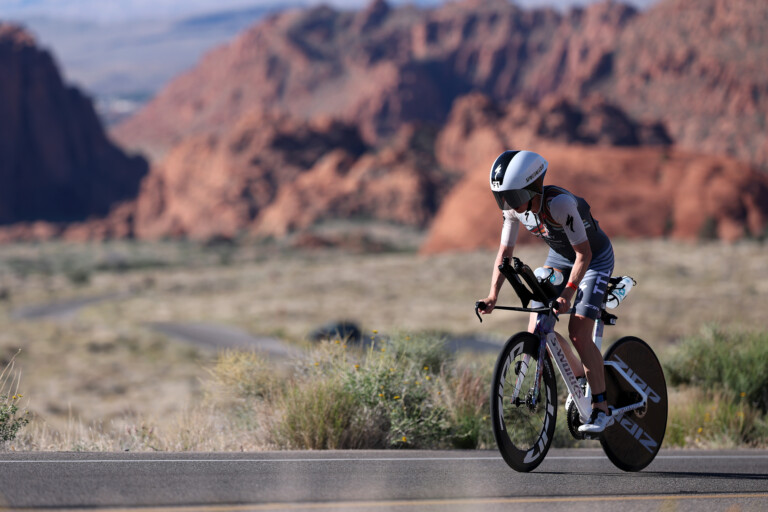
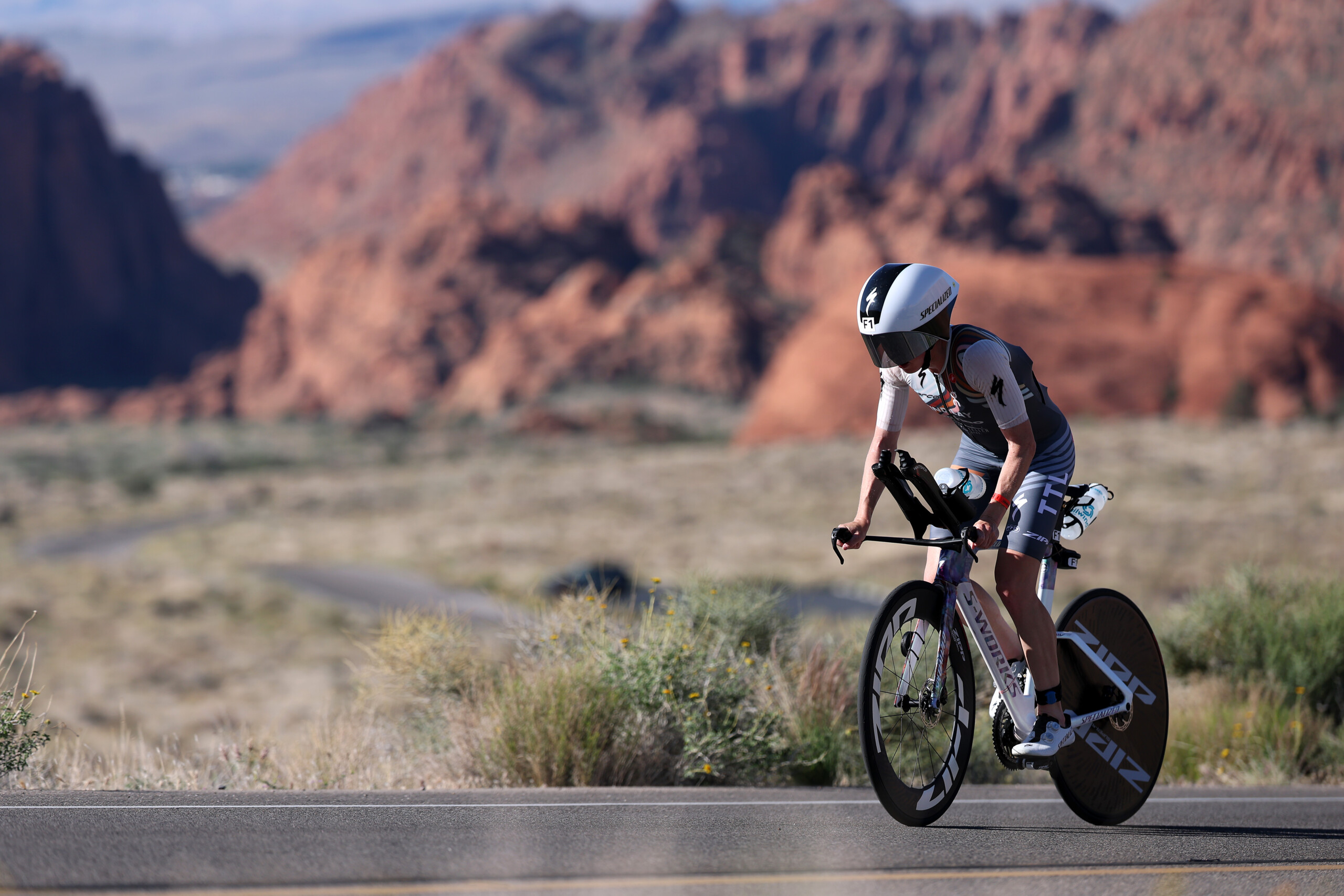
ST GEORGE, UTAH – MAY 10: Paula Findlay of the United States competes in bike the portion of the 2025 IRONMAN 70.3 St. George North American Championship on May 10, 2025 in St George, Utah. (Photo by Sean M. Haffey/Getty Images for IRON MAN)
It would be Findlay who would soar on to the win in a time of 4:11:06, dominating the field and showcasing why she is currently tied for fourth in the IRONMAN Pro Series standings alongside Kat Matthews (USA). A charging Danielle Lewis (USA) would run her way into second, from fourth off the bike, finishing in a time of 4:14:12 while Jackie Hering (USA) would take third, from sixth off the bike, with a time of 4:17:06.
ST GEORGE, UTAH – MAY 10: Paula Findlay of the United States finishes first place in the 2025 IRONMAN 70.3 St. George North American Championship on May 10, 2025 in St George, Utah. (Photo by Sean M. Haffey/Getty Images for IRON MAN)
“I swam well!” Sanders said after finishing. “Well above my capacity. Which you can only ask for that. Then on the bike, I was close to the front, and when you are close to the front you are very motivated to get there. I rode really hard, probably too hard and it felt horrible every single step. However, I’m fortunate that everyone else road hard too and I was able to hang on.
Sanders added. “I love this place and I will definitely be coming back to St. George, even if it is not to race, but certainly to visit.”
“It feels so good and I love this place and to have a good race here – well I wasn’t super conditioned that I thought I could win again. But being that last year [of St, George], it really means a lot.” said Findlay. “I tried to ride the hills on the ups and hold speed on the downs and recover a bit. It is such a hard race and it is the hottest day I have ever raced it, so that added to the suffering. I’m really happy with this result.”
ST GEORGE, UTAH – MAY 10: Paula Findlay of the United States competes in bike the portion of the 2025 IRONMAN 70.3 St. George North American Championship on May 10, 2025 in St George, Utah. (Photo by Sean M. Haffey/Getty Images for IRON MAN)
News and Notes
Lionel Sanders earns his fourth victory in seven appearances at the Intermountain Health IRONMAN 70.3 St. George North American Championship following wins in 2016, 2018, 2021, in addition to his second-place finish at the 2021 IRONMAN World Championship in St. George in May of 2022.
Paula Findlay successfully defends her title, earning her third win in five appearances at the Intermountain Health IRONMAN 70.3 St. George North American Championship following wins in 2018 and 2024, along with her second-place finish at the 2022 IRONMAN 70.3 World Championship in St. George.
Sanders sets a new course best time in St. George of 3:37:54, besting Sam Long’s time of 3:39:17 set just last year.
Sanders records the fastest bike time of the men’s pro field with a time of 1:58:07 setting a new bike course best, surpassing Sam Long’s bike split of 1:59:57 set in 2024. Paula Findlay was the fastest on the bike for the women with a time of 2:17:41.
In the men’s race it was Seth Rider (USA) who clocked the fastest swim of the day with a 22:15; Brazil’s Vittoria Lopes was the first out of the water in the women’s race finishing the 1.2-mile swim in Sand Hollow Reservoir in a time of 24:35.
Matt McElroy (USA) secured the fastest run split of the day with a 1:09:44, and Lydia Russell (USA) claimed the fastest run of the female professional field in a speedy time of 1:19:02.
Kevin McDowell (USA) clocked the fastest transition time of the day with 1:03 in T2.
The biggest movers and shakers in the IRONMAN Pro Series standings following today’s race came from two Oceania athletes Ben Hamilton (NZL), who moved up nine spots into the lead and Cameron Wurf (AUS) who moved six spots into second. Following her victory, Paula Findlay moves up 13 spots to tie Kat Matthews (GBR) for fourth place.
By Charles Pekow — The many ills caused by climate change include discouraging biking – especially for those who most need to pedal. Sea level rise, rising temperatures and changes in precipitation patterns are making cycling conditions more difficult for disadvantaged communities that need alternative means of transit, according to a study at the University of Delaware. The state’s low-lying flatlands make it vulnerable to flooding.
Excessive heat caused by climate change make it difficult to enjoy summer cycling. Photo by Dave Iltis
“With rising temperatures, especially notable during the summer months (June, July, and August), urban areas like Wilmington could see an increased strain on residents, particularly those in disadvantaged neighborhoods who rely heavily on active transportation such as walking and cycling,” the researchers warn.
Not only are people less inclined to ride when it gets too hot, “environmental heat stress can impact cycling performance, with heat affecting the battery life of electric scooters and posing risks of dehydration and heat-related illnesses to riders,” according to previous research the study cites.
The study notes that the notoriously hot Phoenix, AZ improved its situation by shading public spaces and using reflective materials that reduce pavement temperatures.
There’s something about coffee and cycling that just goes together. Coffee has become an essential part of cycling culture, whether pre-ride espresso, a mid-ride café stop, or a post-ride wind-down. It’s more than just a caffeine fix. It is a ritual, a meeting place, and a way to build community.
Across the world, cyclists gather at cafés before hitting the road, swapping stories over cortados and cappuccinos. But why does this connection run so deep? Part of it is practical—coffee gives riders the energy boost they need—but it’s also cultural. Cafés have long been a hub for cyclists to rest, refuel, and connect, a tradition passed down through generations.
Why Coffee and Cycling Just Work
The link between coffee and cycling isn’t just about convenience. It’s about shared values. Both require precision, patience, and an appreciation for the process. Just as cyclists fine-tune their bikes for the perfect ride, coffee lovers take the time to craft the perfect brew. Both require endurance, whether pushing through a long ride or slowly savoring a perfectly pulled espresso.
But beyond the mechanics, coffee stops are a social glue. There’s a familiar scene outside many cafés: bikes leaned against walls, riders chatting about gear, upcoming races, and the best local routes. These moments, spent over a shared love of coffee and cycling, make the experience memorable.
A Tradition Rooted in History
The relationship between cycling and coffee runs deep, especially in Italy and Belgium. In Italy, stopping for an espresso mid-ride is practically sacred. Decades ago, during the early days of races like the Tour de France and Giro d’Italia, cafés played an essential role. Before energy gels and sports drinks, riders relied on strong coffee, fresh bread, and simple sandwiches from local café owners to endure brutal mountain climbs and arduous stages.
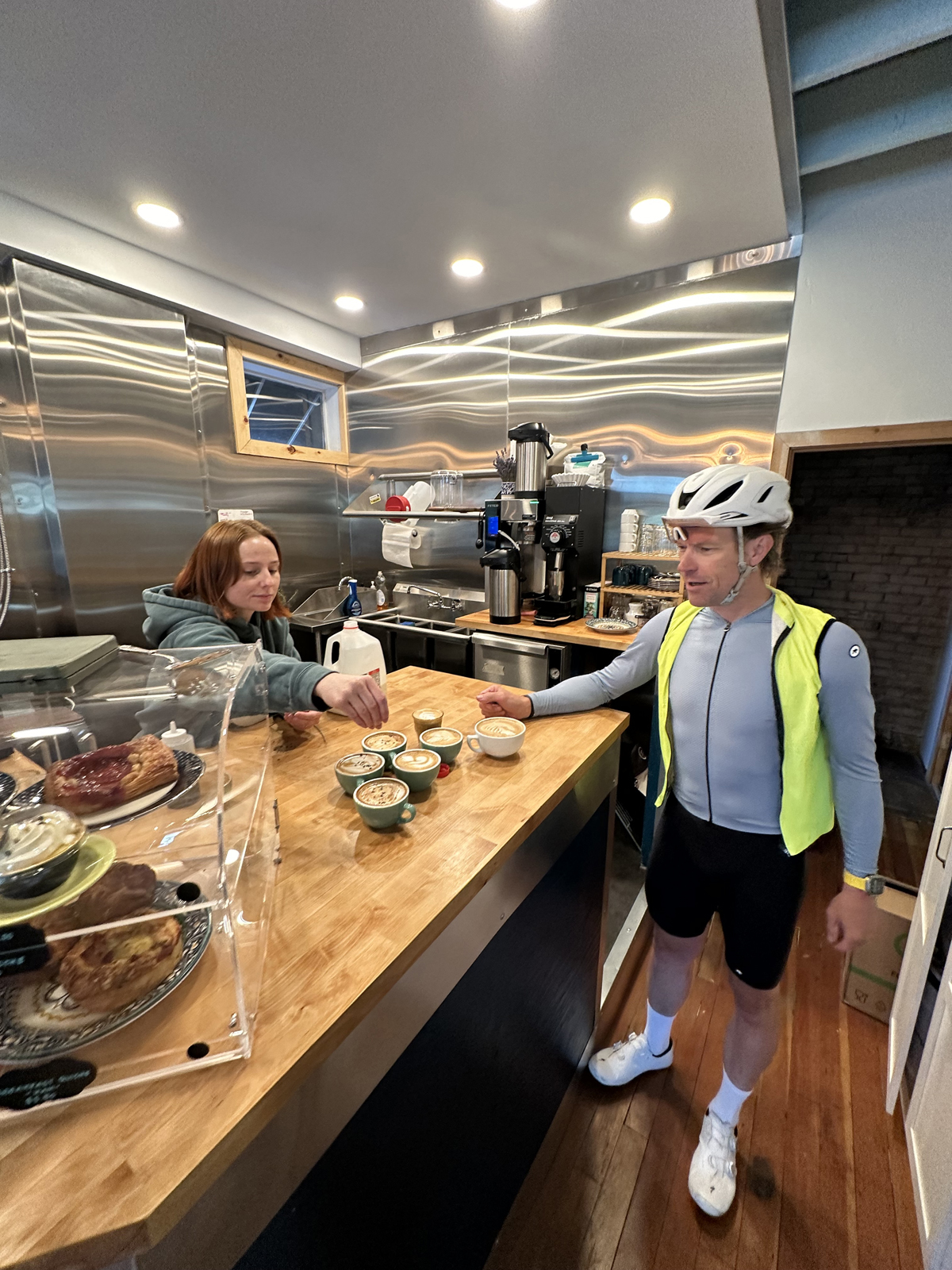
A cyclist gets a cup of coffee at Peak State Fit CycleCafe. Photo courtesy Peak State Fit
By the mid-20th century, coffee culture and cycling were inseparable. Italian legends like Fausto Coppi and Gino Bartali were known for their love of espresso, often grabbing a quick shot before or after races. Coffee brands took notice, and sponsorships soon followed, most famously the Faema espresso machine company, which backed one of the greatest cycling teams in history, featuring the legendary Eddy Merckx.
Today, this tradition lives on. Gran Fondos and cycling events worldwide feature designated coffee stops, keeping the heritage alive. Cycling cafés everywhere, from London to Los Angeles, take inspiration from these early racing traditions, creating spaces where cyclists can gather, refuel, and celebrate their shared passion.
In Belgium, cafés serve as unofficial clubhouses for cyclists. Rain or shine, pros and amateurs alike meet in these cozy spots to plan routes, analyze races, and warm up after grueling rides through the cobbled classics. Coffee isn’t just a caffeine fix. It’s the unwinding ritual, the stories swapped, and the camaraderie brewed over a steaming cup after miles in the saddle.
Coffee, Community, and Performance
While coffee is a social cornerstone of cycling, it also plays a significant role in performance. Caffeine has been shown to enhance endurance, improve mental focus, and reduce perceived exertion, making long rides feel easier. Research suggests that consuming caffeine 30–60 minutes before exercise can maximize these effects, helping cyclists sustain energy levels and push through fatigue.
However, moderation is key. Too much caffeine can lead to jitteriness, dehydration, or digestive discomfort, so finding the right balance is crucial. Many cyclists swear by an espresso shot before a ride, while others prefer a longer brew for a more gradual caffeine release. Post-ride, coffee serves as both a recovery ritual and a social gathering point, reinforcing the deep connection between cycling and coffee cultures.
But beyond the science, the real magic of coffee in cycling is the sense of connection it fosters. Unlike the competitive atmosphere of races, cafés provide a space where everyone, a seasoned racer, or a casual weekend rider, feels welcome. Coffee shops create an inclusive space where friendships are formed, knowledge is shared, and the love of cycling is celebrated.
Conclusion
Cycling and coffee are more than just a pairing. They’re a culture, a tradition, and a way to unite people. Whether you’re pushing for a podium finish or simply riding for the joy of it, a good coffee stop adds something unique to the experience. Don’t just think about the miles the next time you head out for a ride. Take a moment to enjoy a well-brewed espresso, the camaraderie of fellow cyclists, and the culture that makes this connection so timeless.
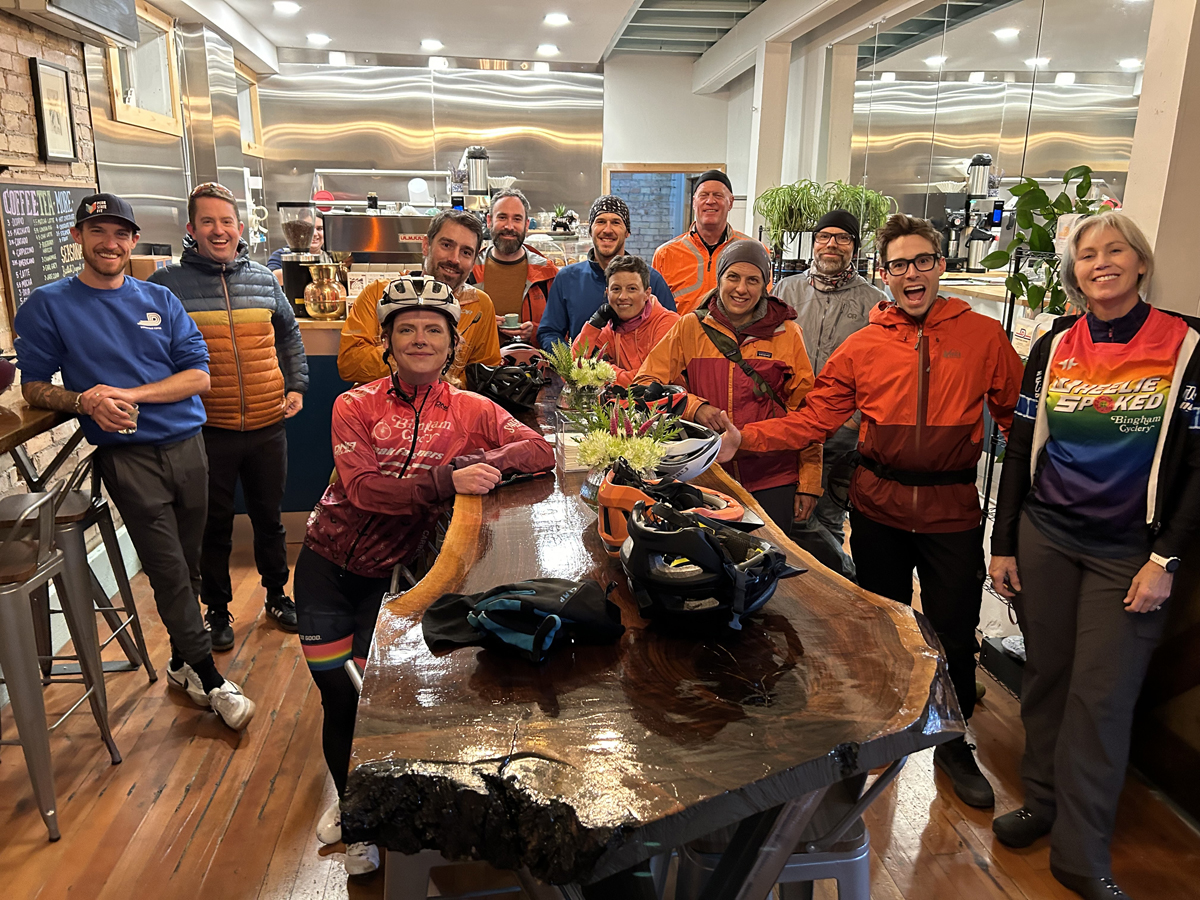
The Wheelie Spoked group ride meeting at Peak State Fit. Photo courtesy Peak State Fit
Afterword: Peak State CycleCafe: A Hub for Cyclists in Salt Lake City
Recognizing this deep connection, my husband Pat and I founded Peak State CycleCafe to be more than just a coffee shop. It’s a welcoming space where cyclists can come together, refuel, and feel at home.
Here’s what makes it a natural fit for riders:
It is a prime location along popular cycling routes, making it an easy and accessible stop.
Seating is designed for different needs, whether a quick espresso at the bar or a long post-ride debrief with friends.
menu for cyclists featuring high-quality coffee and nutritious snacks to keep energy levels up.
But it’s not just about great coffee. It’s about community. Peak State hosts regular events to bring cyclists together, including:
Weekly coffee meetups, where riders of all levels can swap stories and share tips.
Post-ride gatherings, turning a simple coffee stop into a social tradition.
Educational clinics on everything from coffee brewing techniques to the science of roasting.
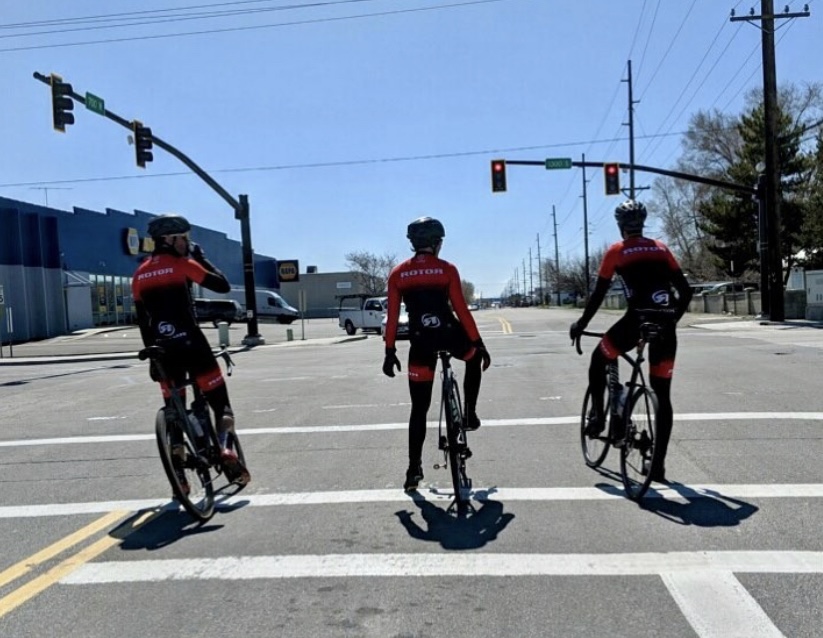
SALT LAKE CITY, Utah (May 14, 2025) — Rotor America, the U.S. arm of Spanish cycling component maker Rotor Bike Components, will shut down its Salt Lake City office on June 15, 2025. The decision comes after nearly a decade of operations and is attributed to “ongoing tariff insecurity” impacting the company’s ability to maintain a stable U.S. presence.
Despite the closure, Rotor will continue to serve U.S. consumers and dealers by shipping products directly from its warehouse in Madrid, Spain. Orders can be placed through Rotor America until June 15, after which fulfillment will transition to the Madrid facility. This logistical shift will likely increase shipping times and costs for U.S. customers while complicating returns, warranty service, and dealer support.
The closure reflects broader challenges faced by international cycling brands amid shifting U.S. trade policies. Recent tariff adjustments have imposed significant duties on imported goods, including a 20% reciprocal tariff on European products, a 10% base tariff on general imports, and additional 25% tariffs on sectors like automotive, steel, and aluminum.
The move is a severe blow to a brand that has relied on local manufacturing in Spain and a 100% European supply chain since its inception. This strategy, designed to maintain high quality standards and accelerate product development, has not been enough to protect the company from the new tariff framework.
In a statement on Rotor America’s website, Managing Director Lori Barrett expressed gratitude to the U.S. team for their professionalism during this transition, stating, “I am grateful to the current U.S. team for their professionalism in light of the difficult situation. It’s been an honor to help develop the amazing Rotor America staff over the last decade, and I know this team will continue in to find their places in this industry.”
For further information or assistance, customers and dealers can contact Rotor at [email protected]
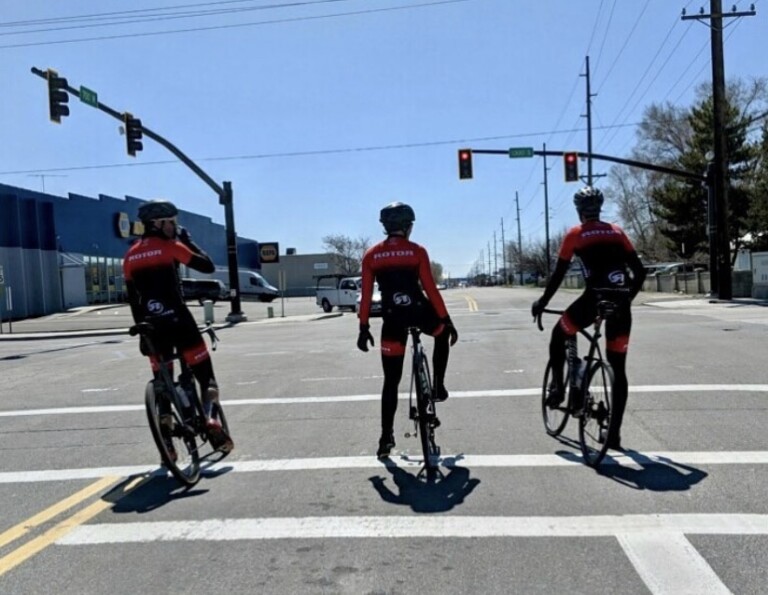
Due to tariff uncertainty, ROTOR is shutting their doors in Salt Lake City. Photo courtesy Rotor
“I am a reader of maps…I read them as others do holy writ, the same text again and again in quest of discoveries….”—William Least Heat Moon, River Horse: A Voyage Across America
“It is not on any map; true places never are.”—Herman Melville, Moby-Dick
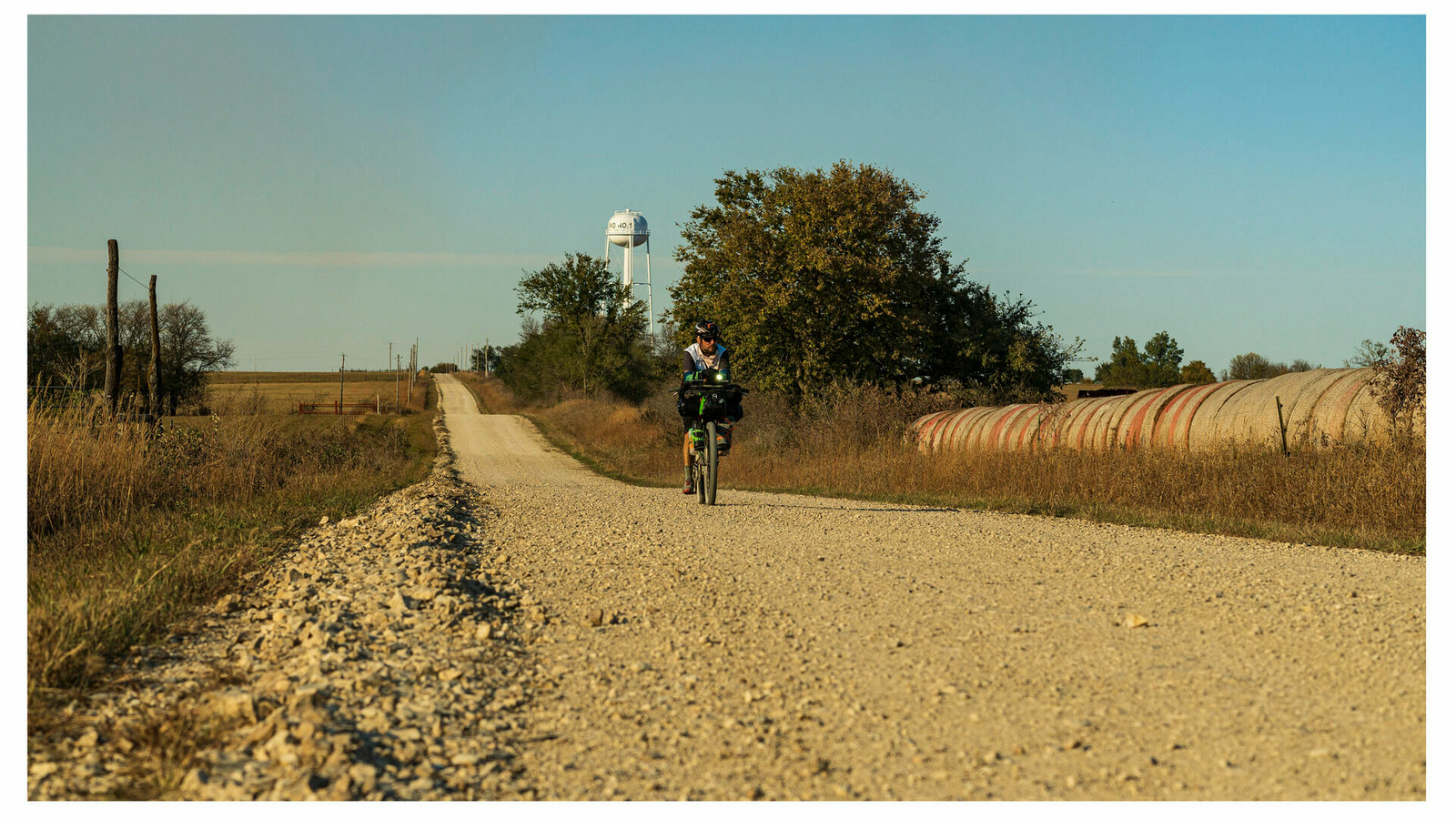
By Don Scheese — According to the Federal Highway Administration, as of 2012 there were 1,357,430 miles of unpaved roads in the United States (35% of the total road mileage in our nation). If you are a map freak like me, you spend a significant portion of your time poring over maps, planning and fantasizing about future cycling trips, mainly on unpaved roads. Given the increasing popularity of gravel grinding (see my article “Why Gravel?” in the Early Spring 2022 issue of Cycling West), it seems more and more people are trundling over unpaved roads on gravel-specific bikes around the country, either through organized events or on their own, seeking less vehicle-trafficked, wilder routes.
Cover of the Santa Fe edition of the Gravel Adventure Field Guide.
But the number of organized gravel events may be on the decline, says Betsy Welch, senior editor at Outside magazine and authority on gravel cycling culture. In a December 2024 on-line article, “Velo’s 2025 Gravel Cycling Predictions,” she speculates that “we may have reached a plateau in gravel racing in the U.S., and there are various reasons for this.” Welch cites factors like expense fatigue, with some events costing hundreds of dollars to register for, and over a thousand in travel costs to ride to at distant locales; saturation of the gravel event calendar, with races now occurring on a weekly basis; and more of a “grassroots gravel” inclination among potential gravel grinders, causing riders to seek out events closer to home.
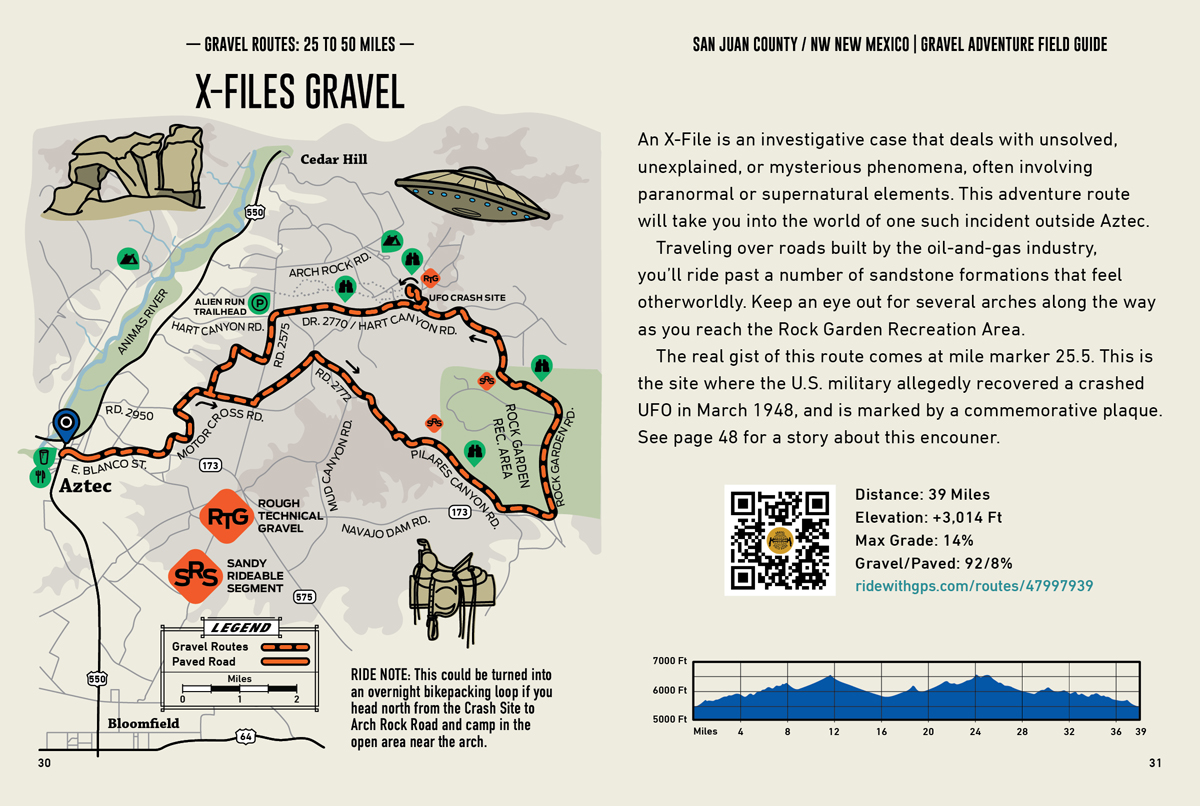
This means more cyclists looking for close-by adventure on their own. But how to find out about potential off-pavement routes near one’s home? Enter the Gravel Adventure Field Guide series, the brainchild of Colorado residents Juan DelaRoca and Stephen Beneski, who began publication of pocket-sized pamphlets in 2021. These colorful, well-written, and artfully produced guidebooks feature 10-12 gravel routes varying in length from under 25 to over 100 miles, from fairly easy to quite challenging, with useful information included on the local climate, ecology, and culture of a given area. Each route provides a paper map as well as a QR scan code connected to the RidewithGPS website, allowing one to download the route to a phone or Garmin, Wahoo, etc. As of January 2025, 16 guidebooks have been published, with most of them centering on rural areas in the western U.S. (and more are in the works). Copies are free at local bike and coffee shops in the areas in which guidebooks have been published, and they also can be purchased for $11 each from the website https://graveladventurefieldguide.com. (Full disclosure: I own four of the guidebooks and have 6 more in my cart on the website as I write.)
An excerpt from the San Juan County New Mexico Gravel Adventure Guide.
Let’s look at one of the guides as an example of what they offer. Before even getting to the route maps, the field guide for Las Cruces/Dona Ana County in New Mexico offers 22 pages of info and illustrations on local climate, geography, Chihuahuan desert ecology, history of roads in the state, suggestions on appropriate tire size, how to engage in “astrotourism” under the clear desert skies, and guidance on what kinds of bikepacking bags to use (along with a few ads from bike gear sponsors). All of this comes with lovely, colorful, even whimsical illustrations! And following 22 pages of route maps is further info on backcountry cycling and camping ethics as well as a section entitled “Desert Flow: A Cycling State of Mind”—what might be termed a philosophy of gravel grinding. The guide concludes with pages of information on local lodging, restaurants and cafes, art galleries, and bike shops. All this, in a pocket-sized pamphlet of 64 pages!
In an interview with Juan and Stephen, they explained how the idea for the guidebooks came about. Juan had recently moved to Trinidad, Colorado, and worked with the local bike shop and city economic development office to promote all the wonderful gravel riding in Las Animas County. Just as road cycling and mountain bike cultures have for decades coordinated with local towns and chambers of commerce to allure riders to come visit (and spend money in) an area for its wealth of trails and terrains, the Gravel Adventure Guide series aims to do the same for gravel grinding. Thus, gravel cycling has become part of the “sustainable tourism” trend growing across the country and world. Not coincidentally, the “Trinidad Rad” gravel event, now part of Lifetime Fitness’ series of gravel races, began in 2021, the same year that the “Trinidad/Las Animas County Gravel Adventure Field Guide,” the first in the series, was published.
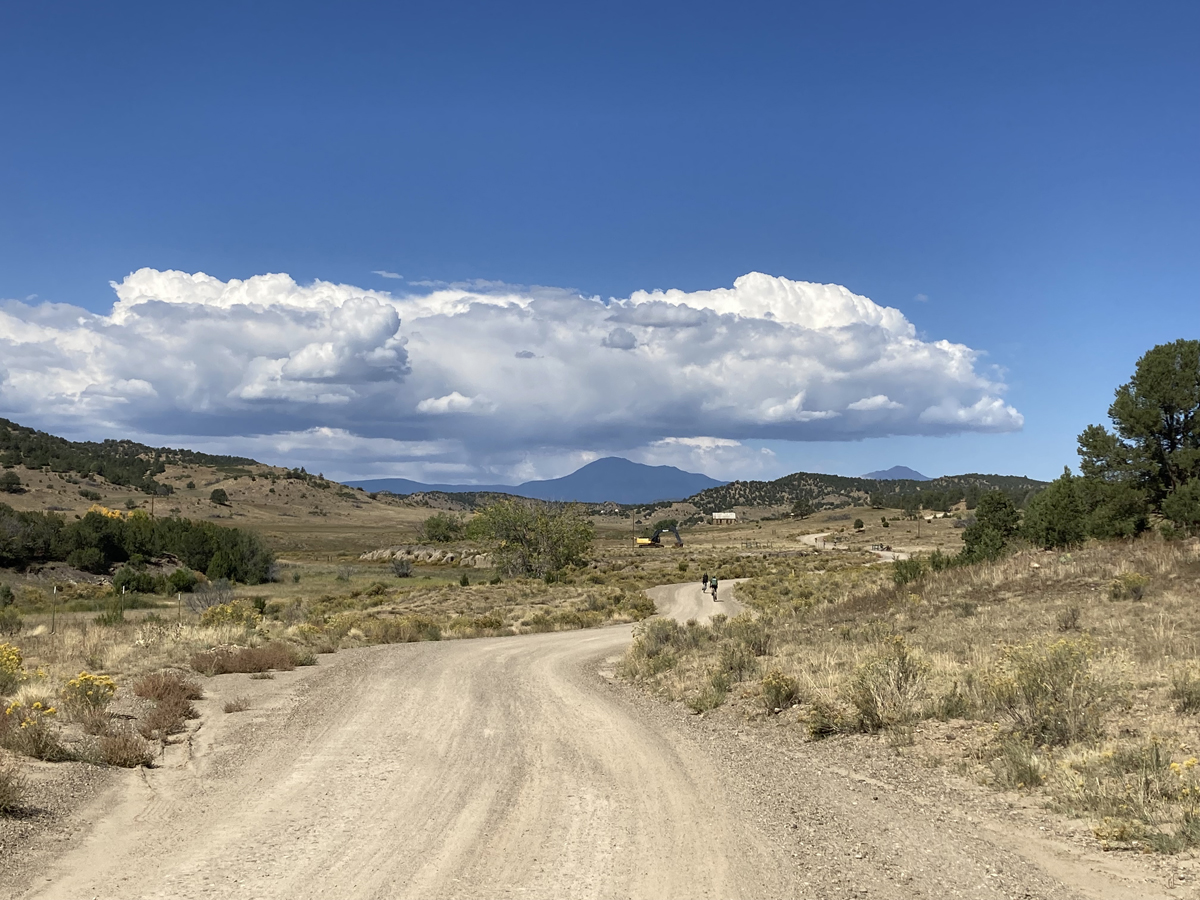
Approaching the Spanish Peaks on one of the routes included in the Trinidad Gravel Adventure Guide. Photo by Don Scheese
Other towns followed the example of Trinidad: Patagonia, AZ (home to the Spirit World 100 gravel event), and Bend, Oregon (home to the 5-day gravel stage race, the Oregon Trail Gravel Grinder). In my home state of New Mexico, guides have appeared for Las Cruces, Santa Fe, and San Juan County (with another to come out of Angel Fire, a mountain biking mecca in the northern part of the state). How do these guides originate? Often times it involves an organic process in which resident cyclists team up with local and state officials in economic development agencies to research, write, and produce a gravel guide. Production costs are covered by various bicycle gear sponsors as well as by state and local government funding. Upon publication of a particular pamphlet, Juan and Stephen then produce a short video on their website to help promote it.
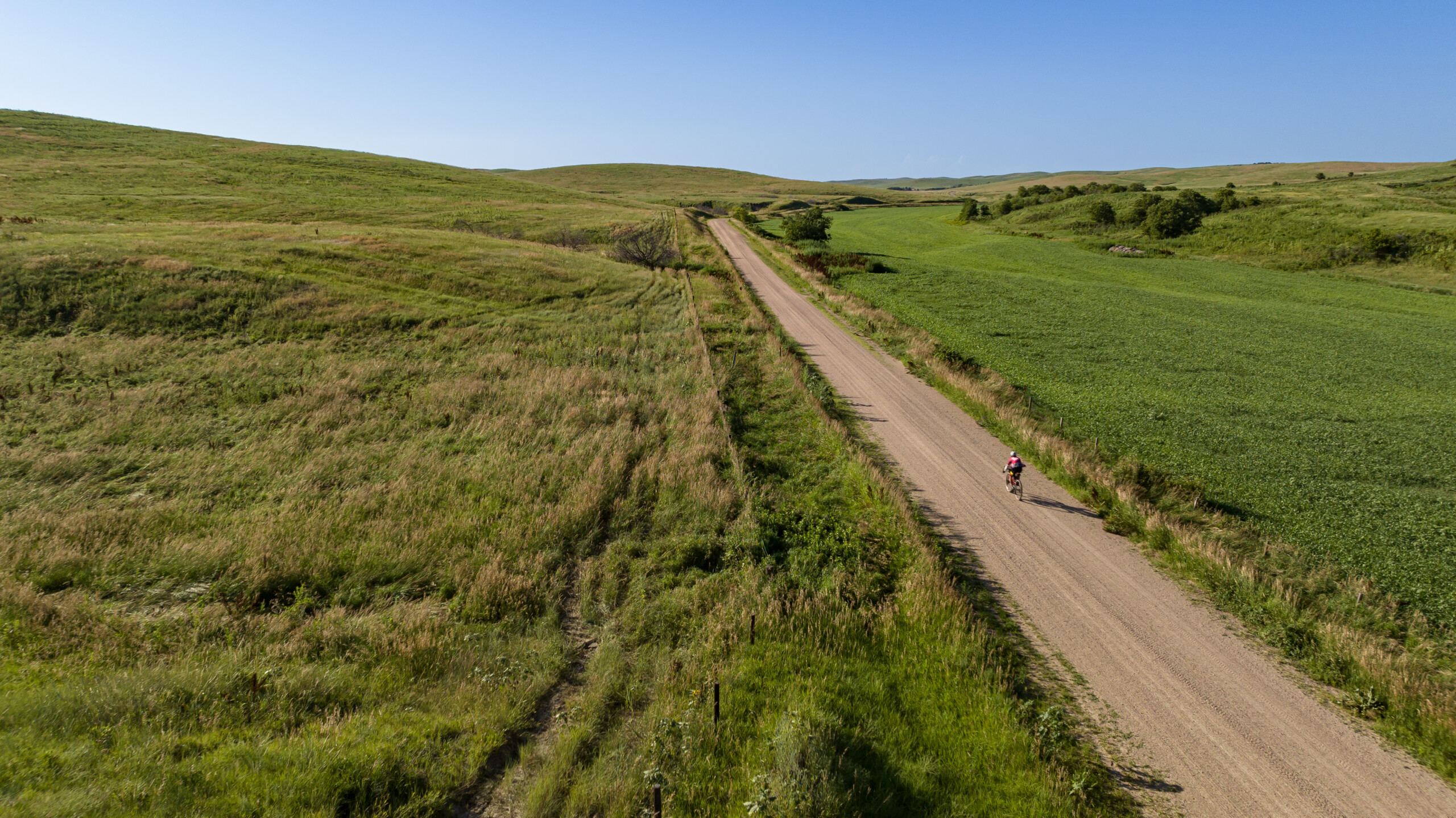
Typically, the suggested routes include riding on a variety of surfaces. As anyone who has ridden gravel routes well knows, the term “gravel” is (echoing Walt Whitman) large, containing multitudes. It can mean “champagne gravel,” i.e., hard-packed, smooth, rail-trail-like surfaces; or contain loose or sizable stones, i.e., “chunky gravel”; it may comprise soft dirt and/or sand; it can also consist of broken-up chipseal tarmac; or even include “baby-head” size rocks (sometimes requiring some hike-a-bike, depending on the size of the tires one is riding and whether or not your bike has any kind of suspension). And as every experienced gravel grinder knows, any given route can include all the above riding surfaces. “Gravel” can also refer to wide Forest Service or BLM roads, ranging from so-called secondary byways to primitive two-tracks, or the occasional single-track mountain bike trail. And to access gravel routes sometimes requires riding smooth tarmac for miles and miles (which gravel grinders rarely complain about). Where riders have access to mass transit, it may include riding a train or bus to begin a route. In Albuquerque, for example, I have ridden the local commuter train, the Rail Runner, to the outskirts of Santa Fe to begin riding various gravel routes.
In addition to using the guide to Santa Fe County, I’ve also utilized the route info from the guides to Trinidad, Patagonia, and Las Cruces. Sometimes I’ve followed the exact routes suggested; other times, after consulting local Forest Service and BLM maps, I’ve created my own variations, adding a personal touch. That is what I hope these gravel guides will do: encourage riders to not only follow established routes, but, using some creativity, create their own routes. Isn’t that what the very meaning of “Adventure” entails—a little (sometime more than a little) bit of the unexpected, the unforeseeable? As Henry David Thoreau implores us in Walden, “Be rather the Mungo Park, the Lewis and Clarke and Frobisher, of your own streams and oceans; explore your own higher latitudes…” Today we live in a world dominated by technology and industry, where virtually every choice we make involves less and less self-reliance, less risk—from the food we eat to the travel we engage in. It’s way past time to restore some good old fashioned Emersonian self-reliance to the American public.
So, use these guides, by all means, but expand upon them. Follow the routes in the maps, but don’t stop there. Discover a “true place” on your own. As Melville said, true places exist, but not on any map.
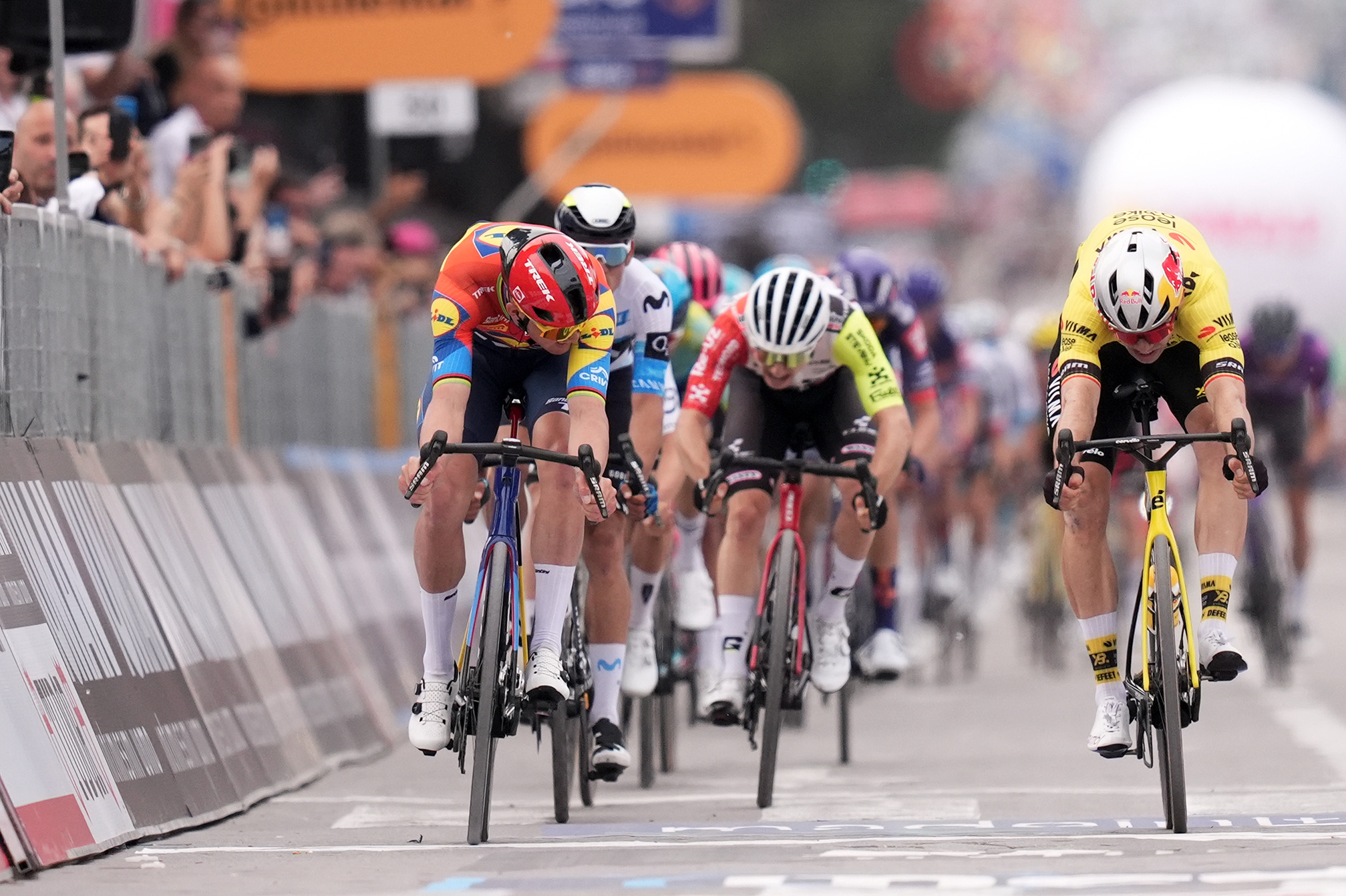
VLORË, Albania (May 12, 2025) — Danish powerhouse Mads Pedersen has emerged as the dominant force in the historic Albanian opening of the 108th Giro d’Italia, claiming two stage victories in three days and twice donning the coveted maglia rosa, including after Sunday’s finish in Vlorë when he reclaimed the race lead from Slovenia’s Primož Roglič.
The Lidl-Trek rider and former world champion has written his name in the history books as the first Danish cyclist ever to wear the leader’s jersey in the prestigious Italian Grand Tour, while his team’s tactical mastery has repeatedly dismantled the hopes of pure sprinters on courses designed to favor versatile power riders.
“When you win, it’s usually because the plan went to perfection,” Pedersen said after his initial triumph, encapsulating the meticulous approach that has brought him such success in the race’s Albanian debut.
Stage 1: Pedersen Makes Danish History in Tiranë
The Giro’s first-ever visit to Albania began with a 160-kilometer route from Durrës to Tiranë on Friday, featuring enough climbing to shake up the peloton but not enough to deter the strongest sprinters. Pedersen’s Lidl-Trek team executed a flawless strategy, pushing the pace hard on the climbs to eliminate less versatile riders before the finale.
“Our exact plan was to push very hard on the climb and make it a smaller group for a sprint,” Pedersen explained after the finish. “You always have to be afraid of Wout van Aert, he’s a really good bike rider. It’s not given to win when he’s in the group. We had to handle that with respect and a bit of fear as well.”
The Danish powerhouse narrowly outsprinted Belgium’s Wout Van Aert (Team Visma | Lease a Bike) and Venezuela’s Orluis Aular (Movistar Team) to claim both the stage victory and the first maglia rosa—a historic achievement as no Danish rider had ever led the Giro d’Italia in its 108-year history.
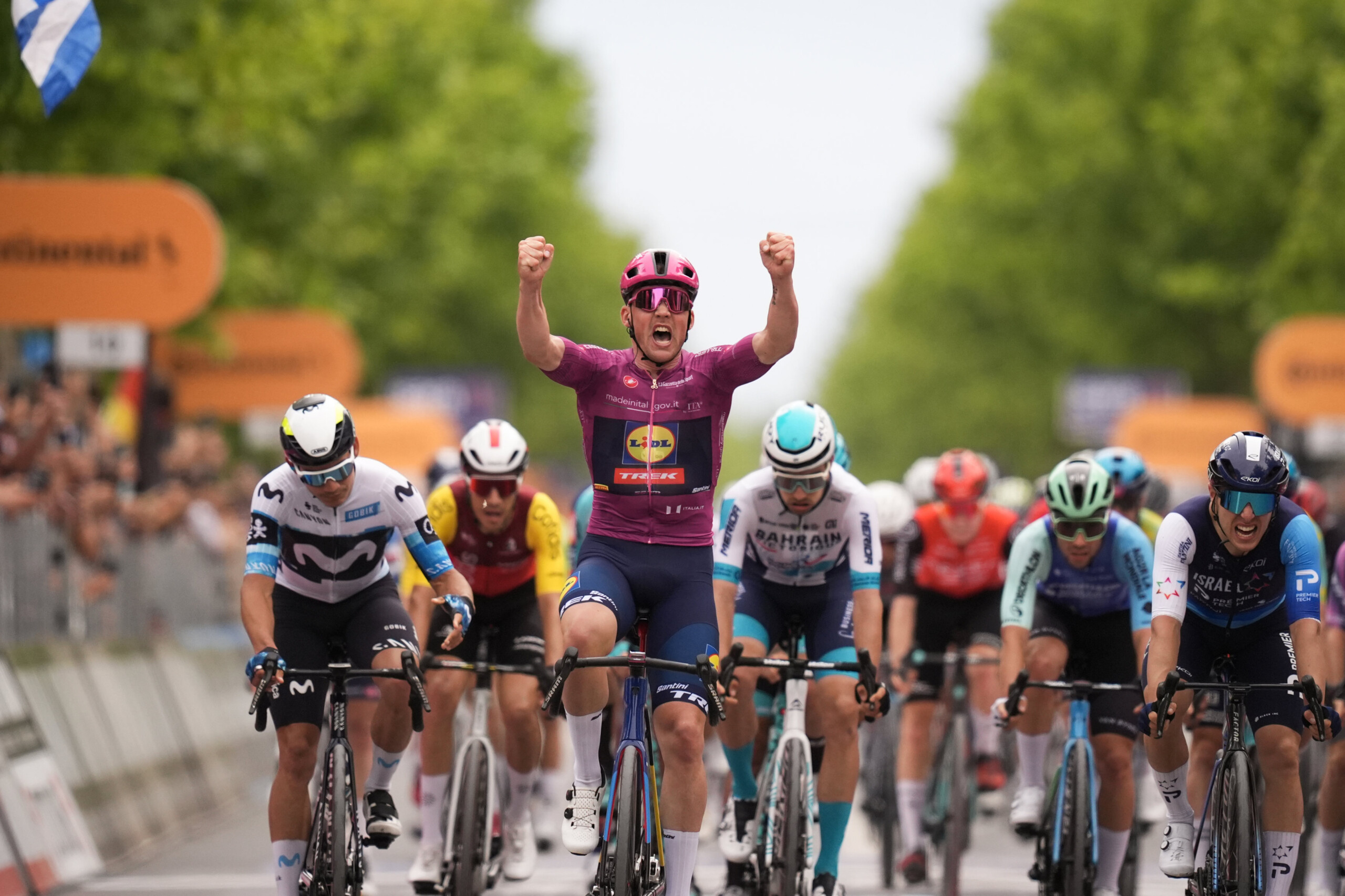
Pedersen Mads of Lidl-Trek winner of the stage during the stage 1 of the Giro d’Italia from Durazzo (Durrës) to Tirana (Tirane), Albania- Friday, May 9, 2025. Sport – cycling. (Photo by Massimo Paolone/LaPresse)Pedersen Mads of Lidl-Trek winner of the stage during the stage 1 of the Giro d’Italia from Durazzo (Durrës) to Tirana (Tirane), Albania- Friday, May 9, 2025. Sport – cycling. (Photo by Massimo Paolone/LaPresse)Mads Pedersen (Lidl-Trek) wins the stage during the stage 1 of the Giro dÕItalia from Durazzo (Durrës) to Tirana (Tirane), Albania – Friday, May 9, 2025. Sport – cycling. (Photo by Massimo Paolone/LaPresse)
“To win stage 1 and go in the maglia rosa is absolutely amazing,” said an elated Pedersen. “It’s incredible that the team worked that hard. I’m happy to pay them back with the win. It’s the first leader’s jersey I get in a Grand Tour, it’s something nice.”
The stage wasn’t without casualties, as Mikel Landa, a former podium finisher, and Geoffrey Bouchard, a previous King of the Mountains winner, both crashed out. General classification hopefuls Derek Gee and Thymen Arensman also lost valuable time that may prove costly in the overall battle.
Jersey Leaders After Stage 1:
Maglia Rosa (Pink – General Classification): Mads Pedersen (Lidl-Trek)
Maglia Ciclamino (Purple – Points Classification): Mads Pedersen (worn by Wout Van Aert)
Maglia Azzurra (Blue – King of the Mountains): Sylvain Moniquet (Cofidis)
Maglia Bianca (White – Best Young Rider): Francesco Busatto (Intermarché – Wanty)
For Cofidis, Sylvain Moniquet’s capture of the maglia azzurra represented a rare classification lead at the Giro—only the second time in team history after Staf Scheirlinckx briefly held the same jersey in 2006.
Stage 2: Young Tarling Triumphs as Roglič Takes Pink
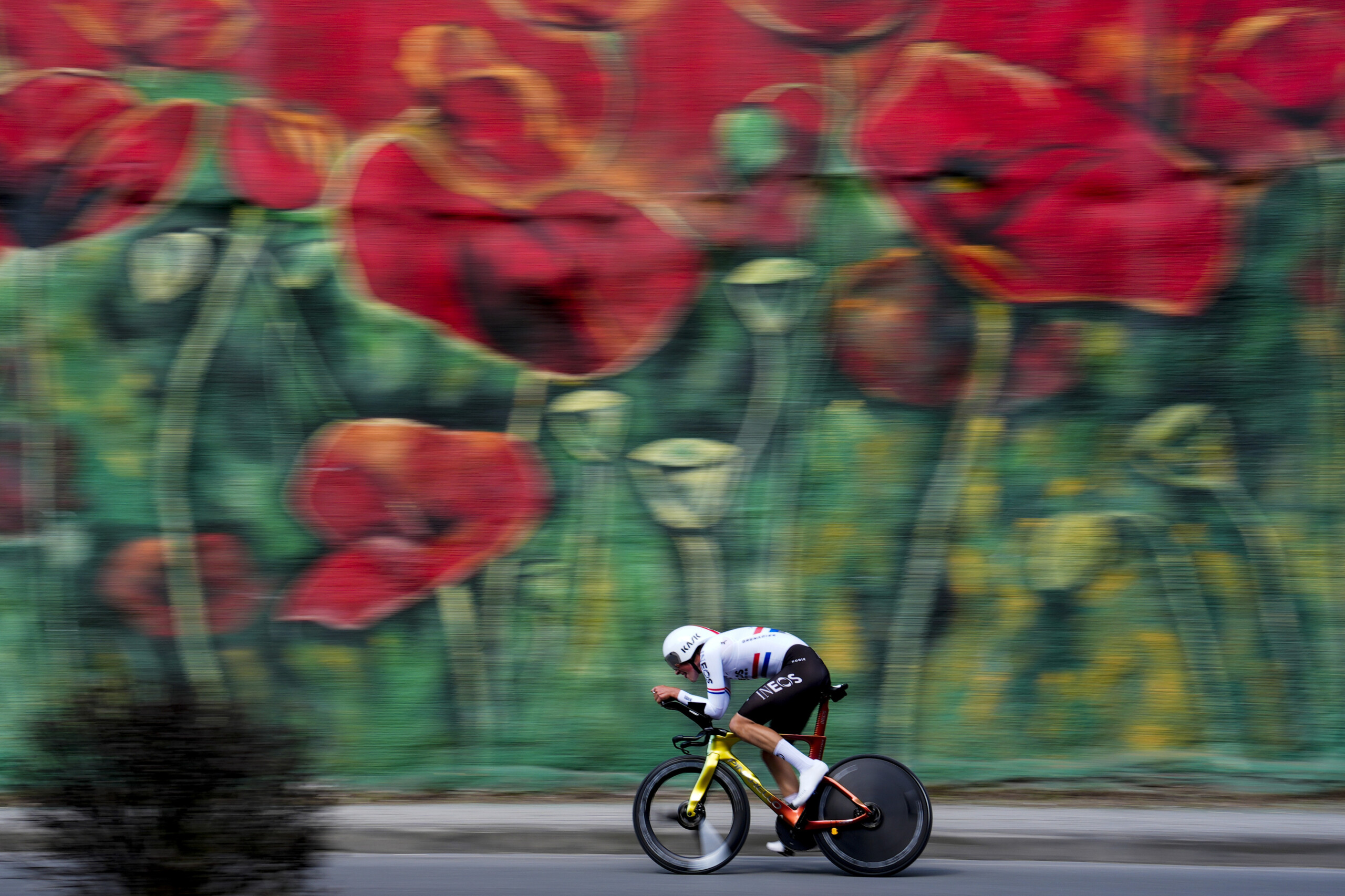
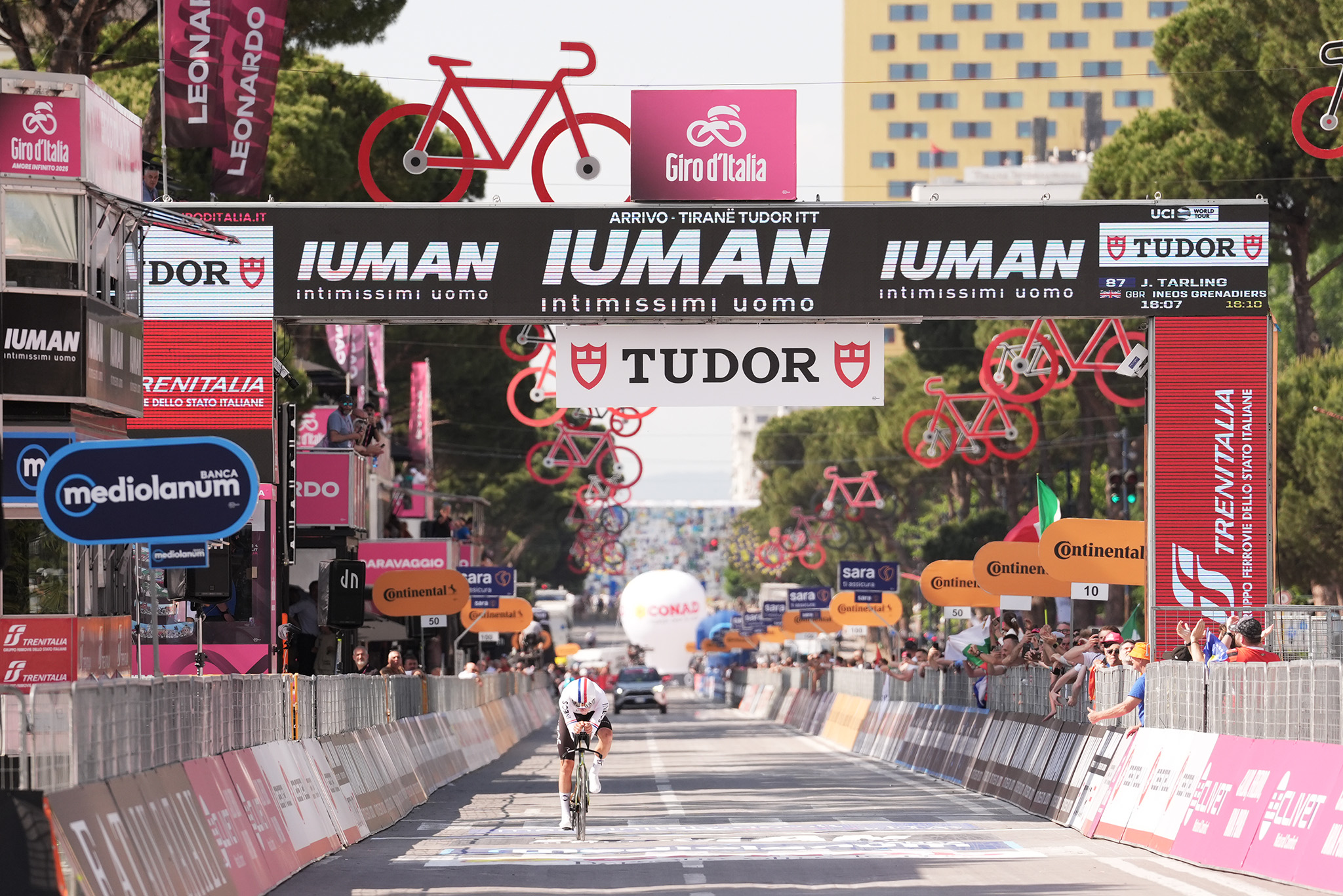
Saturday’s compact but challenging 13.7-kilometer time trial entirely within Tiranë created a battle between youth and experience that ultimately saw both triumphant in different ways.
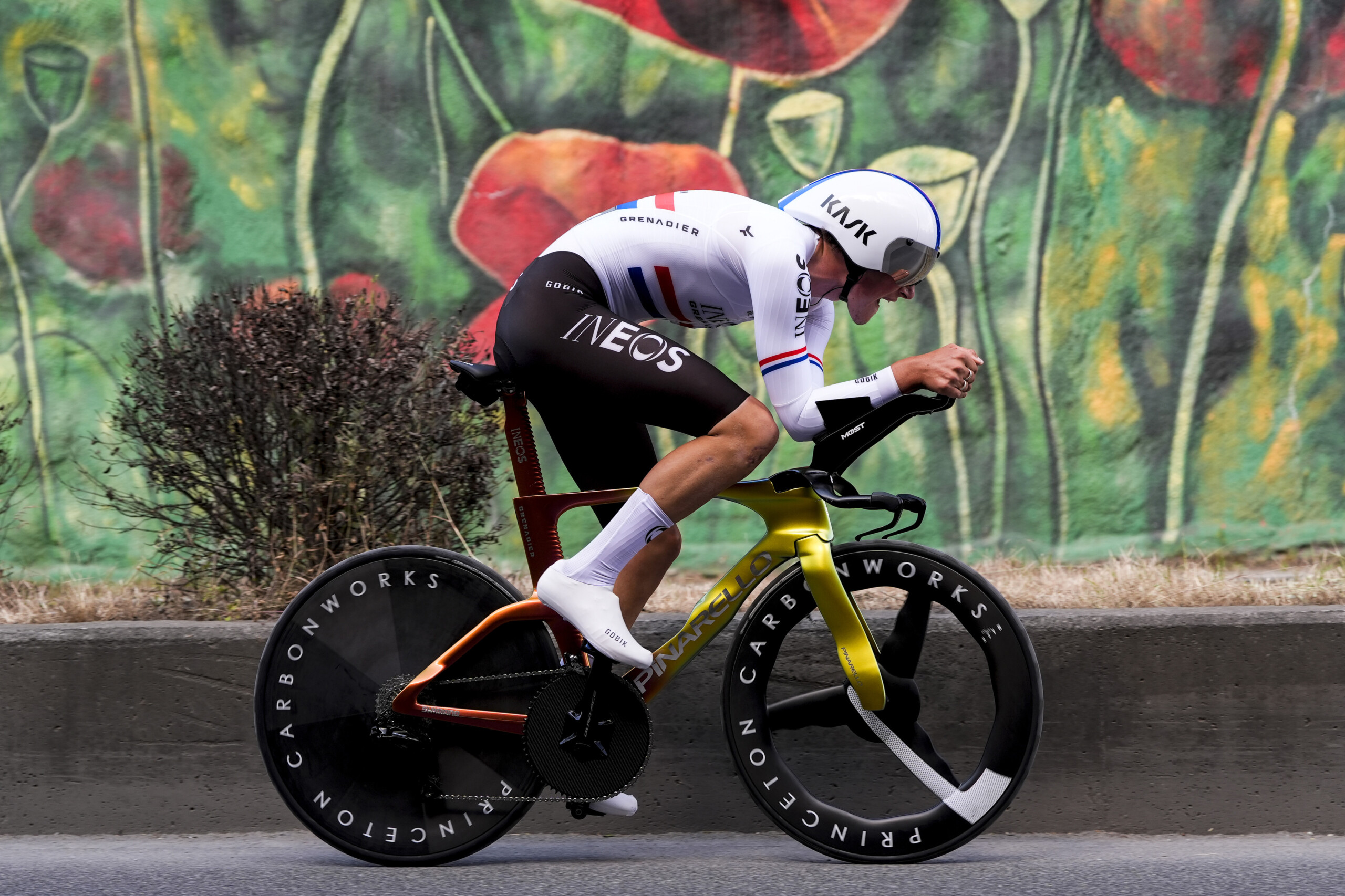
Joshua Michael Tarling of Ineos Grenadiers during the stage 2 of the Giro d’Italia from Tirana (Tiranë) to Tirana (Tiranë) Tudor ITT (Individual Time Trial), Albania – Saturday, May 10, 2025. Sport – cycling. (Photo by Fabio Ferrari/LaPresse)
Joshua Tarling of Ineos Grenadiers, just 20 years old, powered through the technical course at an average speed of 51 kilometers per hour to claim victory, becoming the youngest-ever time trial winner in Giro history. However, the British rider’s margin was razor-thin—just one second ahead of Slovenia’s Primož Roglič, the 35-year-old Red Bull – Bora – Hansgrohe leader who is aiming to become the oldest-ever Giro champion.
Joshua Michael Tarling of Ineos Grenadiers during the stage 2 of the Giro d’Italia from Tirana (Tiranë) to Tirana (Tiranë) Tudor ITT (Individual Time Trial), Albania – Saturday, May 10, 2025. Sport – cycling. (Photo by Fabio Ferrari/LaPresse)
“It’s a good way to start, it gives me confidence,” Tarling said after his victory was confirmed. “This time trial was a goal of mine from the start of season. It was stressful to watch the riders after me. Primož went fast and gained more uphill than I would have liked. It’s my first Grand Tour win, it stands on top of the list of my achievements so far.”
Joshua Michael Tarling of Ineos Grenadiers wins stage 2 of the Giro d’Italia from Tirana (Tiranë) to Tirana (Tiranë) Tudor ITT (Individual Time Trial), Albania – Saturday, May 10, 2025. Sport – cycling. (Photo by Massimo Paolone/LaPresse)
Australia’s Jay Vine (UAE Team Emirates XRG) took third place, just three seconds behind Tarling.
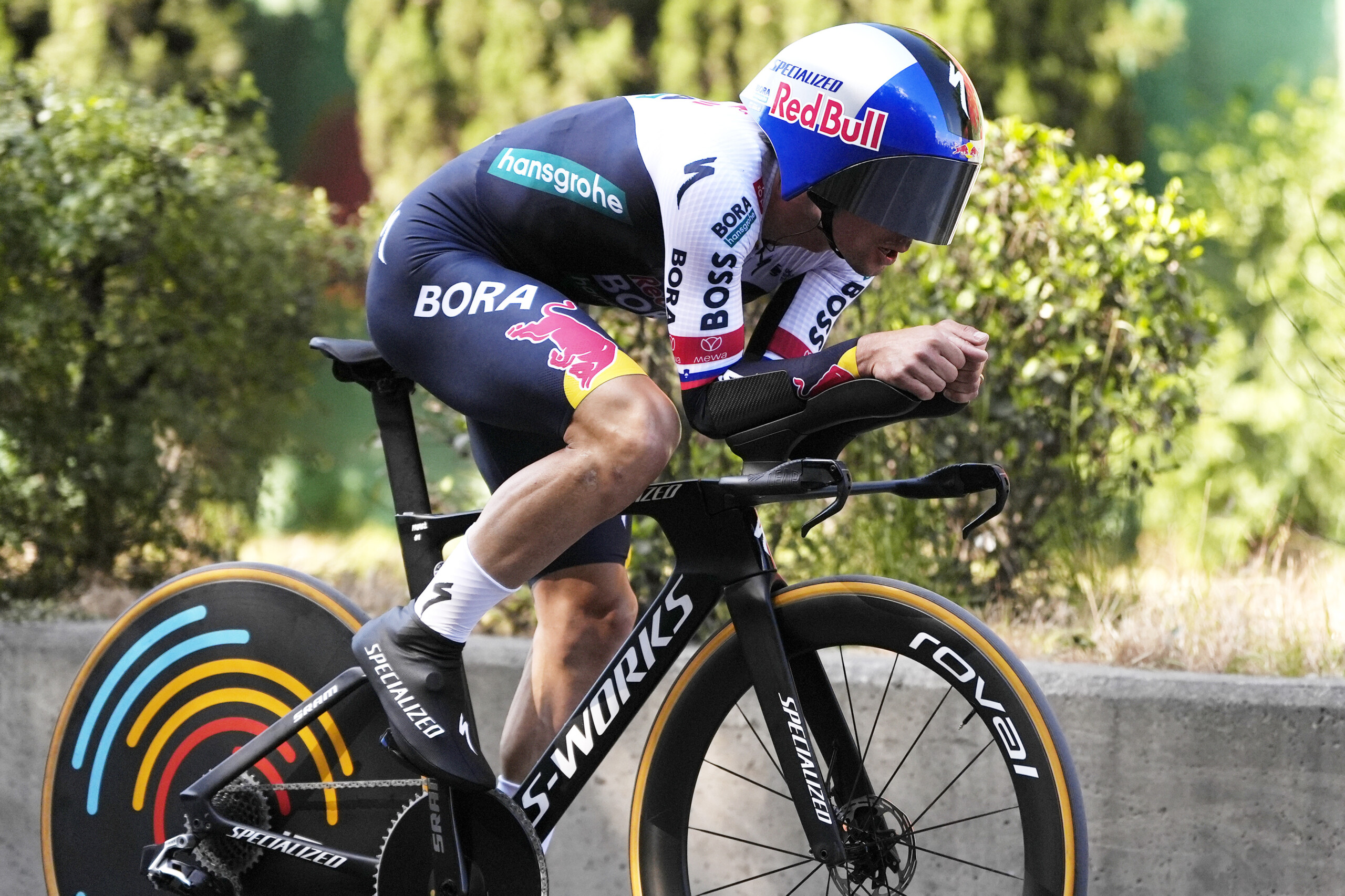
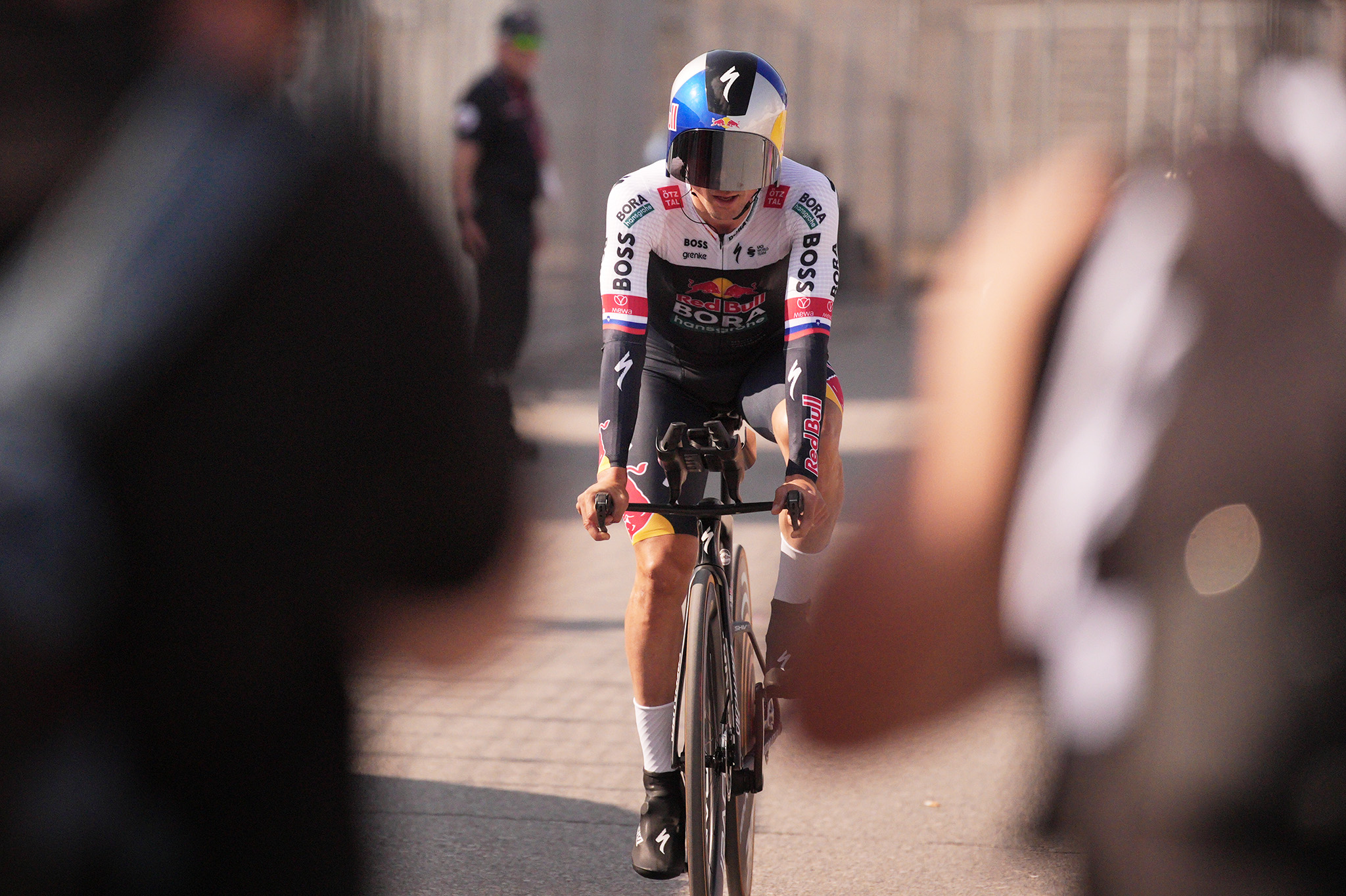
Primož Roglič of Red Bull – Bora – Hansgrohe during the stage 2 of the Giro d’Italia from Tirana (Tiranë) to Tirana (Tiranë) Tudor ITT (Individual Time Trial), Albania – Saturday, May 10, 2025. Sport – cycling. (Photo by Fabio Ferrari/LaPresse)
Despite narrowly missing the stage win, Roglič’s performance was sufficient to claim the maglia rosa from Pedersen, mirroring his compatriot Tadej Pogačar’s achievement from the previous year when he also took the race lead on stage two. The Slovenian climber positioned himself as the man to beat in the general classification battle, though his advantage over Pedersen was a mere one second after just two days of racing.
Primož Roglič of Red Bull – Bora – Hansgrohe during the stage 2 of the Giro d’Italia from Tirana (Tiranë) to Tirana (Tiranë) Tudor ITT (Individual Time Trial), Albania – Saturday, May 10, 2025. Sport – cycling. (Photo by Massimo Paolone/LaPresse)
The time trial maintained the status quo in the mountains classification, with Moniquet retaining the maglia azzurra for a second day, while the white jersey for best young rider transferred from Francesco Busatto to Mathias Vacek of Lidl-Trek, highlighting the team’s depth beyond their Danish leader.
Jersey Leaders After Stage 2:
Maglia Rosa (Pink – General Classification): Primož Roglič (Red Bull – Bora – Hansgrohe)
Maglia Azzurra (Blue – King of the Mountains): Sylvain Moniquet (Cofidis)
Maglia Bianca (White – Best Young Rider): Mathias Vacek (Lidl-Trek)
Stage 3: ‘Total Madsness’ as Pedersen Reclaims Pink
Sunday’s 160-kilometer stage from Vlorë back to Vlorë showcased both Albania’s scenic coastal beauty and Lidl-Trek’s tactical mastery, as the team once again manufactured ideal conditions for their versatile sprinter in what local media dubbed “Total Madsness.”
Mads Pedersen during the stage 3 of the Giro d’Italia from Valona (Vlorë) to Valona (Vlorë) , Albania – Sunday, May 11, 2025. Sport – cycling. (Photo by Massimo Paolone/LaPresse)
A strong breakaway animated much of the stage, featuring Dries De Bondt (Decathlon AG2R La Mondiale), Lorenzo Germani (Groupama-FDJ), stage 2 winner Joshua Tarling (Ineos Grenadiers), Mark Donovan (Q36.5), Chris Hamilton (Picnic PostNL), and Alessandro Tonelli (Polti VisitMalta). The race proceeded without major incident, save for an unexpected appearance by a rogue goat that fortunately caused no crashes.
Mads Pedersen of Lidl-Trek, cyclamen jersey, celebrates as he cycles to the finish line to win during the stage 3 of the Giro d’Italia from Valona (Vlorë) to Valona (Vlorë) Albania – Sunday, May 11, 2025. Sport – cycling. (Photo by Gian Mattia D’Alberto/LaPresse)
As the race approached the challenging Llogara Pass, Lorenzo Fortunato (XDS Astana) seized the opportunity to claim the maglia azzurra from Moniquet with an aggressive ride on the climb, while Pello Bilbao (Bahrain Victorious) also attempted to disrupt the peloton’s rhythm. However, neither could prevent the inevitable as the descent and flat run-in neutralized any climbing advantages.
Mads Pedersen celebrates winning the sprint during the stage 3 of the Giro d’Italia from Valona (Vlorë) to Valona (Vlorë) , Albania – Sunday, May 11, 2025. Sport – cycling. (Photo by Massimo Paolone/LaPresse)
“I was also in doubt today about how hard the stage would be but we managed to race the way we wanted to,” Pedersen revealed afterward. “I’m in a good shape that we managed to keep from the classics until now. We also have to take into account that the first three days of the Giro in Albania suited me very well.”
Mads Pedersen celebrates taking maglia rosa during the stage 3 of the Giro d’Italia from Valona (Vlorë) to Valona (Vlorë) , Albania – Sunday, May 11, 2025. Sport – cycling. (Photo by Massimo Paolone/LaPresse)
The finish saw Pedersen outsprinting New Zealand’s Corbin Strong (Israel – Premier Tech)—achieving his best-ever Grand Tour result—and Orluis Aular, who matched his third-place finish from stage 1. The time bonuses propelled Pedersen back into the maglia rosa, now leading Roglič by nine seconds in the general classification, with young teammate Mathias Vacek holding third place, 14 seconds behind.
Jersey Leaders After Stage 3:
Maglia Rosa (Pink – General Classification): Mads Pedersen (Lidl-Trek)
Maglia Azzurra (Blue – King of the Mountains): Lorenzo Fortunato (XDS Astana Team)
Maglia Bianca (White – Best Young Rider): Mathias Vacek (Lidl-Trek)
Team Harmony Key to Success
The extraordinary teamwork displayed by Lidl-Trek has been a defining feature of the opening stages, with even general classification rider Giulio Ciccone sacrificing himself for Pedersen in the finale of stage three, throwing elbows left and right to clear space in the chaotic final kilometer.
“When Mads is in this kind of form, he doesn’t even need to ask – we sacrifice ourselves for him automatically,” Ciccone explained after shepherding his captain into the perfect position for the sprint.
Pedersen was quick to acknowledge the selfless work of his teammates, particularly highlighting the contribution of the 22-year-old Czech rider in the white jersey.
“Mathias Vacek is absolutely amazing,” Pedersen enthused in the post-stage press conference. “This kid has a big future ahead of him. I’ll do everything I can for him to have a stage win here, he’s a machine, he has done so much work for me in the classics, I’m proud to have this guy racing for me!”
The Dane also promised to return the favor when the race reaches terrain less suited to his abilities: “Ciccone doesn’t need to worry, I’ll return the favor in the mountains,” Pedersen noted with a smile.
Historic Achievements
With his two stage victories in Albania, Pedersen has already secured his place in Giro history as the first Danish rider to win multiple stages in a single edition. His career tally now stands at an impressive 52 professional victories, making him the most successful Danish rider of all time in terms of total wins.
He has also equaled Ole Ritter’s record of three Giro stage wins by a Danish rider, having previously triumphed in Naples during the 2023 edition. The last rider to achieve two stage victories in the first three days of the Giro was Elia Viviani in 2018.
Beyond Pedersen’s personal milestones, the race has also highlighted emerging talent. Strong’s second place represents the best-ever finish for a New Zealander in a Giro stage, though the nation still awaits its first stage win after Greg Henderson and Julian Dean both finished second in stages during the 2010 edition.
Looking Ahead
With 18 stages remaining and the race now bidding farewell to Albania after three spectacular opening days, Pedersen appears well-positioned to defend the maglia rosa through at least the next few flat stages, potentially until Stage 7 to Tagliacozzo. After that, the mountains will likely favor climbers like Roglič.
The Danish champion has already indicated his intention to shift focus toward securing the maglia ciclamino points classification once the mountains arrive, acknowledging the reality that pure climbers will eventually gain the upper hand in the general classification battle.
“I’m hungry for more,” he said. “I’ll do my absolute best to keep the maglia rosa tomorrow.”
The question remains whether Roglič and the other general classification contenders will be content to allow Pedersen’s dominance to continue in the coming days, or if they will seek to disrupt Lidl-Trek’s control before the race reaches more favorable terrain for the climbers.
Either way, the opening three days in Albania have set the stage for what promises to be a thrilling 108th edition of the Giro d’Italia, with the perfect blend of sprint finishes, time trial drama, and tactical intrigue already on display as the race prepares to continue its journey through Italy.
ALTO DE COTOBELLO, Asturias, Spain (May 11, 2025) — As Mother’s Day dawned in Spain on May 4th, 2025, the streets of Barcelona buzzed with anticipation for the start of La Vuelta Femenina 25 by Carrefour.es. Few could have predicted the drama that would unfold over seven days of racing across the Spanish landscape, from the technical team time trial through Barcelona’s iconic streets to the grueling final ascent of Alto de Cotobello in Asturias.
This year’s edition would feature all the hallmarks of grand tour racing: strategic masterclasses, surprising breakaways, powerful sprints, and mountain showdowns that separated the contenders from the pretenders. But at its core, this year’s Vuelta told a story of champions—both new and returning—pushing their limits and redefining what’s possible in women’s cycling.
Stage 1: Lidl-Trek and Ellen van Dijk Triumph in Barcelona
The opening team time trial through Barcelona’s streets gave spectators their first glimpse of the tactical chess match that would define the week. The 8.1-kilometer course starting at the iconic Casa Milà would provide minimal time gaps but maximum tension as teams sought to position their leaders favorably for the stages ahead.
Lotto Ladies was first off the start ramp at 12:51 CEST, setting an initial benchmark of 10’07” that was quickly bettered by Cofidis with 9’57”. As the afternoon progressed, Picnic-PostNL raised the bar significantly with their 9’39” effort, a time that stood until Liv-AlUla-Jayco knocked six seconds off with 9’33”.
With pre-race favorites EF Education-Oatly and Canyon//SRAM zondacrypto failing to best the Australian team’s time, it fell to Lidl-Trek to make the difference. The American squad, anchored by three-time individual time trial world champion Ellen van Dijk, stopped the clock just three seconds faster than Liv-AlUla-Jayco, claiming the day’s victory and putting van Dijk in La Roja, the race leader’s red jersey.
The final two teams to start—Anna van der Breggen’s SD Worx-Protime and Demi Vollering’s FDJ-Suez—came tantalizingly close, finishing just three and six seconds behind Lidl-Trek respectively. FDJ-Suez’s effort was hampered when powerhouse Vittoria Guazzini crashed at the course’s turning point in front of the former royal palace in Pedralbes.
“Of course it was really hard, but we trained a lot for this, also in the winter,” explained Riejanne Markus of Lidl-Trek. “It’s 10 minutes of racing full gas, so it always hurts, but it was really nice.”
The tight margins between teams meant that the general classification remained compact, with the top ten teams separated by just 20 seconds—a situation that Markus acknowledged: “From a GC perspective, it is important to start off like this. I wish this team time trial had been longer, because then it could have really made differences in the GC. Now everyone is within 10 seconds, so there are no big gaps.”
For van Dijk, wearing La Roja held special significance following her crash in last year’s Vuelta: “I know it is Mother’s Day in Spain, but in the Netherlands it is next week! I’ll be home for Mother’s Day in the Netherlands, so I have two Mother’s Days this year.” She added, “I see it as an honor because this particular leader jersey is not my jersey, but a team’s jersey. I’m honored that they want me to wear it.”
Canyon//SRAM zondacrypto’s Justyna Czapla, who claimed the best young rider jersey, credited teammate Chloé Dygert’s contribution: “She is a really strong TT rider. We were happy to have her in the squad. She was very important for us today as she took long, hard turns that enabled us to recover on her wheel.”
With no overall favorite falling out of contention on day one, the race was perfectly poised heading into the more selective stages ahead.
Stage 2: Vos Bosses the Sprint as Paternoster Takes La Roja
The second day of racing brought the peloton 99 kilometers from Molins de Rei to Sant Boi de Llobregat on a route featuring the category 2 Alt de la Creu de l’Aragall early in the stage. Heavy rain and slippery roads added an element of danger that would ultimately reshape the general classification.
As the flag dropped, the bunch immediately began climbing the insidious Alt de la Creu de l’Aragall. While no breakaway managed to establish itself on the ascent, Laboral Kutxa-Fundación Euskadi’s Ane Santesteban seized the opportunity to secure mountain points, cresting the climb first to become the initial leader of the mountains classification.
It wasn’t until kilometer 22 that Elena Cecchini (SD Worx-Protime) launched the day’s first significant attack, building a solo advantage of 50 seconds. With no collaborators willing to bridge across, Cecchini was reabsorbed by the peloton after approximately 13 kilometers of freedom. Her efforts weren’t in vain, however, as she claimed the Combativity award for the day.
“Why did I attack? Well, it wasn’t on the plan,” Cecchini explained post-stage. “I was hoping that somebody would jump on my wheel. Then I found myself alone in the lead, and I decided it was too long before the finish to keep going. It’s nice to race like this every now and then—I had fun.”
As heavy rain began falling, the peloton approached the intermediate sprint at kilometer 58.5, which was taken by Visma | Lease a Bike’s Marianne Vos. A brief attack by Lea Lin Teutenberg (Lotto Ladies) followed but was quickly neutralized as the wet conditions increased tension in the bunch.
The long descent to Gavà at kilometer 90.2 proved decisive, not for crashes but for the splits it created. The peloton stretched under pressure, and several groups lost contact—crucially including one containing race leader Ellen van Dijk (Lidl-Trek), who would be forced to relinquish La Roja by day’s end.
In the final kilometers, Visma | Lease a Bike orchestrated a textbook leadout with Pauline Ferrand-Prévot and Imogen Wolff positioning Marianne Vos perfectly for the uphill sprint in Sant Boi de Llobregat. The Dutch legend powered to victory, claiming her fifth career stage win at La Vuelta Femenina and confirming her status as the event’s most successful rider.
“It’s really good to win—especially, when all the team put their effort in as they have done all season,” said Vos. “After what happened yesterday, we wanted to put all our energy into today’s stage. We just all committed to it. I’m happy I could finish it off.”
Letizia Paternoster (Liv-AlUla-Jayco) finished second, securing six bonus seconds that, combined with van Dijk’s time loss, elevated her to the overall lead. The Italian was clearly emotional about unexpectedly claiming La Roja: “Being in the leader jersey feels amazing. I’m a little bit emotional. I’m happy for me and for the team because all the people I have around really deserve this.”
Paternoster revealed that La Vuelta wasn’t originally in her planning: “It was not in the plan to participate in La Vuelta Femenina, but then in the Ardennes my team and I decided that it was a good idea to come here. I said before the start that I wanted to enjoy the race and do my best.”
New mountains classification leader Ane Santesteban highlighted the importance of her achievement for both herself and Laboral Kutxa-Fundación Euskadi: “These last few weeks have been rough both for me and for my team. Things were not going our way, and this is why I was looking forward to attaining today’s goals. We all needed it—we had to give our 110% for this prize!”
As the peloton dried off and recovered, the general classification had been completely reshuffled, with Paternoster now holding a narrow lead and all to play for in the coming days.
Stage 3: Perfect, Unexpected Day for Femke Gerritse and SD Worx
The third stage presented 132.4 rolling kilometers between Barbastro and Huesca, with crosswinds posing the greatest threat to the peloton. Just two seconds behind overall leader Letizia Paternoster, SD Worx-Protime’s Femke Gerritse started the day with La Roja firmly in her sights—though few, including Gerritse herself, could have predicted how perfectly events would unfold for the Dutch rider and her team.
Three riders did not start: Chloé Dygert (Canyon//SRAM zondacrypto), Georgia Baker (Liv-AlUla-Jayco), and Laura Lizette Sander (Team Coop-Repsol), all sidelined by illness. Soon after the flag dropped, a five-rider breakaway formed, comprising Maaike Coljé (Arkéa-B&B Hotels), Marion Borras (Cofidis), Magdalene Lind (Coop-Repsol), Marina Garau (Bepink-Imatra-Bongioanni), and Ariana Gilabert (Eneicat-CM Team).
Lea Lin Teutenberg (Lotto Ladies) attempted to bridge across but was eventually reabsorbed by the peloton after nearly 30 minutes of solo chasing. Meanwhile, the five-woman breakaway built a maximum advantage of 3’15” by kilometer 40, with the peloton showing little urgency in the chase.
The dynamics changed dramatically around kilometer 95 when Coljé accelerated at the front, dropping both Gilabert and Borras from the breakaway as the peloton increased its pace approaching the intermediate sprint. The three remaining escapees were caught at kilometer 99, setting up a fascinating contest at the intermediate sprint in Tramaced (kilometer 101.6).
It was here that Femke Gerritse made her first decisive move of the day, outsprinting both Marianne Vos and race leader Letizia Paternoster to claim six bonus seconds that propelled her to the top of the virtual general classification.
“I took the bonus seconds at the intermediate sprint and I felt ‘ok, my sprint is good,'” Gerritse recalled. “Beating Marianne [Vos] there gave me and my team a lot of confidence.”
From the right-hand turn in Grañén (kilometer 108) to the finish, the peloton faced challenging crosswinds that threatened to split the race apart. Several teams found themselves in difficulty, with Lidl-Trek scrambling to save both sprinter Anna Henderson and GC contender Riejanne Markus after they were momentarily dropped. AG Insurance-Soudal faced a similar crisis with their leader Ashleigh Moolman.
The resulting selection reduced the peloton to approximately 60 riders for the final. Despite a crash near the back of the group inside the final three kilometers, SD Worx-Protime executed a perfect leadout to position Gerritse for the sprint.
“The final was chaotic, but I just stayed calm,” Gerritse explained. “In the end, I had the perfect leadout, and I’m really grateful to my team. We took the lead with two kilometers to go, and Anna [van der Breggen] and Mischa [Bredewold] were so amazing!”
Gerritse powered to victory ahead of Vos and Uno-X’s Linda Zanetti, completing what she described as a “perfect day” by claiming both the stage win and La Roja. “It’s my first WorldTour win and my first Grand Tour stage win. I don’t even know what to say, it’s just so crazy!”
For Maaike Coljé, winner of the day’s Combativity award, the stage represented a rare opportunity for personal recognition: “I always try to show myself in the break, but I also work a lot for my teammates and that is not always seen. To get a personal reward for once is nice.”
With Gerritse now leading the general classification with a 12-second advantage over Vos and Paternoster, the race was set to enter more challenging terrain the following day.
Stage 4: Anna van der Breggen Is Back—For Real!
The fourth stage from Pedrola to Borja stretched 111.6 kilometers across rolling terrain that would finally offer the climbers their first opportunity to test their legs. What unfolded was a masterclass in tactical racing that culminated in a triumphant return to the winner’s circle for one of cycling’s most decorated champions.
Five riders did not take the start: Greta Marturano (UAE Team ADQ), Carina Schrempf (Fenix-Deceuninck), Mona Mitterwallner (Human Powered Health), Laura Tomasi (Laboral Kutxa-Fundación Euskadi), and Laura Asencio (Arkéa-B&B Hotels). Those who did face the starter found themselves immediately thrust into a relentless series of attacks during the first 40 kilometers, with several breakaway attempts—including one featuring AG Insurance-Soudal’s Justine Ghekiere—failing to establish a sustainable gap.
The first significant climb, the Alto del Moncayo (Category 2, kilometer 58.5), saw Erica Magnaldi (UAE Team ADQ) launch an attack that was quickly neutralized. Ghekiere crested the summit first, unseating Ane Santesteban as leader of the QOM classification.
Despite continuous attacking, the peloton remained largely intact at the intermediate sprint in Novallas (kilometer 81.3), where SD Worx-Protime again delivered a strong leadout for race leader Femke Gerritse. The Dutch rider secured maximum bonus seconds while FDJ-Suez’s Demi Vollering claimed four seconds to bolster her general classification prospects.
Julie Van de Velde (AG Insurance-Soudal) attempted to break clear shortly after but was brought back as the bunch prepared for the decisive climb, the Puerto de El Buste (Category 3, kilometer 99).
Valentina Cavallar (Arkéa-B&B Hotels) initiated hostilities on the final ascent, immediately putting pressure on the peloton and reducing the front group to approximately 40 riders. Movistar Team then took control with Cat Ferguson, Mareille Meijering, and finally Liane Lippert progressively ramping up the pace.
By the summit, only 17 riders remained in contention, with race leader Gerritse distanced. Évita Muzic (FDJ-Suez) crossed the peak first to claim the mountains classification lead and positioned teammate Demi Vollering for an attack that ultimately proved unsuccessful.
As the reduced group descended toward the finish, multiple riders launched attacks before Anna van der Breggen (SD Worx-Protime) made the decisive move in the outskirts of the Santuario de la Misericordia with approximately 7 kilometers remaining.
“I didn’t expect this, as it was not the team’s plan,” van der Breggen revealed post-stage. “I found myself at the front in the descent. The speed was down and I found it was a good moment to attack and go solo.”
The Dutch veteran, who had returned to professional racing just months earlier after retiring in 2021, showcased her tactical acumen by establishing an insurmountable gap. Behind, Muzic worked frantically to bring her back for Vollering, but to no avail.
Van der Breggen crossed the line victorious, securing her first win since returning to the peloton and marking an emotional moment in her storied career. Marianne Vos (Visma | Lease a Bike) and Demi Vollering (FDJ-Suez) rounded out the podium, finishing second and third, respectively.
“It’s fantastic to have Anna back in the bunch,” Vos said admiringly. “A rider like her is a fantastic addition for the racing itself. I am not surprised to see her win again, and it’s so good.”
Meanwhile, race leader Gerritse had mounted a determined chase after being dropped on the final climb. With assistance from teammate Mischa Bredewold, she managed to rejoin the main group just in time to retain La Roja—though clearly at her limit.
“The last climb was ridden at a pretty hard pace, and I got dropped just near the summit,” Gerritse admitted. “Luckily, I had a great teammate in Mischa [Bredewold] to help me bridge back with the front group. I was so on the limit…”
For van der Breggen, the victory represented a significant milestone in her comeback journey: “This victory is so nice. Yesterday was such a good day already, as we could see Femke win and get some confidence that she can beat a great sprinter like Marianne [Vos]. Things are going really well for us.”
Évita Muzic, who had moved into the mountains classification lead, remained optimistic despite her team’s inability to reel in van der Breggen: “The mountain jersey didn’t really come by chance, because it was hard to be the first one on the last climb! But yeah, I had some points, so we were thinking that, if I was there, I could grab it. It was the goal to be the first at the top of the last climb, so I did my best.”
With Gerritse maintaining her overall lead but the mountains looming in the coming stages, the general classification battle was about to intensify dramatically.
Stage 5: Demi Vollering Back in Red
The fifth stage delivered the first true high-mountain test of La Vuelta Femenina 25, with the 120.4-kilometer route from Golmayo culminating in the fearsome ascent to Lagunas de Neila. It was here that defending champion Demi Vollering would emphatically announce her return to the race lead with a display of climbing prowess that left her rivals in no doubt about her intentions.
The peloton set off with 132 riders, after illness claimed both Pauline Ferrand-Prévot (Visma | Lease a Bike) and Audrey De Keersmaeker (Lotto Ladies). Cofidis’ Spela Kern added to the day’s casualties, crashing during the neutralized zone.
Following a flurry of early attacks, a four-rider breakaway finally established itself at kilometer 36, comprising Maike Van der Duin (Canyon//SRAM), Julia Börgstrom (AG Insurance-Soudal), Arianna Fidanza (Laboral Kutxa-Fundación Euskadi), and Lea Lin Teutenberg (Lotto Ladies). The quartet built a maximum advantage of 3’22” by kilometer 57.
Lidl-Trek and FDJ-Suez assumed responsibility for the chase, systematically reducing the escapees’ advantage to just one minute by the intermediate sprint at Quintanar de la Sierra (kilometer 87.6). Van der Duin crossed the line first, after which Börgstrom accelerated with Fidanza on her wheel, dropping both Van der Duin and Teutenberg.
The newly formed duo’s freedom proved short-lived, however, as FDJ-Suez’s relentless pursuit reabsorbed them by kilometer 93. Ally Wollaston and Évita Muzic then set a fierce tempo for FDJ-Suez up the Alto del Rozavientos (Category 2, kilometer 98.5), which was crested first by Niahm Fisher Black (Lidl-Trek) at the head of a severely reduced peloton containing just 15 favorites.
Following a slight lull on the descent to the final climb, Mareille Meijering (Movistar Team) launched an opportunistic attack with 11 kilometers remaining. Rather than chasing immediately, FDJ-Suez’s Muzic maintained a steady tempo before compatriot Juliette Labous took over with 4 kilometers to go, launching a couple of accelerations that eventually neutralized Meijering’s move.
Anna van der Breggen (SD Worx-Protime) briefly attempted to seize control, but it was Vollering who delivered the decisive blow with a devastating attack 3 kilometers from the summit. Marlen Reusser (Movistar Team) briefly tried to follow but quickly realized the futility of the effort as Vollering powered away with remarkable ease.
“I’m very happy I won the stage, and very happy with the work we did as a team,” Vollering said afterward. “The previous days have been a bit difficult, as someone close to me is going through a really hard time mentally. This victory is for all the people who struggle with their mental health.”
The defending champion crossed the line alone to claim both the stage victory and La Roja as the new overall leader, unseating Femke Gerritse. Reusser finished second to move onto the provisional general classification podium alongside Anna van der Breggen.
“My team was really strong today,” Vollering continued. “We were really focused on both the win and the GC, so I’m very happy that it worked out. Everybody did their job perfectly and I’m really grateful for all their hard work.”
For Reusser, the result represented an impressive return to form: “It doesn’t matter ahead of who—if it is an old teammate, if it’s my old DS or if it’s my old trainer. I just want to win,” Vollering explained when asked about racing against former teammates. “I was really focused on my own effort and my own pacing. At one moment I felt the group had slowed down a bit, and I thought it was the moment to attack. Actually, it was a slight surprise that I was immediately alone.”
Vollering also expressed admiration for Reusser’s performance: “Marlen was very strong as well, I’m really happy to see her back on this level. I think it means a lot to her, and it’s cool to see. I’m really happy for Marlen.”
With significant time gaps now established in the general classification and just two stages remaining, Vollering had positioned herself perfectly to defend her title. However, with a rolling stage and one final mountain test still to come, her rivals weren’t ready to concede just yet.
Stage 6: Marianne Vos Lives Up to Visma’s Impressive Work in Baltanás
What was expected to be the least dramatic day of racing turned into an unexpectedly aggressive and constantly evolving battle over 126.7 kilometers from Becerril de Campos to Baltanás. The rolling terrain provided the perfect platform for attacks, with the scenario changing repeatedly before ultimately concluding with the anticipated sprint finish.
The peloton set off with 128 riders after Minke Solbjork Anderson (Uno-X Mobility) and Stine Dale (Coop-Repsol) did not start. From the outset, aggressive racing characterized the day, with numerous attacks neutralizing each other until kilometer 46, when a powerful 19-rider breakaway finally established itself.
This formidable group included Vittoria Guazzini and Marie Le Net (FDJ-Suez), Elena Cecchini and Femke Markus (SD Worx-Protime), Ellen van Dijk (Lidl-Trek), Letizia Borghesi and Kristen Faulkner (EF Education-Oatly), Anastasiya Kolesava (Canyon//SRAM zondacrypto), Jeanne Korevaar (Liv-AlUla-Jayco), Millie Couzens (Fenix-Deceuninck), Femke de Vries and Marion Bunel (Visma | Lease a Bike), Susanne Andersen (Uno-X Mobility), Justine Ghekiere (AG Insurance-Soudal), Romy Kasper (Human Powered Health), Pfeiffer Georgi and Franziska Koch (Picnic-PostNL), Daniela Campos (Eneicat-CM Team), and Anna Van Wersch (Lotto Ladies).
With such firepower up the road, the escapees quickly built a maximum advantage of 1’15” by kilometer 65. However, several teams with interests in the stage combined forces behind, eventually reeling in the breakaway after 35 kilometers of freedom.
The constant reshuffling continued at kilometer 84 when three riders—Sarah Roy (EF Education-Oatly), Nicole Steigenga (AG Insurance-Soudal), and Lea Lin Teutenberg (Lotto Ladies)—broke clear. Four additional riders—Nikola Noskova (Cofidis), Andrea Casagranda (Bepink-Imatra-Bongioanni), Andrea Alzate (Eneicat-CM Team), and Titia Ryo (Arkéa-B&B Hotels)—set off in pursuit as the peloton temporarily eased its chase.
At the intermediate sprint in Tabanera de Cerrato (kilometer 104.5), Steigenga crossed first with the leading trio enjoying a 48-second gap over the chasers and 1’09” over the main field. It was at this point that Visma | Lease a Bike committed fully to the chase, rapidly closing the gap to the chasing group with 21 kilometers remaining and then neutralizing the leaders with 13 kilometers to go.
The exact moment the catch was made, Liane Lippert (Movistar Team) launched a powerful attack on an uphill section, forcing Marianne Vos herself to lead the pursuit with overall leader Demi Vollering and Anna van der Breggen also vigilant. A second acceleration from Lippert briefly created a dangerous move containing Vos and Mischa Bredewold (SD Worx-Protime), but this too was brought back with 9.5 kilometers to the finish.
As the reduced peloton of approximately 60 riders approached the finish in Baltanás, Visma | Lease a Bike again demonstrated their commitment to Vos, with Imogen Wolff providing a perfect leadout. In the final sprint, Vos narrowly edged out Bredewold to claim her second stage victory of the race and mathematically secure the green points jersey.
“I’m very happy… and also exhausted, to be honest,” Vos admitted after the finish. “We knew, as a team, that today it was a chance for us. The first one of course takes you the pressure off, but today we wanted to go all out, and we did.”
The Dutch legend detailed the challenging finale: “It was a fast run in with the downhill, and every team wanted to lead out its sprinter. It was pretty tough to stay in contention already in the last few hills, but anyway I was in a really good position coming into the finish. As in the previous sprint stage, Imogen Wolff did a really good job at leading me out into the final corner. Then Mischa Bredewold opened her sprint, and in the last 150m we were just out of breath. It was very close, and I’m happy I could take the victory.”
For race leader Demi Vollering, navigating the chaotic finish unscathed was the primary objective: “Today was a bit of a crazy final. It was really stressful, with this last downhill and still a big bunch at the finish because the stage was mostly flat. I’m happy I made it to the finish inside the front group and that I managed to stay upright despite finding a crash in front of me in the last right-hand turn—it was a bit scary!”
With one stage remaining—the grueling mountain test to Alto de Cotobello—Vollering maintained her overall lead and was already mentally preparing for the final challenge: “It will be a really hard stage and I am looking forward to it. We will see on the road how the race will unfold. A breakaway will probably want to go up the road and we will try to control the race, hoping for another stage victory. In any case, keeping the red jersey will be our priority.”
Stage 7: Vollering Extends Her Reign at La Vuelta Femenina 25 by Carrefour.es
The final day of La Vuelta Femenina 25 promised to be the most demanding of the entire race—152.6 kilometers from La Robla to the summit of Alto de Cotobello featuring three significant climbs on the back half of the route. Cold, wet conditions only added to the challenge of what was already the hardest stage in the event’s history, with 2,724 meters of elevation gain.
Of the 125 riders who took the start, Linda Zanetti (Human Powered Health), Magdalene Lind (Coop-Repsol), and Arianna Fidanza (Laboral Kutxa-Fundación Euskadi) were absent. Many more would abandon as the punishing combination of weather and terrain took its toll.
The racing was aggressive from the outset, with numerous splits and attacks characterizing the first half of the stage. Finally, at kilometer 54, Agnieszka Skalniak-Sójka (Canyon//SRAM zondacrypto) established a solo lead, with teammate Justyna Czapla, Silvia Zanardi (Human Powered Health), and Femke de Vries (Visma | Lease a Bike) forming a chasing group behind. Elisa Valtulini (Bepink-Imatra-Bongioanni) rode alone between this group and the peloton.
On the first categorized climb of the day, the Alto de la Colladona (Category 2, kilometer 86), De Vries bridged to Skalniak-Sójka while the chasing riders were absorbed by the peloton. At the summit, the leading duo held a 2’12” advantage over the main field, which was being driven by FDJ-Suez’s Évita Muzic.
Skalniak-Sójka led through the intermediate sprint at San Martín del Rey Aurelio (kilometer 104.6), but as the road tilted upward again toward the Alto de la Colladiella (Category 1, kilometer 113.8), their advantage had dwindled to 1’15”. De Vries attacked solo and crested the summit with a slender 15-second gap over a drastically reduced favorites group, which had been whittled down to just 20 riders by accelerations from several riders, including a particularly strong effort from Anna van der Breggen.
De Vries’s brave solo effort was neutralized on the descent, with 35 kilometers remaining. Almost immediately, Mavi García (Liv-AlUla-Jayco) and Muzic countered, quickly establishing a gap that grew to 1’28” with 20 kilometers to race.
As the road began rising toward the fearsome 10.3-kilometer final climb to Alto de Cotobello (Category 1, kilometer 152.6—designated as the Cima Estela Domínguez), García and Muzic’s advantage had been reduced to 42 seconds by a 40-rider peloton led by SD Worx-Protime.
Once Mischa Bredewold completed her stint of pace-setting with 9 kilometers remaining, Anna van der Breggen herself took control in a remarkable display of selfless teamwork. The Dutch veteran set a ferocious tempo that systematically eliminated riders from the contenders’ group until only Demi Vollering (FDJ-Suez), Marlen Reusser (Movistar Team), and Cédrine Kerbaol (EF Education-Oatly) remained with her.
“Why did I pull so much time during the final climb?” van der Breggen explained afterward. “Well, I just wanted to make the race hard, and the team wanted to be at the front for as long as possible. We tried, and I actually felt kind of good.”
As the finish line approached, race leader Vollering launched her first acceleration with 1.5 kilometers to go, testing her rivals but not creating a decisive gap. Her second attack, with 800 meters remaining, proved unanswerable. The Dutch champion surged clear to claim a dominant stage victory and emphatically secure the overall title.
“It’s really cool to win this race for the second time in a row,” Vollering said in the post-race interview. “I also wanted this stage victory in Cotobello. I decided to wait for as long as possible to launch my attack. It was hard to wait, but I’m happy that I won the way I did.”
Behind, Reusser outsprinted van der Breggen for second place, cementing her runner-up position in the final general classification ahead of van der Breggen, who completed the podium.
“I’m super happy. What else can I say!” an elated Reusser exclaimed. “I think we did a really good week of racing with the team. I think we played a main part in the unfolding of the race.”
For Reusser, the result carried special significance considering her struggles the previous year: “One year ago, I was in such a bad state, and now I’m second in the Vuelta. Achieving this after this period is incredible and super special. I really enjoyed racing the whole week.”
Van der Breggen, despite being unable to follow Vollering’s final acceleration, found satisfaction in her performance: “I think I came closer to victory than in the last mountain stage. It was a good day and everything went according to plan. I was just trying to take my own pace, the faster that was possible.”
Nienke Vinke (Picnic-PostNL), who secured the white jersey as best young rider, reflected on her achievement: “It’s very special. I didn’t expect to finish as the best young rider because, to be honest, I didn’t feel great this week. Today was the first day that I finally found my good legs again, and I’m really happy with that. I think I like cold weather, as I normally do well in the cold and rainy weather. I also thrive when it has been a hard race and we’ve done multiple stages – I just start feeling better and better. That was key – and also keeping the fight on, because the last day of the race always is a mental struggle. This week I’ve learnt I must never give up and that having a team is really important to get a good result.”
For Vollering, the victory confirmed the success of her transition to FDJ-Suez. “I’m really proud of what we achieved here with the team. It was nice to see us succeed like we did. It’s a bit scary to come into a Grand Tour with a new team because you don’t know how it will go. In this stage race, we found each other well on the bike and proved we can work really well together.”
With Vollering already looking ahead to future targets, particularly the Tour de France Femmes, this dominant performance at La Vuelta Femenina 25 by Carrefour.es serves notice to her rivals that the Dutch champion remains the rider to beat in women’s stage racing.
“It’s a good sign for what’s coming later in the year, during the Tour de France for example,” Vollering concluded. “I think we also found some small details we can still improve. That’s always good to know. We just need to keep believing. If you manage to land these results already during the learning process, then it’s a good sign.”
Bikepacking Roots launches Great Plains Gravel Route, a transcontinental bikepacking route showcasing the American heartland
May 8, 2025 — Bikepacking Roots launched the Great Plains Gravel Route (GPGR), which celebrates the Great Plains, its people, history, wild ecology, and agricultural prominence.
The route, which traverses 3,500 miles across six states in middle America, immerses riders in the richness and diversity of landscapes that the region has to offer, via the veins of rural byways that knit together the farms, ranches, grasslands, and plains towns.
Scenes from the Great Plains Gravel Route. Photo by Aaron Apel, courtesy Bikepalcking Roots
Each segment has been carefully curated to showcase the hidden beauty of the Great Plains, from the Llano Estacado region of Texas to the rolling Flint Hills of Kansas, and from Nebraska’s prairies to the iconic Black Hills and Badlands of the Dakotas.
“I am extremely excited to have a new line all the way across the country creating bikepacking opportunities across six states that aren’t typically known for bikepacking,” says Bikepacking Roots Executive Director Noelle Battle. “There are so many hidden treasures on this route, and it offers an opportunity to connect with small communities and towns across the Great Plains, and to immerse riders in the culture in the unique way that traveling by bike allows.”
Nebraska, Photo by Jared Foster, courtesy of Bikepacking Roots
The idea for the GPGR began over a decade ago in a meeting between Bobby Wintle and LeLan Dains, both of whom have been instrumental in the growth of gravel cycling in the U.S. (Wintle owns and operates The Mid-South and Dains has played a significant role in the growth of Unbound Gravel). They wanted to create something like the Great Divide MTB route, but showcasing a different kind of beauty from the region that they called home.
Photo by Matt Sherman-Three Pillars Media, courtesy of Bikepacking Roots
“Dirt roads have a different aura,” says Wintle. “They’re calmer, and they have way less climbing than mountains. The Great Plains Gravel Route is going to show you the true beauty that is the middle of America.”
In the summer of 2021, the full slate of route creators came together, featuring some other big names in the gravel world, each tasked with developing their states’ segment of the total route:
Texas: Jerod Foster, a Chumba USA ambassador, trail shop owner, and professor teaching adventure photography and filmmaking at Texas Tech University in Lubbock.
Oklahoma: Bobby Wintle, organizer of The Mid-South Gravel and owner of District Bicycles.
Kansas: LeLan Dains, former owner of Unbound Gravel and Aaron Apel, bike-industry veteran and community builder.
Nebraska: Corey Godfrey, founder and former promoter of Gravel Worlds.
SouthDakota: husband-wife duo Perry and Kristi Jewett, organizers of the Dakota Five-O and the Pine Island Gravel Odyssey in Spearfish, SD.
NorthDakota: Nick Ybarra, creator of the MDH100 & Badlands Race Series, founder of Save the Maah Daah Hey nonprofit organization.
Bikepacking Roots joined the project in the fall of 2023 after being approached by the team of route creators to help bring the route vision to fruition and give it a permanent home and stewardship. It was a natural fit for the organization since it had already published the Kansas portion of the route, the Flint Hills Traverse, as a part of its Community Routes Project. Bringing the full route to life has been made possible with support from Shimano.
One aspect of the route that sets it apart from many other bikepacking routes in the western U.S. is the fact that this route traverses states with some of the lowest percentages of public land.
While there are plenty of opportunities for camping along the route, including dispersed camping options in places like the Black Hills National Forest in South Dakota and a number of Wildlife Management Areas in Nebraska, some stretches will require riders to add local accommodation options in the small towns along the way. While the full route totals 3,500 miles, the route offers ample opportunities to be split into segments for anyone who may be interested in taking on a shorter bikepacking trip.
“We are excited to point a lens toward a fascinating region of the world that may be considered flyover country by some,” shares Jerod Foster, who recently rode the entire route on an adventure motorcycle for an upcoming PBS travel series. “The Great Plains is one of the most important places in the world and for the world, and this route will immerse riders in the richness and diversity of landscapes that this region has to offer.”
By Lisa Hazel — As a child who grew up in the suburb of Sandy, Utah, riding my bicycle was a way to expel frustration while connecting to the world around me within a small radius of my home. I remember taking a breath of relief once I decided to grab my helmet, wander downstairs, and open the garage. My parents had two Honda Accords for most of the time my bicycle was in working order and my bike belonged in front of the 1988 Honda Accord.
Lisa Hazel finding joy on a bike ride. Photo by Dave Iltis
Remembering the act of untangling my bike from the other bikes and various other garage tools is one of the first memorable acts of patience I learned. I remember thinking of the reward, which made the detangling from the Radio Flyer wagon and my parent’s Schwinn bicycles a price I was willing to pay. Feeling the freedom of my long hair blowing behind me as I rode to my favorite driveways on the neighboring blocks brought happiness I only glimpse shortly as an adult. The pitch of the driveway one block east and at the end of two blocks north gave my calves a preview of steep climbs. Most of my friends had flat driveways so I didn’t see an incentive to riding up theirs. Driveway climbs were reserved for those that could give me a boost home or up longer street hills.
I feel like my life adds more responsibility to it as each day passes. There are my two credit card bills to pay; each with their respective due dates clouding up my mind from the childhood and carefree state. In my life now, I need to do the dishes, apply for jobs, read books, write, clean my house, organize my mind, and organize my possessions. I prepare for riding my bike differently now. Pushing my life list aside to gather my gloves, helmet, lock, and backpack often occupies so much brain space I do not get to be excited about the bike ride that’s coming until I am back to the experience of the wind in my long hair. My long hair gives me a link to the connection I have with the wind in my face with my feet pedaling my bicycle. That tickle on my face from my hair getting stuck from perspiration links me to times I have enjoyed dancing, public speaking, and testing my skills at school.
Bicycling connects me to other memories that release endorphins or swing me toward deep pain. To experience the full pendulum of feeling from pain to contentment one must be open to many feelings in between that expose one to emotional nuances throughout a lifetime. This range of emotion does not cost money. It is one of the spectrums of freedom and connection we all have access to. To gain access to your own subtle feelings, talk to people around you about memories you haven’t mentioned for years. Try talking about a fond memory and mention a detail you often leave out. If you have a biking memory, talk about it. If it’s painful, try to mention one vulnerable detail that you haven’t before. Then, listen.
By Charles Pekow — So how can you learn to bike more efficiently? Or understand the mechanics of just how your body’s interaction with the pedal machine actually moves you along? A new book provides answers and explains how you can adjust the vehicle to give your more power per revolution. The answer depends on what you want to use the bicycle for. The book discusses what to look for in buying a bike but mostly about adjusting it to your desired outcomes. The catch is, it’s hard to understand the very technical tome.
Bicycle Biomechanics: How to Build a Power Dynamometer. ISBN: 978-3-031-85712-6
Bicycle Biomechanics: How to Build a Power Dynamometer discusses in very technical language the process of riding a bike and explains how to install a dynamometer so you can see how you’re doing. Dictionary.com defines dynamometer as “a device for measuring (either) mechanical force (or) mechanical power, especially one that measures the output or driving torque of a rotating machine.”
The book describes biomechanics as “the branch of science focused on the technique of objectively quantifying human motion or indeed that of any living animal.” To the book’s credit, it thankfully defines most of the technical terms.
The book, written by Anthony Crimin and Anthony McGarry — two scholars from the United Kingdom, explains how to go beyond the basic bicycle setup. The authors intend to help people at all levels from professionals to commuters, but the book is soo full of technical jargon and equations that only those in engineering or a related field and those who remember well their algebra will understand. Don’t read Bicycle Biomechanics for a thrill or humor. It even talks of “analytical analysis.”
But if you slog through it, you can learn some ways to try to ride more efficiently if you’ve got the knack to assemble a dynamometer. The book is loaded with charts, graphs and equations, such as:
The power (P) developed by the cyclist is calculated by taking the product of the moment (M) and crank angular velocity (Eqs. 5.12 and 5.13). The relationship between the number of crank revolutions per minute (rpm) and the angular velocity is shown by Eq. 5.14.
(Eq. 5.12) M = crank length (l) x Feffective force
(Eq. 5.13) P = Mω
(Eq. 5.14) ω = 120π/rpm
And many are much more complicated. For example, sentences like “Markers are usually placed on identifiable bony prominences such as knee epicondyles, ankle malleolus, and the iliac crest of the pelvis—for both 2D video analysis and full 3D motion capture.” Whew!
The first chapter goes through the history and pre-history of modern bicycles, discussing their 19th Century forerunners (or should we say forecycles?). It starts out telling you that bicycles haven’t changed much in many ways over their history: pedals and handlebars remain in the same place. Changes in wheelbase, fork rake and trail have made bikes more adaptable to specific uses. For instance, racing bikes “have steeper steering angles (74°) compared to touring or audax geometry (72°) as more toe clearance is required for mudguards or panniers. This can affect the wheelbase and the ‘slacker’ head tube angle for non-racing machines and increases the wheelbase, which makes the frame less agile but provides greater straight-line stability.”
Lighter materials and design changes to improve aerodynamic have improved cycles over time. Tricycles, quadricycles and even hand-powered machines make cycling possible for some people. The book says that bicycles were developed in “tandem” with roller skates, which may have helped inspire people to believe in wheels under feet.
The second chapter discusses drag and aerodynamics. Just like outfits, racing bikes are tweaked to fit the racer, but most drag is caused by the rider. Weight, clothes and position don’t make much difference inside a car but affect your motion on a bike and the book explains why you can improve your efficiency with well-lubricated and maintained chains.
The book says that racers who break speed records do so largely because of design – it’s not just their strength or talent (or performance enhancing drugs, Lance Armstrong). Some racing bike designers focus on weight; others on drag resistance.
The lesson here for average cyclists is not to worry much about drag reducing unless you participate in races: “do not adopt super aerodynamic positions and think you will go faster, as there is also a compromise between comfort and ergonomics/flexibility to hold these positions.”
The third chapter focuses on design. It says AI tools, even on cellphones, can help riders position themselves to find optimum relationships, for instance, between motion and limb position, saddle height and knee flexion. The chapter discusses how to measure forces riders use. It recommends one specific tool, MyVeloFit, which can help your fit (http://myvelofit.com/pricing/rider/). You can also use your own cellphone camera.
Everything from the seat height to the tilt of the saddle and the height and length of the stem affects not just your legs, but the position of your elbows, and adjusting them can help find the right position for you. “By setting the saddle in a more forward position, it was found that more work was performed at the knee joint, along with reduced work at the hip,” we learn.
If you consider what to do with all the contact points and joints, you can reduce the load on your spine.
Chapter four covers “muscle physiology and force development,” with a formula to balance comfort and maximum power. The direction of the saddle nose can affect your speed. It makes a difference when going uphill because you use energy just to maintain a position on the saddle, if that doesn’t saddle you with too much detail.
A mathematical formula tells you how cadence and power relate, at what point power peaks, and how it varies with crank length, but the basic advice is just to optimize your comfort. The authors acknowledge that biomechanics and bike set-up won’t explain everything, as they don’t measure your muscle composition and aerobic and anaerobic capacities.
The final chapter tells you how to build a power dynamometer, fit it on your bike, and calibrate. You can choose from three different types: crank, bottom bracket force and pedals. And – it could get costly.
Since the authors come from Great Britain, some of the references differ from what you’d find in North America, but if you love technical reading, take racing seriously, or are willing to work to get a little more speed or energy efficiency, you might find the volume helpful.
Bicycle Biomechanics: How to Build a Power Dynamometer by Anthony Crimin and Anthony McGarry, 150 pages, is available as an ebook for $119 or hardbound at $159.99 from Springer Nature, link.springer.com/book/10.1007/978-3-031-85712-6.
Cycling West is keeping a list of bike shop closures in the western US. While the list is not complete by any means, we hope that this will shed light on some of the troubles in the bike industry over the last few years. The closures we report start in 2023, roughly.
Additionally, this is further reason to support your local bike shop. They are the backbone of cycling in the US not only for repairing ever more technologically advanced bikes, but also for providing community.
Berkeley Cycle Works (Berkeley, California) closed in 2024. They are closing out their inventory online at https://www.berkeleycycleworks.com/ Photo by Dave Iltis
Bike Shop Closures from 2022 on:
Bill’s Bike and Run, Idaho Falls, ID (closed 2024 after 77 years)
Finish Line, Bakersfield, CA (May 2025) – News report
Montrose Bike Shop, Montrose California (after 70 years) – News report
Bike n Hike in Albany and Corvallis, OR (closed 2024)
Minneapolis, MN: The Hub, Coop; Maple Grove Cyclery, Watertown Cycle, Michaels Cyclery, Jerry’s Schwinn
JRA Bikes & Brew, Thousand Oaks, CA
Beach Cities Cycles, Torrance, CA, closed in 2023
Yucaipa Bike Center, Yucaipa CA after 31 years
Fat Tire Farm, West End, Seven Corners – Portland, OR
Rocket Bicycle Studio, Verona, WI
Allegro Cyclery, Walla Walla, WA – April 2025 – “We are looking forward to seeing many customers / friends during these last days of Allegro Cyclery. We are forever grateful for all the wonderful 20 years in business in downtown Walla Walla. All the rides, trips, events, and just cycling fun have set permanent fond memories for us both. Not to mention all the amazing people we’ve met and now consider friends. A big thank you to all who have supported us through these last 20 years! Michael and Kathryn Austin”
Out Sportin’, Riverton, Wyoming – closing down as of August 2025 due to serious health issues of the owner Amanda Portschy.