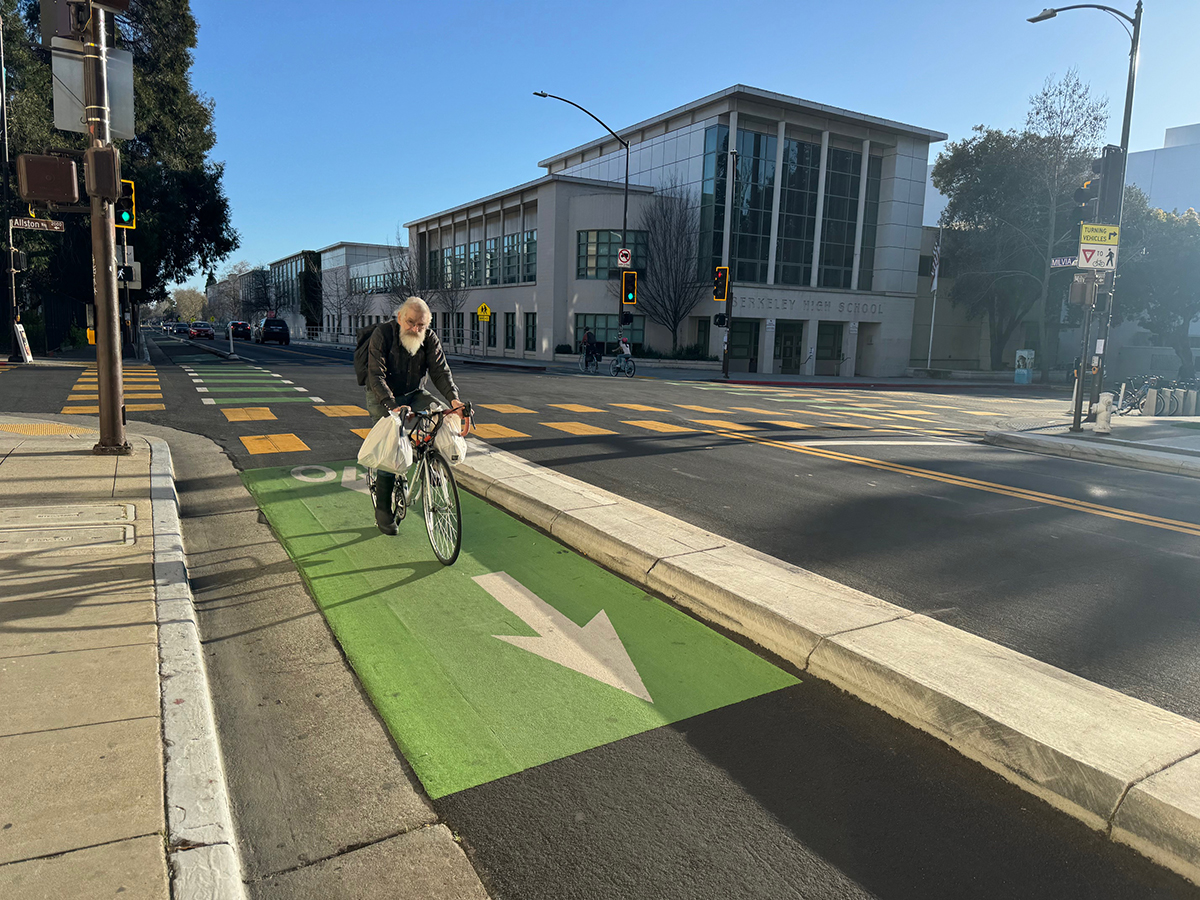
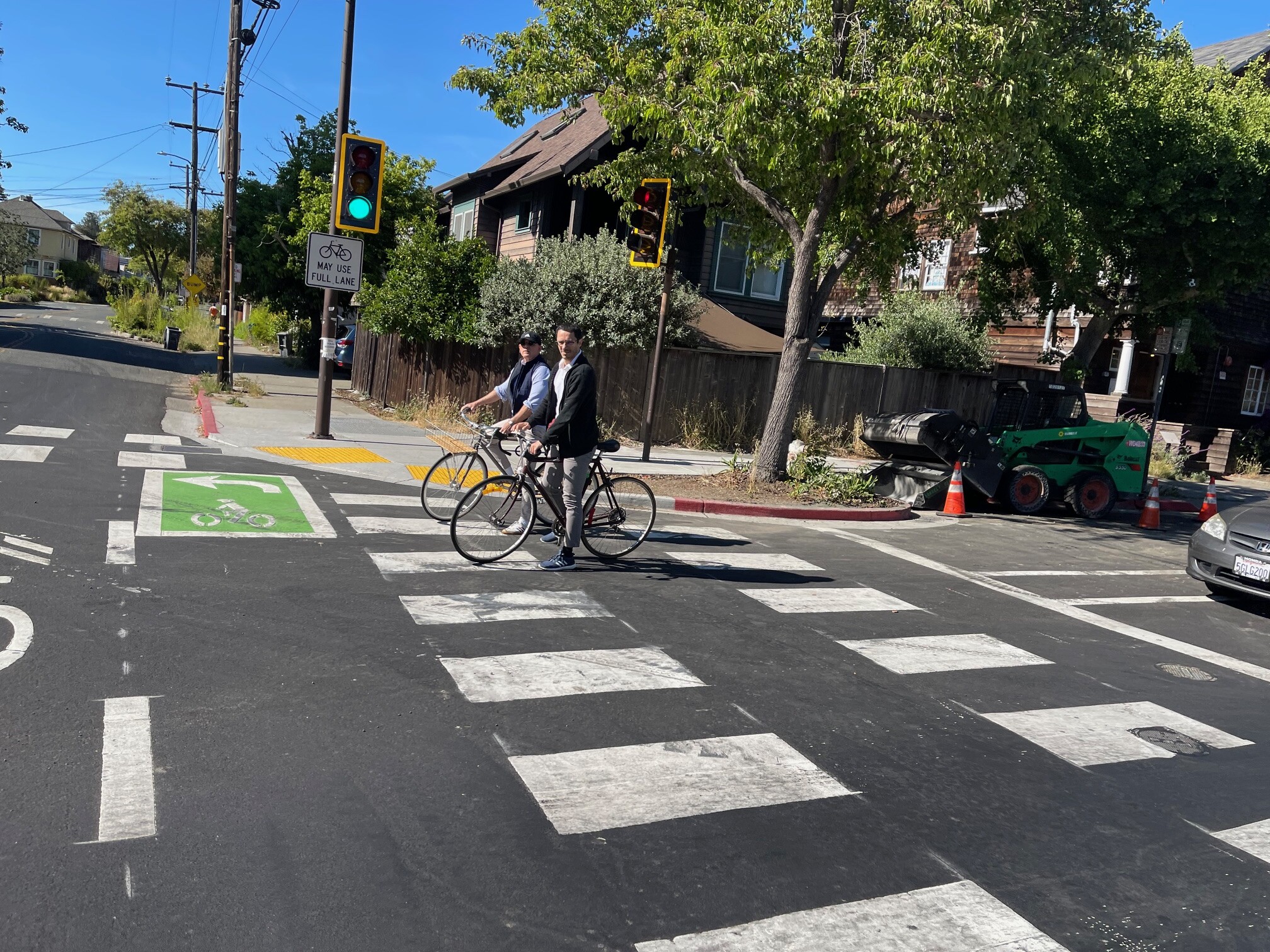
A rider on Milvia Street in Berkeley, California. Photo by Dave Iltis
By James Knight — Two new research studies have shown that active commuting modes of transportation such as cycling and walking have significant health benefits. According to the study “Impact of commuting on mental well-being: Using time-stamped subjective and objective data”, those who commute using active transportation modes such as cycling or walking report better moods, while those with longer commutes report increased stress levels. The article continues, “Longer commutes are associated with poorer moods but surprisingly, lower stress levels. Regarding commuting modes, taking the bus and bicycling were found to enhance moods relative to traveling by car. Conversely, walking and cycling appeared to elevate stress levels the most.”
A second recent study titled “Good for the planet… and for you too? Comparing five travel and health-related outcomes among active, motorized, and public transport commuters” compares the commutes of a nationwide sample of urban daily commuters from all 17 regions of Spain, between the ages of 18 and 70. The study authors conclude that “active” commuters had lower commuting stress and Body Mass Index values than those who used other forms of transportation. They also reported higher life satisfaction, increased cardiovascular fitness and improved muscular strength. This same study also highlights that the positive aspects of active transportation aren’t just limited to individual health benefits. Active modes of transportation have also been shown to benefit the environment and raise environmental consciousness.
Useche, Sergio A, et al. “Good for the Planet… and for You Too? Comparing Five Travel and Health-Related Outcomes among Active, Motorized, and Public Transport Commuters.” Journal of Transport & Health, Elsevier, 29 Aug. 2024, https://www.sciencedirect.com/science/article/pii/S2214140524001397
May 30, 2025 — On April 21, 2025 ARI Bikes, a Utah bike brand, was hit with a $1.7 million dollar theft of 337 bicycles that were enroute to Utah via cargo truck.
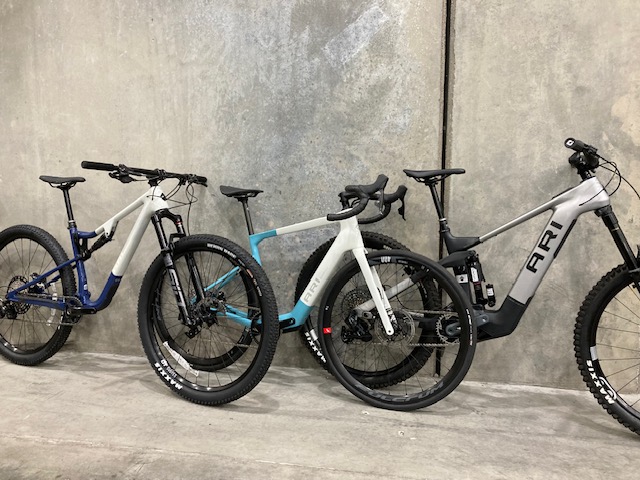
Photo from the ARI Bikes theft in April 2025. Photo Courtesy LAPD
Subsequently, the LASD Cargo Cats were able to recover 288 of the bicycles as Tyler Cloward from ARI Bikes recounts in this instagram post from May 14, 2025:
LASD Major Crimes Bureau (Cargo Cats) Arrest 5 In Connection with High-Value Retail & Cargo Thefts
May 29, 2025 — Detectives from the Los Angeles County Sheriff’s Department Major Crimes Bureau (MCB), assigned to the Cargo Criminal Apprehension Team (Cargo CATs), have been investigating a series of high-value retail and cargo thefts. One of these investigations involves the following individuals:
Samvel Karapetyan (DOB: 02/24/1987, Age 38)
Vazgen Avagyan (DOB: 06/04/1988, Age 36)
Narek Badalyan (DOB: 07/24/1992, Age 32)
Vladimir Gyulankaryan (DOB: 09/18/1992, Age 32)
Davit Grigoryan (DOB: 08/14/1984, Age 40)
These individuals are suspected of orchestrating theft operations by redirecting truck drivers and using box trucks and passenger vehicles to transport large quantities of stolen cargo.
A separate but potentially related investigation began on April 21, 2025, when an employee of ARI Bikes, located in Utah, contacted the LASD Compton Station to report the theft of 337 bicycles valued at approximately $1.7 million. Over the course of several weeks, the Cargo CATs team collaborated closely with ARI Bikes and members of the biking community. These partnerships generated critical leads that significantly advanced the investigation.
As a result, investigators identified multiple suspects and several warehouse locations suspected of housing stolen goods. Two multi-location search warrants were executed in connection with these separate investigations. The operations led to the recovery of 288 bicycles along with additional stolen merchandise. Several suspects were taken into custody, though their direct involvement in the ARI Bikes theft is still under investigation.
MCB Captain Calvin Mah stated “The Los Angeles County Sheriff’s Department, Majors Crime Bureau is dedicated to combatting retail and cargo theft. We are specifically trained to investigate all major theft groups as their criminal activities adversely affect the community. When these theft incidents occur, our detectives will work with all community members who are willing to provide information which can lead to an arrest. I am proud of our detectives’ efforts in bringing these suspects into custody. I am also encouraging all community members to notify us when they have information related to retail or cargo theft.”
The mission of the Cargo criminal apprehension team (Cargo CATS) is to reduce cargo theft crimes by apprehending and prosecuting both cargo thieves and their receivers and by returning stolen property to their rightful owners. The mission involves a close working relationship with representatives from the private sector as well as other law enforcement agencies.
In 2023, AB 413, Assemblymember Alex Lee’s Daylighting to Save Lives Bill, passed in Sacramento, making California the 43rd state to prohibit parking approaching intersections to increase visibility of pedestrians and bicyclists. CalBike and California Walks sponsored this critical safety measure, and we are calling on all municipalities to enforce it.
The law included a one-year grace period during which cities could issue warnings but not tickets to cars parked in the daylighting zone of 20 feet on the approach to a crosswalk. On January 1, 2025, cities could begin issuing tickets. Yet, few California communities have stepped up to enforce daylighting, and some of our largest cities are lagging in their implementation.
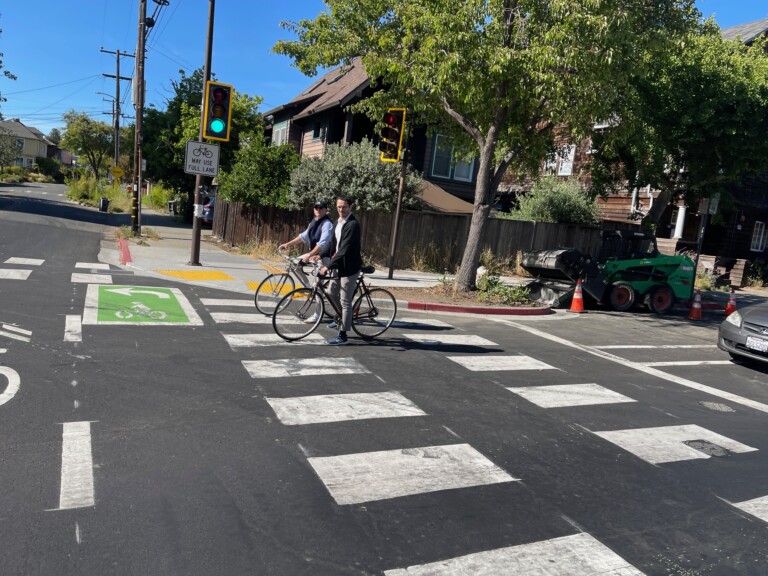
An example of an intersection in Berkeley, California that needs a little more daylighting. Photo by Dave Iltis
“Intersections are some of the most fatal parts of our roads where cars, bikes, and pedestrians cross paths,” Assemblymember Lee said. “Roughly a quarter of all traffic fatalities occur around intersections. By improving visibility, daylighting is a simple solution that’s been proven to save lives. Daylighting will help prevent roadway deaths, and we need cities statewide to fully embrace this safety measure. It’s critical that we catch up with the rest of the country and commit to solutions like daylighting to make our streets safer for everyone.”
Every year, around 4,000 people are killed on California roads, and many more are injured. Pedestrians are particularly vulnerable, and intersections are one of the most dangerous spots on the road. Older adults, who are more likely to die even in a low-speed collision, make up a disproportionate number of these fatalities. Children are also among the most vulnerable pedestrians, and the trend of taller front hoods on cars, trucks, and SUVs means that drivers of these vehicles need extra distance to see kids.
The improved sightlines provided by daylighting intersections allow time for drivers to see someone crossing the road on foot or by bike, slow down, and come to a stop to yield the right of way. Yet, we are hearing excuses and obfuscations from cities to water down or simply not enforce this law. In San Francisco, the SFMTA is painting 10-foot red zones instead of 20-foot red zones on some streets. The law allows cities to set shorter daylighting zones if they pass a local ordinance including justification for the difference, which San Francisco has not done. Other cities have refused to ticket drivers because there is no local ordinance prohibiting parking next to intersections, even though state law supersedes local regulations and the daylighting law is enforceable throughout California.
California communities would do better to follow the example of cities like Cupertino, CA, which has taken many of the appropriate steps to prepare its intersections for daylighting. Of course, other cities across the country, including Hoboken, NJ, have achieved zero traffic fatalities, mainly through the daylighting of intersections.
CalBike and California Walks urge municipal leaders and public works departments to:
Educate parking enforcement officers and empower them to write citations for parking within daylighting zones. No signage or curb paint is required to take this step.
Educate residents about the need to leave sightlines clear near crosswalks as an act of community care.
Install signage and red curb paint marking the 20-foot no-parking space wherever feasible.
Harden daylighting zones as much as possible by adding bike parking corrals, bike or scooter share docks, benches, planters boxes, bioswales, or other community amenities.
Use planned road maintenance projects as opportunities to demarcate and harden daylighting zones.
The 20-foot space required by state law (15 feet for intersections with curb extensions) is the equivalent of just a single parking space. We believe one parking space is worth the life of someone’s child or grandparent. Giving up this small amount of parking is something we can all do to benefit our communities and our neighbors.
Daylighting is an essential tool in reducing the growing toll of traffic violence on California streets. We urge our civic leaders to fully adopt this simple yet effective safety measure.
By James Knight — The popular and long cycling race known as LoToJa provides opportunities for cyclists to push their limits while also having some flexibility. If you can’t cycle the whole 200+ miles, there are still opportunities to be a part of it.
According to LoToJa’s official website, LoToJa was started in 1983 by two cyclists for Logan, Utah, David Bern, a Utah State University student, and Jeff Keller, the owner of Sunrise Cyclery. LoToJa’s first year only featured seven cyclists who raced 187 miles from Logan to a finish line at Jackson’s town square. In 1986, the distance was expanded to over 200 miles when the finish was moved to Teton Village. Over time, LoToJa has grown into one of the nation’s premier amateur cycling races and attracts both top level riders, and everyday recreational cyclists.
The founders passed LoToJa’s future into the hands of current race director Brent Chambers, who has overseen LoToJa since 1998. Chambers describes how LoToJa is both a ride and a race, which allows it to incorporate both competitive and non-competitive recreational riders.
“LoToJa is both a race and a ride. We sanction the event through USA Cycling, and it’s sanctioned as a licensed race. It’s also sanctioned as a non-competitive ride. So, about half the event are cyclists that are there to compete, and the other half are there to just get from Logan to Jackson. I mean, their goal is to basically compete with themselves,” Chambers said.
One of these non-competitive riders is Stephen Fredrick. He described his first experience racing LoToJa with his brother Johnny.
“I’m not necessarily riding competitively, but I like the challenge to ride from Logan to Jackson, and I thought it would be something that would push me and something really hard, but really rewarding if I was able to finish. So, me and Johnny both signed up, but we didn’t sign up to do the full thing. We said, hey, let’s sign up and ride it in groups. So, I rode about 100 miles. He did about 100 miles, and we both did together. The first year I didn’t ride the whole thing, and that’s partly because it takes a long time to be able to train for a race like that.”
At over 200 miles, LoToJa is the longest one-day USA Cycling-sanctioned bicycle race in the country. Cyclists must conquer three mountain passes through the scenic terrain in Utah, Idaho and Wyoming. With a final destination line below the Teton Mountains at the base of Jackson Hole Mountain Resort, which is also a popular ski destination. LoToJa offers 31 different start groups which feature full-distance, tandem, and relay team categories. All categories and classes leave Logan in timed intervals. To win or even place in a respective LoToJa category is a considered a great achievement. Some past winners have pursued careers in professional cycling.
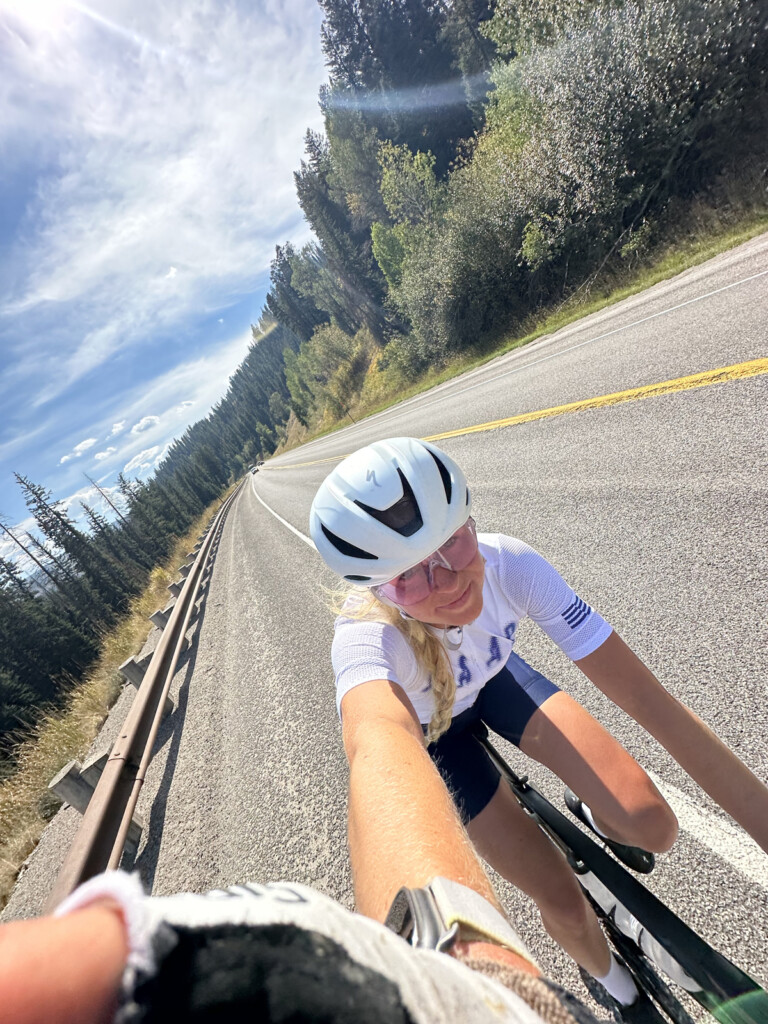
Micah Fredrick takes a selfie as she races in LoToJa. Photo by Micah Fredrick
One such winner is Stephen’s cousin Micah Fredrick, who won the women’s 25+ citizen category last year and is looking forward to racing in one of the more the more competitive yet slightly shorter USA Cycling sanctioned racing categories this year. She describes the training and effort it takes to race in the competitive categories and how it differs from other sports she’s played.
“Training has been a learning curve. I was going almost every day for a bike ride. I was upping my distances. And then once I decided that I really wanted to compete with LoToJa, I just started having mileage goals. So, I would set weekly and monthly goals that I needed to meet. And then, biking is different than anything else, because the nutrition is different to me. When I’m running, I don’t typically eat. I just run, I get it over with, and then I’ll eat after. But with cycling, you kind of have to eat throughout. So, I’ve had to learn how to do cycling nutrition,” Fredrick said.
Fredrick also emphasized the importance of having a team and a support system cheering you on. She describes how LoToJa has great staff and people always willing to help and provide encouragement throughout the race.
Micah Fredrick smiles as she crosses the finish line of LoToJa. Fredrick won the women’s 25+ ride category in 2024. Photo by Natalie Fredrick
“It has the best atmosphere. All of the staff and everyone helping you. They want you to succeed. So, when you get to a pit stop, you have all these people there that are just trying to help. They’re getting you water. They’re getting you whatever you need. One year, my dad’s cleat broke, and someone went in their car and got their biking shoe out and gave him the screws out of their cleat. The staff are so awesome, and then you ride with a bunch of different people. My first year and my and last year, I wasn’t really riding with a team. I ended up just riding with random people. And it was so fun, because you just talk to them, you can get to know new people. It’s my favorite race by far,” Fredrick said.
Race director Brent Chambers also gave some insight on how to prepare for such a long race. Emphasizing that proper preparation and knowing what your body needs is key for success.
“Obviously, there’s lots of training. It’s not something you can just do off the couch. The racers that compete in LoToJa, their preparation will include not only their training but also include lots of races that they compete in during the months leading up to LoToJa, lots of miles and lots of climbing. They need to understand and be prepared to know what their body is going to need as they ride a double century. That’s a long way to ride a bike, and they might be good for 100 miles, but the last 100 miles might be a different story. They need to know what their body needs when they ride long distance like that, how to keep that fuel tank as full as possible throughout the day. Because as they leave Logan and they finish in Jackson, as they’re going that distance, the gas tanks emptying the entire way, and they just need to try to keep it full as much as possible with the energy that their body needs,” Chambers said.
For more information on LoToJa, visit their official website https://LoToJa.com/
September 6 — LOTOJA Classic Road Race, Utah Triple Crank, Logan, UT, 43rd Annual, 1 day, 3 states, 200-plus mile road race from Logan, UT to Jackson Hole, WY, Brent Chambers, 801-546-0090, [email protected], LoToJa.com
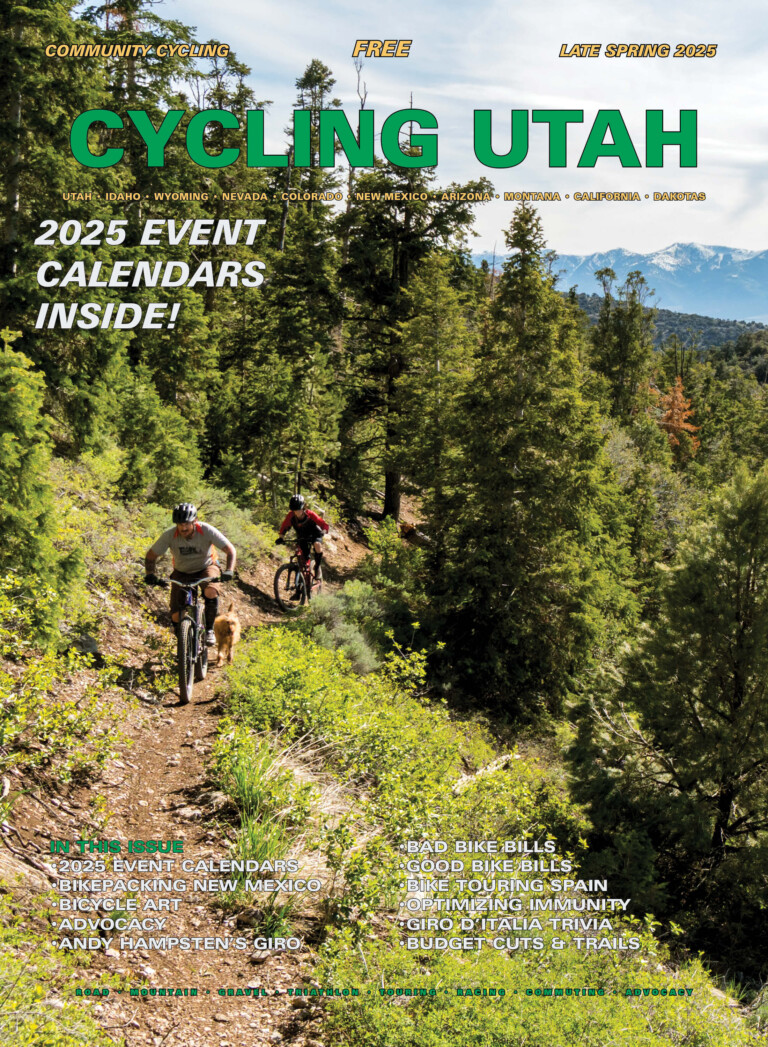
Cycling West and Cycling Utah Magazine’s Late Spring 2025 Issue is now available as a free download (10 MB download). Pick up a copy at your favorite Utah, Idaho, Wyoming, Nevada, Montana, Colorado, Arizona, New Mexico, North Dakota, South Dakota, and Northern California bike shop or other location. Or join to get a copy of our next issue delivered to your actual mailbox!
Cycling West Late Spring 2025 Cover Photo: Kyle Horvath, Ryan Warner (Kyle’s son), and Jasper (RIP), nearing the summit of High Roller Trail in Cave Lake State Park outside Ely, Nevada. Photo by John Shafer, photo-john.net
Contents
The Athlete’s Kitchen: Optimizing Your Immune Response — page 2
Bikepacking New Mexico’s Caja del Rio — page 3
Andy Hampsten and the 1988 Giro d’Italia: America’s only win in Italy’s Grand Tour — page 6
Congress Approves Mountain View Corridor Completion Act — page 8
Colorado Senators Reintroduce CORE Act — page 8
New Utah Bills Prohibit Drivers From Blocking Bike Lanes; Allow E-Bike Powered Food Carts — page 8
Idaho Passes Bills Hampering Bike Lane Construction — page 8
What is the Current State of the Bike Industry? — page 9
New Mexico To Allow ‘Idaho Stop’ So Cyclists Can Roll Through Stop Signs — page 10
When Bikes Fail: Studies Examine the Physics of Pitch-Overs and the Hidden Risks of Structural Defects — page 10
Trail Access in Jeopardy as Trump Cuts Hit Federal Land Agencies — page 11
A Bike Tour in Spain – Mountains, the Alhambra, and Panaderias — page 12
A Power-Boosting Ride, If You Can Do the Math: Inside the Science of Bicycle Biomechanics — page 14
May is Bike Month Across the West! — page 15
New Utah Law Will Hinder Bike Lanes and Street Safety in Salt Lake City — page 15
Giro d’Italia Trivia Questions — page 15
De Ronde – The Bicycle Art of TJ Eisenhart (Right –>) — page 22
By Betsy Gordon — I have been a casual rider for some 50 years. I bought my first bike as an adult from a friend when I was a student at the University of Utah (U of U), living in an apartment near 200 South and 800 East in Salt Lake City. The bike was an old 10-speed of the type that I had in high school. I bought the book – “Anybody’s Bike Book: A Comprehensive Manual of Bike Repairs” by Tom Cuthbertson – and tuned the bike myself. It was a challenge. After the bike was ready, I walked it to the gas station a block away from my apartment, put air in the tires, and coasted back to my apartment. I lifted my bike to carry it up the steps to my apartment, only to have the front wheel fall off. There was obviously still a learning curve ahead of me. After I handled that, I began to ride my bike up the steep hill to the U of U, to classes, work, and just explore the area. I had no car and relied on walking and public transportation to get around. My bicycle provided freedom and independence. My supervisor at work was an avid bicyclist and rode his bike to work, even in winter. He was an inspiration to me to bike and keep biking, as he was decades older than me.
I eventually graduated from the University and would occasionally ride my bike to work (across town). I also rode in nearby areas just for enjoyment. I never rode fast or up the canyons, and I still don’t. Life continued, and eventually, marriage and children came along. We tried mountain bikes, but they were too heavy for me, especially the models that were available 40 years ago. I did get a child seat for the back of my bike so that I could bike around with the baby. I found that the weight of the child could throw me off balance, and it was too much for me. After that, I rode sans baby, and not so much. After the children got older, I found time to ride more. I explored further and further afield. I found that the farther I rode, the farther I wanted to ride. I got a job with a long and friendly bike route and would ride to work occasionally. That was difficult for me when the children were still in school because I always felt the need to hurry. When our youngest son graduated from high school, however, I suddenly felt free… I did not need to hurry. I still did not ride to work frequently because, for me, biking is a fair-weather sport. Additionally, the bicycle commute added almost two hours to my day. I would take Saturday or Sunday mornings for longer rides to the zoo, along Legacy Parkway, and other places, going farther and farther, mostly alone as my husband, Oakley, still wasn’t riding.
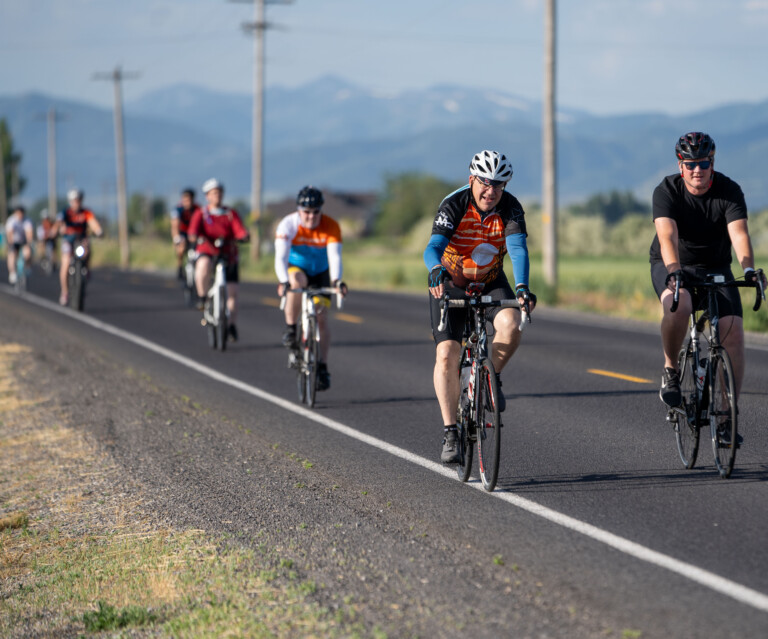
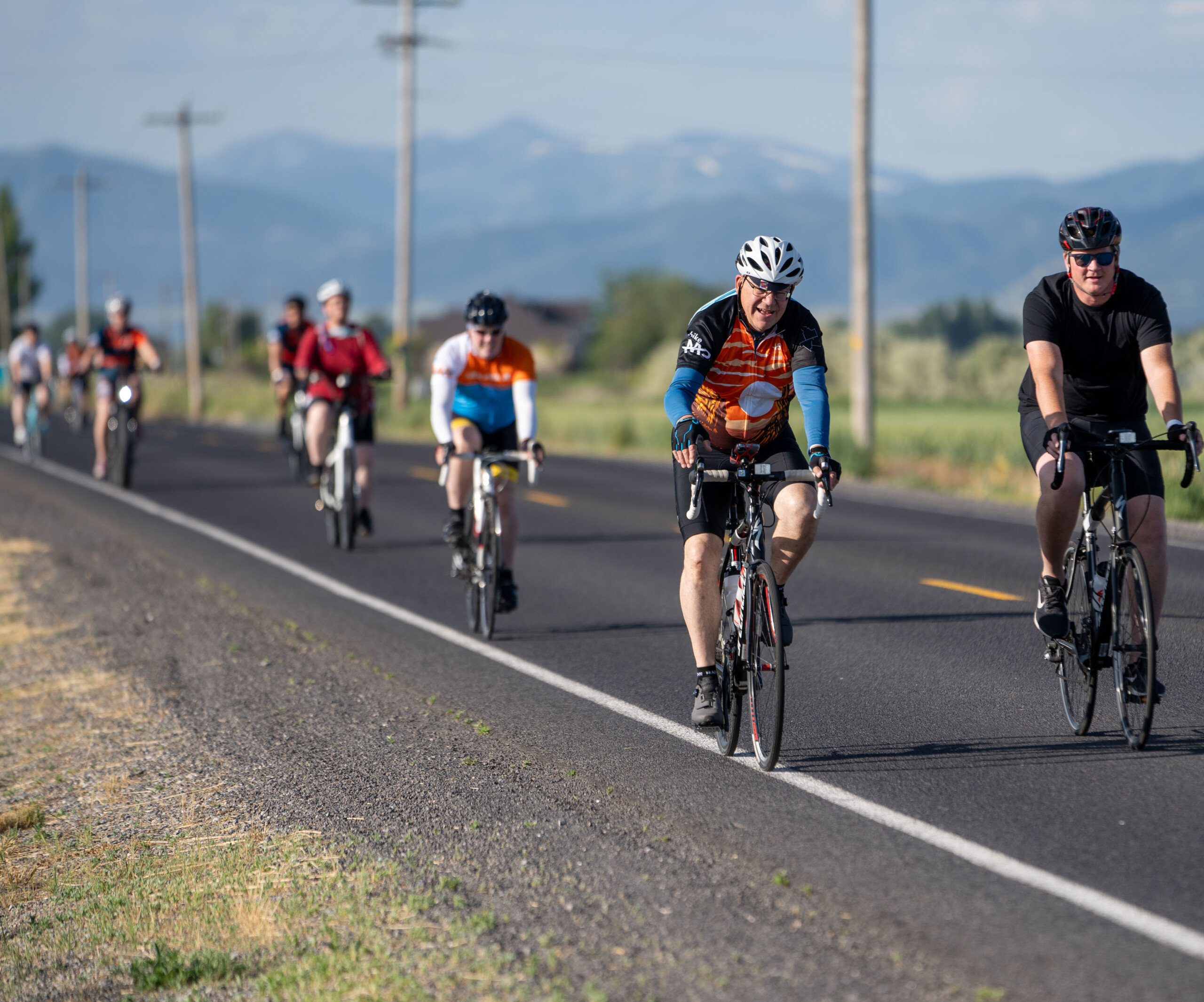
Scenes from the Bike MS: Harmons Best Dam Bike Ride in Logan, Utah. Photo courtesy Utah MS Society
In 2007, our niece, Heidi, was diagnosed with Multiple Sclerosis at the age of 35 and with two young children. She had been working at Alta, a ski resort in Utah, on a ski break and one of her legs didn’t respond as normal. She mentioned to her co-worker that her leg just didn’t seem to be working. The co-worker had some medical training and urged her to go to the doctor immediately. Please check this information from the National Multiple Sclerosis Society if you would like to know about symptoms and the disease: https://www.nationalmssociety.org/understanding-ms/what-is-ms. The prospect of Heidi having this disease was alarming.
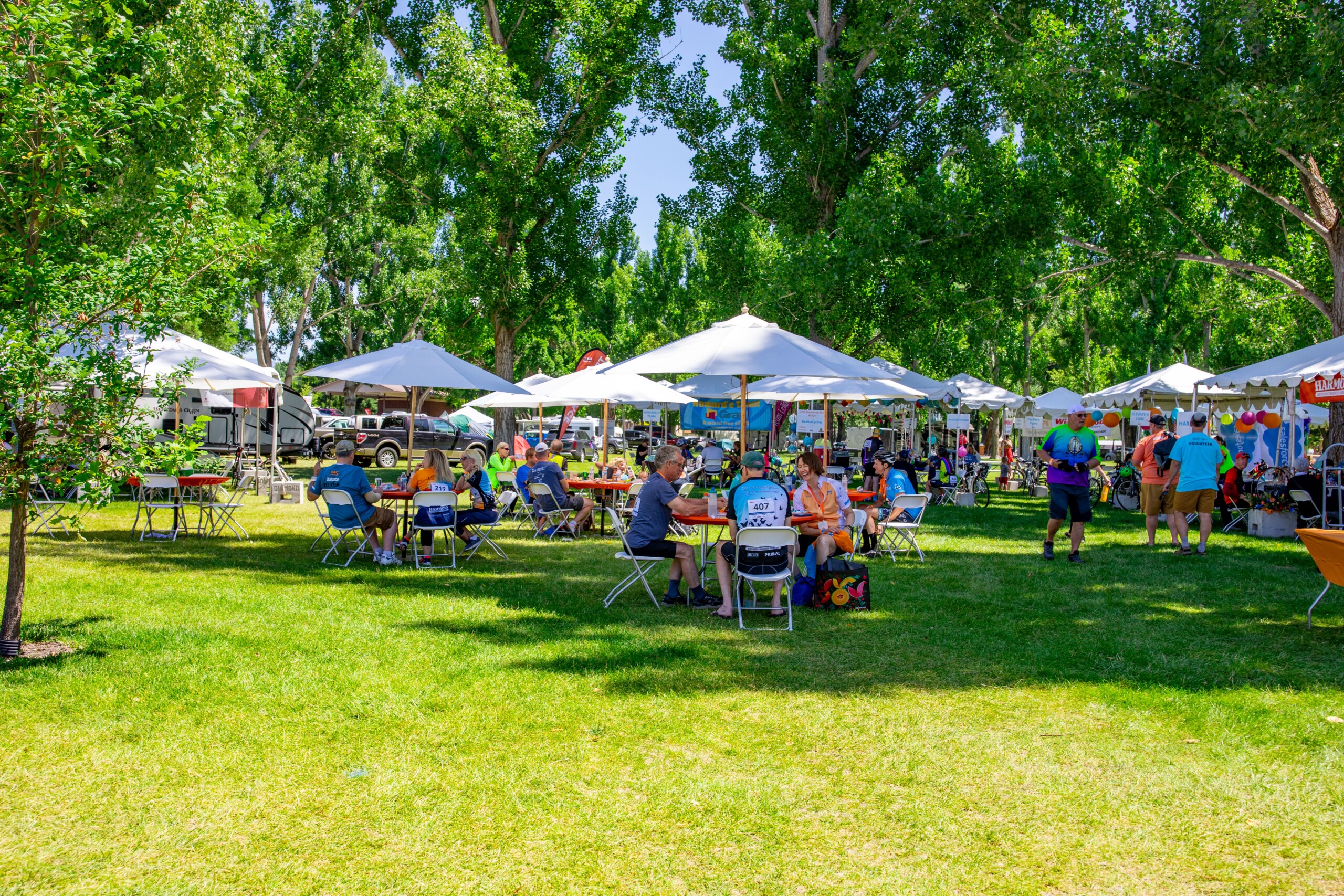
Scenes from the Bike MS: Harmons Best Dam Bike Ride in Logan, Utah. Photo courtesy Utah MS Society
That spring, I participated in the Walk MS in Salt Lake City in an effort to do something to support my niece. I was surprised by the energy of all the supporters. People were dressed in costumes, including one dressed as Darth Vader. In subsequent years, more family and friends participated. I was impressed by the crowd of people, as I assumed that they all had connections who were affected by MS. I had known a few people over the years who had MS but discovered how many people that I knew peripherally had friends and relatives with the disease.
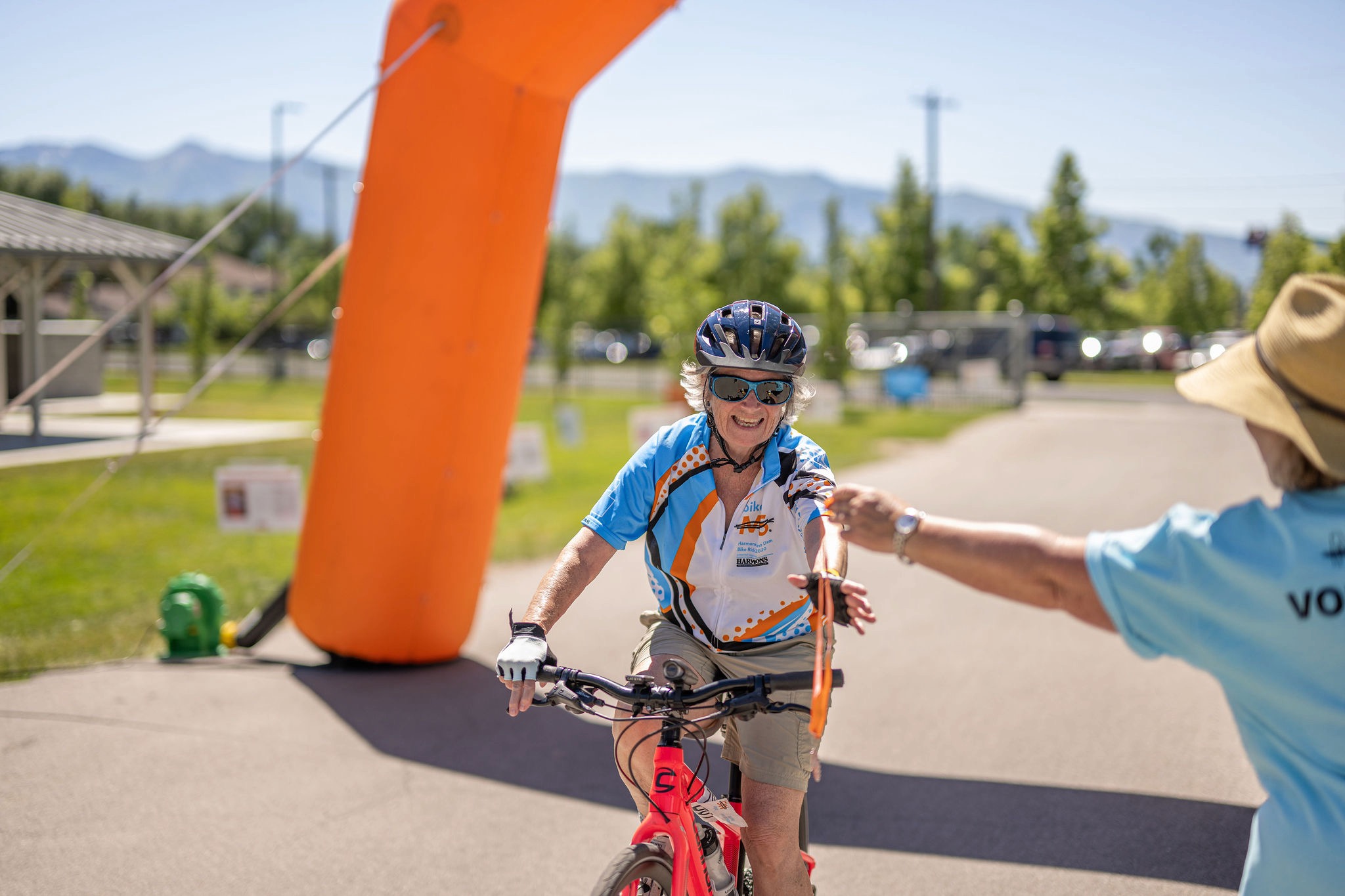
Elizabeth Gordon at the finish of the Bike MS: Harmons Best Dam Bike Ride in Logan, Utah. Photo courtesy Utah MS Society
In 2010, I decided to participate in Bike MS: Harmons Best Dam Bike Ride in Logan, UT. This is a fund-raising event, the goal is to raise over $900,000. There is a registration fee of up to $70, it is less if you register early. If you register, then you are expected to raise $250 minimum for the cause. There are two days of biking, Saturday and Sunday, and different length rides to pick from each day. This is a 2-day weekend event, though you can ride just one day or both. It’s a ride, not a race. The route options are inclusive for all ability levels, with recumbents, hand-cycles, and e-bikes welcomed. Bike MS is a fully supported ride, with rest stops every 8 to 12 miles, SAG vehicles to help out on the route, and the most encouraging community of participants, volunteers, and supporters.
Elizabeth Gordon crossing the finish line in the Bike MS: Harmons Best Dam Bike Ride in Logan, Utah. Photo by Eric Larson, courtesy Utah MS Society
The rides start and end at the Cache Valley fairgrounds, where the meals are held, and participants can camp for free. There is room for camping, camping trailers, and RVs, and some people prefer to stay in motels or commute if they don’t live too far away. I like to camp, so that option suits me perfectly. My favorite camping spot is on the grass near a stream that flows through the fairgrounds.
I like to leave Salt Lake on Friday and drive to Logan in time to get there around lunchtime. Upon arrival, I set up my tent, eat the lunch I brought with me, relax next to the stream, and explore the preparations for the ride. I like to park and then try to avoid driving at all until I leave on Sunday. Lunch and dinner are not served on Friday, so I bring my own. When I was working (i.e., before I retired) this was great downtime for me, spending an afternoon just relaxing by the stream, reading, and watching the children tubing by. I love that I have nothing that I have to do all weekend except to ride my bike.
Saturday is the big day for the bike ride. Because I camp at the fairgrounds, all I have to do after getting up is stumble the 50 yards or so to the breakfast area for food and coffee, pick up my bike from the bike corral, meander back to my camp, and get ready to ride. There is a big crowd of bikers at the starting line, mostly teams, who have the privilege of going first (I think because of their fundraising). You don’t have to be part of a team, however, and most years, it was just me. They start us off in waves, as there would be too many if everyone left at once. There is an announcer announcing the names of the teams, who is generally charming and encouraging.
On the first day, Saturday, there are three distances to pick from: about 40 miles, about 70 miles, and 100 miles. I often ride the shorter route and find that when I return, the 100-mile riders have been back for quite a while. Upon leaving the fairgrounds in the morning, the intersections are staffed by police officers who give you the right of way. Eventually, you reach roads that take you out of town. These are regular highways with traffic, but after a few miles, the roads are not so busy, and it is pretty mellow until you finally return to Logan. However, safety first. I cringe when I see people who are being careless on busy roads. I usually take long breaks in the rest areas. They can be fun, the other bikers are pretty happy and tired, snacks and sports drinks are crucial. One year I did not take advantage of the energy/granola bars at the stop and found myself without any food in the middle of nowhere. That was a big mistake. Now I always check my food supply before leaving any rest area. On my first ride, and not far from the beginning, the chain popped off of my bicycle! Before I had a chance to do anything a ride marshal (volunteer biker) stopped, put the chain back on and told me what to tell the repair people, who are always at rest stops, to fix. I was hooked on Bike MS at that point. As I stopped to admire views, people would stop and ask if I needed help. Encouraging words are frequently heard. I love the people. One year I neglected to ensure that my cell phone was fully charged. I worried about that the entire time – don’t make that mistake.
After the ride, I drop my bike off at the bike corral and spend the rest of the day resting and recovering. There are showers in the campground, but there is also a water park across the street with nice showers and a pool. I spend the balance of the afternoon walking about, sitting by the stream, and feeling very happy. Eventually, dinner is served, and there is music and a program. For the last few years, alcohol has also been available in a beer garden.
There is also a bike ride on Sunday, but I have only done it a handful of times, mostly because I am exhausted from the Saturday ride. There is a choice between a long ride that goes up scenic Blacksmith Fork Canyon and a shorter 25-mile ride. Breakfast is served at the campground, and lunch is served on the ride or at the campground, depending upon whether you take the shorter or longer ride. Then it’s back to camp, pack up, and have a leisurely drive home.
For the first few years, I just did the shorter Saturday ride but I was always wondering if I could do 75 miles. One year, I finally decided to go for it. This was the only year that I have ridden where the weather was not perfect. I call it “The Year of the Wind.” And my bike at the time was a pretty heavy one. I got very far in the ride and made it into Idaho. Heading back into Utah, I was riding into the wind, and it was much harder. Still, I persevered. I returned to the main road into Logan and stopped in front of the cheese factory there. I had to sit on the curb and consider whether I could possibly go the last three miles. I just didn’t know if I could go any further. As I sat pondering, I saw a SAG wagon going in the opposite direction. The driver saw me and turned around to see how I was doing. He encouraged me to let him give me a ride for the last bit and I saw the wisdom in that. The SAG wagons are very nice because they let the riders off a block or two before the finish so that we can have the satisfaction of riding across the finish line. I bought myself a lighter-weight bike after that ride.
I tried the 75-mile ride another year, but that time, I took a wrong turn which added several more miles to my ride. Fortunately, I saw a few other riders who pointed me in the right direction. I went to the closest rest area and caught a SAG wagon from there. I knew that 75 miles was about as far as I could go and didn’t think that I could manage that, plus the extra miles from getting lost.
Finally, in 2022, I reached my goal of completing the 75-mile ride. I did it! As only a casual rider, and at the age of 69, it can be done! I can’t say that I want to do it again, but on the other hand, I must confess that I am considering it.
A lot has changed over the years. I have retired, and so has my husband. He had stopped biking for many years. Then, on a trip we took to Europe in 2016, he got so ill that he was hospitalized in Montepulciano, Italy, for three days. We had to abort the trip. Upon returning, the first thing he did was buy a new bike and take up biking again. We have been riding together since then, which has been much more fun. He rode the MS ride with me for the first time in 2023. Overall, we have been having a great time riding and plan to continue as long as we can pedal.
In closing, I have always enjoyed biking, and the MS Bike Ride has given me focus. Participating in the ride has helped raise money for this great cause. I encourage all bikers (casual or serious) to support finding a cure for MS while having a good time on this ride.
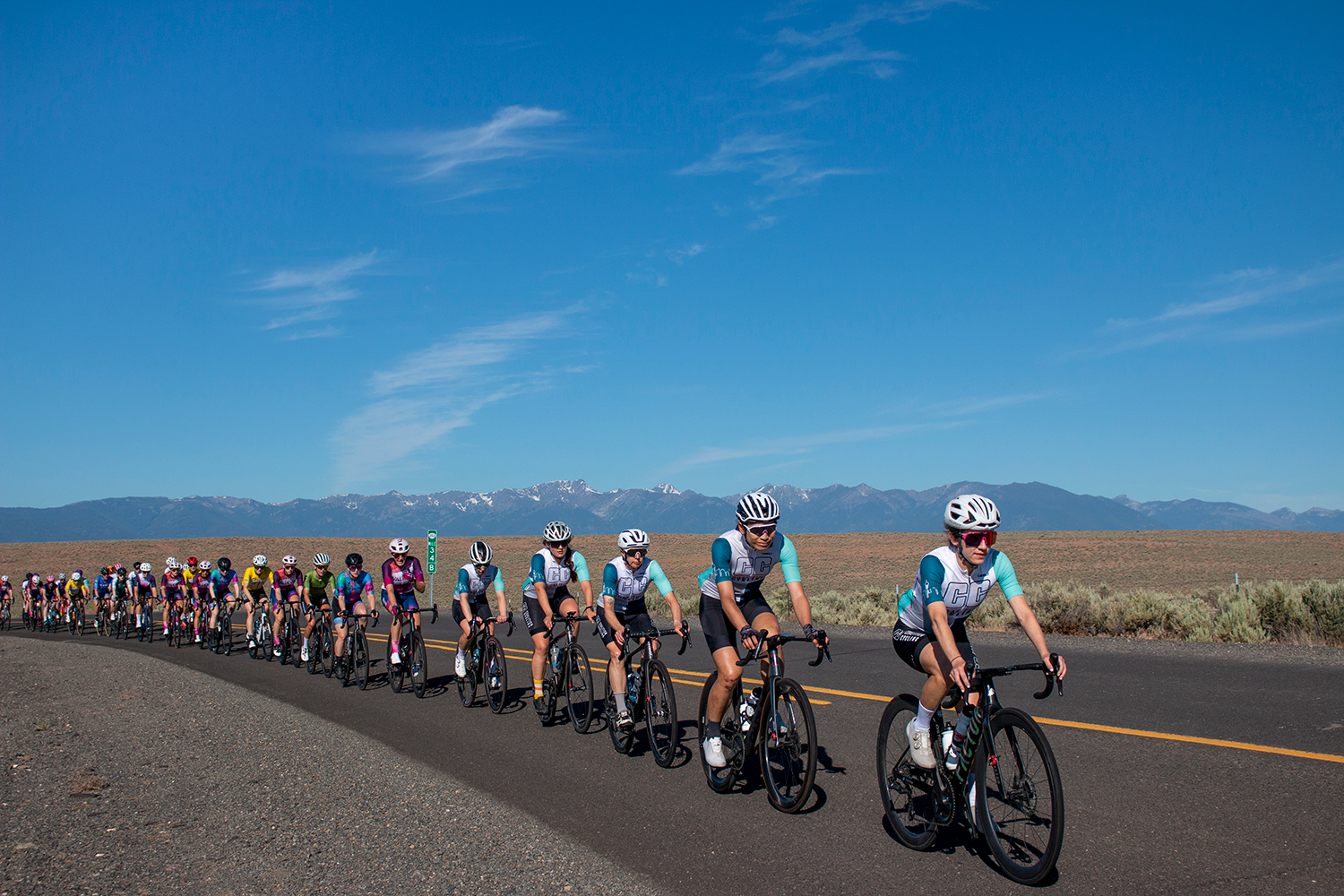
BAKER CITY, Oregon — The Baker City Cycling Classic returns for its 24th year on June 20 – 22, 2025. With four challenging stages in some of Oregon’s most iconic landscapes, the Baker City Cycling Classic offers riders the chance to showcase their skill in epic terrain against top-level competitors. This year’s race carries on the proud tradition of stage racing in the Northwest for hundreds of regional and international cyclists, with 2025 registration numbers already outpacing 2024’s robust participation.
Photo by Brandi McPherson, courtesy of Baker City Cycling Classic
Stage One, the Catherine Creek Road Race, is a scenic 78-mile course through the rolling hills of Baker valley. Set against the backdrop of the Elkhorn Mountain range, Catherine Creek is a beloved fixture of the Baker City Cycling Classic. This year’s race features a modified start on Pocahontas Road.
“I started the Baker City Cycling Classic because I wanted to share this incredible part of the country with other cyclists,” Nathan Hobson, founder and current board member, shares. “It’s iconic riding, great competition, and the community has really come to support the race.”
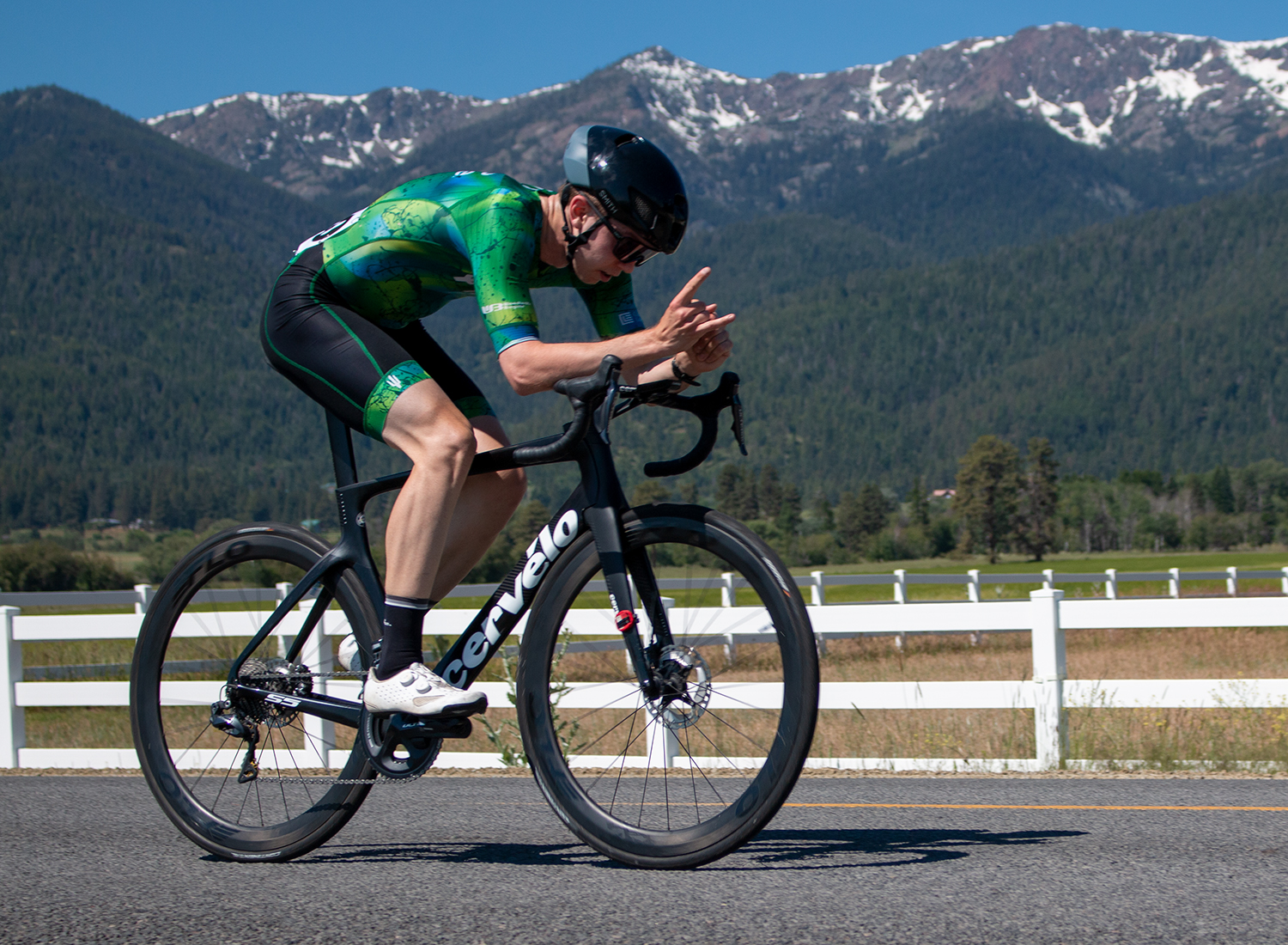
Photo by Brandi McPherson, courtesy of Baker City Cycling Classic
In contrast, the Stage Two Time Trial challenges cyclists with one noticeable climb over its 12-mile course that finishes with a slight downhill. Though in past years the race has limited riders to Merckx-style competition on standard road bikes, this year Stage Two grants riders the freedom to go full aero with no restrictions on their set-ups.
Photo by Brandi McPherson, courtesy of Baker City Cycling Classic
Equal parts community event and fierce competition, the Stage Three Baker City Downtown Criterium is a legendary criterium course in Baker City’s historic downtown. With one of the widest finishing straights in the entire Northwest, spectators and riders alike are thrilled by the exhilarating pace of the 0.6-mile course around 6 corners.
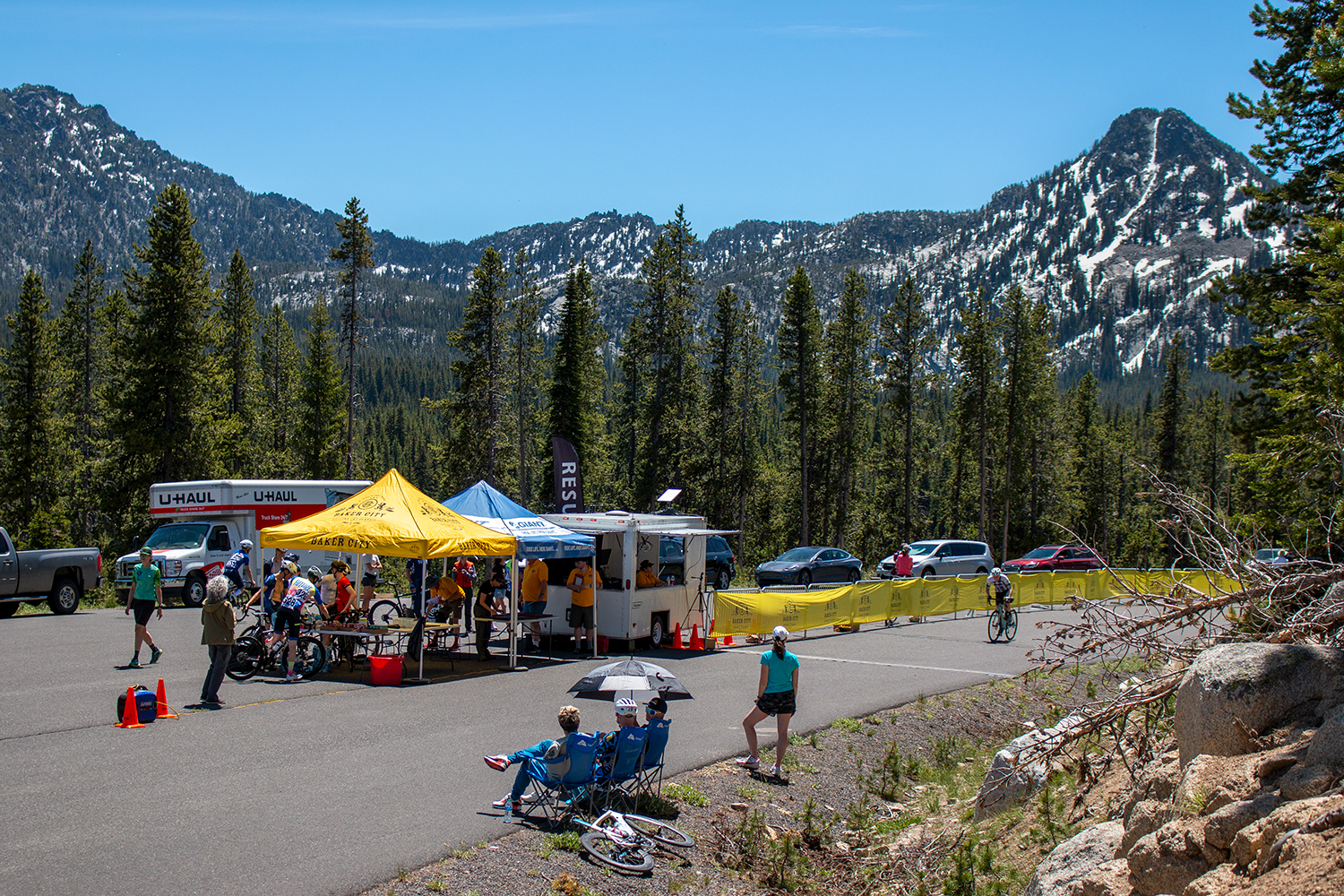
Photo by Brandi McPherson, courtesy of Baker City Cycling Classic
Stage Four challenges riders with punishing climbs through the Elkhorn Mountains. With a spectacular finish at Anthony Lakes Ski Resort, riders are welcomed by a raucous finish line celebration including vendors like Barley Brown’s Brewing. It’s the perfect way to end an epic series of stages.
As the longest-running stage race in the Northwest and the sole stage race in Oregon, the Baker City Cycling Classic will remind riders of the stage races that once defined Oregon road racing, like the Cascade Cycling Classic, Columbia Plateau, and Mt. Hood Cycling Classic. Today, the Baker City community has embraced the event, transforming the city into a welcoming place for cyclists full of eager supporters
June 20-22 — Baker City Cycling Classic, Baker City, OR, Three days and four stages in beautiful eastern Oregon, with great support and unparalleled scenery. Over 8,000 ft of climbing over the three days in one of the country’s most beautiful cycling regions. Pros and amateurs race the same courses and the women’s and men’s prize purses are matched by sponsor BELLA Main St. Market, Ace Bollinger, 509-679-5003, [email protected], Brian Cimmiyotti, 541-371-3303, 509-374-8424, [email protected], bakercitycyclingclassic.com
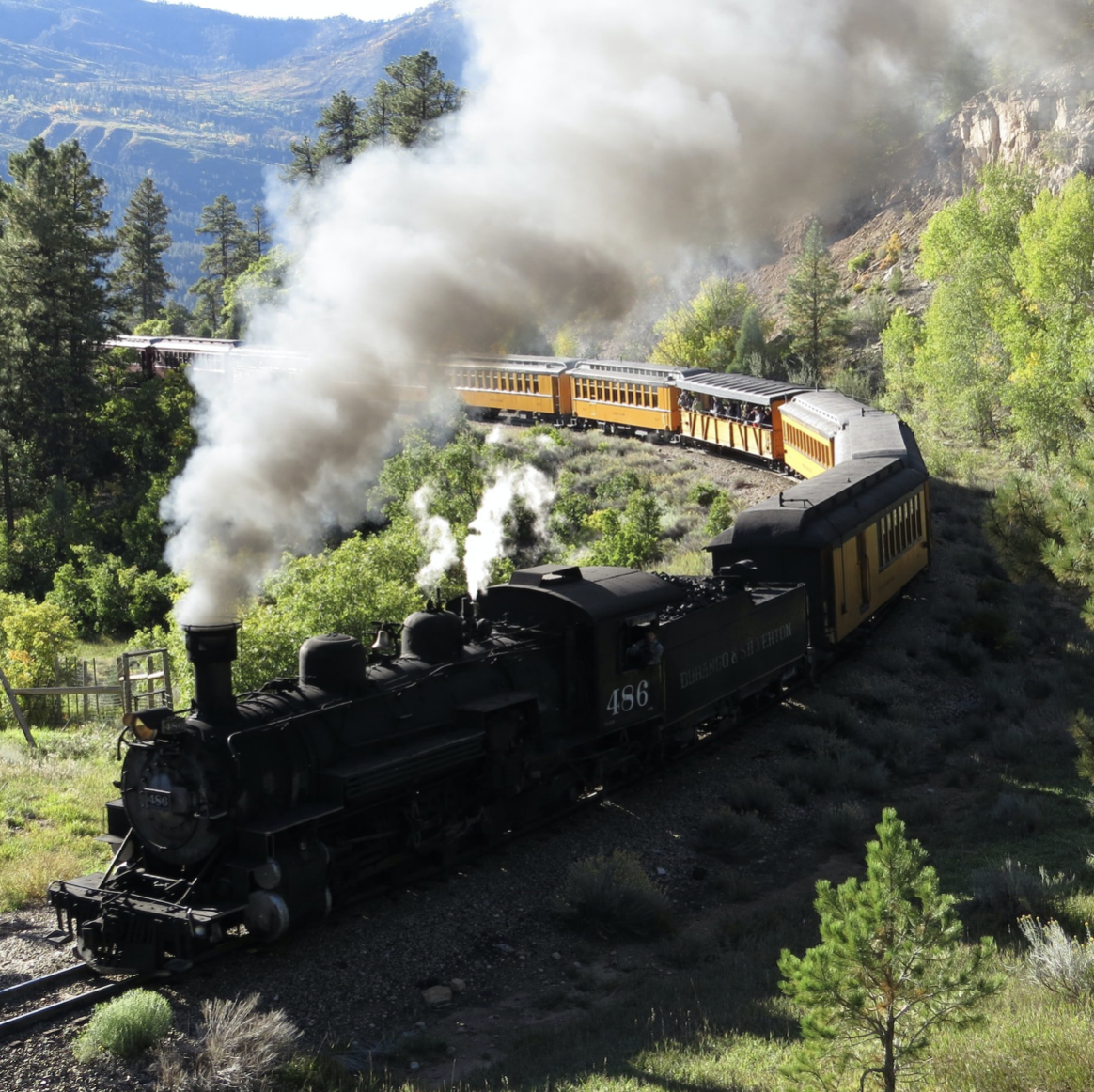
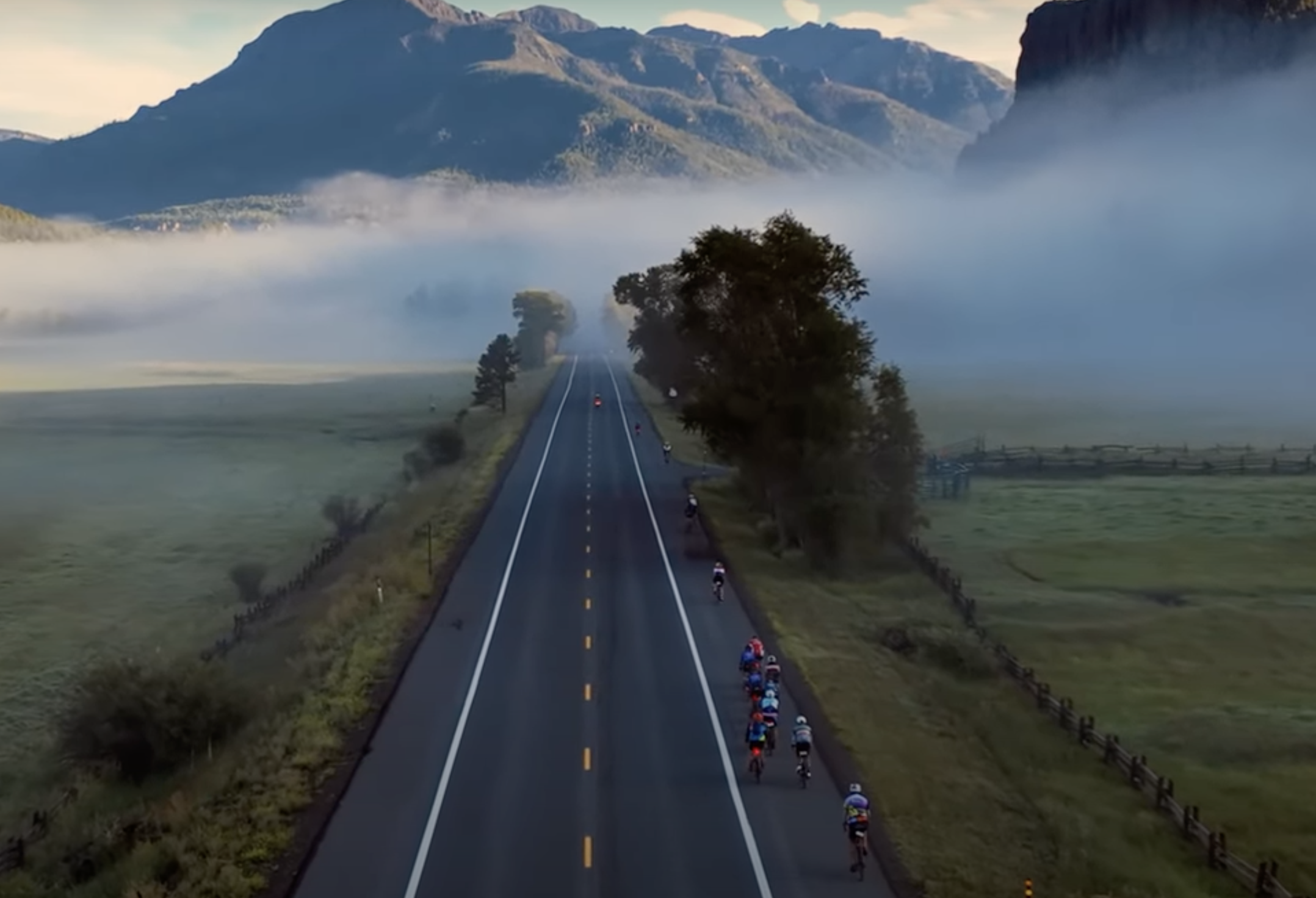
DURANGO & PAGOSA SPRINGS, Colorado — Cyclists from across the nation will gather this August for Colorado’s Ride, a five-day, 350-mile road bike tour showcasing the spectacular scenery and challenging climbs of Southwest Colorado. Taking place August 18–22, 2025, this immersive cycling experience blends iconic mountain passes, a historic train ride, rejuvenating hot springs, and a powerful commitment to local communities.
Photo courtesy of Colorado’s Ride
Starting in Durango with three nights to enjoy the culture of this train town and fine dining and then transferring to the relaxing haven of Pagosa Springs, riders will enjoy two days of access to its world-renowned hot springs.
Photo courtesy of Colorado’s Ride
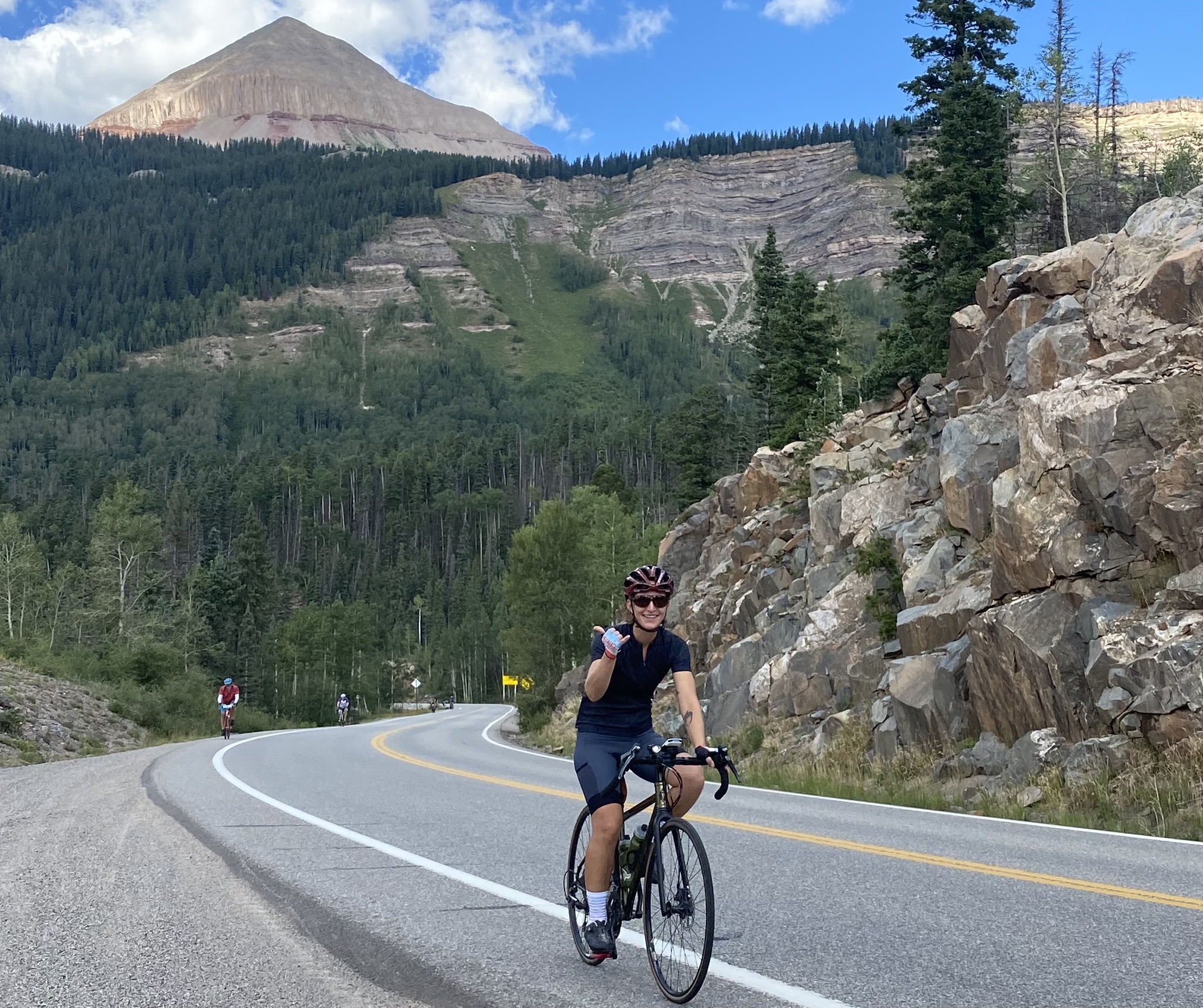
Riders will embark on a breathtaking tour that includes climbs over Coal Bank, Molas, and Wolf Creek Passes, accumulating over 26,000 feet of climbing.
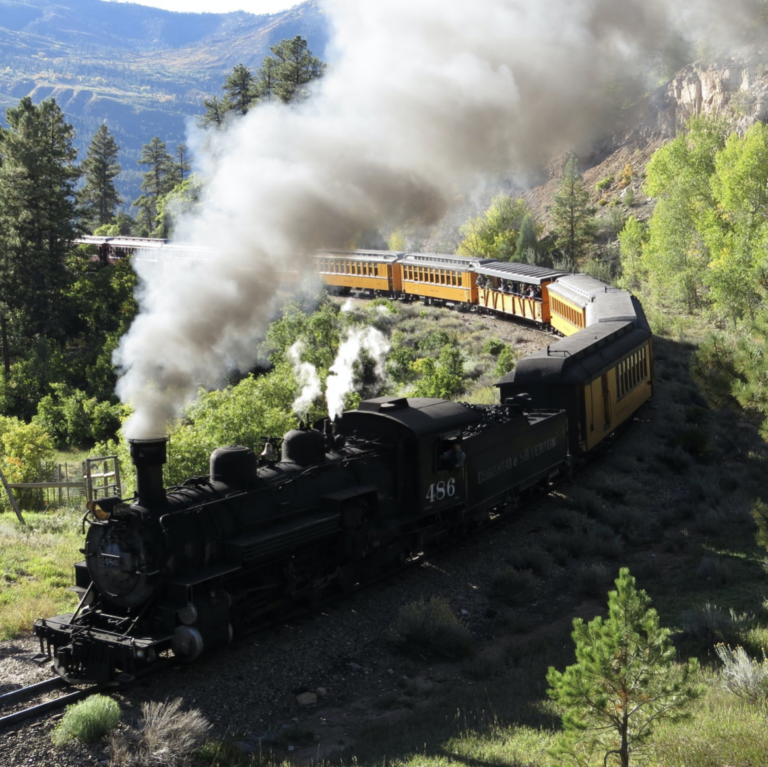
A highlight of the event is the opportunity to ride the historic Durango & Silverton Narrow Gauge Railroad—a steam-powered journey through some of Colorado’s most scenic terrain. Riders will board the train in Silverton and travel to Durango, making for a one-of-a-kind cycling adventure.
Photo courtesy of Colorado’s Ride
“Colorado’s Ride is more than just a tour—it’s about building community,” says Ride Director Bill Plock. “Our mission is to create an unforgettable experience for cyclists while giving back to the towns and people who make this route so special.”
The ride supports several local nonprofits, including the Pagosa Springs High School Mountain Bike Team, the ELHI Community Center in Ignacio, and various cycling teams that raise funds during the tour. Colorado’s Ride is committed to strengthening communities through both recreation and philanthropy.
Riders will enjoy:
Fully supported aid stations stocked with nutrition and hydration
Colorado State Police escort and road safety support
Medical support provided by CommonSpirit Health
Flexible lodging options including camping, RV sites, and hotels
Whether you’re a seasoned cyclist looking for a new challenge or a rider inspired by purpose-driven adventure, Colorado’s Ride offers an unforgettable journey through the heart of Colorado’s majestic San Juan Mountains.
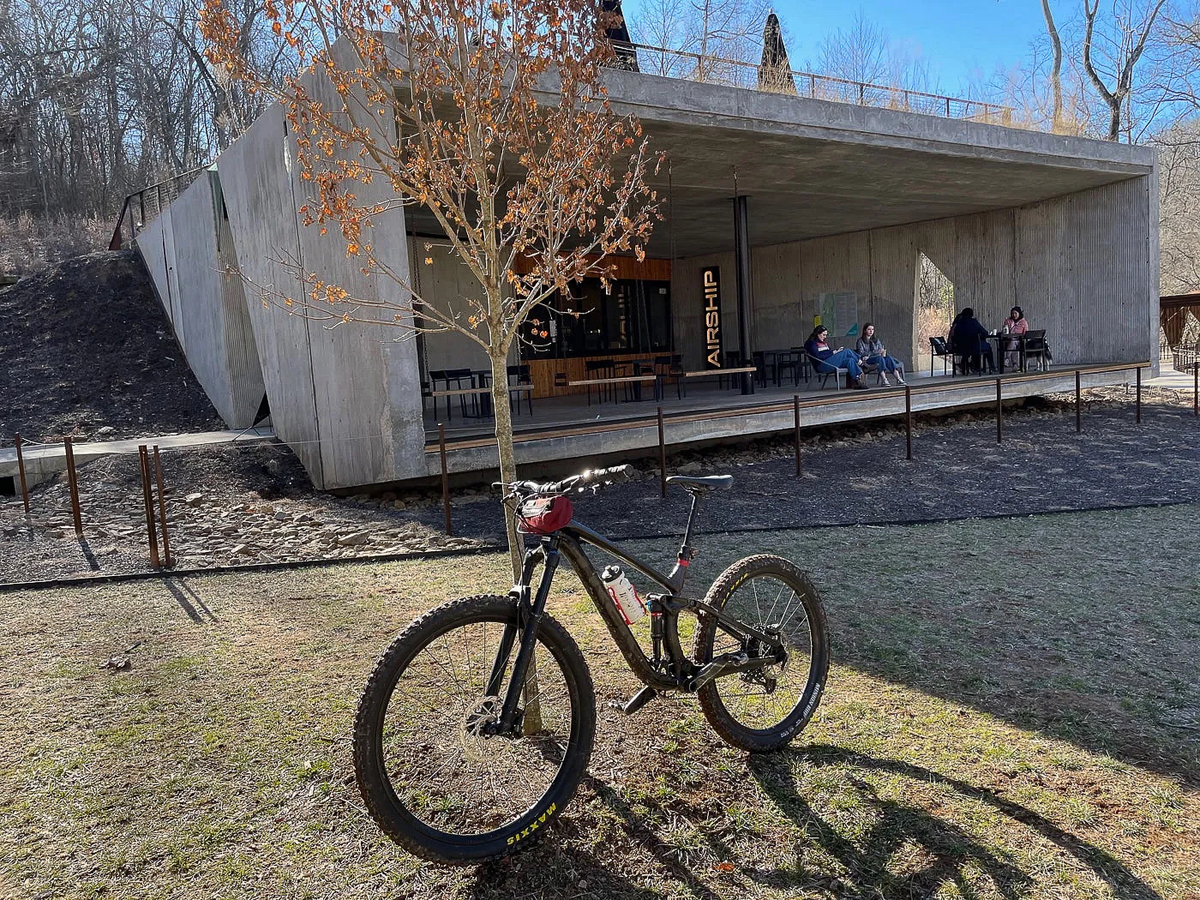
By Peter Abraham — The last thing I remember on October 18th, 2023, was taking off on a group mountain bike ride in the Coler MTB Preserve in Bentonville, Arkansas. I was going out with the USA Cycling national MTB team. A large group of us showed up, and the route was not especially technical. We climbed onto our bikes and took off.
The Coler MTB Preserve, near to where my crash occurred. Photo courtesy Peter Abraham
“Peter — do you have any memory from yesterday’s accident?” Wait…what? No, I had no memory of the previous 24 hours. That period of time had been permanently erased from my brain. My friends explained that I had been in a mountain bike crash, knocked unconscious (snoring even) for 5 minutes and taken by ambulance to the hospital. In my entire life, which has been filled with dangerous activities like skiing, climbing, and surfing, I’d been lucky enough to never suffer a concussion. Until now.
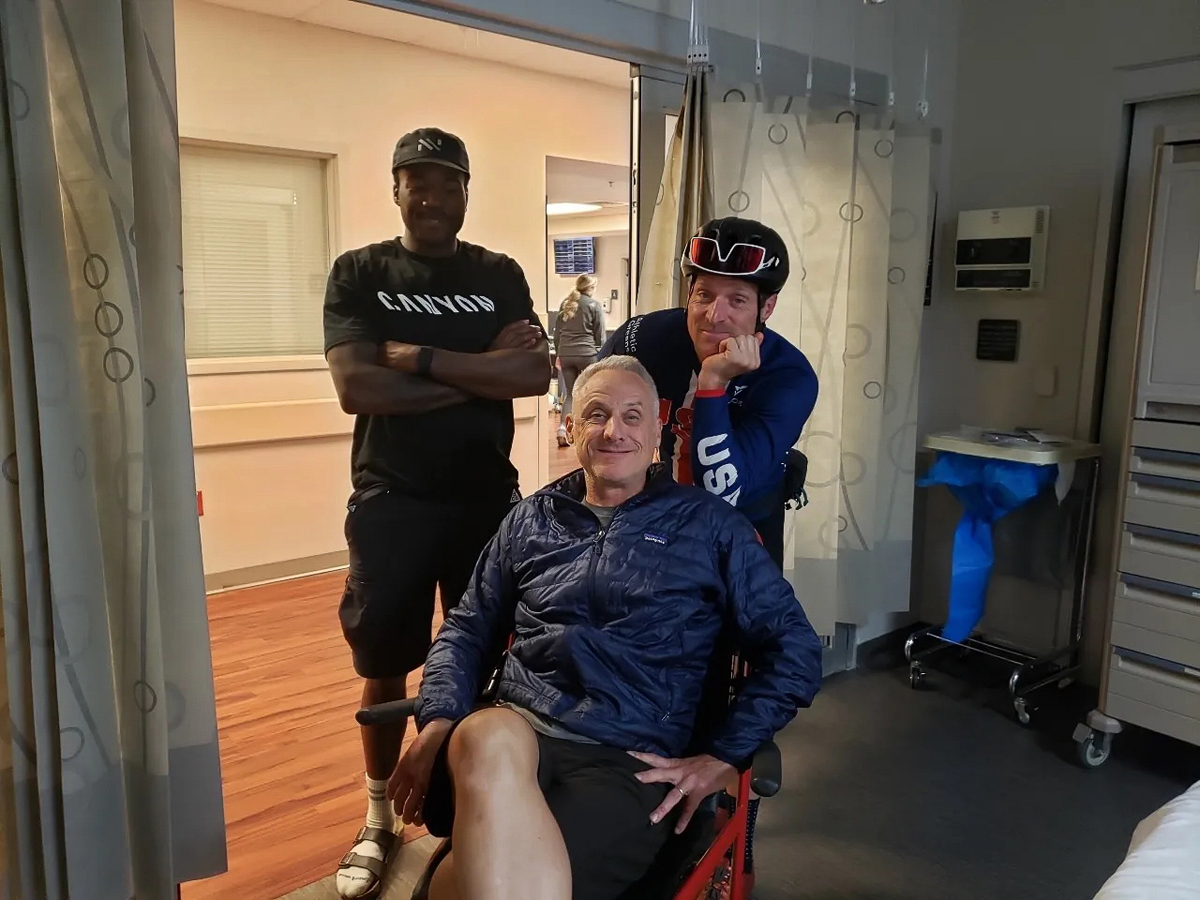
First of all, I want to thank my friends Sean and Shannon Scott, who were in Arkansas with me to ride bikes but also for business meetings. They took a couple of days away from their work to look after me and get me to the airport for my flight home. Sean told me later that he was following me into the bathroom at our Airbnb, because I was wobbling from side-to-side, and he did not want me to fall and hit my head again. I am also grateful for my friends Jelaani Davis and Brad Huff, who both came with me to the hospital after the crash. My friend Tim Johnson, who first took me to Bentonville five years ago, was around and helpful. I’m lucky that all of these friends were in Bentonville with me, and happy to have them in my life in the first place.
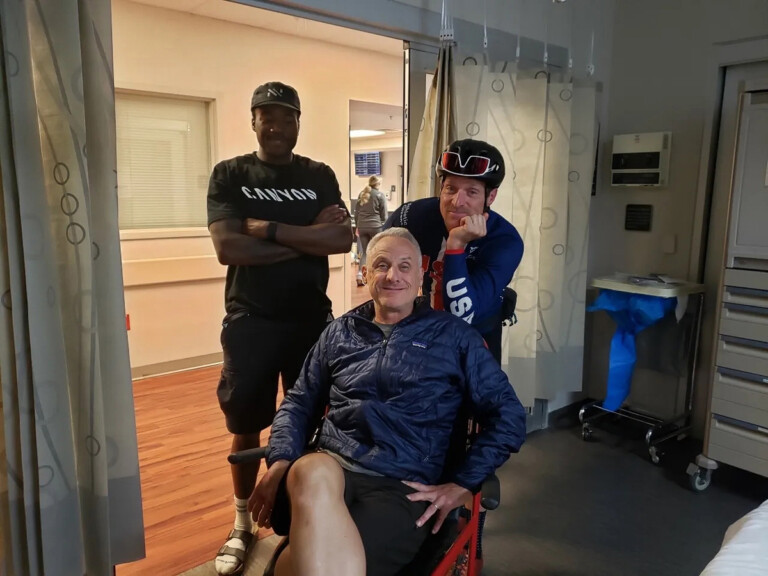
The lights are on but nobody is home. I have no memory of being at the hospital with Jelaani and Brad. Photo courtesy Peter Abraham.
I flew home a couple of days later and week by week I felt a little better. The two obvious symptoms I felt were 1) my left-right balance was a little off, and 2) my memory for names, places and businesses had gotten worse. I normally have a very good memory, so this part was really obvious. USA Cycling Chief Medical Officer Dr. Michael Roshon called me a couple times to check in. To make sure I was taking care of my injury, I went to see a neurologist experienced with sports-related concussions. He took me through a series of cognitive tests, and I’d clearly lost some of my brain ability. But I could feel over time that I was gradually improving. My balance had gotten back to normal. By my second visit, about 3 months after the crash, the neurologist said, “Your cognitive results are nearly back to normal, and you’ll have a full recovery. You’re good to go.” This was a relief, and I went on my way.
Over the course of last year, however, it was clear that I had not fully recovered. I felt the most off while driving at night, where you have a lot of sensory inputs: the rear-view mirror, cars around you, exit ramps off the freeway, lots of headlights, etc. I just felt overwhelmed by all of this. Then on two separate occasions in the first 6 months of the year, I was in fender bender car collisions that were my fault. I had maybe had one of those in the previous thirty years. I was wondering, am I just getting old? Whatever the reason, it was clear that I was not functioning well cognitively. The concussion crossed my mind as a reason for this, but it wasn’t obvious to me. Although it probably should have been. Even with lots of expert help, my traumatic brain injury was not fully healed. After a concussion, you might not just “get better.”
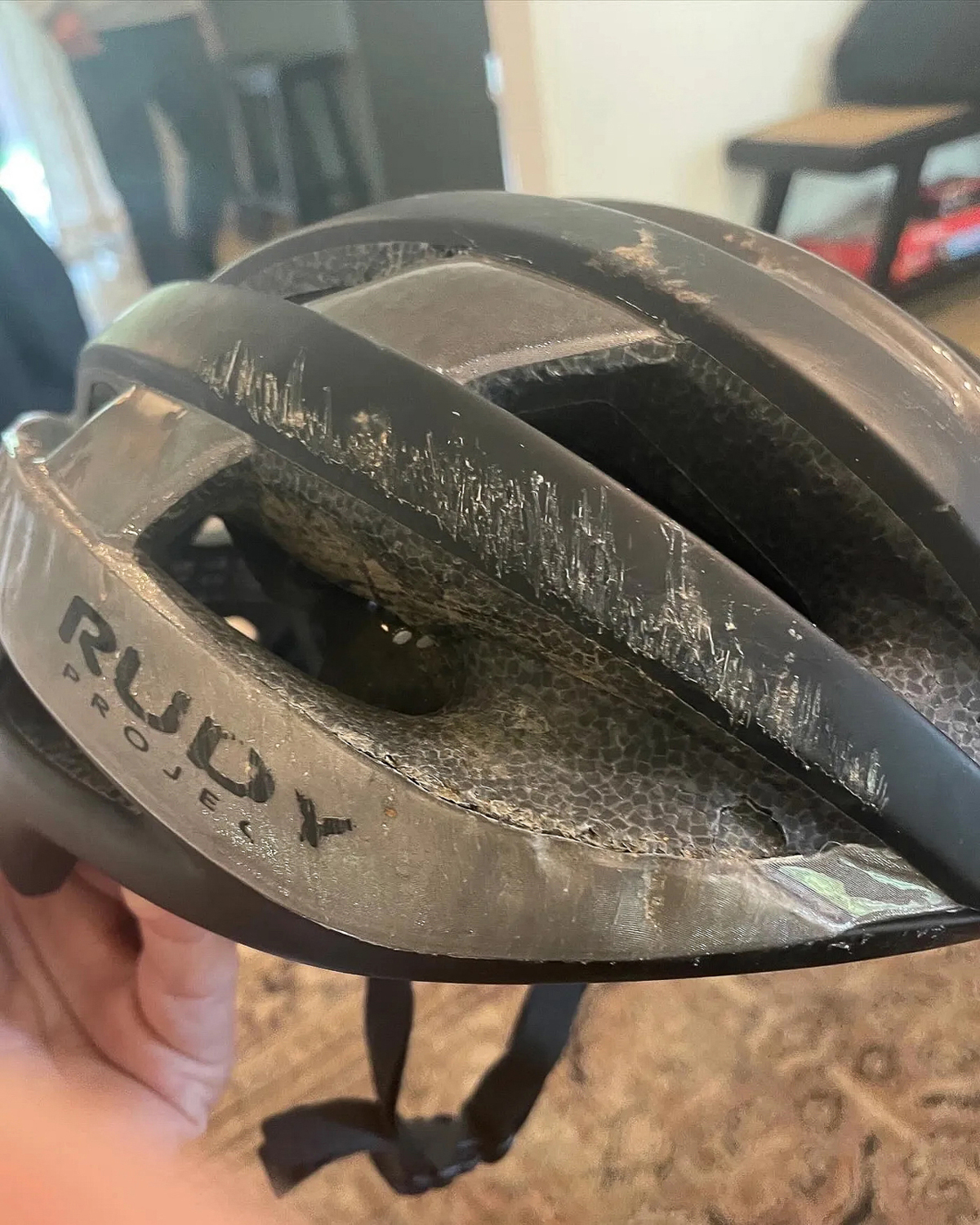
My helmet after the crash. Thankfully I was wearing one. Photo courtesy Peter Abraham.
In late September, I went out with Sean to do the Montrose group ride in Pasadena on a Saturday morning. While there, we connected with my friend Shari Stillman-Corbitt, a clinical psychologist and founder of the Awakenings mental health treatment facility. On the ride back to the car I shared my TBI symptoms with Shari. She immediately said, “Peter, those symptoms are not normal. You may need more treatment. At my place we use a modality, neurofeedback, that is very effective for brain injuries. Why don’t you come by and try it?” I said, “Sure, why not?”
So, a few weeks later I found myself in Shari’s office getting wired up to start my neurofeedback treatment protocol. This methodology monitors EEG brain waves and sends feedback to the brain (via audio or visual cues) that tells you to process things differently. After an initial lengthy questionnaire, the neurofeedback process started. For me, this included about 30 minutes of watching visually stimulating (lots of moving geometric shapes) videos on the Brain Paint software system while my brain waves were being measured.
After my first visit, I went outside to get in my car for the 20-minute drive home. It had gotten dark while I was in my appointment, and I was now starting my drive when I otherwise would have felt really overwhelmed. Within 5 minutes of getting in the car, it was clear that something had changed. I felt totally focused, calm and present. Had the neurofeedback really made that much of an impact in just one visit? Well, maybe. Given this promising start, I am starting visiting Shari’s facility every week for more neurofeedback therapy. Since then, my brain functionality has felt better and better. And I’m still doing the neurofeedback with Shari. I now feel more on top of my mental game than ever. Clearly, I spent most of last year living under a TBI-induced brain fog without ever realizing it. That’s one of the weird things about brain injuries: you may not even understand that you’re suffering symptoms. Brain issues are complex and sometimes vague. There’s no x-ray that shows you how your brain is broken. My TBI symptoms were invisible to even my wife. And yet, after a few months of neurofeedback, I feel like I’m operating at a higher level than even before my crash. That’s anecdotal, and hard to measure, but I really do feel that good. Because of that, my self-esteem is better, my time management has improved and the work I do is of higher quality. So, the brain health builds on itself.
I’m so grateful for Shari’s treatment and to be feeling back to full strength. In hindsight, 2024 was a hard year, with a lot of problems to solve: recovering from a TBI, I also had a herniated disc in my back, work was hard. It felt like everything in my life was an uphill struggle. I’m looking forward to going back to the Coler MTB Preserve in Bentonville with all of my faculties next month and staying upright.
Peter started racing bikes in high school and has continued to ride his entire life. He also runs the Abraham Studio (ABRHM.com), which works with purpose-driven brands in sports, technology and healthcare to find their voices and tell their stories. He lives in Los Angeles, California.
Del Toro weathers tactical storms and crashes while extending his overall lead as the race heads into its decisive final week
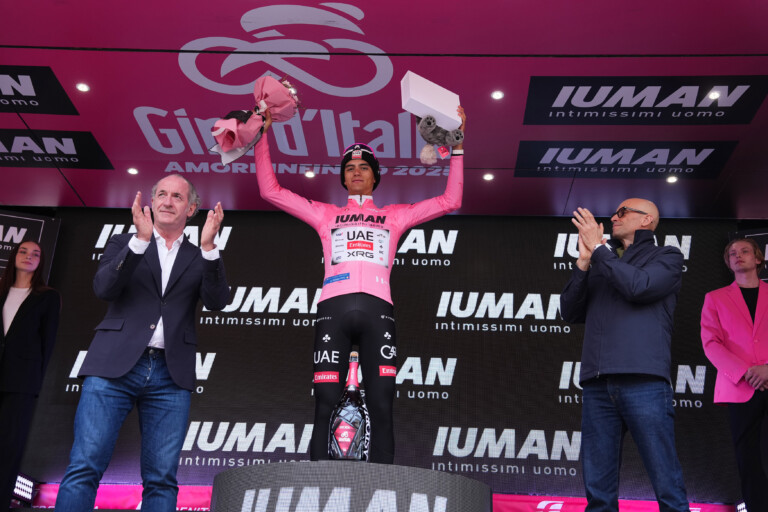
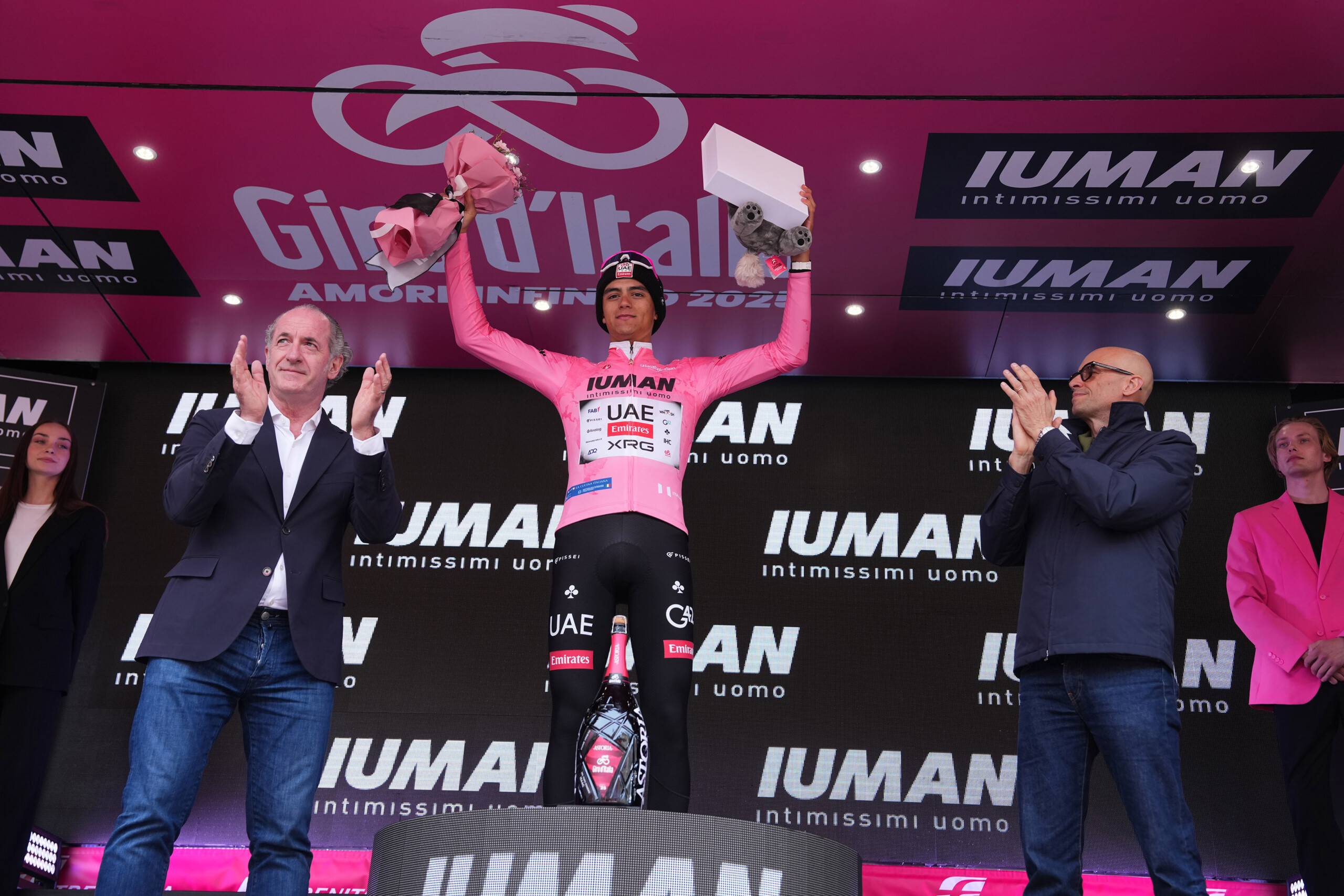
ASIAGO, Italy (May 25, 2025) — In the pantheon of cycling’s most celebrated jerseys, few carry the weight of history and expectation like the maglia rosa of the Giro d’Italia. For six consecutive days now, that pink symbol of leadership has draped the shoulders of Isaac Del Toro, a 21-year-old Mexican whose ascension from domestique to race leader has become one of the most compelling narratives in this year’s corsa rosa.
As the 108th Giro d’Italia prepares to enter its brutal final week, Del Toro’s grip on the overall lead has only strengthened, even as the tactical chess match around him has grown increasingly complex. Through time trials in Tuscany, mountain stages in Emilia-Romagna, crash-marred sprints across the Veneto plains, and now into the foothills of the Dolomites, the young UAE Team Emirates XRG rider has displayed a maturity that belies his years.
“I wear the Maglia Rosa but I feel nervous in the race because everyone is my idol, I’m a fan of them and now I have to follow their attacks,” Del Toro confessed after Stage 15’s finish in Asiago. “To be able to do it is crazy.”
Stage 10: The Time Trial Revelation
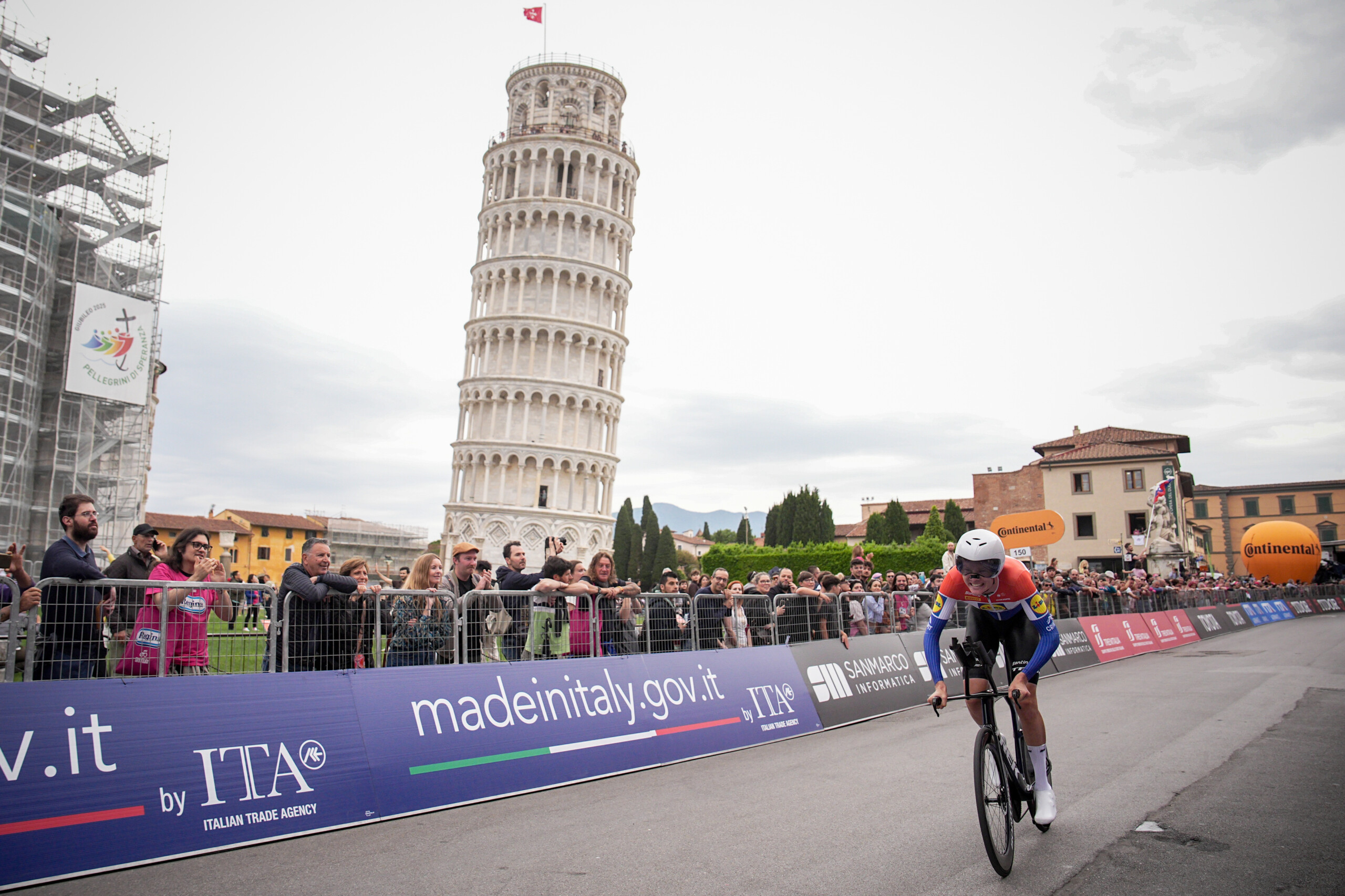
The race’s tactical complexity first emerged on Stage 10, a 28.6-kilometer individual time trial from the medieval walls of Lucca to Pisa’s iconic leaning tower. While Dutch champion Daan Hoole of Lidl-Trek claimed his maiden Grand Tour victory in dramatic fashion, the real drama unfolded behind him as changing weather conditions split the field and reshuffled the general classification.
Daan Hoole of Lidl-Trek during the stage 10 of the Giro dÕItalia from Lucca to Pisa Tudor ITT (Individual Time Trial), Italy – Tuesday, May 20, 2025. Sport – cycling. (Photo by Marco Alpozzi/Lapresse)
Hoole, typically a domestique for sprint star Mads Pedersen, delivered a masterful performance over the rolling Tuscan terrain. Starting early in ideal conditions, the 27-year-old Dutchman set a blistering pace of 52.8 kilometers per hour, ultimately holding off Britain’s Joshua Tarling by seven seconds despite the Ineos Grenadiers rider being widely considered the stage favorite.
“Had you asked me yesterday who’d win the TT, I’d have said Josh Tarling because he’s the best time triallist at the moment,” Hoole admitted in the post-stage press conference. “I made the difference on the hill. I started fast but kept something for this small drag up, then I pushed and the numbers were good.”
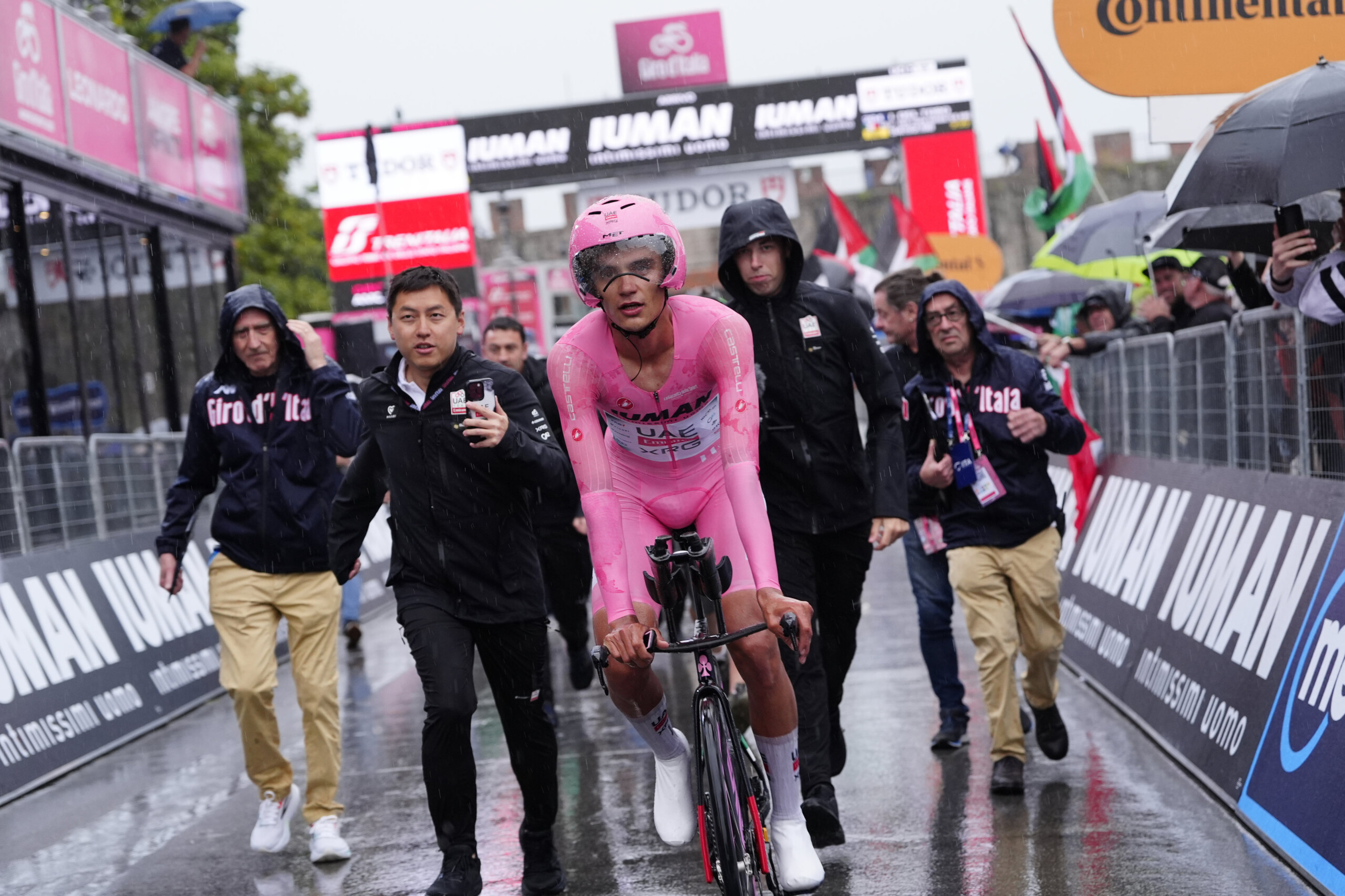
Isaac Del Toro (UAE Team Emirates XRG) during the stage 10 of the Giro d’Italia from Lucca to Pisa Tudor ITT (Individual Time Trial), Italy – Tuesday, May 20, 2025. Sport – cycling. (Photo by Marco Alpozzi/Lapresse)
The weather played a crucial role as rain began falling just as the general classification contenders took to the course. Under these treacherous conditions, three-time Grand Tour winner Primož Roglič of Bora-hansgrohe demonstrated his championship pedigree, clawing back 19 seconds on Juan Ayuso, Del Toro’s UAE teammate. The Slovenian’s tactical nous in adverse conditions served as an early warning of the battles to come.
Stage 10 Results:
Daan Hoole (Lidl-Trek) – 32’30”
Joshua Tarling (Ineos Grenadiers) at 7″
Ethan Hayter (Soudal Quick-Step) at 10″
General Classification after Stage 10:
Isaac Del Toro (UAE Team Emirates XRG)
Juan Ayuso (UAE Team Emirates XRG) at 25″
Antonio Tiberi (Bahrain Victorious) at 1’01”
Jersey Holders after Stage 10:
Maglia Rosa (Overall Leader): Isaac Del Toro (UAE Team Emirates XRG)
Maglia Azzurra (Mountains): Lorenzo Fortunato (XDS Astana Team)
Maglia Bianca (Young Rider): Isaac Del Toro (UAE Team Emirates XRG)
Del Toro’s composure under pressure was already evident. “It’s been a good day because I didn’t crash,” he said with characteristic understatement. “I didn’t take risk in the corners.”
Stage 11: Carapaz’s Reminder of Class
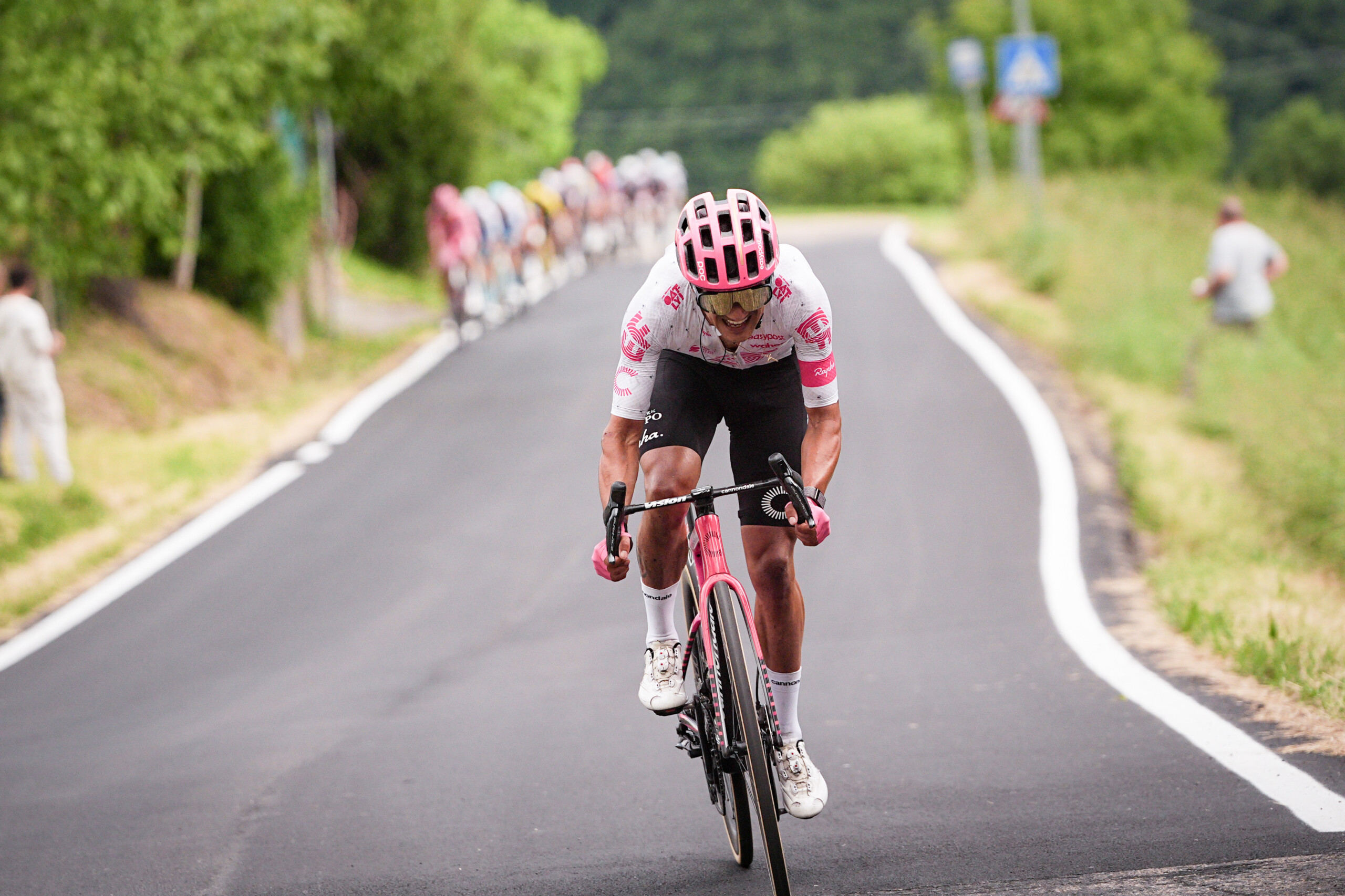
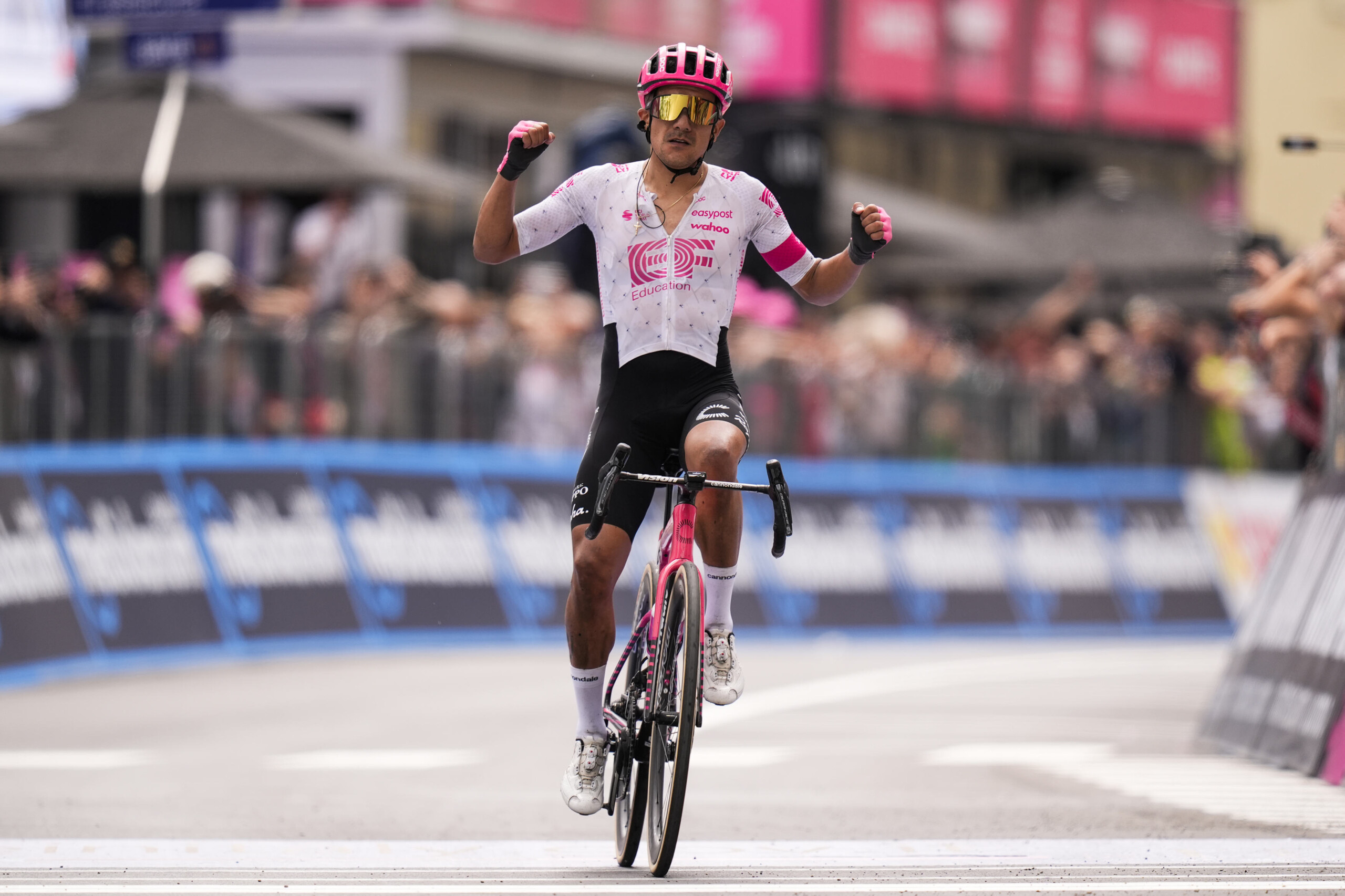
Stage 11’s 186-kilometer journey from Viareggio to Castelnovo ne’ Monti provided the race’s first true mountain test, and with it came a reminder that Richard Carapaz remains a force to be reckoned with. The 2019 Giro winner and 2021 Olympic champion chose his moment perfectly, attacking with nine kilometers remaining and soloing to victory ahead of Del Toro and Italy’s Giulio Ciccone.
Ecuador’s Richard Carapaz of Ef Education – Easypost Team competes during the stage 11 of the Giro d’Italia from Viareggio to Castelnovo ne’ Monti, Italy – Wednesday, May 21, 2025. Sport – cycling. (Photo by Marco Alpozzi/Lapresse)
For Carapaz, riding for EF Education-EasyPost, the victory represented both vindication and declaration. After disappointing in the time trial the previous day—”I know time trialing isn’t my forte,” he admitted—the Ecuadorian demonstrated that his climbing legs remained sharp as he approaches his 32nd birthday.
Richard Carapaz (EF Education Easypost) wins during the stage 11 of the Giro d’Italia from Viareggio to Castelnovo ne’ Monti, Italy – Wednesday, May 21, 2025. Sport – cycling. (Photo by Fabio Ferrari/LaPresse)
“I took advantage of the work of my team-mates Georg Steinhauser and Mikkel Honoré,” Carapaz explained. “We knew it could be a good stage for us. The Giro was my goal since the beginning of the year. We’ve been working on it since October.”
More significantly, the stage revealed Del Toro’s tactical awareness and team-first mentality. When Carapaz’s acceleration created gaps in the chasing group, the young Mexican actually slowed his pursuit to ensure his teammates could regroup.
“It would have been nicer to be all together with my team-mates, that’s why I stopped and we managed to be everybody together again,” Del Toro explained, displaying the kind of tactical maturity that often takes years to develop.
Stage 11 Results:
Richard Carapaz (EF Education-EasyPost) – 4h35’20”
Isaac Del Toro (UAE Team Emirates XRG) at 10″
Giulio Ciccone (Lidl-Trek) at 10″
General Classification after Stage 11:
Isaac Del Toro (UAE Team Emirates XRG)
Juan Ayuso (UAE Team Emirates XRG) at 31″
Antonio Tiberi (Bahrain Victorious) at 1’07”
Jersey Holders after Stage 11:
Maglia Rosa (Overall Leader): Isaac Del Toro (UAE Team Emirates XRG)
Maglia Azzurra (Mountains): Lorenzo Fortunato (XDS Astana Team)
Maglia Bianca (Young Rider): Isaac Del Toro (UAE Team Emirates XRG)
Stage 12: Dutch Dominance in the Sprints
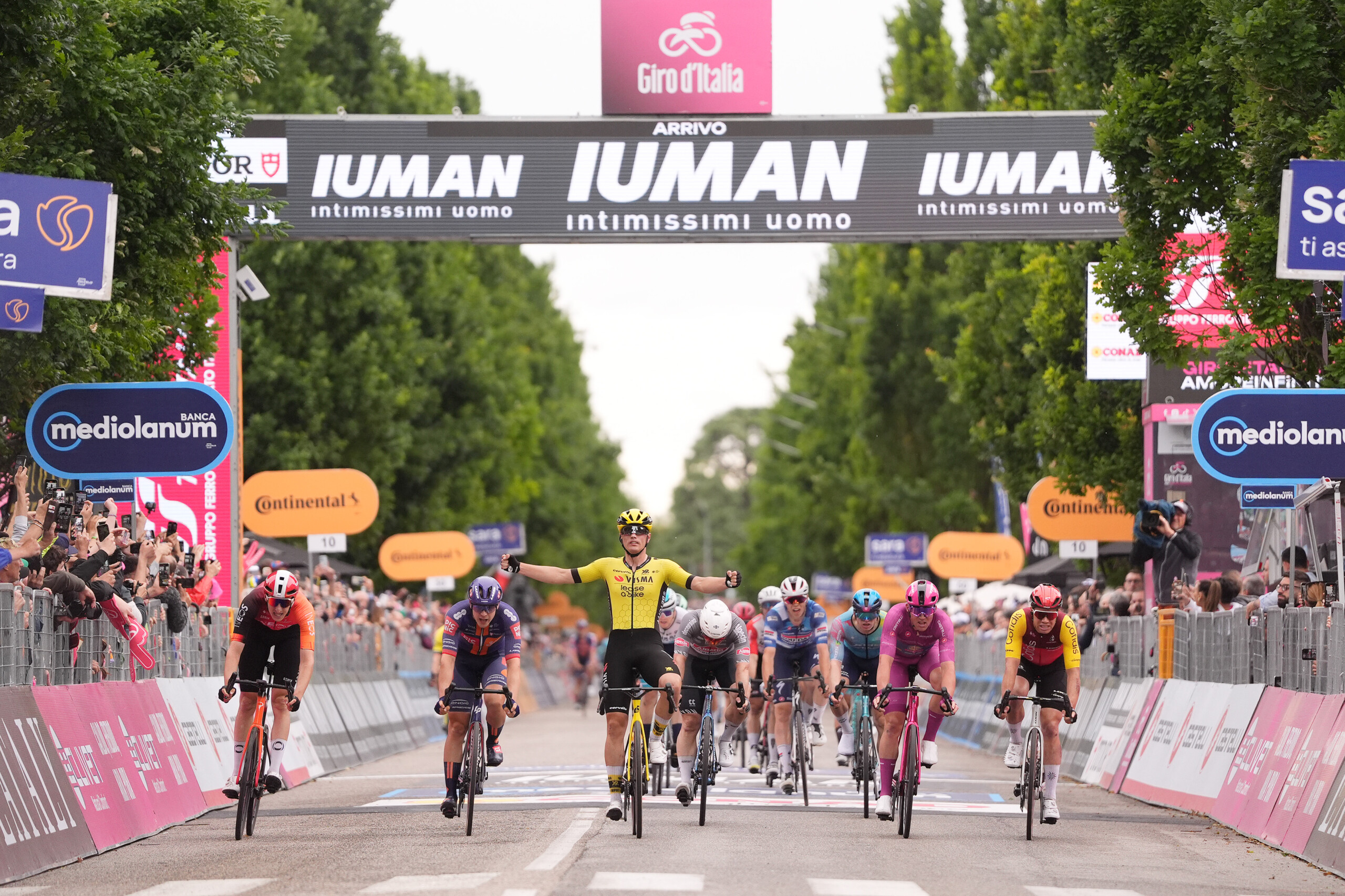
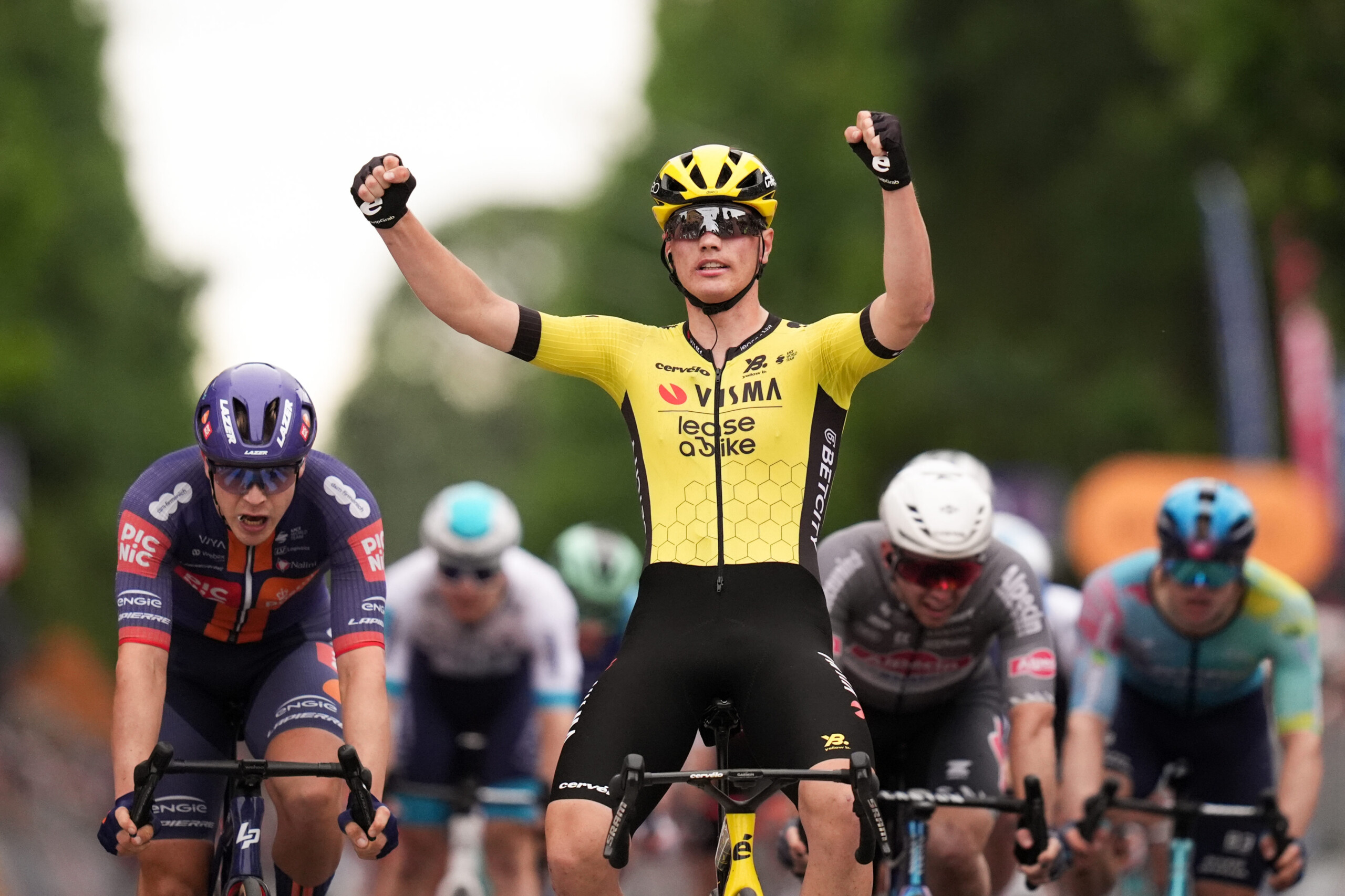
The following days showcased the remarkable depth of Dutch cycling talent, with three different riders from the Netherlands claiming consecutive stage victories—a first in Giro d’Italia history. Stage 12 belonged to Olav Kooij of Team Visma-Lease a Bike, who finally delivered on his sprint credentials after two disappointing results earlier in the race.
Olav Kooij of Team Visma | Lease A Bike winner of the stage at the sprint during the stage 12 of the Giro d’Italia from Modena to Viadana (Oglio-Po), Italy – Thursday, May 22, 2025. Sport – cycling. (Photo by Fabio Ferrari/LaPresse)Olav Kooij of Team Visma | Lease A Bike winner of the stage at the sprint during the stage 12 of the Giro dÕItalia from Modena to Viadana (Oglio-Po), Italy – Thursday, May 22, 2025. Sport – cycling. (Photo by Massimo Paolone/Lapresse)
Kooij’s victory in Viadana was orchestrated by an extraordinary lead-out from Wout van Aert, whose versatility continues to astound the cycling world. “Only Wout can do such a long lead out like today’s,” Kooij marveled. “I got an extraordinary support.”
Stage 12 Results:
Olav Kooij (Team Visma-Lease a Bike) – 3h55’40”
Casper Van Uden (Team Picnic PostNL) at 0″
Ben Turner (Ineos Grenadiers) at 0″
General Classification after Stage 12:
Isaac Del Toro (UAE Team Emirates XRG)
Juan Ayuso (UAE Team Emirates XRG) at 33″
Antonio Tiberi (Bahrain Victorious) at 1’09”
Jersey Holders after Stage 12:
Maglia Rosa (Overall Leader): Isaac Del Toro (UAE Team Emirates XRG)
Maglia Azzurra (Mountains): Lorenzo Fortunato (XDS Astana Team)
Maglia Bianca (Young Rider): Isaac Del Toro (UAE Team Emirates XRG)
For Del Toro, even the supposedly easy sprint stages provided opportunities to extend his overall advantage. His savvy positioning at intermediate sprints netted additional bonus seconds, demonstrating a completeness that separates potential winners from mere climbers.
Stage 13: Pedersen’s Poker Hand
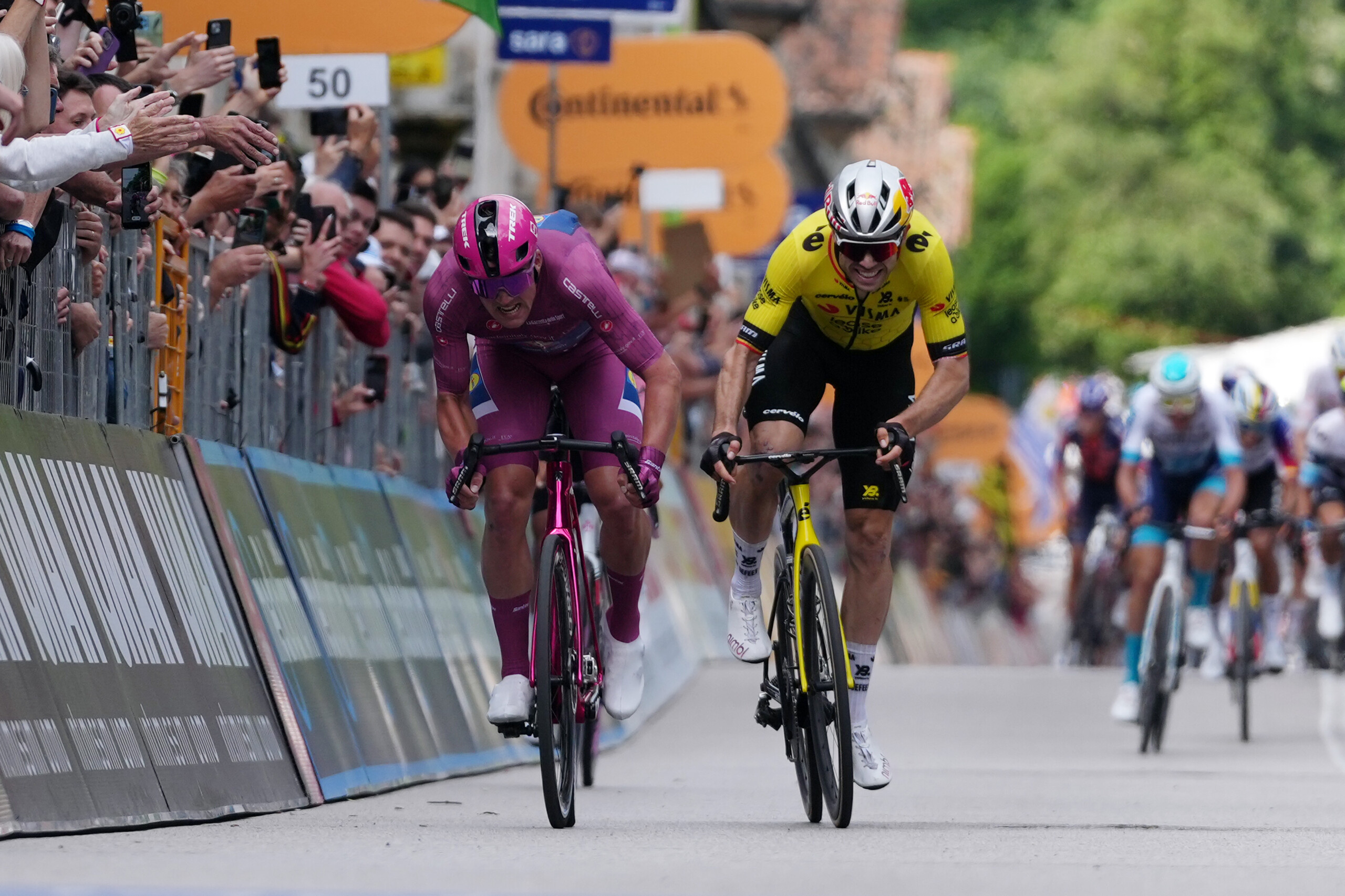
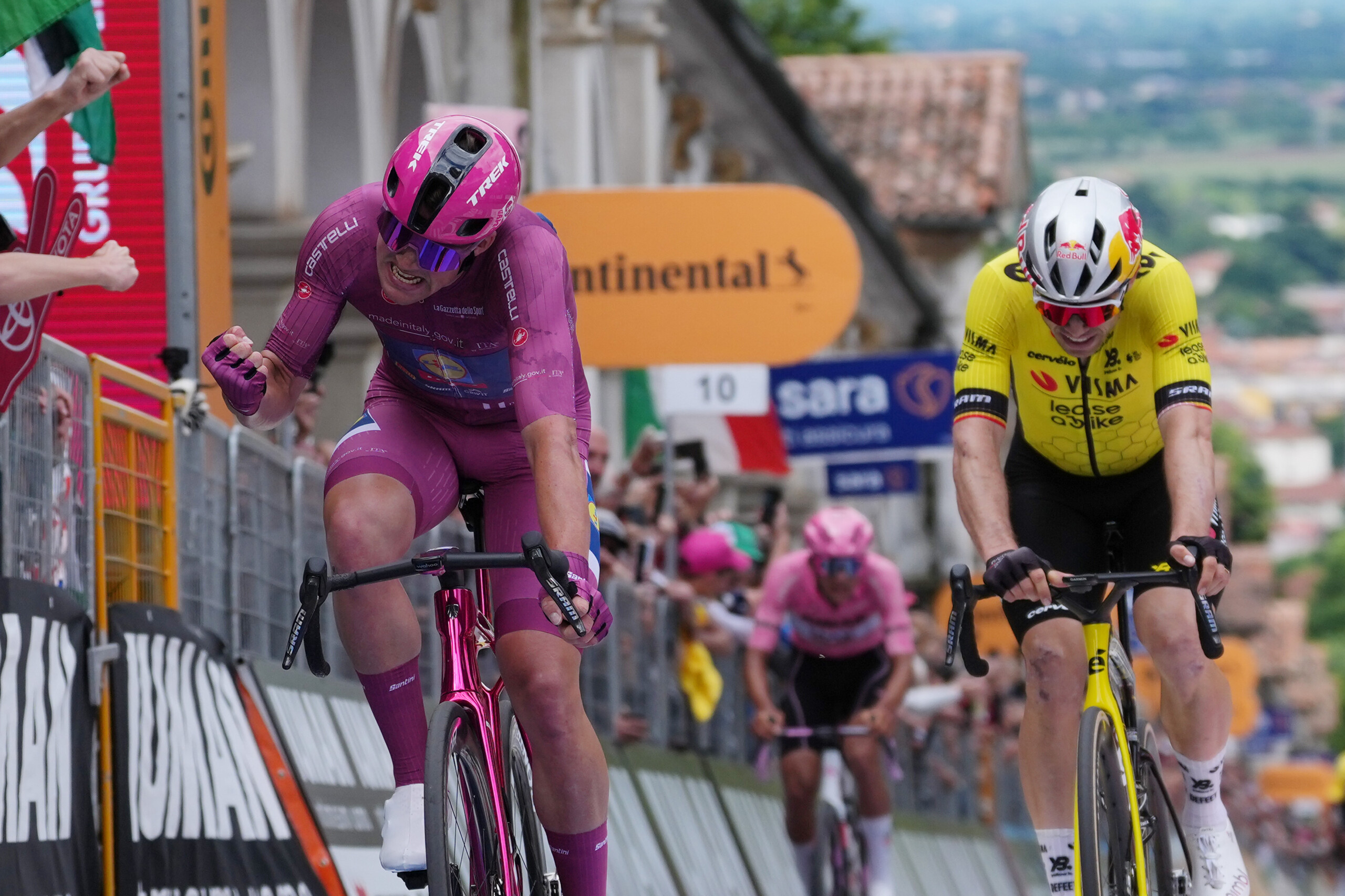
Mads Pedersen’s dominance of Stage 13 represented perhaps the most tactically sophisticated victory of the race to date. The Danish powerhouse from Lidl-Trek claimed his fourth stage win with a perfectly timed sprint up the steep finish in Vicenza, outdueling Van Aert in a battle between cycling’s premier all-rounders.
The stage finish at Monte Berico provided an ideal arena for Pedersen’s unique blend of power and tactical acumen. After his teammate Mathias Vacek animated the early part of the stage, Pedersen could conserve energy for the crucial final kilometer.
Pedersen Mads of Lidl-Trek cyclamen jersey winner of the stage during the stage 13 of the Giro d’Italia from Rovigo to Vicenza, Italy – Friday, May 23, 2025. Sport – cycling. (Photo by Gian Mattia D’Alberto/LaPresse)Pedersen Mads of Lidl-Trek cyclamen jersey winner of the stage during the stage 13 of the Giro d’Italia from Rovigo to Vicenza, Italy – Friday, May 23, 2025. Sport – cycling. (Photo by Gian Mattia D’Alberto/LaPresse)
“In a finale like today’s, you have to see the openings,” Pedersen explained. “I was on the right side of Wout [van Aert], I had to open the sprint when I saw the 200m mark, hoping it was enough to keep the lead till line.”
Del Toro’s third-place finish, crucially ahead of the main group of GC contenders, netted him additional time bonuses and extended his overall lead to 38 seconds over Ayuso.
Stage 13 Results:
Mads Pedersen (Lidl-Trek) – 3h50’24”
Wout Van Aert (Team Visma-Lease a Bike) at 0″
Isaac Del Toro (UAE Team Emirates XRG) at 2″
General Classification after Stage 13:
Isaac Del Toro (UAE Team Emirates XRG)
Juan Ayuso (UAE Team Emirates XRG) at 38″
Antonio Tiberi (Bahrain Victorious) at 1’18”
Jersey Holders after Stage 13:
Maglia Rosa (Overall Leader): Isaac Del Toro (UAE Team Emirates XRG)
Maglia Azzurra (Mountains): Lorenzo Fortunato (XDS Astana Team)
Maglia Bianca (Young Rider): Isaac Del Toro (UAE Team Emirates XRG)
The statistic that Pedersen had led the points classification from Stage 1 through Stage 13—a feat not achieved since Alessandro Petacchi in 2003—underscored the Dane’s remarkable consistency in this Giro.
Stage 14: Border Drama and GC Reshuffling
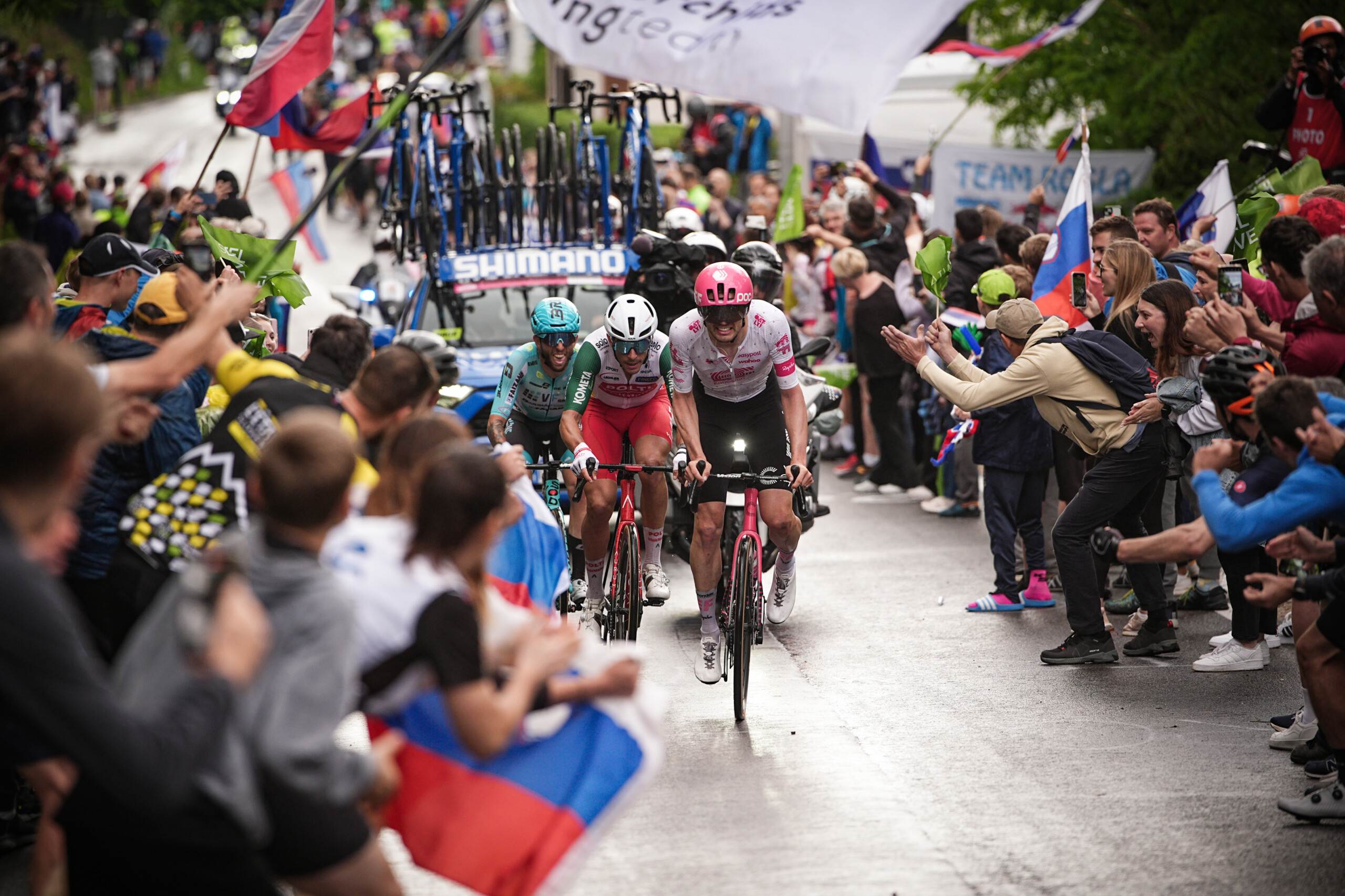
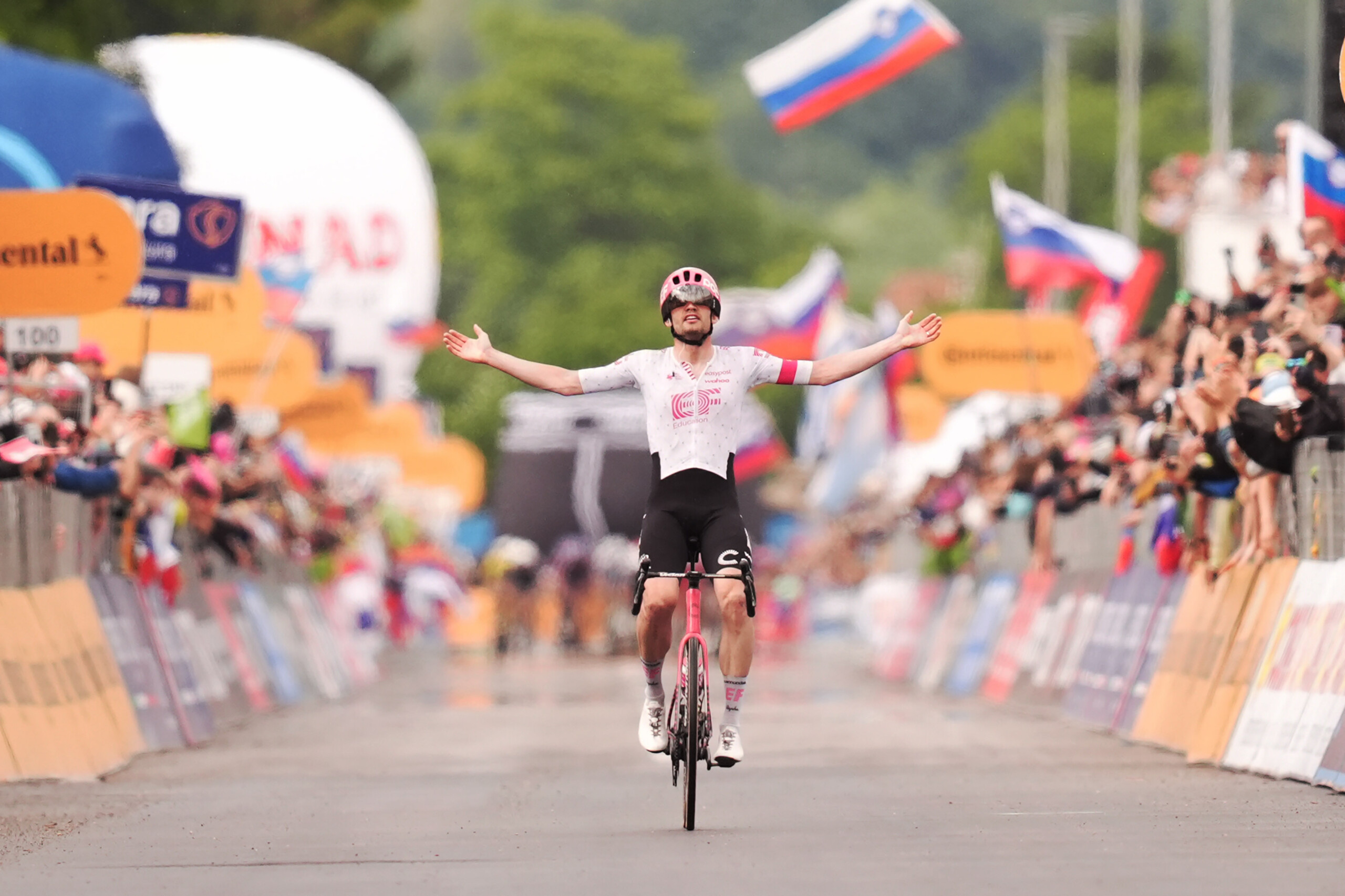
Stage 14’s symbolic finish in Nova Gorica/Gorizia, celebrating the first cross-border European Capital of Culture, delivered drama that extended far beyond its ceremonial significance. Kasper Asgreen’s solo victory from the breakaway provided a Danish follow-up to his compatriot Pedersen’s success, but the real story unfolded behind him as crashes split the peloton and reshuffled the general classification.
Denmark’s Kasper Asgreen pedals in action during the stage 14 of the Giro dÕItalia from Treviso to Nova Gorica/Gorizia, Italy and Slovenia- Saturday, May 24, 2025. Sport – cycling. (Photo by Marco Alpozzi/Lapresse)
The technical circuit in Slovenia, made treacherous by rain, caught out several key contenders. Most significantly, Antonio Tiberi and Giulio Ciccone—previously sitting third and fourth overall respectively—lost significant time, while Simon Yates moved up to second place overall.
Kasper Asgreen of EF Education – Easypost Team competes during the stage 14 of the Giro d’Italia o Nova Gorica/Gorizia, Slovenia – Saturday, May 24, 2025. Sport – cycling. (Photo by Marco Alpozzi/Lapresse)Kasper Asgreen of EF Education – Easypost Team competes during the stage 14 of the Giro d’Italia o Nova Gorica/Gorizia, Slovenia – Saturday, May 24, 2025. Sport – cycling. (Photo by Marco Alpozzi/Lapresse)
Del Toro himself was caught in the chaos. “Some guys crashed in the front, I wasn’t that much in the front but I crashed too because someone hit me from behind,” he recounted. “I managed to stand up and go quickly to the front.”
His quick reflexes and presence of mind in joining the front group likely saved his race, as gaps of over a minute opened behind him. The incident demonstrated not just his bike handling skills but his mental resilience under pressure.
Stage 14 Results:
Kasper Asgreen (EF Education-EasyPost) – 4h04’40”
Kaden Groves (Alpecin-Deceuninck) at 16″
Olav Kooij (Team Visma-Lease a Bike) at 16″
General Classification after Stage 14:
Isaac Del Toro (UAE Team Emirates XRG)
Simon Yates (Team Visma-Lease a Bike) at 1’20”
Juan Ayuso (UAE Team Emirates XRG) at 1’26”
Jersey Holders after Stage 14:
Maglia Rosa (Overall Leader): Isaac Del Toro (UAE Team Emirates XRG)
Maglia Azzurra (Mountains): Lorenzo Fortunato (XDS Astana Team)
Maglia Bianca (Young Rider): Isaac Del Toro (UAE Team Emirates XRG)
Stage 15: Verona’s Emotional Triumph
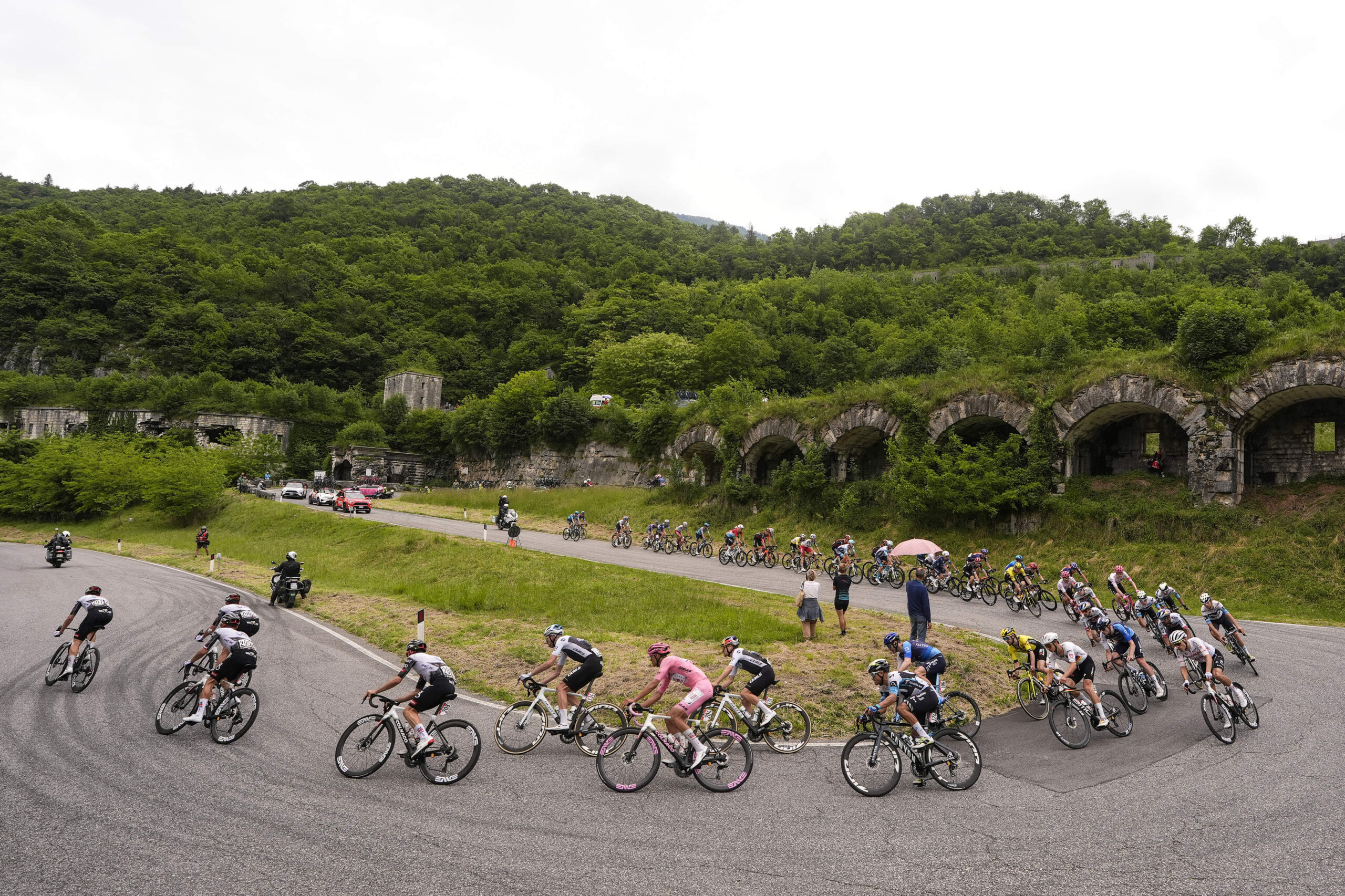
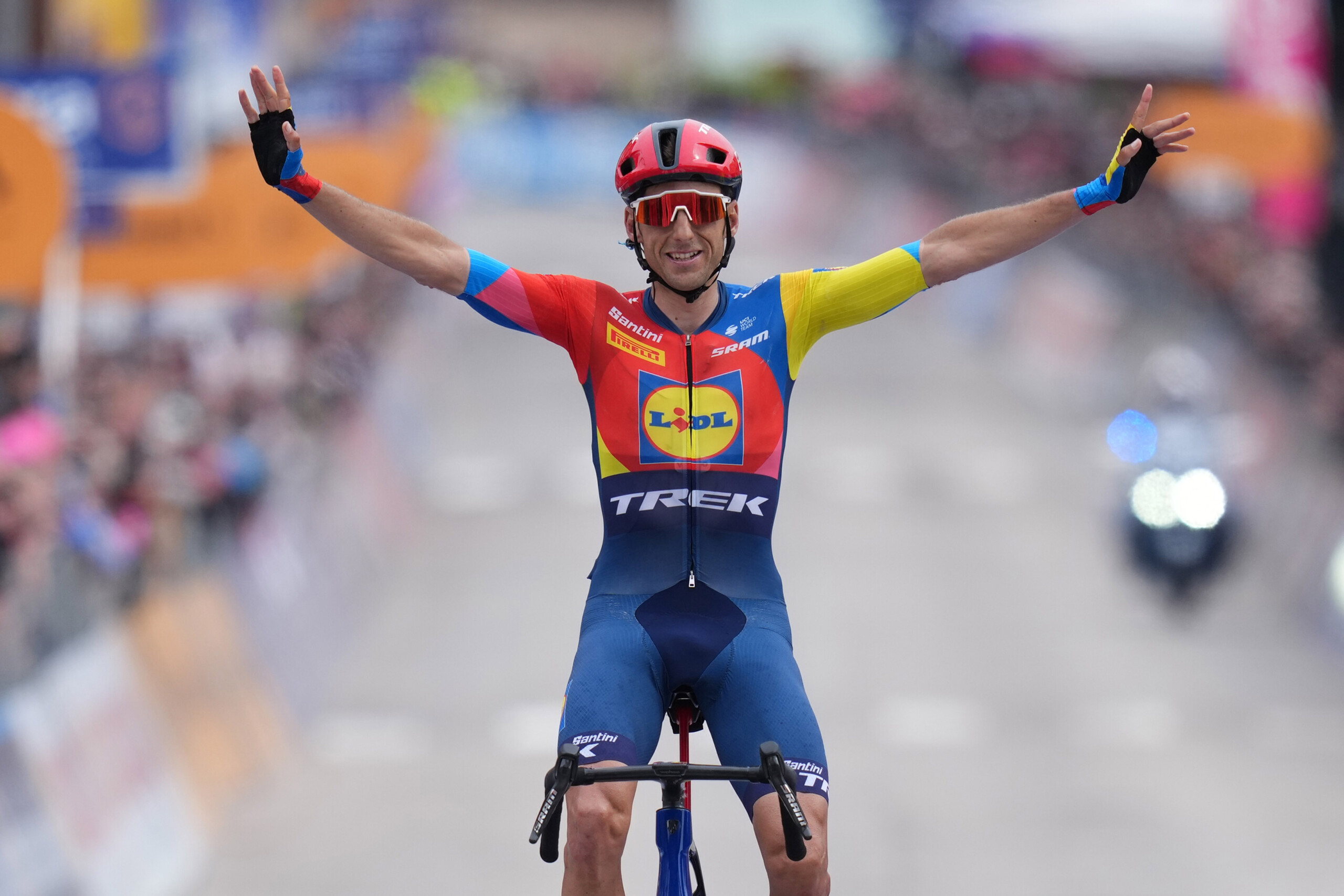
Stage 15’s marathon 219-kilometer journey to Asiago provided the longest stage of this year’s Giro and delivered one of its most emotionally charged victories. Carlos Verona, the 32-year-old Spanish domestique for Lidl-Trek, claimed his first Grand Tour stage win in an escape that began as revenge for his fallen teammate Giulio Ciccone, who had been forced to abandon the race due to injuries sustained in the previous day’s crash.
The peloton during the stage 15 of the Giro d’Italia from Fiume Veneto to Asiago, Italy and Slovenia- Sunday, May 25, 2025. Sport – cycling. (Photo by Fabio Ferrari/LaPresse)
“I didn’t want to do it for me but I wanted to do it for the team, knowing how much Giulio had worked for this race,” Verona said through tears. “Today’s victory makes cycling a wonderful sport because of the different emotions it delivers in such a short period of time.”
Carlos Verona (Lidl-Trek) during the stage 15 of the Giro d’Italia from Fiume Veneto to Asiago, Italy and Slovenia- Sunday, May 25, 2025. Sport – cycling. (Photo by Fabio Ferrari/LaPresse)
Verona’s solo attack 45 kilometers from the finish came at a moment when the general classification riders were beginning to eye each other nervously. His tactical awareness allowed him to bridge between the early breakaway and the approaching favorites, ultimately holding off the chase by 22 seconds.
Carlos Verona (Lidl-Trek) during the stage 15 of the Giro d’Italia to Asiago, Italy – Sunday, May 5, 2025. Sport – cycling. (Photo by Gian Mattia D’Alberto/LaPresse)
Behind him, the day’s most significant development was Primož Roglič’s continued slide down the general classification. The 2023 Giro winner lost another 1’30” to Del Toro, dropping from fifth to tenth overall with a deficit of 3’53”. For a rider who arrived as one of the pre-race favorites, this represented a potentially race-ending blow.
Stage 15 Results:
Carlos Verona (Lidl-Trek) – 5h15’41”
Florian Stork (Tudor Pro Cycling Team) at 22″
Christian Scaroni (XDS Astana Team) at 23″
General Classification after Stage 15:
Isaac Del Toro (UAE Team Emirates XRG)
Simon Yates (Team Visma-Lease a Bike) at 1’20”
Juan Ayuso (UAE Team Emirates XRG) at 1’26”
Jersey Holders after Stage 15:
Maglia Rosa (Overall Leader): Isaac Del Toro (UAE Team Emirates XRG)
Maglia Azzurra (Mountains): Lorenzo Fortunato (XDS Astana Team)
Maglia Bianca (Young Rider): Isaac Del Toro (UAE Team Emirates XRG)
Del Toro’s performance on the demanding climbs of Monte Grappa showcased his continued development as a complete rider. When Ineos Grenadiers applied pressure through Egan Bernal’s acceleration, the young Mexican responded immediately.
“I like how they race and when they passed us with a fast train, I caught their wheels and waited for Egan Bernal’s attack,” Del Toro explained. “He got a gap, I needed to go quickly, I’m glad I was able to follow him.”
The Mathematics of Leadership
As the Giro prepares to enter its decisive final week, the numbers tell the story of Del Toro’s growing authority. His six days in the maglia rosa have already placed him in rarified company—only Taylor Phinney, another 21-year-old American, has worn the race leader’s jersey for as long at such a young age in this century.
The UAE Team Emirates XRG squad’s tactical sophistication has been evident throughout. With both Del Toro and Juan Ayuso sitting first and third overall respectively, they possess multiple cards to play in the mountains ahead. The presence of Adam Yates, though currently further back, adds another dimension to their tactical arsenal.
Isaac Del Toro (UAE Team Emirates XRG) retains the maglia rosa after the stage 15 of the Giro d’Italia to Asiago, Italy – Sunday, May 5, 2025. Sport – cycling. (Photo by Gian Mattia D’Alberto/LaPresse)
“We still need to see who is the leader of the team,” Del Toro acknowledged with refreshing honesty. “Juan Ayuso and Adam Yates are so strong, we’ll see how we play in last week, we need to play the three of us.”
This team-first mentality, combined with his individual strength, has been key to Del Toro’s success. Unlike many young riders who might be tempted to overextend themselves early in a Grand Tour, he has shown remarkable discipline in picking his battles and conserving energy for the crucial moments.
Jersey Classifications Paint Full Picture
The jersey competitions tell their own stories of this Giro’s evolution. Pedersen’s stranglehold on the maglia ciclamino (points classification) reflects not just his sprint dominance but his versatility over varied terrain. His 14 days in the jersey equals the achievements of Peter Sagan and puts him on course for one of the most dominant points classification victories in recent memory.
Lorenzo Fortunato’s retention of the maglia azzurra (King of the Mountains) through 15 stages speaks to the consistency required in the climbing competition, while Del Toro’s dual role as both overall leader and best young rider (maglia bianca) underscores his exceptional talent.
The Week Ahead
As the Giro approaches its traditional climax in the high mountains, Del Toro faces his greatest test. The third week of a Grand Tour is where young legs often falter, where the accumulated fatigue of two weeks’ racing finally takes its toll. His honest self-assessment suggests he understands this challenge.
“Personally, I don’t know how good I’ll be in the third week,” he admitted. “I cannot yet realise that I’m one of the top guys.”
Yet his performances to date suggest otherwise. His ability to respond to attacks from proven Grand Tour winners like Carapaz and Bernal, his tactical awareness in crucial moments, and his team’s clear commitment to his leadership all point to a rider capable of going the distance.
The mathematics of his advantage—1’20” over Simon Yates and 1’26” over teammate Ayuso—provide a cushion, but not an overwhelming one. In the high mountains that await, such gaps can evaporate in a single explosive attack or disappear gradually through a sustained tempo that exposes any weakness.
What Del Toro possesses, however, is something that cannot be taught: the ability to remain calm under pressure and the wisdom to race tactically rather than emotionally. As he noted after surviving the chaos of Stage 14: “People around me give me the confidence.”
That confidence, combined with his evident talent and the strength of his supporting cast, suggests that Mexico’s first Grand Tour victory may be within reach. In a sport where youth often struggles to master the tactical complexity of three-week racing, Isaac Del Toro has already demonstrated a maturity that extends far beyond his 21 years.
The pink jersey will face its sternest tests in the days ahead, but if the first 15 stages have proven anything, it is that this young Mexican has both the legs and the head to potentially carry it all the way to Rome.
Pennsylvania’s premier gravel cycling event will offer cash prizes for the first time when unPAved of the Susquehanna River Valley returns for its eighth edition on October 12, 2025.
Event organizers announced expanded racing options Tuesday, including a new 200-mile overnight race and lower entry fees for recreational riders. The event attracts cyclists from across the country to central Pennsylvania’s challenging terrain during peak fall foliage season.
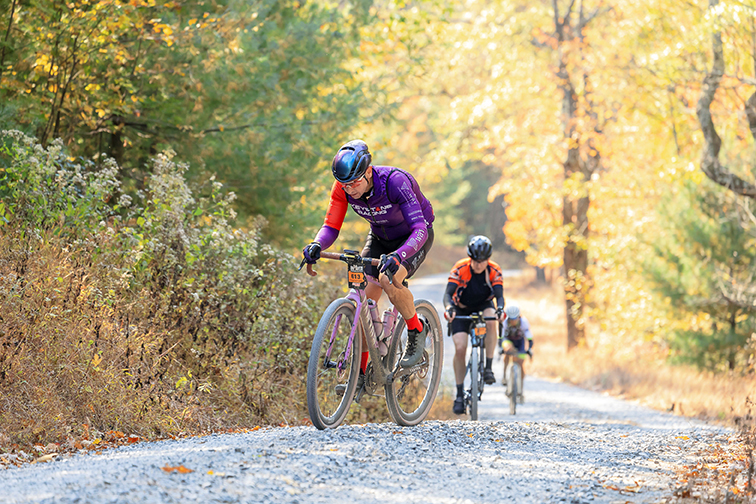
Photo courtesy of unPAved Pennsylvania
“Some really want to test themselves against others so we’re putting more attention on the racing and results, including a cash purse to make it a little more serious than ‘racing for whoopie pies,'” said Dave Pryor, co-founder and event director.
The competitive “Race for Whoopie Pies” category will take racers across 130 miles featuring 13 hills and 11,500 feet of climbing. Organizers will time competitors over four segments totaling 56 miles and more than 7,000 feet of elevation gain. Six untimed aid stations will allow racers to refuel during the course.
Event officials plan equal prize money for men’s and women’s categories, with a podium presentation scheduled during the post-race party.
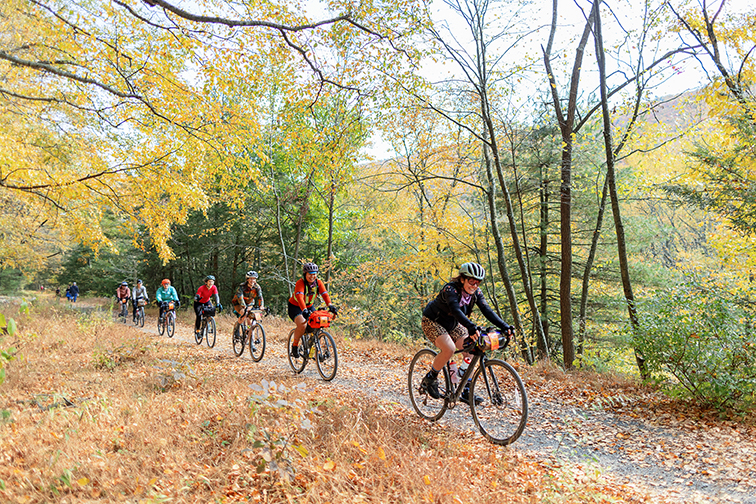
Photo courtesy of unPAved Pennsylvania
The event has expanded its inclusivity efforts since adding Non-Binary/Gender Expansive and Para-Cycling categories several years ago. Organizers will donate $100 to related charities for each Full-130 finisher in those categories this year, and will provide equal cash payouts if five or more riders complete the full distance.
“It’s amazing to see the wide variety of gravel cyclists that come to unPAved,” said Race Director Cimarron Chacon. “We’ve built the event with a lot of options.”
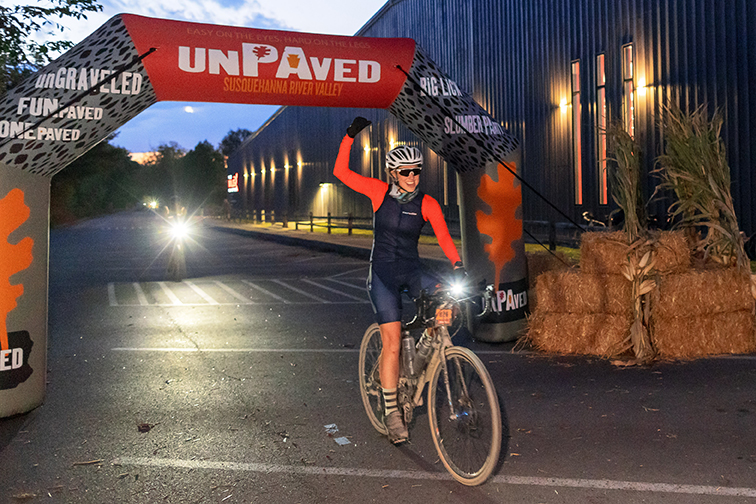
The new Big Lick-200 targets experienced backcountry adventurers seeking an ultra-endurance challenge. The popular SlumberPArty category combines overnight camping with catered breakfast service from Backyard Beans Coffee Company.
Photo courtesy of unPAved Pennsylvania
Recreational riders can choose distances ranging from 30 to 130 miles using interconnected course loops. All participants receive whoopie pies and finisher prizes at the concluding DONEpaved Party.
The event has grown from a single-day race to a three-day weekend celebration. Activities begin Friday night with pub crawls through Lewisburg, continue Saturday with the Lewisburg Fall Festival and social rides, and conclude Sunday with the main racing events.
“The Susquehanna River Valley Visitors Bureau has proudly supported the unPAved of the Susquehanna River Valley gravel cycling event since its launch in 2018,” said Judy Machesic, member and community engagement director. “Over the years, we’ve watched it grow into a premier event that draws riders from across the country.”
Corporate sponsors include Stan’s NoTubes, Lauf Cycles, New Trail Brewing, and more than a dozen cycling industry companies. Event proceeds support Pennsylvania Environmental Council and Penns Valley Pedals and Pints.
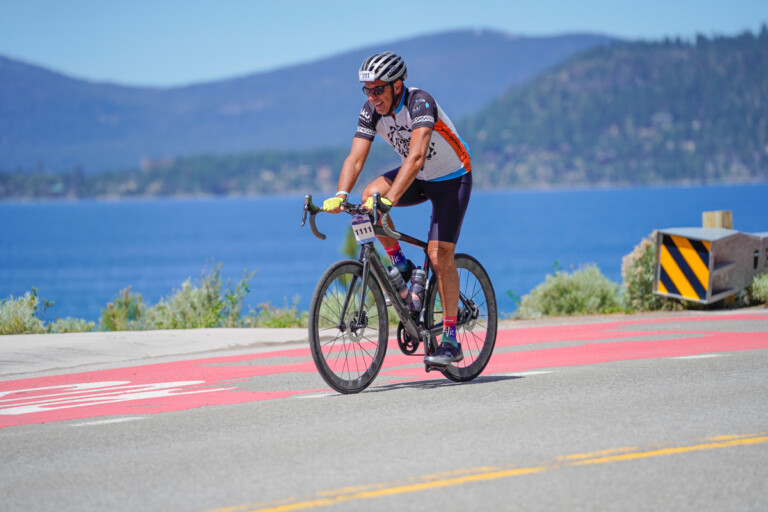
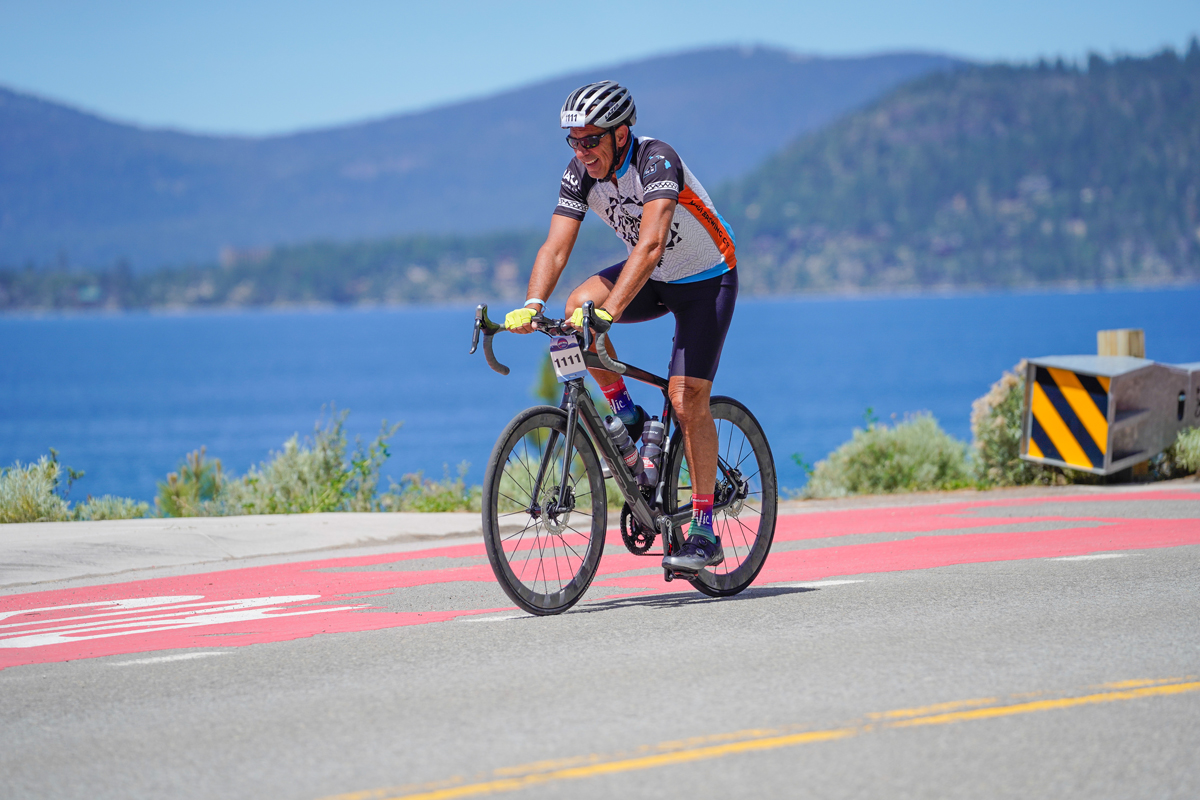
America’s Most Beautiful Bike Ride in Lake Tahoe is the ride of a lifetime. For those affected by blood cancer, it can be lifesaving.
WASHINGTON, D.C. (APRIL 9, 2025) – Cyclists from across the country are helping blood cancer patients live longer better lives by gathering in Lake Tahoe on June 1, 2025, to participate in America’s Most Beautiful Bike Ride. While enjoying picturesque views, their efforts will drive forward the mission of The Leukemia & Lymphoma Society (LLS): cure blood cancer and improve the quality of life of all patients and their families.
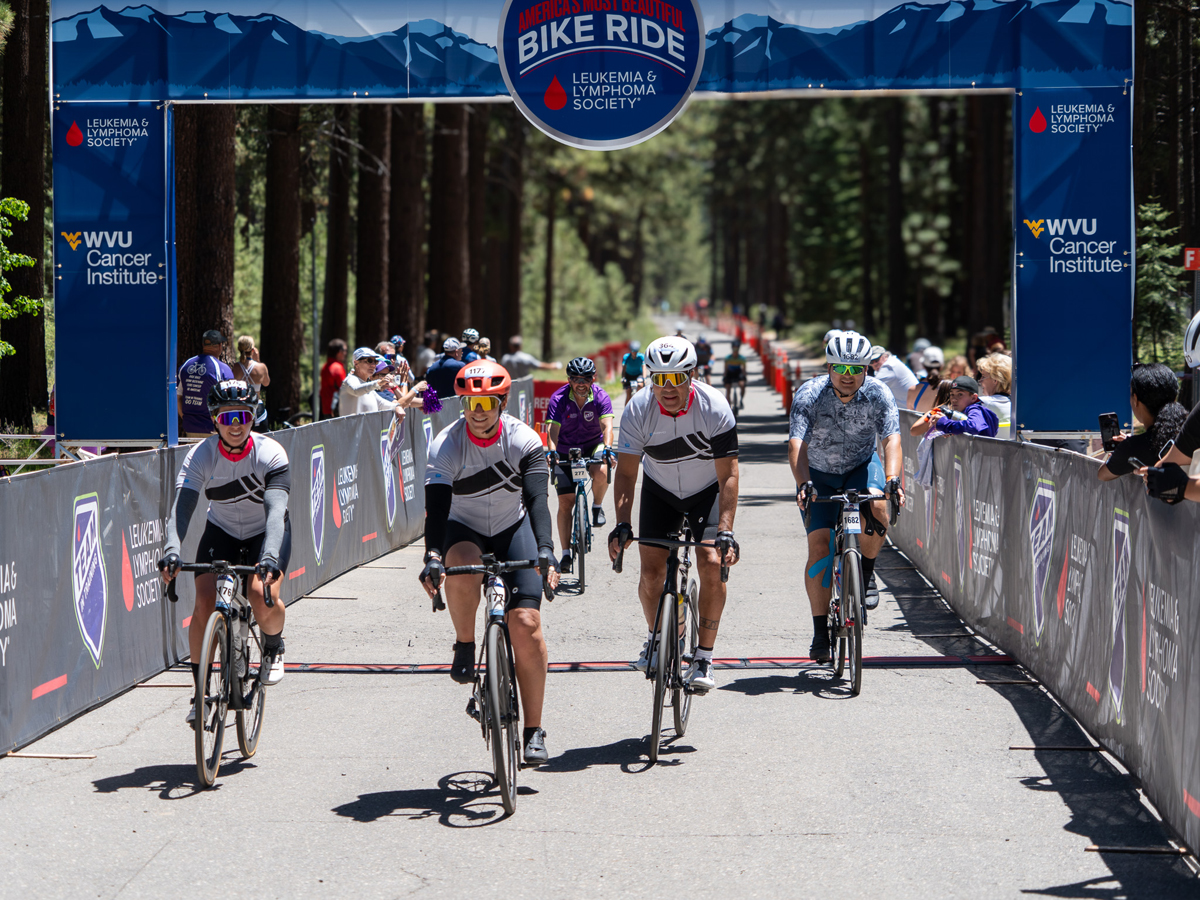
Scenes from the 2024 America’s Most Beautiful Bike Ride around Lake Tahoe, CA. Photo by David Braun, Captivating Sports Photos, courtesy Leukemia and Lymphoma Society.
During the past 28 years, America’s Most Beautiful Bike Ride has hosted nearly 30,000 cyclists who have raised more than $115 million for LLS. Cyclists preparing for their ride of choice of 35, 72, or 100 miles around iconic Lake Tahoe can train independently as a general rider or be coached through LLS’s Team In Training, the largest athletic endurance training program in the world.
Joining riders this year is LLS President and CEO, E. Anders Kolb, M.D., who will be leading his very own fundraising team, “PedAL to the MedAL” with his brother, Bill Kolb.
“I dedicate my ride to everyone who has dealt with a blood cancer diagnosis,” said Dr. Kolb. “Their grit and resilience powers me through every pedal stroke, hill, and winding road.”
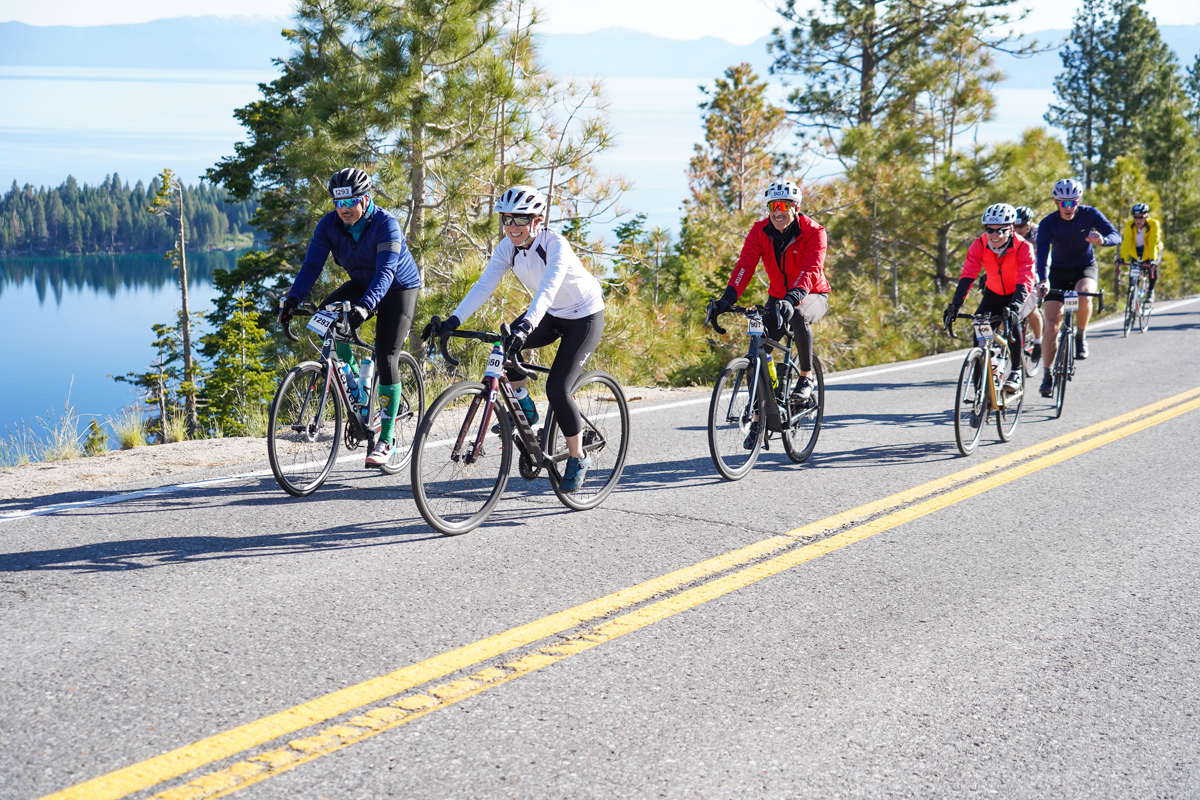
Scenes from the 2024 America’s Most Beautiful Bike Ride around Lake Tahoe, CA. Photo by Captivating Sports Photos, courtesy Leukemia and Lymphoma Society
After an injury cut his training journey short last year, Dr. Kolb is back to conquer the ride, as he prepares to complete 100 miles. He has set an ambitious personal fundraising goal of $100,000 for LLS.
“At LLS, we believe that everyone impacted by blood cancer deserves longer and better lives and I’m looking forward to riding alongside LLS’s incredible supporters who are helping us achieve that vision!”
Recently, Dr. Kolb announced LLS’s bold goal for the future: to enable blood cancer patients to gain more than one million years of life by 2040.
Scenes from the 2024 America’s Most Beautiful Bike Ride around Lake Tahoe, CA. Photo by Captivating Sports Photos, courtesy Leukemia and Lymphoma Society
America’s Most Beautiful Bike Ride has chosen five-year-old leukemia survivor, Vera Padilla of Sacramento, CA as this year’s Honored Hero. As a young survivor who has been through more than most adults could fathom, her heroic story serves as an inspiration for everyone involved.
“Participants of America’s Most Beautiful Bike Ride are helping LLS advance groundbreaking blood cancer research, patient support services and resources, and advocacy for policies that ensure all patients can access innovative cancer care,” said Coker Powell, LLS Chief Revenue Officer.
In its efforts to help all those affected by blood cancer, LLS actively partners in communities across the country. This year, LLS is proud to partner with WVU Cancer Institute as America’s Most Beautiful Bike’s premier sponsor, Subaru of America, and venue partner Tahoe Blue Event Center.
Join America’s Most Beautiful Bike Ride
WHY: To support LLS and make an impact in the lives of all those affected by blood cancer WHEN: Sunday, June 1, 2025 WHERE: Lake Tahoe, NV
REGISTER: Interested riders of all levels are encouraged to register through LLS’s Team In Training program. “Teammates” will receive event access and can choose from three distance options, 35, 72, or 100-mile rides. Register here!
By Charles Pekow — First they made you go through metal detectors and inspect your bags. And some venues won’t even allow fanny packs, let alone backpacks. Since the 2001 terrorist attacks, fences went up around some federal installations. And now, the federal government may even restrict bicycles on or even near some federal property.
The Department of Homeland Security (DHS) proposed updated regulations for Protection of Federal Property. The proposal would “prohibit the unauthorized use, operation, parking, locking, or storage of vehicles or other personal transportation devices on federal property.” The definition specifically includes bicycles and scooters.
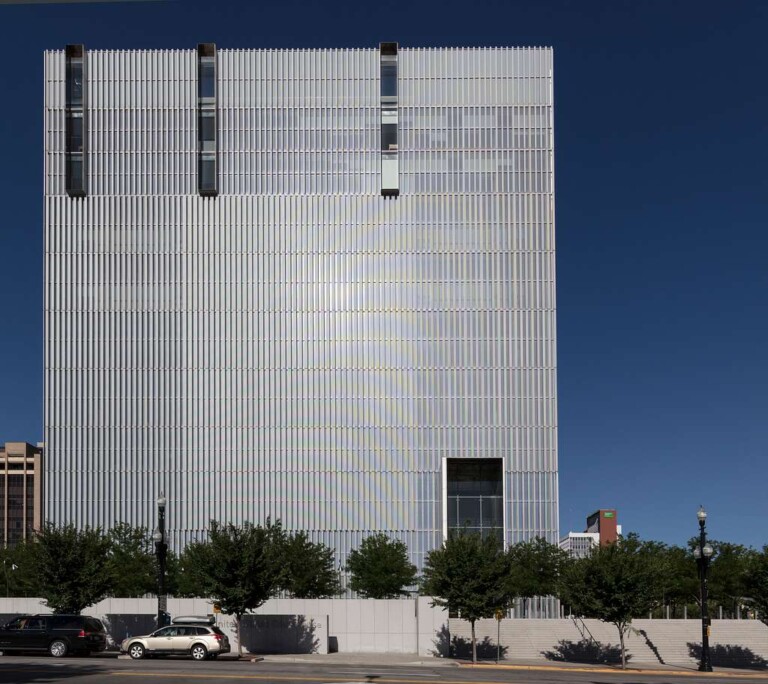
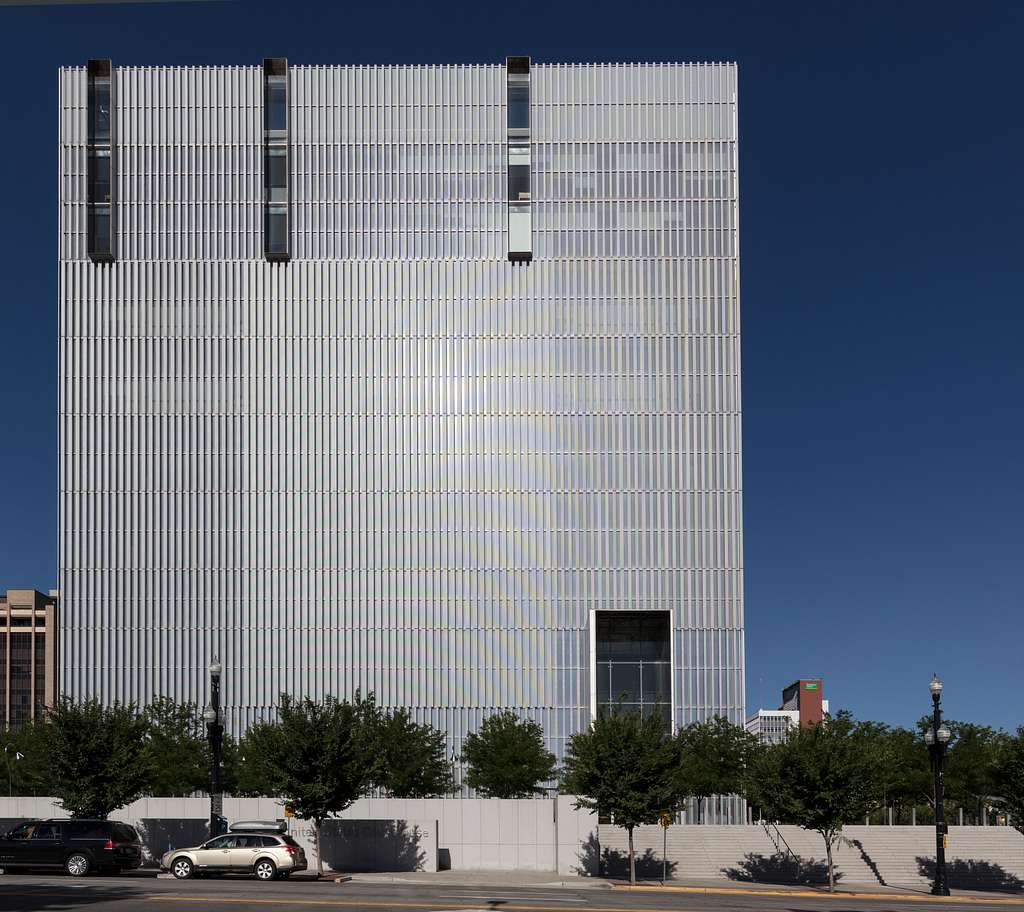
US Courthouse for the District of Utah, also known as the Borg Cube. Credit: Carol M. Highsmith’s America, Library of Congress, Prints and Photographs Division
The devices would be OK, however “when specifically allowed in designated areas.” DHS says these vehicles can create “security threats” by blocking entrances/exits or being rammed into people or facilities. DHS says it has observed vehicles parked at or near federal facilities unattended for significant time in dense urban areas and they could also be used to carry explosives.
DHS spokesperson Amelia Roberson clarified in an email to Cycling West that the proposed rule “does allow the restriction on the use and parking of bicycles on federal property in limited circumstances. For this provision to be in force, the federal facility must identify areas where either the use or parking of bicycles affect the security of the federal facility or adjacent federal property, and then provide constructive notice (signage) at those specific locations that the use or parking of bicycles is prohibited. The prohibition on the use or parking of bicycles in these restricted areas will not impact either existing bike parking racks or the ability to establish bike parking racks at federal facilities by federal facilities.”
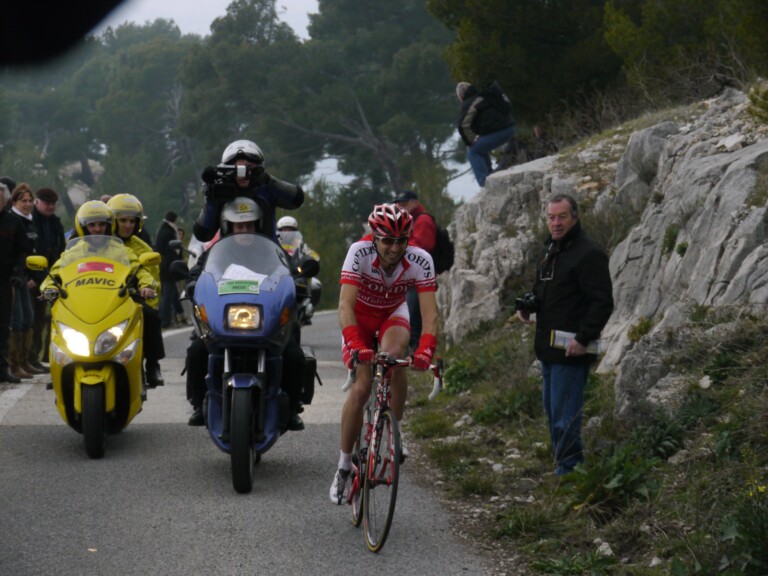
By Dave Campbell — The Tour Méditerranéen, later called simply La Méditerranéenne, was a four day long early season (February) stage race held in France, Italy, and Spain along the Mediterranean Coast. It was run from 1974 through 2014 and was the brainchild of former Tour de France winner Lucien Aimar. The race was mainly held on the Cote d’Azur in France but also occasionally featured stages in Liguria, Italy. The final edition held in 2016 after no race the previous year, spanned three countries, starting in Spain, then racing in France for two stages, before a final stage on the Italian Riviera. A summit finish atop Mont Faron in Toulouse was traditionally the deciding stage. Unfortunately, a parallel race for women was never held.
David Moncoutié – 800m de l’arrivée Tour Med au Faron – Toulon – février 2011 – P1000440. Photo by Yves Tennevin, CC BY-SA 2.0, Attribution-ShareAlike 2.0 Generic
Q1. Who has won the most editions of Tour Méditerranéenne?
Q2. Who was the first English-speaking rider (anglophone) to triumph over the Dutch, French, Italians, Belgians, and Spaniards in this event?
Q3. Did an American or an American team ever win this short stage race?
Q4. All the following Grand Tour winners and all-time greats list this race in their palmarès, excepting one: Eddy Merckx, Bernard Hinault, Tony Rominger, Gianni Bugno, and Laurent Jalabert. Can you spot the intruder?
Q5. Who was the first American to win a stage of the Tour of the Med?
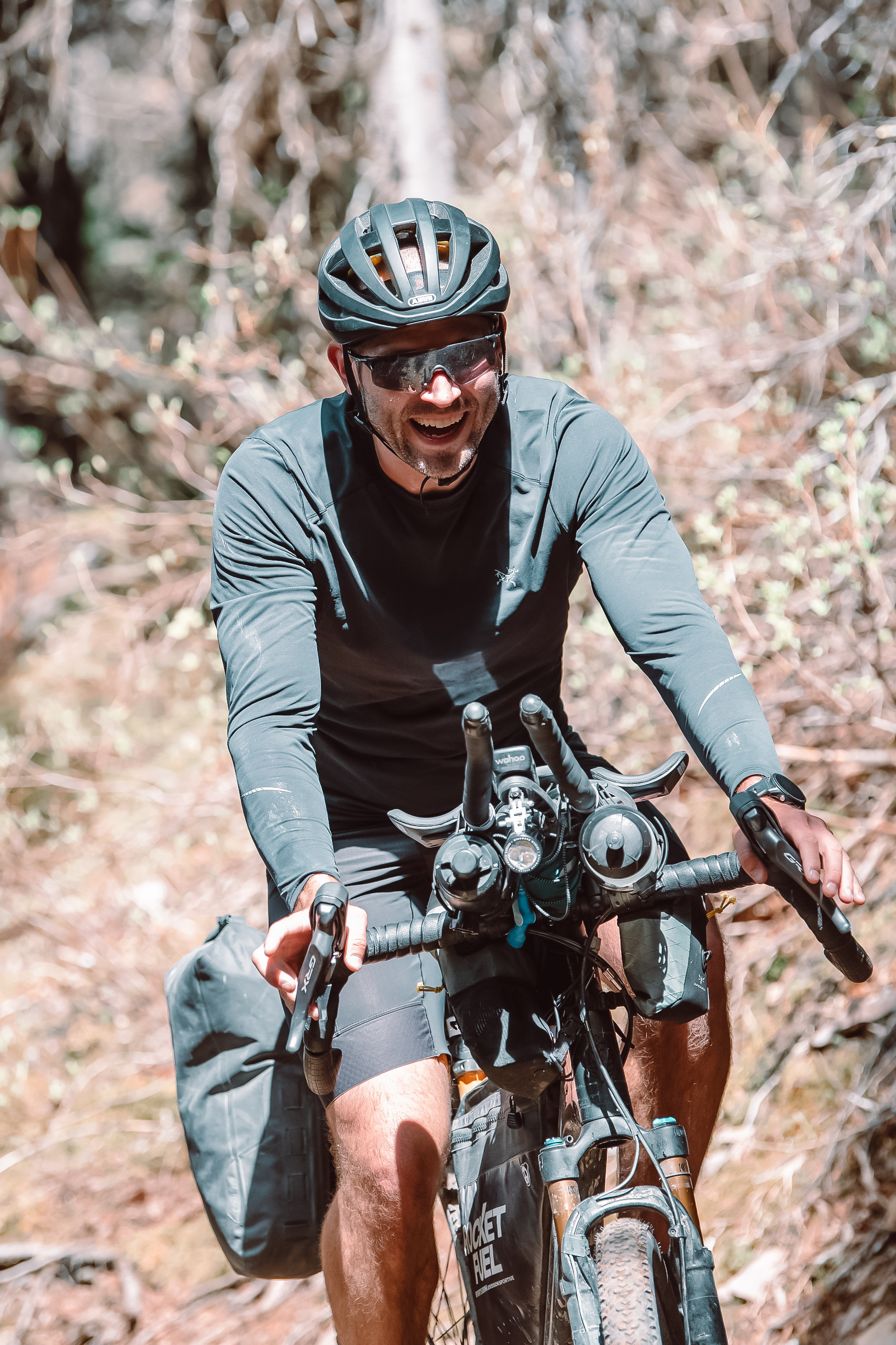
QUÉBEC, Canada (May 18, 2025) — After more than two years of work behind and in front of the camera, Canadian filmmaker and endurance cyclist Gabriel Rancourt has released Beyond the Dots, a feature-length documentary that takes viewers deep into the physical and emotional realities of the Tour Divide, one of the most grueling bikepacking races in the world.
The 2.5-hour film, now streaming for free on YouTube, traces Rancourt’s 2,600-mile ride from Banff, Alberta, to the U.S.–Mexico border—an ultra-endurance journey many cyclists describe as a test of the body, mind, and spirit. But the project’s ambitions go well beyond documenting another long bike ride.
“This isn’t just about the finish line,” Rancourt said in an interview. “It’s about the internal reasons we take on things that seem impossible. I wanted to ask: why do we do hard things?”
What started as a solo chronicle—originally titled Beyond the Dot, a reference to the GPS tracking used in ultra-distance racing—grew into something more expansive. The final film blends Rancourt’s raw, self-shot footage with videos and voiceovers submitted by fellow racers. The result is a multi-narrative exploration of connection, solitude, and the emotional complexity of pushing past perceived limits.
Through sweeping landscapes and moments of quiet reflection, Beyond the Dots turns its lens on the often-overlooked human element of endurance sports. Viewers follow not just the route, but the shifting psychological terrain of its participants. Visual aids like 3D topographic maps, elevation data, weather overlays, and real-time GPS positions help orient audiences unfamiliar with the geography or the demands of the race.
Gabriel Rancourt during the Tour Divide. Photo courtesy of Gabriel Rancourt.
Rancourt, who has spent more than two decades in the cycling world—from trials and enduro to cross-country and now ultra-distance—sees the film as both a culmination and a transition.
“This project closes one chapter for me,” he said, “but it also opens the door to something new.”
Early viewers have responded with praise, highlighting the film’s emotional depth and its central question: what drives people to embrace discomfort, risk, and isolation for days on end? Rancourt’s story, while grounded in the specifics of the Tour Divide, is framed to resonate far beyond the cycling community.
In tandem with the documentary release, Rancourt has launched a YouTube channel where he shares gear reviews, bikepacking tips, and behind-the-scenes content from the making of the film. He says he’s open to media collaborations and discussions about endurance sports, adventure filmmaking, and personal transformation.
For now, Beyond the Dots stands as both a love letter to long-distance riding and an invitation to reflect on the challenges—both internal and external—that define our most transformative journeys.