Saturday, January 10, 2026
Home Blog Page 326

Sharing our Urban Canyons

By  Dan Fazzini Jr., LCI, Chair, Salt Lake County Bicycle Advisory Committee

Urban Canyons are a great place to ride.  They usually offer great scenery, generally slower motor vehicle traffic and are close to the areas which we live.  The convenience of these canyons also comes with some tradeoffs.


Many hazards and challenges are presented to us when riding these canyons.  Some have better shoulders than others, some are narrow, some are wide, some have rock fall and some have intermittent natural light.


Many modes of transportation are frequently used in these canyons.  In addition to cyclists other users include:  drivers in motor vehicles, runners, equestrians, hikers, motorcyclists, those just on a scenic drive, dogs and the occasional moose.  In order for each user group to be safe, we must all respect each other’s right to use the roadway corridor in a safe and thoughtful manner.


Shoulder Use

Many canyons have a useable paved shoulder.  The uphill cyclist should utilize these as much as possible (provided that the shoulder is reasonably free of debris and obstacles such as garbage cans, large rocks and parked cars).  However, a cyclist should not ride so far to the right as to be “invisible” to residents pulling out of their driveways or being hidden around right bends to other drivers cutting over the fog line (white shoulder stripe).


Utah State Code 41-6a-1105 requires the cyclists to ride as far to the right as is “practicable,” gives some examples as to why the cyclist could or should move from that position, and when it is “legal” to ride two abreast.


Riding Two Abreast

For the purposes of riding in these canyons, law enforcement is currently including the shoulder when determining if riders are riding two abreast if at least one is in the traffic lane.  To my knowledge, this has not yet been challenged in court.  Their opinion is that if it is safe for the rider to ride in the shoulder, then the 2nd rider is unnecessarily “impeding the normal and reasonable movement of traffic.”  For canyons such as Emigration Canyon in Salt Lake County, the County installed a widened shoulder striped on both sides of the shoulder which could be taken as being part of the “roadway.” There are arguments on both sides of this issue which we could discuss, but that is for another forum.


Due to increasing calls to the Sheriff’s office in Salt Lake regarding Emigration Canyon, by both motorists and cyclists, they are increasing their enforcement efforts and citations in the canyon.  The Canyon Patrol Deputies will generally watch to see if you were just passing or having an extended conversation while keeping two abreast.  If you can both safely keep in the shoulder, you can ride two abreast.  If you do get stopped, be polite! And it does yourself and the rest of us no good to lie to them about how long you were riding two abreast.


The Major Issues

In State law, the right to ride two abreast includes not “impeding the normal and reasonable flow of traffic.”  Dropping back once the cyclists sees a motorist could be taken as violating this rule as the motorist has likely already slowed down.  As the driver now has to accelerate (uphill), it takes them longer to safely pass, and the longer they are near or over the centerline, the longer safety is reduced to both the motorist and cyclist.

The number one issue for residents in the canyon is “large groups” riding together.  Even though we all have the “right” to use the canyon, please be cognizant of the rights of the other users as well.  There is little drafting advantage in riding in large packs uphill and it can be unsafe at downhill speeds.  In addition to the fact that large packs have a tendency to ride two or three abreast (see above), they are much harder to pass safely on narrow canyon roads due to their extended length. “We all want the same thing, for all users to enjoy travelling the canyon safely,” notes Joe Smolka, Chair, Emigration Township Council.


Rider’s Duty to Share the Road

By being good stewards of the roadway and avoiding riding in large packs and two or more abreast when it is not necessary, motorists have less reason to get impatient.  This can decrease passing when it is less safe to do so, either by crossing the double yellow line or passing to closely to the cyclists.  Although, an “unsafe” pass by a motor vehicle isn’t excused by an illegally riding cyclist, the cyclist can ease tension by making reasonable efforts to share the roadway when safe.  The cyclist has the most at risk as being the more vulnerable vehicle; this includes recognizing when even a single rider may be delaying a long line of motor vehicles due to the terrain.


As for other areas of the canyons: constantly be on the lookout for bottlenecks and other hazards, such as narrow lanes with no shoulders, going around turns, hidden rock fall around turns coming down the canyon, and other incursions by vehicles and pedestrians. Extra caution is needed when travelling down the canyon at higher speeds; at these higher speeds, it is more reasonable to ride further to the center of the lane, so that you’ll be seen more as a vehicle by cross traffic and have a better view of the roadway and debris.


In Salt Lake County, we are working with the County to provide more frequent sweepings of the canyons, re-examining the signage for both motorists and cyclists, evaluating and repairing the shoulder and other portions of the roadway used by cyclists, and working with the Sherriff’s office on reasonable enforcement issues.  The Township is also working with the County and residents to make Emigration Canyon safer by keeping obstacles such as garbage cans off the roadway.  No matter where you live, communicating with your government and local officials mends many fences, but it all starts and ends with the cyclist’s behavior on the roads, we must each take responsibility for our own actions first.


Here are some general tips to help keep us all safe in the canyons:


Ride Single File

When riding up narrow canyons, ride single file as much as possible.  Always be on the lookout for motorists behind you.  Remember you are traveling much slower in this direction.  Allow faster traffic to pass when it is safe to do so.  Avoid riding in large groups which are harder to pass, even in single file.


Riding Down

When riding down a canyon, watch your speed, you can be ticketed for speeding. Only ride a speed that you are comfortable with for the given conditions and your riding ability. If riding less than the speed of other traffic, you still must “ride as near as practicable to the right-hand edge of the roadway” as conditions permit; however, your safety comes first.


Use caution when braking and going around turns; you want to do a majority of your braking before the turn.  Hard braking during a turn can result in your bike swerving into the oncoming lane.


Use caution around narrow curves, especially where rock fall is common, Utah law allows cyclists to ride towards the center of the lane when: “a lane that is too narrow for a bicycle and a vehicle to travel safely side by side within the lane.” (Do so sparingly, but your safety comes first)


Obey All Signage

Obey all traffic control devices (stop lights, stop signs, single file signs etc.)


Be Courteous

Remember the roads and trails belong to everyone.  Be a “Bicycle Ambassador,” wave to others to acknowledge others who recognize and give you the right-of-way, whether they were required to or not.  There is a difference between “our right” and “doing what is right.”


Utah and Salt Lake County bicycle related laws can be found at www.safe-route.org/laws
For information on taking a “Cyclist Education/Vehicular Cycling” course, please visit www.slcbikecollective.org.


Dan Fazzini is a longtime bicycle commuter, a League Cycling Instructor, chair of the Salt Lake County Bicycle Advisory Committee, founder of Safe-Route Connection, Inc. and sits on various cycling and planning boards.  www.slcbac.org, www.safe-route.org, [email protected]


OGDEN – SNOWBASIN TO HOST XTERRA NATIONALS

0

HONOLULU, HI – The 2011 XTERRA Trail Run National Championship is moving to Snowbasin Resort near Ogden, Utah, on Sept. 25.


The XTERRA Trail Run Nationals will be held one day after the XTERRA USA Championship of off-road triathlon to create the ultimate XTERRA racing weekend.


The two events will bring more than 1,000 of the nation’s very best amateur and professional triathletes and trail runners to Northern Utah to battle for the title of XTERRA National Champion.

While the USA Championship off-road triathlon is an invite only race, the XTERRA Trail Run National Championship is open to the public, so one and all can challenge the best-of-the-best trail runners and race for a national championship.

XTERRA Trail Run Nationals is the final event of the 70-race XTERRA U.S. Trail Run Series, which is currently underway with races across the country. Runners from the 12 respective regions in the U.S. Series can now focus on Snowbasin in Sept. as one of their goals.


The trail run championship is a 21-kilometer half-marathon, and the course will start and finish at Snowbasin Resort – a world-class ski resort that hosted the downhill and super G races for the 2002 Winter Olympics, and most recently served as the final stop of the Winter Dew Tour.

Located just 35 miles north of Salt Lake City, and just up the road from the adventure capitol of Ogden, Snowbasin is an easy get to and increasingly popular adventure travel destination. It has an incredible collection of trails, which are nothing short of spectacular in late September as the fall colors start bursting in an array of red, pink, orange, and yellow.

“We are terribly excited to bring our entire XTERRA Tribe – both triathletes and trail runners – together in Utah this September.  The energy level is going to be off-the-charts,” said Janet Clark, president of TEAM Unlimited/XTERRA. “Ogden and Snowbasin are proven winners – between the facilities at Snowbasin, the great restaurants and atmosphere along Historic 25th Street in Ogden, and the unbelievably supportive community – we couldn’t have asked for a better situation.”

The invite only off-road tri nationals will be held on Saturday, Sept. 24, along with full and half-distance XTERRA Utah off-road tris that are open to everyone.  The Trail Run Nationals will take place on Sunday, Sept. 25, and will be accompanied by 5km and 10km trail runs (registration for all events except the invite-only tri nationals is open now at www.xterraplanet.com).

Both the tri and trail running races will be filmed for nationally syndicated TV programs that will expose the beauty of Utah to millions. In addition to the races, XTERRA will host an expo in downtown Ogden with free kids races, vendor booths, Paul Mitchell hair cut-a-thon for charity, and evening dinner parties.
2011 marks the fifth year XTERRA has hosted a trail running national championship race.  In the inaugural season of 2007 nationals was a 10km race at Incline Village, NV.  In 2008 XTERRA switched the championship distance to the 21km half-marathon, and moved to Bend, Oregon, who played host to the past three national title races from 2008-2010.

For more information visit www.xterraplanet.com or www.xterratrailrun.com, or call toll-free to 877-XTERRA-1 (877-983-7721).


The XTERRA USA Championship weekend is sponsored by the Utah Sports Commission, Paul Mitchell, and XTERRAVitality.com. Sponsors include GU, Gatorade, Zorrel, Snowbasin Resort, GOAL Foundation, MediaOne of Utah, U.S. Forest Service, ENVE Composites, KSL TV, and the XTERRA Alliance – Wetsuits, Gear, Cycling, Fitness, Flex, and Footwear.


Time to Train Equals Time to Eat (right!)

written by Sylvie Allen, Coach – Trek Dirt Series www.dirtseries.com

(See our MTB Tours Calendar for the Trek Dirt Series in Park City)

Do you have goals and results that you’re striving for? This takes a lot of time and effort with planning and training. Your effort in scheduling your day with your workouts should include equal effort into planning your food for the day. What you put in your mouth is just as important as your physical training.


Weight Loss


For a safe weight loss program you want to decrease your total daily calories by 10-20%. Divide these calories evenly throughout the day, here’s an example for a 2100 calorie day:

Breakfast 7-8am:  500 cals

Lunch 11am-12pm: 600 cals

2nd Lunch 3-4pm:  400 cals

Dinner 7-8pm: 600 cals


By skipping meals, ‘fasting’ or not eating breakfast, you are training your body to ignore hunger signals and you will decrease your metabolism. You could also get yourself so hungry that you overeat on unhealthy snacks to quickly satisfy yourself before the real meal, now there’s a whole bunch of unnecessary calories! If you cut back too much on your calories, you will loose lean muscle, slow your metabolism, and consume too few nutrients to protect your health and invest in top performance.


How to calculate your caloric needs:


  1. Calculate your Resting Metabolic Rate (RMR): Weight x 10

This is the base which is what your body needs to simply function: pump blood, work the organs, etc. If you are significantly overweight, use an adjusted weight such as ½ way between your current weight and your desired weight.

  1. ADD: Daily Activity: +/- 50% of your RMR: do you move non-stop during your day or are you on the couch or at a desk? +20-40% sedentary, +50% for moderately active, +60-80% very active
  2. ADD: Purposeful Exercise: 400-800 cals/hr
  3. To loose weight, subtract 20% from your total after your calculations above.


Early Morning Workouts

Do you work out really early in the morning and don’t eat anything before hand?

By simply eating some carbs and drinking water, you will increase your level of performance by 20% over having nothing, let alone feeling more energetic. Wow 20%! Why wouldn’t you want that improvement?!

Your muscles and brain need carbs! After a night of fasting there really isn’t anything left for your muscles to use for energy, let alone thinking properly.


Here’s some examples of what you can eat:

Fruit                                    Cereal

Fruit + Yogurt                        Granola bar

Smoothie

Energy drink – diluted

If you really can’t tolerate anything immediately before working out then you can have your bowl of cereal right before you go to bed and you will have some spare carbs left for your early workout.


Everyone has different guts! Some of us can eat 5 minutes before working out and others 4 hours. You need to find out what works for you so you can plan your meals in advance to have sustained energy through your workout.


Post Exercise Carbing (eating):


Your muscles need mostly carbs and a small amount of protein to recover from a workout. It’s really important to eat carbs of any sort within the 1st hour after your workout. It can take up to 2 days to fully recover and top up your muscle glycogen stores after full depletion (that’s after a really really really hard effort!). A bike ride around Lost Lake doesn’t warrant endless burgers and beer!

Low muscle glycogen stores will jeopardize performance. So it’s important to start your workout with carbs 4 hours prior and top up on more carbs post workout. For 2 workouts in one day or very long workouts you will need to eat a high carb diet. There is a balance between your carb (energy) intake and your energy output. Careful not to drink a 500 cal energy drink while only burning 300 cals while exercising – it will be hard to loose weight on that program!


Recovery Drinks & Protein:


Recovery between workouts is crucial for your muscles to rebuild and refuel. ALSO for your mind to rest and recharge. Without the proper re-fueling after a workout, you risk decreased performance. Remember that during your recovery day, you will feel hungry even though you’re not exercising – your muscles are asking for energy to replenish. You will also gain weight since carb refueling / glycogen holds water. Therefore your increased weight is water weight. Perhaps similar effect to pigging out on Christmas dinner and panicking on the scale the next day… you just ate way too many carbs!


Here’s where protein comes into the picture. Protein will BUILD your muscles and Carbs will RECOVER your muscles by replenishing your glycogen stores. You need 3 X more carbs than protein.


Here is an ideal recovery drink ratio:

8 grams carbs

10 grams protein

3 grams fat

Total Calories = 100


If you’re making a protein smoothie (from powder) add some fruit in it so you get some carbs in the mix.


Here’s some examples of protein you can use to re-build after your workout that won’t cost you as much as protein drinks:


2 Tablespoons of peanut butter = 8 grams

2 large egg whites = 7 grams

16 oz milk or yogurt = 16 grams

1 can tuna = 40 grams

6 oz chicken or beef = 45 grams


It’s pretty simple to get your required protein intake from REAL food versus an engineered food such as a powdered supplement! These engineered foods often create more problems than real food such as getting too much protein. Here’s a sample comparison of a protein drink vs. real food and the amino acid contents:


Isoleucine            Leucine

Met-Rx Whey Protein – 1 scoop                        1.4 grams            2.3 grams

Chocolate milk – 16 oz                                    1.2 g                        1.9 g

Tuna – 6 oz                                                            2.0 g                        3.5 g

Cottage cheese – 1 cup                                    1.6 g                        2.9 g


But how much protein should you consume in one day??

.6 – 1 gram / protein per lb of body weight

Here’s some examples:


Intake/lb                        Grams of Protein / Day

200lb Football player                        .7 – 1.0                        140-200g

150lb Runner                                    .6 – .8                                    90-120g

80lb Gymnast                                    .9-1.0                                    72-80g


Benefits and costs of eating right:


Benefits

–         eating a healthier diet and having more energy all day

–         perform better; perhaps achieve your personal best

–         weight management becomes easier

Costs

–         planning takes time and energy

–         fewer ‘pig outs’ on yummy junk food


PLAN ON 80-90% QUALITY IN YOUR DIET


Manage your time: if you have time to train, you have time to eat right – it’s just as important!


Excerpts from Nancy Clark’s Sports Nutrition Guidebook


Sylvie Allen is …

She’s also a coach for the Trek Dirt Series, a mountain bike instruction program that travels across Western Canada and the US, delivering technical skills and overall motivation to beginner, intermediate, and advanced mountain bikers all season long. For a list of their women’s specific and co-ed camps, please see www.dirtseries.com.


WYDAHO Rendezvous Mountain Bike Festival Announces Schedule of Events

Driggs, ID June 7, 2011, Teton Valley Trails And Pathways announces that this year’s lineup of events includes 16 group rides on area singletrack trails, downhill and cross-country races at Grand Targhee Resort, bike demos from bicycle companies Giant and Yeti, riding skills clinics by RipStoke, and three trials-riding demos.  There will be parties too, of course – Friday’s at the Ice Rink in Victor, featuring Jackson band The Outfit; Saturday’s in front of the Driggs City Center, and Sunday’s at Targhee with music by the Jet Black Ninja Funkgrass Unit.


Mountain bike festivals have become increasingly popular events throughout the nation. In addition to providing an opportunity for riders to gather and enjoy riding together, festivals effectively draw attention to area trails.  Teton Valley offers superb trails that are worth spotlighting.  “I am consistently impressed by the quality of off-road riding we have here.  Truly, Teton Valley should be a mountain bike destination, on the roadmap for any biker” says Scott Fitzgerald, Mayor of Victor, Idaho and Owner of Fitzgerald’s Bikes in Jackson, WY.


When a location becomes a “destination riding area,” the local economy stands to benefit enormously from the influx of riders who dine, shop, and sleep in the surrounding communities.  “I see the growth of mountain biking in Teton Valley as a boon to the city of Driggs,” says Driggs Mayor Dan Powers.  “Cyclists spend money in the towns they visit. As we improve the quality of biking here, we’re better able to attract businesses who view this as an important amenity.  These businesses can create the good jobs we really need, and everyone benefits from that.”


For only $30 ($25 before June 15th!), participants in the Wydaho Rendezvous Mountain Biking Festival will gain entry to all events and receive a “swag bag” of goodies from sponsors.  Registration is available online now at www.athlete360.com.


Sponsors of the event to date include Sram, Wells Fargo Bank, Grand Targhee Resort, Fitzgerald’s Bicycles, Peaked Sports, Yostmark, Kate’s Real Food, Heimerl Law Firm, Garage Door Handiman, Western Spirit Adventures, Jackson Hole Resort Lodging, Yeti, Fox Racing Shox, Smith Optics, Specialized and Powers Builders.  “We’re really pleased with the support we have so far,” says Tim Adams, Executive Director of TVTAP.  “We’re looking forward to the continued backing of both local and national businesses,” Adams adds. “We are dedicated to creating an event that will become an annual tradition in Teton Valley, bringing people together to highlight the extensive and world class mountain bike trails in the region.”


For more information on the Rendezvous, including how to become a sponsor, go to the event’s website at www.tetonmountainbikefest.tvtap.org or contact [email protected].


Crusher in the Tushar Changes Route Due to Snow

Salt Lake City — An unusually large amount of snow has forced a decision to re-route the “Crusher in the Tushar,” race course, while two-time Olympic mountain bike racer Tinker Juarez is the latest renowned rider to sign up for the half dirt, half road race on July 16 in Southern Utah.

Race promoter Burke Swindlehurst said there was a “1 in 100 snow year” in the area, with roughly a 300 percent increase in total accumulation. The United States Forest Service made the final decision that a re-route was necessary due to the snowfall.

“Trust me, there’s nobody who is more disappointed about the need to re-route the course, but Mother Nature has taken it out of my hands,” Swindlehurst said. “I received word from the U.S. Forest Service yesterday that it would not allow the event to go over Big John’s Flat Road until they had cleaned the debris from a large avalanche on the backside of the course. Unfortunately, that’s not something that can be done before the race.”

Still, Swindlehurst believes participants in the first-time event will be satisfied with the adjusted route.

“The alternate route I have is actually the first version of the race I drafted up,” Swindlehurst said. “It also maintains all the attributes that make this event a ‘Crusher.’ It is 69 miles and has more than 10,000 feet of climbing. I rode it last weekend and it nearly broke me.”

Juarez joins an already diverse group of marquee riders that includes Canadian Olympic cyclist and speedskater Clara Hughes, two-time U.S. national cyclocross champion Tim Johnson and domestic road professionals Tyler Wren and Nick Frey (both of Jamis/Sutter Home) and Paul Mach (BISSELL Pro Cycling).

Juarez is a fan favorite whose 35-year professional cycling career includes Olympic appearances in 1996 and 2000, three cross-country national championships, a Pan American gold medal, and a Masters world championship in 2010. He said he signed up to race the course that fits his racing style and schedule perfectly.

“A friend recently called and asked if I’d heard about this crazy new race that Burke was putting on, so I checked out the website and and saw quickly that it was the perfect prep for Leadville,” Juarez said. “It looks like it has a ton of climbing at high elevations and it’s exactly a month out from Leadville. The photos of the mountains look amazing and I can’t wait to explore a beautiful new place on my bike.”

Wren said he also knew immediately he wanted to be a part of the first edition of the event.

“Burke and I have many similar tastes,” the Salt Lake City resident said. “Namely, we both love the Utah landscape, all kinds of bikes, and to suffer mightily on those bikes.”

Swindlehurst said Johnson, who raced 11 years professional on the road in addition to cyclocross, was the first big name to sign up. Swindlehurst, who is the BISSELL Pro Cycling assistant director sportif in addition to the Crusher race promoter, knows both Johnson and professional racing well.

“I’m so stoked to have him at the event,” Swindlehurst said. “We’ve known each other for quite a while, having raced against one another on the domestic circuit for so many years.” 

For more information on the race re-route, the latest confirmed riders, how to register, or other topics involving the Crusher, visit www.tusharcrusher.com.


Cycling Utah’s July 2011 Issue is Now Available!


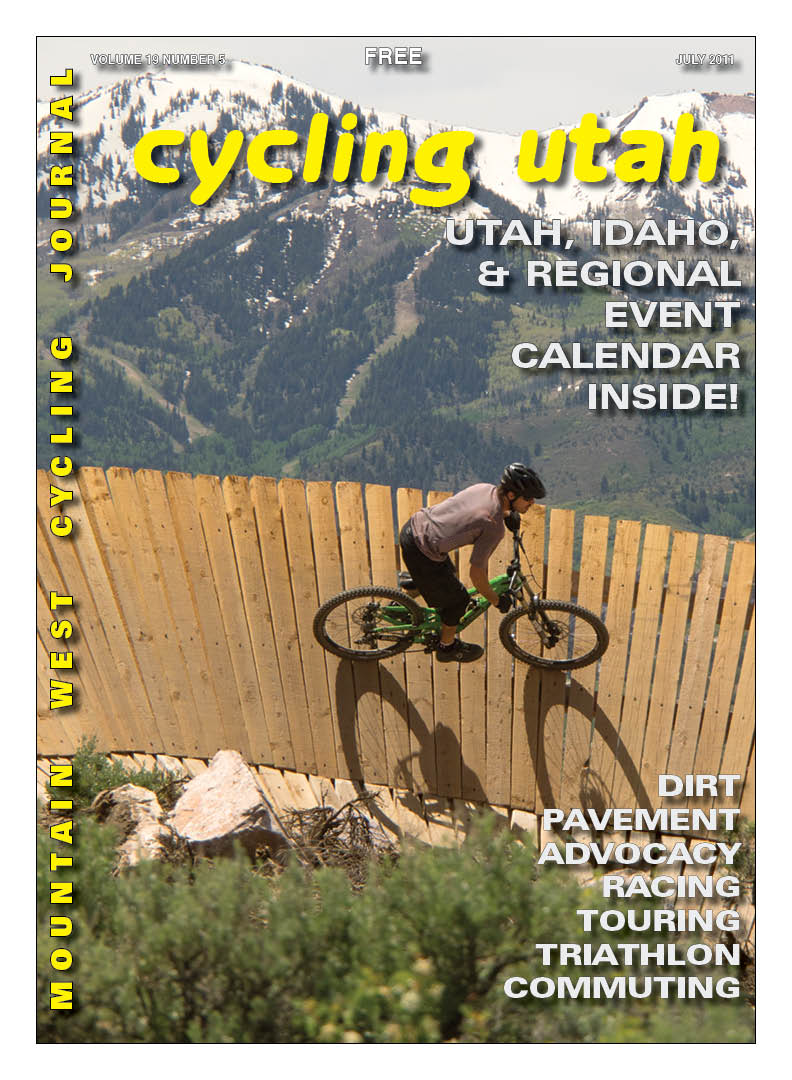
Cover: A rider on the banked wooden curve at the brand new Trailside Park Mountain Bike Park in Park City. See the story on page 16. Photo: Photo John. See more at flickr.com/photos/photo-john or the gallery at PhotographyREVIEW.com


Our July 2011 Issue is now available as a PDF (6.4 mb download), Pick up a copy at your favorite Intermountain bike shop or other location!


Featuring :

Contents

Brynn Barton, 24, Struck and Killed By Hit and Run Driver page – 2

The Climbs of Salt Lake County page – 3

Raising Bike Friendly Kids Part Three: And They’re Off! page – 4

DinoTri Carves Its Own Niche page – 5

The Southwick Family Instills a Love of Cycling page – 6

Tour of Utah Volunteers Needed page – 6

Inherit the Win page – 7

Tour de Cure Raises $483,000 page – 7

Biking Through the ‘Hoods — Exploring Fifty American Cities by Bicycle page – 8

Utahns Excel at 2011 USAC National Championships page – 8

Is Working with a Coach Necessary? page – 9

Bike Collective News page – 11

Showalter to Red Canyon Ride page – 13

Pedaling Veganism page – 14

Trailside Park Bike Park Opens in Park City page – 16

29’ers, They’re Not Just for Single-speeding Anymore page – 17

Sherwin and Day Crowned State Champions at Deer Valley Pedalfest page – 18

Swenson and Carey Take USCS XC Race #2 on Round Valley Course page – 20

High Uintas Classic Stage Race a Success page – 21

Keen Austin Pedal Shoe page – 25

Road Respect Tour Teaches By Example  page – 29

An Excerpt from “Mythical and Tangible: Tales of Life, Liberty, and the Pursuit of Singletrack” page – 30

Tricycle Touring In Southern Peru page – 32

Delta-Sevier River Ramble page – 34

Utah and Idaho Fall in Bicycle Friendly State Rankings page – 35

Bicycle Safety Funds Could Be Better Utilized page – 35


Bike Night at The Salt Lake City Library July 6

July 1, 2011 – SALT LAKE CITY — The City Library, with the Salt Lake PoliceDepartment, the Salt Lake Bike Collective and the Salt Lake City Mayor’sBike Advisory Committee, are ‘gearing up’ for Bike Night at the City Library, which will be held on July 6 from 6:00 – 7:30 p.m. on LibrarySquare.
Bicyclists of all ages and abilities are invited to an evening of bike skills, safety, registration, and information. With presentations and information from a variety of local experts, Bike Night will ensure Salt Lake City residents have the know-how to stay safe while riding in allconditions and keep their bikes secure while they enjoy the city.
Bike Night is sponsored by The City Library, the Salt Lake City PoliceDepartment, Salt Lake Bike Collective, And the Salt Lake City Mayor’s BikeAdvisory Committee.
Events:- The Salt Lake City Police Department will offer bicycle registration andpresent their Bike Rodeo, a hands-on riding skills and safety course forkids, including free helmets for participating children.- The Salt Lake City Police Department will present “Respect is a Two-WayStreet,” information about staying safe and respectful while biking on citystreets.- The Salt Lake Bike Collective will demonstrate how to lock you bike forsecurity in any situation and provide bike valet for attendees.- The Salt Lake City Mayor’s Bicycle Advisory Committee will distribute bikeways maps and receive community comments on ways to improve Salt LakeCity for bicyclists.

Brynn Barton, 24, Struck and Killed By Hit and Run Driver

0

Police Ask for Public’s Help; A Thousand Cyclists Ride in Solidarity.

By Dave Iltis—On June 7, 2011, twenty four year old Brynn Barton was struck and killed on 700 E at around 750 S. by a hit and run driver. According to Salt Lake City police, it appears as though she was not on her bike when she was hit, and was possibly on the roadway already. She had been riding with two friends who were ahead of her and didn’t see what had happened. The vehicle is described as a dark colored Volkswagen Passat that would have driver’s side front-end damage and potentially windshield damage. Currently, the police don’t have much information to go on, and are asking the public to distribute a flier available at www.slcpd.com/Newsroom that describes the car. Anyone with information is asked to call 801-799-3000. Callers can remain anonymous. A $5000 reward is being offered from the Tips for Cash program through SLCPD, and an additional $1000 from the Christensen Law Firm.

A ghost bike was placed near the location where Brynn Barton was killed.
Photo: Dave Iltis

A memorial ride and candlelight vigil was held on Friday June 17th in the evening at Liberty Park. The ride began at the park and moved slowly through downtown Salt Lake City before returning back to Liberty Park for embraces, song, and the vigil. An estimated 1000 cyclists took part in the ride, many who knew Brynn, and many who were there to show solidarity for their fellow fallen cyclist.

Debbie Barton, Brynn’s mom said, “We are just amazed at the outpouring of love. We’ve had such amazing love and support with such a tragic thing. We are glad to raise awareness for this and hopefully people look out for each other more.”

A sea of cyclists rides in solidarity on 700 E.
A sea of cyclists rides in solidarity on 700 E. Photos: Dave Iltis

Most of the Barton family rode that evening along with close friends. Her father, Jeff Barton said that the ride helped get his family through the ordeal. “If we can raise awareness somehow by doing some good with this, that’s great.” He mentioned the possibility of continuing the ride as a tradition, “It would be nice to do something for raising awareness for motorists and cyclists, with the UDOT (Road Respect) program.”

He described his daughter as “happy, easy going, funny, and that she loved to get together with friends and family. She’s a great kid.” She had recently taken up cycling and had done the Salt Lake Marathon ride and the metric century option of the Salt Lake Century with her father, “She did the whole thing, she sprinted over the finish, she loved it.”

Brynn had worked at University Hospital as a nurse in the maternal newborn unit and had graduated from Murray High. Co-worker Philip Carlson remembered her as” bright and cheerful and happy and interested in learning new things” and that co-workers were quite upset by her passing.

Around a thousand cyclists came out to ride in solidarity including many who didn’t know her.

Family, friends and fellow cyclists attended the vigil. Many wore 'Live to Inspire' and Brynnstrong t-shirts in remembrance of Brynn Barton.
Family, friends and fellow cyclists attended the vigil. Many wore
‘Live to Inspire’ and Brynn-Strong t-shirts in remembrance of Brynn Barton. Photos: Dave Iltis

Pip Hunt, a cyclist who moved to Salt Lake a couple of years ago, remarked, “I came out tonight, I don’t actually know Brynn, but I’m a cyclist, and I ride a lot, and bike commute, about 30 miles a day. I think it’s an important thing to stand up for, to have safe biking and being able to share the roads.” Commenting on the accident and the ride, she said, “Having someone die in a hit and run accident is awful. It’s really, really sad. It’s unacceptable that someone can just drive away from a situation like that. I hope that that person came across the bike mob going downtown tonight and is like holy crap.” The ride is “where people come together to share something and to stand up for what they believe in.”

Local cyclist Art O’Connor shared similar views, “I came out to support the bike community and to hopefully raise awareness. There are a lot of unnecessary accidents. People need to pay attention, both cyclists and drivers. I think it’s important to support the community. It’s a good community, but we’re losing too many people.”

Utah and Idaho Fall in Bicycle Friendly State Rankings

By Charles Pekow

As states, both Utah and Idaho leave a lot to be desired when it comes to bicycle friendliness. Both states got low or failing grades in most of the six subjects they were graded on by the League of American Bicyclists (LAB): legislation, policies & programs, infrastructure, education & encouragement, evaluation & planning and enforcement. Both states fell below average in the annual Bicycle Friendly America State rankings. Idaho finished 30th out of 50 states; Utah ranked just below it at 31. They both scored poorly enough to be flunked out of college.

But officials from both states question the methodology of the rankings.

“All states have great places to ride. All states have lots of good things going in for bicyclists: activities, bicycle clubs rail-trails, a lot to build on,” says Jeff Peel, who supervised the rankings for the league. Indeed, communities, businesses and universities in the two states have won kudos from the league’s Bicycle Friendly America program.

But the states as a whole fell down in many ways. LAB flunked Utah with a scarlet F for policies & programs.

“The big story with the rankings was funding. Utah, like a lot of states, is not using all the funding programs that could go toward bicycling and walking that it can and should be using. It has been a tough couple of years for state department of transportation budgets across the country,” Peel notes. But he adds that “with bicycling more and more popular across the country, and a greater demand for bicycle projects, now is the time to be investing in bicycling and not seeing it sit dormant.”

Peel says that “one thing that really hurt Utah (in the rankings) was how it uses its money. There was a great opportunity in the last few years to use Transportation Enhancements money provided in the economic stimulus legislation that a lot of states took advantage of. We saw a huge boom in bicycling projects. States had been sitting on plans on project lists for years. It was a free pot of money and Utah didn’t make as much use of it (for bicycling) as it should have.” He also said Utah has used little of its highway safety money to protect bicyclists.

LAB also gave Utah an F for enforcement. Police officer training in the state, including continuing education, does not include dealing with bicyclists. And state law outlaws photo enforcement of speeding and red light running, two dangers to cyclists.

Utah got an embarrassing D for evaluation & planning. The sport got insufficient notice in the states outdoor recreation plan, says Peel.

It did better in the legislation and education & encouragement categories, earning Bs. LAB was impressed with that state’s requirement that motorists give bicyclists a three-foot leeway when passing. LAB also gives Utah kudos for outlawing hand-held cellphones by drivers, a danger to cyclists. Cyclists are also allowed to use shoulders on state highways, which many states don’t allow.

“We’re expecting bigger and better things from the state,” Peel notes. “We’re excited about the potential it has and are hoping the state Department of Transportation and bicycle coalitions can work together to make the improvements and continue to build a great cycling (infrastructure) in the State of Utah.”

Brad Woods, proprietor of Mad Dog Cycles and board member of Bike Utah, generally agrees with the findings. He’d like to see better legislation, such as stricter penalties for reckless drivers. “I was hit by a car” and injured he recalls “The most a driver can be charged with is failure to yield. That is ridiculous.”

The Utah Department of Transportation (UDOT) “has a really hard time, it seems, with doing anything regarding Complete Streets policies. If you utter the words ‘complete streets’ at UDOT, it seems there is a collective heart attack.”

But Woods acknowledges that UDOT “is doing a lot to put in wider shoulders but…is also putting a lot of rumble strips, which have mixed results. They are hesitant to put in bike lanes and Share the Road signs….UDOT is doing some more planning but I think they have a long way to go.”

Woods also thinks Utah could improve its bicycling infrastructure by promoting bicycle tourism more. “It would be better to be more involved in the national bike route system, mainly for long distance riders. It would be really great for Utah to designate some routes and make sure they are good for bicyclists…If Utah provided more encouragement, it would bring more people into the state. They do a lot for the ski industry….The interesting thing is Utah used to be #11 (in LAB ranking) a few years ago and (has) been consistently dropping. It is not because they are doing bad things but they are doing nothing and everybody else is (improving).”

UDOT officials complain that LAB’s methodology doesn’t look at all relevant criteria. The state is undergoing a major bicycle route improvement project, says UDOT spokesperson Tania Mashburn. “We’re working to widen shoulders; we’ve done 85 bike friendly projects in the last two years. It’s hard for me to comment on their rankings because we feel we are doing a lot for cyclists.” Mashburn also cites the Road Respect project in which cyclists traversed the state and taught motorists and cyclists about the rules of the road.

And getting downgraded for not using special Enhancements money on cycling projects isn’t fair, suggests UDOT’s bicycle/pedestrian coordinator, Evelyn Tuddenham. (Cycling Utah previously reported that since the state had to spend the money quickly, it used most of it on projects ready to be built, mainly to help people with disabilities.) “That does not mean we didn’t do any bicycle and pedestrian infrastructure improvement,” Tuddenham notes. LAB also emphasized the state recreational plan and not the state health plan, which encourages cycling and walking, she adds.

Meanwhile, up in Idaho, the state got Fs in three of the six courses: polices & programs, infrastructure and enforcement – and a D for legislation. “There’s a lot that needs to be done in Idaho,” Peel says. “The state lacks a three-foot passing law and distracted driving legislation….They’re not using money as well as we’d like them to. They have a very low obligation rate among Enhancements and the Recreational Trails Program.” Nor does the state dedicate its own money for bicycling. “They’re not investing transportation money the way we want them to. We’d like them to build more bicycling infrastructure and encourage more bicycle programming.”

And the fatality rate for cyclists is way above the national average in Idaho, Peel charges. “There should be an emphasis…on reducing those drastically,” Peel says. As in Utah, “bicycle enforcement is kind of lagging and the state does not teach police about cycling.

Idaho got a C for evaluation & planning. “For a state well known for outdoor activities and recreational riding, bicycling is not included in the outdoor recreation plan.

On the bright side, Idaho earned an A for education and encouragement. The state tourism board promotes cycling in the state; bike groups are active and the state encourages motorists to share the roads.

Maureen Gresham, bicycle & pedestrian coordinator for the Idaho Transportation Department, responds “I was disappointed to see” the ranking. She is puzzled that the state fell in the rankings after having risen in previous years. Over the last two years “we ramped up our education and encouragement activities so I thought we’d be higher this year….I was surprised to see that….We have not changed anything except increasing some of our activities yet we went down in the rankings.” But she acknowledged that she hadn’t looked at how other states may have improved.

Regarding low obligation rates, Gresham complains that “they are only looking at specific funding categories. They don’t look at how we try to accommodate bicycle and pedestrians in all our highway projects regardless of the funding source. She also disputed LAB’s notion that bicycling isn’t included in the state outdoor recreation plan, which she says “includes both mountain biking and road biking.”

You can view the rankings at http://www.bikeleague.org/programs/bicyclefriendlyamerica/.

Charles Pekow on Google Plus

Bicycle Safety Funds Could Be Better Utilized

By Charles Pekow

A pot of gold for promoting bicycle safety remains largely unused in most of the country. It comes from the same federal law that funds Transportation Enhancements, Recreational Trails, and the Congestion Mitigation and Air Quality grants, long used for bicycle projects.

The 2006 SAFETEA-LU Act created the Highway Safety Improvement Program (HSIP) in addition to the traditional programs named above. HSIP funds programs to reduce traffic deaths – and bicycle programs count.

“To date, bicycle and pedestrian projects have not received a fair share of HSIP funds,” says Getting a Fair Share for Safety from HSIP, a report from the Advocacy Alliance, a joint venture of the League of American Bicyclists and the Alliance for Biking & Walking.

Still, some states are using the money to create bike lanes and make intersections safer for cyclists. Virginia, for instance, reserves 10 percent of its federal highway safety money for bicyclist/pedestrian projects, a figure in line with the percentage of their traffic fatalities. Bicycle advocates in Hawaii made a point to get on the committee that determines HSIP funding right from the start.

Idaho’s formula for allocating HSIP money is based on the percentage of crashes for any transit mode. “We have an extremely low bicycle and pedestrian crash rate,” explains Maureen Gresham, bicycle & pedestrian coordinator for the Idaho Transportation Department. “That is fortunate (but therefore) the majority of the money goes to other” areas. But the state has used some HSIP for bike safety. “We have been providing helmets to local community events. If you have a bicycle rodeo, we’ll provide helmets if you are doing education programs. We have a very limited amount of money coming from HSIP. There is not a lot you can do with $1,000-$2,000.”

The report details how bicycle advocates can push their states to get a fair share of HSIP money. Read the report at http://www.bikeleague.org/resources/reports/pdfs/hsip_casestudies_shsp_emphasis.pdf.

Charles Pekow on Google Plus


Tour de Cure Raises $483,000

By Marshall Emsley

At Tour de Cure on June 11, 2011, we saw the power of the human spirit as Michael Downey conquered the 100 mile route in an astonishing 4:42.07. We shared our stories and forged new friendships like Brett Kassing our Chair of the Organizing committee who’s commitment to improve the lives of 177,000 Utahns living with diabetes. We saw strength in our movement to stop diabetes as David Schiff climbed Faust Valley Road on the 100 mile route multiple times to encouraged others to press forward. Then he descended at a top speed of 49.4 MPH! We witnessed the impact teamwork makes as Team SelectHealth’s 255 riders raised $83,950 making it the largest single-site team participating in Tour de Cure nationally.

Let’s recognize our largest Friends and Family teams – BadAss Coffee’s 103 riders raised $60,810 and Team Red’s 77 riders raised $33,070. Our outstanding individuals are Ken Schaecher raising $14,550 and captaining Team SelectHealth, Joe Kalodimos raising $10,045, and the Willie Blocker Family (Linda, Willie Ray, John, Laura and Hannah) raising $40,000! Special thanks to our sponsors who work year-round to make Tour de Cure a success: Larry H. Miller Dealerships, SelectHealth, Jason’s Deli, Questar, Nate Wade Subaru, Intermountain Healthcare, IM Flash Technologies, Pfizer Primary Care, Pacific Steel and Raleigh Bicycles.

We are still processing donations from the event, but in total 1,562 riders registered, 237 people volunteered and 110 teams have currently banked $483,897 with additional donations accepted through July 8th at diabetes.org/tour. Tour de Cure is not over until we Stop Diabetes. Save the date for June 10, 2012.

Sherwin and Day Crowned State Champions at Deer Valley Pedalfest

Kathy Sherwin was crowned the Women's State Champ
Kathy Sherwin was crowned the Women’s State Champ.
Photo: Chrisopher See. Find more at fredmarx.photoshelter.com

By Christopher See

Nearly 270 racers showed up June 11 at The Deer Valley Resort for the 20th edition of the Deer Valley Pedalfest. Starting near the Snow Park Lodge, the course immediately hit racers with a steep slippery climb up the bottom of Rosebud ski run. A right turn long traverse east across the bottom of the Freestyle Skiing World Cup Venue lead riders into a rolling singletrack section through a grove of aspens. After exiting the aspens, a long decent through the pines to the base of Deer Crest chairlift brought the course to its lowest point. From here the route returned to the start finish after traversing the scrub oak hillside above the Snow Park Lodge. Course conditions were generally dry with some wet sections near the melting snowpack.

The steep climb out of the start-finish combined with traffic on the singletrack sections proved to be the determining factors in the outcome of the racing. Kathy Sherwin, winner of the pro women’s race, said course knowledge was critical. Knowing where to pass proved to be vital as the course presented few opportunities. The start climb had many racers practicing their cyclocross and hike-a-bike skills. The steep, slippery surface combined with heavy traffic made it more practical at times to run the climb as a means to gain places over riders struggling to ride the section. The tight singletrack may have directly affected the pro women’s outcome as on lap two they became mixed in with a slower men’s field that had started 2 minutes earlier.

Australian national champion Katherine O’Shea (Torq Nutrition) lead out the first lap. Followed by Sherwin (Stan’s No Tubes), Sarah Kaufmann (Elete Nutrition), Kelsy Bingham (Jamis), Erika Tingey (Jan’s/White Pine) and Kara Holley (Mad Dog). Sherwin made good on her course knowledge and slipped past O’Shea at the bottom of the course. Climbing steadily back to the start area, Sherwin held a small gap over O’Shea heading into lap two. The others held position behind the leaders. Going into the single track sections for the second time the women caught the men’s expert field. Sherwin and O’Shea got in ahead of the men, while Kaufmann, Bingham and Tingey got mixed in with the men. With clear trail in front of them, the two leaders extended, while the chasers lost ground unable to pass.

Sherwin went on to finish two minutes ahead of O’Shea. Kaufmann finished third overall.

KDay topped the men's pro field. Third place Jonny Hintze is on his wheel. Left: Kathy Sherwin was crowned the Women's State Champ
KDay topped the men’s pro field. Third place Jonny Hintze is on
his wheel.
Left: Kathy Sherwin was crowned the Women’s State Champ.
Photo: Chrisopher See. Find more at fredmarx.photoshelter.com

On the men’s side, junior rider Noah Talley led out the first lap while Geoff Montague and Kevin Day (Kühl) kept pace. On lap two, the Roosters Brewery/Bikers Edge team made its presence felt. Nick Fisher of the Rooster’s Team upped the pace with teammates Jonny Hintze and Brent Pontius in tow along with Montague and Day, while Talley dropped off. Fisher broke his chain and was out.

On lap three, it was down to Day and Pontius. “At the start of the third lap, I knew this would be my only chance, and so I went for it on the steep section and put a little time on the descent and held him off from there,” said Day on his race winning attack. He completed three and a half laps of the course in 1:47:13. This was his first championship win since 2002. When he started the race, he didn’t realize it was the state championship race, “I would have probably buckled under the pressure had I known.” When he finished the race, he was the State Champion, and a happy rider. Hintze would end up third on the day behind teammate Pontius.

With invites to the USA Cycling MTB National Championship in Sun Valley in July on the line, turnout was high and racing was fast. In all forty four men’s invites were claimed in the non professional classes. The women laid claim to seven bids. The top 15 riders in each category and age-group qualified.

Keen Austin Pedal Shoe Review

0

Keen Austin Pedal ShoeBy Dave Iltis

Over the winter, I received a pair of Keen Austin Pedal shoes to try out. Because of the endless rains we had this spring, I didn’t want to mess up these sharp looking commuter shoes. Finally, over the last few weeks, I’ve been able to give them a try.

I’ve found them to be comfortable, with a nice stiff sole for easy power transfer to the pedal that doesn’t flex like a pair of running shoes does. They are stylish enough to wear at most social gatherings and with a cushioned sole, they are comfortable enough to wear all day. I wear custom insoles (Superfeet), and with the Keens, these are easy to swap out with the nice quality insole that comes stock, since it’s not glued to the shoe.

The sole also comes with a removable plate so that one can install cleats for clipless pedals. I have not tried this feature out yet, but it appears to be well designed. The plate is easily replaced with two screws if one wants to switch back to platform pedals. Keens provide a larger toebox than other shoes. Since I am used to wearing narrower running shoes, I ended up needing a half size smaller shoe than I usually wear. All said, the Austin Pedals are a great choice for bike commuting footwear.

Road Respect Tour Teaches By Example

The Road Respect Tour took the message of mutual respect across the state
The Road Respect Tour took the message of mutual respect across the
state. Photo: Beth Runkle

By Tara McKee

Soon after Evelyn Tuddenham became UDOT’s Statewide Bicycle and Pedestrian Coordinator, she started hearing the complaints. Cyclists called her complaining about motorists that passed too closely or endangered cyclists in other ways. Motorists registered complaints about bicyclists strung across the road, making it difficult for cars to pass them. It became very clear to her that both cyclists and motorists had a point and that the problems couldn’t truly be addressed by focusing on only one side. Evelyn felt that the key would be for cars and bikes to each show respect to the other and follow the rules. “When cyclist and motorists both take responsibility to show respect, that makes the most difference,” she adds.

The Road Respect Tour was framed to bring those issues of mutual respect and following the rules to the forefront. A core group of 25 cyclists were chosen to ride the entire 450 miles over 6 days. The route was planned to make the cyclists visible to motorists and busy roads weren’t completely avoided. Many drivers saw the cyclists riding down the road, wearing the black and yellow jerseys with the words “Road Respect: Cars + Bikes” and “3 Feet is the Law” prominently written on the backs.

The route began in Logan on June 13th with a special kickoff by Mayor Godfrey, who was the first of many Utah mayors to sign the Road Respect Pledge board. Many cyclists from Logan joined the core riders that morning, some for only a few miles, and a few continued with the ride through Ogden and Farmington into Salt Lake City, stopping for the rallies along the way.

At Olympic Park visitor’s park, the riders were joined by several Summit County residents who rode with the group into Park City for a rally and lunch. One of those riders was Midway resident Gary Peirce, who had a strong reason to want to join the ride. Gary rode with the group down to Provo, biked home and rode back to join the group the next day. It was then that ride leader, Keri Gibson of the DPS Highway Safety Office, invited Gary to join the group for the rest of the week. At the rally in Moab, Gary stood up to share his story. Several years ago, Gary’s beloved wife, Judy was riding her bike near Bear Lake when a driver, distracted by a cell phone, drifted across the lane and hit her, ending her life. Road Respect isn’t a trivial issue to Gary. “It’s personal, real personal,” he explains.

Many of Utah’s towns were very excited to welcome the Road Respect Riders. In the town of Loa, so many children came to the rally that the 30 helmets were quickly given away. One of the shuttle drivers and a few of the cyclists were able to help the town’s children by making small repairs on their bikes: lubing rusty chains, fixing flats on even the smallest tires and adjusting seats for better fit. It wasn’t just the children who greeted the riders. Mayors, city council members, bike advocates, and cycling enthusiasts joined the Road Respect group in various parks along the way. Family friendly activities were a big part of each rally, as were speeches. The enthusiasm in each town for making the roads safer for cycling was evident. Manti’s Mayor Natasha Madsen joined the riders on her mountain bike several miles outside her town and then she and her husband rode with the group into town. Mayor Madsen enjoys riding her bike and deeply feels the concern about safety on the roads: “How many automobile drivers know the rules? That is the question.”

The Road Respect Tour concluded with a long ride from Panguitch through Zion’s Park and Springdale finally finishing in Hurricane. As an effort to bring awareness to the importance of cyclists and drivers sharing the road and following the rules, it was a great first step for Utah. The tour was a chance to spread the word across the state that it is time for mutual respect between cars and bikes. As Salt Lake City’s Mayor Ralph Becker stated, “Everyone on the road needs to have a safe environment.”

2011 High Uintas Classic a Success

The Men's Pro 1-2 Cyclists approach the Snowline, halfway point of the High Uintas road Race
The Men’s Pro 1-2 Cyclists approach the Snowline, halfway point of the High Uintas road Race. Photos: Randy Garner.

By Randy Garner and Ryan Barrett — The 23rd Annual Cook-Sanders, Associates, and the Spence Law Firm High Uintas Classic Stage Race drew over 200 cyclists to the small town of Evanston in southwest Wyoming over the weekend of June 18-19.

The High Uintas Stage race was a bit different this year, than years past. Due to record snowfall in the recent winter, the race’s usual course through Bald Mountain Pass was still closed when the June 18 road race took place.

Instead of the traditional “Over the Top” route, organizers of the road race opted to hold a “Chain Up, Hammer Down” race that would take competitors south on highway 150, to the snowline, which would serve as a halfway point. Cyclists would then turn around and race back to the starting line for the finish in Evanston.

“The climb from Kamas, to Bald Mountain Pass is 30 miles and 3,300 feet. Evanston to the snowline is 39 miles, and about 2,400 feet is much more difficult than the North Slope,” said organizer, Paul Knopf.

Overall, Knopf said he, and the Evanston Cycling Club considered the race to be a success.

“Despite the fact that we have had an angry Old Man Winter, and angrier Mother Nature, I think it was a good success, and it worked out well for all of us, and our community”.

Organizer Paul Knopf said he is also pleased with the turnout for this year’s race. “Considering this has been the year of the perfect storm — the pass is closed, winter lingers, people haven’t had a chance to train, it’s been cold, rainy, and snowy — I think 226 is reasonable,” Knopf said.

“Two hundred and twenty-six is a good number considering all of the circumstances,” he added.

Cyclists charge up the hill in Evanston Wyoming in the criterium
Cyclists charge up the hill in Evanston Wyoming in the criterium. Photos: Randy Garner

Due to the course change, the race was decided primarily in the wind, rather than on the climb. The Men’s Pro 1-2 event came down to an elite group of six. Sam Krieg of Ski Utah-MarketStar lead out the sprint and teammate Michael Booth took a convincing win.

“The last time I did the race was in 2007, when I was first getting into racing,” said Chase Pinkham. Pinkham took second in all three stages of the event, placing first in the Men’s Pro 1&2 General Classification.

“This year, it was a good course. It was still very difficult, but with the headwind on climb on the first stage, it didn’t really break up very much so it was a little bit less difficult than the ‘Over the Top”.

“It was a great race; it was hard, and a little faster than the “Over the Top”. It was a good race overall”.

The Women’s Pro 1-3 event unfolded similarly with a group of five coming to the line together. Hillary Crowley (Primal Utah) took the sprint in front of Ski Utah-MarketStar teammates Laura Howat and Alison Frye.

Bryson Perry of Sandy, Utah competed in the High Uintas Stage race as a member of the Life Time Fitness team. Perry took second overall in the Pro Men 1-2 General Classification. Perry won the Stage Two time trial, in front of Chase Pinkham (Bissell Pro Cycling) and Krieg.

“It (the road race)was definitely easier than ‘Over the Top’, and very different. It had some climbing, but it wasn’t hard climbing it was more just gradual climbing. It played out very differently,” Perry said.

Though Perry said the road race was easier, the Sandy cyclist said he couldn’t have placed second were it not for the help of his teammates.

The Women’s Pro 1-3 stage 2 time trial was won by Ski Utah-MarketStar’s Laura Howat, also giving her the G.C. lead.

The Stage 3 men’s Pro 1-2 criterium was held in a deluge. Under heavy rain, the race became one of attrition with riders constantly falling off the back, rather than a traditional breakaway and pack scenario. When the dust settled, it was again Michael Booth proving he was the fastest sprinter. The G.C. remained unchanged, however, with Pinkham taking the win in front of Perry and Krieg.

The women’s Pro 1-3 crit was won by Sinead O’dwyer. The G.C. went to Howat, in front of Chantel Olsen (PCIM) and Crowley.