Home Blog Page 35

Queen of the Cobbles: Ferrand-Prévot Makes History at Paris-Roubaix Femmes

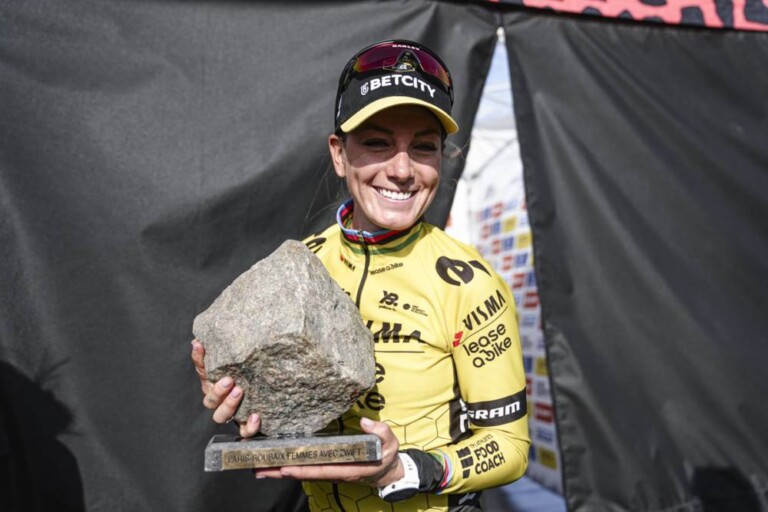
ROUBAIX, France (April 12, 2025) — The dust of northern France may never settle quite the same. On April 12th, 2025, in a solo surge of power and poetry, Pauline Ferrand-Prévot claimed a landmark victory at Paris-Roubaix Femmes avec Zwift, becoming the first French woman to conquer the storied cobblestones and cross the line alone inside the Roubaix velodrome. Cheered on by a thunderous crowd, she didn’t just win a race—she rewrote history on home soil.

In the dusty, deafening roar of the Velodrome André-Pétrieux, Ferrand-Prévot, wearing the colors of Team Visma | Lease a Bike, rode into the Roubaix velodrome solo, arms outstretched in triumph, the French tricolor fluttering in the crowd behind her.

This wasn’t just a win. It was a comeback, a statement, and a masterclass in determination and grit. Having returned to road racing in 2025 following her gold medal triumph in mountain biking at the Paris 2024 Olympic Games, Ferrand-Prévot proved she still had the fire, finesse, and fortitude that had made her a world champion in multiple disciplines.

The Hell of the North Beckons

The fifth edition of the Paris-Roubaix Femmes began under deceptively calm skies in Denain. 135 riders took to the start line after Sofie Van Rooijen (UAE Team ADQ) and Julie Hendrickx (Lotto Ladies) withdrew at the last minute. At precisely 1 p.m., the peloton rolled out for 148.5 km of punishing terrain, featuring 17 cobbled sectors identical to the 2024 route.

The race was aggressive from the outset. The first 20km were filled with attacks, attempts to forge a breakaway thwarted by the fierce pace. Finally, at km 33, Dutch rider Quinty Ton (Liv-AlUla-Jayco) and Poland’s Aurela Nerlo (Winspace Orange Seal) escaped, carving out a 2’20” advantage after 50km. Their lead ballooned to nearly three minutes as they approached the first cobbled sector from Hornaing to Wandignies (km 66), the race’s brutal heartbeat.

A Race That Never Rests

Cobbled chaos erupted in the Warlaing to Brillon sector, as Ellen van Dijk (Lidl-Trek) launched a characteristically bold attack. The Dutch powerhouse was soon flying solo, hunting down the leading duo with relentless resolve. By the fifth sector (Orchies), she had reached the front, with only Ton remaining. Nerlo had dropped off, and the peloton loomed just seconds behind.

Sector 12 saw a major crash—Lily Williams, Linda Riedmann, and others hit the deck, shaking up the chasing group. Lotte Kopecky (SD Worx-Protime) took the moment to launch an attack, dragging teammate Lorena Wiebes with her. Marianne Vos bridged across, and a new elite group formed.

This lead group swelled to eight as Chloe Dygert, Alison Jackson, Romy Kasper, and Jelena Eric joined the fray. But it didn’t hold. By the time they exited Mons-en-Pévèle (Sector 11), only six remained. Kopecky’s relentless tempo caused more attrition, with Kasper and even the instigator Van Dijk unable to stay with the group.

Behind them, the peloton was regrouping. With 35km to go and eight cobbled sectors remaining, the front of the race grew to 20 riders. It was here that Pauline Ferrand-Prévot appeared, silent and dangerous. Her presence was a quiet threat, and when she attacked, it came like a storm.

Ferrand-Prévot Strikes

Emma Norsgaard (Lidl-Trek) was the first to make a daring move, attacking after Templeuve (Sector 8) with 32km to go. She eked out a 36-second gap before Ferrand-Prévot made her move. The French rider attacked with 25km remaining, right as the race plunged into Sector 6 (Bourghelles to Wannehain).
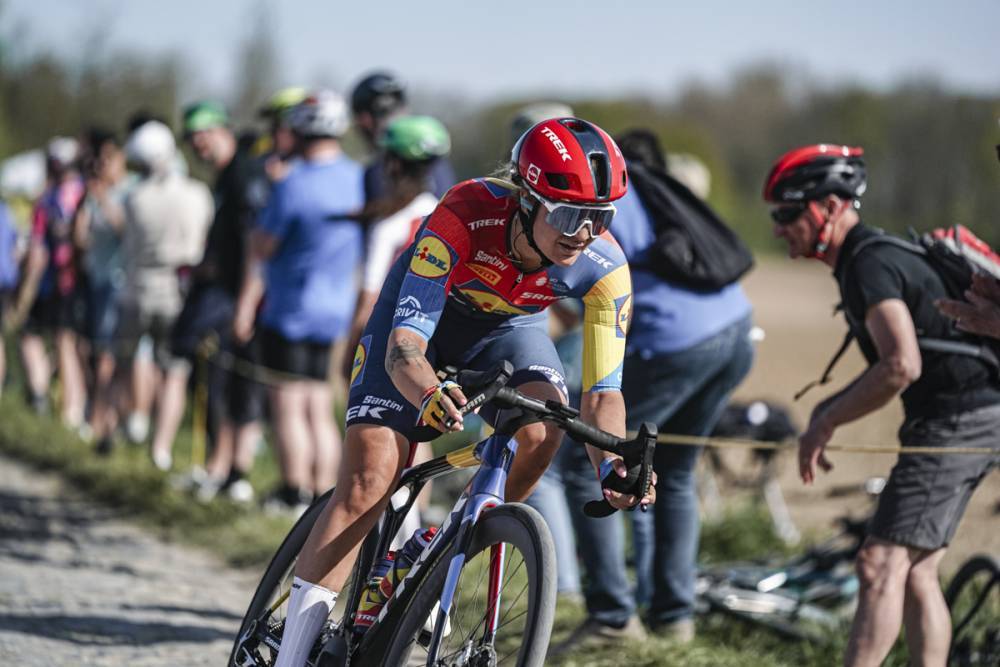
It was a classic Ferrand-Prévot attack—calculated, explosive, and perfectly timed. She quickly bridged to Norsgaard, then wasted no time pressing on alone. By Sector 5 (Camphin-en-Pévèle), she was off the front, a lone figure slicing through dust and cobbles.
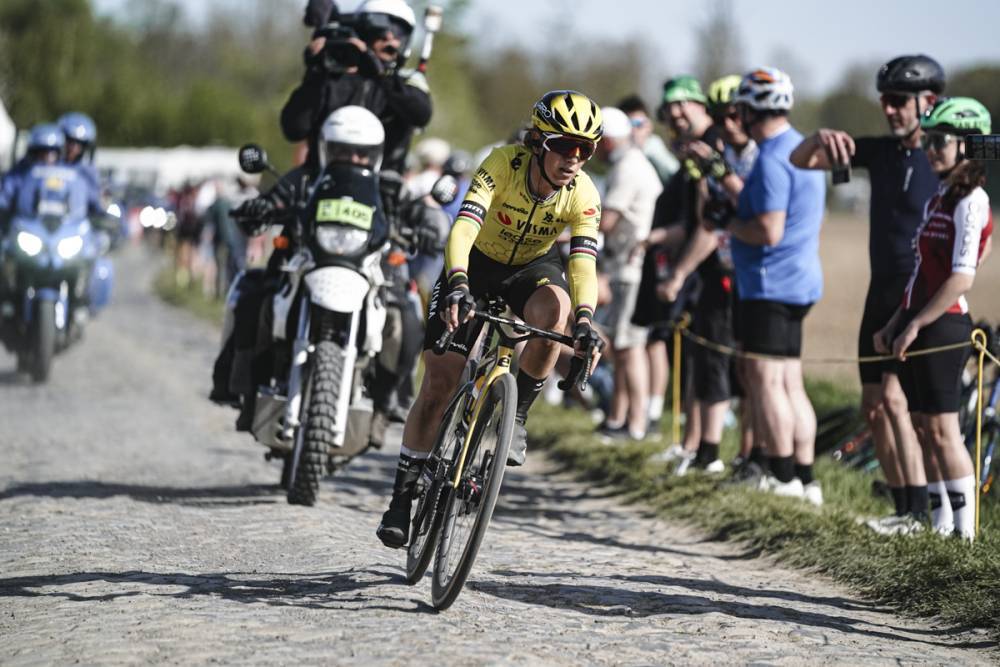
Pauline Ferrand-Prévot (VISMA Lease-a-Bike). Photo © ASO/Thomas Malheux

With 10km to go, she was 25 seconds ahead of Norsgaard and a full minute ahead of the chasing group. From that moment, her victory looked inevitable. The cobbles of Carrefour de l’Arbre and the winding streets into Roubaix only seemed to sharpen her determination.

Ferrand-Prévot never faltered. Her cadence remained strong, her focus unwavering. Her mountain biking background gave her a unique edge—balancing power and precision across the broken, uneven stones. With every cobbled kilometer behind her, the cheers from roadside fans grew louder. By the time she reached the final sector, she was met with a wall of sound.

Tactical Analysis: Timing, Terrain, and Tenacity

Ferrand-Prévot’s decisive attack didn’t just happen—it was built on a foundation of careful tactical thinking. Her positioning throughout the cobbled sectors was meticulous; never too exposed, yet always close enough to respond. Unlike some of her rivals who burned matches early, Ferrand-Prévot remained economical until the critical moment.
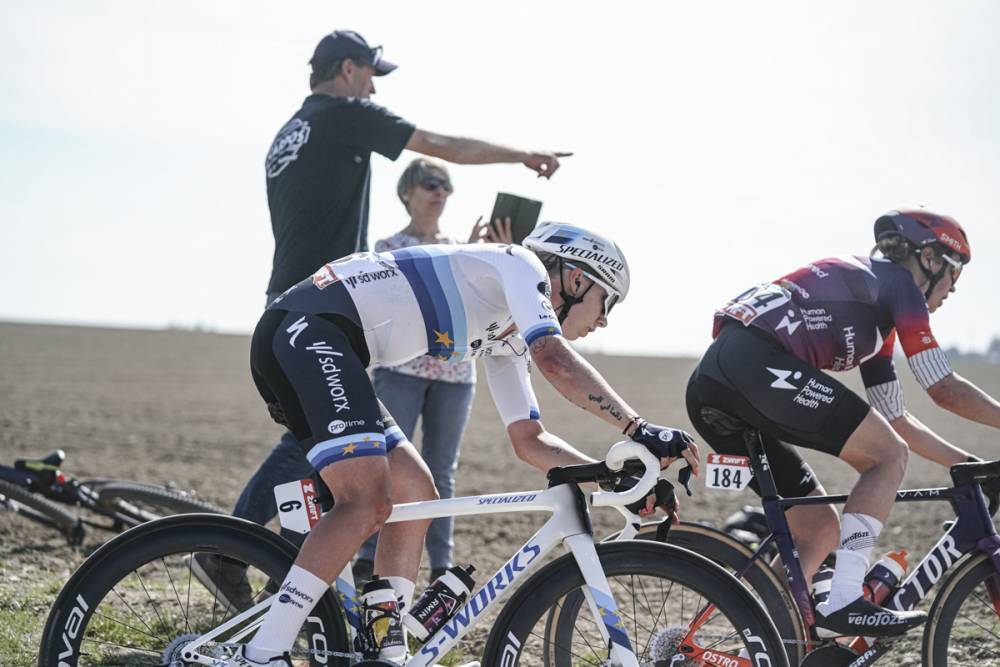
Lorena Wiebes (Team SD Worx-Protime). Photo © ASO/Thomas Malheux

By launching her move just before Sector 6, she took advantage of a natural selection point on the course—riders were already fatigued from earlier attacks and crashes, and the cobbled terrain amplified any weakness. Her solo pursuit of Norsgaard was a statement of strength, but it also forced the chasers to gamble: who would sacrifice their legs to bring her back?

The dynamics of the chase were revealing. Once Ferrand-Prévot was clear, the cooperation behind her rapidly disintegrated. Teams like SD Worx-Protime and EF Education-Oatly each had multiple riders in the group but conflicting priorities. Kopecky was marked closely, reluctant to tow rivals; Wiebes was saving her sprint; Jackson and Borghesi hesitated to take long pulls without assurance. Lidl-Trek, having already launched Van Dijk and Norsgaard, had no remaining firepower to commit.
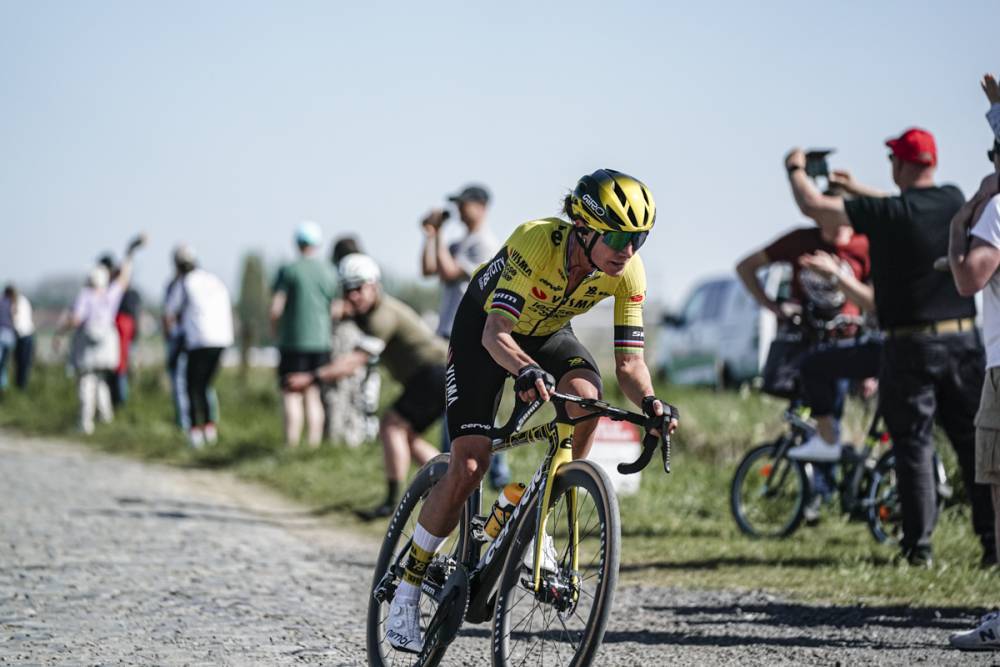
Marianne Vos (VISMA Lease-a-Bike). Photo © ASO/Thomas Malheux

In the critical stretch from Camphin-en-Pévèle to Carrefour de l’Arbre, hesitation turned into fragmentation. Riders attempted solo bridges, but none had Ferrand-Prévot’s momentum or technical fluency. Kopecky made a half-hearted dig, quickly marked by Vos. The rest watched, waited, and second-guessed.

Ferrand-Prévot, meanwhile, was executing a negative split—a rare tactic in such a brutal race—riding faster in the final sectors than earlier in the day. That acceleration not only demoralized the chasers but made cooperation nearly irrelevant. It was a classic case of attack timing meeting indecision—a race won not only by strength, but by psychological edge.

A Nation’s Roar

The final cobbled sector, Roubaix (Espace Charles Crupelandt), offered no resistance. Ferrand-Prévot, grimacing but composed, flew through it, riding solo into the iconic velodrome. The crowd exploded. She allowed herself a smile, a wave, then raised both arms as she crossed the line. Behind her, Letizia Borghesi (EF Education-Oatly) arrived 58 seconds later to claim second. Wiebes outsprinted Vos and Jackson to round out the podium, 1’01” behind.

It was a triumphant moment not just for Ferrand-Prévot, but for a nation that had long yearned to see a homegrown talent triumph at this legendary race. Fans wept, cheered, and celebrated. In a sport of suffering, her joy was contagious.

Post-Race Emotions and Reflections

For Ferrand-Prévot, this win was personal, unexpected, and emotional.

“This was my first time at Paris-Roubaix Femmes, and maybe my last one! I had a crash before Mons-en-Pévèle and had to chase, but once I was back, I just went full gas. I’ve been sick the last two days so I wasn’t even sure this morning whether to participate at Paris-Roubaix. But I said OK we’ll just go and I’ll do my best for Marianne. Finally, I took the start and it’s amazing. My boyfriend [Dylan van Baarle] won three years ago and now I won. It’s quite incredible!”

“When I attacked, I was mostly thinking about helping Marianne, to make the others work behind. We really wanted to try to drop Lorena Wiebes (the best sprinter). They started looking at each other behind, and it worked to my advantage, so it was good.”
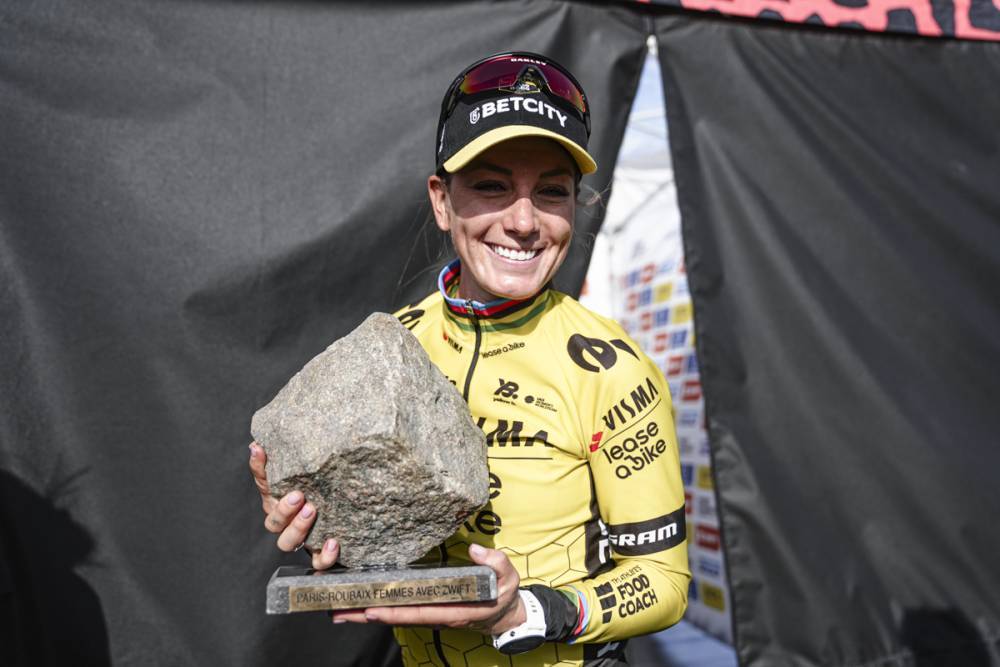
“I just attacked on a paved section. Marianne had told me to attack on a cobbled part, but I felt that we were already riding fast, and I wasn’t making any difference. I knew that after each cobbled section, everyone would need a little time to recover. And then I saw that it was now or never to go for it. Behind, it took some time for them to react. And after that, by the time they organized… Sometimes with the women, it’s a bit complicated, so you have to take advantage of it.”

Her words reflected the unpredictable nature of racing, and the underlying resilience of a rider who has fought through injuries, illnesses, and the weight of expectation to reach the top once again.

Letizia Borghesi reflected on a gritty and determined performance at the race, marked by early adversity and a strong comeback.

“I had a flat tyre so I had to chase… I think I came back after four sectors or something like that,” she explained. Rejoining the front group wasn’t easy, with the pace high and rivals unwilling to let anything slip. Once back, Borghesi launched several attacks of her own, describing the group as “racing really aggressively” while SD Worx tried to control the action. Though she couldn’t follow Pauline Ferrand-Prevot’s decisive move, Borghesi expressed pride in both her own performance and that of her EF Education-Oatly team.

Looking back on her season so far, Borghesi noted major progress and growing confidence. “These are my favourite races… and this year I reached a level that I didn’t have in the past,” she said. From strong rides at Strade Bianche and Milano-Sanremo to solid performances at Flanders and Roubaix, she sees this spring as a breakthrough.

“I improved year after year, without forcing, leaving myself time for my body to grow,” she added, proud of her steady development. With a solid foundation, she believes her team is now a real contender among the sport’s elite. “We know that we can really fight with the biggest teams,” she said. “It’s crazy the level that we reached this year.”

Lorena Wiebes, despite missing the win, was philosophical, as she reflected on a tough race with a mix of disappointment and pride, acknowledging the challenges she and her SD Worx-Protime teammate Lotte Kopecky faced.

“At the end of the race, out of nowhere, I cramped a bit in my legs when they attacked in the last four kilometres,” she said, explaining how the final moments played out. With only two teammates in the front group, reacting to every attack was nearly impossible.

“Sometimes you have to gamble,” she admitted, especially when racing against strong riders like Pauline Ferrand-Prevot and Ellen van Dijk. Wiebes clarified there was no miscommunication within her team, saying, “I didn’t say to Lotte at all to not attack. I only said to her, not to attack when I’m leading at the front. So that’s a big difference.”

Despite not taking the win, Wiebes expressed pride in the team’s effort and consistency throughout the spring campaign. “We were fighting for it all the time… It’s easy when you win all the races, but you cannot always win,” she said, showing both realism and resilience. While the immediate result brought “mixed feelings,” she acknowledged the bigger picture: “I think I can be really happy with what we achieved, and it’s still not over yet because the Ardennes classics are coming up.” Though the night might bring less sleep than a victory would, she believes pride will follow soon enough.

A Monumental Moment for Women’s Cycling

Ferrand-Prévot’s victory is a watershed moment for women’s cycling in France. Paris-Roubaix, once considered too brutal for women, now sees French women conquering its most legendary stretches. From the mud of Hornaing to the polished concrete of Roubaix, her triumph will resonate for years.

This edition of Paris-Roubaix Femmes showcased the grit, strategy, and drama that makes this race one of the most revered on the calendar. From early breakaways and mechanicals to crashes, bold solo efforts, and the final glory lap in the velodrome, it had everything.

It also underlined the evolution of the women’s peloton. No longer merely mirroring the men’s races, events like Paris-Roubaix Femmes have taken on a life of their own. They are marked by high-level tactics, compelling rivalries, and ever-deepening rosters of talent.

Ferrand-Prévot’s win was a symbol of persistence and adaptability. A rider who has conquered cross-country mountain biking, cyclocross, and road racing, she stands as a beacon for versatility and resilience in modern cycling. Her win was not just for France—it was for the sport itself.

Legacy and the Road Ahead

The legacy of this win goes far beyond Roubaix. It underscores the impact of investing in women’s cycling, building deeper teams, offering more race days, and giving riders the platform to shine. In Ferrand-Prévot, we see the reward of decades of dedication—not just hers, but the efforts of an entire sport pushing toward parity.

Young riders, especially in France, now have a new role model—one who blends talent with tenacity. Her win may inspire the next generation to dream of Roubaix not just as a legend, but as an attainable goal.

With the Ardennes Classics on the horizon and the Tour de France Femmes later in the year, Ferrand-Prévot’s performance is likely to galvanize her team and inspire a new generation of French cyclists. The peloton has taken note. The Queen of Roubaix wears tricolor.

Results Summary:

 
RANK
RIDER RIDER NO. TEAM TIMES GAP
1  PAULINE FERRAND PREVOT 32 TEAM VISMA | LEASE A BIKE 03H 40′ 07”
2  LETIZIA BORGHESI 83 EF EDUCATION – OATLY  03H 41′ 05” + 00H 00′ 58”
3  LORENA WIEBES 6 TEAM SD WORX – PROTIME 03H 41′ 08” + 00H 01′ 01”
4  MARIANNE VOS 31 TEAM VISMA | LEASE A BIKE 03H 41′ 08” + 00H 01′ 01”
5  ALISON JACKSON 81 EF EDUCATION – OATLY  03H 41′ 08” + 00H 01′ 01”
6  MARIA GIULIA CONFALONIERI 134 UNO-X MOBILITY 03H 41′ 08” + 00H 01′ 01”
7  ELISE CHABBEY 41 FDJ-SUEZ 03H 41′ 11” + 00H 01′ 04”
8  CHLOE DYGERT 73 CANYON//SRAM ZONDACRYPTO 03H 41′ 13” + 00H 01′ 06”
9  ELISA BALSAMO 11 LIDL – TREK 03H 41′ 28” + 00H 01′ 21”
10  CHIARA CONSONNI 72 CANYON//SRAM ZONDACRYPTO 03H 41′ 28” + 00H 01′ 21”

USDOT Awards RCP Grants for Bicycle Projects (and Trump Taketh Away)

By Charles Pekow — Several western communities received FY 25 funding from the Reconnecting Communities Pilot Grant Program from the US Department of Transportation. The program was created by the Bipartisan Infrastructure Law to connect communities, especially disadvantaged ones that lack adequate transportation infrastructure. Funding goes for activities such as planning, engineering and environmental assessments, but not actual construction. Grants include:

  • $1.6 million to Commerce City CO for a planning grant for the East 60th Avenue Multimodal Connections Study – Brighton Boulevard to Vasquez Boulevard. Overall estimated cost of the project: $2 million. The Adams Heights neighborhood lacks bike lanes to connect to schools, groceries stores and the local recreation center that this project intends to fix.
  • $1.44 million for the Phoenix Grand Canalscape-Phase IV Reconnecting Communities Across I-17, US 60 and BNSF Railroad Community Planning Grant in Phoenix AZ. The goal involves adding a bike route along the Grand Canal. Estimated project cost: $1.8 million.
  • $2 million to Gallup NM for the 2nd and 3rd Street Crossings Community Planning Project. Presently, cyclists and pedestrians must use dangerous at-grade crossings to get over the BNSF railroad tracks. The study will examine safer ways for them to cross. Projected cost $2.5 million.

See the list of grantees at https://www.transportation.gov/sites/dot.gov/files/2025-01/RCP%20FY24%20Award%20Factsheet.pdf

Editor’s Update (April 10, 2025): 

Trump administration’s policy shifts have significantly impacted the Reconnecting Communities Pilot (RCP) Grant Program. While the third and final round of RCP grants was awarded in January 2025, totaling $544.6 million for 81 projects across 31 states, these allocations occurred just before the administration began reevaluating federal grant programs.

The administration’s broader initiative to reduce federal government size and spending has led to the termination or reduction of various programs, particularly those emphasizing environmental justice, equity, and community development. For instance, the Building Resilient Infrastructure and Communities (BRIC) program, designed to help communities prepare for natural disasters, was terminated (https://apnews.com/article/fema-grants-cuts-trump-emergency-management-disaster-bc36ea4ca328e1eb4a07641ba1fb770e). Similarly, the Environmental Protection Agency (EPA) rescinded grants aimed at assisting rural and tribal communities with infrastructure projects, citing a shift in funding priorities. (https://www.cpr.org/2025/04/09/trump-ends-funding-epa-maptcc-rural-tribal-communities/)

Given these actions, there is a heightened risk that RCP-funded projects, especially those not yet in advanced stages, could face delays, funding freezes, or cancellations. 

Going Far Beyond in Italy with Lachlan Morton (Watch “The Hills”)

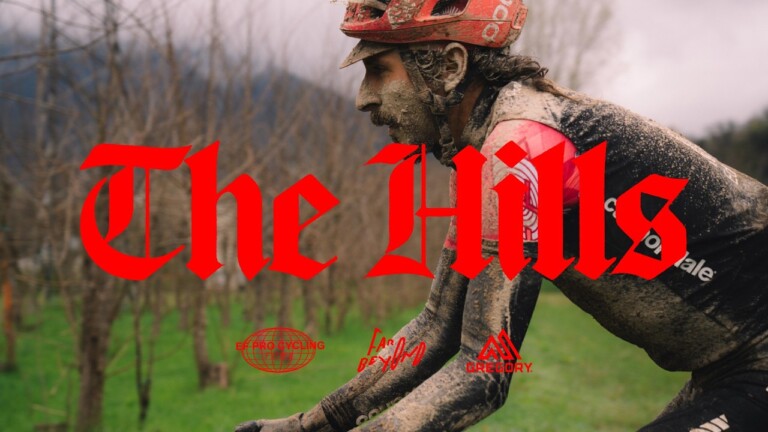
Whether it was mud baths or gravel grinds, the first-ever Hills Gravel event was one for the books. Watch Lachlan Morton take it all on in “The Hills,” presented by Gregory—only on the Far Beyond YouTube channel.

USDOT Awards RAISE Grants for Bicycle Projects (and Trump Taketh Away)

By Charles Pekow — The first round of 2025 RAISE Grants has been awarded by the US Department of Transportation. Grants include:

  • $25 million to Tempe AZ to build the Upstream Dam Bicycle and Pedestrian Bridge across the Rio Salado River. The project also includes an approximately quarter mile shared-use path along the North Bank, which will connect the bridge to the Indian Bend Wash Path and McClintock Drive.
  • $450,000 to Page AZ to redesign the intersection of Coppermine and Haul roads, including making the area more bikeable.
  • $1,160,850 for a planning grant to Larimer County CO to redesign Larimer County Road 50E to include a multi-use trail.
  • $1.3 million to Helena MT “to plan and design an arterial connecting the South Helena I-15 interchange to US Highway 12,” including bicycle facilities. The project is part of the city’s plan to reduce carbon emissions by encouraging bicycling and other transit alternatives.
  • $998,520 to the Ephraim City Corporation in Ephraim UT to study and design bike paths to connect Snow College’s East and West campuses with other destinations, including a health center and a grocery store. The study will also explore where to set up bikeshare stations, especially in and near the campuses.

See the list at RAISE 2025 Round 1: https://www.transportation.gov/sites/dot.gov/files/2025-01/RAISE%202025%20Round%201%20Award%20Fact%20Sheets_0.pdf

Editor’s Update (April 10, 2025):

Under the current Trump administration (2025–2029), the probability of bicycle infrastructure projects receiving funding through the U.S. Department of Transportation’s discretionary grant programs—formerly known as RAISE (Rebuilding American Infrastructure with Sustainability and Equity) and now reverted to BUILD (Better Utilizing Investments to Leverage Development)—has significantly diminished. In early 2025, the administration reduced the BUILD program’s annual funding from $1.5 billion to $150 million and amended the Notice of Funding Opportunity to eliminate considerations for projects focused on equity, climate change, and non-motorized transportation infrastructure. See https://www.transportation.gov/sites/dot.gov/files/2025-01/BUILD%202025%20Amended%20NOFO%20-%20Redline.pdf

Further, a leaked memo from the U.S. Department of Transportation directed agencies to review and potentially revise or cancel projects primarily aimed at bicycle infrastructure, electric vehicle charging, and environmental justice. This policy shift has placed numerous bike-related projects, including those in Portland, Oregon, and Arizona, at risk of losing federal funding. Consequently, while the BUILD program continues to exist, its current orientation under the Trump administration significantly reduces the likelihood of bicycle infrastructure projects receiving federal support.​ See https://www.planetizen.com/news/2025/03/134560-usdot-could-pull-green-infrastructure-grants?utm_source=chatgpt.com

Keegan Swenson and Haley Batten Reign Supreme in Monterey

0

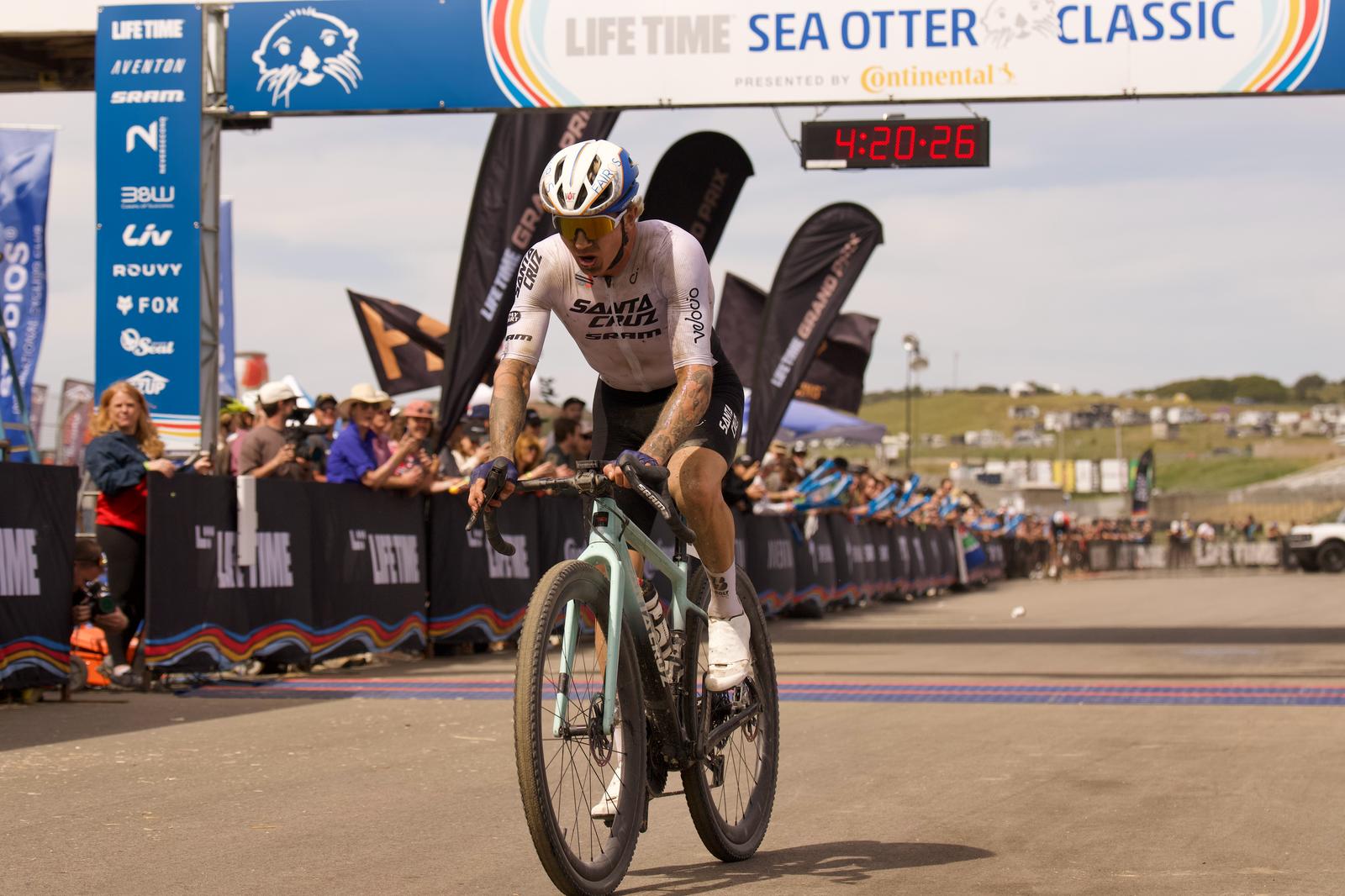
MONTEREY, California (April 10, 2025) — Keegan Swenson continued his winning run at the Life Time Sea Otter Classic presented by Continental by powering to his fourth successive victory in Monterey, while Sofía Gómez Villafañe also took maximum points in the Life Time Grand Prix after finishing the race in second position behind the triumphant Haley Batten.

The 35th edition saw the discipline switch from MTB to gravel, but Swenson proved unstoppable once again in the men’s race by launching a stinging attack on the final ascent of Lookout Ridge and then pressing home his advantage in typically dominant style.

The 31-year-old crossed the line nine seconds ahead of Matthew Beers – who also wrapped up his second podium placing in as many years – with Alexey Vermeulen 29 seconds further back in third.

Keegan Swenson wins the Sea Otter Classic Gravel, race #1 of the 2025 Life Time Grand Prix. Photo courtesy of Life Time

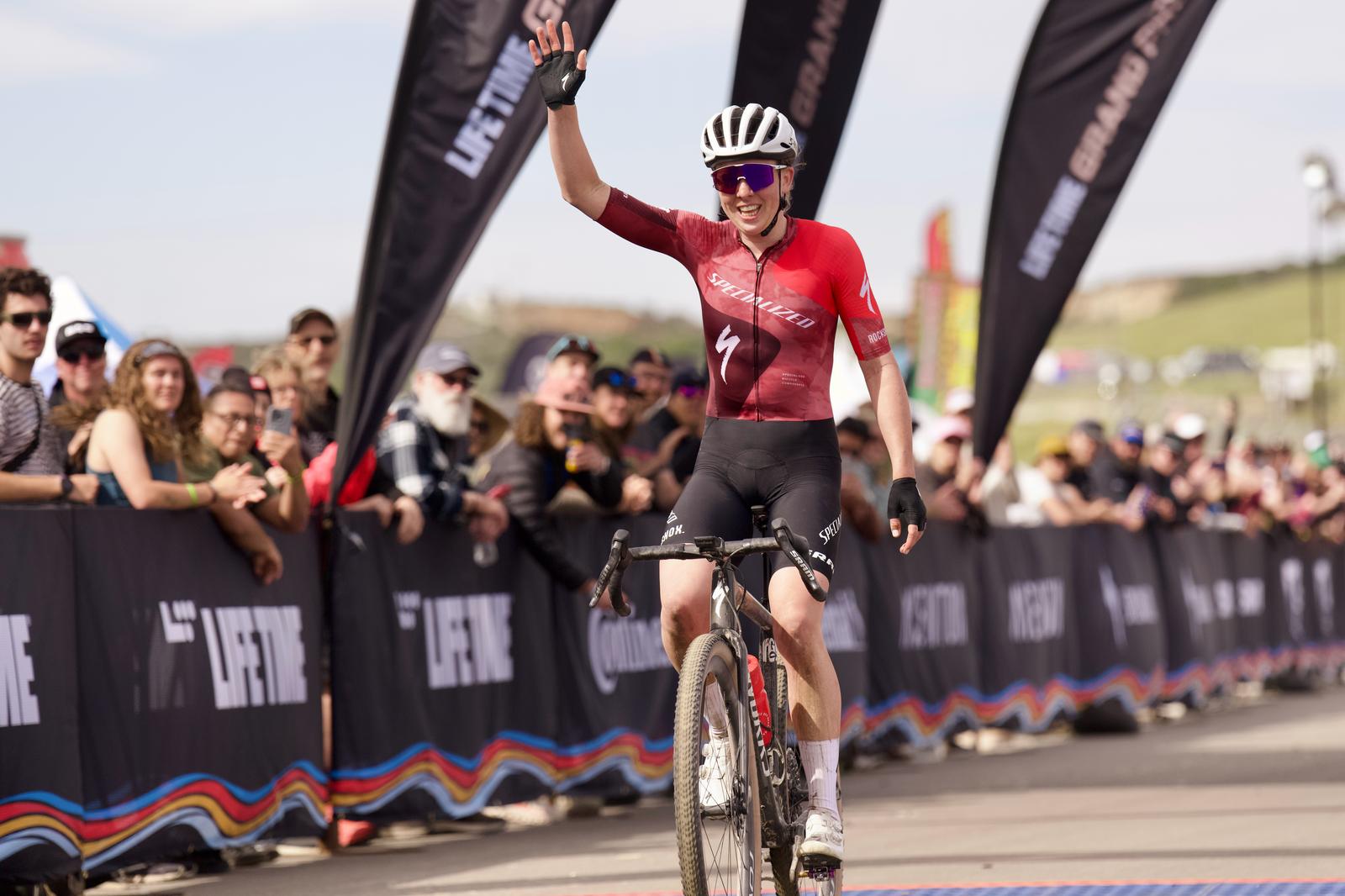
In the women’s race, Batten took the crown after commencing her winning move almost 50 miles in. The Olympic silver medalist never looked back and sealed her win by five minutes and 23 seconds. As Batten wasn’t competing in the Life Time Grand Prix, it was Villafañe who proved the highest-placed Series finisher, taking second place 14 seconds ahead of Cecily Decker.

Haley Batten wins the Sea Otter Classic Gravel. Photo courtesy of Life Time

Those results mean Swenson and Villafañe sit at the top of the overall standings with 35 points respectively, with Beers and Decker both with 33 points, and Vermeulen and Hayley Preen – who finished the women’s race in fourth place – two points further behind.

In the Wild Card competition, Petr Vakoc and Maude Farrell top that leaderboard after finishing in fourth and 17th places respectively, while Griffin Hoppin and Emily Stapleton lead the U23 Program with their respective 29th and 36th-placed finishes.

Extended highlights will be available in the next 48 hours on the official Life Time Grand Prix YouTube channel.

Reaction from the Life Time Sea Otter Classic presented by Continental:

Men’s winner Keegan Swenson said: “It was fast, tactical racing all day and Lookout Ridge was the only place where there was much selection. On the first two laps it separated on there and then came back together, but with the group getting smaller each time. I knew that was going to be the place to go on the last lap, and that I needed to play my cards right.

“Before I made my move I tried to play it smart and save my energy. I put in a dig on the first steep bit and knew they’d be hurting behind. I had a feeling Matt and Alexey would come back, but that they’d have to work hard to do so, and I rested up a little bit so I could hit out again on the last section of that climb.

“I gave it everything I had, opened up a small gap and then managed to defend it all the way to the finish.

“It’s always good to start the season off with a win here, in terms of confidence and points. It’s nice to have a little buffer heading into UNBOUND too because that’s a crazy, hectic race where anything can happen.”

Women’s winner Haley Batten said: “This was my first gravel race so I had no real plan and just wanted to see how the athletes were riding and working together. They didn’t seem to be in sync so I thought, if I surprise everyone, no one would be expecting it.

“I had hoped a rider or two would come with me so there would be more chance of making the move stick. I pushed really hard though, and knew if anyone hesitated for a second behind that I could get away, and I just kept going. During the last lap I was regretting my move as I was deep in the pain cave, but it turned out well.

“The Life Time Grand Prix is a super exciting Series, with so many super strong athletes, and I hope to show up for more races in the future.”

Women’s runner-up Sofía Gómez Villafañe said: “I’m more-than happy with second place today as I got super sick in the lead up to it and have been on the couch for the last two weeks. I thought I’d only be racing for a top-10 finish today, but had no real idea what to expect.

“When Hayley went I had nothing in my legs. I got to play the ‘she’s kind of my team-mate card’ and have Cecily drag me around for the last lap, and I thought I was still going to get dropped. Somehow though, I found I still had a kick on the final climb.

“My result speaks volumes to the groundwork I’d put in before getting sick, but it was such a hard day, mentally. My confidence was low but it was so important to have a good race. I’m super proud to get a 1-2 with Hayley, and she was a in a league of her own. It’s all upwards from here.

“As for the Series, it’s exciting to have a deeper field, with more international riders coming in. It’s been really cool to see all the changes that Life Time has been making too, especially with the no drafting rule, and they are always elevating the support they give us as riders.”


Colorado Senators Introduce Bill to Improve Safety by Holding Negligent Drivers Accountable

DENVER, Colorado (April 7, 2025) – Colorado lawmakers Senators John Carson and Marc Snyder today introduced SB25-281, a bill that aims to improve safety on Colorado’s roads, especially for the most vulnerable, and provide justice for families who have lost loved ones in preventable traffic crashes.  

Between 2014 and 2024, pedestrian fatalities increased by 73 percent. During these ten years, 1,131 bicyclists and pedestrians lost their lives on Colorado’s roads. In 2023 alone, 156 bicyclists and pedestrians lost their lives–a record high in Colorado and up from 64 fatalities in 2013. 

“Although there are signs that traveling on Colorado’s roads is becoming safer for people inside vehicles, data over the last decade shows that it is less safe for people outside vehicles. One part of the solution is creating a culture of safety on our roads by ensuring that a person who drives without regard for the safety of others and hits and kills a vulnerable road user is held accountable,” said Senator Marc Snyder.

Magnus White was killed by an impaired driver in July 2023. Photo courtesy The White Line

People make conscious choices while driving, and when these choices place other people at risk and result in the death of a vulnerable road user, they should be held accountable. In Colorado, a driver who is at fault and hits and kills a vulnerable road user can be charged with a class one misdemeanor, the same level of offense as other non-violent traffic offenses, such as not securing insurance. The death of a vulnerable road user in a crash is the only crime involving the loss of life that is a misdemeanor in the Colorado statute. A class one misdemeanor excuses the poor choices drivers make and falls far short of addressing the impact of those choices, the death of another person. This undermines efforts to create a culture of personal responsibility and accountability on Colorado’s roads. 

“Vulnerable road users have little to no chance of surviving when hit by a driver of a vehicle. Drivers must be held accountable for their actions—especially when they result in death—because distracted or careless driving is a choice, not an accident,” said Victoria Cegielski, mother of Alex. Alex was killed when a driver ran a red light and hit Alex while he was in the crosswalk.

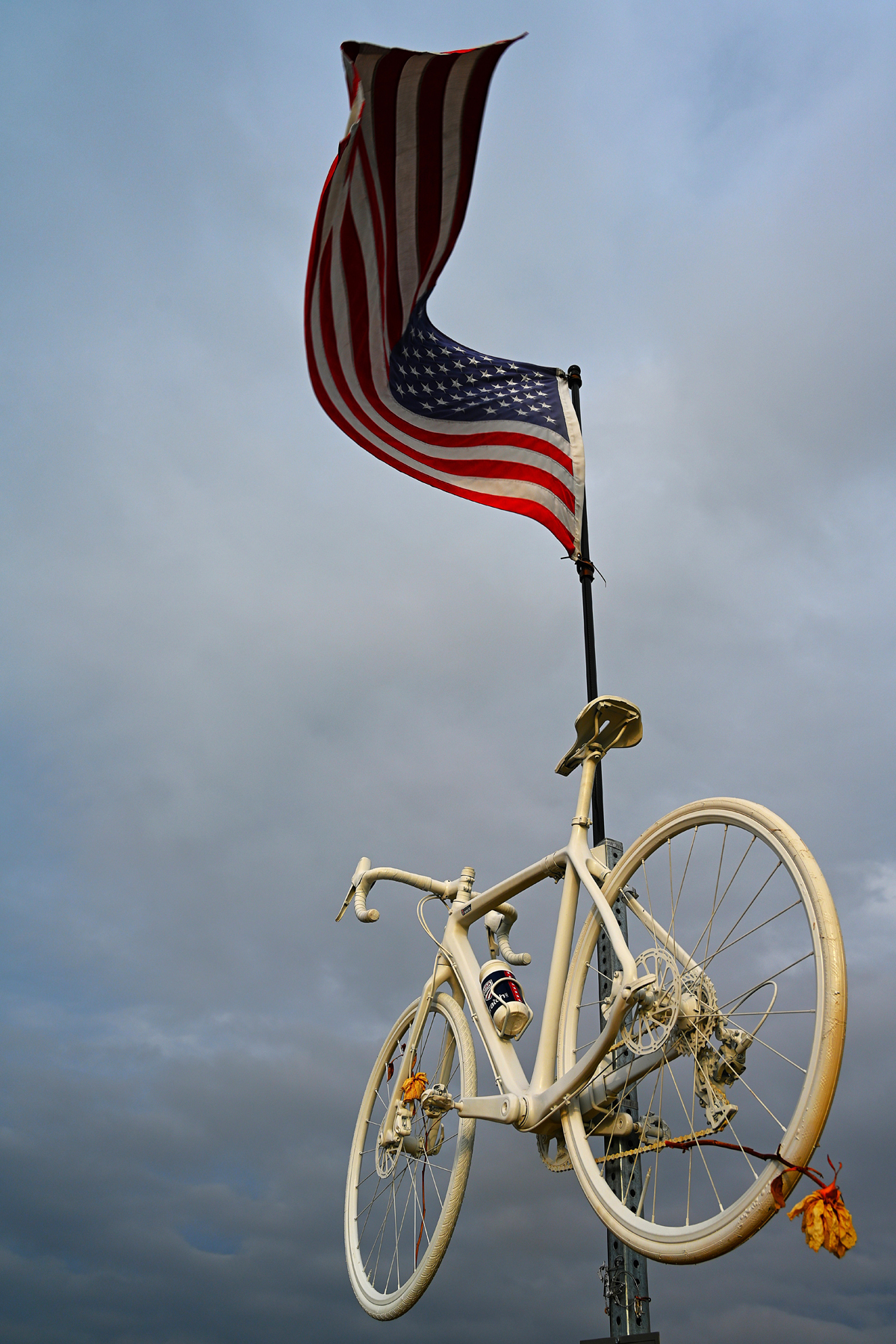
Even a slight reduction in cyclist deaths is welcome. One less death means one less ghost bike. Pictured is Magnus White’s ghost bike from the Ride for Magnus: Ride for Your Life. Photo by Ryan Muncy

Senator John Carson added, “When we get behind the wheel, we have a responsibility to drive safely. This means our hands should be on the wheel, we should not be distracted, and our minds should be focused on driving. Too often, people are not paying attention or are in a rush and drive in ways that put other road users at risk. People must be held accountable for these choices and the harm they cause.”

A core component of the bill changes the charge of Careless Driving Resulting in Death from a class one misdemeanor to a class 6 felony. In addition to enhancing safety by promoting a culture of accountability on Colorado’s roads, this bill represents a step towards justice for family and friends who have lost a loved one in a traffic crash. Today, the class one misdemeanor charge of Careless Driving Resulting in Death, which includes a maximum fine of $1,000, fails to deliver justice. 

“Killing a defenseless bicyclist or pedestrian with a car commands consequences more serious than a mere misdemeanor. How a society punishes those whose carelessness takes a life is one measure of how that society values life. Driving is a privilege, and one with potentially deadly consequences. Elevating this homicidal crime to even our lowest level felony is a step in the right direction,“ said District Attorney George Brauchler. 

Josh Stewart, father of Liam, added, “We were shocked when we learned the driver who killed our son Liam, while he was riding his bike to middle school through a school zone, would face only a traffic misdemeanor. Fatal crashes are not random accidents; they are the result of bad decisions. Making careless driving that causes death a felony makes clear that Liam’s life mattered and that people must be held accountable for the harm they cause.”

SB25-281 would also require chemical testing when an officer has probable cause to believe that a person was driving carelessly and that those actions are the proximate cause of the death of another person.

ENVE Expands HEX Gravel Tire Line with New 48mm Width

OGDEN, Utah (April 10, 2025) — ENVE has expanded its HEX gravel tire lineup with the release of a new 48mm width, joining the existing 40c and 44c options. Designed for mixed-surface riding, the HEX tire aims to balance speed, traction, and durability across a variety of conditions including dry, hard-packed, and loose terrain.

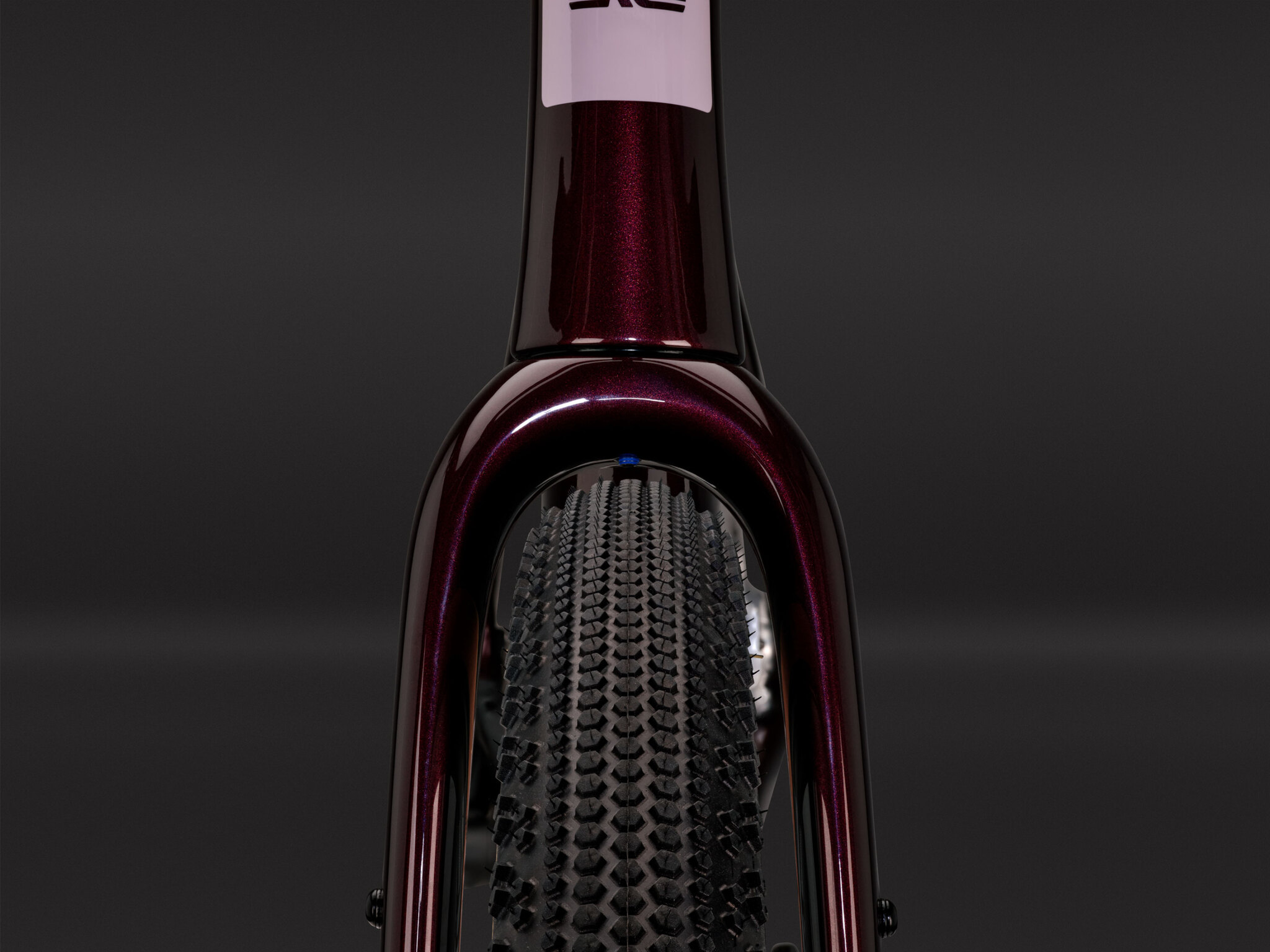
ENVE Hex Gravel Tire, now available in 48mm. Photo courtesy of ENVE.

Engineered for riders who demand traction, speed, and control across a variety of terrain, the HEX features a unique hexagonal tread block design that enables the tire to flex and conform to the ground, contributing to consistent handling and grip. With the new 48c size, the tire offers increased volume for riders seeking additional comfort and control—particularly beneficial for rougher courses or bikepacking setups.

Among the tire’s key design elements are an extended chafer strip at the bead for improved pinch-flat protection and a sub-tread barrier that adds puncture resistance without compromising rolling efficiency. The Kevlar bead is optimized for use with modern hookless rims, and a reinforced sidewall tread pattern helps boost cornering traction while resisting folding and tearing under load.

Additional tread features include outward-angled side knobs that vary in size and height to improve cornering grip, de-coupled tread blocks that allow the casing to flex with the terrain, and a textured “cat tongue” tread pattern for enhanced braking and driving traction.

The ENVE Hex tire is suitable for mixed terrain conditions making it an excellent all-around tire. Photo courtesy of ENVE

Key Features of the ENVE HEX Gravel Tire:

  • Extended chafer strip at the bead for increased pinch-flat protection
  • Sub-tread barrier delivers anti-flat protection without sacrificing rolling efficiency or ride quality
  • Kevlar bead optimized for modern hookless rim designs
  • Reinforced sidewall tread improves cornering traction and reduces the chance of folding or tearing
  • Outward-angled side knobs of varying size and height offer articulate cornering grip while maintaining speed
  • De-coupled tread blocks allow the casing to flex and conform for maximum traction and ride feel
  • Hexagonal tread design delivers three-way flex for superior terrain conformity and consistent control
  • “Cat tongue” texture provides confident braking and driving traction
  • Weight: 460 grams (48c)
  • MSRP: $75 USD

With the addition of the 48mm size, the ENVE HEX tire is now even more versatile—ready for everything from race-day performance to long-haul gravel adventures.

A Brief History of Americans Contesting the Cobbles in Paris-Roubaix

What is Paris-Roubaix? This April will mark the 122nd running of the professional bicycle race known as “the Hell of the North” that seeks out every cobbled Napoleonic era cow path in Northern France before finishing…on a velodrome. Beautiful and historic? Torturous and soul crushing? The rider’s first “race” of the day is to get to the front for the worst cobbles of the race in the Arenberg Forest. This section comes after a long stretch of pavement but precedes dozens more sections of bone jarring stones. Then U.S. Postal rider Marty Jemison, who rode it, as most do, in a support role in 2000 for Frankie Andreu and George Hincapie offered some insight in a previous post in these pages. 

Marty Jemison (USA / Team US Postal Service) – pictured during the 2000 edition of Paris-Roubaix 2000. Photo by Cor Vos

“The Arenberg Forest is 2.7kms long and comes after 168kms. It is a very rough section…imagine crossing rough rail-road tracks for 2.7kms…. shaken silly. Six of us entered together, three exited together. When I stood on the pedals, my legs were jelly, vibrated into mush, as slowly I regained speed, but I was now alone. I recovered a bit, ate and drank. A select group was on its way up to me so I waited. Now on the radio, George was talking to me…. “Get ready to ride on the front”. Frankie and Eki (Viatcheslav Ekimov) were there with George in the wheel, and they were leading the group. The team was riding well!! When they caught me, I rode on the front, at a very stiff tempo to set up for the next section of pavé. I continued this solo effort for the next five kilometers. Frankie knew the sharp turns and coached form behind. I did take one turn too fast, and Frankie led the team past me. I then tried to move back up, but the pavé was too near. When the group entered, with fresher legs, they simply rode away and my role in the race was coming to an end. Now I rode as hard as possible, looking for a teammate who may have had a flat. When they were far up the road, I knew my race was over. The director’s car passed, and they told me the second feed was not far, indicating to stop there. I had done my job.”

Paris Roubaix was first run in 1896, but it was not until 1978 that an American raced across the cobblestones in “The Queen of the Classics”. That rider was Jonathan Boyer, who would also become the first American to race in the Tour de France (1981), but he did not finish on his first attempt. Few do! He did, however, make it to the velodrome in his second attempt in 1981, becoming the first American to finish the grueling event (55th) while supporting his team leader and reigning World Champion Bernard Hinault to victory. He was joined by young Greg Lemond, just nineteen years old, who failed to finish but was active at the front leading his French teammate into the early cobbled sections. 

Lemond would miss the 1982 edition when he broke his collarbone in Ghent-Wevelgem but Boyer, now on Sean Kelly’s Sem-France Loire-Campagnolo squad, finished a very respectable 18th and was joined on his team by another American pioneer, John Eustice, who unfortunately failed to finish. Lemond raced again in 1983 and 1984, failing to finish in both attempts. Especially in wet years it is not uncommon for three-fourths of the field to abandon this monument. Boyer was back in 1984 with the Italian team Supermercati Brianzoli which included another American, John Patterson, but both failed to finish.     

LeMond finally broke through in 1985 with a strong ride under the most difficult conditions. It had rained for days in Northern France and the cobbles were choked with heavy mud washing out of the fields while a strong head wind meant it took nearly seven and a half hours for winner Marc Madiot to complete the course. Only thirty-five of the nearly two hundred starters did, and Greg just missed the third step of the podium, pipped on the line by Sean Kelly in the chase group sprint. His historic fourth place would stand for nearly a decade and a half as the best American finish. He would also place ninth in the 1992 race, in support of his victorious French teammate Gilbert Duclos-Lasalle.

In 1986, the American 7-Eleven team began their annual participation in “The Hell of the North” and a record eight Americans took the start: Lemond and his young teammate Roy Knickman on La Vie Claire, and Chris Carmichael, Gavin Chilcott, Alexi Grewal, Ron Kiefel, Bob Roll, and Doug Shapiro for the Slurpees. Shapiro had ridden the race the year before with the Dutch Kwantum squad but failed to finish. Lemond rode at the front with the favorites for much of the day but an untimely puncture and an absence of support vehicles meant he trailed home in 30th. Bob Roll finished his debut in 55th place, the only finisher from his team and only the third American to finish Paris-Roubaix. Many 7-Eleven riders contested the event in the coming years, but few made it to Roubaix with Roll proving their most reliable: 48th (1987), 25th (1988), 37th (1989), 61st (1990), with his final appearance a DNF with Motorola in 1991. Their most unlikely finisher was the spindly climber and future Giro d’Italia winner Andy Hampsten who showed his versatility earning 50th in 1987. 

By the mid-90s Americans were doing much better. A stalwart on both the Motorola and US Postal teams, Frankie Andreu started every year between 1990 and 2000 with a best finish of ninth in 1994. Of those eleven consecutive starts, he made it to the finish nine times, albeit outside the time limit in 1998. He gave American cycling fans a thrill when he went clear with 50 kilometers to go alongside Johan Museeuw in 2000 but was unfortunately dropped by the rampaging Lion of Flanders who went on to win his second of three cobbled trophies while Andreu faded to 20th. 

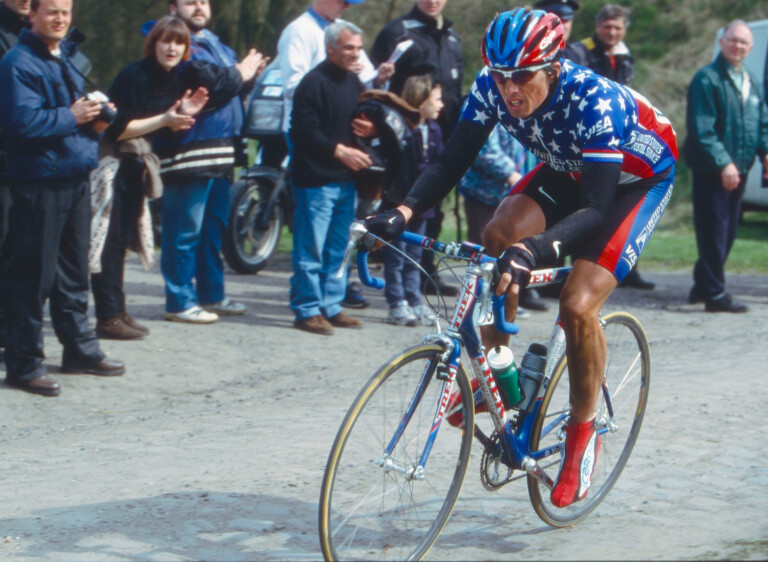
It was during these years that America’s greatest ever Roubaix rider would emerge. George Hincapie started the race 17 times, which ties him for the all-time most starts in the event alongside Frederic Guesdon, Imanol Erviti, and Matthew Hayman. Hincapie rode it in only his first year as a professional, 1994, finishing 31st and he loved it. He improved to 21st in 1995 but equaled Lemond’s fourth place in 1999 behind a Mapei clean sweep while wearing the stars and stripes of US National Champion. He followed that up with sixth in 2000 in the second group behind winner Museeuw and was fourth again in 2001 behind a Domo team clean sweep. In 2002, he suffered an exhausted crash into a ditch when chasing with young teammate Boonen, who carried on to a fine third on his debut and was dubbed Museeuw’s heir apparent with George again sixth. George missed 2003 with illness and was eighth in 2004. In 2005 he made the winning break but lost to Boonen in a three-up sprint. This second-place finish is not only still the best American finish to date but the only time an American has finished on the podium. He finished the race a staggering sixteen times, with his only DNF coming in 2006 when in the lead group of eight with two teammates, it seemed to be his year…until his fork steerer broke and he crashed heavily. What an incredible run!

In 2008, George scored his last top ten (9th), and a new American classics hope emerged. Sprinter Tyler Farrar would start nine times from 2008 to 2017, finishing eight but despite success in other classics, his best result was 29th in 2012. Hincapie’s last finish came in 2012 when he supported his young up and coming teammate Taylor Phinney to 15th. Phinney had twice won the Espoir edition of Paris-Roubaix and would become the new American hope, ultimately peaking at 8th in 2018, about two and a half minutes down on Peter Sagan. Sadly, no American has been in the first thirty since. In fact, we had no one in the race for the next few years and in 2022 and 2023 Magnus Sheffield alone flew the flag. Hopefully in a positive sign for the future, three Americans raced last year: Andrew August, Joey Rosskopf, and Riley Sheehan…and all three finished. In all just sixty-four Americans have started the “Queen of the Classics”. And in 121 editions of Paris-Roubaix, only thirty Americans have earned the honor of finishing the race. But what an honor!!!

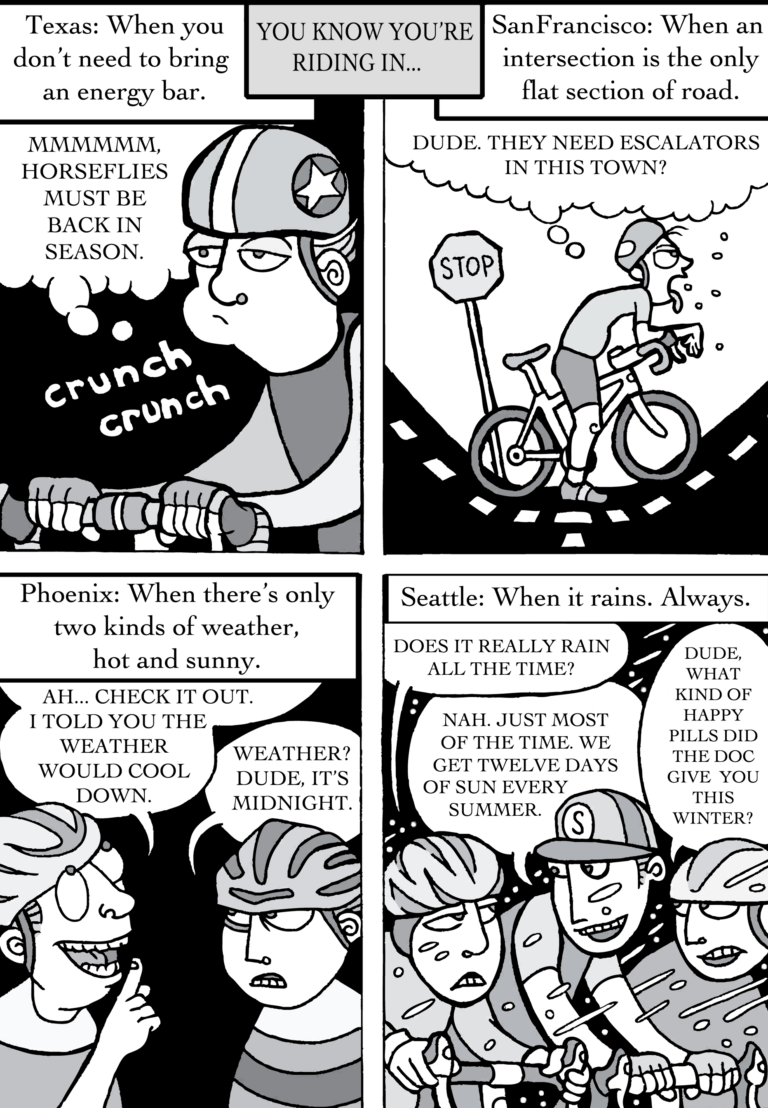
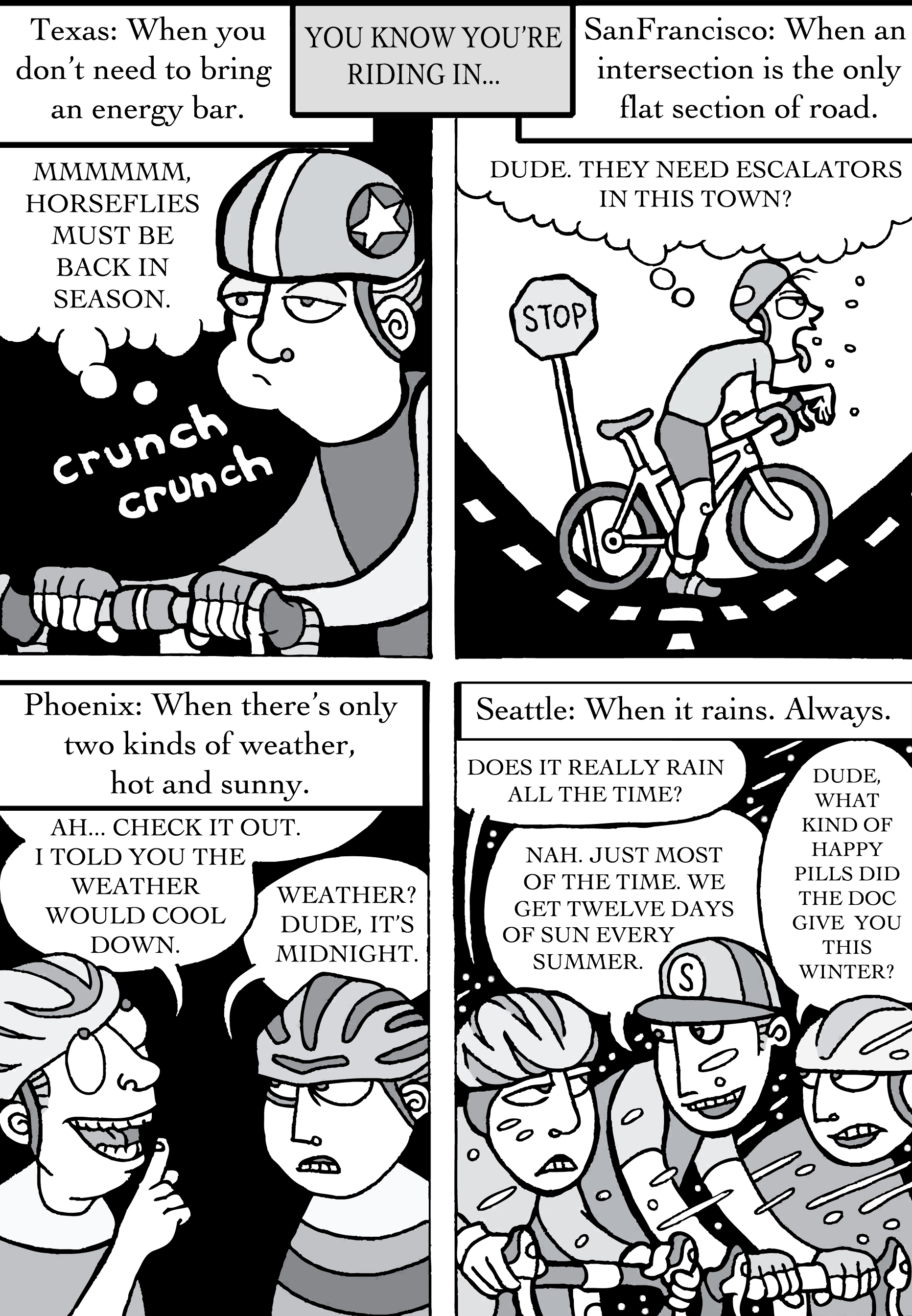
Quick Shot Bike Cartoon: You Know You’re Riding In …

Quick Shot Bike Cartoons: You Know You’re Riding In …, by Chad Nichols

Bridging Generations: A 32-Year-Old Cyclist and His Over-70 Rookie Parents Find Joy on a 400-Mile Journey 

Cycling the International Selkirk Loop

By Gail Newbold with Conner Newbold — “You tried to kill me!” I said angrily to my son as I got off my bike, legs shaking with fear. He is 32 and an avid cyclist. I am 70, my husband is 72, and we are novice cyclists. Yet here we were attempting a six-day road-bike trip on our own that started in Northern Idaho, crossed the Canadian border, and looped back. 

It was day one and I was afraid. We were riding on narrow, curving roads, most without shoulders. My fear escalated when we suddenly entered a town with traffic and stop lights—a scenario for which I was totally unprepared. What really sent me over the edge was when my son started crossing a heavily trafficked bridge in the car lane with me right behind. I pumped my pedals furiously, heart pounding, wondering bitterly why he hadn’t veered into the bike lane safely behind a barricade. “Because he doesn’t care if I die,” I thought.

We were thrilled when our son invited us to bike with him although we had no idea what lay ahead. The description sounded amazing: We’d be privy to the International Selkirk Loop’s spectacular scenery on a route designated by the U.S. Department of Transportation as one of the “Top 10 Scenic Destinations in the Northern Rockies.” Named “Best of the Roads” by Rand McNally Road Atlas and the “West’s Best Scenic Drive” by Sunset Magazine.

I wasn’t worried because we’d have our car and my husband Dave and I planned to take turns riding while Conner tackled all 402.6 miles and 20,822-foot elevation gain. Dave, however, is a worrier and spent the next eight months stewing over everything that could go wrong. In the end, the things we worried about never happened, and things that never occurred to us to worry about, happened.

Conner: I enjoy spending time with my parents. When they expressed interest in joining me, I didn’t pull any punches about what it would entail. I did my best to make it clear I wasn’t inviting them on a leisurely joyride. There would be steep climbs, long days, and hot sun. We’d ride on highway shoulders and would sometimes be far from water or medical facilities. To be honest, I was surprised when they enthusiastically accepted. In retrospect, I should have realized that no matter how much I tried to set expectations, they couldn’t fully grasp what was coming. They have bikes but aren’t cyclists.

The day before our ride, Dave barely slept from worrying. He’s a nervous traveler and hates feeling out of control. And this was nothing he’d ever done before. He did not feel prepared. He hadn’t trained enough. He worried about falling behind and losing Conner, even though our son was riding his traditional analog bike. He worried about using RideWithGPS. He was concerned about his clothes and what to carry on his bike. My biggest worry was getting hit by a car since 95% or more of the ride was on roads—which was the only worry NOT on Dave’s list.

Conner: I had vague fears that my parents didn’t entirely believe my determination to ride the entire route without assistance or understand how much effort and focus that would require. I knew I wouldn’t have spare energy to be perky and chatty and worried they’d be offended. To make matters worse, prior to the trip I’d been sick repeatedly and injured one of my knees, so this ride would test the limit of my fitness. I knew my dad’s fears about not keeping up were unfounded. If anything, I worried my pace might be too slow for his sag-wagon-, battery-assisted legs.

Day 1: Sandpoint, ID to Colville, WA – 104.2 miles, 5,009 elevation gain

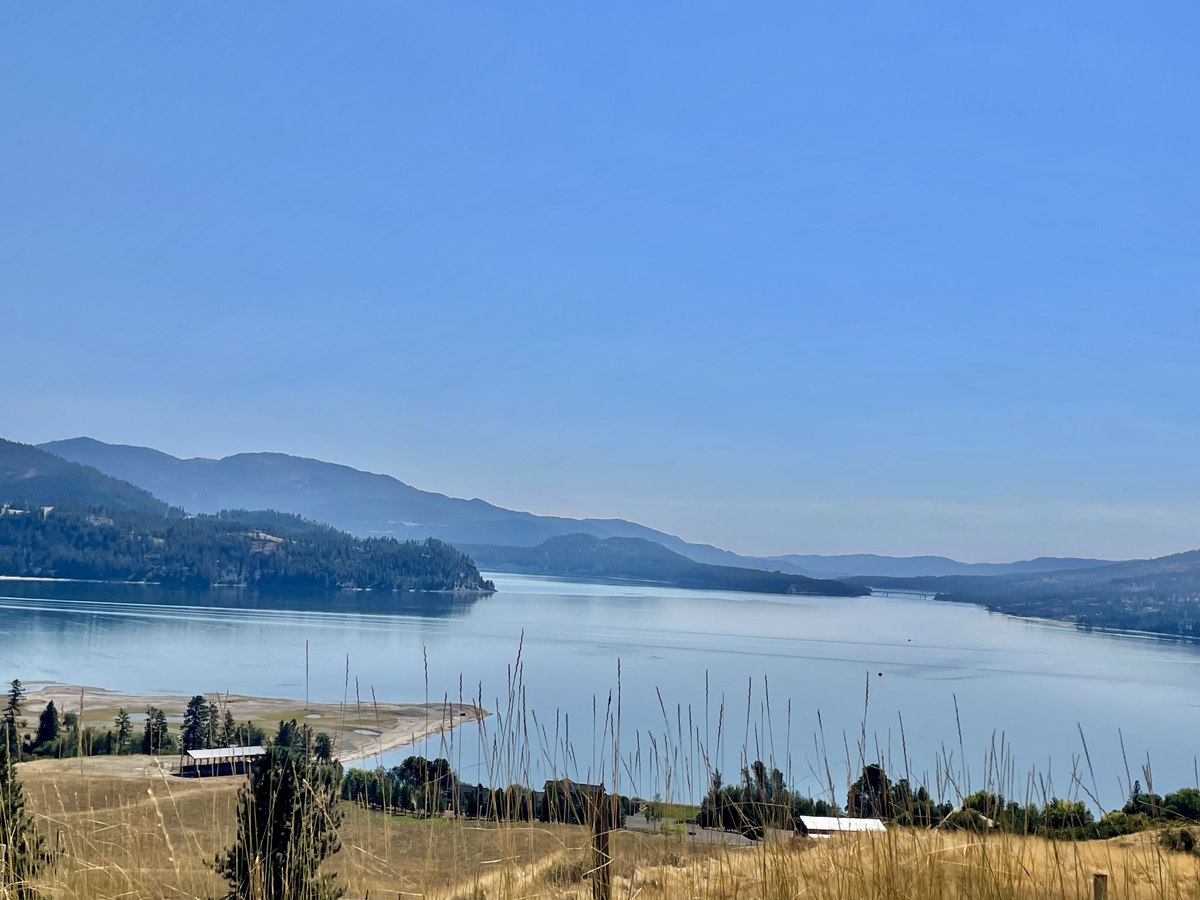
Conner’s wife Kaeli drove us to Sandpoint City Beach Park where she and their baby Kate said good-bye on the shore of Lake Pend Oreille, Idaho’s largest and deepest lake, and fifth deepest in the US. I felt lucky to bike the first 25 miles since Dave wanted to save the 2,309-foot climb for himself and Conner. We started on a dedicated bike trail and rode across the lake on Long Bridge’s beautiful two-mile pedestrian-bike lane with breathtaking views of the water and forested hillsides. The air was cool and pungent with the scent of pine, and the scenery spectacular. I was filled with joy. That is, until we exited the bike path onto a narrow winding road alongside the lake and later by the Pend Oreille River.

Day 1 – My first (and terrifying) experience biking on Old Priest River Road with no shoulder and massive trucks and RVs flying by. Photo by Conner Newbold

This was my first experience road biking with no shoulder and I was nervous. I looped a mantra in my head: relax, have fun, focus, and be careful. Sometimes there were no cars but other times a terrifying barrage of massive trucks, boats, and motorhomes blasted by. Conner scheduled quick food and rest stops every 20 miles, so we enjoyed our first of many by a remote fire station eating peanut butter and bananas.

About five miles later, we reached the center of a busy town and crossed the bridge referenced above. Even though our next stop wasn’t for another four miles, Conner pulled into a parking lot and suggested Dave take a turn. My legs were shaking from fear and exertion, and I didn’t argue. It was a relief to take over as the sag wagon driver. Days into the journey, I realized biking was more fun than driving, but in the moment, I was grateful for a break to calm my nerves and enjoy the scenery. 

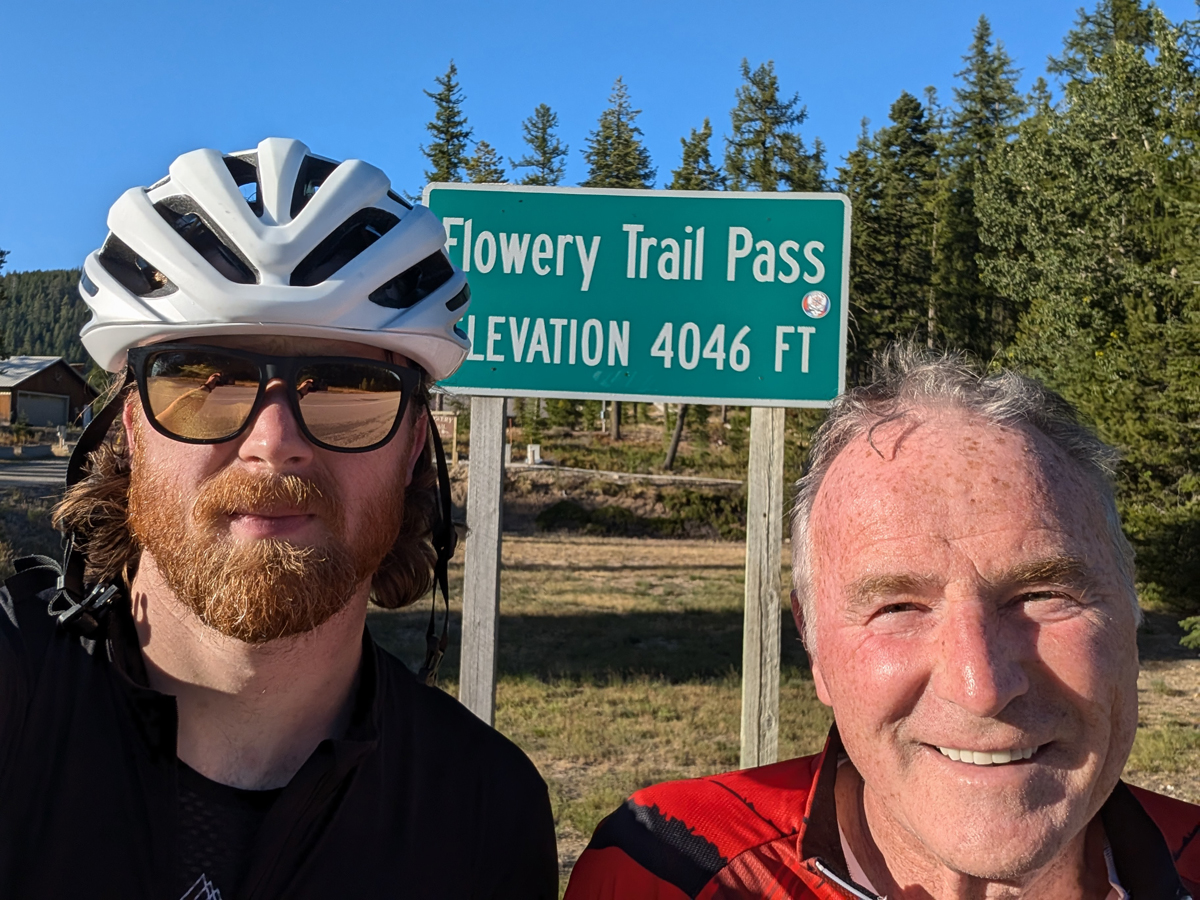
Day 1 – Longest day of the ride for Conner at 104 miles. He and Dave tackled the steep Flowery Trail Pass (elevation 4,046) in 95-degree heat starting at 3:15 pm after a bakery binge. Photo by Conner Newbold

Our next stop was Mellany’s Bakery in Usk, WA, where we stuffed ourselves on luscious pastries and burgers. My fear escalated again watching Conner and Dave tackle the steep Flowery Trail Pass (elevation 4,046) in 95-degree heat at 3:15 pm after our food binge. There were 50 miles left to ride. I was relieved when they reached the peak where we took the requisite cheesy photos by the elevation signage. Relieved again when Dave got in the car, leaving Conner to blaze downhill alone. I averted my eyes as we passed, terrified he’d repeat the epic crash he’d had a year earlier that left him with a smashed helmet, three broken ribs, broken collarbone, and broken shoulder blade. A crash so bad the ER surgeon ordered extra brain scans, commenting on how it takes “a remarkable amount of force to break a scapula this way.”

Conner: Funny that my mom was so worried about us. I was completely unbothered. In fact, I was looking forward to going into the pain cave, as they say. What I didn’t like was having my dad drop me on the climb. There I was grinding it out in the heat, while he bopped by effortlessly on his e-bike, or so it seemed to me. I found out later he tried to keep his gears at a challenging level, and was working hard for his age and abilities. I was nervous about him descending with me and glad he opted not to. If I wrecked, I’d break a few bones. If my dad wrecked, he’d be gone. And I’d feel responsible. I love the descent on any ride, and had fun racing the car. I worked through my post-crash fears long before. Plus, my bike-wreck was on a muddy rutted canyon road. Riding on the smooth asphalt highway shoulder felt like flying.

When Conner arrived at the bottom only minutes after us, I knew his speed far surpassed my mom-comfort level. He and Dave biked the last 23 miles through farmland to our motel in Colville, one of Washington’s oldest cities, arriving at 8:30 pm in near dark. It was the longest and most grueling day of the ride with Conner netting 100 miles, Dave 64 and I 36. Conner was exhausted and announced he was retreating to his room to shower and eat pizza in bed. I wanted to hang out and deconstruct the day, so was a little disappointed. But didn’t say anything.

Conner: This was by far the hardest day of the ride, and I had zero energy to socialize over dinner with my parents. I felt bad as I snatched my much-needed, calorie-dense pizza and hid in my hotel room. 

We didn’t have time on this 103-mile day to explore the towns we rode through, but I recommend adding a day or two to explore charming Sandpoint. It has cute shops and restaurants, white sand beach, mountain views and more.

Day 2: Colville, WA to Rossland, BC (Canada) – 62.3 miles, 4,378 elevation gain

Once again, it was my turn to ride first and I was afraid. I’d been anxious all morning—probably PTSD from my panic the day before. I didn’t want the others to know what a chicken I was, so kept quiet. I knew I couldn’t back out after all our preparation and planning. I forced myself on the bike and within minutes, felt a wave of joy. The scenery was gorgeous and I was exhilarated.

Day 2, It was a transcendent experience riding on Northport Flat Creek Road alongside the mighty Columbia River. Photo by Gail Newbold

Later that day, as I biked alongside the wide Columbia River, I had one of the top 10 experiences in my life. The surface of the water was like a painting, reflecting shadows, colors, clouds and mountains. I marveled at its beauty and felt an overwhelming sense of gratitude. 

They say what goes up comes down, and so it did. The temperature soared to about 97 in the shade, and away from the river’s edge, the ride was an uphill grind. My feet were throbbing from pressing on the pedals and I was fatigued and thirsty. I didn’t have a Camelbak, which was a big mistake. Conner only wanted to stop every 20-miles—never in between whether for water, photos or peeing. I thought I might collapse. At 20 miles we took a long break in the shade. I was happy Conner enjoyed our sag wagon with lawn chair, ice water, and snacks because I knew he’d never cared about having one. He likes the challenge of riding unassisted. 

Conner: The day was hotter than expected and I could swear my shoes were filling up with sweat. It felt fantastic to find a spot in the shade, take my shoes off, drench myself with water, and chat for a while.

Dave finally got on his bike at 4:30 pm in 98-degree heat. His leg included a steep 12-mile climb before reaching Rossland. That night Conner asked what we thought about the trip. We both agreed it exceeded our expectations so far. We didn’t have time to explore Rossland, aka Canada’s Alpine City, before the sun set. It’s renowned for its mountain biking and scenic hikes. I enjoyed wandering the fascinating LeRoi Mine in the morning that produced phenomenal amounts of gold during its day.

Day 3: Rossland, BC to Nelson, BC – 75.3 miles, 5,071 elevation gain

It was 10 a.m. and Dave was chomping at the bit to get on his bike. Conner preferred a slower pace in the morning and was relaxing in his motel room. Dave got so frustrated he took off on his own for the first time. He was nervous because RideWithGPS wasn’t working and he was afraid of getting lost. (User error). When he arrived 20 miles later at our meeting point at the Nancy Greene Provincial Park, he was glowing with pride about riding solo and not getting lost. Meanwhile, I loved my beautiful hike by at the subalpine Nancy Greene Lake. Con showed up for a quick rest before he and Dave descended the mountain.

Conner:  All my previous rides were solo and without sag support, which means I’m essentially homeless in between hotels. So, I like taking advantage of my comfortable hotel room and conserving energy for the day ahead. I felt bad my dad was waiting on me, but also felt a mixture of relief and guilt when he took off. I didn’t know until later that riding alone proved to be such a boost for him.

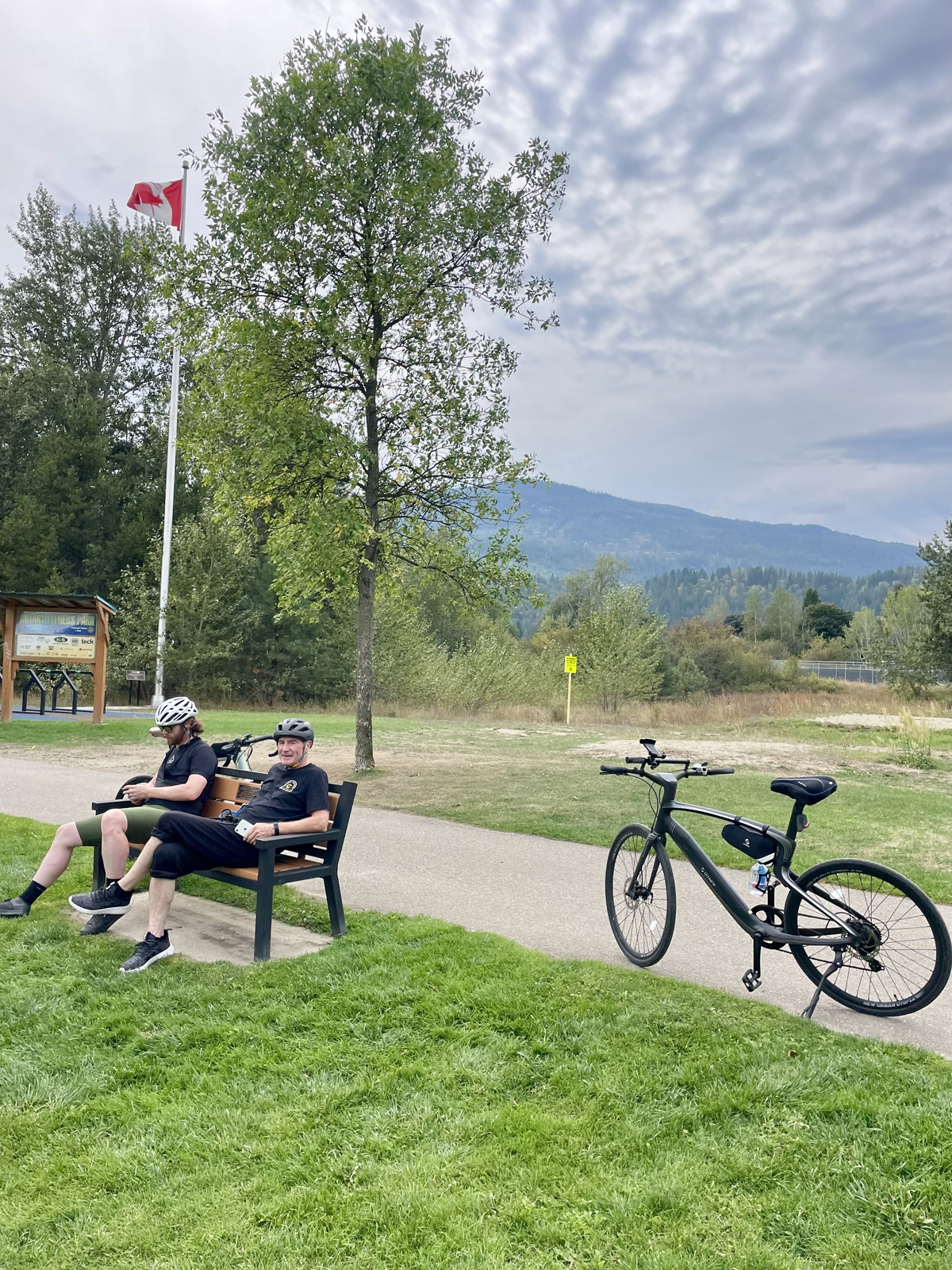
Day 3, Dave and Conner rest at Castlegar’s impressive Millennium Park on the shores of the Columbia River after biking 36 miles from Rossland, beginning with a long mountain climb. Photo by Gail Newbold

Zuckerberg Island Heritage Park in Castlegar, BC was a fascinating place to stroll while awaiting my turn on the bike. Sixty years ago, Alexander Zuckerberg built a unique Russian Orthodox Chapel House on the heavily forested island with a variety of paths to explore. I wish we’d had time to enjoy Castlegar’s famous sculpture walk featuring 20 or more sculptures of various media, many on our route. Conner and I took off around 3:15 pm on a beautiful ride through a remote forest on a narrow curving road by Gibson Creek and Pass Creek. I thought for the hundredth time how we were completely at the mercy of cars, but they politely gave us a wide berth. 

I knew something was wrong when Con suddenly stopped. After 45 minutes of desperate calling, Dave finally reached one of us to say he was stranded by the side of the road. I’d taken off with both sets of car keys. He was highly frustrated and insisted Conner ride back immediately with his keys, thinking Conner would be faster. But that would have added 12 miles onto Con’s pedal-powered ride because of our mistake. I knew I needed to do it.

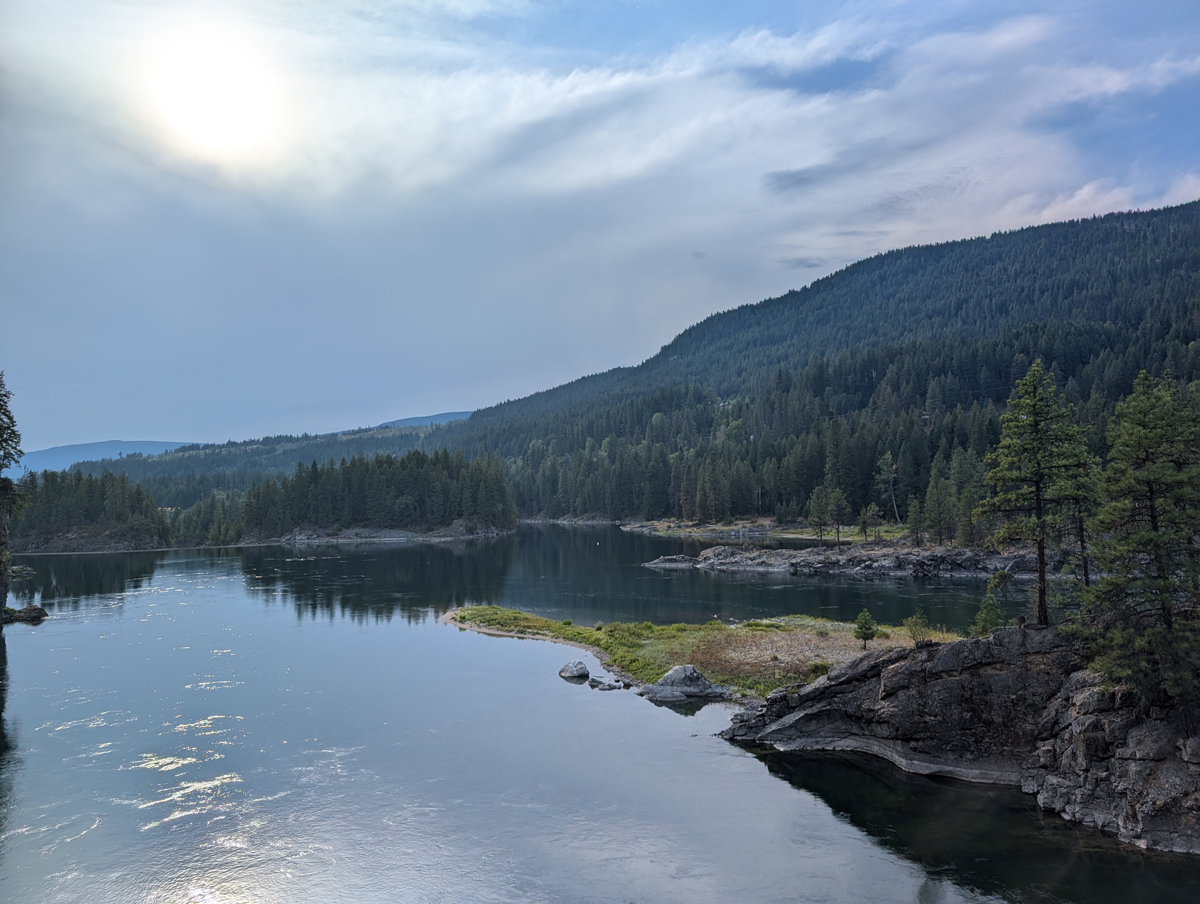
Day 3, Photo of the Kootenay River taken from a bridge near Lower Bonnington Dam on the stretch between Castlegar and Nelson, BC. Photo by Conner Newbold.

Up till then, I’d always followed closely behind Conner. He asked if I was nervous to ride alone. “No,” I said. “If I have problems and can’t reach one of you, the world is full of nice people who will help me.” RideWithGPS wasn’t going to direct me backwards, so Con made sure I knew the route and I took off.

Conner: I felt super guilty and worried about my mom but completely unwilling to help, I can’t lie. I didn’t want to add in an unanticipated 12 to 14 miles because someone forgot their keys. Not to mention, I had my nutrition all planned out in 10-minute chunks. 

The ride back was beautiful and I was fast. I tried not to feel bitter at myself or Dave about the situation. It was a mutual error. We’d both forgotten I had Dave’s keys. The silver lining was that like Dave, I discovered I loved riding on my own. Back at the car, I felt incredibly proud and empowered and often chose to ride alone after that.

As we raced to catch up with Con, we drove through an especially beautiful stretch of scenery by mountains, rivers, and dams. I desperately wished I was on my bike. When we finally spotted Conner, there were only about eight miles left to Nelson, BC. I savored every remaining mile, trying as always not to think about how fast cars were going and how vulnerable we were.

Conner: It really was an incredibly beautiful segment of the journey. I felt simultaneously happy to be riding alone as I’m used to, but sad my mom was missing it. She would have loved it.

I had hours to think during my days on the bike and didn’t listen to music or audiobooks. I liked feeling attuned to my surroundings, and viewed the lack of noise distraction as a challenge. I wondered if Conner sometimes felt he was babysitting us, as with the key snafu. And when he stopped to untangle the elastic on my saddle pack that came loose and wrapped itself around my spokes. But he was always outwardly very patient. I wondered why he didn’t want to talk during the quiet stretches. My feelings had been hurt when I tried and felt rejected. Not wanting to seem needy, I didn’t ask. Instead, I told myself he needed a lot of space and alone time.

Conner: I felt like my fitness level was just barely, barely enough to survive this ride, so slowing down to chat wasn’t really on my radar. Part of the joy of cycling for me is pushing myself hard and I wanted to stay in the zone mentally. 

Our VRBO was located at the top of a very steep hill, so I jumped in the car for that section. Con tackled it with his usual resolve, arriving hot, tired, and sweating.

Conner: Grinding up this 9% or 10% grade on a tiny canyon road to the VRBO at the end of a long day biking was an unexpected challenge. I arrived heaving from the exertion to see the VRBO hosts and my parents happily chatting, and I felt unaccountably furious.

Day 4: Rest Day, Nelson, BC

We enjoyed a relaxing day exploring beautiful Nelson, resting, doing laundry, and recovering from aching muscles, butts, necks, legs, shoulders, and hands. We especially enjoyed wandering the unique shops on Baker Street in its historic downtown, Gyro Park with incredible views of Kootenay Lake, Cottonwood Falls Park and Japanese Garden and sampling the pastries at two French bakeries. WACANID says many travelers refer to Nelson as a European Village and is renowned for its eclectic arts scene, restaurants, and wide variety of outdoor recreation like hiking, swimming, and the Ainsworth Hot Springs. 

Day 5: Nelson, BC to Creston, BC – 79.7 miles, 3,517 elevation gain

Conner and I biked the first 18-mile leg alongside an arm of Kootenay Lake on a 2-lane highway with traffic going at 60 km/hour. I tried to be vigilant about staying in the narrow strip between the cars and the edge of the road and only allowed myself glimpses of the lake. When we arrived intact at the Osprey Ferry, claimed to be the longest free ferry ride in the world, I felt exhilarated to be alive. We ate pastries from a bakery at the ferry landing in Balfour before boarding.

Day 5, Conner admiring the gorgeous scenery on the ride between the Kootenay Bay Ferry Landing and Creston, BC. Photo by Gail Newbold

It was bright and sunny. I wandered to the front of the ferry where a woman said she and her husband from Kamloops, Canada, were on a 40th anniversary trip. I assumed Dave and Conner were enjoying some father-son talk time, but later discovered a biker from Austria held court during the entire crossing. He was 78, riding solo and probably lonely. Dave was disappointed, but Con enjoyed swapping stories with a veteran biker.

Conner: I especially enjoyed admiring his Pinarello Dogma.

The rest day in Nelson did everyone good and Conner and Dave were feeling strong. I worried because the next 25 miles off the ferry were on a remote scenic drive with no shoulder. It began with a short but steep climb before dropping back down into Crawford Bay. A variety of artisans selling their wares are located there. The scenery along the east shore of Kootenay Lake was stunning and I pulled over in the car to enjoy beaches and viewpoints. I later read claims that this section along the south arm of Kootenay Lake to Creston might be the most spectacular road-biking daytrip in Canada with its rolling hills, winding turns, and huge views across the water to snowcapped peaks.

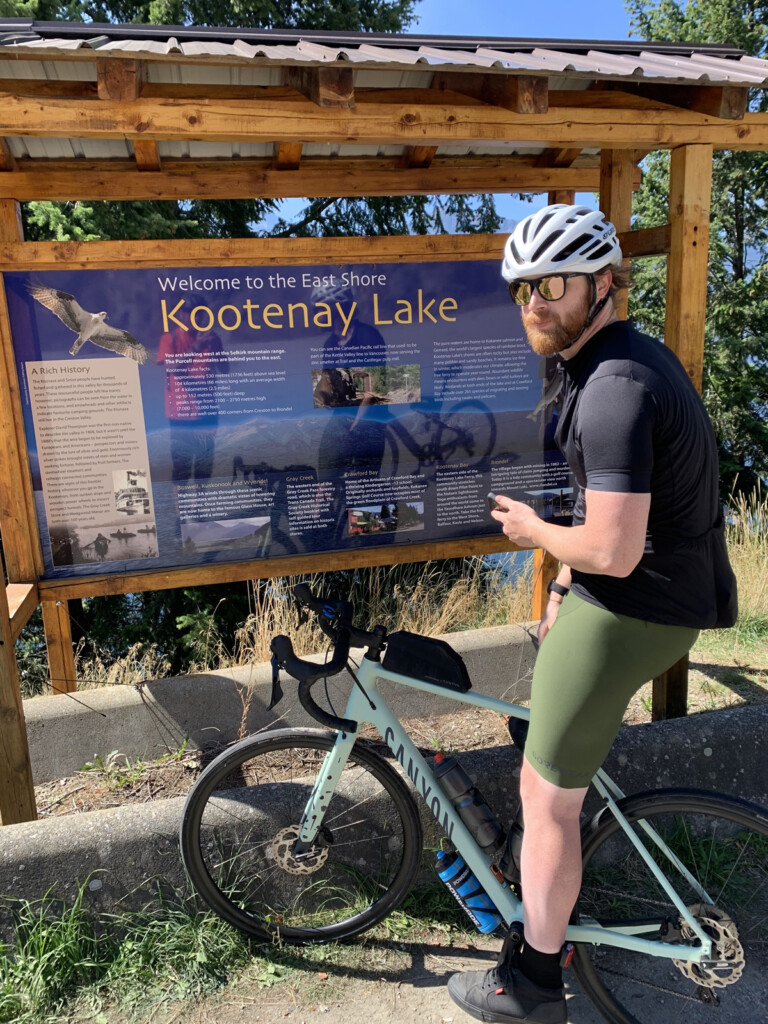
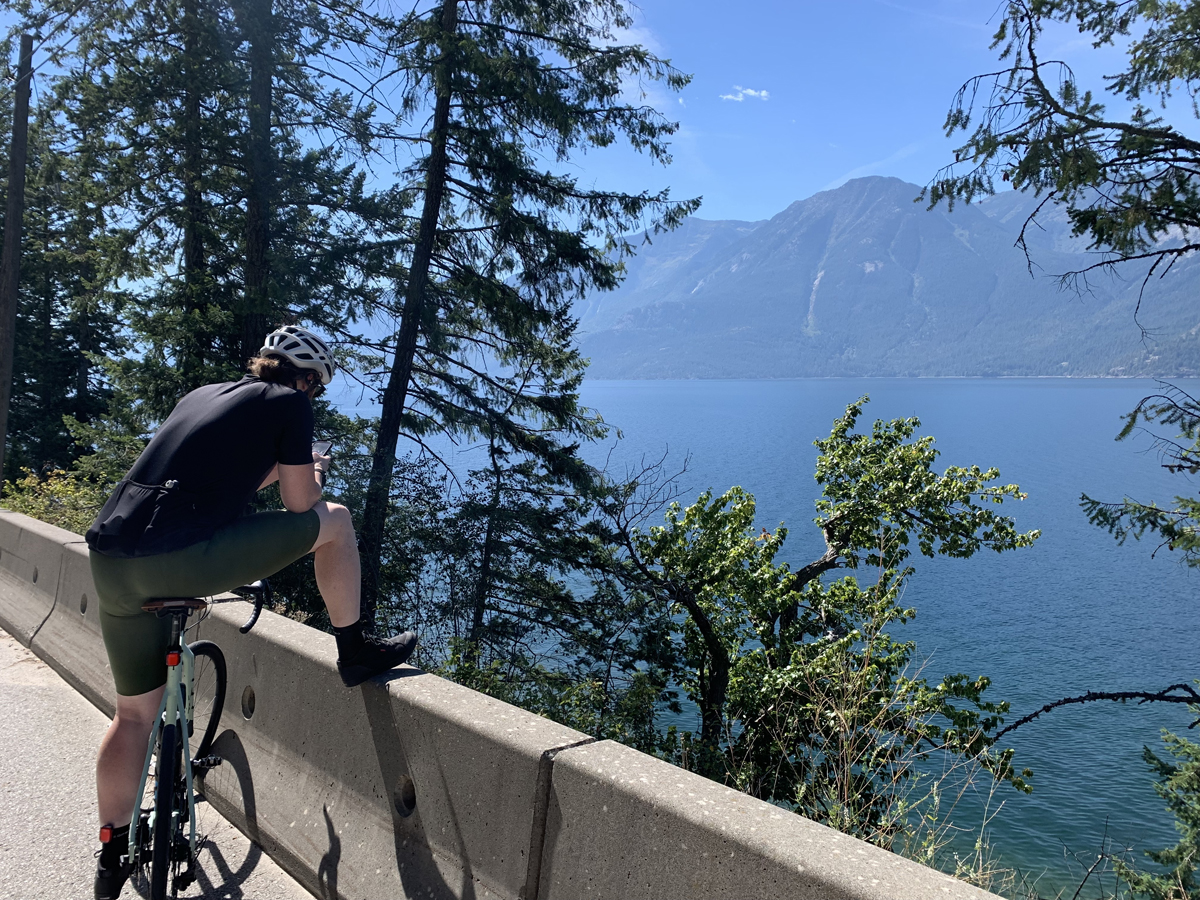
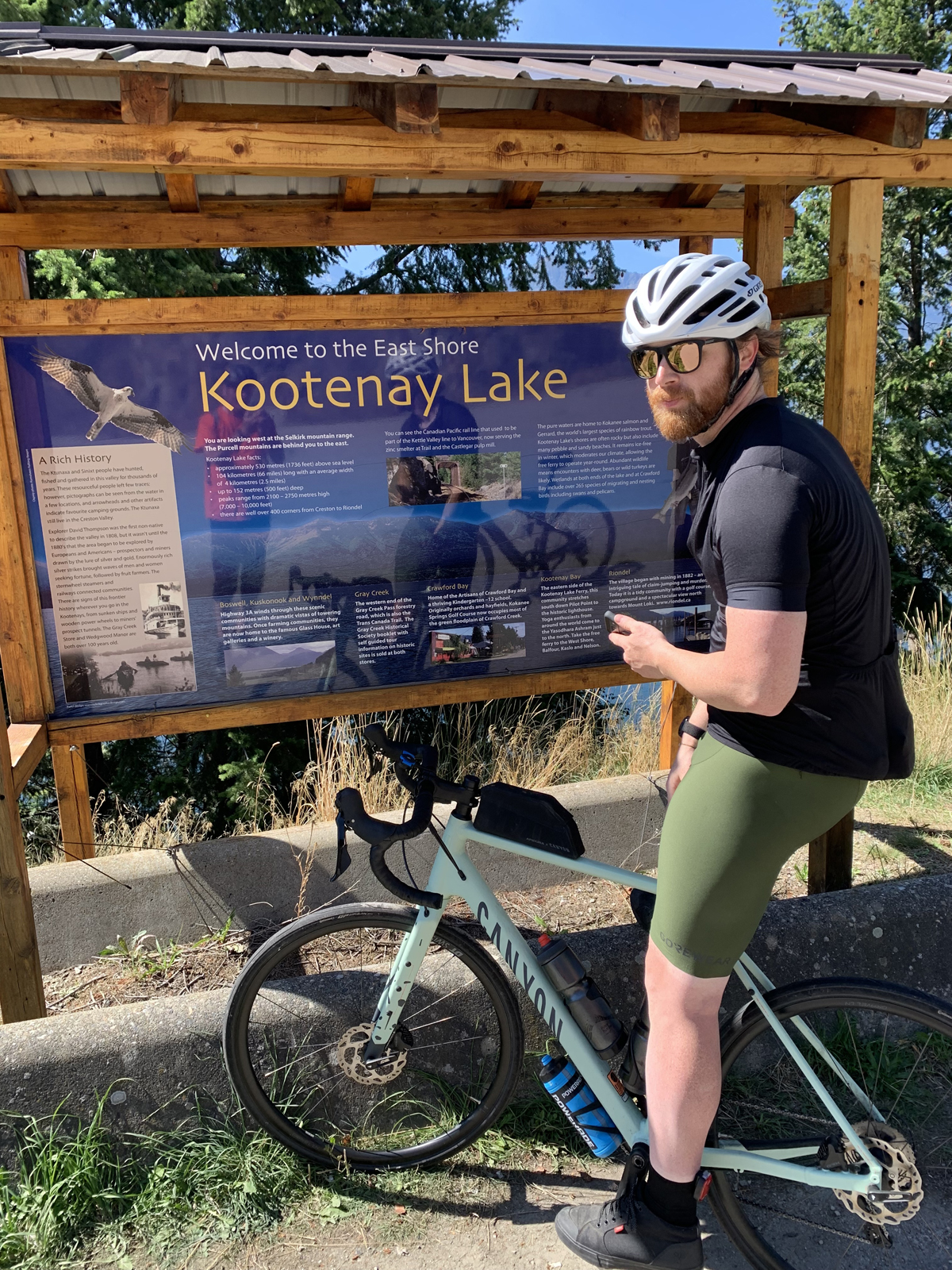
Day 5, Conner reading an interpretive sign on the east shore of Kootenay Lake, one of the most spectacular sections of the entire ride. Photo by Gail Newbold

We met up at The Glass House made from over 500,000 empty embalming fluid bottles. No time for the tour but we appreciated its quirkiness from the outside. Before reaching Creston, Con and Dave rode on a secondary highway into the valley floor with views of the Selkirk Mountains. Dave ended up doing 50 hard and hot miles that day. Conner did 78, and I only rode 18.

Creston felt like a forgotten town with a tiny main street and no touristy stores. We loved it and our lodging at the Uptowner Motel. I wandered funky little shops before they closed while Conner and Dave showered and rested. We pulled out the stops for our last night and had a fun sit-down dinner at Bayleaf Indian Fusion restaurant with some good talk time. 

Day 6: Creston, BC back to Sandpoint, ID (USA) – 81.1 miles, 2,847 elevation gain

Conner wanted a leisurely morning exploring Creston and I wanted to start biking while it was cool. I felt elated as I rode alone through forests, by mountains, alongside fields of hops grown for Budweiser, and across the US Canadian border. There was a bit of a climb south of the border, which meant some downhill on the other end. I gained so much confidence that I started allowing myself to go fast downhill. Never as fast as Conner. And only when I could see far ahead. I felt enormous gratitude to Conner for inviting us on his adventure, and Dave for hefting my bike in and out of the car. I dreamed about a future trip with all our adult children. We could be a peloton. 

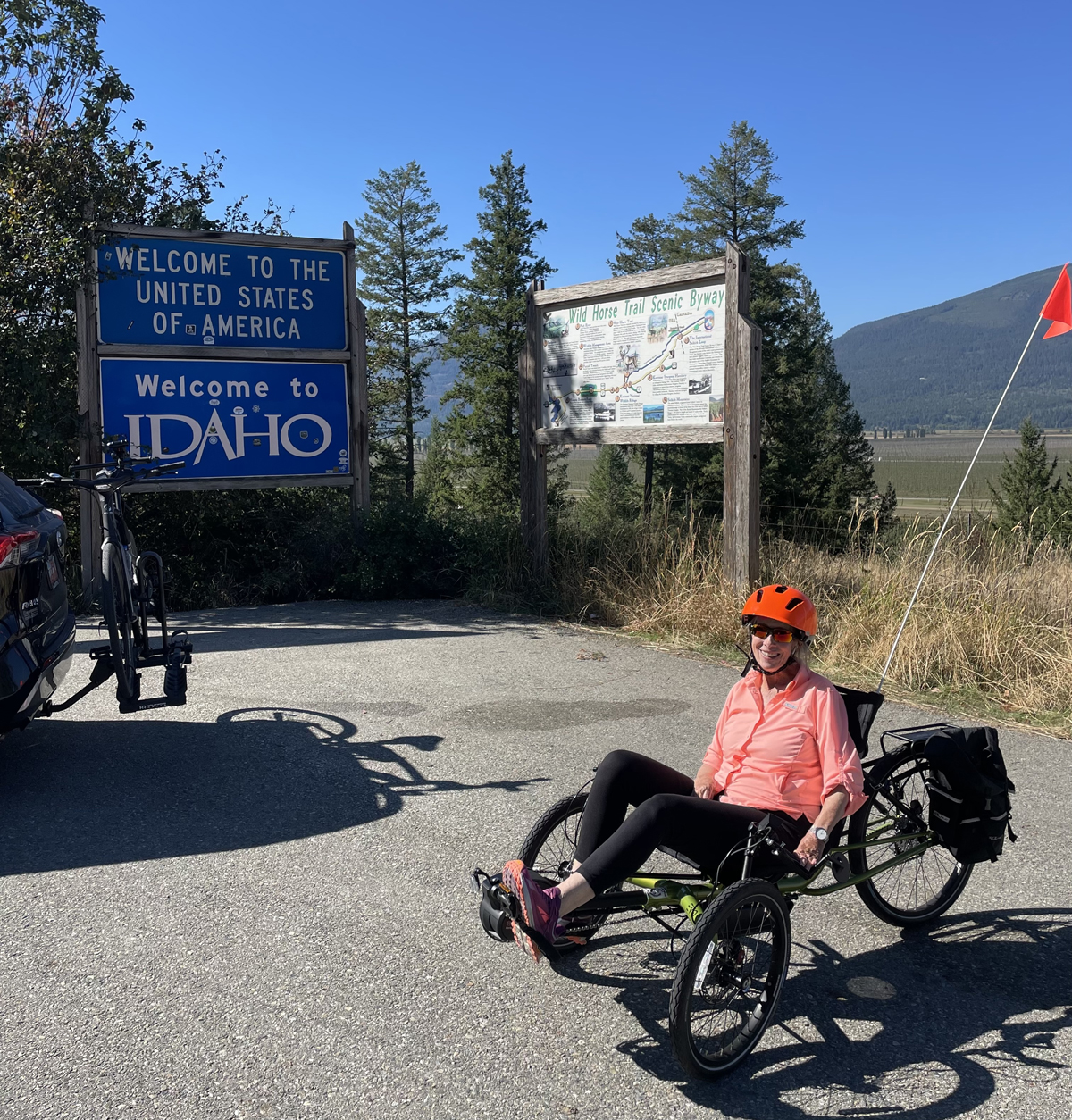
Day 6, I learned to love riding alone, so here I am on the final day crossing the border back into the U.S. Photo by Dave Newbold

Conner: An amusing thing about cycling with my dad involved his clothing. Before the trip, I tried to equip him with appropriate cycling gear – a bib, shorts, shoes, jersey, even mid-calf Italian cycling socks. He’s always been very clothing-conscious, and I figured he’d want to look the part of a cyclist. Somewhere between day two and three, I noticed certain elements of the kit disappearing. By the end of the trip, he was riding in basketball shorts, thick cotton underwear, gym shoes, and a heavyweight orange cotton tee (better to wipe his sweaty face with, he later explained). He seemed perfectly happy so I decided not to care. My mom did, however, since she’d help finance it. 

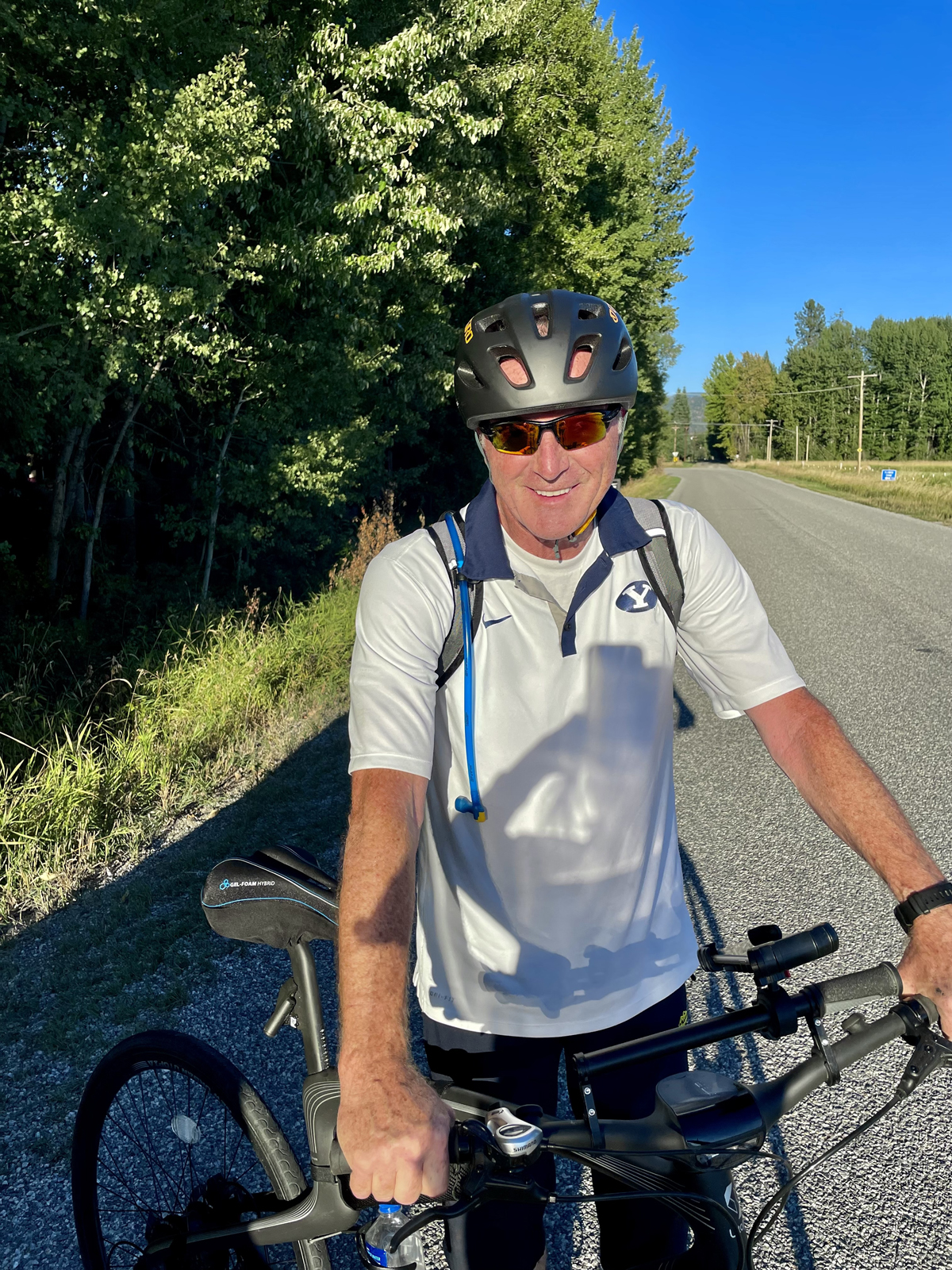
Day 6, Dave was itching to get on his bike and ride the last 10 miles into Sandpoint, and after riding 42 miles, I was happy to let him. He’d discarded his fancy biking kit by then in favor of a golf shirt and baggy shorts. Photo by Gail Newbold

Bonners Ferry is a great place to stop for lunch and wander shops if you have time. I enjoyed my longest ride that day (42 miles). Dave rode the last 10 miles. Con finished the day at 80 miles or so, which included two stretches on Highway 95, a major thoroughfare for trucks that neither Dave nor I wanted anything to do with. One section was in a construction zone with orange cones that forced Conner onto the highway with cars at high speeds. I was terrified for him.

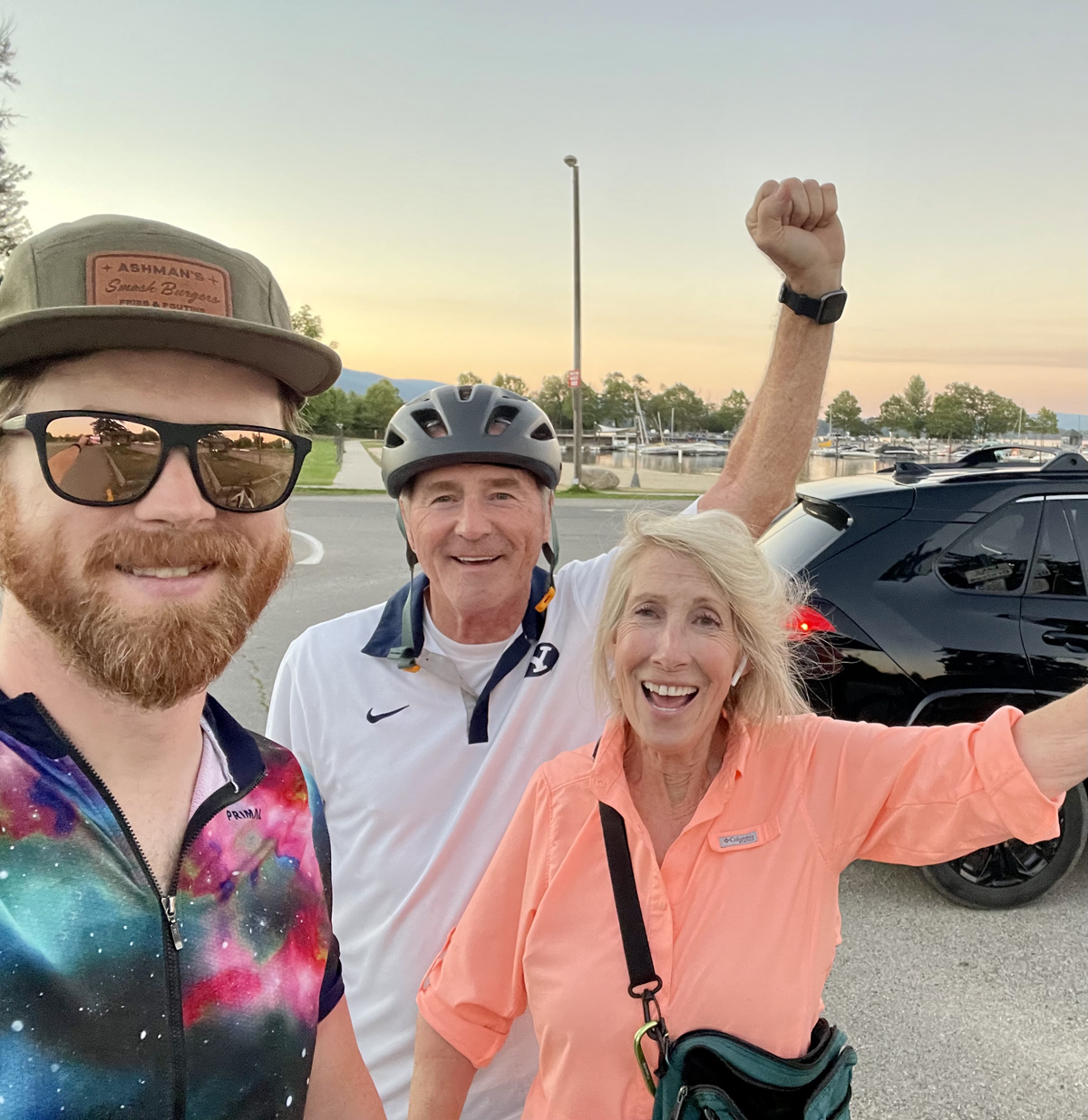
Day 6, Hamming it up for the camera at the end of our journey back at Sandpoint City Beach before driving back to Hayden. Photo by Conner Newbold

Dave and I celebrated the end of the ride with a delicious flight of ice cream from Panhandle Cone and Coffee in Sandpoint, then met Con in the parking lot where we began. We took congratulatory pictures by our bikes before driving to our son’s home in Hayden.

On the long drive back to Utah, I contemplated why I loved the trip so much:

  • It was a completely new experience. 
  • I loved being with my husband and son.
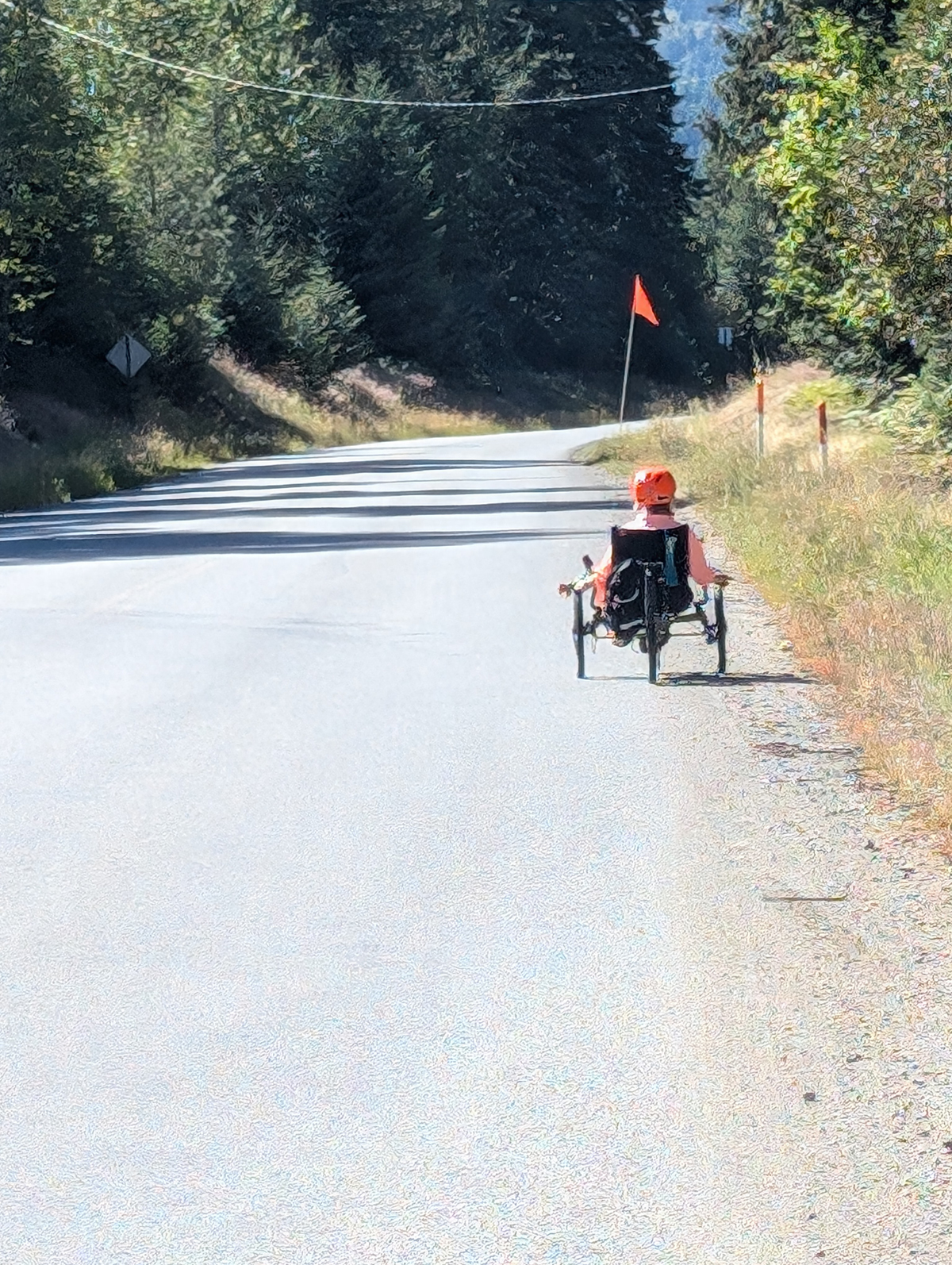
  • I love nature and this was nature up-close and personal since my e-trike was low to the ground.
  • I felt a huge sense of accomplishment and empowerment from doing things that were hard and scary, and at age 70: riding alone, biking on roads with no or small shoulders, and adjusting my gears to keep the ride challenging.
  • I loved exploring new places every day.
  • Conner’s intensity and determination to ride every mile as outlined in WACANID’s route added to my own sense of accomplishment though I didn’t bike anywhere near what he did.

Conner: It was a good time and I’m glad we did it. Counterintuitively, having my parents there made it more challenging, rather than less, even though we had a sag wagon, stopped often, and stayed at nicer places than the slums I would have booked. But there were many upsides that more than counterbalanced it – I loved seeing my parents fall in love with cycling and watching them revel in this unique experience. I loved how they pushed themselves so hard, and seeing how proud they were of themselves. It made me happy when I found out they bragged to all their friends about it. I would definitely go on another ride with them – but instead of trying to set their expectations properly, I would adjust my own. 

End Notes

  • Route: https://www.WACANID.org/ (Washington-Canada-Idaho Ride) – We appreciated using the information provided online by this website but did not join its organized ride. The route follows the famous International Selkirk Loop (https://selkirkloop.org/maps/driving-map/) closely on the east side of the loop, but not the west. The loop is a 280-mile scenic drive that winds through the Selkirk Mountains, crossing international borders between the U.S. and Canada, making it the only National Scenic Byway in the US to do so, and offers stunning views of lakes, forests, charming towns, and wildlife along the way.
  • Trip Length: 6 days including a one-day layover
  • Mileage:  402.6 miles and 20,822-foot elevation gain
  • Food/water tips from Conner: Eat a ton of carbs all day and at dinner. Be sure to pack enough water for the long legs if you’re going in the hot months. It gets surprisingly hot and dry for a route so far north. The WACANID route is pretty good about including regular stops in towns with gas stations and c-stores, so you can usually pack light and restock as you go. But many are small towns so it’s worth checking to see if businesses are open on weekends/Sundays/random Canadian holidays/whatever. I’ve had scary situations with this in the past.
  • Problem areas: Biking on US Hwy 95, especially in the construction zone, was by far the worst section of the route. Traffic was heavy and shoulders were slim. Definitely not recommended for beginners.


UDOT to Make Crossing I-15 in SLC Valley Safer for Cyclists

By Charles Pekow — Additional bicycle crossings have been approved along I-15 between Salt Lake City and Farmington, Utah. The Utah Department of Transportation (UDOT) has finalized an updated plan for the highway, pending potential legal challenges before March.

600 N crossing of I-15. Photo by Dave Iltis

According to UDOT, the plan aims to significantly enhance safety and improve the experience for pedestrians and bicyclists at existing interchanges within the social environment evaluation area. The interchanges included in the plan are:

  • 200 West in Farmington
  • Parrish Lane in Centerville
  • 400 North in Bountiful and West Bountiful
  • 500 South in Bountiful, West Bountiful, and Woods Cross
  • 1100 North/2600 South in North Salt Lake and Woods Cross
  • 1000 North in Salt Lake City
  • 600 North in Salt Lake City

UDOT explains that all these interchanges will feature wider, safer facilities specifically designed for pedestrians and bicyclists. Additional roadway improvements, such as signal-controlled turn movements at interchange terminals and perpendicular intersection designs, will further enhance safety and improve the user experience for those crossing I-15 at these locations.

For more details, visit UDOT at https://i15eis.udot.utah.gov/


2025 USA Cycling Collegiate Road National Championships Coming to Madison, Wisconsin – May 2–4, 2025

MADISON, Wisconsin (March 31, 2025) – The 2025 USA Cycling Collegiate Road National Championships, presented by Trek, will take place May 2–4 in Waterloo and Madison, Wisconsin. The public is invited to experience three days of exciting racing in Watertown, at Trek Bicycle Headquarters in Waterloo, and throughout downtown Madison.

Trek Bicycle is thrilled to welcome the nation’s top collegiate athletes to their home turf for this premier event. Racers will compete across a variety of scenic and challenging courses, from rural farmlands to urban streets. A total of twelve championship races will be held, with Varsity and Club collegiate athletes competing for national titles.

Race Schedule & Daily Awards

Friday, May 2 – Team Time Trial
Location: Outside Hubbleton Brewing Taproom (W7071 Main St, Watertown, WI)

  • Food and beverages will be available for purchase starting at 10 AM.
  • Street parking available throughout town.

Saturday, May 3 – Road Race
Location: Trek Bicycle Headquarters (801 W Madison Street, Waterloo, WI)

  • Spectator areas will be available along the course.
  • Mediterranean cuisine from the Banzo food truck will be available for purchase.
  • Awards ceremony will take place inside Trek Headquarters after racing concludes.
  • Free parking on-site.

Sunday, May 4 – Criterium
Location: Downtown Madison, near Breese Stevens Field

  • Pay-for parking available at the South Livingston Public Ramp (111 S Livingston St) and other downtown locations.
  • Please note: Parking around the course will be limited.

Awards for Saturday’s Road Race will be presented at Trek Headquarters, and Sunday’s awards will be held at the Criterium course in downtown Madison.

General Information

Consistency for the Win; Building Sustainable Cycling Fitness

By Sarah Kaufmann — In these early season months, as we look to the training and racing ahead, everything seems possible. It’s easy to get excited by intense workouts, smashing group rides, and big, flashy efforts. But the key to sustainable, long-term progress is more mundane – and sometimes more challenging. It’s about being consistent day in and day out, doing the work as your body tolerates and having the objectivity to step back when it doesn’t. It takes patience.

Why Consistency Matters

Consistent training builds your fitness over time. Each ride – whether an endurance session or a structured workout, adds up. You build a deep aerobic base. Regular training creates changes in the body across a spectrum of cardiovascular, muscular, metabolic, respiratory, hormonal, and neuromuscular systems that give you the foundation to develop peak fitness. This aerobic foundation lays the groundwork for all the training you do. Think of it as the base of a pyramid – the larger the base, the higher the peak. As your aerobic conditioning improves with consistency, your ability to recover and absorb hard sessions also improves. So, the more you do, the more you can do.

The Importance of a Strong Aerobic Base for High-Intensity Training

High intensity, flashy workouts are exciting. The programming usually looks interesting and pulls our attention. But before you can fully benefit from these sessions, it is essential to have a deep aerobic foundation in place. Even the most exciting workouts will under deliver without the base to adapt from the load. A strong base ensures you can tolerate and recover from these sessions.

Consistency in training is key. Photo courtesy Sarah Kaufmann

A Realistic Timeline for Season-Long Goal Setting

Building a well-rounded training program means there is a time and place for the high-intensity workouts within a context of consistent work and proper recovery. Keep in mind that developing deep aerobic fitness takes years, so this timeline is meant only as a barebones guide for single event prep:

  • Base Phase (12-16 weeks): Focus on creating a base with long rides, as conditions allow (this period of training is often done during the winter). Intervals in the tempo/ sweet spot/ threshold ranges also fortify these long rides and can fill in when volume isn’t achievable.
  • Build Phase (6-8 weeks): Moving toward more structured intensity with focused threshold and VO2 Max work. Volume likely dips to accommodate the additional intensity. More strategic recovery sessions are needed to ensure adaptation from the higher intensity.
  • Peak Phase (4-6 weeks): Prepare for your goal event by fine-tuning your fitness. Volume is reduced and the structured workouts are tailored to the specific demands of your event. This is when those spicy, exciting workouts have their place!
  • Transition Phase (Post-Event): After your goal event, build in time to recover and reflect. This phase can often bring some feelings of sadness. The denouement may leave you feeling empty. Preparing for these emotions can make the process easier. Use this period for open riding, limited structure, and cross-training, setting the stage for the next training cycle.

Practical Strategies to Maintain Consistency

  • Plan Your Training: Work with a coach to strategically plan the timing and intensity of training sessions to optimize within your normal life schedule and commitments. This partnership will manage training through periods of fatigue and stress.
  • Reflect on short-term goals: In addition to your seasonal objectives, celebrate the successes that come within training – new FTPs or peak power metrics, nailing a week of training, consistency with sleep, optimal fueling, etc.
  • Monitor Your Recovery: Be aware of how your body feels after each workout and adjust your training load accordingly. Be willing to modify or cut workouts if you are under recovered, to complete subsequent sessions with precision.

Conclusion

Developing deep, resilient fitness is about steady, consistent work over time. Realistic, focused goals, and a structured training plan give you the foundation for success and ongoing progress throughout the season.


Trump Tariffs Likely to Take Toll on Bicycle Industry

By Charles Pekow — New and increased tariffs will likely cause the price of bicycles and spare parts to rise, but it’s too early to say how much. The Trump Administration continues to announce a series of import taxes that will be ultimately passed on to consumers – if the products they seek are available at all as supply may dwindle.

This 1908 cartoon shows how tariffs, sold as “protection for the people,” often serve as hidden taxes on those same people, enriching an elite few and leaving consumers with inflated prices and empty promises. Image in the public domain.

In February, for instance, President Donald Trump announced increased fees of aluminum imports of between 10 and 25 percent (Federal Register, Volume 90 Issue 31 (Tuesday, February 18, 2025) https://www.govinfo.gov/content/pkg/FR-2025-02-18/html/2025-02832.htm and 25 percent more on steel (Federal Register, Volume 90 Issue 31 (Tuesday, February 18, 2025) https://www.govinfo.gov/content/pkg/FR-2025-02-18/html/2025-02833.htm. Additionally, bicycles imported from China will be subject to an additional 10 percent tariff. This will affect about 87 percent of bicycles imported to the USA.

The “tariff situation is still developing, and we have some uncertainly about how things will play out,” Heather Mason, president of the National Bicycle Dealers Association (NBDA) wrote in an email to Cycling West. Depending on the level of inventory, wholesale prices for bicycles could go up as early as late March, or three or more months later, she stated.

NBDA sent a memo to members suggesting dealing with the situation by selling used and refurbished bikes. “The highest-grossing product category in bike retail is used bicycles, yielding 50 percent gross margins – yet fewer than 10 percent of shops actively sell them!” NBDA’s correspondence reads.

People for Bikes has been carefully tracking the situation. Matt Moore, its Policy & General Counsel, indicated it also doesn’t know how tariffs will play out “other than that additional tariffs will continue to add to the landed cost of imported bicycles, electric bicycles, components and accessories. How much retail prices increase, and how tariffs affect supply and consumer demand, is unknown at this point.” But Moore warned that not only may prices rise, but the added cost of tariffs will mean manufacturers won’t have as much money to develop new products and obtain inventory. He added in an email “with interest rates staying high…working capital is more expensive than it has been in recent years.”


Sport Produces Mountains of High-Tech Waste. We are Finding New Ways to Recycle It

0

By Ali Hadigheh, University of Sydney and Yaning Wei, University of Sydney In the early days of the modern Olympics and Paralympics, athletes competed using heavy, non-aerodynamic equipment. The record for throwing a javelin, for instance, has almost doubled since 1908, when the sport was introduced. Athletes have got better – but so has their equipment.

In fact, sporting equipment (and the materials it is made from) has improved in almost every sport. Fibre-reinforced plastics, in particular, have been revolutionary. These composite materials commonly combine plastics with strong carbon or glass fibre. You can now find them in most sports played at high level.

These strong, bendable and lightweight materials have made it possible for athletes to push the limits of their sports, win medals and bring pride to their nations. But they come with a hidden cost.

Composite materials are notoriously hard to recycle. And the amount of waste from sports is growing fast. Our research offers a way to reduce this waste – and extract valuable carbon fibres.

Composites everywhere

Fibre-reinforced polymers have become ubiquitous because of their unique properties. They offer a combination of low weight, flexibility, strength and durability. The properties can be modified by adjusting fibres, mixing materials and changing how sporting equipment is designed.

If you pick up a modern tennis racket in one hand and an old wooden racket in the other, you will notice the difference. New composite rackets are light and strong, letting players achieve faster swing speeds.

Badminton rackets, too, have left solid wood behind. Today, even shuttlecocks have feathers reinforced with carbon rods.

Running footwear relies on carbon composites to boost springiness, aid propulsion, boost heel stability and reduce foot fatigue.

This carbon fiber bicycle had a defect in the rear triangle and ultimately was destroyed. New techniques may allow carbon fiber to be recycled. Photo by Dave Iltis

Cycling has greatly benefited from carbon composites. Modern racing bikes are often made entirely of carbon fibre, including lugs, tubes and connections. These bikes are lightweight, highly durable and with significantly lower air resistance compared to their metal counterparts.

Wherever you look, you see fibre-reinforced plastic composites. The bows in archery, the poles in pole vaulting, the wheelchairs in the Paralympics, the carbon net poles in volleyball, the saddles, horseshoes and helmets in equestrian disciplines, the gun bipods in shooting, the golf club shafts in golf, the boats in sailing, the skateboards in skating, the surfboards in surfing and even the climbing walls in rock climbing – all are now made of composites.

When the games are over

These materials have transformed many sports. But composites are made of several materials combined. That means they are often hard to recycle.

In the United Kingdom, for instance, about 90% of all composite waste goes to landfill. Only 2% is reused for carbon fibre. Producing new composites consumes a lot of energy.

Globally, about 7,000 tonnes of composite sporting equipment reaches its end of life and could be recycled every year. Demand for recycling is increasing. This stream of waste now accounts for almost 9% of the total composite market.

As these composites have become ever more popular, researchers have looked for better ways to recycle them – ideally, in ways which are also profitable. While many methods are not profitable, our earlier cost-benefit research found several methods which show promise.

In our recent research, we put one method to the test: thermochemical recycling.

Consider the challenge of recycling composites. They are often coated with polymers or resins to make their surfaces more durable. But this makes harder to pull these materials apart. Carbon fibres are the most valuable part in these composites.

To find ways of extracting these fibres, we took broken bikes made of carbon fibre composite and experimented with recycling using chemicals and heat.

Through trial and error, we developed highly efficient chemical methods of pre-treating broken bikes and discovered the optimal temperature to melt them: 425°C. At this temperature, we could extract these fibres relatively intact. The recycled fibres retained 94% of their original stiffness and 90% of their original strength.

This means they can be put to different uses, where slightly lower strength and stiffness are acceptable.

Recovered carbon fibres can also be used in 3D printing of other bike components, offering a high weight-to-strength ratio and increased durability, or even in reinforced concrete.

Where to from here?

It is hard to see athletes ever shifting back to the heavy, non-aerodynamic equipment of the past. But if valuable materials can be recovered cost-effectively from sporting equipment at the end of its life, it creates an incentive to do something useful with this growing waste stream.

While our new method uses less energy than existing heat recycling processes and produces relatively environmentally friendly waste by-products, we believe we can improve this process further so it uses still less energy.

Ultimately, we hope this method will be useful to help small and medium recycling businesses process more composite products from sports.

Ali Hadigheh, Senior Lecturer, Structural Engineering, University of Sydney and Yaning Wei, Postdoctoral Researcher, Civil Engineering, University of Sydney

This article is republished from The Conversation under a Creative Commons license. Read the original article.