Bike Prom Is A Two-Wheeled “Fun-Raising” Event To Benefit Bicycle Collective
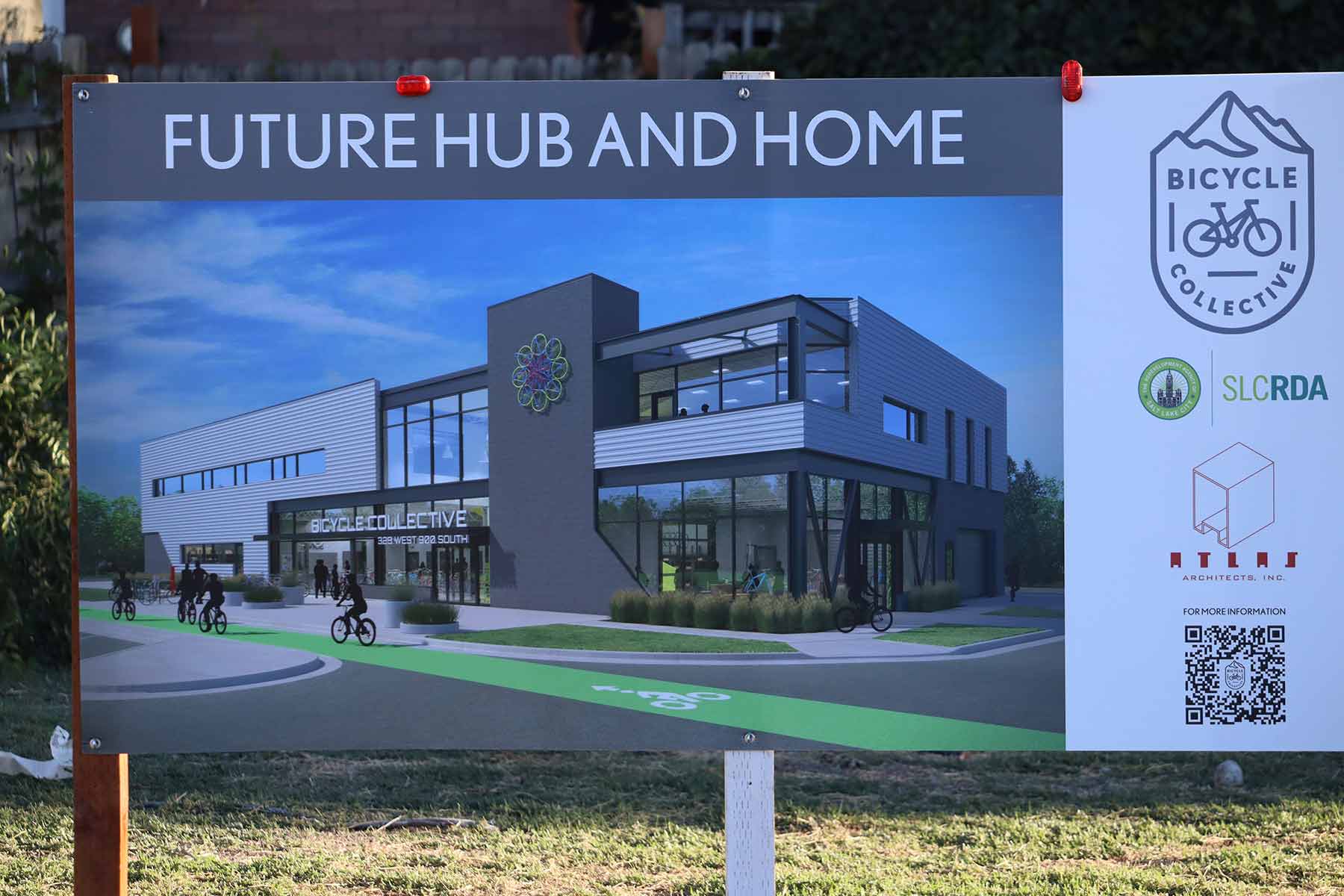
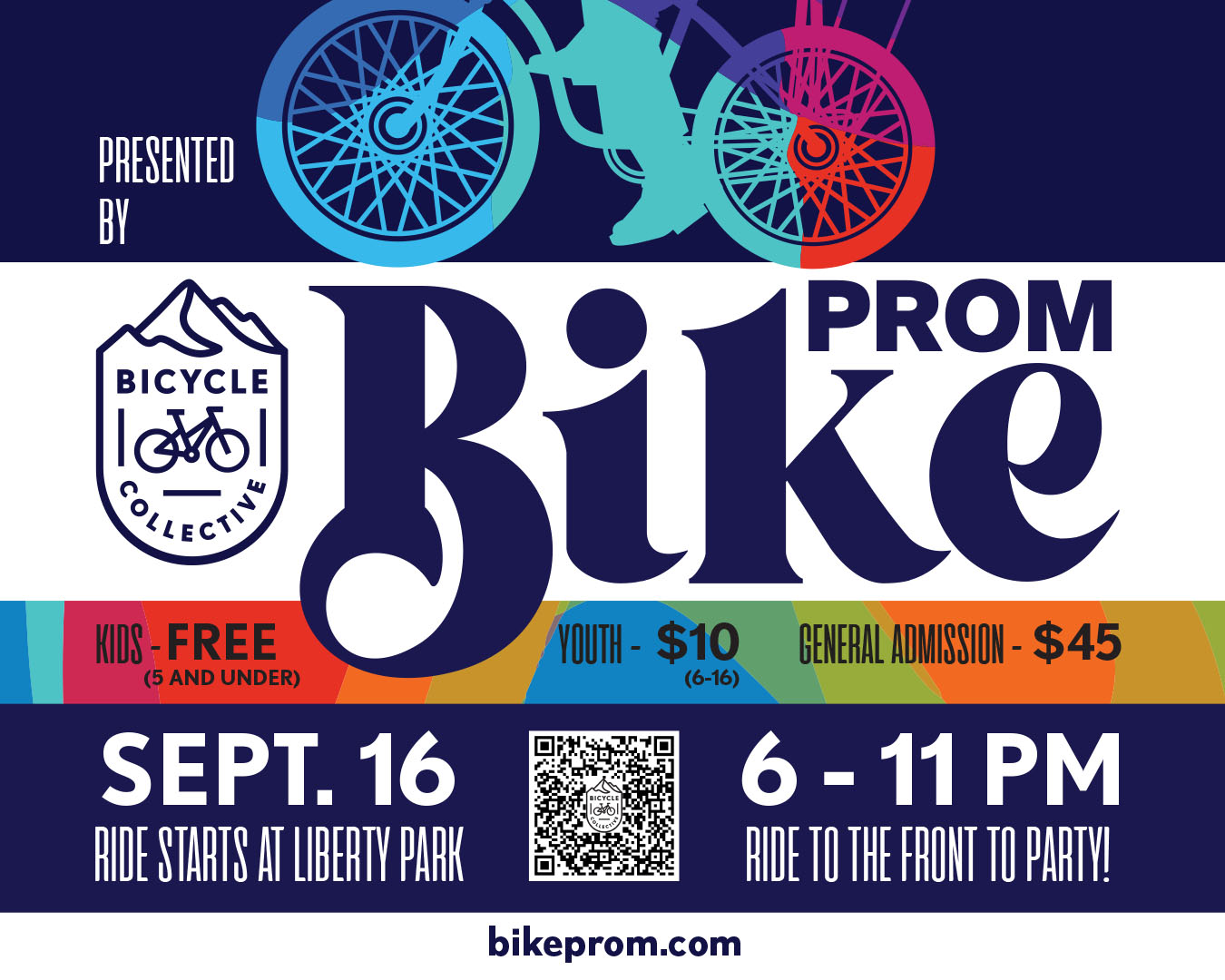
Bike Prom is back in 2023, as a social cycling fundraising event in downtown Salt Lake City, to benefit the construction of their New Hub building project.
SALT LAKE CITY, Utah (August 23, 2023) — Bicycle Collective, a Utah-based non-profit operating four community bike shops in Salt Lake City, Ogden, Provo, and St. George, is bringing their signature annual social event back to the streets of downtown Salt Lake City, with a “slow roll” group ride starting at Liberty Park, stopping at the nearly completed New Hub at 900 South and 325 West, and then culminating in a festive party at The Front Climbing Gym, located at 1470 S 400 W, Salt Lake City, Utah 84115.
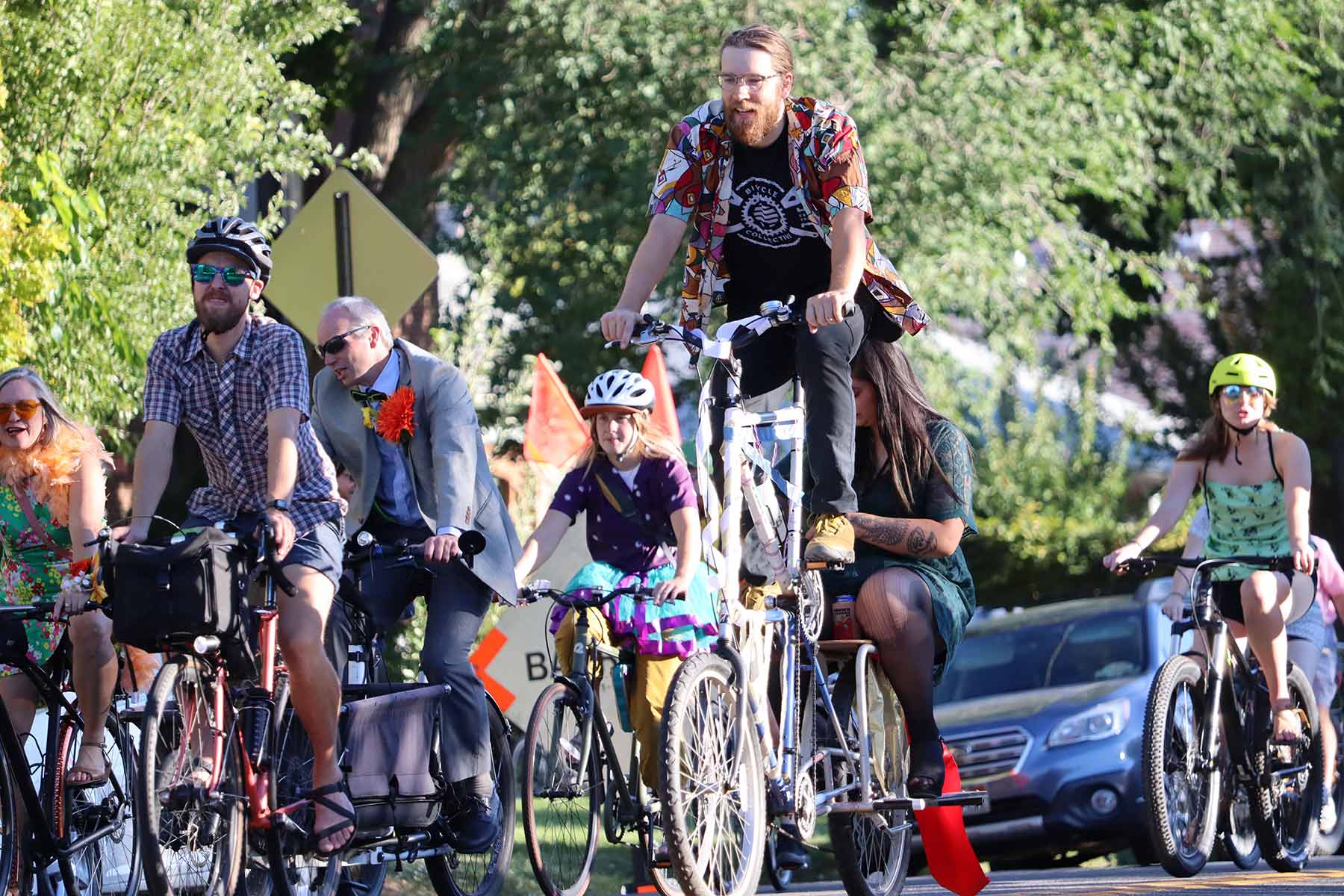
Previous editions of Bike Prom have been known for participants dressed in formal wear, costumes, and occasionally outrageous attire, which is all part of the fun.
Photo courtesy Bike Collective
“Based on the success of last year’s event, we are again partnering with our venue host, The Front Climbing Gym.” said Donna McAleer, Bicycle Collective’s Executive Director.
Photo courtesy Bike Collective
The ride is about 3 miles, and upon arrival at The Front, there will be a complimentary bike valet service so attendees can enjoy the party and not worry about their bikes. There will be food and beverages available onsite from various food trucks, and Fisher Brewing will unveil a special commemorative beer.
This is a ticketed event, and all proceeds go to support the fundraising for the New Hub.
Bike Prom 2023 Details
When: September 16, 2023. 6:00 pm to 11:00 pm.
Where: Meet at Liberty Park (corner of 500 East and 900 South) at 6:00 pm. End at The Front Climbing Gym, 1470 South 400 West, Salt Lake City, UT 84115
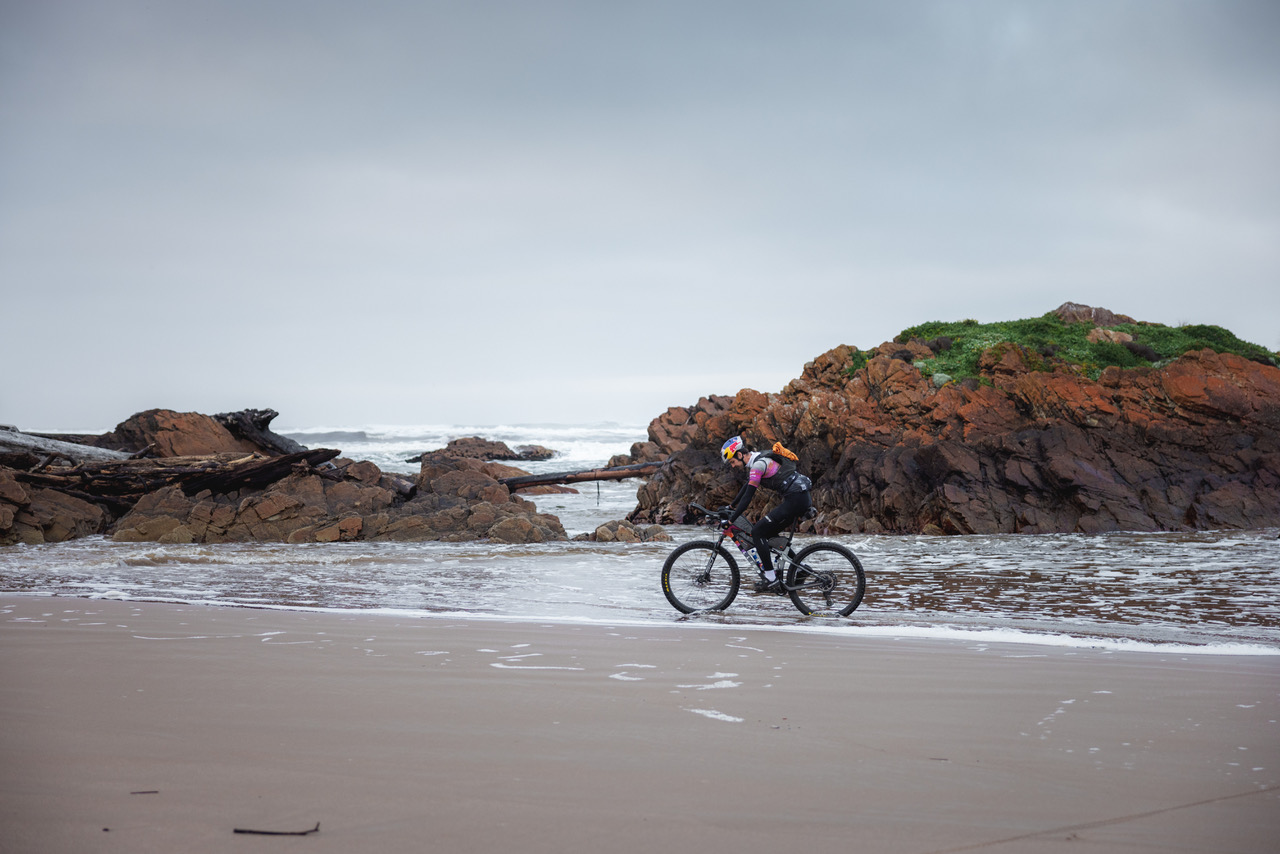
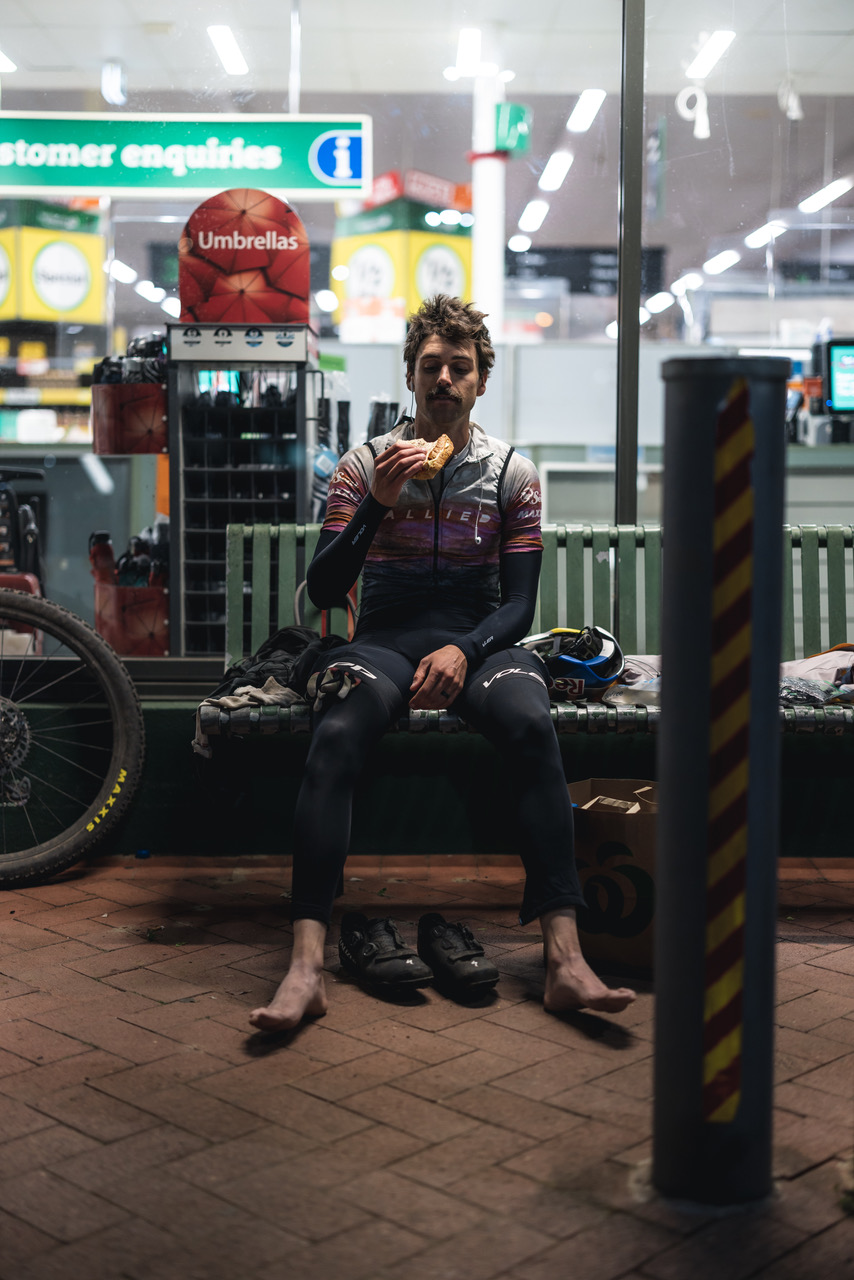
DURANGO, Colorado (August 18, 2023) — Professional mountain bike athlete Payson McElveen detaches from time and immerses himself in the sheer joy of adventure in Crossing Tasmania, now available on Red Bull TV. The short film, produced by Stachehouse Productions, captures Payson during his 32-hour solo journey across Australia’s least populated state. Join Payson as he pushes his limits physically, while opening new levels of emotional and mental fortitude, on a once-in-a-lifetime trip.
Photo Credit: Red Bull Content Pool / Thrainn Kolbeinsson
Coming off an under 24-hour fastest known time (FKT) across Iceland, Payson desires to experience places and biking in a new, more present way. With this mindset, he built a 360-mile greatest hits route including 35,000-ft in elevation gain with the local knowledge of Tasmanian bikepacking legend and scientist Emma Flukes. Stretching from the Indian Ocean to the Tasman Sea, a wilder, longer and more adventurous west-to-east journey was developed.
“Like so many people, I’m always watching the clock, and on race days and in training, every second counts,” said McElveen. “Throughout the ride I found myself further letting go of time. By the time I was starting to fall apart physically, mentally I had unlocked something, which was new to me, this acceptance, or surrender of control. I had achieved that true timelessness. There was something so healthy and powerful about that.”
Watch it here (but click on the full screen icon since the smaller size is wonky):
Between breaths of what is often ranked the world’s cleanest air and riding ahead of schedule, Payson found it hard to shake his need for speed, saying, “I will still want to do this ride fast and hard, because I love to ride that way.”
But there are twists, turns and venomous Tiger Snakes on this route. Through the night Payson navigates around wallabies and wombats far from the van and his friends. Most rides for Payson are lonely endeavors, and this one is fully unsupported, with quick check-ins, but not help, from his fiancee Nichole Baker and the film crew.
Photo Credit: Red Bull Content Pool / Thrainn Kolbeinsson
With a camera in hand while riding, Payson shares this emotional journey of self-discovery and the universal challenge between the demands of the clock and a desire to be in the moment. After a grueling day and night in the saddle, he climbs through thick ferns and slabs on the Blue Derby trail network, which has been repeatedly voted “Trail of the Year.” Finally emerging into the salty air and sunshine of Tasmania’s east coast, Payson says, “I’d like more time. More time outside of the ride itself.”
As Payson rolls into the sparkling blue Bay of Fires 32-hours later, Nichole is there to meet him and celebrate the accomplishment; FKT or not. But, who’s counting?
Richard Vroom, known simply as “Rich”, passed away on July 3, 2023 in Salt Lake City, Utah. He was a long time stalwart and force of the bicycle racing community as well as an extraordinary watercolor artist and teacher. He will be dearly missed by his family, friends, art students, bike racing competitors and me because he was one of my best friends ever.
Rich Vroom 1957-2023 — Artist, Bicycle Racer, Family Man. Photo courtesy The Vroom family
Rich grew up in Grosse Pointe, Michigan and found his love for riding a bicycle at an early age and quickly developed into a top sprinter who excelled in criterium racing. He was a member of the famous Schwinn Wolverine cycling club from the Detroit area that boasted such riders as Tom Schuler, Jeff Pierce and the Meingast brothers from Germany.
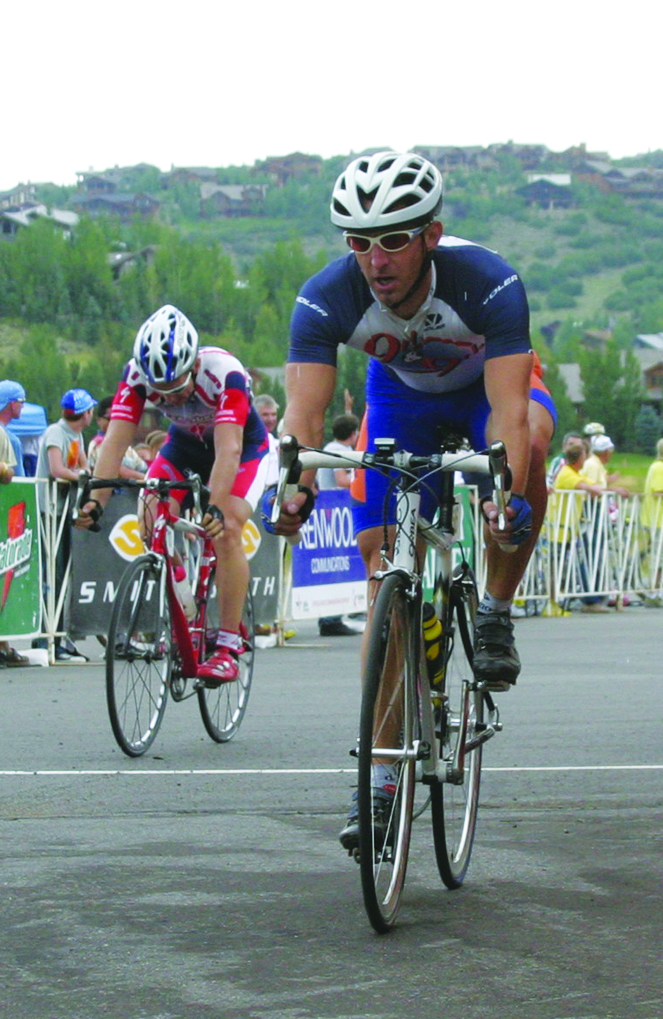
Rich Vroom at Masters Nationals in Park City, Utah, 2004. Photo by Dave Iltis
Vroom was a proud Michigan State Spartan where he was roommates with Jeff Pierce, who would go on to a very successful pro racing career and a Tour De France stage win in the mid 80s. Rich also met his wife Jane Brennan, who was a 3 time National Champion on the track, at Michigan State and they eventually raised two wonderful kids together in Utah.
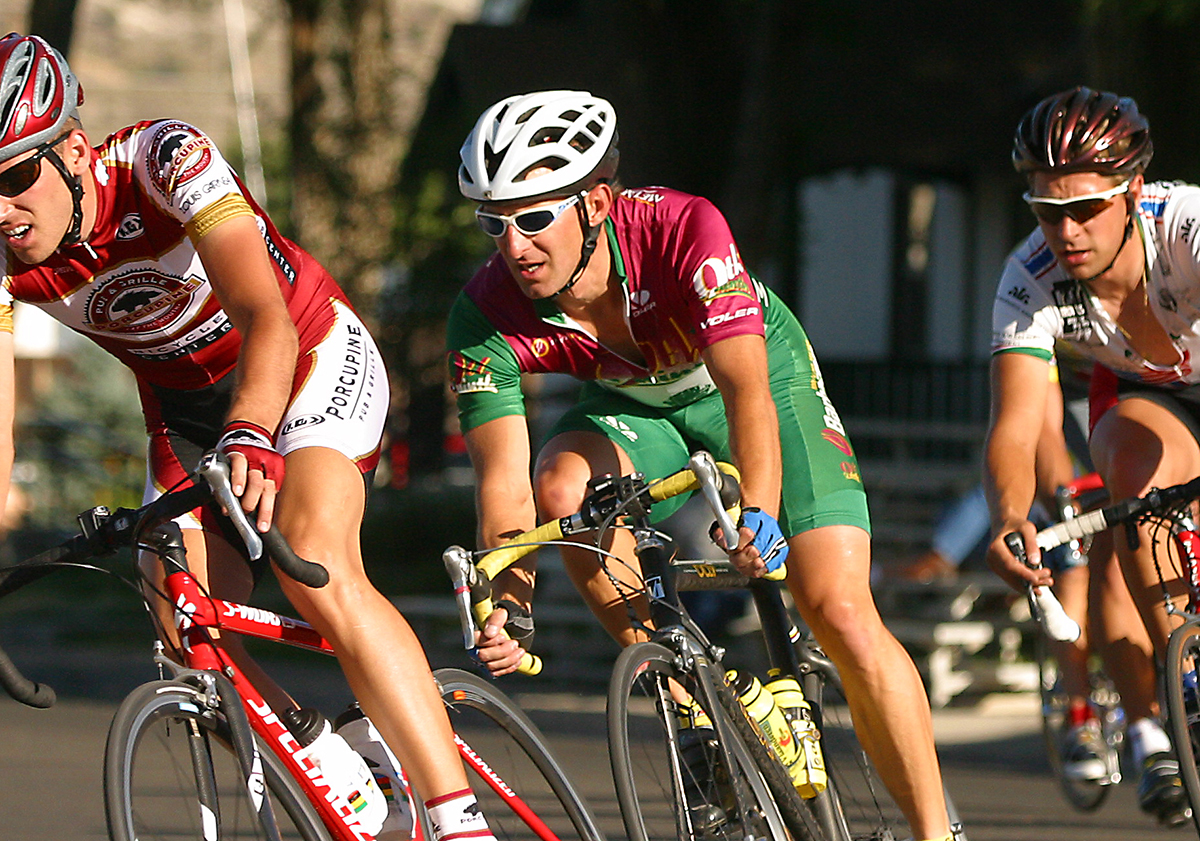
Rich Vroom (center) at the Running of The Bulls Crit in Elko, July 4 2003. Photo by Eric Schramm
After moving to Salt Lake City in 1983, Rich became a fixture in the local racing community and combined an uncanny sense of strategy, tactics and speed to become a fierce finisher at the races. He was a superb bike rider who seemed to be able excel with ease and minimal, but focused training. He also had an easygoing personality and great sense of humor.
My first memory of Rich was at a weekly criterium race at the Salt Lake International Center shortly after he moved to Utah in 1983. On the starting line I noticed this guy who looked like a good racer, but was wearing green Adidas running shoes. I snickered to myself about this silly guy I didn’t know in tennis shoes amongst the best racers in Utah. Rich had forgotten his bike shoes that day and did just fine in his tennis shoes finishing in the top three that day. Soon after that we developed a close friendship that lasted until his passing.
It is quite likely that Rich Vroom and my wife Laura Howat did more of the weekly Utah criterium races than any other male or female racers during their long and successful racing careers. Starting with the Thursday night races at the Salt Lake International Center in the early 80s and transitioning to the Tuesday night RMR races, they both racked up many, many top finishes before retiring in the late 2010s. Both were very skilled racers and excellent mentors to younger riders throughout their racing careers. Laura’s favorite part of the criteriums was riding back to the neighborhood with Rich after the races.
Bill Harris, a top racer in Utah who won loads of races had this to say about Rich: “At the start of a race I always look around and pick 4 or 5 key guys to keep an eye on. Rich was always one of those guys. I learned so much watching him race. Rich had an uncanny ability to conserve energy during the race, then weave his way to the front and finish with a wicked sprint to take the win. I always looked up to Rich, he was a wonderful person and a great example of a life well-lived.”
One of Rich’s regular training routines was to practice 200 RPM sprints which helped develop his tremendous leg speed for those fast finishes. He also practiced sprinting with his hands off the bars and arms pointed backwards behind his hips to deemphasize the upper body and focus on a circular pedaling stroke.
Many people knew Rich as a superb painter. He showed amazing talent as a young person and largely taught himself to paint with watercolors. Painting was always a passion of his and in the late 1990s he went pro. Besides selling paintings at galleries and art shows he taught painting classes through the University of Utah and privately at his studio in Sugarhouse. His work can be purchased on Instagram at @richvroom. Rich’s paintings have also been showcased in Cycling West magazine many times in the past.
Rich Vroom was a man of many talents and interests. From life long cyclist, gym rat, little league soccer coach, nordic skiing instructor, golfer, sailor, climber, exceptional athlete, artist, family man and all-around fun person he touched many lives. He will surely be missed.
Group Ride: There will be group ride in honor of Rich on Sunday 8/27/23 at 8:30 starting at Sugarhouse Park in Salt Lake City, Utah. Please meet at the 1500 East entrance to Sugarhouse Park at 8:30am on Sunday morning. We will ride down to the Cotton Bottom and return along Wasatch Blvd. It will be an easy conversational pace. Anyone who wants to ride more can tack on Emigration Canyon at the end.
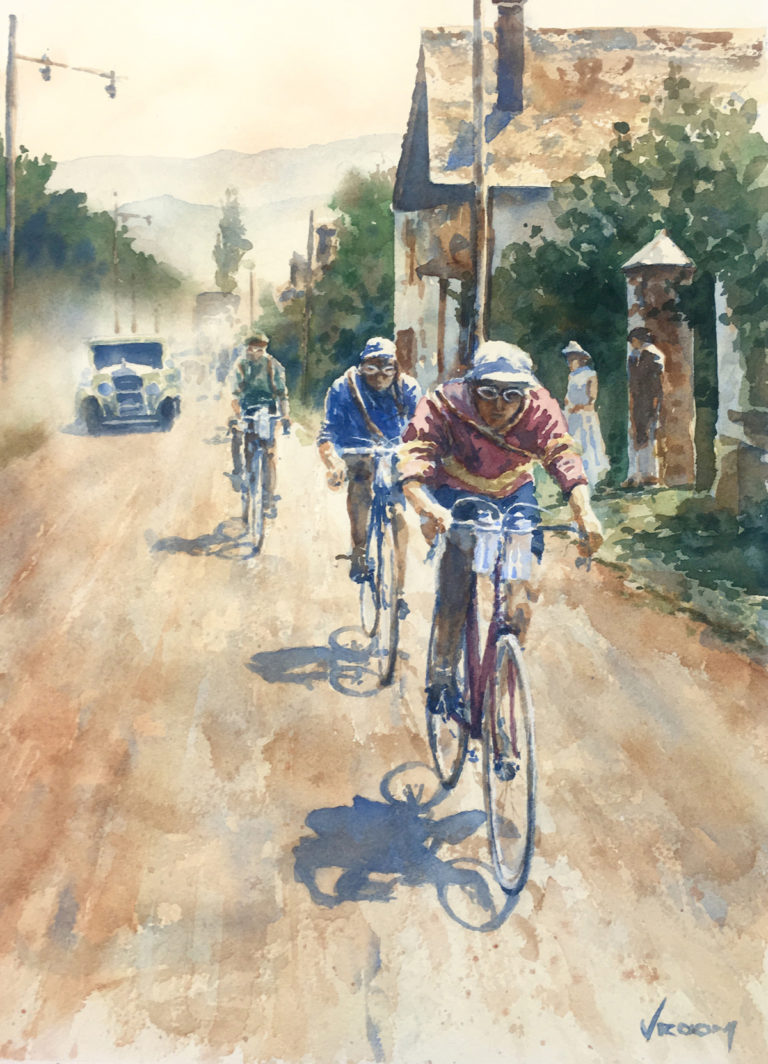
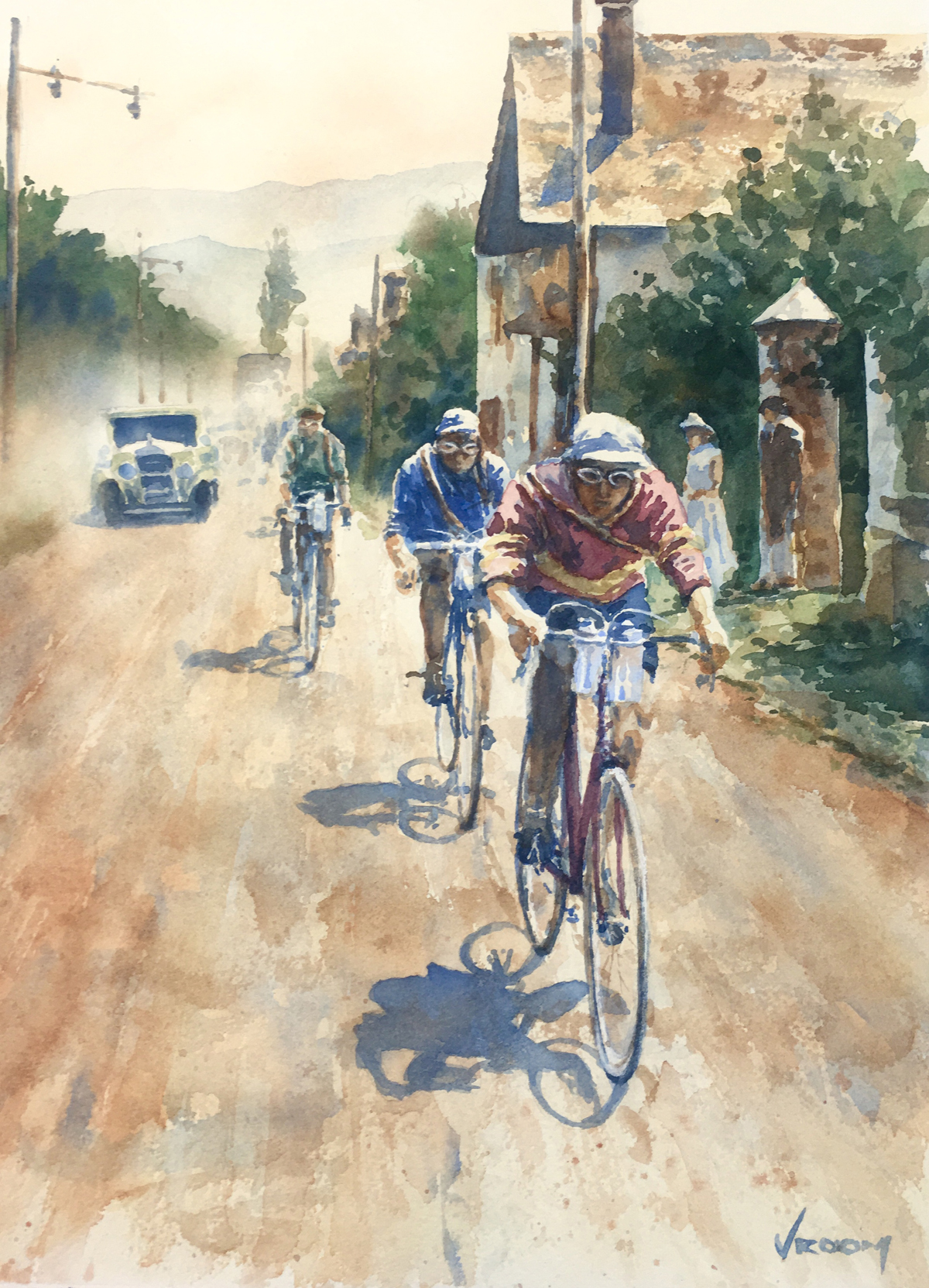
Cycling West Summer 2019 Issue Cover Art: 1921 Tour de France.
Watercolor by Richard Vroom.
1921 Tour de France. Watercolor by Richard Vroom. Follow Richard on Instagram: @rich- vroom
Medium: Watercolor on paper.
Rich Vroom is a watercolor artist based in Salt Lake City, Utah. His studio is in Sugarhouse where he teaches classes, paints, and bike races. He also teaches at the University of Utah.
Prints are available for purchase from Richard. Contact him at [email protected]
Follow Rich on Instagram
@richvroom or on Facebook: Rich Vroom Watercolors.
By Nancy Clark MS RD CSSD — As a sports nutritionist, I commonly counsel athletes who have Attention Deficit Hyperactivity Disorder—generally referred to as ADHD (or ADD). ADHD is characterized by hyperactivity, impulsivity, and/or inattention. It affects 4-10% of all American children and an estimated 4.4% of adults (ages 18-44 years). ADHD usually peaks when kids are 7 or 8 years old. Some of the ADHD symptoms diminish with maturation but 65-85% of the kids with AHDH go on to become adults with ADHD.
Ideally, athletes with ADHD have gotten the help they need to learn how to manage their time and impulsiveness. Unfortunately, many youth athletes with ADHD just receive a lot of negative feedback because they have difficulty learning rules and strategies. This frustrates teammates and coaches. Older athletes with ADHD often use exercise to reduce their excess energy, calm their anxiety, and help them focus on the task at hand. This article offers nutrition suggestions that might help coaches, friends, and parents, as well as athletes with ADHD, learn how to calm the annoying ADHD behaviors.
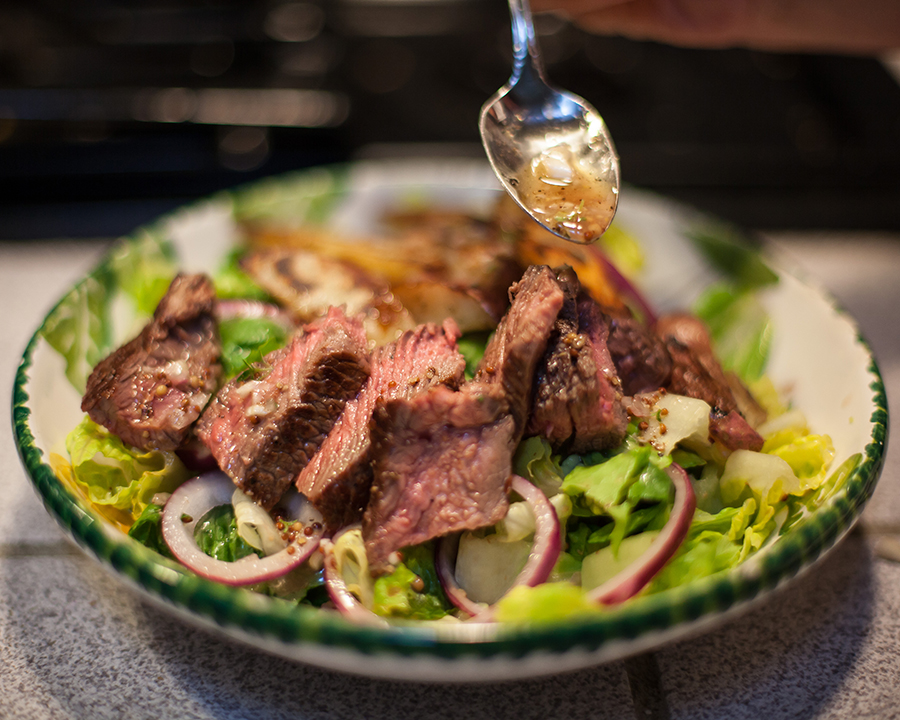
High-protein & complex-carbohydrate meals, like this chipotle lime grilled steak salad, could help manage ADHD symptoms. Photo by Jeff Hutchison. Attribution 2.0 Generic (CC BY 2.0) https://creativecommons.org/licenses/by/2.0/
To date, no clear scientific evidence indicates ADHD is caused by diet, and no specific dietary regime has been identified that resolves ADHD. High quality ADHD research is hard to do because the added attention given to research subjects with ADHD (as opposed to the special diet) can encourage positive behavior changes. But we do know that when & what a person eats plays a significant role in ADHD management and is an important complimentary treatment in combination with medication.
ADHD treatment commonly includes medications such as Concerta, Ritalin & Adderall. These medications may enhance sports performance by improving concentration, creating a sense of euphoria, and decreasing pain. These meds are banned by the World Anti-Doping Agency (WADA) and the International Olympic Committee (IOC). Hence, athletes who hope to compete at a high level are discouraged from taking ADHD medications.
To the detriment of ADHD athletes, their meds quickly blunt the appetite. Hence, they (like all athletes) should eat a good breakfast before taking the medication.
The medication-induced lack of appetite can thwart the (teen) athlete who wants to gain weight and add muscle. Teens taking ADHD meds should be followed by their pediatricians, to be sure they stay on their expected growth path. If they fall behind, they could meet with a registered dietitian (RD) with knowledge of sports nutritionist (CSSD) to help them reach their weight goals.
An easy way for “too thin” athletes to boost calories is to swap water for milk (except during exercise). The ADHD athlete who does not feel hungry might find it easier to drink a beverage with calories than eat solid food. Milk (or milk-based protein shake or fruit smoothie) provides fluid the athlete needs for hydration and simultaneously offers protein to help build muscles and stabilize blood glucose.
A well-balanced diet is important for all athletes, including those with ADHD. Everyone’s brain and body need nutrients to function well. No amount of vitamin pills can compensate for a lousy diet. Minimizing excess sugar, food additives, and artificial food dyes is good for everyone.
Eating on a regular schedule is very important. All too often, high school athletes with ADHD fall into the trap of eating too little at breakfast and lunch (due to meds), and then try to perform well during afterschool sports. An underfed brain gets restless, inattentive, and is less able to make good decisions. This can really undermine an athlete’s sports career
Adults with ADHD can also fall into the same pattern of under-fueling by day, “forgetting” to eat lunch, then by late afternoon are hangry and in starvation mode. We all know what happens when any athlete gets too hungry – impulsiveness, sugar cravings, too many treats, and fewer quality calories. This is a bad cycle for anyone and everyone.
All athletes should eat at least every four hours. The body needs fuel, even if the ADHD meds curb the desire to eat. ADHD athletes can set a timer: breakfast at 7:00, first lunch at 11:00, second lunch at 3:00 (renaming snack as second lunch leads to higher-quality food), dinner at 7.
For high school athletes with ADHD, the second lunch can be split into fueling up pre-practice and refueling afterwards. This reduces the risk of arriving home starving and looking for (ultra-processed) foods that are crunchy, salty, and/or sweet.
Athletes with ADHD are often picky eaters and tend to prefer unhealthy snacks. For guidance on how to manage picky eating, click here for adults and here for kids.
Fiber-rich fruits, vegetables, and whole grains can be low on an ADHD athlete’s food list. Their low fiber diet can lead to constipation. Fiber also feeds the zillions of microbes in their digestive tract that produce chemicals that can positively impact brain function and behavior. Everyone with ADHD should eat more fiber-rich foods like beans (hummus, refried beans in a burrito), seeds (chia, pumpkin, sunflower, sesame), and whole grains (oatmeal, brown rice, popcorn). They offer not only fiber but also magnesium, known to calm nerves.
With more research, we’ll learn if omega-3 fish oil supplements help manage the symptoms of ADHD. No harm in taking them. At least eat salmon, tuna, and oily fish as often as possible, preferably twice a week, if not more.
Picky eaters who do not eat red meats, beans, or dark leafy greens can easily become iron deficient. Iron deficiency symptoms include interrupted sleep, fatigue, inattention, and poor learning and can aggravate ADHD. Iron deficiency is common among athletes, especially females, and needs to be corrected with iron supplements.
While sugar has the reputation of “ramping kids up”, the research is not conclusive about whether sugar itself triggers hyperactivity. The current thinking is the excitement of a party ramps kids up, more so than the sugary frosted cake. Yes, some athletes are sugar-sensitive and know that sugar causes highs and crashes in their bodies. They should choose to limit their sugar intake and at least enjoy protein along with sweets, such as a glass of milk with the cookie, or eggs with a glazed donut. Moderation of sugar intake is likely more sustainable than elimination of all sugar-containing foods.
For more information about ADHD in kids, teens, and adults, please use these resources:
Feeding the Child with ADHD—a podcast with Jill Castle RD
Children and Adults with Attention-Deficit/Hyperactivity Disorder (CHADD) – a national resource center
An excerpt from the forthcoming book Saddling up to ride in Cowboy Country…in Spandex! A unique tale of both personal and American cycling history
By Dave Campbell — I started racing in 1981, the first year that an American rode in the Tour de France. That rider was Jonathan (Jacques) Boyer from Carmel, California. While Americans (seen by many Europeans as cowboys) struggled to make their way in the European peloton, I struggled to make my way in an exciting but exotic sport in actual “Cowboy Country” …Wyoming!
In fact, Boyer’s tour debut was such a significant event that he was allowed to ride in a stars-and-stripes jersey, despite not being the National Champion! In 1981 there was no US National Professional Championship. The US only had two other professional riders…George Mount and Greg LeMond.
“Smiling” George Mount had turned pro after the 1980 US Olympic boycott and in 1981, with almost zero fanfare, had become the first American to contest a Grand Tour, finishing 25th in the Giro d’Italia. Neo-pro Greg LeMond, Junior World Champion in 1979, was racing for the French Renault team under the tutelage of renowned coach Cyrille Guimard, Guimard was developing his protege very slowly and carefully, with a Tour de France debut still years away. Americans were suddenly starting to make their mark in professional cycling internationally!
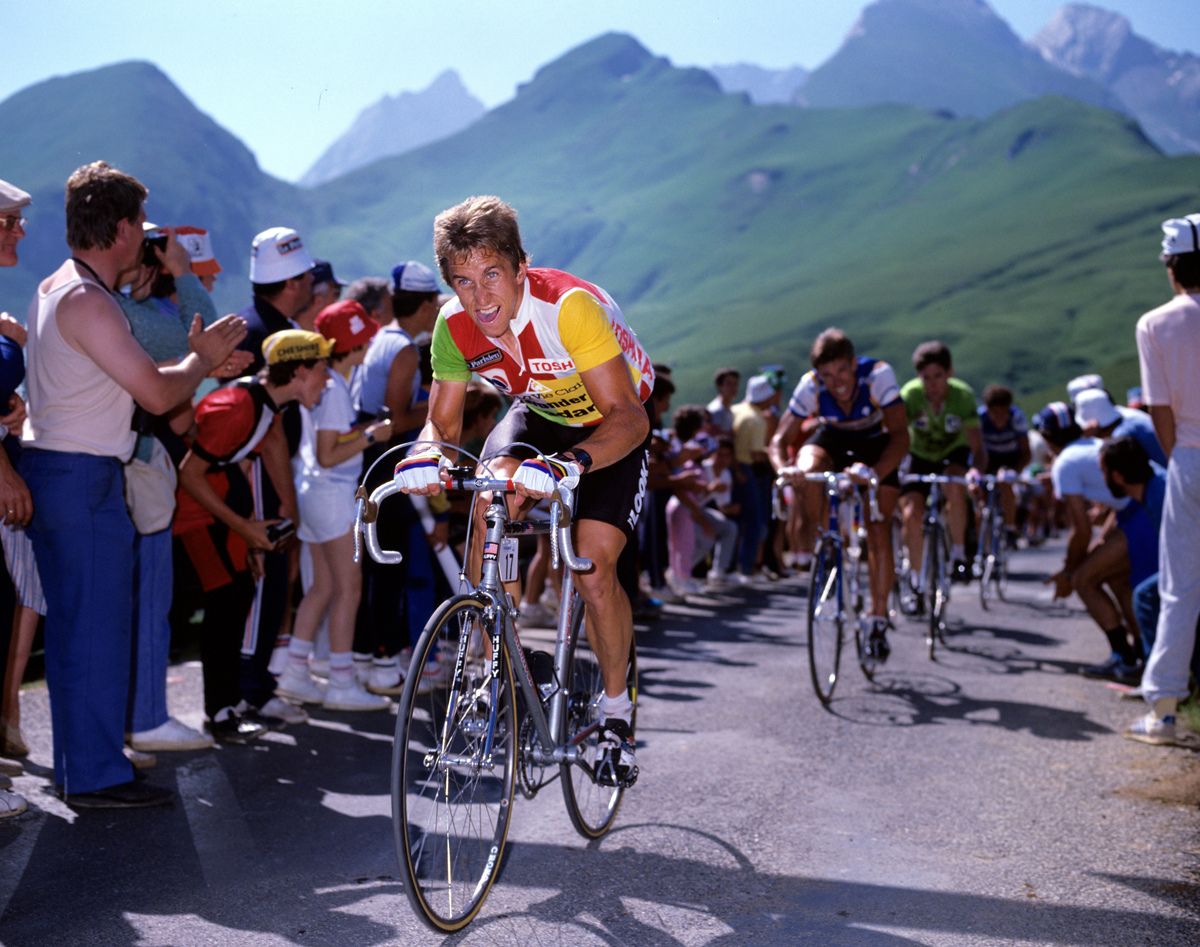
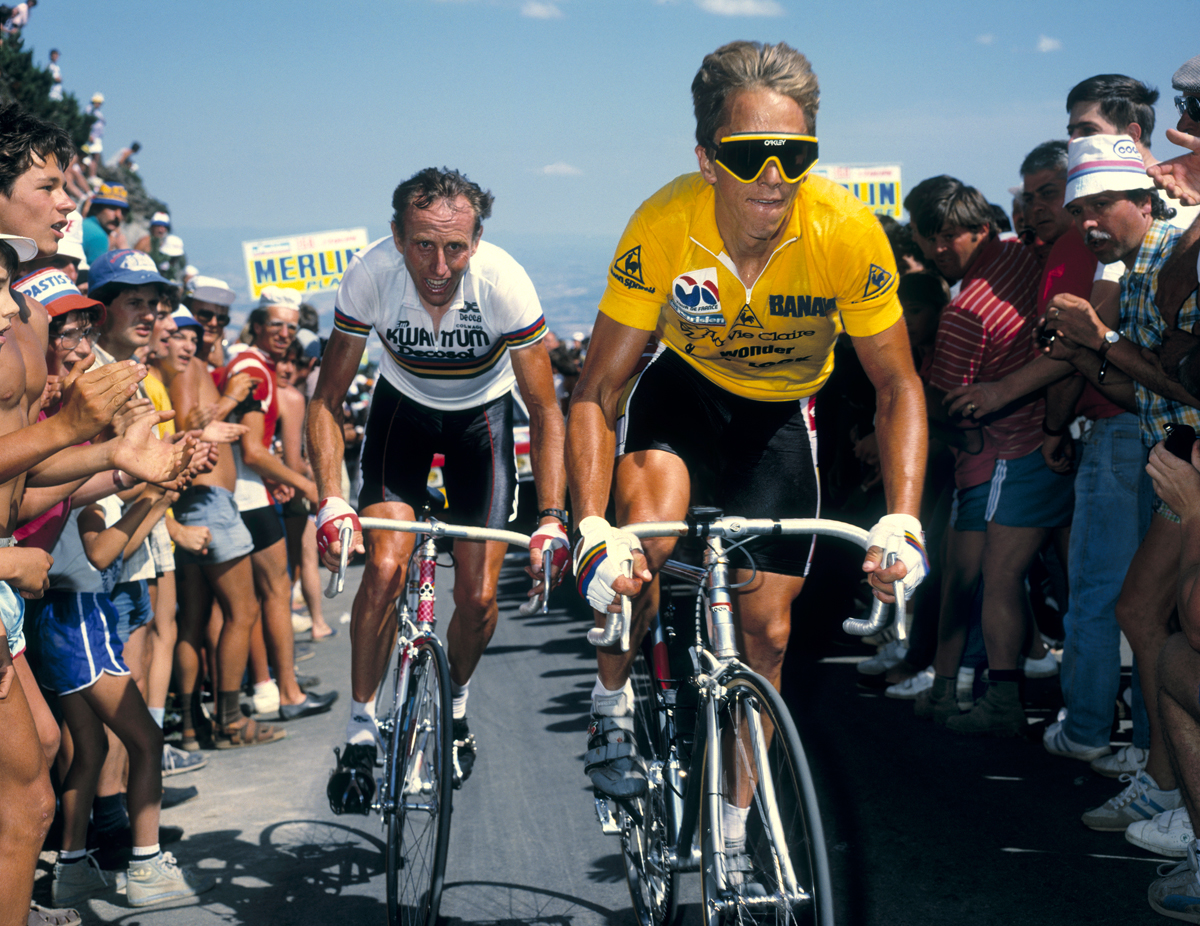
Greg LeMond in the Yellow Jersey in the 1986 Tour de France on stage 21 to the summit of the Puy de Dôme. Joop Zoetemelk, the reigning world champion at the time, is on his wheel. LeMond went on to win the 1986 Tour de France. Photo by Graham Watson
As a junior rider in Wyoming in the early 1980s, I had to venture to Colorado to find races with sizeable fields and strong competition. In the cycling hotbed of Boulder, Colorado I competed for ten days in August of 1983 against 65 other junior riders in the Red Zinger Mini Classic. In the shops, I also found a brand new magazine: “Winning Bicycle Racing Illustrated”. It would be instrumental in fueling and informing the growth of the sport of cycling in America. Riders like me could now follow our heroes as they continued to make inroads into this esoteric and previously exclusively European sport. I bought the inaugural issue, which primarily detailed the career of Belgian Eddy Merckx, the greatest cyclist of all time and…the current issue, issue #2, that was just out!
The cover detailed “Boyer and LeMond Success Abroad” with a special focus on the 1982 Worlds Road Race in England. All three of our pros competed. This would be the first real detailed accounting I had ever read of a professional road race, and it lit me up! The magazine detailed the final exciting moments of the race blow-by-blow. Boyer had launched an attack in the final mile on the long grind to the finish. He faded to 10th but LeMond, only 21 years old and in only his second year as a pro had won the silver medal. Italian Giuseppe Saronni, the winner, was already an established star in the European peloton, but Greg beat the rest including Irishman Sean Kelly, a name I knew from the Tour de France.
More importantly, we, the United States, had two riders who were right in there at the end of the World Championship going for the win! And this young guy, only 21 years old and in his second year as a professional finished 2nd! Could he win it next year? The first ever US World Road Cycling Champion? And what about his prospects in the Tour de France? This could be “our guy”, an American who can beat the best in the world!
After reading about Greg LeMond in those Winning Magazines I brought home from Colorado and his 1982 Worlds medal, I was desperate to learn more about my new hero. As was often the case in that era, the coverage of that historic silver medal didn’t come to me until well after the fact, so I was playing catch up. I turned to … where else, but my high school library, mining the card catalog for bike racing gold on the very first day of high school! While my classmates stood in line for burgers and shakes at the local Dairy Queen, I ate my rice cakes and yogurt in the library, a student of my sport. I educated myself on my new hero Greg LeMond, and how he was taking on the world!
There was not much to be found except … a July 13, 1981 issue of Sports Illustrated with an article entitled “Goldilocks 1, Bears 0”. Young Greg vs the Big Soviet Bear! I was loosely familiar with the story of Greg defeating the Soviet Olympic Team in the Coors Classic, as the older members of my cycling club (several who “went down to Colorado to follow the Classic”) regaled us with tales at the local shop. Now I wanted all the details! In the early 1980s of Ronald Reagan’s America, and particularly in Cowboy Country, the Soviet Union was “the evil empire”. This was a looming threat to our western way of life and so when an American kicked their asses? Oh, hell yeah!
The article’s author, Barry McDermott, wrote “Now the Soviet Union has something else to worry about. It ran into Greg LeMond! The dimple-chinned, blonde-haired, rosy-cheeked Yankee Doodle Dandy from Washoe County, Nevada took on the older, more seasoned Soviet stars in the torturous nine-day stage race in the Rockies!”
What a script! Race promoter Michael Aisner had a flair for the dramatic and so, following the American boycott of the 1980 Olympics (where the Soviets dominated) he invited them to race America’s premier event!
The Pro-Am event, then in its seventh year featured eleven stages in Colorado in July with a mixture of high-altitude road races featuring big climbs, downtown criteriums, and time trials. In the excellent Drake/ Ochowicz book “Team 7-Eleven,” Aisner recounted: “I got letters from racers, who were friends, who said the Russians will come and take all the prize money away! Why would you do this? It will ruin the race!” He noted his unwritten response was “Get off your asses and beat them!” One racer who responded positively? Greg LeMond! He said “Bring ’em on! I’ll show them which wheel to get on!”
LeMond, who was barely 20 years old when the Coors started, was in his first year as a professional with the Renault-Gitane team led by Bernard Hinault. His astute director Cyrille Guimard only wanted his protege to gain experience that year … and focus on a few races including the Dauphiné Libéré and the Coors Classic. He helped Hinault win Paris-Roubaix in April, finished third behind his team captain in June’s Dauphiné, and then headed to America with a young French team to race the Classic!
Coors promoter Aisner noted that the Russians brought their very best riders and were “supremely confident” of winning the 538-mile event and the lion’s share of the $50,000 purse.
“They came not just to win, but to embarrass!” Greg LeMond explains. “Facing Sergei Soukouroutchenkov and Yuri Barinov, The Olympic Gold and Bronze Medalists, was for me a real test of who would have been Olympic Champion. This was my real revenge on missing the Olympics because of the boycott.” LeMond had been a favorite for an Olympic Gold medal following a strong spring campaign with the US National team in Europe. It included an historic first American victory in a major European Pro-Am Stage Race, France’s Circuit de la Sarthe, and ultimately helped land him that 1981 pro contract.
LeMond won the Prologue Time Trial but then Russian Yuri Kashirin took over the Red Leader’s Jersey after the high-altitude Bob Cook Memorial Road Race. Miffed at how intimidated his countrymen were by the Russians, LeMond was keen to race on all terrains, even earning bonus seconds in field sprints in the criteriums!
On Stage seven, the “Suicide Hill” circuit race in Snowmass, a torturous up/down, “LeMonster” broke clear with Colombian Noberto Cesares, ultimately winning the stage and putting four minutes into the Russians. Later in that afternoon’s time trial, his second place allowed him to pull on the leader’s jersey, for good this time.
On the penultimate stage, the Morgul-Bismark road race, the entire Soviet team broke clear and only LeMond could stay with them. LeMond recalls “We went head-to-head, me against four Russians on the Morgul Bismark course. They tried every which way to drop me and every time they’d attack, I’d chase one guy down. I would slow just before I caught him and then as the other group caught up, just before they caught, I’d attack and drop everyone. Then I’d slow down and when they caught me, they’d send somebody off and I would go after him. I just played this game with them, four against one, and they couldn’t drop me.”
With only the North Boulder Park Criterium remaining, Greg had a nearly five minutes overall lead, while the Russians lay 2nd-5th on GC and would have to be content with the team prize. 40,000 spectators gathered in Boulder’s cycling mecca, and even a last lap crash (“I over-cooked the last corner”) couldn’t keep LeMond from overall victory. And that, I found was the story of how Greg LeMond defeated the mighty Russians or as Sports Illustrated wrote: “Goldilocks slayed the FOUR Bears!”
It was an All-American success story kind of like “The Miracle on Ice”, only in this exotic sport that I was falling in love with. My sport! His irrepressible drive to succeed, ability to overcome adversity, and win against all odds would serve him well in the years to come. I loved his attitude! This was my guy and from then on, I rabidly followed the incredible story of Greg LeMond.
Perhaps more importantly for America as a fledgling cycling power, Greg was proving to be our guy! According to those Winning magazines I was studying intensely, Jonathan Boyer became only the first American to ride the Tour de France in 1981, finishing a credible 32nd. He improved to 23rd the following year and was 12th in 1983. LeMond, under his brilliant and calculating coach Guimard, whose riders had triumphed in five of the previous seven Tours up to that point, was being carefully built up for his debut in 1984. I wondered what “LeMonster” do in the Tour de France? I had to think he could be a contender. This really could be our guy!
A few weeks later, Bob Moon, proprietor of my local bike shop Freewheel Sports, returned from a bike tour around Europe. He even watched the World Pro Road Championships in Switzerland! And, he informed me LeMond had won it! Greg LeMond was the World Champion! He went in a break with a couple laps to go and by the final lap he was solo! He won alone by over a minute! An American cyclist was World Professional Road Champion and would wear the rainbow jersey in the European peloton during the 1984 season!
LeMond, in the rainbow jersey of reigning World Champion, ended 3rd in his debut Tour and won the White Jersey as best young rider. Plagued by bronchitis and sore feet, he languished in 8th place with a week to go. Guimard stated Greg was “riding the Tour on one leg”. Greg, however, as he would show again and again, is something very special. He fought back in the final week in the Alps, to make the podium. He was joined there by American Marianne Martin who had won the inaugural but sadly short-lived Tour de France Féminin. He had given all Americans hope that a male American Tour winner was not that far away.
Greg LeMond of the La Vie Claire team in the 1985 Tour de France on the Col d’Aubisque, stage 18. Phil Anderson, Sean Kelly, and Pedro Delgado are the cyclists chasing LeMond, and he’s chasing the stage-winner Stephen Roche. LeMond finished second to Bernard Hinault in the General Classification. Photo by Graham Watson
Greg finished a disappointed 2nd the following year to team leader Bernard Hinault in a race many, including Greg, thought he should have won. The final margin was barely a minute after Greg waited for an injured Hinault on the mountain stage to Luz Ardiden. In a breakaway with third-placed Stephen Roche, Greg’s French team staff misinformed him of the gap to Hinault behind. Rather than aid Roche in moving past the Frenchman, the American was ordered to wait. He later realized that the gap to Hinault was much larger than he had been told, and he had thrown away a winning opportunity. Hinault, meanwhile, won his fifth Tour joining all-time greats Eddy Merckx and Jacques Anquetil. After LeMond rallied to win the final time trial, Hinault pledged his support to the American for the 1986 edition, stating to the press “next year I will suffer for him as he has sacrificed for me”.
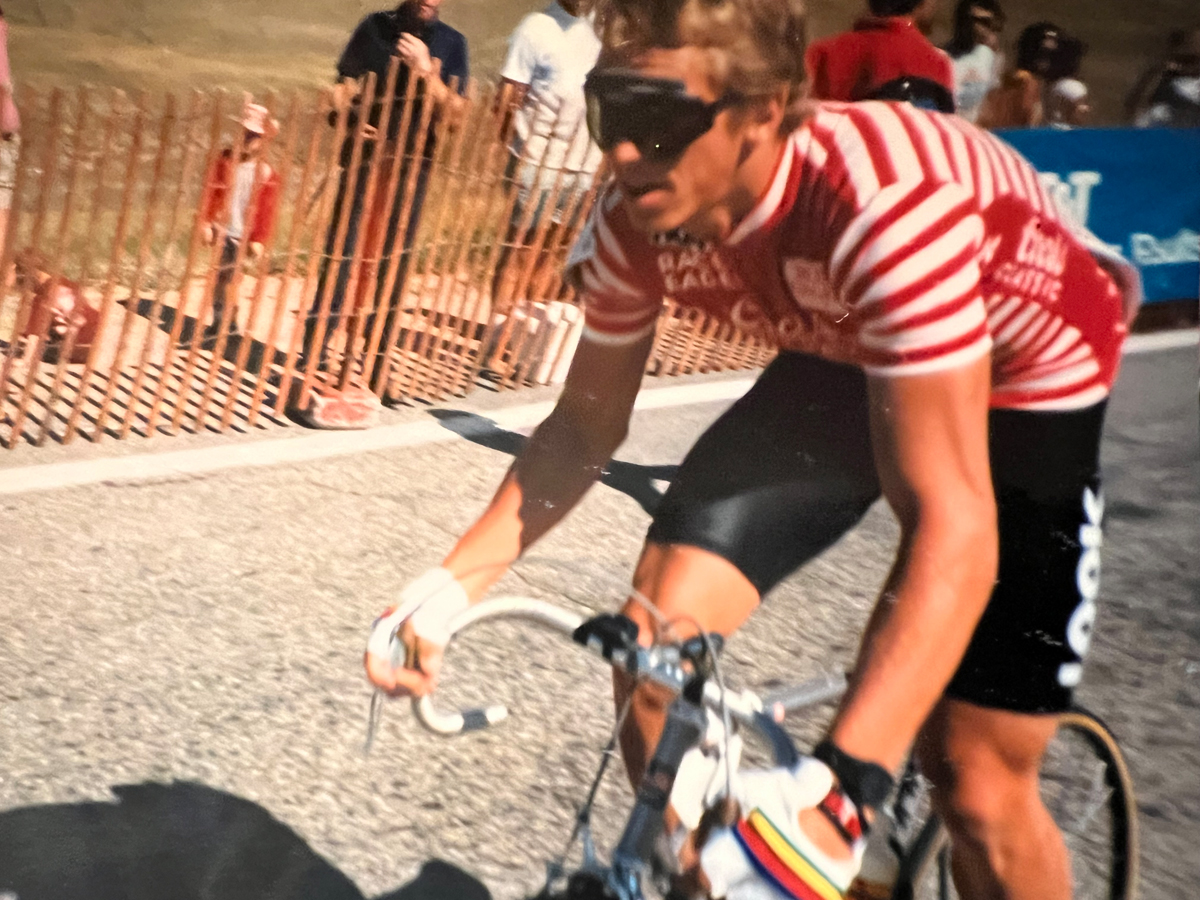
Greg LeMond in the 1985 Coors Classic. LeMond took first overall. Photo by Dave Campbell
It was after the 1985 Tour that I met my hero in person. Just 16, my best friend and training partner and I drove down to Boulder to watch the final two stages of the Coors Classic. And not just any Coors, but a mountainous California/Nevada/Colorado edition that featured the La Vie Claire team (rebadged as Celestial Seasonings Red Zinger for the event) of LeMond and Hinault. I was going to cheer and hopefully meet my hero. After crashing with a friend, we rode our bikes out to the stage with many others. So many people had turned out! The American cycling cult was out in force! We didn’t catch Greg, the race leader, prior to the start but we strategically waited by the doping control trailer after the race. No one else was there. Within five minutes, the door opened and there was my main man, Greg!
“Hi, guys!” he boisterously exclaimed. “Are you bike racers?”
“We are!” we proudly responded.
He signed our hats, our books, smiling and taking time to talk with us and listen to us. I told him I knew he would win the Tour next year. He said he appreciated that. What an ambassador of the sport and just a nice guy. He was one of us!
The 1986 Tour, well documented in Richard Moore’s excellent book “Slaying the Badger”, was one for the ages and LeMond overcame his team leader Hinault, who constantly raced against him, to become America’s first Tour de France champion. Further American history was made by the participation of the first ever American team, 7-Eleven, who won a stage (Davis Phinney) and enjoyed a day in the yellow jersey (Canadian Alex Stieda).
Greg’s incredible story was not over, however.
In the spring of 1987, while recovering from an early season injury, LeMond’s brother-in-law shot him in a hunting accident and he was unable to defend his title. Injuries and illness kept him out of the race again in 1988, but he returned in 1989 to win what many consider the greatest Tour of all time on the final day by only 8 seconds. Later that year, he won his second world road title and in 1990, again wearing the rainbow jersey, he would win his final Tour de France.
After the disqualification of Lance Armstrong for years of systematic doping, Greg LeMond, along with Marianne Martin, who won the 1984 Tour Féminin, remain the only American winners of the Tour de France.
References:
Drake, Geoff with Ochowicz, Jim. (2011) Team 7-Eleven: How an Unsung Band of American cyclists took on the World and Won. Velopress.
The pair of Utah-based riders have combined to take the top step at 5 of 6 major events so far in 2023, the exception being the Garmin UNBOUND, which Swenson won but Gomez Villafañe finished in second place.
STEAMBOAT SPRINGS, Colorado (August 20, 2023) — The event, now officially in its fifth year, brings thousands of riders to the mountain town of Steamboat Springs to enjoy the champagne gravel. The flag dropped for the race at 6.30am Mountain Time in the cool alpine air for an assembled peloton of the best gravel riders on the continent.
Riding out of town into Lower Elk, a group of over 100 riders took to the front as the pace lifted and the grip of the asphalt turned to the slip and slide of gravel. After just over an hour of racing, the lead bunch hit Fly Gulch around mile 21. The key contenders in both the Pro Men’s and Pro Women’s field took charge with Keegan Swenson, Petr Vakoc, Alexey Vermeulen, Peter Stetina, Sofia Gomez Villafañe, Alexis Skarda, and Ruth Winder all showing their form on the early climbs with favorite Cromwell drifting back. The challenging descents proved too much for riders with flats coming for many.
Into the first aid station few riders stopped, with Stetina opting for chain lube on the dry dusty day. The rest of the large groups rolled straight through, which would prove to be a theme of the day, most riders favoring wearing hydration packs.
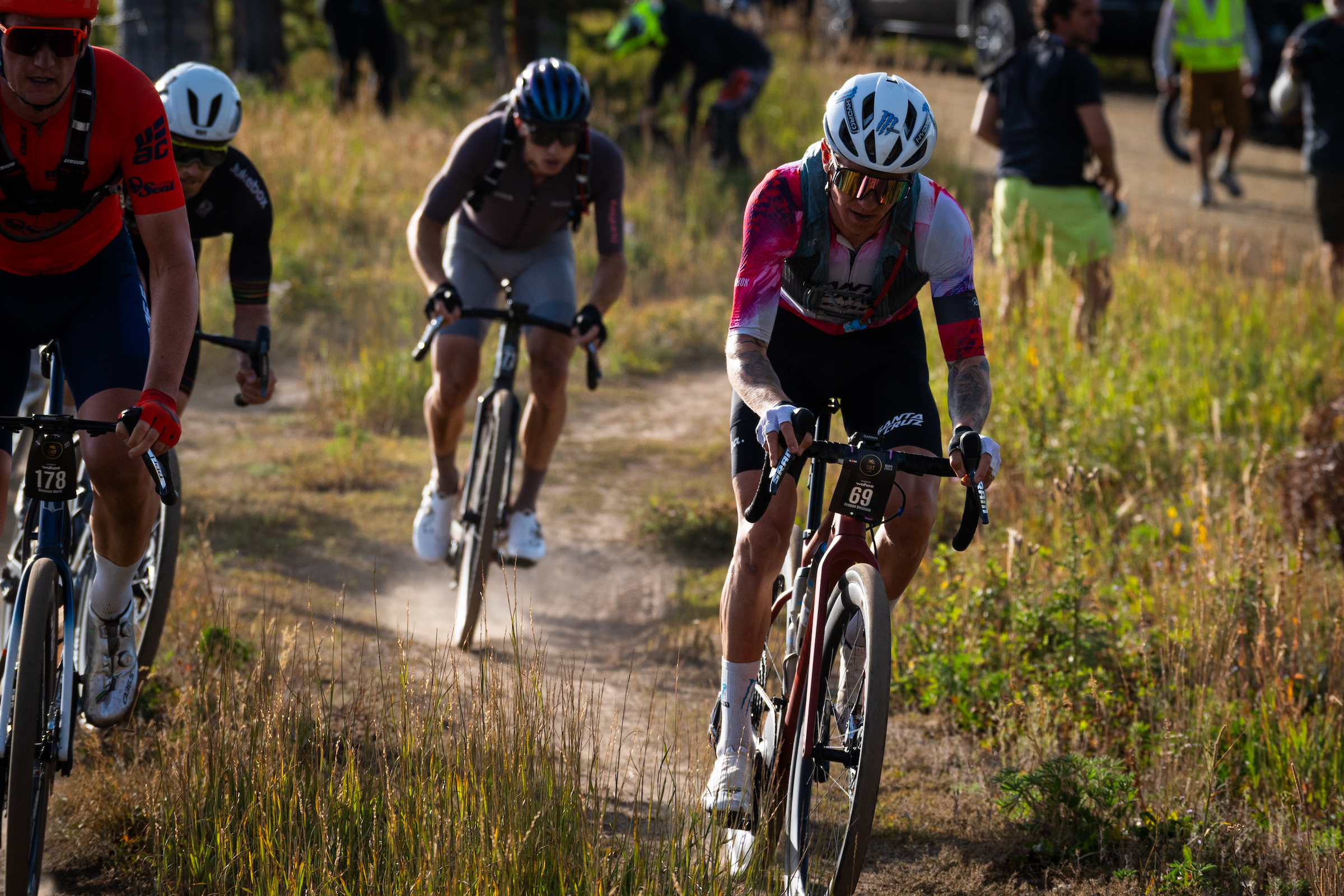
Peter Stetina. Photo by Dave Sear/@4seasoncollective, courtesy SBT GRVL
A reasonable tailwind aided the riders as they headed on the northern loop of the course towards Steamboat Lake, with 3 key distinct groups formed on the pavement and the rapid pace began to take its toll.
Heading down the descent of Mystic a clear separation formed with Stetina, Swenson, Vermeulen, Adam Roberge, Lachlan Morton, Rob Britton, Payson McElveen, and Howard Grotts all present. With stated intentions on pre-race social media, there would be no stopping at any aid stations throughout the 142-mile race.
Keegan Swenson Photo by Dave Sear/@4seasoncollective, courtesy SBT GRVL
Heading to the southern loop, Swenson forced the pace with Vakoc following. Going clear from a select group cresting the climb to the top of Trout Creek, the pair then worked hard together to extend their lead into the town of Oak Creek.
The climb out of Oak Creek proved to be decisive with both the men’s and women’s winners establishing their gap in the crosswinds around mile 115, however before the climb a huge crash for Roberge on a left hander took him out of the group followed meters later a slide out from Morton who quickly remounted and made chase. The duel between Vakoc and Swenson took place on the savage 2-mile climb with Swenson making the separation before a 60-mph descent towards the final climb of the corkscrew and then the infamously technical sector of cow creek.
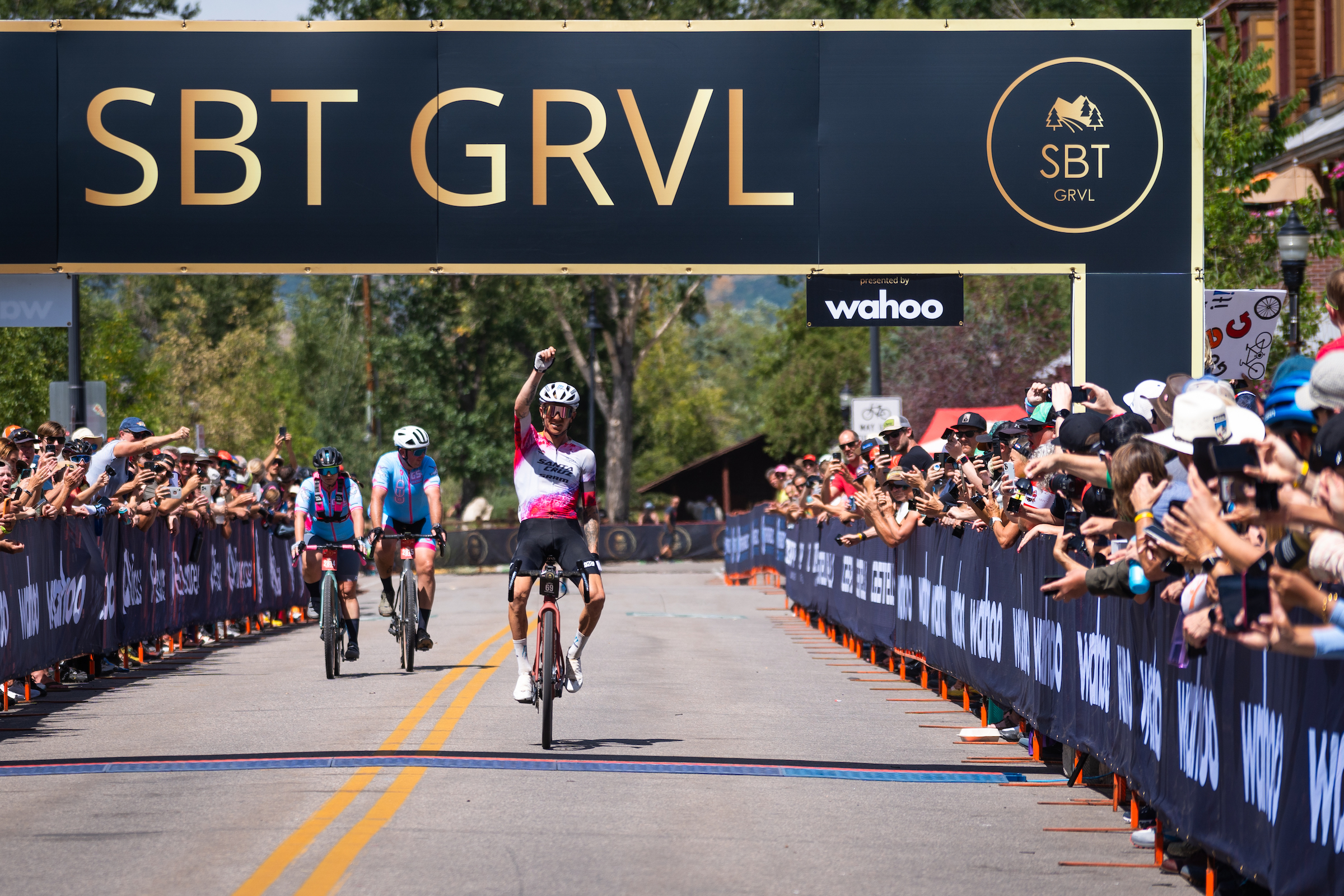
Keegan Swenson crossed the line in a blistering 5:57, setting a new course record with Petr Vakoc coming in some 2’30” back being the only other rider clocking a time under 6 hrs. Behind, things were hotting up under the midday sun as Vermeulen, Stetina, and Morton took the sweeping left onto Yampa street sprinting for the final spot on the podium with Alexey Vermeulen edging out Stetina and Morton in the sprint for 3rd, 4th, and 5th respectively.
Keegan Swenson crosses the line to win the 2023 SBT GRVL. Photo by Dave Sear/@4seasoncollective, courtesy SBT GRVL
In the Women’s event, it would be clear that Sofia Gomez Villafañe had her eyes on victory as she and Alexis Skarda held the pace at the front, clearly with a plan to start strong despite a spirited chase from Ruth Winder and Flavia Oliveira on the northern part of the course.
Winder looked in good spirits on the tarmac section returning from Steamboat Lake. The gaps were looking sizable, but Cromwell’s WorldTour road racing pedigree would out as she made up places, despite later commenting that earlier in the race she was unsure whether she’d be able to finish.
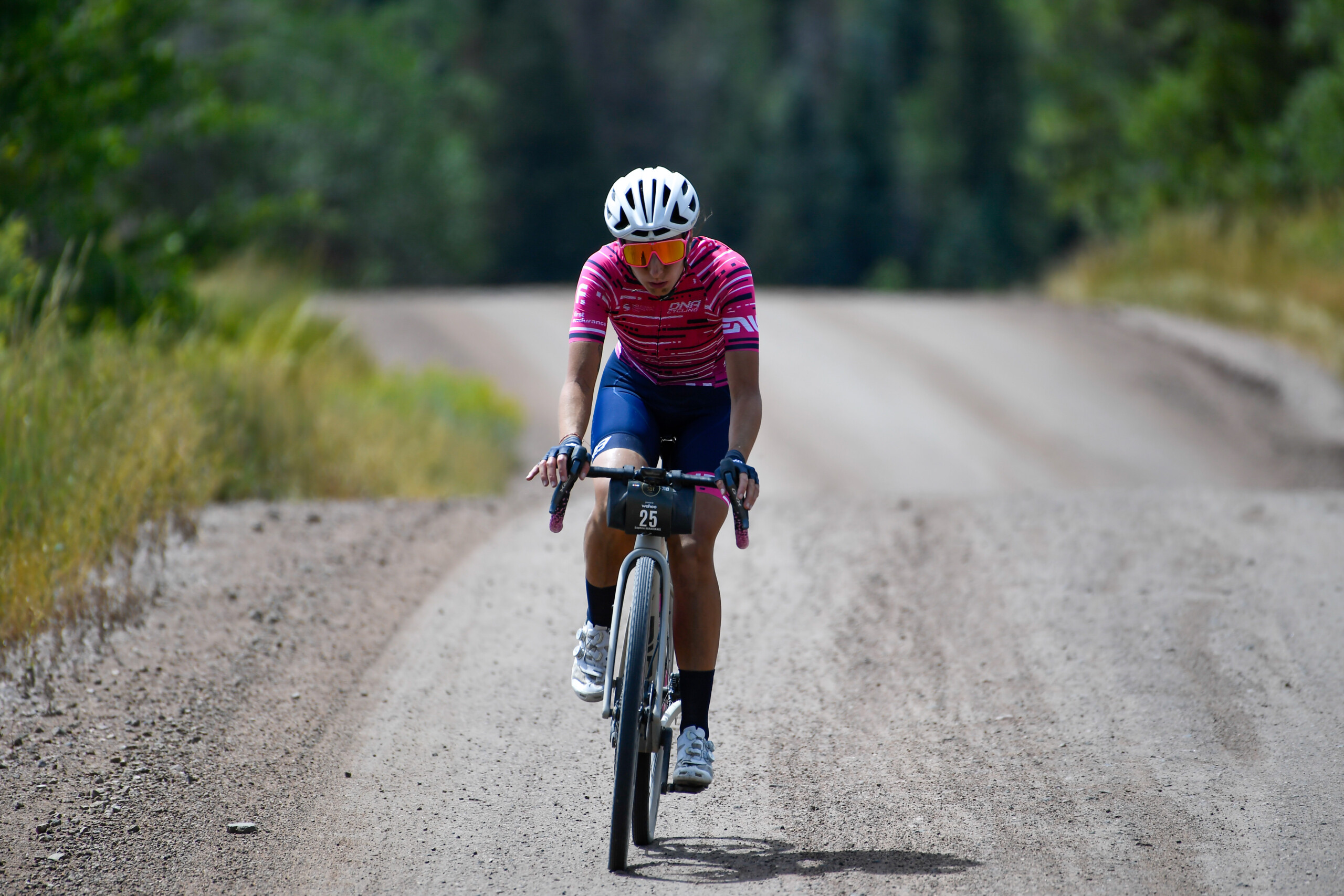
DNA Pro Cycling’s Daphne Karagianis during the 2023 SBT GRVL. Photo by Tyler Phillips, courtesy SBT GRVL
The duo of Skarda and Villafañe worked tightly together in a race long battle that would define the result, both going deep to hold the gap over the chasers balancing stopping for water with the need to hold their strong advantage. Oliveira remained strong in the chase for the win, coming into Trout Creek but the strong wind saw Cromwell surge forward with magnificent speed into the podium position, meanwhile further down the valley Skarda and Villafañe entered Oak Creek but the savage climb out of town with gradients of up to 11%.
Despite her fueling and strong work for the previous 5 1/2 hours, Skarda’s power faltered as Villafañe rode strongly into the Corkscrew climb. Behind, Cromwell found her second legs, and aided by a tailwind and the will to win, she rode the gap down significantly over the final 25 miles, with Skarda, Cromwell and Oliveira joining up to form a strong chase. The advantage was around 35 seconds and Villafañe was clearly within their sights.
Coming into the final key sector at Cow Creek, Villafañe showcased her MTB skills to confidently descend, extending her lead. Meanwhile behind, it was Cromwell who would force the pass on the final tarmac section returning into town pressing home her advantage and leaving Oliveira to chase the final podium spot.
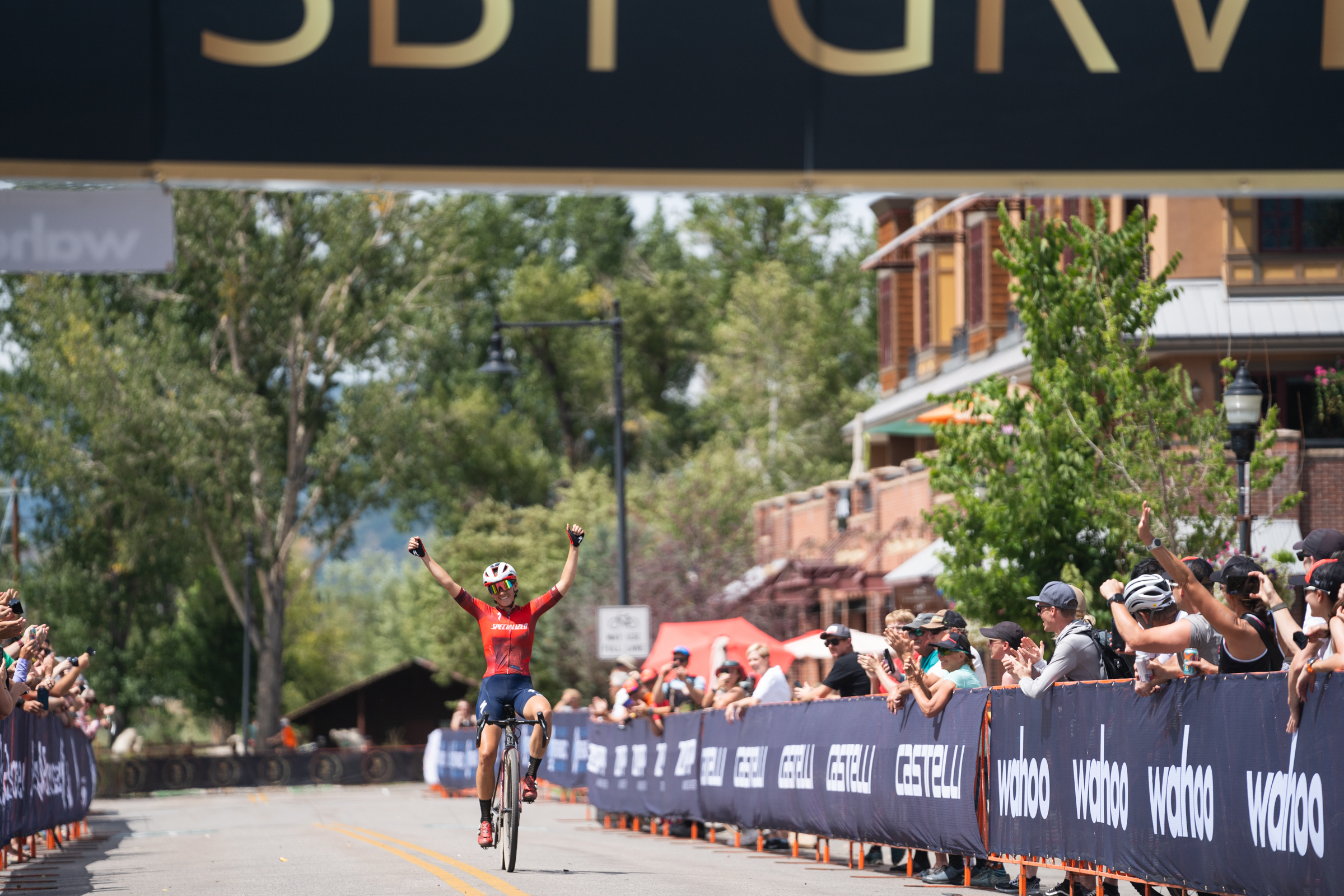
Sofia Gomez Villafañe crosses the line to win SBT GRVL. Photo by Dane Cronin, courtesy SBT GRVL
Crossing the line at just under 7 hours Sofia Gomez Villafañe took the win, the only female rider to go under 7, on crossing the line she commented that she wasn’t aware of her advantage and as such had to push hard to the finish line. Despite Cromwell’s reluctant start, her return to second place was one of the most impressive rides of the day, finishing just over 1 minute down on Villafañe with the podium rounded out by Oliveira who rolled in some 3 minutes further back, complete with an impressive bee sting to the neck.
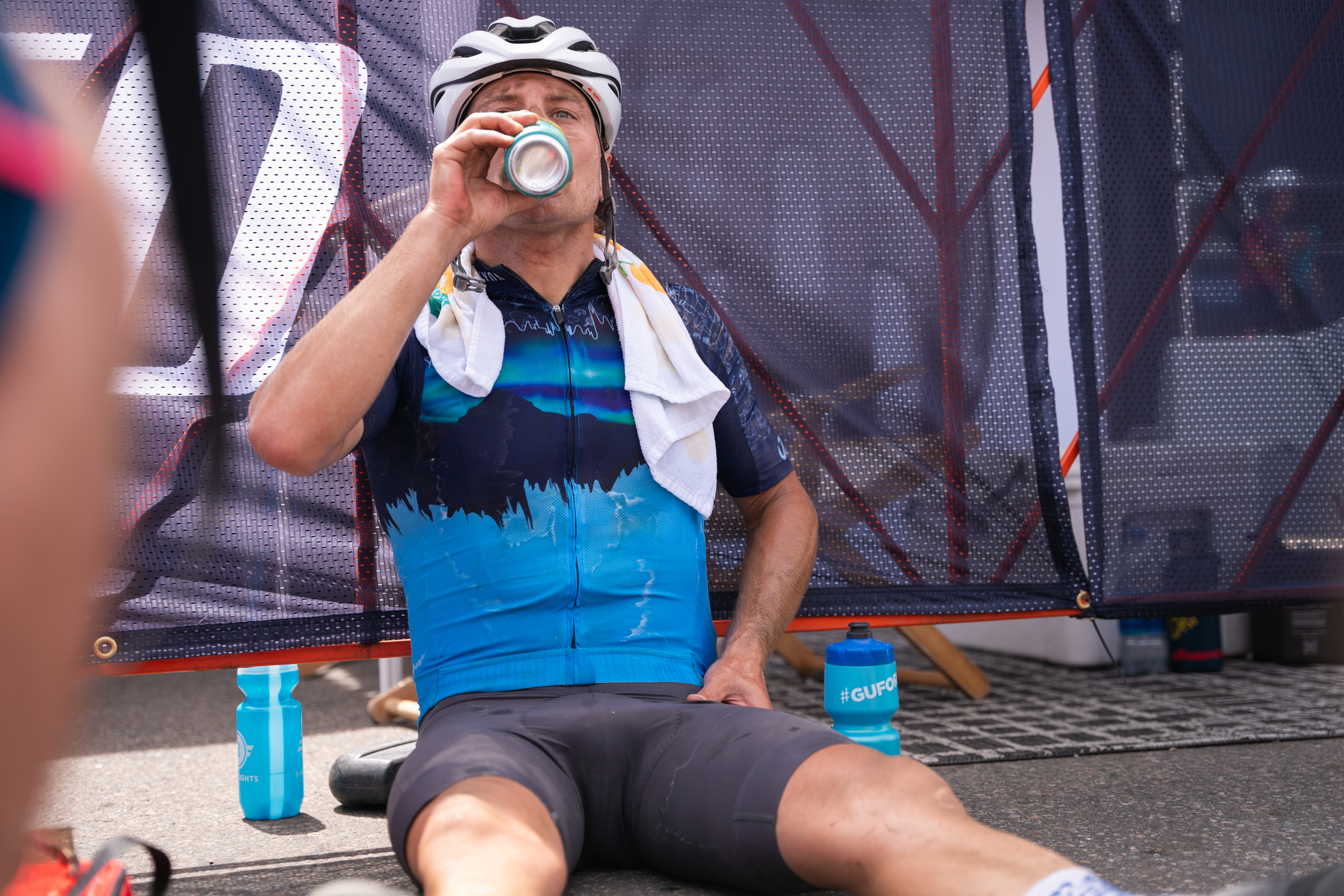
Formula 1 driver Valtteri Bottas (Alfa Romeo F1 Team) enjoys a cold beer after finishing the Blue course at SBT GRVL during F1’s summer break. Photo by Dane Cronin, courtesy SBT GRVL
“When people ask what makes SBT GRVL so special it really comes down to our riders, and I think this year more than any other there was something truly magical in this mountain air. We’re proud to showcase our gravel here in Steamboat, but it takes more than great roads to make a great race, and we wouldn’t be where we are today without the thousands of supportive and inspiring participants and their families and friends who show up each August, as well as our sponsors who make it all possible by fully embracing the spirit of the event. Each year we continue to expand, and we can’t wait to share what we have in store on August 18th, 2024,” said Amy Charity, founder of SBT GRVL.
SBT offered 4 route options, the Black pro course from 142 miles approx. 9,200 feet of climbing 100+ miles of gravel to the green at 37 Miles with 20 miles of gravel.
BOULDER, Colorado (May 30, 2023) — The Better Bike Share Partnership (BBSP) awarded just under $100,000 in grants to six projects that will reach and engage traditionally underserved populations through shared micromobility. This is the eighth round of mini-grant funding the national bicycle advocacy organization PeopleForBikes will administer through its role as a BBSP partner.
“Since it has become increasingly costly to conduct the work that is critical to achieving equity in shared micromobility, we decided to raise this year’s grant awards,” said Tangier Barnes-Wright, senior partnership and program manager at PeopleForBikes and BBSP. “These six organizations identified gaps in who is accessing and using their shared micromobility systems and are committed to enacting change in a short period of time. We look forward to learning from them and sharing stories about how their work can be replicated elsewhere.”
The following projects were selected to receive funding:
Guided Bike Commute Series | $20,000
A Better City Initiative, Boston, Massachusetts
A Better City Transportation Management Association will organize a series of guided bike commutes ending in the vicinity of large institutional employers in Boston’s Downtown, South End, and Dorchester neighborhoods. By providing free Bluebikes bike share passes and routing between stations, this initiative aims to reduce financial barriers to participation and highlight the availability of bike share for
commuting purposes. The grant funds will be used to support professional ride guides, free Bluebikes passes and helmets, sign-up incentive raffle prizes, and breakfast for participants.
Increasing Access to Bike Share | $13,500
Bikeshare Hawaii, Honolulu, Hawaii
In partnership with local community-based organizations, Bikeshare Hawaii will raise awareness about its Biki Access Program through strategic digital communications, content creation, in-person outreach, and hands-on workshops. In addition to helping Bikeshare Hawaii increase digital and in-person engagement, the funding will be used to improve the current application process and make it easier for residents to enroll in the program.
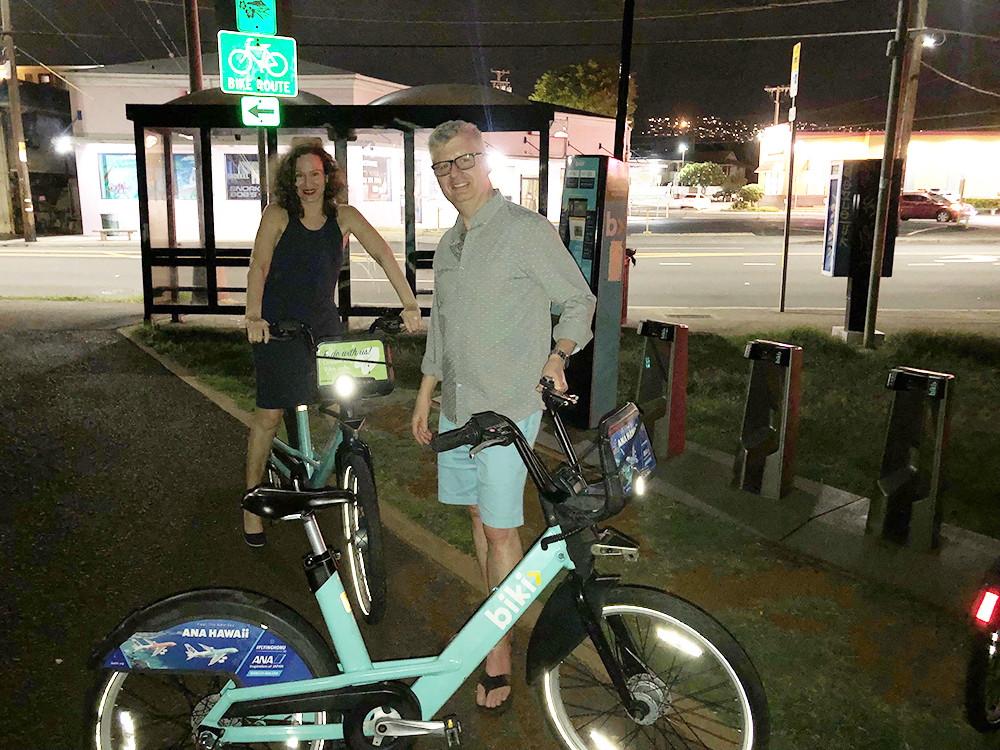
Bikeshare Hawaii’s Biki Access program received a $13,500 grant from the Better Bikeshare Partnership. Photo by Dave Iltis.
Increasing Access to Bike Share for Underrepresented Groups | $13,350
BikeLA, Los Angeles, California
BikeLA will partner with Metro Bike Share and Bicycle Transit Systems to increase access to bike share in Los Angeles County through four 90-minute, no-cost classes for underrepresented riders (specifically, women, seniors, Latinx folks, and students). These classes will be held in collaboration with four community-based organizations in the Los Angeles area and will invite those often left out of cycling to experience its joys. Attendees will receive bike safety education, a firsthand demonstration on how to use bike share, a meal from a local business, a helmet, a 30-day Metro Bike Share pass, and the opportunity to participate in a group ride.
Dockless Vehicle Equity Initiatives | $21,500
Baltimore City Department of Transportation, Baltimore, Maryland
The grant money will fund aspects of Baltimore’s Dockless Vehicle Program equity initiatives, including support for discounted equity plans and educational activities to encourage participation from eligible residents. Baltimore City Department of Transportation will partner with the Baltimore Civic Fund and other local nonprofit organizations to effectively reach transportation-insecure communities by hosting registration events, providing free ride passes, sponsoring bike lane clean-up activities, and distributing informational materials at libraries, community centers, and transit stations.
Golden Rollers: E-Bike Training Program for Older Adults | $13,029
Ghisallo Cycling Collective, San Antonio, Texas
This program will provide e-bike-specific training, annual bike share memberships, guided rides, and safety equipment to seniors and older adults at no cost. Thirty-six participants will complete a three-session, six-hour program designed to increase ridership by building confidence and establishing social connections with other riders. The program, based at a senior center close to a BCycle bike share station, will use the all-electric system to safely explore trails and neighborhood streets on destination-based rides.
Community Ambassadors Expanding Access to BIKETOWN | $18,500
The Street Trust, Portland, Oregon
The Street Trust will use grant funding to help improve and expand its BIKETOWN Ambassador Program. The program — a partnership between The Street Trust, the City of Portland, and Lyft/BIKETOWN bike share — encourages residents living with low incomes to sign up for a BIKETOWN for ALL membership, which provides unlimited 60-minute trips at no cost. The Street Trust will dedicate more staff time, develop new marketing material, and provide riders with more support for a series of bike share events during summer 2023.
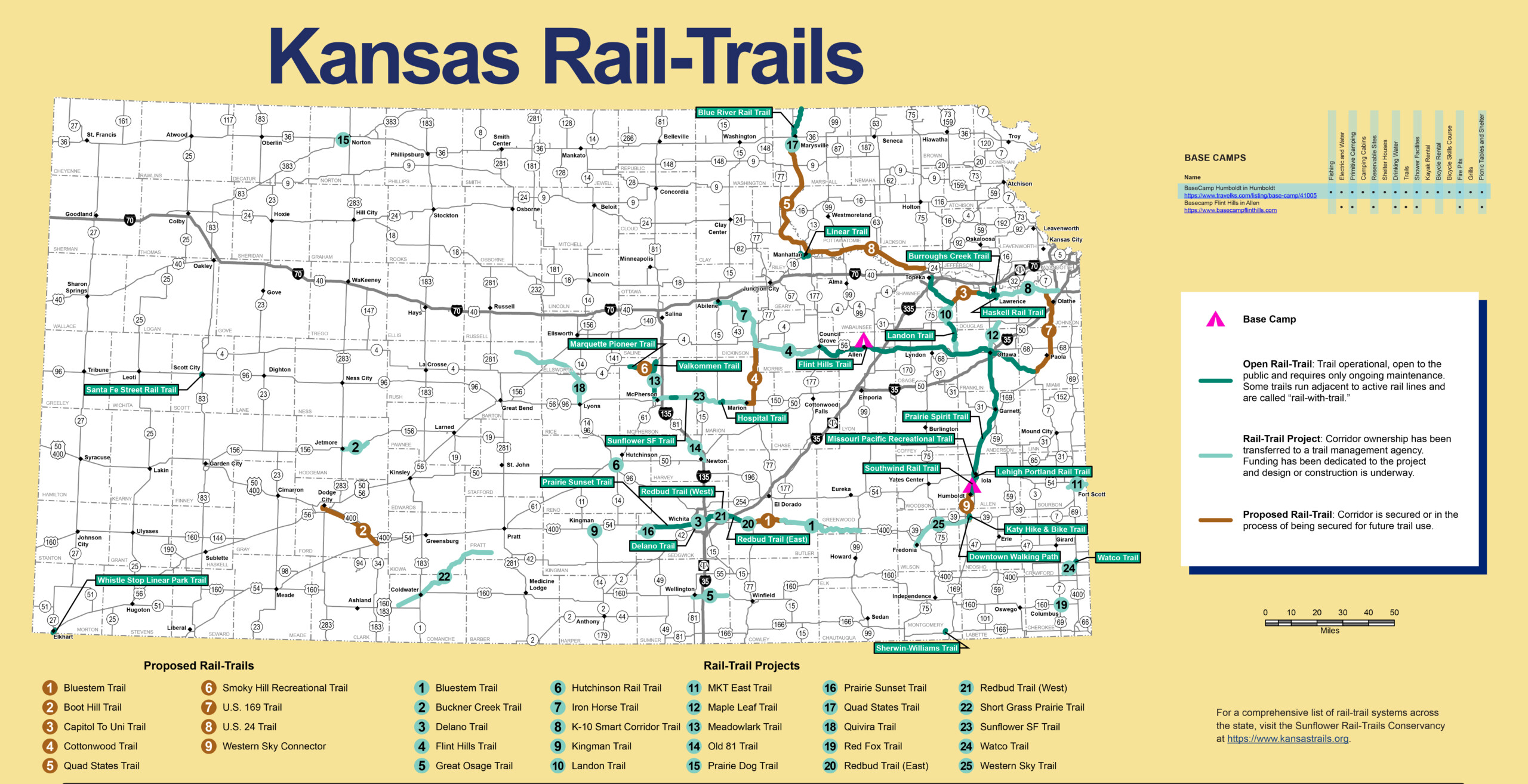
Whether you’re looking to cycle from one county to the next or across the entire state, the new 2023-2025 Kansas Bicycle Map has a lot to offer those planning a short trip or a long ride.
“The revised map has new features such as a focus on rail-trails, Kansas Tourism resources, and information on the recently published Kansas Active Transportation Plan,” said KDOT’s Active Transportation Manager Jenny Kramer. “This map provides information for cyclists of all levels of experience as well as community advocates wanting to develop and improve trails and paths in their areas.”
Kansas Rail Trail Map
The 2023-25 map includes a state map showing daily traffic volumes, county roads, rest areas, bike shops, byways, state parks, bicycle routes across Kansas, and also includes:
Kansas Rail-Trails revised map and infographic.
Section on Sharing the Trail.
Information on Kansas Tourism Cycling resources.
Information on the Kansas Active Transportation Plan.
U.S. Bicycle Routes 76 and 66 information.
A table of state recreation areas and amenities.
State bicycle laws.
Maps and cards with bicycle safety tips are available free of charge on the Kansas Bicycle Map webpage – KSBicycleMap (ksdot.gov) This page also includes links to an interactive bicycle map and several city maps.
For more information or to order maps by email or phone, please email [email protected] or call (785) 296-5186.
DENVER, Colorado (July 13, 2023) — The National Cycling League (NCL) and Wish for Wheels are thrilled to announce a continuation of their partnership to promote cycling to drive community-building in Denver, Colorado.
The NCL, the first gender-equal professional sports league in the U.S. and the first majority women-and minority-owned league, is committed to reimagining what American bike racing can and should look like. Advocating for the power of cycling to nurture community bonds, NCL is partnering with Wish for Wheels for the second time this year.
Photography by Alex Beker
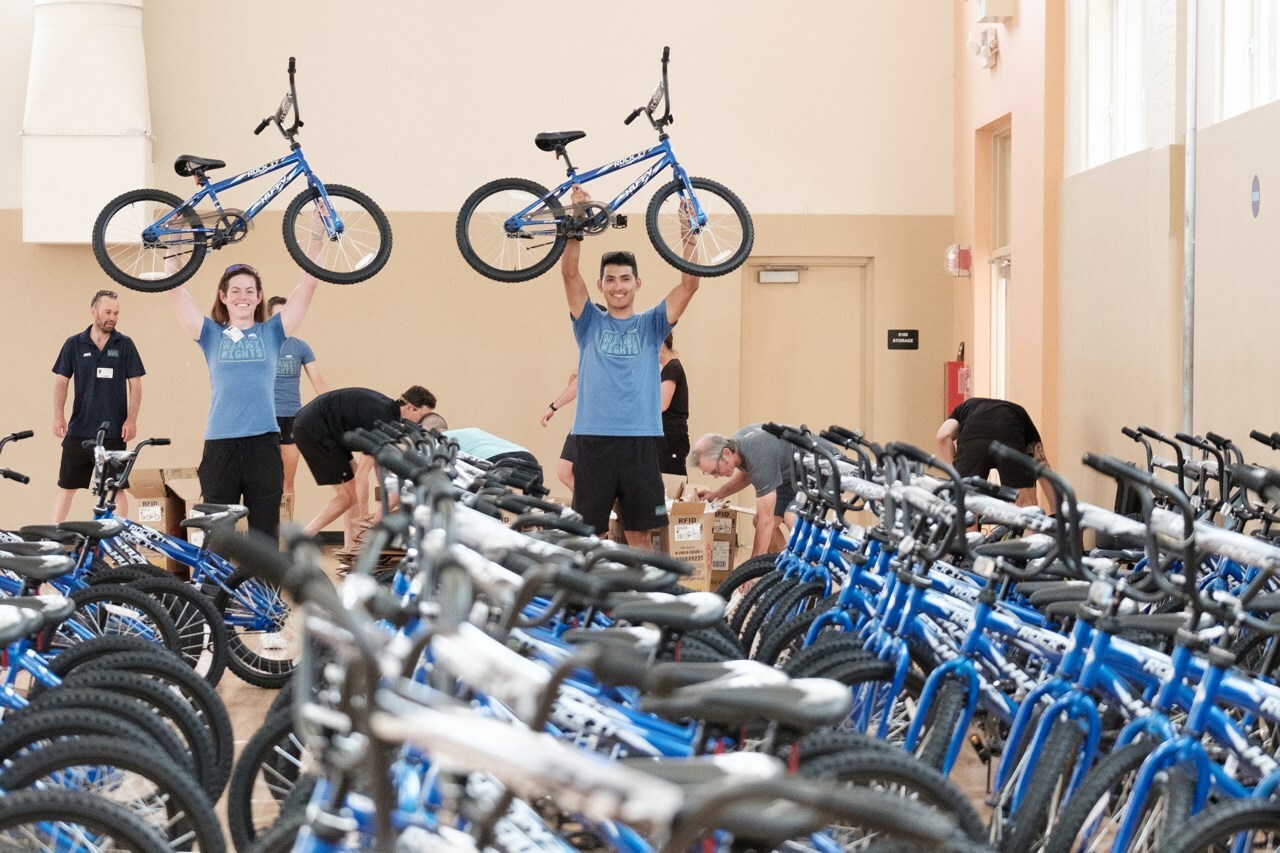
Wish for Wheels, a non-profit organization headquartered in Denver, CO, partners with companies and organizations to fund, build, and give away new bikes and helmets to second graders in Title I schools. The Wish for Wheels partner schools all qualify for Title I federal funding, reserved for the schools with the highest concentration of low-income students.
To kick off the partnership, the NCL worked with Wish for Wheels during its inaugural event in Miami Beach and gifted over 80 bicycles. The second race of its inaugural series is set for Sunday, August 13 at Dick’s Sporting Goods Park in Commerce City, Colorado, located just minutes from downtown Denver. Raceday will begin with a community bike build for the Boys & Girls Club in Commerce City, Co.
“Our partnership with Wish for Wheels is a testament to our commitment to community,” said Andrea Pagnanelli, NCL CEO. “Together, we’re creating positive change, one bike at a time.”
Brad Appel, Founder of Wish for Wheels says, “Our partnership with NCL exemplifies our shared vision for cycling and community development. Thanks to the NCL’s support, we are going to continue to utilize bikes to be a transformational shift for a child living in poverty.”
Both organizations call upon cycling enthusiasts, community members and sports fans to join in celebrating this dynamic partnership. Race attendance, parking and bike valet is free and open to the public. A limited number of VIP Hospitality start/finish line tickets are also available for purchase and offer all-inclusive food, beer, wine, and non-alcoholic beverages. For more information about the August 13 racing event, visit nclracing.com.
To learn more about Wish for Wheels and its mission to help build and give a new bike & helmet to every Title 1 second grader across America, visit wishforwheels.org.
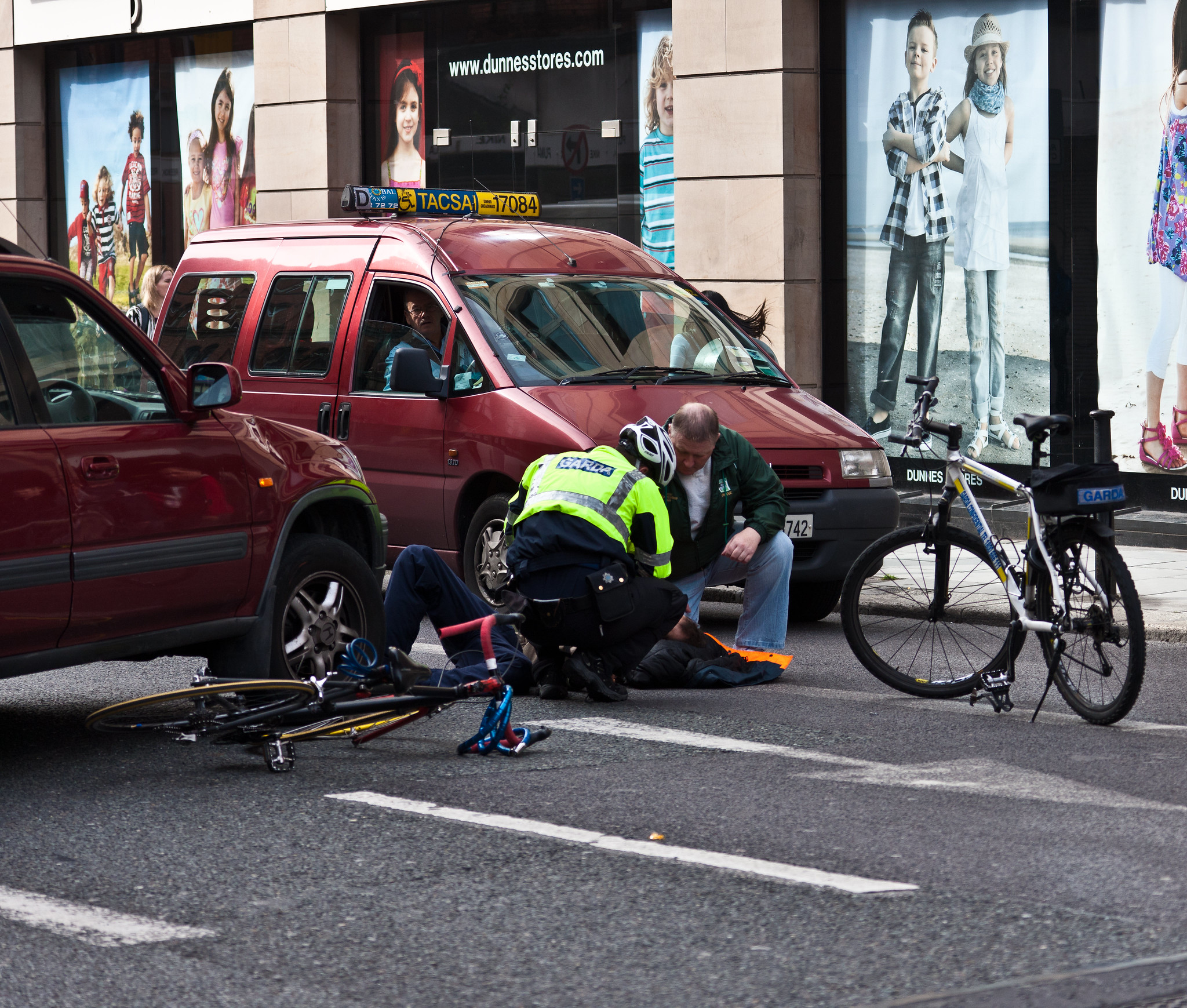
By Charles Pekow — Watch out if you’re biking near an SUV. If you get hit, especially in the head, it’s likely to be much worse than if you collide with another type of auto, according to a study from the Insurance Institute for Highway Safety (IIHS), which examined 71 bicycle-SUV collisions.
An injured rider ies on the ground after being hit by an SUV in Dublin. Attribution-ShareAlike 2.0 Generic (CC BY-SA 2.0)
The trouble stems from getting smashed from components near the ground on SUV fronts when cyclists hit the street and get run over. Danger was the same no matter the speed, time, demographics of the cyclist or other factors.
But SUVs could be designed to lessen the impact, IIHS says. “Future work should investigate specific front-end shapes that underlie these effects. Understanding how vulnerable road users are being injured can inform design changes to help protect them,” concludes “Bicyclist Crashes with Cars and SUVs: Injury Severity and Risk Factors.”
The third Annual Italian SLC Vintage Ride takes place on September 16, 2023, to kick-off the annual Festa Italiana held at the Gateway in downtown Salt Lake City. The Festa Italiana hosts thousands of guests each year with amazing music, food, art, motorcycles, and cars on display.
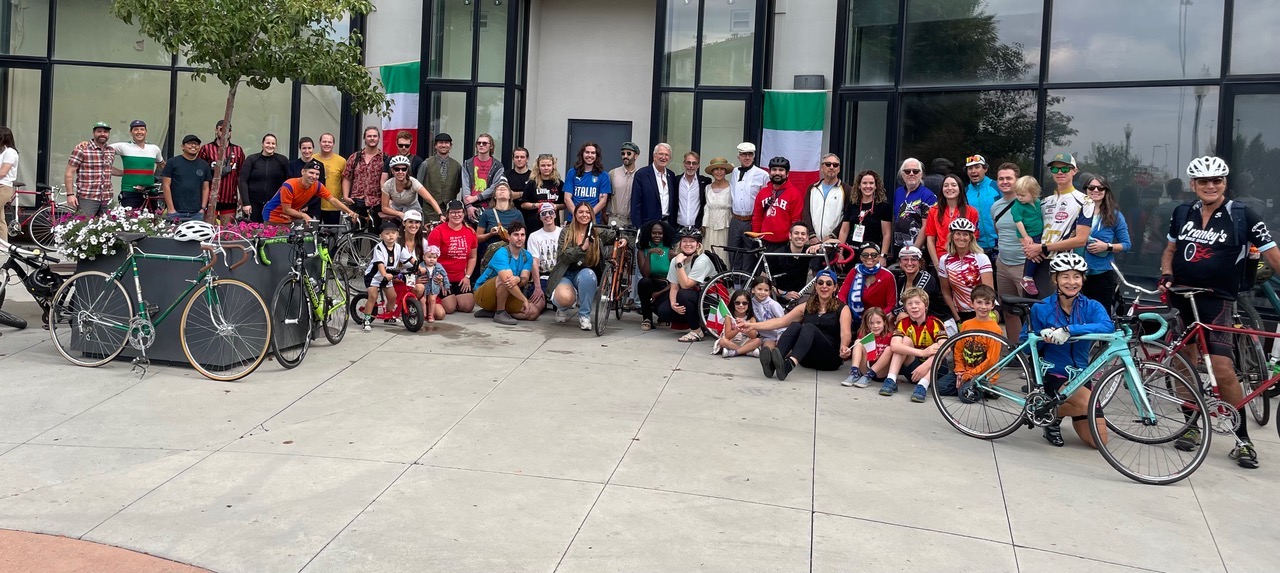
Riders gathered at the Gateway before the 2022 SLC Vintage Ride. Photo courtesy Giuliana Marple.
Two-time participant Anthony Nocella interviewed ride organizers Giuliana Marple, Kastle Christensen, Eric Figliomeni, and Chris Hubbard about this year’s event.
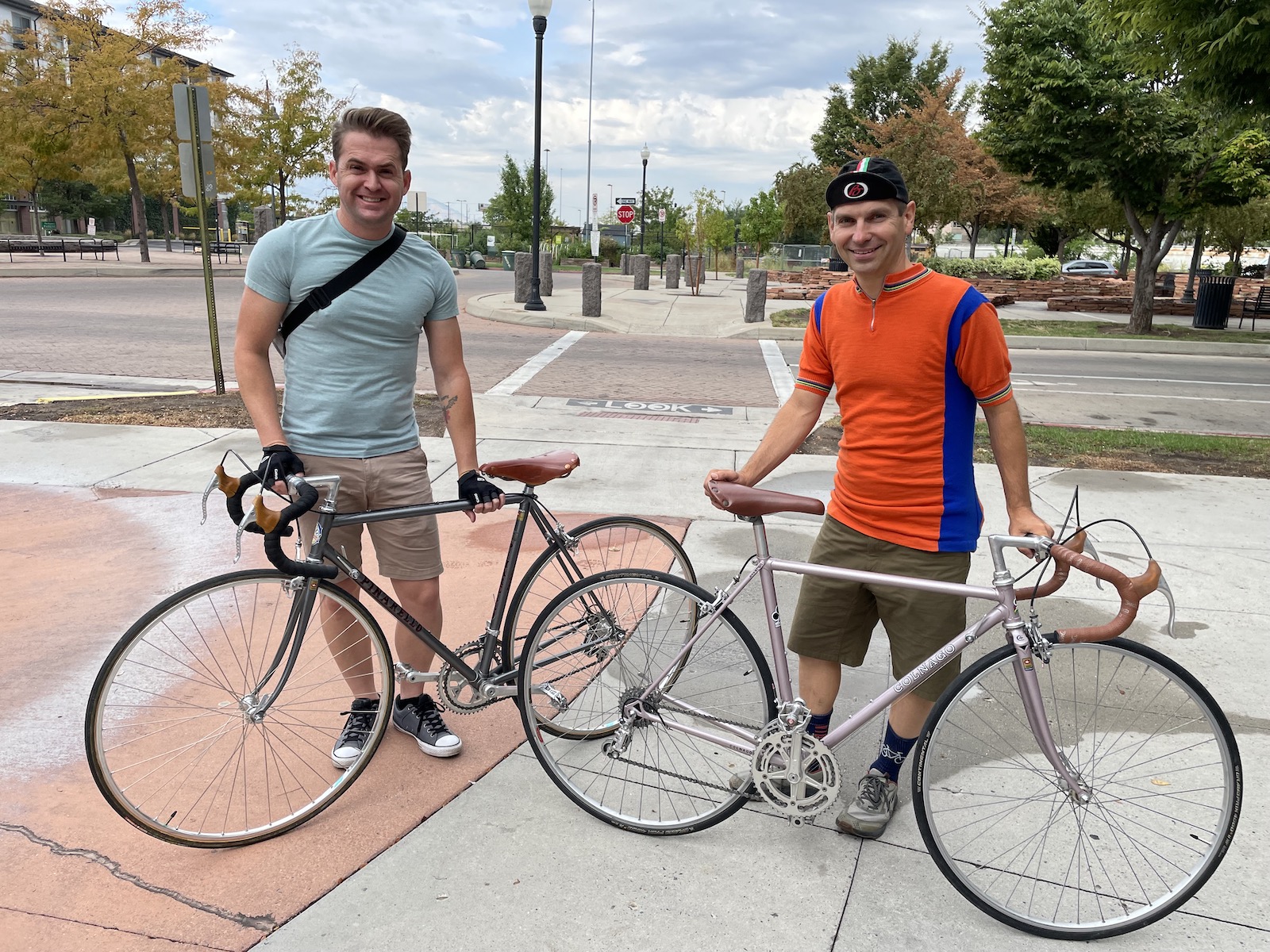
Anthony Nocella (right, with Colnago) and another rider showing off their vintage Italian bikes. Photo courtesy Giuliana Marple.
Anthony Nocella: Why was the Annual Italian Salt Lake City Vintage Ride created?
SLC Vintage Ride: The ride was created to honor the bygone era of cycling in Italy, with races starting back in 1876. Similar to the L’Eroica bike ride in Tuscany, the SLC Vintage Ride celebrates bicycles and clothing used until the 1980s and is a great way to kick off the Festa Italiana activities.
Anthony Nocella: How long is the ride and is it a hard ride?
SLC Vintage Ride: The ride is about three miles long. It starts and ends at the Gateway Center, so the course is also flat, making it an easy ride even for children. It’s a fun and casual ride with locals and a great way to kick off the Festa Italiana weekend.
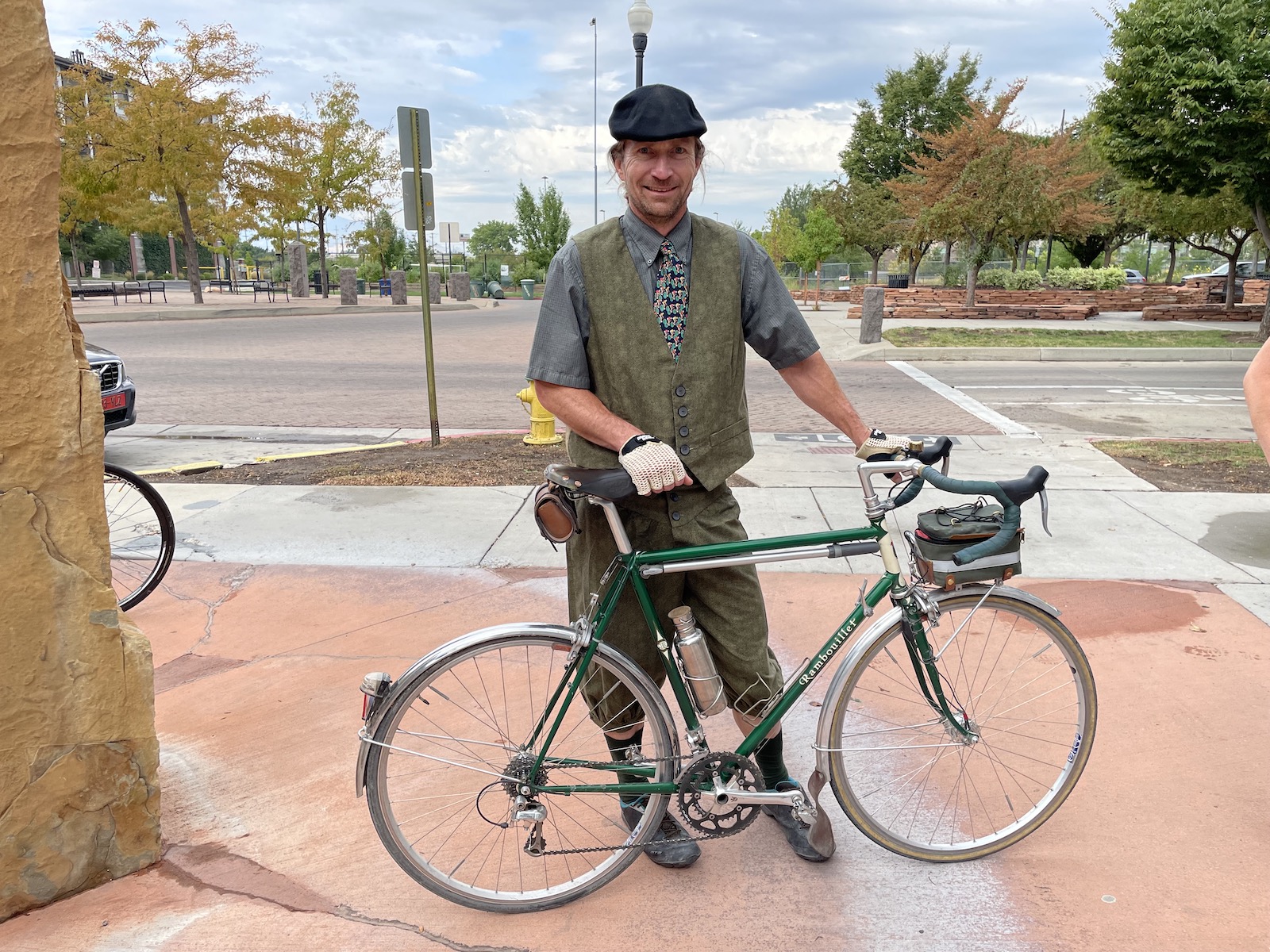
Steve Wasmund poses with his Rivendell Rambouillet. Photo courtesy Giuliana Marple.
Anthony Nocella: Do you need a vintage bike to ride this or any other special equipment?
SLC Vintage Ride: No, the best bike is the bike you have! There are prizes for the best vintage bikes and outfits, so if you have an older bike in the garage you might want to dust if off and ride it. Registration is open now.
Anthony Nocella: What is the most beautiful part of the ride?
SLC Vintage Ride: During the ride it’s seeing people coming together to celebrate cycling and all things Italian. At the finish line, Festa Italiana opens to give you authentic food and live music for the rest of the weekend.
Event Info: September 16 — SLC Vintage Ride p/b Festa Italiana, Salt Lake City, UT. Approximately 3-mile flat fun ride starting and finishing at the Gateway in downtown Salt Lake City, marking the official open of the Annual Festa Italiana. Old bikes with single-speed drivetrains, flip-flop hubs, rod derailleurs, etc. are encouraged. Wool jerseys and shorts as well as other vintage bike attire are also encouraged. Unlike cyclists from decades ago, we highly encourage helmets. Festa Italiana, [email protected], https://www.bikereg.com/slc-vintage-ride
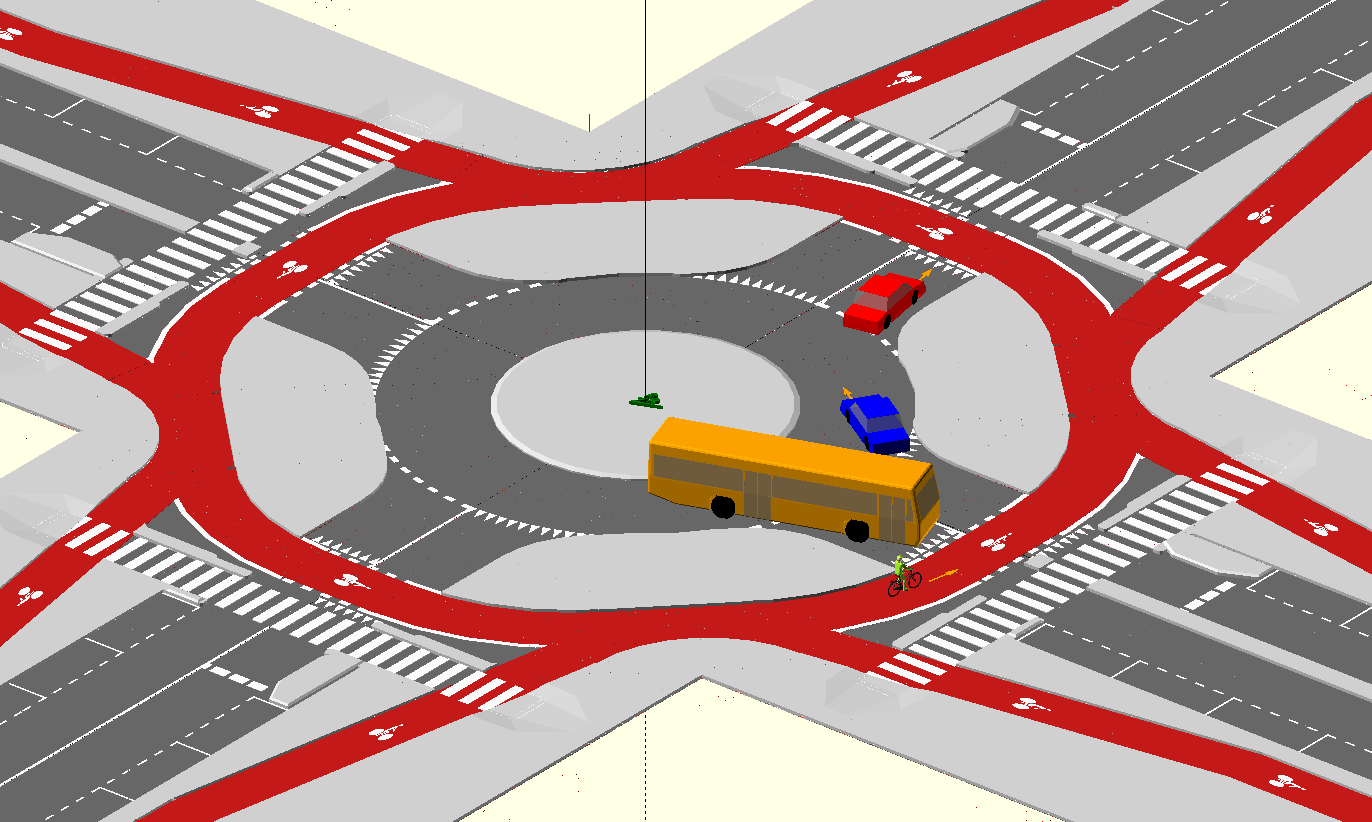
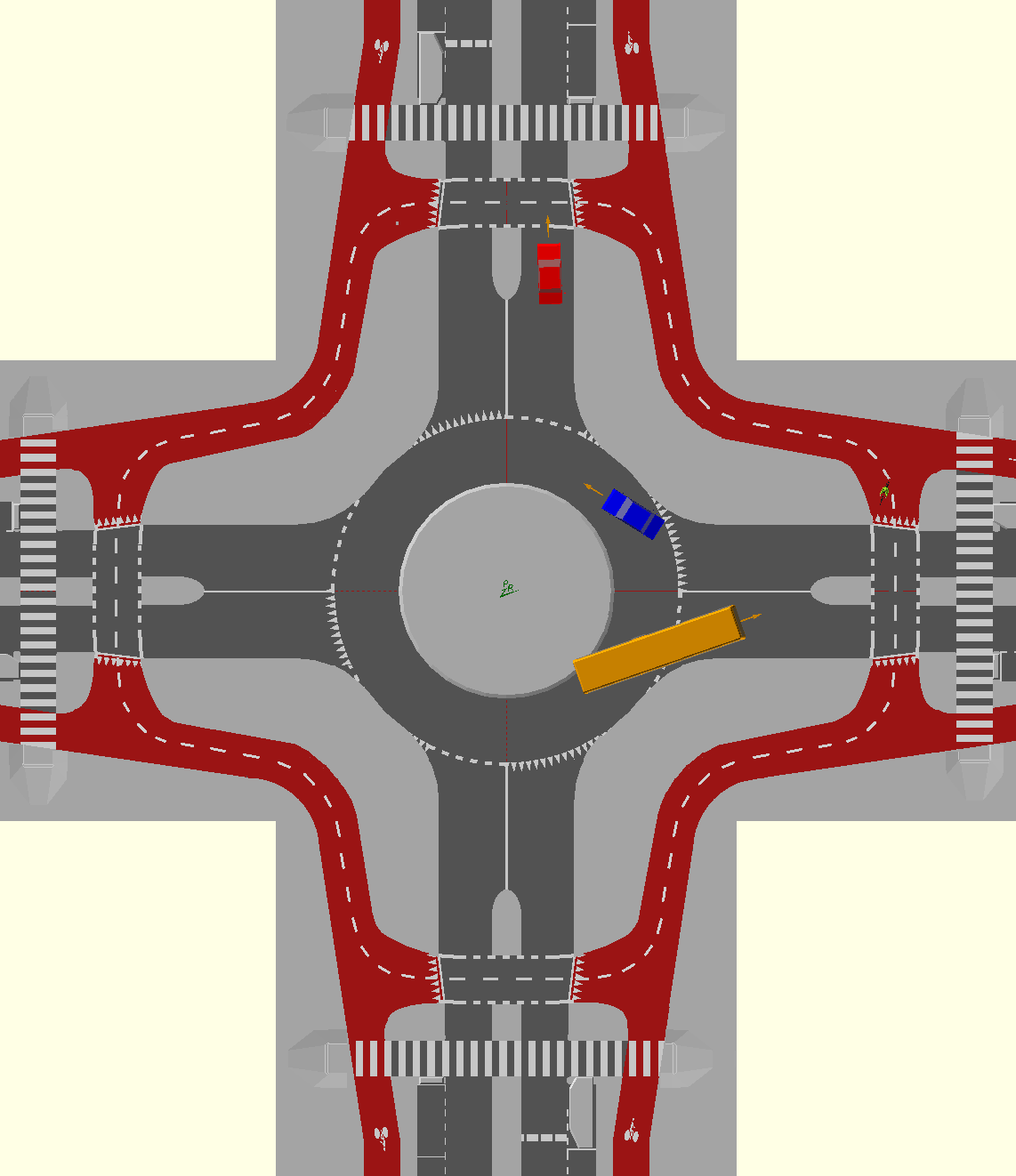
By Charles Pekow — Navigating roundabouts can be hell for bicyclists. But a study from the Transportation Research Board says they can be designed to make them safer and easier to get around. New technologies can help, but a problem installing them is that traffic circles are designed very differently across the country, says Background and Summary of a Guide for Roundabouts (https://nap.nationalacademies.org/catalog/27068/background-and-summary-of-a-guide-for-roundabouts).
Many conflicts between cyclists and autos come entering right turn lanes.
The guide suggests many safety measures. For instance, if roundabouts don’t include separate bike lanes, they should include sharrows to encourage cyclists to ride down the middle of the lane. It also urges designers to install signs saying “Bikes May Use Full Lane” or “Do Not Pass Bikes.”
A Dutch-style protected roundabout, which gives cyclists priority, rendered in 3D. Image by PRZ (Pierre ROUZEAU), CC BY-SA 4.0 <https://creativecommons.org/licenses/by-sa/4.0>, via Wikimedia CommonsAlternative dutch roundabout with remote cycle path crossing NOT having priority against motorists, requiring cyclists to give way to oncoming vehicles at crossing points, but protecting cyclists better than merging with auto traffic. Image by PRZ (Pierre ROUZEAU), CC BY-SA 4.0 <https://creativecommons.org/licenses/by-sa/4.0>, via Wikimedia Commons
Hailed as Utah’s largest cycling event for people of all abilities, the popular ride welcomes hundreds of participants to Park City
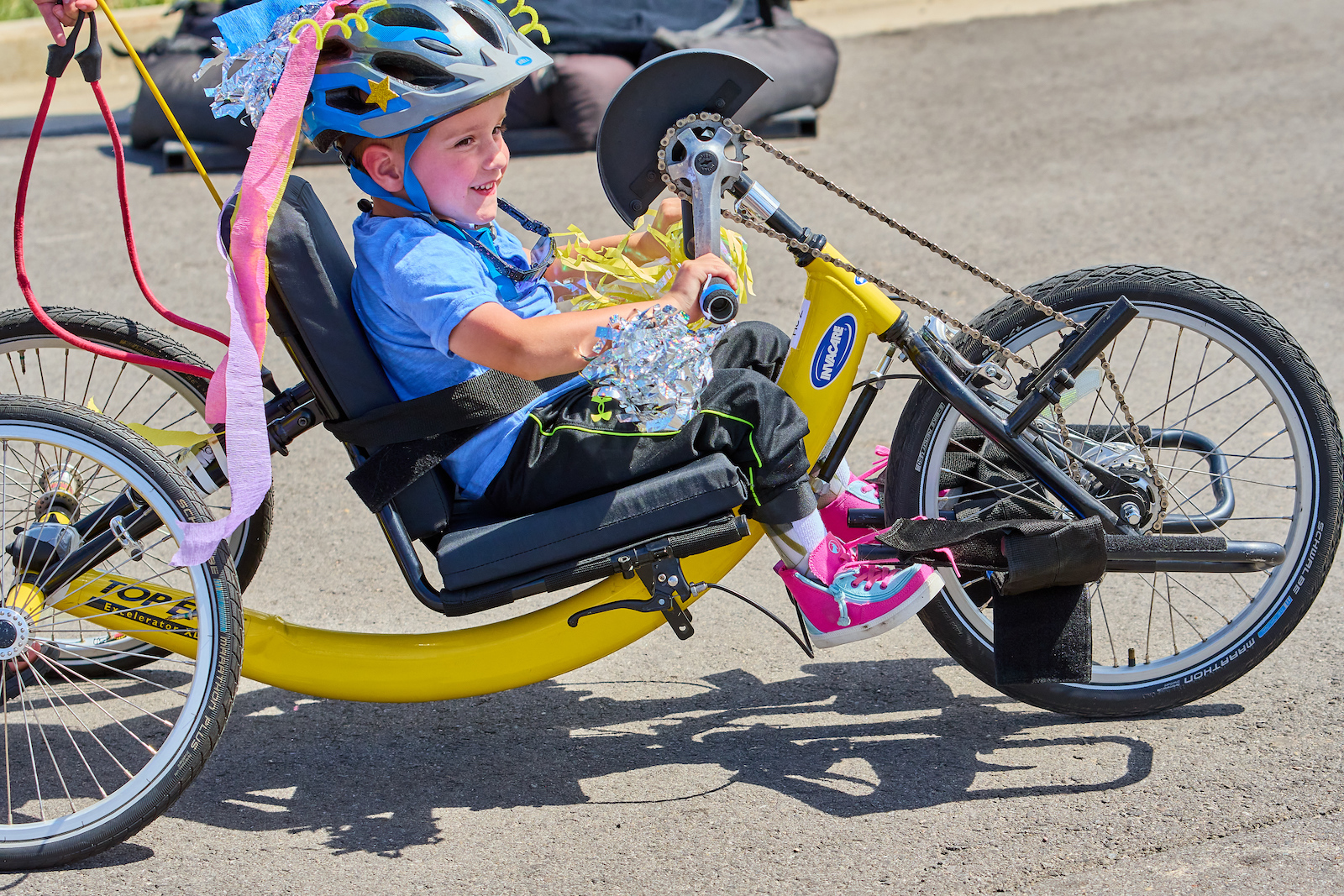
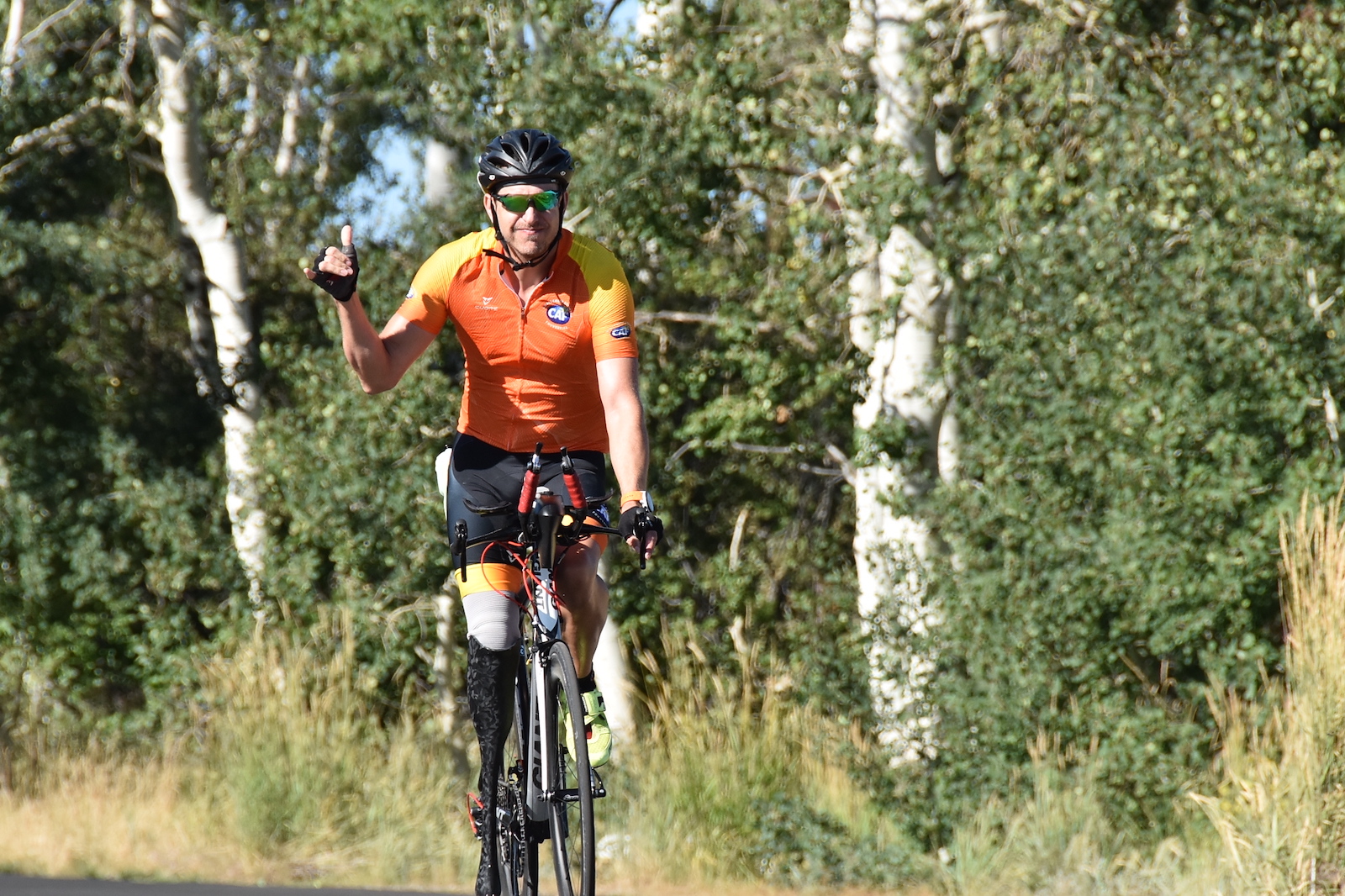
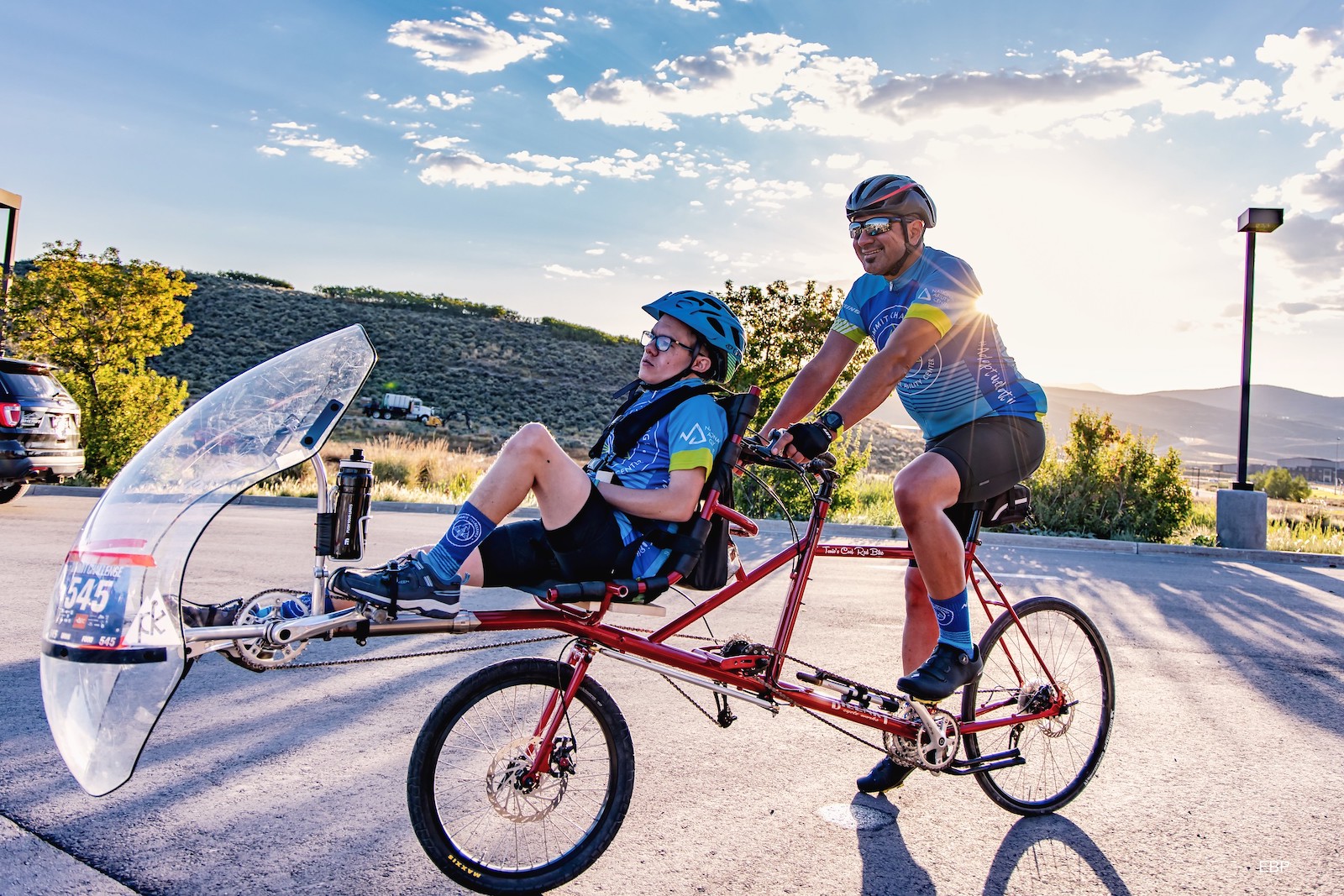
PARK CITY, UTAH (June 21, 2023) — The Summit Challenge will return to the National Ability Center (NAC) on Saturday, August 26, 2023 with the goal of raising $100,000 for adaptive recreation programs. Beginning at 7:00 a.m., the ride runs through the scenic mountains and valleys of Summit and Wasatch counties. With multiple distance courses available for riders to participate in, ranging from 16 to 100 miles, cyclists of all abilities will help raise funds for the National Ability Center’s multitude of programs and activities.
Photo courtesy National Ability Center
“We’re looking forward to welcoming the hundreds of participants, both new and returning, to the NAC’s Summit Challenge,” said Danny Glasser, Executive Director of the National Ability Center. “This fun community event allows cyclists to pedal together through the scenic mountains of Northern Utah while raising money for our over 5,000 participants annually. Sign up and seek your summit with us!”
Photo courtesy National Ability Center
Over the last 16 years, the Summit Challenge has come to be known as Utah’s largest ride for cyclists of all abilities and continues to provide people of all ages and skill levels the opportunity to experience the thrill and beauty of the Utah mountains. The annual challenge raises money to support over 22,000 experiences that the National Ability Center offers to people of all abilities annually. The fully-supported road ride offers participants a choice of a 16-, 25-, 50-, 80- or 100-mile course to fit all experience levels and 10 rest stops along the way provide fuel, hydration and encouragement. A unique feature to the Summit Challenge includes the chance for riders on the 100-mile course to complete the two-mile climb up Wolf Creek Ranch, a trail that is typically only open during the Tour of Utah. A 1-mile Discovery Loop that offers families a fun-filled way to get involved with the Summit Challenge is also open to attendees at no cost. Starting at 11 a.m. MT, the Event Village on NAC’s campus will be open for lunch, refreshments and entertainment followed by an awards presentation at 2:30 p.m. MT on the main stage.
Photo courtesy National Ability Center
“This year will mark my third year attending the Summit Challenge Veterans Camp and participating in the Summit Challenge ride. Because of the Summit Challenge, I have learned how to set obtainable goals and made solid connections with other veterans who are avid cyclists who have taught and coached me into being a much more proficient cyclist,” said Rhonda Liddell, Trail Orienteering and Para-Skeleton athlete. “It is hard work, but I love the challenge this event poses for me! It is my goal to ride the 50-mile Summit Challenge route this year, and I plan to reach that goal.”
Early bird tickets are available for purchase now until July 14 at midnight MT, and start at $40. Regular registration closes on Aug. 24 at 5:00 p.m. MT, and prices start at $55 and all adaptive athletes ride for free. Event sponsors include DW Healthcare Partners, Boeing Company, KT Tape, Leave Room for Dessert Eateries, Michelob Ultra, Swire Coca-Cola, USA, Nate Wade Subaru, Summit County Restaurant, Salt Lake Magazine, KPCW, Stein Eriksen Lodge Deer Valley, Vail EpicPromise, Zions Bank, ABC4, Del Taco and Utah Life Elevated. For the full list of sponsors, visit the Summit Challenge website. The National Ability Center encourages riders to raise a minimum of $50 to benefit the leading, adaptive nonprofit.

 Previous editions of Bike Prom have been known for participants dressed in formal wear, costumes, and occasionally outrageous attire, which is all part of the fun.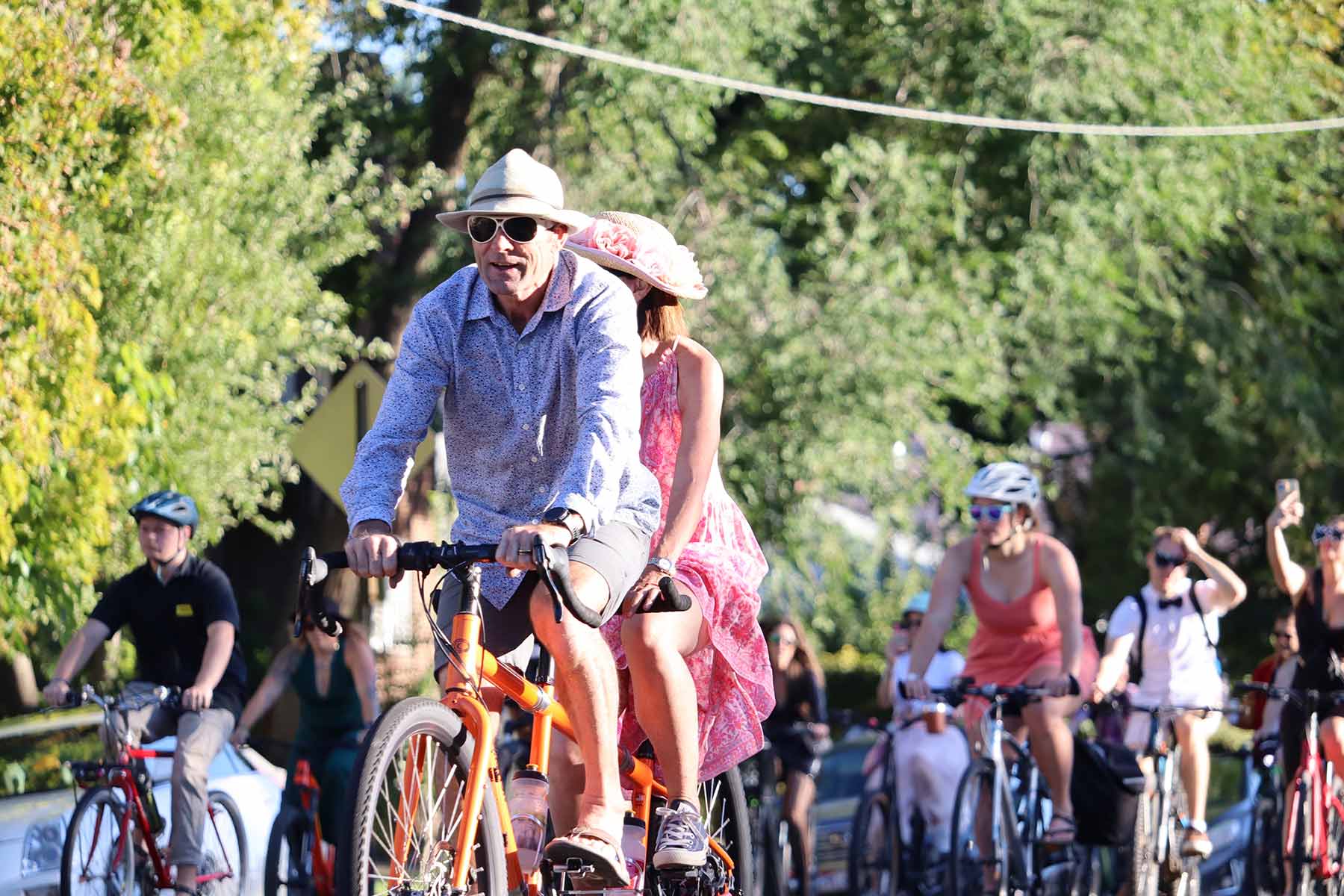
 This is a ticketed event, and all proceeds go to support the fundraising for the New Hub.