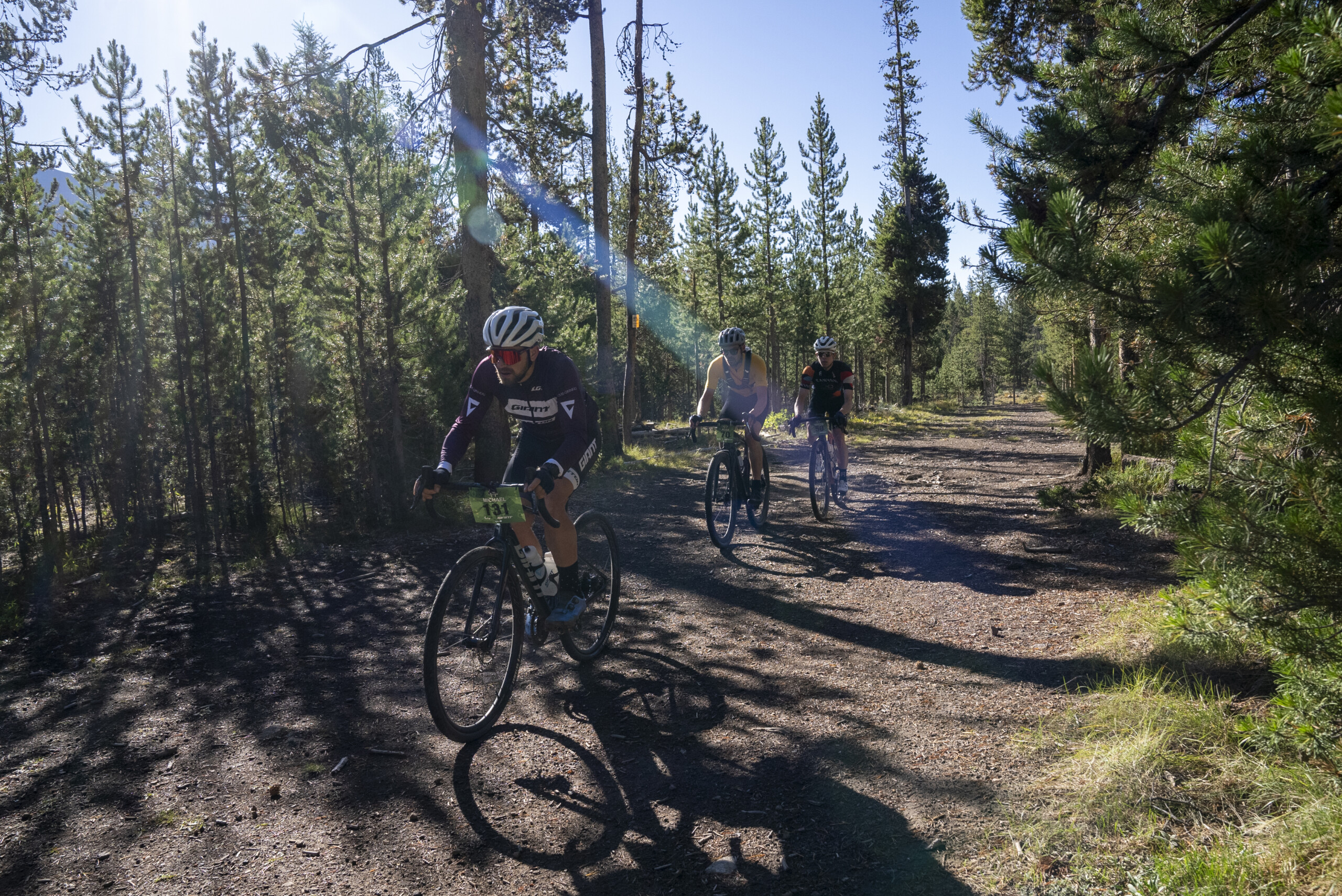
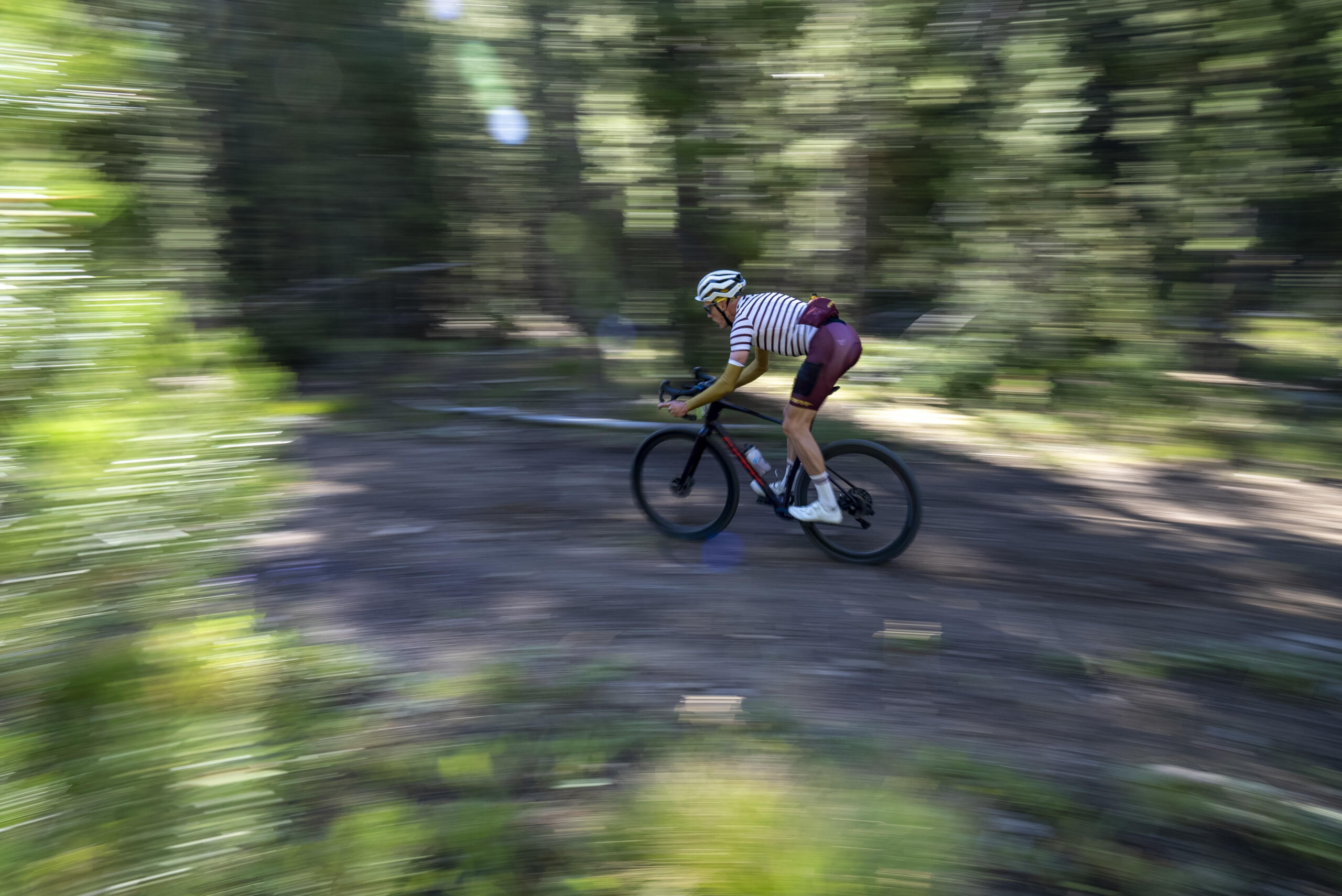
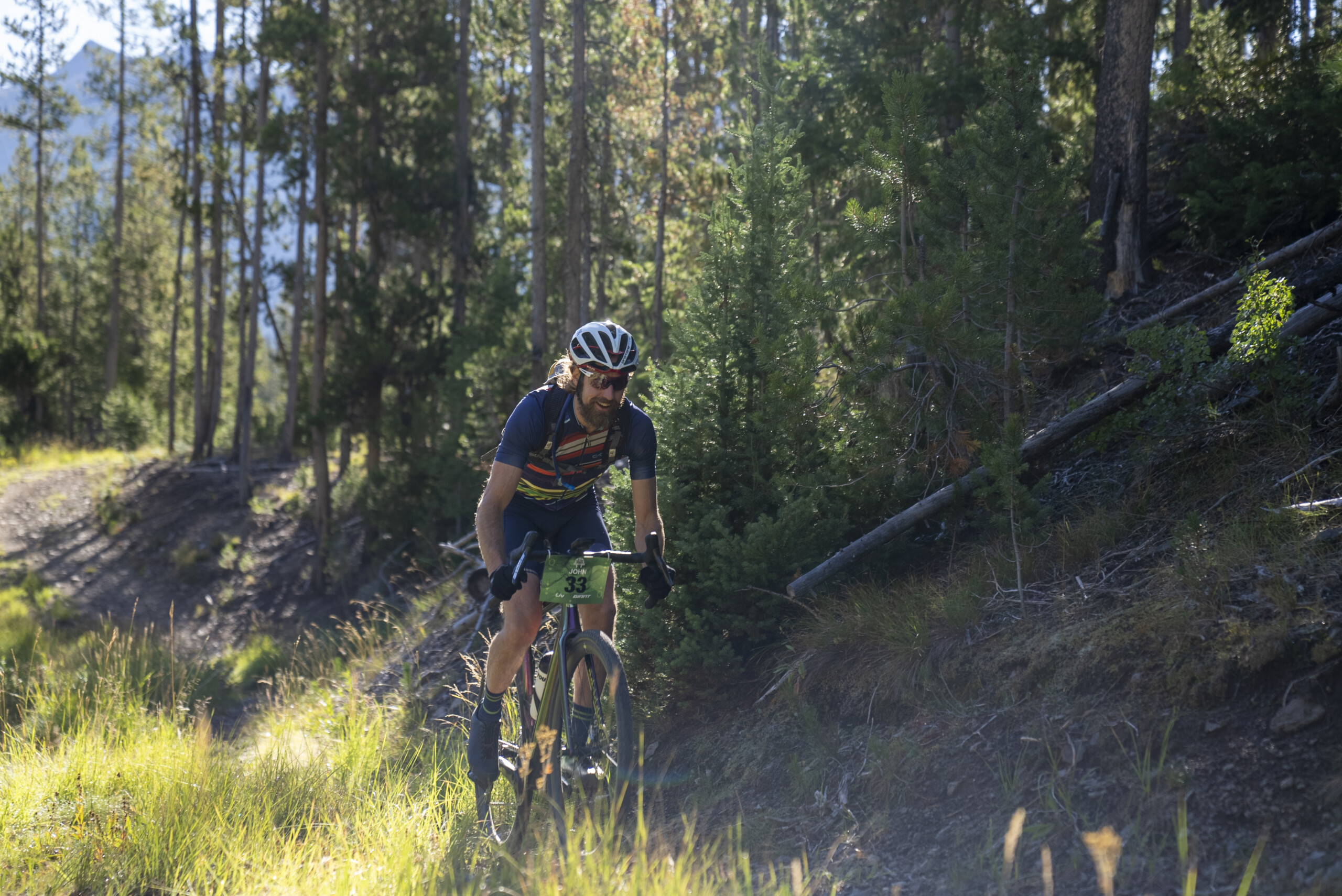
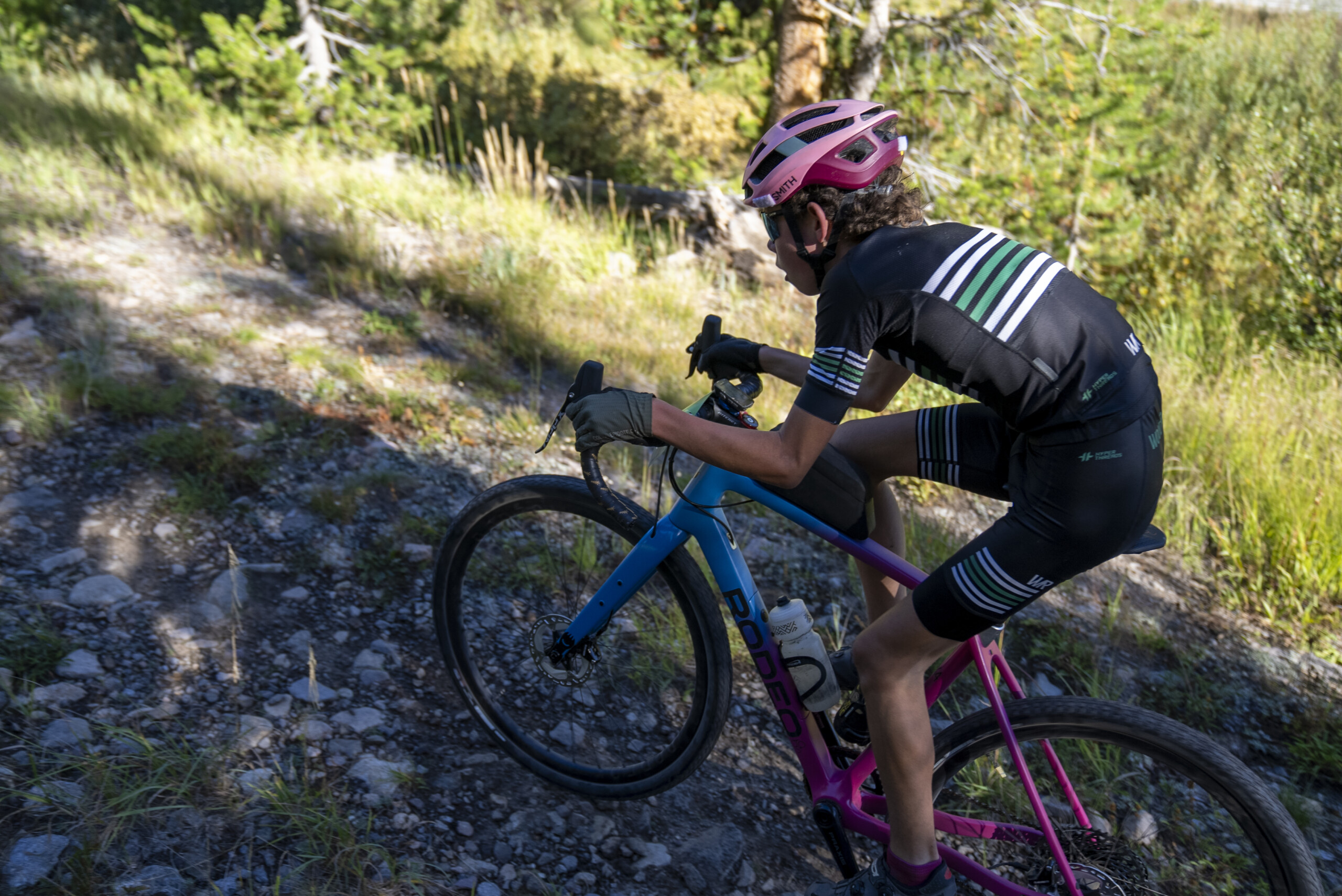
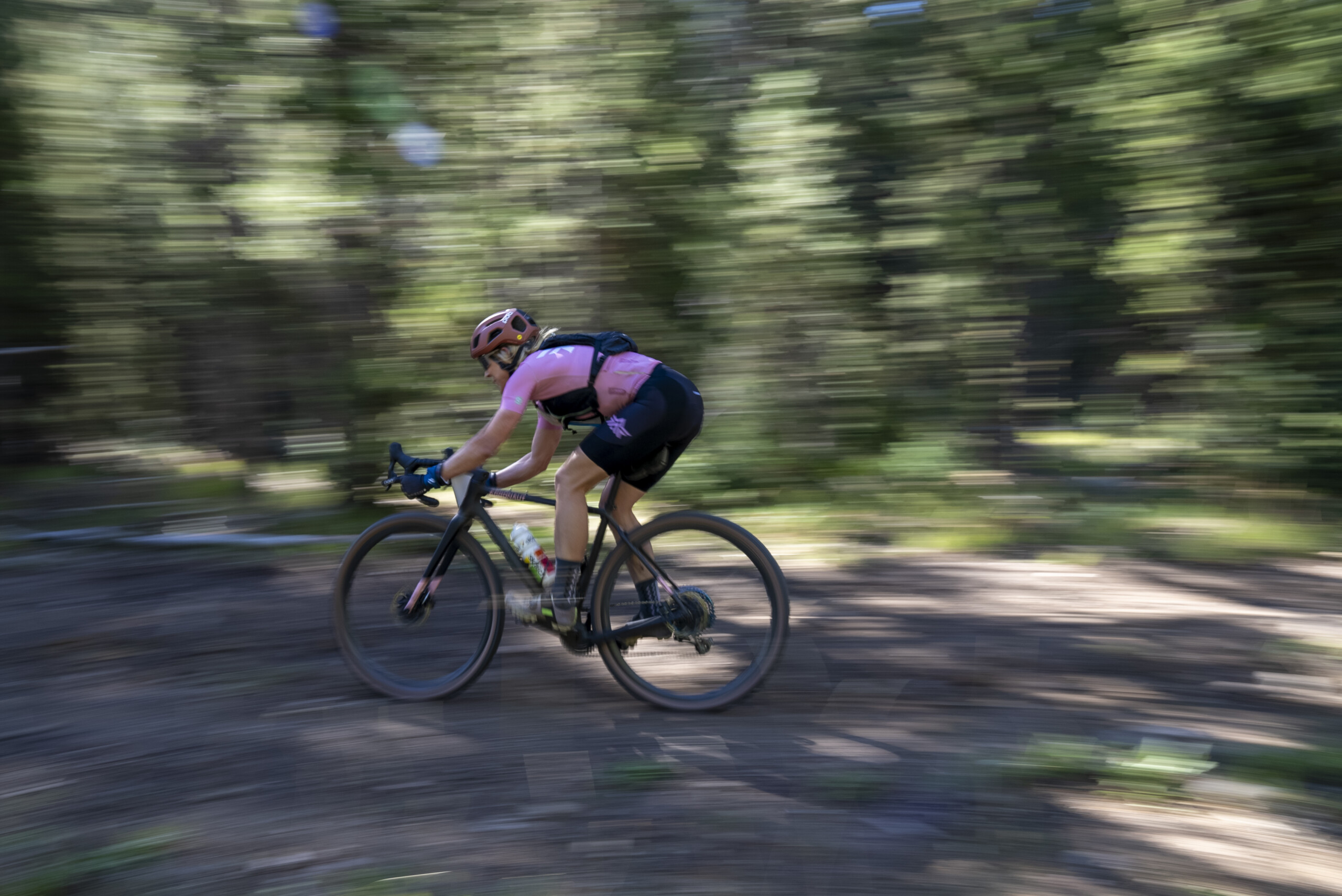
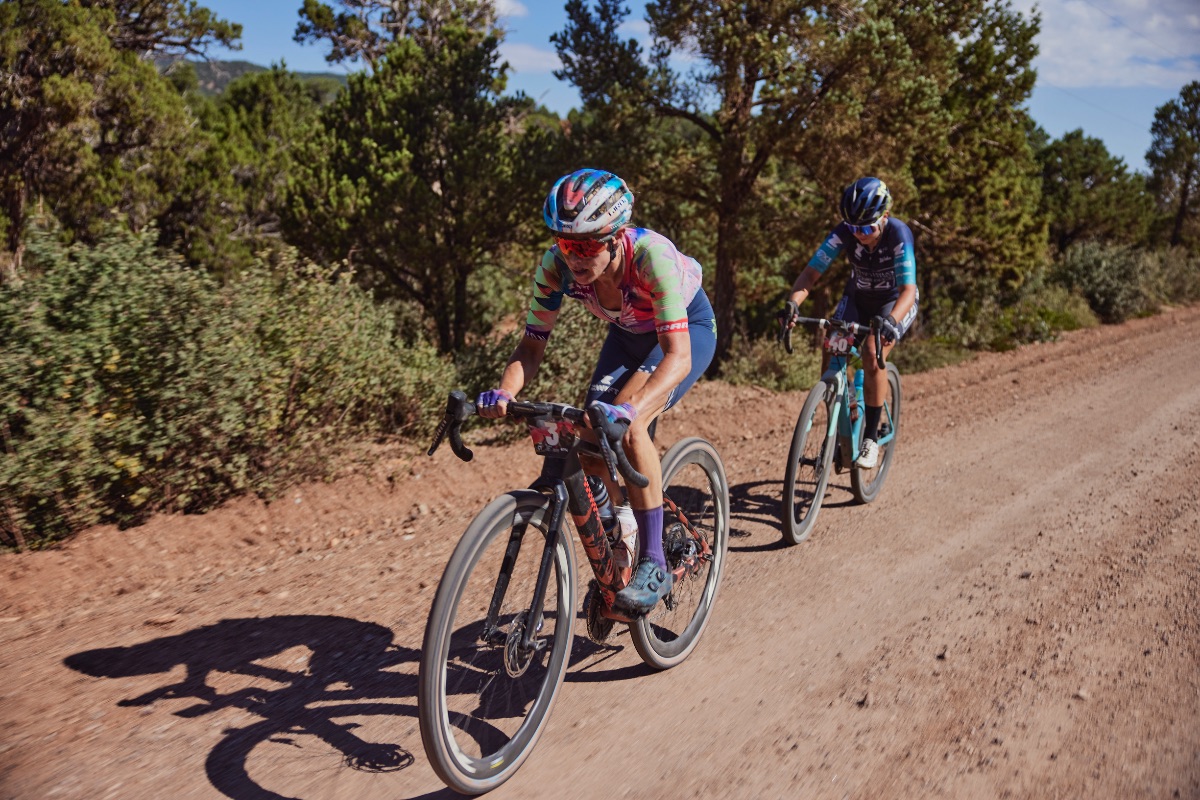
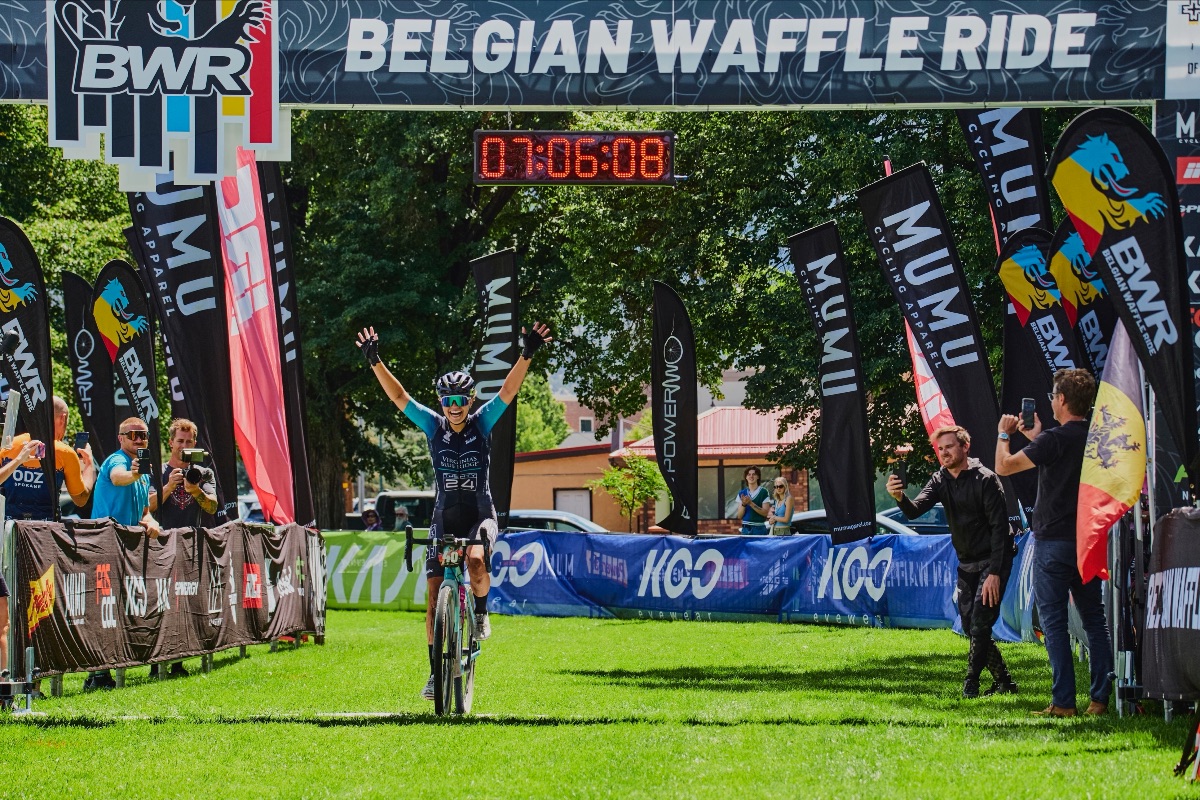
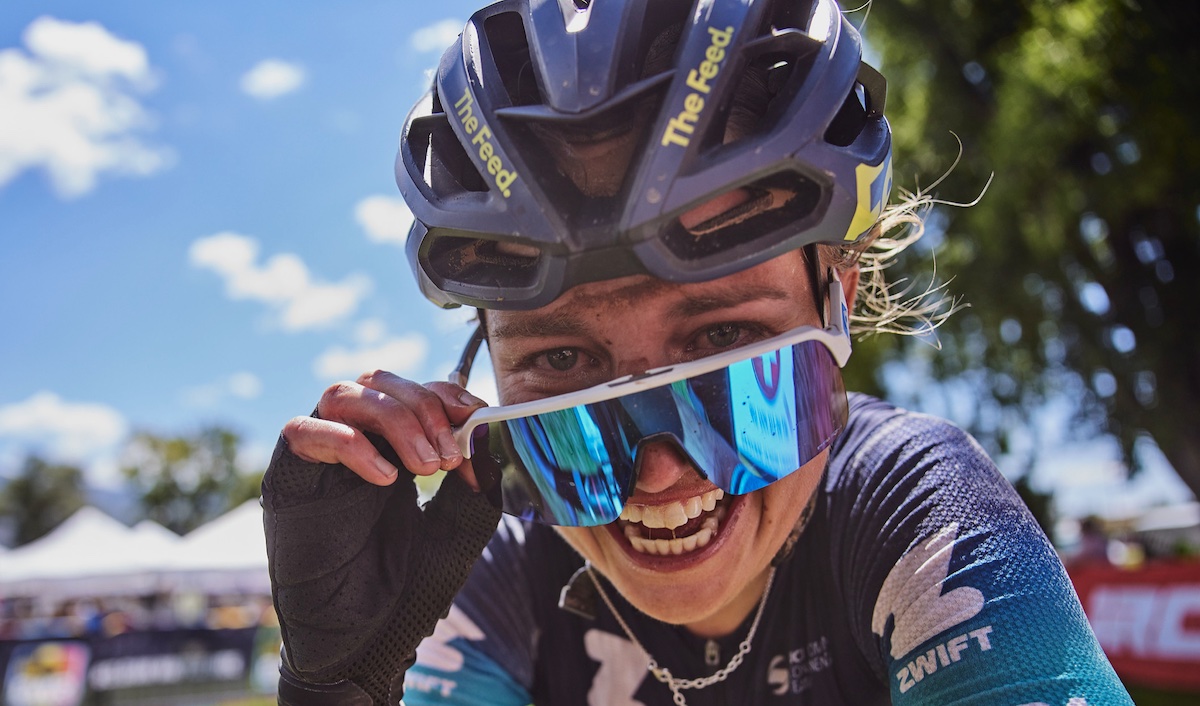
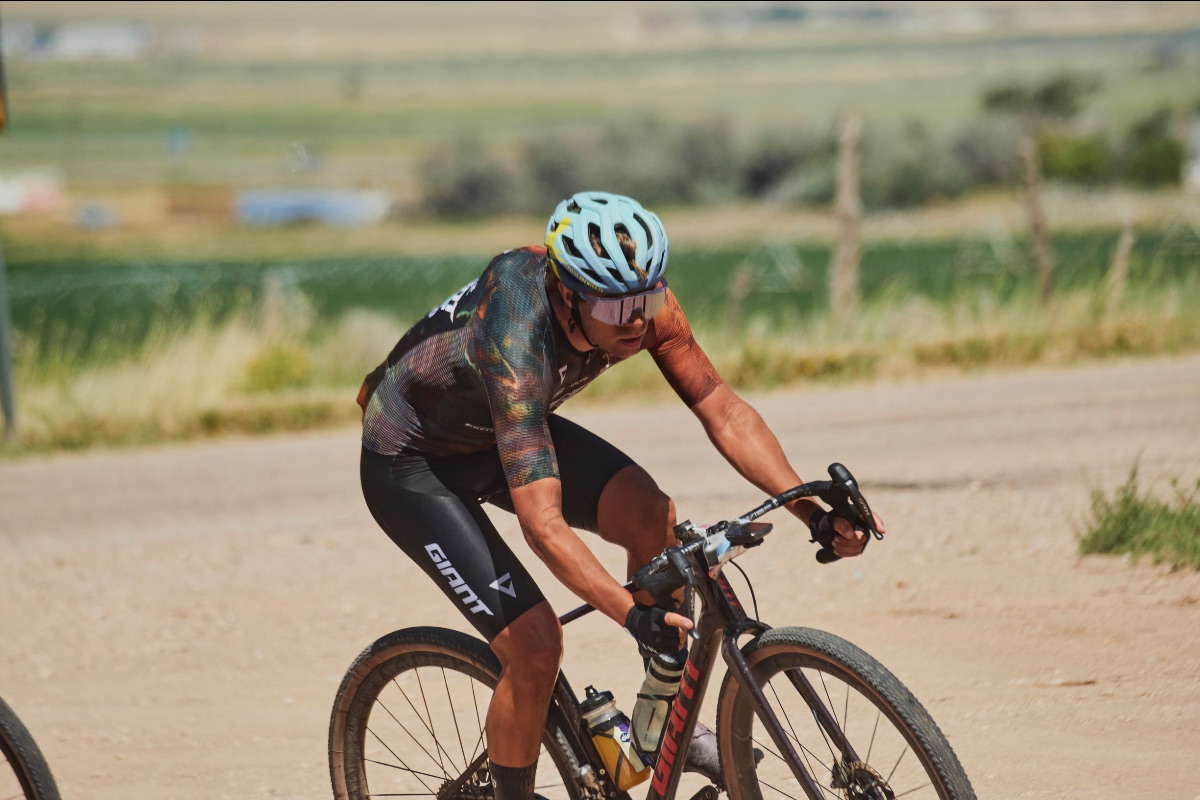
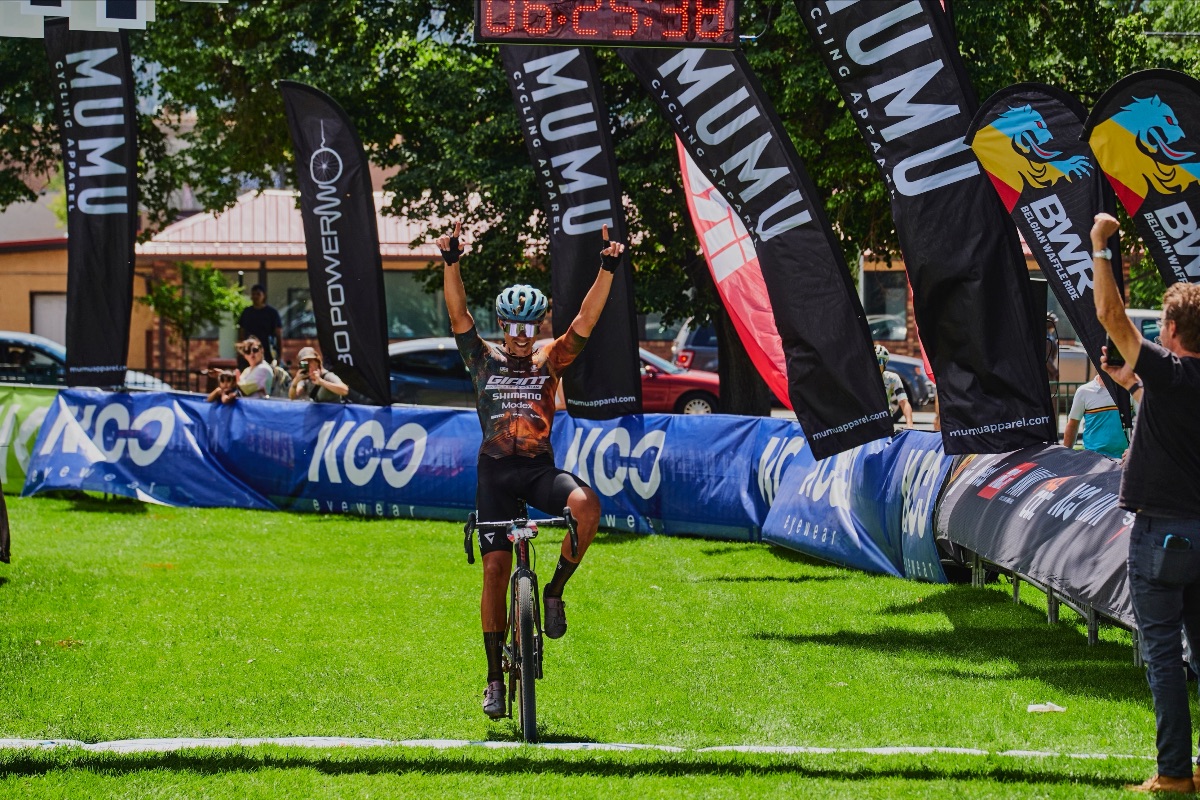
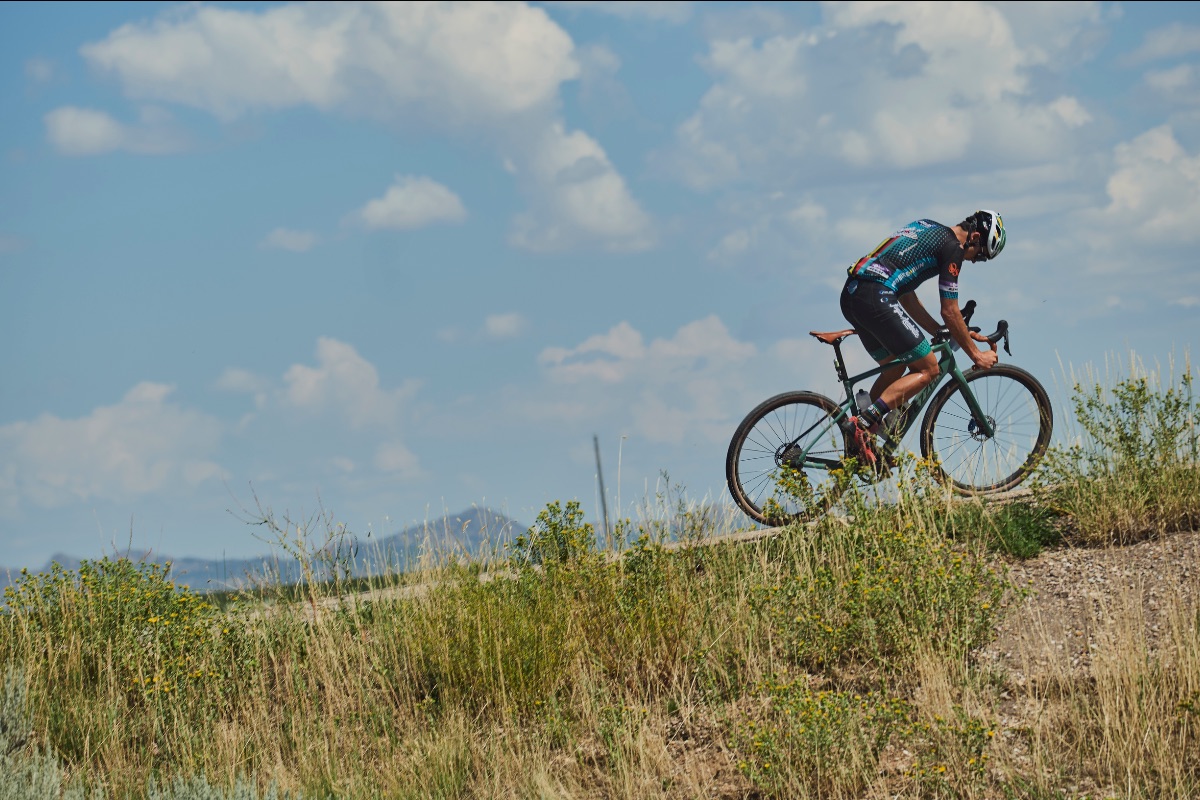
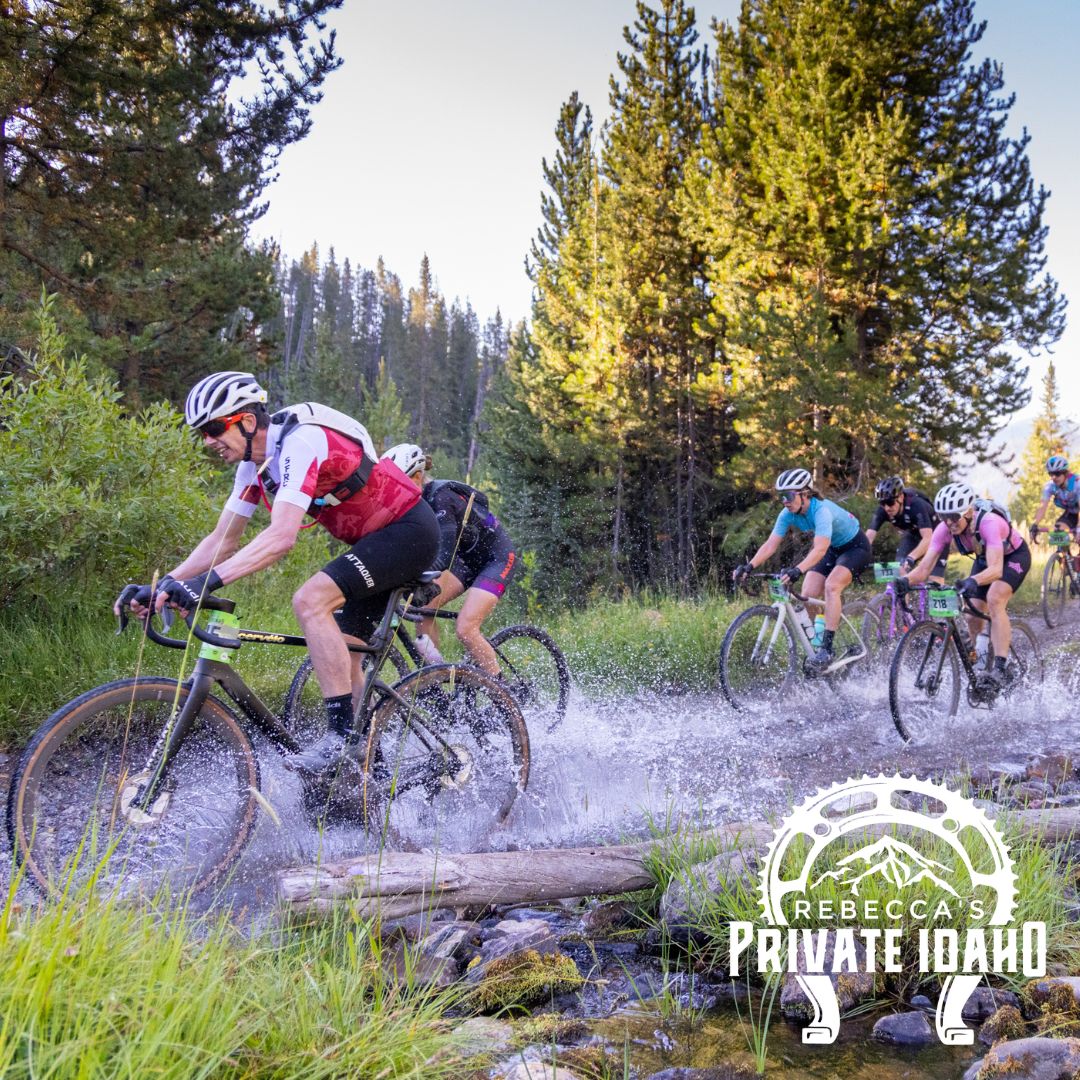
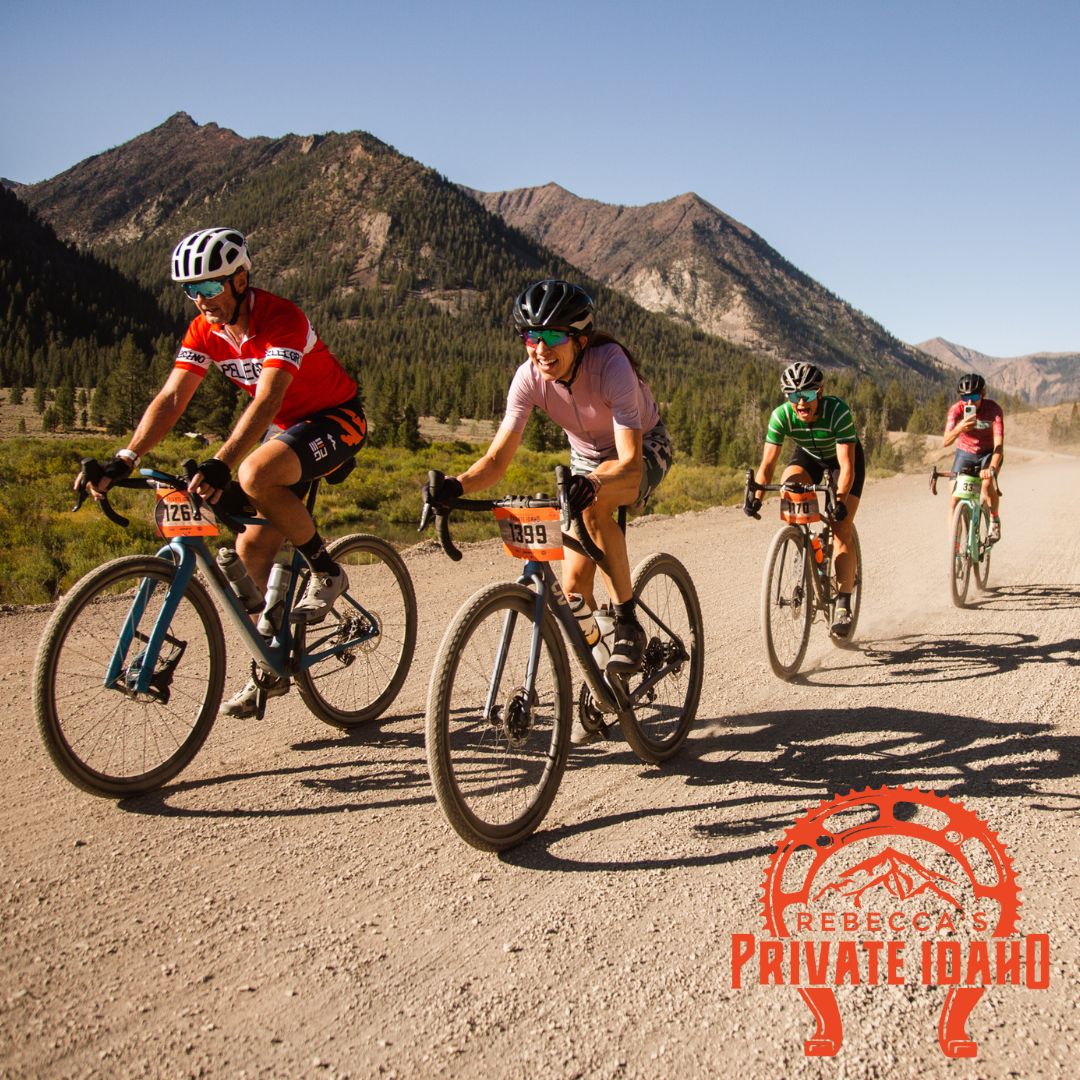
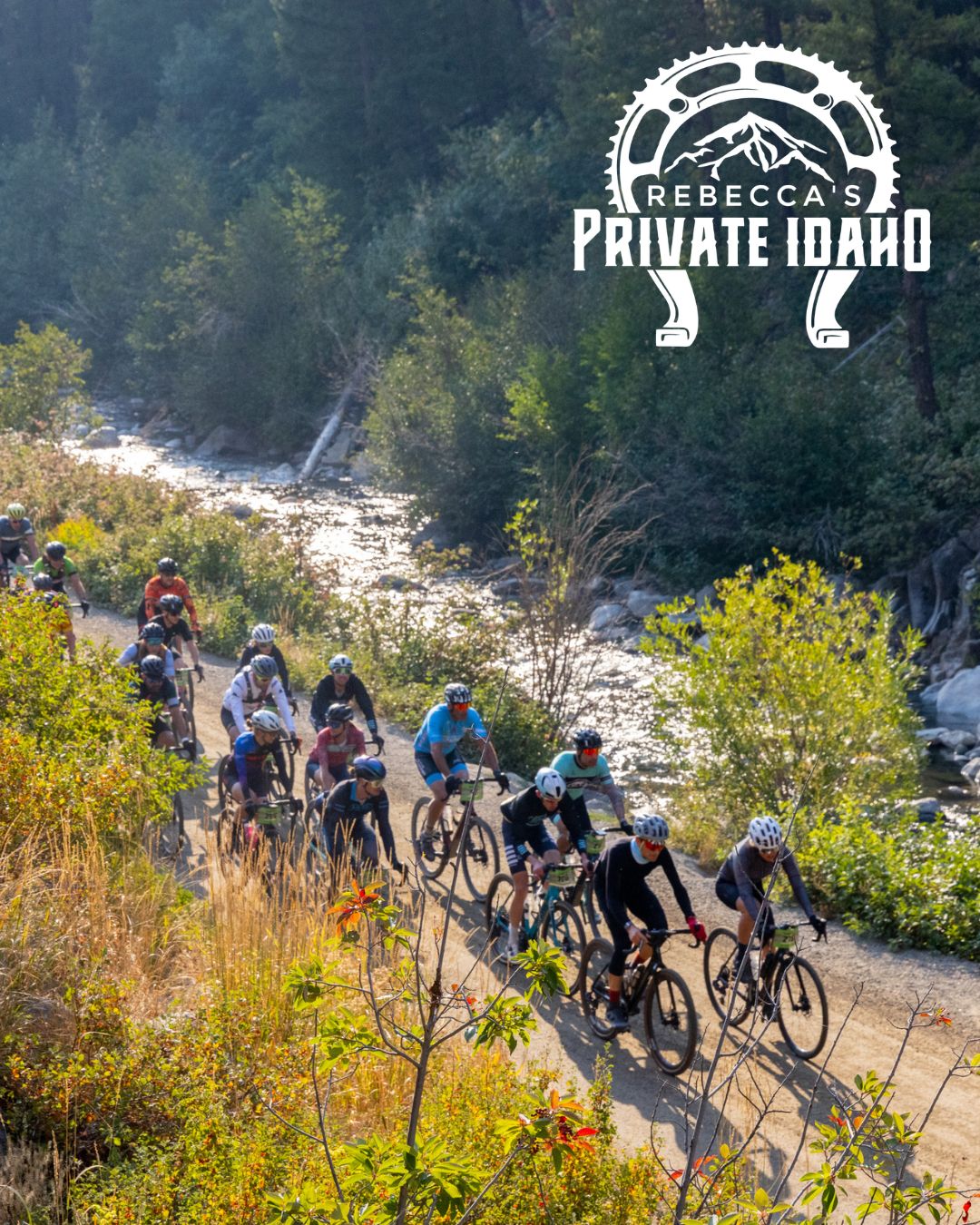
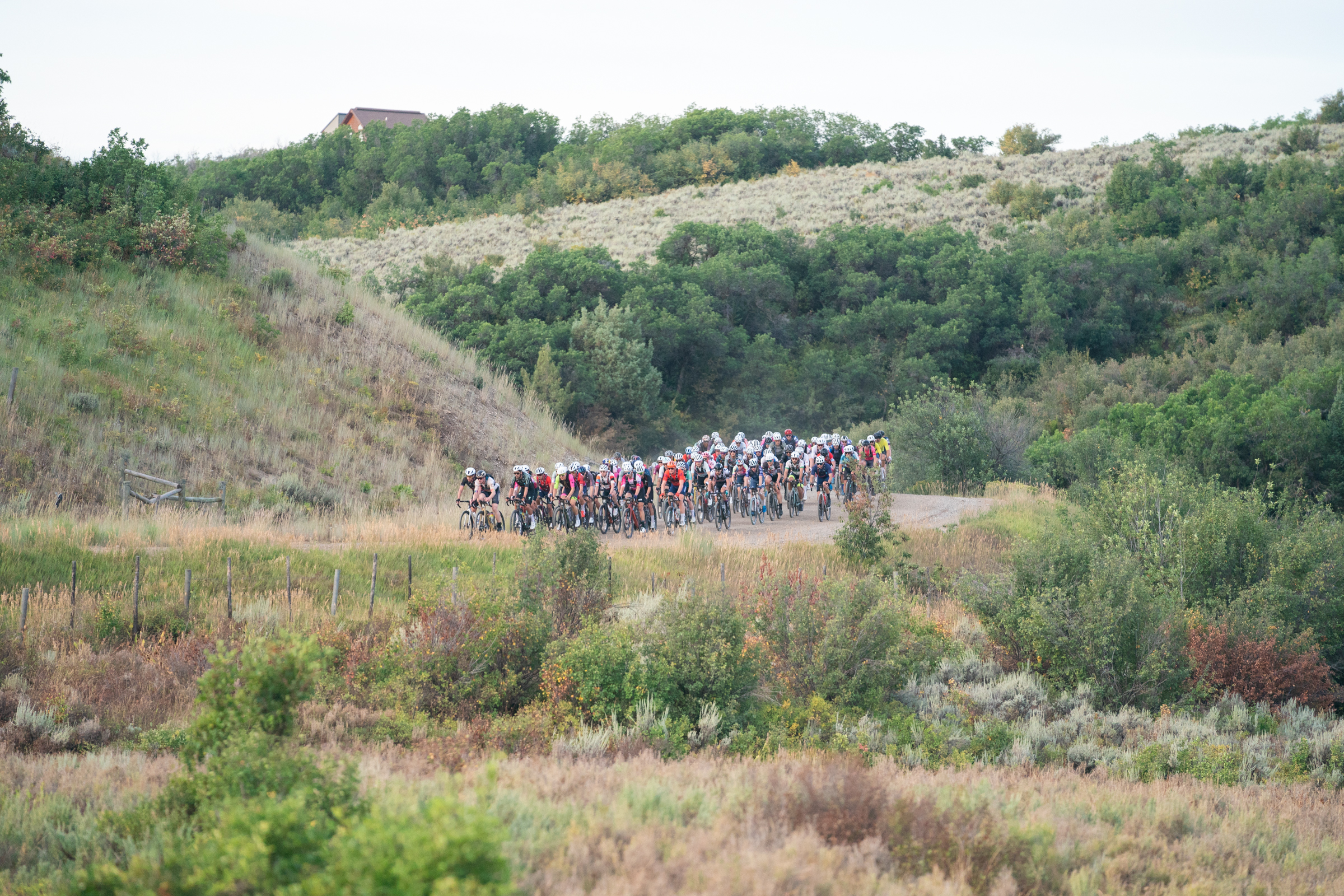
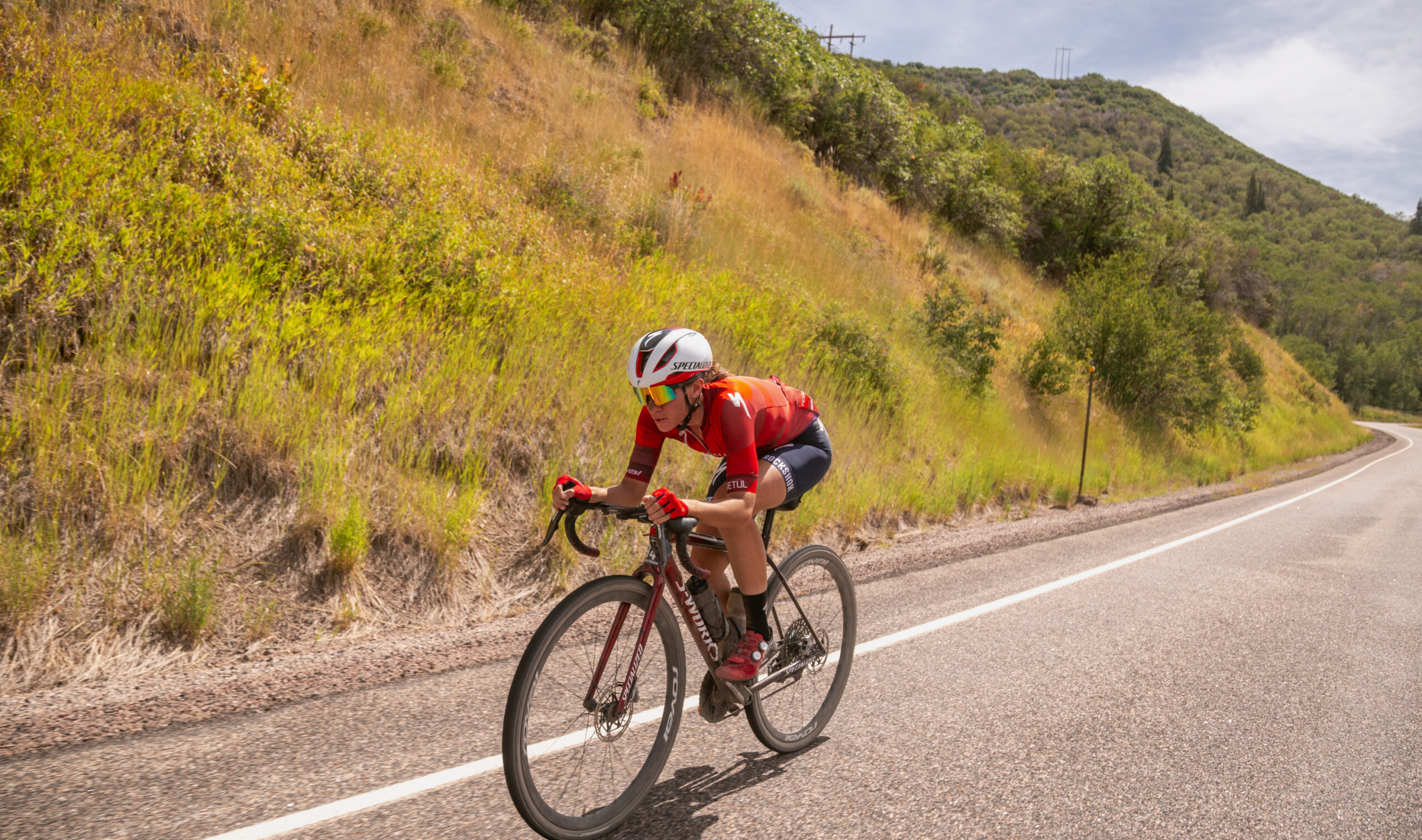
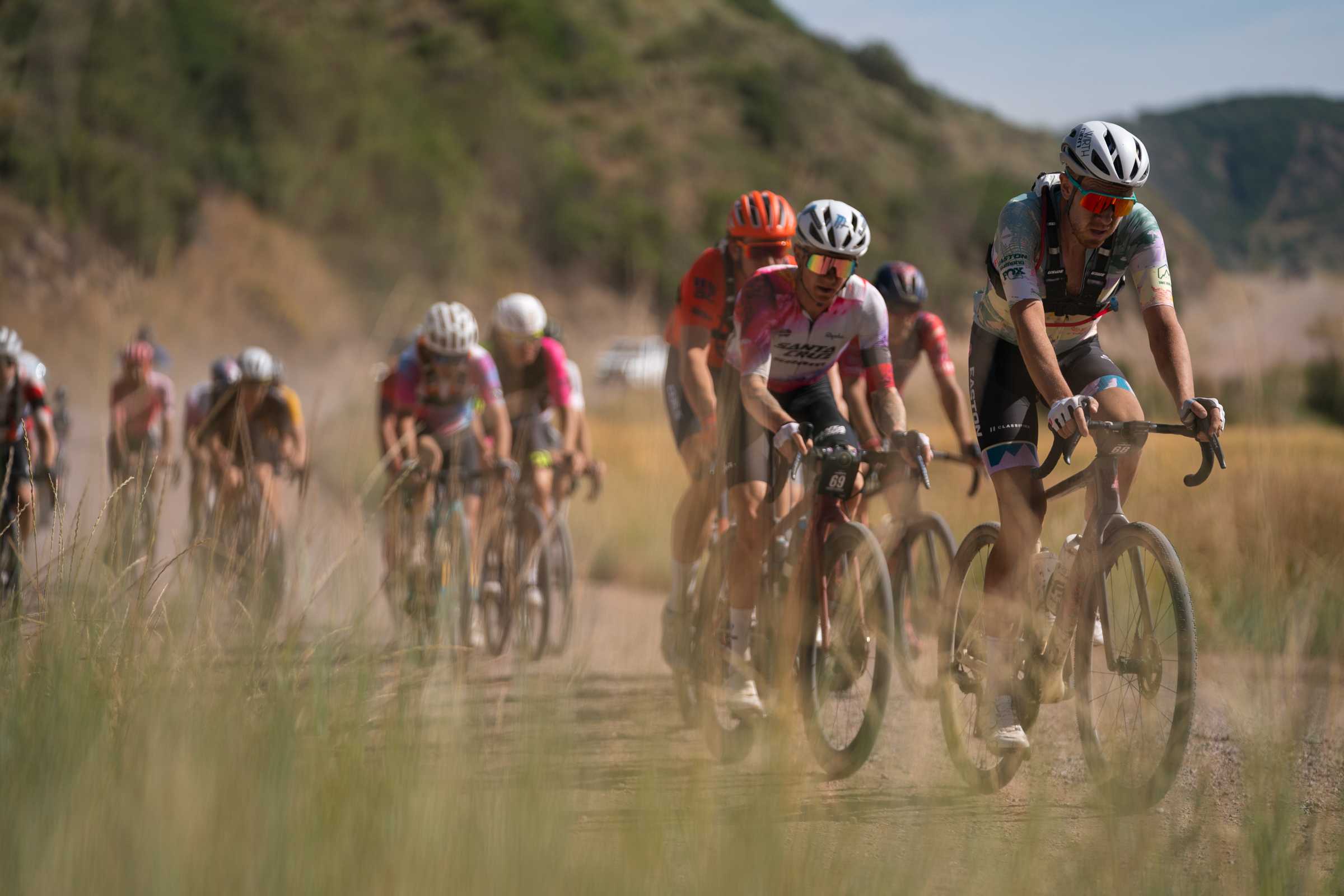
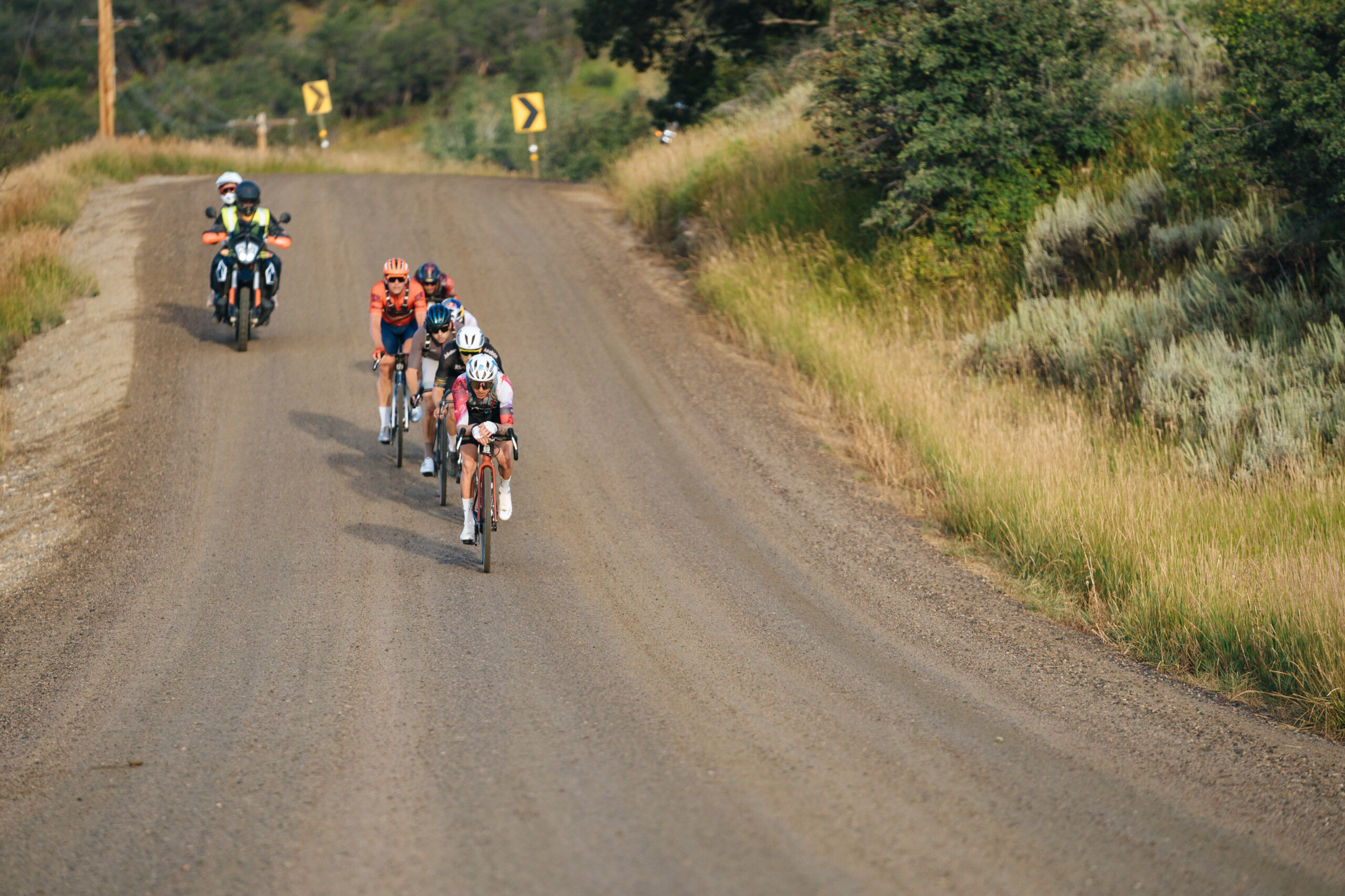
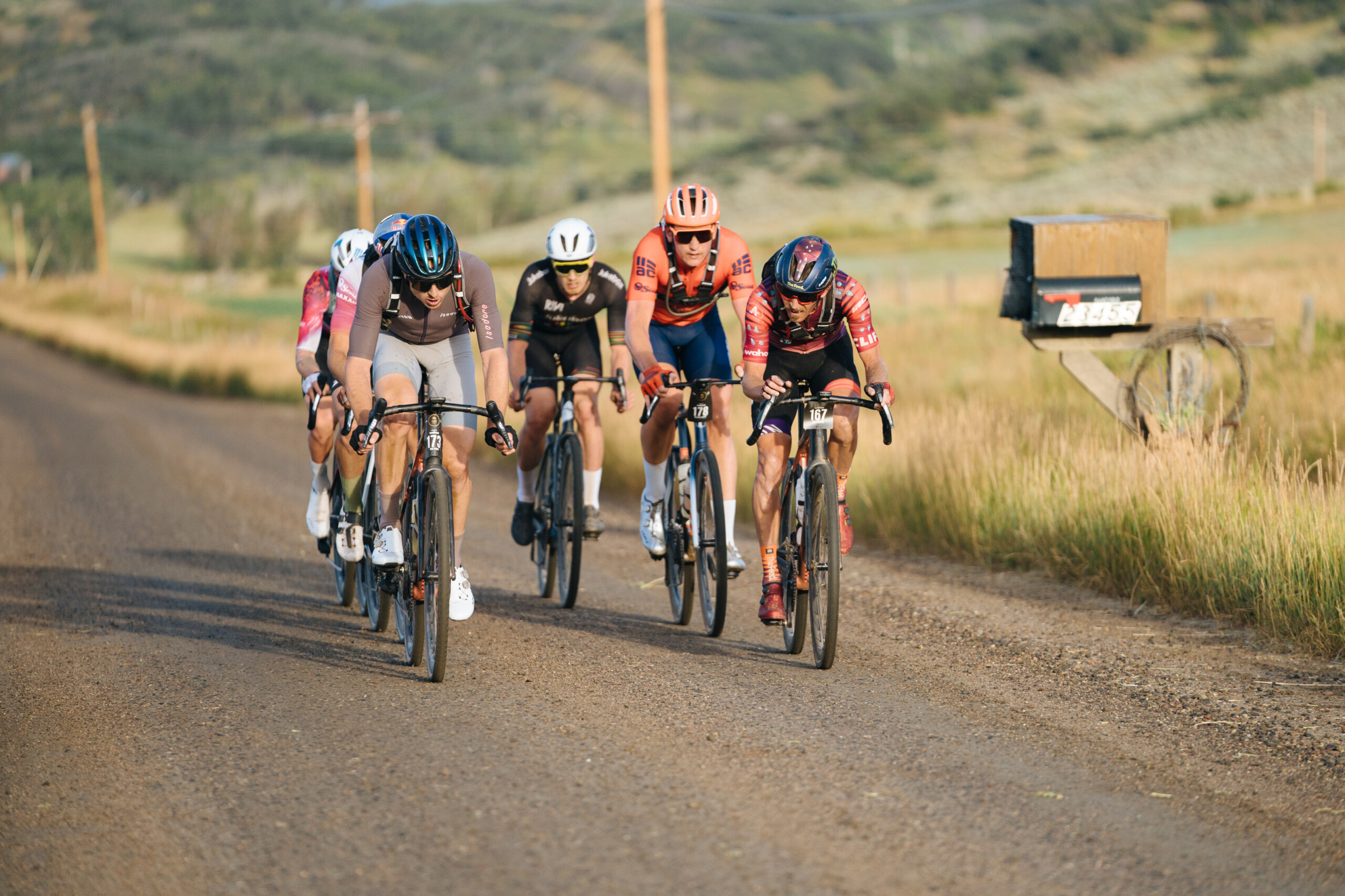
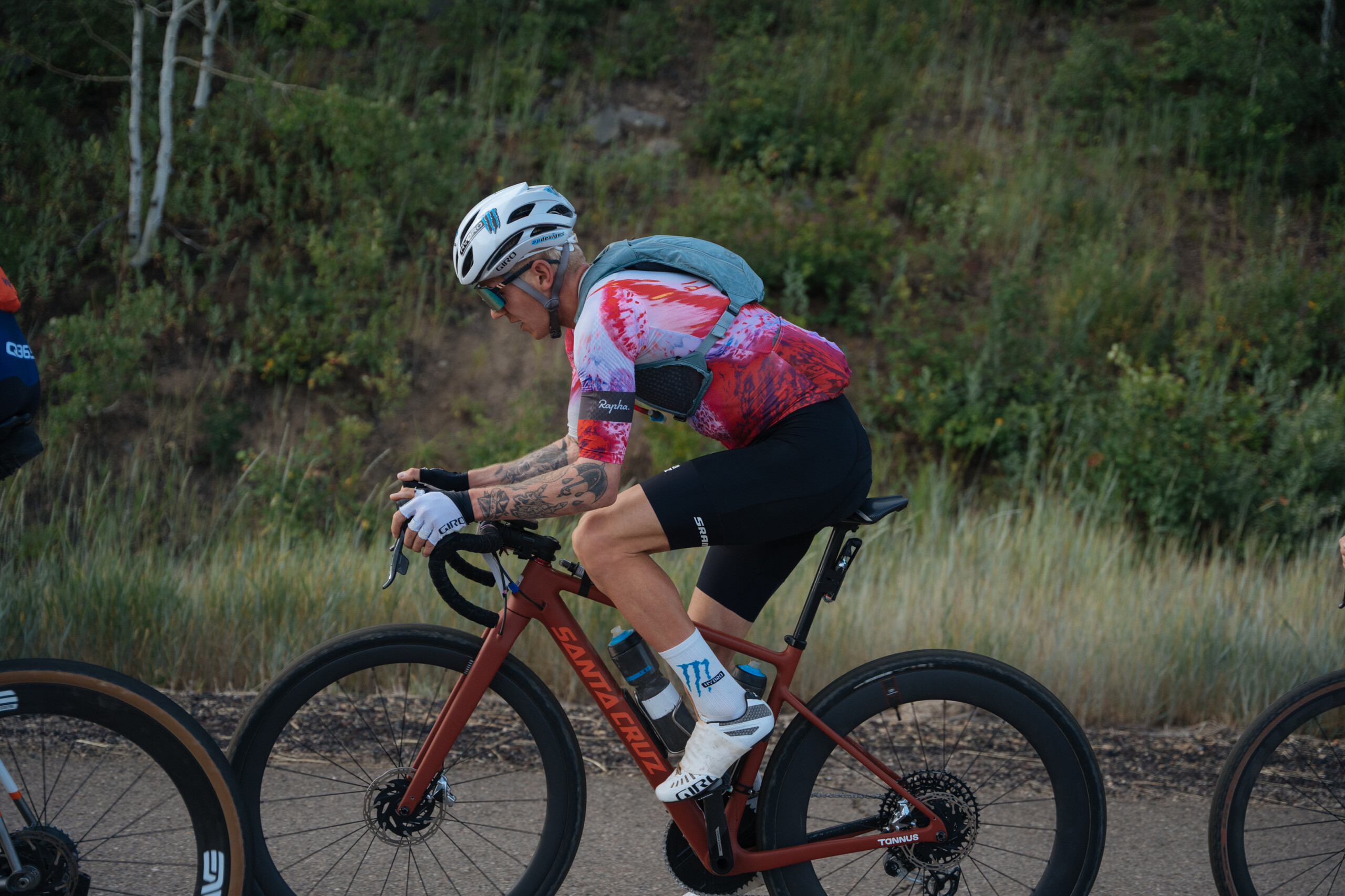
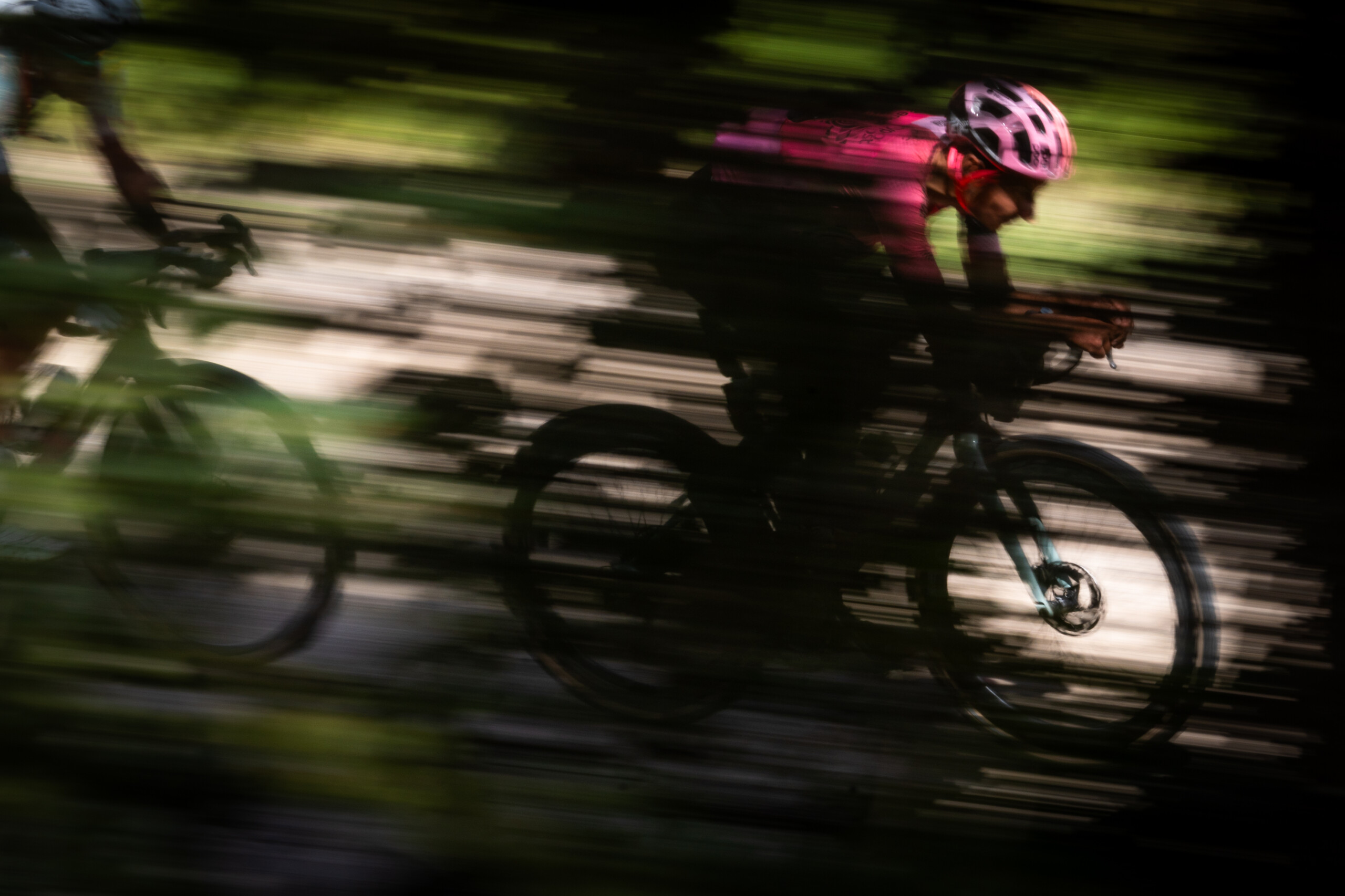
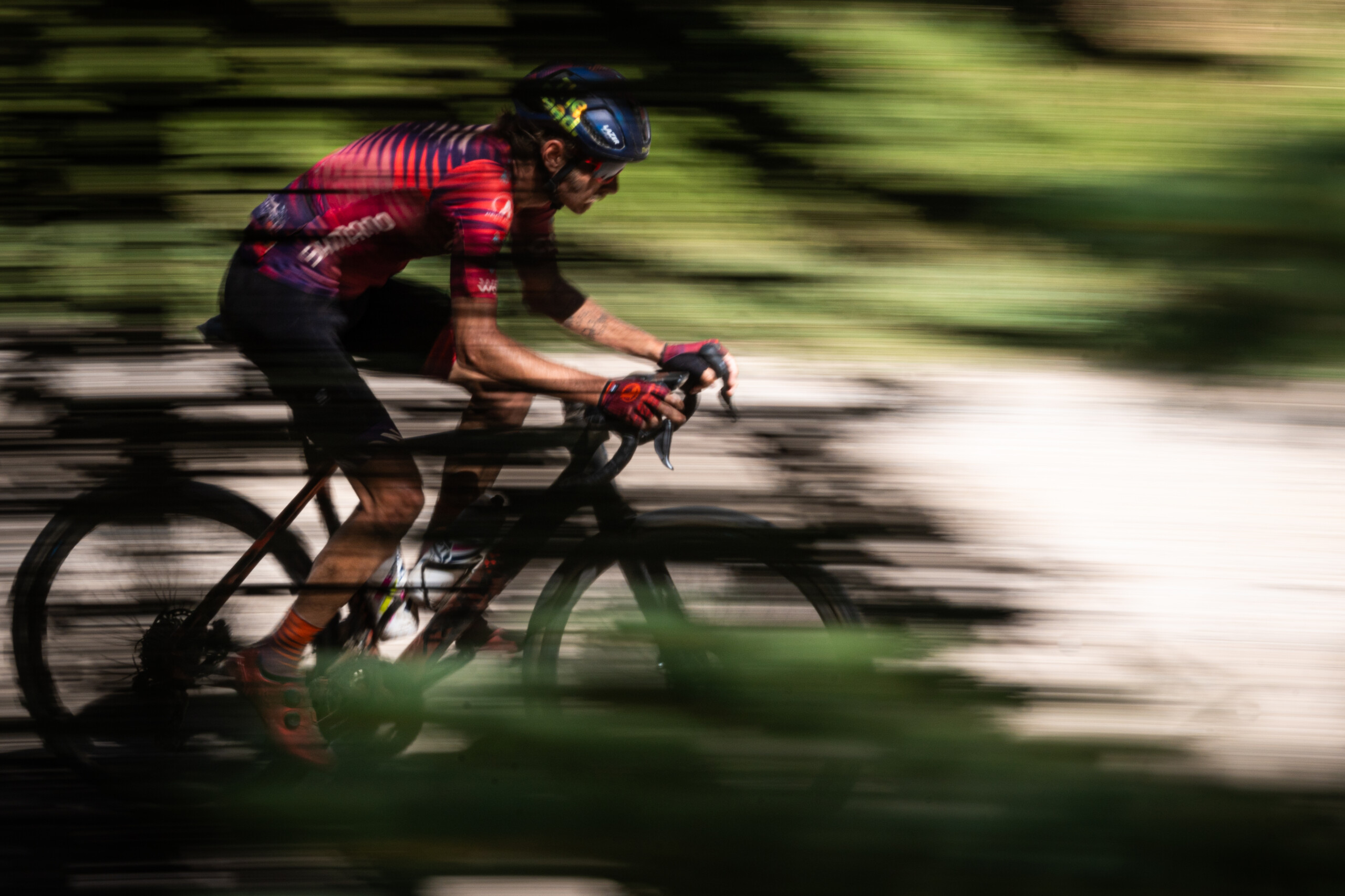
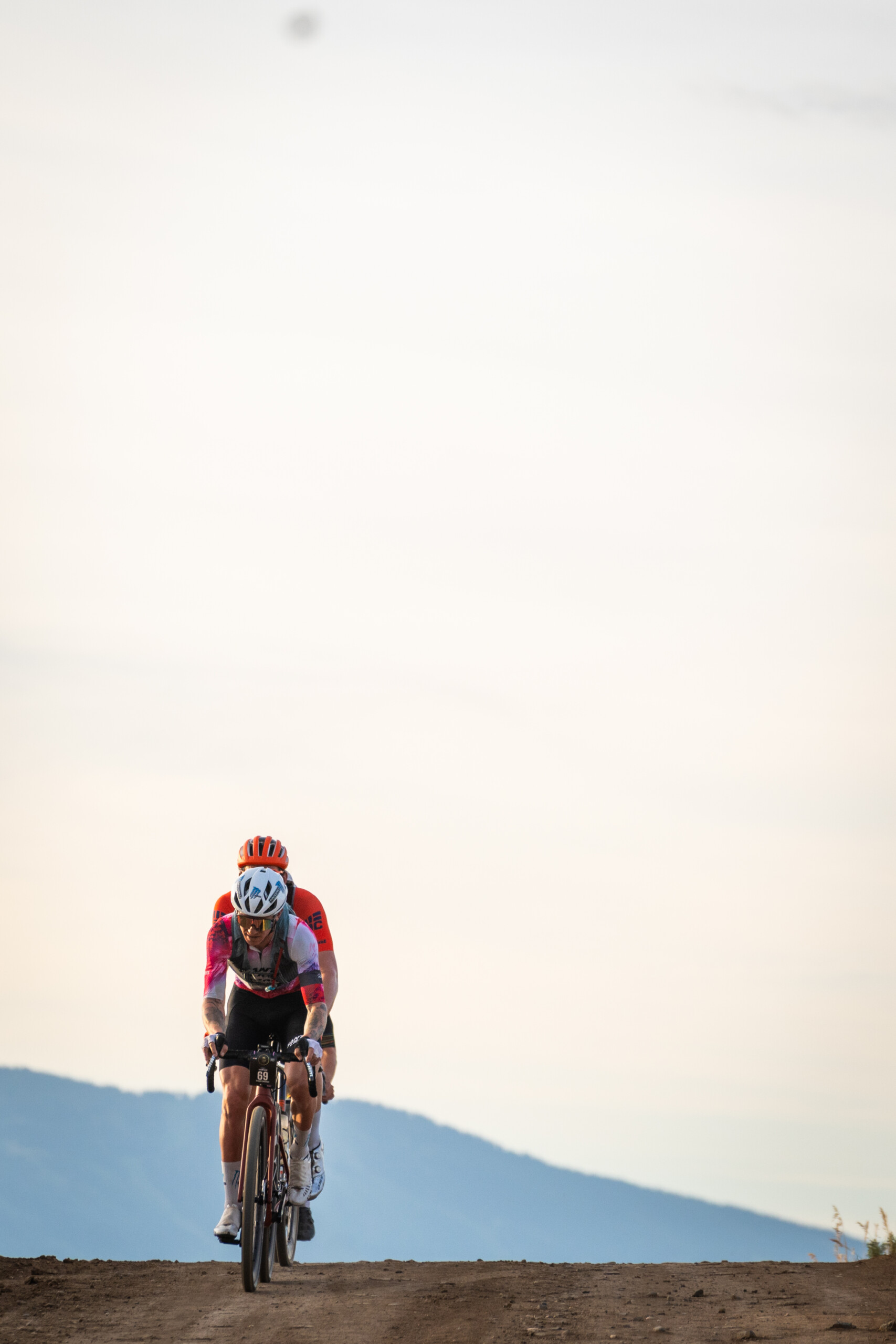
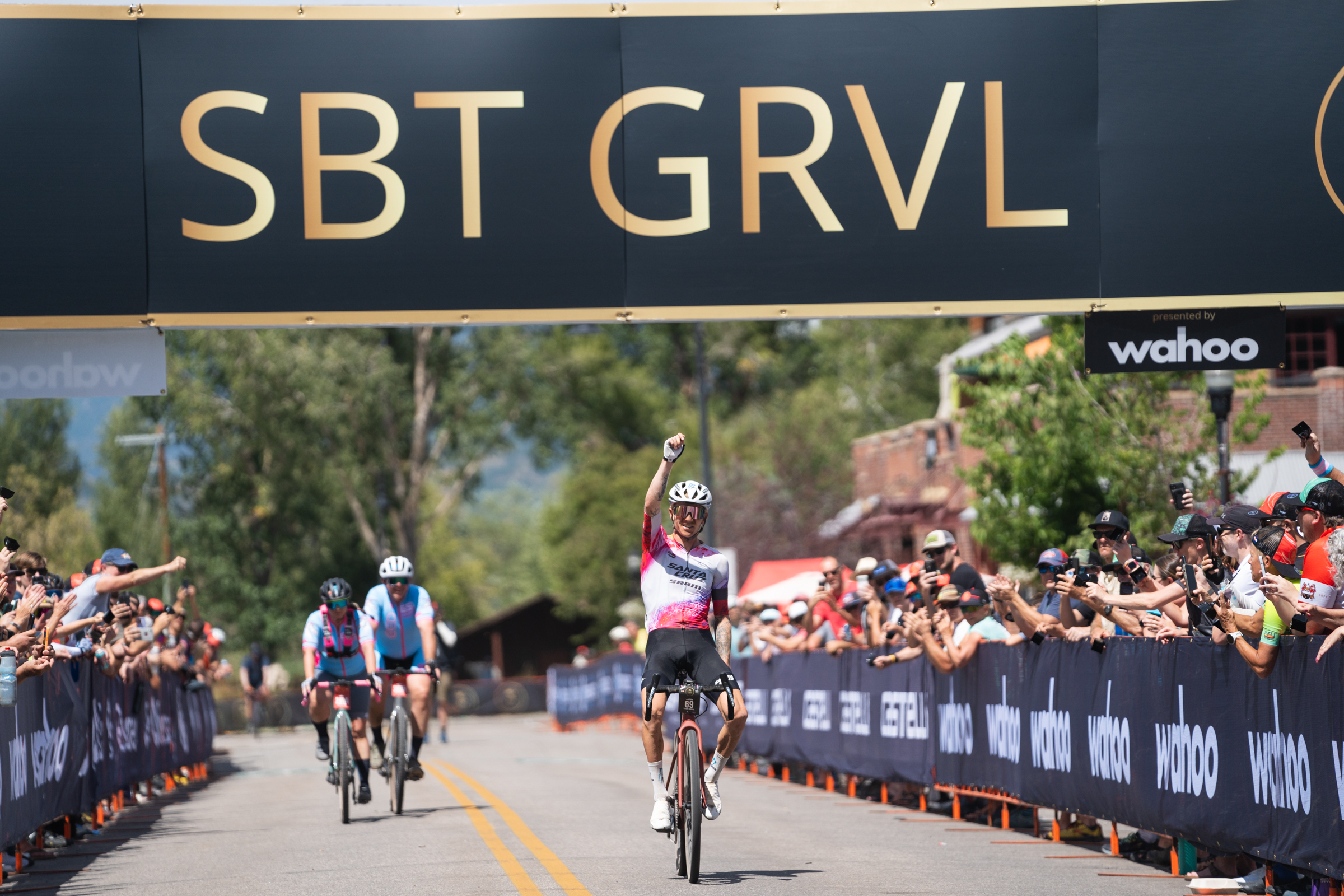
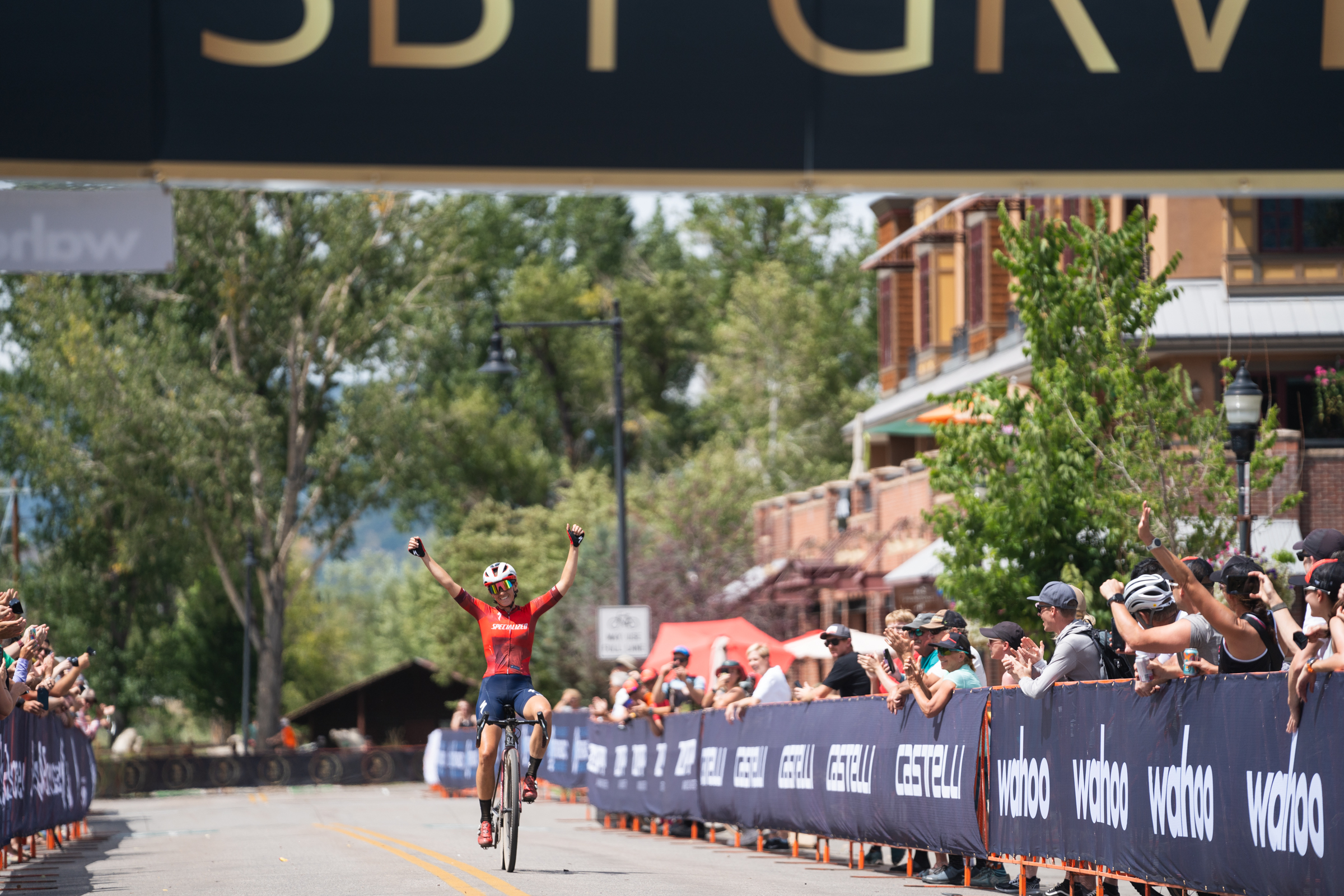
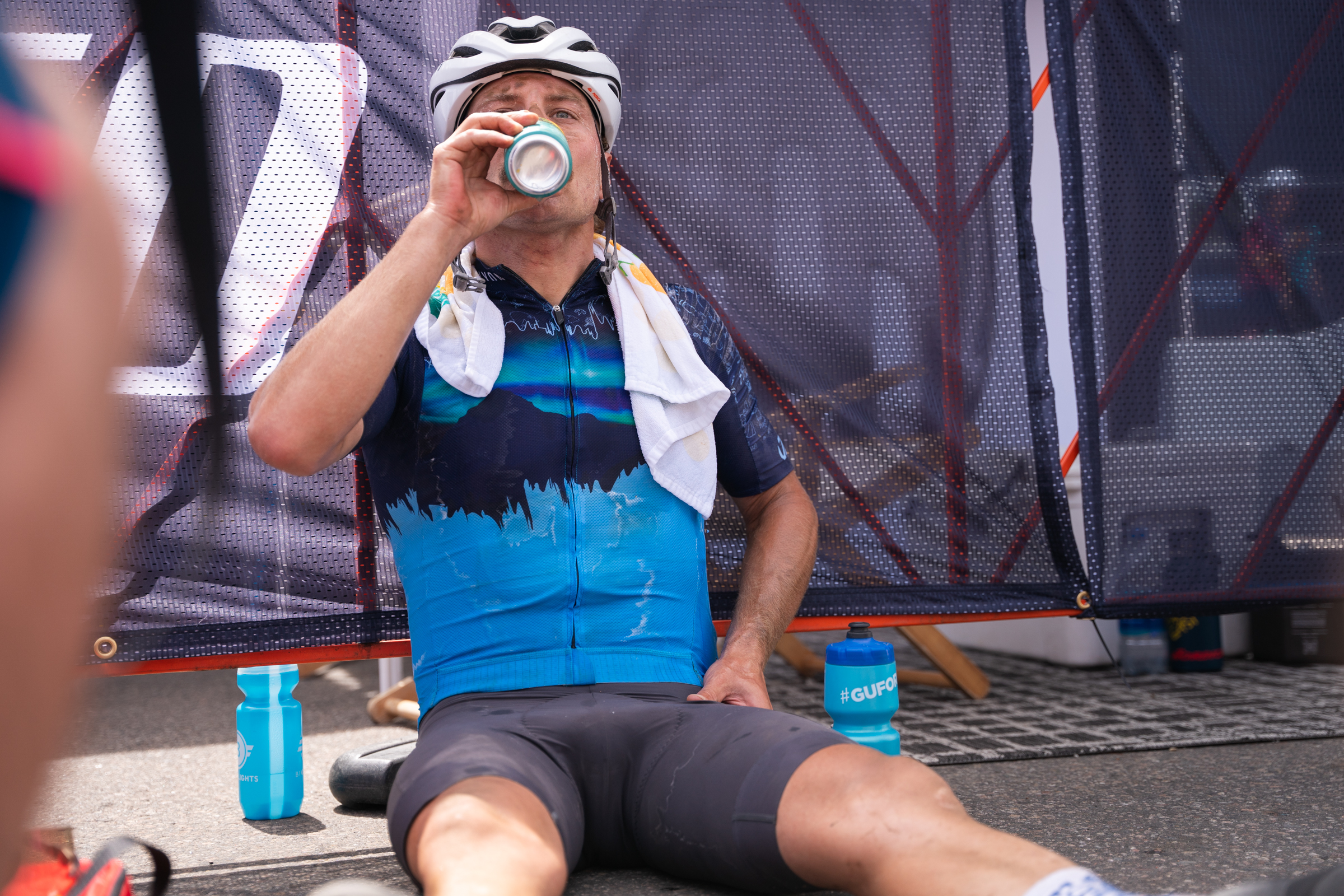
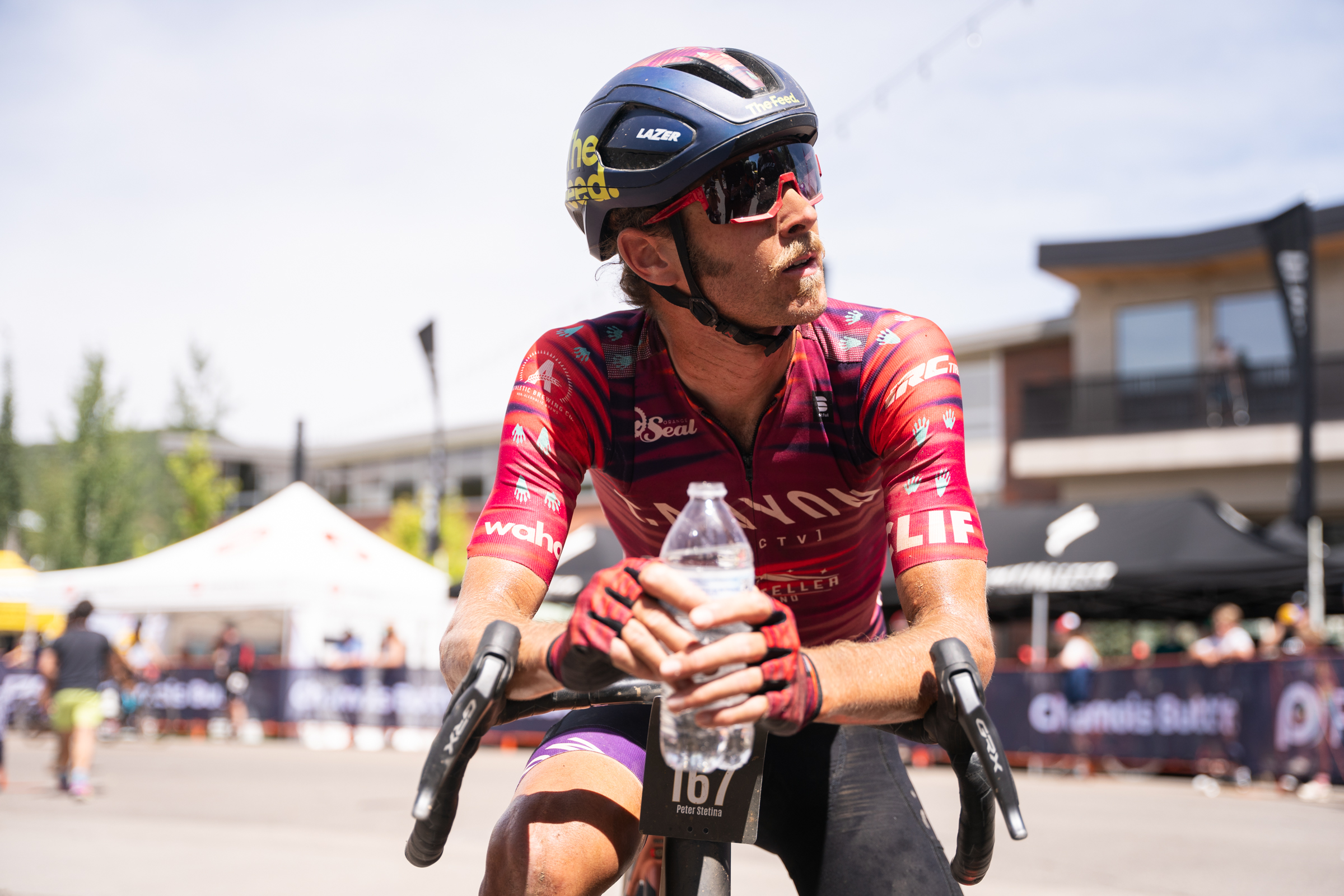
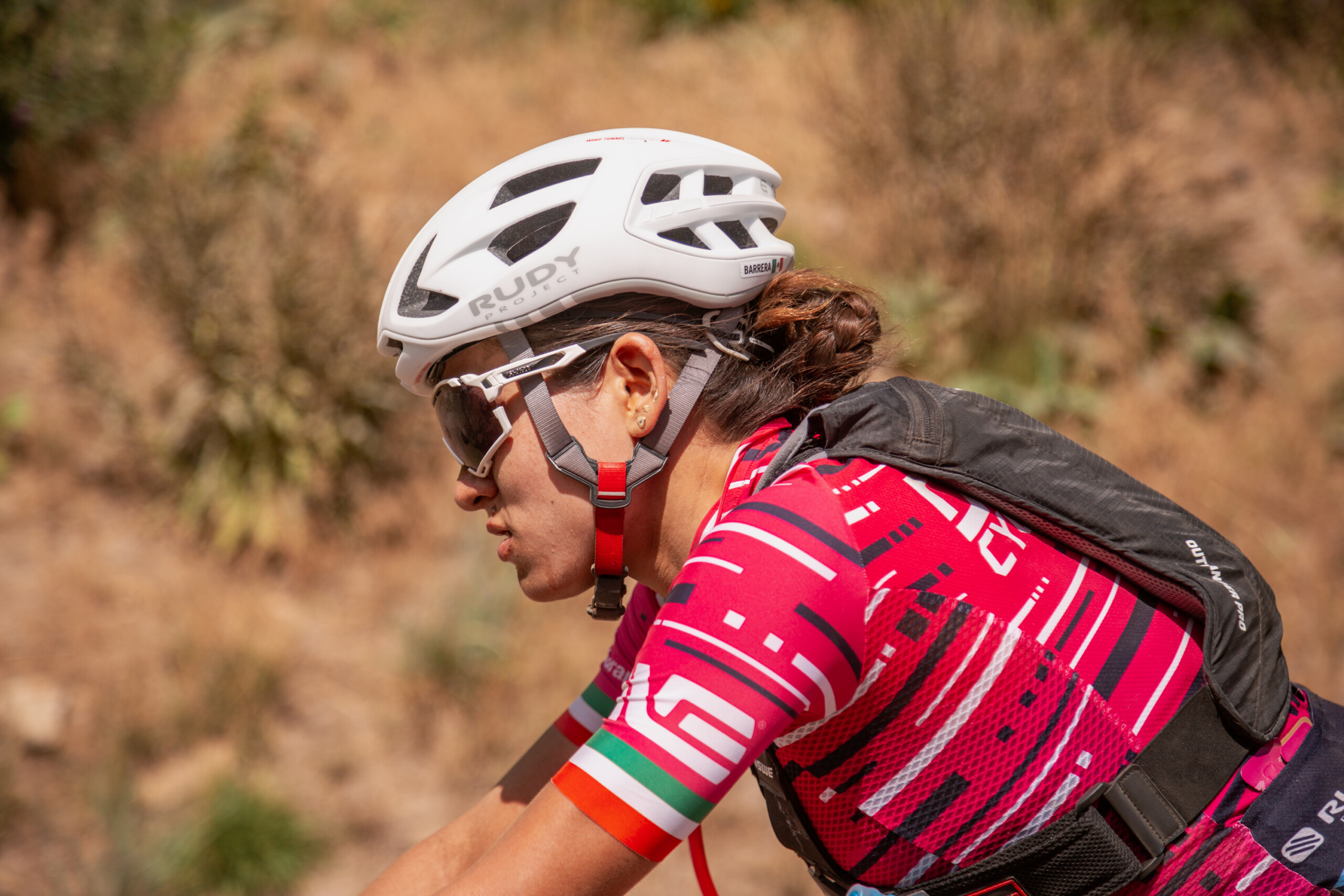
KETCHUM, Idaho (August 31, 2023) — Winners Sarah Max (Women), Griffin Easter (Men), Sam Hansen (Non-binary), Hannah Raymond (Women Para Cyclist), and Thiago Costa (Men Para Cyclist highlight an epic first day of racing on RPI’s new course.
Photo courtesy Rebecca’s Private Idaho
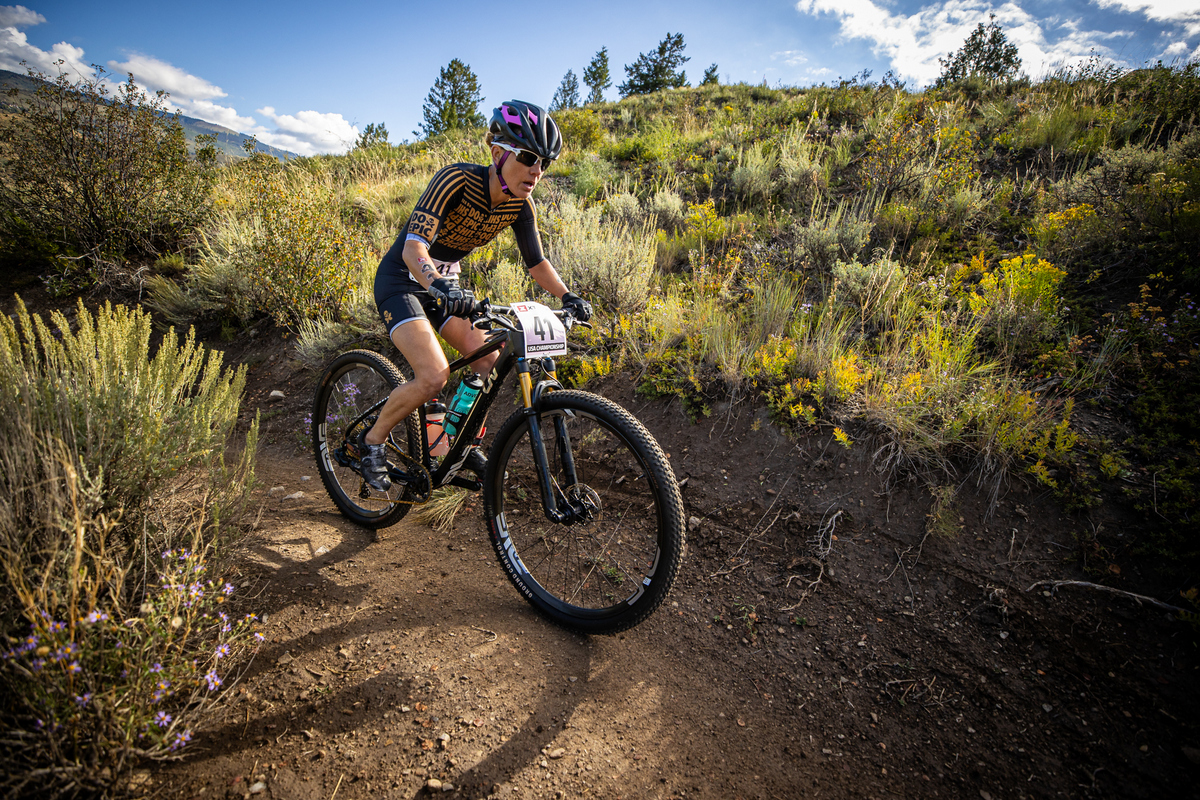
Starting and finishing at a new location this year, the first stage of the QSR began at the Baker Creek parking lot and featured 35 miles of grueling single track and chunky gravel, testing the bravery of all Queen’s Stage Race brave participants.
Photo courtesy Rebecca’s Private Idaho
With a new start and finish location and new trails, Stage 1 is entirely different from years’ past. This means that every winner set a new course record today. Every race category featured exciting and competitive races that came down to the final stretch up the Harriman Trail before the winners were crowned. Today’s victors included:
Women: Sarah Max
Men: Griffin Easter
Non-Binary: Sam Hansen
Women Para Cycling: Hannah Raymond
Men Para Cycling: Thiago Costa
Photo courtesy Rebecca’s Private Idaho
“The lengthy and challenging singletrack segments of today’s new course pushed every rider to go farther than they thought they could,” offered race founder Rebecca Rusch, “I loved seeing everyone smiling because it was fun, but also gritting their teeth because it was really hard. Seeing everyone’s joy on the bike while ringing in the 11th year of this event was a special highlight for me and brought to life our mission of people, purpose, and place.”
Photo courtesy Rebecca’s Private Idaho
The celebrated event features both a four-day stage race (three of four stages of the Queen’s Stage Race are timed) and a single-day, multi-distance race. To build on the inclusion momentum of past years, the Non-Binary and Para Cycling categories are back and thriving. Recognizing these new categories aligns with RPI’s vision of creating a cycling event that welcomes anyone who wants to experience riding in the beautiful Wood River Valley area.
Photo courtesy Rebecca’s Private Idaho
Today’s Stage 1 of the QSR was the first day of the four-day event. Today’s stage winners, along with the entire QSR field, will ride Stage 2 at Dollarhide Summit tomorrow, Friday 9/1. This stage includes a 20-mile neutral roll-out with a 4.5-mile time trial up a 3,000’ gravel climb that will test every participants’ limits.
RPI benefits the Be Good™ Foundation, which was founded by Rebecca Rusch in 2017. The Foundation uses the bicycle as a catalyst for healing, empowerment, and evolution, and each year supports a select group of nonprofits that are advancing the Foundation’s mission. This year’s beneficiaries include World Bicycle Relief, Mines Advisory Group and the Be Good Scholarship, which sponsored six incredible riders this year.
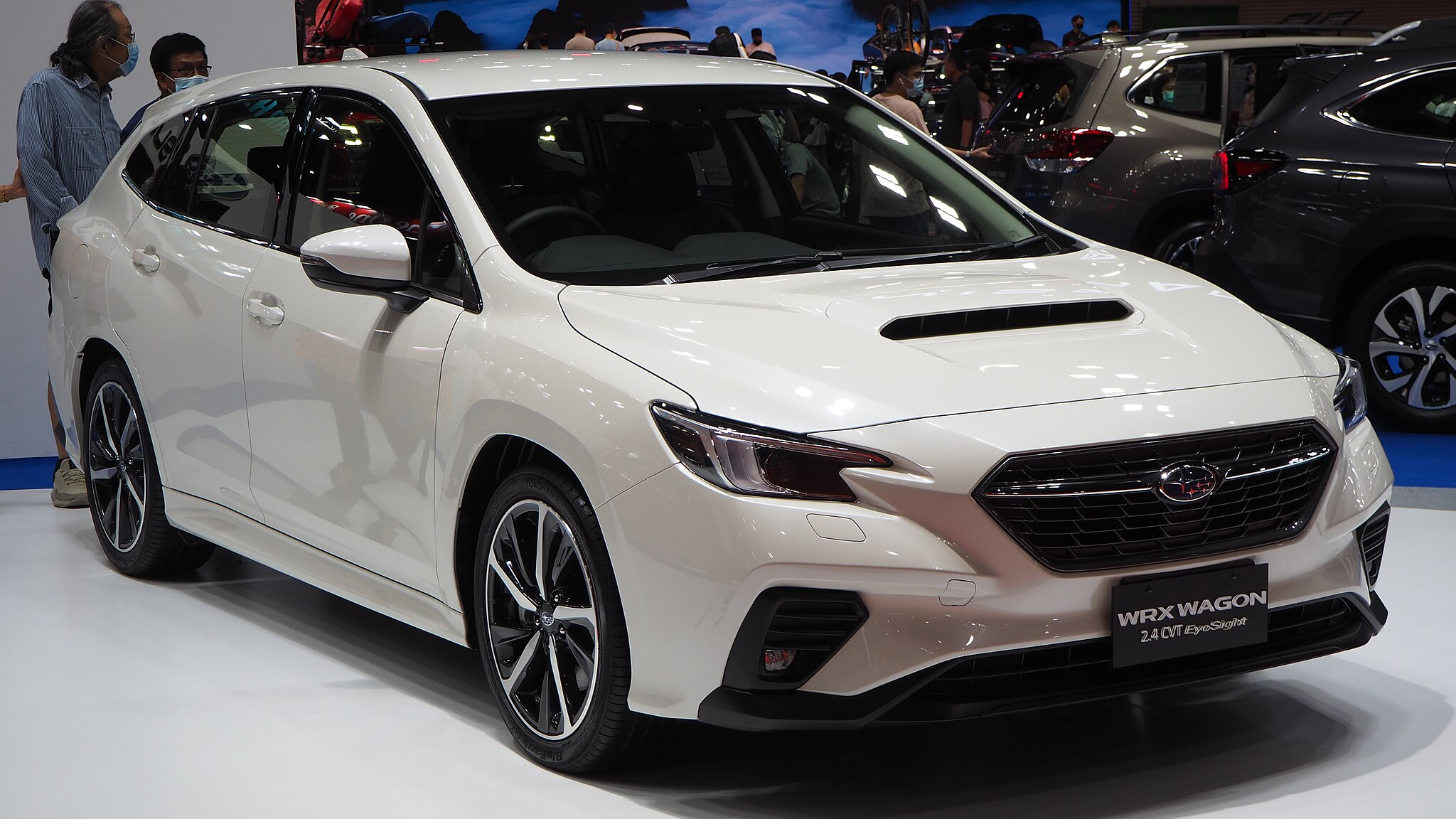
By Charles Pekow — Subaru has developed an EyeSight crash avoidance system that seems to improve safety for bicyclists traveling parallel to its autos, but the system doesn’t improve bicyclist safety in other situations.
2022 Subaru WRX Wagon 2.4 with EyeSight. Creative Commons Attribution-Share Alike 4.0 International
Subaru’s driver assistance technology (https://www.subaru.com/eyesight.html) consists of cameras by the rear view mirror that can spot what a driver may miss, and an automatic braking system.
By Michael Marckx — The BWR UTAH song that keeps us on our (dancing) toes…
We are family. We got all our people with us. We are family. Get up everybody and roll.
Together, as a family, we have the power to transform lives. We can achieve a lot together… And there is no better place than Utah to revel in the idea and glories of FAMILY.
Inspire. Mentor. Champion. Amplify. Create. Lead. Help each other. Have fun!
We can enhance the power of community by welcoming everyone into the family.
We are a growing, global tribe of bike-minded family members of different cultures, ethnicities, beliefs, and backgrounds.
And we believe in the power of family and it’s easy to sing this psalm after a BWR in Utawesome, where the family effect was in full bloom.
Family is just about the only way of life in Utah. The same familial sensibilities that we all know can make the world a better place are evidenced by the importance of ‘family’ in Utah. There is a Family Prosperity Index that measures 50 social and monetary factors to rank each state, and Utah has constantly ranked #1 in the nation. And Cedar City offers not only a taste of the importance of ‘family,’ but it also offers a spectacular canvas for our different kind of family to draw upon; a newer, two-wheeled family formed in the shared love of this thing they now call ‘Gravel.’ And this family has a genuine commitment to the values of diversity and equality, that we should be able to work together to find compassion and peace no matter how wide our tires are. This family understands that forcing the beliefs of one onto another, diminishes diversity and skews the scales of equality. By engaging in compromise and extending love to all of cycling’s children, who are our mothers and fathers, brothers and sisters, together we can create a peaceful, diverse tapestry of ideals and beliefs, expressed by spinning wheels and tales alike… in the gravel.
The race commenced exactly on time at 7:00 a.m., which was a testament to every rider agreeing to play by the rules, and those rules were simple: Love your neighbor like family. Every single mother, father, sister, brother played along. So away we went, like a family to church.
Before we get to the race recaps from our stellar pro family members, Melisa Rollins, and Brendan Johnston, I’d like to pause to further this idea of family…
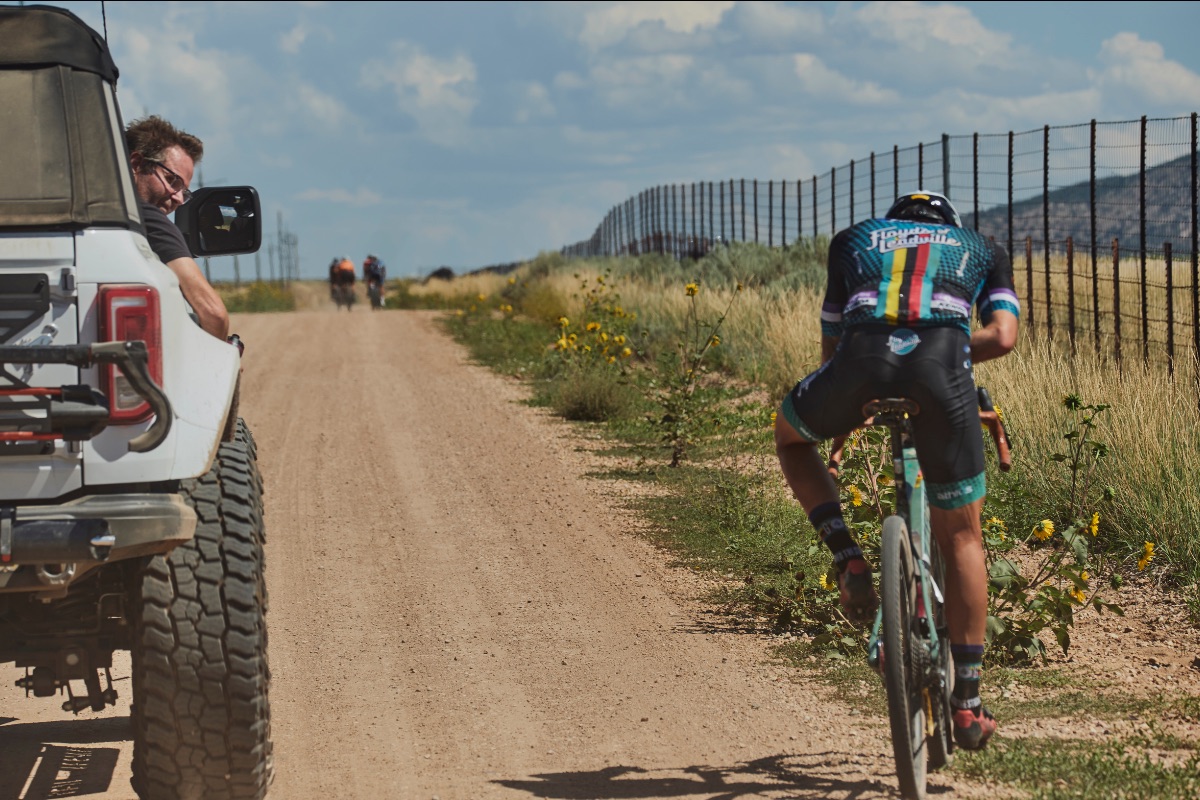
And, thanks to Fred Brooks and Scosche for the use of their amazing Bronco as the lead vehicle that was able to manage the various unroad sectors easily.
Our Monuments of Cycling is a small family with a collection of partners like Jan Heylen and Sean Fondrk of Mumu, Steve Driscoll and Joe Staron OF IRC Tire, Greg Cowan of F2C, Katie and Tony of OmniGo Timing, Dave Towle, Paul Dunlap at the Wrench House, Almsthre’s Steve Yeager and Jen El Aile, John Perry, Adam Spahr, Amelia Durst, Jon Hornbeck, Jake Orness, Priscilla Savord, and the wonderful people at Cedar City, especially Brooke Twitchell and Officer Justin Ludlow. Our team is also Joe Schmalz, Randall Coxworth, Phil and Shelby Tinstman, and Shelby’s dad, Dyrk.
Perhaps the most important family present was that of Todd Hess, our Volunteer Coordinator from Cedar City. Todd spent the last four years as our boots on the ground in Utah, not only enticing locals in the Cedar City area to join in the family fun of putting on a world class gravel race, but Todd was also out reconning the various course features, meeting with local land owners and construction crews to help pave the way for all the approvals we need from the various private landowners, institutions and agencies in order to put on this event to our level of satisfaction. Without Todd and his family, this event could not happen. So, next time you are at a Feed Zone or pass a volunteer at a corner, make sure to sing out loud to them, “We are Family!”
Todd and his family engaged with this fine group of individuals, below, who in turn brought their families out to work the Feed Zones, Expo, and critical intersections for everyone’s safety.
SPECIAL THANKS TO RAWLEY MACIAS OF ROULEUR BREWING FOR OUR BWR BADASS ALES THIS YEAR! HE ALSO RODE THE WAFER!
Melisa Rollins Race Recap
Melisa was fifth at last year’s Unbound 200, but until this weekend she had never won a gravel race. We think this victory is the beginning of a long string of them. One very interesting tidbit about the women’s race was that after the initial Red Hills QOD/KOD sector that ends at the first feed zone at mile-29, Melisa and Tiffany Cromwell were a few minutes behind the lead men, and used the Rollers for Rouleurs 10-mile unroad sector to reel the lead men’s group back. It was phenomenal the way they worked together! Melisa also won the QOM category.
Belgian Waffle Ride Cedar City was my first race on the dirt in 11 months. After finishing off my first pro season as an endurance gravel/mountain bike racer racing in the Lifetime Grand Prix in 2022, I decided to step away from the dirt in 2023 and focus on gaining leg speed and developing some race tactics by committing to a season on the road. However, after being in a high speed crash while racing the Tour of Belgium in early July, I decided it was time to shift my focus back to gravel after some time to recover. Being just a few hours north of Cedar City, BWR Utah was the first event to come to mind.
For me, there was a lot of anticipation for this event. I knew I had gained a lot of fitness and a lot of race savviness since the last time I raced gravel, but the legs you have on race day don’t always reflect that. I of course wanted to perform well here, but my first goal was to be present at the front of the race in the opening hours, something I’ve always struggled with.
In the opening miles I focused on sticking near the front, and I quickly found myself near Flavia and Tiffany. With their years of experience, I really tried to watch how they were moving and where they used energy. The three of us stuck with the lead men until the first KOM/QOM climb, the Rode Heuvels, where I summited solo, just 10 seconds ahead of Tiffany, and about 30 seconds behind the lead group of men. Tiffany and I regrouped on the descent as we approached the first aid station. Here we caught a man, and the 3 of us traded pulls— building on our gap to 3rd place. Our small trio slowly began to swell as we picked off riders dropped from the lead group, and as our horsepower increased, so did our speed. At mile 40 we actually caught the lead men! Now as we sat as a group of 30, Tiffany and I were able to relax just a little, sheltered from the wind and preparing for the single track.
Tiffany Cromwell and Melisa Rollins at the 2023 BWR Cedar City. Photo courtesy BWR
As we approached the first sector of single track the pace increased and Tiffany and I were dropped again from the lead men’s group. I was quickly realizing how evenly matched the two of us were on this day. I followed Tiffany’s wheel down the single track, and while navigating a technical corner, my front wheel slid out in some sand and I fell, smashing my derailleur on some rocks. I remounted quickly and worked to make contact with Tiffany again. When we made it back to the road and were trading pulls again, I noticed my shifting start to skip and knew my hanger was bent. With almost 70 miles still left to race, I was forced to only use my bottom 4 gears.
Tiff and I traded pulls for the next 15 miles, our duo adding and losing members periodically, but unspokenly, the two of us knew this race was between us. We summited the penultimate climb at mile 85 together and Tiff took the lead on the dusty descent to New Harmony. Here was where Tiffany’s bad luck struck. Her front tire washed out on a loose corner and she went down. Hard. I actually was a little worried, so I pulled to a stop and checked she was okay and handed her her bike before continuing on down the mountain. As I descended it sunk in that I was leading the race! But just as this feeling of excitement began, it started to shift into worry as I started to cramp severely. Everywhere. I don’t often cramp so I wasn’t sure what to do. I started smacking my legs. I coasted, I soft pedaled. In between smacks I would look back to check. Where’s Tiffany? Still not there. I finally made it to a flatter section and forced a little more power and a miracle happened. The cramps vanished as quickly as they appeared.
Melisa Rollins wins the 2023 BWR Cedar City. Photo courtesy BWR
I spent the final 40 miles completely solo. I was sad to have lost my competitor. It felt like a shame to have spent 5 hours racing together without being able to properly fight it out for the finish. But as the race went on, my time gap continued to grow. On the final major climb of the day, a 2.5 mile sandy dirt road averaging ~9%, but with pitches upwards of 20%, I was forced off the bike to walk due to my lack of gears. I panicked, thinking this would be where Tiffany would catch me and I would lose the race, but she never did. I cruxed the climb and made my way to the final single track sector solo, and after completing that started making my way to the finish. With a few miles to go the lead Moto told me I had 7 minutes and I cried. I had done it! I had just won my first ever gravel bike race, I just needed to make it to the finish. And I did. It was amazing!
Melisa Rollins after the finish of the 2023 BWR Cedar City. Photo courtesy BWR
Brendan Johnston’s Race Quote
Four-time Australian national MTB Champ, Brendan Johnston, uncorked his first gravel victory here in the US, and did so with one devastating attack on the final climb up the Kanarraberg, leaving his four breakaway partners at the bottom – gaining three-minutes by the top. It was the one & only, yet decisive, move of the day. He also won the KOM category.
Brendan Johnston (AUS) during the 2023 BWR Cedar City. Photo courtesy BWR
I was really pleased to take the victory here at BWR Utah! The course in Cedar City is actually one of the best I have competed on, so dynamic and challenging, however really quite high speed for the most part which made the racing exciting. I was feeling really good out there and had a plan to ride all the headwind sections with the group of 5 or 6 before turning back towards the north and picking up the tailwind and hitting the biggest climb of the day. I attacked the group at the base wanting to make as big an impact as possible for the remaining rough single track sector before the finish, cresting the top with a 5 min buffer to the chasers I was able to really enjoy the single track and the run into the finish. It was a special day in Utah for me and one I won’t forget meeting my family at the finish line for my first victory on US soil!
Brendan Johnston (AUS) wins the 2023 BWR Cedar City. Photo courtesy BWR
Hardman Award Winaar – Cody Cupp
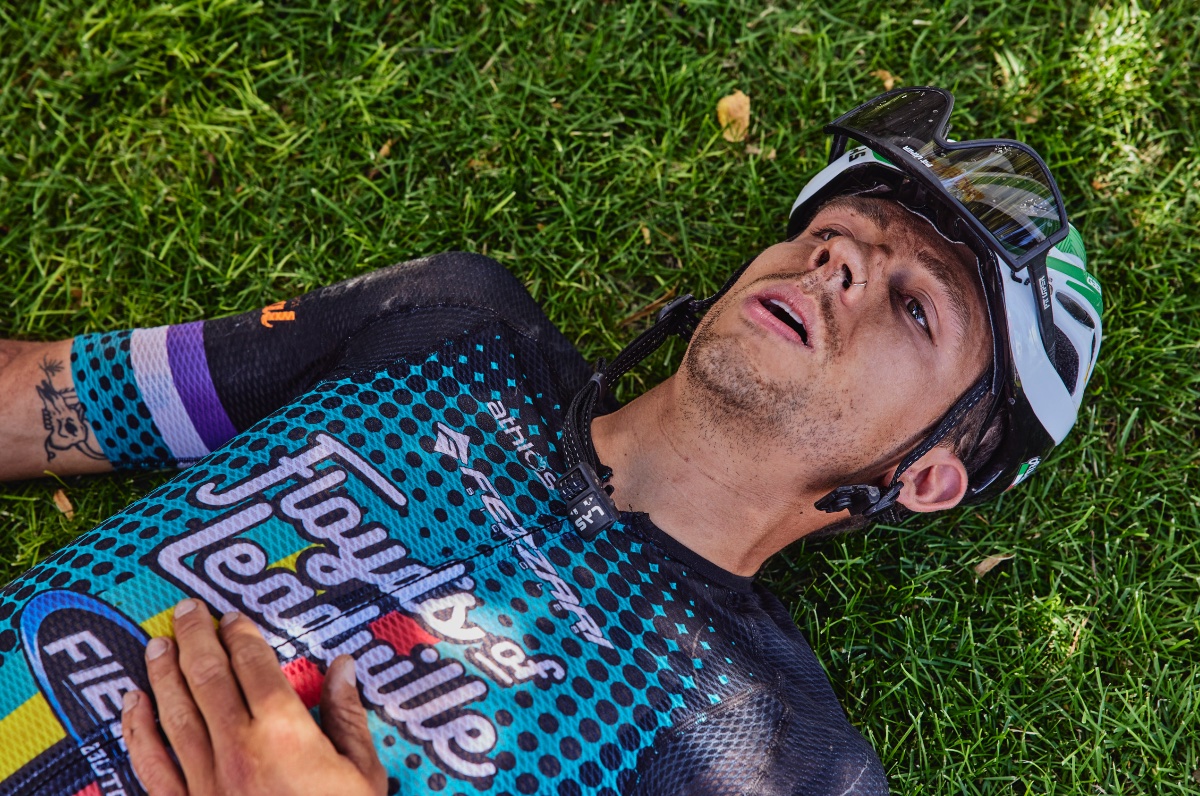
Cody Cupp was enjoying a nice day in the Hell of the South, making it into every break and chasing back frequently to stay with the leaders. He managed to make it to the fourth Feed Zone at mile-100 where the temperature hit 95 degrees. It was here his crew handed him an energy drink that did not agree with him. He began barfing more than anyone we’ve ever seen toss their energy drink before, as the leaders pedaled away into the distance along with his chances at a podium. You can see in the picture below. But, Cody somehow managed to regain his composure with the five leaders up the road over 1-km ahead, and began chasing in earnest, finally catching them at the base of the final climb, the Kanarraberg. It was an extremely impressive feat and ultimately he finished third overall and won the Hardman award in the process.
Without an early climb to separate things, the day started off pretty chill. I sat into the big group, dodging rocks flying off wheels, and tried to enjoy the easy pace while I could. The first climb 20 miles in is where the race really began. A few younger racers got on the front and pushed the pace on the way up and over the first climb to form the first selection of the day, coming out the other side with a group of 30 or more.
This group rolled along pretty well for 10+ miles. The pace stayed steady but was easy enough to recover from the climb and prepare for the hard parts of course that were coming.
At mile-42 we turned onto rough, rocky, and fast double track and the racing kicked back up. I tried to stay near the front for this section knowing that splits were going to happen and that it’d be harder to avoid unseen rocks if you’re buried further back in the field. It felt like we kept it close to full gas at the front for this whole double track section, hopping back and forth between the wheel lanes trying to rotate and draft off each other and dodging baby head rocks and wheel sucking rain ruts. The double track finished with a sand pit and a short climb, which I got into first and tried to push through as fast as I could. When we got to the top of the climb we had whittled the group down to maybe 10 or 15. The next difficult sector was the single track from mile 52-58. I wanted to hit this first, but so did everyone in our group and after the fight for the trail entrance I was sitting 5th wheel. We were moving quick and on one of the more high-speed early parts of the trail I clipped a pedal on a rock I didn’t see, demolishing one side of my pedal and ejecting myself over the bars. It was one of the bigger crashes I’ve had on a gravel bike, and it took me a little to realize what happened, decide I wasn’t hospital hurt, find my bike, and straighten my bars, then get back to ripping. At this point I’d lost the leaders and knew I had to do work to get back to the front before the single track ended so that I wouldn’t be stuck in the wind alone once we hit the road. I managed to find the flow for the rest of the trail, passing racers one by one and making my way through the shattering lead group until I got back up to 4th, in front of Joe and just behind Carter, Brendan, and Tasman. It’s a good thing I got there because the 5 of us ended up riding together for most of the rest of the day.
Cody Cupp at the 2023 BWR Cedar City. Photo courtesy BWR.
Once we settled in after the single track we had a group of 6 (which turned to 5 when Brendan attacked over the top of the climb at mile 84) that was rotating and working together well to move through the fast dirt roads over the next 40 miles.
During this time, I was trying to just ride steady, relax, and keep the nutrition and hydration coming in. The nutrition component to these long races is something I haven’t quite gotten dialed in yet.
Cody Cupp gets sick at the 2023 BWR Cedar City, yet manages to recover to finish 3rd. Photo courtesy BWR.
Around mile 90 my body started telling me that it really didn’t want any more drink mix or gels, but I was racing for the win, and I know you need to keep the calories coming to be able to have the energy to throw down in the end, so I kept stuffing the sugar down. At mile 100 my stomach had enough. I had just taken a gel and drank some mix and my body decided that was it. I started throwing up, and it felt like I threw up pretty much everything I had in me. I didn’t stop, but I couldn’t pedal as I puked off my bike and I got dropped from our 5-man group.
At first I thought that might be it and I’d be limping it in solo from there, but once the puking stopped I felt surprisingly okay and also felt not content with settling for 5th, so I laid on the bars, got frickin aero, and gave it what I could to get back up to the lead group. I managed to make contact with the group just as we got onto the last big climb of the day at mile 104. It felt like I was back with the group for only 30 seconds or so before Brendan made his winning move at the base of the climb. I wanted to try to fight for it with him, but I had nothing in me after the chase back on and I had to just suffer up the brutal climb at my own pace, coming over the top of it in 4th with Joe maybe a minute or two in front of me.
On the descent off the climb, I was able to recover enough to be able charge hard on the final single track of the day at mile 112. I knew Joe was up there and I felt like I was hunting him down as I gave it everything I had to keep it pinned on the final 4 miles of trail. I closed the gap and was just about on his wheel when we hit the pavement.
Joe and I came back together on the pavement and rode together for a few miles until some fast, winding, and rocky double track just before the end.
I made my move on the double track, hitting the first corner as fast and recklessly as I could to get a gap on Joe then tried to rip the rest of it at full speed pushing in every corner.
Cody Cupp “recovering” after finishing 3rd at BWR Cedar City. Photo courtesy BWR
The final 5 miles of the day was flat pavement. When we hit the pavement I think I had maybe a 100–200-yard gap on Joe. From there it was a full death TT to the finish to try to hold onto 3rd place. That was the deepest I’ve ever gone on a bike. Nearly six and a half hours of racing in and trying to hold max effort for 5 miles. My head was tingling, vision was starting to narrow, but kept the gap there and managed to come across the line in 3rd. That was a crazy fight with myself, and I’m so stoked I was able to stay in the race after tossing myself off the bike and puking my guts out. Nothing feels better than finishing an effort like that.
By Audra Jeske and Annie Andrus — In the desert of southeast Utah is a road cycling event called the Moab Century Tour. Held annually in September in Moab, Utah, it is a multi-day event put on by Skinny Tires Events. Day one features a stunning ride up to Dead Horse Point with distance options of 38, 60 or 100 miles. The second day is a 64-mile ride through the La Sal Mountain roads, with a challenging climb worthy of the name “The Big Nasty.” Organizers, Mark Griffith and Beth Logan do a tremendous job creating and marking the courses, aiding, and supporting the riders, and providing a memorable ride.
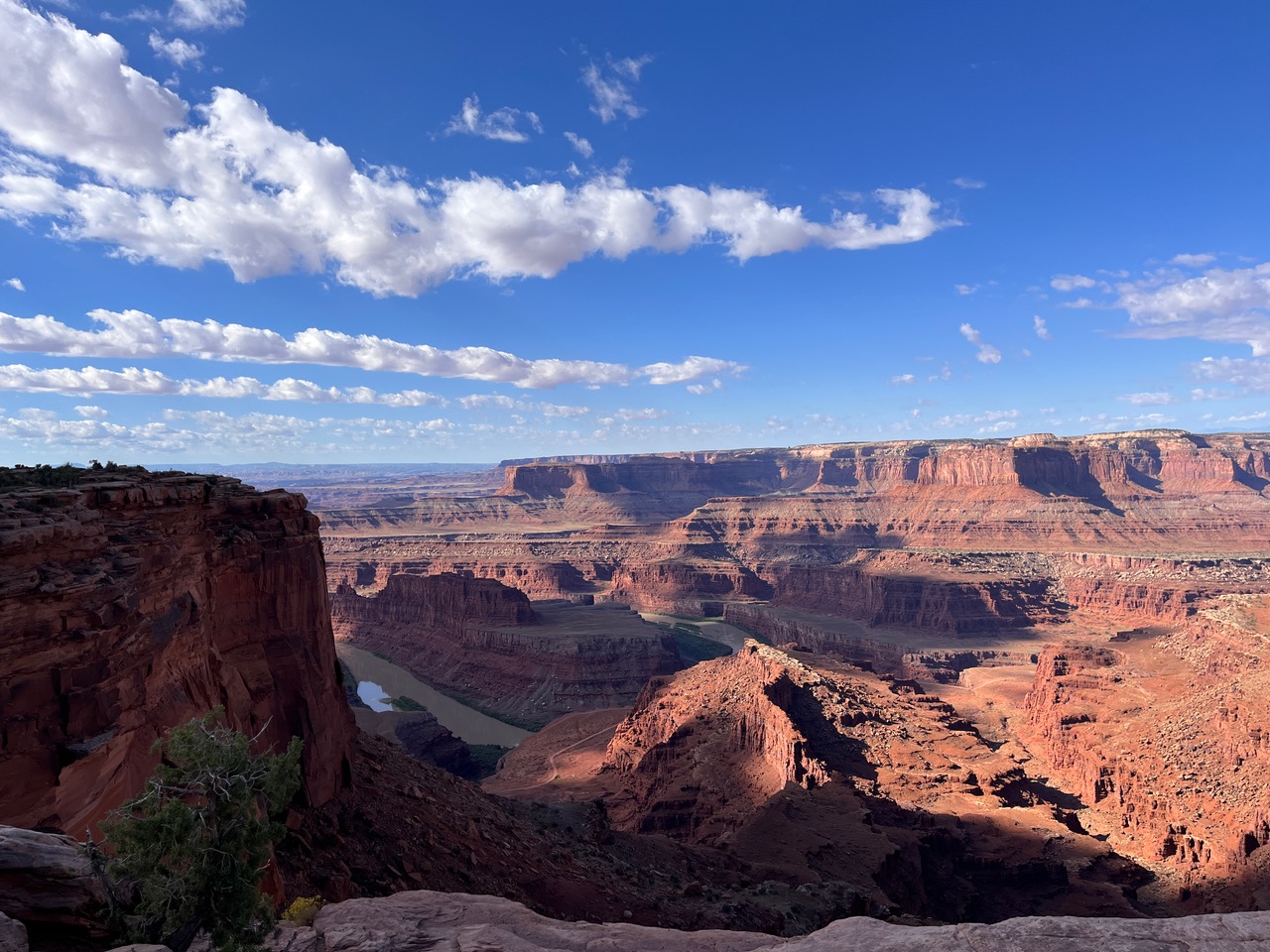
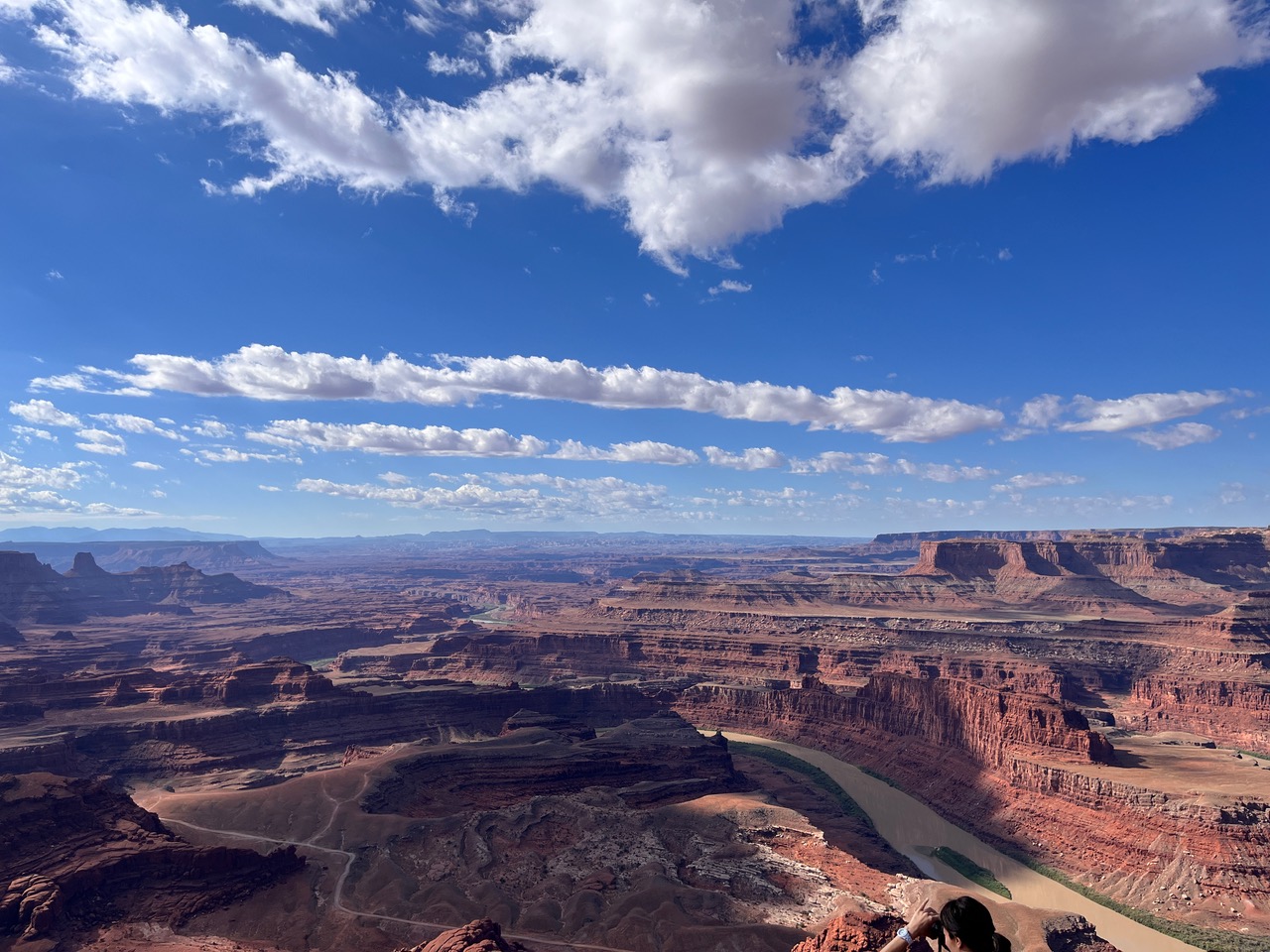
Dead Horse Point Overlook. Photo courtesy Annie Andrus
The Moab Century, along with the Skinny Tire Festival held in March, are fundraisers for cancer. After event founder, Mark Griffith lost his brother to cancer, he was inspired to do something that would not only raise money, but provide an uplifting experience physically, as well as emotionally. Many of the aid stations are staffed by cancer survivors, creating an inspiring environment as riders refuel along the course.
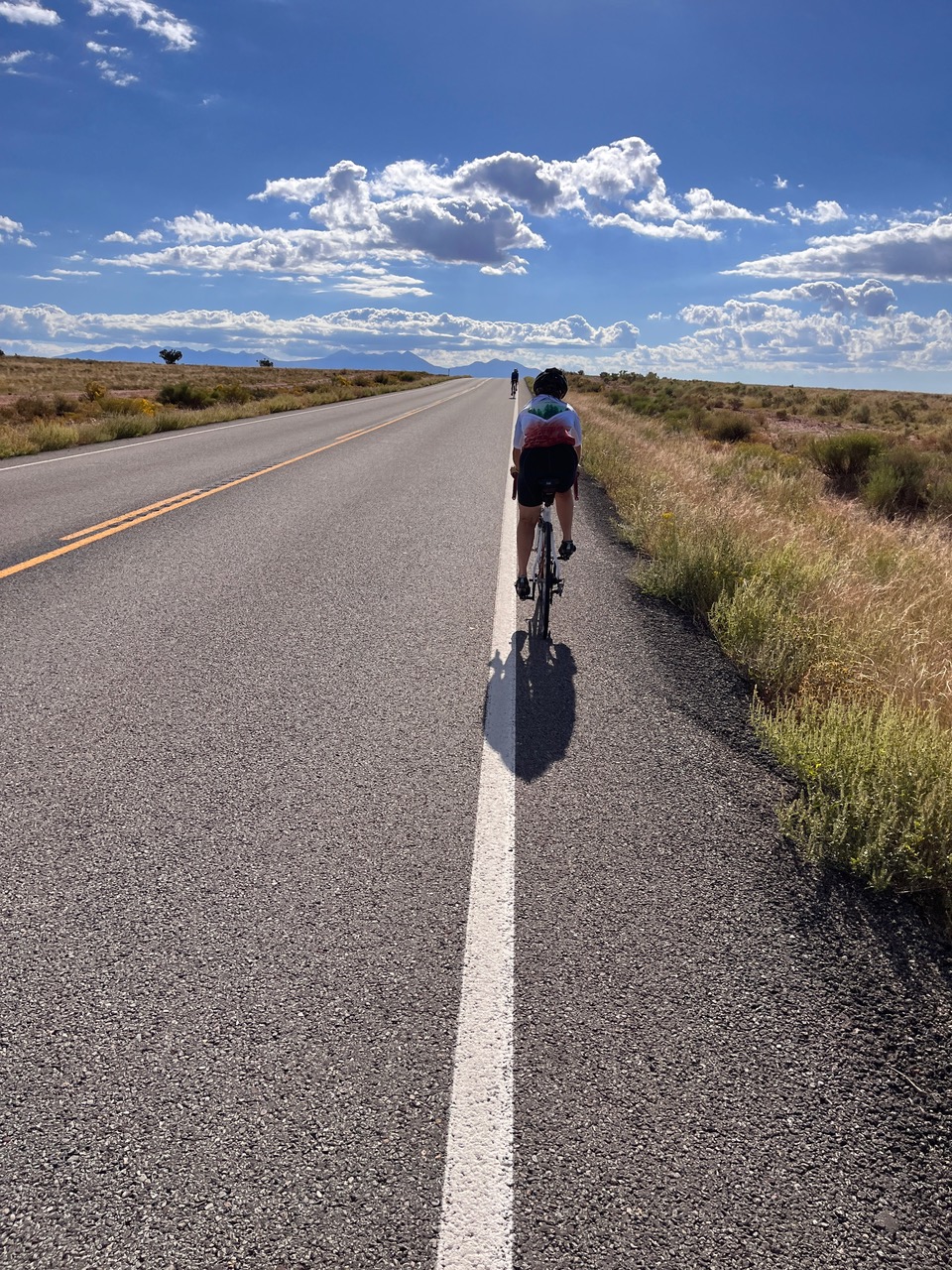
Audra Jeske (rider) enjoying the flat after the steady, but pleasant climb. Photo by Annie Andrus
With a casual rolling start, and no timing chips, the Moab Century has a relaxed feel, very suitable for Moab. Riders start at the Archway Inn on the north side of Moab then continue north and quickly get onto the bike path that crosses the Colorado River beginning the 32-mile climb to Dead Horse Point.
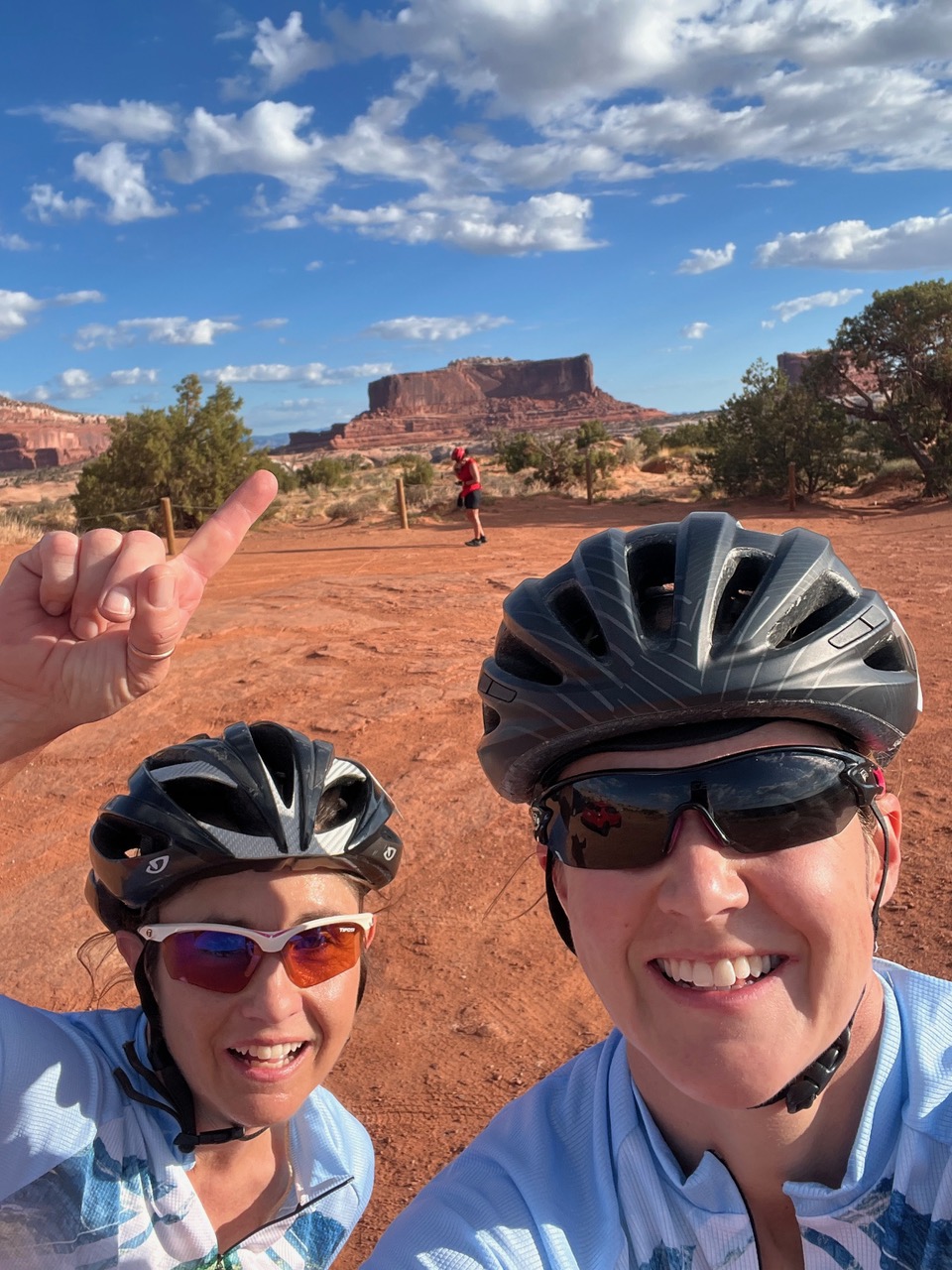
Audra Jeske (left) and Annie Andrus appreciating one of the many marvelous rock formations along the way. Photo courtesy Annie Andrus
The path weaves steadily upward through beautiful red rock for 9 miles before heading up towards Canyonlands. There are so many picturesque places to get off and enjoy the view, so be sure to drink in the towering canyon walls and majestic red rock monuments as you ascend into the canyon. Fuel up at one of the many nicely spaced aid stations, stocked with sweet, salty, and juicy snacks, while friendly volunteers hold your bike!
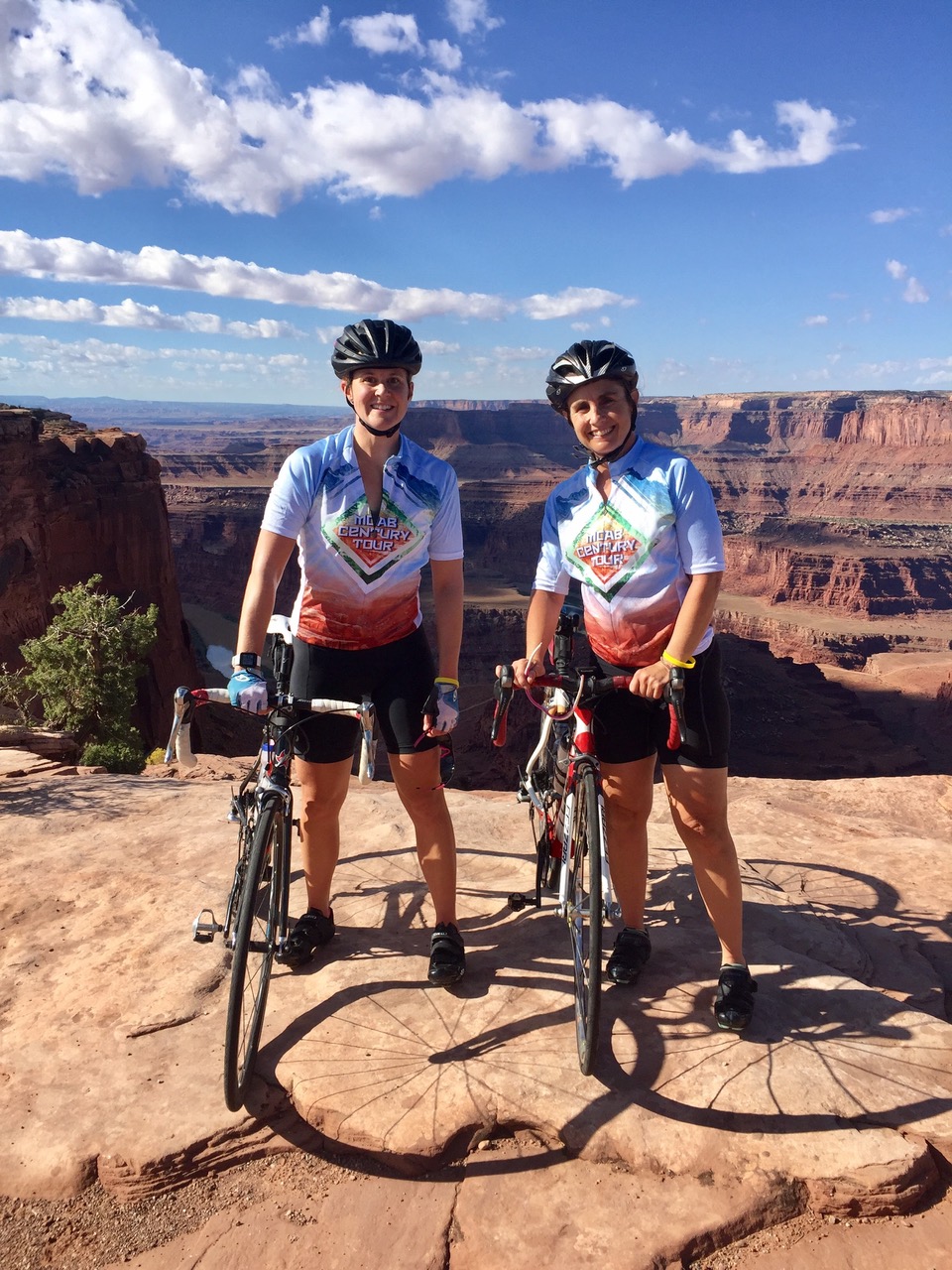
Annie Andrus (left); Audra Jeske right) at top of Dead Horse Point overlook. Photo courtesy Annie Andrus
After miles of climbing, you are rewarded with the famous views of Dead Horse Point, including Horseshoe Bend. Be sure to look off the edge and admire the spectacular vastness of the Canyonlands area. Enjoy the working downhill back to Highway 191 and finish the century on a 30 mile flat out and back along the Colorado River Portal.
The Colorado River from the top of Dead Horse Point. Photo courtesy Annie Andrus
In addition to the native flora of sage and cedar, keep an eye out for arches and petroglyphs. With sleek canyon walls on one side and a slow-moving river on the other, it is a perfect finish back to the Archway Inn where you’ll recover with a smoked pork and chicken lunch, ice cold drinks, and perhaps even a well-earned nap in the cool shady grass.
A well put on event in a place known for adventure, and challenging courses surrounded by breathtaking scenery, the Moab Century is a must-do ride.
Event Info
September 16-17, 2023 – Moab Century Tour, Moab, UT, The Moab Century Tour sends riders across Moab’s unique topography of mountain passes, canyons, and the mighty Colorado River. From gaining elevation into the La Sal Mountains (including “The Big Nasty!”), to carving down red rock canyons, and finishing along the Colorado River, this event has landscape worth training for! Live music, beverages, great food await you at the post-ride party. Join us in September when temperatures cool down, the fall foliage comes alive, and cyclists from across the country unite in red rock country to experience awe-inspiring landscapes. An annual fundraiser to benefit cancer survivorship programs, your registration includes a donation to Moab Healthcare Foundation. Groups use the event to inspire fundraising for large and small foundations. Ask how your beneficiary can participate., Beth Logan, 435-260-8889, 435-260-2334, [email protected], skinnytireevents.com
BEAVER CREEK, Colorado (August 26, 2023) — The reigning XTERRA USA Championship race champions, Sullivan Middaugh and Lesley Paterson, defended their titles in impressive fashion on a picture-perfect blue sky day at Beaver Creek Resort in Avon, Colorado.
In the men’s race Sullivan Middaugh and Ruben Ruzafa came out of the water 1:30 down from Sam Osborne, reeled him in early on the bike, then rode wheel-to-wheel on the entire bike course. Once on the run, the 19-year-old turned on the jets at mile one and pulled away for the win in 2:15:33, with Ruzafa in second (2:17:14), and Osborne in third (2:18:44).
With the second place Ruzafa moves into fourth-place in the XTERRA World Cup standings. Kieran McPherson, who finished fourth, jumps into fifth, Sebastien Carabin (BEL) moves from 8th to 6th, and Middaugh advanced four places into the top 10 at No. 10.
In the women’s race Aneta Grabmuller (AUT) led Amanda Presgraves (USA), Samantha Kingsford (NZL), and Suzie Snyder out of the water. On the bike Kingsford and Snyder rode up front the whole way into the bike-to-run transition, but behind them was the “Scottish Rocket” Lesley Paterson. The 3x XTERRA World Champion was five minutes back after the swim, but just two minutes behind after the bike, and took the lead with a mile to go on the run to secure the win in 2:44:50, with Kingsford in second place just 15-seconds back and Snyder in third in 2:48:21.
With the third-place finish Snyder jumps back into the top five at No. 5, and Samantha Kingsford moves up eight places into the eighth spot.
Recap Men’s Elite
It’s the second career XTERRA World Tour win for Middaugh, who got his first at this race last year, and the 25th for Paterson, the five-time World Champion who also won this race last year.
In the men’s elite race Sam Osborne (NZL) led Americans Timothy O’Donnell and Keller Norland (pictured) out of the water in 17:08, and the trio were a full minute 20 seconds ahead of Edmond Roy (CAN), Ruben Ruzafa (ESP), Branden Rakita (USA) and Middaugh.
“Timothy and I were hoping to push the swim pretty hard and get a bigger gap, and I felt like I was riding okay early on and then Ruben and Sullivan came rolling through,” said Osborne.
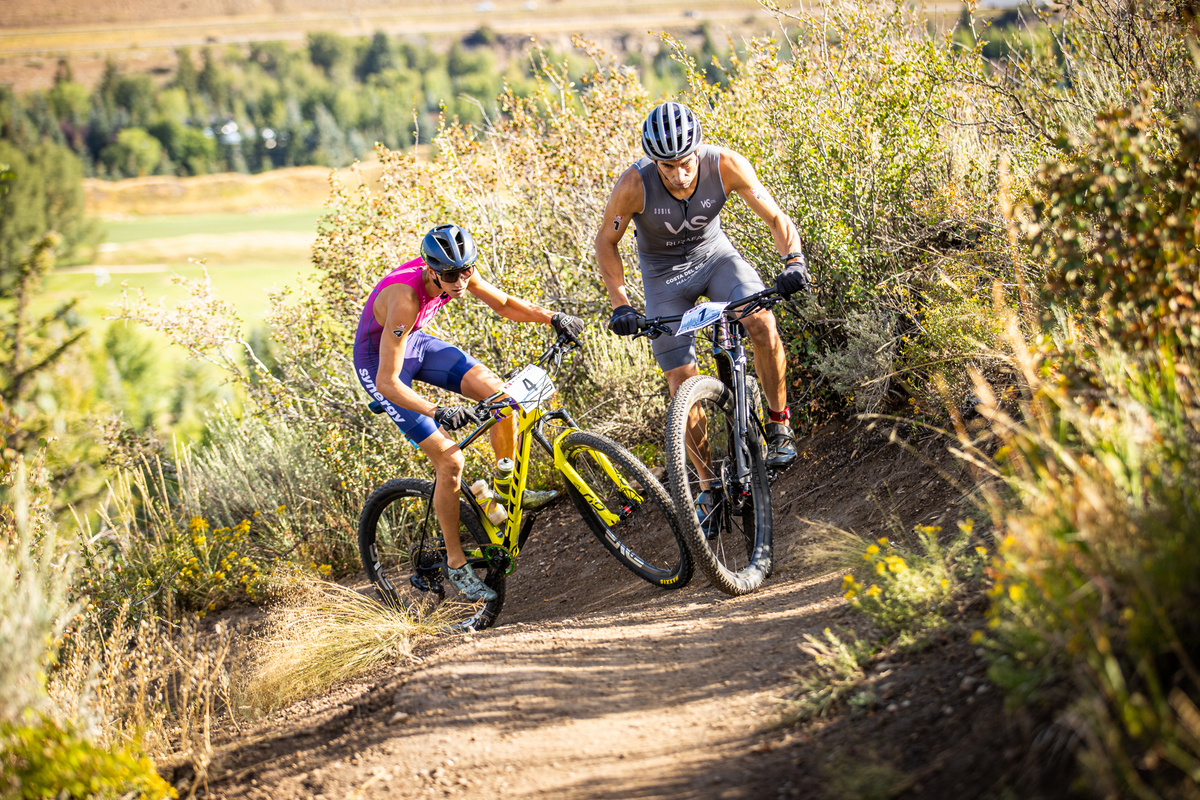
Ruben Ruzafa (ESP) and Sullivan Middaugh riding wheel-to-wheel on the bike leg at Beaver Creek XTERRA World Cup. Photo courtesy XTERRA
Those two – Ruzafa and Middaugh – would roll wheel-to-wheel for the next 15 miles with Ruzafa, the seven-time World Champion, in the front.
“In the swim, I was struggling to hold on to Rubens feet, and thinking to myself just get to the next buoy then the next buoy,” said Middaugh, the 19-year-old freshman at Arizona State University. “And then on the bike, I let him pull the whole time, which I was really grateful for because he was pushing it. I actually tried to help and take a turn up front but he didn’t seem to want it.”
After the race, Ruzafa confirmed that indeed he did not want to give Middaugh a turn up front.
“No, I didn’t want him to go in front because I wanted to control the pace and the lines,” said Ruzafa. “He tried to go in front but I said no-no, I’ll go, and we were pushing it to the limit.”
To the delight of a packed house of Middaugh’s hometown fans, the two flew into the bike-to-run transition together and the foot race was on.
“On the run I had good legs, and treated every hill like my first and my last,” said Middaugh. “We ran together to the first aid station and I put the throttle on it through the Aspens climb, that’s where I was really pushing it.”
Middaugh pulled 30 seconds ahead in one-mile and kept extending the gap from there.
“He had another gear at that point, and I just had to keep my place to save the second-place,” said Ruzafa. “I was really hoping to pull away on the bike, but Sully knows the course and the downhills, and I couldn’t shake him. He had a really good race. I’m proud of him, he’s really young and raced really well. Happy for him and happy for Josiah.”
For Middaugh, to defend the USA Championship, an accolade his Dad, Josiah, held 15 times, in front of his friends and family and against some of the World Cup’s best, was a dream come true.
“There was a little extra pressure to defend the title here in the U.S. under the Middaugh name, so it was great to pull it off,” said Middaugh. “And racing against Ruben today was really special. I grew up watching him race against my dad since I was 10-years-old, and I respect him a lot, so it was awesome to race with him. And for sure I had home course advantage today, but beating Ruben is a great motivator heading into Worlds.”
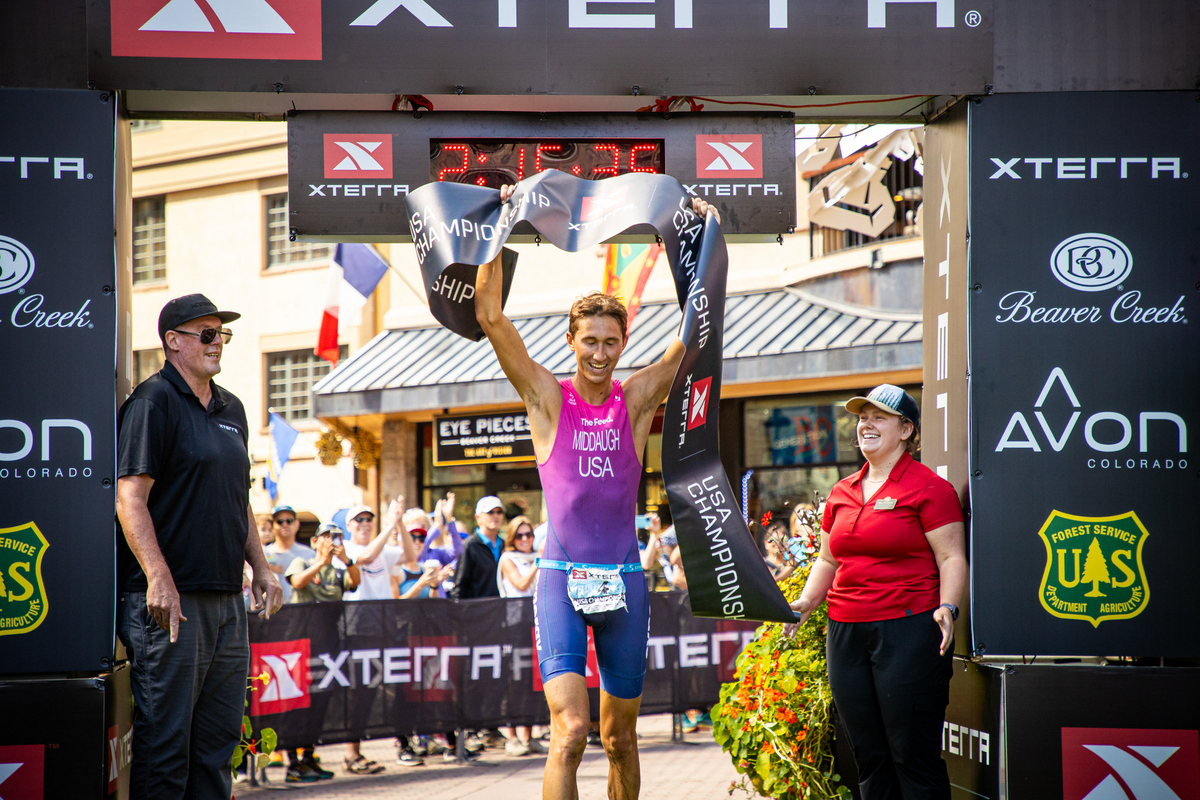
Sullivan Middaugh wins the Beaver Creak XTERRA World Cup. Photo courtesy XTERRA
Middaugh posted the fastest bike (1:15:43) and run (38:52) times and took five minutes off his winning time from a year ago to take the tape in 2:15:33, with Ruzafa in second (2:17:14), and Osborne in third (2:18:44).
“Sullivan is a wizard out there,” said Osborne. “He’s a carbon copy of his dad but he swims better, and for sure he’ll be giving us headaches for years to come. On the second climb I was looking ahead and Ruben was out of the saddle prancing around, and Sully was just sitting there, taking a drink, he was chill. It was like he’s just sitting there and waiting for the running race.”
With the win Middaugh advanced four places into the top 10 of the XTERRA World Cup standings. Ruzafa moved into fourth-place, Kieran McPherson, who finished fourth, jumped into fifth, and Sébastien Carabin (BEL), who placed fifth today, moved from 8th to 6th.
And Sullivan wasn’t the only Middaugh to have an amazing day. His younger brother Porter, 17, who is a senior in high school, finished fifth overall and as the top amateur for the second year in a row (he was 10th overall last year).
Male Elite
Place
Name
Age
Hometown
Finish
1
MIDDAUGH, Sullivan
19
Vail CO
2:15:33.7
2
RUZAFA CUETO, RUBEN
38
Aizarnazabal ESP
2:17:14.3
3
OSBORNE, Sam
31
Rotorua NZL
2:18:44.0
4
MCPHERSON, Kieran
31
Matamata NZL
2:23:03.9
5
CARABIN, Sebastien
34
Andrimont BEL
2:24:43.0
6
NEEF, Sebastian
34
Lappersdorf GER
2:25:39.7
7
TELLER, Sam
25
Boulder CO
2:28:37.6
8
SERRANO, Francisco
43
San Pedro Garza Garcia MEX
2:28:41.4
9
ROY, Edmond
24
Nicolet CAN
2:30:07.6
10
NORLAND, Keller
20
Corvallis OR
2:30:30.5
Recap Women’s Elite
In the women’s race Aneta Grabmuller (CZE) led Amanda Presgraves (USA), Samantha Kingsford (NZL), and Suzie Snyder out of the water.
On the bike Kingsford and Snyder worked their way to the front and rode together the whole way into the bike-to-run transition, but behind them was the “Scottish Rocket” Lesley Paterson.
Paterson was five minutes back after the swim, but just two minutes behind after the bike, and took the lead with a mile to go on the run to secure the win in 2:44:50, with Kingsford in second place just 15-seconds back and Snyder in third in 2:48:21.
Lesley Patterson on the bike at Beaver Creek XTERRA World Cup. Photo courtesy XTERRA
“I knew the swim was going to be dreadful and it was,” said Paterson. “But when I came out of the swim I felt great. I love this course, it’s perfect for me because I’m a climber. And when I saw the girls at the top of the climb on the run I thought to myself, game on, but it really hurt and I was worried I wasn’t going to pass Samantha.”
Kingsford pulled away from Snyder early on in the run and was able to hold off Paterson for a long time.
“It was really fun to race against Suzie and Lesley today,” said Kingsford. “On the run when I heard Lesley coming up behind me, I was like, oh no, here we go. And she was killing it on the downhills but I wasn’t letting her go. I didn’t give up and tried to get back on and maybe I could have if the run was longer.”
Paterson took the win with a large dose of gratitude.
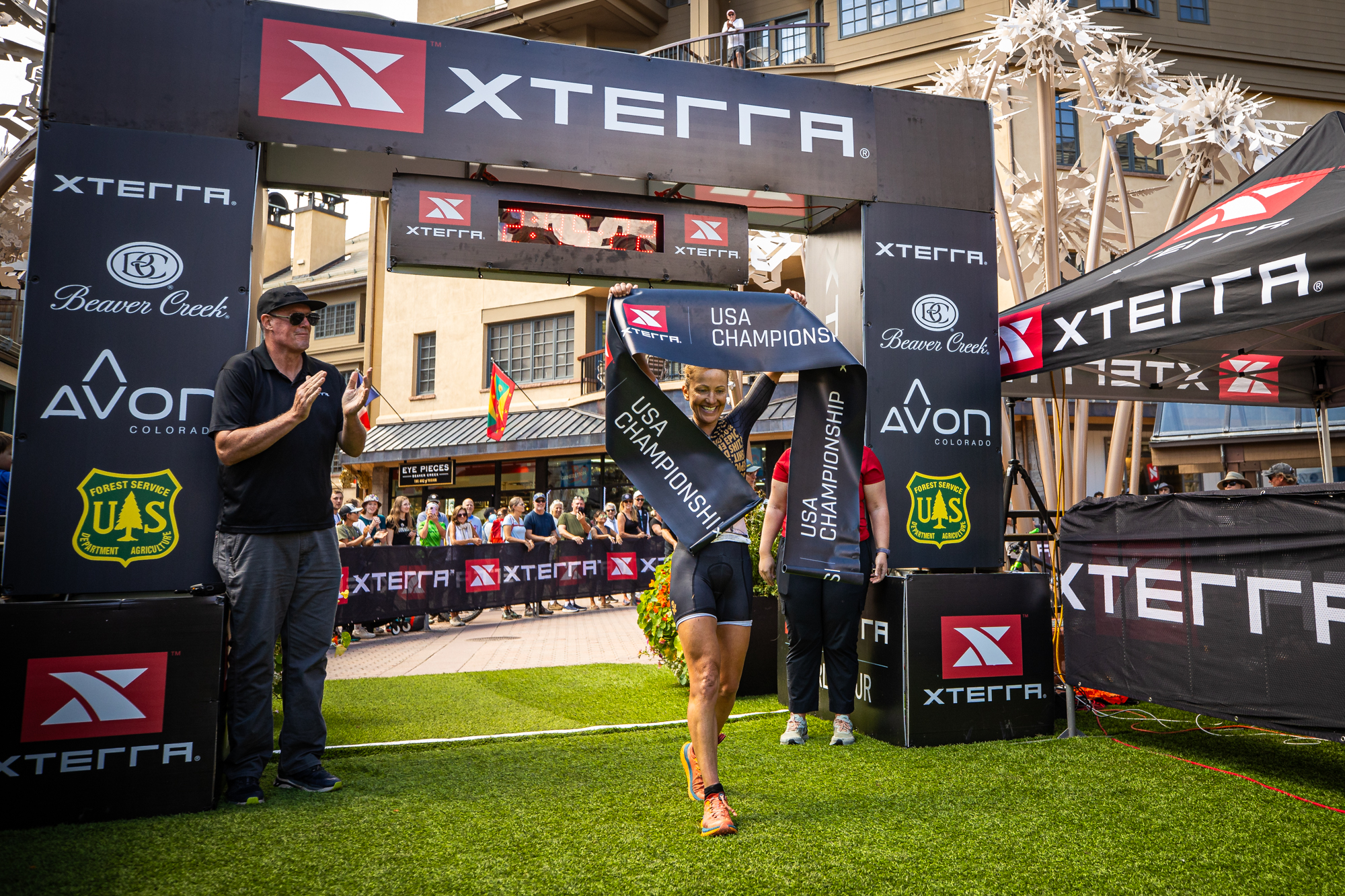
Lesley Patterson takes the win at Beaver Creek XTERRA World Cup. Photo courtesy XTERRA
“Gratitude is my theme this year. Grateful just to be able to be here and still do it, and ya know, it’s the first time in 10 years nothing hurt. I had no hamstring pain, no foot pain, no head pain, nothing. For the first time in forever,” said Paterson, who is working on a screenplay based on the famous novel, Man’s Search for Meaning by Viktor Frankl.
“It’s made me realize what matters in my life,” she said. “It’s my community, friends, love, my work, mastery of craft, and I’ve just focused on those things and not on the outcome. And as a result, I’ve been so joyous this week.”
With the third-place finish Snyder jumps back into the top five of the XTERRA World Cup standings at No. 5, and Samantha Kingsford moves up eight places into the eighth spot.
“Game on for Worlds now,” said Snyder, who won the U.S. Elite National Championship crown for the third year in a row and sixth time in her career. “I’m happy to keep the crown, of course, I would’ve loved to win it as the overall champ, but these girls are at another level.”
Aneta Grabmüller (CZE) finished in fourth and Maria Döring (GER) rounded out the top five.
Visitors Can Enjoy Vehicle Free Days at Crater Lake National Park
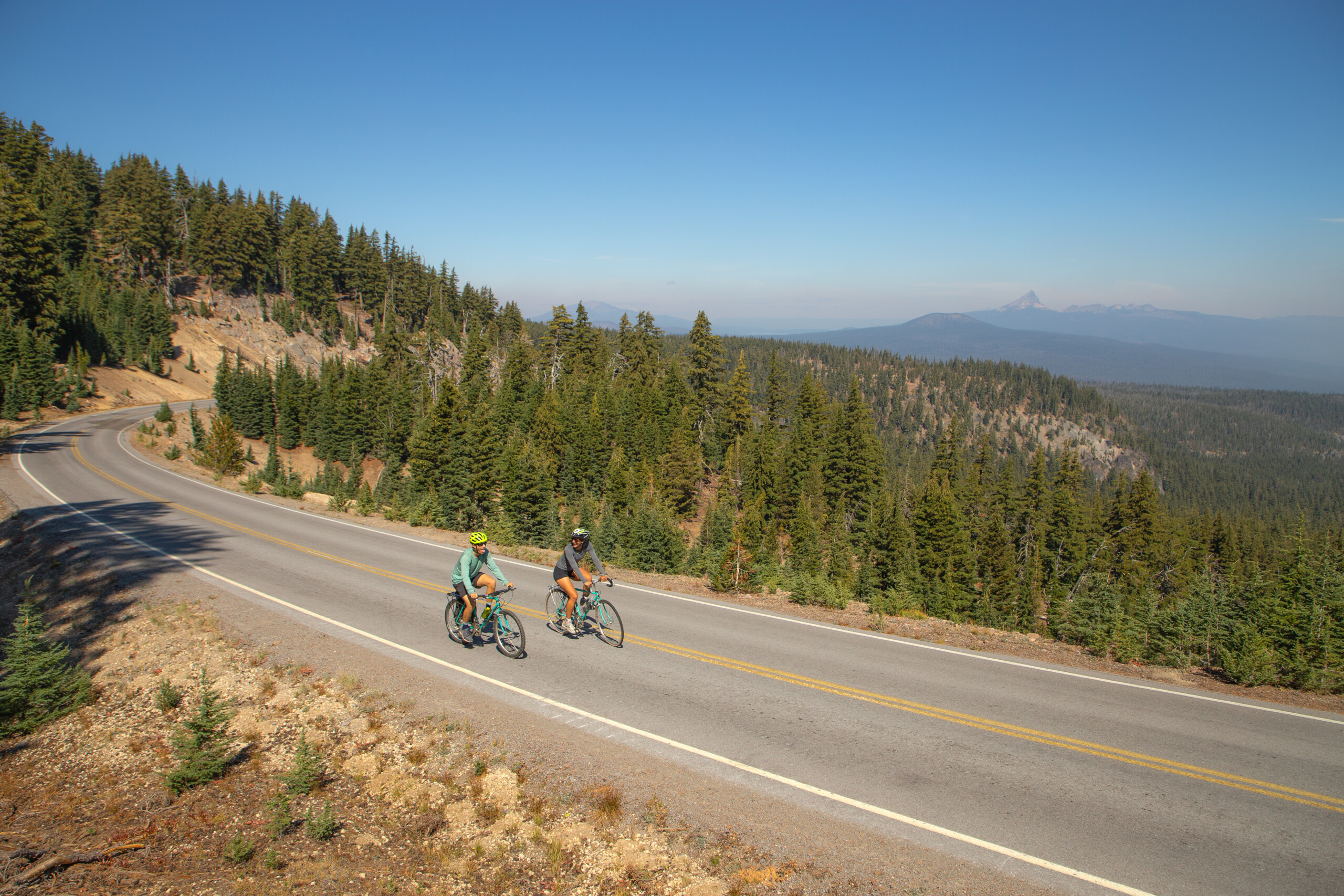
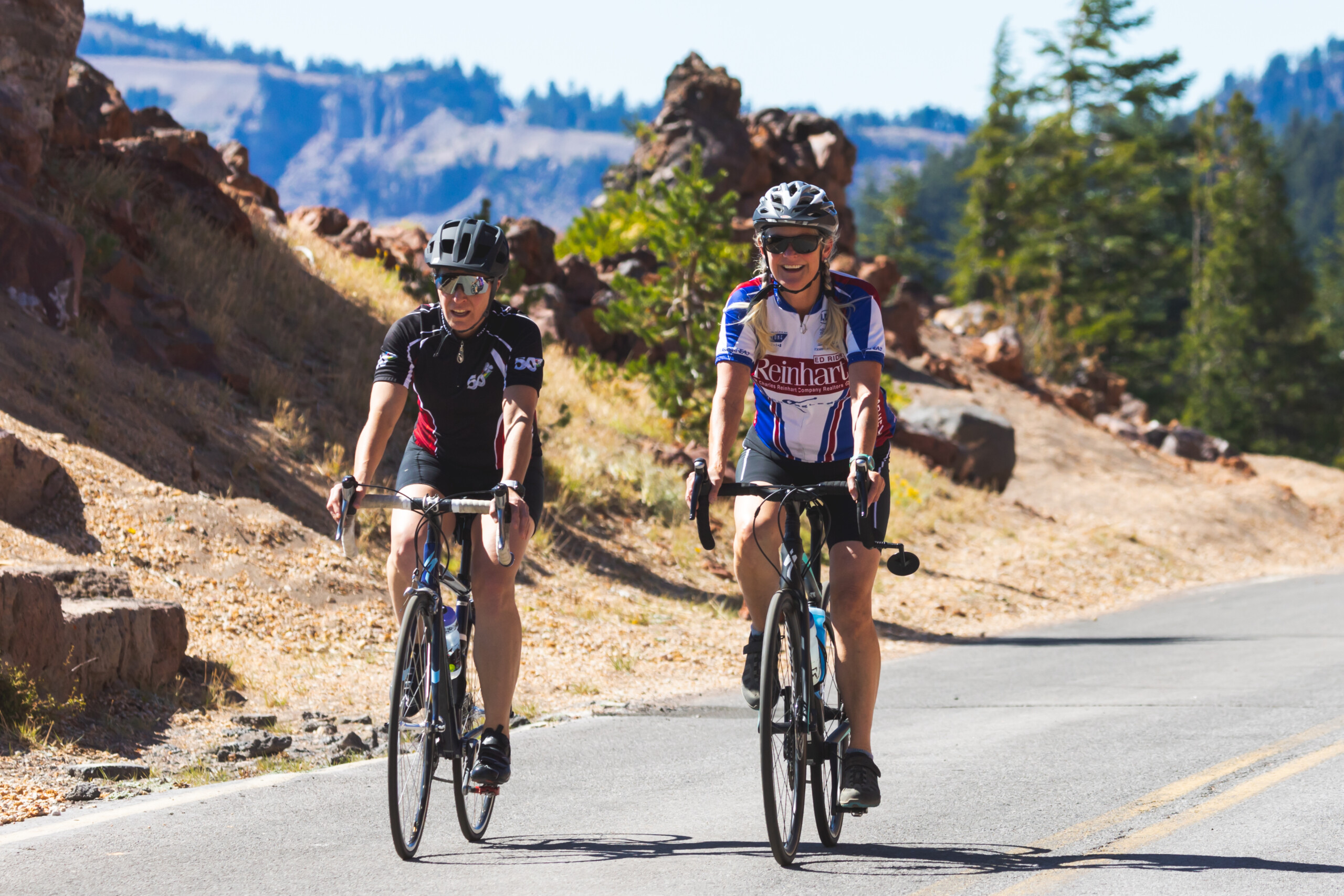
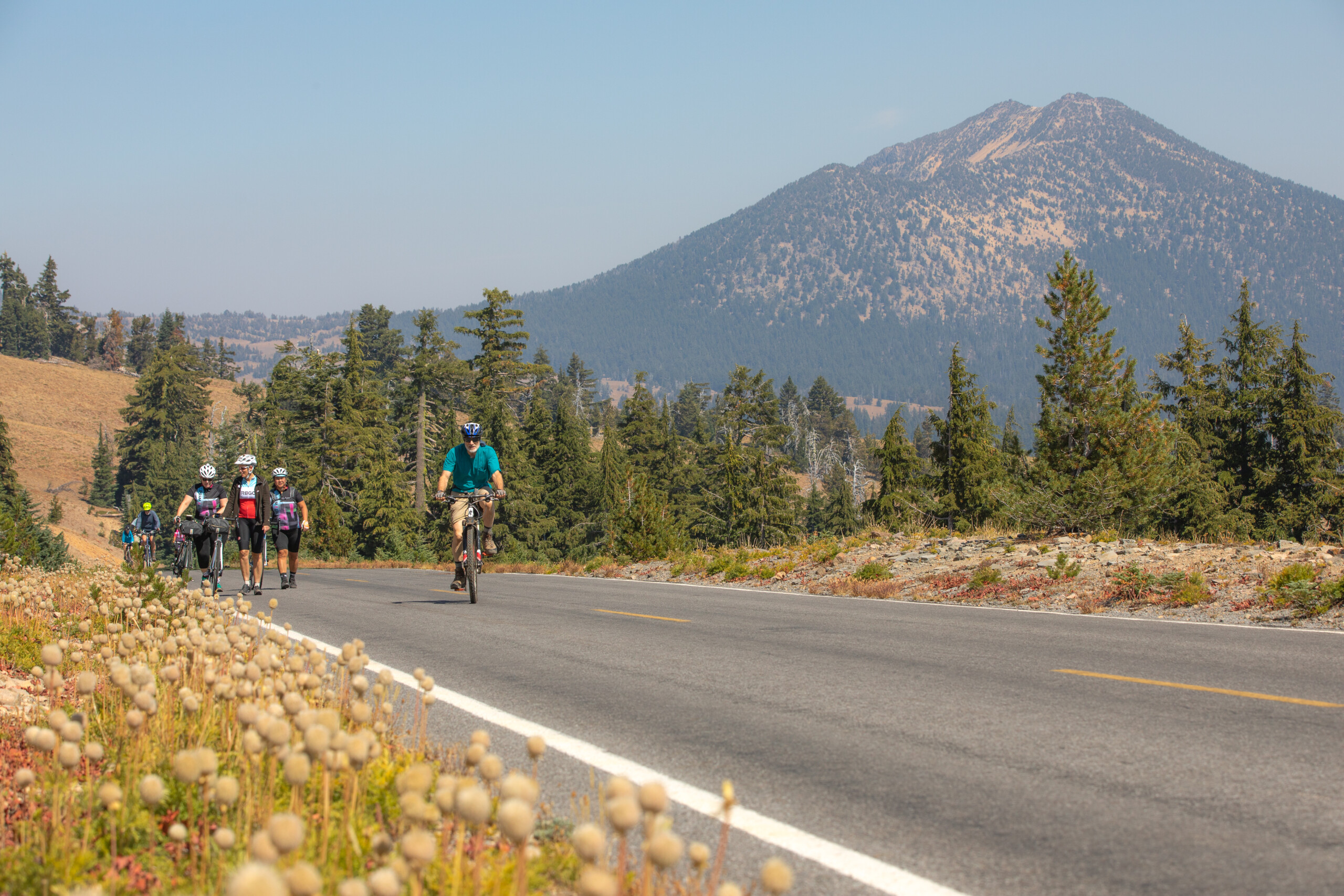
KLAMATH FALLS, Oregon (August 29, 2023) – Crater Lake National Park, in partnership with Friends of Crater Lake and Discover Klamath, will host the annual Ride the Rim days September 9 and 16, 2023. On these consecutive Saturdays, East Rim Drive from North Junction to Park Headquarters will be closed to motorized vehicles from 8 a.m. to 6 p.m. to allow for non-motorized recreation including biking, hiking, and running.
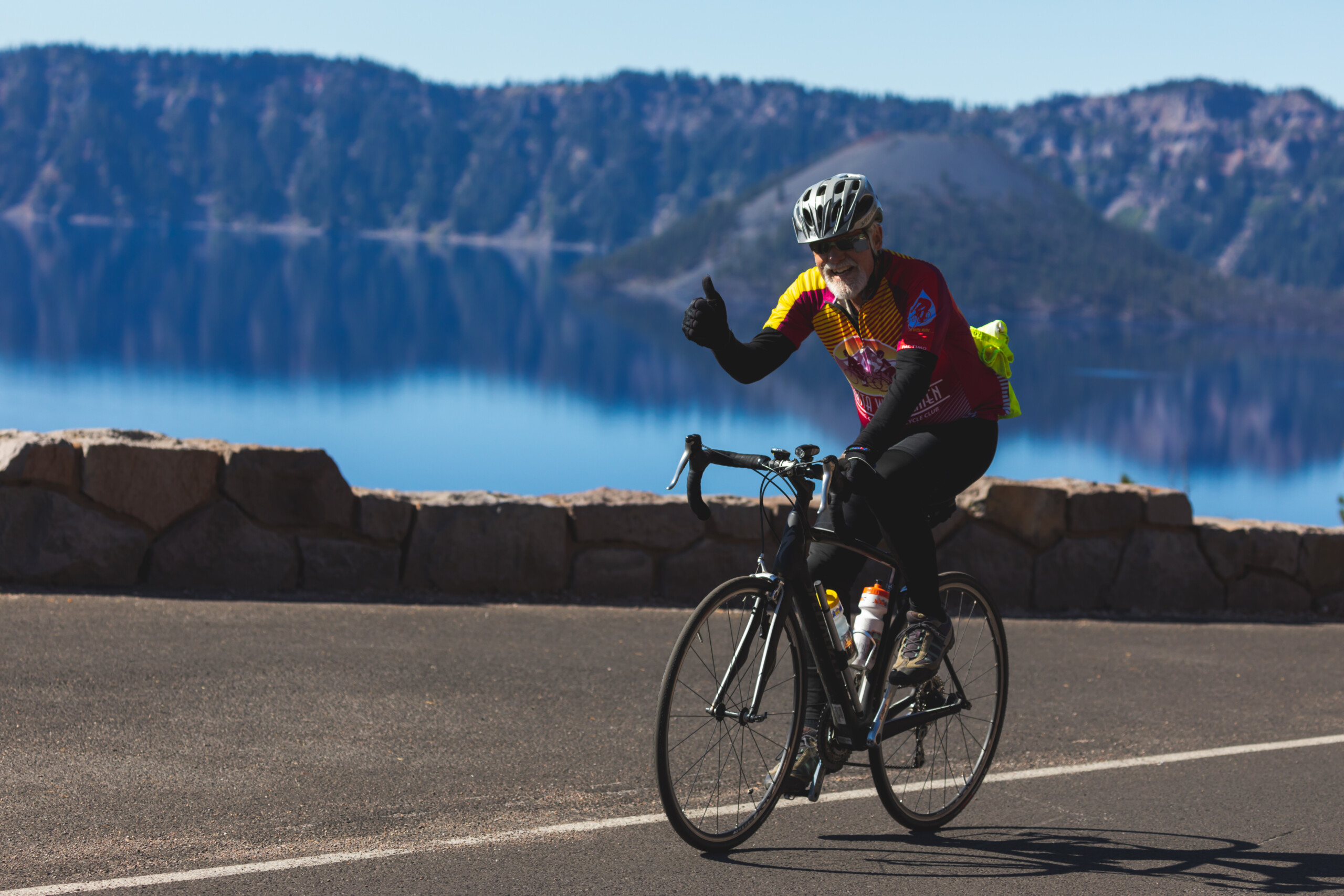
Photo courtesy Ride The Rim
Ride the Rim participants will need to pay a Park Entrance Fee upon entering the park.
Superintendent Craig W. Ackerman said, “Ride the Rim provides an opportunity to experience East Rim Drive in a unique way, under your own power, whether you’re on a bike or on your own two feet. It is a strenuous endeavor, but the rewards of a slower pace, opportunities for quiet reflection, and healthy, vigorous recreation make it a special experience for many people.”
Photo courtesy Ride The Rim
The event also offers jerseys and other merchandise for participants to remember Ride the Rim. Says Tonia Ulbricht, Senior Marketing Manager for Discover Klamath: “We are excited to offer event mementos through merchandise including many different styles of tees, hats, and other merchandise.”
Visitors on these days should expect a large number of bicyclists on park roads. Please ride and drive with caution and patience. Cyclists should ride single-file when sharing the road with motorists.
Photo courtesy Ride The Rim
West Rim Drive will be open to both pedestrian and cycling traffic. Park staff recommends bicyclists avoid riding on West Rim Drive if possible, because of increased traffic from Ride the Rim participants, shuttles, and other park visitors.
Ride the Rim parking will be located at North Junction, Park Headquarters, and the Picnic Hill area of Rim Village. Participants are encouraged to share rides to help ease parking congestion.
A free shuttle will transport participants to the start of their Ride the Rim experience or to their vehicles at the end. The shuttle will run between North Junction, Rim Village, and Park Headquarters. The shuttle will not carry bicycles in an effort to accommodate more people. A person or people from each party should remain with bicycles while members of their party park or retrieve vehicles. For single riders, there will be limited, unfenced bike corrals at North Junction and Park Headquarters. Check in with Ride the Rim Volunteers if you wish to use the bike corral.
Lost Creek Campground will be unavailable on the nights of September 8, 9, 115 and 16 to accommodate volunteers working to support Ride the Rim. Mazama Campground will be open on these days.
It is the poetic spirit (fūrabo), the spirit that leads one to follow nature and become a friend with things of the seasons. — Matsuo Bashō (Japanese haiku master, 1680s)
By Albert Flynn DeSilver — When you cross the San Andreas Fault at Olema, California, you cross over from the North American plate to the Pacific Plate and everything changes. To set foot, horse hooves, or bicycle tires on the Point Reyes peninsula is to land on another continent— geologically literally, of course, but also culturally, even spiritually. It means to land in a unique, more poetic consciousness imbued with the essence of the East.
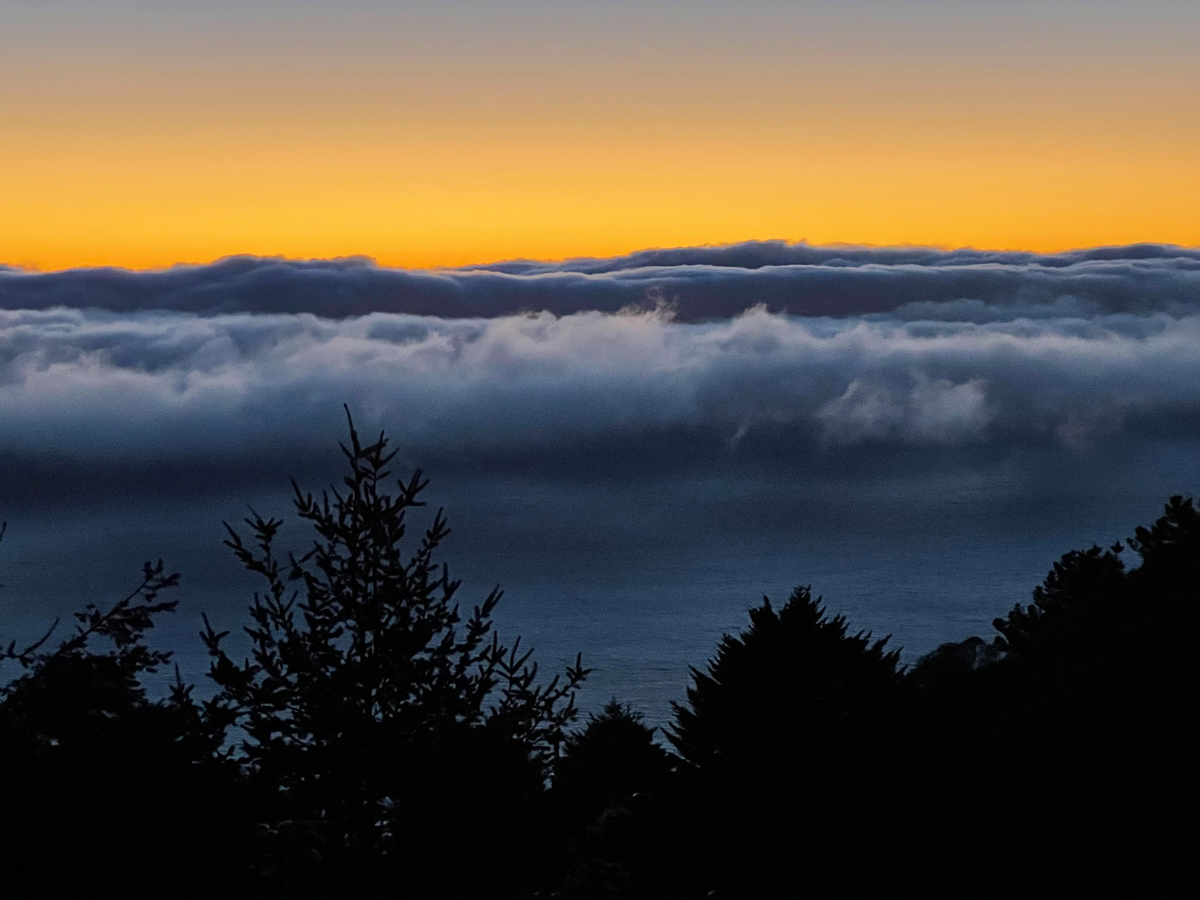
The fog rolling in at Point Reyes, California. Photo by Albert Flynn DeSilver
The Point Reyes peninsula is located just thirty miles north of San Francisco from its south end near Bolinas, forty miles from its midpoint. It lies in the shadow of Mount Tamalpais, the birthplace of mountain biking and the klunker revolution. Though perhaps some of the klunkers were tooling around the hills and dales of Point Reyes in the late seventies and eighties, the peninsula has maintained a remote and inscrutable vibe, courting perhaps a quieter, more contemplative two-wheeled adventurer. The total landmass of the peninsula is just over seventy thousand acres, yet you feel like you have entered a vast wilderness on the scale of Yosemite or Yellowstone.
The only way to properly capture such a vast and dynamic place as the Point Reyes Peninsula is through—what else—the tiniest of compressed art forms, the haiku. As I conceived of this adventure and a piece of writing to follow, the haiku promptly blew into my consciousness like a gust of Japanese plum blossoms snowing in from across the Pacific.
Poet Matsuo Bashō was born in Japan’s Iga region in 1644 and from an early age was drawn to the form called hokku, today known as haiku. By his thirties, he was a hokku master and was fortunate to find fame and financial success in Edo (now Tokyo), but material trappings left him empty, so he wandered the farthest reaches of the country in search of peace and greater communion with nature. Today he is considered Japan’s greatest haiku poet, but he also invented a new form called haibun, which alternates prose with haikus. The haiku is designed to serve as soft punctuation of the words that come before it, a murmur of affirmation.
As we rode across the peninsula, my ride itself came to feel like a haibun’s haiku to all the trips that had preceded it. In the ever-present struggle to put words to experience, this combination of prose and poetry seems closest to capturing Point Reyes’s essence for me.
Alex Ketley riding in Point Reyes, California. Photo by Albert Flynn DeSilver
During the 1906 earthquake the Point Reyes peninsula reportedly “lurched forth more than twenty feet,” and a cow was swallowed up by the fissures torn in the earth. Geologically, the formations from Bear Valley north to the tip of Tomales Point and west to the highpoints of Mount Vision are dominated by granite. This granite isn’t found on along the coast on the mainland North American plate just east of the peninsula, only much farther east when you reach the uplift of the Sierra Nevada. Franciscan undifferentiated sedimentary rock such as graywacke, shale, conglomerate, and chert make up much of the mainland geology just east of the Point Reyes peninsula. In his The Natural History of the Point Reyes Peninsula, Jules Evans describes the peninsula as “the northwesterly migration of a granitic whale,” as if it were floating through geologic time—which of course it is. This “island in time” notion of the place is as much physical and elemental via the geology, flora, and fauna as it is energetic and poetic—which is to say, spiritual.
Last year I asked my wife what she wanted to do for her birthday. “I want to go out to Chimney Rock and see a whale.” “Sure honey,” I told her, “no problem.” A good whale spotting is generally not something one can orchestrate on command, but fantastic husband that I am, I got it scheduled on the calendar and set my intentions alongside hers. When her special day arrived, we drove more than an hour out to the far point, stepped out of the car, and walked maybe two hundred yards down the road toward the old coast-guard station, where I presented her with her whale sighting. We looked down to our left into Drakes Bay, not twenty yards off the pier, and right then a gray whale breached the surface as if to say, “happy birthday, Marian.”
That’s the kind of magical, poetic thing that happens all the time in Point Reyes. That is, if your sensibilities are open (you’re paying attention and truly tuning in), you can sense such magic at the continental threshold. Most people beeline it across Highway 1 at Olema without even noticing. They head for the wild beaches at Abbotts Lagoon, which stretch for miles, or for the famous lighthouse out at the far point proper. Some speed out to see the elk at the north refuge on Tomales Point or the spectacular views from Mount Vision. Still others go for the cliffs, lakes, and waterfall near Palo Marin.
Two things bring me to presence in a place more than any other: writing (poetry) and mountain biking. When I say “bring me to presence,” I mean they wake me back up to a renewed sense of awe and wonder with the natural world. To know a place is not to know “about” it, via the maps, history, place names, or even the scientific nomenclature of the flora and fauna (as fun as all that is), but rather to be in flow with its energies and essences—its poetries. To be in rhythmic harmony with the folds and contours of the landscape itself, enchanted by the low-leaning light, absorbing the radiance of plant, animal, and mineral communication—to allow them space in your bones—this is truly being alive in a place.
elk herd traipsing by their halo the rising sun
Though I’ve done a thousand loops and out-and-back rides here, I wanted to see the whole peninsula anew through the lens of poetry on a single day in March at the turn of spring, via an acoustic bicycle. I wanted to celebrate as much of its magical entirety as possible. I brought along my friend C, a consummate adventurer, whom I met, perfectly enough, on a bike ride here in Point Reyes. I’ve been coming to Point Reyes for twenty-six years and have kayaked many of its inlets and esteros, hiked or ridden every one of its roads and trails, swam most of the beaches—but how much of this place did I really know?
Albert Flynn DeSilver riding in Point Reyes. Photo by Alex Ketley
When it comes to bike rides, I’m more of a fifteen-mile-once-or-twice-a-week guy. I will never do the Leadville 100 or the Tour Divide. I’ve never actually ridden a bicycle more than twenty-five miles in a day. I’m in it for the nature, for the poetry of being in place. I like to lollygag and talk to the periwinkle, the purple star thistle, the mugwort, the aster, the yarrow, the calla lily. When I scoped out this ride out on a map (yes, a paper map), I honestly did a cursory job, lining up my thumb with the little mileage-scale thing in the lower left-hand corner. I counted twenty-something-ish miles with scant consideration of elevation gain and loss. I had all the hills figured out in my mind as “doable.”
I showed up in the parking lot with a thirty-pound pack complete with three-plus liters of water, two sandwiches, five energy/chocolate bars, and some backup Pata-gucci provisions. I had extra tubes, tools, layers. You’d think we were doing a multi-day trans-Sierra midwinter bike-pack. C showed up with almost nothing. He’d recently experienced a disaster and lost most of his possessions—including his stable of bikes—and he was in full fuck-it-none-of-this-material-shit-matters mode. I lent him my hardtail. Besides that, he had a thirty-ounce water bottle and a couple of energy bars. “What about water?” I asked, reaching for my bladder and taking a comforting slurp from the tube. “I’m good,” he told me. “I can fill up at little streams and whatever along the way. You know that whole giardia thing is a myth.”
*
Vizcaino, one of the first Spanish explorers, called this great triangular peninsula “Punta de Los Reyes” (point of the kings). The coast Miwok called the surrounding bay waters tamál-húye, or simply home, since it was the place they had continually inhabited for more than five thousand years. By the 1850s, Portuguese dairy farmers began sectioning off the vast tracts by lettering them and building ranches. An old map reads like scattered Scrabble letters tossed across an empty board. To this day the signs along Sir Francis Drake Boulevard read “Historic A Ranch,” “Historic H Ranch,” “Historic L Ranch,” and so on. The ranches are in decline and the elk are back. There is a space near the Bear Valley visitor’s center in which to honor the Miwok with a model village called Kule Loklo (bear valley). The last grizzly was killed in 1913, though every twenty years or so a stray black bear wanders down from Mendocino. Every year a powwow here celebrates coast Miwok culture, and this is the go-to field-trip destination for surrounding Bay Area schools.
I’m not sure when the poets started showing up, but some of America’s greatest have written and/or lived here. Gary Snyder with his famous poem about hanging out down at McClure’s beach with Jack Kerouac in the fifties. Robert Bly and his men’s groups, poeming about in the seventies and eighties. Bob Haas and Brenda Hillman still have a place here. Bolinas has the peninsula’s strongest history in this regard. Allen Ginsberg lived there for a while in the sixties along with Philip Whalen, Robert Creeley, Bill Berkson, Joanne Kyger, Anne Waldman, and so many others. Like I did, they came to re-experience the origins of language—which ultimately belong to the string of snowy plover footprints in the sand down at Drakes Beach, the scrawl of bishop pine branches scratching at the clouds above Mount Vision, and the traces of a redtail hawk’s thermal rise into the sky over Pelican Lake.
*
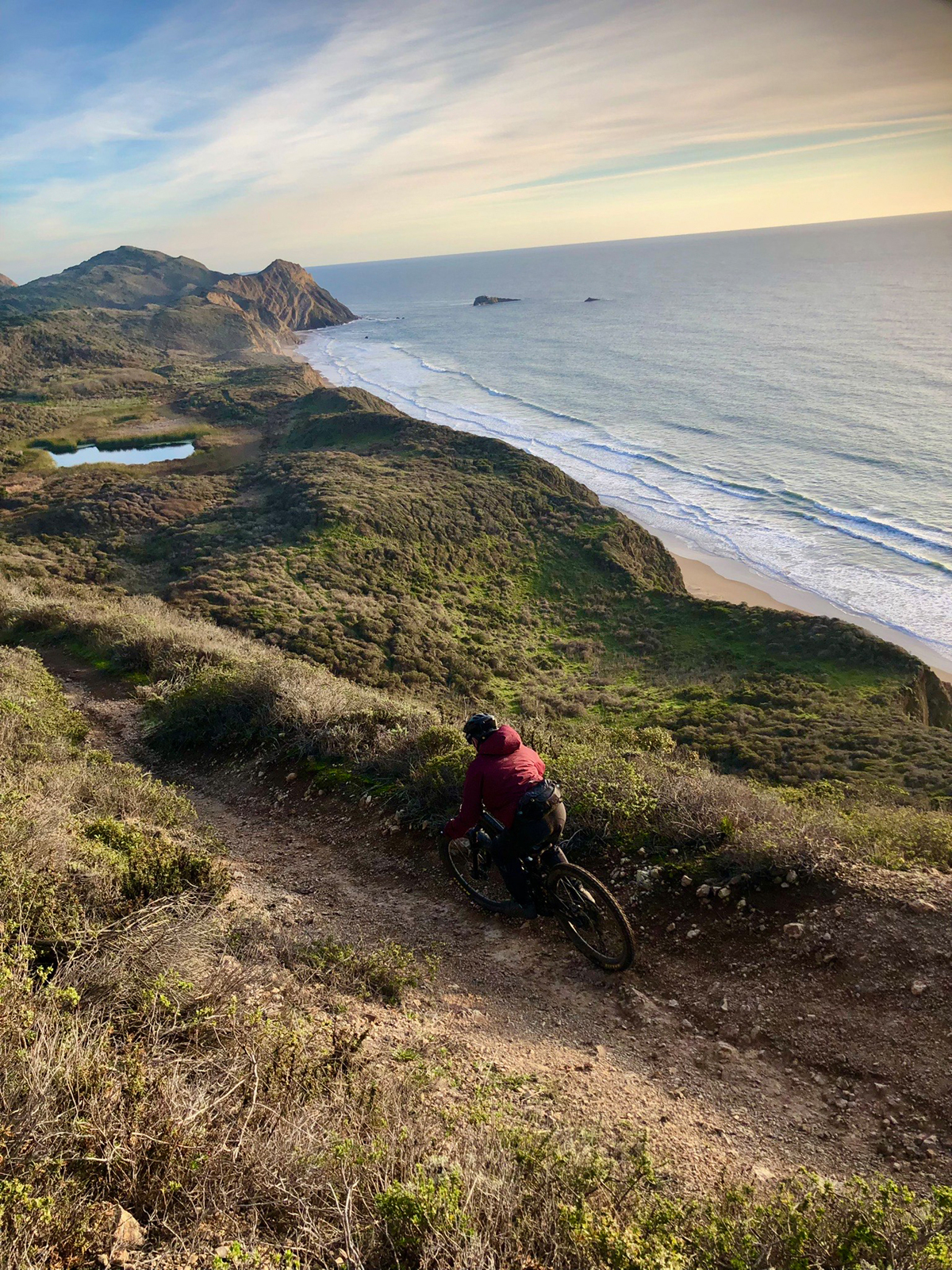
We set off at dawn from the north tip of the peninsula at the Tomales Point parking lot, taking in an elk herd cantering along a small rise, backlit by the brightening eastern sky. After shooting a few happy snaps, we burn pavement from the McClures Beach turnoff and climb south. A mile or so later of pavement, we veer off near the Pierce Point Ranch on the bay side, climb through a barbed-wire fence, and pick up a game trail (stray elk, fox, coyote, deer, bobcat, skunk, perhaps raccoon and possum—I imagine them all prowling along sniffing out the cows) and we too ride the fence line that takes us over to the Marshall’s Beach road.
swatch of blazing mustard flowers, bright green fields spotted with spotted cows— the oceans roars
We pause at the top of the Marshall’s Beach parking area. There’s an old road that leads down to the legendary artist Clayton Lewis’s place at Lairds Landing. He had a small cottage and sculpture studio down there for years, more or less squatting until eventually the park service forced him out. In the sixties and seventies, when he was living there full time, he’d reportedly row across the bay to get groceries at the Marshall store and mail his famously decorated envelopes filled with poetic letters to friends and family. Up until the nineties, this was the ultimate romantic place to take a lover, to explore the old buildings and studio, to drop the rope swing from the cypress tree and swing out over the water, to skinny-dip in the bay and lie around naked in the warm sand. The park has since cut the rope swing, cleared out some of the debris, and let the outbuildings collapse.
We pedal on for a couple of miles down a wide gravel ranch road into the lower bishop pine forest. You don’t see these trees east of the San Andreas Fault, as they thrive in granite soils. The bishop pines sing a different song with their paired dark-blue-green needles, creating a humming low-pitched whisper: a voice that says, “wake up and smell the poetry.” Scent is always on the wind here, alternating between saline air, crushed huckleberry, and citrusy pine pitch. As you ride up in elevation you feel as if you are being dipped in a Japanese brush painting—especially when the cold air streams in off the Pacific and collides with the warmer air of the mainland, filling the forest with vaporous gray veils that stream through the branches, creating moody ghosts of the surrounding snags.
Our route takes us along another half-mile run of pavement on Sir Francis Drake Boulevard over to the base of Ottinger’s Hill, a fire-road cutoff that runs steeply to the top of Mount Vision at 1,283 feet above the sea.
a window framed by bishop branches Irish pastures, strip of cobalt ocean— the horizon smiles
Onward to the top of Mount Vision, site of the great fire of 1995, which destroyed forty-five homes east of the park and charred 15 percent of the seashore lands. The view is in fact visionary, with Tomales Bay stretching out to the left and the vast gleaming Pacific unraveling to the right. This fast steep drop along Inverness Ridge gives us our first taste of singletrack, providing many a yip and holler, a couple of wide smiles, and if not a fist bump, then certainly an elbow-to-elbow tap (as the pandemic rolls on).
Still no fog by midday as we arrive at Bayview, with unobstructed views back at Mount Vision and down to Drakes and Limantour beaches. We contour another bit of pavement to the Sky Camp trailhead and notice it is still closed due to last summer’s lightning-strike fires that set much of Northern California ablaze, including another five-thousand-plus acres between here and Bear Valley. We descend the wide curves of Limantour Road whizzing most of the way down in a tuck, then pause at a small rise to take in the successful roadside backburn that saved the Fox and Inverness Park neighborhoods.
pair of black vultures glide between two burnt trees— not a word between them
At the bottom of Limantour Road our route takes us on through the rift-zone gut of the San Andreas Fault, paralleling Highway 1 for a few more miles of pavement until we turn off at the Five Brooks trailhead. Even “burning” road here is a thrill: between the swish of cars as you listen for the bap-bap-bap stutter of tires hitting the strange median reflectors on California’s rural roads, signaling the driver sees you and is moving even slightly around you. Then there’s the unexpected finds like the Olema Lime Kilns, built in 1850 on land leased from Mexican grantee Rafael Garcia by two enterprising Forty-Niners. From the bike, roadside not far south of Olema, you can spot the kilns (now just a mossy cluster of stones wrapped in blackberry vines). To ride the peninsula—whether road burn, ranch road, or singletrack—is to feel the perpetual tectonic buzz beneath your tires as you straddle two continents.
At Five Brooks, we take the Stewart Trail fire road, meandering at about 3-percent grade up to Fir Top at 1,342 feet. Here we welcome the embrace of a mature fir forest dripping with sage-colored drapery commonly known as “Spanish moss,” actually a beard-like lace lichen known scientifically as Ramalina menziesii. You can pedal all the way out to the ocean at Glenn and Wildcat camps, but to do so would add ten-plus miles and 1,500 feet of climbing.
We decide we’re doing great in both departments and opt for the Olema Valley Trail, a kind of seismic zipper running north-south down the belly of the fault. (It’s best ridden this direction: after a punchy climb out of Five Brooks it’s mostly downhill.) This is a gorgeous four-and-a-half-mile stretch of trail that rolls in and out of meadows sprinkled with coyote brush and shoulder-high stands of Queen Anne’s lace. In spring the trail is edged with thigh-high clusters of stinging nettles, which upon the slighted graze set your skin ablaze—leaving not so much an itch or burn as a weird buzzing throb that can last for a days. The trail dips, rises, and swoops into dense stands of oak, alder and bay laurel following a winding creek south to Dogtown.
We’re back out on Highway 1 at Dogtown, blurring by fat stands of roadside eucalyptus for the final stretch via “Seventeen S’s” to Horseshoe Hill Road, blinking by gorgeous farmhouses, the old Saint Mary Magdalene Mission church and graveyard overlooking Bolinas Lagoon, and the famous “peace barn” just outside of town. To complete the journey, we pedal up to the mesa past Agate Beach off Ocean Parkway, which lands us at our final southern destination near Duxbury Point, where we take in a deep saline breath, sponging up the full spirit of the Pacific plate.
snowy egret perched in church’s shadow stabs a shimmery blue fish with its yellow beak
I thought about the thousand other rides I’ve done in this place, including that epic full-moon night ride out to Drakes Head for my friend Fuzzy’s birthday a couple of years before he died. Twenty of us had a giant bonfire out by the cow pond. Someone brought pints of ice cream; another brought several pounds of shrimp scampi, full bottles of wine, and plenty of weed. We didn’t get back to the car until four in the morning.
Yet on this through ride—as we avoided an unexpected spring storm roaring in off the Pacific, being pounced upon by a foamy-mouthed mountain lion, or tearing open a thigh on rusty barbed wire, thus needing to improvise a tourniquet with some tule reeds—something more profound emerged.
It takes time for giardia to show up, but at last check C’s stomach was fine. Point to point, we ended up riding forty-plus miles and logging more than six thousand feet of climbing—a decent-sized adventure, which allowed us to become better “friends with the things of the seasons,” to cultivate a deeper enchantment with our local watershed, and to allow our hearts and minds to become further imprinted by another continent’s poetry.
cliff’s edge, gulls cry, rocks shine white necklaces of foam sizzle and dissolve
Albert Flynn DeSilver is the former Marin County Poet Laureate.
Excerpted from the book Singletrack Mind: Finding Wisdom & the Poetry of Life on Two Wheels; the nonexistent press, 2023 and available at www.singletrackmindbook.com.
This piece first appeared in Adventure Journal 21 with gratitude to Steve Casimiro.
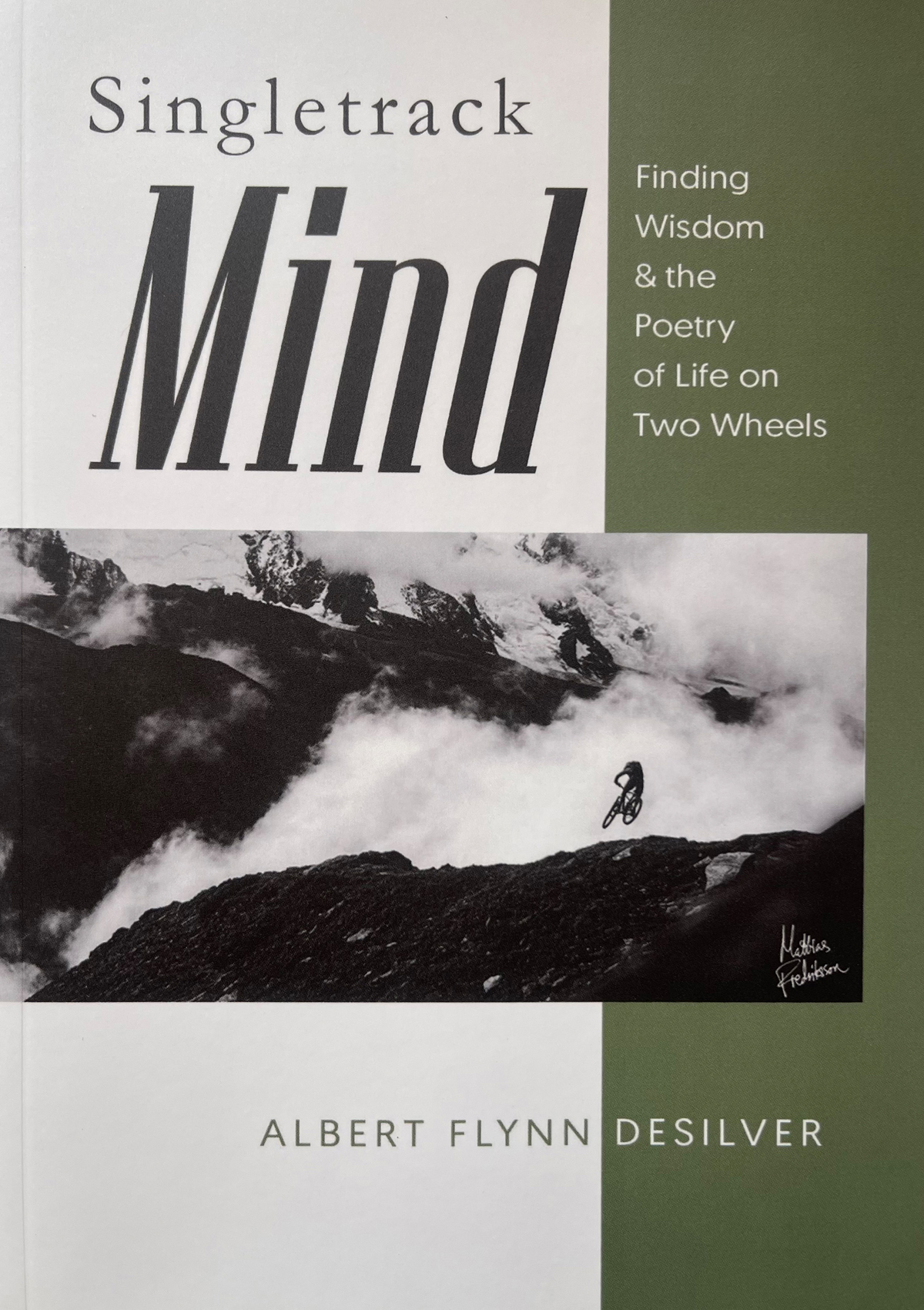
By Dave Iltis — Do you ride your mountain bike, but struggle for connection to the earth and life? Albert DeSilver’s wonderful new collections of essays, Singletrack Mind: Finding Wisdom & the Poetry of Life on Two Wheels, is part storytelling, part philosophy, part tribute to fallen friends. The collection of 7 stories by DeSilver with photos by Mattias Fredriksson is flowy and poetic. He writes in the haibun style of Japanese poet Matsuo Bashō that mixes prose with poems.
Singletrack Mind is a collection of essays by Albert Flynn DeSilver with photos, including the cover photo, by Mattias Fredriksson.
The former Marin County Poet Laureate includes an essay on his path to mountain biking through life called Beginnings. Here, he explores Dolores La Chapelle’s concept of Being – “in harmony with the elements—with no imposed will, reason or agenda, but rather with connection, immersion, and elemental collaboration.” He explores connectedness to the earth, and Zen – “what happens at speed in flow on a bike is the emptying of mind, the absence of thought, moving beyond thinking, evaluation, or judgement.” Mountain bikers and skiers may relate to this experience, where one is moving fast, and there’s no room for thoughts to clutter the mind.
In “The Point of All Return”, he explores the Point Reyes Peninsula, mixing history, terrain, and an epic day with a friend.
In “Fuzzy, Yes!”, DeSilver pays tribute to his late friend Fuzzy through a story of Hummingbird Trail.
Other essays include a tribute to another friend, Chris Geiger, riding in Slovenia, and mountain biking in Sedona.
DeSilver’s writing describes Deep Mountain Biking – fitting in with the world through mountain biking rather than dominating the world through technology. Being, “immersive flow” through riding, and the connection to the earth through a trail.
“One doesn’t feel so much that they are riding as that they are being ridden by the elements‑earth, air, fire, water—and the “gods” or spirit itself, carrying one forward into another dimension. This is singletrack mind.”
The book is a reminder of why we mountain bike and our connection to the earth and a highly recommended read, especially in our disconnected world.
Singletrack Mind: Finding Wisdom & the Poetry of Life
2022, the nonexistent press
ISBN 978-0-6468673-3-5
Available at albertflynndesilver.com
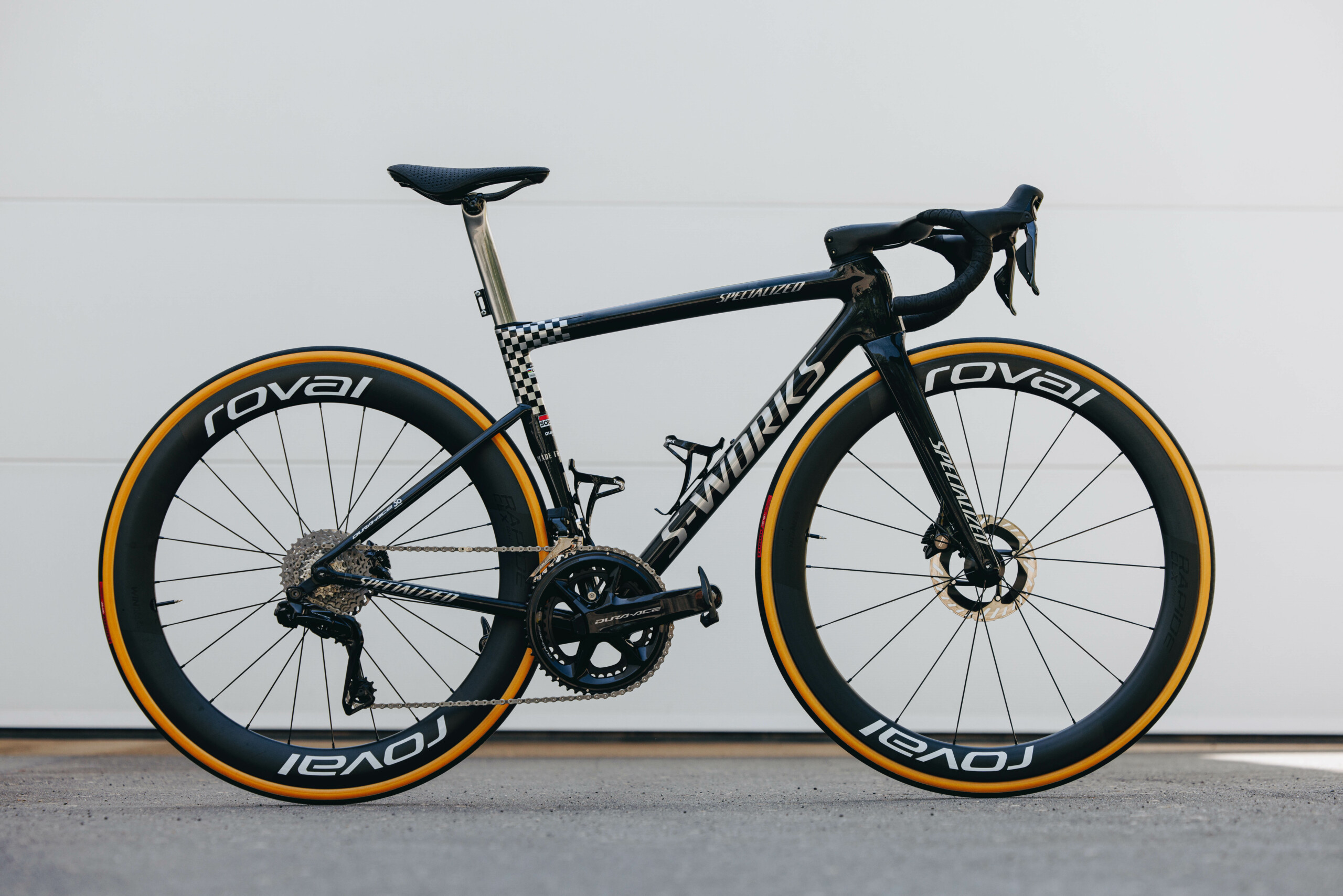
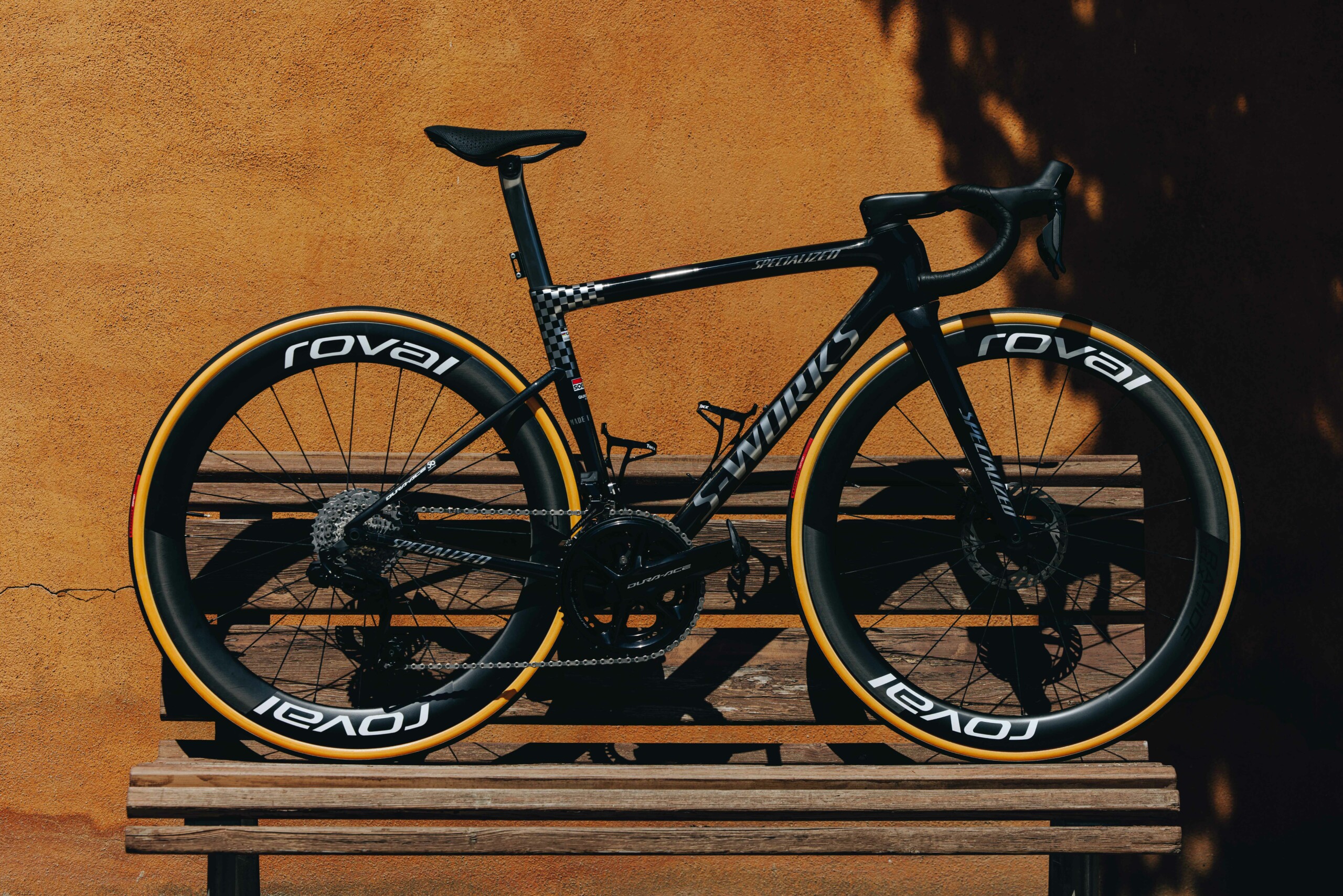
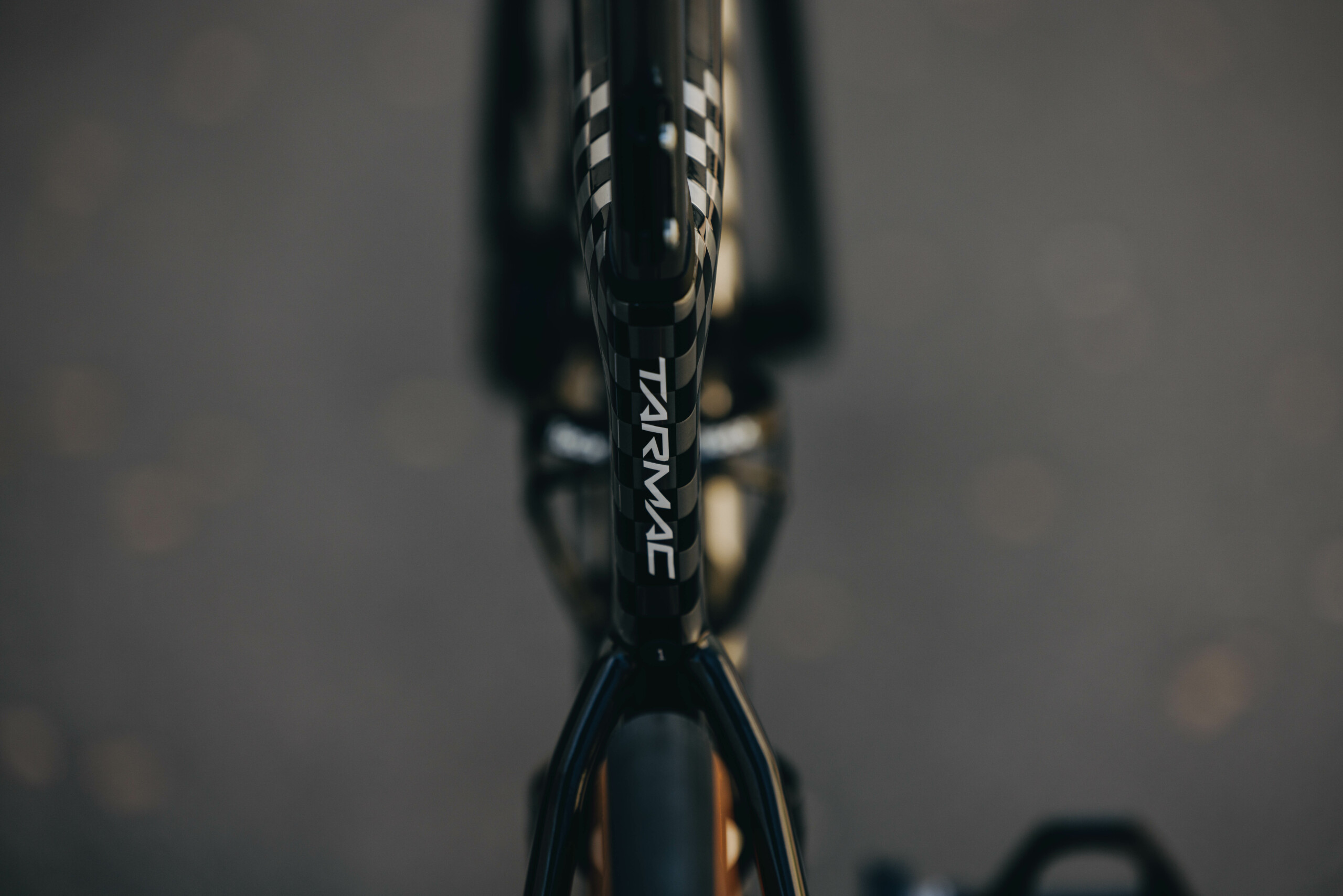
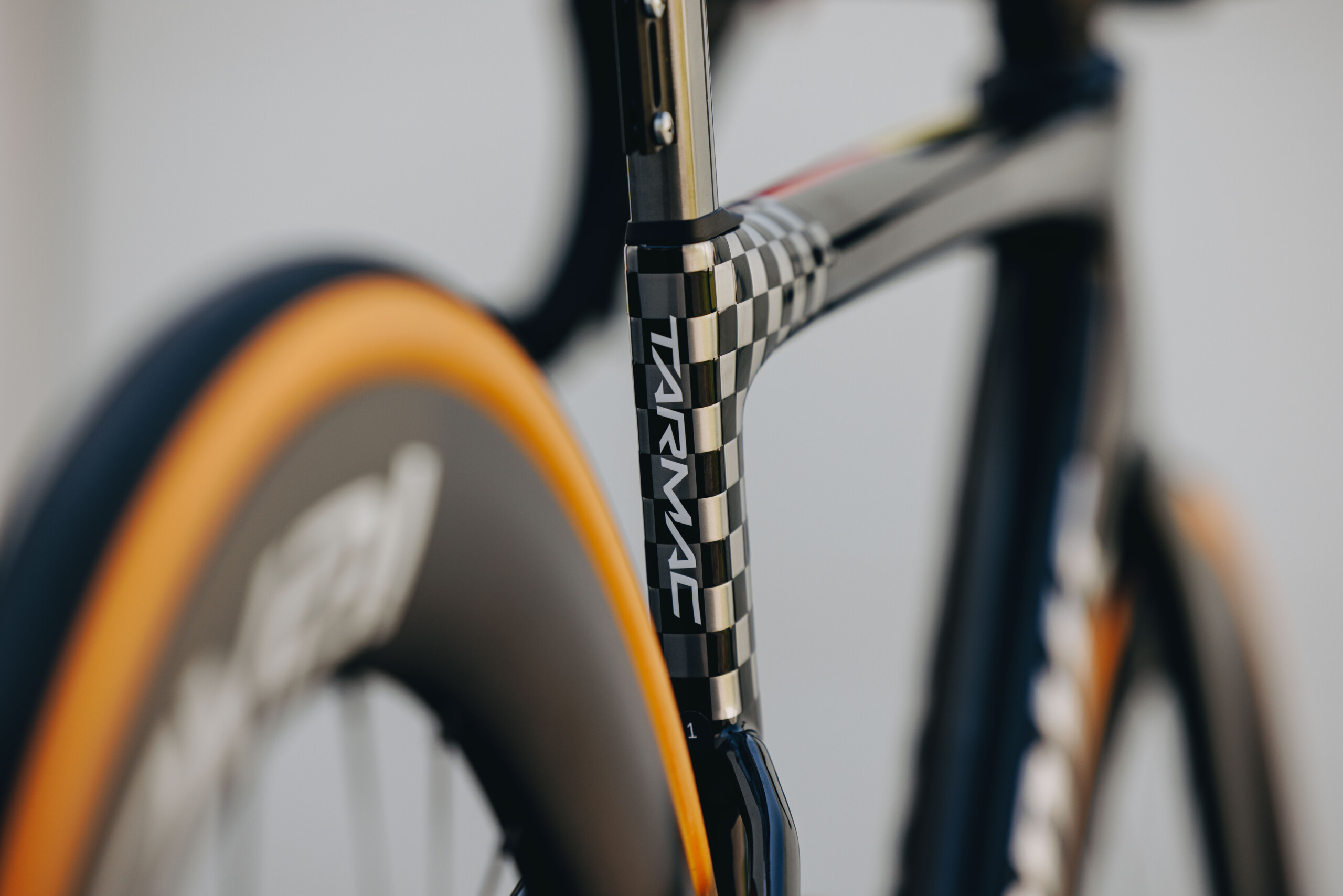
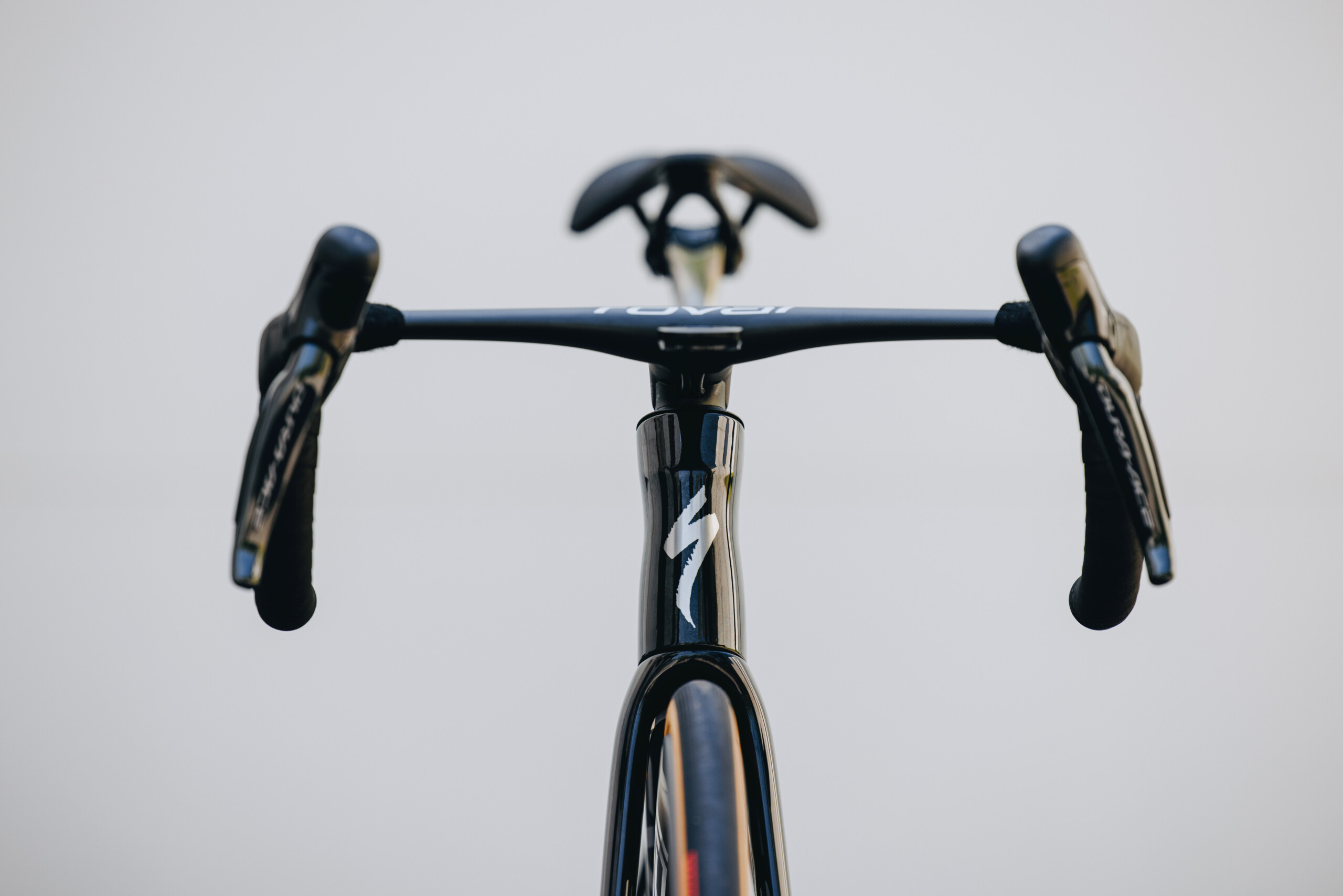
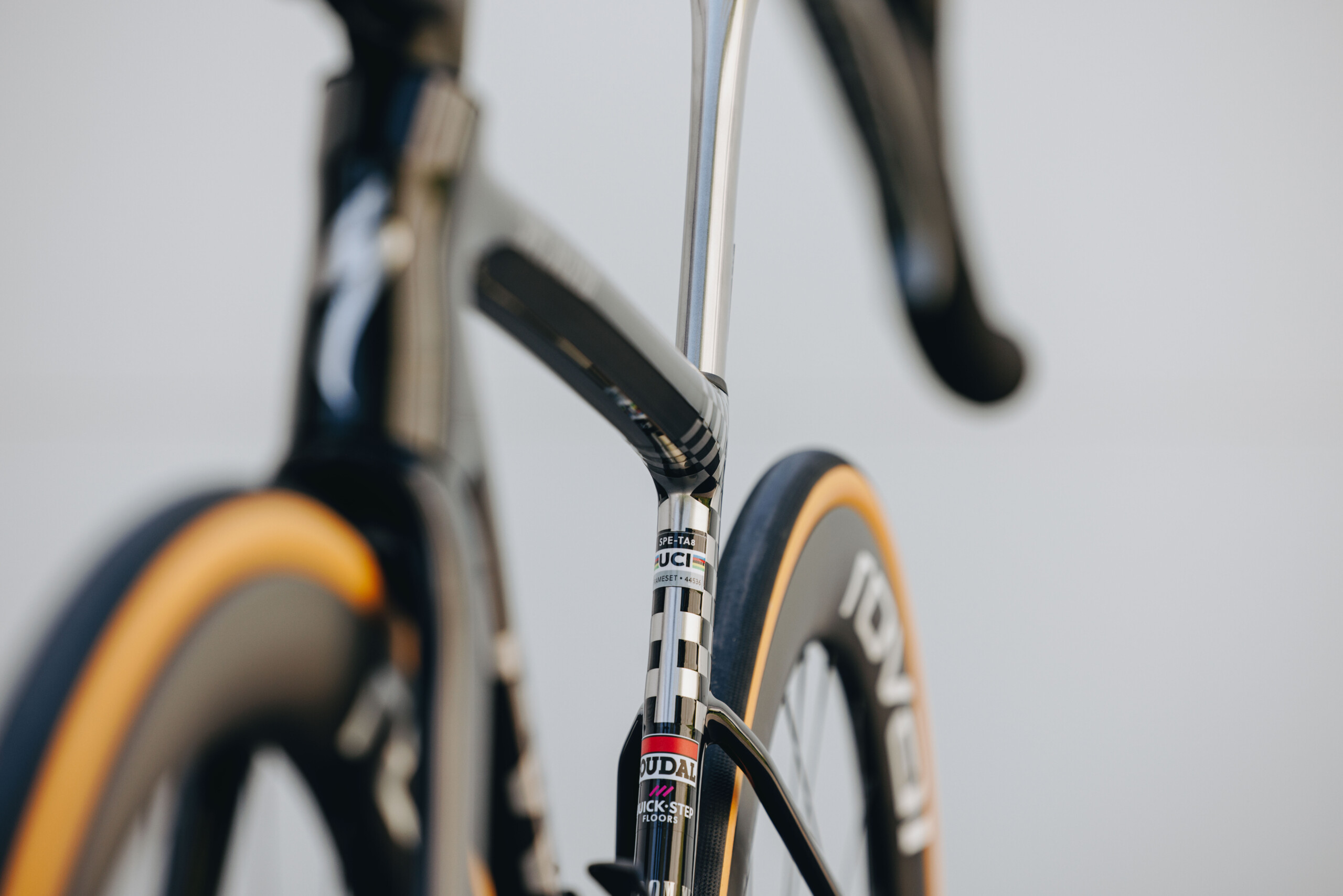
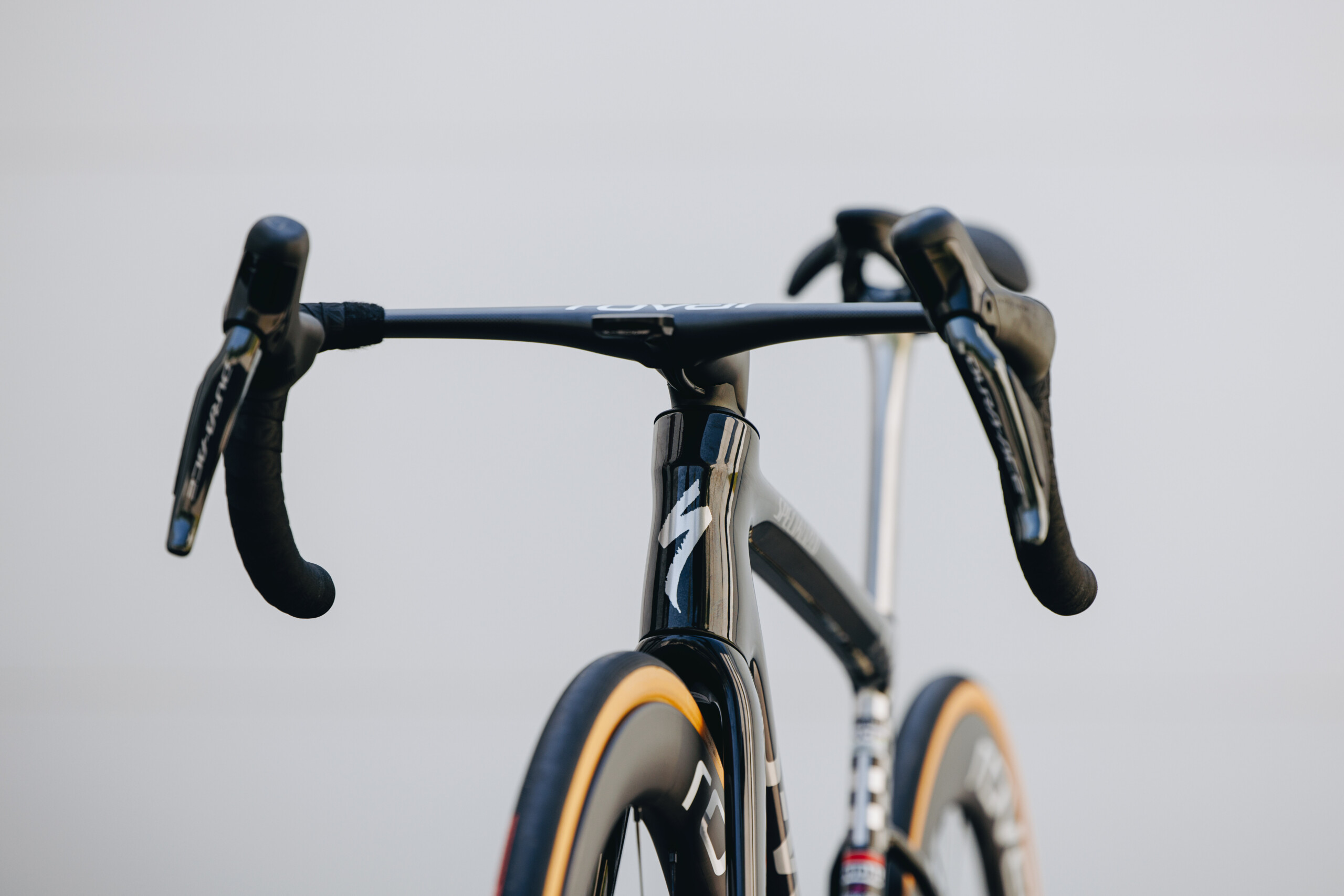
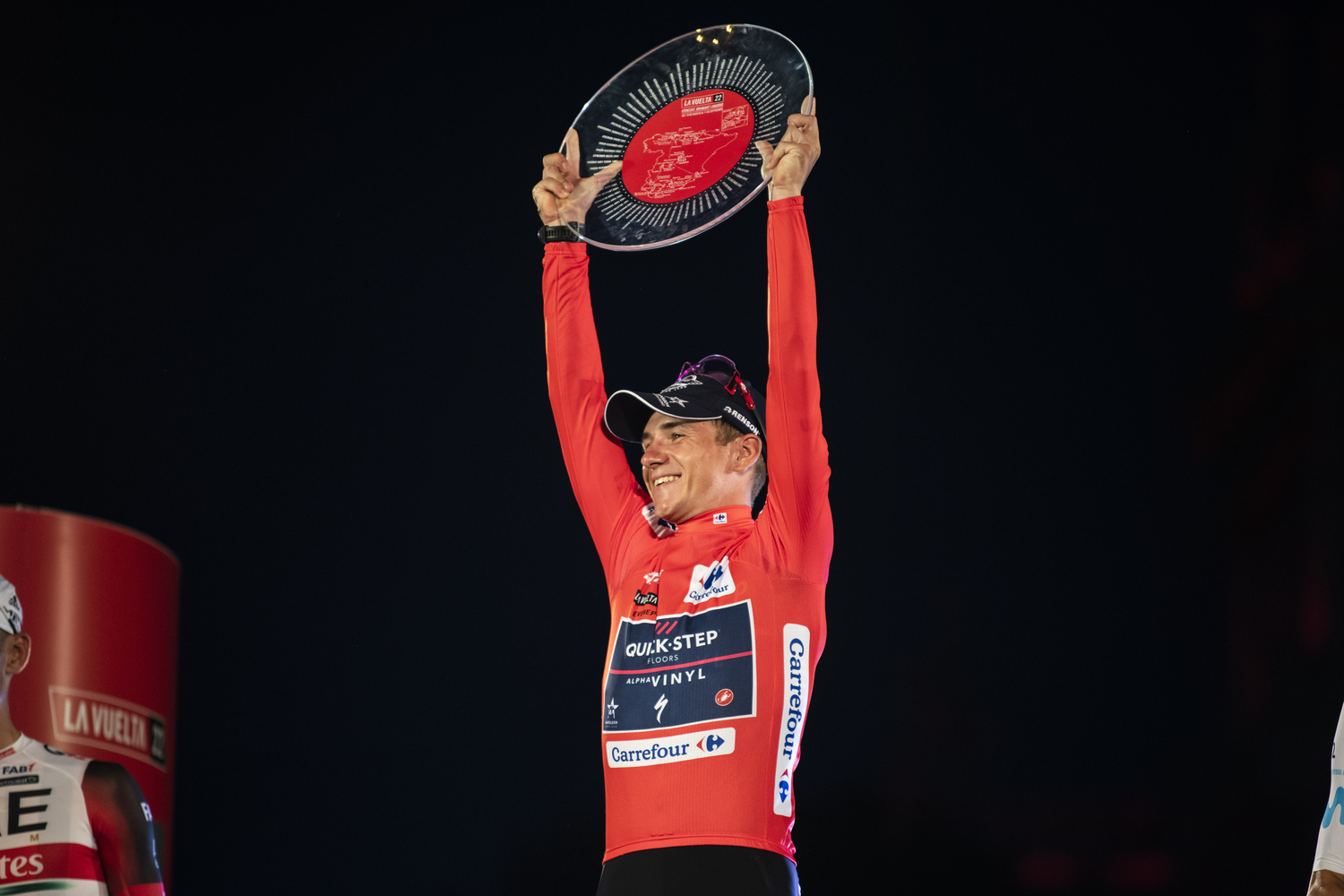
Remco Evenepoel’s Specialized Tarmac SL8 for use in the 2023 Vuelta a España. Photo courtesy Specialized.Remco Evenepoel’s Specialized Tarmac SL8 for use in the 2023 Vuelta a España. Photo courtesy Specialized.Remco Evenepoel’s Specialized Tarmac SL8 for use in the 2023 Vuelta a España. Photo courtesy Specialized.Remco Evenepoel’s Specialized Tarmac SL8 for use in the 2023 Vuelta a España. Photo courtesy Specialized.Remco Evenepoel’s Specialized Tarmac SL8 for use in the 2023 Vuelta a España. Photo courtesy Specialized.Remco Evenepoel’s Specialized Tarmac SL8 for use in the 2023 Vuelta a España. Photo courtesy Specialized.Remco Evenepoel’s Specialized Tarmac SL8 for use in the 2023 Vuelta a España. Photo courtesy Specialized.
By Heather Casey — In Part I of this article (Cycling West, Early Summer 2023 issue), I discussed the potential benefits and drawbacks of becoming fat-adapted for endurance athletes. While this can be an effective strategy for some athletes, it requires careful planning to optimize performance. For cyclists, fat adaptation must be implemented strategically to support the unique demands of the sport.
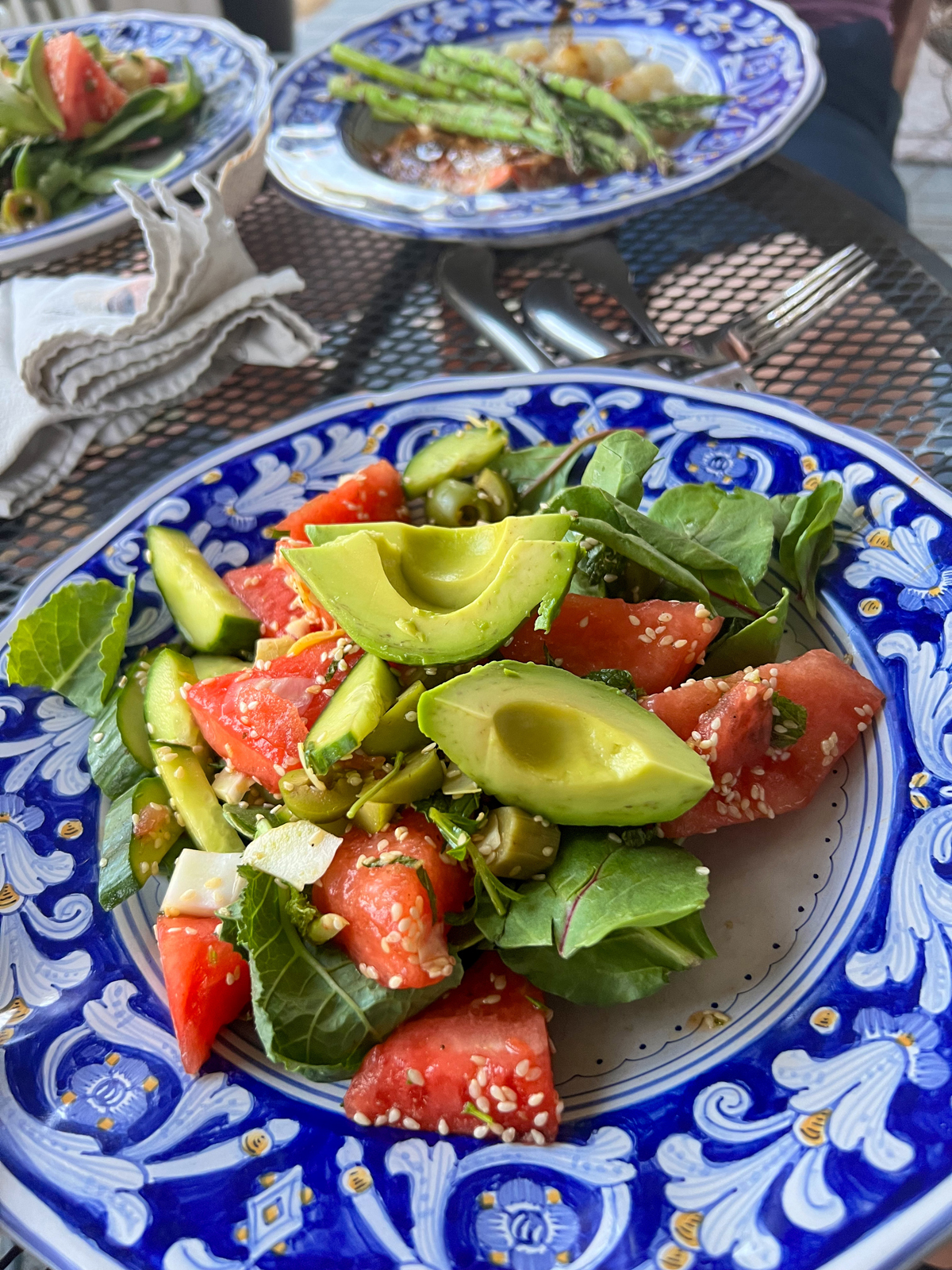
Avocados are a healthy source of fat that provide essential nutrients without spiking blood sugar. Photo by Heather Casey
Refresher: What is Fat Adaptation?
Fat adaptation refers to training your body to use fat as its primary fuel source during endurance exercise rather than relying on carbohydrates. The theory is that by becoming fat-adapted, athletes can conserve their limited carbohydrate stores and rely more on their abundant fat stores to sustain energy levels during long-duration exercise.
The keys to optimizing fat adaptation as a cyclist are:
Base Diet on Whole Foods: The foundation of a fat-adapted diet for cyclists should focus on high-quality fats, proteins, and vegetables. Avocados, nuts, seeds, eggs, meat, fish, and leafy greens provide essential nutrients without spiking blood sugar. Limit processed foods, even if they are low in carbohydrates.
Time Carbohydrate Intake: While lowering overall carbohydrate intake, cyclists should strategically consume carbohydrates to fuel high-intensity efforts. Have some carbohydrates before and during intense training rides and races when carbohydrates are needed to sustain power. Stick to low-carbohydrate meals during lighter training and recovery.
Incorporate High-Intensity Intervals: High-intensity interval training in Zone 5 with long rest periods teaches your body to tap into carbohydrates for fuel during sustained hard efforts. Include some intervals in your training to optimize carbohydrate utilization on race day.
Experiment with Carbohydrate Cycling: Try consuming extra carbohydrates 1-2 days per week to support intense sessions. Carbohydrate cycling prevents chronic low energy levels while continuing to promote fat adaptation.
Test Race Nutrition Strategies: Practice your racing nutrition during hard training rides. Test which foods and what timing of carbohydrate intake works best for you to avoid gastrointestinal issues while maintaining power.
Allow Time for Adaptation: It takes time for your body to become efficient at burning fat. Stick with a fat-adapted approach for at least 4-6 weeks before assessing its effectiveness.
Stay Hydrated: Adequate hydration aids in metabolism and performance. Incorporate electrolytes, especially during long rides, to prevent imbalances that may affect performance.
Cycling-Specific Considerations
Training Phases: Align carbohydrate intake with training cycles. Higher carbohydrate intake might be beneficial during high-intensity training blocks, while lower intake might suit base training.
Racing Scenarios: Learn to fine-tune carbohydrate intake based on the demands of specific races. This requires experimentation during training to understand how your body responds under different conditions.
Listen to Your Body: Recognizing signs of fatigue, hunger, or decreased performance may indicate a need for adjustment in carbohydrate timing or quantity.
Conclusion
Cyclists aiming for fat adaptation must approach their nutritional strategy with nuance and intention. A well-rounded low-carbohydrate lifestyle can be the bedrock for fat adaptation but incorporating carbohydrates in a deliberate and thoughtful manner is key to fulfilling the energy demands of training and racing.
Carbohydrate timing, individualized planning, and a strong understanding of cycling’s unique demands will enable cyclists to leverage the benefits of fat adaptation without compromising performance. This dynamic approach not only supports endurance but also promotes overall health and well-being, aligning with the holistic goals of many endurance athletes.
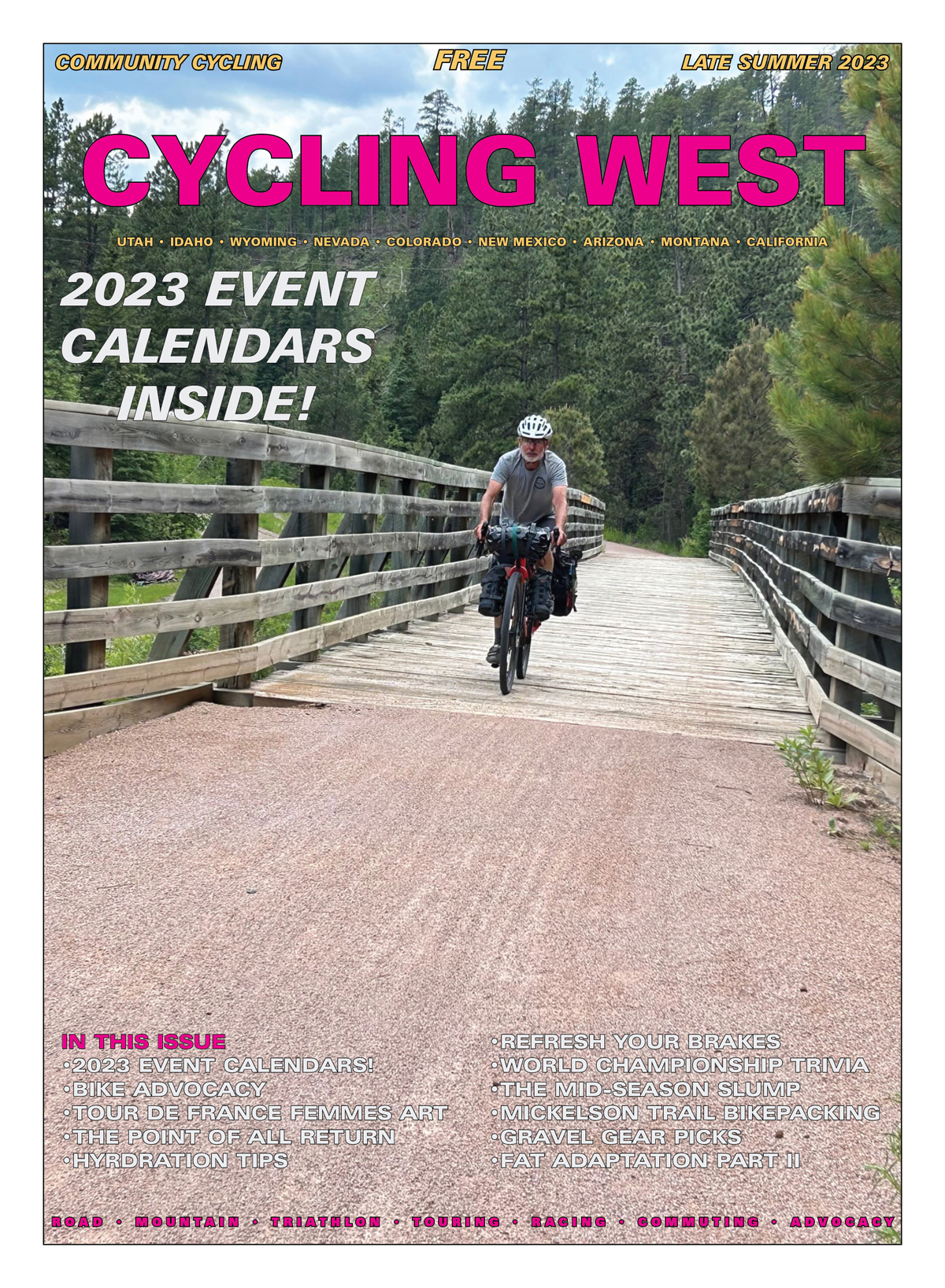
Cycling West and Cycling Utah Magazine’s Late Summer 2023 Issue is now available as a free download (11 MB download). Pick up a copy at your favorite Utah, Idaho, Wyoming, Nevada, Montana, Colorado, Arizona, New Mexico, and Northern California bike shop or other location.
Originally held in the spring and preceding the Giro d’Italia, the Vuelta a España, the third of cycling’s Grand Tours has gone from strength to strength since moving to its current fall date in 1995. The event has used creative course design to help it serve as a key preparation event for the World Championships. It has also successfully been a “back-up Tour” for riders who have failed, fallen ill, or crashed out of the Giro or the Tour.
Of course, it has also been targeted by riders, often younger up-and-coming riders or those on the largest and strongest teams who didn’t make the Giro or Tour squads, as an objective for the season.
This season, despite the Worlds preceding the event, promises to be one of the greatest editions of the Vuelta ever! Grand Tour winners Egan Bernal, Geraint Thomas, Richard Carapaz, three-time Vuelta winner Primoz Roglic, defending champion Remco Evenepoel, and even Tour champion Jonas Vingegaard will all be riding this year’s edition to win. A true clash of cycling’s current stage racing titans with only Tadej Pogacar, opting not to participate. With that in mind, let’s test your knowledge on the third of cycling’s three Grand Tours!
Q1. Spanish cyclists are far and away the most successful in their home tour, winning 31 of the 63 editions. France is a distant second with nine victories. However, the race has been dominated by foreigners in recent years. When was the last time a Spaniard won the Vuelta?
Q2. Who is the only American rider to win the Vuelta? BONUS: He is also the only American rider to win one of the coveted category jerseys (Mountain, Points, Combo) as well.
Q3. Former World Road-Race Champion (and newly crowned World Time-Trial Champion) Remco Evenepoel won the Vuelta in 2022 for Belgium. Belgium in third as a nation in all-time Vuelta wins with eight, but Evenepoel’s win (and perhaps repeat this year) marks a resurgence in Belgian success in Grand Tours. Prior to Remco’s win, when was the last Belgian victory at the Spanish Grand Tour?
Q4. The Women’s Vuelta has gone through a number of permutations beginning with a one-day event coinciding with the finish of the men’s event, to the week-long Grand Tour format of today, which was already been held this year. Over the course of its nine editions, who has been its most consistent champion?
Q5. South American riders Richard Carapaz (Ecuador) and Colombian Egan Bernal (Colombia) are among the favorites for this year’s Vuelta. What is the best ever finish in the Vuelta by a South American racer?
World’s Premier Freeride Mountain Biking Competition will be Available on ESPN/ESPN+
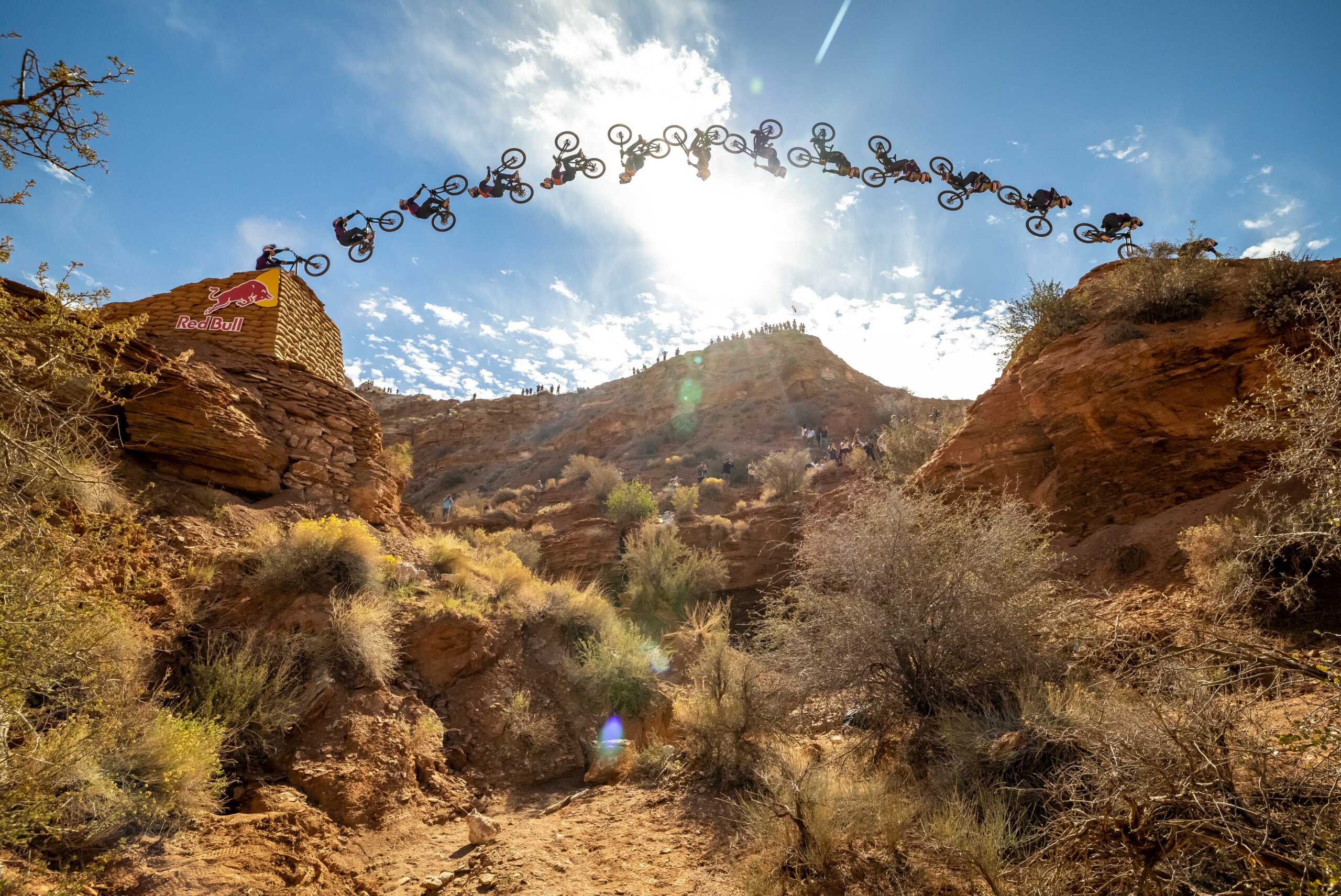
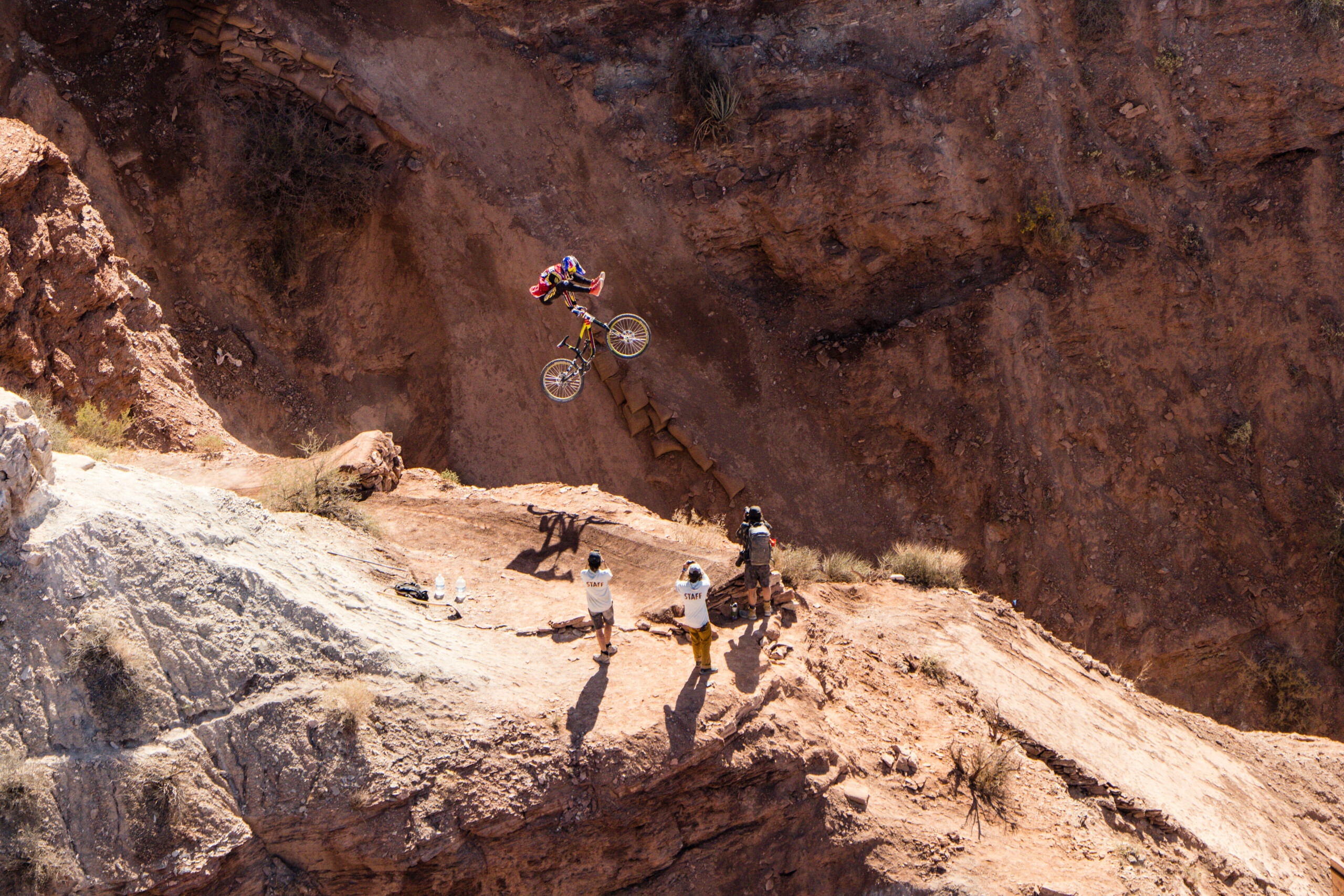
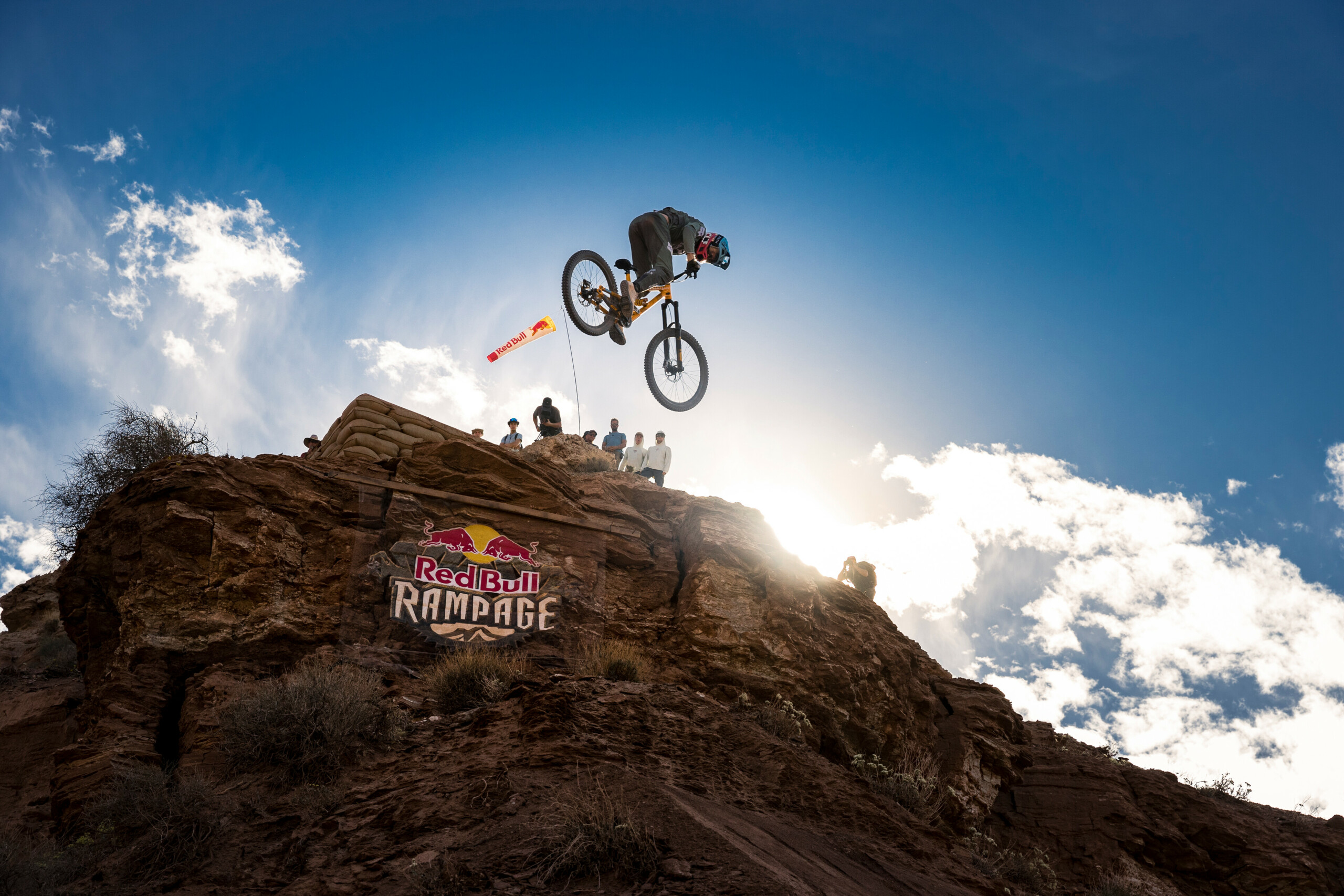
VIRGIN, UT (August 3, 2023) — The world’s gnarliest big-mountain freeride mountain bike competition, Red Bull Rampage, announces its return to southwest Utah. On Friday, October 13th, the top 18 mountain bike athletes will descend upon some of the most difficult terrain in the world to compete for the title of baddest freerider in the scene.
Szymon Godziek rides his bike at Red Bull Rampage in Virgin, Utah, USA on 21 October, 2022. // Garth Milan / Red Bull Content Pool // SI202210220308 // Usage for editorial use only //
ESPN+ returns to exclusively stream the event in the U.S., and the competition will be available live on Red Bull TV in all other countries. Following the live show, the complete event will be available on-demand on both ESPN+ and Red Bull TV. On October 22, viewers can also tune-in to a 90-minute highlight on ESPN.
Jaxson Riddle rides his bike at Red Bull Rampage in Virgin, Utah, USA on 21 October, 2022. // Christian Pondella / Red Bull Content Pool // SI202210220361 // Usage for editorial use only //
For fans looking to attend the event in-person, tickets will go on-sale via the Red Bull Rampage website with an announcement to come, so check the site for further updates and the official on-sale date in the coming weeks.
The inaugural Red Bull Rampage was held in 2001, and last year we celebrated 21 years of Red Bull Rampage. Since then, 16 different events and 10 different winners have earmarked their place in the history books. This year, viewers can expect an enhanced broadcast experience with upleveled technology and new voices sharing their perspective on the sport.
Brett Rheeder rides at Red Bull Rampage in Virgin, Utah, USA on 21 October, 2022. // Robin O’Neill / Red Bull Content Pool // SI202210220343 // Usage for editorial use only //
The competition format will remain the same, with an elite group of riders carving their ultimate lines into the side of near-vertical sandstone ridges with the help of their two-person build crews. In advance of the competition, riders and their support crew will spend four days building their lines, followed by a rest day, and then four practice days. All of the preparation will end in an epic showdown in the desert, where only one will ride away as champion of the 2023 Red Bull Rampage.
To stay up to date on the latest Red Bull Rampage information, including confirmation of the official rider list, venue details, ESPN+ and Red Bull TV tune-in times, and spectator and ticketing info, follow @RedBullBike and visit the event website here.
KETCHUM, Idaho (August 23, 2023) — Rebecca’s Private Idaho (RPI), now in its 11th year, offers four days of world-class racing and riding over nearly 200 miles of gravel in the center of Idaho’s heartland, August 31-September 3. Riders may choose a one-day gravel race or, for experienced and elite racers, participate in the four-day Queen’s Stage Race. RPI is one of America’s longest-running, mass-participation gravel races, and is rated a Top Five Gravel Event by Global Cycling Network and one of the 25 Best Bike Rides in the World by Outside Magazine.
Photo courtesy Rebecca’s Private Idaho
All RPI riders pedal with a purpose, supporting the Be Good Foundation, which seeks to enrich communities by using the bicycle as a catalyst for healing, empowerment, and evolution. Proceeds from various aspects of RPI are used by the Foundation to support global, national, and local nonprofit organizations that use the bicycle to improve health and overall well-being, connect communities, boost local economies, and protect our planet.
Photo courtesy Rebecca’s Private Idaho
RPI was founded in 2013 by Rebecca Rusch, who is a seven-time world champion, record setting endurance and adventure athlete, bestselling author, entrepreneur, and philanthropist. It has been staged every Labor Day weekend since then in Rebecca’s hometown and surrounding backcountry of Ketchum, Idaho.