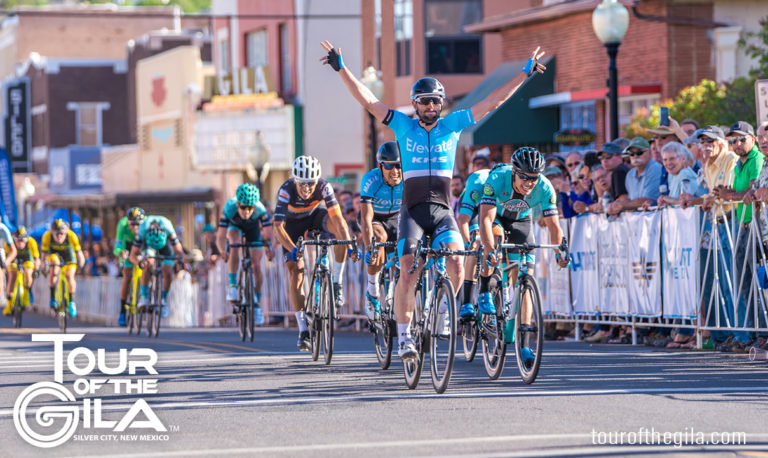
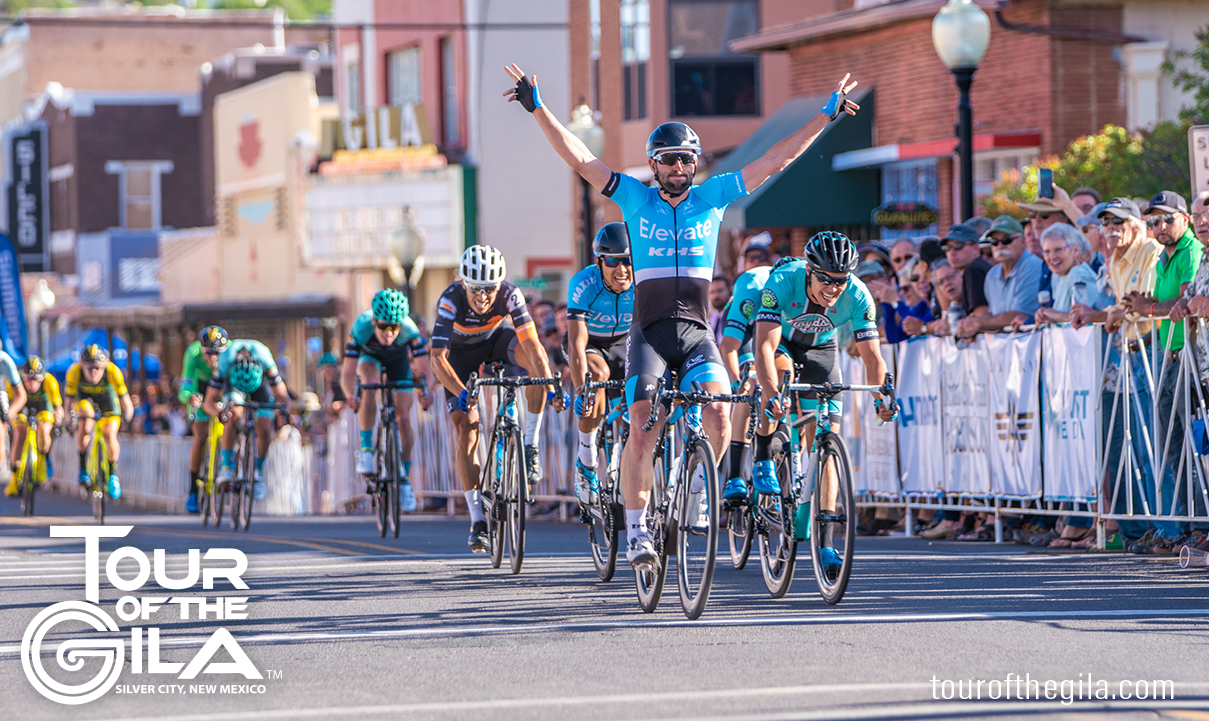
SILVER CITY, New Mexico (December 6, 2022) — The three-stage Virtual Tour of the Gila will be happening December 16, 17, and 18, 2022. People who wish to watch pro road cyclists compete while riding their trainers can watch via any device online by going to TouroftheGila.com. There is no cost to watch the races.
The Virtual Tour of the Gila is a part of the Echelon Racing League using modified, virtual versions of the in-real-life courses. The Echelon Racing League features men’s and women’s teams from across North America, as well as select esports and international teams.
Photo courtesy Tour of the Gila
The Echelon Racing League will be on the virtual platform RGT Cycling. What is unique about RGT is that they have the capability of making virtual versions of our real Tour of the Gila racecourses. GPX files of our 3 race courses, the Tyrone Individual Time Trial, the Mogollon Road Race, and the Gila Monster Road Race, were created and sent to RGT.
“The folks at RGT created our in-real-life racecourses onto their cycling platform,” explained Jack Brennan, Tour of the Gila Race Director. “When the Pro Men and Pro Women race the Virtual Tour of the Gila, they will be actually racing and experiencing, on-line, the road profiles that make up our Tour of the Gila. That is really cool!”
The Virtual Tour of the Gila livestream race schedule:
Tyrone Individual Time Trial: Friday, December 16
Pro Men: 5:05PM MST
Pro Women: 6:00PM MST
Mogollon Road Race: Saturday, December 17
Pro Men: 8:05AM MST
Pro Women: 10:10AM MST
Gila Monster Road Race: Sunday, December 18
Pro Men: 8:05AM MST
Pro Women: 10:10AM MST
“Life should not be a journey to the grave with the intention of arriving safely in a pretty and well preserved body, but rather to skid in broadside in a cloud of smoke, thoroughly used up, totally worn out, and loudly proclaiming “Wow! What a Ride!” – Hunter S. Thompson
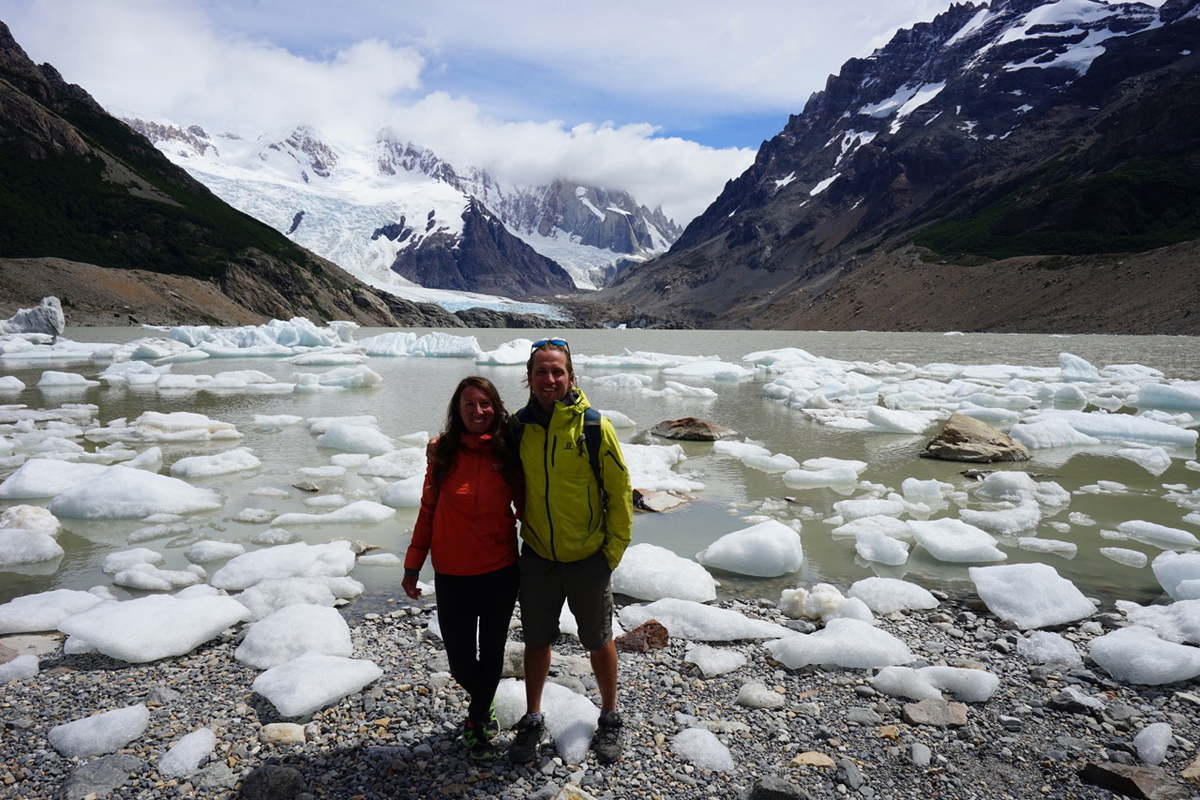
Kristen has a smile that lights up any room she enters. I first noticed her and Ville one day in the gym onboard our ship heading towards Patagonia. A few days later there was an announcement of a spur-of-the moment lecture by a couple that had bicycled down the Pan-American highway. It sounded interesting so we went. The show was unscripted and very entertaining mostly because of the two people with the oversized personalities. It was then that I knew their story needed to be told.
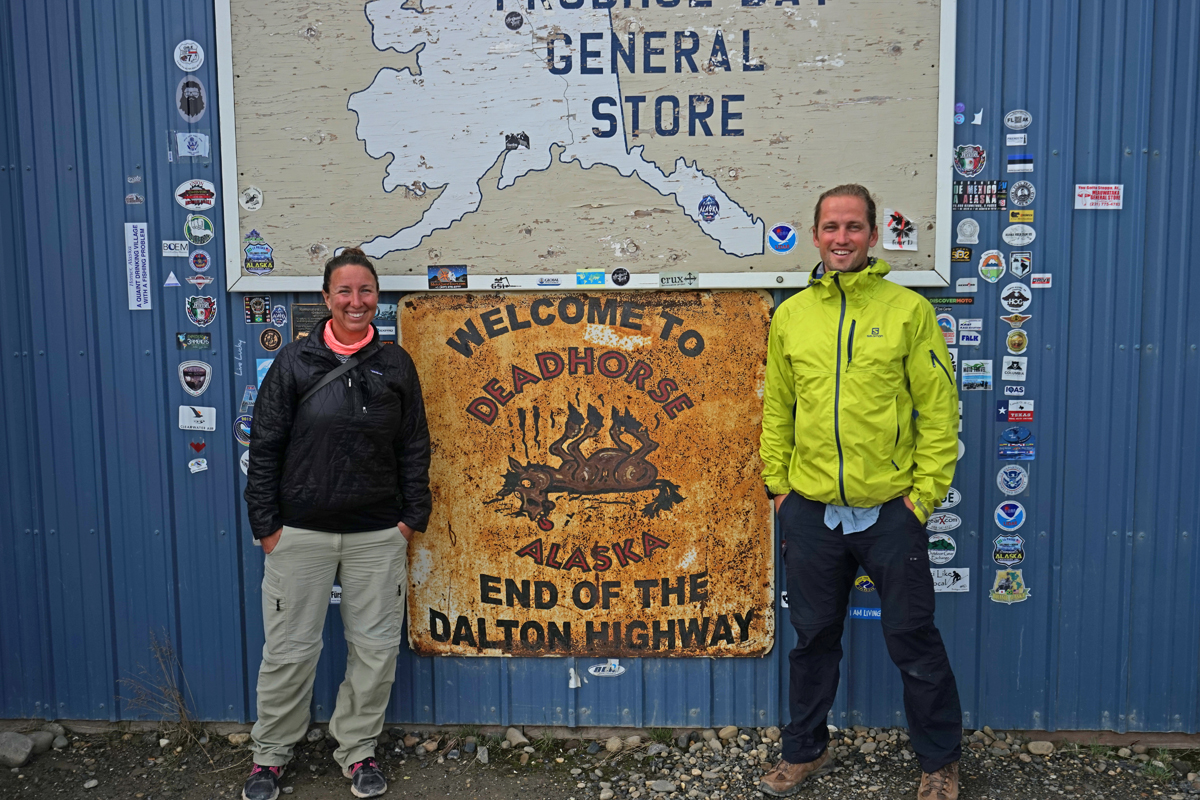
Kristen and Ville at the start of their journey in Deadhorse, Alasaka. Photo courtesy Kristen and Ville
Their journey begins in Bend, Oregon, one of my most favorite places on the planet. In 2011 they had hiked the Pacific Crest Trail with no real prior experience to prepare them. “All it took is one foot in front of the other, and just like life, you get through it. And professional backpackers we soon became.” This is the attitude they took with them when they decided to bike from Prudhoe Bay, Alaska to Fin del Mundo outside of Usuhaia, Argentina. With some help from their friend John Frey from Hutches Bike shop in Bend, they soon assembled their Surly Disc Trucker bikes, put together a rough route of the trip, then headed up to Alaska. Kristen’s advice is simple for those that want to try an epic adventure, “Don’t think about and plan everything, just get a bike, some gear together and go. Over-planning is pointless because everything changes once you start.” This is a metaphor for life: know where you are, where you want to be, then get going.
Photo courtesy Kristen and Ville
“Why ride over 20,000 miles? Because the voice of reason flew out the window a long time ago telling us not to. And why not do it? Ever changing scenery for nearly 2 years will be mind-blowing and intense, but honestly, we really do this for the people we meet. The characters we met hiking the PCT pretty much just redeems your faith in humanity. Some of the kindest, coolest, wackiest, neatest, people that helped us just because it felt right. And for no reason other than to help someone in need.” Her words definitely apply to the bicycling community where the spirit of helpfulness abounds. This was also an opportunity to help out several organizations. One that is particularly near and dear to them is Carly’s Kids (http://www.carlyskids.org) which raises money to send disadvantaged children to outdoor school.
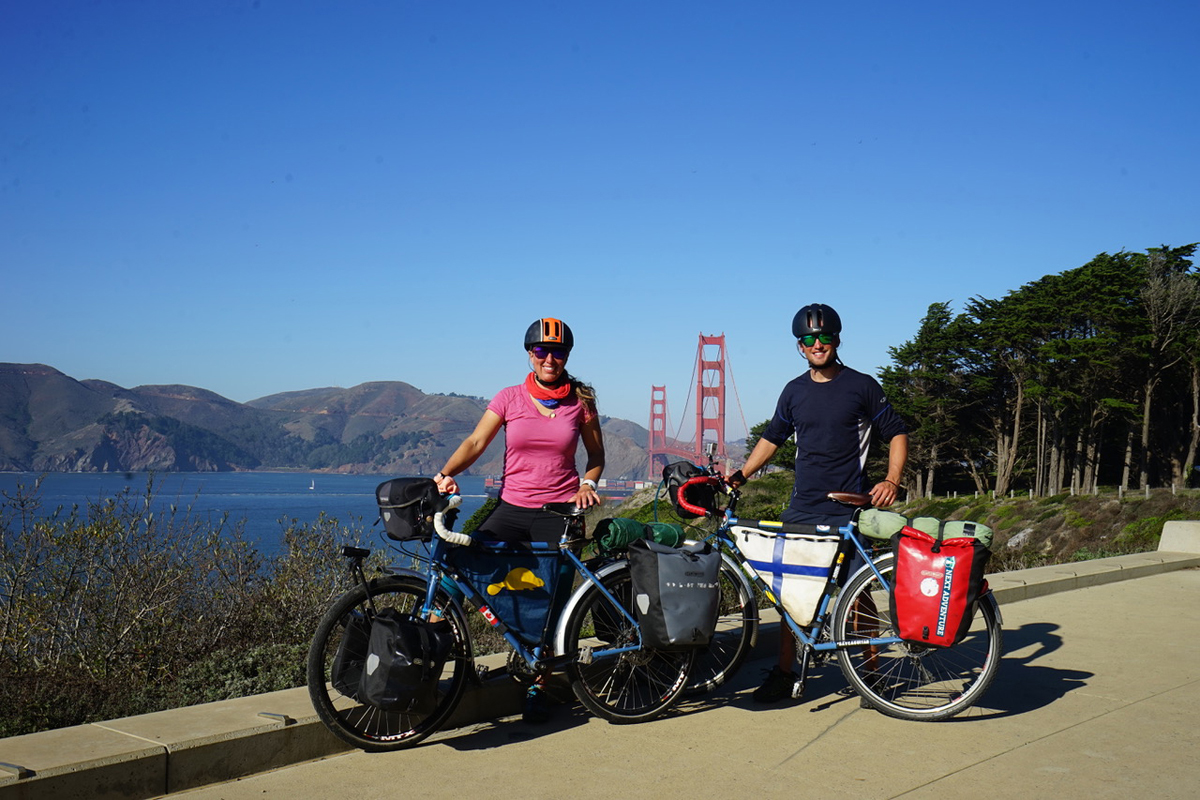
Alaska to San Francisco. Off to South America. Photo courtesy Kristen and Ville
The trip was punctuated with random acts of kindness, everything from letting them stay in a home, providing food and water, to donating to help fund the trip. These acts added to a large group of data points that indicated that people truly are good no matter where you go in the world and that kindness begets kindness.
Their adventure covered 18,235 miles across innumerable countries and took them 20 months to complete. Along the way, they experienced encounters with a bear, and contracted dengue fever which kept them on a couch in Costa Rica for five weeks.
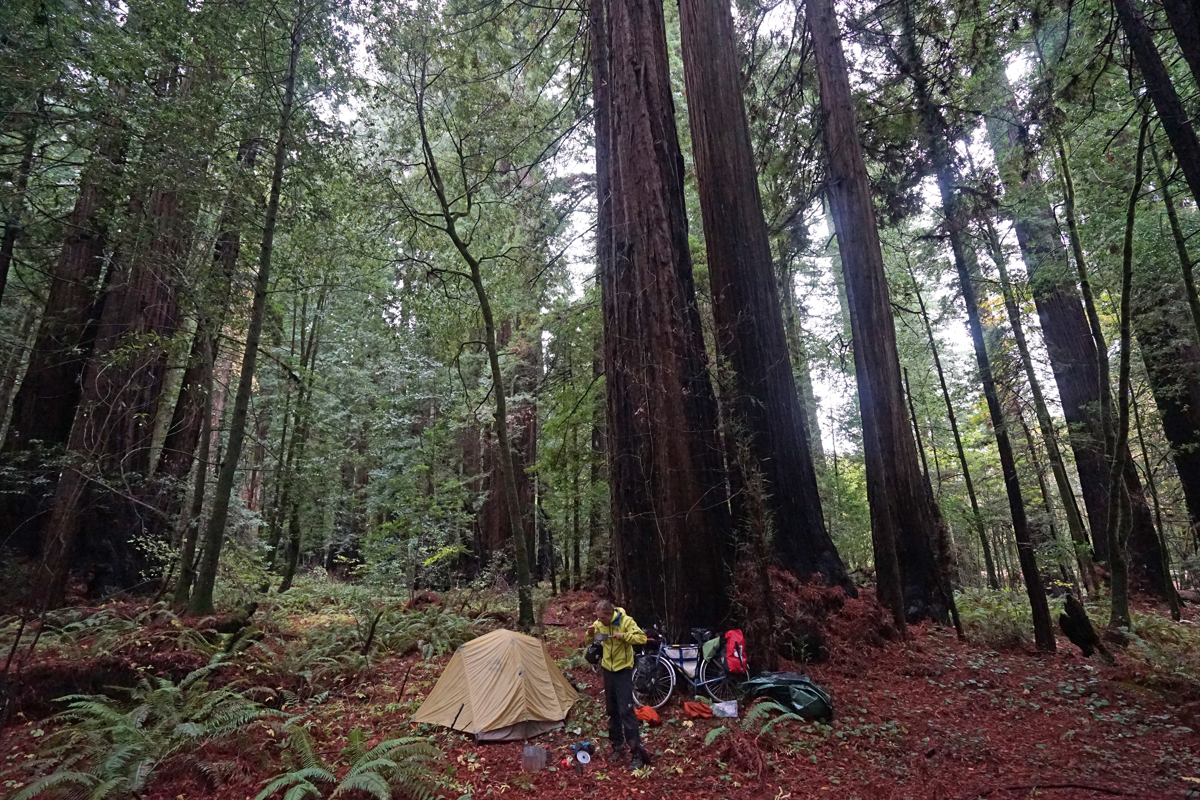
Camping in the Redwoods. Photo courtesy Kristen and Ville
The bear story is best told in their own words, “It was late one evening biking south on the Cassiar Highway in British Columbia, Canada. We were just about to start our search for a good spot to camp and made our way down a steep hill with an uphill straight in front of us, when a large black bear wandered up onto the pavement right in front of us. The sides of the roads were cleared of trees for ease of visibility for cars, and allowed for lots of berry bushes to grow. This bear had been feasting on the plump berries right along the road when we had startled her and she came up on the road directly in front of us. We braked hard, and climbed off our bikes, putting the bikes between her and us. Unfortunately for us, two little black balls of fluff popped right out behind her from the bushes and we realized with a sinking feeling that this unfortunate situation was about to get a lot worse. As the mother bear pinned her ears to her head, started to grunt and snort, and then began her charge no more than 20 feet from us, we both froze realizing our bear cans were buried deep in our panniers. Very bad planning on our part for such a situation as the one we were currently in. Trying to think fast, we couldn’t remember what advice we had been given when confronting a bear. And an angry, protective mother bear at that. Stop, drop and roll? Nope. That was fire. Hide under your desk? Earthquake. Oh, make yourself big, loud, yell, wave your arms in the hopes it scares them away. And luckily for us, it worked! Mid-charge, she turned, and headed straight for the bushes with babies in tow. Phew! That was a close one. After dodging that bullet, we decided to ride at least another fifteen miles before looking for a camping spot, pulling all our food up into a tree and loudly making all bears in a few miles radius aware of our presence.”
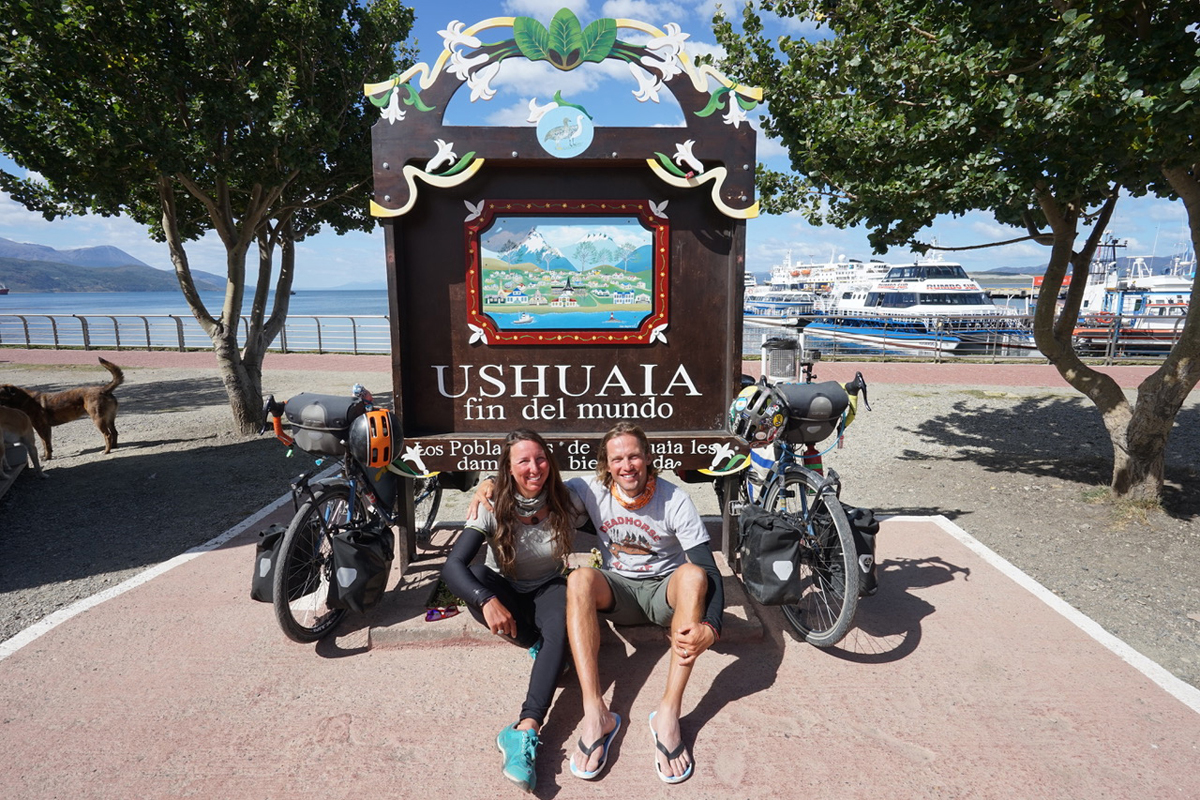
At the end of the earth, Ushuaia, Argentina. Photo courtesy Kristen and Ville
Their faith in humanity has been renewed along with their spirits and their desire to explore the world further. Ville is working on a film of the trip, which, hopefully, will be shown at next years Wasatch Mountain Film Festival as well as several others and Kristen is looking to publish a book on their adventures within the next 6 months. I would highly recommend that you go to their website, www.welostthemap.com to get to know them better and to learn more about this and upcoming adventures.
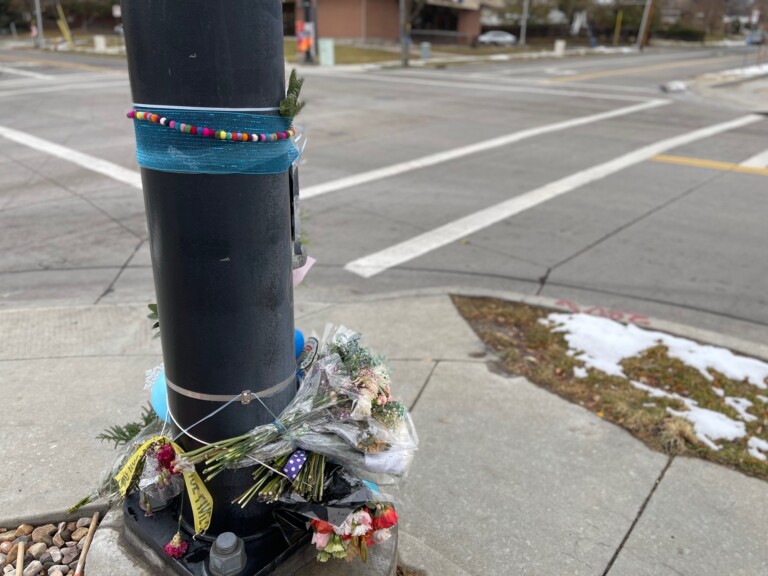
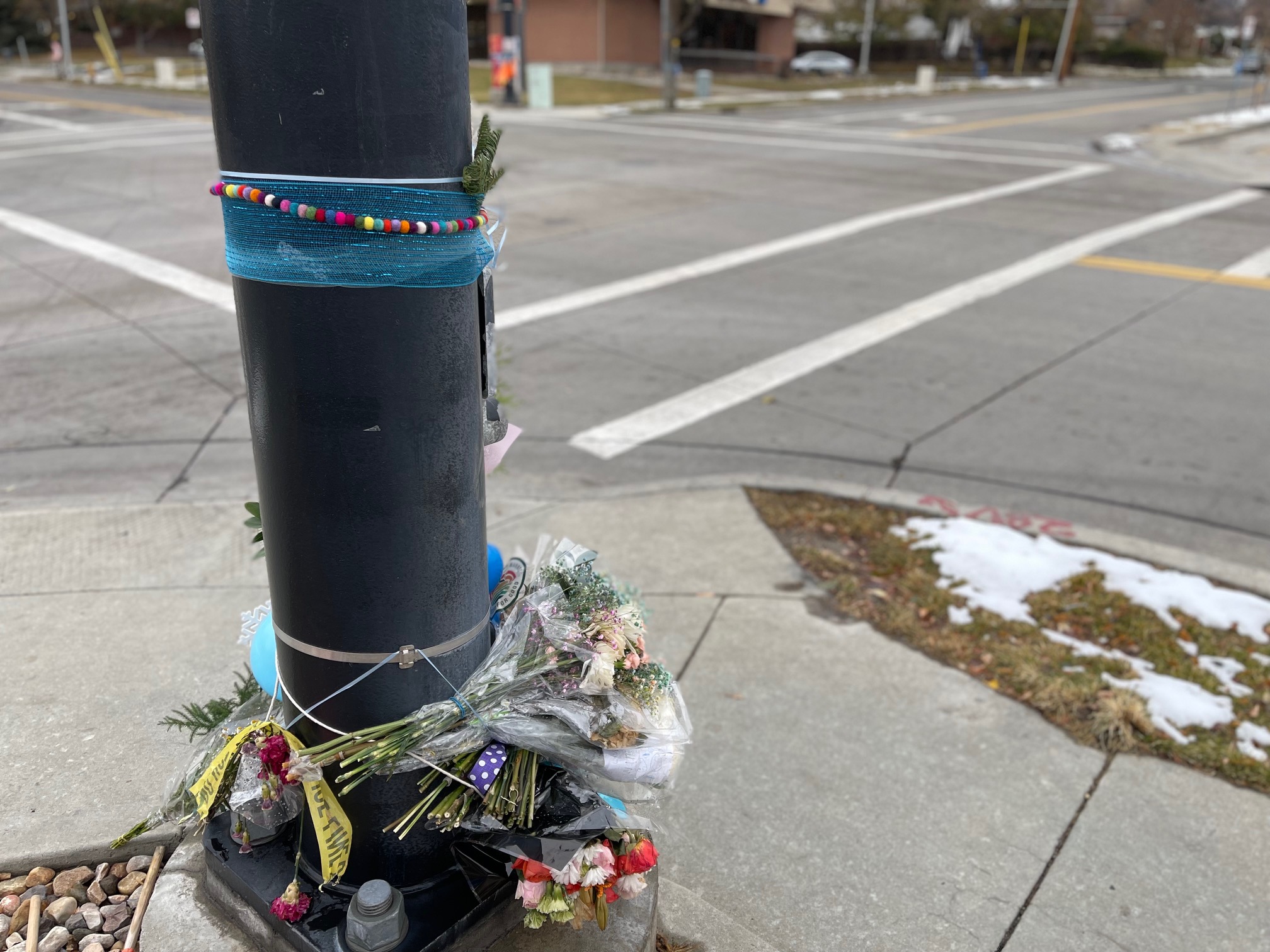
On November 30, 2022, 11-year-old Winnie Wolfgramm was tragically killed in a crosswalk on 1300 South and 2100 East by a driver, while crossing the street with a friend. Details from the Salt Lake City Police Department are sparse, but it appears that her friend had made it safely across the street before Winnie was hit.
According to a witness (who asked not to be identified for privacy reasons) who saw the crash, the driver of a Nissan Titan pickup truck turned left from 1300 South westbound to 2100 East southbound and hit the child in the crosswalk on a green light.
We are heartbroken by this avoidable death and are calling for action from Salt Lake City.
The site of the death of Winnie Wolfgramm on 1300 South and 2100 East. She was hit and killed in the crosswalk on the right of the photo. Photo by Dave Iltis
If you would like to Vision Zero implemented in Salt Lake City, please email Mayor Mendenhall at [email protected] and/or sign the petition below:
[emailpetition id=”6″]
When is one more death or injury too much?
Cycling Utah is calling on Salt Lake City Mayor Erin Mendenhall and the Utah Department of Transportation (UDOT) to immediately adopt Vision Zero to eliminate all traffic fatalities and injuries in Salt Lake City.
In Cycling Utah’s survey sent to mayoral candidates prior to each of the last two elections (in 2015 and 2019), we asked candidates if they would be willing to adopt Vision Zero. Both Jackie Biskupski, who served as Mayor from 2016-2020, and Erin Mendenhall (serving from 2020-2024) agreed to do so. Former Mayor Biskupski never followed through. Current Mayor Mendenhall still has a chance to do so.
Erin Mendenhall: As Mayor, I will convene a committee of interested stakeholders and SLC transportation experts to review Vision Zero opportunities–including speed limits–for Salt Lake City. Pedestrian and cyclist safety is critical, particularly amid such population and transportation growth.
Mayor Mendenhall needs to follow through on this immediately.
So, what is Vision Zero? From the Vision Zero Network Website:
Vision Zero is a strategy to eliminate all traffic fatalities and severe injuries, while increasing safe, healthy, equitable mobility for all.
“Committing to Vision Zero will take the following strategies:
Building and sustaining leadership, collaboration, and accountability – especially among a diverse group of stakeholders to include transportation professionals, policymakers, public health officials, police, and community members;
Collecting, analyzing, and using data to understand trends and potential disproportionate impacts of traffic deaths on certain populations;
Prioritizing equity and community engagement;
Managing speed to safe levels; and
Setting a timeline to achieve zero traffic deaths and serious injuries, which brings urgency and accountability, and ensuring transparency on progress and challenges.”
In May 2022, following a spate of traffic deaths, Mayor Mendenhall and UDOT Director Carlos Braceras announced the creation of a “Safe Streets Task Force” which is intended to be a “multi-department effort with the Salt Lake City Police Department and Transportation Division to identify the most critical areas of the city where intervention may be necessary to prevent future crashes, injuries, and deaths.”
Mendenhall and Braceras also announced a partnership with the State of Utah’s Zero Fatalities program.
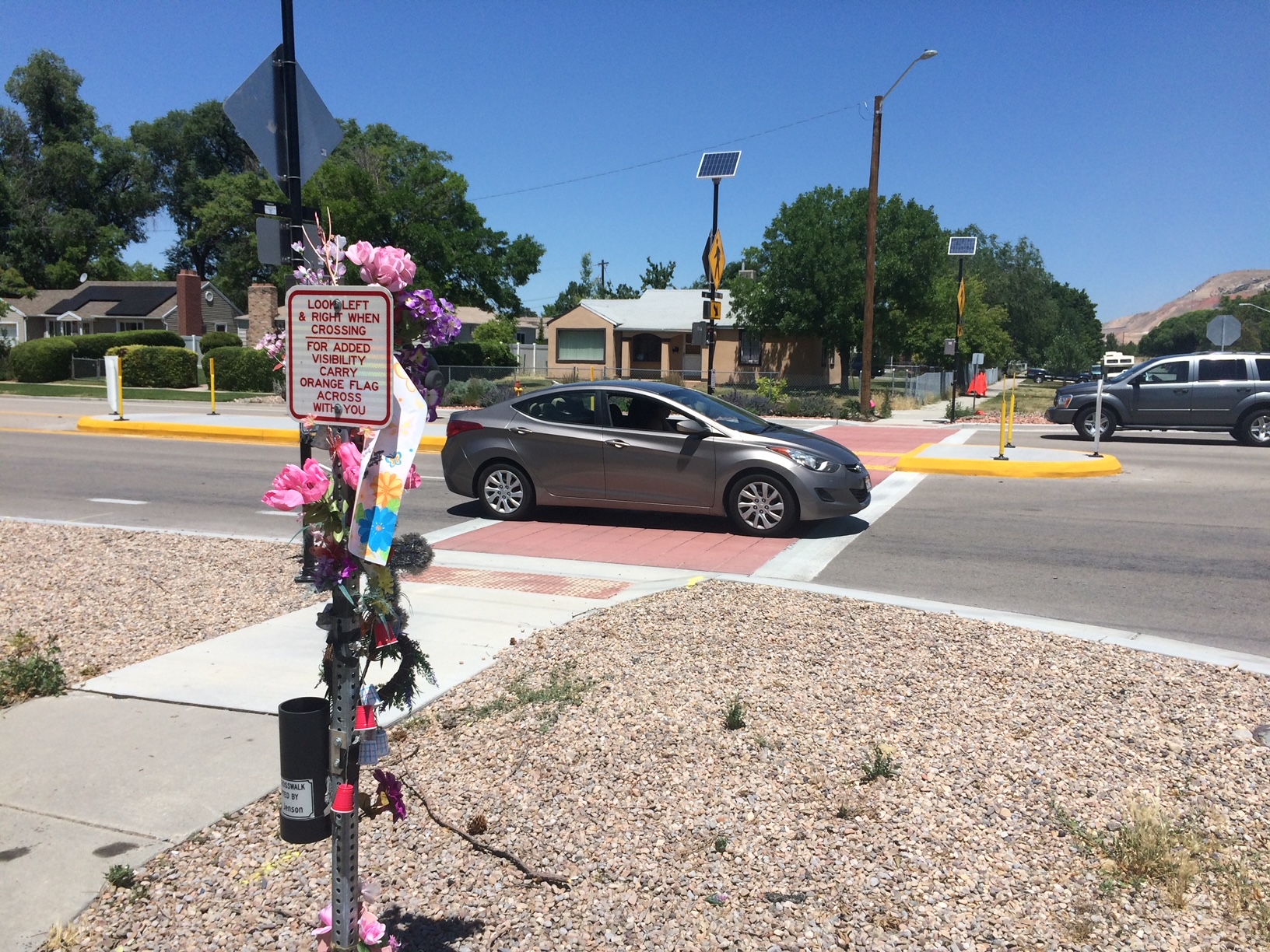
The site of a traffic fatality on 600 North in Salt Lake City, Utah. Photo by Dave Iltis
According to Salt Lake City, the task force has met, but there have been no announcements, goals, or programs to come out of the task force. The task force supposedly will include 4 working groups: analytics, education, capital projects, and enforcement. While it’s a step in the right direction, it’s not Vision Zero, and it’s not nearly as aggressive an approach as needed.
UDOT program Zero Fatalities, not to be confused with Vision Zero, has as a goal “to eliminate fatalities on our roadways.” While this is of course what we want, Zero Fatalities is an admirable education program to ask drivers to drive safer. It does not address speed limits, road design, car and truck design, traffic signals, stop signs, bike lanes, pedestrian bulbouts, or any of the multitude of necessary physical or legal changes to our streets and highways.
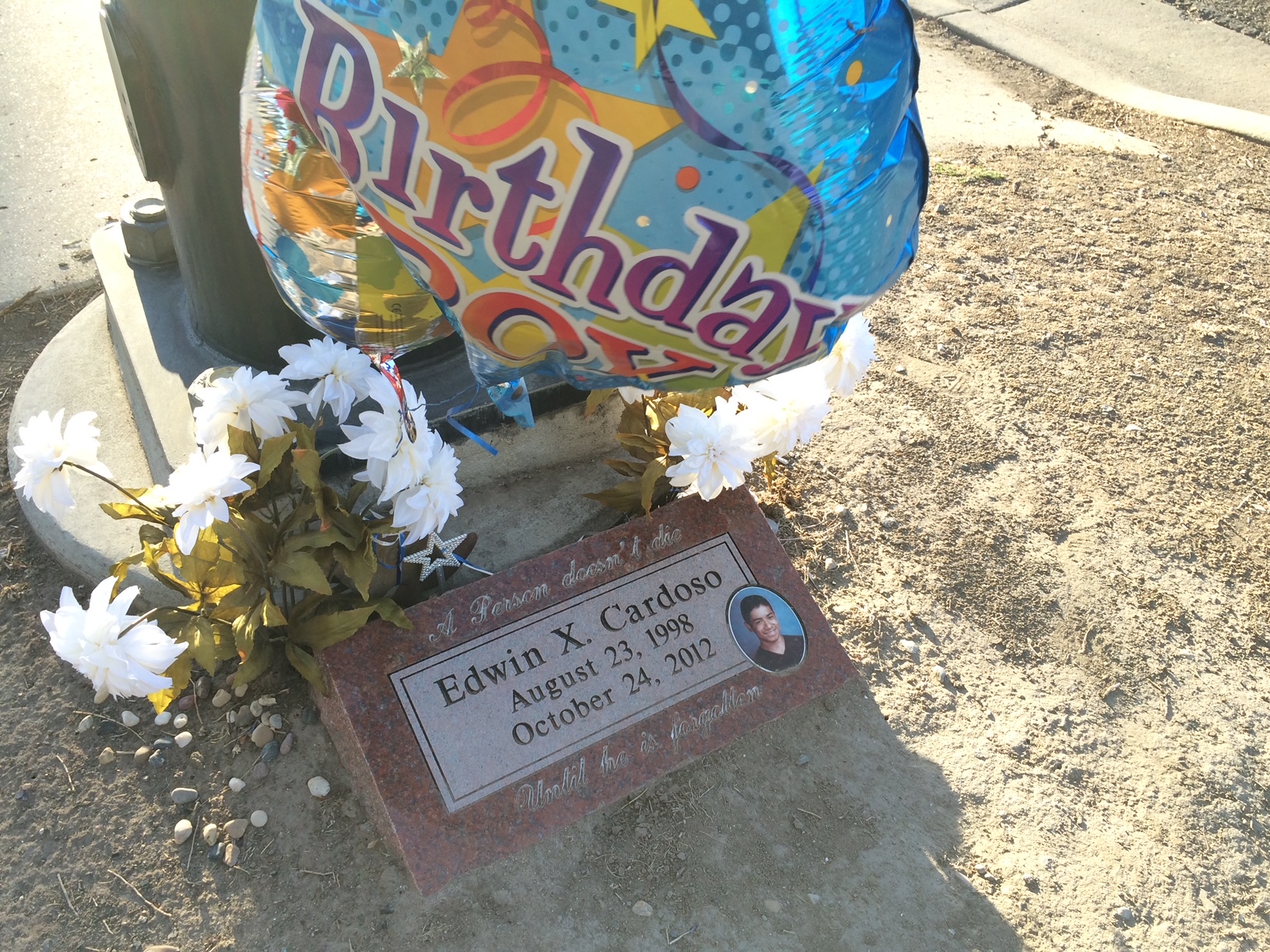
The site of the death of Edwin X. Cardoso in a traffic fatality on 600 North in Salt Lake City, Utah. Photo by Dave Iltis
Earlier this year, after the task force was formed, Cycling Utah asked UDOT and Salt Lake City to make 400 South and 300 West safer when the streets were repaved. Nothing happened. The two streets were restriped and repaved with no additional safety measures.
While projects like the 9 Line Trail, Folsom Trail, and the 300 West Trail are wonderful, there are many other recent examples of road projects and safety measures, on both UDOT’s and Salt Lake City’s streets, that have not put the pedestrian and cyclist first, but which have instead prioritized automobiles. Enough is enough is enough.
Cycling Utah’s Plan for Salt Lake City to get to Vision Zero and eliminate deaths and injuries on our streets:
UDOT and Salt Lake City need to publicly and strongly commit to Vision Zero and do everything they can to eliminate all fatalities on the streets and roads in the city. This means following through on the Vision Zero commitment (https://visionzeronetwork.org/wp-content/uploads/2018/05/VZN-9-Components.pdf). And, it means that not only Salt Lake City maintained streets would be made safe, but UDOT’s would as well. This would be accomplished through:
Political Commitment
Multi-disciplinary leadership
Action Plan
Equity
Cooperation and collaboration
Systems based approach
Data Driven
Community Engagement
Transparency
Rename the task force the Salt Lake City Vision Zero Task Force to show the city’s clear commitment to no more traffic deaths.
To get to no more traffic deaths and injuries means that every single decision regarding streets, transportation, and roads within Salt Lake City shall prioritize in order:
People on foot, wheelchairs, and other person mobility devices.
People on bikes, scooters, skateboards, one wheels, and other micromobility options.
People on transit – buses, trains, and trams.
People delivering goods to our local businesses and homes.
People in cars or personal trucks.
Salt Lake City and UDOT should complete an immediate reevaluation of all speed limits in the city. While the recent #20IsPlenty change of the default limit on Salt Lake City streets to 20 mph was a huge step forward, it is not enough. Every single speed limit signed street in Salt City needs to be reevaluated and changed downward.
Seattle not only changed their default speed limit to 20 mph, but they also changed the default speed limit on arterials to 25 mph. This could easily take place during the winter when road paving and striping cannot happen due to weather.
Despite several opportunities on newly-configured streets (Main Street and South Temple for example) to take this step, this has not happened. Salt Lake City is supposed to be in the process of reevaluating speed limits, but change has not yet occurred. For critics who say that signs don’t matter, remember on a 2-lane street or road-dieted street, it only takes one driver to go the speed limit to require everyone behind them to go the speed limit.
Accelerate the City’s new Livable Streets program. While still in the planning stages, the program holds great promise, but we have not seen any new initiatives yet. A main goal is for “measures should be implemented to calm traffic and improve the overall safety, livability, and attractiveness of residential streets in Salt Lake City.” Salt Lake City has not had a traffic calming program in 15 years, so this will be a welcome change. A recent report found that 403.5 miles of streets are eligible for traffic calming. For details: https://www.slc.gov/transportation/wp-content/uploads/sites/11/2022/05/SLC_Livable_Streets_Final_Report_compressed_short.pdf
Reinstitute Salt Lake City’s successful Stay Safe, Stay Active Streets program that was a savior to many during the height of the COVID-19 pandemic in 2020. The program closed off a number of streets to all but local car traffic using nothing more than temporary barricades and signage. The program was a simple but extremely effective way to allow people to have priority on the streets. https://www.slc.gov/transportation/wp-content/uploads/sites/11/2020/05/FINALSafeActiveStreetsSummaryReport-2.pdf
Add speed bumps everywhere that will truly slow cars down, rather than the anemic ones recently added to 500 East. With better engine design going towards more power rather than better fuel economy, good road design and lower speed limits are not enough. We need a massive investment in new speed bumps, raised crosswalks, traffic diverters and other road furniture that will force drivers to slow down.
Create a standard of a maximum of 10-foot-wide travel lanes on all UDOT and Salt Lake City streets to slow traffic and make more room for bicycles.
Reinvigorate the city’s efforts to increase walkability and bikeability, both of which help to get people out of cars and make our roads safer for all. This is a combination of planning and cheerleading.
Continue expansion of our rapidly improving transit network along with a program for free fares for all residents. This is likely best accomplished at the State of Utah level with taxation, financing, and reprioritizing of transportation measures. Better public transit will lead to fewer drivers behind the wheel and thus makes our streets safer for all.
Continue planning efforts to increase housing density and walkability and bikeability in the city to reduce the need for a car.
Ban right turns on red. This simple measure would keep cars from traveling across crosswalks where pedestrians have the right of way. The law does not allow cars to travel perpendicularly across routes where other cars have the right of way when the light is red, so why does it allow cars to violate pedestrian right of way?
The right turn on red became Federal Law in 1975, intending to encourage energy conservation. In 1992, the law was apparently changed to allow safety as a reason for not allowing right on red (https://www.law.cornell.edu/uscode/text/42/6322). New York City has banned the practice since pedestrian safety was clearly diminished.
Right on Red is inherently dangerous to people on foot and it’s time to eliminate this practice not only locally in Salt Lake City, but statewide, and ultimately federally. With cars increasingly equipped with automatic shutoff devices at a stop along with the rise of the electric car, energy conservation arguments hold less weight. By making it safer for cycling and walking, more people will cycle and walk which is orders of magnitude more energy efficient than driving.
Follow through with the 2015 Bicycle and Pedestrian Master Plan goal of completing the Neighborhood Byway network by 2025. Sweetstreetsslc.org has made this a current campaign.
The use of red-light cameras and speed limit cameras to identify and ticket violators is currently banned at a state level. Legislation needs to be introduced to overturn this myopic me-first policy.
We also need a better approach to reduce impaired driving from alcohol, drugs, cell phones, and other distractions. This could include making sure that public transit runs later at night to allow people to take alternative transportation rather than a car.
By Micah Drew – Seeley Swan Pathfinder — Cycling tourism contributes nearly $377 million annually to Montana’s economy
Leigh Ann Valiton watched a customer meander the aisles of the Blackfoot Commercial Co. in Ovando, Montana. Valiton’s store, and attached inn, is open until seven every evening, but it was 10 p.m. and she showed no sign of leaving. The customer, Faye Cunningham from New Zealand, filled her basket with frozen burritos, energy bars, chips and a Mountain Dew.
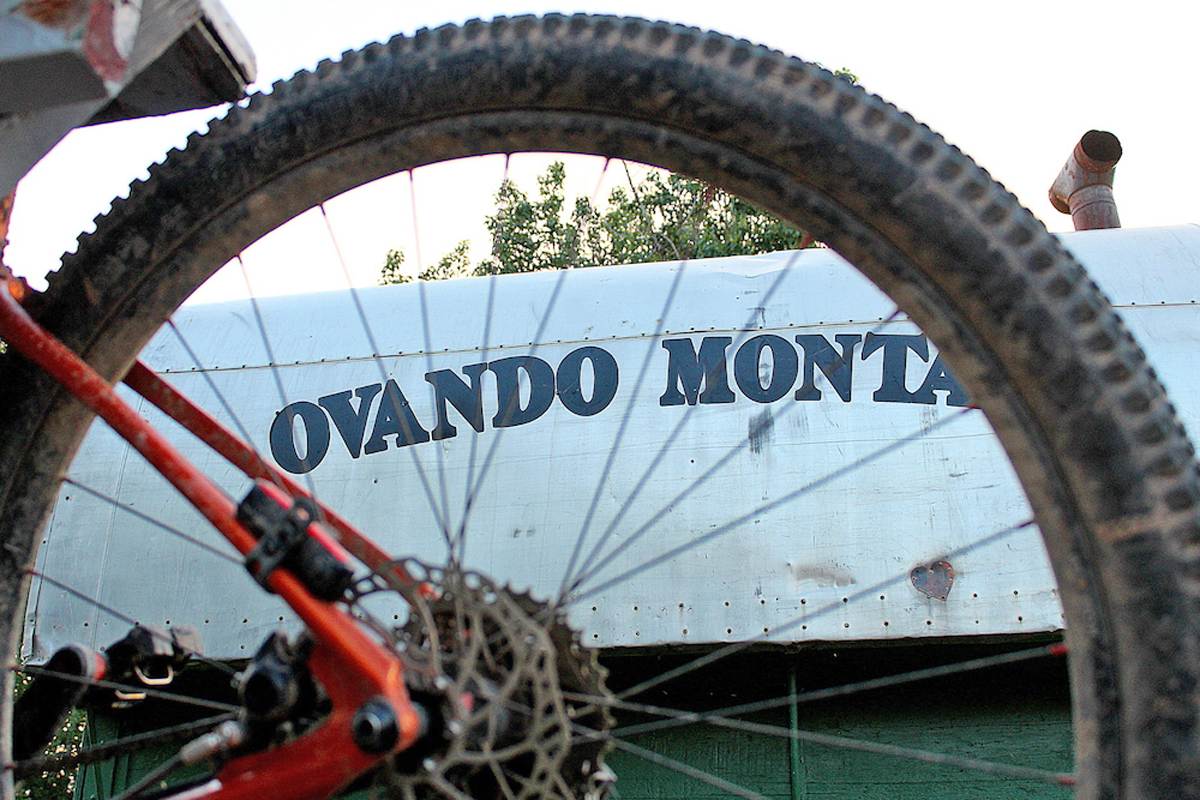
An old sheep wagon welcomes cyclists to Ovando, Montana. Photo by Micah Drew/Seeley Swan Pathfinder
Cunningham was competing in the Tour Divide Race, a 2,735-mile long mountain bike race that stretches from Banff, Canada, to the Mexican border. The route enters Montana in Glacier National Park and meanders south, paralleling the Continental Divide.
Ovando sits at mile 550 and has become a staple stop for riders. “You always hear about the accommodations. It’s certainly known,” says Cunningham as she finished filling her basket. “It’s totally cool to come here.”
For the last five years, Ovando has become known by the cycling community around the world as a place to stop and sleep, refuel and chat with the locals. “I’ve been a groupie (of Tour Divide) for years so it’s cool to see the places I’ve read about — Richmond Ridge, Holland Lake, here,” she continued.
Cunningham had ridden for 16 hours and wanted to make it to Ovando before she stopped for the night.
Currently every room in Valiton’s inn was booked and a rider was sleeping on a mattress in the living room. Outside a cyclist was crashing in an old sheep wagon. Another was passed out in a teepee. The only open sheltered place left for Cunningham to rest was an old jail house that was restored for just that purpose. As Valiton scanned her purchases, she paused and looked up. “Wait, I’ll put a bed in the kitchen and you can sleep there.”
After making sure her last guest was settled in, Valiton finally left for the night. Most of the riders would be up before dawn to get back on the trail. “Our goal is to be as accommodating as possible,” said Valiton as she turned off the lights. “But that’s Ovando in general.”
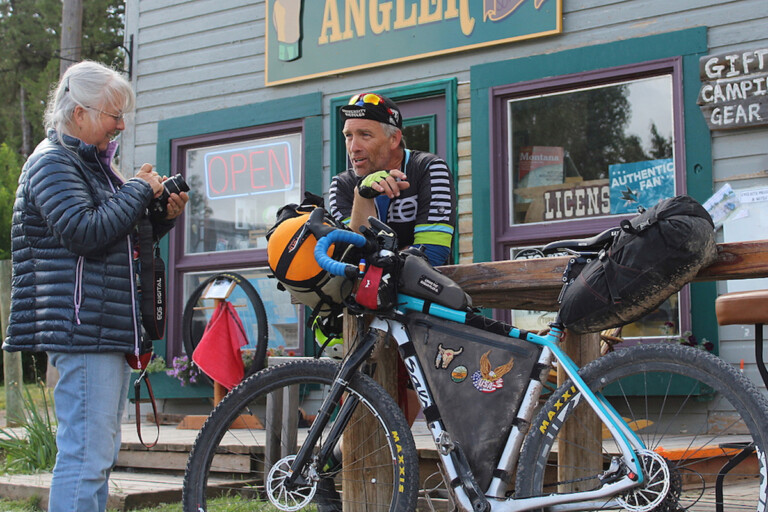
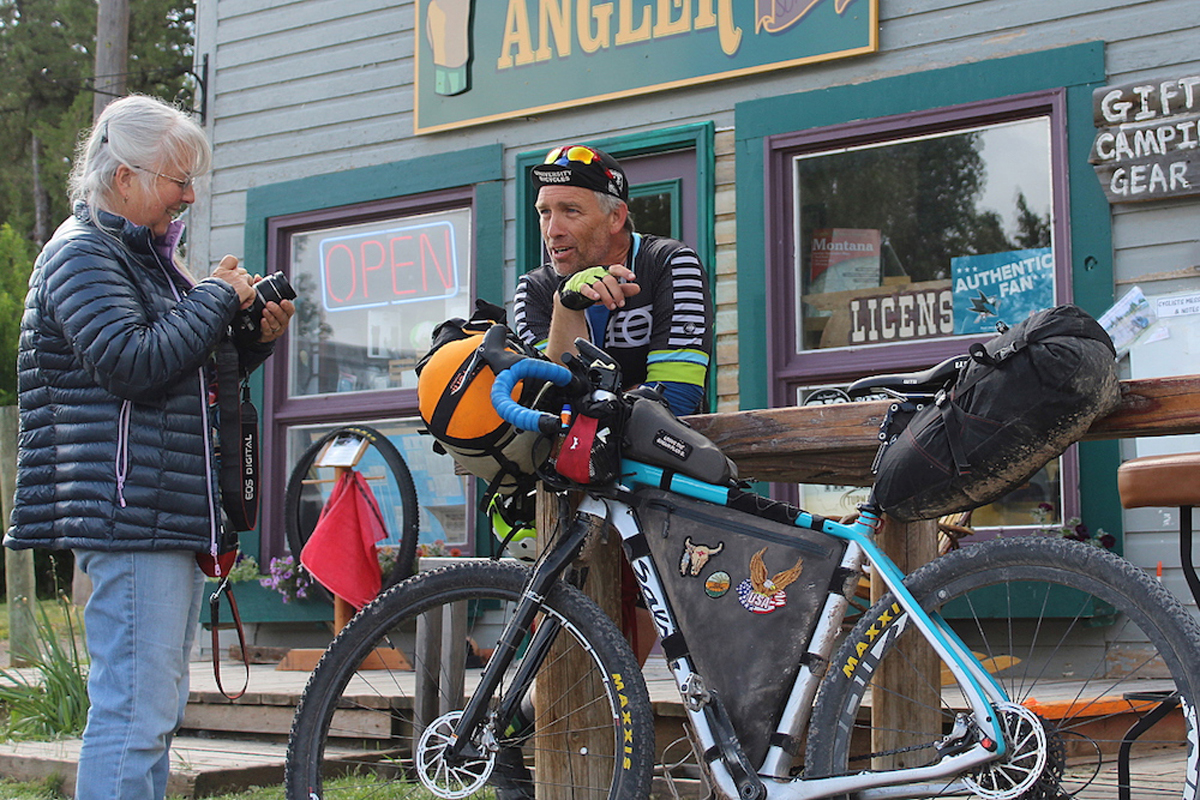
“Years ago if I went to Missoula, no one knew where Ovando was,” said Kathy Schoendoerfer, the owner of the Blackfoot Angler and Ovando’s unofficial “Organizer of Frivolous Affairs.”
Now, nearly a thousand cyclists from around the world pass through the town of 50 residents every year. In addition to being a waypoint for the Tour Divide Race, the town on Highway 200 sits at the intersection of two popular cross country cycling routes.
Kathy Schoendoerfer and Randy Neil chat in front of the Schoendoerfer’s store, Blackfoot Angler. Neil is riding in his third Tour Divide. Photo by Micah Drew/Seeley Swan Pathfinder
Schoendoerfer recalled the first time the community banded together to support bicyclists. It was in 2012, when a TDR rider, Tracy, was inbound to Ovando. Someone phoned ahead, letting the town know Tracy was having a rough go of it. Only the sheep wagon existed back then, but the townsfolk put out a sign telling Tracy to rest up and left food, drink and moral support.
Since then, the town has actively courted the two-wheeled tourists. One small corner of Schoendoerfer’s fishing shop is dedicated to cycling gear — tires, tubes, lube, pedals, the essentials. The Ovando Community Fund was started from donations and provided money for the teepee, jailhouse and outdoor shower system riders can use.
Each year riders donate around $500, Schoendoerfer said. Sometimes it’s change (Canadian), sometimes it’s a can of beans if that’s all they have. It’s enough for the town to know they’re having an impact on their visitors.
That impact goes both ways. According to a 2014 study by the University of Montana, cycling tourism has a substantial impact on the state.
The study, conducted by the University of Montana Institute for Tourism and Recreation Research looked at the effect of bicycle tourism statewide. It found that the industry contributed nearly $377 million annually to Montana’s economy. Of the nearly half million bicycle tourists who visited the state, the average cyclist spent around $75 a day and stayed for at least a week.
For rural communities, that kind of expenditure can greatly increase viability and towns are learning how to capitalize on it. A hundred and fifty miles south of Ovando, another small Montana town shows up on cycling maps, at the intersection of the Lewis & Clark and the TransAmerica Trails.
Twin Bridges is home to almost 400 residents and the nation’s first ever Bike Camp. Bike Camp sits in Jessen Park, on the edge of town. It’s a simple wooden building complete with a shower, toilets, tables and chairs, a sink and grill and plenty of space outside to pitch a tent — but only for visitors arriving on two wheels.
After spending two years watching cyclists passing through, resident Bill White decided the time and need was right to do something to engage the Lycra-clad tourists. “All the bike riders passing through were like gold going by in a river,” he said in an interview for Montana Quarterly. “I started thinking about how to make Twin Bridges more than just a place to get a cup of coffee.”
White developed a proposal for Bike Camp, got a building permit and raised $9,000 for materials. The town broke ground in April of 2009 and the camp was ready by June.
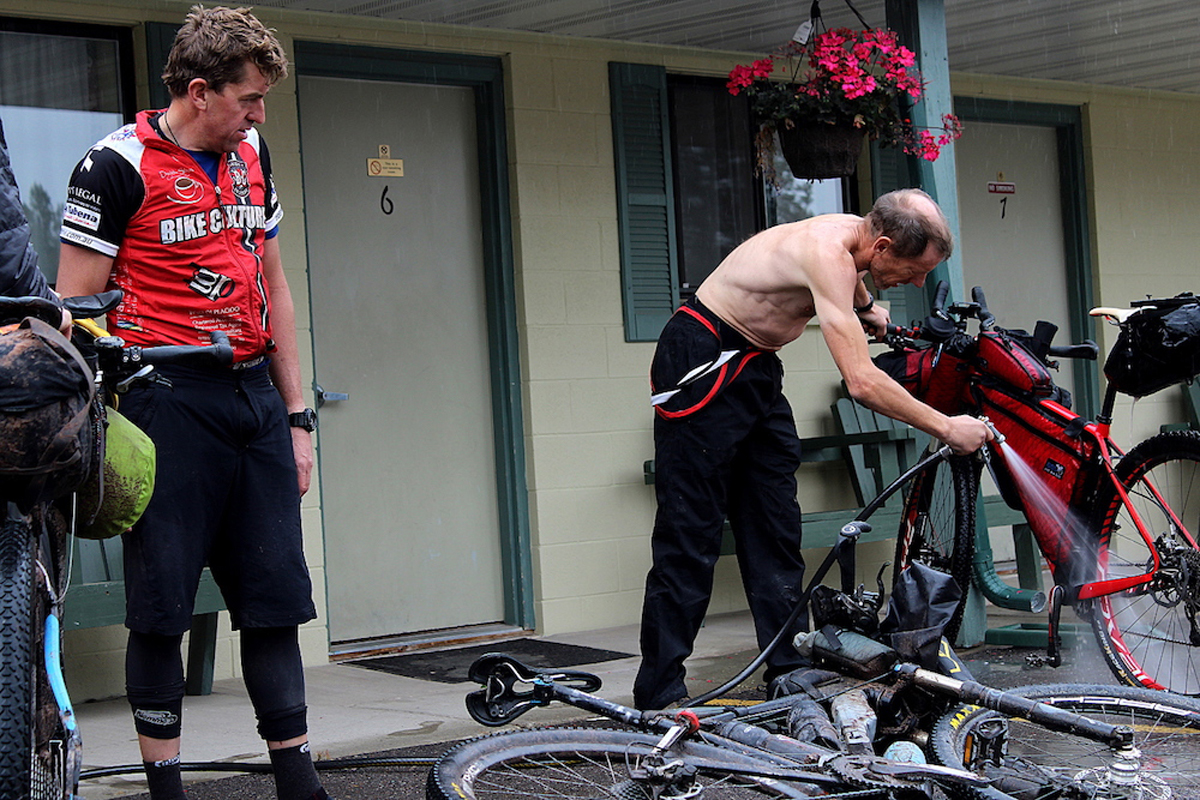
Cyclists riding the Continental Divide trail wash off their bikes outside a motel. Cyclists rely on small communities for lodging and other amenities such as laundry and other services. Photo by Micah Drew/Seeley Swan Pathfinder
In the first year, around 300 riders used the camp. White said that by July of the second year, the number of visitors was already up by more than 50.
Those early cyclists left feedback for Twin Bridges (and enough donations to cover the cost of building Bike Camp), and the town found that the average expenditure per night per visitor was $24.92. In a small community like Twin Bridges, the economy is a closed loop, amplifying any expenditures. Overall it was determined that the cyclists brought at least $10,000 into the local economy
That figure is lower than the UM study estimate, but regardless, “it’s good for the local economy,” White said. “Especially the grocery store, the ice cream shop, the restaurant and the laundromats.”
It’s personal interactions and community attitudes like those in Twin Bridges and Ovando, more than any university study, that excite proponents of cycling tourism. “There’s increasingly more stories coming out about how bike touring and bike travel can benefit rural communities,” said Laura Crawford of Missoula-based Adventure Cycling. “There’s maybe not an attraction that would pull people off the freeway, but if you’re going through by bike, you kind of rely on those communities as a place to stop for the night, stock up on food or grab coffee.”
Adventure Cycling is a national cycling advocacy group (“America’s Bicycle Travel Experts”) that boasts 53,000 members. The company organizes guided bike tours and maps out the more than 46,000 miles of cycling networks in the country.
A portion of their work is teaching communities how to become bike friendly, and its website offers pages of resources (adventurecycling.org/bicycle-tourism/building-bike-tourism/). Crawford has spent years investigating how cycling can save rural economics. In addition to her work for Adventure Cycling, she founded the travel website The Path Less Pedaled. She makes a comparison between a cyclist and a road tripper and the impact they have on communities during a trip.
Using a 200-mile stretch of road as an example — roughly the distance between Whitefish and Helena — Crawford breaks down the differences.
For a vehicle, that trip is a mere afternoon’s travel. A road tripper’s itinerary traveling city to city might only include a stop at a gas station or a lunch break in the middle and skip most of the small towns in between.
On the two-wheeled side, biking 50 miles a day requires a huge influx of calories, prompting the need for a dozen meals or snacks during that same trip. Due to the restrictions of carrying that much food on a bike, cyclists are more likely to stop in any town with a restaurant or market. They also need places to sleep, preferably with hot water to shower and potentially a place to do laundry. “Small towns would benefit as well with a constant stream of tired and hungry bike tourists coming through town,” a blog post on The Path Less Pedaled reads. “The more accommodations and services, the more people touring, the more people spending money in small towns.”
White, who passed away in 2012, saw firsthand the effect of riders on his town. When Crawford pedaled through Twin Bridges to profile the town and the Bike Camp in a video, she was struck by White’s foresight and determination to make the camp happen.
“Bill persevered … because he knew it would benefit the community,” Crawford said. “It gives tourists a reason to stop and stay and leave a few dollars behind that wouldn’t otherwise trickle into the town. And that idea is really fundamental to how bike tourism works in small communities. “It’s not a get-rich-quick sort of scheme, but a long-term, sustainable investment.”
This article was originally published on Jan. 12, 2018 at High Country News (hcn.org) and Seeley Swan Pathfinder (seeleylake.com, Seeley Lake, Montana) and is part of The Montana Gap project, in partnership with the Solutions Journalism Network.
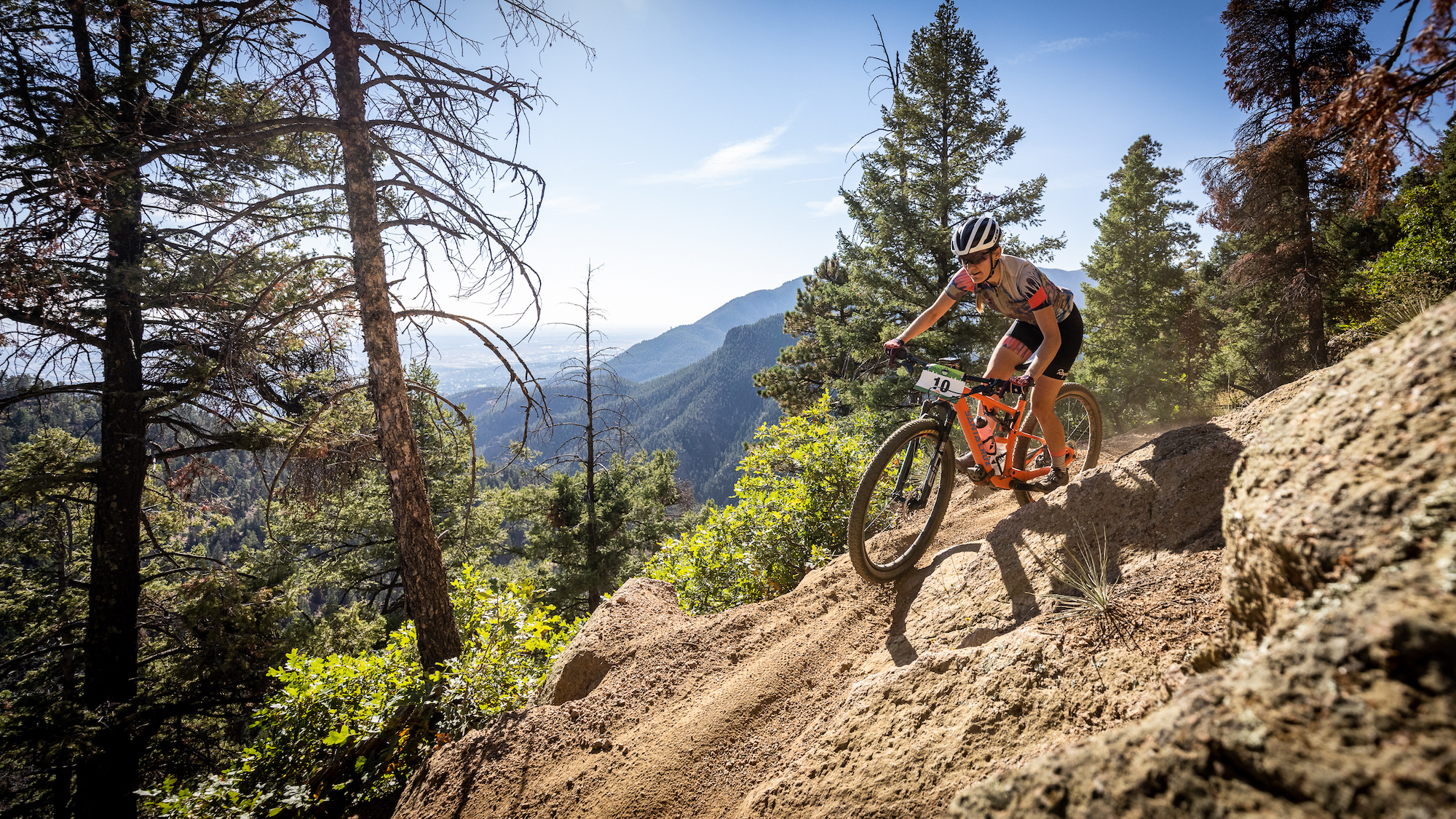
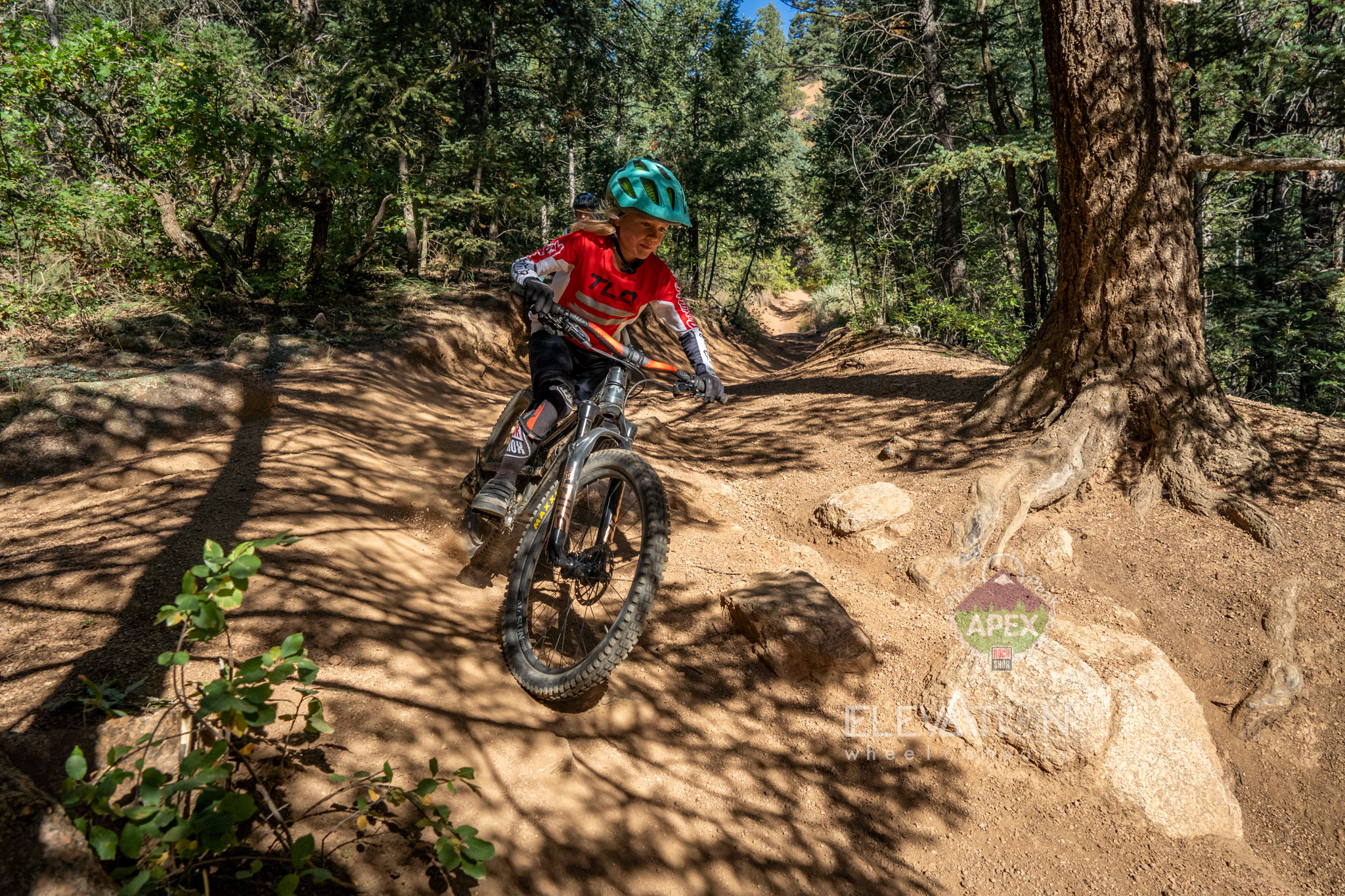
COLORADO SPRINGS, Colorado (November 18, 2022) — Colorado Springs Sports Corporation (CSSC) is pleased to announce its newest undertaking as the new hosts of the Pikes Peak APEX, presented by RockShox, a unique mountain bike challenge on the slopes of the Pikes Peak region’s best trails.
Alexis Skarda during the 2021 Pikes Peak APEX. Photo by James Stokoe Photography
Previously a 4-day event, Pikes Peak APEX will transition to a 3-day event in 2023, and is set for September 8-10 on three unique courses that showcase the world-class trail systems of the Pikes Peak region. The event will conclude with an outdoor festival at America The Beautiful Park featuring food, vendors, activities, and more on Sunday (Sept. 10). Specific course details will be announced in early spring.
Stage 4 of the 2022 Pikes Peak APEX. Photo courtesy Pikes Peak APEX
Amateurs and professionals alike looking for a bucket list adventure and chance to line up with Olympians, pros, national & world champions are encouraged and welcomed to compete in the Pikes Peak APEX, presented by RockShox. Riders can test their skills by participating in a single day or take the plunge and participate in the full 3-day event. The 2023 event will also include an endurance trail running component with 5K, 10K and Ultra events for recreational and elite runners.
“Having the APEX under the umbrella of an organization like Colorado Springs Sports Corp. is a best of all worlds scenario for us,” said Micah Rice, Executive Director of the Pikes Peak APEX. “Now there are more resources than ever behind the event and we will still continue to raise money for the trails in the Pikes Peak region. We hope that the slight change in date and length will make the event even more popular for mountain bike enthusiasts coming in from out of town.”
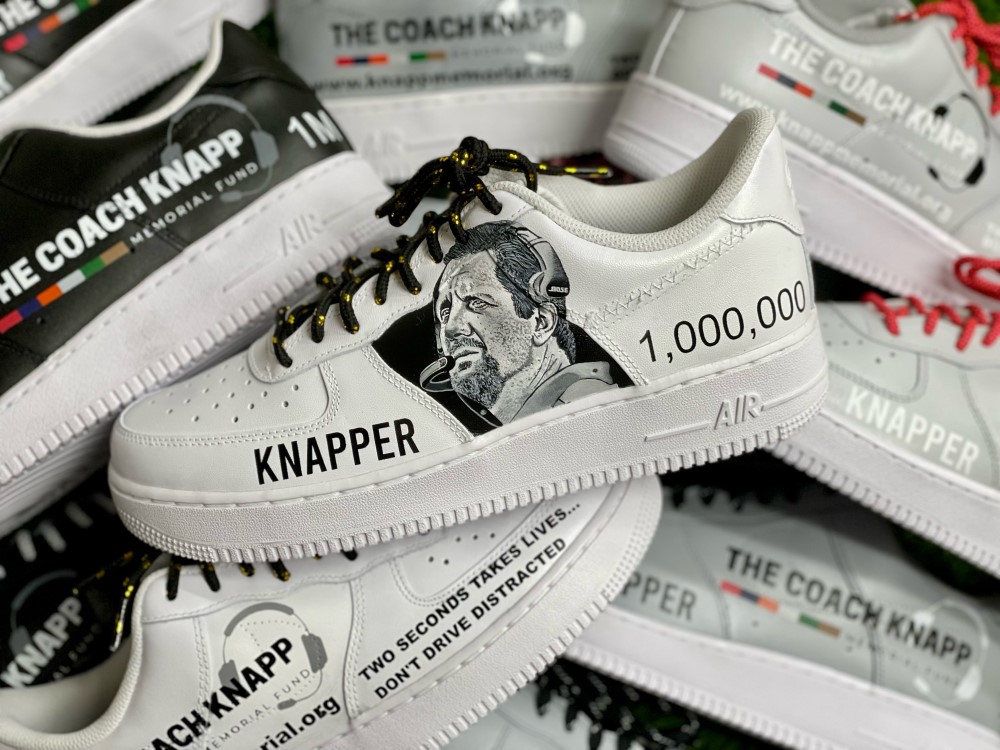
Five teams to do Stair Climb, others to wear custom designed cleats in support of the initiative during “My Cause, My Cleats” weekend; Goal to Raise excess of $100,000 for The Coach Knapp Memorial Fund To Educate Drivers On the Dangers of Distracted Driving
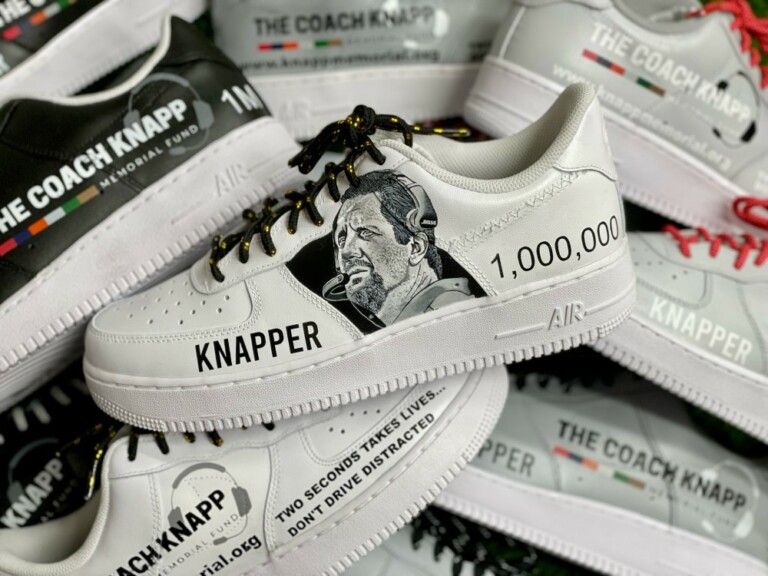
NEW YORK, New York (November 29, 2022) — Eight NFL teams today announced that select coaches, athletes and staff will participate in different ways to support the first-ever Coach Knapp fundraiser this December, which will benefit The Coach Knapp Memorial Fund. The fund exists to educate drivers on the dangers of distracted driving, reduce the number of distracted driving related deaths, and promote distracted driving awareness reform. The fund was created by his wife Charlotte and close friend and agent Jeff Sperbeck, to honor the legacy of Greg Knapp who tragically passed away in July 2021 after being hit by a distracted driver while he was bicycling. Coach Knapp was known for climbing the stadium stairs before every single NFL game he coached over his 25 season career. All will be tagged #knappstairclimb on social platforms.
“We can think of no better way to honor Greg’s legacy and raise awareness for such a simple, but vital cause than by doing one of the activities he loved the most, climbing the stairs on gameday,” said Steve Mariucci, former NFL head coach and one of Knapp’s key mentors, who is now at analyst on The NFL Network. “To see the amount of support this has gotten is really touching, and most importantly, we firmly believe it will save lives well into the future.”
“Knapper was one of the very best teammates I’ve ever been around. His Energy, optimism and high standards as a coach made such an impact on anyone who was fortunate to be around him,” added Dallas Cowboys Defensive Coordinator, Dan Quinn, another of Greg Knapp’s loyal fellow coaches, “Please join me in making sure his legacy as a great teammate and friend lives on.”
At the time of his passing, Knapp was recently named Passing Game Coordinator of the New York Jets under head coach Robert Saleh, after serving as an assistant coach for over a quarter of a century with the Atlanta Falcons, Denver Broncos, Oakland (now Las Vegas) Raiders, Houston Texans, Seattle Seahawks and San Francisco 49ers. Known as a “quarterback whisperer,” Greg coached some of the greatest quarterbacks in NFL history helping chart the careers of many young athletes with kindness, humor and trust.
In honor of Coach Knapp, NFL coaches, players, executives and alumni will participate in raising funds and awareness at each NFL stadium prior to team warm ups between Week 14 (Dec. 11th), Week 15 (Dec. 18th) or Week 16 (Dec. 24th) of the NFL season. In addition, coaches and staff from several teams will wear custom designed shoes honoring Coach Knapp’s legacy as part of the annual “My Cause, My Cleats” celebration the weekend of December 4th. The shoes will be designed by several local artists working with each team. Participating coaches and former players will include: Steve Mariucci, Dan Quinn, Peyton Manning, Joe Lombardi (LA Chargers), Chris Strausser (Indianapolis Colts), Frank Pollack (Cincinnati Bengals), Jeff Ulbrich, TJ Yates, among many others. Teams confirmed to participate include: New York Jets, Atlanta Falcons, Dallas Cowboys, Cleveland Browns and San Francisco 49ers.
Fans, athletes, and coaches at any level can also participate wherever is most convenient to them across the country, such as apartment building stairs or a high school sports stadium. Images will be shared on various social channels.
By Christine Dern and Rae Sutherland — So, you’ve ridden around on an old bike that has been in the garage for 10 years. Or, you jumped on your friend’s bike that’s way too big for you and attempted to hit the trails but maybe it feels more like the trails are hitting you. Maybe you stare at these mountains that surround us and want to explore them in a way that is different and serene.
Whatever the reason, you are absolutely hooked on this thing called mountain biking and have decided it’s time to purchase a bike, but you are just not sure where to start. Hopefully we can help, just a little.
Here are 5 things to consider when you have fallen in love and need something that is all your own.
Type of riding:
The most important question to ask yourself, what do you want to ride with this bike? You may or may not know enough yet to answer this question and that’s okay. In case you are not yet sure, here are a few related questions to help.
Do you want to ride gravel road or singletrack trail? If you want to mostly ride dirt roads, you will need a lot less *suspension and may even want to look into a gravel bike or cross-over bike. We won’t focus on those here. (*Suspension: Think of it like a shock absorber that compresses and rebounds to lessen the impact felt from mountainous terrain. The front suspension is the fork, the rear is the shock.)
How often do you think you will realistically be riding? The less you ride, the less money you will want to sink into your bike. If you are jumping in with both feet and will be riding multiple times a week, then splurging to get better *suspension and *components for your bike, will make it last longer, function better and overall, make your life easier and more fulfilled. ( *Components: The moving parts that are attached to the frame of your bike, such as the derailleur, brakes, chainring, etc.)
Do you prefer riding Cross Country (XC) or All Mountain? If you like to ride uphill and really enjoy hammering your thighs into the ground you may like XC. If you want to ride a mix of singletrack and fire roads and are not really excited by fast downhill with *features, then you will want to look into a bike with less suspension or even a *hardtail. (*Features: Obstacles in the trail such as jumps, drops, rocks. *Hardtail: a bike with only front suspension or no suspension.)
If you like to ride a mix of uphill and downhill, mostly singletrack or lift accessed trails, if the adrenaline pumping through your veins gives you a kick and you want gravity fed, technical terrain, and/or larger features then you will want to look into more suspension, think 130-160mm of travel, front and rear.
Angela Wright on a 130mm travel trail bike. Photo by Rae Sutherland
Wheel size:
The options feel endless, but don’t worry, they aren’t. Read on and we will try to help. Circa 2007 and before, the choice was simpler, 26” wheels for mountain bikes. 29” wheel bikes were available but were not as popular or widely supported. 29” and 27.5” wheels have been growing in popularity since then, so much so, that buying a new 26” bike is almost impossible.
What do these numbers mean exactly? The number is the diameter of the wheel and the tire together, the larger the number, the larger the roll over circumference. Here are the most popular wheel sizes with pros and cons for each.
29” (aka 29er) – A larger wheel means it will roll over obstacles with ease. These are sometimes harder to get rolling because of the larger circumference, but as wheels get lighter and made out of different materials, like carbon, this is less of an issue. They can be harder to turn through tight switchbacks due to longer wheelbase (this can depend a lot on the brand and their 29er *geometry specs). Many companies also do not make a small or xs bike in this wheel size due to issues with maintaining performance while fitting two large wheels on a small or xs frame. The larger wheel can also make the bike feel like it has more travel than a similar bike in a smaller wheel size. (*Geometry: the design of a bike frame and the measurements of specifics parts of the frame)
27.5” (or 650b) – These are faster than the 26” wheel and easier rolling over ledges, rocks, etc. They are not so large that they are cumbersome and typically more playful than the larger wheel. You will find them welcoming for all shapes and sizes of people, if you are on a small or xs bike this is a great option.
Mid-fat or Plus 27.5 – The rim size of this wheel is still the same diameter of a 27.5” but the tire is much wider so the rim is wider to accommodate, thus creating a larger rollover circumference. This also makes the bike ride more similarly to a 29er. The larger tires can offer a more cushioned and buoyant feel on the trail and make getting over obstacles easier. If you are looking for a 29er feel in a smaller wheel size or smaller bike size, this is a great option to check out.
26 – Don’t even bother, unless that is all you can find or afford, then go for it and don’t worry, just have fun.
Nat Holden on a 27.5″ wheel size trail bike. Photo by Rae Sutherland
Full suspension or hardtail:
This again comes back to the type of riding you will be doing.
Hardtails – Hardtails generally only have front suspension however can be built with a fully rigid front fork as well. Usually a hardtail would be used for cross country riding but also can be a great entry level bike since the lack of suspension can make them cheaper. Hardtails are very efficient since there is no suspension bob while riding and all of your effort gets transferred directly to the rear wheel. That also means all the bumps and technical terrain gets transferred to the rider. This can cause a slightly harsher, less comfortable feel while riding. Learning to ride on a hardtail is great for skill building since you feel everything. So hardtails can definitely make you a smoother rider and capable of jumping on any bike comfortably.
Full Suspension – at this point, if you can afford a full suspension, this is where you want to be. Suspension has come a long way and makes the ride more comfortable and is great for performance. While exploring full suspension options you will find many different price points. Better suspension usually means more adjustability so the suspension can be tuned to you and a much better feel, but also means higher cost. If you are on a budget, suspension is the one place you will not regret spending a little extra.
Rae Sutherland’s 150mm 29er trail bike. Photo by Rae Sutherland
Choosing *travel size: It can be confusing to makes sense of all the numbers associate with suspension. We are using the metric measurement of how much travel, or how much compression you have. (*Travel: The distance in millimeters that the suspension moves when fully compressed.)
If you are choosing XC you will look for between 100-120mm of travel. This gives you some travel, but also keeps the bike light, more travel usually means more weight, and allows for more nimble steering
If you want a bike that can be pretty good at everything, look between 120-140mm. This bike will let you have fun on pretty much all terrain and build your confidence up so you feel comfortable. This is also a good starting point if you do not know what you like just yet. You can use this on all trails and specialize with more or less travel as you ride more.
If you will be spending your time doing above 70% downhill then 140-160mm might be a good range for you. The angles of the bike are designed around more descending so your positioning on the bike is already further back making it easier to maneuver down obstacles. This can make going uphill a little harder because it is harder to keep the front end of the bike on the ground and makes the bike quite a bit heavier.
Also look at the style of bikes your friends or the people you go out with will have. If you are going to be riding with these people a lot, it is a good clue to which bike you might want to buy.
Christine Dern drops in. Photo by Erica Tingey
Buy new or used
Whether you buy used or new depends mostly on your budget, how much can or do you want to spend? That being said, there are many perks that come with buying a new bike if you buy it at a bike shop. When you go to a shop, you can get professional advice on which bike fits you best and work with the shop to get your bike to fit the way you want. Bike fit can make or break your riding experience. Most shops also offer free service like flat repair or gear, like water bottles or helmets, with a purchase. One more buy-at-a-shop perk, you can often demo bikes and the fee of the demo will go towards a purchase.
Favorite places to buy used bikes include KSL Classifieds, Pinkbike.com, Facebook gear pages, etc. When buying a used bike, it is harder when you are new to the sport. If you don’t know what you are looking for, you may easily pay way too much for what you are getting. Don’t hesitate to enlist help. Friends who have been riding for a while can help you find that diamond in the rough. A word of caution on buying a used bike, there are plenty of scammers online and plenty of stolen bikes circulating too. Read up on common scams before purchasing used online.
Budget
We saved this for last because it is, unfortunately, the most important aspect of buying a bike. As much as it is painful to say it, don’t borrow money to buy a bike, don’t buy more than you can afford. Biking is amazing, but it won’t pay the light bill or buy you a burrito after a hard ride. Set a budget before you even start looking and stick within that budget. This is where buying used can come in handy, you can often find really great bikes for less.
Whatever you do, plan to test ride as many bikes as possible. This is the only way to really know what you like. The way you feel when you are riding is more important than anything else. Most shops or bike manufacturers do free new bike demos, just pay attention to Facebook or bike shop websites. Most bike shops also offer demo rentals to take for a day. Another great option is a bike festival like Outerbike. You can try many bikes next to each other and see what fits. When you are looking to spend a good chunk of change on a bike, spending a little extra to get the right bike will be worth it in the long run.
We hope this article has helped, even just a little. We believe strongly that getting the right bike for you will help you enjoy the sport as much as we do, and that is beyond description. Best of luck in your bike buying pursuits.
Rae Sutherland is founder of WomenMTB, an organization working to empower women and build community through mountain biking. She has been riding for 17 years and loves every second of it. Christine Dern is currently teaching mountain bike lessons to women with Women in the Mountains. She was a pro downhill racer and loves sharing her love of biking with others. She splits her time between working as a mechanic at Competitive Cyclist, teaching skills clinics with women in the mountains, and exploring the world on her mountain bike.
Find out more at Womenmtb.org and womeninthemountains.com
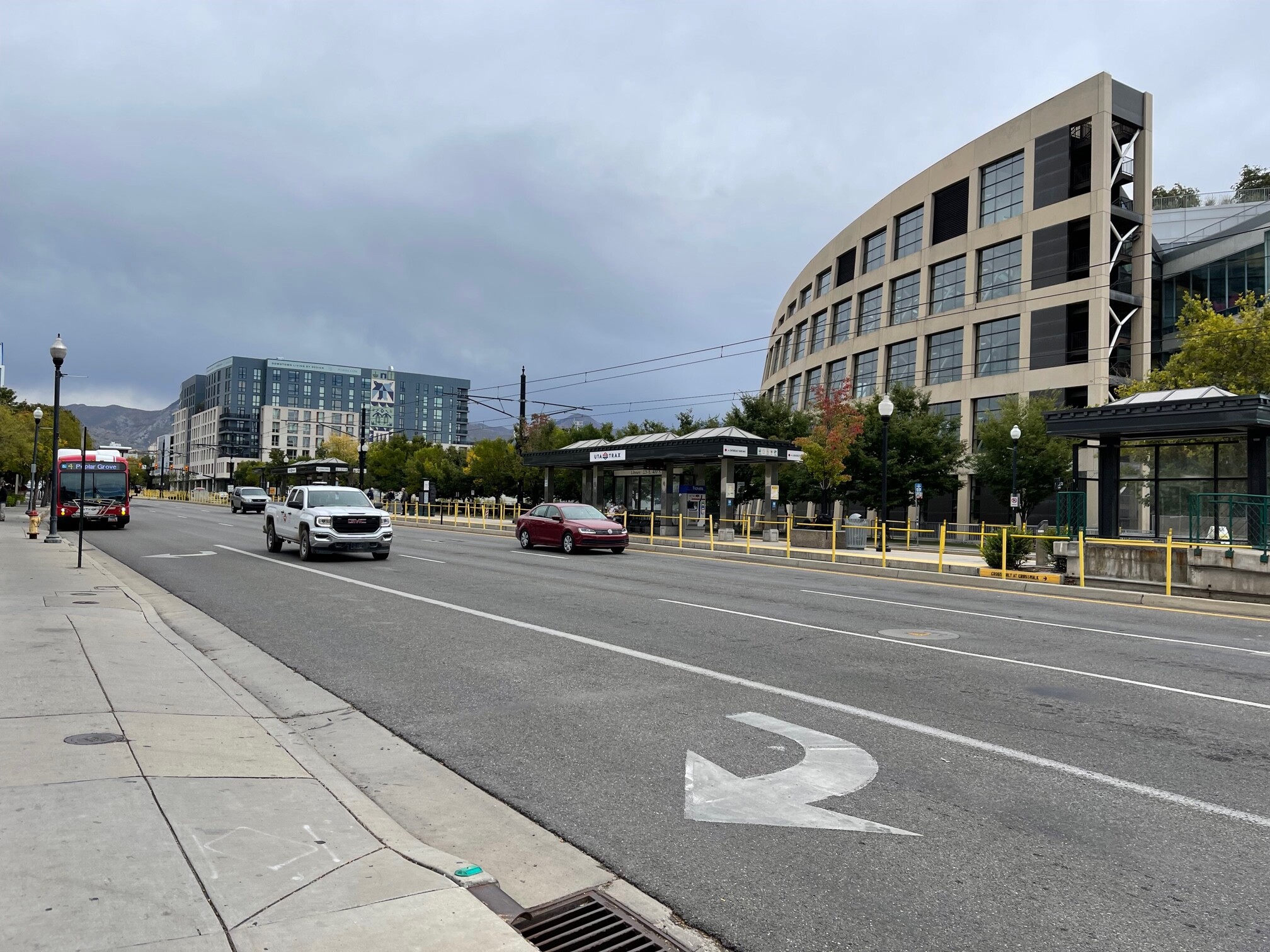
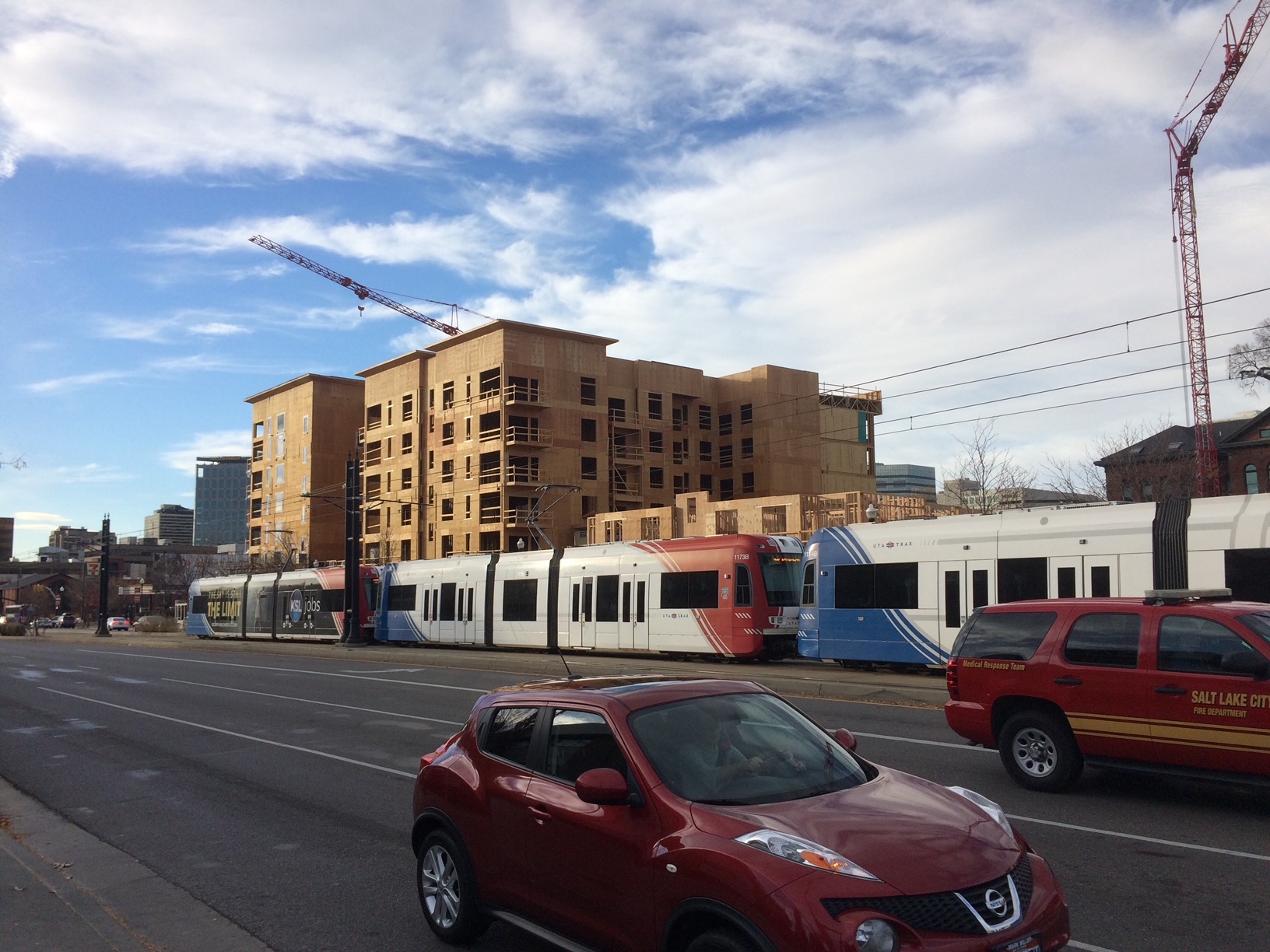
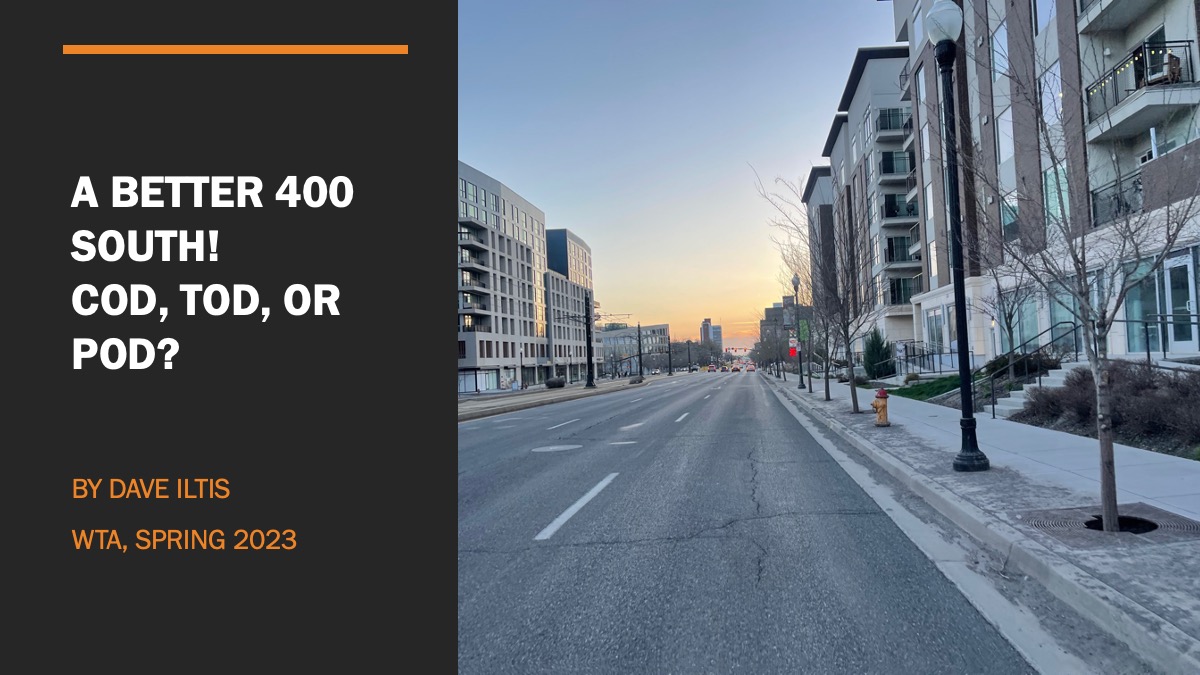
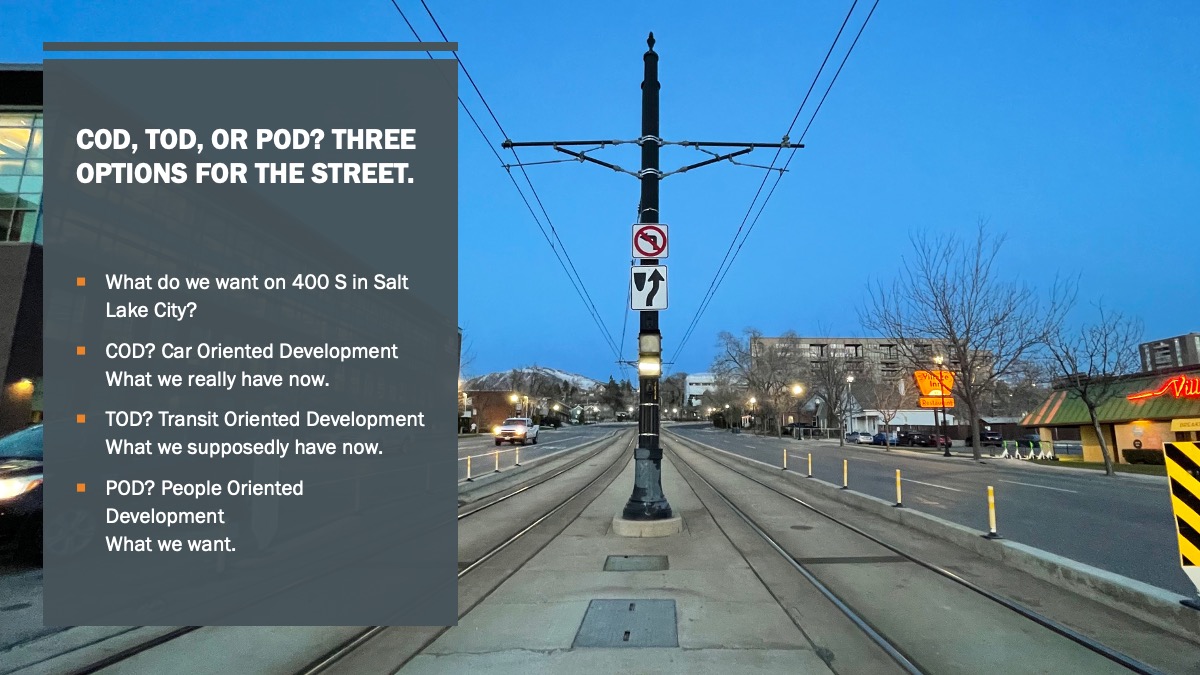
400 South in Salt Lake City, Utah has undergone a transformation since the installation of the TRAX line in 2001 in time for the 2002 Olympic Games. The street is an example of Transit Oriented Development (TOD). Since then, many new apartment buildings have gone up, a new Federal courthouse built in 2014 (https://en.wikipedia.org/wiki/Orrin_G._Hatch_United_States_Courthouse ), and renovations and upgrades to the majestic Salt Lake City and County Building. Salt Lake City’s fantastic library sits on the corner of 200 East and 400 South, and a new public safety building is just to the east of the library. Yet the street is dead.
Salt Lake City’s signature building sits next to an uninviting 6 lane, overbuilt road. Photo by Dave Iltis
What’s wrong?
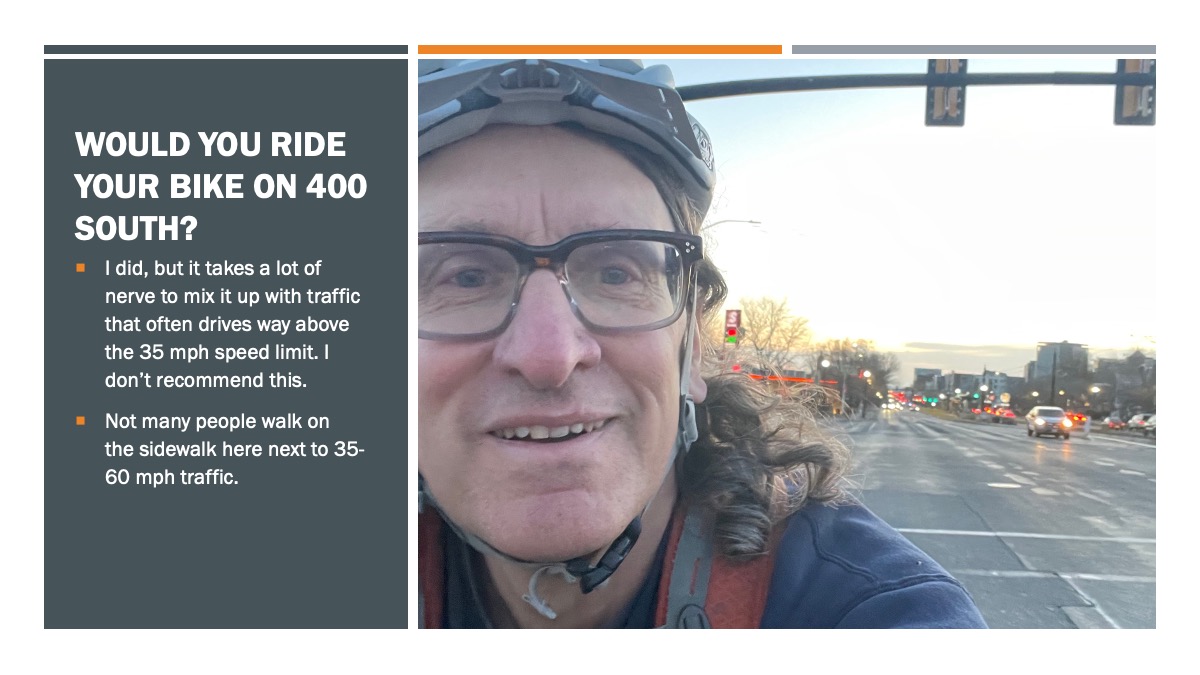
The street should be hopping. Everything (almost) is there for vibrancy, people, and economic development. Yet, it’s a pedestrian obstacle course and a stroad (street-road) where only the brave cyclist dares to venture. I rode this once and had a car pass me on the right in the outermost travel lane! No wonder Dunkin’ Donuts was dunked out.
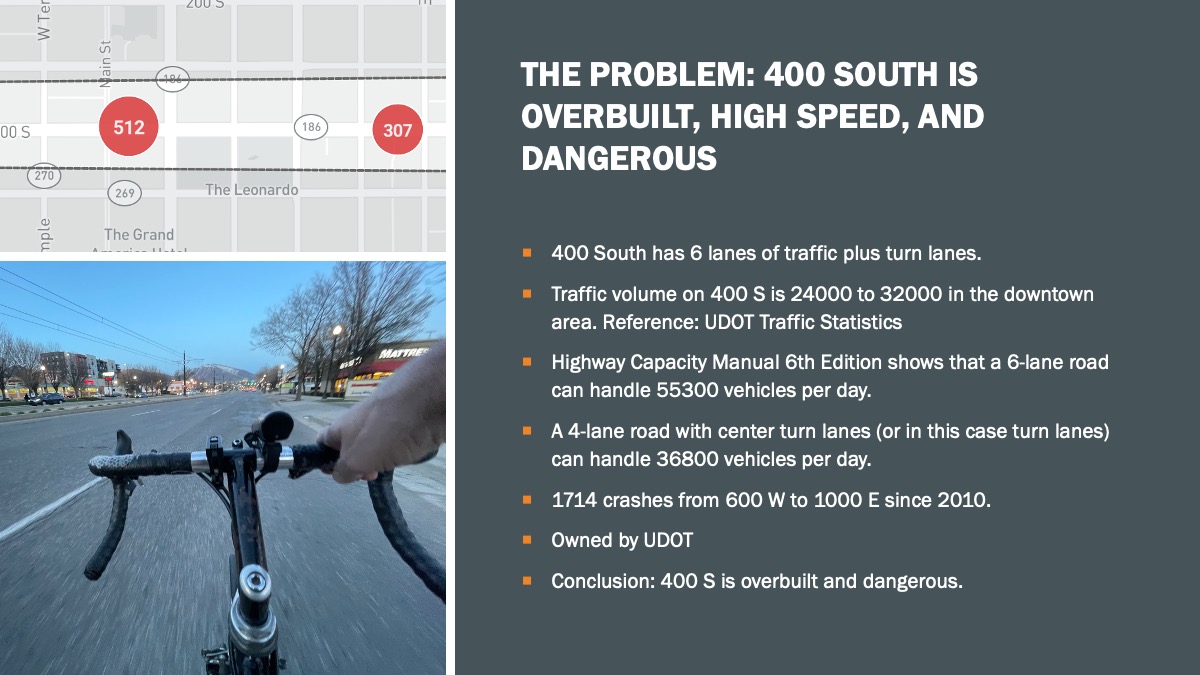
The street has 6 lanes of car traffic, turn lanes, and an east-west TRAX line. Like most streets in Salt Lake City, it’s overbuilt, and there’s no justification for 3 lanes of traffic in each direction unless you consider UDOT’s argument of preserving potential, but unknown, future needed capacity.
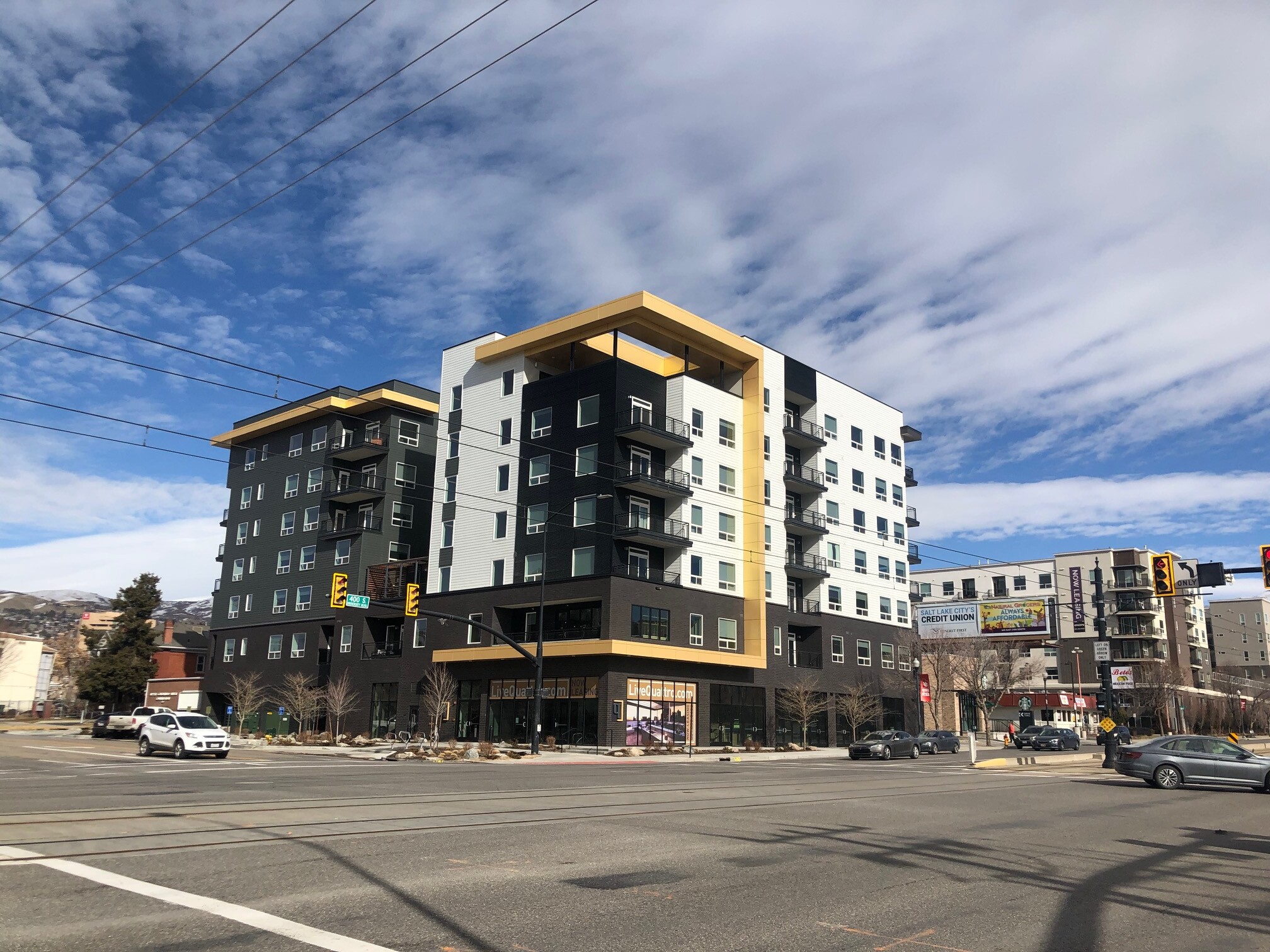
There are many new apartments on 400 South, most with little to no ground floor activation. It’s no wonder since they are next to a de facto highway. Photo by Dave Iltis
Meanwhile, Salt Lake City residents suffer under the tyranny of an unsafe, overbuilt street that does nothing to activate retail on the street, nor does it make it safe for the ever-growing residential population of the corridor. With another new apartment complex just announced (https://buildingsaltlake.com/bye-bye-betos-400-south-continues-its-transformation-to-residential-with-156-unit-project/ ), and the demise of Beto’s Mexican Restaurant, more residents are coming to the street, but counter to the goals of a TOD, they are stuck on a street that is unsafe for biking and walking, and pretty much requires the use of a car. The new 156-unit building will have space for 153 more cars, and apparently no ground level retail. Why would any savvy developer want to build ground level retail when the street next to it is a highway?
A Plan for a Better 400 South
Cycling Utah is calling for a reconfiguration of 400 South to one that is more inviting, safer, more sustainable, and of greater economic value.
According to the Highway Capacity Manual 6th Edition (from https://www.mikeontraffic.com/numbers-every-traffic-engineer-should-know/ ), a 6-lane road is appropriate for traffic volumes of 55,300 vehicles a day, about twice the capacity needed on 400 South. A 4-lane street with center turn lanes can handle 36,800 vehicles a day, still more than what is needed.
So, the first step on the corridor would be to reduce the lane number from 6 to a maximum of 4. What then?
400 South Needs Barrier Protected Bike Lanes
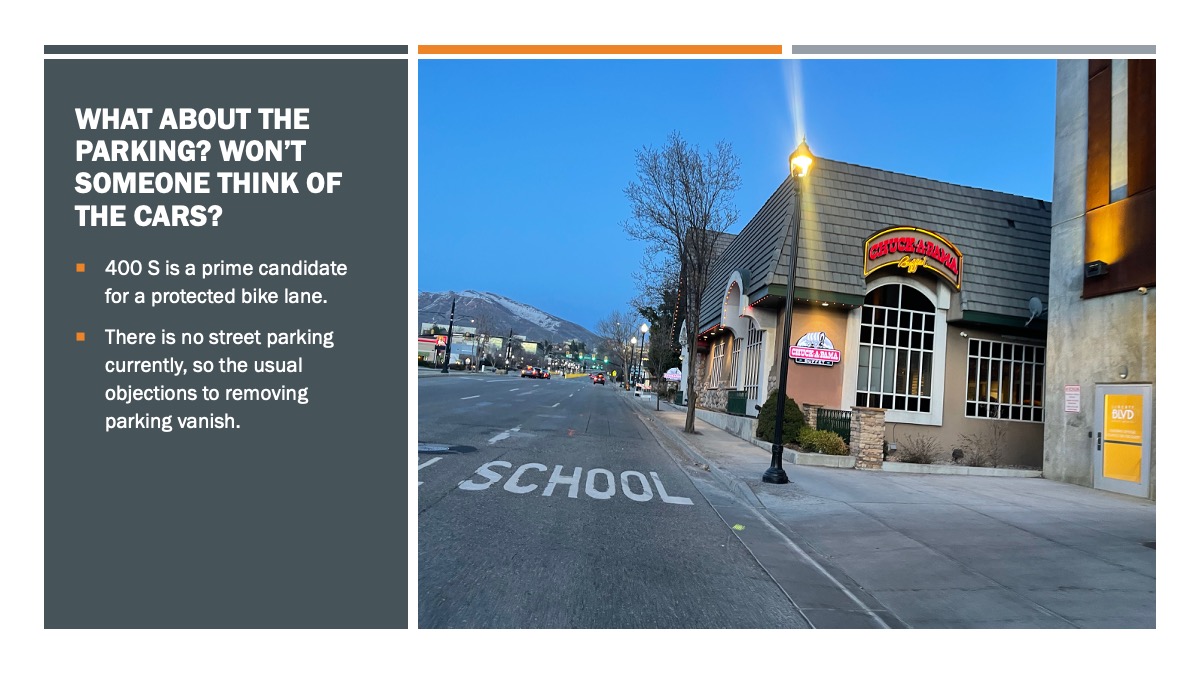
400 South has no street parking, and so it lends itself to the immediate installation of barrier protected bike lanes, one in each direction that utilize the width of a current traffic lane.
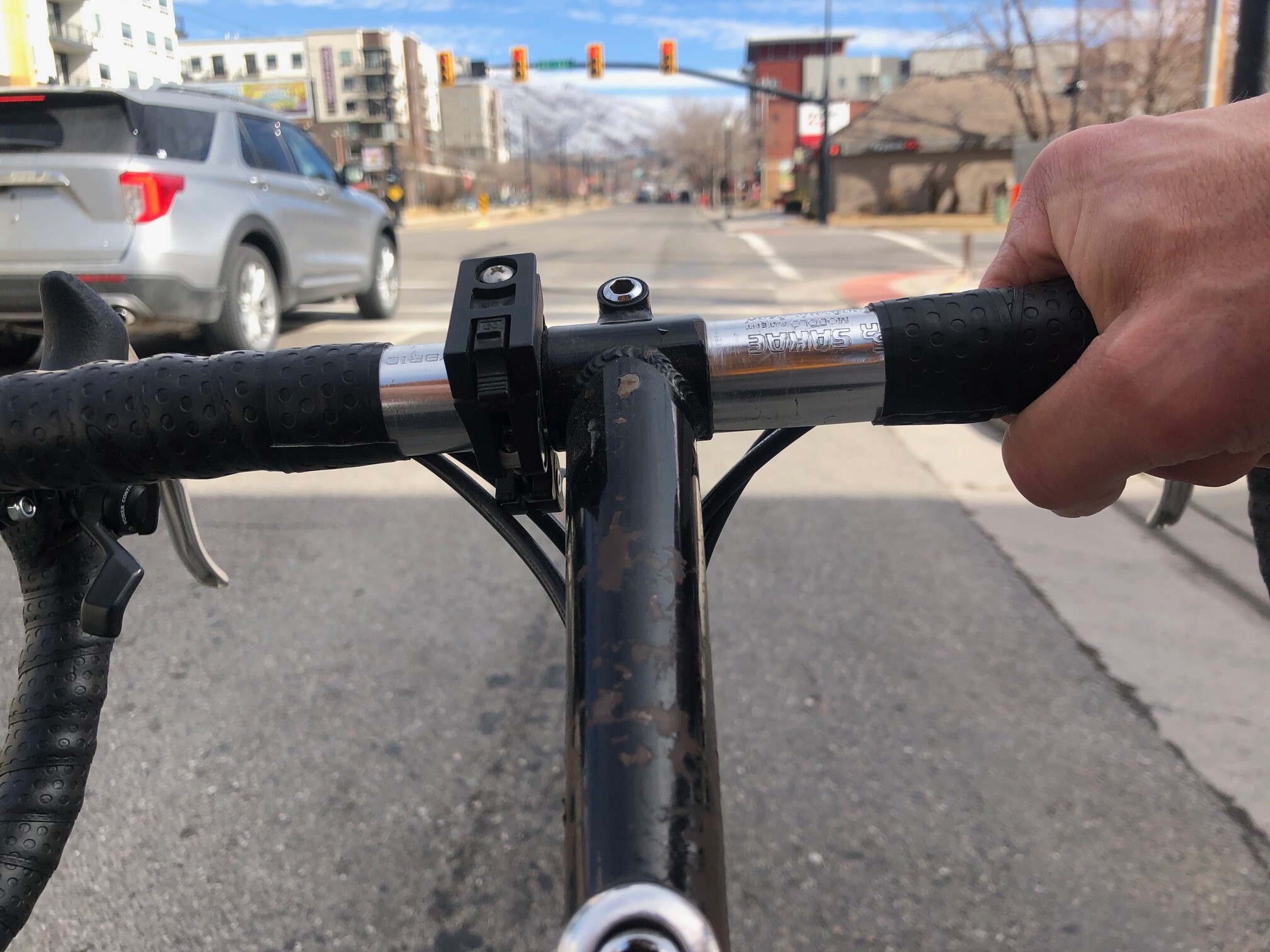
Only a few cyclists ever ride on 400 South because there are no bike lanes and high speed cars. Photo by Dave Iltis
The protected bike lanes would have the effect of making the road safer for all users by right sizing the number of traffic lanes, reducing the speeds of cars, and making the walk across the street much less stressful.
Transit works best when people can easily get to a bus or light rail stop. UTA, just now embarking on a first ever Active Transportation Study to look at how people on bikes and foot get to transit, would benefit greatly since it would be much safer to get to the TRAX stops on 400 South.
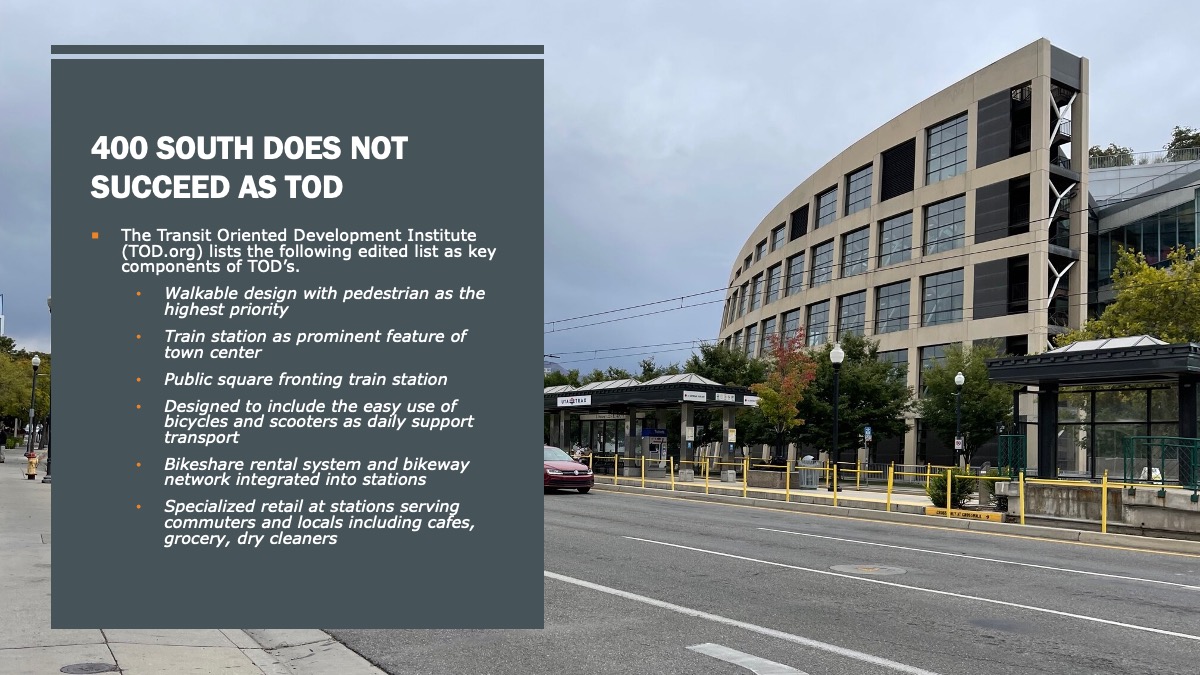
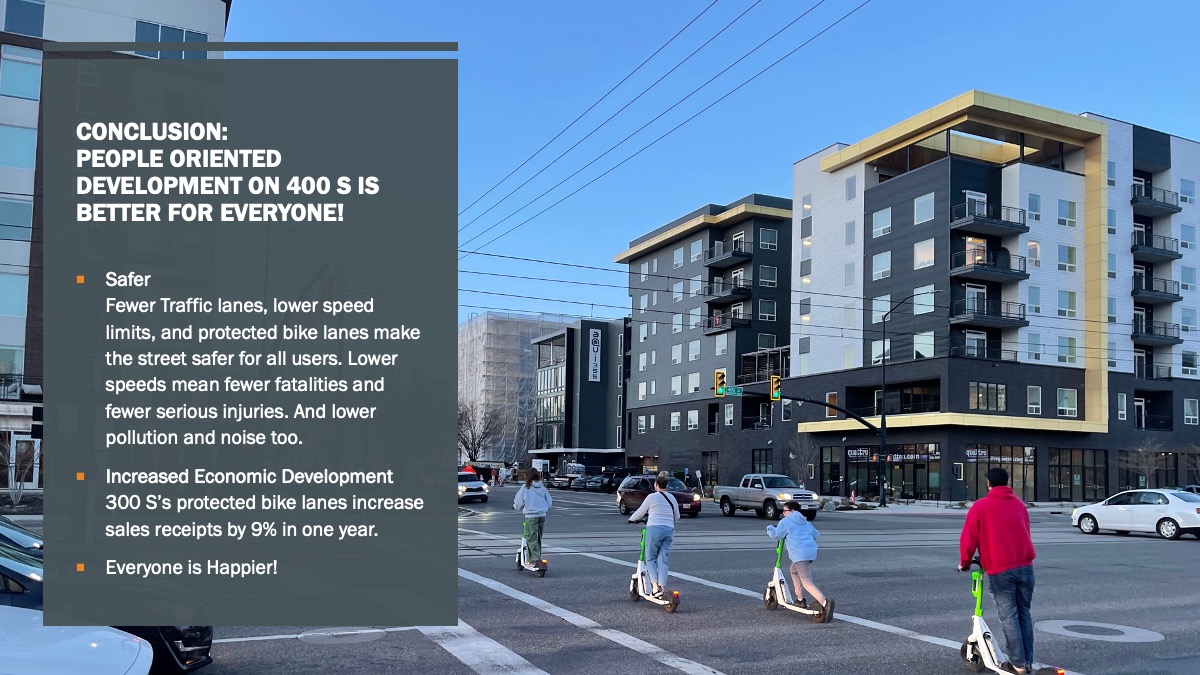
Transit Oriented Development has led to the construction of tons of new housing here, yet in our view, TOD here is a complete failure. It does not take people into account and just looks at increasing the number of buildings and increasing economic activity by supporting the construction industry and the car industry. It falls flat when viewed from a people perspective of living and working on the street.
Salt Lake City’s 400 South has many of the right components for Transit Oriented Development but fails to deliver. Photo by Dave Iltis
From UTA’s website, we learn what a TOD should be:
“It is development that is: compact, vibrant, mixed-use, walkable, formed around a well-connected street grid, connected to other areas of the region via high-capacity transit, and designed with the station as a prominent center.
“TODs are destinations designed for people and reflect the core values and priorities of the community. They occur within the existing urban context and compliment the surrounding area. They act as gathering places, designed at a human scale, both intuitive and comfortable. Streets, paths, buildings, open space, and other aspects of the environment are organized to optimize access to and from public transit, making it convenient for people to get where they want to be. TODs may become economic generators for their communities because of their variety and intensity of land use.
“By optimizing land use and accessibility, Transit-Oriented Development decreases traffic congestion, improves air quality and public health, lowers the cost of living, and makes opportunities more accessible. (http://tod.org/)”
400 South fails in that it is not a destination designed for people. It’s clearly designed for cars and thus subpar in how it could encourage transit use and active transportation use.
The Transit Oriented Development Institute (TOD.org) lists the following as key components of TOD’s:
Walkable design with pedestrian as the highest priority
Train station as prominent feature of town center
Public square fronting train station
A regional node containing a mixture of uses in close proximity (office, residential, retail, civic)
High density, walkable district within 10-minute walk circle surrounding train station
Collector support transit systems including streetcar, light rail, and buses, etc.
Designed to include the easy use of bicycles and scooters as daily support transport
Large ride-in bicycle parking areas within stations
Bikeshare rental system and bikeway network integrated into stations
Reduced and managed parking inside 10-minute walk circle around town center / train station
Specialized retail at stations serving commuters and locals including cafes, grocery, dry cleaners
400 South has many outdated shopping centers that essentially require a car to access. Most of the shopping centers, pharmacies, grocery stores, and banks have large parking lots bordering the street which are uninviting to pedestrians and bicyclists. Few of these complexes have bike racks, or if they do, they are of the wheel bender variety, or have been removed altogether apparently to keep out those scofflaw cyclists (who spend their money at the stores just like people in cars do).
The few highlights on the street such as The Green Pig, Salt Lake Coffee Break, and Doki Doki suffer with lack of good access from foot traffic because of the pathetic lack of planning and lack of vision from both UDOT and Salt Lake City. Other hot spots like The Tin Angel, and much of the shops from 300 West to State Street have moved or turned over; except of course the hopelessly undersized state-run liquor store on 200 West.
A shift to having the stores be streetside and the parking lot in the back would help activation and bicycle and pedestrian friendliness. The same goes for the plethora of cookie-cutter apartment buildings going in, most of which have non-descript ground level nothingness. This change will of course years, or even decades, but could be moved along by Salt Lake City with incentives to redevelop the corridor.
Reducing the speed limit to 25 mph in conjunction with a removal of traffic lanes would further the safety of cyclists and pedestrians, as would ensuring that the travel lanes are 10-feet wide only. UDOT recently repaved a section from 300 West to State Street (https://www.udot.utah.gov/projectpages/f?p=250:2007:0::NO:2007:P2007_EPM_PROJ_XREF_NO,P2007_PROJECT_TYPE_IND_FLAG:14507 ) and left the lanes at 11-feet, 12-feet, and extra wide despite evidence (and requests from Cycling Utah) that narrower travel lanes are safer. Salt Lake City did absolutely nothing to work with UDOT on this stretch to improve safety.
One bit of good news on the corridor is an upcoming shared use path on the 400 South overpass over I-15. While we don’t have details on this project, we believe that it is coming in 2023, and will improve access over the freeway for bicyclists and pedestrians. Unfortunately, this progressive thinking isn’t planned to any greater extent.
In the downtown area, Salt Lake has the following highways: 300 West, 400 South, 500 South, 600 South, 700 East, State Street, West Temple, and 800 South. Isn’t that just a few too many highways in the center of Salt Lake City?
Video Presentation for A Better 400 South:
Summary: A Better 400 South would have People-Oriented Development:
Create a 400 South corridor plan from at least Redwood Road to Guardsman Way.
400 South is University Boulevard, yet the only connection to the University of Utah is that it speeds by Rice Eccles Stadium (which itself does little to encourage alternative transportation to and from the games).
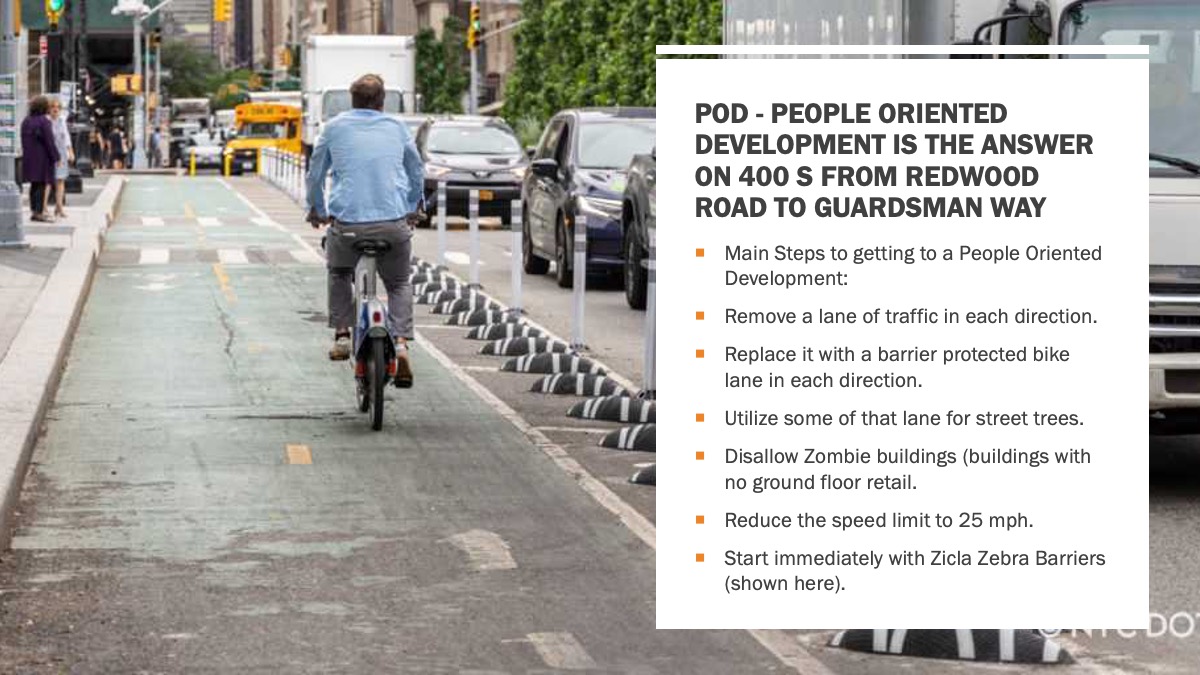
Remove at least 2 travel lanes and replace with a barrier protected bike lane. This would be easy to do since there are no parking spots along most of 400 South.
Reduce the speed limit to 25 mph.
Reduce lane widths to 10 feet.
Change future zoning to require streetside front doors for retail. In the meantime, encourage streetside businesses such as food trucks or popup florists in the large parking lots near 600 East.
Work with current retail destinations to install usable bike racks. And, work with the Salt Lake City Main Library which has decorative, but subpar bike racks.
Work to activate the ground floors of the numerous zombie buildings, especially the new apartments at about 400 East. This of course would be easier with more pedestrian and bike traffic.
Work to reconfigure the cross streets of 400 South. Almost all of them need help to become more people friendly, but Salt Lake City could start with 200 East which runs between the City/County Building and Library Square, yet remains a 4 lane mess.
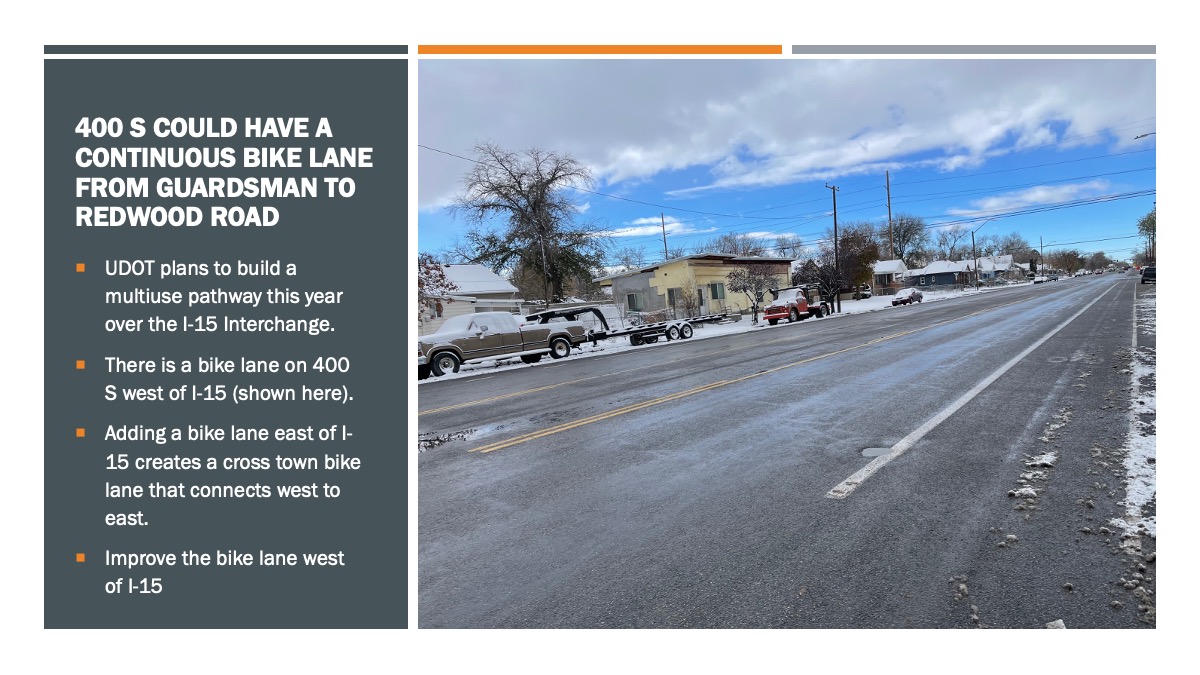
Focus on the Westside of I-15: narrow the traffic lanes, add buffers to the bike lanes, narrow the center turn lane, and reduce the speed limit to 25 mph. It should not be 35 mph in a residential neighborhood.
Start immediately with a barrier protected bike lane using quick build methods and Zicla bike lane dividers (https://www.zicla.com/en/zebra-family/ )
Salt Lake City needs to restripe each of the cross streets with upcoming repaving.
Improve access to the TRAX stops on 400 S by adding mid-block crosswalks.
Who needs to make these changes?
Primarily, UDOT needs to start the changes on the street since they own the road, but Salt Lake City can and should work with UDOT to jump start this process. UTA has a vested interest in this too.
A Better 400 South Presentation:
Photos of 400 South:
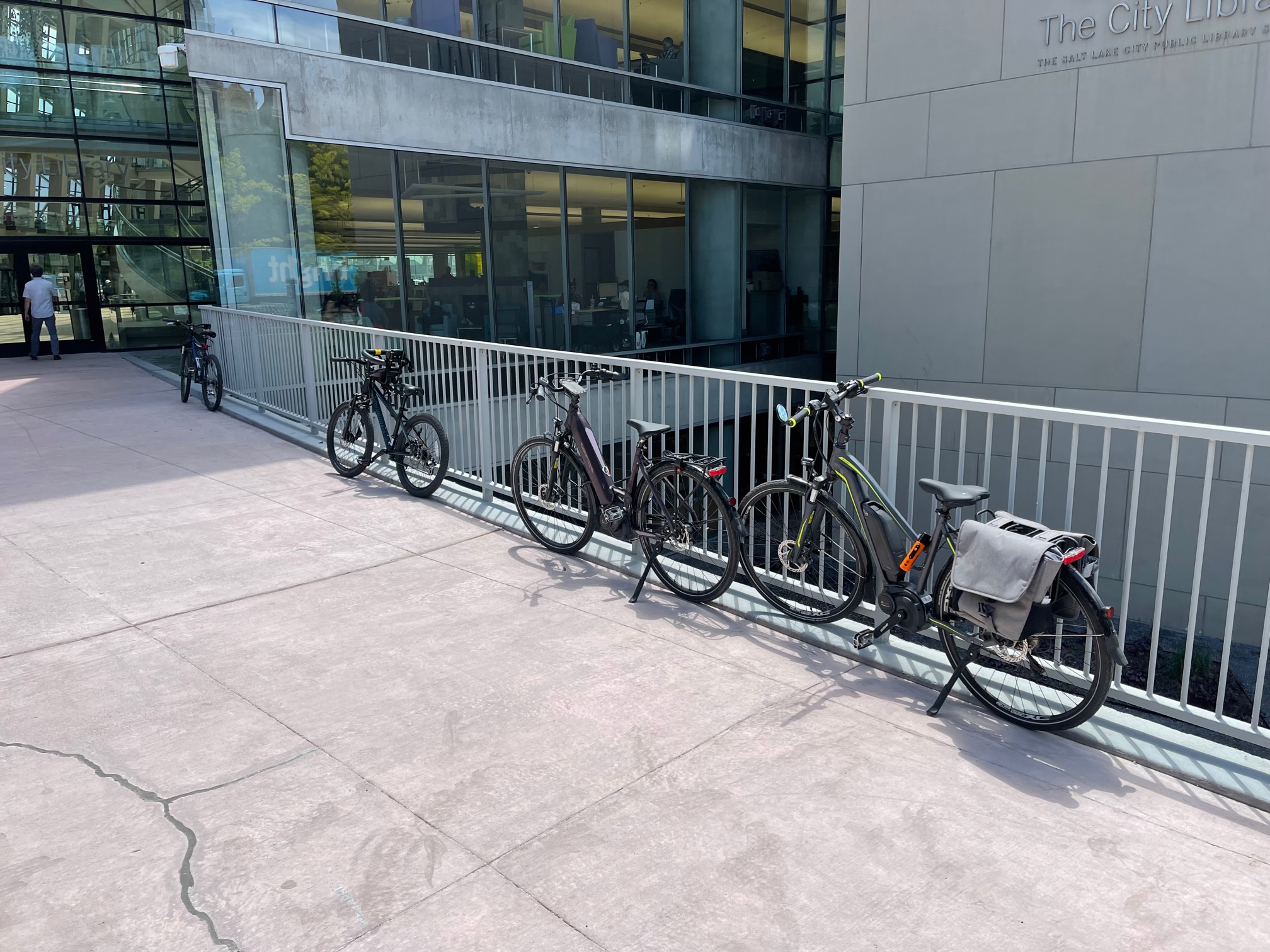
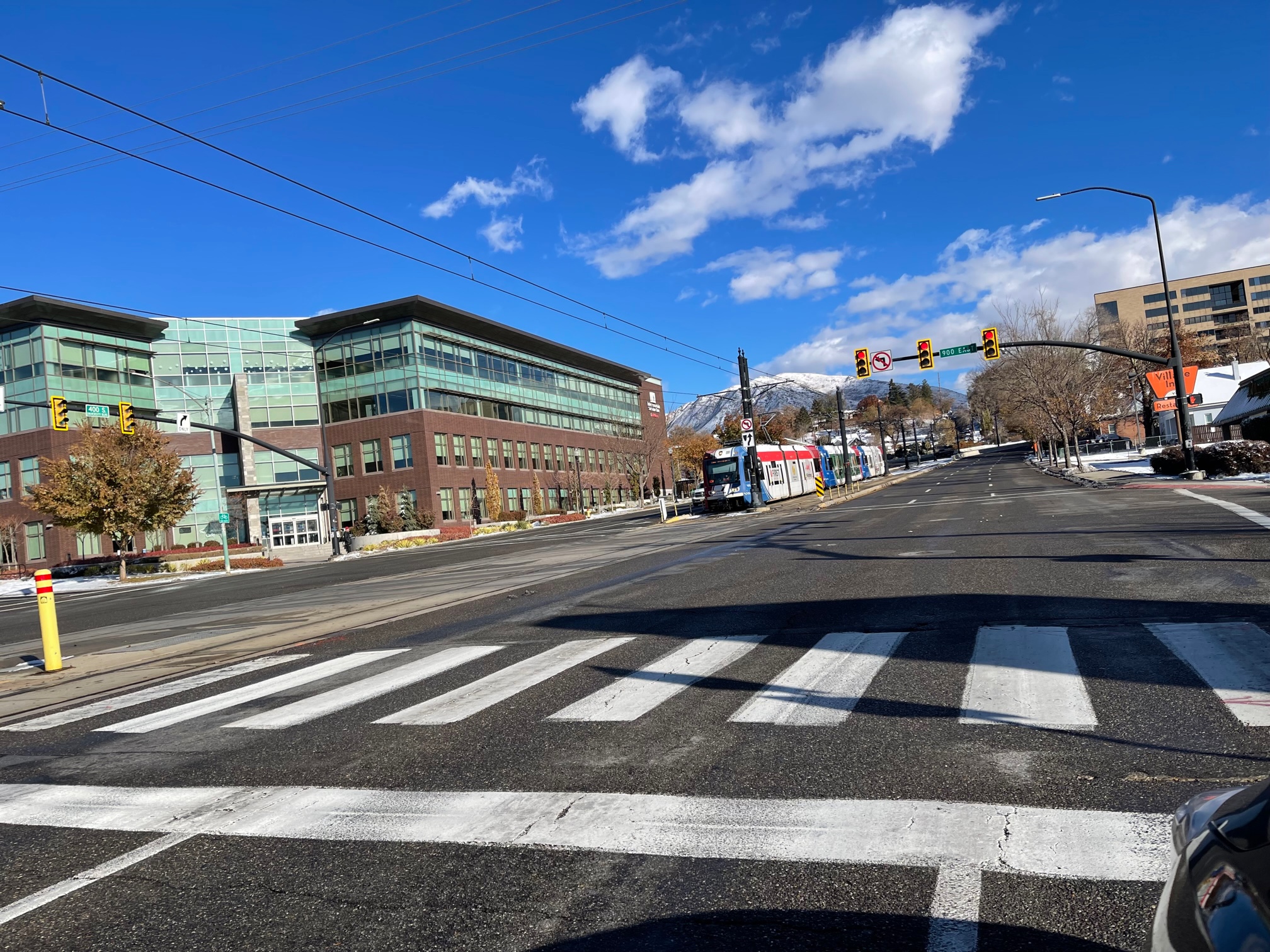
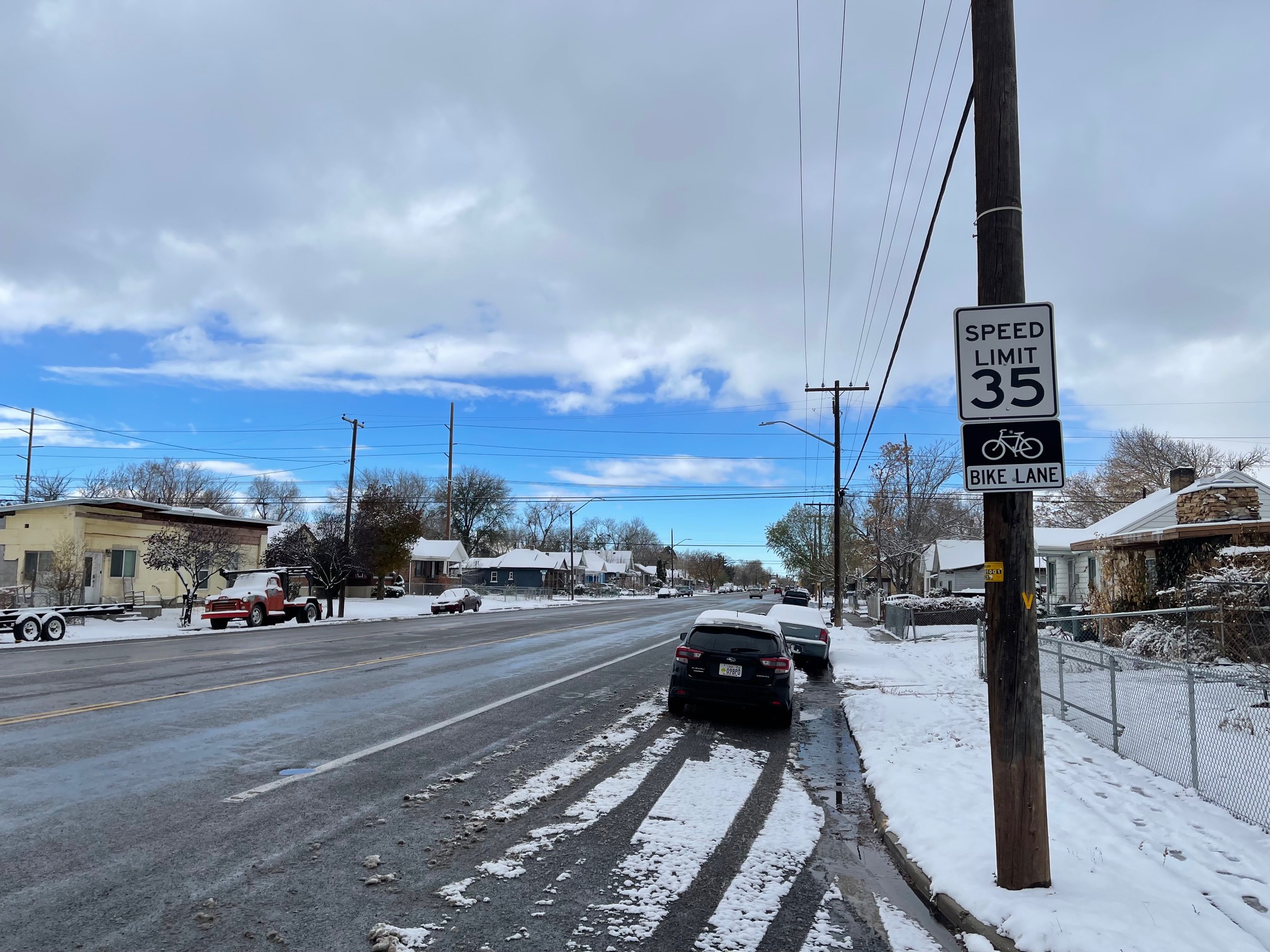
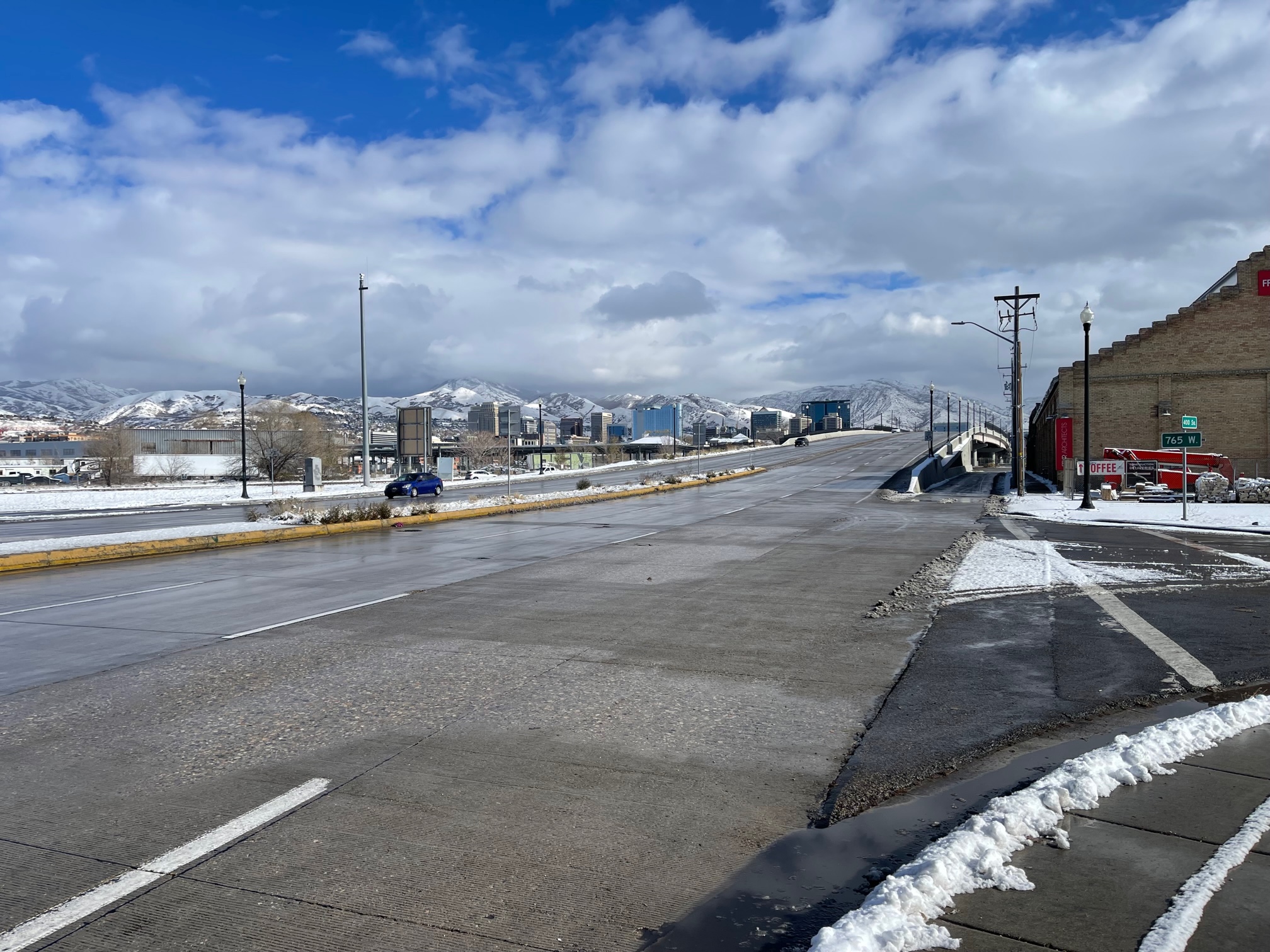
The Salt Lake City Library needs better bike racks. Bike theft is common there, and most people don’t use the inadequate library approved racks and instead use the railing. Photo by Dave IltisBuffered bike lanes could extend up the hill by the S Turn since traffic volumes don’t justify 6 lanes. Photo by Dave Iltis400 South on the west side of I-15 has an unnecessarily high speed limit and and a center turn lane that could be narrowed to make way for buffers on the bike lanes. Note that this is a residential street with schools and kids nearby. Photo by Dave IltisUDOT and Salt Lake City are colloborating on a shared use path over I-15. It’s not clear if it will solve the issue of no safe pedestrian crossing of 400 S from 900 W to 400 West. If uou are on the southside of the road, you are stuck there. Photo by Dave IltisUDOT recently repaved 400 S from 300 W to State Street, but did nothing to improve bike or pedestrian safety. Here, the center lane is about 12′ wide. Photo by Dave Iltis
MOAB, Utah — Utah mountain bike racer Hannah Otto set the Fastest Known Time (FKT) on Moab’s Whole Enchilada Loop. The loop isn’t just the well known and epic 26 mile descent, it’s also the 29 mile fire road climb to the top with no shuttling involved. Otto’s time of 5:50:38 posted on October 11, 2022 beat the previous FKT of 6:46:05 set in 2017 by Slash! (on Strava).
Hannah, sponsored by Pivot and DT, worked with Competitive Cyclist to document the ride in this video that shows her preparation and the ride itself:
We caught up with Hannah and asked her some questions about the ride:
Cycling West: What made you decide to tackle the Whole Enchilada Loop?
Hannah Otto: When I first rode the Whole Enchilada trail several years ago, I absolutely fell in love. In my opinion, the trail is everything that mountain biking should be. The trail covers a wide variety of terrain from high-alpine aspen groves to desolate desert terrain. It forces a rider to constantly adapt and overcome. It takes every rider on an adventure that is sure to highlight both strengths and weaknesses. Add the climb to the top, and you add the fitness component as well. I had been dreaming of doing this FKT for a couple of years, and finally everything aligned to make it happen. My hope is that it will inspire others to go out and experience all this trail has to offer as well.
Cycling West: Have you attempted any other FKT’s?
Hannah Otto: I’ve never attempted another FKT of this magnitude before because most of my performance goals are generally set around racing. I’ve always enjoyed challenging myself on the occasional Strava QOM/KOM as a part of my training, but this was my first experience attempting an “official” FKT. I had a blast and I hope to tackle some more FKTs in the future!
Cycling West: Did you do any special preparation for the Whole Enchilada FKT?
Hannah Otto: Since I had been racing all season, I relied on all of my race experiences and training for my fitness to be high enough to tackle this challenge. My primary preparations that were specific for this FKT were planning and research oriented. I practiced the descent several times in order to dial in both my line choices and my equipment choices for this attempt.
Cycling West: Any tips for others attempting the Whole Enchilada Loop?
Hannah Otto: I think one of the most exciting things about this route is how many different variables there are to account for and consider. It seems like the planning and advice for a route like this could truly be endless. If I had to pick just one piece of advice then I would tell people that “smooth is fast.” On this type of terrain there is a tendency to want to take risks to gain a couple seconds here or there, but mistakes, crashes, and mechanics will be the slowest way to tackle this challenge. Minimizing mistakes will be the fastest way to ride.
Cycling West: What are your racing plans and goals for 2023?
Hannah Otto: In 2023 I plan to tackle the World Cup XCO Calendar with a big overarching goal of being on the Olympic team in Paris in 2024. I also plan to apply to race the Lifetime Grand Prix Series here in the United States.
FKTStats:
55.27 miles
8,011 feet of elevation gain
Lowest Elevation: 4,004 feet
Highest Elevation: 11,146 feet
Finishing Time: 5 hours 50 minutes and 38 seconds
Previous Fastest Known Time on this route (Male or Female): 6 hours and 47 minutes
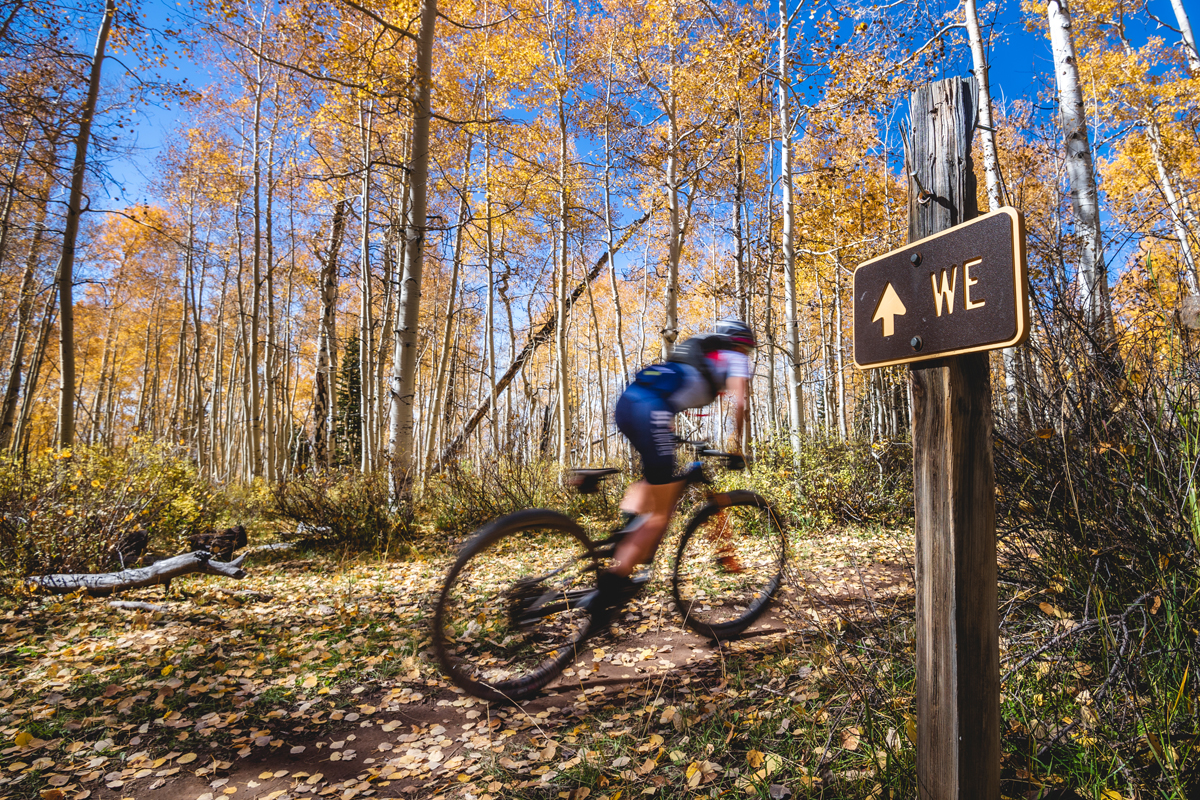
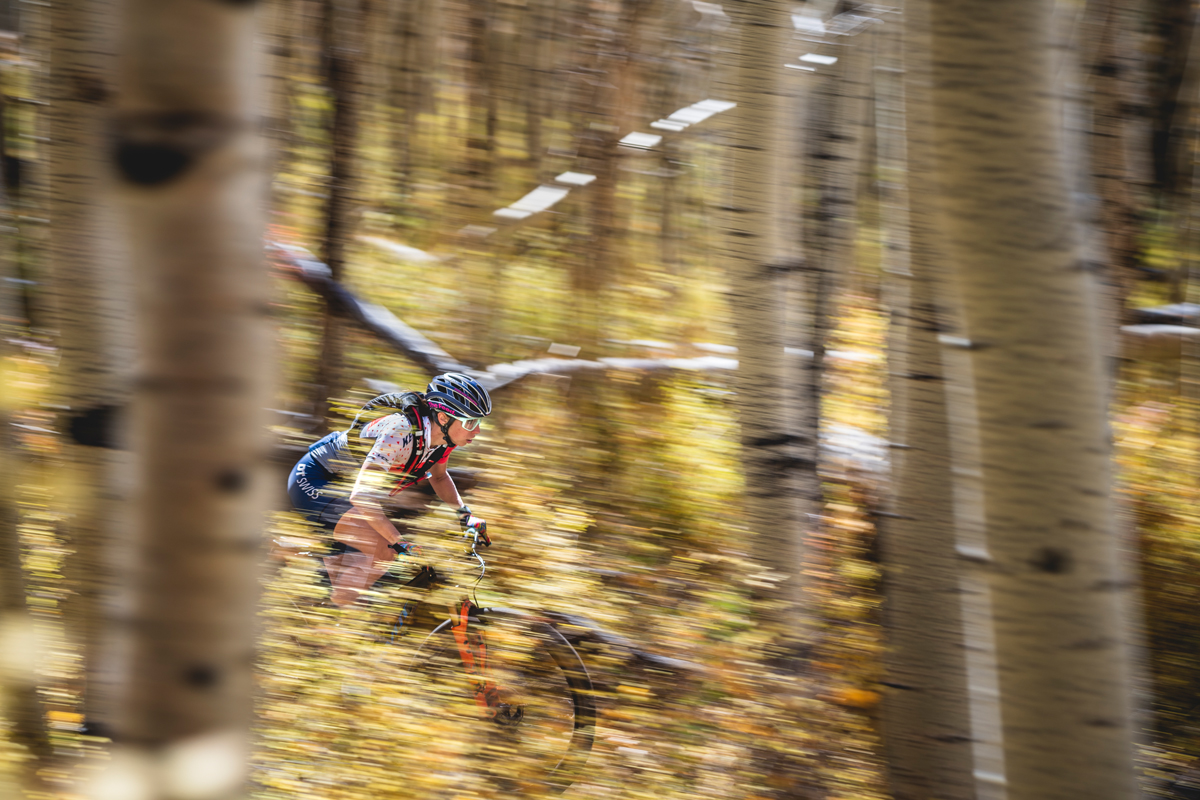
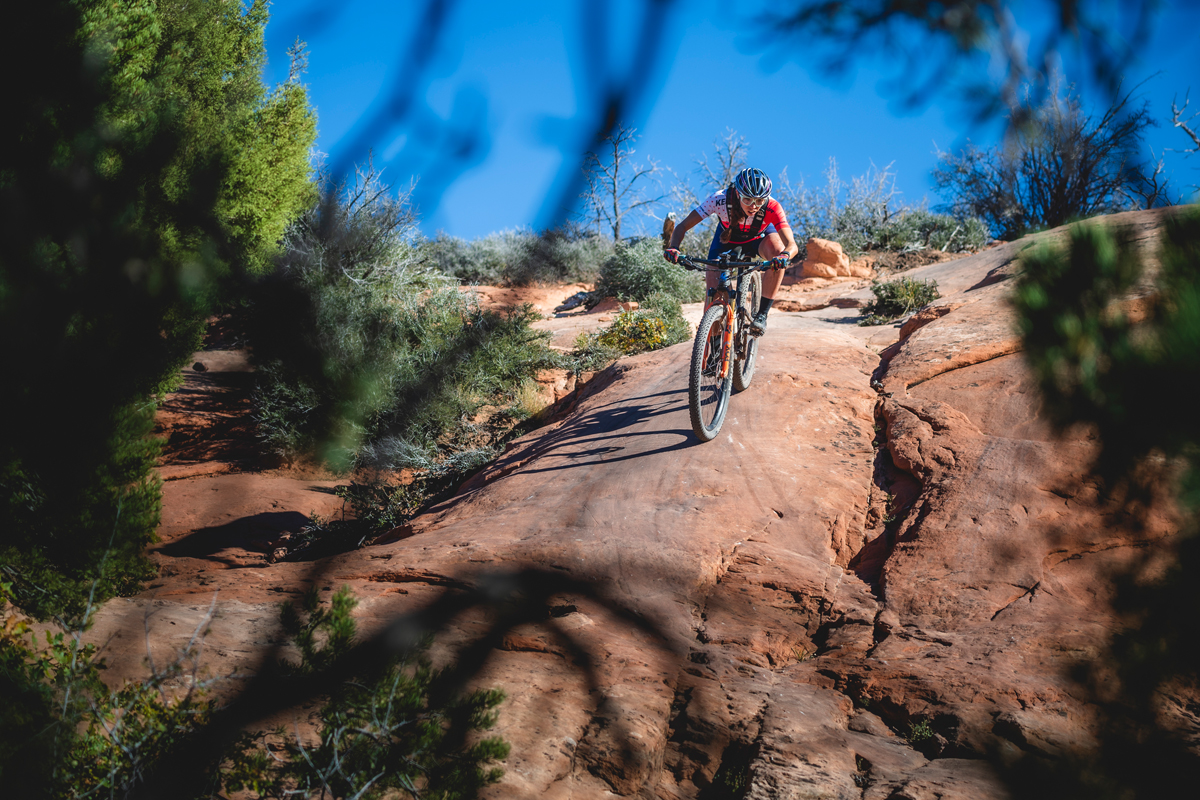
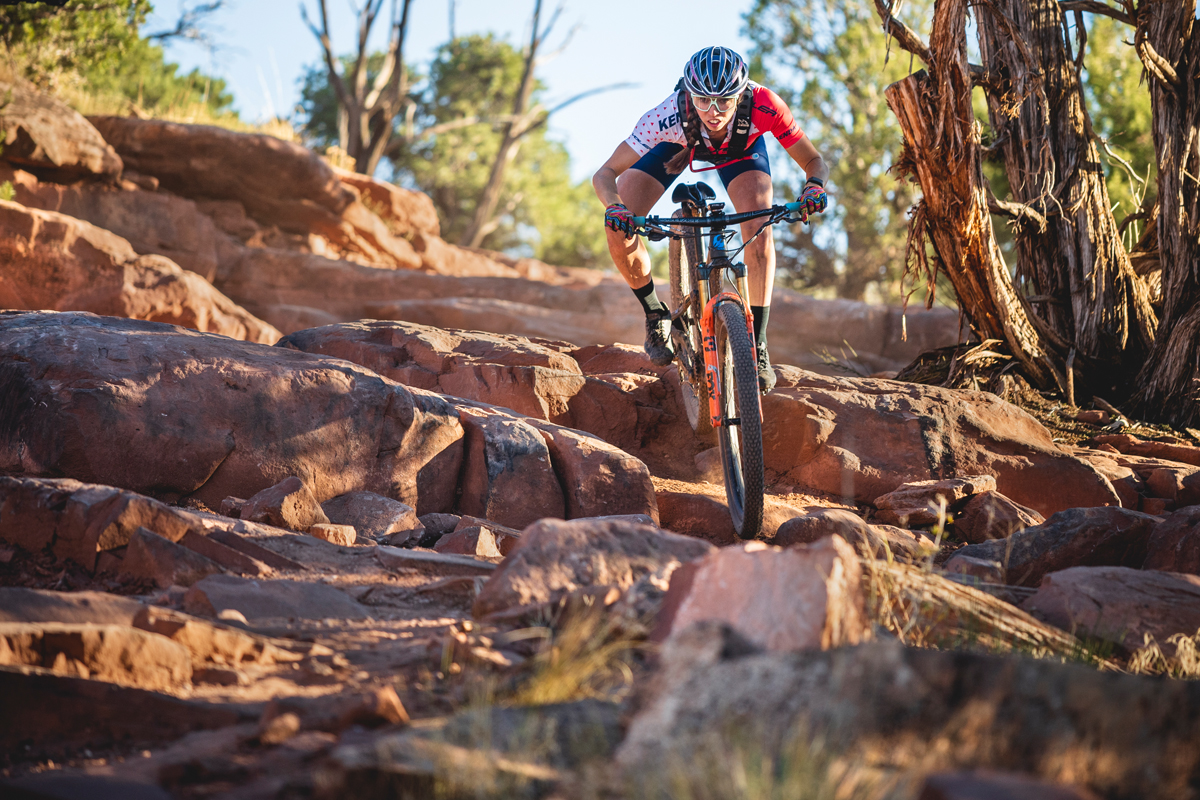
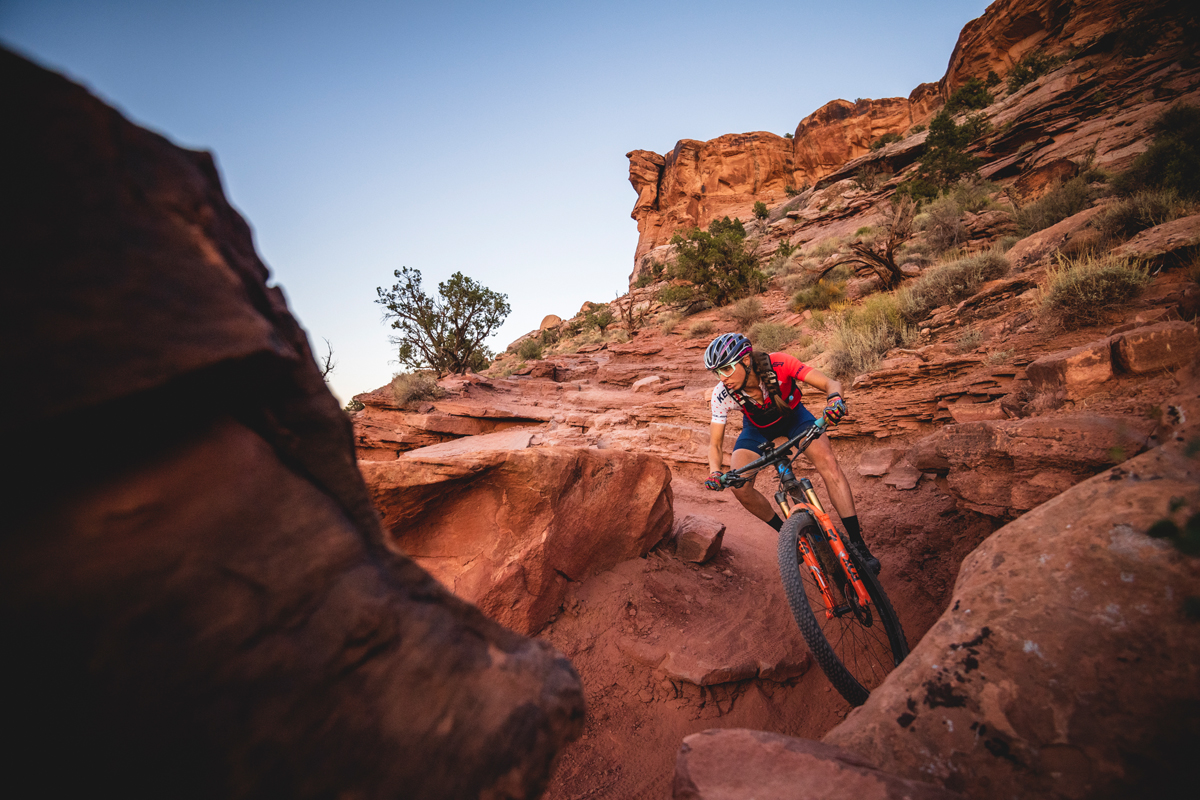
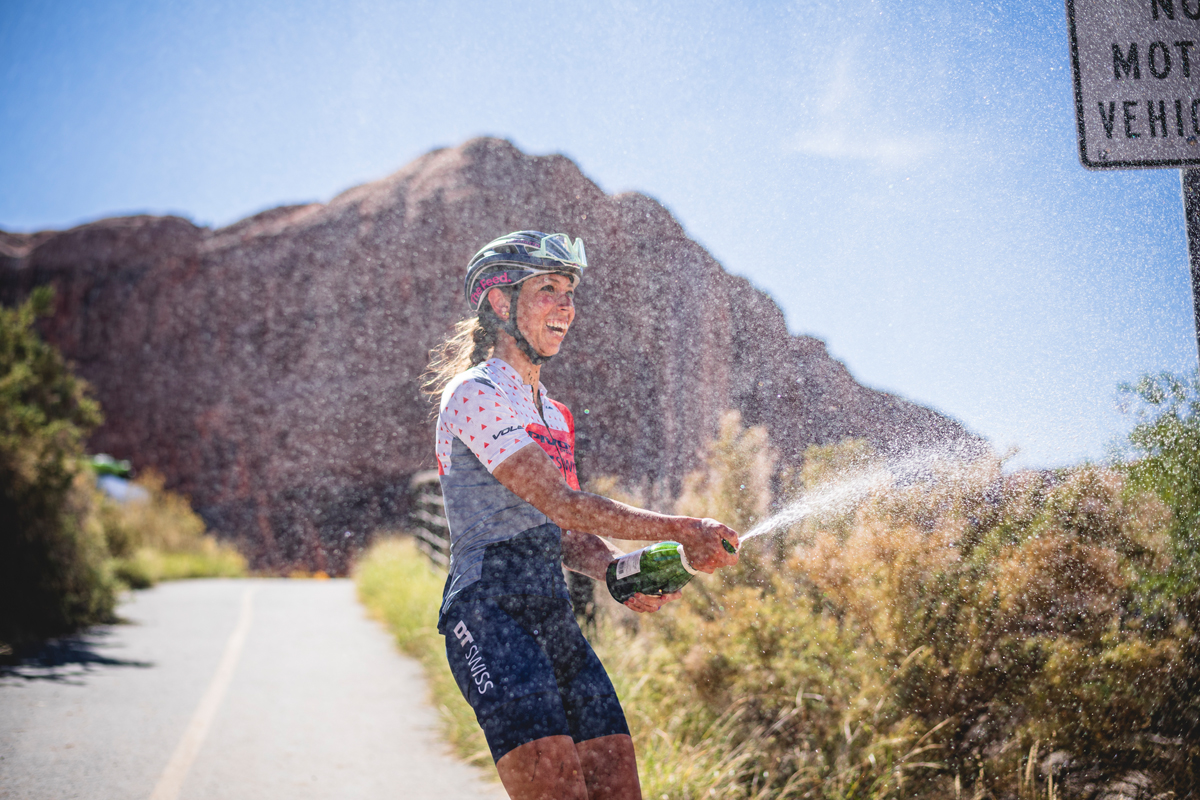
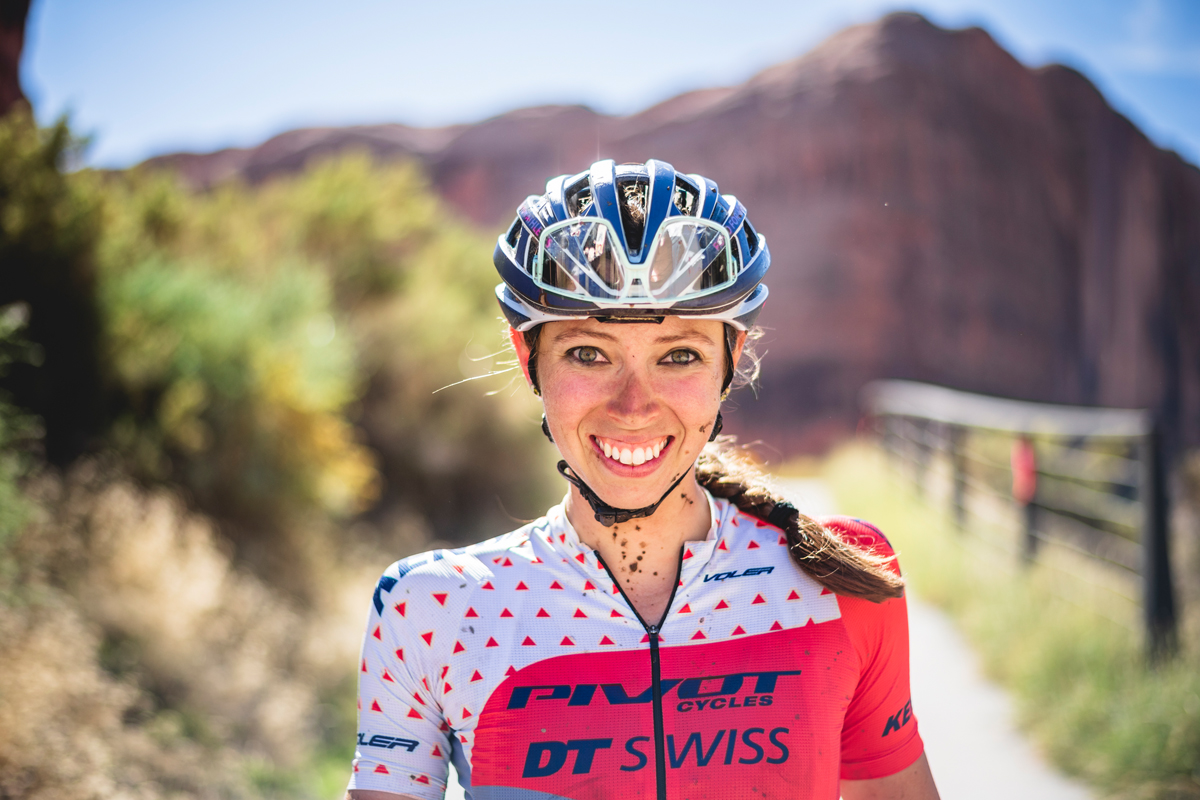
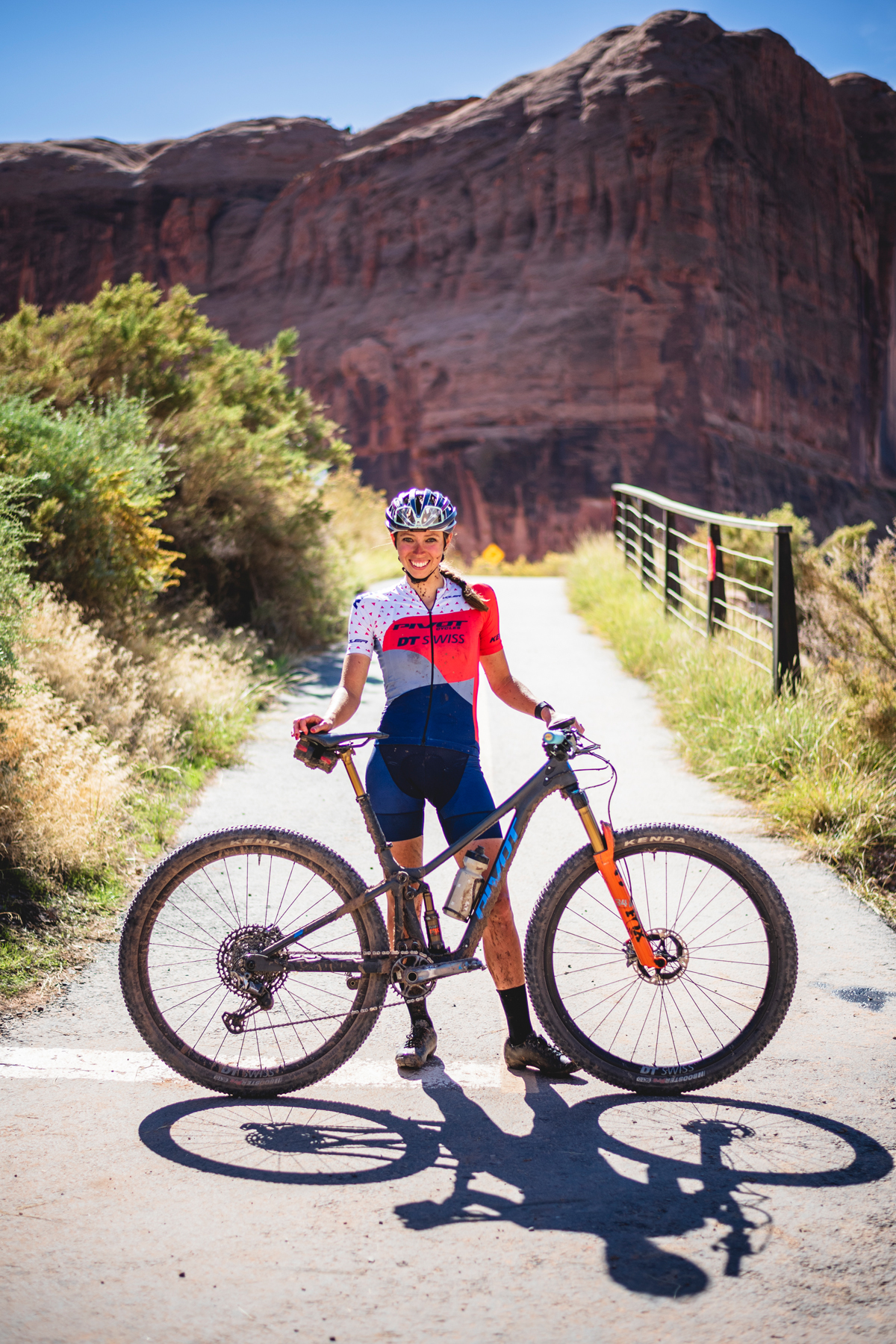
Hannah Otto descends the Hazard County Trail on her way to setting an FKT on “The Whole Enchilada” route, riding from town, into the La Sal Mountains and descending to the trail’s end near the Colorado River, in Moab, UT. Photo by Re Wikstrom / CompetitiveCyclist.comThe sun begins to rise over Moab as Hannah Otto pedals south to the La Sal Loop Road, on her way to setting an FKT on “The Whole Enchilada” route, riding from town, into the La Sal Mountains and descending to the trail’s end near the Colorado River, in Moab, UT. Photo by Re Wikstrom / CompetitiveCyclist.comHannah Otto climbs the La Sal Loop Rd on her way to setting an FKT on “The Whole Enchilada” route, riding from town, into the La Sal Mountains and descending to the trail’s end near the Colorado River, in Moab, UT. Photo by Re Wikstrom / CompetitiveCyclist.comHannah Otto climbs the La Sal Loop Rd on her way to setting an FKT on “The Whole Enchilada” route, riding from town, into the La Sal Mountains and descending to the trail’s end near the Colorado River, in Moab, UT. Photo by Re Wikstrom / CompetitiveCyclist.comHannah Otto climbs the La Sal Loop Rd on her way to setting an FKT on “The Whole Enchilada” route, riding from town, into the La Sal Mountains and descending to the trail’s end near the Colorado River, in Moab, UT. Photo by Re Wikstrom / CompetitiveCyclist.comHannah Otto descends the Hazard County Trail on her way to setting an FKT on “The Whole Enchilada” route, riding from town, into the La Sal Mountains and descending to the trail’s end near the Colorado River, in Moab, UT. Photo by Re Wikstrom / CompetitiveCyclist.comHannah Otto rides past a “WE” sign on the Burro Pass Trail section of The Whole Enchilada in Moab, UT. Photo by Re Wikstrom / CompetitiveCyclist.comHannah Otto rides through golden aspen trees on the Burro Pass Trail section of The Whole Enchilada in Moab, UT. Photo by Re Wikstrom / CompetitiveCyclist.comHannah Otto rides over slickrock on the UPS (Upper Porcupine Singletrack) section of The Whole Enchilada in Moab, UT. Photo by Re Wikstrom / CompetitiveCyclist.comHannah Otto rides through technical chunky rock on the classic Porcupine Rim Jeep trail section of The Whole Enchilada in Moab, UT. Photo by Re Wikstrom / CompetitiveCyclist.comHannah Otto weaves through sandstone on the classic Porcupine Rim trail section of The Whole Enchilada in Moab, UT. Photo by Re Wikstrom / CompetitiveCyclist.comHannah Otto celebrates after setting an FKT on “The Whole Enchilada” route, riding from town, into the La Sal Mountains and descending to the trail’s end near the Colorado River, in Moab, UT. Photo by Re Wikstrom / CompetitiveCyclist.comPortrait of Hannah Otto after setting an FKT on “The Whole Enchilada” route, riding from town, into the La Sal Mountains and descending to the trail’s end near the Colorado River, in Moab, UT.Photo by Re Wikstrom / CompetitiveCyclist.comPortrait of Hannah Otto after setting an FKT on “The Whole Enchilada” route, riding from town, into the La Sal Mountains and descending to the trail’s end near the Colorado River, in Moab, UT. Photo by Re Wikstrom / CompetitiveCyclist.comPortrait of Hannah Otto after setting an FKT on “The Whole Enchilada” route, riding from town, into the La Sal Mountains and descending to the trail’s end near the Colorado River, in Moab, UT. Photo by Re Wikstrom / CompetitiveCyclist.com
By Heather Casey — Maybe you’ve heard this: “A faster climber trains on hills more.” Makes sense, yes? There’s more to riding uphill than simply doing it over and over. Your power-to-weight ratio determines your overall performance when riding up a hill. Power-to-weight ratio has two essential components to know about:
Power Output refers to the speed and strength of your bike pedals for a sustained time.
Total Weight refers to the weight of your bike, including clothes, shoes, and things you carry on your bike like hydration, bottles, snacks, and tools.
Heather Casey climbing in the Wasatch Mountains. Photo by Scott Markewitz
From the two points above, we can deduce that riding uphill in an improved manner relies on slowly gaining a higher power output or having specific training that will focus on reducing your weight and the bike’s total weight. It’s not an absolute rule to train on hills; whenever you’re out and about on your bike, you can achieve a faster speed while riding uphill.
Reducing Weight Uphill
Reduce Weight of Bike
Are your bike’s components relatively light or relatively heavy? How can you assess whether it’s heavy or light? Try weighing it to find out. Your bike weight, including everything you carry, affects your speed when you ride uphill. For example, Tour De France bikes weigh less than 6.8 kilos or 15 pounds. If you have riding buddies riding even lighter bikes, then best believe they will have the upper hand when you go on riding expeditions together.
Components of your bike that you can tweak and upgrade first are the rotating parts like the wheels, shoes, and pedals, as these will immediately prove your money’s worth. However, take into consideration the costs as well. Spending hard-earned bucks on fancy new wheels will not be worth it if your frame and components do not match the new gear because of their age and weight. Sometimes it’s better to tuck your old bike, use it for other stuff, and upgrade your ride. Ultimately, it’s all up to you to make the more cost-efficient and sustainable choice.
If you lack the money to invest in upgrades, there’s another tactic you can try: Minimizing what you carry on hilly rides will make your bike lighter and smoother. Do you need the two water bottles that you always have with you? How about the big saddlebag full of tools and other miscellaneous items? Maybe it’s better to take one bottle and go for a refill. Choosing lighter apparel could shave one pound and help shift your power-to-weight ratio.
Reducing Weight of Rider
Sometimes, reducing your body weight to increase your cycling speed when riding up hills is better. How much weight loss are we talking about? Imagine this: You can increase your Functional Threshold Power (FTP) by 15 watts simply by having a sleek and intelligently tailored training regime within a 3-month timeframe. Apart from this, you can also achieve a similar effect by working out and losing 7.7 combined pounds from your weight and bike. Doing this would turn you into a significantly faster hill rider, even without improving your power output.
Metabolic Testing is the gold standard in determining an appropriate fueling rate. Losing one pound per week may be realistic by consuming 500 calories less per day or burning the 500 calories through exercise. Doing this daily would earn you at least a pound in weight loss per week. It’s a healthy rate of weight loss that won’t interfere with your overall health.
Improving Your Power Output is a Process
Maybe you feel tired from reading what it would take for you to be a better climber, but remember the idiom “no pain, no gain”? I think its application to sports and our overall health varies, but it also stands true in that there are simply no shortcuts to improve your pedaling power output. Hard work will get you there; training consistently for several months to gain the desired results is worth it.
Before starting a new training program, it’s essential to test your current power output with your preferred method. Doing this will act as your standard and guideline for future improvements you want to try achieving.
Once you have the baseline, there is no other way but up. Diversify your training by including a mix of high- and low-intensity workout sessions that will eventually become more demanding. Aim to ride at least three times per week. Again, don’t expect to achieve your goals overnight. Your improvements will occur slowly. Remember – find your flow, and row, row, row. Or, in this case – pedal, pedal, pedal.
Three months is the least amount of time you’ll need to notice a significant difference in your riding wellness. In this timeframe, expect a considerable increase in your FTP of around 3-5% if your training has been effective. It’s also important to consider whether your sessions are the best path for you to continue taking on. In that regard, here are five more ways to try to ride faster uphill.
5 More Ways You Can Try to Ride Faster Up Hill
Gearing for terrain specificity
Pace yourself properly so you don’t blow up when you ride uphill. Proper pacing is problematic when you don’t have the appropriate gearing. Giant gears force you to slowly turn the pedals at a high-power output when riding uphill. Enduring this pace can cause muscle micro-trauma and lactate build-up and cause you to fatigue quickly. Setting up easier gears for your bike for hilly rides is better so you can ride at your maximum intensity leisurely without tearing your legs apart. If you have a 53/39 chainring on the front, consider using a 27-, 28-, perhaps even a 32- or 36-tooth cassette in the back. If you have a 50/34 chainring on the front, still consider the option of a 28 or 32-tooth sprocket. Your legs will thank you for it.
Work on your upper-body strength: When engaging in long rides or competing in multi-day hill cycling events, it’s worth building your strength beforehand. Stress on the upper body increases when you’re riding up hills. Your forearms, shoulders, and entire upper body will soon tire when you have long rides that surge up.
Has your rolling resistance been checked? Carefully choosing your tires, tire pressure, and wheels can help you save a few precious watts on the bike. Making educated choices will help you have better-rolling resistance for better rides on slopes.
Aerodynamics: It’s not a big deal when riding up hills, but aerodynamic drag still affects the ride, especially on lower gradients.
Mechanical resistance: This refers to how efficiently all the moving parts on your bike work. For example, a well-maintained chain might save you a couple of Watts.
Conclusion
To get better at riding faster up hills, acknowledge these facts: improving your power output will push you to the top better, and reducing your overall weight will alleviate a lot of unwanted stressors in your ride. If you can achieve both things together, trust that your hill-climbing on the bike will improve at a rate you never thought possible.
Perhaps the next big thing to consider from all this is the importance of choosing the proper gearing set-up and feeling the route you’ll be riding on when setting up your bike. Several smaller gains will come after that, such as reducing the rolling and mechanical resistance of your bike riding and improving your aerodynamics. Riding faster uphill is hard work, but it’s honest work. And the less time it takes to surge up that slope, the more satisfying your journey.
By Nancy Clark MS RD CSSD — Wouldn’t it be nice if athletes could get a genetic test that tells them precisely what they should eat to enhance their performance? Of course, the answer is yes! Personalized (or precision) nutrition currently exists as a growing area of interest to athletes. Yet, the field is in its infancy. To date, precision nutrition is not precise enough to tell athletes what they can eat to be able to perform better. Plus, many factors impact performance and health, including sleep and dietary patterns. Regardless, athletes are already buying (expensive) genetic testing kits.
Blueberries are high in polyphenols which may help to curb the body’s inflammatory response. Photo by Dave Iltis
Speaking at the Academy of Nutrition and Dietetics annual conference (Oct 2021, www.eatright.org), exercise physiologist David Nieman PhD, director of the Human Performance Laboratory of Appalachian State University, stated we can’t yet make claims about what to eat based on genetic testing because the results are just too variable. Plus, many factors impact performance and health, including sleep and dietary patterns. More research is needed before athletes can get valid personalized nutrition recommendations.
Without question, exercise scientists are getting better at analyzing genetics and each athlete’s metabolites (end-products of exercise metabolism). This has the potential to improve our understanding of how genes, diet, and exercise interact. But the diversity of responses leaves big gaps in knowledge.
Case in point: genes related to caffeine metabolism. Consuming 3 to 13 mg caffeine per kilogram of body weight reportedly improves athletic performance. But why do only some athletes perform better with caffeine? Is the difference due to genetics? Genetic tests can identify which athletes have the ability to metabolize caffeine quickly or slowly. But Dr. Nieman reported the data shows no patterns that reliably link caffeine-metabolizing genes to enhanced athletic performance.
Is inflammation related to genetics?
Here’s an example of how personalized nutrition could potentially help athletes. At the Western States 100-Mile Endurance Run, Dr. Nieman measured inflammation (cytokines) in 154 ultra runners. The amount of inflammation varied widely. Some runners had very high levels of cytokines and others very little. Was this due to genetics? Unknown; genetic testing couldn’t explain the differences.
Neiman has identified that exercising “on empty” creates inflammation. That is, athletes who exercise first thing in the morning without eating have an immediate spike in inflammatory cytokines. Regardless of their genetics, athletes can reduce this inflammatory response by about 40% just by consuming carb before and during extended exercise.
Does the kind of carbohydrate eaten make a difference? That is, would consum-ing banana or blueberries be less inflammatory than chugging a sport drink? Here’s what research tells us about the impact of carbohydrate before and during exercise:
Cells function best when they are fed. Both sugar from a sport drink and sugar from a blueberries or banana can help cells function optimally and curb a negative stress response.
Polyphenol-rich fruit/fruit juice (such as blueberries, blueberry juice) curb the inflammatory response more than fruit low in polyphenols, such as banana.
The best dose of polyphenols from fruit is unknown. Dr. Nieman’s initial research looked at the polyphenol quercetin (found in apples). He learned very high doses of quercetin were not helpful. Nieman then tested polyphenols in amounts that athletes could easily consume. He saw better results.
For example, when athletes ate (or not) 1 cup of blueberries a day for two weeks before a 75-mile hard cycling test, the inflammatory response was much lower overall. But that said, the response varied by 14-fold among the blueberry eaters. Eight cyclists experienced high inflammation, 13 had a moderate amount, and 10 had much less inflammation. Could genetic testing help identify the athletes who responded with high inflammation? If yes, could sports dietitians encourage those athletes to eat extra blueberries to get a stronger anti-inflammatory response? We don’t know yet…
Similarly, among runners in the Western States 100-Mile Endurance Run, those who experienced a lot of muscle damage had a gene that limits their bodies’ use of choline, a nutrient that helps repair cell membranes. Could genetic testing help identify those athletes, so they could eat more choline-rich foods, such as eggs and liver? Would that help them decrease their post-exercise muscle damage, soreness, and inflammation? Stay tuned.
Inflammation creates problems for athletes. What if athletes with high inflammation could get a genetic test to determine if their exercise-induced inflammation was related to genetics? Could they then be advised to participate in, let’s say, swimming instead of ultra-running? (and would they do that?)
A multi-factorial view
Is inflammation related primarily to genetics?, diet? or some other factor, like the microbiome? (Microbiomerefers to the billions of bugs that live in your gut and have a strong influence on your immune system.) Dr. Neiman suspects the athletes with a robust, microbiome have less of an inflammatory response to exercise compared to athletes with a weaker microbiome. How much does genetics influence the microbiome?
We know that athletes who eat a polyphenol-rich diet (fruits, veggies) do a good job of feeding their gut microbes. They tend to have a more vibrant microbiome than those athletes who eat a diet filled with ultra-processed foods. Maybe diet is the driving force that reduces inflammation—more so than genes? We have so much to learn…
The bottom line: Athletes vary widely in their metabolic responses to hard exercise and to the ways that food influences that response. While we do not yet know what triggers the variance (genetics? diet? the microbiome?), we do know that diet reduces inflammation (soreness, muscle damage). By regularly consuming colorful fruits (berries, cherries, apples, etc.) and colorful veggies (spinach, carrots, tomatoes, etc.), you’ll likely get more bang for your buck than spending that money on genetic testing kits that likely produce questionable nutrition recommendations. Be patient; the future of sports nutrition is just around the corner!
By Tara McKee — It is cause for celebration: you just found out you’re pregnant! There are so many things to consider over the next few months, and one that cyclists have to consider is should I continue to ride my bike as exercise or transportation during the pregnancy?
The short and easy answer is that most women with a healthy pregnancy do benefit with at least 30 minutes of exercise a day. Cycling can be a great exercise for most of the pregnancy for many expecting women. The bike supports a pregnant woman’s weight and places less stress on the body. As the abdomen grows, the center of gravity shifts, and it may become harder to reach the handlebars, so balance becomes an issue and it may be a good time to put the bike on a stationary trainer.
DJ Morisette drops in at Gooseberry Mesa. She is eight months pregnant in this shot. Photo: Quintin Morisette.
How much cycling can you continue to do while pregnant? The short answer is that it depends on the individual woman, her level of fitness and health issues. At the first appointment, talk to your doctor and get their advice. Women who have high-risk pregnancies (like I did) may not be able to cycle at all or may have to settle for riding on a stationary bike during pregnancy. If blessed with a nice, normal pregnancy, you should be able to ride your bike or continue an exercise program to some degree.
DJ Morisette, co-owner of Over the Edge Sports in Hurricane, Utah continued to mountain bike throughout most of her pregnancy (even past 8 months). Originally she had also been running in the early months of her pregnancy, but found the “bouncing and jiggling” of running bothered her. “The bike was my saving grace,” she said. She had talked about her activity with her midwife and because mountain biking was something her body was used to, it was fine to continue. As DJ’s pregnancy progressed, her bike was adapted to help her ride comfortably. She also made other adjustments later in the pregnancy, noting it became harder to ride up hills and she had to make sure she was balanced as she rode through turns. DJ has some practical advice for other women: “Being active is important for both you and your baby. But it’s also important to listen to your body and keep it safe. If you feel discomfort, you need to stop.”
General Guidelines for Cycling While Pregnant:
During pregnancy, a woman will need even more fluids as her blood volume doubles during this time. Dehydration can lead to headaches, dizziness, fainting and even premature labor. Avoid riding in hot weather and carry water with you at all times, drinking often.
Do all you can to be safe. Wear a helmet and make sure the bike and its components are in good working order: check the brakes and make sure the bike has reflectors and working lights if needed.
The American Congress of Obstetricians and Gynecologists (ACOG) and American College of Sport Medicine (ACSM) are no longer recommending having pregnant women keep their heart rates at a certain level, but have them focus on their rate of perceived exertion (RPE). Generally, if you can carry on a conversation, you’re not overdoing it. That’s probably a 60-80% aerobic capacity for most women. Well-trained athletes may be able to exceed this, especially if they have their doctor’s blessing. It’s important to avoid pushing yourself to the point of exhaustion.
If you are very active, assess your diet to make sure you are getting enough calories and protein.
Pregnant women may feel more comfortable and secure if you switching clip-less pedals out for platform pedals and athletic shoes.
If you’re riding alone, always take a cell phone with you…just in case.
You may not want to ride too far from home just in case you experience some unpleasant pregnancy symptoms during your ride such as dizziness, vomiting, muscle cramping or extreme fatigue. A “figure 8” loop ride may work well, riding two (or more) small loops from your home.
During your pregnancy, avoid high traffic routes on your commute or road cycling rides both to minimize risk from unpredictable motorists and to avoid breathing in pollutants from car exhaust.
First Trimester Cycling:
During the first trimester, a woman’s pelvis encases and protects the uterus, so most women can safely ride without problems at this time. Even so, talk to the doctor about individual risks for cycling. Women who are carrying multiple babies, diabetics, and women with high blood pressure are at a higher risk for falls.
Road cyclists may want to consider a switch: using a bike with a more upright position, a more comfortable seat and wider, hybrid-style tires. If you do keep your road bike, alter the seat and handlebars to give yourself a more upright position and take the strain off your back.
Take precautions to avoid falls and crashes. It’s the time to drop out of the competitive cycling group rides as the pace-lines and a push to go faster can be dangerous at this time. Avoid fast hill descents.
Pay attention as to your sense of balance as the growing uterus can change your center of gravity and it can be a challenge to even reach the handlebars. Avoid riding in conditions where your chances of a fall are significantly higher such as when the streets are wet and slick or the single-track is too technical. Avoid ride routes with sharp turns and rough terrain.
Second Trimester:
If a woman is blessed with a normal, healthy pregnancy, there are no hard and fast rules from obstetricians about riding a bike in the middle trimester. It is true that the uterus is not as protected during this time, so it is important to make sure one is well balanced on the bicycle and avoid more risky rides. Women who have placenta previa should not ride their bicycles for the remainder of the pregnancy as any bouncing can induce bleeding.
If women have not been cycling since the beginning of their pregnancy, do not start cycling during the 2nd trimester, as a sense of balance is often too compromised.
This is a good time to enjoy pleasant easy-going bike rides with your good friends or your husband.
Continue to adjust the fit of the bike to keep an upright position and make it easier to breathe. This can often be done by raising the handlebars and lowering the seat. Move the pedals so the knees don’t open too far.
After the first trimester, pulling a bike trailer with a toddler or preschooler inside may be too much of a strain. Let someone else do that.
Mountain biking can be risky as falls are common on technical trails. If in doubt, walk the bike down a twisty downhill or through and over large obstacles.
Many women choose to move from outdoor to indoor cycling during this trimester. Let the spin instructor know about your pregnancy and don’t feel tempted to over-do the workout or even complete the full hour. Do not work out to the point of exhaustion.
Third Trimester
For women who have been cycling throughout the pregnancy, it is fine to continue to ride in the third trimester if she is comfortable doing so. As a form of exercise, cycling is a great, low-impact activity that gives the cardiovascular system a workout while sparing the hips, knees and feet.
For women who continue to ride during the last few months of pregnancy, continue to adjust the bike fit as needed. Some women prefer using a wider saddle at this time. If you have access to a recumbent bike, you may find they are more comfortable to ride during the last trimester as they support the back quite nicely and offer a wider seat.
Choose ride routes that are predominately flat and don’t take you far from home. You may wish to really shorten your rides during this trimester.
If, during the last trimester, if it is becoming too much of a challenge to ride outside, this is really the time to consider riding a stationary bike inside.
Stop riding when your body tells you or when you’ve decided it’s not fun anymore.
Post-Partum Rides
Technically, cycling is a safe activity after giving birth. Professional cyclists such as Olympian Kristin Armstrong were back on the bike and training within a month after giving birth. But sitting on the saddle can be sore after giving birth, especially if one has had stitches. A new mother may be more mentally ready to ride than physically able to. Later on, as new moms become more rested; they often develop a strong wish to do something active all by themselves, freedom for 30-60 minutes at a time. Cycling can be the perfect activity.
Some things to keep in mind:
Nerve damage which can occur during labor can take 4-6 months to heal. Adjust the fit on the bike to avoid rubbing any sore spots and gradually ease into cycling as your body allows. Change to a different bike seat if needed.
This is not the time to train on a time-trial bike. Triathletes will be more comfortable training with a road bike at this time, so as to avoid leaning too far forward.
New mothers may find it easier to get in a workout with their bike indoors on a trainer at home while the baby naps in the other room. As you feel stronger, you can gradually add intervals and sprints back into the workouts.
May you enjoy a fit, active and healthy pregnancy!
Mothers-to-be may enjoy a new book just released from Velopress titled, Fit & Healthy Pregnancy: How to Stay Strong and in Shape for You and Your Baby by Kristina Pinto and Rachel Kramer, MD.
SALT LAKE CITY, Utah (October 28, 2022) — Utah Governor Spencer J. Cox and Utah Department of Transportation (UDOT) Executive Director Carlos Braceras announced a vision to build a network of trails that would connect Utahns of all ages and abilities to their destinations and communities throughout the state. This network will be a sustainable contribution to the quality of life for Utahns and visitors for generations to come.
Governor Cox’s trails vision would hopefully include more like the Legacy Parkway Trail. Photo by Dave Iltis
“We have heard the public asking for more trails, and we see how trails are bringing people together across the state,” Gov. Cox said. “Our vision is about connecting communities in ways that provide additional transportation choices for everyone to commute, to recreate and to enjoy Utah.”
“I’m excited about what our governor has announced today because it truly has potential to benefit everyone, of all ages and abilities,” Dir. Braceras said. “We want to give people transportation options and allow them to choose how they want to travel – whether it be by car, bus, train, walking, or biking – to get where they want to go freely and safely.”
The vision, as outlined by the Governor, includes a state-funded program where UDOT will work with local communities to build and maintain trails as part of Utah’s transportation system.
Today’s announcement is only the first step in the process from vision to completion. Move Utah, Wasatch Front Regional Council, Get Healthy Utah, Bike Utah, Utah League of Cities and Towns, legislators, and many more local leaders and advocates attended the announcement to show their support for this statewide process.
This follows in the footsteps of former Utah Governor Herbert’s 1,000 Miles Campaign, initiated in 2017 to build family-friendly bike paths, lanes, and trails by 2027. Because details have yet to be revealed, it’s unclear at this time where new trails are being planned and if they will be paved or soft surface.
BOULDER, Colorado (November 15, 2022) — The Bureau of Economic Analysis (BEA) recently released their 2021 estimate of the outdoor recreation economy for the U.S., all 50 states, and the District of Columbia. The data includes estimates of value added (or gross domestic product) for the overall outdoor recreation economy in addition to bicycling and other specific activities.
This Don Walker handmade track bicycle was one of hundreds of incredibly beautiful handcrafted bicycles at the 2017 NAHBS. Domestically produced bicycles, parts, and services are all factors considered in GDP. Photo by Dave Iltis
The BEA estimated that bicycling contributed $3.28 billion to the gross domestic product (GDP) in 2021. This measure of GDP only tells a small portion of bicycling’s overall contribution to the U.S. economy, but the takeaways are still impactful.
The BEA measures the economic contribution of bicycling (and other outdoor activities) to the GDP. This means it only captures spending on goods produced within the U.S. and, as a result, excludes imports in its estimates. Because the overwhelming majority of bicycles sold in the U.S. are imported, the money spent on those products does not figure into the BEA’s estimates.
“Retail sales data from NPD Group, a market research company, estimated that the retail market for bicycles, parts, accessories, apparel, and service reached $8.95 billion in 2021, down only slightly from $9.25 billion in 2020,” said Patrick Hogan, senior research manager of PeopleForBikes. “If the BEA is estimating a growth in the economic contributions of bicycling in the U.S., this indicates that sales of domestic products and services fared better in 2021 compared to imports.”
State Outdoor Recreation Value Added as a percent of state GDP, 2021.
“For those familiar with the estimates of economic impact presented in the Outdoor Industry Association’s (OIA) 2017 Outdoor Recreation Economy Study, there are other important differences to consider when estimating how bicycling contributes to the U.S. economy,” said Hogan. “Simply put, the BEA measured the value of domestic goods and services produced by the industry, whereas the OIA measured consumer spending on gear, apparel, footwear, equipment, as well as travel — a particularly important part of the equation as OIA estimated that it accounts for more than 85% of consumer spending on bicycling.”
The 2017 OIA study estimated that Americans spend $97 billion on cycling and skateboarding each year. It’s unclear why they would link to very different sports that are sold in different types of retail and reach different markets.
The study also estimated that the outdoor industry as a whole generated $887 billion in consumer spending, 7.6 million jobs, $65.3 billion in Federal tax revenue, and $59.2 billion in local and state tax revenue.
As PeopleForBikes expands its own research program, the organization is prioritizing an economic impact study for 2023, providing an update to the 2017 work published by OIA. 2023 will also bring the measure of direct-to-consumer (DTC) bicycle sales, along with estimates of used bike sales prioritized for 2024 as PeopleForBikes works to better capture all market sales, enhancing their ability to describe how bicycling creates significant value for the U.S. economy.
The BEA’s latest numbers also support PeopleForBikes’ work to increase funding for biking and outdoor recreation at the local, state, and federal levels. Specifically, the data shows investments like America’s Outdoor Recreation Act (S.2366) are timely and critical to expanding access and resources for an ever-growing number of Americans purchasing bikes and outdoor products to recreate and enjoy the outdoors.
Following a successful inaugural year, Life Time furthers commitment to grow cycling fandom in U.S. with second season and $250,000 purse
CHANHASSEN, Minnesota, (Nov.17, 2022) — Following the successful finale of the 2022 Grand Prix race series at Big Sugar Gravel in Bentonville, Ark., Life Time announces details for the 2023 Life Time Grand Prix.
Women’s Pro winner Haley Smith at the 2022 Crusher in the Tushar. Photo courtesy Life Time
For 2023, the series will expand to seven races – the last being a ‘Wild Card’ event that will be announced January 11. With this change, athletes will have the option to drop up to two events versus just one last year. Additionally, field sizes will expand to 35 female and 35 male riders, and entry fees will be covered by Life Time. Additionally, doping controls will also be expanded to include more races and athletes. A total prize purse of $250,000 will be allocated to the top 10 female and male riders upon the conclusion of the Series.
Men’s Pro winner Keegan Swenson at the 2022 Crusher in the Tushar. Photo courtesy Life Time
Application Window:
Athletes may apply between December 1–7.
Life Time will announce the selected 35 women and 35 men on December 15, 2022.
2023 Life Time Grand Prix presented by Mazda Event Lineup:
April 22: 100K cross country mountain bike race in the Fuego XL at the Life Time Sea Otter Classic in Monterey, California
In 2022, Life Time brought anti-doping procedures to three of its Grand Prix events. This will expand to more events in 2023, with more athletes being tested including riders in the elite fields who are not part of the 70 Grand Prix riders.
2022 Life Time Grand Prix presented by Mazda Results:
Canadian XC mountain biker and Olympian, Haley Smith, 29, of Uxbridge, Ontario took first in the women’s category with 138 points.
Three-time National XC Mountain Biking Championship winner, Keegan Swenson, 28, of Heber City, Utah secured first in the men’s category with 149 points.