By Charles Pekow — Cycling can improve life and achieve equality for many groups of people, an academic review found. It does much more than provide recreation, exercise, and transportation: Cycling empowers and improves the health of women, improves mental and physical skills of people with disabilities, improves quality of life for different racial groups, and inhibits discrimination against older folks.
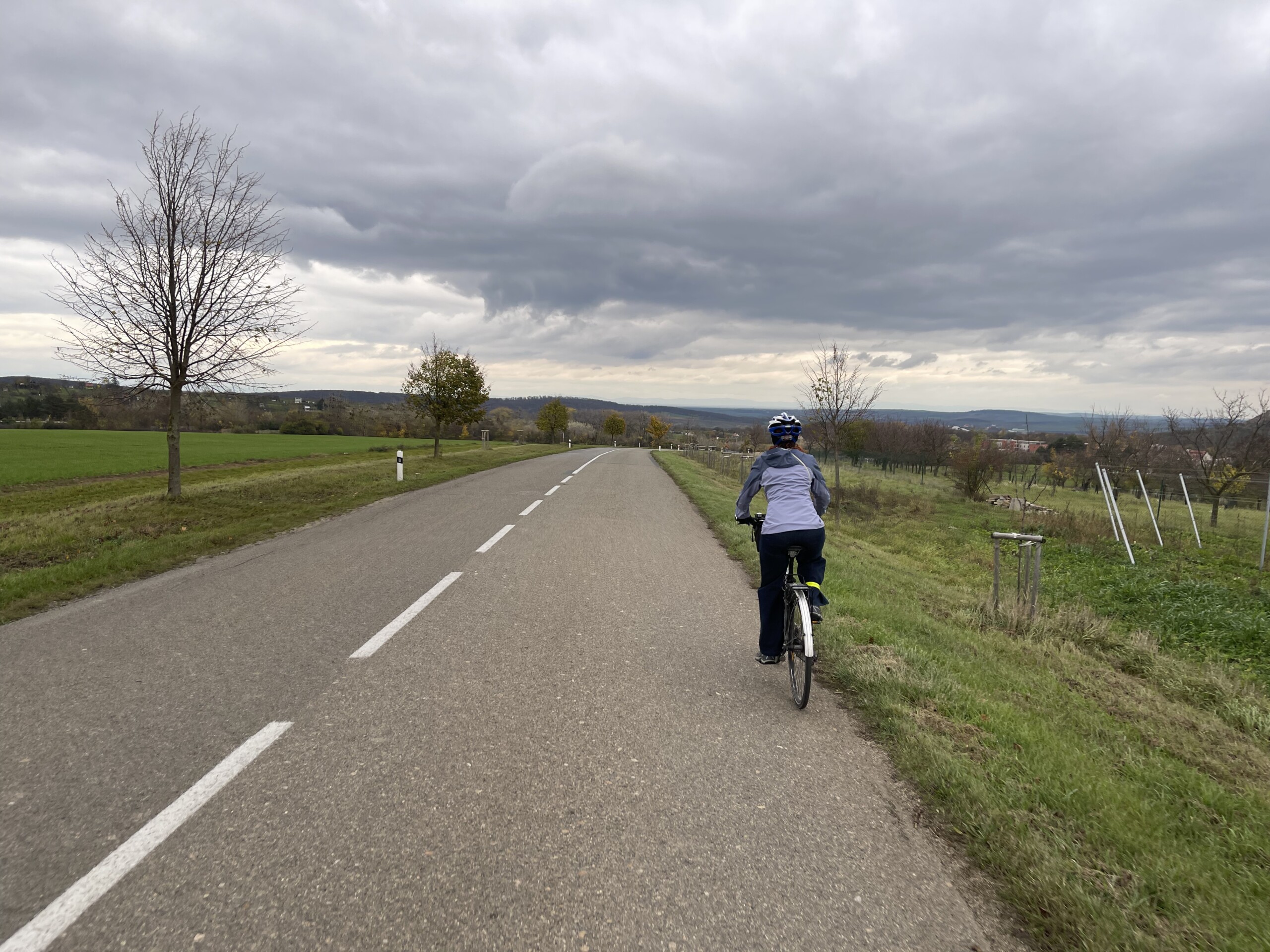
Cycling in Czechia. Photo by Dave Iltis
So concluded scholars from three American universities in a presentation given at the International Academic Forum Conference on Educational Research and Innovation 2022.
“A Case for the Bicycle: How Cycling Can Promote Equality” points to studies that made the case and provides examples:
A program that gave bicycles to schoolgirls decreased absenteeism and tardiness because it got them to school on-time and safety.
Some children with autism or Down Syndrome have trouble with balance. Learning to ride a bike can help them overcome this problem, but more research is necessary in this area.
People with cognitive and physical challenges can improve their quality of life and health if given the proper training and adaptive bicycles (handcycles, tandems, incumbents).
There are no reasons why capable senior citizens can’t enjoy a ride, should a suitable vehicle be available. Some may need e-bikes. Trishaw bikes can carry passengers and use motors to assist.
SALT LAKE CITY, Utah (October 31, 2022) — Two Utah titans of tiny rocks are teaming up – Salty & Stupid Cycling, LLC is announcing a new partnership with PLAN7 Endurance Coaching. PLAN7 will take over as the training and coaching sponsor for the Wild Horse, the Stupid Pony, and the Salty Lizard 100 and host supported group rides in Tooele County on the Wild Horse course and in Wendover, UT on the Salty Lizard 100 course.
All clients and team members with PLAN7 will receive discounts on entry fees and lodging at Salty & Stupid events, as well as generally special treatment.
PLAN7 is owned by Dave Harward and Breanne Nalder-Harward in Salt Lake City, UT. Since 2006, they have offered endurance sports coaching and training to athletes of all abilities including the popular House of Watts winter training program. PLAN7 also operates the PLAN7 Cycling Team, a successful local “Semi-amateur/Pro-am enthusiasts” competitive team.
Salty & Stupid Cycling has hosted several long distance gravel rides that have quickly become Utah favorites, the Salty Lizard 100, the Stupid Pony, and the Wild Horse.
PLAN7 and Salty & Stupid Cycling share a commitment to inclusion and diversity within cycling, as well as a deep love of dirt riding. PLAN7 athletes have won or placed highly in nearly all of Utah’s gravel rides in recent years, including at the Salty Lizard 100 and the Wild Horse.
Correct body position is an essential part of going faster on a mountain bike. For descending, you should be in the strong, but relaxed “ready position.” Level your pedals, get up and off your seat, and keep your elbows and knees slightly wide to allow for range of motion side-to-side and front-to-back.
Think heavy feet, light hands, and you will naturally settle into a good position. You want your weight to be very much in your feet, and you want to hold the bars with your hands, but don’t grip them to avoid the common beginner mistake of flexing and gripping everywhere and feeling everything you hit on the trail bouncing through your whole body.
Be strong by engaging your core and glutes and working your quads while simultaneously relaxing your upper body. The “ready position” helps you to absorb features on a trail. The key is staying relaxed and letting your bike move around under you.
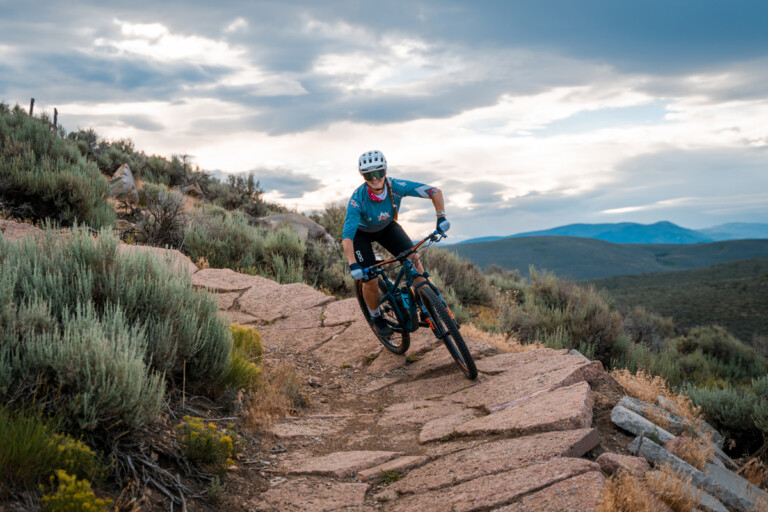
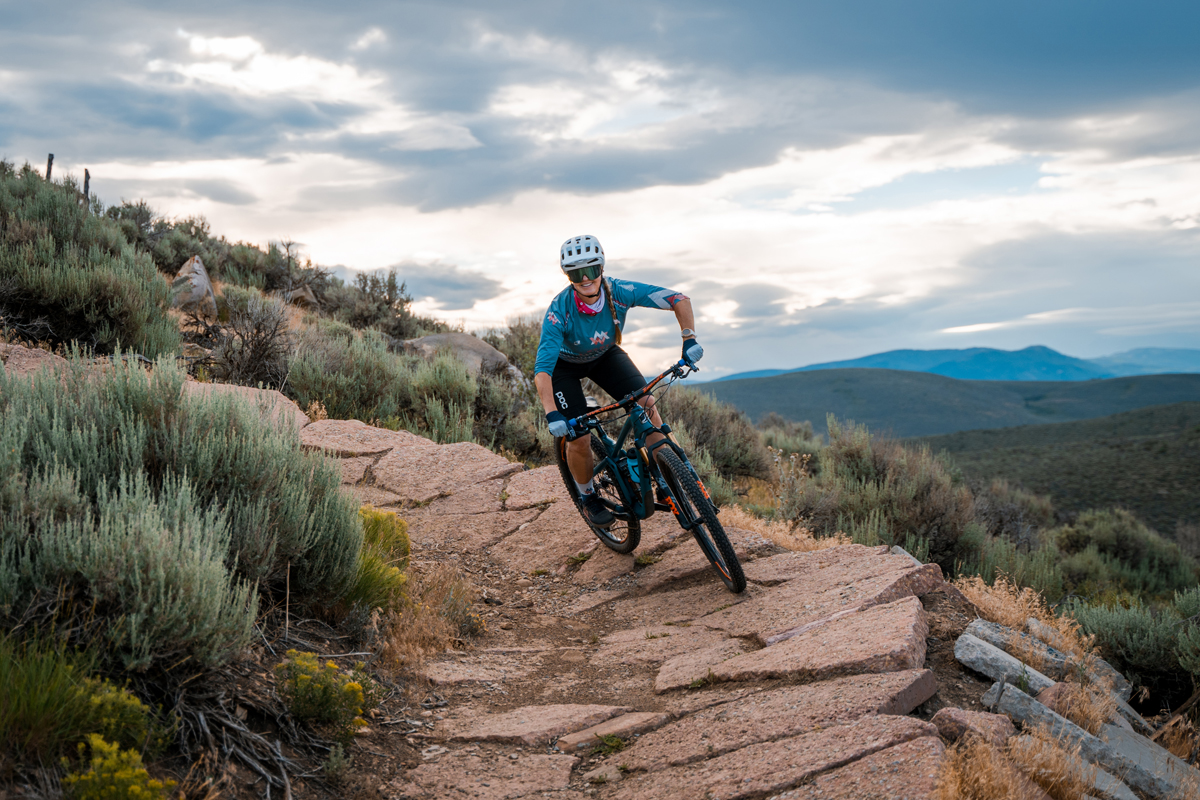
Erica Tingey cornering. Photo by Alex Knight
Tip #2: Look Ahead
You can break down where you look while mountain biking into the now and the next. Think of the “now” as one to three seconds in front of you, and the “next” as four to six seconds in front of you.
If you’re only looking in the now, you’re not prepared for what’s next, and if you’re only looking in the next, you’re not prepared for what’s now. In general, your eyes should be on the next, but allow them to scan the now when necessary. Don’t tilt your head to look; keep it level, and scan with your eyes.
Avoid tipping your head to look down because doing so will make you automatically grab your brakes; it’s an instinctual reaction that happens when your brain doesn’t know what’s next. It happens because the fluid in our inner ears tells your brain when you are out of balance, so when you dip your head, you’ll instinctively feel a corresponding urge to brake.
Tip #3: Ease The Squeeze
Many riders make the mistake of squeezing their brakes too hard and too fast – something that’s especially dangerous at high speeds. Others insist on only using their rear brake because they’ve learned to fear the consequences of going over the bars from overusing their front brake. That’s why it’s important to get to know both of your brakes BEFORE you try to go fast.
Practice using both brakes simultaneously in the parking lot as you go slowly on a stable surface, then add some speed. When you use only your rear brake, you have less stopping power, so your rear wheel is more likely to lock up, lose traction, and slide out, which is the definition of skidding. Skidding is considered bad form and can ruin some trails (especially those in Utah). Keep in mind that 80-90% of your stopping power is up front, and remember that your brakes aren’t just on or off. Think of using them like squeezing a tube of toothpaste; do it gently and with precision.
As you go faster, you’ll need to counteract the forces that tend to throw you forward when you brake. Do this by braking while in a body position with a lower center of gravity. Lowering your torso while shifting it back a tiny bit and dropping your heels are two ways of doing this.
Tip #4: Know Before You Go
Most of us start riding our local trails, and eventually, we get to know them pretty well; sometimes they even get kind of boring. As that happens, it’s normal to be curious about different trails in other places and want to go exploring, but prior to heading somewhere new, do some basic research. It can go a long way toward helping you have a successful adventure.
Before you go, download the Trailforks [or other relevant-to-your-area] app on your phone, and learn how to use it. Read about the trail, and understand what to expect, then take a moment to check signs at the trailhead for any updates. For example, are you going on a one-way trail, and if so, are you planning to ride it in the right direction? Is it a hiking-only trail or a horse trail? As we’re seeing more users on the trail than ever before, it’s even more important to respect the rules of the trail and be kind to everyone out there.
Per standard trail etiquette, hikers and horses have the right of way on multi-use trails, and so do all users who are traveling uphill.
Tip #5: Be Prepared
Be sure to bring tire plugs, a suitable tool to insert the plugs, a spare tube, a pump and a basic multi-tool so you’ll have a way to fix flat tires and other common mechanicals. Even if you don’t know how to use all the tools yourself yet, someone is more likely to stop and help you if you have what you need to make the repair.
Always take some type of riding fuel (bars, trail mix, fruit snacks). Take a little more than you need because you never know when you or someone you encounter will end up needing them.
Checking weather forecasts prior to departing is also a good idea so you can bring the appropriate extra layers to accommodate changing conditions, especially in the mountains, which are more prone to surprise temperature swings and storms.
By Katherine A. Beals, PhD, RD, FACSM, CSSD and Breanne Nalder, MS, RDN —
In the last article, we covered the role of protein in athletes’ diets as well as recommendations for protein intake for training and competition. But what about those athletes who limit or restrict meats or other animal proteins from their diet? How can they meet their protein requirements? Well, it really is not as hard as you might think (or some glorified and unqualified “nutritionists” might have you believe). Most athletes can, and do, get adequate amounts of protein on a plant-based diet and, assuming the amount and timing of protein intake is appropriate and energy intake is sufficient, athletic performance will not suffer. Read on to find out more about adopting a plant-based diet.
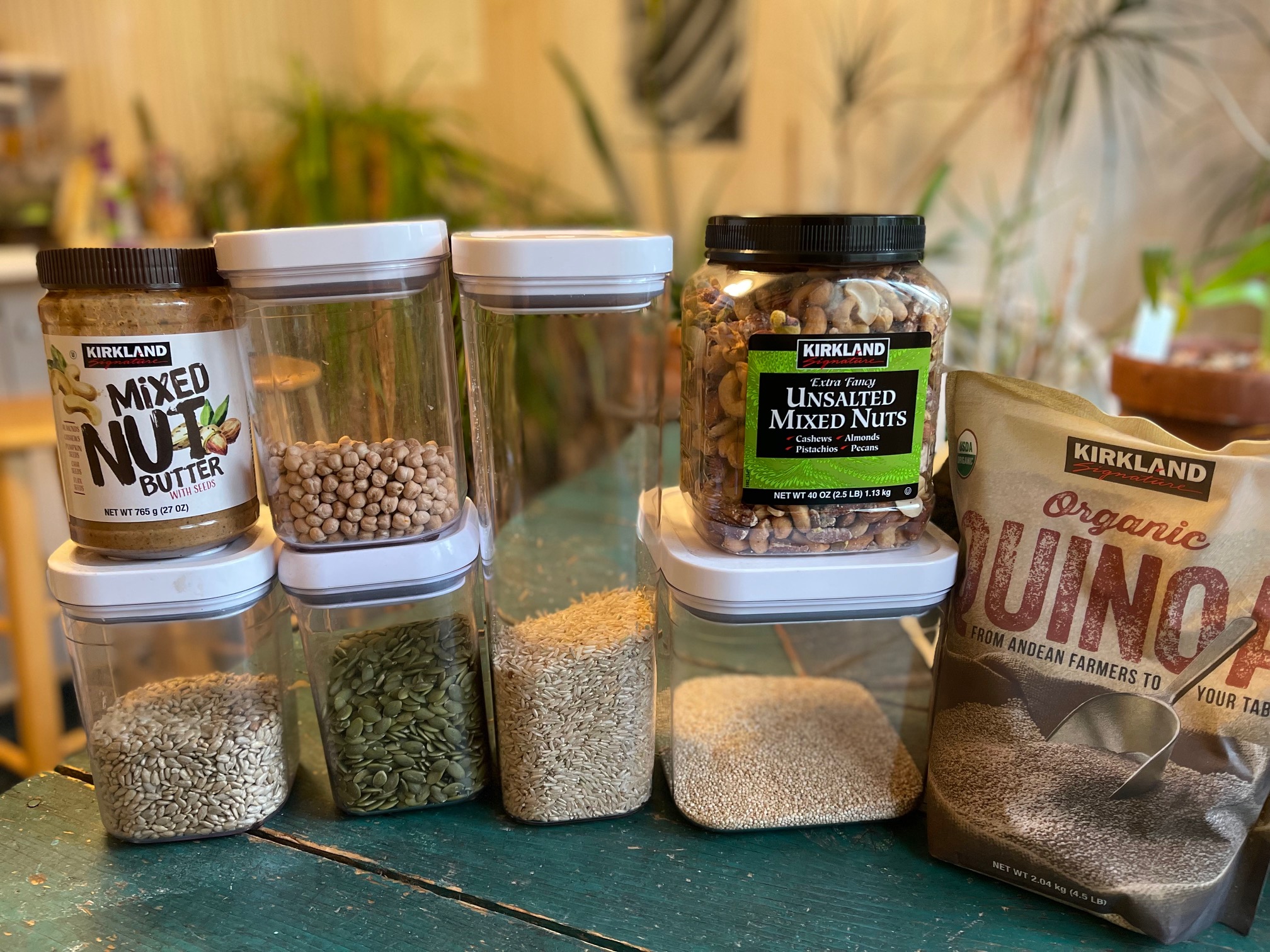
Seeds, nuts, chick peas, quinoa, and rice are all good sources of protein. Photo by Dave Iltis
Types of Vegetarianism
The term “vegetarian” generally denotes an individual who limits or restricts animal products in one form or another from his or her diet. Which animal product(s) and the degree of restriction can be highly variable. Below are some of the more common “types” of vegetarians.
Lacto-ovo vegetarian: is the most common form of vegetarian. Lacto-ovo vegetarians do not eat beef, pork, poultry, fish, shellfish or animal flesh of any kind, but do eat eggs and dairy products (“lacto” comes from the Latin for milk, and “ovo” for egg).
Lacto vegetarian: is used to describe a vegetarian who does not eat eggs, but does eat dairy products.
Ovo vegetarian: refers to those who do not eat meat or dairy products but do eat eggs.
Pesco or Pescatarian: is not an official term but, is occasionally used to describe those who abstain from eating all meat and animal flesh with the exception of fish.
Semi-vegetarian or “flexitarian”: is the least strict of the vegetarians, this term is used to describe those who eat a mostly vegetarian diet, but occasionally eat meat.
Vegan: is the most strict of the vegetarians. They don’t eat meat of any kind and also do not eat eggs, dairy products, or processed foods containing these or other animal-derived ingredients such as gelatin. Many vegans also refrain from eating foods that are made using animal products that may not contain animal products in the finished process, such as sugar and some wines. There is some debate as to whether certain foods, such as honey, fit into a vegan diet.
Reasons to (and not to) become Vegetarian
People choose to follow a vegetarian diet for a number of reasons; however, the two most common are because of moral/ethical beliefs (i.e., animal rights, sustainability) and for the purported health benefits a plant-based diet might provide.
Of the two, health benefits are probably the least well-supported by scientific research. While several epidemiological studies have shown an “association” between a vegetarian “lifestyle” and decreased incidence of certain chronic diseases; these types of studies cannot prove causation, rather they can only demonstrate a relationship or a link. There could very well be other mediating factors that are responsible for the “link” or that might be confounding the association.
For example, the vegetarian “lifestyle” tends to be healthier overall (i.e., vegetarians are less apt to smoke, more apt to physically active, less likely to be overweight); thus, it is hard to tease out in these studies whether it is the diet or some other aspect of the vegetarian lifestyle that is providing the health benefits. Nonetheless, there is no question that, from an ecological standpoint, a vegetarian diet is infinitely superior.
Meeting Protein Needs as a Vegetarian Athlete
There is a prevailing misconception that plant sources of protein are “lower quality” sources of protein compared to animal sources of protein because plant proteins are missing one or more essential amino acid. That is completely untrue!
In fact, ALL grain and vegetable proteins contain ALL nine essential amino acids. Fruits provide insignificant amounts of protein overall and, so, their amino acid profiles really aren’t relevant. And as long as we are myth-busting, it is also not true that you have to combine plant sources of proteins at a meal (or anytime really) in order to receive all the essential amino acids. If all grains and all vegetables contain all nine essential amino acids then there is no need to combine plant proteins.
So, where did these misconceptions come from? Well, nutrition scientists have long been interested in examining protein requirements and have derived a number of methods to evaluate proteins for their ability to promote/sustain growth. One of the most popular methods is known as amino acid scoring in which the essential amino acid profile of a food of interest (e.g., a potato) is compared to the essential amino acid profile of a “reference” food (which is typically an egg).
So, if you compare the essential amino acid profile of egg protein to a plant protein you will find that there are some essential amino acids that are found in lower amounts in the plant protein compared to the egg protein; thus, it is considered lower quality compared to an egg. (What they don’t point out is that, in some plant foods there are higher amounts of certain essential amino acids than in eggs—Go figure!).
In any case, such a comparison is misleading and overlooks the point that no one is likely to consume a diet containing only one specific plant food (i.e., potatoes) or one specific animal food (i.e., eggs) for that matter. A nutrient dense-plant based diet containing a wide variety of plant foods and adequate calories to support energy needs will almost always provide sufficient amounts of protein!
Other Nutrients of Concern for Vegetarian Athletes
There are some micronutrients that are found in significantly greater quantities in animal products and, thus, they might be absent or limited in the diet of an individual who chooses to follow a plant-based diet, these include iron, zinc, calcium, vitamin B12 and vitamin D.
Of greatest concern for the cyclist is iron. Found in significant amounts in only a few foods (and poorly absorbed from plant foods), iron is an integral part of hemoglobin, which is essential for oxygen uptake and transport to the working muscle. Iron also functions in energy production and oxidative metabolism, thus rendering it a key nutrient in athletic performance. Endurance athletes such as cyclists are already at an increased risk of iron deficiency due to prolonged phases of intense exercise, muscular injuries, increased turnover of red blood cells, and increased loss of iron in sweat and urine. Red meats provide the most significant and most bioavailable source of iron; thus, anyone who limits or eliminates meats is at increased risk for iron deficiency and should strive to include iron-rich plant foods in their diet (see examples of protein and iron-rich plant foods below).
Going Meat Free
Here are some tips for incorporating more plant-based proteins into your diet while maintaining adequate nutrients and energy needs:
Build meals around plant sources of protein that are naturally low in fat and high in nutrients, such as beans, lentils, and soy products (tofu, tempeh, edamame beans, etc.)
Try different veggie versions. A variety of vegetarian products look (and may taste) like their non-vegetarian counterparts, but are usually lower in saturated fat and contain no cholesterol. For breakfast, try soy-based sausage patties or links. For dinner, rather than hamburgers, try veggie/black bean burgers or portabella mushrooms, etc.
Bone up on sources of Calcium and Vitamin D. Sources include fortified cereals, soy products, calcium-fortified orange juice, and dark-green leafy vegetables. Some may choose to use supplements to get their daily need of the bone builders.
To help meet vitamin E recommendations, choose specific nut and seed choices such as sunflower seeds, almonds, and hazelnuts.
Include beans and peas. Due to their high nutrient content, consuming dry beans and peas is recommended for everyone, vegetarians and non-vegetarians alike. Enjoy some beans and rice, a three bean salad, chili, or split pea soup.
Make some small changes at restaurants. Most restaurants can accommodate vegetarian modifications to menu items by substituting meatless sauces, omitting meat from stir-fries, and adding vegetables or pasta in place of meat.
Nuts and nut butters make great snacks on salads, or in main dishes. Use nuts to replace meat or poultry, even in sandwiches. Add walnuts or pecans to a green salad instead of cheese or meat.
Make simple changes from meat products, which can increase vegetable intake and cut saturated fat and cholesterol intake. For example, pasta with marinara or pesto sauce, veggie pizza, vegetable lasagna, tofu-vegetable stir fry, bean burritos, etc. Try veggie/garden burgers, soy hot dogs, marinated tofu or tempeh, and veggie kabobs. Grilled veggies are great, too!
Next week, we will discuss protein supplements. Are they necessary or beneficial? Which type or types are the best? And, are there any potential hazards associated with consuming them?
Katherine Beals, PhD, RD, FACSM, CSSD is an associate professor (clinical) in the Division of Nutrition at the University of Utah. She is a registered dietitian, a certified specialist in sports dietetics and a fellow of the American College of Sports Medicine.
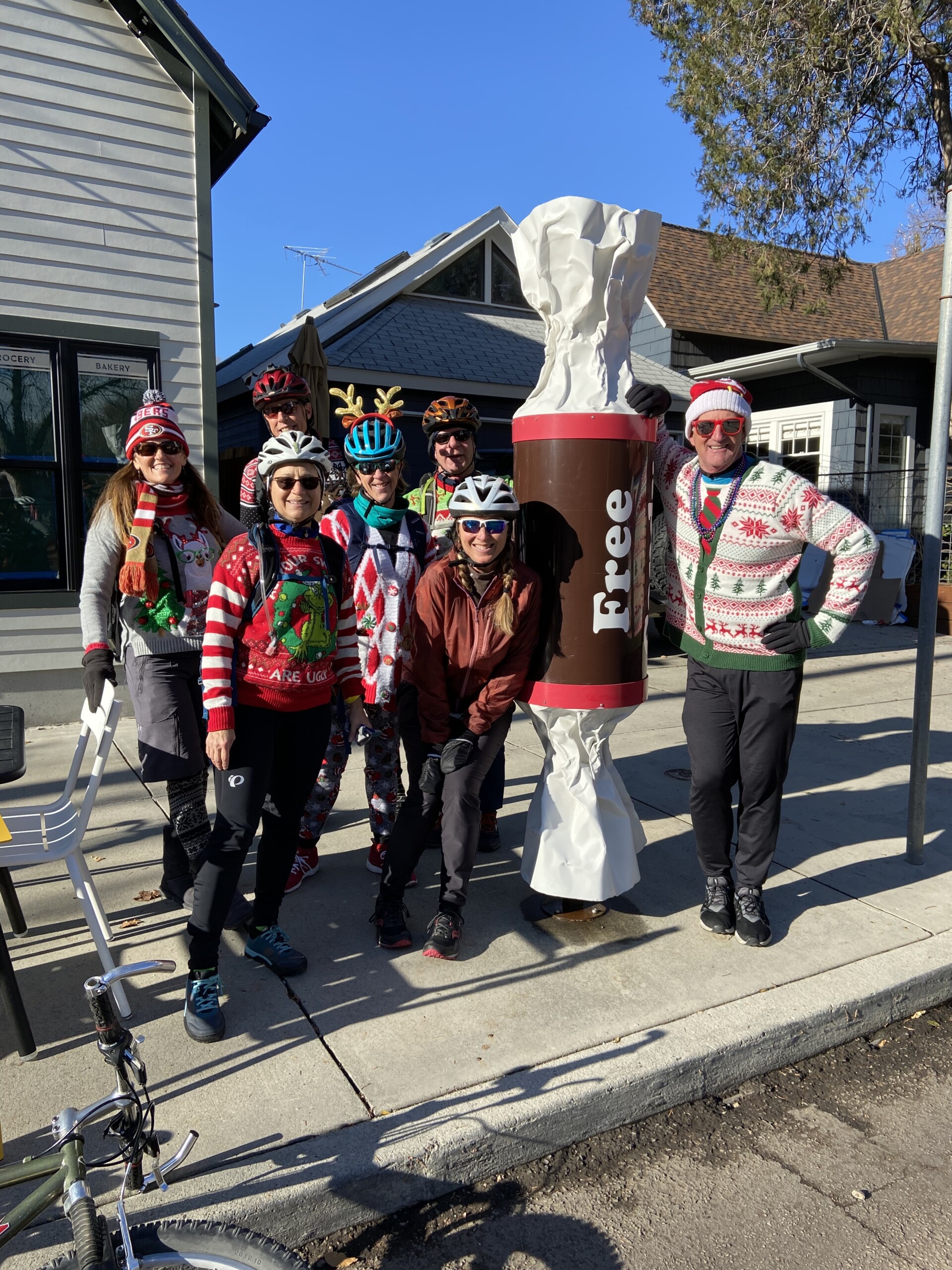
Cranksgiving, the annual Thanksgiving-themed scavenger hunt on bicycles, returns for a seventh year on Saturday, November 19, 2022. Sponsored by Vall-eBike, Valley Regional Transit, and City Go, the event will feature costumed teams of cyclists riding all over town, gathering all the items necessary to fill Thanksgiving food boxes. The boxes go to St. Vincent De Paul for distribution to Treasure Valley families in need.
Photo courtesy Cranksgiving Boise
Instead of an entry fee, each rider should bring money to purchase food items, even though many of the items are available free from generous supporting businesses. Teams get a manifest listing the food items they need to collect and a list of fun tasks to complete along the way. Trophies and prizes are awarded to the three fastest teams, the team with the biggest turkey and the best team costumes.
Photo courtesy Cranksgiving Boise
The event will start at 11:00 a.m. near the Vall-eBike building, 106 E 34th Street, Garden City. The event will finish with a gala after-party at Clairvoyant Brewing, 2800 W Idaho Street, Boise. There will be live entertainment, food, and of course, beer!
For those who don’t want to do the bike ride, but would still like to contribute, Cranksgiving organizers will accept food box donations at Clairvoyant. Go to the participant registration website and register to drop off food items. The shopping list will be emailed the morning of the event.
You can make a direct donation to St. Vincent de Paul without participating in Cranksgiving by going to https://svdpid.org/donate/.
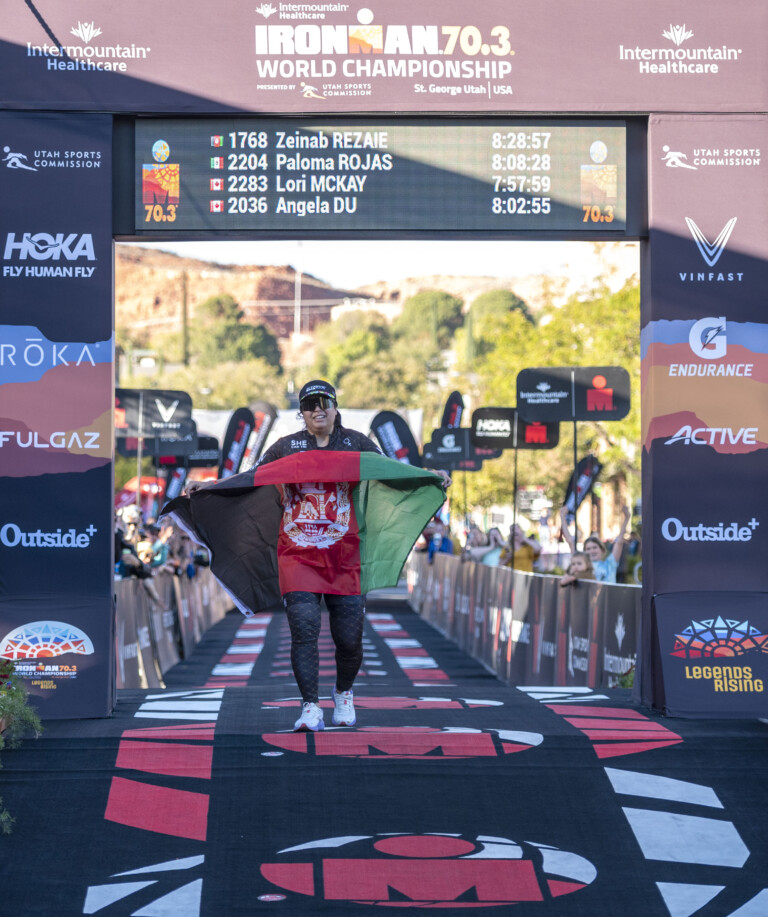
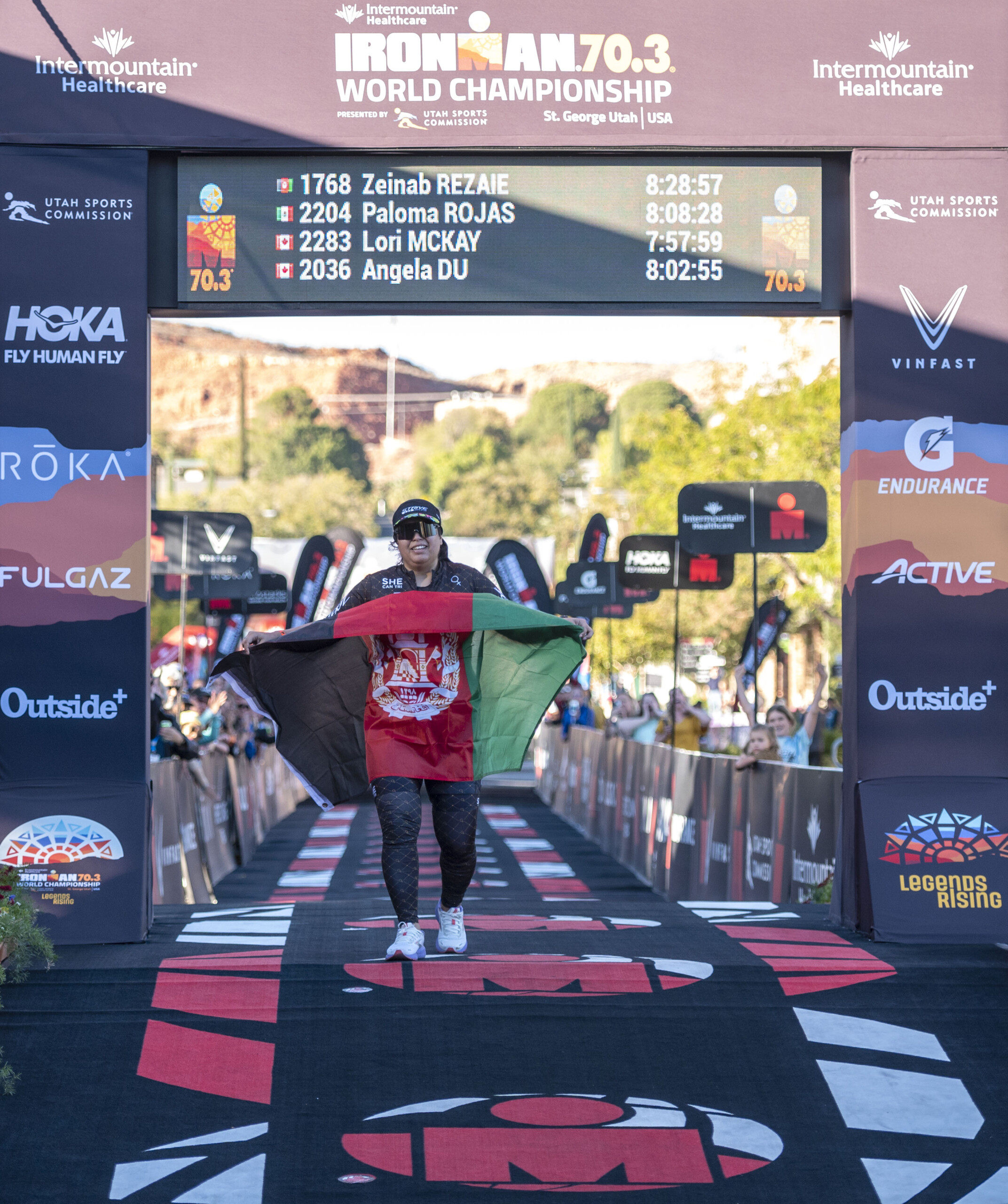
Rezaie, 27, is the first Afghan woman to race and finish the IRONMAN 70.3 World Championship
As final finisher of women’s day at the 2022 Intermountain Healthcare IRONMAN 70.3 World Championship presented by Utah Sports Commission, Rezaie completes race in 08:28:57
ST. GEORGE, Utah (October 31, 2022) — At just 27, Zeinab Rezaie has made history in becoming the first Afghan woman to race and finish the IRONMAN® 70.3 World Championship. Zeinab was the final finisher of the women’s day at the 2022 IRONMAN 70.3 World Championship yesterday completing the race in a time of 08:28:57, giving her just over a minute to spare before the final cut off.
ST. GEORGE, UTAH – OCTOBER 28: General views of the 2022 Intermountain Healthcare IRONMAN 70.3 World Championship Women’s Race presented by Utah Sports Commission on on October 27, 2022 in St. George, Utah. (Photo by Donald Miralle)
Zeinab, who was born a refugee in Iran, returned to Afghanistan with her family aged nine, just two years after American troops ousted the Taliban. Despite living in a society that didn’t accept women or girls participating in sport, Zeinab was determined to stand tall in the face of adversity. She completed her first marathon in 2017 and then went on to complete a multi-stage ultramarathon across 250 km of the Mongolian Gobi Desert in 2018. In February 2020, she completed IRONMAN 70.3 Dubai and became the first Afghan woman to finish an IRONMAN 70.3 triathlon.
Yesterday, Zeinab re-wrote the history books once again and became the first Afghan woman to compete in and ultimately finish the IRONMAN 70.3 World Championship.
On finishing, Zeinab commented: “I did it not for myself but for the women and girls of my country who do not have the basic rights of education, work, travel, or sport. Not only was this for the women of my country but for the minorities and all the women across the world who do not have access to their basic rights.”
Zeinab was introduced to triathlon by She Can Tri founder Jackie Faye when she was studying at the American University in Kabul.
Training in Afghanistan was challenging – there are only two swimming pools in Kabul that allowed women, but they were crowded and expensive. Thanks to the She Can Tri community, Zeinab learnt to swim by attending training camps and watching YouTube videos.
Now living in the USA, Zeinab is studying for a Master’s degree in Social Entrepreneurship but her family remains in Afghanistan.
Zeinab hopes to set an example for other Afghan women who may also be passionate about sport, but don’t know where to turn.
Talking about how triathlon has changed her life, Zeinab said: “In lots of ways, but mostly it has given me a voice to speak up about basic rights for women, such as freedom of movement, sport, education, work, and travel. Many women in my country are deprived of these things.”
Zeinab was amongst nearly 5,500 age-group athletes who are racing across Friday and Saturday in the 2022 IRONMAN 70.3 World Championship. She raced alongside some of the world’s best triathletes, which saw Taylor Knibb (USA) take the women’s IRONMAN 70.3 World Championship Crown, followed by Paula Findlay (CAN), and Emma Pallant-Browne (GBR).
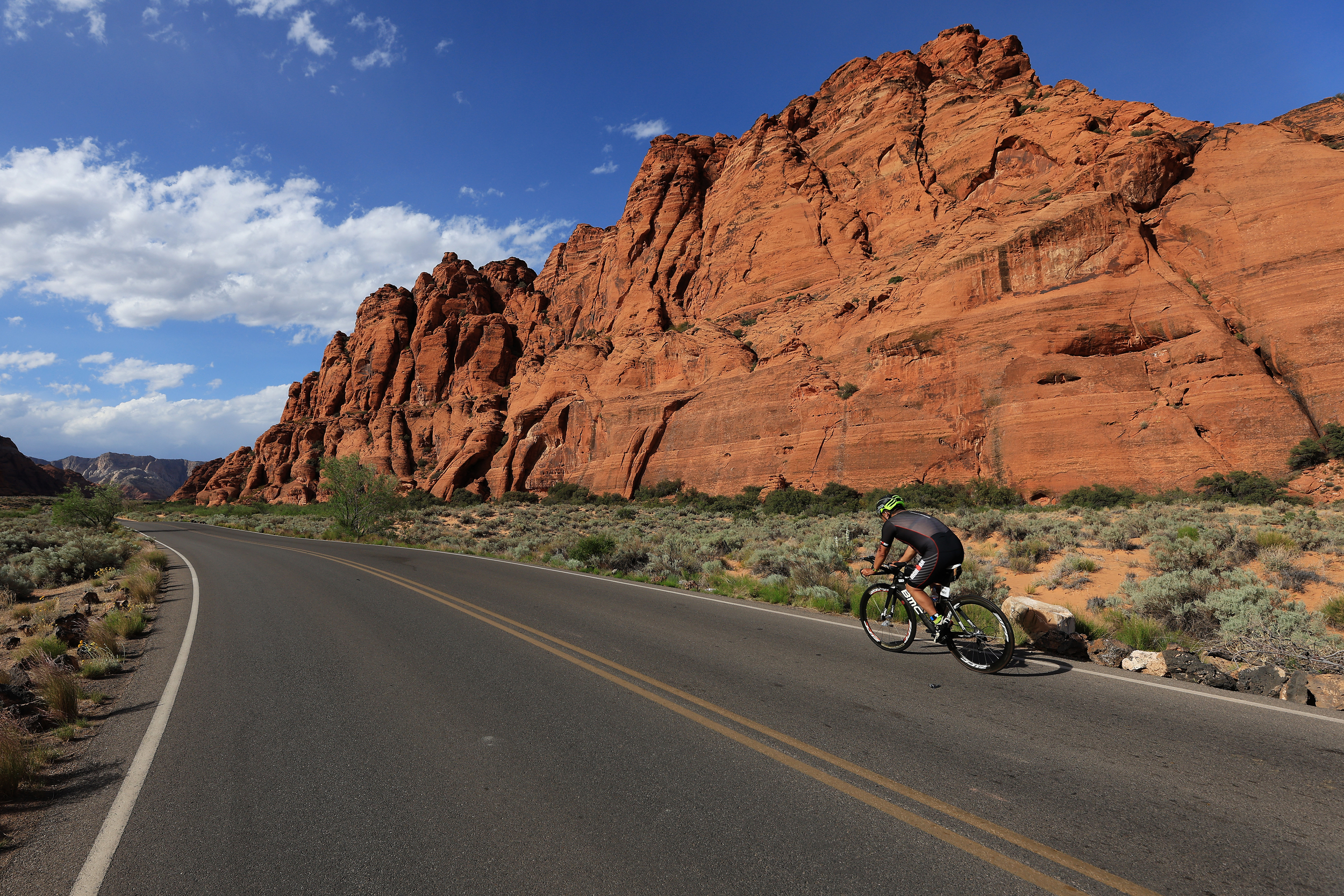
Zeinab completed the 1.2-mile swim course in Sand Hollow Reservoir located in Sand Hollow State Park in Hurricane, Utah in 00:53:32. She then went onto race the challenging 56-mile bike course through stunning desert landscapes with 3,201 feet (1003 meters) of elevation gain and an unforgettable climb into Snow Canyon State Park and surrounding Washington County in a time of 04:11:29. Finally, she took to the 13.1-mile (21.2km) run course in the stunning Red Hills Parkway, finishing the run in 03:10:58 in historic downtown St. George for an overall time of 08:28:57.
As part of her training and racing efforts, Zeinab is attempting to raise $15,000 for She Can Tri to make sure more women and girls can follow in her footsteps. Supporters may donate to her GoFundMe campaign.
By Christina Hartsock — Were we hallucinating? As we rode a bit farther down the dirt path it became clear that we were indeed not imagining things. There was a dog lying in the middle of the trail! Naturally, we scanned the surroundings to see if the owner was nearby, but there was nobody around.
As a newbie mountain bike rider, I always expect to be thrilled or frightened by what I experience on the trails, however, I was totally unprepared for the discovery that awaited me on that casual ride with a friend last September.
Deanna and I were riding in a popular area of the Cibola National Forest, called Pine Flats, near Albuquerque, New Mexico. Pine Flats is populated by a network of mostly singletrack trails that appeal to both the beginner and more experienced MTB rider. Deanna, being the advanced rider, was seemingly trying to push my comfort level that day by taking me on the Southern Crossing trail, which after crossing the highway, immediately sends you up a super steep, rocky climb that isn’t really “beginner friendly” at all.
Once the terrain leveled off, big rocks continued to challenge my skills, and I was forced to walk over several sections that Deanna easily cleared. We came to a crossroads and took a break. We were indecisive about which trail to take next when we heard voices approaching, and three other riders appeared on the trail. Deanna happened to know them, and introduced me to Eliza, Donald and Mark. They have a solid plan, and they seemed cool, so we decide to join their ride. Of course, there was more climbing to do and more rocks to clear before we descend into a beautiful meadow. We stopped to take in the scenery and snap a cheery group photo. Up to this point our ride had been carefree, fun, and unremarkable (especially since I hadn’t crashed), but that was about to change.
The technical parts of the trail were behind us, and I was able to relax and chat as we rode down a doubletrack trail through a grassy open area. Then we spotted a black and white blob in the center of the trail. We pedaled closer, and were shocked to find a dog, collarless, without a leash, and at least three or more miles from the nearest trailhead. We dismounted and approached slowly so as not to frighten her, but she didn’t budge.
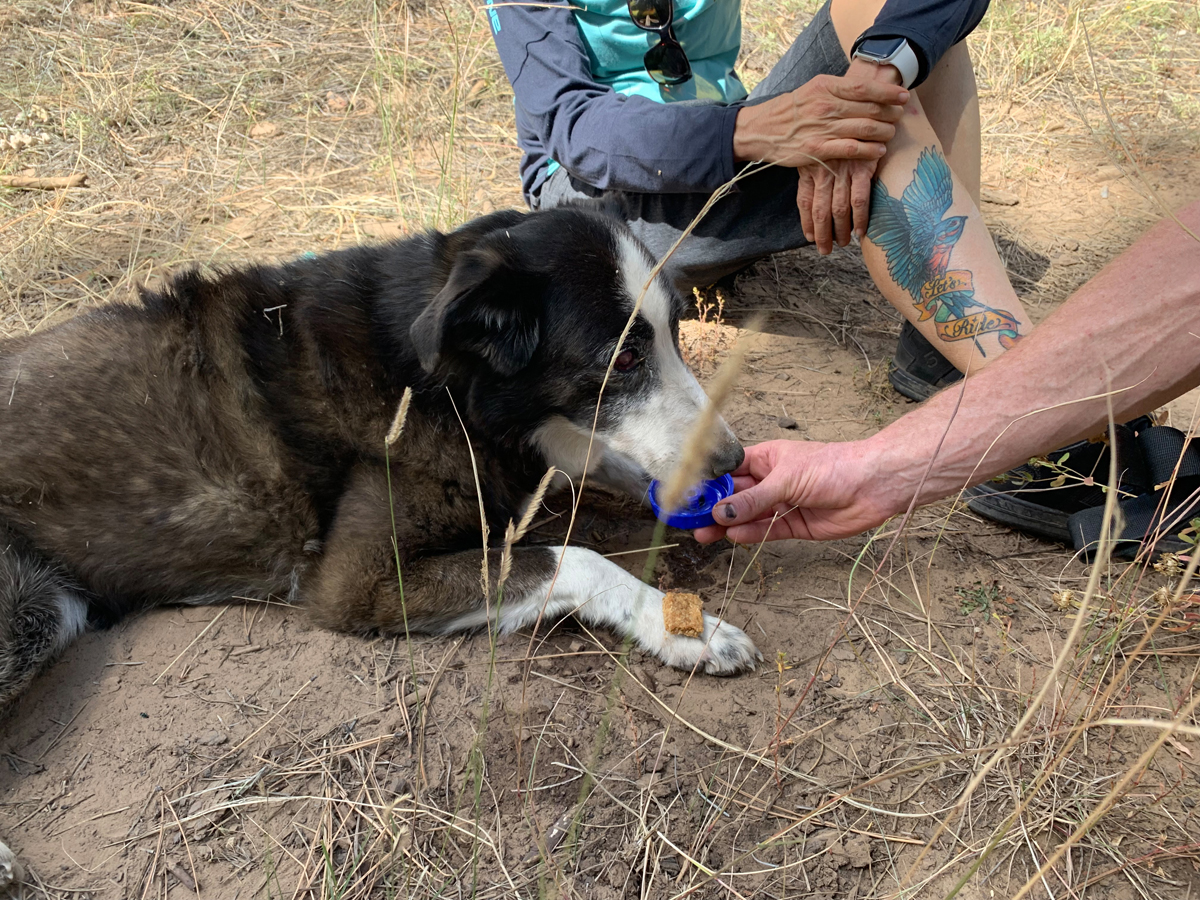
Photo courtesy Chrtistina Hartsock.
It was a hot day, so we grabbed our bottles and offered her water from the lids. She lifted her head slightly and began drinking. The whites around her eyes were bright red, she was dirty with matted fur, but she didn’t appear to have any wounds. She finished the water, so we offered more, then more again. Her thirst was unquenchable; we put water into a plastic baggie so she could take bigger drinks. We tried feeding her small pieces of an energy bar, but she wasn’t interested. Fortunately, someone in the group had beef jerky, which she gladly accepted. We sat on the trail with the dog for at least thirty minutes taking turns feeding her and giving her water, but she made no effort to stand up.
We noticed a couple hiking towards us! Surely, the dog was theirs and they just got separated on the hike. “Not ours,” they said, as they passed us, barely skipping a beat from their rapid pace.
The reality of the situation suddenly became grim. We were nearly out of water, several miles from the trailhead, with a dog who apparently was too weak to even stand up. How were we going to get this dog out of the forest? We didn’t yet know that, but we did know that we weren’t going to leave her behind.
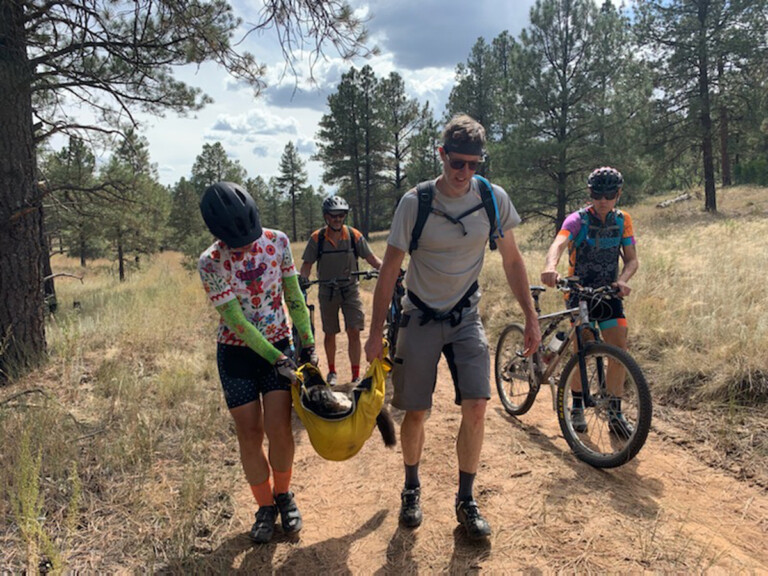
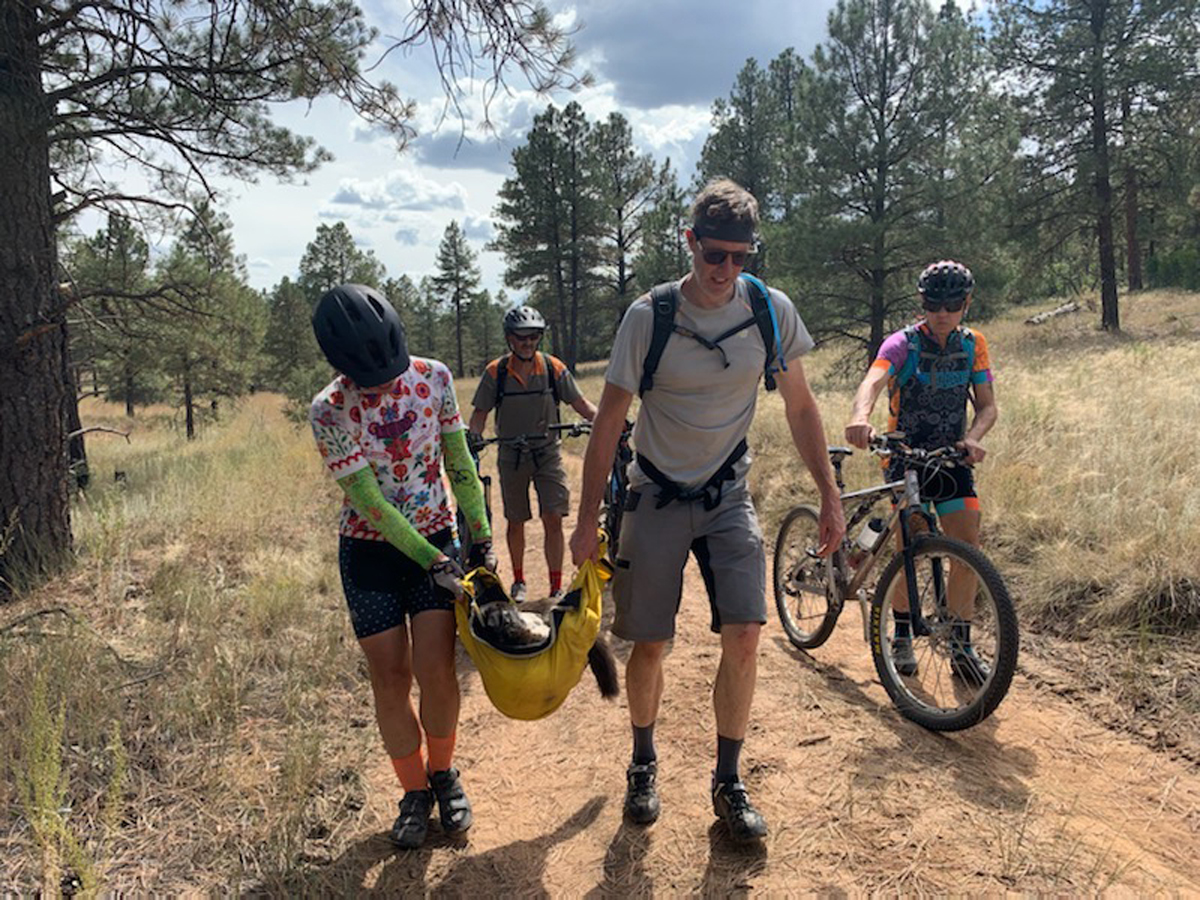
The group carrying Ada to safety. Photo by Eliza Linde
Best case scenario: if we could get her to stand then maybe she could walk out of the forest while we pushed our bikes. We gently coaxed her up off the ground. She stood, and immediately sat back down. When we got her up again, she took a few steps, then sat down. It became clear that this dog was unable to walk out on her own. Our only option was to carry her.
Though probably down from her normal weight, she must have weighed at least fifty pounds. Regardless, Donald stepped up to the challenge, picked her up and carried her over his shoulder. Moving at a snail’s pace, we pushed our bikes down the trail walking behind Donald. The dog became squirmy to the point that Donald was unable to continue carrying her. Though I am not the type of cyclist who is always prepared for any weather event, fortunately, Donald and Eliza are. They both had raincoats! Donald pulled a large, yellow raincoat out of his pack, and we placed the dog on it, using it as a stretcher. We each took turns carrying the dog and pushing the extra bikes. Eliza decided she should ride ahead to get her car and meet us at the trailhead. I can’t remember exactly how long it took us to walk out of the forest, but we were joyful to reach the parking lot and deliver the dog to safety. Once loaded into the car, she seemed to relax a little.
After a quick trip to a vet in Tijeras to see if the dog was microchipped, which she wasn’t, Eliza and Donald took her to the Bernalillo County Animal Shelter. Staff at the shelter named her Ada and were quick to contact a local rescue for dogs called Tootsie’s Vision. They took Ada in, and in short order found a foster for her. The foster became an adoptive family, welcoming Ada as a permanent member of their loving home.
I still wonder how Ada ended up alone in the forest. Was she dumped or had she simply wandered away from her home and gotten lost? Would she have survived another day if we hadn’t stumbled upon her? I’ll never know the answers to those questions, but I guess it doesn’t matter now. It was Ada’s lucky day in the forest, and although my MTB skills have improved since last September, that day still is my best experience on the mountain bike yet.
Blummenfelt feels at home in St. George where he earns IRONMAN 70.3 World Championship crown after IRONMAN World Championship win in May; Becomes first triathlete to ever win WTS World Title, Olympic Gold Medal, IRONMAN 70.3 World Championship, and IRONMAN World Championship
– American Ben Kanute finishes in second-place, with Magnus Ditlev (DNK) coming in third, followed by Mika Noodt (DEU) and Frederic Funk (DEU) finishing in forth and fifth-place, respectively
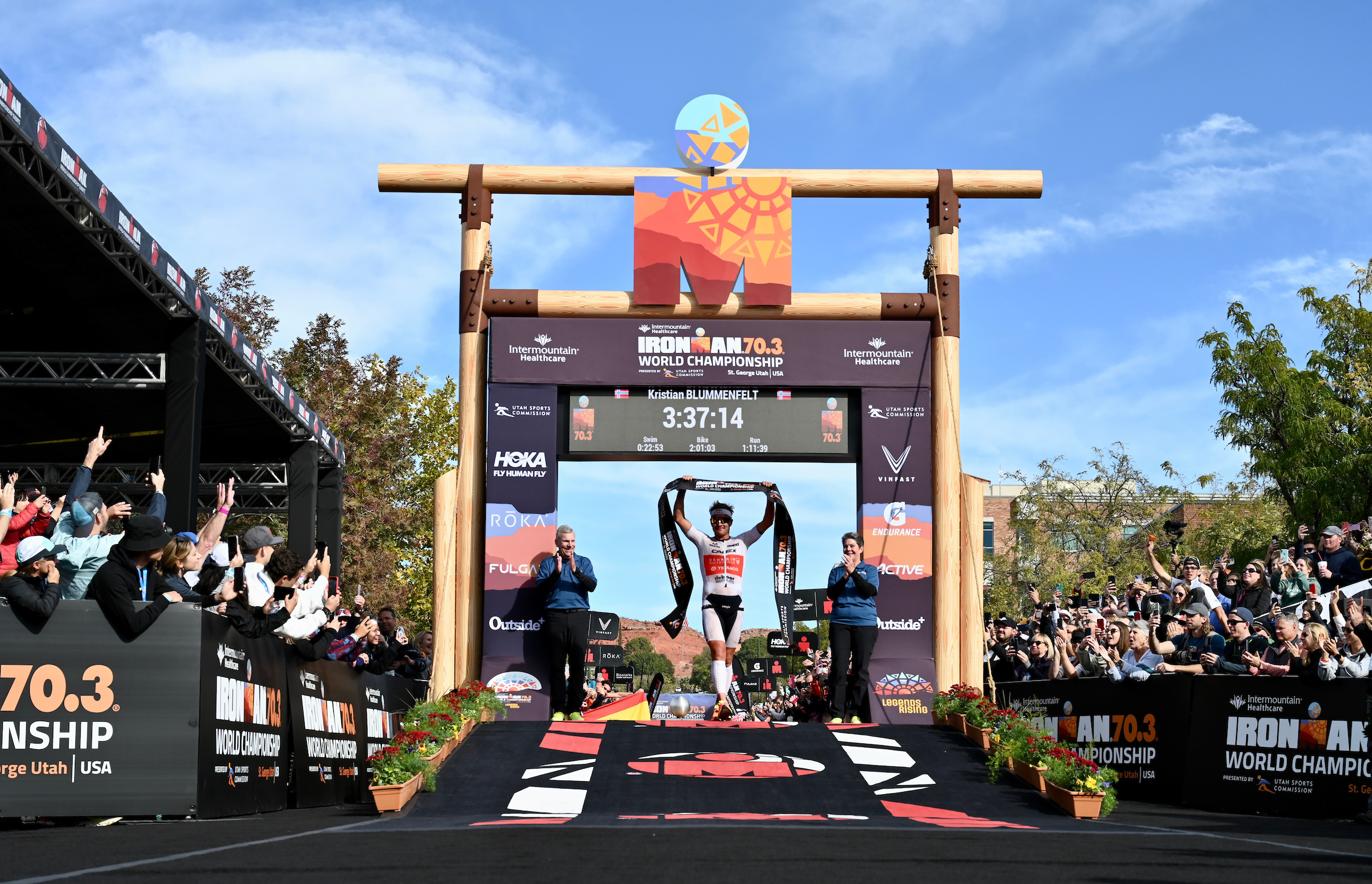
ST. GEORGE, Utah (October 29, 2022) – Adding to his long list of recent achievements, 28-year-old Norwegian Kristian Blummenfelt commanded the race today, coming in first place at the 2022 Intermountain Healthcare IRONMAN® 70.3® World Championship presented by Utah Sports Commission. The 2021 IRONMAN World Champion and Olympic gold medalist held the competition at bay with a 22:53 swim, a 2:01:03 bike, and a 1:11:39 half marathon to break the tape in 3:37:14, just weeks after a third-place finish at the 2022 VinFast IRONMAN World Championship.
Photo by Donald Miralle / IRONMAN
“My goal was to try to put pressure on Magnus (Ditlev) and Gustav (Iden) early on the bike. I felt strong all the way. On the run I tried to hold back as much as possible before putting it in second gear,” said Blummenfelt.
The second day of racing opened with a 1.2-mile swim in Sand Hollow Reservoir, where Aaron Royle (AUS), Marc Dubrick (USA), and Ben Kanute (USA) formed an immediate gap on the main group. An unfortunate wrong turn at one of the buoys by Royle resulted in the chase group catching back onto the leaders, stringing the field out. Near the end of the swim, the lead three put in a surge to form a small break, but it was still a mass of athletes storming into the first transition area together.
Saturday’s race in St. George, Utah showcased the men’s professional field, with many top athletes, including Blummenfelt, just three weeks off of the 2022 VinFast IRONMAN World Championship in Hawai`i. In the mix were reigning IRONMAN World Champion Gustav Iden, as well as Blummenfelt and many other IRONMAN 70.3 triathlon specialists.
Royle and Dubrick entered transition 1 first, with Kanute shortly behind. Eric Lagerstrom (USA) led a large group 20 seconds behind the leaders, including Miki Taagholt (DEN) and Germany’s Frederick Funk. Pre-race favorite Kristian Blummenfelt (NOR) was 30 seconds back, with Gustav Iden (NOR) and Magnus Ditlev (DEN) 45 seconds back.
After a lightning-fast transition, the current IRONMAN 70.3 record holder Blummenfelt stormed onto the bike course, taking the lead immediately. Kanute, Taagholt, Ditlev, and Funk worked hard over the opening miles of the bike behind the Norwegian.
At the halfway point of the 56-mile bike ride, Blummenfelt was still in command of the race with Funk, Taagholt, Kanute, and Ditlev in line behind him. After the Snow Canyon climb, Ditlev rode himself to the front where he stayed until the end of the bike.
With Ditlev into the second transition and Blummenfelt and Funk on his heels, the chase was on. Blummenfelt took off on the first few miles of the run as he had on the bike, commanding the lead. Iden was down five minutes after the bike ride and later dropped out of the race. Kanute surged ahead of the Norwegian at mile 2, taking the lead. Blummenfelt stayed in his shadow, apparently content to let the American lead the pace. Ditlev remained about a minute back, while Taagholt led a group over three minutes in arrears.
At mile 10, a calm, confident Blummenfelt decided to make his move, which he later said was reminiscent of his effort at the mixed relay at the 2020 Tokyo Olympics. The smiling athlete ran to the win, high-fiving the thousands of fans that turned out to watch in St. George, and raising the banner once again, as he has so many times in his illustrious career.
Though Kanute was unable to ultimately keep the pace with Blummenfelt, he fought hard, earning his second IRONMAN 70.3 World Championship second place finish. Ditlev ran across the line in third, almost three minutes back, with the German duo of Mika Noodt and Frederick Funk taking fourth and fifth.
While pleased with his accomplishments of a WTS World Title, Olympic Gold Medal, IRONMAN 70.3 World Championship, and IRONMAN World Championship, Blummenfelt, shared his third-place finish in Hawai`i still leaves him hungry: “You can’t get a revenge in Kona outside of Kona–it’s been on my mind every day for three weeks now. I have to go back there to finish my business.”
But redemption was felt by the likes of Ben Kanute, who said at the finish line that the year has been really hard, due to sickness and other setbacks: “I hit a new level of fitness coming into this race. I just went out there and took it. Kristian did all the hard work at the front, I was just super focused trying to stay in the moment, enjoy the day, and enjoy racing. That was the most fun I’ve had out on a race course in a long, long time. To see where I stacked up in the world is what I really wanted, this is more than I could’ve asked for.”
In what has been significant performances for the Scandinavians at recent world championship events, Magnus Ditlev shared how important it is for his fellow competitors to push each other. “It is crazy, the times we live in with the Danish and Norwegian [triathletes], it is very positive, inspiring. I can only speak for the Danish but last year Daniel came in third and Miki was forth, so we sort of push each other in a way and not try and root against each other but bring out the best,” said Ditlev.
Top five professional men’s results““““““““““““““““““““““““““““““““““““““““““““““““““““““““`
As youngest professional racing at 24 years old, Knibb becomes first IRONMAN 70.3 World Champion from USA since 2008 and just second ever
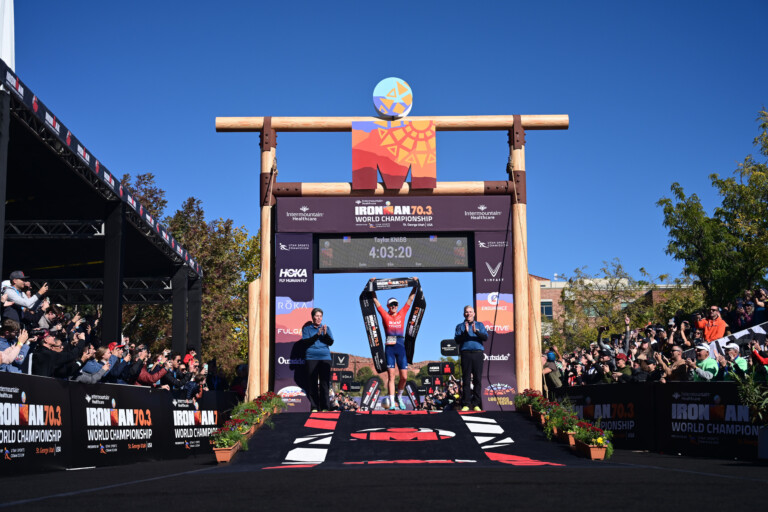
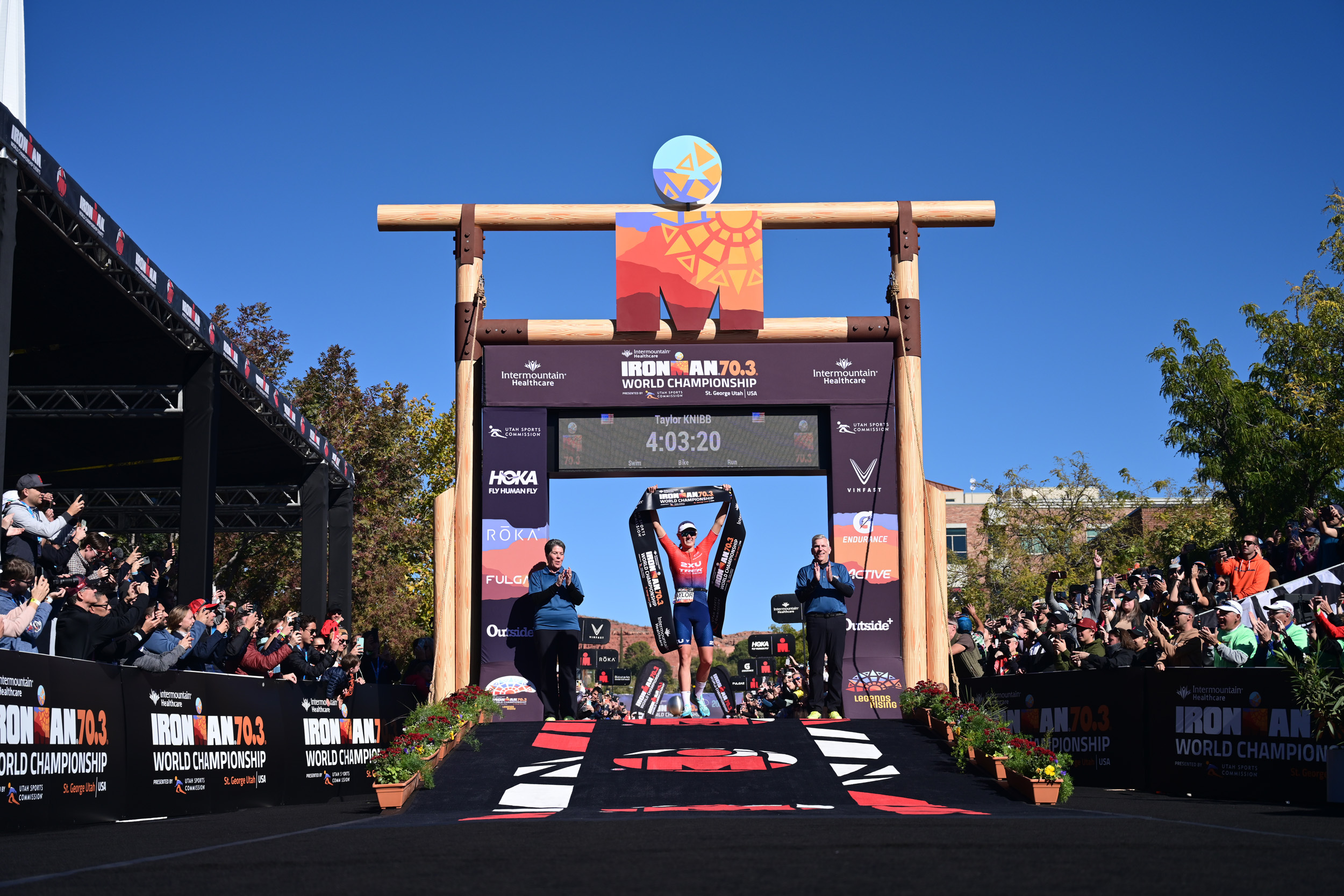
ST. GEORGE, Utah (October 28, 2022) — In a day that was all about the sport’s top women, Taylor Knibb of the USA overpowered the competition at the 2022 IRONMAN 70.3 World Championship. At just 24 years old, Knibb used a 23:54 swim, a 2:14 bike, and a 1:21 half marathon to better her third-place finish from a year ago to secure her first IRONMAN 70.3 World Championship title with an overall time of 4:03:20. After being the youngest women to ever qualify for the US Olympic triathlon team where she earned a silver medal in the mixed relay triathlon in 2021, Knibb now also becomes the youngest female to ever to win the IRONMAN 70.3 World Championship. The Washington, D.C. native also became the first American woman to win the IRONMAN 70.3 World Championship since 2008 when Joanna Zeiger won the crown and just the second American female ever.
Photo by: Donald Miralle for IRONMAN
“I can’t really believe it. I’m just grateful that I could execute a good swim, bike, and run,” said Knibb. “That last 10km was very, very long, I can’t believe I made it.”
Reigning IRONMAN 70.3 World Champion Lucy Charles-Barclay of Great Britain led the field out on the 1.2-mile swim in Sand Hollow Reservoir with Knibb and Lotte Wilms (NED) trailing shortly behind her.
A solid chase group stocked with talent trailed just 20 seconds back, including Olympic gold medalist Flora Duffy (BMU), and former IRONMAN 70.3 World Champion Holly Lawrence (GBR), in addition to Ellie Salthouse (AUS), Paula Findlay (CAN) and Emma Pallant-Browne (GBR). The top 10 women all knocked out sub-25-minute swim times, starting the bike with a host of athletes that could take the top spot.
Knibb put her mark on the race when she stormed past Lucy Charles-Barclay barely two miles into the bike course. As the miles ticked by, Knibb put more and more time into her three main chasers—Findlay, Charles-Barclay, and Duffy—who took turns trying to break away from the chase group.
Off the bike, Knibb’s victory was all but sealed with a lead of over six minutes. She coasted to a win with a rare buffer of over five minutes on the rest of this world-class field that all fought to the end.
The trio of Charles-Barclay, Findlay, and Duffy was off the bike almost seven minutes back of Knibb, setting the half marathon up as a battle for positions two through five. Into transition 2, Lawrence was back over two minutes from the chase group.
In the early miles of the run, Pallant-Browne, who had the quickest run on the day passed Lawrence for fifth. But it was Findlay who had the legs to break away from the pack and run into a satisfying second place. In the late stages of the run, Pallant-Browne passed Charles-Barclay and Duffy in an impressive fight for third. Only three weeks from her second-place finish at the 2022 VinFast IRONMAN World Championship in Kailua-Kona, Hawai`i, Charles-Barclay took fourth, with Duffy rounding out the top five in just her second-ever IRONMAN 70.3 race.
“None of my splits were the fastest splits of the day so it came down to consistency across three,” said Findlay. “It was very cold, but I do think that played to my advantage. I never felt too uncomfortable on the bike, I was always in control, and I kept looking at my watts, and they were high but I felt fine so I kept pushing. I started living for the uphill’s where we could warm up a little bit because it was cold on the descents. I felt great on the run, it doesn’t happen often in my career that I feel like the run is smooth and fluid and it happened today so grateful for that.”
For Pallant-Browne, it was a good swim and a disappointing bike that propelled her to push on the run. “It was tough. I got on the bike and I was so happy with my swim. I could see the girls around me and for me that was probably the best swim I’ve ever had so I thought this could be an OK day,” said Pallant-Browne. “I think I had no expectations. I just wanted to run fast and if I saw people, great but I was just looking at every aid station and just focusing on each aid station instead. If people came, great, but I knew it wouldn’t be easy overtaking them as everyone is going to go into battle and, yeah, it was really tough.”
By Charles Pekow — Riding a bike can provide needed exercise for people with type-2 diabetes. But many of them lack the motivation or energy for a long ride. And a new study suggests a solution: the electronic bicycle. Riding an e-bike even seems to improve their health, a study published in the peer-reviewed British journal called Diabetic Medicine says.
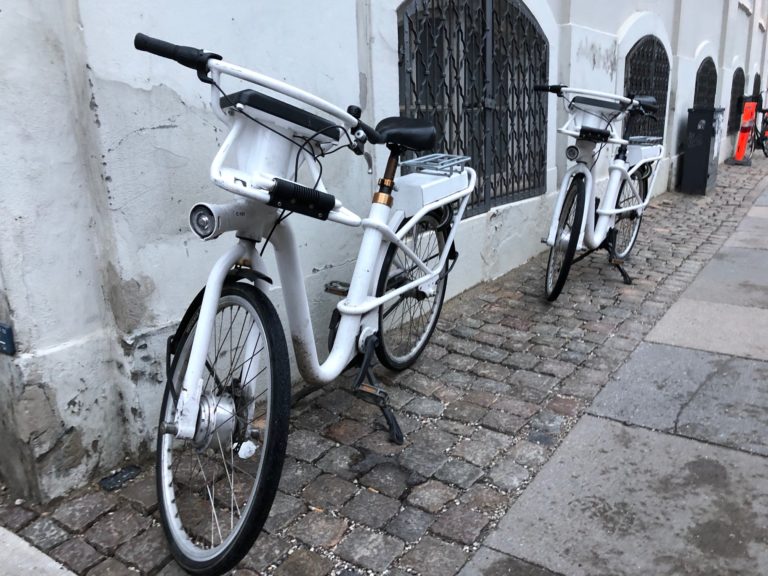
E-Bikes in Copenhagen, Denmark. Photo by Dave Iltis
Potential of Electric Bicycles to Improve the Health of People with Type 2 Diabetes: a Feasibility Study reports on a study of 20 people with the condition who were given e-bikes to ride for 20 weeks for commuting, shopping and recreation.
Participants reported it helped them climb hills and of the 18 who finished the project, 14 liked the vehicles so much that they bought one.”There was evidence that e‐cycling was acceptable, could increase fitness and elicited a heart rate that may lead to improvements in cardiometabolic risk factors in this population,” the authors conclude.
Anthony Nocella: Could you tell me how you got into cycling and if any women supported you in the beginning?
Isabel King: I fell into cycling a bit serendipitously. I was a soccer player growing up and played D1 through college. After working on the trading floor in New York City for 4 years I decided to move back to California for business school. In the summer between quitting my job and starting my MBA I signed up for a triathlon. I fell in love with bikes and haven’t stopped riding since (hilariously, this was only 4 years ago so I still feel new).
Isabel King. Photo by Scott Tribby
I was living in San Francisco the summer before starting at UCLA Anderson. Evelyn Stevens had just retired from pro racing and was looking to get back into finance. Lucky for me, our paths perfectly crossed at this intersection. She took me on some of my first training rides and introduced me to her former coach. Her story inspired me, because she also discovered bikes later (we were both 26) and had such a successful career. Besides her obvious achievements on the bike, what I try to emulate most about Evi is her charisma and influence on the cycling community as a whole. Every time you mention her name someone has their own story about a time they rode together or something kind she did.
AN: Tell me a bit about your racing history, such as your podiums and other accomplishments, including the teams you have ridden and raced for.
IK: Haha, it’s pretty short! I qualified to compete as a pro triathlete in my 4th 70.3 Ironman race. The plan after finishing business school was to try competing full time as a pro triathlete, but 2020 had other plans. In 2020 I used Strava as my competitive outlet and took over 1,000 QOMs (mostly in the Los Angeles area, but also in San Francisco, Yosemite, and Tahoe).
In 2021 I jumped headfirst into the gravel race scene. I finished 8th at Unbound Gravel (my gravel first race ever, yikes), 6th at Crusher in the Tushar, 4th at BWR San Diego and 7th at Leadboat (Leadville 100 MTB followed by SBT GRVL Black the next day)
Isabel King. Photo by Dominique Powers
AN: As a competitive cyclist can you tell me how your personal life or family life is shaped to support your racing and training?
IK: In 2018 my dad was diagnosed with brain cancer. Even when he unknowingly had a baseball size tumor in his brain, he was the fittest person I knew. Among everything else, brain cancer took away his ability to ride a bike. Every time I get on my bike, I remember to be thankful for the opportunity. This elective suffering we participate in can be taken away at any moment. I ride for my dad and for those who can’t.
My mom is my support system and inspiration. Growing up my mom was one of the only female hedge fund managers. She showed my sisters and I that you can do whatever you set your mind to. It doesn’t matter whether the odds are stacked against you or it’s not what society dictates you’re supposed to do, if it’s what you want to do, go for it. Her support allowed me to jump off the traditional post-MBA career path and go after a dream I didn’t know I had until I started riding. My mom comes to every race she can and the hug at the finish line will always be better than any trophy or prize money.
AN: When training and racing with other women what are some key differences that you see as the best part of the women’s cycling culture?
IK: I love it. Being out there with other strong women is so much fun. Beating up on the boys will never get old.
AN: In your opinion, how can the industry, race promoters, and bicycle shops be more inclusive to women and girls, besides hiring them as is much needed?
IK: The cycling community is incredibly intimidating. Even as someone who’s spent most of their life in male dominated environments (sports, the trading floor, business school and now cycling), I was nervous at first to show up to group rides or ask silly questions. As the sport grows, we need to make sure people realize that, at some point, it was everyone’s first time. Everyone has fallen over trying to clip out at a stop sign. Everyone has bonked so badly they have to limp home. Slowly breaking down the stigma and elitist culture will help make the cycling world better and more inclusive.
AN: How can the general community support upcoming girls who want to be elite racing cyclists like you, and what do you have to say to young girls?
IK: I strive to be a good example to anyone who’s looking to get into the sport; wave to others, say hi to someone you don’t know, inspire people to beat their personal bests. There are a lot of rules in cycling, but there isn’t a rule book. Don’t be afraid to ask questions. And don’t be afraid to beat up on the boys. All the cool kids are doing it.
By Katherine A. Beals, PhD, RD, FACSM, CSSD and Breanne Nalder, MS —
The word “protein” is derived from the Greek word, “proteos” meaning first and, when it comes to reputation of this macronutrient in the diets of athletes, the name seems to fit. Surveys assessing the nutrition knowledge of athletes often find that they believe protein is more important than either carbohydrate or fat in athletic performance. But, is protein deserving of this position on the pedestal of the athlete’s diet? In this month’s nutrition article—the first of a three-part series– we will take a look at the role of protein in cycling performance as well as protein recommendations for endurance athletes, considering the amount and timing of protein intake around training. In subsequent articles we will address the topics of meeting protein needs on a vegetarian diet and protein supplementation.
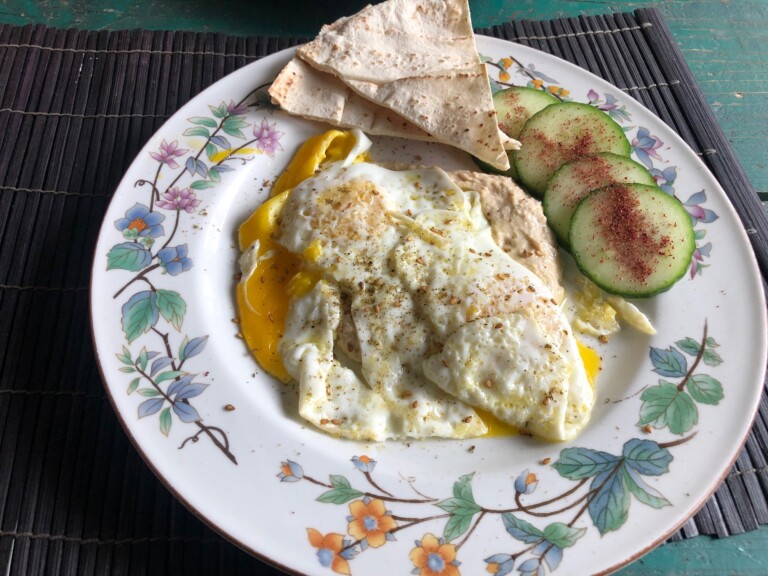
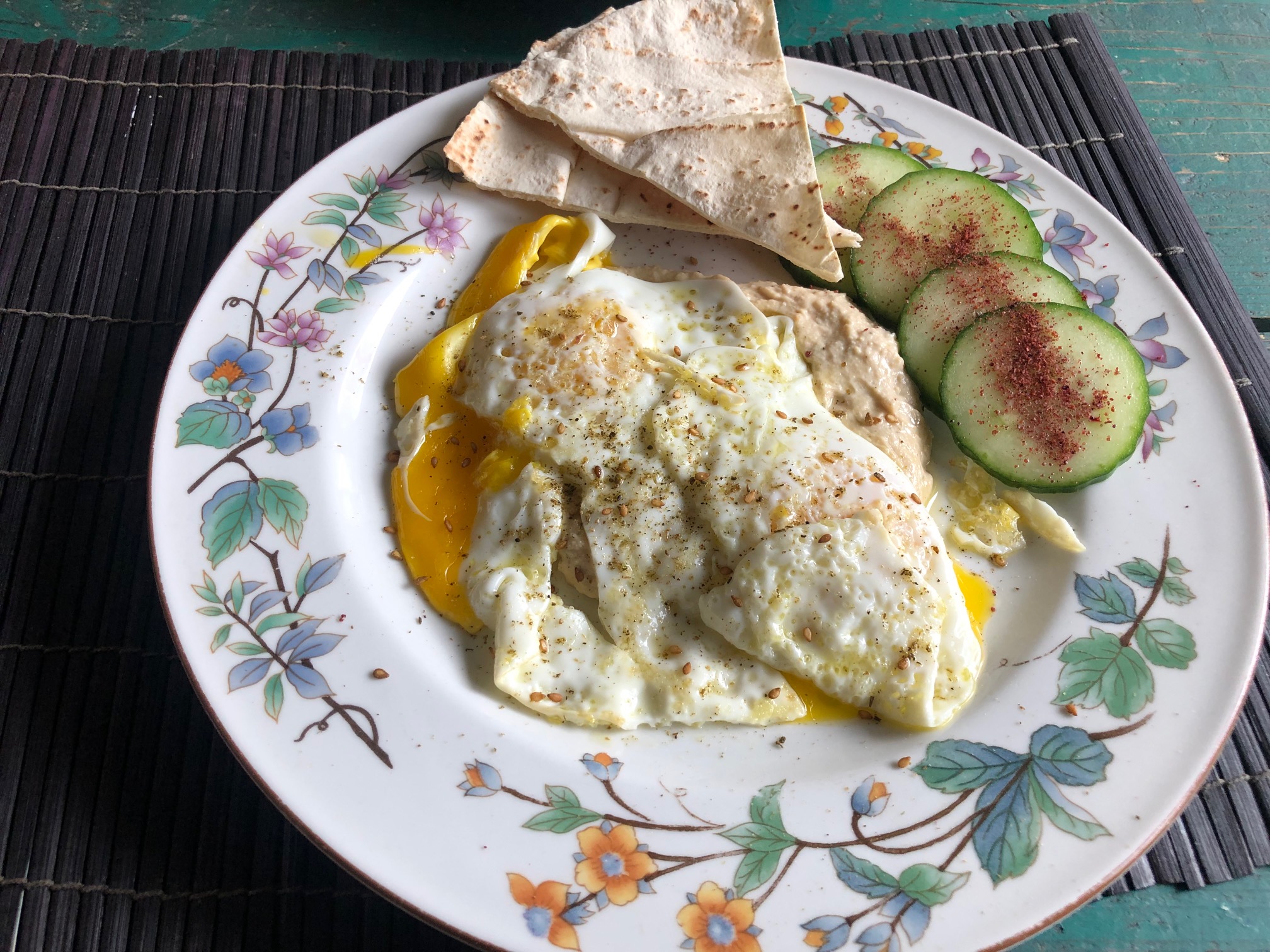
Eggs and hummus are a good source of protein.
The Importance of Protein
Protein serves a number of structural and functional roles in the body. Structurally, protein is required for the synthesis of muscle tissue, tendons, ligaments, and even bone. Functionally, protein is involved in nutrient transport, endocrine control, immunity, and metabolic regulation. While protein can be used as fuel (i.e. ATP) to support muscular work, using protein for energy severely compromises its structural and functional roles.
Protein is comprised of amino acids. There are twenty amino acids that have biological significance- eleven are non-essential, meaning that the body can synthesize them, while nine are essential, meaning that the body cannot synthesize them and, thus, they must be consumed as part of the diet. The essential amino acids include leucine, isoleucine, valine, phenylalanine, tryptophan, threonine, histadine, methionine, and lysine.
Unlike carbohydrate and fat, which can be stored in the body for later use, there is no inert storage of protein in the body; rather, all of the protein in the body is functional (i.e., muscles, tendons, ligaments, transport proteins, hormones, bones are all carrying out functions). Thus, it is important that athletes consume an adequate amount of protein on a daily basis to support the multitude of structural and functional roles.
How Much Is Enough?
Some controversy exists regarding the amount of protein athletes need to consume on a daily basis; however, there is a significant body of research to suggest that athletes do require slightly more protein than their sedentary counterparts. The current recommendation for protein intake among adults is 0.8 grams per kilogram of body weight. Most sport nutrition experts recommend endurance athletes consume between 1.2-1.6 grams per kilogram of body weight. Exactly how much protein within this range an individual athlete needs depends on the intensity, duration, and frequency of training as well as the athlete’s training status. So long distance rides, intense interval workouts, and how often you train or race all contribute to higher protein needs.
It should be emphasized, however, that while protein requirements are likely higher for endurance athletes compared to sedentary individuals, dietary intake surveys reveal that the majority of endurance athletes either meet or exceed the current protein recommendations, so there is no need to go crazy to get large boluses of protein. In fact, our bodies can only process about 15-30g at a time (depending on body size and digestibility). Aim for adequate amounts of protein spaced among each of your meals and snacks throughout the day. Nonetheless, there are certain athletic populations such as female endurance athletes, vegetarians, weight-class athletes, or those restricting energy intakes that may be at risk for inadequate protein intakes.
How Much is too Much?
If the body has no place to “store” excess protein, then what happens if an athlete consumes too much protein? The answer to this question depends largely on the rest of the athlete’s diet. If the diet is excessive in protein but inadequate in carbohydrate, then some of the excess protein will be used to synthesize carbohydrate—a process known as gluconeogenesis (literally the making of new glucose). If the athlete is getting adequate carbohydrate then the excess protein will be converted to fat and stored (yes as body fat).
What likely won’t happen as a result of excess protein consumption is kidney damage or brittle bones. In fact, excessive protein intake will only cause kidney damage if the athlete already has compromised kidney function. And, research suggests that higher protein intakes actually result in greater peak bone mass among adolescents and may actually reduce the risk of osteoporosis and related fractures in older individuals. Indeed the only real concern regarding consuming too much protein is the impact on the rest of the athlete’s diet (crowding out other important macronutrients like carbohydrate) and, perhaps, his or her waistline (as protein consumed in excessive will be stored as body fat).
Is Timing Everything?
Research suggests that there is an anabolic window—approximately 1 hour prior to and/or after resistance training– during which protein should be consumed to optimize strength gains and muscle hypertrophy (increase in muscle mass). However, whether consuming protein prior to, during, and/or after endurance exercise is more advantageous remains unclear. Protein digestion is a fairly complicated process; thus, consuming protein along with carbohydrate before endurance exercise will likely only delay gastric emptying (the time for the food to leave the stomach) and intestinal absorption, which would NOT be beneficial for performance.
There is some research suggesting that consuming protein along with carbohydrate during endurance exercise may provide performance benefits over pure carbohydrate. However, a closer look at that research highlights some major flaws in the methodology. For one, the studies failed to use isocaloric drinks, meaning the protein + carbohydrate drinks contained more total calories than the carbohydrate drinks. In addition, the “performance” measure used was time to exhaustion (that is, the length of time the athlete could cycle or run until fatigue). In real life there are no events in which the winner is the one who cycles or runs as long as possible until fatigue. Rather the goal of most endurance events is to go a set distance as fast as you can. Studies that have used isocaloric drinks and have tried to mimic real-life endurance events, have found no endurance performance benefits when protein is added to a carbohydrate solution consumed during endurance exercise.
When it comes to post exercise, cyclists are advised to consume a recovery drink with protein (i.e., chocolate milk) to minimize muscle damage and speed recovery.
But, is there any research supporting a recovery benefit from consuming protein along with carbohydrate post endurance exercise? The research is somewhat mixed on this topic. Early studies seemed to indicate that protein based recovery drinks/chocolate milk were superior to carbohydrate only replacement beverages post exercise. However, once again, these studies suffered from flaws in the methodology, most notably not equalizing the calories of the recovery beverages. More recent research in which the calorie levels of the recovery beverages are matched, have found little benefit from the added protein (assuming that total carbohydrate and calories is sufficiently high). Still, there is no disadvantage to consuming some protein along with carbohydrate post exercise and it may be more palatable to the athlete.
Remember that if you have another workout or race within 24 hours of finishing a hard training bout, you have a 30-minute window to get your recovery nutrition according to your body size and the effort you just finished and replenish depleted glycogen and repair tissues. If you keep your tank well fueled, you will be more equipped to perform to your optimal abilities in your next ride or race!
Examples of foods to help achieve adequate protein needs
Breanne Nalder, MS recently completed her master’s degree in nutrition with an emphasis in sports dietetics at the University of Utah and is a competitive Category 2 cyclist. For personal nutrition coaching, you can reach Breanne at 801-550-0434 or [email protected].
Katherine Beals, PhD, RD, FACSM, CSSD is an associate professor (clinical) in the Division of Nutrition at the University of Utah. She is a registered dietitian, a certified specialist in sports dietetics and a fellow of the American College of Sports Medicine.
ST. GEORGE, Utah. / TAMPA, Florida (October 25, 2022) – The IRONMAN Foundation will distribute $75,000 in giveback to charitable initiatives and groups in the greater St. George region in conjunction with the 2022 IRONMAN 70.3 World Championship. Combined with the giveback for the 2021 IRONMAN World Championship that took place in May, the IRONMAN Foundation’s overall 2022 giveback in St. George will be over $190,000, bringing the total amount awarded to the region to over $655,000 since IRONMAN started conducting events in St. George in 2010.
Community Grants
In IRONMAN host cities worldwide, The IRONMAN Foundation Community Fund provides community and volunteerism grant opportunities to nonprofit organizations. In all of 2022, the IRONMAN Foundation will distribute more than $2 million in grant funding to support the needs of race communities around the world.
In conjunction with the 2022 IRONMAN 70.3 World Championship, the following six local nonprofit organizations will receive Community Grant awards:
Building Character Troop 1830 to assist with the acquisition of troop equipment which will further the troops mission to build and teach youth character, service, and work ethic.
City of St. George to further efforts by the city to expand the community’s capability to host community events, by assisting with construction costs for a performance stage at Worthen Park.
Friends of Snow Canyon State Park to assist with the building of a 20×26 ft shade and picnic pavilion at the Chuckwalla Trailhead in the Paradise Canyon Management area of the park. The welcomed respite place and picnic area will provide seating and tables with a para-soleil top to protect visitors from the elements.
Rotary Club of Hurricane Valley to aid in the building of an “All Abilities Playground” at the Dixie Springs Park next to Sand Hollow Reservoir. The playground will give everyone, including those with physical limitations, as well as those on the autistic spectrum a place to play together.
St. George Children’s Museum for a Desert Discovery Room, meant to excite visitors’ minds about St. George’s local desert environment, its many living things, and the interaction and impact of humans both past and present.
St. George Elks Lodge 1743 to support charitable giveback programming, including scholarships for local St. George High School students.
“We are thankful for the opportunity to give back to these amazing organizations within the St. George community,” said Audra Tassone, Executive Director of The IRONMAN Foundation. “Our goal is to leave a positive lasting impact in the communities where IRONMAN athletes live, train, and race long after race day. We are very excited about the programs and projects we are able to support through this year’s Community Grants.”
It is unclear why the IRONMAN Foundation has chosen to ignore those organizations which help make St. George and the Greater Zion are such a great place for cyclists and triathletes to race and train. For example, the Southern Utah Bicycle Alliance’s mission is to promote the infrastructure, policies, attitudes, behaviors, and knowledge necessary to make bicycling safe, convenient, and inviting for residents of and visitors to southern Utah. SUBA endeavors to help local communities reap the economic, health, and transportation benefits of increased bicycling. SUBA members also volunteered to help on race days to make IRONMAN events in St. George a success.
ST. GEORGE, Utah (October 24, 2022) – On October 28 & 29 the Land of Endurance, Southern Utah will welcome over 6,000 registered athletes from 104 countries, regions, and territories to compete in the 2022 IRONMAN 70.3 World Championship. This will mark the second year in a row that St. George, Utah will host the IRONMAN 70.3 World Championship in addition to also becoming the first location outside of Hawai`i to host the IRONMAN World Championship this past May. In all Greater Zion has hosted three world championship IRONMAN or IRONMAN 70.3 events in the past 13 months showcasing why it is known as the Land of Endurance.
ST GEORGE, UTAH – MAY 07: Cesar Suzuki of Brazil competes on the bike during the 2021 IRONMAN World Championship on May 07, 2022 in St George, Utah. (Photo by Sean M. Haffey/Getty Images for IRONMAN)
Breaking down the regional representation, North America leads the way with 42 percent of athletes registered to race at the 2022 Intermountain Healthcare IRONMAN 70.3 World Championship presented by Utah Sports Commission. Europe follows North America with the second most, accounting for 37 percent of athletes. Latin America follows with 10 percent, Oceania with 4 percent, and Asia with nearly 2 percent make up the top five regions represented at the 2022 edition of the event.
The United States of America is the most represented nation with 2,331 registered athletes, followed by France (472), Canada (448), United Kingdom (405), Germany (348), and Australia (245). Other athletes from countries as far as Egypt, New Zealand, South Africa, and Jersey are traveling from around the globe to race the 2022 Intermountain Healthcare IRONMAN 70.3 World Championship presented by Utah Sports Commission. Countries being represented for the first time include Cayman Islands, St. Martin, and Syria.
This year’s field boasts 12 age-group champions from the 2021 Intermountain Healthcare IRONMAN 70.3 World Championship presented by Utah Sports Commission that took place in St. George on Sept. 18, 2021. On the women’s side, there is: Mexico’s Alina Hanschke Busch (F35-39), along with American’s Cathy Yndestad (F40-44), Juliet Hochman (F55-59), Colleen De Reuck (F55-59), Juliana Nievergelt (F60-64) and Diane Tracy (F70-74). On the men’s side, Luxembourg’s Olivier Godart (M45-49) returns to St. George. American’s Gennaro Magliulo (M75-79), Tim Bradley (M60-64), Andrew Hall (M35-39), Mike Wien (M70-74) and Ilya Slepov (M40-44).
Other notable age-group athletes competing at the 2022 IRONMAN 70.3 World Championship include:
Rajesh Durbal was born as a triple amputee, but that hasn’t stopped him from competing in triathlons, traveling the world, and inspiring millions of people. His foundation, Live Free, conducts events and seminars which have trained more than 500,000 people in 16 different countries to achieve their full potential and experience life at the highest level possible. He became the first triple-amputee to compete in the IRONMAN World Championship in Kona in 2010 and 2011. In addition, he holds a provisional patent in prosthetic quick-connect components to improve mobility and decrease limitations for amputees. Last year, with a group of athletes and para-athletes, he ascended the summit of Mount Kilimanjaro. He will continue to inspire others who have had to overcome in St. George.
In 2018, David Haywood, from Belfast, Great Britain set out on a journey like no other during his gap year. David decided to bike around the world, covering over 21,000 miles. The journey covered 33 countries in 349 days. David also is a Guinness World Record holder for ‘most countries visited by bicycle in seven days’.
Athlete Zeinab Razaie will be the first Afghan woman to race in the IRONMAN 70.3 World Championship. Despite her athletic ambitions, she is unable to compete in her home country due to the Taliban’s rules. Razaie completed her first marathon in 2017 and ran a multi-stage ultramarathon across 250 km of the Mongolian Gobi Desert in 2018. Then, in February 2020, she completed the IRONMAN 70.3 Dubai and became the first Afghan woman to finish an IRONMAN 70.3 triathlon.
Joe Terry was drafted to the Seattle Seahawks out of college to play at the linebacker position. He was cut at just 22 years old and had to find a new purpose and meaning in life. Joe found triathlon as a challenge and decided to start competing. As he crossed the finish line of his first IRONMAN, Joe broke down in tears and was forever hooked on triathlons. Today, Joe works as a CEO at Culture Partners in San Francisco and trains to compete at his highest level.
10 years ago, Beth Ulibarri was diagnosed with Multiple Sclerosis. A few years later, she started competing in IRONMAN and IRONMAN 70.3 races. She finds that her training helps her stay fit and healthy to manage and combat her MS.
Salt Lake City-based Sara Whittingham will compete in the IRONMAN 70.3 World Championship to combat the pain of Parkinson’s Disease. In 2020, Whittingham assumed her triathlon days were over after being diagnosed with the disease. After participating in a research study at the Cleveland Clinic on the effects of cycling on disease progression, Whittingham found that cycling made her feel better. Encouraged, she signed up for IRONMAN 70.3 Ohio with her husband and completed her fastest IRONMAN 70.3 since 2001.
The 2022 IRONMAN 70.3 World Championship will kick off with a 1.2-mile (1.9km) Swim Course, which takes place in Sand Hollow Reservoir located in Sand Hollow State Park in Hurricane, Utah. A challenging 56-mile (91.3km) Bike Course follows and will lead athletes through stunning desert landscapes with 3,201 feet (1003 meters) of elevation gain and an unforgettable climb into Snow Canyon State Park and surrounding Washington County. The 13.1-mile (21.2km) Run Course will take athletes on two loops through the stunning Red Hills Parkway and wind through historic downtown St. George where the finish line is located.
Additional historical facts and stats on the field competing in the 2022 IRONMAN 70.3 World Championship in St. George, Utah:
Erwin Helml (DEU) is the oldest male participant at 82, while Ted Ward (GBR) is the youngest at 18
Linda Ashmore (GBR) is the oldest female participant at 76, while Arina Niyaki (ZAF) is the youngest at 19
34 percent of the registered field of participants are female and will race on Friday
66 percent of the registered field of participants are male and will race on Saturday
42 is the average age of all registrants
18 athletes will be celebrating their birthdays on their respective race days
All 50 U.S. states are accounted for, with the greatest number hailing from California (304), Texas (189), Florida (176), Colorado (168), New York (138), Illinois (112), Washington (102), Pennsylvania (93), Wisconsin (86), and Michigan (83) making up the top states.
2,514 athletes racing in this year’s Intermountain Healthcare IRONMAN 70.3 World Championship presented by Utah Sports Commission are IRONMAN All World Athletes
18 new IRONMAN and IRONMAN 70.3 race locations were added to the calendar in 2022; – (New IRONMAN triathlons in France (Pays D’Aix), Israel, and USA (Alaska and Iowa); New IRONMAN 70.3 triathlons in Argentina, Germany, Greece, Morocco, Norway, Philippines, Poland, Rwanda, South Africa, and Wales.
More than 4,000 volunteers will help make the 2022 Intermountain Healthcare IRONMAN 70.3 World Championship presented by Utah Sports Commission successful in 2022.