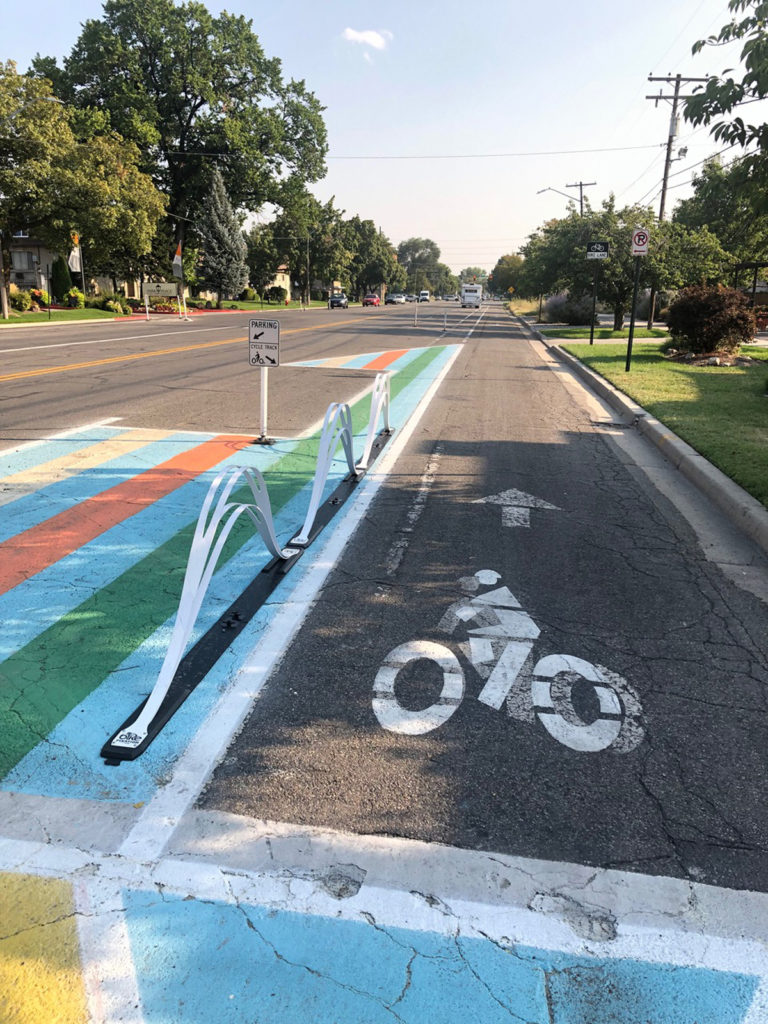
By Charles Pekow — How do you determine the safest design to get bicycle riders through an intersection? The Federal Highway Administration (FHWA) has come up with a highly- technical guide on what factors to consider in any given case. A suggestion: the type of facility at the intersection should remain the same as the one that got the riders through the block. Nor should bike lanes end at corners. Specific bike signals, not just red/green and walk/don’t walk lights also help. Find the report at https://safety.fhwa.dot.gov/ped_bike/tools_solve/docs/FHWA-SA-21-010_Traffic_Analysis_Intersection_Considerations.pdf.
The FHWA also added to its list of proven safety countermeasures to reduce roadway fatalities and injuries, this autumn. Officially included on the list now: bicycle lanes, crosswalk visibility enhancements that help cyclists determine where to cross (lighting, pavement markings, signs), and rectangular rapid flashing beacons (yellow flashing lights). See the list at https://safety.fhwa.dot.gov/provencountermeasures/.
By Wayne Cottrell — Although Weber County’s population has grown by over 50% in the past 25 years, things tend to get quiet in the area west of I-15, to the northwest of Ogden. The North Weber Basin Ramble is a 33.8-mile ride on the roads in this area. The ride is nearly pancake flat, with an elevation differential of just 90 feet, and only one hill of any note. The heaviest traffic volumes were on roads having adequate shoulders. These included U.S. Highway 89 in Pleasant View (6,900 vehicles per day), 2700 North in Pleasant View (14,500 vehicles per day), and Rulon White Boulevard in Farr West (6,100 vehicles per day). The other roads in the ride have narrow shoulders, with the busiest being State Route (SR) 126, with 8,700 vehicles per day north of SR 39. Use caution on all roads having narrow shoulders. There are a few railroad crossings along the way, all of which had been improved (i.e., not the old, bumpy kind).
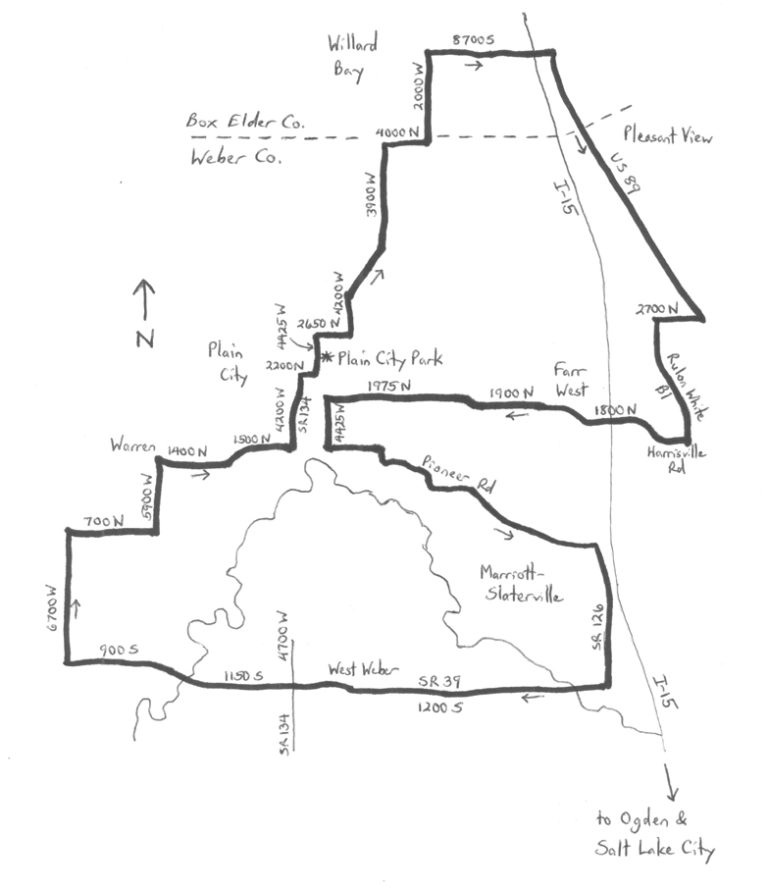
Map of the North Weber Basin Ramble Ride.
The ride passes through the cities of Farr West, Marriott-Slaterville, Plain City, and Pleasant View, as well as the unincorporated communities of Warren and West Weber. The route visits Box Elder County for a short stretch. Start the ride in Plain City, at Plain City Park, located at 2350 North and 4425 West. Plain City had a population of 5,887 in 2012. Settlement began in 1859, and was based on 1.25-acre lots. Head north on 4425 West. The road bends right at mile 0.4, becoming 2650 North. At the end of 2650 North, turn left and head north on 4200 West. After passing by a few residences, 4200 West bends to the right (mile 1.0), leaving the city. After crossing the Little Mountain Rail Trail, the road bends to the left, becoming 3900 West. It is a straight shot northward, as you ride along the fringes of the Willard Bay Wildlife Management Area (to the left). At the end of 3900 West, turn right onto 4000 North and head east. Next, turn left onto 2000 West (mile 3.35) and head north – enter Box Elder County. You are bound to see a few boaters and anglers, as the South Recreation Area of Willard Bay State Park is on the left. The road curves to the right at 8700 South, to head east. After passing under I-15, 8700 South climbs the only true hill of the ride (at a gentle 2.4% grade), to meet US 89.
Turn right onto US 89 and head southeast. The highway is one-way (in your direction!) for just under one mile. Return to Weber County at mile 7.05, entering Pleasant View, and reaching the highest elevation of the entire ride (4,308 feet). Pleasant View had a population of 8,340 in 2012, and is primarily a bedroom community. Turn right onto 2700 North (mile 9.4) and head west. Turn left onto Rulon White Boulevard (1500 West; mile 9.95) and head south. As this road serves an industrial area, it is lightly-used after hours. Rulon White served as Ogden’s mayor (1950-1951). Turn right onto Harrisville Road (mile 11.45) and enter Farr West. This city had a population of 6,122 in 2012, having doubled since 2000. Despite the geographical-sounding “Farr West,” the city’s name actually pays homage to Mormon (LDS) pioneers Lorin Farr (former president of the Weber LDS stake) and Chauncey W. West (former presiding bishop of Weber County). Harrisville Road curves to the right, becoming Farr West Drive, and then to the left, becoming 1800 North. Pass under I-15, and continue heading west. The road makes a couple of alignment shifts along the way. By the time you have re-entered Plain City, you are on 1975 North.
At 4425 West (mile 15.7), you have the option of bailing out of the ride by turning right and returning to Plain City Park. You are otherwise halfway through. For those who are game, turn left and head south on 4425 West. Next, turn left onto Pioneer Road and head east. Leave Plain City and enter the city of Marriott-Slaterville. This city, one of Utah’s newer ones (incorporated in 1999), had a population of 1,727 in 2012. A number of descendants of famous hotelier J. Willard Marriott reside here. Pioneer heads south southeast, with a couple of sharp right and left turns along the way. Turn right onto SR 126 and head south. At 1200 South (mile 21.4; SR 39), turn right and head west. Leave Marriott-Slaterville after crossing over the Weber River. Enter the community of West Weber; its population of several hundred was little different from its 1887 total of 700. Infrastructure improvements along SR 39 and westward as of this writing suggest that the area is preparing for growth, though, after some 125 years! SR 39 ends at 4700 West; the road continues as 1200 South, and then as 1150 South (and 900 South) after curving to cross the meandering Weber River again. Turn right at 6700 West (mile 27.55) and head north.
6700 West reaches the lowest elevation of the entire ride (4,218 feet), as you are just 12 feet above the surface elevation of the Great Salt Lake. Turn right onto 700 North and head east; at the end of this road, turn left onto 5900 West and head north. Next, turn right onto 1400 North and head east, entering the community of Warren. This settlement, named in honor of Lewis Warren Shurtliff (former local stake LDS president) is nearly seamless with Plain City, which you re-enter at 5200 West. The road jogs to the left and right, becoming 1500 North. Turn left at 4700 West (SR 134) and head north. The road passes by Fremont High School, which may be best-known as the alma-mater of David Hale, who played for two seasons with the NFL’s Baltimore Ravens. SR 134 turns right at 2200 North to head east. Next, leave SR 134 by turning left onto 4425 West. From here, it is two blocks to Plain City Park, and the end of the ride.
For more rides, see Road Biking Utah (Falcon Guides), written by avid cyclist Wayne Cottrell. Road Biking Utah features descriptions of 40 road bike rides in Utah. The ride lengths range from 14 to 106 miles, and the book’s coverage is statewide: from Wendover to Vernal, and from Bear Lake to St. George to Bluff. Each ride description features information about the suggested start-finish location, length, mileposts, terrain, traffic conditions and, most importantly, sights. The text is rich in detail about each route, including history, folklore, flora, fauna and, of course, scenery.
Wayne Cottrell is a former Utah resident who conducted extensive research while living here – and even after moving – to develop the content for the book.
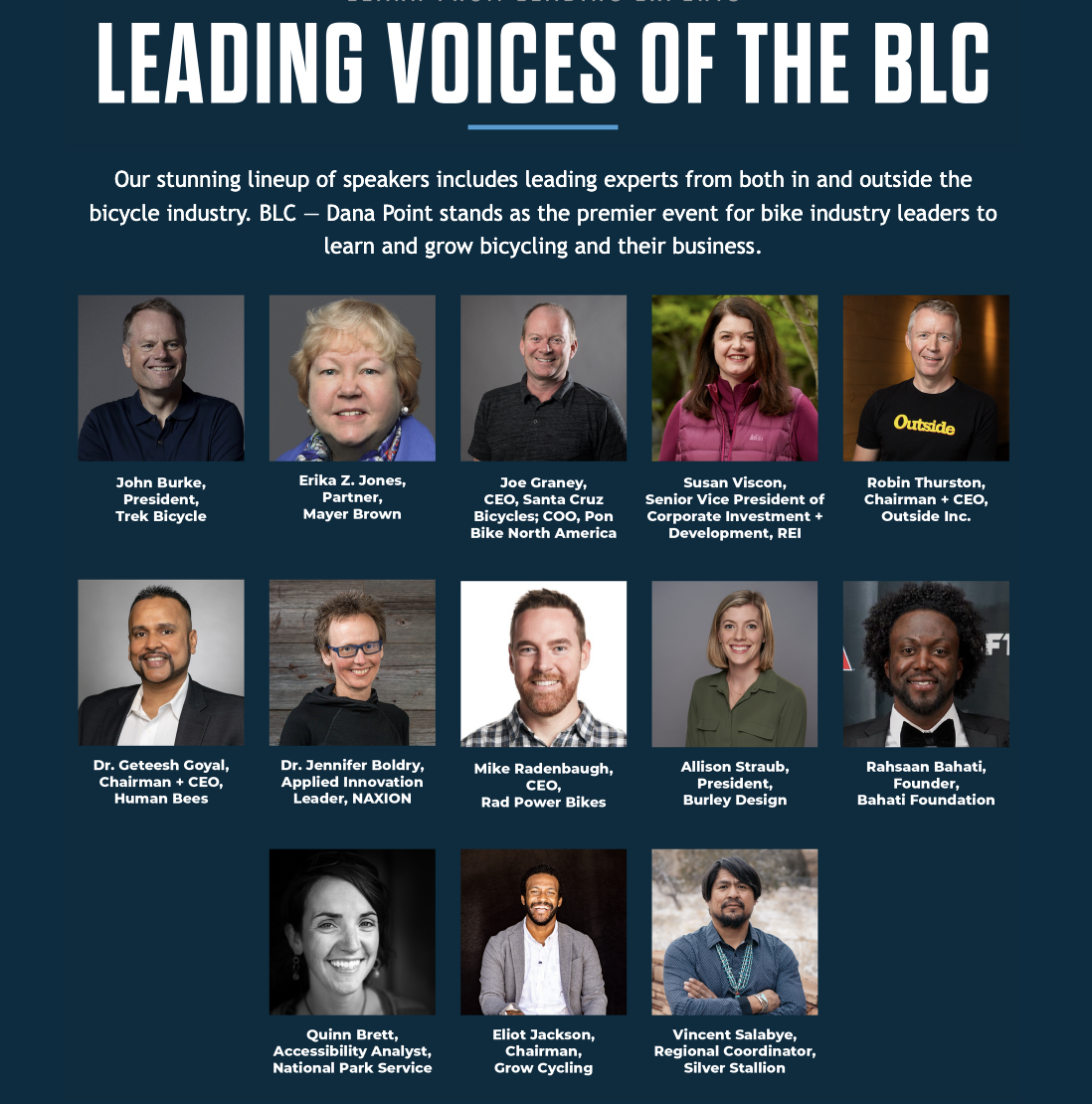
BOULDER, COLO (Feb. 15, 2022) — PeopleForBikes, the U.S. bicycle industry’s trade association, is proud to announce the agenda and list of speakers for their upcoming Bicycle Leadership Conference (BLC), taking place March 21-23, 2022 in Dana Point, California.
Photo courtesy PeopleForBikes
PeopleForBikes organizes the Bicycle Leadership Conference to bring together the brightest leaders in the industry to collaborate, learn and drive their collective vision of transforming America into the best bicycling nation in the world.
Attendees should plan to arrive the morning of Monday, March 21 and depart the morning of Thursday, March 24.
2022 BLC — Dana Point Agenda:
Tuesday, March 22, 2022
KEYNOTE: How He Built Simplehuman — A Conversation With Founder Frank Yang, Hosted by Guy Raz of NPR’s “How I Built This” and “TED Radio Hour”
Guy Raz, creator and host of one of NPR’s most popular programs — “How I Built This” — interviews simplehuman’s founder and CEO Frank Yang to share leadership lessons, insights on his problem-solving passion, his drive for constant innovation and how his love of bikes serves as a personal and professional inspiration.
Introduced by Mike Radenbaugh, CEO, Rad Power Bikes
How the Pandemic Changed Bicycling
John Burke, President, Trek Bicycle
Change Agents: Rapid Industry Growth, Consolidation and Outside Investment
Consolidation and change is happening at an accelerated pace at all levels of the bike industry. Hear from some of the biggest agents of change in the last two years and their vision for the future.
Introduced by Allison Straub, President, Burley Design
Joe Graney, CEO, Santa Cruz Bicycles; COO, Pon Bike North America
Robin Thurston, Chairman and CEO, Outside
Nathan Pund, Managing Director, Houlihan Lokey
Welcoming Diverse Participation: The Changing Face of Ridership
Riders and advocates from diverse backgrounds share their personal journeys and insights on how to grow and sustain diversity in cycling.
Introduced by Milay Galvez, Director of Marketing, BikeCo
Eliot Jackson, Chairman, Grow Cycling
Rahsaan Bahati, Founder, Bahati Foundation
Quinn Brett, Wilderness, Outdoor Recreation and Accessibility Analyst, National Park Service
Vincent Salabye, Regional Coordinator, Silver Stallion
Say Hello to Your New Customers
Learn more about the new riders who entered the market during the pandemic. Hear first-hand perspectives from endemic and non-endemic consumer research experts on how to reach these customers and keep them riding.
Introduced by Ian Christie, CEO, Summit Bicycles
Jennifer Boldry, Applied Innovation Leader, NAXION
Liz Stahura, Co-Founder, BDSA
Kelly Davis, Director of Research, Outdoor Industry Association
Dragana Pajovic, Director of Global Sales Strategy, SRAM
Photo courtesy PeopleForBikes.
Wednesday, March 23, 2022
KEYNOTE: Creative Companies and Courageous Leaders — Turning Culture Into Competitive Advantage With Best-Selling Author Polly LaBarre
Founding member of Fast Company and co-author of the award-winning book “Mavericks at Work: Why the Most Original Minds in Business Win,” Polly LaBarre is a top speaker who leaves audiences with actionable lessons from organizations and leaders who are transforming their cultures and industries by breaking the rules and harnessing the human element.
Introduced by Andrew Kempe, Senior Manager OEM Sales, Shimano
Global Supply: Can It Be Fixed?
With rising pressures from capacity, labor, energy, shipping, raw materials and tariffs, what does the future of manufacturing look like for both small and large companies?
Introduced by Bob Margevicius, Executive Vice President, Specialized Bicycle Products
Mike O’Gara, Senior Vice President, Huffy Corporation
Jeff Scully, Founder and President, Ortlieb USA
Jean-Marc Sorhondo, Head of North America Ocean Operations, Flexport
The Great Resignation Meets the Hybrid Future of Work (Current State)
How are organizations making changes in order to attract diverse talent, retain current employees and inspire and foster inclusiveness during the Big Quit? This session will dive into the future of remote and hybrid working — its effectiveness, its limitations and how to optimize this new norm moving forward.
Dele Downs Kooley, Senior Human Resources Program Manager, Diversity and Inclusion GlobalTalent Acquisitions Excellence, Microsoft
Geetesh Goyal, Chairman and CEO, Human Bees
Ben Coates, Managing Director, POC North America
Brands Leading the Conversation on Sustainability and Inclusion
Learn from industry heavyweights on spearheading initiatives on climate action and social justice and how you can implement these learnings at your business.
Introduced by JJ Trout, Chief of Staff, PeopleForBikes
Matt Dwyer, Vice President of Product Impact and Innovation, Patagonia
Susan Viscon, Senior Vice President of Corporate Investment and Development, REI
Dan Kihanya, Director of Corporate Development and Investment, REI
Regulations and Risk: Is That Bike an Electric Bicycle?
Product innovation continues to outpace current regulations for electric bicycles. As product developers create new e-bike concepts, companies need to pay closer attention to the legal standards that govern electric bicycles in the United States.
Introduced by Larry Pizzi, Chief Commercial Officer, Alta Bikes
Erika Jones, Partner, Mayer Brown
Erik Pritchard, CEO and President, Motorcycle Industry Council and Powersports Industry and Safety Associations
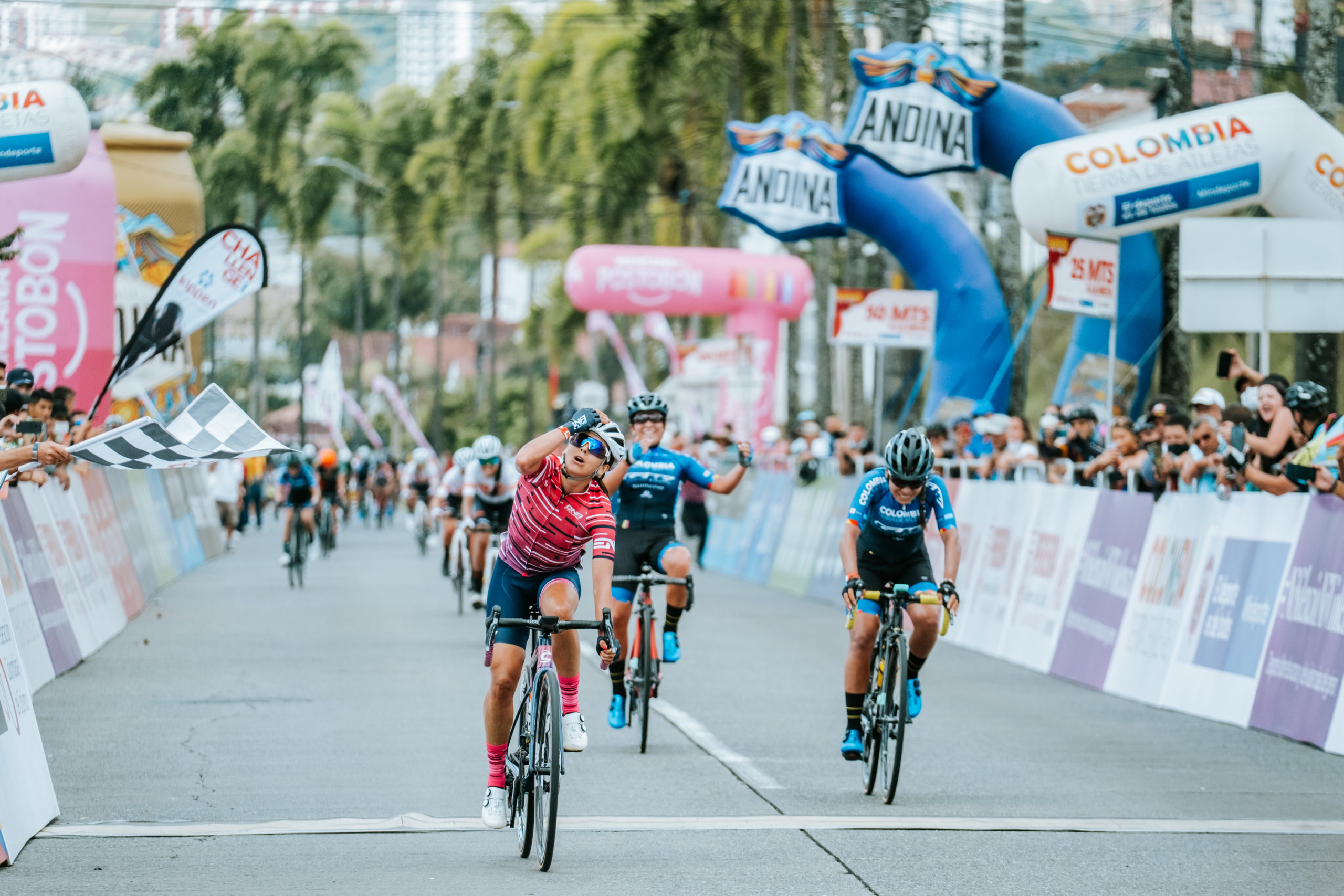
PEREIRA, Colombia (February 14, 2022) — Diana Peñuela dug deep into the pedals in a thrilling finish, initiating the sprint early, getting passed, and then coming around in the final 50m to earn her first Colombian national road title. Peñuela had come close before, finishing second four times in the event. The newly signed rider to DNA Pro Cycling had the support of her team directors in the days before the event and during the race which took place on Friday, February 11 in Pereira, Colombia. The team had traveled to Colombia to hand-deliver her Cannondale and other 2022 equipment. The title is the first major race and win of the season.
Diana Peñuela (DNA Pro Cycling) wins the 2022 Colombian National Championships. Photo courtesy Colombian Cycling Federation.
“I’m so happy. The support the team gave me was fundamental,” Peñuela said. “I wasn’t sure if I was in good form, but the team had a lot of faith in me. They told me to follow the attacks and race aggressively, believing I had the ability to win.”
Peñuela overcame a host of challenges that had been thrown her way last season. She had suffered two broken collarbones, working hard to return, only to become ill with Covid, abruptly ending a difficult season. She now heads into the new season with momentum and the form she is accustomed to.
Diana Peñuela unleashes a powerful sprint up the 6% finish straight to win the Colombian National Championship. Photo courtesy Vuelta Es Asi.
The race took place on 8 laps of a 17.8km circuit (total 142.4km / 88.5mi), taking the riders up steady climbs in the first half, followed by a descent into a final kick up to the finish. Peñuela had been part of a 6-rider break that included several riders from the Colombian powerhouse team Tierra de Atletas, that included last year’s champion.
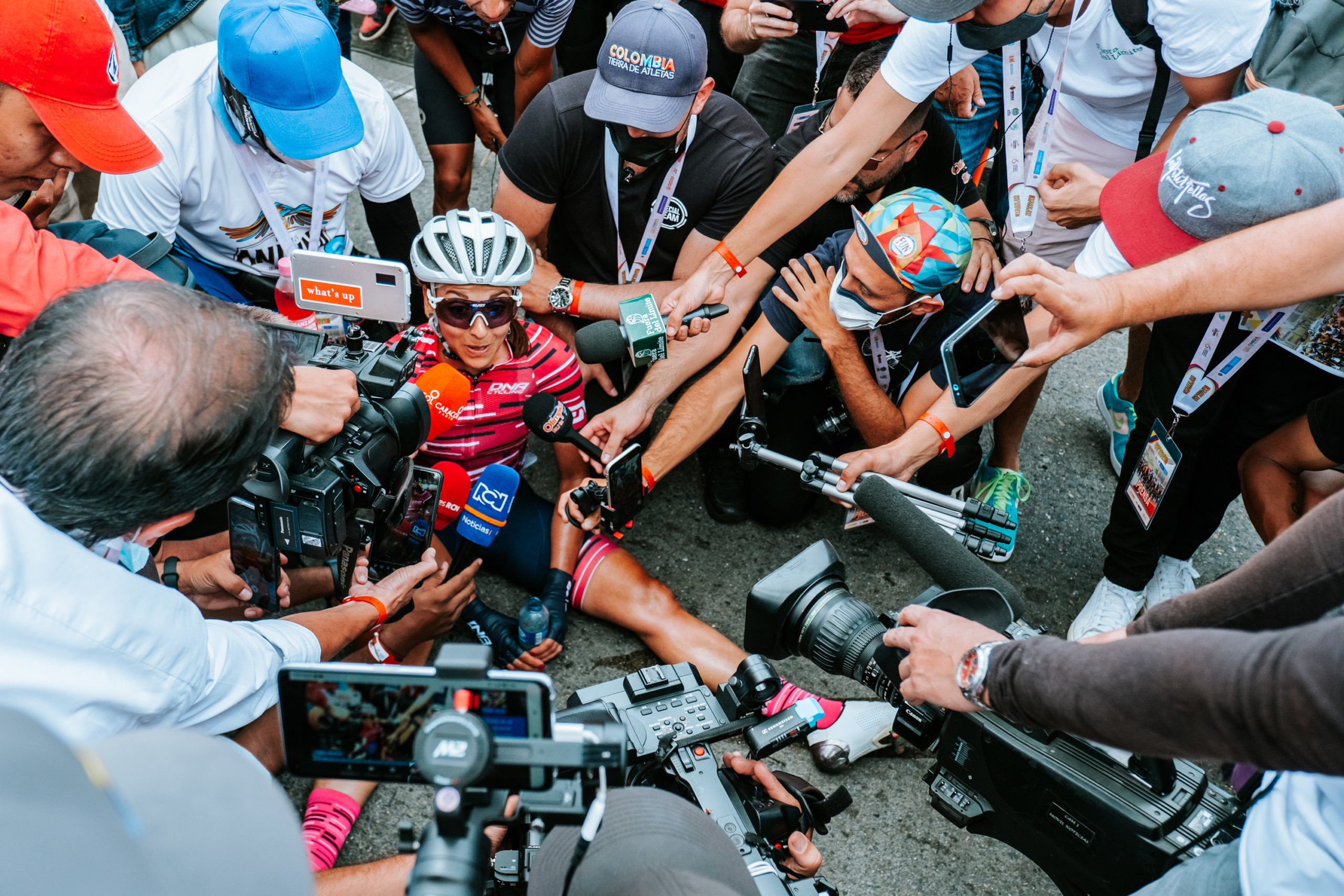
An exhausted Diana Peñuela answers questions from the media after winning the 2022 Colombian National Championship. Photo courtesy Vuelta Es Asi
“I tried to go solo so I wouldn’t be carrying multiple riders to the line from the same team,” Peñuela added. “Of course, it was difficult with all of them. Each time we made the climb, I enforced a strong rhythm to try to keep control. On the final climb to the finish, if they surprised me, it was going to be that much harder for my legs to respond.”
“At the finish, I began to cramp at 1.5km-to-go but knew I had to keep pedaling. Last year, I finished third at nationals, and I told myself, ‘No! I can’t finish second or third this time. I want that jersey!’”
DNA Pro Cycling team now looks ahead to a full season of scheduled races, hoping to continue the winning momentum. The team is planning a camp in Tucson, Arizona during the first week of March.
By Lou Melini with Chris Blinzinger — Sometime in mid-August 2020, I received an email from Chris Blinzinger; “Lou, Starting on September 11th, I am doing a bike tour starting from Nephi and ending in St. George via Capitol Reef National Park. Would you like to join me?”
I knew of Chris through several of his write-ups of tours he had ridden with John Monroe. I had never met him, but I enthusiastically agreed to join him after checking for any potential conflicts with Julie, my wife and #1 bike-touring buddy. Neither Chris nor I like to bike tour alone, at least not for more than a few days. Chris was grateful for the company, and I was grateful for the opportunity to do a bike tour with him.
After meeting Chris over coffee and exchanging a bunch of emails, we started our trip from Nephi, Utah, on the chilly and windy morning of September 11th, 2020. From the very start, we got along well.
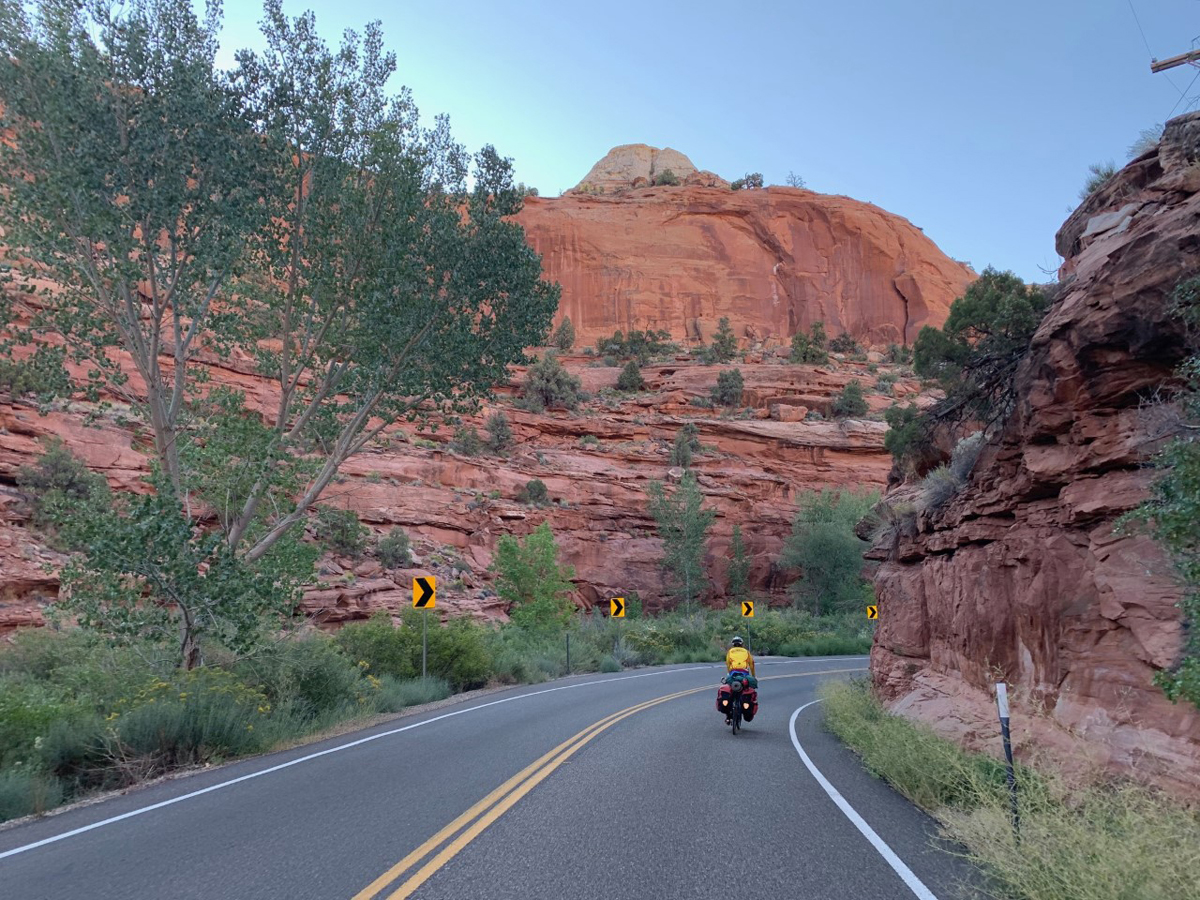
Lou Melini riding friendly roads in the early morning. Photo by Chris Blinzinger
The start of the tour
Chris planned a great ride. The planned tour had us riding no more than sixty miles/day, save for one day. Because of uncertainties surrounding coronavirus and crowding, we made reservations for a couple of campgrounds and our bus ride home from St. George. However, our first night of camping was still uncertain. Salina, Utah, fit well in our plans for our first night lodging. Unfortunately, Butch Cassidy campground closed their restrooms allowing only vehicles with a toilet (i.e., RVs) to camp there. Knowing this, Chris made potential arrangements with the town of Sigurd, twelve miles away, to stay in the city park. The restrooms there were closed, and the added twelve miles would have made for a 70-mile first day.
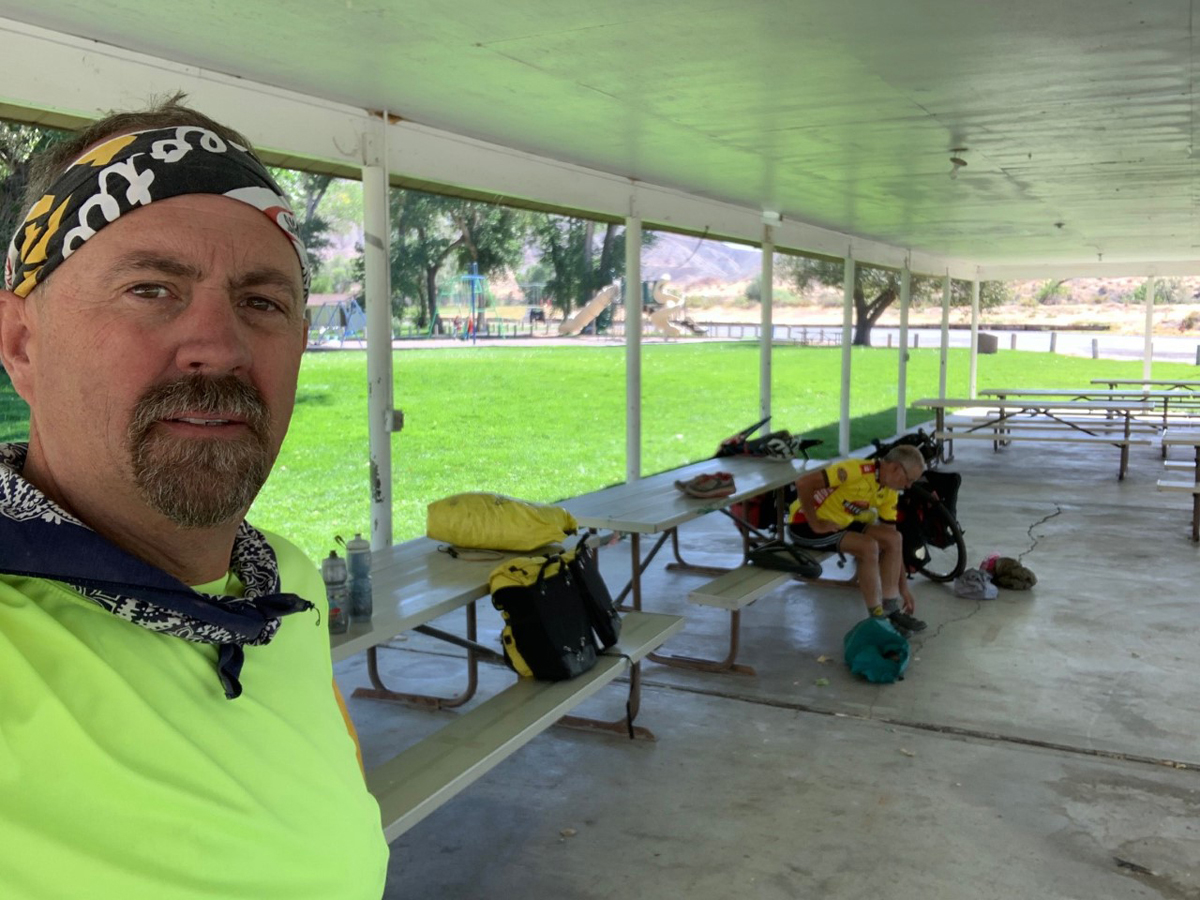
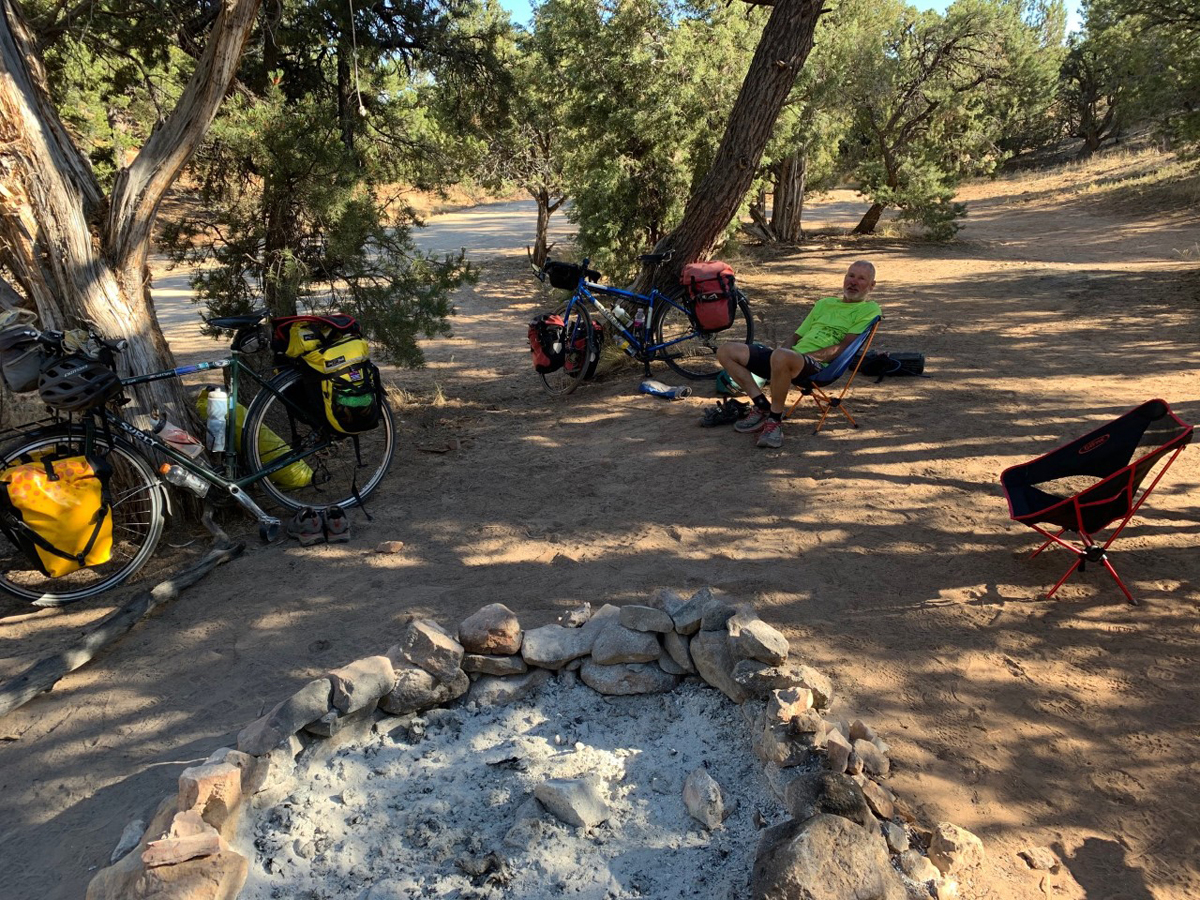
Guess we’ll sleep here. Photo by Chris Blinzinger
Shortly before our arrival in Salina, Chris said: I have an idea. Perhaps we should go to City Hall to seek permission to stay in the city park. Excellent idea Chris, I replied. We confidently went to the City Hall office only to find out that the Salina City Hall is closed on Fridays. We then tried the police station to get permission to camp in the city park. After explaining about Butch Cassidy campground and City Hall, the officer on duty hesitated for a moment to grant us permission. In my most polite way of asking, I suggested he was the person to make the executive decision. I also played the age card by stating I was “almost 70 and tired from today’s ride”. Within minutes we were off to the grocery store before settling in at the city park. To see if we were OK, the officer we spoke with came to check on us, as did the night patrol officer. Other than a lack of showers and some brief late-night use of the park by the town teenagers, the city park was a great first night lodging.
From Salina our destination was Loa where we had reservations at a new campground that had not yet completed the tenting area, so Chris had to reserve an RV site for the night. Similar to day one, most of the second day of riding was on roads I had not traveled upon with my bike. The morning was cold, cold enough that Chris needed to stop at the IFA country store as we left Salina to buy long fingered gloves. I almost joined him, as my hands were chilly in my long-fingered gloves. By the time we reached Sigurd the temperature was warming. On the negative side, we turned onto route 24 where the road grade increased by several degrees through a scenic forested canyon. With the addition of a slight head wind, Chris remarked that it felt as if we were riding through glue, an apt description of the morning ride. We continued on route 24 past the turnoff for route 62 where the road severely increased in grade. I had ridden this section with Julie in 2007, not remembering the steep grade. Once past the turnoff to Fish Lake we were able to speed downhill to Loa, pick up groceries and settle into the campground. As we sped down the hill, we encountered a Sports Car Road Rally of 20-30 expensive cars going the opposite direction. The campground is new, with clean restrooms and great showers, but no tent sites. We set up our tents on the softest spot we could find. Fortunately, the picnic table was light, as we moved it several times to obtain shade from our neighboring RV.
Surprise, Surprise!
It was during dinner that we both realized we forgot a day as we looked over the plans for the next couple of days. Yes, we both had overlooked a day in our trip itinerary. After a few laughs and with several reservations in place, we decided to rethink our trip before changing our reservations.
Upon leaving Loa, I could not find my American flag that adorned the back of my bike. Gone, nowhere to be found in the campground. With a shrug of my shoulders, we moved on to Torrey and a planned second breakfast. The temperature was again cold. Ice formed on the fences from early morning irrigation.
By the time we finished breakfast in Torrey the temperature had warmed enough to allow us to strip down to our short sleeves.
Lou at the campsite, a welcome sight after Boulder Mountain. Photo by Chris Blinzinger
Tough day with a great ending
After Torrey we faced the major climb of the trip, a ride over Boulder Mountain. I last rode over Boulder Mountain in 2007. The climb this time again seemed longer and steeper than I remembered. Twice we thought we reached the 9,606-foot summit with speeds as low as 3-4 mph on the frequent 8% grades. We twice made short descents from these false summits only to climb again. Perhaps the next ride over Boulder mountain I will plan to camp at one of the several forest service campgrounds. We met the Road Rally once again when we stopped at a viewpoint. Expensive, fancy cars they were. We chatted briefly with one driver who remarked how he likes riding his bike. Nice guy.
By 4 PM we cruised into the town of Boulder. Being Sunday, the small grocery was closed but there was a food truck parked at the Anasazi State Park Museum serving huge burritos that satisfied our hunger. A woman from the State Park gave us assurance that finding a primitive campsite along the road out of town would be easy, so we loaded up on water and rode on. After a couple of miles, a well-worn path led us to a perfect campsite. Chris and I were smiling big time sitting in our chairs, secluded in a shady cluster of trees.
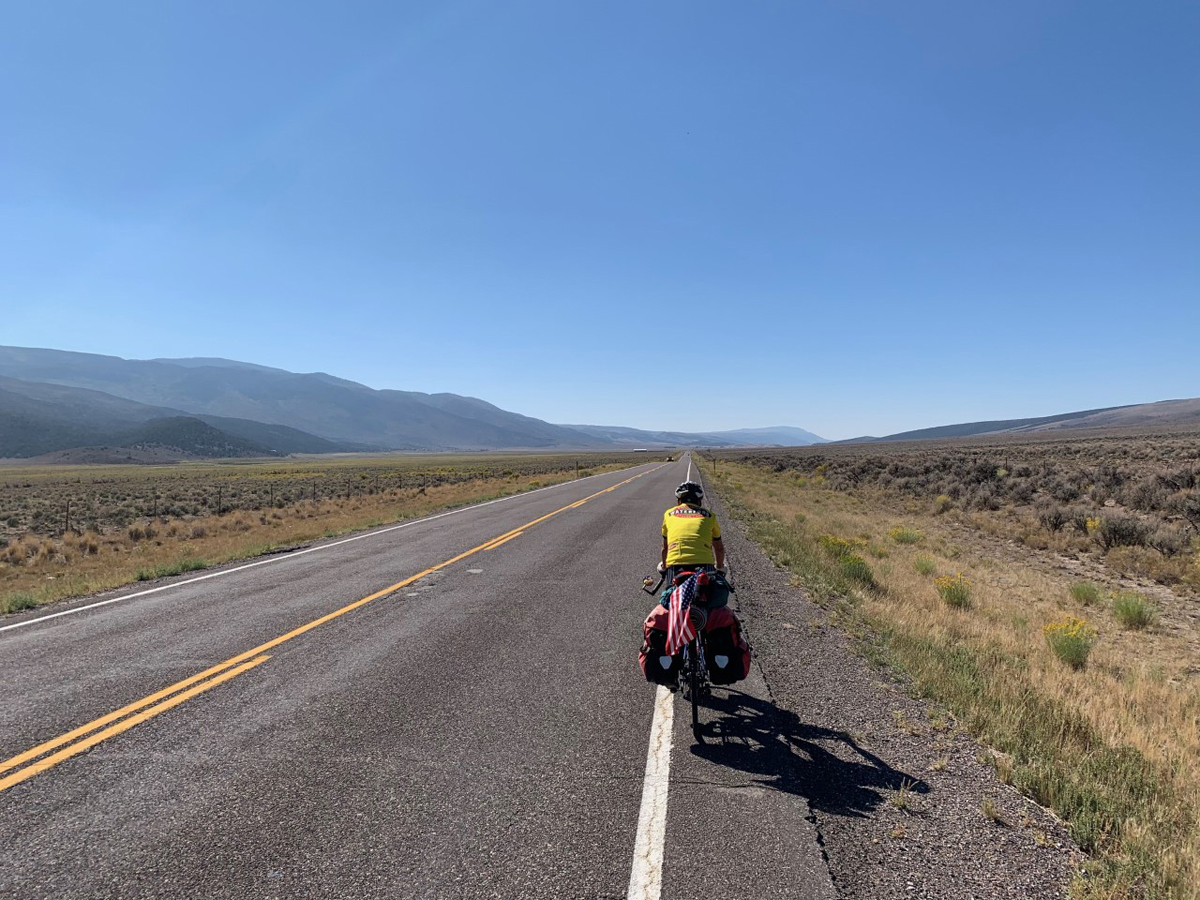
Upon leaving camp the next morning the temperature was notably warmer. It wasn’t long before we were able to strip down to shorts and short sleeve shirts as we rode route 12. There was little traffic on the road and beautiful views every mile. As we passed Calf Creek recreation area, we were constantly reminded why this road is considered one of the most scenic roads in America.
More trip changes
So far, social distancing on our trip has been easy. In Escalante, we were the only customers during our early lunch at the only open café in town. The grocery had few customers. At this point in the ride Chris and I were reading each other’s mind when it came to food, water, and rest. It was also at this time that we decided to split the planned long day (potentially seventy miles) into 2 days, utilizing our extra day. We were both enjoying the 55-60 mile days.
Also, at lunch we decided that our plan to ride to Kodachrome State Park would be nice, but we both felt that the extra nine miles would be too long of a day. Mostly though, we needed to do laundry. Chris called the KOA in Cannonville and they had room for us.
What we thought would be a relatively easy afternoon ride turned into a slog. A 20-mile stretch of steady uphill into a head wind relegated us to no more than a 7-mph pace over a 20 miles stretch. We readjusted our mindset for a later than planned arrival. We finally reached the expected relatively short but steep climb just before Henrieville. The downhill ride with no wind to contend with was a welcome relief so that we were able to arrive a little after 4 at the KOA.
Lou Melini riding on rural Utah roads with great scenery. Photo by Chris Blinzinger
Another story to be told
Memorable stories seem to abound with every trip I have ridden. This time the joke was on me. The Cannonville KOA was laundry day. I packed all of my dirty clothes into a stuff sack, threw in my book and was off to the laundry. After tossing the laundry into the washer I went to the office for coins. In went the coins to start the wash and off I went to the restroom to pee. Picking up my stuff sack I didn’t see my book, so I started to head back to the tent to see if I left it there. No sooner than three steps I realized that I was going to have either an exceptionally clean book or one that is totally shredded with the pieces imbedded in my clothes. The washer distinctly said; DO NOT OPEN DOOR WHEN WASHER IS OPERATING! No kidding, despite my attempt, the door would not open. I frantically told a KOA worker my dilemma. She was polite but could not stop the washer. It took me an hour with duct tape to pull off the small wads of paper from my clothes. When I returned home a second washing cleaned the rest of the paper out. To add insult to injury, the book was written by a high school teammate who is being billed as the “next Tom Clancy”. I was halfway through the book. Chris was very polite by not rolling on the ground in laughter. I later emailed Andy, the author, who also had a good laugh. I was able to finish the book shortly after Christmas, a gift from Julie.
Day of uncertainty
The Cannonville KOA was nice. We waved goodbye to several motorcyclists camping near us. They provided some conversation though neither party wished to trade transportation vehicles. We picked up supplies at the small grocery in Tropic not knowing what was ahead. Soon we were climbing again to reach Bryce National Park in addition to riding into a construction zone. We rode to the front of the line to receive instruction on how to proceed with our bikes. Instead of following the construction car we were given permission to ride on the construction side of the orange barrels giving us our own private lane.
A second breakfast was not available at the turnoff for Bryce, so Subway became Plan B. After that we took the bike path that parallels UT-12 nearly all the way to US Highway 89, making several stops for picture taking as the scenery through Red Canyon is simply beautiful. The campground in Red Canyon was full, as has been the case for many of the campgrounds in this area. We decided to see what our options were for the night, so we called another campground to get lodging. The woman I spoke with said; “we only have 6 sites, $45 cash only and we are 13 miles from your location south of the US-89 and UT-12 junction”. Off we went.
Route 89 buzzed with traffic. We had a good shoulder where the road had been repaved, but bad shoulder on other sections. We again fought the wind. As we approached fifteen miles, we still had not seen the campground we called, so we called another campground, the Zion/Bryce Campground. We realized that when we Googled “campgrounds near Long Valley Junction” we were actually accessing campgrounds in Glendale, a town thirteen miles further south of Long Valley Junction. Disappointed and tired, we pushed on to the summit at Long Valley Junction. Fortunately, the long fast downhill relieved our tired spirits, and soon we were only a few miles from our destination. Another construction zone stopped us. Again, we rode to the front to get instructions for our passage. We chatted with the flagger and noted a campground just past where we were stopped. A motorcyclist next to us said that was the “Zion/Bryce KOA”. It surprised us, as we thought we had another 4 or 5 miles to go. The flagger put us ahead of the construction shuttle vehicle. About 100 yards we saw the campground sign making a quick right turn into the drive. This was the place. It turned out that this campground used to be a KOA, but with $36,000 for annual franchise fees, it no longer was part of KOA. The “$45 cash only campground” we were told is not a real campground.
On to Zion
Our original plan was to ride from the campground we had thought would be near Long Valley Junction. We would have had to ride to the entrance of Zion, hitch a ride through the tunnel, ride through Zion NP, ride Scenic Drive, and then on to the campground in Springdale for a total of nearly seventy miles. When we added in the uncertainty of obtaining a quick hitch through the tunnel, we thought it would be a long day. Chris and I each had a friend that said hitching was no problem, but they were solo. Two cyclists may make a truck with enough room for one move on.
We left the Bryce/Zion campground early. Within a couple of miles, we were stopped again because of road construction. We rode to front as we did at previous construction sites to find out how we would be handled. We met the same flagger and caught up with road construction news. After chatting a bit, we found out we would follow the lead car past the wet tar section that was being laid down. After that we could drift to the right and have our own lane. The road was downhill, so we made good time exiting the construction zone.
On this day we went as far as the campground just east of the Zion entrance a mere 27-mile ride. This plan insured plenty of time to get through the tunnel and ride scenic drive the following day. We killed time in the air-conditioned recreation/laundry/restroom building catching up on fluids, calories, and sleep. Later we asked around the campground for potential rides through the tunnel vs. sticking out our thumbs. Chris struck out 3 times, but I hit a home run on my first try from a young couple from California. They had a truck, not much gear and were leaving promptly at 6 AM.
Zion National Park
We were at our ride vehicle by 5:45, our bikes and panniers took up every square foot of excess space in the truck. Within a half hour we were at the visitor center in Zion missing the scenic views due to the darkness as a trade-off for the ride. At the visitor center we cooked breakfast at an idle picnic table using our headlamps while watching the parking lot fill up. Shortly after daylight we took off on a bike path that took us to Scenic Drive and Zion in its entire splendor. We shared the road with numerous Park and commercial shuttles as well as rental e-bikes but mostly the road was ours.
After a brief time hanging out near the closed visitor center, we went to the campground to check-in. The restrooms were air-conditioned, and the showers had plenty of hot water but the campsite itself needed some work. We moved our chairs from campsite to campsite following the available shade. I had the maintenance crew rake off the stones that ranged up to 2 inches covering our “tent site”. The ground underneath the stones was hard and difficult to drive a stake. The view of the cliffs from the campground was great so I guess I should be grateful that I rented the last tent site to be had for miles.
The end of the road
As we rode to St. George, we were again unsure of our lodging for the night. We rode a nice shoulder into the town of Hurricane to stop for a second breakfast. I ordered off the “Senior Menu” to take advantage of the “10% discount for seniors over 55”. I didn’t get the discount when my check arrived. I didn’t say anything as I chalked it up as a compliment. Chris announced he received a positive reply from a WarmShowers host in St. George. This time Chris hit a home run while I struck out.
WarmShowers.com is a worldwide website for traveling cyclists. I had once been on the Board of Directors. From that experience I know that there are problems with non-responsive hosts and guests that no-show. We had 2 potential hosts that didn’t give us the courtesy of a reply. The third potential host replied to us, but was not able to host. With the fourth request we had a backyard to camp located about a mile from the bus station. Perfect as we had 9:45 reservations for the bus ride home.
After leaving breakfast we moved onto Washington where we picked up the Virgin River trail for our final miles into St. George. We couldn’t arrive before 3 PM at our hosts’ home so we killed a couple of hours on the cushy sofas of the “Love Sac Lounge” on the Dixie State College campus.
Notes from the ride
Chris and I averaged 57 miles/day for the first 5 days, then 27 miles/day for the final 3. It was a very relaxing and enjoyable ride. With headwinds, a couple of long steady up hills and the Boulder Mountain climb our average pace for days 2-5 were just under 10 mph.
Temperatures ranged from low thirties during the first couple of mornings, but it became hot the rest of the ride once we left Escalante including a reported 102 in Zion NP.
I broke two presta valve stems, one when my bike fell over as I was doing a routine topping off of tire pressure. We did not have any mechanical issues off significance.
Chris had some stomach issues one day on the ride and I had similar problems the night I returned home. Wind and sun blistered my lower lip on the ride to Cannonville. I couldn’t get enough Chapstick on my lip to relieve the discomfort until I arrived home. I should have been more proactive with skin care. Social distancing was easy throughout the trip with two exceptions. Zion NP was seeing record crowds though we were fairly distanced from others. The bus ride home was surprisingly packed with travelers all masked up.
Considering that we had never ridden together and only met once, Chris and I traveled well together. Looking forward to 2021.
Lou Melini is a lifelong bicycle commuter, and the former Commuter Column editor for Cycling West.
Chris Blinzinger is an avid cyclist, commuter and tourer. He is a member of the Provo Bike Committee and advocate for active transportation. He tours with friends and family and hopes to ride back to his home state of Indiana in the near future.
BOULDER, Colorado (February 8, 2022) — Blue skies, chilly temps, slushy roads and hiking through calf-deep snow on Rowena Pass brought the tagline “epic winter adventure” back to life for this year’s Old Man Winter Rally, held on February 6th in Lyons, Colorado. Between last week’s heavy snowstorm and temperatures that hovered in the low forties in the days following, 1200+ runners and cyclists were in for a fun, wintery, fitness treat last Sunday.
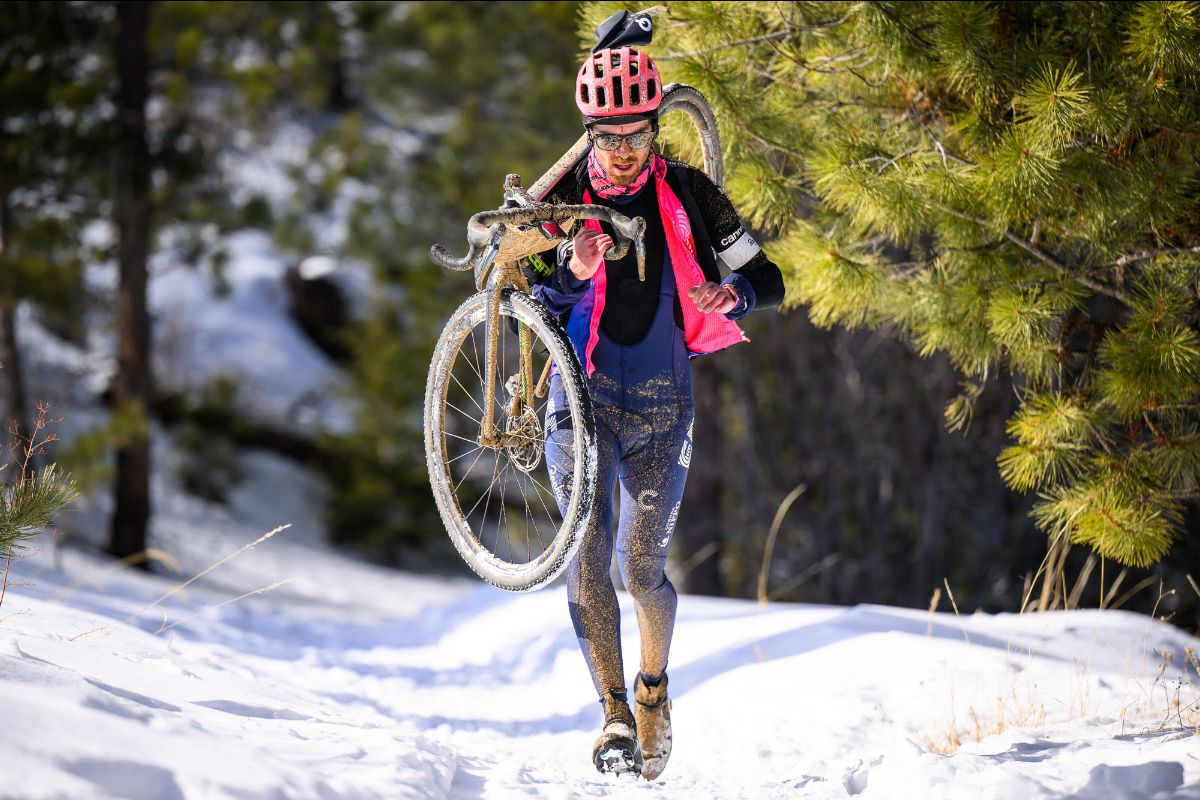
Alex Howes slogging through the snow at Rowena. Photo by EddieClarkMedia.com, courtesy Old Man Winter Rally
“Conditions this year were perfect,” explains Josh Kravetz, president of Adventure Fit Events and the event director for the Old Man Winter Rally. “We had a mix of dry pavement and trails in and around town, then dirt roads, mixed with snow, mud, ice and slush. Yet, the Colorado sunshine kept everybody warm on a blue-bird day. On the run course, we saw plenty of bare arms and legs but shoes with heavier traction and microspikes. Our cyclists were traveling at faster speeds (until Rowena) so they were bundled up a bit more with jackets, heavier gloves, hats, and full leg coverings. We also saw a lot of cyclists wearing boots. The winner of the men’s 100K bike course, Alex Howes, actually credits his choice of footwear for his win as the conditions on the Rowena required a 2-mile hike through soft snow,” finished Kravetz.
Amidst the slippery, snowy, chilly conditions, the atmosphere was just what the Old Man Winter Rally promises: festival-like. From costumes, live music, good food and fire pits, there was nothing but smiles at the afterparty; smiles and plenty of s’mores (courtesy of a Colorado-based company, Chocolove). While chatting around the fire pits, many athletes mentioned they were drawn to this year’s event because of its efforts to support the Boulder County Wildfire Fundfor victims of the Marshall Fire. The event raised $5000 for non-profits through a portion of the registration proceeds plus $20 for every volunteer hour logged at the event. Kravetz and his team also coordinated a public Facebook community group dedicated to collecting and donating cycling and running-related products for athletes affected by the fires. This has resulted in donations from over 400 people to date.
The feel-good front range event boasted an impressive start list of professional athletes, but the majority of the participants were biking and running enthusiasts or novices to racing. “The pros in Boulder take this event VERY seriously, putting a ton of strategy into their gear and preparation,” laughed Kravetz. “On the other hand, we had 271 athletes who had never done a race or an event like ours in their lives. We really aim to make the event fun and accessible to everybody so people are inspired to dive deeper into the cycling and running lifestyle. Showing up at a startline with 1200+ other athletes, on a winter day, is very thrilling and surely made memories for all levels of participants.” finished Kravetz.
COLORADO SPRINGS, Colorado (February 11, 2022) — USA Cycling announced on Friday additional dates and locations for several 2022 National Championships. As many are eagerly awaiting many of these dates and locations, USA Cycling is excited to share that in 2022, Marathon Mountain Bike National Championships will be taking place on October 23 and returns to Frederick, Md. Junior and Elite Track National Championships will head back to the Valley Preferred Cycling Center in Breinigsville, Pa., and will start on July 26 and go through August 1st. Lastly, Cyclocross National Championships will return to Hartford, Conn. and will be from December 6-11.
USA Cycling is working hard to finalize the outstanding national championship locations and dates, with a specific focus on Amateur Road National Championships. “We have received questions regarding the date and location of Amateur Road. We have run into disruptions beyond our control with last year’s courses both for the time trial and road race and are working daily with local authorities to find a resolution,” said Tara McCarthy, USA Cycling’s Director of National Events. “At this time, we are targeting two dates based on local schedules and are providing them for planning purposes. These dates are June 16-19 and June 30-July 4. We will provide an update on Friday, February 25, or sooner as we have information.”
Event
Date
Location
2022 USA Cycling Junior and Elite Track National Championships
July 26 – August 1
Breinigsville, PA
2022 USA Cycling Marathon Mountain Bike National Championships
October 23
Frederick, MD
2022 USA Cycling Cyclocross National Championships
Three-day stage race features top professionals and family-friendly
February 10, 2022 — Since 1991, Arizona’s legendary Cactus Cup has been a must-do early season event for professional and amateur athletes.
This female-owned mountain bike festival features world-class competition in a fun, inclusive environment with activities for mountain bikers of all ages and ability levels—including children.
“The Cactus Cup is a can’t miss event! I make it a priority each year because the vibe is so fun and relaxed, yet the field is full of fast competition. I usually bring my daughter to this event because it’s family-friendly, and the kids have the opportunity to race and be involved,” said five-time Marathon Mountain Bike National Champion and two-time Leadville 100 winner, Rose Grant.
Photo by Let’s Wander Photography, courtesy Cactus Cup
For 2022, festivities kick off at McDowell Mountain Regional Park on Friday, March 11, and run through Sunday, March 13.
The three-day stage race includes a mountain bike time trial, a 40-mile cross-country race, and an XC-focused enduro. These race categories sold out in record time, but there are still opportunities for participation in the fondo, family ride, kids race, and bike demos.
As a family-friendly event, the Cactus Cup features a kids’ camp that lets parents race the 40-mile XC event. (Or head out for a run or ride.) Way better than daycare, this five-hour kids’ camp will help young riders build skills, confidence and make new friends.
In addition to riding and racing, event highlights include food trucks, a beer garden, live music, an industry expo, and a pop-up museum with memorabilia from the early years of the event.
“The Specialized Cactus Cup is a one-stop mountain bike racing weekend. With something for every age and ability, everyone can enjoy this iconic event. Mountain bike enthusiasts can rub elbows with internationally recognized pros like Ned Overend and Keegan Swenson. Spectators can watch their kids race, listen to live music, and have a beer all while checking out the latest from Specialized and other industry leaders in an up-close setting,” said Cactus Cup promoter Sage Melley.
By Charles Pekow — Subsidies encourage people to buy ebikes. At least, that’s what researchers found in New Zealand. It’s something Congress might want to consider as it ponders the Build Back Better Act, which includes tax breaks for buying them. It’s not clear if the provision will survive as the Senate will have to scale down the act if it ever passes.
Kenny Freestone commutes 38 miles each day on his pedal-assist eBike. Photo by Jill Freestone
Back in 2019, the New Zealand Transport Agency experimented with a variety of subsidies, mainly for public employees. The agency offered a variety of subsidies ranging from interest-free loans to salary advances, discounts, trials, and advice.
COVID slowed the program, but 112 public agencies took part. Even with discounts, many lower-paid employees couldn’t afford the bikes, so interest-free financing helped them more. Suppliers also didn’t prove terribly fond of giving discounts. However, many of those who bought bikes rode them to work.See the study at https://www.nzta.govt.nz/resources/research/reports/678
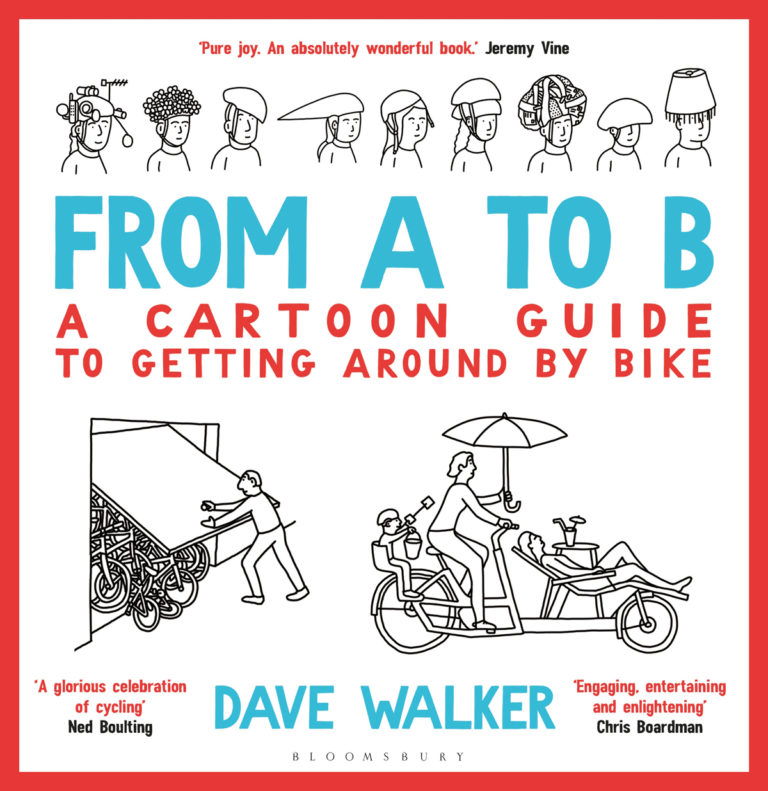
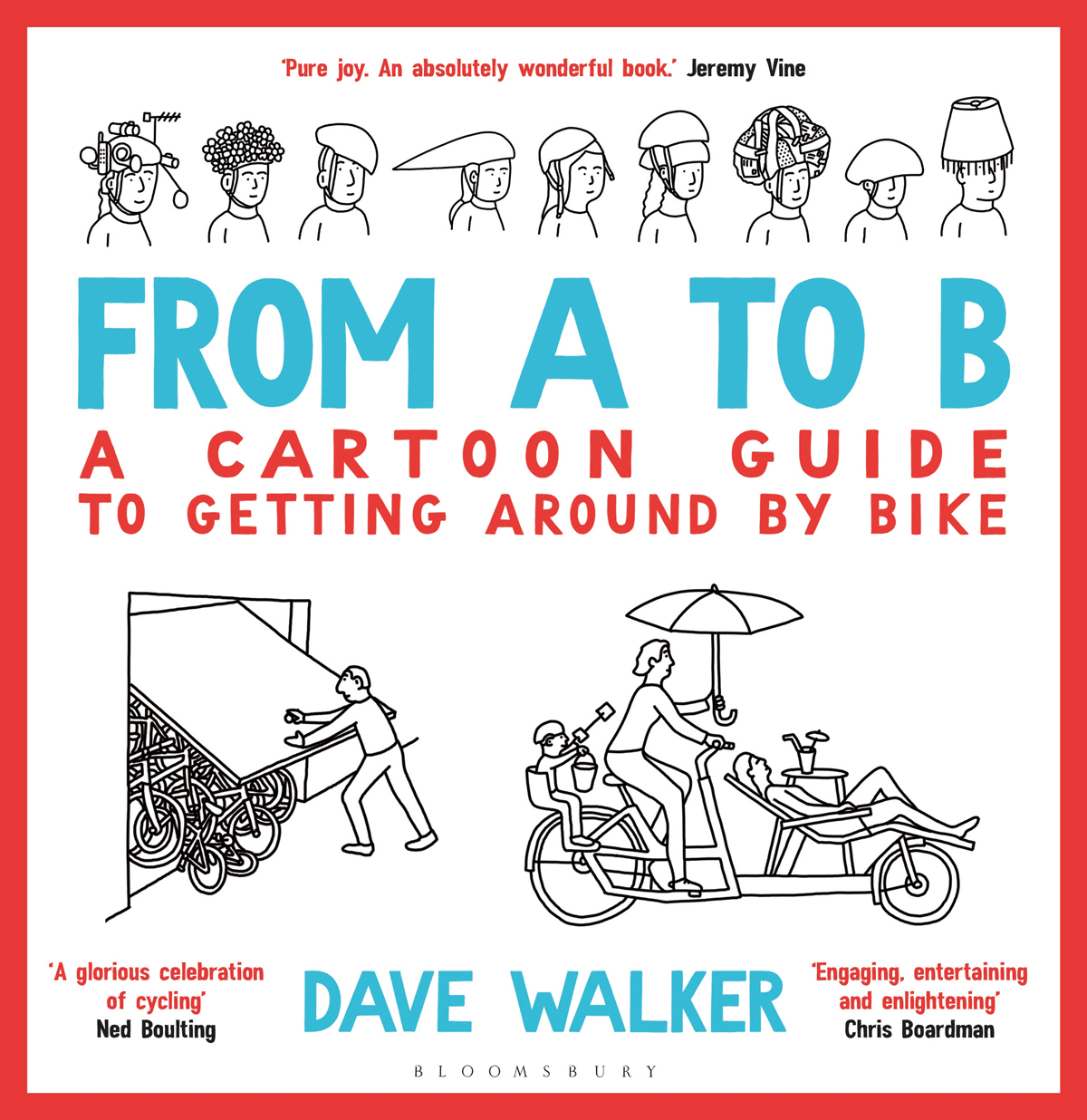
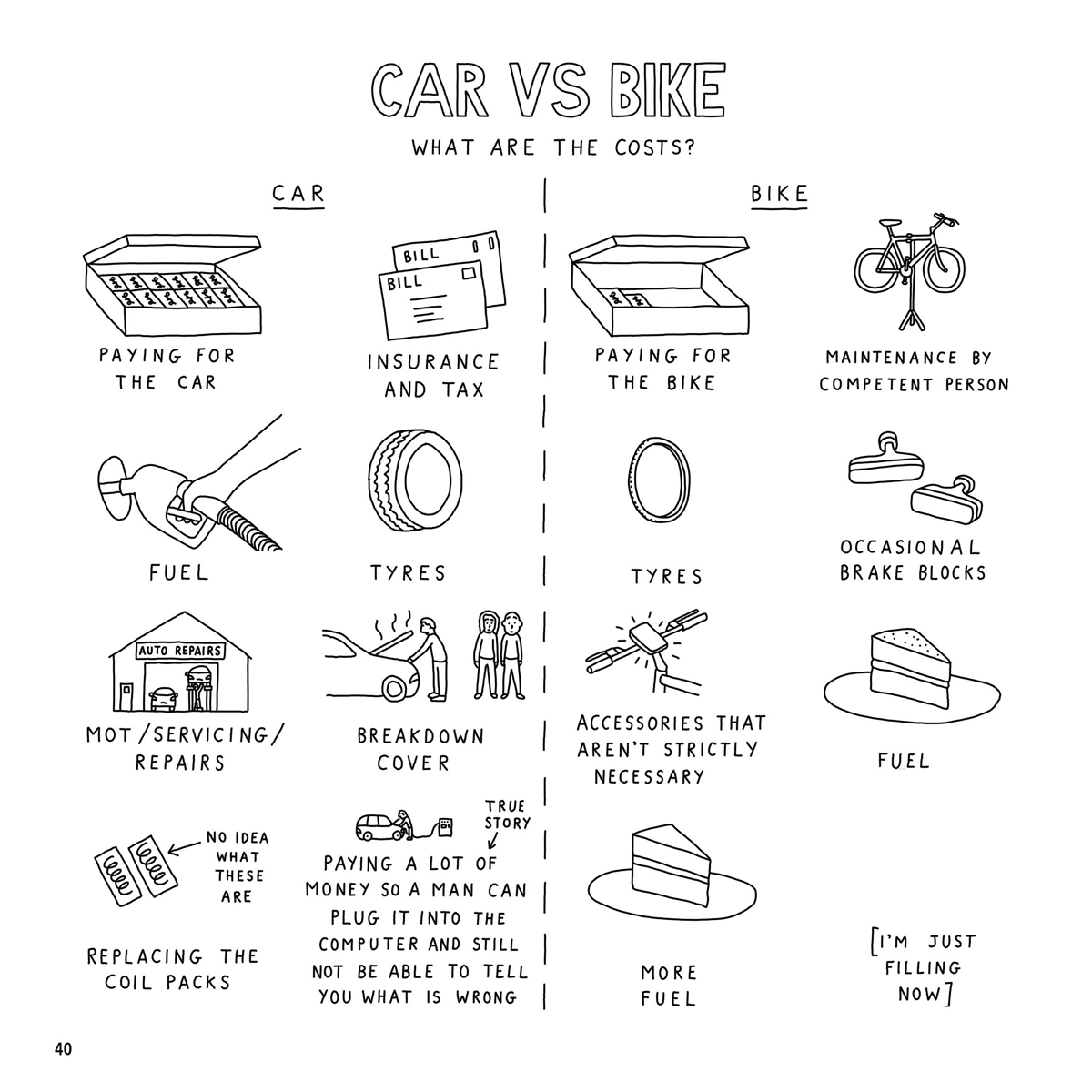
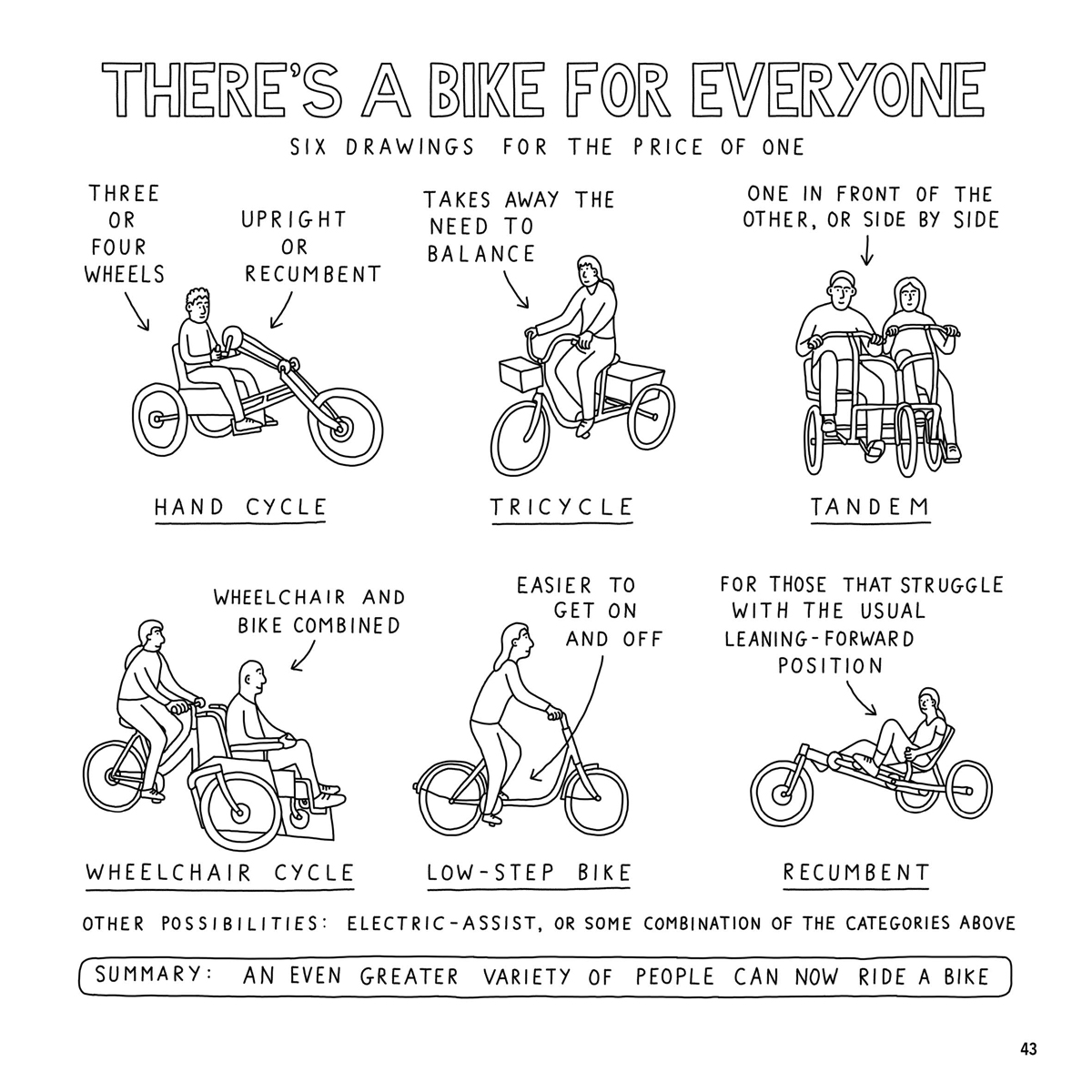
By Dave Iltis — Bike people rejoice! From A to B, A Cartoon Guide to Getting Around by Bike, brings together the reasons for riding a bike under one cover. The book features 125 bicycle cartoons and drawings by the British cartoonist Dave Walker.
Title: From A to B: A Cartoon Guide to Getting Around by Bike Author: Dave Walker Imprint: Bloomsbury Sport Format: Hardback ISBN-13: 9781472976130
The cartoons illustrate many of the current themes of why riding a bike is good for the world, fun, and healthy, along with adventure, how-to’s, pitfalls, and safety issues. Chapters include Cycling is Brilliant, Traffic, Getting Started, Safety, and Cycling: A Force for Good. The book is oriented more toward utility and recreational cycling (is there really a difference?) and a less towards racing.
One cartoon makes light of the joys of buying a used bike with comedic illustrations of what the words in an ad translate to. For example, “Ideal Project” shows a bike that is certainly a ‘project’ and much more.
Other cartoons highlight the fun and trials of cycling with kids including bringing along a giant dinosaur in the basket, the types of friends you might ride with, and the joys of wandering around the bike shop. Others are on Romance on a Bike, Hills, Punctures, Shopping, Cars, and Rules of the Road – which points out the differences in consequence of cars breaking the law versus bicyclists breaking the law.
As a companion to this review, we are showcasing two cartoons; one on Car vs. Bike showing the reasons to ride instead of drive, and one on bikes for everyone.
Car vs. Bike. Cartoon by Dave Walker reprinted by permission from From A to B: A Cartoon Guide to Getting Around by BikeThere’s a Bike for Everyone. Cartoon by Dave Walker reprinted by permission from From A to B: A Cartoon Guide to Getting Around by Bike
I have been active in the bicycle world for 35 years and got a kick out of how Walker highlights many of the idiosyncrasies of cyclists, bikes, and the interactions that bikes have with cars and roads. More than that, the book shows in succinct cartoon form the counterarguments to many of the tropes used by the powers-that-be (such as people on the internet) that constrain cycling.
For example, he counters the argument that helmets are the only thing that will make cycling safer by drawing on studies on safety that show the best solutions include separating bikes from car traffic, close passing laws, and the health benefits of active transportation. Note that he doesn’t push not wearing a helmet, in case you the reader were about to react.
The cartoons are often funny, sometimes brimming with dry humor, especially to those who have ridden a lot and understand the things that sometimes make it difficult to ride a bike from A to B.
At Cycling West, our mission is to make the world a better place through bicycling. Dave Walker’s book summarizes many of the things that we believe about riding a bike. Buy this book or give it to your friends and family so that they can see why bikes are the best. It would also make a delightful book to give to your favorite or least favorite politician to move them towards more support of cycling.
Title: From A to B: A Cartoon Guide to Getting Around by Bike
Author: Dave Walker
Imprint: Bloomsbury Sport
Format: Hardback
ISBN-13: 9781472976130
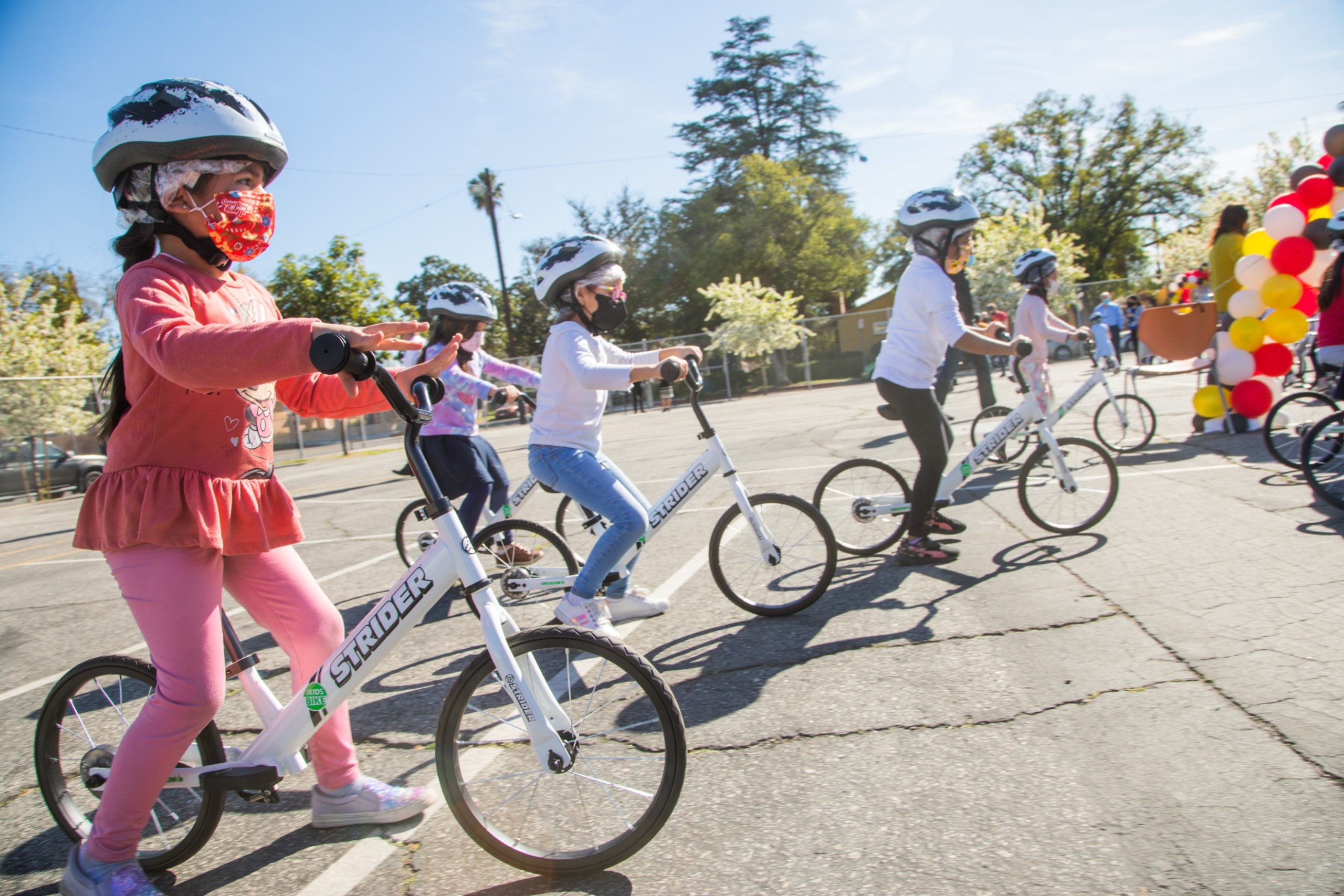
Littleton, CO – Damon Runyon Elementary School received a complete Learn-To-Ride Program, including Strider Learn-To-Ride Bikes, helmets, and curriculum from All Kids Bike.
This program will help approximates 320 kindergarten students learn to ride over the next five years.
The Strider Bikes were delivered to the kindergarten physical education class at Damon Runyon Elementary School and will be incorporated into their curriculum during the 2022-2023 school year.
All Kids Bike is a national movement on a mission to teach every child in America how to ride a bike in kindergarten PE class. Launched in 2018, 490schools in 50 states are running the All Kids Bike Kindergarten PE Program. Funding for this program was made possible by PEARL iZUMi.
This Kindergarten PE Program includes a proven, integrative curriculum, staff training and certification, the revolutionary, child-friendly Strider Learn-To-Ride Bikes, and helmets. The fleet of dual propulsion Strider Learn-To-Ride Bikes start as balance bikes and convert to pedal bikes. All Kids Bike also offers continued support for each school to ensure everyone involved is successful for five years.
Damon Runyon Elementary School is eager to begin the program this year. PE Teacher, Jason Hill, who applied for the program wrote: “Runyon has had a strong “Learn to Ride” program over the last ten years. This program would increase the number of kindergarten and 1st Grade riders who participate in the program. Currently, we have a limited number of strider bikes in our fleet. The Runyon program is Kindergarten -5th grade with our 4th graders participating in a family ride (6 miles) to a local park in the spring. Many students continue the love of riding with the program and All Kids Bike would be a great addition!”
By Jamie Morningstar — One of my family’s most treasured annual traditions is our trip down to Colima, Mexico to visit with, serve, and enjoy precious time at Hogar de Amor Orphanage. We started traveling to Colima in 2013 and over the years have forged deep relationships with the kids and caregivers. We usually take a large group to Mexico for the trip and spend our time doing projects around the orphanage, doing activities with the kids, and having a wonderful time together.
But, of course, the past two years have been anything but “usual”. We had to cancel last year’s trip completely, and this spring we traveled as a small family rather than bringing down a large group. This meant that we also needed to rethink our normal schedule of activities at the orphanage, since we wouldn’t have enough people to take on major projects. In addition, since schools still aren’t open in Colima, we needed to target activities we could ideally do alongside the kids.
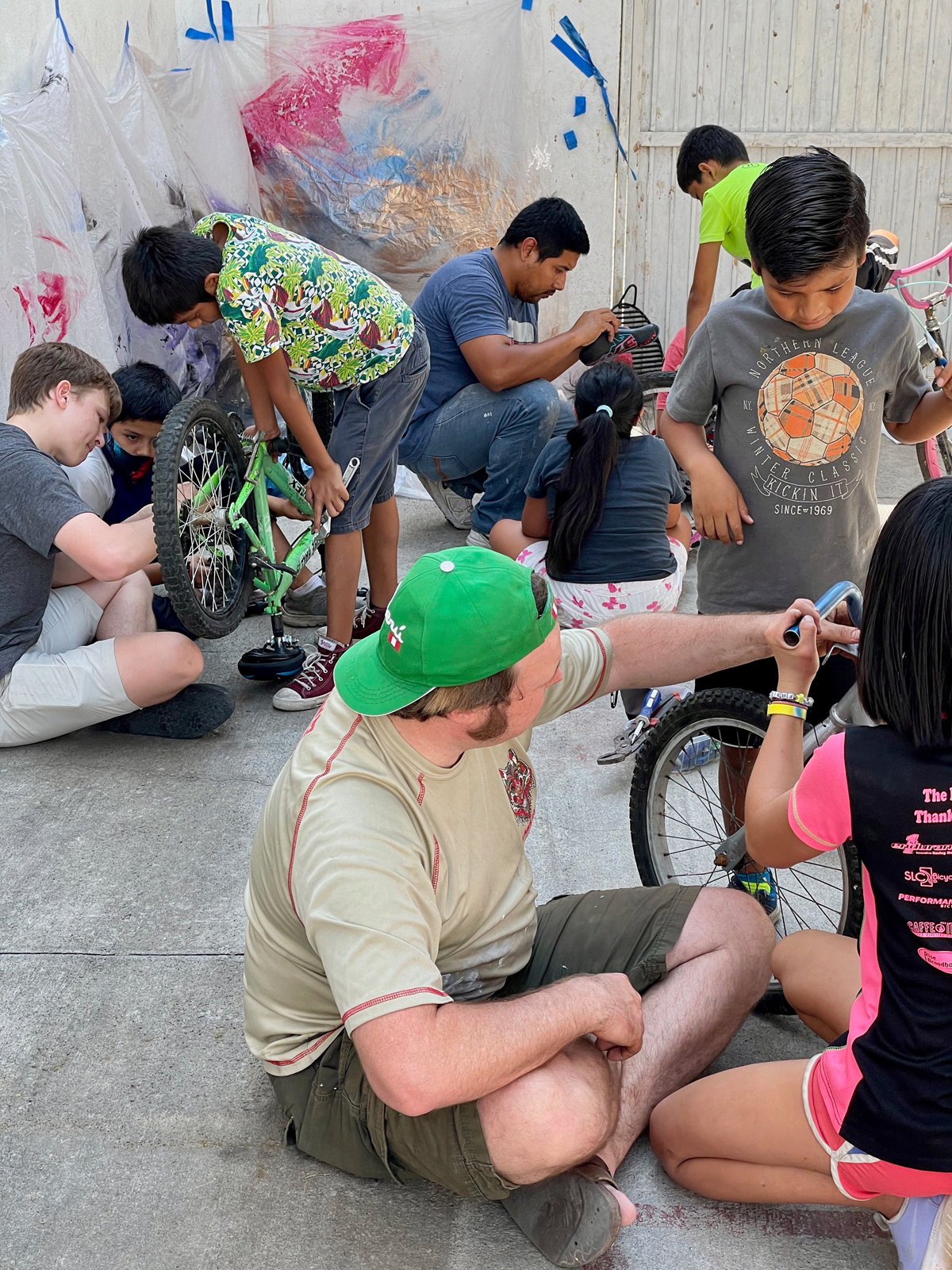
The Morningstar family taught bike repair to the kids from the Hogar de Amor Orphanage in Colima, Mexico. Photo by Jamie Morningstar.
Slowly, an idea emerged — what about bike repairs?
I hadn’t really thought of bike repairs as a form of community engagement and service, but the more we thought about the idea, the more it made sense. We could bring down a set of basic bike repair tools and supplies that we could leave with the orphanage staff for future maintenance. Not only would we be engaging the kids while we were there, but we would also teach them skills that they could use to care for their own bikes. Plus, we love bikes!
We contacted our local bike shop, Mad Dog Cycles, who kindly collaborated with us to sponsor and work out a discount for supplies to take to Mexico. We made our best guesses regarding the things we would need (more details on that, below), and we were on our way!
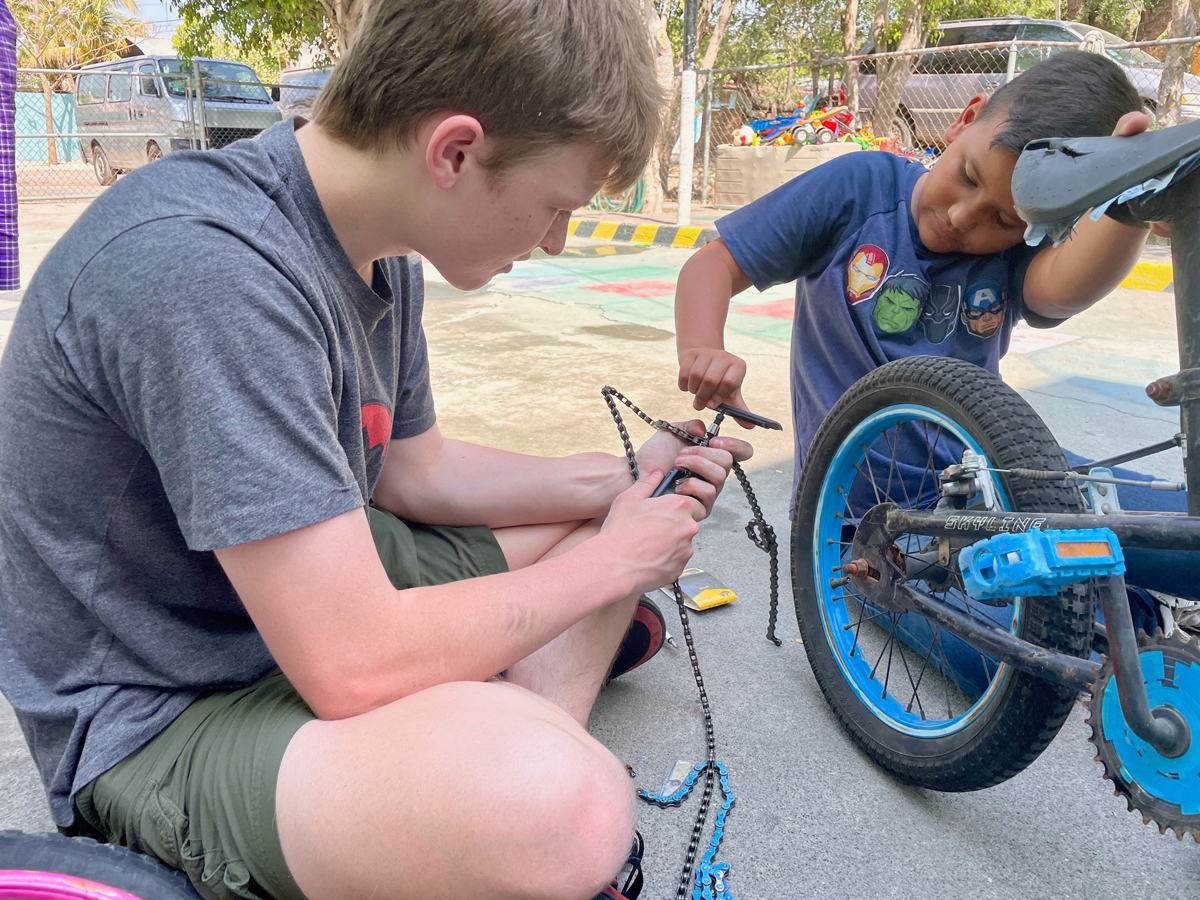
The kids from the Hogar de Amor Orphanage in Colima, Mexico learn bike repair. Photo by Jamie Morningstar.
We had so much fun hanging out with the kids, getting greasy and dirty together, fixing and re-fixing parts, spray painting bikes, and transforming some pretty beat-up bikes into ones that the children were excited to use. We made a lot of mistakes along the way, and we think we lost the confidence of several kids on that first day when we had to YouTube how to use a chain breaker. What we lacked in skills, we made up for in adventurous, collaborative spirits. We had a blast.
At the end of day one, we had only three repaired bikes to show for our day’s effort, and we were feeling a little sheepish. Then one caregiver brought us right back to the purpose of our time by reminding us that each bike brought ten smiles and an entire day of fun together – and that was the real reason we were in Mexico.
It was fun to see the different jobs that the kids gravitated to. Some loved to dismantle the bikes and got really into the mechanics of the thing. Others loved to clean the bikes off and prep them for painting, removing every decal. Some loved the painting (ok, they all loved the painting). A few kids would stay right by our sides the whole time, some would come and go. That’s part of what made this activity so great – it appealed in various ways to a diverse group of kids.
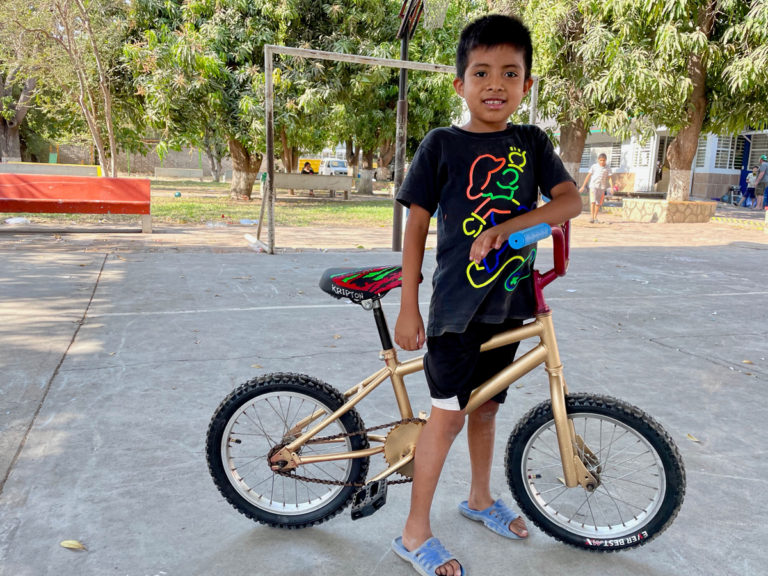
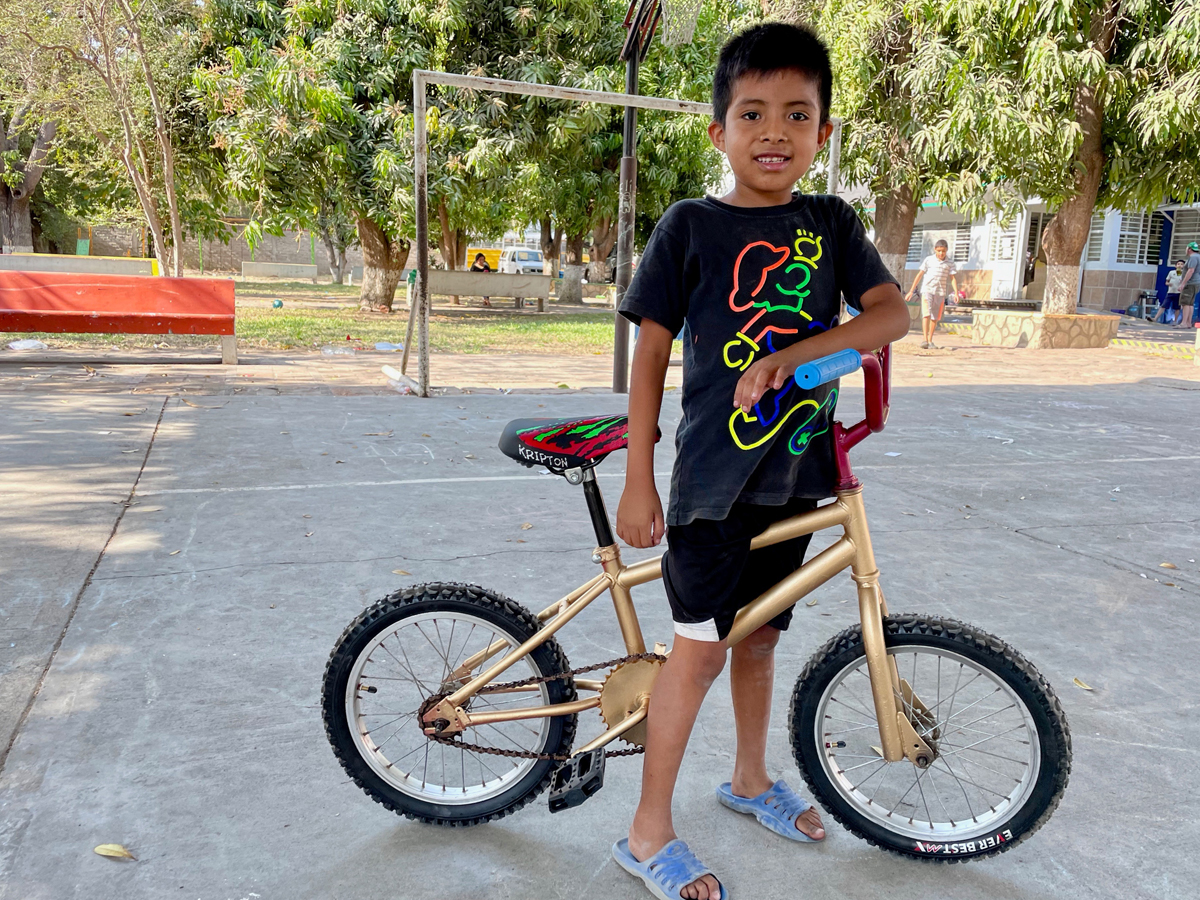
One of the kids from the Hogar de Amor Orphanage in Colima, Mexico with his completed bicycle. Photo by Jamie Morningstar.
After 9 years of annual travel to the Hogar de Amor Orphanage, this was one of our absolute best trips. We engaged with the kids in a unique way, side by side and with very grubby hands. That got me thinking – you don’t need to travel to a different country or to an orphanage to engage with your community over bike repairs. Maybe you could organize a repair afternoon for a local elementary school, or for your neighborhood or church. I would even bet there is a person in your neighborhood with a broken-down bike they’d love to ride, if only someone would help them fix it.
I love cycling because of the community connections I make on the bike. And now I love cycling even more because of the community connections I make putting the bike back together!
Supplies
If you’re interested in running a bike repair clinic, here’s our list of recommended supplies.
Basic bike kit (the stuff you’ll need all the time and can leave with folks so they can do their own repairs)
Bike repair multi tool with a variety of hex keys and a chain breaker
An adjustable crescent wrench
A pair of needle nose pliers
Tube patch kits
Chain lube
An inexpensive screwdriver with multiple bits
A sturdy tool bag to store it all in
Other stuff to have on hand
A few new chains
A few tubes (but in our experience it’s hard to anticipate the sizes you’ll need, so don’t overbuy). We used mostly 16” and 20” tubes on our trip.
WD-40 or another multi-purpose lubricant
One or two pumps
A can of penetrating lubricant, like PB Blaster, for the rusted-on bolts
A hacksaw, for the bolts that you really can’t get off
A few sets of brake cables
Spray paint for metal and clear sealant. Take off the nozzles before they are within reach of children – just trust me on that one.
A roll of painter’s tape, for making cool stripes on the bikes you’re painting
A few sets of pedals (mostly 1/2”)
A few sets of grips
A few bike seats
A really adventurous spirit and sense of humor, and the knowledge that you won’t be able to fix every issue, but you can be grateful for the ones you can fix!
By Charles Pekow — The Bureau of Land Management (BLM) plans to update its Utah resource management plans. It will perform environmental assessments to update plans dating to 2008 for its Price, Moab, and Vernal field offices. The BLM is specifically looking at rewriting plans for the McCoy Flats Trail System near Vernal City. Federal law calls for promoting mountain biking in the area. BLM is considering setting boundaries for the trail area and balancing recreation with other uses (grazing, mineral extraction). It may also come up with specific trail management plans.