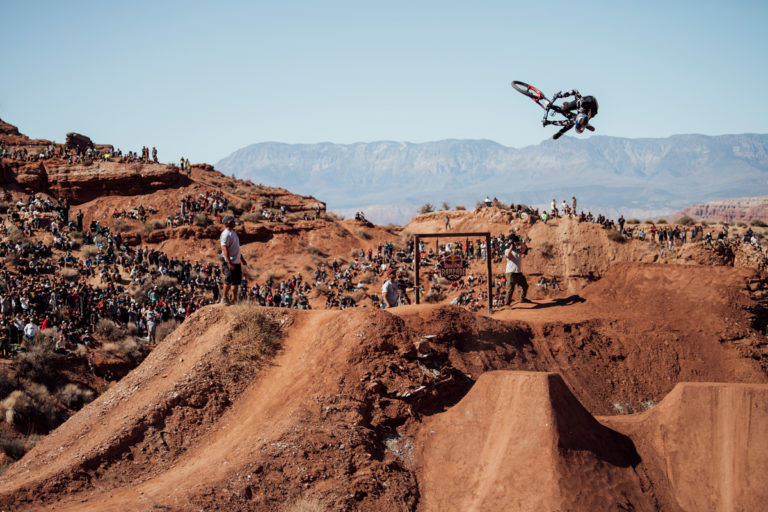
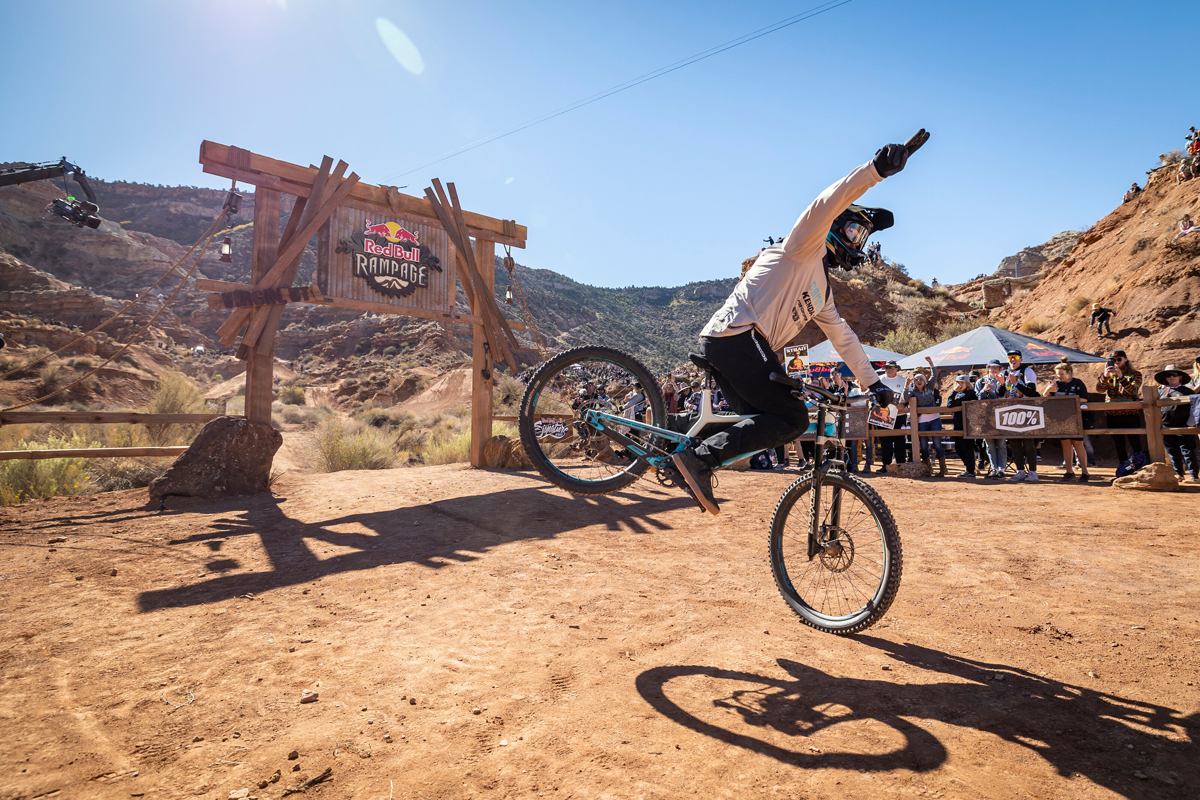
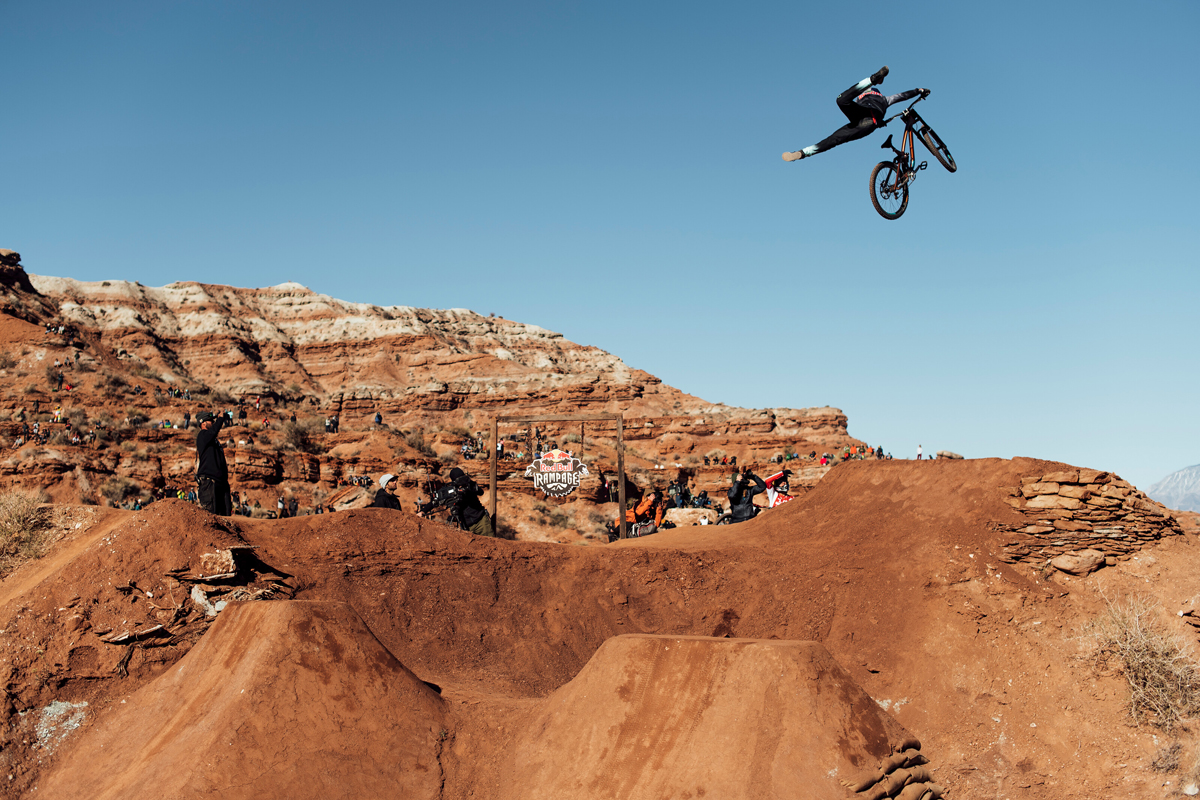
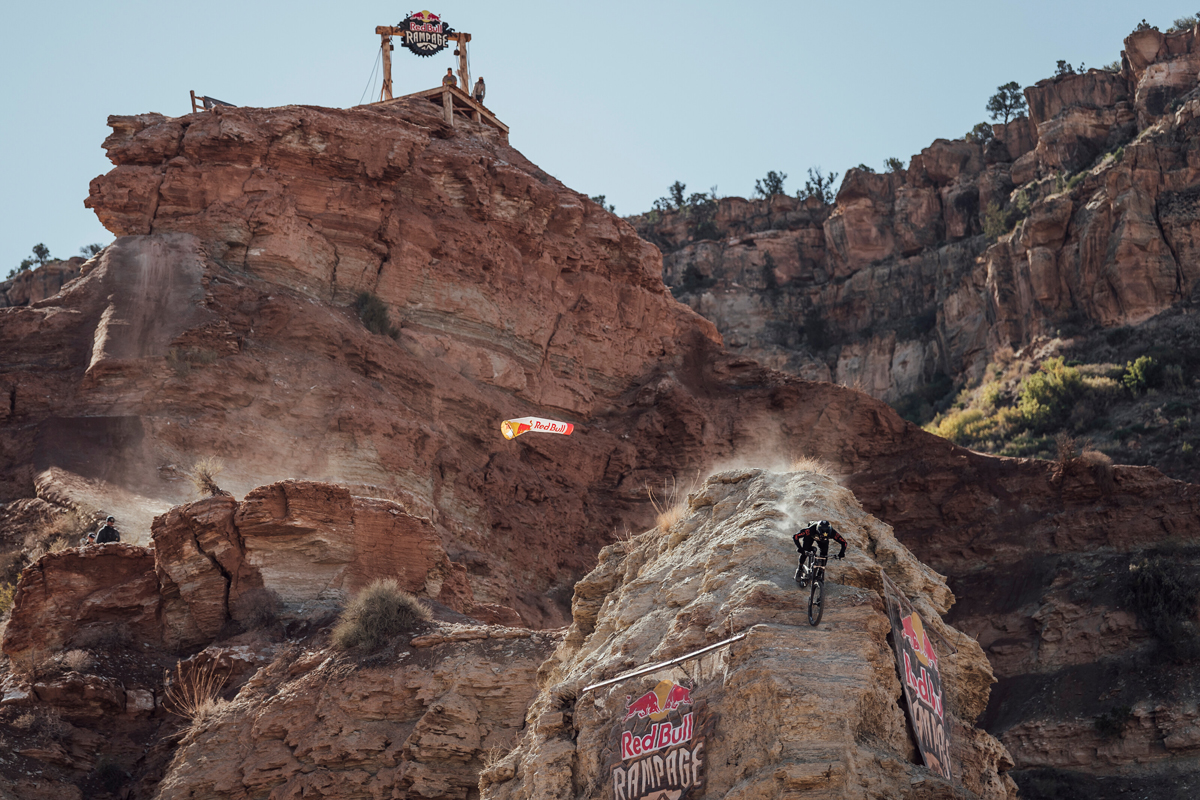
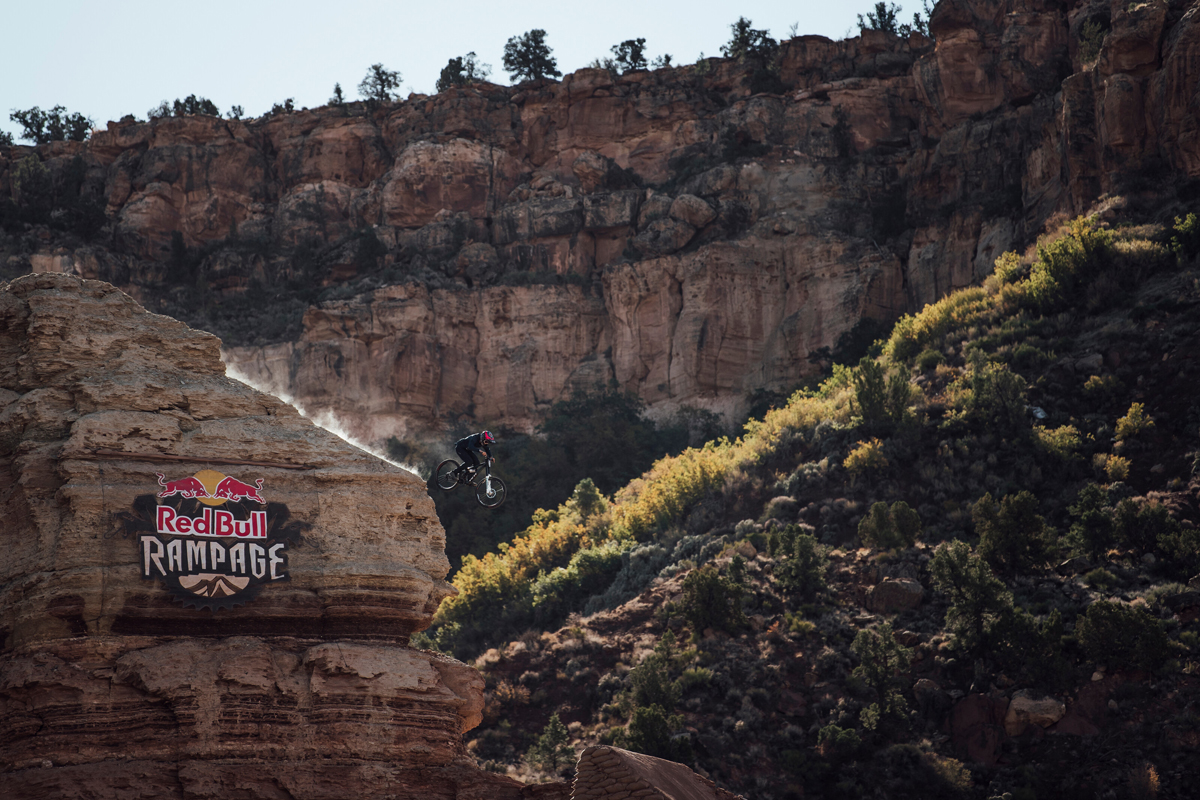
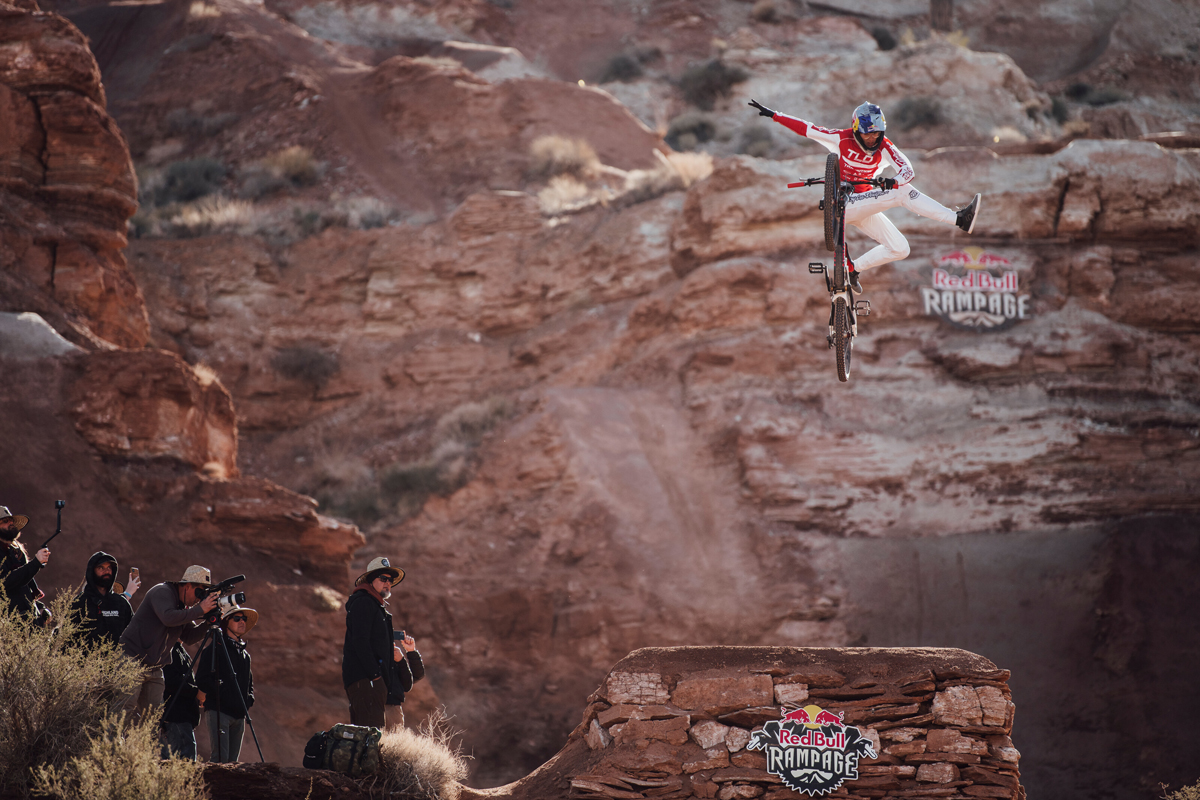
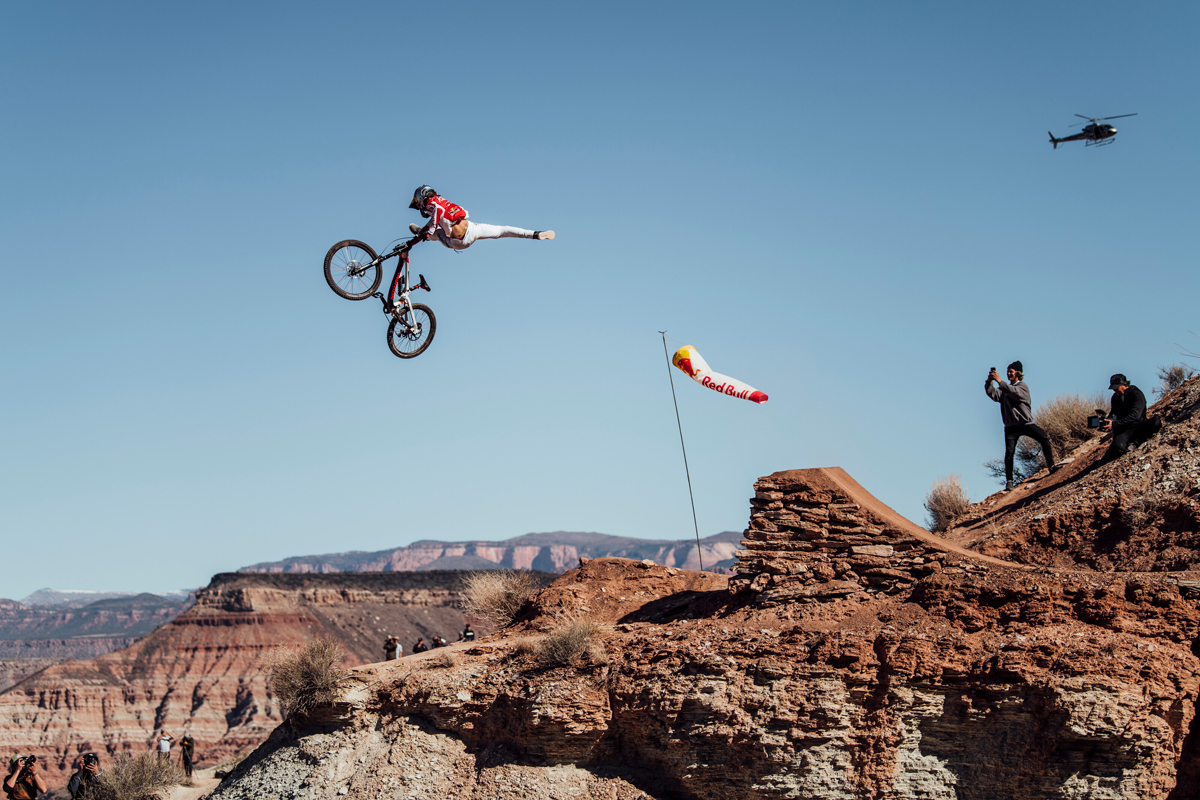
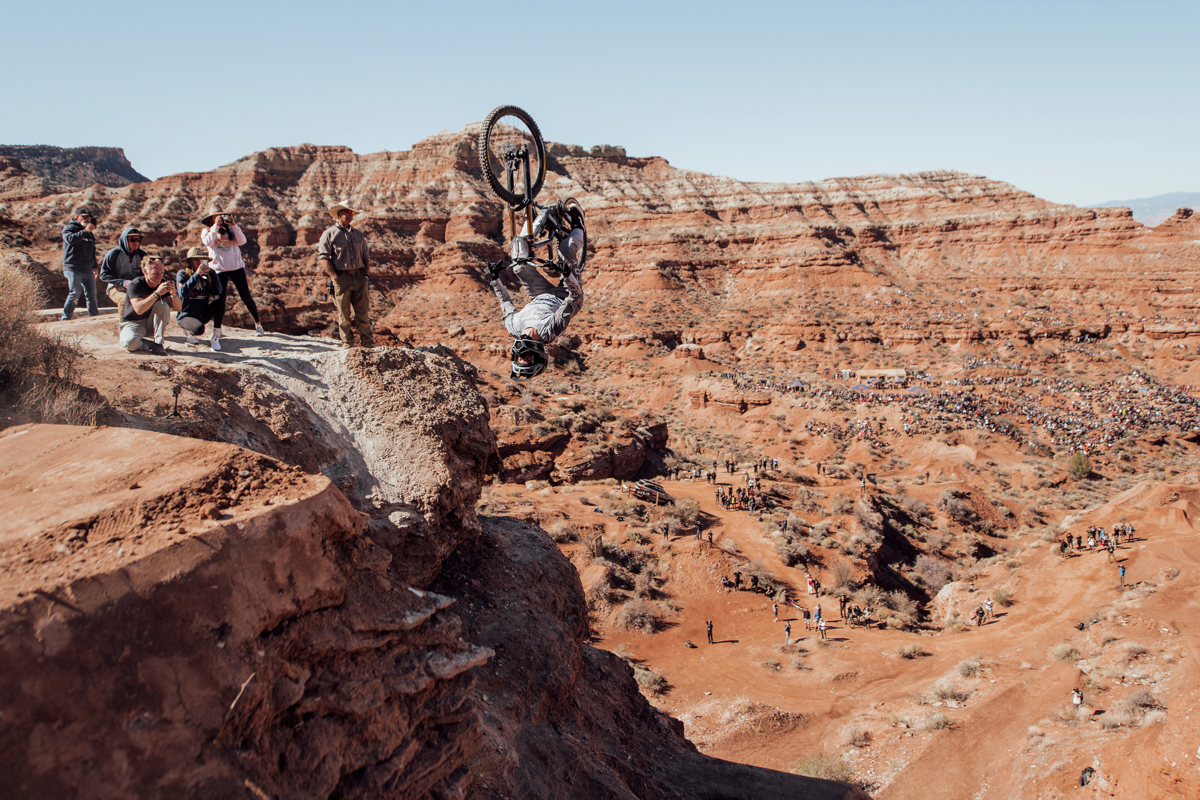
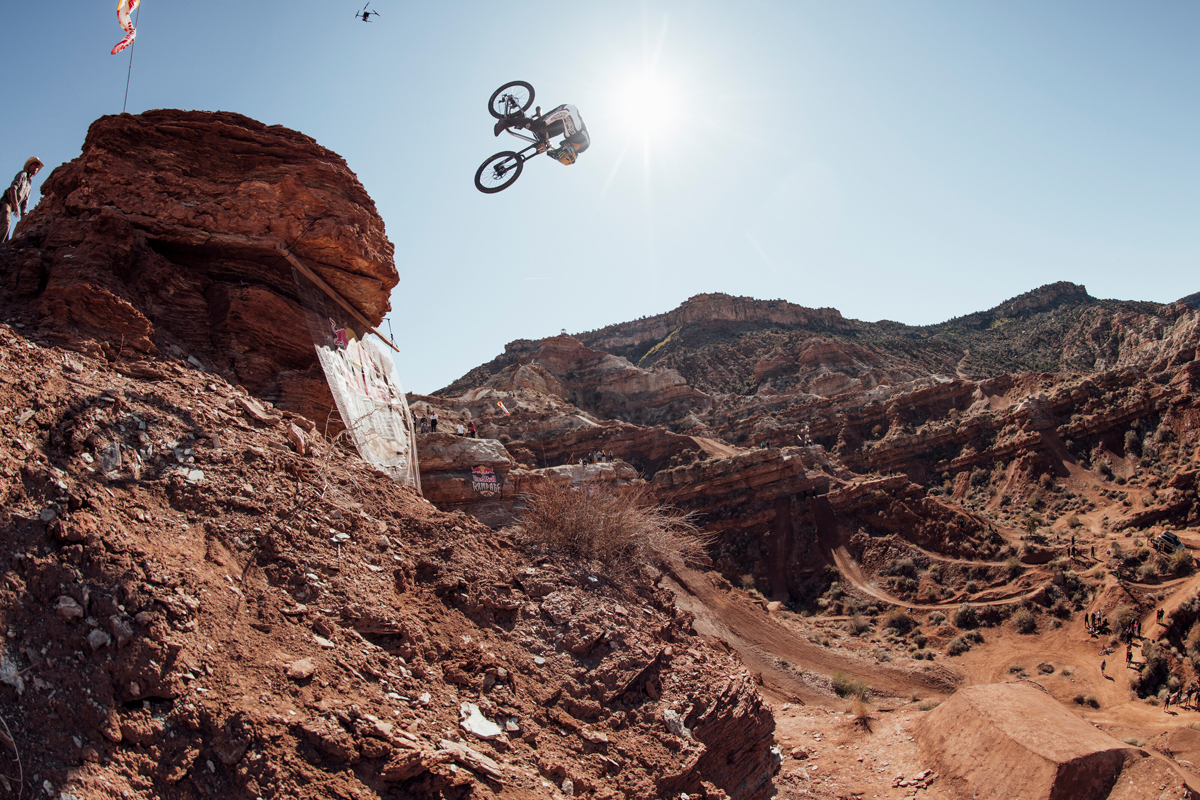
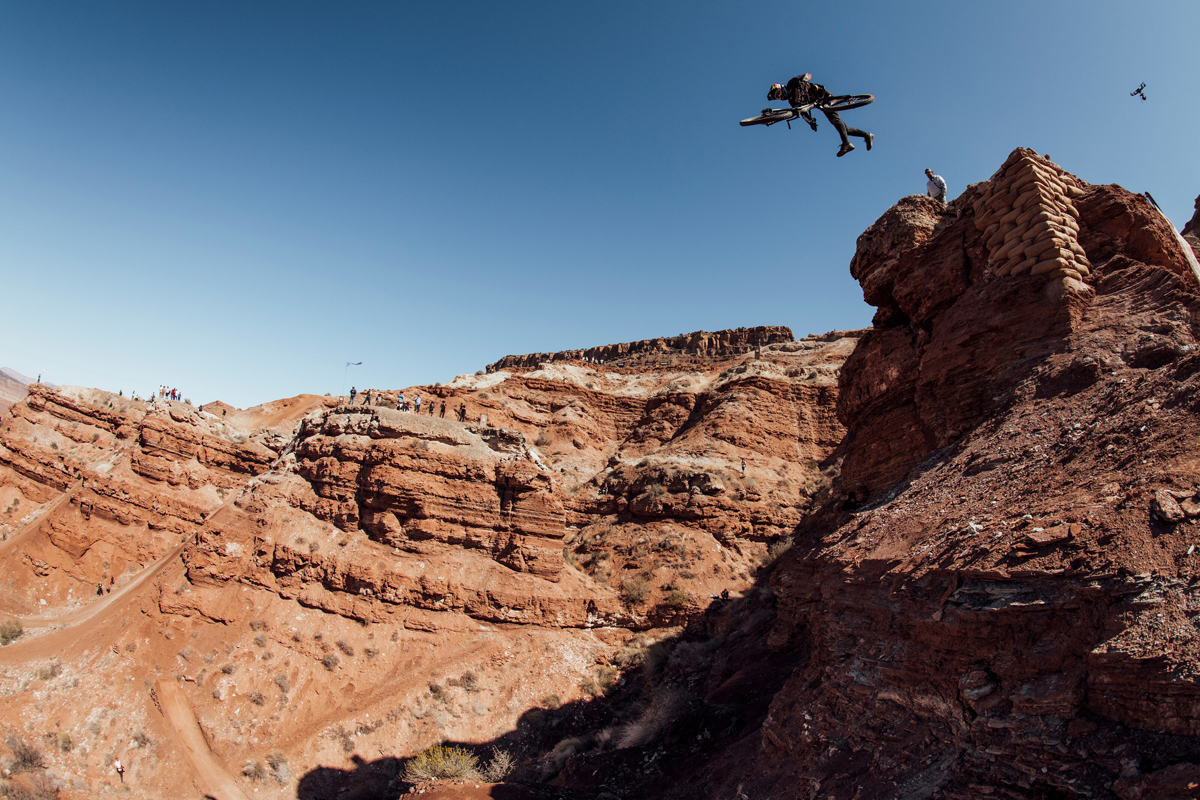
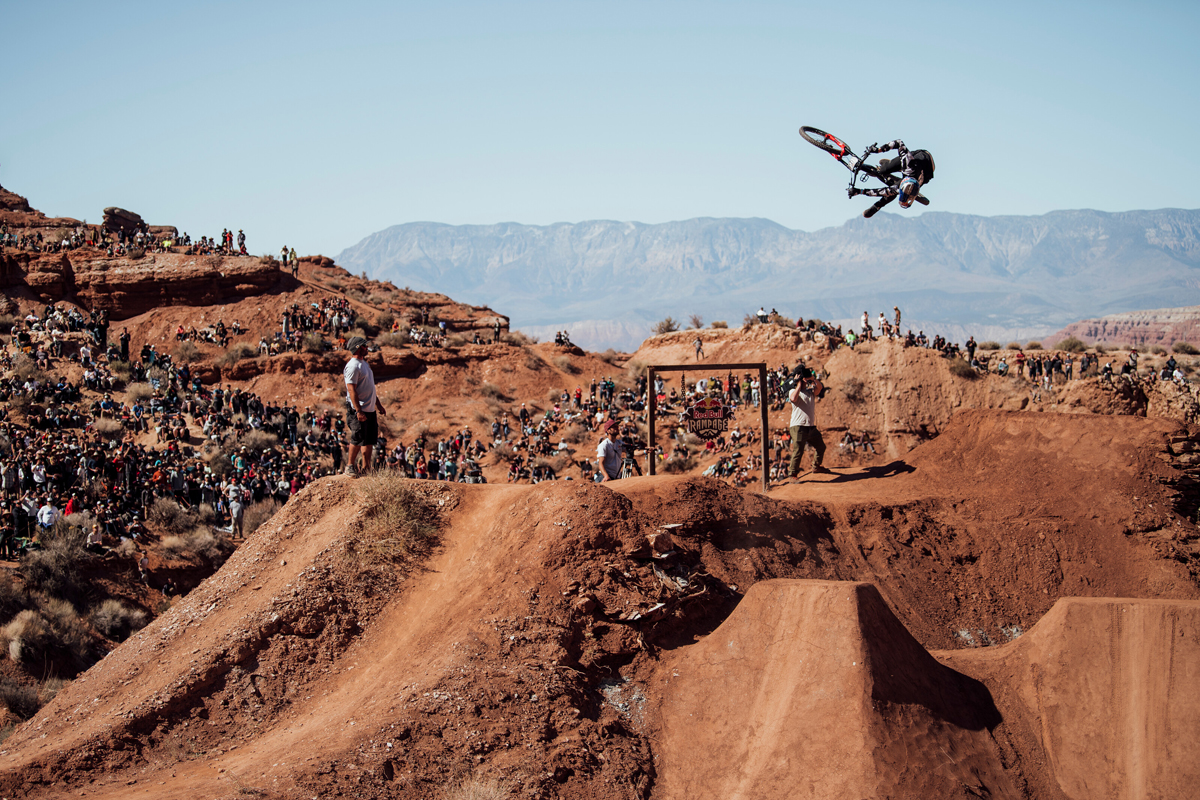
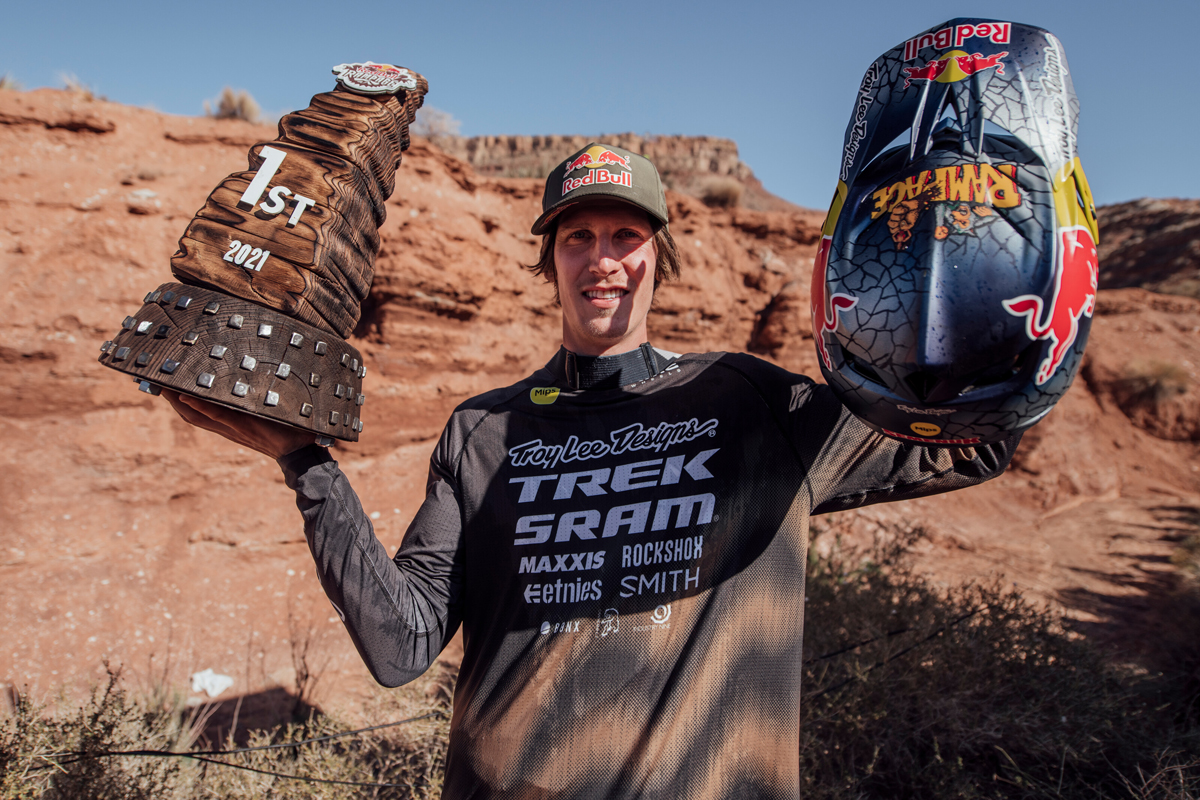
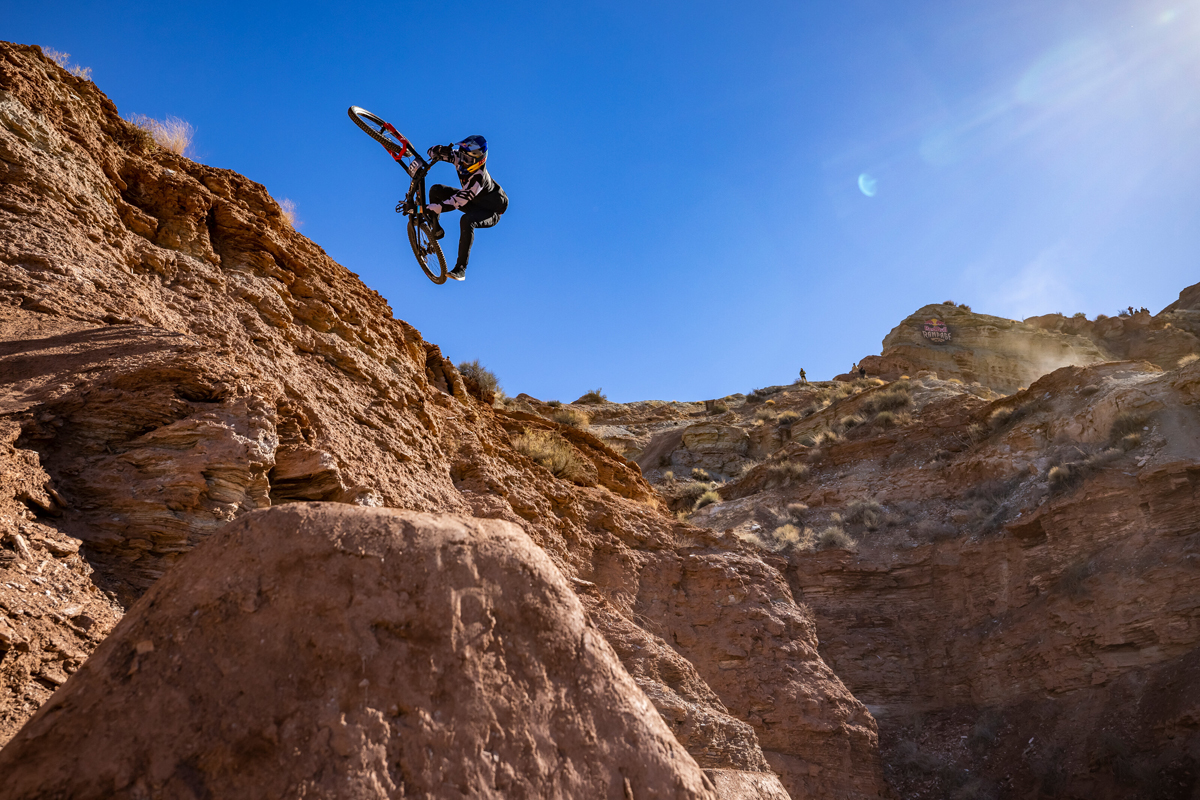
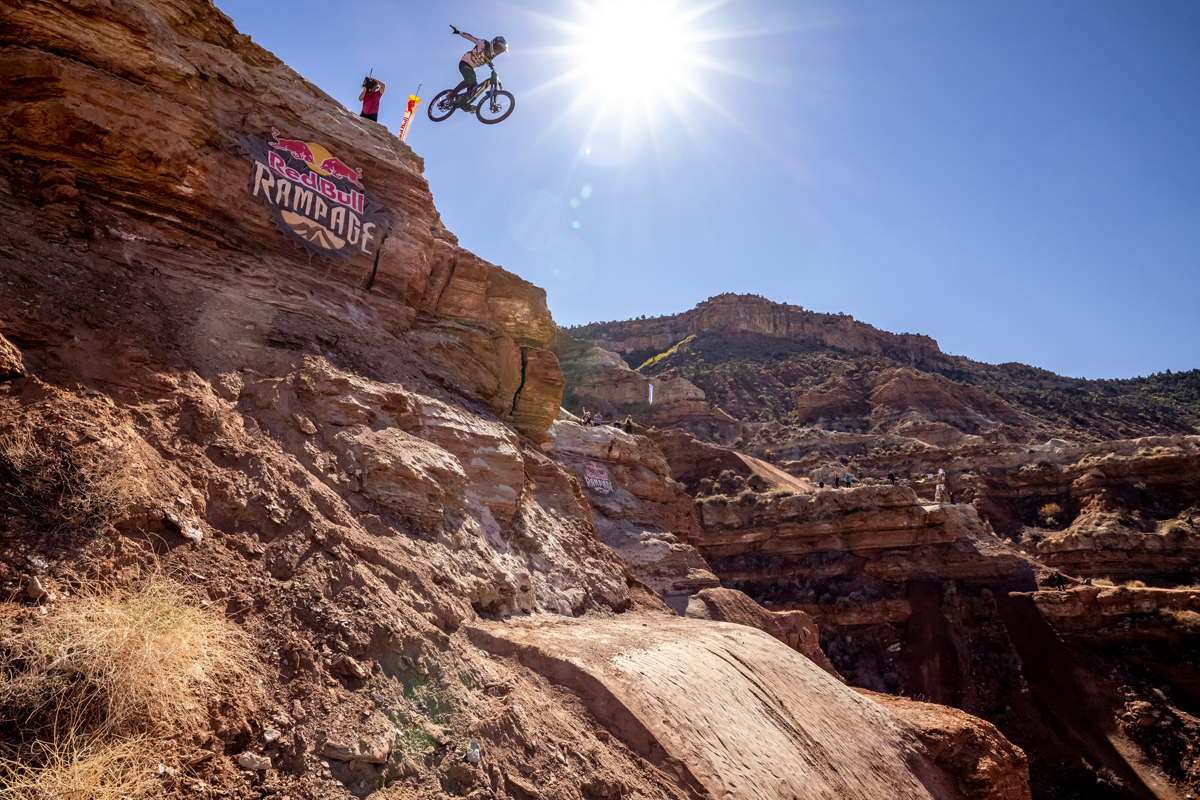
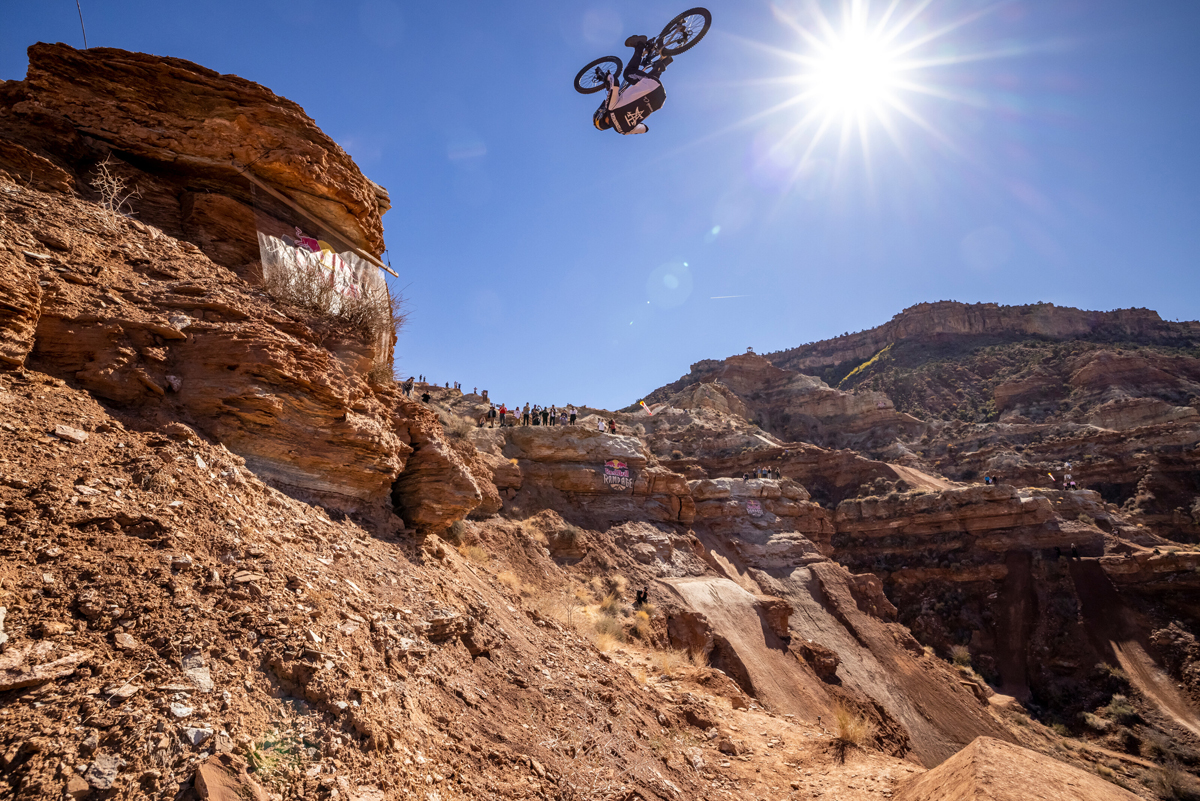
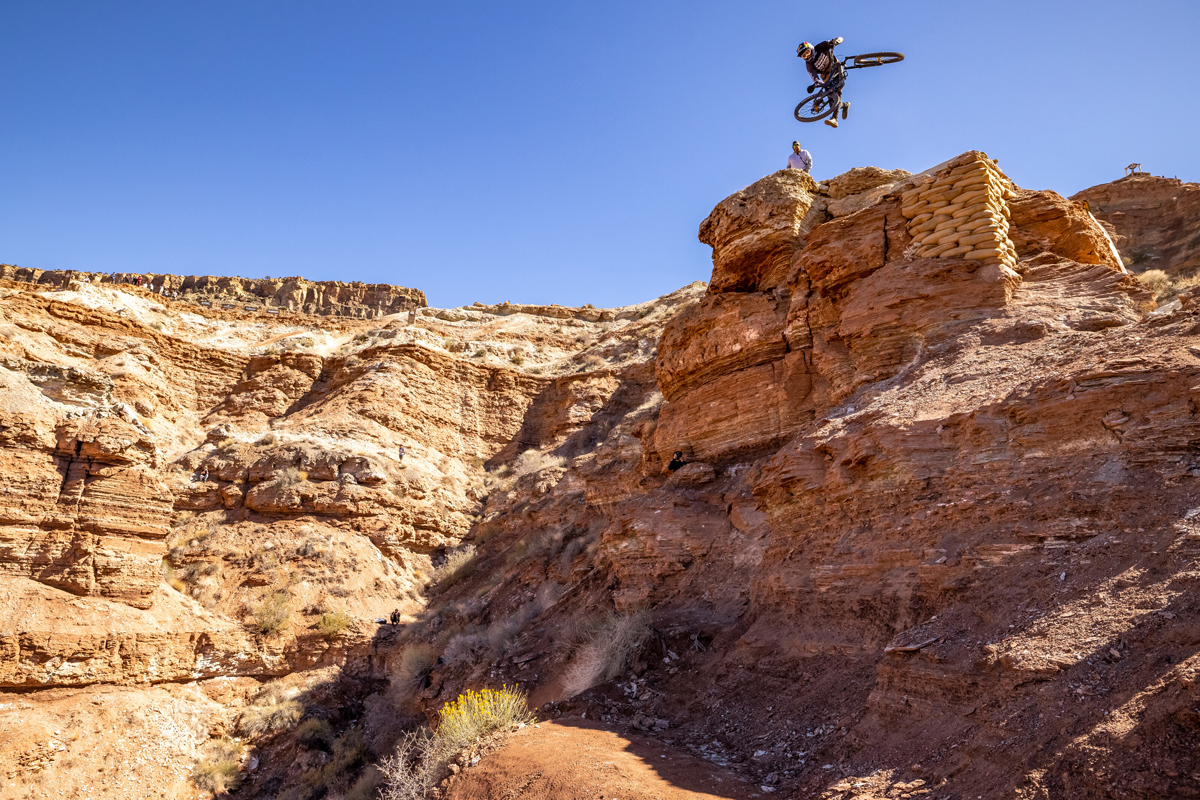
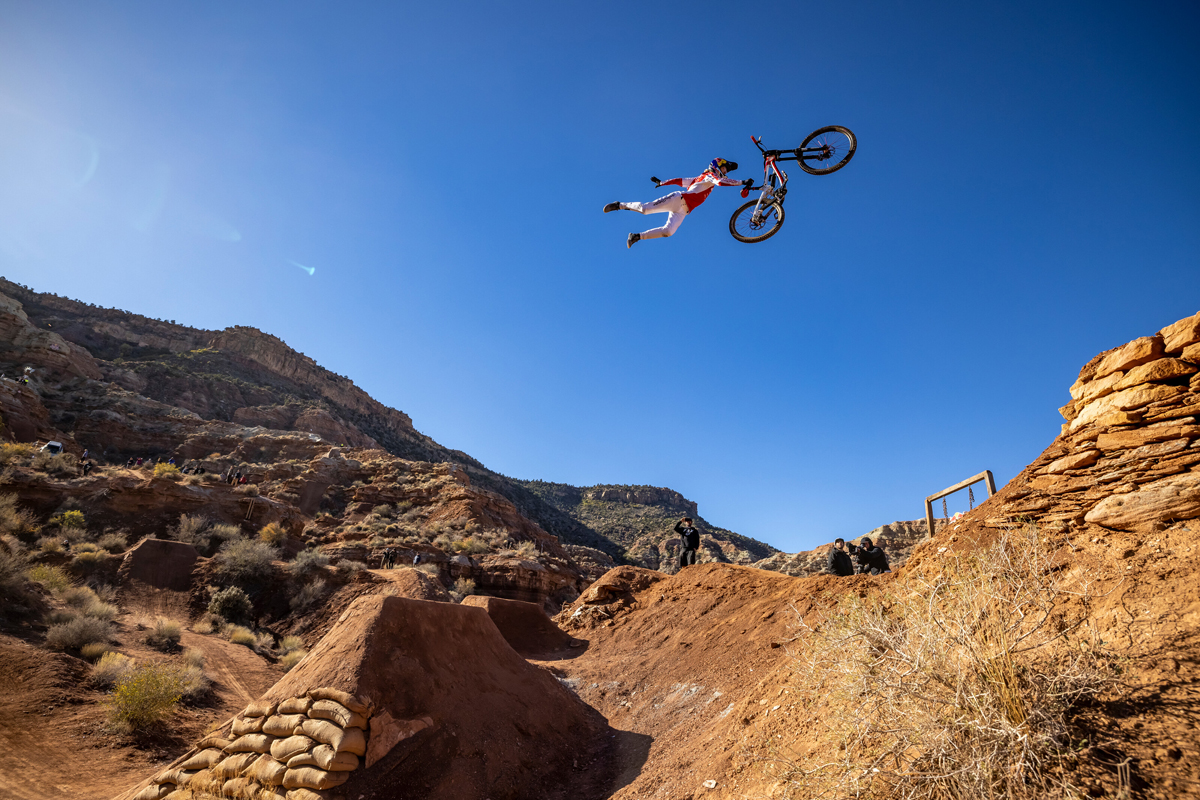
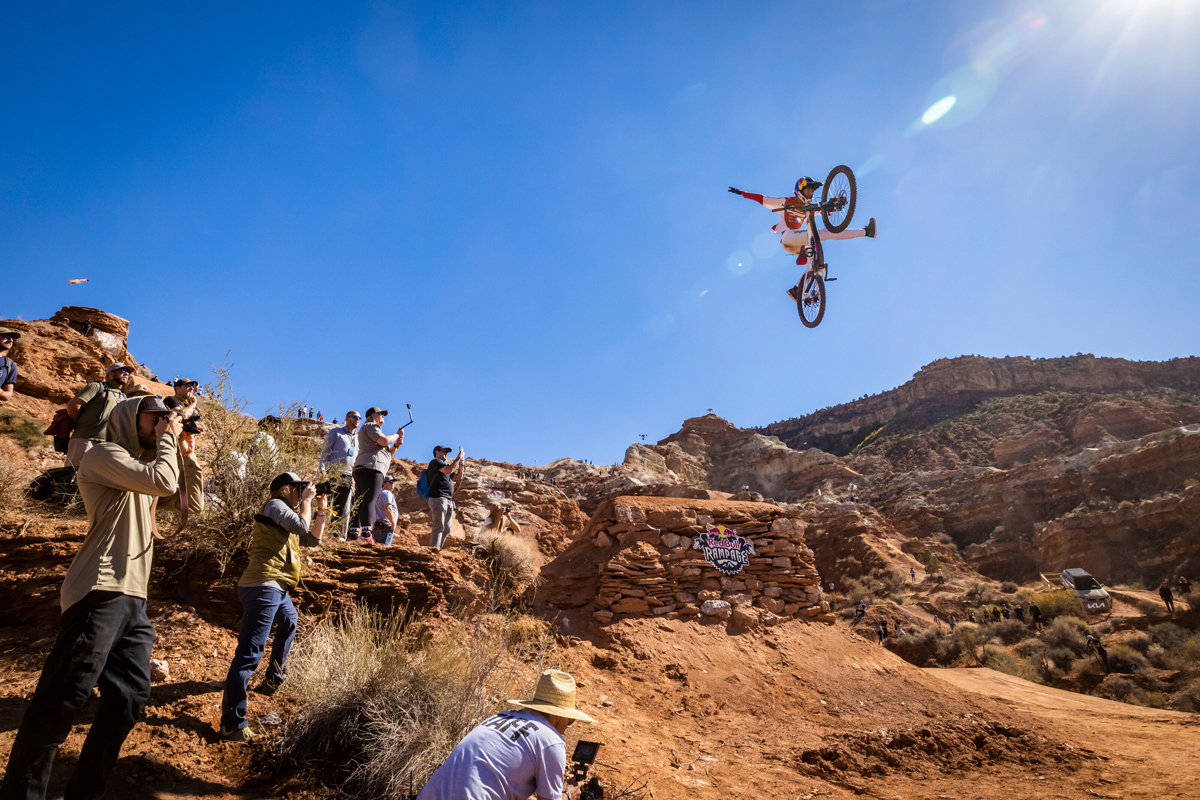
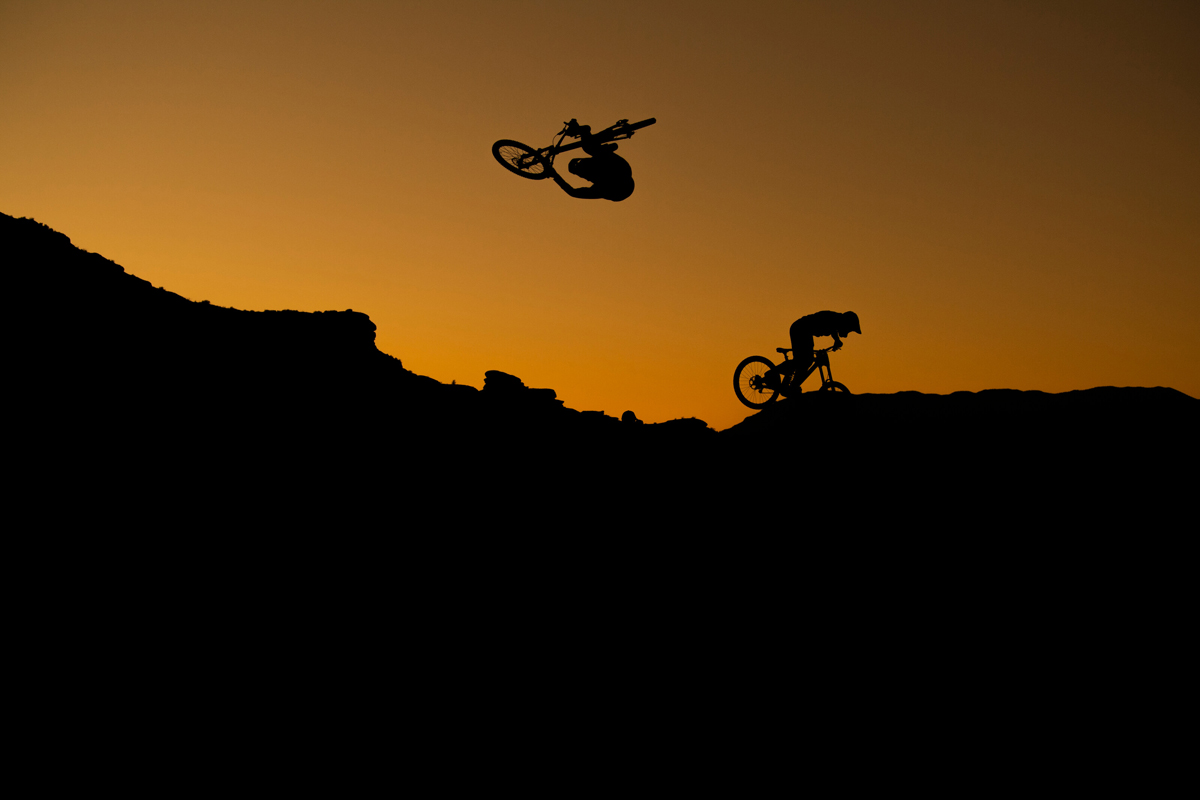
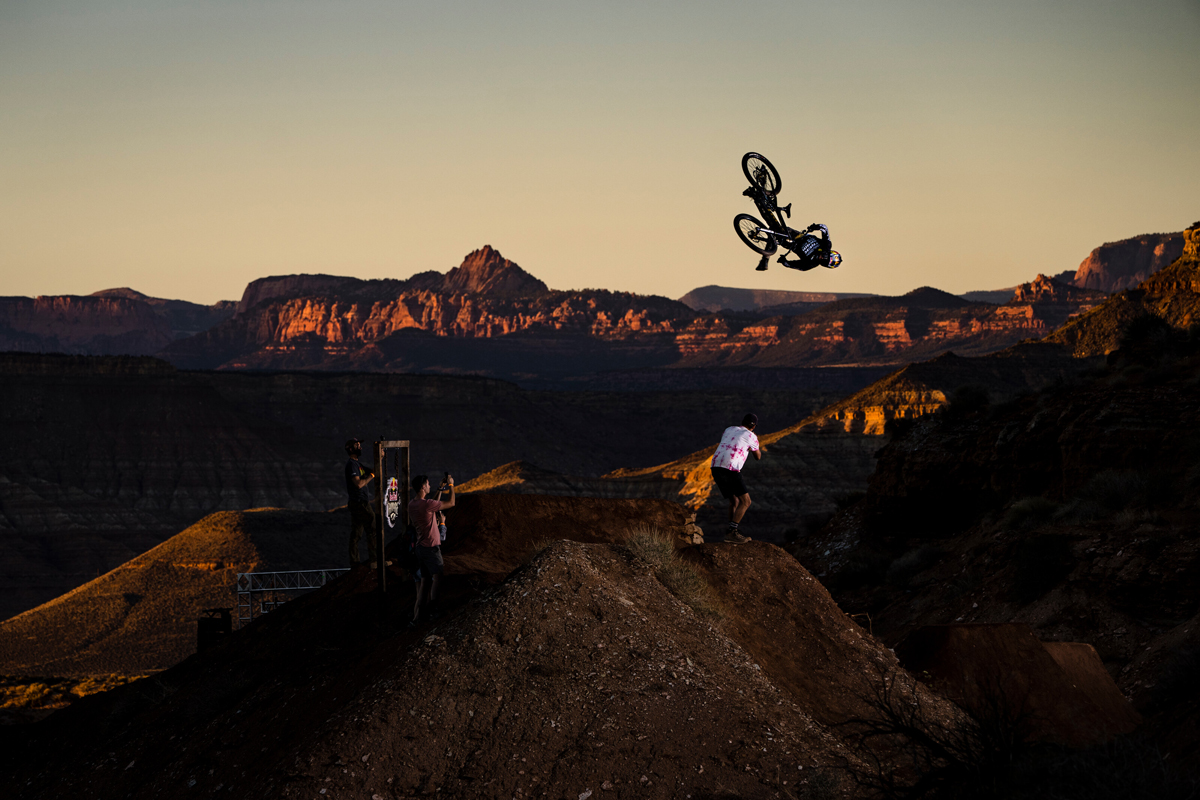
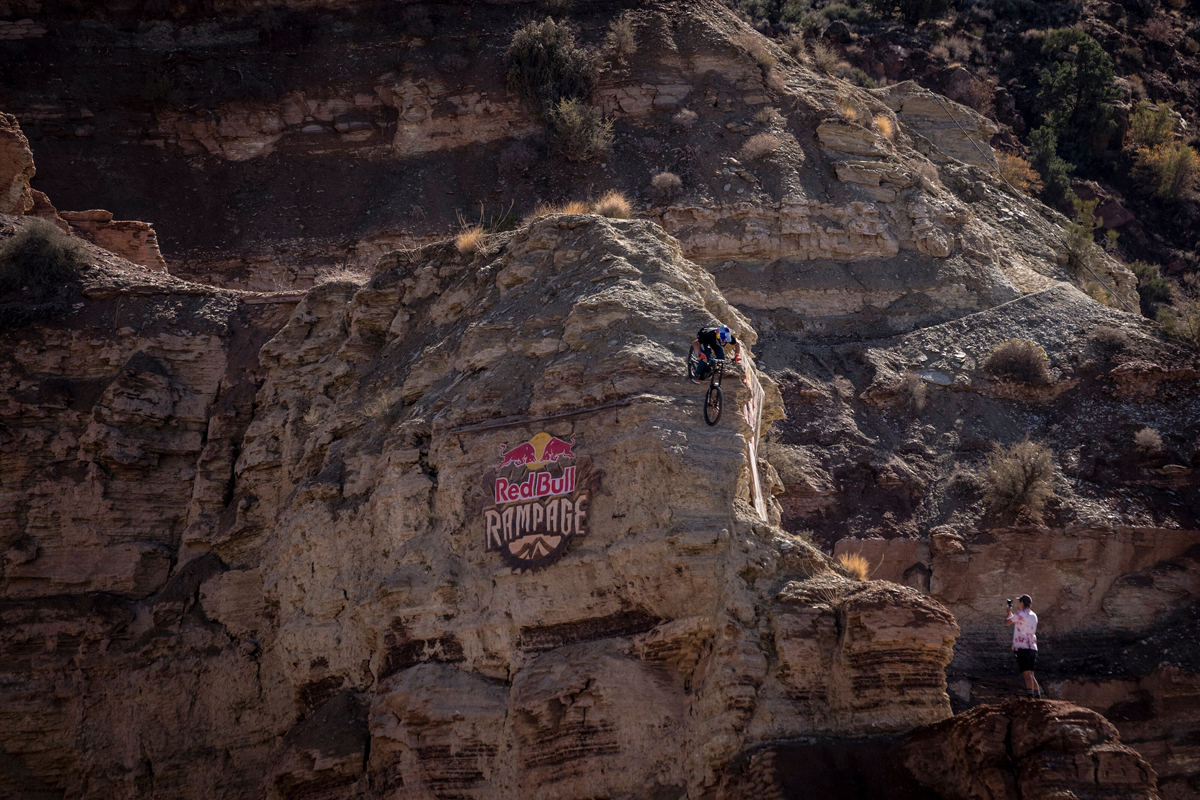
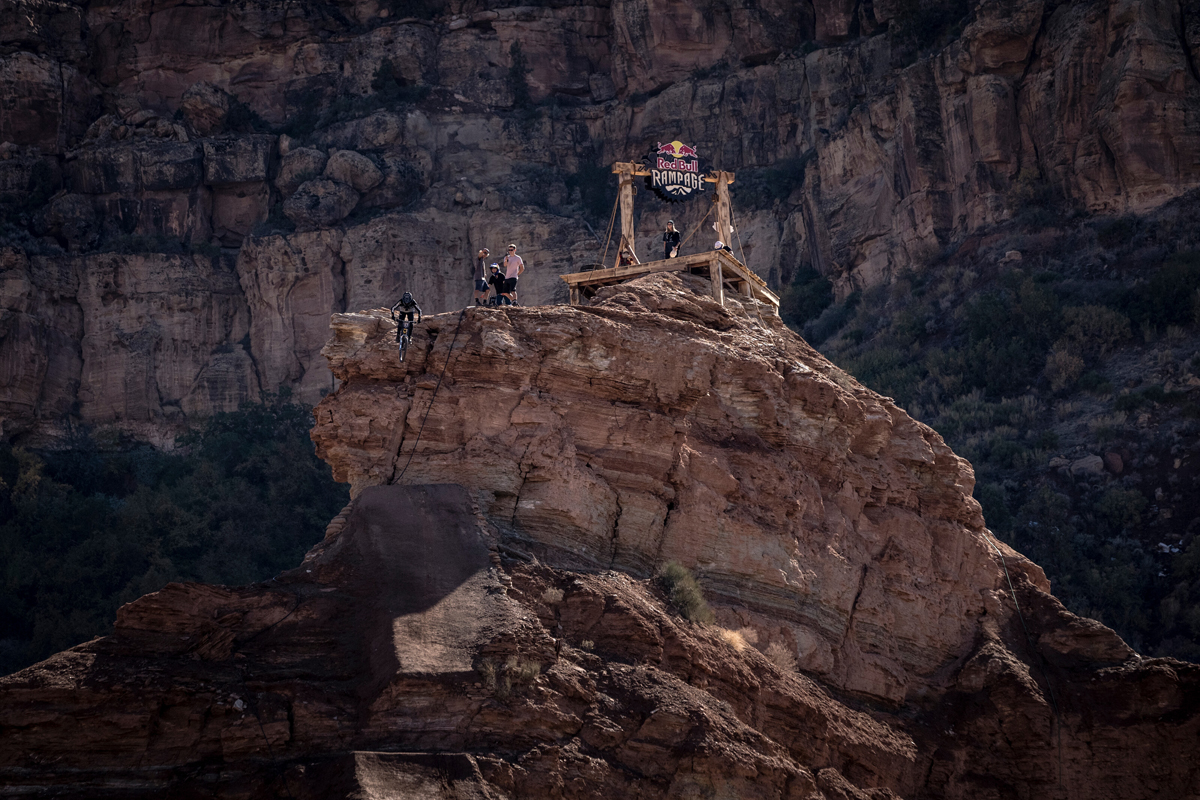
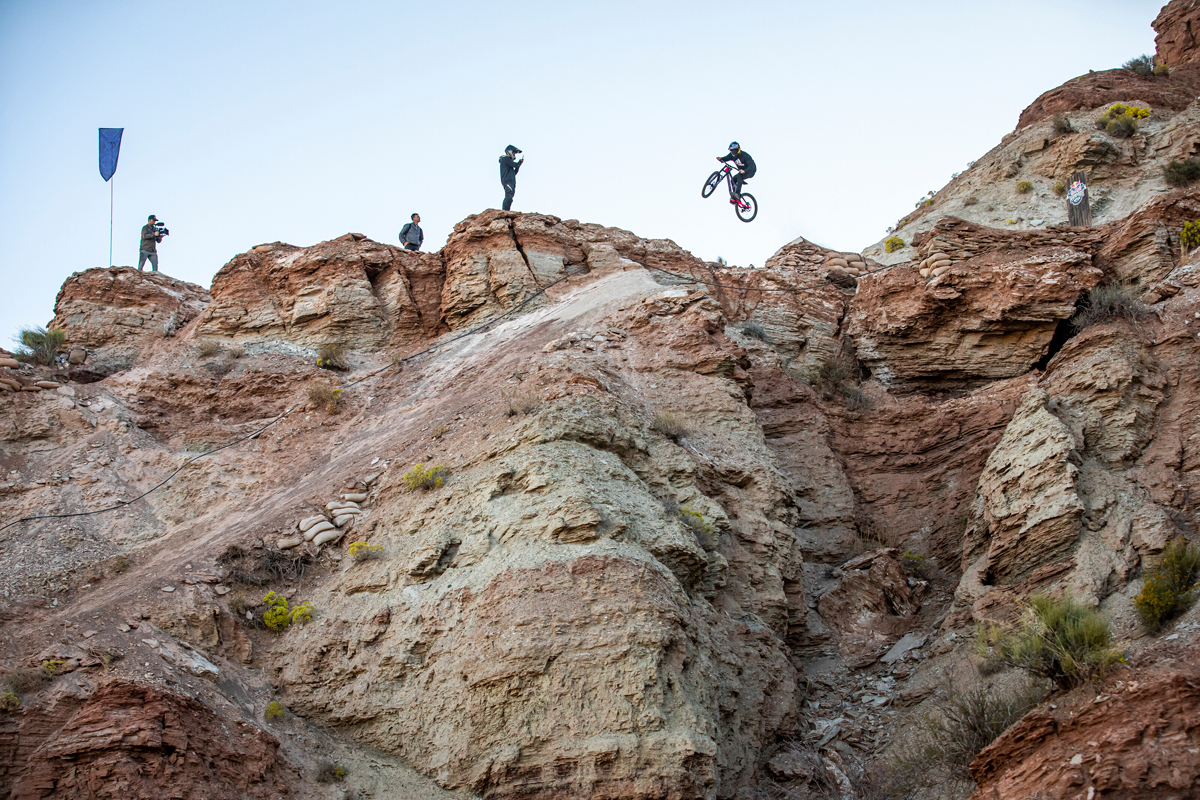
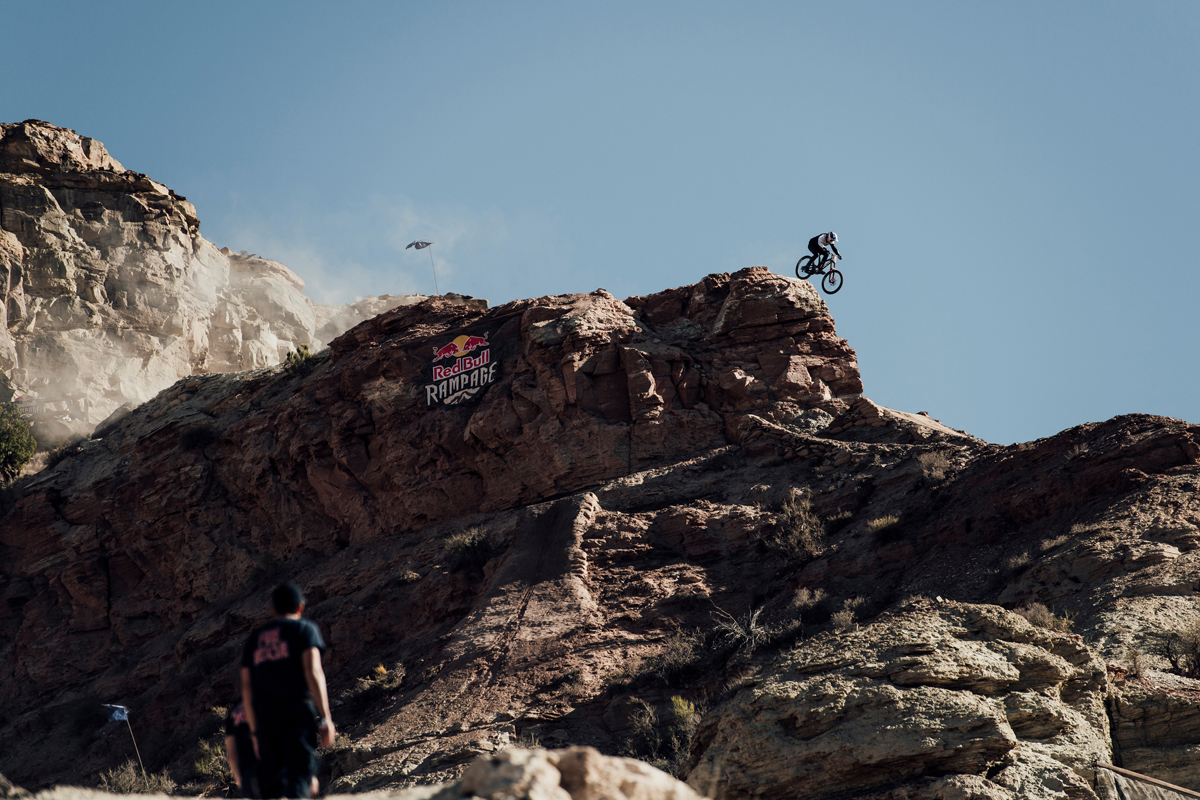
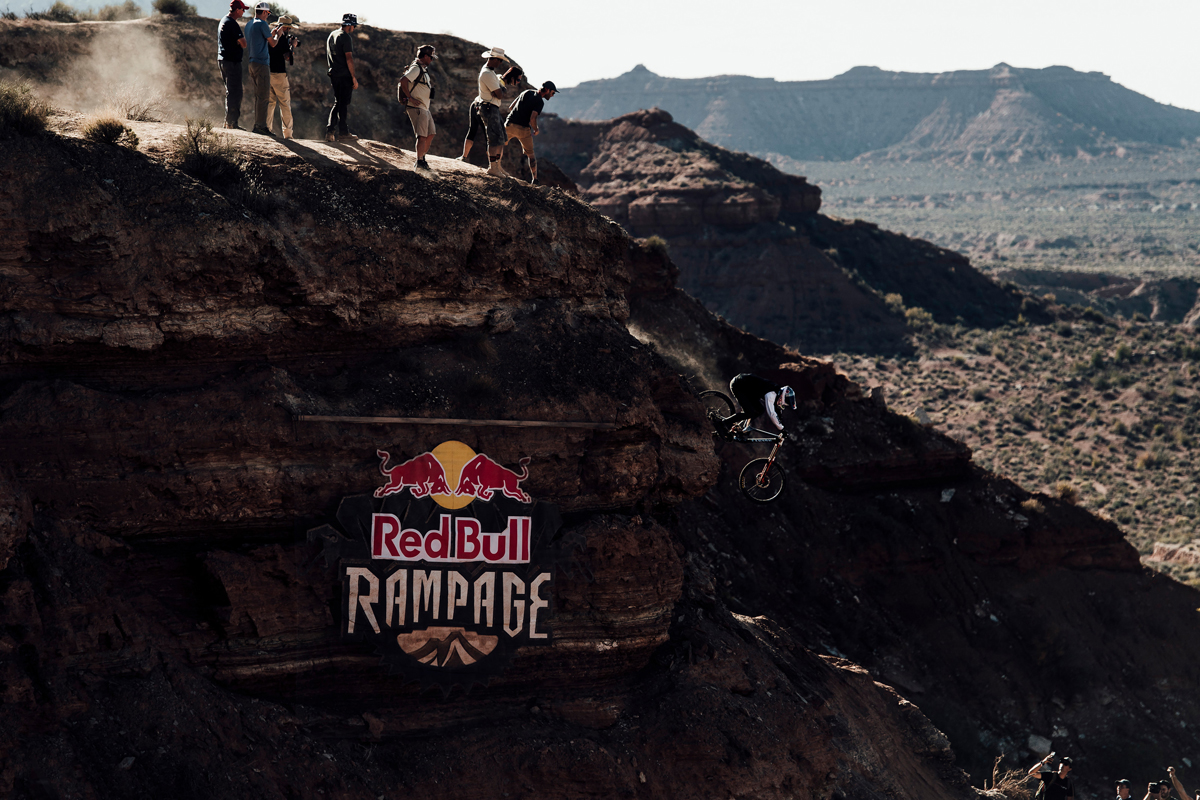
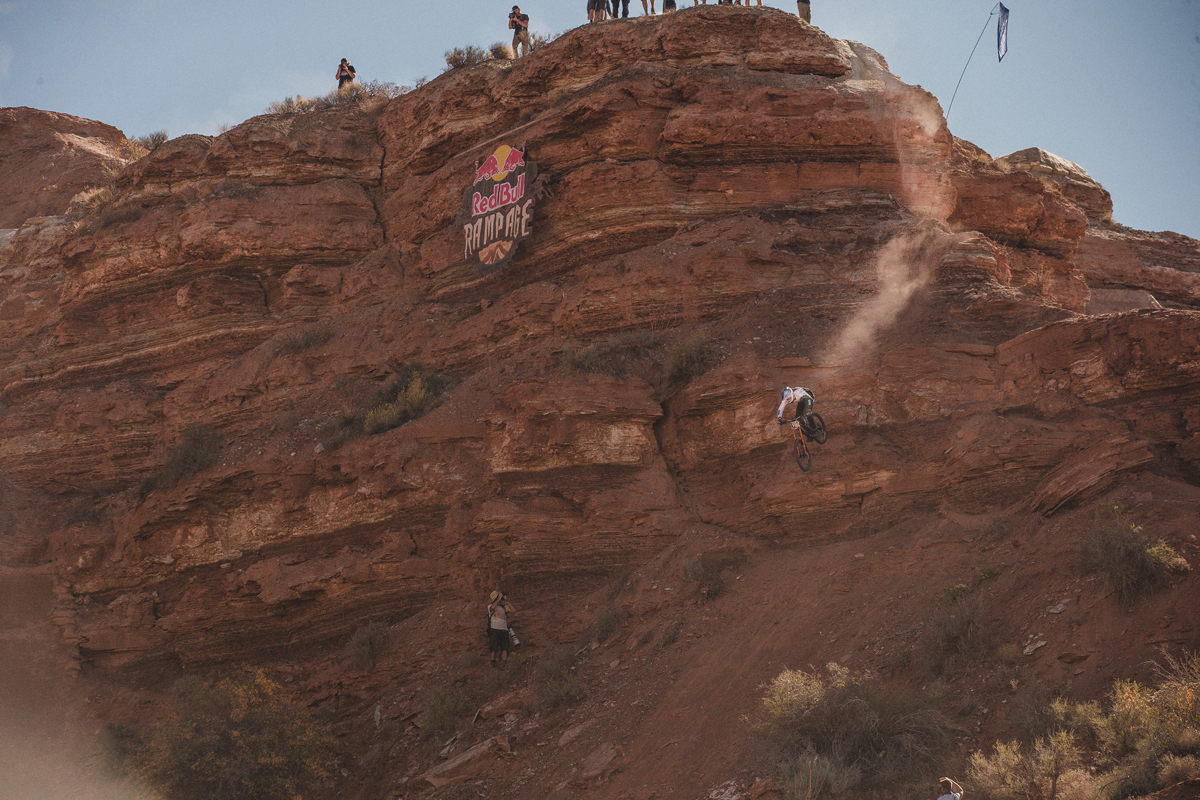
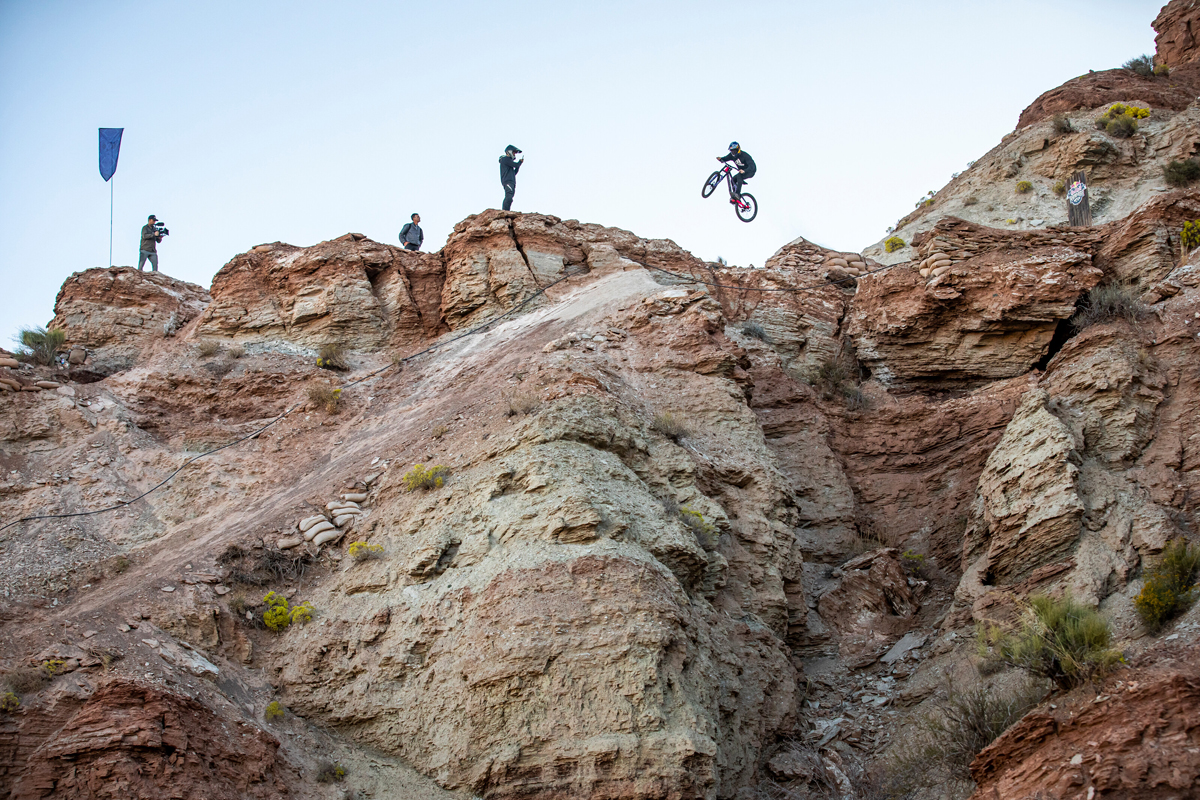
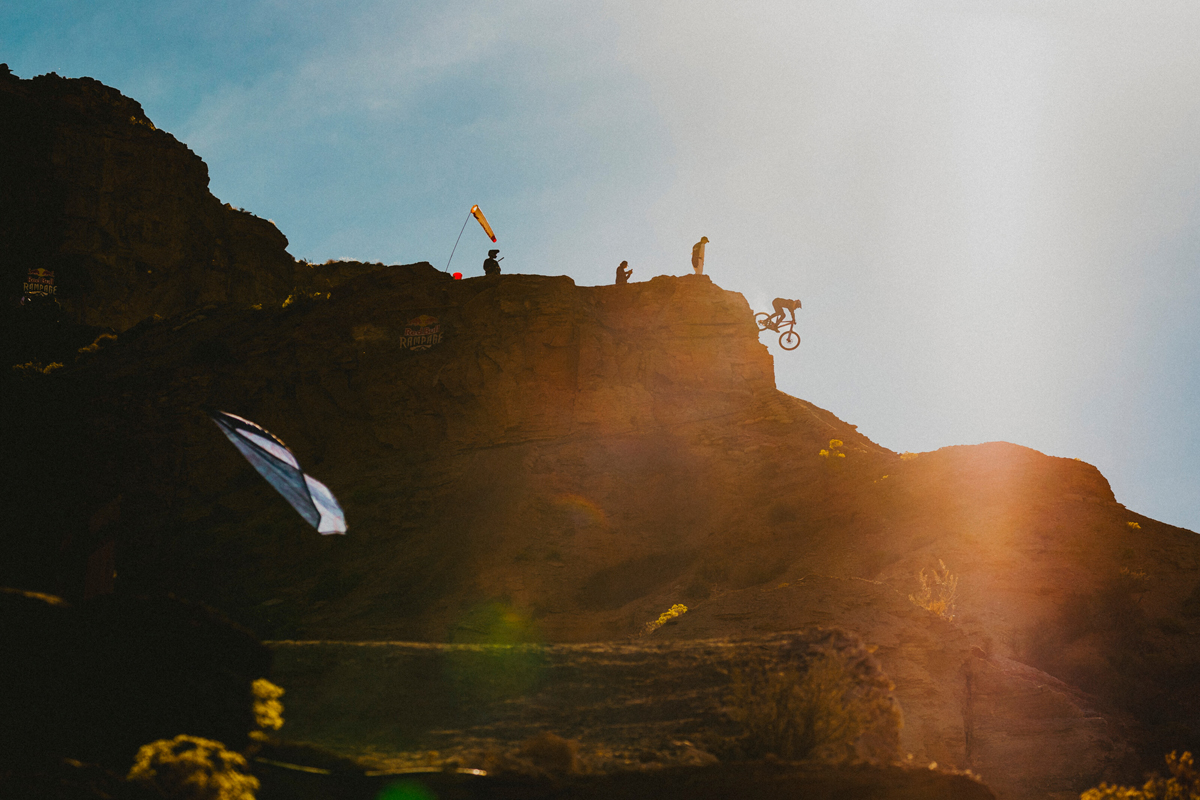
Canadian holds off compatriot Sorge with Boggs third down steep Utah course.
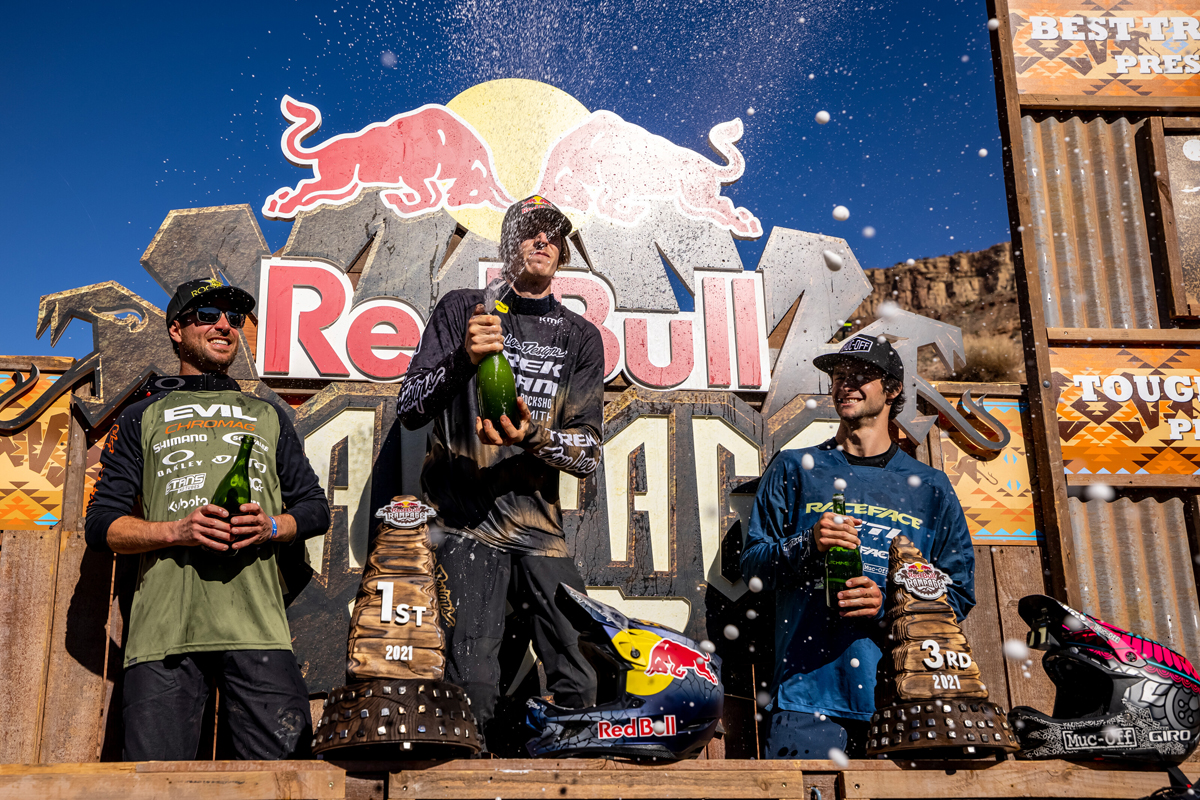
VIRGIN, Utah (October 16, 2021) — Brandon Semenuk made Red Bull Rampage history on Friday when he edged out three-time champion Kurt Sorge to claim his fourth title and become the first to win back-to-back Rampages, as fans and riders alike celebrated 20 years of freeride history. Here is all you need to know:
At each Rampage out in the wilds of Virgin, Utah, riders and fans are continually challenged to rethink what is possible on a mountain bike with the world’s best freeriders pushing the boundaries of the sport.
Thirteen years after he first won the competition as an underdog coming from the slopestyle scene, defending champion Semenuk’s ingenuity brought him his fourth coveted Rampage title with compatriot Sorge 0.67 of a point back in second and American Reed Boggs just behind in third.
Semenuk’s nervous first run saw him over-rotate one of his jumps to eject out with two-time winner Kyle Strait leading at the halfway point from fellow American Tyler McCaul and Belgian Thomas Genon.
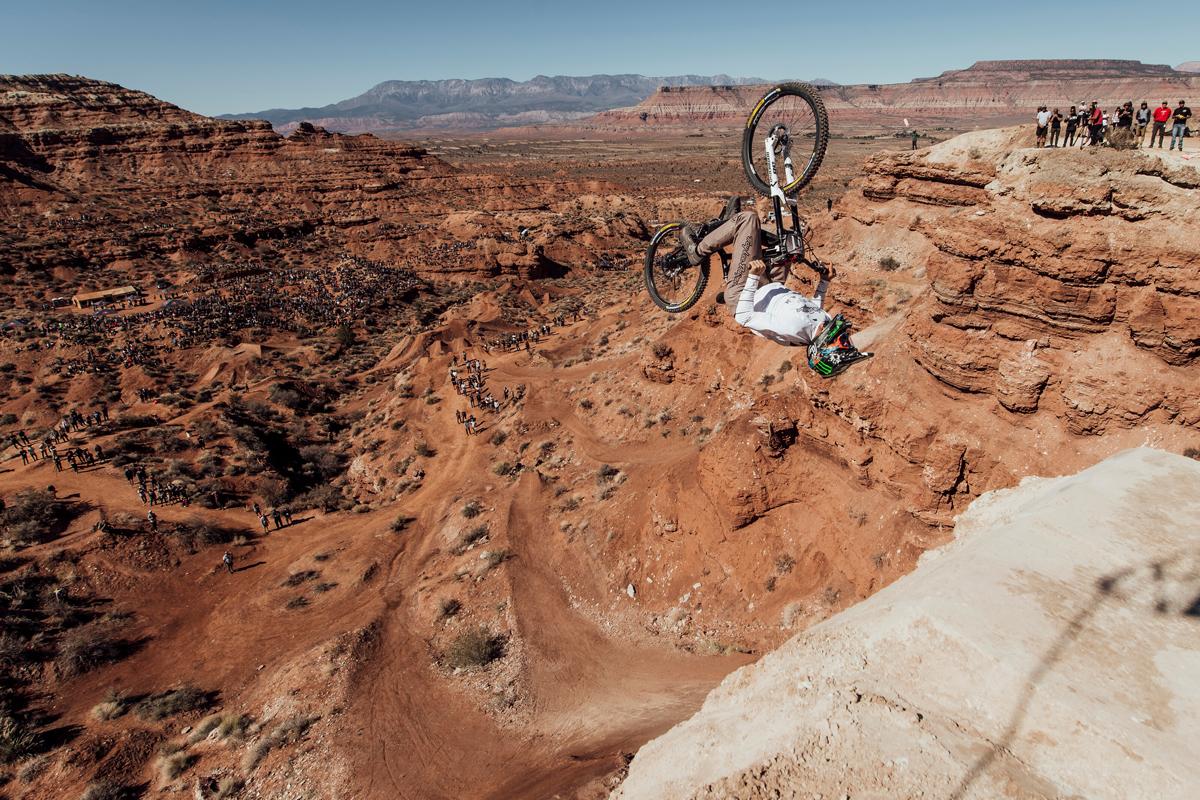
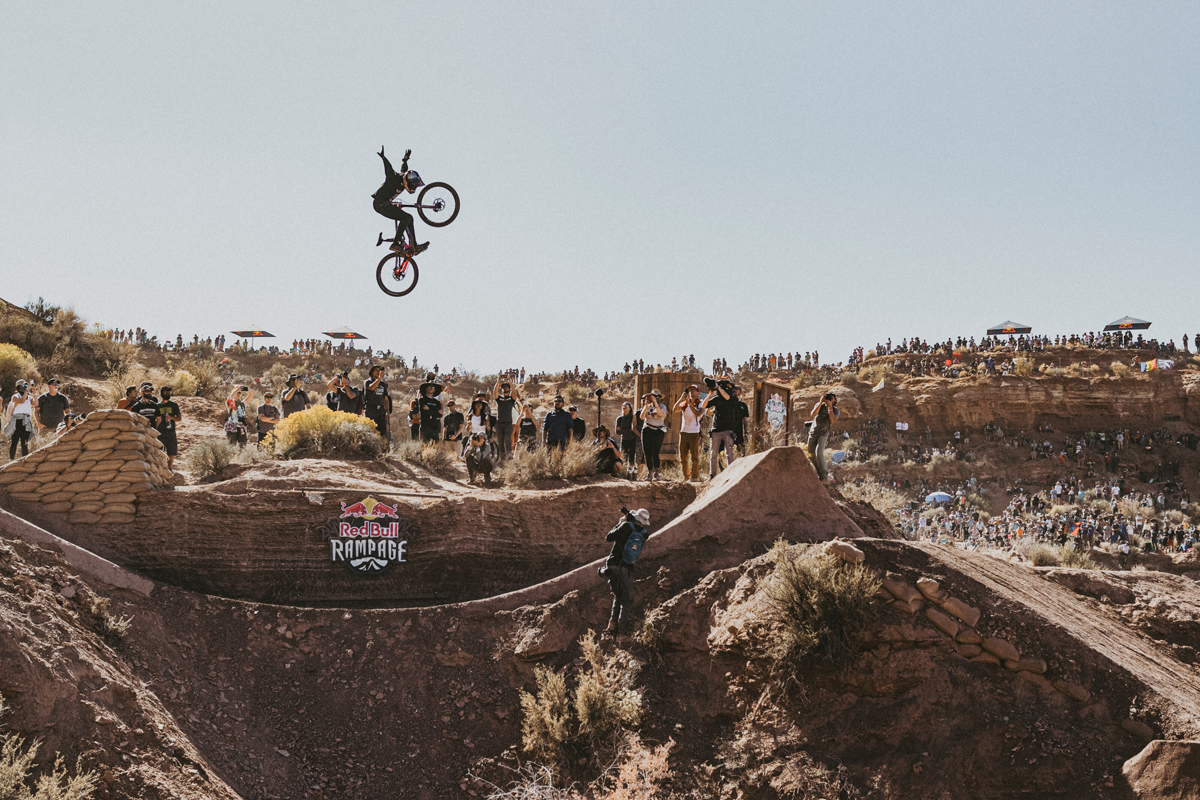
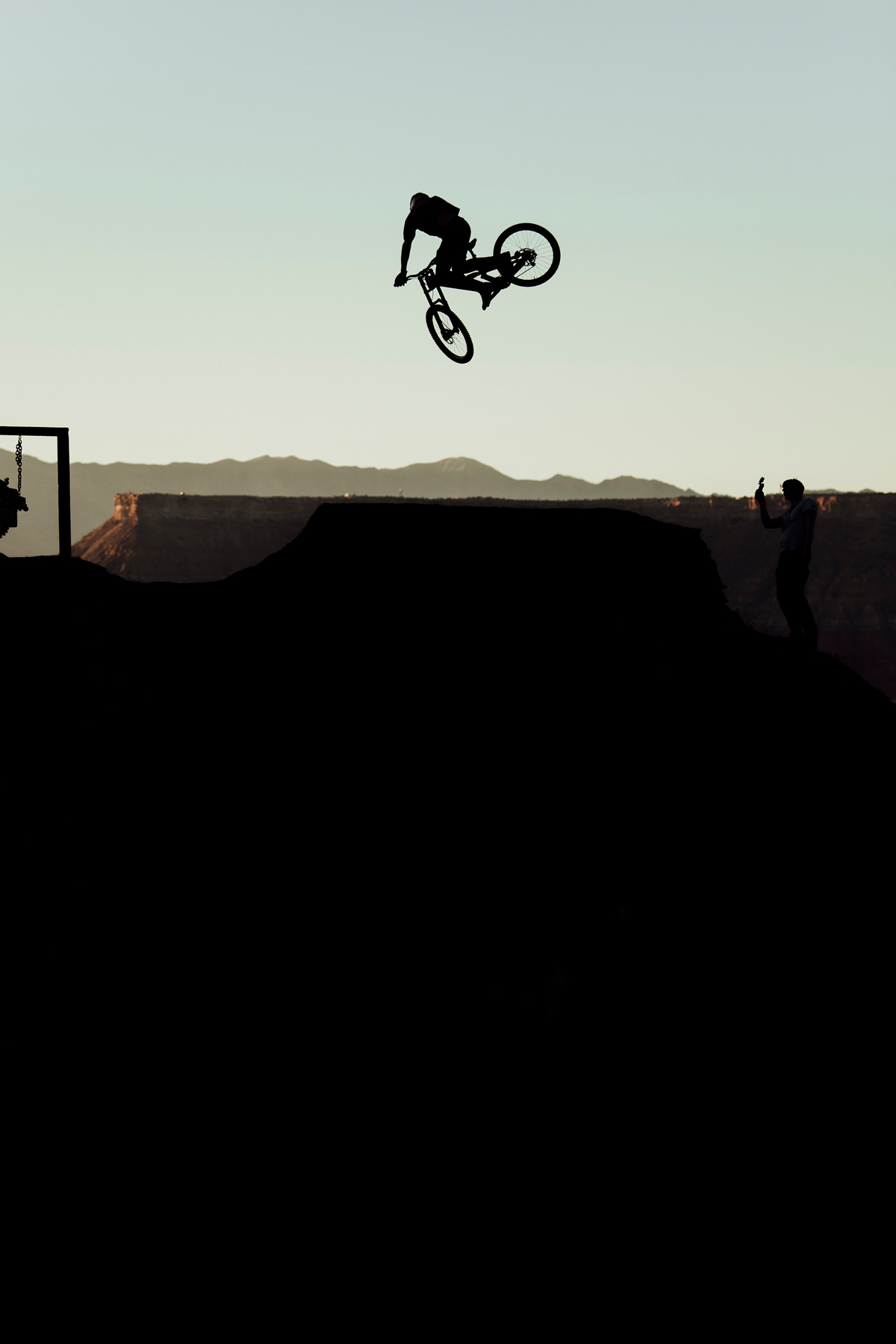
The second run, though, was a brilliant series of efforts down the steep, jagged, ochrecoloured cliffs with Semenuk first out the gate to deliver a run for the ages as the Whistler native combined a t-bog, bar spin, flat spin, tail whip off a big drop – a first in Rampage history – and backflip tailwhip off the last jump to see him claim the lead with a mammoth 89.
Sorge came agonisingly close to beating Semenuk to the four-time champion milestone after he scored 88.33 second time out, thanks to a run that included a superman added to a flip knack on his big drop.
Alternate rider Boggs stomped his drops and tricks second time down to secure a memorable maiden podium on the back of an 87 that just edged out 2010 champion Cam Zink, who thrilled with 86.33 in fourth.
Semenuk, 30, said: “After making a mistake in my first run, I had the body moving and nerves out, and just wanted to get the run I wanted done. All my (Rampage wins) are special in their way and this one is amazing for obvious reasons. The boys worked so hard on this event.”
Sorge, 33, said: “Especially with all the unpredictable variables like the weather. I didn’t have quite as much practice time as I would have hoped, and just had to dial it in on my run. The scene is amazing, especially the motivation and progression coming from younger guys and veterans.”
Canadian Tom van Steenbergen followed up his 2019 third place with the Best Trick Award presented by the Utah Sports Commission for a massive front flip on his big flat drop that had the crowd on their feet.
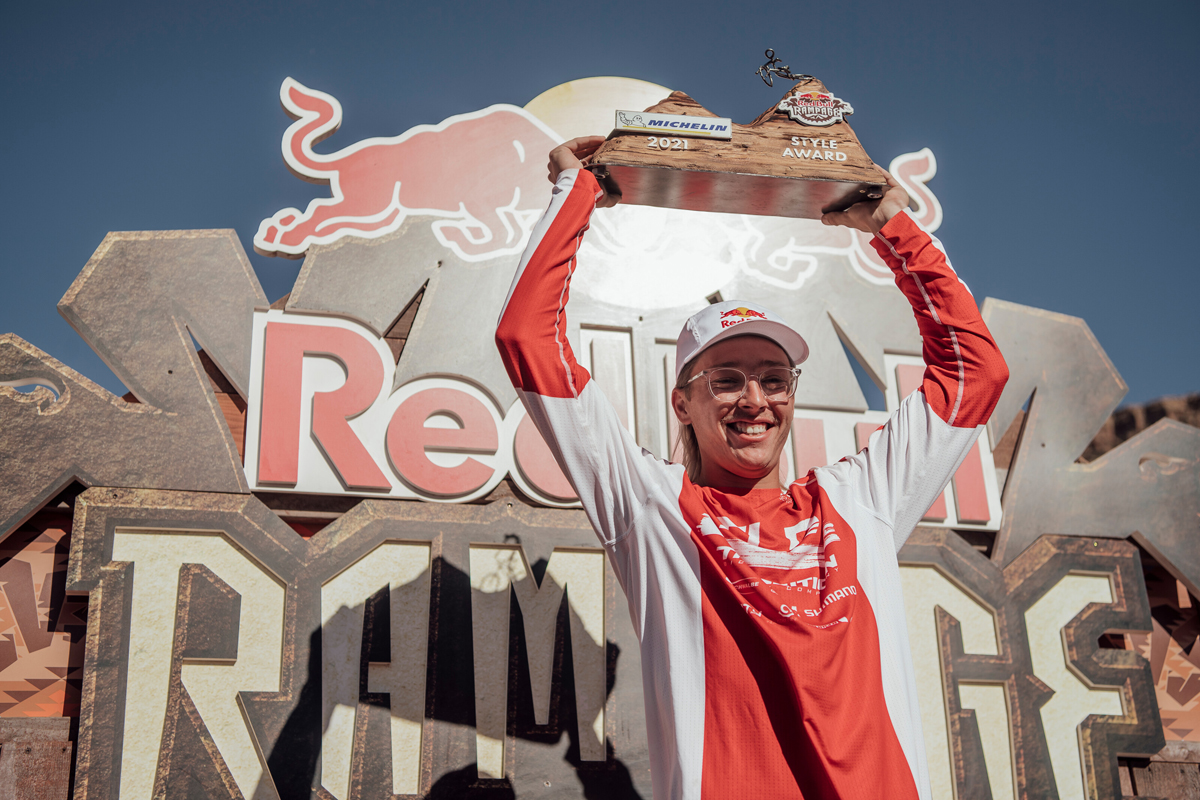
American rookie Jaxson Riddle walked away with the Best Style Award presented by Michelin and his dig crew, comprised of Joel Shockley and Samual Mercado, also won the Digger Award presented by Kia.
The Toughness Award presented by BFGoodrich went to man of steel Zink after he competed despite a big crash during practice with Brage Vestavik’s spirit and drive rightfully earning him the McGazza Spirit Award.
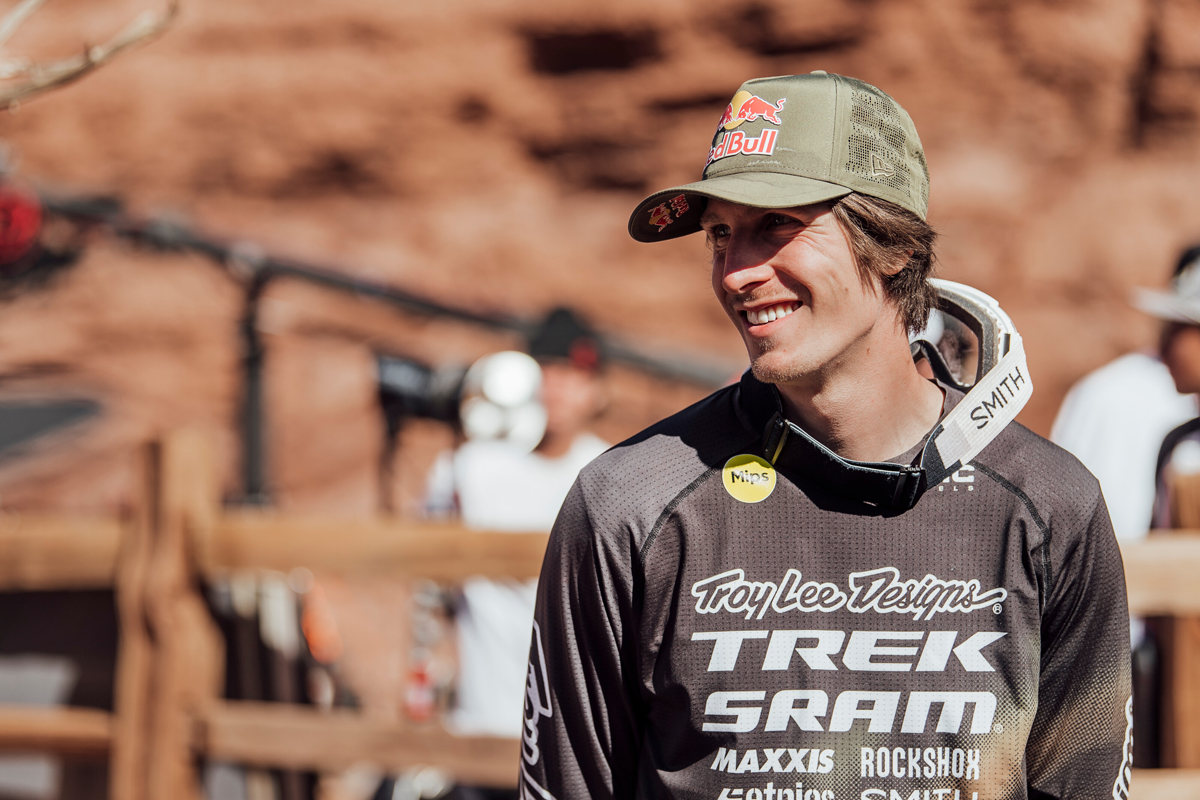
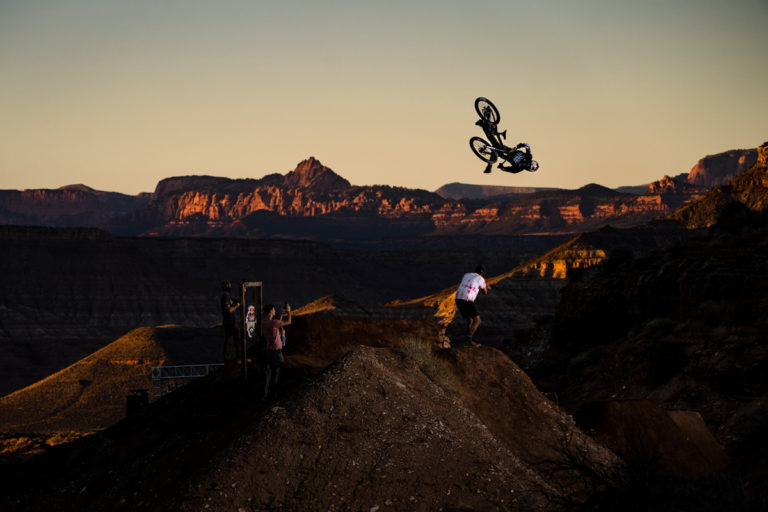
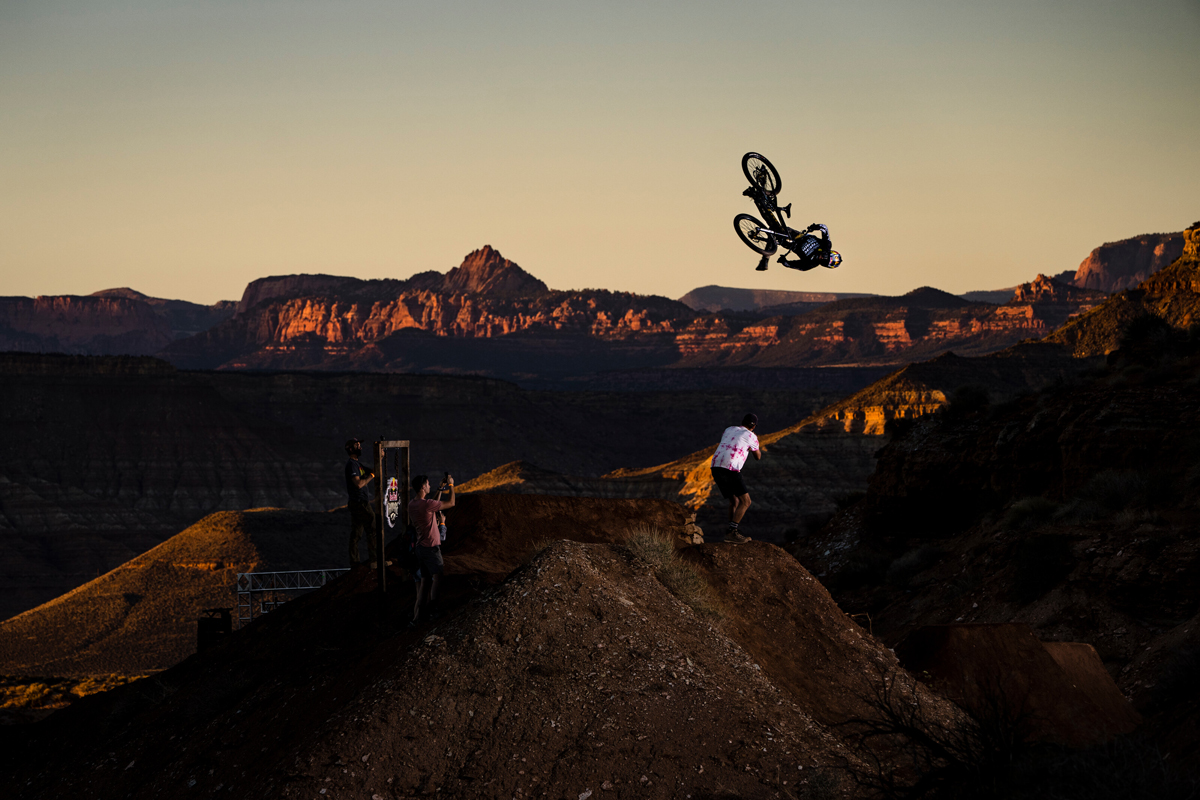
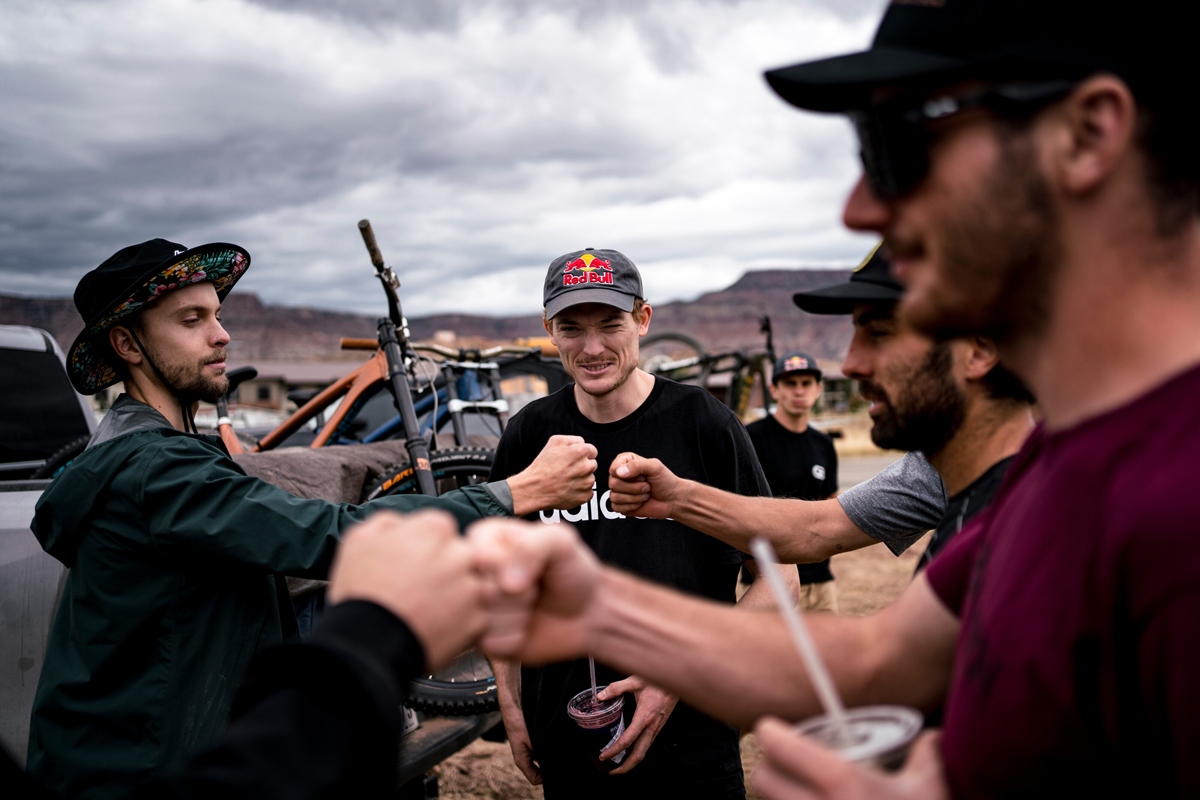
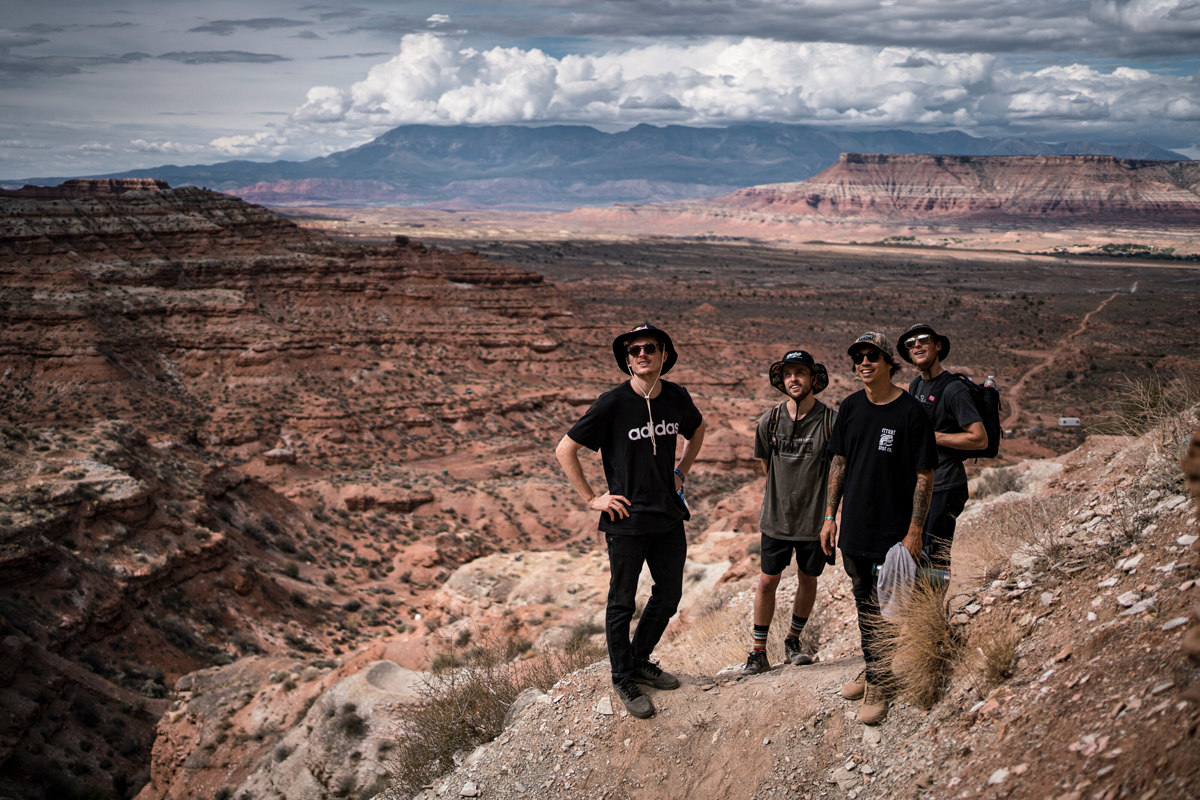
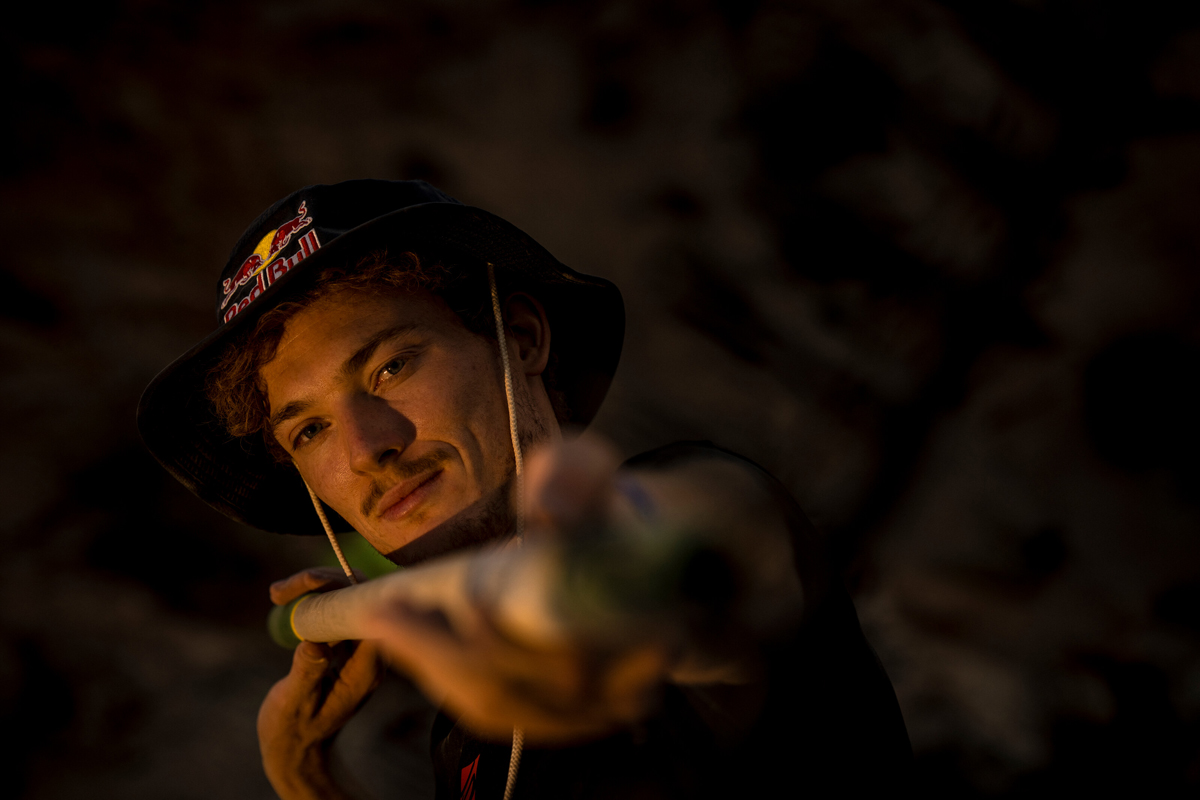
Kyle Strait celebrates at Red Bull Rampage in Virgin, UT, USA, on 15 October, 2021. // SI202110160058 // Usage for editorial use only //Szymon Godziek performs at Red Bull Rampage in Virgin, Utah USA on October 15, 2021 // SI202110160126 // Usage for editorial use only //Kurt Sorge performs at Red Bull Rampage in Virgin, Utah USA on October 15, 2021 // SI202110160124 // Usage for editorial use only //Reed Boggs performs at Red Bull Rampage in Virgin, Utah USA on October 15, 2021 // SI202110160122 // Usage for editorial use only //Cam Zink performs at Red Bull Rampage in Virgin, Utah USA on October 15, 2021 // SI202110160120 // Usage for editorial use only //Brandon Semunek at the Red Bull Rampage 2021 Virgin, Utah, United States. SI202110160117 // Usage for editorial use only //Red Bull Rampage 2021 Virgin, Utah, United States. SI202110160115 // Usage for editorial use only //Red Bull Rampage 2021 Virgin, Utah, United States. SI202110160113 // Usage for editorial use only //Red Bull Rampage 2021 Virgin, Utah, United States. SI202110160112 // Usage for editorial use only //Red Bull Rampage 2021 Virgin, Utah, United States. SI202110160110 // Usage for editorial use only //Red Bull Rampage 2021 Virgin, Utah, United States. SI202110160108 // Usage for editorial use only //Red Bull Rampage 2021 Virgin, Utah, United States. SI202110160107 // Usage for editorial use only //Brandon Semunek at the Red Bull Rampage 2021 Virgin, Utah, United States. SI202110160105 // Usage for editorial use only //Brandon Semunek at the Red Bull Rampage 2021 Virgin, Utah, United States. SI202110160103 // Usage for editorial use only //Thomas Genon competes at Red Bull Rampage in Virgin, Utah, USA on 15 October, 2021. // SI202110160077 // Usage for editorial use only //Tyler McCaul competes at Red Bull Rampage in Virgin, Utah, USA on 15 October, 2021. // SI202110160075 // Usage for editorial use only //Tom Van Steenbergen rides at Red Bull Rampage in Virgin, Utah, USA on 15 October, 2021. // SI202110160074 // Usage for editorial use only //Brandon Semenuk rides at Red Bull Rampage in Virgin, Utah, USA on 15 October, 2021. // SI202110160072 // Usage for editorial use only //Podium finishers celebrate at Red Bull Rampage in Virgin, Utah, USA on 15 October, 2021. // SI202110160070 // Usage for editorial use only //Jaxson Riddle competes at Red Bull Rampage in Virgin, Utah, USA on 15 October, 2021. // SI202110160069 // Usage for editorial use only //Jaxson Riddle competes at Red Bull Rampage in Virgin, UT, USA, on 15 October, 2021. // SI202110160064 // Usage for editorial use only //
By Lukas Brinkerhoff — You could say I was seated but that would signify I intended to end up where I was. I guess I did. I mean I planned the whole thing, but I didn’t mean to be right there, right then, seated where I had more or less collapsed into the dirt. There was a picnic table about thirty feet away, but for some reason falling down next to a rock in the dirt is where I ended up. I had my Mooseknuckler Cycling Alliance flask on one side and a bag of Dorito’s on the other.
The Ponderosa Pines towering over my rock provided the perfect relief from the sun that had been boiling my brains for the past hour or so as we climbed the last six miles to camp. Six miles and 2000 feet of up can make you tired. It can also make you do things like fall down next to a rock and not move for a couple of hours. There was also a little breeze that kept everything just this side of warm or in other words heavenly.
Singletrack is always worth the effort.
I couldn’t have imagined anywhere else that I wanted to be.
As a child, I always struggled to imagine what I wanted to be when I grew up. I was smart enough to recognize that no, not everyone can be whatever they want. I spent a lot of time contemplating that question and couldn’t ever decide on a profession or, in reality, anything that I felt I could dedicate my entire life to. It just wasn’t something that existed or that I could fathom. I knew what I liked to do, but I had no idea what I wanted to do.
Over the years I’ve met the occasional person who without asking I knew what they were all about. There was no question. Their passion was what they followed and they did so with such fervor as to remove any doubt as to what that passion was. There entire life revolved around this one thing. If they worked a job, they did so to save money for that one thing they were doing. If they had a family, the entire family either accepted that this was who they were or was so enthralled with that passion that they were swung completely into the dream as well.
I’ve met precious few people that I can place in this category.
Oak Grove Campground is not a place that you would write home about. Or at least, it wouldn’t fall into the category of places that you should make a huge effort to ensure you see before you die. It’s pretty. It sits at the base of Pine Valley Mountain and provides some relief from the summer temperatures on the southern side of the state. If I was going to be honest, and I am, it was only our destination because of those three characteristics and its proximity to St. George.
Pounding the pavement on our way to some dirt.
We left from our doorstep. The plan was simple, pedal for as long as it took to get to Oak Grove. Camp. Maybe do some hiking if we felt up to it. And then pedal home the next day. We packed everything that we thought we would need except the beer. The beer was going to be brought up by a friend. I mean, carrying a cooler on your bike can be a bit heavy. But everything else was packed, tied to or jammed into our bikes.
We knew the hard part was going to be the last climb up to the campground. Six miles, 2000 feet. For some reason, we always seem to forget that to get to Oak Grove you have to pedal the Turkey Farm Road which climbs from town and keeps climbing for the first 14.5 miles. Then drops for a mile or so and repeats the climb back up eventually finding a pinnacle just above the turn off that would take us to our end destination. Meaning we pretty much climbed all day before even getting to the turn off that we were all worried about.
There are few things better than a long road ahead.
That last hill was a beast. It was worsened by the heat and lack of shade. Said heat and lack of shade made my head boil. I don’t know if you’ve ever experienced a boiling head, but it’s uncomfortable. So much so that it will make you remove your helmet and pray for a headwind just so you can get cooled down. And in extreme cases, you might even find yourself jumping into frigid streams just to find some relief. Luckily, there was a frigid stream that we could use for said purpose on our last climb of the day and like children we splashed and played in the water.
It’s a simple question. That one we are all asked as children, what do you want to do with your life?
If we were all to follow our passion, it would be simple. The input would equal the output. Our passion, that one thing that we truly believe in and will give our left nut for, would be easily identifiable in everyday life. The problem is that for most of us, it’s not. We wish it were, but we spend more time tweeting about our passions than actually doing them. Maybe it’s the culture or maybe it’s the fact that following your passion can be scary. It’s kind of like playing with fire. It’s easy to get burned and most of us spout off passions like first graders with no concept of what it means to follow them. And then we sit in front of TVs pretending that we have lived.
I don’t claim to be one of those people whose passion burns bright and no one questions what they are about. No, I don’t think that is me, but as I sat propped up against a boulder being shaded by pine trees, there was no doubt about what I wanted to do with my life.
Lukas Brinkerhoff blogs about mountain biking and life at mooseknuckleralliance.org.
I’ve had several close calls with distracted drivers on the road. What should I do at the scene if one of them hits me? –Ron B., West Jordan, Utah.
It’s a concern shared by many cyclists, Ron. No matter how diligently you follow the law as a cyclist, you cannot control the careless actions of an inattentive motorist. Below we’ve identified three essential steps to follow to ensure that the damage to your body – and your bike – is covered under your insurance claim.
Call 911. If you’re hurt, call an ambulance. We’ve known many cyclists that are more concerned about their bikes than they are with their injuries, but don’t wait to get the medical attention you need! Also, keep in mind that some injuries may not be immediately apparent (so make sure to get medical attention ASAP for any injuries that surface later). Even if you don’t think you’re injured, call the police so a record of the crash is made. A police report is critical for a couple of reasons. First, it provides documentation of the accident in the event you don’t realize you are injured until after leaving the scene. And second, it helps establish fault. We know of numerous instances where a driver has admitted fault at the scene to a cyclist, but later told a different story to his insurance company.
Find Eye Witnesses. Eye witnesses are often the key to refuting false statements from a driver that the cyclist “came out of nowhere,” or “turned right in front of me.” Unfortunately, often times these crucial eye witnesses leave the scene before police arrive. Get names and contact information from anyone who may have seen what happened.
Gather Information / Take Pictures. It should go without saying, but be sure to obtain the driver’s name, contact information, and insurance information! Also get the license plate number, VIN, make, model and color of the car. Note the driver’s physical characteristics and demeanor as well. Gathering accurate information is best done shortly after the crash while it is still fresh in your mind. We’ve seen many times where the outcome of an insurance claim has depended on basic information that would have otherwise been lost or forgotten had it not been written down right away.
As for pictures, remember that documenting the scene of an crash is one of the most important things you can do! Take pictures of your bike and the car that hit you (before they are moved, if possible). Photograph any injuries you have. Take pictures of skid marks, broken glass, damage to other property, anything else that you think may be pertinent to the crash.
Ken Christensen and Russ Hymas are avid cyclists and Utah attorneys at UtahBicycleLawyers.com. Their legal practice is devoted to helping cyclists injured in collisions with motor vehicles. They are authors of the Utah Bicycle Accident Handbook and are nationally recognized legal experts on cycling laws and safety.
A flash of white and then…nothing. Later: slowly my eyes open and I hear a loud groaning – was it me? And then – PAIN. Oh so much PAIN. I lay there for I don’t know how long trying first to figure out: why was I in so much pain? What happened? What was I? It seemed forever before I came out of the fog and put everything together – all while I was feeling incredible pain throughout my body and mostly concentrated in my left arm and shoulder. Oh how I hurt!
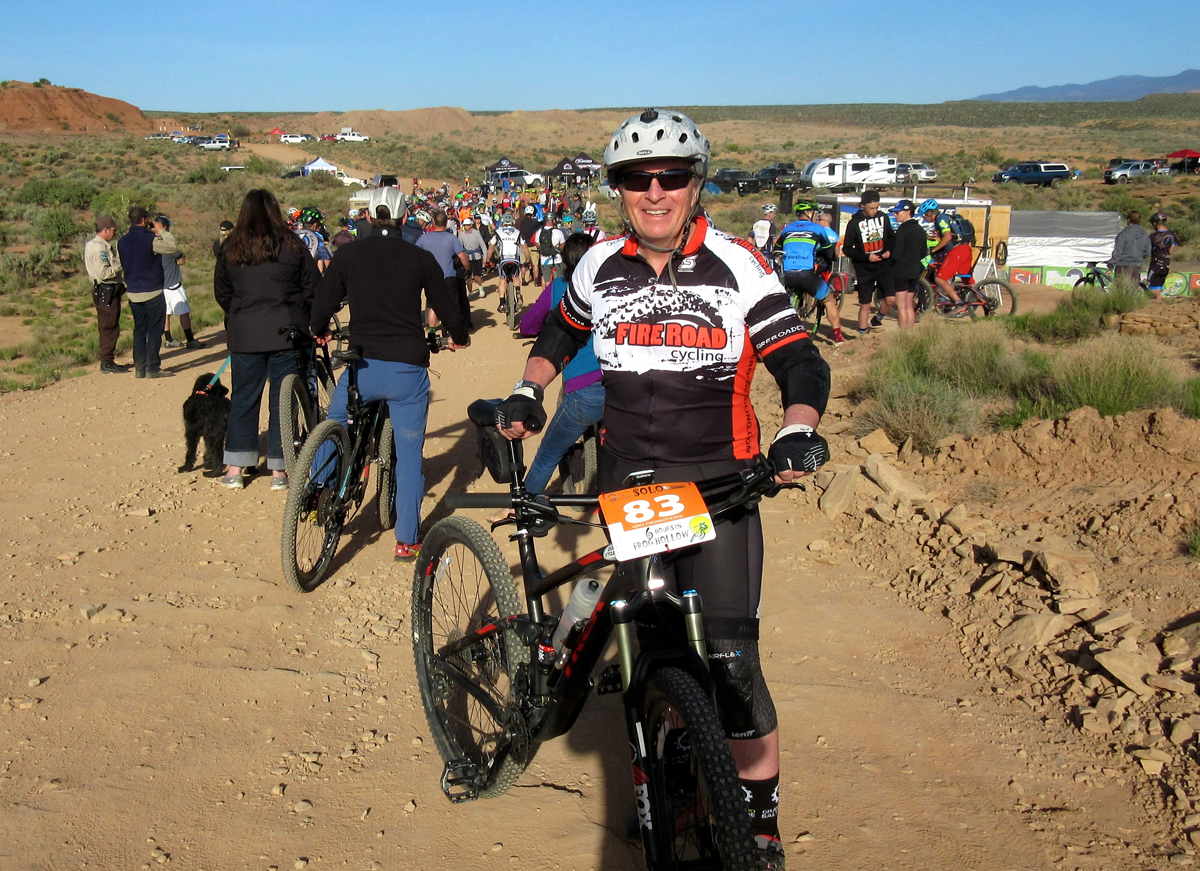
Rich Howard at the “Six Hours of Frog Hollow” days before his crash on the same trail. Photo courtesy Rich Howard
The weekend previous I’d ridden in the “Six Hours of Frog Hollow” and now planned to practice the trail again for the upcoming “Cactus Hugger.” Early that morning I put on all my protective gear – G-form knee, elbow and hip protectors and Bell ¾ helmet. I’d soon loaded my prized Trek Fuel Ex in the van, and headed up to the JEM trail just up the hill above the town of Hurricane – a trail I’ve ridden, literally, hundreds of times over the past many years. A trail I knew very well. The JEM – such a great ripping, flowing ride with an occasional rock garden and near-edge thrills. Just 10 minutes from our home, riding the JEM before the main duties of the day has been a near-daily biking destination for me – a trail, along with the Dead Ringer and Goose Bumps trails, I never tire of riding.
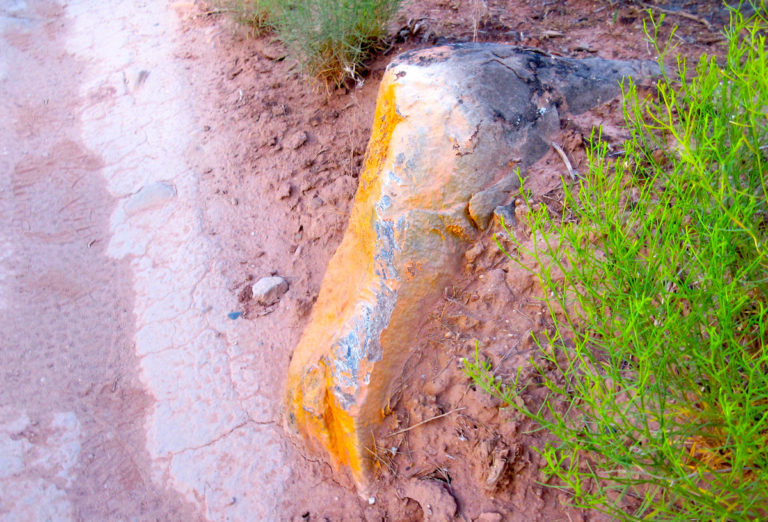
The infamous “Pedal Strike Rock” showing numerous hits by riders of the JEM. Photo by Rich Howard
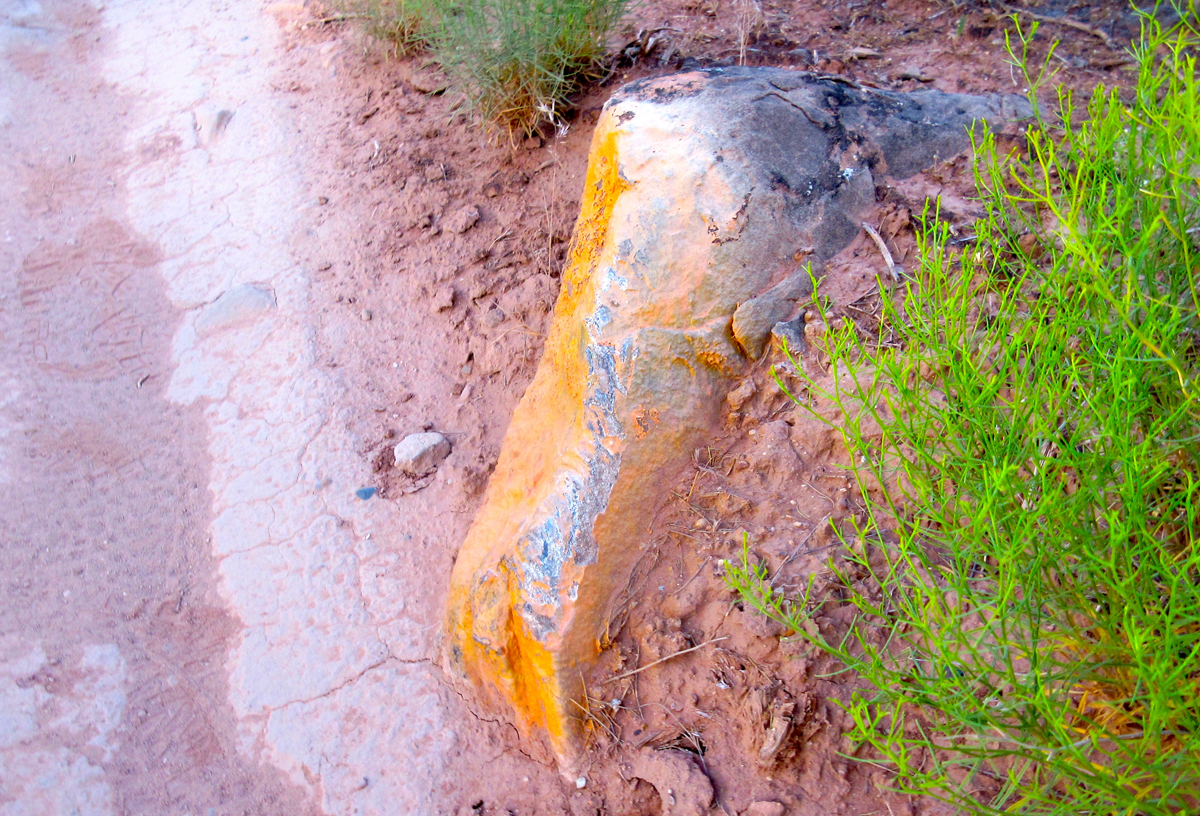
But not today. Not right now. Right now I hurt like crazy and knew I needed help. Somehow, on this trail I knew so well, I’d found that special rock a-waiting, hidden just behind a bush immediately trail-side. Practicing for the upcoming Cactus Hugger, I was riding hard with my Garmin telling me I was climbing past 20mph, when a hit that rock with a hard pedal strike which had thrown me, head and shoulder first, hard onto the trail and knocked me head over tea kettle. A subsequent visit to the crash site revealed the offending rock – and the near-miss pedal strikes by many-a-rider passing the same spot.
Finally I got enough of my wits about me to rise and find my bike had flown over me and down the trail. I staggered up and to my bike. I was plenty wobbly and fully in pain but getting more and more oriented to where I was and what I needed to do to get help. Heading back up the JEM to the van was a several mile hike – something I was not in any kind of shape to attempt. Sheep Bridge Road, which more or less parallels the JEM for much of its distance, was not too far to my east.
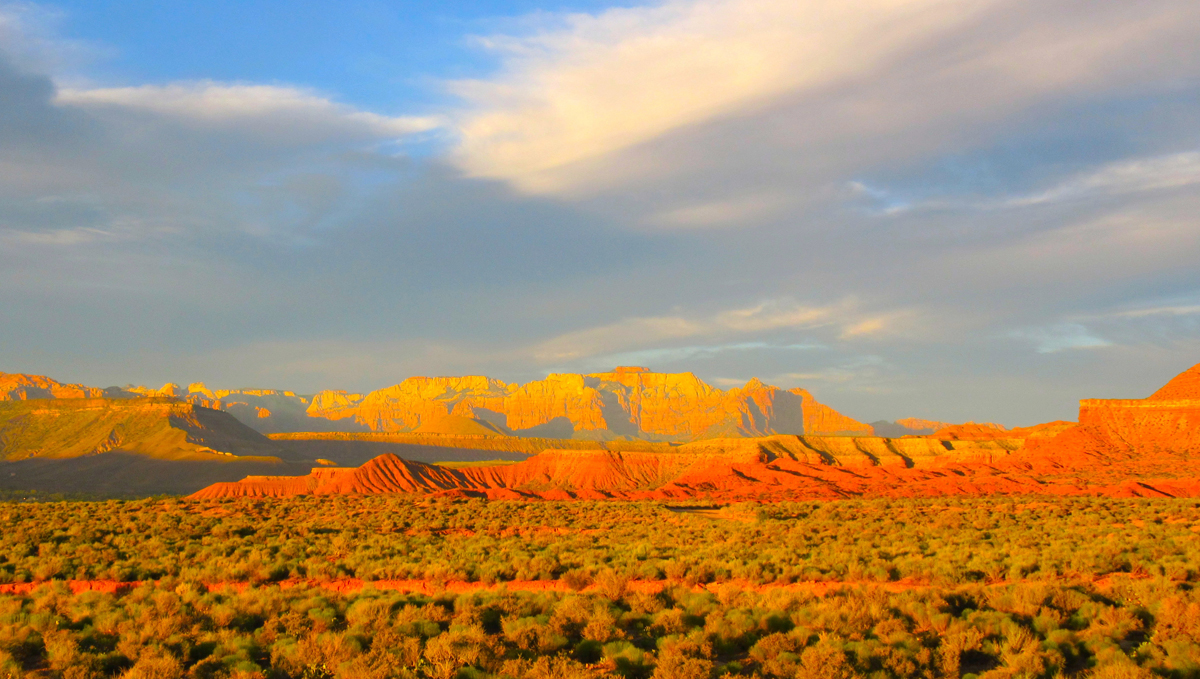
The incredible views of Zion as seen from the accident site on the JEM. Photo by Rich Howard
So I headed cross-country and found the road. And most fortunately, found Morgan, a mountain biking friend, who was just passing along in his Suburban. He’d seen me from a distance looking distressed and stopped to help. Thank you Morgan! He loaded my bike in to his vehicle and drove me the 2-3 miles back to my van and loaded it in for me. We both didn’t know at the time how badly I was hurt so I gave him my most grateful thanks and climbed in the van to head back to Hurricane – and straight to the Insta-Care center.
There the doctors confirmed: “yes, you’ve shattered your left clavicle.” A pretty straightforward diagnosis. The next day the orthopedic surgeons confirmed the same thing – “yep, broken”. My gratitude to them for both their care – and their discretion for not saying “what were you doing riding a mountain bike at your age?”
I knew the answer to that question but was still grateful not to be called out about it. Biking, as any bike-addict knows, runs deep and powerfully through my veins. It’s a lifelong habit and I thrill every time I climb on any bike to ride. Even throughout my 35 military years I’ve ridden whenever I can – and usually daily. Like when I was assigned to the Pentagon and I’d cycle to work everyday. My bike would wait patiently in the rack all day and, after a grueling day of dealing with every kind of issue, I’d climb on my bike at the end of the day and pedal toward home feeling instantly refreshed. It was like a rejuvenation-of-life: all my stresses seemed to just flow away with every pedal stroke and before long I’d be stress-free and feeling great. Biking does that for me – as I’m sure it does for everyone who knows that feeling of bike-freedom and pure exhilaration that comes when on-a-bike.
Not that riding bikes has been accident free for me until this April day. I’ve had a great share of bicycle accidents, big and small. Other broken bones, scrapes, cuts, bruises, and teeth knocked out. A lifetime of riding and crashing – but at least spread out over decades of riding. And plenty of other accidents wherein bicycles are fully guilt-free. My body represents a war-zone of broken bones, scrapes, bumps and bruises, many of which can be directly attributed to the tens-of-thousands of miles I’ve ridden throughout the decades of my life – and many not bike-related: Broken nose (baseball), three broken ankles (motorcycle, basketball, softball), and three broken arms (auto shop, motorcycle, bicycle). And now with this last collarbone break my wife said to me “you’ve literally broken bones from head to toe – you can stop now!” Hope she’s right!
She understands my passion. She has her own road, gravel and mountain bikes. We ride regularly and love our rides such as Rebecca’s Private Idaho, Cache Gran Fondo, Tour de St. George, Cedar’s Fire Road, and oh-so-many other rides big and small around the west. We’re a biking family and, gratefully, not even with this recent episode, our biking passion only seems to grow and grow.
The Story Continues…
But the story doesn’t end with this latest bone-break. Fast-forward eight weeks from my 19 April 2017 crash: we’d sold our home with plans to build new on the old family homestead. Lots to be done. Boxes to lift and store. Couches, chairs, beds and tools to be lifted, moved and stored. An old house to tear down board by board. Tractor work on the farm. Grandkids to spoil. A life to be led and moved forward.
After eight weeks of this lifting, moving, and go, go, going, in southern Utah’s heat as well, my recurring headaches now wouldn’t abate. I couldn’t find anything that would cut the pain. I started feeling “wobbly” and told my wife “it feels like my head is full and sloshing.” The crisis came on a recent Saturday when there was no way to deal with the excruciating head pain. My wife raced me to St. George’s Dixie Regional Medical Center’s emergency room.
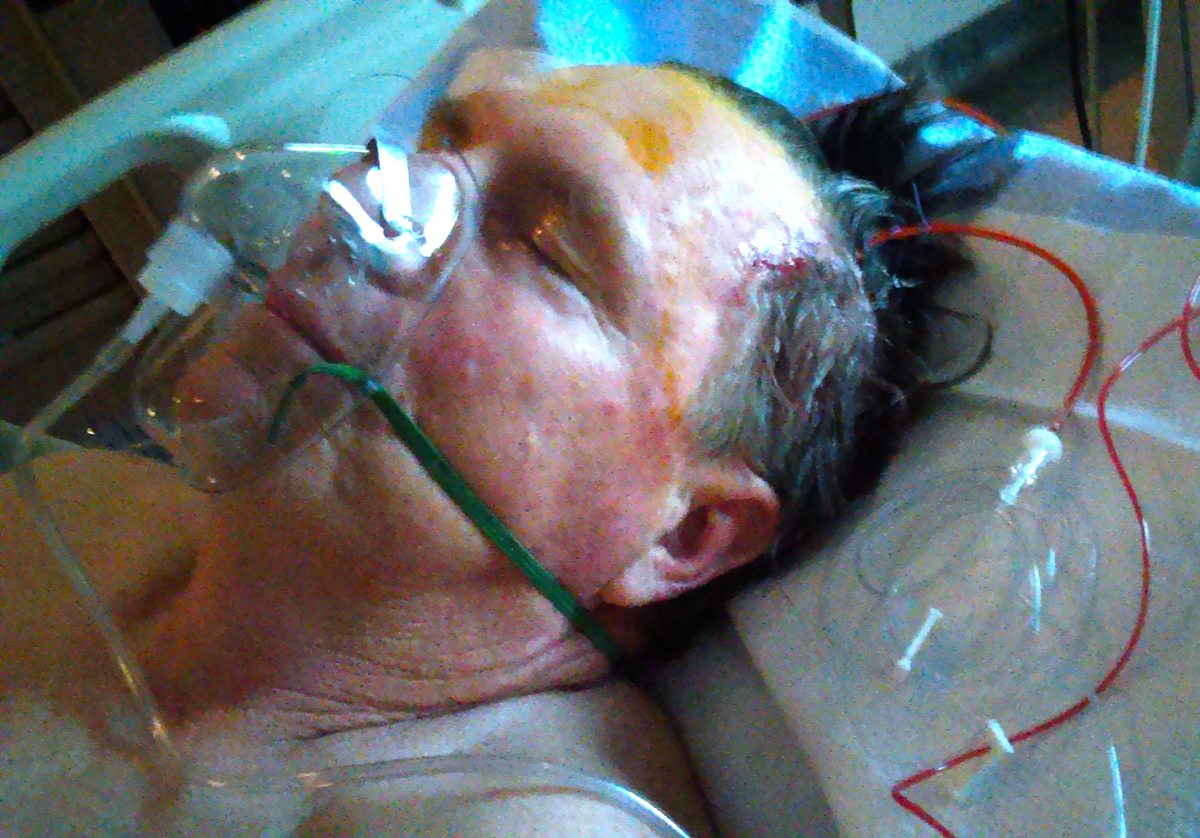
Rich post-surgery with his head still draining – a rough recovery. Photo by Cozette Howard
There the staff rushed me in for a CT scan and confirmed I’d sustained a subdural hematoma those many weeks ago – blood had been constantly leaking and pressing hard on my brain. The on-call neurosurgeon was immediately contacted and within a short time he and his team performed emergency surgery and, as he related later, hit a “gusher” when relieving the pressure on my brain.
There followed five days in the ICU and other hospital care. The staff at Dixie Regional were exceptional in everyway and provided the recovery care I desperately needed. How fortunate we are in southern Utah to have this top-notch neurosurgery unit. Just a few short years ago such an incident would have, as happened to my brother, resulted in a rushed, but delayed, transport to Salt Lake City for such care. Thank you Dixie Regional staff and doctors! Thank you!
So what does the future hold for me? I’m home recovering, grateful to be healing and for professionals that knew how to provide that healing. I’ve a garage full of bicycles – touring bike, gravel bike, road bike, mountain bike(s), all anxious, surely as much as me, to be back on the road and trails and riding like a kid and feeling like those Pentagon days when all my stress would leave at the start of the first pedal stroke.
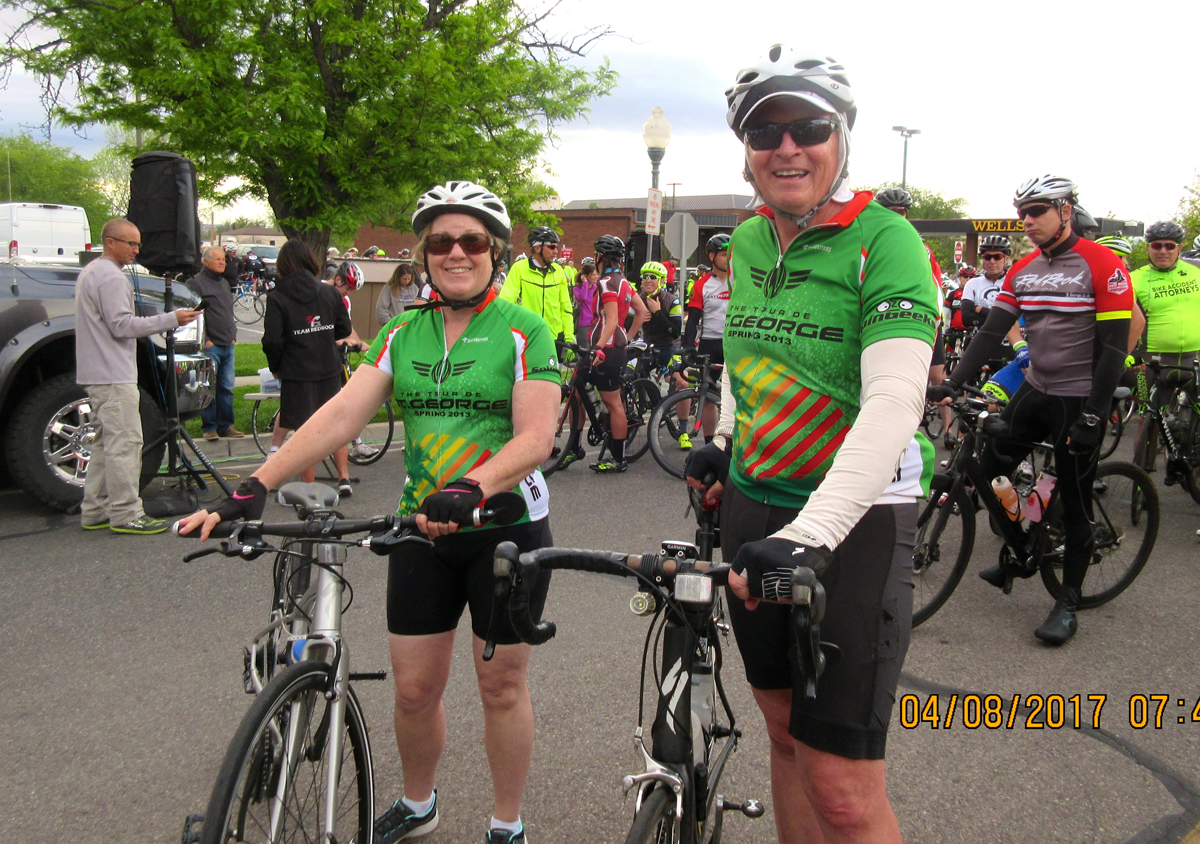
Cozette and Rich Howard at this year’s Spring Tour de St. George. Photo courtesy Rich Howard
Is there a moral to this story? Possibly – at least for me there is. A few things stand out as I reflect back on the crash and subsequent events: I’m glad I had on my safety gear – especially my helmet. In thousands of miles of riding I’d never really needed it like I did that day. But since one never knows which ride is the one when you’ll want it – always wearing my helmet was key in this crash to preventing something possibly much worse. I wish also I’d had a complete physical examination after my crash. It’s likely such an exam might have caught my head injury early and might have avoided what happened eight weeks after the crash. And finally, I can’t say enough about the incredible skill and attention that was provided by the health care professionals of the Dixie Regional Medical Center. These doctors and staff are amazing – and their skill and dedication were there exactly when I needed them. And finally, my deepest thanks to my wife Cozette. She has been there with me through every step and moment of these post-crash events. Thank you Cozette! We’re both looking forward to being back on our bikes in the near future. See you all out there soon!
Rich Howard served 35 years in the military and is a retired Air Force Colonel. He lives, and rides, in LaVerkin, Utah with his wife Cozette.
By Charles Pekow — Low-income Latino immigrants remain underrepresented in the bicycle world, a study suggests. A survey in San Francisco of more than 2,000 people and interviews with a handful suggest many find affording a bicycle difficult and they are concerned about crime. The Mineta Transportation Institute in May 2016 released its findings in Exploring Bicycle and Public Transit Use by Low-Income Latino Immigrants: A Mixed-Methods Study in the San Francisco Bay Area. It’s not clear to what degree the findings would apply in other communities, but the institute says that we don’t know enough about this demographic group as little bicycle research has focused specifically on it.
The finding contradicts previous research. But it says Latino immigrants were more likely to ride a bicycle to a day labor site than to a regular job. It says a “significant minority of transit riders value bicycle access to transit, suggesting judicious investment in bike-transit integration is warranted.”
Interviewees said they had seen people robbed while on bicycles, mostly at night. They noted, however, that increased police presence lowered crime and fear. And education may provide the key: the report states that “the more familiar immigrants are with bicycling, the more likely they are to see it as a way to overcome barriers associated with transit.” Find the study at http://goo.gl/QYx8F2
By Charles Pekow — One day, you may be able to mount your cellphone on your handlebar with an app that can tell you to adjust your pace so you don’t get caught at red lights. Researchers at the University of Oregon have developed FasTrack that works in bike corridors on and near campus. They are currently working on expanding the app so it will work in the outside world. It can time traffic lights within one second with 85 percent accuracy.
So far, the app works for timed traffic lights. Now the researchers are trying to expand it so it will consider lights that have to be changed by activation (sensor or pushing a button). Thus far, results haven’t been as successful, only reaching 78 percent accuracy. The app will tell you if you have to slow down or speed up to maintain a “green wave.”
The researchers plan to look at more roads in Portland, OR to see if they can adjust for date, time, season and possible weather. The system wouldn’t work with older traffic signal systems. No word yet on when it will be available outside Oregon.
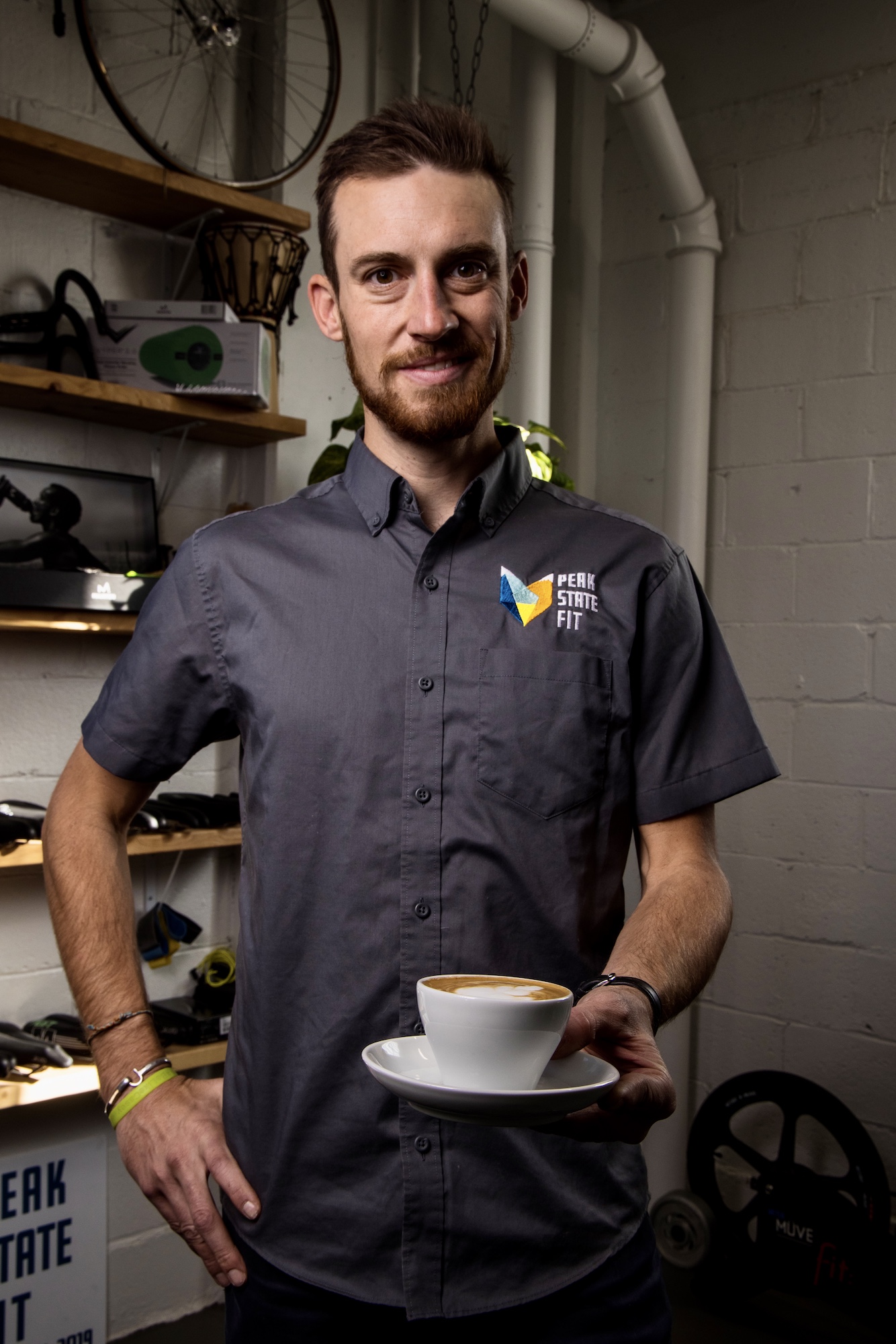
By Pat Casey — How many of you reading this article have been told to “stretch more” or “add some yoga” into your routine? Mobility practice and maintenance of your body’s functional ranges of motion are often the first items to fall off on our training calendars. Most riders I work with at Peak State Fit acknowledge that they need to improve their movement quality, but they let their maintenance routine take a back seat in their busy lives. Many will mention that they stretch, but don’t have any rhyme or reason or process of how long per stretch or why they are stretching the muscles they do.
Having a purpose driven routine for your recovery, mobility, strength, and core stability are not only tremendously beneficial to your riding, but will make you a more productive human in your various roles in life, and help you as you age (sorry, but we all are). Expanding your knowledge and how to address pervasive muscle tension might be transformative for you, so do yourself a favor and try this out next time you unroll your yoga mat for some quality movement and restoration.
What is Really Causing Muscle Tension?
Although stretching provides a temporary relief, feels good and aids in active recovery, many mainstream methods of stretching barely scratch the surface of the underlying reason for ‘why does muscle tension, tendon pain, or movement pattern discrepancies or encumbrances occur in the first place?’
The answer to this question is multifactorial. But at the very root of muscle tension and subsequent tendon pain or movement pattern imbalances are our brains. We hope to address symptoms of our pains and tensions through stretching routine, but rarely do we try to send a signal to change or disrupt the environment that our body is in. When an issue is embedded neurologically, it requires change to the pattern.
What is P.A.I.L.s and R.A.I.L.s?
The solution is found in changing the pattern. Presenting the muscle with a timed stimulus that allows the muscle to relax, or reset itself. This is done by adding an active, or isometric load to a stretched position. This way of “hacking the system” is known as P.A.I.L.s and R.A.I.L.s – which stand for passive and active angular isometric loading. This method is also known as Kinstretch and Functional Range Conditioning.
Why is this the Preferred Method? How and why does it work?
Reciprocal inhibition is a neurological mechanism of the muscles on one side of a joint relaxing in order to allow contraction on the other side of the joint. While these should function in synchronicity for optimal movement, due to our habitual movement patterns, mostly seated lifestyles, and even from the sport of cycling, we can expect some imbalances between these extensors and flexors that are commonly used: particularly our quadriceps, anterior hip and core muscles, and hip abductors and adductors.
First, the P.A.I.L.s and R.A.I.L.s are meant to retrain not only range of motion, but also the strength in the joint, and the brain’s familiarity with increased function at those end ranges. The Progressive portion is an active movement, which sends signals to your brain that the end range of your stretched position is not a threat to the body. Then, by using an antagonist muscle to pull the joint into a greater range, activating motor units and changing the relationship between the extensors and flexors that are causing the muscle tension in the first place.
There are many resources and available information on responsibly using this technique to address muscle tension, rotational impingements and mobility issues, as well as changing neuro drive to various muscles. First, understanding the appropriate amount of time and intensity will help the most in achieving the goal of the technique. Below, I will provide you with a guide to add P.A.I.L.s and R.A.I.L.s into a common stretch. Then, you may add this to stretches you are already familiar with and address some of your own tight muscles and common aches!
“P.A.I.L.’s/ R.A.I.L.’s is an isometric loading protocol created by Dr. Andreo Spina. In other words, this is when we are stretching and contracting the muscles that are being lengthened/ stretched followed by the opposing muscles to pull us deeper into the stretch.” (https://www.markowtrainingsystems.com/2020/07/09/p-a-i-l-s-and-r-a-i-l-s-explained/)
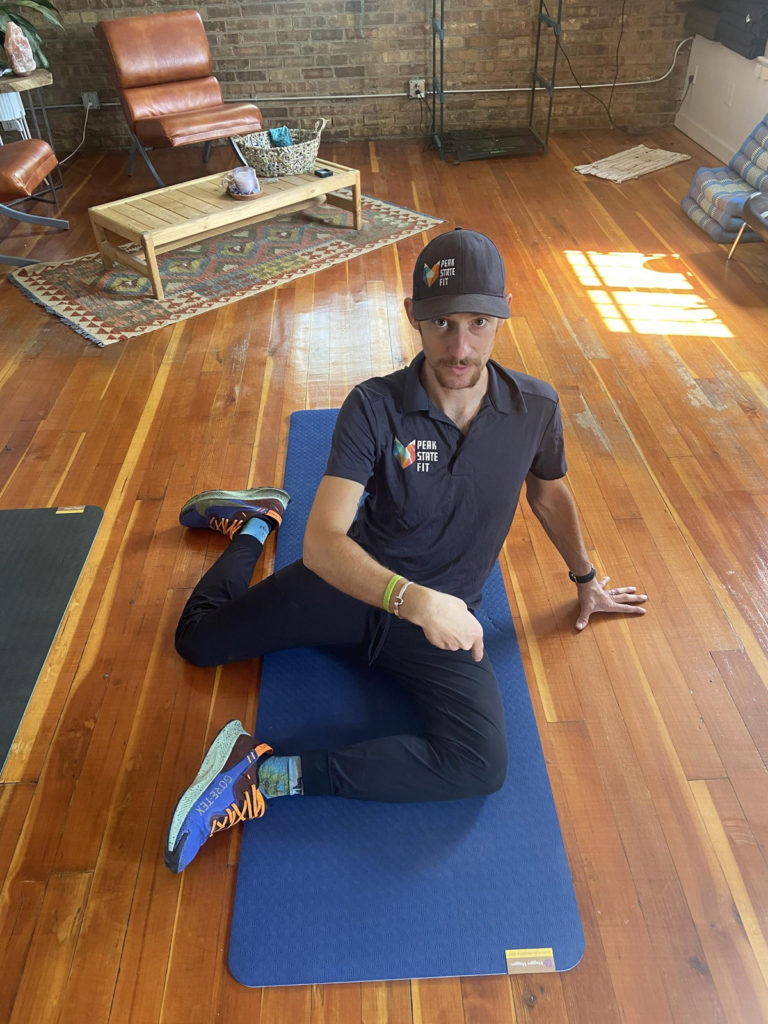
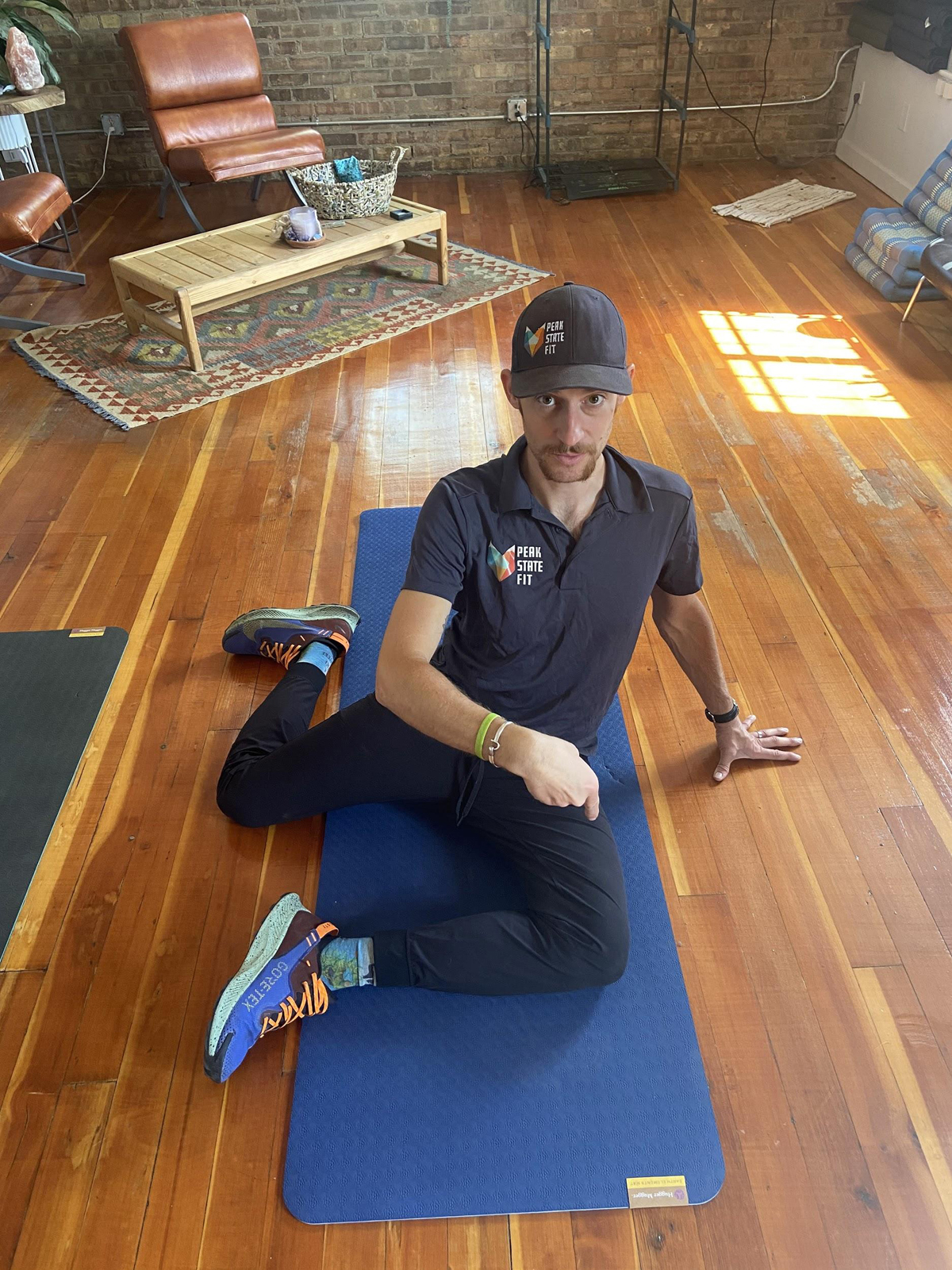
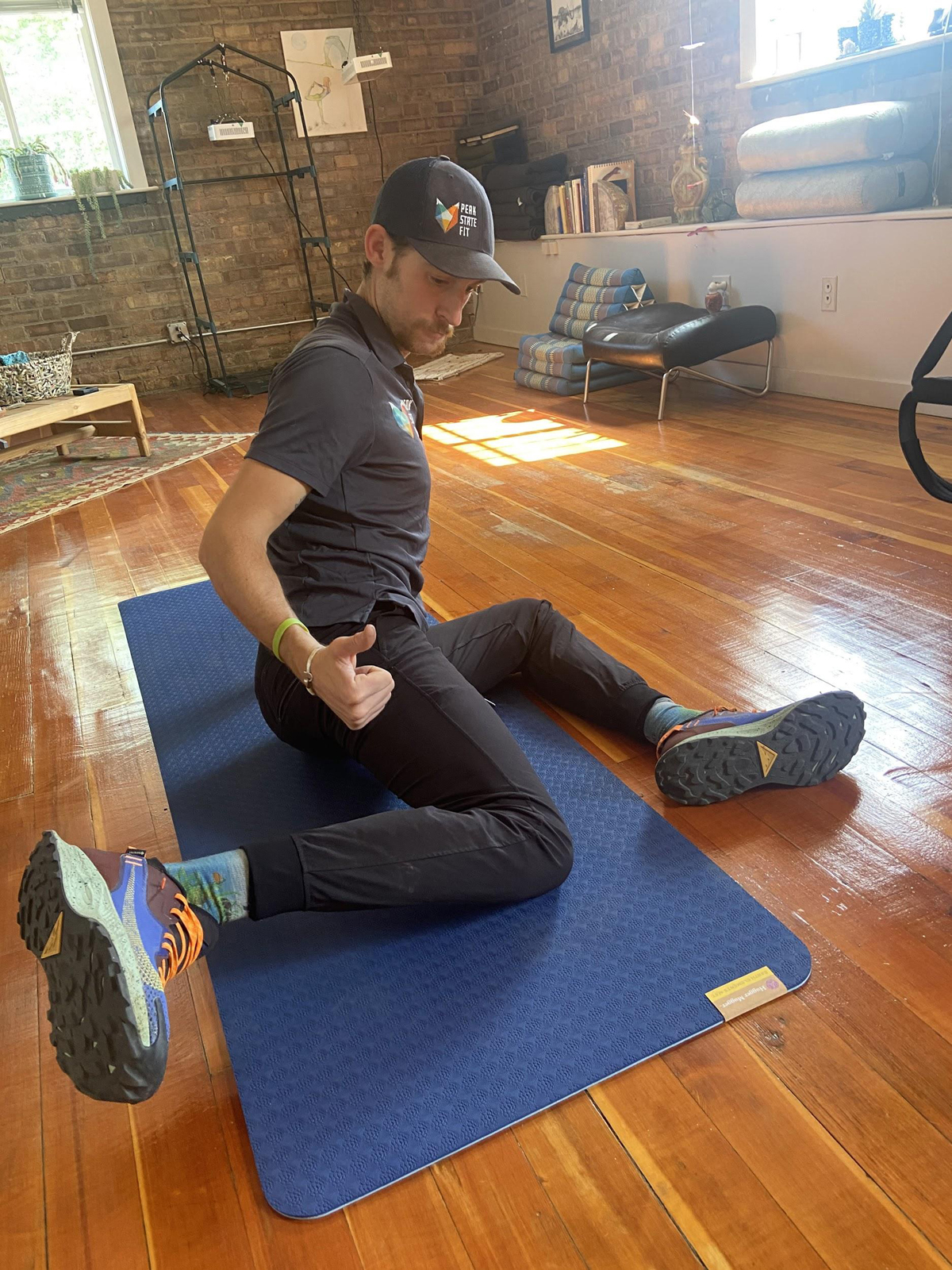
How to start: Position your body in a “90 90 Pose” with one leg out front in external rotation, and the other in an internal rotated position.
Begin by spending approximately 2 minutes in the starting position of each stretch. Breathe steady with a 4 count in, 4 count out.
After 2 minutes, begin with a progressive contraction for 20 seconds (P.A.I.L.s). Here, you will press into the externally rotated knee into the floor.
Start with a 20% contraction and progress to a 40-50% effort.
Relax for 5 seconds.
Then, follow this movement with your regressive pattern. Inhale, then on an exhale, lift the externally rotated leg up for 20-30 seconds.
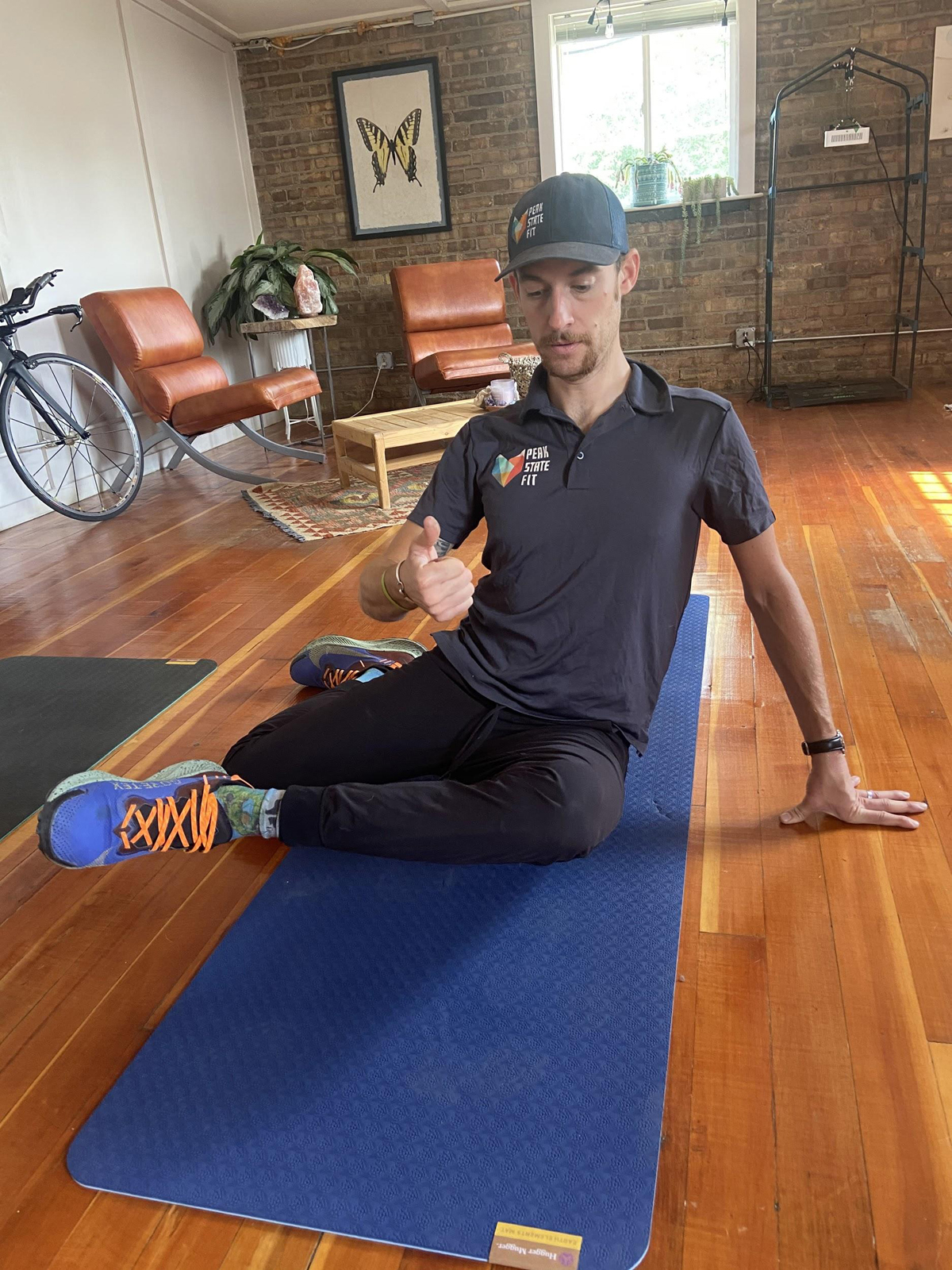
For internal hip rotation, begin by performing the P.A.I.L.s contraction to your internally rotated knee.
Hold for 20-30 seconds, progressively increasing intensity.
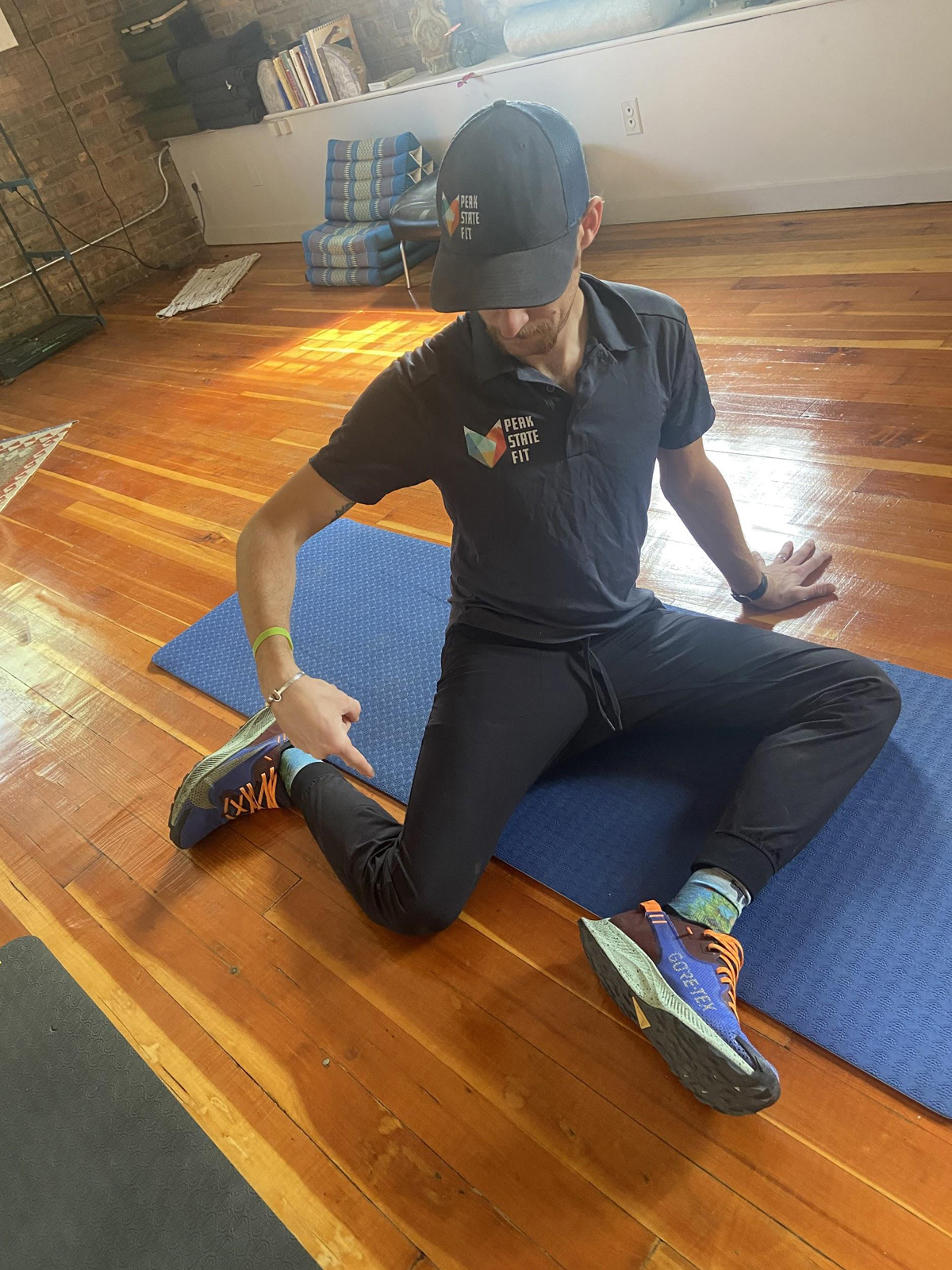
Then, without lifting the knee, raise your ankle and deepen the internal rotation of your hip.
Hold this internally rotated position for 20-30 seconds. Challenge yourself in each regressive pattern – these take control and focus!
Repeat 3X for each, alternating your progressive and regressive movements. With each progressive (P.A.I.L.s) movement, increase your effort on each set. On the third and final set, you should reach maximal contraction. After you’re finished, rehydrate and allow your body to recover. This is training!
How to start: Position your body in a “90 90 Pose” with one leg out front in external rotation (left leg in first image), and the other in an internal rotated position (right leg in first image). Begin by spending approximately 2 minutes in the starting position of each stretch. Breathe steady with a 4 count in, 4 count out. After 2 minutes, begin with a progressive contraction for 20 seconds (P.A.I.L.s). Here, you will press into the externally rotated knee into the floor. Start with a 20% contraction and progress to a 40-50% effort. Relax for 5 seconds. Photo by Heather CaseyThen, follow this movement with your regressive (opposing movement) pattern. Inhale, then on an exhale, lift the externally rotated leg up for 20-30 seconds. Photo by Heather CaseyFor the internally rotated hip now, perform a progressive contraction for 20-30 seconds (P.A.I.L.s). Here, you will press into the internally rotated knee into the floor. Start with a 20% contraction and progress to a 40-50% effort. Increase this effort for subsequent sets, starting at 30%, 40%, etc. Relax for 5 seconds. Photo by Heather CaseyThen, without lifting the knee, raise your ankle and deepen the internal rotation of your hip. Hold this internally rotated position for 20-30 seconds. Challenge yourself in each regressive pattern – these take control and focus! Repeat 3X for each, alternating your progressive and regressive movements. With each progressive (P.A.I.L.s) movement, increase your effort on each set. On the third and final set, you should reach maximal contraction. After you’re finished, rehydrate and allow your body to recover. This is training! Photo by Heather Casey
References:
Power, G. a., Dalton, B. H., & Rice, C. L. (2013). Human neuromuscular structure and function in old age: A brief review. Journal of Sport and Health Science, 2(4), 215–226. https://doi.org/10.1016/j.jshs.2013.07.001
McHugh, M. P., & Cosgrave, C. H. (2010). To stretch or not to stretch: The role of stretching in injury prevention and performance. Scandinavian Journal of Medicine and Science in Sports, 20(2), 169–181. https://doi.org/10.1111/j.1600-0838.2009.01058.x
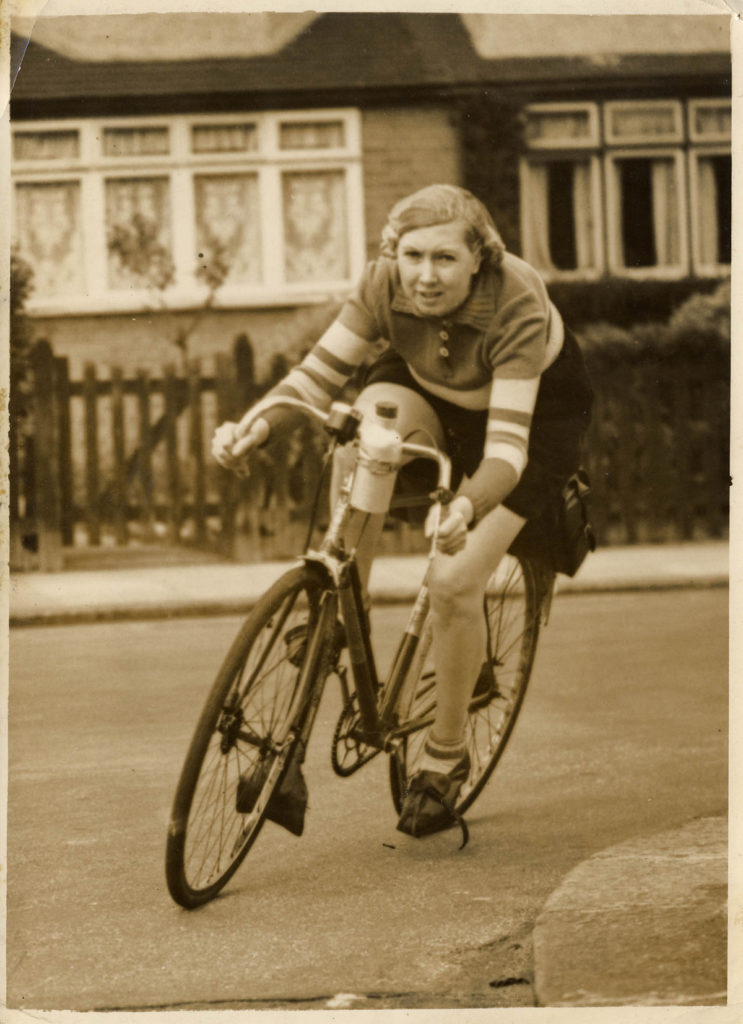
By Joe Kurmaskie — In the same vein as cycling legend Major Taylor, Evelyn Hamilton, British racing phenom, equality pioneer turned war heroine, was overlooked then nearly lost to history.
It wasn’t until, as a journalist working on another unrelated bicycling article, I stumbled upon her photo and a global literary treasure hunt was set in motion.
It would take 4 years and a brush with my own mortality before I unearthed the complete story of Evelyn Hamilton… and continue to pace her legacy across the finish line of history.
Evelyn Hamilton was one of Great Britain’s greatest cyclists. Photo courtesy Joe Kurmaskie
When, with 50 wins in six countries, the half mile sprint record and the sporting life award under her belt, Evelyn Hamilton was barred from men’s racing and the Tour de France, she attempted and completed world record setting rides, fought sexism, Nazis, and risks it all in occupied France. She lived under an assumed name and went about rescuing airmen by bike and couriering coded messages hidden in her handlebars, (she was the inspiration for Gino Bartoli’s handlebar message exploits in Italy years later) messages that might well have determined the fate of the world.
Not content to pedal with other women in long dresses and feathered hats, she becomes a sponsored racer and lover to Europe’s largest bike manufacturer, a Great Gatsby style promoter, Claud Butler. Together they conspire to make Evelyn the most decorated cyclist in the world.
She shatters the distance record of 1,000 miles in 10 days by completing it in 82 hours of in the saddle riding. The Queen of England fires the starting gun. She gets her own line of bicycles, The Miss Modern Model of 1934. She stars in Hollywood features as Gracie Field’s cycling stunt double and becomes a darling of Pathe Newsreels. She receives the unlikely support and friendship of 1925 Tour winner, Henri Pellisier, a womanizer and chauvinist who, nonetheless, sees Evelyn’s talent for what it is. Henri warns the race world, “It’s a good thing you won’t let Evelyn compete in your Tour. She’s lightning in a saddle, and you would lose.”
She climbs from lowest to highest points in the UK, 1,000 miles in 7 days. Then turns around and covers 10,000 miles in 92 days.
But her biggest ambition, the Tour de France, remains out of reach.
England’s war footing forces her to leave the bike shop she has purchased and find races in France. When the Germans invade she’s performing in the Circle Of Death Circus outside Paris. Rather than flee, Evelyn assumes the identity of a dead Bistro owner and uses the eatery to spy on Gestapo dining there. Becoming one of the heroines of the resistance by bringing downed airman to the border on a tandem bicycle and providing so much actionable intelligence that her bike shop back in London becomes a meeting place for Charles de Gaulle and Churchill.
She was fond of saying she would have left, but that was before she learned that Hitler wasn’t a cyclist.
An excerpt from my book, (Cadence Press 2019) Lightning In A Saddle, picks up the action when she is stopped at a roadblock on a quiet rural hilltop.
Northern France, August 1944
The lane curves away from farm country, a gentle climb into the forest. Evelyn recognizes this stretch from a race she’d won in 1939. Fifty firsts across six countries by then. Not allowed to compete against men, the only challenge left was the clock and herself. That race, one of the last best times spent on a bicycle before what she’d imagined would remain a regional war burned around the globe with fury and consequence.
The countryside is full and lush; a summer dress of sunflowers and fertile soil. Everything headed for harvest. The farmers know most of it will feed an occupying army, paid for with money picked from the pockets of ghosts. These truths can’t touch Evelyn when she’s in the saddle; making little circles with the pedals and feeling the breeze on her face quiets the rage. The rest seeps out on sweat and effort. Evelyn looks like any other woman on a bicycle foraging for food during wartime. Her cover story, perfected French accent and forged papers are so flawless that for a few miles she relaxes to the rhythm of the ride, finding the inside of the road.
Long shadows stretch across the lane. It’s the warm, backend of an incendiary August afternoon. At this pace she’ll be home to work the dinner service at the bistro. Roadside wildflowers sway as she crests the hill, coming face to face with a military roadblock.
A lone German solider leans against his vehicle, machine gun slung over one shoulder, at the ready, but not drawn. He crushes out a cigarette with his boot and puts up a hand. She comes to a stop, offers a smile, the one she used as Gracie Field’s stunt double for bicycling scenes during the filming of Sing As We Go. No nerves, her papers are in order and her charms never fail.
Slips of vital intel tucked inside the handlebars of her Granby bicycle still to be passed to a resistance contact – locations and schedules of troop trains. Later in the week, under a moonless sky, it might be helping an allied airman or prisoner of war escape the country on the back of her tandem.
“Guten Tag, Gladys,” the solider says. Her surprise, slight and fleeting as it is, betrays her. Though her fate has already been sealed by someone else.
Gladys is her longstanding nickname popularized in British newsreels. Betrayal. Considering the solider’s presence on the road with such specific information, this is the only plausible explanation. A hulking specimen of Hitler’s war machine, well over 6 feet, he offers a nod and a satisfied grin.
It strikes her funny, looking back across the valley, that those were the last few curves of her life before the road has likely come unwound for good.
She stalls by asking for one of the soldier’s cigarettes. She doesn’t smoke, but if he gives one up it will indicate how little he fears her. Still grinning, he reaches into his trousers and produces the whole pack.
“Danke,” she says, coy, steady. She offers him one of his own back. He accepts it, lighting them both in a cruel mystery dance of civility. They stand in the middle of the road, smoking in silence. This can only play out a few ways, none of them good. Either he will shoot her somewhere in the forest behind them and leave her body, or take her in for questioning. There will be torture, perhaps rape, then she’ll be shot once they have what they need, or, and this is best the case scenario; questioning, torture, a train ride and slow march to death by way of concentration camp.
Or she could run.
“Does it end here, or later?” she asks.
He grins. “Do I call you Gladys or Evelyn?”
“My friends call me Gladys.”
He tips some ash. “Then Evelyn it is.”
Evelyn debates whether she wants a bit more life as a prisoner or risk dying in the next few seconds… by taking her only real shot at freedom.
She chooses to act. Timing will be everything. She wears her hair in a bun to conceal a small pistol. She’ll need to cock it in a single, fluid motion – the reach up masked as casually playing with her hair – then draw and shoot before he finishes his smoke. And hope beyond hope he isn’t able to get the nose of the machine gun up and aimed… while her aim has to be true. She’s practiced this move countless times, but it’s a very different animal in the wild.
How quickly reality can grow teeth.
Evelyn crushes out her cigarette, blows a long, smokey sigh and offers her most inviting smile. She puts everything behind it, sex and longing and a touch of sadness, men adore the myth of the sad, vulnerable woman. If she can cloud his judgement, even for a moment, get him out of his head to a place of heat and lust and…
As he raises the cigarette to his lips, she glances at her bicycle, presumably for the last time. Feeling the miles still left in her legs, Evelyn Hamilton reaches, cocks, draws and shoots…
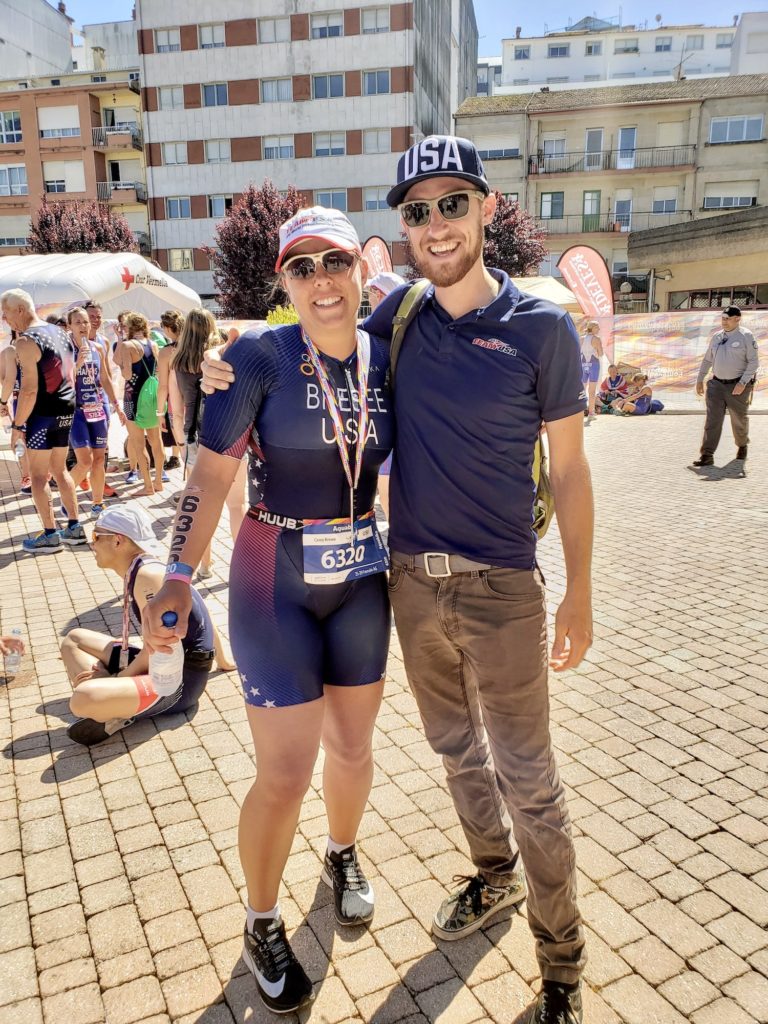
SALT LAKE CITY, Utah (October 11, 2021) — USA Triathlon has named Coach Pat Casey of Salt Lake City to serve as Team USA’s Head Coach for athletes attending the 2021 World Triathlon Duathlon Championships. The event will take place in Aviles, Spain, on November 6-7.
Photo courtesy Peak State Fit
Over 1500 participants representing over 35 countries compete in the Elite, Junior, Para, and Age Group events. King Felipe VI was named Honorary President of the Duathlon World Championships.
Photo courtesy Peak State Fit
Included events are Sprint/Draft-Legal Duathlon and Standard Duathlon, along with ParaTriathlon and Elite races. Coach Pat Casey will lead athletes through course reconnaissance, rules of the event, transition areas, and features of the course athletes should be aware of before racing.
This will be the third World Championship Pat has served as Head Coach for Team USA.
Biggest mountain bike stars compete in Utah this Friday down steep cliffs.
Brandon Semenuk riding the course during the Red Bull Rampage in Virgin, Utah, USA on 10 October, 2021. Photo courtesy Red Bull Content Pool
Red Bull Rampage has built up a reputation as the Super Bowl of the extreme sports world with the best mountain bike stars just happy to get down the course safely as the 2021 edition launches this Friday on the ochre-colored cliffs of Virgin, Utah, USA. Here is all you need to know:
The only worldwide event that comes close to Red Bull Rampage is winter’s daunting Natural Selection Tour that sees backcountry freestyle snowboarders take on nature’s biggest lines, with the most extreme and intense mountain bike test thrilling fans since 2001 – the 2021 event this week, its 15th edition as well as the 20th anniversary.
Unlike the traditional mountain bike slopestyle course of wooden ramps and smooth terrain, Red Bull Rampage is more of a freeride event that takes place on loose ground that offers hardly any grip with riders using robust downhill bikes boasting a lot of suspension and large tires.
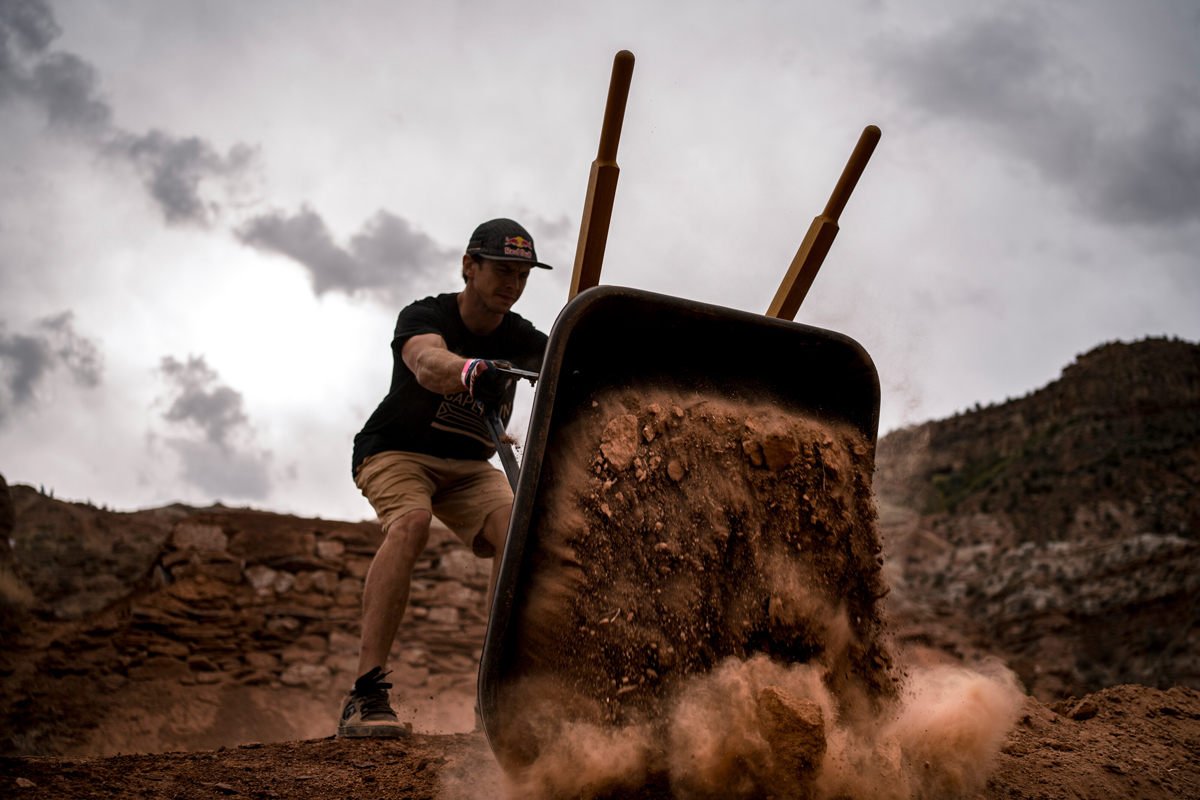
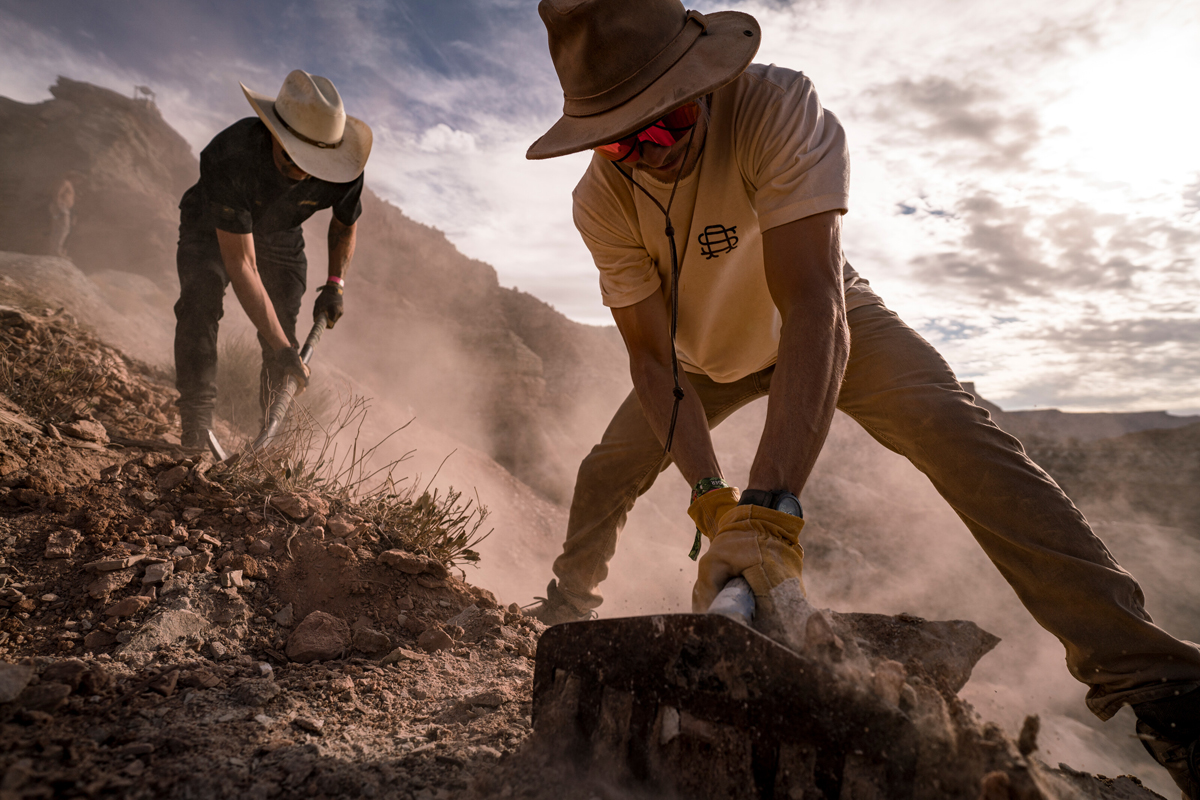
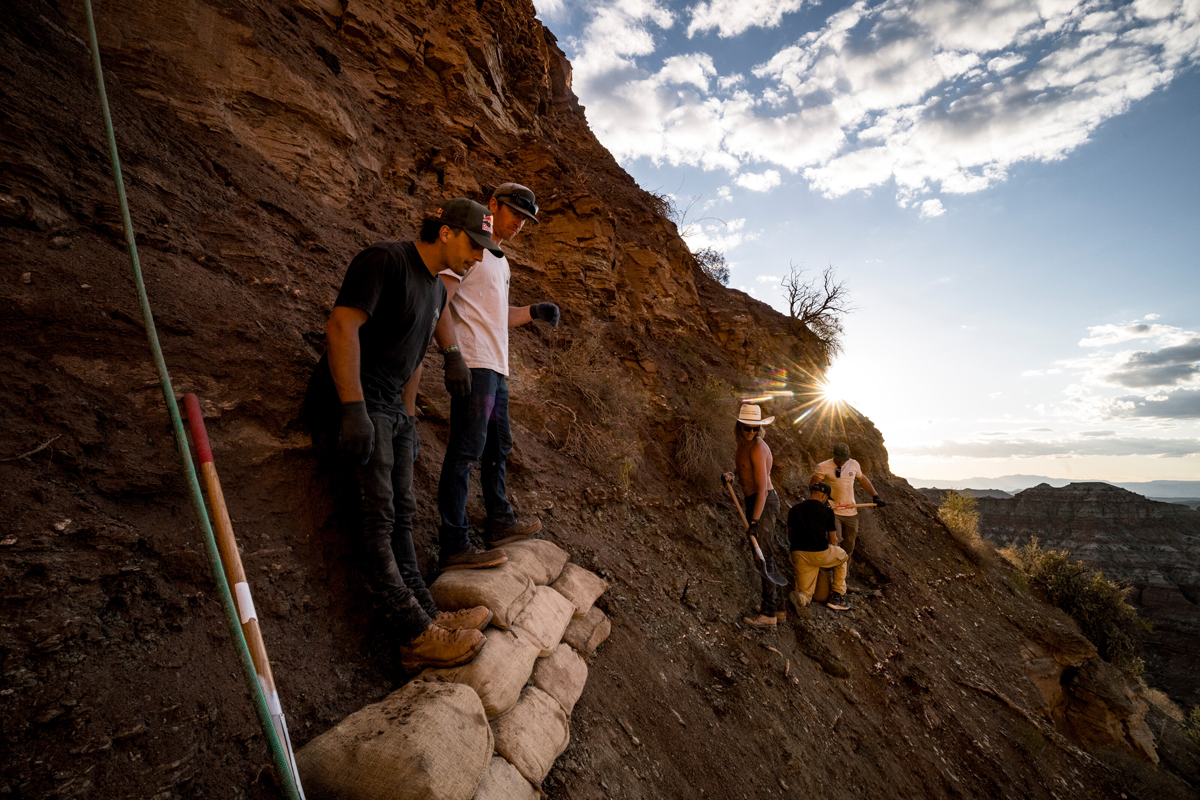
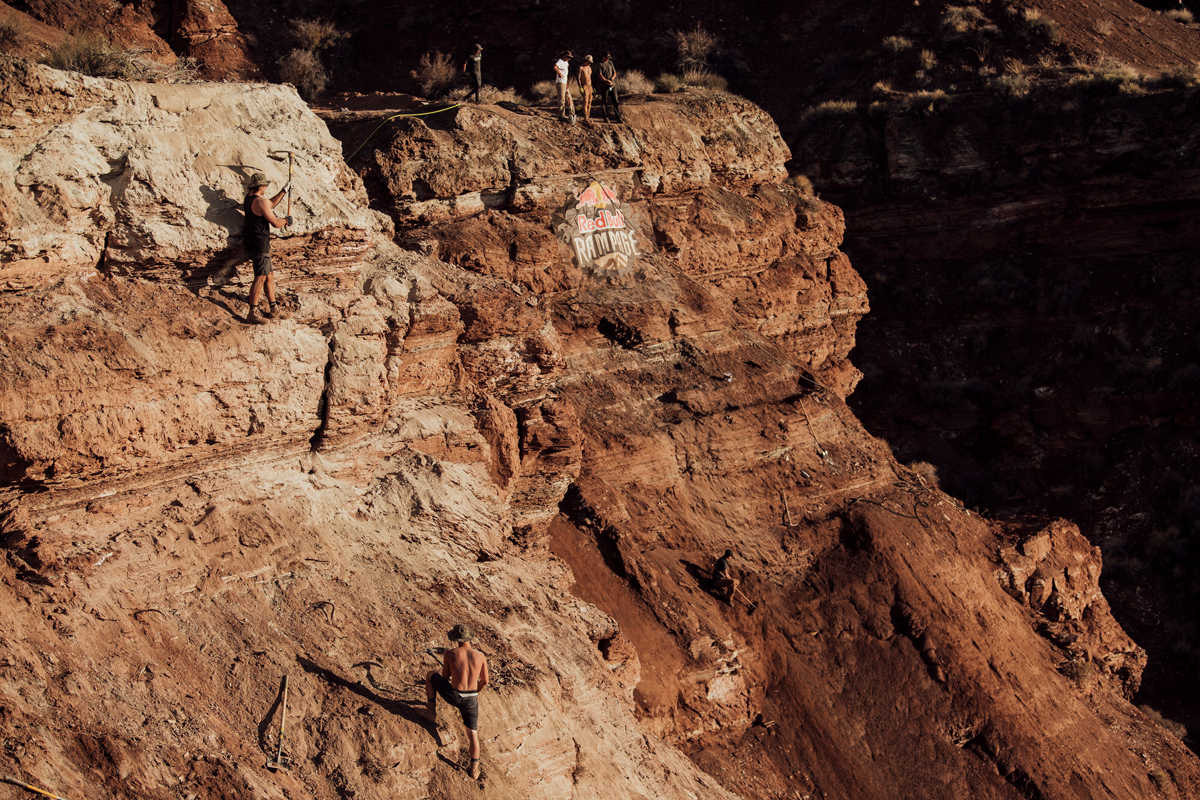
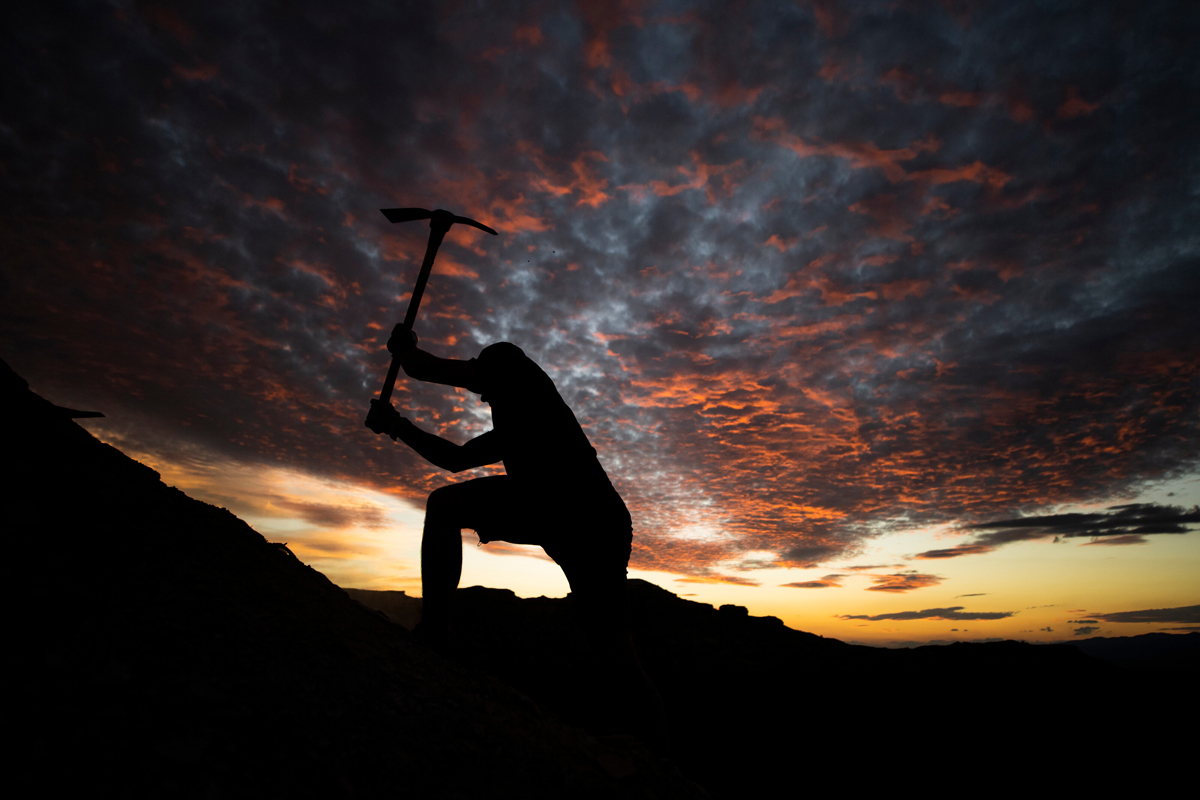
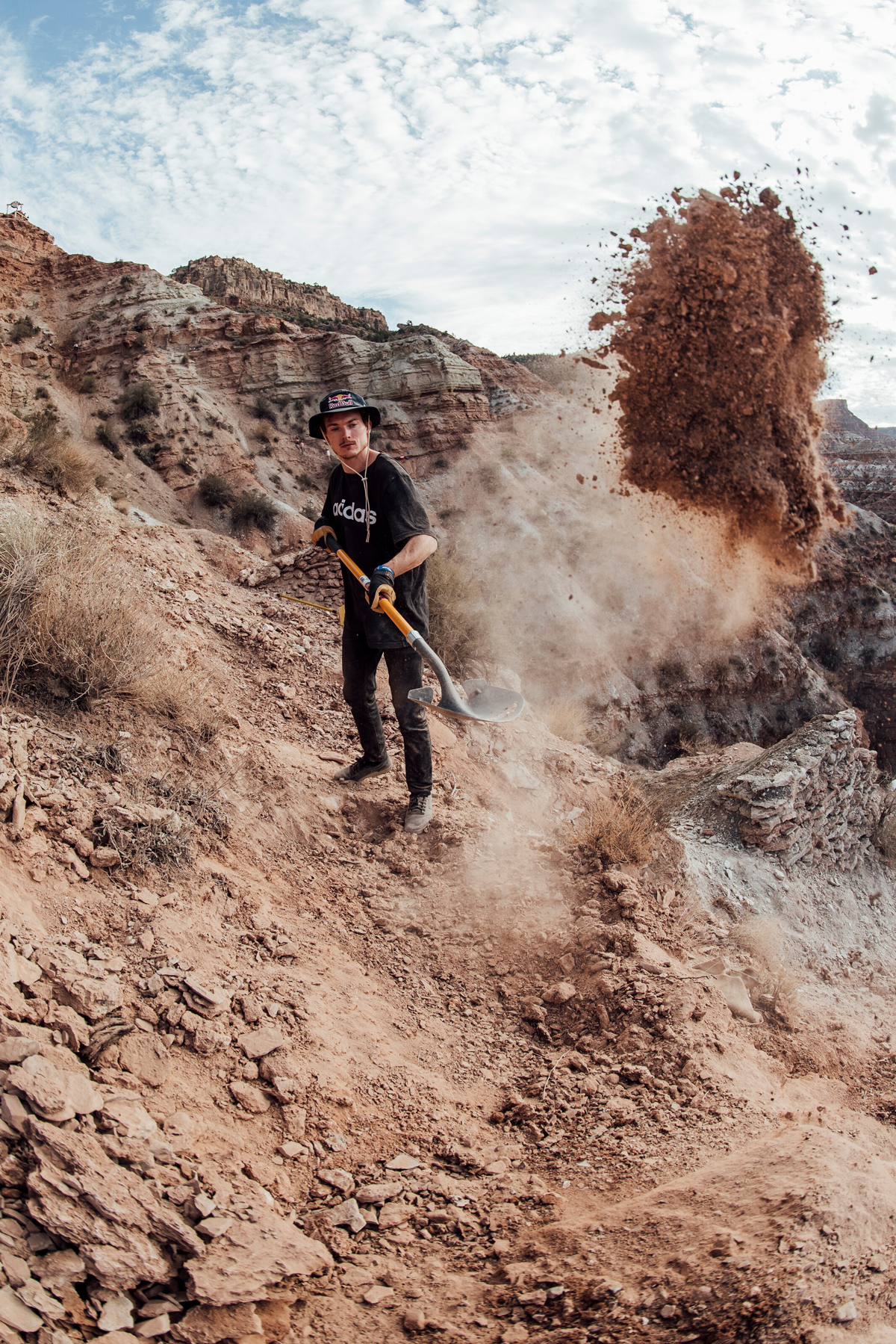
Riders and their small dig team can craft the natural terrain for their lines within the marked area over the first four days with shovels, picks and 75 sandbags before a rest day and then a further four days to practice.
The riders have two runs of three minutes each to impress the judges with riders scored throughout on difficulty level of the line, tricks and style, fluid and control and finally altitude over the breathtaking cliffs, dizzying exposure and almost vertical gullies that connect the lines.
Flash flooding hampered the riders and their dig teams last week with the wind often making the event even more hazardous on race day as they carefully pick their routes down the exposed, meandering mountain.
Red Bull Rampage has conjured up some classic moments over the years such as Kyle Strait’s 2004 no hander trick, Cam Zink’s 360 trick in 2010 and Antoine Bizet’s first double backflip during the 2016 edition.
Two years ago, 21 riders saddled up at the top of the steep and rugged mountain slope with Canadian Brandon Semenuk collecting his third Rampage title from compatriots Brett Rheeder and Tom van Steenbergen.
A stacked field of 15 has returned to compete with the best 10 from 2019 joined by five wildcards selected by a committee of former Rampage participants, professional athletes, judges and experts.
Semenuk, fellow three-time champion Kurt Sorge, two-time winner Strait and former winners Zink and Andreu Lacondeguy line up with Canadian Van Steenbergen and Poland’s Szymon Godziek also out to excite.
2021 Red Bull Rampage riders
Pre-qualified athletes:
Szymon Godziek (POL)
Tyler McCaul (USA)
Ethan Nell (USA)
Brandon Semenuk (CAN)
Carson Storch (USA)
Kyle Strait (USA)
Vincent Tupin (FRA)
Tom van Steenbergen (CAN)
Wildcards:
Andreu Lacondeguy (ES-CT)
Jaxson Riddle (USA)
Kurt Sorge (CAN)
Brage Vestavik (NOR)
Cam Zink (USA)
Replacements:
Thomas Genon (BEL)
Reed Boggs (USA)
Watch Red Bull Rampage on Red Bull TV this Friday HERE.
Photo Gallery
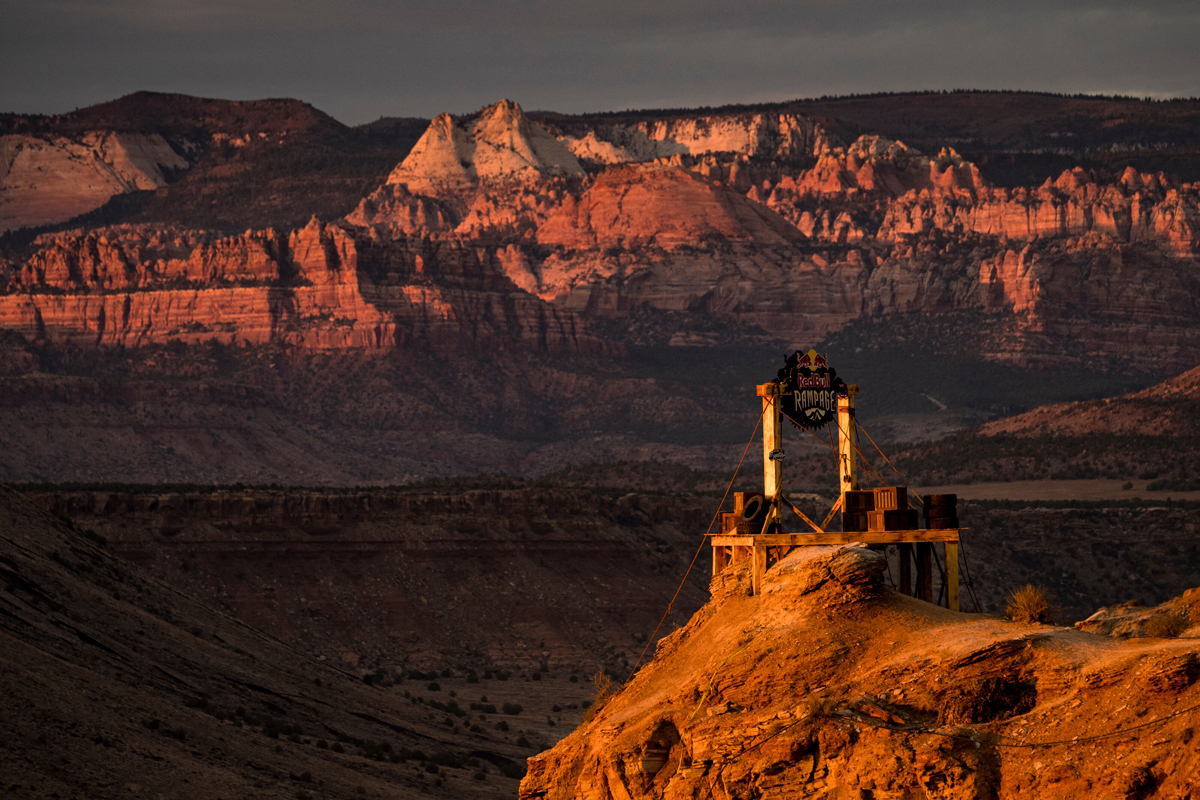
Event Competitors at registration during the Red Bull Rampage in Virgin, Utah, USA on 5 October, 2021. Photo courtesy Red Bull Content PoolSzymon Godziek digging and prepping the course during the Red Bull Rampage in Virgin, Utah, USA on 7 October, 2021. Photo courtesy Red Bull Content PoolLast light on the start gate during the Red Bull Rampage in Virgin, Utah, USA on 7 October, 2021. Photo courtesy Red Bull Content PoolDiggers prepping the course during the Red Bull Rampage in Virgin, Utah, USA on 7 October, 2021. Photo courtesy Red Bull Content PoolCarson Storch scouts his line during the Red Bull Rampage in Virgin, Utah, USA on 9 October, 2021. Photo courtesy Red Bull Content PoolBrandon Semenuk performs at Red Bull Rampage in Virgin, Utah USA on October 10, 2021 Photo courtesy Red Bull Content PoolDiggers seen at Red Bull Rampage in Virgin, Utah USA on October 10, 2021. Photo courtesy Red Bull Content Pooluse only //Digger at Red Bull Rampage in Virgin, Utah USA on October 10, 2021. Photo courtesy Red Bull Content PoolBrandon Semenuk riding the course during the Red Bull Rampage in Virgin, Utah, USA on 10 October, 2021. Photo courtesy Red Bull Content PoolJaxson Riddle rides the course during the Red Bull Rampage in Virgin, Utah, USA on 10 October, 2021. Photo courtesy Red Bull Content PoolTyler McCaul rides the course during the Red Bull Rampage in Virgin, Utah, USA on 10 October, 2021. Photo courtesy Red Bull Content Pool
MUNICH, Germany (12 October 2021) — After a long season that saw him ride two Crankworx events, Red Bull Roof Ride, Red Bull Hard Line and Loosefest Malmedy, Thomas Genon is about to ride Red Bull Rampage as the conclusion to his year. He talks about his thoughts and objectives ahead of his 8th consecutive participation in the biggest freeride MTB event in the world. Watch it live on Red Bull TV on Friday: https://www.redbull.com/int-en/events/rampage.
Thomas Genon rides at Red Bull Rampage in Virgin, Utah, USA on 23 October, 2019. Photo by Garth Milan/Red Bull Content Pool
How do you feel for your return to Red Bull Rampage after the cancellation of the event in 2020?
I’m really glad to have the opportunity to come back and show what I can do. The last time I rode, in 2019, I crashed and didn’t manage to do what I set out to achieve. It was frustrating not to be able to wipe that memory the following year; it’s so much better when Rampage goes ahead! Now we’re back to a site we’ve already used, the last time in 2017, we will be able to reuse some of the old lines but the line crossings will also make it difficult to be very creative.
It’s already your 8th Rampage in a row, with only a few riders having more consecutive entries that you do. Is it special for you?
I think Rampage is one of those events where the first thing you need is experience. The more you have, the better you ride! I learn a little bit more every year.
You’ve mixed up slopestyle, downhill and freeride a lot this season, with your first Red Bull Hardline participation and big freeride sessions in Belgium. How was it?
It’s been one of the best summers of my life on the bike! It was amazing to have so many new goals. I had loads of fun and made a lot of progress on my downhill bike.
What’s your objective for Rampage?
The most important thing for me is to create a line that will put together all my skills in an optimal way. It’s always tough to find the balance, even more so when it all depends on what you will find on site. I have to American builders to help me, Dylan and Scotty. Dylan is a Utah local so that’s great. My main goal will be to create a line I will be happy with and ride as well as possible.
Is it the highlight of your season?
Every year Rampage becomes a little bit more important to me. I have the feeling that I truly can express myself here. I love to be able to combine freeride and slopestyle. Showing what I can do at the highest level of both disciplines at the same time makes me very happy.
You received a last-minute invite for this year’s edition, how did it affect your preparation?
The invite came in when I already was in Canada for Crankworx which I had been focusing on for a while already. Of course, I would have loved to ride a bit more in Utah before Rampage but I’ve done so much on the downhill bike this summer that I feel ready!
October 15 — Red Bull Rampage, Virgin, UT, Downhill, slopestyle and freeride MTB athletes will converge on the demanding terrain of Virgin, Utah to compete for glory in one of the biggest tests of skill and guts in the world., redbull.com/us/en/bike/events
Thomas Genon performs at Red Bull Rampage in Virgin, Utah on October 26th, 2018. Photo by Bartek Wolinski/Red Bull Content PoolThomas Genon performs at Red Bull Rampage in Virgin, Utah on October 26th, 2018. Photo by Bartek Wolinski/Red Bull Content PoolThomas Genon rides during the Red Bull Rampage in Virgin, Utah, USA on 26 October, 2018. Photo by Peter Morning/Red Bull Content PoolThomas Genon rides at Red Bull Rampage in Virgin, Utah, USA on 23 October, 2019. Photo by Garth Milan/Red Bull Content PoolThomas Genon practices at Red Bull Rampage in Virgin, Utah, USA on 24 October, 2019. Photo by Peter Morning/Red Bull Content PoolThomas Genon comptes at Red Bull Rampage in Virgin, Utah, USA on 25 October, 2019. Photo by Peter Morning/Red Bull Content PoolThomas Genon and friends at rider registration during the Red Bull Rampage in Virgin, Utah, USA on 5 October, 2021. Photo by Christian Pondella/Red Bull Content PoolThomas Genon scouts the venue during the Red Bull Rampage in Virgin, Utah, USA on 5 October, 2021. Photo by Christian Pondella/Red Bull Content PoolThomas Genon poses for a portrait during the Red Bull Rampage in Virgin, Utah, USA on 6 October, 2021. Photo by Christian Pondella/Red Bull Content PoolThomas Genon performs at Red Bull Rampage in Virgin, Utah USA on October 10, 2021. Photo by Bartek Wolinski/Red Bull Content PoolThomas Genon seen at Red Bull Rampage in Virgin, Utah USA on October 10, 2021. Photo by Bartek Wolinski/Red Bull Content Pool
By J. Ty Hopkins — As a cyclist and exercise scientist, I’ve always been curious about the limits of the human body. How fast can it go? How much work can it do? How far can it go? How much recovery does it need? To what extent can it repair itself? Those are questions that are extremely difficult to answer, but over time, I’ve learned a little about what my body and mind can do.
When I was younger, I really wanted to be fast. That was all that mattered. Everything was a race, and riding a bike was no different. I raced road, cross country mountain, and cyclocross. I also ran 5k and 10k races and muddled my way through the swims only to get to the bike portions of various triathlon events. My body and mind seemed to accept the high intensity, but one thing made all of these races exhausting: the starts. I stressed about the fast starts and the high tempo. I wanted the racing without the stressful starts
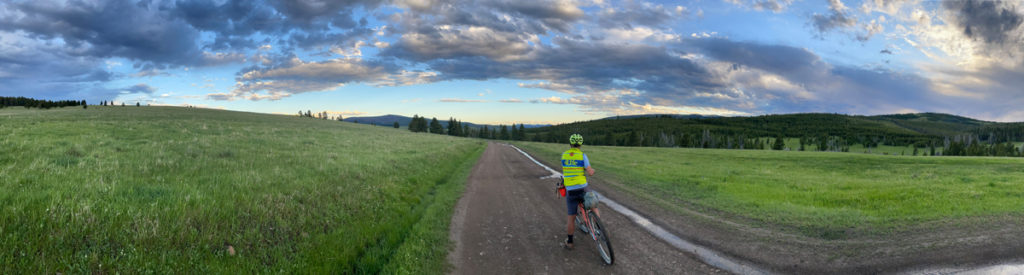
The GDMBR often crossed and paralleled the Continental Divide Trail. 2021. Photo by Ty Hopkins
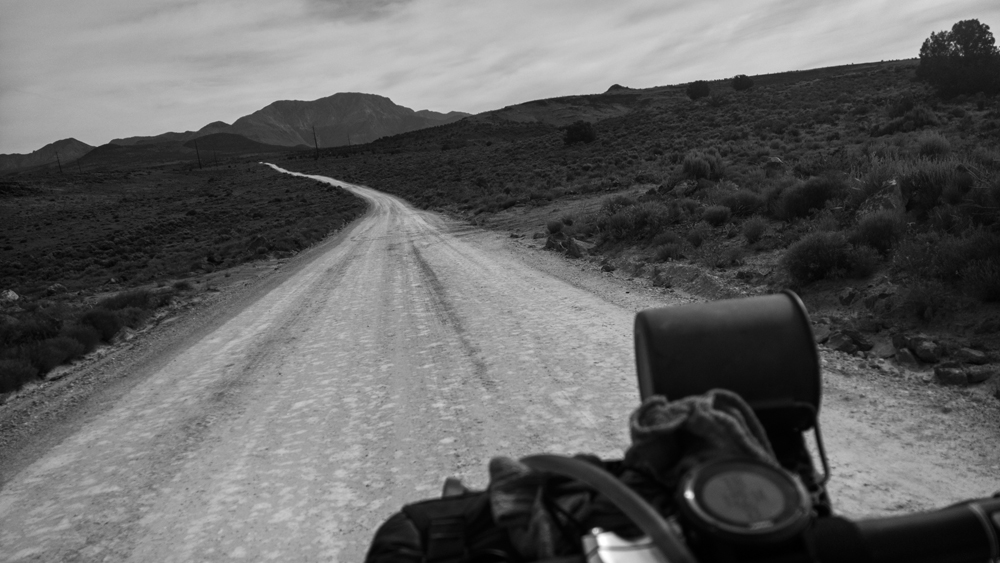
In 2010, I happened on a piece in Outside magazine with the catch phrase, “The Hardest Bike Race in the World is not in France.” I bit. The article talked about an underground genre of bike racing: ultra-racing or bikepacking. The events are self-supported: no aid stations, no support from other people, no entry fees, and no prizes. Each rider is expected to follow a specific route, over long distances, while providing your own support. The granddaddy of these ultra-races is the Tour Divide (TD), which follows the Great Divide Mountain Bike Route from Banff, Alberta, Canada to the Mexican border crossing at Antelope Wells, NM (2700+ miles). The route is mostly dirt, loosely following the continental divide, with a couple hundred thousand feet of climbing.
Between my sense of adventure and my desire to transition away from “fast” races to long races, I was hooked. I started riding longer, pushing my body to incremental extremes. In 2013, I raced the Colorado Trail (CTR). It was brutal, and more than I was prepared for. I finished, but the race left multiple marks on my psyche. For almost a year after the CTR, I wanted nothing to do with ultra-racing, but gradually I realized the vast amount of satisfaction that came from that adventure. As the pain faded, my enthusiasm grew, and I started thinking more about the incredible sights and feelings I experienced. The Tour Divide had my full attention.
Ty Hopkins on the Great Divide Classic ride 2021. Photo by Adam Lisonbee
Over the subsequent years, I started focusing on what it would take to race the TD. I studied bikes and gear. I constantly read about the route and others’ experiences on the route. Most importantly, I started increasing my training volume. I continued to ride with friends and race local events. Additionally, I looked for ways to start feeling comfortable riding all day and for multiple consecutive days. I commuted to and from work on bike over the Alpine loop, a 2.5 hour ride with almost 4000’ of climbing. I tried to plan day-long rides a several times a month, and most importantly, I looked for multiday routes. These rides allowed my body to adapt to the rigor of 16+ hours in the saddle, on a loaded bike, for multiple days. They also allowed me to test gear and prepare my mind for the inevitable physical low points that come from pushing the body. Another major advantage was seeing so much of the remote intermountain west on a bike. I rode fantastic routes in the deserts of Utah, Sawtooth mountains of Idaho, the Sierras in California, the San Jauns of Colorado, and the mixed terrain of Arizona. Each of these adventures taught me about my body and my mind, allowing me to slowly accept the idea of longer distances and bigger adventures.
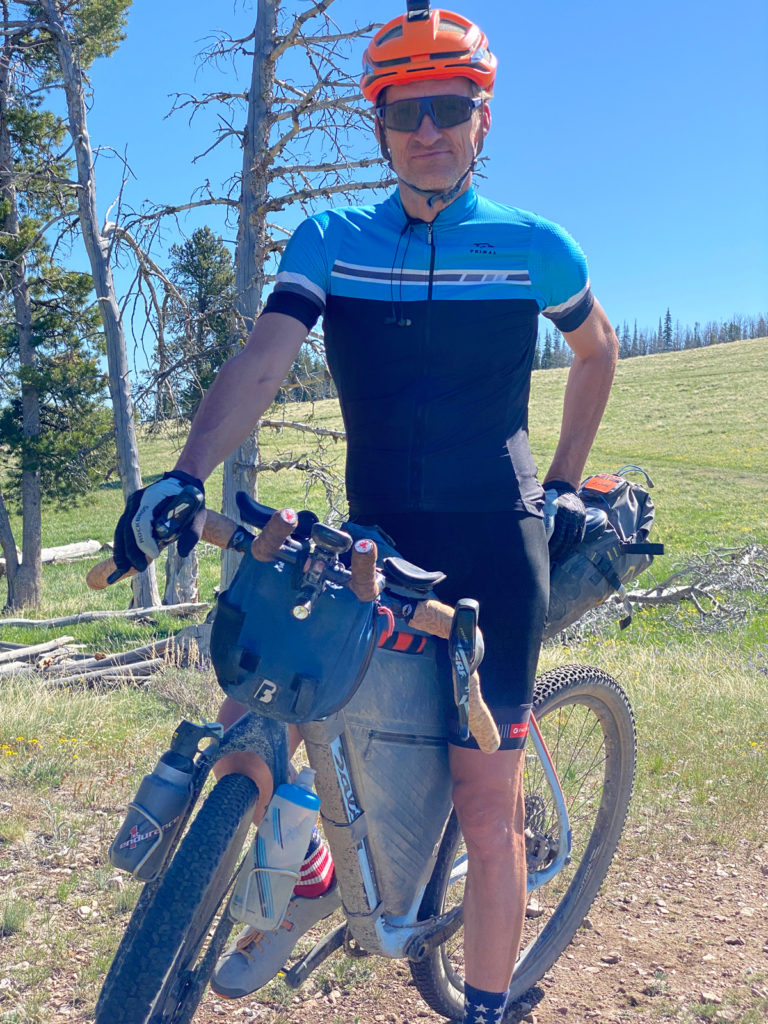
In 2017, it was time to attempt the Tour Divide. At this point I had trained for several years, and I felt I was ready both physically and mentally. I was not. After pushing hard for 6 days, I withdrew from the race in Lima, MT. My knees and achilles were both extremely swollen and painful making every pedal stroke excruciating, and my grandfather, with whom I was very close, passed away during the race. I had raced well, finding myself in the top ten over those 6 days, but I was also devastated by my early exit. To give an idea of what a single day was like on the TD, here is an excerpt from my journal of the 2017 race:
Day 2: Fernie, BC – Tuchuck CG, MT (150mi, 12,500’)
After tossing and turning and dosing for a few hours, I rolled out of bed, packed up my drying gear, and was out the door by 5:00am. I made a stop at the 7-11, loaded up for a big push to the US border, and headed out of Fernie as the sun was just beginning to show some life. It looked to be a beautiful day. I stopped by the bike shop, which had a convenient hose for washing the bike, and gave my bike a little cleaning and lubing. The pavement turned to gravel and the climb went on and on. I ran into Andy from Boise pulled over on the side of the road, fiddling with his bike. Andy and I rode together for part of the Smoke-n-Fire race in Boise earlier in the fall, and I was hoping we could ride some more when I caught him. Unfortunately, he was having derailleur issues, and he decided to roll back into town and wait for the bike shop to open. I never saw Andy again, but he had a strong finish. I pushed on up the climb, with the views becoming more and more spectacular. Once I reached the summit of the climb, the sun was finally coming over the peaks just in time for a smoking fast descent. I loved the mornings: the anticipation of the sun, the process of getting my legs, and the serenity of solitude in some of the most beautiful places on earth. My knees and Achilles took some time (and Tylenol) to warm up and feel OK. I knew this was going to be something I was going to have to manage and be smart with over the days ahead. My knees would scream at me during the steeper parts of the climbs, and my Achilles were stiff and sore in the mornings and again in the evenings. “All part of the experience,” I rationalized.
Around lunchtime I stopped at Butts cabin for a break and some food. There were signs of people around, as evidenced by a couple trucks, but I didn’t see anyone. As I finally got on my bike to head up the road, some guys pulled up near me in their truck. The exchange was pretty funny:
Big Truck Guys: “You’re not going down that road, are you?”
Me: “Uhhh, yeah.”
Big Truck Guys: “Are you carrying a gun?”
Me: “Bearspray.”
Big Truck Guys: (Laughing hysterically for 30 seconds, finally stopping, catching their breath) “Well, you can go down there if you want to, but there’s a Grizzly with her cub in that field, and she’s not going to be happy to see you.” (now talking to me with a lecturing tone)
Me: “Hmmm, ok. Thanks.” (I start to ride up the road)
Big Truck Guys: (Yelling from their truck) “Hey, didn’t you hear me! What are you stupid!?”
Me: (Waving, but not turning back to look at them) Now I’m thinking to myself, yep, I am stupid.
I never saw the bear, and I wondered if they were just messing with me, but what was I going to do? Turn around and go back to Fernie? I didn’t have an option but to go forward. During the days, I was never scared of possible bear encounters, but I must admit, riding at night did have me freaked out at times. More on that later.
Not long after this, Thomas caught me, he looked like he was doing well, and this gave me a chance to ride with someone for a while. I picked it up a little, and we chatted. We spent quite a bit of time together over the first 4 days. He was a good dude: easy to talk to and we both liked bikes – what more could you want? The scenery through this area was amazing. The dirt roads were also great, and we crossed a number of really nice bridges that seemed too nice for an area that appeared to get no traffic. We eventually made our way onto a fast double track in a forest of small firs. This is when I stumbled on my 1st black bear, which took off like a bolt of lightning as soon as we came around the curve into view. We were within 50 feet of the bear, and the fact that it took off so quickly was confidence boosting to me.
Eventually, I made it to “the wall,” a relatively short hike-a-bike that requires some serious pushing and lifting. I muddled my way up the steep, muddy game trail that connects to another double track and eventually a dirt road leading up and over the last pass in Canada. The wall wasn’t as bad as some had suggested, but it was a little different than I anticipated – wetter. Eventually I got over Galton pass, where just a little bit of snow still covered the roads at the top and descended the dirt road to the border crossing. I saw one more black bear on the descent, which took off as soon as it saw me. Another boost for my bear confidence.
The border crossing was funny. The border agent was trying to convince me that the TD didn’t start until the following week. I tried to assure him that it had indeed started, but I finally gave up and told him to have a great day. I called Holly for the 1st time after crossing the border. I talked to her as I rode the back roads into Eureka, MT. It was good to talk to her and hear about all the people following me and cheering me on. It made me feel that there was another level of motivation that could keep me going when the days got long. I was spent and ready to sit down for a little while. I was trying to resist the urge to stop in Eureka for the night.
I reached Eureka, MT around 7pm, stopped at the convenience store and Subway, and tried to force down some food. For me, eating is difficult over the 1st few days as my body tries to deal with the physical demands, lack of calories, and how both affect my GI system. I managed to gag a foot-long sandwich down, and I loaded up on stuff I thought I might want to eat over the next day (chips, nuts, candy, pastries, etc.). Thomas came in to eat as well. He talked about stopping at the south end of town at a campground, but I had my sights set on Sondressen community center, another 45+ miles and a big pass (Whitefish Divide) to go. As I headed out of town along some more back roads, one of my brake pads was rubbing. For some reason, I tend to get irritated by such things, but I never want to stop and fix it. Finally, I decided to stop and adjust my front brake. Sure enough, I overtightened the torx 25 bolt and snap, the tip of my t25 wrench broke off in the caliper. Immediately I felt like I just ruined my race, but I was able to calm down and reason that it would be ok – well as long as I didn’t need a t25 wrench.
I crossed the highway and started toward the Grave Creek road which climbs up Whitefish Divide. I could see there was a storm brewing in the mountains, and I wasn’t looking forward to riding into it as the sun went down. As I was making my way up the last of the pavement, an old pickup was coming down slowly, looking at me. For some reason it made me nervous, and it made me even more nervous when the pickup turned around and started back up towards me. I was thinking this is where Josh Kato had gotten run off the road the previous year. Instead, the guy rolled up beside me and asked if I was part of the TD. Turned out, he was following the race in his truck, and he hoped that one day he could do it on a bike. We chatted. He wished me well and continued up the road. I stopped at a pavilion at Birch Creek pavilion at the end of the pavement. I sat there as it started raining, and I thought this would be a good place to sleep; dry and seemingly safe, but it was still light. I sat there for 20-30 minutes trying to convince myself to keep going when I saw Thomas ride by. That was all I needed. I put on my raingear and took off after him. It was wet and getting colder, but at least I could ride with someone. The last hour or so of daylight went quickly, and before we knew it we found ourselves in the middle of nowhere. Avalanche debris covered the road in places, and it was obvious that this area had not yet recovered from winter. To make matters worse it was getting hard to see as the sun was fading. It was at this point that Thomas said, “oh crap,” and came to an abrupt stop. I looked up, and had the same reaction as my stomach immediately felt sick. About 100 yards in front of us was the biggest grizzly I had ever seen – maybe the biggest animal I had ever seen. I starting thinking about my options. The road was such that there was no place for the bear to go – vertical cliffs to our left and a big drop down to a stream on our right. The bear was moving up the road the same direction we were going, but it didn’t look like it was in any hurry to get away from us (unlike the bears I had already encountered). I considered going back to the pavilion at Birch Creek campground, and if I was by myself I may have, even though I had already gained many miles and well over 1000’ of elevation since the pavilion. We decided to get off our bikes and walk, bear spray in hand, and start blowing our whistles. So, that’s what we did, trying to keep our distance and still maintain visual contact, which was getting harder as it got darker. We did this for about 15-20 minutes. I’m pretty sure it wasn’t that great of an idea. When I told this story to my colleague, Tom Smith, a bear biologist, he just shook his head in disapproval. Every couple minutes, the bear would pause, turn, look at us, and continue to saunter up the road. I imagined the bear thinking to himself as he looked at us, “should I go eat them? Ugh, it’s just too much effort, and they smell really bad.” I was biting and blowing the whistle so hard that my jaw hurt and my ears were ringing, but I was wired. The adrenaline was flowing at high levels. Eventually it got too dark. We couldn’t see the bear anywhere. When we came to the next avalanche debris shoot over the road, we didn’t see any tracks in the snow. Now I was even more spooked. I had no idea where the giant grizzly was, and there was no way I would see it coming at me in the dark. In a panic, I put on the rest of my lights, we got on our bikes and started riding. As we crested the summit I stopped to add more layers, constantly looking all around me for the killer bear. I was soaking wet, it was cold, and now I was about descend, still freaked out by the bear encounter. With that said, I was ready to go fast and take advantage of the descent. I took off, still blowing my whistle. Not 5 minutes into the descent, another bear ran out onto the road 20-30 feet in front of me. I was so stiff and cold that I didn’t even stop. Instead, the bear was running down the road in front of me, eventually peeling off the road. Once I got far enough down the road, away from where the bear peeled off, I stopped. I was definitely in a bad place mentally. I was a basket case. Physically I was exhausted and really cold. I finally coaxed myself back onto the bike and slowly inched my way down the descent. What should have been a screaming descent, turned into an agonizing slog. I was done. Around 11:30 we rolled up to Tuchuck, a primitive campground. I wandered around looking for shelter. I had no intention of sleeping outside. It was an answered prayer to find a relatively clean toilet block. I have never been so happy to see a primitive campground toilet. I gagged down some food, rolled out my sleeping bag, and hunkered down with my head next to the base of the toilet and my feet wedged against the door. Between the sewage gurgling from under the floor and the image of an Uncle Buck style bear entrance, I didn’t sleep much; but I was warm and safe.
In 2018, I returned to Banff for another TD attempt. I learned from my failed 2017 attempt. I had done a fair amount of eccentric training for my knee and Achilles issues, made a few adjustments in bike fit, reduced the overall volume of my training, and had the previous years’ experience to draw from. I wanted to push myself, but stay away from expectations. While the 2018 race was not without mistakes and issues, it was a great success. I completed the 2725 mile route in 16 days and 7 hours, placing me 4th overall in a field of approximately 200. It was an incredible adventure, but incredibly hard and at times, lonely.
In addition to successfully completing the route, my colleagues and I collected data on what happened to my body over the 16+ days. My circulatory system, immune system, and GI system took a significant hit. Systemic inflammation was also extremely high. The extreme workload, limited sleep and recovery, and poor nutrition took its toll on the body. That said, there were measured adaptations to muscle that signaled a shift towards efficiency in energy production and increase in force production. In other words, while the body broke down to some extent, it also adapted in a pretty incredible way to keep the legs turning.
The story of my 2018 TD adventure and a complete breakdown of what happened to my body are documented in my book, “Just Ride.”
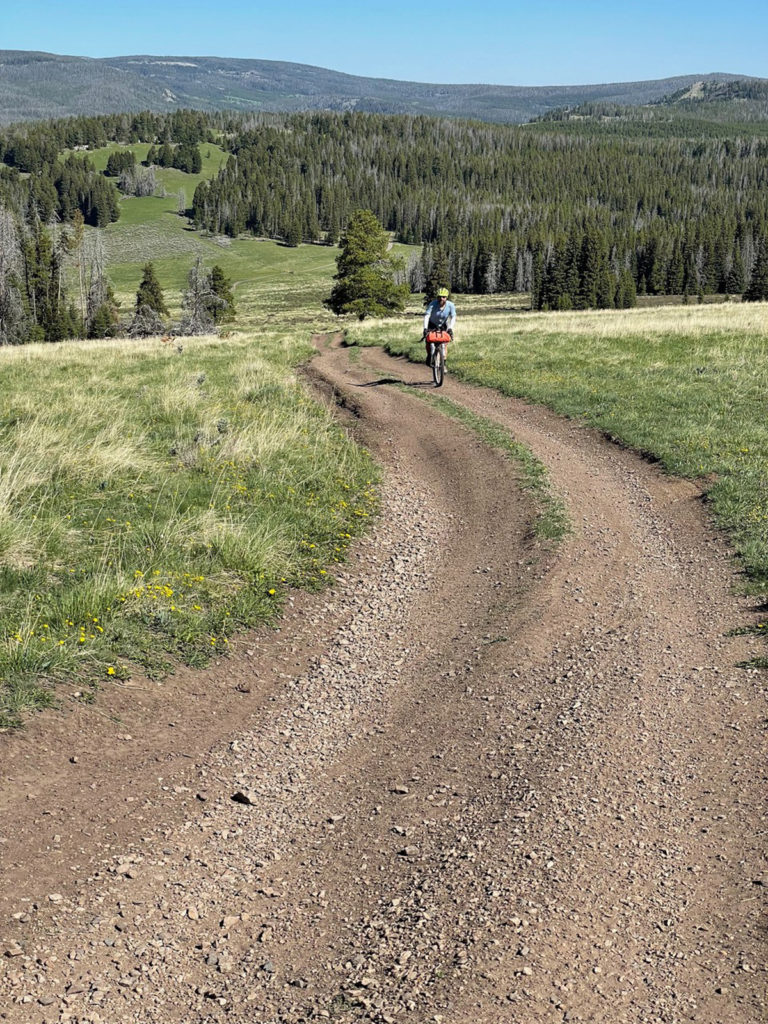
Adam Lisonbee taking in “Big Sky Country” north of Helena, MT. 2021 on the Great Divide ride 2021. Photo by Ty Hopkins
Following 2018, I continued to ride and train. I rode the Arizona Trail and the Colorado Trail as well as several other multiday routes, but it was hard to get the TD out of my head. The route is so big and beautiful. It offers a variety of people, landscapes, and challenges. Every turn on the trail is an adventure. I missed it, and I wanted to go back. Additionally, my good friend Adam Lisonbee, wanted to go back and ride the route. So, we decided we would ride it in 2020, BUT we do so at a pace that allowed us to appreciate the route more and meet more people on the route. In other words, we would ride the route a little slower.
The 2020 TD was cancelled, so we pushed to 2021. The 2021 edition of the race was complicated by the Canadian border remaining closed. So, the 2021 edition would be a border to border (no Canadian section) route, called the Great Divide Classic (GDC), commemorating the original route prior to the Canadian section. The route still followed the continental divide through Montana, Idaho, Wyoming, Colorado, and New Mexico for approximately 2500 miles.
I must admit, I did not take a serious approach to the 2021 GDC. I didn’t train as much, I already had my gear dialed, and I had been on the route several times. After all, I planned to slow down and enjoy the route and the people. This was a mistake. Good preparation makes for an enjoyable adventure, and I was not well prepared. I entered the race 15 pounds heavier than I was in 2018, and I overestimated my fitness. That said, I had no expectations. Adam and I were excited to be on the route.
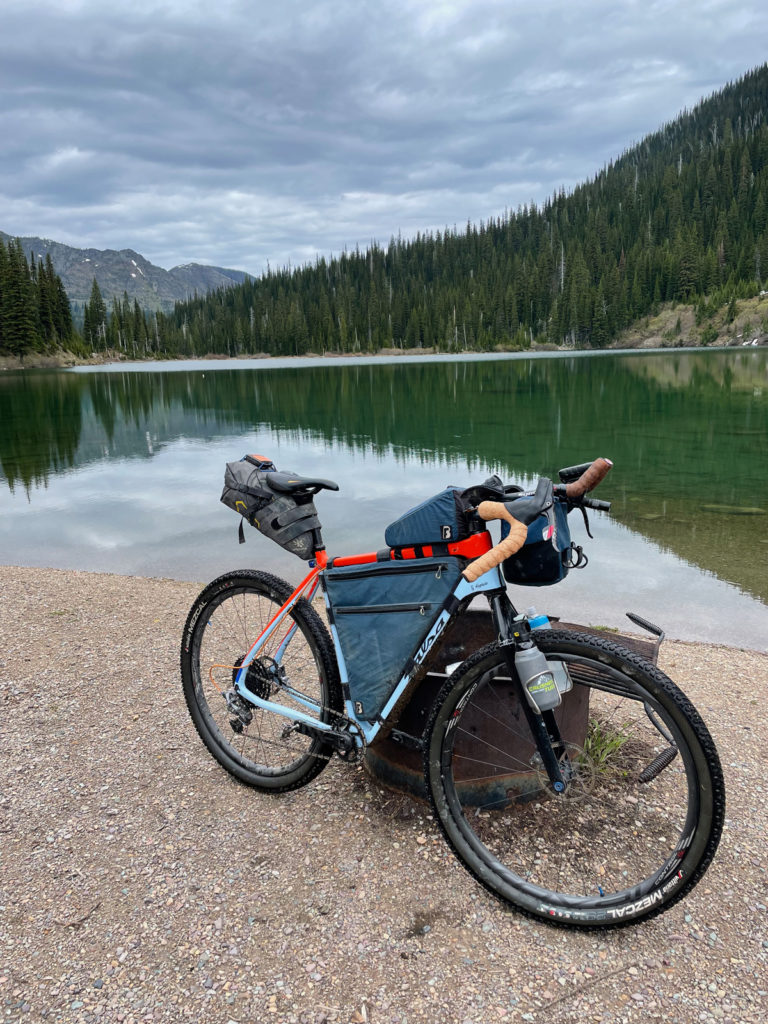
Red Meadow Lake, south of Whitefish, MT, 2021. Photo by Ty Hopkins
The route did not disappoint. The race started at noon from the border crossing at Roosville and the easy rollout took us through Eureka, MT before entering some of the densest grizzly bear country in the world. This year, however, I had the company of dozens of other riders as we made our way over Whitefish Divide, into the area northwest of Glacier National Park, and then up and over Red Meadow Lake Pass. It was a cool 100 miles as we exited the mountains into Whitefish, MT and made our way along peaceful rural roads to Columbia Falls, MT where we stayed for the night. It really was a great 1st day. The variety of riders and the company they provided was what I was hoping for. This was fun.
One of the lessons I have learned from ultra-racing is that the body will wake up in full revolt to doing another day, churning up big mountain passes. The mind will always tell you there is no way it can do another day like the previous day. But it does. It takes a little time and some calories, but the body always bounces back. The 2nd day was no different as I was stiff from the previous day. We started early, around 4am in constant rain. We made our way through the Flathead Valley skirting the western edge of Glacier National Park before entering a series of long, dirt road climbs making their way into the Swan River valley. The day was tough for 2 reasons. First, it rained for the 1st 8 hours of the day, and second, I was having a hard time with my GI system. Ever since 2018, I had struggled to eat the calories I needed without my GI revolting. The easy thing to do is to stop eating, but this is an unsustainable strategy. When you ride a loaded bike all day on limited calories, the inevitable bonk is coming. I managed to snack here and there, but I suffered mentally and physically while I waited for the medication to kick in. As the day progressed, my mood and power faltered. Fortunately, we were riding with a good group of racers. Backgrounds ranged from retired accountant to bike shop wrench with huge ranges of age and philosophy. Meeting the variety of people was the best part of the day and the instant bonds that are formed are one of the best parts of the race. By the time we got to base of the biggest climb of the waning day, I was physically and mentally spent with no calories in the tank. I suffered up the massive climb for hours, hiked through a couple miles of snow at the top, before finally being rewarded with a long, fun, fast descent. While, painful and slow, the day had been a success as a burrowed into my sleeping bag for a few hours of sleep before doing it all over again.
Adam Lisonbee on Fleecer Ridge, south of Butte in the Great Divide Mountain Bike Race, 2021. Photo by Ty Hopkins
The next days were filled with incredible mountain vistas, crystal clear lakes and streams, and some scorching temperatures. We climbed over Poor Man’s Pass, Huckleberry Pass, Fleecer Ridge, and dozens of other giant passes. We were met by numerous trail angels – Kathy in Ovando, the Nyes prior to Helena – who tried to give us encouragement and food with the payment of simply paying it forward. We saw wildlife galore in some of the most remote and pristine wilderness in the United States. We also suffered heat, dehydration, sleep deprivation, and the aches and pains that come from sitting on a bike saddle for 15 hours a day. It was all worth it.
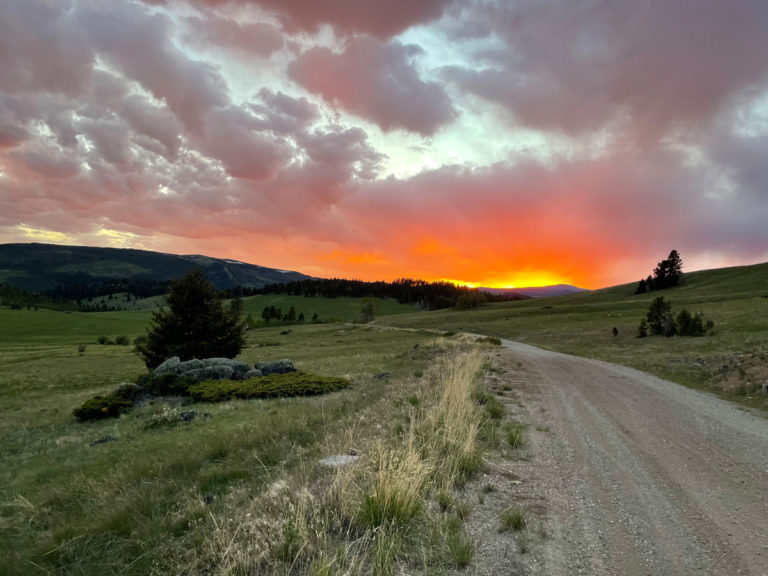
Incredible sunsets were never in short supply. Near Helena, MT. 2021. Photo by Ty Hopkins
On day 7 we slowly worked our way over Union Pass in the Wind River Range of Wyoming. At the summit, above tree line, I ate some food while watching the sun set. The view was incredible – 360 degrees of brilliance. No people, no sounds, and the fresh smell of rain. It was perfect. When Adam arrived we mounted lights and descended, looking for a place to roll out our bivies. The night before we literally froze sleeping above the Snake River near Jackson Lake, and we were determined to find a place away from water that might not be so cold. By luck we happened upon an open forest service warming hut. What an incredible find! We were ecstatic.
The next day we finished the descent off Union Pass through herds of cattle being driven to new grazing pastures up the mountain. Then we rode the 30+ miles of pavement to Pinedale, WY. There, Adam and I talked about what we wanted to do. We decided we had gotten what we wanted out of the ride. A little less prepared than we wanted to be, we decided we would leave the route with a little meat still left on the bone. We completed 1000 miles of the route, we felt good, and it was time to go home. It was nice. I didn’t feel like I had failed. I had simply done what I wanted to do.
The TD is a route I really love. There are sections that are extremely hard. There are sections that are boring. Most of the route is incredible. I think I’ve got one more fast one in me. Until next time.
BOULDER, COLO (September 30, 2021) — PeopleForBikes, a national bicycling advocacy nonprofit and the bicycle industry’s trade association, is pleased to announce the agenda of its latest virtual Bicycle Leadership Conference (BLC) and upcoming in-person Electric Bicycle Summit, as well as future events planned for 2022 aimed at bringing the bike industry together through comprehensive educational programming.
PeopleForBikes’ third virtual BLC will take place Nov. 2-3, 2021 and feature a stellar lineup of keynote speakers, paralympians Clara Brown and Jerryd Wallace, and critical bike industry topics including the potential of U.S.-based manufacturing, industry sustainability initiatives and a brand new, nationwide electric bicycle battery recycling program. The full agenda can be found below.
“PeopleForBikes’ industry education and networking events are some of our most important offerings as a trade association and advocacy group,” said Ravi Rajcoomar, vice president of PeopleForBikes’ Business Network. “Delivering compelling content, sharing best practices and working across all aspects of our industry to get more people on bikes more often is paramount to the current success of bicycling and its sustainable future.”
PeopleForBikes is working with leaders from its industry Electric Bicycle Subcommittee to design and host an in-person Electric Bicycle Summit on Nov. 19, 2021 in Tucson, Arizona. The event will take place in concert with El Tour de Tucson and is open to all who are interested in the future of electric bicycles. Topics to be discussed include data on electric bicycle sales and rider participation, updates to public lands access and the power of effective advocacy techniques. Tickets to the event, as well as a full agenda, can be found here.
Next March, the in-person Bicycle Leadership Conference will return for three days in Dana Point, California. Dates will be announced soon. PeopleForBikes is also in the preliminary stages of planning a Leadership Summit for fall 2022 in Bentonville, Arkansas. These events will be filled with opportunities to come together in person to collaborate, learn, network and create a world where bicycling and the bike industry thrive.
Every month in between, PeopleForBikes will continue its popular online industry webinar series available to PeopleForBikes members, featuring exclusive content and topics including new rider information, purchasing behaviors, trade and tariff threats, public lands and conservation issues, all things electric bicycles, market and retail insights and more.
November 2021 Virtual Bicycle Leadership Conference Agenda:
Day 1:
Better Biking for All — Cyclist Clara Brown and sprinter Jerryd Wallace will share their journeys to the 2020 Paralympic Games in Tokyo and highlight how the power of community, passion and perseverance can accomplish truly monumental feats.
Made and Assembled in the USA— This panel will explore what onshoring could mean for the bike industry. The bicycle industry, like many others, has been deeply affected by the pandemic, trade wars and rapid price increases in international freight. This panel will bring together experts from across the industry to explore the potential for U.S. production to help stabilize the supply chain and generate new jobs. Panelists include Arnold Kamler, chairman and CEO of Kent International; Charles Cooper, managing director of Signal Group; Patrick Cunnane, President and COO of Yuba Bicycles; Joe Graney, CEO of Santa Cruz Bicycles and Drew Medlock, CEO of Allied Cycle Works.
Day 2:
Bikes: A Climate Solution — Every day, our industry is presented with choices to make our internal and external operations more sustainable. In this session, you will learn and gain inspiration from industry leaders who are paving the way in this space. From packaging to marketing, to corporate partnerships, our choices make a difference as we learn and grow together to combat climate change. Panelists include Arleigh Greenwald, marketing and PR at Tern Bicycles; Chris Van Der Linden, packaging designer at Trek Bicycles and Aaron Kutzer, senior manager, retail division at PEARL iZUMi.
Industry Campaign for Electric Bicycle Battery Recycling — This session will address the growing need for convenient and sustainable battery recycling solutions as more riders discover the joy and convenience of electric bicycles. PeopleForBikes proactively addressed this need by collaborating with Call2Recycle to develop a voluntary battery recycling program for the U.S. bicycle industry. In this session, you will learn more about this initiative, hear from current program participants and learn how you can get involved to support the long-term and sustainable adoption of electric bicycles. Panelists include Kunal Kapoor, service, quality and compliance manager for Bosch eBike Systems Americas; Jeff Haltrecht, executive at Call2Recycle; Sara Beach, regulatory compliance specialist at Quality Bicycle Products and Erik Saltvold, owner and founder of ERIK’S Bike Board Ski.
Scholarships are available and if you have any questions regarding the vBLC, or any of PeopleForBikes’ continuing education programming, please contact Ravi Rajcoomar at [email protected].
Utah’s Swenson has top American performance at Marathon Mountain Bike Worlds in Italy.
October 2, 2021 – ELBA ISLAND, Italy. – The 2021 Marathon Mountain Bike World Championships took place on the island of Elba in Tuscany. Almost every part of the course was demanding single track with challenging climbs. The men raced 71 miles with 14,000 feet of climbing. The women raced 50 miles with over 10,000 feet of climbing. It was a challenging day.
The race proved to be one of the hardest most have ever competed in. Fan favorites like Swiss rider Nino Schurter led the lead group for a while and eventually pulled out of the race for health issues. It was a struggle for most to even finish. Keegan Swenson (Park City Utah; Santa Cruz Bicycles) left it all out on the course. He had a 91st call-up and made it into the lead group early into Lap 1 of 3. On Lap 2, he had a hole in his tire that he was able to fix on course. By the end of the day, he was able to finish seventh after one of the hardest days he’s ever had on the bike.
Kyle Trudeau (Phoenix, Ariz.; Construction Zone Racing) and Kelly Catale (Pepperell, Mass.) were both able to manage a Top-40 in their respective races. Utah’s Jules Goguely was 67th.
COLORADO SPRINGS, Colorado (October 5, 2021) — The top collegiate athletes from around the country will head to Durango, Colo., for the 2021 USA Cycling Collegiate Mountain Bike National Championships October 14-17. Student-athletes will have the opportunity to compete on the 1990 UCI Mountain Bike World Championships course at the Purgatory Resort.
“Purgatory is excited to welcome the USA Cycling Collegiate Mountain Bike National Championships,” said Dave Rathbun, General Manager for Purgatory Resort. “We are fortunate to have some of the best riding in North America to attract one of America’s premier cycling events to Purgatory. We look forward to bringing more events like this to the Durango area,” said Rathbun.
Dave Hagen, Director of Cycling Operations at Fort Lewis College and the Technical Director for the event, believes it will be an action-packed weekend for the collegiate athletes. Hagen said, “Racers will be riding on spruced-up versions of legendary courses up at Purgatory. The Cross-Country course is almost identical to the one from the 1990 UCI MTB World Championships and the World Cup Downhill from 2001 has been modernized – both the courses will be very challenging as the National Championship course should be. The entire Short Track, Cross-Country, and Dual Slalom courses will be visible from the base area and will make for some great action.”
Racing begins on Thursday, October 14 starting with the Dual Slalom qualifiers. Friday will be a full day of action with early Cross-Country racing followed by Dual Slalom finals. Downhill seedings and Short Track will take place on Saturday, and the weekend will conclude with Sunday’s Downhill finals and the ultimate collegiate omnium decider, the Team Relay.