Home Blog Page 135

Why?

By Lukas Brinkerhoff — It’s a simple question, one that is often asked and more often left unasked and more often than not left unanswered. Particularly when the interrogative is about motivation.

Let’s start with a simple one, why are you here? And no, we aren’t going to get existential. I don’t mean in the big scheme of things, I’m referring to here, Cycling West. You are here, whether you are reading this in the analog or digital version, because, on some level, you identify with cycling, are traveling through or live in the West or are a mom to someone who writes for this publication. Hi, mom!

As far as I’m concerned, if you identify on any spectrum with being a cyclist, you are one. The issue of how serious you are, how often you ride or what bike is your preferred steed have zero impact on that basic fact. You are a cyclist. You ride a bike. And for some, unknown reason, you enjoy it. So, let’s talk about that.

Why do you ride a bike?

According to a TED Radio Hour that I was listening to the other day, the most important thing we need to figure out, is what we are passionate about. That is according to the all too famous Tony Robbins who was preachin’ to me via NPR. Find your passion and follow it, he said. Ok. I’ve been doing this bike thing for a while. I feel passionate about that, but why? To understand a passion, one must ask that question. Once we understand the reason, it may be easier to follow that passion, live that passion, burn that passion all the way to the end of its wick and die with a smile on our faces.
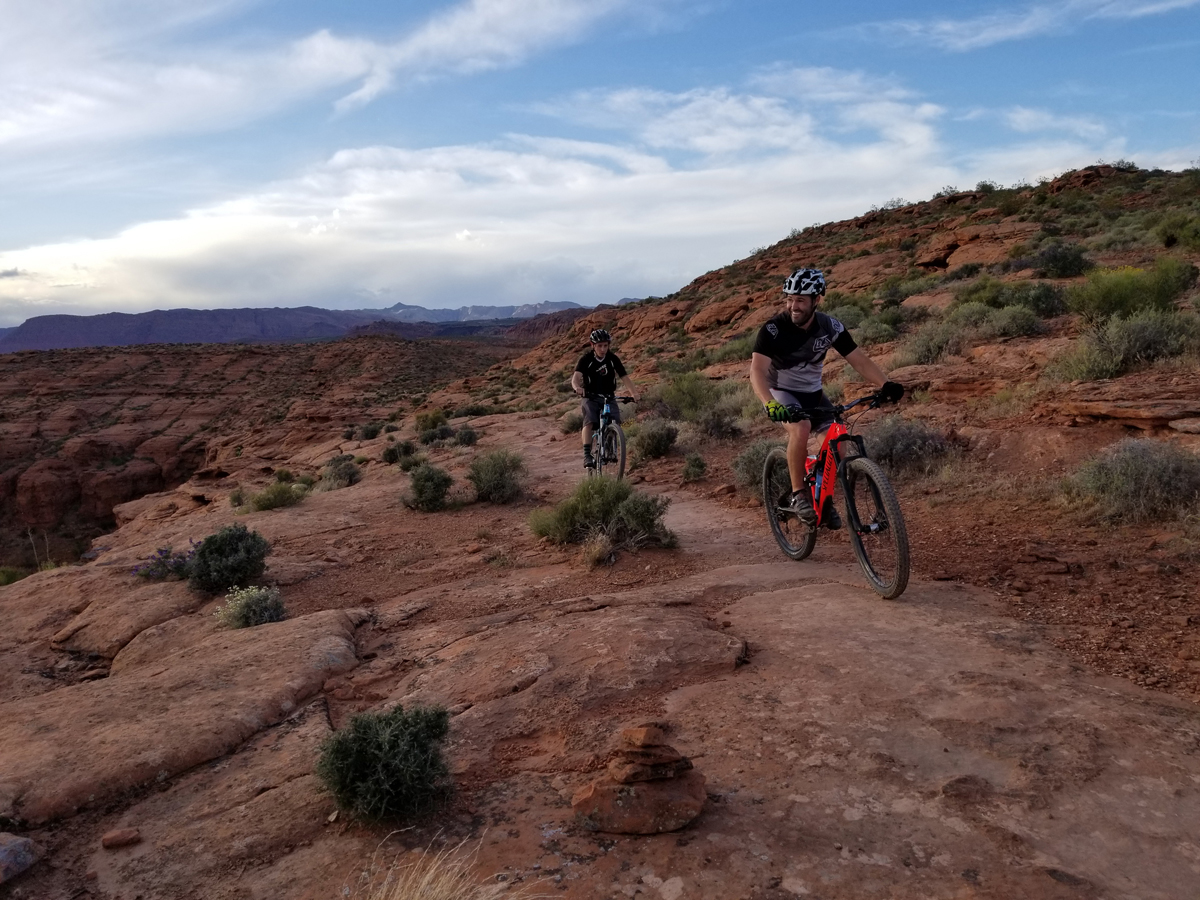
Cory Thompson and Kraig Winterton dedicated enough to ride after work even in the heat. Photo by Lukas Brinkerhoff

So, what is it? What is it about riding a bike that makes us get up before the sun, put on funny clothes, a foam helmet and crank out a few miles before work? Why would anyone do that? You could be sleeping, cozied up next to your significant other or preferred version of a pet. I can guarantee you beyond a shadow of a doubt that your mattress is significantly, scratch that, exponentially more comfortable than your saddle. And yes, I include you Brooks fans. Another guarantee, stay in bed and those post lunch sleepies you get every day that you ride, won’t be so bad. You need sleep, so sleep. Why are you riding a bike?
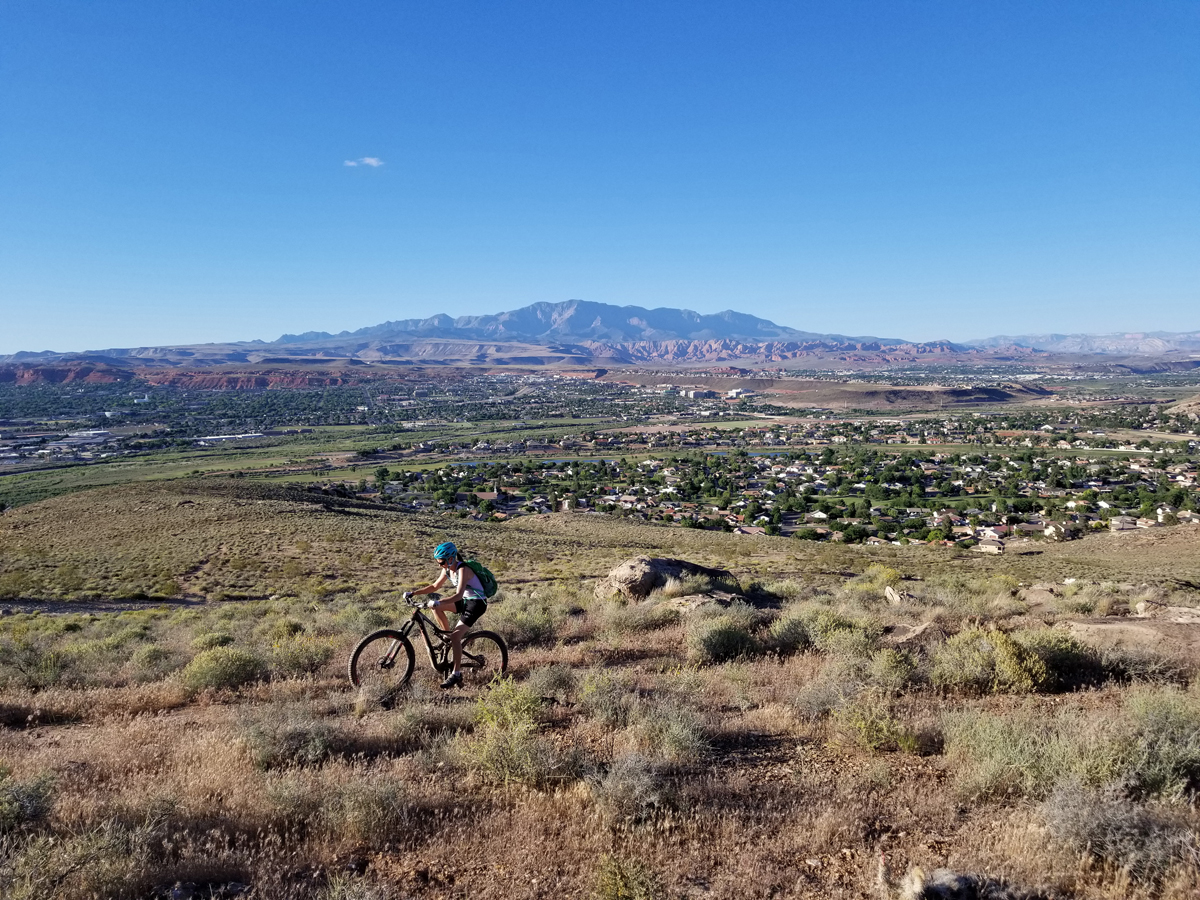
Kathleen Berglund catching some singletrack after work. Photo by Lukas Brinkerhoff

Our lives have been manufactured for us. Anything that an average human being would have done on a daily basis a hundred years ago, now takes us a matter of minutes and the swipe of a plastic card through a payment console. Don’t want to cook? Buy dinner. Sick of walking to the store two blocks away? Drive your car. Feel a deep need for human interaction and companionship? Buy a social media app. When we say that a good business fulfills a need, what we mean is that they take away the need for us to act for ourselves. Those things that were daily chores, are now expenses. We have been convenienced almost to death.
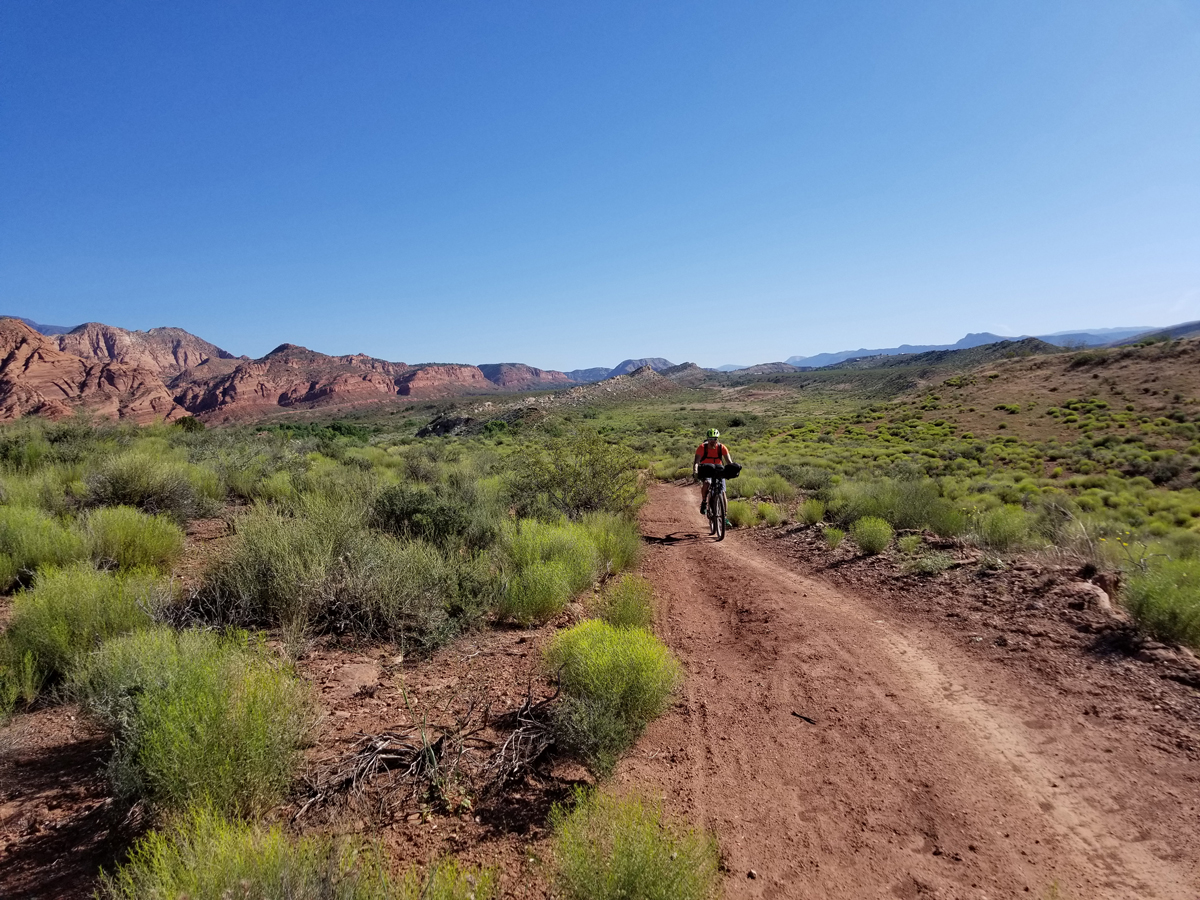
Blake Mitchell caught the bug good, riding for big adventure. Photo by Lukas Brinkerhoff

And the bicycle is not convenient. You sweat. For those uninitiated in the activity. Sweat is moisture that leaves your body during a hot day or intense exercise. It smells. If you don’t stop your activity, you will continue to sweat and it will leave a salty layer on your skin. You can taste it on your upper lip, in fact it can be a great electrolyte replacement in a pinch. The point is, there is nothing necessarily logical about riding a bicycle. We have faster, easier ways to get from point A to point B that don’t include being uncomfortable.

Which brings us right back to where we started, why do you ride a bike? I can’t answer that question for you, however, I could probably venture a couple of guesses based on my interaction with all forms of cyclists over the past 20+ years.

The number 1 reason I hear is exercise, “I gots to lose some weight cause the doc said I had high blood pressure.” It’s a good reason, a logical reason. It is not a reason that will keep many people riding. Beginning begrudgingly can make the whole thing unpleasant regardless of how long you try to get past it. Of course, there are plenty of people that broke through this. They begin to pedal, the weight starts to come off and then they can’t imagine a day going by without riding.

Reason numero dos I categorize as enthusiasts. They love riding bikes. Their “why” is the escape from the above mentioned convenient life. It’s a way to feel alive. They can’t get enough riding and that’s part of the draw. It’s something they love so much, but the daily grind keeps them from doing it as much as they would prefer.

And then you have the lifelongers, those who have been riding since birth or at least since they realized that they love cycling. There’s a lot less of a question for these folks. It’s just part of who they are. They aren’t thinking, “I wish it wasn’t raining and blowing so hard,” when you see them on the side of the road in a horizontal rain pedaling with all their might to go downhill. No, they are thinking, “There is nothing else I would rather be doing right now.”

Of course, one can lead to two and often then to three. Your why will determine how much you love this thing called cycling. Finding your reason will get you pedaling, but the bike has a way of changing that reason from the mundane to a passion that burns for a lifetime.

Lukas Brinkerhoff blogs about mountain biking and life at mooseknuckleralliance.org.
Cycling in Comfort

By John Higgins — As a bike fitter is it quite common for a cyclist to say to me “I’m not racing, I just want to be comfortable on my bike.” Interestingly, I’ve never heard a competitive rider say to me “I’m racing and I don’t care about being comfortable”. Every cyclist regardless of participation level and ability wants a reasonable level of comfort. However, there is often confusion as to what realistic expectations are when the word comfort is used together with the word cycling. Are they at odds, or can these two C words co-exist?

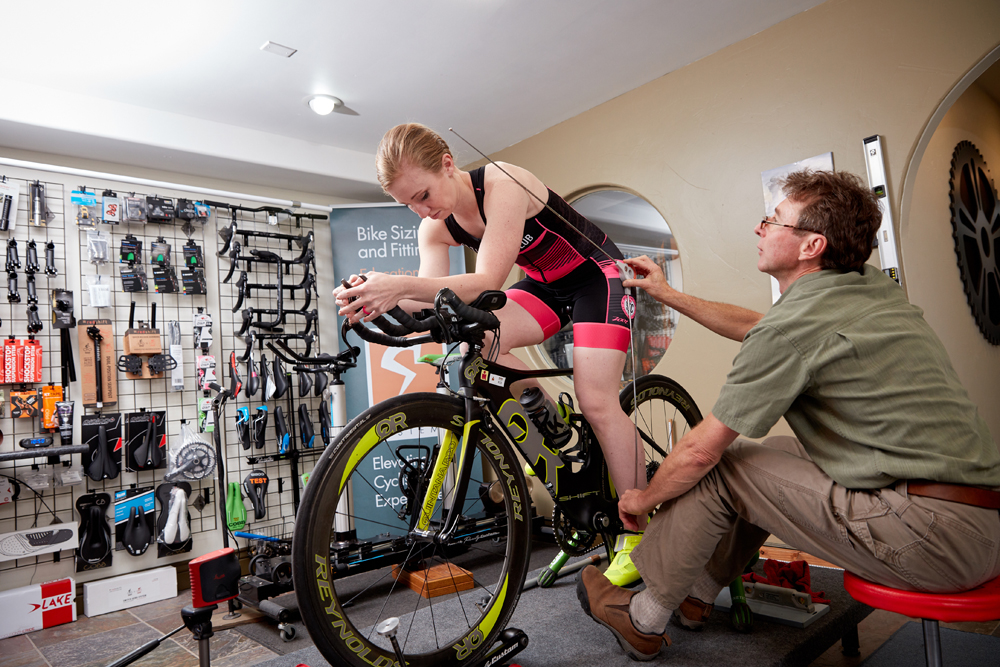
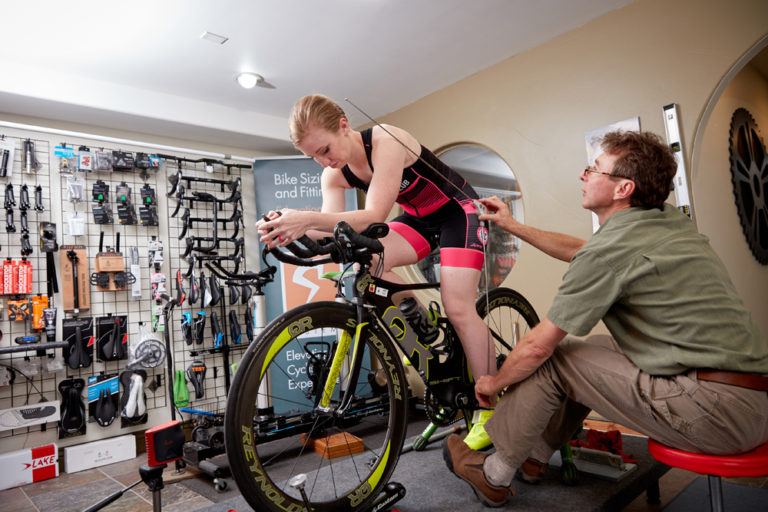
John Higgins takes measurements during a bike fit at the Bike Fitr studio. Photo by Derek Israelsen Photography

Historical stories and images of cyclists have often conveyed a subtext of hardship and suffering. To be a “real cyclist” was to embrace the art of suffering and to endure the associated physical aches and pains. This perception that “cycling = suffering” has permeated common cultural understandings of what it is to be a cyclist. Novice cyclists often report that they thought having body parts hurt was an intrinsic aspect of the sport. The historical perception is not without a basis in the reality of the times, but those times are not these times, and cycling is no longer the sole purvey of the hardcore athletic aspirant. Cycling is participated in by men, women, and children across a wider age range than probably any sport other than swimming. This would not be the case if cycling was intrinsically and necessarily uncomfortable.

But what does the word comfort mean in the context of cycling? Let’s start with what it is not. Cycling in comfort is not analogous to kicking back in a recliner streaming your favorite Netflix series with a cold beverage and plate of snacks at hand. Or dozing off in a gently swaying hammock. Being comfortable is not the same as being relaxed and exerting the smallest possible amount of effort. Cycling is a physical activity requiring a blend of skill, muscular strength and movement, and cardio-vascular exertion. Comfort in this context is the absence of discomfort. Discomfort includes aches or pains resulting from a poor position detracting from the quality of your postural and bio-mechanical function, or equipment selection and set up that causes chafing, undue pressure, loss of sensation, or tissue irritation at any of the touch points on a bike.

These are completely different issues from a self-imposed fatigue due to the physical exertion required to ride a bike, and this is where confusion can arise. If you use cycling to push your mental and physical limits, then it’s realistic to expect discomforts, but this should primarily be from exertion and fatigue. If you are doing a challenging event like the Crusher, Lotoja, Wasatch All-road, Leadville 100 or an IronMan, your butt and back are probably going to be less than overjoyed with the experience. However, any back, butt, neck, feet, or hand pain should be low on the scale compared to overall fatigue.

As a general guideline, cyclists will perform better when not distracted by discomfort, and this applies equally to novices, weekend warriors, and pros. If you are fidgeting around on a bike; keep thinking there must be a better saddle out there; get numb hands or feet; or suffer back, neck or knee aches, then you are experiencing discomfort. These will detract from your mental and emotional enjoyment of the sport, as well as your physical performance. It is a completely reasonable expectation for any cyclist to be comfortable riding, by which I mean not enduring preventable discomfort.

Environmental discomforts from adverse weather conditions are in a whole different category with different management protocols. It is easy to become miserable if you are riding in conditions too hot, humid, wet, cold, or windy – but that is not unique to cycling.

What is unique to cycling is that it is a sustained interaction of human and machine reliant on pelvic supported lower limb locomotion. You probably haven’t heard it described that way before, but you know what I mean. No other sport features this combination of attributes, and as a consequence cycling in comfort presents unusual conditions and challenges. Although individuals vary widely in their sensitivity to, and tolerance of discomfort, being able to cycle comfortably is a thing, and should be for you. Enjoy your riding.

John Higgins is a professional bike fitter and purveyor of unique and boutique bicycles and fit-related components and accessories in Salt Lake City. More info on bikefitr.com

DNA Pro Cycling Team Announces 2022 Roster

SALT LAKE CITY, Utah (October 6, 2021) – DNA Pro Cycling capped off a successful 2021 season with 1st and 2ndplace in the USA CRITS Series Final at Winston-Salem. Erica Clevenger won from a solo breakaway while Maggie Coles-Lyster topped the field sprint for second. Coles-Lyster secured the Primal Best Young Rider (U25) Jersey, and the team earned the season’s HelloFresh Team Competition title.

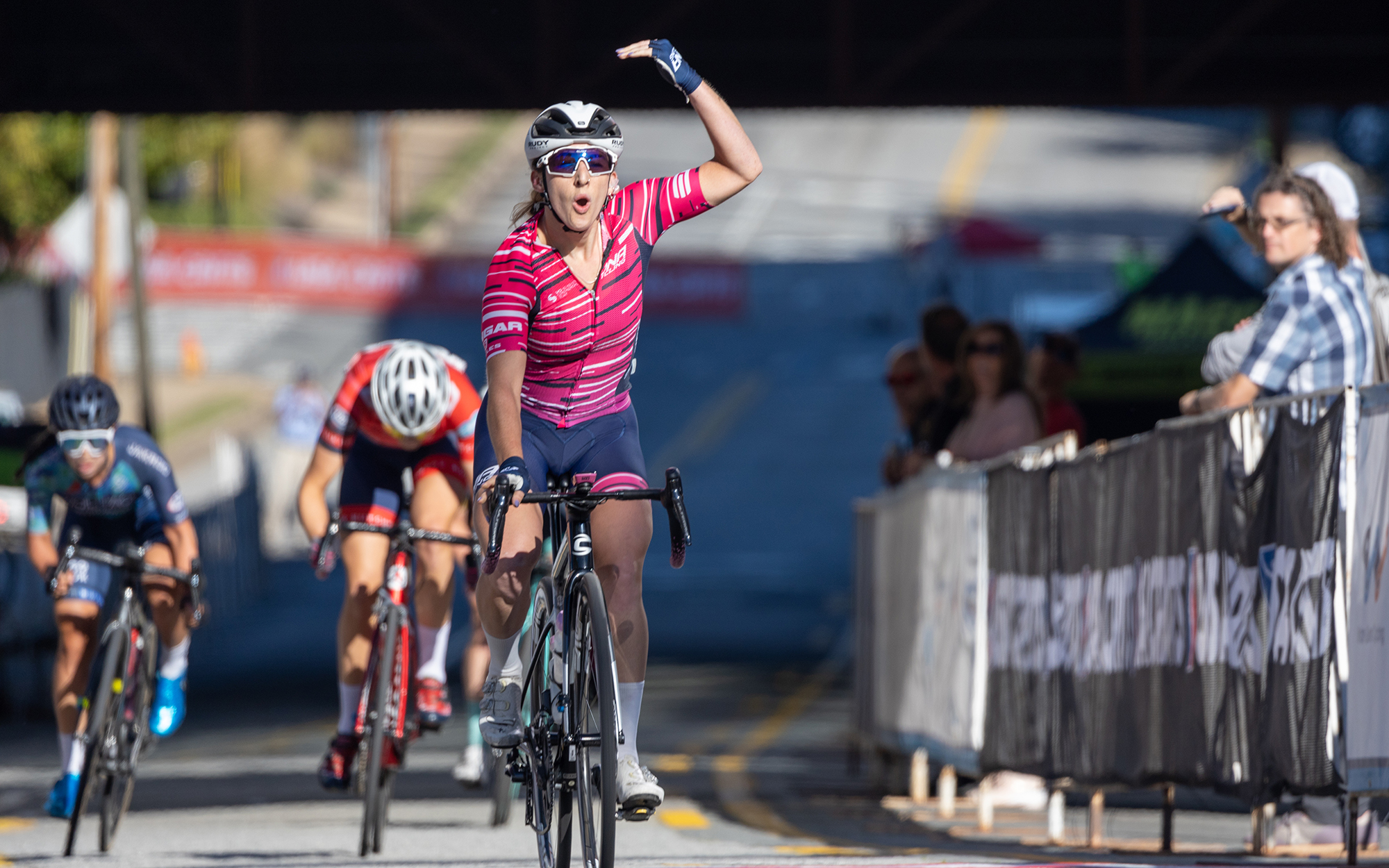
Maggie Coles-Lyster winning the second Winston-Salem Criterium at the 2021 Winston-Salem Cycling Classic. Photo Credit: Snowy Mountain Photography.

Clevenger and Coles-Lyster will be returning to the team in 2022 as part of an 11-rider international squad.

“I’m so excited to build on the momentum from the season,” Clevenger said after the Winston-Salem win, “Obviously, last year was a real challenge, and even this year in the US it was a slow start compared to Europe. It’s been a crit-heavy season, so we had to shift our views. I’m excited to show what I have in 2022 with DNA Pro Cycling and use my legs for more road racing when it comes back in the US next year.”

“It was pretty amazing to end the season this way,” Coles-Lyster said after clinching the USA CRITS young rider title and winning the second day at Winston-Salem. The Canadian sprinter emerged this year as a consistent force of strength for the team, with frequent podium visits in her first full season racing on a UCI Continental team.  She finished second in both the overall standings in USA Crits and on the USA Cycling Professional Road Tour calendar.

“I’m really excited to continue with DNA Pro Cycling, especially after capping off with a race like Winston-Salem,” Coles-Lyster added, “We know what we’re capable of and we’re learning how to execute the perfect race. Taking that forward with this squad into next year is pretty epic.”

Joining Clevenger and Coles-Lyster, as returning riders in 2022, will be Brenna Wrye-Simpson, Nicole Shields, Kimberly Lucie, and Mia Manganello Kilburg. Kilburg will once again play double duty with a hopeful return to the 2022 Beijing Winter Olympics in long-track speed skating after earning a bronze medal in 2018.
DNA Pro Cycling is thrilled to welcome five new riders in 2022.

Coloradan Daphne Karagianis joins DNA after successfully garnering individual and team results over the last 6 years with UCI and domestic elite teams including Illuminate and LA Sweat.

Up-and-coming U23 riders Kaitlyn Rauwerda and Kira Payer, who finished 2nd and 3rd respectively in the U23 GC at this year’s Joe Martin Stage Race, are looking forward to further growth under DNA. Rauwerda is a 4X Canadian junior track champion and has held provincial road, criterium, and time trial championships as a junior.  Payer, who raced with the US national team in Europe as a junior, had a break-out collegiate season at Fort Lewis in 2019 with wins in multiple disciplines including criterium, road racing, and Fat Bike Worlds (U30). She is USA’s reigning U23 national time trial champion.

Mexican rider Anet Barrera will be joining DNA in 2022 after coming off a successful season with a 5th in GC at the Joe Martin Stage Race and 4th in GC at the Vuelta a Colombia Femenina.  She is Mexico’s 2019 National Road Race Champion (Elite and U23). Hailing from Colombia, Diana Peñuela joins DNA with an impressive list of results including stage wins at the Joe Martin Stage Race and Tour of the Gila. She also supported a great many team-wins during the last 10 years racing as a professional with UnitedHealthCare, Alé Cippolini, and Team Tibco-SVB.

“I’m really excited to be building on our successful season, next year is an important milestone for us: it’s our 10th year as a professional team,” said team co-owner and director Catherine Fegan-Kim, “We have built a strong, balanced roster, with talented young riders matched with experienced, respected veterans.”

DNA Pro Cycling Team 2022 UCI Roster (*new riders)

  • Anet Barrera* (Jalisco, Mexico)
  • Maggie Coles-Lyster (British Columbia, Canada)
  • Erica Clevenger (Colorado, USA)
  • Daphne Karagianis* (Colorado, USA)
  • Mia Manganello Kilburg (Utah, USA)
  • Kimberly Lucie (Arizona, USA)
  • Kira Payer* (Colorado, USA)
  • Diana Peñuela* (Caldas, Colombia)
  • Kaitlyn Rauwerda* (Ontario, Canada)
  • Nicole Shields (Waikato, New Zealand)
  • Brenna Wrye-Simpson (Oregon, USA)

Sarah Kaufmann, Hanna Muegge, and Quinn Bradley who have all been with the team for several years will continue riding dirt and asphalt with DNA’s ambassador program.

The team, which competes on road, mountain, and gravel, is a UCI Women’s Continental Team and USA CRITS D-1 Team.  The team’s website is www.DNACyclingTeam.com. Official social media properties of the DNA Pro Cycling Team are: facebook.com/k4racing; instagram.com/dnak4; and twitter.com/DNA_K4.


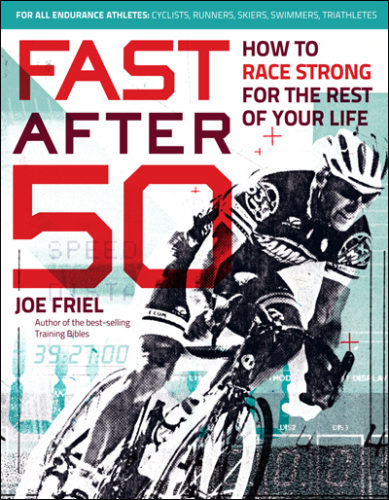
Fast After Fifty is An Informative Read for the Older Athlete

By Lou Melini — About every 5-10 years I try to read a book on the topic of sports science to update my current knowledge short of reading an academic textbook. Velopress Books has given me what I needed. Joe Friel has written a number of “training bibles” for cyclists and triathletes for VeloPress, but Fast after 50 is the first book of his that I have read. The book seems to be primarily targeted to the older athlete that has a history of competition and formal training for a relatively long time period. However, many of the principles for training stated in “Fast after 50” can be well applied to athletic non-racers or those that do not consider themselves athletes.

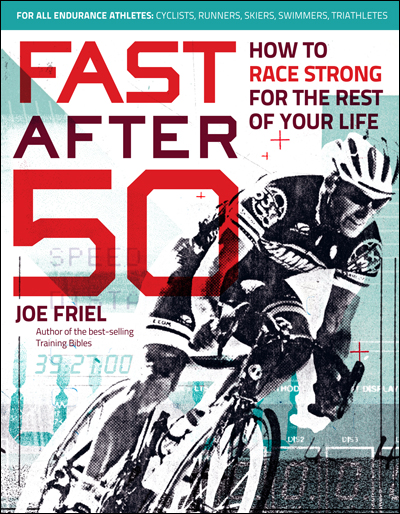
Fast After 50: Race strong for the rest of your life, by Joe Friel

“Going Fast after 50” is a relative term. At 66, I may be capable of holding onto the wheel of other 66 year-olds, but I am very much slower than I was just 6 years ago when I was a podium finisher in the local cyclocross series over-55 age group. I have little desire to “race strong for the rest of my life” as my motivation has been a challenge. I have not raced in the cyclocross series for the past 2 seasons though this is partly because I was either training for or recovering from a 6-month hike of the Appalachian Trail.

In the prologue of the book Mr. Friel states; “The first thing athletes typically notice is that they don’t recover form a race or a hard training session as quickly as they did a few years earlier. Race times are slowing, there’s a loss of power, hills seem steeper, and other performance markers are also looking worse.” That paragraph sounded like it was written with me in mind. In addition I have had frequent stiffness, fatigue and a bout of arthritis in my right knee that caused me to limp every morning for nearly 3 months in 2014. I am not alone as evidenced in conversations with other “older” athletes.

With 21 pages of references to back up his book Mr. Friel answers the big question, “What can be done” for the aging body. Chapter one discusses “The Aging Myth” and the “plenty of voices telling you that you shouldn’t be exercising so strenuously”. Training Basics, Advanced Training, Rest and Recovery, Body Fat and Nutrition are all covered in subsequent chapters in quite a bit of detail. The book is a seminar in aging, training, and a motivational primer to get you moving. There are contributions from a variety of experts such as former elite athletes as John Howard and Ned Overend as well as physicians such as Larry Creswell and John Post, to name a few, that add their expertise to the book. The book is not just for males as Mr. Friel addresses woman athletes plus a piece by Gale Bernhardt on menopause.
Overall the book is an easy and interesting book to read. Chapter two reviews theories of aging followed by chapter three that discusses the decreased physiological capability. An aging athlete can’t control the factors of aging but chapter four points out that “lifestyle a big impact and largely determines your physiological age.” “The approach to training is something we can control to counter the aging processes”.

Mr. Friel points out that “regardless of your ability or experience, there are only three workout variables that can are the basis of training, intensity, duration and frequency”. Understanding the simplicity of that statement is important for any cyclist, swimmer or runner that wants to improve their health and physical capability.

Some of the chapters are more complicated. The chapters on Training Basics and Advanced Training require careful attention. Terminology describing workouts such as Aerobic-capacity, Lactate-Threshold, and Aerobic Threshold can be a tad confusing, along with the variables that make up duration, frequency, intensity, recovery, and training periods. If you have used a coach, have had base-line fitness and power testing, and are familiar with a structured training routine, these chapters will be easier to read. For those without that background the book concludes with Appendix A-C that summarizes these chapters that helps with the understanding of the training terms used. Mr. Friel also discusses the benefits of strength training. I personally did not think weight training helped my racing, but lowering the weights and increasing the reps has helped my arthritis.

Mr. Friel spent a good deal of time on the science of sport and training and for the most part, he did so in a way that most readers will understand the research summaries. Regarding cross training for swimming he states: “intervals done by running or cycling have been shown to be of no benefit to swimming.” He discussed many of the aides to help measure power and body composition such as power meters, heart rate monitors, and body fat calipers to name a few. However he is not opposed to stating the obvious; “The fit of your pants and belts around the waist are also indicators of the direction your fatness is going”.

I came away after reading the book with a better understanding of what is taking happening, to me especially statements when one reaches 65. I also become a bit more energized about changing my attitude for more intensity. According to Mr. Friel’s research the anabolic hormones erythropoietin, testosterone, human growth hormone, and insulin-like growth factor will decrease as you age. You can counter that with: “High intensity training stimulates anabolic hormone secretion more than low-intensity, steady-state training. Heavy load strength training has a similar effect”. I was motivated to start integrating a few “sprints” in my recreational rides and slightly increased the machine weights at the gym the week I finished reading the book. There were some “folksy” take home messages that I liked such as “you must always respect fatigue” and his analysis of ‘risks” vs. “rewards” of training intensity have important implications.

The VeloPress price I paid was $21.95. A good investment for any older competitive athlete, non-competitive athlete or the recreationalist that hopes to continue to be able to ride a charity ride such as the Bike MS 2-day 150 mile event. In addition, none of us are getting younger. If you ask if the book would be worth reading if you were less than 50, I will give you the answer by quoting that ageless baseball pitcher and reputed philosopher, Satchel Paige. His advice on how to keep young included, “Don’t look back. Something might be gaining on you”.

Fast after 50: How to Race Strong for the Rest of Your Life, By Joe Friel, 2015: VeloPress Books, www.Velopress.com

Gravel Riders Take on a New Off-Road Adventure at the ‘Rad Dirt Fest

0

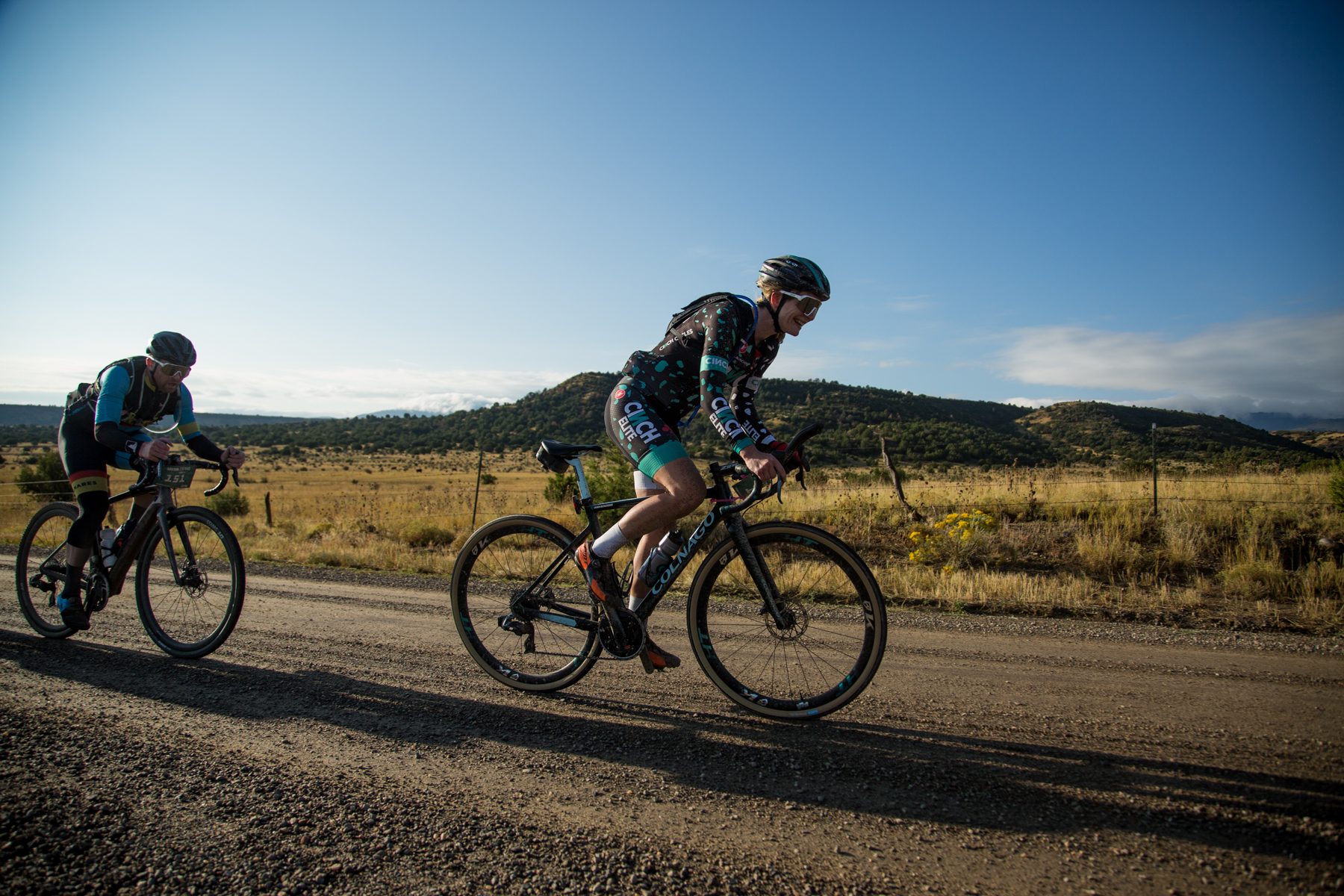
TRINIDAD, Colorado, (Monday, October 4, 2021) — The first-ever edition of Life Time’s The ‘Rad Dirt Fest took place this weekend in Trinidad, Colo. Off-road athletes either took on the three distances of the gravel race or two distances of the running event while some athletes took on both events in the Purgatory Challenge.

“It was a thrill to welcome these bike and run athletes to Trinidad this weekend to experience this new event created by Life Time,” says Phil Rico, Mayor of Trinidad. “We hope this is one of many events that come to town and that Trinidad’s outdoor recreation continues to grow and get recognized.”

Gravel Results

On Saturday, gravel riders took on the Stubborn Delores Race, 165 miles, the Anteloop Race, 99 miles or The Frijole Race Start for 38.5 miles. After a few days of rain the gravel courses lived up to the dirt fest name.

Lauren De Crescenzo, on her way to winning thw women's category (and 2nd place overall) at the initial 'Rad Dirt Fest. Photo by Linda Guerrette, courtesy Life Time
Lauren De Crescenzo, on her way to winning thw women’s category (and 2nd place overall) at the initial ‘Rad Dirt Fest. Photo by Linda Guerrette, courtesy Life Time

For the 165 miles Stubborn Delores Race in the women’s division, Lauren De Crescenzo, 31, of Longmont, Colo. placed first with a finish time of 8:35:03 and second overall, just 2 minutes off the overall win. Serena Gordon, 42, of Bend, OR. secured second place with a finish time of 9:35:49. Hannah Shell, 30, of Boulder, Colo. placed third in the division with a completion time of 9:52:14.

In the 99 mile Anteloop Race, Ashley Fouts, 45 of Boulder, Colo. placed first with a time of 5:27:25. Beth Wyatt, 53, of Denver, Colo. was second with a time of 5:30:20 and Kate McLaughlin, 33 of Golden Colo, finished third with a time of 5:35:00.

For the 165 miles Stubborn Delores Race in the men’s division John Keller, 24, of Boulder, Colo. placed first with a finish time of 8:33:05. Nathaniel Draeger, 41, of Taos, NM. secured second place with a finish time of 8:56:24. Life Time’s own Ryan Cross, 35, of Boulder, Colo. placed third with a time of 9:18:00. Cross’ day job is as Life Time Event’s Off-Road Cycling and Trail Running Marketing Manager.

In the 99 mile Anteloop Race for the men Eli Kranefuss, 24 of Mill Valley, CA placed first with a time of 4:48:44, Jake Magee, 34, of Longmont, Colo. was second with a time of 4:49:34 and James Walsh, 43 of Littleton Colo, finished third with a time of 4:54:45.

Riding A Bicycle Across Frozen Alaska — A Hundred Years Ago

By Jill Homer — They were perhaps North America’s first endurance racers — the grizzled men and a few women who set out across wild expanses in a race to reach a land of uncertain but undeniably vast fortunes. The Klondike Gold Rush brought the notion of adventure racing to the forefront of American imaginations, because it was widely accepted that those who got there first got the gold — by any means possible. Klondike gold rushers sailed hundreds of miles on rough seas, hoisted a thousand pounds of gear over the steep and snowbound Chilkoot Pass, and expunged their life savings on dog teams and supplies to travel a thousand miles across the deep-frozen wilderness of Yukon and Alaska. Those who couldn’t afford dog teams used bicycles.

Winter cycling is currently a fast-growing trend, with enthusiasts touting the latest innovations that allow cyclists to ride bikes on snow. It’s a little-known fact that a hundred years before winter endurance races such as the Iditasport Extreme popularized snow biking, Klondike gold rushers were riding significantly more primitive bicycles across Alaska. 

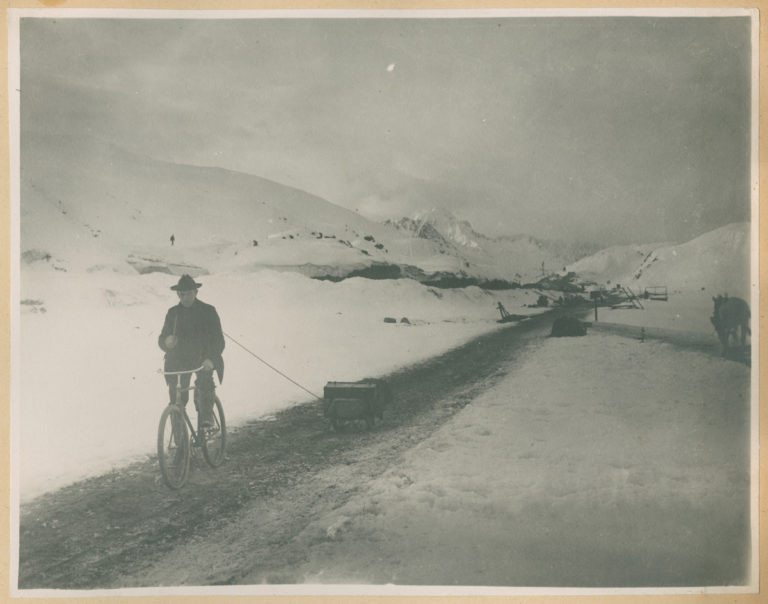
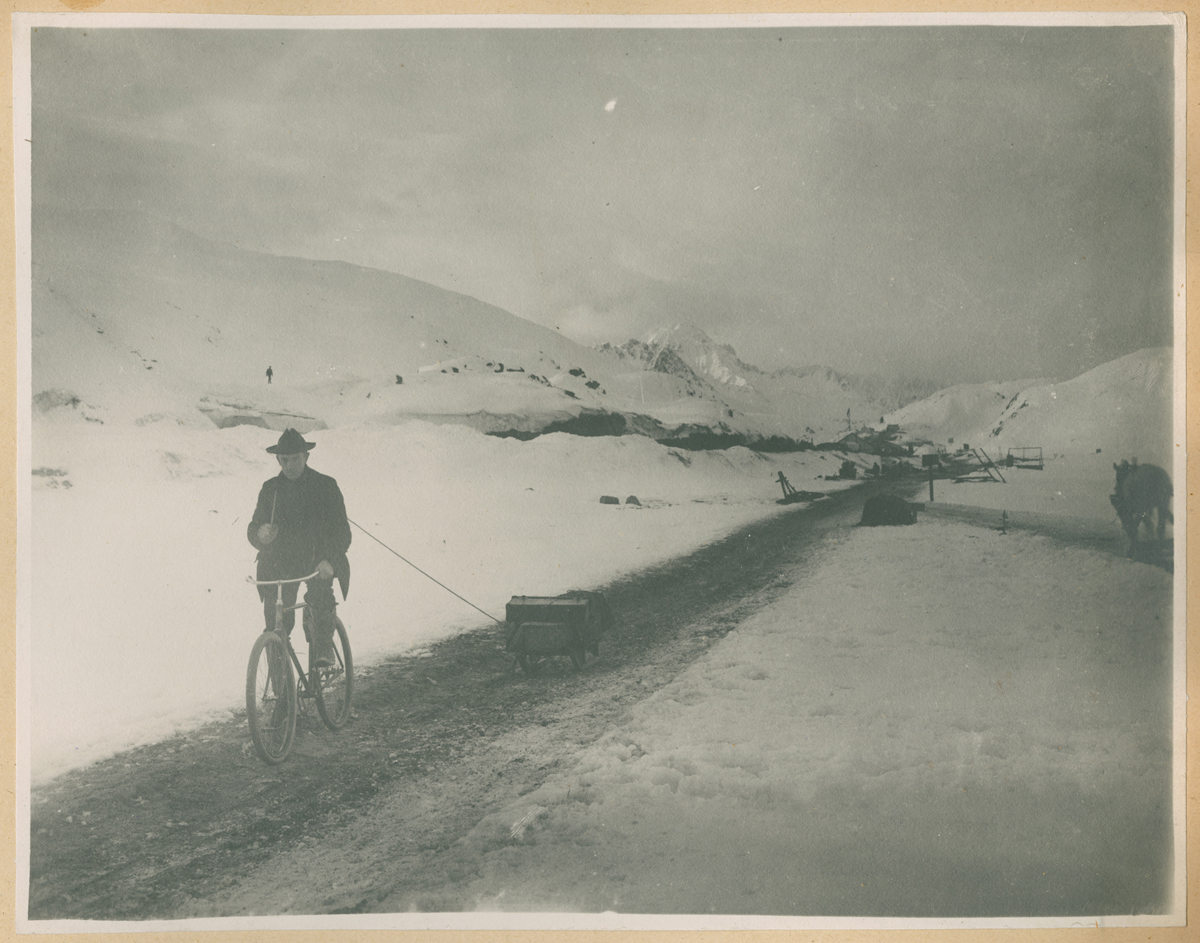
During the Klondike Gold Rush, the White Pass was one of the routes used by prospectors to travel from Skagway to the Yukon gold fields. Here, a man on a bicycle is pulling a sled near summit of White Pass Trail, ca. 1899 Photo by Arthur C. Pillsbury. Courtesy of The Seattle Public Library, spl_ap_00115

In the late nineteenth century, a bicycle craze was sweeping across the nation. People were using bicycles to ride across town, race their friends, and even travel across the country. It made sense that the “wheel” would find a place in the Gold Rush. At the time, most bicycles were built of heavy steel with a fixed-gear drivetrain and solid rubber wheels. 

Miners would use their wheels to travel the trails set by dog teams between mining camps. Others used their wheels to travel farther distances or over Chilkoot Pass with various degrees of success. 

Competition also found its way into frozen north, with bicycle races on the ice. One photograph preserved in the Selid-Bassoc Collection from the Alaska and Polar Regions Archives depicts a young man straddling a fixed-gear bicycle with the caption “White Horse to Dawson in 5 Days Overland Bicycle Record, Winter of 1903.” The man in the photo is not identified. The Dawson Overland Trail travels more than 400 miles between Whitehorse and Dawson, Yukon. It remains in use today, largely unchanged in more than 100 years with the exception that it’s more common to see a snowmobile these days than a team of dogs. A 430-mile race is held on the trail every other year, the Yukon Arctic Ultra. On a modern fat bike, it took U.K. cyclist Alan Sheldon seven and a half days to ride 430 miles from Whitehorse to Dawson during the Yukon Arctic Ultra in 2009. If the photo caption is correct about a five-day ride, it’s likely an unidentified wheelman from 1903 still holds the Dawson Overland Trail record. 

Also attempting to capitalize on the bicycle craze, a Gold Rush-era bicycle company developed a special model called the “Klondike Bicycle” and claimed it was the answer to every miner’s prayer. On this innovate bike, the company claimed, a miner could carry his necessary 1,000 pounds of supplies 500 miles from Chilkoot Pass in Southeastern Alaska to the Klondike goldfields.

A guidebook explained the bicycle was “in reality a four-wheeled vehicle and a bicycle combined. It is built very strongly and weighs about fifty pounds. The tires are of solid rubber, one and a half inches in diameter. The frame is ordinary diamond, or steel tubing, built however more for strength than appearance, and wound with rawhide, shrunk on, to enable the miners to handle it with comfort in low temperatures.” The bicycles had two fourteen-inch retractable wheels on which a miner could load a quarter ton of gear, and “drag it on four-wheels ten miles or so. Then the rider will fold up the side wheels, ride it back as a bicycle, and bring on the rest of his load.”

It’s unclear how many gold rushers actually used the combination cart-bike Klondike Bicycle to travel long distances. But for lighter-weight travelers, a bicycle was thought to have several advantages. Cyclists followed two-inch tracks left by the dogsleds, and they could generally travel faster than dog teams and horses under good conditions. The bicycles were less expensive to purchase and maintain than animals and offered the user a greater margin of independence. After all, you don’t have to feed and water a bicycle. However, Far North cycling was wrought with hazards, as documented by the “wheelmen” of the Klondike. They suffered from snow-blindness and eyestrain, as well as numerous crashes from their efforts to stick to the narrow track. Bicycles also experienced frequent breakdowns because of frozen bearings and stiff tires. 

One of the cyclists who documented his journey was Max Hirschberg, a Yukon roadhouse owner who joined the stampede to Nome in 1900. The night before he planned to leave Dawson, he acquired blood poisoning while responding to a hotel fire. It was March before he recovered, too late to reach Nome by dog team ahead of the spring thaw. However, he reasoned, he was an experienced cyclist, and felt confident in his chances of reaching the goldfields before the Yukon River became unfit for travel. His account of the journey was first published in Alaska Magazine in February 1978. 

“The day I left Dawson, March 2, 1900, was clear and crisp, 30 degrees below zero,” he wrote in his journal. “I was dressed in a flannel shirt, heavy fleece-lined overalls, a heavy mackinaw coat, a drill parka, two pairs of heavy woolen socks and felt high-top shoes, a fur cap that I pulled down over my ears, a fur nosepiece, plus fur gauntlet gloves. On the handlebars of the bicycle, I strapped a large fur robe. Fastened to the springs, back of the seat, was a canvas sack containing a heavy shirt, socks, underwear, a diary in waterproof covering, pencils and several blocks of sulfur matches. In my pockets I carried a penknife and a watch. My poke held gold dust worth $1,500 and my purse contained silver and gold coins. Next to my skin around my waist I carried a belt with $20 gold pieces that had been stitched into it by my aunt in Youngstown, Ohio, before I left to go to the Klondike.”

Outside of Dawson, the 1,500-foot-wide Yukon River had been through a rough freeze. Slabs of ice the size of houses were littered along the banks, preventing access to the shore. Overflowing river water collected around the slabs, covered by weak layers of ice that broke when Hirschberg crossed them. “By the time I reached Forty Mile, my socks were wet, and ice covered my felt shoes. It took me quite a while to orient myself to my two-inch trail and I had many spills on this early part of my journey.”

About 250 miles downriver, he reached the Yukon Flats, where the river was so wide and the landscape so flat that he could only see a few scatterings of trees on far-away banks. “The most dangerous and difficult parts of the flats were between Circle City and Fort Yukon,” he wrote. “Save for a portage land trail of 18 or 20 miles out of Circle City, the trail was on the river, which split into many channels without landmarks. The current was so swift that I encountered stretches of open water and blow holes. Snowstorms completely obliterated the trail.”

In Tanana, near modern-day Fairbanks, Hirschberg encountered a forty-mile stretch of glare ice where the river had been wind-swept free of snow. After numerous crashes he broke a pedal, returned to town for a quick fix, and continued on to Nulato. The weather was warming, and numerous creeks were flowing with water. On the Shaktoolik River, he broke through the ice and nearly drowned. As he struggled in the water for nearly two hours, he lost his watch and his poke with $1,500 in gold dust but managed to save his bicycle.

Hirschberg encountered open water on the Bering Sea, but started out across Norton Sound anyway. Just as he was nearing the opposite shore, the ice shifted, leaving an eight-foot lead of open water between him and land. “I took a chance and leaped to the shore,” he wrote, “where I picked up a piece of driftwood, jumped back on the ice floe and poled myself and my bicycle back to the shore, and went on my way.”

Just east of Nome, he skidded on glare ice and broke a chain. Unable to pedal any longer, Hirschberg found a stick, strung it through his large fur parka, and constructed a sail to catch the wind, which was blowing in the direction of Nome. “At times the wind was so strong that I was forced to drive into some soft snow to stop my wild flight,” he wrote. “Without my chain I could not control the speed of my bicycle. However, I finally arrived at Nome, May 19, 1900, without further incident. I had had my twentieth birthday on the trip.”

That same year, a man named Ed Jesson was hunting caribou near Dawson City when he decided to join the rush to Nome. Excerpts from his diary have been reprinted in “Wheels on Ice,” an out-of-print book edited by Alaska historian Terrence Cole. Although Jesson owned a dog team, he thought it would be cheaper and maybe even faster to travel under his own means. He purchased a bicycle from a man who had just ridden into Dawson from the coast. After practicing the steady steering needed to keep the front wheel in the narrow tracks of dog-sled runners, he took off down the Yukon River. Early in his trip the temperature plummeted to 48 below zero, and his rubber tires froze stiff. 

He wrote in his diary: “The oil in the bearings was frozen. I could scarcely ride it and my nose was freezing and I had to hold the handlebars with both hands, not being able to ride yet with one hand and rub my nose with the other.”

As he pedaled down the river, most of the people he encountered thought he was crazy for riding a bicycle, especially since he had access to dogs. However, Jesson countered, on good days he could cover as many as a hundred miles, and “it didn’t eat anything, and I didn’t have to cook dog feed for it.” 

Many of the older miners and Natives along the route had never before seen a bicycle, and Jesson often stopped to show others how the machine worked. He arrived in Nome after more than a month of traveling. He wrote that the bicycle “stood the trip in splendid shape and to my great surprise I never had a puncture or broke a spoke the entire trip.” Except for bruises he acquired from continuously falling on the ice, Jesson was in good shape himself after the arduous journey. 

Hirschberg’s and Jesson’s stories would go on to live on in the annals of “And You Thought You Were Tough,” and his survival instinct, unwillingness to quit, and innovation continue to inspire modern adventurers.

Jill Homer is a freelance editor and writer in Boulder, Colorado. She enjoys exploring the world around her on two feet or wheels, and writes about her adventures at jilloutside.com.

Manti-La Sal National Forest Taking Comments on Plan

By Charles Pekow — The Forest Service plans to update the Land Management Plan for the Manti-La Sal National Forest in Utah. It is taking public comment until October 25 on the environmental impact statement it is working on. The service plans to offer a draft plan next summer with a final statement the summer of 2023. The plan is intended to guide management of the forest for the next 10-15 years.

Manti-La Sal is a popular mountain biking destination for both tourists and locals, helping the local economy, the draft plan issued last year notes. The current management plan dates from 1986 and mountain bike use has increased dramatically since then.

Management indicated it is interested in ways to manage the Fish Creek National Recreation Trail for mountain biking and other mobility activities. The plan will deal with balancing conflicts among various trail users (mountain bikers, hikers, snow mobilers, etc.). For details and to get involved, see https://www.fs.usda.gov/main/mantilasal/landmanagement/planning.


Bikeshare Benefit a Mixed-Bag for Low-Income Communities

By Charles Pekow — The Bikeshare Destination Choices and Accessibility among Disadvantaged Communities study cited “a lack of research exploring whether individuals from disadvantaged areas actually improve their accessibility by using bikeshare as a transport mode. Moreover, a greater understanding of the destination choices of bikeshare trips among disadvantaged populations is needed, which would help confirm the connection between bikeshare and accessibility, and the extent to which bikeshare is used to access desired places and opportunities.”

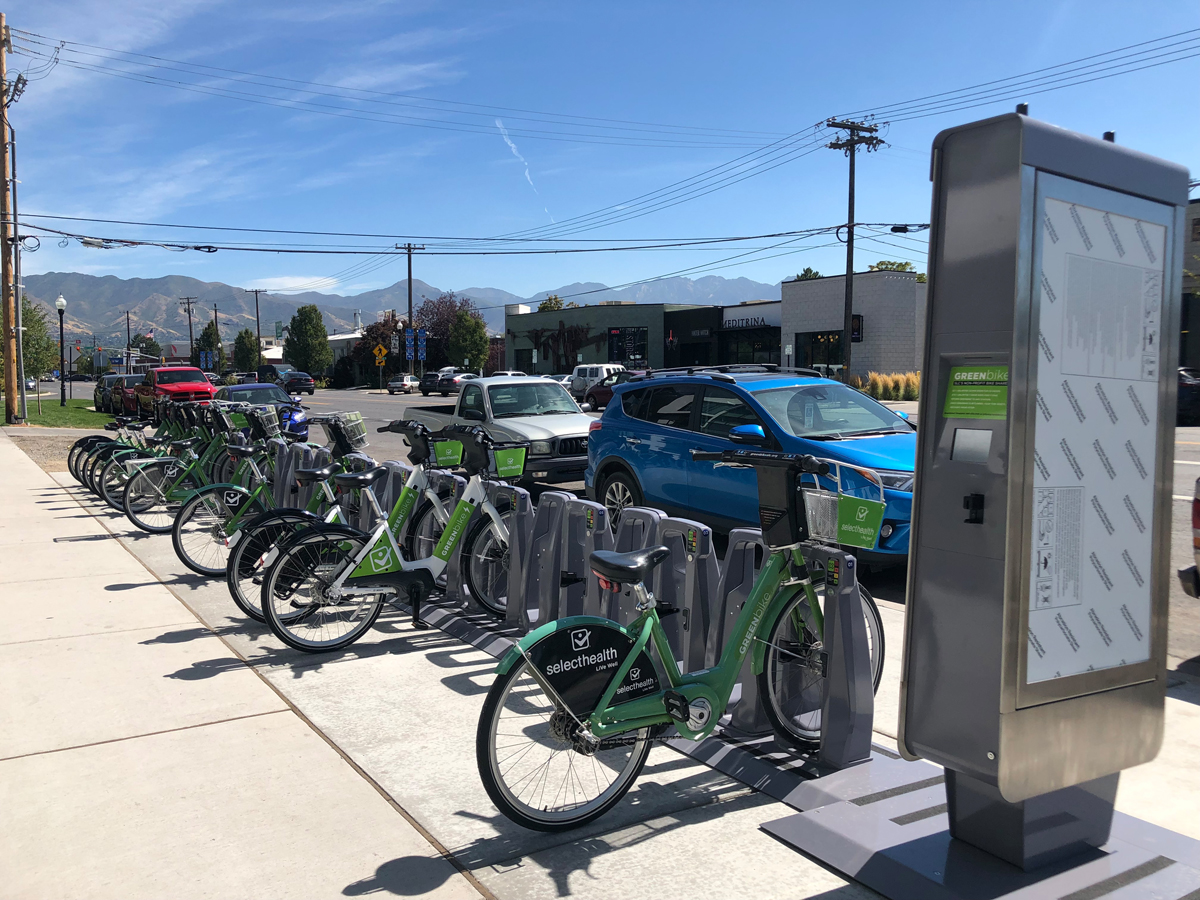
Greenbike, Salt Lake City’s bike share, expanded 300% recently including this new station in the Central 9th area. Photo by Dave Iltis

But the authors from the University of California, Davis write that users from low-income communities often need to travel further and therefore get hurt by surcharges for keeping bikes longer than 30 minutes.

See https://www.sciencedirect.com/science/article/abs/pii/S1361920920308701


BLM Taking Comments on Moab’s Klondike Bluffs MTB Area

By Charles Pekow — The Bureau of Land Management (BLM) wants to take better care of the Klondike Bluffs Mountain Bike Focus Area and adjacent land in Grand County, UT. It is taking public comment on proposed rules to ban camping outside designated campgrounds, prohibit cutting and taking wood, and require people to use restrooms or port-o-potties. Yes, people have been leaving waste on the ground, which is degrading it.

The BLM noticed an increased use of the area, so it wants more controls. Comments are due Oct. 8. https://www.govinfo.gov/content/pkg/FR-2021-08-18/html/2021-17704.htm


Skarda and Swenson Conquer Pikes Peak Apex

Four days of racing draws to a close as Alexis Skarda and Keegan Swenson are crowned championsof the 4-day mountain bike challenge

COLORADO SPRINGS, Colorado (September 28, 2021) — After 4 days, 120 miles of dirt and over 15,000 feet of climbing, Alexis Skarda and Keegan Swenson, both from Santa Cruz/SRAM, beat strong fields to win the overall general classification at The Pikes Peak APEX. The men’s field featured a who’s-who of American mountain bike racing plus EF Education-Nippo riders Lachlan Morton and Alex Howes, while the women’s field ended up being a tight three- way battle between three well-known domestic pros.

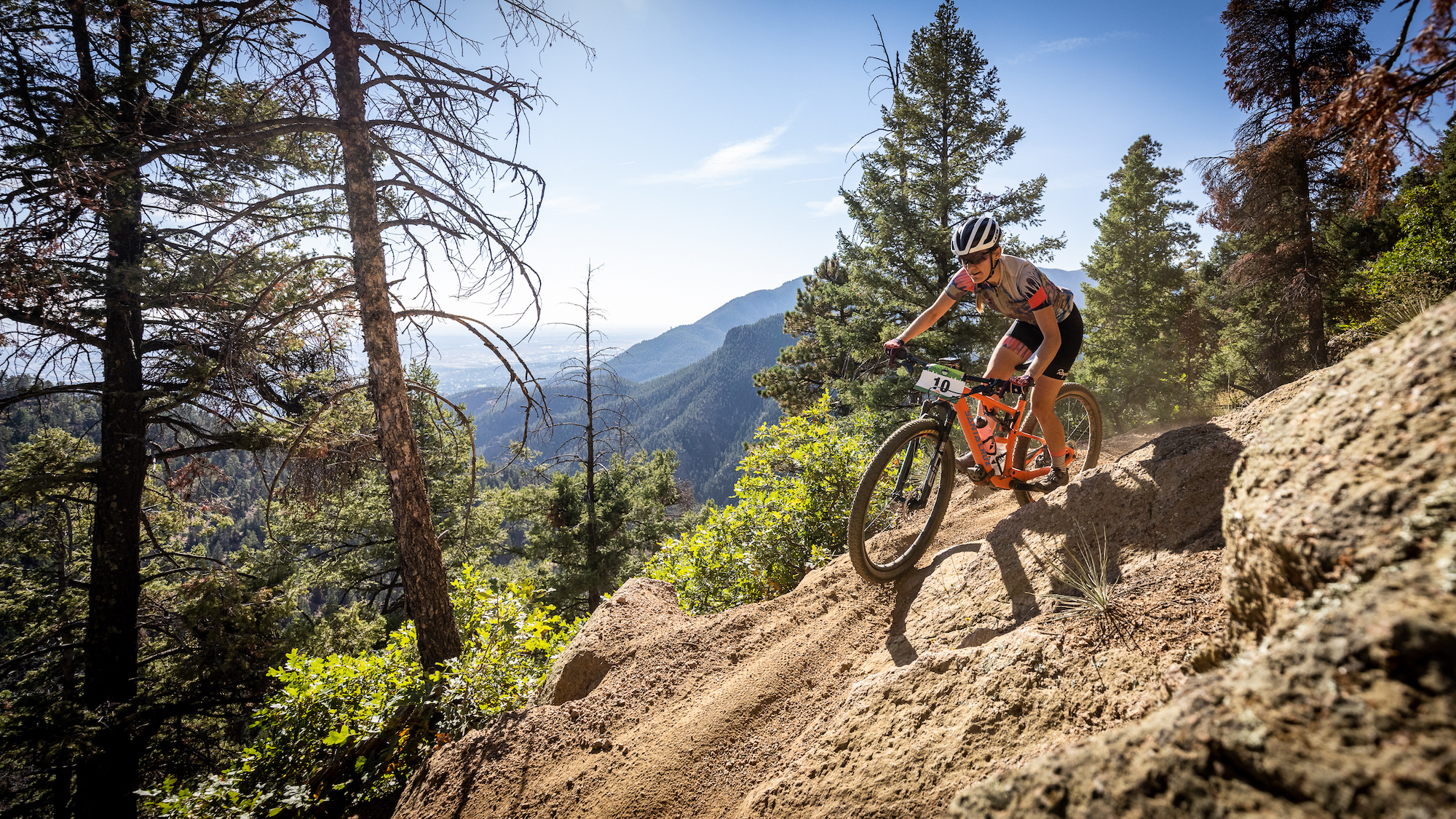
Alexis Skarda during the Pikes Peak APEX. Photo by James Stokoe Photography

Racing started in earnest on Thursday with the short, 11-mile technical time trial prologue. Clif Pro Team rider Sofia Gomez-Villafane won the stage for the women, with Juliana/SRAM rider Evelyn Dong and Bear National rider Alexis Bobbitt close behind. Swenson notched his first win of the week for the men, beating out defending overall champion and Colorado Springs local Russell Finsterwald, racing for Clif Pro Team and Ross Bell/Trek Factory Racing rider Riley Amos.

Day 2 of the APEX was the first big stage with nearly 6,000 feet of climbing over 40 miles. Swenson and Amos took off mid-race during the first section of singletrack, never to be seen again. Swenson held on for the win and the GC lead with Amos right behind, followed by Finsterwald and Bear National Team rider Braden Johnson about 5 minutes back after the super-technical finish. Skarda started to take advantage of her climbing prowess by putting time into the women’s field early and holding off Dong and Gomez-Villafane at the line. Dong held on to enough time to take the GC lead from Gomez-Villafane.

Day 3 featured another long day for the riders with the queen stage on Gold Camp and Jones Park. Skarda once again put time into the other women and went over the top of Frosty Park at over 10,000 feet with a lead of several minutes. Despite a strong chase down Captain Jack’s Trail, Dong and Gomez-Villafane couldn’t catch the climber, and Skarda took the stage by over 10 minutes to put her in the driver’s seat for the GC. Swenson continued to dominate the men’s field despite some strong attacks mid-race by Amos and just barely held on for the stage win with Finsterwald in 3rd and three-time Olympian Todd Wells in 4th.

The 4th and final day saw a shorter 20-mile stage with attacks from the gun with riders trying to mix it up. With higher speeds we saw a few more crashes with Alex Howes clipping a tree and breaking a finger and Sofia Gomez-Villafane putting a gash in her knee. While Gomez-Villafane was able to finish and get stitches in her knee immediately by the Centura Health Medical Team, Howes was unable to finish the stage. Skarda put her final stamp on the race by winning her third stage in a row and Swenson made it a sweep by winning Stage 4.

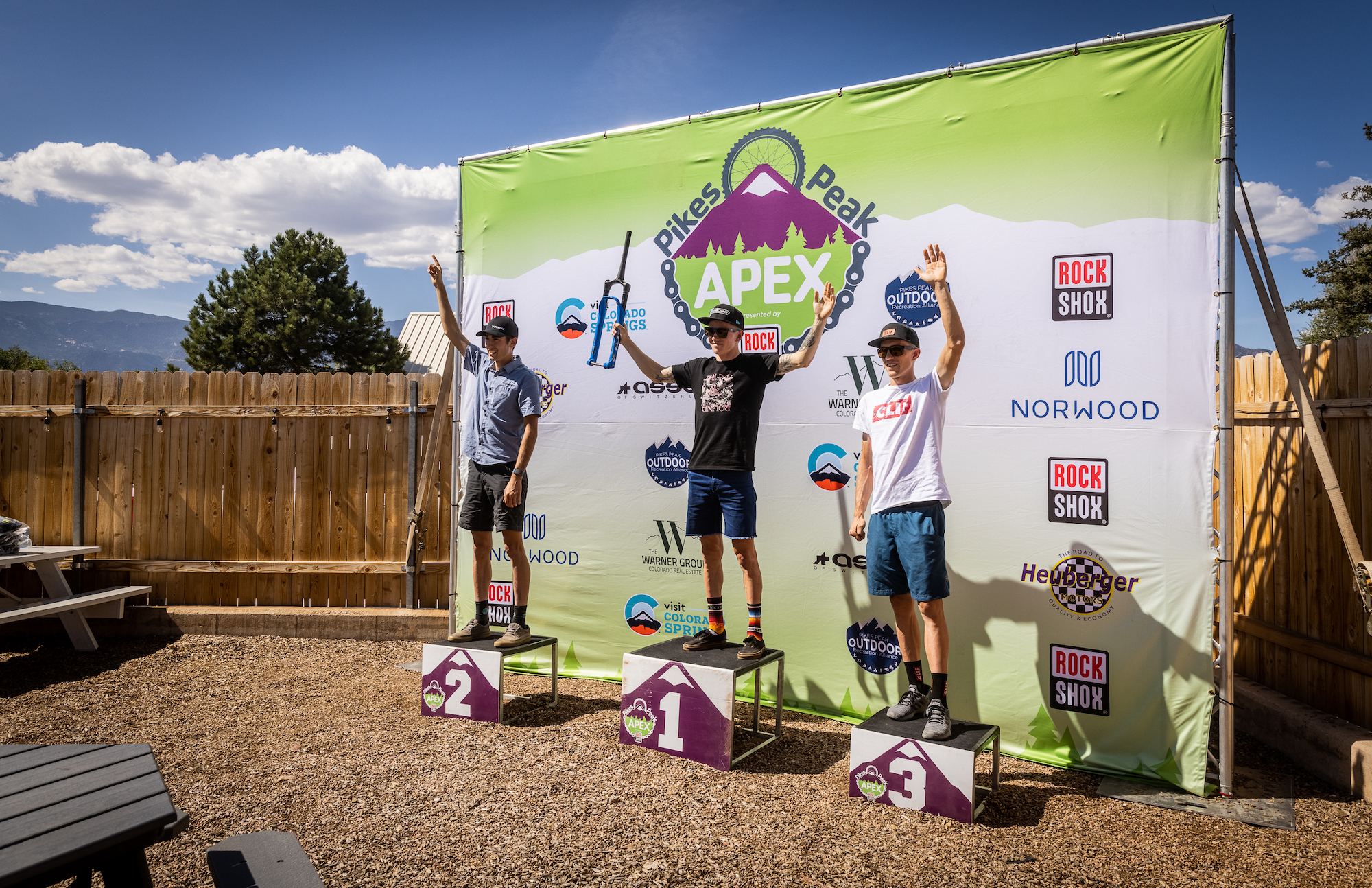
Men's podium at the 2021 Pikes Peak APEX/. Photo by James Stokoe Photography
Men’s podium at the 2021 Pikes Peak APEX/. Photo by James Stokoe Photography
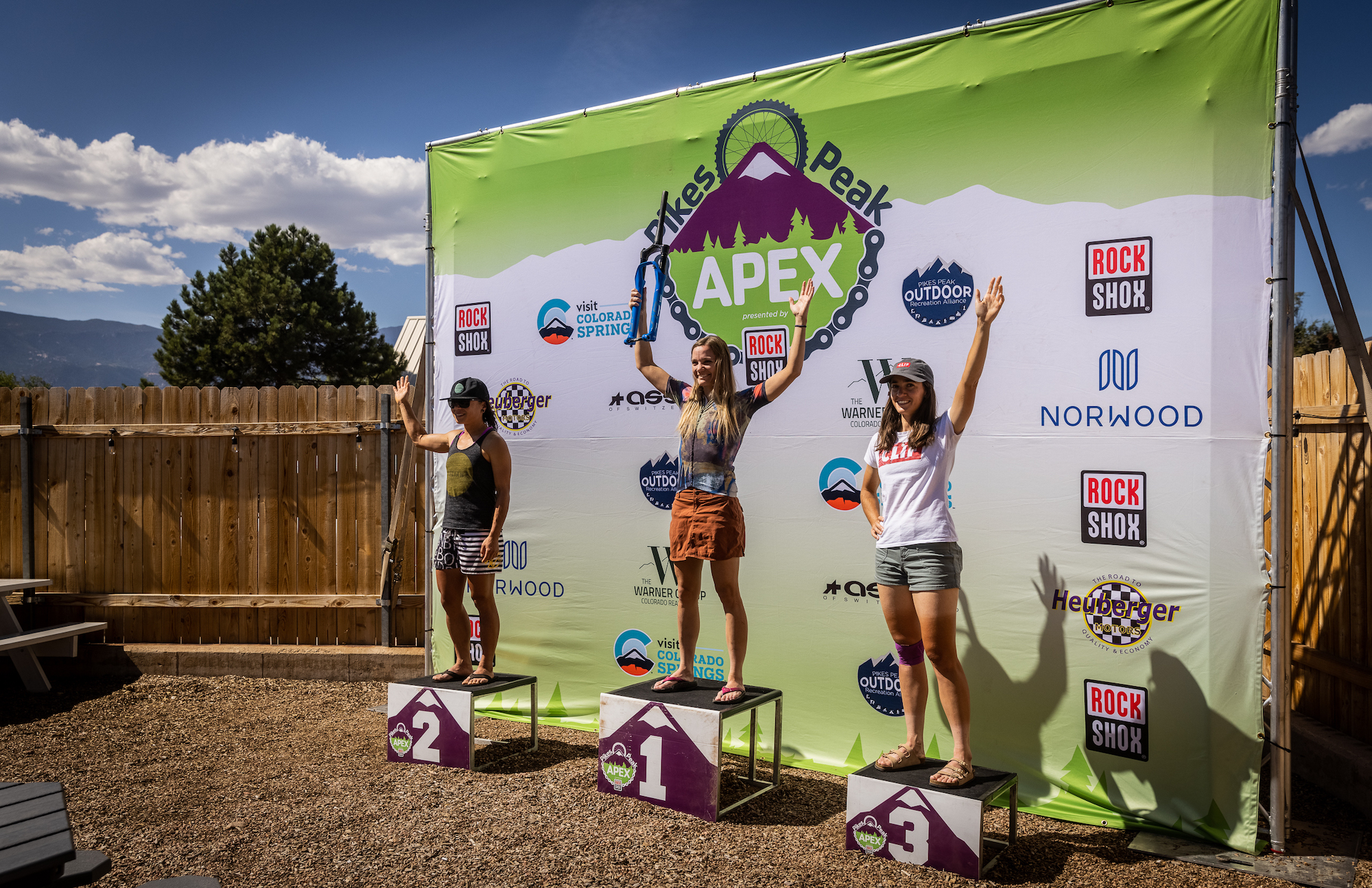
Women's podium at the 2021 Pikes Peak APEX/. Photo by James Stokoe Photography
Women’s podium at the 2021 Pikes Peak APEX/. Photo by James Stokoe Photography

Immediately following at the APEX Awards & After Party, over $38,000 in cash and prizes was distributed to winners in the pro/open and age group categories. The APEX pays out equally to men and women 15 deep each in the pro/open category and distributes prizes equally to 1st, 2nd, and 3rd-place men and women across 5 age categories. All results can be found on PikesPeakAPEX.com


Puppets With Tools Teach Kids How To Repair Bikes in New Video Series

0

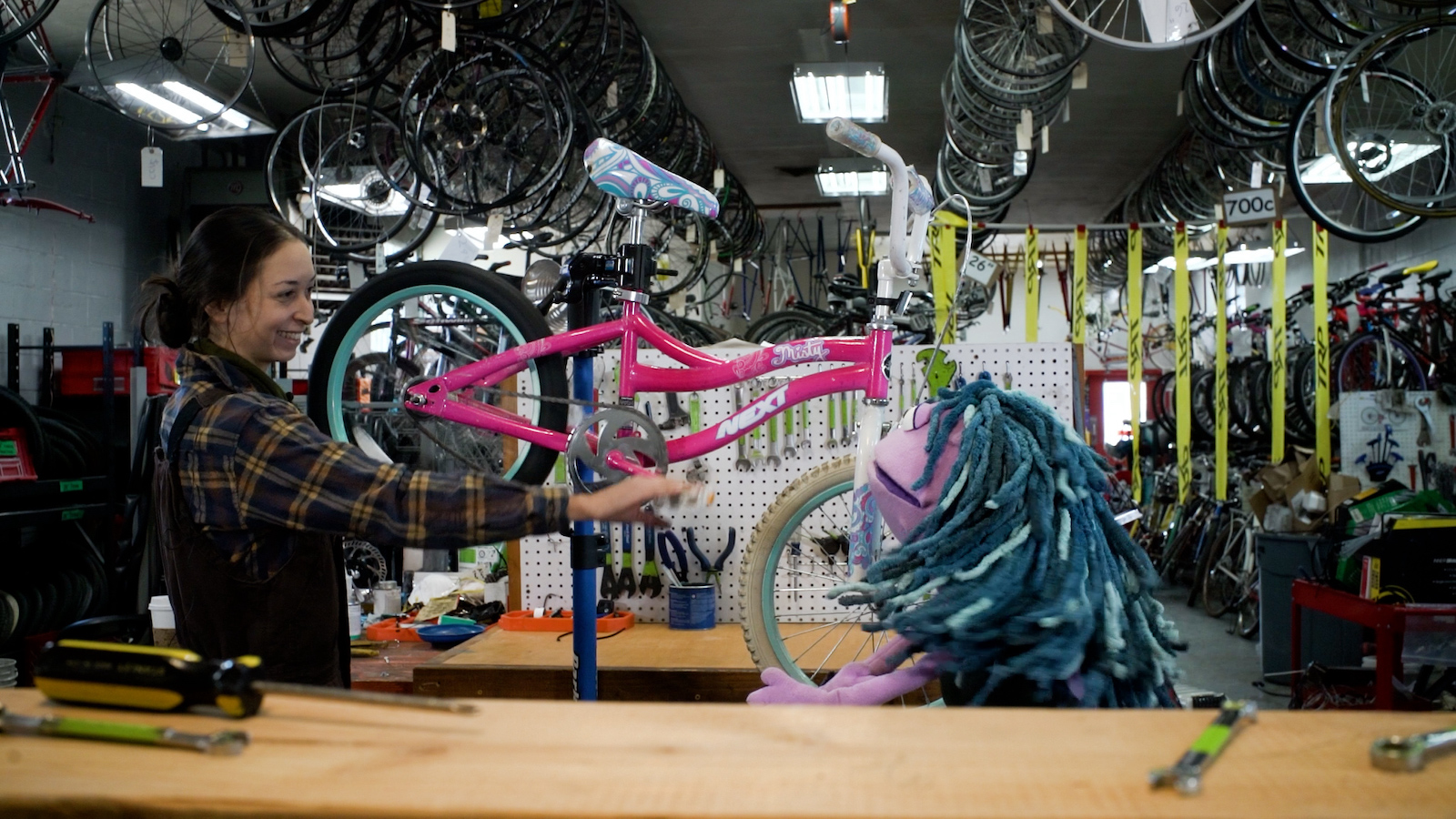
OGDEN, Utah (September 30th, 2021) — The early days of the pandemic provided plenty of challenges for traditional bike shops, but even more so for a bike shop whose model is based on gathering community members and volunteers in a collaborative indoor space.

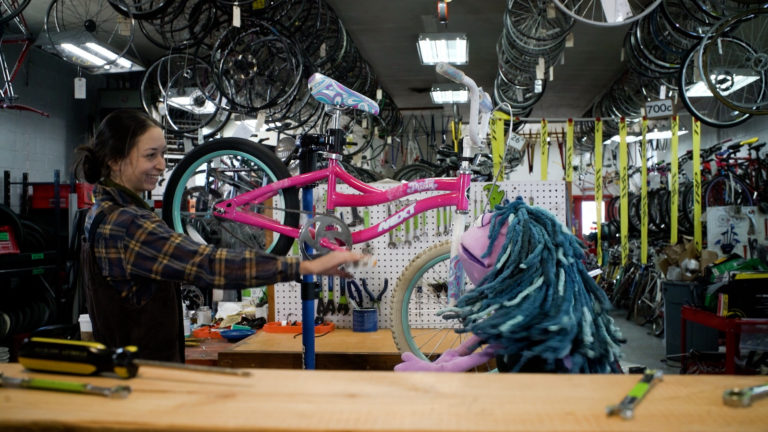
Photo courtesy Ogden Bicycle Collective

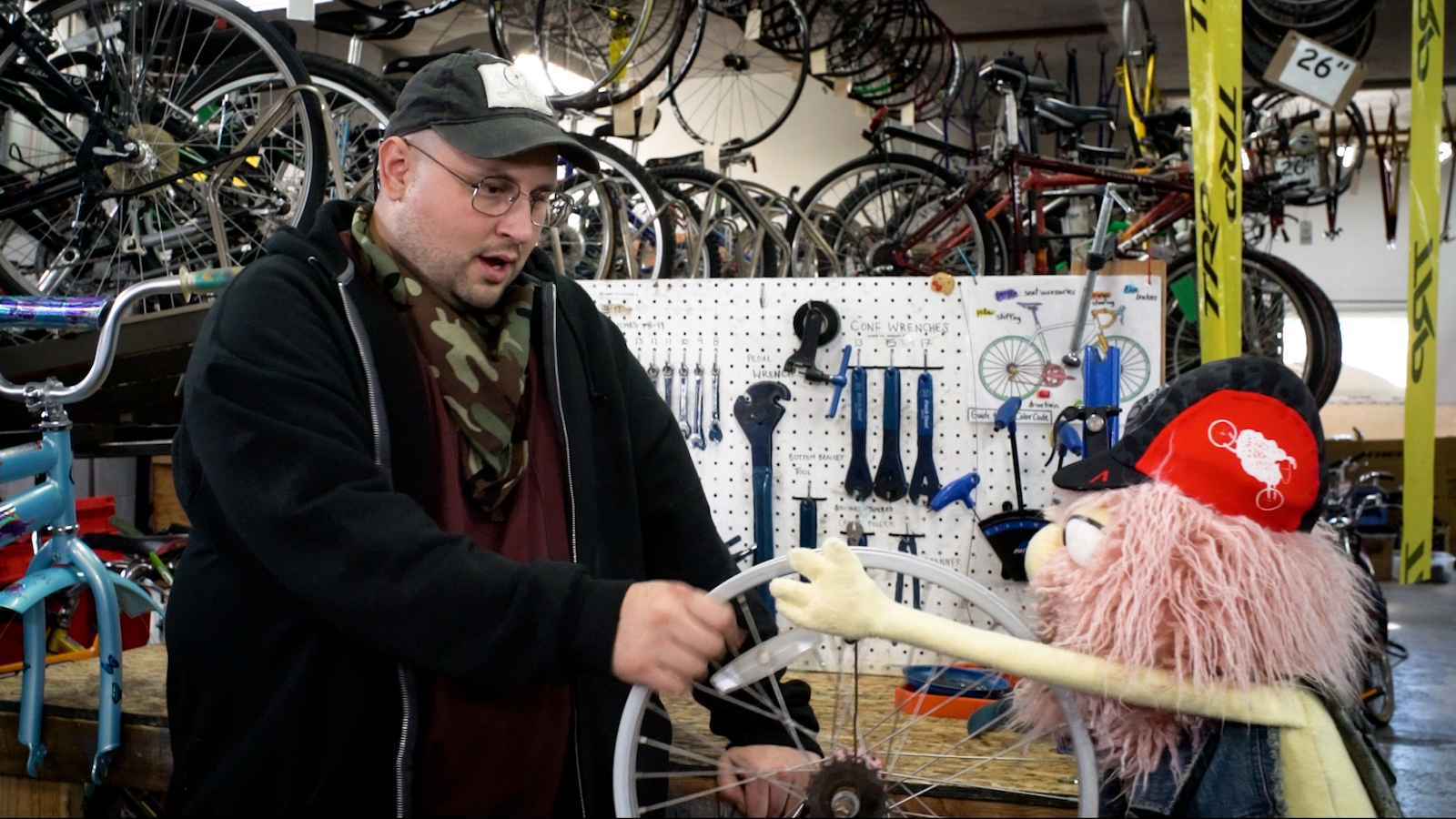
Contemplating how to move in-person, hands-on youth bike mechanics programming virtual during last summer’s lockdown, two employees at the Ogden location of the Bicycle Collective joked about   a Sesame Street style kids program about bicycles as a way to continue and expand programming.

Photo courtesy Ogden Bicycle Collective

Juan “JP” Orquiz, head mechanic, took the joke seriously and went home and made the first puppet.

A year and several puppets later, Orquiz and Location Director, Dustin Eskelson created “Dusty and the Wrenches”, a nine episode YouTube series about maintaining and repairing bikes. The series covers the component systems that a child will need to know in order to fix a basic coaster brake bicycle. “We’re excited to launch the bicycle industry’s first mechanic video series targeted to a youth audience.

“We never could have made this a reality without the support of Quality Bicycle Products, The David Kilby Johnson Memorial Foundation and The Utah Governor’s Office of Economic Development,” said Eskelson. The first episode launches on October 1st on the Bicycle Collective’s Youtube Channel.

Following the initial release, a new episode will be released weekly.

Link to the Channel: https://youtube.com/playlist?list=PLcwT-l_DtQyBA0CGc3-9mnxoyUUKnBUzH

Bikepacking Through New Mexico’s Valle Grande

1

By Don Scheese —

“By the middle of the morning he was on the rim of the Valle Grande, a great volcanic crater that lay high up on the western slope of the [Jemez] range. It was the right eye of the earth, held open to the sun. Of all places that he knew, this valley alone could reflect the great spatial majesty of the sky … the great feature of the valley was its size. It was almost too great for the eye to hold, strangely beautiful and full of distance.” — N. Scott Momaday, House Made of Dawn

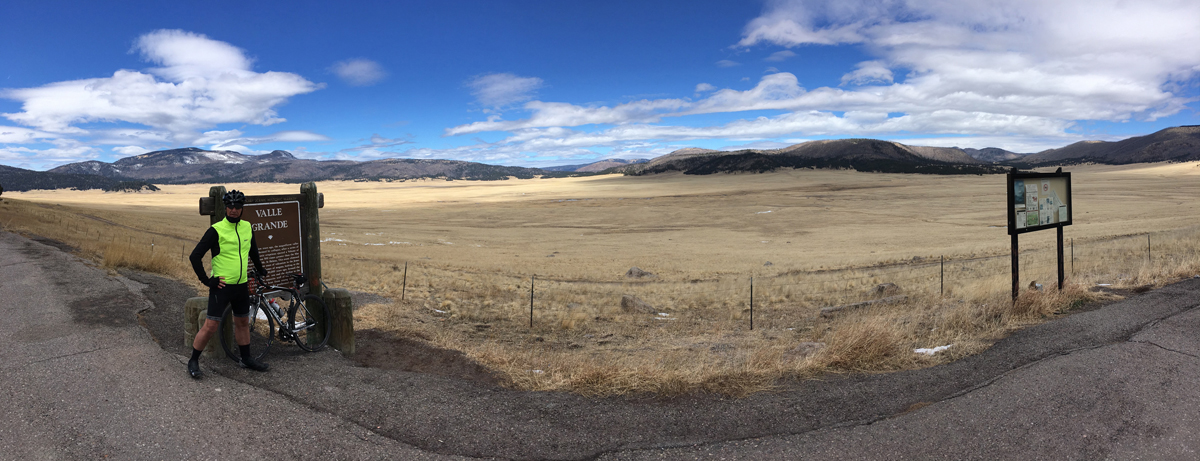
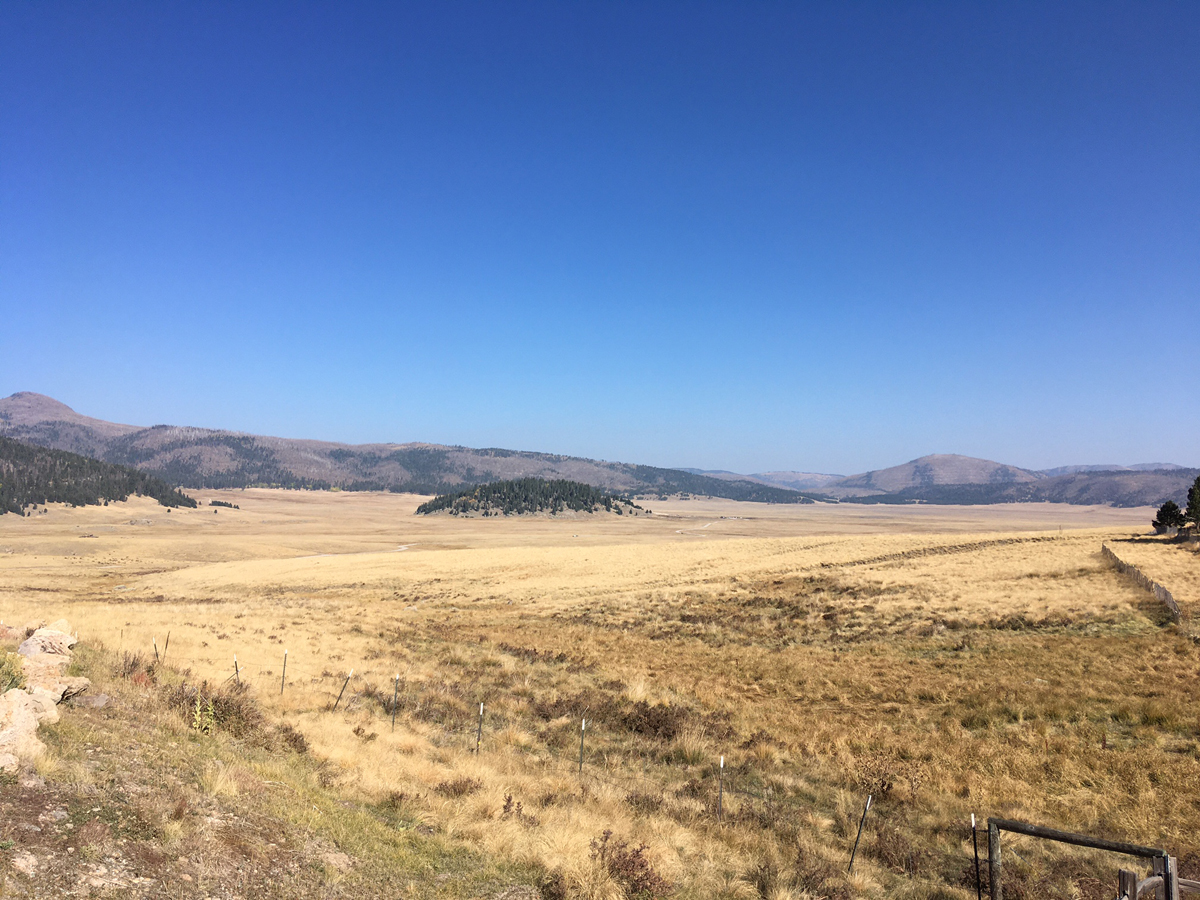
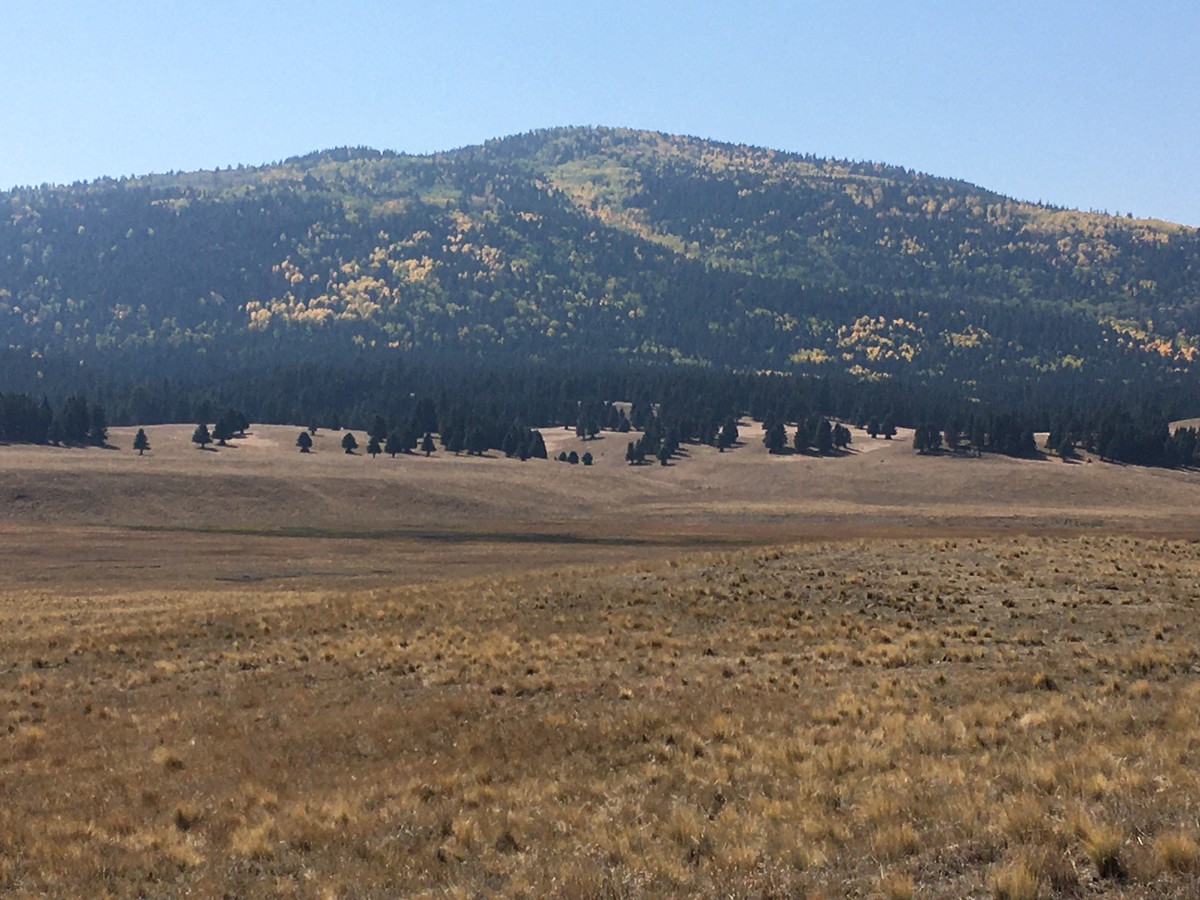
Don Scheese and a panorama of the Valle Grande.. Bikepacking the Valle Grande. Photo by Don Scheese
Don Scheese and a panorama of the Valle Grande. Bikepacking the Valle Grande. Photo by Don Scheese

The Valles Caldera National Preserve, established in 2001, is something special. Locals simply refer to it as “The Valle,” or “The Valle Grande,” and grand it certainly is. Almost 100,000 acres in size, this volcanic caldera is New Mexico’s mini-Yellowstone, a high elevation grassland basin rimmed by dark, conifer-clad, rounded-off mountains. Elevations range from the basin at 8400’ to the Valle’s high point, Redondo Peak, at 11,254’. Whatever way you approach it from State Highway 4, which runs along the southern boundary of the preserve, the contrast between the densely forested and fire-scarred landscape from which you emerge and the open vista of The Valle is visually striking—one might even go so far as to say sublime.

It is not only the geologic history of the Valles Caldera that is so interesting, but the human history is also fascinating too. Over thousands of years people have visited, used, and at times lived there, forming a rich palimpsest of stories and events.

The caldera was created around 1.25 million years ago. As part of the Jemez Mountain volcanic complex, a “Big Bang” occurred when the volcano at the heart of the range erupted, spewing magma 15 miles high into the stratosphere, blanketing an area 30 miles in diameter in over 6 feet of ash. Eventually the caldera collapsed, and the flow of magma and ash cooled and solidified to create pinnacle-like formations made of volcanic tuff (like nearby Kasha-Katuwe Tent Rocks National Monument). Accumulating rain and melting snow created a lake inside the caldera, while resurgent domes formed as volcanic activity continued over millennia. Over time the rim of the caldera was breached on the west side, draining the lake as the running water formed creeks and canyons. With the advent of cooling global temperatures during the Ice Age some 20,000 years ago, grasslands evolved in the basin of the caldera. Colder temperatures inhibited tree growth, creating the magnificent valleys for which the Valle Grande became known.

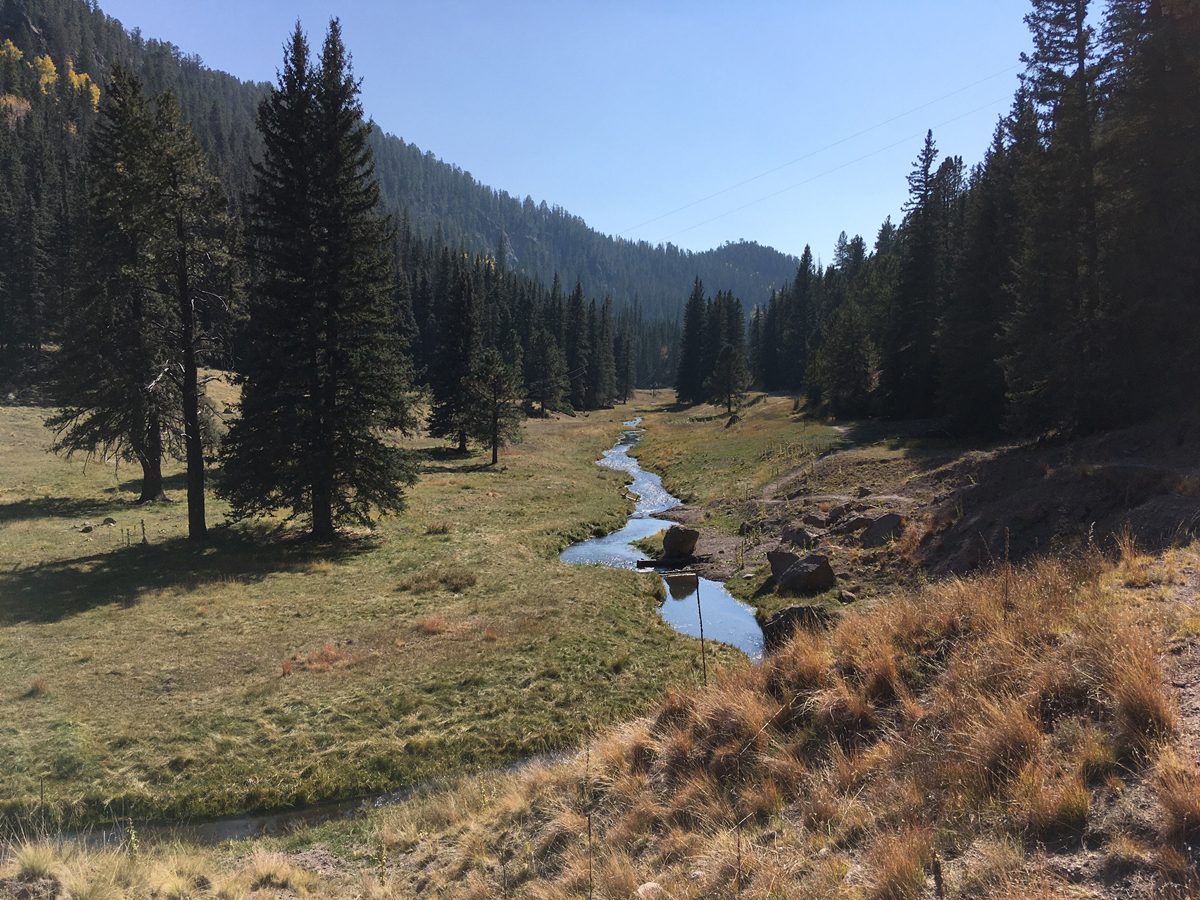
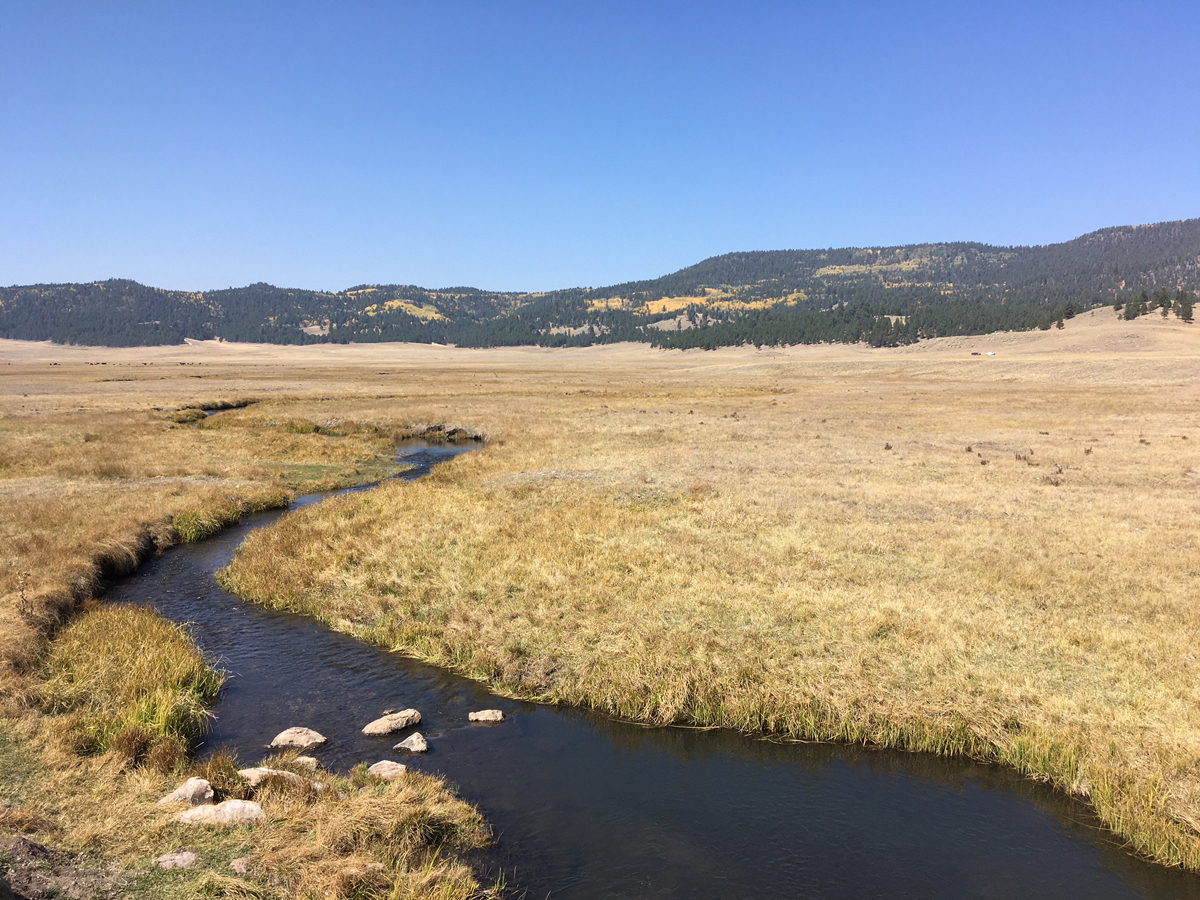
San Antonio Canyon and Creek. Bikepacking the Valle Grande. Photo by Don Scheese

As you approach the Valle from the west on Highway 4, the forest suddenly opens up as you top out on a plateau over 8000’ high. A sign proclaiming the entrance to the national preserve appears on your left, and so begins the main gravel road that slices through the meadows and around the timberline of the Valle. It is 2 miles to the Visitor Center and entrance station, and another 16 to the northwest corner of the park on road VC 02, where I planned to exit the preserve. Since camping within the park boundaries is not allowed at this time, I intended to camp somewhere along a creek just west of the caldera. The roads are rough but passable to passenger vehicles, and monstrous RVs are not recommended (thank gawd). Let us hope the Park Service keeps it this way. Basically the lightly travelled roads of the Valle are wonderful gifts to cyclists with mountain or gravel bikes.

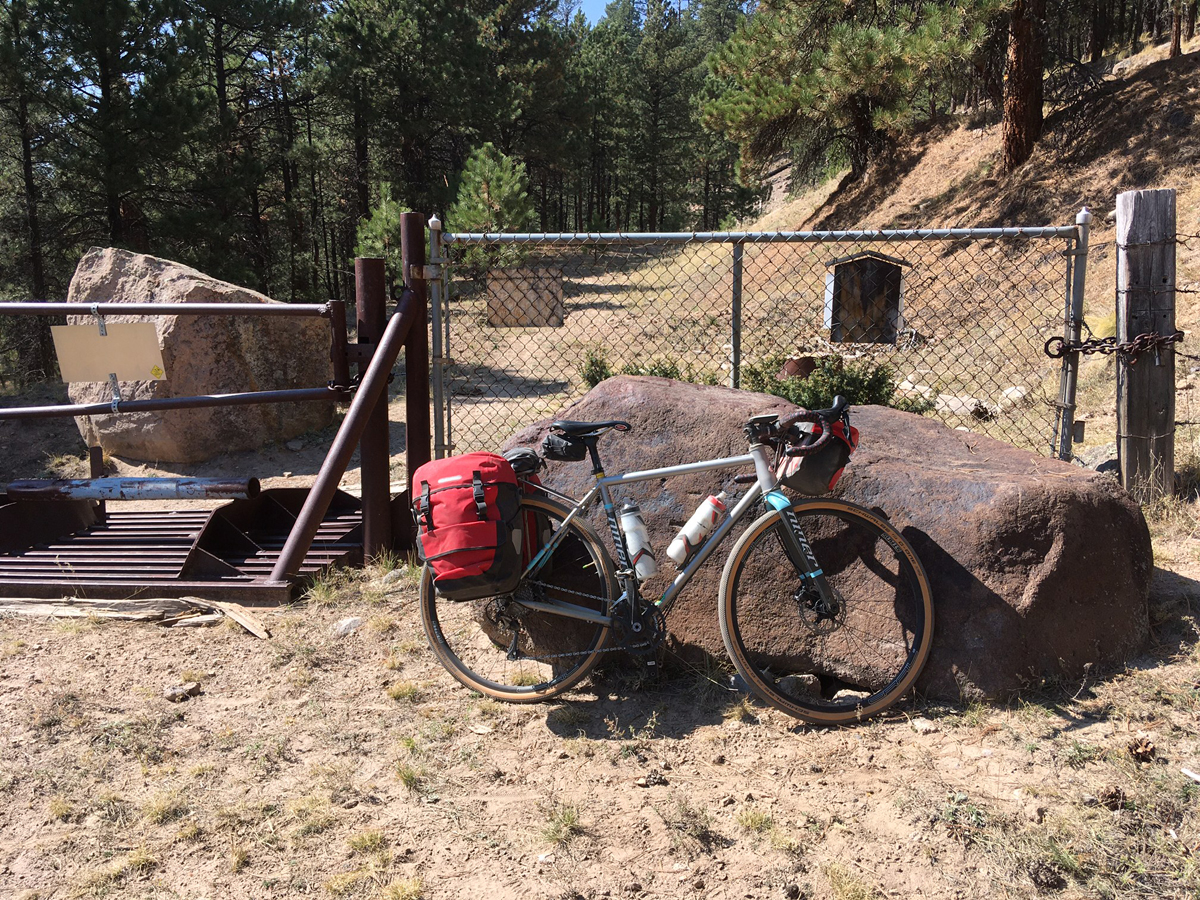
After loading up my steel Niner RLT with rear panniers and handlebar bag, making sure my 2 water bottles and Camelbak were topped off, I headed out from the visitor center parking lot on a gorgeous fall morning in mid-October, with temps in the 60s and a bracing northwest headwind.

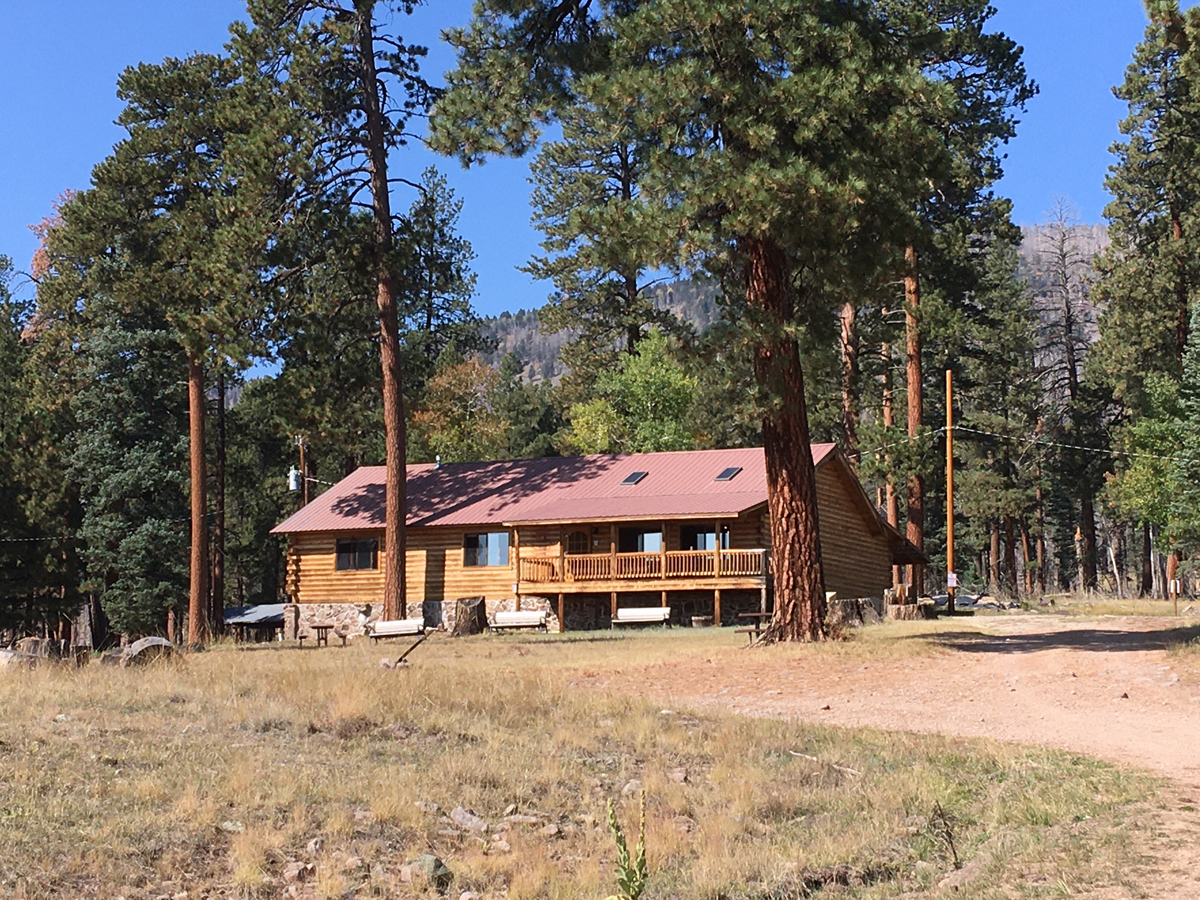
The first two miles ascend gradually to a junction, where a collection of historic buildings stands. For most of its human history the Valle was uninhabited due to its long winters and cold temperatures. It was and continues to be visited seasonally by Ancestral Puebloans and the current members of the nearby Jemez and Santa Clara Pueblos, who make pilgrimages to the tops of the highest peaks where shrines to their gods still exist. Beginning in the 1700s and lasting into the 20th century, Spanish sheepherders, the US military during the Indian Wars, and vaqueros herding cattle were also regular visitors. Only in the 20th century were ranchers willing to build cabins, and even then stays were restricted to summer and early fall. When Texas oilman Francis Dunigan purchased the property in the 1970s, he permitted the Hollywood film industry to shoot a number of Westerns in the Valle, the best of which was The Missing (1990), starring Tommy Lee Jones and Kate Blanchett. The TV series of the modern-day Western Longmire was subsequently filmed here as well.

VC 02 wends its way along the edge of the timberline, through the History Grove, a magnificent gallery forest of ponderosa pine some 500 years old through which there are fine vistas looking south over the expansive grasslands towards the dark conifer-clogged rim of the caldera. One of the provisions of the Valles Caldera National Preserve when it was created held that cattle grazing on a sustainable basis would be preserved as a “historic use,” and so you may see herds of cows here and there as you follow the meandering roads. There are also some 5000 elk that thrive in and around the Valle, and a favorite pastime of tourists is to watch them graze at the forest edge early mornings and towards dusk. A member of the Cochiti Pueblo once told me he collects the elk antlers in the spring on the nearby hillsides for sale to wanna-be Westerners in Santa Fe who decorate their homes with the magnificent racks.

VC 02 trends northward on rolling terrain along the base of several resurgent domes that formed after the Big Bang some 1.25 million years ago: Cerro Pinon, Cerro del Medio, Cerro del Abrigo. There are some fine routes to the east that loop through the Sierra de los Valles and Valle Toledo, past Obsidian Valley (a rich source of carving tools for Ancestral Puebloans) and back to VC 02—but my route today was more direct. After a gradual climb I reached the high point of my entire 2-day journey: San Antonio Divide, 8800’, separating the waters of the East Fork of the Jemez River from those of San Antonio creek (the two drainages re-join at Battleship Rock, a stunning tufa formation to the west in San Diego Canyon).

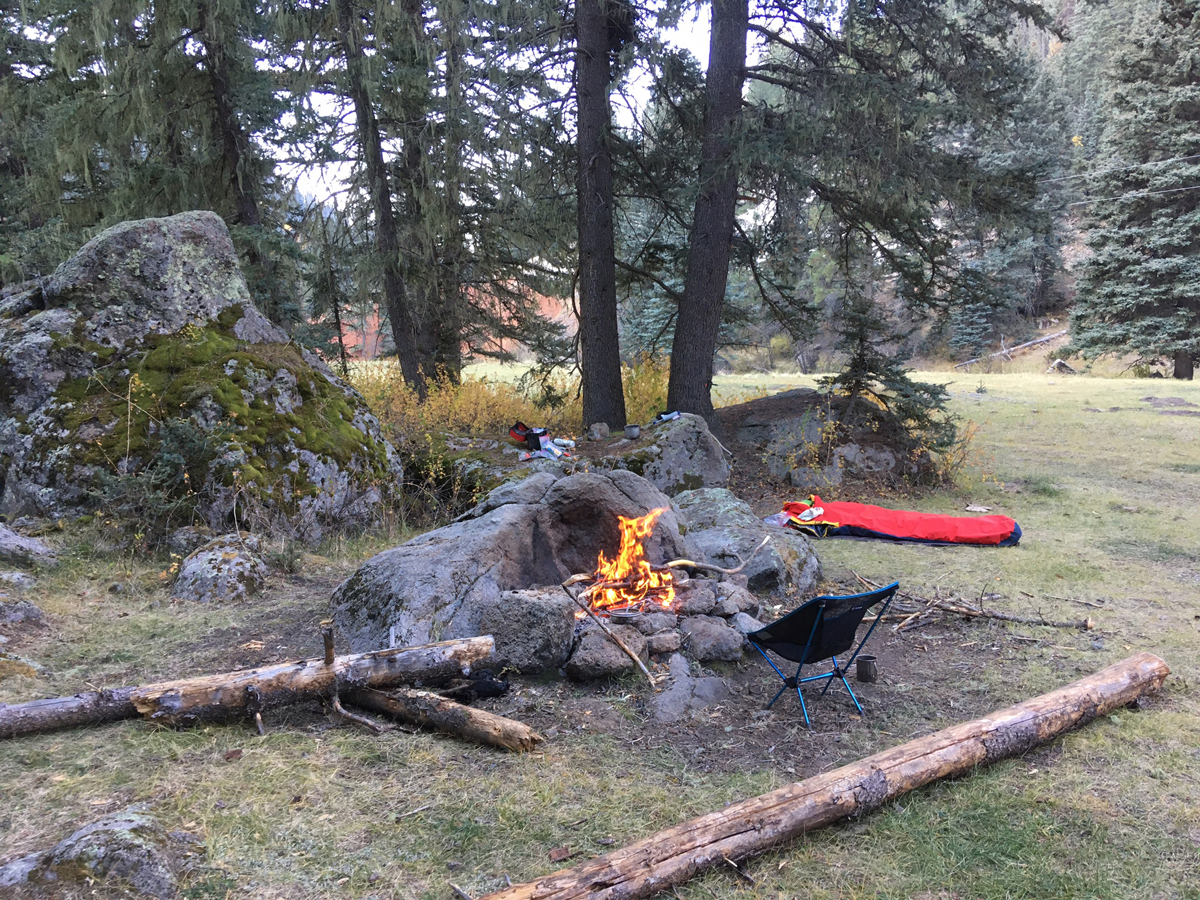
Don's camp by San Antonio Creek. Bikepacking the Valle Grande. Photo by Don Scheese
Don’s camp by San Antonio Creek. Bikepacking the Valle Grande. Photo by Don Scheese

Only two or three vehicles passed me by this point, all going the opposite direction. From here it’s a 4-mile gradual descent into my favorite part of the preserve, the Valle San Antonio. Farther removed from the visitor center, it’s even less travelled by motor vehicles, and the vistas along San Antonio Creek are especially sublime. Particularly in October, when the flaming colors of the aspen stand in stark contrast to the dark green conifer-studded slopes of Cerro Seco and San Antonio Mountain. There’s another picturesque cabin along the creek, and you may well see cattle grazing off in the distance. On some of the hillsides are horizontal lines rimming the mountains on the north side, remnants of roads that are a legacy of decades of intensive commercial logging in the 20th century. I once heard a mountain biker describe the Valle as “pristine,” and had to laugh—it is hardly a landscape untouched by humans over time. But it is a rewilded landscape, and with effective management by the Park Service it should continue as such.

Occasionally a lone stunted conifer rose from the grasslands, representing the age-old battle between the two biomes. Since the last Ice Age the colder temperatures of the basin have largely prohibited tree growth, leading to the open vistas for which the Valle became famous. The isolated tree here and there called to mind ‘the tree where man was born.’ This is an allusion to a book by Peter Matheissen of that title, and the origin of the human species on the African savannah, where we became a bipedal mammal emerging from the dense forest onto the open grassland some 5 million year ago. Biologist E. O. Wilson developed his theory of the Biophilia Hypothesis from this fact, arguing that we have an innate preference for a landscape that is both open and provides cover from predators. [Editor’s Note: The idea of Biophilia, love of nature, was proposed early on by my father, Dr. Hugh Iltis. Wilson later developed the concept further in his book by the same title.] Perhaps, I thought, this is one reason, albeit of the subconscious, why the Valle is so visually attractive to visitors.

Wildfire has also played a dominant role within and around the Valle. Prior to the 20th century, ecologists have concluded based on tree-ring data and fire scars that most fires were low-intensity blazes restricted to the understory and grasses. But beginning with the total fire suppression policies of the 1900s by the federal government, fuels began to accumulate, resulting in bigger, higher-intensity crown fires, whether started by lightning or humans. Four of the 5 largest wildfires in the area’s history have all occurred since the 1970s, and the scars are visible all around the rim and surrounding forest of the caldera.

Don Scheese on Highway 4 at the edge of the Valle Grande. Bikepacking the Valle Grande. Photo by Don Scheese

VC 02 ends at the junction with VC09 in the San Antonio valley, and from there it is 6 more miles of rollers to the park boundary and gate in the northwest corner. I geared down for a few of the short punchy grades as I approached the gate and had a good lunch after 2+ hours of gravel grinding on a loaded touring bike. It was early afternoon, a cool breeze was blowing, and there was some welcome shade under a big ponderosa as I took in the quiet and solitude, soothed by the wind whooshing through the pines.

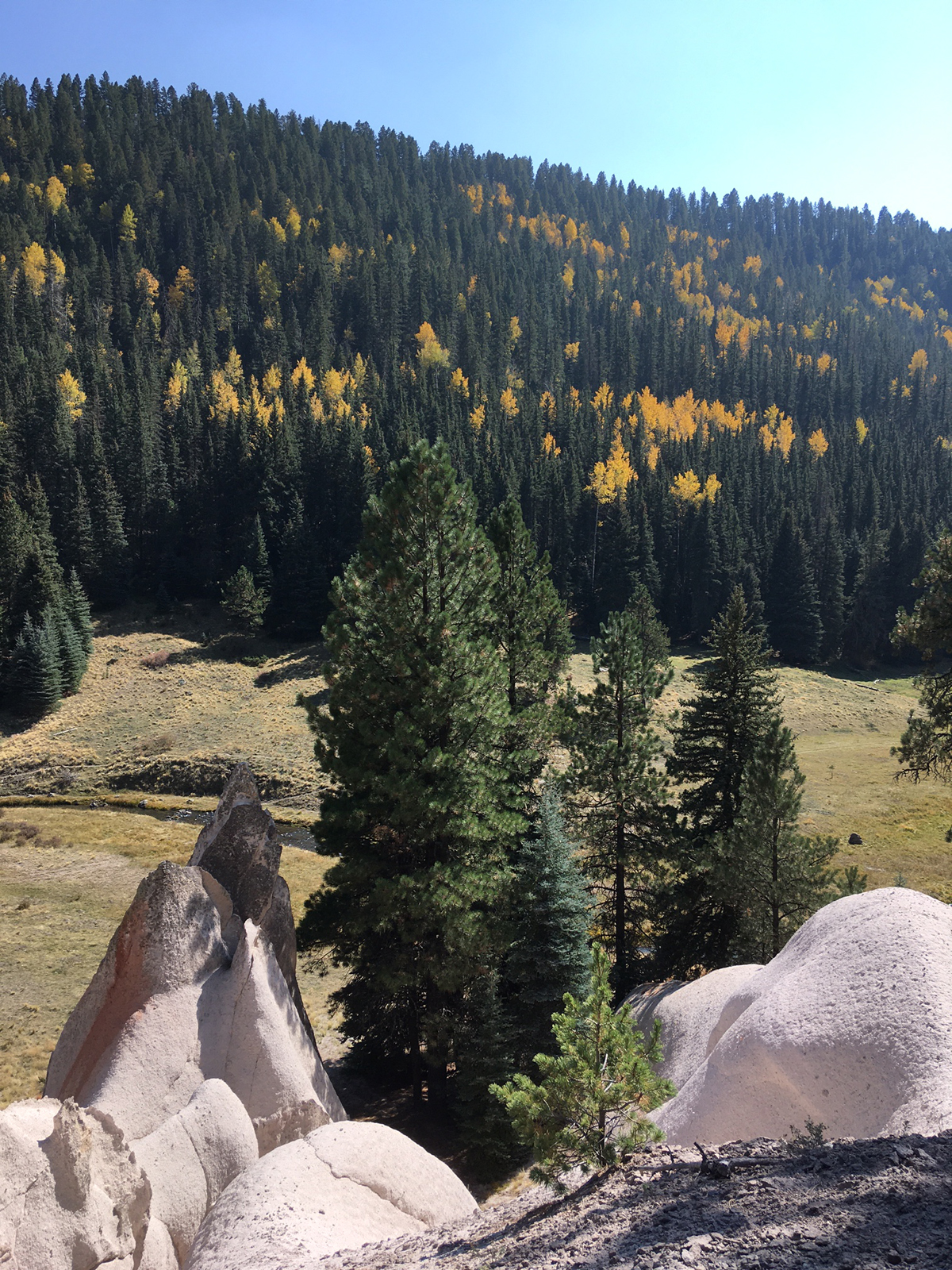
At this point I was on the lip of the caldera. The next 2 miles consist of singletrack on an old logging road down one of the most scenic canyons in all of New Mexico. A purling meandering stream; aspen trees flaming on the hillsides; and tent-rock like tufa formations punctuating the defile: I was witness to all this and more, as I descended slowly, savoring the experience. In a few spots I played it safe and dismounted where the trail took a steep plunge or the singletrack became too crumbly and unstable for my 38 mm tires. I encountered one hiker, a guy and his dog, who were sauntering up the canyon. He told me about “a primo campsite one meadow up” from the popular San Antonio hot springs. I thanked him for the tip and told him I’d definitely check it out.

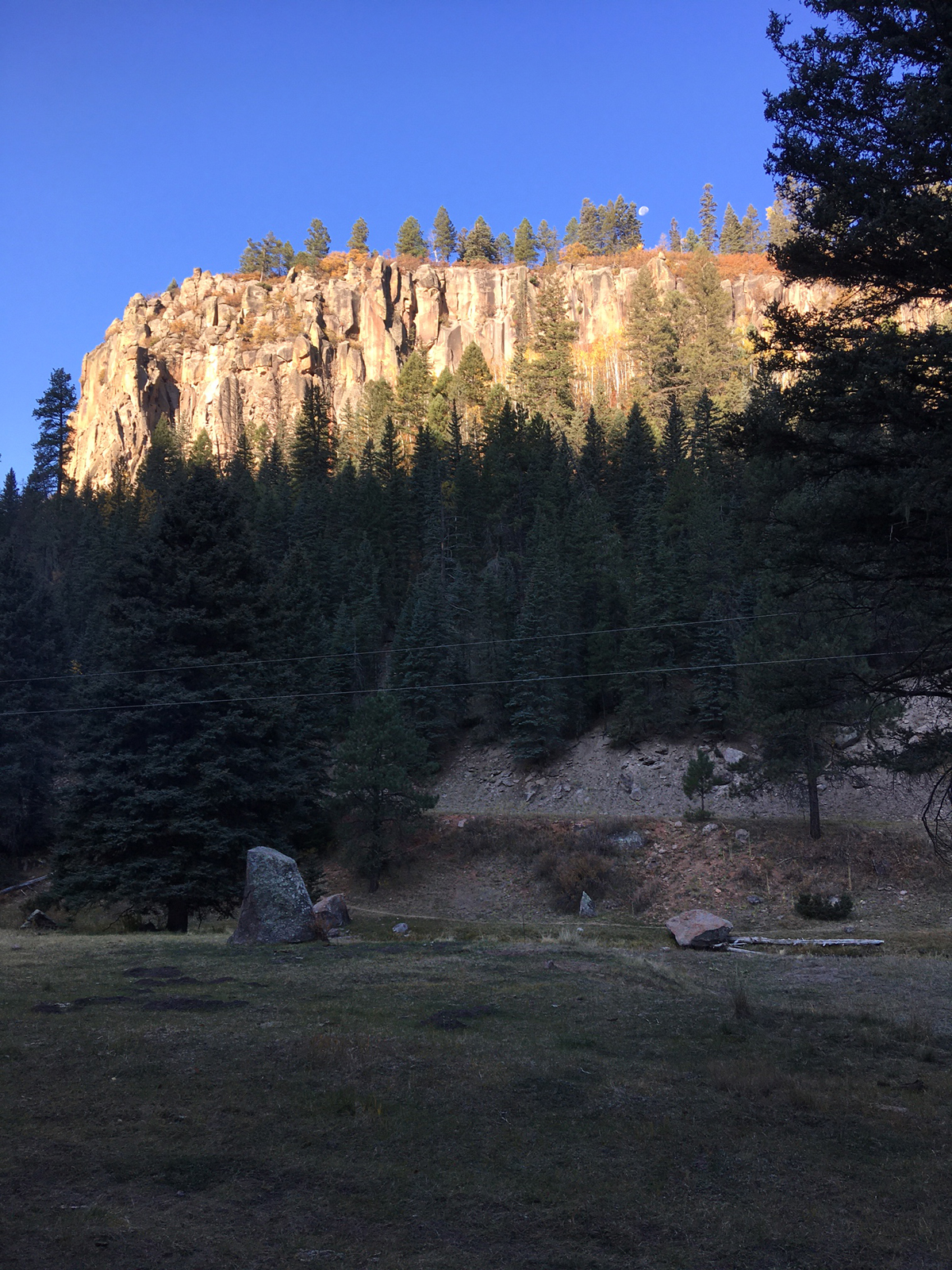
In all too short a time I recognized the spot. To reach the campsite required fording the stream, so I donned sandals and tossed my panniers and handlebar bag across the creek to lighten my load when crossing. The fresh icy cold water soothed my feet, and in no time I reached the campsite, sheltered by towering spruce. There was plenty of downed wood for an evening and morning fire, with a fire pit built up against a huge slab of granite. Above me on the opposite side of the canyon, the warmer south side, towered pink-gray tufa cliffs interspersed with ponderosa pine. After setting up camp I simply sat in my Helinox camp chair, sipped whiskey, munched some habanero jerky, listened to the purling stream, and watched the sun sink ever-so-slowly behind the cliffs.

Dinner: mac ‘n cheese with spicy Thai tuna. A nice warm blazing fire for a couple hours. Sound sleep in my down bag and bivy sac. A sky filled with stars and the Milky Way. A great horned owl hooting softly in the forest primeval. Quiet. Solitude. Wildness.

Morning: ice in my pot with water filtered from the creek. A visitor: an old Hispanic man with his pugsley dog, who told me he walks up the canyon several times a week. (I referred to him as El Viejo in my journal.) The temps slowly warmed as the sun crept over the ridge, hours later finally reaching my campsite. At that point the air quickly warmed up to the 60s, and I slowly shed layers of clothing and basked in the morning sun.

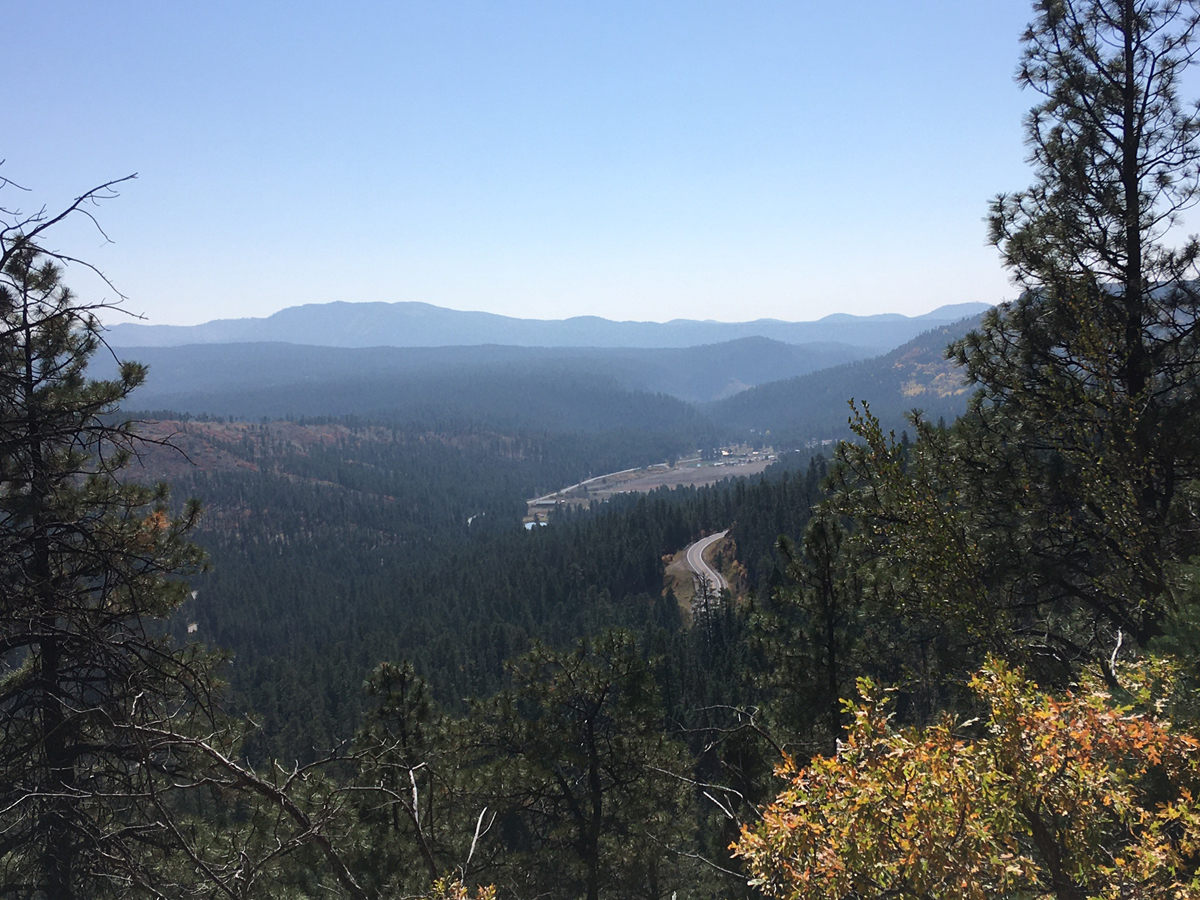
I re-crossed the stream and continued down the canyon. Forest Road 376 from the hot springs to Highway 126 is open to vehicles from June to December, and along these 5 miles I met with a couple vehicles heading to the hot springs. Just before the junction I paused to take in the overlook of La Cueva, a village at the junction of Highways 126 and 4, where there’s a general store motel, and a few summer residents.

I was about to enjoy a 2000’ plunge on paved roads all the way down to Jemez Springs, 13 miles distant. Before beginning the descent, I re-checked my brakes and rack and panniers, making sure everything was tight and in good working order.

Swooping switchback twists and turns, high-speed descents on straightaways, little traffic: the Reward for the Cyclist who has labored up some 1300 feet of elevation. In no time I was passing through La Cueva. Rather than stop at the general store for some refreshment I decided to continue on down through San Diego Canyon, not wanting to interrupt my momentum (every cyclist knows that feeling). There are numerous hot springs, fishing spots, and hiking trailheads along this stretch of Highway 4, but mercifully traffic was still light and most of it was heading the other way. Of course a guy in a pickup had to pass me on the narrow-shouldered road with oncoming vehicles, but after that I whizzed past the dark prow of Battleship Rock, then the weird formation of Soda Dam, where geothermal mineral deposits have built up to form a barrier of sorts to the creek. After a brief holdup for ongoing bridge construction, I reached the funky New Mexican village of Jemez Springs, where galleries, thermal pools, and a thriving little community of independent-minded folks flourish.

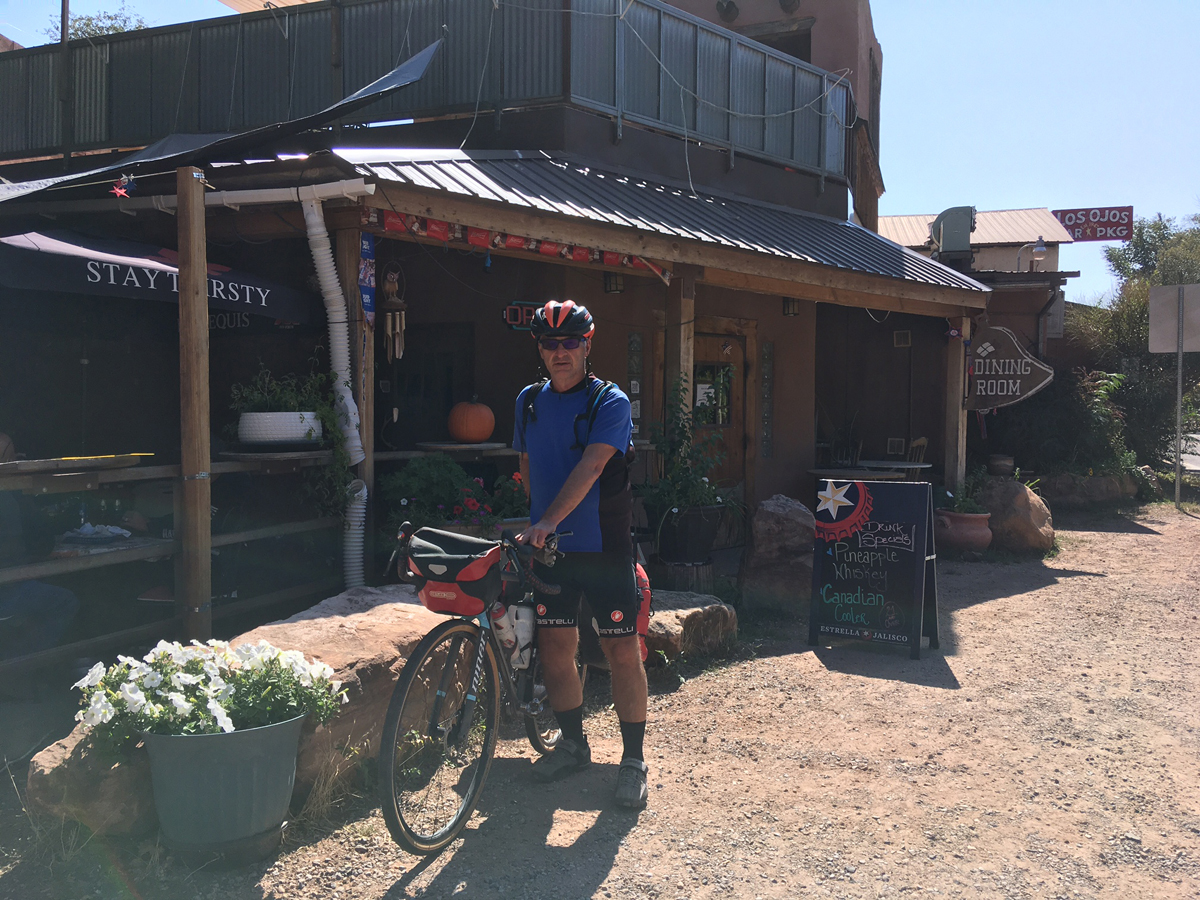
Time to celebrate: a good lager and Olga’s famous chile rellenos at the historic bar of Los Ojos. I was back in the world of masks, social distancing, and the pandemic….waiting for my wife to pick me up and take me back to my car at The Valle.

Cyclists know the feeling of having come across a landscape that caused them to think, “Now this is a place that I have to come back to on my bike.” And when they do, they realize a Dream Fulfilled.

Exactly my feeling as I toasted a fine trip through the Valle Grande.

Don “Seldom Seen” Scheese lives and rides in New Mexico, always in search of new adventurous routes, especially on gravel roads.

The Athlete’s Kitchen: Male Athletes & Eating Disorders

0

Guys, do you know that eating disorders are not just a woman’s issue?

By Nancy Clark MS RD CSSD, copyright Sept 2021

Guys, do you know that eating disorders are not just a woman’s issue? An estimated 8% of male athletes, as compared to 33% of female athletes, have pathological eating disorders that can damage their physical and mental health. This includes anorexia, bulimia, binge eating, and compulsive exercise. Another 19% of male athletes likely have sub-clinical disordered eating behaviors. If anything, these estimates are low because eating issues in males can be challenging to identify. Many go undetected and untreated, as demonstrated by new research published earlier this year (1).

Education can help men overcome eating disorders. Photo by Dave Iltis

Male athletes live in an environment that can easily trigger disordered eating. Triggers include:

  • immense pressure to look a certain way to perform well
  • social media’s idolization of the “perfect physique”
  • incessant comparison of oneself to others
  • a competitive nature and drive to be better than others.

The end result: some male athletes resort to extreme behaviors in their attempt to be able to control their body shape and size. They do extra training and become extra vigilant about their food intake. It’s not uncommon for one athlete to observe another who eats restrictively and start to wonder. “If he cuts out XXX (sugar, red meat, white flour, etc.) maybe I should too…” Somehow, eliminating XXX becomes the path to becoming a better athlete—and the athlete starts down that slippery slope into a full-blown eating disorder. It can happen so easily, quickly, and unknowingly.

Social pressures:

Advertisements and social media teach men they should look lean and muscular. But no one teaches them the images are photoshopped. Or that some of the male models use performance enhancing drugs to help them look so buff. As a result, male athletes tend to suffer in silence with their concerns about their bodies, which they may perceive as “flawed.” After all, real men don’t talk about this stuff with others. Hence, they may believe they are the only ones who eat less and exercise more to fix their flaws. They may not even realize their behaviors are abnormal. Don’t all serious male athletes live on salad to be lighter, leaner, and (supposedly) better? Turns out, that is not the key to success.

Why do eating disorders take root in men in the first place?

An eating disorder gives a sense of control. While an athlete cannot control his genetics or his coach’s opinion of him, he can attempt to control his food, exercise, and weight. Given the (incorrect) belief the lighter athlete is the better athlete, competitiveness can take hold. A vulnerable male can feel compelled to do whatever it takes to reach a performance goal or a target weight. Unfortunately, one athlete’s extreme dieting can become another athlete’s motivation to become even more extreme. (“If Joe skips breakfast to lose weight, I should skip breakfast and lunch….”) The male sporting environment embraces and rewards extremes.

Extreme behaviors can bring desirable results initially – as well as praise. (“Our #1 runner is the healthiest eater on the team”) Positive comments from others are validating, confidence-boosting, and perceived as a positive sign that their efforts are paying off. That is, until the body starts falling apart. (Athlete + too much exercise + too little fuel = injuries, sooner or later)

If a male athlete hears a negative comment (such as, “Looks like you’ve gained some weight…?”), he might feel the need to work harder and go to extremes to correct the problem. While eating less and training more might look like discipline and dedication to the sport, the extremes can destroy one’s quality of life, to say nothing of dramatically increase the odds of getting a stress fracture, tendonitis, pulled ligament, or other injury associated with underfueling and/or poor nutrition.

Seeking help

Research confirms that few male athletes readily seek treatment for their eating disorders. They may believe they are not “sick enough” to justify getting help. They are likely unaware of the risks they are imposing on their physical and mental health. Most are unaware that their thoughts or behaviors are disordered.

Many males have no one to talk to. This leads to suffering in silence. If a male athlete does try to talk about his experience to a teammate, the teammate might express disbelief and have little understanding of what the athlete is talking about. This can lead to embarrassment and shame.  It’s shameful to not only have an eating disorder—Isn’t that a woman’s issue? — but also to want a body that’s slim (not muscular, as society preaches).  It’s easier to try to hide their eating disorder rather than share their personal issues.

Other male athletes don’t even know they have a problem because they have been performing well (to date) and no one seems concerned about their extreme dieting and exercise behaviors. They just get praise for how dedicated and disciplined they are. These positive comments must mean the behaviors are working and paying off (in the short term). But injuries will inevitably ruin the dreams…

  • In a survey of eight men with eating disorders, only four sought help — and that was when the physical and mental costs of restrictive eating outweighed the benefits. One subject reached out for help after he passed out on the side of the road during a long run. Others acknowledged the loss of sexual interest/function (side effects of under-fueling), and the heightened anxiety, depression, and extreme fatigue just weren’t worth it anymore.

What can we do to minimize eating disorders?

Male athletes need to be educated about:

  • fueling wisely to enhance performance and health
  • the benefits of staying away from social media sites that focus on super-fit bodies (To compare is to despair)
  • the benefits of training appropriately (not compulsively)

Coaches, trainers and sports medicine professionals also need to be educated about warning signs of eating concerns (skipping team meals, complaining about body fatness, avoiding carbs). Just like a torn ligament, an eating disorder is an injury—a mental health injury. Male athletes deserve to be able to comfortably seek help instead of suffering alone and in silence.

Reference:

1) Freedman, J, S. Hage, and P. Quatromoni. Eating Disorders in Male Athletes: Factors Associated with Onset and Maintenance. J Clin Sports Psychology 2021

Sports Nutritionist Nancy Clark, MS, RD counsels both casual and competitive athletes in the Boston-area (Newton; 617-795-1875). Her Sports Nutrition Guidebook has strong sections on how to manage dieting gone awry. Visit NancyClarkRD.com. For her online workshop, visit NutritionSportsExerciseCEUs.com.

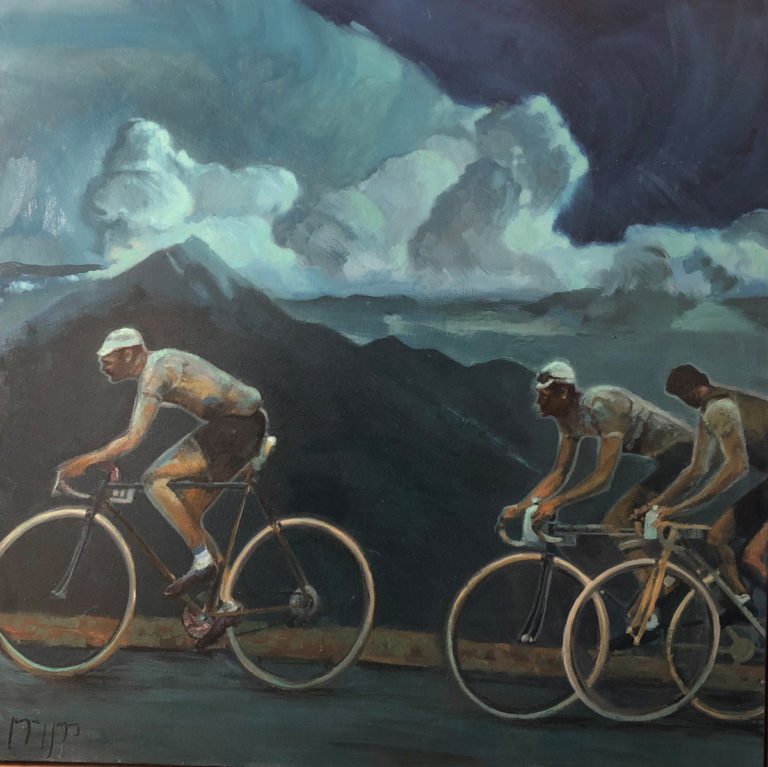
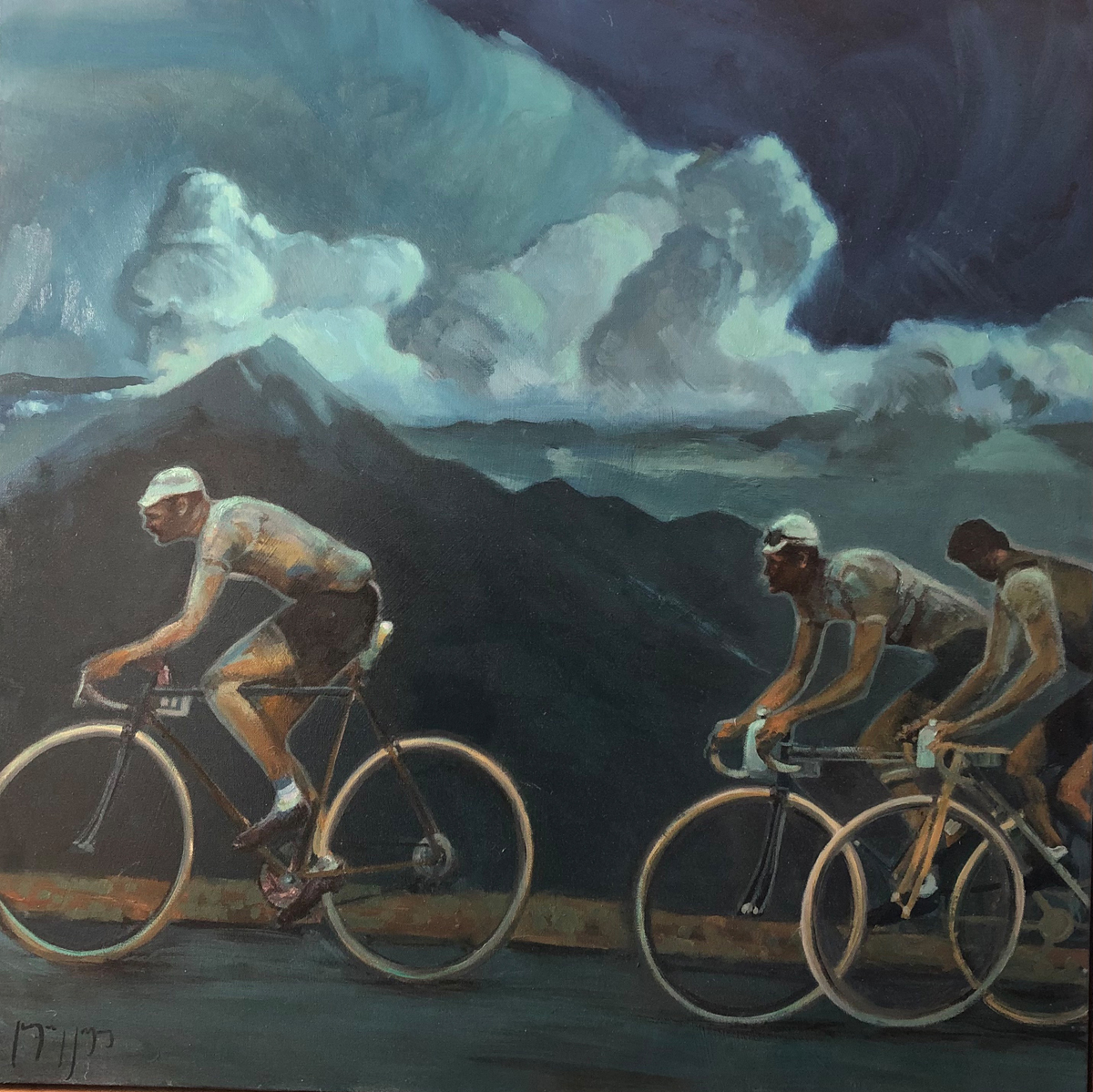
Breath and Sky — The Bicycle Art of Trenton Higley

Artist bio: Trenton Edwin Higley (b. 1970) is a American Artist specializing in beautifully handcrafted representational figures, landscapes and narrative works in oil and watercolor.

Artist: Trenton Higley, Title: Breath and Sky, Medium: Oil on canvas, Size: 36″ x 36″

Often set within and around the Wasatch Mountains near by, his timeless paintings of strong alluring figures placed in intriguing situations or simply posed in a Landscape, strike a pleasing balance between the classical and the contemporary. His paintings are part of his desire to be in the outdoors riding his bicycle or skiing with his family.

Along with solo, joint and group shows in Jackson Hole Wyoming, Park City and Salt Lake City Utah and countless commissions, his artwork has been in many collections including Robert Duvall and Stetson inc.

Upcoming show: “Breath and Sky,” 36×36 oil on canvas, will be on display at Contender Bicycles in Salt Lake City, Utah.

Find Trenton’s art at trentonhigley.com.


Osborne, Kingsford win 2021 XTERRA USA Championship

0

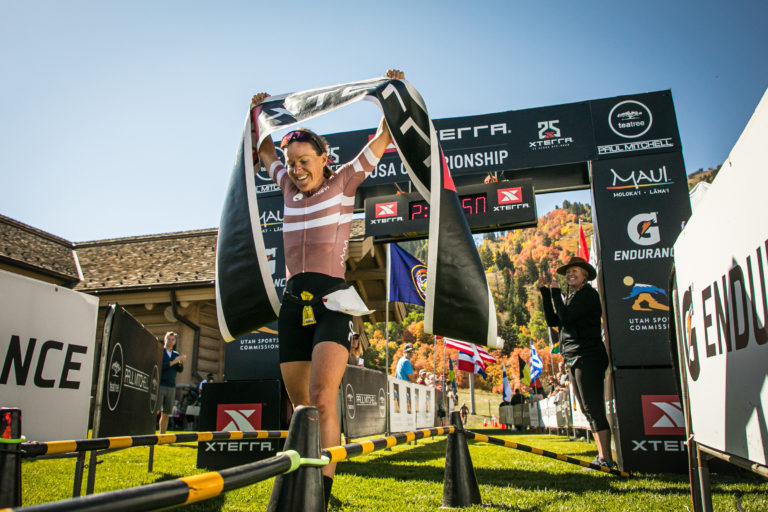
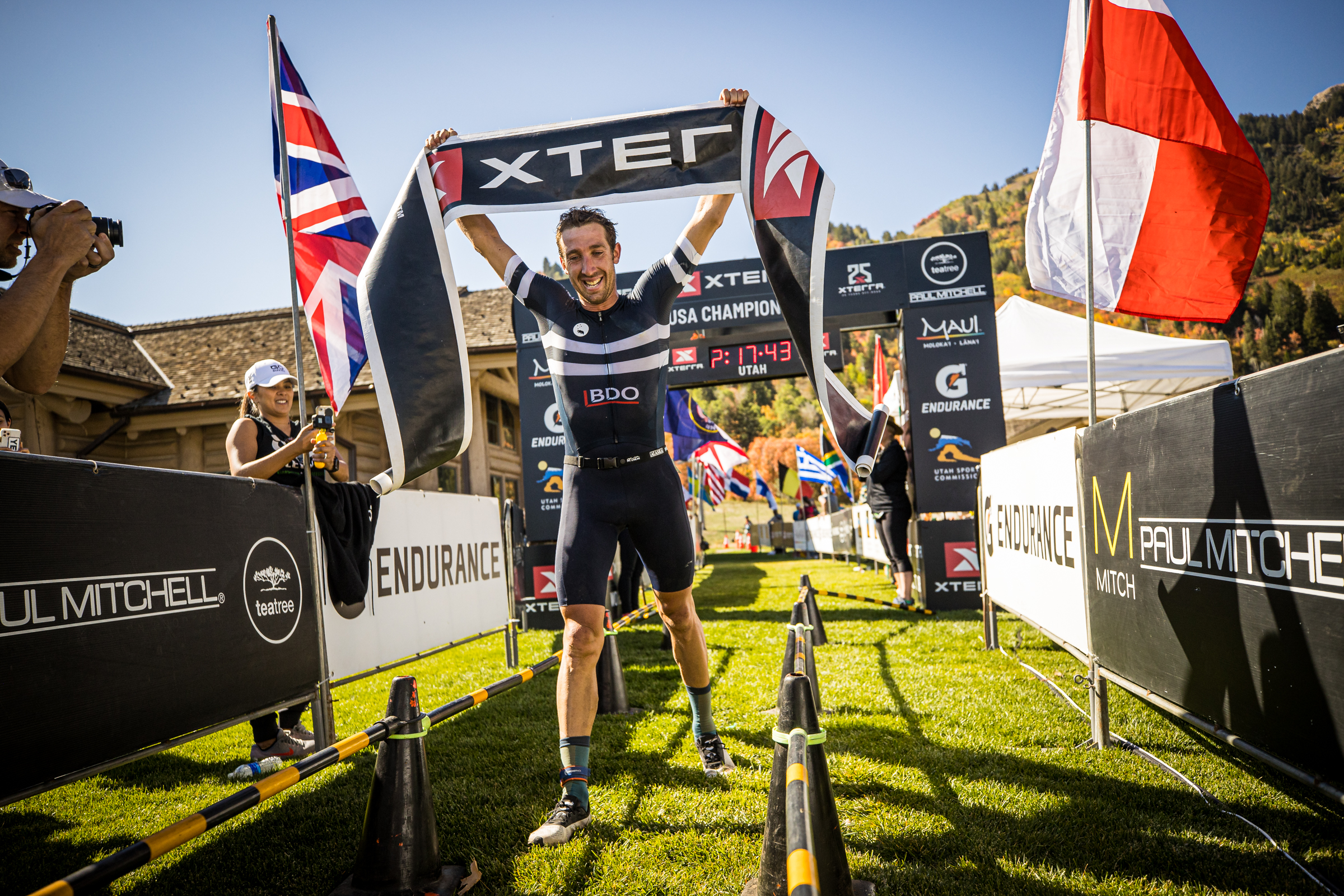
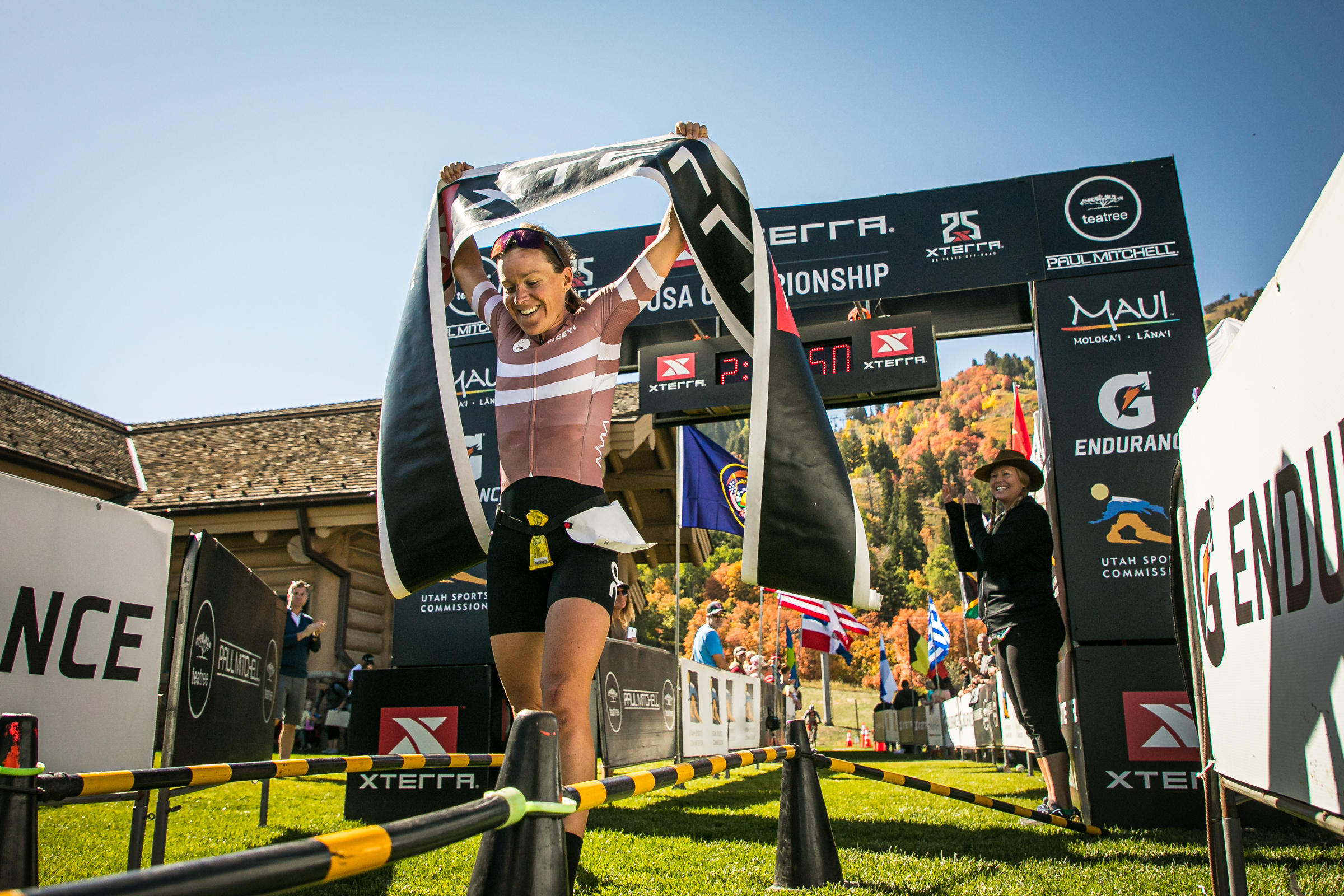
Sam Osborne and Samantha Kingsford from New Zealand won the XTERRA USA Championship elite titles with winning times of 2:17:33 and 2:46:47, respectively, on a gorgeous fall day at Snowbasin Resort in the Wasatch Mountains high above Ogden, Utah on Saturday, September 25, 2021.

Photo courtesy XTERRA

It’s the 17th career XTERRA World Tour win for Osborne, the eighth for Kingsford, and the fourth victory of 2021 for both. The couple from New Zealand won their hometown XTERRA in Rotorua back in April then swept the three majors in the U.S., thus achieving the lofty goal they set for themselves at the start of the season.

The day’s race was not the traditional XTERRA off-road triathlon, rather a run-bike-run duathlon after the swim was canceled due to harmful algal blooms in Pineview Reservoir. The new challenge featured a 2.5-mile trail run to start the race instead of the swim, transitioned to an epic 19-mile mountain bike, and finished with a grueling 5.5-mile trail run.

It was a sprint from the opening cannon blast and as soon as the course started to ascend straight up the ski slope Kieran McPherson surged out in front and challenged the field to go with him.

“I wanted to see what everyone was going to do early on in the climb, and nobody did anything, so I took off,” said McPherson, who said he recently started a full-time job and didn’t have the bike fitness he wanted, but knew he could hurt everyone’s legs earlier on in the run. “I didn’t run as hard on the downhill but still made everyone work to get back on, and was able to lead into the first single track, but after that, it was pretty much all over for me.”

McPherson led the field into and out of the run-to-bike transition, followed by Josiah Middaugh and Osborne just seconds behind, then Colin Szuch, Eric Lagerstrom, and Brian Smith. From T1 that group went all-out in a race to be the first rider to the top of Sardine Peak at 7,400-feet. It’s a grueling 1,000-foot climb, and came as no surprise that Middaugh, perhaps the best climber in the sport, got there first.

“I was able to get past Kieran then overtook Sam about halfway up and put maybe 10-15 seconds on him to get over the top first, but he caught me coming down and probably put 45 seconds on me by the bottom of Icebox Canyon,” said Middaugh (pictured).

The downhill is relentless, roughly 2,000 feet of technical, twisting singletrack over rocks and into tunnels of orange-yellow-and-pink leaves, and it’s where Osborne’s colors shined through.

“That first run then the climb up to Sardine Peak was absolute misery, it was so hard. Josiah lit it up, and in hindsight I probably shouldn’t have gone that deep going to the top,” said Osborne (pictured). “On the downhill I was trying to get around Josiah but there was a lot of race-craft going on, he’s learned a few tricks in his day so I took some huge risks, and came down on a rock really hard and thought ‘oh no,’ my race might be over but my tires held. I was absolutely on the limit, but if you’re going to take on Josiah in a duathlon you’ve got to take risks.”

Middaugh closed the gap on the East Fork climb to maybe 20 seconds to Osborne, then gave those 20 seconds back on the Middle Fork descent, then pulled him in a little more on the last climb. At the bike-to-run transition, he was about 30-seconds back and the run for gold was on.

“Sam throttled that first mile, and I ran hard but didn’t have that next gear,” said Middaugh. “I felt steady and strong, just didn’t have a lot of pop. Sam is super strong, he’s a hard guy to beat, so I was glad to be second.”

Osborne posted the fastest second run split of the day and was ecstatic when he crossed the line, and emotional to get the win he’d been working towards since May.

“To sweep the U.S. majors, it’s a dream,” said Osborne, the reigning XTERRA Pan Am Tour Champion who won this event when it was an off-road triathlon two years ago. “It was a big commitment for Samantha and I to come to the U.S. for this series in the middle of a pandemic, and it’s been tough, so to get it done, it’s incredible.”

Middaugh finished in second place about two minutes later, and as the top American pro, won the XTERRA U.S. Elite Men’s Championship title for an unprecedented 15th time.

Eric Lagertsrom, just a week removed from a seventh-place showing at Ironman 70.3 Worlds, had a brilliant race to finish third and put any doubts about his mountain bike ability to rest in emphatic fashion.

“It was cool to see Eric come across and nail one,” said Osborne. “He’s pretty legit, I knew what he could do since Alabama, and he’s certainly one of the few road guys who can ride a mountain bike.”

It was no surprise, of course, to Lagerstrom either.

“I’ve been telling people I can ride, but haven’t been talking too much,” he laughed. “This was a sick race, amazing. That gravel road climb on the runs was psychotic, though, I was questioning my love for any kind of exercise after that.”

Brian Smith caught up to Lagerstrom on the Middle Fork downhill and took the lead for a little bit on the last climb up to transition, but Lagerstrom shifted into another gear to create a gap going into T2. Smith, however, posted the fastest final run split of the day to make it close.

“I thought Brian was going to catch me, I was sucking wind so hard,” said Lagerstrom, who finished 20-seconds ahead of Smith.

“I gave it everything I had but Lagerstrom is strong. After racing last weekend, to be able to come back and ride and run that good here was just amazing,” said Smith. “And I thought for sure I’d catch him on the first descent but I didn’t see him until later.”

McPherson held on for fifth, age group stand-out Anders Johnson – who posted a better bike split than Osborne by one-second, came in sixth, and 19-year-old Colin Szuch placed seventh in his elite debut.

Pl Name, NAT Run 1 Bike Run 2 Finish
1 Sam Osborne, NZL 00:16:10 01:23:22 00:37:00 02:17:33
2 Josiah Middaugh, USA 00:16:10 01:23:54 00:38:08 02:19:25
3 Eric Lagerstrom, USA 00:16:18 01:26:09 00:38:11 02:21:48
4 Brian Smith, USA 00:16:22 01:26:06 00:37:57 02:22:08
5 Kieran McPherson, USA 00:16:08 01:30:05 00:39:24 02:26:42
6 Anders Johnson, USA* 00:18:01 01:23:21 00:44:40 02:27:56
7 Colin Szuch, USA 00:16:17 01:34:05 00:38:34 02:30:40
8 Hite Stromberg, USA* 00:17:20 01:27:02 00:45:19 02:32:17
9 Steve Croucher, USA  00:17:54 01:33:34 00:42:20 02:35:09
10 Jason Michalak, USA* 00:18:33 01:31:38 00:45:40 02:37:34


Photo courtesy XTERRA

In the women’s race, three-time XTERRA World Champion Lesley Paterson set the tone early with the fastest first run, but Kingsford was just 13-seconds back and ready for the ride.

Roughly a mile or so into the bike Kingsford caught Paterson and started pulling away. She had the fastest elite bike split of the day and the best final run split to finish a full eight minutes ahead of Paterson for the win.

“I was running scared, because two years ago at this race Lesley taught me that the race isn’t over until it’s over,” explained Kingsford, who took a big lead into the run here in 2019 but got caught by Paterson and finished second. As a result, Kingsford said she had unfinished business with this race, and now, that’s all over.

“The win was Samsational some people are saying,” laughed Kingsford, who met her boyfriend, Sam Osborne, in college 10 years ago. “For both Sam and I to come over to the U.S. from New Zealand was such a big gamble because of covid, and we weren’t sure if we were making the right decision so to take three is amazing and it makes it all worth it.”

Paterson, who has been full-on with her movie making career for more than a year now, showed she still has what it takes to race at a high-level today.

“That was so fun. I have not gone that hard in two years, but the adrenaline kicked in right at the starting gun,” said Paterson. “My alter ego, Paddy McGinty, was out in full force and I’m just so grateful. And it was awesome to see Samantha killing it, she is incredible right now, and deserves it because she’s put in the time and effort. Suzie and Amanda were riding great too, and they both passed me on the descent. And what about that girl, she came out of nowhere!”

“That girl” Paterson is referring to is Andie Aagard, a 15-year-old sophomore from Lone Peak High School in Utah Valley. She absolutely crushed it, had the fastest bike split of the day, and despite “never running ever,” finished second overall.

“I wasn’t really expecting that because the last time I ran was three months ago and I just decided to sign-up last night,” said Aagard, a local phenom and the current Junior Women’s 15-16 cross country mountain bike champ.

Even more incredible is that Aagard started the race four-minutes back in the fifth wave and had to run and ride her way passed hundreds of other racers.

“Oh my gosh, I’m 25 years older than her, she’s awesome,” exclaimed Paterson, who came into T2 with Suzie Snyder and Aagard but then blitzed the run to cross the line in second, but with the third best time due to the chip-timed wave starts.

“The course was phenomenal, too, I think it’s one of the best in the world,” added Paterson.

Snyder finished fourth, and as the top American pro, won the XTERRA U.S. Elite Women’s title for the fourth time.

Former elite Deanna McCurdy placed fifth overall, Amanda Felder was sixth, amateur standouts Jill Sorensen and Jennifer Razee were seventh and eighth, and Irena Ossola placed ninth and fifth elite in her elite debut at an XTERRA major.

Pl Name, NAT Run 1 Bike Run 2 Finish
1 Samantha Kingsford, NZL 00:19:33 01:40:17 00:45:26 02:46:47
2 Andie Aagard, USA 00:21:12 01:39:16 00:48:50 02:52:03
3 Lesley Paterson, GBR 00:19:20 01:45:29 00:47:07 02:53:47
4 Suzie Snyder, USA 00:20:48 01:43:45 00:47:37 02:54:22
5 Deanna McCurdy, USA* 00:21:13 01:52:52 00:49:23 03:05:22
6 Amanda Felder, USA 00:20:30 01:46:48 00:58:45 03:07:51
7 Jill Sorensen, USA* 00:22:35 01:51:06 00:54:24 03:10:15
8 Jennifer Razee, USA* 00:21:31 01:57:01 00:50:08 03:10:33
9 Irena Ossola, USA 00:21:36 01:58:43 00:48:04 03:11:13
10 Jennifer Johnson, USA* 00:21:00 02:01:14 00:47:06 03:12:11