Home Blog Page 136

St. George, Utah will host IRONMAN World Championship in 2022

0

St. George to host 2021 IRONMAN World Championship, prestigious event moves from Hawaii for the first time since 1978

ST. GEORGE, Utah (September 23, 2021) – On the heels of the prestigious IRONMAN 70.3® World Championship held in St. George last week, IRONMAN announced today that it is bringing its 2021 IRONMAN World Championship event, traditionally held in Kona, Hawaii, to St. George on May 7, 2022.
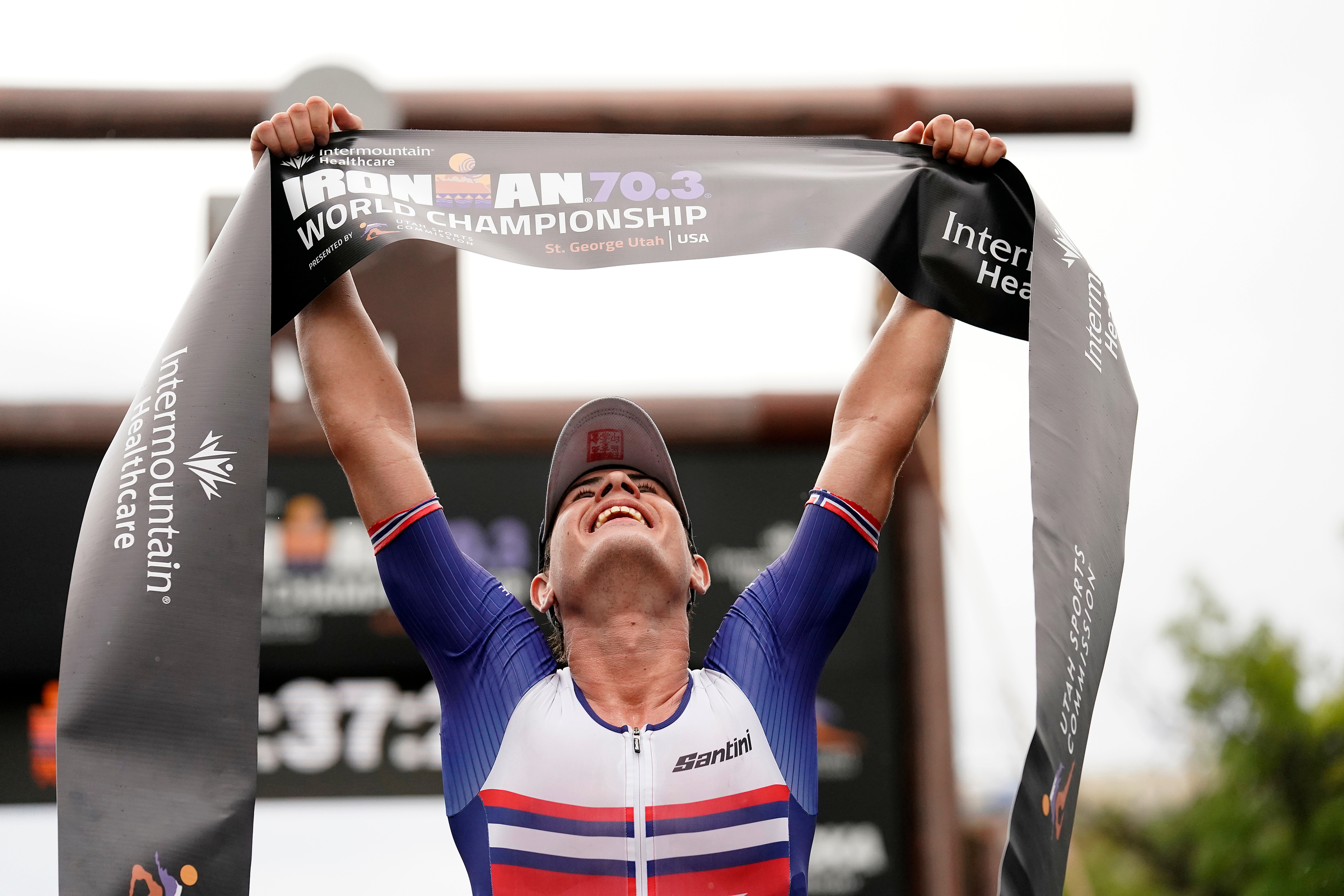
ST GEORGE, UTAH – SEPTEMBER 18: Gustav Iden of Norway finishes first in the Men’s Pro portion during the IRONMAN 70.3 World Championship on September 18, 2021 in St George, Utah. (Photo by Patrick McDermott/Getty Images for IRONMAN)

The IRONMAN World Championship is the longest running and most distinguished endurance event in the world, but due to Covid-19 restrictions in its home state, the culminating experience in IRONMAN’s full-distance triathlon (140.6-miles) circuit has not happened since 2019. The 2020 race was scrapped entirely and in early August, the 2021 event slated to happen on October 9, 2021, was postponed. As travel restrictions and accessibility in Hawaii continued, IRONMAN executives looked for solutions and found one in Greater Zion.

“We are fortunate to have built such a strong and trusted relationship with our friends in the greater St. George region over the past 10-plus years,” said Andrew Messick, President & Chief Executive Officer for The IRONMAN Group. “St. George stepped up to ensure IRONMAN athletes will have a 2021 world championship, even if delayed into 2022. We all just witnessed why this special place has been dubbed the ‘Land of Endurance’ and we are confident that we will have an outstanding championship in May.”
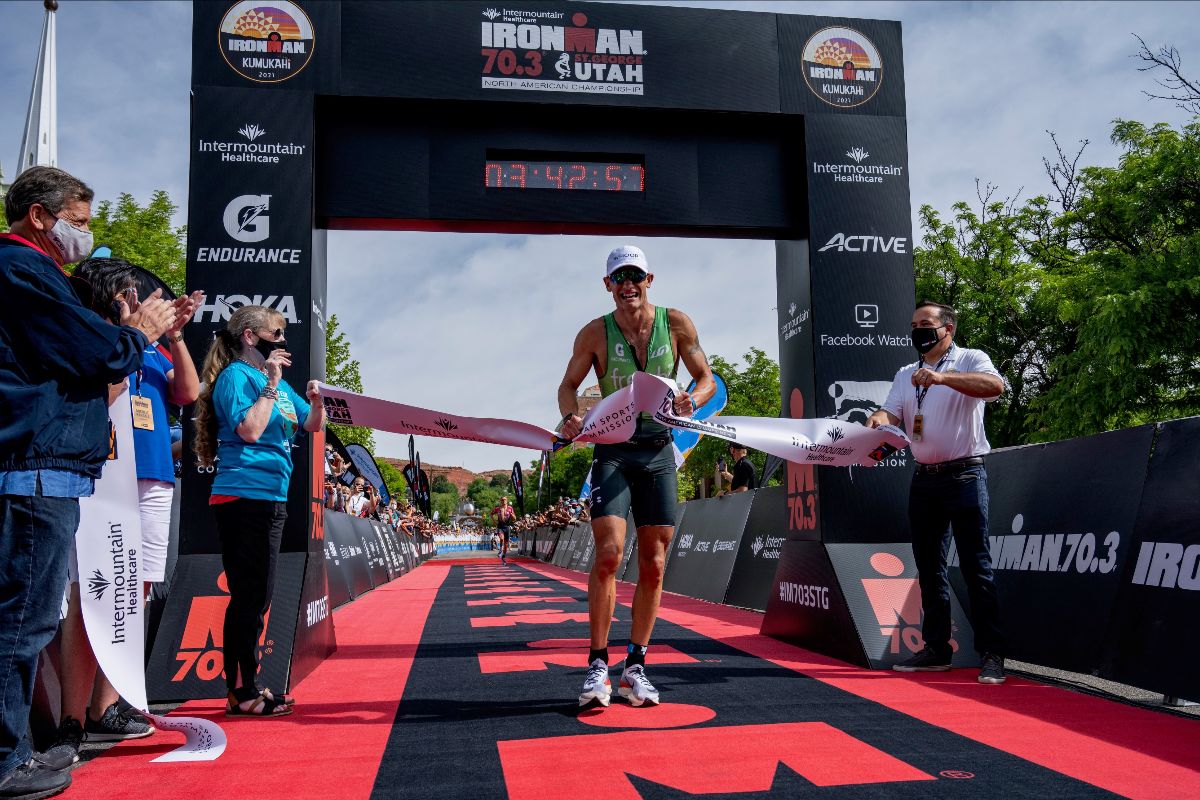
Lionel Sanders (CAN) claims victory at the 2021 Intermountain Healthcare IRONMAN 70.3 North American Championship in St. George, Utah. Photo courtesy IRONMAN

“The honor to host the first IRONMAN World Championship outside of Hawaii is as humbling as it is glorious,” said Kevin Lewis, Director of the Greater Zion Convention & Tourism Office. “There are few events that hold the prestige and respect of Kona. To be chosen as the destination with the capacity and character to host this event takes my breath away.”

“Hosting the IRONMAN World Championship is yet another example of the Utah Sports Commission’s sport and Olympic legacy efforts that showcase globally why Utah is known as the State of Sport,” said Utah Sports Commission President and CEO Jeff Robbins. “Together with our partners, we look forward to welcoming the world to Utah.”

The 2021 IRONMAN World Championship will replace the previously scheduled IRONMAN North American Championship on May 7, 2022. The 2022 World Championship is slated to return to Kona in October 2022.
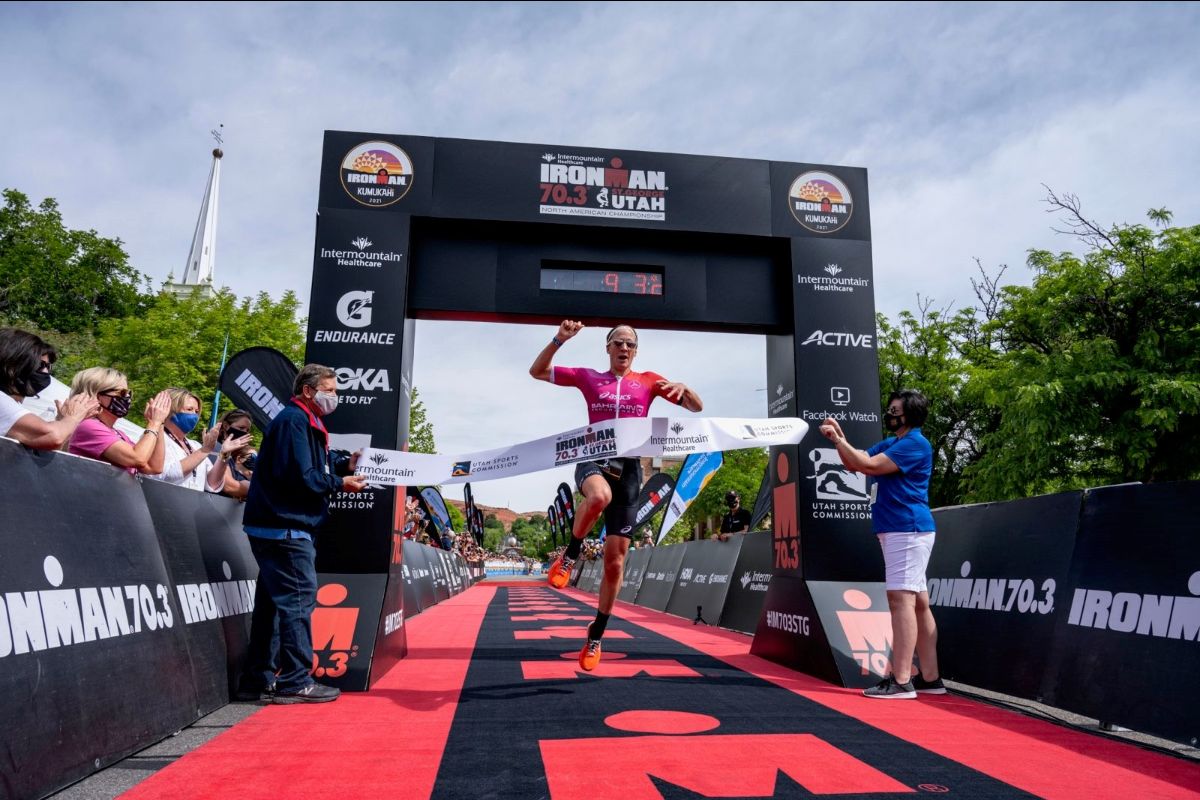
Daniela Ryf (CHE) claims victory at the 2021 Intermountain Healthcare IRONMAN 70.3 North American Championship in St. George, Utah. Photo courtesy IRONMAN

“I think we understand the weight and responsibility we now have to carry forward the cherished significance of Kona and we don’t take that responsibility lightly,” said Lewis. “We have the deepest respect for the IRONMAN legacy and all that has gone on before – the passion, the dreams, the gut-wrenching persistence and the human spirit of caring for one another, as we push forward to build something better. We now have the opportunity to truly honor that legacy in a place where the land holds a familiar spirit and the people comprehend what it all really means.”

With continuing uncertainty of travel around the world, officials felt confident in the opportunity in St. George. Moving the race to St. George in 2022 gives world-class international athletes another chance to race in the Land of Endurance, and it rewards the local efforts and the community’s commitment to success.

“It’s clear that IRONMAN officials respect and appreciate St. George and our surrounding communities,” Lewis said. “They have confidence in our ability to host a World Championship. They have witnessed the professionalism in our communities and the agencies that support the race. They’ve seen our capabilities, they’ve felt the spirit of our people and they’ve reveled in the beauty of our landscapes. In a time when many things in the world are unclear, IRONMAN officials are certain of our hosting abilities and our hospitality.”

With today’s announcement, St. George will now play host to three World Championship events over a 13-month period bringing millions of dollars in economic impact to the region. Last week’s IRONMAN 70.3 World Championship brought an estimated $18 million in economic impact to Washington County. The event featured over 3500 athletes and brought more than 12,000 visitors to the area. Next year, St. George will host two additional World Championship events. On May 7, the IRONMAN World Championship is slated to host 4,000 athletes, and up to 20,000 guests and spectators. An independent study for the IRONMAN World Championship in Kona estimated economic impact of more than $70 million to the island annually. Then on October 28 and 29, the 2022 IRONMAN 70.3 World Championship will feature nearly 7,000 athletes in an expanded two- day race format. Economic impacts from that race are estimated at $20-$25 million. Since its first event here in 2010, IRONMAN has infused more than $118 million directly into the local economy. With the World Championship events in 2022, that number could easily rise to over $200 million.

“We’re already seeing substantial benefits from the IRONMAN 70.3 World Championship, not just economically, but in positive exposure throughout the world,” Lewis said. “Much like what the Winter Olympics did for northern Utah in 2002, hosting these three back-to-back world championships showcases the qualities of this area and strengthens the fundamental economic value of our communities in an unrivaled way. Through them we gain credibility and respect across the globe. The benefit to our overall economic development efforts from the media exposure we gain is unlike anything this area has ever seen.”

“This is an incredible privilege and we are grateful that we’ve earned the confidence and trust of the IRONMAN organization,” said Gil Almquist, Chairman of the Washington County Commission. “The positive characteristics symbolized by IRONMAN blend perfectly with the qualities of the people in our communities. The enduring effort of athletes and volunteers inspires us to be better people, to be more caring and to support each other through challenges and adversity. Throughout history, our communities, agencies and volunteers have accomplished remarkable feats by working together. Those who’ve been here understand what makes this place so special. Those who haven’t are about to find out.”

“In spite of challenging conditions in the world, we’re honored to be able to host these elite and prestigious events,” said Lewis. “We live in a ruggedly beautiful place. It’s a place where hearts beat with passion, sweat weeps for the good of others, and blood flows with determination. I think we understand the weight and responsibility we now have to carry forward the cherished significance of Kona and we don’t take that responsibility lightly. We have an enduring legacy of success here, and once again, we will rise to it.”

Upcoming IRONMAN events in St. George

  • 2021 IRONMAN World Championship – May 7, 2022
  • 2022 IRONMAN 70.3 World Championship: – October 28 and 29, 2022 (Women’s Race Friday; Men’s Saturday)
  • IRONMAN 70.3 North American Championships: 2023, 2025
  • IRONMAN North American Championships (140.6): 2024

IRONMAN World Championship Returns to Kona in October 2022 with Two-Day Race Format

For the first time in the 40-plus year history of the IRONMAN World Championship, the pinnacle event for triathlon will take place over two days with the 2022 IRONMAN World Championship returning to Kona, Hawai`i on October 6 and 8, 2022. The two-day event will see an expanded women’s professional field of 50 athletes race on Thursday, October 6, and 50 professional men race on Saturday, October 8. Details of the age-group races will be communicated in the coming weeks.

“We expect the races in October of 2022 to be unique and historic,” said Messick. “Two days of racing in Kailua-Kona addresses the overwhelming demand from athletes to race in a World Championship and will allow us to host our deferred athletes and place more emphasis on showcasing our women’s and men’s professional races.”

“We are excited to work in collaboration with IRONMAN to bring two events home to Hawaiʻi Island in October of 2022,” said Hawai`i County Mayor, Mitch Roth. “As our island’s premier sporting event, IRONMAN has been a trusted community partner for over 40 years, and we’re ever grateful for their willingness and ability to adapt to our community’s needs and contribute to its vibrancy. That said, we would like to send a sincere mahalo to the city of St. George, Utah, for allowing IRONMAN competitors a stage to compete, as we ready our shores to welcome back our IRONMAN ʻohana in anticipation of next year’s events.”

“Hawaii Island, and Kona in particular, have had a wonderful 40-plus year relationship with IRONMAN and its origins,” said Ross Birch, Island of Hawai`i Visitors Bureau Executive Director. “While the iconic event has provided long-lasting economic benefits to our island, what’s sometimes missed is the transformation of Kona as a lifestyle destination because of IRONMAN. We are in full support of IRONMAN’s change to host a two-day race format that enables the opportunity for all qualifying athletes from the past two-plus years to compete as well as giving the local economy a chance to benefit and recoup lost tourism opportunities.”

“The loss of the past two IRONMAN World Championship races certainly dealt us an economic blow. Our restaurants have always received a big boost from the race, athletes, and their families. We are very excited to hear that with two races next October we can plan to make up for the economic losses from the past two race cancellations,” said Luana Hospitality Principal, Eric von Platen Luder

“It has been a challenging few years, however we have stayed true to our goal to create exceptional experiences for our ‘ohana,” said Diana Bertsch, Senior Vice President, World Championship Events for The IRONMAN Group. “We are grateful to our host communities in St. George and Kailua-Kona as well as their local and state officials, for their willingness to trust us. Our team is committed to putting on incredible race weeks as we add pages to the IRONMAN World Championship history books in May and October 2022.”

IRONMAN athletes registered for the 2021 and 2022 editions of the IRONMAN World Championship triathlon, along with athletes currently registered for 2022 IRONMAN St. George, will be contacted directly with additional information. For more information and event details for the IRONMAN World Championship, please visit www.ironman.com/im-world-championship.
Caliente to Host Second Annual Mountain Bike Fest October 1-3, 2021

CALIENTE, Nevada (September 20, 2021) — Caliente Area Mountain Bike Alliance (CAMBA) will host the Second Annual Caliente Mountain Bike Fest on October 1-3, 2021. The event, which will showcase the more than 30 miles of purpose-built trails in the area, will also feature a catered dinner, raffles, and shuttles to trailheads.

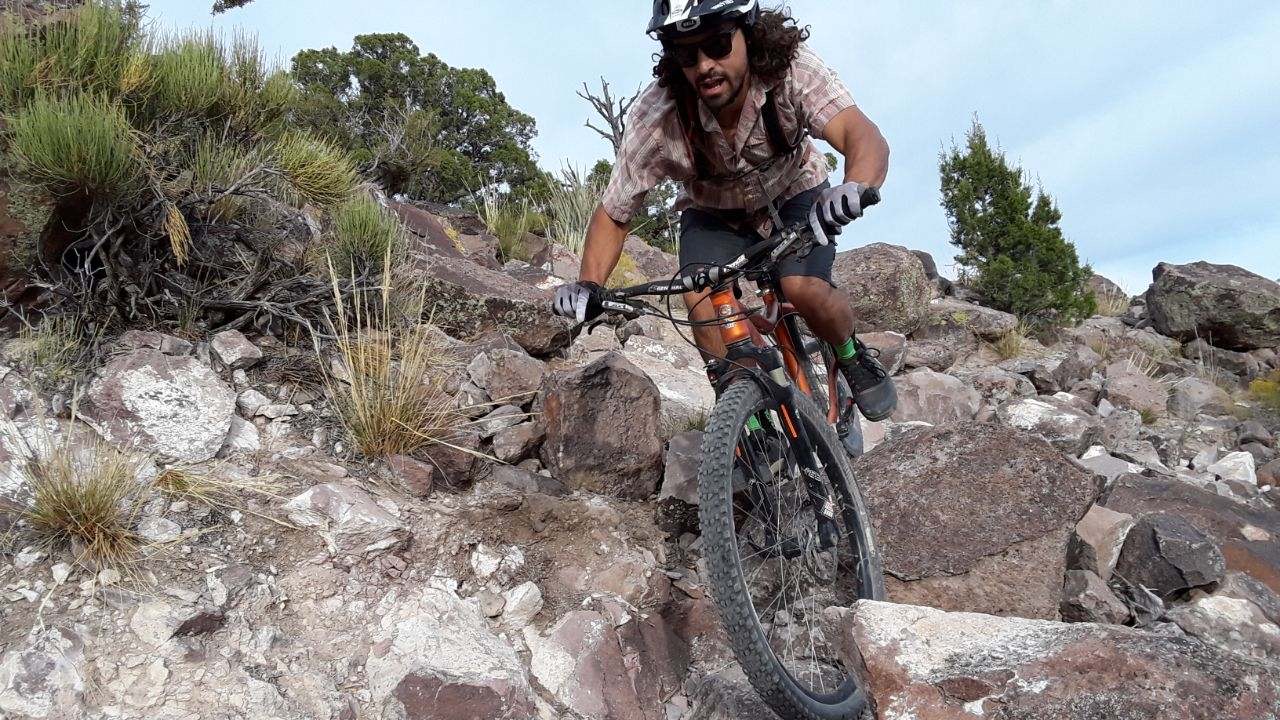
Local rider Jon Prescott dropping into the first move on Wake Up Call at Barnes Canyon. Photo by Ryan Perry

The rapidly growing trail network features a wide variety of trails to suit multiple riding styles. Barnes Canyon, located on BLM-managed land, features 13 miles of singletrack ranging from beginner flow to expert technical. A connector trail to link the Barnes network with Kershaw Ryan State Park, which now boasts over 10 miles of singletrack, is in progress and is partly rideable from both ends. Riders attending the fest can take shuttles to both Barnes Canyon and Kershaw Ryan State Park trails.

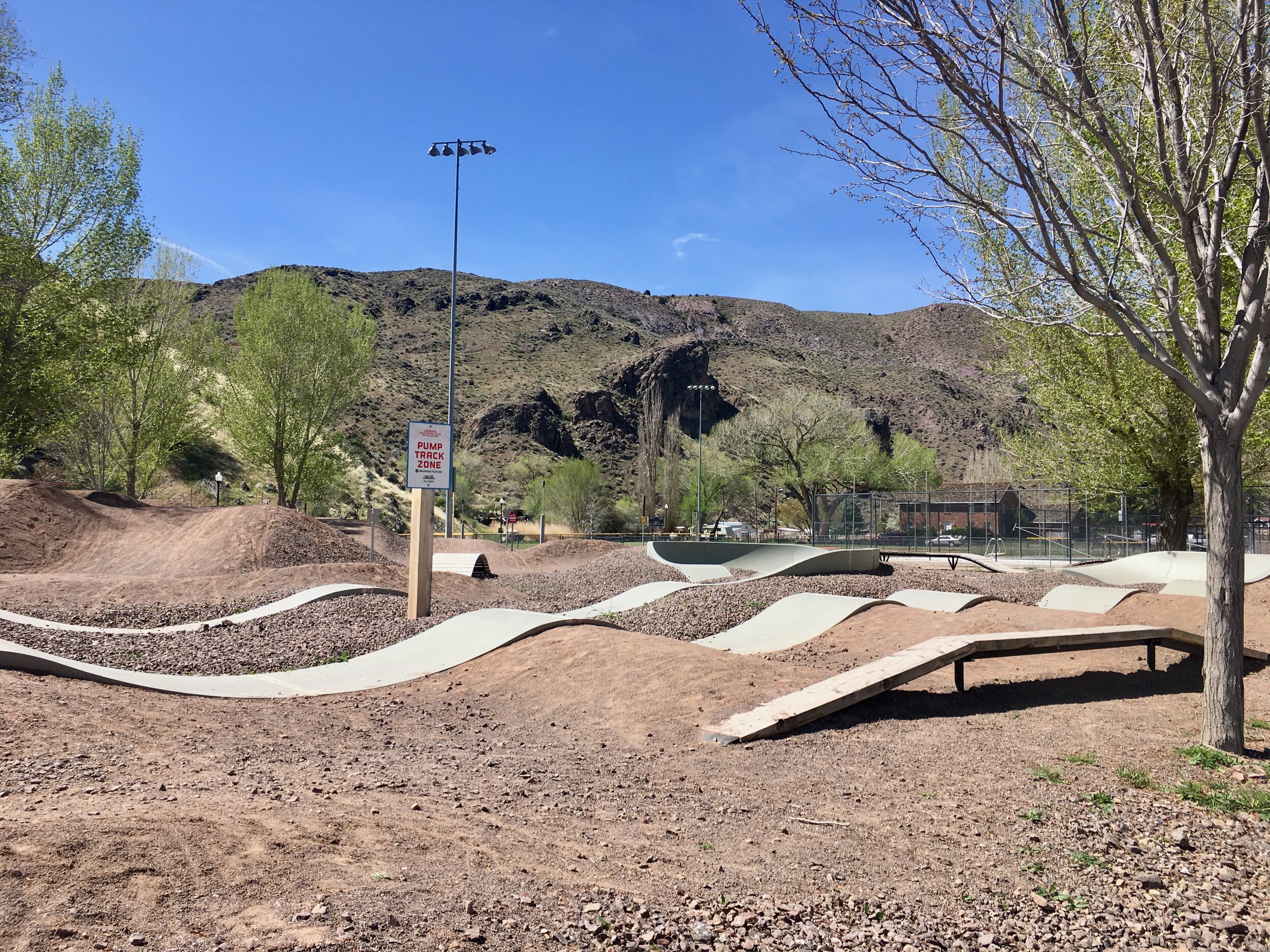
The Mountain Bike Skills Park at Super Park, where the main fest venue will be located. Photo by Christine Harrington

In addition to the existing trails, the BLM is currently supervising construction on a 24-mile descent trail off nearby Ella Mountain, a 7,400 foot peak. The first 8 miles will be ready in time for the 2021 bike fest, and CAMBA plans to offer shuttles on that section. Riders should be prepared for a remote backcountry ride with panoramic views and varied terrain.

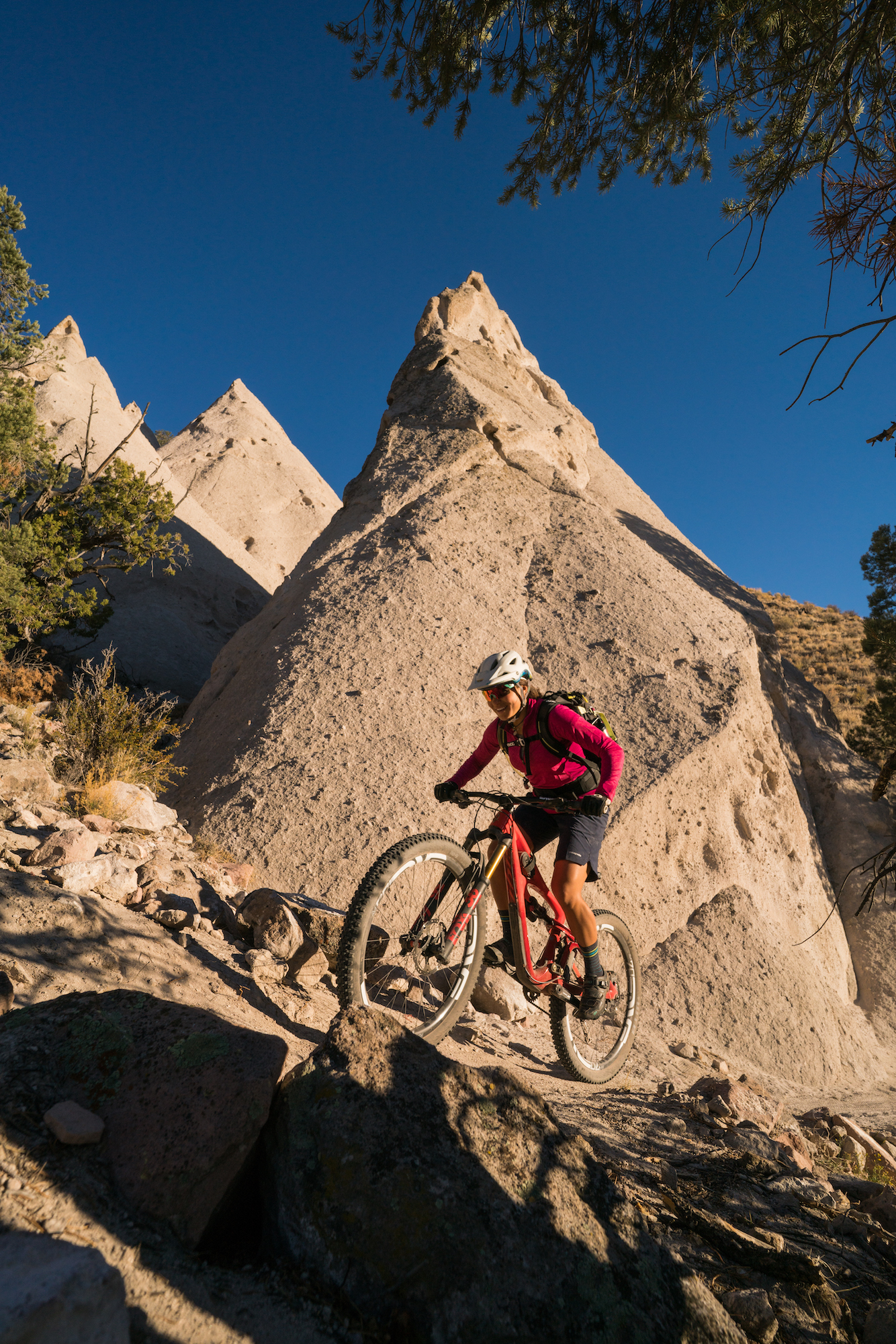
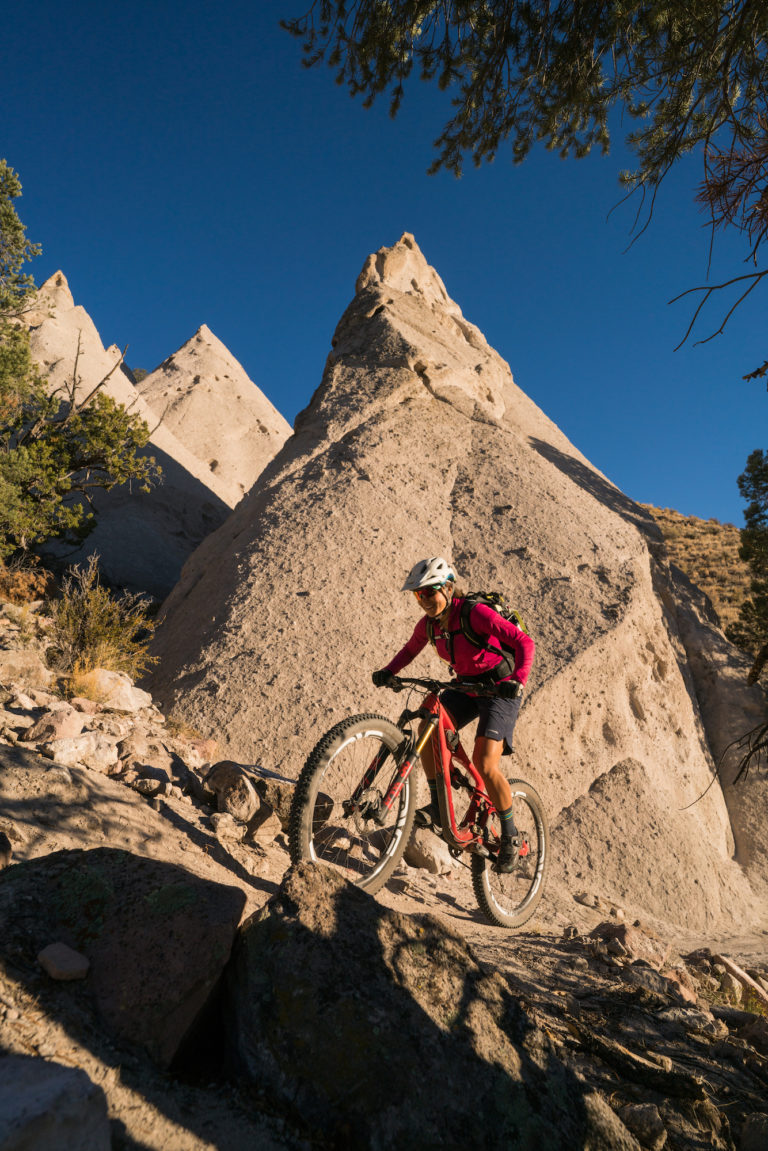
A rider passing underneath the Tepee Rocks on Primer in Barnes Canyon. Photo by Leslie Kehmeier

The bike fest will be headquartered at Super Park, a mountain bike skills park in Caliente. Among the vendors in attendance will be HANDUP, a popular glove and apparel company started by local Caliente couple Cody and Jamie Wallis, now based in Chattanooga, TN. Jamie says they are excited to see their hometown embracing mountain biking and “can’t wait to see all the good that comes out of it”.

This year’s event will build off the success of the first Caliente Bike Fest, which took place in 2019. Organizer Christine Harrington reports that over 130 people from 5 states attended the inaugural event, and they are hoping for an even wider reach this year. She says that visitation increased during the Covid shut-downs because riders were looking for remote, uncrowded trails and a new experience. “People were coming from as far away as Reno and Salt Lake City for the weekend” she says. Harrington credits the high-quality trails and friendly small town atmosphere for bringing people back again and again. “This type of place is hard to find any more. It’s a little gem”, she says of Caliente.

Information and registration for the fest can be found at www.calientemtb.org.


BWR Cedar City Tips From ENVE Pros

0

The Belgian Waffle Ride heads to Cedar City, Utah, for round three of the four race series. As one of the only major events to happen in 2020, BWR Cedar City became the first BWR held outside of San Diego and helped lay the foundation for adding rounds in Asheville, North Carolina, and Lawrence, Kansas this year.

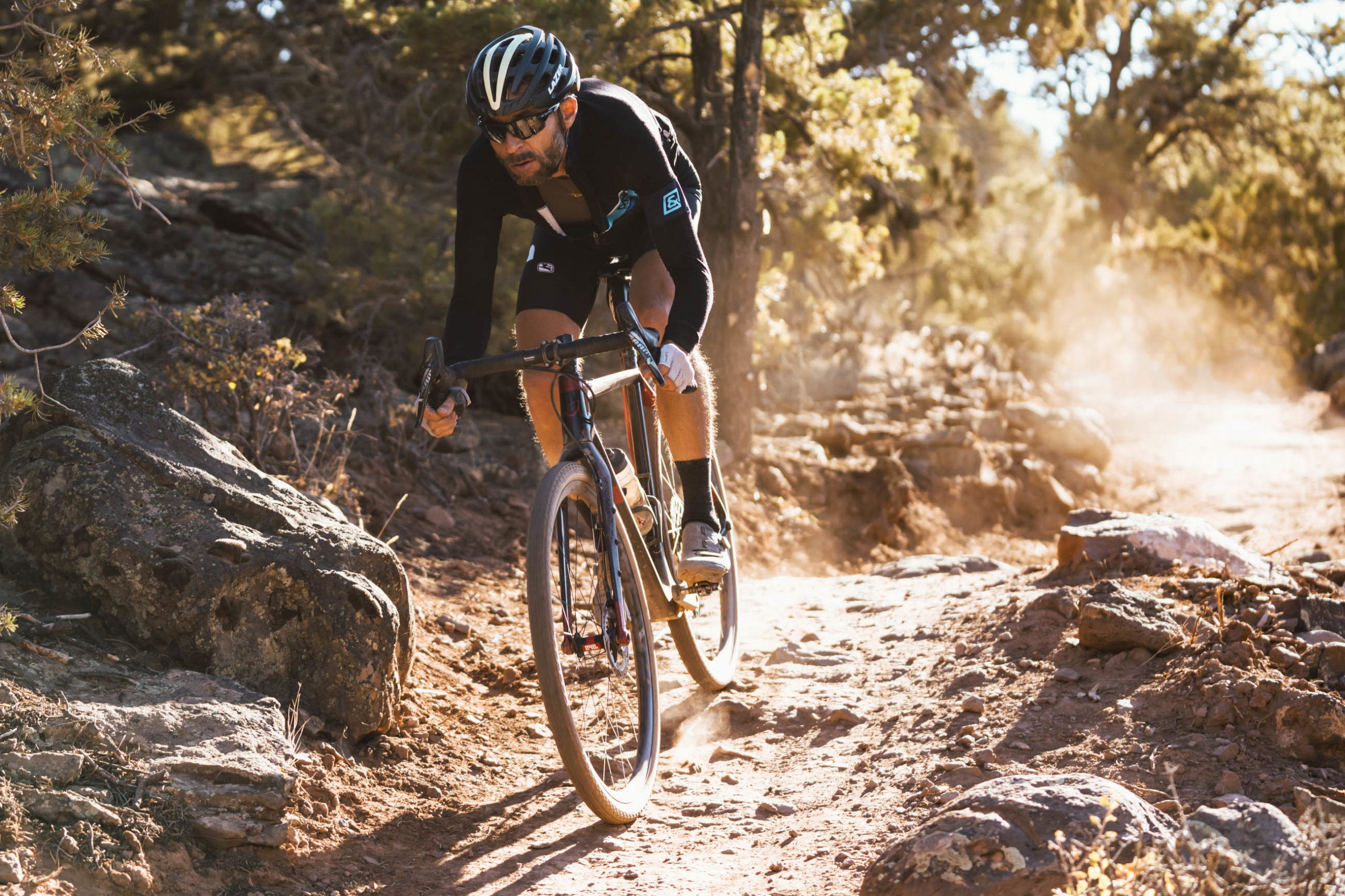
Photo by Ian Matteson, courtesy ENVE Composites.

With each of the BWR rounds being unique in what equipment is best for the course and the dirt conditions found in each region, Cedar City will once again favor a true gravel setup with challenges coming from rocky singletrack, chunky dirt roads, and altitude. We asked three ENVE athletes, which include past BWR winners and coaches, what course advice they have and how they are preparing for their own race in Cedar City.

Photo by Ian Matteson, courtesy ENVE Composites.

HOW MUCH WILL THE ALTITUDE IMPACT THINGS, AND WHAT CAN SOMEONE DO TO MINIMIZE THAT?

Whitney Alison: Altitude does have a pretty big impact for most riders. You’ll find your heart rate is a bit higher than normal and it is harder to recover from hard efforts. No matter where you are in the field, be mindful of those big digs as they may not have the same effect they normally do at sea level and can spit you out the back instead. Really respecting what your body is telling you can save your day when you are up high…like tortoise and the hare. Also, remember your sunscreen as you’ll burn faster and stay on top of your hydration goals even though you’ll sweat less.

Brian McCulloch: Altitude can be one of the most challenging components of BWR Cedar City. Why? If you are a “flat-lander” who lives near sea level you are likely to feel short of breath, dehydrated, and low energy, none of which are likely to facilitate a break-out performance on event-day. Although an altitude of 5,000′ is not considered “high-altitude” it will make enough of an impact that every rider should think about it in their preparation. The common solutions include earlier bed-times leading into the event (try to increase your time in “deep” or REM sleep), add electrolytes to your fluid intake on and off the bike, and consider pacing by Heart Rate in the opening miles rather than traditional power targets. The last suggestion, pacing by H.R. is of particular value for all those that know how torturous and ruthlessly steep the Kanarraville climb and Tolweg single-track will be at the end of the race. My simple approach is putting electrolytes in every bottle, getting to be 1/2-hour earlier every night the week before the race, and then setting an H.R. ceiling that I cannot explode-through when charging through the first hour or two of the race.

Zack Alison: I think the altitude will be enough to make things split up a little earlier and a little more than the other BWRs that are below 3k feet. For the average rider it just makes things harder, your FTP is a few percent lower, your pacing is off. You also have a harder time preparing, staying hydrated. There’s also those people that live at altitude that are affected less which can drive the pace.

Photo by Ian Matteson, courtesy ENVE Composites.

WHAT’S YOUR TIRE AND WHEEL SETUP, AND HOW DOES THAT COMPARE TO WHAT YOU USED IN PREVIOUS BWR EVENTS?

Whitney Alison: I’ve been on an Ibis Hakka MX for both the BWRs . Because the Cedar City course is a more chunky and rougher environment in terms of the surface, I’m running the ENVE G23 wheels instead of the 3.4 ARs I used at San Diego. I’m looking for that stability and ability to run over more stuff, not to mention having more confidence on the descents. Although I’m not quite sure on the final tire selection yet, it will be something wide and with substantial tread.

Brian McCulloch: I’ll be riding the same set-up as I did for the 2020 BWR Cedar City, a BMC URS fitted with ENVE AR Handlebar rolling on ENVE G23’s adorned with IRC Doublecross 38c rubber. Depending on the conditions of the course during my event-week pre-rides I might opt for the Doublecross 42c tires. Last year these tires were “choice”, but I do like to get rowdy in the sand sectors and Tolweg single-track which is much easier on 42’s. This particular course requires, in my opinion, a full gravel set-up. Whereas BWR San Diego can be ridden on a road bike with a robust tire/aero wheel combination.

Zack Alison: I am still deciding on a 40mm Maxxis Rambler or a 40mm Donnelly Xploro MSO. For wheels, I’ll be on the ENVE G23. Cedar City is more of a traditional gravel race with some trail sections whereas BWR Asheville and San Diego have way more decisive road sections and nothing that really demands a 40mm+ tire across the whole course.

Photo by Ian Matteson, courtesy ENVE Composites.

WILL YOU USE A HYDRATION PACK OR ANYTHING SIMILAR?

Whitney Alison: This will be a game-time decision for me. BWR Cedar City has much less climbing than the San Diego round so there is less of a disadvantage to carrying a hydration pack, but it’s still long enough you’d likely have to stop even with a pack. I’ll be calculating out times from last year, temperature, bottle options, and feed zone locations to decide. If you are going for pure enjoyment, I’d say enjoy the freedom of the wind on your back and enjoy all those excellent feed zones.

Brian McCulloch: I will not use a hydration pack this year. I have contemplated it and think it is a great idea for many athletes. One thing to consider is how long it will take you to get between SAG stops. BWR events are known to have well-stocked aid stations that have friendly volunteers ready to help. So whether you are doing a “splash’n go” stop strategy, stopping to stretch out a cramp, or trying to “race through” you are likely to be well taken care of. With that said, being self-sufficient is the only way to control as many factors as possible in your race-day nutrition strategy. If you have a very specific race-day nutrition strategy I strongly recommend a pack, but if you are more flexible, then I believe it’s OK to take the chance and go without the pack.

Zack Alison: I’m not planning to use a hydration pack but I will bring it and see how hot it will be. We also have 1 L bottles to start with so if there’s a need to skip early aids we have hydration options. It seems like the aid stations are around climbs and BWRs have great neutral support so packs aren’t as necessary.

Photo by Ian Matteson, courtesy ENVE Composites.

WHAT’S THE MOST CRITICAL OR CHALLENGING ASPECT OF THE COURSE IN YOUR OPINION, AND HOW ARE YOU PREPARING FOR IT?

Whitney Alison: The first climb will be critical. It looks to be technical and comes early in the race. This means dust, chaos and separation, which makes positioning really important to make the splits and to see any obstacles. That final descent and singletrack section will be most challenging for me but likely a mountain biker’s dream.

Brian McCulloch: That’s a tough question. From last year, the opening dirt sectors (all the way through the Parowan Gap), proved to be chaotic and challenging, more so than most predicted. But the two most prominent and distinctive features of the course come at the end. The Kanarraville climb is simply ruthless. I had a 1:1 gear ratio 42T Shimano GRX mated to a 11-42 cassette which was great in pre-rides, but was almost not enough on race day when we were confronted by a thick layer of “moon dust” toward the top of the climb. That powder soaked up all power and reduced many riders to walking. This year I’ll be using a Shimano 11-46 cassette as a result. Following a hair-raising descent of Kanarraville riders will be treated to the most fun or ruthless part of the course: the Tolweg singletrack. This trail is better suited for mountain bikes, not drop-bar speedsters like we’ll be riding, which makes it brutal. But if you fuel well and have paced/prepared properly you might just let out a few “YEE HA’s!” while you traverse the one-line sector. To prepare for the Tolweg, I have been riding my MTB and racing cross-country events, even short track races that emphasize quick-turns and momentum changes. I am hoping that this extra time sharpening my single-track skills will transfer to my drop-bar beast come race day.

Zack Alison: I think the most critical and challenging part of the course will be different depending on what kind of rider you are. I live at altitude, I’m heat acclimated, so I’m not too worried about those aspects of Cedar City. If you’re a great climber, the Cedar City course only has 6k feet of climbing in 130 miles so you’re going to have some windy and flat high power sections to cope with. I think personally my biggest thing will be getting tire choice and tire luck right. Getting my offerings to the tire gods correct will be key. I feel like I’ve been making good tire choices for BWR and Unbound lately and yet still having flat issues.

[Editor’s Note: This article previously appeared on ENVE’s website, and has been reprinted with permission of ENVE Composites.]

No Place To Go But Everywhere

By Joe Kurmaskie — We were never far from nowhere, you could see it from just outside the backdoor. And when the magic of the adventure threatened to overwhelm, we didn’t crack because we knew the way with best laid plans, the myth of merciful Gods and America. Better to get lost in the mysteries of leaves and dirt and mesas, long nights and late summer sunrises.

When we taste a shift in the season on the wind there’s that pull. Not to take a stand, but to drop the pedal like a holy roller and turn the corner. Find if the hunger still resides somewhere between head and toes and if the beauty still catches in the throat. The first pedal strokes trace this mantra: a horizon with no one on it, a gift to look upon it. Sun in the saddle – on my way to nowhere but getting there with heaps of joy in my bones, and a hint of a summer breeze in my hair. Someday I’ll be old and bent and devil spent, but thanks to days like today I’ll be that wrinkled as jerky but still going old timer with a grin people will mistake for wisdom. Get at it wherever you’re at.

I’ve always liked criterium races, they make me think of summer and race season, though I’ve only been in one, which I won, but we’ll get to that in a bit. I do a a crit a couple times a week in my neighborhood. I’m the only one in the race and it’s not a square as much as a very long rectangle with a slanted roof on it along the bluff. I like to do five laps because after that i get a little bored and it feels like I’ve gotten the blood flowing enough. I lean into the corners and open it up on the long straight aways and sometimes I narrate in my best color commentator voice, “It’s time to open up the suitcase and see what tricks are stored in there.” “Dig deep, lad. It’s the bell lap.” Sometimes I pass other riders who don’t know they are in a race. Mostly I like taking the air and seeing the angle of the sun across the pavement when it’s beaming through the trees. Mostly I like feeling alive and in motion.

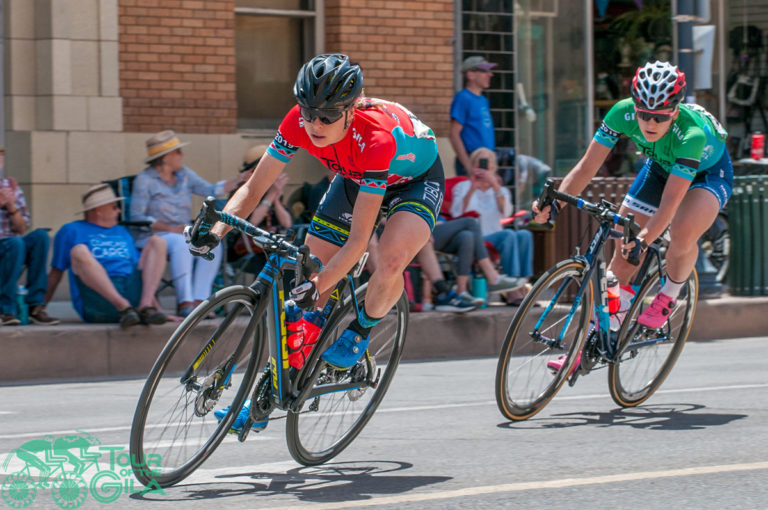
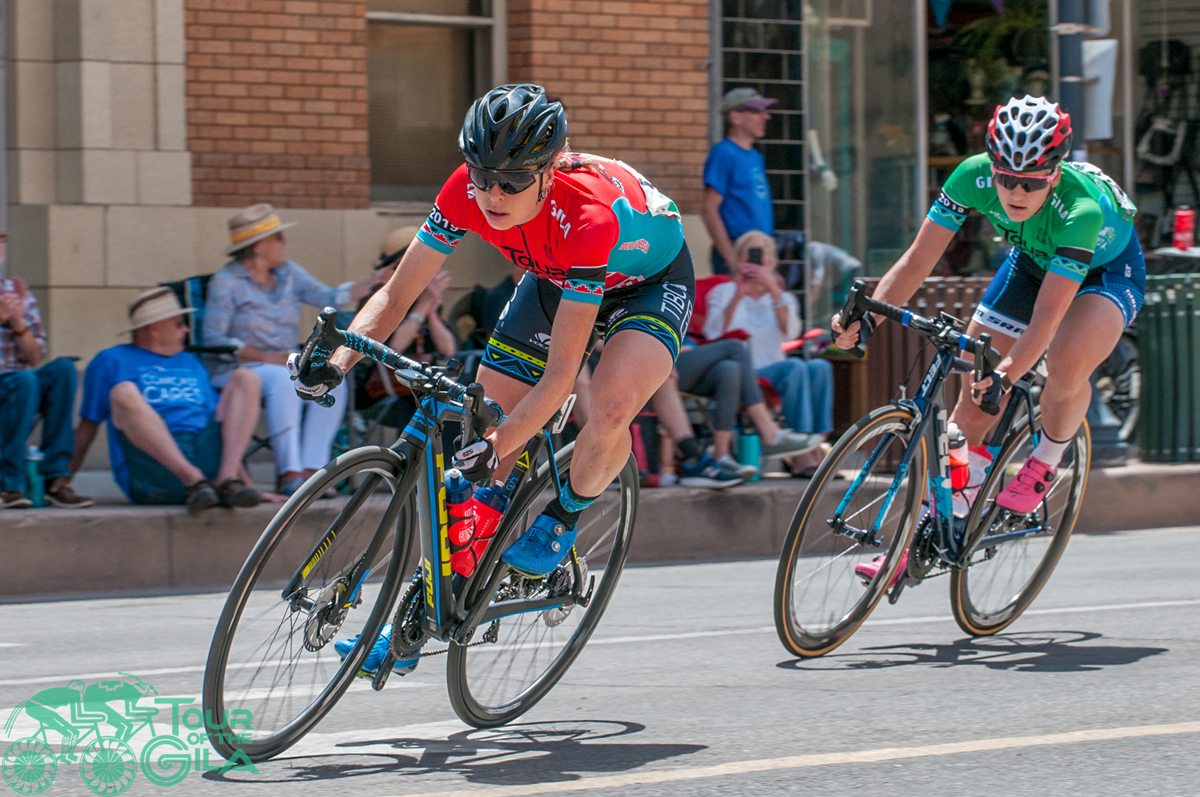
Action in the 2019 Tour of the Gila. Photo courtesy Tour of the Gila

In 1996 I was covering the Tour Of The Gila for the newspaper where I worked. My landlord was one of the race sponsors. He co-owned the local bike shop and he was a pretty chill guy. He partner was a ball of stress. You know how you can actually see stress swirl around some people? It’s a five day stage race with a crit in town on that Saturday. I rode along on the long day out to the cliff dwellings, and appreciated how fast these non body fat lost souls could coax a bike to go.

The Saturday race was in multiple parts. The women raced in the morning, then the citizens crit. Then the men’s cats in the afternoon. My landlord came out at about 5 minutes before noon with a mountain bike and told me he’d signed me up for the citizen’s race. I waved it off and pointed out that I was wearing hiking boots. The gun sounded and he literally ran me to the start line and pushed me forward. I had a few seconds to decide to peel off or dig in… I have this default feature built into the reptile part of my brain… it’s always set on fight. So I did my best to get my hiking boots onto the middle of the pedals and I dug in, hard. so hard I had to back off a bit so as not to blow up, but that was after I’d caught and overtaken the pack. I held me line in my mountain hardware shorts, Suwannee Country Tours tank top and hiking boots. I looked absurd, I felt exhausted. By the third lap I contemplated dropping off the back but half of the town, my friends and neighbors were chanting Joe, Joe, Joe at every corner. Several of their dogs chased after me, mistaken Joe for go perhaps. Much of my life has followed this track… a push from nowhere, chaos, excitement, sound, fury, pain, motion and at some point a big smile turns to laughter because hell, it’s all gonna be over soon enough so enjoy the ride.

A hundred yards out my boot slipped the pedal and I almost went down, but I went loose and completed the motion catching the pedal again. When it was over I was laying on the ground thinking is this what a heart attack at 29 feels like?

The Ilg brothers helped me to the curb where I sat with my head between my knees for an indefinite period of time. “You won,” Craig Ilg said but all I heard was. “You Done.”

“How do you feel?” Craig’s brother asked. Still a bit breathless, I could be philosophical, “Like I will stick to touring for here on…”

When they put the medal around my neck I chuckled, realizing that since I was the reporter, I was going to have to write about my win in the third person when listing the stats for that day.

Since the race was a loop, it somehow made sense, as if seeing myself as I came around to the start.

On stage, I manage to blurt out. “Next year leaving the hiking boots at home…. maybe flip flops.”

Durango’s Cole Paton and Salt Lake City’s Melisa Rollins Win 38th Annual Chequamegon MTB Festival Race

2,500 Cyclists ‘Revel in the Woods’ At 38th Annual Chequamegon MTB Festival

CABLE, Wisconsin (September 18, 2021) — The 38th annual Chequamegon MTB Festival took place in the remote Wisconsin towns of Hayward and Cable Wisconsin this past weekend. The 2021 event featured $10,000 in prize purse winnings. The event’s signature distance features 40-miles of the famed Birkie Ski Trail, forest roads and winter snowmobile routes, but also includes the popular ‘Short & Fat’ 16-mile distance, and ‘Little Loggers’ route to inspire a future generation of off-road enthusiasts. In total and across all three event distances, 2,677 cyclists took part, with the oldest age 82 and the youngest just one year old; they hailed from 37 states and four countries.

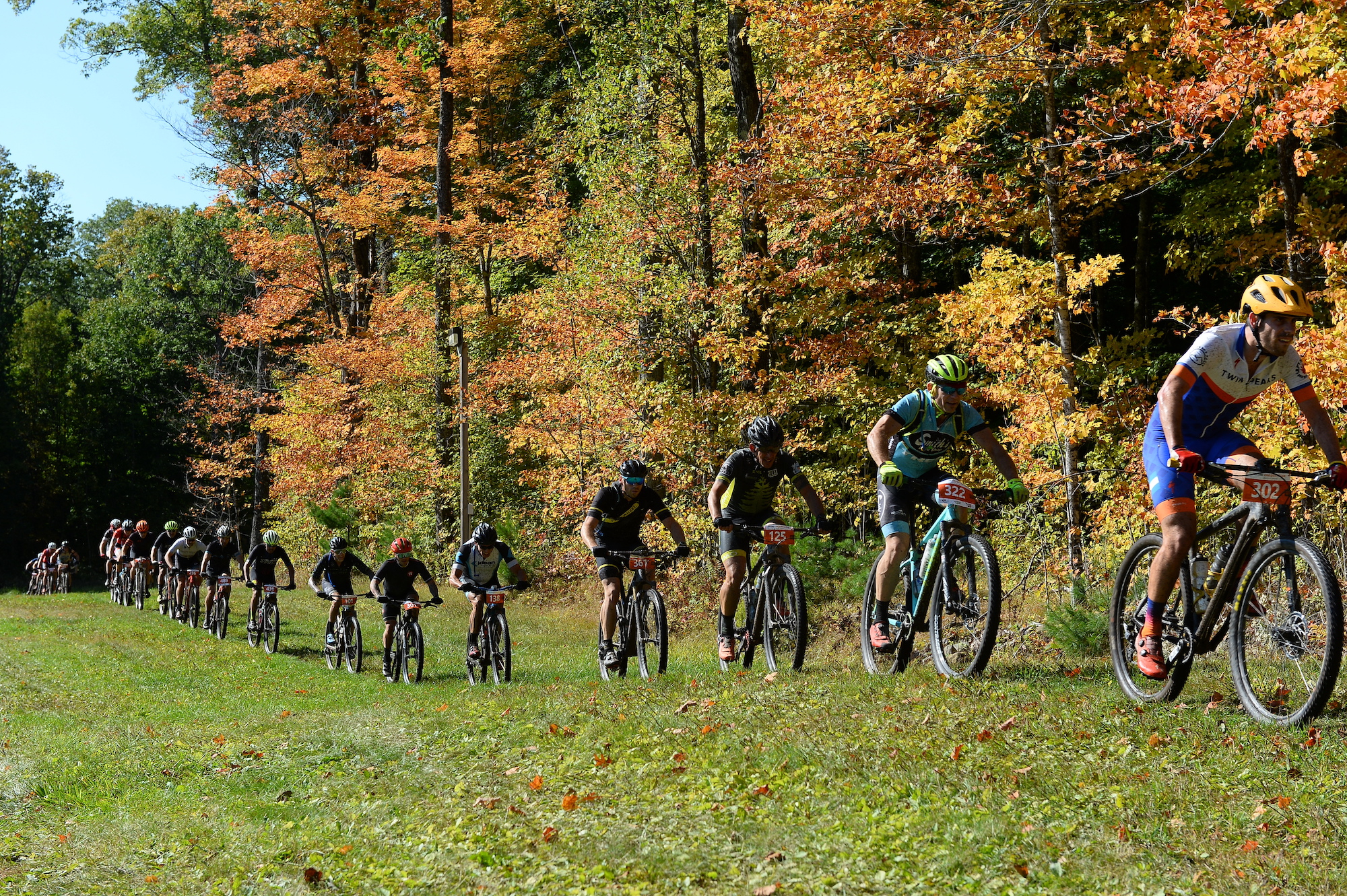
Riders at the 38th Annual Chequamegon MTB Festival, Chequamegon, Wisconsin. Photo courtesy Life Time

“It’s beyond exciting for us to welcome everyone back to this celebration of bikes and camaraderie in off-road cycling,” said Peter Spencer, Events Manager at Life Time. “Everyone is in high spirits and the excitement is truly palpable. The atmosphere at Chequamegon is exemplary of what folks can expect at Life Time events, where we aim to provide memorable experiences that change lives while inspiring onlookers to take up the sport themselves.”

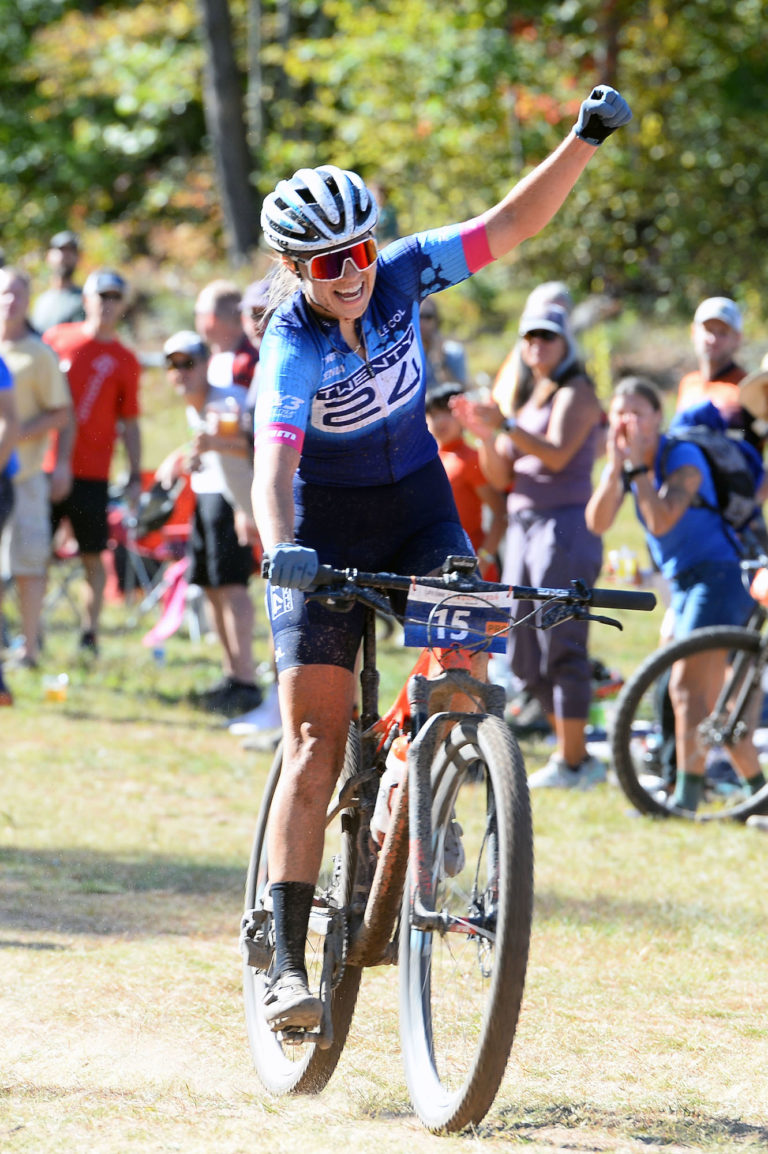
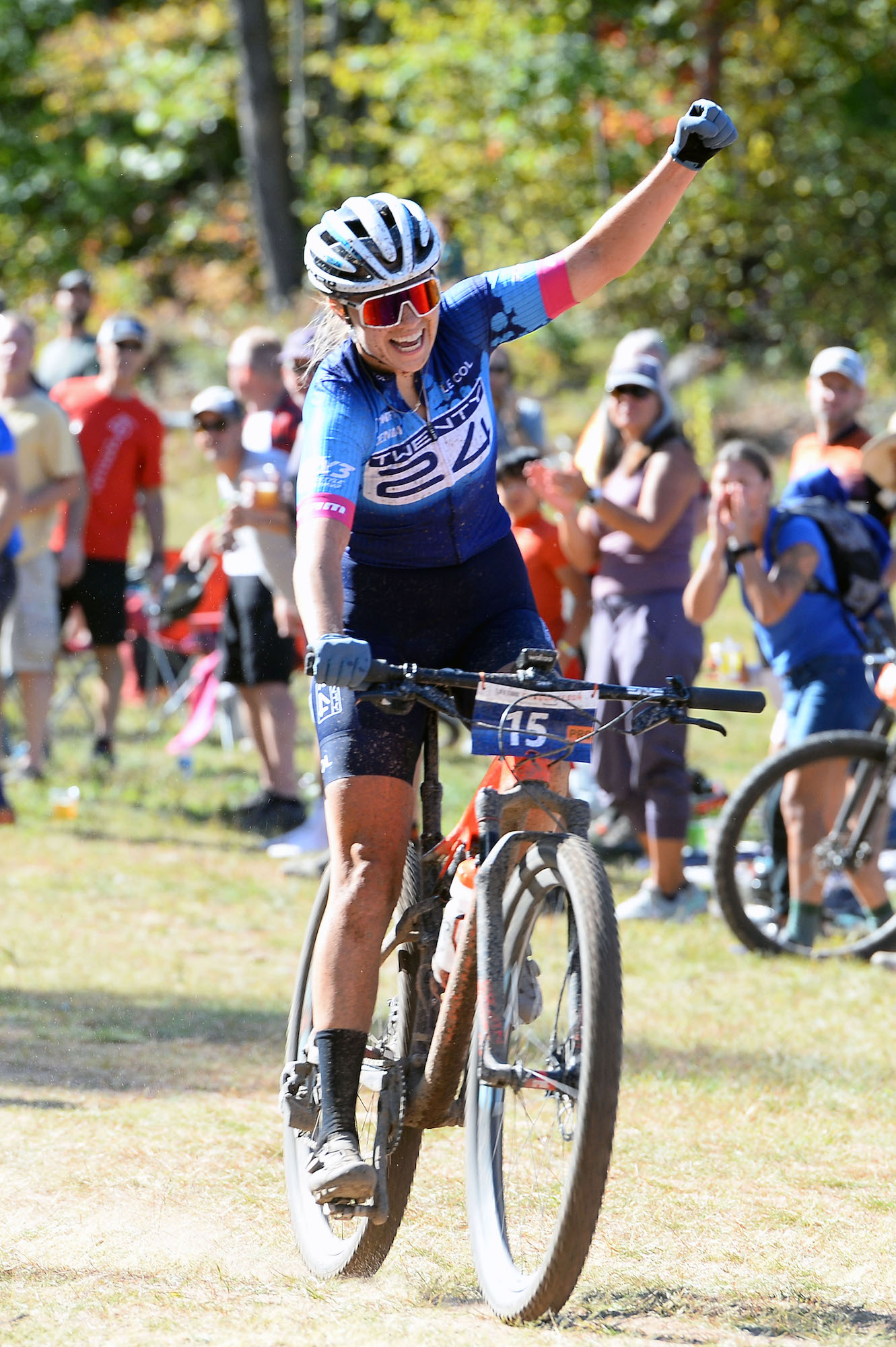
Melisa Rollins celebrates her win at the 38th Annual Chequamegon MTB Festival. Photo courtesy Life Time

In the women’s 40-mile, Melisa Rollins, 25, of Salt Lake City, Utah crossed the finish first with a time of 2:36:39. Second behind Rollins was six-year first-place title holder Jenna Rinehart, 37, of Mankato, Minn. with a time of 2:36:40.  Kenzie Statz, 38, of Wisconsin Rapids, Wis. placed third with a time of 2:49:23

“It feels so dang good!,” Rollins noted about her win. “Jenna and I were together the entire time from the gun and we really ramped it up in the last mile. This event’s atmosphere is so cool, and I’ll absolutely be here next year.”

In the men’s 40-mile, Cole Paton, 23, of Durango, Colo. took first with a finish time of 2:15:26. 2019 first-place winner Alexey Vermeulen, 26, of Pinckney, Mich. took second, crossing the finish at 2:15:27. Corey Stelljes, 40, of Madison, Wis., placed third with a time of 2:15:49

“This is my first time in the Midwest and Chequamegon is an awesome event,” said Paton about his win. “It was a tactical race and Alexey was riding really strong. Everyone here is super welcoming, and I think this is going to be a tradition. Next year I’m focusing on Life Time events; Life Time is doing a great job of promoting athletes and I want to support that.”

Bike Your Park Day Celebrates Bicycling, Public Lands on September 25

0

MISSOULA, Montana (September 20, 2021) — Join Adventure Cycling Association and thousands of others across the country on Sept. 25, 2021, to celebrate bicycling and public lands on Bike Your Park Day. Every year on the last Saturday in September, participants are encouraged to explore the nation’s parks and public lands by bicycle, riding for however long they like on roads, paved paths, or singletrack. Bike Your Park Day is being held in conjunction with National Public Lands Day, which is a “fee-free day” for national parks and public lands, providing an opportunity for everyone to enjoy and care for America’s parks, monuments, wildlife refuges, forests, and more.

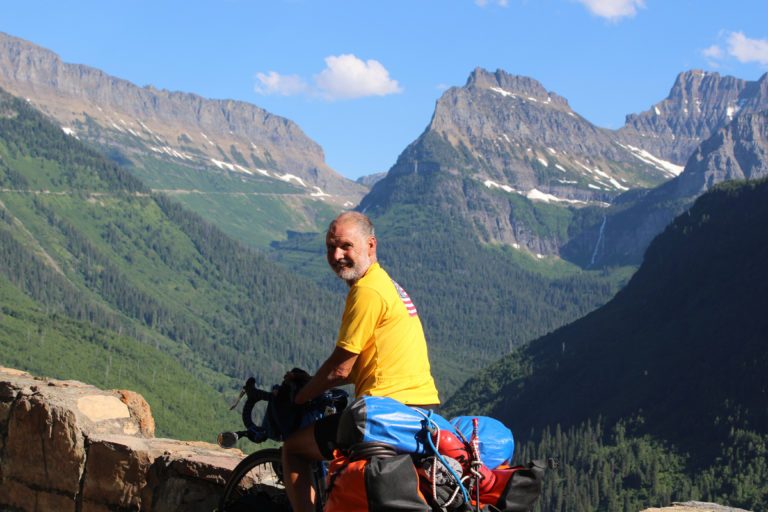
Lou at the location that inspired the Monte Dolack painting, Going to the Sun Highway, Glacier National Park.
Lou Melini at the location that inspired the Monte Dolack painting, Going to the Sun Highway, Glacier National Park. Photo by Julie Melini

“Adventure Cycling created Bike Your Park Day to inspire people across America to explore nearby parks and public lands by bike while promoting a healthy, sustainable way to travel,” said Carmen Aiken, Bike Overnights Event Coordinator for Adventure Cycling. “This year, rides are planned everywhere between Maine and California, Washington and Florida, and even in Hawaii. And those who aren’t comfortable joining a group event can still participate by creating a ride to do solo, with family, or with a few friends. However you ride, Bike Your Park Day will provide an opportunity to discover the treasured places all around you while connecting with others in your community.”

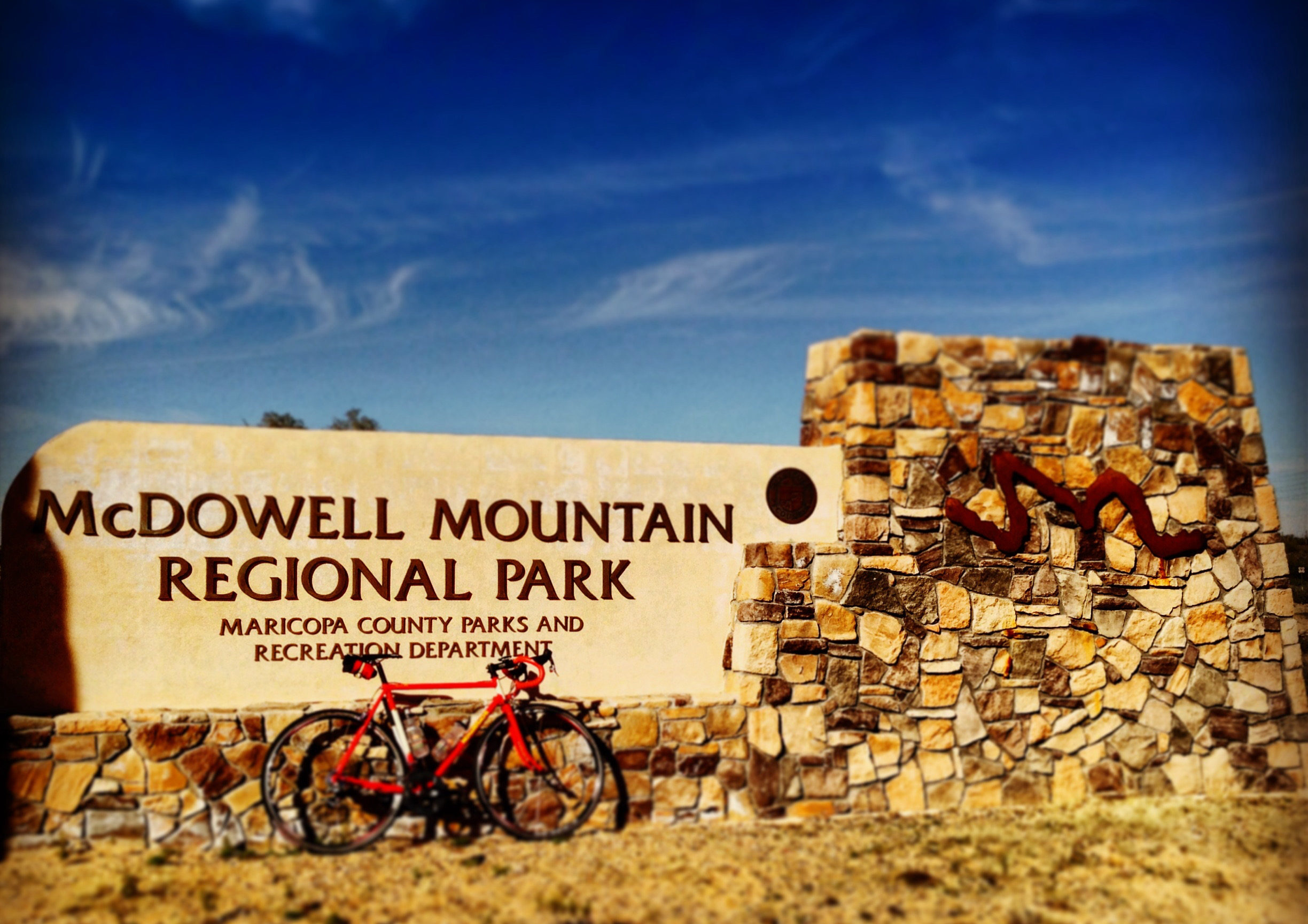
Steven Sheffield’s Richard Sachs road bike on a visit to McDowell Mountain Regional Park, Fountain Hills, Arizona. Photo by Steven Sheffield

In the past five years, over 50,000 people have participated in more than 5,000 rides for Bike Your Park Day. Bike Your Park Day is for people of all experience levels, backgrounds, and ages.

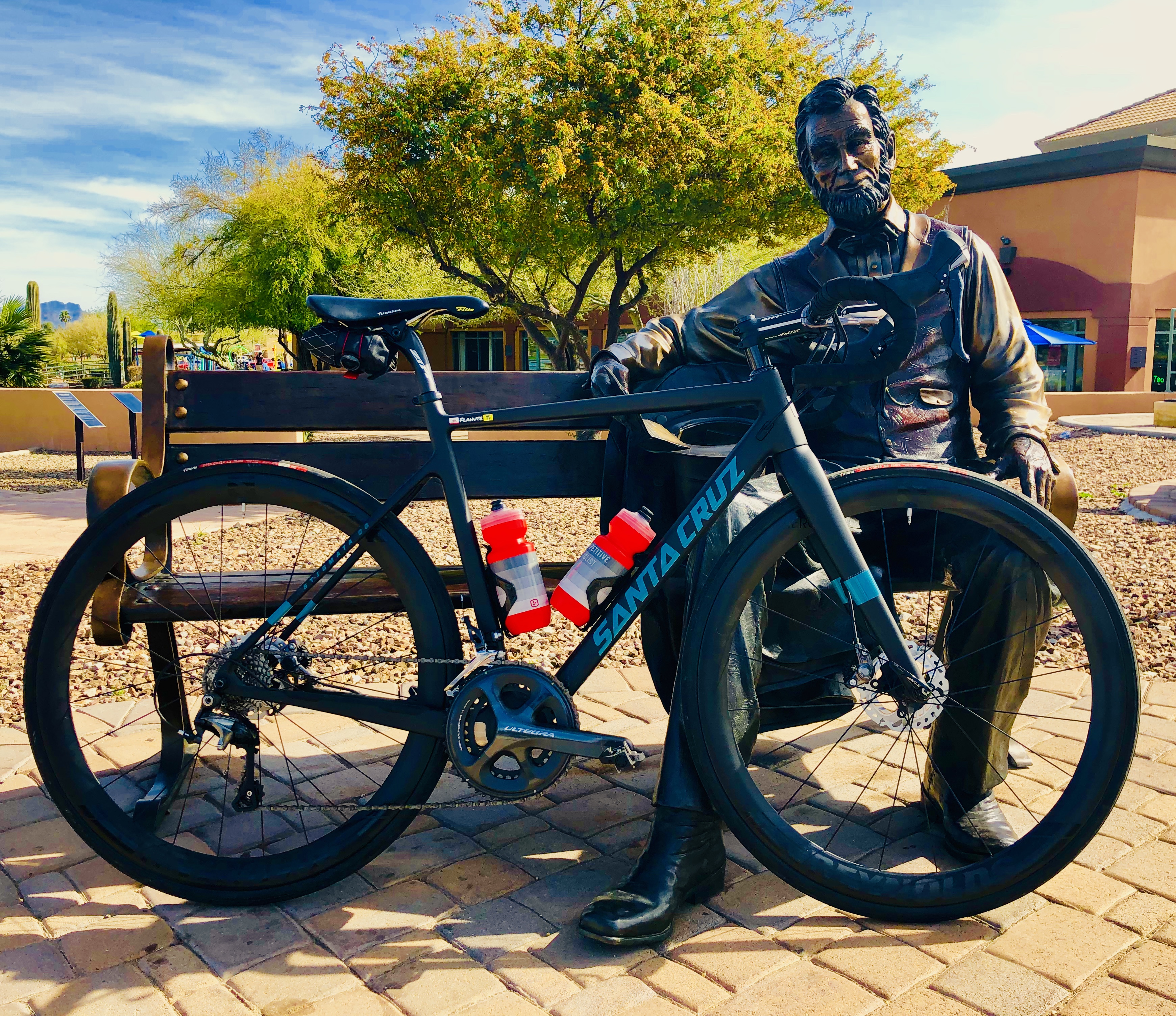
Honest Abe keeping an eye on my Santa Cruz Stigmata. Fountain Park, Fountain Hills, Arizona.
One of the features at Fountain Park in Fountain Hills, Arizona are sculptures of various President. Here, Honest Abe is keeping an eye on my bike. Fountain Park, Fountain Hills, Arizona. Photo by Steven Sheffield

What can rides look like? Examples include:

  • A casual mile on a park path with younger family members.
  • A ride using alternative transit like buses, trains, and ferries to expand mileage.
  • A challenging gravel century through forestlands and mountains with friends.
  • A ride with a stewardship focus like removing litter and invasive plants along the way.
  • An educational ride with a park ranger to explain the history and geography of the area.

A Teton and Yellowstone National Park Bike Tour

By Lou Melini with Chris Blinzinger

Yellowstone to Salt Lake City: The Journey continues.

During March of 2021 I spent time planning for potential bike trips. Julie and I had an upcoming outing to our timeshare in Island Park, Idaho (Julie’s place) the week before Memorial Day weekend. I thought why not ride home again from the cabin through Yellowstone and Teton NPs.

The problem was that I didn’t want to go alone so I threw out an invite to Chris Blinzinger who I did a tour within September of 2020. Within 2 days Chris not only replied affirmatively, but he also had a bus ticket taking him to Island Park on the last night at the timeshare. Julie would drive to our home in Millcreek, while Chris and I would begin our ride through the Parks, a first for Chris.

Weather and (bad) planning:

The first few days of the tour would be over Memorial Day weekend. I told Chris “No problem”, we will stay in hiker/biker sites at Madison, Grant Village and Jenny Lake”. During the first night at the cabin, I read the local Island Park paper that mentioned the opening of Yellowstone, but not Grant Village. In addition, the weather was bad. Julie and I hiked nearly 9 hours during the first 2 days at the cabin in rain and snow, with Yellowstone receiving 6 inches of snow.

“Hey Chris”, I have a bit of a problem planning the tour. Who would have thought that Yellowstone would only have three campgrounds open during the Memorial Day holiday weekend and Grant’s Village is not one of them! Also the weather is a little nasty, but the extended forecast looks good for us, if an extended forecast in Yellowstone can be believed”. “Hey Chris”; plan B at Flagg Ranch won’t work. Tent camping doesn’t start until June 1st.” I knew about a primitive campsite near Flagg Ranch and Chris found it on a map. “Hey Chris: I have what we need to hang a bear bag, plus bear spray.”

Yellowstone and Teton NPs:

The ride from the timeshare to the entrance station was just over 27 miles. When we arrived, Chris and I were perhaps 20th in line, one of 4 lines to enter the park. As I handed the ranger my Senior Pass and ID, I needed to remind her that I was allowed to take another cyclist into the park with that pass. With a brief pause she said; “Yes, I think you are correct”.

This trip is the 8th time I have ridden through a Yellowstone entrance station on my bike going back to 1975, the 5th time since 2014. The road from the West Yellowstone entrance to Madison campground 14 miles further down the road is one of the most scenic stretches of road in all of my travels on a bike. After telling this to Chris several times I think he agrees. The ride is flat, albeit at nearly 6700 feet of elevation. There are multiple pullouts for scenic gazing. The road has a good road shoulder that allowed Chris and I to pass dozens of vehicles that were moving along at the pedestrian rate of 4-5 mph for the first 5 miles or so.

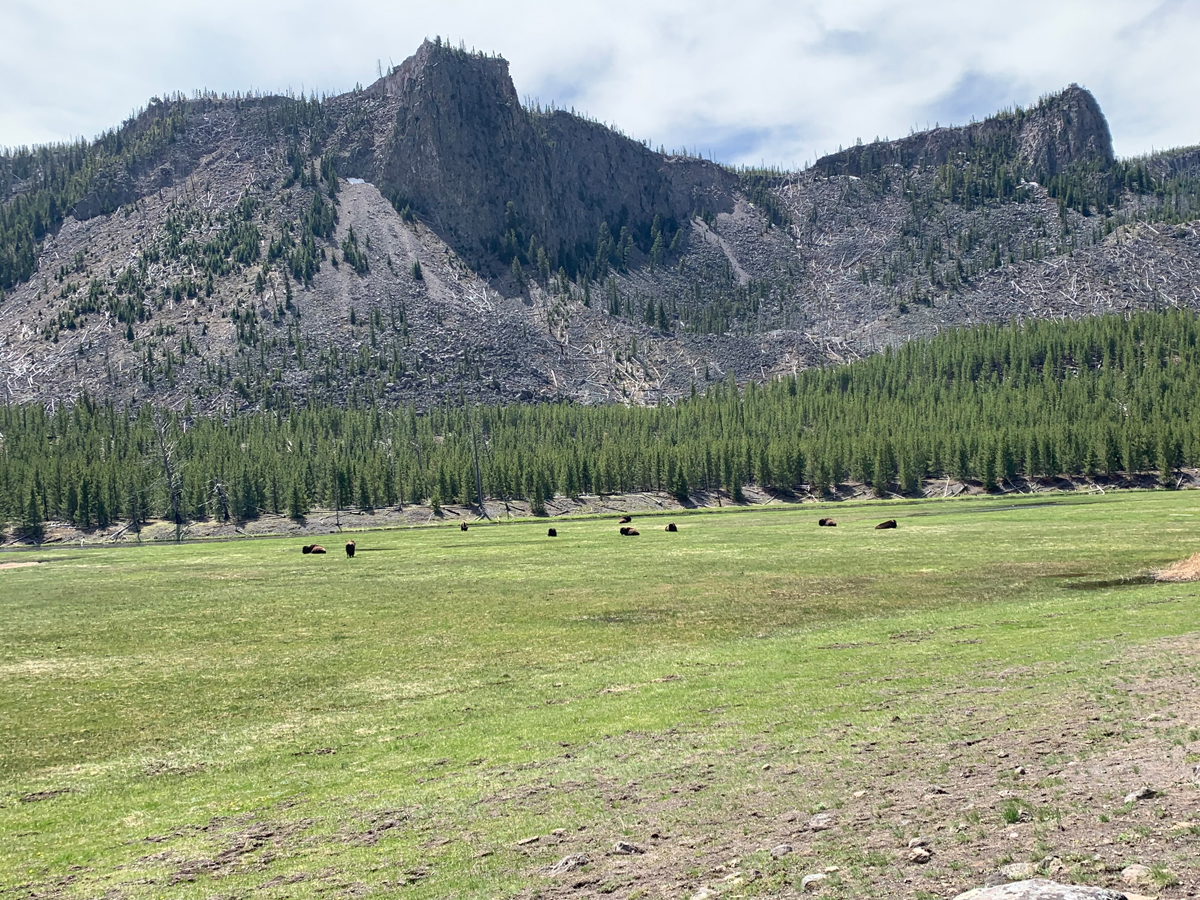
Bison. Yellowstone area bike tour. Photo by Chris Blinzinger

Slow and stopped traffic usually mean one thing: Wildlife! Bison graze along the sides of the road and at this time of the year take the road. Julie and I had earlier in the week come to a standstill in our car due to bison and their newborn calves strolling down the road. Chris and I made mental to-do notes about the bison. Fortunately, the only bison we encountered on our way to Madison were grazing and resting in the meadow far from the road. On day 2 we encountered a lot of bison along the road. We had to jump into the oncoming traffic lane and speed up due to this. The car we had been using for protection between us and the bison suddenly sped up and left us exposed.

Without Hiker/Biker sites at the campgrounds in Yellowstone and Teton, touring cyclists would simply not be able to camp in the parks. These sites are welcome mats for cyclists in an environment of campgrounds that fill well before noon. The current fee is $10.50 (half-price for senior car holders) is reasonable. The Madison hiker/biker site conveniently sits behind the camp registration building and sometimes there is coffee from the employee coffee pot starting about 7 AM or so. Our original destination for day 2, the hiker/biker site at Grants Village, also has showers and laundry.

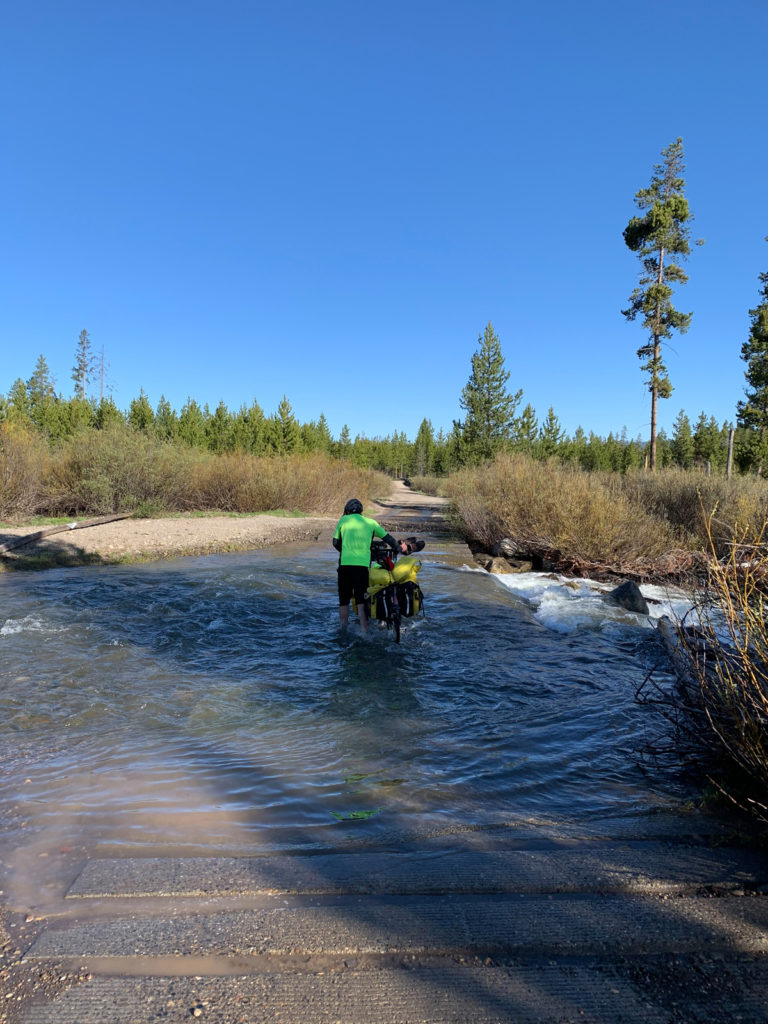
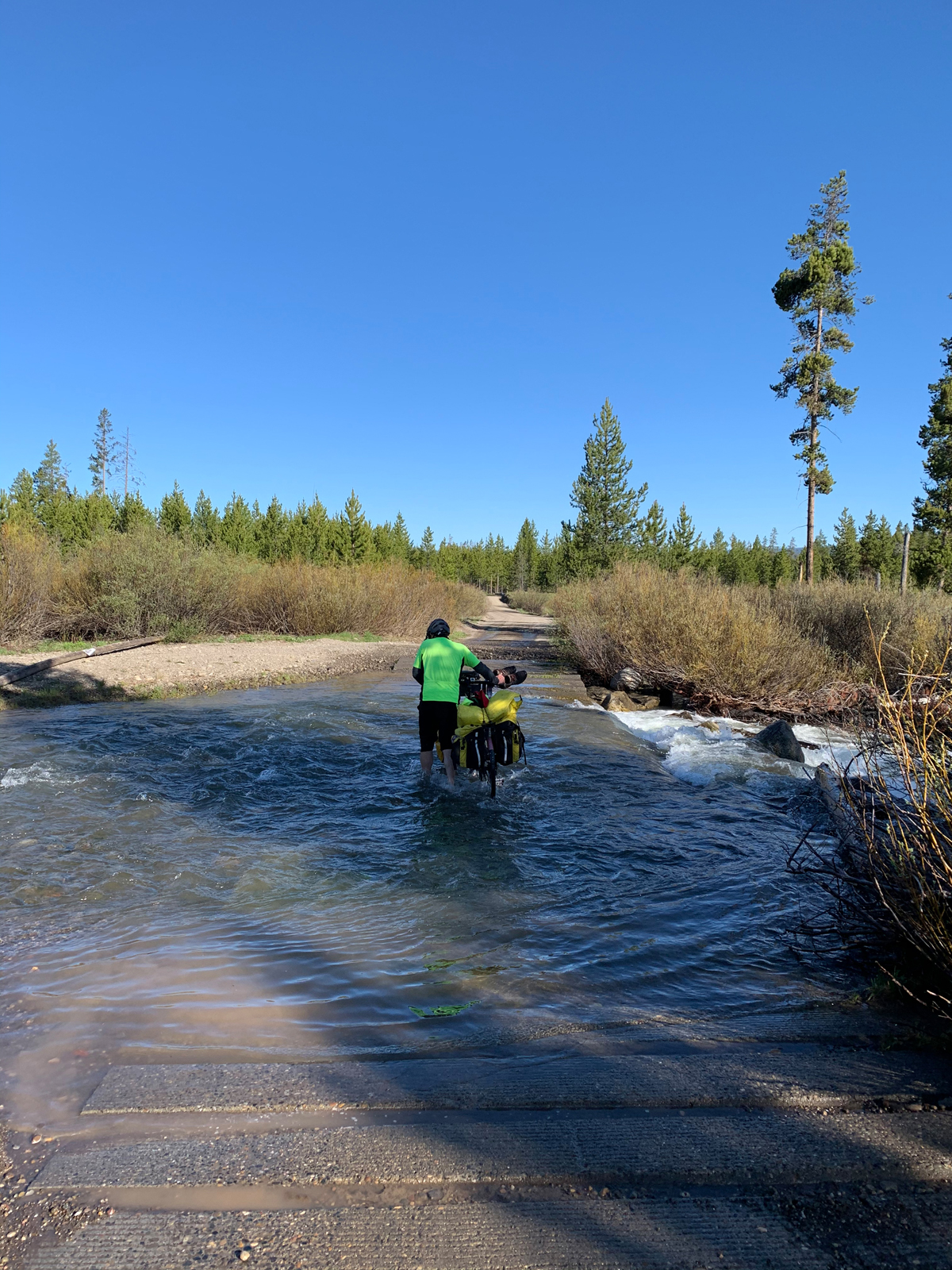
Chris fording a stream on the Yellowstone area bike tour. Photo by Chris Blinzinger

Chris and I left Yellowstone Park on Day 2, not fully knowing where we would camp. After considering a few possibilities and filling up our spare water containers at the Flagg Ranch store, we rode a gravel road for 0.5 miles to Sheffield campground, a “primitive” campsite on forest service land one mile south of Flagg Ranch. Just before entering the campground there was a stream to cross. Large concrete slabs formed a roadbed across the stream, but the water was 4-inches above the concrete and moving fast. Chris put his bike in the back of truck from a friendly camper to get across and I took off my shoes and socks to walk across with my bike. The camp was full, but we shared a site with the truck driver and his wife-thank you Johnny and Meghan. The camp supplied bear boxes as hanging a bear bag would be next to impossible. A vault toilet was available, and we had the necessary t/p. Overall the camp was a pleasant surprise, but the morning temperatures in the 20’s were also a surprise, just not pleasant.

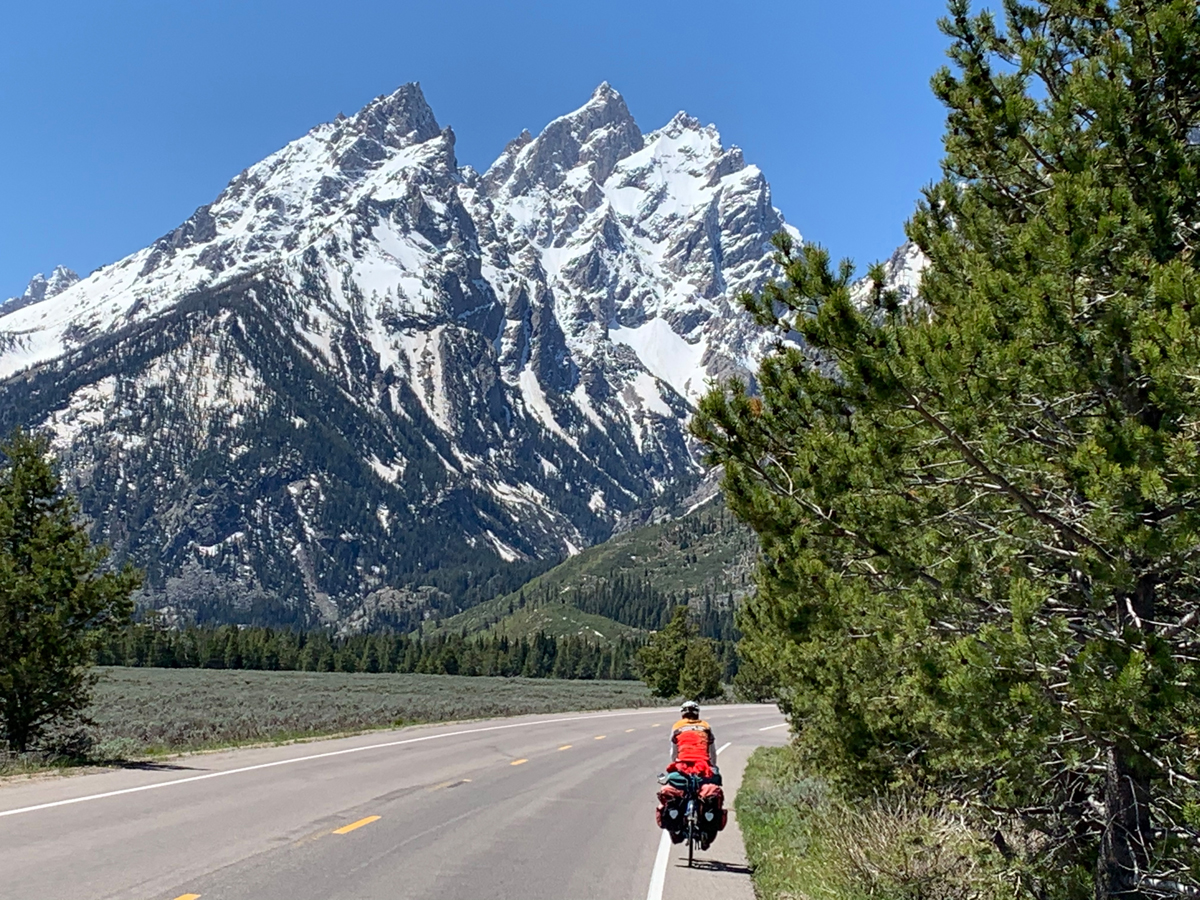
Lou Melini riding towards the Tetons. Yellowstone area bike tour. Photo by Chris Blinzinger

I feel a need to discuss bears, specifically grizzlies, while road touring. Bike packing in remote areas is another discussion that won’t be addressed here. The parks bear boxes are steel and bear proof. Testing of bear resistant containers, by the way, is done at the Grizzly and Wolf Discovery Center in West Yellowstone. Hanging a bear bag in the pine tree forests is difficult, very difficult. Hard shell bear resistant canisters don’t fit well in standard sized panniers so one would have to strap one onto the bike rack. (Ursak makes soft shell bear resistant containers that could fit into a pannier) Fortunately the Park Service has provided bear-boxes. Staying in formal campsites with other campers is helpful, if the other campers don’t make a mess with odors attractive to bears. Do you need to carry bear spray when road touring? Generally, I do not unless I plan on hiking. During this tour, I was not familiar with Sheffield primitive campground, so I carried bear spray and provisions to hang a bear bag including odor-proof bags. Fortunately, neither were necessary. In general, road touring in grizzly country is safe, with the caveat on where one camps. If you are unsure, ask a ranger in the parks for information.

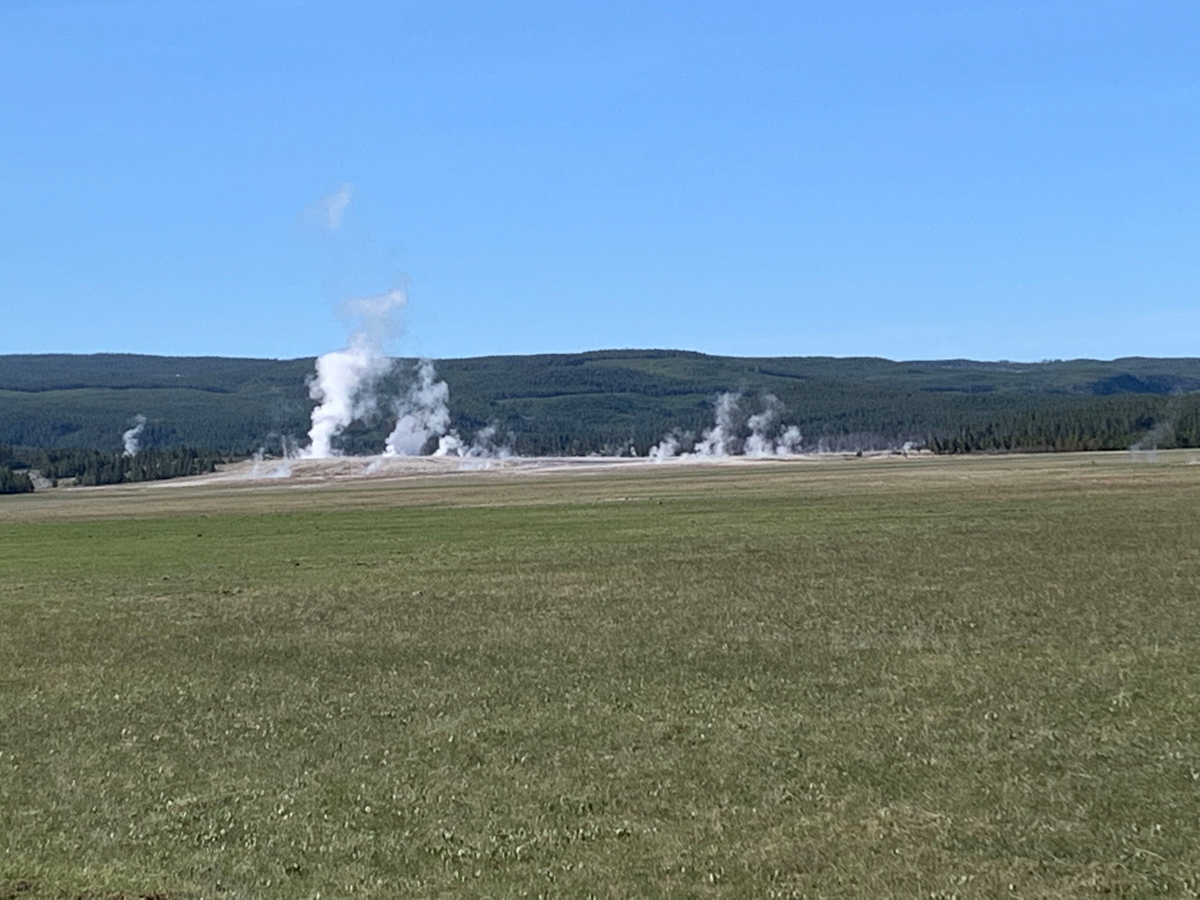
Yellowstone geothermal activity. Photo by Chris Blinzinger

Our destination in the Parks was the hiker/biker campsite at Jenny Lake in Teton NP with much needed showers. I told Chris there was a Laundromat at Jenny Lake, until I remembered I stayed at Colter Bay on my ride in 2020 so another planning mistake on my part. Six young girls, who started their ride in Florence, Oregon, were packing up to leave as we arrived. I gave them my best words of encouragement. Then I found out from the camp host that they skipped out on paying pissing off the Park. I offered to pay their tab, but the offer was refused.

Just after dinner we heard a noise from the nearby lake. “Lou, do you hear that noise. The guy is trying to start his engine with a bad fuel line.” It was an odd sound and continued for over an hour. At 5 AM when Chris and I were awakening the noise started again. As I got out of my tent, I spotted a well-camouflaged bird on a nearby log drumming its wings against his chest. Chris made a Google search noting that we were looking at a ruffled grouse making a mating call.

The ride to Alpine, Wyoming:

From Jenny Lake, the ride to Alpine Wyoming is 60 miles with 1150 feet of elevation loss. There is a bike path from Jenny Lake to Jackson, Wyoming. After a short meander through town the bike path continues south of town for 6 miles or so.

South of Jackson, Wyoming, Route 89/191 has been under construction for a couple of years. We left the bike path, onto good shoulder for several miles before we crossed the road onto another bike path for 4 or 5 miles. Normally the worst part of the ride south of Jackson occurs just north of Hoback Junction. Historically there has been a 2-mile section of narrow road without a shoulder. This year that section is under repair. Given that it was Memorial Day, the construction crew was gone so we had a relatively nice, packed gravel construction road to ride save for a 50-yard section thus avoiding the traffic north of Hoback Junction. Once past the junction we again had good shoulder.

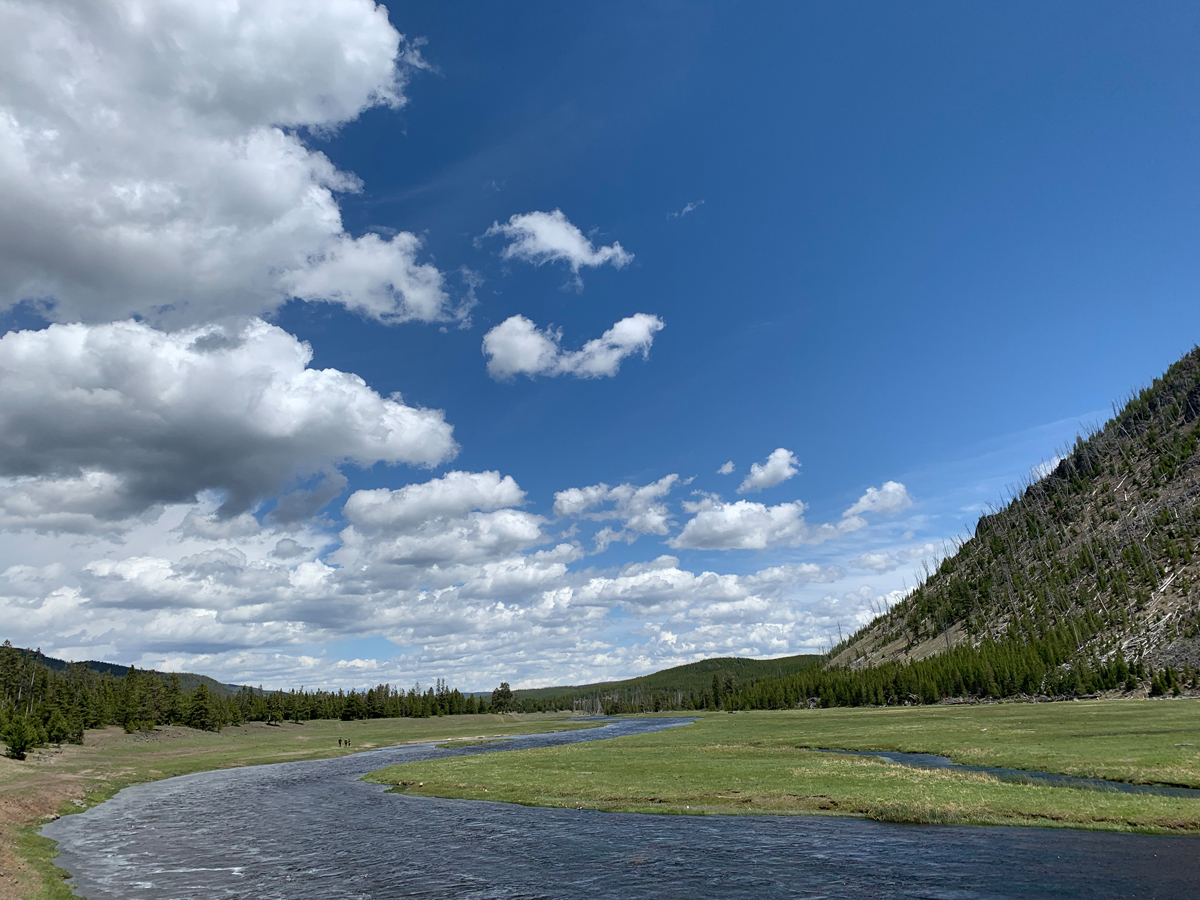
The Madison River in Yellowstone National Park. Photo by Chris Blinzinger

Chris and I planned to stay at a forest service campground about 2 miles north and west of downtown Alpine on route 26 as you enter Idaho. I had called a week ago to the campground I normally stay at in Alpine that is located behind a bar and a short walk to your choice of a grocery store or cafe. When I called, I was told, “the rates have gone up, $22/tent. By the way, the showers and restroom are being remodeled so they are out of service, but you can use the restroom in the bar”. I didn’t want to chance the possibility of the bar not being open at 6 AM so we decided the Forest Service camp would be better.

And better it was. With my senior pass we had a nice site for $9 and a 24-hour clean pit toilet a short walk from camp. The camp host was a wonderful lady. She paints rocks all sorts. Rocks painted with decorative “Welcome” greetings, frogs, and small ladybugs are a few of her creations that she sells or gives to the campers. Somehow the discussion mentioned that I was missing my granddaughter’s birthday party during this ride (she is 4), so I was given a small painted ladybug rock to bring home.

I asked her about bears and if there were bear boxes available. She said I should just put our food in our car. When I reminded her that we were on bikes she said that she has not she has not seen a bear in 2 years as the camp host so no worries. As I walked away, I heard her say “and if you are still worried, just put your food in your car’.

Confidence Building Days:

I define Confidence Building Days as long days in the saddle that exceed what you mentally think you can ride thus you gain confidence. On the flip side, if you exceed what you mentally and physically can do, bonking, heat exhaustion and extreme fatigue will occur making the ride miserable. One must know their limits.

Lodging made day 5 and 6 each 80 miles long, a distance neither Chris nor I looked forward to riding. There would be 3 climbs totally 12 miles included in those 2 days. We proved to ourselves that we could do the distance, but 60-mile days will still be our preferred planned limit.

Second Breakfast:

Chris and I both eat our own special blend of oatmeal in camp. Chris also makes what he calls “Hudson Bay” granola bars that he has for breakfast. The Hudson Bay bars include quick oats, old fashion oats, sugar, butter, a little bit of salt and usually with peanut butter and chopped nuts. Raisins are sometimes used. My oatmeal is a combination of what I have in the kitchen. Quick oats, instant oatmeal, and dried fruit (crasins, raisins, dates, or figs) are always used. If available, Julie’s homemade granola and sliced almonds are added. Occasionally I put in instant cream of wheat and wheat germ. Five ounces plus coffee is first breakfast.

Chris and I just couldn’t make a second breakfast café run work with our ride schedule. It was disappointing. Both of us look forward to a second breakfast after 15-20 miles. We both feel fresher with the calories and taste of a quality breakfast. Finally on day 5, the grocery in Afton, Wyoming provided us with the breakfast we needed. We bought hard-boiled eggs, cream cheese and some great tasting bagels and took over a table in the small dining area. My phone was dead so we both were able to finally charge our phones for the first time since we left on the trip. Windows allowed us to see our bikes, though there was not a need in this town.
After leaving Afton we completed our first 80-mile day helped by our second breakfast. We arrived at the KOA near Montpelier, Idaho for showers and laundering our copious volume of sweaty clothes. The next day, our last full day on the bike, was much the same. We again were able to have a small second breakfast before the climb to Logan Canyon. There is a new market that has a Beans and Brew along Bear Lake with pastry and of course, coffee.

After this 2nd breakfast we climbed for 6 miles to the summit, stopping at the summit campground for more food from our panniers. We then fought off and on head winds down Logan Canyon limping into Hyrum State Park with its lush grass and enviable shade trees. Showers, dinner, and sleep were on the agenda.

On day 7, our last day, we had a 40-mile ride to the FrontRunner station in Ogden that would take us near our respective homes. First, we had a 6-mile climb over Sardine Canyon to start the day. We had hoped to have a second breakfast at the diner next to the train station, but it was closed and probably had been for some time.

Trip Nuts and Bolts:

Chris and I rode 400 miles from Julie’s timeshare cabin in seven days: 3 40-mile days, 2 60-mile days and 2 80-mile days. Hiker/biker sites are plentiful in the parks and except for weekends, campgrounds are accommodating along the rest of the ride.

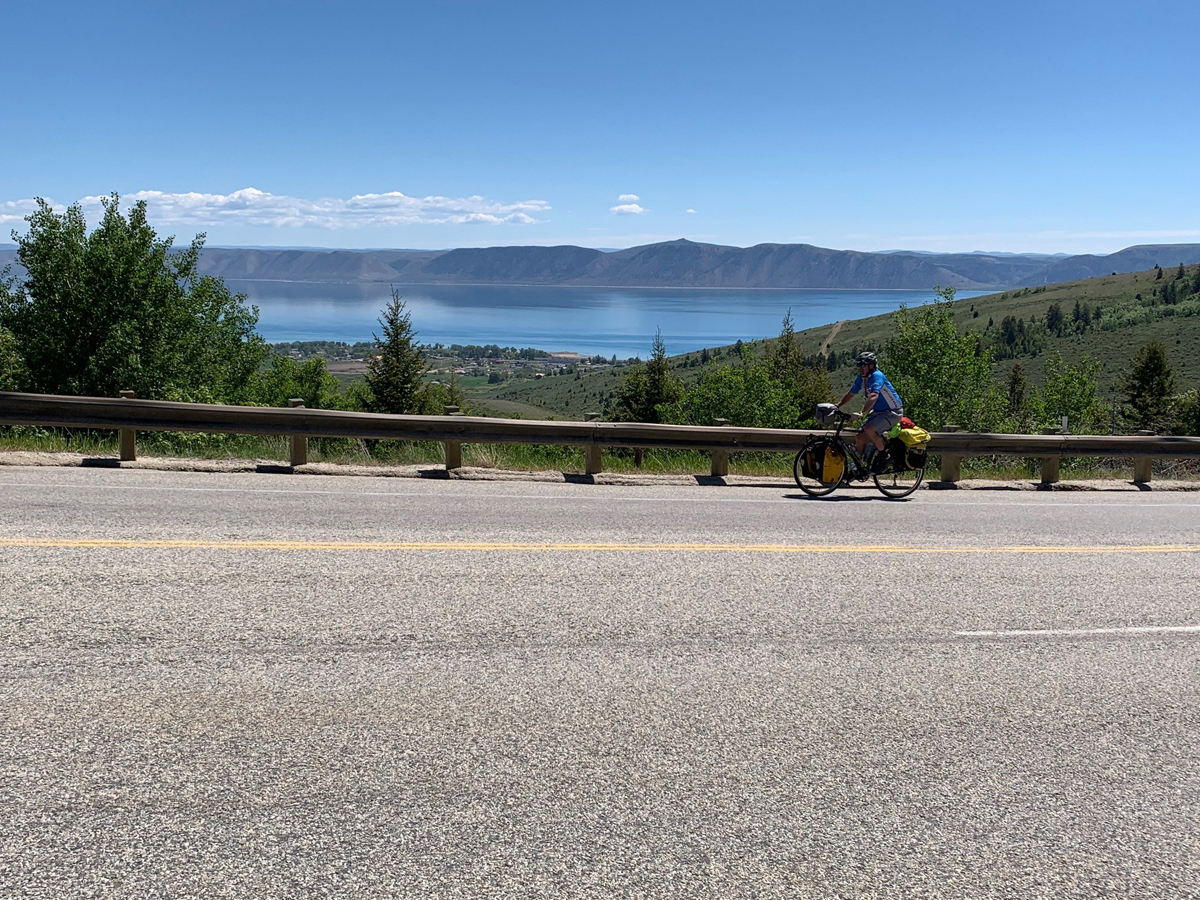
Chris climbing out of Bear Lake. Photo by Lou Melini

Food and water were plentiful, though with Grant’s Village closed there isn’t potable water between Old Faithful lodge and Flagg Ranch. We had a water filter if needed. We had stocked up on food for the 3 days in the Parks, but we could have purchased some food at the Flagg Ranch store. Jenny Lake had limited supplies. Full grocery stores are located at the south end of Jackson, Alpine and Afton Wyoming. Montpelier Idaho and now Bear Lake area have groceries as does Logan and the town of Hyrum. There is no need to carry a lot of extra food.

Weather, of course, varies based on the time of year one travels but Yellowstone always has potential for cold and wet weather. The route we took drops in overall elevation, but a Google search said we did 10,000 of climbing during our 7 days.

Our route followed two of Wyoming’s many scenic byways. The Wyoming Centennial Scenic byway goes from Jackson to Hoback Junction, but one would wonder why the scenic byway is not all the way to Alpine. After Alpine is the Star Valley Scenic Byway.

For cyclists not interested in riding the roads home from Teton NP there is the option of a Parks tour. Using Salt Lake Express bus service one can travel to West Yellowstone, Montana and return home from Jackson, Wyoming. All but 2 campgrounds have hiker/biker sites so you could bike from one campground to another; do some hiking to spend more time in the Parks. Food and shower options are available at most campgrounds in the Parks as well as at Flagg Ranch that sits between the Parks. Laundry services are also available at selected campgrounds.


35th Edition Santa Fe Century Ride Returns on 10-10-21 after Covid-19 Pandemic Pause

0
 

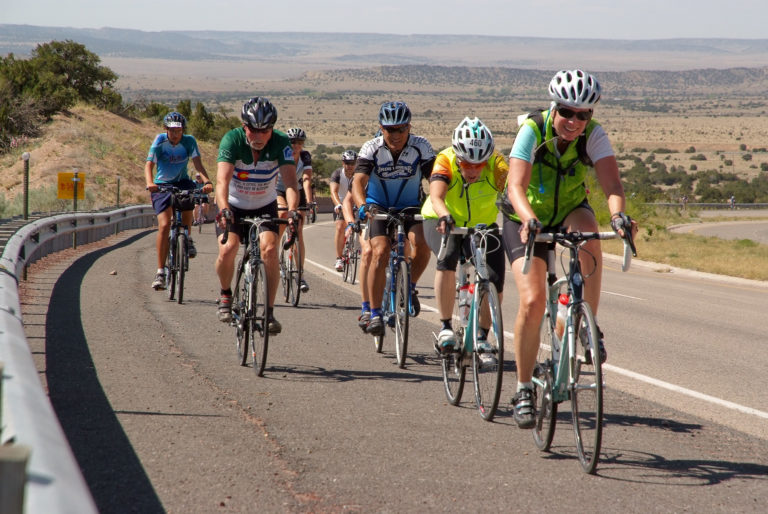
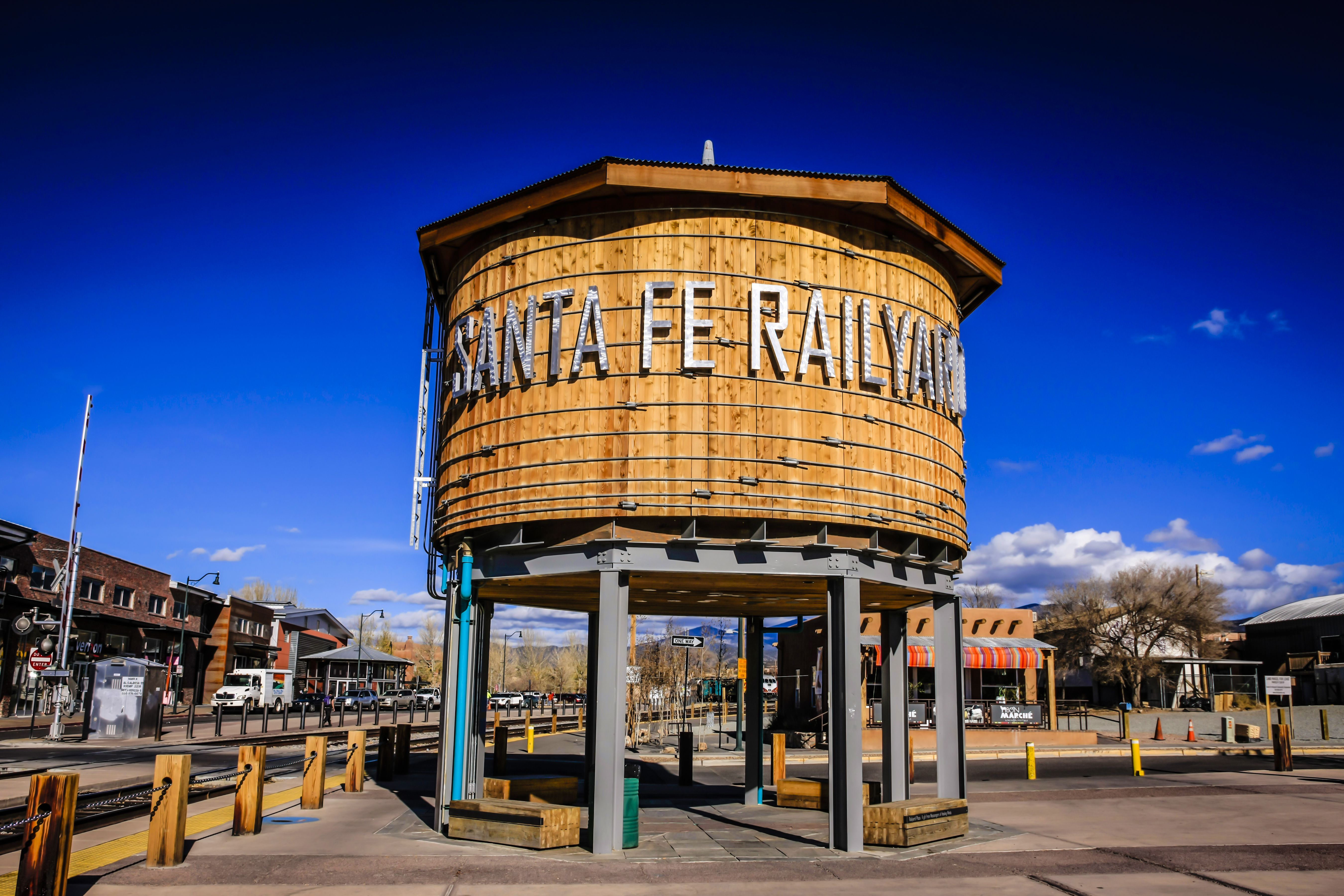
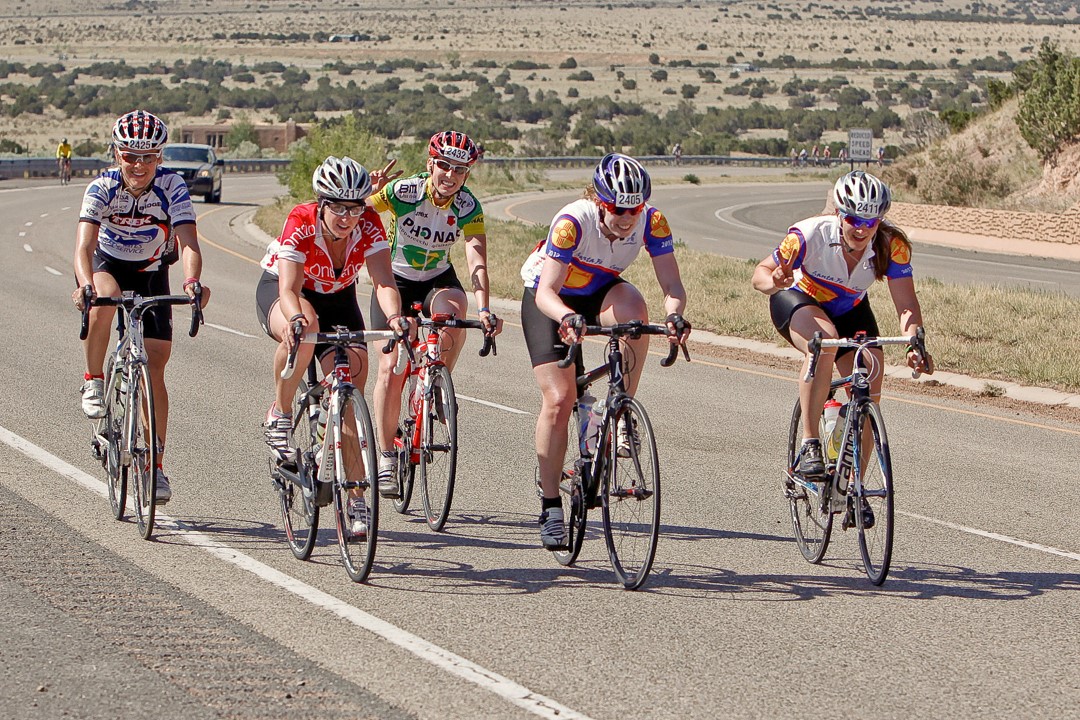
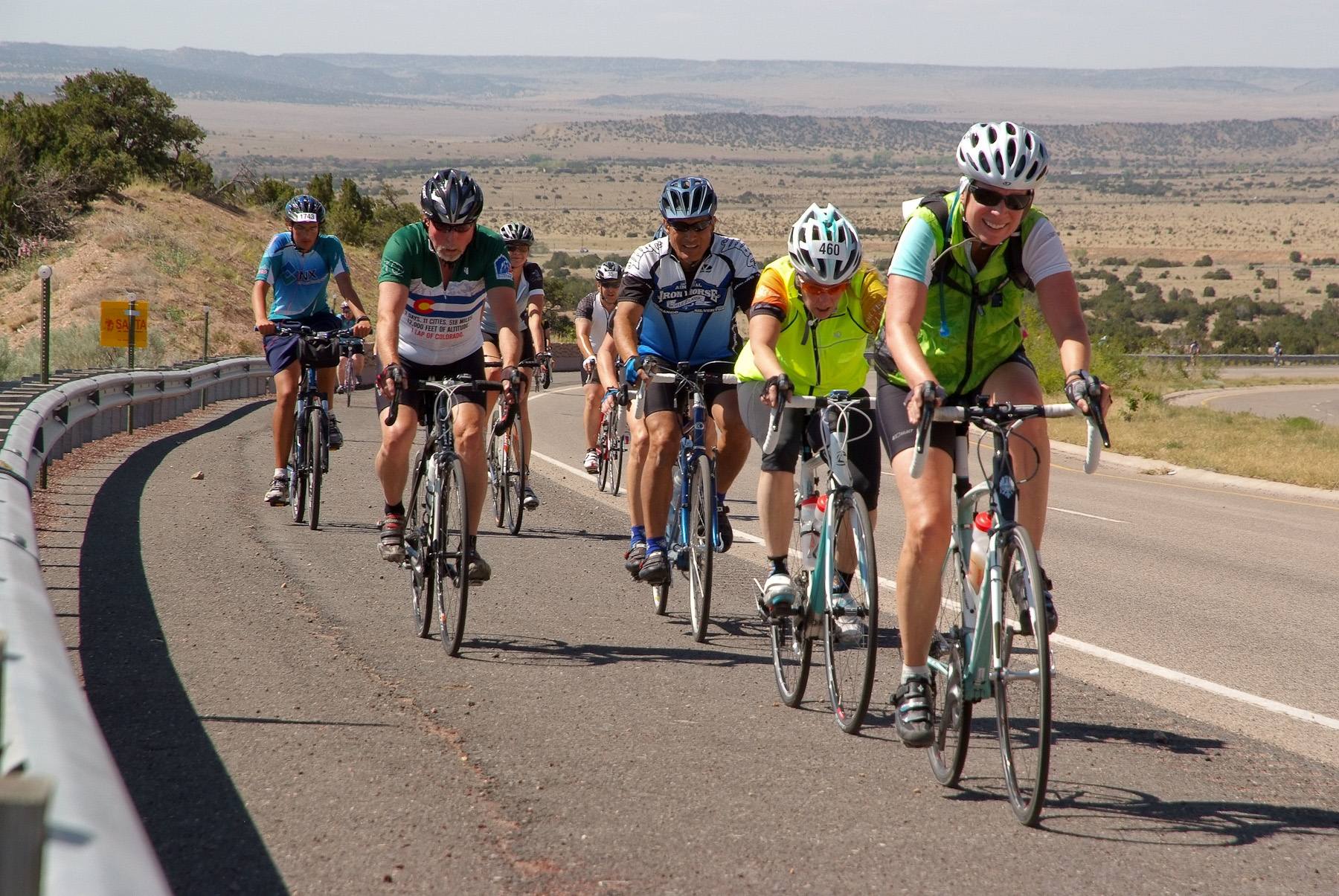
The 35th edition of New Mexico’s largest bicycling event has been upgraded and is set to roll out from Santa Fe’s iconic Railyard on Sunday 10 October, 2021 after being cancelled due to the pandemic in 2020.

Photo courtesy Santa Fe Century Ride“For over 35 years the Santa Fe Century has been a rite of passage for cyclists throughout the Southwest, from first-timers to weekend warriors and ex-professionals everyone loves riding our beautiful routes that wind through the Ortiz Mountains, Galisteo Basin and now finish at Santa Fe’s exciting Railyard arts district,” said Matt Piccarello, event Executive Director.

Photo courtesy Santa Fe Century Ride

The Railyard’s Director of Events Sandra Brice added, “We’re thrilled to welcome the legendary Santa Fe Century race to the Railyard for the first ever in-town start and finish.  Our restaurants and breweries are looking forward to serving riders, their friends and families and we hope the Century will become an annual fall staple here at the Railyard.”

Over 1000 cyclists have already signed up to participate and Piccarello expects over 2000 to rollout from The Railyard on 100, 50 and 25-mile routes on the 10th.

Photo courtesy Santa Fe Century Ride

To help protect the health and safety of riders, volunteers, staff, and the Santa Fe community, the Santa Fe Century is requiring everyone at the event to wear masks anytime they are not pedaling a bike. This includes at the start/finish in The Railyard and at all rest stops. 

The 100-mile century route leaves Santa Fe and goes through Madrid and Golden on Highway 14, up the steepest paved road in New Mexico – Heartbreak Hill, crosses over to Stanley and Galisteo before slowly climbing back to The Railyard finish line.  Along the way rest stops will offer riders COVID safe refreshments, mechanical assistance and encouraging words of support “to keep pedaling!”

Cyclists of all ages and abilities are welcomed to participate with registration fees starting at only $25.  Registration closes 3 October and more information is available at santafecentury.com.

IRONMAN 70.3 World Championships: Kyle Brown (USA) Battles ALS to Finish; Gustav Iden (NOR) and Lucy Charles-Barclay (GBR) Take Pro Titles

0

ST. GEORGE, Utah (September 18, 2021) — After two-years of anticipation for a world championship event, St. George, Utah, took the global spotlight this week as fans and athletes alike witnessed the remarkable lineup of pro athletes at the 2021 Intermountain Healthcare IRONMAN® 70.3® World Championship presented by Utah Sports Commission. Featuring moderate temperatures, striking landscapes, and some unpredictable weather, the Land of Endurance lived up to its billing with Lucy Charles-Barclay (GBR) taking the top spot for the first time as women’s world champion while Gustav Iden (NOR) defended his 2019 IRONMAN 70.3 World Championship title, making it two-in-a-row.

Utah’s Kyle Brown Races for ALS Awareness

After being given 6 to 18 months to live in March of 2021, Kyle Brown of Farmington, Utah, became determined not to let his diagnosis stop him from living his life. On race day, Brown sported bib number 179 in honor of Jon Blais, the first person with ALS to complete an IRONMAN race.

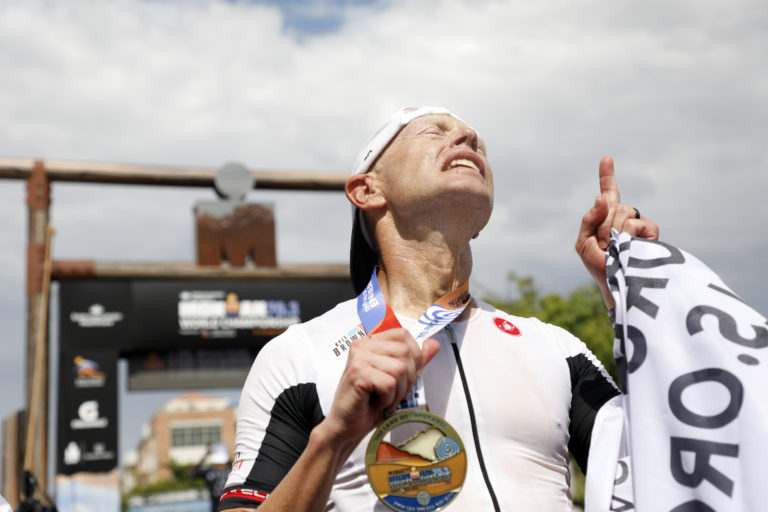
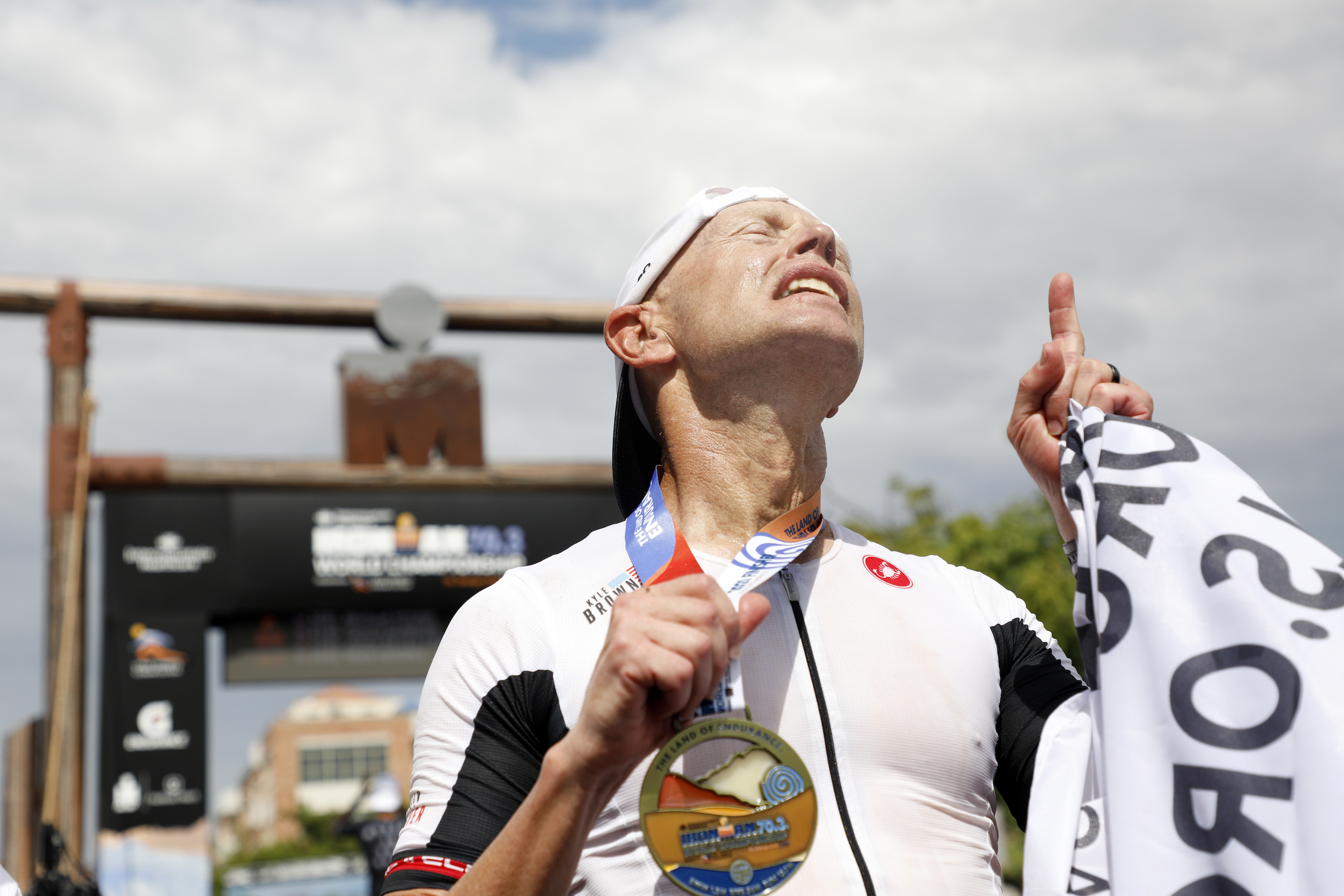
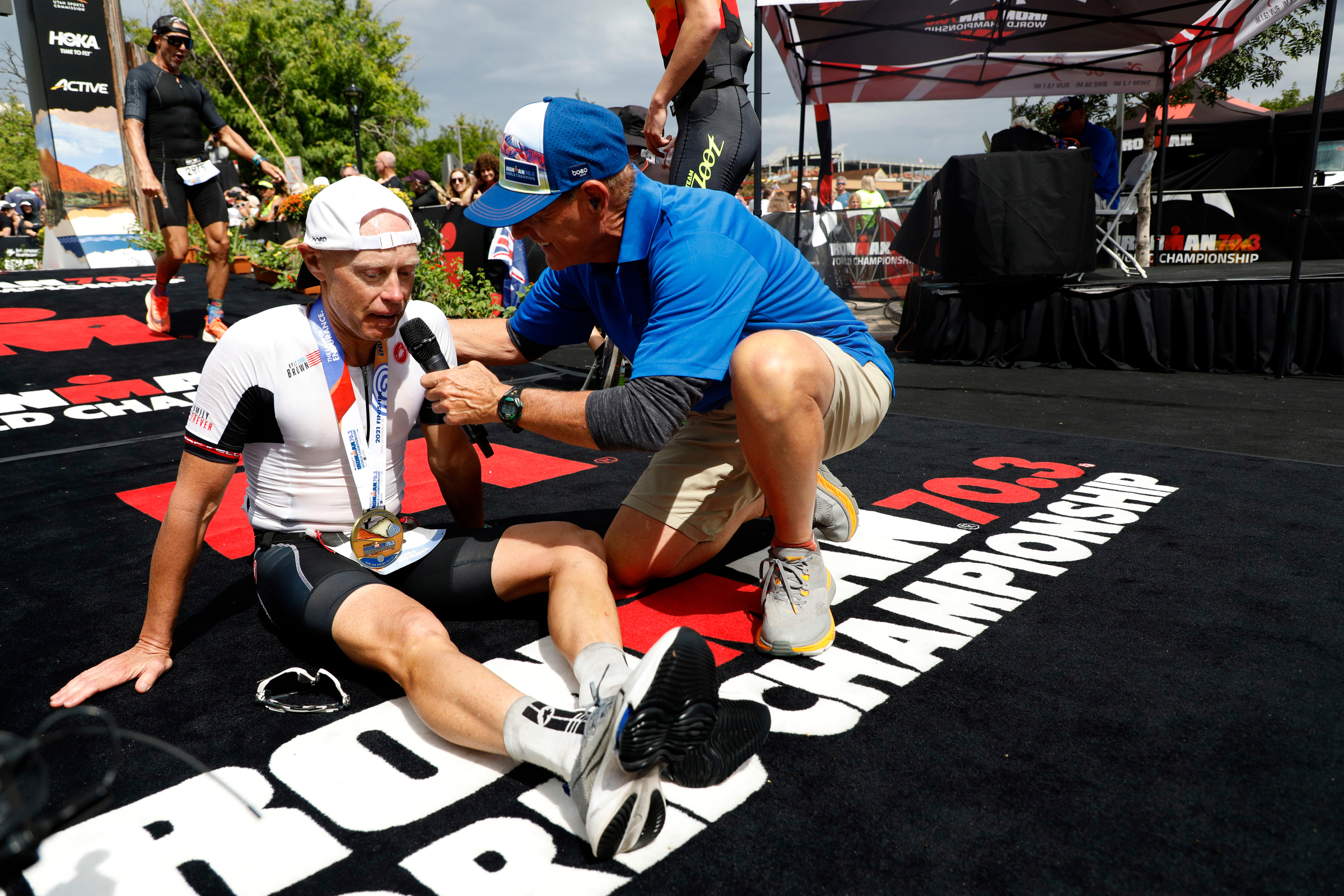
Having said before the race that he would finish even if he had to roll across the line, Kyle did exactly that, stopping just before the finish and lying down to log-roll across the line, and then breaking down in tears as he was greeted by friends and family. In his bid to continue raising awareness for ALS at the, Brown displayed a flag to the crowd that reads “It’s too late for me, but not for someone you love. A cure for ALS is close.”

ST GEORGE, UTAH – SEPTEMBER 18: Kyle Brown reacts after finishing the IRONMAN 70.3 World Championship on September 18, 2021 in St George, Utah. (Photo by Patrick McDermott/Getty Images for IRONMAN)
ST GEORGE, UTAH – SEPTEMBER 18: Kyle Brown reacts after finishing the running leg during the IRONMAN 70.3 World Championship on September 18, 2021 in St George, Utah. (Photo by Patrick McDermott/Getty Images for IRONMAN)

Gustav Iden defends IRONMAN 70.3 World Championship title

ST GEORGE, UTAH – SEPTEMBER 18: Gustav Iden of Norway finishes first in the Men’s Pro portion during the IRONMAN 70.3 World Championship on September 18, 2021 in St George, Utah. (Photo by Patrick McDermott/Getty Images for IRONMAN)

Following his quick rise and stunning 2019 IRONMAN 70.3 World Championship win as a seemingly unknown challenger, Norwegian professional Gustav Iden crossed today’s finish line with an unrivaled race that has cemented him as a force for others to catch. Coming out of the swim pack in 17th, Iden made up lost time by battling it back on the bike, passing fellow athletes early on. Even though heavy showers and hail poured down on athletes for a portion of the run, Iden remained undeterred and unstoppable, crossing the finish line in 3:37:13 at the 2021 Intermountain Healthcare IRONMAN 70.3 World Championship presented by Utah Sports Commission, nearly four minutes ahead of second place athlete Sam Long. The podium rounded out with an impressive performance by Daniel Baekkegard (DEN), who finished in 3:42:24.

Top five professional men’s results:
PLACE ATHLETE SWIM BIKE RUN FINISH
1 Gustav Iden (NOR) 0:24:54 1:58:58 1:11:32 3:37:13
2 Sam Long (USA) 0:25:54 2:00:48 1:12:11 3:41:09
3 Daniel Baekkegard (DEN) 0:23:51 2:03:00 1:13:23 3:42:24
4 Miki Taagholt (DEN) 0:23:54 2:03:02 1:14:00 3:43:07
5 Jackson Laundry (CAN) 0:24:50 2:01:54 1:14:38 3:43:24

 
Lucy Charles-Barclay wins first IRONMAN 70.3 World Championship title

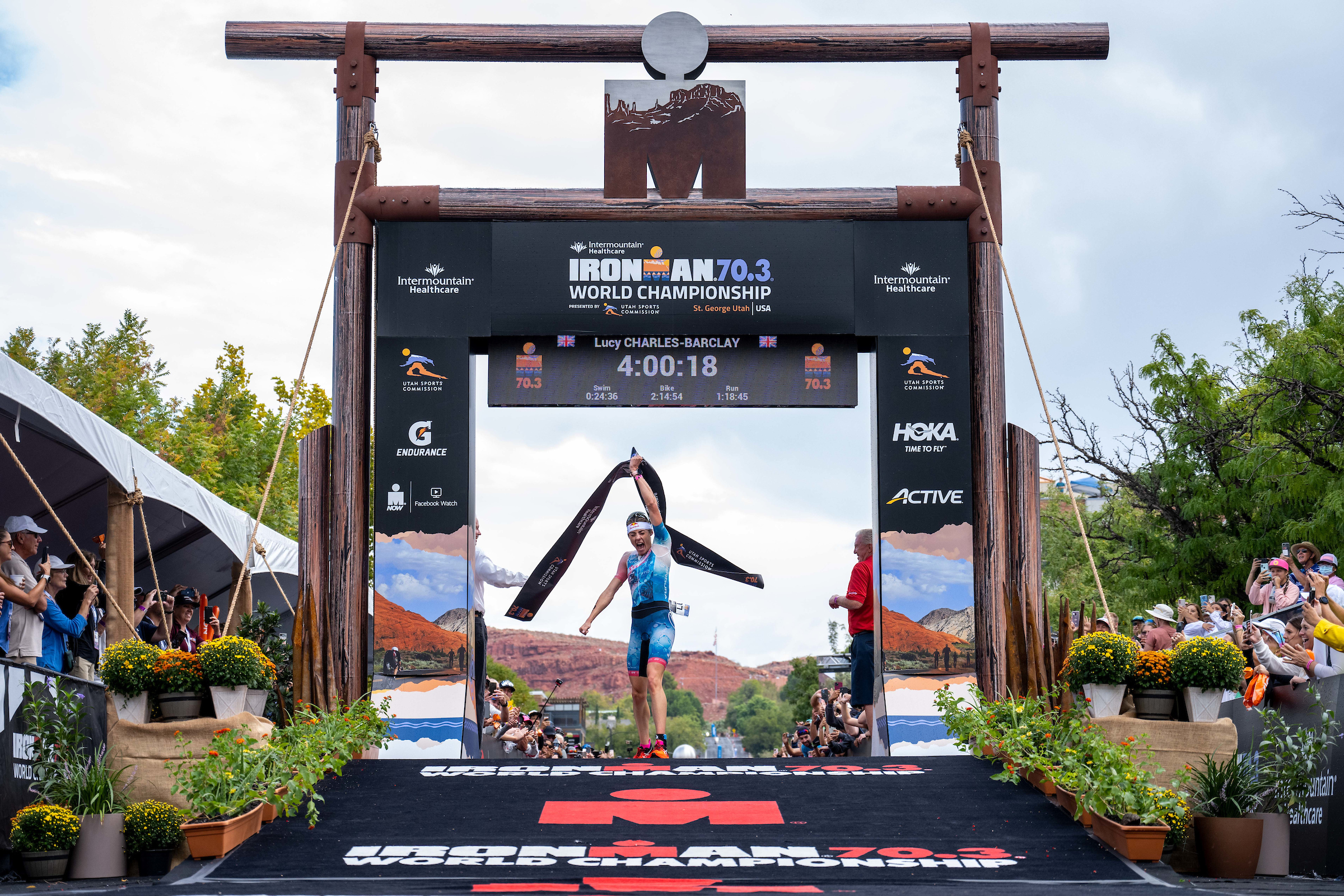
ST. GEORGE, UTAH – 18 SEPTEMBER: During the IRONMAN 70.3 World Championships on September 18, 2021 in St. George, Utah. (Photo by Donald Miralle for IRONMAN)

From the firing of the start cannon to the finish line tape, Lucy Charles-Barclay dominated the women’s professional field with prowess and a determination to win that wouldn’t be denied. Charles-Barclay put together a stellar race that was years in the making after one second-place IRONMAN 70.3 World Championship (2018) and three second-place IRONMAN World Championship (2017, 2018, 2019) finishes. Crossing the finish line on Main Street in 4:00:20, Charles-Barclay soaked in the roar of the crowd, leading to tears of joy as she embraced her husband, Reese, and realized her goal of an IRONMAN 70.3 World Championship title. South African Jeanni Metzler had an impressive day of her own, running her way into a second-place finish with a time of 4:08:39. Meanwhile, Taylor Knibb in only her second ever IRONMAN 70.3 finished the world championship in third just 11 seconds behind Metzler.

Top five professional women’s results:
PLACE ATHLETE SWIM BIKE RUN FINISH
1 Lucy Charles-Barclay (GBR) 0:24:36 2:14:54 1:18:48 4:00:20
2 Jeanni Metzler (ZAF) 0:26:08 2:20:17 1:20:12 4:08:38
3 Taylor Knibb (USA) 0:26:05 2:18:23 1:22:18 4:08:50
4 Katrina Matthews (GBR) 0:28:14 2:17:43 1:22:37 4:10:45
5 Emma Pallant-Browne (GBR) 0:28:13 2:18:03 1:23:42 4:12:10

 
The next edition of the IRONMAN 70.3 World Championship returns to St. George, Utah with a two-day event on October 28-29, 2022. The 2023 edition moves to Lahti, Finland on August 26-27.

Democrats in Congress Moving to Improve Bicycle Infrastructure Nationwide

0

By Charles Pekow — National surface transportation law needs to be replaced this year and advocates in Congress say it will be. They don’t want Congress to just kick the can down the road another year, as has happened so many times before. And the legislators in charge, at least in the House, are cyclists themselves and strong advocates for bicycling.

As of yet, the main legislative vehicle for replacing the FAST Act hasn’t been introduced. But ideas are floating around, including in some pieces of legislation on the table that might get folded into the new law.

Rep. Peter DeFazio (D-OR), who chairs the House Transportation and Infrastructure Committee promised at the recent 2021 virtual Bike Summit put on by the League of American Bicyclists that “we are not going to do Eisenhower 7.0 (but) 21st Century 1.0.” But he added that “we still have a problem with many members of Congress (who) don’t recognize bicycling.”
But DeFazio says the bill he will introduce will provide $6.25 billion to help states meet targets for “active transportation.” He also promised to reform Transportation Alternatives, to provide flexibility in matching requirements and technical assistance. He said the bill will restore and expand Safe Routes to School and include a Complete Streets provision.
Rep. Earl Blumenauer (D-OR) who sits on the Ways and Means Committee, which handles tax legislation, promised to push a tax credit for buying ebikes, plus Vision Zero and to clarify in law that that bikeshare programs can get transportation grants. Current law was written before they became popular so it’s not clear if they’re eligible.

Rep. Ayanna Pressley (D-MA), who co-chairs the Congressional Bike Caucus with Blumenauer, pledged at the summit to introduce a Freedom to Move Act that would include funds for bike shelters, mainly with public transit.

Meanwhile, several pieces of legislation have already been introduced.

These include Blumenauer’s Bicycle Commuter Act of 2021 (H.R. 384), which would reinstate the defunct tax benefit for employer subsidies for the costs of biking to work and make sure it would include bikeshare and ebike costs.

Also, Rep. Julia Brownley (D-CA) introduced the SAFE Streets Act (H.R. 508), which would give states a year to develop a “vulnerable road user safety assessment,” to include a study on locations with safety problems and projects to address the issues.

Over in the Senate, Sen. Edward Markey (D-MA) introduced S 684, which would provide federal grants to build bike and pedestrian connections among communities.


Tubeless Tire Service Can Be Easy

By Tom Jow — During my career as a bicycle technician, it has been my duty to prepare the two-wheeled machine so that its rider can perform at their best. That means presenting a clean bicycle that operates safely, smoothly and quietly. Therefore, my personal bikes, most people would expect, would also be “ready to race” at any moment. Nothing could be farther from the truth. In fact, it has almost become a personal challenge to see how much squeaking, grinding and knocking I was able to put up with. One of the things I put up with most of last summer was clogged tubeless tire valves. Unlike “tubed” tires, tubeless tires on road, gravel, and mountain bikes require periodic maintenance.

A tubeless road tire with dry sealant residue. Photo by Tom Jow

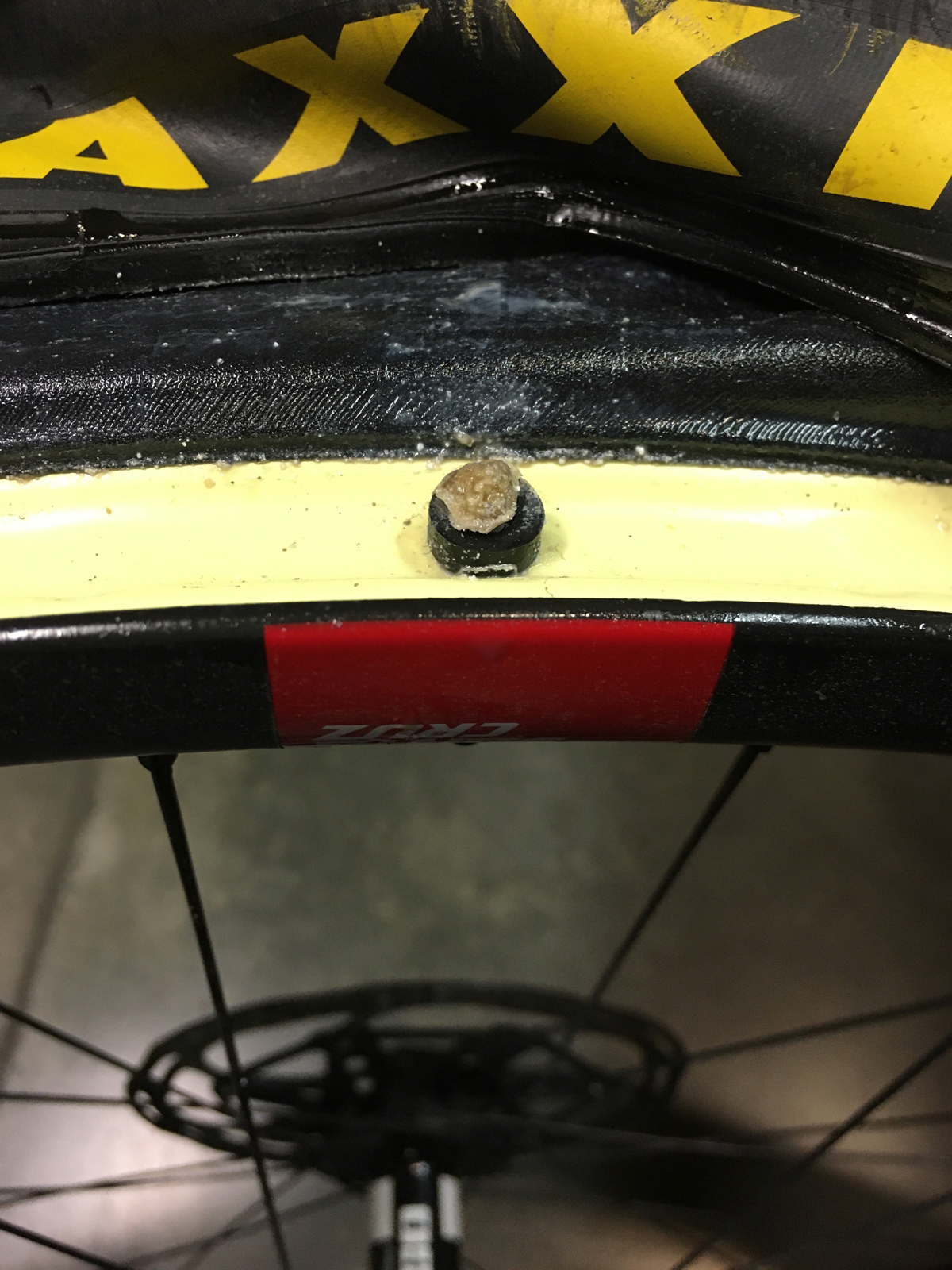
The current version of tubeless bicycle tires uses a tight-fitting seal between the tire and rim with a liquid sealant inside. It is the liquid sealant that creates the need for maintenance. Why? There are two reasons. First, because bicycle tires are not one hundred percent airtight, the liquid medium of the sealant evaporates over time. In extreme cases, evidence of this shows up as what appears to be large wet areas on the exterior of the tire casing. The second reason is the tire valves can become clogged. This occurs because the tire sealant is designed to seal punctures up to approximately 3mm in diameter. Conveniently the inner diameter of the tire valves is approximately 2.5mm.

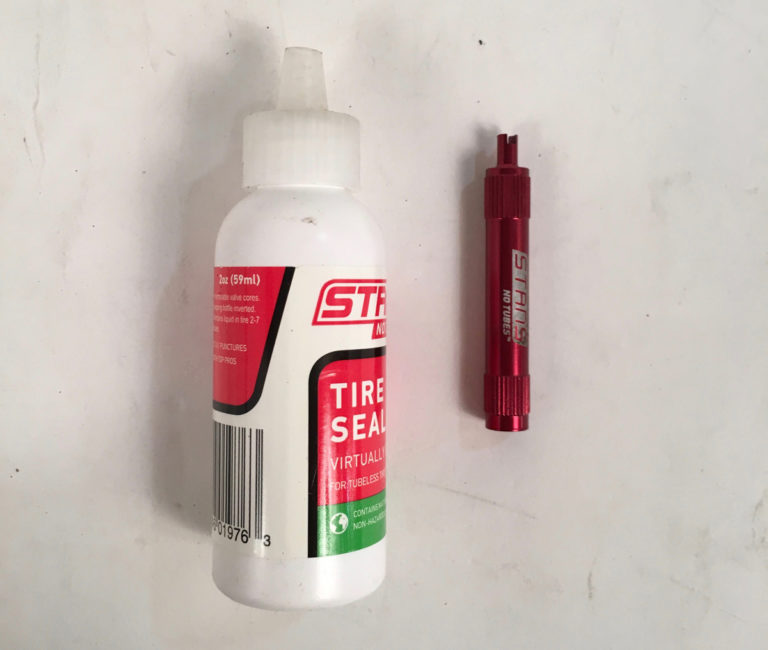
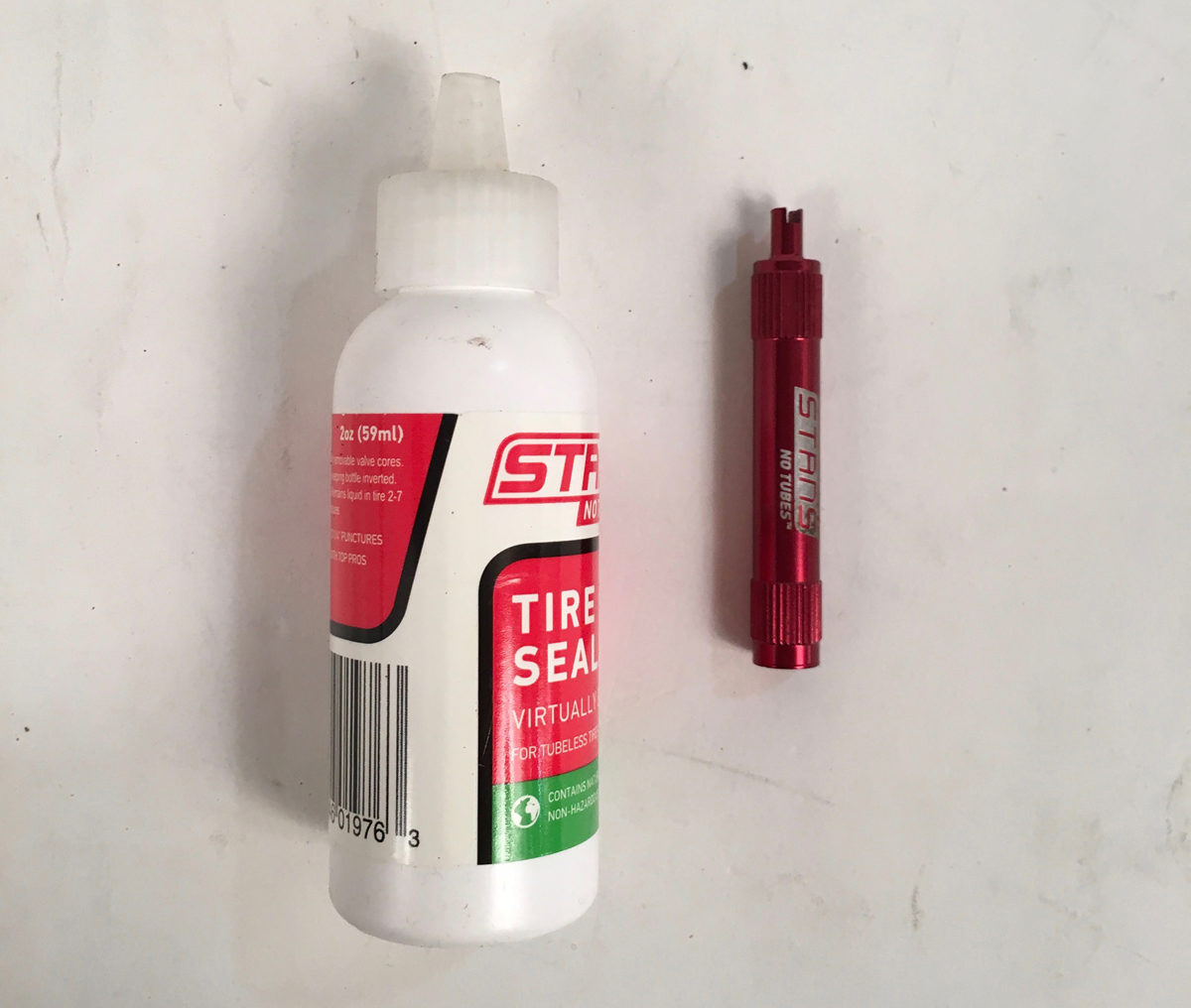
A valve core tool and refill bottle for tubeless tire maintenance. Photo by Tom Jow

How then shall we service the tubeless tire system? For periodic in season maintenance it can be as easy as refreshing the sealant and replacing the valve core. Do this by first removing the valve core. Follow this by installing a small amount of sealant through the valve. When installing the new sealant, place the valve stem at approximately the four or eight o’clock position. In this position, the sealant flows out of the valve stem and down to the bottom of the tire. This helps prevent clogging the valve stem. Finally, install a new valve core and inflate. Valve cores, core removal tools and sealant refresh kits can be ordered or purchased at your favorite local bike shop.

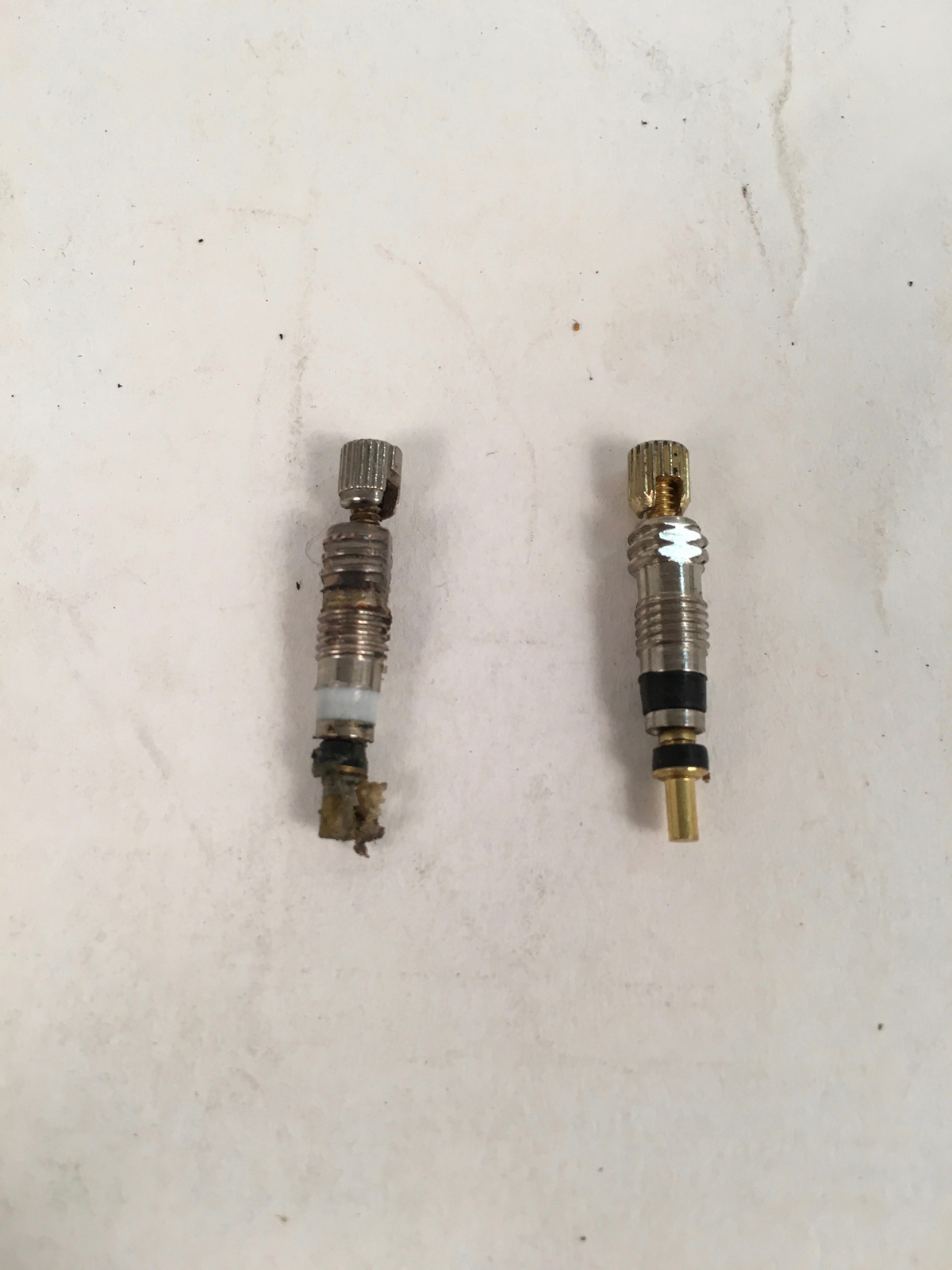
Example of clogged valve core on the left. A new core on the right. Photo by Tom Jow

For a more extensive service, such as at the beginning of the season, tire removal is recommended. Before removing the tire, wash the exterior of the tire and wheel with soap and water. When dry, remove the tire from the wheel. Be prepared for a wet sticky mess. When I do this at work, I first carefully dismount one side of the tire over the trash can. Then, gently pour out any remaining sealant. Wipe out the inside of the tire with a rag before completing the tire removal. Once removed, wash the inside of the tire and the rim bed with soap and water. Inspect the valve stem for blockage and the rim tape for any cuts or damage. If necessary, clean the valve stem and replace the rim tape if damaged.

A valve stem blocked by sealant. Photo by Tom Jow

Reassembly starts by installing one half of the tire. Be sure to orient the tire to the manufacturer’s recommended direction of rotation (pro tip: orient front and rear tires with the tire name at the valve stem). Installing the second tire bead and sealant can be done in one of two ways. The potentially messy way involves now pouring sealant into the tire, and then gently, without spilling, fold the second bead onto the rim. To complete the tire installation the less messy way, fold the tire bead onto the rim and before inflation, install the sealant through the valve stem. In either case, begin the second tire bead installation opposite the valve, and finish it at the valve.

Inflation of an unseated tire is best done with an air compressor (wear eye and ear protection please) or a bicycle tire pump specially designed for tubeless tires. Perform this first inflation with the valve core removed. Without the valve core a higher volume of air flows into the tire which more easily enables the seating of the tire beads. Then, as mentioned earlier, rotate the wheel to place the valve at approximately the four or eight o’clock position. After the beads are seated install the valve cores. Inflate to your desired pressure. Service complete!

One of the great things about bicycles is the fact that they will continue to operate despite neglect and lack of maintenance. This includes modern tubeless tire systems. Despite the old “tube” tire system being virtually maintenance free, tubeless tire systems, while a little messy, require only a little more care to operate flawlessly. Don’t put up with clogged tire valves. Tubeless tire service can be easy.


No Hill Hundred Century Bike Tour Set for October 2, 2021 in Fallon, NV

0

Registration now open for Oct. 2 event in Fallon, Nevada

FALLON, Nevada — Churchill County Parks & Recreation announces that registration is open for the 2021 No Hill Hundred Century Bike Tour to be held Saturday, October 2 in Fallon, Nevada.

Join other road cyclists for a beautiful fall day in rural Nevada for a fully supported ride along the scenic roads of Churchill County. The course is entirely flat and is a perfect ride for a great end to the season. Spend the day cycling the prehistoric Lahontan Lake bottom that is now the Desert Oasis of Nevada!

Cyclists from a past No Hill Hundred event, provided by CCPR staff

The tour has three distance options: 30-miles, 60-mile Metric, or 100-mile Century. The tour includes numerous support stops, event shirts, swag bags, in-race lunch (for Metric and Century riders), and post-event meal for all riders. There will be a raffle featuring a new Specialized SirrusX 4.0 in gloss sky blue and tarmac black, valued at $1,500, and many other prizes.

There are also many fun things to do in the community to make it a full weekend! A welcome packet will be sent to each race participant with a list of things to do in Churchill County over the weekend, special events will include the Fall Backroads Vintage Market, Fastest Gun Alive World Championships and the DeGolyer Rough Stock Rodeo.

For more information and to register, please visit: bit.ly/CCPRNoHill

A Lonely Century in the Heart of the Great Basin

102 Miles of Remote High Desert Cycling

By David Collins — Hank Williams’ I’m so Lonesome I Could Cry may be a fitting anthem for this adventure since Life Magazine described Nevada’s HWY 50 as the “Loneliest Road in America”. The ride begins about a 100 miles east of the Nevada/Utah border and cuts through what Millard County dubs the Heart of the Great Basin. If you’re looking for a well-maintained road, devoid of traffic but loaded with natural high desert phenomena, topped off by a treasured national park and epic dark skies when the sun goes down, this ride is for you.

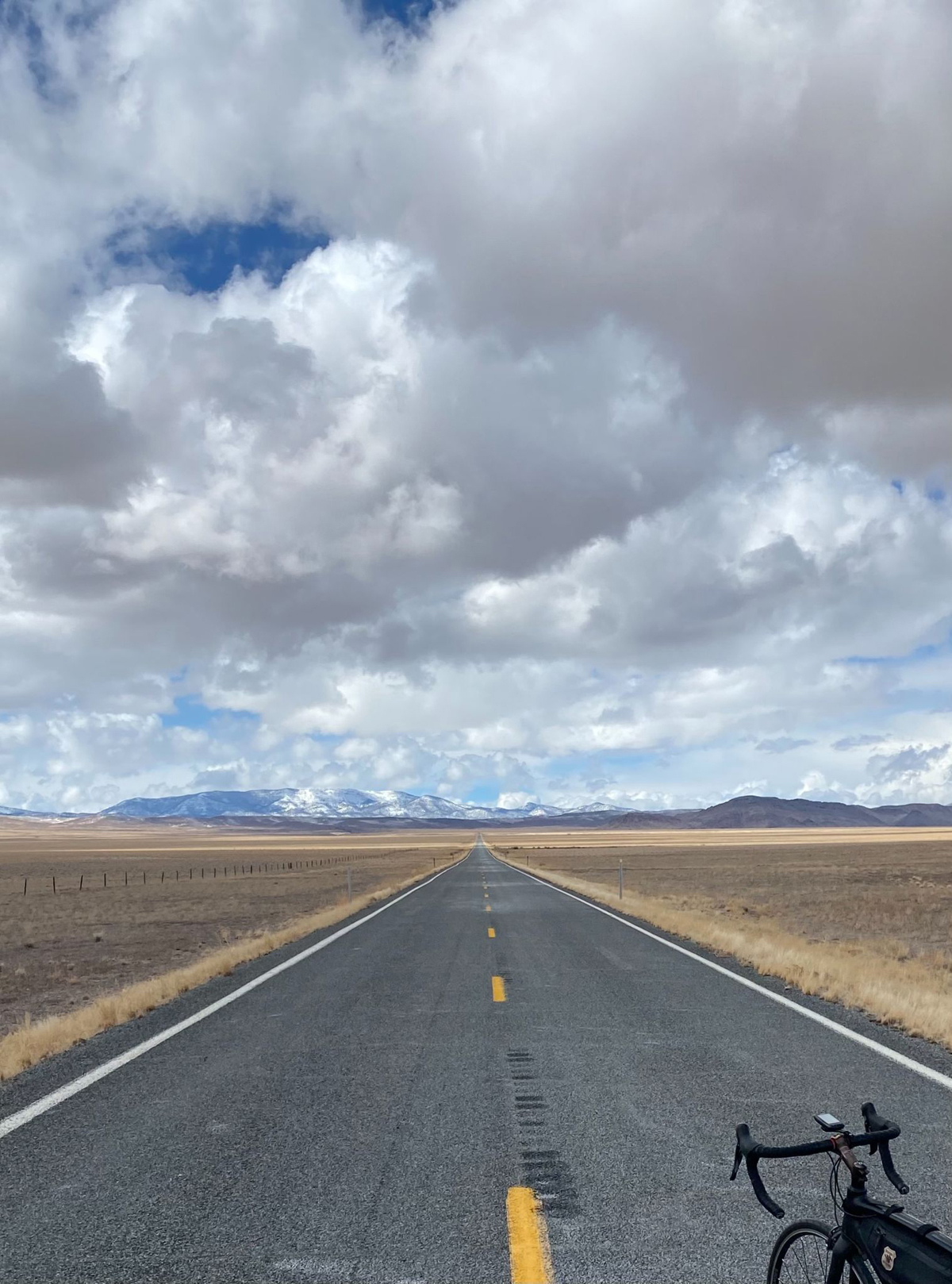
Infinity shot, one of many on the Great Basin Lonely Century. Photo by David Collins

Extended shoulder seasons are usually the best time to ride but depending on your skills, equipment, local conditions and road closures, you might be able to ride it throughout much of the year. Be weather aware, riding conditions can swiftly change.

Excursions and explorations are part of the fun of unsupported bicycle touring at your own pace. Mileage estimates are approximate and may vary depending on your tracking system and whims of the ride. Be sure to tell someone your plans and allow them to track your location using a smartphone or other device.

Solo or unsupported distance cycling often presents potentially dangerous situations related to terrain, weather, equipment, traffic, navigation and mental awareness. Even experienced cyclists must plan carefully and use wise judgment to successfully mitigate inherent risks of the sport or terminate a ride before it turns injurious or deadly. If you are new to the sport or have never ridden a bicycle more than 100 miles in a single day, learn the ropes with a seasoned buddy or local cycling club before strapping on this ride.

Make sure to check maps, plan your route and check local road conditions before you go. As with any ride, be aware of your surroundings and of roadway traffic.

Time to fill water bottles, stuff gear bags, click in and start pedaling The Lonely Century.

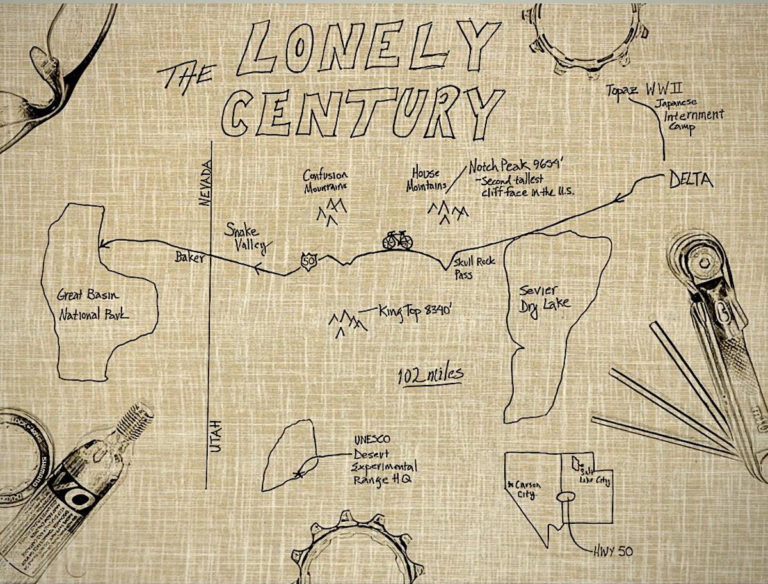
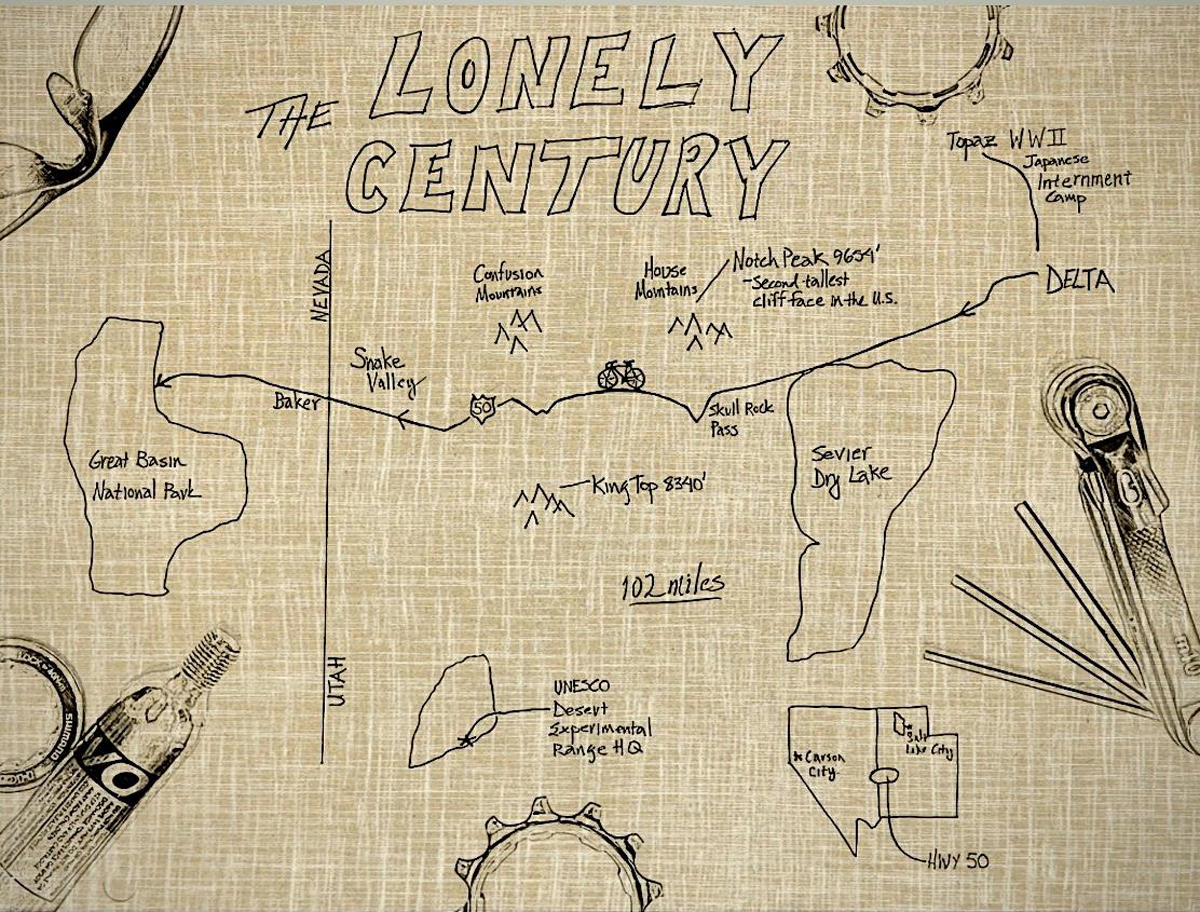
A hand drawn map of the Lonely Century, through the Great Basin area (not to scale). Map by David Collins

Route:

Hwy 50 from Delta Utah to Great Basin National Park, just over the Nevada border. 102 miles.

Terrain:

All paved. Flats throughout the first 50 miles, risers, two mountain passes and more flats to the Nevada state line. Although many segments of the route do not have much of a shoulder, it is cyclist friendly since traffic is nearly nonexistent.

What to See:

Gunnison Bend Reservoir; WWII Japanese Internment Camp (see Still Have Legs, Lungs and Sunlight); Topaz Internment Camp Museum in Delta; Great Basin Museum in Delta; Sevier Dry Lake bed; mountain ranges (House, Confusion and Snake); rock climbing cliffs; Skull Rock Pass; Kings Canyon; valleys (Tule and Snake); cosmic ray detectors sprinkled in the desert throughout the ride (more than 750 telescopes deployed by scientists from Belgium, Japan, Korea, Russia and the United Sates); King Top Wilderness Study Area; Baker Archaeological Site, a village occupied by Freemont Indians around 750 years ago; Lehman Caves, 1965 film setting for The Wizard of Mars; ancient Great Basin bristlecone pines, some over three thousand years old (see note 1); Great Basin National Park.

Selfies and Photo Ops:

So many lonely infinity shots showing the empty road stretching across the valleys or through the mountains coming to a distant point on the horizon – they dominate the scene from start to finish; WWII Japanese internment site including: Historic Site Topaz Internment sign, Military Police sign and a couple of dilapidated wood structures crumbling in the field; U-dig Trilobite Quarry turnoff; Sevier Dry Lake bed sign; Kingtop Wilderness Study area sign; summit plaques; Eskdale turnoff; Grand Army of the Republic Highway sign; Great Basin National Park entrance; constellations, planets, meteors, satellites, the Andromeda Galaxy and the Milky Way can be seen by the naked eye and easily photographed (the area is recognized as one of the darkest night sky spots in the country).

Wildlife:

Wild mustangs, mule deer, elk, pronghorn antelope, mountain lions, curlews, raptors, pelicans, bats, lizards, rattlesnakes, scorpions, native Bonneville cutthroat trout, freshwater mussels, fingernail clams, pea clams, springsnails, vagrant shrews and other little varmints.

Best Post-Ride Eats:

This is not a culinary tour and food options are minimal, but If you ride back a few miles to The Border Inn on the NV/UT line, you’ll find a tiny casino with a few modest rooms for rent. One of their most precious commodities for a hungry cyclist is found at the dinner counter in the back of the convenience store where a friendly short order cook works the grill and serves up no-nonsense hot plates and sandwiches. Tuck into a couple of classic cheeseburgers, fries and a Coke; then check into one of their cabins for night. The Lehman Caves Visitor’s Center sports a café with a simple menu as well – try the smoked brisket sandwich. Check their schedule before you go, since their hours seem to change with the seasons.

Still Have Legs, Lungs and Sunlight?

After Pearl Harbor, more than 100,000 people of Japanese descent were detained from the West Coast and sent to remote camps. Now a National Historic Landmark, Topaz was one of those internment camps. An easy 15-mile ride from Delta, on paved and hard packed dirt roads, the original camp site is worth the detour. It’s hard to imagine more than 8,000 internees were held here since it’s mostly just an empty field now, with a sign or two and a couple of crumbling structures.

Notes:

  1. Once you get to the national park, spend the next day on the Wheeler Peak Scenic Drive. Ride it to its high elevation (9800+ ft.) terminus and take the 1.5-mile hike to reach ancient Great Basin bristlecone pines, some over three thousand years old.
  2. If you’re up for a second century the next morning instead, take HWY 159 from the Utah border through Garrison, then take HWY 21 through Milford and Minersville to Beaver (121 miles). It’s another lonely, beautiful route through basin country and mountains and you’ll clip the Desert Experimental Range not too far from the old UNESCO Experimental Range Headquarters. The road winds over a couple of memorable mountain passes, including a bout with Wah Wah summit.
  3. Take more than minimum food and water and be extra prepared for mechanical problems since GPS and cell service are often spotty or unavailable and the likelihood of someone stopping to help is minimal due to nearly nonexistent traffic flow.

David Collins is a cycling enthusiast and amateur randonneur. Follow him on Instagram @rockypumpkin.

A Solo Ride in the El Doce 12 Hour Mountain Bike Race

By Scott Stanger — I’ve been dreading this: El Doce 12 Hour Mountain Bike Race. I had big plans for training and racing this year, but life decided to change all of that for me. So, no training, and I’m about to attempt to ride my mountain bike for 12 hours, for the first time. There’s no way this can go smoothly …

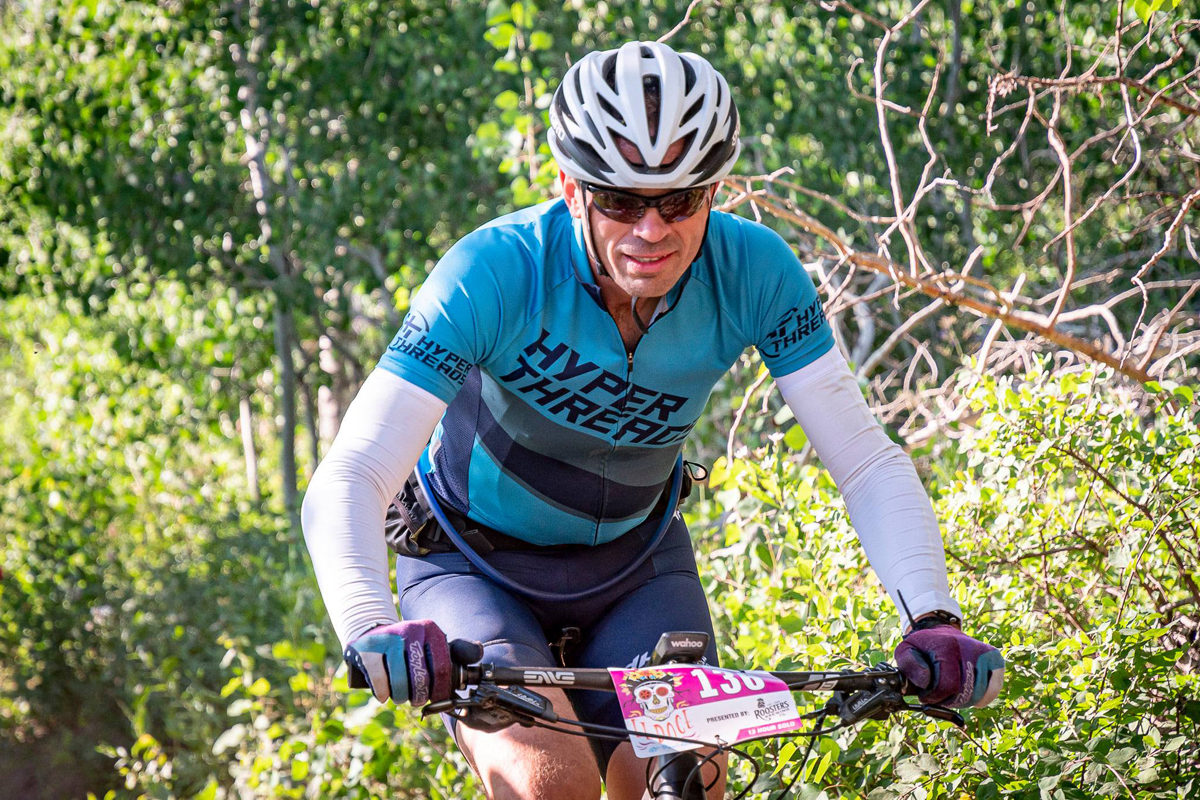
Scott Stanger competed in the solo division in the El Doce 12 Hour MTB race in Ogden, Utah on July 17, 2021. Photo by Austin Luckett, Iron and Pine.

Upon arrival, I’m greeted by a friendly volunteer, and given parking directions. I throw my cooler, snacks, and a chair out alongside the road just before the finish line and start prepping myself. Bib – check, jersey – check, shoes – check, snacks – check (and lots of them), tires – rear tire has lost air overnight. If I take that tire off, I’ll never get the bead to seat without an air compressor, so I overfill it a bit, grab a couple extra CO2 cartridges, and head off to the riders’ meeting. I doubt this is even possible for me.

At the meeting, the solo riders were asked to raise their hands, so I did. The gentleman with the bullhorn explains that solo riders were given a ribbon, what the ribbons are all about, and praises us as “bad-asses” for taking this on, solo.

I thought “Great, now I’ll look like a real idiot with my ribbon when I can’t make it more than a few hours”. Nobody likes to feel that way.

As I’m leaving the meeting, I overhear someone saying that a fellow rider had forgotten his riding shoes. I just happen to have an extra pair in the car (you can never be too prepared), so I track the guy down. Turns out, my shoes are the correct size, and have the proper cleats on them. It’s a person I have met on the trail, but don’t really know, but I trust him with my shoes. That’s some incredibly good luck, and at least he’s going to have a better day, which brightens my mood a bit. Maybe my shoes will do better than I do today! 

It’s time to start. I’m going to have to really watch my pace today, and I don’t want to hold anybody else back, so I settle in toward the back of the group. The energy is high, with lots of excitement, kudos, high fives, and wishes of “good luck”. Heart rate monitor battery apparently dies … great. At least my tire still seems to be holding air.

And off we go …

A crowd has gathered along the base camp area, some in costumes, with cowbells, pots and pans, and anything else they could find to make noise. It’s exciting, and the enthusiasm rubs off on me a bit. At this point, they all believe in me more than I do, because they don’t know any better, and I realized how silly my thoughts had been this morning. Nobody is watching for me to fail, and these strangers seem genuinely excited to see me do my best, without expectations. So, that’s just what I’ll do — the best I can on this particular day. I feel a sense of relief, as I make the first left turn onto single-track.

It takes a while for the crowd on the trail to thin out, and to find my pace for the day, but so far, so good. Despite my earlier doubts, I’m feeling surprisingly good! It’s been a while since I’ve ridden these trails, and I’m quickly reminded why so many people love them. Powder Mountain is a beautiful place to ride, and I’m going slow enough to actually enjoy the scenery. Regardless of how I finish, I’m riding a mountain bike in Utah, in the cool morning air, and it doesn’t get much better than this. One lap down … that was quick!

As I roll along slowly, fresh riders from the 12-hour teams start to pass me. There are so many compliments from riders who spotted my ribbon. Athletes who are much more fit than I am, young riders with tons of energy, nearly everyone takes the time to acknowledge me as a solo rider. It was truly uplifting. Suddenly, I’m glad I raised my hand in that meeting, and for that guy with the bullhorn. I AM a bad-ass, just for trying. It’s going to be a wonderful day…

As the hours roll by, I am perfectly executing my plan for eating, drinking, and holding my pace. I take a couple long breaks that I didn’t necessarily “need”, but which I knew would help in the long run. I make a couple new friends during those breaks at base camp, and enjoy that time as part of the overall experience. I love making friends on bikes. You can’t go wrong making friends. Then, I start into lap #4.

I’m tired. My shoulders are starting to ache a bit, and I have no power left in my legs. Even the descents are tough. My gut has had enough trail food and wants no part of anything I put down my throat … not even water. A new friend who I have been pacing with has left me behind, and the bonk is coming. Doubt creeps back in, and the “fun” is gone. I just need to gut out this one last lap. Even though I still have hours left on the clock, I’m fairly sure I’m done, but I keep pedaling, and as I approach base camp, I hear the cowbells and cheers, and more compliments. These people still think I’m incredible, despite the way I feel (and probably look), and I find motivation in that. I need a break, but I’m not done yet.

I’ve matched the mileage from my longest mountain bike race previously (Wasatch 50), so I can’t stop now. I’ve done all the work to get this far, so why not go one more lap and completely crush that personal best? It would be a shame not to! Even if I have to walk a few sections, I’m doing it…

Part way up that nasty road climb near Hidden Lake, a rider points out that my rear tire is looking a little “squishy”. I’m so zoned out, that I had no idea … and the tire is almost completely out of air. This could end my day, and what a shame that would be. A couple deep breaths to clear my mind, and a little air from a CO2 cartridge, and all is well. Nowhere near the disaster my mind had made it into. I roll on. At the 7-mile aid station, I stop to get a kiss from my wife, who was volunteering at the station. I’m so happy to see her, and once again, I am invigorated. 6 1/2 miles to go, and I can call it a day. The mile marker signs along the trail become my prizes … 5 1/2 miles to go, then 4 1/2, 3 1/2, 2 1/2….CRAMP!!! It’s not my quads or calves giving up on me…it’s my finger. My third finger on my left hand goes straight as a board and cocks all the way to the right. It’s a cramp, and it hurts, but it looks so silly, that I find it entertaining. If I’m going to cramp up, this is the way to do it! I can still grip and put a finger on the brake lever, so no harm done. In fact, the laughter does me good. The end is in sight.

As I finish that fifth lap (just over 66 miles and almost 7200′ elevation gained), the crowd is still there, cowbells clanging, cheering, and I can hear the announcer call my name. “12 Hour solo rider, Scott Stanger … looking strong as he goes out for another lap”. I am amazed at how I feel, and the level of boost I am given by the enthusiasm of everyone around me. I have another lap in me. As I roll toward the single-track, I’m doing the math in my head, and come to grips with the fact that even though I made the cut-off time, it doesn’t make sense to attempt this 6th lap. I know I’m spent, and the price I will pay for the added miles will be heavy. It’s time to call it a day, so I head back to base camp.

I didn’t earn a podium spot, but I certainly won my race. Total strangers helped me win. I cannot imagine a better race day. THIS is why I compete. 

Oh, and my shoes? They beat me by 20 minutes.


The Athlete’s Kitchen: Quality Calories for Weight Management?

0

By Nancy Clark MS RD CSSD — If you are like most athletes, you are busy juggling work, workouts, family, and life. You likely eat meals and snacks on the run, grabbing an energy bar here, a frozen meal there, and a protein shake to go. You can easily fuel yourself with highly processed foods that are ready to heat and/or ready to eat.

While you can choose a nutritionally well-balanced diet when eating on the run, you might want to pay attention to the amount of ultra-processed foods that sneak into your meals and snacks. They have a food matrix far different from natural foods, and they might have an impact on your weight and health.

What are ultra-processed foods?

Cooked eggs, canned beans, and dried raisins are all considered processed foods. Technically speaking, a processed food is one that has been altered from its original form. The foods have been cooked, dried, or canned in a way that’s safe for your health.

Ultra-processed foods include fast foods, sugary drinks, chips, candies, sweetened cereals, etc. They span the spectrum from minimally processed foods that are prepared to make them edible (bran flakes) to industrial formulations with five or more ingredients (Cap’n Crunch). Ultra-processed foods commonly have added flavors, sugars, fats, preservatives and ingredients that you are unlikely to have stocked in your pantry, such as sodium benzoate. These foods are designed to be convenient, ready to eat, palatable, affordable and welcomed as replacements for freshly prepared meals and snacks.

More than half the calories consumed in the US come from ultra-processed foods (think packaged soups, instant noodles, frozen meals, hot dogs, cake mixes.) The foods tend to be high in calories, salt, and fat, and low in fiber. Ultra-processed foods can be marketed as natural, healthy and organic. (Those words don’t refer to the process of how the food was made.) Yes, your favorite all-natural, organic energy bar likely counts as an ultra-processed food.

A diet rich in ultra-processed foods has been associated with high blood pressure, heart disease, Type 2 diabetes, and stroke. While these foods might not cause those health problems, people with the health issues are more likely to consume a fair amount of ultra-processed foods. We need more research to determine if these easy-to-overeat foods are the problem (“I can’t eat just one…”), or if their high caloric density makes them easier to over-consume.

Ultra-processed foods and your waistline.

Speaking at the Academy of Nutrition and Dietetics’ (AND) 2019 Food and Nutrition Conference and Expo (FNCE), Kevin Hall PhD of the National Institutes of Health spoke about the ease of weight gain among people who eat a plethora of ultra-processed foods. He conducted a study in which 20 healthy adults (10 men, 10 women) ate as much or as little as they wanted for 14 days from a buffet of minimally-processed or ultra-processed foods (1). The buffets were matched for calories, sugar, fiber, carbohydrate, protein, fat, and salt. The subjects rated both diets as being equally palatable. Yet, when the subjects ate from the ultra-processed buffet, they consumed about 500 calories above their baseline intake and they gained about 2 pounds in two weeks. (Some of that weight gain can be attributed to water-weight, given the ultra-processed foods they chose were higher in sodium than their standard diet.)

When the subjects ate the unprocessed diet, they chose their typical caloric intake, yet they lost about 2 pounds in two weeks. How could that be? Some weight loss was related to water-weight loss, but some might be related to a higher amount of calories needed to digest the whole foods. (This is called the Thermic Effect of Food—the increase in the body’s metabolic rate related to the consumption, digestion, metabolism and storage of food.) Foods in their natural state take more energy to be digested and metabolized than highly processed foods. For example, a grilled cheese sandwich made with whole wheat bread and cheddar cheese uses about 20% of the ingested calories to digest and metabolize the nutrients. In contrast, the same sandwich made with white bread and processed American cheese uses only 11% of ingested calories (2)

Ultra-processed foods tend to be high in simple-to-digest sugar, with a low thermic effect. They also tend to be low in fiber. Fiber-calories are not readily accessible to the body. Almonds, for example, reportedly offer 170 calories per ounce (23 almonds), as written on the food label. The reality is, your body can access only 130 of those calories (3). Fiber-rich plants foods can be better for your waistline (and your overall health).

Processing changes the food structure (matrix), and this impacts satiety, the feeling of fullness that persists after eating. The more a food is processed, the lower it’s satiety, likely related to its higher glycemic response (rise in blood glucose). Simply put, devouring 500 calories of ten (ultra-processed) Oreos is far easier than chewing through 500 calories of almonds (~70 almonds)—and is far less satiating.

The bottom line

At this time, we have no data to confirm that ultra-processed foods cause obesity, but they are certainly associated with obesity. Dr. Hall is planning another study to look at the impact of energy-density on calorie intake. Til then, common sense tells us for weight management, our best bet is to snack on whole grains, fresh and dried fruits, nuts and other minimally processed foods. Limiting ultra-processed foods may be an effective weight-management strategy.

Recipe for Super-Seedy Granola Bars

 These crunchy, seedy bars offer fiber, protein, and healthy fats. They are minimally processed and a wrapper-free alternative to yet-another energy bar in a shiny wrapper.

When making these bars, you are welcome to mix-and-match the ingredients. That is, don’t fret is you don’t have chia (although the chia seeds add a fun crunch) or if you want to use chopped walnuts instead of sunflower seeds.

These bars are best stored in the refrigerator for a quick and hearty snack. At room temperature, they can become crumbly, though the crumbs are totally enjoyable by the spoonful and as a topping for yogurt or oatmeal.

  • 1 1⁄2 cup dry oatmeal
  • 1⁄2 cup sunflower seeds, hemp hearts, or chopped nuts of your choice
  • 3 tablespoons chia seeds
  • 1⁄4 cup dried fruit of your choice, such as craisins or chopped dates
  • 1 teaspoon ground cinnamon
  • 1 cup peanut butter or nut butter of your choice
  • 1⁄2 cup honey
  • Optional: 1 teaspoon vanilla extract, 1⁄2 teaspoon salt
  1. Line a 9-x 9-inch square pan with parchment paper or plastic wrap with enough overhang for easy removal.
  2. In a medium-sided bowl, combine oats, sunflower seeds, chia seeds, dried fruit, cinnamon (and salt).
  3. In a small microwaveable bowl, combine peanut butter, honey (and vanilla extract); warm in the microwave oven (30 to 60 seconds), and then mix together until very smooth.
  4. Pour the peanut butter mixture over the dry ingredients. Using a sturdy spoon, stir until evenly combined.
  5. Transfer the mixture to the prepared pan. Using the back of the spoon or a spatula, firmly press the mixture evenly into the pan.
  6. Cover and refrigerate for at least 1 hour or overnight.
  7. Gently lift the parchment or plastic overhang to remove from pan and slice into 16 bars. Id desired, wrap individual bars and place them in a freezer-safe bag to store in the fridge or freezer.

Yield: 16 bars. Nutrition information: 2,900 total calories; 180 calories per bar; 20 g carbohydrate; 5 g protein; 9 g fat

References:

  1. Hall, K et al. Ultra-processed diets cause excess calories intake and weight gain: An inpatient randomized control trial of ad libitum food intake. Cell Metabolism 2019; 30:67-77.
  2. Barr, S. and J. Wright. Postprandial energy expenditure in whole-food and processed-food meals: implication for daily energy expenditure. Food & Nutrition Research 2010; 54: 5144-5153.
  3. Novotny J. et al, Discrepancy between the Atwater factor predicted and empirically measured energy values of almonds in human diet. Amer J Clin Nutr 2012 96(2):296-301.