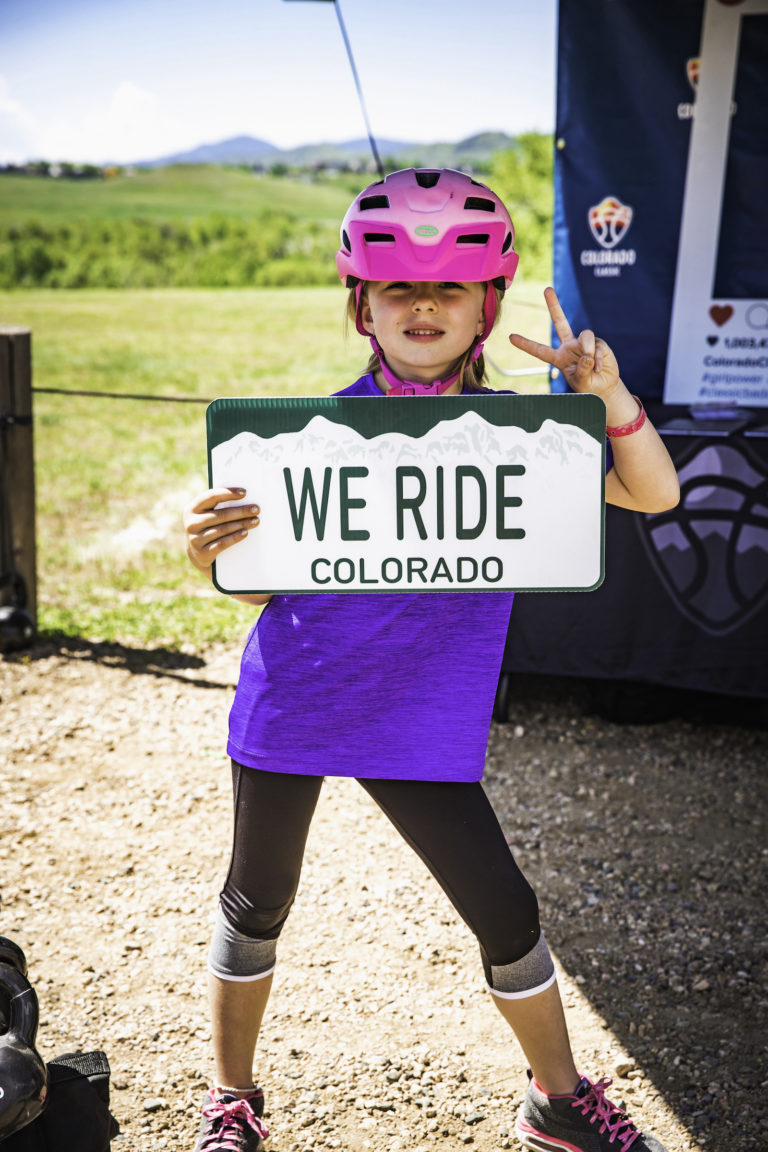
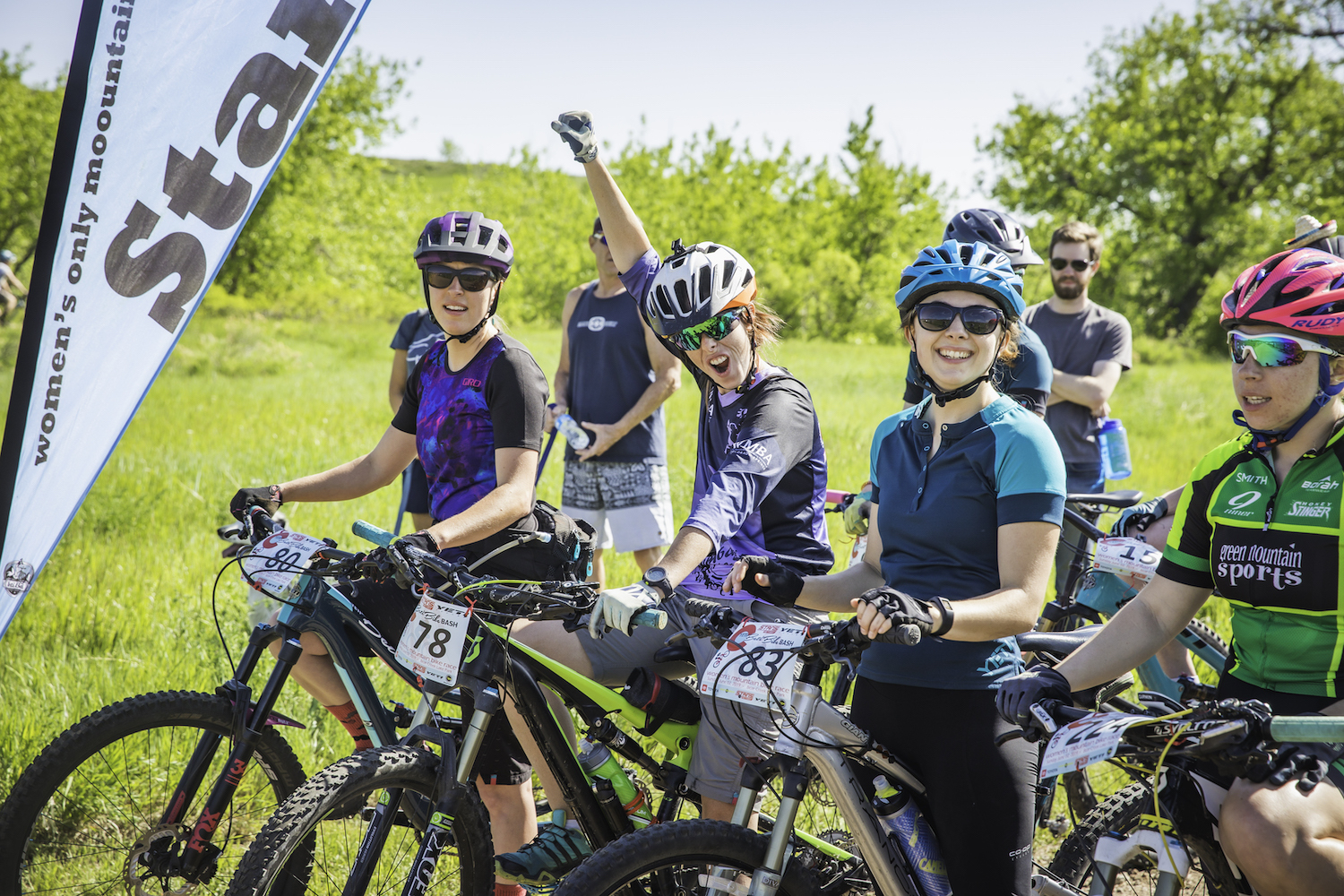
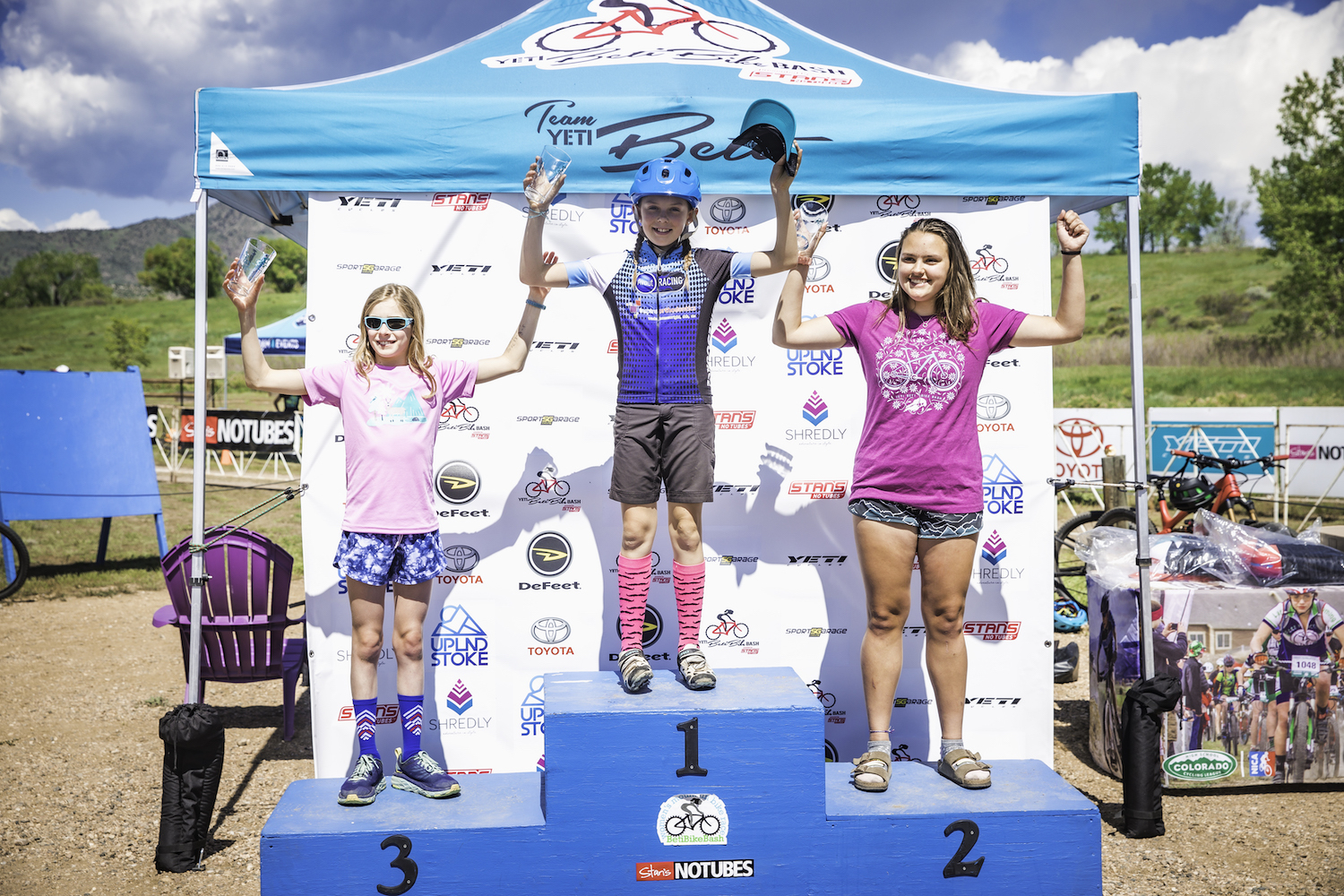
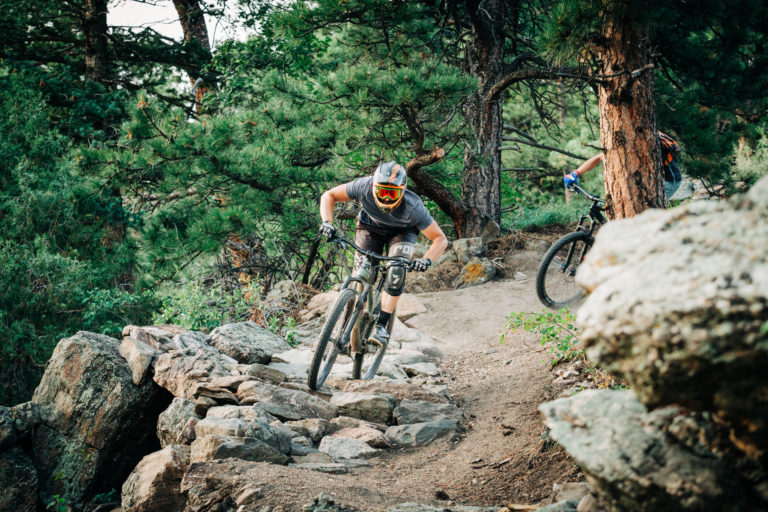
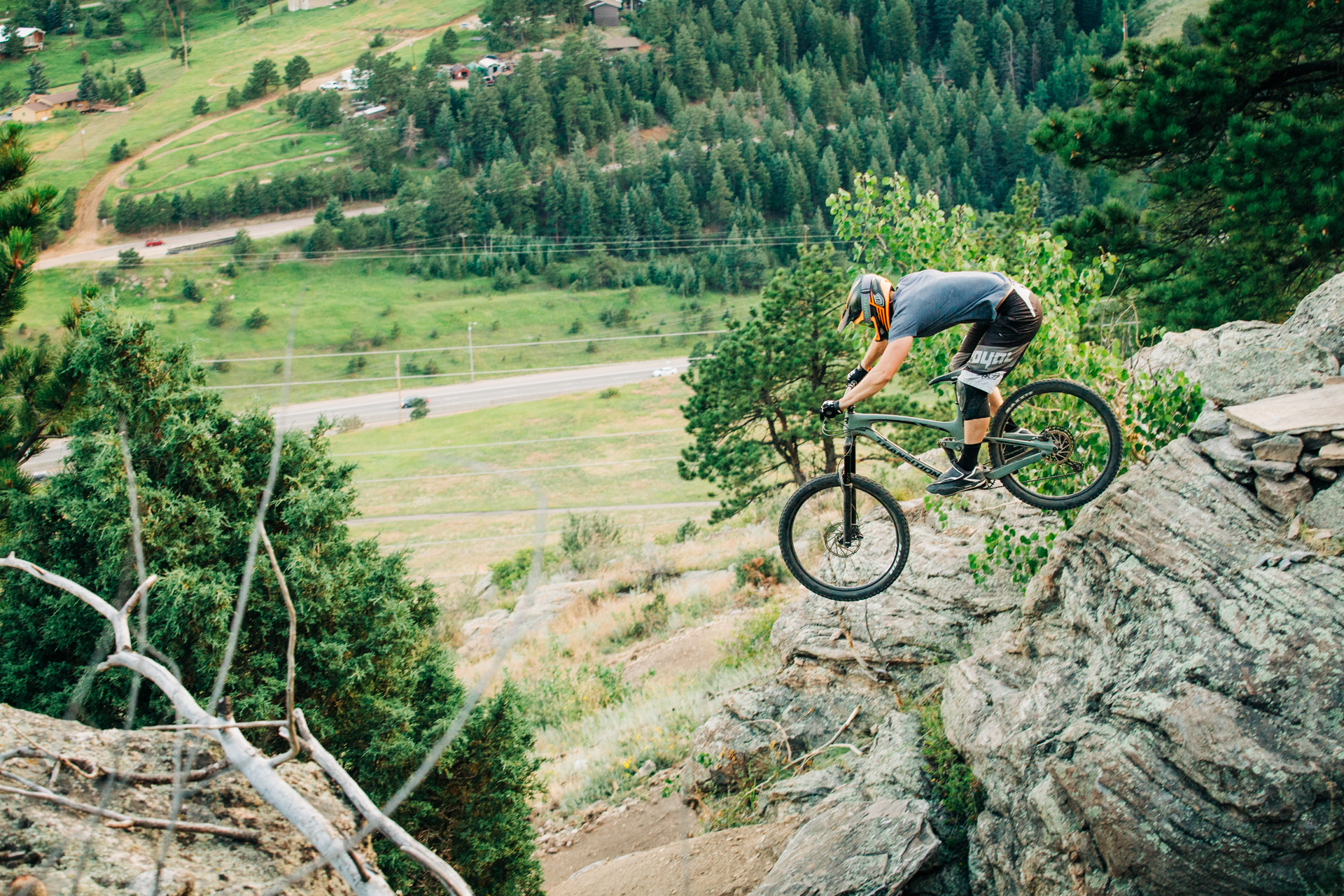
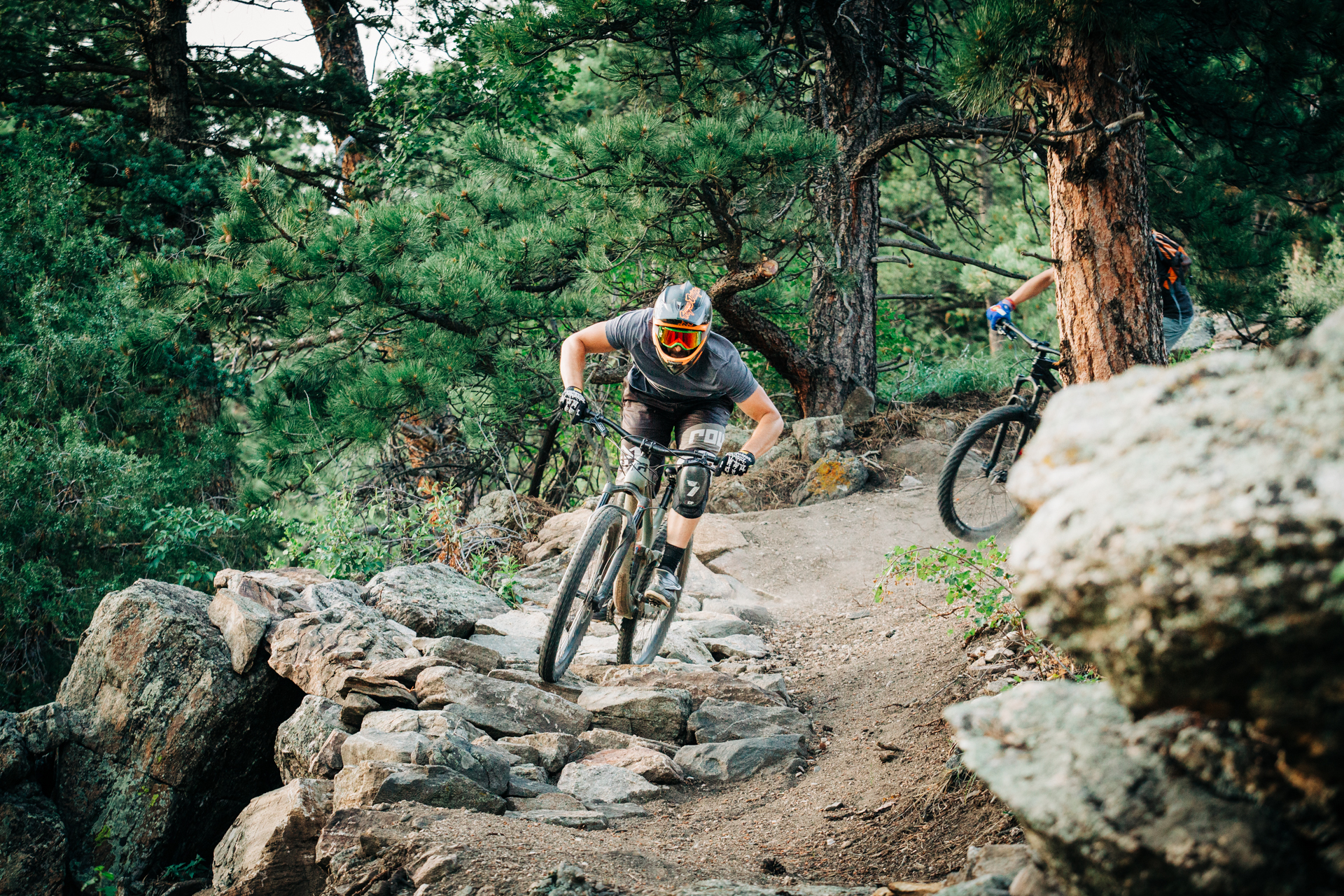
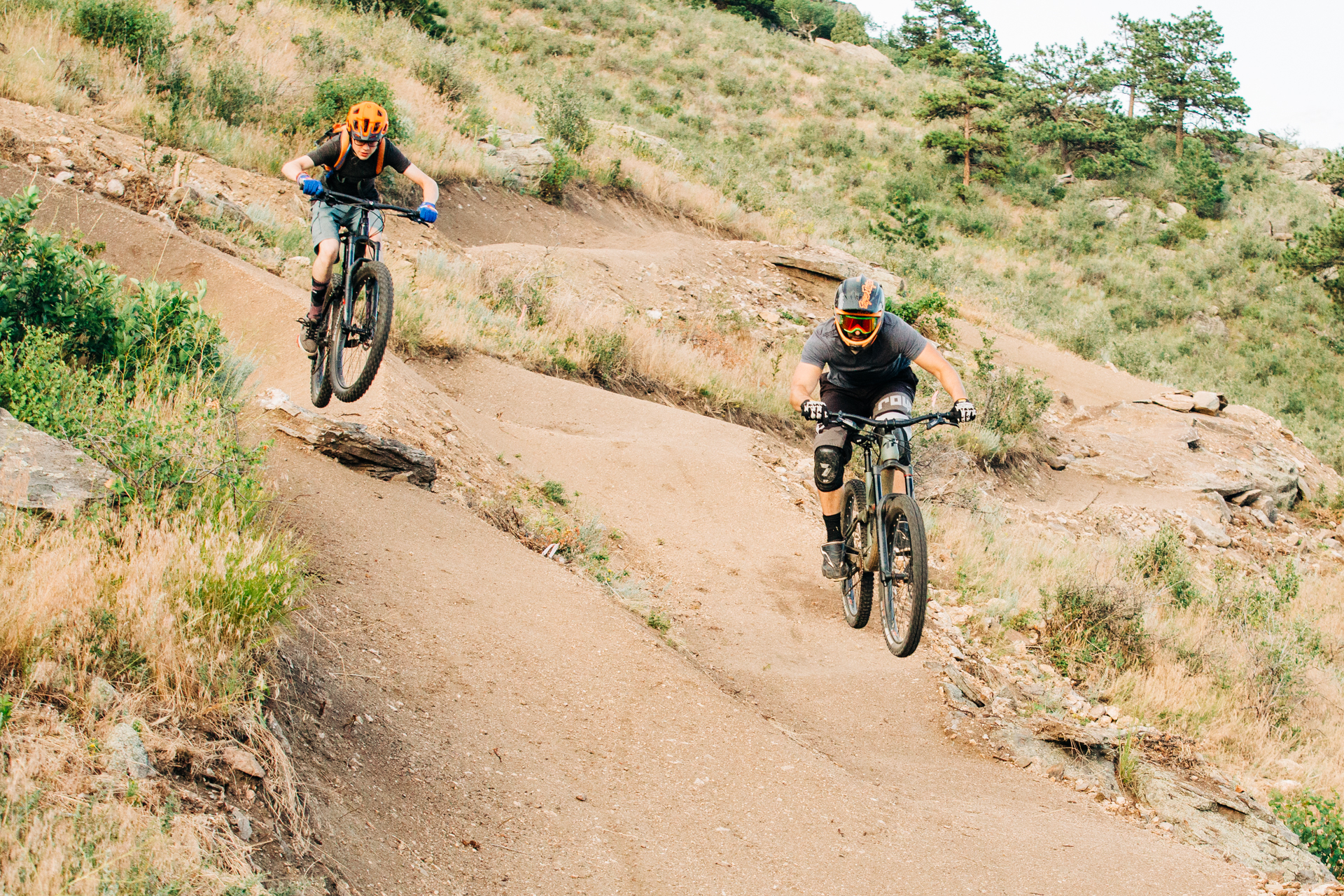
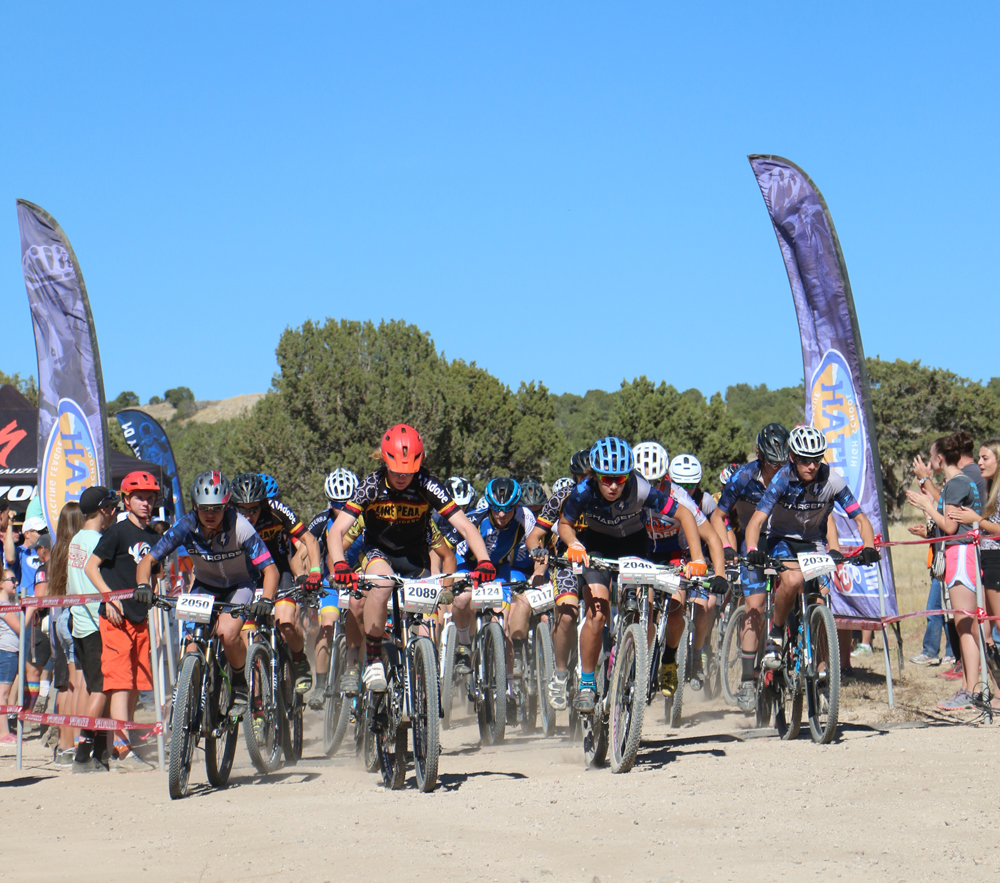
EVERGREEN, COLO, March 30, 2021 — The Beti Bike Bash p/b by Yeti Cycles will return to Lakewood, CO for the 11th time on October 3rd. Registration is now open. The nation’s largest women’s-only mountain bike race, produced by Team Evergreen, prides itself on bringing together the cycling community in a unique and supporting environment. This is exemplified by categories such as ‘7 and Under’, ‘New Moms’, ‘Never-Evers’, all the way to seasoned professionals, and the optional additional support of the VIDA MTB Series and Little Bellas program on October 2nd.
Photo courtesy Team Evergreen
This year, the Beti Bike Bash will benefit both Little Bellas and Go4Graham. The Little Bellas, a mountain bike organization geared to help young women reach their fullest potential, has a well-established and known presence at the Beti Bike Bash. Catering to the younger crowd, they will be onsite both days, to offer a one- or two-day bike camp designed to get young ladies hooked on the sport.
Go4Graham is a community-based movement to shred the stigma surrounding mental health and promote mental wellness through physical activity and connection. Go4Graham utilizes mountain biking and the outdoor community as one of its biggest tools to decrease stigma, raise awareness, and reduce suffering related to depression, anxiety, and other mental health issues. An optional fundraising-focused registration tier has been added for 2021 for those who wish to give more back to Little Bellas and Go4Graham.
Photo courtesy Team Evergreen
In addition to the race, first-time and beginner riders can develop their skills at the VIDA MTB Series race-specific clinic on Saturday, October 3rd. Attendees will learn proper body positioning, race etiquette, and technique in an ever-encouraging atmosphere, leaving them with increased rider confidence.
“After a challenging 2020, we are looking forward to gathering this year to celebrate the Beti Bike Bash. This race is a cornerstone in the women’s mountain biking community and we are thrilled to participate in October! Running our clinic Saturday to help women get race ready and spending Sunday cheering everyone on makes for a celebratory and fun weekend,” says Rachel Gottfried, Dir. of Operations at VIDA MTB Series.
Photo courtesy Team Evergreen
One of the original Yeti Betis, Natalie Raborn, will be stepping into the Race Director role for 2021. Natalie brings a wealth of production experience having worked at the University of Denver running events for 15 years taking primarily at the Newman Center and Magness Arena. In 2016 Raborn left DU to follow her passion and founded High Road Coaching currently coaching athletes from all over the US. Not too shabby on the bike herself, she’s currently defending the title of Masters Marathon Mountain Bike National Champion.
Photo courtesy Team Evergreen
“I am really excited to step into the role of Race Director for 2021. Amy [Thomas], Sarah [Rawley] and the rest of the Beti’s have done a fantastic job building this event from the ground up the last 10 years and the future for the Beti Bike Bash looks very bright, and I am proud to lead it into the next chapter,” said Raborn. “This Bash along with the VIDA Mountain Bike Clinic and the Little Bella’s camp have become important staples in girls and women’s sports in Colorado. The impact of these efforts can be seen on the trails every day now when you ride and you see significantly more women than what you did 10 years ago. The core group of Yeti Betis who have run it from day one will still be involved, as well as some of the original sponsors. We don’t expect the special energy this event creates every year to change.”
To that point, Yeti Cycles and TwinSix, key sponsors from day one, are returning along with FinishLine, Shredly, Wahoo Fish Tacos and UplandStoke.
Registration for the 2021 Beti Bike Bash and its ancillary events is expected to fill quickly.
EVERGREEN, COLO, April 1, 2021 — Team Evergreen introduces the Session Series at Floyd Hill – a new weeknight short-course enduro series with a weekend finale on The Sluice, a highlight acclaimed trail at Floyd Hill in Clear Creek.
Photo courtesy Team Evergreen
The Sluice, originally known as Segment 4, opened for the first time on August 21, 2019. This mountain-bike-only public trail offers riders an extremely accessible opportunity to test their skills on a one-way trail. It is one of only a few top-to-bottom bike trails in Colorado aside from ski resorts and is known for its technical, rocky terrain. With steep rocks, high berms, and big jumps, it’s any technical rider’s dream.
Beginning May 12th, gravity riding enthusiasts will race a new line each Wednesday evening chosen by race director, Josh Kravetz, and Yeti / Fox FACTORY team member, Shawn Neer. Each session will have its own awards and point rankings with the best 3 of 4 races determining the overall winners. The series will benefit Clear Creek County to continue the trail-building efforts of the Colorado Mountain Bike Association (COMBA), including a downhill trail system at Virginia Canyon and the Warren Gulch trail. Project Bike Tech, dedicated to teaching bike mechanics to high school students, will also be a beneficiary of the Session Series.
Photo courtesy Team Evergreen
“The Session Series is the first weekly enduro series in Colorado and we are stoked to race on one of the coolest gravity trails on the Front Range,” said Jennifer Barbour, executive director of Team Evergreen. “The series gives riders an opportunity to race what they’ve been riding and support more trail building in the area. It will have a laid-back vibe, but there will be no shortage of competition. Take your run, grab a beer and cheer on your friends in a unique after-work atmosphere.”
The Session Series at Floyd Hill is produced by Team Evergreen in partnership with COMBA and Clear Creek County Open Space Commission. In 2019, COMBA and Team Evergreen spearheaded a public fundraising effort to secure funds to build the marquee trail, and contributed $80,000 to the planning, building, and maintenance of The Sluice.
Photo courtesy Team Evergreen
“The Sluice stands out as a unique and engaging mountain biking experience in this area largely due to being designed and built for that purpose. It combines a designated use of bike-only and a mandatory downhill direction, with a large variety of trail options from blue to black and throws in some double-black options to appeal to a huge cross-section of riders. Add in that it is southern-facing and thus rideable for most of the year, and you have yourselves a mega-popular trail,” says Gary Moore, executive director of COMBA.
Registration for The Session Series at Floyd Hill is now open and will be capped at 200 riders per week, with the first 30 slots being reserved for women riders. For those seeking a more tamed challenge, weekly alternative lines will be available. Volunteers are needed to support the race and prepare the course. For those wishing to donate their time at the event, please contact [email protected]. COMBA performs weekly maintenance on The Sluice every Wednesday and volunteers are always needed! If you’d like to help with the upkeep of the trail, please contact [email protected].
SALT LAKE CITY, Utah (March 26, 2021) — While the Larry H. Miller Tour of Utah is on hiatus for another year due to ongoing concerns over COVID-19, the organizers of the two-day Salt Lake Criterium events at the Gateway in downtown Salt Lake City, Utah on Saturday July 17, and in Holladay, Utah on Sunday July 18 are still moving forward at full speed. The two-day event is part of USA CRITS, the premier cycling series in the United States, showcasing the best riders in a uniquely American style of racing.
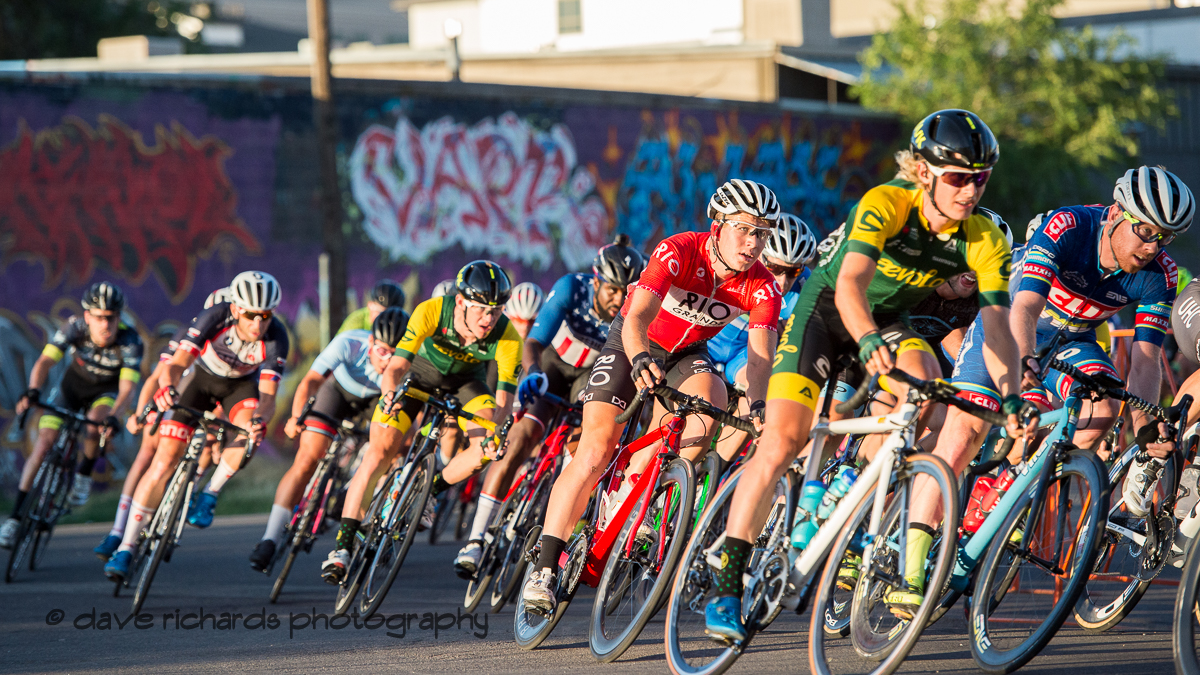
Fading evening sunlight reflects off the Men’s D1/Pro peloton during the Salt Lake Criterium, USA CRITS series held at the Gateway Mall (Photo by Dave Richards, daverphoto.com)
The criterium, with its fast, short laps, world class sprinters and professional teamwork, is one of the most exciting cycling disciplines to watch, and is ideal for spectators who will be able to watch each race develop from start to finish.
The Organizing Committee will be planning to safely support the number of fans expected to watch in person, with scenarios dependent on the status of the pandemic in the coming months. Both days will be also streamed live on USACRITS.tv.
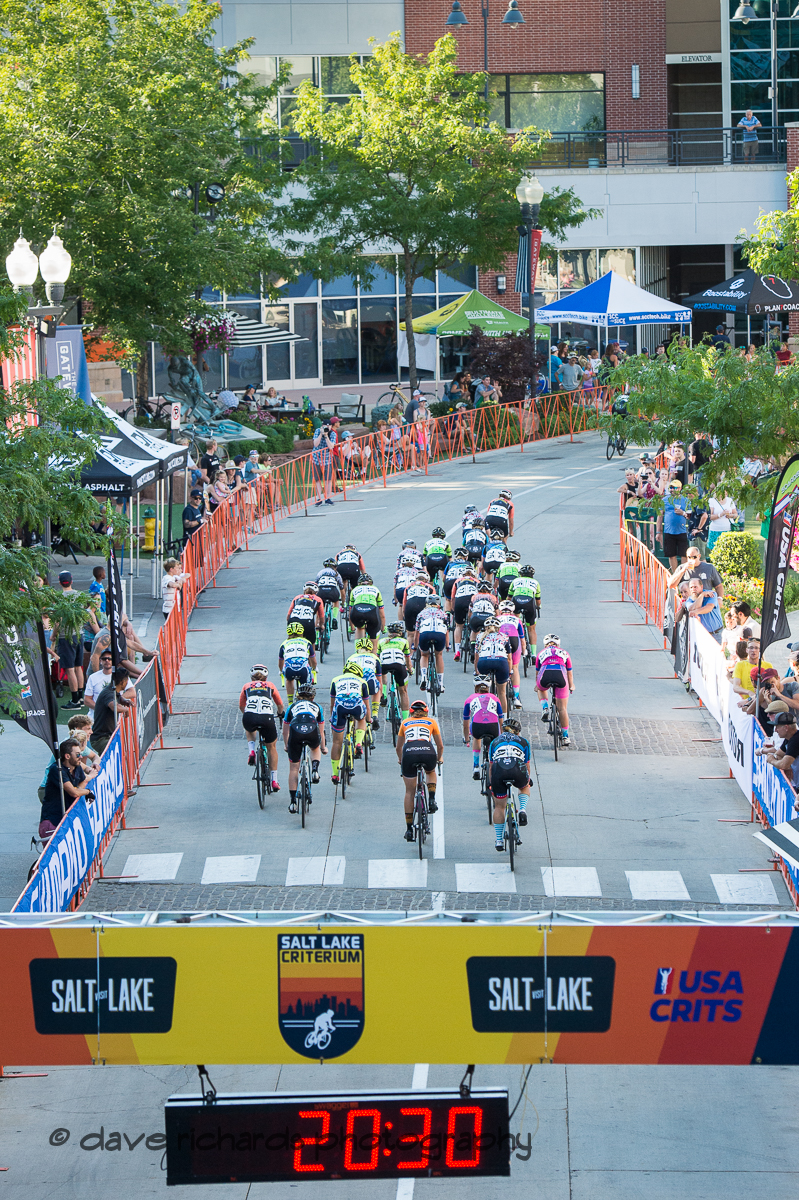
The women’s D1/Pro peloton passes under the finish line banner during the Salt Lake Criterium, USA CRITS series held at the Gateway Mall (Photo by Dave Richards, daverphoto.com)
“The very nature of criterium racing on short, closed circuits is what makes it possible for us to put on these events this year,” says Race Director Eric Gardiner. “A major stage race, like the Tour of Utah, requires hundreds of staff and volunteers, along with the cooperation of the Utah Highway Patrol and getting permits for not only the start and finish cities, but every town along the route. This is difficult enough to accomplish in the best of times, and even more so during a pandemic.”
Gardiner continues, “Criteriums require a much smaller footprint, and thus we are able to more easily put together a plan to help mitigate potential exposure to COVID-19 making the event safer for everyone from riders to staff to spectators.”
The Salt Lake Criterium inaugural event in 2019 was highly successful with 319 amateur riders, 21 USA CRITS D1 professional teams, and over 5,000 fans that came down to The Gateway throughout the day.
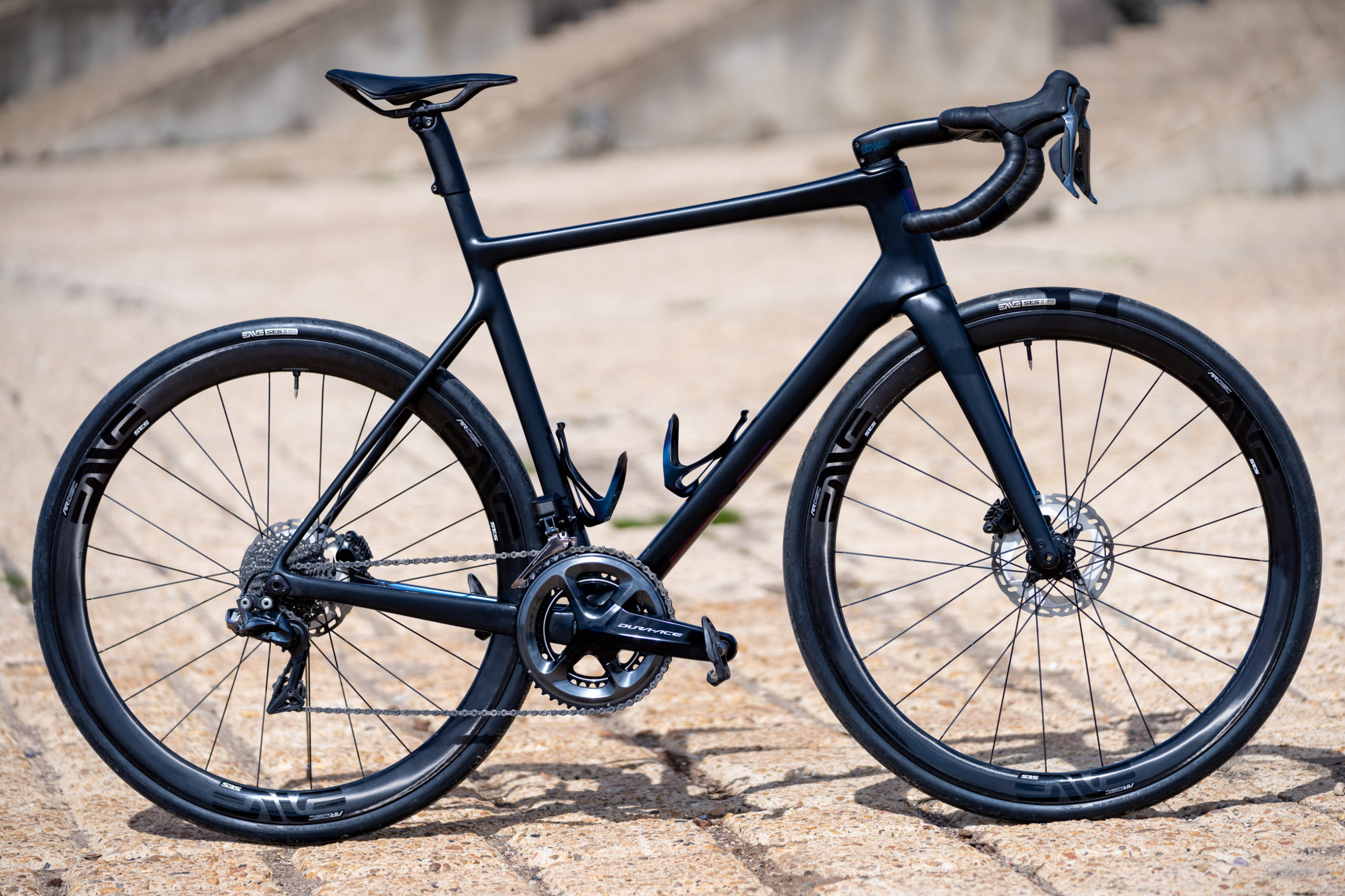
OGDEN, Utah (March 26, 2021) — ENVE announced today that they are expanding their manufacturing expertise and product offering to include bicycles. The US manufacturer introduced the Custom Road, a modern road bike manufactured at their Ogden, Utah, based headquarters. ENVE’s Custom Road is available through ENVE.com and a limited number of premier US retail partners.
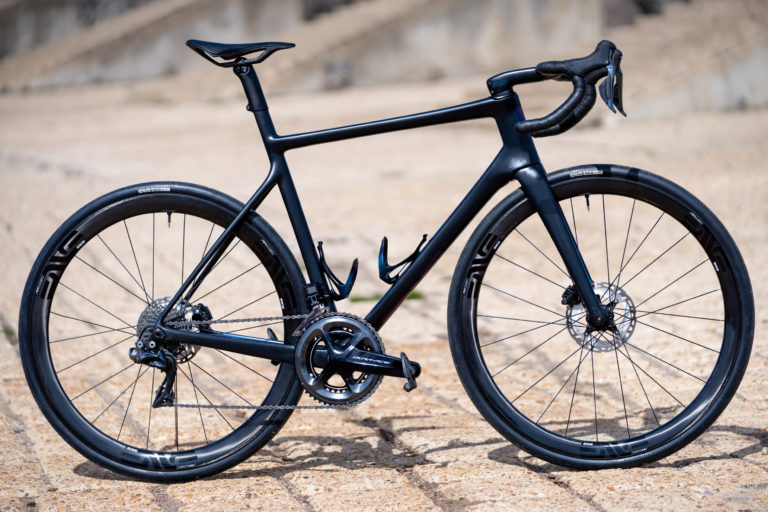
The new US-built ENVE Custom Road. Photo by Ian Matteson, courtesy ENVE
Production has begun and bikes are now shipping to select customers.
The ENVE Custom Road is a modern road bike featuring an aerodynamic design, integrated components, premium carbon construction, and 35mm of tire clearance. To top it all off, customers can personalize everything from geometry and paint, to wheels and components. ENVE streamlines the customization process using an online application called the ENVE Bike Builder. The builder guides customers through their build and allows them to change wheels, components, paint design, and colors. ENVE is offering 4 paint design templates and 38 colors. For customers who want paint and design outside of this offering, full custom paint is available from ENVE, or a “ready to paint” chassis can be shipped to one of several specialty bicycle paint shops with whom ENVE has partnered.
“The ability to customize and add that personal touch to each Custom Road is the crux of this project. Our opportunity as a carbon specialist and US manufacturer is to deliver a bike that can compete with the best high-end frame models available while also delivering a high-touch personalized experience to our customers,” commented Jake Pantone, ENVE’s VP of Product and Brand. “While customization at any level is a challenge, the ENVE Bike Builder allows customers to virtually paint and build out their dream bike, streamlining the process and allowing us to focus our direct interactions with customers on getting their fit and geometry defined,” stated Pantone.
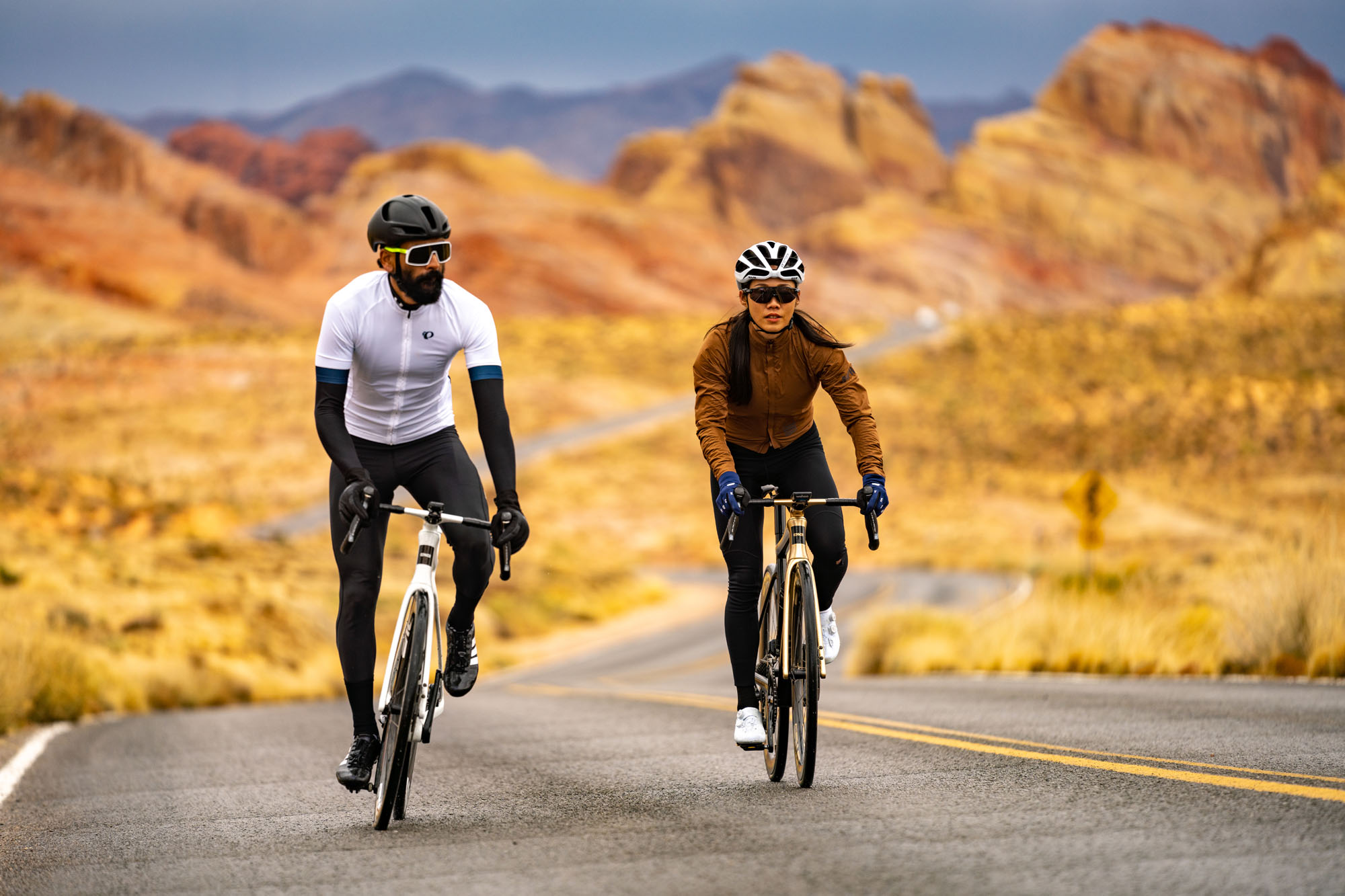
The ENVE Custom Road comes in two different geometries: Race and All-Road. Photo by Ian Matteson, courtesy ENVE
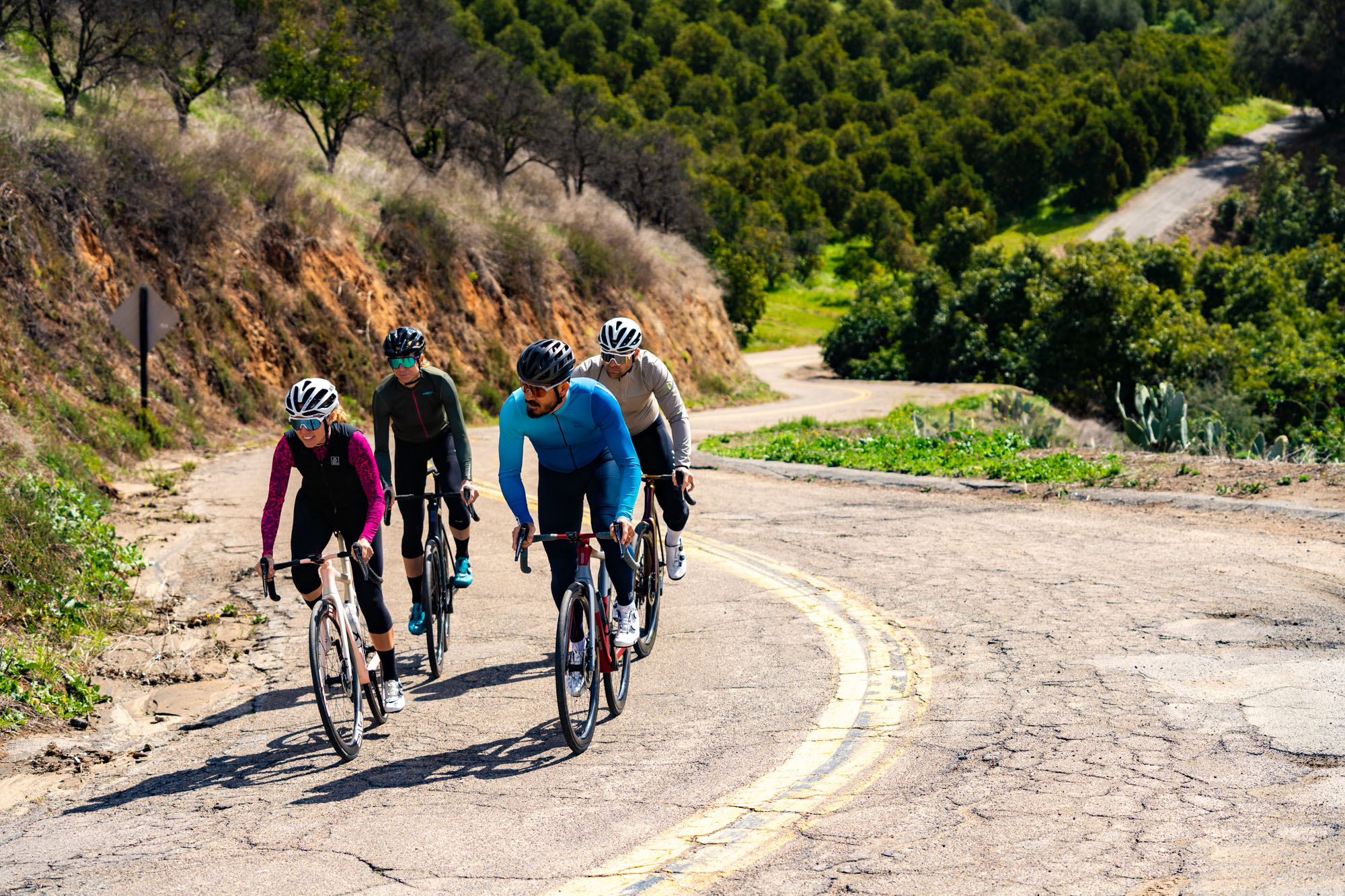
In regards to geometry, the Custom Road is available in two unique formats, “Race” and “All Road.” The Race geometry has a shorter wheelbase and delivers the ride sensations you would expect from a pro- level race bike. The All Road features a slightly longer wheelbase and is tuned for larger volume tires making it an ideal solution for mixed-surface adventures. Regardless of the chosen geometry, the Custom Road can accommodate a labeled 35mm tire, making it a viable option for mixed-surface road events like the Belgian Waffle Ride or Paris-Roubaix Challenge.
The ENVE Custom Road also features a high level of integration. Employing the design and features of ENVE’s recently launched SES AR Handlebar, each Custom Road is paired with a one-piece bar/stem combo that saves weight and allows for all wires and hoses to be hidden for a clean aesthetic, and airflow. Additionally, the One-Piece SES AR Bar/Stem Combo is manufactured and assembled in Ogden which allows ENVE to customize the stem length and bar width to the customer’s needs. Specifically, stem length is adjustable in 5mm increments between 90 and 130mm and the bar is available in widths between 38 and 46cm.
The ENVE Custom Road comes in two different geometries: Race and All-Road. Photo by Ian Matteson, courtesy ENVE
To make the integrated front-end possible, ENVE partnered with fellow US manufacturer Chris King Precision Components to develop the AeroSet™, a premium headset for the Custom Road. The new headset features a proprietary interface that creates a net fit with the carbon top bearing cover. Brake hoses and wires are routed through the stem and into the head tube between the upper 1.5” bearing and a standard 1.125” steerer.
The ENVE Custom Road is offered as a complete bike with SRAM Red or Force AXS, and Shimano Dura- Ace or Ultegra Di2 electronic and disc brake drivetrains only. Customers opting for a “frame-only” will have the option of buying what ENVE is referring to as a “Chassis” or “Rolling Chassis.” The Custom Road Chassis consists of the frame, fork, headset, seat mast topper, bar/stem combo, and custom Scicon Aerocomfort 3.0 TSA Travel Case. By adding an ENVE SES or Foundation wheelset, the Chassis becomes a Rolling Chassis.
“The Custom Road, like all ENVE products, is designed to deliver not only the best ride experience possible, but also the ownership experience. With performance features like the integrated seat mast and one-piece bar/stem combo, travel and transport of the bike become inherently complicated. Most shipping solutions require the removal of the handlebar and seatpost to fit them in a bike case. In our personal experience, this greatly increases the risk of kinking brake lines, cutting wires, and damaging the bike in transit. To solve these problems, we include the Scicon travel case with every configuration of Custom Road,” stated Pantone.
To order a Custom Road, ENVE is asking potential customers to secure a future production slot with a $250 deposit made on ENVE.com at the end of the Bike Builder configuration process. Orders will be fulfilled on a first-in, first-out basis. ENVE is clear to point out that selections made through the builder are not final and will require final sign offs prior to the start of production. After paint, geometry, and build specifications have been signed off, a 50% deposit to which the initial $250 is applied, will be required to initiate production. The Custom Road is available in the USA only. Pricing for the Custom Road is as follows:
Chassis Builds Starting At
MSRP
Chassis Only (Frame, Fork, Bar/Stem, Seat Topper, Bar Tape, HS, Axles & Hardware, Travel Case)
$ 7,000.00
Rolling Chassis Premium (Frame, Fork, Wheelset, Tires, Bar/Stem, Seat Topper, Bar Tape, HS, Axles & Hardware, Travel Case)
$ 9,500.00
Rolling Chassis Foundation (Frame, Fork, Wheelset, Tires, Bar/Stem, Seat Topper, Bar Tape, HS, Axles & Hardware, Travel Case)
NICA Welcomes Dr. Francine Luce, Imelda March and Robert Saffell to the NICA Board of Directors
BERKELEY, Calif. – The National Interscholastic Cycling Association (NICA) is pleased to announce the appointment of Dr. Francine Luce, Imelda March and Robert Saffell to the NICA Board of Directors.
As NICA continues to expand across the country the strategic addition of leadership professionals to its Board of Directors is key to helping guide the organization and its portfolio of youth development programs as it develops to serve a broader customer base.
At the start of one of the races at Eagle Mountain in 2015. Photo by Dave Iltis
Steve Matous, NICA President, states: “NICA’s expansion into new regions and continued development of programs for student-athletes, coaches and volunteers has sustained the growth of our community. Even during the pandemic, we have continued to experience growth in numbers of student-athletes and coaches. As our organization expands, it is crucial that we have the support of a strong and talented Board of Directors. Currently, we are supporting 29 leagues and serving close to 23,000 student-athletes and 11,000 licensed coaches. NICA has made incredible strides towards our vision of having every youth empowered to be part of a thriving and engaged cycling community.”
NICA is thrilled to welcome the following professionals to our Board of Directors:
Dr. Francine Luce, Secretary, NICA Board of Directors
Dr. Francine Luce is currently a District Director at the Jersey City Board of Education in Jersey City, New Jersey where she oversees the Office of Grants Development for the Jersey City Public School District. Prior to her current position, Dr. Luce served as a Principal in the Jersey City School District. Dr. Luce’s collaboration with the New Jersey State NICA representative provided her school and district with a curriculum for mountain biking that was created in an educational format that allowed the sport of mountain biking to be approved as an activity for middle school students.
“My life’s work is to serve and educate students of all backgrounds and economic statuses. Being part of the NICA Board of Directors provides me with an opportunity to assist in a national effort to promote an enhanced supplemental educational experience for all youth with a lifelong activity of biking.” states Dr. Luce.
Imelda March, NICA Board of Directors
Imelda March is a Digital Designer and UX Strategist from Chicago, Illinois. She has previously served on the Board of the Northbrook Cycle Committee and regularly rides in Chicago for recreation and work commutes, giving her a front-and-center view of two-wheeled commuting issues. Imelda has a keen interest in transit-related mobility issues and growing cycling in the youth segment. She has raced bikes for over eight years, both regionally and nationally competing in track, road, gravel and criteriums. Follow Imelda on Twitter @hcram1 and on Instagram @imelda.march.
On joining the NICA Board, Imelda states: “I am passionate about cycling and am looking forward to reaching out to local youth communities to spread the word about NICA programs. I believe that cycling teaches our youth a healthy lifestyle and provides discipline that can be applied to multiple aspects of their lives.”
Robert Saffell, NICA Board of Directors
Robert “Bob” Saffell is the Director of Content Operations and Management at Wolters Kluwer Health Learning, Research and Practice and currently serves on the Board of Directors for the Utah High School Cycling League. Bob, a lifelong cyclist, learned to ride in his hometown of Lexington, Kentucky, and began his relationship with mountain biking after racing 24-Hours of Moab. He has led the Scalded Cats Cycling team, currently known as the Bingham Cyclery-Peak Fasteners for 16 years and was a partner with the Utah State Championship Series. Bob recently ended a 2-year term as a member of the USA Cycling Board of Directors in December 2020.
“Cycling has brought me so much joy, it has introduced me to amazing people and places. I am grateful for the opportunity to serve on the NICA Board. I hope in my time here I can be of service to continue building sustainable expansion, equity, and inclusivity to build strong minds, bodies, character, and communities,” states Bob.
By David Ward — For this month’s column, I dug into the archives for one of my favorite articles. This is one I wrote 19 years ago about my mom, my southern Idaho roots, and a ride through memory lane. I hope you enjoy it as much I enjoyed the ride and writing about it. After 15 years, this ride still owns a tender spot in my heart.
Yesterday’s Ride (June, 2002)
Going for a bike ride is always fun. But occasionally, you experience a ride that connects with you in a way that makes that ride memorable and creates an indelible impression upon your mind. I had that experience yesterday.
My grandmother, Marinda Irene John, after whom my daughter Marinda is named, was born and raised in Portage, Utah, a small farming community bordering on Utah in the Malad Valley. (For you non-continentals, “malade” in French means “sick”. The Malad Valley is a lovely valley, so I have always wondered about the origin and significance of its naming.)
The author, on one of his many rides around various parts of the country. Photo by David Ward
Yesterday, we attended a John Family reunion in Portage. It was a small gathering of approximately 50 people, of whom I knew only my father, his wife Louise, and my aunt and uncle. Still, it was a pleasant and enjoyable gathering on a gentle and relaxed country afternoon, consisting mostly of people who live or were raised in this or a similar rural community.
We were on our way to Pocatello to spend Father’s Day with my dad. He is president of the John Family organization this year, and invited us to attend the reunion if we were able. As we were going to Pocatello anyway, we decided to leave a little early to attend. Afterwards, my wife would drop me off in Malad from where I would ride the rest of the way to Pocatello.
As the reunion wound down and after the raffle was completed, an older gentleman took out his saxophone and began playing music to a prerecorded background. First thing I knew, my dad had grabbed my oldest daughter and was dancing with her between the tables of the park pavilion. He is 82, and still dances the two-step with an ease and enjoyment I envy. After that, he pulled up his wife, Louise, and began dancing with her.
I don’t know if it was just seeing him dance with his wife, or the gathering on this country afternoon winding my thoughts and feelings back toward the community and life of my youth. But at that moment, my mother’s memory flowed into my consciousness and a flood of feeling filled my heart. My mother had not been able to dance for decades, but this whole setting spoke of her, and the life and people she loved. I am grateful for Louise. She is a kind and good person, an enjoyable companion for my dad, and a blessing in his life. But at this moment, I found myself longing for my mother’s presence to make this picture complete.
After the reunion, my wife dropped me off as planned. I do this ride once or twice a year, but usually from the other direction. I start in Pocatello and work my way back toward Malad, usually being picked up somewhere on the way depending on how much riding time I have. So, I generally make it about 30 to 40 miles southward. Because I was riding the opposite direction and from approximately 65 miles away, I would be covering some country I seldom ride. Indeed, the first four miles would be a country road I had only observed from the freeway during my numberless drives north, had wanted to ride, but had never done so.
As I set off, it was a hot and dry, late southern Idaho afternoon. I rode alongside the irrigation ditches and heard and observed the numerous red-shouldered blackbirds hanging and flying around the life-sustaining water. I observed a bird I had not heretofore recognized, a slim erratic bird with a grey head and chest, and contrasting bright yellow stomach. I need to look that one up in my bird book, I thought.
As I rolled the four miles leading to the Devil Creek Reservoir dam, I passed grain and alfalfa fields on either side of me, along with numerous discarded and mostly forgotten old farm buildings and equipment. Evidence of the surrender of the small family farm to large scale farming is all around. So, too, is the advancing tide of urbanity, with its new homes just beginning to dot this pastoral setting.
After climbing to the level of the dam and riding along the reservoir, I caught the old highway, Highway 191, that basically parallels Interstate 15. This stretch from the reservoir to the top of the Malad pass is a rolling, winding road through the verdant hills of the Malad Pass. I recall driving this road during my trips as a student back and forth between home and Brigham Young University. I enjoyed this drive then, and I found it most pleasant and enjoyable yesterday.
After descending most of the way down the north side of the pass, I turned left on to Marsh Valley road. Soon, I rode into the sweet scent of the sagebrush blanketing the valley. Sagebrush and its fragrance permeates this landscape, and the landscape of my memories. My thoughts were again swept back to my mother. She loved the smell of sagebrush, so much so that a sprig of sagebrush was enclosed in her casket when she passed away. Again I reflected on how she loved this dry country. One of her favorite books was Letters of Long Ago by Agnes Just Reid, a resident of Blackfoot, Idaho. This book tells the story of Reid’s mother, a pioneer settler of southern Idaho. Its descriptions of this south Idaho landscape, which some inaptly call desert, and the life of this pioneering lady endeared this book to my mom.
I wound my way along the west side of the McCammon Valley till the road finally angled right, eventually coming alongside Interstate 15. After another couple of miles, I was at the Interstate exit for Arimo. Feeling a little heat exhaustion and dehydration, I stopped at the local Sinclair station to refill my water bottles and downed a can of Coke.
Refreshed and reloaded with sugar and caffeine, I took Arimo Road back west for a couple of miles, and then turned right onto Robin Road. I followed this north for a couple more miles and then left again onto Marsh Creek Road. From here to Inkom is my favorite stretch of this ride. The road winds and rolls underneath the sloping foothills on the west, with a narrow vale of verdant vegetation flowing with Marsh Creek between the road and the walls of the sagebrush covered lava flows about a quarter mile to the east. Evening was settling in, and with it the fresh, cool country air. As I pedaled, Marsh Creek slowly meandered along, with cattle and horses grazing in the sweet grass along its banks.
I happened to catch sight of a sandhill crane walking amid the horses and cattle. The robins were flying back and forth, and I also caught sight of a golden eagle floating above the treetops. Occasionally I passed an old homestead, knowing that these would become more numerous, along once again with the encroaching urbanity, as I neared Inkom and Pocatello.
As I was climbing a short hill, a pickup truck pulling a trailer loaded with irrigation pipe passed me by. A couple of young men sitting on the trailer waved and called, smiles on their faces. Friendly folk live here. As with these two young men, most looked up and waved at this lone sojourner making his way through their vale and his memories.
Finally, I rode into Pocatello. On the southern end, I took the road running through Ross Park. I noted the zoo is still there, and looking better. Of course, now one has to pay to get in, whereas it was free when I was a kid. My parents used to come to Ross Park on warm Sunday evenings to listen to a local brass band. As kids, we were off to the zoo and the amusement park. I especially loved the flying swings, a carousel from which attached swings flew up and out as the carousel twirled. We enjoyed the merry-go-round, the small train that circled the amusement park, and cotton candy from the concession stand.
Just before I finished my ride, I rode past Alameda Park. My memories of July 24th celebrations and watching and playing softball at this park came forward in my mind. We were country hicks, hailing from the small farming community of Tyhee, just north of Pocatello, and Alameda Park really seemed cosmopolitan to me.
Southern Idaho is a part of me, firmly imprinted upon the pathways of my soul. I am always amazed that my children consider themselves Utahns. I have lived in Utah, except for a couple of years spent in France, since I was 18 years old. But I am, and always will be, an Idaho boy, and specifically a southern Idaho boy.
Like my parents, I love this landscape and its people. Or maybe it is my memory of this landscape and its people that I love. I don’t suppose it really matters. I do know that I really enjoyed this ride. It was a nostalgic sojourn for me, made poignant by the events of the day and the memories and tender impressions embedded in my heart.
I especially loved the fragrant scent of the sagebrush.
By Charles Pekow — The Great American Outdoors Act Congress passed this year is beginning to bear fruit. The U.S Department of the Interior announced the first round of grants to clean up the backlog of deferred maintenance on public land.
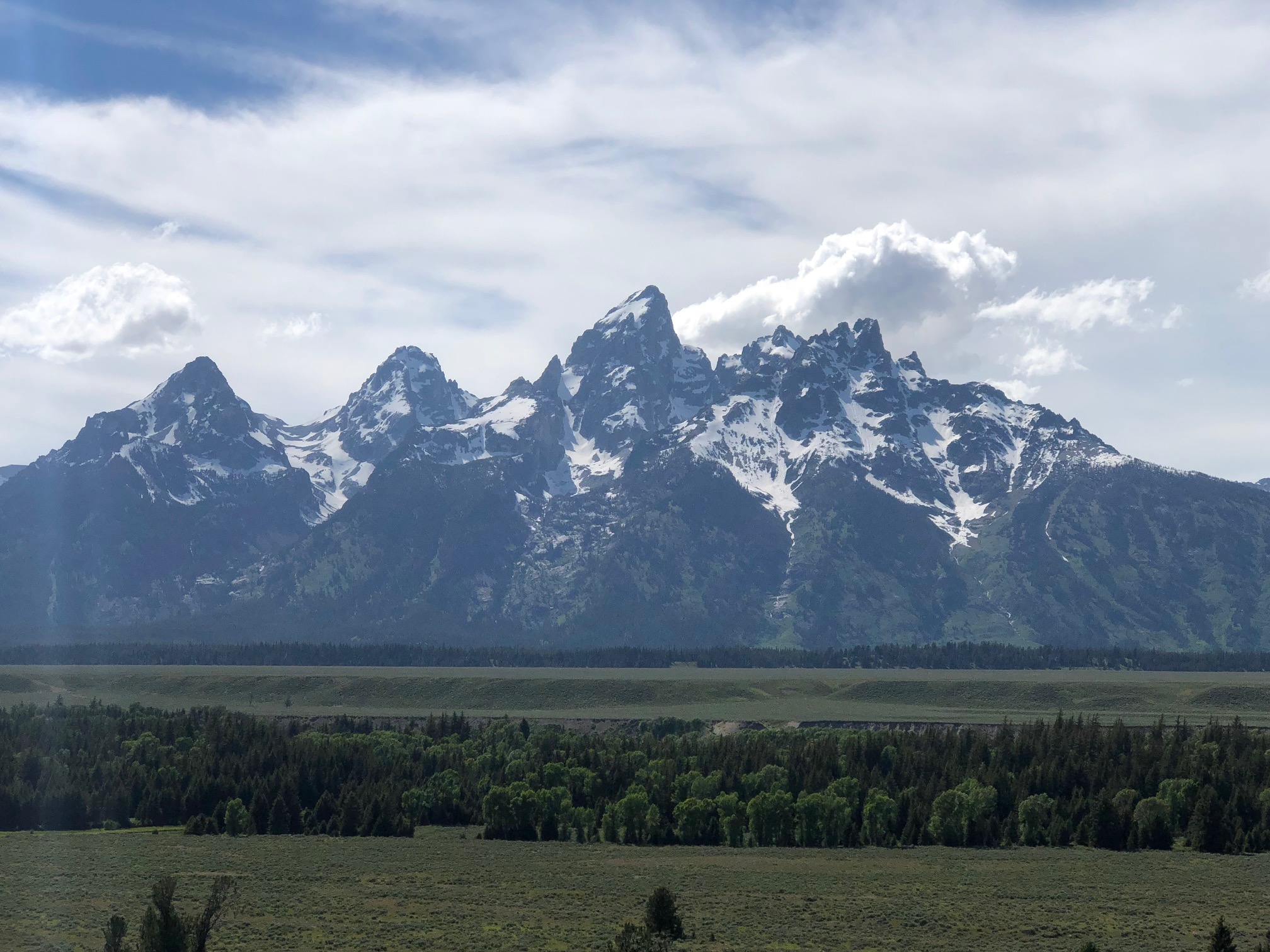
Teton National Park will be getting better bicycle access soon. Photo by Dave Iltis
Interior didn’t announce funding figures, but the projects it will support include improving and expanding access to 34 miles of trails in the Bureau of Land Management Canyon County District in Utah.
Additionally, Interior will improve bicycle access to Grand Teton National Park in Wyoming along Moose Wilson Road at both the north and south ends of the park.
By Jamie Morningstar — Cycling Utah / Cycling West has a wide and varied readership. Some readers open up each month’s issue and zoom straight to the race results and next month’s race schedule. And plenty of others are dabbling in cycling – learning the ropes, figuring out if a bike fit is worth the money (it is!), and maybe toying with the idea of riding their first century. And, fortunately, Utah and the whole mountain west region has a wonderful variety of cycling events from top races to recreational events open to all riders.
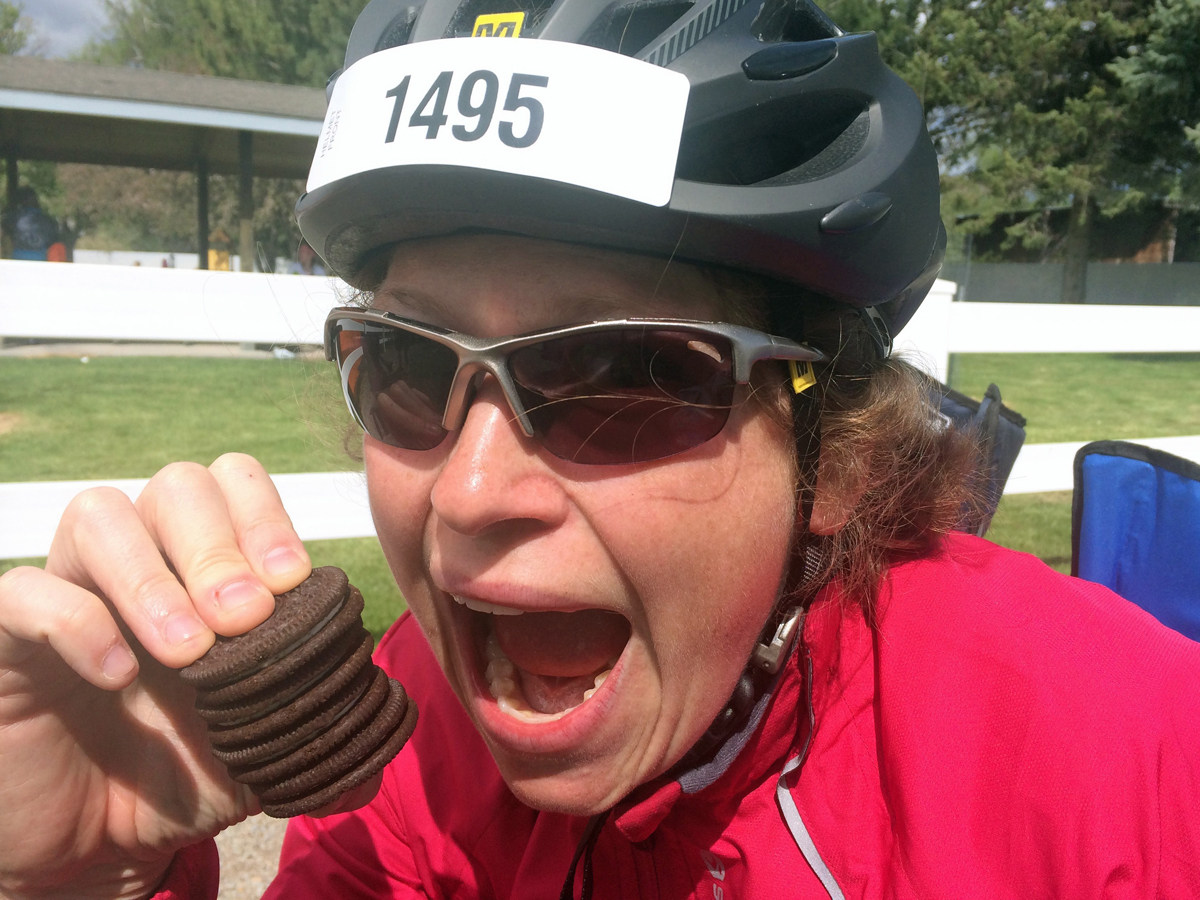
Jamie Morningstar trying to eat my entry cost’s worth of Oreos at Goldilocks 2014. Photo by Stephen Morningstar
I’ve been cycling for a few years now. I’m not serious by serious standards and I’m not a racer. But I do love to ride. I cycle commute year-round. And I ride in a handful of citizen centuries every year.
If you’re toying with the idea of signing up for your first organized citizen ride, it’s good to be aware of the pros and cons of large events. Whether they’re called gran fondos, charity rides, or sportives, they all have basically the same goal: to get a bunch of riders together on the same course on the same day and go ride! I love large cycling events – the energy of hundreds or thousands of cyclists lining up to start, the satisfaction of accomplishing something really tough, the challenge of eating my entry fee’s worth of Oreos, I love it all! Well… almost all…
Let’s be honest – everything has its pros and cons, and cycling events are no exception. Based on my first few years of cycling experience, here are the ups and downs of large recreational cycling events as I see them:
Pro: Pre-planned Accountability
This is the biggest advantage of signing up for events ahead of time. Every spring I sign up for 5-10 cycling events and it keeps me accountable to training and ramping up to be ready for my summer schedule. I’ll be darned if I’m going to miss out of the fun of an event that I’ve already paid for and am looking forward to just because I didn’t stick to my training plan. Seeing the events on my calendar is some great external motivation for me.
Pro: Discover new routes
I enjoy participating in events close to home because often the organizers will often set a novel route that I never considered or will introduce me to a little-known gem of a back road. I gleefully incorporate these new routes into my regular cycling routine. I also love participating in events farther from home because I can enjoy riding in a new place without researching routes. Events are an (almost) guaranteed way to check out a new place without the risk of getting stranded at a dead end or forced to race the sun back on a busy highway.
Pro: Support a good cause
Events are a fun way to support a good cause. Most cycling events have a charity partner that receives some or all of the profit from the event. Also, there are often opportunities for non-cycling friends and family to get involved by staffing an aid station, working registration, or helping out with SAG (Support and Gear) – it’s a way for everybody to be a part of the event together and an added perk they’ll usually get free food and maybe even a free registration for next year.
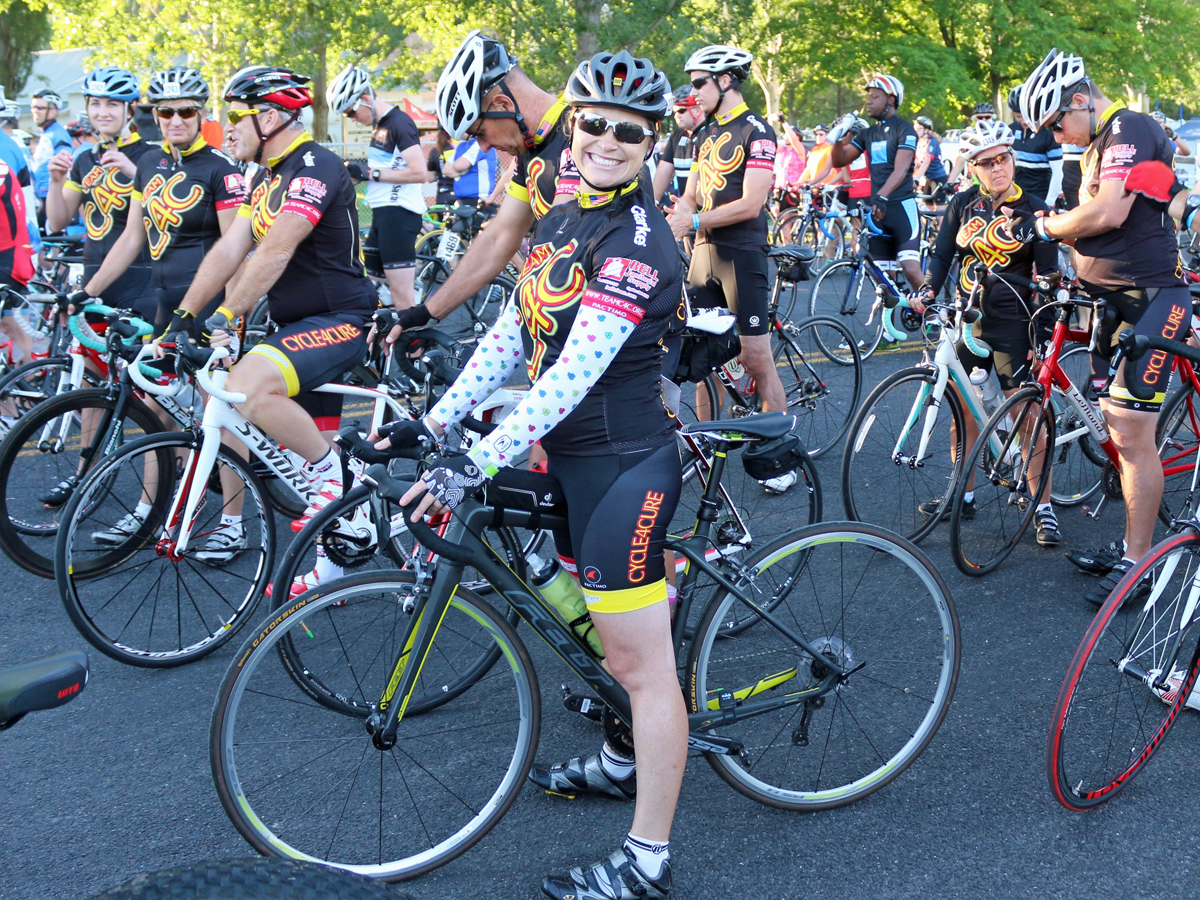
The excitement of the start. Jamie Morningstar and Team C4C at Bike MS 2015. Photo by Stephen Morningstar
Con: It ain’t cheap
Between entry fees, transportation to and from the event, and a hotel for events far from home, the costs of participating in a large events can add up. You get a lot for your money – food before, after, and along the route, support in case of injury or equipment issue, a marked route, and swag. But you’ll be hard pressed to eat your entry fee’s worth of Oreos and peanut butter. Trust me, I try every time.
Pro: Big energy
There’s nothing like the feeling of all those riders lining up at the wee hours of the morning, ready to start on the day’s adventure. Everybody’s excited, everybody’s freezing, everybody’s wondering if they’ve got what it takes, everybody’s thinking they must be a wee bit crazy to pay money to wake up at 5 am to go out and ride. I especially love ladies’ events, which usually have a great “sisterhood” vibe. It’s amazing to look around at a rest stop or at the start and think, “Oh my gosh, all of these women love cycling just like me!”
Con: A Crazy hectic start
The flip side of all of the positive energy in a cycling event is that the first few miles can be congested and super slow as the pack of hundreds or thousands of riders get started. If you’re nervous, just stick toward the back of the pack for your first few events until you get the pattern of what’s going on so you miss the jostling in the front of the group.
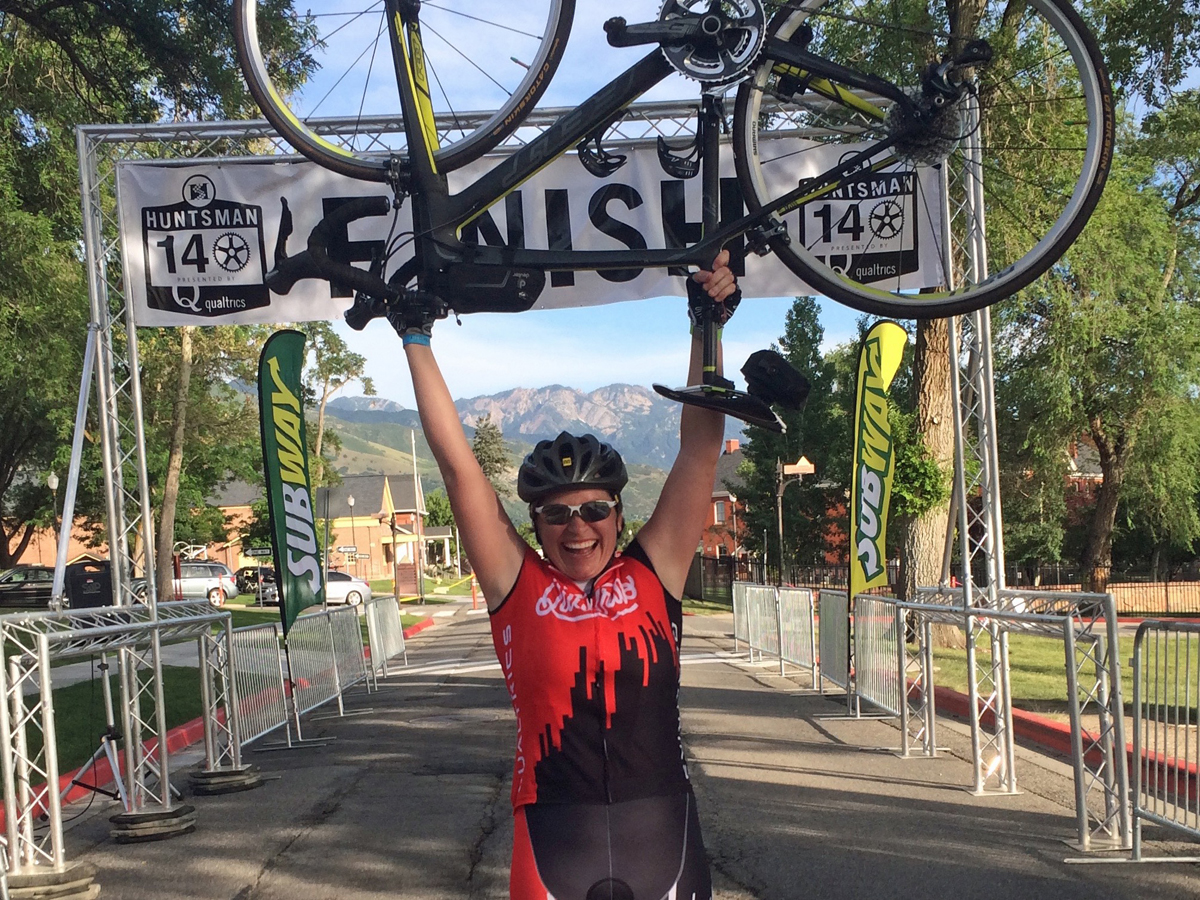
Jamie Morningstar’s victorious finish at the 2015 Huntsman 140. Photo by Stephen Morningstar
Pro: Emergency plan
A well-organized ride has plenty of support and SAG (Support And Gear) vehicles to keep you rolling or even leapfrog you forward if you have an equipment failure, injury, or are falling behind pace. Every rider has a responsibility to know basic bike maintenance and to ride with a tube, patch kit, and the essentials. But if the nice man on the SAG motorcycle wants to change my tube while I look on in gratitude, who am I to argue?
Con: Poorly planned events negate all the pros
Every event has its ups and downs, but an ill-planned event is extremely frustrating or even dangerous. A poorly-planned or badly-marked route will leave you confused, frustrated, or lost. Badly spaced or unequipped rest stops fall somewhere between a nuisance and downright liability if you run out of energy or water to drink.
So, expect the best and prepare for the worst, especially if the event is in its first or second year because the organizers may still be working out the kinks. Just like anytime you go out to ride, carry more water than you need and take responsibility for your own equipment and nutrition. Chances are, you won’t need it, but it’s always wise to be prepared.
Comments on the 600 N / 700 N Mobility Study Due by March 31, 2021
March 21, 2021 – Salt Lake City is seeking public comment on plan options for the reconfiguration of 600 N. between Center Street (approximately 150 W) and 2200 W. Cycling Utah first called for cycling improvements in the area in 2016 and 2017 and specifically with our 600 N safety plan.
According to the City’s 600 N Study page, “The 600/700 North Mobility, Safety, and Transit Improvements Study will create a plan to transform this critical Westside Salt Lake City corridor in ways that promote safety, enable mobility for active modes and transit, and better serve the surrounding neighborhoods. With input from local stakeholders and community leaders, the Study will identify specific projects to be phased in during the next few years. In anticipation of future planned frequent transit service on the corridor, the project will determine how transit stops are oriented on the corridor.”
The 600 N Overpass is a cyclist and pedestrian disaster. UDOT implemented the SPUI design, but has done little to make it safe for active transportation. Photo by Dave Iltis
The city presents 3 different potential street treatments in storyboard format. The format is in-depth and takes awhile to digest; and is presented in both English and Spanish. It is easier to view on a desktop computer.
Concept 1, the baseline scenario, offers some improvements including buffered bike lanes (an upgrade from the current standard bike lanes), more street trees, and pedestrian crossing islands. It retains the current 5 lane configuration of 2 travel lanes in each direction and a center turn lane.
Concept 2, the Green Boulevard, adds a wide landscaped median in the center of the street and reduces the number of travel lanes to one each direction. It keeps the buffered bike lanes presented in the baseline scenario.
Concept 3, the Streetside Park, adds a linear park on one side of the street with a two way bike path on edge of the park, and a protected bike lane on the other side of the street. Parking would be eliminated throughout the corridor. The City would also look at adding commuter route on 500 N for “those wishing to ride faster.”
All three concepts share better bus stops and transit routes.
The 600 North I-15 overpass is a safety disaster for cyclists and pedestrians. Photo by Dave Iltis
The study options are confusing in regards to the spot improvments with different treatments for places like the 600 N overpass over I-15 in each of the three concepts. Each story board has options for the spot treatments, but it’s not clear why concept 1 couldn’t have the spot treatment option presented in concept 3.
The 600 N overpass is a key failing point of the roadway currently. The SPUI interchange design is not safe for bicyclists or pedestrians, and in fact, the Mayor’s Bicycle Advisory Committee pointed this out in discussions in the early 1990’s before it was built. UDOT built the interchange and others like it along I-15 despite these concerns.
There have been several pedestrian fatalities on 600 N. The street needs to be completely redone from 200 W to 2200 W with a road diet and safety features. Photo by Dave Iltis
Concept 1 and 2 suggest a bike path and better pedestrian crossings on the south side of the overpass. Concept 3 suggests protected bike lanes on both sides of the overpass.
Another key area is where the road shifts from 600 N to 700 N by the Backman School and Riverside Park. Currently, this area has no bike lanes. Concept 1 proposes adding bike lanes, as do 2 and 3. However Concept 2 proposes adding roadways in the park itself, which would reduce the park size by the added roadway size in order to increase parking options.
In a recent BAC meeting, the project team noted that the entire roadway will not be rebuilt right away, and it’s not clear when the improvements will start.
If you do send comments to the city, please consider adding them in the comment section on this post so that others can see what you have to say.
Our Comments:
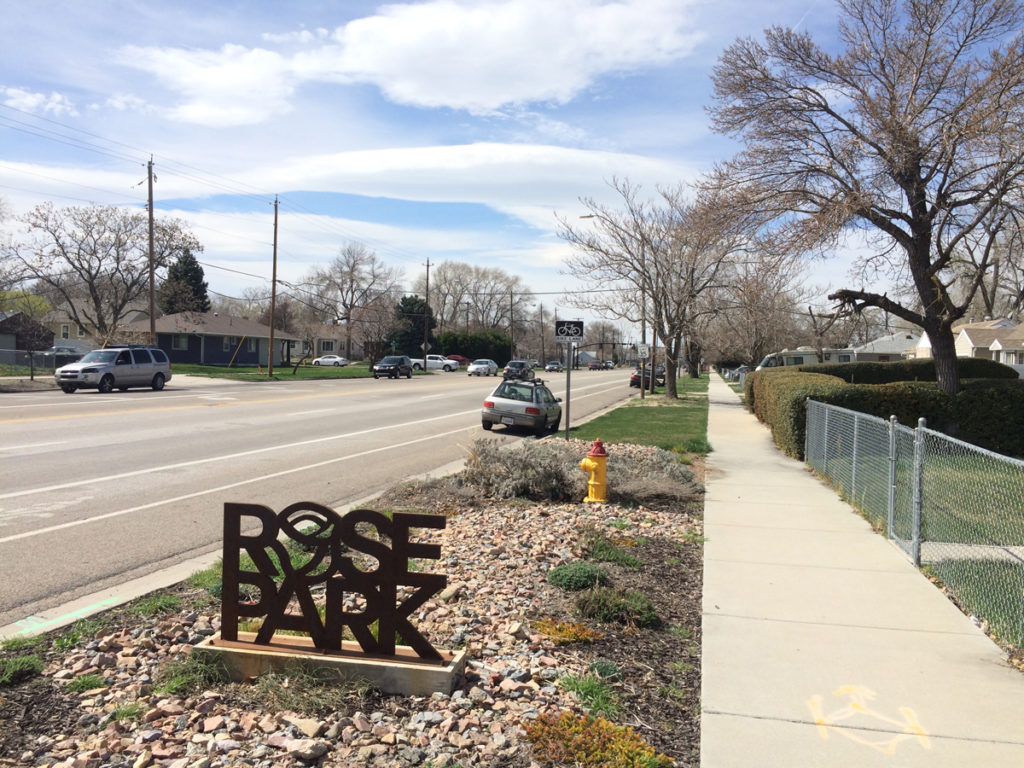
Overall, it is a welcome project to see in the works. As we mentioned before, Cycling Utah called for an overhaul of 600 N in 2016 and 2017. Additionally, in a separate effort, the Rose Park Community Council called for safety improvements and a petition was started to “Slow Down 6th North“.
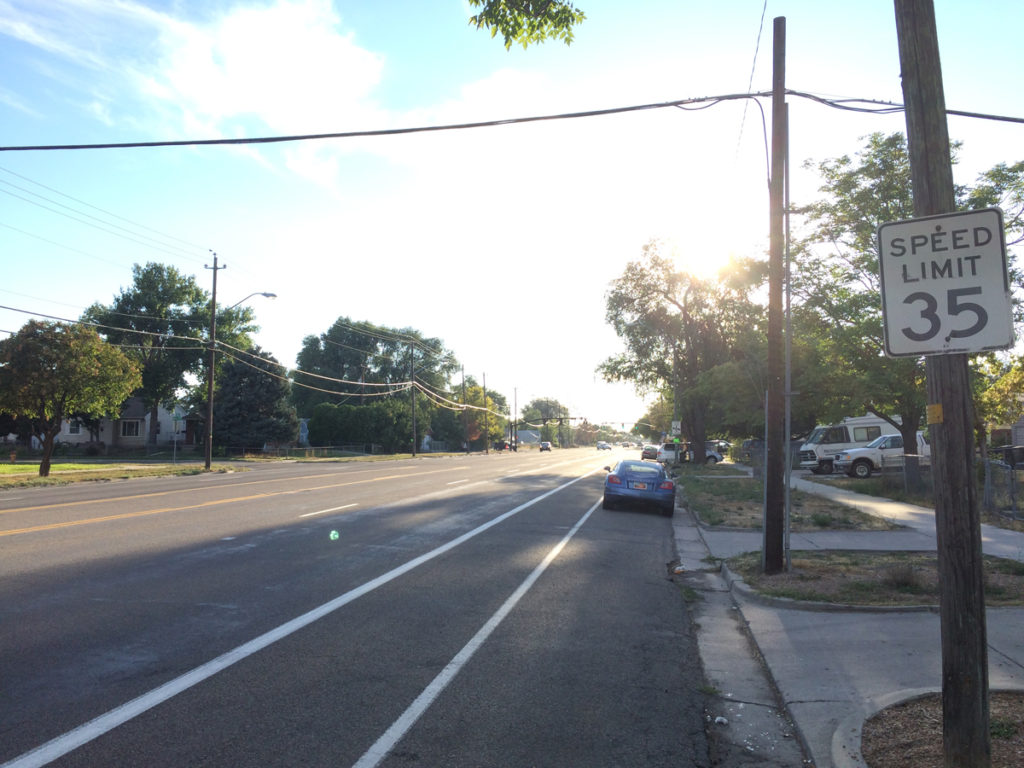
Each of the designs is an improvement over the current high speed, unsafe situation. Better bike lanes along the entire corridor are needed. The existing ones are ok, but when combined with too wide travel lanes and too high speed limits, 600 N is not the most comfortable street to ride. Additionally, there have been several pedestrian fatalities in the last few years, indicating that speeds are too high. While UDOT lowered the speed on the overpass to 35 mph, this remains unsafe for pedestrians and cyclists, and is not conducive to a quiet neighborhood.
The bike lanes on 600 N have a huge gap between about 600 West and 400 W. Photo by Dave Iltis
Our previous comments were the following:
600 North Safety Plan – 600 N. needs to be made safer for people on bikes and pedestrians. This is a key E-W connector, and is currently a nightmare for bicyclists and pedestrians wanting to cross I-15. With bike lanes on either side, making the I-15 overpass bicycle safe would help to connect Rose Park / Fair Park to Marmalade. Additionally, traffic calming and speed reductions on 600 N are needed, especially at 800 West (see http://www.ipetitions.com/petition/slow-down-6th-north)
600 North really needs to have a comprehensive plan from 200 West to 2200 West for better bicycling, traffic calming, better pedestrian safety, and slower speeds.
Narrower traffic lanes in order to reduce traffic speed.
Lower speed limit on 600 N.
Integration with UDOT to make the overpass bicycle and pedestrian safe. It is not safe currently.
A buffered or protected bike lane on 600 N.
Regular sweeping of the 600 N. overpass
Safer crossing of the 600 N. overpass for bikes and pedestrians and SPUI (Note: the 600 N and I-15 interchange is a SPUI – Single Point Urban Interchange) restriping/design.
Continued traffic calming at 800 W and 900 W.
Much of this is addressed in the current plan. Speed limits are a noted omission. It’s unclear why Salt Lake City is so addicted to speed limits that are too high, and inappropriate for a given street. 600 N should be 25 mph throughout, including on the overpass. Seattle recently has gone to a system of 20 mph in the neighborhoods and 25 mph on arterials. Salt Lake City should do the same. Hence lowering the speed limit on 600 N needs to happen. For those of you reading this who adhere to the idea that road design is the best way to lower speed limits, we agree. However it is not the only way. Lowering speed limits actually lowers speeds too according to a study in Massachusetts, regardless of road design. Another speed limit study in Portland had similar results.
The speed limit is too high on 600 North for cyclists and pedestrians. Photo by Dave Iltis
Of the three concepts, we like concepts 2 and 3 the best. The linear park idea is innovative and could change the neighborhood for the better. It includes a two way shared pathway. While these are a great option for many, they do result in increased pedestrian and bicycle conflict as use increases. It would be nice to see the path be for bicycles only, and existing sidewalks widened for pedestrians so that each has a safe off-street facility. Additionally, the road treatment on N. Temple of a bike path and a bike lane should be applied here.
Concept 3, the Linear Park, also includes making 500 N a bike commuter route. We think that’s a great idea and should happen regardless of which of the three concepts are adopted, and should happen as soon as possible regardless of the construction schedule of 600 N.
The 600 N overpass is a disaster for cyclists and pedestrians currently. We like the third concept the best in its treatment of the overpass – protected pathways and walkways on both sides of the overpass. In concepts 1 and 2, the overpass would only see slight improvements on the south side, which would force cyclists and pedestrians that are on the north side to cross the roadway somewhere between 600 W and 300 W, which is not a safe proposition.
Concept 3 calls for protected bike lanes on the north side of the roadway. We would like to see protected bike lanes on both sides of the street, especially in concept 2 if that is adopted. Rather than the bulbouts that allow for streetside parking, we’d rather see a parking protected (or no parking allowed) bike lane if either concept 1 or 2 is chosen.
The area around Riverside Park needs bike lanes. We would welcome them here. Concept 2 unfortunately adds roadways within the park and thus would reduce the size of the park. That’s probably not a good change for open space preservation. We’d like to see protected bike lanes here on both sides of the street.
Lastly, while it’s not mentioned in any of the concepts, removing the slip lane at the intersection of 2200 W and 700 N needs to happen to increase safety for cyclists and pedestrians.
600 North would be improved by adding protected bike lanes. Photo by Dave Iltis
March 18, 2021 – Former NBA Center and BYU Graduate Shawn Bradley was paralyzed after being hit from behind on his bicycle by a car only one block from his home in St. George, Utah on January 20, 2021. The Dallas Mavericks issued the statement below regarding Bradley’s condition and what happened in the crash. Given that he was hit from behind, it is most likely that the crash was completely the fault of the driver. At the time of this article, we are waiting for a response from the St. George Police Department on the details of the crash.
Shawn Bradley in 2008. Official Army Photo by Dustin Senger
Bradley played for the Philadelphia 76ers, the New Jersey Nets, and the Dallas Mavericks. His career spanned from 1993 – 2005. Known for his shot blocking abilities, he blocked 228 shots in the 2000-2001 season for the Mavericks.
Statement from the Dallas Mavericks:
March 17, 2021 – DALLAS, Texas — The Dallas Mavericks are issuing the following press release on behalf of former Maverick Shawn Bradley as well as the below statements from Mark Cuban and Donnie Nelson:
Shawn Bradley released the first public details today of the accident that he suffered on January 20, 2021. Bradley, the 7’6” former NBA player with the Dallas Mavericks, was struck from behind by an automobile while riding his bicycle a mere block from his home in St. George, Utah. The accident caused a traumatic spinal cord injury that left him paralyzed. After undergoing neck fusion surgery, Bradley has spent the last eight weeks hospitalized and undergoing rehabilitation.
Bradley, a devout member of the Church of Jesus Christ of Latter-day Saints, spent two years performing missionary work in Australia after his freshman year at Brigham Young University. Following his mission, Bradley was drafted by the Philadelphia 76ers as the number two pick in the 1993 NBA Draft, but he spent the majority of his career with the Dallas Mavericks. His very strong sense of faith is being tested as he participates in grueling physical therapy and learns how to cope with the challenges of paraplegia. Doctors have advised him that his road to recovery will be both long and arduous, perhaps an even more difficult physical challenge than playing professional basketball.
With his wife Carrie at his side around the clock, and supported by an amazing team of rehabilitation specialists and family, Bradley is in good spirits. He plans to use his accident as a platform to bring greater public awareness to the importance of bicycle safety.
Bradley asked to convey his deep appreciation for the outpouring of well wishes and prayers he has received from family, friends and fans. Their support has energized his recovery and bolstered his confidence that he will manage the long process ahead successfully. He does not plan to issue further public updates, preferring to devote his full concentration on his rehabilitation.
Mark Cuban:
“We are saddened to hear of Shawn’s accident. Shawn has always been incredibly determined and shown a fighting spirit. We wish him nothing but the best in his recovery. He will always be a part of our Mavs family.”
Donnie Nelson:
“We are deeply saddened to hear of Shawn’s injury and our thoughts and prayers go out to him and his family. In his eight-plus seasons in Dallas, Shawn demonstrated all of the qualities you want in a person representing your organization. He has always exhibited unwavering grit and determination and we are thinking of him at this difficult time. He is a Maverick for life.”
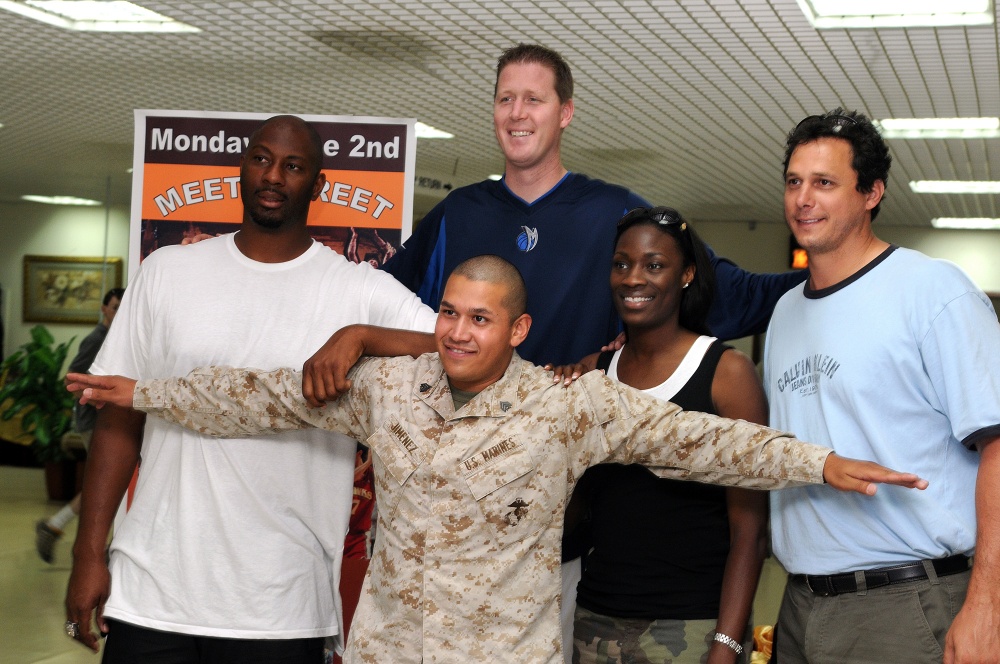
“This is my wingspan, so you can see how much damage I could do in the air with you,” said U.S. Marine Sgt. Sergio Jimenez, from Fresno, Calif., while posing for a photograph with four former professional basketball players at Camp As Sayliyah, Qatar, June 2. The four players included: Elden Campbell, Shawn Bradley, Rushia Brown and Tom Gugliotta. The former NBA and WNBA players were traveling to military installations in Southwest Asia to meet deployed service members. “I knew they were tall, but this is ridiculous,” said Jimenez jokingly. “I have been a fan for years but this is the first time I have ever met anyone in the NBA or WNBA.” Former Basketball Stars Travel to Qatar, by Dustin Senger
March 16, 2021 – Salt Lake City, Utah – Gov. Spencer Cox today signed into law the Utah Yield / Idaho Stop law, HB 142. The new law will allow cyclists to treat stop signs as yield signs. Rep. Carol Moss, has worked tirelessly for the last 11 years to get the bill passed. The bill passed the legislature on March 5, 2021; the last day of the session.
As with most bills passed this year, it will take effect on May 5, 2021.
Rep. Moss’ tweet announcing the signing is here:
@SpencerJCox busy signing bills today signed my HB 142, Cycling Traffic Amendments, making it legal for cyclists to treat a stop sign as a yield sign if there is no traffic or pedestrian in the intersection. pic.twitter.com/PcNYh6ewGC
(5) (a) As used in this Subsection (5), “immediate hazard” means a vehicle approaching
91 an intersection at a proximity and rate of speed sufficient to indicate to a reasonable person that
92 there is a danger of collision or accident.
93 (b) Except as provided in Subsection (6), an individual operating a bicycle approaching
94 a stop sign may proceed through the intersection without stopping at the stop sign if:
95 (i) the individual slows to a reasonable speed; and
96 (ii) yields the right-of-way to:
97 (A) any pedestrian within the intersection or an adjacent crosswalk;
98 (B) other traffic within the intersection; and
99 (C) oncoming traffic that poses an immediate hazard during the time the individual is
100 traveling through the intersection.
101 (6) Subsection (5)(b) does not apply to an intersection with an active railroad grade
102 crossing as defined in Section 41-6a-1005.
Rep. Carol Moss worked for 11 years to get the Stop as Yield Law (Idaho Stop) passed in Utah. Photo by Dave Iltis
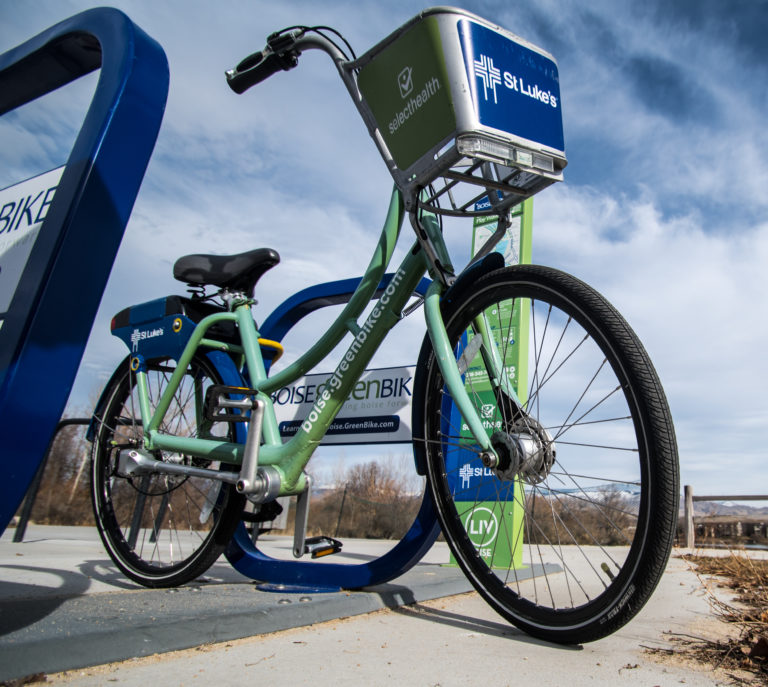
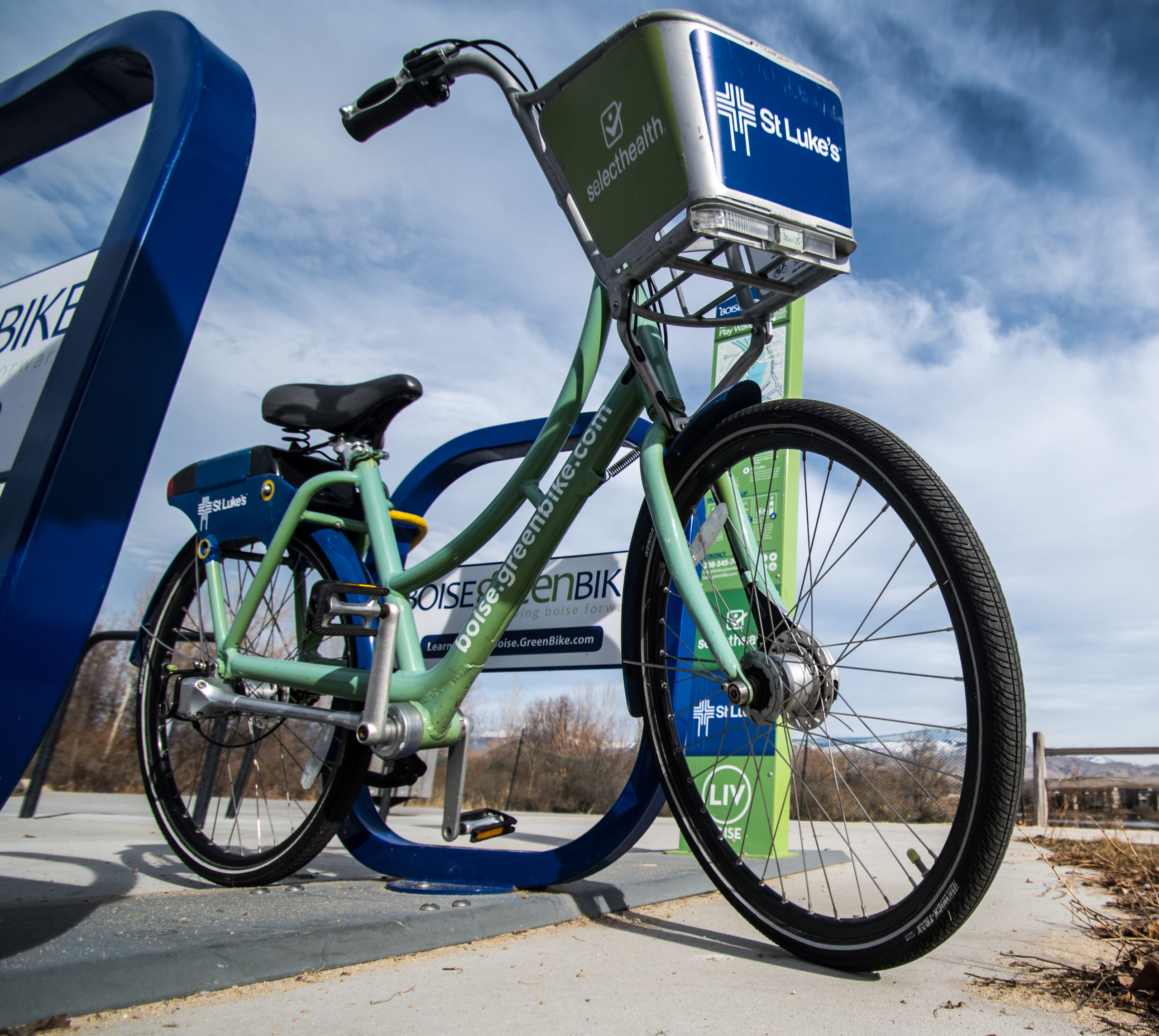
Valley Regional Transit’s bike-share program, Boise GreenBike, suspended operations last September and is now selling some of the signature green bikes to the public.
Photo courtesy Boise GreenBike.
The Boise GreenBike Garage Sale is on the Auction Frogs website from now until March 28. Up for sale are 70 bikes, kiosks, solar panels, batteries, and other equipment no longer needed since Valley Regional Transit ended its contract with Social Bicycles.
Shortly after suspending operations, Boise GreenBike donated about 40 bikes to area nonprofit organizations. That still left an inventory of 70 bikes. All the bikes have had the controllers and locking units removed, and proprietary nuts and bolts have been replaced with standard hardware, enabling the new owners to more easily service the bikes.
“When we suspended operations, I got lots of phone calls from people interested in acquiring one of the bikes,” said Dave Fotsch, founder and director of Boise GreenBike. “We’re finally making the bikes available and hoping to put a little money aside for whatever comes next.”
The garage sale proceeds will go into a fund to help bring to Boise the next generation of bike-share. VRT is trying to recruit corporate sponsors to support a larger and all-electric fleet of bikes. The pandemic has adversely impacted those efforts, so there will be no bike-share program in Boise this year. VRT is now working to launch a bike-share program in the spring of 2022.
To access the online auction, go to: https://boisegreenbikegaragesale.afrogs.org/#/index and register to bid. The bikes and other equipment will be sold in two phases, with the second phase opening up on Saturday, March 21.
As the New Year starts, I hear way too many athletes vowing to “knock off carbs” for their nutrition resolution. Most intend to eat less sugar (OK). Some plan to cut out bread, pasta, potato and starchy foods (not OK), and others plan to also limit fruits and veggies (bad idea). The reality is, carbs should be the foundation of your sports diet.
Pasta is a great source of carbohydrates for cyclists. Photo and dish by Dave Iltis
Carbs 101
By carbs, I mean primarily fruits, vegetables, beans and grains. But little is wrong with a sprinkling of added sugar (less than 10% of your total daily calories) or enjoying a meal with refined white flour (as long your other meals include whole grains). To be sure we are all on the same page, let’s define this much-maligned word “carb.”
Carbohydrates include both sugars and starches. They are biochemically similar. For example, green peas (and other veggies) are sweet when young; their sugar converts into starch as they mature. Unripe bananas (and other fruits) are starchy when young and become sweeter as they ripen. Their starch converts into sugar.
Both sugars and starches are equal sources of muscle fuel. Whether you eat a starchy potato or sugary candy, the digested end-product is the same: glucose.
Glucose feeds your brain, gets stored as glycogen in muscles (for fuel during hard, extended exercise) and also in the liver (where it gets released, as needed, into the bloodstream to prevent your blood sugar from dropping).
Some carbs are more nourishing than others. Added sugars (white sugar, maple syrup, honey, agave, gels, chomps, sport drinks, etc.) lack the vitamins and minerals that invest in good health. Fruits, veggies, beans, and dairy, however, are health promoting sources of carbs. Obviously, you want to eat more of the best and less of the rest.
Physically fit athletes easily metabolize sugars and starches. Unfit people, however, often end up with high blood sugar and pre- or Type II diabetes. Note: Most messages to cut out carbs are targeted at unfit people, not athletes.
Reasons to keep carbs in your sports diet
Here are five reasons why you, a physically fit athlete, want to include carbohydrate in your sports diet.
1. Carbohydrates fuel muscles.
Athletes who restrict carbs pay the price: “dead legs” and inability to exercise at their best. If you routinely train hard 4 to 6 days a week, carbs should be the foundation of each meal. Here are the International Olympic Committee’s research-based carb recommendations for an optimal sports diet:
Amount of exercise/day
gram carb/lb. body weight
gram carb/kg body weight
1 hour moderate exercise
2.5 to 3
5 to 7
1-3 h endurance exercise
2.5 to 4.5
6 to 10
>4-5 h extreme exercise
3.5 to 5.5
8 to 12
For a 150-lb athlete who trains hard 1 hour a day and remains somewhat active the rest of the day, the target intake should be 375 to 450 grams carb/day. That’s at least 90 g (360 calories) carb per meal and 50 g (200 cals) carb at each of two snacks. This is more carbs than in the ever-popular (low-carb) breakfast protein shake with a few berries, a lunchtime spinach salad, and a dinner with a pile of broccoli but no rice. Here’s what 375 grams of carbohydrate looks like (without the protein and fat that balances the diet):
B: 1 cup dry oats (50g) + 1 banana (25g) + 1 T honey (15g)
Sn: 1/3 cup raisins (40g) + 1 Tbsp dark chocolate chips (10)
D: 1.5 c cooked brown rice (65g) + 14-oz bag frozen broccoli (20g)
Sn: 8 ounces vanilla Greek yogurt (20) + 1 Nature Valley Granola Bar (30)
While I am sure many of you are rolling your eyes right now and thinking, “I could never eat that many carbs without getting fat,” this is an appropriate carb intake, believe it or not, and these 1,500 carb-calories can fit into your day’s 2,500+ calorie budget. I invite you to be curious and experiment. How much better can you train with an appropriate carb intake?
2. Carbohydrates are not fattening.
Despite popular belief, carbohydrates are not inherently fattening. Excess calories at the end of the day are fattening. Excess calories of carbs (bread, bagels, pasta) are actually less fattening than are excess calories of fat (butter, salad oil, cheese). That’s because converting excess calories of carbohydrate into body fat requires more energy than does converting excess calories of dietary fat into body fat.
3. Avoiding carbs can lead to food binges.
By routinely including carbs in your daily sports diet, you take the power away from them and will be less likely to binge. That is, if you “cut out carbs” but then succumb to eating the entire breadbasket and the mountain of pasta when at a restaurant, you are doing what I call last chance eating. You know, last chance to eat bread and pasta so I’d better stuff them in today because my no-carb diet restarts tomorrow. (Ugh.)
4. Quality carbs (fruits, vegetables, grains and beans) promote a healthy microbiome, which reduces the risk of heart disease, diabetes, and cancer.
Fiber-rich carbs feed the zillions of microbes that live in your gut. These microbes have an incredible influence on your mood, weight, immune system, and overall health. Every major medical association recommends we consume a strong intake of fruits, veggies and whole grains. Do athletes on a low carb diet miss out on these health benefits? TBD.
5. Carbohydrate adds pleasure to your sports diet.
Is something wrong with eating some yummy foods, like pasta and bagels? How about chocolate milk for a fun recovery food? Given that 10% of daily calories can come from refined added sugars, most athletes have about 240-300 calories (60 to 75g) of added sugar a day in their calorie budget. You can easily ingest that sugar via sport drinks, gels, and sweetened protein shakes. You can also enjoy one or two cookies or a slice of birthday cake—guilt-free.
Carb abuse is the bigger problem than carbs in moderation. The easiest way to prevent carb abuse is to eat satiating breakfasts and lunches (with carbs + protein) that fill your tummy, prevent afternoon hunger, and curb cravings for sugary sweets later in the day. Preventing hunger minimizes the cravings that give carbs a bad name in the first place. Give it a try?
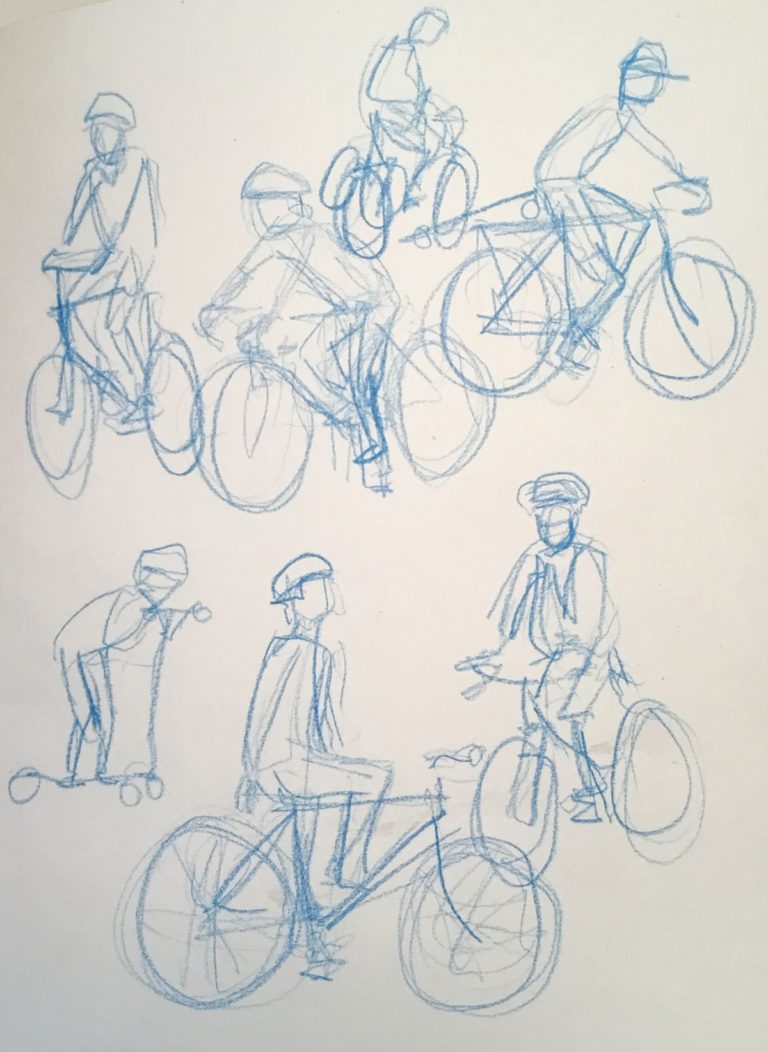
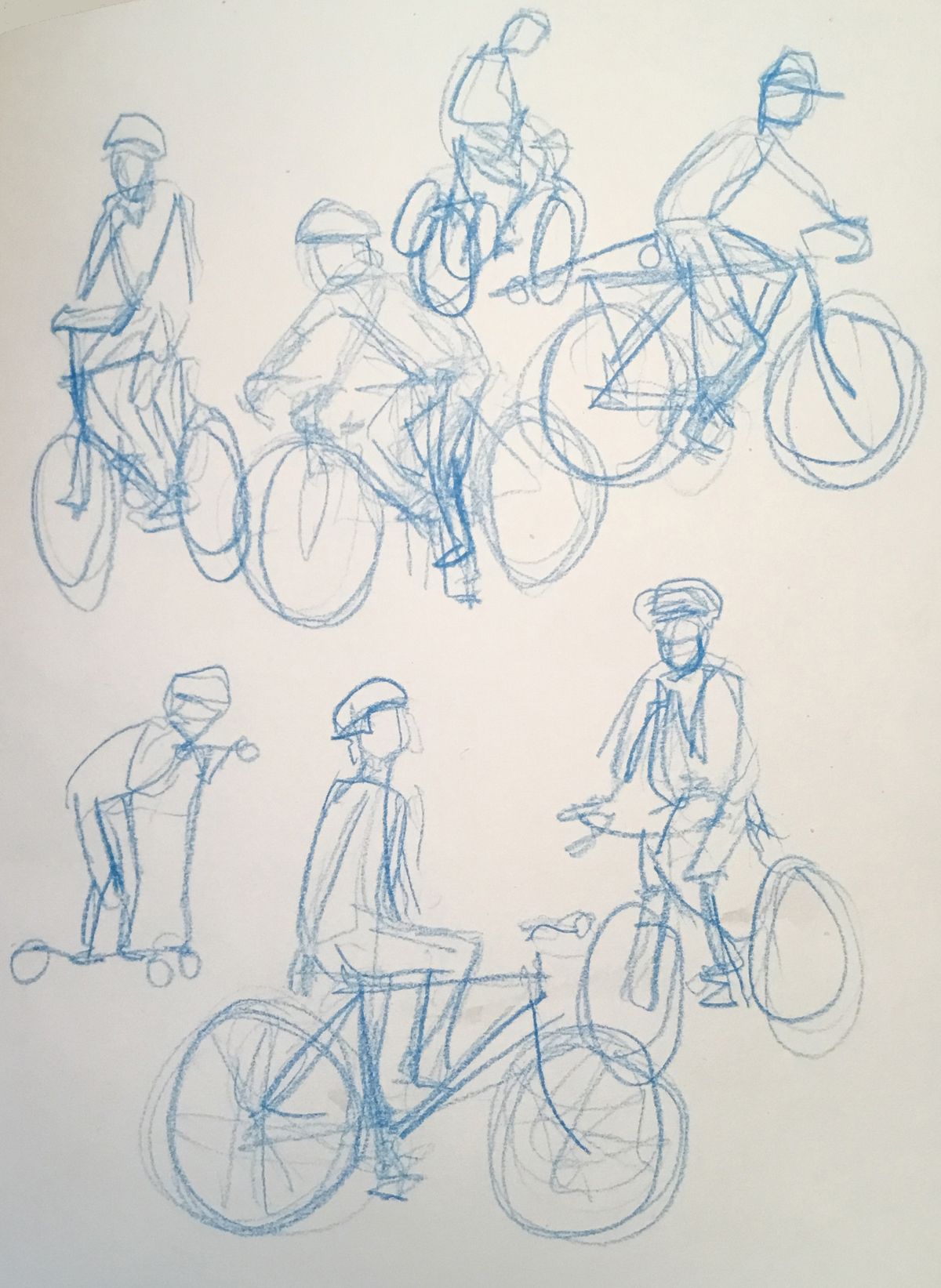
Artist’s statement: I’m an artist/printmaker/teacher in San Francisco. This is drawing of the some of the people using JFK blvd in Golden Gate Park in San Francisco that has been partially closed to automobile traffic during the COVID pandemic.
By Charles Pekow — Not enough is known about how parking infrastructure affects bike theft. In an attempt to close that knowledge shortfall, researchers from the University of Washington and three Chinese institutes of higher education issued a report on bike parking security.
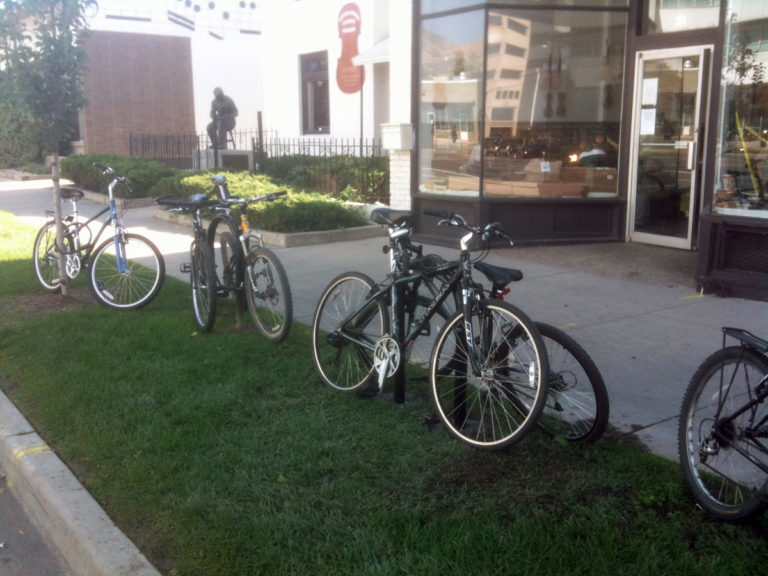
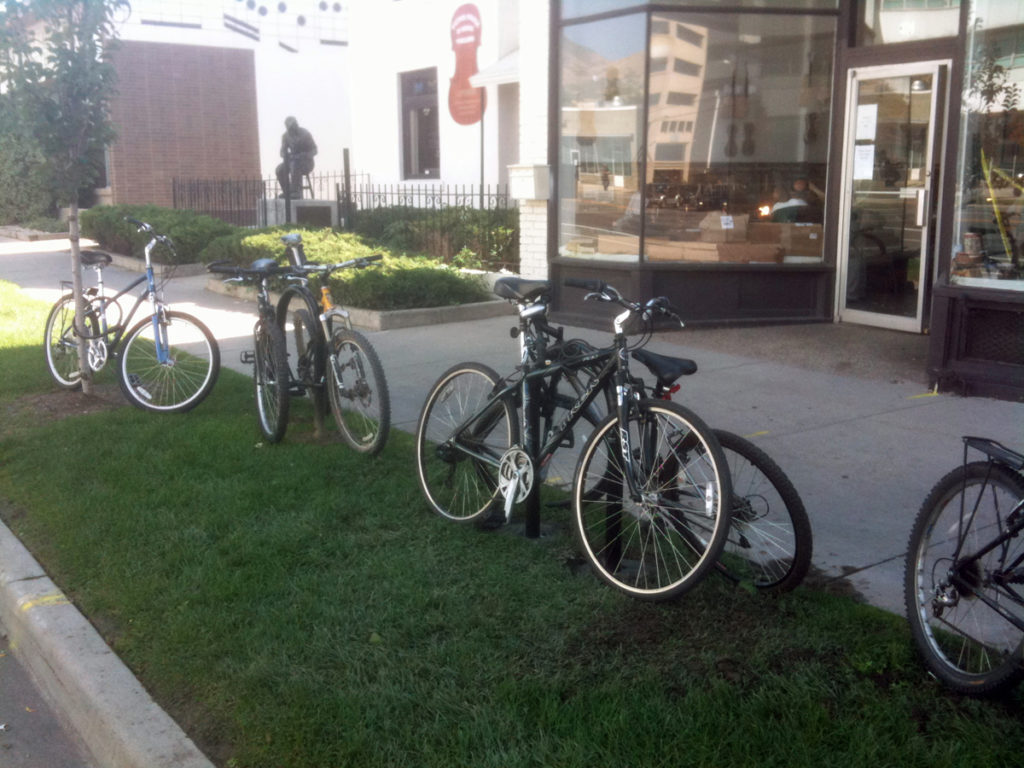
Bike Parking in front of the Peter Prier Violin Making School in Salt Lake City, Utah. Photo by Dave Iltis
The study found that you are more likely to lose your bike while at work than at home, as most thefts take place in business districts and sadly but not unexpectedly, the more bike lanes, bike racks and bus stops; the more theft. Thefts that do occur in residential areas take place disproportionately in low-income neighborhoods and where high ratios of young people live.
But the closer you park to a corner, the safer the bike; evidently thieves choose mid-block destinations because fewer people are likely to spot them.