Hazard: The recalled front bicycle rack can loosen and contact the front wheel, posing crash and injury hazards to the rider.
Remedy: Repair
Consumers should stop using the recalled bicycle racks immediately and contact the bike shop or online retailer where it was originally purchased to arrange for a free repair.
Consumer Contact:
Surly Bikes toll-free at 877-773-3191 between 8 a.m. and 6 p.m. CT Monday through Friday, or online at www.surlybikes.com and click on the “Safety Recall 8 and 24-Pack Rack” button for more information.
Recall Details
Units: About 5,139
Description:
This recall involves all Surly 8-Pack Racks and Surly 24-Pack front bicycle racks and Pack Rat Bicycles equipped with these racks. The racks were sold in black and silver finishes, are made of tubular chromoly steel and are intended for use on the front of a bicycle.
Incidents/Injuries: Surly has received 15 reports of racks failing, including three reports of minor injuries including sprains and lacerations, and seven reports of serious injuries including a fractured vertebra.
Sold At: Bicycle stores nationwide and online at various websites from December 2015 through September 2019 for $110 and $150 for the 8-Pack Rack and 24-Pack Rack, respectively, and $1,350 for the Pack Rat complete bicycle with rack.
Importer: Surly Bikes, a wholly-owned brand of Quality Bicycle Products Inc., of Bloomington, Minn.
Hazard: The front fender bolt can unthread causing the wheel to detach from the bicycle, posing a fall hazard to the rider.
Remedy: Repair
Consumers should immediately stop using the recalled bicycle and take it to a Trek retailer for a free inspection and repair.
Consumer Contact:
Trek at 800-373-4594 from 8 a.m. to 6 p.m. CT Monday through Friday, or online at www.trekbikes.com and click on Safety & Recalls at the bottom of the page for more information.
Recall Details
Units: About 2,840
Description:
This recall involves all model year 2017, 2018, and 2019 Trek Super Commuter+ 8S electric bicycles. “Trek” is printed on the bicycle’s downtube and the bike has an integrated battery and motor. The bikes were sold in the following color and sizes: Viper Red with black decals, sizes 45/S through 60/XL.
Incidents/Injuries: The firm has received two reports of the wrong bolt being installed to secure the front fender to the fork crown. One injury has been reported, resulting in a vertebrae fracture.
Sold At: Independent bicycle stores nationwide and online at www.trekbikes.com and other websites from June 2017 through June 2019 for about $5,200.
Importer: Trek Bicycle Corporation, of Waterloo, Wis.
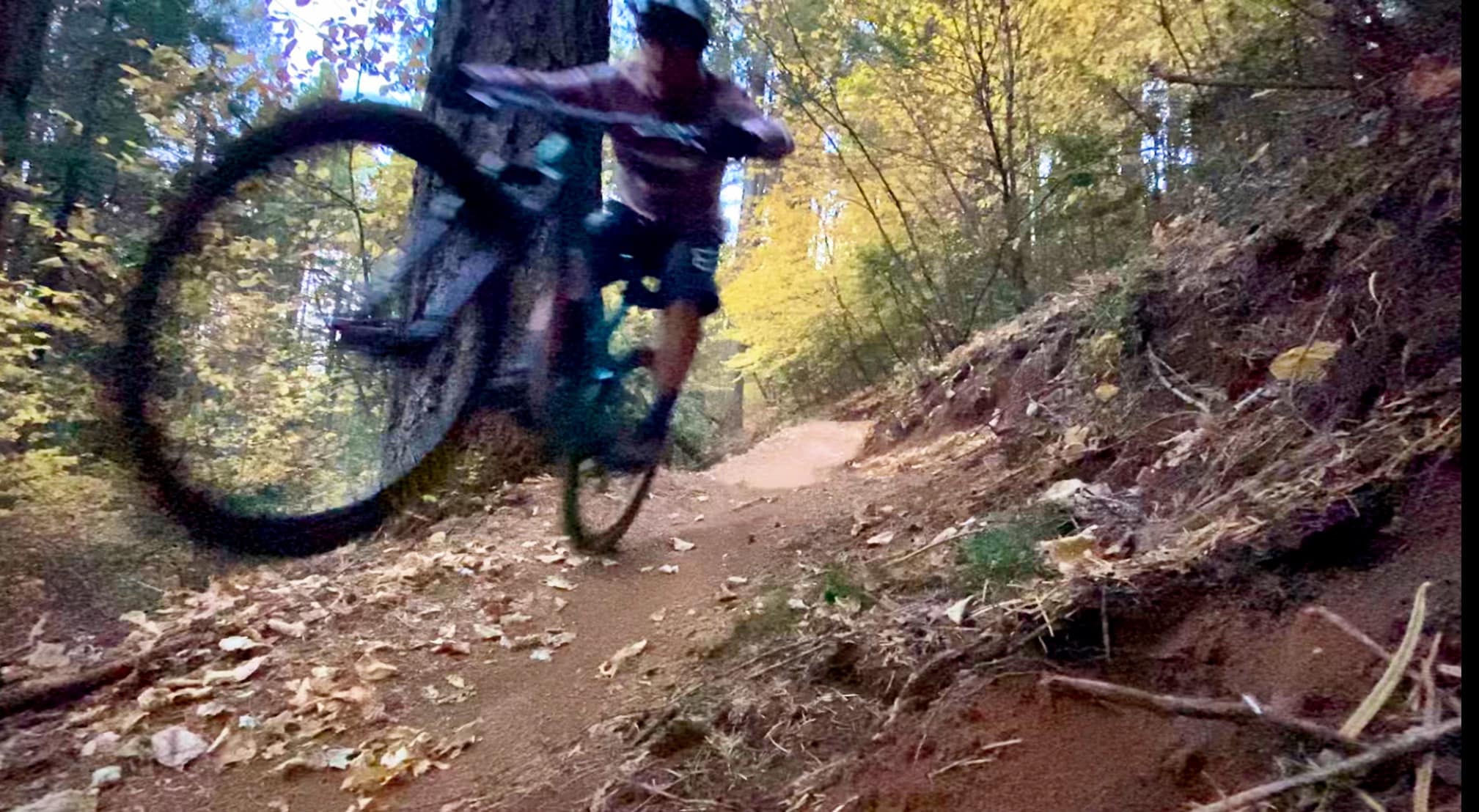
Fall is here in the west and it is one of the best times of the year for riding. Temperatures come down, the foliage is beautiful, if you enjoy mountain bike riding, the dirt is perfect, and you are probably carrying great fitness from a summer of training.
Use specific training targeted to your event so you can line up with confidence! Photo by Joan Mower
If you are preparing for cyclocross racing, it is important to be very specific with your training this time of year. You will use your summer riding as a base and add in the repeated sharp efforts required in CX. But if you are finishing a season of road or MTB racing and you don’t plan to race again until next year, now is a great time to be a little less specific with your training. If you have followed a training schedule all year, let the structure go a little. Ride how you feel and take some days off the bike to enjoy other activities; hiking, running, swimming, etc., as well as some dedicated downtime. In general, the further away you are from target events, the less specific you can afford to be with your training.
As you get into winter base building, you will want to add some specificity back in. You can include plenty of off-the-bike exercise to keep winter interesting but you will want to be riding three to four days per week if you have ambitious cycling goals next year. The fewer days you get on the bike per week, the more specific and targeted you need to be with your workouts. For example, you can use off-the-bike workouts to develop general aerobic and cardiovascular fitness but when you do get on the bike, you should have specific workout goals. For many cyclists a smart training program through the winter is the edge that allows them to achieve their goals during the summer.
Specific training means that your workouts target the specific demands of your goal event(s). You do not need to match the total duration of your event in training. If you can do about half of your expected duration in training, you should have the endurance to complete your event. Different types of events will have different fitness and skill demands and your training should reflect that. For example, for XC mountain bike racing, you need high intermittent power, the ability to produce near peak efforts repeatedly from threshold with limited recovery. For road racing, you need more endurance and the ability to surge and sprint with very fatigued legs. Depending on your goals for the event; shooting for a personal best, trying to complete an event, or be competitive in your field, etc, your training demands will also vary. As you approach your target events, the specificity of your workouts will increase.
A coach can help you plan when to make your training more or less specific through the year to match the ebbs and flows of your goals. Too much specificity at the wrong times of year results in burnout and too little specificity results in lacking peak fitness. Get it dialed in just right!
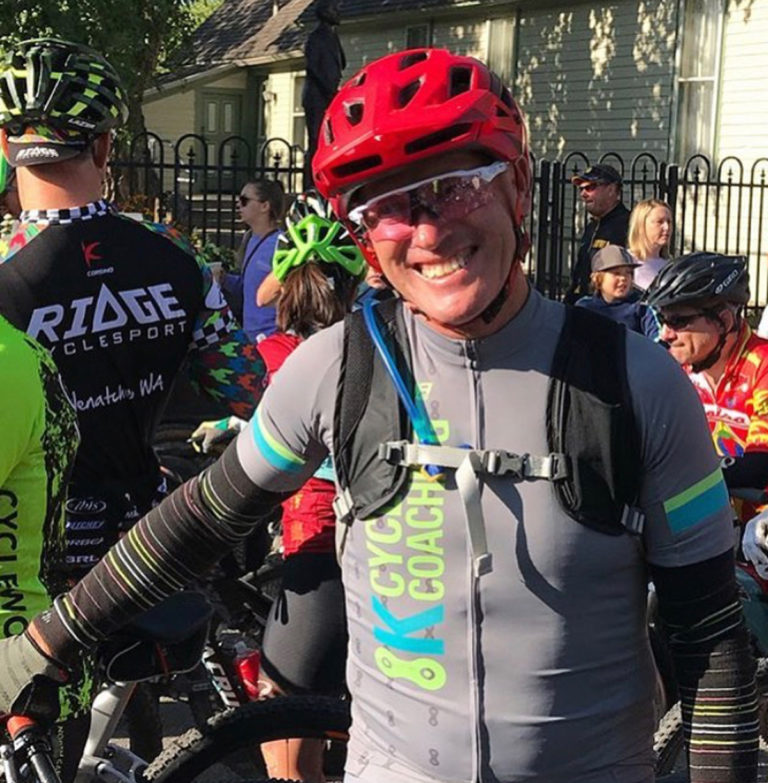
Sarah Kaufmann is the owner of K Cycling Coaching. She is an elite level XC and CX racer based in Salt Lake City, Utah. She can be reached at [email protected] or 413-522-3180.
STEAMBOAT SPRINGS, Colo. (Dec. 5, 2019) – SBT GRVL, a Colorado gravel bike event and celebration in the picturesque ranching town of Steamboat Springs, opened registration on Dec. 3 for year two and sold out in 25 minutes.
In total, over 700 women will ride SBT GRVL in 2020, a 75-percent increase from the 2019 event. Women comprise 30-percent of the field. All race distances sold out.
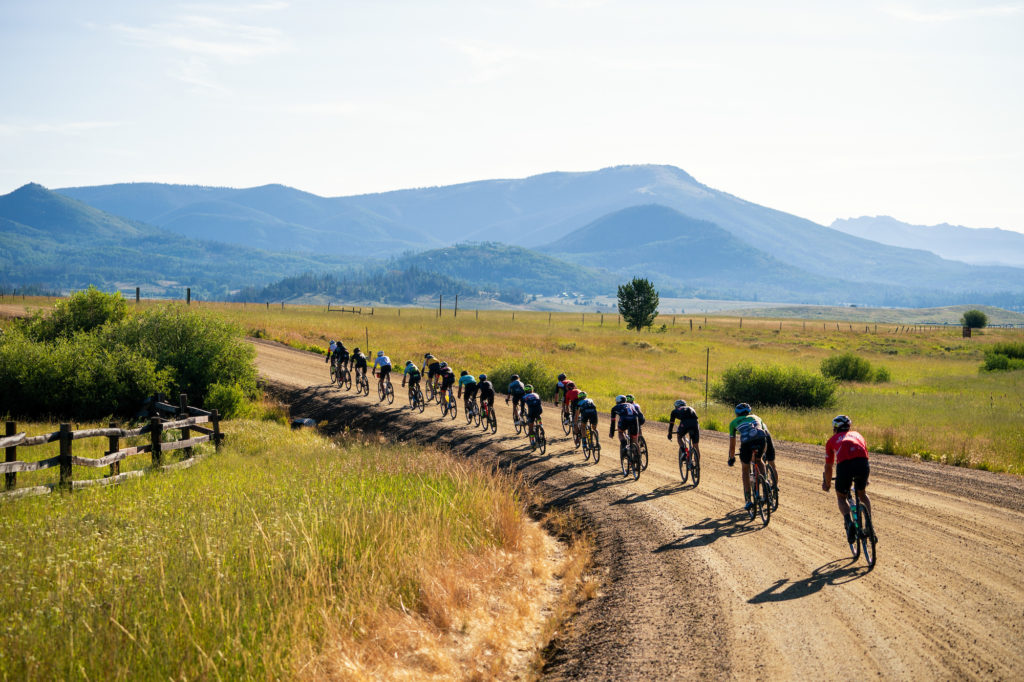
Riders participating in the 2019 Steamboat Gravel cycling race held near Steamboat Springs, Colorado. Photo courtesy SBT GRVL
Race co-founders and directors Amy Charity, Ken Benesh and Mark Satkiewicz point to an unwavering focus on the rider experience for the success. Immediately after the inaugural SBT GRVL event closed, participants were surveyed and the founders took action on what they learned. A new 64-mile course option was added, and new double and single track sections were added to the Black and Blue courses. SBT GRVL will continue to alleviate race -day stress in 2020 by offering incredible on course support with aid stations, volunteers, mechanical SAG support and fully marked courses for clear navigation.
“We continue to be blown away by the supportive community we’ve built since last year,” says Benesh. “There are a lot of gravel events out there, and we’re grateful to everyone who has committed to joining us again for the second year. We’re so thankful that we get to share this beautiful setting with top-notch gravel roads with people from all over the country and even abroad.”
SBT GRVL is excited to welcome riders from 48 states and 13 countries to its second year event. From the supportive volunteer crew to the scenic ranching backdrop, read why participants from year one are excited to return for SBT GRVL 2020 here.
“Organizing this event, we wanted to invest in the participant by taking any stress out of their day, so they can just enjoy the course, make some new friends and experience the beauty of Steamboat,” says Benesh. “This way, riders can have fun and perform at their best rather than worrying about whether the course is going to be marked or if there will be aid stations along the way.”
SALT LAKE CITY, Utah (December 5, 2019) — Burke “T-Bird” Swindlehurst’s Crusher in the Tushar will be joining the Life Time family of events starting in 2020, alongside notable endurance events such as the Leadville Trail 100 MTB and Emporia’s Dirty Kanza. Swindlehurst will remain at the helm as Crusher’s Event Director, but will now have the added resources and wealth of experience that the Life Time team brings.
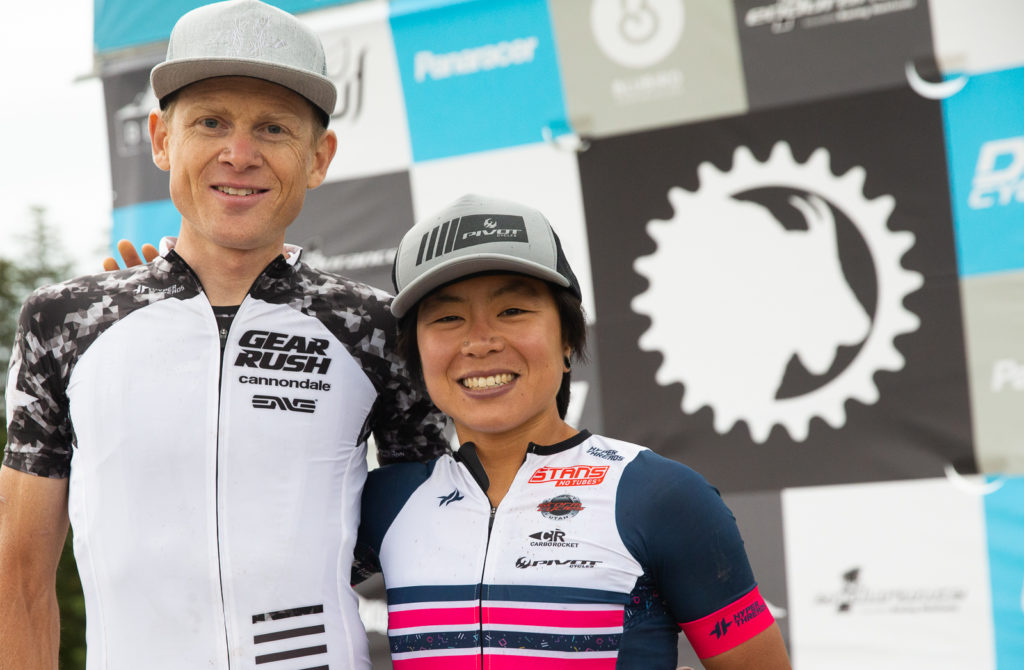
Your 2019 Crusher in the Tushar winners, Alex Grant & Evelyn Dong. Photo: Cathy Fegan-Kim
In an email sent to riders of past events, Swindlehurst says:
Before I spill the proverbial frijoles, I want you all to know that this news comes as the culmination of extensive soul-searching, counsel and consensus within our family. It was a decision that was not made in haste and was arrived at with one goal in mind: securing the future and legacy of The Crusher for many years to come.
It’s with great excitement that I’m proud to announce that Crusher in the Tushar will be joining the Life Time family of events!
I’m sure many of you are already familiar with the Life Time name for their role in producing such venerable events as the Leadville Trail 100 MTB in Colorado, the Chequamegon MTB Festival in Wisconsin, and more recently, the Dirty Kanza in Kansas. And with tremendous pride, the Crusher will join that distinguished list.
Before arriving at this decision, I was invited by Kimo Seymour, Life Time’s Senior Vice President of Media & Events, out to Colorado shortly after this year’s Crusher to get a feel for how they do things at the Leadville Trail 100 MTB. I went not only to observe, but also to participate in the race itself (my legs still hurt!) to get a feel for how the “rubber meets the road.” While there, I was able to meet Life Time’s Founder and CEO, Bahram Akradi, and I quickly learned he wasn’t in Leadville just to shake hands and kiss babies. He was there chasing his “Big Buckle,” a
distinction reserved for those having finished 10 LT100’s, which he did! I also learned that Kimo was racing that weekend to keep his own Leadville streak alive as the current holder for the record of most consecutive finishes under 8 hours, which subsequently now stands at 13.
That said, I had quite a few “takeaways” from Leadville, and the one that stood out the most is that these are people with a true passion for cycling. They don’t just talk the talk. They walk the walk. But, what really cemented the experience for me was seeing firsthand the amount of philanthropic and community enrichment that Life Time initiates within its host communities. These are good people doing good things. The upshot is that I left Leadville knowing that a partnership with Life Time will not only enrich the event for our riders, but it will also enrich the greater community.
I want you all to know that the heart and soul of Crusher is here to stay. I’m not going anywhere. I will remain at the helm as Crusher’s Event Director with Mrs. Crusher by my side. We will never forget our humble roots, and rest assured, we will continue to C*R*U*S*H you for years to come. Who knows, I might even be able to get out there and join you on the bike one of these years. I hope to see you in July!
As ever,
-Tbird
The 10th Annual Crusher in the Tushar will take place on Saturday, July 11, 2020 in Beaver, Utah. The date when Registration opens is still to be determined.
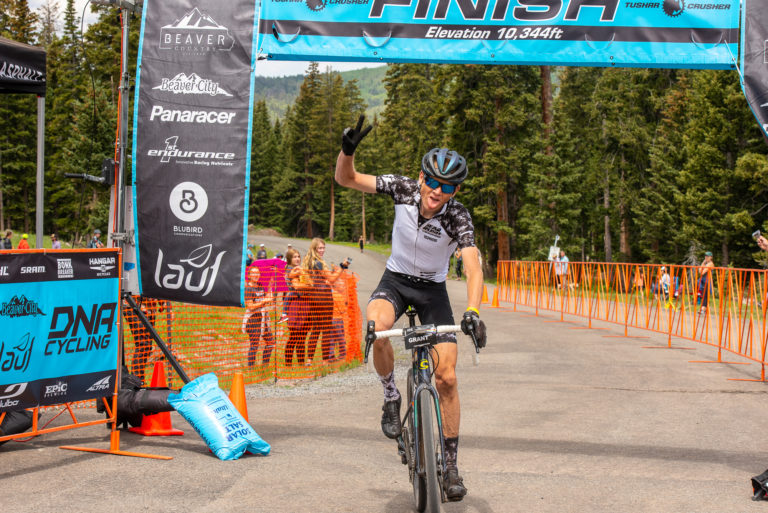
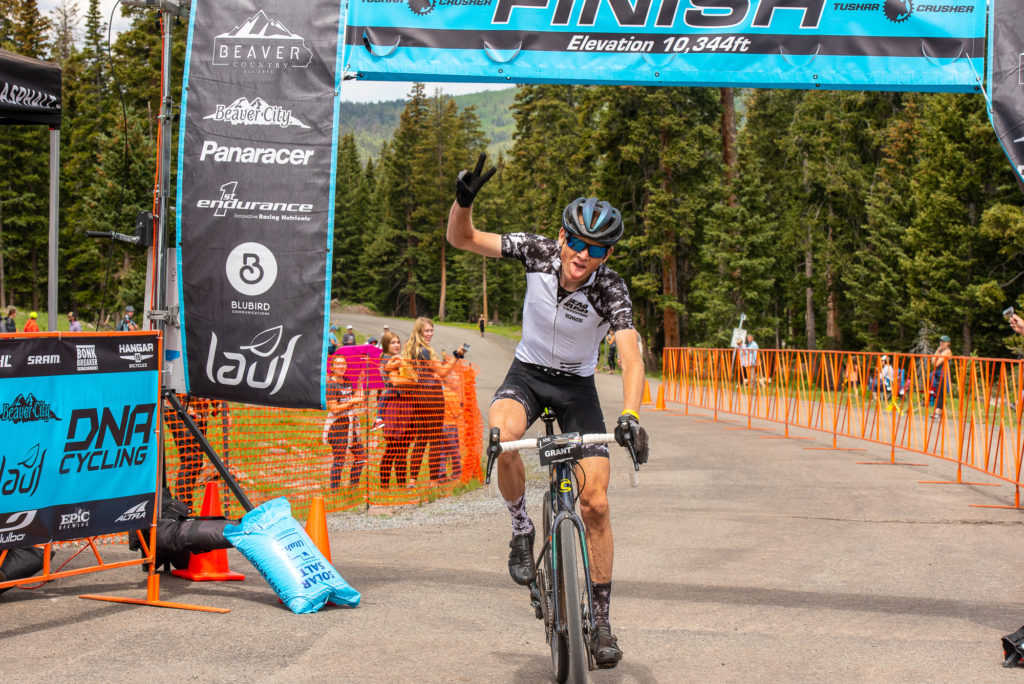
2019 winner Alex Grant raises an arm in a victory salute, as he crosses the finish line. Photo: Steven L. Sheffield
By Joe “Metal Cowboy” Kurmaskie – My Papa Wheelies Dad bicycle gang based out of Portland, Oregon met up along the Springwater Corridor near the Sellwood neighborhood. We were gearing up for an afternoon of wholesome fun. The plan: pedal our troop of eight cargo bikes, bakfiets and trail-a-bikes, totaling about 16-18 adults and children along a dedicated bike path for 8-9 miles until we reached Armstrong’s Berry Farm. One adult member of today’s gang is honorary – not a papa but a mama, but we’re casual and inclusive like that…
After much merriment and some uphill effort and a bit of traffic on the final mile push to the farm, we arrived in staggered waves of a minute or two. Josh (Baby Wheelie at 26 years young) and myself – referred to as Papa Bear or incorrectly mocked as Grandpa Wheelie, sometimes, since I’m the oldest at 48, but have no grandchildren, besides, I arrived in front with two children in tow, so suck it – reach the barn door and spill off the bikes. We are ungreeted by an elderly farm couple.
Josh offers up smiles and I toss out an “Afternoon.” Crickets and a grunted hello.
Josh lets them know we have a pack of cyclists bringing them business. I come in to the barn and lean against a table to have chat with the old man – New Mexico ranch style – nod, wait, wait some more, then speak.
“We just biked over from Sellwood.” He squints. I tell him that’s back in Portland by the river.
“You know they have this thing called a car now.”
I chuckle.
“And I own one, but try to let cobwebs build on it. Biking is so much more fun, better for us, the Earth…”
He grunts, folds up his newspaper and points up to the rafters. Three vintage bikes hang up there covered in cobwebs and missed opportunities. Nothing sadder than bikes three feet off the ground forever. That’s when the bulk of the Papa Wheelies roll through the gate and starts disembarking out by the blueberry patch. You hear laughter and a family fun vibe, like a ramshackle carnival has arrived.
“And here comes the rest of your profit center for today.” I gesture at the gang.
That’s when the elderly woman who is preparing weighed containers for us to use turns and says. “I hate bike riders.” Then the old man chimes in. “They run stop signs and get in the way. I don’t think you people should be allowed on the road.” I start in about how there are good and bad road users in every transportation mode….
“You’re just in my way.” He adds before I’ve even completed a thought. I try to stay reasoned and calm, but as I start to get angry, something happens… I just feel bad for these two aging dinos with bitterness in their hearts. I do the unthinkable for Joe Kurmaskie, even five years ago.
I walk away.
I head over to the gang, still deciding if we should still pick there or not… when I hear the woman say something to Josh. He was telling her that this group are all dads and moms and we try to follow the rules and be safe for our children.
She cuts him off with, “You bikers make me so angry I’d like to run all of you over… and your kids.”
Josh marches over to us. I’m already taking blueberries out of some of the kid’s hands. I say. “We not gonna play Sun City (apartheid musical protest reference, for the younger generation, Google it).”
Josh and I tell the gang what just happened. We all look back at the old folks who stand there like statues as we pedal a couple hundred dollars worth of blueberry money back out the gate.
We regroup at the front of their entrance – take a thumbs down photo of their sign and look up where another reasonably close farm might be. Turns out Josh remembered one very close – he pedals up the hill ONE block – paradise – Powder Blue Berry Farms – Like a scene out of the Coen Bros’ O Brother, Where Art Thou where they hear the sound of singing from the sirens down by the river – we roll up to a pack of fresh faced farm girls in tank tops and their Cougar mom – and a pair of strapping young guys getting on farm equipment.
“Don’t worry bout those old crabapples. We love bikers. That couple has just a small patch and we don’t see them as competition, but still they find out what the price of the berries are each set week, by the u pick group, then cut it by 25 cents to steal away business.” Cougar Mom rolls her eyes.
The next hour or two is spent in berry heaven. Kids running between the rows, faces covered blue. Farm animals the kids look at. The gals gave us frozen ice cream containers to pack home more berries for the freezer.
Instant Karma on the bitter harvest down the road. I felt pity that they’d grown brittle and hollow and forgotten what it means to be kind, no matter how people arrive at your door.
Like our berry farm friends on Facebook and they have the fattest berries for the taking each season!
Cram for the LOTOJA? What a ridiculous idea. But what could I do? On June 3, three months before the LOTOJA, I had hip replacement surgery. So for the next month I was off the bike. Not good preparation for a 206 mile bike race.
But can I say right now how good my hip feels? I had heard before my surgery that the first thing I would notice was the pain was gone, and that was true. A few days after surgery, while crutching it with my wife and daughter on a short walk, I turned to them and said, “Can I just tell you how good my hip feels?” Indeed, I now tell people it is the best part of my body.
Two riders from the Wounded Warriors Project take part in the Summit Challenge on August 24, 2013. Photo: Dave Iltis
Just a week before, we had gathered with our children over Memorial Day. I tried to be cheerful, but when you are in constant pain, it is hard. And it was depressing to be with those I love the most and not be able to enjoy it. This hip has given me renewed life in doing the things I like and enjoying being with those I love.
Anyway, I had my first real post-surgery bike ride, a 20-miler, on July 10. I felt like a slug, and was out of breath after a mile long section with a gentle incline. I thought then, “There is no way I am going to be ready for the LOTOJA.” This is not like a school exam. You cannot cram a sufficient amount of fitness into your body to last long enough to just get you through a single endurance event.
But I decided to soldier on, reserving my right to withdraw from the LOTOJA if the fitness was not there. So for the next month, I tried to ride more, but could not ride consistently due to work, family responsibilities, and a vacation. But finally, in August, I was able to get some consistent training, albeit a little late.
That brings me to the Summit Challenge held on August 24th. Prior thereto, I had been quickly trying to increase my mileage and the amount of climbing. A week prior, I rode 75 miles, including a climb up Big Cottonwood Canyon to the Brighton Ski Resort. As I crawled the final miles to Brighton, I remember thinking this was so fatiguing that I did not even want to do the LOTOJA. Once again, though, I revived my drive and talked my good friend, Elliot Morris, into riding the Summit Challenge with me the next Saturday.
So it was that we arrived at the National Ability Center (NAC) in Park City, the charity for which this ride was a benefit. I fully expected this to be a good ride as it was Cycling Utah’s “Event of the Year” for 2012. Also, I was looking forward to not doing as much climbing as I had the previous Saturday riding to Brighton. Clearly, I had not thought that through.
Consisting of three options (18, 62 and 102 miles), the route starts at NAC, does an 18 mile loop through Park City and environs and returns to NAC. For those doing a longer ride, the route heads to Kamas and includes a climb of over 1500 feet. From there, it heads to Heber City via the south side of the Jordanelle Reservoir which, from the east side, includes a 400 foot climb. The nasty secret though is that, after descending to and looping through Heber City and Midway, you have to climb back up the west side of the Jordanelle Reservoir, a climb of over 1000 feet. Then, after winding north through the Kamas valley, the route descends down to the base of Brown’s Canyon for the final climb which ends about a mile before the finish at NAC.
All told, and with all the rolling climbs in between, my computer logged 5400 feet of elevation gain. Not exactly the gentle ride I was expecting. But had I given it even a little thought or glanced at the map, I would have known better. I have ridden all these climbs before, and should have known what to expect.
But what a ride. We had perfect weather, partly cloudy and the temperature had been dialed down to make for a comfortable ride. The Summit Challenge takes in some of the most lovely farm and rural area one will find in northern Utah. And I had a good friend to ride it with who patiently waited for me after I lagged behind on the climbs.
And the organization was great. Packets were ready and quickly picked up. The volunteers at the start/finish and food stops were extremely friendly. And the peanut butter filled tortillas were a big hit, at least with Elliot and me. And as we crossed the finish, and we were among the stragglers thanks to a late start and lots of conversation and casual riding, volunteers were there to cheer us.
I need to make special note of the last food stop. We were tempted to skip this stop and just keep going as we only had about 10 miles left. But as we approached, one of the volunteers was blowing a whistle and calling out, “ice cold waterཀ” That was enough to convince us, and upon stopping we were promptly plied with the promised water, fruit, and snacks, and some very interesting and friendly folks.
After we finished, I spoke with Gail Loveland, one of the NAC staff charged with organizing this ride. They had over 600 entries this year, including nearly 70 participants with disabilities. To their credit, the ride is free for such participants. As Gail said, “We used to have them pay something, but then I thought, ‘This is who we are benefitting. We can’t be charging them.” Included among such participants I saw several hand cyclists, a trike rider and a recumbent tandem hand cycle.
The Summit Challenge was my final prep ride before the LOTOJA. Was it enough? Doubtful, but we shall see. My goal is to finish, but I am not confidant the body will agree. At the top of the Salt River Pass, I shall likely know if enough is left in the tank to make it to the finish.
But even if I can’t finish the LOTOJA, the tradeoff is well worth it. My hip feels great, and I am enjoying life more than I have for at least a year. I nevertheless had a great time riding the Summit Challenge which, while used for training, has become the highlight of my abridged cycling season.
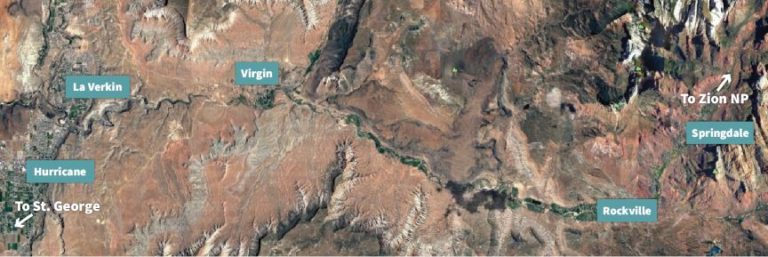
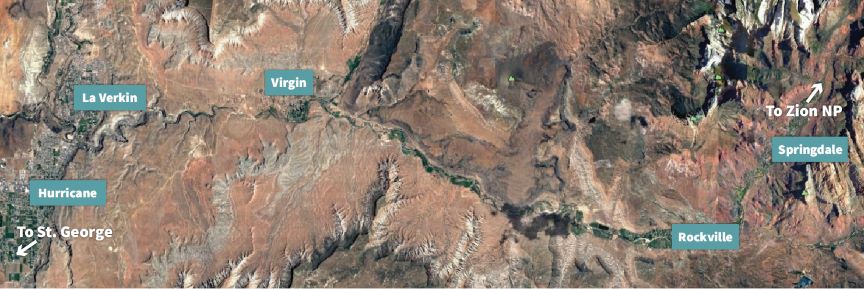
Are you interested in multi-use trails in Washington County, specifically between Hurricane and Springdale? We need your voice! The Zion Regional Collaborative — a group of local government, land managers, interested stakeholders, and residents working together to address issues in the Zion region — is working on an initial planning study to come up with feasible routes for a Zion Corridor Trail from the Hurricane / La Verkin area to Springdale, near the entrance to Utah’s Zion National Park — a distance of 22 miles. At this point the Collaborative has draft trail routes to get your input on.
Please click on THIS SURVEY LINK to learn more and provide your input on the routes. Thank you for your time!
Map of the proposed multi-use trail, courtesy Zion Regional Collaborative.
By Bill Roland – Many avid cyclists throughout the readership of Cycling West may feel quite confident that having watched The Tour de France throughout July and perhaps other European Grand Tour events, they have a firm grasp on all the intricacies of the 2.HC events of the UCI Europe Tour. Not so fast my friends! May I introduce you to Carlton Kirby, employed by Eurosport and considered to be the legendary Tour de France radio voice commentating on the world’s biggest cycling races. Carlton has covered the Tour de France, the Giro d’Italia and Vuelta a España among many other cycling events. In this book, you will find out very early on that Carlton Kirby is far from your “just give me the facts” commentator.
After a quarter of a century, Carlton has accumulated legions of loyal fans who are drawn to his off the cuff wit, his excitable style, and his insider’s view to tell the radio listeners what is really going on and why. Along with Carlton in the commentary booth is Sean Kelly, referred to as “The King,” a nickname rightfully earned after seven times the consecutive winner of the Paris-Nice classic. Together they report every aspect of bicycle racing and exactly what is taking place in the current stage and in the minds of not only the team managers but the cyclists themselves. Carlton has established a reputation among the competitors and the fans that he possesses no fear to share with the listeners exactly what he saw take place. It might be an outstanding descent performed by an extremely brave rider taking tight corners at an atrocious speed or a sprint finish when an unabashed rider reaches wattage power that completely destroys a group of favorites over the final 200 meters.
Throughout much of the book, written by Carlton along with Robbie Broughton, the co-founder and managing editor of Ride Velo, the story is presented in a diary format throughout the 2018 Tour de France. In 2016, Robbie asked the managers of Eurosport if he could do an interview with Carlton for his @ridevelo site. A 20-minute appointment turned into a thoroughly enjoyable two hour conversation and Carlton admitted that Robbie hardly got a word in. Robbie asked if he’d ever thought of writing a book and Carlton said his life got very busy. A series of recorded chats were planned and scheduled into the season between races. Robbie collected Carlton’s thoughts into a series of chapters and by the end of the 2018 Tour de France, ‘Voila’ a book was in the making.
Perhaps the most intriguing aspect of Magic Spanner is the combined authors’ ability to share with the readers a great deal of interesting behind the scenes Tour racing happenings and events that never seem to to be recorded on the screen or leaked out via the news media. As an Englishman, it didn’t take Carlton very many pages before he highlighted the Five Lions of British cycling. In no particular order, he went into detail about the personalities and riding characteristics of Mark Cavendish, Bradley Wiggins, Chris Frome, Geraint Thomas, and Simon Yates. For each rider, several pages were dedicated to the intricacies of their riding style along with their personalities and how they communicated with the reporters. Carlton succinctly described approaching a rider for an interview. “Getting a good interview from a rider,” he explained, “after he’s just completed a grueling time trial, or spent four hours hacking up a series of mountains, is not easy. It takes a bit of finessing — not easy in a competitive environment. The finish line reporter has rivals in the hunt for the first reaction. Getting a handle on those around you as well as the target interviewee is difficult.”
Life on the road for a radio broadcaster, or for that matter, all working press members, is not peaches and cream, excellent vintage port wines, or masterfully decorated hotel rooms.Carlton described many transfer trips from the finishing line of one stage to the press center of the next. First of all, we must account for the thousands of staff members who bring the cycling excitement to our television screens. There are the race organizers, the police, the national sports bodies and sanctioning authorities along with the negotiation crew and the booking staff. Keep in mind, all of these workers are traveling simultaneously to the site of the next stage and Europe does not have a ribbon of interstate highways to transport thousands of people along with the barriers, cables, rigging, guidebooks — and much more. Carlton reminded the readers that the TV crew includes cars, tickets, passes, cameras, graphics, planners, producers, directors, lightening, sound, make up crews, and much more. When you factor in each racing team and all of their equipment including cars, buses, bicycle mechanics and their gear, it’s more like a traveling circus than we might have imagined. Oh, and let’s not forget the team chefs and catering staff members who have the responsibility of providing each contestant at least 6,000 calories a day to cope with the physical torment of a regular racing day. All of us are familiar with the bonkers or running out of fuel. Feeding these cyclists is extremely important and the timing of it is vital.
One of the most interesting and respected people that Carlton describes in the book is Patrice Diallo, a camera motorcyclist. “The guy is a genius,” Carlton writes. “Patrice can’t dance. But a motorcycle, in his hands, does. The finesse displayed by Patrice and his machine is simply remarkable. His ability to control his bike, while accounting for the added load and imbalance of a cameraman with all his kit, is remarkable. The platform he provides for generating pictures is as stable as they come, even on a highly technical, mixed surface descent. Every cameraman wants to work with Patrice. He is so experienced he knows when and where to go, how to get there and how to get out. It’s almost as if the cameraman just has to press the button because Patrice, with the lines he is taking, has the shot set up for him.”
Needless to say, this review is an extremely brief account of Magic Spanner. Which brings a question to mind: What is a Magic Spanner? That’s easy, just read the book and Carlton Kirby will tell you all about it!
Magic Spanner: The World of Cycling According to Carlton Kirby, by Carlton Kirby and Robbie Broughton (Bloomsbury Sport, 2019). ISBN: 9781472959867
By Jared Eborn — It was May 31 and I felt fabulous. Less than 24 hours earlier I was coming off one of those highs that come from an amazing workout.
I had just completed a 14-mile run and a 3000-meter swim as I trained for an Ironman distance triathlon a couple of months down the road. I felt on top of the world because the workout felt almost effortless – like I had turned a significant corner in my training and that I was in the best shape of my life.
Hitting my goal of 12 hours seemed a distinct possibility. But that was on May 30.
At about 7:30 a.m. on May 31, a full-sized Dodge Ram pickup truck turned through an intersection and changed those plans and goals. Though I was in my car at the time, and thankfully not on my bike, the impact was brutal.
My goal went from racing 140.6 miles in 12 hours, from enduring the Crusher in the Tushar, from a sub-11 hour LOTOJA … well, my goals suddenly became more simple but quite possibly just as painful.
24 hours after running 14 miles and swimming 3000 meters my new goal was to keep the plunger thingy in my respirator at 500 milliliters for two seconds. Well, that and to be capable of going to the bathroom without the assistance of the nursing staff at Intermountain Medical Center.
Two broken ribs, a Grade 3 ruptured spleen, internal bleeding, a partially collapsed lung and the assorted aches, pains and bruises that come from getting side-swiped by a pickup truck effectively ended my season before it really even began.
No more Crusher. No more Ironman. No more LOTOJA. Heck, no more riding or running at all. After a weekend in the Shock-Trauma Intensive Care Unit my doctors told me I needed to take three months off any vigorous exercise. My limit was lifting no more than 10 pounds – roughly the equivalent to a gallon of milk and about four pounds less than my bike.
Yippee!
So what’s my point? Well, after a month or three of losing fitness and gaining weight – I went from 189 pounds to 202 at last check – I’ve finally received the green light from the doctor to resume training and racing.
All healed up but back to ground zero in many ways. I doubt there’s a 14-mile run in my near future.
That said, the handcuffs are off and the bike is no longer collecting dust on hooks in my garage.
And, like many other endurance athletes of various skill levels, after an injury-forced sabbatical from exercise, I find myself eager to get back to the lifestyle I had to abandon.
Over the next several months I’ll write about my road to recovery.
Though not a highly-competitive athlete, I enjoyed racing and found myself on a variety of age-group podiums at triathlons and even surprised myself with a top-10 finish in a few C Flight criteriums out at Rocky Mountain Raceway or in the Saltair Time Trial.
My goal is simple – to return to a level of fitness where I not only enjoy racing my bicycle, but also experiencing a little bit of success.
Traumatic injuries happen to athletes of all varieties. Some injuries happen when a pickup truck sends you to the ICU, others involve torn tendons, ligaments and muscles.
Recovery is a funny thing. It’s never the same for any two endurance athletes but at the same time most of us can relate. We know there’s a piece of our soul that’s missing and the only way to reclaim is just might be a long, labor-intensive process.
With the help of Plan 7 Endurance Coaching and David Harward, I hope to use data from power tests, lactate tests and VO2 Max tests to see how that recovery process will be.
After an short session on the bike with a computrainer tracking my power output, I know my journey back – to what, I don’t know – will be an experiment.
My 15 minutes on the bike with Plan 7 had me sweating and struggling to breath while sustaining what would have been an extremely easy cool-down ride.
I hope the journey proves to other athletes recovering from injury that it’s within reach. Injury, not even the kind that wipes out an entire season of plans and races, need not be the end of the road.
Rather, it can be an opportunity to reflect and renew the drive inside.
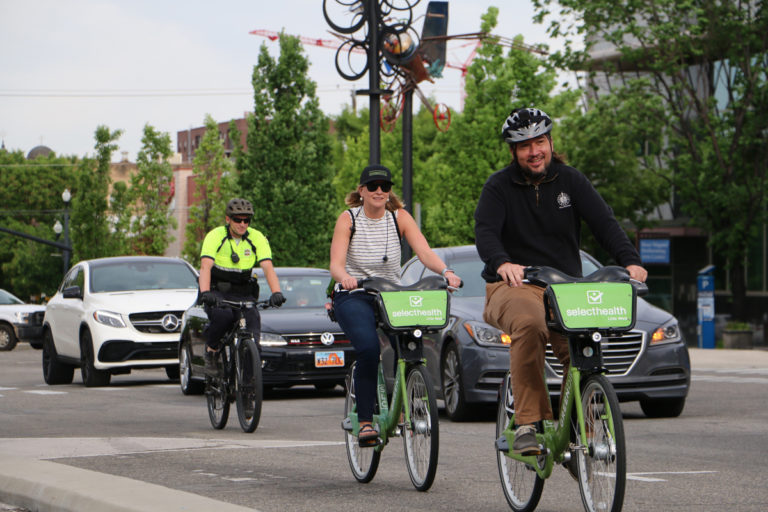
SALT LAKE CITY, Utah (Nov. 26, 2019) — On Saturday, Nov. 30 SelectHealth will sponsor all rides using GREENbike, Salt Lake City’s non-profit bike share system, for the final FREE Ride Day of 2019.
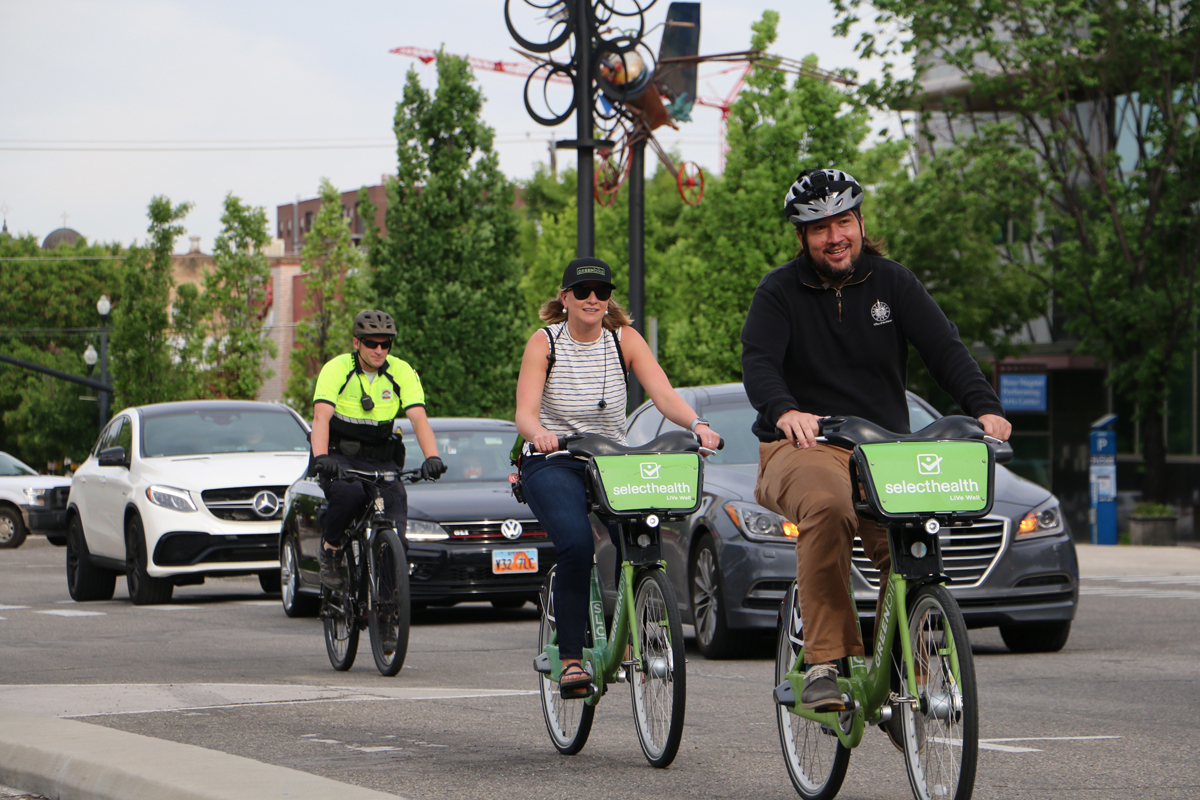
Matthew Rojas and Anna Loughridge ride Greenbikes during the 2019 Mayor’s Bike to Work Day. On November 30, 2019, GREENbike Bike Share will be free in Salt Lake City with code 2019. Photo by Dave Iltis
On Saturday, all Salt Lake City residents and visitors will be able to ride GREENbikes for free by using the promo code “2019” at any GREENbike kiosk. Riders can take as many 30-minute trips as they want during the 24-hour period.
“SelectHealth is invested in our community. Supporting air quality, recreating, and getting around town are some of the benefits of riding GREENbikes. Enjoy a free ride day powered by SelectHealth,” said SelectHealth Public Relations Manager Greg Reid. “GREENbike supports our mission of helping people live the healthiest lives possible.”
Over the past six years, the GREENbike program has offset more than 4.7 million pounds of carbon dioxide from entering the air and avoided more than 5.2 million vehicle miles from impacting local roads. GREENbikers burned nearly 72 million calories—roughly 252,000 slices of pizza—in the process. The local non-profit bike share system is dedicated to offering the community an affordable, convenient and sustainable transportation option.
“We’re happy to be able to offer folks the opportunity to try out our system, especially the 50 new e-bikes we added in August,” said GREENbike Executive Director and Founder Ben Bolte. “We’re grateful for the generosity of SelectHealth. We wouldn’t be able to offer these rides without SelectHealth’s support.”
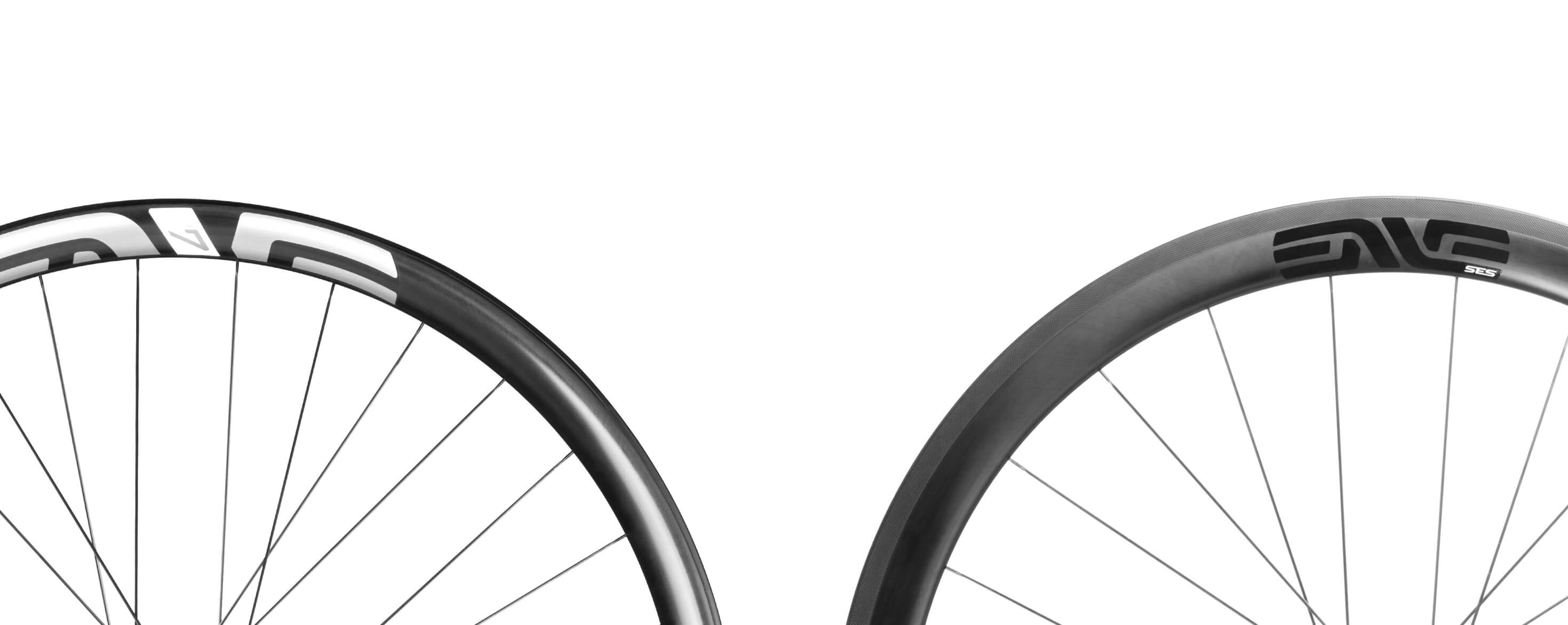
OGDEN, Utah (November 19, 2019) — ENVE is pleased to announce that their Trade-In, Trade-Up carbon wheel upgradeprogram is back for a limited time. This program allows current and aspiring ENVE consumers to trade in their used ENVE or Other brand carbon wheels, and upgrade to ENVE’s latest M Series, G Series, and SES wheel technologies.
Here’s how it works. Customers trading in an ENVE wheelset will be extended a $900.00 credit towards the purchase of their new wheelset, while those trading in Non-ENVE carbon wheels will receive a $600.00 credit. The Trade-In, Trade-Up program allows consumers to participate through one of ENVE’s Retail Partners or directly through ENVE’s website.
The 2019 ENVE Trade-In, Trade-Up Carbon Wheel Upgrade program will run from November 19th, 2019 until January 3rd, 2020 and is available to US customers only. As a Black Friday Special, ENVE is extending the offer to include a $600.00 credit for alloy wheelsets from November 27, 2019 until December 2, 2019 only.
ENVE’s Trade In ,Trade Up Program runs through January 3, 2020. Photo courtesy ENVE.
“Last fall, we had what seemed to be a crazy idea. The concept was that we were going to offer to buy back the ENVE customer’s previous generation wheel product to incentivize upgrades to our latest and greatest M Series mountain wheels. Our primary motivation was to move customers from old technology to new as the latest M Series wheels truly leapfrogged the previous generation, as well as our competition’s wheel offerings, in a material way as it relates to performance. To be specific, the new M Series is more durable, delivers a more refined ride feel, and eliminates the dreaded pinch-flat. While M Series was the focus, the story is the same for our latest SES and G Series wheel lineups. In the end, the program was a success, so much so that we’re bringing it back,” commented Jake Pantone, ENVE’s VP of Product and Consumer Experience.
Since ENVE introduced this program in 2018, many aftermarket wheel companies have launched upgrade programs, but none of these programs have allowed customers to trade in wheels from other manufacturer.
“The objective of this program is simply to give more riders the opportunity to ride and experience the ENVE difference – to know firsthand that not all carbon is created equal. In practice this means that some riders are trading in their wheelsets for ENVE’s latest technology, while others will be purchasing a used wheelset that was traded in and experiencing ENVE for the first time as a second-hand owner. For both customers, it is our intention that the ride experience will be their best one yet,” commented Managing Director, Jeremy Venz.
After last year’s program, there were many questions related to what happens with the used wheelsets that are traded in. Pantone commented, “Each wheelset that is brought in on trade is immediately evaluated and dispositioned to either be refurbished and resold, donated, or recycled. Many of our customers own perfectly good wheelsets that are sitting in their garages collecting dust. These wheels have become obsolete by way of advancements in axle standards, tire volumes, and the growth of disc brakes. The true beauty of this program is that we are providing a convenient outlet to put these dormant wheelsets into the hands of someone in need. Last year, wheelsets that were traded in on our program were donated to cycling programs in developing nations, to high school mountain biking, and developmental road programs. Ultimately, it is our goal to find a home for each wheelset brought in on trade.”
ENVE asks that if anyone has a specific charity that could benefit from used wheelsets in rideable condition to please reach out and your proposal will be evaluated.
By Mark Deterline – A few years ago, after disappointment in the quality and service provided by a clothing supplier to our women’s and men’s elite bike racing team in Northern California, we switched to DNA Cycling. The entire team, especially our women, loved every thing about the clothing line, including the fit of the smaller sizes, the women’s and men’s specific insert pads and the technical performance of each item.
[Editor’s Note: Prior to his untimely death in July 2019, Mark Deterline coached some of Utah’s and California’s top cyclists, as well as triathletes, distance runners, cross-country skiers, motocross racers and boxers. This article was originally written in 2016.]
As owner and manager of the team, I loved working with DNA Cycling so much that I had my own brand’s custom clothing done by them, and have never been disappointed.
Am I sponsored or supported in any way by DNA? Nope. Do I stand to gain anything by promoting them? Nope. They advertise with this publication, but all of that was in place via the publisher long before I was hired as assistant editor. Am I personally partial to certain brands? Yup, as evidenced by my cycling team’s former list of sponsors — all longtime personal favorites of mine.
As a technical cycling journalist over many years for Triathlete Magazine, Lava Magazine, and as translator and sometimes online journalist for VeloNews, I had the opportunity to test many brands and models of clothing over several years, much of it excellent. Did I ever try anything I liked better than DNA? Never.
My association with DNA Cycling manufacturing quality actually goes back further than my acquaintance with the company itself. While living in Italy and working in the famed cycling region of “il Veneto,” where bike companies abound, I had the opportunity to use clothing produced by Ronni and Donatella, who have formed a mutually beneficial collaboration with DNA Cycling, which now helps drive innovation in technical features and design.
One of the cool things about DNA Cycling is not the “what” but the “why.” Drive Marketing is a very successful custom corporate shwag designer and manufacturer, the company that founded the clothing brand. If you want a custom corporate clothing articles, bags, nicknacks, awards, utility products or pretty-much-anything items, you can call Drive Marketing. I have been to their offices for meetings, team launches, strategic marketing pow-wows and design sessions. I can’t be in there without thinking: Wow, that’s cool, I should have them do something like that for me.
So, DNA Cycling doesn’t exist solely to make money, but rather to do something cool that they are excited to do well — every day. They’ve invited me to go on bike rides, to come fit some of them on their bikes, to see what they’re doing in the way of products for women, and that might make my coached and team riders happier.
But don’t take my word for it, talk to cyclists — male and female, younger and older — who have ridden and competed countless hours in DNA Cycling products. Ask people who have worked with and for the owners whether they are driven, passionate people with integrity. Ask customers if DNA Cycling cares about female as well as male athletes; about handicapped, ill and recovering cyclists; about young people; and about events as big as Tour of Utah and as local as intermountain racing series.
And then, if you have the resources and energy to do so, try DNA Cycling products for yourself, so that you can decide for yourself. If you’re like me, some of your all-time favorite cycling clothing items will feature their label.
Along with my son, my daughter is the most precious athlete in my life. She loves her road bike, and rides hundreds of hours each year, either outdoors or indoors. You can’t fake comfort and performance when you spend that kind of time “in the saddle.” You can’t fake female-specific comfort and fit, and you can’t fake the pride you take in how good looking something is when you are an artist and aspiring fitness model. My daughter is always quite fond of the DNA Cycling products I buy her, and I want nothing more than to make her happy.
When I called one of the owners before writing this article, a guy I like very much and trust implicitly, I asked him how he would break down for readers what motivates him and his business partner, who is a favorite designer of mine. His response was, “Mark, here is our goal, the big story: We want cyclists to forget about their effort and everything they are using as products and LOSE THEMSELVES IN THE RIDE, which is, after all, what it’s all about.” The other thing he emphasized was the pride they take in infusing that concept with a lot of history and tradition combined with innovation, such as new patterns, fabrics and designs.
I am a bike fitter, an ergonomic bike saddle and footwear advocate, and a coach who spends a lot of time and energy helping people get stronger, faster and achieve their athletic dreams. One of the ways I like to sum up success in equipment fitting and fitness is by stating that, “The bicycle and all components must disappear beneath you. There is a start, a finish and there are often competitors, with nothing but effort and smarts between you and the desired outcome. Once there is nothing but you and your will in space and time, you’re on your way.”
So, if DNA Cycling claims to offer the opportunity to lose yourself in your rides, and you haven’t find that yet with other clothing, this brand is probably worth a try.
The 60th Annual Nevada City Classic, the second oldest continuously run Pro-Am criterium in America, will be held on Sunday, June 14, 2020 as part of a weekend filled with cycling-related events around Nevada County, California. Events occurring on Saturday, June 13 include the Rotary Gold Country Century Challenge, the Big Brothers & Sisters Gravel Race/Ride, the 2nd Annual Nevada City Fat Tire Festival, and the 3rd Annual Nevada City Brewfest.
Saturday’s Fat Tire Festival celebrates all things dirt; Mountain Biking, Gravel/CX and Bike-Packing, with an evening street fair full of popular industry vendors and more.
Nevada County is chock-full of cycling from gravel rides & mountain biking to the Nevada City Classic Criterium. Add to this a Fat Tire Festival and Brewfest and you’ll have a fantastic weekend June 13-14, 2020. Photo courtesy Shane Scrimager/Nevada City Fat Tire Festival.
Cyclists can spend the day riding the Big Brothers & Sisters Gravel Race/Ride or part of the world-class Nevada City MTB Trail System, before heading to the Festival and Brewfest Saturday evening.
Sunday kicks off with the Kid’s Bike Parade, followed by the 3rd Annual Nevada City Classic “Mile” Run, which will allow the top runners from around the West Coast to test their sneakers on the same challenging course cyclists will race on later that day.
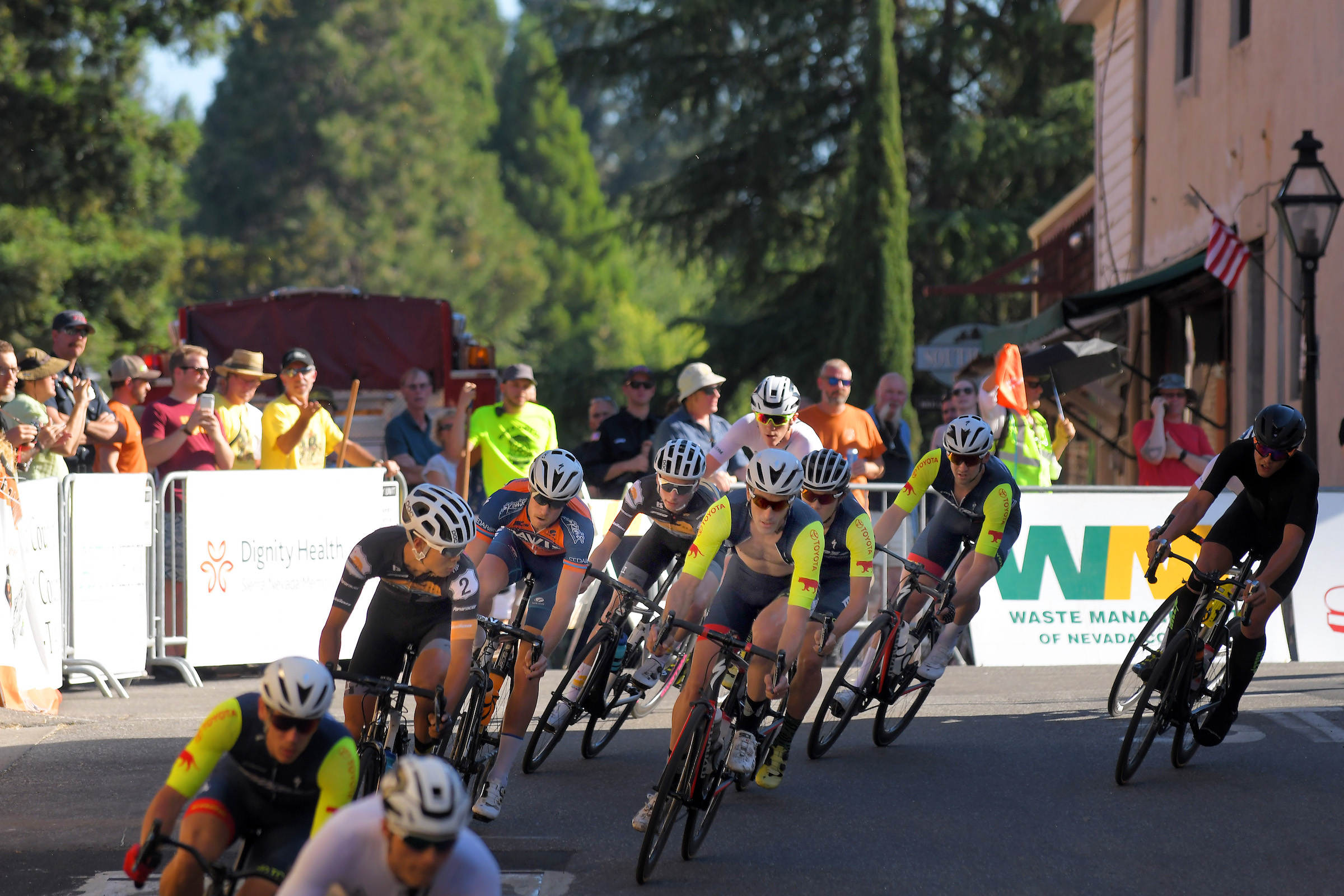
Nevada County is chock-full of cycling from gravel rides & mountain biking to the Nevada City Classic Criterium. Add to this a Fat Tire Festival and Brewfest and you’ll have a fantastic weekend June 13-14, 2020. Photo courtesy Nevada City Classic/Kris Wakefield
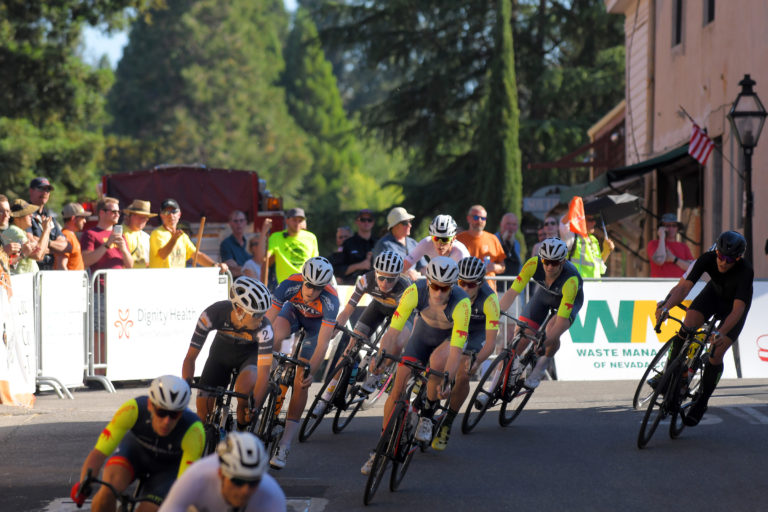
The Nevada City Classic Pro/Am Criterium boasts a demanding, scenic course, requiring racers to navigate sharp high-speed turns on the narrow Gold-Rush era roads, climb steep hills, and speed down the famous Broad Street descent past postcard-beautiful Victorian homes. Past victors include John Howard (1970), 3-time winner Greg LeMond (1979-1981), Todd Gogulski (1986, 1988), Olympic Gold Medalist Alexi Grewal (1993), 4-time winner Scott Moninger (1994, 1997, 1999, 2006), Levi Leipheimer (1998), and 2-time winner Ian Boswell (2010-11).
Watch for more exciting news to come as the 60th anniversary of this great bicycle race nears.
Salt Lake City is Starting the Process to Reconstruct 100 S – No Bike Lanes Are Planned
Editorial and Analysis:
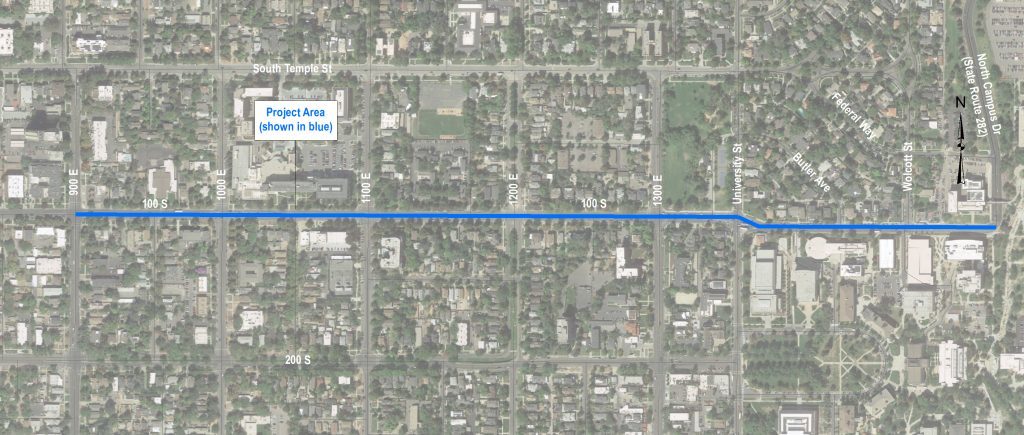
Salt Lake City is preparing to reconstruct 100 S between 900 E and N. Campus Drive on the University of Utah Campus. The roadway is a major corridor for those driving to the University of Utah, especially the health complexes. Will the street be reconstructed according to the Complete Streets Ordinance of 2010? At the Salt Lake City Bicycle Advisory Committee meeting on November 18, 2019, city transportation planning staff stated that bike lanes are not planned for the project except for possibly between 1300 E and N. Campus Drive. This is a clear intended violation of the Complete Streets Ordinance as we will discuss below.
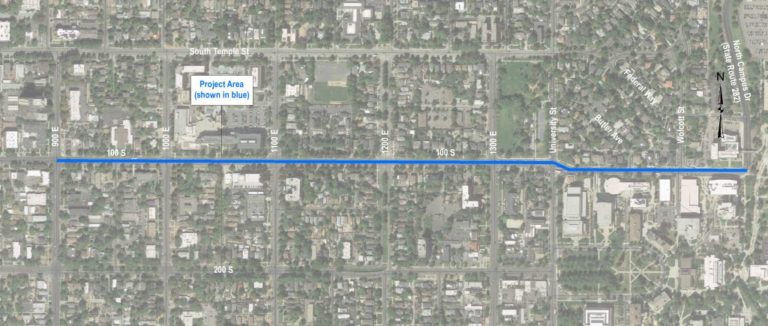
Salt Lake City is preparing to reconstruct 100 S between 900 E and N. Campus Drive. Map from project webpage
Advocacy Alert – Take the Survey by December 6, 2019 and Submit Comments on 100 S.
Salt Lake City is seeking community input for the rebuild of this street. Proposed changes are to be determined, and may include some changes to intersections, sidewalks, curbs, pedestrian crossings, bus stops, road striping, driveways ramps, and/or parking. Community input will be shared with the design team as we develop the draft concept in the next few months.
The survey does ask if one feels unsafe riding on 100 S. But nothing is mentioned about adding bike lanes.
The conclusion is that Salt Lake City does not intend to install bike lanes on 100 S.
Send an email to [email protected] or use our editable petition form:
[emailpetition id=”4″]
100 S in this area is currently is a 4 lane road, mostly with no center turn lane. The roadway is in a state of disrepair, and hence is near the top of the list for reconstruction.
While we are all for maintaining and reconstructing streets in Salt Lake City, we believe that all streets should be safe and accommodating for all users. Currently, 100 S is not. It is accommodating to cars. It isn’t even great for the plentiful UTA buses that traverse the street.
The street like many in Salt Lake City has a 30 mph speed limit. Yet observationally, cars exceed this almost always. So what does this say about the street? 2 things. One, the speed limit is too high, and should be reduced to 25 mph since studies show that people actually do adjust their speeds based on the posted limit. “Lowering the speed limit by 5 mph on city streets can improve safety for motorists, pedestrians and bicyclists alike by reducing speeding, new research by the Insurance Institute for Highway Safety indicates,” states a press release on the IIHS website. Second, if roadway speeds are too high, the preferred method for reducing speeds is through better road design – a road diet with bike lanes is one great way to do this. 100 S is a perfect candidate for this change.
100 S and 1200 E in Salt Lake City. Pedestrian crossings need to be redone with bulbouts for safety and to slow traffic. Photo by Dave Iltis100 S and 1200 E in Salt Lake City. 100 S is a major bus corridor, but the conditions for buses are not great. Additionally, the lack of bike lanes makes it unsafe for cyclists. Photo by Dave Iltis
Salt Lake City has a Complete Streets Ordinance, not a sometimes we want to pay attention to it and sometimes not loose guideline for accommodating users other than cars. The 2010 Ordinance states, “All city owned transportation facilities in the public right of way on which bicyclists and pedestrians are permitted by law, including, but not limited to, streets, bridges, and all other connecting pathways, shall be designed, constructed, operated, and maintained so that users, including people with disabilities, can travel safely and independently. (Ord. 4-10 § 1, 2010).” The operative word is SHALL.
And, “A. Bicycle and pedestrian ways shall be established in the city’s new construction and reconstruction projects in the public right of way, subject to budget limitations, unless one or more of the following three (3) exemption conditions is met…” (For the exemptions, see the ordinance. None of them apply in this situation.
This requires that 100 S have bike lanes installed during the reconstruction process.
Cycling Utah’s Recommendations for 100 S:
Our recommendation is that a Road Diet be applied to 100 S. For most of the stretch being reconstructed, there are 4 lanes and no center turn lane and for all of it, there are no bike lanes. Shifting the street to 2 travel lanes, 2 bike lanes (preferably protected bike lanes), and a center turn lane would be optimal. Given the width of the street, better pedestrian crossings could be installed, as could better boarding zones for people riding the bus. Lower the speed limit to 25 mph, and narrow the travel lanes too to 10 feet. Add some pedestrian bulbouts at 1000 E, 1100 E, and 1200 E (that don’t interfere with the bike lanes). Add some pedestrian islands, and some center of the road landscaping.
Why do this? The University of Utah is the largest single commuter destination in the state. To continue on the same path by encouraging everyone to drive to the U is not sustainable. The only way out is to improve walking, biking, and transit to the U, in that order.
Edited: It has been brought to our attention that this is one of the main emergency routes to the University of Utah hospital. If a road diet is not possible, there is likely room to keep two lanes in each direction, and add bike lanes too as the road is very wide.
Additionally, Salt Lake City should go back and fix its past violation of the Complete Streets Ordinance, and add bike lanes on 100 S between State Street and 600 E, which is about the area that was repaved during the Becker administration.