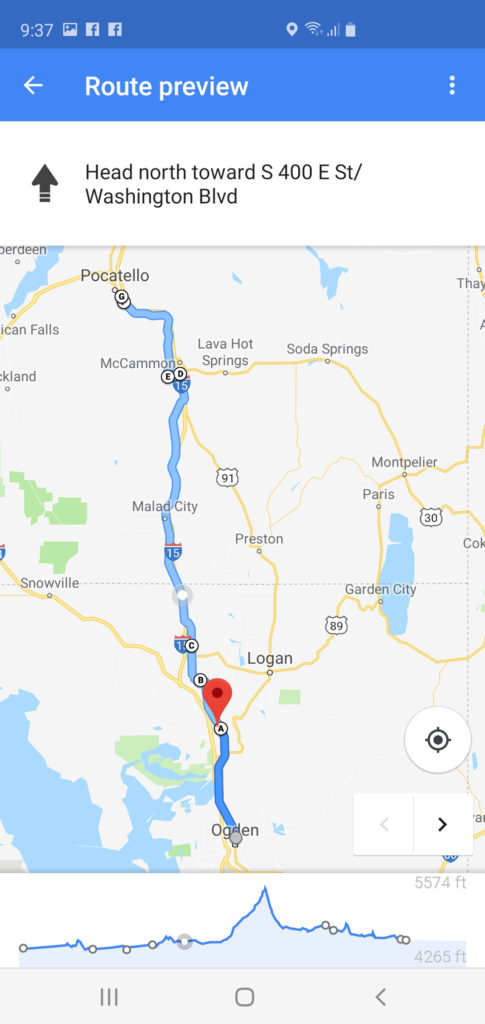
I am an Idaho boy at heart, having been born and raised in Tyhee, a small farming community sandwiched between Pocatello and the Fort Hall Indian Reservation. So when my brother, Nick, came up with the idea to do a one day ride to Pocatello, I was all in.
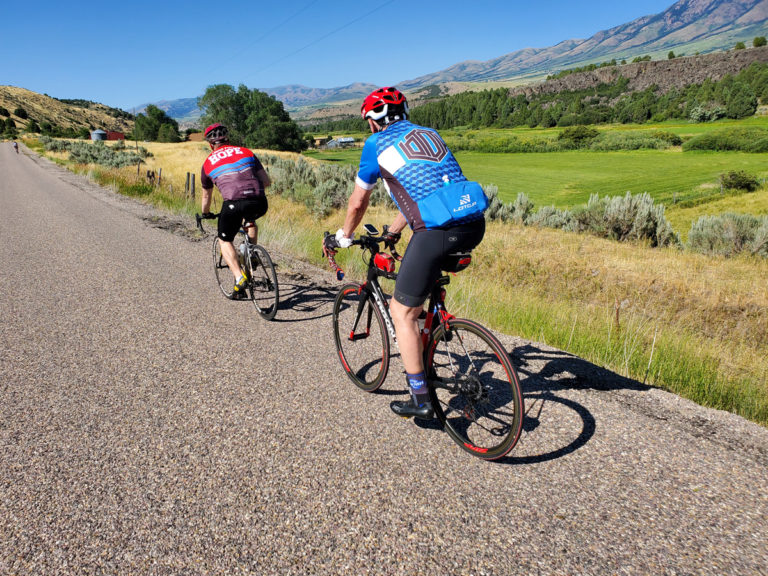
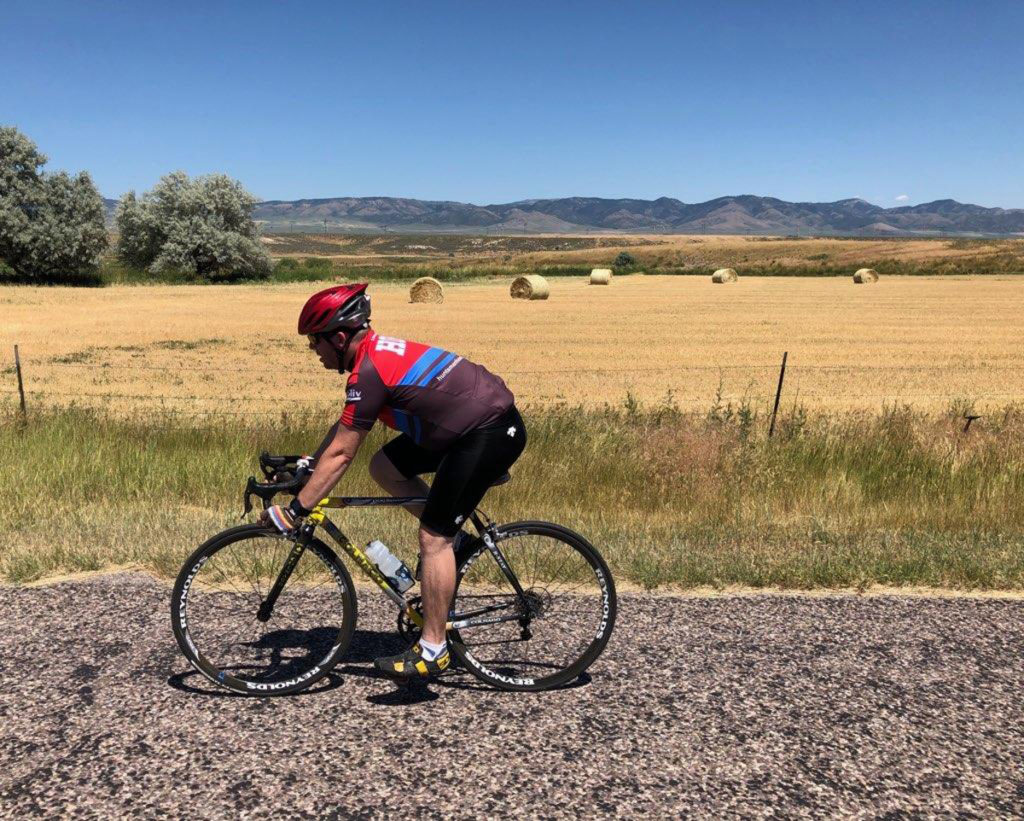
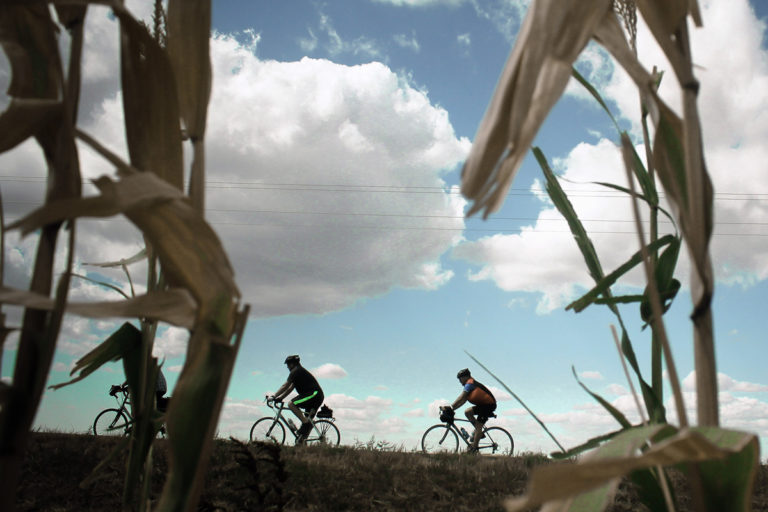
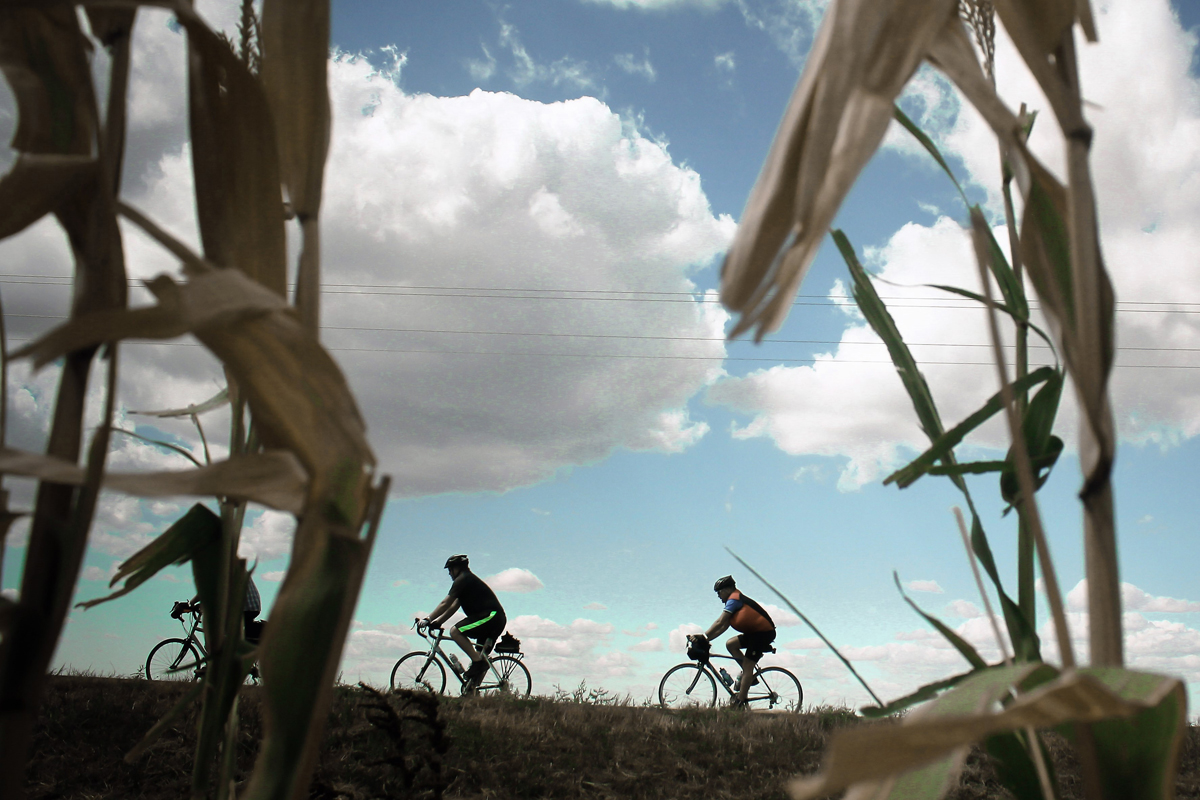
Kimball Ward on the bucolic roads of the Potato Run. Photo by Nancy Ward
Nick and I have a small group of family and friends we ride with, affectionately known as the “Studs and Former Studs”, a team name we adopted for the LOTOJA. “Studs” is for the young, strong guys, and “Former Studs” is for the guys like Nick and me who are way past our prime, if we ever had one. In truth, maybe we should use the term, “Never Were Studs”. And on the topic of our team name, now that we have women participating in our group, we should probably include the term, “Studettes”. Enough of the name stuff.
Anyway, Nick came up with this idea, and several of our team decided to do this as a training ride for the LOTOJA. So, we scoped out a route from north Ogden and on August 6, 2016, after begging some spouses to provide support, we held what turned out to be our 1st Annual Potato Run. Why “Potato”? Because Idaho is famous for its potatoes. Duh. And why “Run” instead of “Ride”? Good question. Probably because whoever came up with the name was euphemistically thinking of “making a run to Idaho for some potatoes”. Anyway, the name has stuck, and I think we all like it.
So on this last July 20th, seven of us set out around 6:30 a.m. We made our way through Pleasant View and on to Highway 89. As we rode past the cemetery in Willard, I turned to my son, Kimball, and said, “Put your hand over your heart. We are riding past your great, great, great grandfather’s grave.” George Welton Ward, a convert to the LDS church who emigrated from England, was sent by Brigham Young to settle the Willard area. So, a little piece of heritage.
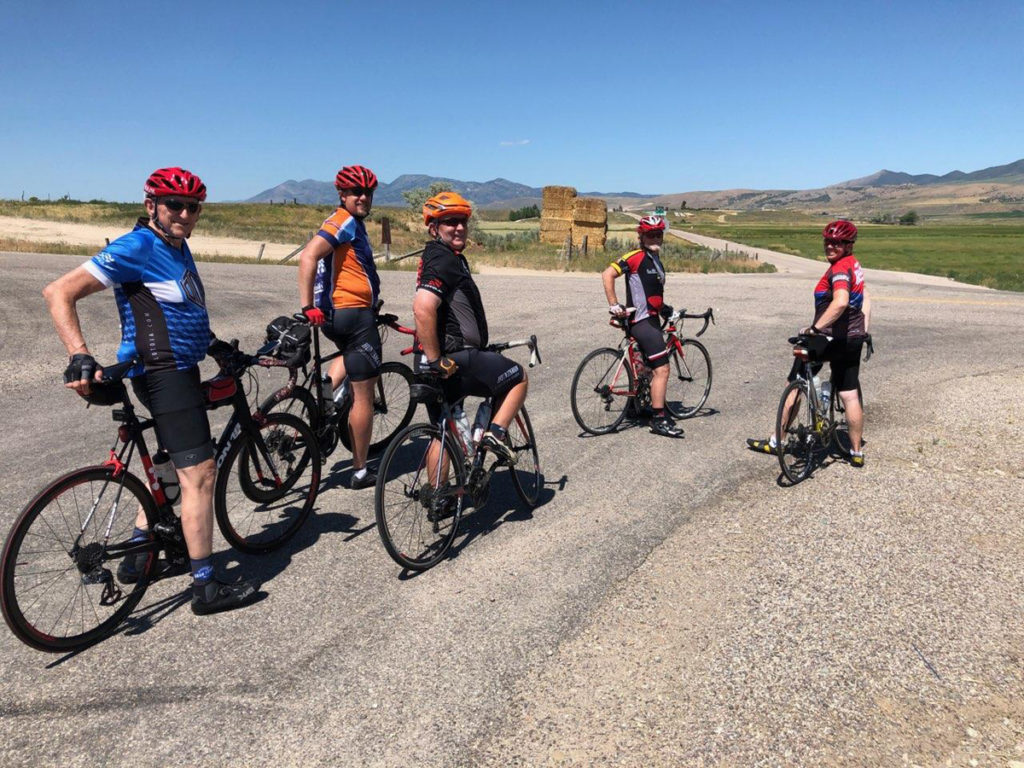
Paul Spilker, Ryan Whittaker, Nick Ward, David Ward, and Kimball Ward on the 4th Annual Potato Run from Ogden, Utah to Pocatello, Idaho. Photo by Nancy Ward
From there, we rode through Brigham City and Honeyville, and on to Deweyville, a really nice stretch of rural beauty, where we turned and made our way to Tremonton and on to Riverside for our first stop. After fueling up, we rode on to Plymouth, crossed under 1-15 to the west side frontage road and continued north. Just before crossing the border into Idaho, we passed the small community of Portage. Hand over heart again, as Portage is where my grandmother, Marinda Irene John, was born and raised. A second little piece of heritage.
As we crossed the Utah/Idaho border, Nick celebrated our heritage by breaking out into the Idaho state song, “And here we have Idaho, winning her way to fame. . . .” I joined in, but needless to say it’s hard to carry a very good tune with labored breath from pedaling our bikes. Our riding partners just smiled.
Just past the border is the small community of Woodruff. I again told my son to put his hand over his heart as we passed the home where my grandfather, Richard Alvin Ward, was born and raised. My great grandfather, George Ward, son to George Welton Ward, had moved from Willard to the Malad Valley. A third piece of our heritage.
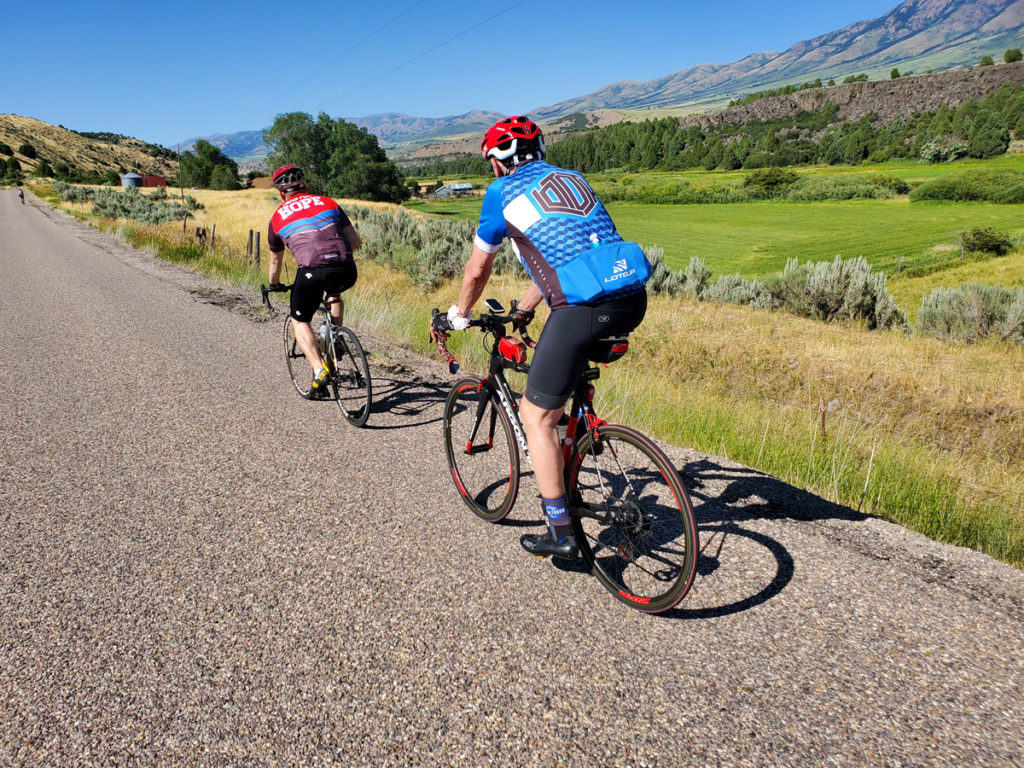
Kimball and Paul on the Potato Run. Photo by David Ward
As an aside, and another piece of our family heritage, my grandfather, then a young man, drove a horse and wagon from Woodruff to Portage to pick up my grandmother, after which they continued on to Logan where they were married in the LDS temple. Family lore has it that when he picked her up, she was crying. He offered to call it off, but she declined, and here I am two generations later. As a further aside, Richard and Irene moved to Sterling, Idaho and later to Tyhee. And that is how Nick and I ended up being raised there.
Back to the ride. After Woodruff, we came to Malad where we had our second main stop. I have to confess, I had been having some intestinal issues since early on, and made a quick dash to a gas station to use the restroom facilities. After our feed stop, I had to make another quick dash to the gas station. Thankfully, my intestines then settled down for the rest of the day. Despite those issues, the legs were feeling really good, so it was kind of that odd situation of not feeling so well in one way, while my legs were going well.
From Malad, it was on up to Devil Creek Reservoir and then a scenic climb from there to the top of the Malad Summit. At that point, we got our only real downhill, about a one mile stretch of tuck and cruise. At the bottom of that hill, we swung to the west side of I-15 again and then angled across the valley to our final feed stop in Arimo.
Up to this point, we had mostly ridden through open farmland surrounded and divided by large stretches of mostly sagebrush. But for a southern Idaho boy, that is almost like riding through the promised land. The smell of sagebrush and alfalfa, the songs of meadow larks, the sound of sprinkler pipe in the fields and the vast stretches of semi-arid country mixed with large fields of potatoes, alfalfa, wheat, sugar beets and various other crops brought forth the sweet memories of my youth, and tender emotions of growing up among good people in this semi-arid yet fertile countryside.
More was yet to come, though. From Arimo, we swung back to the west side of the valley, crossing the Portneuf River and hooking up with South Marsh Creek Drive. This little used road, and little known except for the locals, meanders alongside Marsh Creek which flows alongside a black wall of ancient lava flows with rising mountains further behind. Between the road and creek is lush bottom land with grazing horses and livestock. Marsh Creek then flows into the Portneuf River, and we turned onto to the bordering West Portneuf Road, following this lush and idyllic scene which continued to unfold to us as our tiring legs pushed our bikes the final miles to the finish at Ross Park.
This year’s annual Potato Run was a great ride, despite the lack of a good south wind to push us along. It was also a day of heritage, reflecting on the progression of my ancestors as the generations moved northward along this route to eventually settle in Tyhee. And it has been a day to enjoy the southeastern Idaho beauty which reminds me that my heart remains that of a boy who had the good fortune to grow up in this corner of Idaho.
Layton, Utah — More than 1,500 bicyclists from across the U.S. and two foreign countries will point their handlebars north toward Jackson, Wyoming, when they depart on Saturday, Sept. 7 in the 37th annual LoToJa Classic.
Ridden entirely in one day, LoToJa’s 207-mile (333-kilometer) course begins at Sunrise Cyclery in Logan, Utah, and ends at Jackson Hole Mountain Resort with the 13,776-foot high Grand Teton towering nearby.
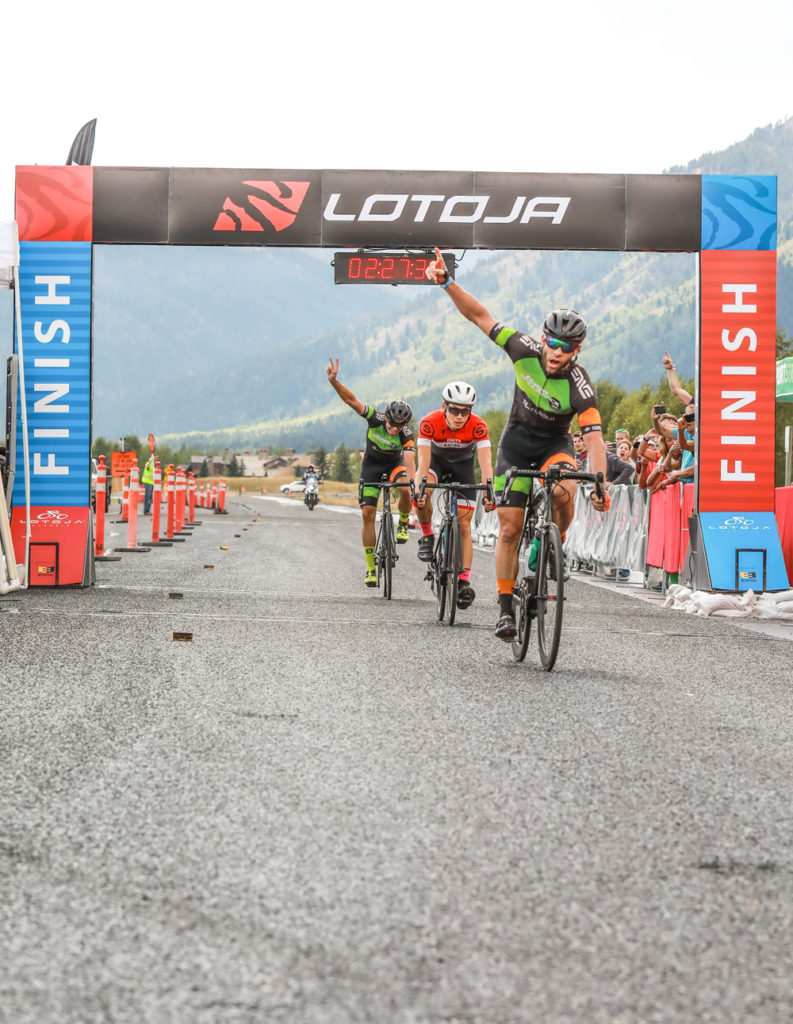
Spencer Johnson (Team Endurance 360) exults after winning LoToJa’s Men’s Pro Cat 123 race on Sept. 8. He also smashed the old 202-mile course record by 24 minutes. Coming in second is John Jantz (Team Community Bike) and in third, Johnson’s teammate Nathan Manwaring. Lotoja 2018. Photo by SnakeRiverPhoto.com
The course winds on back roads through scenic northeastern Utah, southeastern Idaho and western Wyoming, and includes three mountain passes that total 35 miles and almost 10,000 vertical feet of riding uphill. While en route, cyclists also pedal through Utah’s Cache Valley, Preston and Montpelier, Idaho, and Wyoming’s Afton and Alpine before reaching Jackson Hole.
“It doesn’t matter if you’ve been racing for years, or are new to the sport, crossing LoToJa’s finish line is known to change lives,” said LoToJa Race Director Brent Chambers. “It is a challenging and beautiful event that presents a huge goal for every cyclist who enters. They must properly train and dig deep — and that includes those who just want to finish and cross LoToJa off their bucket list.”
Chambers, who has been race director and owner of LoToJa since 1998, said the race continues to be one of America’s most popular cycling events. Several thousand register every April, but less than 2,000 are accepted to keep LoToJa as a high quality cycling experience with a premium on safety.
The race director said it would be extraordinary if the men’s course record is broken again this year, and also the current women’s course record. A year ago, Spencer Johnson of Riverton, Utah, set the new men’s record of 8:18:29, taking off more than 24 minutes from the previous record of 8:42:31 set in 2017. Melinda MacFarlane of Salt Lake City set the current women’s course record of 9:35:00 in 2013.
Most of the other cyclists take 10-13 hours to ride LoToJa, with some coming in long after the finish line closes at 8:30 p.m. But despite pedaling all day, many return every year. For 2019, cyclists are coming from 37 states, some as far away as Maryland and North Carolina, Chambers said. There are also cyclists coming from Canada and the United Kingdom.
LoToJa began in 1983 by two Logan cyclists who wanted to create an enduring one-day bicycle race. They modeled it after European professional cycling’s five grand monuments: Milan-San Remo, Ronde van Vlaanderen, Paris-Roubaix, Liege-Bastogne-Liege and the Tour of Lombardy.
In LoToJa’s first year, seven cyclists competed and crossed the finish line near downtown Jackson. The winner was Bob VanSlyke of Logan who finished the 186-mile course in 9 hours. In 1986 the finish line was moved to Jackson Hole Mountain Resort, which pushed the race’s distance to over 200 miles.
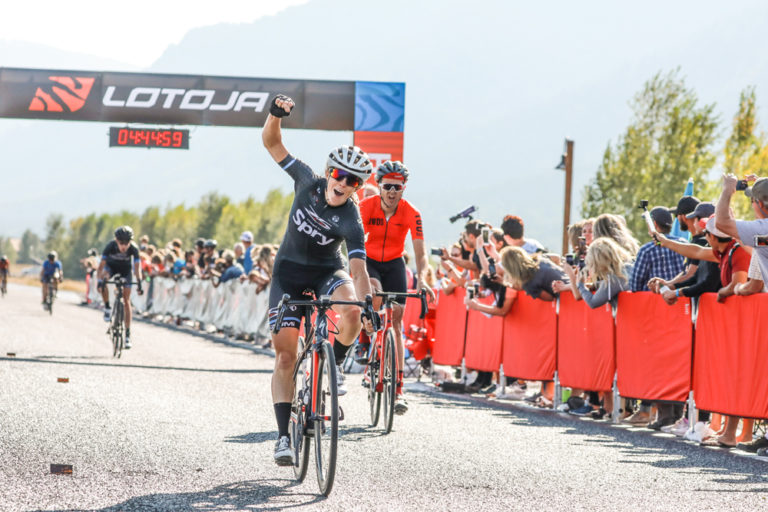
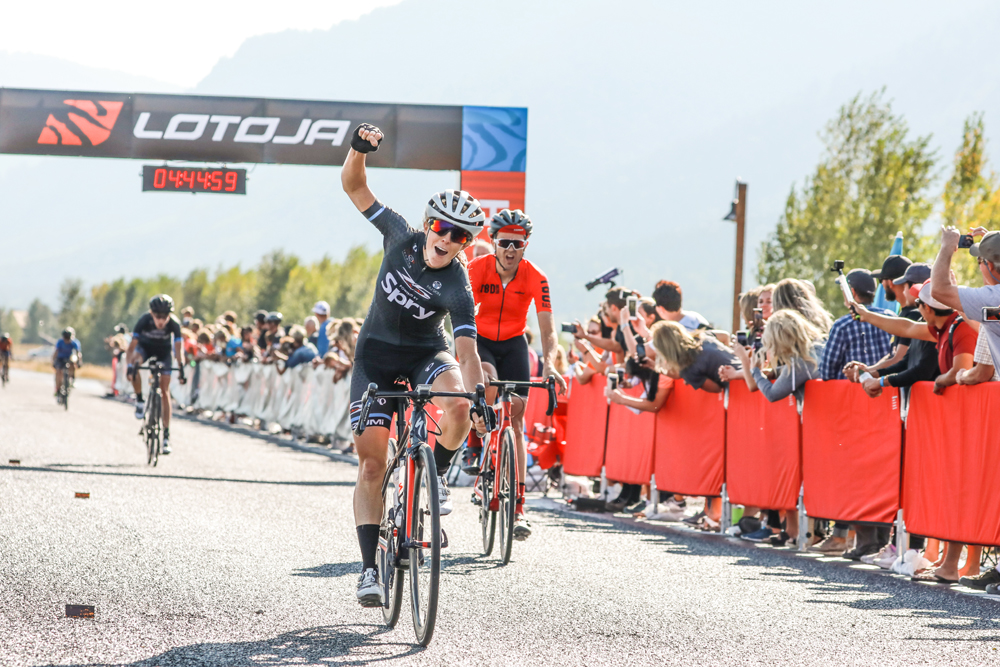
Lindsey Stevenson (Team Zone 5) celebrates after crossing the line in first place during LoToJa’s Women’s Pro Cat 123 race on Sept. 8. This was the second consecutive year that Stevenson won. Lotoja 2018. Photo by SnakeRiverPhoto.com
Since then LoToJa has become one of America’s premier amateur cycling races. It has also become a major fundraiser for the Huntsman Cancer Foundation and for other health-related organizations. More than $2 million has been contributed to Huntsman alone by cyclists and sponsors. LoToJa also sponsors local fund-raising groups that assist the event.
Chambers said this year’s LoToJa again features multiple categories for USA Cycling license holders, plus a cyclosportive class, which consists of non-licensed cyclists who are either competing against riders within their age group, or are just riding for fun. A relay race and categories for tandem riders are also held.
This year’s race will have nearly 700 course volunteers, which includes 150 Ham radio operators from the Bridgerland Amateur Radio Club, he said. They provide uninterrupted communication throughout LoToJa’s mountainous and remote terrain.
Chambers stressed LoToJa wouldn’t be possible without its volunteers and the cooperation and assistance it receives from businesses, civic leaders, public safety officials and community volunteers.
He also emphasized that LoToJa’s top goal is to have a safe race for all cyclists, support crews and volunteers. Motorists traveling LoToJa’s course on Sept. 7 are asked to use caution when approaching cyclists. Groups consisting of up to dozens of riders may be encountered. Motorists are urged to pass carefully and to leave a safe distance between their vehicle, cyclists and other traffic.
To further increase safety on race day, the Idaho Transportation Department will restrict eastbound traffic on state Route 36 north of Preston between Riverdale and Ovid from 7 a.m. to 12:30 p.m. Eastbound traffic on US-89 between Montpelier and the Wyoming state line will also be restricted from 9 a.m. to 2 p.m.
The temporary travel restrictions were started years ago because SR-36 and US-89 are filled with eastbound LoToJa cyclists, Chambers said. Motorists are asked to use caution while traveling on these two roadways during LoToJa, and to anticipate encountering groups of cyclists. Cautious passing is advised to ensure safety for everyone.
Chambers defined “cautious passing” as slowing down, giving plenty of space (at least three feet) between the vehicle and cyclist(s), and patiently waiting for oncoming vehicle traffic to clear before pulling around a cyclist or group of cyclists.
LoToJa cyclists, plus their support crews, well-wishers, event staff and volunteers, represent an entourage of approximately 4,000 people, Chambers said. Several of the communities through which LoToJa passes organize roadside fundraisers to capitalize on the influx of visitors. The host cities of Logan and Jackson also enjoy a welcomed economic boost from the race, specifically restaurants and hotels.
According to Chambers, LoToJa is the longest one-day bicycle race in America that is sanctioned by USA Cycling, the sport’s governing body. It is estimated more than 19,000 cyclists have pedaled more than 6 million miles during LoToJa since the race began in 1983.
Last year’s oldest male cyclist to finish was 76 years old and the oldest female was 67. The youngest boy and girl finishers were 13 years old. The average age of a LoToJa participant last year was 45.
LoToJa’s route and additional information about the race are available at lotoja.com.
Will sharrows reduce the chances of getting doored? The best place to look, one study found, is in Chicago, where the city actually examined the extent of dooring in 2010. The study was just accepted for publication this year, though.
One reason for sharrows is to encourage cyclists to move out of dooring range. The researchers compared crash data on Chicago streets with sharrows to those on streets with marked bike lanes and those with nothing special for bikes.
Sharrows didn’t seem to help much. The authors realize they couldn’t determine why, but found areas “that had sharrows installed experienced less than desirable safety outcomes….” They couldn’t say why for sure but suggest that sharrows may “provide a false sense of security to bicyclists” since bike lanes provide dedicated space and cyclists know to look out if there’s no marking. Sharrows may also attract inexperienced cyclists.
See N.N. Ferenchak, W.E. Marshall, Advancing Healthy Cities Through Safer Cycling: An Examination of Shared Lane Markings, International Journal of Transportation Science and Technology (2019), doi: https://doi.org/10.1016/j.ijtst.2018.12.003
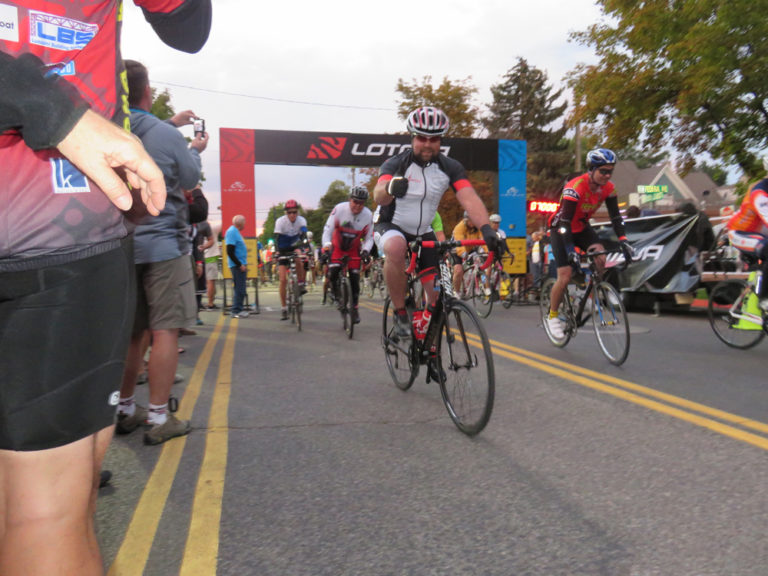
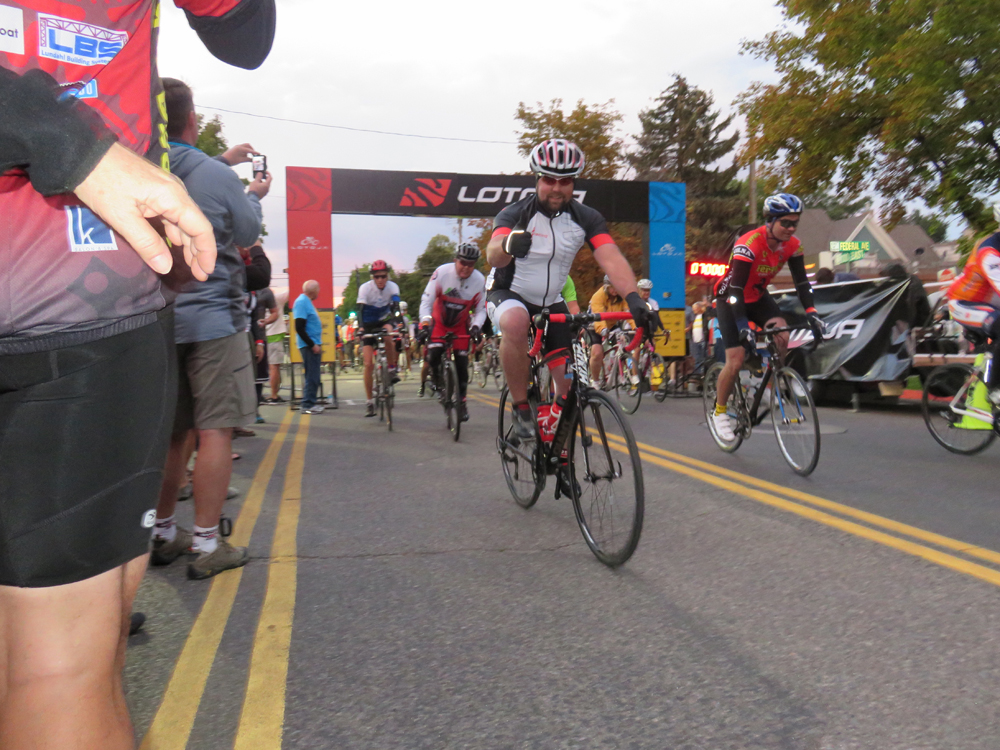
I think maybe I have graduated. Before this year, I had schooled myself by placing my mortal frame at the starting line of the LOTOJA on 25 separate occasions, each time intent on riding 206 miles the finish. 22 times I succeeded. Twice I had to drop out due to illness, and once because I felt like crap and knew it was only going to get worse. Now, I think maybe I have graduated.
Relay team member Alan (Ace) Call at the start. LOTOJA 2014
For several years now, my wife, Karma, who was my support during all but three of those LOTOJAs (and by virtue thereof probably holds an unofficial record for having driven support more than any other person), has been alternately trying to convince me that enough is enough, or to ride the LOTOJA as part of a relay team.
In 2013, I rode the LOTOJA just three months after hip replacement surgery. The hip felt great, but my conditioning was clearly lacking. I remember dreading the start and, during the 80-120 mile stretch (Montpelier, Idaho to Afton, Wyoming), wondering if I could even make it. I actually felt better by the time I reached Alpine Junction, and had a good finish. But overall, it was a very painful ride, both physically and mentally.
Exchange of the “baton” (timing chip) in Alpine Junction. LOTOJA 2014
Long story short, as a result of that experience, my wife finally prevailed. For this year’s LOTOJA, I organized a 4-man relay team consisting of a mountain goat, Elliot Morris, and two flatlanders – my brother, Nick, and my nephew, Ace Call. Drawing on our relative strengths, I assigned Elliot the stretch between Preston and Montpelier with its 3500 feet of climbing. Nick was given the finishing stretch from Alpine Junction to Grand Targhee Resort, and Ace took the two flattest legs, the first from Logan to Preston, and the penultimate from Afton to Alpine Junction. I took the less strenuous mountain stage from Montpelier to Afton (2500 feet of climbing).
We had a blast. Ace got us off to a good start with a strong ride on the first leg. As expected, Elliot had an impressive ride on the long haul up and over Strawberry Summit and on to Montpelier. I was the weak link, but managed a decent ride over the two shorter mountain passes, Geneva Summit and Salt River Pass.
Ace took over again and practically flew to Alpine Junction, skidding to a stop in order to pass the baton (actually, timing chip) to Nick. Ace had so much adrenaline pumping, he was ready to keep going. Nick delivered our team effort to the finish line in excellent fashion, bringing us in at 11th place out of the 90 teams that started the 3-5 man relay.
Being part of a team and contributing to a joint goal is always satisfying. And for three old men (me at 63, Elliot at 61 and Nick at 54) with only one youngster to carry us (Ace is a mere 34, in the midst of his cycling prime), we did all right. And we had a great time.
But I probably enjoyed it more than anyone. There are several reasons for that. At the top of my list is the fact that I was not constantly thinking and worrying, beginning in March and ending on race day in September, about training for the LOTOJA. I am not demeaning that and, in fact, understand both the desire and satisfaction in so doing. But my summer, riding and otherwise, was more relaxed, varied and, frankly, enjoyable.
Additionally, I did not have to plan any meals on the bike. Usually, I spend a considerable amount of time determining and outlining for Karma what I want at each of the three feed zones where she is allowed to hand up food, and how I am going to get by in between. Not this year. I just needed to be fueled and ready to go in Montpelier. Between there and Afton, I only needed my two large water bottles and a few energy boosting treats.
Probably the nicest treat was having Montpelier as my starting point rather than a way station between the 3500 foot slog over Strawberry Summit and the two climbs over Geneva Summit and Salt River Pass. It’s a long slog over Strawberry, and you are at 80 miles by the time you get to Montpelier. Geneva Summit isn’t extremely bad, but those last two miles up Salt River Pass, with its summit at mile 110 for the solo racers, are enough to make you swear you’ll never do this again.
But when you start your race in Montpelier, its an entirely different story. You’re just hitting your stride when you tackle Geneva Summit and, while Salt River Pass is still hard, its just a challenge, not a death march. After the race, I was asked by some if, while riding my leg, I found myself wishing I were doing the whole race. I’ll admit, I had some of those thoughts, but not during my leg. It was so sweet to feel fresh and strong over that stretch that people were probably wondering why I had this stupid grin on my face.
Karma probably enjoyed this year more than I did. She didn’t have to prepare hand-ups for me, worry about getting to the feed zones on time or fighting with traffic. Indeed, there was always a teammate to shuttle to the next transition point so she didn’t have to drive at all. Plus, everyone took care of their own food. So she spent the whole day visiting and enjoying the sights. Best LOTOJA she’s ever experienced.
Three of the four relay team members at the finish – Dave, Nick, and Ace. LOTOJA 2014.
Seriously, though, it is for the solo racers that the LOTOJA exists. That is its reason for being. For me, few cycling experiences have brought a greater sense of satisfaction and accomplishment than crossing the LOTOJA’s finish line after 7500 feet of climbing, three very serious summits and 206 miles of grueling effort,.
Have I truly graduated? I don’t know. There is still that yearning to keep doing it solo as long as I am able. On the other had, we had a great time.. I had a great time. It was not the same sense of accomplishment as riding it solo, but it sure was fun. And since I am the one who decides whether or not to award the diploma, I determine if I have graduated. Since registration for the LOTOJA is not till April, I’ll wait a few months to decide.
But whatever I decide, I will be there next year. It’ll be great. It’s the LOTOJA.
Cycling West and Cycling Utah Magazine’s Late Summer – August 2019 Issue is now available as a free download (8 MB download). Pick up a copy at your favorite Utah, Idaho, Wyoming, Nevada, Montana, Colorado, Arizona, New Mexico and Northern California bike shop or other location.
By Frank Owen, PhD, PE, Professor Emeritus, Mechanical Engineering, California Polytechnic State University, San Luis Obispo, California –
Introduction
Every year since 2000 a somewhat motley and diverse group of speed junkies make the long trek to remote Battle Mountain, Nevada, to have a go at going faster under just the power of their legs. They ride in bullets built for speed, high-tech marvels of engineering and technology. So far they’ve succeeded in getting to almost 90 mph! And the female record stands at more than 76 mph!
[Editor’s note: this article was written before the 2018 event. Any reference to dates and/or records should be considered with that in mind.]
2019 Event Info:
September 8-14 — World Human Powered Speed Challenge (WHPSC)|, Battle Mountain, NV, 20th annual hosted by the IHPVA. Current record is 89.59 mph. Classes: Men’s, Women’s, Juniors in Open, Multi-track, tandem and Arm Power. International cyclists from around the world will gather on SR305, the fastest stretch of road in the world to see who can break the World Record., Al or Alice Krause, 707-443-8261, 707-845-3683, [email protected], ihpva.org, whpsc.org
Ellen van Vugt – Netherlands at the 2017 WHPSC in Battle Mountain, Nevada. Photo by Eric Satterlee
There is no great money in this. It’s no Indy 500 nor a Formula 1 race. Yet teams put up the cash and effort to come to this remote spot to take advantage of a unique stretch of lonely highway, Nevada State Highway 305 that leads south of Battle Mountain out into the high desert. The high desert air is thin, reducing aerodynamic drag. Nevada State 305 is straight as an arrow and relatively flat, a requirement for the world record.
Last year’s event took place 11-16 September, 2017. It drew teams from Canada, Mexico, Italy, England, the Netherlands, Australia, Japan, etc. Even just the appearance of this polyglot lot of bike racing aficionados in this home-grown bedrock of ranching and mining is a cultural clash interesting to observe and experience.
The technology
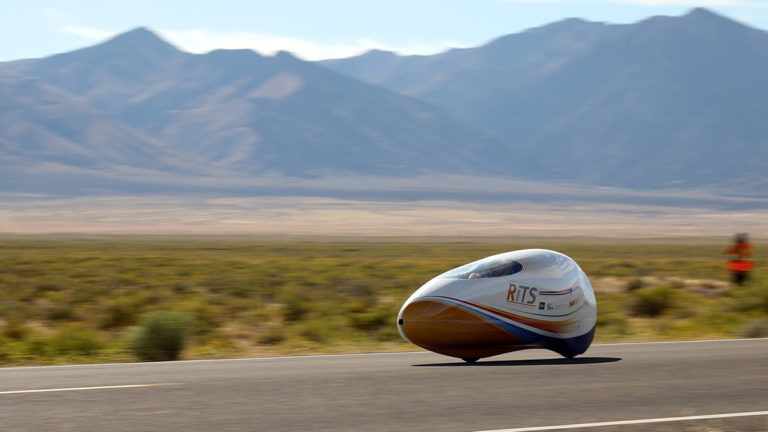
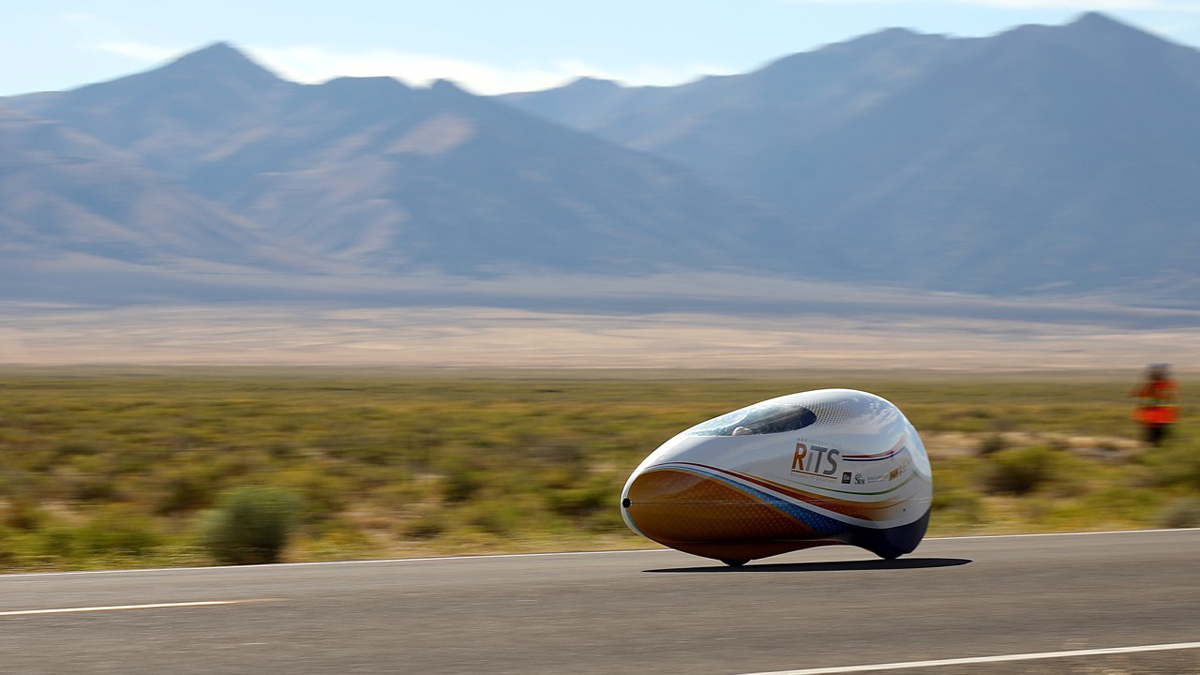
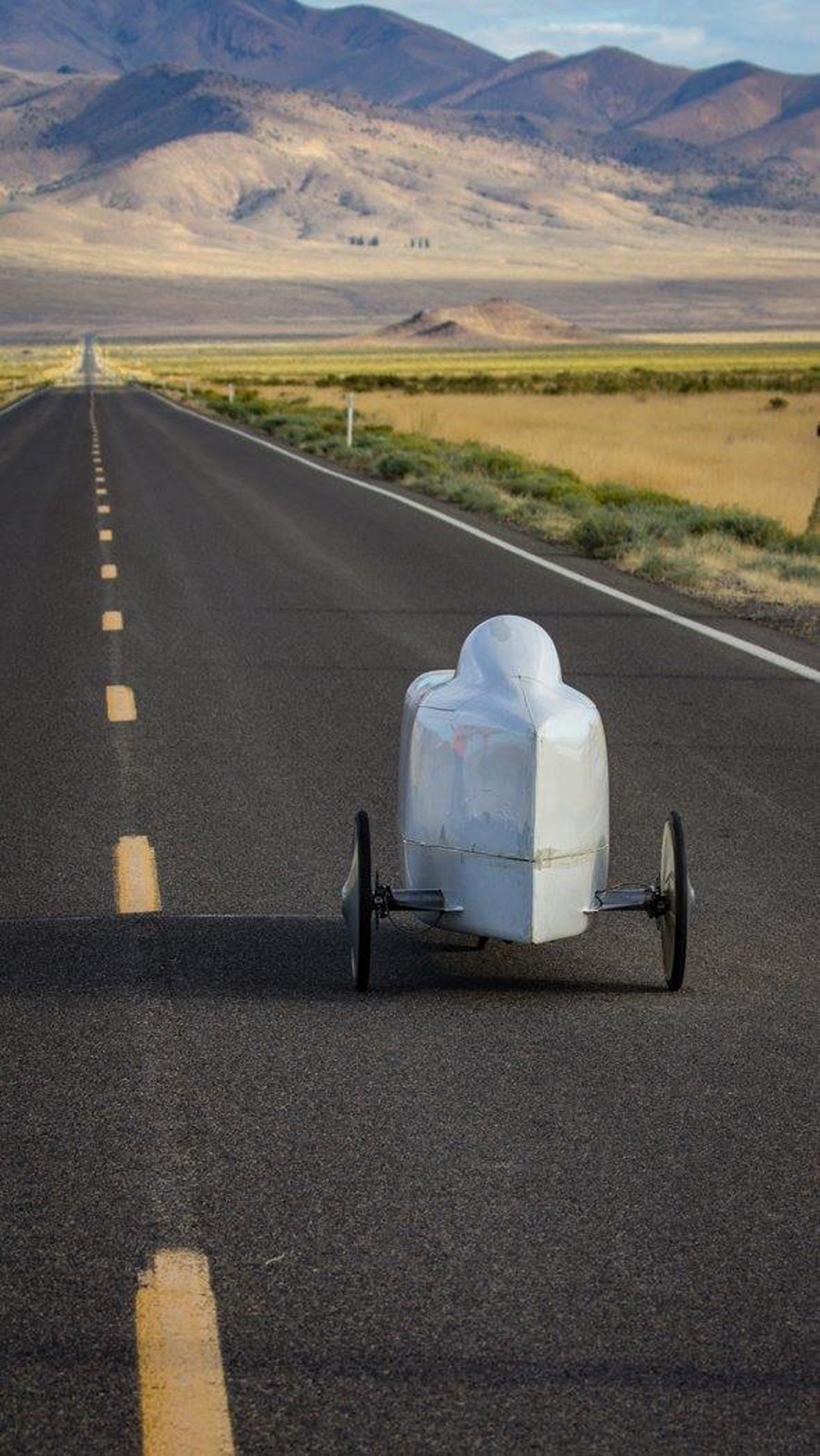
The bikes are faired; that is, they have an aerodynamic shell on them that gives them their bullet-like appearance and reduces aerodynamic drag. This is how they are able to achieve speeds in excess of 80 mph. Besides being slippery aerodynamically, they are also light, sculpted from modern-day carbon fiber, the high-tech, strong-as-steel stuff that is also used to make race cars, airplanes, helicopters, etc. Such bikes are called “streamliners” in the specialized jargon of HPVs (Human-Powered Vehicles).
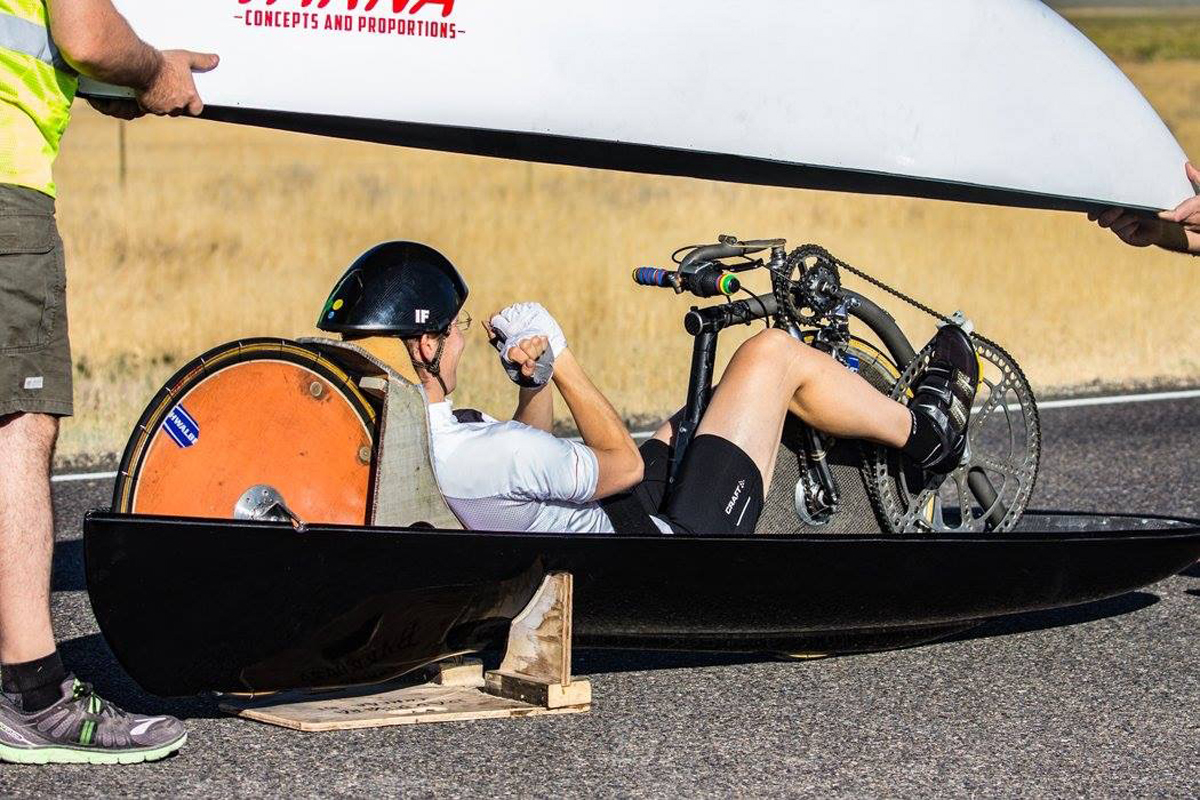
Barbara Buatois gets ready to ride at the 2017 World Human Powered Speed Championship. Note the chainring! Photo by Jamie Guthrie
Fitting a human engine into this shell, along with the drive-train needed to make it reach these speeds, is no easy matter. The smaller the cross-section of the vehicle, the less drag it will experience. This dictates that the rider must be reclined, that is, lying on his/her back. This makes seeing ahead no trivial matter. And even keeping the bike upright, especially at the low speeds, is tricky.
The reclined rider must drive one wheel, usually the front one, with an often complex, high-tech transmission, crafted to fit very tightly into the small package with his/her body. One rider’s bike last year had no wheel-well for the front wheel, which she was straddling. She had to wear Kevlar pads on her bike shorts should the fast-spinning wheel come into contact with her legs! Anything to save weight and space.
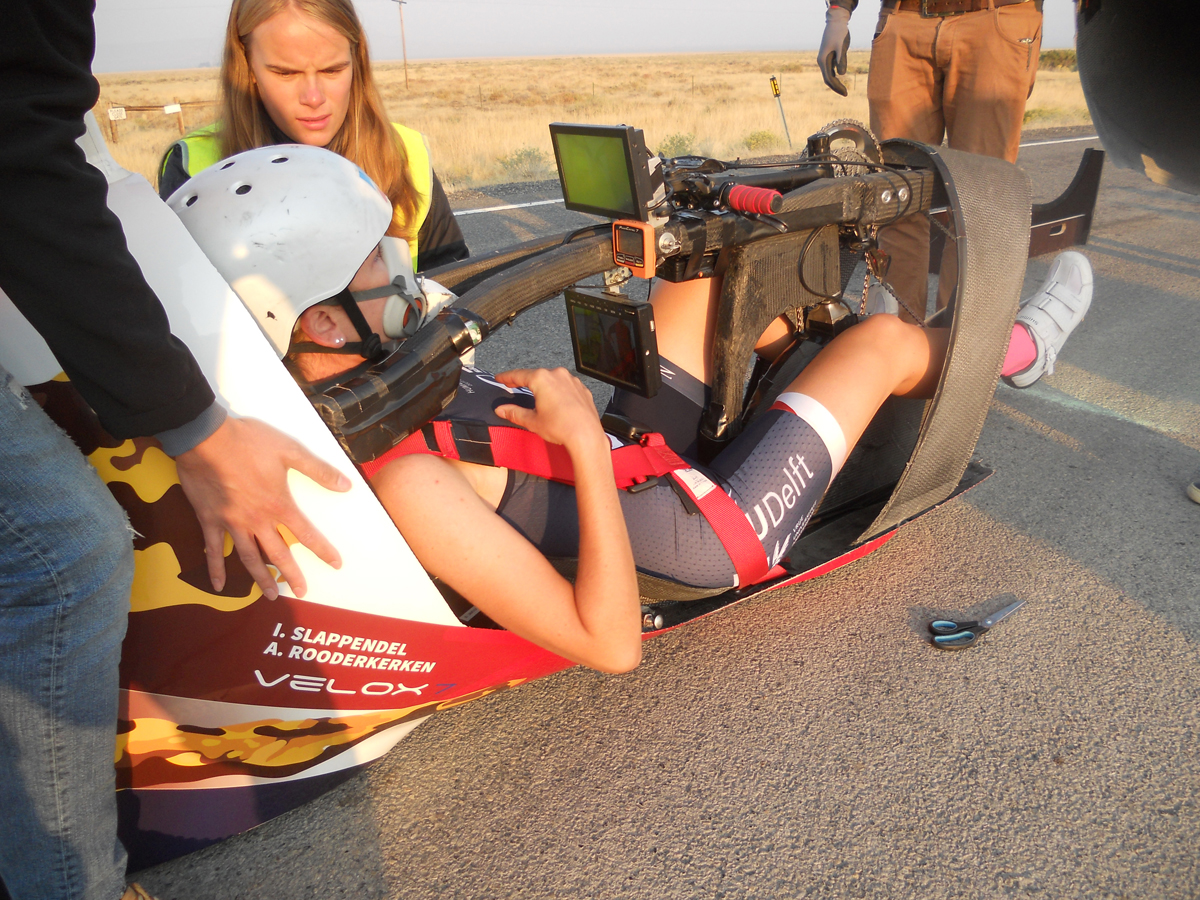
Dutch rider Aniek Rooderkerken prepares for a start in Velox, a streamliner from Delft University. Delft has become a regular contender at the Battle Mountain Speed Trials. Photo by Frank Owen
The answer to the limited visibility, for most of the bikes now in this competition, is to have a “camera bike”. These bikes do not have windshields. A camera is mounted discreetly on top of the bike, and the video display is piped down to a screen just in front of the rider’s face. There is a real argument about camera bikes amongst teams, because they present a filtered view of reality to the rider. One year a Slovenian rider came up with a unique solution that allowed him to lie flat, yet see ahead. He lay down this yearwith his head in the nose of his shell, facing backward. His view forward was through a mirror mounted in front of his face at 45°, looking forward. But this meant that he had to learn to ride the bike looking at a reflection and hence steering backward! Such clever and novel solutions are part of the lore of HPV racing and can give a rider that margin that means a record-setting victory.
Yet another difficulty, often overlooked by novice teams, is that cross-winds have a big effect on the tracking ability of these bikes. The fairing presents a sort of wall to a cross-wind, and the cross-wind tends to knock the bike over or push it off the road. Novice teams tend to forget about the cross-winds and only design the bike for forward motion through the air. Often they produce a slab-sided bike that is more easily knocked over by a side-gust of wind.
Thus mastering the low-speed stability of a streamliner, then keeping it on the road even at high speeds in a cross-wind, and with little visibility, requires a rider with some experience. Yes, young people have an advantage physically, perhaps. But high-speed streamliner racing is not for the faint of heart nor for the inexperienced and mentally unprepared. Often the best performances are delivered by more experienced streamliner pilots.
The teams
Since 2000 the speed trials have evolved from privately-financed, free-lance teams—mostly American—to university-sponsored, international teams. For years the male world-record holder for the Battle Mountain trials was Sam Whittingham, a Canadian bicycle racer, riding streamliners designed and built by Georgi Georgiev, a Bulgarian-born sculptor who immigrated long ago to Vancouver Island. Georgiev has designed and built many streamliners with his brand name Varna. The current fastest female, Frenchwoman Barbara Buatois, set her speed record of 76+ mph in a Varna streamliner.
Georgiev is hands-on, has a lot of experience, uses his intuition to design a beautiful, aerodynamically sleek streamliner. He was again at Battle Mountain in 2017. Buatois was also there racing a Varna bike.
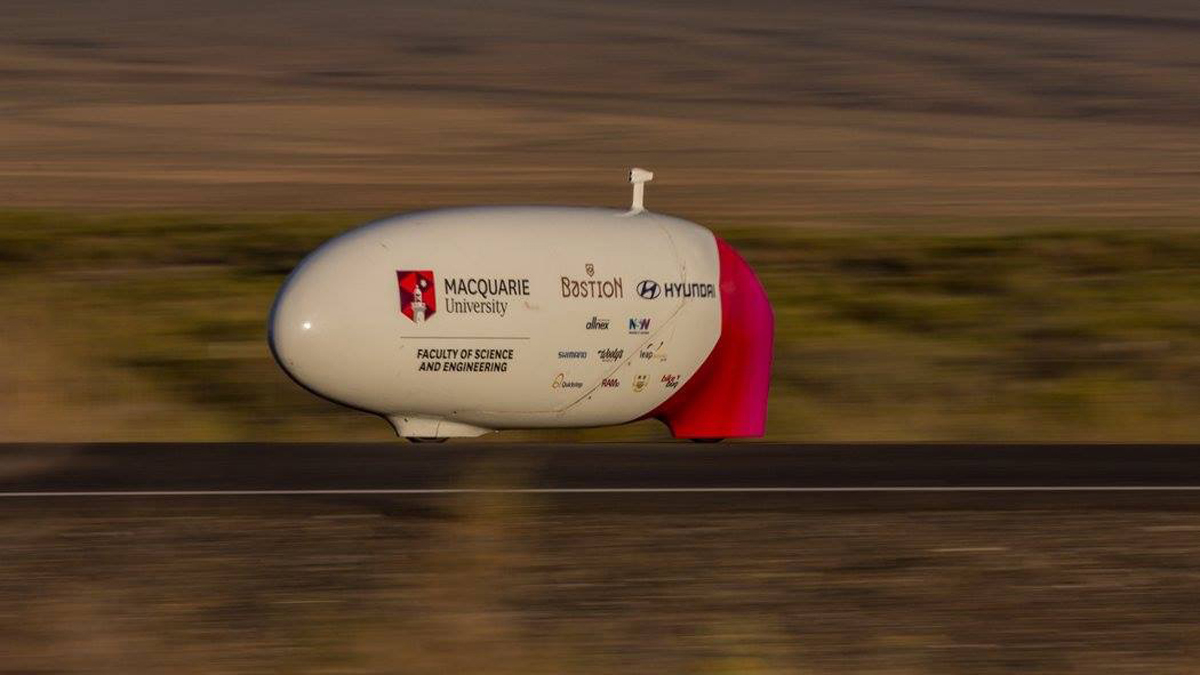
But since 2000 the times have changed. Now the majority of the teams are university-sponsored teams. The 2017 event saw competing teams from Delft University (Netherlands), the University of Toronto, LaSalle University (Mexico), the University of Liverpool (England), Macquarie University (Australia), and the Politecnico di Torino (Italy). There are still privately sponsored teams, some of them long-time participants at the speed trials at Battle Mountain. A private team of Japanese enthusiasts from near Kyoto has attended for the past two years. They are sponsored by Toray Carbon Magic Co., Ltd., of Shiga, Japan, which makes carbon-fiber components for race cars, airplanes, and helicopters.
The Australian Team, Macquarie University at the 2017 World Human Powered Speed Challenge, Battle Mountain, Nevada. Rider – Charles Easton-Berry. Photo by Jamie Guthrie
The competition has evolved over the years. It’s gotten more technical, since it is part of the studies of the student participants. The computer plays a much more important role in the design and analysis of the race bikes than it did in the past. Very detailed stress analysis is done on the streamliners’ structures. Computational fluid dynamics is used to optimize the streamlined shape of the racers. A geometric computer model of the transmission is made to test the positioning and possible interference of the components and the rider. Parts and components, often custom-designed, are built nowadays using computer-aided manufacturing and robust 3D printing.
Student participants on teams learn valuable design, analysis, and building skills that will enhance their chances for obtaining interesting employment upon their departure from the university. Indeed, two entrepreneuring students from the University of Toronto, Todd Reichert and Cameron Robertson, founded their own company, Aerovelo, which not only set the speed record of 89.59 mph in 2016 but previously won the American Helicopter Society’s Sikorsky prize for developing and flying a human-powered helicopter in 2013. Aerovelo is currently working in Silicon Valley on the Kitty Hawk Flyer, a project funded by Google co-founder Larry Page to build an electric helicopter for personal transport.
That the trials have become so international is astonishing, especially given that Battle Mountain isn’t the easiest place on earth to reach. But that is, in part, what draws teams from all over the globe to this lonely stretch of highway. For the student squads, it’s a bit like going to Mars, it is so foreign to the surroundings back home.
The time trials: drama and trauma
Months, even years, of work go into designing and building a bike, training for Battle Mountain, packing it all up and arriving at the head of this long, straight arrow of highway. The chips are on the table and the hand is about to be dealt. The actual speed measurement is a speed trap 200 meters long at the end of a 2.5-mile or 5-mile run-up. This is called a 200-meter flying start trial.
Adam Ince – USA, independent on course at the 2017 World Human Powered Speed Championships in Battle Mountain Nevada. Photo by Jamie Guthrie
The first step is just to get the bike launched and going down the highway at a good clip. These bikes are built for speed, the regime where they are relatively stable. They are not built to go slow, and this often causes problems with low-speed stability. Without experience, without a good launch, the streamliner falls over, scrapes along the ground, and is not so streamlined as it was before.
2017 was full of falls like this. Time after time bikes fell over during the start. Even Barbara Buatois, who had not experienced false starts before in her career, suffered heartache after heartache of missed starts. The Italians had a beautiful bike, and they kept it off the ground until the last day of racing. Yet something went wrong on the first start of Andrea Gallo, and he fell over and scratched the beautiful surface of his streamliner Taurus.
The Liverpool team suffered fall after fall at the start. Nights would find them in the parking lot of the Big Chief Motel, applying Bondo to the scars on the fairing and then wet-sanding them down. During the course of the week their streamliner morphed from a beautiful carbon-fiber shell to a heavy Bondo-laced fairing. They used and wet-sanded so much Bondo, there was a stream of white debris in front of their row of rooms into the Big Chief parking lot.
As the week wore on, riders built experience, and launches improved. Only one speed record was set in 2017, that in an arm-powered bike. Several teams were relatively new. They are still cutting their teeth with new bikes and new teams, hoping for success in years to come.
The camaraderie
HPV racing is, indeed, a small world. Everybody knows everybody else. For the Battle Mountain speed trials, all make the same effort during the year to design and build bikes, to scrape together the financial support for a new effort, to train, to push aside studies to work with your buddies getting your hands dirty day after day, often night after long night, to bring all of this together and then make the long trek to far-away Battle Mountain, Nevada, for the culmination of all this work. Even though the aim is to go ever faster, to be the fastest man or woman on earth, there are other non-aimed-for results, collateral effects, above all a camaraderie that arises during the speed runs.
Paolo Baldissera expressed this to me as the Italian team stopped by San Luis Obispo after the Battle Mountain trials. “These students really weren’t friends before the start of our effort last year,” he explained. “Now they are the best of friends, a real team.” I pointed out to him that that effect was lifelong, that even after they leave the Politecnico, they have had this profound shared experience that will extend on into their professional lives and careers.
The HPV speed trials also have no age limit. Quite often the guile of age trumps the physiology of youth, due to its naïveté. Some riders come year after year to Battle Mountain. Barbara Buatois made an appearance in 2017 after two years of absence. Ellen Van Vugt, from Holland, is a regular competitor at Battle Mountain. Georgi Georgiev, the designer/builder of the Varna streamliners is a regular fixture at the speed trials. With such long-term commitment and participation in the event, there is a continuity that also lends camaraderie to the event. Sam Whittingham was not at Battle Mountain in 2017, but his presence was still felt there. Andrea Gallo, the semi-professional Italian rider, dreamed of going as fast as he could as a boy in Turin. To him, Sam Whittingham was a hero. To be in Battle Mountain and to sit in a Varna streamliner to have his picture made was a dream-come-true for him.
At the end of the competition, Saturday night 16 September, there was a somewhat rowdy awards presentation and dinner. The internationality of the event in far-away Battle Mountain was almost surreal to experience. The English were taunting the Italians, and the Italians were giving it back, all in an atmosphere of fellowship. Everyone understood what colossal effort was behind bringing each of them to this remote place, because each had played his or her part in the drama of getting there. The profound shared experience was universal in the group and crossed international and language barriers.
The underlying culture of the speed trials is open. Secrecy is almost unknown. Participants are welcomed to browse the bikes, poke their heads inside the fairings to get a good look at the often very complicated transmissions of these bikes. Nothing is standard when the objective is to cram a human and a transmission for 70-90 mph together in close proximity inside a tight shell. Again, the longevity of the competition brings old rivalries back to go at it once again at the annual event. The camaraderie accumulates year after year and imbues the HPV culture with a very nice aura.
The Nevada State Highway Patrol gives speeding tickets
A nice touch to the competition is the participation of the Nevada State Highway Patrol in the event. They gave “speeding tickets” to the riders who had exceeded 70 mph on the course. Reckless speeders were handcuffed and put into the back of the NSHP squad SUV and then ticketed later. The ticket requires them to appear in court on the first day of the Speed Challenge for 2018, to assure that they return for that event. Thanks to Officers Arther Aten and Steve Day for adding some levity to the 2017 World Human Powered Speed Challenge.
Conclusion
The WHPSC is a great event to be part of, whether it be as a rider, part of the support team, a volunteer, or simply a spectator. Battle Mountain becomes truly international, having found its way onto the HPV world map because of its remoteness, desert, and thin air. It’s fun to see these bikes zip pass at hard-to-believe speeds. And the good vibes that the event emits bring a smile to one’s face, a good feeling about human potential, and the desire to return for next year’s Challenge.
This story was reprinted with permission from Human Power News, the official newsletter of the International Human Powered Vehicle Association (IHPVA).
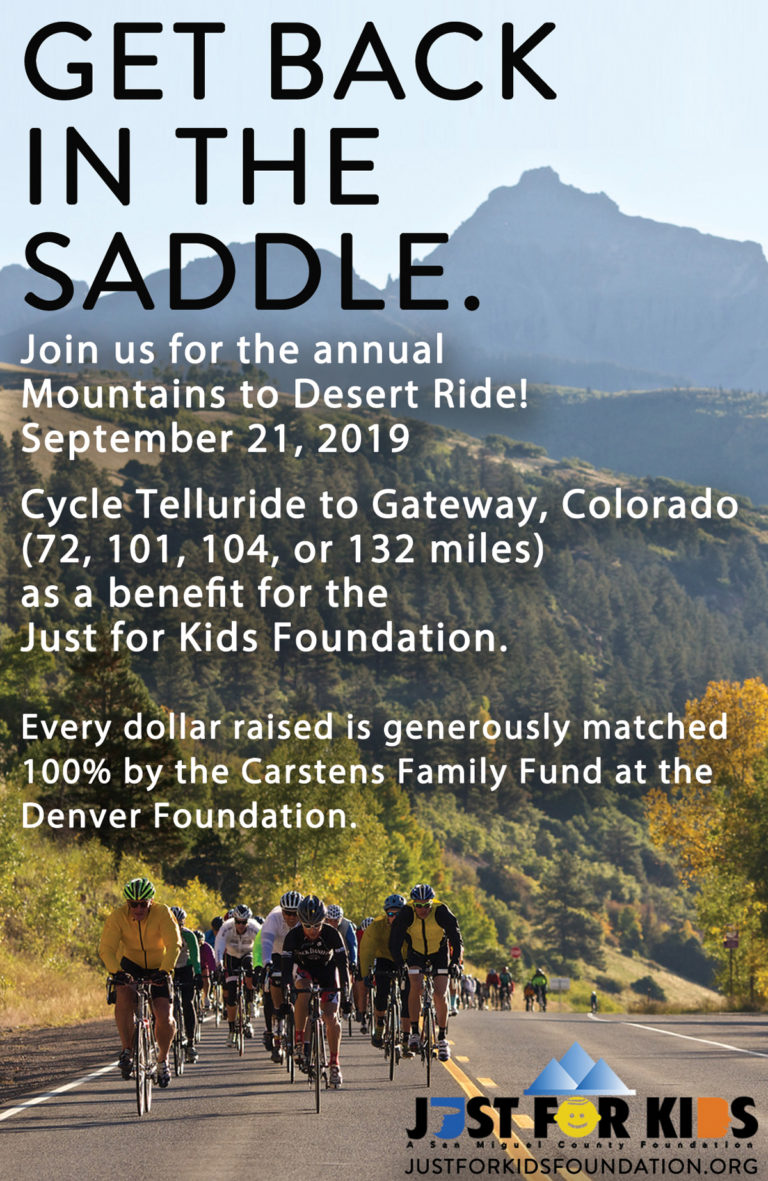
The Mountains to the Desert bike ride is a 70, 100, or 132 mile road ride that starts in Telluride, and travels to Gateway Canyons Resort, Colorado on September 21, 2019.
We asked organizer Lara Young of the Just for Kids Foundation a few questions about the event.
Cycling West: Tell us about the course. What are the highlights?
Mountains to the Desert: It really is the perfect race and ride. Half the riders are intense mountain athletes out to win or get their personal best time the other half are in it for the adventure and sheer beauty. The ride is so appealing because of the diversity of topography. Riders travel from the Town of Telluride in the peak of the fall colors in shimmering yellow and gold Aspens following the San Miguel and Dolores river watersheds to the iconic Red Rock Desert of Gateway. The ride is perfect for a first time Century rider or a competitive cyclist who wants to push them selves and take on the 132 mile with a grueling hill climb at the finish. The 70 mile option starting in Norwood is ideal for families or those who don’t have the interest or time to train for a 100 miles. The Highlights are Telluride and Gateway both target destinations for the beauty and history and literally there is 100 miles of the most interesting geology and history in the west the lies between the two destinations.
CW: Tell us about the Just for Kids Foundation. How does the ride help the cause?
M2D: Just For Kids serves children from birth through high school graduation throughout the San Miguel Watershed, including the towns of Telluride, Norwood, Nucla, Naturita, Paradox and all points in between.
We provide funds for scholarship programs, operating grants, program support, capital needs, start-up projects, and equipment. We particularly target projects with leadership opportunities for children and projects promoting self-sufficiency and responsibility.Please contact us if you have questions about whether your organization qualifies for grant consideration.
Some of the innovative programs we have funded include experiential learning programs, collaborative efforts between children’s organizations, character building programs, early childhood programming, programs offering job skills training and assistance and college scholarships through the Man of La Mancha scholarship program.
Each year, the Mountains to the Desert Bike Ride serves as the single fundraising event for the Just For Kids Foundation which raises over 100k. Every dollar raised through participant fundraising is matched by the Carstens Family Fund at the Denver Foundation. That money is then awarded to individuals and organizations that provide leadership opportunities for regional youth as well as organizations that promote self-sufficiency and responsibility. Over the past ten years, the Just For Kids Foundation is proud to have raised over $2 Million; all of which has been awarded to hundreds of organizations benefitting thousands of underprivileged children and to deserving seniors who are awarded college scholarships through the Man of La Mancha program.
CW: Telluride is in the high San Juan Mountains. Tell us about the geology and natural history that the ride travels through.
M2D: The ride begins in the awe inspiring San Juan Mountains riders cycle past towering 14,000-foot peaks and continue their descent parallel to the San Miguel River. A short climb at mile 28 leaves riders at the summit of Norwood Hill, overlooking miles of ranches, farmlands and the La Sal Mountains.
Riders who prefer a shorter, 70-mile ride, start in Norwood an hour later, at 8:30 AM. From Norwood, the ride continues through Naturita, Nucla and Uravan and winds further along the Unaweep-Tabeguache Scenic and Historic Byway past the Hanging Flume. Riders will pass millions of years of history, geology and ancient lands.
The route subsequently meanders along the Dolores River at the base of thousand-foot red sandstone walls into the sleepy town of Gateway, CO.
CW: What sort of support do you have for the riders? And, what about post-event festivities?
M2D: There are 5 strategically placed aid stations with food, water, and energy drinks and of course youth program volunteers cheering riders along the 101 mile route. There is also a smoothie aid station at the top of the additional hill climb at Mile 115. The ride is not to be missed because it supports all area youth programs to scholarship kids and the sheer physical beauty of the event. If that’s not enough the ride finishes with a grand feed and music. Riders are also rewarded with an opportunity to swim and spa at the finish. Gateway Canyons Resort is award winning and star rated by Travel&Leisure, Conde Naste, and Forbes.
CW: Where can people stay or camp when they come to do the event?
M2D: We have reserved 30 rooms for the event ranging in Price from 225 to 375.00. These are greatly discounted for our riders. There is also stunning, convenient, and free BLM camping along both sides of the Dolores River just several miles from the resort. If you can’t spend the night there is a 40.00 shuttle available to get you back to Norwood or Telluride.
Event Details:
September 21, 2019 — Mountains to the Desert Bike Ride|, Telluride, CO, 16th Annual Mountains to the Desert Bike Ride, From the high mountains of Telluride, cyclists descend past hillsides of quaking aspens along a route that passes through millions of years of geologic record, ultimately finding themselves at the base of striated sandstone cliffs reaching up to 1,000 feet overhead and onwards to the beautiful desert landscape of Gateway. Mileage options: 70, 100 & 130. This ride benefits the Just For Kids Foundation, Lara Young, 970-708-1105, [email protected], justforkidsfoundation.org
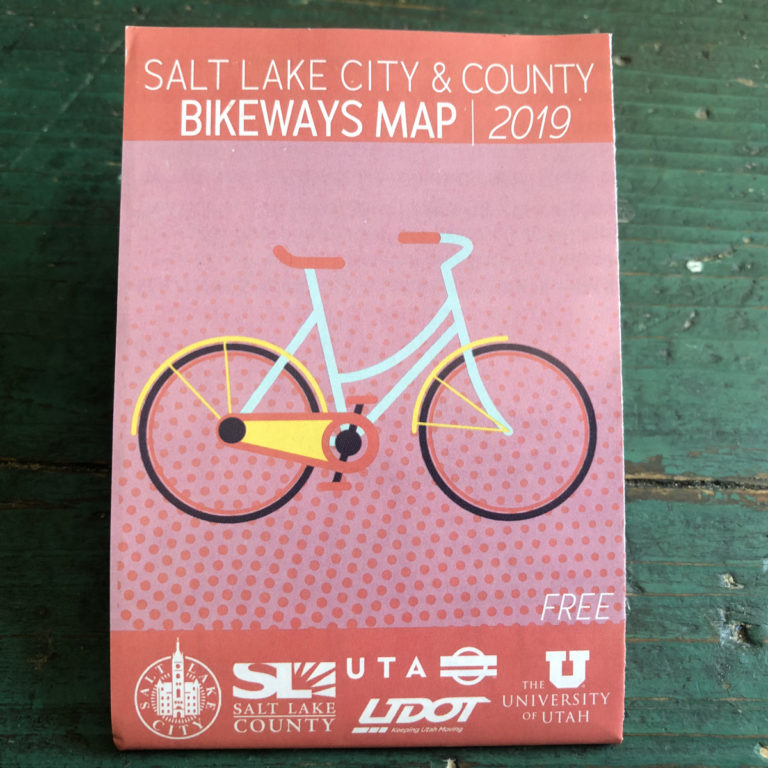
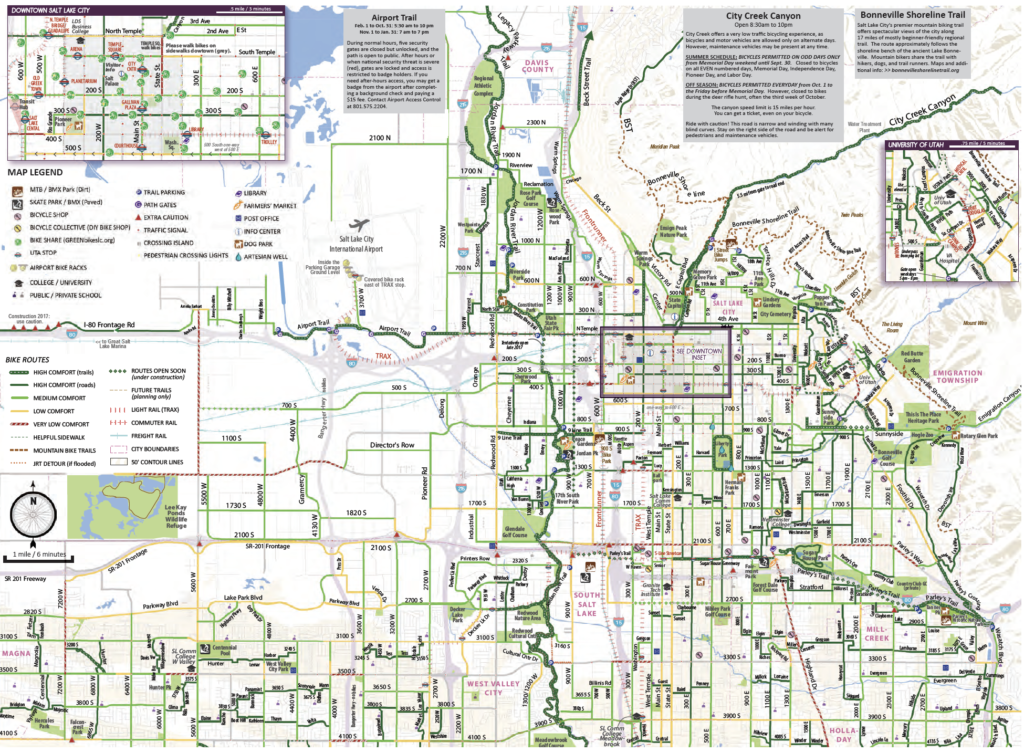
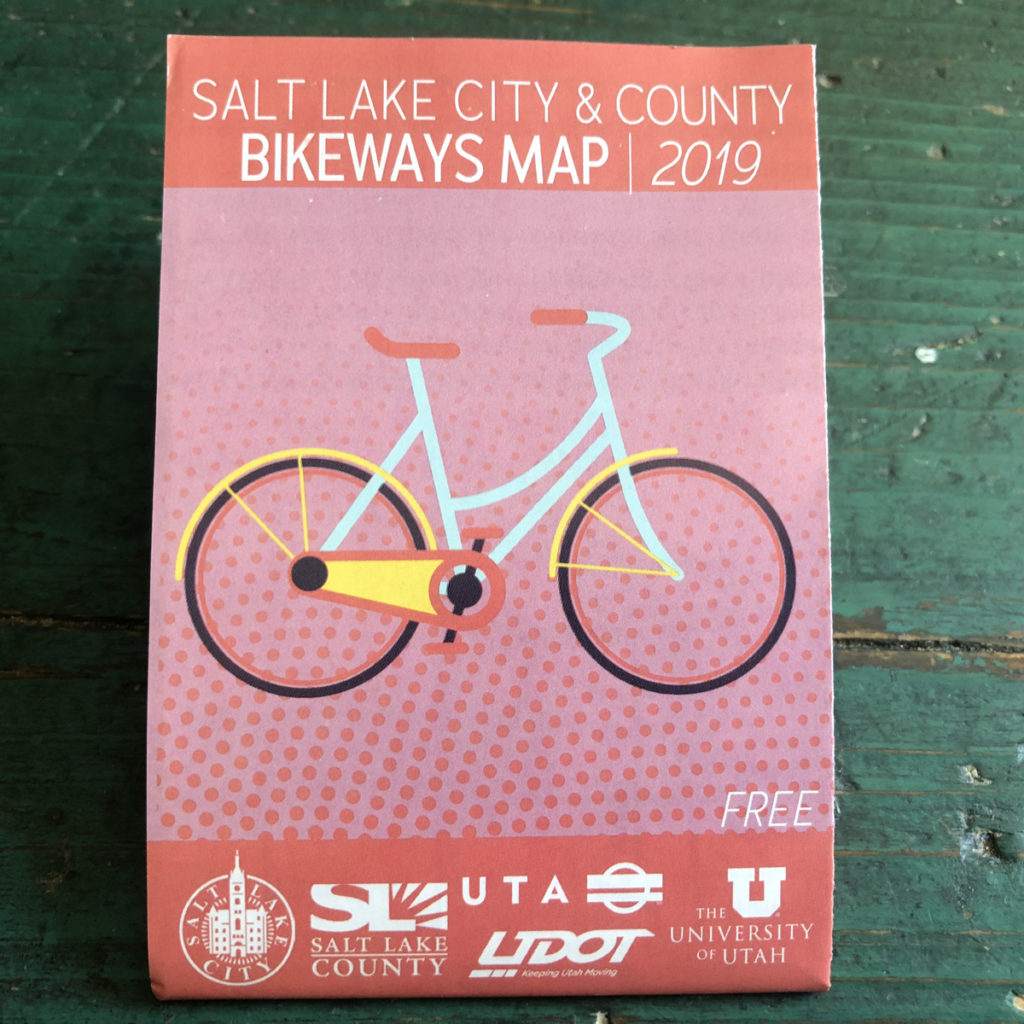
The Salt Lake City and Salt Lake County Bikeways Map has been updated and rereleased for 2019. The 24×36 inch map shows routes for cyclists throughout the city along with bike shop locations, bmx/skateparks, parks, and other locations relevant to cyclists. The map is free and copies can be obtained at Salt Lake City and County bike shops and other locations in the Salt Lake Valley.
Salt Lake City bike map graphic from the 2017 map.
The map has many new features including new safety information and graphics, and new bike infrastructure added since 2017. But, the biggest change is that the new version of the map designates bike routes in terms of comfort levels for cyclists rather than whether or not there are bike lanes on a particular street.
Salt Lake City’s 2019 Bike Map is available for free in bike shops and other locations in Salt Lake County. Photo by Dave Iltis
The comfort rating seeks to give people information about the type of experience to expect. Salt Lake City adapted the comfort rating from the Austin, Texas bike map and applied their descriptions to Salt Lake City streets. Several regular bicyclists on staff worked on the initial ratings, and the ratings were also critiqued by the City’s Bicycle Advisory Committee. High comfort routes include trails, very low traffic roads, or bikeways with separation from traffic. Most regular bike lanes on streets with typical city traffic are rated as medium comfort. Higher-speed and higher traffic streets, even with a bike lane, may be rated low comfort. A few critical connections are rated as extremely low comfort, such as a hairy section around a freeway interchange. The map legend explains these in further detail.
The recreational routes section that was on the 2016 map was removed, which included are Emigration Canyon, City Creek, Salt Lake Marina, and the Cycle the City Route, a site seeing route in the core of the city that highlights historic sites and urban trails.
The map is free and copies can be obtained at Salt Lake City and County bike shops, on some UTA buses and trains, the information desk at the Salt Lake City and County Building at 451 S. State, and from Salt Lake City sponsored booths at various festivals throughout the summer. It is also online as a pdf at slc.gov. The pdf is geotagged so that it can used on a smartphone to show location and other relevant information. The map was produced by Salt Lake City in conjunction with Salt Lake County, the University of Utah, UDOT Travelwise, and UTA to create a combined map covering the entire country.
Ideas are beginning to come in for reauthorization of federal surface transportation law. The current statute, the Fixing America’s Surface Transportation (FAST) Act technically expires at the end of Fiscal Year 2020. But if history is a guide, current law may wind up getting temporarily extended a year or two.
But sometimes small pieces of legislation get put in the hopper to give Congress something to think about and perhaps fold into the major reauthorization. The latest idea that could affect bicycle safety is called the Safe And Friendly for the Environment Streets Act or the SAFE Streets Act (H.R. 3040) introduced by Rep. Julia Brownley (D-CA) with two cosponsors (https://www.congress.gov/bill/116th-congress/house-bill/3040/text).
The bill would not add any safety money but would alter the formula to direct more federal funding to areas with high levels of bicycle and pedestrian fatalities. (The legislation uses the term “vulnerable users;” which also includes those riding scooters, e-bikes, wheelchairs, etc. For every planning area with a bike and pedestrian fatality rate of at least 1.5 per 100,000 residents, states and metropolitan planning organizations receiving Highway Safety Improvement Grants would get a guaranteed share of the money.
The bill doesn’t specify that the grantees would have to use the money for cycling safety, though. It was referred to the Transportation and Infrastructure Subcommittee on Highways and Transit.
The 2019 Utah Cyclocross Series is nearly upon us, with the first race of the season scheduled for Saturday, September 14 at the Ogden Cyclocross Park. The series will consist of 13 races this year, including a long-form 30-mile gravel-cross race in Cedar City on November 16 (details TBA) in addition to 12 traditional cyclocross events.
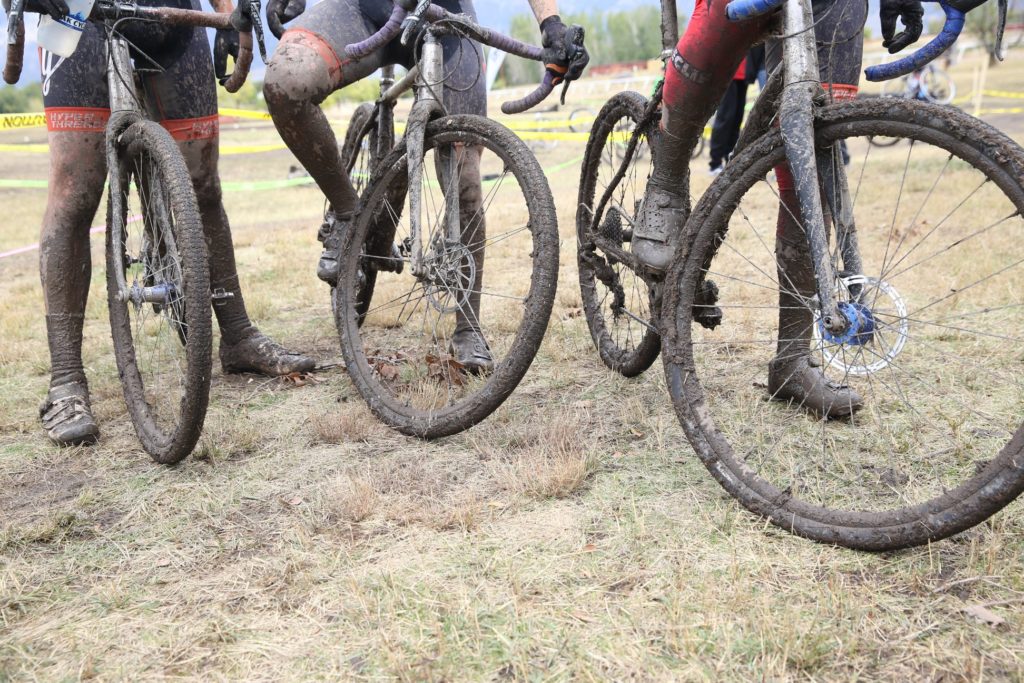
Mud is a beautiful thing. Photo courtesy Utah Cyclocross Series
The organizers of the Utah Cyclocross Series will also be promoting the Utah State Cyclocross Championship at Soldier Hollow (site of the cross-country skiing and biathlon events at the 2002 Winter Olympics) on November 9. The Utah State Championship will be held separately from the Utah Cyclocross Series.
For 2019, UTCX is partnering with USA Cycling, and all races will be sanctioned allowing riders to earn points towards category upgrades and for seeding purposes at the USA Cycling Cyclocross National Championships. This means that racers will need to have a license in order to race, but there are a couple of options available.
If a rider has never held an annual license, one-day licenses will be available for $10.00 when registering at the venues.
If a rider is planning on racing the majority of the series, a discounted annual license (valid through December 31, 2019) will be available through USA Cycling for $50.00. Since licenses do expire at the end of each calendar year, racers can also bundle their 2020 license for a total of $130.00, which will also allow them to enter any USA Cycling sanctioned road, mountain, or gravel events through December 31, 2020. Both options are only available through the USA Cycling website.
2019 Utah Cyclocross Series Schedule
Date
Race
Location
09/14/2019
UTCX #1
Ogden Cyclocross Park, 2599 A Ave, Ogden, UT 84401
09/21/2019
UTCX #2
Draper Cycle Park, 1455 Highland Dr, Draper UT 84020
09/28/2019
UTCX #3
Thomas Jefferson Jr High, 5850 S 5600 W, Kearns, UT 84118
10/05/2019
UTCX #4
Weber County Exhibit Hall, 1000 N 1200 W St, Ogden, UT 84404
10/12/2019
UTCX #5
Hillside Middle School, 1825 E Nevada St, Salt Lake City, UT 84108
10/19/2019
UTCX #6
Fort Buenaventura, 2450 A Avenue, Ogden, UT 84401
10/26/2019
UTCX #7
Art Dye Park, 573 E 700 N, American Fork, UT 84003
11/02/2019
UTCX #8
Barnes Park, 950 W 200 N, Kaysville, UT 84037
11/09/2019
CX State Championship
Soldier Hollow 1370 West Soldier Hollow Lane, Midway UT 84049
11/16/2019
UTCX #9
Cedar City West Midvalley Rd., Cedar City UT 84721
11/23/2019
UTCX #10
Weber County Exhibit Hall, 1000 N 1200 W St, Ogden, UT 84404
11/30/2019
UTCX #11
Community Park, 1350 N 400 W, Centerville, UT 84014
12/07/2019
UTCX #12
Barnes Park, 950 W 200 N, Kaysville, UT 84037
12/14/2019
UTCX #13
Art Dye Park, 573 E 700 N, American Fork, UT 84003
Annual passes for the entire Utah Cyclocross Series can be purchased through Bikereg at https://www.bikereg.com/utcx-season-pass for $265 for adult categories, or $65 for junior categories. Eight-race passes are also available $220 for adult categories, or $40 for junior categories at https://www.bikereg.com/utcx-8-pass. All pre-season pass registrants will be automatically entered a 2020 Cannondale CAADX Tiagra.
Since the Series organizers recognize that many experienced local riders may technically hold a lower USA Cycling category due to a lack of opportunities to upgrade in the past, all A-level races will be open to riders from Cat 1-5, B-level races to riders from Cat 3-5, and C-level races to riders from Cat 4-5. Riders will also be able to petition the Utah Cycling Association (the local administration for USA Cycling) for upgrades to an appropriate USA Cycling Cyclocross category. The organizers and officials do reserve the right to upgrade riders from Cat-C to Cat-B and/or Cat-A as appropriate. Sandbagging isn’t cool.
Thanks to longtime UTCX Official (and fan) Steven Sheffield, racers can also subscribe to the UTCX Schedule Calendar through this link. Any changes should automatically sync to your calendar application.
By Turner Bitton – Lindsey Edwards is the Salt Lake County Regional Director at the YMCA of Northern Utah where she oversees youth development programming staff throughout the valley and help make the Y a successful leader in educating youth. Cycling West recently caught up with her to talk about her experience as an aspiring bicycle commuter – and a life-long BMX enthusiast.
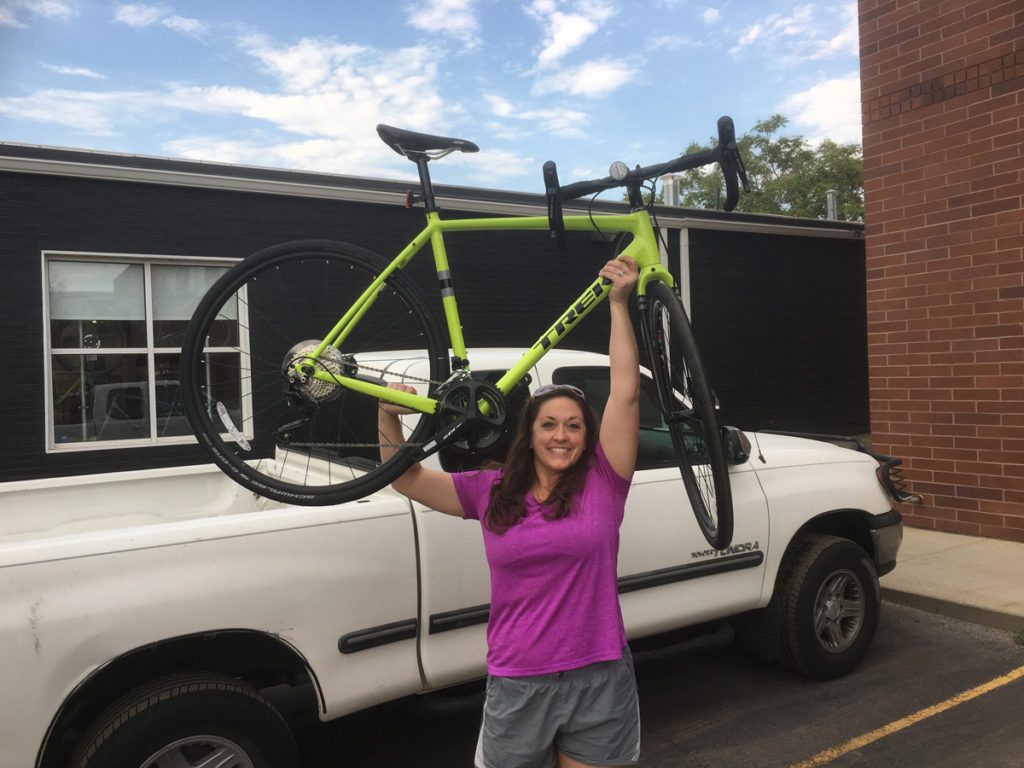
Lindsey Edwards celebrating the purchase of a new bike. Photo courtesy Lindsey Edwards
Cycling West: Tell me a little bit about yourself. Are you from Utah? If not, what brought you here?
Lindsey Edwards: No, I am originally from Watauga, Texas. My husband and I served as Peace Corps volunteers in Uganda, East Africa. We then moved to New York City for graduate school. After living abroad, we knew we wanted to be in a place that offered real access to the outdoors, and Salt Lake City seemed to be perfect. We drove a U-Haul with everything we owned out here about 7 years ago and have fallen in love with Utah.
CW: What brought you to cycling? Is it a lifelong passion or something you picked up more recently?
LE: I have always loved riding my bike and learned how to ride at a very young age. I started racing BMX at four and a half years old, and I loved the freedom it gave me as a kid to be able to ride through the neighborhood and be outside. I would say I took a break from riding through my young adult years but have recently found my way back to cycling.
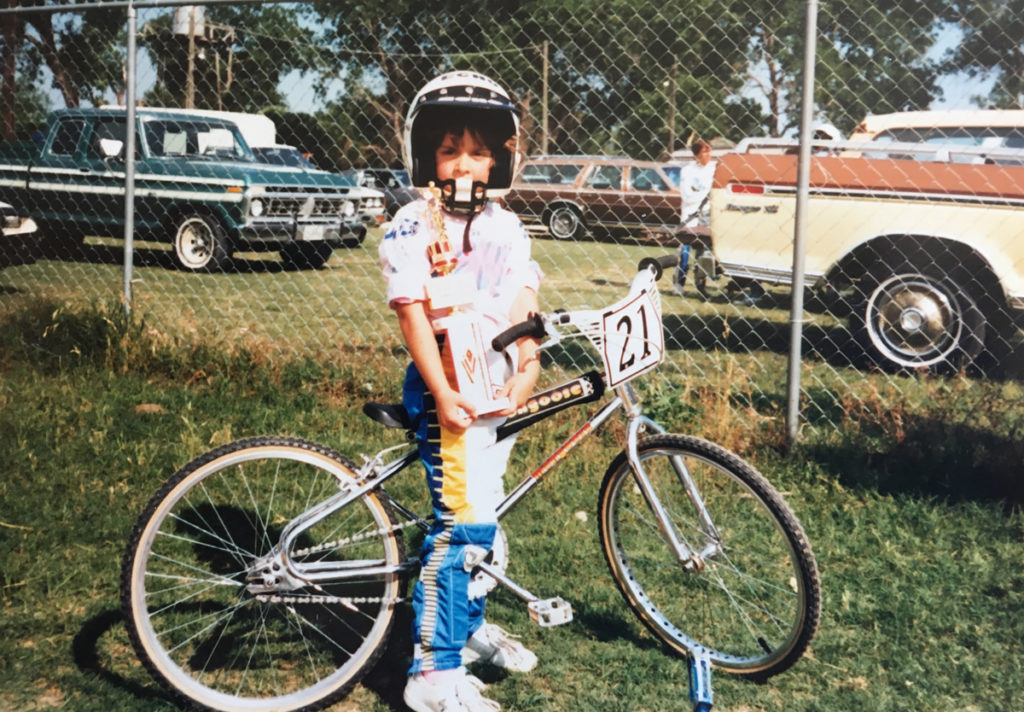
Lindsey Edwards at her first BMX race. Photo courtesy Lindsey Edwards
CW: Do you consider yourself a commuter or more of a recreational cyclist?
LE: I would say I am a recreational cyclist striving to be a commuter. My goal is to commute to work 3 days per week and get a recreational ride on the weekend with my husband. I am more successful some weeks than others. I just try to turn pedals as often as possible.
CW: What does the route you take to work look like? What’s your favorite recreational ride?
LE: My commute to work is part trail and part city, so it is always interesting. My favorite recreational ride is to start near the Capitol, and ride through downtown. Then head east and go through Liberty Park. Ride to Parley’s Trail, and ride through Sugarhouse Park. Then head back North to the Capitol through the west side of town. You get to pass the railroad station and new breweries. There is so much to see in a relatively short ride. It shows how special Salt Lake City really is.
CW: I understand you were recently in an accident. Has that shaken your confidence at all? Any advice for other commuters?
LE: Yes, I did. I would not say that it shook my confidence because I was eager to get back on my bike once I got it out of the shop. I would say I have a deeper respect for riding now, though. As far as advice goes, I would say you can’t be too careful. You can be doing everything right, and accidents still happen. I would also say that if you do wreck or have a scary experience, don’t let it deter you from getting back on.
CW: What is your favorite piece of cycling equipment – other than your bike?
LE: My favorite piece of kit is my SON 28 dynamo hub with a Busch Moller front light. It is attached to my front wheel, and kinetically operates a front and rear light. So, I always have light when I am riding my bike. I was not always great about remembering to charge my lights before, and now I don’t have to worry about it. My goal was to remove as many barriers to riding as possible. I wanted to make it as easy as possible to just go for a ride, especially as I was just getting back into riding.
CW: If you could wave a magic wand and fix one thing about cycling, what would it be and why?
LE: Honestly, I would like to see more people cycle. Changing transportation changes the human. I am not suggesting that everyone ditch their cars, and only ride for transportation (although that would be cool). However, I would like to see more people being outdoors and riding. I feel like I can connect to the city on a different level by cycling through it, and Salt Lake City is a fun place to ride.
Turner C. Bitton is an avid cyclist and is well-known for his commitment to public service. He lives in the Glendale neighborhood of Salt Lake City with his husband Chase and their two dogs Charley and Moose.
If you have a suggestion for a commuter profile, have a commuter question, or other comments, please send it to [email protected].
TEMPE, Arizona (August 27, 2019) – The new Pivot LES SL introduces a new paradigm of hardtail performance.
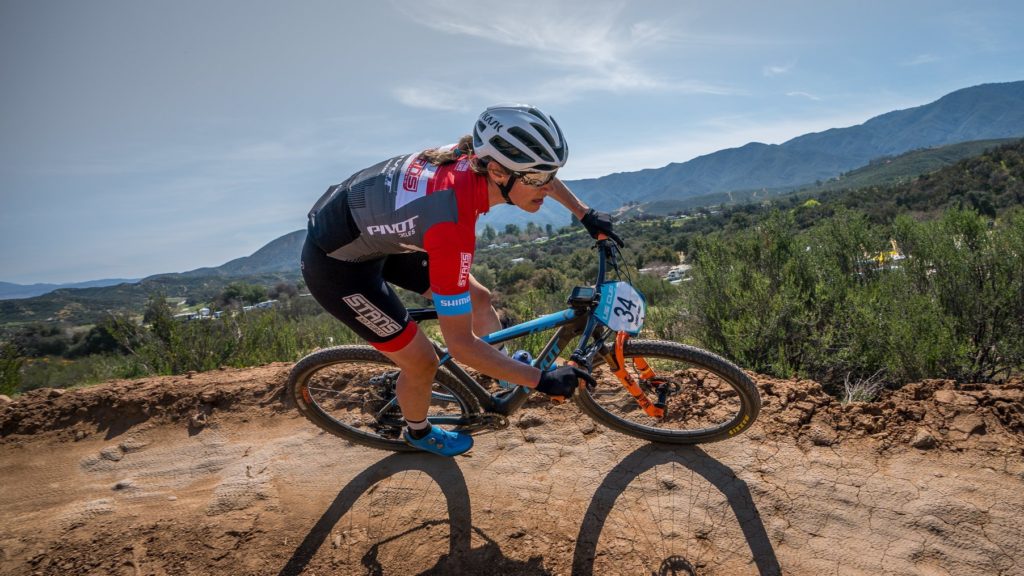
Pivot Cycles introduces the new LES SL – a bike engineered to the Nth degree to deliver the kind of handling, extreme power transfer, and weight that transforms every last watt of output into a race-winning performance. Already proven by the Stan’s-Pivot Pro team with a Short Track National Championship, Leadville 100 win, and many others – on the right racecourse, nothing is faster than a hardtail, and nothing delivers the stiffness to weight ratio and raw speed as a Pivot LES SL.
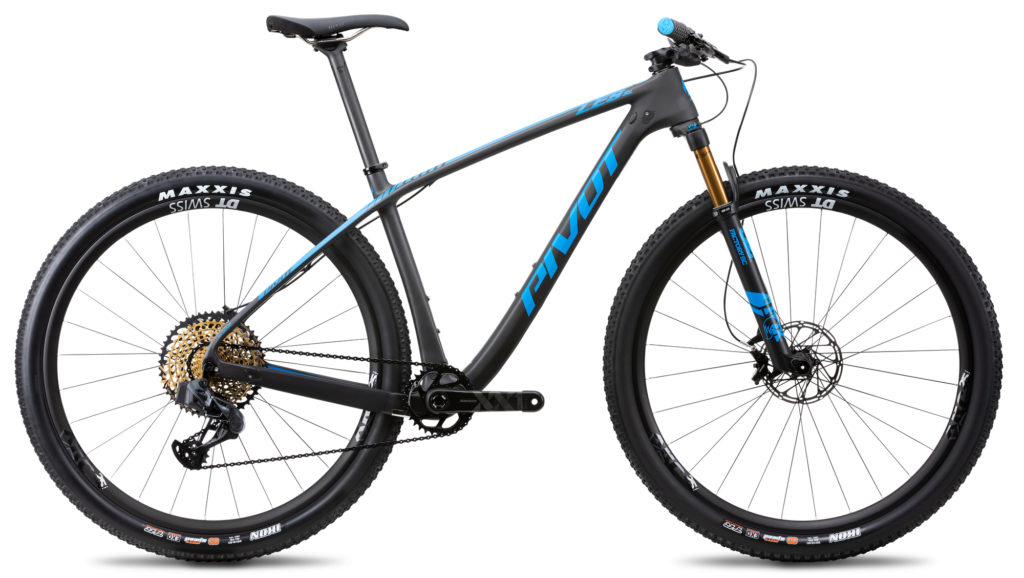
The new Pivot LES SL. Photo courtesy Pivot Cycles.
The LES SL is up to three-quarters of a pound (that’s 300 grams!) lighter than it’s already svelte predecessor making it a racer’s dream that can turn seconds saved into minutes – all while retaining the quality and handling that has pushed Pivot athletes to cross country race wins at the elite level, across the world. With new carbon dropouts, an integrated headset and new layup schedule utilizing Hollow Core Molding Technology and cutting-edge carbon materials, the LES SL is by far the lightest hardtail that we’ve ever built. Pivot’s race-winning hardtail legacy takes a quantum leap forward with a lighter, faster, and sharper-edged tool with only one goal in mind: getting from point A to point B, as fast as possible.
“When I choose to race my LES SL, it’s an ‘all-in’ choice,” says Stan’s-Pivot Pro team athlete, Chloe Woodruff. “And it’s not only for climbing. At the Whiskey Off-Road this year, I rode my way from 5th to 2nd on the final descent.”
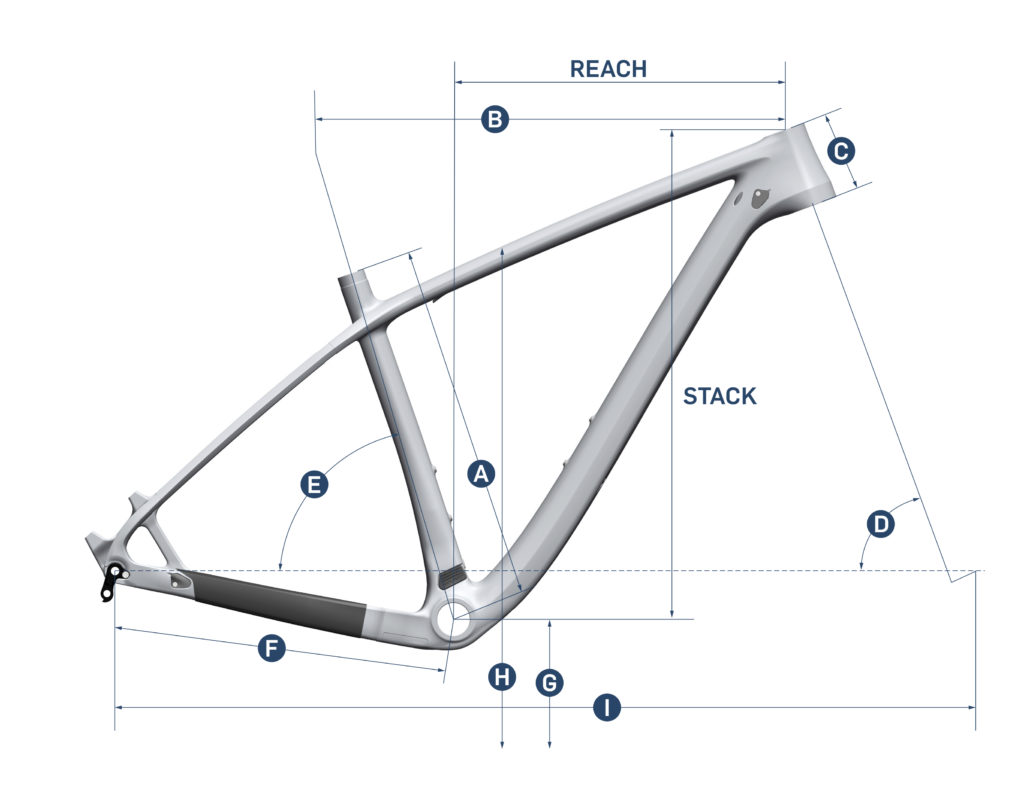
The incredibly light LES SL offers best in class stiffness to weight ratio and power transfer with laser-focused yet predictable handling. Our engineers managed to cut grams while retaining that legendary Pivot ride feel and compliance that the LES line is known for – the kind that saves energy over the long haul and keeps the bike planted and predictable over all surfaces. The LES SL is the perfect hardtail trifecta of lightweight, stiffness and ride quality that lets racers excel at the highest levels.
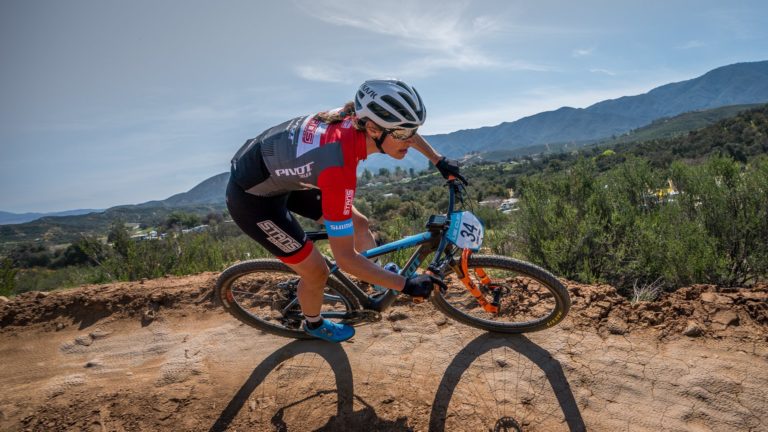
Rose Grant on her Pivot LES SL at the US Cup in Vail, Colorado. Photo courtesy Pivot Cycles.
Pricing, Specifications, and Availability: The LES SL will be available in two color options—Blue and Stealth. It is available as a frameset and a complete bike in nine configurations ranging in price from $3,799 to $8,199. The LES SL is available now, in all sizes, at key Pivot Dealers worldwide. For more information, visit www.pivotcycles.com/en/bike-les-sl-1.
It’s quite technical but the Federal Highway Administration (FHWA) has released what it considers a comprehensive guide for transportation officials to measure trade-offs and determine what type of bikeway to build and where. The Bikeway Selection Guide shows, for instance, how to consider auto traffic volume and speed and number of lanes. It discusses all the possibilities from narrowing and removing auto lanes to the preferred shoulder width on rural roads (10 ft.).
Among the many generalities: It’s usually better to include a bike lane even next to parking, despite the possibility of dooring, which accounts for 5-10 percent of bicycle accidents. And generally, one-way bike lanes are better on two–way streets than two-way bike lanes on one side.
It is also worthwhile to provide protection at intersections and continue bike lanes through them. “Intersection approaches with mixing zones require motorists to yield to bicyclists before entering or crossing the bike lane. This clarity can be further enhanced with bicycle lane extensions through the intersections, green colored pavement, and regulatory signs. Research shows protected intersections have fewer conflicts and are therefore preferable, the guide says.
The manual discusses the many factors that should go into deciding whether to separate autos from bikes. If they can’t do so, planners can consider other measures, such as reduced speed limits.
Bicyclists do tend to feel more comfortable on separated lanes.
Pedal the Plains is a 3-day road ride in central Colorado that will be held from September 13-15, 2019. The ride features a 3-day fully-supported option, with a one-day road or gravel century option too.
The ride celebrates Colorado’s rich pioneer and agricultural traditions with a new route each year.
Pedal the Plains showcases Colorado’s agricultural heritage. Courtesy Pedal the Plains.
We asked organizer Deirdre Moynihan of the Denver Post Community Foundation about the ride.
Cycling West: Tell us about the ride and the course. What are the highlights along the way? How many riders do you expect?
Pedal the Plains: We get approximately 1100 riders annually. Day 1 goes from Kiowa to Bennett. It is a shorter day of approximately 32 miles on the Kiowa Bennett Road. What is really interesting is that both Kiowa and Bennett border the more Metro areas of Denver and the Front Range. The surrounding completely changes when you cross into these towns – you know you are in the country immediately. Once in Kiowa, I parked my car to go to a local café (Patty Ann’s Café) and a group of folks on horses rode up and parked their horses! The Kiowa-Bennett Rd has many farms and ranches and it is beautiful countryside. One of the Aid Stations will be a local Alpaca Ranch – Kamali Alpaca Ranch – and the cyclists will be able to meet and hang out with the Alpaca. Day 2 will showcase big wheat farms and cattle ranches before heading south on Route 71 towards Limon. There will be a great aid station at one of the largest bison ranches. A fun stop will be Last Chance. Last Chance is all but gone now but was the town that everyone traveling East would stop at for gas and food because it was their “Last Chance” for a long time! The building of Interstate 70 made the town unnecessary and people stopped going. For those riders that want an extra challenge they can continue onto Genoa after reaching Limon. The trip to Genoa adds about 20 miles to make it a century with a great aid station at the World’s Wonder View Tower. This was highlighted in Rigley’s Believe or Not at one point. They say that you can see 6 states from the top of the tower. And for those that want a big challenge they can do the Great Mustang Gravel 100 with lunch at the Great Escape Mustang Sanctuary. The gravel route winds in and out of true farm country with ranches, corn, and wheat. It is just beautiful. The final day heads back to Kiowa traveling through some little towns along the way. Day 3 has more towns than the previous days so it is really fun to stop in them. One of the great highlights will be the Paint Mines – a geological wonder in the Eastern Plains.
And the route is only part of the fun – what happens at the Headquarters each day when you finish is amazing – farmers show off their crops, knee slapping music, some great food and of course beer!
Sag wagon support at Pedal the Plains Friday September 16, 2016. Photo by Evan Semón, Courtesy Pedal the Plains.
CW: What are the food and beverage highlights during and after the ride each day? How do you showcase the local agriculture and culinary folks?
PTP: We showcase them in a variety of ways. For example the Colorado Egg Producers are at an Aid Station every day with hard boiled eggs. The Colorado FFA (Future Farmers of America) do lunch every day and source out local food to use. We always try to use the local crop as much as possible – this area is a bit interesting because the local crop really is beef! The 2018 Route really travels through cattle country.
CW: What’s the new gravel ride like?
PTP: Fun, beautiful, challenging! For the most part it is a packed dirt, although there are a few sandy spots. It has a few rolling hills that add to the challenge but for the most part it is just some beautiful roads surrounding by corn and horses. You feel like it is just you and the road. There are a few farm vehicles but not many so you feel very safe as you ride along.
CW: Tell us more about the history of the area and the points of interest on the ride.
PTP: Much of the history comes from people traveling. Limon has remnants of the Smoky Hill Trail, established in 1859, went from Atchison, Kansas to Denver to provide a route for individuals during the Colorado Gold Rush. Strasburg, the town next to Bennett, is the location where the Transcontinental Railroad met. There is a great story about that. Union Pacific celebrated the meeting of the Transcontinental Railroad in Utah 15 months before it actually happened. Kiowa and Elbert County possess a quintessential Western landscape with long-distance views of the Front Range and working agricultural lands. This area marks the end of the Front Range and the beginning of high plains grasslands.
CW: Can you tell us about the beneficiaries of the ride?
PTP: The 2 key beneficiaries are:
Colorado FFA: Integrated into the curriculum of over 100 high schools in Colorado, the Colorado FFA Foundation is the premier co-curricular leadership organization for students ages 14 – 18. Most members of Colorado FFA do not come from a farm or ranch but have a desire to learn more about agriculture and the inspiring task of providing food and fiber to a growing population. Areas of focus are: premier leadership; personal growth; and career success through agricultural education.
Colorado 4-H: Embedded in the CSU Extension Offices, 4-H is a non-profit designed for youth ages 5 through 18 years of age living in counties across the state. 4-H began over 100 years ago as an educational program for the rural youth of America. Their mission remains to empower young people to reach their full potential, working and learning in partnership with caring adults. Through projects in environmental science, rocketry, foods and nutrition, animal science, and photography, members of 4-H learn important skills such as leadership, ethics, decision making, record keeping, responsibility, and community service. The 4-H motto, “To make the best BETTER,” is something that this non-profit strives to accomplish as it embarks on another century of service for America’s youth.
Event Details:
September 13-15, 2019 — Pedal the Plains, Kiowa, CO, PTP will take cyclists through the host communities of Kiowa, Bennett and Limon. Celebrates the agricultural roots and frontier heritage of the Eastern Plains of Colorado. Learn about farming and ranching, while experiencing the culture, history and landscape of Colorado’s high plains.The Tour incorporates interactive on-route experiences by staging rest stops on farms, posting educational points of interest and serving community meals composed of locally sourced food. New in 2018 is the Great Mustang Gravel 100 80% on packed dirt or gravel roads, this route will be fun and challenging for the gravel expert or rookie! Proceeds from Pedal The Plains benefit The Denver Post Community Foundation in support of the Colorado FFA Foundation and Colorado 4-H., Deirdre Moynihan, 303-954-6704, [email protected], pedaltheplains.com