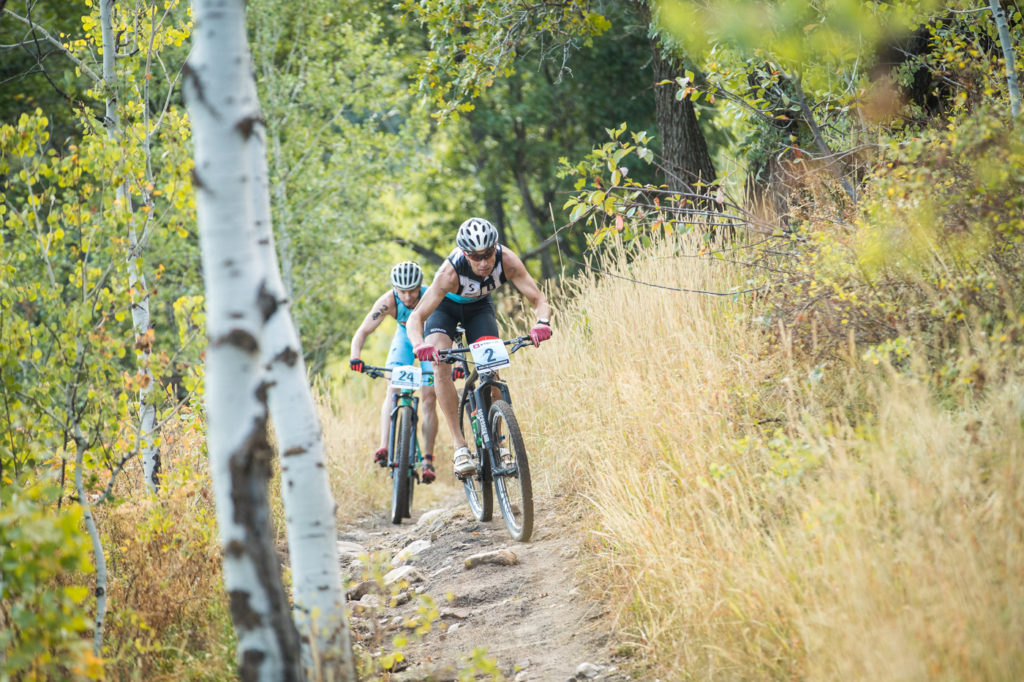
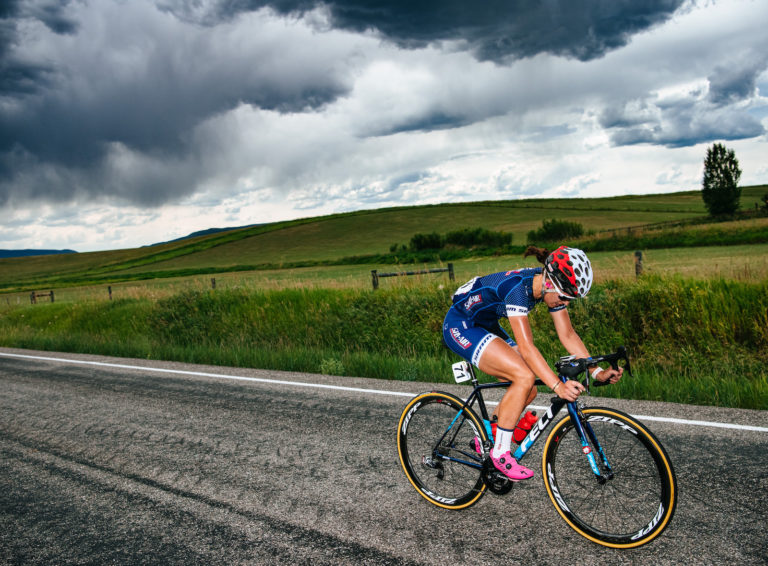
The XTERRA Pan American / USA Championship on September 7 at Snowbasin Resort near Ogden, Utah is the culmination of a series of off-road triathlons spanning South and Central America, Mexico, the Caribbean, Canada, and the United States, and is open to everyone.
Photo courtesy Xterra Planet
The off-road triathlon begins with a one-mile swim in Pineview Reservoir (4,900-feet elevation), follows with an 18-mile mountain bike leg that climbs more than 3,000-feet to the top of Sardine Peak (7,300-feet elevation), and culminates with a 7-mile trail run featuring another 600-feet of climbing on trails around Snowbasin Resort in the Wasatch Range.
There is also half-distance sprint off-road triathlon and relay-team options where athletes can join together to conquer the course.
Held at the most beautiful apex of the year, while summer is gracefully yielding to autumn, the XTERRA Pan Am / USA Championship honors the fastest athletes in each five-year age group categories as the XTERRA Pan Am Champion, and the fastest American in each of those divisions is celebrated as XTERRA’s U.S. National Champion.
Elites compete for $80,000 in prize money, and cameramen position themselves around Wheeler Canyon and the Wasatch Range to capture all the action for a nationally syndicated XTERRA Adventures TV show that exposes the beauty of northern Utah to the masses.
“XTERRA is one of the events that truly highlights Utah’s beauty and will showcase one of Utah’s Olympic and world class venues at Snowbasin Resort,” said Jeff Robbins, president & CEO of the Utah Sports Commission.
In addition to Saturday’s race, the XTERRA Trail Run National Championshiphalf-marathon on Sunday features scenic views, technical trails, and big climbs. The half-marathon, plus the 5K and 10K trail runs, are open to everyone, and it’s important to note that you don’t have to be fast to join in the fun. For some, it’s just about finishing and that’s okay as XTERRA is all about perpetuating the healthy, active, outdoors lifestyle.
XTERRA will also host an expo in downtown Ogden on Friday with free run and bike races for kids, a full-on Kids Zone, SUUNTO demos, triathlon clinics, the Paul Mitchell hair cut-a-thon for charity, and more.
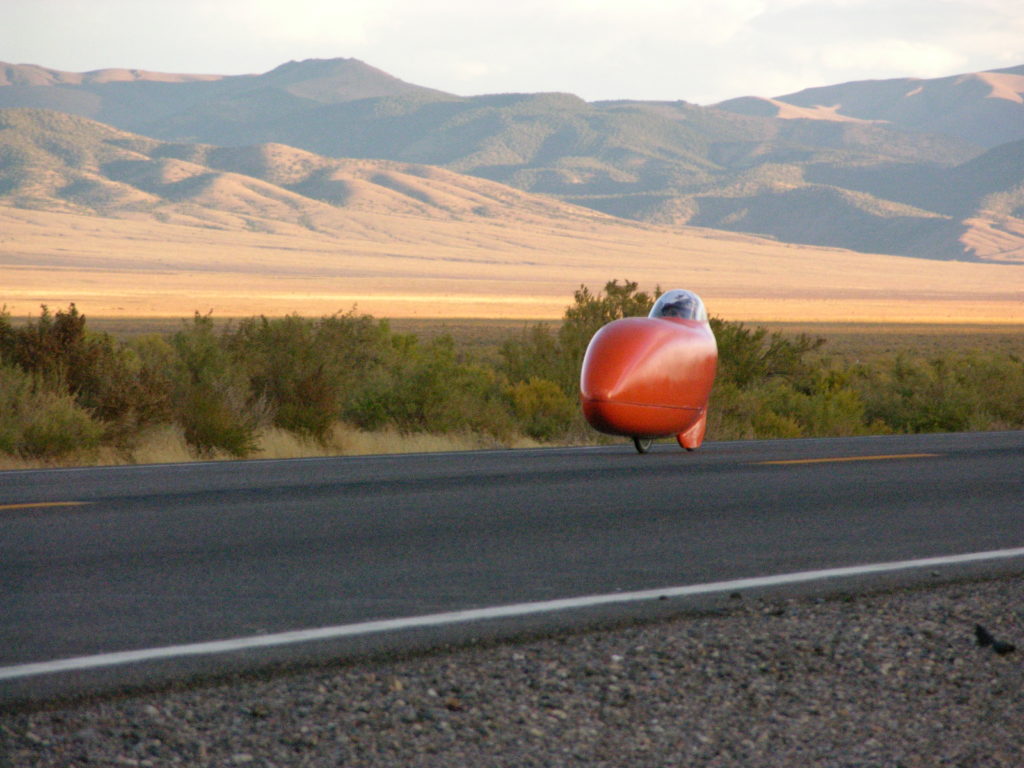
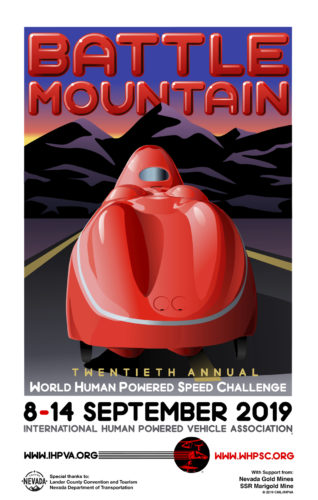
The 20th annual World Human Powered Speed Challenge (WHPSC) Sept 8-14, 2019 will be held on SR305 south of Battle Mountain, Nevada.
One of the bikes from the World Human Powered Speed Challenge. Photo courtesy: Lander County Convention & Tourism Authority
The world’s fastest humans from around the world including the US, France, Russia, Japan, Canada, Italy, Mexico, the Netherlands, Australia and England which include many Collegiate teams and their pedal powered vehicles, will attempt to break the current land speed record of 89.59 mph set by Todd Reichert of team Aerovelo, of Toronto, Canada in 2016 the women’s record set by Barbara Bautois from Draveil, France in 2010 of 75.69 mph, and Multi-track set by Gareth Hanks from Berwick Australia at 73.95 in 2016
Highway SR 305 just south of town possesses the unique traits necessary for these highly engineered bicycles to achieve top speeds. The 4,619ft (1,408m) altitude road allows riders an acceleration zone of over 5 miles, enabling them to reach their maximum velocity before being timed over a 200 meter distance. The section of the road used for this event was paved in 2009, with a smooth surface specially prepared for human powered cycle racing by Frehner Construction and the Nevada Department of Transportation using a Nevada Department of Tourism Grant from the US government.
As per the rules of the International Human Powered Vehicle Association (IHPVA), the world record keeping and sanctioning body for this sport, the maximum grade allowed cannot exceed 2/3 of one percent over the entire course, in homage to the first record attempts held in the early 70’s on the Irwindale Speedway. The high altitude and arrow straight section of pavement has drawn athletes worldwide to test their speedbike designs and sprinting abilities since 2000.
The longstanding partnership between Lander County Convention & Tourism Authority and the IHPVA has motivated both to create an independent permanent facility in Battle Mountain specially created for human power events, record attempts as other like minded endeavors. The IHPVA and Lander County are currently seeking partnerships to make this dream facility into reality.
Spectators are welcome to this free event each morning from 7:00-10:00 and each evening from 6:00-7:00. The commuter bus leaves the Battle Mountain Civic Center each day at 4:30 and returns at 7:30. Grandstands are located at the timing traps for maximum speed thrills or for those curious about the riders and vehicles you can wait in the “catch” area to see the racers assisted from their fully enclosed speedbikes. Spectators are encouraged to ride the bus but parking is now available at the grandstands
The Civic Center will also host a show and shine on Tuesday, Sept 10 from 12:00 – 2:00 for those who would like to see the bikes and meet the riders. Event T-shirts, hats and posters will be on sale.
Drag races will be held in town Friday morning at 12:00 near the High School. All are welcome to test their mettle against the world’s fastest.
Don’t miss this opportunity to attend what could be world record setting history!
The WHPSC is open to all riders. All vehicles and riders must safety inspection and reach a minimum speed during morning qualifications. Entries may be limited due to road-closure time constraints.
Event Coordinators / Race Directors: Al and Alice Krause: Email [email protected] or (707) 443-8261 (10:00 AM to 10:00 PM PST)
September 8-14 — World Human Powered Speed Challenge (WHPSC), Battle Mountain, NV, 20th annual hosted by the IHPVA. Current record is 89.59 mph. Classes: Men’s, Women’s, Juniors in Open, Multi-track, tandem and Arm Power. International cyclists from around the world will gather on SR305, the fastest stretch of road in the world to see who can break the World Record., Al or Alice Krause, 707-443-8261, 707-845-3683, [email protected], ihpva.org, whpsc.org
The 22-year-old proves unstoppable in 2019 Colorado Classic presented by VF Corporation
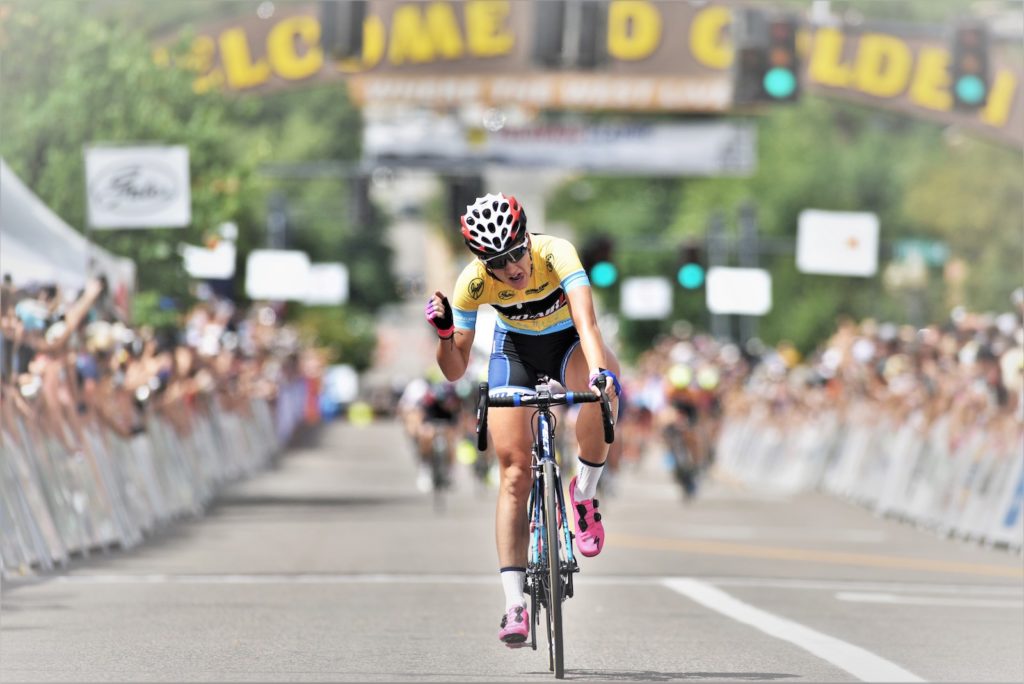
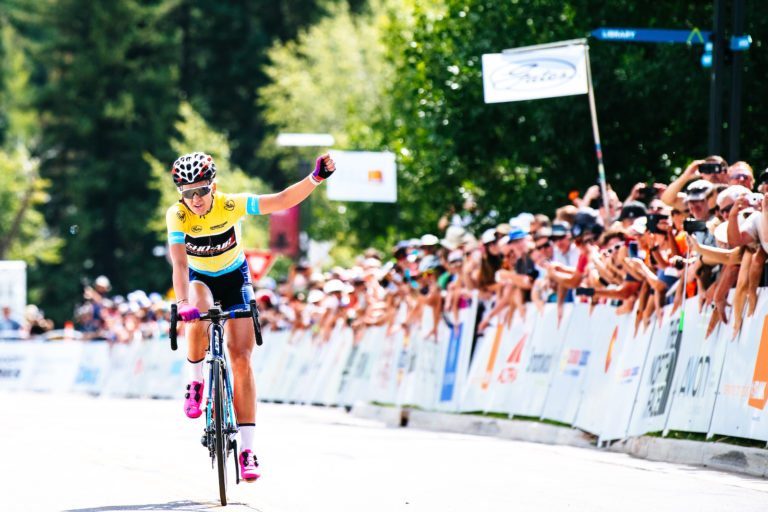
DENVER, Colorado – Chloe Dygert (Sho-Air Twenty20) surprised even herself on Sunday when, for the fourth straight day, she pedaled across the finish line alone in first place in the 2019 Colorado Classic presented by VF Corporation.
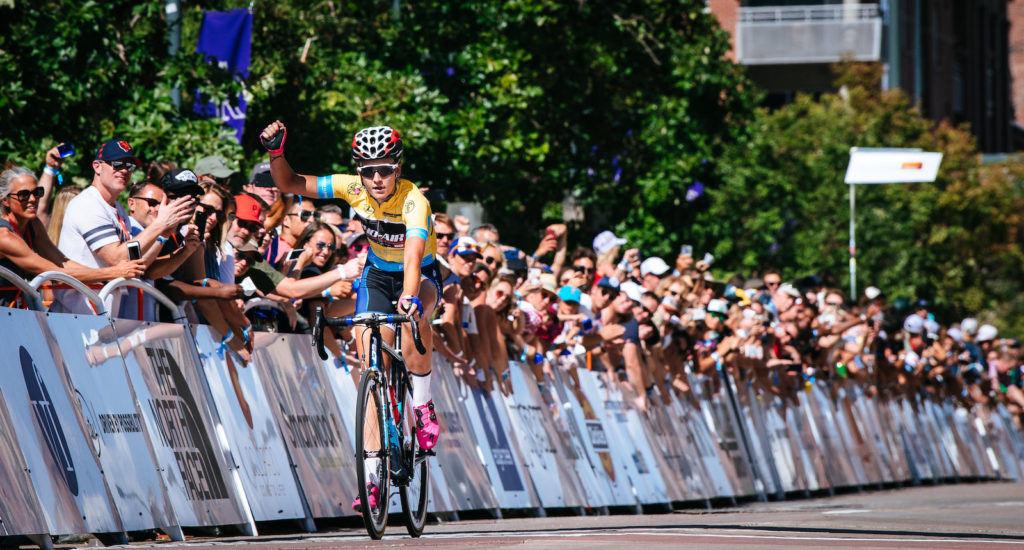
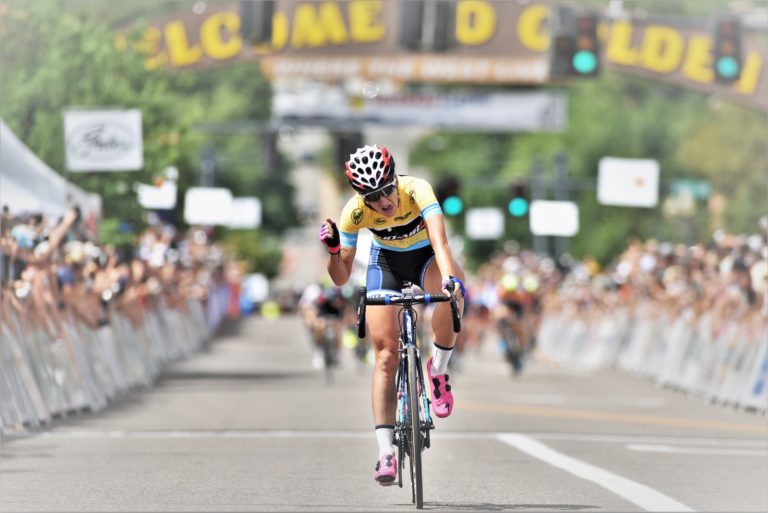
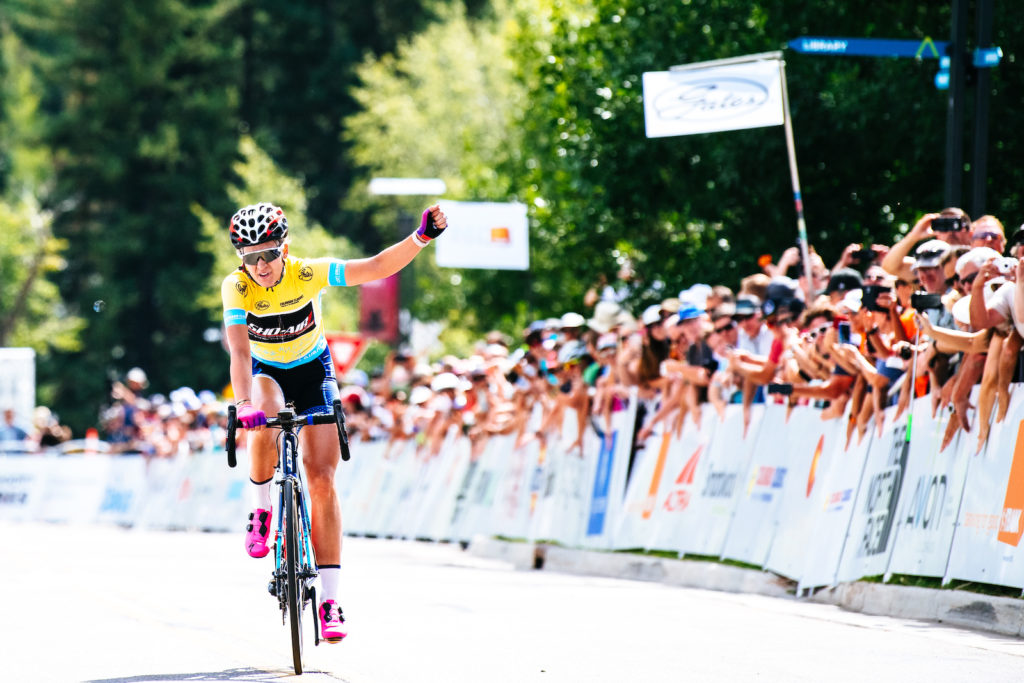
Chloe Dygert (Sho-Air Twenty20) soloes in to take her 4th consecutive stage and the overall win at the 2019 Colorado Classic. Photo courtesy Colorado Classic.
In oven-like temperatures that climbed to 96 degrees, the 22-year-old bided her time in Stage 4 presented by Gates Corporation, on a fast, 52.8-mile course comprised of eight laps around downtown Denver.
Although there were nonstop attacks throughout the race, no rider was able to put much of a gap between herself and the peloton…until Janelle Cole’s (LUX/Flexential) last-ditch effort.
With one lap to go, Cole charged ahead in a valiant attempt to pry at least one stage from Dygert, but the race leader had none of it, hammering past Cole in the last few kilometers.
Cole ended up 11 seconds back as Dygert made a clean, incredibly decisive sweep of all four stages of the race, also claiming four straight days as the FirstBank Sprint Leader, Colorado Tourism Office Queen of the Mountain and the VF Corporation Best Young Rider. She came away winning the overall four-stage race in a total time of 8 hours, 55 minutes and 6 seconds, by 2 minutes and 37 seconds ahead of runner-up Brodie Chapman (TIBCO-Silicon Valley Bank) and 2:57.00 over Omer Shapira, whose Canyon-SRAM team walked away on top for team points.
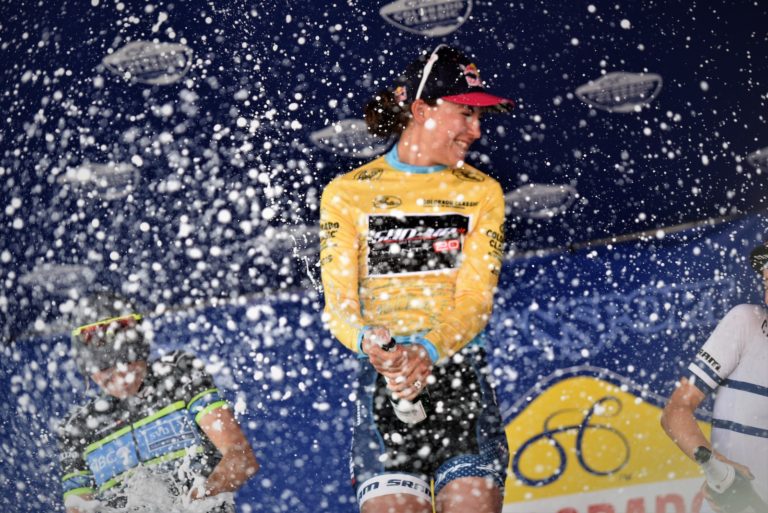
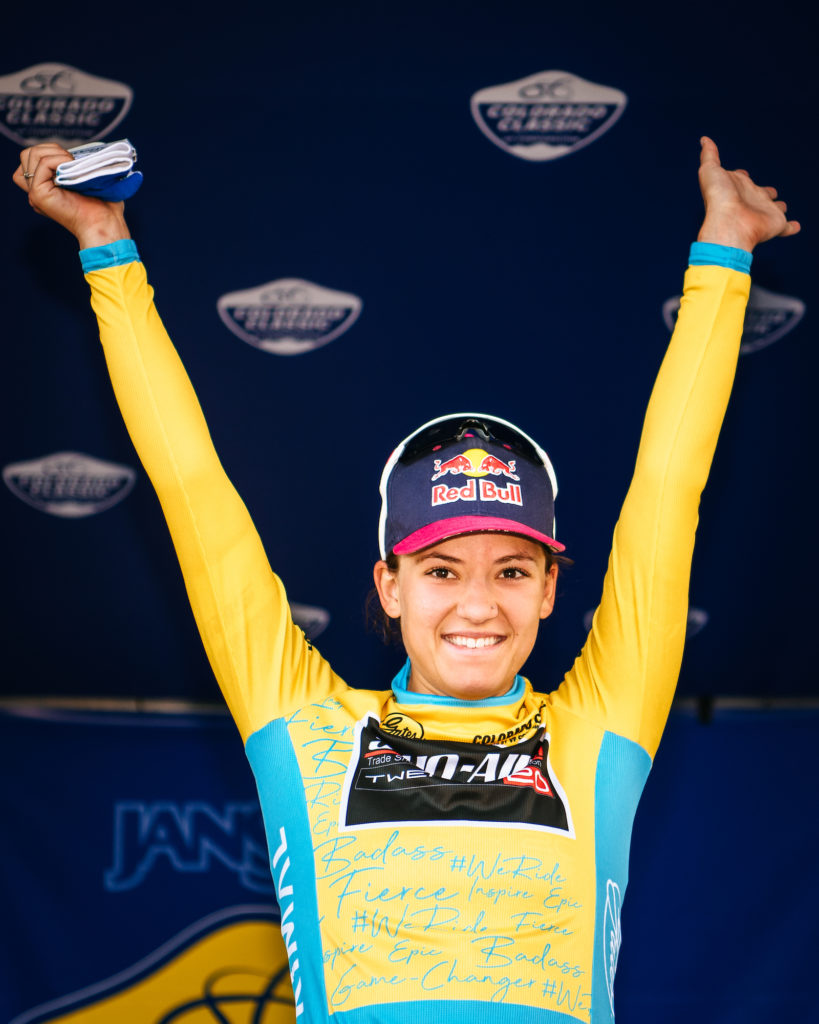
Chloe Dygert (Sho-Air Twenty20) celebrates her overall victory on the podium with Brodie Chapman (TIBCO-SVB, 2nd) and Omer Shapira (Canyon-SRAM, 3rd). 2019 Colorado Classic. Photo courtesy Colorado Classic.
“I was not expecting to do this,” Dygert said after the race Sunday. “I just wanted this race to be a really good block of training for the World Championships. Hopefully this helps my case with being able to go. I work really hard and it’s taken over a year to get my strength back.”
Dygert’s domination of the Colorado Classic is especially impressive in the wake of the injuries she’s suffered in the last two years, including a torn knee ligament, concussion, torn hip labrum and bulging disc in her back.
“Chloe, in the last 18 months, has been through a bunch,” said her father, David Dygert. “She’s really starting to come on now. This race really showed that.”
The seven-time world champion and Olympic silver medalist proved unstoppable to everyone witnessing the four days of racing this week in Colorado.
“Chloe is a phenom. She’s incredible. We all know that. I have so much respect for her,” Cole said, adding that she had nothing to lose by her Stage 4 late attack on Sunday. “Before the race today, I said the only way to lose a bike race before you even start is by racing for second. “I thought, ‘I’m 10 minutes out in GC, no one is going to care about me. Today is the day to throw it all in. This is my last race of the season. I don’t have a team for next year. This is the time to make it happen.’”
Cole’s efforts, which took her about 50 seconds ahead of the peloton at one point, were thwarted by Dygert and Dygert alone. “I was assuming that Chloe would come after me and if she did, no one would come after her. I got lucky it happened that way,” Cole said.
Chapman, too, said there was nothing more she could have done to give Dygert a run for her money these last few days.
“She was just super strong. I did my best,” Chapman said.
Chloe Dygert (Sho-Air Twenty20) sweeps the GC, Sprints, KOM, and Best Young Riders jerseys. 2019 Colorado Classic. Photo courtesy Colorado Classic.
Brazilian racer and Colorado resident Flavia Oliveira (Fearless Femme) made several attacks on Sunday, earning the VF Corporation Most Badass Rider jersey while the event’s oldest rider, 52-year-old Edwige Pitel (Cogeas Mettler Look), who crashed on the final lap but bounced right back into the saddle, earned the Audi Most Inspirational Rider jersey.
All top riders commented on the great energy and crowd turnout throughout the four days of racing.
“The crowds are really great. It’s probably one of the biggest races I’ve been to,” Dygert said. “The support has been phenomenal.”
Colorado Classic organizer RPM Events Group said the 2019 race, which is the only 2.1 UCI-ranked women’s standalone pro road race in the Western Hemisphere, was a resounding success and a springboard for something even greater.
“We’re doing something meaningful,” said RPM Chief Operating Officer Lucy Diaz. “This is not just another bike race. It’s about the content and the future of the sport. To speak to the #WeRide movement, that made us feel really unified with what we were doing out here. We can create a platform that creates a sense of women’s empowerment. The impact to girls is powerful. All the girls out here watching … hopefully it gets them on a bike, on a soccer field, on a track. Hopefully it gets them out there.”
And the momentum continues.
“I think we had a hunch the last couple of years that the time was right to do this,” said RPM Chief Executive Officer Ken Gart. “We feel like this is the beginning of something really exciting.
FINISH STANDINGS
#71 – Chloe DYGERT – Sho-Air Twenty20
#143 – Janelle COLE – LUX/Flexential
#14 – Emma White – Rally UHC
GATES CORPORATION GENERAL CLASSIFICATION JERSEY
#71 – Chloe DYGERT – Sho-Air Twenty20
#41 – Brodie CHAPMAN – TIBCO-SVB
#22 – Omer SHAPIRA – Canyon-SRAM
COLORADO TOURISM QUEEN OF THE MOUNTAIN LEADER JERSEY
winner – #71 – Chloe DYGERT – Sho-Air Twenty20
VF CORPORATION MOST BADASS JERSEY
winner – #112 – Flavia OLIVEIRA – Fearless Femme
AUDI MOST INSPIRATIONAL JERSEY
leader – #32 – Edwige PATEL – Cogeas Mettler Look
“America is all about speed, hot nasty bad-ass speed” – Eleanor Roosevelt.
Lessons learned from DH riders: why ride uphill when you can shuttle? Only the descents count! Photo by Ian Matteson
Modern day criterium racing requires athletes to be faster than ever. Fast Bikes, Fast Wheels, Fast Riders. Only those with a need for speed will stand on top of the podium. Team Clif Bar knew they needed a unique challenge to test their mettle. With Salt Lake’s Cottonwood Canyons as their latest proving ground, these crit stars once again earned their stripes. Think you could keep up?
Video shot by Mike Swim, directed by Ian Matteson.
By Greg Hoole – CNN recently reported that seventeen cyclists have been killed in New York City this year alone. To put this in comparison, there were only ten deaths in 2018. In response, Mayor Bill de Blasio recently announced a $58.4 million plan to improve bike safety in the city.
The improvements largely consist of adding 30 miles of additional protected bike lanes each year, with the goal of having 80 new miles of such lanes by 2021 (for a total of around 162 miles). Protected bike lanes, which use a physical barrier to separate cyclists from motor vehicles, are far superior to painted lines on the street.
A May 2019 report by the city transportation department found that there are 490,000 cycling trips made in a typical day in New York, and that number is expected only to grow. Cities along the Wasatch Front, likewise, continue to see an increase in cycling trips. This provides countless benefits, both to our community and cyclists themselves. Unfortunately, as cycling trips increase, so do injuries.
According to the latest statistics reported by the Utah Department of Health, each year in Utah an average of 372 cyclists are injured in crashes with motor vehicles. Five are killed. Nearly half of these injuries are suffered by children and young adults. Head injuries are the most serious type of injury and the most common cause of death for bicyclists. Bicycle helmets have been proven to reduce the risk of head and brain injury when a crash occurs by as much as 85 to 88 percent.
Suffice it to say, we should all wear a bicycle helmet every time we ride. There are also a number of other, common sense, measures we can take to stay safe out on the road. First and foremost, we need to be seen. All other safety tips typically boil down to helping us be seen. This is because nothing else really matters if motorists don’t see us.
One thing to consider is using a white flashing light on the front of your bike and a red blinking light on the back every time you ride. Lights are required at night but they also greatly improve one’s visibility during daylight hours. (By the way, failing to wear a helmet or use a bright white front light and a red taillight at night not only greatly increases your chances of accident and injury but may compromise your ability to obtain legal relief if you are injured.)
It is also critical that we be predictable. This means generally acting like a motor vehicle—driven be a smart person. We should follow the rules of the road. I came across a cyclist riding against traffic (including me) on my ride this morning. Not a good idea. Cars don’t expect traffic going the wrong direction. This means your chances of being seen are greatly diminished and your chances of getting whacked are greatly increased. Never do this, and teach your children likewise.
Finally, ride defensively, with making sure motorists see you being first in your defensive strategy. The best way to make sure a particular motorist actually sees you is to make contact with the motorist. Although you cannot always be 100% positive that a motorist who is looking at you actually sees you (I could tell you stories), you can be 100% positive that the motorist does not see you if he has not made eye contact with you. Track the eyes and live.
So, as we as a cycling community continue to push for more biker-friendly infrastructure (like New York is implementing), don’t forget to focus on what you can do individually to stay safe.
The Sho-Air Twenty20 star again makes strategic move to win third straight stage.
GOLDEN, Colo. – Winning the first two stages of the 2019 Colorado Classic presented by VF Corporation was not enough for 22-year-old Chloe Dygert on Saturday during Stage 3 in Golden.
As numerous racers attacked throughout the race, breaking away only to be sucked back into the peloton, Dygert waited until just before the final lap to charge ahead and not only win her third straight stage but also handily maintain the yellow Gates Corporation General Classification Jersey as race leader as well as FirstBank Sprint Leader, Colorado Tourism Office Queen of the Mountain and VF Corporation Best Young Rider.
After attacking out of the peloton to take the final QOM points on offer, Chloe Dygert (Sho-Air Twenty20) soloed in for her third consecutive stage win. Stage 3, 2019 Colorado Classic. Photo courtesy Colorado Classic.
“It was an on-the-fly decision,” Dygert said of her move. “I had that gap and I looked back and saw some heads hanging. Again I said, ‘OK, let’s keep this going for as long as I can.’ I knew either way we were going to have a solid day.”
Dygert completed the 63.7-mile Stage 3 circuit course in 2 hours, 27 minutes and 45 seconds as her Sho-Air Twenty20 teammate Jennifer Valente of Colorado Springs was second across the finish line, 5 seconds back.
“Nobody should give Chloe an inch, because she will keep going,” Valente joked after the race.
Fearless Femme’s Rebecca Wiasak, who won Stage 1 of the 2018 Colorado Classic, took third in Stage 3 after a mid-race breakaway in which she led for two laps with only Silvia Valsecchi (BePink) on her wheel and the peloton as much as 50 seconds behind her.
“We wanted to make the race aggressive. All my teammates had a go off the front at various times. The wind really picked up and it was really hard. I thought, these girls are just sitting in the bunch having a cruise-y ride and I’m dying. I thought when I was in the break, hopefully I’ll get the Badass jersey for this. If I can get to the climb with the lead group, I might have a chance of hanging on,” Wiasak said.
Then Dygert came charging past.
“We kind of joked that Chloe might try the exact same move she’s done the last two days,” Wiasak said. “I thought if I had the legs and I hadn’t been at the front for two laps, I could have probably gone after her. I’m stoked to finish on the podium after such a tough day at the front.”
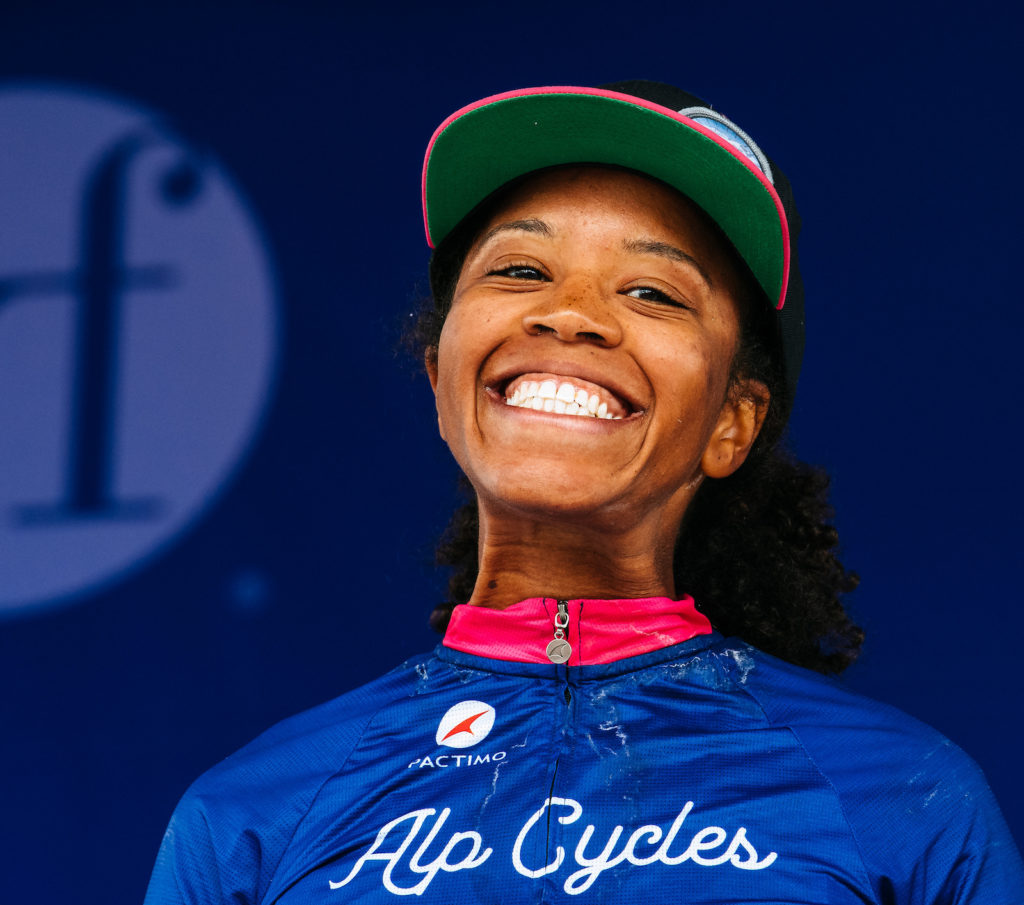
It was Wiasak’s teammate, Rachel Langdon (Fearless Femme), who launched the string of attacks on a day that saw average speeds of around 26 miles per hour, to win the VF Corporation Most Badass Jersey. Ayesha McGowan (ALP Cycles Racing), who is working to become the first African-American female pro cyclist, also launched a solid attack mid-race and earned the Audi Most Inspirational Jersey.
Ayesha McGowan (ALP Cycling Team), who is striving to become the first African-American female pro cyclist, is awarded the Most Inspirational jersey after Stage 3, 2019 Colorado Classic. Photo courtesy Colorado Classic.
“It’s a pretty big deal,” McGowan said after the race. “It’s definitely the toughest race I’ve ever participated in and definitely the most elite race. It’s been phenomenal to be a part of it. I raced my heart out and the crowd today was insane.”
Dygert now has a 1 minute, 36-second race lead over Brodie Chapman (TIBCO-Silicon Valley Bank) with Omer Shapira (Canyon-SRAM) 1:53.00 back and the rest of the field well over 2 minutes behind.
Racing wraps up Sunday with the grand finale in Denver. Stage 4 presented by Gates Corporation starts at 1:30 p.m. in front of Coors Field and will feature eight fast laps around downtown, up and down E. 17th Ave. and around City Park for a total of 52.8 miles and 1,345 feet of climbing.
Those who can’t watch the race in person can watch live streaming coverage from start to finish and follow statistics and race progress by downloading Tour Tracker.
FINISH STANDINGS
#71 – Chloe DYGERT – Sho-Air Twenty20
#72 – Jennifer VALENTE – Sho-Air Twenty20
#111 – Rebecca WIASAK – Fearless Femme
GATES CORPORATION GENERAL CLASSIFICATION JERSEY
leader – #71 – Chloe DYGERT – Sho-Air Twenty20
COLORADO TOURISM QUEEN OF THE MOUNTAIN LEADER JERSEY
leader – #71 – Chloe DYGERT – Sho-Air Twenty20
worn by – #32 Edwige PITEL – Cogeas Mettler Look
VF CORPORATION MOST BADASS JERSEY
leader – #115 – Rachel LANGDON – Fearless Femme
AUDI MOST INSPIRATIONAL JERSEY
leader – #135 – Ayesha MCGOWAN – ALP Cycles Racing
UDOT to Introduce Bike Boxes in Utah County at Two Intersections on Redwood Road. New innovation in active transportation to provide safe and visible crossing for people who ride bikes.
In an effort to enhance road and bicycle safety, UDOT has incorporated its first bike boxes in Utah County as part of the new Continuous Flow Intersection (CFI) at Redwood Road and Pioneer Crossing. Later this summer, UDOT will open another set of bike boxes at the intersection of Redwood Road and 2100 North (Mountain View Corridor). In conjunction with the opening of these new bike boxes, UDOT will host a media availability at the Redwood Road/Pioneer Crossing intersection in Saratoga Springs.
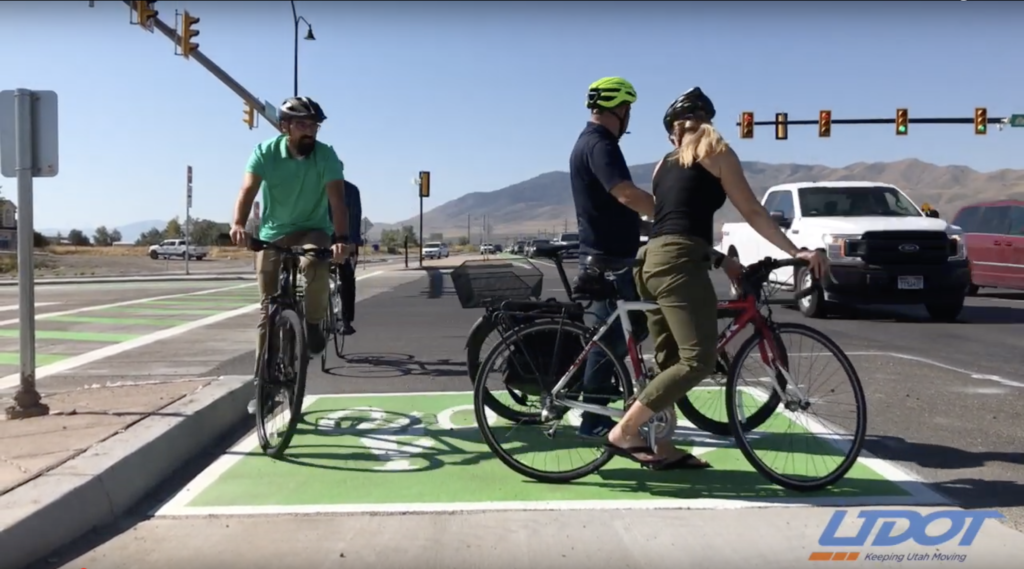
The bike boxes are designed to provide safe and visible stopping areas for people using the bicycle lanes as part of UDOT’s efforts to reduce congestion and improve traffic flow in this area. Cyclists traveling through the intersection of Redwood Road and Pioneer Crossing are now able to wait safely in the bike boxes until they are able to cross the intersection with traffic. UDOT integrated the bike box concept into the project to connect with existing local community trails and bike routes and to support active transportation in the area. To learn how to use the bike boxes, cyclists should visit the bike box website, where they can view a short video or use the bike box virtual reality tool.
As part of UDOT’s efforts to reduce congestion and improve traffic flow in this area, the bike boxes are designed to provide safe and visible stopping areas for people using the bike lanes. People who ride bikes through the intersection of Redwood Road and Pioneer Crossing are now able to wait safely in the bike boxes until they are able to cross the intersection with traffic. In an effort to support active transportation, UDOT integrated the bike box concept into the project to connect with existing local community trails and bike routes. To prepare for their first use of the bike boxes, people who ride bikes should visit the bike box website to view a bike box animation video or use the bike box virtual reality tool.
Bike Boxes in Utah County
Bikes Boxes are being introduced at two intersections on Redwood Road in Utah County
Bike Boxes at the Redwood Road and Pioneer Crossing Continuous Flow Intersection (CFI) are now open
Bike Boxes at the Redwood Road and 2100 North (Mountain View Corridor) intersection will open this fall
These are the first Bike Boxes implemented by UDOT
Bike Boxes provide safe and visible stopping areas for people who ride bikes until they are able to cross the intersection with traffic
Bike Boxes are being used nationally as an innovative way to improve roadway and bicycle safety
In an effort to support active transportation, UDOT integrated the bike box concept to connect with existing local community trails and bike routes
People who ride bikes can learn how to properly navigate the bike boxes by visiting: utah.gov/go/bikebox
Redwood Road and Pioneer Crossing Continuous Flow Intersection (CFI)
The intersection at Redwood Road and Pioneer Crossing is a Continuous Flow Intersection (CFI)
CFI’s move left-turning vehicles across the road before they reach the intersection, allowing cars to turn left while oncoming vehicles go straight
CFI’s also feature bypasses for right-turning vehicles
These improvements allow left, right and through vehicles to move simultaneously
CFI’s will reduce wait times and improve safety
These intersections are a reflection of coordinated efforts between UDOT, Active Transportation and the local community
Redwood Road and Mountain View Corridor Intersection
The extension of the Mountain View Corridor (MVC) in northwest Utah County on 2100 North from Redwood Road to S.R. 73 is nearly complete
Construction includes two lanes in each direction, a trail and sidewalk and a pedestrian/bicycle underpass at Redwood Road
Mountain View Corridor will eventually be a 35-mile freeway from I-80 in Salt Lake County to S.R. 73 in Utah County
Future construction phases will build out the remainder of the corridor by converting intersections to interchanges and adding lanes to achieve a fully functional freeway
So many cyclists around the world are in environmentalists, especially here in Salt Lake City. Yes, riding a bicycle is better than driving a car, but there is much more to bicycling than just riding them. As an environmental studies scholar and long-time cyclist, I figured I would write a column that interweaves those two areas together. The bicycle industry is global and as a result, because of the manufacturing, shipping, and selling of bicycles and bicycles parts the industry causes a considerable ecological impact, economic exploitation, all while advocating for ecological conservation. In this article, we will look at: (1) unity in the bicycle industry, (2) living wage, and (3) ecological impact.
Unity – The bicycle industry could learn a thing or two from the outdoor industry, which recently boycotted the state of Utah for their Outdoor Industry Association’s annual convention, which brought over ten million dollars a year to Utah. The reason is because the state of Utah plans to allow energy companies to mine uranium and extract oil and gas in the Bear Ears National Monument, a million acres in southwestern Utah. Bear Ears National Monument was created and protected by President Obama, but in 2018 Utah Governor Gary Herbert signed a resolution to President Trump to overturn the designation. This unification by many outdoor companies is something that is in desperate need in the bicycle industry, such as the bicycle industry needing to protest the tariffs, which President Trump signed into place that will increase the price of many bicycles, which will as a result put some bicycle manufacturers out of business and cause some bicycle stores to go bankrupt. Moreover, the unification of bicycle companies encouraging customers to buy bicycles and bicycle parts at a bicycle shop is essential for the bicycle industry and community to survive. For years, bicycle shops were pseudo youth community centers. Bicycle shops today are not merely stores, but community centers to meet fellow cyclists and talk to employees about the latest gear. The bicycle industry also needs unification on supporting bicycle manufacturers and parts makers that do not have a universal manufacturers suggested retail price (MSRP) to implement one in order to support the bicycle shops.
Living Wage – When shopping for a bicycle, I am sure the sales-person never speaks about the living wage of the employee at the bicycle manufacturing plant in Taiwan. Are the employees building, selling, and designing the bicycles making a living wage? This is an important question to ask. If a buyer of a bicycle is concerned about this, the best purchasing decision is buy a bicycle in a country with strict minimum wage laws such as the United States, Canada, England, and Italy. Further, ask the bike shops if they are paying for insurance, dental, and providing a living wage to their shop employees. Of course, this is difficult, but bike shops should strive to do this and many are.
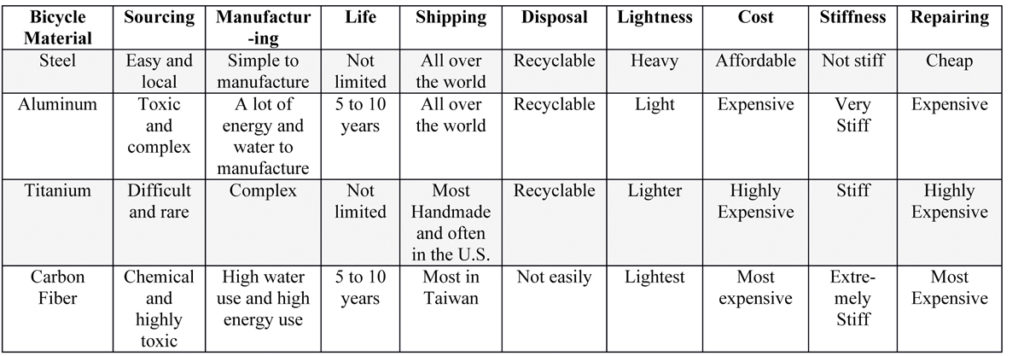
Table 1. The Environmental Factors of Bicycle Frame Production
Environmental Conservation – Now let us move onto the last topic of this article environmental conservation. There are five factors in determining if a bicycle is ecologically sustainable or not – (1) the sourcing of the material to build the bicycle, (2) the manufacturing of the bicycle, (3) the life of the bicycle, (4) the shipping of the bicycle, and (5) disposal of the bicycle. Most bicycles are made of four materials (1) steel, (2) aluminum, (3) titanium, and (4) carbon fiber. Of course there are other materials such as bamboo, which Calfee bicycle uses, which might be the most environmental, but for this article we will only look at the main four. From the chart below, carbon, used by most major bicycle companies, is the most expensive and ecological destructive, while aluminum, also used by most companies, is almost as stiff and light as carbon, is not as expensive and is readily recycled. There is titanium, which often is used by handmade companies such as Seven, Moots, No. 22, and Twinsix, which is not stiff, rather it is forgiving and a responsive smooth ride. Because it is used almost exclusively by handmade companies titanium is often more expensive than carbon, but lasts forever. Finally, steel is the cheapest of all materials, not as rigid as aluminum and carbon, and is the most ecologically sustainable – but it can rust, which titanium does not. For more analysis on the four materials, see Table 1.
The most environmentally sustainable way when purchasing a bike is to buy a used bike, ideally steel or titanium, as they will last the longest. Further, some bicycle manufacturers such as Moots (and many bike shops too) run their factory on solar panels, recycle all of their materials including paper, cardboard and metals, and have a community garden. Additionally, Moots and Chris King, for example, give back to the community by financially supporting nonprofit environmental protection organizations.
There is a lot to think about when buying a bicycle, besides how it rides. Do your homework, get online, make some phone calls, and ask many questions – the bicycle industry, employees, and the world is counting on you.
The Sho-Air Twenty20 star is proving unstoppable in the 2019 Colorado Classic presented by VF Corporation
AVON, Colorado – It felt like déjà vu watching Chloe Dygert (Sho-Air Twenty20) speed down an open road toward the finish line in the 2019 Colorado Classic presented by VF Corporation on Friday. As the 22-year-old cruised along the final four miles of Stage 2 presented by FirstBank in Avon, she kept glancing over her shoulder, but saw nobody.
After handily winning Stage 1 presented by Smartwool in Steamboat Springs on Thursday, Dygert repeated the feat Friday, winning day 2 and once again sweeping the majority of jerseys: the Gates Corporation Individual Race Leader, the FirstBank Sprint Leader, Colorado Tourism Office Queen of the Mountain and VF Corporation Best Young Rider.
Chloe Dygert (Sho-Air Twenty20) takes another solo win to increase her overall lead. Stage 2, 2019 Colorado Classic. Photo courtesy Colorado Classic.
Dygert also increased her race lead to 1 minute, 22 seconds. Brodie Chapman (TIBCO-Silicon Valley Bank), finished second on Friday, 28 seconds behind Dygert and set the tempo for the final lap, which took racers on a steep slog up the switchbacks of Daybreak Ridge above Beaver Creek following seven fast laps through the town of Avon. Stage 2 totaled 50.3 miles, including 3,428 feet of climbing, 2,000 of which were up the final climb.
“It is consistently steep. It went a lot longer than I thought,” Chapman said. “I was like, ‘I’m almost there,’ and then I definitely wasn’t. In hindsight, I think I went a little too hard too early because I started to fade near the end. Mad props to Chloe who just reeled me in and there was nothing I could do about it.”
Chapman led the charge to race’s high point and — sprinting neck-and-neck with Dygert — threw her front wheel at the QOM summit in an effort to get an edge on the race leader. Dygert’s father had driven the course on Friday morning, providing her with detailed notes, whereas Chapman and other racers were only able to eyeball the course from afar.
“It’s really awesome having my dad out here,” said Dygert, who won silver in Team Pursuit at the 2016 Olympics and has won five World Championship gold medals. “It’s really special for him to go up there this morning and do that.”
It was Heather Fischer (DNA Pro Cycling) who set the pace out of the gate, pulling ahead of the peloton during the high-speed laps that preceded the climb, an effort that earned her the VF Corporation Most Badass Rider jersey. Katie Hall of the US National Team, 2018 Colorado Classic champion, broke off of the group to chase the leaders in the final climb on Friday, earning the Audi Most Inspirational Rider jersey.
“It was a hard climb. I just couldn’t hang,” Hall said, adding that she was honored nonetheless to wear the jersey.
“I hope that we can inspire more ladies to ride bikes in any fashion that brings them joy,” she said. “It doesn’t need to be bike racing, but bike riding, even commuting, has brought a lot of joy into my life. I hope more people find that.”
The support for women’s cycling hit a benchmark Friday with the Bonus Cash Lap, also known as a prime, yielding an unprecedented total reaching nearly $10,000. Of this amount, $1,000 was contributed by the Colorado Classic, but the rest crowd-sourced by supporters. Dygert’s Sho-Air Twenty20 teammate Jenn Valente won the lap, splitting the sum with local nonprofit Chris Anthony Youth Initiative Project.
Chloe Dygert (Sho-Air Twenty20) holds on to the leaders jersey after Stage 2, 2019 Colorado Classic. Photo courtesy Colorado Classic.
The race moves to Golden for Stage 3 on Saturday, beginning at 11:30 a.m. from under the arch on Washington Ave. Riders will complete seven laps, including three sprints and one QOM, covering a total of 63.7 miles and climbing 4,639 feet. With two fast lap stages remaining, it will be difficult for riders to catch Dygert, but she herself pointed out that it’s not over until it’s over.
“There are still two hard days of racing left,” Dygert said. “It’s never set in stone. I have a good team, a solid team. We’re just going to work really hard to keep this jersey and see what we can do.”
Best viewing for Stage 3 will be from Washington Ave. in Golden at the start/finish between 12th and 13th and on 15th Street for the QOM. Those who can’t attend in person can watch live streaming coverage from start to finish and follow statistics and race progress by downloading Tour Tracker.
FINISH STANDINGS
#71 – Chloe DYGERT – Sho-Air Twenty20
#41 – Brodie CHAPMAN – TIBCO-SVB
#22 – Omer SHAPIRA – Canyon-SRAM
GATES CORPORATION GENERAL CLASSIFICATION JERSEY
leader – #71 – Chloe DYGERT – Sho-Air Twenty20
COLORADO TOURISM QUEEN OF THE MOUNTAIN LEADER JERSEY
leader – #71 – Chloe DYGERT – Sho-Air Twenty20
worn by – #22 – Omer SHAPIRA – Canyon-SRAM
VF CORPORATION MOST BADASS JERSEY
leader – #91 – Heather FISCHER – DNA Pro Cycling
AUDI MOST INSPIRATIONAL JERSEY
leader – #1 – Katharine HALL – U.S. National Team
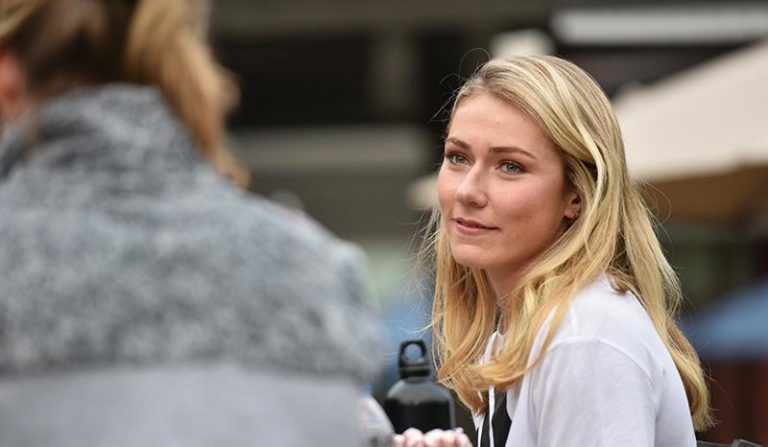
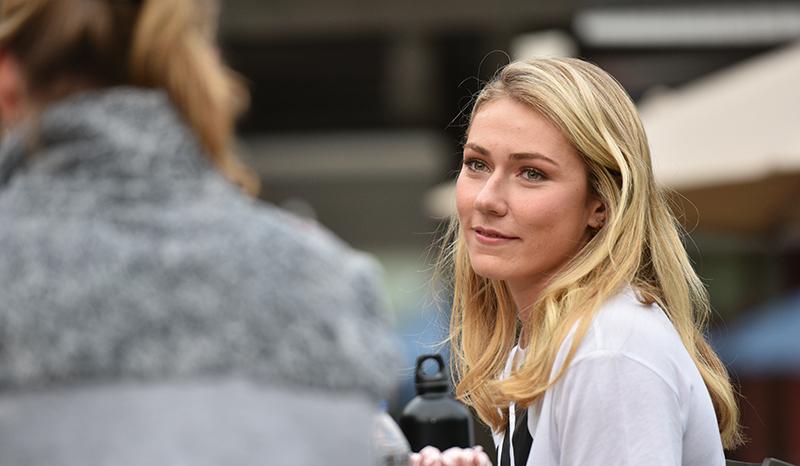
AVON, Colorado — Besides their legs of steel, pro cyclists and pro skiers have more in common than you’d think, as noted by the world’s best skier: Olympic and World Champion Mikaela Shiffrin.
Mikaela Shiffrin chats with VF Corporation’s Anita Graham at The Westin in Avon Thursday night. Photo courtesy Colorado Classic.
Before the 2019 Colorado Classic presented by VF Corporation rolled onto Shiffrin’s home turf in Avon for Stage 2 presented by FirstBank, the 24-year-old local hero welcomed the race by discussing a few of the similarities shared between ski racing and road cycling during a chat with VF Corporation’s Anita Graham on Thursday night.
“There are a lot more similarities than people realize,” Shiffrin said. “First of all, you have the speed and feeling the wind in your face. The actual movement, the push-pull that your legs and feet do in biking is a very similar movement to skiing. Biking is more of a linear sport … you add more of a three dimensional quality to it and you basically have a ski turn.”
Having done her fair share of road cycling and mountain biking for cross training, Shiffrin has drawn parallels to the g-forces involved in both.
“When biking, I’m always thinking, how would this feel if I were in my ski boots on my skis? You don’t want a lot of pressure coming at the end of a turn, because then you’re working against gravity and that’s when you slide out. It’s the same thing in skiing. You want to be working with gravity, finding your apex in the turn so you can accelerate out of it,” she said.
Surprisingly, Shiffrin is not as relentless on the pavement as she is on the icy slopes.
“I have not been the type of cyclist who’s good at going downhill. I’m not particularly good at going uphill either, but on the downhill I use my brakes a lot,” she said. “The road rash … I never signed up for that. If there’s gravel on the road or it’s wet at all, I’m going to go bike inside.”
One area where cycling and ski racing diverge is their prize money track record. While ski racing has offered equal prize purses for both men and women nearly since the inception of the World Cup, there has historically been a gap in cycling, one which the 2019 Colorado Classic aims to close in offering a $75,000 prize purse — nearly four times more than the women have ever made in the event and more than the Classic paid out in the men’s event in 2018.
With her unprecedented 17 victories last season (and two World Championship gold medals), Shiffrin earned a record $885,000 in prize money, nearly double that of the top earning male racer (who didn’t win nearly as many races). Shiffrin appreciates the progress being made in closing the gender gap in all sports, but believes events like the Colorado Classic, which simply showcases the sport’s top competitors, who happen for this event to be all women, is a massive step in the right direction.
“I think it’s awesome to put that opportunity there. There’s so many sports where the men’s events overshadow the women’s event. To make it so there is no overshadowing — to make this the highlight, to say this IS the show, I do think that makes a big difference, because people will be just as excited to watch,” she said.
Shiffrin compares the spectacle of the 2019 Colorado Classic to that of the U.S. Women’s National Soccer Team, whose FIFA World Cup triumph earlier this year buoyed the spirits of the entire nation.
“It’s huge to be able to put that show in the forefront,” she said. “It’s something you saw from the women’s national (soccer) team. People just want to see good sport. They want to see good quality entertainment. Something that kind of irks me in this effort to reach equality is pitting women against men or men against women, when I feel that men are a huge part of the solution. It should be about trying to lift everybody up. Men are a huge part of the conversation. When you see an event like this where [women] are the highlight and the show, it’s not pitting anyone against each other. It’s just highlighting sport at its best level. And that’s super cool.”
Researchers at the University of Minnesota have developed a new way to determine bicycle and pedestrian crash risk at both intersections and mid-block. They say using their methodology can help planners mitigate risks to both groups. What makes matters more complicated is that many factors go into the equation (the most obvious being the number of people using the roads) and that the factors determining danger differ for cyclists and pedestrians.
The researchers used their method in Minneapolis and found that low-income and minority neighborhoods fared worst. When armed with the data, planners can take action. The study points out that historical data won’t tell you everything: it found the same risk factors at locations with no crashes as those with a history of them.
Note: the research was done in a large city and factors may differ in other communities.
Cycling Utah worked to add protection for cyclists and other vulnerable road users to the bill
Additional Clean Air Bills Pass Too
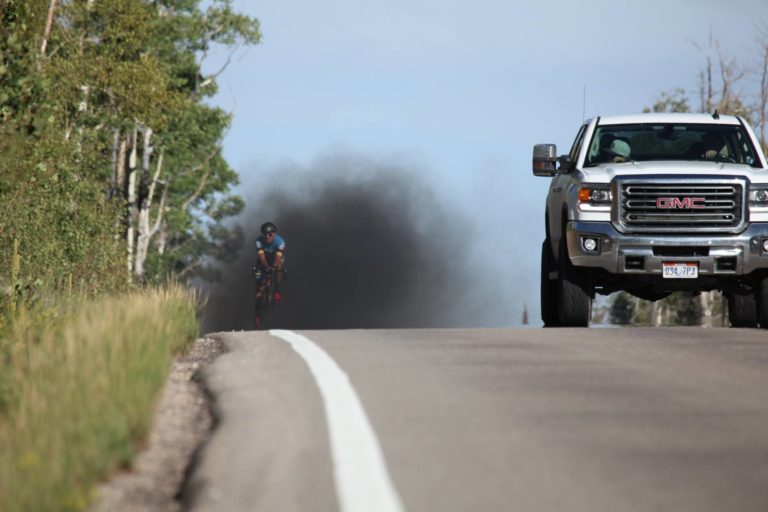
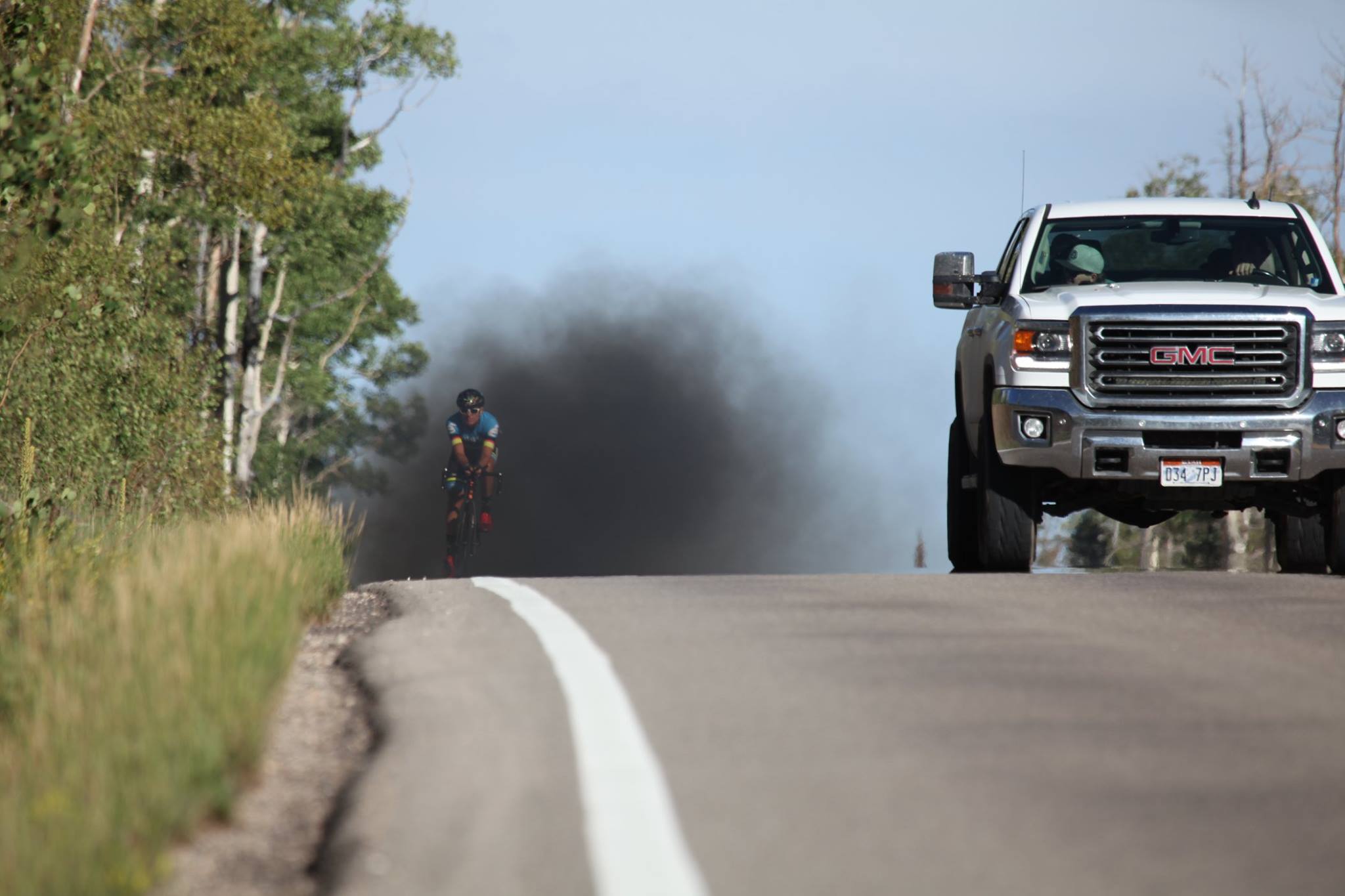
SALT LAKE CITY, Utah — In the 2019 Utah Legislative Session, Rep. Angela Romero’s HB0139 Motor Vehicle Emission Amendments passed with time to spare after failing to get a final vote before the end of the last year’s legislative session. HB0139 increases the penalties on drivers who “roll coal” (illegally tampering with a diesel engine’s emissions controls in order to spew clouds of black smoke). The bill was signed into law by Governor Gary Herbert in March, and went into effect on May 14, 2019.
Andrew Danly rides in a cloud of black smoke, apparently from the pickup truck. The incident took place on Highway 14 near Cedar Breaks, Utah on August 25, 2018 during the Hoodoo 300 Bike Race. Photo by Michael Conti
“‘Rolling coal’ is not representative of the manner in which diesel engines were designed to operate, especially modern diesel engines that have stricter emission control technologies,” said Allen Schaeffer, executive director of the Diesel Technology Forum, an educational advocacy organization representing vehicle, equipment, and engine manufacturers, headquartered in Frederick, Md. “Tampering with engines and emissions controls to generate excess emissions on demand is offensive, unsafe and harmful to the environment.”
HB0139 also improves the reporting system for rolling coal and adds a clause to the traffic code that makes rolling coal a citable offense when affecting pedestrians, bicyclists, or other road users in a harmful way. Cycling Utah worked to add vulnerable road users to the bill HB0139.
Cyclists are affected by air pollution because of the time spent exercising in bad air. Additional efforts to clean the air help people to get out of their car and onto their bicycle.
“Clean air is a nonpartisan issue since air pollution impacts everyone, no matter where you live or what side of the aisle you sit on,” HEAL’s Policy Associate Jessica Reimer said. “While there is still a long way to go in Utah, the legislature has shown this year that when you put political differences aside, we can all start to breathe easier.”
HEAL worked on and helped to pass Rep. Joel Briscoe’s HB0353 Reduction of Single Occupancy Vehicle Trips Pilot Program. HB0353 creates a 3-year pilot program where all Utah Transit Authority transportation will be free on certain days during the inversion season to give people affordable options other than single occupancy car trips. This bill received $500,000, which funds about seven free fare days throughout the pilot program.
The 2019 session also saw funding of some of the air quality appropriation requests Governor Herbert proposed in order to reduce emissions by 25% by 2026. Lawmakers funded about $28 million of the $100 million requested for these air quality programs. Funded programs include a wood stove conversion program, electric vehicle charging stations, air quality messaging campaigns, and a state government teleworking program.
“We were hoping for the full $100 million recommended by the Governor, but $28 million is one of the largest amounts Utah has ever devoted to air quality programs in a single year,” Dr. Scott Williams, Executive Director of HEAL said. “The funded programs address air quality from many angles, but all will contribute to cleaning up the air in order to help protect the health of our entire community, especially our more vulnerable populations – pregnant women, children, seniors, and those with chronic illnesses.”
Other bills passed in the 2019 legislative session to improve air quality include Rep. Timothy Hawkes’ HB0357 Voluntary Wood Burning Conversion Program; Sen. Luz Escamilla’s SB0144 Environmental Quality Monitoring Amendments; Rep. Patrice Arent’s HB0148 Vehicle Idling Revisions; Rep. Stephen Handy’s HCR003 Concurrent Resolution Urging the Environmental Protection Agency to Update Switcher Locomotive Emission Standards; and Rep. Suzanne Harrison’s HCR011 Concurrent Resolution Encouraging the Purchase of Tier 3 Gasoline.
The Sho Air Twenty20 racer runs away with four jerseys — including the Gates Corporation General Classification leader’s jersey — in Steamboat. Lindsay Goldman earns Audi Most Inspirational jersey. The Hagens Berman-Supermint rider is honored for juggling racing, team management, work and motherhood.
STEAMBOAT SPRINGS, Colo. – The kickoff to the 2019 Colorado Classic presented by VF Corporation transpired in runaway fashion — literally — as 22-year-old Chloe Dygert of Sho-Air Twenty20 broke away in the final climb to ride solo for the last 15 miles of the race and claim victory in Steamboat Springs Stage 1 presented by Smartwool.
Chloe Dygert (Sho-Air Twenty20) attacks on the gravel to take a solo win on Stage 1, 2019 Colorado Classic. Photo courtesy Colorado Classic.
Dygert, who is fresh off of a double gold medal performance at the Pan American Games in Lima, Peru, where she won both the Team Pursuit and Time Trial, won Thursday’s 54-mile Steamboat stage in 2 hours, 19 minutes and 9 seconds, earning not only the Gates Corporation General Classification yellow jersey but also the VF Corporation Best Young Rider, FirstBank Sprint Leader, Colorado Tourism Office Queen of the Mountain and VF Corporation Best Young Rider.
“I had some good legs today,” Dygert said after the race. “I saw everyone suffering. I looked back and saw there was a little bit of a gap. I knew that was my only chance. I just attacked and was able to hold it and keep it.”
Chloe Dygert (Sho-Air Twenty20) solos in to take the win on Stage 1, 2019 Colorado Classic. Photo courtesy Colorado Classic.
Dygert, who has suffered multiple injuries in the last several months, put a sizable gap between herself and the rest of the field. Fort Collins resident Whitney Allison of Hagens Berman-Supermint did Colorado proud by finishing runner-up on the day, firing across the finish line 44 seconds behind Dygert as Australian Brodie Chapman (TIBCO-Silicon Valley Bank) followed on her wheel to take third.
“When we heard Chloe Dygert took the lead, my reaction was, ‘Oh man. It’s going to be hard,’” Chapman said. “She’s a hard one to reel in.”
A total of 16 teams representing 20 countries shot off the start line for the long loop course in beautiful, sunny weather in Steamboat on Thursday. Emily Newsom (TIBCO-Silicon Valley Bank) was the first rider to make a move, breaking away to win the first QOM but then falling victim to a flat tire. Nonetheless, the effort earned her the VF Corporation Most Badass Rider jersey.
A pack of riders near the back of the field went down in the first half of the race but all quickly returned to their saddles. During a technical descent through gravel, Dygert said she came close to crashing on a sharp turn but held it together to launch her attack.
Veteran Lindsay Goldman, who co-owns, manages and rides for the Hagens Berman-Supermint team, all while working a full-time job and taking care of her 18-month-old baby, earned the Audi Most Inspirational Rider jersey on Thursday.
Lindsay Goldman (Hagens Berman-Supermint) is awarded the Most Inspirational jersey after Stage 1, 2019 Colorado Classic. Photo courtesy Colorado Classic.
Waves of emotion are pouring through Lindsay Goldman as she competes with her team in the 2019 Colorado Classic presented by VF Corporation this week.
Goldman launched the Hagens Berman-Supermint pro cycling team four years ago, but the team will come to an end along with the 2019 season, with the Colorado Classic marking its second-to-last race.
“It’s always bittersweet when something awesome comes to an end,” said Goldman before firing off of the starting line in Stage 1 Steamboat Springs presented by Smartwool on Thursday. “But we’ve had a great run for four seasons and it’s really special to be able to be here at this race with this squad and be able to finish our season on a high note.”
Goldman, 34, has had more than the average load for a pro cyclist to juggle over the last couple of seasons. In addition to managing the team, which is a full-time job unto itself, she works full-time as a business development and marketing consultant for companies serving the federal government and also became a mother last year. Every day, her multitasking super powers come into play as she juggles the care of 18-month-old Caroline with training, racing, team management and work.
“It’s definitely a balancing act, but I have a great support system. My husband has been wonderful and our family has really stepped in to help,” Goldman said. “It’s just a matter of figuring out each day what I need to get done and how to make that happen.”
A typical day in the life of Lindsay Goldman, who splits her time between homes in Arizona and California, looks like this: “I get up at 4 or 5 o’clock in the morning. I’m out the door in an hour. In that time I do core work, drink coffee, eat a quick Honey Stinger bar and do whatever ride I have on tap for that day – I like group rides, a little bit of structure training, sometimes just an easy spin,” she said. “I come back from the ride; usually the baby is up by then, so I take care of her, eat breakfast, try to get work done until she goes down for her nap … that sometimes doesn’t happen, which throws the day off a little bit. My husband comes home from work to join us for lunch. Then I juggle spending time with Caroline and working at the same time until dinnertime. Then it’s bedtime and I get up and do it all over again.”
When asked to name a moment or experience that’s been most rewarding for her during her time with Hagens Berman-Supermint, Goldman said there is no single occasion.
“It’s just been a lot of wonderful moments and learning experiences that have ultimately been positive,” she said. “Everything we’ve done, growing form a brand new team with so many lessons to learn into a team that is today a real contender in this race amongst a top level field … the entire experience has been rewarding.”
As her team led the peloton through a portion of Thursday’s race and her teammate, Colorado’s own Whitney Allison, fired across the finish line in second place, Goldman was awarded the Audi Most Inspirational Rider jersey on Thursday.
“It’s an honor to wear this jersey for what I’m hoping is a meaningful contribution to this sport,” Goldman said, adding that she also feels honored to compete for the landmark 2019 Colorado Classic, the only UCI 2.1-ranked standalone women’s four-stage race in the Western Hemisphere with an unprecedented $75,000 prize purse. “It makes me feel I want to show up and race as hard as I can, have my athletes show up and race as hard as they can. I want them to promote the #WeRide hashtag and show our gratitude for the opportunity we’ve been given.”
Colorado Classic Race Director Sean Petty was quick to point out that Goldman is highly deserving of the Most Inspirational jersey.
“Lindsay’s done so much – run a team, found a sponsor, raced herself, then had a baby. That’s more balls in the air than any other human,” Petty said. “She makes it look easy.”
While Hagens Berman-Supermint is disbanding after 2019, Goldman plans to keep on racing as well as keep at her mission to inspire others in the sport.
“I’ll race on my own next year, do some road racing, some gravel racing … I’ll represent a few personal sponsors,” she said. “I’ll also continue to work in the industry and try to bring about positive change in cycling, help grow the sport, not only at the professional level, but also at the grassroots level. I want to continue to do what I can to mentor other riders.”
Racing continues on Friday with Stage 2 presented by FirstBank in Avon. The course features seven laps around town followed by a steep 15-mile lap up Daybreak Ridge Road through Beaver Creek. Stage 2 will total 50.3 miles and 3,428 feet of climbing.
Stage 2 kicks off at 1 p.m. with an event expo at Nottingham Park and best viewing at Avon Road at Benchmark and Highway 6 as well as on Daybreak Ridge Road in Beaver Creek. Those who can’t attend in person can watch live streaming coverage from start to finish and follow statistics and race progress by downloading Tour Tracker.
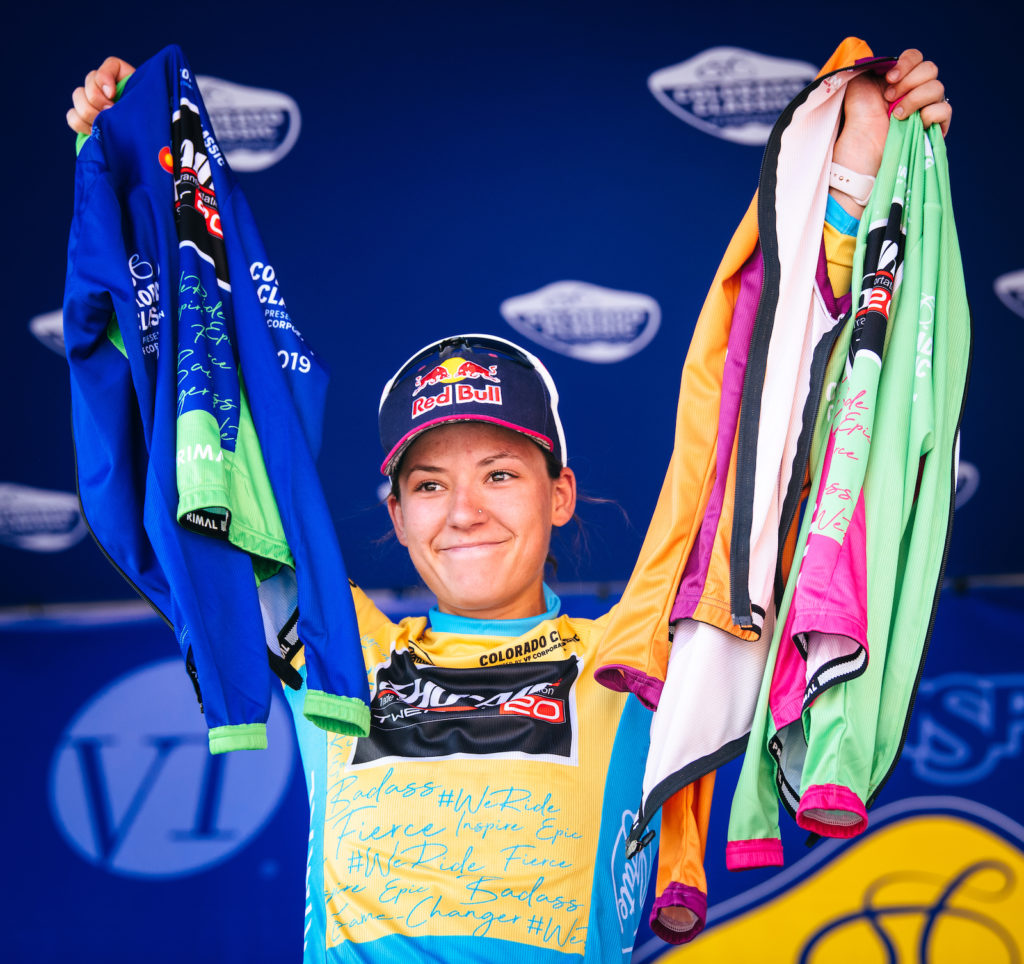
Chloe Dygert (Sho-Air Twenty20) shows off her collection of leader’s jerseys after Stage 1, 2019 Colorado Classic. Photo courtesy Colorado Classic.
FINISH STANDINGS
#71 – Chloe DYGERT – Sho-Air Twenty20
#85 – Whitney ALLISON – Hagens Berman-Supermint
#41 – Brodie CHAPMAN – TIBCO-SVB
GATES CORPORATION GENERAL CLASSIFICATION JERSEY
leader – #71 – Chloe Dygert – Sho-Air Twenty20
COLORADO TOURISM QUEEN OF THE MOUNTAIN LEADER JERSEY
leader – #71 – Chloe DYGERT – Sho-Air Twenty20
worn by – #43 – Emily NEWSOM – TIBCO-SVB
VF CORPORATION MOST BADASS JERSEY
leader – #43 – Emily NEWSOM – TIBCO-SVB
worn by – #115 – Rachel LANGDON – Fearless Femme
AUDI MOST INSPIRATIONAL JERSEY
leader – #86 – Lindsay GOLDMAN – Hagensn Berman-Supermint
Pedal the Plains is a 3-day road cycling ride in Eastern Colorado that will be held from September 13-15, 2019. The ride features a 3-day fully-supported option, with a one-day road century option too.
This year’s ride travels through the Colorado communities of Holly, Lamar, and Springfield and celebrates Colorado’s rich pioneer and agricultural traditions. We asked organizer Deirdre Moynihan of the Denver Post Community Foundation about the ride.
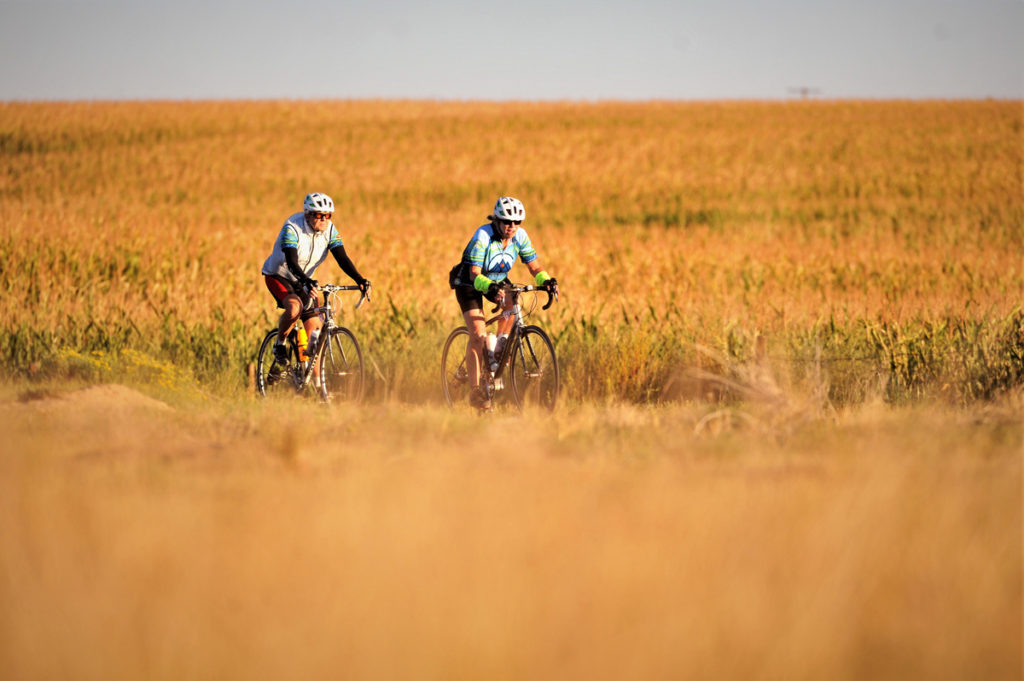
Pedal the Plains will travel through Eastern Colorado in 2019. Here’s a scene from the 2018 ride. Photo courtesy Pedal the Plains
Cycling West: Tell us about the 2019 ride and the course. What are the highlights along the way? How many riders do you expect?
Pedal the Plains: The terrain is predominantly flat with some rollers but no major climbs that is for sure. We travel through fields of corn, milo, wheat and cattle! It is very bucolic and peaceful. There are two options on Saturday: a Century and a 70 mile route so people seeking an additional challenge can find it. The route is very attainable to all with stops every 10 miles.
CW: Looks like you have lunches by the Future Farmers of America. What are the food and beverage highlights during and after the ride each day? How do you showcase local agriculture and culinary options?
PTP: We showcase them in a variety of ways. For example, the Colorado Egg Producers are at an Aid Station every day with hard boiled eggs. The Colorado FFA (Future Farmers of America) do lunch every day and source out local food to use. We always try to use the local crop as much as possible – this area is a bit interesting because the local crop really is beef! The 2019 Route really travels through cattle country.
CW: Tell us more about the history of the area and the points of interest on the ride.
PTP: We are traveling to the far southeastern corner of Colorado this year and touching our wheels into Kansas as well. This area is full of history and stories of the wild west. For example, on Friday, we travel along what was the Santa Fe Trail. In 1821, the Santa Fe Trail became America’s first great international commercial highway, and for nearly sixty years thereafter was one of the nation’s great routes of adventure and western expansion. On Friday, we are also stopping at the Amache Camp, a Japanese internment camp based in Granada, CO during WWII. And that is just one day of the route emphasizing how much history there is in the area. Saturday and Sunday are equally as interesting in terms of showcasing the area. On Saturday, we will stop in Two Buttes named after the Two Buttes that can be viewed from the town. Two Buttes is one of the smallest incorporated “cities” in the state. The population in the town is about 50, however many buildings and structures remain from its heyday when the population was around 2000. The town was founded under the formation of the dam at Two Buttes creek making Two Buttes Reservoir. Two Buttes was officially incorporated in 1911. Over the years the reservoir has evaporated and today it is used by local county residents for boating. There is also a local swimming hole called the Black Hole on the other side of the dam enjoyed by locals. Sunday will include stops at the gallery of Cowboy Poet and metal artist Bill “Three Feathers” Bunting, followed by a visit to the Colorado Green Project. So, through out the ride you will meet some of the great people of the Plains, learn the history and how they are surviving now.
CW: Can you tell us about the beneficiaries of the ride?
PTP: The 2 key beneficiaries are:
Colorado FFA: Integrated into the curriculum of over 100 high schools in Colorado, the Colorado FFA Foundation is the premier co-curricular leadership organization for students ages 14 – 18. Most members of Colorado FFA do not come from a farm or ranch but have a desire to learn more about agriculture and the inspiring task of providing food and fiber to a growing population. Areas of focus are: premier leadership; personal growth; and career success through agricultural education.
Colorado 4-H: Embedded in the CSU Extension Offices, 4-H is a non-profit designed for youth ages 5 through 18 years of age living in counties across the state. 4-H began over 100 years ago as an educational program for the rural youth of America. Their mission remains to empower young people to reach their full potential, working and learning in partnership with caring adults. Through projects in environmental science, rocketry, foods and nutrition, animal science, and photography, members of 4-H learn important skills such as leadership, ethics, decision making, record keeping, responsibility, and community service. The 4-H motto, “To make the best BETTER,” is something that this non-profit strives to accomplish as it embarks on another century of service for America’s youth.
CW: Is there anything else that you would like to add?
PTP: One of the great parts of Pedal The Plains is the fun of the Host Communities at the end of each day. There is music, beer, ice cream sundaes, homemade pies, food from chuck wagons and real foot stompin’ country fun. The whole community comes out to support the ride and celebrate. It is so much fun.
Event Details:
September 13-15, 2019 — Pedal the Plains, Kiowa, CO, PTP will take cyclists through the host communities of Holly, Lamar, Springfield. Celebrates the agricultural roots and frontier heritage of the Eastern Plains of Colorado. Learn about farming and ranching, while experiencing the culture, history and landscape of Colorado’s high plains. The Tour incorporates interactive on-route experiences by staging rest stops on farms, posting educational points of interest and serving community meals composed of locally sourced food! Proceeds from Pedal The Plains benefit The Denver Post Community Foundation in support of the Colorado FFA Foundation and Colorado 4-H., Deirdre Moynihan, 303-954-6704, [email protected], pedaltheplains.com
Pedal the Plains will travel through the farm country of Eastern Colorado in 2019. Here’s a scene from the 2018 ride. Photo courtesy Pedal the Plains
In 2006, Jonathan “Jock” Boyer landed in Rwanda. He came at the behest of Tom Ritchey and a donated plane ticket to help Tom run a bicycle race in a small Rwandan village. There was no big plan, a plan after the bike race, just do the race and go home and back to his life. Jock spent the next decade in Rwanda developing the Rwandan National Cycling Team.
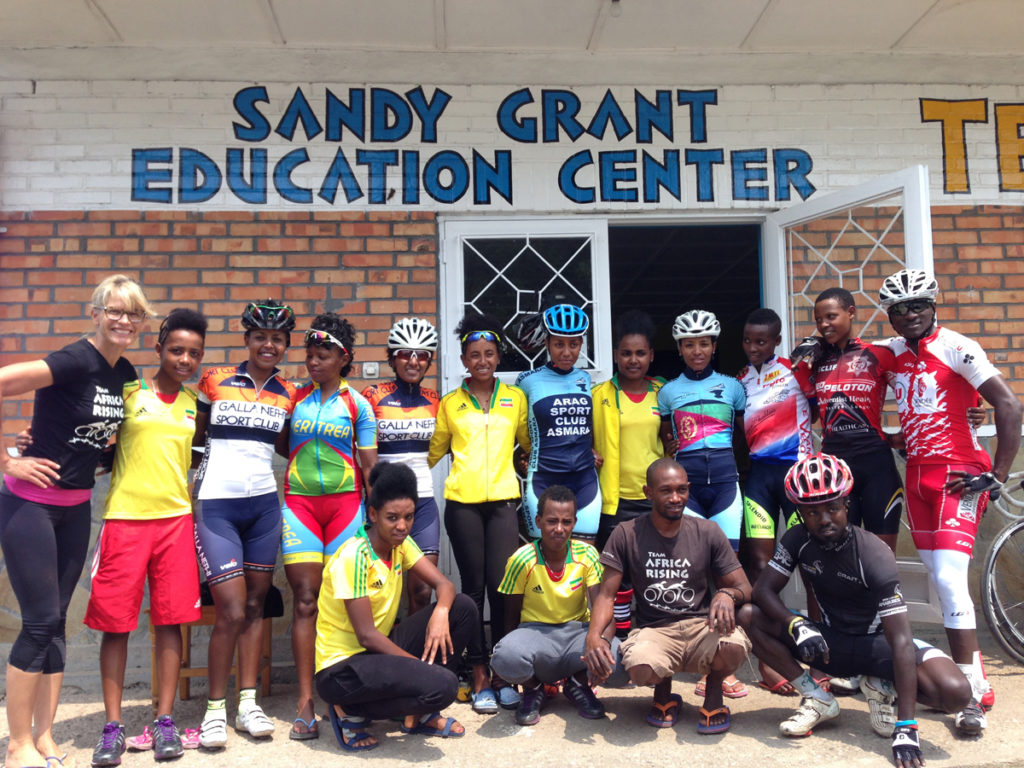
Cyclists and staff (Kim Coats is on the far left) at the Team Africa Rising Cycling Center in Musanze, Rwanda. The Sandy Grant Education Center provides education for cyclists. Doug Grant tells localemagazine.com, the center is “named after my wife who passed away from cancer in 2013. The Education Center is a huge benefit to the national team riders who previously had no access to secondary school.” Photo courtesy Team Africa Rising
The first Wooden Bike Classic was won by a young man wearing a much too old helmet with the strap fastened around his chin just below his lower lip. That young man was Adrien Niyonshuti, an incredible cycling talent. Together Jock and Adrien changed the world of cycling in Rwanda and beyond over the next decade.
In spring of 2007, Jock returned to Rwanda and began testing riders and by March had selected the initial five members of Team Rwanda Cycling. Two of those riders, Adrien and another cyclist, Rafiki Uwimana, headed to South Africa to race the Cape Epic. Adrien and Jock were partners, and by the end of the 8-day grueling mountain bike stage race, they were 23rd in their category and 33rd overall amongst 468 teams who finished. The cycling world took notice.
In 2008, Jock spoke with Douglas Ryder, who at the time ran a South African Continental Team, MTN Energade, and Douglas took Adrien and another Rwanda, Nathan Byukusenge. Adrien would stay with this team in all its variations eventually becoming the first Rwandan to race for a World Tour Team, Team Dimension Data.
During the early years, Jock rode and trained with the riders and slowly began to develop legitimate competitive cycling in Rwanda. By 2009, the original five had grown to 12-15 cyclists attending regular camps at the team’s home base in Musanze, Rwanda, a small town in the northern part of the country. Jock also added staff, a French mechanic by the name of Maxime Darcel, and a volunteer who became the Director of Marketing and Logistics, Kimberly Coats. The team slowly began to see small results, but for every little win, there were exponentially more obstacles.
In 2009, with the support and vision of the Rwandan government, the first UCI 2.2 Tour of Rwanda launched. Rwanda would see a home town winner until 2014, however, the race grew year over year as did the fan base and support.
For the first time in history, in 2010, Rwanda hosted the African Continental Road Championships. This was the Olympic qualifying race and a strategic plus for home country advantage. Adrien, who had been training, racing and living in South Africa was primed to become the first Rwandan to qualify for an Olympic cycling event. Unfortunately, a mechanical on the last lap caused him to miss the winning break, and the slot went to Dan Craven of Namibia.
However, just a few short months later, Adrien qualified at the 2011 African Continental Mountain Bike Championships held in South Africa. He became the first Rwanda to qualify for the Olympics in mountain biking. It was a massive victory for Rwanda and put Rwandan cycling on the map.
When Adrien raced in London in 2012, he became the first Rwandan and first black African to finish an Olympic Mountain Bike event in the Games history. The road for Adrien was long and filled with loss and heartache. Adrien is a survivor of the 1994 Rwandan Genocide. He lost six brothers and 60 family members in a span of 100 days in 1994. To come from such desperate tragedy to the glory and achievement of the Olympics was nothing short of miraculous.
Adrien and Jock’s story of finding each other and making it to the Olympics is told in the 2012 award-winning documentary, Rising From Ashes.
Slowly, Rwanda began to move up the ranks in the Africa Tour. Year over year, the team started to secure stage wins. The Tour of Rwanda expanded and attracted more international teams. The team continued to grow, clubs formed, and young people who rode bikes now realized they could ride bikes professionally. They wanted to be the next Adrien Niyonshuti!
In 2014, a young man from a small town in Rwanda, who had tested with Team Rwanda Cycling three times before he was brought onto the team, became the first Rwandan to win a stage at the prestigious Tropical Amissa Bongo UCI 2.1 race in Gabon. Bonaventure “Bona” Uwizeyimana used to see Team Rwanda training along the road by his house and would jump on and ride as long as he could. He would come for regular testing camps but was always on the bubble. One day, he sprinted with Team Rwanda for the prime in a local village and won. Bona came to camp and never left. Bona later raced for the feeder team for Team Europcar. He is the current Rwandan National Road Cycling Champion (2016 & 2019) and in 2018 became the first Rwandan to win the Tour of Cameroon. Bona is now the team captain of the first Rwandan UCI Continental Team, Team Benediction Excel Energy.
At the 2014 Tour of Rwanda, a Rwandan finally took the Yellow in the General Classification. Valens Ndayisenga, a protégé of Adrien Niyonshuti’s cycling academy became the first Rwanda to win the home race. After the victory, the Rwandan President, Paul Kagame, invited the team for an exclusive reception where he committed a fleet of new national race bicycles and earmarked our compound, Africa Rising Cycling Center, the permanent home of Team Rwanda Cycling.
Valens later went on with Bona to ride for Team Dimension Data Continental. He also rode for Team Tirol out of Austria and POCCL out of France. He repeated a win at the Tour of Rwanda in 2016 when he was riding for Team Dimension Data Continental.
In 2016, Adrien returned to the Olympics in the road cycling event in Rio and his compatriot from the beginning, Nathan Byukusenge, qualified for the XCO Mountain Bike event at the age of 37.
The Future of Team Africa Rising
By 2017, Jock Boyer and his now wife, Kimberly Coats, were poised to relinquish the day to day operations, funding and support of Team Rwanda Cycling to the government of Rwanda and the Rwandan Cycling Federation. The plan was always to build the team, infrastructure, and culture to eventually turn it over to Rwanda.
Rwanda became the success story from which to build Team Africa Rising. As Rwanda came from nowhere to the top of the Africa Tour other countries began seeking our support. Team Africa Rising started working with countries, teams, and cyclists requesting our assistance. Our goal is to assist in developing UCI Continental Teams and to promote women’s cycling on the continent. In 2019, Africa has seven UCI Continental or higher level teams versus three in 2018. Rwanda, Angola, and Guinea-Bissau have their first Continental teams in the history of the sport.
In 2020, Team Africa Rising is working to bring the first Pan Africa women’s team to races in Holland and Ireland, along with assisting Nigeria in launching their first UCI Continental Team.
Battle of the Gravel
Team Africa Rising also works on the grassroots level supporting and advising programs in Sierra Leone and Togo and with the national team of Benin.
Team Africa Rising is a 501(c)3 non-profit supported by grants, donors and people buying merchandise and participating in one of our fundraisers. Our largest fundraiser it the 50 Mile Ride for Rwanda held for 13 straight years in Southern California. This event has raised over $1 million since 2007. Based on the long-running success of the Ride for Rwanda, Team Africa Rising is developing another ride, Battle of the Gravel in Savery, Wyoming.
Battle of the Gravel will feature some of the members of Team Rwanda and possibly other African cyclists we work with on the continent. The event will feature three distances 21, 50 and 106 and will traverse 95 – 100% gravel roads for all three events. Team Africa Rising along with Boyer YL Ranch, Jock’s boyhood summer home is hosting the event to raise awareness and funds for the cyclists on the African continent. The event is also supported by the Carbon County Visitor’s Council to introduce tourists to this spectacular area of Wyoming.
Join us on Sunday, September 15th for the Battle of the Gravel, race your heart out, enjoy the fantastic roads and scenery and support the young men and women of Africa in the pursuit of their dreams.
September 15 — Battle of the Gravel, Savery, WY, South of Rawlings, WY, The race will start and finish at the Little Snake River Museum. Riders will start between 7 and 9 am and return to a BBQ, band and brews on the grounds of the Museum. 95 miles, Kimberly Coats, 307-383-7778, 530-744-8773, [email protected], battleofthegravel.com
Kimberly Coats is Director of Marketing and Fundraising for Team Africa Rising. After living in Rwanda for 8 years, she returned to the US in 2017 to focus on providing opportunities for cyclists throughout Africa and building on the foundation of Team Rwanda Cycling.
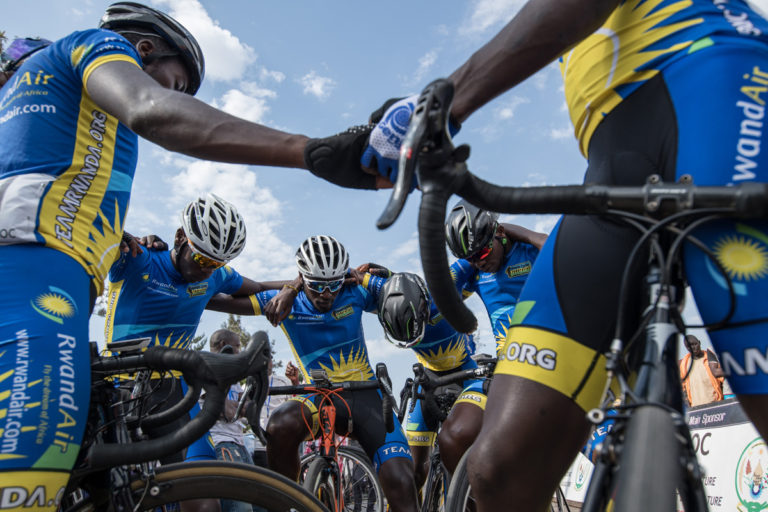
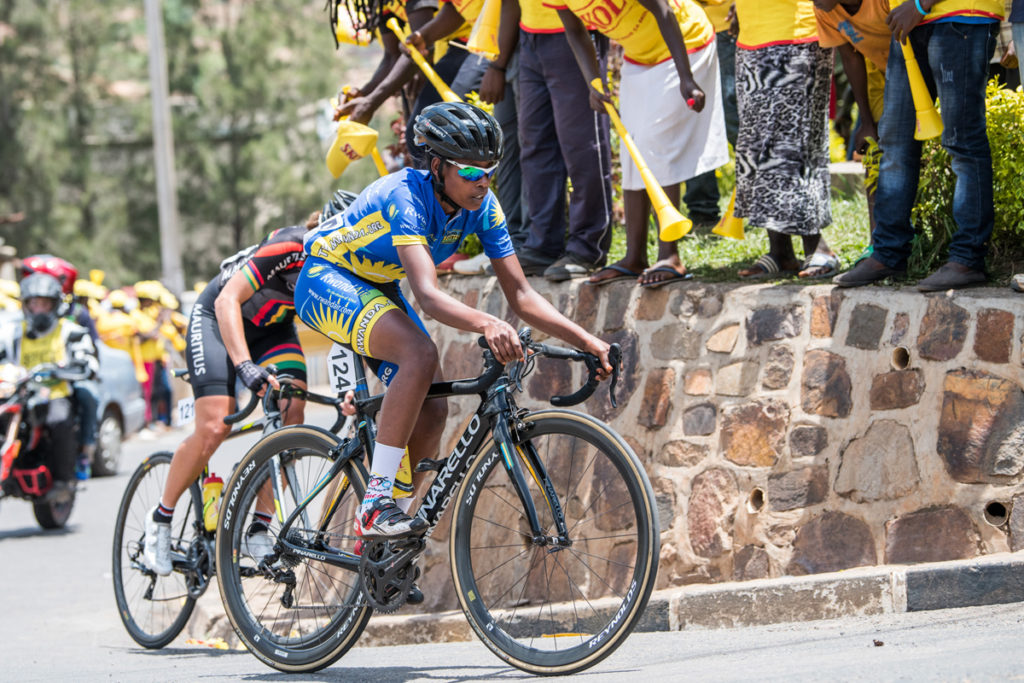
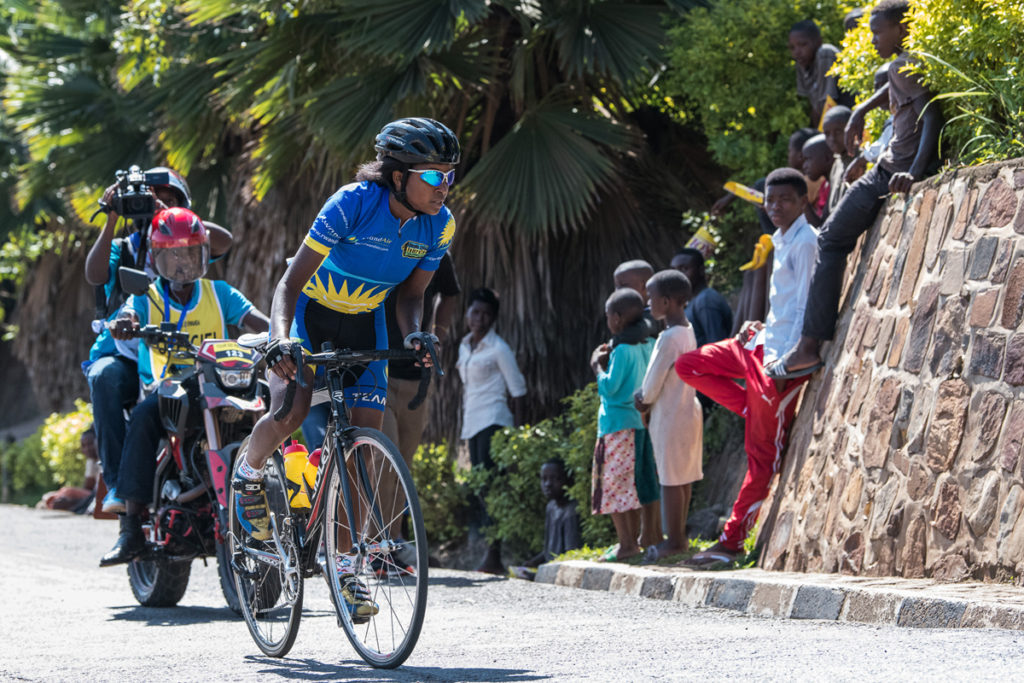
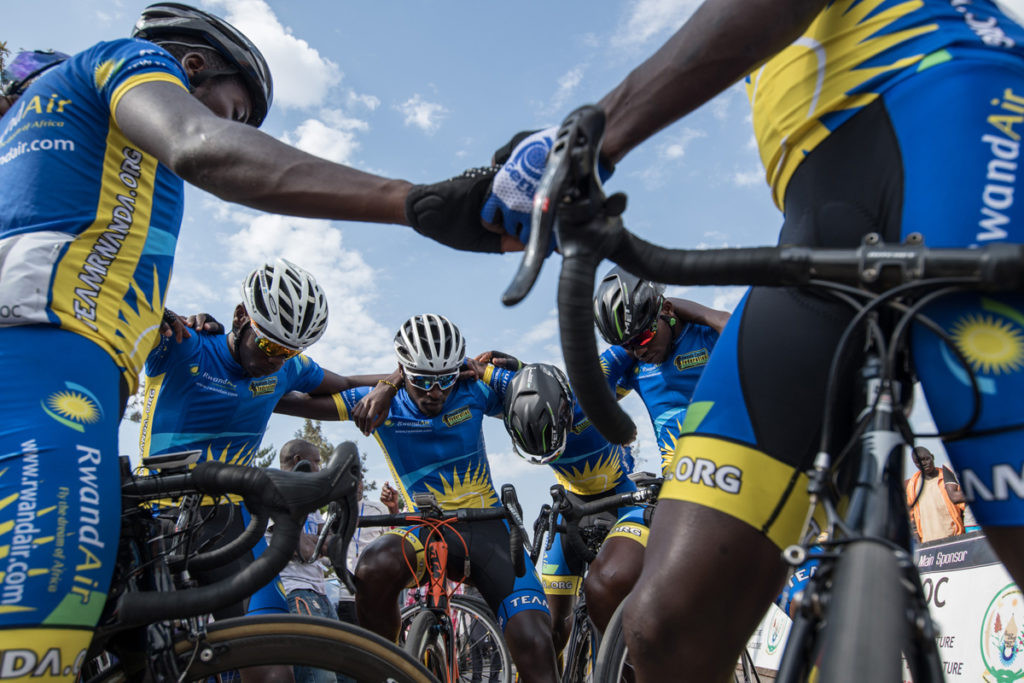
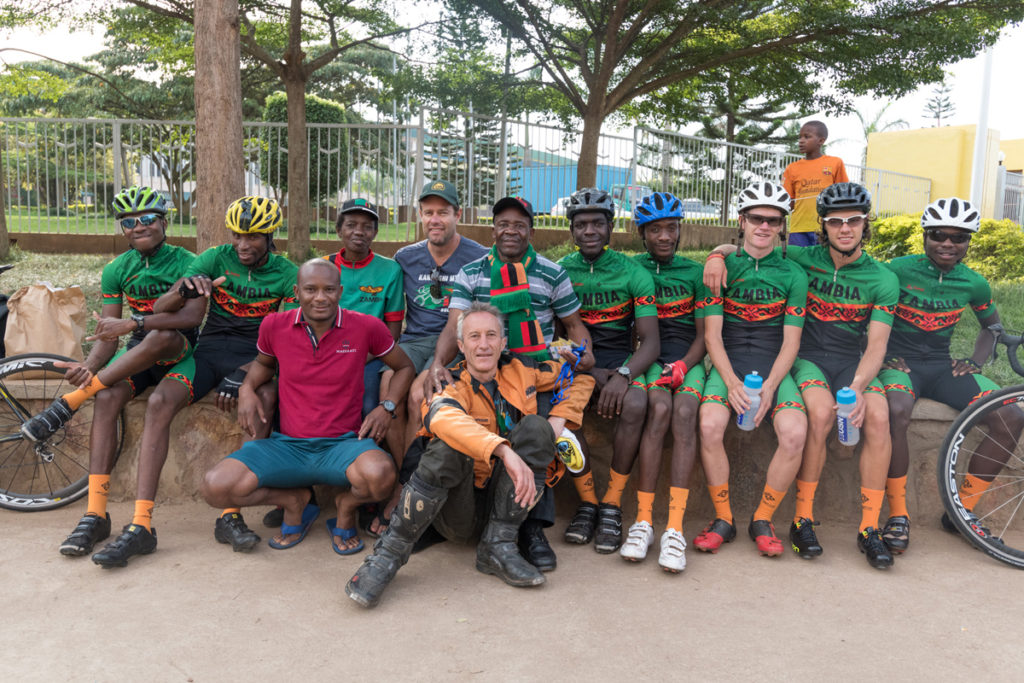
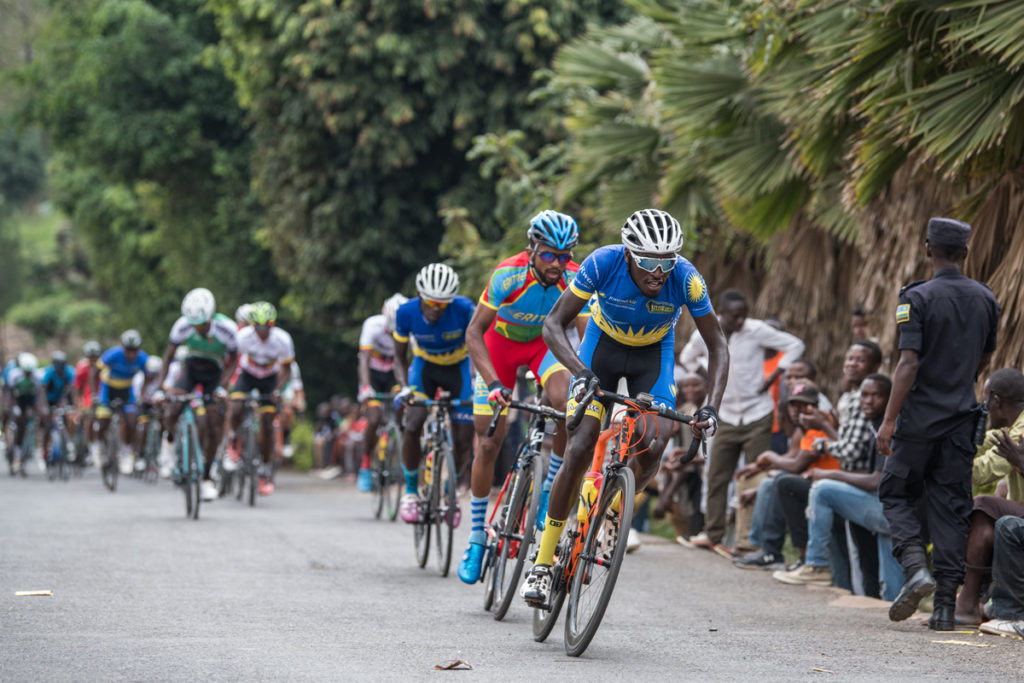
A Team Rwanda rider in the Elite women’s race in the 2018 African Continental Championships. Photo by Skyler BishopA Team Rwanda rider in the junior women’s race in the 2018 African Continental Championships. Photo by Skyler BishopTeam Rwanda at the 2018 African Continental Championships. Photo by Skyler BishopThe Zambia team at the 2018 African Continental Championships. Team Africa Rising founder Jock Boyer is pictured in the center in orange. Photo by Skyler BishopTeam Rwanda at the 2018 African Continental Championships. Photo by Skyler Bishop