Home Blog Page 198

David Ibarra – Salt Lake City 2019 Mayoral Election Candidate Survey

1

General Candidate Statement: David Ibarra is a community leader and successful business owner. David was raised in the Utah foster care system and needed to blaze his own trail to success. At 28 years old he started his first business, and now owns seven thriving businesses, including coaching hundreds on executive management skills. David is a seasoned leader and clearly a driven person, but because his was the path less traveled, David’s approach to leading others is also open and compassionate.

David has informally been serving our communities for years. He was an advisor to Mayors Rocky Anderson and Ralph Becker. He’s served as a board of director for Salt Lake International Airport, Utah Private Industry Council, Utah Department of Workforce Services, Latino Leaders Network, Utah Hispanic Chamber of Commerce and many more. David was appointed by President Clinton to serve on the U.S. Air Force Academy Board of Visitors.

As with many self-made people, giving back came hand in hand with success. For more than 30 years David has offered free weekly mentoring sessions to business owners. Fifteen years ago, David started the Ibarra foundation. His foundation has provided full college scholarships to 89 Utah students. David is the recipient of an Honorary Doctorate from the Salt Lake Community College.

The Mayor’s office is not a stepping stone for David, with his unique combination of municipal experience and executive leadership skills, David is ready to serve this city full time. SLC has all the ingredients to be extraordinary but has lacked the leadership to bring these components together. Our biggest challenges are connected – the key will be electing an executive with the background to take a holistic point of view.

We have tough issues to solve involving local control, air quality, growth, quality of life, inclusion, and infrastructure. We need a leader who can make good calls now, who is not afraid to widen the leadership group in city hall, while also preparing this great City for the next generation. “To achieve success, I learned to work hard and never give up. I will do what it takes to make you proud to call me your Mayor.” This is David Ibarra.

Contact info for campaign (for the public) – Brandon Monson – [email protected]
Website: Ibarra4mayor.com
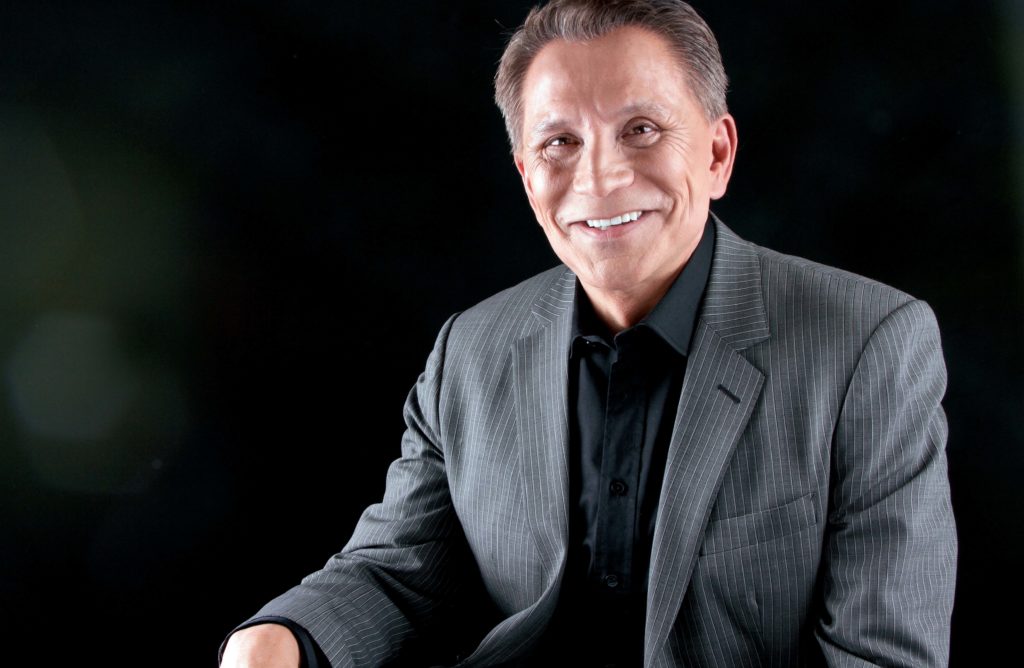
Salt Lake City Mayoral Candidate David Ibarra, photo courtesy Ibarra for Mayor.

Mayoral Candidate Questions:

Salt Lake City has not had an update to the Transportation Master Plan since 1996. What is your vision for transportation in Salt Lake City, and what would you do to get a new transportation master plan in place?

How we move about the city is central to our story. While many people talk about transportation in terms of convenience, efficiency, or even as a driver for economic development, mobility is about more than that; it’s about choices, connections, and community.

Since 1996 much has change – bike lines, introduction of scooters, walkability challenges, and planning for the utilization of autonomous ride sharing electric vehicles (people movers). Updating the master plan will be a major priority for my administration. I will seek the input from all our transportation and mobility specialized knowledge partners to create and updated a new transportation and mobility master plan utilizing modern transportation and mobility options.

What is your vision for cycling (both road and mountain biking, commuting and recreation) in Salt Lake City? What would you do to make that vision happen (planning, budget, infrastructure, education, safety, economy, etc.)?

As Mayor it would be my vision to establish Salt Lake City as a top twenty city in the ratings by “People for Bikes” in their “Places for Bikes” program. To achieve this goal, we will establish our improvement goals, then create solid plans to improve our “Places for Bikes” ratings in Ridership, Safety, Network, Reach and Acceleration.

By focusing on improving our rating in the “Places for Bikes” program the results will create better mountain biking and recreation along with the improvement in our trails.

As Mayor I will focus on education and investing in motorist awareness and cyclists understanding of the rules of the road.

Climate change is endangering the planet. Car and Truck Transportation is responsible for approximately 23% of the US CO2 output according to the EPA. And, transportation accounts for approximately 50% of PM2.5 emissions according to UCAIR. Salt Lake City is moving towards carbon free electricity generation. What will you do to move towards a carbon free transportation system in Salt Lake City and consequently obtain better air quality? How do biking and walking fit in your plan?

Salt Lake City has some of the worst air quality in America. Our pollution is resulting in an increased level of asthma, brain and heart damage and much more – loss of life. Serious action is required. I will adopt far-reaching, even radical, measures to clean up our valley’s air. I will set concrete goals – then achieve them, unlike many politicians who only know how to talk.

Actions

  • Getting things accomplished requires two steps not one. First, we must create the goal then we must have the concrete plan to achieve these goals.
    • I will outline specific long-term and short-term goals, that will hold elected officials accountable, for substantially reducing both greenhouse gas emissions and air polluting chemicals.
    • My administration will create a concrete plan for achieving our long-term and short-term goals. Beginning with 100% renewable and clean energy by 2030.
  • Work with the Legislature to restore major incentives for electric cars and solar panels.
  • Build affordable housing so people can live close to where they work, go to school, and recreate – reducing mobile emissions.
  • Move the city’s fleet to 100% zero or low emission.
  • Create greater incentives for zero-emission vehicles – reduced or reserved parking.
  • Enact more aggressive green building standards.
  • Incentivize green renovations for older buildings.
  • End any parking lot requirements for selected new construction.
  • Aggressively continue energy off sets of City buildings by using solar power. Including installation of solar panels on most city-owned buildings.
  • Support incentives for solar-powered homes and commercial buildings.
  • Ban, or disincentives for, incandescent light bulbs
  • Develop city-wide autonomous car system, moving people from city grid to city grid to chosen location.
  • Create safe, interesting, welcoming pedestrian experiences, with alternative lanes for bicycles, scooters.
  • Support revenue-neutral carbon tax.

It is important to continue to point out how intertwined good policy should be. My plan achieves success for the City in the following three areas – Affordable housing, mobile emissions and air quality and walk/bike riding increasing sound health.

Complete Streets are streets for people of all ages using all types of mobility. Salt Lake City has a Complete Streets Ordinance that was passed into law in 2011. Yet the ordinance is often ignored, or circumvented (for example on 100 S, 700 S, and 2100 S). Salt Lake City recently passed the Funding Our Future Bond and implemented a city and county sales tax that will go to fund transportation. What would you do to ensure that the ordinance is strengthened and followed, especially in regard to those streets reconstructed with the bond?

The “Streets are street for all people”, including people with disabilities, ordinance must be executed as written. This ordinance accommodates cars, pedestrians, bicyclers, and scooters. The benefits are enormous to our environment and the overall health of our community.

The past investment by the Becker administration to make the “Streets are street for all people” a reality is a key component to achieving a Beautiful, Prosperous and Livable City. Past city leadership, along with stake holders, identified the root causes to our transportation, environment and sound health problems. This ordinance was part of the solution to those root causes and now that solution must be executed. Failure to execute this solution constitutes leadership incompetency and a lack of will.

As mayor, I would ensure that all city related departments (transportation, street engineers…) and all other stake holders are involved in the design and fulfillment of our city vision to modernize our transportation and mobility systems.

UDOT Roads are important corridors for bikes as well as cars. What would you do to work with UDOT to ensure that UDOT and SLC implement bike facilities on these roads such as State Street (see Life on State)?

As mayor, I will fully support transforming State Street back to the “Signature Street” of its historical past. I would work enthusiastically with UDOT, which has supported this vision in the past. The “Life on State Street” is a very exciting initiative that shows a high degree of imagination. My administration will carry this initiative forward with a great deal of enthusiasm. “Life on State Street” supports my goal to create Salt Lake City as a Beautiful, Prosperous, and Livable City.

The 2015 Bicycle and Pedestrian Master Plan guides bicycle and pedestrian facilities in Salt Lake City. What will you do to ensure its rapid implementation? Are there improvements that you would like to make to the plan?

The 2015 Bicycle and Pedestrian Master Plan along with the “Street are streets for all people” support the attainment of a my Beautiful, Prosperous and Livable City vision. And each initiative supports the other. All our related department leaders will create the rapid implementation of the 2015 Bicycle and Pedestrian Master Plan into their department’s Vision/Purpose statement. Their Vision/Purpose Statement will be supported by action plans. As Mayor, I will ensure there is accountability to execute these actions to achieve our desired end results – the obtainment of the purpose statement goals.

As Mayor, I would add to the Master Plan – plans for an addition of utilization of autonomous ride sharing electric vehicles (people movers) system.

Salt Lake City currently does not have a formal Vision Zero program. What will you do to work towards Vision Zero (zero fatalities) for cyclists and pedestrians in Salt Lake City? Would you commit to establishing a formal Vision Zero program? What would you like to see in regard to speed limits in Salt Lake City?

My administration will join the many cities across the nation committed to Vision Zero. Saving lives should be an easy commitment to make and we will make that commitment. SLC will meet the minimum criteria to become a Vision Zero City.

  • Create a clear goal of elimination traffic fatalities and severe injuries.
  • As Mayor I will publicly, commit to Vision Zero.
  • As Mayor I will commit to develop a Vision Zero strategy within my first year.
  • As Mayor I will engage police, transportation, public health and other key city departments to the commitment of the attainment of Vision Zero.

After gathering unshakable facts, we will set the proper city speed limit to achieve our Vision Zero goals.

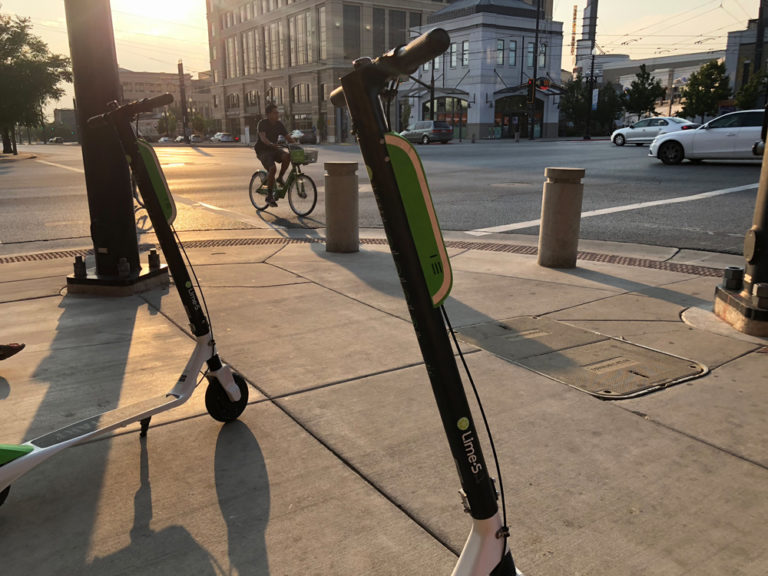
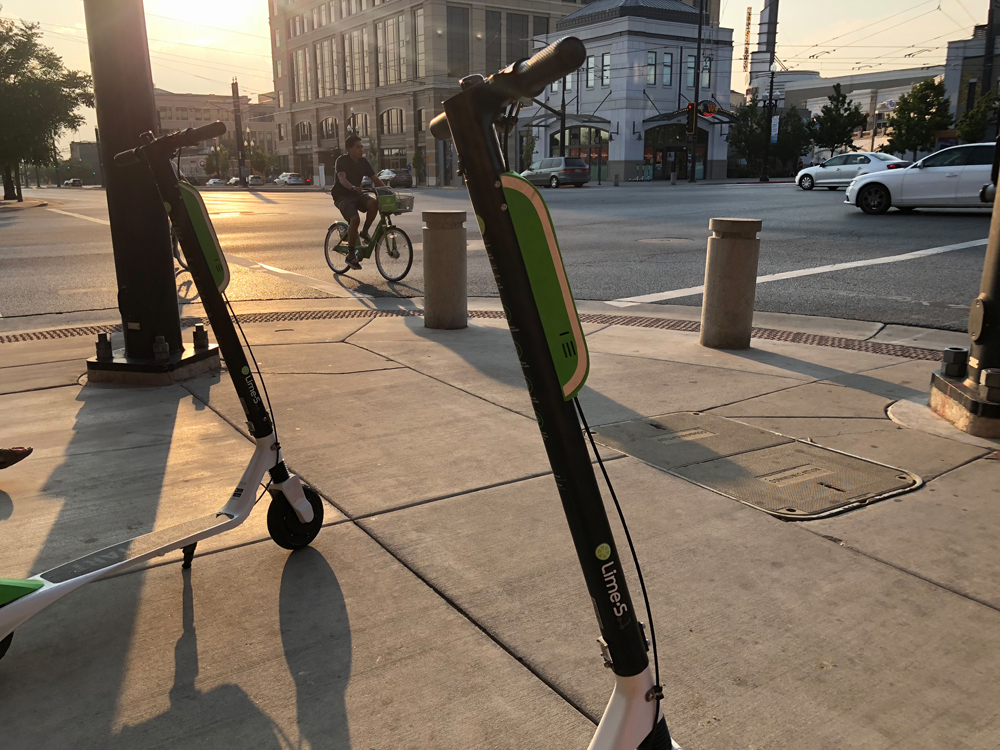
What do you think of the new shared electric scooters in Salt Lake City?

The electric scooters are a nature fit for a mobility options to move people around the city. We must improve the ride process to include the safety rider and pedestrian. The pick-up and drop-off process must be improved remove the overall cluttered appearance of a poorly designed system and improve the safety issue related to trips and falls.

What is the biggest issue for cyclists currently in Salt Lake City and what will you do to address it?

Creating a vision for all our resident to understand our goal to modernize SLC’s transportation and mobility plans and what impact they have to the future of our city.

Safety! Rules of conduct for the cyclist and automobile reviewed, updated, installed through education and then enforce.

Do you ride a bicycle? Tell us more about how and where you ride.

I prefer to walk, jog or run. I walk our city 45 minutes every night to wind down and maintain sound health. I have a vehicle usage rule – If I am within 30 walking minutes distant – I try to never use a personal car, cab, or Uber. I enjoy the outdoors by walking, jogging and running. I run one marathon every other year. I have completed seven. I will switch to bicycling once my running day have past. Until then I will continue to share the trails with cyclist as I jog and run those same trails.

Is there anything else you would like to add?

[Editor’s note: no answer]

For all Salt Lake City Mayoral Candidate Responses click here

Luz Escamilla – Salt Lake City 2019 Mayoral Election Candidate Survey

3

General Candidate Statement: My name is Luz Escamilla, I believe that I am the best choice to be the next Mayor of Salt Lake City because I see the residents of Salt Lake City as individuals each with unique needs. One of the biggest issues Salt Lake City residents face is transportation. Ensuring equitable access to various forms of alternative transportation requires a leader that can successfully implement a Master Transit Plan. As the Mayor I will work so the city can thrive and its residents can have a better quality of life. I have the experience to convene all the stakeholders successfully and get results for Salt Lake City.

Contact info for campaign (for the public): Caitlin Vincent, Communications Director [email protected], (517) 897-0057
Website: luzformayor.com

Salt Lake City Mayoral Candidate Luz Escamilla, photo courtesy Escamilla for Mayor.

Mayoral Candidate Questions:

Salt Lake City has not had an update to the Transportation Master Plan since 1996. What is your vision for transportation in Salt Lake City, and what would you do to get a new transportation master plan in place?

The 2017 Transportation Master Plan is a great start and as Mayor I will continue to see the plan is fully implemented. Salt Lake City is the heart of the state, the county, and the Wasatch front we have to lead the way on transitioning the community towards alternative transportation. I am committed to working in partnership with UDOT, UTA, and other stakeholders as we move forward on this Master Plan.

What is your vision for cycling (both road and mountain biking, commuting and recreation) in Salt Lake City? What would you do to make that vision happen (planning, budget, infrastructure, education, safety, economy, etc.)?

My vision for cycling in Salt Lake City is that we have clearly marked, safe, and maintained pathways for our cyclists to use. Outdoor recreation across the Wasatch Front is a major contributor to our quality of life. I will continue to work for protection for cyclists and keeping them safe. As the Senate sponsor of HB 139 (Motor Vehicle Emissions Amendments, 2019 Legislative Session), fines have increased for those who let their cars emit over state standards. I am committed to providing safety to cyclists. I will also ensure that further development includes complete streets and encourages active transportation.

Climate change is endangering the planet. Car and Truck Transportation is responsible for approximately 23% of the US CO2 output according to the EPA. And, transportation accounts for approximately 50% of PM2.5 emissions according to UCAIR. Salt Lake City is moving towards carbon free electricity generation. What will you do to move towards a carbon free transportation system in Salt Lake City and consequently obtain better air quality? How do biking and walking fit in your plan?

A carbon free transportation system is the ultimate goal. Active transportation is a critical piece of a carbon free transportation system and is crucial to sustainably and responsibly growing our city. Electrifying our public transportation system would significantly clean the air of our most densely populated and visited areas (i.e. downtown) and will hopefully encourage more commuters to use bikes and walk as transportation alternatives since they will not face emitting vehicles.

Complete Streets are streets for people of all ages using all types of mobility. Salt Lake City has a Complete Streets Ordinance that was passed into law in 2011. Yet the ordinance is often ignored, or circumvented (for example on 100 S, 700 S, and 2100 S). Salt Lake City recently passed the Funding Our Future Bond and implemented a city and county sales tax that will go to fund transportation. What would you do to ensure that the ordinance is strengthened and followed, especially in regards to those streets reconstructed with the bond?

The Salt Lake City complete street ordinance should be enforced by the city. Complete street infrastructure goes beyond urban planning; it requires the cooperation of residents and commercial entities to be successful. I would do away with the overestimation of parking needs for both people living and working in Salt Lake City. Many people move to denser areas precisely to not need a car and streets like 300 S demonstrate that a lower amount of parking spots does not decrease business, but rather invigorates and strengthens the community as a walkable area.

UDOT Roads are important corridors for bikes as well as cars. What would you do to work with UDOT to ensure that UDOT and SLC implement bike facilities on these roads such as State Street (see Life on State)

As a sitting legislator for 11 years one of my strengths coming to this race is my strong relationship with UDOT,UTA, and state government. I was able to secure the construction of a sound wall in Glendale (I-215) which was a top priority for the community. This wall will help reduce exhaust and sound pollution coming into the area and makes outdoor activities like walking and biking friendlier for the community. I know what it takes to successfully work with these state agencies. I want to see state roads safe for bicycles. As Mayor I will work to get cooperation from UDOT and the rest of the state to ensure that state roads match the city’s Master Plan.

The 2015 Bicycle and Pedestrian Master Plan guides bicycle and pedestrian facilities in Salt Lake City. What will you do to ensure its rapid implementation? Are there improvements that you would like to make to the plan?

The 2015 Bicycle and Pedestrian Master Plan is a great start and I am ready to begin implementation on day one. An important component is not to simply build, but also to maintain infrastructure. Many bike lanes are not cleaned regularly and this discourages their use. A clear connection with the 2017 Transit Master Plan could help bridge the first-mile, last-mile issue and encourage commuters who may want to use their bikes as a solution to get to/from transit stations as well as the whole journey.

Salt Lake City currently does not have a formal Vision Zero program. What will you do to work towards Vision Zero (zero fatalities) for cyclists and pedestrians in Salt Lake City? Would you commit to establishing a formal Vision Zero program? What would you like to see in regards to speed limits in Salt Lake City?

Fatalities in our community as a result of insufficient safety regulations for our bicyclists and pedestrians are unacceptable. A Vision Zero plan would absolutely be a priority in my administration. I will follow best practices and work in collaboration with Salt Lake City’s Transportation Advisory Board, Cycling Utah, and other stakeholders to understand how we can address and reduce incidents.

What do you think of the new shared electric scooters in Salt Lake City?

The shared electric scooters are an extra tool in our toolbox for promoting active transportation; unfortunately they have been fairly dangerous for users and others. These scooters can reach high speeds resulting in serious injuries. We have a high increase of Emergency Room visits in the Salt Lake City area due to scooters. In this 2019 legislative session the legislature passed a law defining operation requirements and local regulatory power regarding scooters and the relationship between the providers and municipalities. I think that to keep these scooters welcome in Salt Lake City the companies need to provide maintenance besides charging them. Safety for users and others around the community is my priority. One community impacted by a lack of regulation is people with disabilities when scooters are left discarded across sidewalks.

What is the biggest issue for cyclists currently in Salt Lake City and what will you do to address it?

Safety and access are the biggest issues for cyclists. The challenge Salt Lake City faces is bringing more active transportation and sharing the roads with motor vehicles. I will continue working with and developing synergy Master Transit Plan and Bicycle and Pedestrian Master Plan to create stronger partnerships with the State so their roads fit the more active transportation plan.

Do you ride a bicycle? Tell us more about how and where you ride.

I ride recreationally with my family at the nearby park.

Is there anything else you would like to add?

 As a mother, a significant concern I have is the safety of children riding bicycles. Although there are no specific helmet laws in Utah, I want to encourage children and adults to wear helmets for their safety. I am also very happy to see how e-bikes are taking off in popularity. Many people who would not be able to ride conventional bikes to work (journey is too long, steep, or incompatible with clothing) can now use a bike and take one more car off the road.

For all Salt Lake City Mayoral Candidate Responses click here

Jim Dabakis – Salt Lake City 2019 Mayoral Election Candidate Survey

1

Candidate Statement: My name is Jim Dabakis. I live in the lower Avenues. I have been a small business-person for the last 30 years, meeting a payroll and dealing with all the issues that entails. In 2010, I turned my business over to my husband and dove headfirst, full-time, with passion, into trying to improve my community, city, and state by jumping into politics. I was elected as Utah State Democratic Party Chair. I served without pay or expenses, traveling the state, rallying people to get involved! I loved every minute of that job–as I explored our breathtakingly beautiful state and met people who inspired me every single day. 

In 2013, over tough competition, I was elected to the Utah State Senate–with a seven vote “landslide.”

My six years in the Senate ended last December. It was a great joy and the honor of my life to represent you. While I served in the Capitol, I was always firm (and loud) in representing OUR values, but I made great efforts to keep the friendship and respect of my colleagues on the other side of the aisle. Nothing is possible unless we work together.

It would be my privilege to represent you, this time as Mayor. I would love your support.

Contact info for campaign (for the public): [email protected]
Website: https://www.dabakisformayor.com

Salt Lake City Mayoral Candidate Jim Dabakis, photo courtesy Dabakis for Mayor.

Mayoral Candidate Questions:

Salt Lake City has not had an update to the Transportation Master Plan since 1996. What is your vision for transportation in Salt Lake City, and what would you do to get a new transportation master plan in place?

A great city transportation system is “all of the above.” But a safe place for bikers has a special place in heaven. Add in ingenious light- rail transportation access, and hundreds of bus lines. By working with downtown businesses, the University of Utah, and Salt Lake County, I will plan more bike-to-work days, with better incentives. I will also put forward an action plan creating more protected bike lanes. We need more bike plans to convince cyclists to bike down into the city.

I will increase access to buses. We need stronger last mile solutions. I will not just have free fare days, but will work hard to get free UTA fares or very reduced fares- all the time. This will convince more commuters to find an alternative transportation route to Salt Lake City.

What is your vision for cycling (both road and mountain biking, commuting and recreation) in Salt Lake City? What would you do to make that vision happen (planning, budget, infrastructure, education, safety, economy, etc.)?

I will work my spandex off to make better education for non-cyclists! I am a firm believer that the majority of accidents that happen between motor vehicles and bikers are due to one of the two overestimating what they thought they could do on the road. Even though the cycling culture is increasing and improving in Salt Lake City, accidents are still happening all too frequently.

I will work with the many great Salt Lake City non-profits such as the bike collective, who work to educate and encourage better access to bicycles. I will partner with them. I will also promote the bike rental companies in Salt Lake City to help encourage education and a chance to “cycle to work.”

Climate change is endangering the planet. Car and Truck Transportation is responsible for approximately 23% of the US CO2 output according to the EPA. And, transportation accounts for approximately 50% of PM2.5 emissions according to UCAIR. Salt Lake City is moving towards carbon free electricity generation. What will you do to move towards a carbon free transportation system in Salt Lake City and consequently obtain better air quality? How do biking and walking fit in your plan?

By maximizing UTA, we can get Salt Lake City and Utah to less carbon transportation. UTA is a world-class transportation system, yet there is much room for growth and expansion.

I will work passionately to make UTA access free to all riders, which will encourage alternative transportation in and out of the city–hence, less emissions, road costs, and cleaner air.

I will include biking into this plan by developing strategies to offer incentives to businesses to participate in the Bicycle Friendly Business program. As for walking, we need to work to make it safe and promote the health and vigor of it!

Complete Streets are streets for people of all ages using all types of mobility. Salt Lake City has a Complete Streets Ordinance that was passed into law in 2011. Yet the ordinance is often ignored, or circumvented (for example on 100 S, 700 S, and 2100 S). Salt Lake City recently passed the Funding Our Future Bond and implemented a city and county sales tax that will go to fund transportation. What would you do to ensure that the ordinance is strengthened and followed, especially in regards to those streets reconstructed with the bond?

I believe this comes from a lack of better communication between the county, the City, UDOT,  and cycling advocates. I will strengthen these relationships, so that we can all work on a larger strategy that will support transportation in our region for years to come. New transit lines and bus routes, free/ reduced fares, and improving crosswalks/ protected bike lanes will help to strengthen these bonds.

UDOT Roads are important corridors for bikes as well as cars. What would you do to work with UDOT to ensure that UDOT and SLC implement bike facilities on these roads such as State Street (see Life on State)?

Salt Lake City roads are becoming an increasing corridor for bikes, as the culture continues to grow. My goal is to create a State Street culture that is welcoming and safe for bikers as well as pedestrians and drivers. It is a huge piece of the heart of downtown.

The 2015 Bicycle and Pedestrian Master Plan guides bicycle and pedestrian facilities in Salt Lake City. What will you do to ensure its rapid implementation? Are there improvements that you would like to make to the plan?

I think the plan is great and as mayor, I will continue to implement and reinforce its attributes. As I stated before, I support the protected bike lanes. I know not all streets are uniform with these protected lanes, which can cause confusion for oncoming traffic, bikers, and walkers. We need a serious approach to implement more uniform policies for bike lanes on streets. I embrace the approach to implement this to the large master plan that accounts for future bike lanes and bus routes.

Salt Lake City currently does not have a formal Vision Zero program. What will you do to work towards Vision Zero (zero fatalities) for cyclists and pedestrians in Salt Lake City? Would you commit to establishing a formal Vision Zero program? What would you like to see in regards to speed limits in Salt Lake City?

Safety for all citizens in all modes of transportation is really important. As citizens move out of their vehicles and into alternative transportation, we need to prioritize safety;  whether that is alternative transportation specific lanes, campaigns to promote safety and wellness, or better technology to keep bikers safe. I believe that zero fatalities is 100% a reachable goal, and we shouldn’t stop striving to get there.

What do you think of the new shared electric scooters in Salt Lake City?

They are a great last mile solution. They add vibrancy, and excitement to our downtown. They are a modern solution for parking, and short distance commute problems. As mayor, I will work with the scooter companies to create, fund, and promote campaigns that educate users about safety and courtesy as we share roads and sidewalks.

While the scooters are safe for much of the public, we need to be aware of our community members that NEED our sidewalks who can’t get around otherwise (canes, wheelchairs, etc). We need to be better about educating scooter users about not using sidewalks.

What is the biggest issue for cyclists currently in Salt Lake City and what will you do to address it?

I think the biggest issue for cyclists currently is the danger they face from oblivious drivers. Educating the community on biking and traffic laws is a priority. Additionally, by working to create more protected bike lanes, we can help increase better awareness for bike travelers not just at rush hour, but for all hours.

Do you ride a bicycle? Tell us more about how and where you ride.

Both my husband and I have bicycles. I get out. I love the rush of wind in my face. I have used the GreenBike program! It is incredible–and deserves broad support from the city!

Is there anything else you would like to add?

[Editor’s note: No answer.]

For all Salt Lake City Mayoral Candidate Responses click here

It’s Time to Climb!

If you live in the mountain west region, we are in for another hot summer. One way we cyclists like to escape the heat is by climbing canyon roads. With each gain of a couple of thousand feet of altitude, we can expect a welcome drop in temperature of 10-20°. Of course climbing a couple thousand feet is no easy task. Here are a few tips to make the climb a little more manageable and get you out of the valley heat.

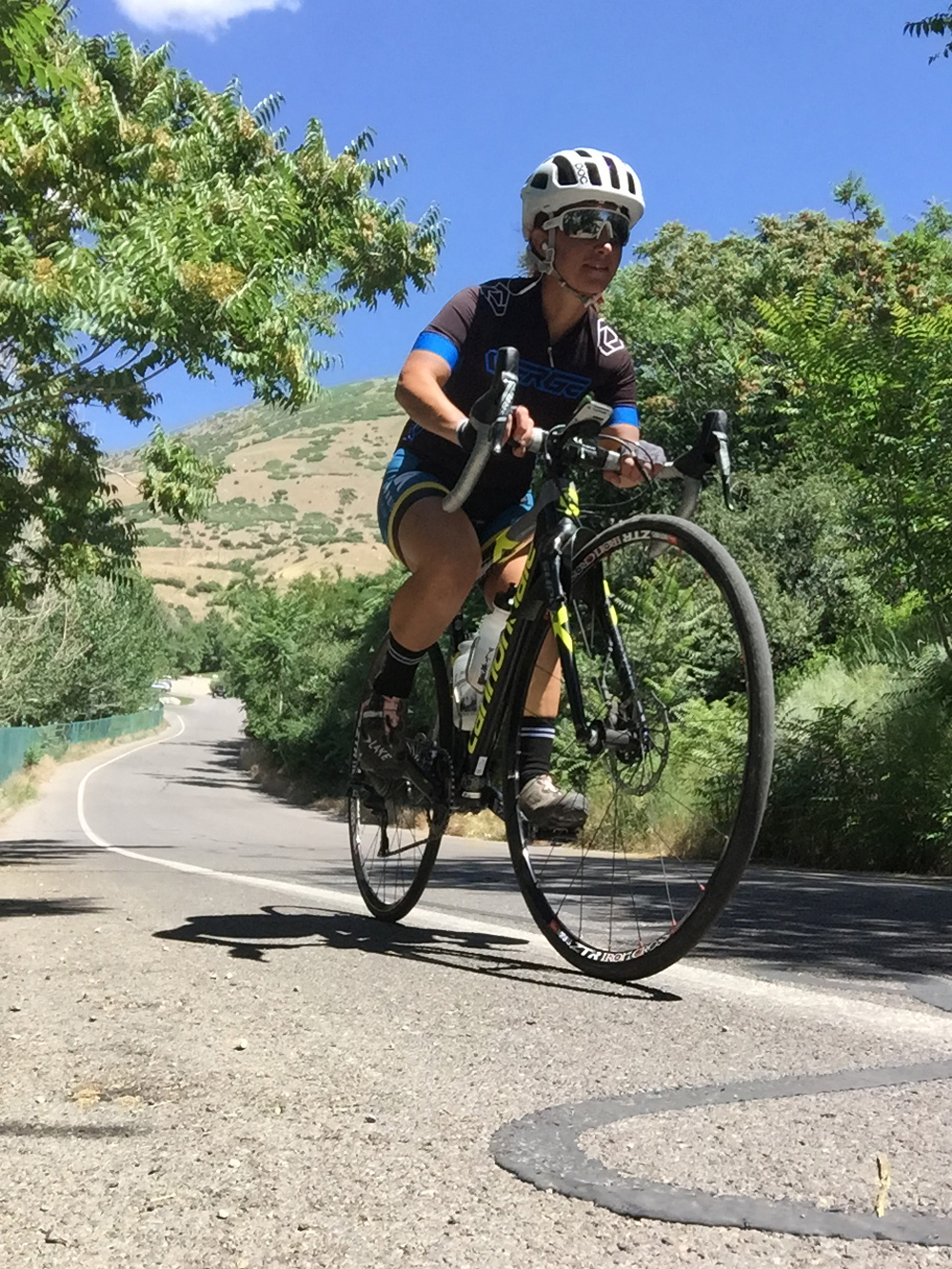
Sarah Kaufmann climbing in Farmington Canyon, Utah. Photo by Sarah Kaufmann

To begin with, you need the right tool for the job. Make sure your bike is set up with adequate climbing gears. Few things will flatten your legs more quickly than stomping a massive gear. Try not to ‘save’ gears when you are climbing. Shift as you need to so you can maintain a quick, smooth cadence. Shoot for above 80 rpm and focus on pedaling nice smooth circles, not jagged squares. Stay ‘on top’ of the gear and avoid slow, heavy cadences. Try practicing 90 or 100+ rpm on flat terrain to develop the neuromuscular connection and make it easier to hold higher cadences on climbs. If you do not have adequate gearing to maintain a high cadence, check with your favorite shop to see if it is an easy swap to add gears to your bike. (i.e., a cassette with a larger cog and/or a compact crank).

Once you have the right tool for the job, there is a lot you can do with your body (even before dedicated training) to make the effort more manageable. As you settle into a long climb, keep your upper body relaxed. On a drop bar bike, you will usually want to have your hands on the tops of the bars or sometimes out on the hoods. There isn’t much reason to be in the drops when you are climbing. Bend from the hips to keep your back flat/straight and not rounded. As you do this, you should feel your glutes get more recruitment. Your glutes are big muscles so use them! Relax and open your shoulders to create more space in your chest and open your lungs. You want to be able to take deep breaths and fill up your lungs, rather than short shallow breaths into your chest. Keep your head up and look ahead for balance and focus. Keep your feet flat the whole way around the pedal stroke (do not pedal with your toes). As you do this you should feel your calves get more recruitment. Try standing on short pitches to stretch and stay on top of the gear instead of shifting down to spin up those pitches. Watch undulations in the grade of the road and shift in anticipation.

It is easy to charge into a climb and forget how hard it will be when fatigue starts to catch up. Break climbs into thirds for pacing strategy. Break them up using anticipated time (not mileage). For the first third, your main goal will be to hold yourself back a little. Spin easy gears and keep things conservative. In the second third of the climb, your effort will start to catch up and your goal is just to hold steady. In the final third, you will be feeling the effort and it’s time to empty the tank.

Climbing is hard work and you want to be well fueled for these kinds of efforts. Try to plan ahead and avoid eating too much right before or during the climb. Start with a solid meal before your ride and fuel in small bites and bits once you are into the climb. With lots of blood diverted from your belly to your working muscles, you may have a hard time digesting a large amount or heavy food so you want to start topped off and just keep up after that. Eat light and eat often as you climb. And remember to drink! Use an electrolyte mix like GU Brew to replace the electrolytes you are sweating out in the heat.

These tips give you a broad map to get you started.

For training protocol for climbing and all cycling goals, please contact Sarah for coaching.

Sarah Kaufmann is the owner of K Cycling Coaching based in Salt Lake City, UT. She is a professional XC and CX racer and can be reached at [email protected] or 413.522.3180.

Etiquette for Road and Mountain Biking

By Kira Maicke

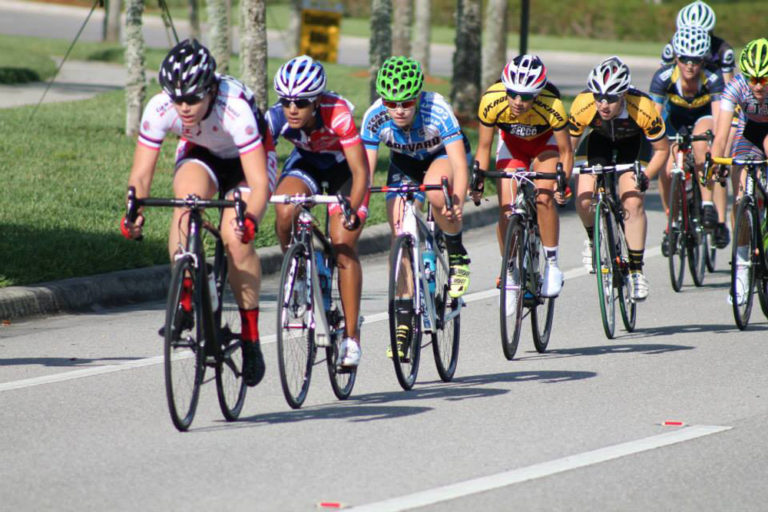
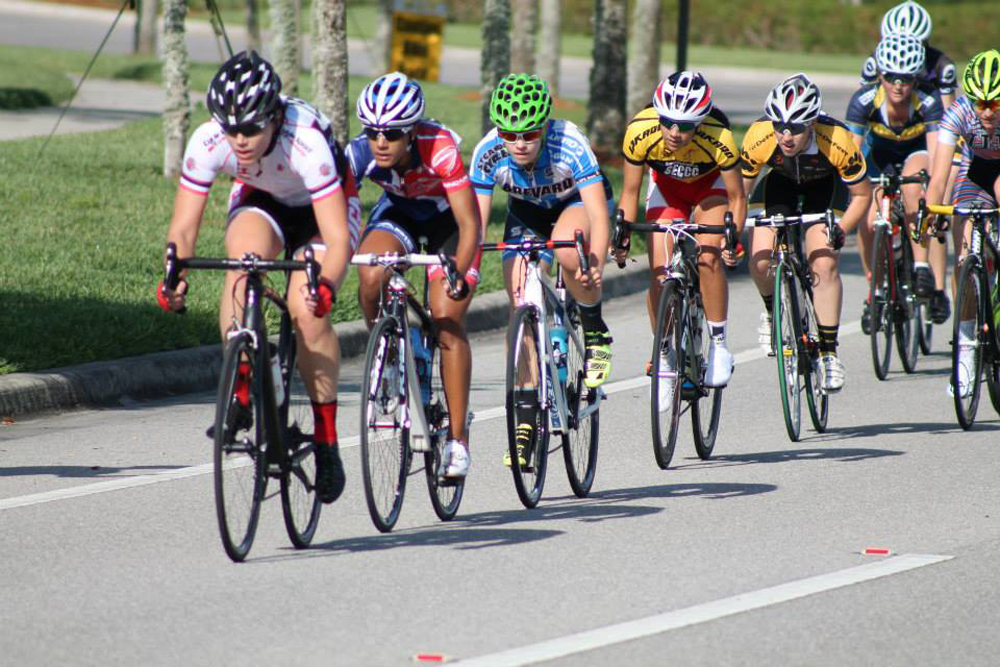
Kira Maicke in a women’s A collegiate road race when she raced for the University of Georgia. Photo by Nick Luther

“Rule #1: Obey the rules.” While great for a fun read, “The Rules” according to the Velominati should be taken with a grain of salt. When riders, particularly road cyclists, cite the rules, they are often referring to those that help paint a mental image of the stereotypical “Euro” road rider.

“Tan lines should be cultivated and kept razor sharp. Shorts should be black. Shorts and socks should be like Goldilocks (Not too long and not too short). Eyewear should be cycling specific.” etc…

This sport has been exclusive and elitist for far too long. Wear your jean shorts and flannels! Sport your aviators with an aero road helmet! Just get out and enjoy the ride!

There are, however, some important “rules” to consider when cycling in groups. Road racing and group rides share similar etiquette to ensure everyone is safe and has fun.

“Hold your line.” Be consistent and predictable. Riding erratically in a large group can be very dangerous. If you notice road or trail debris up ahead, alert other riders by pointing at the object, or waving everyone over to a certain side to avoid the object. When closely drafting, the riders following cannot see upcoming obstacles quickly enough, so the riders up front need to point them out. Signaling, in general, is very important. Alert other riders with hand signals when changing direction, slowing, or stopping. For riders not yet comfortable with one handed riding, verbal cues will suffice. Hand signals also help to let cars know which direction the group is heading. This is not quite as necessary in a race scenario where the courses are typically closed to cars, but for group rides, signaling is a must.

“Don’t overlap wheels.” Overlapping wheels is when the front wheel of the trailing bike overlaps the rear wheel of the leading bike. This is dangerous, especially if the leading rider has to swerve quickly to avoid an object. If the rider swerves in the direction of the trailing rider’s front wheel, this will very likely result in a crash.

“Do your time in the wind.” This one is a little more relevant for the roadies, but can also apply for open, windy trails. Pacelines are a great way to save energy and ride faster and farther than you could on your own. Single and double file pacelines are both common for road group rides. On very windy days, rotating pacelines are a popular choice. With a rotating paceline, the lead rider(s) are not in the wind very long at all. The line is constantly changing. As soon as the rider gets to the front of the paceline, they continue to ride left and ride next to the line of riders until they are back at the end of the line, shielded from the wind. Often when riding in a double paceline, the two front riders will pull for a longer amount of time and pull to the sides after a couple of miles to draft off the group to recover.

Most of the rules and standard etiquette highlighted so far have been pretty road oriented, but there are some rules and guidelines to consider when riding trails as well. When riding multidirectional trails, the downhill riders must yield to the uphill riders. When trails are directional, be sure to ride them in the designated direction. Downhill only trails will have riders bombing down expecting not to see anyone climbing, and if someone is climbing up a downhill-only trail, this can cause a dangerous wreck.

Ride trails and features within your ability. If you plan to work on a specific section of trail or a certain feature, be sure others can see you. Do not stand on the landing of a jump, or push your bike back up the trail without knowing the trail is clear up top. Yield to faster riders. I know I do not have as much fun when someone is right on my wheel, and I am sure the rider behind would have more fun if they could ride the trail at their speed. Even in a race situation, if you can tell someone is itching to go by, it is proper etiquette to let them pass. As hard as that is when you are racing against the clock, or in a pack of XC racers, if someone is able to pass, they are having a better race than you.

Whether on the road or on the trail, in a race or just riding with friends, following these guidelines will ensure everyone has a safe and enjoyable riding experience.

Kira has been racing bikes since 2010. She started racing road bikes for the University of Georgia and raced at the elite level until transitioning to mountain bike racing in 2016. She currently races downhill, and can usually be found sitting on chairlifts in Utah, Idaho, Wyoming and Montana.

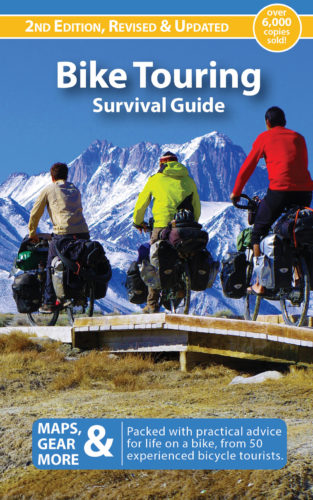
Bike Touring Survival Guide is Highly Recommended for Anyone Planning a Bike Tour

By Lou Melini

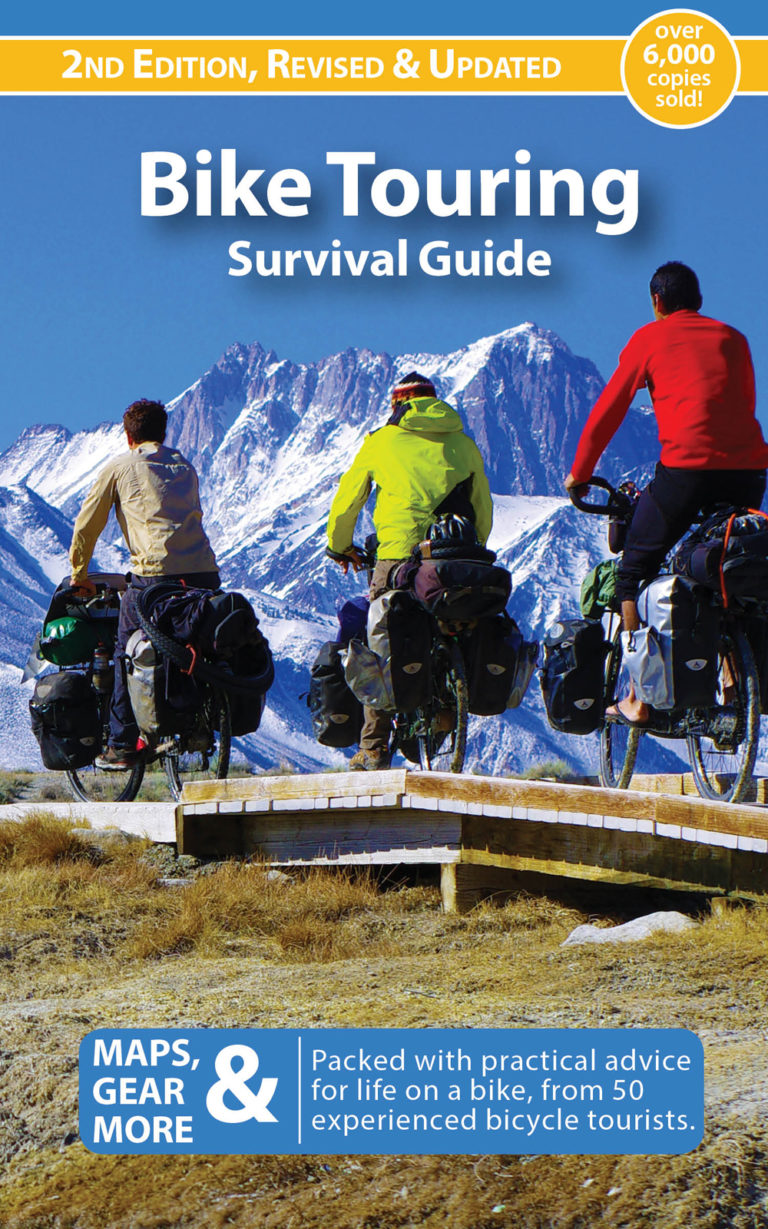
Andrew and Friedel are known as the Travelling Two, though they are now the Travelling Three with the addition of Luke in 2012. The website is not only their personal website but it seems to be a clearinghouse for other long distance bike travelers. Hence the Bike Touring Survival Guide (e-book) is advertised on the website as “250 pages of tips from over 50 experienced bike tourists”. The actual book has 455 pages.

I purchased the 1st edition of the Bike Touring Survival Guide a couple of years ago with the promise that when the second edition was printed I would receive a copy. True to their word, I recently received the 2nd edition with the updates. The book only comes as an e-Book with PDF, Kindle and ePub files for 7.50 Euros (the print version will be available in early 2015). This is an incredible bargain for an encyclopedia of bike touring knowledge.

Andrew and Friedel use the proceeds of the book to help finance their travels. So they ask that you do not pass it around on the Internet. Without this meager source of income they may not have been able to bike tour the 60,000 Km in 40 countries. As a result of their experiences they are able to provide the invaluable advice they give for experienced and novice bike tourers through their book.

Originally from Canada, Andrew and Friedel were living in London before their first bike trip. They were looking for an “adventurous way to go around the world”. During a “random internet search” they happened upon “the website of Alastair Humphreys who, at the time was in the midst of his own global bicycle tour.” Inspired, they left after 9 months of preparation in 2006, embarking on a 3-year around-the-world journey on their bikes. After that bike trip, they now live in the Netherlands.

The book is primarily, as they say, “your personal cheerleader, here to get you started on a lifetime of two-wheeled discoveries”. The book continues to be a cheerleader under the heading of “Why You Should Read This Book”. There are multiple pages in this chapter that would encourage even the most skeptical cyclist to go on a bike tour.

Much of their advice in the book is a compilation of choices and considerations, a rather extensive list. For example, their advice on what bike to buy is: “Bike touring can be done on any bike as long as that bike meets two criteria: it should be in reasonable mechanical shape and you should feel comfortable riding it. Everything else comes down to personal preferences and style.” Overall they devote over 13 pages to bicycle considerations including examples of bikes ridden by many other long-distance traveler. At $1000-2000 they say you can buy a good touring bike such as the Trek 520 or Surly’s Long Haul Trucker. For $2000-4000 they say you can get an expedition-quality touring bike. Their absolute limit is $5000, when they say; “There is a point where spending more money doesn’t get you a whole lot. We personally don’t see much value in blowing more than $5,000 (U.S.) on a touring bike. The mechanical advantages are negligible and when you plunk down that amount of cash for a bike. It risks becoming such a valuable possession that it takes away from the freedom of touring. Will you be able to lock it up in a city square for an hour so you can go sightseeing or will you be too paranoid to take your eyes off it?”

Sometimes the advice in the book is very specific based on their experience. For hubs they state in the book to buy LX Shimano hubs vs. XT; “because the newer XT models aren’t as durable as they used to be.” Further they say; “If you have more cash to spend, you might look at hubs by manufacturers such as Phil Wood and Hope.” They devote several paragraphs to Rohloff hubs though they have not used them in part due to cost. They do have bikes that could convert to a Rohloff hub if desired.

If foreign travel is what you are interested in, the book devotes 25 pages specifically to foreign travel, though there are many references to traveling in foreign countries throughout the book. If you are concerned about fixing your bike in remote parts of the world, Andrew and Friedel have numerous tips about fixing your bike such as how to make an emergency spoke. There are numerous anecdotes as well throughout the book such as a short piece by Alastair Humphreys repairing (actually rebuilding) a wheel while in his tent during a storm.

If you have a question, there is probably an answer in the book. There are short sections about “Caring for raingear” and “Keeping shoes in good shape”, though I doubt if I would boil a rock to “create a mini heater” and use it to dry my boots. Other unique recommendations include using (denatured) alcohol to prime your (liquid fuel) stove, something that I have been using for many years and the first time I have seen this recommendation from someone else. They also suggest tents that I use from Big Agnes and MSR, though they neglect the REI brand tents that I use, presumably because they now reside in the Netherlands.

Although the overall information in the book tends toward the long-distance cyclist, a novice will come away with ample advice. Andrew and Friedel make a good effort to make suggestions for the novice tourist along with stronger recommendations for experienced bike travelers. I highly recommend this book for anyone that is planning a bike tour.

E-Book, 2nd edition by: Andrew and Friedel Grant; Travellingtwo.com

E-Scooters and Cyclists

By Ken Christensen and Russ Hymas

As cyclists and car drivers we are very familiar with the term “share the road.” But until recently, we didn’t think this included e-scooters. If you’ve walked or driven around Salt Lake City, Reno, Oakland, or Boise lately, you’ve probably seen people zipping around town on two-wheeled battery powered razor-like scooters that are part of an e-scooter sharing program growing in popularity.

E-Scooters and bikes are interacting more on the road. What happens when there's a collision? Photo by Dave Iltis
E-Scooters and bikes are interacting more on the road. What happens when there’s a collision? Photo by Dave Iltis

The e-scooter program is pretty simple: you download an app from companies like “Lime and Bird” that lets you find and unlock a nearby e-scooter for a small fee, often just $1. The scooters travel about 15-20mph and anyone with the app and a credit card can use them. You can then ride around, and the app charges you per mile. These companies have already calculated more than 20 million scooter rides. The scooters are dockless. So once your trip is finished, you can park your scooter anywhere local ordinance permits (you cannot block public paths).

This program may lead to problems for pedestrians and cyclists. Most city ordinances prohibit driving e-scooters on sidewalks, but the app doesn’t tell anyone about this before they unlock their scooter and start traveling. At almost any time of the day, people can be seen riding e-scooters on sidewalks, around town, and in bike lanes. One of the biggest problems is that people are often riding these scooters in the bike lanes against traffic.

There have been numerous reports of accidents on motorized scooter rentals nationwide. In September of 2018 alone, three people died while riding scooters in Dallas, Cleveland, and Washington D.C.

Some people have filed lawsuits against the scooter rental companies. But these are expensive and difficult cases to win. The more likely case is against the person who caused the accident. Careless drivers will always be personally liable, but you hope they have some type of insurance policy to cover your damages.

For example, let’s assume you are hit by a careless scooter driver while riding your bike. How will you get your injuries, bike, and other damages paid? Automobile insurance generally omits liability coverage for motor vehicles with less than four wheels. So, it’s unlikely that the scooter driver’s car insurance company will pay your claim. If the driver has personal motorcycle or ATV insurance then there should be coverage, but very few people have these types of policies. So, a homeowner’s or renter’s insurance claim may be your only chance of finding insurance.

Most homeowner’s and renter’s policies provide some liability coverage if you cause an accident even when you are away from home. But a cyclist will have to open a claim to see exactly what the driver’s homeowner’s or renter’s insurance policy covers. Unfortunately, coverage may be limited or denied because it was a rental scooter. Always check to see if there is an umbrella policy in addition to the homeowner’s policy. Personal umbrella policies offer an extra layer of protection that kicks in when you reach the limit of the underlying homeowner’s or automobile policy.

You cannot make an injury claim under your personal homeowner’s or renter’s insurance policy. However, you can make a property damage claim for your bike if the careless driver doesn’t have any insurance available. Some cyclists do not realize that they can make a claim under their own policy when their bike is damaged outside of the home. But this is one of those situations where you should contact your insurance adjustor and find out what coverage is available. You may have to pay your deductible, but at least you will be able to replace your damaged bike and get back outside doing what you love!

Ken Christensen and Russ Hymas are avid cyclists and Utah attorneys at UtahBicycleLawyers.com. Their legal practice is devoted to helping cyclists injured in collisions with motor vehicles. They are authors of the Utah Bicycle Accident Handbook and are nationally recognized legal experts on cycling laws and safety.

Snēk Cycling Launches the Lifeboat Tire Lever

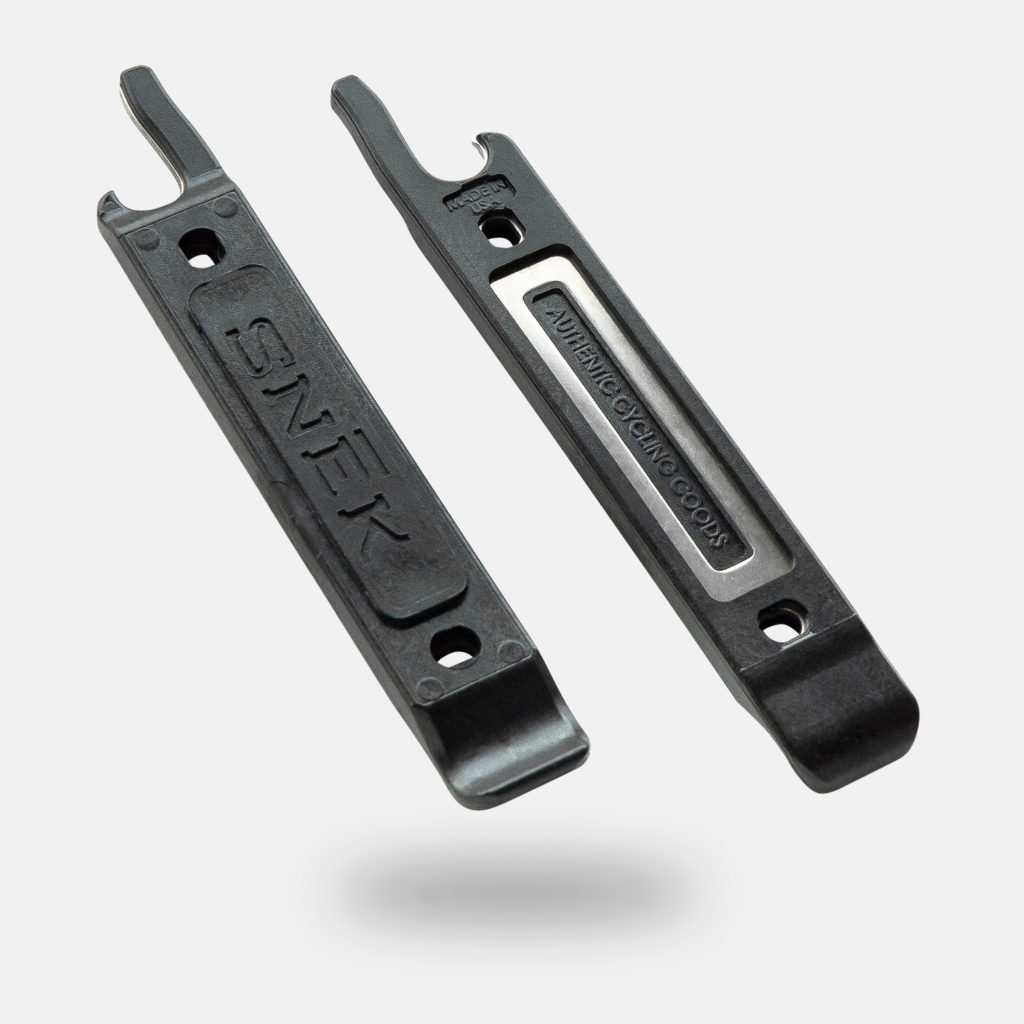
June 26, 2019 (SALT LAKE CITY, Utah)Snēk Cycling has officially launched the Lifeboat Tire Lever, after successfully funding the project on KickstarterTraditional bicycle tire levers aren’t built to use on modern bikes with tubeless tires. The Lifeboat solves this problem and does even more.

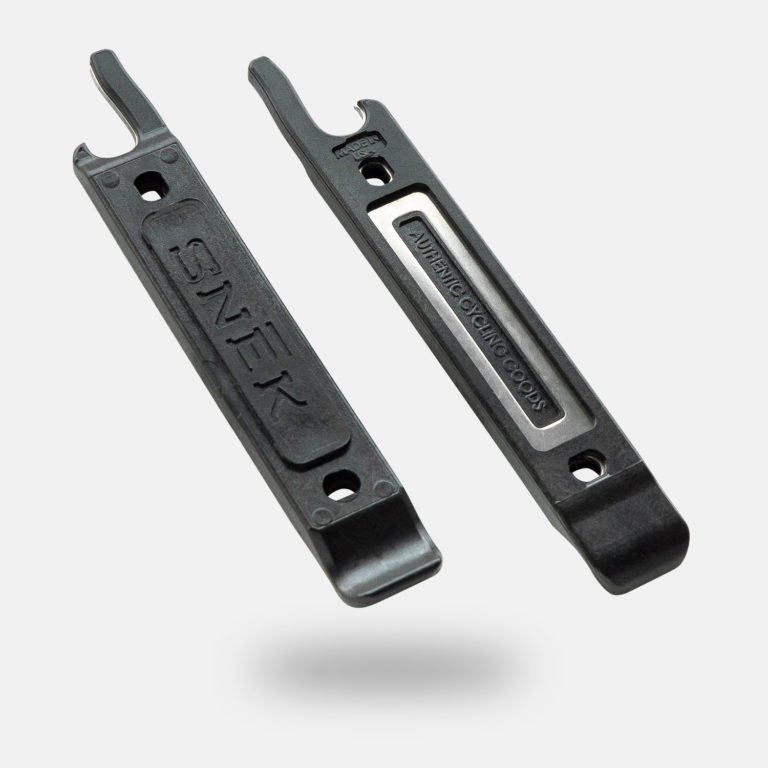
The Snēk Cycling Lifeboat Tire Lever features a metal core, offset valve core removers, and bottle opener.
Photo courtesy Snēk Cycling.

For years cyclists used plastic tire levers, with just a simple scoop, to remove tires to repair or replace a punctured inner tube. While there are many different designs, the basic decades-old concept remains unchanged. However, tire and wheel technology continues to evolve.

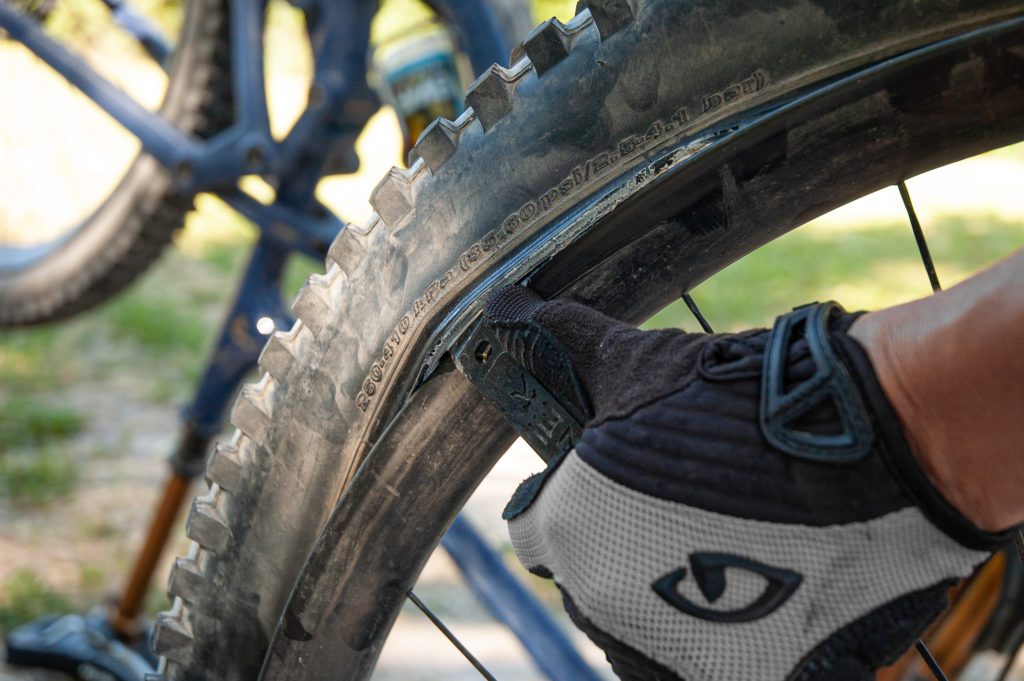
With tubeless-ready wheel, tire, and sealant technologies to fix and prevent flats, traditional levers are no longer adequate. Plastic levers often break in the process of removing tight-fitting tires. With modern tubeless wheels, often the only tool necessary is an easily lost valve core remover, to install or replace sealant into the tire.

“When doing a repair to my tubeless wheels, I often found myself searching for my small missing valve core removal tool, needle nose pliers, or anything that would allow me to remove the valve core. That’s when it dawned on me. Why not just have this remover as part of the tire lever? Now, the tool is always there when a tire needs service. Whether installing new tires, removing old ones, or fixing a flat with either sealant or a tube, the tools are available,” stated Jonny Hintze, founder of the Utah-based company. “I am tired of breaking disposable plastic levers and want something that is built to last.”

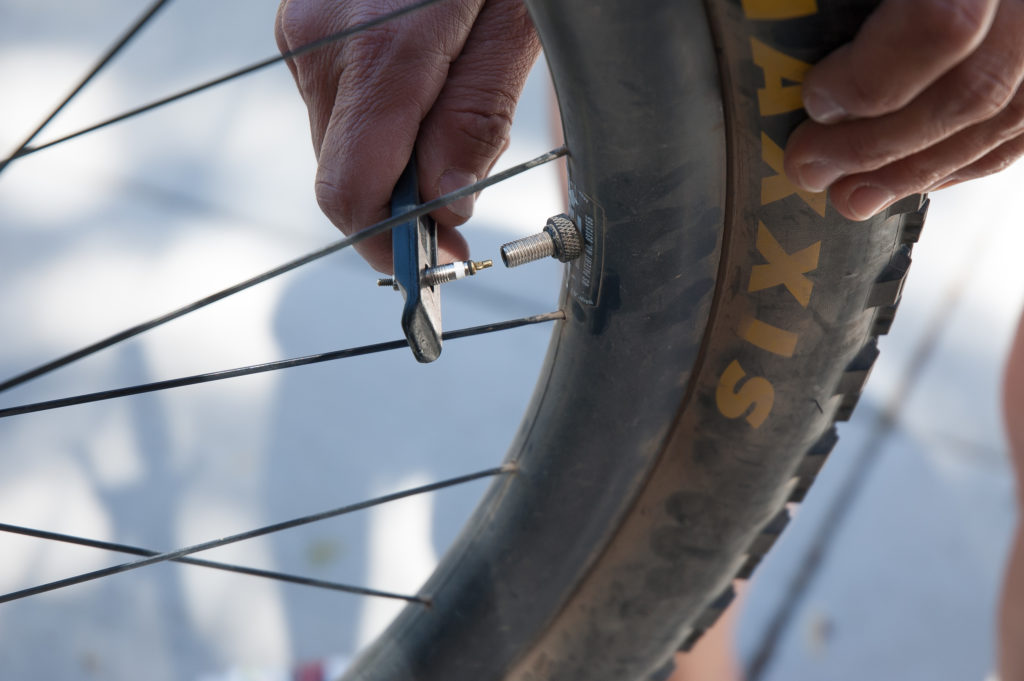
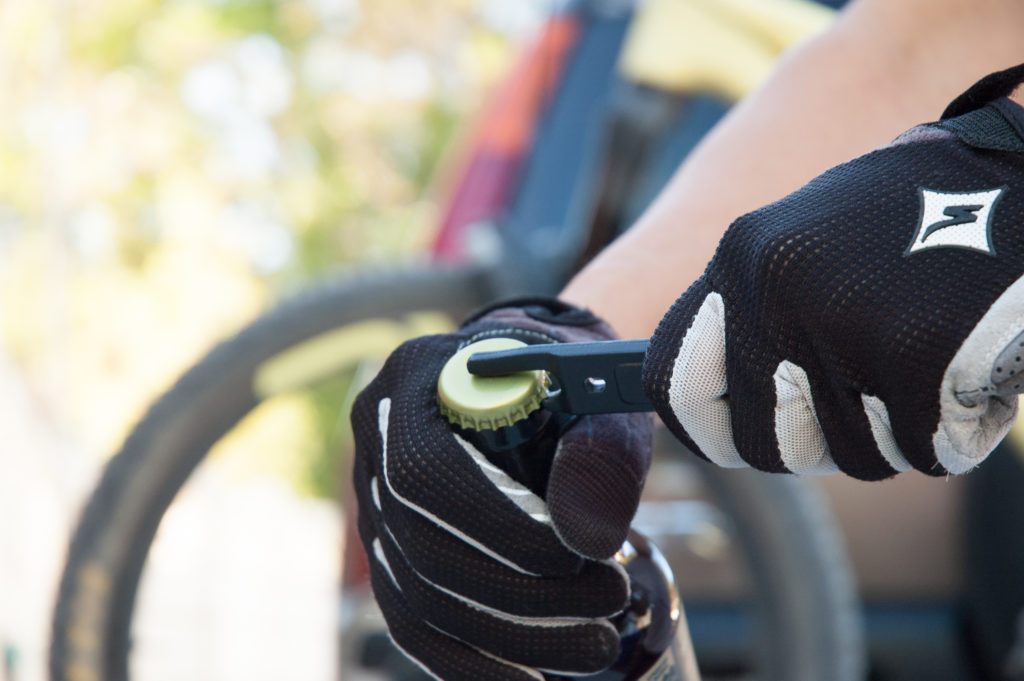
The Lifeboat features a pair of 90-degree offset valve core removers as well as a bottle opener so you can remove your tire, valve core, and open your post ride beverage all with one tool. The lever has a metal core construction for added strength, while the injection molded plastic outer protects carbon rims from damage. Chamfered edges in the lever scoop also aid removal and installation of tight fitting tubeless-ready tires. 

The Lifeboat Tire Lever is made in the USA and carries a life-time guarantee. Retail is $25.00, available now from http://snekcycling.com/products/lifeboat-tire-lever.

Removing the valve core with the Snēk Cycling Lifeboat Tire Lever.
Photo courtesy Snēk Cycling.

"<yoastmark

"<yoastmark

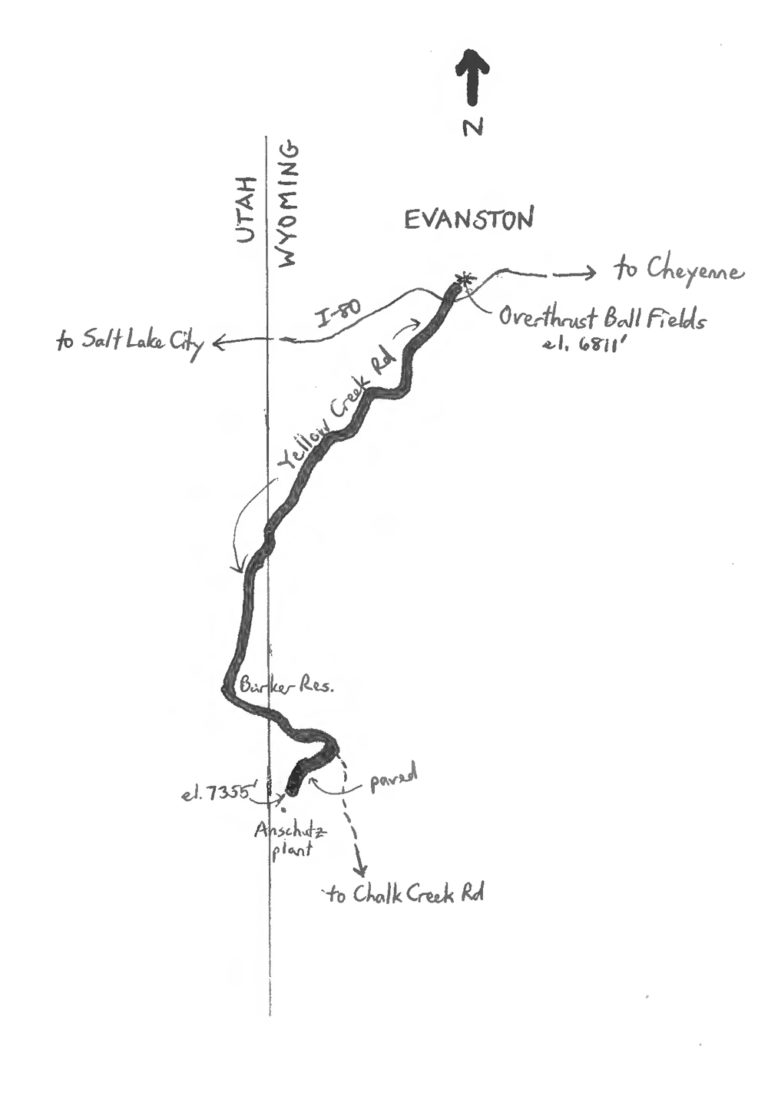
Follow Yellow Creek Road Ride is a 35.5 Mile Jaunt Through Southwest Wyoming

Follow Yellow Creek Road is a 35.5-mile, out-and-back route, starting and ending in Evanston, Wyoming. Be sure to carry your passport with you, as the road leaves Wyoming, enters Utah, and then returns to Wyoming. The entire ride remains on Yellow Creek Road, although there are enough turns and curves to keep the trip interesting. Yellow Creek was used for the time trial stage of the former High Uintas Classic bicycle race. Follow Yellow Creek Road goes well beyond the length of that race’s time trial, though, all the way to the end of pavement. Elevations on the ride range from 6,784 feet just outside of Evanston, to 7,355 feet at the turnaround, for a differential of 571 feet. Any climbing along the route is gradual, with no gradient exceeding about three percent. Yet, be prepared for some high-altitude riding, including cooler temperatures than at lower altitudes. There is little climbing, as indicated, but Wyoming’s winds can be notorious.

The ride starts and ends at the Overthrust Ball Fields, located on Yellow Creek Road just north of I-80 in the city of Evanston. The elevation at the park is 6,811 feet. The city had a fairly stable population of 12,090 in 2016. Evanston was established during the construction of the Transcontinental Railroad, in 1868. Although the rail line moved to Wasatch, about 12 miles to the west, for a while – and Evanston was briefly abandoned – operations returned to Evanston a few months later. Evanston would become a supply point for timber, and as a water stop for cross-country trains. Also, coal was mined in Almy, to the north. Later, Evanston became an important stop on the Lincoln Highway, the country’s first transcontinental road. After growing slowly during the 20th century, the population nearly doubled during the 1980s, when there was an oil boom. Natural gas is also extracted in the area. All of these transportation-related resources have kept Evanston alive as a city. Yet, one of Evanston’s greatest claims to fame may be one of the first J.C. Penney stores in the U.S., opening in the early 1900s. Another of Evanston’s claims to fame is that city residents, given the option, by the state of Wyoming, of having a college, or a sanitorium, chose the latter!

Exit the Overthrust Ball Fields parking area, and turn left onto Yellow Creek Road. Yellow Creek immediately passes under I-80. The underpass is narrow, so a safe option would be to use the walkway. The first three miles of the ride are within Evanston, so there will be a few traffic controls (signals and stop signs). Yellow Creek passes through an Evanston neighborhood. The housing in this neighborhood is no older than 30 years or so, unlike the much older residences near the center of the city. At the intersection of Yellow Creek, Overthrust Road, and Arrowhead Drive (mile 1.75), turn left to continue on Yellow Creek. You are now heading south. Yellow Creek curves to the right, to head west at mile 2.75. The road leaves Evanston along this stretch, entering classic, rural Wyoming. Development out here is sparse. The road curves to the left to head southwest, passing through Sulphur Hollow, and then Burton Hollow; there is not much to see in either place – at least not from the road. After another righthand curve, the ride reaches its lowest elevation (6,784 feet).

From here, Yellow Creek Road rolls, climbing gradually, while curving gently to the left and right across the landscape. If you are wondering about Evanston’s timber, it came from the forested mountains to the south – certainly not from out here! The road enters Utah at mile 8.1, now at 6,886 feet. Around mile 11, the road’s namesake creek can be seen running to the left, near the road. The road also tops the 7,000-foot elevation mark along here. Barker Reservoir is crossed at mile 11.8. Return to Wyoming at mile 12.75, now at 7,070 feet. The road crosses Chicken Creek at mile 13.45, followed by a short but sharp descent, and then a return to gradual climbing. There is a cattle guard at mile 16.0. One quarter-mile later, the paved road turns to the right, while Yellow Creek continues heading south as a dirt road. (The road eventually returns to Utah, becoming Chalk Creek Road). Veer right and stay on the paved road; the road narrows, and the surface deteriorates. There were plenty of cracks in the pavement when I checked it, but it is suitable for riding. You are now climbing at a gradient of 2 to 3%. As if the rougher road is not enough, there is another cattle guard at mile 17.25. This grate is an indicator that you are near the turnaround point. Indeed, turn around one-half mile later, where the road splits into three. The pavement continues for a short stretch, ending at an Anschutz (oil and gas exploration) plant. There is no real need to ride all the way to the plant, so turn around here, at mile 17.75. This is the highest elevation of the ride (7,355 feet).

The return ride simply follows Yellow Creek Road back to Evanston, and then back to the Overthrust Ball Fields. It is a net descent until you are about a mile-and-a-half outside of Evanston; from there, the road is more-or-less flat. Once in Evanston, be sure to turn right at the intersection with Arrowhead and Overthrust, to remain on Yellow Creek Road. If you have time, be sure to descend into central Evanston, to view some of the city’s historical sites and buildings.

Starting & ending point coordinates: 41.2599oN 110.9660oW

For more rides, see Road Biking Utah (Falcon Guides), written by avid cyclist Wayne Cottrell. Road Biking Utah features descriptions of 40 road bike rides in Utah. The ride lengths range from 14 to 106 miles, and the book’s coverage is statewide: from Wendover to Vernal, and from Bear Lake to St. George to Bluff. Each ride description features information about the suggested start-finish location, length, mileposts, terrain, traffic conditions and, most importantly, sights. The text is rich in detail about each route, including history, folklore, flora, fauna and, of course, scenery.

Wayne Cottrell is a former Utah resident who conducted extensive research while living here – and even after moving – to develop the content for the book.

The Athlete’s Kitchen: Sports Supplements: Buyer Beware?

By Nancy Clark, MS RD CSSD — Definition of Sports supplement: A food, food component, nutrient, or non-food compound that is purposefully ingested in addition to the habitually consumed diet with the aim of achieving a specific health and/or performance benefit.

The global sports nutrition supplement market (including sports foods, drinks and supplements) accounted for $28+ billion in 2016 and, with the help of rigorous advertising, is expected to almost double by 2022. How many of the products are moneymaking ploys marketed to uninformed athletes? Unfortunately, too many.

Due to the plethora of products that have infiltrated gyms, fitness centers and professional sports teams alike, I get questioned by fitness exercisers and aspiring Olympians: “Which of these supplements are actually effective??”  Hands down, the most effective way to enhance sports performance is via your day-to-day sports diet, coordinated with a consistent training program. Eating the right foods at the right times creates the essential foundation to your success as an athlete.

That said, specific sports supplements could make a minor contribution to small performance improvements for certain elite athletes. If you wonder if the grass is greener on the other side of your sports diet’s fence, here are some facts from the 2018 IOC Consensus Statement: Dietary Supplements and the High-Performance Athlete (1).

  • Supplement use varies across sports. It increases with the athletes’ training level and age, is higher in men than women and is strongly influenced by perceived cultural norms. (For example, “Everyone” on my team takes creatine, so I do, too.)
  • Before making any decisions regarding sports supplements, you want to get a nutritional assessment to be sure your diet supports your performance goals. No amount of supplements will compensate for a lousy diet. To find a local sports dietitian who is a Certified Specialist in Sports Dietetics (CSSD), use the referral network at www.SCANdpg.org.
  • Despite the ads you see for a zillion sports supplements, very few have strong proof of directly enhancing performance. These include caffeine, creatine, specific buffering agents, and nitrate. Period.
  • Very little research with supplements offers definitive evidence, in part because the research is rarely done with elite athletes under real life conditions. Real life includes 1) multi-day tournaments, competitions or events, 2) “stacking” supplements (such as mixing caffeine and nitrates) and 3) determining if an elite athlete responds the same way to a supplement as does a Division-3 collegiate athlete.

Real life also includes your unique microbiome (the bacteria in your gut that influence your overall health and well-being). We do not yet know how much a microbiome, which varies 80% to 90% between individuals, influences the effectiveness of a sports supplement and contributes to different responses.

Supplements are used for many different reasons.

Here’s a breakdown of supplements by categories.

  1. Supplements used to prevent/treat nutrient deficiency. Nutrients of concern for athletes include iron (to prevent anemia), calcium and vitamin D (for bone health), as well as iodine, folate and B-12 for specific sub-groups of athletes, including vegans and women who might become pregnant. The basic supplement question is: If you are deficient, what led to that deficiency and what dietary changes will you make to resolve the issue so that it doesn’t happen again?
  2. Supplements used to provide energy. Sports drinks, energy drinks, gels, electrolyte replacements, protein supplements, energy bars, and liquid meals are commonly used to help meet energy needs before, during and after exercise. They are a convenient, albeit more expensive alternative to common foods. They aren’t magical or superior to natural food. They are just easy to carry, standardized and eliminate decisions about which foods would offer, let’s say, the “recommended ratio” of carbs, protein and fat.
  3. Supplements that directly improve performance. Caffeine, creatine monohydrate, nitrate, sodium bicarbonate, and possibly beta-alanine are the very few performance enhancing supplements that have adequate support to suggest they may offer a marginal performance gain. If you choose to use them, be sure to test them thoroughly during hard training that mimics the competitive event.  Choose a brand that is NSF Certified for Sport to minimize the risk of inadvertent doping due to contamination. Every year, athletes get suspended for failing a drug test after they unknowingly took a supplement with an illegal ingredient…
  4. Supplements that indirectly improve performance.  Some supplements claim to enhance performance indirectly by supporting the athlete’s health and limiting illness. “Immune support” supplements that have moderate research to support their health claims include probiotics, vitamin D, and vitamin C. Supplements that lack strong support for their immune-enhancing claims include zinc, glutamine, Echinacea, vitamin E, and fish oil.  Tart cherry juice and curcumin show promise

A supplement with strong evidence to indirectly improve performance by helping build muscle is creatine monohydrate. Questionable supplements without strong evidence for athletes include gelatin and HMB.

Adverse effects.

If some supplements are good, would more be better? No, supplements can cause harm. Too much iron can lead to iron overload. Too much caffeine increases anxiety. Supplements are linked to liver toxicity, heart problems and seizures. In the USA in 2015, dietary supplements contributed to about 23,000 emergency department visits. Manufacturers are not required to show safety or assure quality of a supplement. Athletes beware— and try eating better to perform better?

References

Maughan R, Burke L, Dvorak J et al. IOC Consensus Statement: Dietary Supplements and the High-Performance Athlete Intl J Sports Nutr Exerc Metab 2018, 28: 104-125. (https://globenewswire.com/news-release/2017/01/10/904591/0/en/Global-Sports-Nutrition-Market-will-reach-45-27-Billion-by-2022-Zion-Market-Research.html)

Nancy Clark, MS, RD, CSSD (Board Certified Specialist in Sports Dietetics) counsels both casual and competitive athletes at her office in Newton, MA (617-795-1875). Her best selling Sports Nutrition Guidebook and food guides for marathoners, cyclists and soccer players offer additional information. They are available at www.NancyClarkRD.com. For her popular online workshop, see www.NutritionSportsExerciseCEUs.com.

Bikes versus Cars Under the Law

By Ken Christensen and Russ Hymas

Cycling West - Cycling Utah Magazine logoYou’ve likely heard the popular perspective among motorists that the streets are overrun with lawbreaking cyclists – a group of oblivious, space-entitled individuals that pay no heed to vehicular traffic or traffic signals. If you ride a road bike frequently, you probably see things the other way around – having witnessed motorists scoff at the law with regularity. In fact, you may have even launched a fair number of expletives on the road toward drivers who endangered your life because they broke the law. And if you’re anything like us, as you contemplated the intelligence of having hurled an angry tirade from your 18-lb bicycle toward the irate person sitting in a steel box weighing thousands of pounds, you probably jetted off on a side street to get away.

So, who are the real law breakers anyway? A 2017 study commissioned by the Florida Department of Transportation concluded that cyclists were more compliant with traffic laws than drivers. Take that, motorists! But before you beam too brightly with pride, it should be noted that the study found cyclists were only “slightly” more compliant. (www.fdot.gov/research/Completed_Proj/Summary_SF/FDOT-BDV25-977-13-rpt.pdf).

The study decked out the bikes of 100 cyclists with sensors and cameras and then recorded the data as those cyclists went about their normal lives. Researchers tabulated how often cyclists and drivers failed to yield, rolled through stop signs, or otherwise broke the law. The results indicated that cyclists were compliant with the law 88% of the time during the day and 87% of the time after dark. Drivers complied with the law 85% of the time.

Interestingly, 20 of the 21 recorded close calls where an accident could have ensued, involved a driver who failed to yield properly while turning or didn’t give a cyclist three feet of space as mandated by the law.

If you’re honest, you know that as it pertains to cyclists, this study is likely spot on. Cyclists break or “bend” traffic laws on a semi-consistent basis. Is this because cyclists have a flippant disregard for the law? Or could it be something else far more appropriate, like trying to stay alive? Our experience tells us that it is largely the latter.

Think of a crowded traffic signal near a freeway on-ramp, for example. As you wait alongside the line of vehicles for the light to change, you may jump out into the intersection just before the light turns green. Do you do this to show the motorists that the powerful quads you’ve been working on all summer can beat their horse-powered engines across the intersection? Admittedly, we know a handful of riders that may be thinking something along those lines. But for most of us, the answer is a resounding no! You jump out into the intersection to establish yourself in the lane in front of the long line of cars that will be crossing the bike lane to turn onto on the on-ramp. Cars are big and imposing, and their drivers’ attitude tends to be something along the lines of: “Get out of the way, I’m driving here!”

These types of traffic violations by cyclists sound much more reasonable when done for safety reasons. But we have to ask ourselves whether the reasoning matters if drivers don’t know enough about laws surrounding cyclists and don’t understand what might motivate a cyclist to break the law?

With the above in mind, some cycling proponents recommend that cyclists take the high road by respecting and following the laws – even unreasonable ones – until those laws are changed. As bicycle accident attorneys, we often find ourselves echoing that advice. It’s much more difficult for an injured cyclist to recover damages from an at-fault driver’s insurance company when the cyclist broke the law as well, even if it was for a good reason. Following the law is the best way to avoid having to pay for your own medical expenses when you do get hit.

You’re probably thinking that sounds all well and good — until a driver puts your life in jeopardy! And there is certainly validity to that statement. It feels wrong to expect cyclists to follow all the rules of the road when doing so would deny those cyclists the right to take the very action that will keep them safe!

Cycling advocates have spent countless hours attempting to change the laws so cyclists are placed in far fewer circumstances in which they are forced to make a choice between obeying the law and taking action to ensure their own safety. These relentless efforts are to be lauded, and have brought about successful, significant changes to the law.

But in addition to legislative endeavors, we in the cycling community can help ensure the safety of our fellow riders by promoting greater separation between bikes and cars on the road. At some level everyone must understand that cyclists are not cars or pedestrians and many of the laws governing the road were created with cars in mind, not bicycles. In addition, the infrastructure influences how everyone thinks about themselves in relation to everyone else on the road and largely shapes our behavior.

Consider for a moment that motorists don’t drive on sidewalks and pedestrians largely stay off the street. This is because the infrastructure defines their role. If the same infrastructure existed for cyclists, there would be much less hostility between motorists and cyclists and, more importantly, far fewer collisions involving those groups.

Separate bike lanes have been a wonderful step in the right direction. As that trend continues to spread across the world, cyclists and drivers will reap the benefits. The buffer between motorists and cyclists can also be increased by pushing for installation of road signs promoting the 3-foot law. These are popping up in many states and have been an effective measure in educating drivers about the rights and role cyclists have on the road.

The events of the past several years have taught us that changes to the law and improvements in infrastructure for cyclists is possible. But we can’t leave it to a few dedicated individuals to carry the banner for cyclist safety – each of us needs to do our part! “How?” you ask? Just keep reading! Almost every issue of Cycling West provides opportunities to get involved.

Ken Christensen and Russ Hymas are avid cyclists and Utah attorneys at UtahBicycleLawyers.com. Their legal practice is devoted to helping cyclists injured in collisions with motor vehicles. They are authors of the Utah Bicycle Accident Handbook and are nationally recognized legal experts on cycling laws and safety.

Overnight Bike Touring to Antelope Island, Utah

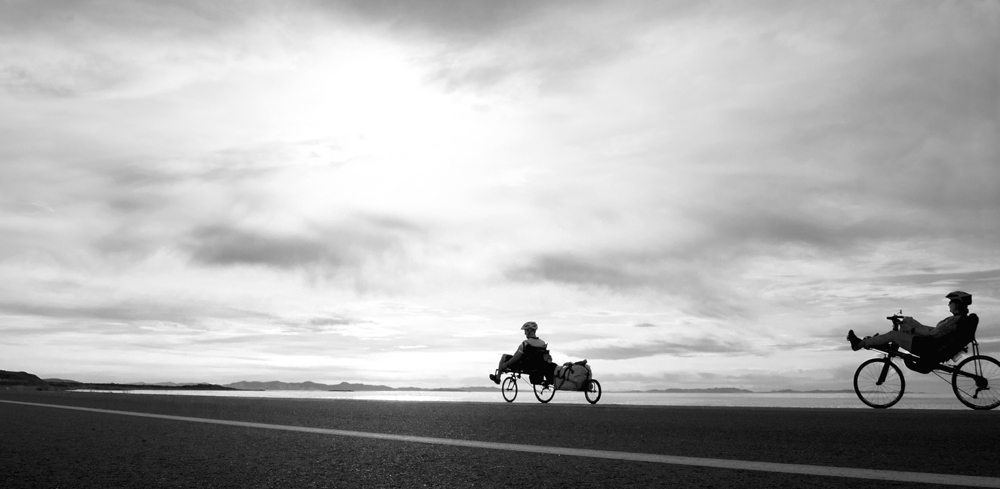
By Martin Neunzert — I remember, a long time ago, when March was for corn skiing. But no matter, we will adapt and evolve. Cycle touring is a good substitute, right? But everyone is SO busy, busily coming up with lame excuses like “work” or “yard work.”

Martin and Arleigh Neunzert, on the causeway. Photo by Martin Neunzert

So could I design a unique early-season, shake-out micro-adventure? I certainly thought so. Antelope Island leaped to mind, although I didn’t figure on the Buffalo Run and a bunch of crazed birders. They got all the good campsites.

Saturday was spent wheelbarrowing three cubic yards of bark mulch and finishing a report for my job. All week I had been throwing diverse things into the BOB trailer, so the final packing was quick. We met Molly (#Who’s-Crazier-Someone-Who-Thinks-Of-Things-Like-This-or-Someone-Who-Gets-Talked-Into-Them) at the start of the Antelope Island Causeway at 4:30 pm, smashing our best crack-of-noon start by hours and hours. Good thing the dozens of running and yelling Scouts were done for the day, I thought, but why did they still have so much energy? Then I heard: “OK, everybody load up! Remember, White Rock Bay!” Hey! That’s where we’re going!

By 5:00 pm, accompanied by the sound of gunfire from local shot-gunners, we were heading west, into the setting sun, with barely a headwind. Over the hill and down to White Rock Bay, a grueling hour-and-a-half ride, including all the stops.

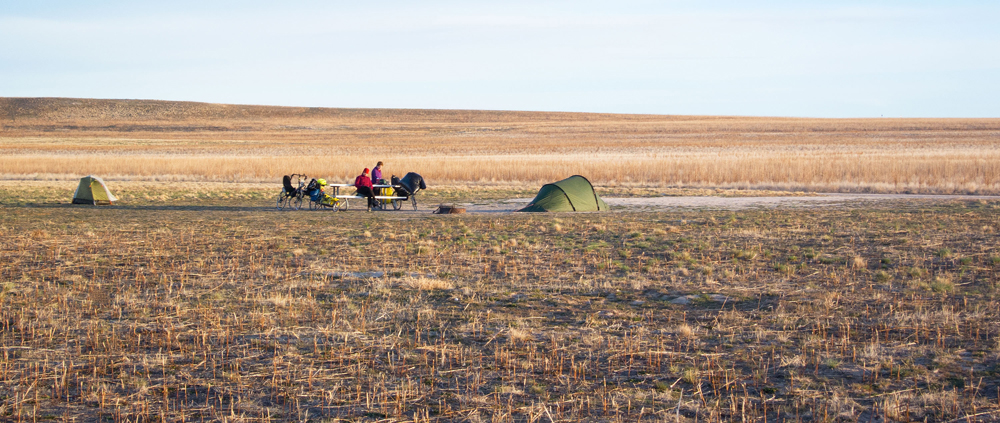
WRB #17 is not the bleakest campsite I’ve used—“Camp Tatooine” holds that distinction—but by far the bleakest I’ve had to pay for. Even though the sites are well separated, the noise of over-amped Scouts, with nothing to block it, was the dominant irritant. We felt a little wimpy watching the last of the Buffalo Run participants straggle by, some not just figuratively on their last legs.

Antelope Island is famous for its spectacular sunsets, but that day’s was not one of them. On the plus side, there were absolutely no bugs and only a barely perceptible breeze. Molly had fully embraced the spirit of the trip, pulling out a congealed Burger King burger to go with the still-cool margaritas, having been frozen into a brick and wrapped in my wooly socks. We chatted amicably about the world’s problems—and solved many of them—as the sliver of the crescent moon slipped behind Buffalo Point and vivid stars filled the sky.

I’ve camped in an astoundingly wide range of spots on my bicycle tours: In a dusty pit next to a busy highway, amongst Engelmann spruce by a mountain lake, in a narrow sandstone canyon in southern Utah, between 45-foot motor homes running generators in the heart of Yellowstone National Park, behind a gritty sand dune. It never fails to amaze me how little a practiced bike tourer needs to be totally secure and comfortable.

I know what you’re thinking: “Why didn’t they get a spot at the Ladyfinger walk-in campground?” Well, yes, had this brilliantly-designed campground been available, we certainly would have. It would be several more months before it was opened. Yet Antelope Island State Park could do even more to accommodate cycle tourers. For example, parks in other states guarantee cyclists will not be turned away if all the campgrounds are full. Then, maybe someday, long after this article has been forgotten, a future superintendent of Antelope Island State Park will be talked into a bicycle tour by her crazy friends and love it. Later still, after she becomes the superintendent, she’ll realize the potential this park has and, possessing both extraordinary wisdom and great determination, will give us the unequalled world-class experience of bicycle camping at Garr Ranch!

The coyotes, practicing their non-movie-script yipping and laughing, woke up the meadow larks at 3:00 am and they woke us up with their relentless singing. It was what photographers call a “yawn dawn” and was chilly enough to make us linger a bit in the sleeping bags. We casually fixed a simple breakfast, and soon were on our way, warming up nicely on the first hill. We investigated the water supply at Bridger Bay (excellent, and available all year), and soon were cruising along the causeway. We were home in time to move the rest of the bark mulch.

I count the trip as a total success: simple, storied and stellar. The total time away from home was approximately 20 hours, with about 21 miles of cycling in three hours. We shook all the winter cobwebs out of our equipment, plans were made for our next adventure (a 50-mile three day tour to Craters of the Moon National Monument) and promises were made to refine the margarita recipe to better complement freeze-dried food!

Note: This account was written in the spring of 2015, after what we thought was a exceptionally poor winter. I’ll leave it up to you to guess what I’d given to have last winter be that good…

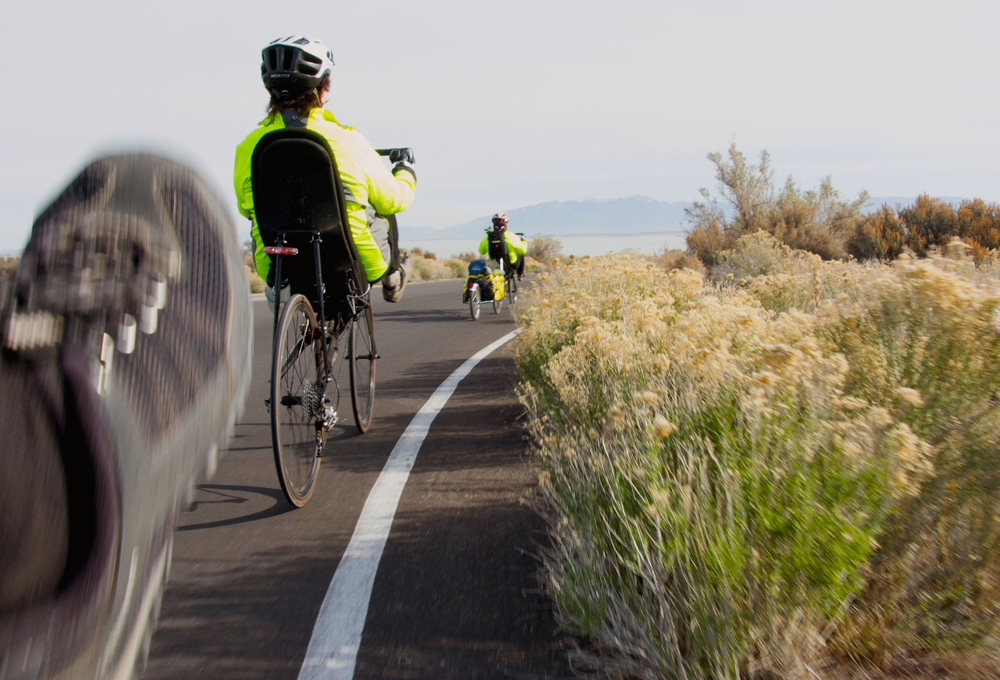
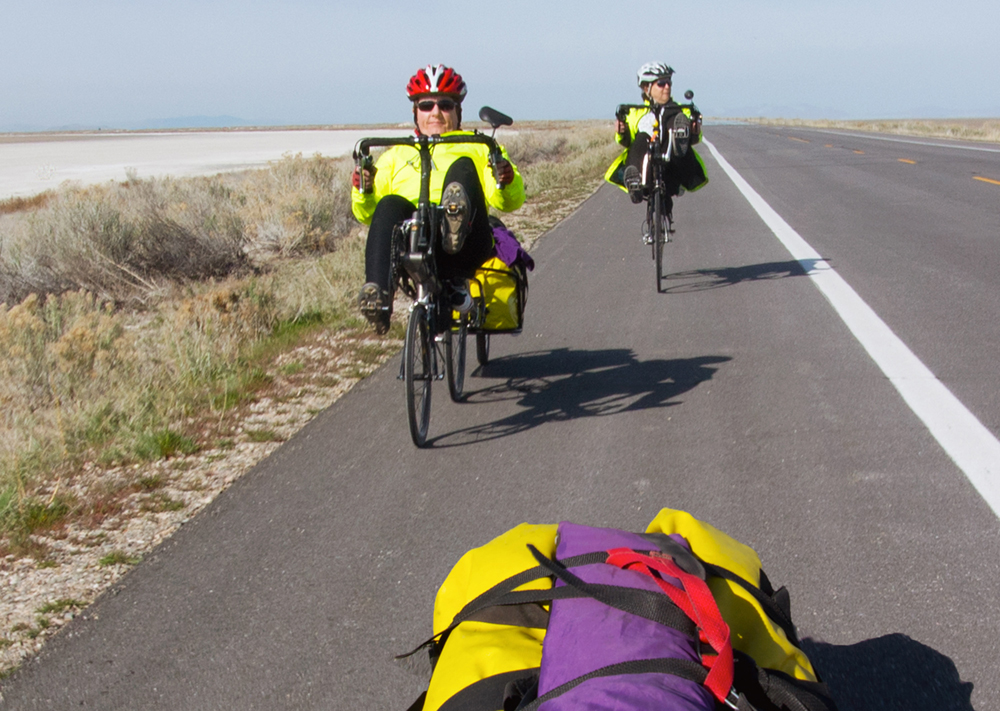
Molly Mooers leading, Arleigh Neunzert cruising on Antelope Island, Utah. Photo by Martin Neunzert

Campsite WRB #17. Pretty Bleak. Photo by Martin Neunzert

Molly Mooers (left) and Arleigh Neunzert on Antelope Island, Utah. Photo by Martin Neunzert

Studies Look at New Ways to Separate Bikes from Cars

By Charles Pekow

Cycling West - Cycling Utah Magazine logoA pair of studies from across the pond recently indicated that specific ways to separate cyclists from autos can bring specific safety benefits.

What are the best methods for protecting cyclists in bike lanes when strong physical barriers are lacking? The International Transport Forum, headquartered in Paris, studied that issue and released Light Protection of Cycle Lanes: Best Practices Discussion Paper (https://www.itf-oecd.org/light-protection-cycle-lanes-best-practices).

Bike lanes can be separated from auto traffic lanes by vertical posts, planters, concrete blocks and short bumps, such as “armadillos,” striped stumps used in Europe (sometimes also called “zebras”). Researchers in England found little difference in effectiveness between the various methods — but they all seem to improve safety.

So far, no research has shown that low barriers increase danger for other road users, though some motorcyclists and truckers have expressed a fear of hitting them. To make sure they are visible at night, planners should consider adequate lighting, adding reflective or light-colored material to them and starting a row of them with a higher bollard or post.

When bus stops fall along cycle tracks, the town of Enfield in England provided a raised platform for riders to disembark on outside the bike lane, so they don’t get out right into oncoming bike traffic. Cyclists can see stopped buses and will adjust their speed, figuring someone will be getting out.

Meanwhile, a study done for Transport for London, the public transit agency for the metropolitan area including the British capital, looked at “cycle gates,” physical barriers separating bicycle from auto traffic at traffic lights. London has been experimenting with them at intersections where cyclists are likely to go straight while many drivers turn left. The idea is to prevent cyclists from getting hit by turning cars. (Remember that in the United Kingdom, motorists drive on the other side of the road.)

Cyclists and motorists get separate light signals and never get green at the same time. The idea is to reduce the likelihood of collision by having the two modes of transport proceed in different lanes at different times. While some cyclists went through red lights, they tended to do so when no cars were turning left. Some cyclists opted to use the main road instead of the cycle gate.

Researchers observed two London intersections with cameras but did not interview anyone so can’t ask motivation for running a red light, not using the cycle gate, etc. But their observations found that very few autos got stuck in the way when lights changed. The few problems observed came when a motorist ran a red light or stopped too far (the auto stop lanes lie several feet before the intersection and cyclist stop line) or couldn’t clear the intersection because of traffic ahead, or a motorcycle using the cycle gate.


Bike Advocacy Alert: 500 E Survey and Comments – Return by Sunday, June 23, 2019

June 23, 2019 – Salt Lake City is conducting a survey and accepting comments on the initial design of 500 E. The 500 E project webpage states that the road will be rebuilt as part of the Funding Our Future program, a bond and sales tax increase to fix Salt Lake City’s streets. The street will be reconstructed between 1700 S and 2100 S in 2020. Comments are needed by Sunday, June 23, 2019. Comments may be sent to: [email protected] or take the survey here.

The main design choice is between bike lanes on both sides of the street (our preference) or bike lanes on one side of the street with shared lane markings on the other side. Salt Lake City is proposing three crosswalks in the area, including an improved design at Hollywood and 500 E. In addition, they are considering changing the speed limit to possibly 20 mph, according to the survey. Lower speed limits are safer for all users, especially pedestrians and cyclists.

Bike lanes on both sides of street would involve removing parking from the west side of the street. Currently, there is no parking on the east side. According to the project website, parking is very lightly used here at a rate of only 4-7%.

Additionally, bus stops would be improved and consolidated for better transit.

Please take the survey and/or send in comments by Sunday, June 23, 2019.

The 2 design options for the reconstruction of 500 E. in Salt Lake City. The road will be rebuilt in 2020. Graphic by Salt Lake City

Sports Nutrition Update from the American College of Sports Medicine

By Nancy Clark MS RD CSSD

Cycling West - Cycling Utah Magazine logoStaying on top of the latest sports nutrition information is a challenge. That’s why I attend the annual meeting of the American College of Sports Medicine (ACSM). ACSM is a professional organization for sports medicine doctors and health-care providers, sport dietitians, exercise physiologists and sport science researchers. More than 3,000 ACSM members gathered in Minneapolis (May 2018) to share their knowledge and latest research. The following summarizes a Sports Nutrition Update session presented by many leading exercise scientists from around the globe.

Fat vs. Carb., Gareth Wallis PhD, Univ. Birmingham, UK

Which will better enhance athletic performance: A high carbohydrate or a high fat sports diet? Despite growing interest in a high fat sports diet, research does not support it for athletes who exercise at high intensity. Rather, research supports consuming 3 to 4.5 grams carbohydrate per pound (7-10 g carb/kg) body weight per day to be well fueled for hard training and competitive events.

Grains, fruits and veggies are obligatory if you want to exercise hard. Some athletes eat a high fat diet for training and then switch to carb-loading before a competitive event. Bad idea. The enzymes involved in metabolizing carbohydrate become less active, so the muscles are less able to access carbs for fuel when it is needed for winning sprints and surges.

Protein for Athletes., Nicholas Burd PhD, Univ Illinois and Trent Stellingwerff PhD. Canadian Sport Institute

If you want to build muscle, when is the best time to eat protein: before, during or after you lift weights? It might not actually matter because resistance exercise stimulates a muscle-building effect that is most robust within the first 4 hours but lasts for 1 to 2 days. You need not carry a protein shake around the gym! More important is to pace your protein intake evenly throughout the day.

Resistance exercise is far more potent than a high protein diet for increasing strength and muscle gains. That said, most athletes could expect to see only a gain of about 2 pounds (1 kg) of muscle in 13 weeks. That’s not very much compared to what they really want to see.

Maximal anabolic (muscle-building) effects are seen with about 25 to 30 g protein per meal. More precisely: 0.75 g protein per pound of body weight per day, or 0.1 to 0.2 g protein per pound per meal in young men. More than that has little or no further benefit. However, these recommendations do change with age. If you are >50 years old, you should target an additional 10 grams of high quality protein (milk, egg, fish, soy) per meal. That’s just a little bit more: a glass of milk or 1.5 ounces of meat-fish-chicken.

Despite rumors, protein does not damage the kidneys nor cause a decline in kidney function. Even people with chronic kidney disease should consume the RDA for protein (0.8 g/kg). A high protein diet also does not cause bone loss. Bone is 40% to 50% protein (collagen).

Over-consuming protein is not only a waste of money but it also stresses the environment. As athletes, we need to take a holistic and whole-foods approach to our diets. Natural protein-rich foods, as opposed to processed supplements, are best (if compatible with your training schedule) because they offer a complex and complete matrix that is more effective than processed proteins. One example of the benefits of whole foods can be seen with eggs. A whole egg promotes 40% greater muscle protein synthesis in the 5 hours post-exercise as compared to eating just the egg white (van Vliet AJCN 2017). Nutrient interactions seem to facilitate a more robust response when compared to eating isolated protein.

Sport Supplements., Eric Rawson PhD RD, Messiah College

There is no one single sport supplement that works for all athletes. To better understand why, we need a more specific scientific approach to studying supplements based on age, sex, body size, training status, and genetics. That would help us give better advice to target groups of athletes, rather than simply make population-wide recommendations. Many athletes take multiple supplements, so research with “stacked” supplements would also be helpful. Here’s some of what we do know:

Creatine enables an athlete to lift harder in the training room—and build more muscle. But not everyone is a responder. For example, 3 of 11 subjects in a research study had a strong positive response, 5 had a slight response—and 3 did not respond at all (Syrotuik, Bell 2004). Why not? Maybe their daily diets impacted their baseline creatine levels?

Creatine is found in meat and other animal proteins. When a meat-eating athlete goes on a meat-free lacto-ovo-vegetarian diet (milk, eggs, beans) for 26 days, his or her creatine levels will drop. (Lukaszuk, 2005). To normalize the level, athletes could take creatine monohydrate supplements (the most effective form of creatine).

Caffeine is a known energy-enhancing sport supplement. Your response to caffeine will depend on your genetics. Caffeine works best when you are starting to fatigue. Athletes can consume it in coffee, tea, soda, gels, gum, and pills, preferably consumed with carbs.

Sodium bicarbonate is used by some athletes to buffer the lactic acid that builds up during intense bursts of exercise. Research suggests peak response times can vary widely, from 40-165 minutes. (Jones 2016 ISSN). This variability makes it hard for exercise scientists to offer firm recommendations; hence, outcomes vary. Sub-elite athletes seem to respond better then elite athletes. Because sodium bicarbonate easily causes nausea and vomiting, a solution it to take it in gastro-resistant capsules.

Fluids and Hydration., Lindsay Baker PhD, Gatorade Sports Science Institute

When you sweat, you lose proportionately more water than sodium, hence sodium levels in the blood increase with dehydration. The amount of sodium you lose in sweat varies from a lot to a little, related to both sweating rate and how well you are acclimated to exercising in the heat, among other factors. A high concentration of sodium in your blood stimulates thirst.

Thirsty athletes have three ways they deal with replacing fluid losses: hit-or-miss ad lib drinking as desired; drinking to quench thirst; and drinking on a set schedule. The effectiveness of these strategies depends on the individual athletes, availability of fluids, the weather, and exercise intensity and duration. If you happen to have a lot of tattoos, take note: tattooed skin may sweat less and excrete saltier sweat.

Nancy Clark, MS, RD counsels both casual and competitive athletes at her office in Newton, MA (617-795-1875). Her best selling Sports Nutrition Guidebook and food guides for marathoners, cyclists and soccer players offer additional information. They are available at www.NancyClarkRD.com. For her popular online workshop, see www.NutritionSportsExerciseCEUs.com.