The National Park Service (NPS) is eager to work with communities and activists on improving bicycling in and around national parks. NPS just released the National Park Service Active Transportation Guidebook: A Resource on Supporting Walking & Bicycling for National Parks & their Partners (https://www.nps.gov/subjects/transportation/bikeped.htm).
NPS developed the guide with the Federal Highway Administration. The book describes itself as a resource for national park units and their partners to both identify and prioritize bicycle and pedestrian transportation needs . It adds that other federal land agencies can find it useful.
The guide covers everything from the planning process to safety, bikeshare, and rentals, sponsoring activities such as rides, and getting park employees interested in cycling. It shows how to work with partners and improve access to parks as well as cycling within them.
Bicycle advocates might cite it as a useful tool and contact local federal land managers about it, now that the NPS headquarters has shown that it expects them to improve and expand cycling on federal recreational land.
PRESS RELEASE – Virgin, Utah (June 17, 2019) – The date has been set for the 2019 edition of the biggest show in freeride mountain biking:
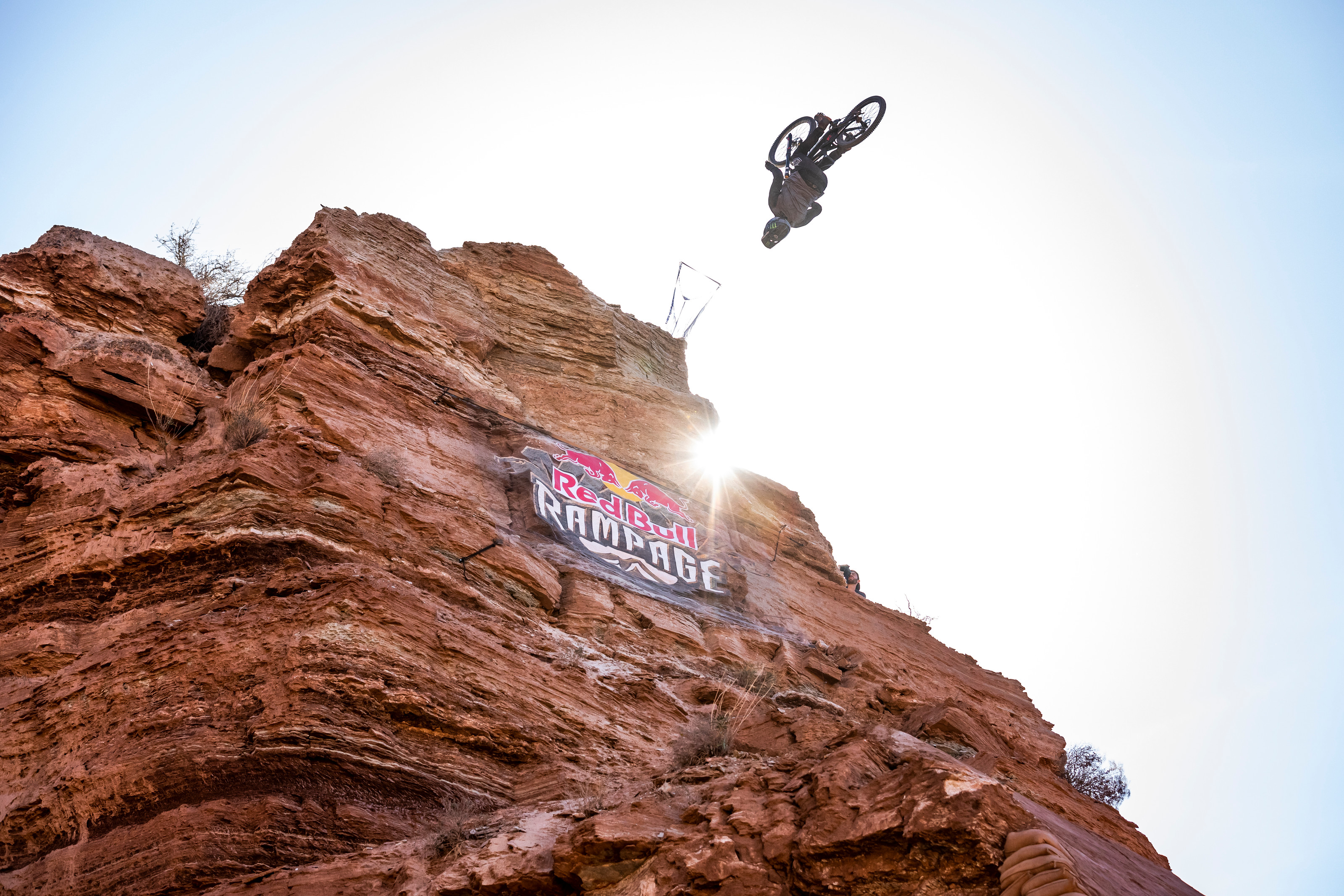
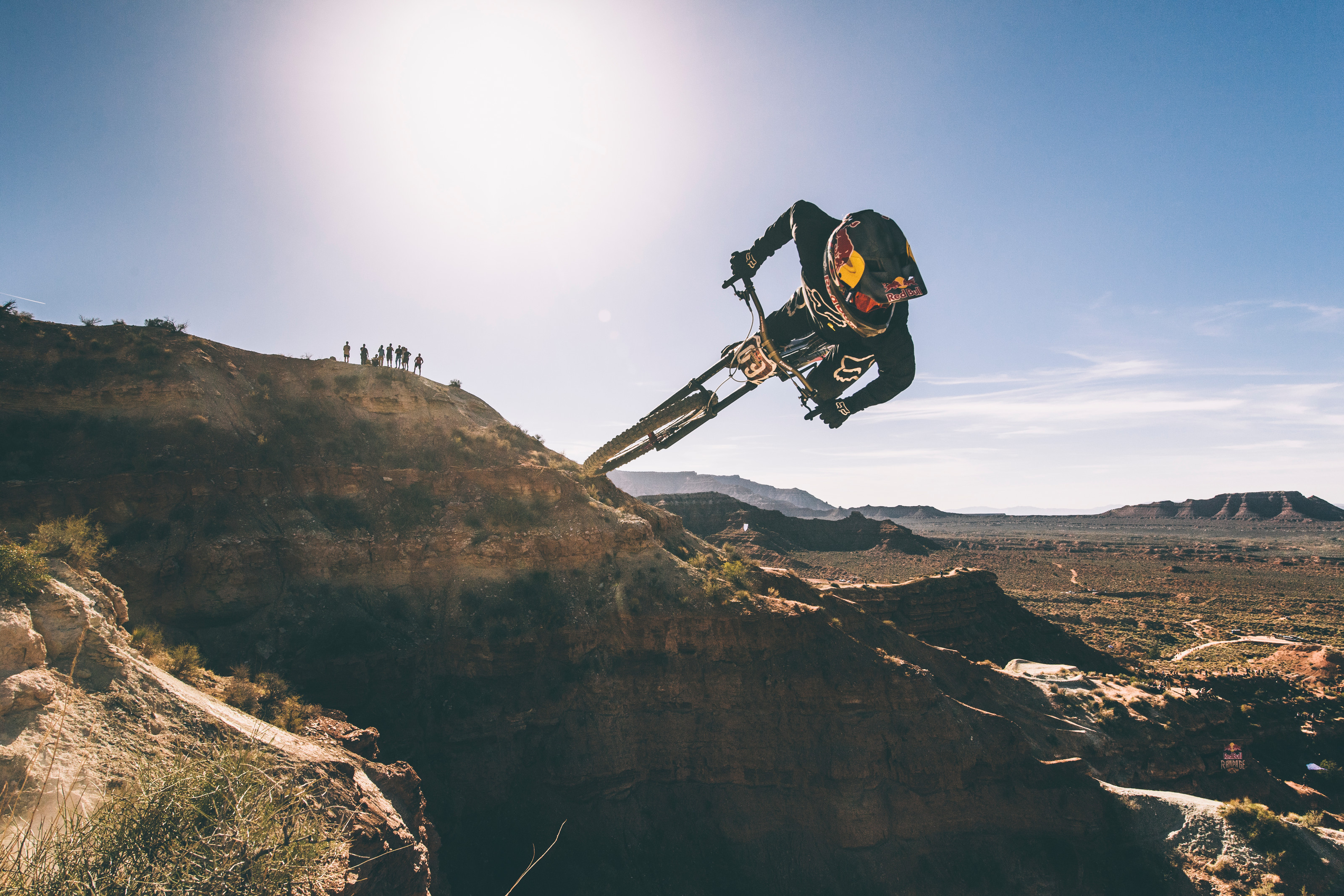
Red Bull Rampage returns to Utah soil on October 25th. This fall, 21 of the world’s greatest freeriders will return to what was a new venue in 2018 and continue to evolve their innovative descents, features and drops into a winning run with the hopes of standing atop the podium at the end of the day.
Photo Courtesy: Red Bull Rampage
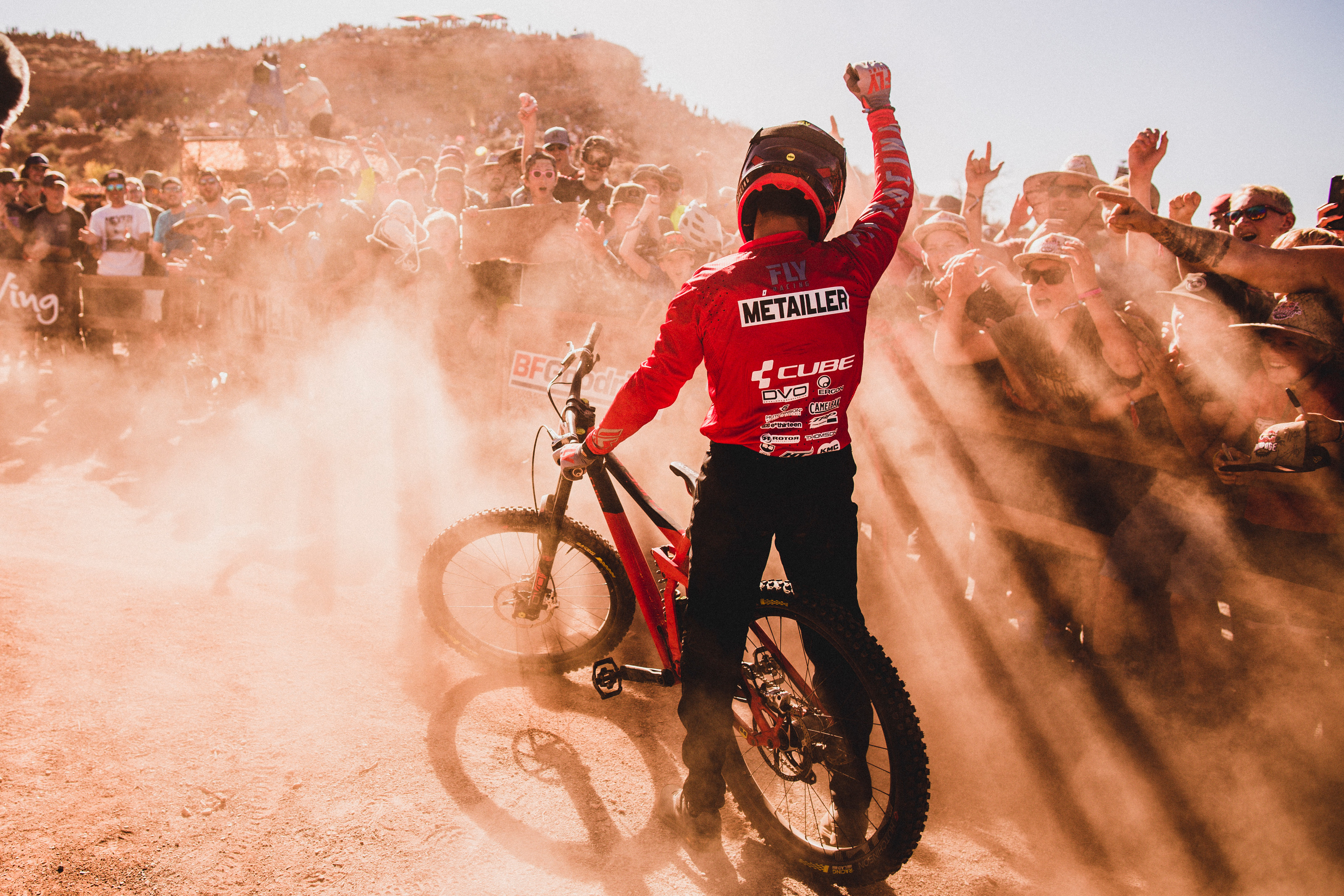
Red Bull Rampage fan favorites Andreau Lacondeguy and Ethan Nell top the list of returning riders this year after taking home silver and bronze, respectively, in 2018. After five seasons in the Utah sands, Brett Rheeder took home the gold last year and plans to return to defend his title.
The elite group of 21 riders will once again shape and build their ultimate lines down the mountain with the help of their two-person build crews. As a result, no two rider’s path down the near-vertical sandstone ridges will be the same. In advance of the competition, the riders, along with their build crews, will spend four days building and then will have four additional days to practice in order to build their dream line in what is touted as one of the most intense contests in the world.
Red Bull Rampage is supported by Kia Motors America, BFGoodrich, Utah Sports Commission and Red Hydrogen.
2019 Pre-Qualified Athletes
Brett Rheeder (CAN)
Andreu Lacondeguy (SPA)
Ethan Nell (USA)
Tom van Steenbergen (CAN)
Thomas Genon (BEL)
Tyler McCaul (USA)
Kyle Strait (USA)
Szymon Godziek (POL)
Kurt Sorge (CAN)
Brendan Fairclough (UK)
Key 2019 Red Bull Rampage Dates
July 15th – Red Bull Rampage Tickets on Sale
August 8th – Red Bull Rampage Wildcard Athlete Announcement
September 7-8th – Marzocchi Proving Grounds – Bend, OR
September 8th – Final Three Rampage Qualifiers Announced
October 25th – Red Bull Rampage – Virgin, UT
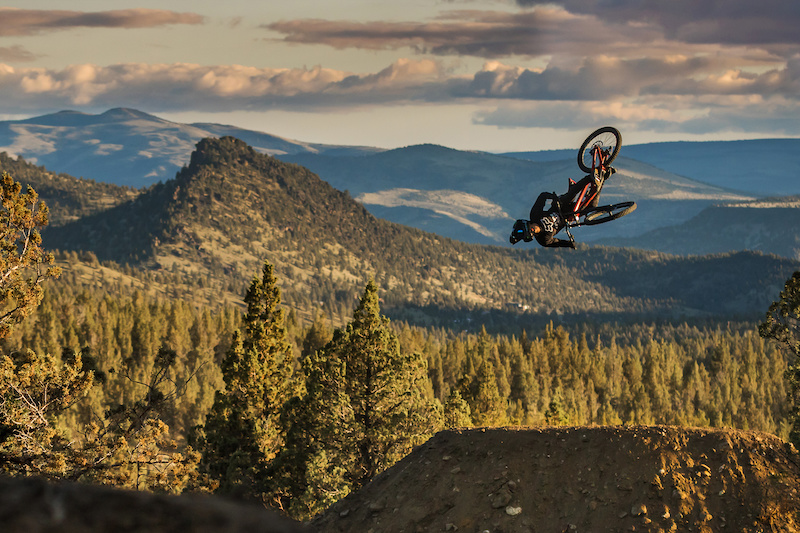
The inaugural Marzocchi Proving Grounds presented by 5.10 will be the first official athlete qualifier for this year’s Red Bull Rampage. The event will take place at Oregon Dirt Park, just east of Bend, OR. The course design will be built to allow current pros as well as young-and-hopeful a chance to show their metal and earn an invite to the big show. The man-made course will feature multiple lines to let athletes choose their own path and style, with huge drops, massive doubles, berm presses and rhythm sections. Top prospects that plan compete this year, include: Antoine Bizet, Nicholi Rogatkin, Louis Reboul, Reece Wallace, Conor Macfarlane, Sam Reynolds, Tomas Lemoine, Jordie Lunn, DJ Brandt, Jaxson Riddle, William Robert and Casey Brown.
This inaugural event will take place in coordination with the 3rd annual Black Sage Fest (part of the Fest Series). This will ensure an action-packed weekend with the World’s top pros and amateurs. Hosted by Carson Storch and Kyle Jameson the event features a jam session format with top Pros including Graham Aggasiz, Kurt Sorge, Cam McCaul, Tyler McCaul, Ryan “R-dog” Howard, Cam Zink, Kyle Strait, Nico Vink and others.
The Black Sage Fest and Proving Grounds weekend will feature onsite camping, food trucks and music. For more event information visit www.h5events.com or Marzocchi Proving Grounds Facebook page.
Photo Courtesy: Red Bull RampagePhoto Courtesy: Red Bull RampagePhoto Courtesy: Red Bull Rampage
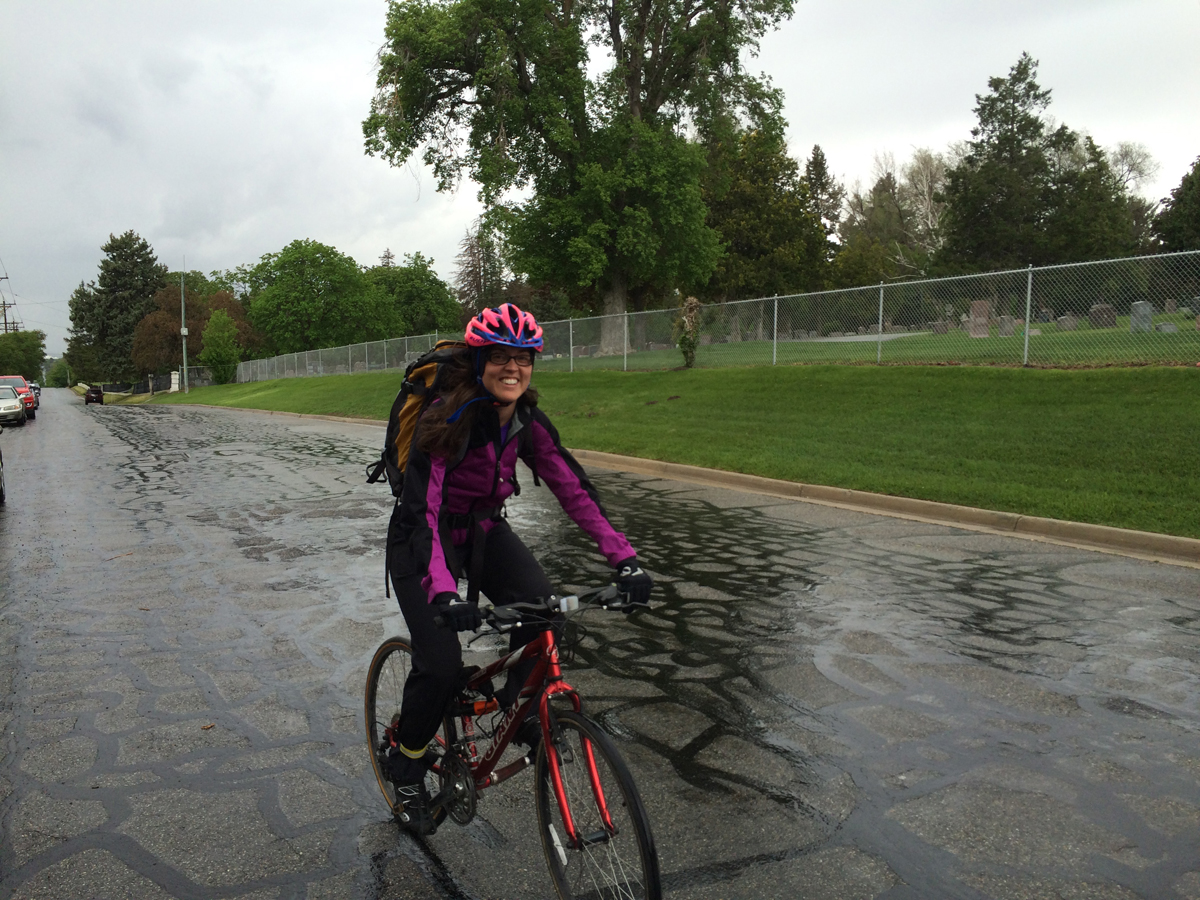
Lisa Hazel demonstrates several safe riding techniques: She’s wearing a helmet, has a reflective band on her leg, reflectors on her bike, and reflective patches on her gloves. Photo by Dave Iltis
Be a Defensive Rider this Summer!
The West is a wonderful place to enjoy the outdoors, especially on a bike. Here are some simple tips to help keep you safe while cycling the roads this summer.
Avoid Crashes
Ride defensively and predictably:
Go with the traffic flow. Always ride on the right in the same direction as other vehicles.
Obey all traffic laws. A bicycle is a vehicle on the road and must obey all traffic signs, signals and lane markings.
Be predictable. Ride in a straight line, not in and out of cars. Signal moves to others.
Stay alert and look before turning. Try to avoid using personal electronics when you ride as it hinders your ability to listen for traffic and avoid dangerous situations. Always look before turning to avoid being surprised by a red light runner or distracted driver.
Watch parked cars. Ride far enough out from the curb to avoid the unexpected from parked cars (like doors opening or cars pulling out).
Wear the Gear
Proper cycling gear can not only be comfortable but will help keep you safe.
Wear sun protection. Sunburns not only hurt your skin but contributes to fatigue. Wear sunscreen and clothing with built-in sun protection.
Wear reflective gear. Especially wear reflective gear at dawn, dusk and dark hours of the day. And a great location to wear reflective gear is around your ankles – that way a driver will not only see you but recognize your movement as a cyclist. Also make sure your bike is equipped with a headlight, red tail lights or reflector and side reflectors all visible for at least 500 feet any time you ride before sunrise or after sunset.
Wear bright clothing. Fluorescent or neon clothing helps drivers notice you during the day. Find riding gear that helps you stand out.
Wear a helmet always. Just like hats, helmets come in various sizes so make sure you have a helmet that fits and is adjusted properly.
Beat the Heat
Drinking cold fluids on your ride is not only more enjoyable but will help keep your core temperature down. Plan ahead before your ride and freeze one bottle at half full and another at the three-quarter mark. Then top them off and enjoy cool fluids on the ride. If using a hydration pack fill the pack half full and freeze.
Before your ride, especially a big ride, increase consumption of watery fruits and vegetables like cucumbers, celery, lettuce, zucchini, grapes, grapefruit, strawberries, or watermelon.
During long rides, it’s advantageous to sip on an electrolyte beverage to help the body rehydrate more quickly. If you need to cool off while riding, use cool water to wet your clothes, arms and or neck. On extra hot days don’t try to maintain your usual pace, instead ease up a bit to help counter the effects of the summer heat.
Post ride, drink plenty of water or a protein-based recovery drink and a snack or meal.
Educate Others
A large percentage of crashes can be avoided if motorists and cyclists follow the rules of the road and watch out for each other. When riding in groups or with friends encourage others to ride safely. If you see unsafe behavior among fellow cyclists make sure to address it and educate friends and family, especially those who may not ride, on how to share the road with cyclists.
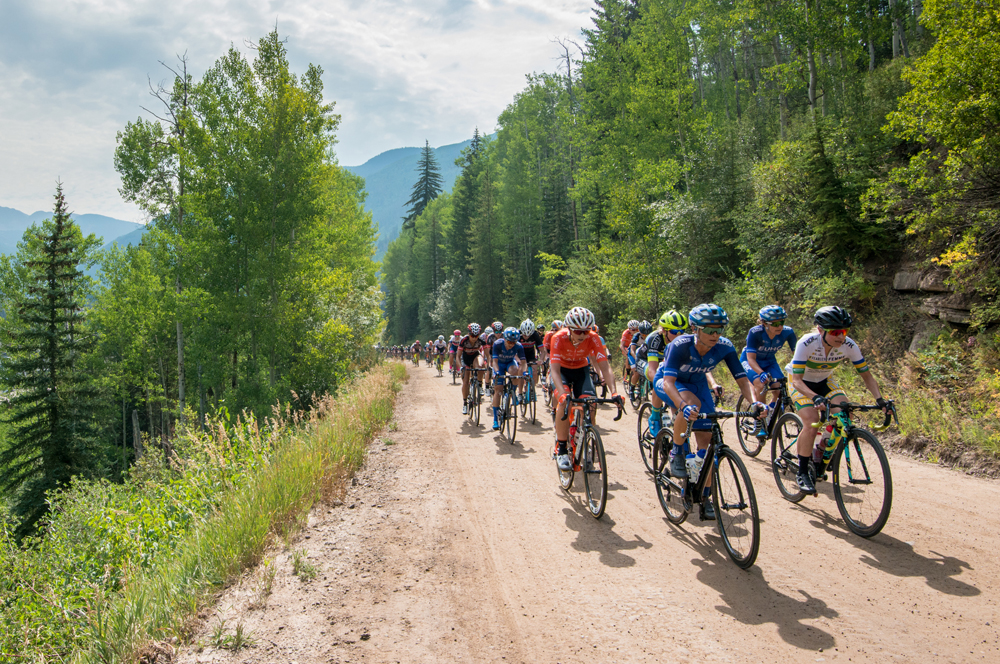
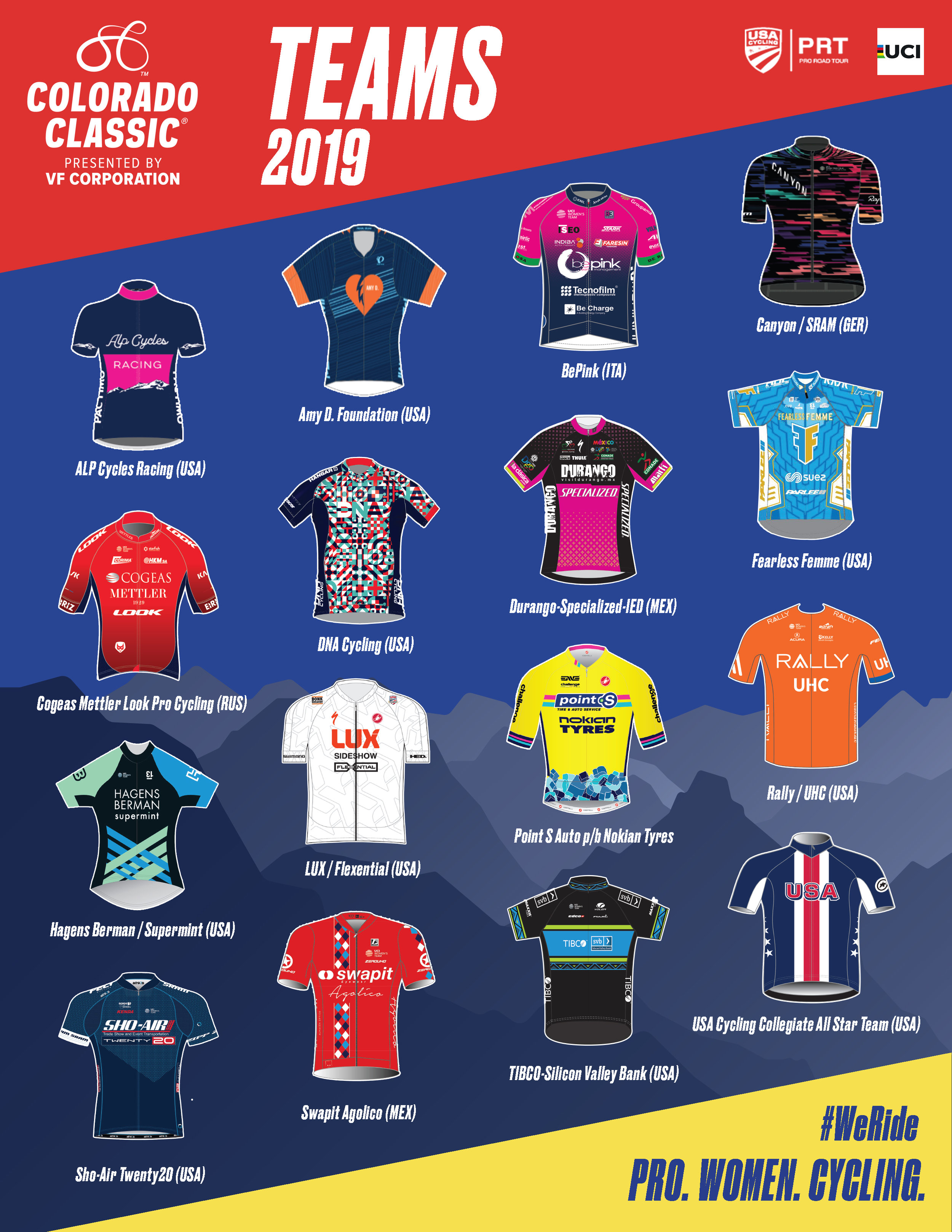
According to a press item released today, June 20, 2019, the Colorado Classic presented by VF Corporation has received commitments from 16 teams to participate in this year’s race, which is expected to showcase the most competitive field in the race’s history. The commitments include 5 international teams, of which 4 are in the top-20 of the UCI rankings.
Climbing high up above Vail in the Aspen trees. Women’s Stage 1 Vail Colorado, 2018 Colorado Classic cycling race (Photo by Dave Richards, daverphoto.com)
In addition, the race has partnered with USA Cycling to bring an all-star collegiate team to the event, helping to showcase America’s up-and-coming talent. Rounding out the field will be several of the USA’s top domestic women’s teams.
Teams committed to attend the 2019 Colorado Classic include:
ALP Cycles Racing (USA)
Amy D. Foundation (USA)
BePink (ITA)*
Canyon//SRAM (GER)*
Cogeas Mettler Look Pro Cycling (RUS)*
DNA Cycling (USA)
Durango-Specialized-IED (MEX)
Fearless Femme (USA)
Hagens Berman / Supermint (USA)*
LUX/Flexential (USA)
Point S Auto p/b Nokian Tyres
Rally/UHC (USA)*
Sho-Air Twenty20 (USA)*
Swapit Agolico (MEX)*
TIBCO-Silicon Valley Bank (USA)*
USA Cycling Collegiate All Star Team (USA)
* Indicates UCI registered women’s team
According to Sean Petty, the Colorado Classic Race Director, “With the race’s move to the UCI calendar, we will see a much more international field. This year’s race will be the most competitive field we’ve had, especially with riders all over the world battling for significant UCI individual and team points and for their country’s Olympic qualification.”
The final field of teams and rosters of female athletes will be released later this summer.
Sara Poidevin of Rally/UHC Cycling and 2017 Colorado Classic overall winner is quoted in the press release as saying, “all of the changes are exciting and it’s really encouraging to have the event increase their support of women’s racing in North America. Having a live stream is a great way to showcase women’s racing and helps provide sustainability for the event. I’m looking forward to seeing the new courses. Any race at altitude adds another level of difficulty and makes for good, hard racing.”
The Colorado Classic has become increasingly important on the women’s world race calendar and demand for team entry into the race was high. Currently carrying a UCI 2.1 category designation, one of only 13 women’s races in the world to do so, the event will enable riders to earn points for team and individual UCI rankings as well as qualification for the upcoming Olympics. The race is also on the USA Cycling Pro Road Tour (PRT), which brings together all of the top domestic road calendar events in the U.S.
Race overview:
Stage 1: Steamboat Springs presented by Smartwool (Thursday, August 22)
Stage 2: Avon presented by FirstBank (Friday, August 23)
Stage 3: Golden (Saturday, August 24)
Stage 4: Denver presented by Gates Corporation (Sunday, August 25)
Highlights from the 2019 Cactus Hugger Intermountain Cup. Photo by Mckenzie Dye
The Cactus Hugger Intermountain Cup was held on April 27, 2019 in St. George.
Natalie Quinn took top honors in the Elite Women’s Category at the Cactus Hugger showing she can podium on techy, punchy courses, and on all out pedal fests. This is her second first place finish in as many races.
Letting Sarah Kaufman set the pace, Quinn planned for a sprint finish.
Describing her race, she said, “I find super punchy courses with fast downhills to be more my style. That’s why I let Sarah set the pace. I figured that if it came to a sprint finish, I would try to beat her then. But near the beginning of the third lap, I got tangled with a teammate while trying to pass him. Sarah just took off after that. She gained a huge lead that I was trying to close the entire third lap. And then she got a flat, and my plan of a sprint finish was done with.”
Quinn crossed the finish line followed by another high schooler, Kendyl Nelson. KC Holley came in next rounding out the ladies’ top three.
In the Elite Men’s Category, Bryson Perry stood on top of the podium.
Perry said the race was pretty tactical mentioning both the heat, race day saw temperatures in the upper 80s, and the slightly longer course.
The Cactus Hugger course is fast and usually requires the ability to stay on the gas the entire race. The uphills aren’t super steep and the downhills are fast and flowy. There aren’t a lot of spots to rest.
He continues, “In a race that long pacing is key but positioning in your group is really important too as it’s so hard to pass. I think it helps to race from the front in a race like that and then recover when you want to recover.”
In addition to good tactics, he adds, “Suspension set up out there was pretty valuable. I ran my Specialized Epic FS for the race and it was awesome.”
Perry’s teammate Brennon Peterson took 2nd place.
Peterson describes getting the hole shot on the singletrack to take the lead at the start of the race echoing some of the tactics Perry described, “The race was going very well for me straight off the start. I was able to enter the singletrack first and it allowed me to ride at my own pace. After a few minutes I could tell that I was pulling away from the others and had an increasing gap. Just before the descent, I looked back and saw that my gap had increased from a few seconds to about 20 seconds. Unfortunately, I took a bad line going down one of the rocky sections near the end of the lap and punctured my tire.”
Despite flatting and falling to the back of the pack, he was able to pick off positions through the next few laps and made his way back up to 2nd. Rylan Schadegg came in 3rd rounding out the podium.
Shop Reopens with New expanded service department, Same Great Bikes to Demo or Buy
By Lou Melini
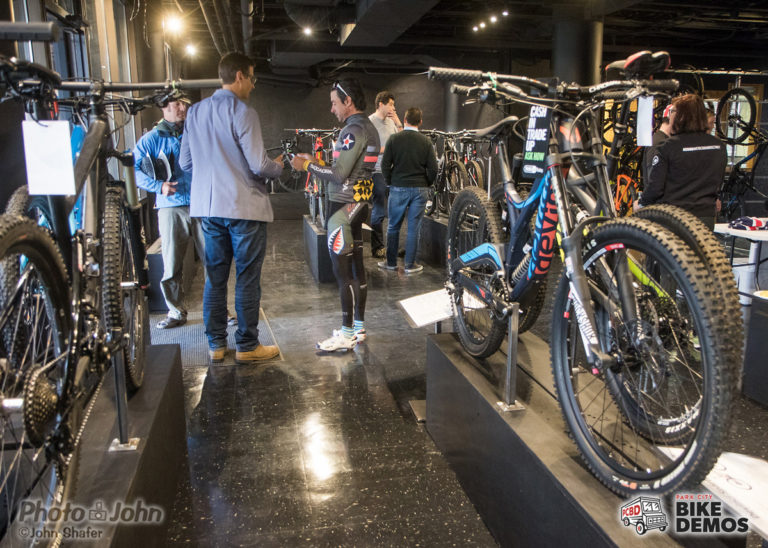
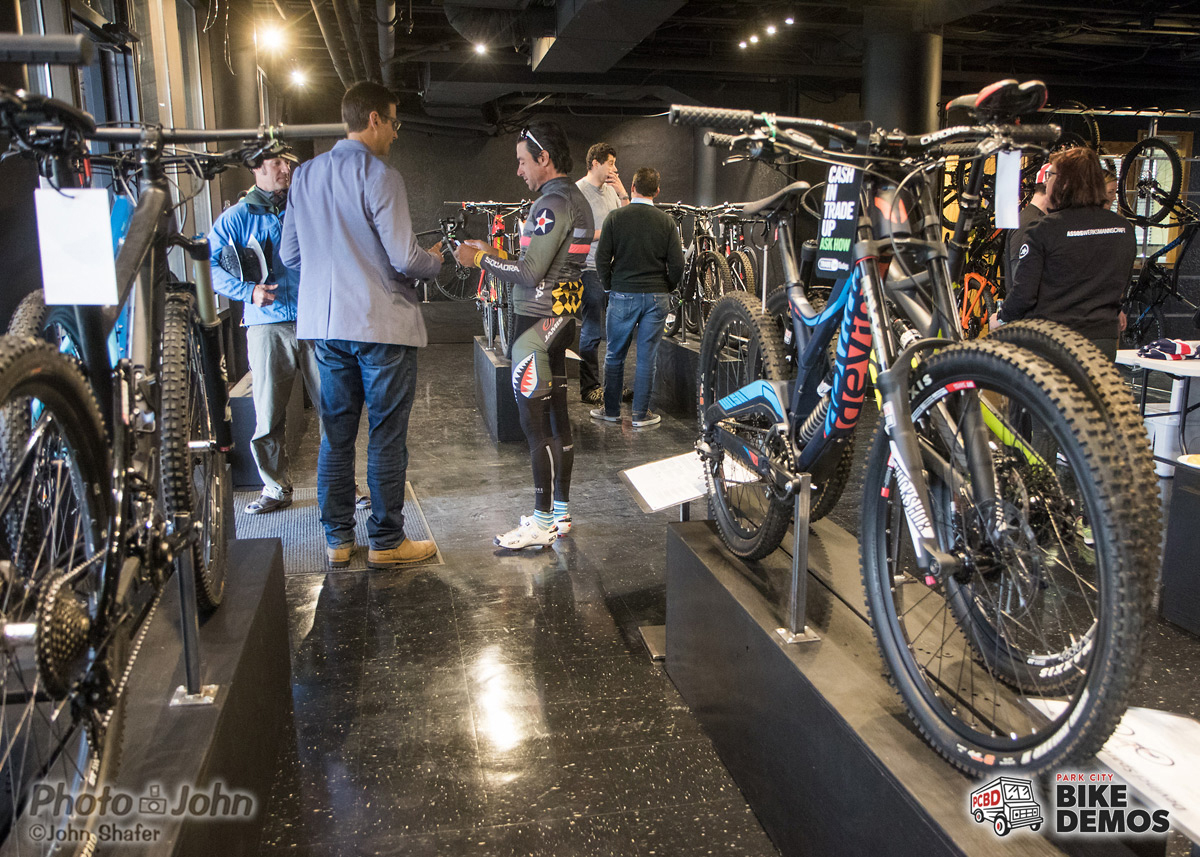
Park City Bike Demos shop floor. Their model lets you try any bike before you buy it. Photo by John Shafer.
In February of this year, Park City Bike Demos was sold to Rob DeMartini. You may have heard the name before, as Rob is the CEO of USA Cycling, the national governing body for the sport of cycling in the United States. Former owner Andre Shoumatoff is still involved in the business and this interview is with Andre.
Cycling West: Andre, I know that Park City Bike Demos (PCBD) is a little different than other bike shops. Tell the readers a little about the business model.
Andre Shoumatoff: Park City Bike Demos is a full-fledged bike shop, complete with accessories and service department, but we didn’t start that way. We originally started with two vans that were modified into rolling bike shops! That was about 5 years ago and back then we were having a blast mostly squatting in parking lots. Travelers would find us online, usually based around Park City’s unbelievable mountain and road riding, and find it to be a pleasant surprise to be able to try or buy a truly special bicycle made from some of the smaller precision bicycle manufacturers with cutting edge technology.
Not too much has changed other than today more than 90% of our customers choose to come to the store. About half of our customers are still tourists who often fly to Park City for vacation specifically because of our bikes. About a quarter come up from the Wasatch Front and we carry that with pride. And the rest are locals. We still pay homage to our roots via our logo-a delivery truck!
Our business model is different in that all of our bikes are demos and they are for sale all the time. Average usage before the bike sells is usually only 5 to 9 rental days, so if you’re in the market for a bike, it’s sort of like getting a killer deal on a car with 1500 miles on it. Because they sell so quickly, the demo bikes are always fresh and fairly new so they’re never beat up. It’s pretty much a win-win for everyone.
C.W.: Can you briefly describe how to demo a bike from your inventory?
A.S: Rentals are booked online, which you can do from your phone at Parkcitybikedemos.com. We have also been dabbling in some subscription-based rentals for people who don’t want to ever own a bike, but always be able to use something nice. Because we have this customer-centric approach, we thrive on making sure our customers have a good time, first and foremost.
C.W.: Why would I want to rent a bike?
A.S.: There are just so many variations now with precision bikes that the only way to really know what you should buy next is to try it first. Likewise, each bike has its own personality, separate from specs, wheel size, brakes, etc. Mountain bikes are our core business but we also sell cruisers, e-bikes, e-mountain bikes, gravel bikes, and our demo road bikes include the Argon 18 Gallum Pro (what Astana rides) with Ultegra Di2 shifting.
For those in the market to buy, rental credits accrue up to $600 (which is usually about 6 rental days for a top-tier bike) and is good for up to 6 months, and it’s transferable to a buddy if you decide to buy a bike elsewhere. If you don’t buy a bike, no big deal. Most people who are looking to buy a bike will demo just 2 or 3 days. We really make it a point to try to listen to what our customers want and get them on the right bike, the first time.
We’re also really focused on the demo experience, whereas most other shops make most of their profits in service and accessories.
Because you can rent up to 6 days, and swap out bikes as you see fit, our model lets people try at their own pace on their terms, take their time, and usually get a better deal as the bike is slightly used.
C.W.: If someone lived in Salt Lake County, what would you say to him or her to convince that person to come to PCBD?
A.S.: Most of us live in SLC and commute up ourselves – it’s only 25 minutes or so. Once it gets hot, the weather in Park City is great. I’m not sure that everyone knows that Park City has the biggest and highest rated trail system, according to IMBA. Everything is right out of our door within as little as a couple hundred yards. The road riding is also epic as there are gorgeous paved paths that circle the city for recreational riders, including one 15 feet from our door.
C.W.: Can customers come to the shop for service on their bikes just like any retail bike shop or is your service shop strictly for the rentals and bikes you sell?
A.S.: Yes, we have a full service shop for anyone that needs work done on his or her bike. We have online booking for service, so you’ll know exactly when your bike will be worked on and when it will be done. The current backlog is only 1 day. Our shop manager has over 15 years of shop experience and he and his staff do a great job.
C.W.: What bikes are you currently carrying that one may rent? Can one swap out a suspension fork to try out?
A.S.: We are the top dealer in Utah for Devinci and Argon 18 and previously the top dealer of Felt bikes. We just picked up Ibis and have a massive inventory of all of their bikes. We have an extensive set of Trust forks that are either on Ibis Ripley 29ers, or we’ll install it on your bike for a demo day at only $49. We test ride nearly every bike we carry before we buy them and put tons of thought into our buying, as if we were purchasing each bike ourselves as a customer.
C.W.: Andre, it was great to meet you at the grand opening of Park City Bike Demos. Will there be other events?
A.S.: Great to meet you too! Yes, we love events and are expecting a fun and busy summer. This year’s lineup isn’t 100% but our shop is now the national headquarters for Summit Bike Club, which is a national ranked developmental MTB race program.
First, we’re expecting at least one party during Tour of Utah as we’ve done in the past usually with a pro team. We’re also expecting to have several speaking events with local non-profits. And finally we also have daily shuttles up to the Crest trail with Fox N Rox shuttles and plan to do a bunch of group rides and/or taco nights around this. Stay tuned to Cycling West, or check our website or Facebook for more info.
C.W.: Andre, Remind me of your address, phone number and hours of operation.
A.S.: Don’t forget we deliver as well! The information is on the website Parkcitybikedemos.com
Park City Bike Demos
1500 Kearns Blvd
Park City UT 84060
(855) 432-BIKE (toll free)
(435) 659-3991 (local)
Open 9 AM-6 PM; 7 days a week, with longer hours in the summer or delivery by appointment.
C.W.: Thanks Andre. Once the valley dries out a little I am looking forward to taking the bus up to Park City to rent a bike.
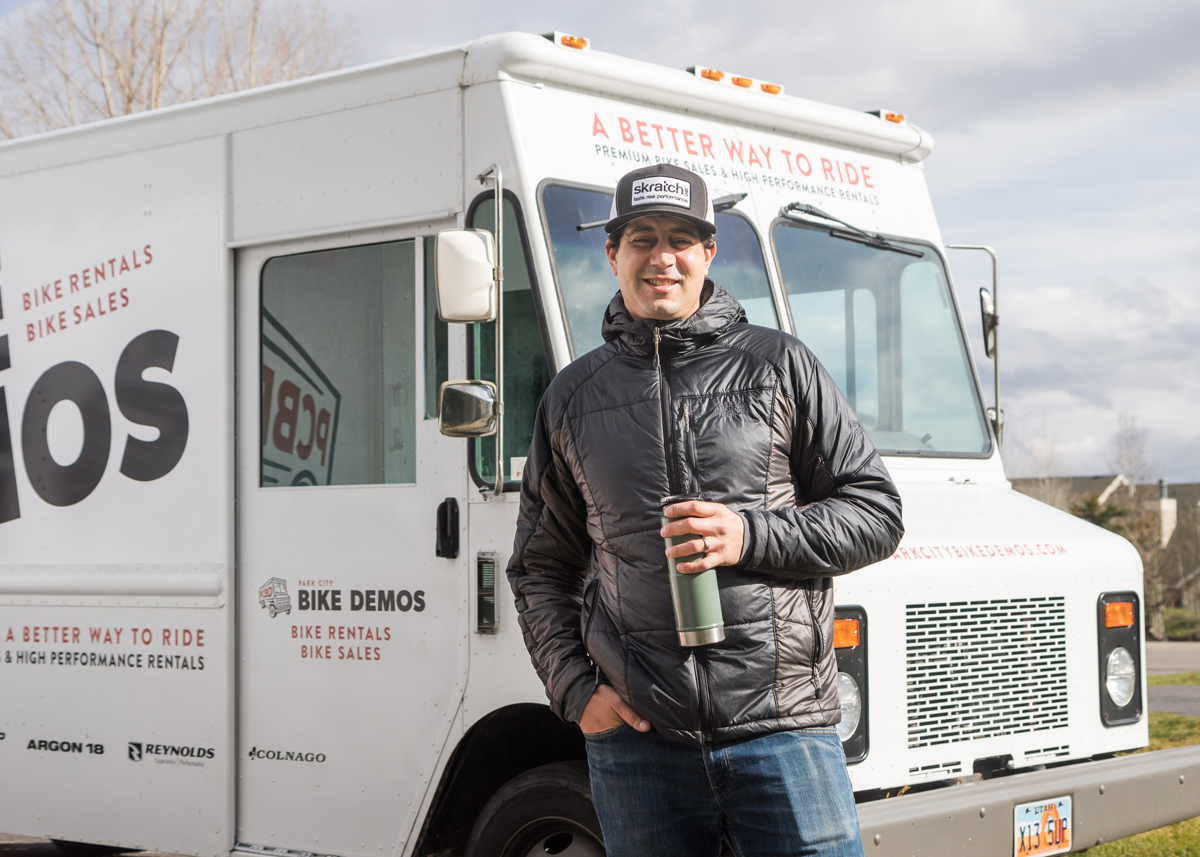
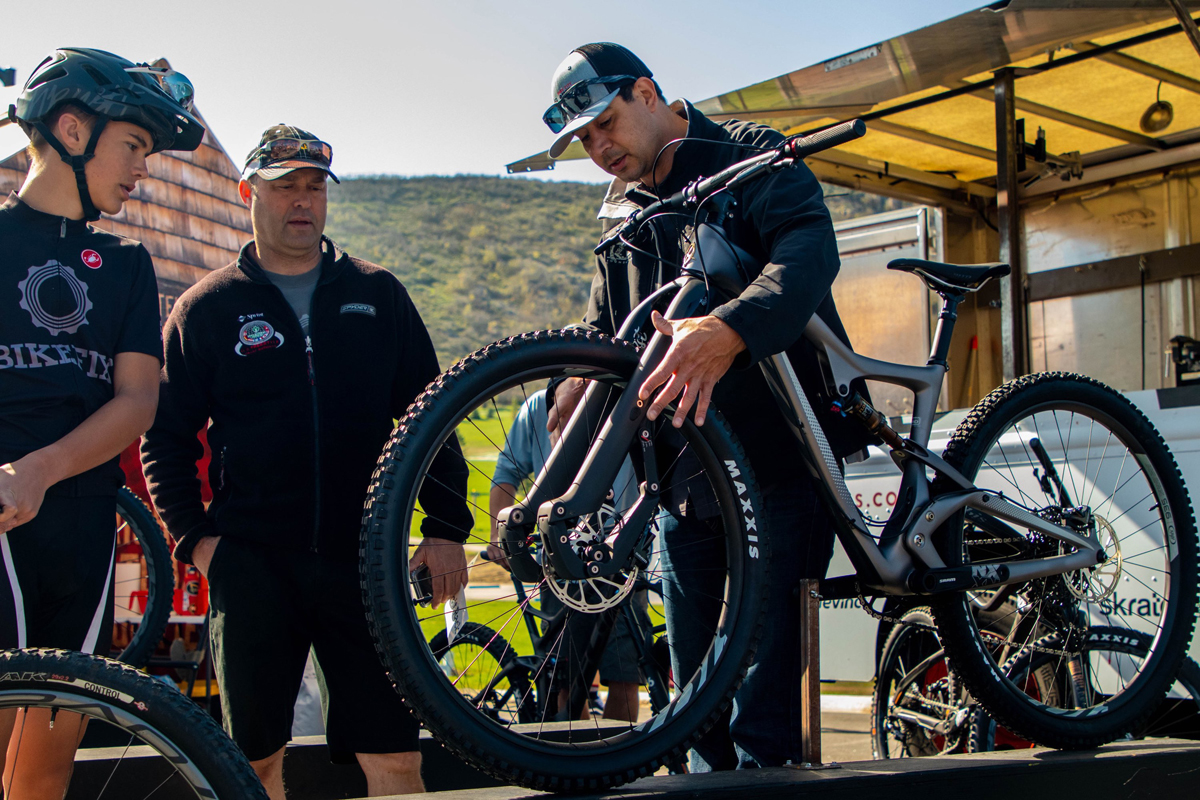
Park City Bike Demos manager Andre Shoumatoff. Photo by John ShaferPark City Bike Demos general manager Andre Shoumatoff demonstrates a Trust Performance shock. The shop’s unique business model lets you try any bike before you buy it. Photo by MJ Turner
GREENbike and SelectHealth Offer Free Rides to Everyone on June 22, 2019!
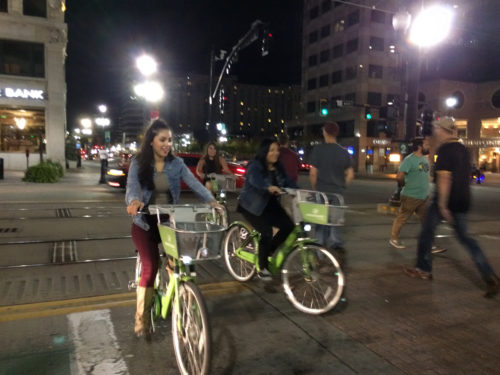
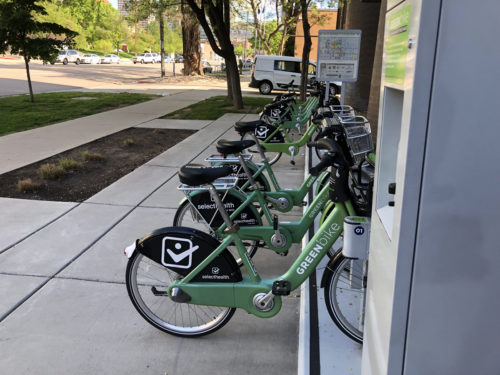
Greenbike is free to ride on June 22, 2019 in Salt Lake City. Just use the promo code 2019 at the kiosk.
SALT LAKE CITY, UT (June 19, 2019) — GREENbike, Salt Lake City’s non-profit bike share system, is teaming up with SelectHealth to offer free rides to the public this Saturday, June 22.
“GREENbike is a fun and versatile way to exercise and enjoy our great city,” said SelectHealth Public Relations Manager, Greg Reid. “It complements our mission of helping people live the healthiest life possible”
Over the past six years, the GREENbike program has offset more than 4,600,000 pounds of CO2 and other pollutants from entering the air and avoided more than 5,000,000 vehicle miles from impacting local roads, while burning nearly 68,000,000 calories in the process. The local non-profit bike share system is dedicated to offering the community an affordable, convenient and sustainable transportation option.
“None of this would be possible without the support of SelectHealth,” said GREENbike executive director, Ben Bolte. “Now we have the opportunity to offer folks familiar or unfamiliar with the program another chance to ride for free!”
This Saturday, GREENbike is the best way to have fun and avoid parking with the many downtown attractions like the Farmers Market, Utah Arts Festival and Bee’s baseball game. Go to any GREENbike station, purchase a 24-hour pass using the promo code “2019” and ride for free!
GreenBike Bike Share has changed downtown Salt Lake City! Photo by Dave IltisGreenBike Bike Share has changed downtown Salt Lake City! Photo by Dave Iltis
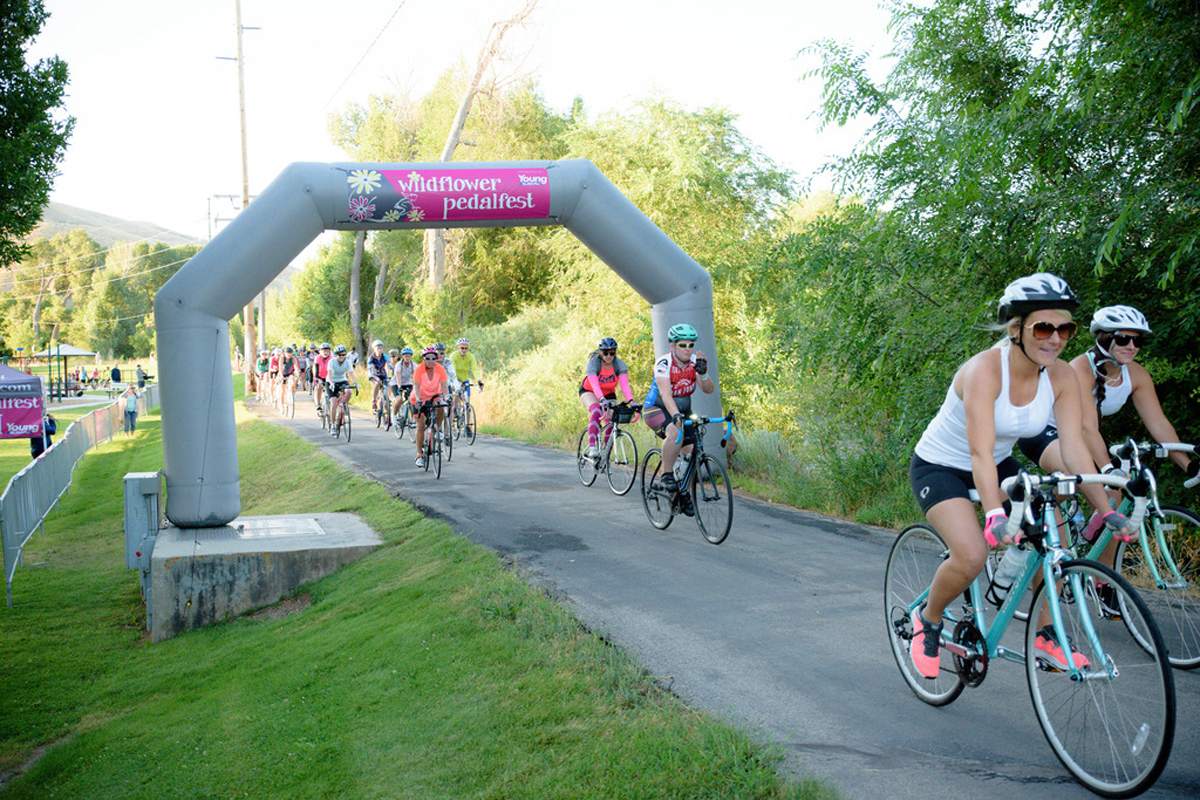
The Wildflower Pedalfest is a women’s only road bike event in Utah. Photo courtesy Wildflower Outdoor
Wildflower Outdoor is a women’s cycling organization that promotes two women-only events and has a bike club in addition. Wildflower Trailfest, a mountain bike event, will take place at Powder Mountain, Utah on July 13, 2019. Wildflower Pedalfest, a road bike event, will take place in Morgan, Utah on August 17, 2019. We asked Kim Bowsher of Wildflower about the events.
Cycling West: Tell us about Wildflower Outdoor.
Wildflower Outdoor: Wildflower is all about supporting women in the sport of cycling, whether road or trail. We provide a fully supported ride experience that is catered for women from start to finish. Our weekly rides, through the club, and our clinics and training programs in partnership with REI, Bingham Cyclery, WomenMTB, and AndShesDopeToo are all built to create a tribe of confident and proud women riders.
CW: How did you get involved?
Wildflower: Kim, I first became involved with Wildflower when I rode Trailfest a few years ago. It was my first trail event and I just fell in love with what this organization was doing. When the opportunity came up to continue this legacy, my husband and I both felt that Wildflower was too important to not continue and that it was a project we could take on and nurture together.
CW: What sort of environment for participants are you trying to create?
Wildflower: Tribe. That’s a big word for us. We want women to feel that they are truly a part of something special. It’s a pampered experience full of care and love for these women.
CW: Tell us about Wildflower Trailfest. What is the riding like?
Wildflower: It’s a gorgeous route, up at Powder, great options for our beginner riders and also that longer, more technical option for more experienced riders. The scenery is absolutely stunning and at this point in the year just loaded with wildflowers, which is fitting for Wildflower. Route options are 6 to 13 miles.
CW: Tell us about Wildflower Pedalfest.
Wildflower: Pedalfest is in its eighth year and we are so excited for how much the ride has grown! We are on a detour this year because UDOT has a major construction project up Big Mountain but we’ve worked with them and all the agencies to ensure we have a really great detour option that’s safe and still in alignment with the experience Wildflower legacy riders have come to rely on. Route options are 18 to 65 miles, all noncompetitive unless you opt in for our hill climb competition!
CW: Is there anything else that you would like to add?
Wildflower: All that’s missing is you! We have retreat options for anyone wanting to stay the night before the ride and so many fun experiences all season long – follow us on social for group training rides and more!
Event Details:
July 13 — Wildflower Trailfest, Powder Mountain, UT, A non-competitive, women only mountain bike ride. All ages and levels welcome. Come join us for a day of fun on Powder Mountain! Kim Bowsher, 801-610-9422, [email protected], wildfloweroutdoor.com
August 17 — Wildflower Pedalfest, Morgan, UT, A non-competitive, women only road bike ride. All ages and levels welcome. The 65 mile course option has a timed hill climb with prizes. Kim Bowsher, 801-610-9422, [email protected], wildfloweroutdoor.com
The start of the next reauthorization of the Transportation Alternatives Program (TAP) has begun. It has a long way to go and a lot of changes before it gets folded into the next surface transportation reauthorization package which expires after FY 20. But if history is a guide, it may take another year with a temporary extension.
But two senators have introduced the TAP Enhancements Act (S. 1098), sent to the Committee on Environment & Public Works. While the bill has bipartisan support in that half of its sponsors come from each party, so far only senators Ben Cardin (D-MD) and Roger Wicker (R-MS) have sponsored it (https://www.congress.gov/bill/116th-congress/senate-bill/1098/ ).
The bill aims to loosen federal control and make it easier for smaller communities to get grants if states develop a plan and award funds competitively. The changes would start in FY 21.
Under current law, TAP can’t get more than $850 million a year. Under the bill, it would get 10 percent of the Surface Transportation Block Grant, so it could grow if the overall program grows. Now, states get half and local communities get the other half of TAP. The bill would give local communities two-thirds, a move designed to give smaller towns a fairer shake. Current law also only allows metropolitan planning organizations (MPOs) serving at least 200,000 people to get funds; the bill would open it up to smaller MPOs.
In previous installments of the Mechanic’s Column, we’ve talked about wheel bearings, bottom brackets, and drivetrain. The bike has to be solid from the inside out. If the hub bearings aren’t within tolerances the cassette will flutter at a shift. If the bottom bracket is loose, then the crankset (including your chainrings) will deflect while trying to shift the forward gears at your feet. I also discussed drivetrain wear and how that can affect performance in both shifting and pedaling under load.
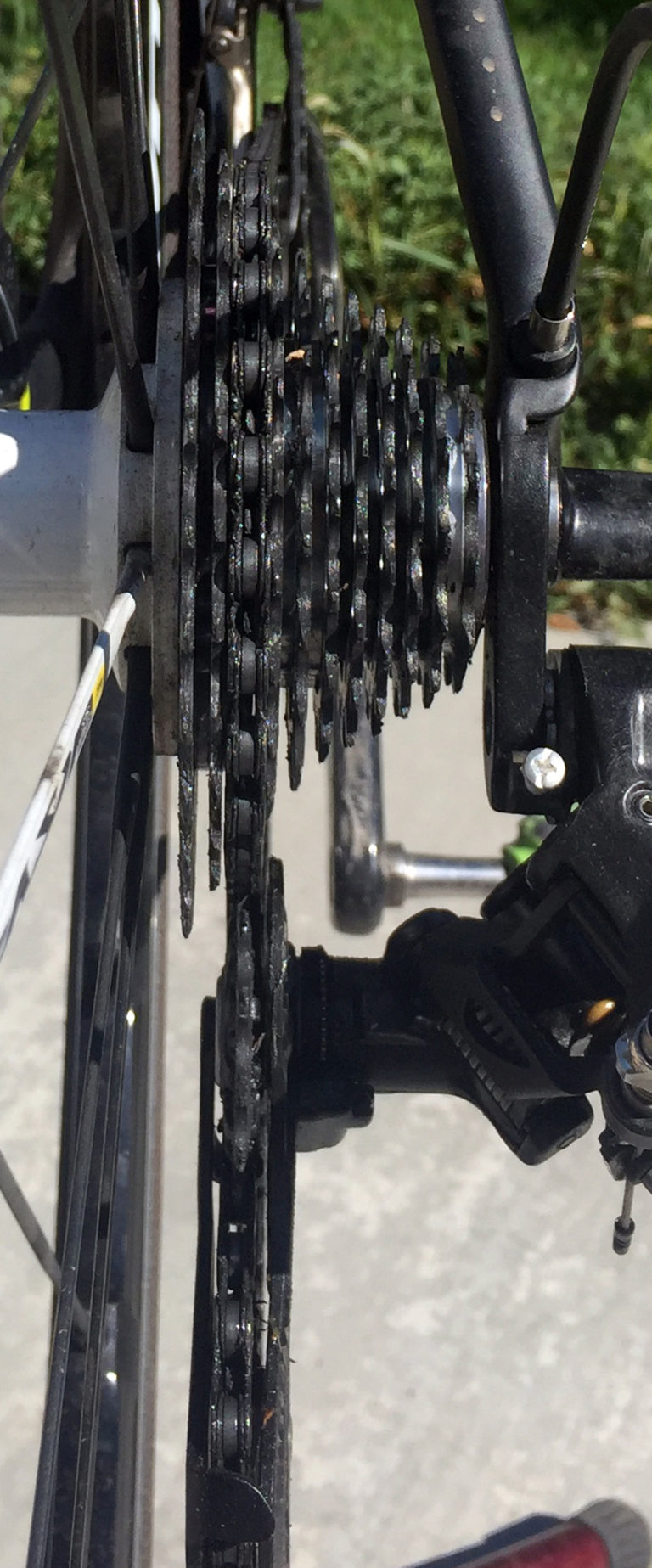
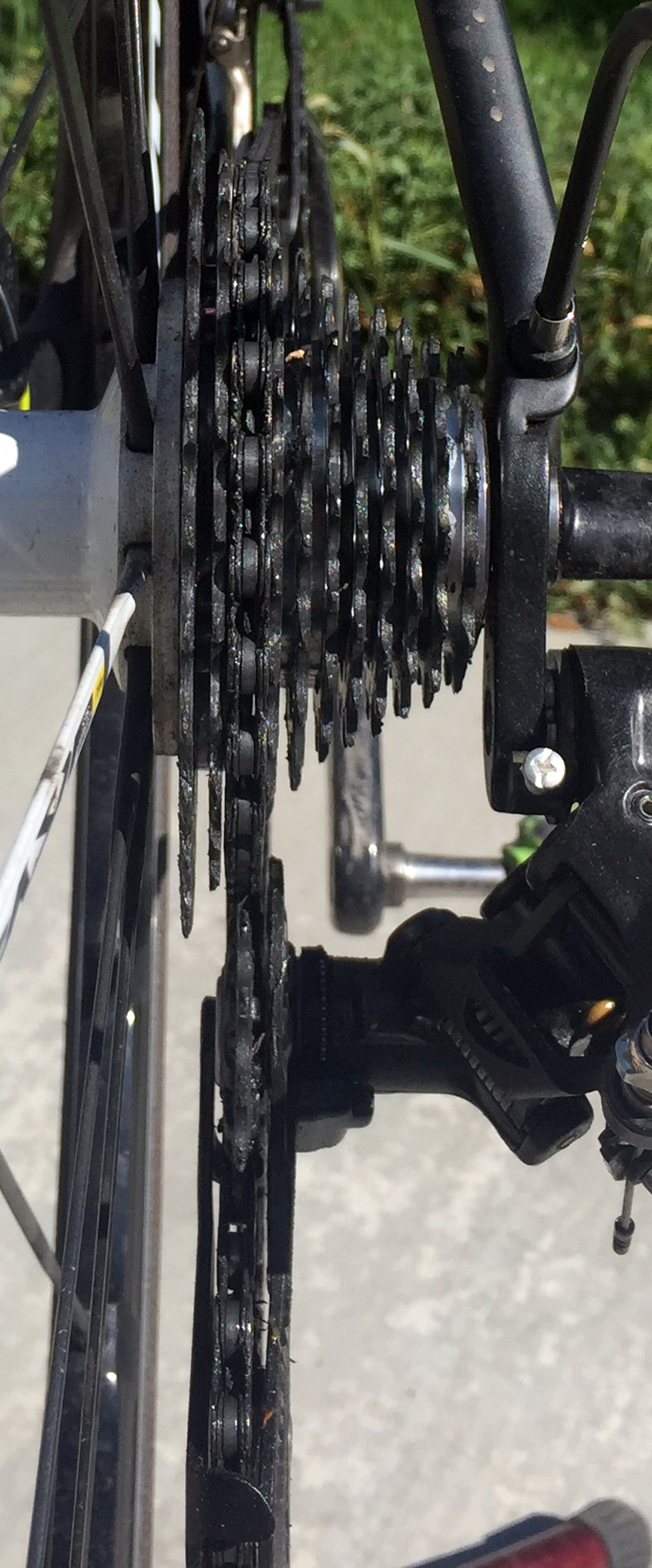
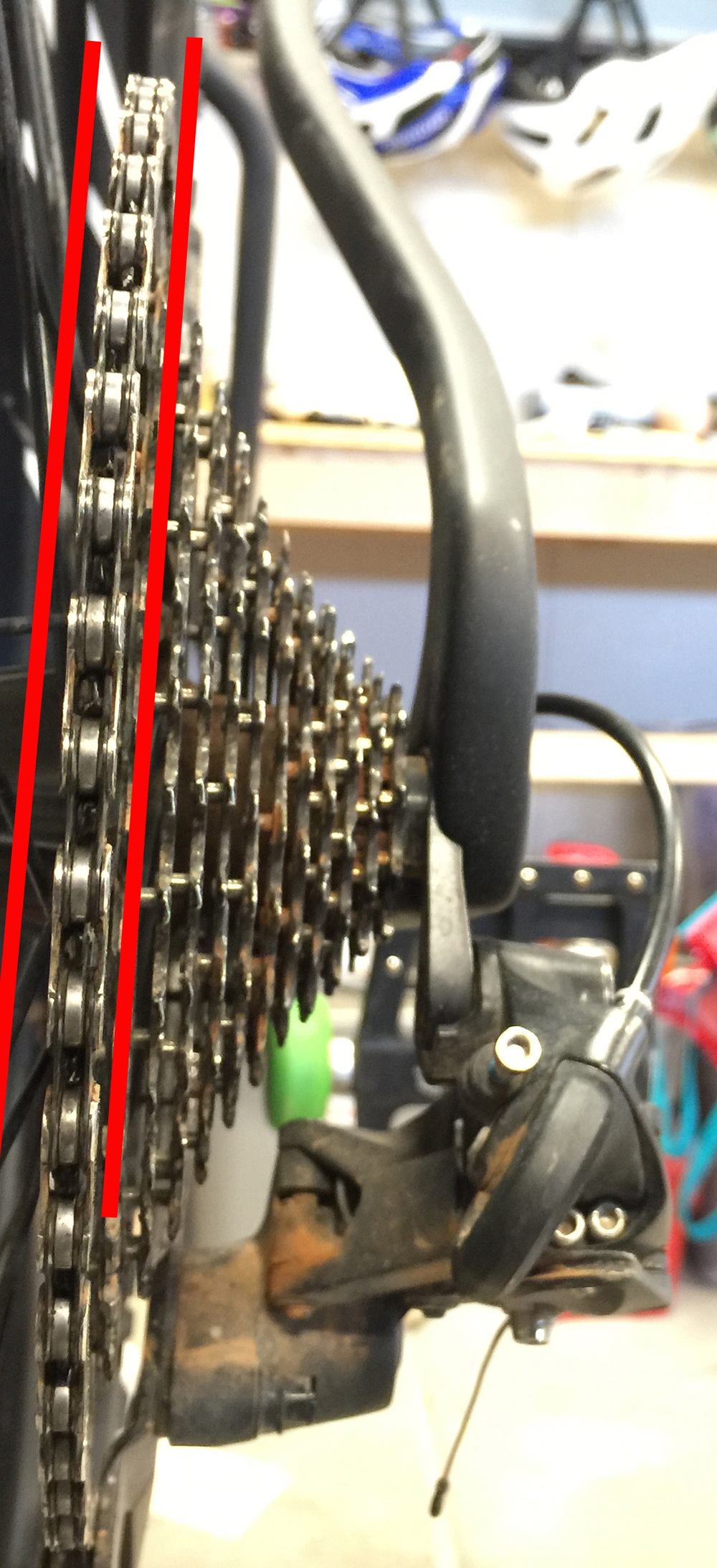
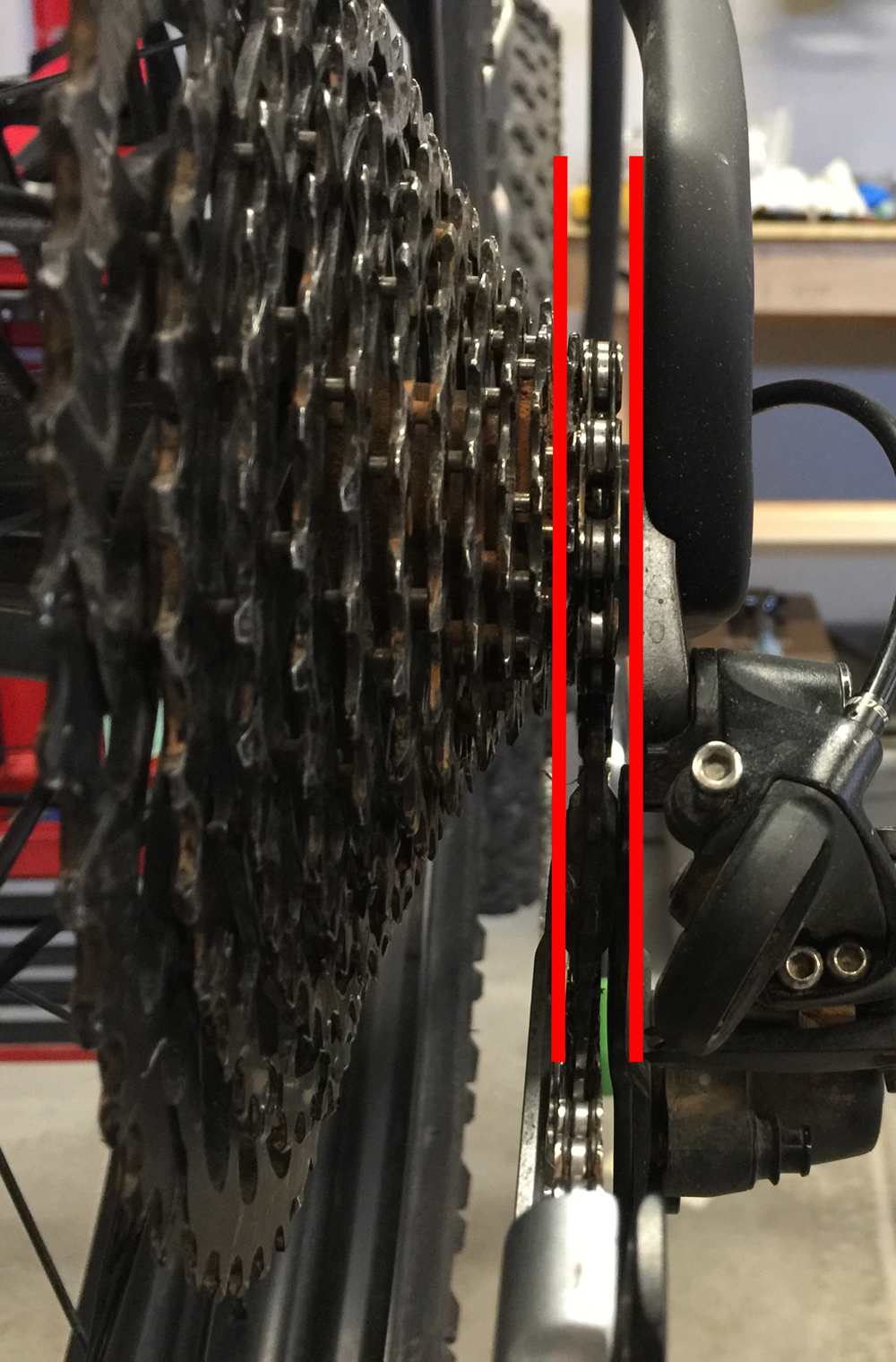
Rear derailleur in 3rd or 4th gear shows cage hanging parallel to wheel. Photo by Eric Ramirez
We’ve already fixed the shifting resistance by replacing cables. But for some reason the rear derailleur shift isn’t happening smooth or it seems that the derailleur is simply missing the correct spot.
Front and rear derailleurs facilitate the shifting by simply pushing the chain into the next gear. We talked about ramps and pins and how these carry the chain the rest of the way onto the corresponding gear, whether cassette cog or chainring. Derailleurs are also extremely exposed to the elements: water, dirt, children, crashing, etc. They are built with this in mind and are very durable. The more you spend the better they are in every way: durability, shift quality, return spring strength, weight, and aesthetic.
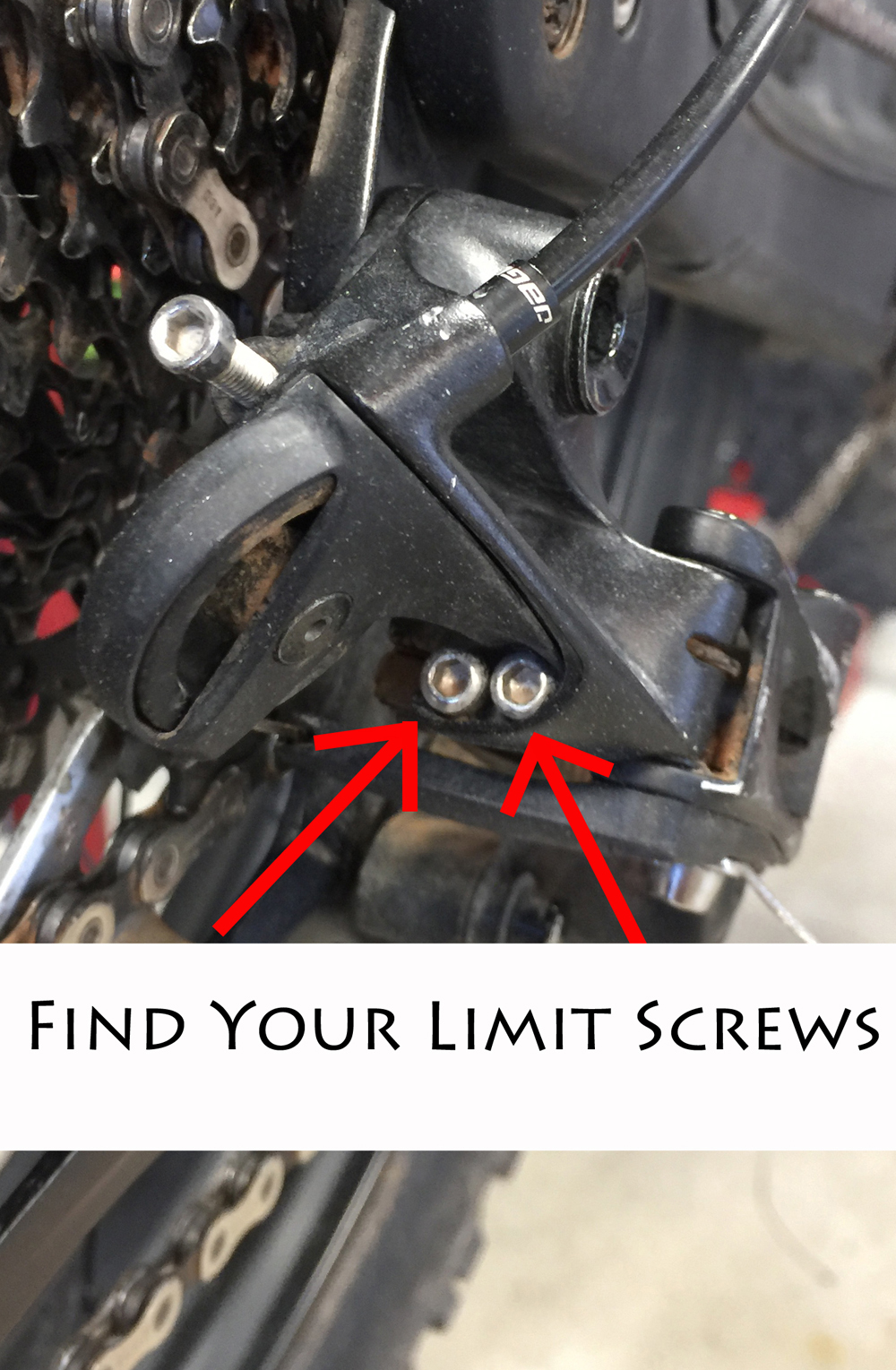
Derailleurs all share a common set of control features: Limit screws, both high and low, cable set screw, a barrel adjuster on the rear (typically). Different brand derailleurs also have different pull ratios from others. SRAM and Shimano and Campagnolo all have different cable pull ratios and are largely incompatible with each others shifters.
A few things to consider with the rear derailleur:
Alignment of derailleur and derailleur hanger
High and Low limits
Cable tension
The following information is presented assuming the bike will be in a work stand.
Alignment:
Derailleurs have an alignment requirement and this must be set before high and low limits are set, before the cable is fastened or even installed. A rear derailleur must hang on a parallel plane to the rear wheel and the cogs it services. I first take a look at the derailleur hanger, the part of the frame that the derailleur connects to.
When installing a derailleur or checking for shifting issues this alignment is the first thing I inspect. No adjustment will matter if this alignment is off. Don’t assume because it is a new bike that this is properly set. I’ve seen poorly aligned derailleurs hangers on new and crashed bikes alike. Often times I find that a rear wheel is installed cock-eyed in the bike and this will have the same effect as a bent derailleur. So, make sure the wheel is in straight.
If the derailleur is hanging at an angle rather than vertically it would be a good idea to take it to shop and have the techs align it for you. They do it all day and can usually get it turned around quickly.
“High” Limit Screw Setting:
Next, with the rear derailleur installed, I like to disconnect the cable from the fastening bolt and see how the high limit is set. The top pulley of the derailleur should feed the chain directly onto the smallest cog, or the cog furthest out from the center of the wheel. The corresponding screw to set this is usually marked with an “H”. Rotating clockwise will set the “H” limit toward the center of the cassette.
Give it a gentle pedal and the chain should pass smoothly onto the small cog without making a whole lot of noise and with no help. If it sounds like it wants to shift into the next gear or into the space between the cassette and frame, then readjust. Once the derailleur is smoothly feeding the chain onto that cog your “High” limit is set.
Attach the Cable:
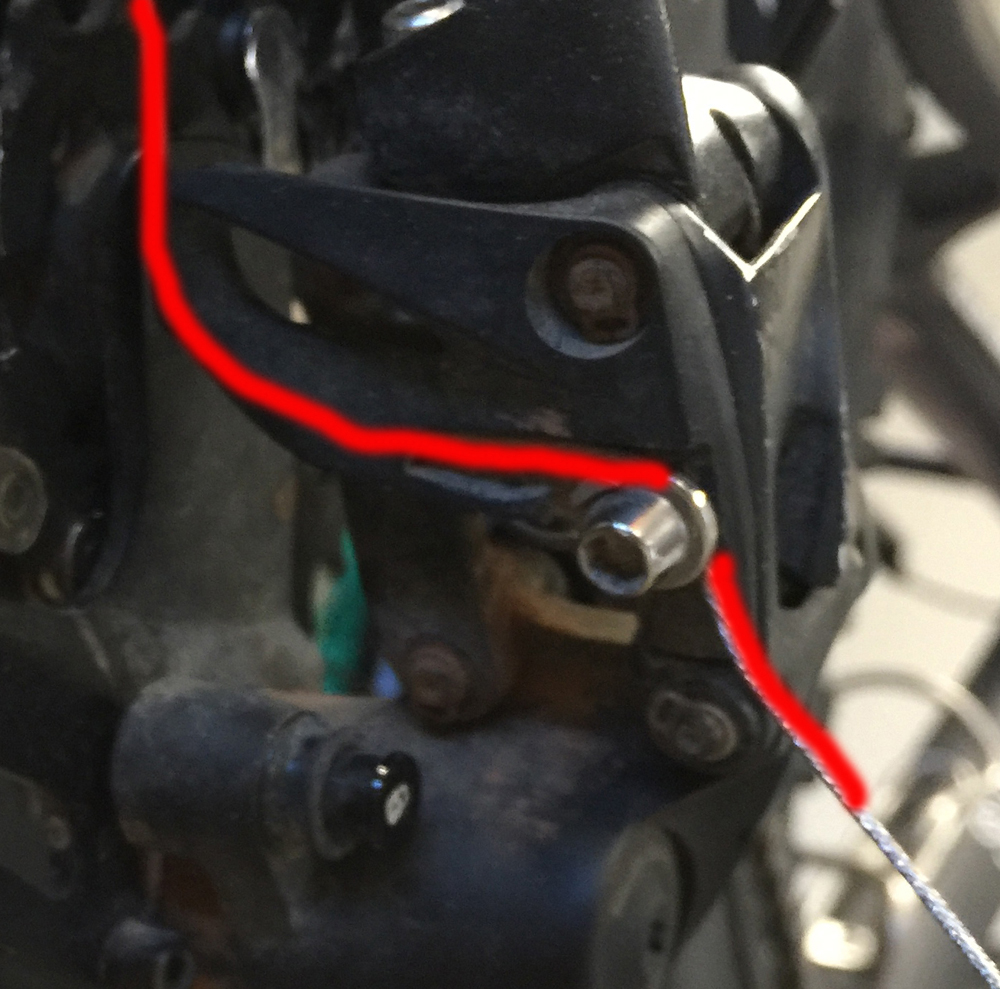
Make sure the barrel adjusters are in all the way so that it takes up no cable slack, both on shifter and rear derailleur. Make sure the shifter is fully released so that the cable is coming out of the shifter at the high gear setting. Now remount the cable to the fastening bolt. This can be tricky. Several derailleurs have a proprietary mounting route for the cable to follow. Look at yours and make sure it falls into manufacturers specifications.
Pedal and shift (slowly) through the range; the chain should readily shift to the next gear and make little to no noise outside of the chain rolling onto the cogs. Watch and listen to the chain as it goes from gear to gear. You may need to adjust the cable with the barrel adjusters. As the cable is tightened with the barrel, the derailleur is forced to align accordingly. I like to start with a quarter turn at a time.
Shift to the climbing gear, whatever the “Low” cog is. These days it could be a 50 tooth cog but it will physically be the largest gear on the cassette. The chain should feed from the derailleur onto this cog easily. At this point give the derailleur a little push and see if it resists the motion and remains on the low gear.
“Low” Limit Screw Setting:
Oops, the chain is now in your spokes! This is a big oops, and the “Low” limit screw needs to be adjusted so that this never happens. Screw the limit screw in just a bit until it stops throwing the chain off the low gear and feeds the chain nicely onto the largest cog. Repeat shifting through the range while pedaling the bike. If the derailleur won’t send the chain onto the largest cog, then the “low” limit needs to be withdrawn just a bit. Do this until it will shift onto the cog but not into the spokes.
Test ride the bike around the neighborhood, gently avoiding abrupt shifts. Shift thoughtfully through the gears one at a time. Look for any hesitation. You may have to readjust some of your settings, starting with cable tension, to get the shifting spot on. A little trial and error here can go a long way to building the necessary experience to making these adjustments quick and efficient, and in the field.
Up Next: I’ll discuss a rear derailleurs “B” tension and why it’s so mysterious.
Eric has 20 years experience working on bikes, starting in Park City. Today he’s a head technician at a shop and maintains a blog about wrenching and adventures at angrybikemechanic.com
Once you find the limit screws, determine which is ‘H’ and ‘L’. Photo by Eric RamirezThis is the ‘low’ gear and corresponds to the ‘L’ limit screw. Photo by Eric RamirezThis is the ‘high’ gear and corresponds to the ‘H’ limit screw. Photo by Eric RamirezAn example of unique rear derailleur cable fastening. Photo by Eric Ramirez
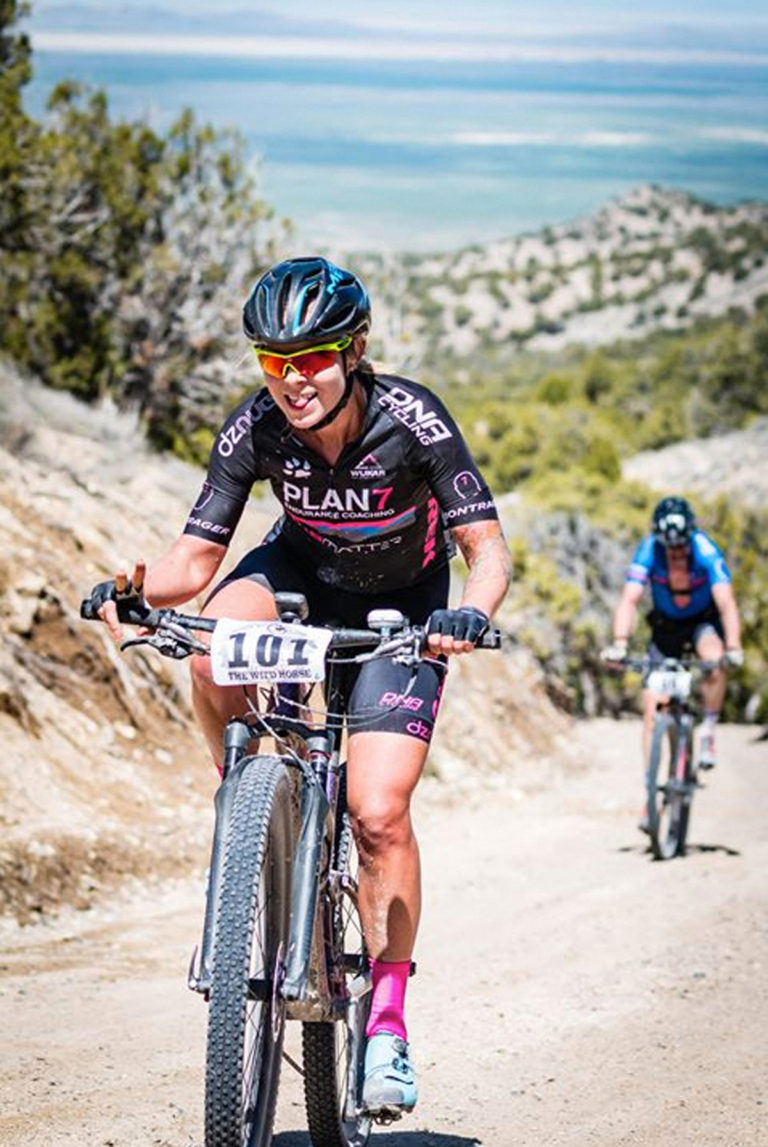
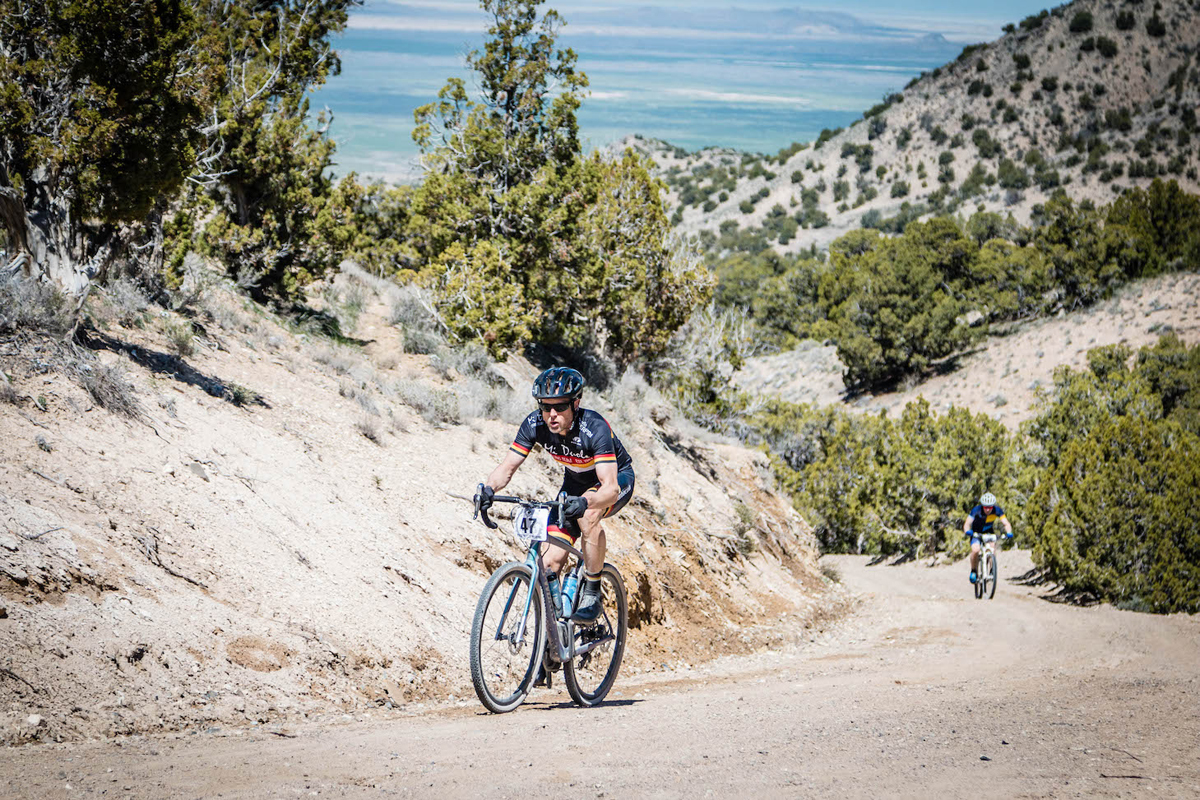
Riders in The Wild Horse climbing Rydalch Pass at the south end of the course, in the Cedar Mountain Wilderness. Photo by Andrew Newcomb
Men’s Race
Jeff Bender and Sam Sweetser were just trying to stay within sight of Jamey Driscoll. Driscoll had broken the lead group very early in this year’s edition of The Wild Horse, a dirt fondo in the Cedar Mountain Wilderness, west of Salt Lake City. This year’s event was on April 27.
Less than 12 miles into the 76-mile loop, Driscoll was off the front and powering toward the top of the first King of the Mountain climb, Hastings Pass. Sweetser described the standings on the road. “Once there, Jamey put the hammer down and quickly dropped everyone. At the bottom of the first descent I caught up with Jeff and from that point on we rode together for the rest of the race. Most of the time we could see Jamey up the road but it never seemed like we were closing much of the gap.”
The course was in good shape, except for a stretch on the west side that had been hammered by rain the previous weekend and then chopped up by the cattle still on the range. Other than that, not much to worry about. “Fresh air, good temps, and awesome views the whole time,” was Bender’s description of the day. Bender was having a good day. “I was solo up and over the top and down the first decent where, luckily enough, Sam Sweetser had caught me. We were able to ride/work together the rest of the race which made for damn good company.”
Sweetser had ridden The Wild Horse in 2018, so he knew the course. He also knew how hard it was to ride solo, as he flatted four times last year. “After coming off the second descent we could see Jamey way off in the distance and figured that was the last time we would see him. But having someone to trade pulls with was a huge advantage and we ended up catching him right before the second feed zone. Jamey stopped while Jeff and I kept riding.”
At this point, Bender and Sweetser were about 25 miles from the finish. A lot of false flats, rollers and fast descents. And one gut punch. Sweetser knew what was coming. “All the while hoping I had enough water to survive until the end as I remembered the last climb up the wash as a soul crushing experience last year. Luckily I had Jeff to ride with all the way to finish and enjoyed dodging cows in the wash.”
Bender and Sweetser came into the final mile together. “It wasn’t until the last straight-away where I thought I could make a move on Sam,” Bender said. “I’ve raced against him before and he is crazy strong. I made the final move and it stuck! I then was able to pull away to the finish line.”
Bender crossed the line in 4:13:40, with Sweetser coasting in eight seconds later. Both were almost five minutes faster than the previous course record. For breaking the record, Bender walked away with a $100 bill and TrueNorth Wealth donated an additional $250 to the Utah League High School MTB Scholarship Fund, the beneficiary of The Wild Horse.
Driscoll was the third finisher, but his efforts on the two King of the Mountain climbs, Hastings Pass and Rydalch Pass, earned him the TRP KOM victory.
Women’s Race
Breanne Nalder on her way to winning The Wild Horse. Here, she climbs Rydalch Pass at the south end of the course, in the Cedar Mountain Wilderness. Photo by Andrew Newcomb
For Breanne Nalder, riding her third Wild Horse, the day was fast, a bit more comfortable, and oh, so close to the course record.
“Wild Horse 2019 was another fantastic adventure,” Nalder said. “I decided to ride my Trek Top Fuel MTB rather than my gravel bike. I was happy with my choice, as I had a cushy ride all day. Although it made the climbs a bit more challenging (slower QOM times than previous years) it made all the rest of the miles faster as I felt confident on my equipment.”
Last year, Nalder was 56 seconds away from being only the second woman in the then four-year history of The Wild Horse to go under five hours. A wrong turn a few miles from the finish likely was the difference in not going under five. There would be no wrong turns this year, and the record was in play all day.
“The second half of the race is usually the hardest but this year it was a blast powering through the rollers and enjoying the beauty,” Nalder said. “I was with my teammate Art O’Connor and we did some math, realizing that if we could average 15 mph I would be on track for the female course record. I didn’t think that would be attainable going into the day on the MTB and with the softer roads.”
The women’s course record was set in 2016 by Meghan Sheridan, at 4:57:53.
“We pushed it together through the wind,” said Nalder. “I missed Meghan’s record by about 20 seconds. It was still a fantastic day and I will undoubtedly be back next year.” Nalder became only the second woman to go under five hours in 4:58:11, and also won the TRP Queen of the Mountain.
Little Wild Horse
In the 31-mile Little Wild Horse, the adventure of the day was provided by wild horses. Dave Gontrum was in a small group off the front when things got weird.
“About 10 miles into the ride, the foursome I was riding with split apart,” said Gontrum. “A few minutes later I looked back and was startled to see a large peloton bearing down on me fast, dust flying in their wake.” He quickly discovered this was no ordinary bike ride. “A second look and I realized that about a dozen frightening large horses were bearing down on me, galloping in phalanx about 50 yards behind me.”
“After a few more glances behind, and some clumsy attempts to video backwards with my phone in the bright sun while ostensibly racing a mountain bike, I realized that they had settled into a comfortable pace at a midpoint between me and the four riders who had coalesced behind them. For the next several exhilarating miles, it was as if the horses just decided to join our event as we proceeded down the now mostly flat final miles to the aid station. At one point, some riders who had bowed out of the longer Wild Horse and were returning the opposite direction, had to stop as our strange posse wove around them. As we neared the aid station, the horses parted from the road and headed off into the open range, leaving us to finish the race with that thrilling experience fueling the climb and return.”
Gontrum went on to finish in the top 10, a few minutes behind three-time Wild Horse veteran Barry Makarewicz, who was riding the Little Wild Horse for the first time.
“I would describe it as a humane ride that a reasonably fit person could do and enjoy ‘off the couch’ “, said Makarewicz.
Bike Choice at the Wild Horse
Just like any long day on dirt roads, at some point you are riding the wrong bike. For Bender, his gravel bike was the right ride. “Weapon of choice was my Norco Threshold built with the new Sram AXS 1×12. 40t up front and a 10-33 rear cassette. I chose the trusty 38c Panaracer GravelKing but ran a pretty high pressure due to the uncertainty in course conditions.”
For Nalder, who has won The Wild Horse on a gravel bike, the MTB was the right call this year. For Makarewicz in the Little Wild Horse, MTB was the way to go. “I chose to ride a full suspension mountain bike knowing it would be a bit of a disadvantage over about 75 percent of the course,” said Makarewicz, “but it was very helpful on the big decent off of Hastings Pass where I was able to make up about a minute and a half on the lead rider, who was on a cross bike.”
Over the five years of The Wild Horse, gravel bikes and gravel-specific tires have really evolved, and riders’ times reflect this. This year there were 25 men who went sub-five hours in The Wild Horse. This is about the same number as went sub-five in the previous four years combined. Having a gravel bike with just a bit more relaxed geometry and that can accommodate a rear tire of at least 40, as opposed to the more aggressive frame of a CX race bike that can perhaps only handle a 35 in the rear, makes a huge difference.
Good weather, great volunteers and a varied, vast course were the highlights of The Wild Horse. “This is an amazing place to ride bikes and everyone should put this event on their to-do list,” Said Sweetser. “The Wild Horse is a well-run event with the riders’ interests and needs prioritized,” said Makarewicz. “I plan to be at the starting line again next year.”
Wild Horse 2019 Results
Women
Breanne Nalder 4:58:11
Ingrid Smallman 5:36:13
Niki Milleson 5:43:15
Men
Jeff Bender 4:13:40 — New course record!
Sam Sweetzer 4:13:48
Jamey Driscoll 4:18:25
Little Wild Horse Results
Women
Trista Winder 2:10:43
Laura Howat 2:15:01
Erin Sweetzer 2:17:19
Men
Barry Makarewicz 1:56:47
Ryan Mauser 1:56:49
Dru Whitlock 2:01:23
(For full results, see our Late Spring 2019 issue online)
Jamie is back in the saddle after her bike commuting accident. Photo by Jamie Morningstar
If you know me at all, you know a few key facts: Raw tomatoes are gross, I almost always wear Birkenstocks, and I love to ride my bike. Yes, there are more datapoints available about my life, but I think those three cover the essentials.
I cycle commute year-round and I love it. My current commute is a quick 2.5 miles and rain, snow, or shine you’ll usually find me on the saddle with a smile. Cycling to work has many advantages: no parking hassles, cheap(er) transportation, fresh air, low carbon footprint, a little extra exercise, looking like a badass (especially on bad-weather days). My favorite benefit is having quieting centering me-time at the start and end of each workday – cycling truly is therapeutic for my body and soul.
My husband gave me a bike for my birthday seven years ago, and shortly thereafter I started to cycle commute whenever I could. It was love at first ride.
Over the years I’ve ridden to and from work over 800 times. That means I’ve cycle commuted about every other day since I started. Not bad, considering vacations, sick days, travel, and the occasional day when I have to drive in (sigh) because of off-site meetings or appointments. I’ve racked up a total of over 8,500 miles in commute distances alone. At this rate, it will take me another thirteen years to cycle commute the equivalent of the circumference of the earth. I’m up for the challenge.
So, yeah, cycle commuting (and riding in general) is a big deal to me and something I’m super grateful for. And after those hundreds of rides and thousands of miles, I had never experienced a serious issue while riding. Sure, I blew out a few tubes and got a couple of scrapes, but nothing big. Until the end of March.
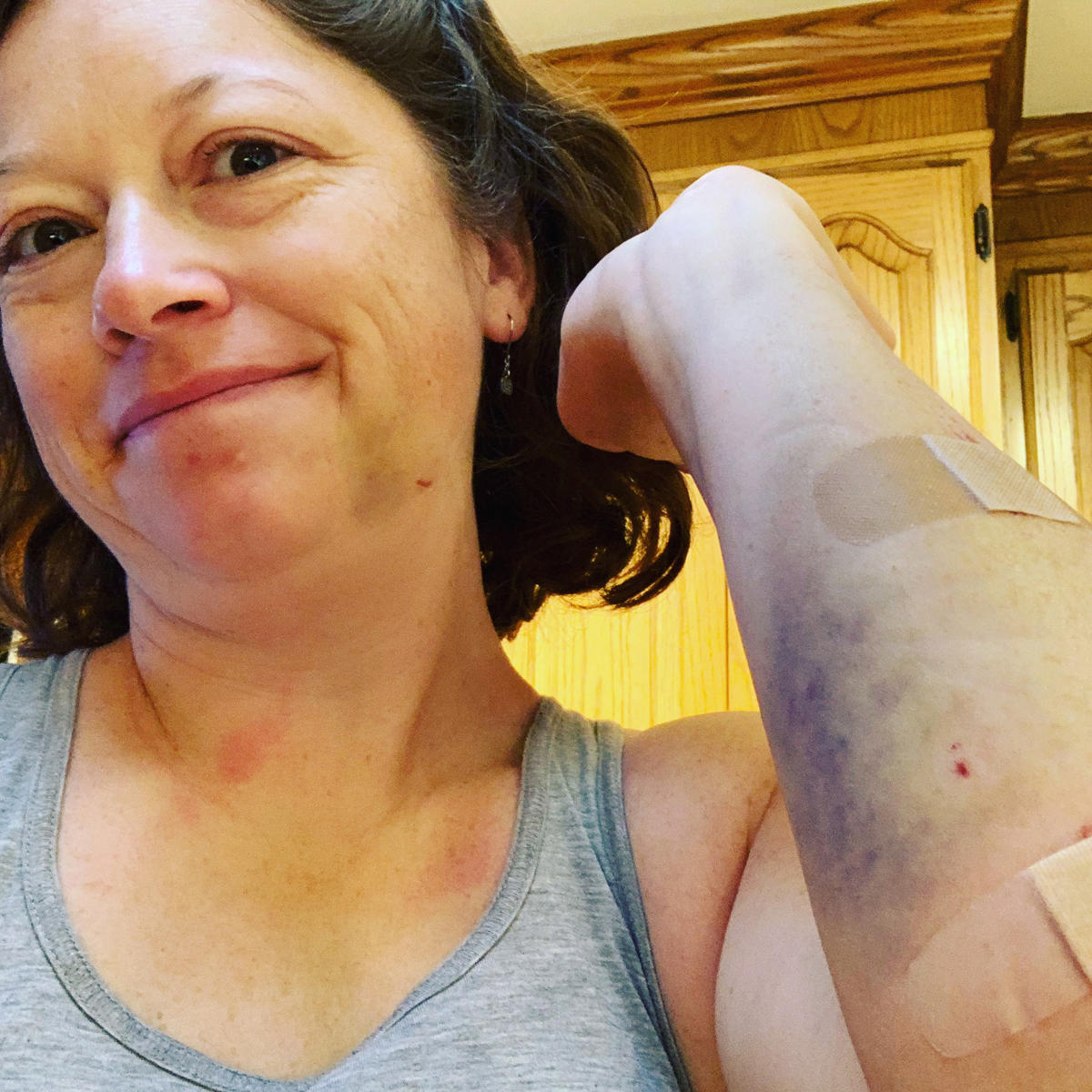
I was riding home at my normal time, on my normal route, on my normal bike, and I got unlucky and biffed a few blocks from work. I don’t have any memories from the incident, so I don’t know exactly what happened. I think I just nicked a curb and went down. Hard. I was wearing a helmet, and hit hard enough that I broke my sternum and got a pretty nasty concussion. As a true hard-core commuter, I picked up my bike and rode home… at least, I assume I did, since I ended up at home with my bike. Good thing my body knew the route even if my brain was at far less than peak performance!
I do remember stopping in my driveway, putting the kickstand down on my bike, walking into the house, and telling my husband that I had fallen on my bike and needed to go to Instacare. CT scans and X-rays and a few checkups later, everything was ok, I just was very banged up and bruised – body and brain both.
Recovery has been slow and laborious. I love my brain, and the awareness that my brain is not performing at full capacity has been deeply challenging for me. My mental processing is still a little slow, especially at the end of the day or when I’m tired. I still get queasy if I spend too much time looking at a computer screen (I work in software, so that’s a bit of a challenge). I’ve given up TV and movies almost entirely because they just don’t feel good.
Jamie’s bruises after the accident. Photo by Jamie Morningstar
But you know what still feels great? Riding my bike.
People have asked if I wanted to give up riding after my accident, and my answer is a resounding no. I got unlucky. Accidents happen in lots of different ways and staying home on the couch (or deciding to drive instead of ride) in order to avoid an accident seems like an unhealthy response. Besides, plenty of people get hurt in car accidents, too!
I did get a new helmet. And I watch corners with curbs more closely now. I’m still taking things slow; there’s a lot of healing still to do. I get frustrated on the slow days and the headache days.
And when I get frustrated, my very best therapy – body and mind – is still a to hop on my bike and take a spin.
If you have a suggestion for a commuter profile, have a commuter question, or other comments, please send it to [email protected].
This Female Duo rocked it, won their category and Best Team Name 2018, The Menstrual Cycles. Photo by Sara Mejeur, GOAL Foundation
El Doce Mountain Bike Race is in its third year. The event sports 6- and 12-hour options with several ways to compete as an individual, as part of a duo or on a team relay. The race will we held at Powder Mountain on July 20, 2019. We caught up with Sara Mejeur of the Get Out and Live (GOAL) Foundation, event producers, for more details.
Cycling West: Tell us about El Doce. What are the features of the event?
GOAL: El Doce is a perfect balance of epic trails, party vibes, camping, tacos and frosty beverages!Powering through a combination of flowy scenic trails, switchbacks and epic climbs, this unique 12-hour mountain bike race feeds on endurance. Utilizing Powder Mountains stunning scenery and camping spaces, El Doce brings you a weekend of connecting with the mountain and then relaxing to what nature has to offer. Great for riders that just want to ride and have fun and challenging enough for even the most seasoned competitor. Included with each registration is a bottle opener, a plate of tacos, and a frosty beer or root beer of your choice.
CW: Tell us about 6- and 12-Hour racing. How can riders best enjoy the event?
GOAL: It’s up to the individual rider. More seasoned competitive riders might enjoy the 12-hour solo, where they can see how many 13-mile laps they can personally accomplish in 12 hours. Newer or more social / casual riders, might enjoy a four-person 12-hour team or 6-hour duo. This way there is more down time between laps. Either way, it’s your race and you can choose to ride El Doce how you want. Once you’ve had enough, kick back at your tent with your favorite snack and beverage and watch the others compete.
CW: For cyclists traveling to the race, where can they stay? Is there camping nearby?
GOAL: The best and closest option is just to camp right in the meadow at Powder Mountain where the race takes place. Camping is available Friday and Saturday night again this year. The camping is rustic (rough ground, no power or water), so keep that in mind, but the location can’t be beat. Once your camp site is set up your all set to stay right where you are and will have access all day to use as your home base. Check out our website for more camping details. https://www.getoutandlive.org/p/about/eldoce/camping-at-powder-mountain
If camping isn’t your style, there are some beautiful properties for rent:
Other Properties can be found by searching in Eden, Utah
CW: What are some of the features of the course? How technical is it?
GOAL: The course is 13.3 miles of IMBA designed trails per lap with roughly 1400′ ascent. Powering through a combination of flowy scenic trails, switchbacks and epic climbs, this unique 12-hour mountain bike race feeds on endurance. The course views the High Uinta Mountains. Start out strong by conquering 13 switchbacks along Doctor’s Dozen, then descend into a vast Aspen grove and cruise past Hidden Lake. The trails are rated green and blue. Check out the detailed course description: https://www.getoutandlive.org/p/other/410
CW: What is the mission of the GOAL Foundation? Tell us more about why you are promoting this event?
GOAL: The GOAL Foundation is a 501 (c) (3) Non-Profit and our mission is to inspire the Greater Ogden Community and its visitors to “Get Out And Live!” by participating, volunteering and spectating at recreational events, programs and activities. We envision a Greater Ogden community that thrives economically and is healthier in mind, body and spirit.
The GOAL Foundation wanted to create an event that brought together the Mountain Bike community for an epic party in our community. The goal is to attract riders from around the county to see what Ogden has to offer. The revenue from our events fund our Youth Programming such as Youth Summer Camps (Hiking, Mountain Biking, and Climbing) and our Young Runners Program.
CW: Is there anything else that you would like to add?
GOAL: We are excited to watch this event grow. We doubled from year one to year two, so we are hoping to keep building on the success year over year. It’s such an incredible vibe, one of our favorite quotes from one of our riders last year was, “GOAL through a party and a race broke out”. That’s exactly what we’re going for, we hope to see you all for 2019.
Event Details:
July 20 — El Doce at Pow Mow, Powder Mountain – Eden, UT, 12/6 Hour Mountain Bike Race at Powder Mountain, Utah. Solo, Duo and 3-4 Person Teams. 13 Mile lap, 1400’ vertical per lap, 12 hours. Limited to 400 riders., Jenny Scothern, 801-399-1773, [email protected], Clairesse Miljour, 801-399-1773,
El Doce race boasts beautiful wildflower lined trails with views of the Uinta Mountains. Photo by Monique Beeley, Discover Utah MagazineCamping party vibes, when you’re not out racing, kick back and enjoy the views. Photo by Sara Mejeur, GOAL Foundation
Park City’s Cyndi Schwandt, a pioneering and premier mountain bike racer, passed away following a mountain bike crash on June 10, 2019.
Cyndi Schwandt at the Joyride Mountain Bike Race in May 2004. Photo by Sherise Crosby
Schwandt won the Utah mountain bike series in 1987, 1989, 1990, 1991, and 1992, among many other victories. She also competed in several mountain bike world championships and numerous national championships, as well as in the pro-elite class in the NORBA National Series.
The following is a portion of her obituary provided by her family. We will have additional remembrances of Cyndi in an upcoming issue.
Cyndi Schwandt was just a few weeks away from turning 69 on July 11th when she died Monday, June 10th doing what she loved best, riding her bike on the trails in Park City. It was especially fitting that these were the very trails she pioneered to help create over the last 40 years, in the heart of the community she called home.
She was a force to be reckoned with, characterized by a quiet presence and unapologetic approach to life. The impact Cyndi made on the community will be forever remembered. Whether it was through her involvement as a Mountain Trails Ambassador, passion for the Adopt-A-Native Elder Program, or utilizing her masters degree in horticulture at Summit Community Garden, her love for Park City was apparent in her varied activities and avid volunteerism. She created a family that will miss her forever.
For those of you who knew Cyndi, she would hate being recognized as a National Champion Mountain Bike Racer, or for her achievements as one of the first women to compete at the professional level. In the winter, she traded her bike for Nordic skiing and could be found most days on the ski trails. In all seasons, she ate chocolate and wore purple. If we can’t praise Cyndi for her athletic accomplishments, let us remember instead the impact she had on the women she mentored and taught through Team Sugar to mountain bike over the last 15 years, or the help offered to friends in need that was truly remarkable. Through overarching kindness and mentorship of others, she truly transformed lives.
Cyndi is survived by her 91 year old mother, Willi; her baby brother Tom and his wife Amy; two nieces, Meghan and Sara; and her cat, Jas. All share the same amazing last name, Schwandt. We will miss you Cyndi.
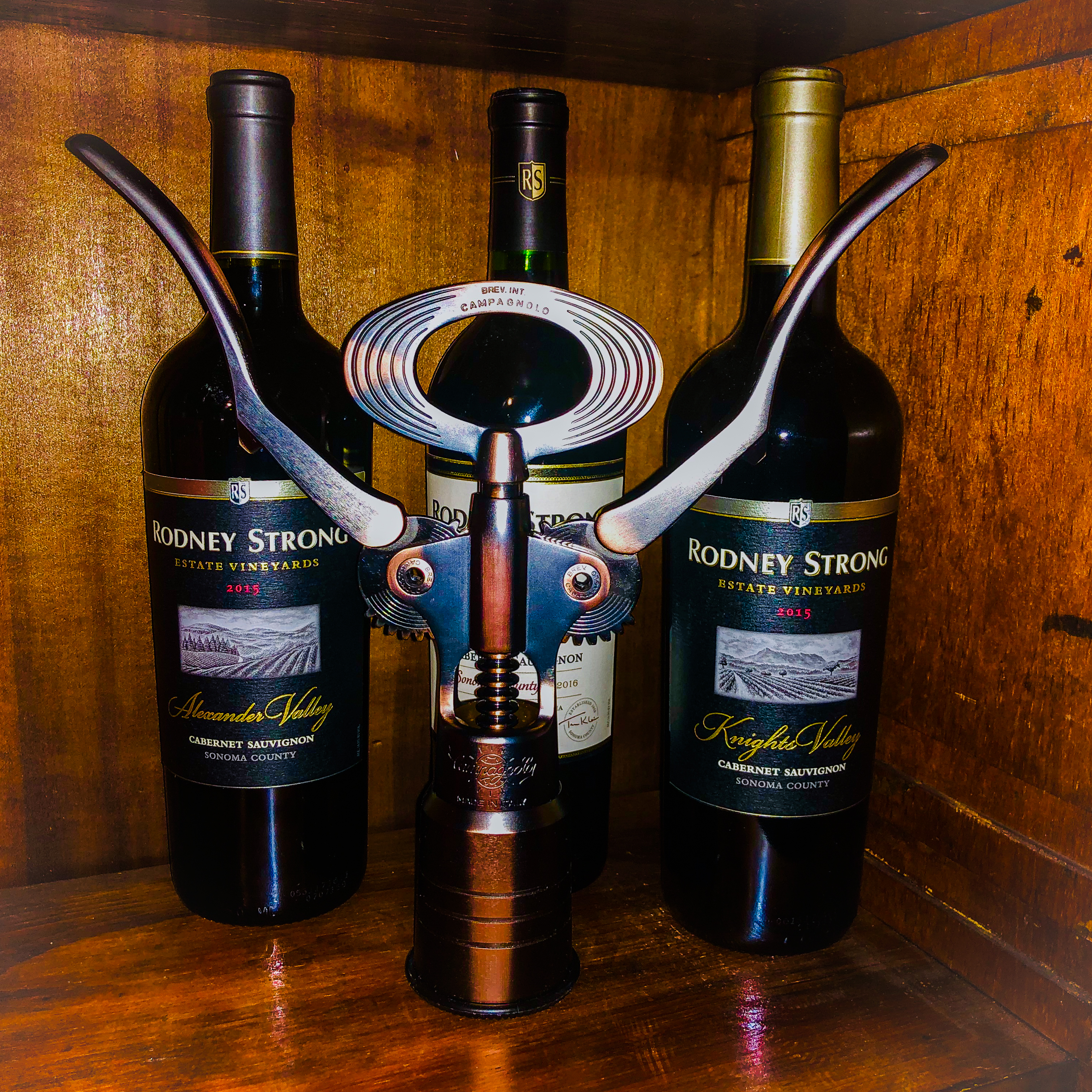
The Campagnolo Cavatappi “BIG” Corkscrew. PC: Steven L. Sheffield
People may ask which of Tullio Campagnolo’s inventions are the most important; the quick release allowing gears to be changed more easily in the pre-derailleur days, or the Gran Sport (and later Record & Super Record) rear derailleurs. One may even debate who has had a bigger impact on cycling, Campagnolo or Shimano … and the best way to do so, is over a fine bottle of wine.
While the Campagnolo vs. Shimano debate may never be decided, one area where Campagnolo definitely has the edge is with their Cavatappi or “BIG” corkscrew, inspired when old Tullio once again hurt his hand … this time in 1966 when opening a bottle of wine.
A self-centering telescopic bell positions the vermillion (the actual corkscrew) in the center of the cork, and the two levers draw out the cork easily and gently. No more broken corks leaving pieces floating in your wine from a poorly centered vermillion, no more wrenching the cork back and forth to get it out of the bottle. As befitting any tool created by the Italian master, the levers are affixed to the main body of the corkscrew with bolts derived from those used to attach chainrings to a Super Record crankset.
Quite simply, the Campagnolo Cavatappi is the best corkscrew ever made, and remained virtually unchanged until 2013, when it was updated; not to improve the way it works, but with new plating to ensure a top-quality, attractive, and even longer-lasting finish so that it retains its character for a lifetime.
All this, and 100% Made in Italy.
The Campagnolo Cavatappi can be found at (or ordered from) finer bike shops. MSRP is $250.00.


 The National Park Service (NPS) is eager to work with communities and activists on improving bicycling in and around national parks. NPS just released the National Park Service Active Transportation Guidebook: A Resource on Supporting Walking & Bicycling for National Parks & their Partners (https://www.nps.gov/subjects/transportation/bikeped.htm).