Home Blog Page 44

Advocacy Alert: Utah’s Zen Trail and Bear Claw Poppy Trail in Danger of Closing

Guest Editorial by Lukas Brinkerhoff

BEEP! BEEP! That blaring sound you’ve been hearing is the Emergency Broadcast System and this is not a test.

ST. GEORGE, Utah (November 26, 2024) — Southern Utah’s Bear Claw Poppy Trail and Zen Trail are in imminent danger. These two highly popular trails are located on  Utah State Trust Lands (SITLA). SITLA has begun the process of receiving proposals to turn that land into cash. This means there could be anything from McMansions to high density housing to a proposed uber high end resort along the lines of Amangiri with nightly stays costing over $10K.
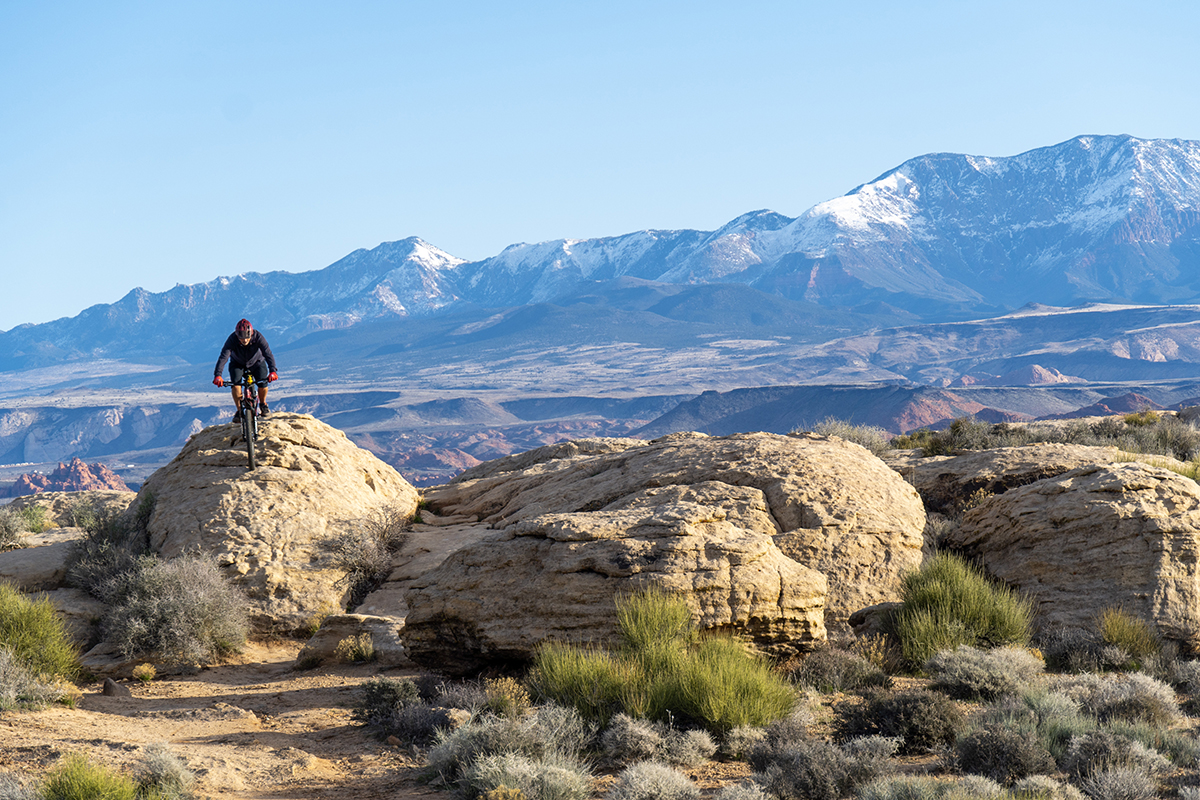
The Zen Trail, pictured here, is in danger of closing permenantly. Photo by Lukas Brinkerhoff

Between these two trails alone, there is an average of 140,000 trail visits each year. They are some of the most popular trails for locals as the access is right out of the neighborhood. Plus, thousands of visitors each year travel to Washington County specifically for recreational purposes often driven by this area.

It’s safe to say that the two trailheads are almost always full.

In addition to the mountain bike trails, two incredibly popular climbing areas would also be affected. Both Moe’s Valley and a portion of the Gap are located within this prime real estate.

As these things tend to go in Washington County, there are a lot of different entities involved and a lot of history that goes into what those different groups want and are willing to accept as a viable alternative to developing this land. SITLA as an organization is not tied to much other than their mandate to create funds for the Education Department.

A wide coalition of climbers, mountain bikers and hikers are tirelessly working to make sure these areas stay open and unchanged. There are a lot of people that use and are passionate about this chunk of land. I won’t bore you with the specifics as there is a lot of nuance, a lot of history, and a lot of politics tied up in these 3,000+ acres of sandstone and alkaline soils, but we do need your help.

The best tool we have right now is to make sure that elected officials are aware of the threat and that they understand how important these places are for our communities. This is most likely going to be a marathon of an effort and we’re going to need the support of all public officials to come up with a viable and acceptable solution.

To that end, we ask that you take a few moments to sign the petition to show your support for these trails and to let elected officials know that you are asking for their support.

And unfortunately, we can’t turn off that blaring beep until these trails are permanently protected, so you best get at it.

Sign the petition here, Petition to Permanently Protect the Greater Moe’s Valley Area including Moe’s Valley, Green Valley Gap, Zen Trail & Bearclaw Poppy Trail in Washington County, Utah

You can find more information including maps at http://moesvalley.com

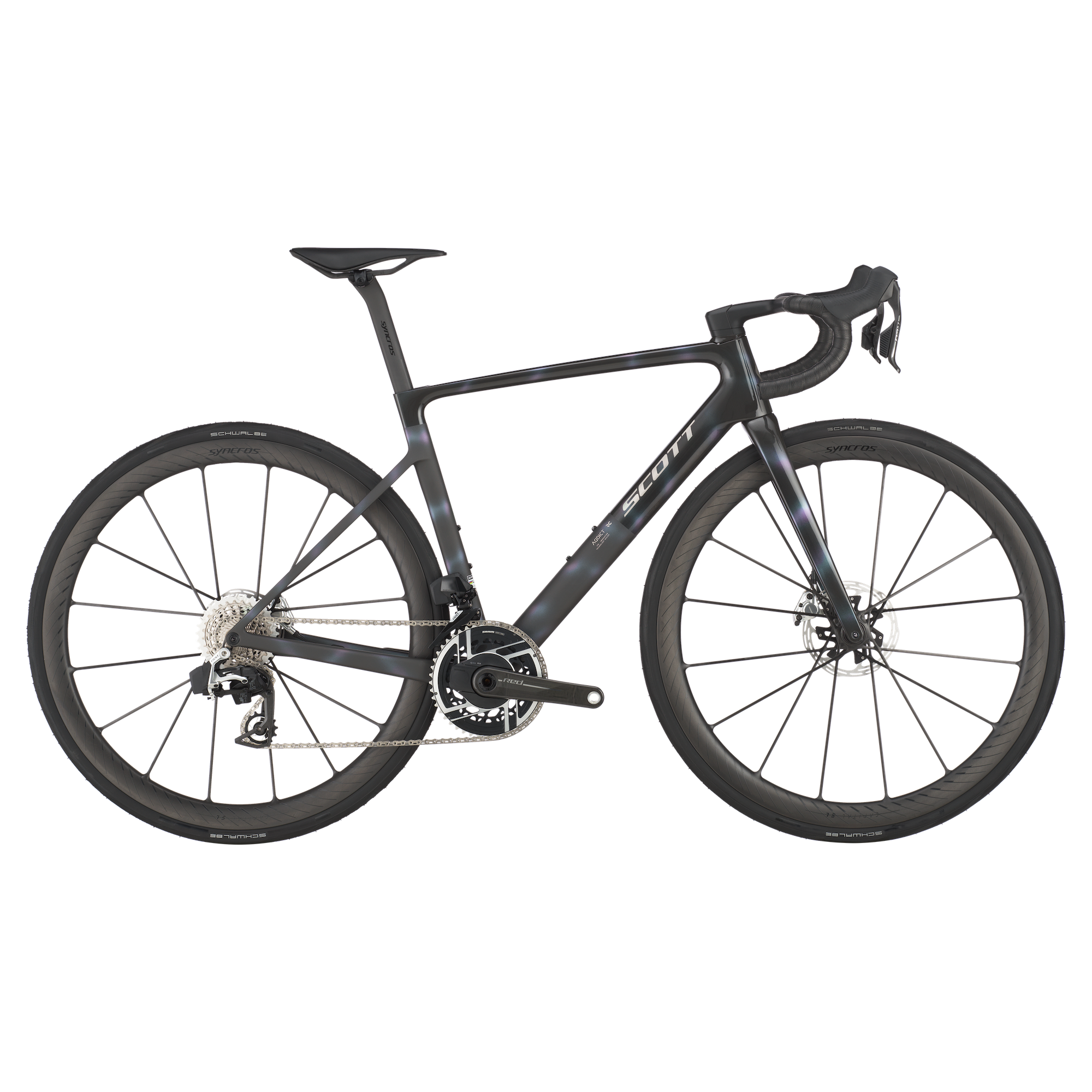
All-New Addict RC Announced by SCOTT

0

Introducing the ALL-NEW Addict RC, SCOTT’s Lightest Production Race Bike ever, developed to leave everyone else in the dust. 

SALT LAKE CITY, Utah (November 26, 2024) — The Addict RC has always been about shedding grams. The latest iteration has been engineered to help riders in the pursuit of defying gravity. SCOTT’s development team had lightweight on the brain 24/7 for this bike – the outcome? A remarkable 300g reduction in the frame kit weight compared to its predecessor and without any compromise on race performance.

Now, this new generation of Addict offers something unique on the market—a complete bike weighing in at under 5.9kg with race-ready geometry that can handle a World Tour sprint, lead a breakaway, and claim all the KOMs along the way.  

LIGHTWEIGHT EXPERTISE

SCOTT’s commitment to crafting lightweight bikes is inseparable from its expertise in carbon technology. For the all-new Addict RC, we took our approach to carbon road bike manufacturing and flipped it on its head. Drawing inspiration from our approach to mountain bikes, we meticulously reevaluated our molding techniques, seeking innovative ways to enhance performance on the road. The outcome? A remarkable 300g reduction in the frame kit weight compared to its predecessor, and without any compromise on race performance.
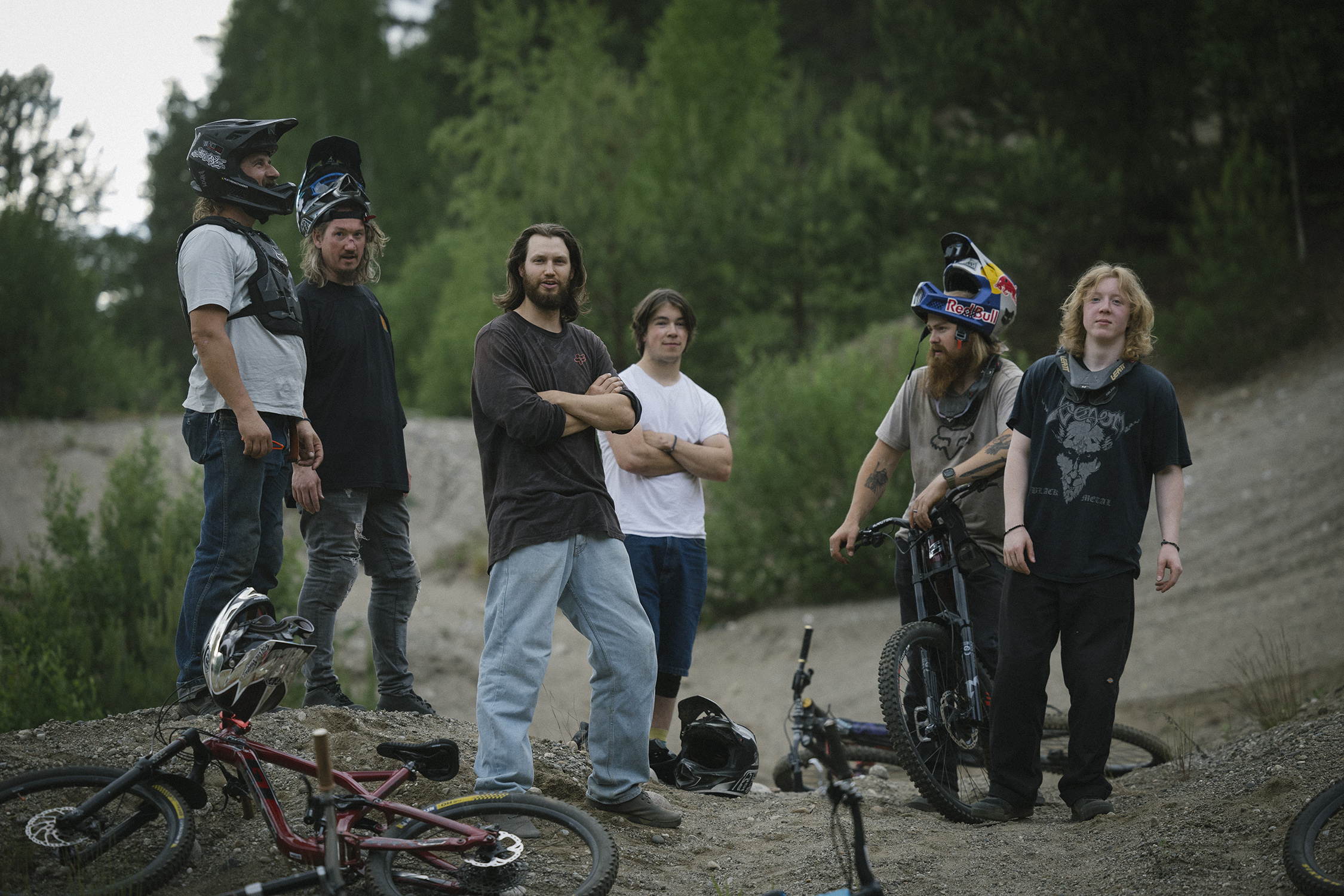
Photo © SCOTT Sports / Brazo de Hierro.”

A new way of carbon molding enabled us to produce a completely hollow frame without any dead-end tube segments. This process is unique in the cycling industry, and it’s only applicable if the frame design is tailor-made for this manufacturing method.

Thanks to the smooth surface of the inflatable preform core, the inside of the frame is super clean and does not have any signs of voids or wrinkles. Due to the precise inside shape, all the excessive resin is extracted from the frame during the molding process, leaving only what’s really necessary for stiffness and strength.

The consistent molding pressure across the complete frame surface ensures optimal compaction of the layup and makes it possible to avoid any additional reinforcement while reducing the thickness to about 0.6mm in some areas.

PRECISION ENGINEERING

Our innovative manufacturing process (PP Mandrel) enables high-precision molding of inner surfaces and transition zones, paired with strength-optimized tube shapes that eliminate additional reinforcements and unnecessary filler material. The result is best-in-class tube profiles and surfaces, significantly reducing the total weight of the frame without sacrificing strength or stiffness.

Photo © SCOTT Sports / Brazo de Hierro.”

With a better carbon lay-up, a reduction in the number of carbon pieces and joints, and incredible attention to the smaller details, such as seat stays and seat clamp, the team shaved weight without sacrificing stiffness.

OPTIMIZED GEOMETRY

The new Addict RC’s geometry has undergone a comprehensive redesign to align seamlessly with our modern specifications for this bike, accommodating wider tires while enhancing overall handling consistency across all sizes. Whether you’re a professional rider or chasing after the local KOMs/QOMs on the weekends, the new Addict RC promises heightened agility and responsiveness, ensuring an unparalleled riding experience.

Photo © SCOTT Sports / Brazo de Hierro.”

Coming stock on the bike, you’ll find a 28mm tire setup. The frame has enough clearance for 34mm tires. We also adapted the Addict RC’s geometry to provide agile handling for tight cornering and quick steering maneuvers. At the same time, we wanted to keep the bike stable enough to resist sudden gusts of wind and to avoid feeling nervous at high descending speeds.

COMFORT

The integration of advanced molding technology and a redesigned seat post clamping system allows for thinner seat tube walls and reduced material usage in this keyframe part. Paired with the new innovative Syncros SP-R101-CF Seatpost, the lower thickness of the seat tube enhances flexibility and promotes added comfort during longer rides. Furthermore, the all-new Addict RC offers a generous 34mm tire clearance, ensuring enhanced comfort even on the most challenging terrain.

Photo © SCOTT Sports / Brazo de Hierro.”

SYNCROS INTEGRATION

IC-R100-SL Cockpit

The introduction of the new Addict RC set the stage for the development of a new innovative Syncros cockpit, the IC-R100-SL. Our goal was to create an aerodynamic handlebar, achieved by incorporating a subtle flare on the drops to seamlessly blend with the brake levers, resulting in enhanced watt savings and improved handling.

The new SYNCROS integrated cockpit was also optimized to reduce material further. Thanks to a new stem clamping design and an FEA-optimized carbon layup, it’s now about 40g lighter at the same strength and stiffness. As standard on all our bikes, Addict RC cockpits offer various computer and accessory mounts. We even developed a new computer mount for our cockpits. It weighs only 12g, almost 70% lighter than our standard CNC machined Computer Mounts.

SP-R100-SL Seatpost

A symbiotic frame kit system can only work with a matching seat post. For the new Addict RC, we offer two different options to match each individual needs.

Our new SL seat post is 10% lighter than the previous model. Thanks to the new seat post clamp design, which is more fiber-friendly, we optimized the seat post layup and further reduced weight while increasing flexibility and comfort. The new Comfort seat post, available from the Addict RC 10, increases the bike’s comfort by another 30% compared to the SL version.

The flexible cover at the back of the Comfort seat post hides a magnetic bracket system to swap the cover with our new SYNCROS rear light once the days get shorter.

User-friendly adjustments

We’ve engineered the new Addict RC to be effortlessly adjustable, setting a new standard in ease of setup. By streamlining bolt specifications and integrating a universal tool, we’ve revolutionized the adjustment process. Located discreetly within the cockpit or handlebar drop, the T25 key empowers riders to fine-tune the stem, handlebar, seat post, saddle clamps, and even bottle cages with unparalleled simplicity. This innovative solution not only enhances user experience but also simplifies setup procedures for mechanics.

Photo © SCOTT Sports / Brazo de Hierro.”

THE ADDICT RC PRODUCT RANGE

The Addict RC will come with five different models, benefiting from a complete HMX carbon construction (HMX-SL for the RC Ultimate) and the same technological benefits, regardless of the chosen spec level.

Discover the entire 2025 Addict RC collection at SCOTT-sports.com. All specs and pricing are provisional and might vary according to currency. The 2025 Addict RC collection will be available at local SCOTT dealers starting in December 2024.

Photo Credits: Brazo de Hierro, SCOTT Sports
Video Credits: Widen Production

Colnago V4Rs Tadej: A Special Bike to Celebrate the Successes of Tadej Pogačar

0

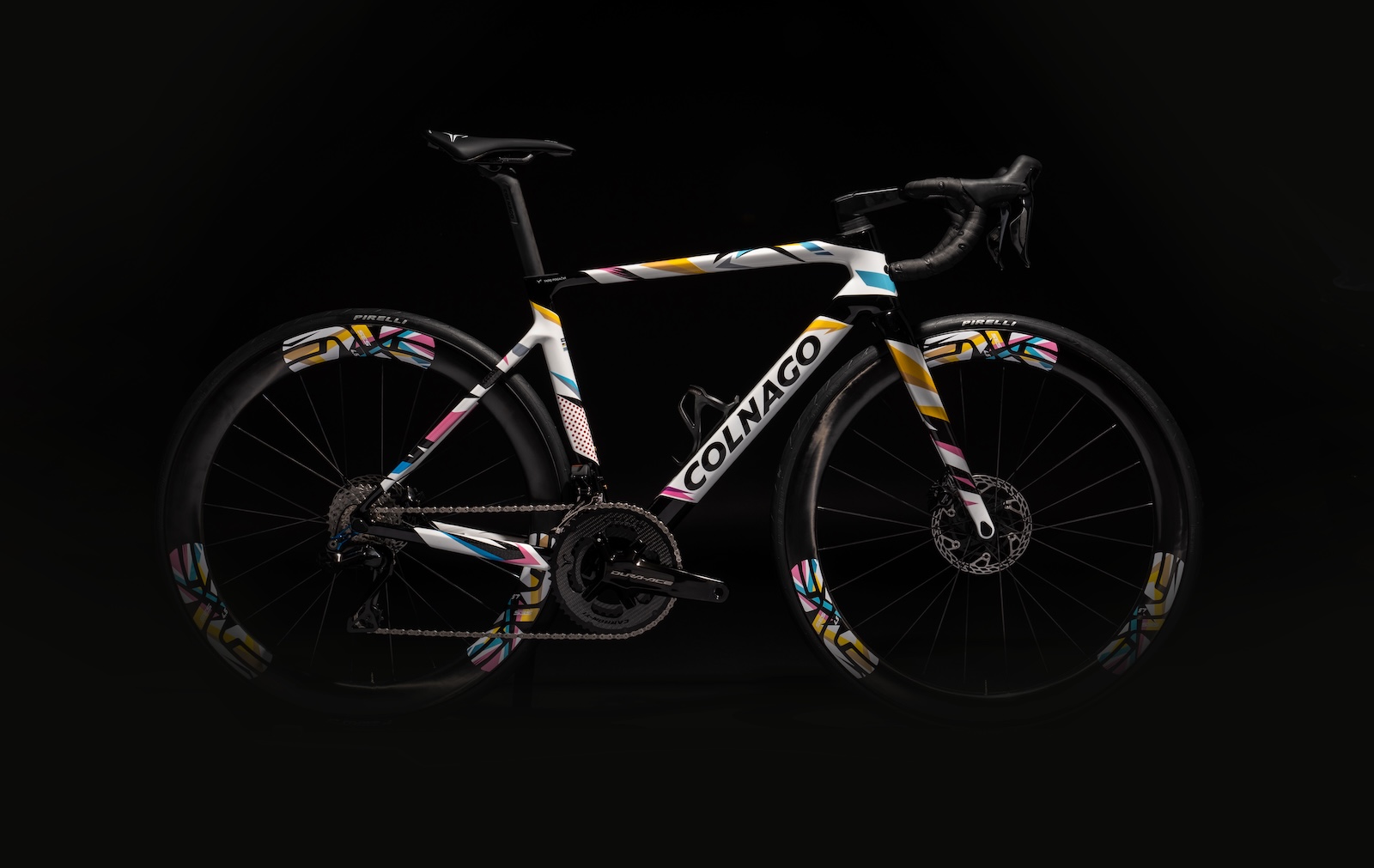
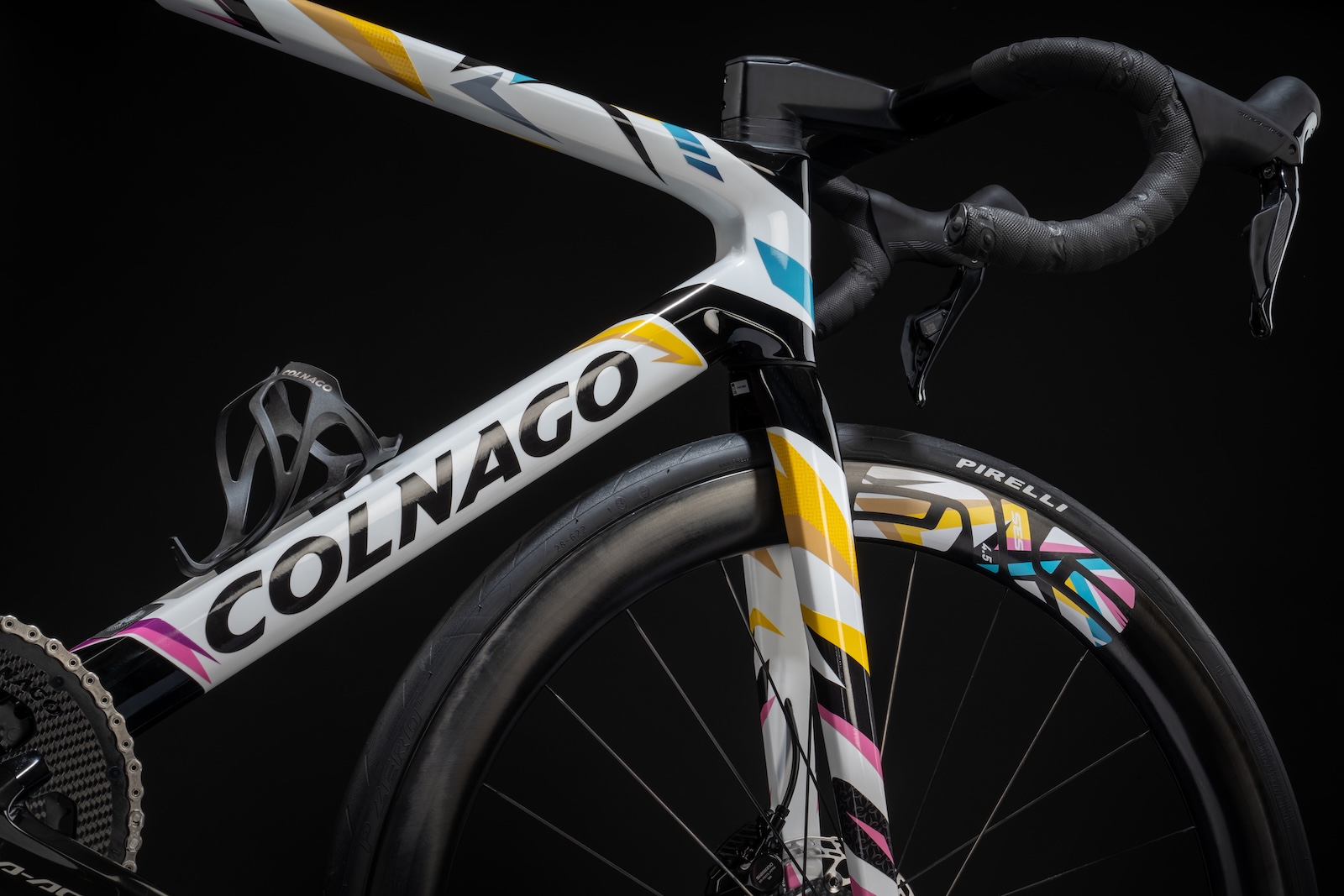
Colnago and Tadej Pogačar are pleased to present a special bike, the limited edition Colnago V4Rs Tadej, that he used to race at the World Championships in Zurich on September 29th. The colorful livery is inspired by all the successes collected by the Slovenian so far.

ZURICH, Switzerland (26 September 2024) — Colnago is pleased to unveil the V4Rs Tadej, the bike that Tadej Pogačar used race at the UCI Road World Championships in Zurich on Sunday, 29 September. The model is the same as he usually uses to compete with UAE Team Emirates, but this livery is very special and way more colorful.

Colnago V4Rs Tadej. Photo courtesy of Colnago.

The paint job recalls the creations made by the Pop-Art artistic movement, which was born around the mid-50s in the USA and the UK, and is inspired by all the major victories achieved so far by the three-times Maillaut-Jaune.

Design Inspiration

Eighty-five victories, including 4 Grand Tours and 14 Classics. On the top of the UCI individual ranking since 2021.

These are the astonishing numbers of Tadej Pogačar since his debut in the WorldTour, a rider who loves to distinguish himself in the peloton, wearing the leader jerseys, or attacking solo from afar.

Colnago V4Rs Tadej. Photo courtesy of Colnago.

The colors on this bike are a tribute to all the major races Pogačar won:

  • Yellow, to celebrate three Tour de France GC victories (2020, 2021, 2024)
  • Pink, as homage to the 2024 Giro d’Italia and the pink jersey he wore for 20 out of 21 stages;
  • Green, to recall Il Lombardia, the Monument Classic that he conquered in 2021, 2022, and 2023, and for Liège-Bastogne-Liège, which he won twice, in 2021 and 2024;
  • Heavenly blue, for Paris-Nice, one of the most prestigious one-week races on the calendar, won in 2023;
  • Blue, the color of Tirreno-Adriatico (victories in 2021-2022) and of the KOM jersey at Giro d’Italia (2024);
  • White, the color of the best young rider of the Tour de France, a special classification that Tadej Pogačar won for four years, from 2020 to 2023;
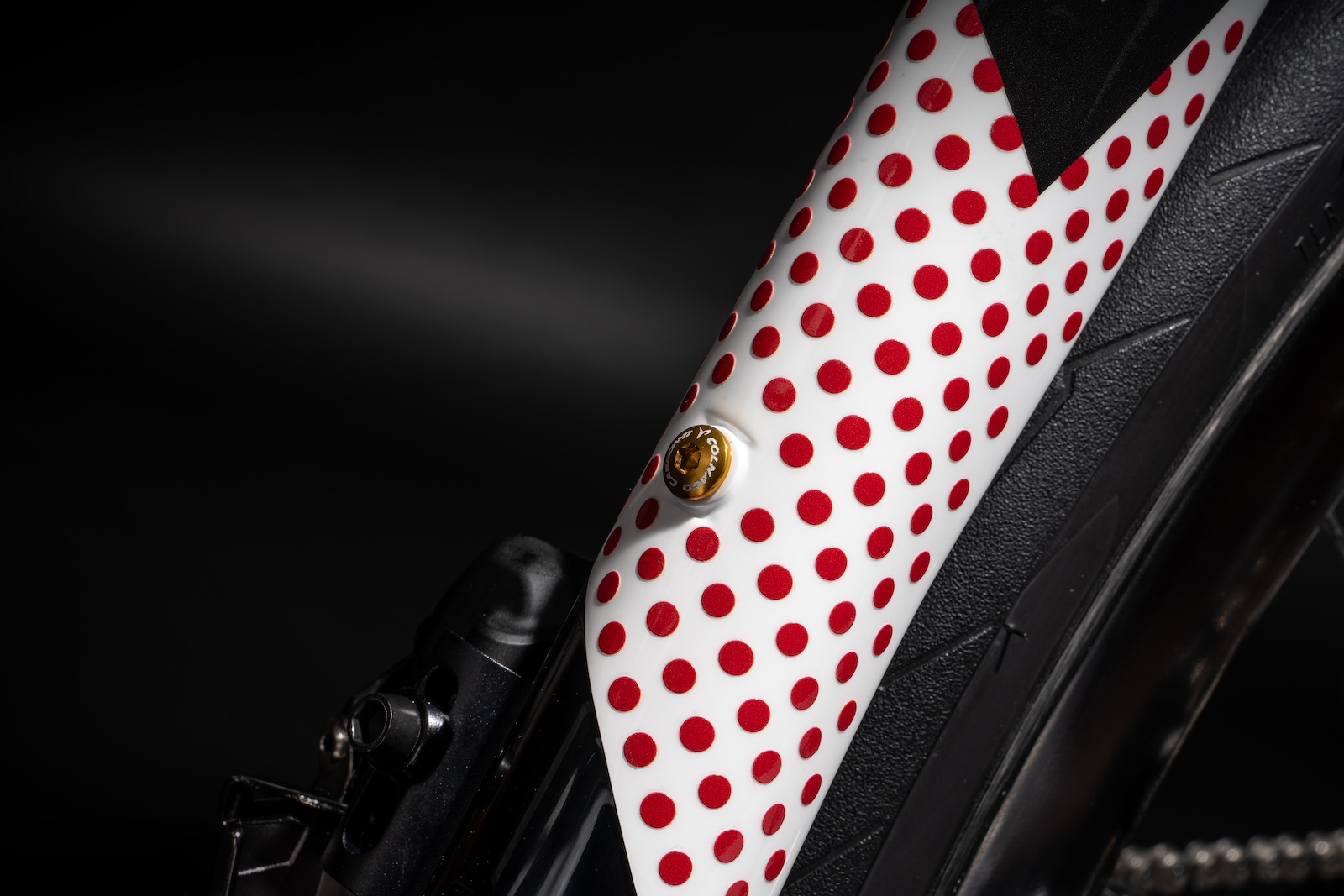
  • Red dots, to celebrate the iconic KOM jersey of the Tour de France, a special classification that Tadej won in 2020 and 2021;
  • Bronze, for two precious bronze medals: the one at the Olympics in 2021 and the one obtained at the World Championships in Glasgow in 2023;
  • Purple… because, as Tadej stated, you always need something purple in your life. The Slovenian actively participated in the creation of the bike, giving feedback to really personalize his Colnago.

Highly-personalized details

The bike is empowered with several personalizations, some with a purely aesthetic goal and others that also save weight and increase stiffness.

Colnago V4Rs Tadej. Photo courtesy of Colnago.
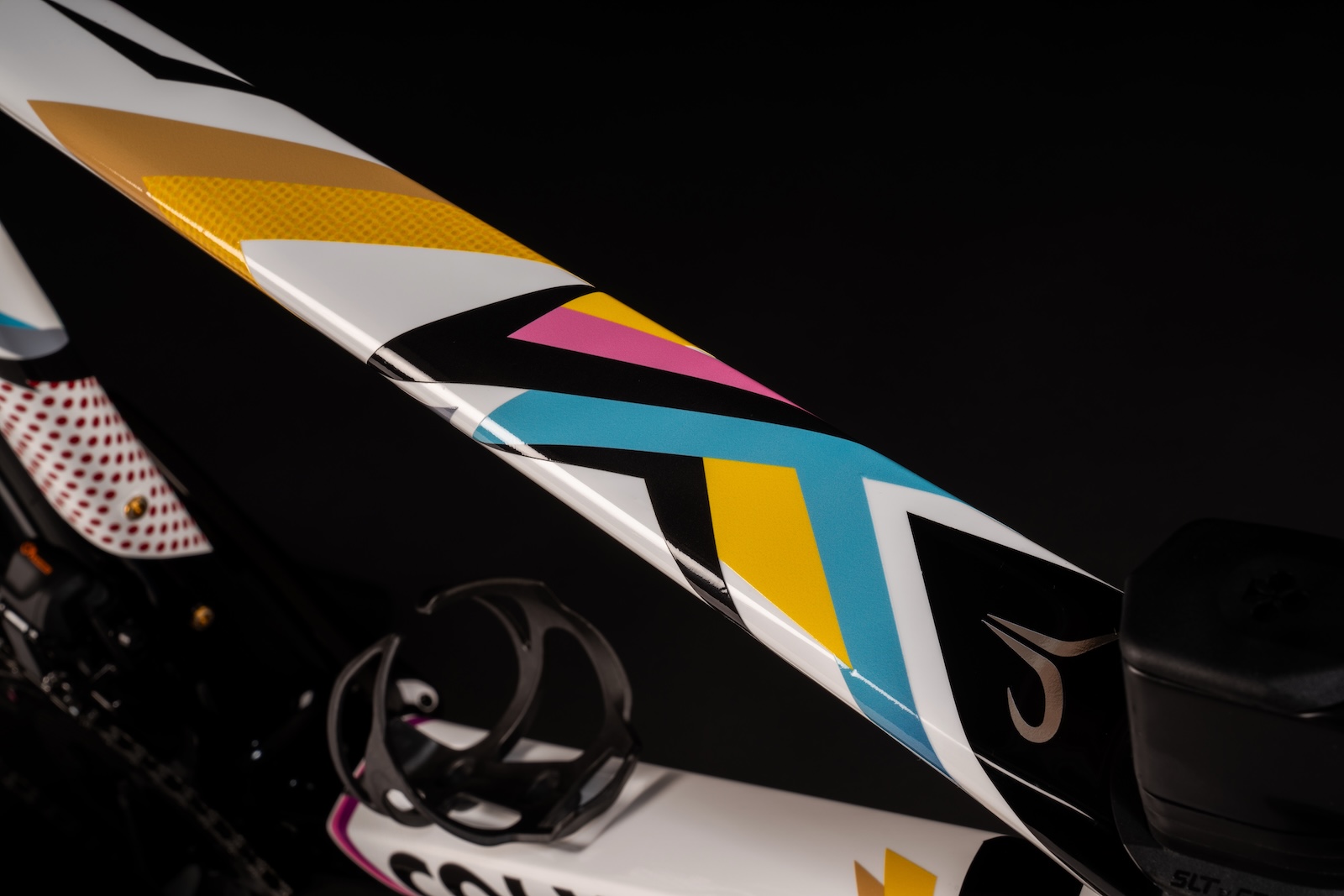
TP Logo and patterns:

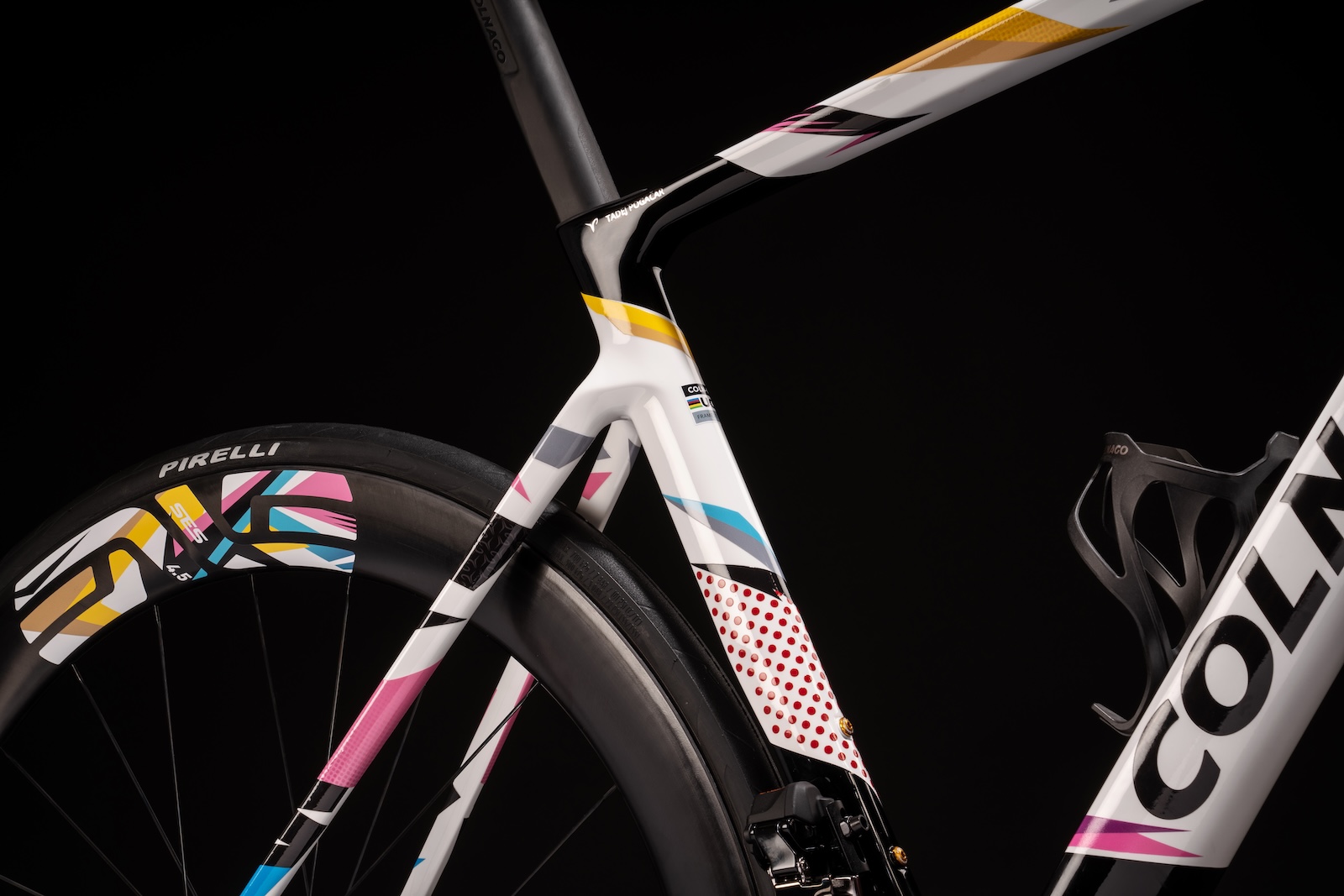
The TP (Tadej Pogačar) logo is visible on the frame, most notably on the horizontal tube and at the intersection with the seat tube. The TP pattern is also appreciated on some areas of the bike, such as the chainstays.

Colnago V4Rs Tadej. Photo courtesy of Colnago.
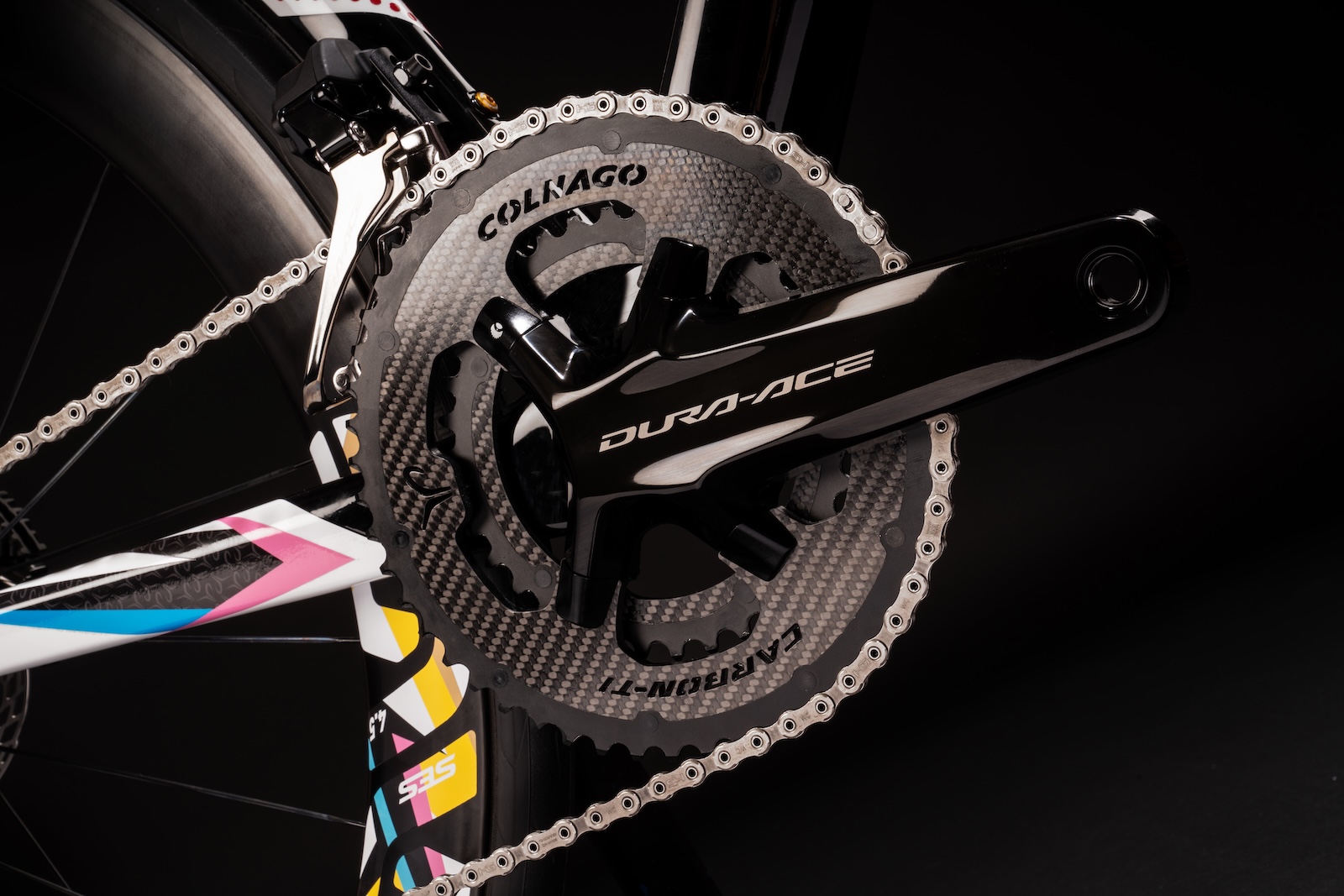
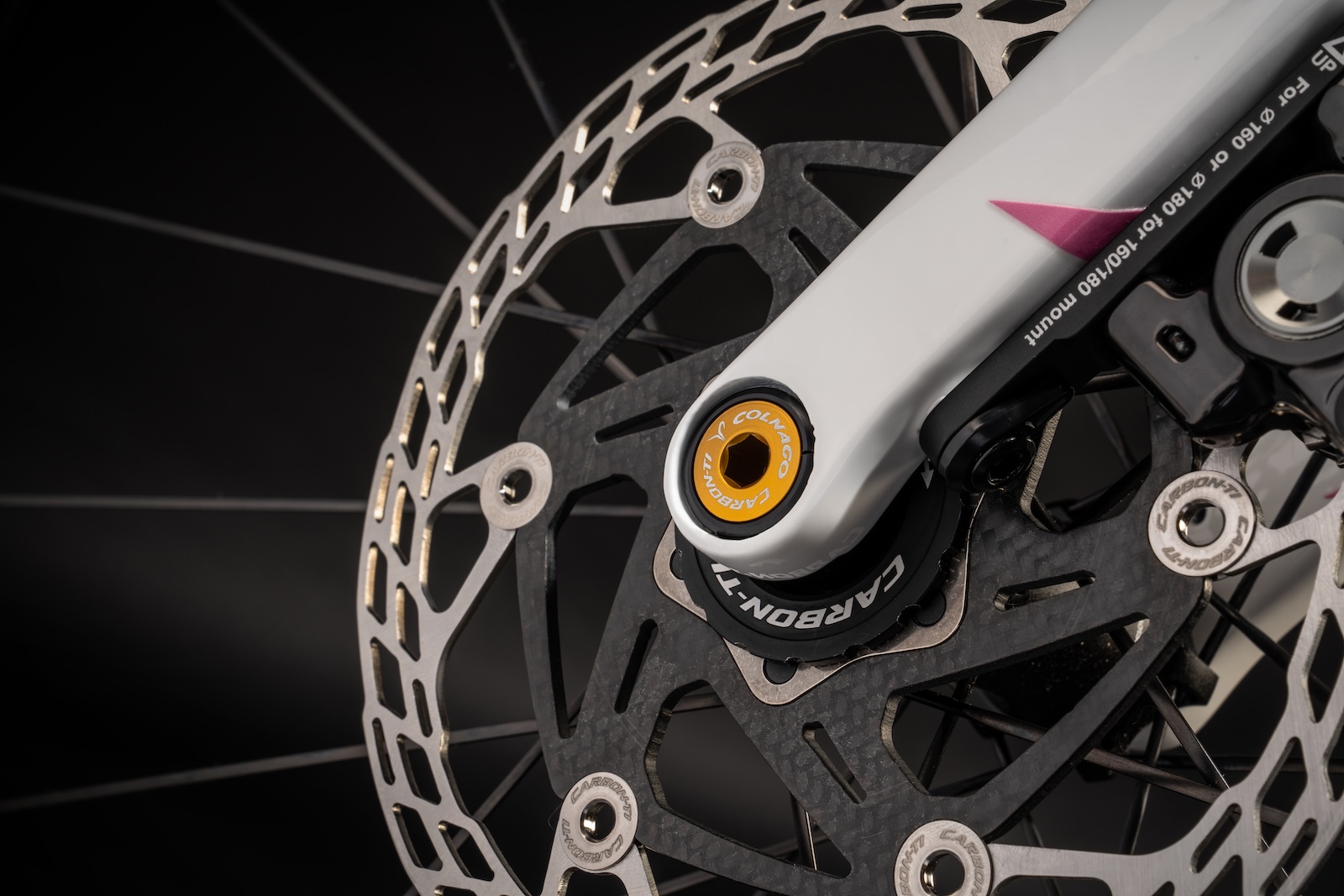
Carbon-Ti crankset, brake discs, thru-axles, and screws:

These are performance-oriented personalizations achieved thanks to the collaboration with the manufacturer Carbon-Ti.

  • The crankset is a composite aluminum alloy with a carbon fiber structure and engraved logos.
  • The discs are the X-rotor steel carbon 3 Center Lock, the highest level of technology available on the market.
  • The threaded thru-axles are super light and come in a gold anodized color with a laser-etched graphic: “Colnago—TP—Carbon-Ti.”
  • The same graphic can be seen also on the screws of the bottle cage, which are in the same gold anodized color and contribute to the bike’s overall weight-saving.
Colnago V4Rs Tadej. Photo courtesy of Colnago.
Enve SES 4.5

The wheels are decorated with the same graphics as the frame.

Prologo Saddle Nago R4 Nack Tadej Pogacar 24

A special Prologo Saddle completes the bike, the Prologo Nago R4 Nack 147 Tadej Pogacar 24, with yellow accents and the names of some of Tadej’s most important victories emblazoned upon it.

Rear derailleur hanger by Framesandgear

The Framesandgear Colnago Disc Brake Direct Mount Derailleur Hanger for V4RS Blue offers precise shifting, improved stiffness, and a lightweight design.

Configuration and Availability

The Colnago V4Rs Tadej will be made available as a limited edition. From the 26th of September until the 14th of October, you will be able to have it exclusively online, on www.colnago.com.

From the 14th of October on, you will be able to find it through stores.

The Colnago V4Rs will be equipped with Shimano Dura-Ace Di2, Enve 4.5 SES Wheelset, Colnago CC.01 Handlebar at a suggested retail price in Europe of 17,200.00€.

Technical Information

  • Name: Colnago V4Rs Tadej
  • Limited edition: XXX?
  • Model: V4Rs
  • Family: V Series
  • Groupset: Shimano Dura-Ace Di2 R9200.
  • Chainrings: Carbon-Ti special limited edition custom Colnago TP 52-36t
  • Sprockets: 12-speed, 11-30t
  • Wheels: ENVE SES 4.5 special limited edition Colnago V4Rs Tadej
  • Discs: Carbon-Ti X-Rotor SteelCarbon 3 – 160mm front / 140mm rear
  • Tires: Pirelli P ZERO Race TLR X 28mm BK
  • Saddle: Prologo Nago R4 Nack 147 Tadej Pogacar 24
  • Handlebar: Colnago CC.01
  • Thru-axles: Threaded thru-axle front Ø12 L120mm – hex 6 Carbon-Ti Gold TP and Threaded thru-axle rear Ø12 L163mm – hex 6 Carbon-Ti Gold TP
  • Rear derailleur hanger: Framesandgear Direct Derailleur Mount V4Rs Blue


2025 US National Championship Schedule Announced

0

USA Cycling unveils the dates and locations for National Championships across Road, Mountain, Track, Cyclocross, Gravel, BMX, and eSports.

COLORADO SPRINGS, Colorado (November 22, 2024) – USA Cycling unveiled the schedule for the 2025 USA Cycling National Championships. With events spanning multiple cycling disciplines, the season showcases some of the best races in the United States. They will draw thousands of cyclists and fans from around the country, all vying for the coveted Stars and Stripes jersey.

“We’re still on Cloud 9 from the record-breaking performances of Team USA cyclists at the Paris 2024 Olympics. That spirit of dreaming big is what makes our National Championships so meaningful,” said USA Cycling’s President and CEO, Brendan Quirk. “For some, it’s about winning a title and qualifying for the World Championships. And for others, it’s about having the courage to sign up and test themselves for the first time against national-caliber competition. There’s something for everyone, and we welcome all our members to pick a National Championship and set their own personal goals.”

Riders will see some exciting new venues in 2025. The first National Championship of the year will be eSports, in partnership with Echelon Racing Promotions and now taking place on MyWhoosh for the first time. Trek Bicycle will host Collegiate Road Nationals, and Tour of America’s Dairyland will host Masters & Junior Road Nationals, both taking place in Wisconsin. Pro Road Nationals is returning to Charleston showcasing Elite, Under-23, Junior 17-18, and Para-cycling racers. It will also mark the debut of the Under-23 Women’s Road Race as a standalone event, as well as the addition of Para-cycling to the program. For 2025 and 2026, Endurance Mountain Bike Nationals will include both the Cross-Country and Marathon Mountain Bike events, creating one exhilarating race week in Roanoke. Gravity Mountain Bike Nationals will take place in partnership with the Pro Downhill Series – specific dates and locations for the Championship event will be announced at a later date. The recently reopened Colorado Springs Velodrome will host Elite, Masters, and Para-cycling Track Nationals. The Gravel National Championship is heading to La Crescent, Minn. To conclude the season, Cyclocross Nationals will take place in Fayetteville, Ark.

The 2025 National Championship schedule is as follows:

Date National Championship Location
February 1 eSports Cycling MyWhoosh
March 23-24 Collegiate BMX West Monroe, La.
May 2-4 Collegiate Road Madison, Wis.
May 9-11 Elite BMX Tulsa, Okla.
May 20-25 Pro Road (Elite, U23, 17-18, Para-cycling) Charleston, W.Va.
June 28-July 2 Masters & Junior Road South East, Wis.
July 14-20 Endurance Mountain Bike Roanoke, Va.
July 24-27 Junior Track Redmond, Wash.
August 6-10 Masters & Para-cycling Track Colorado Springs, Colo.
August 21-24 Elite Track Colorado Springs, Colo.
September 11-14 Collegiate Track Indianapolis, Ind.
September 14 Gran Fondo Frederick, Md.
September 20 Gravel La Crescent, Minn.
October 9-12 Collegiate Mountain Bike Grand Junction, Colo.
November 14-15 Madison Track Detroit, Mich.
December 11-14 Cyclocross Fayetteville, Ark.
Coming Soon Gravity Mountain Bike Coming Soon

 
Details including event locations, registration information, and additional event specifics, will be available on the USA Cycling website at https://usacycling.org/events/national-championships.

For more information, contact National Events at [email protected].

Bicycle on a Quiet Street – The Bicycle Art of Richard Vroom

0
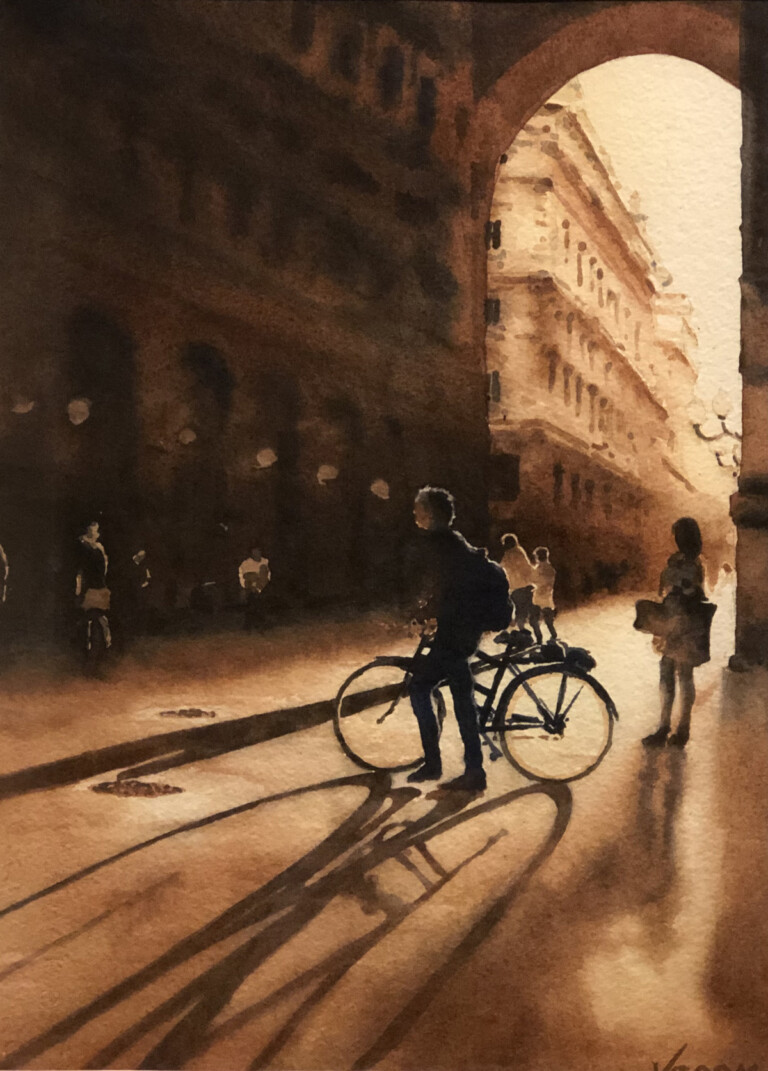
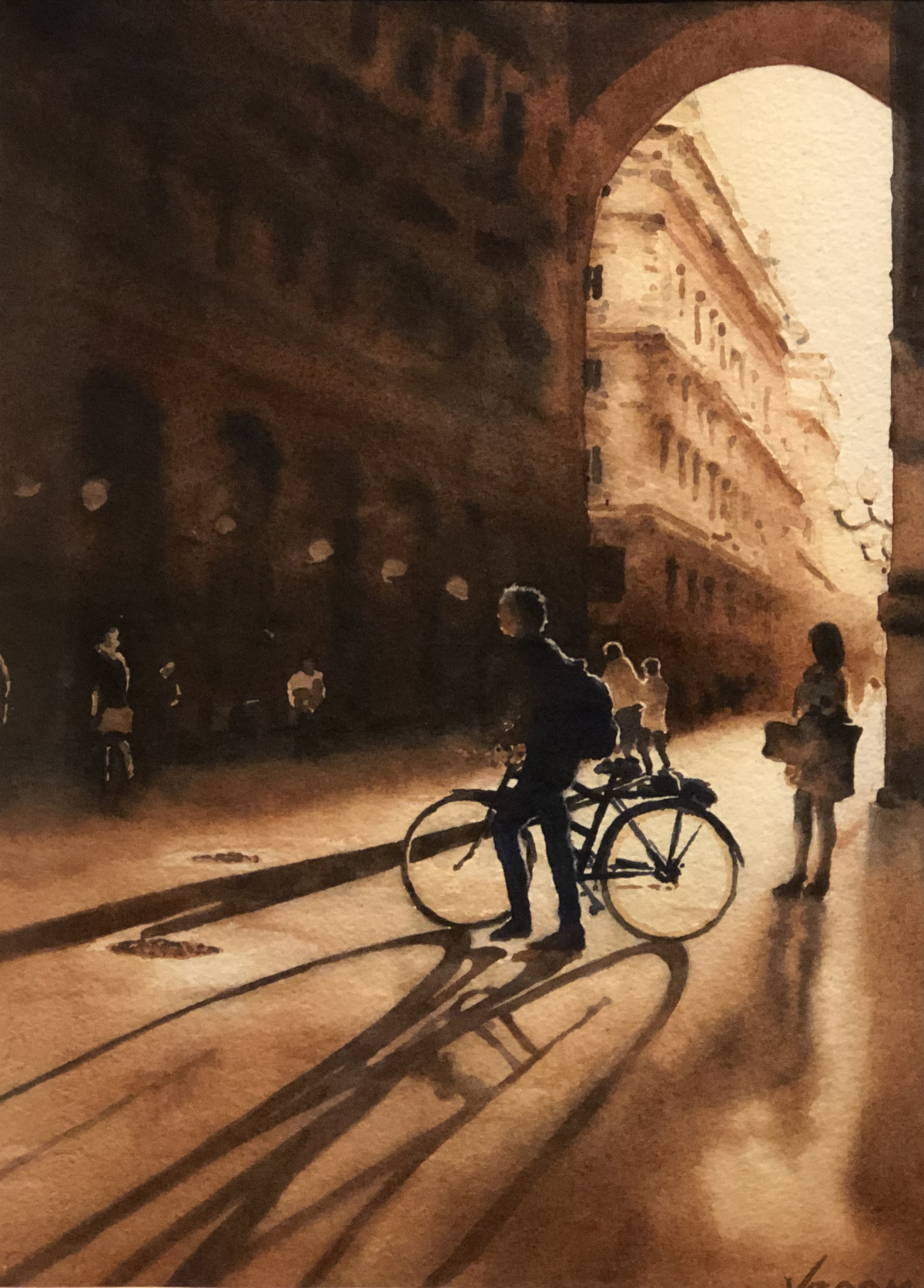
A Quiet Street – The Bicycle Art of Richard Vroom

Title: Untitled
Medium: Watercolor on paper.

Rich Vroom was a watercolor artist based in Salt Lake City, Utah. His studio is in Sugarhouse where he taught classes, paints, and bike races. He also taught at the University of Utah. Rich passed away in 2023.

Follow Rich on Instagram @richvroom or on Facebook: Rich Vroom Watercolors.


Virtual Cycling: How Zwift Changed the Way I Train

0

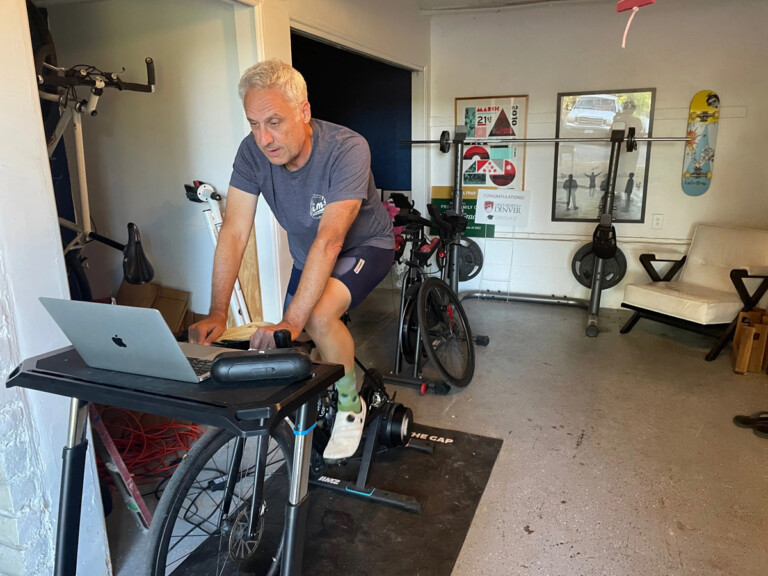
By Peter Abraham — Early last year, my friend Steve Beckett, CMO at Zwift, gifted me their Hub trainer to try out. I had not used Zwift or any other virtual training platform at all. I of course had heard of Zwift, and I often saw the virtual workouts of my friends on Strava. But I had not done any stationary training for over 15 years. In those days as a masters bike racer I had a wind trainer that was not connected digitally at all. But the world has changed and virtual training is an entire category of cycling that did not even exist last time I rode indoors.

My Zwift set up in the garage. Photo courtesy Peter Abraham

Given the unusually rainy winter we had in 2023, it was a good time to get started with virtual training. As someone who was totally committed to riding outdoors all the time, it took me a few sessions to acclimatize to riding indoors and online. But I soon became a convert. There are many online platforms, like Rouvy, MyWhoosh and TrainerRoad. But I have focused on Zwift, because that’s where most of my friends are. I still love riding outdoors, although Zwifting is now a key part of my training. There are all kinds of nuances and sophisticated technical features on the Zwift platform. I won’t get too far into those details. YouTube is full of videos about all of that stuff. Generally, here’s why I love riding virtually:

  1. Time efficiency: When you ride on a trainer, there is no coasting downhill, there are no stop signs, no waiting for red lights, none of that. You are pedaling for 100% of the workout. That means an hour ride on Zwift is comparable to 1.5 or more hours outdoors. And there’s less gearing up and gearing down for a ride. So you get the same amount of fitness in about half the time when riding indoors. Sometimes I just run down to the garage and squeeze in 30 minutes on Zwift. That counts as a workout.
  2. Avoiding the weather and the dark: it feels like a luxury to ride without worrying about heat (very much an issue where I live in LA), rain or pre-dawn or evening darkness. Compared with riding outdoors, your rides are not at all limited by any of these things. This opens up a bunch of new times to ride: mid-day in the summer, nights and super early mornings.
  3. Injury recovery: I recently went through a challenging 6-month period where I had a MTB crash that resulted in a concussion, and then a herniated disc in my neck. Both of these injuries meant that I could not safely ride outdoors for weeks at a time while I was recovering. Being able to jump on Zwift was crucial for me — I was still able to work out but in a way that was safe. In both cases I could also start with very easy zone 1–2 rides that are hard to do outdoors in the hills around my house.
  4. Motivation: When you’re in a Zwift ride, there are generally lots of other Zwifters, sometimes hundreds, there as well. And with each person’s nationality flag displayed, you can see that you’re riding with people from all over Europe, Asia, Australia and even further afield. If it’s a race (there are workouts, events, races, group rides or you can just ride on your own) you really do have to push to keep up with a fast group. I find that I often ride harder than if I was just trying to do, say, intervals by myself. There is real benefit to being pushed outside of your comfort zone when you want a really hard workout. And there are all kinds of interesting events tied into different Zwift virtual worlds (Watopia, London, Yorkshire, France, etc). I’ve done a bunch of Tour de France climbs, group rides with professional teams, and I’ve even by chance virtually run into my friend Eric Min, the co-founder and CEO of Zwift, during a ride.
  5. Safety: As important as riding outdoors is to me, being on the road with cars does pose very real dangers. Sometimes it’s nice to not worry about that, zone out, listen to some music or a podcast and get a stress free workout in. This is an indoor cycling benefit that you just can’t dismiss.
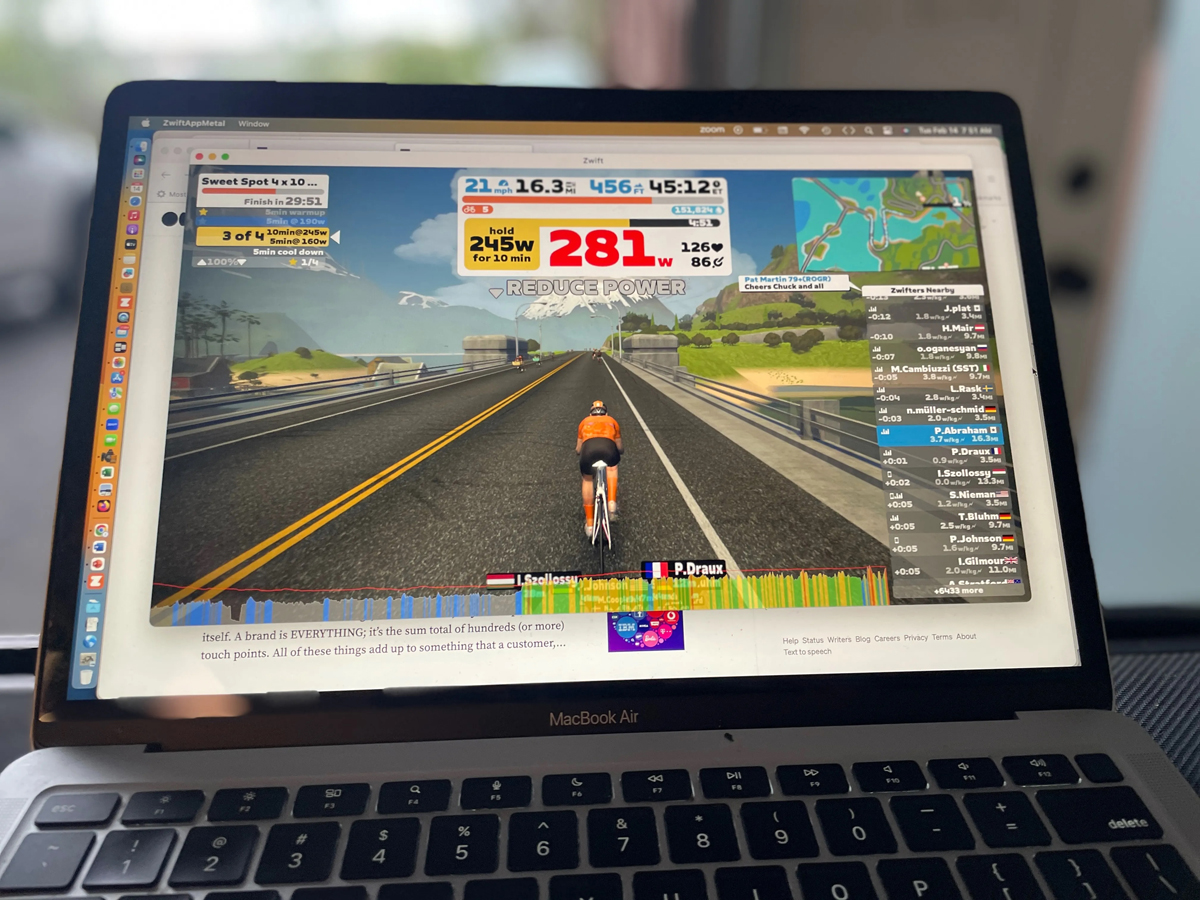
During my sweet spot interval workout on Zwift. Photo by Peter Abraham

I recommend adding indoor riding to your training repertoire if you have not already. The only negative of indoor training for me is having to take my bike on and off the trainer in the garage when I want to ride outdoors. The switch only takes a minute or so, but I wish I had a dedicated indoor training set up. Were I starting from scratch right now, I might get this new Zwift Ride stationary bike. This slick, purpose-built bike would just live in my pain cave and be ready to ride at a moment’s notice.

USA Cycling’s CEO Quirk Elected as National Governing Body Council Chair

0

COLORADO SPRINGS, Colorado (November 18, 2024) — Late last week, Brendan Quirk, President and CEO of USA Cycling, was elected Chair of the National Governing Body Council (NGBC), while Aron McGuire, CEO of USA Bobsled & Skeleton, was elected Vice Chair. Together, Quirk and McGuire will act as liaisons between the 50 National Governing Bodies (NGBs) and the U.S. Olympic & Paralympic Committee (USOPC), helping the collective group of national sports organizations work toward benchmarks of success. 

Brendan Quirk, President and CEO of USA Cyclling. Photo courtesy of USA Cycling.

“I’m grateful for the confidence shown by my fellow NGB CEOs in this election. Aron and I will work tirelessly alongside the USOPC and the Athletes’ Commission to maximize the support for Team USA athletes and our underlying development programs,” said Quirk. “National Governing Bodies face unique challenges as we head into the Los Angeles 2028 and the Salt Lake City 2034 Games. But at the same time, this will be the greatest decade in the history of American sport, and it will bring unprecedented opportunity.”

The NGBC supports National Governing Bodies (NGBs) and Paralympic Sport organizations in their pursuit of long-term competitive excellence. It represents the collective views of the NGBs to the USOPC’s Board of Directors and staff. Additionally, the council is responsible for fostering collaboration and communication between the NGBC and other USOPC groups, including the Athletes’ Commission and other stakeholders.

Following each summer Olympic quadrennium, a chair and vice chair are selected from the membership of the NGBC to a four-year term of office. Voting took place at the annual U.S. Olympic & Paralympic Assembly in Colorado Springs. In addition to voting in new leadership for constituent councils, the Assembly brought various stakeholders and user groups together to collaborate and prepare for Milan-Cortina 2026 and Los Angeles 2028.


Colorado Mesa & CalPoly Win at 2024 Collegiate MTB National Championships

Colorado Mesa University and California Polytechnic State University Win Team Omniums at the 2024 USA Cycling Collegiate Mountain Bike National Championships

Cole Punchard, Kiara Lylyk, Quentin Loxtercamp, and Gwen Ramsey earn individual omnium titles.

BENTONVILLE, Arkansas (November 18, 2024) — After four days of incredible competition, the 2024 USA Cycling Collegiate Mountain Bike National Championships came to a close on Sunday afternoon. At the end of the event, Colorado Mesa University took the Varsity omnium title, while California Polytechnic State University won the Club omnium title.

DUAL SLALOM

Racing kicked off with Dual Slalom qualifying and finals on Thursday. On the Women’s Club side, the top-seeded rider, Gwen Ramsey (Salida, Colo.; California Polytechnic State University) made it all the way to the final round to take gold. Vaila Heinemann (Mill Valley, Calif.; California Polytechnic State University) secured silver, and Avah Cherry (Knoxville Tenn.; The University of Tennessee) took bronze. In the Women’s Varsity race, Breanna Winter (Antelope, Calif.; Marian University) was the top-seeded rider and took home the Stars and Stripes jersey. Caitlyn Farmer (Atlanta, Ga.; Lindsey Wilson College) and Sierra Samhammer (Medford, Ore.; Marian University) finished second and third, respectively.

During the Men’s Club Dual Slalom Finals, George Poggemeyer (Littleton, Colo.; Colorado State University) defended his National Title, adding another gold medal to his collection. Adrian Hayden (Saranac Lake, N.Y.; UVM Cycling) earned silver, and Ben Mackenzie (Durango, Colo.; Colorado School of Mines) took bronze. Colorado Mesa University riders claimed the top three steps on the Varsity Men’s podium with Jack Spranger(Sammamish, Wash.) earning the Stars and Stripes jersey, Matt Sterling (Murrieta, Calif.) with silver, and Grant Lampson (Bethel Heights, Ark.) with bronze.

CROSS-COUNTRY

Nearly 200 endurance athletes took to the 7.9-kilometer Cross-Country course on Friday. Emily Stapleton (State College, Pa.; Penn State Cycling Club) kicked off the day with a win in the Club Women’s race. Elin Hartmann (Minneapolis, Minn.; Colorado State University) and Vaila Heinemann finished second and third, respectively. On the Varsity Women’s side, Kiara Lylyk (Guelph; Brevard College) was the first rider to cross the finish line, winning the National Title with a time of 1:16:04. Michaela Thompson (Durango, Colo.; Fort Lewis College) earned silver, and Lizzy Gunsalus (Dudley, Mass.; Marian University) took bronze.

Justin Peck (Los Gatos, Calif.; Cal Cycling) had an incredible race and won the Club Men’s National Title with a time of 1:23:28. Quentin Loxtercamp (Edina, Minn.; Colorado State University) and Oakley Griffin(Fayetteville, Ark.; Sewanee-The University of the South) finished second and third, respectively. On the Varsity Men’s side, Owen Clark (Mono; Brevard College) pushed it in the fourth lap, ultimately distancing himself from the group by 30-seconds to win the Stars and Stripes. Cole Punchard (Brevard, N.C.; Brevard College) earned silver, and Ivan Sippy (Durango, Colo.; Colorado Mesa University) took bronze.

SHORT TRACK

On Saturday, riders tackled the 1.4-kilometer Short Track course. Kicking off the morning was the Club Men’s race. It came down to a group sprint where Quentin Loxtercamp and Oakley Griffin went head-to-head with Brady White (Laguna Beach, Calif.; California Polytechnic State University) right on their heels. Loxtercamp crossed the line first to win the National Title. Griffin claimed silver and White earned bronze. On the Club Women’s side, Daniela Bronk (Shelburne, Vt.; Middlebury College) would win the Stars and Stripes jersey after finishing in a time of 21:05. Elin Hartmann and Emily Stapleton finished second and third, respectively.

In the Varsity division, Owen Clark claimed victory in the men’s race. Cole Punchard secured silver and Jack Spranger took bronze. Michaela Thompson (Durango, Colo.; Fort Lewis College) outsprinted Jette Aelken (Haltern Am See; Savannah College of Art & Design – Atlanta) to win gold in the women’s race. Kiara Lylyk secured bronze.

DOWNHILL

The Downhill event took place over two days, with the seeding events running on Saturday and the finals on Sunday. The Club Men’s field was 36 riders deep, and George Poggemeyer came out on top, stopping the clock at 3:00.43, and taking home his second title of the week. Eight-tenths of a second behind Poggemeyer was Ben Mackenzie, who claimed silver. Adrian Hayden would take bronze. Matthew Leliveld (Mulmur; Brevard College) won the Varsity Men’s race with his time of 2:52.22. In second was Matt Sterling followed by Cole Punchard in third.

For the Club Women, California Polytechnic State University went 1-2, with Gwen Ramsey and Vaila Heinemann earning gold and silver, respectively. Ramsey finished in 3:39.87, and Heinemann stopped the clock with a time of 3:46.15. This would be Ramsey’s second Stars and Stripes jersey of the week. Avah Cherry would take bronze. Breanna Winter finished with a time of 3:30.36, winning the Varsity Women’s National Title, her second title of the week. Maddy Glotfelty (Durango, Colo.; Fort Lewis College) claimed silver, and Sydney Nielson (Highland, Utah; Colorado Mesa University) took bronze.

TEAM RELAY

The pressure was on when it came to the final event of the weekend, the Team Relay. This was an important event for teams to grab their final points towards the overall omnium. In the Varsity race, Brevard College snagged the overall win, with Colorado Mesa University taking second, and Fort Lewis College earning third.

In the Club race, Colorado State University took the win.  California Polytechnic State University earned second, and Middlebury College secured third.

INDIVIDUAL OMNIUM

Club Women
  1. Gwen Ramsey (Salida, Colo.; California Polytechnic State University)
  2. Vaila Heinemann (Mill Valley, Calif.; California Polytechnic State University)
  3. Avah Cherry (Knoxville Tenn.; The University of Tennessee)
Varsity Women
  1. Kiara Lylyk (Guelph; Brevard College)
  2. Nicole Bradbury (Brevard, N.C.; Brevard College)
  3. Maria Doering (Banner Elk, N.C.; Savannah College of Art & Design – Atlanta)
Club Men
  1. Quentin Loxtercamp (Edina, Minn.; Colorado State University)
  2. Brady White (Laguna Beach, Calif.; California Polytechnic State University)
  3. George Poggemeyer (Littleton, Colo.; Colorado State University)
Varsity Men
  1. Cole Punchard (Brevard, N.C.; Brevard College)
  2. Jack Spranger (Sammamish, Wash.; Colorado Mesa University)
  3. Owen Clark (Mono; Brevard College)

TEAM OMNIUM

Club Omnium
  1. California Polytechnic State University – 574 Points
  2. Colorado State University – 506 Points
  3. UVM Cycling – 483 Points
Varsity Omnium
  1. Colorado Mesa University – 674 Points
  2. Brevard College – 664 Points
  3. Fort Lewis College – 592 Points

Rider results for the 2024 USA Cycling Collegiate Mountain Bike National Championships can be found here

Forest Service to Rehab Neglected 180-mile Trail Network in the Wyoming Range

Much of the range’s southern section near Kemmerer is hard to access, but zone is ‘just spectacular.’

by Katie Klingsporn (The Wyoming Range parallels the state’s western border, unfurling in a spine of ridges between Jackson and Kemmerer. Though the state’s namesake range, it’s not as widely known as the Tetons, Bighorns or Wind Rivers.
 
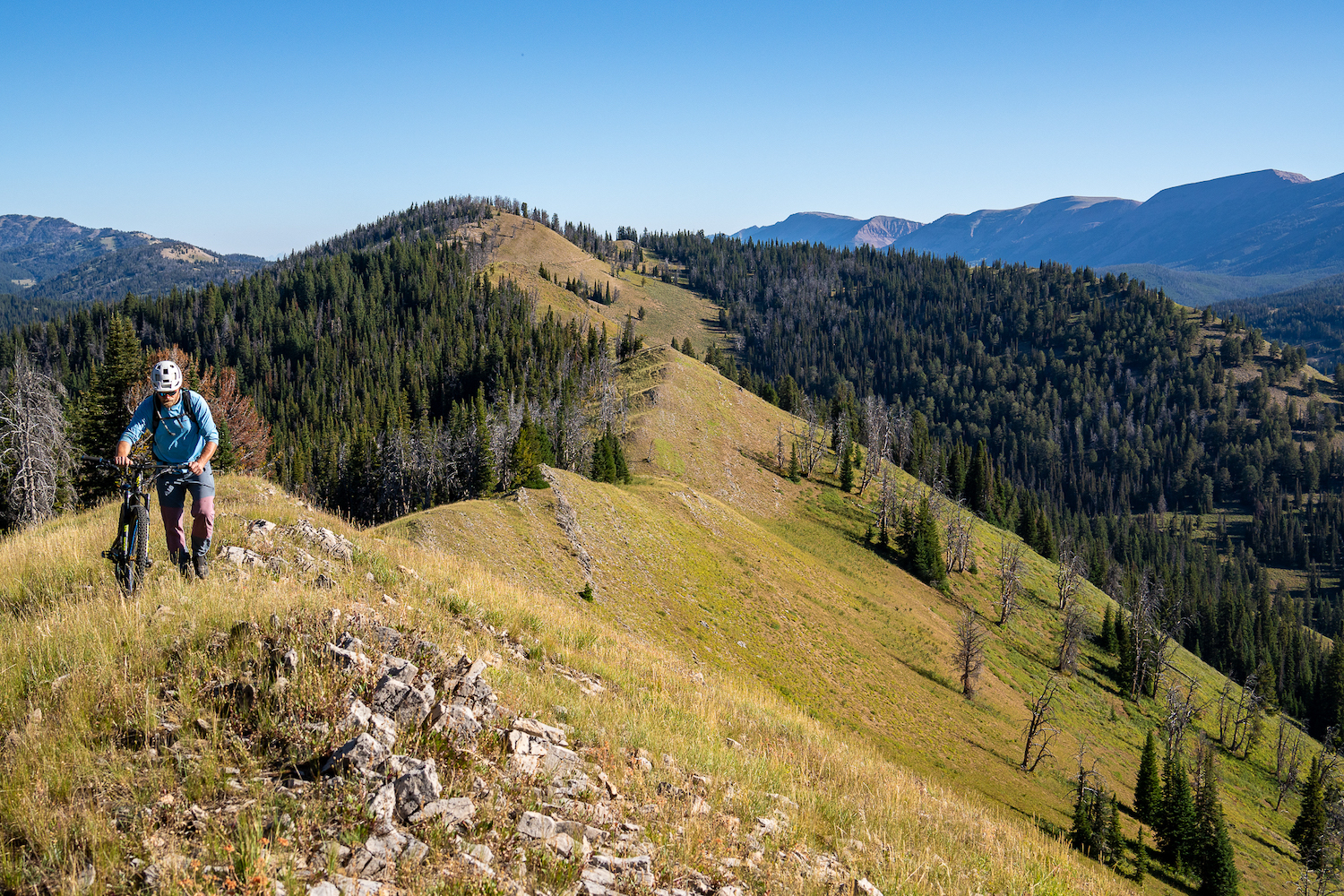
A mountain biker hikes his bike along a ridge in the Wyoming Range in August 2024. (Kurt Refsnider)

That oversight probably owes more to the Wyoming Range’s remoteness than its majesty, according to Bridger-Teton National Forest Kemmerer District Ranger Adam Calkins. 

“It really is a beautiful location that just happens to be sandwiched between the Tetons and the Winds, and so it just gets lost in the shuffle,” Calkins said. 

A Forest Service project to revitalize a 180-mile trail system in the range’s southern region could change that by drawing more users and easing access. Because of strapped budgets and lean staff, the Commissary Ridge trail network has gone largely unmaintained for 20 years. Today, erosion, overgrowth and fallen trees have made its trails difficult to navigate. 

The Forest Service, in partnership with nonprofits and local governments, spent much of the summer inventorying the trails. Now it’s reaching out to the public for input before finalizing the specifics of trailhead parking improvements, tree clearing and other work. 

The agency is asking the public, and particularly users of the Wyoming Range, to fill out a survey that will inform the project. It will also hold a public informational meeting Nov. 19 from 4-7 p.m. at Fossil Fuel Coffee Company in Kemmerer.

The project has a lot of potential for expanding recreational opportunities in a little-used area, Wyoming Pathways Executive Director Mike Kusiek said. “It’s super exciting.” 

Off the beaten path 

The Commissary Ridge Trail System, located on national forest land the agency manages as “roadless,” isn’t close to large towns or major highways. Users can access the system by driving from Kemmerer, Cokeville or La Barge.

The range is home to exceptional elk and mule deer habitat, and the bulk of users are hunters, Calkins said. But there is also potential for backpacking, hiking, camping and fishing. And that ties into the motivation for the project.  

“We recognized the need — that the trails on the Kemmerer District hadn’t been maintained in over a decade, and that was a problem,” he said. “We didn’t have great access to these trails for hunters, for fishers, backpackers or for anybody else.”

The Forest Service district secured several partners to help it implement the project, including Wyoming Pathways, Friends of the Bridger-Teton, Tread Lightly! and Lincoln County. 

Forest Service employees spent the bulk of the season hiking and inventorying roughly 80% of the system, which, all told, includes 17 trailheads and more than 30 separate trails. That work helped identify what is out there and what needs to be done to make trails safe and accessible — clearing deadfall, improving signage or shoring up erosion. 


The agency has applied for several grants to help it pay for the work. Now, Calkins said, it wants to hear from the public to better understand which trails are used and where to prioritize improvements. 

“We want to first start clearing and cleaning up the trails that the bulk [of] people are using,” he said, “and that’s why we’re looking for that public input.”

Facing significant budget cuts, the Forest Service is anticipated to forgo hiring non-fire seasonal workers in the next fiscal year, which will put more strain on full-time staff. Calkins does not foresee that affecting the Commissary Ridge project. Crews are anticipated to complete the work in three to five years, he said. 

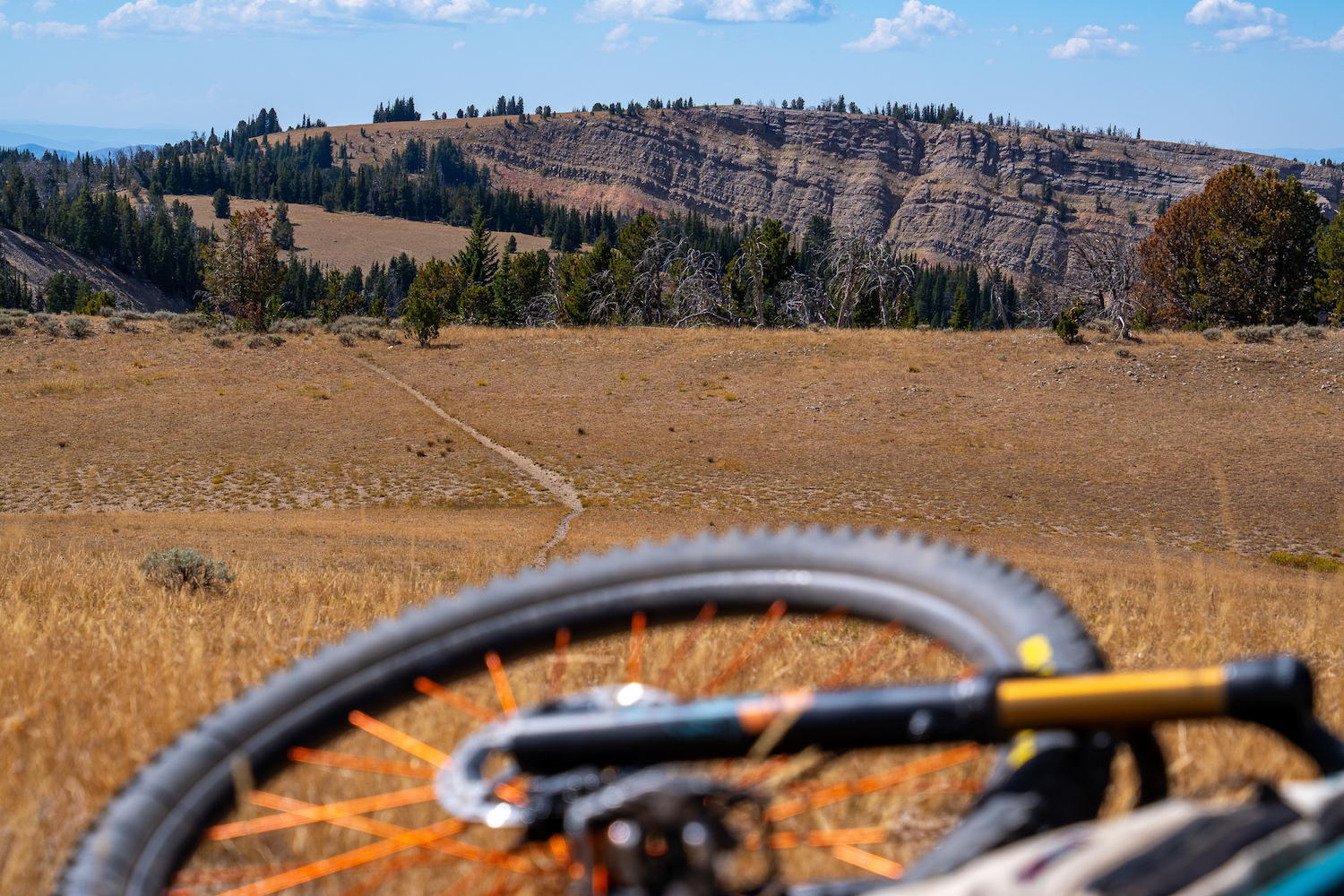
The view from a rest during a September 2024 mountain bike ride in the Wyoming Range. (Kurt Refsnider)

‘Just spectacular’

Though he works in the world of trail development, Kusiek of Wyoming Pathways knew very little about the southern Wyoming Range before the Forest Service contacted his organization — “probably, like a lot of people, almost next to nothing.” 

After spending time exploring the area, he sees a ton of promise. 

“It’s just spectacular,” he said. “I mean, it’s so beautiful in such a different way than anything else in Wyoming.”

Along with the hunters and hikers that already use it, Kusiek and Calkins see potential for expanded fishing, peak-bagging, mountain biking and other activities. 


In a time when the state is embracing the outdoor recreation industry with initiatives like a new trust fund to grant infrastructure projects, Kusiek also believes this project fits into a goal to disperse outdoor visitors around the state. “Especially for legislators who are saying, ‘let’s bring visitors to places they aren’t already going,’” he said, “it’s perfect.”

It can also create better opportunities for the residents of southwest Wyoming who live near the range, Kusiek and Calkins said. 

“Everybody that we’ve talked to in the city of Kemmerer is very excited about it,” Calkins said. “Most people, they’re very grateful that we’re recognizing this need and that we’re doing something about it or moving forward with it.”

WyoFile is an independent nonprofit news organization focused on Wyoming people, places and policy.

Boise’s Ninth Annual Cranksgiving Bike Ride Kicks Off on November 23rd

0

Cranksgiving, the annual Thanksgiving-themed scavenger hunt on bicycles, returns for an ninth year on Saturday, November 23, 2024. Sponsored by the Lost River Cycling Club and Ketlinski Law, the event will feature costumed teams of cyclists riding around town, gathering all the items necessary to fill Thanksgiving food boxes. The boxes go to St. Vincent De Paul for distribution to Treasure Valley families in need.

The teams of riders are expected to bring money to purchase food items, even though many of the items are available free from generous supporting businesses. Teams get a manifest listing the food items they need to collect and a list of fun tasks to complete along the way. Trophies and prizes are awarded to the three fastest teams, the team with the biggest turkey, and the best team costumes.

The event will start at 11:00 a.m. at Clairvoyant Brewing, 2800 W Idaho Street, Boise. The event will also finish at the brewery. There will be entertainment, food trucks, and of course, beer!

Registration is now open at bikereg.com/cranksgiving-boise

Organizers are also looking for volunteers to staff the event. Register to volunteer at tinyurl.com/cranksgivingboise2024

For those who don’t want to ride bikes, but would still like to contribute, make a direct donation to St. Vincent de Paul at svdpid.org/thanksgiving/

For the latest updates on the event visit the Cranksgiving Boise Facebook page facebook.com/CranksgivingBoise.

Send questions about Cranksgiving Boise to [email protected].

Shared Ebiking on the Rise but So are Ebike Crashes

By Charles Pekow — Ebikes are largely driving (or should we say pedaling) the shared micromobility boom in North America. But along with the popularity come affordability, energy and safety issues that remain unresolved.

Despite all the legal, structural and financial woes of the industry, the number of trips taken in the United States and Canada increased from 131 million in 2022 to a record 157 million in 2023, according to a new study from the National Association of City Transportation Officials (NACTO).

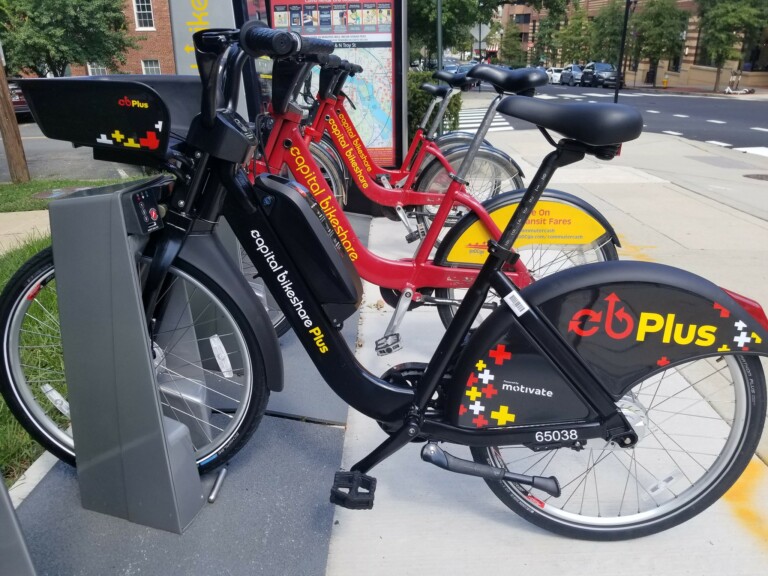
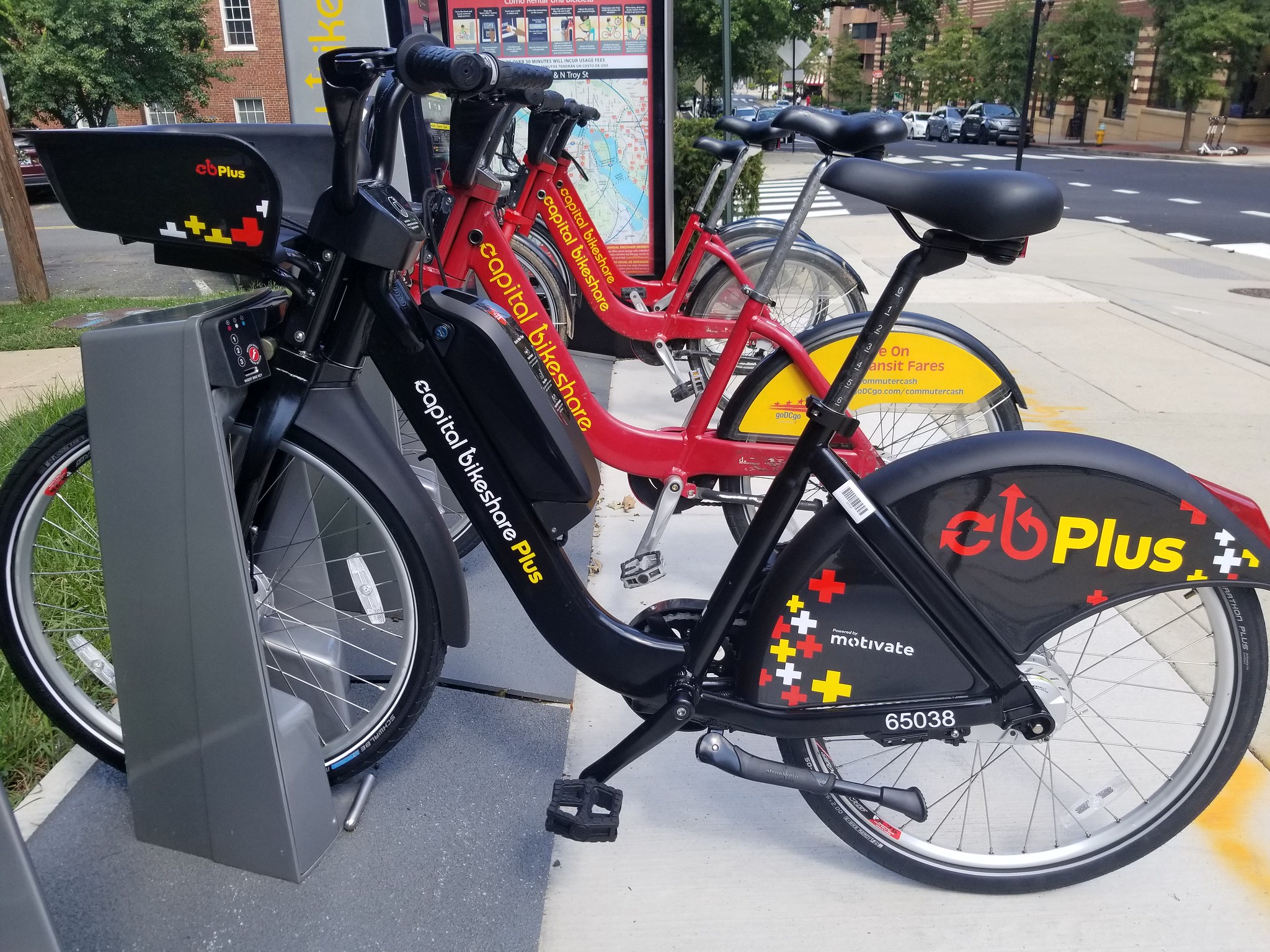
Capital Bikeshare Plus electric assist bike, photo by BeyondDC, CC BY-NC 2.0, ATTRIBUTION-NONCOMMERCIAL 2.0 GENERIC

Micromobility trips “in the U.S. increased by 16 percent in 2023, driven largely by the continued growth of ebike trips on larger station-based systems,” says the report, titled 157 Million Trips across the US and Canada in 2023. But it goes on to say that “despite the overwhelming popularity of these systems, many cities are grappling with the challenges of providing this essential service while facing limited financial and operational resources.”

Ebike trips grew 40 percent across the year from 20 million to 28 million, NACTO says, accounting for 45 percent of all station-based shared bike trips, thought they accounted for only about a third of the available vehicles. And renting an ebike generally costs an average of 22 cents a minute more than renting a human-powered bike.

Dockless bikes accounted for 10 percent of all shared vehicles (including scooters).

Find the study at https://nacto.org/wp-content/uploads/2024/05/Shared-micro-in-2023-snapshot_FINAL_July22-2024.pdf.

But along with increased use comes increased casualties. A report published by the Journal of the American Medical Association stated that the number of ebike injuries doubled annually between 2017 and 2022. “Injuries With Electric vs Conventional Scooters and Bicycles” suggests that law, education and infrastructure need to be improved. It doesn’t suggest how, though.

Injured electric bike and scooter riders were less likely to wear helmets than the average rider. Also, ebike crash victims were more likely to have been drinking than those on conventional cycles. 

Find the study at https://jamanetwork.com/journals/jamanetworkopen/fullarticle/2821387

Even eBikes can always be made more energy efficient. No question ebikes save on fuel. (See the report by this author: https://news.mongabay.com/2024/04/e-bikes-could-cut-smog-energy-use-and-congestion-globally-but-will-they/.) But can they become even more energy efficient by using solar power? Previous studies have said perhaps but they would only be practical with a large battery in a climate with plenty of sunshine. But a new study, SOLAR ELECTRIC BICYCLE (HYBRID) in the International Research Journal of Engineering and Technology, suggests at present, a bike battery can be partially charged by the sun but it would still need the plug-in option to be useful as you can’t rely on absorbing enough solar power.

“The implementation of the proposed system is on its way and is yet to be completed” says the study from the Bharati Vidyapeeth College of Engineering in Mumbai, India. Find it here: https://www.irjet.net/archives/V6/i4/IRJET-V6I4263.pdf


Video — This is Home: Brage Vestavik

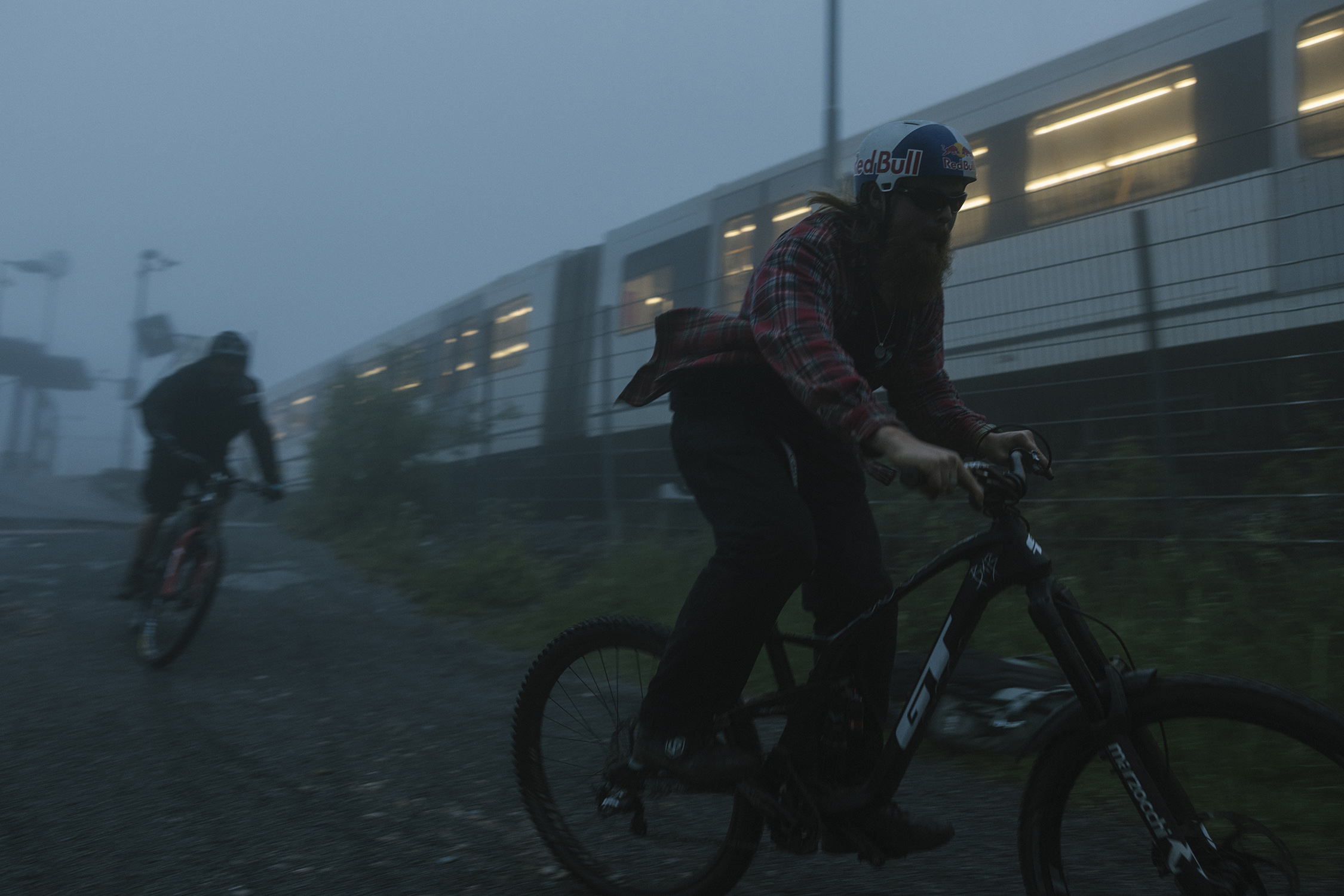
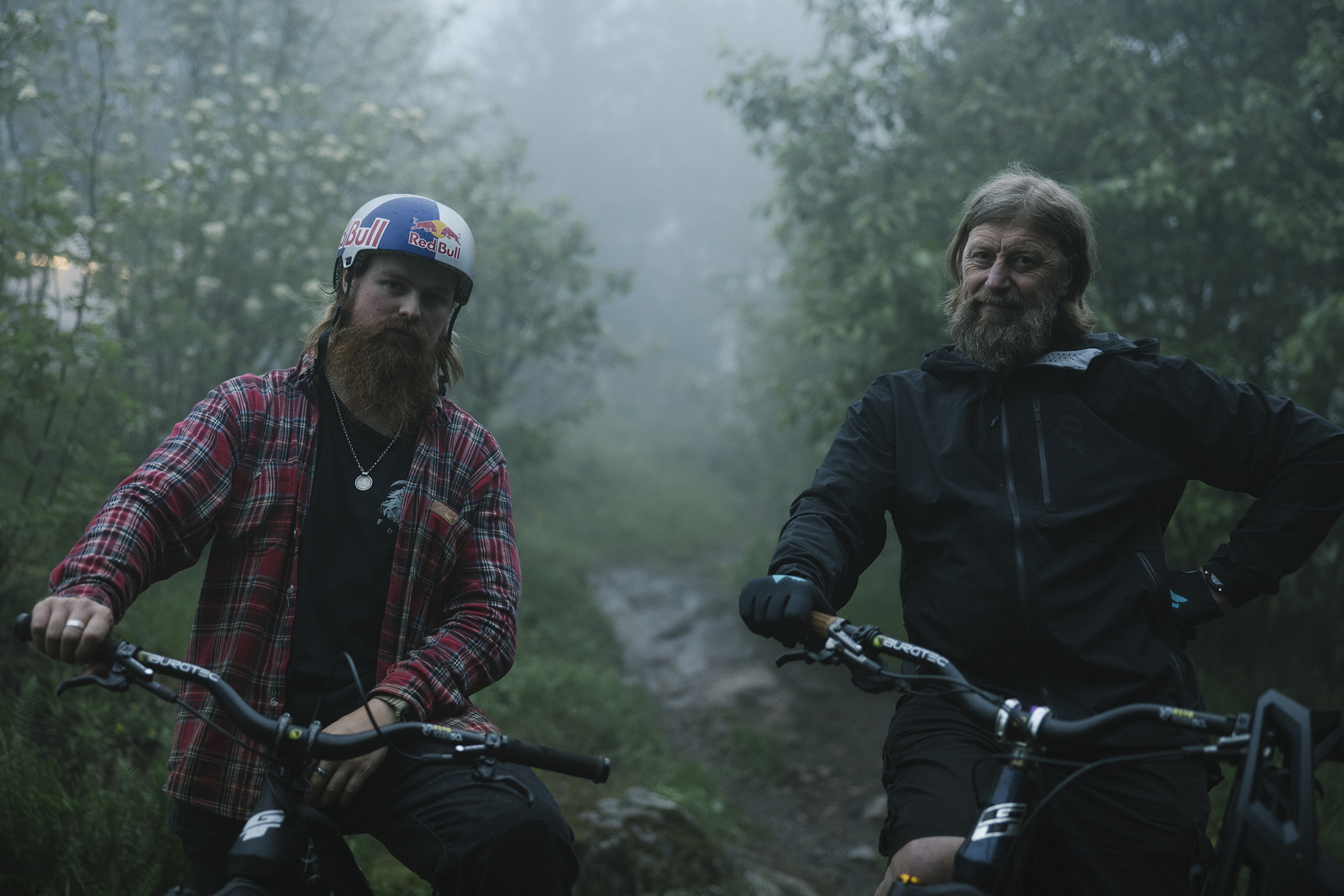
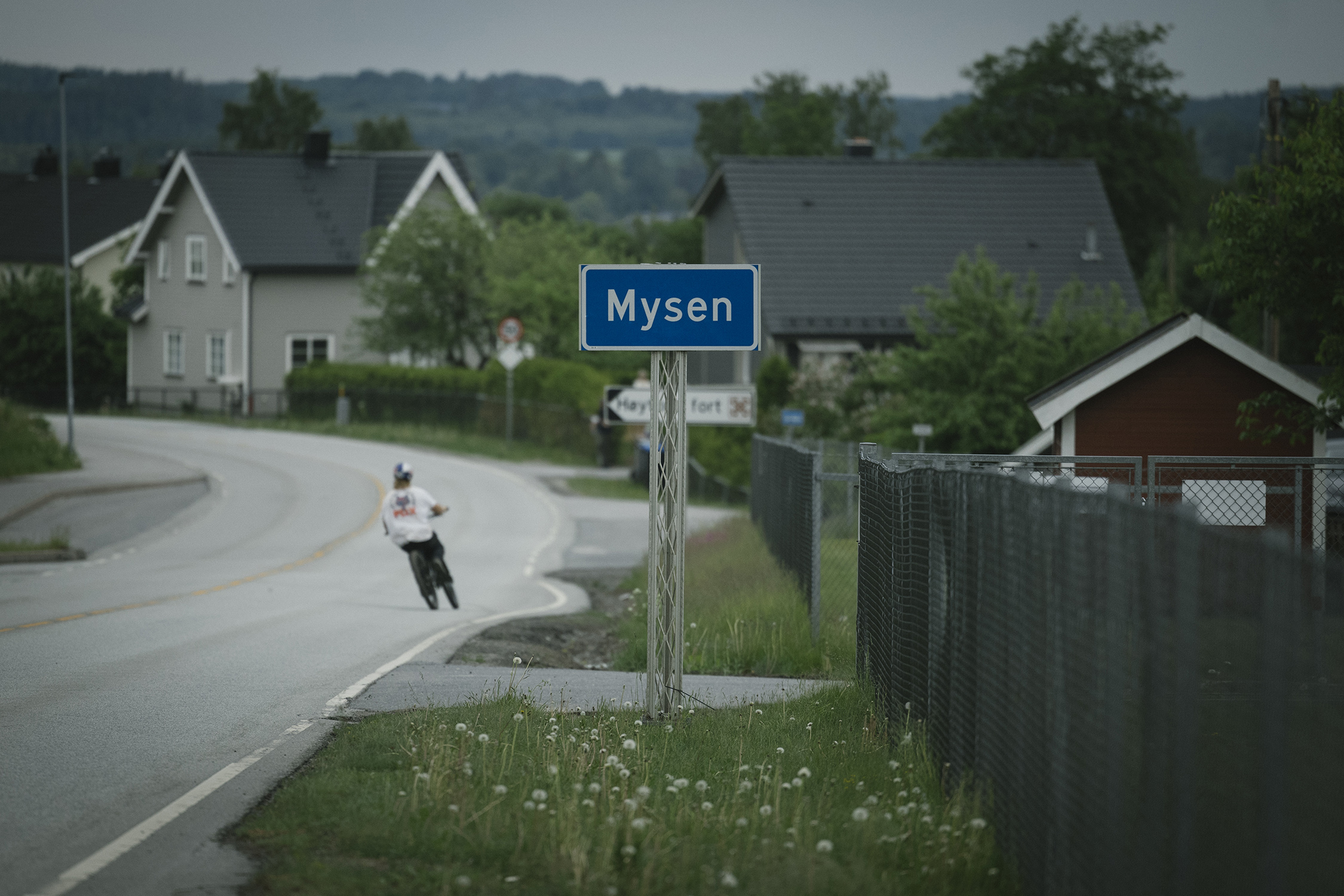
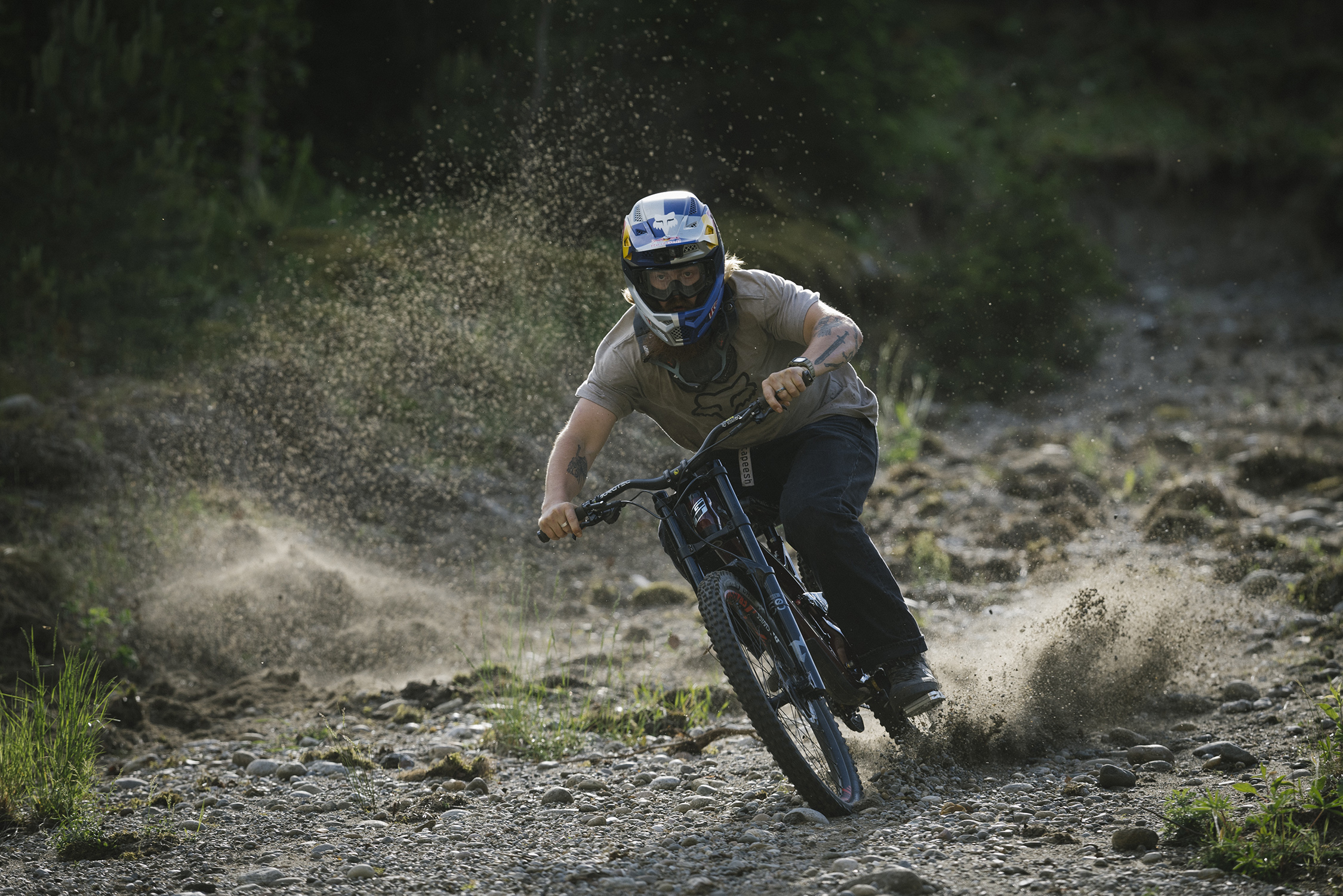
MYSEN, Norway (October 13, 2024) — Brage Vestavik’s journey to the forefront of freeriding began at home, making features from construction materials scattered around his backyard. As the years passed, he took his budding passion into the nearby forests, mimicking the many films he’d watched over the years. The results are now legendary, earning Vestavik worldwide MTB filmmaking fame for his daring creativity, relentless work ethic, precision talent, and a raw and powerful riding style that’s uniquely his own. But even now, with a Red Bull contract and nearly 400,000 Instagram followers, his best days are spent back in those same woods, building, filming, and riding with friends. For Brage Vestavik, This is Home.

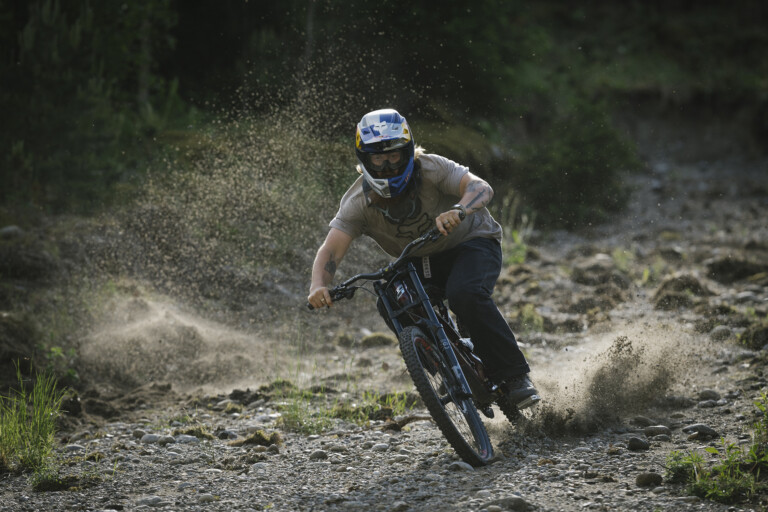
Brage Vestavik, ‘This is Home’, in his hometown of Mysen, Norway. Photo by Sterling Lorence, courtesy of Shimano

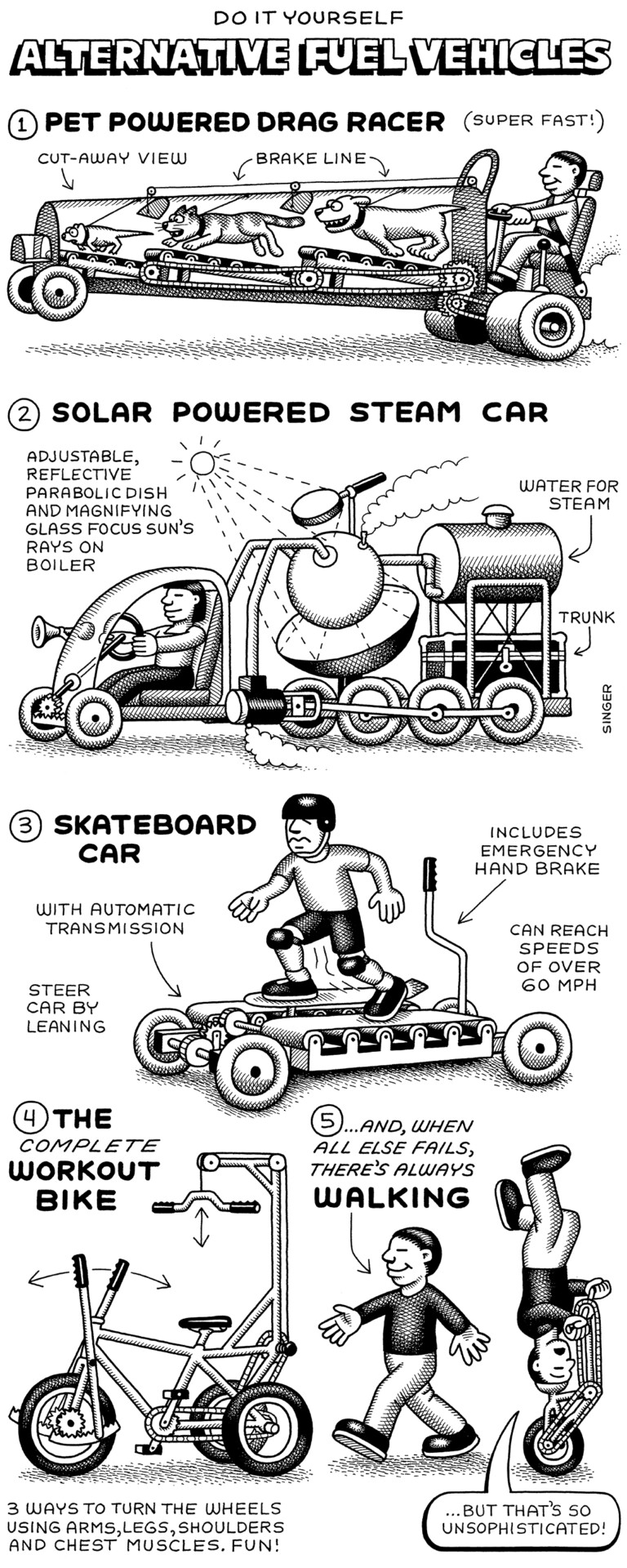
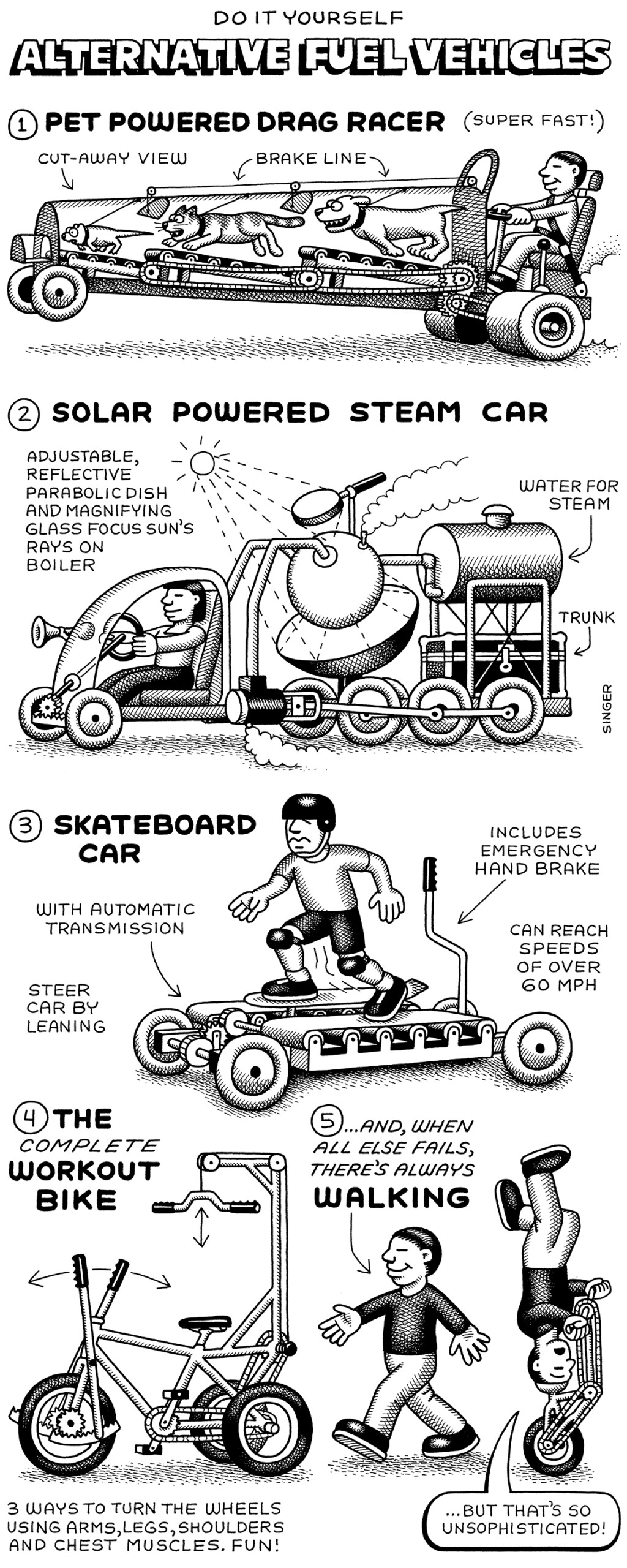
No Exit Cartoons: DIY Alternative Fuel Vehicles, by Andy Singer

No Exit Cartoons: DIY Alternative Fuel Vehicles, by Andy Singer

The Athlete’s Kitchen: Nutrition News from the Academy of Nutrition and Dietetics

By Nancy Clark MS RD CSSD, Oct 2024 — The Academy of Nutrition and Dietetics (AND) is the nation’s largest group of food and nutrition professionals. At their annual convention (Oct 2024; Minneapolis), members presented research and updates that might be of interest to sports-active people. Here is a sampling of some hot topics:

Teenagers (14-18 years) in the US have the lowest Healthy Eating Index Score (49 out of 100) due to their high intake of sweetened beverages and sweet baked goods. How about suggesting more water, bagels with peanut butter, and bean burritos for easy, low cost, and better sport-food options?

A blend of protein and carbohydrates are needed for good post-ride nutrition. Food and photo by Dave Iltis

Athletes commonly over-eat protein. This raises environmental as well as health concerns. Insects are a sustainable source of protein—though they quickly get labeled disgusting. The most palatable insect form is powdered (flour). Will athletes one day embrace insect-based protein products? Stay tuned…

Most female athletes, including those in this study with Division-1 soccer players, eat too little carbohydrate. Analysis of food records from 12 players suggests they ate the recommended amount of fat and protein, but 10 of 12 players fell short of the recommended 2.5 to 4.5 grams of carb/lb/day. For a 120-pound player, that’s at least 1,200 to 2,150 calories a day from carb-rich grains, fruits and veggies. Athletes could perform so much better if they were to enjoy more (quality) carbs!

The body’s response to sugary foods differs between sedentary and fit people. Exercise enhances your muscle’s ability to quickly take up glucose, potentially offsetting “sugar spikes” after consumption of high-sugar foods. Blood sugar management is a good reason to take a walk after enjoying a sweet treat.

Athletes often complain about intestinal discomfort and GI distress. Gut issues can be triggered by school, work and athletic stress; disordered eating, anxiety, and depression. Consulting with a sports dietitian (RD CSSD) can help athletes to reduce, if not resolve, gut issues.

Athletes with gut issues might benefit from taking digestive enzymes (such as FODZYME, Bean-O, LactAid Pills). A FODZYME study with 96 participants (average age-57) reports more than half had a positive response. They reported less abdominal pain, bloating, gas, constipation, diarrhea, vomiting, and nausea—plus better mental wellbeing as well as overall quality of life. 

Food allergies, food sensitivities, and/or autoimmune diseases that limit dietary options are challenging for many athletes, particularly those in college. They express frustration, discomfort, annoyance, isolation, and increased anxiety—especially when dining hall staff are unable to confidently answer their questions. Their overall college experience gets negatively impacted, as they can be excluded from on-campus events that offer free food. They commonly have to prepare and carry enough food for the entire day, and/or face limited options when dining out. Students may worry about getting sick after eating school food, which can lead to class absences, trips to the doctor, and difficulty making up missed assignments. Helping athletes with dietary restrictions is important so they can meet their nutritional needs plus have emotional well-being.

Tik-Tok can easily trigger disordered eating attitudes and behaviors. Don’t go there! A mom who makes disparaging comments about her own body can also trigger the development of an eating disorder in her daughter. Keep any negative body-thoughts to yourself!

A study with 70 females reports a disconnect between actual and perceived body fatness. Distorted body image—an unrealistic view of oneself—increases the risk of restrictive dieting and starve-binge eating patterns to lose body fat. Athletes: please understand that some body fat is necessary for overall health!

Relative Energy Deficiency in Sport (REDs) is a syndrome stemming from chronic consumption of inadequate food to meet daily energy expenditure. This deficit impairs athletes’ health and performance. Athletes with REDs are at increased risk for eating disorders/disordered eating. Coaches, health professionals, and all athletes alike need REDs education, particularly in sports settings where REDs signs and symptoms are prevalent. If you work with a team, how about setting up a REDs workshop with your local sports dietitian?

Female athletes commonly believe society expects them to look feminine and have an ideal body. This unspoken weight bias presents as:

  1. negative comments about weight or appearance,
  2. pressure to conform to certain body standards,
  3. unequal treatment compared to leaner peers.

A survey of normal-weight female athletes reported almost half had experienced weight discrimination. We need to change this mindset so that strong and powerful replaces the quest to be lighter and leaner.

Many athletes with eating disorders/disordered eating feel ashamed of their dysfunction and fear being stigmatized for having an eating disorder. Unfortunately, this can hinder willingness to seek help and delay their recovery. If you have overcome food issues, please talk openly about your recovery so those who are struggling can hear your story. You just might make a difference in someone’s life.  

A light-colored morning urine signals adequate hydration. Athletes who exercise in tight-fitting uniforms may fear that drinking pre-exercise water will make their stomach stick out. That fear is not a fact!

Although student athletes generally need sports nutrition education, they may miss out because of lack of funding. One school solved that problem by partnering with nutrition graduate students who worked together with student athletes to figure out what topics were of interest. (The winning topics included basic nutrition, game-day fueling & recovery, sport supplement benefits and costs, and game-day meal planning.) They then created a class that met once a week before school (that was the athletes’ suggestion) for four weeks. The 35 athletes became empowered with the knowledge—and the graduate students appreciated the real-world teaching experience. Maybe you can make that happen in your town or with your team?


Hellman Foundation Awards $2.5 Million Grant to the USA Cycling Foundation to Fund Women’s Programs

The Hellman Foundation’s long-term investment aims to strengthen and elevate women’s Olympic cycling programs for years to come.

SAN FRANCISCO, California (November 8, 2024) – The Hellman Foundation has awarded a $2.5 million grant to the USA Cycling Foundation to fund its women’s programs, marking a groundbreaking investment in the growth and development of women’s cycling across the United States.

This grant will increase resources to USA Cycling programs and operations for women’s high performance across the Olympic cycling disciplines of Road, Mountain Bike, Track, BMX Racing, and BMX Freestyle, as well as the Paralympic cycling disciplines of Road and Track.

The grant will have two components: First is $1 million specifically intended to support women’s programs delivered in the years 2025-2028 to maximize success at the Los Angeles 2028 Olympic Games. Second is an additional $1.5 million that will go to create a long-term Women’s Cycling Fund that will support USA Cycling women’s programs from the years 2029-2043. The grant for the Women’s Cycling Fund will require a 1:1 match, which will ultimately result in a $3 million fund to support women’s high performance programs.

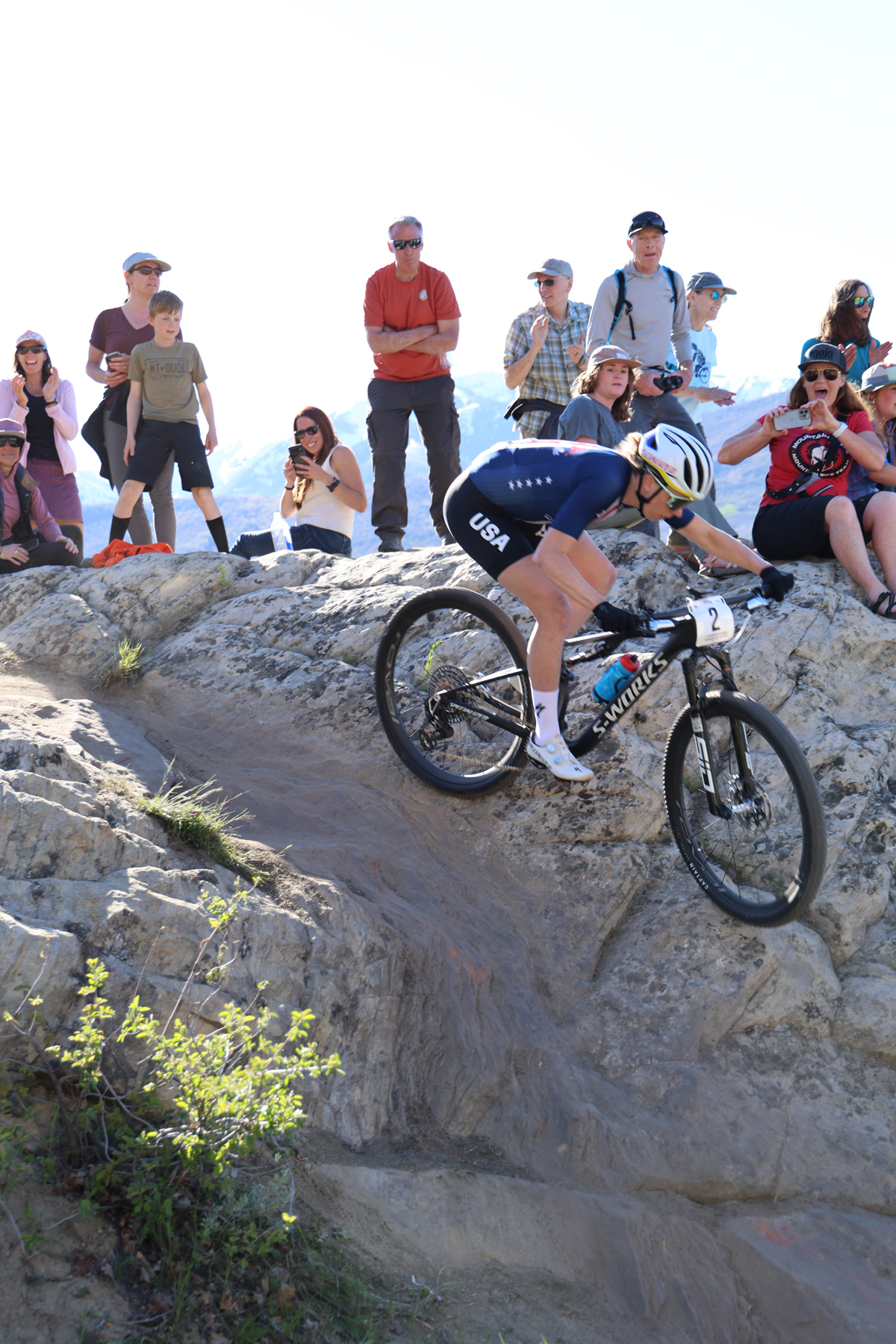
Haley Batten at the rock drop on her way to winning the Elite Women’s XCO title at the 2024 Utah Pan Am Mountain Bike Championships at Soldier Hollow, Utah. Photo by Dave Iltis

“The Hellman Family has been a longtime supporter of USA Cycling, and they have been especially supportive of our Women’s Track Endurance program. Today’s announcement marks their incredibly ambitious and generous approach to women’s cycling and women’s sport in general,” said USA Cycling’s CEO Brendan Quirk. “This gives USA Cycling a huge boost in momentum as we finalize our plan to earn 10 medals at the LA28 Olympics, and we’re eager to kick off the Women’s Cycling Fund matching campaign to ensure strength and stability for our women’s program for decades to come.”

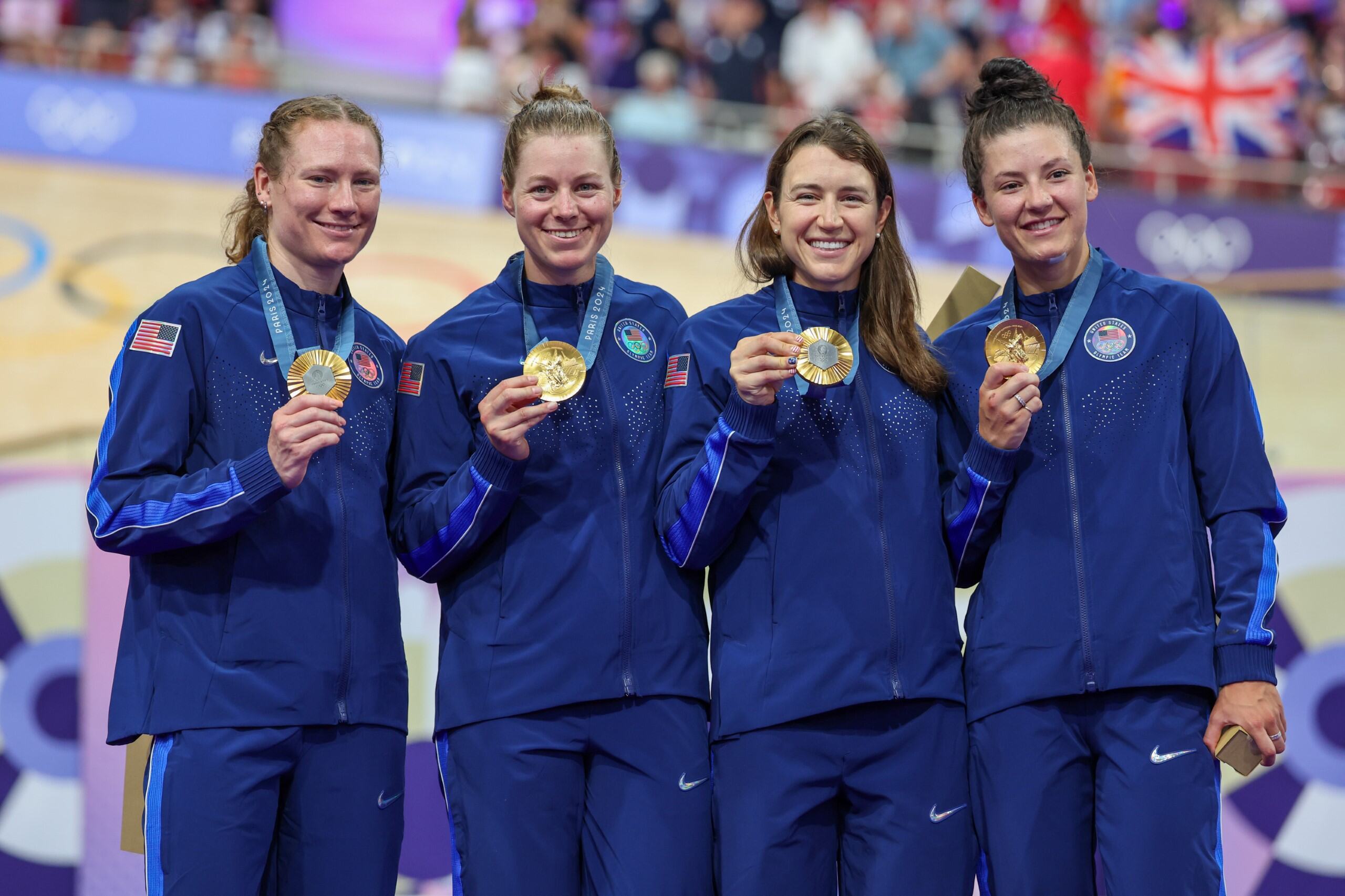
The Hellman Family has been a major supporter of the USA Cycling Foundation since 2000, playing an instrumental role in the achievements of American women on the international stage. Over the years, their generous support has fueled countless successes, culminating in a record-breaking summer at the Paris 2024 Olympic Games, where American women claimed a historic six medals for USA Cycling, including three gold medals.

“The Hellman Foundation is thrilled to support the USA Cycling Foundation’s women’s programs to help develop the next generation of Olympic and Paralympic athletes,” said Mick Hellman, Board Member of the Hellman Foundation. “We hope the Women’s Cycling Fund will inspire and empower elite women cyclists to build on the amazing progress they have achieved in recent years.”