Home Blog Page 45

Bikepacking Crested Butte’s Elks Traverse

0

By Tom Diegel — It’s no secret that Colorado has more than its share of great riding, from many long road passes that go high into the mountains to a big chunk of the Great Divide Route to a lot of great singletrack. Crested Butte (CB) – partly as the town credited with the origin of mountain biking, and partly as a famous destination for a zillion miles of beautiful, high altitude, narrow, hand-hewn quality singletrack with a surprisingly-chill resort town – is venerated as Colorado’s heart of mountain biking. What is less known is that it is also a great center for bikepacking, with some of the most scenic and challenging tours in the West. As summer still kept its blistering tentacles on Salt Lake in early September we decided to head to the high and cooler Crested Butte to – of course – slay a lot of singletrack, and also use the opportunity to do one of those vaunted bikepack routes as well.
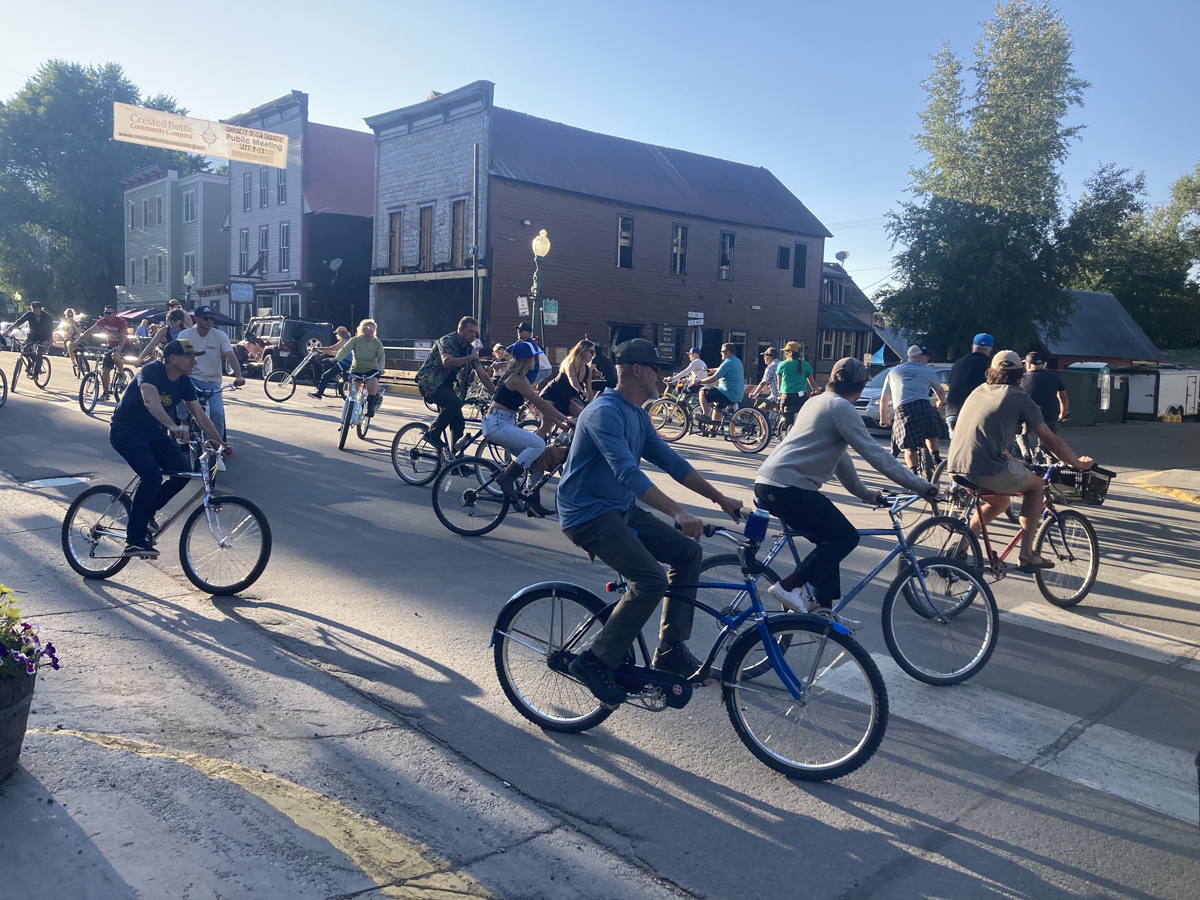
Klunkerz on parade in Crested Butte before heading up to Pearl Pass (with a pub crawl in between). Bikepacking Crested Butte’s Elks Traverse. Photo by Tom Diegel

This year’s bikepack journey actually had its genesis in 2013, when Crested Butte was on a route that we did from Steamboat Springs to Grand Junction (and trained home on Amtrak) via the Great Divide Route, Buena Vista, Cottonwood Pass, and Gunnison. In Gunnison we had stopped at a bike shop for some sort of needed part, and Ashley asked one of the employees about riding over Pearl Pass to Aspen. “You can’t do that!” the guy exclaimed. Huh? Why not? ‘That’s WAY too hard!” To be sure, this was in the early days of ‘bikepacking” and we had more old school gear like panniers, but…..c’mon….”you can’t do that?” We of course were tempted to give it a go just to prove that righteous-sounding guy wrong, but the better route for us at that time was to go over the 10,700-foot Schofield pass and down into the beautiful Crystal River valley that was a more efficient way for us to get to Grand Junction. On that 2013 trip we did, however, get a good taste of Colorado’s old and high mining road touring, since the descent down from Schofield to the sleepy hamlet of Marble (fittingly littered with huge slabs and boulders of white marble) is super steep, rocky, and loose for the first few miles. So on our recent trip back to Crested Butte we heard that Pearl Pass – and Taylor Pass, and Star Pass; the other two passes that loomed on our tour – was much more difficult on both sides than Schofield, we had a bit of a sense of what we might be getting into.
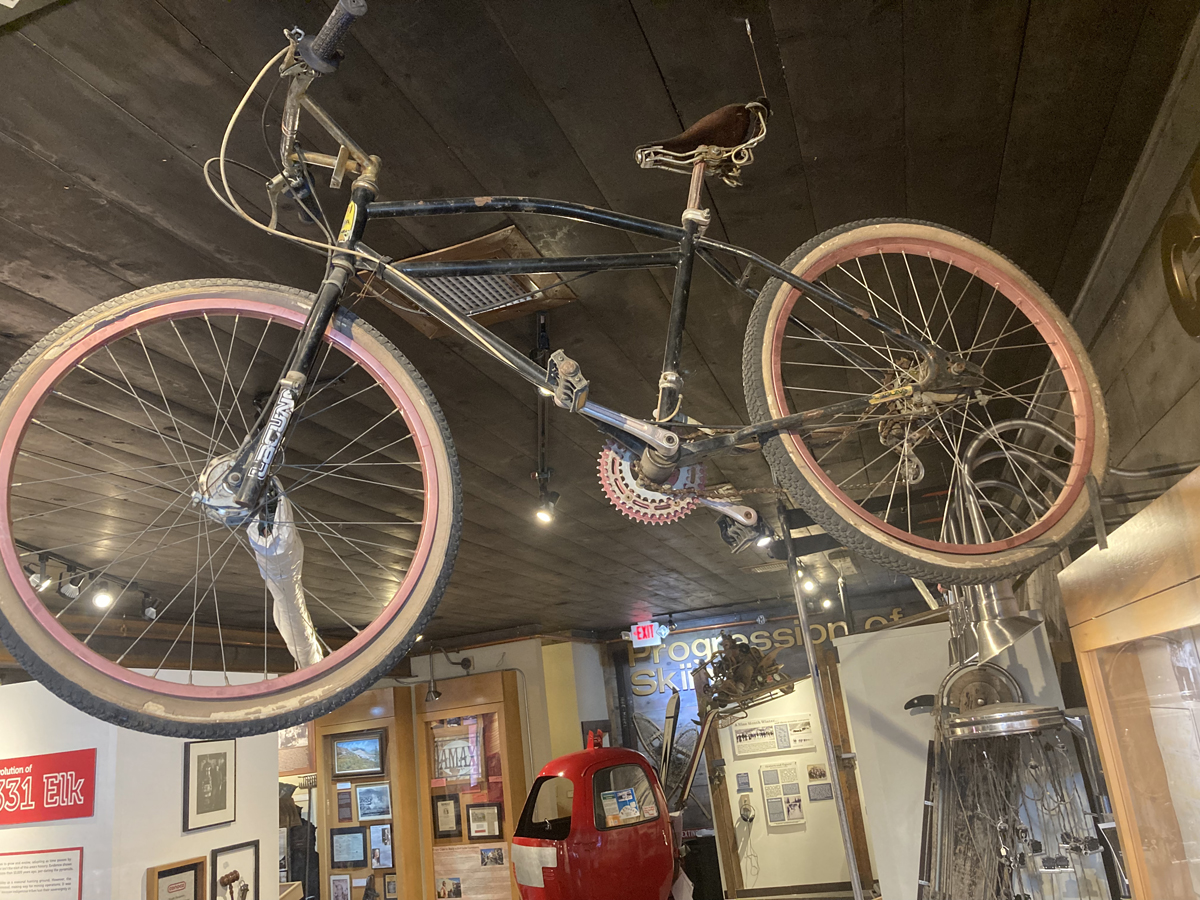
One of the original Klunkerz in the Crested Butte museum. Bikepacking Crested Butte’s Elks Traverse. Photo by Tom Diegel

A vital stop for mountain bikers riding in CB is the museum. Like many western towns the museum has lots of mildly interesting history of the local mining and logging that created the town, the notable characters who led the town through the ages, and of course the evolution of the ski resort. But unlike most other museums, the CB museum also has a big display of not only telemark skiing, which has its American roots in CB, but also mountain biking. In about 1973 someone’s likely-drink-inspired suggestion to ride up to Pearl Pass on their townie “Klunkerz” bikes got taken seriously by a bunch of folks, and they did it, with some fun documentation that is featured in the 2006 documentary appropriately called “Klunkers”. Seeing the various bikes circa 1976 hanging in the museum that were actually used for the first Pearl Pass ascents we naturally felt “well, how hard can it be?” Sure we were going to have a bit of gear, but we were going as light as possible and we have fancy mountain bikes…it can’t be “WAY too hard!”

After a coupla days of riding the oh-so-fun singletrack of Crested Butte (including another climb of Schofield Pass to descend the iconic 420 trail) we loaded up the bikes right in town and headed out Brush Creek; the big valley to the west of town and the backside of Crested Butte Peak. Like most Colorado towns there was a great gravel path next to the busy highway heading towards Gunnison (Colorado’s government is really good about investing in recreation infrastructure) that led to a paved road that fairly quickly turned to quiet gravel and shortly after to doubletrack, and the climb began.
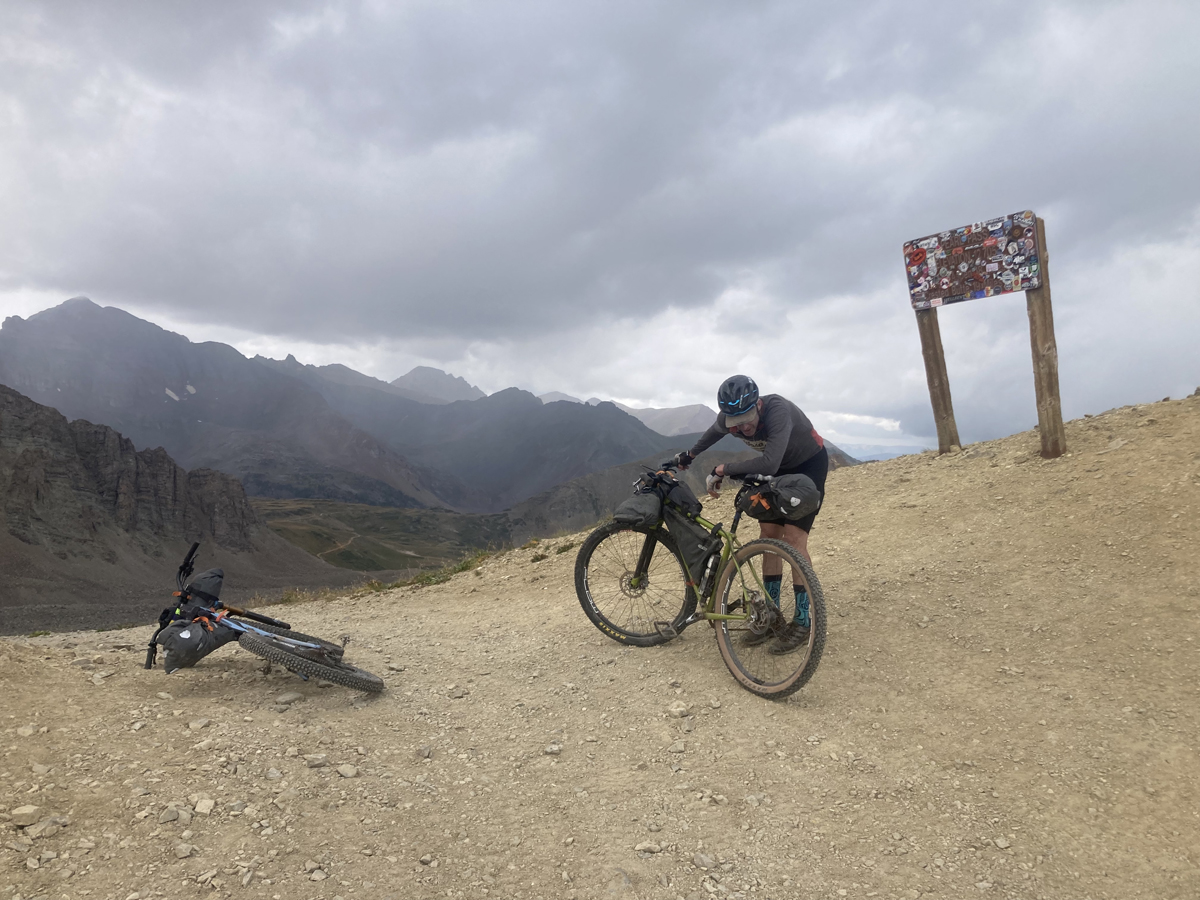
It takes a minute to catch your breath after a hard climb over 12k. Bikepacking Crested Butte’s Elks Traverse. Photo by Ashley Patterson

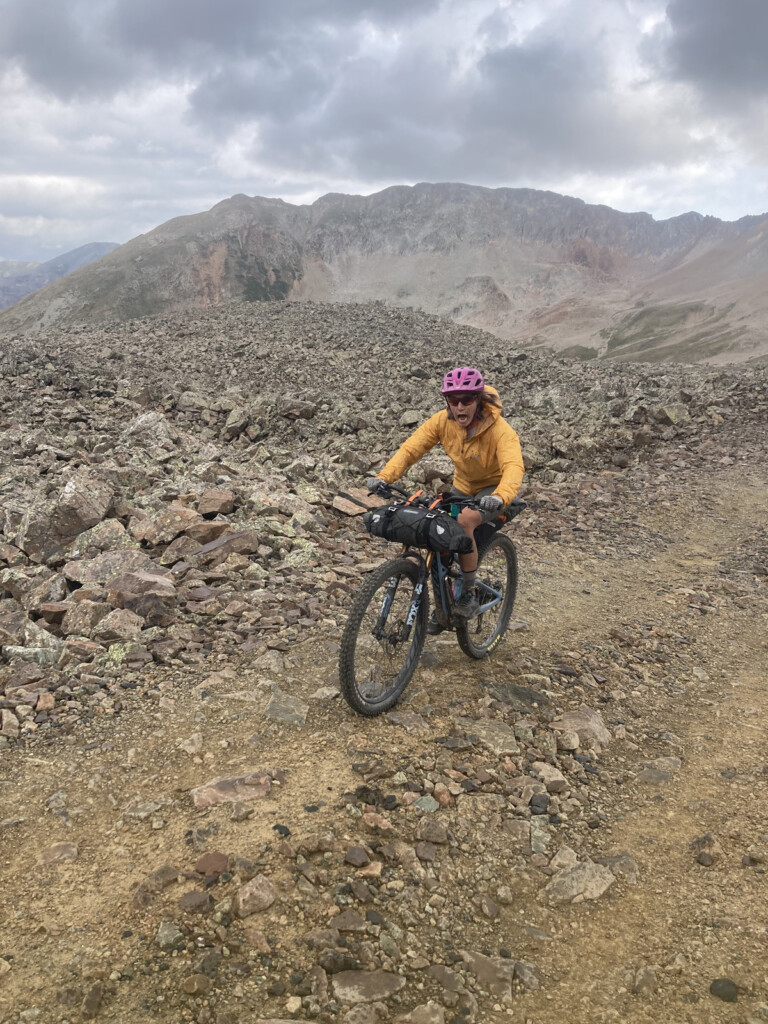
We gradually climbed through a beautiful aspen forest and the double track wasn’t too steep and was still mostly dirt, but as we approached the treeline it got….rocky. They don’t call them the “Buffed Dirt Mountains”, and we found ourselves pushing a fair bit to get through the combination of embedded rocks and baby heads up the steep grades. The climb is only 8 or 9 miles, but given the surface, grades, and 12+ thousand feet it’s….slow goin’, . I actually began to see how “klunkers” could make it up there; there’s very little actual “riding” of the bikes! But of course, the higher we got into the Elks mountains the more their grandeur spread out beyond us, and occasional flatter spins and glances around whilst pushing the bikes indicated some amazing alpine scenery.
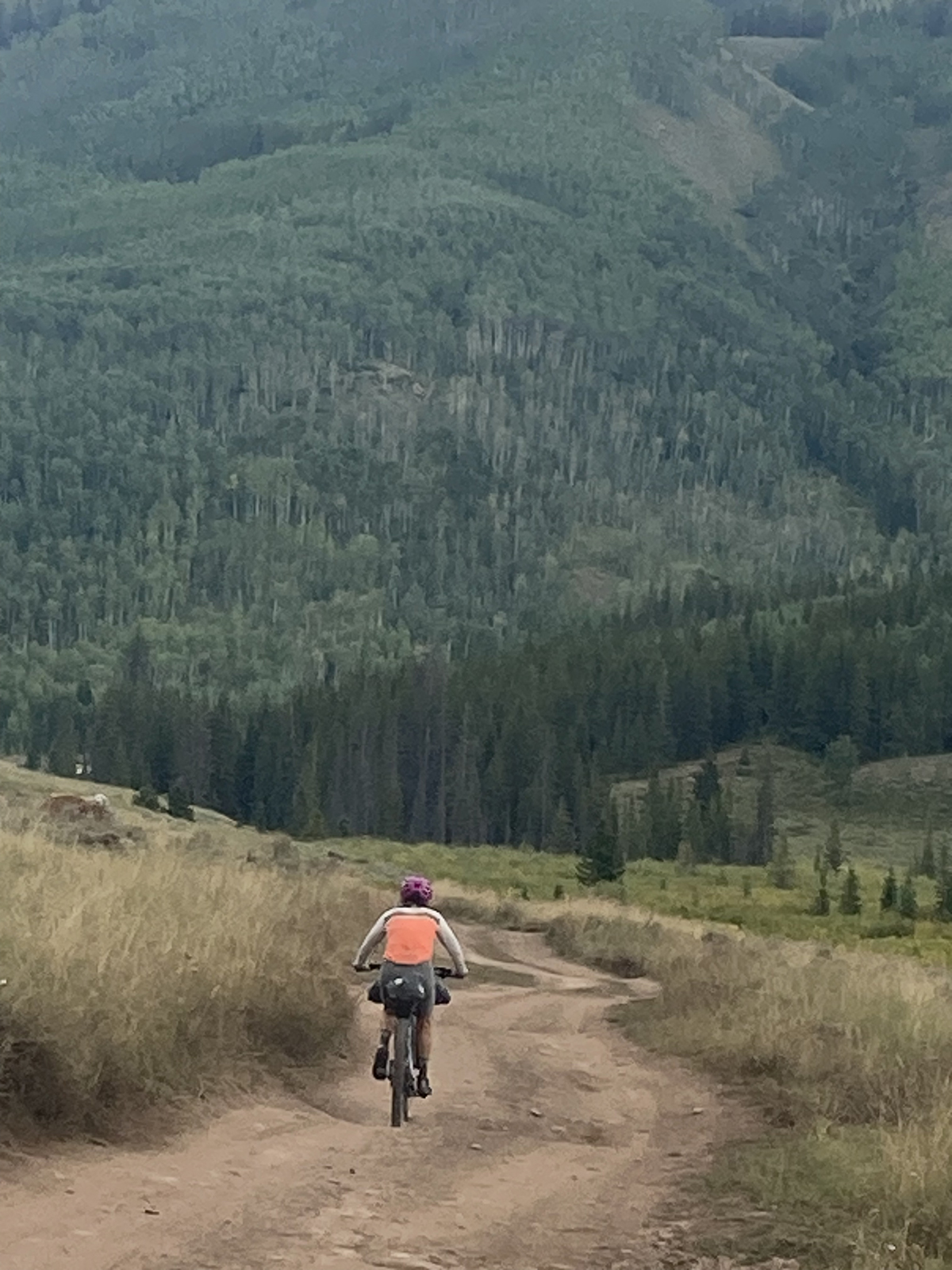
Before the pushing starts – and between pushes -there’s quite a bit of nice pedaling up the climb to Pearl Pass. Bikepacking Crested Butte’s Elks Traverse. Photo by Tom Diegel

There’s a bit of a false summit to the pass, and the last 3/4 of a mile is thankfully somewhat lower-gradient, rideable dirt, but with mushy legs up high it’s still a nice grind to reach Pearl Pass proper. We didn’t linger long, however; in addition to the higher elevations that Coloradans love to always point out, monsoonal thunderstorms are prevalent, and we were keen to get down off the exposed ridge as quickly as possible. But like Schofield Pass, the north side of Pearl Pass is super rocky, and barely rideable, and it was difficult to make time. At least it was starting to rain, making the impressively-large, impressively-embedded rocks really slick as well, and though we didn’t have to deal with the pesky breeze associated with zipping downhill on bikes, the temps dropped dramatically with the rain. But we persevered, and as we approached the treeline we heard the whine of a motor that soon enough became clear enough to discern that it was a chainsaw, and I caught a glimpse of some sort of manmade structure. “Nice.” I thought. “Probably a hunting camp getting set up, and we can see if we can talk our way into the tent to get out of the rain and warm up.” But as we got closer I realized that the tent became the roof of a full on hut, and the chainsaw was being wielded by a guy cutting wood for the hut for the winter. The cutter said “sure, go ahead and go inside”, where we found a full on gas stove, and in a few minutes we were cupping our hands around a mug of hot tea, so psyched!
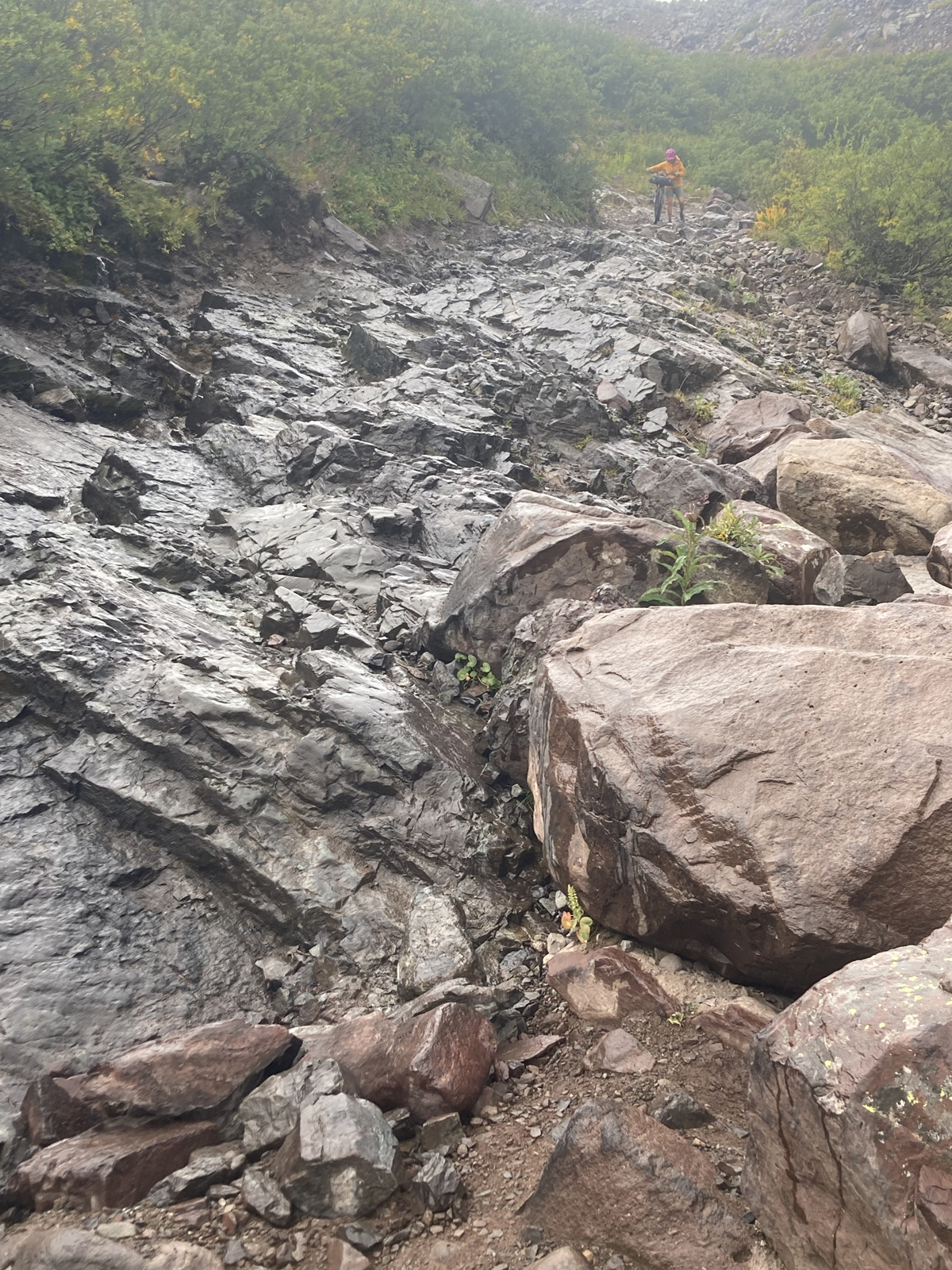
Those mountains are Rocky! The rugged north slope of Pearl Pass. Bikepacking Crested Butte’s Elks Traverse. Photo by Tom Diegel

After we warmed up a bit we wandered through the persistent rain over the wood cutter and meekly asked “hey, could we maybe stay here tonight?” No, was the reply. This is a backcountry ski hut, only “open” in the winter. Okay, whatever, no problem. We went back to the hut to get ready to go, when another guy showed up, and we mentioned our query about staying there. To our surprise, this guy said “sure!” To keep things above board we pointed out that his pard said no, but his response was simple: “Well, I’m The Director!”. We were in. An unexpected but welcome shelter for the night, that probably shouldn’t be counted on (but looking cold, hungry, and tired might be an in).
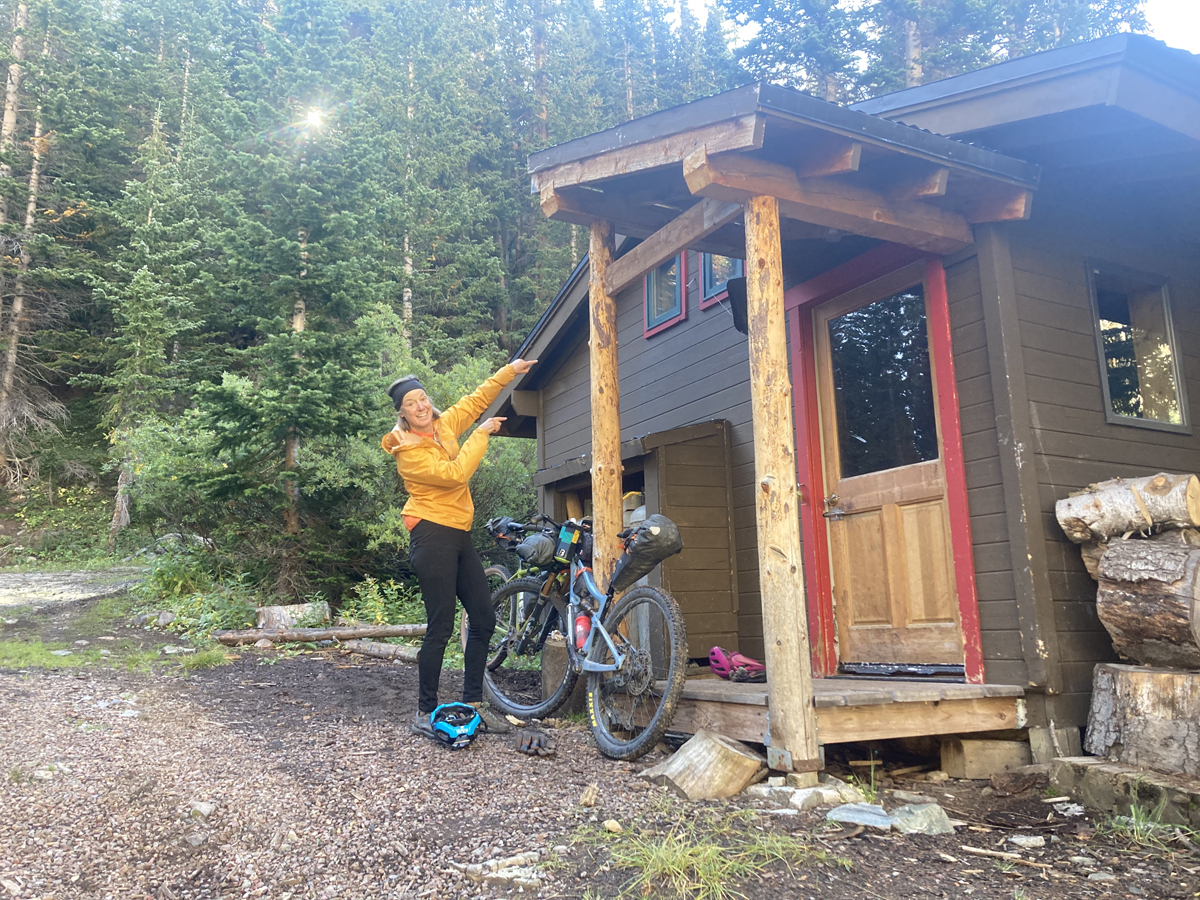
We didn’t expect super cozy accommodations – and can’t guarantee others can use it – but it was
sure nice. Bikepacking Crested Butte’s Elks Traverse. Photo by Tom Diegel
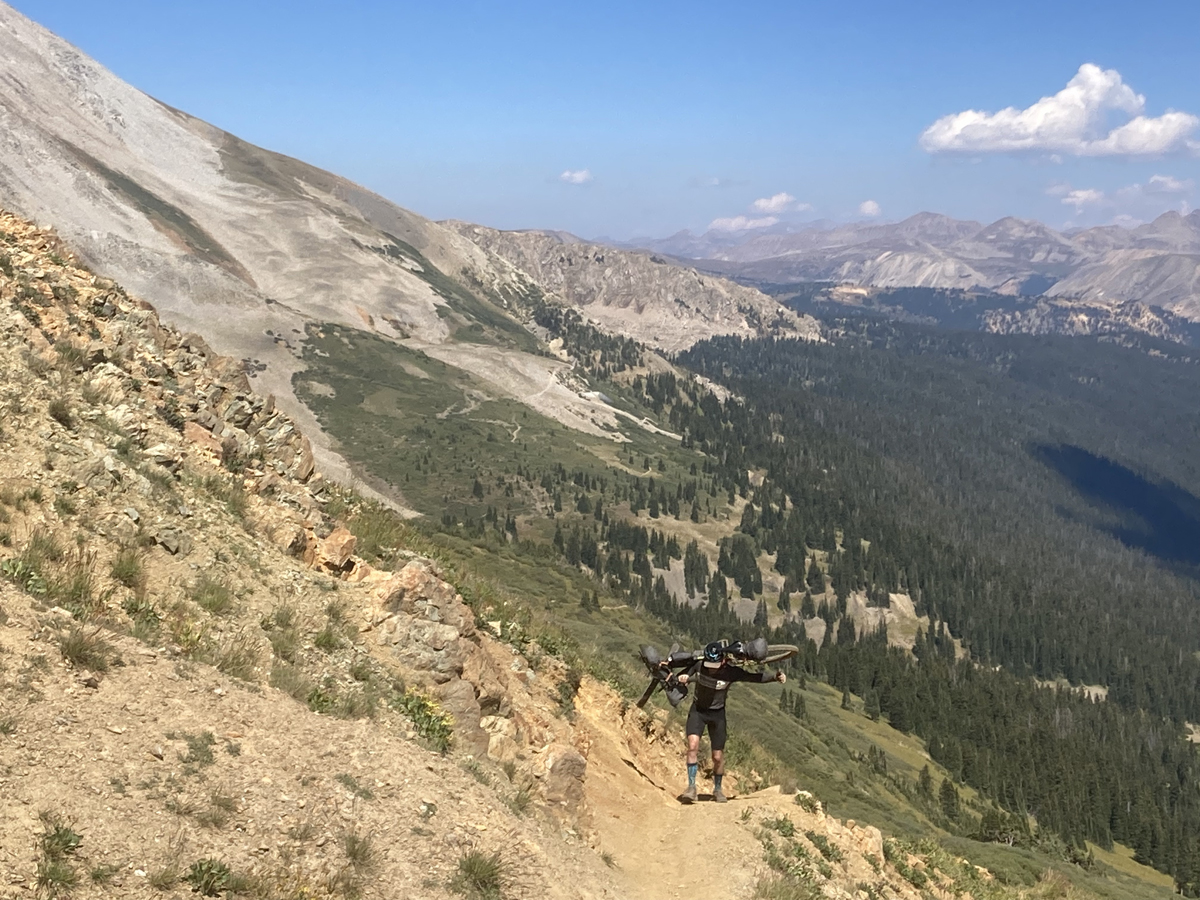
Sometimes the bike on the back is better. But make sure to look up and around sometimes to take it all in on Star Pass. Bikepacking Crested Butte’s Elks Traverse. Photo by Ashley Patterson

In the morning (frosty! again, so psyched we were in the hut, and not being out exposed with our minimal gear) we bounced down another thousand feet of loose rocky double track that improved to the point of being pavement, and shortly came to a turn onto another double track that led up to Taylor Pass; this one enabled a bit more riding and topped out at only 11,800 feet, but we still got in plenty of quality pushing over rocks (and the equally-commensurate big views). A traversing trail led us back into the upper Taylor basin where we met more double track, and then a single track plunged off that into a basin that we had to climb out of to get to 12,000+ foot Star Pass. The final climb up the north side of Star Pass is singletrack that is barely walkable, much less rideable, but it’s pretty short and part of the big views from Star Pass includes seeing a very rideable singletrack heading 3000 feet down towards Crested Butte. From Taylor Pass to Star Pass and Crested Butte is going backwards on the Grand Traverse; an annual 40+ mile backcountry ski race from CB to Aspen that’s been going on for nearly 30 years, and has recently added summertime versions by wheel and by foot as well, and as such the trail up the south side of Star Pass is pretty rideable and makes for a super long and stellar descent back into the Brush Creek Valley and back into town.
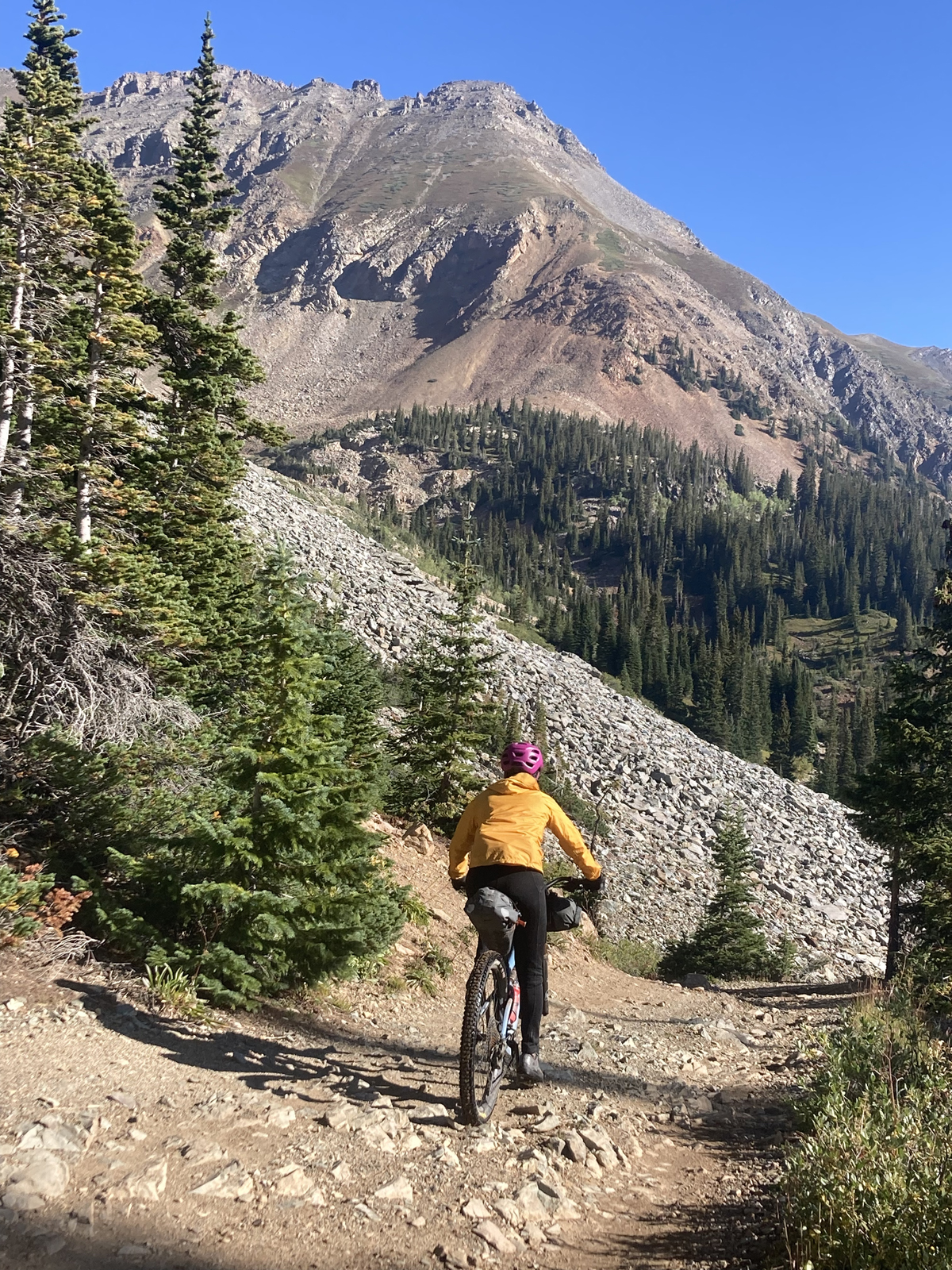
The morning coast down Castle Creek towards Aspen for another thousand feet was chilly but crystal clear, with a nice warming climb awaiting. Bikepacking Crested Butte’s Elks Traverse. Photo by Tom Diegel

As we relaxed that evening over a meal at one of the many great restaurants in CB, the mellow buzz of the main street was suddenly overwhelmed with thumping music and bike bells; it was the Klunker parade! As it turns out, the next day was the annual Klunker ride up to Pearl Pass that’s been happening annually on the first Saturday in September since the original in the mid-70’s, and apparently there’s almost always at least 40 or 50 people who “ride” up there while 4×4’s go up with camping gear and it’s apparently a great high elevation party.
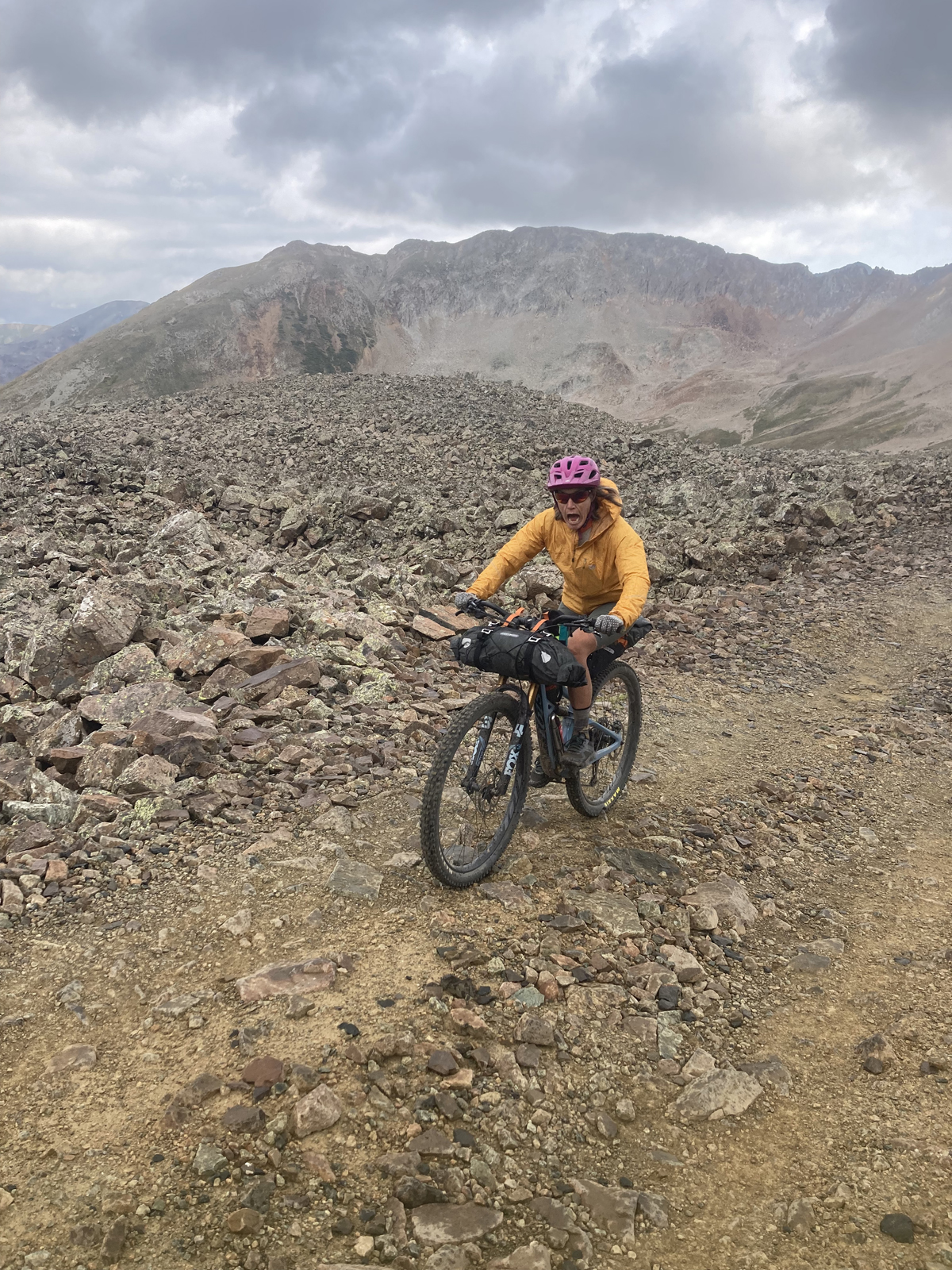
The effort increases up high. Bikepacking Crested Butte’s Elks Traverse. Photo by Tom Diegel

The “Elks Traverse” is detailed on bikepacking.com, where there’s a great 10 minute video and the unusual rating of a 10 in terms of difficulty; now we know what a 10 is on their scale! Though it’s not the fabled Crested Butte singletrack, doing a quick overnight – or if you’re feeling pretty hard – a day shot to do the mighty Elks Traverse is a fun way to get pretty intimate with that area’s “Rocky” mountains.
 

2024 Point Series Champions Crowned by Gran Fondo National Series

0

GETTYSBURG, PA (November 4, 2024) – Gran Fondo National Series awarded 21 Points Series Champions at the conclusion of the 2024 Gran Fondo National Series. The season-long competition rewards accomplishment and consistency by awarding points to cyclists who compete in at least three Gran Fondo National Series events.

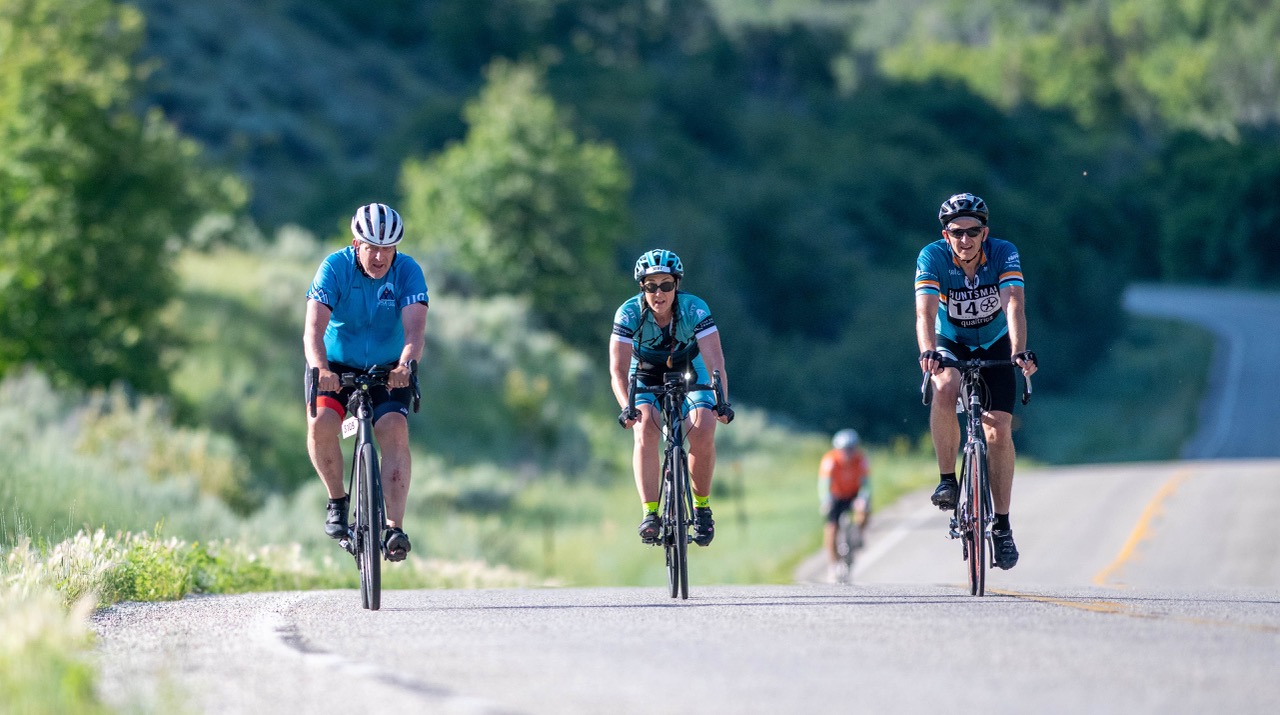
2023 Cache Gran Fondo. Photo courtesy CGF

A record number of cyclists participated in Gran Fondo National Series owned events in 2024, including a record number of cyclists who participated in two or more Series events. The Series achieved a 5% increase in overall participation compared to 2023, highlighted by an increase of over 25% in participation at Boone Gran Fondo. Series owned events include: Gran Fondo FloridaTour of Georgia Gran FondoHighlands Gran FondoGran Fondo AshevilleBoone Gran FondoGran Fondo Maryland, and USA Cycling Gran Fondo National Championships. Cyclists can also earn Series Points at Partner-Events, like the Cache Gran Fondo in Logan, Utah.

Series Points Championships titles are awarded in each Gran, Medio, and Piccolo Route age-group category, to the rider who has the fewest number of points after participating in a minimum of three Gran Fondo National Series events in the same distance category. A rider’s best three results are counted towards their point totals. Click here to see more about Series-Points.

2024 Gran Fondo National Series Points Champions

Category Name
Gran MU23 Charlie Hutchens
Gran M23-34 Felipe Aros
Gran M35-44 Noah Niwinski
Gran M45-54 Jeremiah Bishop
Gran M55-64 Jay Gump
Gran M65-69 Jay Trojan
Gran M70+ Alan Lesage
Gran W23-34 Valentina Cummings
Gran W35-44 Jennifer Thornton-Brooks
Gran W45-54 Shannon Scanlon
Gran W55-64 Marni Harker
Gran W65-69 Gail Waldman
Gran W70+ Camilla Buchanan
Medio M35-44 Sergey Zvezdov
Medio M70+ Tom Gee
Medio W35-44 Monica Bishop
Piccolo M23-34 Nicholas Cornell
Piccolo M65-69 Dan Heiman
Piccolo M70+ Michael Howard
Piccolo W23-34 Alexandria Cornell
Piccolo W35-44 Samantha Spangenburg


Study: ‘Idaho Stop’ No More Dangerous at Intersections than Full Stop

0

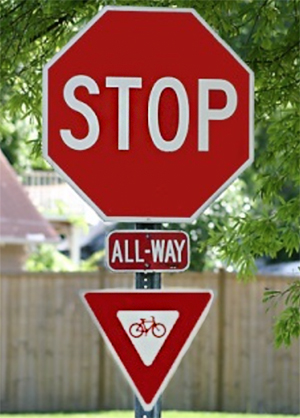
By Charles Pekow – It appears that stop-as-yield laws may not lead to an increase in bike crashes. A study from the University of California looked at how these laws—allowing cyclists to treat stop signs as yield signs—are performing in the five states that have implemented them: Idaho, Arkansas, Oregon, Washington, and Delaware.

The researchers compared crash rates in these states with those of neighboring states to determine whether California should consider a similar law.

“The results did not indicate a significant change in cyclist crashes among the states with stop-as-yield laws,” the study concluded.

However, the researchers noted that the study doesn’t fully settle the issue. More research is needed to explore factors such as weather, terrain, cyclist behavior, urban versus rural settings, and the severity of crashes, as this study focused primarily on crash numbers.

For more information, check out Evaluate the Safety Effects of Adopting a Stop-as-Yield Law for Cyclists in California at https://escholarship.org/uc/item/64h2s9cj.


Utah’s BOLT Skin + Shave Introduces Shaving Cream for Male Endurance Athletes

0

Shaving Cream Specifically Designed for Endurance Athletes Gains Momentum with Pro Cyclist Keegan Swenson as an Ambassador

BOLT Skin + Shave announced the launch of its revolutionary shaving cream, designed to transform men’s leg grooming, especially for endurance athletes. Their shaving cream, along with BOLT’s complete line of leg-shaving products, is crafted to meet the unique needs of cyclists, triathletes, and outdoor enthusiasts who require performance-driven grooming solutions.

Unlike traditional shaving creams or products repurposed from face care, BOLT’s shaving cream is formulated to provide a close, smooth shave that reduces friction and irritation for the high-exertion demands of athletes. Its rich lather, hydrating ingredients, and targeted design help men achieve an optimal shaving experience, setting it apart as a trusted product in leg grooming.

“Our shaving cream is truly groundbreaking because it addresses the overlooked but essential needs of men who shave their legs,” said Adam Barker, active sports photographer and founder of BOLT Skin + Shave. “We wanted to create a product that not only provides the best shave possible but also enhances the overall experience, with a smooth, soothing formula that lasts.”

To bring BOLT’s innovative products to a broader audience, the brand has partnered with Keegan Swenson, a ten-time national champion and endurance cyclist known for his relentless dedication and success in mountain biking and gravel racing. As a BOLT ambassador, Swenson will showcase the difference that the right shaving cream can make in his rigorous training and performance.

“Most products just aren’t tailored to guys who need that next-level shave on their legs,” said Swenson. “BOLT’s shaving cream has completely changed my routine—no more irritation, no more struggle. It simply works better.”

To learn more about BOLT Skin + Shave’s revolutionary shaving cream and its full range of leg-shaving products, visit boltshave.com.

Can Cycling Help With Grief and Depression?

By Craig Fry, Victoria University My father Lindsay Fry passed away suddenly in 2015. He had end stage cancer, which was found well advanced on his lung and spine. Sadly, my father died just seven weeks after his diagnosis. He was two weeks short of his 70th birthday.

I was not prepared at all for my father’s death. It was a great shock, and the resulting grief floored me. The people around me seemed under prepared too – the daily conversations at work, around the dinner table, with family, and even out riding bikes with friends didn’t often accommodate deeper dialogue around the bereavement experience.

Cycling can help when it comes to challenges to our mental health like grief and depression. Author provided

It is a difficult topic after all … death. Most people simply don’t want to follow you too far down that road. Men especially, it seems, are not great at discussing death and grief. An expert in the field suggested to me that this is partly because many men are ‘instrumental grievers’ – we seek active practical outlets for processing grief.

That was certainly me. In the depths of grief, I didn’t always possess the words to describe and understand what I was feeling. But I was lucky enough to discover quickly that cycling helped me.

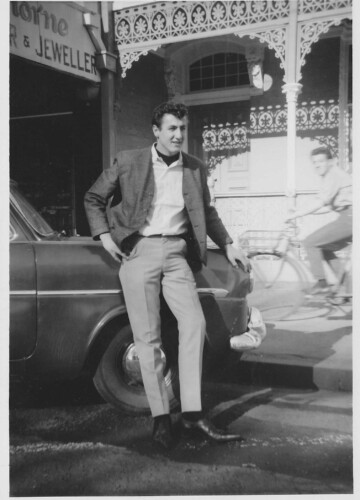
Lindsay Fry in Manifold Street, Camperdown, Victoria, circa 1966.

I was so struck by this that I decided to write about it – the resulting book, Ride: A memoir to my father, was published in June 2016. It’s a personal account of loss and grief, and how the simple act of riding a bike through familiar roads and places has kept me (mostly) sane and well.

I’m no academic expert in this area, but I found that writing a book about my own grief experience made me wonder more about the role of the humble bicycle when it comes to life’s inevitable mental health and wellbeing challenges.

I decided to look into this further. Here’s what I found.

Exercise and mental health

While there is a large amount of academic literature on the mental health benefits of exercise generally, the science here is not clear cut. For instance, a 2013 systematic review of the effects of exercise on depression concluded effect sizes are moderate at best, and of uncertain duration after exercise stops. In contrast, a 2016 meta-analysis of 25 randomised controlled trials of exercise interventions reported large significant antidepressant effects in people with depression (including major depressive disorders).

A common conclusion made in some of the best designed twin and review studies is that while regular exercise is associated with reduced anxiety and depressive symptoms, that relationship is not causal. This means the observed positive mental health effects are complex, and involve a range of other individual and environmental factors besides exercise.

Overall, the evidence seems to suggest that the potential mental health benefit from exercise is not something that all people will necessarily experience. Observed effects can vary as a function of illness severity, study group exercise experience (untrained, recreational, elite), exercise type (frequency, intensity, duration etc), and the chosen measure of mental health. For some of the most severe forms of clinical depression exercise alone is unlikely to be the entire answer.

Cycling and mental health

Far fewer studies have focused on the mental health benefits of cycling specifically. However, similar findings can be found to those for other exercise. For example, a 2004 Polish review study reported that improvements in depressive and other mood disorders are greatest for rhythmic aerobic exercises like cycling.

A 2007 Cycling England review report concluded that:

[…] cycling has a positive affect on emotional health – improving levels of well-being, self-confidence and tolerance to stress while reducing tiredness, difficulties with sleep and a range of medical symptoms.

And 2011 pilot work in Sydney trialling a bicycle program for mental health service users showed promising results with self-reported mental and physical health improvements for participants.

Outside of the academic literature, there are frequent claims about the benefits of cycling for mental health, including popular articles on how cycling can make you smarter and happier. There has been a published guide to depression for cyclists, and Victoria’s Department of Health & Human Services currently provides this public advice on cycling and mental illness:

Mental health conditions such as depression, stress and anxiety can be reduced by regular bike riding. This is due to the effects of the exercise itself and because of the enjoyment that riding a bike can bring.

Claims about the mental health benefits of cycling can be observed at a number of levels, including elite and amateur competitive cycling, for recreational riders, and for people new to bike riding.

And in recent times a number of high profile people have commented publicly about the positive power of cycling in this area – for example, former Australian Rugby professional Mat Rogers recently argued:

I think that blokes in a cycling bunch would be the least depressed of any group of men because they get stuff off their chest, they talk, and they don’t feel like they’re getting looked down on or judged.

Indeed, as one journalist put it recently:

[…] the anecdotal evidence from recreational cyclists and bloggers is overwhelmingly in favour of the beneficial effects of getting out on your bike and riding the black dog off your wheel.

What is it about cycling?

On the question of why physical activity and exercise like cycling has been associated with positive mental health outcomes, the academic literature has pointed to both physiological mechanisms (e.g. the thermogenic, endorphin, and monoamine hypotheses) and psychological mechanisms (e.g. improvement of self-efficacy, distraction, and cognitive dissonance).

Popular accounts have also emphasised social psychology principles to explain the apparent connection between cycling and wellbeing, with one Australian psychologist observing recently:

Cycling seems to possess an array of attributes that boost happiness in ways that few other sports can claim…Cycling boosts mental health.

But again, while it appears there are potential mental health benefits to be had from cycling, this doesn’t mean the bicycle will be a panacea for all our mental health ills. On the contrary, there have been some suggestions of negative mental health impacts at the highest levels of competition cycling, for example:

There has also been the suggestion that certain personality types more vulnerable to mental health problems may be more prevalent in elite cycling. For instance, former world hour record holder and world champion cyclist, Graeme Obree, has said this about depression and cycling:

A lot of people who suffer from depression have a tendency to have obsessive behaviour – that’s why more of them exist in the top end of sport. The sport is actually a self-medicating process of survival.

Cycling and grief

Much less has been written in the academic literature about how exercise and physical activity like cycling might help people when grieving the loss of a loved one – although some experts like the Australian Centre for Grief and Bereavement suggest that exercise can be one useful coping strategy along with others.

Most of the available sources on this question are from personal anecdotes. There have been some books on the topic, such as the recent anthology Cycletherapy: Grief and Healing on Two Wheels and Matt Seaton’s 2002 The Escape Artist. There are also blog articles where the recurring theme is that the bicycle can indeed help in grieving, as these examples show:

In the days before his seventeenth birthday, Tolstoy’s adored son Vanechka had died of scarlet fever. It hit him as hard as his brother Nikolay’s death in 1860, and Tolstoy saw cycling as a kind of “innocent holy foolishness” that allowed him to deal with his grief. (TolstoyTherapy)

There is no instruction manual for grief – you have to find your own path through it. For us that involves a lot of biking. Biking has been our form of therapy. It has kept us living in the present, brought us joy, kept us healthy and reconnected us to the world. (AxelProject)

I had a choice. I could curl up in a fetal position and continue to wish I was dead. Or, I could stand up, put one foot in front of the other and keep going and fight back. I rode my bike and I rode it hard. I could feel Jerry with me. I pushed myself to the point of exhaustion, challenging my emotional pain with physical pain. I rode and I cried. (American Heart Association).

One story closer to home about cycling and grief that stood out for me was the one that emerged in 2000 around Scott McGrory and his family. McGrory is the well known former Australian professional cyclist who won the Madison gold medal with Brett Aitken at the Sydney Olympics. Tragically, in the lead up to his Olympic campaign in 2000, McGrory’s 11-week old son passed away from a heart condition.

Speaking in an interview a few years ago, McGrory’s reflections about that time perhaps reveal a positive connection between grief and cycling, but they also remind us that the bike is not a magic pill that works all of the time:

There were times when I felt invincible, drawing strength from what had happened, and a day later I’d be absolutely useless. One day I did a five-hour ride to the Dandenongs and as it started to rain I looked to the heavens and yelled, ‘Bring it on!’ The harder it rained and the windier and colder it got, the better – nothing was going to touch me that day because I was Superman. The next day I got only 20 minutes into the same ride and had to stop on a bridge over the Yarra because I had been crying for several blocks and couldn’t see where I was going.

Cycling worked for me

Overall, the available evidence suggests that physical activity and exercise like cycling can have a positive impact on mental health, and could be one helpful strategy for some people experiencing grief. However, it is also clear that cycling is unlikely to be a ‘cure all’ for everyone, or for the most severe forms of complicated grief, clinical depression, or other mental health illnesses.

After my father died, cycling has helped me to live with and understand my grief. I had other vital assistance too – my wife, family, relatives, friends, and my father’s friends all played important roles, and I also drew upon professional help.

Mile-for-mile though, I found the simple act of riding a bike was the ‘best’ thing I could do to stay well. The hundreds of hours and thousands of kilometres I spent riding after my father’s death is working for me.

Cycling helped me bring together my physical, emotional, and cognitive energies in a focus on moving towards an understanding of what it really meant to lose my father. I am still learning.


Ride: A memoir to my father by Craig L Fry (Hampress Pty Ltd) published on 21 June 2016 as an Amazon Kindle Single. A percentage of sales will be donated to the Australian Centre for Grief and Bereavement.

Craig Fry, Associate Professor, Centre for Cultural Diversity and Wellbeing, Victoria University

This article is republished from The Conversation under a Creative Commons license. Read the original article.

Helmets Don’t Last Forever – Is it Time to Replace Yours?

By Tom Jow — The rider that has not had a crash may never think to replace their helmet. The rider that has crashed yet did not hit their head may also find little reason to purchase a new one. However, bicycle helmets, like many types of gear that are exposed to extreme hot and cold, and ultraviolet light can deteriorate with time. These and other elements can break down and/or dry out (harden) the EPS (expanded polystyrene) layer of the helmet. This can reduce the effectiveness of the helmet to properly absorb impact. Helmet manufacturers recommend replacing an undamaged helmet every three to five years. Any helmet that has suffered a crash impact should be replaced whether or not there is visual damage.

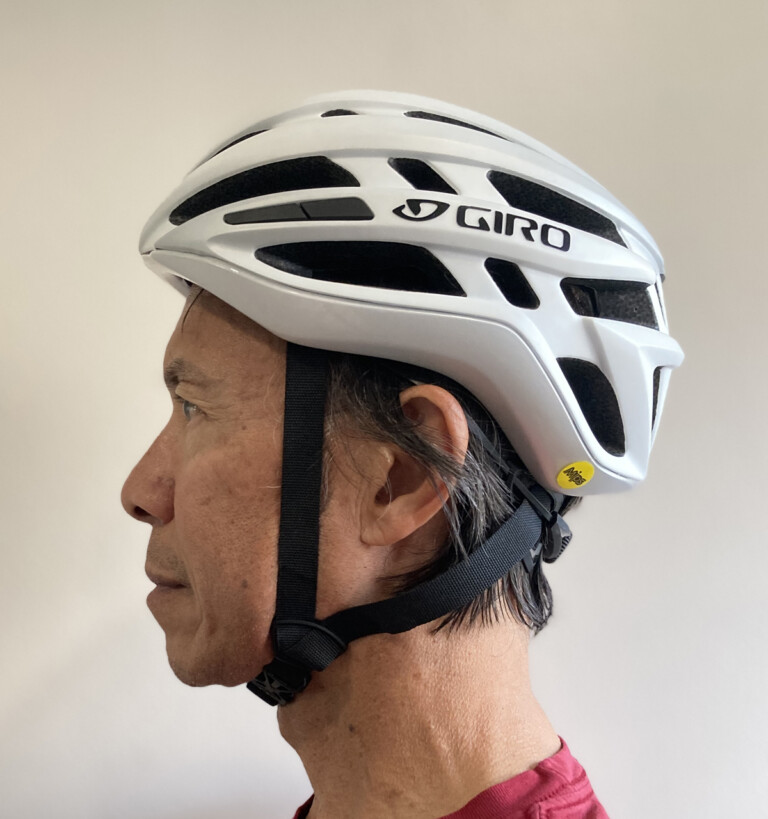
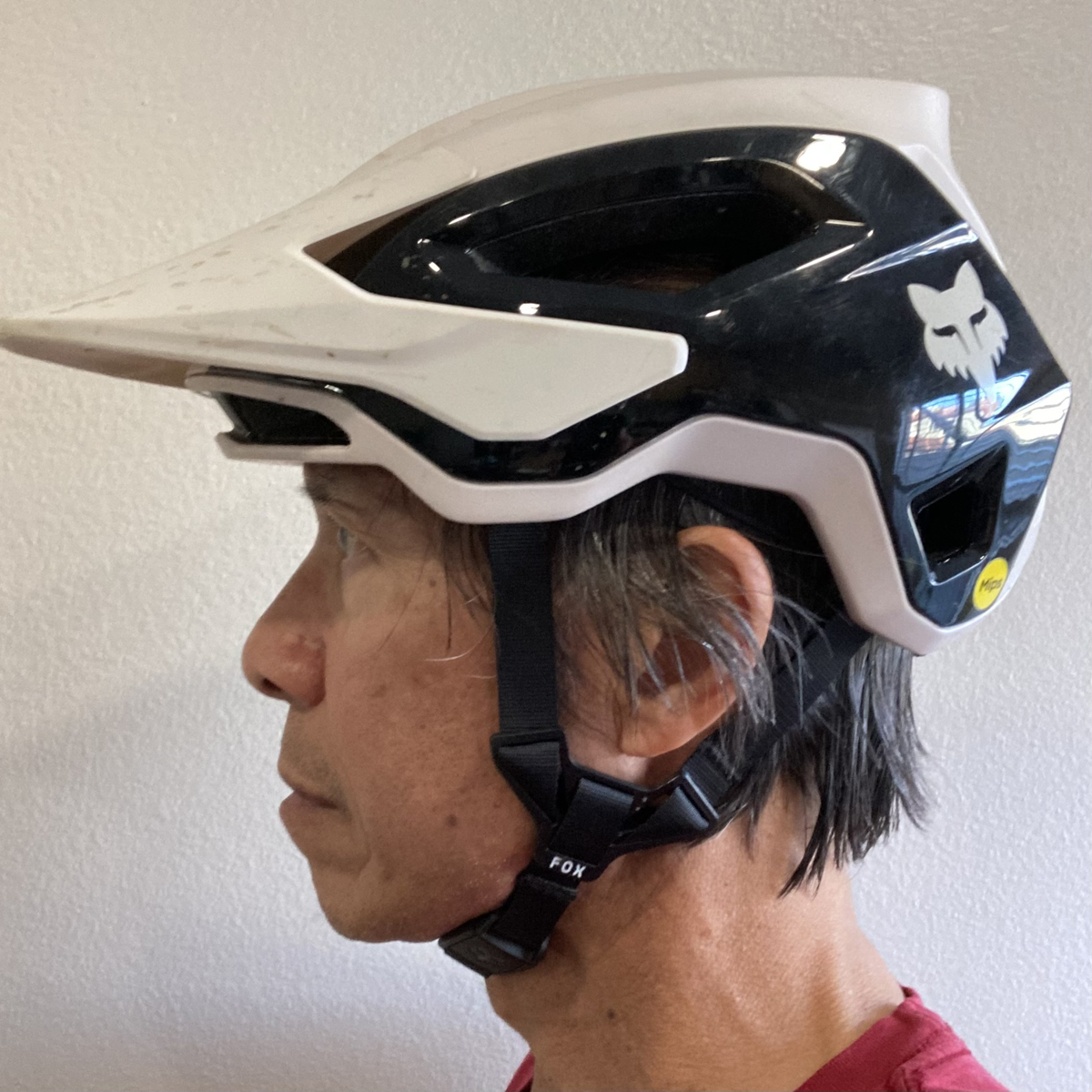
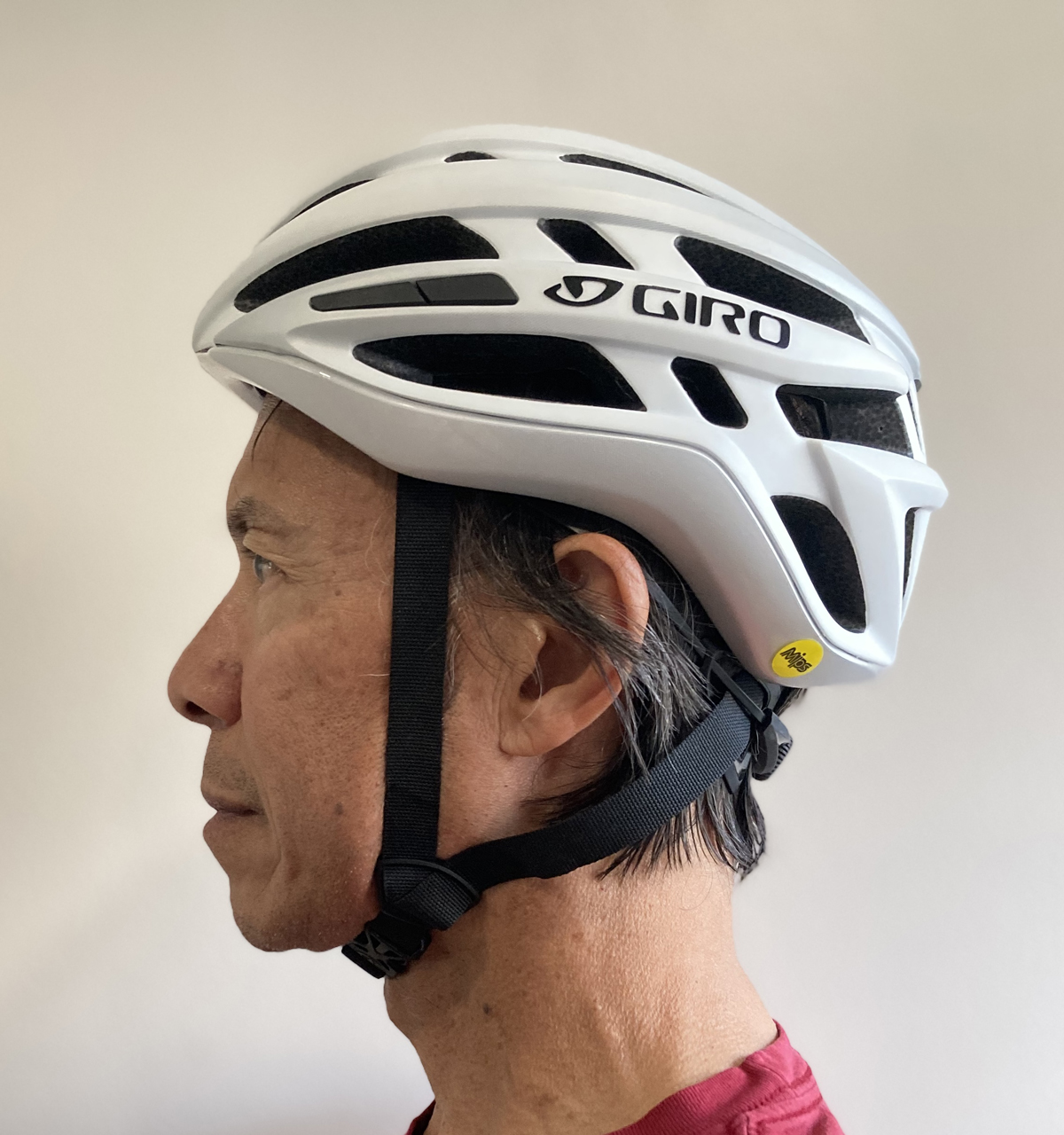
Well-adjusted ear buckles and a tight chin strap keeps the helmet low over the eyebrows. Notice the extra coverage over the temples and behind the ears provided by a mountain bike helmet. Photo courtesy Tom Jow

For better or worse, I have had to replace two helmets over the last several years for just this reason. When shopping for a new helmet, there are several factors that make up the reason we decide on one or the other. Myself, I begin with intended use. I ride several different types of bikes, and it is important to have the correct level of protection for each. The helmet for downhill (full face obviously) is different from mountain bike trail riding, road/gravel, and town riding. Next, I look at the price. While all helmets sold are certified for use, more expensive helmets have more features that offer a little more protection for specific uses. I admit I don’t purchase the most expensive, but not the least expensive either. Also, call me vain but color matters too. I want a helmet that decently matches my outfits. Finally, after I wrote, “A Helmet is More than a Brain Bucket” (Cycling West, August 2024), I found it important to have a helmet with advanced protection like MIPS, Turbine, Koroyd, or similar technology.

Helmet Standards and Testing

All helmets approved for sale in the United States must meet a minimum standard set by the Consumer Protection Safety Commission (CPSC). Each approved helmet must pass a series of four tests: peripheral vision, positional stability, retention strength, impact attenuation (force reduction)[1]. An obvious concern when purchasing a helmet is impact attenuation. For testing, a minimum of eight helmets per model is required to be subjected to impact under different conditions. These conditions include hot (117-127°F), cold (1-9°F), wet (soaked underwater), and room temperature. The impacts for each helmet include flat, round, and curb shaped anvils, each with 80 grit sandpaper to simulate asphalt. To simulate impact, a weighted head form is inserted into the helmet and dropped from approximately 6 feet (6.2m/s) to the flat anvil, and 4 feet (4.8 m/s) to round and curbstone anvils.

An ear buckle that is adjusted too low allows the helmet to tip back exposing the forehead to risk. Photo courtesy Tom Jow

Only after passing these tests is a helmet brand/model approved for sale. The CPSC, however, does not rank helmets for a level of protection beyond the minimum. In order to do this, we would have to know two things: how much force it takes to cause head injury and how much force is being applied. As much as science knows about head injuries, it is not possible to test bicycle helmets on live subjects. However, Virginia Tech University figured out a way.

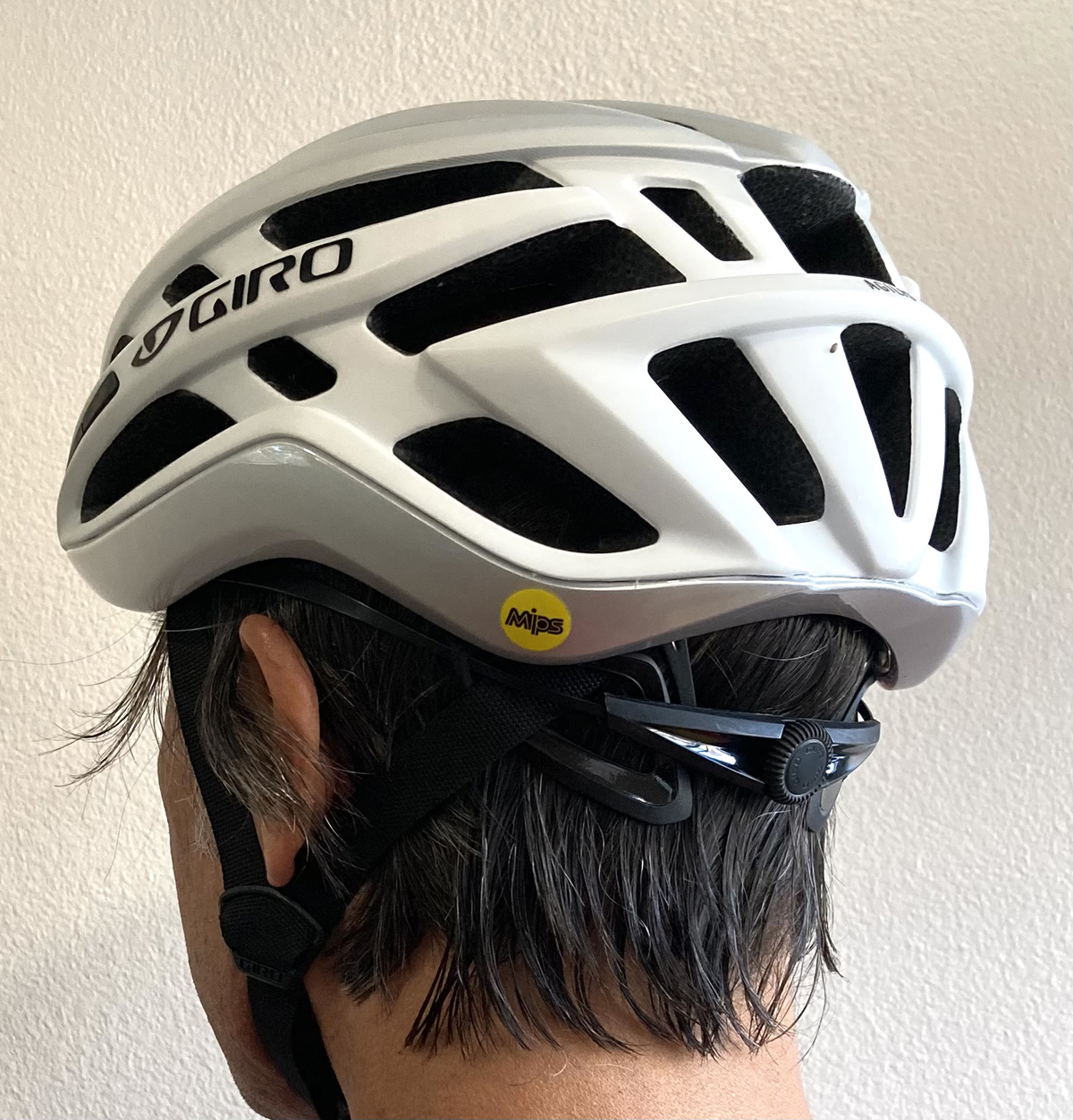
The addition of a dial adjustable strap on the rear of the helmet has made helmet fitting both easier and more secure. Photo courtesy Tom Jow

In the early 2000’s, The Biomedical Engineering Helmet Lab at Virginia Tech University, began recording helmet impact forces by placing sensors inside the helmets of football players, a user group at high risk of concussion. By doing so, this allowed their lab to correlate concussion with real-life impact forces. The resulting data enabled the lab to both determine the forces behind concussion and improve helmet safety. Furthermore, the lab is able to provide test result rankings not only for football, but bicycle, hockey, and other sports[2].

The Virginia Tech Helmet Rankings page[3] is easy to navigate. It opens with the highest rated helmets first, showing the helmet on a head form. There is a row of buttons on top to filter by category, i.e., road, mountain, etc. Each helmet also displays a number of stars (five being best) and a score (lower being better). Click on the helmet and a couple graphs appear. One compares the helmets individual score to the average of the five-star helmets. The star rating is very easy to understand. The individual score, however, was not. In the Virginia Tech paper, STAR Methodology for Bicycle Helmets, the scoring system is explained. The bottom line of the scoring is a representation of the number of concussions estimated that would occur out of a calculated average (47) number of impacts likely to cause concussion[4]. A helmet with a score of 8.7 is estimated to suffer that many concussions out of the forty-seven impacts. Therefore, that same helmet is theoretically safer than a five-star helmet with a score of 10.1.

Helmet Fit

All of this data aside, the helmet we choose will be less effective during impact if it does not fit or is not worn properly. In order to find a good fit, it can be helpful to know the circumference of our head. With a metric tape measure, wrap it around the head horizontally just above the eyebrows. Then, consulting size charts pick out a helmet that fits all our criteria in the size we need. Most helmets are sized S, M, L and XL. For example, if the circumference is fifty-six centimeters, the size is probably medium. Now try the helmet on. A good fit is one where the helmet sits all the way on the head, just above the eyebrows and within the range of the inner shell adjusting strap. If it seems too big, especially if the adjusting strap is all the way closed, it probably is. A good strategy for finding proper helmet fit is to find a size that feels about right, then try on a smaller one. It is much easier to figure out if the helmet is too small.

Once the helmet is selected (and presumably purchased) it is time to adjust the straps. The first thing to know about adjusting helmet straps is to DO IT AT HOME. Attempting to adjust the helmet straps on a ride is a sure way to be frustrated and irritate any friends with us. The first adjustment to make is to the side (ear) buckle. If the straps are adjustable here, position it close under the ear. At the same time, adjust the front straps to hold the front of the helmet down near the eyebrows. This is, however, dependent upon the chin strap adjustment. In order to keep the helmet on the head during a crash, it should be tight enough that just one finger fits under. Work between the two straps until the helmet covers at least most of the forehead with light upward pressure.

Helmet Care

While a bicycle helmet does not appear all that complicated, considering its job, it does deserve a little care and maintenance. Remember that manufacturers design helmets to absorb impact. Therefore, avoid unnecessary impacts such as dropping it on the ground, dropping things on top of it, or wantonly throwing it in the back of the car. If it comes with a storage bag, use it, and whenever possible keep the helmet near room temperature. Finally, keep it clean. A buildup of sweat and skin oils if not damaging, is just not hygienic. Occasionally wash the interior of the helmet and straps with mild soap or shampoo.

Conclusion

A bicycle helmet is an important part of our cycling kit. Having one that looks good and fits properly can help us ride more confidently, more comfortably, and maybe even faster with less risk should the worst happen. However, in order to do so we must be sure to take the time to select the appropriate helmet, adjust for the proper fit, take a little care of it, and replace it at the correct time, impact or not. Most importantly, we must wear it.

References:

  1. https://www.cpsc.gov/FAQ/Bicycle-Helmets
  2. https://www.helmet.beam.vt.edu/lab.html
  3. https://www.helmet.beam.vt.edu/bicycle-helmet-ratings.html
  4. Bland, Megan L.; McNally, Craig; Rowson, Steven, “STAR Methodology for Bicycle Helmets,” Bicycle Helmet Star Protocol, 30 May 2018, https://vtechworks.lib.vt.edu/items/6d20e999-4180-4040-ba77-a4eef66ad1fa


Bentonville to Host 2024 USA Cycling Collegiate Mountain Bike National Championships

Collegiate Mountain Bike Nationals will be moved to Bentonville, Arkansas, November 14-17 after Hurricane Helene forced postponement.

BENTONVILLE, Arkansas (October 30, 2024) – The 2024 USA Cycling Collegiate Mountain Bike National Championships, originally scheduled for October 24-27 at Ride Rock Creek in Zirconia, North Carolina, will be moved to Bentonville, Arkansas, November 14-17, 2024. Registration will open on October 31, 2024, at 9:00 am MT.

“We’re excited to still be able to host Collegiate Mountain Bike Nationals this year, despite the postponement due to Hurricane Helene. We understand how much training and racing these collegiate athletes have done leading up to this point, so we’re glad they will have the opportunity to still compete at nationals this semester. Bentonville has stepped up in a huge way to help us make this happen,” said Kyle Knott, USA Cycling’s Director of National Events.

The event will crown Varsity and Club National Champions in Cross-Country, Short Track, Downhill, Dual Slalom, and Team Relay. An Omnium National Title will also be awarded to the best overall Varsity and Club teams at the end of the weekend. Spectators can expect four action-packed days of racing. The marquee events include:

  • Thursday: Dual Slalom finals and awards.
  • Friday: Cross-Country finals and awards.
  • Saturday: Short Track finals and awards. 
  • Sunday: Downhill finals and awards. Team Relay finals and awards.

The full race schedule can be found here.

“We are honored to welcome the 2024 USA Cycling Collegiate Mountain Bike National Championship to Bentonville.” said Kalene Griffith, president and CEO of Visit Bentonville.

“It is unfortunate that the event was unable to proceed in North Carolina due to the impact of the hurricane and our heart goes out to them. We are fully committed to supporting these talented athletes and ensuring they have a memorable experience here. Bentonville is ready to provide a warm welcome along with an exciting weekend of competition and fun.”

For event updates and additional resources, refer to the USA Cycling Collegiate Mountain Bike National Championships event page as it will continue to be updated leading into the event.

For more information, contact the USA Cycling National Events team at [email protected]


USA Cycling Announces New Junior Gravel National Series for 2025

0

USA Cycling joins forces with prominent gravel events to offer riders between the ages of 15-18 a dedicated development pathway.

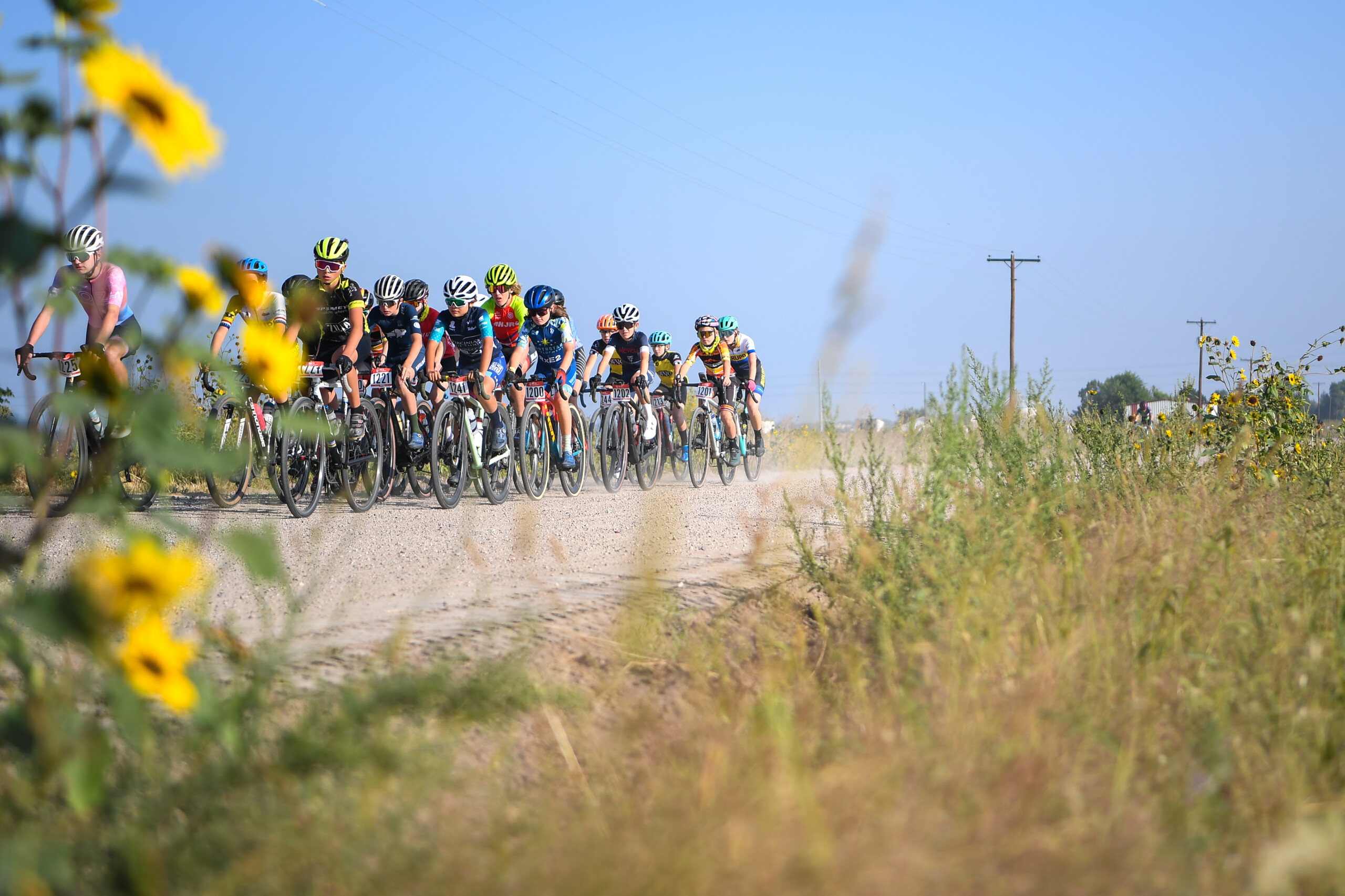
COLORADO SPRINGS, Colorado (October 30, 2024) – USA Cycling has partnered with Life Time, SBT GRVL presented by Wahoo, and Valley of Tears to launch the Junior Gravel National Series, a five-race series exclusively for junior riders aged 15-18. Designed to nurture the next generation of elite cyclists, this series provides aspiring athletes with invaluable race experience in the fast-growing discipline of gravel cycling, along with unique opportunities to advance their competitive careers.

The USA Cycling Junior Gravel National Series will consist of five events across the country and four competition categories: 15-16 Men, 15-16 Women, 17-18 Men, and 17-18 Women. Riders must participate in at least three events to be included in the series standings, with their three best finishes counting toward their overall score. At the conclusion of each series event, each athlete receives a score equivalent to their placement in that respective event. The rider with the lowest total score from their top three finishes will be crowned the overall winner in their respective category. In the event of a tie, rider placements at the USA Cycling Gravel National Championships in La Crescent, Minn., September 20, 2025 will serve as the tiebreaker.

Photo courtesy of USA Cycling

All series participants will have exclusive access to a special discounted registration rate for the 2025 USA Cycling Gravel National Championships. Additionally, the top three finishers in each series event leading up to the National Championships will earn a $50 credit toward their registration fee.

Top-ranked riders from the series will be invited to a USA Cycling Junior Talent Identification Camp in October 2025. This new, invitation-only camp provides young athletes with a dedicated pathway into elite-level road racing and an Olympic discipline.

2025 Junior Gravel National Series Event Schedule:

  • March 8, 2025: Valley of Tears Gravel – Turkey, Texas
  • April 11, 2025: Life Time Sea Otter Classic presented by Continental – Monterey, California
  • May 31, 2025: Life Time UNBOUND Gravel – Emporia, Kansas
  • June 29, 2025: SBT GRVL presented by Wahoo – Steamboat Springs, Colorado
  • September 20, 2025: USA Cycling Gravel National Championships – La Crescent, Minnesota

“We are working closely with event organizers and industry partners to build a foundation for the future. This series is just the beginning of a broader initiative to expand opportunities for junior riders across multiple cycling disciplines. The USA Cycling Junior Gravel National Series represents a bold step forward in our efforts to expand youth participation in gravel, a discipline that offers a unique bridge between road and off-road cycling,” said Kyle Knott, USA Cycling’s Director of National Events.

“We are deeply committed to fostering the growth of cycling in the United States. Life Time has embraced a leadership role through iconic events like Sea Otter Classic and UNBOUND Gravel, and has further promoted the sport with the Life Time Grand Prix presented by Mazda series, encouraging both professional cycling and fan engagement,” said Kristi Mohn from Life Time Off Road Events. “Partnering with USA Cycling to develop and expand youth gravel cycling is a natural next step in this mission. We’re excited to see the development of young riders and look forward to working not only with USA Cycling but with gravel events nationwide to inspire more youth and families to discover the joy of cycling.”

“SBT GRVL presented by Wahoo is honored to be a stepping stone on the road for junior riders to develop their gravel racing skills within the US,” said Amy Charity, Co-Founding Partner and CEO of SBT GRVL. “We are proud to call America the birthplace of gravel, and excited to see USA Cycling and like-minded events working together to build a series that provides a clear path to compete and achieve recognition at a national level.”

“Valley of Tears is thrilled to host the first race of the 2025 Junior Gravel National Series. At the heart of our race is a commitment to fostering community, resilience, and a passion for the sport,” said Christian Fairly of the Fairly Family. “By partnering with USA Cycling, we have the opportunity to help support aspiring young American cyclists—something USA Cycling did 20 years ago for my brother Caleb—by providing young athletes a platform to challenge themselves and develop their skills. We look forward to seeing these talented juniors find their limits and carry the spirit of gravel cycling forward.”

Details including event locations, registration information, and additional event specifics are available on the USA Cycling website at https://usacycling.org/national-series/usa-cycling-junior-gravel-national-series.

VeloSwap Returns to Denver on November 2, 2024

0

Colorado’s Largest Bike Expo will Serve as a Fundraiser for Bicycle Colorado

DENVER, Colorado (October 30, 2024) – VeloSwap, the ultimate end-of-season event for cycling enthusiasts, is set to return to Denver, Colorado, on November 2 at the National Western Complex. Presented by Bicycle Colorado, this one-day event will offer a broad range of products, from bikes and accessories to clothing and gear, featuring over 200 local and national vendors.Cyclists and families alike are invited to enjoy an exciting lineup of activities, including prize giveaways, bike demos, a kids’ bike rodeo, and guest speakers. The event supports Bicycle Colorado’s mission, with proceeds from ticket sales, exhibitor fees, merchandise sales, and sponsorships directly benefiting the organization’s work to promote safe cycling across Colorado.

Attendees can take advantage of special pricing on excess inventory from retailers, unique buys from manufacturers, and a diverse selection from individual swappers. Highlighted vendors include Mike’s Bikes, Save Our Soles, Canfield Bikes, Feedback Sports, EF Educational Tours, Giant Bicycles, HopeCycle, Lucky Bikes, and more, creating the largest single-day bike sale of the year.

This year marks VeloSwap’s 32nd anniversary and its first under the ownership of Bicycle Colorado. In 2023, Outside Interactive, Inc., a global leader in active lifestyle content and events, transferred ownership of VeloSwap to Bicycle Colorado to ensure this beloved event continues its legacy in supporting Colorado’s cycling community.

Bicycle Colorado’s Executive Director, Pete Piccolo, stated, “VeloSwap presents a significant opportunity for us to support Colorado’s bicycling community and advance our advocacy work. We are excited to build on the strong brand of VeloSwap, bringing the event back to Colorado to inspire bicyclists and drive policy changes that make biking safer for all.”

Tickets are available online and at the door, with event hours from 10 a.m. to 4 p.m. For more details, visit www.veloswap.com.

Schedule:

  • 9:00 a.m. | Doors open to Bicycle Colorado members only
  • 10:00 a.m. | Doors open for the general public
  • 10:00 a.m. to 2:00 p.m. | Kids’ zone with bike rodeo and face painting
  • 4:00 p.m. | Doors close

Speaker Series:

  • Brad Tucker from ColoBikeLaw.com: “Insurance 101 for Cyclists” (10:30 to 11:00 a.m.)
  • Lexy Rose from StretchWorks: “The Secret to Recovering Well: What Every Cyclist Should be Doing Off the Bike” (12:30 to 1:00 p.m.)

Event Location:

  • National Western Complex, 4655 Humboldt St., Denver, CO 80216

For More Info:


Tour de France 2025: Route Announcements

Homecoming

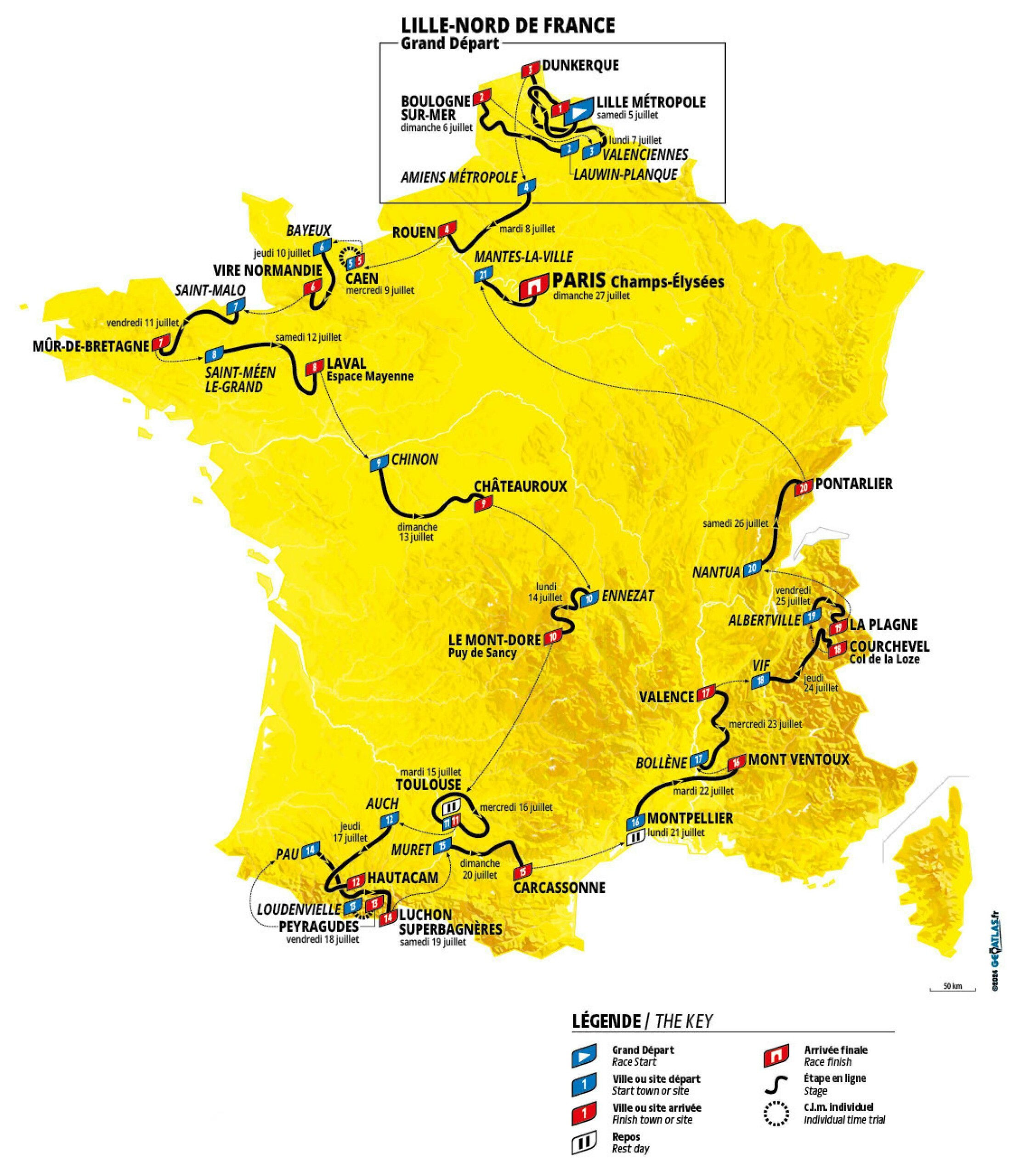
PARIS, France (October 29, 2024) — Christian Prudhomme revealed the route of the 2025 Tour de France in crisp detail at the Palais des Congrès de Paris this morning. It features glamorous summits such as Luchon-Superbagnères, the Mont Ventoux and the Col de la Loze, in the heights around Courchevel. Before these high-altitude showdowns, the main contenders for the yellow jersey will get two chances to turn the balance of power in their favour: a flat time trial around Caen and a mountain time trial at Peyragudes.

The 112th edition, which will start in Lille and take place entirely within the confines of France, will pay tribute to all-time French cycling greats, from Jean Robic and Louison Bobet to Jacques Anquetil, Bernard Hinault, Bernard Thévenet and Laurent Fignon.

The 2025 edition will also mark the fiftieth anniversary of the polka-dot jersey, the best young rider classification and the first finish of the race on the Champs-Élysées in Paris.

Talk about colouring inside the lines! The unveiling of the Grand Départ Lille-Nord de France came in the wake of three editions that got the show on the road in Denmark, Spain and, most recently, Italy. The route of the 112th Tour de France will stretch for 3,320 kilometres without venturing beyond the borders of France, taking the peloton from the Esplanade du Champ de Mars in Lille in the inaugural stage, on 5 July, to the finish on 27 July, when a powerful sense of homecoming will sweep through the peloton as the riders barrel down the Champs-Élysées in Paris for the fiftieth time.

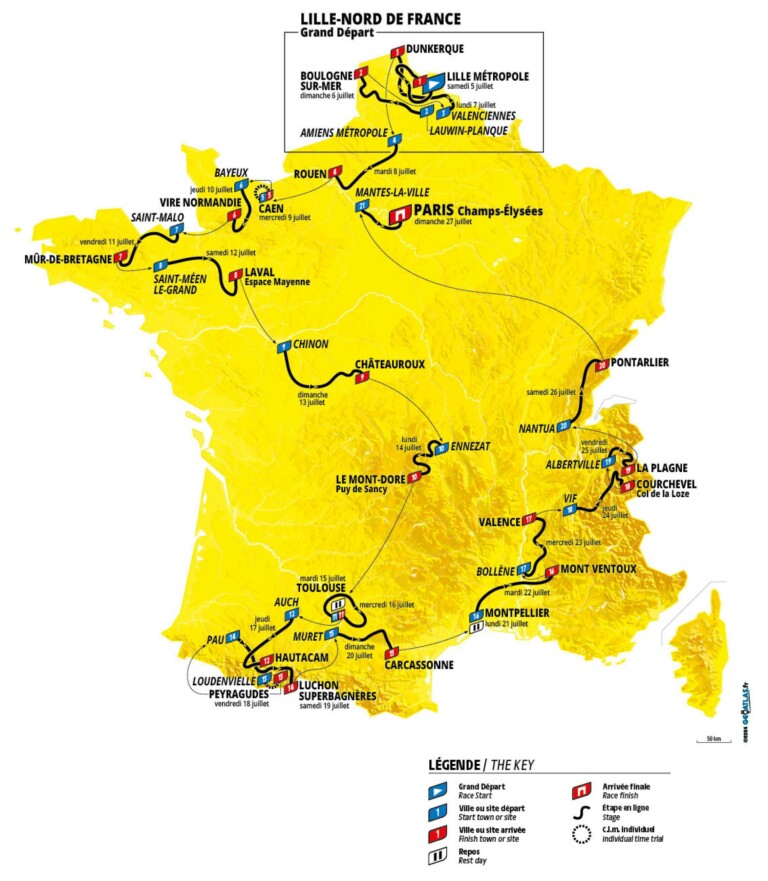
Map of the 2025 Tour de France. Image courtesy of and © A.S.O.

The milestone of turning fifty serves as a central theme, as the year 1975 marked both Bernard Thévenet’s victory ending Eddy Merckx’s reign, the debut of the polka-dot jersey in the Tour de France peloton, and the establishment of a young rider classification rewarded with the white jersey. The names that stand out from the illustrious annals of French cycling will also be present along the route in the shape of brushes with history in which the stars of the peloton will be eager to shine.


After a stint prepared in Région Hauts-de-France, where the opening salvo of the puncheur war will be fired in Boulogne-sur-Mer (stage 2), the competition will continue at the same ferocious pace in Normandy, with a stage win up for grabs in Jacques Anquetil’s home town of Rouen (stage 4). A trek through Norman Switzerland culminating in Vire will dispel any lingering doubts on the ability of the region to host a stage with a cumulative altitude gain of 3,500 metres (stage 6).

The peloton will roll through the Breton town of Yffiniac to mark 40 years since Bernard Hinault claimed his last victory, but the tribute will soon turn into a challenge with a double serving of the Côte de Mûr-de-Bretagne at the end of the day (stage 7). Right after that, the stage to Saint-Méen-le-Grand will be a blast from the past, harking back to the third consecutive victory of the local hero Louison Bobet, 70 years ago. The opening week will draw to a close on 14 July with a firework display on the leg-breaking terrain of south-central France, with a record seven category 2 climbs before the finish at the Le Mont-Dore ski resort, at the foot of the Puy de Sancy (stage 10).

The Massif central will be merely the gateway to the mountains, as a Pyrenean trilogy will quickly follow with a stage to Hautacam (stage 12), a mountain time trial leading to Peyragudes (stage 13) and, as the icing on the cake, the return to Luchon-Superbagnères (stage 14), held on a model of the course on which things started to go south for The Badger in his duel with Greg LeMond in the 1986 Tour de France.

Another climbing fest will come in Provence, where the cream of the climbing crop will clash for a prestigious win at the summit of the Mont Ventoux (stage 16), twelve years after the last stage finish at the observatory. However, the fight for the yellow jersey will rage on in the Alps. An altitude gain of 5,500 metres awaits the peloton on the road to the Col de la Loze, which will be tackled head-on from Courchevel this time round (stage 18). If the race has not yet been decided by then, there will be a new opportunity to tip the scales in the stage to La Plagne (stage 19), at the end of an ascent where Laurent Fignon struck hard in 1984 and 1987. The slopes of the Jura on the road to Pontarlier (stage 20) are unlikely to shake up the overall podium, as is the returning finale on the Champs-Élysées, which will set up a rematch between the winners and losers of the probable sprints in Dunkirk (stage 3), Laval (stage 8), Châteauroux  (stage 9), Toulouse (stage 11) and Valence (stage 17).

STAGE
TYPE DATE START AND FINISH DISTANCE
1 Flat 05 Jul 2025 Lille Métropole > Lille Métropole 185 KM
2 Hilly 06 Jul 2025 Lauwin-Planque > Boulogne-sur-Mer 212 KM
3 Flat 07 Jul 2025 Valenciennes > Dunkerque 178 KM
4 Hilly 08 Jul 2025 Amiens Métropole > Rouen 173 KM
5 Individual Time-Trial 09 Jul 2025 Caen > Caen 33 KM
6 Hilly 10 Jul 2025 Bayeux > Vire Normandie 201 KM
7 Hilly 11 Jul 2025 Saint-Malo > Mûr-de-Bretagne Guerlédan 194 KM
8 Flat 12 Jul 2025 Saint-Méen-le-Grand > Laval Espace Mayenne 174 KM
9 Flat 13 Jul 2025 Chinon > Châteauroux 170 KM
10 Mountain 14 Jul 2025 Ennezat > Le Mont-Dore Puy de Sancy 163 KM
Rest Day 15 Jul 2025 Toulouse  
11 Flat 16 Jul 2025 Toulouse > Toulouse 154 KM
12 Mountain 17 Jul 2025 Auch > Hautacam 181 KM
13 Individual Time-Trial 18 Jul 2025 Loudenvielle > Peyragudes 11 KM
14 Mountain 19 Jul 2025 Pau > Luchon-Superbagnères 183 KM
15 Hilly 20 Jul 2025 Muret > Carcassonne 169 KM
Rest Day 21 Jul 2025 Montpellier  
16 Mountain 22 Jul 2025 Montpellier > Mont Ventoux 172 KM
17 Flat 23 Jul 2025 Bollène > Valence 161 KM
18 Mountain 24 Jul 2025 Vif > Courchevel Col de la Loze 171 KM
19 Mountain 25 Jul 2025 Albertville > La Plagne 130 KM
20 Hilly 26 Jul 2025 Nantua > Pontarlier 185 KM
21 Flat 27 Jul 2025 Mantes-la-Ville > Paris Champs-Élysées 120 KM

Race in Focus

ROUTE
  • 100% French.
  • The 2025 Tour de France won’t be making any sorties beyond France’s borders. This has not happened since 2020. It will visit 11 Regions and 34 departments.
STAGES
  • There will be 21 stages: 7 flat stages, 6 hilly stages, 6 mountain stages with five mountain finishes at Hautacam, Luchon-Superbagnères, Mont Ventoux, Courchevel Col de la Loze and La Plagne Tarentaise, and 2 time trials. There will be 2 rest days. 
NEW STAGE TOWNS

From a total of 39, 8 new stage towns/locations will be joining the Tour club:

  • Lauwin-Planque (start of stage 2)
  • Bayeux (start of stage 6)
  • Chinon (start of stage 9)
  • Ennezat (start of stage 10)
  • Le Mont-Dore Puy de Sancy (finish of stage 10)
  • Bollène (start of stage 17)
  • Vif (start of stage 18)
  • Mantes-la-Ville (start of stage 21)  
MOUNTAINS
  • This 112th edition will feature climbs and summits in the Massif Central, the Pyrenees, the Alps and the Jura.
  • The Col de la Loze (2,304m) will be the highest point of the 2025 Tour. For the first time, the climb will tackled via its eastern flank from Courchevel.  
  • 39 years ago in 1986 – that was the last time a Pau > Luchon-Superbagnères stage appeared on the Tour route. 
ELEVATION GAIN
  • The total vertical gain during the 2025 Tour de France will be 51,550m. 
2 TIME TRIALS
  • The 5th stage, Caen > Caen (33km), will provide ideal terrain for rouleurs who specialise in solo efforts. The terrain and gradients will be quite different on stage 13’s 11km TT between and Peyragudes 
TIME BONUSES
  • Time bonuses will be awarded at the finish of each stage, with 10, 6 and 4 seconds awarded to the first, second and third riders, respectively. 
RIDERS
  • 176 riders representing 22 teams will line up for the start on Saturday 5th July. 

The Diagonal of Queens

The route of the 4th edition of the Tour de France Femmes avec Zwift – held for the first time over 9 days from 26 July to 3 August – was unveiled at the Palais des Congrès in Paris by its director Marion Rousse.

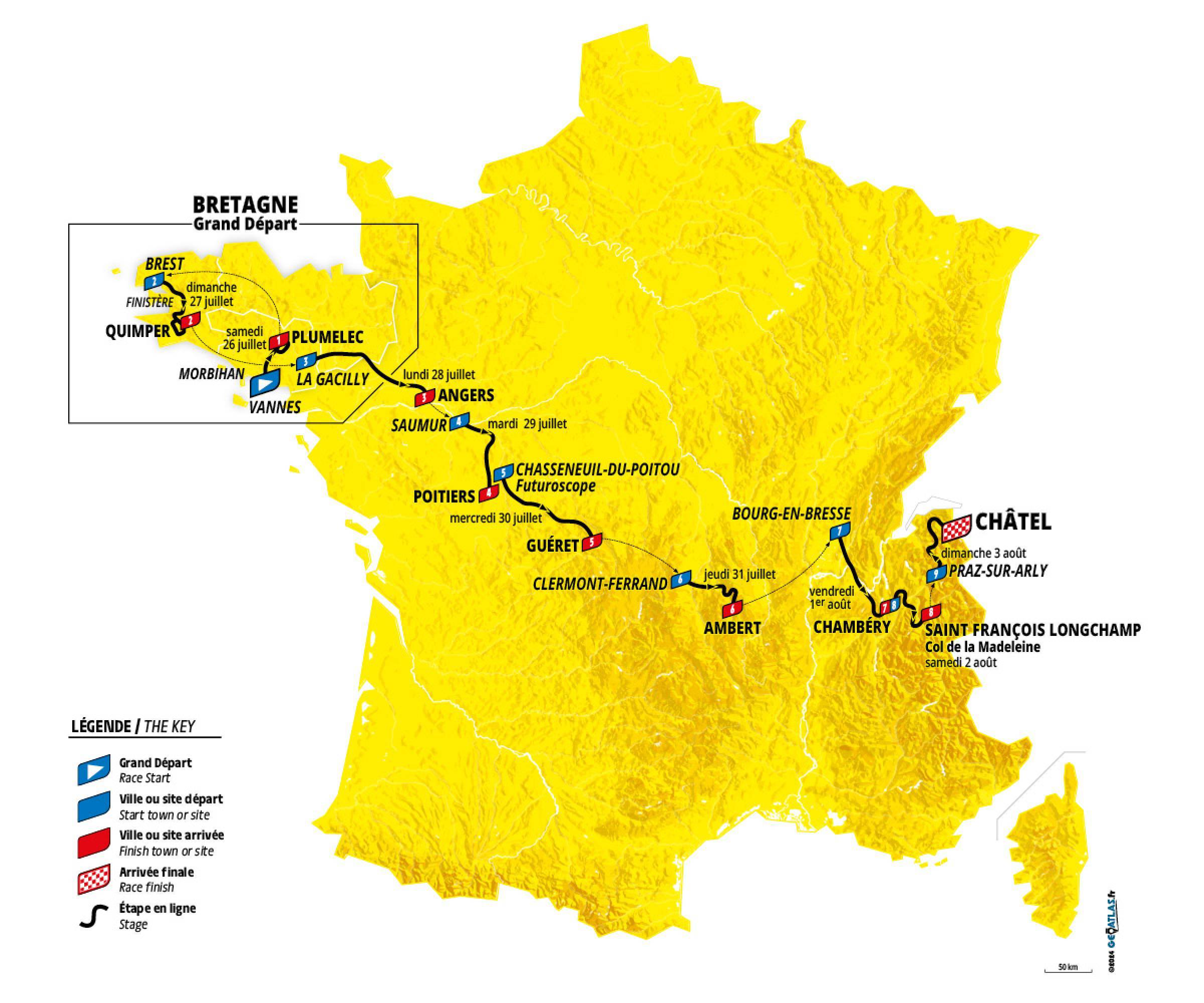
The Grand Départ will take place in Brittany, launching the peloton on a route that takes in the Alps via the Massif Central. After the breathtaking finale at Alpe d’Huez last July, the riders have a crucial meet at the finish on the Col de la Madeleine, but it could be all to play for on the final day as they approach the resort of Châtel, in the heart of the Portes du Soleil.

On 2 August thousands of cyclists will be able to take part in the first edition of L’Étape du Tour de France Femmes avec Zwift modelled on L’Étape du Tour de France, the 33rd edition of which will be held on 20 July between Albertville and La Plagne. The race will involve a more accessible route between Chambéry and the Col de la Madeleine, after which participants will get the chance to watch the champions battle it out.

Map of the 2025 Tour de France Femmes avec Zwift. Image courtesy of and © A.S.O.

A wide diagonal stretches across the map of France, with over 1,000 kilometres separating Brest from the Alpine resort of Châtel as the crow flies, involving a total of 1,165 kilometres of pedalling for the riders, who will be competing for the first time over nine days in the Tour de France Femmes avec Zwift. The peloton kicks off its Brittany leg in the Morbihan, with a stage between Vannes and Plumelec; the punchers who came out on top at the côte de Cadoudal in the Grand Prix du Morbihan will be familiar with this stage’s finish.

The following day in Finistère, racers will need explosive power if they want to get ahead in Quimper, on the climb where Peter Sagan won in 2018. The 2025 route then visits sprinting country in Angers (stage 3) and Poitiers (stage 4), before offering up increasingly demanding terrain in the Creuse on the way to Guéret (stage 5) and upping the ante further in the Puy-de-Dôme department as riders’ legs are tested on the Col du Béal and Col du Chansert climbs (stage 6).

After the Massif Central, a gradual approach to the Alps between Bourg-en-Bresse and Chambéry (stage 7) may well offer the chance for a breakaway, as long as riders are able to get over the Col du Granier without letting up. But a battle between the favourites for the Yellow Jersey on the Queen Stage is a much more realistic prospect, with a Tour first finish on the Col de la Madeleine (stage 8), 2,000 metres above sea level and at the end of a savage 18.6km climb with an average gradient of 8.1%.

Recent history teaches us that nothing is decided until the final stage. And this warning is all the more valid given that during the final 124 kilometres between Praz-sur-Arly and Châtel (stage 9), the champion in yellow will have to hold off her rivals as she climbs the Col de Joux-Plane, keeping her composure as she plunges down to Morzine before entering the final stretch.

STAGE
TYPE DATE START AND FINISH DISTANCE
1 Hilly 26 Jul 2025 Vannes > Plumelec 79 KM
2 Flat 27 Jul 2025 Brest > Quimper 110 KM
3 Flat 28 Jul 2025 La Gacilly > Angers 162 KM
4 Flat 29 Jul 2025 Saumur > Poitiers 128 KM
5 Medium Mountains 30 Jul 2025 Jaunay-Marigny Futuroscope > Guéret 166 KM
6 Mountain 31 Jul 2025 Clermont-Ferrand > Ambert 124 KM
7 Hilly 01 Aug 2025 Bourg-en-Bresse > Chambéry 160 KM
8 Mountain 02 Aug 2025 Chambéry > Saint François Longchamp – Col de la Madeleine 112 KM
9 Mountain 03 Aug 2025 Praz-sur-Arly > Châtel 124 KM

Race in Focus

1
  • Clermont-Ferrand, will be the first city to welcome the Tour de France Femmes avec Zwift on two occasions after hosting the Grand Départ in 2023.
3
  • The race’s categorised climbs will be spread over three massifs: the armoricanMassif, the Massifcentral and theAlps.
5
  • Five stages will take place entirely within a single department: the 1st (Morbihan), 2nd (Finistère), 6th (Puy-de-Dôme), 8th (Savoie) and 9th (Haute-Savoie).
9
  • The number of stages. There are 2 flat, 2 medium mountain, 2 high mountain and 3 hilly stages.
15
  • The fifteen departments the peloton will race in are Morbihan, Finistère, Ille-et-Vilaine, Loire-Atlantique, Maine-et-Loire, Indre-et-Loire, Vienne, Indre, Haute-Vienne, Creuse, Puy-de-Dôme, Ain, Isère, Savoie and Haute-Savoie (as well as 4 regions: Bretagne, Pays de la Loire, Nouvelle Aquitaine, Auvergne-Rhône-Alpes.
154
  • The number of riders at the start, comprising 22 teams of 7 racers each.
166
  • In kilometres, the length of the longest stage, the 5th, between Chasseneuil-duPoitou Futuroscope and Guéret.
1,165
  • In kilometres, the total distance of this 4th edition, a record high.
2,000
  • In metres, the altitude of the Col de laMadeleine, the highest point of the 2025 Tour de France Femmes avec Zwift, which features on stage 8.
3,490
  • In metres, the vertical gain on stage 8, which will feature the toughest climbs during this 4th edition of the race
17,240
  • In metres, the total vertical gain during the race, beating the previous record.

Double delight for L’Étape

On 20 July 2025, the 33rd edition of L’Étape du Tour de France will tackle the roads of stage 19 of the Tour de France between Albertville and La Plagne. The course (131 km and an altitude gain of 4,500 m) features five mountain passes, including the gruelling Col du Pré, the Cormet de Roselend and the summit finish atop La Plagne. It promises a unique day for the 16,000 expected cyclosportives.

Pre-registration opens on Tuesday, October 29, 2024, and registrations will begin on November 6, 2024, at 4 PM on time to.

New for 2025: the first edition of L’Étape du Tour de France Femmes avec Zwift will take place on August 2, 2025, between Chambéry and the Col de la Madeleine.

Lake Las Vegas T100 Triathlon: Knibb Completes the Hat Trick; Geens Takes Belgian Desert Duel

0

Taylor Knibb Delivers Supreme Swim, Bike & Run In Lake Las Vegas To Complete First Hat Trick Of T100 Wins | PTO

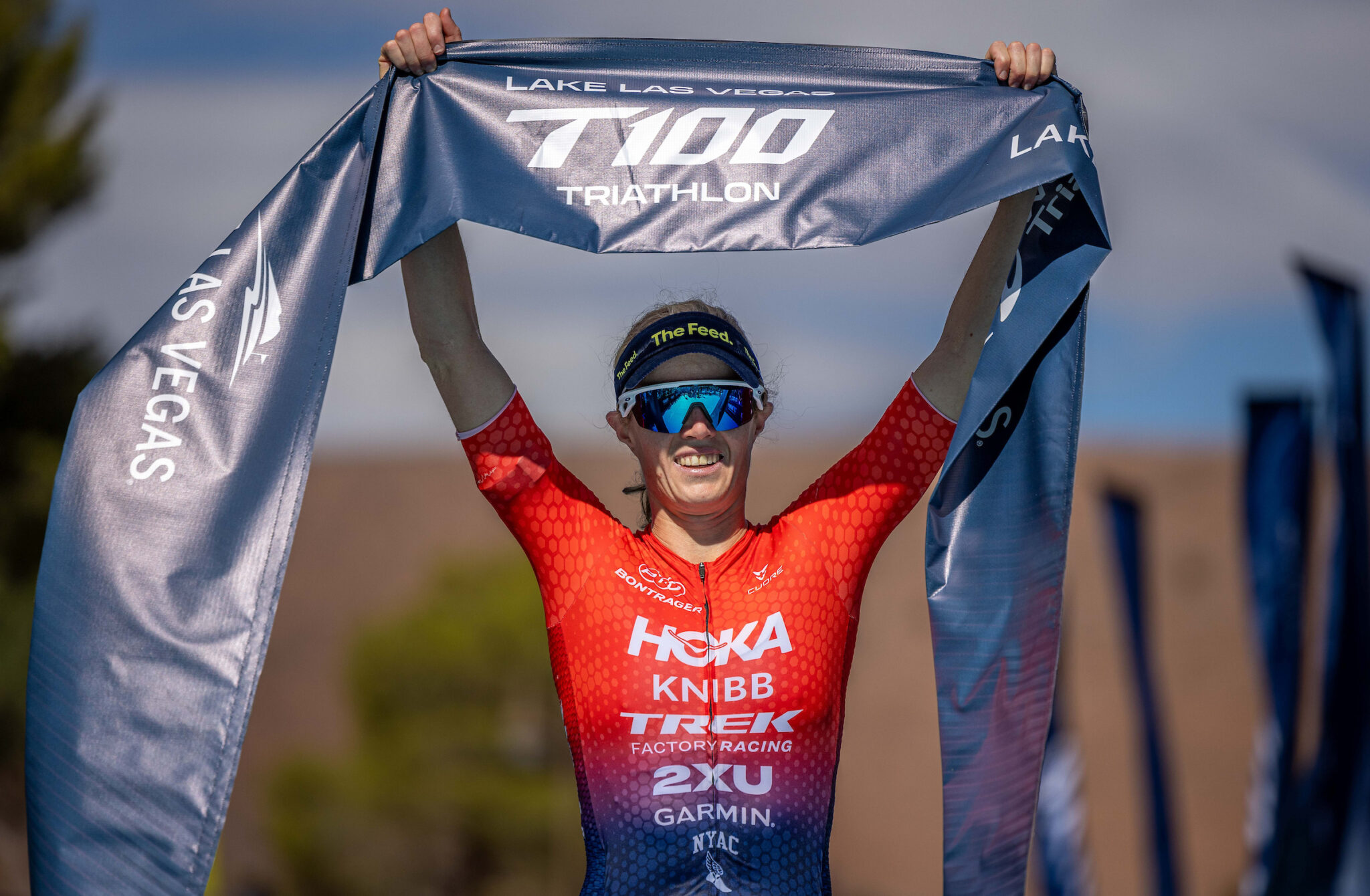
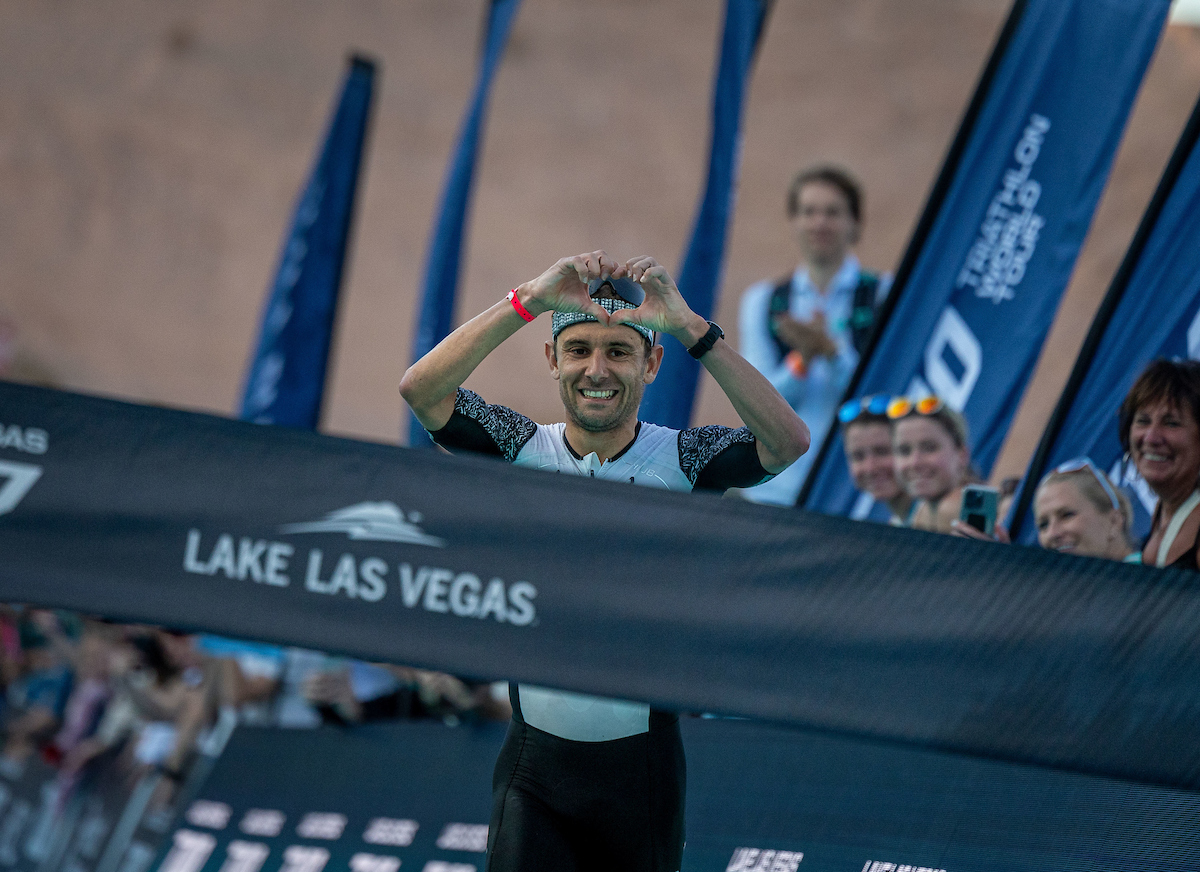
LAKE LAS VEGAS, Nevada (October 20, 2024) — American superstar Taylor Knibb won the Lake Las Vegas T100 Triathlon to live up to her pre-race billing as an overwhelming favourite and complete the first-ever hattrick of T100 race wins – following her successes in San Francisco and Ibiza earlier this season – and surge to the top of the T100 standings.

Taylor Knibb wins Lake Las Vegas T100 2024 Pro Women. Photo courtesy of PTO.

She now needs to finish first or second in next month’s Dubai T100 Triathlon World Championship Final (16-17 November) to become the inaugural T100 women’s World Champion.

Asked about her levels of confidence after the win, Knibb said:

“Oh, I’m not sure. But I’ll spin the answer and say that all three of us on the podium today could have raced somewhere else. But we choose to race here. At this point in the season I’m just trying to enjoy myself and enjoy the process, enjoy the journey and this is what I’m choosing to do.”

And the opportunity to win a first-ever T100 World Championship crown?

“It’s just one step at a time. I’m just grateful for today and to have another race.”

Breaking down her performance, she said: “I would kill to have that swim start every single time. I have a team of people here. My swim specialist and my movement specialist and they are each taking credit for that start. So they both have to come to every race now. On the bike I loved how broken up it was.”

Then, turning to ask second-placed Julie Derron what the run course was like, the Swiss star loudly agreed with Knibb, saying: ‘I’ll agree with you, it was savage.”

Knibb had earlier described the challenging Lake Las Vegas run course, which had steep inclines and declines and the belied the beautiful golf club setting as ‘savage’. It has both positive and negative connotations she said. “I have respect for savage. Good luck to the men!”

Third placed Flora Duffy from Bermuda was pleased to make her first T100 podium having talked all week about it being important for her to be battling at the front of the race.

“I’m really, really happy to be on the podium,” she said. “It was a super hard day out there. It was really tough. Taylor took off like a bullet in that swim. I thought ‘gosh’ I’m back in a short course race. But then I gathered myself and found some good feet to sit on. The bike is the biggest area I need to improve. Getting stronger and more comfortable on the TT bike and this course is certainly better for me today [than Ibiza].”

“I frustratingly got a penalty. I think I need to control my technical abilities. Go through the corners a little slower I suppose. I guess it’s just one of those things. You go into the corners fast. You come out of it and you’re in the red and try to back off and the ref thinks you’re doing something that you shouldn’t be doing. So it’s a learning experience.”

Fourth placed Brit Lucy Byram recorded her best T100 finish.

“I’m really happy finishing fourth,” said Byram. “Which is my best result of the season so far. I unfortunately got a penalty. I think it was up the hill for me. Paula [Findlay] came round and I didn’t drop back quick enough, even though we were going up an 8% hill. But, yeah, I just need to learn to drop back quicker I guess.”

How the Race Unfolded

Taylor Knibb had led out the swim on a serene Lake Las Vegas, that was significantly calmer than it had been during the week. The weather was also significantly cooler too with the air temperature 16.4 degrees celsius. She was followed by compatriot Taylor Spivey and Bermuda’s Flora Duffy, who had celebrated her own national day yesterday in her homeland with a chocolate brownie and strawberries delivery to her hotel room. Following them was Haley Chura in fourth. This front group gapping the rest of the field by 36 seconds on the first lap.

Haley Chura moved to the front on the second lap and was first out of the water in 24:46 followed by Taylor Spivey, Flora Duffy and Taylor Knibb and with a lead of 1:09 on the second group of De Vet, Derron, Curran, Findlay, Byram and Iemmolo.

Onto the bike course first was Flora Duffy, her intent to push the pace clear, but it wasn’t long before Taylor Knibb was pushing past and into the lead at the 6km mark.

As Taylor powered off to set the fastest bike time of the day in 1:58:09, there was plenty of drama and excitement behind, including three drafting penalties – Lucy Byram, Flora Duffy and Canada’s Paula Findlay; two retirements – Britain’s Emma Pallant-Browne and Australia ‘s Grace Thek and another high profile puncture for Germany’s Anne Haug.

Onto the run and the big question was how quickly Julie Derron could close the 5:20 gap to Knibb, having run four and a half minutes faster than her in Ibiza last month.  Derron powered past Byram and was closing on the American – 20 seconds in the first 2km – but Knibb seemed perfectly suited to the rolling run course – having been a stand-out cross country runner as a junior – and more than held her own to win by 2:15 in an overall time of 3:37:03. The full, final results are here.

Sodaro Shines On Comms & Lake Las Vegas Course A Winner

On commentary Chelsea Sodaro made a very assured debut, but will be hoping to be back on the course for the final race in Dubai.

The other winner was the fabulous Lake Las Vegas course. All week the pros had been praising the venue, the Westin Lake Las Vegas hotel and the training facilities as well as the toughness of the challenge – in equal measure.

The local Mayor of Henderson, Michelle Romero, explained:

“Southern Nevada is the sports and entertainment capital of the world and this just adds to our repertoire of having great World Championship events here. There’s such a diversity of environment. It’s great weather. We’re very welcoming and so we just love having athlete events here and the people who live here also love it. So I think it’s great for the visiting athletes to feel so welcome and feel so safe. We’re one of the safest cities in the country and I think it’s a great combination.”

Asked if watching the world’s best female triathletes had inspired her, she tactfully responded: “Not in this lifetime, no!”

The 1,000 amateurs taking on a very similar T100 course tomorrow morning will be hoping for the same, cooler weather at the start of the race rather than the heat the pro women finished in. Otherwise they may think Mayor Romero has the right idea.

Wildcard Jelle Geens Runs Away With Lake Las Vegas T100 Triathlon After Belgian Duel In The Desert | PTO

LAKE LAS VEGAS, Nevada (October 20, 2024) — Belgian wildcard Jelle Geens claimed his first T100 victory at his first attempt in Lake Las Vegas, winning by just 38 seconds after a dramatic duel with compatriot and close friend Marten Van Riel.

Jelle Geens wins Lake Las Vegas T100 2024 Pro Men. Photo courtesy of PTO

Geens’ debut win came courtesy of a blistering run leg, where he averaged 3:13 minutes per km on a brutal run course around the stunning Reflection Bay Golf Course, which had 500 meters in elevation of savage inclines and steep descents.

Speaking after crossing the line, Geens, who also broke Van Riel’s unbeaten 6-race winning streak in middle distance triathlons dating back to November 2019, said:

“It sounds crazy, but a month ago I wasn’t sure if I could even start here, so now to win here, it’s a great honour – and it was a hard and tough battle with Marten. We said for years when we were still doing short course it would be cool to be on the podium together and it never happened in short course, but it’s happened now in our first battle over middle distance.”

“To be honest I felt really good on the run,” the 31-year-old continued.  “Even when Marten came back I felt in control and felt I was going to go for it on the last lap. I kept trying to put pressure on the uphill because that’s where I’m strongest and I tried to get every lap better at the downhill but it really wasn’t easy for me. My knees are really hurting now. But I felt confident. I was still running a bit on fear during the downhill sections. But once I had a gap on the downhills, I started believing it.”

“It was very tough from the start to the end actually,” said Van Riel, also 31 and who has been racing Geens since they were teenagers in Belgum. “The course is brutal…but I was actually suffering on the bike already. I saw Jelle was yo-yoing with the group and then it was the same on the run. He’s lighter than me so on the uphills he had the advantage but on the downhills I tried to use the gravity to pull him back. But in the end I cracked, I didn’t have it. So I’m very happy it’s Jelle that takes away the [winning] streak.”

However, the second place still puts Van Riel in pole position at the top of the T100 standings to win the first T100 men’s World Championship crown in Dubai next month. Where a first, second or third place result will secure him the inaugural series title.

“That’s obviously very important. I was quite scared on the bike because I felt like midway on the bike my watts were very high and I was starting to suffer a little bit and I was thinking, oh, it’s better to finish high than completely burn myself and completely fade. It was definitely playing a little bit in my head. But I’m in a very good position going into Dubai so that’s obviously a nice cushion.”

Asked whether he would follow through on his pre-race promise to put his winnings – which are $16,000 USD for finishing second – on red in a casino later tonight, Geens was quick to answer for him:

“I’m keeping him to it. We’ve figured out how to get enough money out of everyone’s credit card, so it’s happening.”

Last Sunday, Van Riel had gone to a casino with Australian fellow pro athlete Aaron Royle and turned $100 into $1,000 playing black jack.

Third was German Justus Nieschlag, also on his T100 debut.

How the Race Unfolded

South African flier Henry Schoeman led home the swim in Lake Las Vegas in warmer conditions than the women, with the water temperature up from 20.7 to 22.9 degrees Celsius and the air temperature up from a cooler 16.4 when the women started, to 21.1 degrees Celsius. In the front pack with him were Australian Aaron Royle, Marten Van Riel, Britain’s Alistair Brownlee, Justus Nieschlag and American Marc Dubrick; all 21 seconds ahead of Australia’s Josh Amberger and Max Neumann, Jelle Geens, France’s Mathis Margirier and Americans Matthew Mcelroy, Justin Riele and Jason West. Plus German Max Sperl. Flat last was American Sam Long, 5:40 back from the leaders.

After a slow transition, where he took extra time to put his socks on, it looked like Marten Van Riel had lost the first group, but he immediately powered back to second spot. To then set the early pace at the front with double Olympic champion Alistair Brownlee.

Then the drafting penalties – which had started this morning with three in the women’s race – continued, with Alistair Brownlee collecting his second one minute drafting penalty in two races. Clearly frustrated, he rode back with vengeance to re-establish himself, settling in the third group just over two minutes back from Van Riel and Margirier. But it looked like it had lit a match too far as he later DNF-ed on the run.  Then it was Pieter Heemeryck’s turn to collect a 30-second penalty for not putting his goggles and hat in the swim box. Before Max Neumann also got a one minute drafting penalty.

Jason West was probably the surprise package on the bike leg. Having been nursing an injury since London which has meant more bike training, it seemed to be suiting him as he tucked in behind Brownlee in the third group.

On the fourth lap Van Riel made his move from second place, upping his heart rate percentage to 90% and powering past Mathis Margirier to set the pace. Meanwhile, starting from the very back after the swim, American Sam Long started to move through the field on the penultimate bike lap.

Marten Van Riel was quickly out of T2 to get away from Margirier and Geens. But it wasn’t long before Geens was up to and past him. His legs bouncing and stride popping. Especially uphill.

Geens and Van Riel played cat and mouse on the run. With Van Riel determinedly holding on up the climbs and then squeezing the gap down on the descents. But the efforts to catch back up took their toll and the heart rate percentages told the story, with Geens averaging high 70 percents to Van Riel who was consistently pushing over 90% and reaching 99% as he gave one final effort on the last lap to bridge the gap.

Explore all the twists and turns of the race on the T100 Triathlon Live Data Dashboard as well as the final positions at t100triathlon.com/live/. It’s packed with lots of useful statistics and extra information on the races. Including the addition of athletes’ gearing setups and a ‘Race Facts’ tabs showing all the pivotal moments in the race, such as lead changes, fastest discipline times, penalty information and more.

Fans can also stay abreast of how the action will affect the T100 Standings as the race unfolds via the ‘Virtual Standings’ tab. All this is on top of the live leaderboard, which shows key data such as splits to leader, groups, speeds, positions gained and Heart Rate effort.

The seventh and final race of this first T100 season will be the  Dubai T100 Triathlon World Championship Final on 16-17 November where inaugural T100 World Champions will be crowned.

A reminder of how the T100 Triathlon World Tour works:

  • Athletes score 35 points for first place to 1 pt for 20th place at each race
  • The Dubai T100 Triathlon World Championship Final has increased points to up the ante (55 pts down to 4 pts)
  • Each athlete’s best three T100 race scores plus the Final will count towards the inaugural women’s and men’s T100 World Champions
  • $250,000 USD prize fund at each T100, totalling $1,750,000 across the seven races (1st place – $25,000k; 2nd – $16,000; 3rd – $12,000 at each race)
  • The series winners following the Dubai T100 Triathlon World Championship Final will be crowned T100 Triathlon World Champion and collect $210,000 USD from an additional total prize pool of $2,000,000
  • Between the athlete contracts, T100 race prize fund and T100 Triathlon World Tour pool, the series provides more than $7,000,000 in athlete compensation, and is distributed in a way that not only rewards the winners, but also recognises the significant achievement of racing at this level


Off the pavement: Adaptive riders teach trail accessibility

By Katie Klingsporn, Wyofile.com — At BLM area near Lander, disabled athletes illustrate to land managers and trail builders how they can better accommodate adaptive outdoor recreation needs.

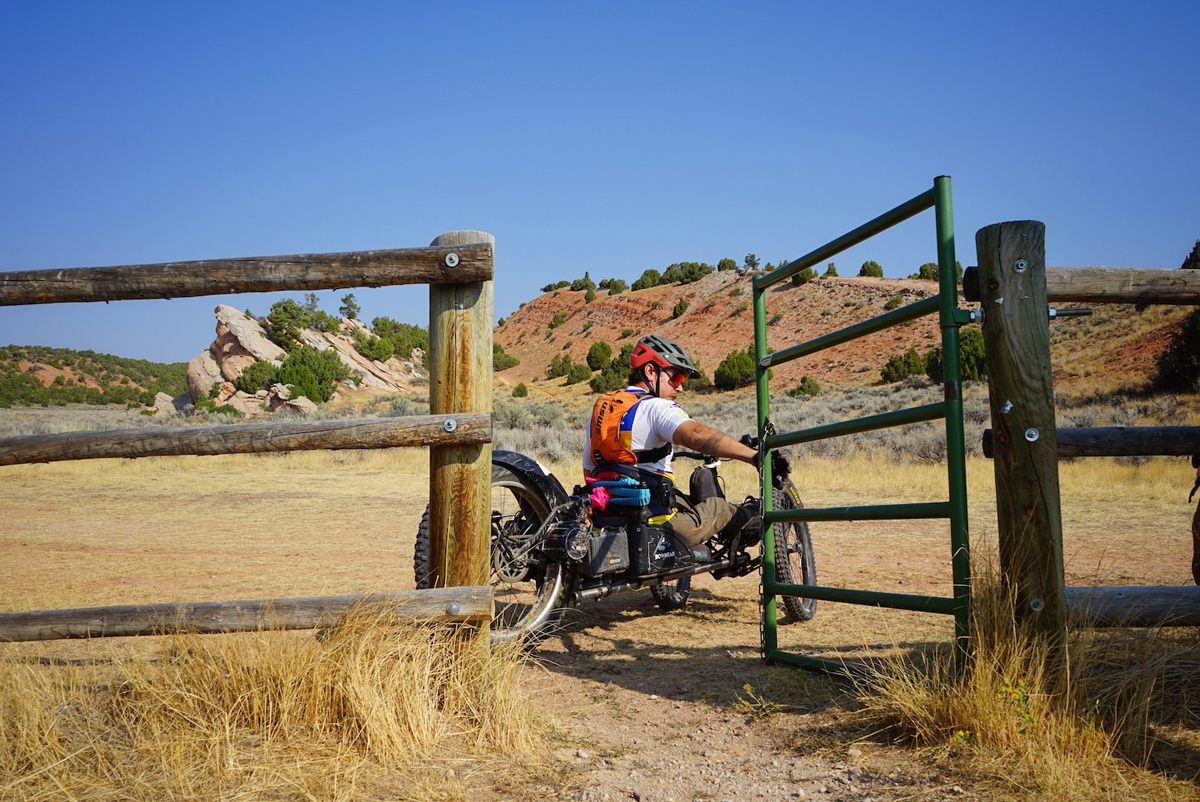
FREMONT COUNTY, Wyoming (September 6, 2024) — Joe Stone struggled momentarily with the chain latch as he closed the gate behind him. He held his hands up, and a time-keeper called out how long it took him to open, traverse and re-secure the swinging pipe fixture.

“Forty-seven seconds,” Stone repeated. “That is actually pretty good. The last one we did, it took me like five minutes.” 

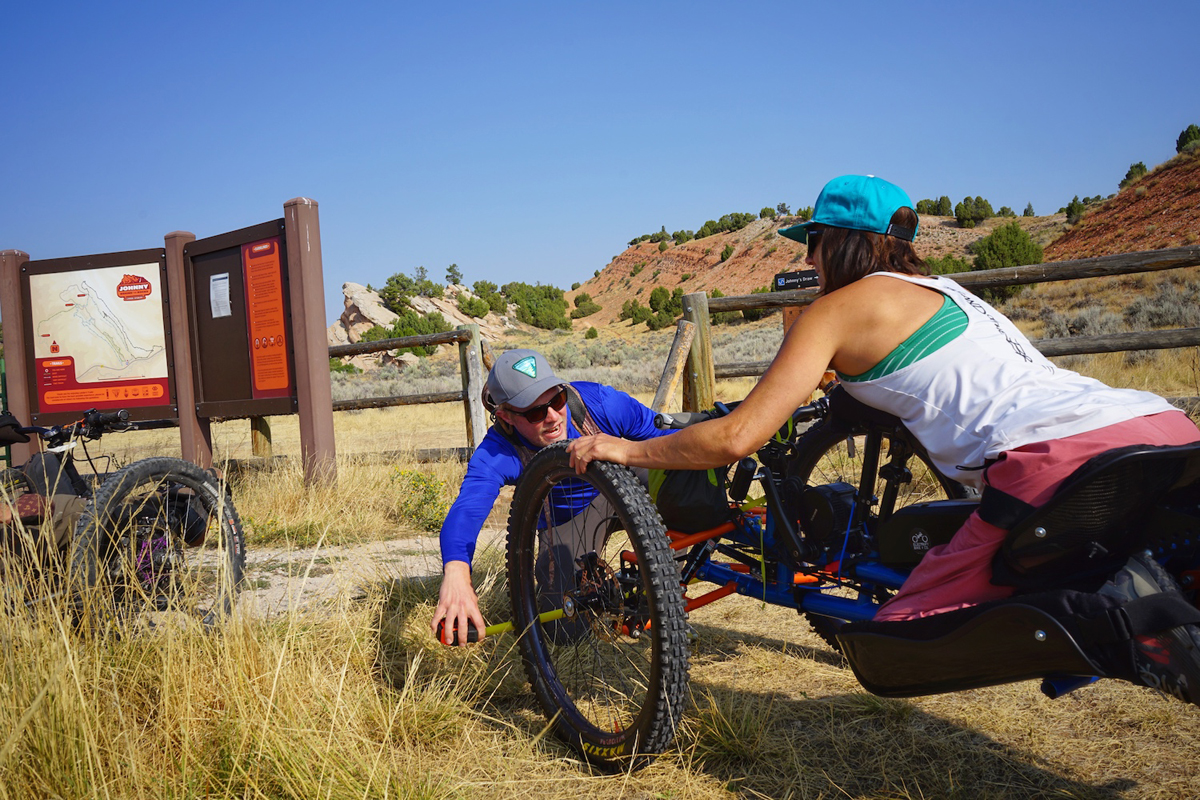
This gate at the entrance of a Bureau of Land Management trail system south of Lander likely wouldn’t give pause to an able-bodied recreator. But for an adaptive athlete like Stone, who is paralyzed from the chest down and rides a heavy three-wheel adaptive mountain bike, the task of passing through a gate can seriously disrupt an outing. 

Joe Stone closes a gate at Johnny Behind the Rocks, a BLM trail area south of Lander, Wyoming in August 2024. Photo by Katie Klingsporn/WyoFile

This is exactly the type of challenge that Stone and his business partner Quinn Brett set out to illustrate to a crew of trail builders, outdoor advocates and BLM staffers on a hazy late-August day at Johnny Behind the Rocks — a popular biking and hiking destination near Lander. 

During a day-long clinic, the two disabled athletes took to the trails to show their students how trail design considerations like turning radius, trail width, rocks and gates can make a huge difference in accessibility. 

The clinic helped give trail managers the understanding they need to build or modify the state’s trails to universal standards, which are intended for people with a variety of mobility levels, Wyoming Pathways Executive Director Mike Kusiek said. His group put on the clinic with the BLM.

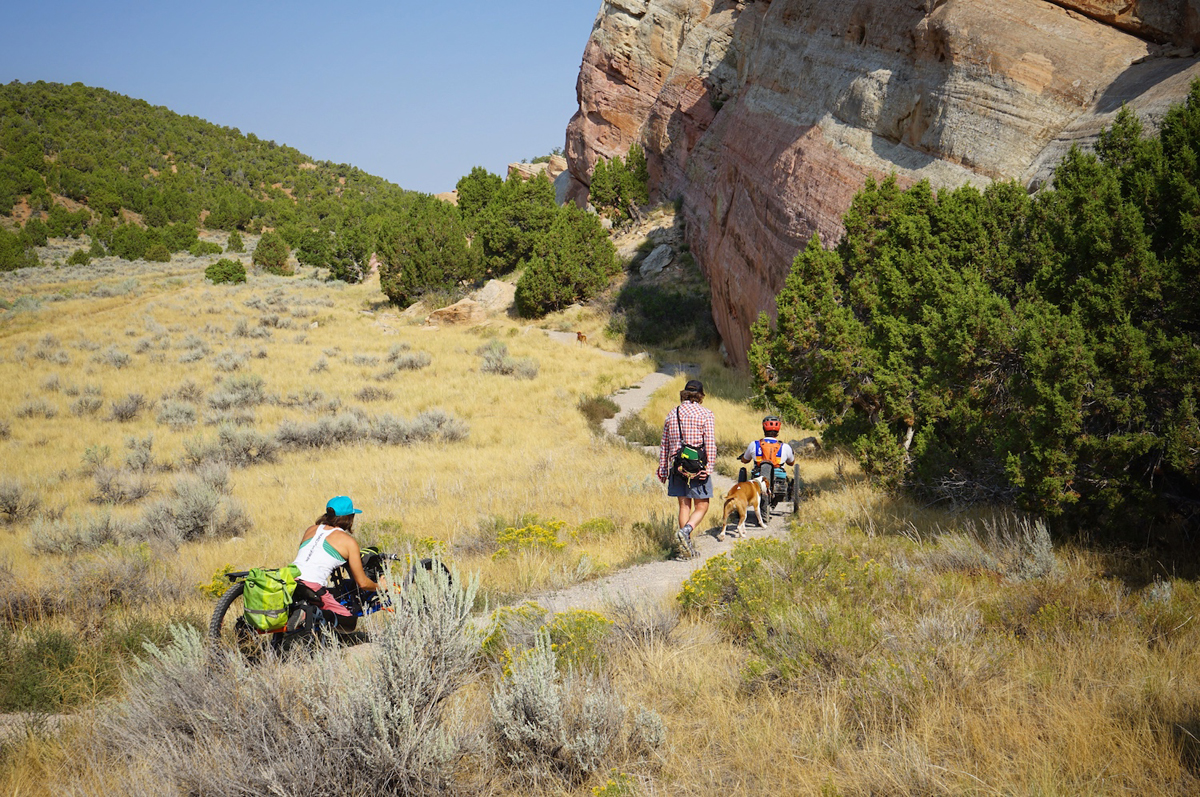
Joe Stone and Quinn Brett of Dovetail Trail Consulting ride a popular trail at Johnny Behind the Rocks south of Lander as Mike Kusiek of Wyoming Pathways and George the dog join on foot. Photo by Katie Klingsporn/WyoFile

Before they started a trail consulting company together, Brett and Stone had much in parallel. Brett is a former professional climber and national park climbing ranger. In 2017 she took a 100-foot fall in Yosemite National Park and broke her back. The injury left her paralyzed from the pelvis down. 

“My world flipped upside down,” she said, “from going wherever you wanted, whenever you wanted, to this world of accessibility where, ‘wow, it’s hard to go anywhere.’” 

Stone was a self-proclaimed “smile-chaser” whose pursuits included skiing, mountain biking and skydiving. He was speed-flying in Montana in 2010 when he crashed his paragliding wing into the side of a mountain. A spinal cord injury also left him paralyzed, but unlike Brett, Stone has no function in his abdominal muscles. 

Like Brett, however, Stone set out on a path “to be able to get me back to the lifestyle I was living before, which was away from the pavement and getting further into the mountains or further into the desert.”

Jared Oakleaf, an outdoor recreation planner for the Bureau of Land Management’s Lander field office, measures the tire span on Quinn Brett’s three-wheeled, battery-assisted hand cycle. Photo by Katie Klingsporn/WyoFile

They discovered an exciting array of equipment and advancements enabling adaptive athletes to explore and play. “But our trails aren’t quite there yet,” Stone said. That’s where Dovetail Trail Consulting comes in.

“That’s really the big picture of what we’re trying to do,” Stone told the participants. “We’re not telling you to dumb down the trails, to simplify them, sanitize them or anything like that. Keep them what the original intent is. But with a few tweaks here and there, they also then can work for people with mobility disabilities.”

WyoFile is an independent nonprofit news organization focused on Wyoming people, places and policy.


USFS Proposes Parking Fees at Bridger-Teton National Forest

0

By Charles Pekow — If you want to ride your bike into Bridger-Teton National Forest, there’s no charge. However, if you drive in and then ride your bike, you might have to pay a fee. While the U.S. Forest Service can’t charge for general admission, it can impose fees for amenities like parking, with parking limited to designated areas.

The Wild and Scenic Snake River. Photo by Bob Wick, BLM. ATTRIBUTION 2.0 GENERIC CC BY 2.0 Deed

The proposed fee would apply to the Wild and Scenic Snake River, a Congressional-designated area. By law, any fees collected must be used on site. According to the Forest Service, the fees would support “operation, maintenance, and improvements to prevent degradation, enhance recreation opportunities, and preserve the outstandingly remarkable values outlined in the Snake River’s comprehensive management plan.”

The USFS is proposing fees of $5 per vehicle per day, $40 per vehicle per year, $20 for an additional vehicle per year, and $3 per outfitted customer or non-commercial group member. The fees wouldn’t take effect until mid-March 2025 at the earliest.

For more information, visit https://www.govinfo.gov/content/pkg/FR-2024-09-12/html/2024-20718.htm.


Rep. Boebert Bashes Bike Benefits

By Charles Pekow — Rep. Lauren Boebert, the Trump-supporting, Republican member of Congress seeking another term in Colorado, has targeted bicycling benefits as part of her campaign. At her urging, the House passed a provision that would remove the bicycling benefit for Department of the Interior employees who ride their bikes to work. This provision was included in H.R.8998 – Department of the Interior, Environment, and Related Agencies Appropriations Act, 2025.

Currently, at the agency’s discretion, federal employees are eligible for a Bicycle Subsidy Benefit to cover expenses if they commute by bike (https://www.doi.gov/ofas/support_services/bicycle-subsidy-benefit-program). Boebert’s amendment specifically targets employees of the Department of the Interior.

Lauren Boebert (51248623782)
U.S. Congresswoman Lauren Boebert (R – Colorado) delivering the invocation at the 2021 Young Women’s Leadership Summit hosted by Turning Point USA at the Gaylord Texan Resort & Convention Center in Grapevine, Texas.
Photo by Gage Skidmore, CC BY-SA 2.0, via Wikimedia Commons

Boebert stated on the House floor:

“American taxpayers’ hard-earned money is being wasted on covering bicycle commuting expenses such as bicycles, bicycle locks, bicycle parking, storage, bicycle safety equipment, bicycle improvements or accessories, including reflective lights, racks, bicycle repairs and general maintenance, personal safety and protective equipment, including high-visibility safety apparel, headwear, and bicycle gloves, and bicycle share memberships as well as getting paid to bike to work. Praise the Lord.”

She further added, “We must redirect our attention and their money to much more important things than subsidizing employees for riding bicycles,” and urged her colleagues to “support my amendment to cut wasteful, silly federal spending by prohibiting funding for the Bicycle Subsidy Benefit Program at the Department of the Interior.”

Rep. Betty McCollum (D-MN), though outvoted, defended the subsidy, noting that the program dates back to 1993 and is not part of the Biden-Harris spending that Boebert criticized. “We all know what the traffic is going to be like here tomorrow. Bikes would be handy,” McCollum said. “This is a government-wide program, and the amendment unfairly targets Department of the Interior employees.”

Passage of Boebert’s amendment is far from certain, as the Senate Appropriations Committee passed a funding bill without the provision. The Interior’s press office did not respond to an inquiry.

On a brighter note, the House also approved an amendment to the bill sponsored by Del. Eleanor Holmes Norton (D-DC), which would allocate $1 million to the National Park Service to report on whether any laws or regulations are inhibiting the use of urban national parks for active use, including bicycling.