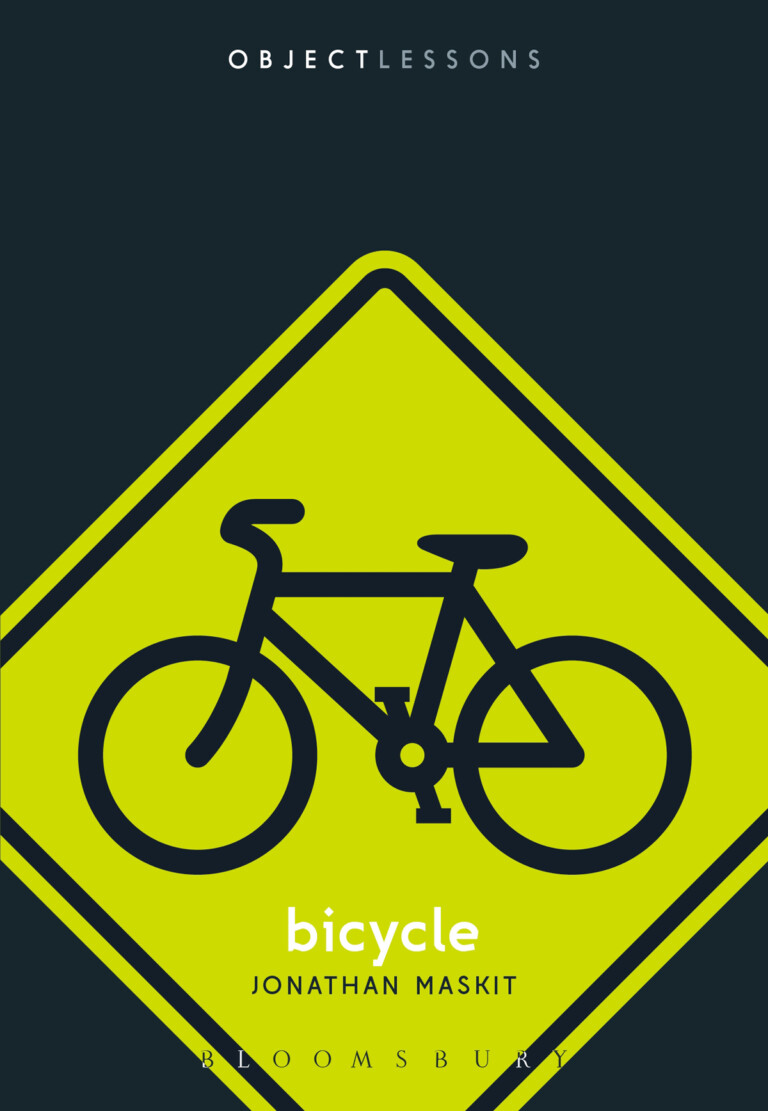
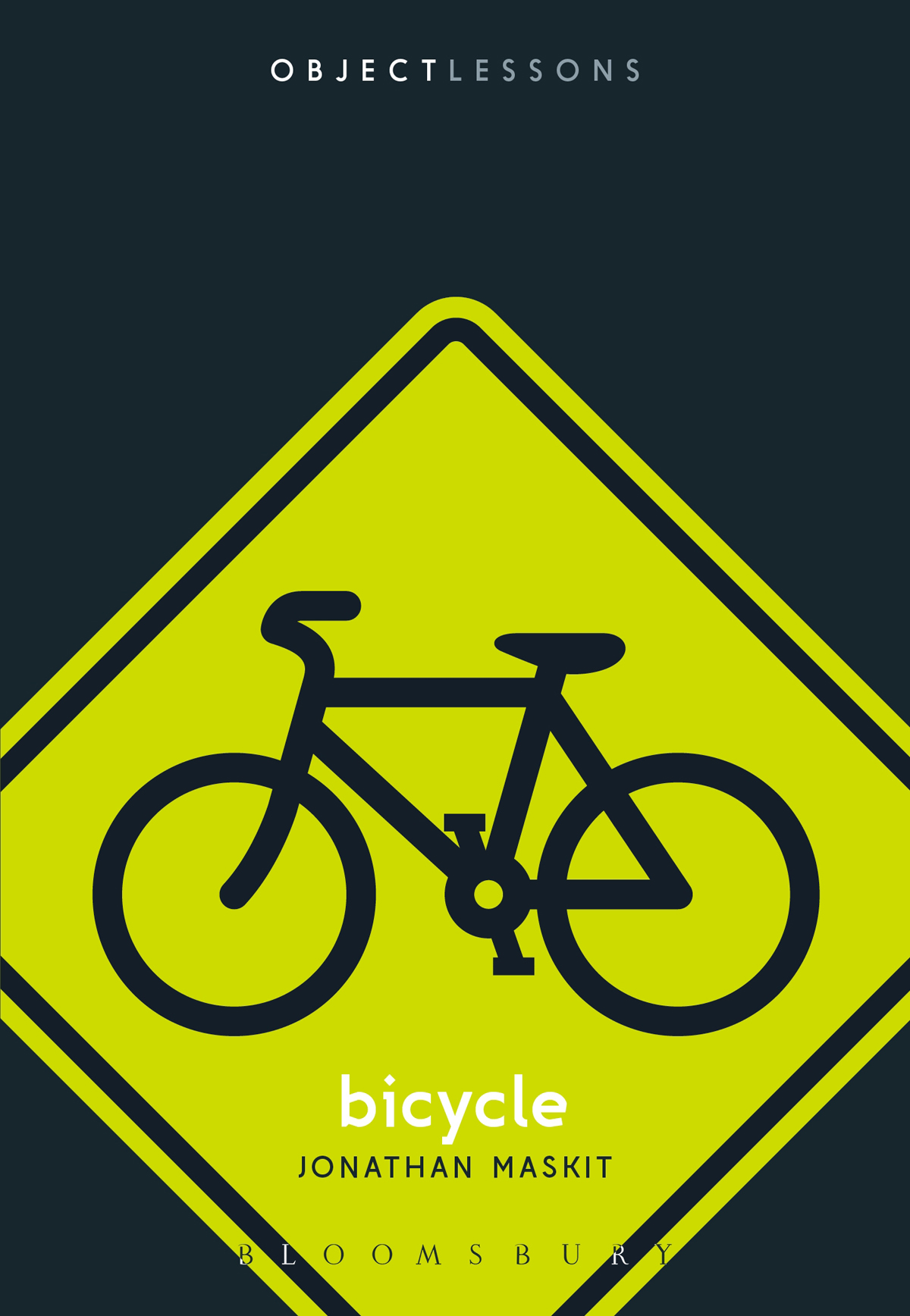
By Charles Pekow — In addition to providing transportation and recreation, the bicycle has impacted culture historically. The difference it made, in all its incarnations over time is chronicled in a new mini-paperback simply entitled bicycle (with a small “b), written by cyclist Jonathan Maskit.
The book is part of a series on Object Lessons from Bloomsbury Publishing Inc. that describes the histories and “hidden lives of ordinary things” we take for granted, ranging from golf balls to pregnancy tests to drivers licenses to dolls to sewers and so on.
While tracing the history of the machine and its relationship to the automobile, Maskit tells us a lot about his own personal experiences. A common theme in the book is that most of the infrastructure used for cycling wasn’t designed for it, even if it was retrofitted for it with the likes of bike lanes and signals. 19th Century bicycle prototypes had to share dirt roads with horses and buggies and since the dawn of the 20th Century cycles shared thoroughfares with larger and more-well armored automated vehicles and the bike rider has generally been at a disadvantage.
The book can get technical in parts and refers to a lot of different scientists and philosophers to make points, even when they weren’t writing specifically about bicycling, as a universal truth can apply anywhere. The book sometimes digresses into talks about everything from gun control to maintaining sidewalks for pedestrians.
We also read some about other forms of transit, such as boats and trains, evidently to show how cycling fits into the overall transportation story. Efforts to put steam engines on bicycles flopped long before the electric bike caught on. We also get a technological explanation of how our muscles can power the wheels and how bicycles get built. And should anyone complain about cyclists on the road, you can tell them that many of the inventions routinely used in autos and airplanes, from pneumatic tires to carbon frames, were developed first for bicycles, which sped their use for automated transit. (The Wright Brothers, the author reminds us, were bicycle builders.)
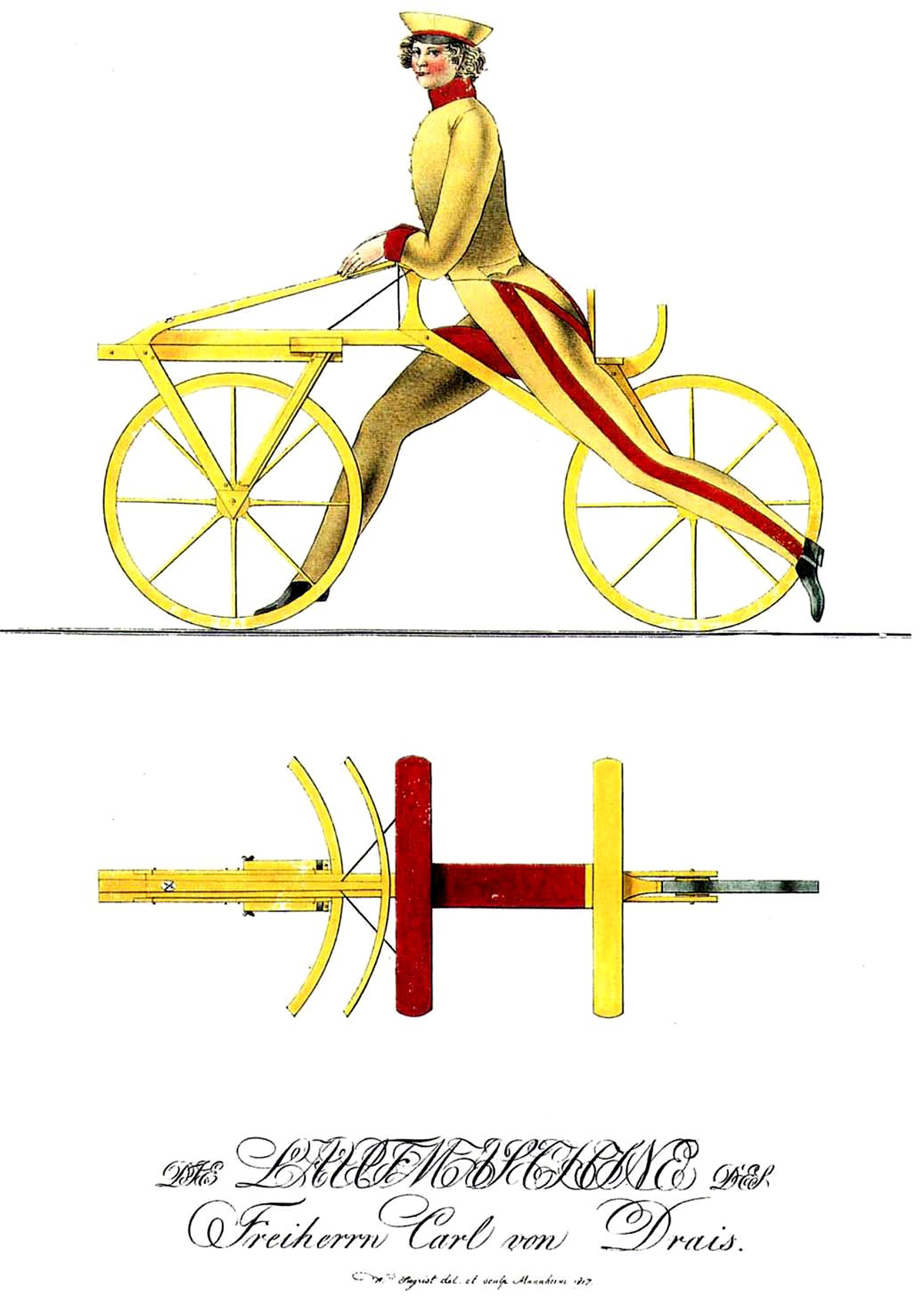
Karl Drais’ Draisine or Velocipede. Drais is considered the inventor of the bicycle. Photo courtesy Bloomsbury
The book takes on a history of the forerunners of the modern bicycle. Maskit traces the origin to 1817 Germany, where people learned to skate during cold winters and thus learned the balance needed to pedal on two wheels. The cyclist scorned by an angry motorist today isn’t facing a new phenomenon: early riders weren’t welcomed in parks or by carriage operators not eager to share their space.
Though the bike (or its predecessors) never really caught on in Europe and North American during the 19th Century, it never completely went away. And designers gradually found ways to make them safer and easier to ride.
It makes cyclists proud to hear in the book that cycling is the most energy-efficient way to get around on land (the book doesn’t say so but only sailing can beat it). Long distances remain a problem, though.
Among the bicycle’s cultural impact, it became popular for late 19th Century women, freeing them from their costumes and making it easier for them to get around and unite, and even leading to their fight for suffrage.
In more modern times, Maskit tells us, largely through personal experience, about all the inconsiderate drivers, or those who don’t understand that bicyclists can use the roads too. He tells us of all the times drivers have made inappropriate gestures and even dumped exhaust at him. Thoroughfares between cities can be especially dangerous and unfriendly to bike on as they usually have faster speed limits. He goes on and on about auto crashes and sharing the road. He even tells us how the thoughts of enlightenment and political philosophers Rousseau, Hobbs and Locke apply to considering bicyclists’ rights to the road (something the philosophers themselves probably didn’t have in mind but their thoughts can be universally applied).
In fact, we get doses of philosophy sprinkled through the book, from Derrida’s reminder that we don’t control words (motorist, driver) to what 20th Century existentialists say about perception, which sometimes means drivers don’t see bicycles because they’re not looking for them.
Maskit makes some good points about the need to include more about bicyclists in drivers’ education. Let’s hope the people who can influence that will read the book and get the message.
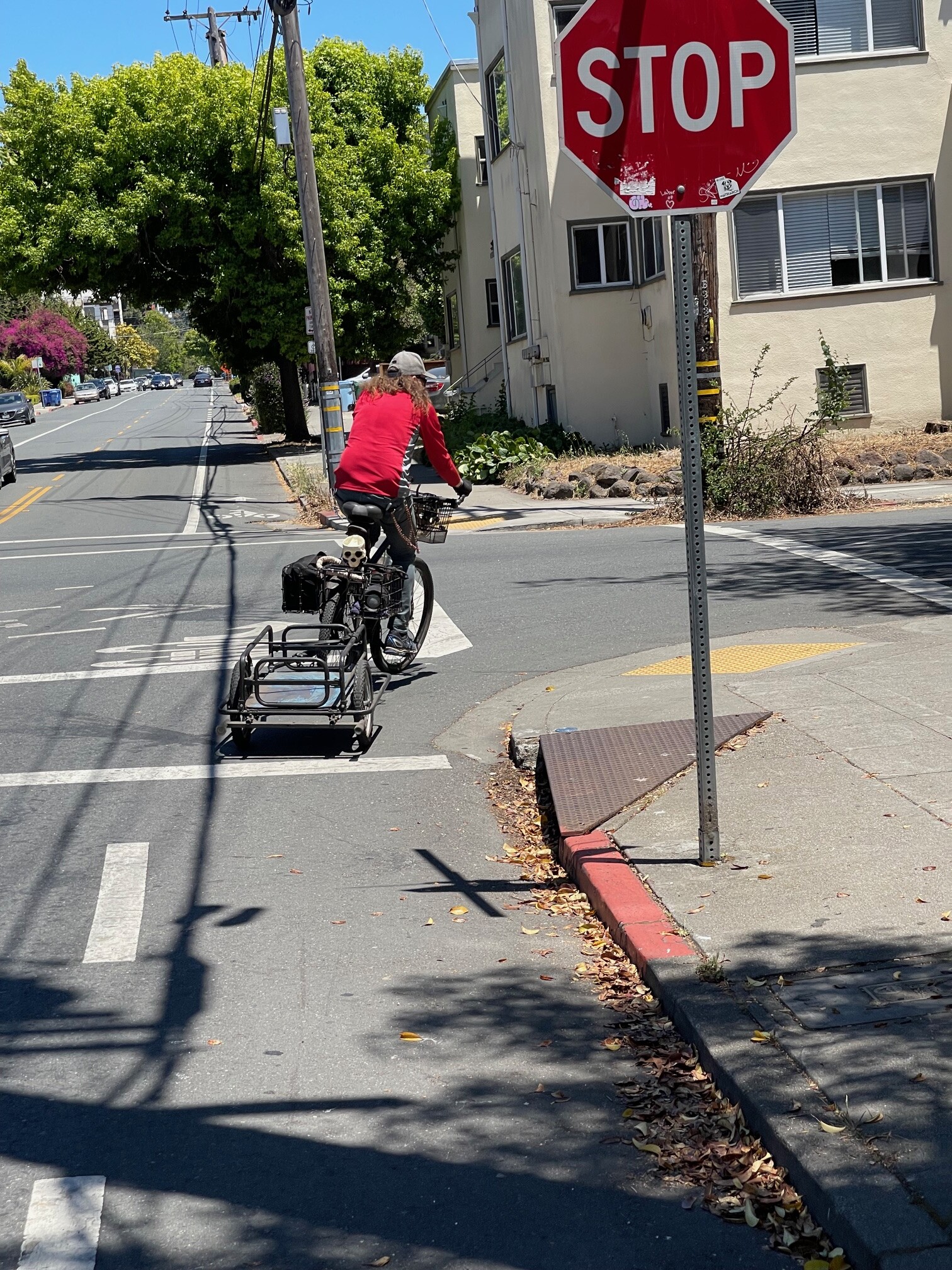
The author also devotes a chapter to “ghost bikes,” memorials we occasionally (but once is too often) see along the roadways as memorials where cyclists came out on the wrong end of a crash; and another chapter to the movement to allow bicyclists to treat stop signs as yield signs. He promotes at length the idea that cyclists should be treated as equals with motorists under law and design. While “separate but equal” has been ruled unconstitutional for public schools, he suggests it would work fine for autos and bicycles to keep on separate paths to stay out of each other’s way, just as is common for pedestrians.
We also learn a bit about the history of police bike patrols. The book discusses but doesn’t resolve the fairly new issues brought up by of ebikes, scooters and whatever other new vehicles are complicating the scene. And while he notes that the COVID pandemic increased cycling, the book doesn’t deal with how some other factors affect ridership, from climate change to economics to energy sources.
Still, readers will learn much about how the bicycle has changed the world from the book.
Title: bicycle Author: Jonathan Maskit Published: Jan 25, 2024 Cost: $13.45 paperback; $10.76 ebook Format: Paperback Edition: 1st Pages: 160, including 20 pages of index, bibliography, and footnotes ISBN: 9781501338090 Imprint: Bloomsbury Academic Series: Object Lessons Publisher: Bloomsbury Publishing URL: https://www.bloomsbury.com/us/bicycle-9781501338090
By Tom Jow — Enter a search for “Bentonville mountain biking” and you will find the statement “Mountain Biking Capital of the World”. For those of us in the Mountain West, it seems a bold statement from a locale where the highest elevation is around 1,300 feet above sea level. Therefore, what reason could they have for this title? Could it be, according to the Trailforks app, the presence of 342 mountain bike trails, not including neighboring Bella Vista, Fayetteville, or Eureka Springs? Or maybe it has something to do with the additional twenty-six interconnected paved city trails not including the Razorback Greenway which stretches more than thirty miles from Bella Vista in the north to Fayetteville to the south? In April of this year, I went to visit a friend that lives in the area. This is what I found out.
After arriving at Northwest Arkansas Regional Airport the day before, the first area my friend took us to was the Coler Mountain Bike preserve. Completed in 2020, this area contains seventeen miles of trails for riders of all skill levels. On the east side of the preserve, “The Hub” features several trails departing in many directions, much like the spokes of a wheel (hence the name). This area features smooth, fast flow lines with perfectly sculpted and maintained jumps, berms. For those that like it rough, the Rock Solid, Rock Soft and Rock Salad trails include man made rock gardens, jumps and natural tech features. Once at the bottom, five of the six trails use the low angle Pedal Assist trail to return to the top. After a few laps here we headed to the westside trails. One of the few natural trails in the preserve, “Here’s Johnny”, is a narrow single track with several natural technical rock features and minor exposure. After that, we went to a real fun feature of the preserve, the half mile “ThunderDome” dual slalom track. Race your friends. This was so fun we had to do a few laps. On the last lap we made a bet that the winner gets a free lunch. Guess who paid?
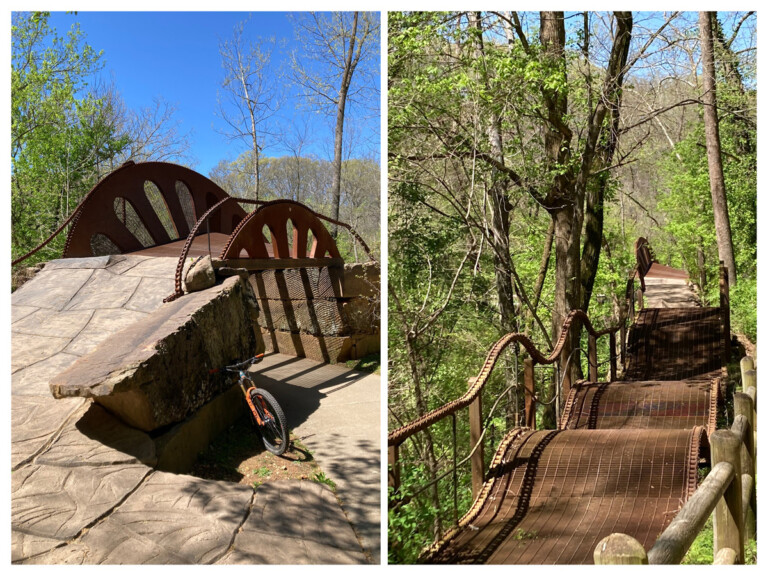
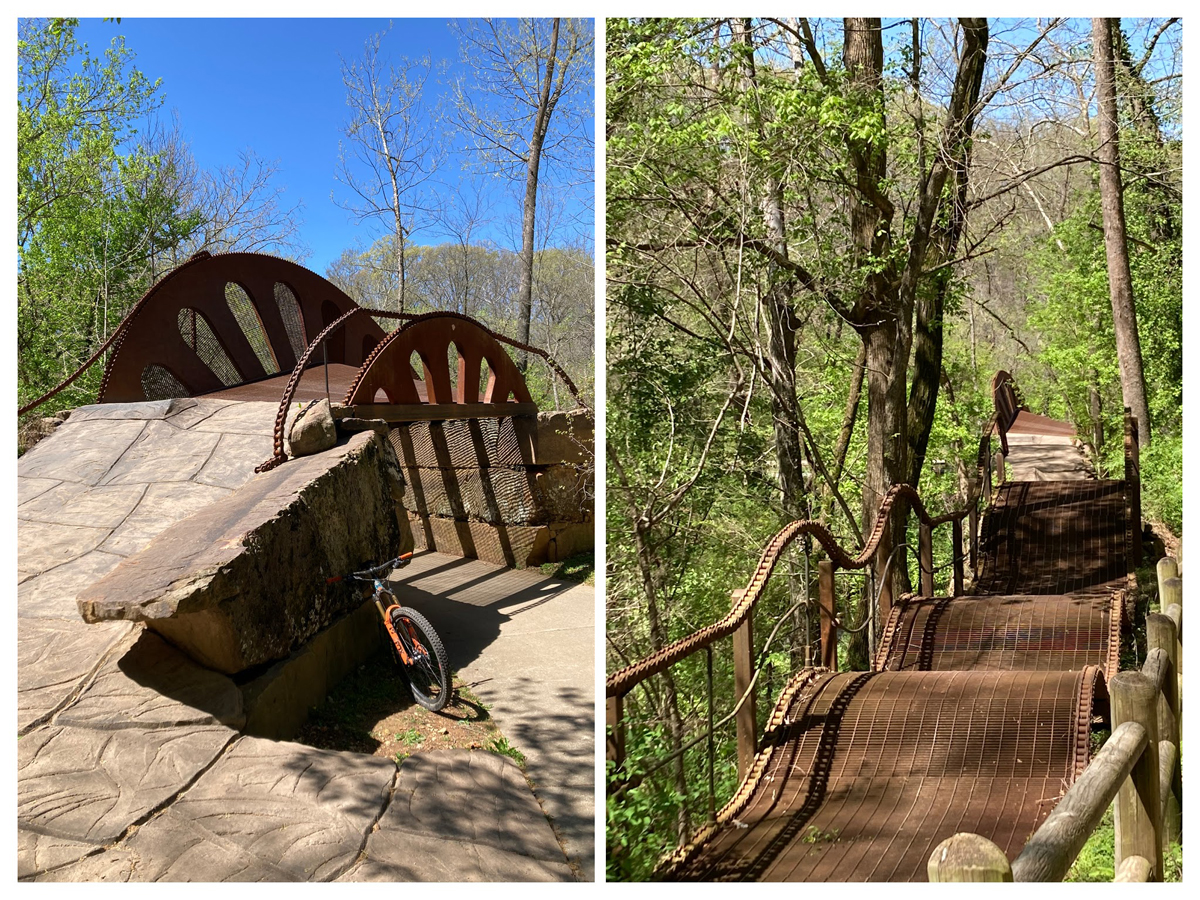
Masterpiece Bridge, rideable art number 13. Bentonville Mountain Biking. Photo by Tom Jow
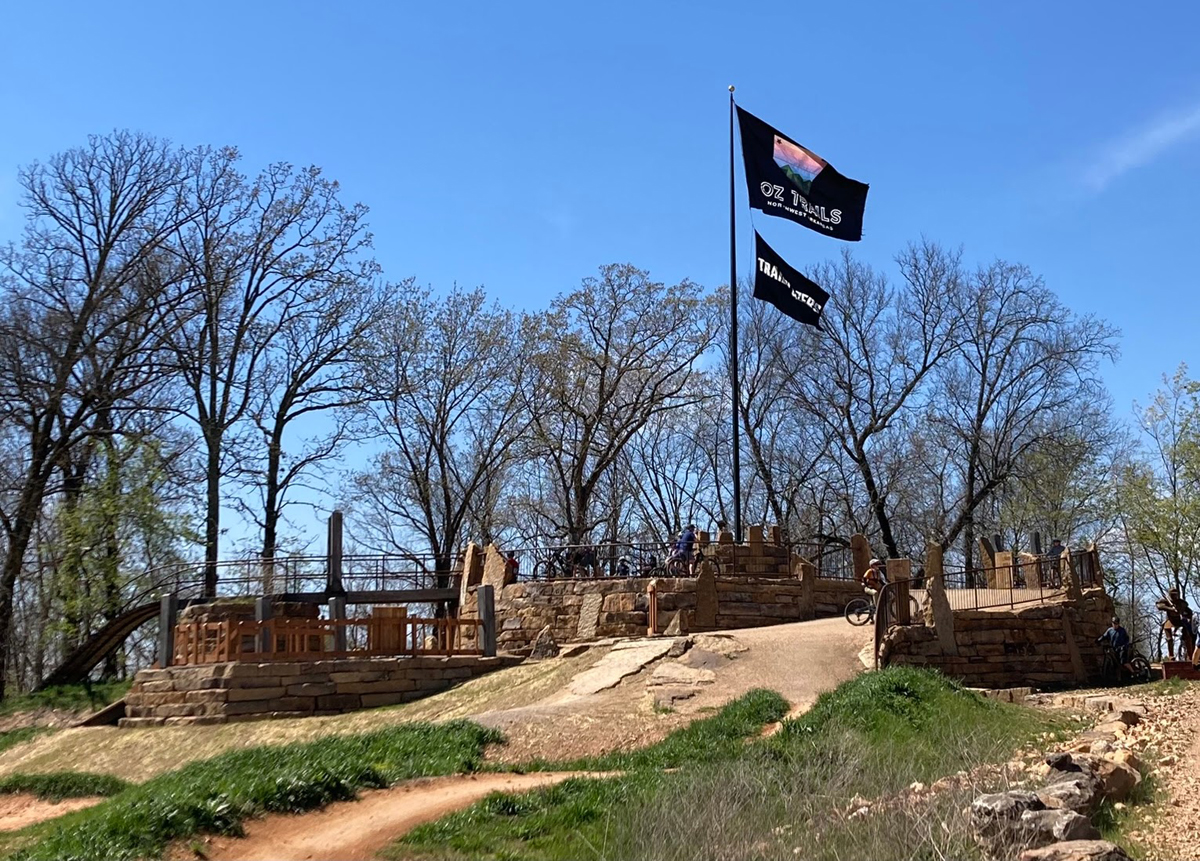
Nestled inside the preserve, the Airship Coffee Shop serves tasty sandwiches, pastries, coffee, and beer. Besides having delicious food, the shop is only accessible by human power. After lunch we rode perfectly paved bike paths and more manicured flow trails to the Slaughter Pen trail network. Along the way we crossed the Masterpiece Bridge, one of sixteen pieces of rideable art in Bentonville. Another work of art (though not one of the sixteen) was our destination; the Castle Hub. This mass of stonework, metal and wood is the starting point of seven distinct downhill trails; three green, two blue and two black. The green trails have well-made berms and jumps. The blue trails are similar, except with bigger jumps. The black trails have even bigger jumps. One of the black trails, Dragon Scales, is a tech flow trail (meaning it has rocks in addition to jumps). The other, Loam Wolf, descends on rough single track through tight trees with natural obstacles. All the downhill runs are short, between a quarter and half mile long. The return trail to the top is about a half mile. Because of this, it is easy to ride multiple laps in order to see which is the favorite. It’s also a great way to work on skills and progress to more difficult terrain. One drawback to the town trails is that being inside the city limits, they tend to be very busy.
The Castle Hub, Slaughter Pen trails. Bentonville Mountain Biking. Photo by Tom Jow
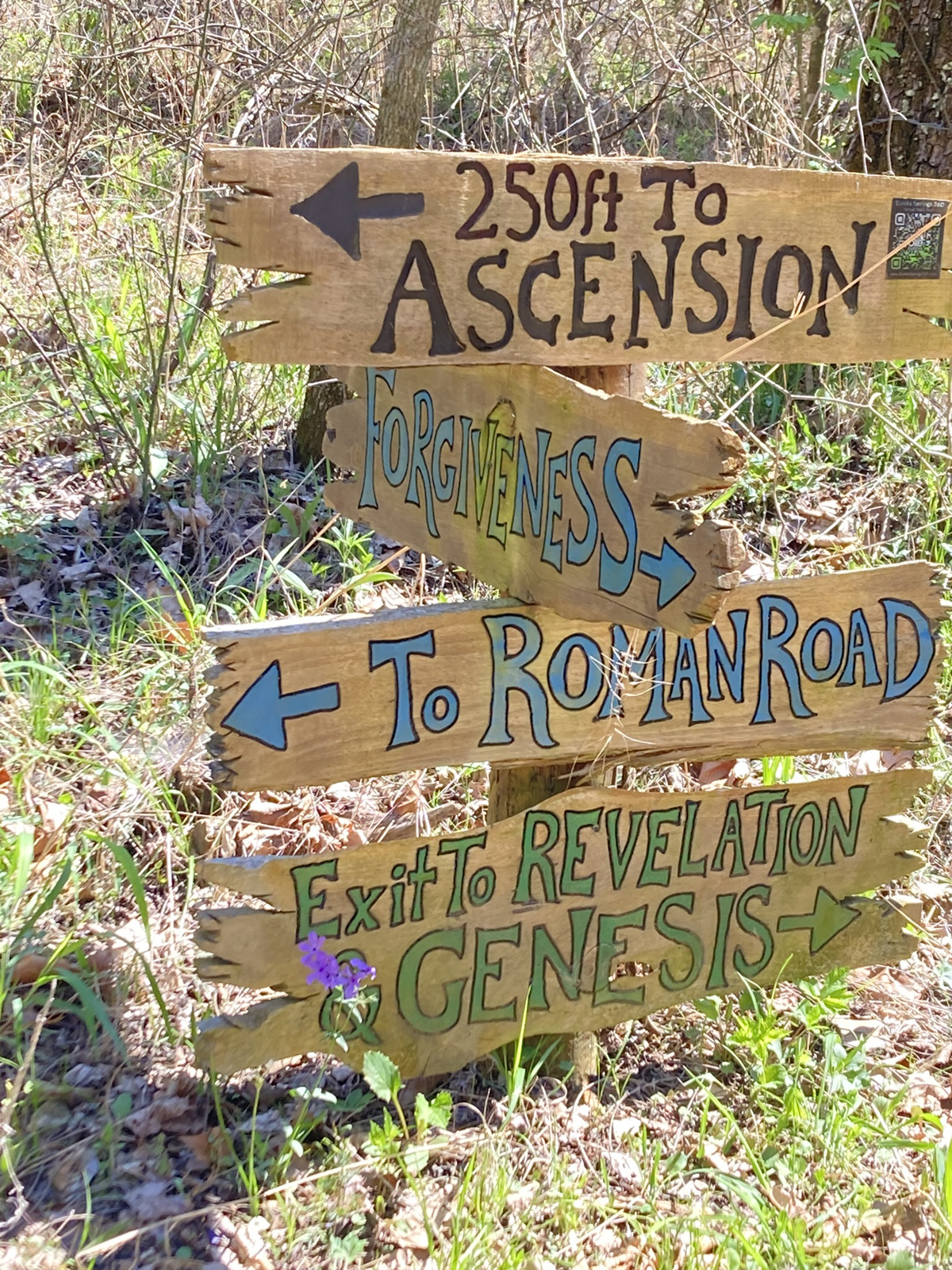
The following day we headed out to Eureka Springs, home of the Great Passion Play theater performance and the sixty-seven-foot-tall Christ of the Ozarks statue. The trails at Passion Play are all built in a more natural style, there was not a single high berm in sight. A funny feature of the network are the religious names, Genesis, Exodus, and Deliverance for example. The trail’s surface here is of many varieties, kitty litter, square marbles, large rocks and even a little dirt. All levels of rider are welcome. There are not too steep undulating descents for some, and steep rocky tech and drops for others. My favorite here was the Deliverance trail. Halfway down there is a long rocky patch followed by a steep chute with a quick right-left turn, through a “keyhole” in the rock. It’s not too difficult at a moderate speed. However, miss that left into the opening, and it’s head first into a wall of rock. Despite not having high altitude, the thirty or so minute climb to the top requires just as much effort as some of the trails at home in Utah. We rode a few laps before stopping for lunch, and afterwards rode a couple more. It was a lot of fun.
After two days of pedaling, we were ready for some pure downhill riding. We headed back out to Eureka Springs to the Lake Leatherwood Gravity Project. Located at the Topo Motel on Arkansas Highway 62, this area features seven downhill trails and all-day shuttle service for $45. Surrounded by some cross-country trails, the downhill area has seven trails departing from two hubs.
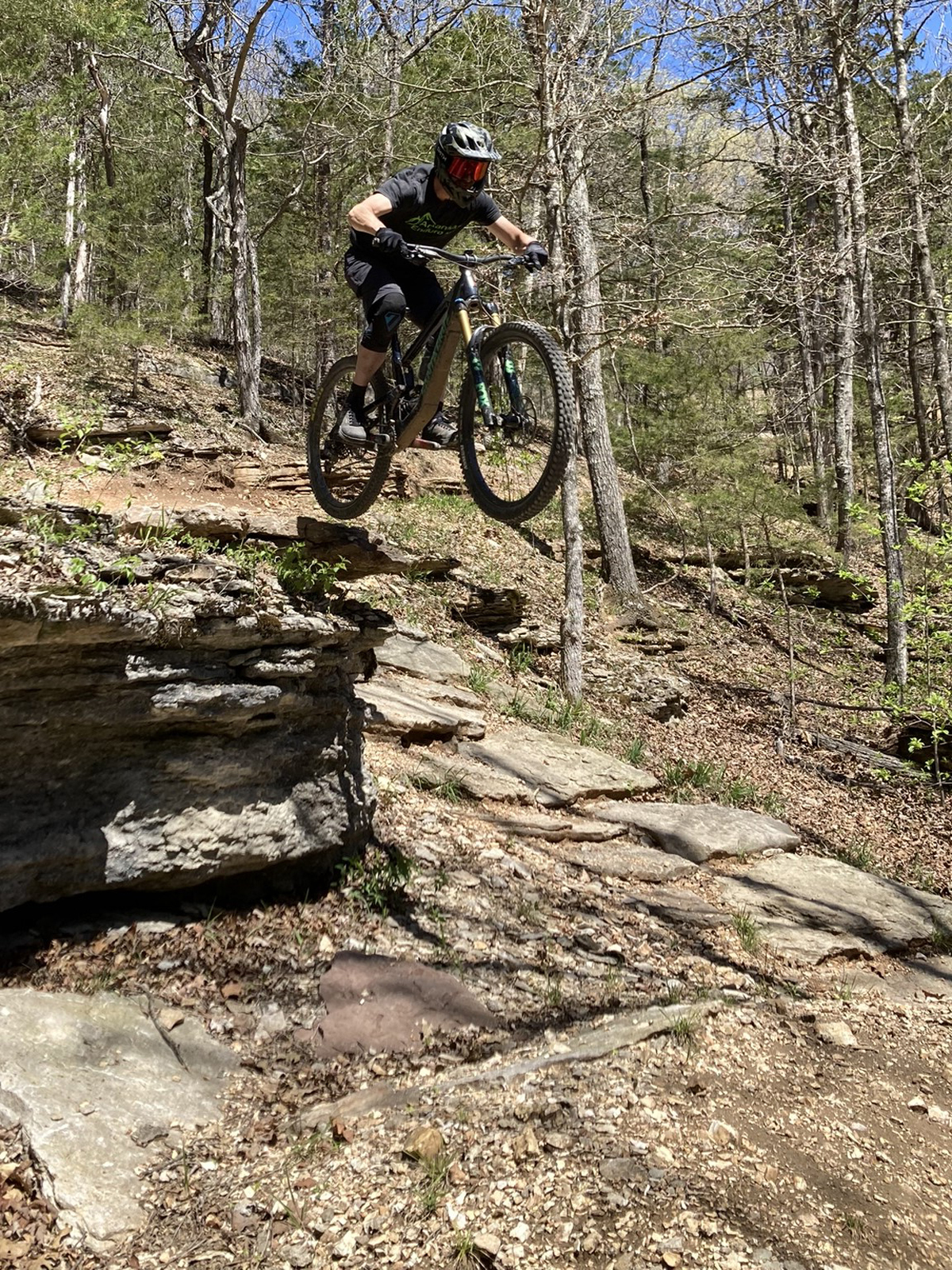
Derrick launches at Leatherwood. Bentonville Mountain Biking. Photo by Tom Jow
Starting with green trail number six, I could tell it was going to be a challenging day. My tires felt like they were sliding all over the place. I felt off balance on the jumps. Good thing the trail was barely a mile long. In just a few minutes we were at the bottom where there was a shuttle waiting for us. Minutes later we were unloading for our next run. Boy that was fast. The next trail, blue level, I was still having a hard time getting into a flow. Were the trails too short? Was I just tired? Certainly, being on these trails for the first time is a factor. Then, while waiting for the shuttle, I read the trail information sign. It was stated that the trail ratings were relative only to the trails at Leatherwood. Thinking about it, the first trail did seem more difficult than most green trails. Maybe that was it. The blue trails were about average, or so they seemed. The black trails were, well…. big. It wasn’t just the drops that were big, but the jumps too. What was unique about some of the jumps at Leatherwood was the level of stone work that went into them. Perfectly shaped six-foot ramps made of stones. While by the end of the day I was feeling comfortable on the bike, I never did tempt any of those big stone ramps.
Need direction in life? Bentonville Mountain Biking. Photo by Tom Jow
After a rest day watching the total solar eclipse, we headed down to Centennial Park in Fayetteville. The weekend before my arrival a US Pro Cup XC Series race had been held there. I wanted to see what the elite race course was like. How close was it to the World Cup courses I had seen on television? Lucky for us, the tape and signage was still in place. The course started at the top of the hill, winding around the plateau before descending into the woods. Jumps, berms, and rock gardens are all part of the course. The “A” line usually contained technical features while the “B” line was smoother and a little bit longer. The trails were wide with plenty of room to pass. Climbs were steep, some with rocky tech sections and some were smooth and fast. The 3.2-mile lap with 373 feet of climbing was fun at a fun ride pace. At race pace a lap (not to mention four) would certainly feel much different.
After the race course, we descended to the west, eventually crossing through some neighborhoods to the Mt. Kessler network. Here we would ride what felt like the longest continual climb of the week (about three miles) piecing together the Fayetteville Traverse, Serpentine, and Trent’s Trail. From there we rode the Crazy Mary trail, the one mile of which looked steeper on Trailforks. Back up to the Fayetteville Traverse, and down the super fun Flight Training downhill trail to the road. After riding back up to the truck, I decided we needed to ride the unridden World Cup 5 trail. Boy, am I glad we did. Fifty yards after entering the trail we encountered a smooth six-foot drop on the “A” line. Can you imagine being at race pace and hitting a six-foot drop with mandatory air not once, but multiple times?
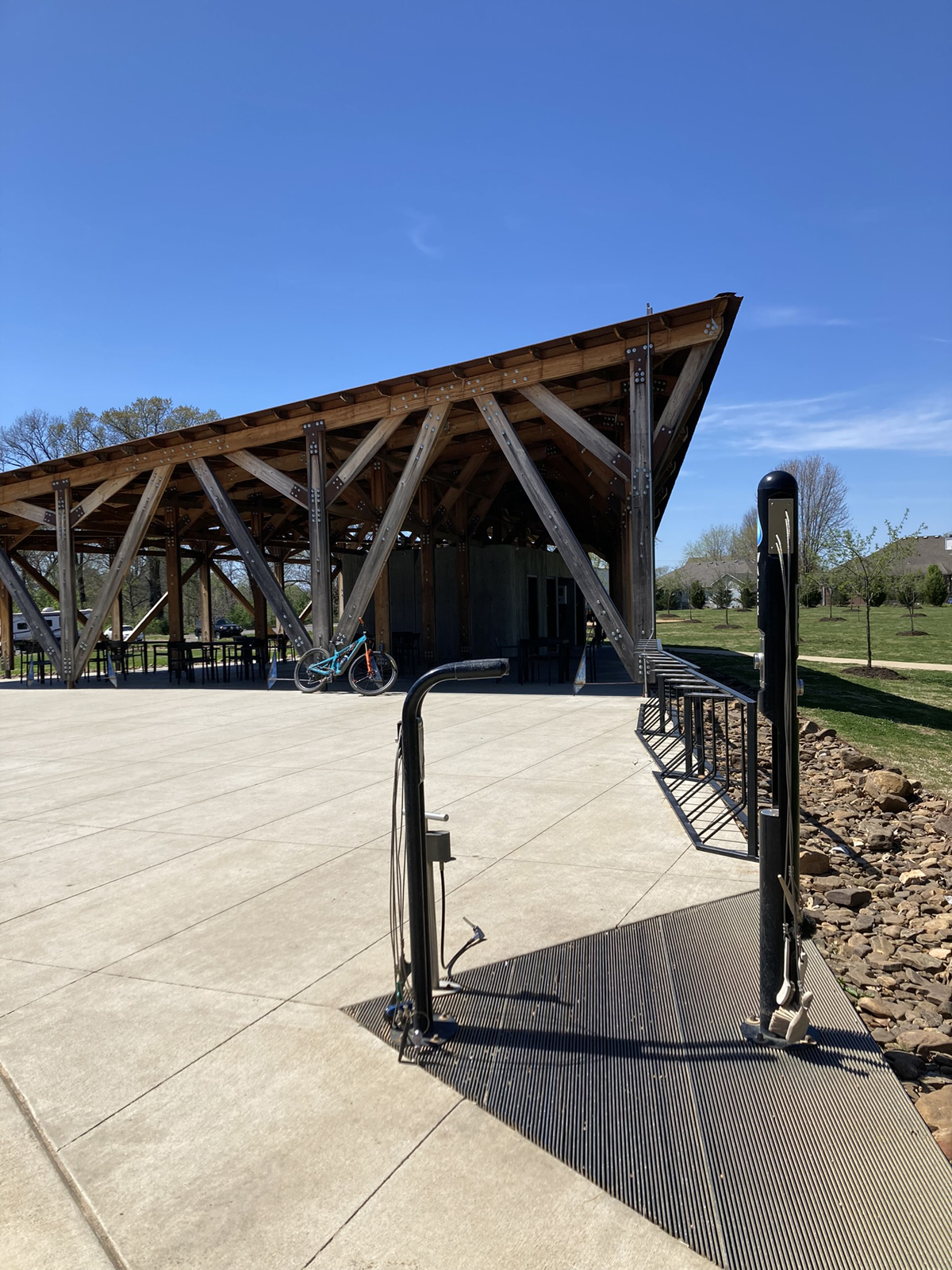
A nice big trailhead shelter with clean bathrooms, shaded tables, and bike workstation. Bentonville Mountain Biking. Photo by Tom Jow
My final day of riding was preceded by an afternoon and evening of light to moderate rain. The Back 40, Little Sugar and Blowing Springs trails surround the city of Bella Vista, where I was staying. After a short pedal we dropped onto the Tunnel Vision trail. This and the other trails in the area wind in, out, around, up and down the forested hills of the area. The trees were just beginning to fill out their foliage and for much of the ride we were in cool shade. The trail surface is mainly small rocks on top of well-draining soil. There were few puddles encountered during our ride. There were also few obstacles encountered, natural or man-made. The trails were cross country fast and fun. No wonder this area made up a large portion of the Big Sugar 100k and Little Sugar 50k race courses in 2023. I was really wishing I had my short travel bike on that day.
So, did Bentonville, Arkansas live up to the title, “Mountain Bike Capital of the World”? After a week of riding, I will say that it is about as close as anyplace is going to get. The city of Bentonville, along with Fayetteville, Bella Vista and Eureka Springs contain an extremely wide variety of trails; something for everyone. Smooth, wide bike paths to ride across town, or to the city next door. Flow trails for every skill level. Natural trails for cross country. A downhill area with a shuttle. A World Cup level cross country race course. The one thing missing is high altitude with climbs that go on for hours. Before naysaying, however, keep in mind that trails are only a part of it. The city is so bikeable. The people are so nice! Rarely if ever a cross word is shared by motorist to cyclist. Go to coffee or lunch and don’t worry that your bikes are not locked. The community is not just supportive of cyclists, but it seems like nearly everyone there IS a cyclist. Don’t believe me? I recommend making a trip to see for yourself.
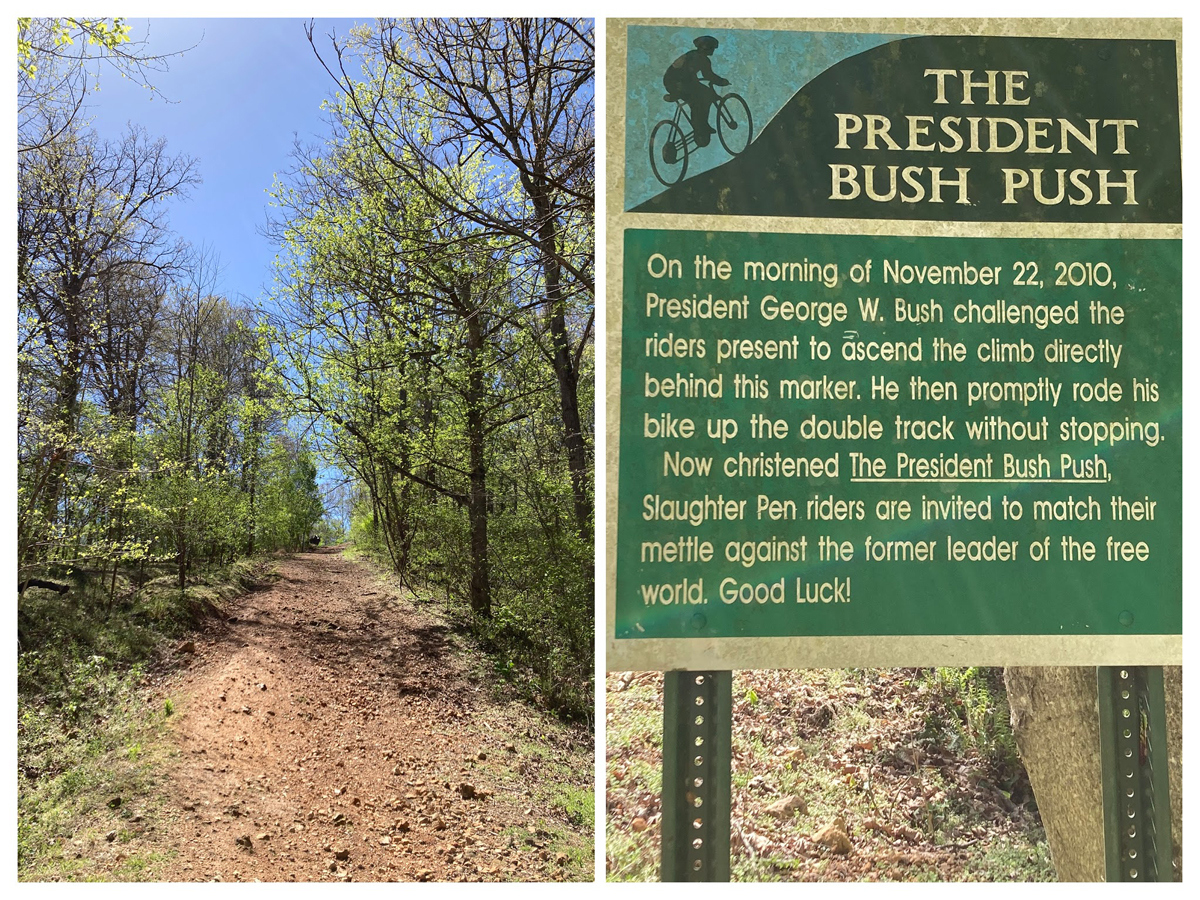
Try your luck against former President Bush. Bentonville Mountain Biking. Photo by Tom Jow
Getting there
Northwest Arkansas National airport (XNA) in Fayetteville is approximately twenty minutes from Bentonville. Airlines serving the airport are American and Delta Airlines. Flights might be cheaper to Tulsa, Oklahoma but it is a two-hour drive. Other places one might be visiting nearby include Little Rock, AR (3 hours), St. Louis, MO (5 hours), Memphis, TN (5 hours), and Nashville, TN (8 hours).
Fun facts
An average of approximately seven miles of trail is built every day.
The Flow Feed trail app tracks real time trail soil conditions with in-ground sensors.
The series will consist of eleven destinations across the United States
COLORADO SPRINGS, Colorado (June 5, 2024) — USA Cycling announced the 2024 Cyclocross National Series today, a successor to the Professional Cyclocross calendar (ProCX). The upcoming series retains the successful format offering UCI points and using an overall ranking system to recognize the top Elite Men and Elite Women.
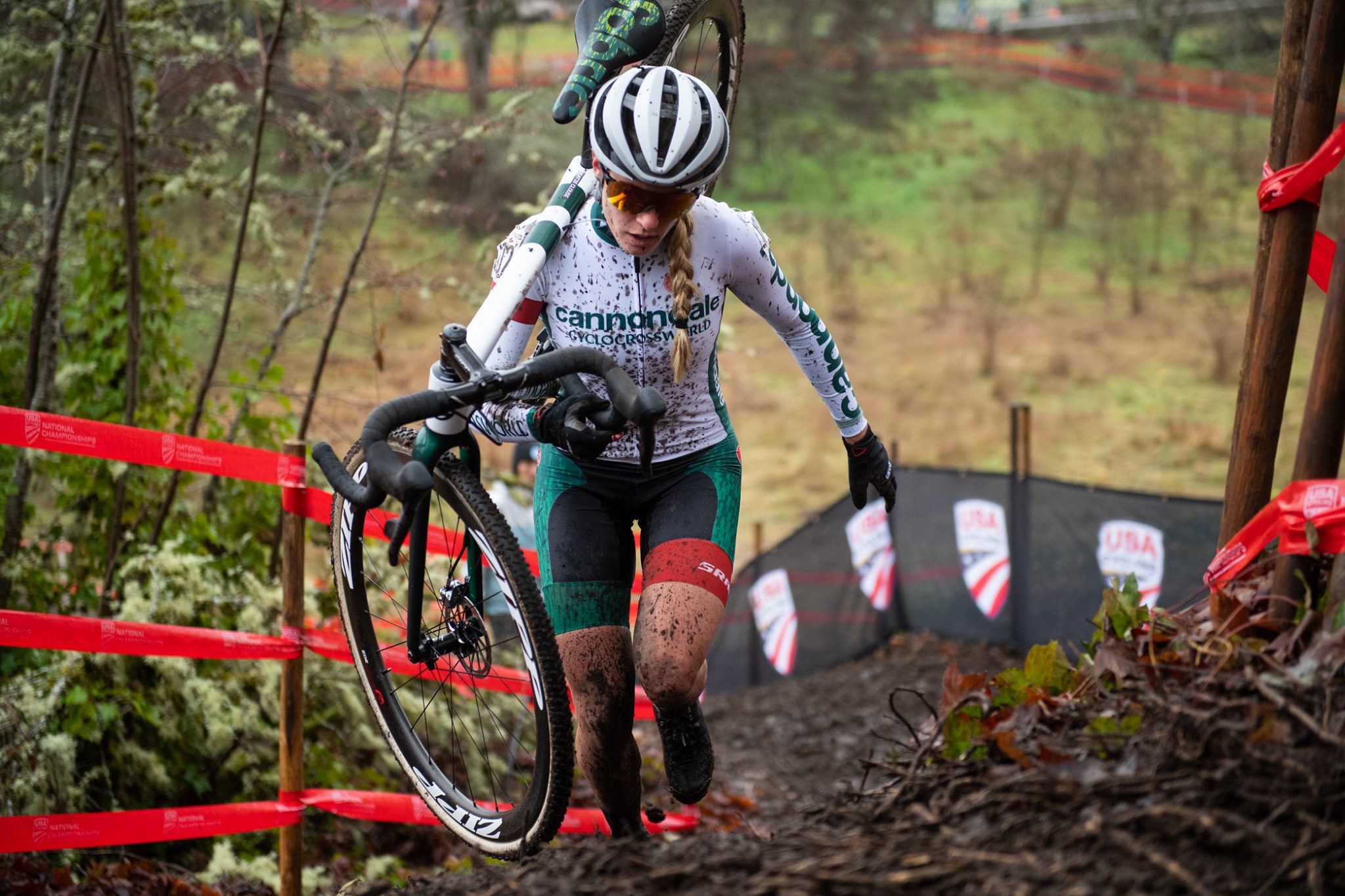
Katie Clouse (Cannondale-Cyclocrossworld.com) tackles one of the run-ups on her way to winning the 2019 U23 National Championship. Clouse is anticipated to return to the Elite racing circuit in 2024. Photo courtesy USA Cycling/Dejan Smaic
In 2024, the Cyclocross National Series will consist of eleven stops across the United States including the Pan American Continental Championships on November 2-3 in Missoula, Montana. Most events within the USA Cycling Cyclocross National Series offer categories for all ages and skill levels, giving riders with varying degrees of experience the opportunity to race alongside the nation’s top athletes. After each event, the individual rankings for UCI Elite Men and Elite Women will be updated. Series standings can be found on the USA Cycling website.
“The Cyclocross National Series showcases some of the most respected cyclocross races in the country. Each location features unique and challenging courses that will provide racers the chance to demonstrate their skills and strength.” said Kyle Knott, USA Cycling’s Director of National Events.
The 2024 Cyclocross National Series events are as follows:
Date
Event
Location
September 7-8
Englewood CX (C2)
Fall River, Wisconsin
September 14-15
Virginia’s Blue Ridge Go Cross (C1/C2)
Roanoke, Virginia
September 21-22
Rochester Cyclocross (C1/C2)
Rochester, New York
September 28-29
Charm City Cross (C1/C2)
Baltimore, Maryland
October 5-6
Trek CX Cup (C1/C2)
Waterloo, Wisconsin
October 12-13
Major Taylor Cross Cup (C2)
Indianapolis, Indiana
October 19-20
Kings CX (C1/C2)
Mason, Ohio
October 26-27
Really Rad Festival of Cyclocross (C1/C2)
Falmouth, Massachusetts
November 2-3
Thunder Cross and Pan American Continental Championships
Keegan Swenson retains the top spot of the men’s 2024 Life Time Grand Prix, while Haley Smith takes the lead of the women’s standings from Sofia Gomez Villafañe.
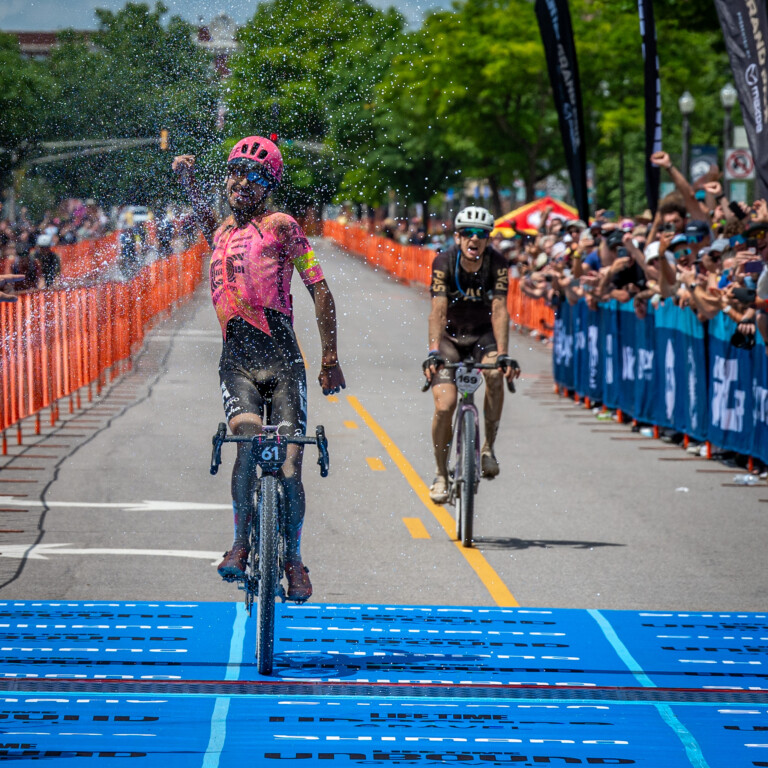
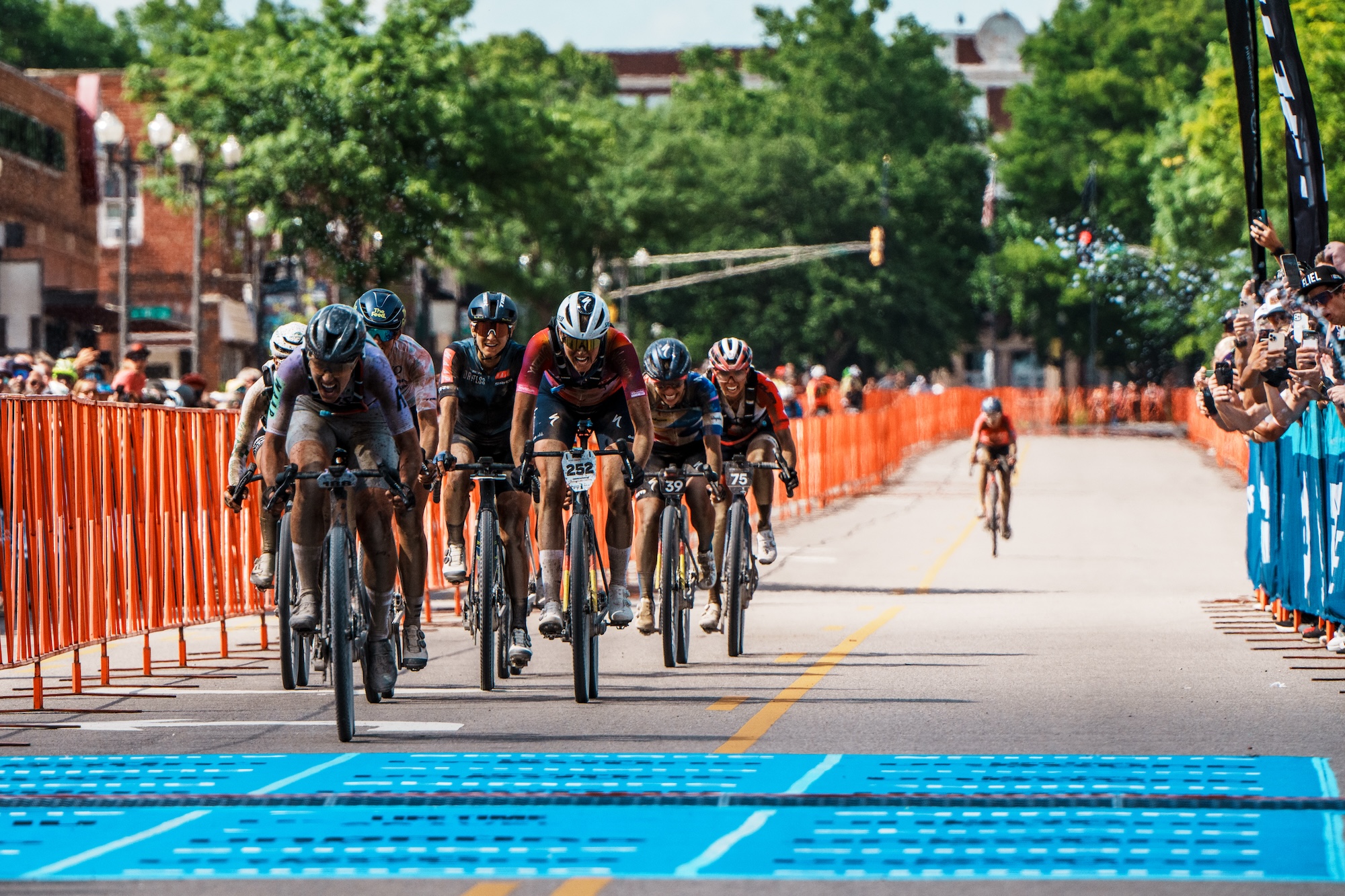
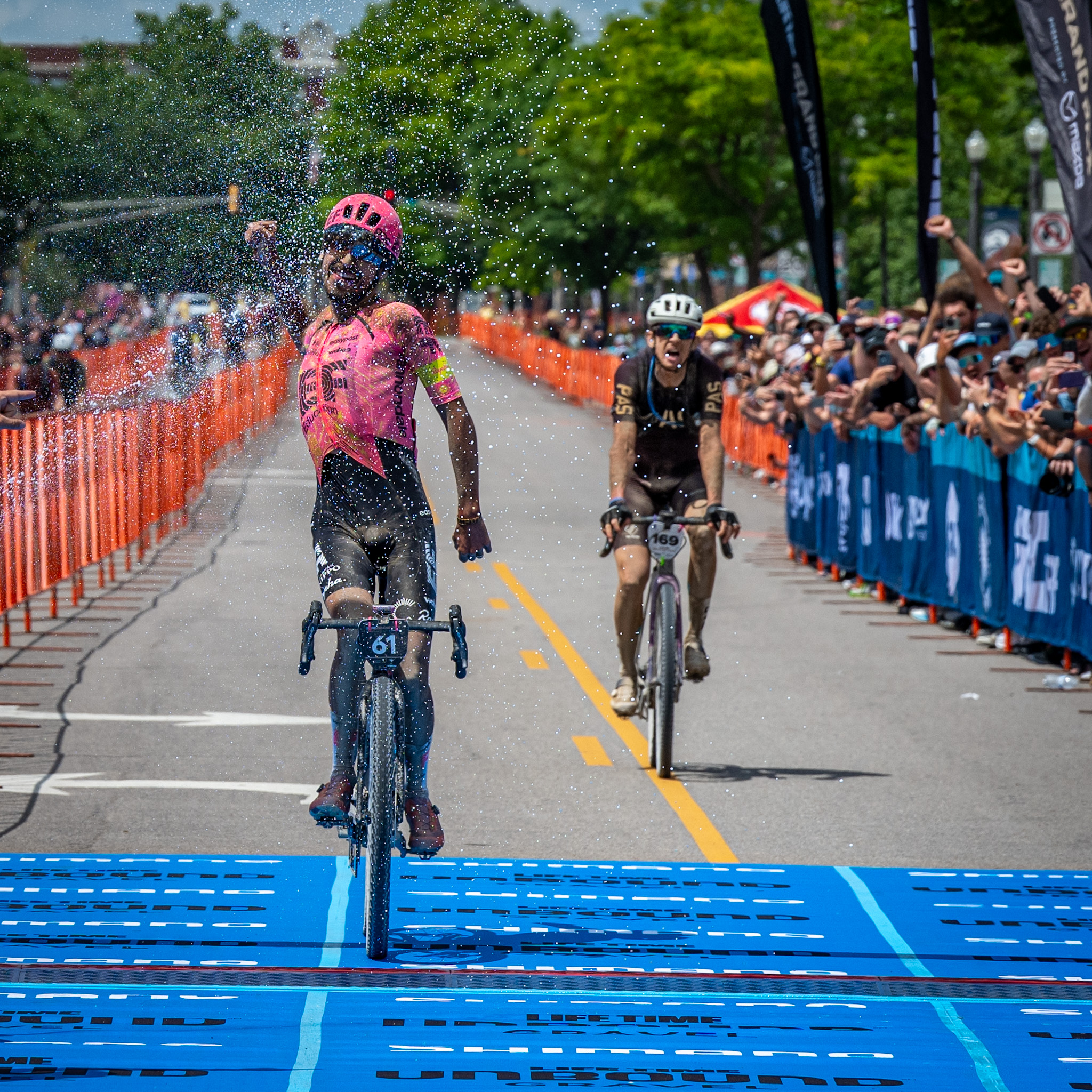
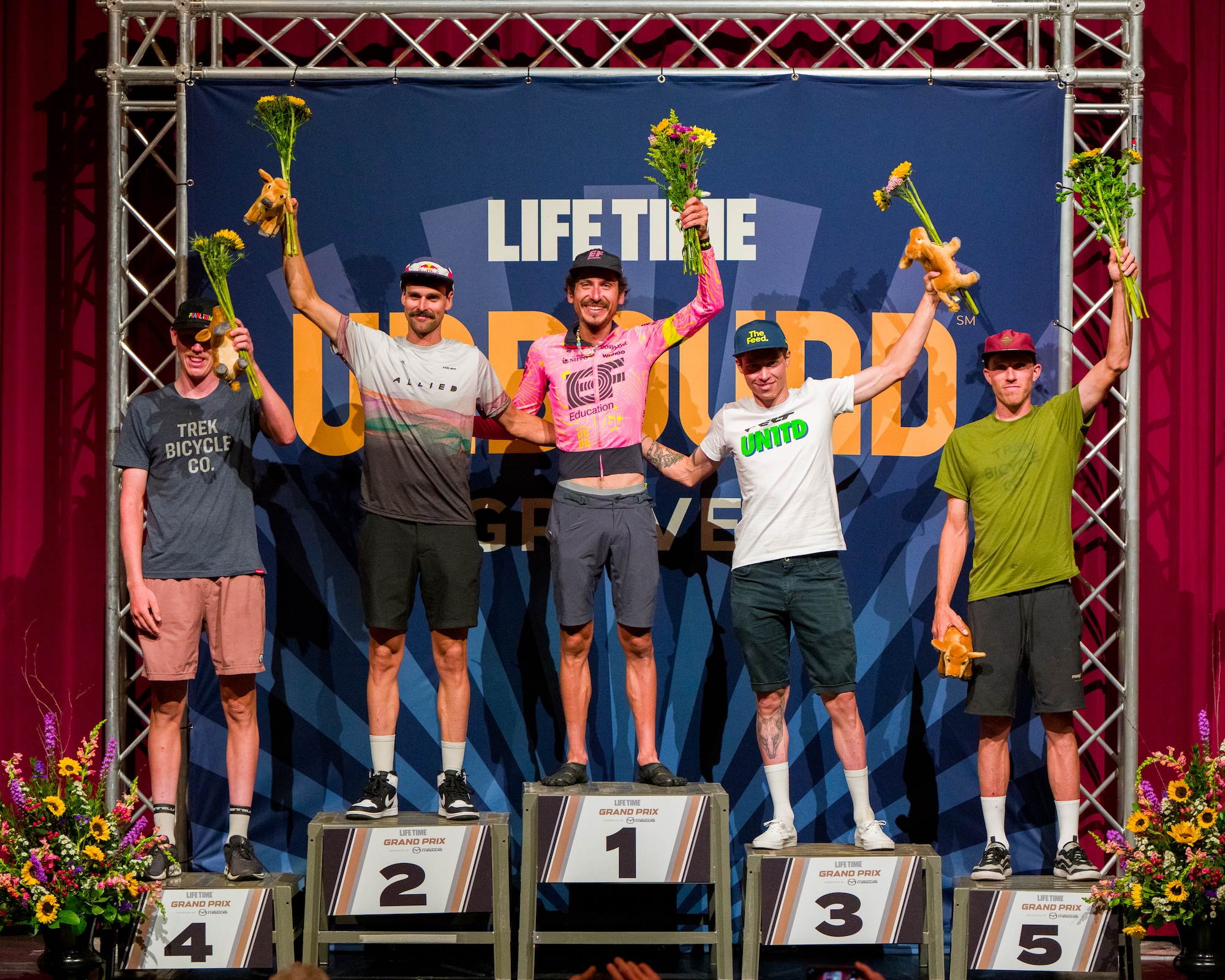
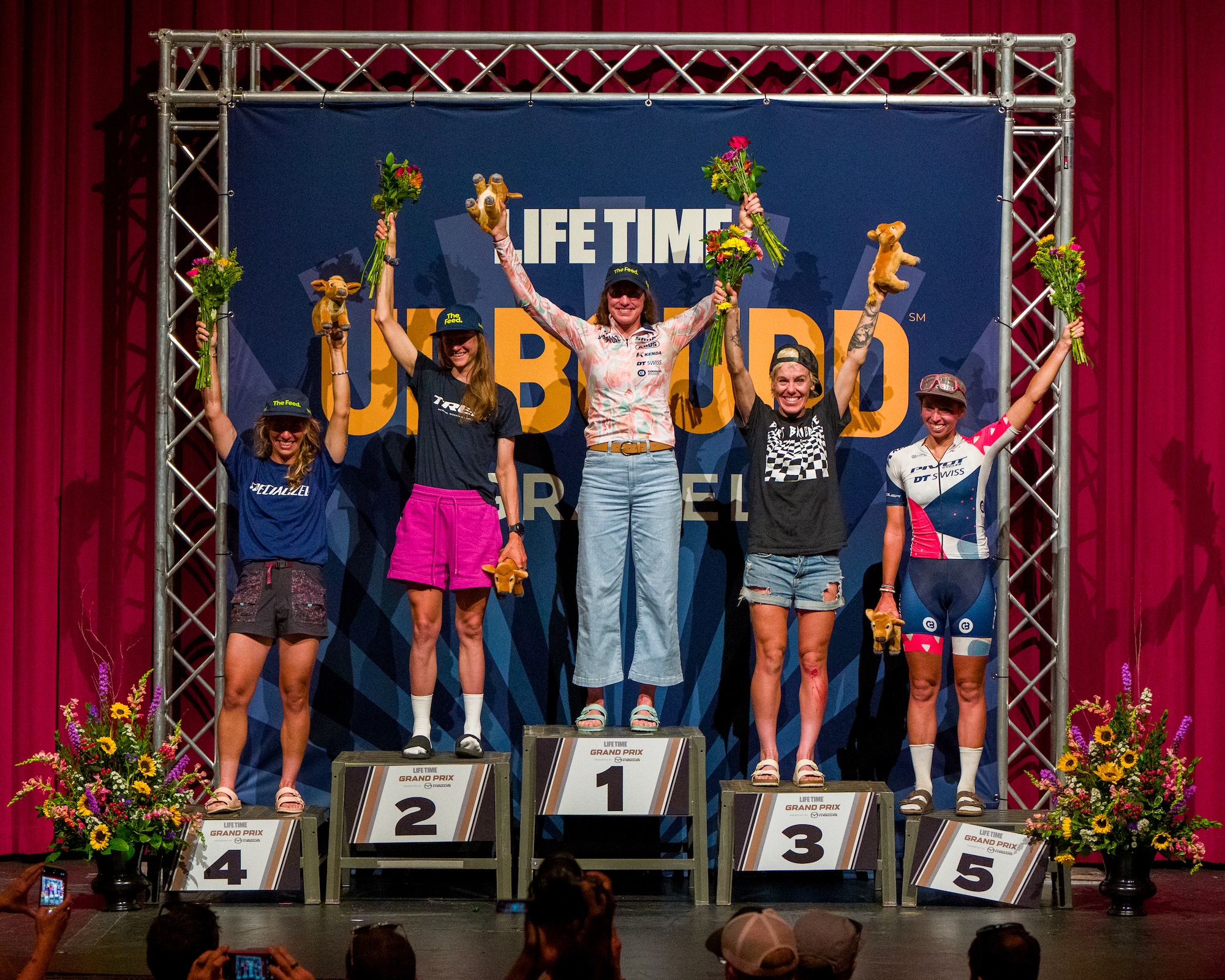
EMPORIA, Kansas (June 1, 2024) — An unprecedented nine-rider sprint finish resulted in a stunning debut win for German PhD student, Rosa Klöser, in the women’s elite UNBOUND Gravel 200. Australian fan-favorite Lachlan Morton (EF Education-EasyPost) took his first victory in the men’s race following a thrilling long-range breakaway alongside second-place finisher, Chad Haga (USA).
A couple of rain-free days allowed for the fastest racing ever seen at UNBOUND, with average speeds above 22mph (35kph) for the men’s race and 19.4mph (31kph) for the women. Following an overcast start to the day, blue skies and light winds characterised race-day conditions, with the dry, dusty dirt roads marking fears of ‘peanut butter mud’ as unfounded.
For the first time in the history of the race, the 2024 edition of UNBOUND Gravel saw the elite women’s field secure an individual start time a full 15 minutes after the elite men, and 25 minutes ahead of the amateurs.
Klöser’s victory followed an eventful day on the gravel roads North of Emporia, with a crash, flat tire and wheel change risking a premature end to her race. She worked hard to bridge a two-minute gap solo to contest the biggest sprint finish in the history of UNBOUND Gravel, beating high-caliber racers including SD-Worx’s Geerike Schreurs (Netherlands) and first American finisher Paige Onweller (Trek-Driftless) into second and third place.
Photo by Taylor Chase, www.chaseincolor.com, @chaseincolor, Life Time Grand Prix 2024, Unbound Gravel 200, Emporia, Kansas, June 1, 2024. Photo courtesy Life Time
In the men’s race, Denmark’s Tobias Kongstad attacked early, setting the stage for an 200-mile game of cat and mouse which pitted breakaways against enormous chasing groups. Big names including defending Life Time Grand Prix champion Keegan Swenson (USA), UCI Gravel World champion Matej Mohorič (Slovenia), Greg Van Avermaet (Belgium) and Ian Boswell (USA) tested the pace for the of 50-strong packs of chasers, but Haga’s attack around 150 miles – with Morton in close pursuit – set the scene for the final hours of the race.
A final sprint for the line down Emporia’s Commercial Street saw Morton triumph over Haga, with Kongstad’s 6am efforts on Emporia’s asphalt rewarded with third place just three minutes after the breakaway pair.
Photo by Dan Hughes, Life Time Grand Prix 2024, Unbound Gravel 200, Emporia, Kansas, June 1, 2024. Photo courtesy Life Time
These results have triggered a number of changes to the Life Time Grand Prix overall standings, with UNBOUND Gravel 200 acting as the second race in the seven-race series.
Swenson’s 14th place allows him to maintain his place at the top of the men’s leaderboard with 59 points, Payson McElveen is now hot on his heels in second place (58 points) after crossing the UNBOUND finish line in 8th. Matthew Beers retains third place in the overall standings (56 points) following today’s 13th place finish.
Today’s racing has given the women’s Life Time Grand Prix standings a significant shake up, with Fuego XL winner Sofia Gomez Villafañe’s 15th place seeing her drop to third (55 points), while Haley Smith’s UNBOUND 4th place boosts her to the top of the overall podium (62 points). Hannah Otto has also taken a step up the standings to second (58 points), following her 8th place result, just two seconds behind today’s race winner.
Reaction from the UNBOUND Gravel 200 winners
Men’s winner Lachlan Morton said: “It was a very fast and hectic start. After Little Egypt we got down to a small group but no one really wanted to take the pace up. When Chad went away I was like that’s the guy I want to be with. I managed to get across to him and I knew if we teamed up we’d both be committed. We didn’t need to say many words, we were both on the same wavelength.
“There was definitely a lot of unknowns with people feeling each other out today. The bigger the groups were, the harder it was to communicate and get the group working together, so I knew that was going to be going on behind us. You’re never really sure of the gap, but I knew we were moving fast and they would have to be really committed behind to catch us.
“Once we got back to town it was always going to be a bit technical, but I was lucky in that I’ve done this finish a couple of times and made those mistakes in the last races.
“To be honest I thought a win here was kind of beyond me now. The levels continue to get higher, and I’m getting older. I’m just really happy with how it went today. I went away by myself with 120 mies to go into a headwind, I just wanted to race hard and race with everything I had. I wanted to leave everything out there today, and in the end I did.”
Photo by Taylor Chase, www.chaseincolor.com, @chaseincolor, Life Time Grand Prix 2024, Unbound Gravel 200, Emporia, Kansas, June 1, 2024. Photo courtesy Life Time
Women’s winner Rosa Klöser said: “My day was definitely adventurous and very mixed. I was happy to make the decisive split and be in the front group with around fifteen women, but I think it was before the first feed zone that I hit a big rock, crashed and had a flat tire in the front. Luckily I was running inserts so I could try to keep going with the girls but they were really strong so it was very hard.
“We did a pit stop change on my front wheel and I only lost around two minutes to the leaders. I told myself I’m going to die trying to close this gap, but I made it! I got back, I was pretty cooked but in the end I was so happy that we had completely our own race that I decided I’m going to keep pushing and keep working, and give a lot of pulls because I want to show everyone how cool it can be that we have our own race. At the end I knew I had a pretty okay sprint after a long day out.
“This was my first UNBOUND. I only started cycling a couple of years ago and I’m still a full time PhD student, so I cycle part time. I still can’t believe I won!”.
Photo by Taylor Chase, www.chaseincolor.com, @chaseincolor, Life Time Grand Prix 2024, Unbound Gravel 200, Emporia, Kansas, June 1, 2024. Photo courtesy Life Time
By Charles Pekow — You’re less likely to get severely hurt at an intersection if the auto is turning right than if it is turning left or going straight concluded a study done at Utah State University. The study focused on crashes with motor vehicles turning right, looking both at crash data and videos of nearly 1,200 incidents in Utah between 2010 and 2019.
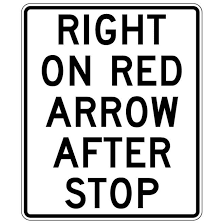
To reduce the chances of auto-bicycle collisions, the study recommends against dual-right turn lanes, in favor of shortening crossings, banning right-turn-on-red, and giving pedestrians a green light before autos.
SACRAMENTO, California (May 29, 2024) — In a significant move, the California legislature released its budget proposal today, reversing the severe cuts to the Active Transportation Program (ATP) that were initially suggested in the Governor’s Budget. Instead of slashing funds, the legislature plans to compensate for these cuts by reallocating state highway funding. This decision has been warmly welcomed by CalBike, which has long advocated for the ATP and its essential role in supporting walking and bicycling projects across the state.
CalBike Responds to Legislative Support
CalBike’s policy director, Jared Sanchez, expressed his gratitude: “I’m glad the legislature recognized the value of the Active Transportation Program. The legislature heard from its constituents and saved a popular program many local communities rely on to fund infrastructure projects.”
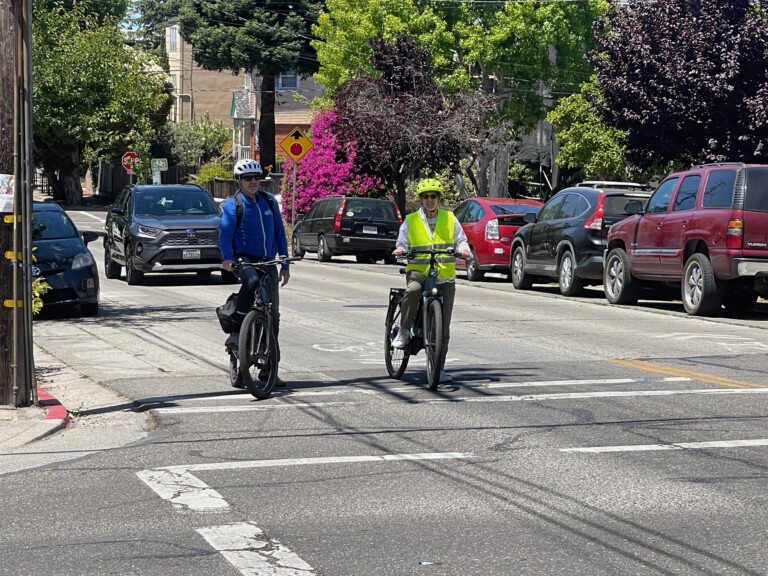
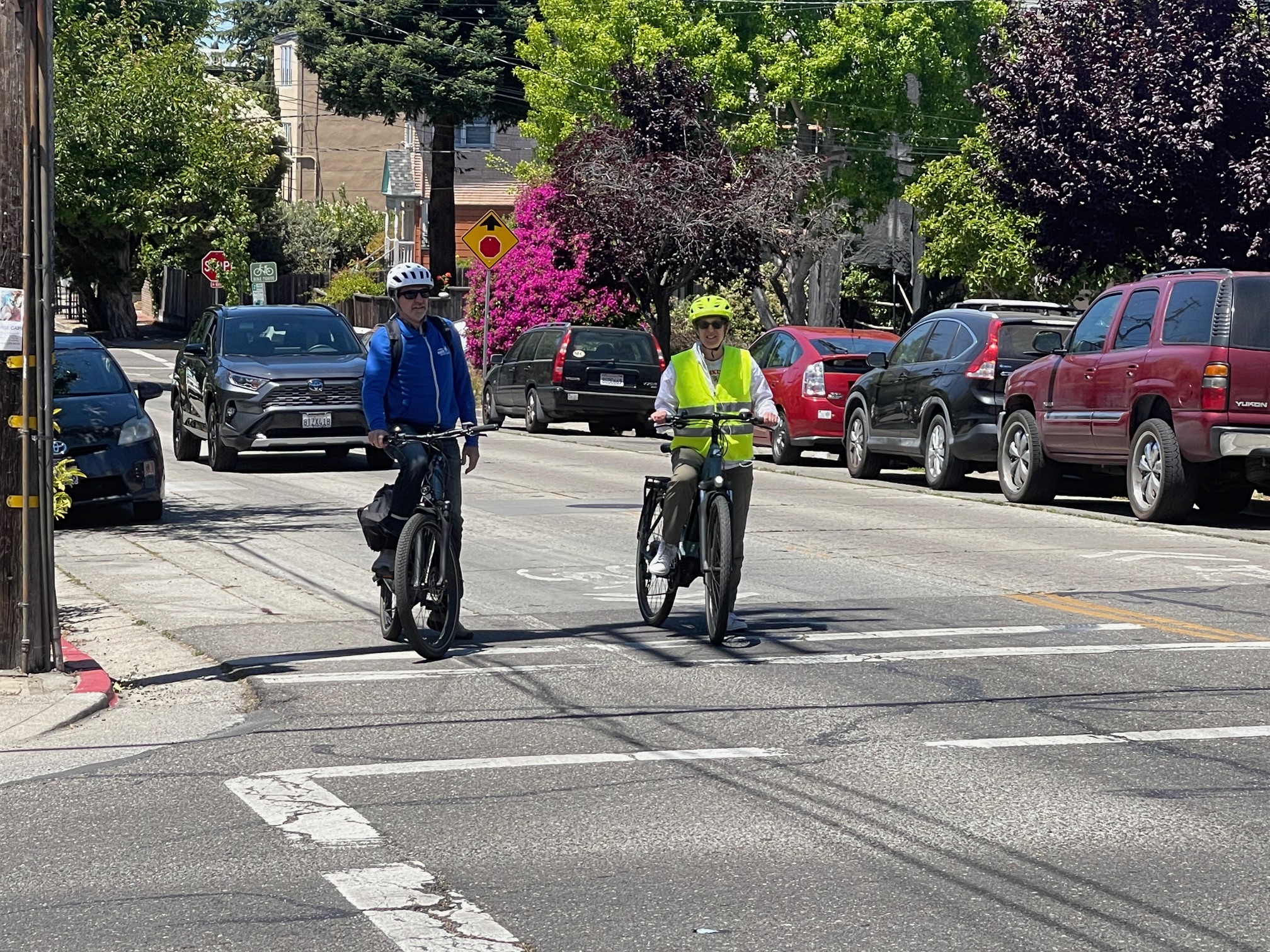
California’s Active Transportation Program helps fund projects like this bikes-only through intersection at Virginia and Sacramento in Berkeley, California. Photo by Dave Iltis
Jeanie Ward-Waller, a consultant for CalBike, highlighted the broader implications: “The ATP is critical to meeting California’s climate goals and addressing the crisis of rising pedestrian and bicyclist fatalities on our roadways, especially in disadvantaged communities across the state. We commend the Legislature for their strong support of shifting funding from car-centric infrastructure to improve walking and biking.”
The Importance of the Active Transportation Program
The Active Transportation Program is a vital competitive funding source designed to enhance biking and walking safety. It distributes approximately $500 million in each two-year funding cycle, supporting a range of projects aimed at improving non-motorized transportation infrastructure.
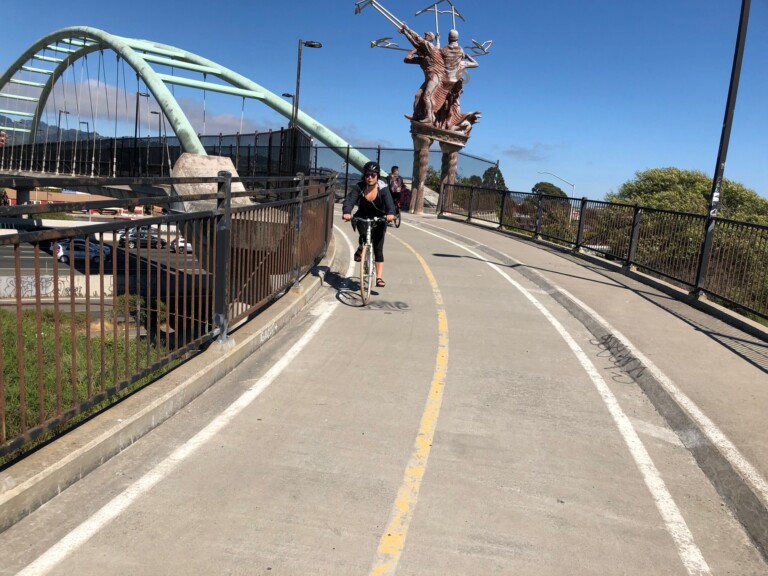
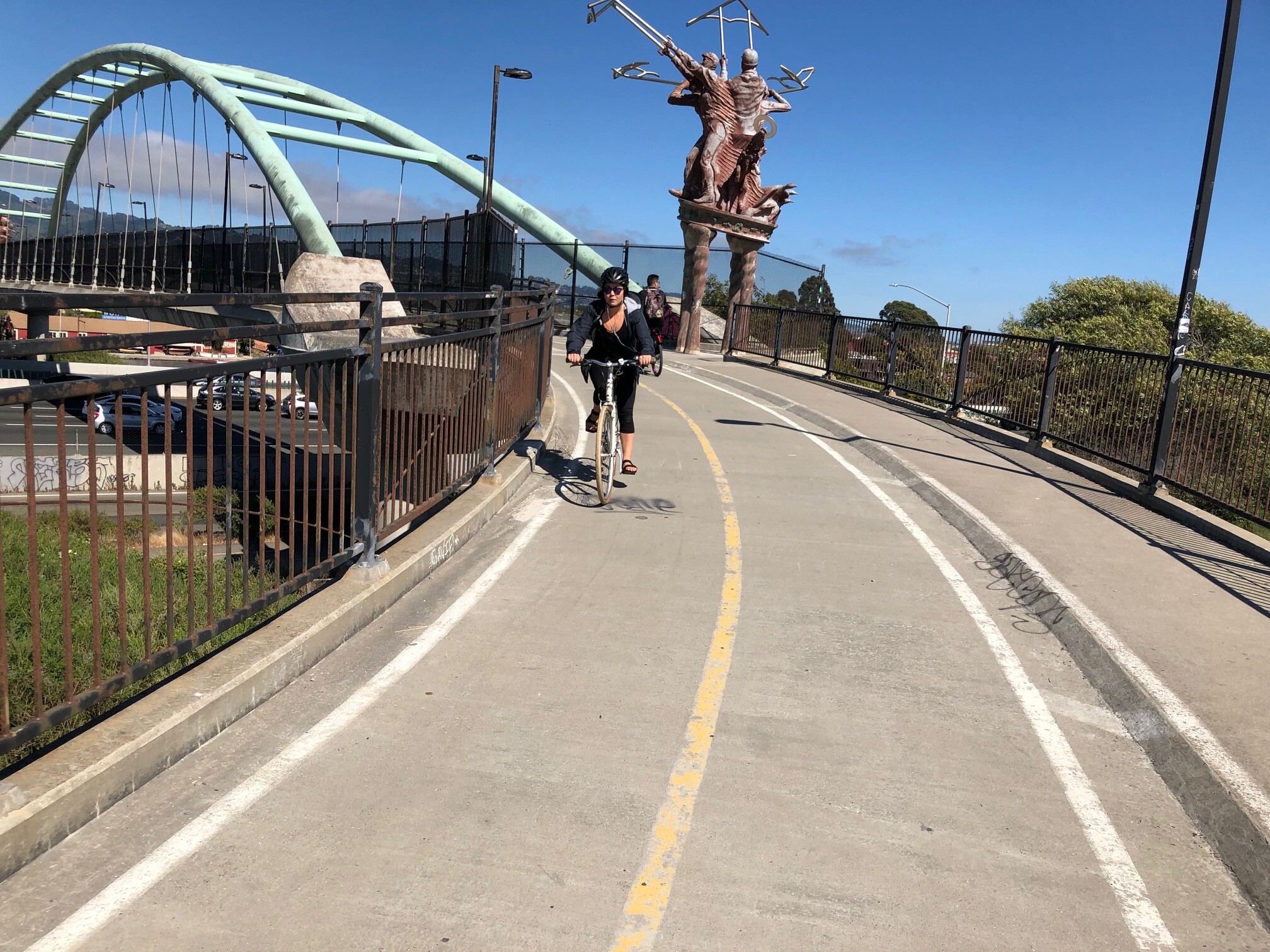
California’s Active Transportation Program helps fund projects like this cycling and pedestrian bridge over I-80 in Berkeley, California. Photo by Dave Iltis
In 2022, the ATP received a substantial one-time funding boost of $1.05 billion from the general fund budget surplus, which increased the total for Cycle 6 to $1.6 billion. Despite this boost, the ATP remains chronically underfunded and oversubscribed, leaving many valuable projects unfunded.
Budget Battles and the Future of ATP
In 2023, Governor Gavin Newsom proposed a $300 million cut from the ATP’s one-time general fund boost. However, the legislature and the Governor reached a compromise to backfill this cut from the State Highway Account, ensuring no reductions in the final budget for the ATP.
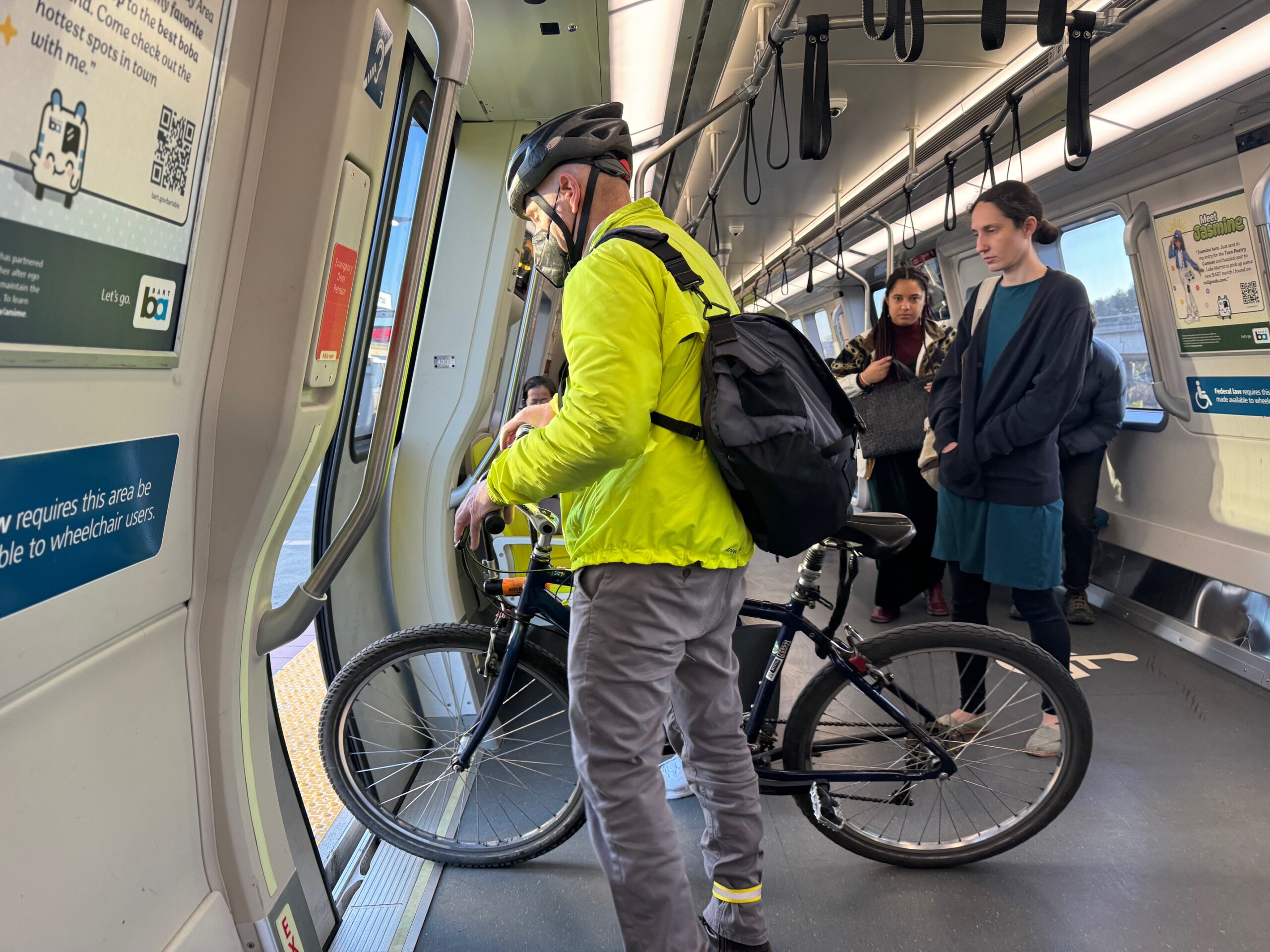
BART has long encouraged Active Transportation by allowing cyclists to ride the train, especially from the East Bay into San Francisco, where the only other option is the San Francisco Bay Ferry. Photo by Dave Iltis
The tension continued into January 2024, when the governor initially proposed cutting $200 million from the ATP. This amount was dramatically increased to $600 million in the May Revise, a cut that threatened to delay and potentially cancel projects awarded in Cycle 6 and could eliminate an entire future cycle of ATP grants.
Critically, no cuts were proposed for highway projects that contribute to increased vehicle miles traveled (VMT) and greenhouse gas emissions. This is despite the fact that California’s transportation budget is well-funded, bolstered by substantial federal and state funds.
A Step Forward for Active Transportation
The legislature’s decision to restore funding to the ATP underscores the importance of active transportation in California’s future. By prioritizing walking and biking infrastructure, the state is not only promoting safer, more sustainable travel but also making strides toward its climate goals and addressing pressing public safety issues.
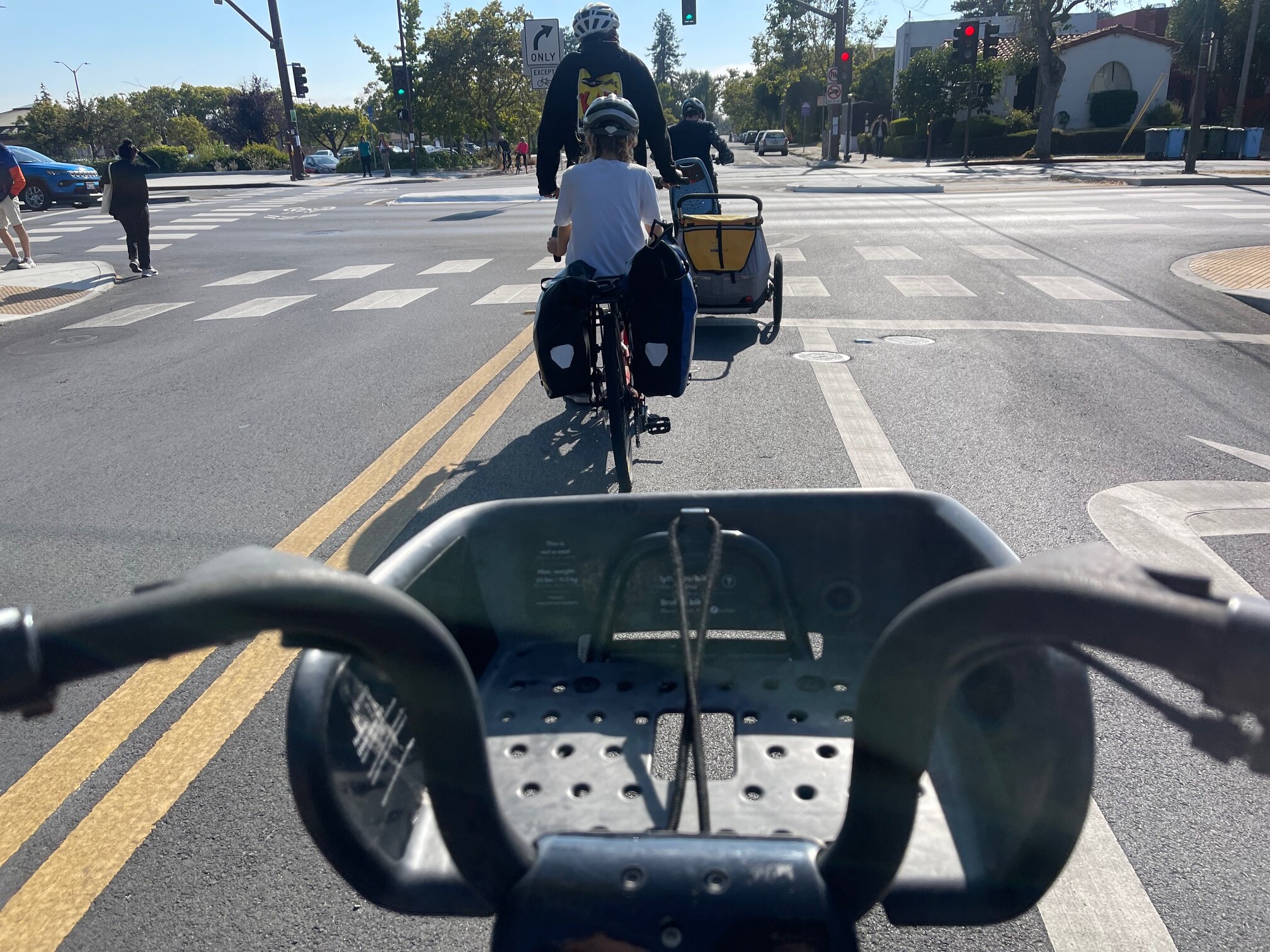
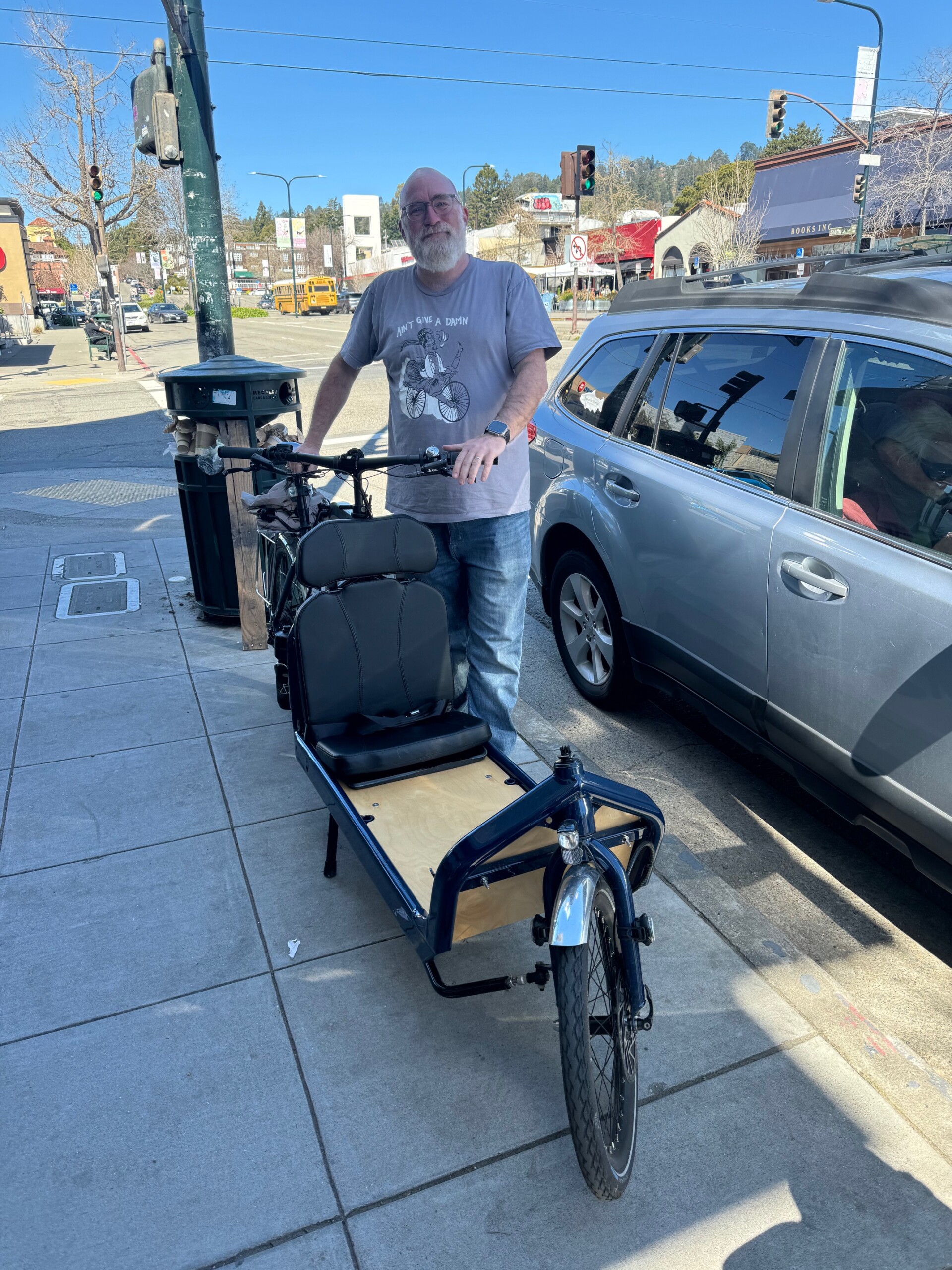
By funding infrastructure projects that make it safer and easier for cyclists and pedestrians, more people can give up their cars in favor of alternatives like this cargo bike for local trips. Photo by Dave Iltis.
CalBike and its supporters remain vigilant and hopeful that this legislative support will translate into continued commitment to the Active Transportation Program, ensuring that essential projects receive the funding they need to succeed.
SACRAMENTO, California (May 29, 2024) — May 24th marked the halfway point for Active Transportation Bills in the California Legislature for this year. All bills needed to be voted out of their originating house to continue progressing. Here’s a look at where CalBike-supported bills stand halfway through the 2024 legislative session.
CalBike Priority Bills Moving Forward
2024 Complete Streets Bill (SB 960)
Authored by Senator Scott Wiener, SB 960 has passed the Senate and is now headed to the Assembly. This bill mandates Caltrans to implement safe infrastructure for bicyclists and pedestrians when repaving a state route that functions as a local street. The 2024 version also includes transit upgrades, a highly welcomed addition. Your support is crucial to ensure legislators recognize the strong backing for this bill. Stay updated on CalBike’s Complete Streets Campaign page.
Safe Vehicles Save Lives Bill (SB 961)
Another part of Senator Wiener’s safer streets package, SB 961, has also passed the Senate and is moving to the Assembly. The bill initially included a requirement for truck side guards to prevent fatal collisions, but this provision was removed due to trucking industry lobbying. However, the requirement for intelligent speed assist (ISA) software in new vehicles starting in 2027 remains, albeit in a modified form that alerts drivers when they exceed speed limits rather than restricting speed. CalBike continues to strongly support this bill as a step toward achieving Vision Zero. We hope the truck side guards provision will return in future legislation.
AB 2290 aims to limit state funding for Class III bikeways (marked with sharrows rather than separated bike lanes) to streets with speed limits under 20 mph and to close loopholes. Photo by Dave Iltis
Quicker and Better Bikeways Bill (AB 2290)
Authored by Assemblymember Laura Friedman, AB 2290 aims to limit state funding for Class III bikeways (marked with sharrows rather than separated bike lanes) to streets with speed limits under 20 mph and to close loopholes. It also strengthens requirements for creating Complete Streets on projects funded by the Road Maintenance and Rehabilitation Program (SB 1) and establishes a quick-build pilot at Caltrans. Having passed the Assembly, it now faces potential opposition in the Senate.
Additional Supported Bills Advancing
AB 2086 (Schiavo) – Caltrans Accountability and Transparency Bill
This bill, which passed the Assembly and is now in the Senate, aims to increase transparency in Caltrans’ budget spending and enhance a public dashboard for easier access to agency data.
AB 2259 (Boerner) – California Bike Smart Safety Handbook
Passed by the Assembly and now in the Senate, this bill requires the DMV to create a bicycle safety handbook covering laws regulating bicycles and e-bikes.
AB 2583 (Berman) – Lowering Speed in School Zones
This bill proposes a default speed limit of 15 miles per hour in school zones during specific hours. It has passed the Assembly and is now in the Senate.
AB 2669 (Ting) – No Bridge Tolls for People Walking and Biking
This bill, now in the Senate after passing the Assembly, ensures that pedestrians and bicyclists will not pay tolls on California bridges. It makes permanent a temporary measure affecting primarily Bay Area bridges.
SB 689 (Blakespear) – Bike Lanes in Coastal Areas
SB 689, now in the Assembly, simplifies the process of converting motor vehicle lanes into bicycle lanes near the coast by removing traffic study requirements for permits.
SB 1216 (Blakespear) – Prohibiting Class III Bikeways
Passed by the Senate and now in the Assembly, this bill prohibits installing Class III bikeways (sharrows) on streets with speed limits over 30 mph, mirroring a provision in AB 2290.
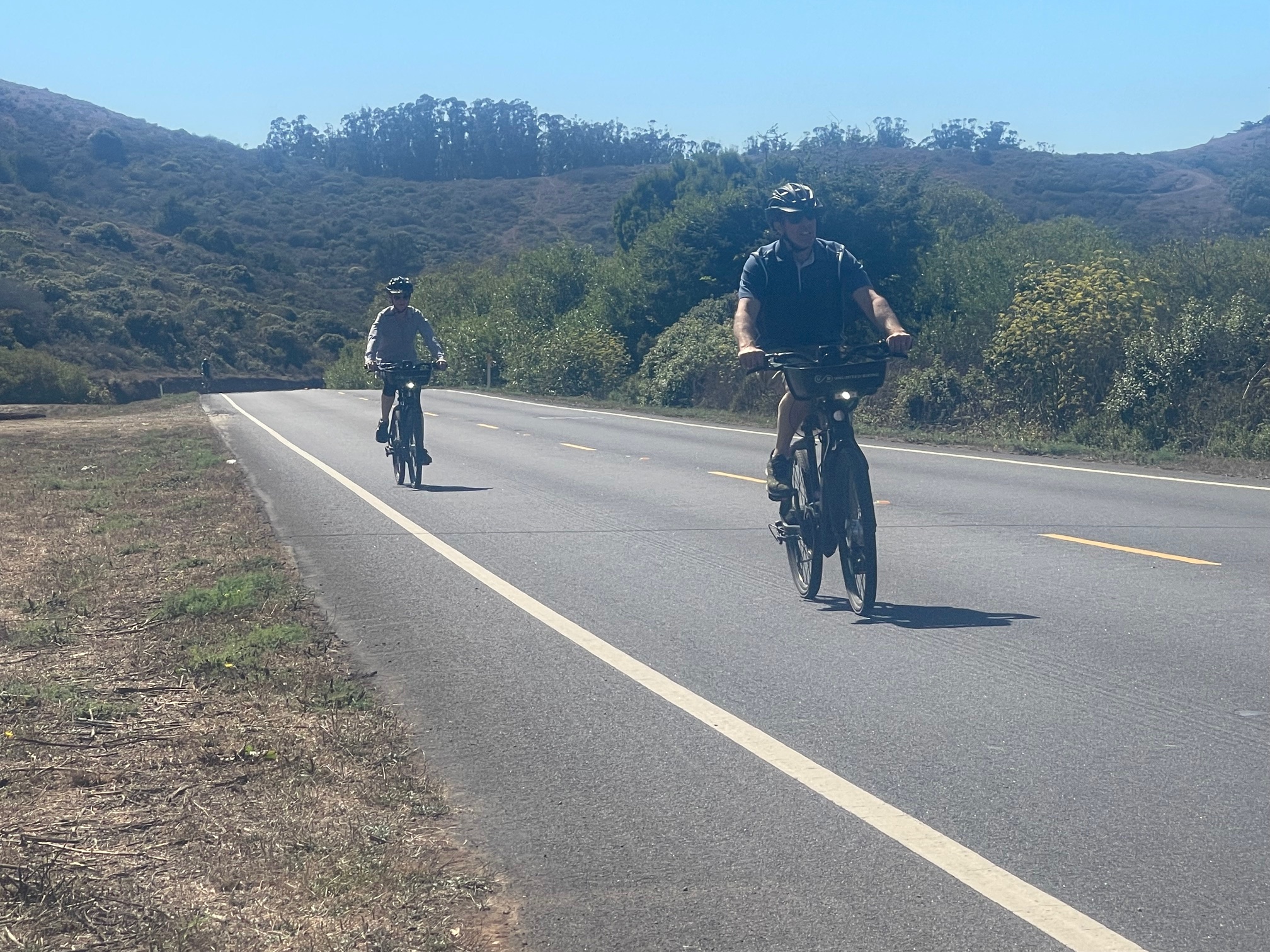
E-Bikers riding in the Marin Headlands. One bill sets certification standards for e-bike batteries sold in California. Photo by Dave Iltis
SB 1271 (Min) – E-Bike Battery Standards
Passed by the Senate and now in the Assembly, this bill sets certification standards for e-bike batteries sold in California. A provision to clarify e-bike classifications was dropped, but there is hope it will return.
SB 1509 (Stern) – Unsafe Speed Penalties
This bill, which passed the Senate and is now in the Assembly, increases penalties for drivers exceeding speed limits by more than 25 mph on roads with speed limits of 55 mph or less.
Two-Year Bills Now in the Second House
AB 6 (Friedman) – Requires regional transportation agencies to prioritize projects contributing to climate goals.
AB 73 (Boerner/Friedman) – Legalizes stop-as-yield for cyclists over 18.
AB 833 (Rendon) – Requires Caltrans to plan freeway caps to reunite urban communities.
AB 73 (Boerner/Friedman) – Legalizes stop-as-yield for cyclists over 18. Photo by Dave Iltis
Bills That Did Not Survive
AB 2535 (Bonta) – No Freeway Expansions for Freight Bill aimed at reducing new freeway capacity to lower GHG emissions, died in committee.
AB 2744 – The Bike Lane Protection Act, focused on preventing right-hook accidents, also died in committee. Despite this setback, there is hope it will return for future development.
Stay tuned for further updates on these vital legislative efforts to enhance active transportation in California. Your support and advocacy are crucial as these bills continue to move through the legislative process.
By Dave Campbell — In the summer of 1984, I was fifteen years old and in my second year of serious bike racing. I was desperate to learn everything I could about this new sport that was still decidedly foreign to me and most of America. I was especially interested to learn about “our” progress in the exotic, incredibly demanding, and tradition rich races of Europe. Unlike most U.S. events, thousands watched these long-standing races from the roadside and up to this point, very few Americans had even contested them. In fact, only three—George Mount, Jonathan Boyer, and Greg Lemond. Each one of them had been veritable pioneers: Mount the first American to ride the Giro d’Italia, Boyer the first to ride the Tour de France, (both in 1981), and of course Lemond, not just racing but winning and currently riding as the reigning World Professional Road champion.
All these riders, however, accomplished their overseas cycling feats as mavericks on foreign teams. My main source of information on their exploits came from Velo News, a twice a month newspaper that I would read I soon as it arrived at “Freewheel Sports”, my local bike shop in Lander, Wyoming. Imagine my surprise one summer afternoon in 1984 when I discovered an American professional team had just competed in the 67th edition of the Giro d’Italia, the first American team ever to tackle a Grand Tour!
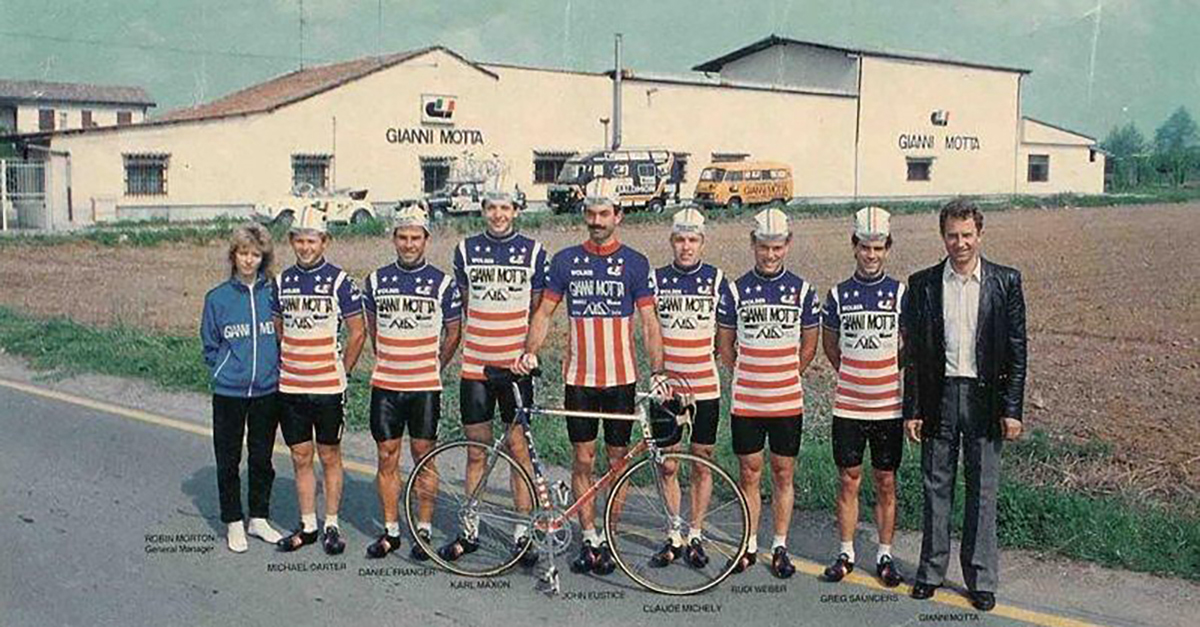
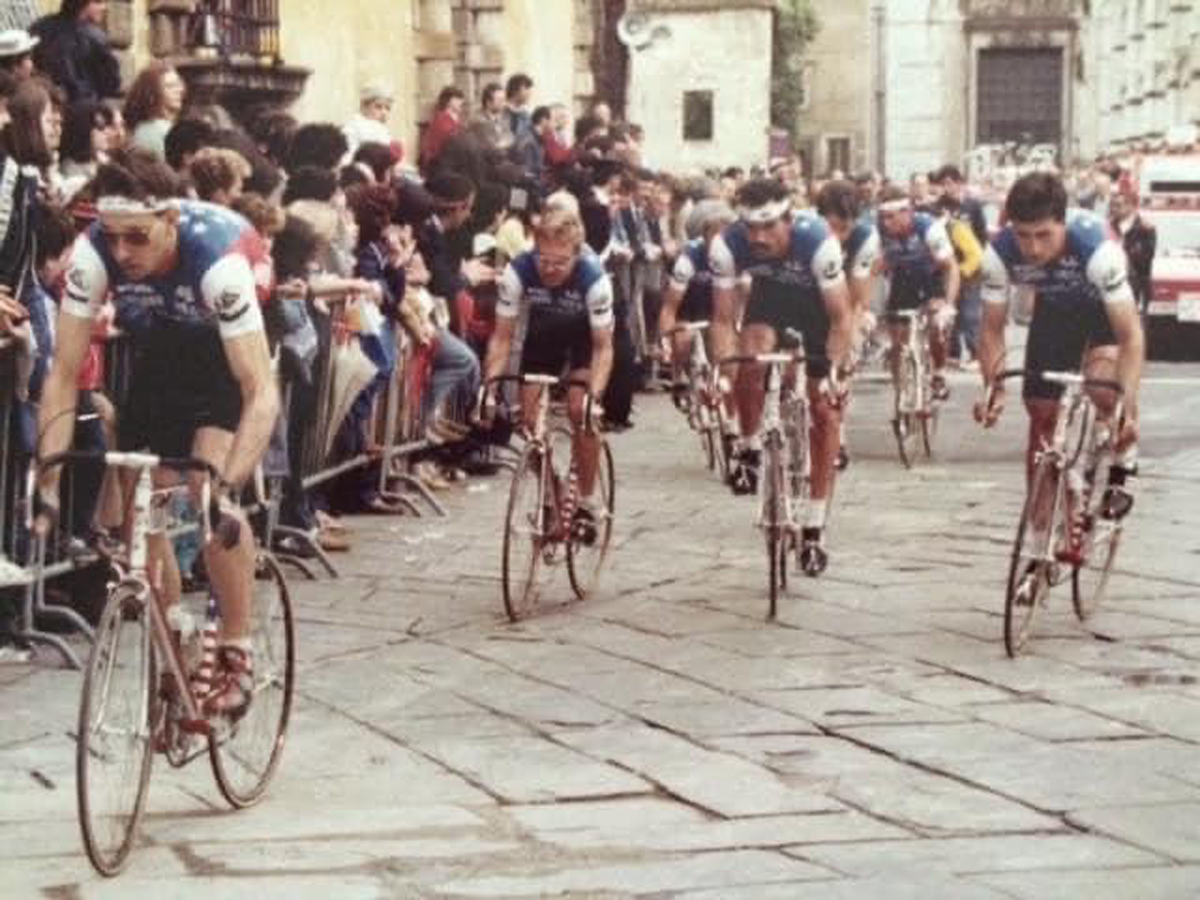
Robin Morton (left) and the team, one week before the 1984 Giro, the team with Gianni Motta at his factory. Photo courtesy Robin Morton
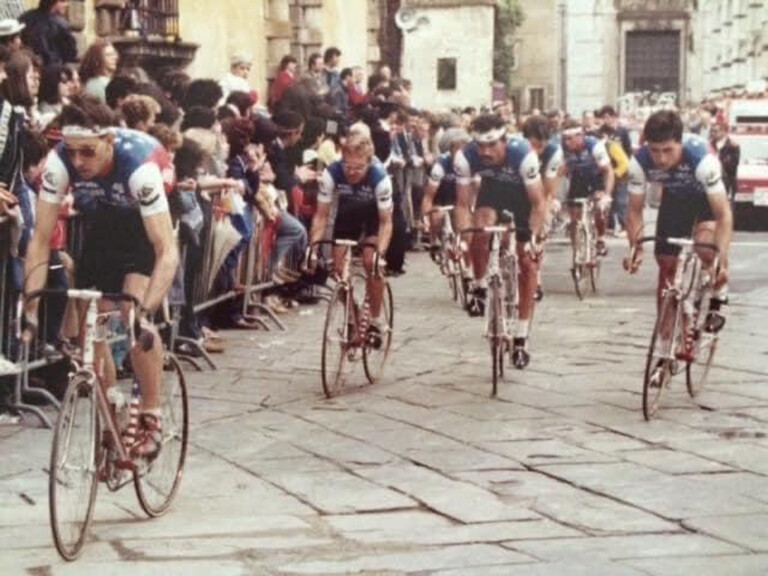
The Gianni Motta-Linea MD squad (sponsored by the Italian bicycle maker and a furniture company) had taken on the second biggest professional stage race in the world. The race ran from Lucca on May 17th and finishing in Verona on June 10th, covering 3808 kilometers over 22 stages. Six of the nine riders were Americans, all were neo-pros, and all the Americans (National pro champion John Eustice, Karl Maxon, Daniel Franger, Michael Carter, Tim Rutledge, and Greg Saunders) finished the race! After the historical and groundbreaking bits, though the story became one more of survival and perseverance. Their best finisher was Californian Franger in 78th overall at nearly two hours down on Italian winner Francesco Moser. He notably ranked 8th in the Young Rider division. Of the 171 starters, 143 riders made it to the finish in Verona and the last placed man was American Saunders. He was in this position from stage nine through to stage twenty-two, but he didn’t quit!!! He hung tough! The team finished last of the nineteen teams in the team competition, over five hours behind, but they finished!
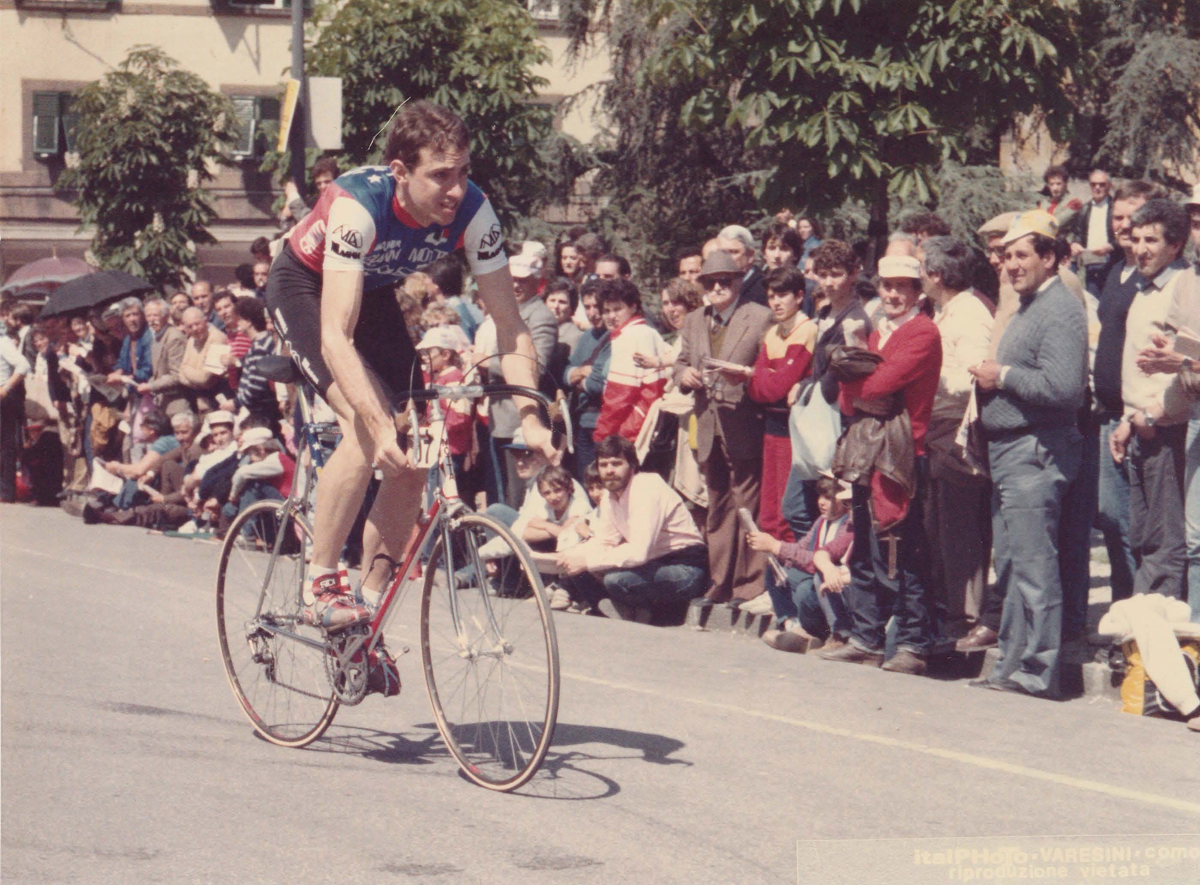
Tim Rutledge in the Prologue of the 1984 Giro d’Italia in Lucca, Italy. Photo courtesy Heather Rutledge
Their best performance came from Karl Maxon, of Eugene, Oregon. The 24-year-old distance runner turned cyclist broke away alone on Stage four from Bologna to Numana on the Adriatic Coast, only 13 kilometers from the start. His lead peaked at 22 minutes, and he stayed off the front for 217 of the 238-kilometers! Until recently, it was the longest solo breakaway in Giro history, and he was even the virtual race leader at one point! Velo News reported that he likely would have stayed away but crashes by two favorites (Laurent Fignon and Johan Van de Velde) prompted defending champion Giuseppe Saronni’s team (Del Tongo-Colnago of Italy) to attack, putting paid to the Americans chances. Maxon rallied to finish a very respectable twelfth in the final time trial into Verona, enroute to 127th overall. It was noted how much promise he had shown. I would note that for me personally, he would later become a mentor and friend and ultimately a rival when I moved to Eugene to go to college and in subsequent years of racing in Oregon.
Tim Rutledge leads the Gianni Motta-Linea MD team off the line in the 60 km Stage 1 Team Time Trial in the 1984 Giro d’Italia. Photo courtesy Tim Rutledge
An Interview with Robin Morton – Director of the Gianni Motta-Linea MD Team
I recently interviewed Philadelphia native, Robin Morton, the pioneering director of the squad, to get the whole story. Robin’s husband raced for the Pennsylvania Bike Club in Chestnut Hill, a renowned racing club that had existed since the late 1920s and produced several very good riders over the years. The Mortons were very involved in the club by 1980. In 1982, John Eustice, a Pennsylvania bike club alum had come home from racing in Europe, and it was grinding him down after many years of being over there. He was racing on the French SEM team (led by Irishman Sean Kelly) along with fellow American Jonathan Boyer. Robin picks up the story:
“We met John at a club function, and he really wanted to put together an American team to go over and race in Europe. That was the impetus for the Gianni Motta team. John and I started to work together, and I helped him put together the Tour of America in 1983, sponsored by Gios. (note: The 1983 Tour of America was a one-off Pro-Am East Coast Spring Stage race that attracted some of the World’s top professionals). He brought over Roger De Vlaeminck and Claude Michely, a Luxembourger, who was a cyclocross rider. We had 3 or 4 Americans on the team and that was the beginning of it all.”
“We were not involved at all with the USCF (United States Cycling Federation, now USA Cycling). We did it on our own. John had a lot of connections in Europe, and I handled the organizational side of things. We just started working together and we met Gianni Motta (former Italian professional cyclist turned bicycle manufacturer) when John was racing in Europe after Tour of America. Gianni wanted to do an American team. At that point, John had the National Champion’s jersey that he had won in Baltimore. In the early 80s on the east coast, there were a lot of free agent pros, you didn’t have to be on a team then. It was a little bit different than today. There were also a lot of guys who wanted to turn pro but needed a team. The first race we did in 1984 as the Gianni Motta team was the Tour of Texas and then we went to the Tour Willamette and Cascade Classic (both in Oregon) and then headed to Italy!”
“We got into the Giro through Motta, who was a big champion in Italy, a past Giro and Tour de Suisse winner. (Note: A pro from 1964 through 1976, Motta won the 1966 Giro and the 1967 Tour of Switzerland. The team’s jersey featured pink and yellow commemorating each event’s leader’s jersey. The jerseys were later changed to a stars and stripes design for the Americans historic debut in the Giro.). He had a very charismatic and gregarious personality, very outgoing, and he had a lot of connections. At that point, the 7-Eleven team wasn’t over in Europe yet (note: they actually were racing in Europe but as amateurs with the US National Team and their focus on the 1984 Los Angeles Olympics), but they had a really big budget and were a much different organization. But the Italians and particularly race director Vincenzo Torriani, wanted to have an American team in the race. And certainly, I was something totally unique to get them publicity, an American team with a woman as a manager! I was totally different. So, they wanted the team!”
“Besides Motta providing bicycles, he came up with other sponsors to cover all of our expenses. We went over right after Cascade (the long running Bend, Oregon stage race then held in the spring) in April. When we first went over, we were definitely ‘fish out of water’ so to speak. We had a different mentality than all of the European teams. But now, even though there are bigger and better funded teams, the difference between American riders and the Europeans is not so great. But then, there just weren’t that many American pros. Most of our guys had just turned pro and hadn’t raced much in Europe! Gianni Motta really set their training schedules and then followed the team on these mega rides near where he lived in Lombardia. He was still very fit then and very attentive to their diets.”
“The reaction towards us was very mixed. I was treated pretty well and after we had been there a while, the riders were accepted. Karl had some standout performances. Obviously, he went on to be in some European teams like Fagor on his own, so he was a very talented guy. Until recently he had the longest solo breakaway in the Giro. In the final time trial, he was 12th without any aero equipment! Not even a disc wheel! Mike Carter, only 21, was a really good climber, this was his first trip to Europe. He went on to be on Motorola, a really talented guy. (note: In 1991, Carter finished third in the Tour of Romandie and rode the Tour de France with Motorola) It was a good little team and I think we hung in there and had some decent results. But again, it was really hard. We only did two European races before the Giro, Giro di Toscana (note: Maxon finished a creditable 16th) and then we went to the Giro di Puglia prior to starting the Giro.”
“I think the biggest difference was the structure. The disciplined system and a certain way of doing things. The very specific and traditional way teams had of doing things. I think that was a little bit challenging. There is a whole cultural difference between Americans and Italians or Europeans in general. Some of our guys had not even been to Europe to race before! The way that the team was organized was a little bit challenging. The riders on the other teams were just much more traditional and old-fashioned in their organization. Team personnel, for instance, weren’t allowed to eat with the riders. They had their own table, but I didn’t want to do that. Really the team personnel didn’t speak any English and I barely spoke any Italian, so I wanted to eat with the riders. And that alone was pretty controversial!”
“The racing was a lot more controlled then, today there is no real patron, or boss, in the peloton. It was a lot slower in the beginning and everyone stayed together, and there always would be teams that were allowed to go away and be in the breakaway, but it was much a more controlled style of racing than now. When the television helicopters arrived to show the final hours, the race went crazy! I still remember Stage 18 from Lecco to Merano, and it snowed a lot, and it was freezing. It was one of those “are they going to be able to ride tomorrow” kind of things. It was a 252-km stage with a bunch of climbs in the South Tyrol area and that stood out as a really hard day.”
“We were outliers. We were a blip on the radar screen, because most people don’t have a lot of historical information, they don’t even know about the team! We did it a little bit differently…we didn’t go through the USCF (now USA Cycling)., it wasn’t a national team, we didn’t have a big budget and a lot of money for promotion like 7-Eleven (note: they turned professional in 1985 and raced the Giro, winning two stages through Ron Kiefel and Andy Hampsten) did. We did it on our own, it was a very small team with a very small budget. It was definitely an adventure and an experience and something that wasn’t done by the book. It was just something that John wanted to do, it was his vision, and I bought into that, and we just said “hey, let’s do it!” It was a really wonderful experience and we had teams for eight years and the next year we did the Vuelta. We worked with European teams that John rode for, we later had Roberto Gaggioli (note: Gaggioli won CoreStates in 1988 and was one of the winningest riders on the American circuit in the late 80s and early 90s) and a great junior team that went to race in Italy. For me it led to a lot of other things, and I went on to work for the company that put on both the Philadelphia (CoreStates) and San Francisco races and I worked for them for fifteen years. But when we did it, it was not something that a lot of people were aware of.”
“All of the Americans finished. There were some issues with sponsorship. We did not find the sponsors, which was controlled by the European management and there were some issues…as there often is. So, all the riders were given an incentive, they got a bonus to finish the Giro. The sponsors didn’t think many would finish the race and when it became clear they would, they didn’t want to pay! Well, we found out afterwards that one of the mechanics was told to tighten the rider’s bottom brackets! So, every day when he worked on the bikes, he tightened the bottom brackets, so it made it a little harder to pedal! So, the fact that they finished the Giro is pretty incredible because it was like they were riding through quicksand!”
“We had a couple soigneurs and mechanics, but we didn’t bring them from the United States. The accommodations were typical small Italian hotels that were used to hosting cyclists and they were pretty good. I think the food was a little bit of an issue initially, especially breakfast. The Americans were used to eating a certain way and they didn’t want a steak and pasta for breakfast! I mean things have obviously changed although riders still adopt a certain kind of diet but having a steak and a big bowl of pasta at 6:30 in the morning without a lot of other choices took a little getting used to!”
“There was satisfaction among the riders for finishing the Giro but there were issues with the riders getting paid. No one knew what was going to happen next, were they going to do the Tour of Switzerland? A lot of the Americans came home, happy with their performance and the fact that they finished but frustrated with the internal issue of money and sponsorship with Gianni and the Linea MD furniture company. That was very draining…whether they were going to get paid. I felt a lot of personal satisfaction but also a lot of angst with how it all played out money-wise. It was really hard, and I give my riders all a lot of credit because we were all like fish out of water! We were not a super big team where everything was super well-organized and ran perfectly with lots of money and extra personnel to help. It was very much on a shoestring sort of thing. We all just did the best we could.”
“It was a great experience, and I am sure that when they look back on it now their take on things is very different than it was right after the Giro. Because I know mine is! Ha! At that time, I was just like this was the hardest thing I’ve ever done, and I can’t believe I made it through this! I was about to leave during the middle of the Giro just because I couldn’t deal with the whole sponsorship thing anymore. I was sort of being shunted off and not involved or able to have a say. It was just ‘get through it and finish it’! A lot of the riders were really accepting, though, and I got invited into this Rancilio sponsor RV at the end and got to hang out with Roberto Visentini, Moser, Saronni, and all the big riders. I got to experience the whole spectrum, so in the end, I have to say the Italians were pretty accepting.”
This article is dedicated to Tim and Heather Rutledge and their family. Tim passed away on February 12th of this year after a long and difficult battle with Cancer.
The 107th edition of the Giro d’Italia begins May 4th in Venaria Reale and concludes May 26th in Rome.
References:
Blumenthal, Tim. “Giro to Moser” VeloNews, June 22, 1984.
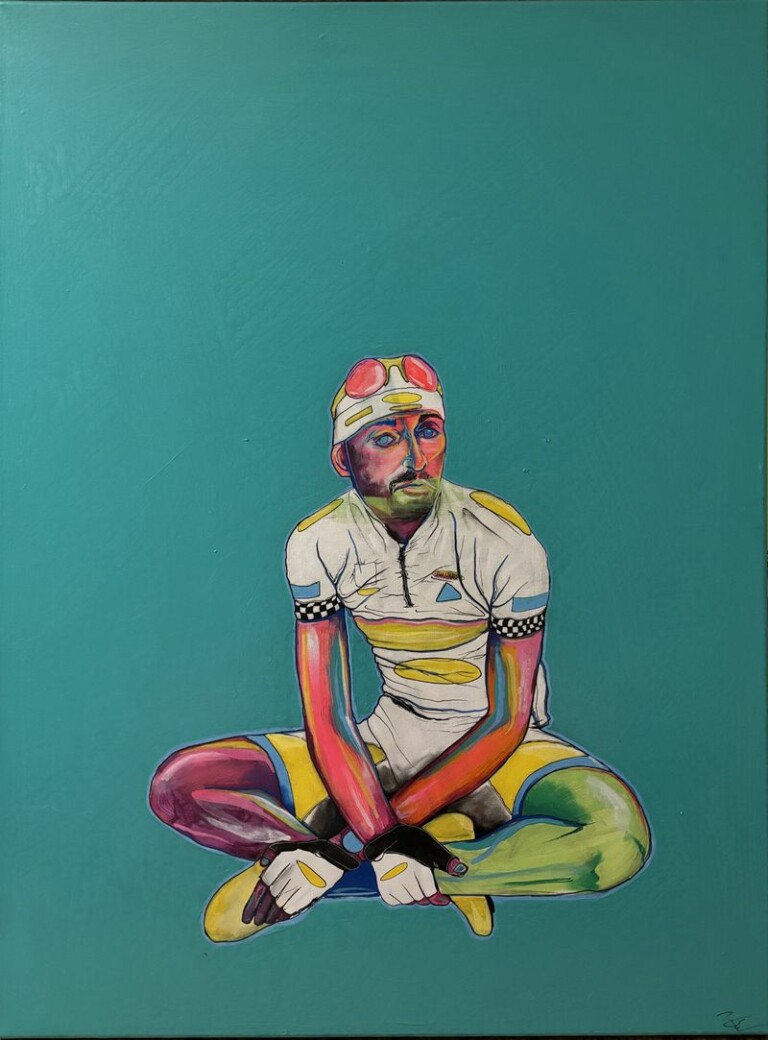
About the artist: Utah-born artist now living in SC, grew up with a strong love for racing bikes. When he turned 16 he was racing in Europe with Team USA. He signed with the U23 BMC racing team and raced in Europe for 4 years before racing 3 years with the USA Team Hincapie. He now owns the brand IMAGINARY which blends his love for art and cycling.
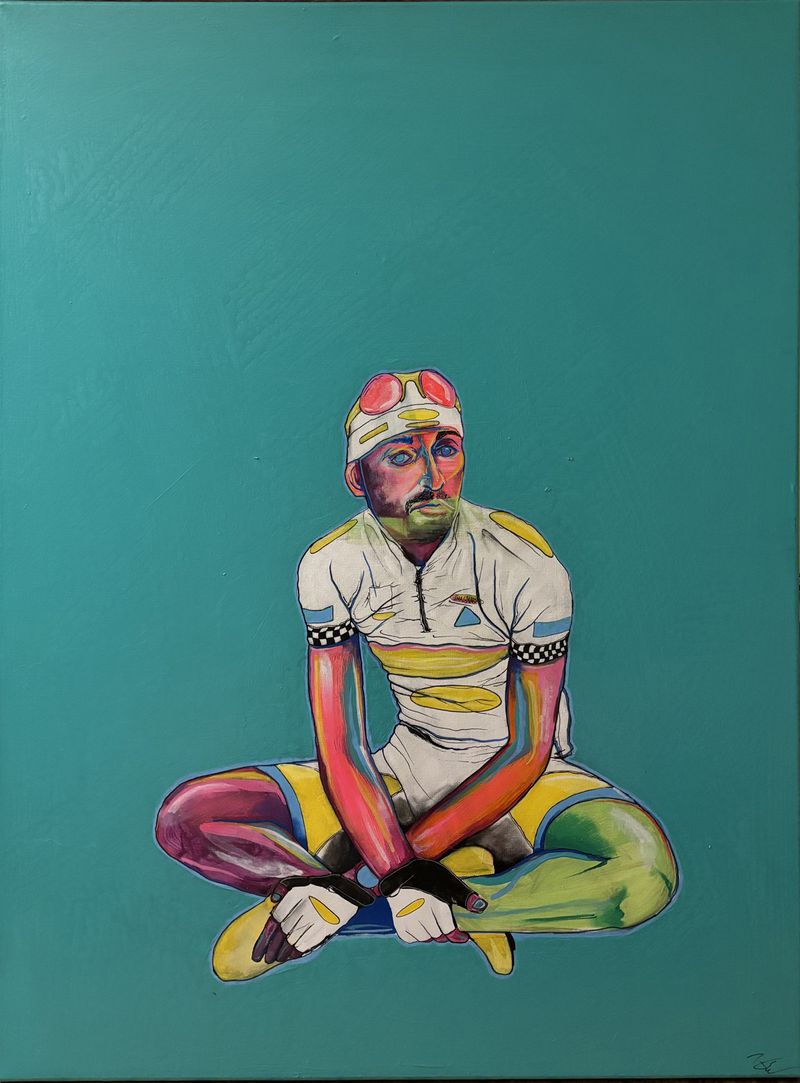
Title: Pantani, by TJ Eisenhart. Acrylic on canvas.
Title of piece: PANTANI
About the piece: I wanted to paint Pantani in a way deep cycling fans could relate to him. I wanted to show him in deep thought.
Medium and size: Acrylic on canvas, Size 30in x 40in
Where can people find or buy your art: My website will be up soon but in the meantime everyone can contact and connect with me at any of my social media accounts: @tjeisenhartj or @imaginary_collective
[Editor’s Note: Marco Pantani was an Italian cyclist who won the Tour de France and the Giro d’Italia in 1998. Regarded as one of the greatest climbers ever, he set records on Mt. Ventoux and L’Alpe d’Huez. He died in 2004 of acute cocaine poisoning.]
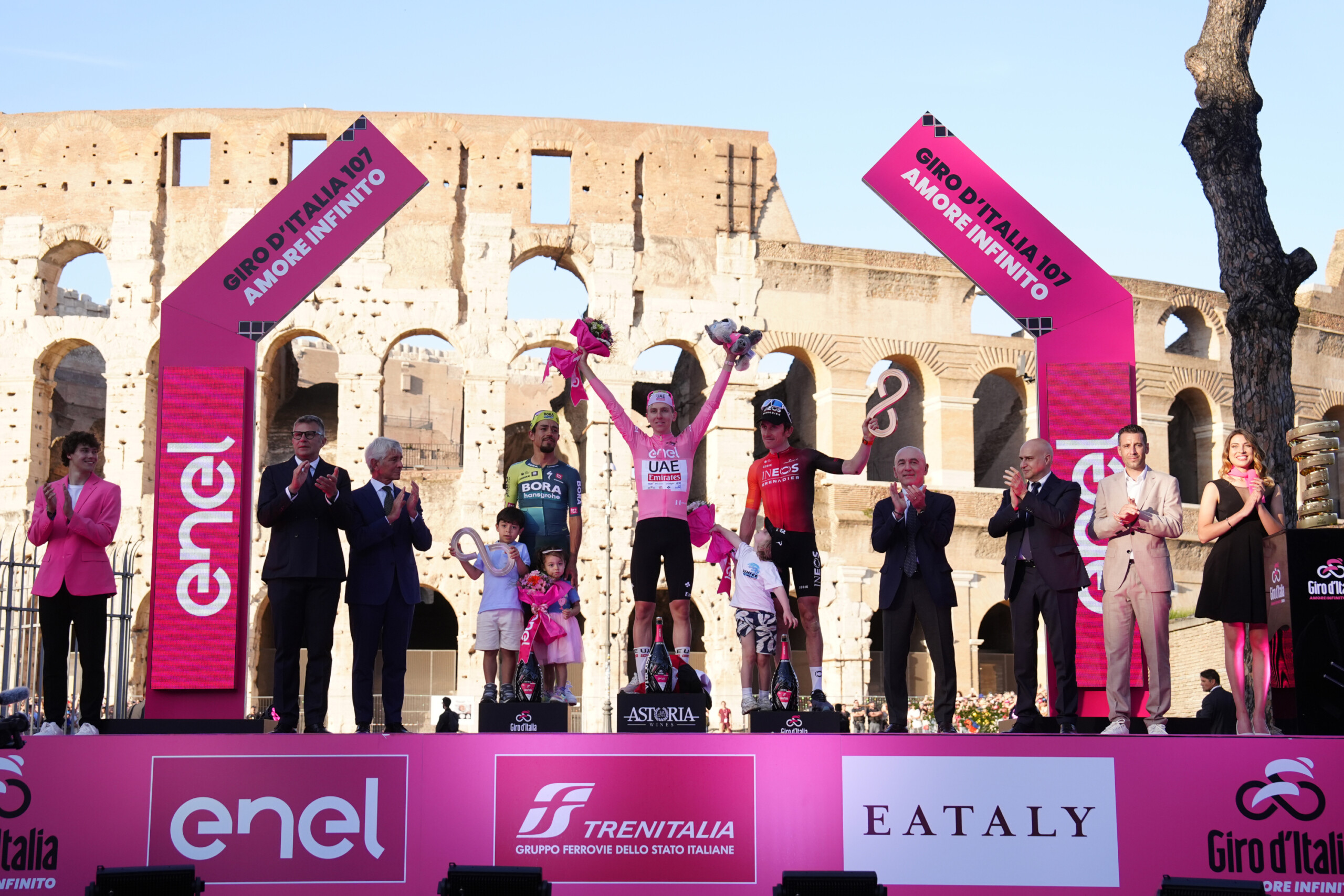
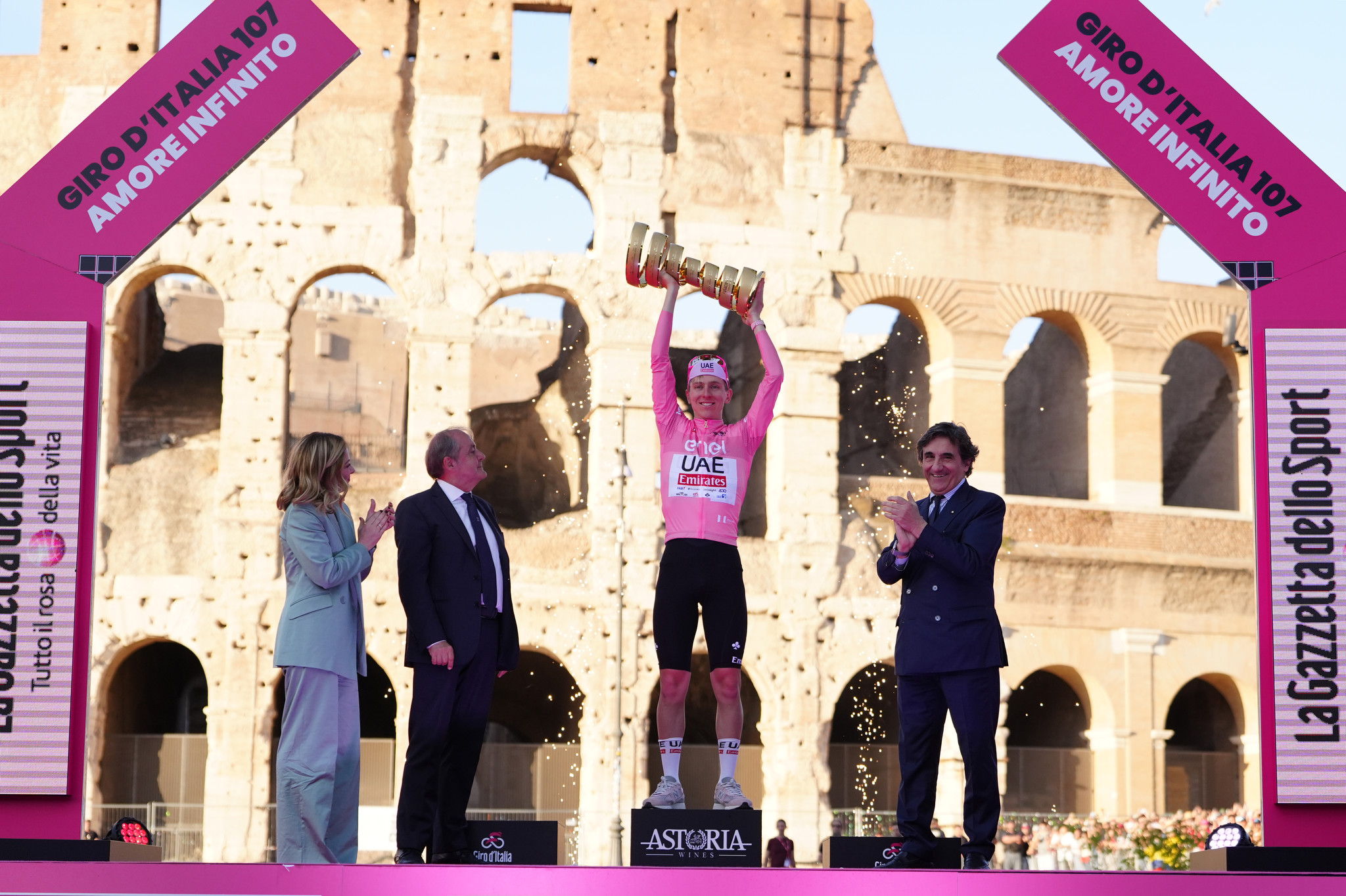
Tadej Pogačar takes the 107th Giro d’Italia ahead of Dani Martinez and Geraint Thomas.
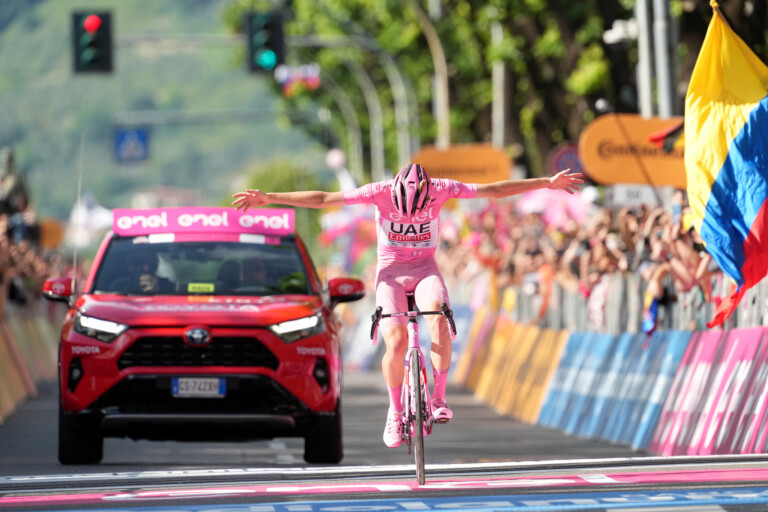
ROMA, Italia (26 May 2024) —Another masterpiece by Tadej Pogačar! The Slovenian won 6 stages, and never relinquished the maglia rosa after moving into the general classification lead after stage 2 of the 107th edition of the Giro d’Italia.
Dani Martinez and Geraint Thomas rounded out the final podium. Johnny Milan won the points classification for the second year running. Pogačar was also crowned King of the Mountains and Antonio Tiberi the best young rider while Julian Alaphilippe was declared the most combative rider and Decathlon-AG2R La Mondiale took the teams classification.
2024 Giro d’Italia Final Podium: Tadej Pogačar (UAE Team Emirates), Daniel Felipe Martinez (Bora – Hansgrohe) at 9’56”, and Geraint Thomas (Ineos Grenadiers) at 10’24”. Photo courtesy RCS Sport
GENERAL CLASSIFICATION
Tadej Pogačar (UAE Team Emirates)
Daniel Felipe Martinez (Bora – Hansgrohe) at 9’56”
Geraint Thomas (Ineos Grenadiers) at 10’24”
Ben O’Connor (Decathlon AG2R La Mondiale Team) at 12’07”
Antonio Tiberi (Bahrain Victorious) at 12’49”
2024 Giro d’Italia Overall Winner Tadej Pogačar (UAE Team Emirates). Photo courtesy RCS Sport
Tadej Pogačar, winner of the Giro d’Italia 107, said:
“Over three weeks, we’ve experienced very nice moments, especially with the kids. I always love to share some moments with them. I’ve been happy to see people on the road sides with the jerseys of Pogi team, the children who came and support us. It’s been crazy with all the fans. It’ll take a week to sink in but I’ve felt great emotions, it’s been a fantastic experience. The parcours was super nice and the organisation pretty good. Maybe during this Giro I’ve made a step up as a man too. As a rider, I felt super strong and more comfortable on the bike since a long time. I can improve this feeling. I’m on a good path for the rest of the season. I don’t know when but I’ll come to the Giro again in the future”.
“I’m speechless about this moment in Rome. It’s crazy. We wanted to be in front in the finale of today’s stage. It was quite technical and bumpy. We did super well with the boys. It’s unlucky Molano didn’t have very good legs but we did the rest of the job so well. So we’re happy. I have a lot of fond memories of this Giro. In a while I’ll realise which one was the best moment. In general it was a beautiful Giro. The Maglia Rosa is really special. It’s been a crazy experience to have it for twenty days. All the fans have been incredibly good”.
THE OFFICIAL JERSEYS
The leader jerseys of the Giro d’Italia are produced and designed by CASTELLI.
Maglia Rosa, leader of the General Classification, sponsored by Enel – Tadej Pogačar (UAE Team Emirates)
Maglia Ciclamino, leader of the Points Classification, in collaboration with Ministero degli Affari Esteri e della Cooperazione Internazionale and ITA Italian Trade Agency – Jonathan Milan (Lidl-Trek)
Maglia Azzurra, leader of the Gran Premio della Montagna (KOM/GPM), sponsored by Banca Mediolanum – Tadej Pogačar (UAE Team Emirates)
Maglia Bianca, Best Young Rider, born after 01/01/1999, sponsored by Eataly – Antonio Tiberi (Bahrain Victorious)
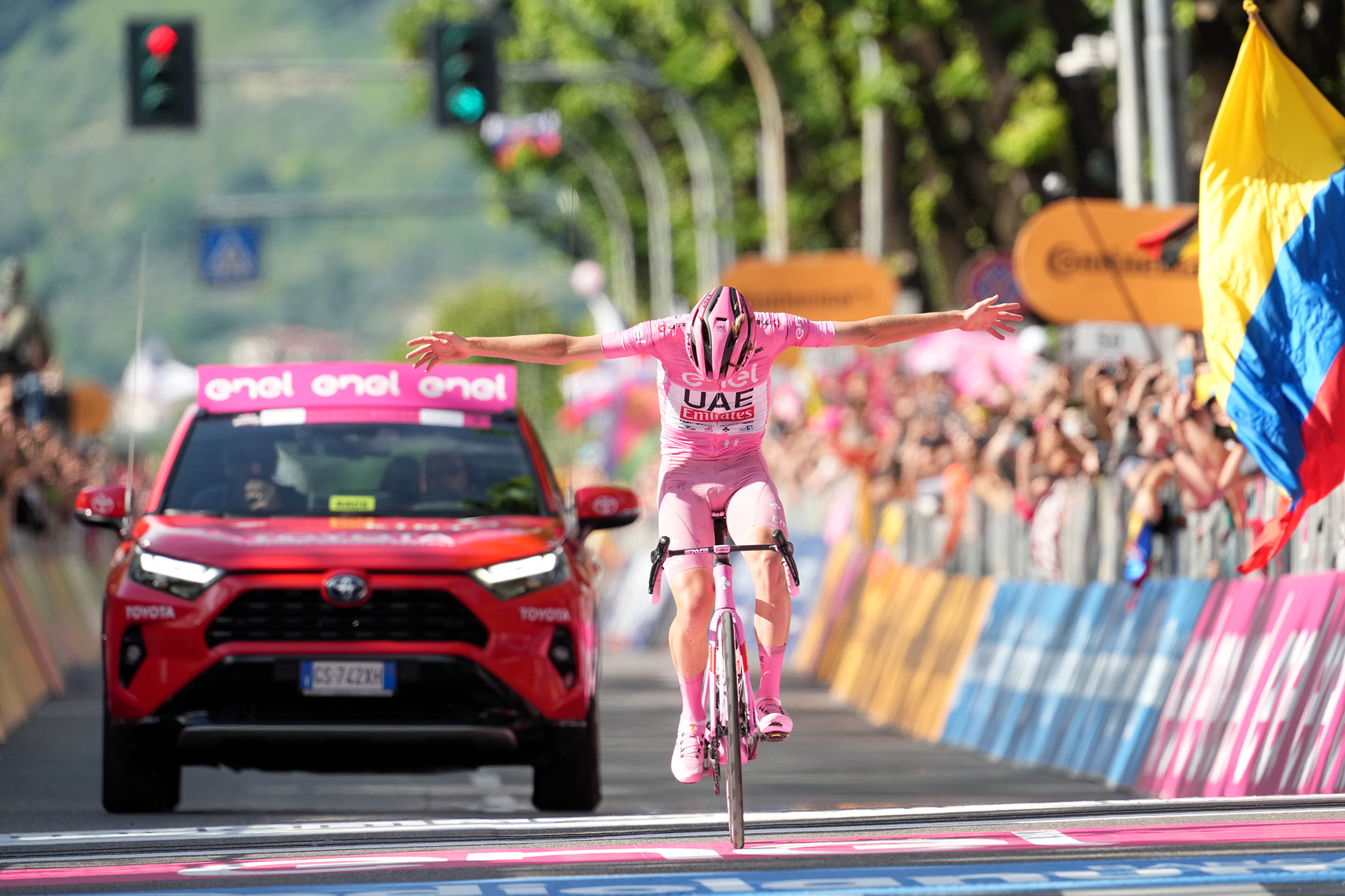
Tadej Pogačar (UAE Team Emirates) bows after winning his 6th stage at the 2024 Giro d’Italia. Photo courtesy RCS Sport
STATISTICS
Tadej Pogačar is the first rider to win 6 stages and the overall classification of the Giro d’Italia since Eddy Merckx in 1973.
In the Maglia Rosa from stage 2 till the end: it didn’t happen since 1995 with Tony Rominger winning a 22-stages long Giro. On the other hand, the last two winners of the Giro, Jai Hindley and Primoz Roglic took the lead on the penultimate stage.
20 Maglia Rosa in a single edition of the Giro, it’s one down on the record held by Eddy Merckx (1973), Gianni Bugno (1990) and Tony Rominger (21). Merckx and Bugno led from stage 1 till the end. Franco Chioccioli (1991) and Miguel Indurain (1992) also got 20 Maglia Rosa.
Pogačar succeeds to his compatriot Primoz Roglic. Except for Italy, the last time two different riders from the same nation consecutively won the Giro was Michel Pollentier and Johan De Muynck for Belgium in 1977 and 1978.
Tim Merlier is the first Belgian to win three sprints in a single Giro since Rik Van Linden in 1978. It’s the 170th Belgian stage victory.
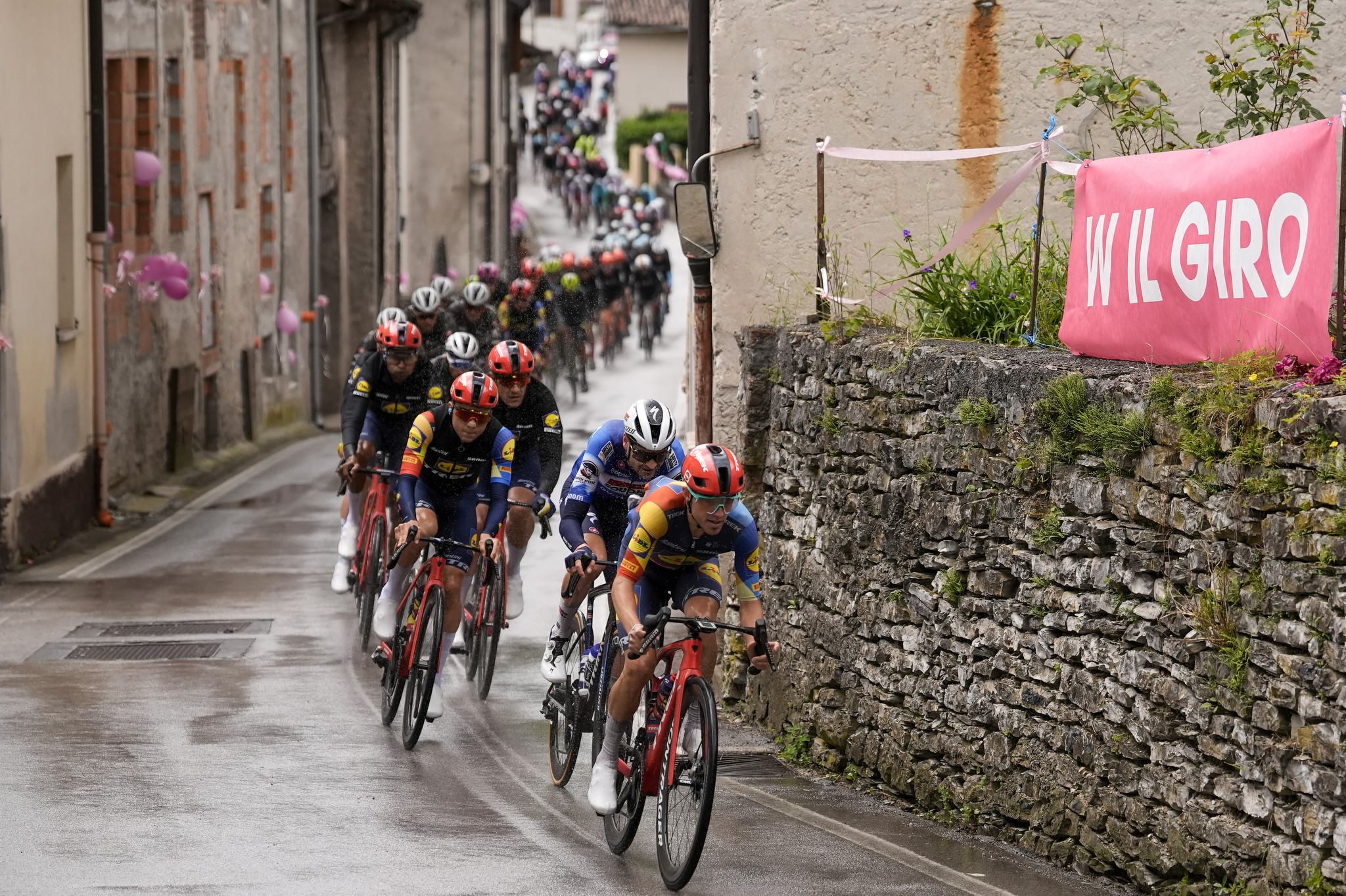
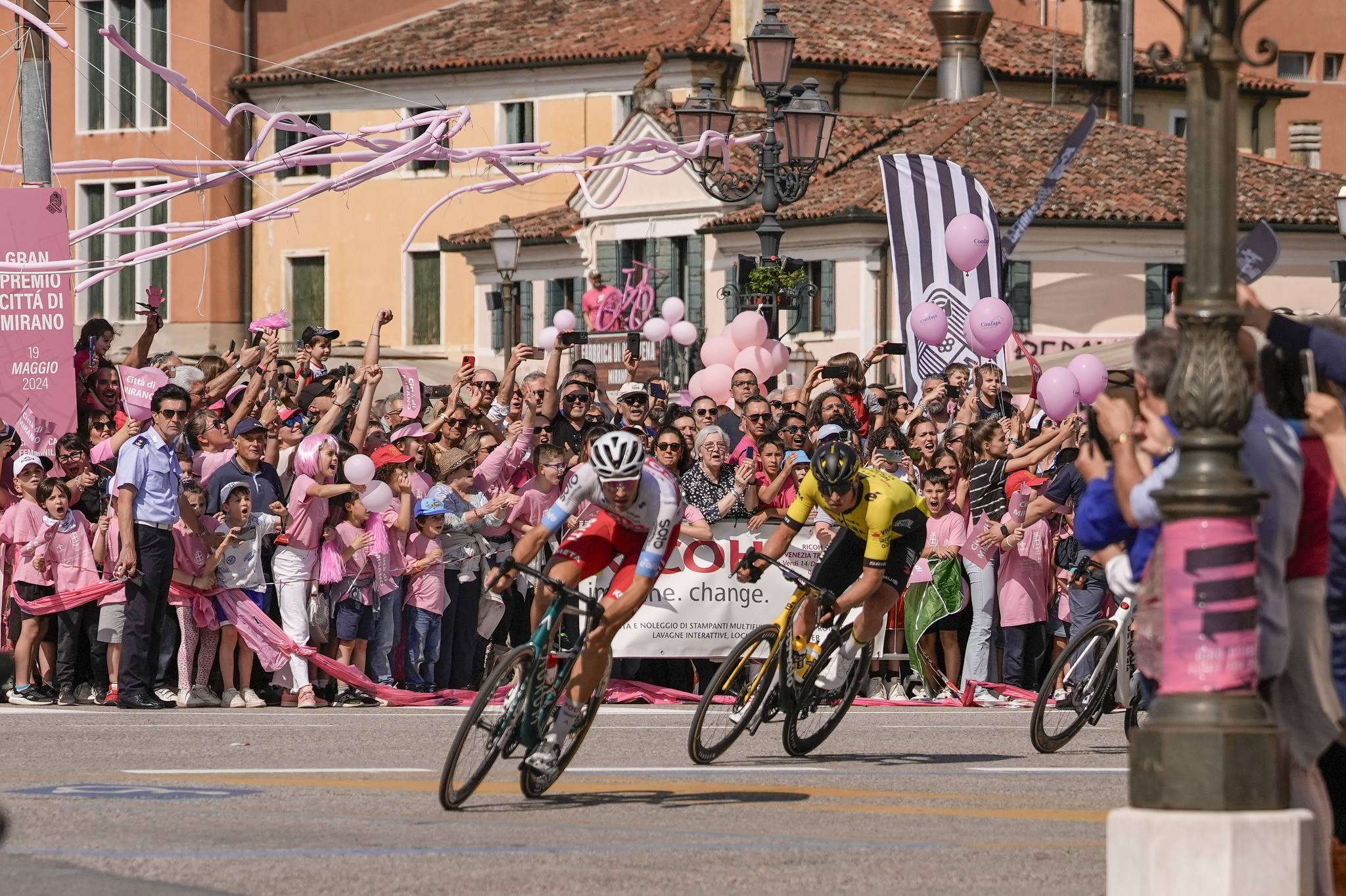
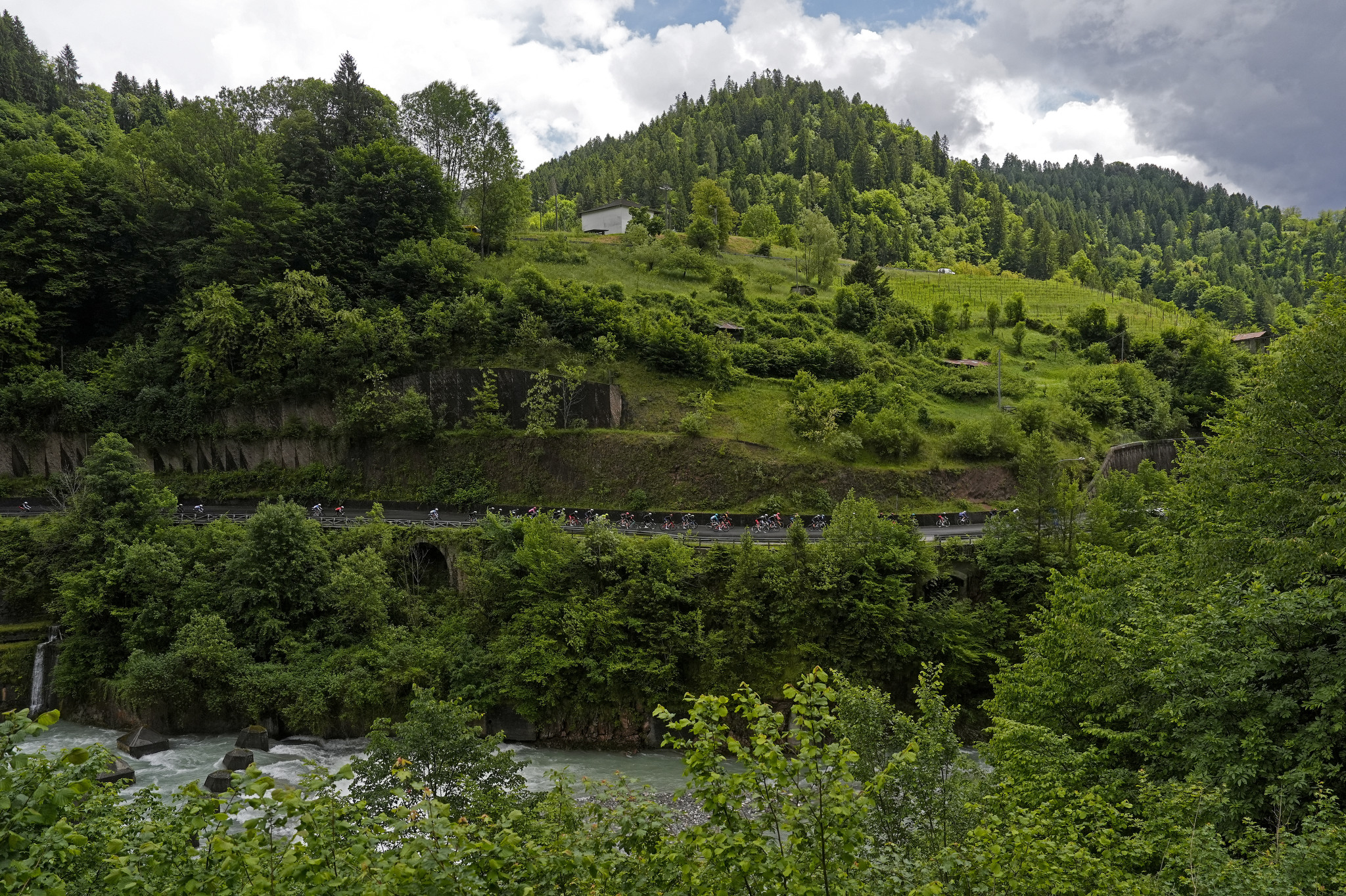
Scenes from the 2024 Giro d’Italia. (Photo by Fabio Ferrari/LaPresse)Scenes from the 2024 Giro d’Italia. (Photo by Fabio Ferrari/LaPresse)Scenes from the 2024 Giro d’Italia. (Photo by Fabio Ferrari/LaPresse)
My teammate eats ice chips like crazy. Isn’t that a sign of being anemic?
Something must be wrong with me. I get out of breath just walking up a flight of stairs…
Should I eat lots of spinach to boost my iron intake, given I’ve stopped eating red meat?
By Nancy Clark MS RD CSSD — Many of today’s athletes are eating little or no red meat (beef, lamb), which is one of the best sources of dietary iron. These athletes are simultaneously consuming less iron. Iron is a mineral found in the hemoglobin molecule inside red blood cells. It helps transport oxygen from your lungs to your muscles. Iron deficiency contributes to anemia, with symptoms of unusual fatigue during aerobic exercise—or even when climbing a flight of stairs. Athletes with anemia may complain about light-headedness, weakness, poor performance, and yes, a desire to chew on ice! While fatigue can also be caused by lack of sleep, depression, stress, and calorie restriction, fatigue due to an iron deficient diet is common.
Iron deficiency anemia is more prevalent among athletes—in particular, athletes in running and endurance sports—than among the general population. That’s because athletes lose iron with heavy sweating, blood loss in urine or via the intestinal tract, and damage to red blood cells caused by footstrikes while running. Female athletes lose blood via monthly menstruation, hence women are more prone to becoming anemic than are men. This study shows just how prevalent the problem is: A survey of 277 everyday runners (~60% females; average age, 40 years) participating in the Detroit Free Press Half- or full Marathon indicates ~50% of the women and 15% of the men had clinical iron deficiency. 15% of the women and 3% of the men had severe iron deficiency. Just think how much faster these athletes could have run!
What to do
If you think you might be anemic, get your blood tested to rule out anemia (and remeasure it in 6 to 8 weeks after treatment). The diagnostic criteria are:
hemoglobin (the iron-containing molecule within the red blood cell) less than 120 (female) or 130 (male) g/L
ferritin (a marker of iron stores): <12 ng/mL (Ferritin should be >30-40, if not higher),
transferrin saturation, <16%
Preventing and/or resolving anemia
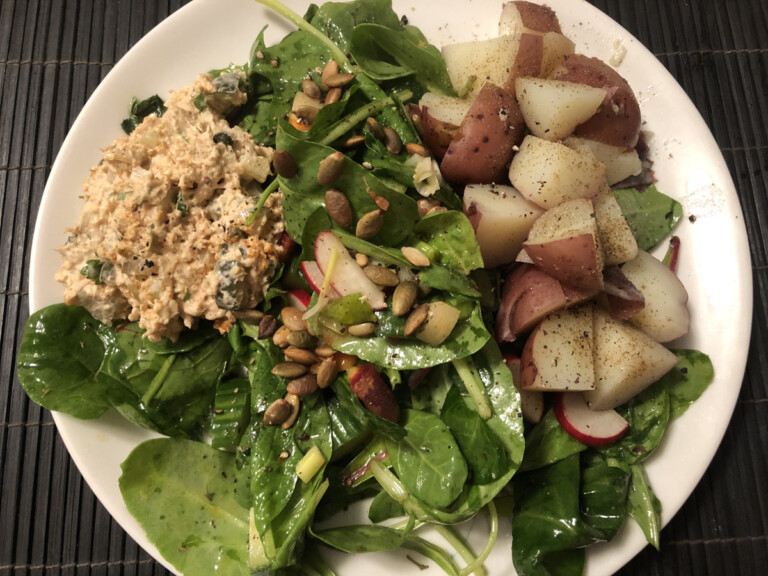
If you limit your intake of iron-rich beef and lamb, be sure to consume alternate sources of iron, such as dark-meat chicken or turkey (legs, thighs), tuna, or salmon. About 40% of the heme-iron in animal protein is absorbed, as compared to only 5% of the non-heme iron in plants. Don’t count on plant sources of iron such as almonds, spinach, lentils, beans and grains to satisfy your iron needs! Only about 2% of the iron in spinach might get absorbed. Despite Popeye’s claim that spinach made him strong to the finish, spinach is a poor source of absorbable iron. Combining heme-iron in animal protein with non-heme (plant) iron optimizes absorption. Hence, add some tuna to your spinach salad, turkey to lentil soup, beef to chili.
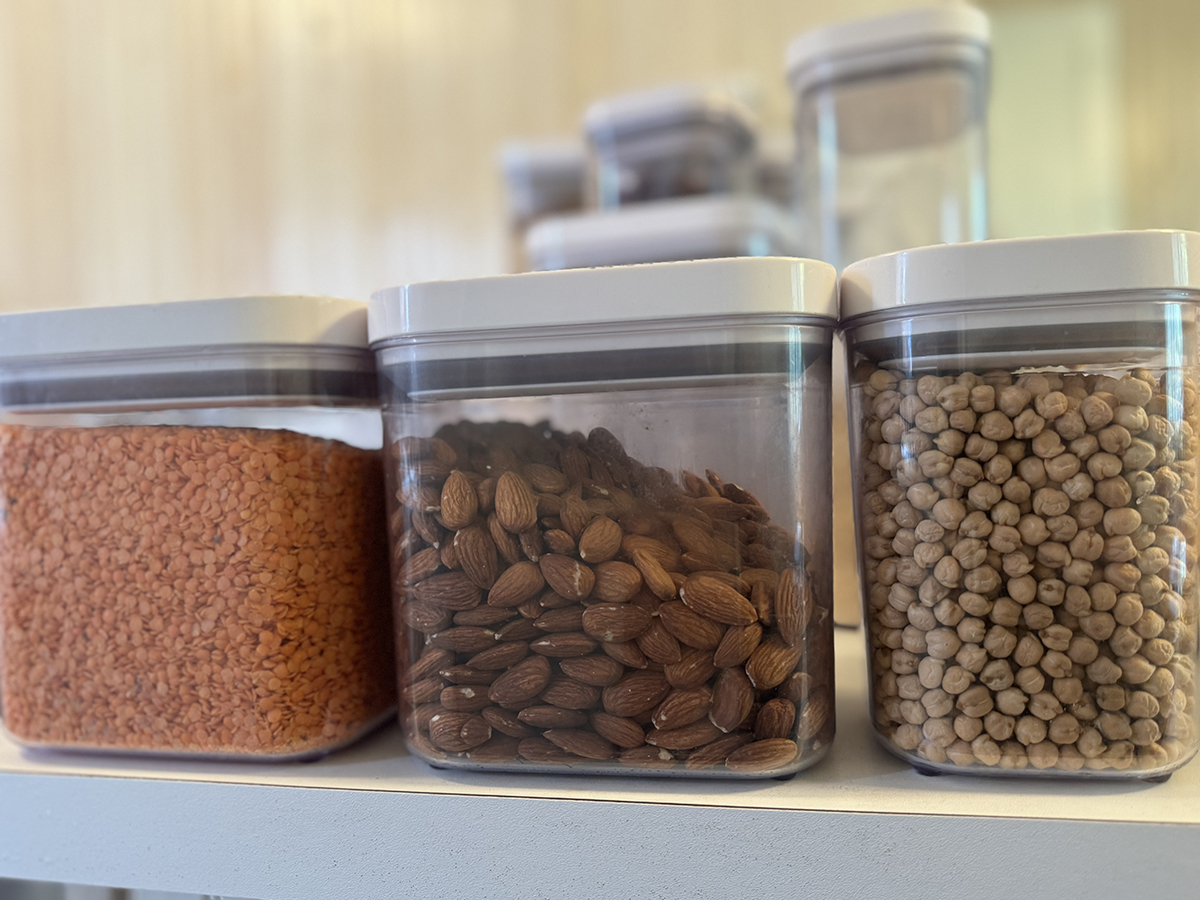
While lentils, almonds, and chick peas are high in iron, the body has trouble absorbing iron from plant-based sources. Include fruit or other foods high in vitamin C to help improve absorption.. Photo by Dave Iltis
If you are an athlete who “eats clean” and minimizes your intake of “white foods” (such as white bread, pasta and rice), take note. Refined grains are generally enriched or fortified with iron. Hence, eliminating enriched white bread and other refined grains reduces your intake of iron (as well as other added nutrients). The US Dietary Guidelines recommend eating at least half your grains as whole grains. (This is not a compromise based on the assumption Americans would never eat all whole grains). Enriched white pasta and breads do offer important nutrients!
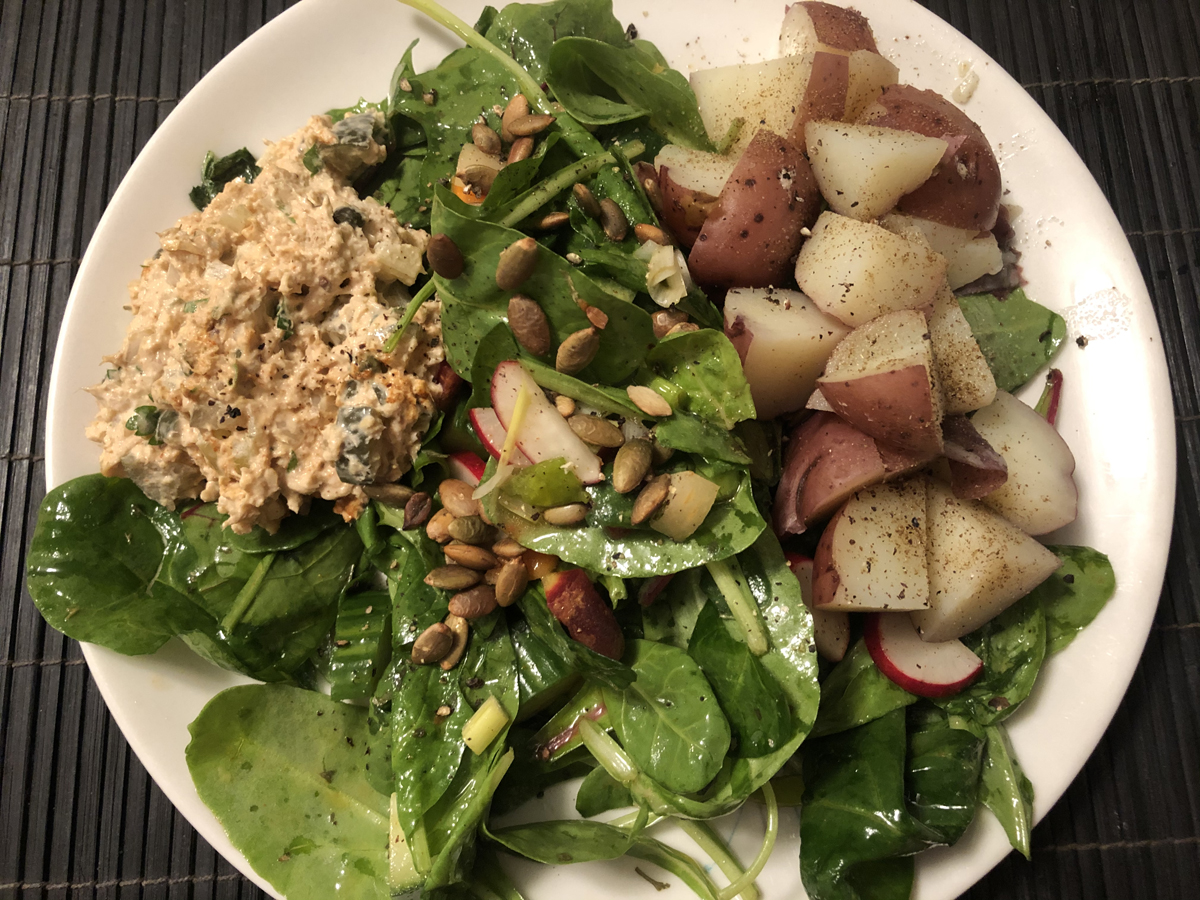
A salmon and spinach salad is a good source of iron. Combining heme-iron in animal protein with non-heme (plant) iron optimizes absorption. Photo and food by Dave Iltis
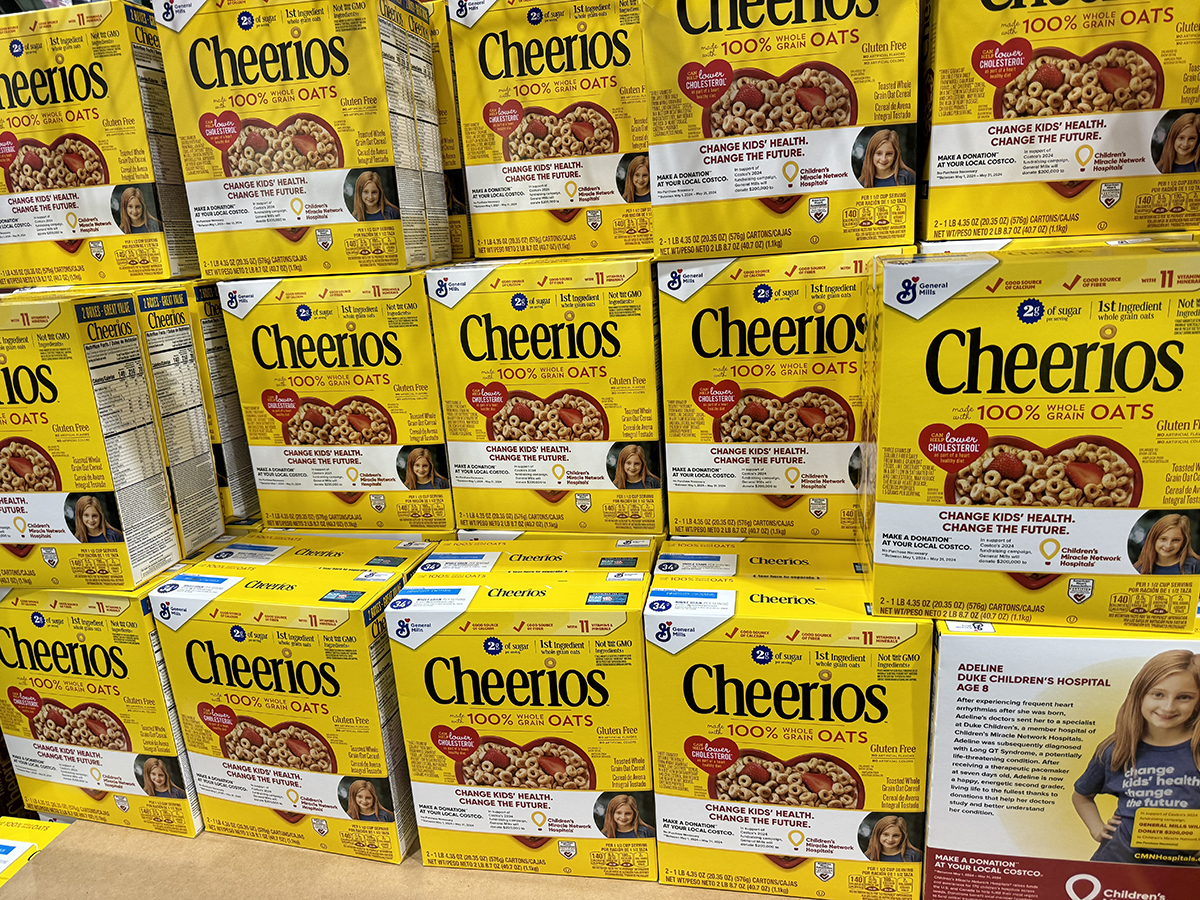
Enriched breakfast cereals such as Cheerios, Grapenuts, and Kellogg’s Raisin Bran are good sources of iron. (In comparison, “all natural” cereals, like granola or Puffins, have no additives. That means, they have no added iron.) To enhance the absorption of the iron in enriched cereals, include a source of vitamin C with the meal — such as an orange or orange juice, a clementine, or some strawberries.
Cheerios and other enriched cereals are a great source of iron, better than many “all natural” cereals. Photo by Dave Iltis
Research indicates iron tends to be absorbed better in the morning than in the evening. This is due, in part, to the daily fluctuation of the hormone hepcidin. Hepcidin hinders iron absorption from the intestinal tract and is a key regulator of iron absorption. Hepcidin increases after exercise, triggered by exercise’s inflammatory response. Hence, to optimize your iron absorption, pay attention to when you eat iron-rich foods or take an iron supplement in relation to when you exercise. A good time to consume iron or iron supplements is with an iron-rich breakfast either before or shortly after a workout, but NOT 3 to 6 hours afterwards, when hepcidin peaks. This timing will optimize iron absorption as well as tolerance, given iron supplements are better tolerated when taken with food.
Iron supplements
If you are anemic, you want to boost your dietary iron intake. You will also need to take supplemental iron to correct the deficiency. Do not self-prescribe high doses of iron supplements. Your doctor should prescribe the dose best for your body. Taking too much iron puts some athletes at risk of iron-overload, which is dangerous.
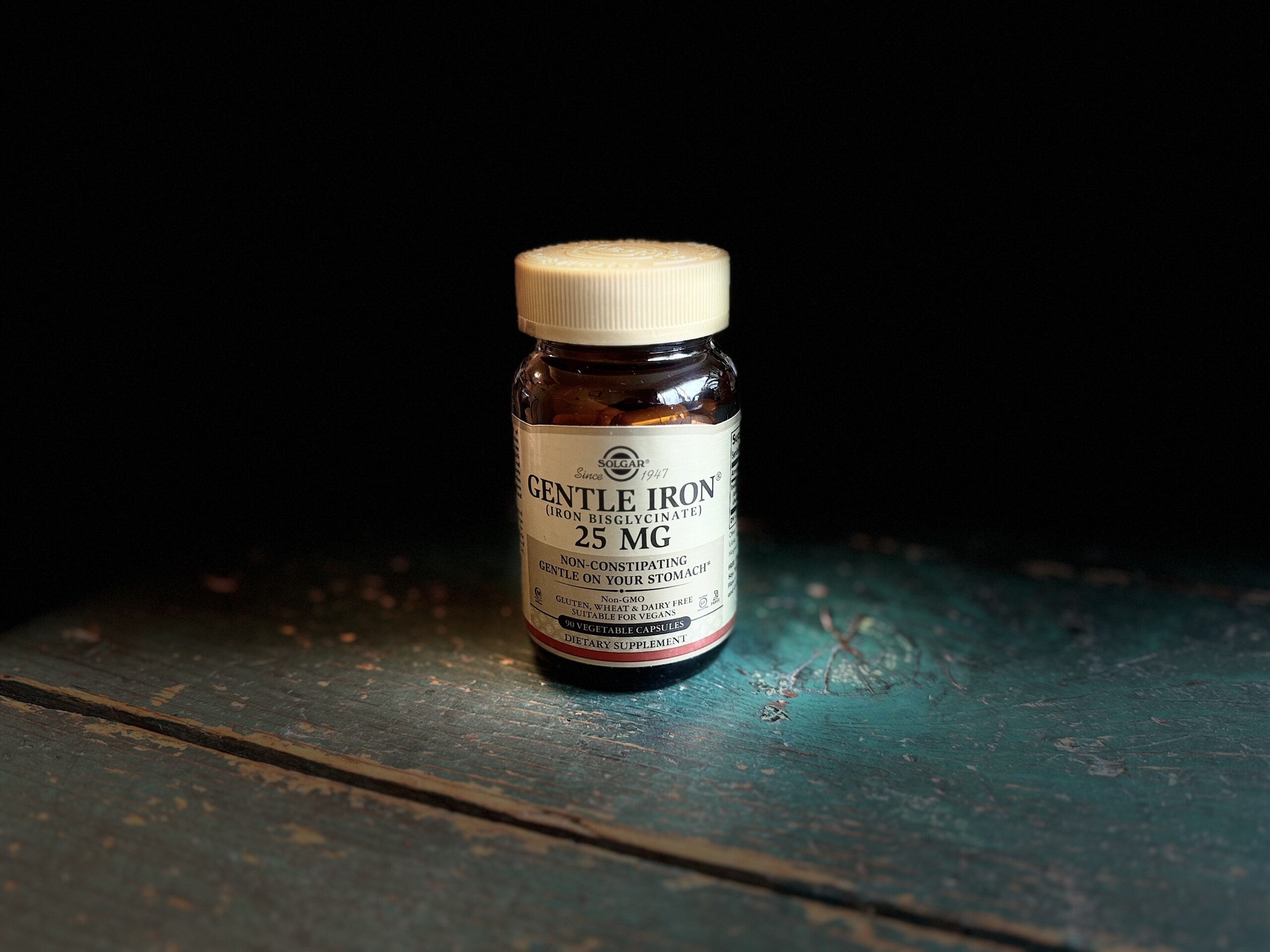
Iron supplements may be needed by some athletes. Photo by Dave Iltis
Supplements come in two forms: Ferrous iron (gluconate, sulphate, fumerate) and ferric iron (citrate, sulphate). Ferrous is better absorbed from the gut, but ferric iron settles better in the gut. Some athletes find iron supplements contribute to nausea and constipation. If that’s your case, you want to experiment with different brands to find the supplement your body tolerates best. Slow-release ferrous sulphate and ferrous bisglycinate are popular choices. Taking an iron supplement every other day is as effective as taking it daily.
The bottom line
To iron out performance problems such as needless fatigue, be sure your diet supports your athletic goals. A registered dietitian (RD) who is a certified specialist in sports dietetics (CSSD) can teach you how to consume an optimal diet that helps you be strong to the finish (with or without the spinach)!
Reference
Kohler L et al. Prevalence of iron deficiency in endurance runners: a cross-sectional study of the Detroit Free Press Marathon and Half-marathon athletes. Blood (2022) 140 (supplement):11074-11075
By Charles Pekow — A federal study conducted in Texas found that separated bike lanes and mixing zones at intersections significantly reduce the risk of crashes. The report, released by the Federal Highway Administration (FHWA) and titled “Development of Crash Modification Factors for Bicycle Treatments and Intersections,” concludes that these treatments are economically feasible. However, other safety features, such as chevrons (angled stripes on the road), extension lines in crossings, colored lines, and other types of bike lanes, did not make much difference.
A companion study in six cities in Virginia, however, found no methods that significantly reduced crashes. The research team noted that it might not have enough crash data to definitively conclude that the methods don’t work, and an unknown number of crashes went unreported, possibly skewing results.
The researchers highlighted the use of different counting methods in the two states, relying on bicycle counts in Virginia and using their own demand models in Texas.
Meanwhile, another FHWA-sponsored study found that converting a standard bike lane into a protected one can cut crashes in half. The research team, examining six cities, including Denver, found that all it takes is adding flexible posts. Additionally, other measures to separate bike lanes proved effective, as reported in “Developing Crash Modification Factors for Separated Bicycle Lanes” (https://highways.dot.gov/media/30486).
The study suggested that the results in Denver weren’t as clear as for the other cities, possibly due to Denver’s climate and elevation. However, it also noted that bike crashes are less likely to occur with multiple auto lanes on the road, parking banned on at least one side of the street, and in industrial or public use zones, as opposed to mixed land-use areas.
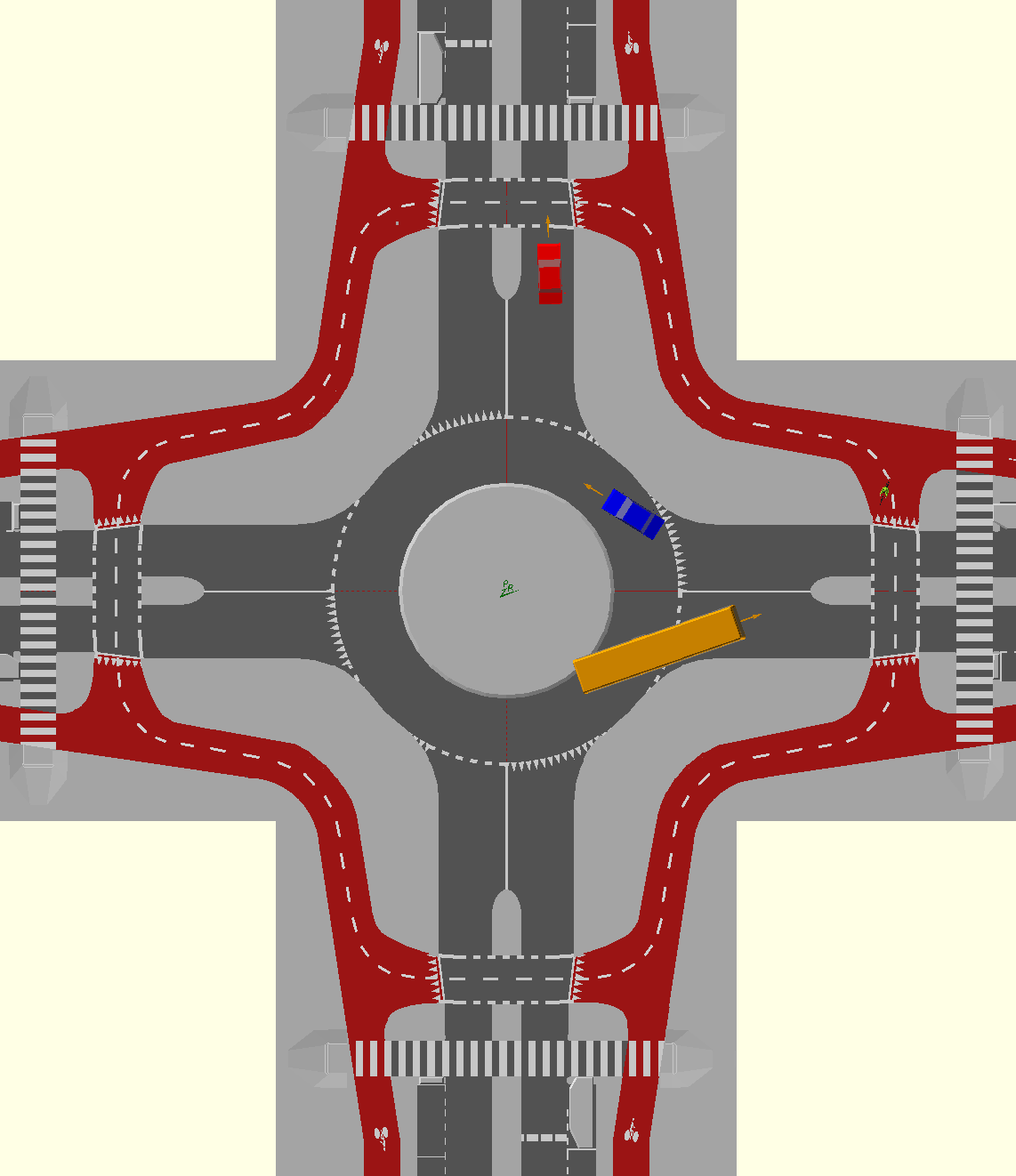
Alternative dutch roundabout with remote cycle path crossing having NOT priority against motorists, requiring cyclists to give way to oncoming vehicles at crossing points, but generally protecting cyclists better than merging with auto traffic. Image by PRZ (Pierre ROUZEAU), CC BY-SA 4.0 <https://creativecommons.org/licenses/by-sa/4.0>, via Wikimedia Commons
Intersection Safety Challenge
Also in the realm of intersection safety, some innovators will receive federal grants next year to develop technology for safer intersections for bicyclists. The U.S. Department of Transportation’s Office of the Assistant Secretary for Research and Technology is considering funding 120 concept papers received from academia, business, and government in response to a call for ideas under a new Intersection Safety Challenge – System Assessment and Virtual Testing Competition.
Participants will develop and improve algorithms to detect, localize, and classify “vulnerable road users” and autos based on government sensor data. The programs will use the data and algorithms to determine hazardous intersections. Cyclist deaths are on the rise, increasing by 2 percent from 2020 to 2021.
Ideas can include installing improved sensors to detect cyclists and others, using artificial intelligence to anticipate problems, and creating new safety systems that can be widely and inexpensively replicated.
The DOT can award up to $6 million in grants of up to $100,000 for projects enhancing holistic intersection safety.
Meanwhile, an FHWA-funded research project at the University of Utah reported that crashes involving right-turning autos were “less severe” to cyclists and pedestrians than crashes involving left-turning autos or those going straight. The study surmises that’s because cars are moving more slowly when turning right and shorter exposure time. University researchers looked at data from about 2,200 incidents in Utah between 2010 and 2019. They found that the issue had scarcely been studied before.
Separated bike lanes and median strips tended to decrease bike incidents, while higher speed limits and the presence of bus stops and driveways increased danger. As you might expect, the higher the population and number of bicyclists, the more crashes – but not per capita. Statistically, there seems to be “safety in numbers” for cyclists, though obviously the more cars, the more crashes. The presence of nearby houses of worship decreased crashes, though it’s not known why. “More crashes were observed at intersections in neighborhoods with lower household incomes and more people of Hispanic or non-white race/ethnicity,” the report says.
Safety was enhanced somewhat by clear crosswalk markings. But factors such as right-turn lanes, bike lanes and ramps didn’t seem to matter much.
The project recommends that “if both bike lanes and dedicated right-turn lanes are present at an intersection (and unless the bicycle and right-turn movements are controlled by separate signal phases), the right turn lane should be on the right side of the bike lane (unless they are in a shared lane), and right-turning traffic should be directed to yield to bicycles and cross the bike lane prior to the intersection.”
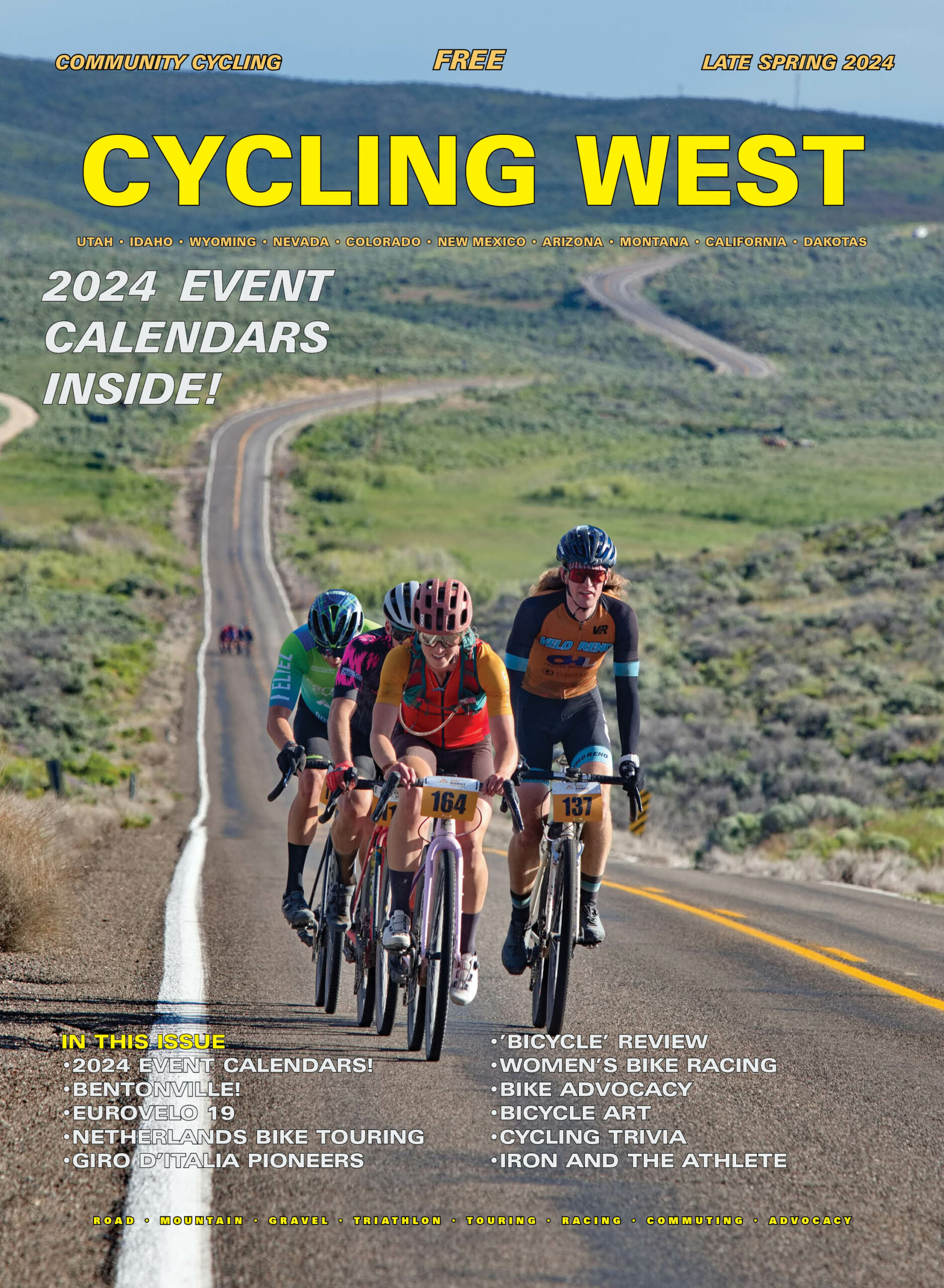
Cycling West and Cycling Utah Magazine’s Late Spring 2024 Issue is now available as a free download (9 MB download). Pick up a copy at your favorite Utah, Idaho, Wyoming, Nevada, Montana, Colorado, Arizona, New Mexico, North Dakota, South Dakota, and Northern California bike shop or other location.

 While tracing the history of the machine and its relationship to the automobile, Maskit tells us a lot about his own personal experiences. A common theme in the book is that most of the infrastructure used for cycling wasn’t designed for it, even if it was retrofitted for it with the likes of bike lanes and signals. 19th Century bicycle prototypes had to share dirt roads with horses and buggies and since the dawn of the 20th Century cycles shared thoroughfares with larger and more-well armored automated vehicles and the bike rider has generally been at a disadvantage.