Gran Fondo Fundraiser for Just For Kids Foundation Seeks to Raise $200,000
TELLURIDE, Colorado (September 12, 2023) — On September 23, approximately 200 cyclists will enjoy the perfect 74, 103, or 133-mile fully supported ride from the high alpine of historic and stunning Telluride, Colorado, to the landmark desert red rock canyons and palisades of Gateway, Colorado. The cool early morning start on Colorado Avenue, where the hard rock gold and silver mining Town of Telluride was carved into the most scenic ski resort Town in North America, is just the beginning.
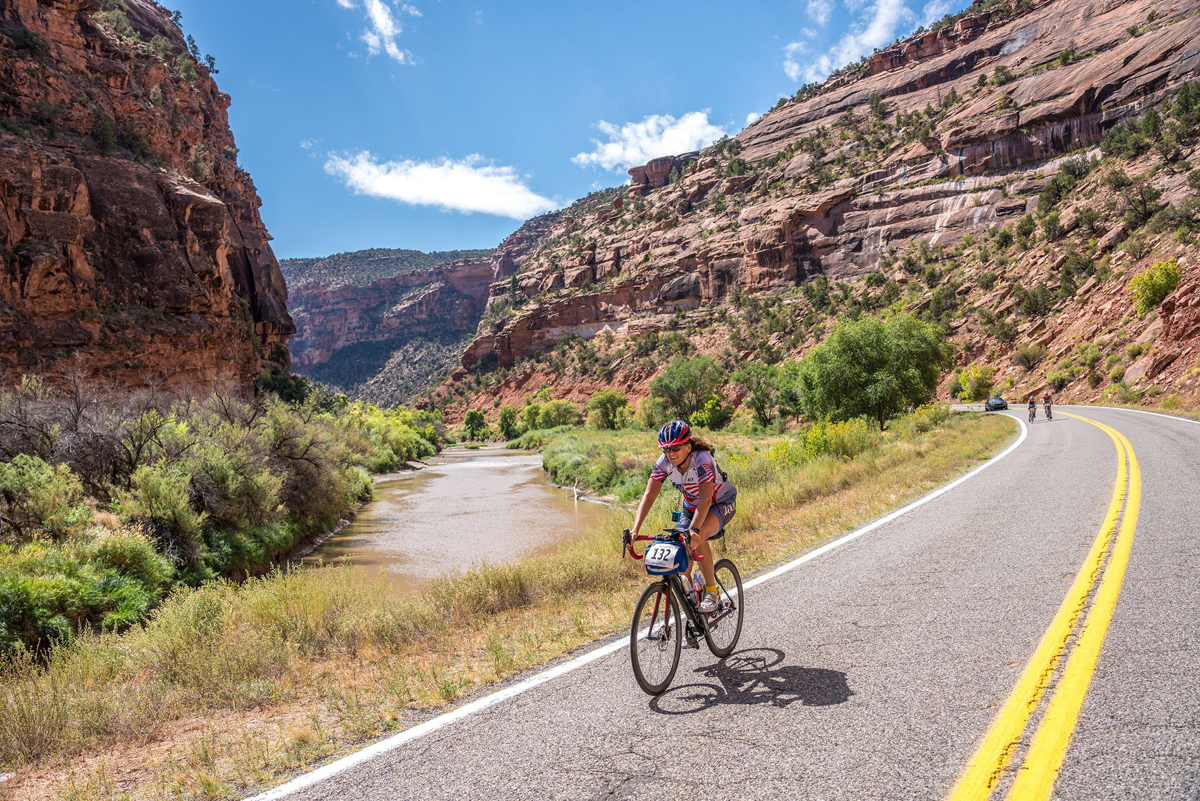
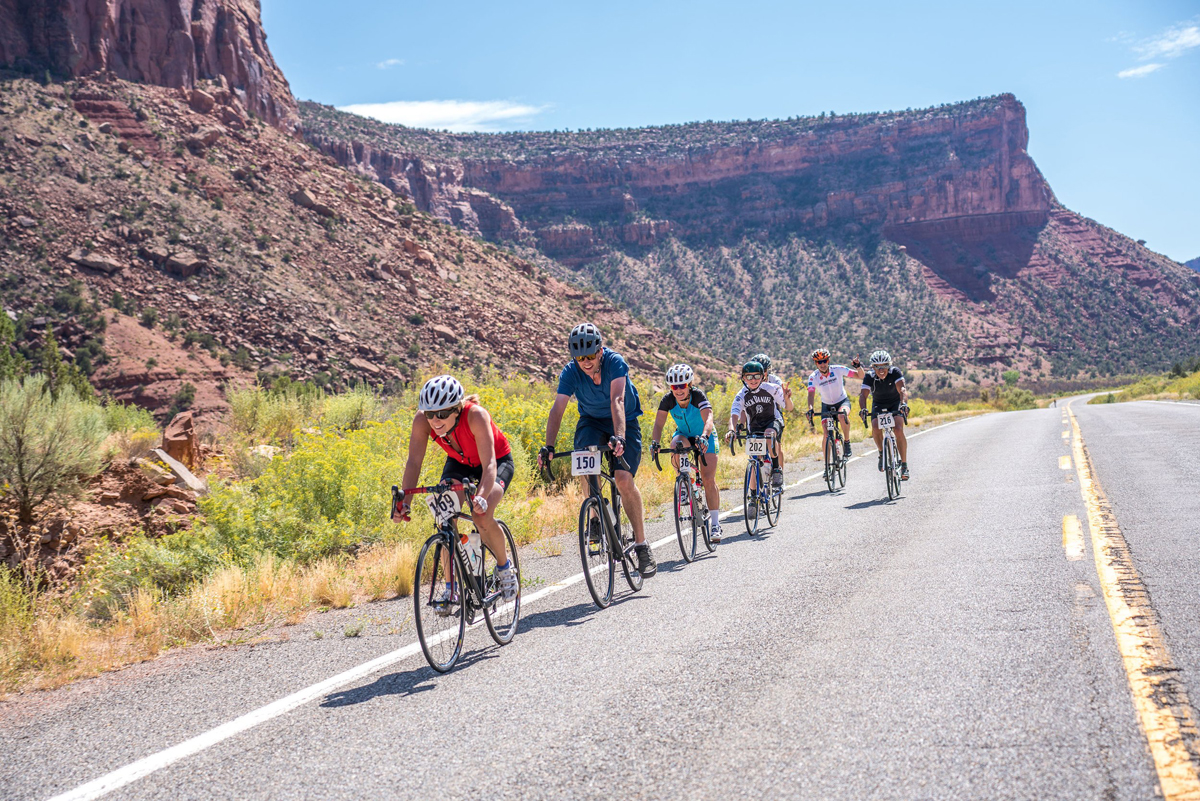
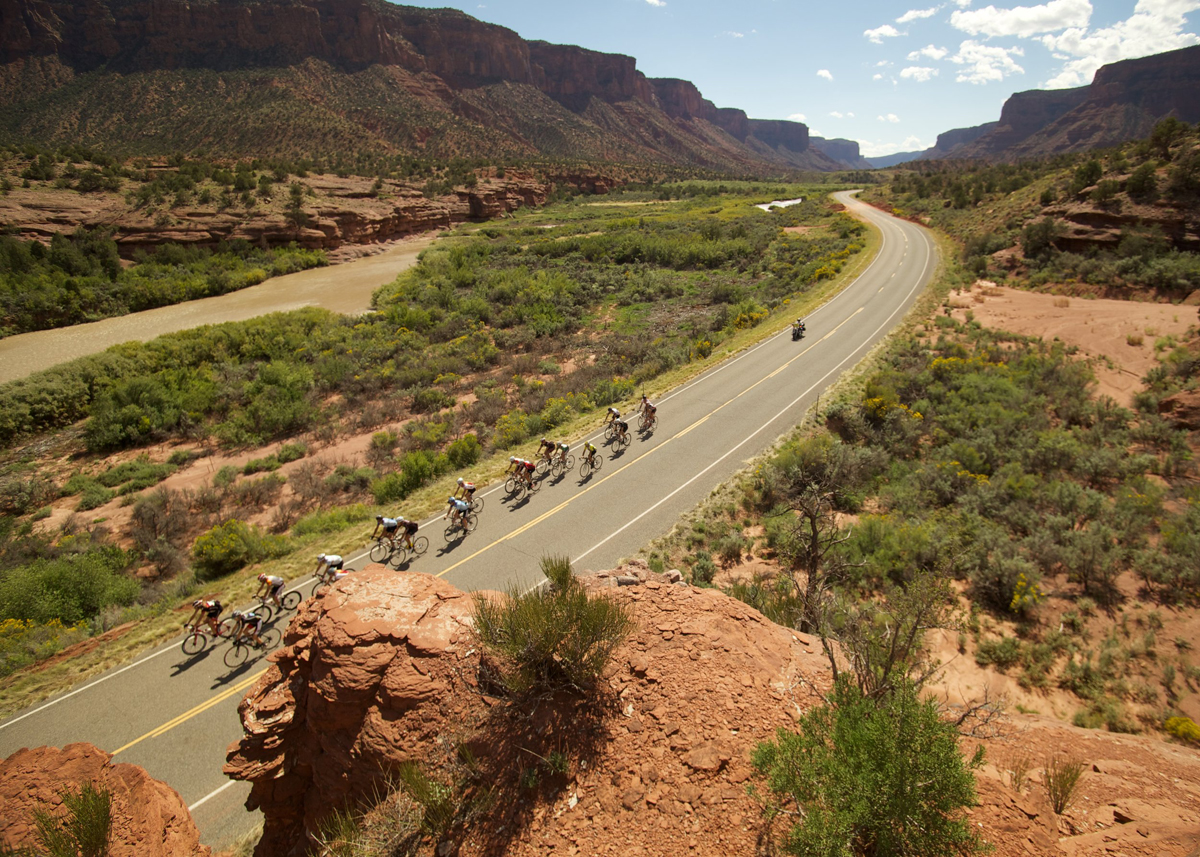
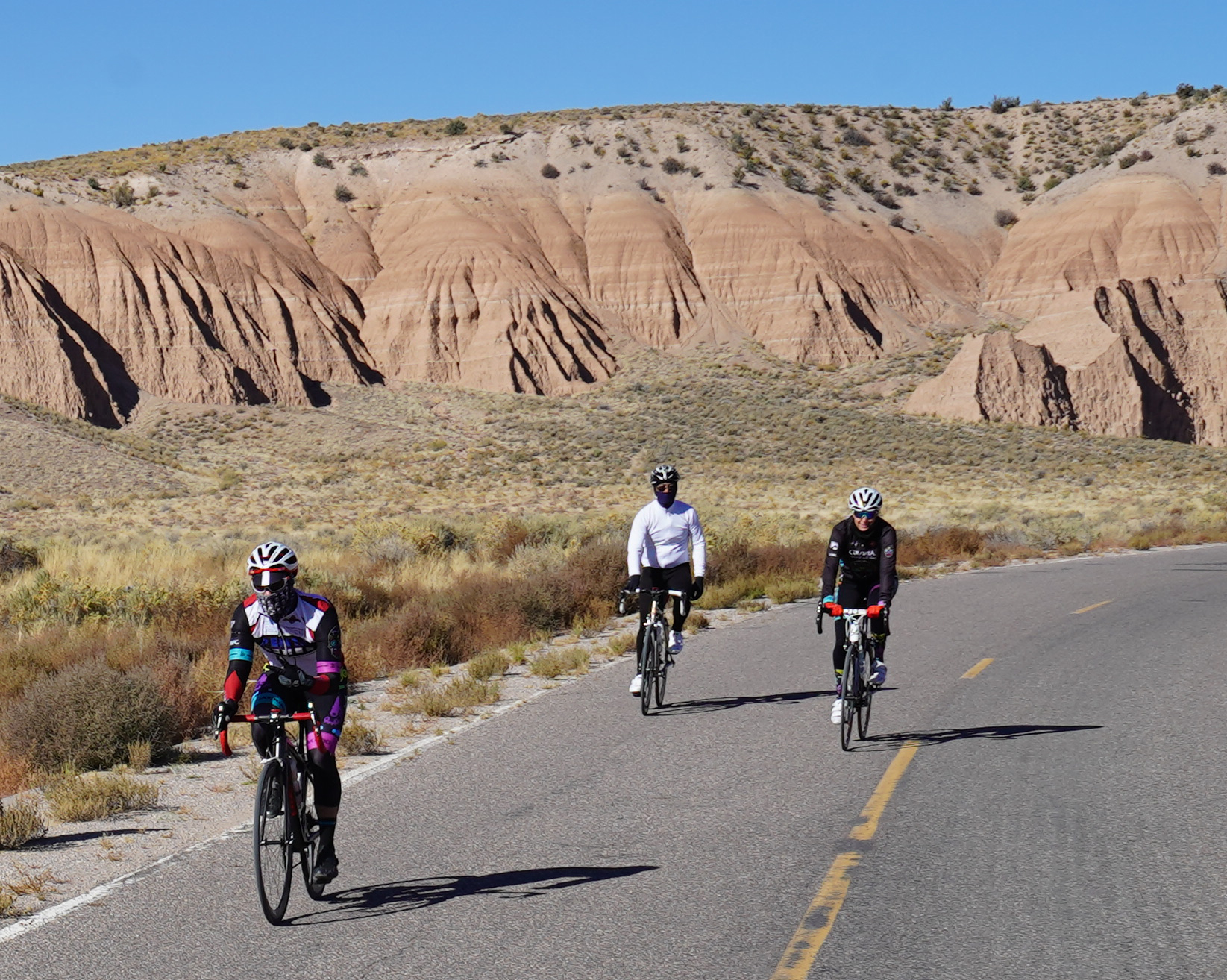
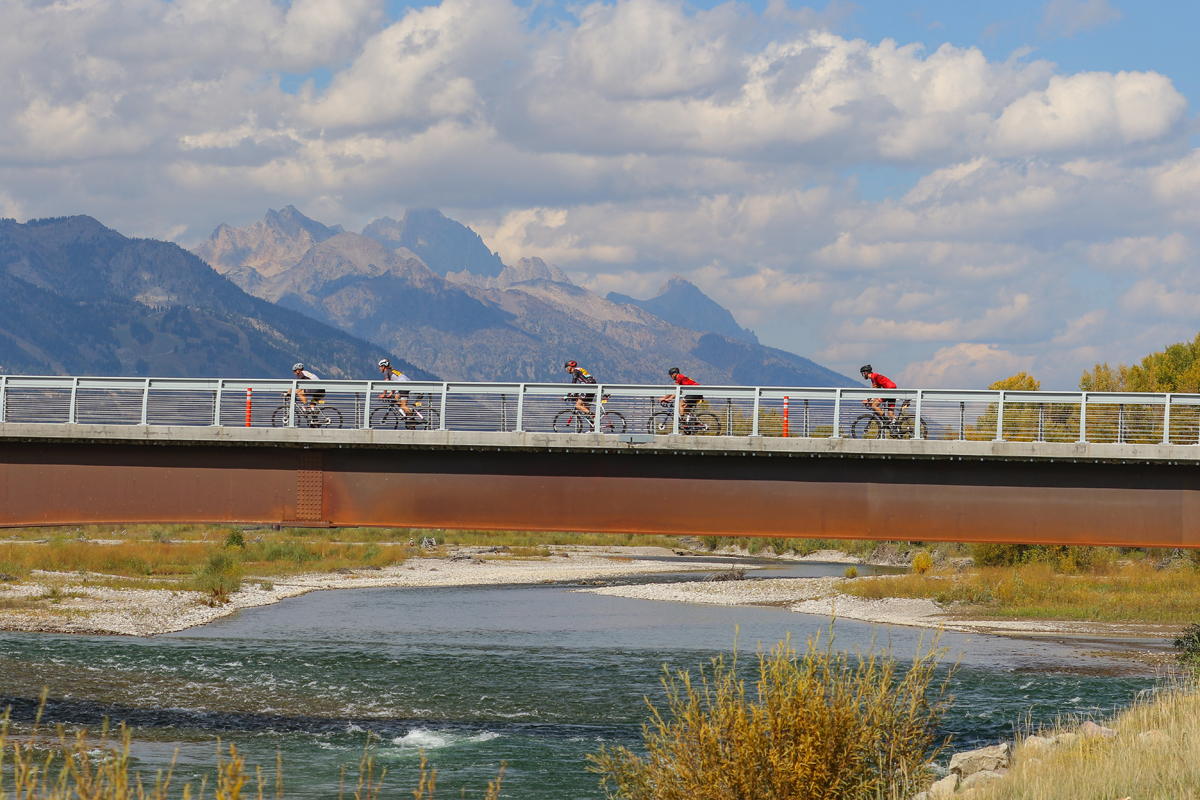
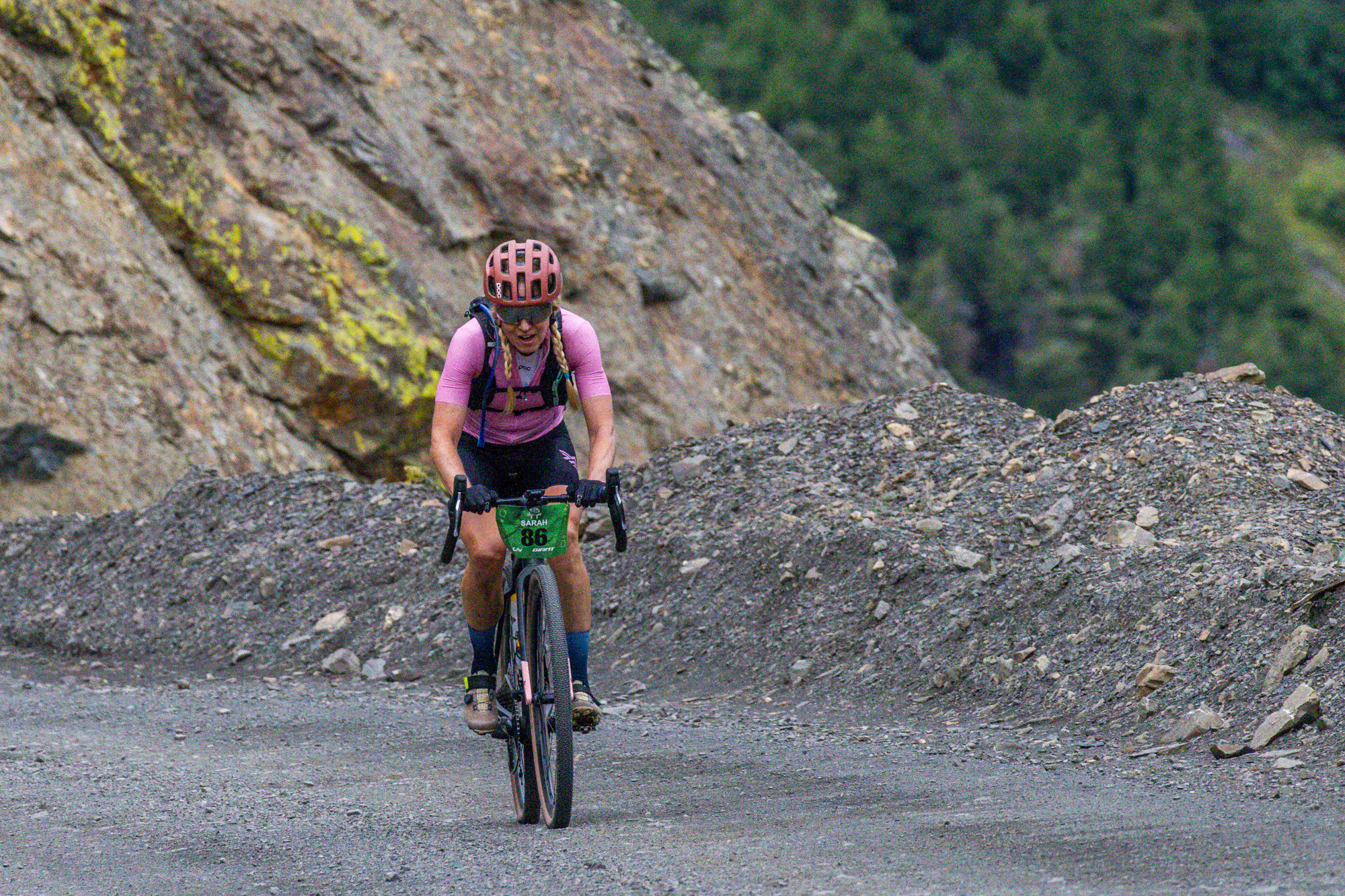
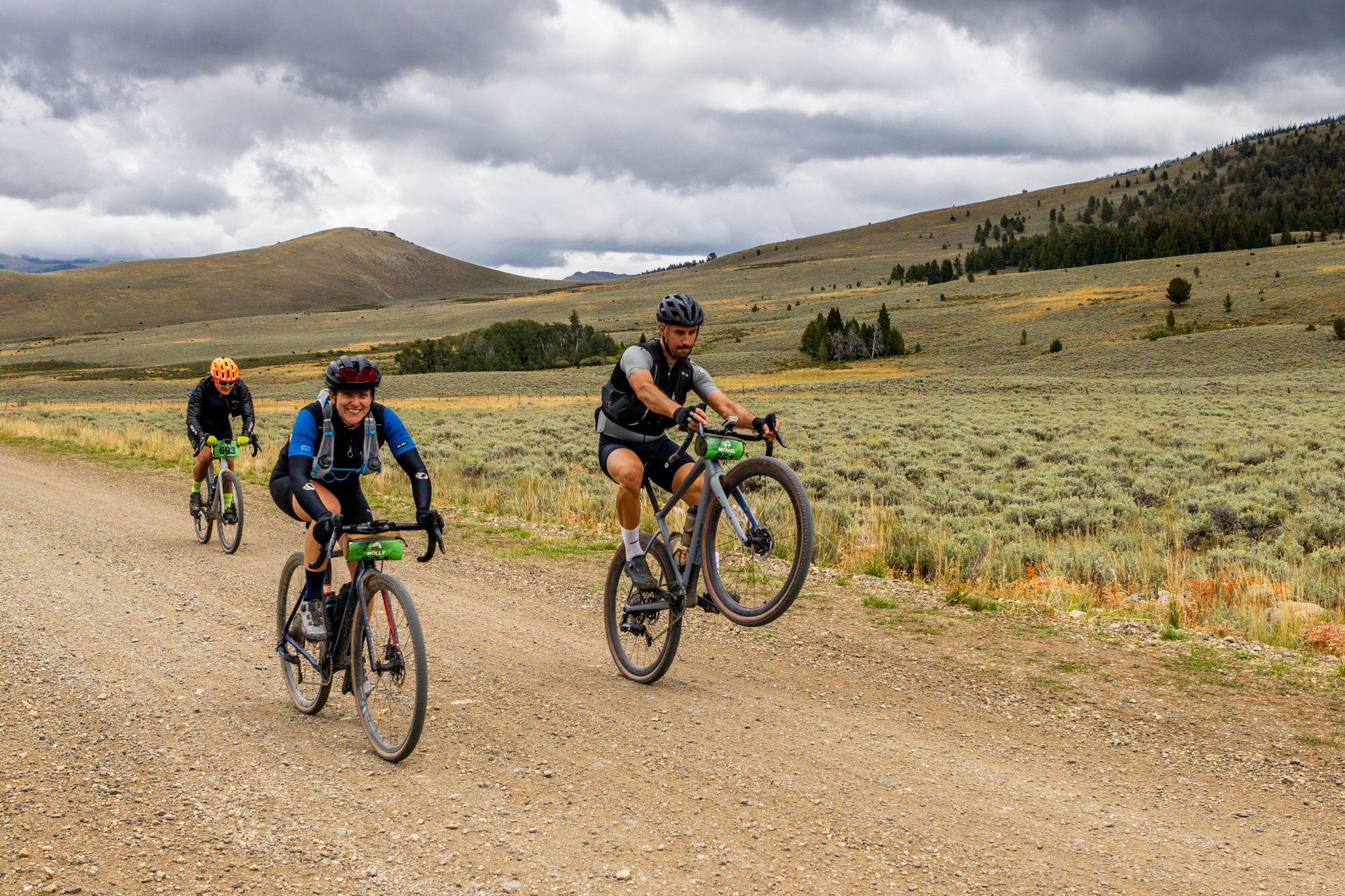
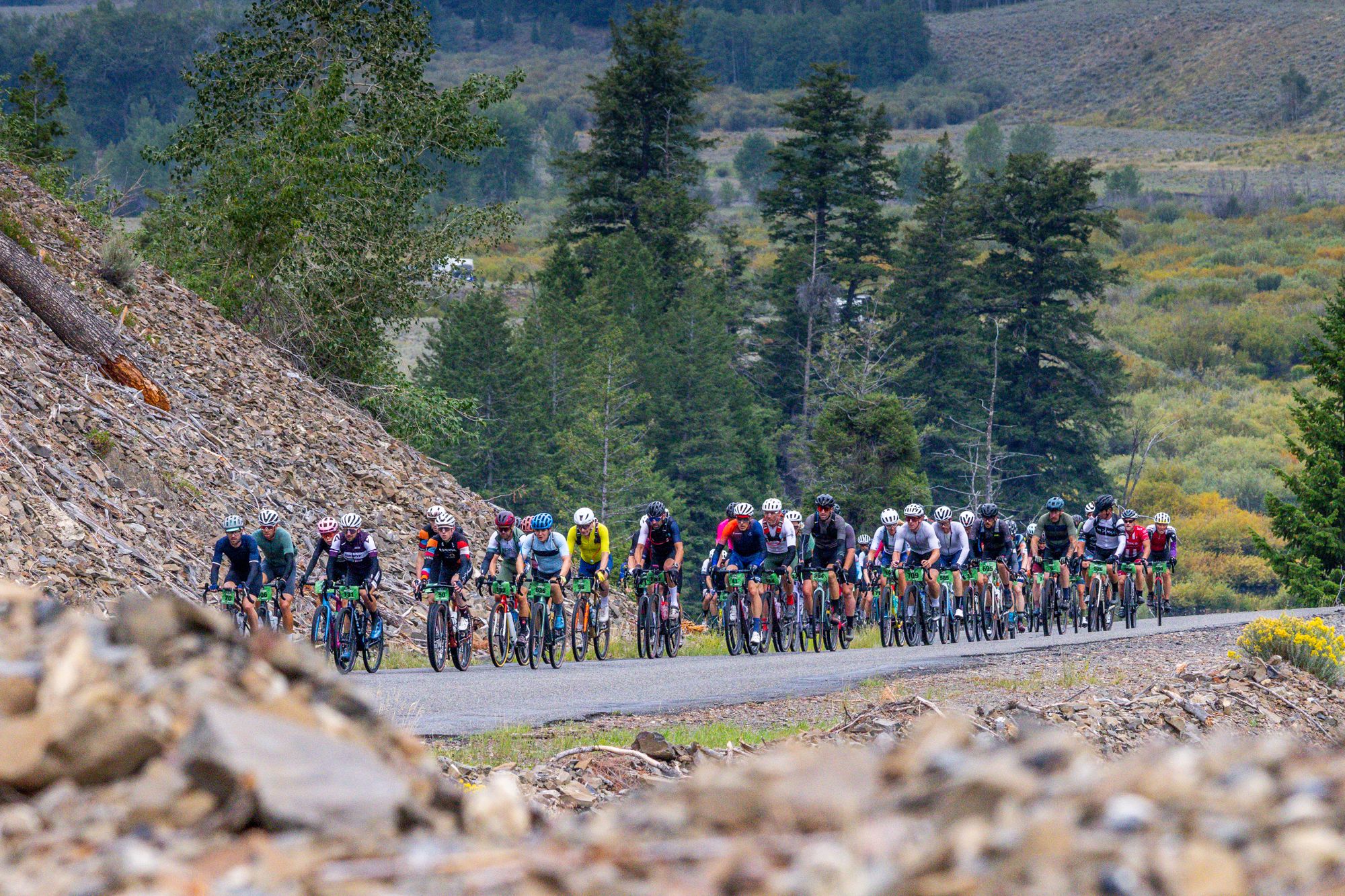
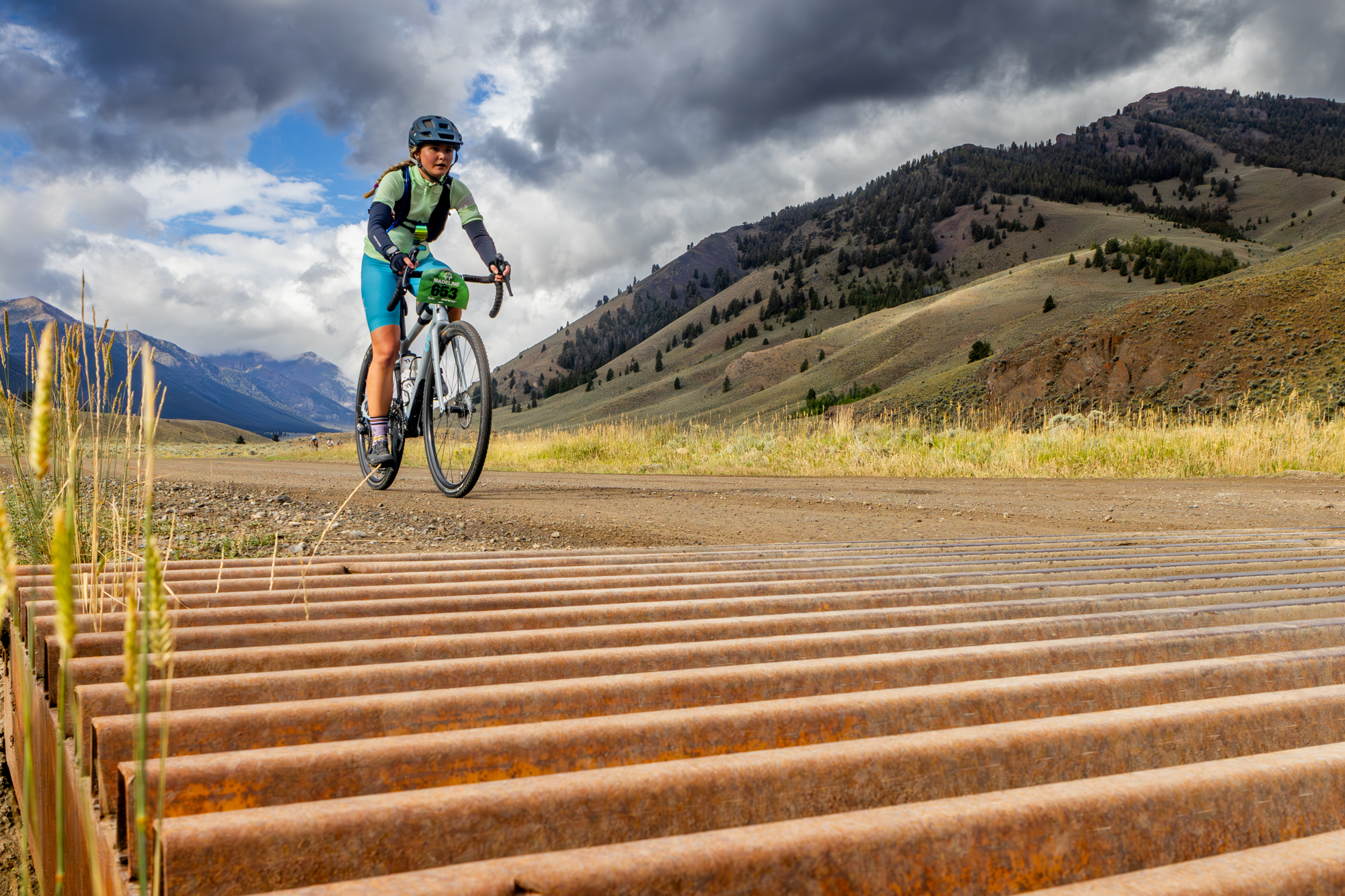
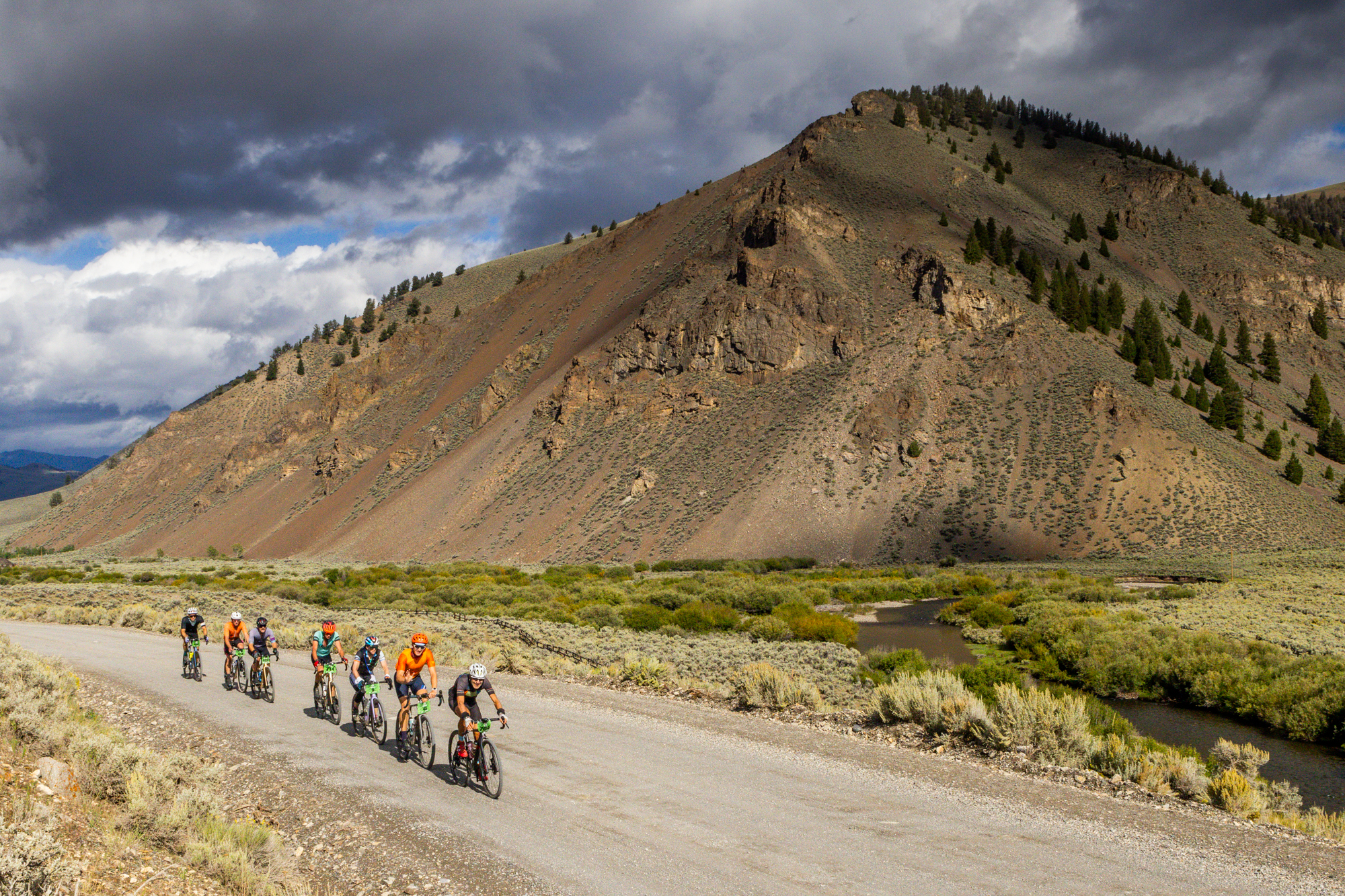
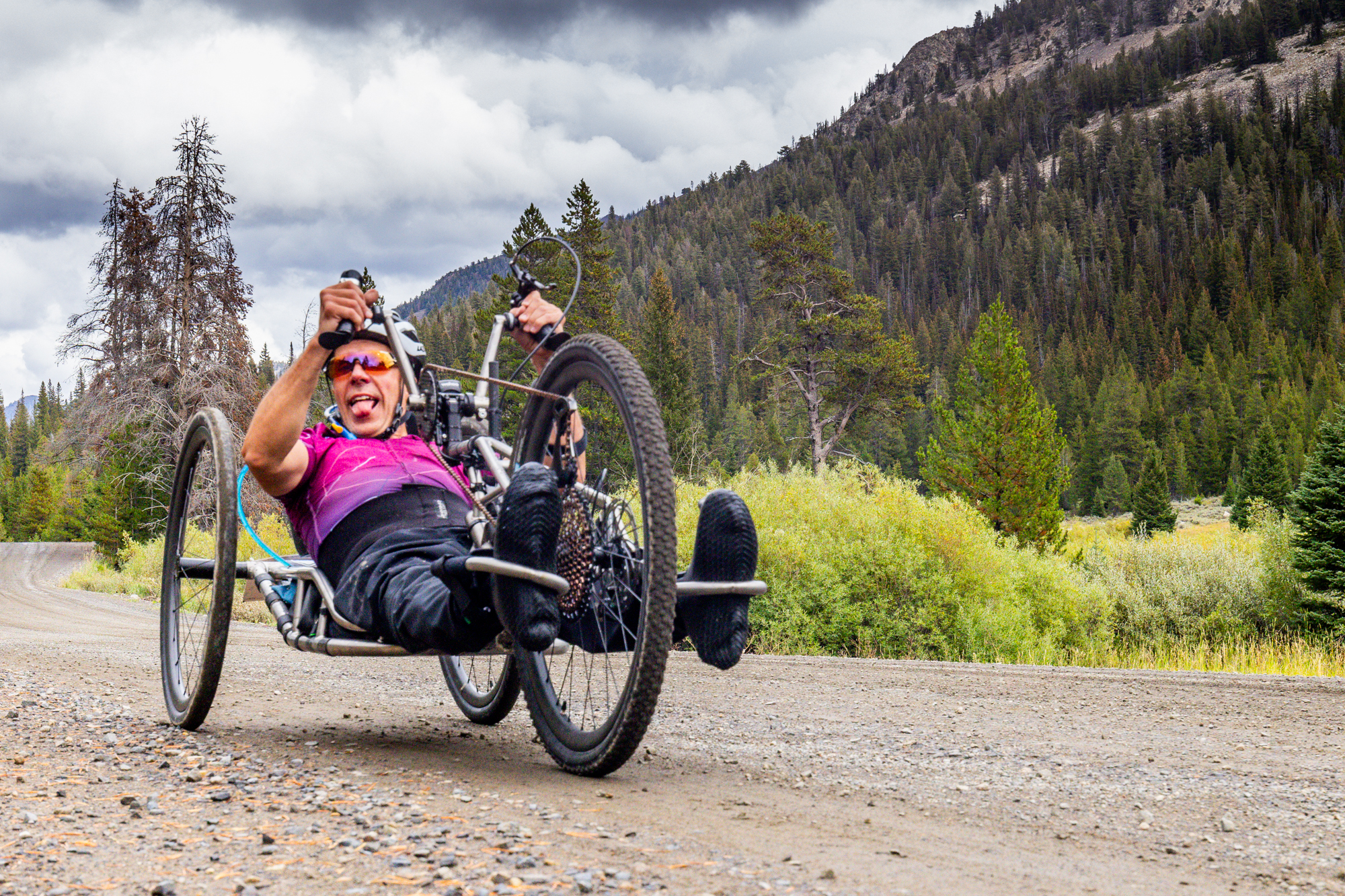
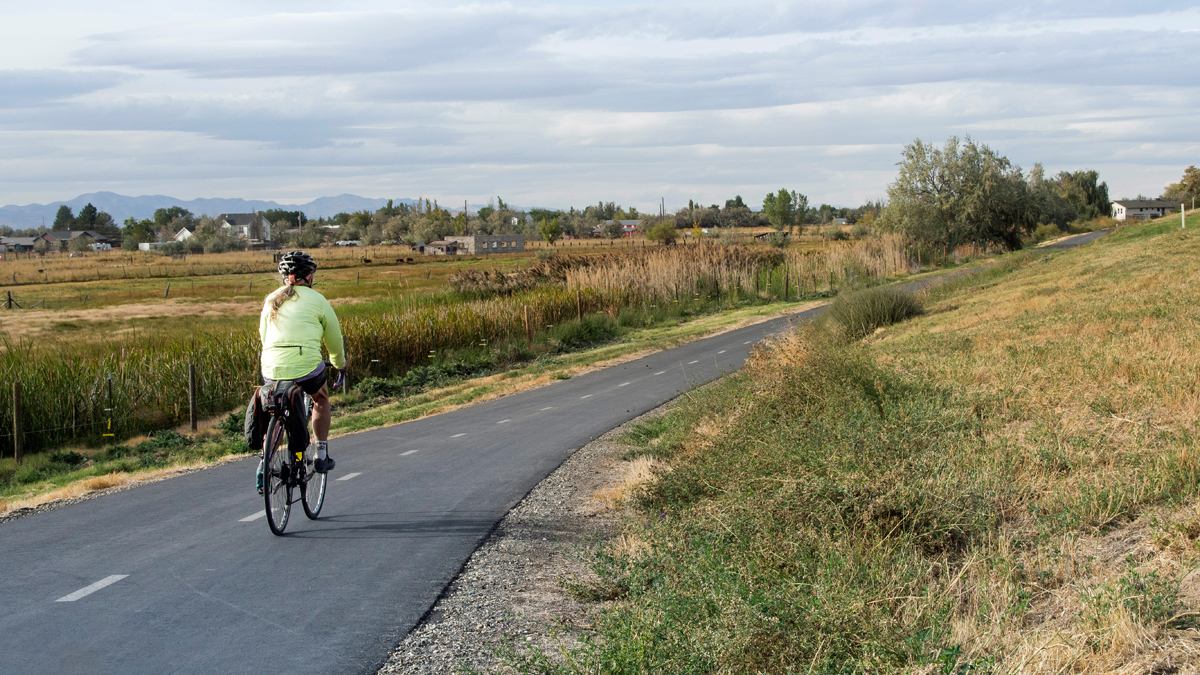
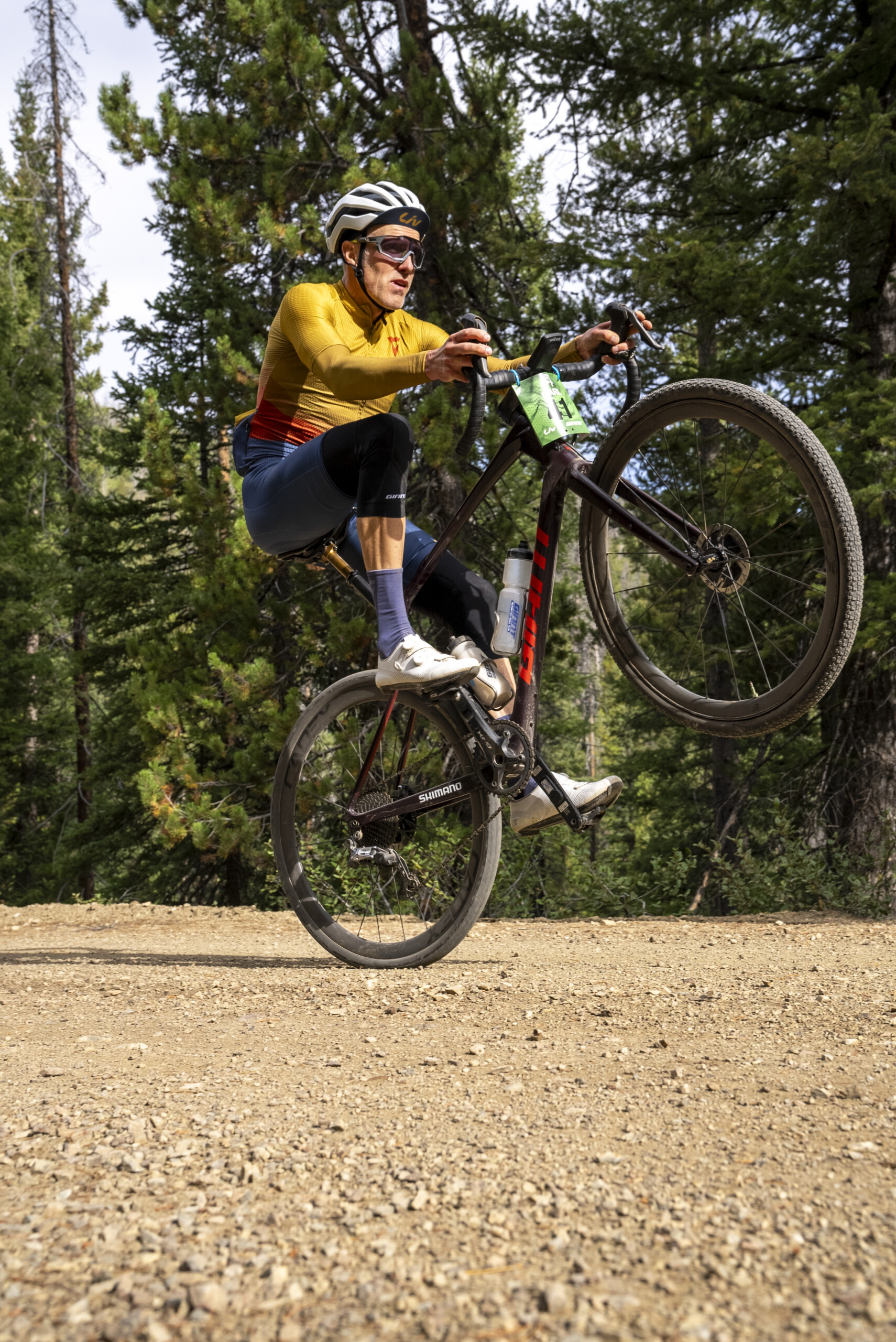
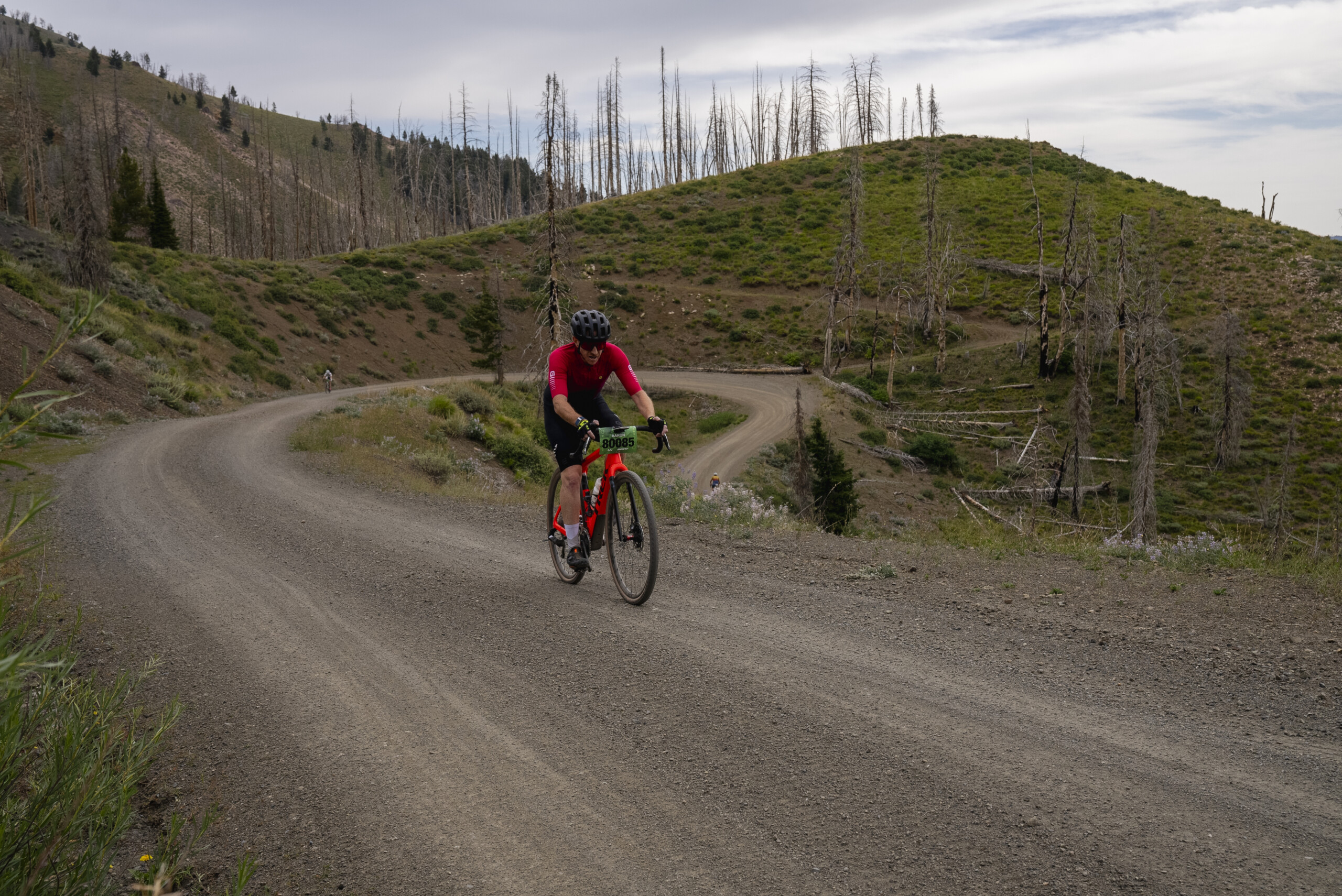
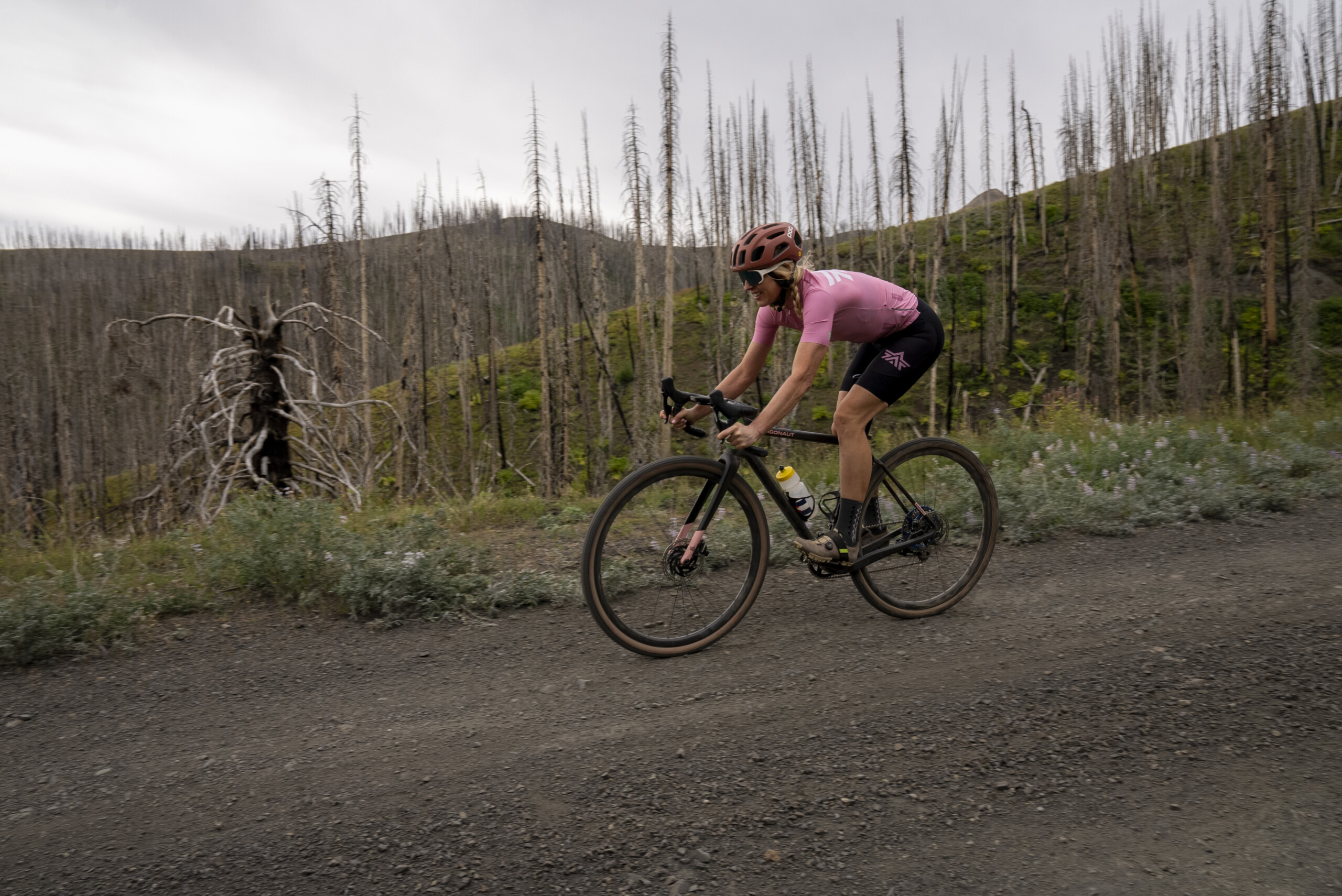
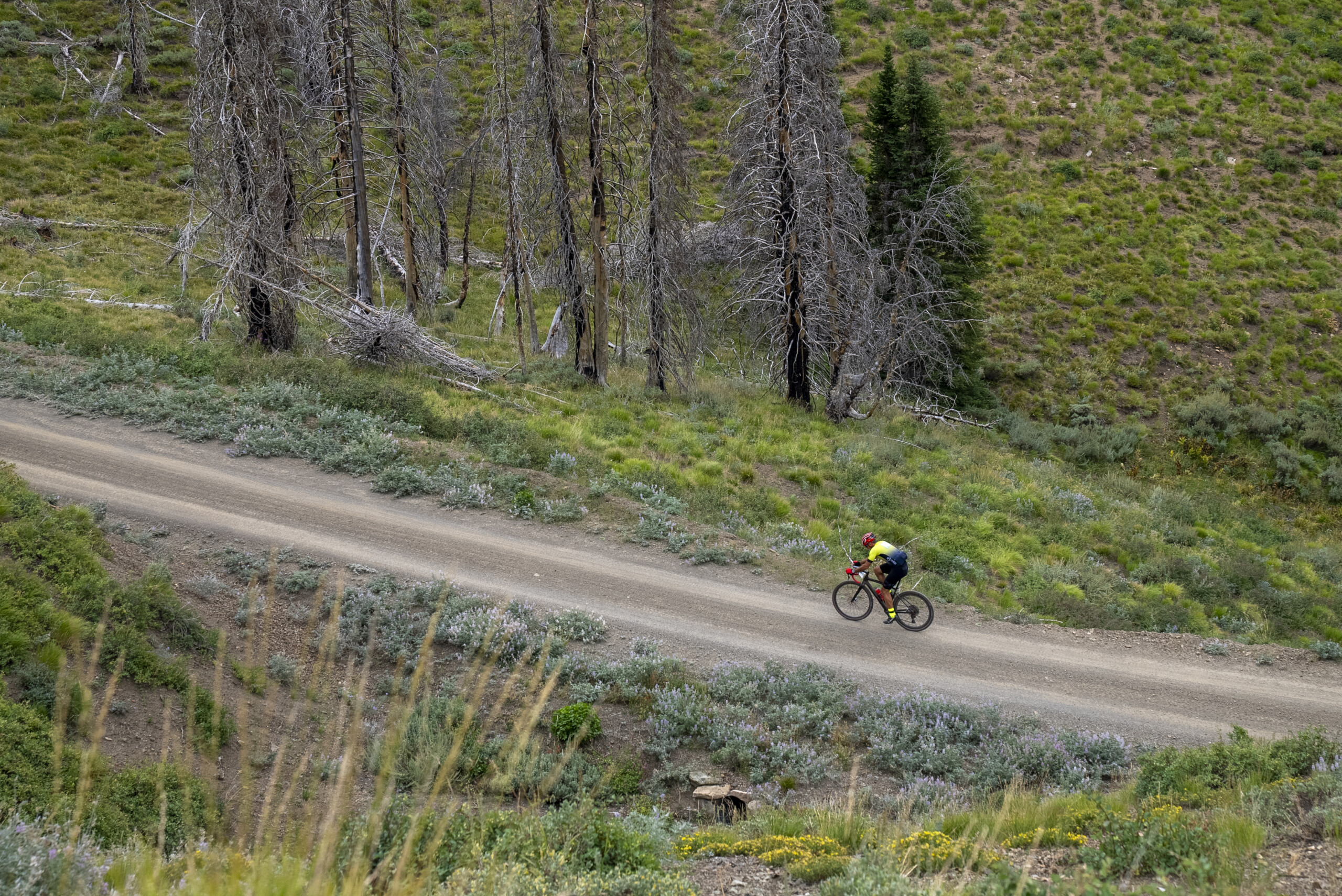
Scenes from the Mountains to the Desert Gran Fondo. Photo courtesy M2D
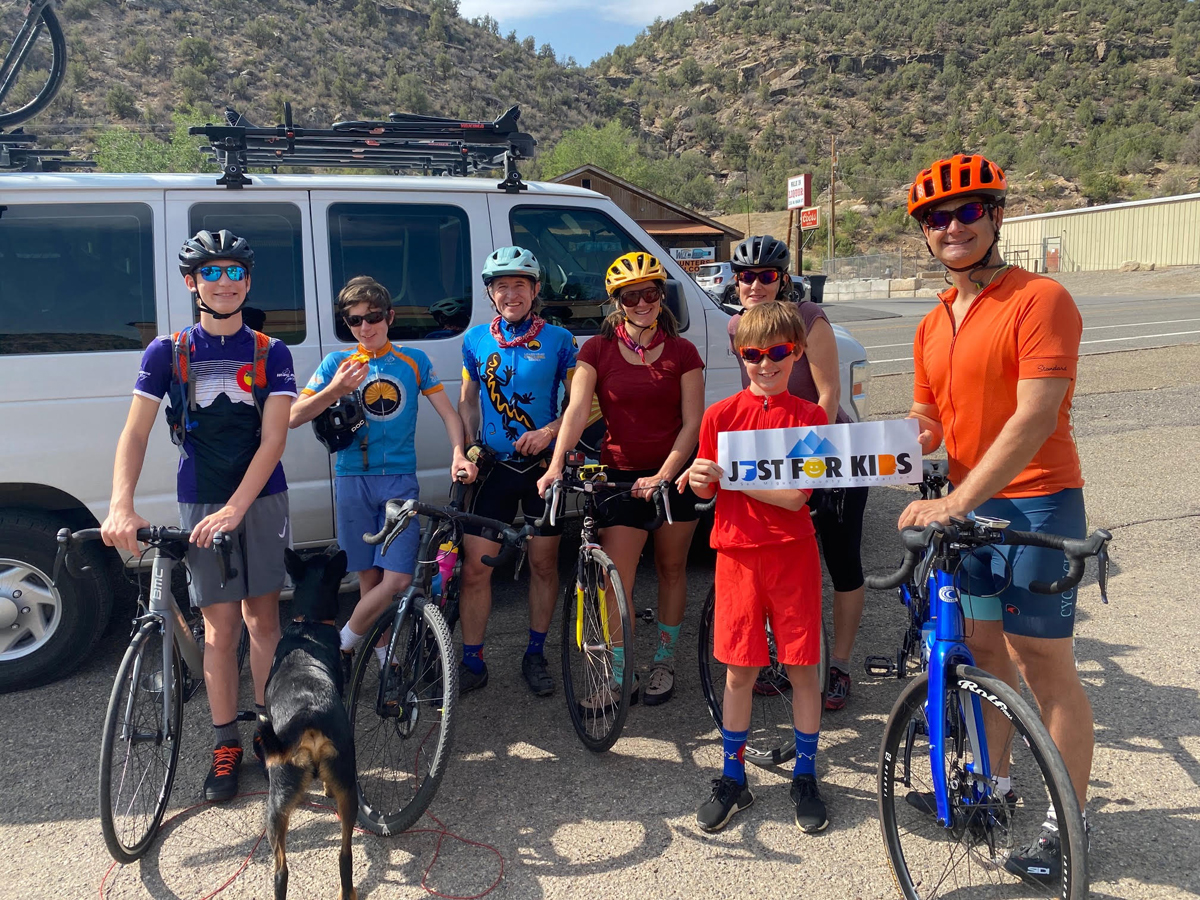
The ride is a fundraiser for the Just for Kids Foundation (JFK). JFK is a 501(c)(3) established in 1999 that is based in Telluride, Colorado. It serves the San Miguel Watershed region and provides essential scholarships, operating grants, program support, capital and start-up funding, and equipment to deserving youth and youth organizations throughout the county.
The ride meanders down along the wild and scenic San Miguel River for the first 33 miles (if you’re riding the 103 miler) before a two-mile climb up to Wrights Mesa and the western ranching Town of Norwood. 20 miles of flat cruising brings you to Naturita, where mountain and gravel bikes are finding a whole new world of endless high desert roads and trails. Here you begin the gentle descent into Canyon Country. The road is super quiet and the road surface is in excellent condition. At about mile 74 you enter the heart of the scenic Unaweep-Tabeguache Byway as you drop into the steep red walls of the Canyon. Cruising here along the mellow Dolores River, you feel like you’re in a National Park that no one goes to. The last 10 miles open up into a valley of desert palisades as you come to the very small community of Gateway, the finishing point for all the ride distances.
The M2D bike ride is JFK’s only funding event, and JFK’s fundraising goal for the 20th M2D ride is $200K. Thanks to generous support from sponsors and donors, M2D 2023 has raised $150K so far – please consider a donation today to support the youths of San Miguel County! To see JFK’s full list of grant recipients, see upcoming grant deadlines, and read more about the history of the organization, visit www.justforkidsfoundation.org. Donate to M2D here: https://runsignup.com/teamjfk.
The aid stations are superb, the cyclist’s swag is first class, medals are won, a fantastic lunch is served, and there is live music. Go to http://www.m2dclassic to learn more.
Scenes from the Mountains to the Desert Gran Fondo. Photo courtesy M2DScenes from the Mountains to the Desert Gran Fondo. Photo courtesy M2DScenes from the Mountains to the Desert Gran Fondo. Photo courtesy M2D
By Lou Melini — It was November of 2022 that Julie told me her sister was planning a family reunion at Mt. Rushmore in South Dakota. Julie’s younger brother and sister and families reside in her home state of Wisconsin, with a nephew in Boise. When I heard Mt. Rushmore, I didn’t think of a stone monument of 4 presidents. I instead thought about the nearby Mickelson Trail, officially called the George S. Mickelson Trail, the former governor of South Dakota that championed the building of the trail. Riding the Mickelson and the surrounding area has been on a mini bucket list for quite some time.
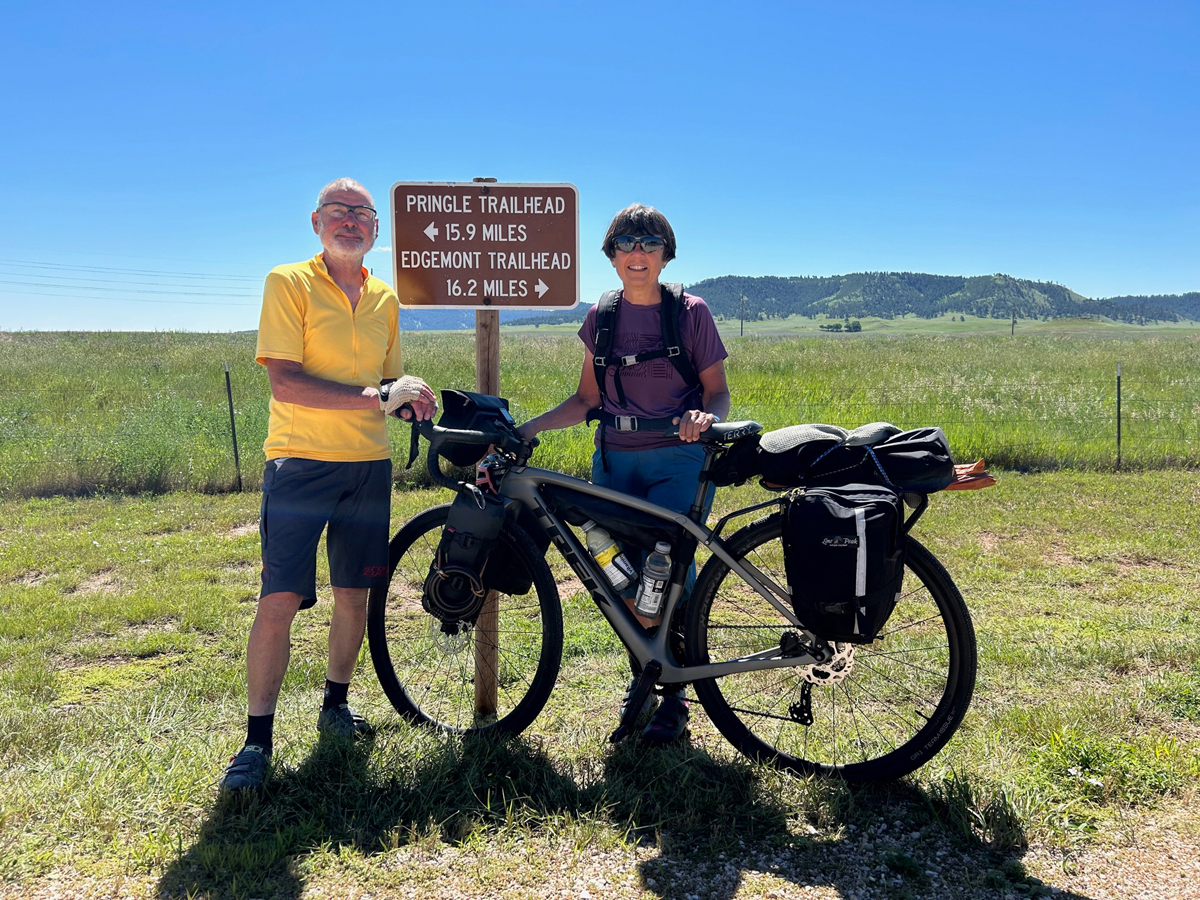
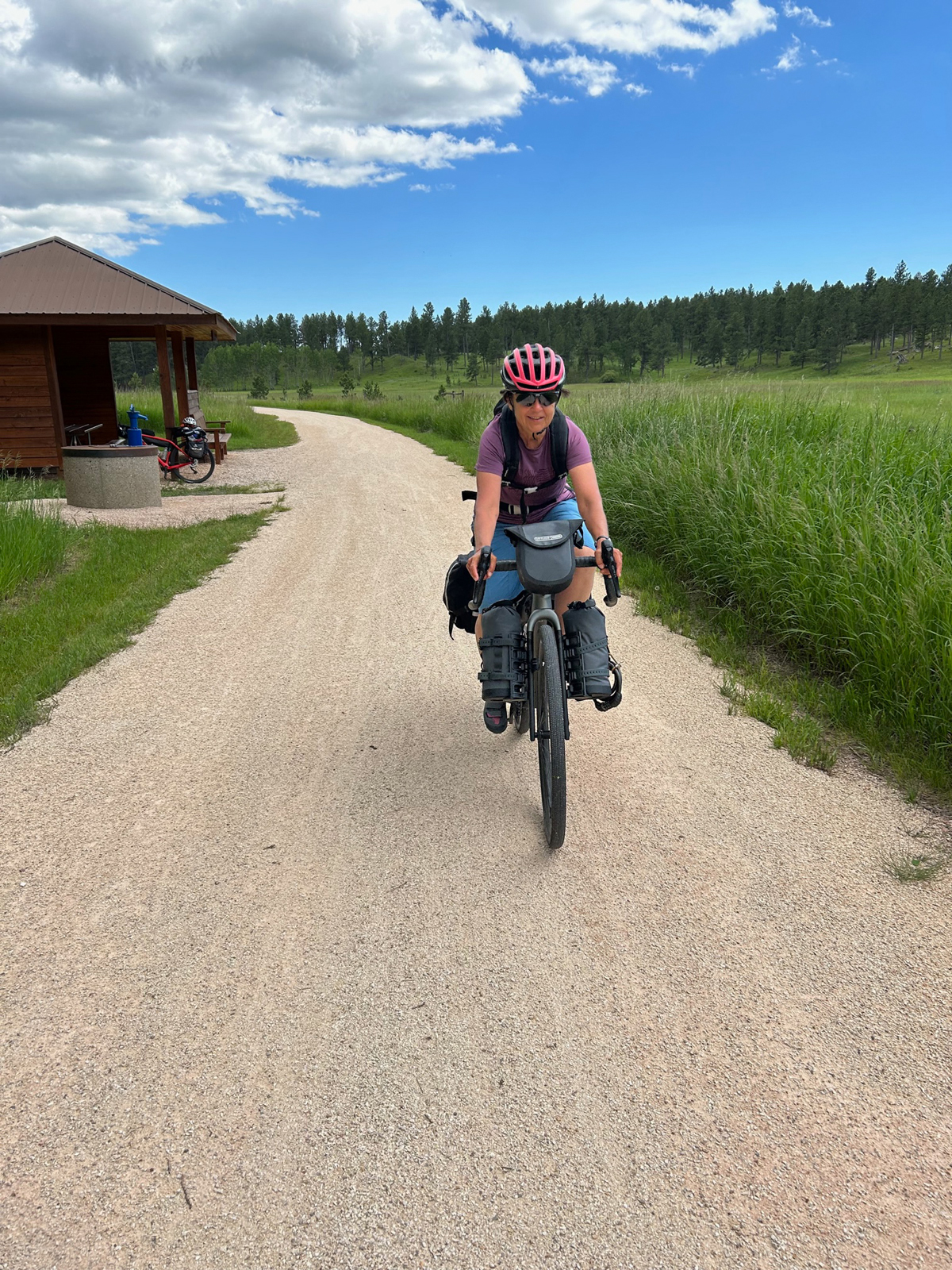
The trail is a former rail line abandoned in 1983. In 1991 the first 6 miles was completed. The 109-mile trail was fully completed in 1998 spanning from Edgemont in the south to Deadwood in the north. The trail surface is primarily crushed limestone and gravel that is kept in immaculate condition. There are 15 trailheads along the trail, 11 that have water cisterns, sheltered picnic tables and vault toilets. The furthest distance between trailheads with the noted services is 16 miles.
There is a $4/day or a $15 annual pass to use the trail except within city limits. The fees go back to the trail. We rode on the trail about an hour after a heavy early morning storm. The trail was not affected by the rain except in one spot where water ran onto the trail. The previously mentioned water cisterns consist of 175-gallon tanks with a pump. The water is tested for quality twice weekly. It is a trail for all ages and abilities given the railroad grade of the trail. E-bikes seem to be the dominate bike on the trail. Rentals can be had in the cities that the trail passes through. We encountered one couple doing an overnight ride on the trail.
If the Mickelson trail is not enough for the gravel lover, there are perhaps hundreds of miles of gravel roads in the vicinity of the trail.
Preparing for the ride:
Julie has not liked riding gravel roads aside from a few short rides on bike trails, mostly comprised of crushed limestone in her home state of Wisconsin. I put 35C gravel bike tires on her touring bike for a ride on the Park City rail-trail to see how she would do. Julie did great though she realized that her position on her touring bike is no longer satisfactory since the 2005 build and the brakes are no longer adequate in part due to her hand arthritis. I did not think I could make the needed adjustments to her bike within the 2-week departure time so I went to Plan B, a new gravel specific bike that I knew my son Ben had in stock at Storm Cycles in Park City. I also have the same bike – a Trek Checkpoint SL5 gravel-specific bicycle. In addition to the new bikes, we used bike packing bags though we added rear racks and panniers to meet our needs to travel comfortably. We considered using flat pedals which would work great on the trail, but we opted to keep our clipped in style due to the hills of the area adjacent to the trail, primarily Custer State Park. Oh, I should mention that Julie had her left knee replaced in early January. This trip will be her first multiday bike tour since the knee replacement. Julie started the trip with a new knee, new bike, and a new gravel attitude.
Packing gear for the ride with the bike packing bags was an issue. I packed and repacked stuff perhaps 3 times making the most efficient use of the reduced space. Julie and I are used to having front and rear panniers and a handlebar bag for a total 75 liters of space on each of our bikes. We are never fully loaded but the extra space is nice for shopping at a grocery store that may include a personal sized watermelon if we wish. We travel comfortable which is neither light nor heavy depending on one’s definition of heavy.
The Ride:
Our trip consisted of 250 miles over 5 days. Short, but it was nice to get back on the bikes. This was our first bike trip since our (Yellowstone and Northwest Wyoming) 13-day ride just after Labor Day of 2021. Backpacking, including a 9-day Yellowstone walk, took up 2022.
The longest day on this tour was 65 miles on the trail and our shortest was just shy of 30 on the last day to return to our car. Of the 250 miles, 160 miles were on the gravel trail and 90 miles on pavement. I had planned on 45 to 50-mile pavement days and 35-40 gravel days. Campground locations were the dictating factor for our trip. Our ride occurred in late June with wetter and cooler than expected weather.
Julie’s Trek Checkpoint SL5 Gravel-Specific Bicycle with Salsa, Ortlieb, and Trek bikepacking bags. These are the most widely spaced trailheads on South Dakota’s Mickelson Trail. Photo courtesy Julie Melini
Hot Springs, South Dakota
We left our car at Spokane Creek campground just outside the northeast section of Custer State Park. Our route took us south on the wildlife loop road in Custer State Park. During a car ride with my son and family, we previously encountered a small herd of bison and wild donkeys along this road. On our bikes we saw the donkeys and some bison that were not along the road. From Custer State Park we went south past Wind Cave national park to Hot Springs, SD. The KOA was 5 miles east of Hot Springs, making for a 55-mile day. The ride on this day was mostly through rolling hills and forest traversing on the west side of Wind Caves NP. Traffic was relatively light.
Julie Melini at Minnekahta trailhead where we started the trip on South Dakota’s Mickelson Trail. Photo by Lou Melini
Custer:
On day 2 we rode 20 miles due west to our start on the Mickelson trail at the Minnekahta trailhead, mile 16 from the southern start of the trail. The first campground from Minnekahta trailhead going north is in Custer at milepost 46 resulting in a 50-mile day. Many of the local riders consider the trail from Minnekahta to Custer “boring” as it follows along highway 89 and runs through primarily ranchland. As we approached Custer, the “Black Hills” started to dominate the scenery.
When we set upon the trail, we found it in great condition. We talked to several folks during our ride that use the trail once or twice a week for casual rides. There is a lot of community pride in having the trail for local folks and the economic benefits from riders coming to the area to ride the Mickelson.
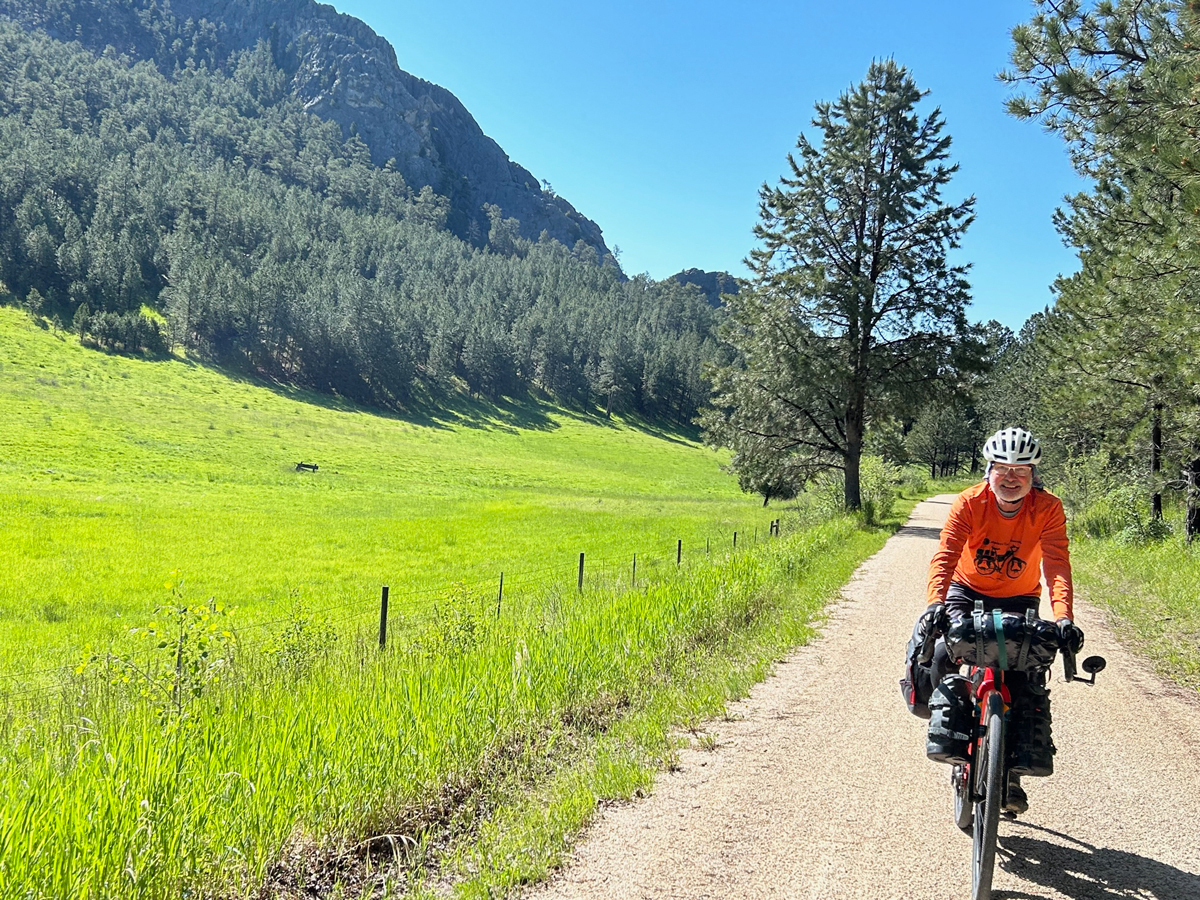
Lou Melini on South Dakota’s Mickelson Trail. Photo by Julie Melini
Deadwood:
Julie and I had a lot of discussion regarding Day 3. Julie was tired, quite tired, at the end of day 2. Despite that, we did walk to the Purple Pie (and ice cream) place for homemade pie for our dinner desert. Our two options for day 3 were a very short ride, about 15 miles, to Hill City or 65 miles to Deadwood, the next available (commercial) campground. There were Forest service campgrounds about 6 or more miles off the trail and there was a slight chance of finding Forest Service land to stealth camp along the trail. After looking at the map, we learned that the last 15 miles in Deadwood descended about 1600 feet.
We awoke at 5 AM for the predicted long day but had to deal with a thunderstorm with fairly heavy rain at that time. The campground office had a large overhanging roof with a picnic table so we picked up everything, including our tent, and set up camp there, had breakfast and packed up. The rain stopped shortly before we were ready to roll. The Mickelson trail is paved in town boundaries, but we were concerned that we would be riding on a muddy mess once we left the town limits. To our surprise, the trail was immaculate with only one small puddle to ride around. As we are fond of doing, we had a second breakfast after the 15-mile ride to Hill City. We were also able to see the Crazy Horse monument from the trail north of Custer.
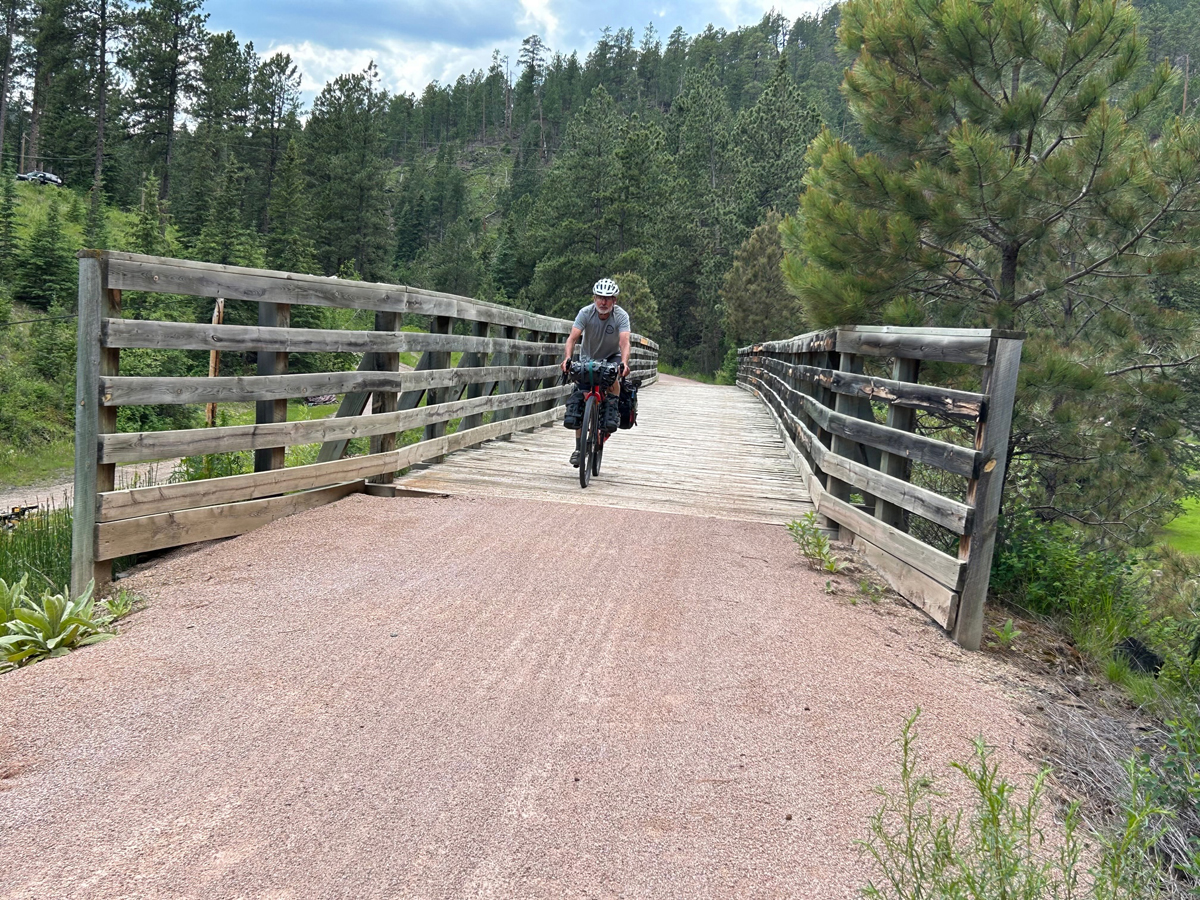
Lou Melini on one of the many bridges on South Dakota’s Mickelson Trail. Photo by Julie Melini
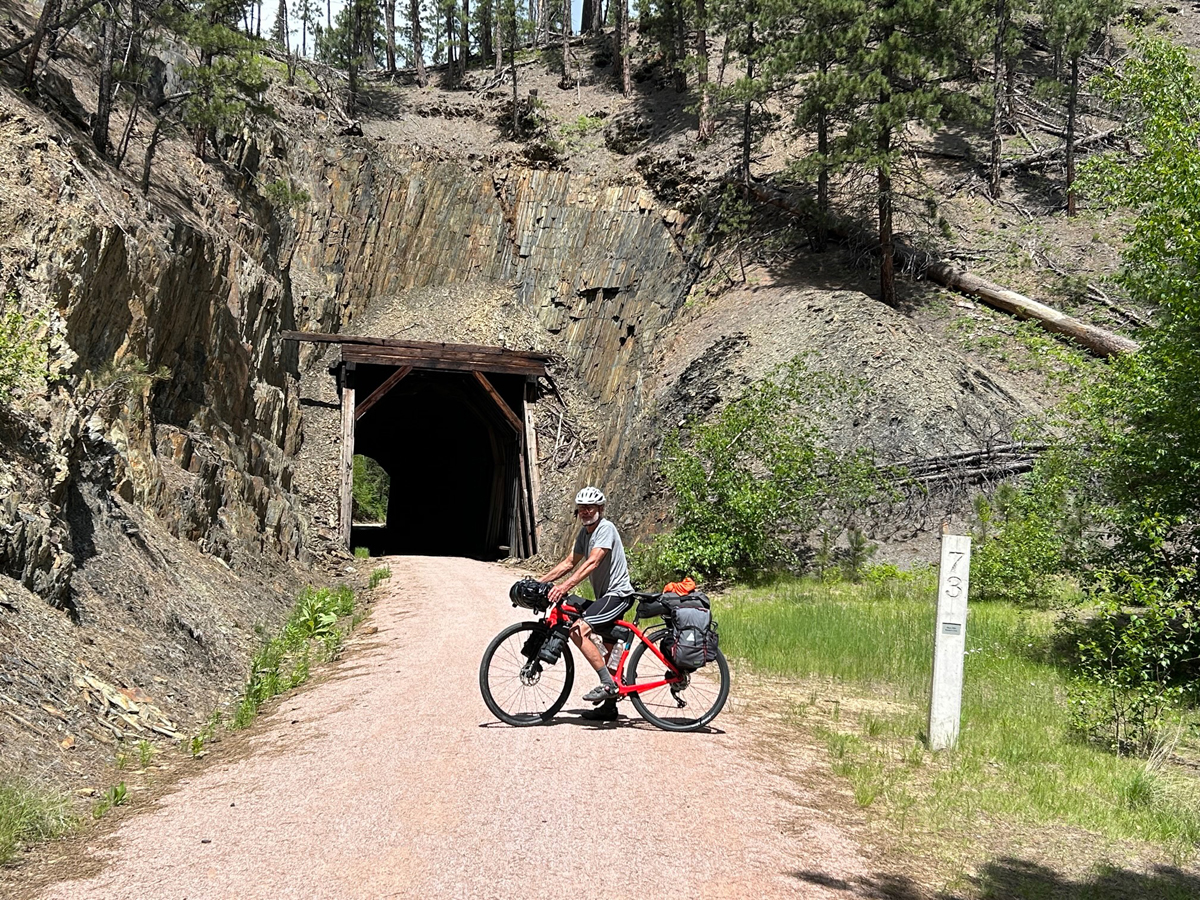
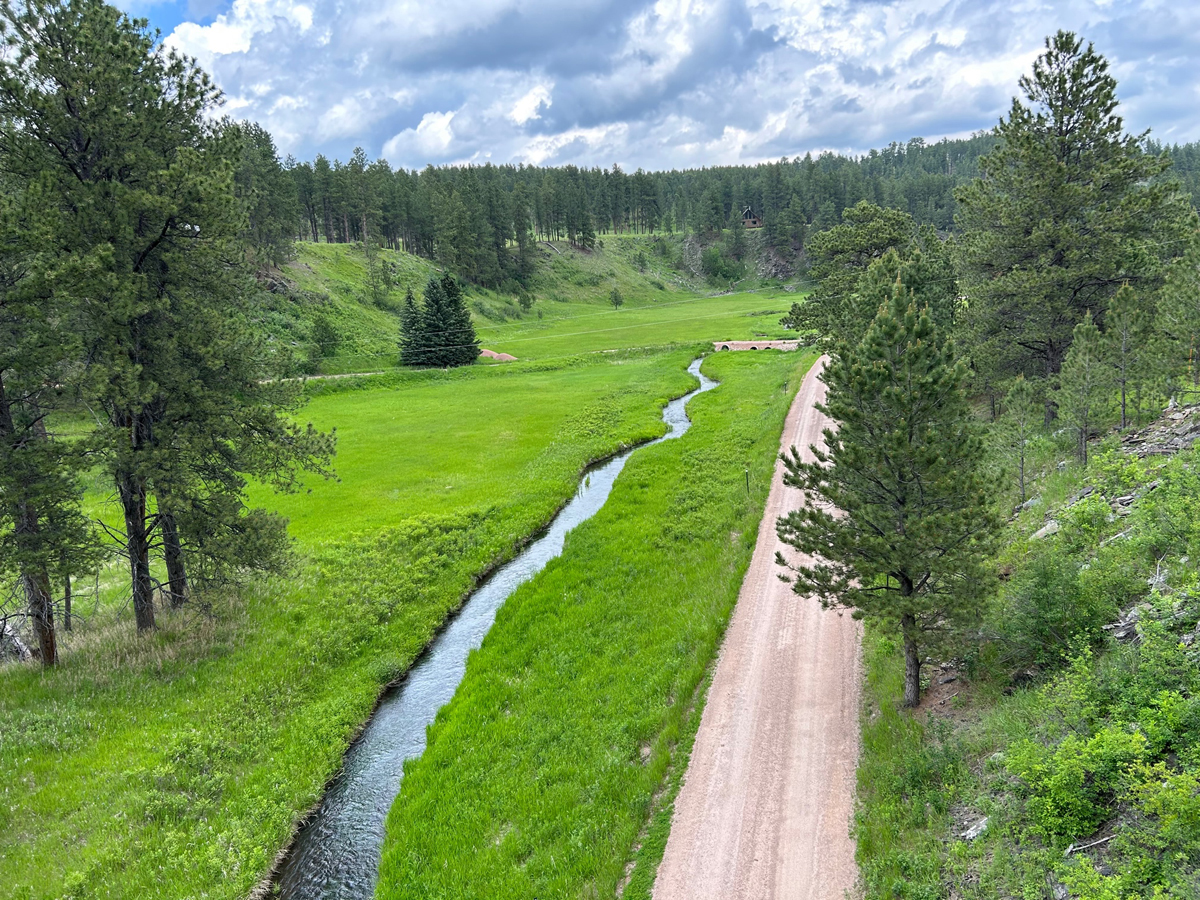
Leaving Hill City, we simply planned to keep a steady pace, stop when needed and enjoy the scenery to Deadwood. We stopped at trailheads along the way as needed for water and food. In between we experienced Black Hills beauty, crossed numerous wooden bridges, passed through three short tunnels, and saw a large number of cyclists, though not enough to slow our progress.
The first campground we came to in Deadwood made for a 67-mile day that took 6 hours and 30 minutes for a 10.2 average. We were both tired especially when we had to ride a quarter of a mile up a rather steep grade of a canyon to the tenting area. After dinner we walked back down the quarter mile for showers. The view was worth the ride up the hill.
One of several gravel roads intersecting South Dakota’s Mickelson Trail. Photo by Julie Melini
(Return to) Hill City:
Our legs knew we had a good ride yesterday but the ride back to Hill City was “only” 50 miles with a nearly 15-mile steady, railroad grade climb out of Deadwood and a similar 7-mile elevation change shortly before reaching Hill City. The trail had a few ruts in places from the many thunderstorms that recently came through the Black Hills. I noted that a trail crew had come through and patched up the ruts for the first mile or so of the trail out of Deadwood. We chatted it up with a lot of cyclists along the way including five from Salt Lake City (one with recognizable Contender Bicycle shorts). We also met and chatted with a trail crew testing water quality in the cisterns while others emptied the trash container and cleaned the vault toilet. You could see the pride that the community has invested in the trail. After a grocery store stop in Hill City, we rolled into a campground south of the city that was one of several along the trail adding a few miles to our day.
Custer State Park:
We rode to Custer and took the (paved) spur trail to the entrance station of Custer State Park. The entrance fee for cars to travel in the park is $20, a sum we had paid when we drove through Custer SP. Bicycles are free to enter the park. Despite the beauty of the park, there is not a lot of traffic, especially early in the day on weekdays. Weekends have a bit more traffic. The hills in the park are relatively short but steep. Even the spur trail we took had a steep ascent where Julie was in her lowest gear. The famous Needles Highway in the park is a twisty road with pigtail hairpins necessitating a 10-mph speed limit at one hairpin turn. On a different section of the needles road there are several short tunnels wide enough for one car. The Adventure Cycling Parks, Peaks and Prairies map has an alternate route through Custer State Park with the warning that “Proper caution should be taken during riding Needles Highway and it is not recommended during inclement weather.” The short section of the Needles Hwy that Julie and I rode to get back to the campground and our car was a pleasant ride. There was little traffic that was patient with our presence.
Lou Melini in front of one of 3 tunnels on South Dakota’s Mickelson Trail. Photo by Julie Melini
Citing tradition, Julie and I opted for the campground café pizza, something we have done on the last night of many of our trips (usually having pizza delivered from a pizza place). It also saved us from schlepping food from Custer City. If folded over the pizza would have looked like an Italian Quesadilla as it lacked sauce. We gave what we didn’t eat to the appreciate young campers near us from Canada. Fortunately, we bought a bagged salad kit in Custer to go with the meal. After the early dinner we went to the Black Hills Theater, 4 miles from the campground and saw the Silent Sky, a production about pioneering women in astronomy. Even considering the pizza, it was a great way to end our short journey on the Mickelson Trail.
Nuts and Bolts:
Julie and I like to tent camp. Since the Covid-19 pandemic, acquiring tent sites meant making reservations. On this trip we could rode into each campground and had a tent site. Prices ranged from $24 one block from the Custer City trail head to $58 for a tent site in a campground with many amenities such as outdoor kitchens if you wished. On the other nights we paid, $30, $36, and at the campground where our car was located, $40.
The weather for South Dakota was unseasonably wet and cool for the end of June. Thunderstorms lasting about 30 minutes or so hit mostly from 6 PM to 5 AM.
Custer State Park is a very scenic park that is not visited by the crowds going to Mt. Rushmore and Crazy Horse Monuments. It is worth riding through it but go early and on a weekday.
We rode with 40C width tubeless tires. The set-up worked well. The wider tires compared to our road touring bikes gave us plenty of stability. Given the quality of the Mickelson Trail, one could ride a narrower tire. I would be OK with a 35 C tire but probably nothing smaller, but others might.
By Tom Jow — Last month during my trip to Oakridge, Oregon I noticed my brake performance beginning to deteriorate. Specifically, my rear brake lever was feeling soft and pulling almost to the bar. In addition, both brakes just did not feel as strong as they did when they were new a couple of months ago. Considering I was headed to Brian Head for the Big Mountain Enduro later in the month I decided that some brake service was necessary.
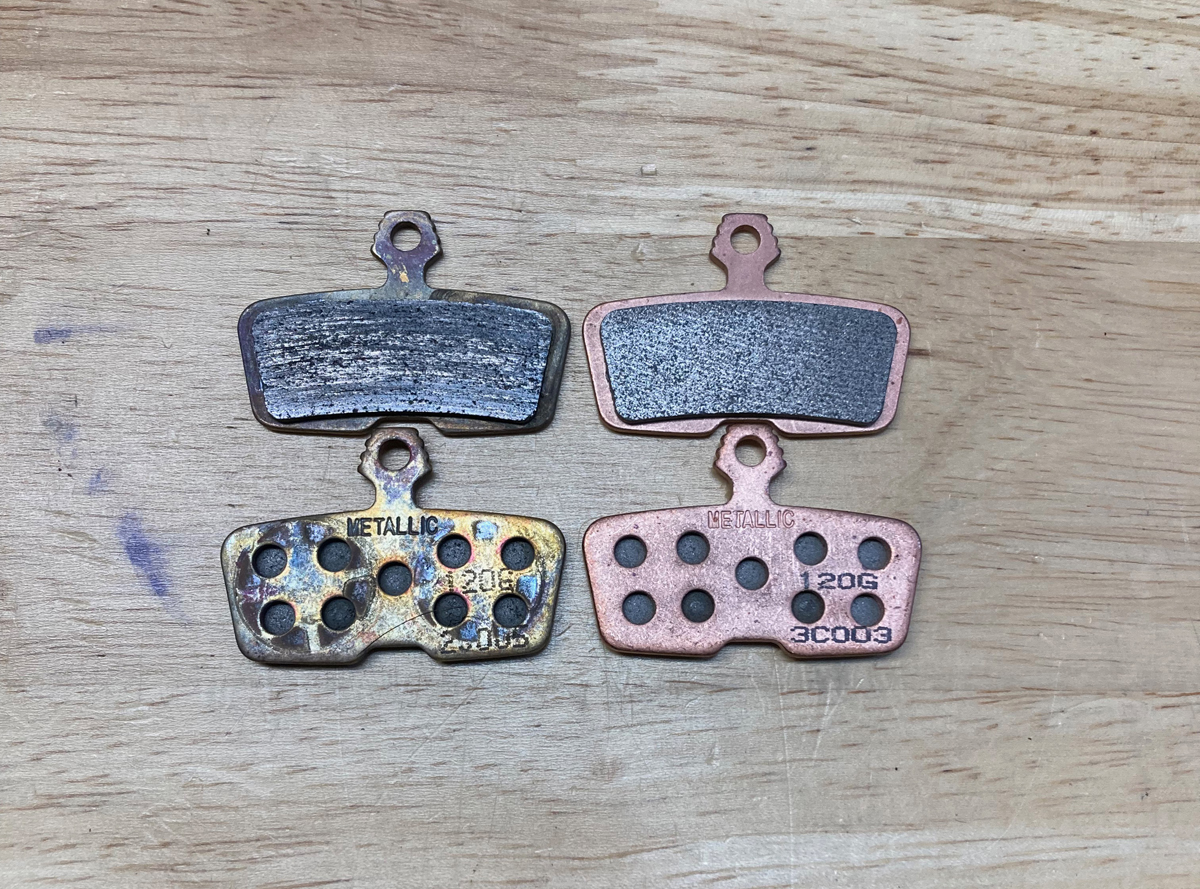
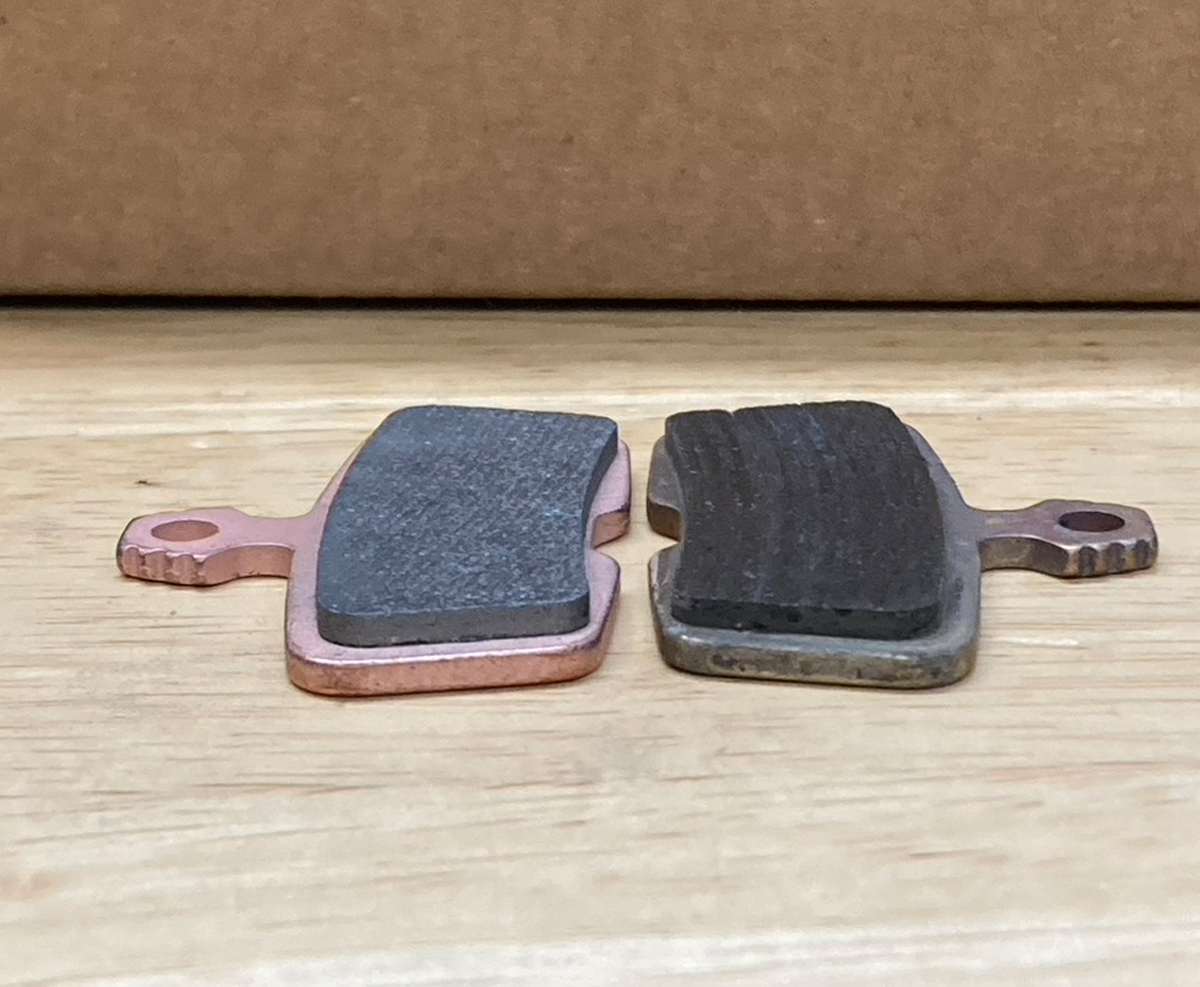
Discolored, glazed brake pad on the left. New pad on the right. Photo by Tom Jow
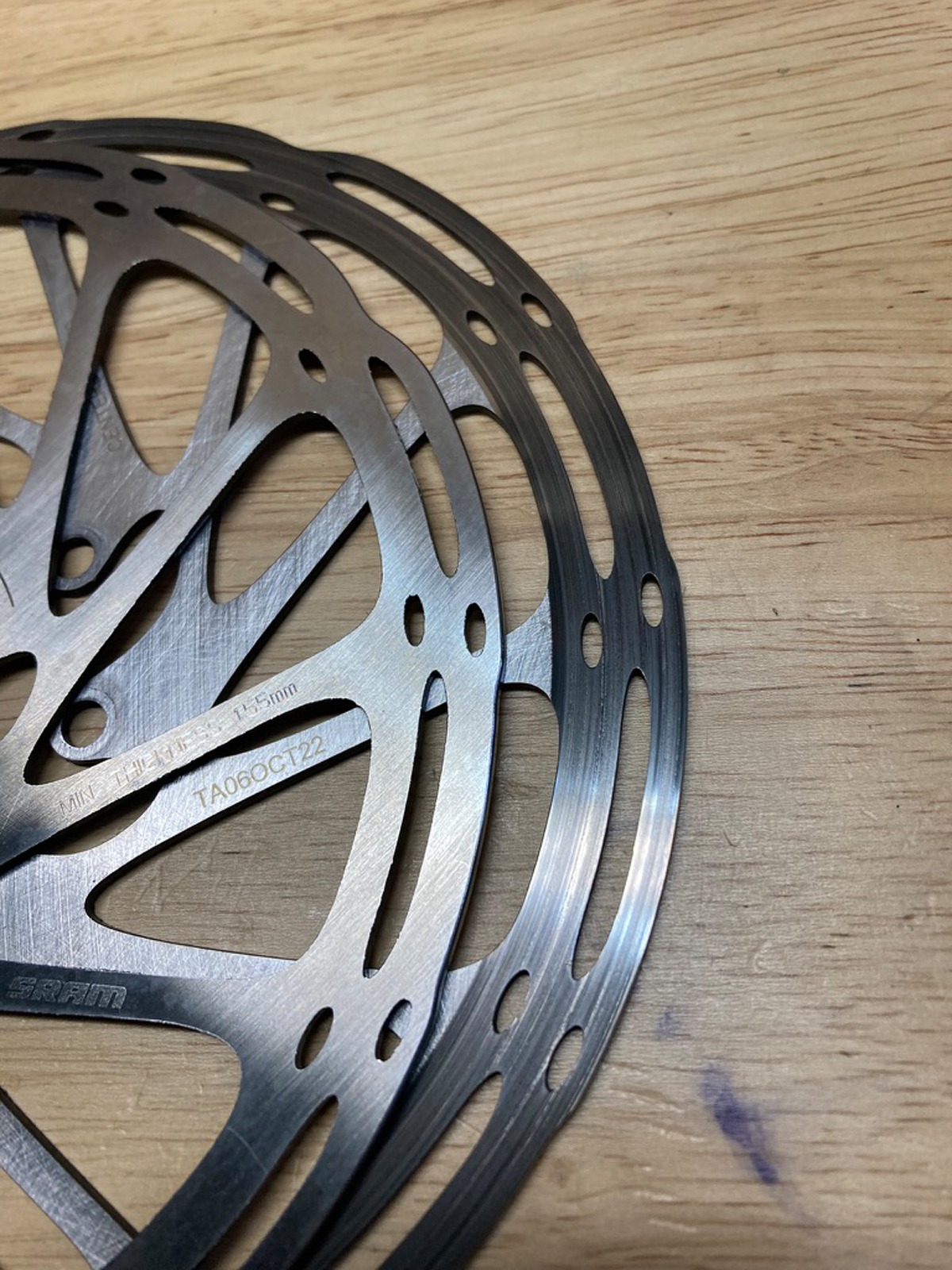
My plan was this. Replace the pads because they are easy and bleed the rear brake since the lever was acting up. On removing the brake pads, it was clear that they needed to be replaced. The braking surface had a slight shiny glaze as well as a dark, burnt appearance. The discoloration of the backing plates was evidence that the brake pads had been hot, hot, hot! What surprised me though was the fact that the pads were barely even worn. On previous bikes I have used a set of brake pads for a whole season. Have I really been putting up with such poor brake performance? (Longtime readers you know I can put up with a lot). Another thing surprised me. My rotors had been “cooked”. The brake surface of the rotors looked like the brake pads; dark blue and glazed, scored, and scratched from debris. And just like the brake pads they were barely worn. It was clear that both the pads and rotors would need to be replaced.
New rotor on top. Overheated, glazed rotor underneath. Photo by Tom Jow
To replace the brake pads and rotors is usually a pretty easy job. Begin by removing the wheels from the bike. Next remove the rotors. There are two types of mounting for brake rotors, 6-bolt and center-lock. It is also possible for 6-bolt rotors to be used on center-lock hubs with an adapter. To remove a 6-bolt rotor, use a T25 Torx wrench. In order to remove a center-lock rotor, a Shimano bottom bracket wrench is required. Remove the lock-ring by turning counter-clockwise. Once the lock-ring is removed, lift the rotor off the splines.
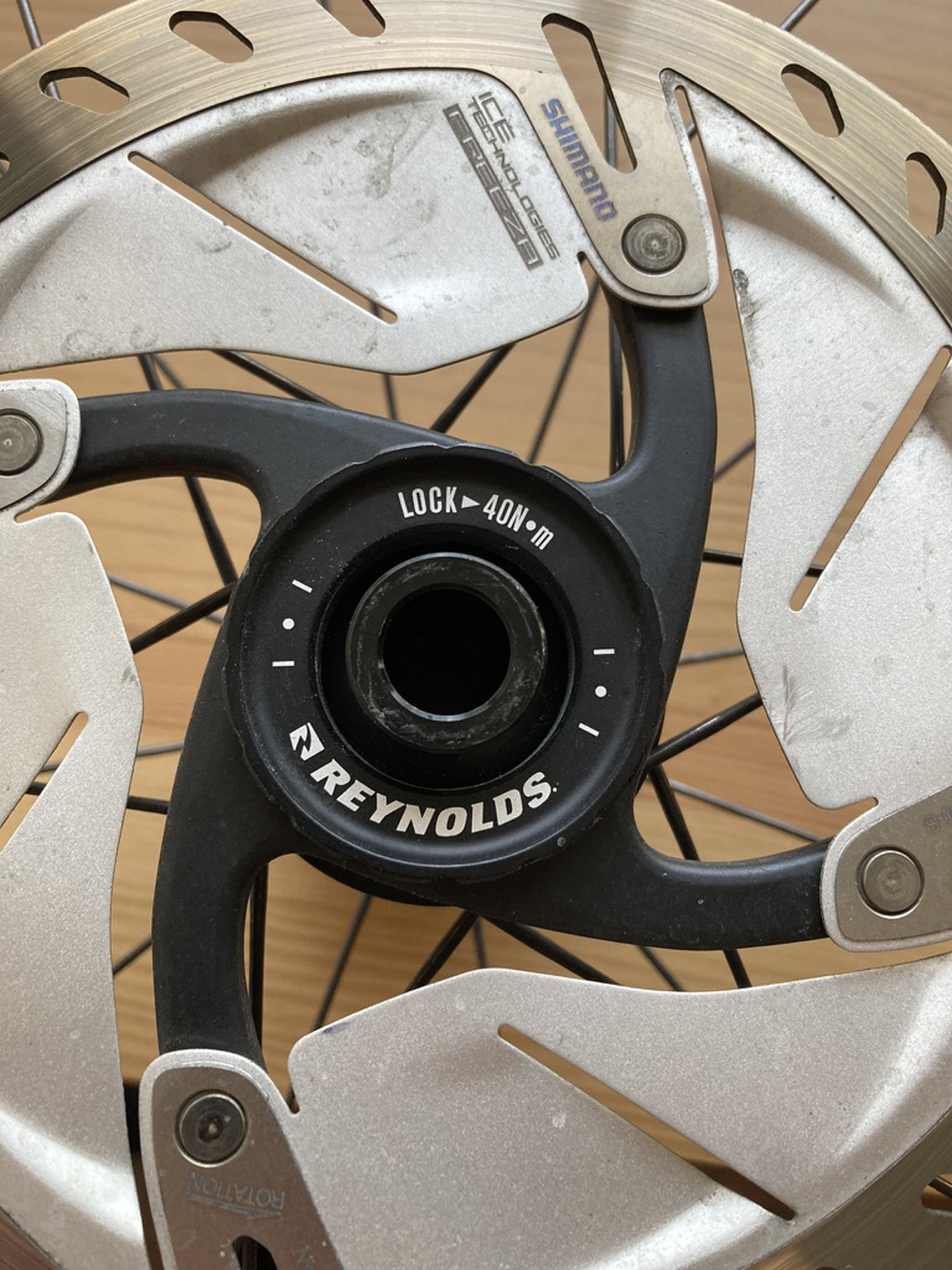
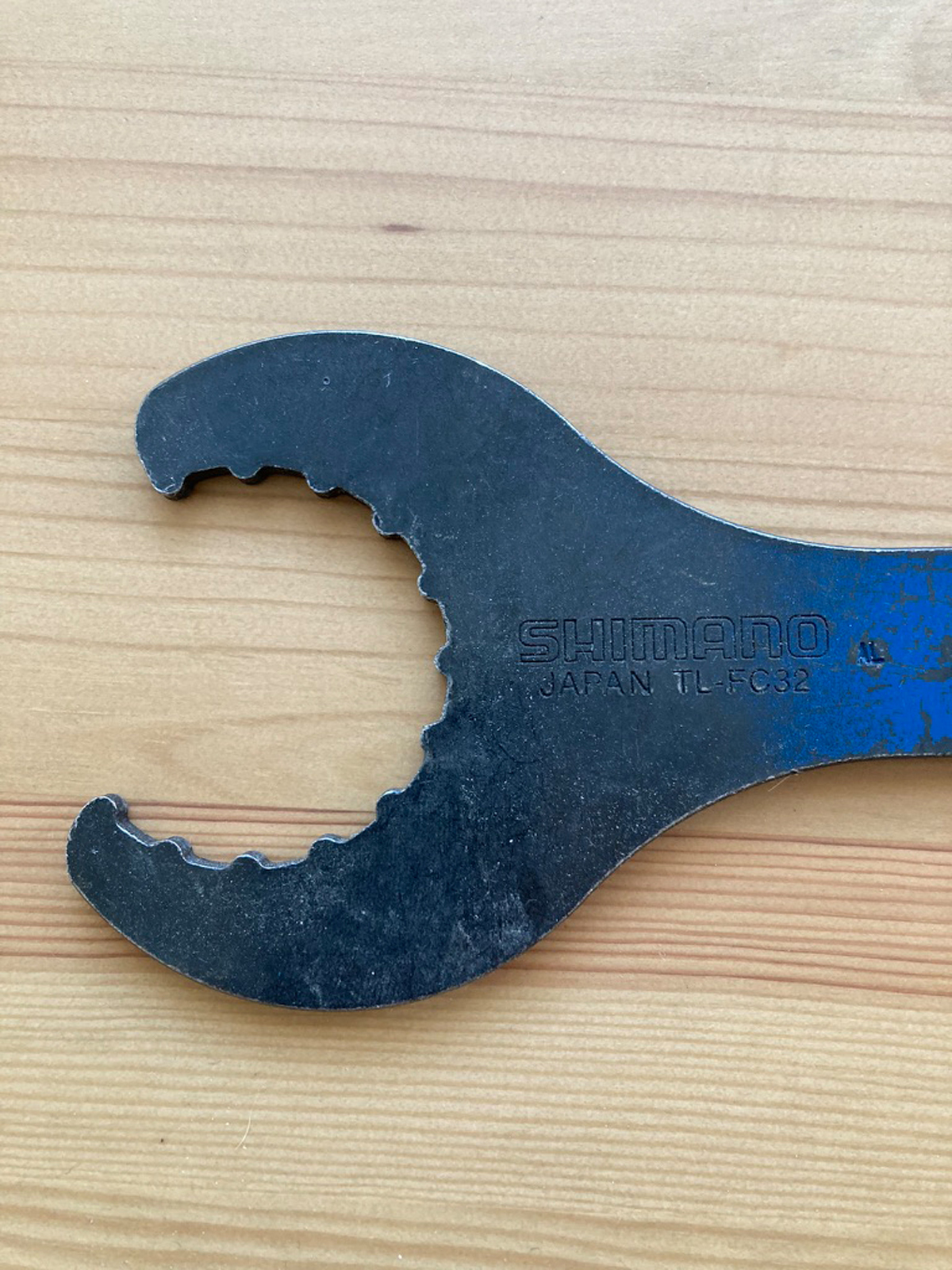
Centerlock rotors are becoming the standard for road and gravel. Photo by Tom JowShimano lockring and bottom bracket tool. Photo by Tom Jow
When installing new rotors there are a couple of things to keep in mind. First, keep the braking surface of the rotors clean and free from any oil. Handle the rotors in the center. Second, install the rotor with the printed label facing away from the hub with the rotational arrow oriented in the direction of rotation. It’s not difficult to install rotors incorrectly.
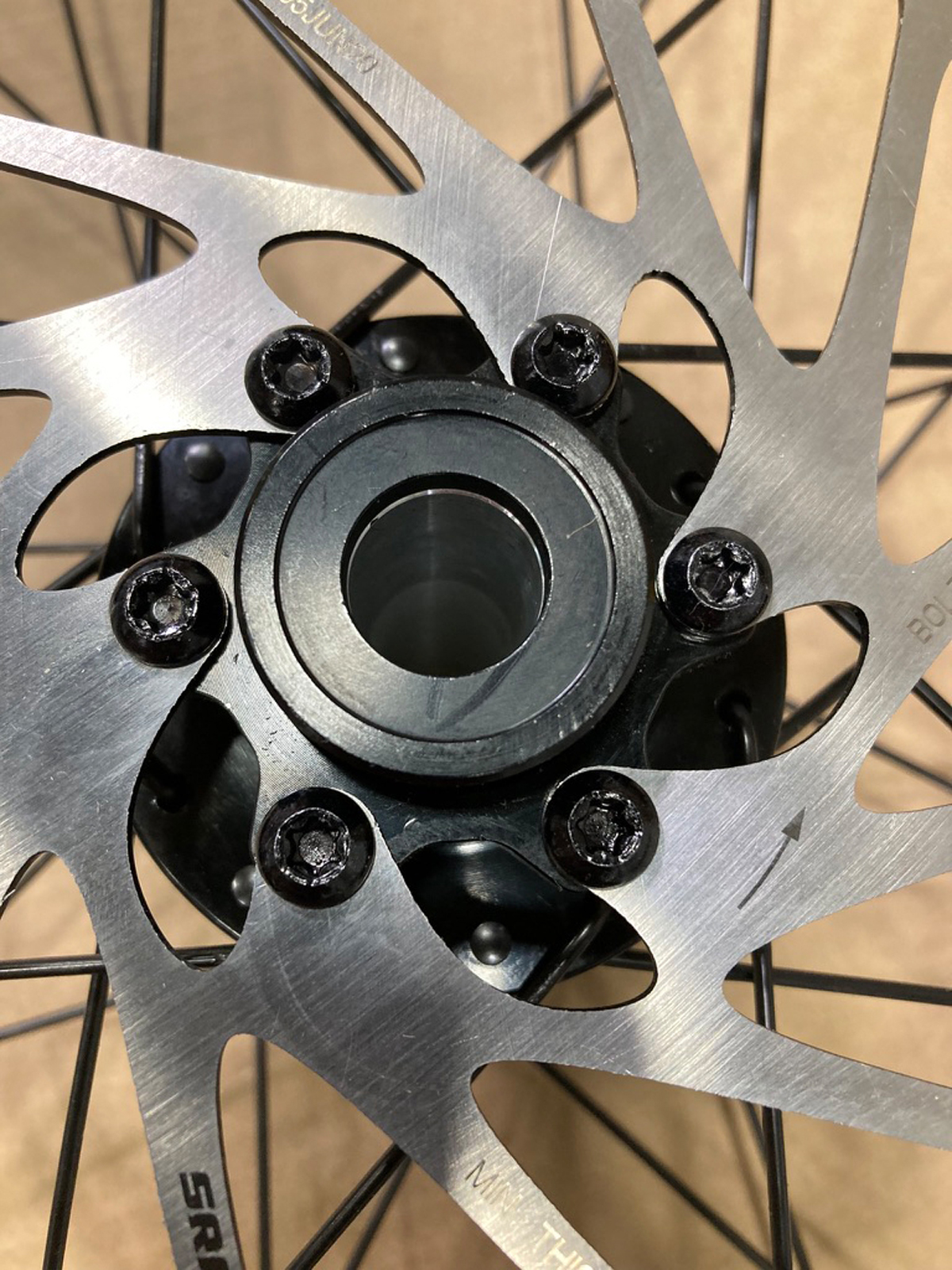
Six-bolt rotors require a T25 Torx wrench for installation and removal. Notice the directional arrow. Photo by Tom Jow
After carefully starting the 6 small bolts, tighten them in a cross pattern to the specified torque range, usually about 6-7 newton-meters. Center-lock rotors can be installed in any rotational position on the splines, there is no index. Once the lock-ring is threaded, tighten it to 40 newton-meters. If you don’t have a torque wrench for this, it’s ok. It’s darn tight and difficult to over tighten. The standard conversion of 40 newton-meters is equivalent to approximately 30 foot-lbs. So, imagine applying 30 lbs. of force to a 12-inch lever (wrench).
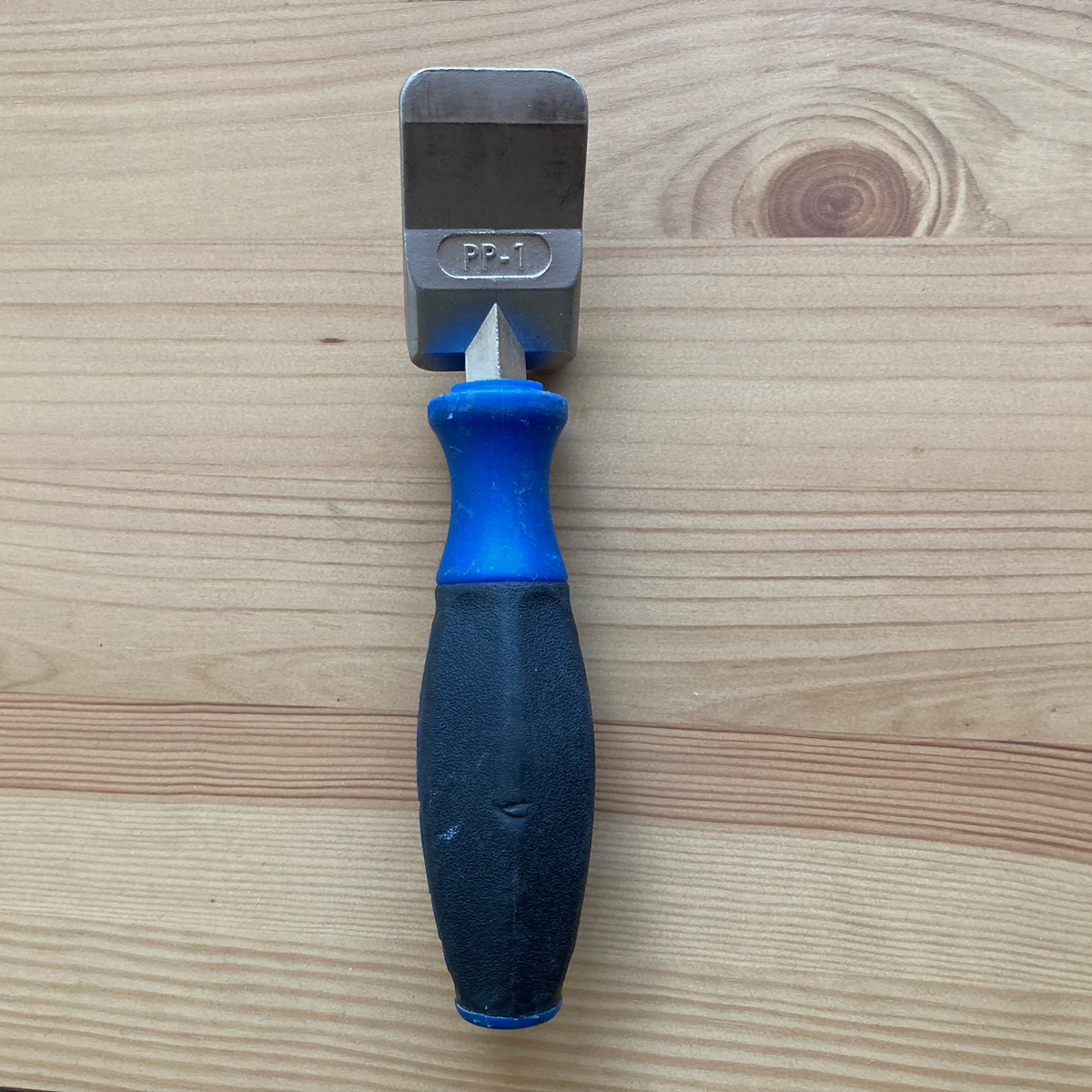
Park PP-1 brake pad spreading tool. A handy tool to have in the tool box. Photo by Tom Jow
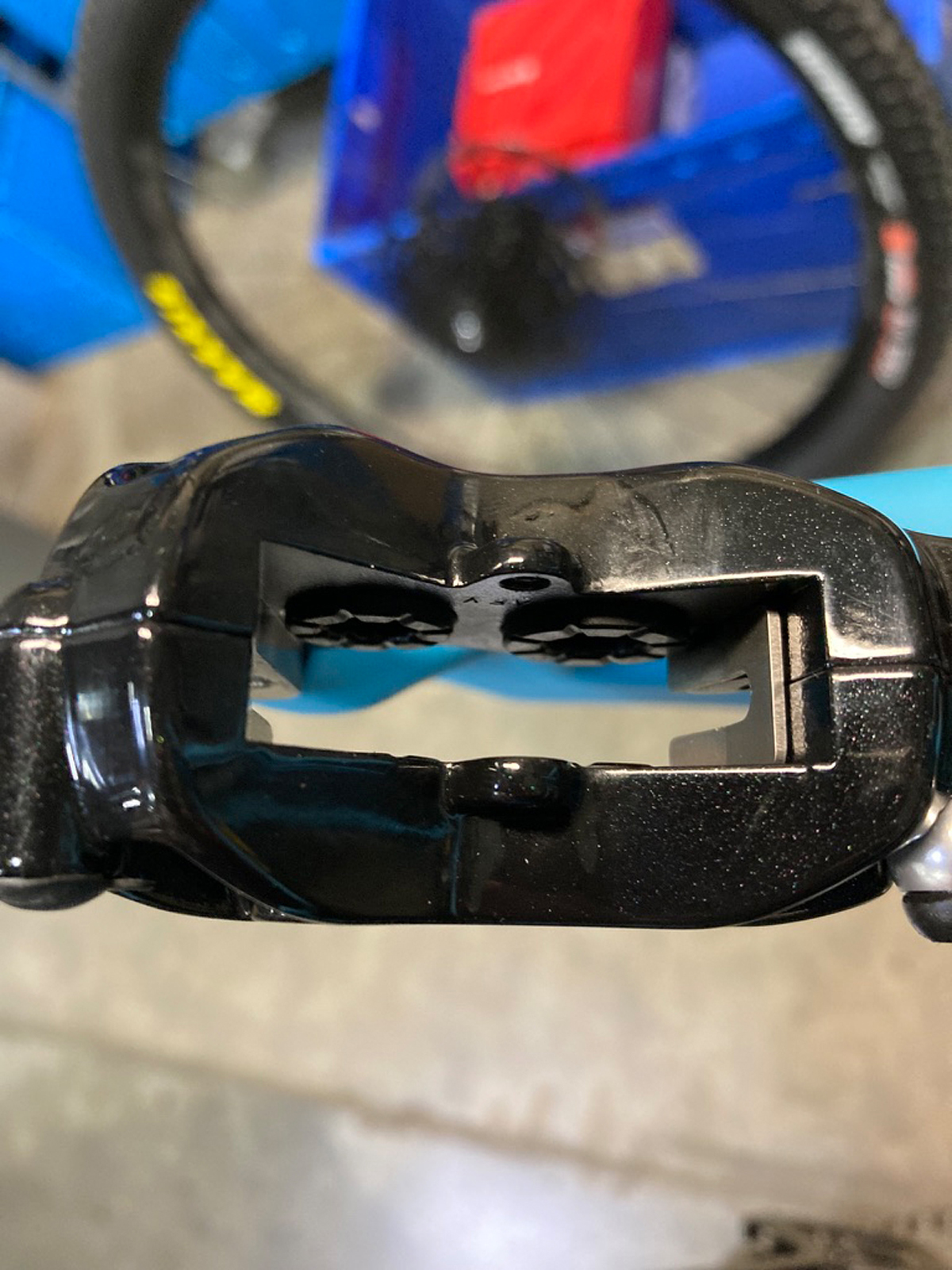
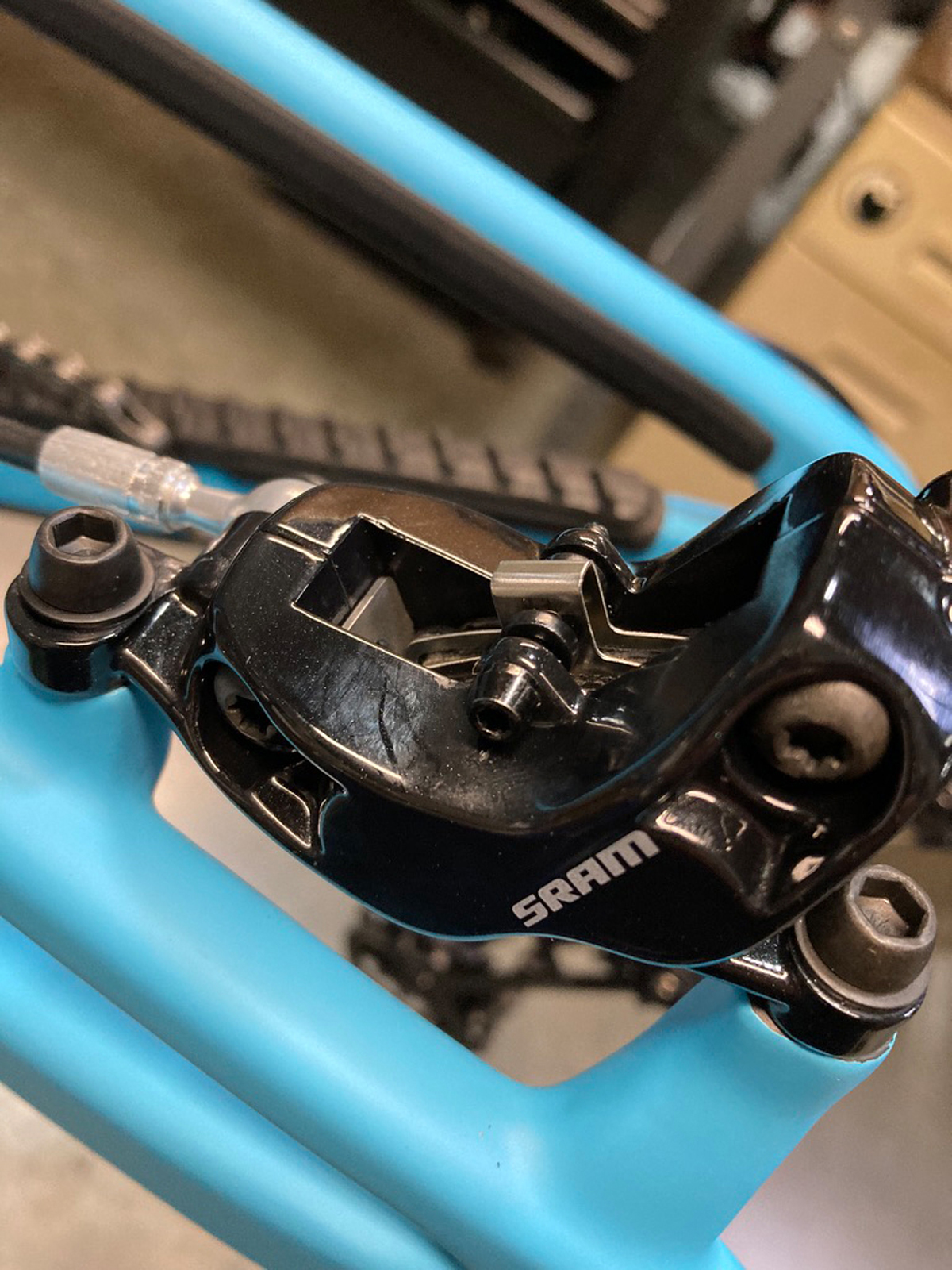
Replacing the brake pads is almost as easy as replacing the rotors. While the wheels are out of the frame, first press the old pads and pistons into the caliper using the Park Tool PP-1 or something similar. This will ensure there is enough clearance for the new pads when the wheels are reinserted. Next, remove the brake pad retaining safety clip. With the appropriate hex wrench or screwdriver, remove the brake pad retaining pin. The brake pads can now be removed by grasping the pad tabs and pulling upward and out. Inspect the back of the pads for signs of oil. Wet backing plates are a sign of leaky piston seals. Some brakes have replaceable seals (read: seals are available) but if it’s one of the two big brands, the brake caliper will need to be replaced.
Brake caliper with pads removed. Brake pistons are slightly extended. Photo by Tom Jow
While the pads are out, take a minute to clean inside the caliper with a clean, dry rag or cotton swabs. I have seen some videos that recommend lubricating the piston seals with brake fluid and then cleaning them off with isopropyl alcohol. I do not recommend this. Brake pads and brake fluid don’t mix well and placing one near the other voluntarily or otherwise is a recipe for disaster.
SRAM brakes use a 2.5mm hex for the brake pad pin. Photo by Tom Jow
With clean hands, align the new brake pads on the spring and insert them into the caliper. Insert the pin and tighten carefully. Install the safety clip. Mount the wheels and tighten the axles to the proper torque. Tip: when tightening the axles, apply pressure under the wheels as if the bike were on the ground to ensure consistent alignment of, well, everything.
Heat damaged brake pad on the right. Notice it is barely worn compared to new. Photo by Tom Jow
Actuate the brakes a couple times and spin the wheels to check the alignment of the calipers. If there is contact between the rotor and brake pads, align the caliper by slowly loosening the mounting bolts and gently adjusting the caliper until there is no contact. Be patient. This can be an excruciatingly frustrating process. When complete, remember to torque the caliper mounting bolts. I’ve seen this forgotten more than once.
Don’t stop reading, there’s one more thing. New rotors need to be “bed in” with new brake pads. This process applies a layer of brake pad material into the surface of the rotor in order to have powerful brakes. To bed in the brakes accelerate to approximately 10-15 mph. Firmly apply the brakes to slow nearly to a stop. Do not come to a complete stop and hold the brake on. This will imprint a spot of brake pad material. Perform this several times being careful not to overheat the rotor. By the third or fourth time the brakes should be feeling stronger. Five times is probably enough.
Replacing the brake pads and rotors was just what my bike needed. Their stopping power was back to full-strength, and I was able to readjust my levers back to the way I like them. Coincidentally, as I was preparing to write this article, the website PinkBike started a series “Brake Tips from World Cup Mechanics”. I waited anxiously for each installment, hoping to learn something amazing. At the same time, I was let down and relieved. There were no exotic tricks (that they would tell anyway). Keeping it simple was the way I read it. Replace brake pads and rotors at the same time. Use the correct parts (don’t mix and match). Protect your pads and rotors from contamination. Simply put, pretty much everything we’ve done here.t
LINCOLN COUNTY, Nevada (September 10, 2023) — Nevada State Parks announced that the Park to Park Pedal Extreme will return to Kershaw-Ryan State Park on Saturday, Oct. 7. The popular ride is now open for registration.
Cyclists will enjoy miles of scenic beauty as they ride along Nevada’s first Scenic Byway, Highway 93, and peddle past the 1920s mission-style depot in the railroad town of Caliente and through the historic mining town of Pioche. The tour winds through four of Nevada’s beautiful State Parks: Kershaw-Ryan, Cathedral Gorge, Spring Valley, and Echo Canyon, and includes breathtaking views of Meadow Valley. The tour is capped off with a hearty Dutch oven feast at Kershaw-Ryan State Park.
Cyclists at Cathedral Gorge State Park. Phot esoospe
The Park to Park Pedal event features three rides to choose from:
100 Mile Extreme
This ride is the most challenging with approximately 5600 ft of climbing. Pedal through four state parks, two old west towns, and up Pioche Hill.
60 Mile Double Jack
A more moderate challenge, this ride does include Pioche Hill, which is approximately 1400 ft of climb in about 10 miles. Features two state parks and two old west towns along the way.
40 Mile Helix
A shorter ride without extreme hill climbs. This ride goes from Kershaw-Ryan to Cathedral Gorge State Park in Panaca. Two state parks and the old railroad town of Caliente.
Registration is online at https://parktoparkpedal.com. Packet pick-up is Friday night between 4 p.m. and 6 p.m. at Kershaw-Ryan.
Contact Dawn Andone, [email protected], 775-728-8101 with any questions.
The Park to Park Pedal returns to Lincoln County, Nevada Oct. 7. Registration is available at https://parktoparkpedal.com.
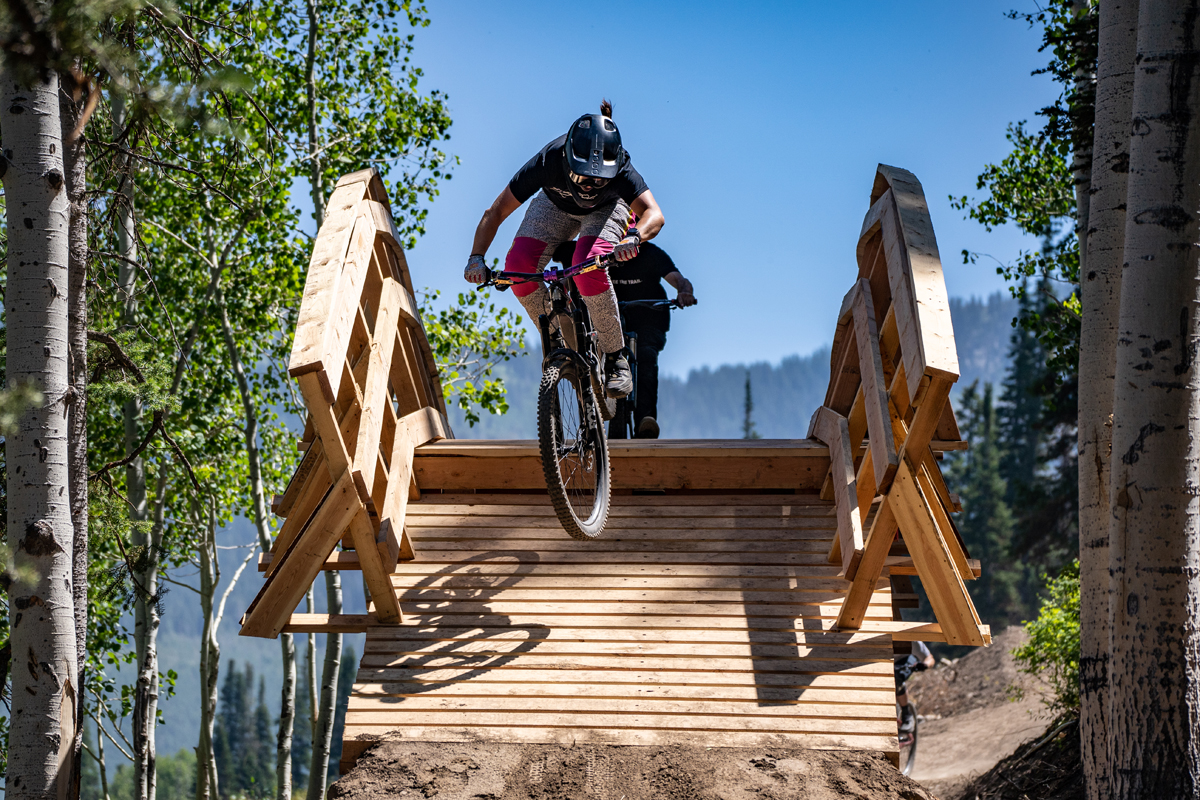
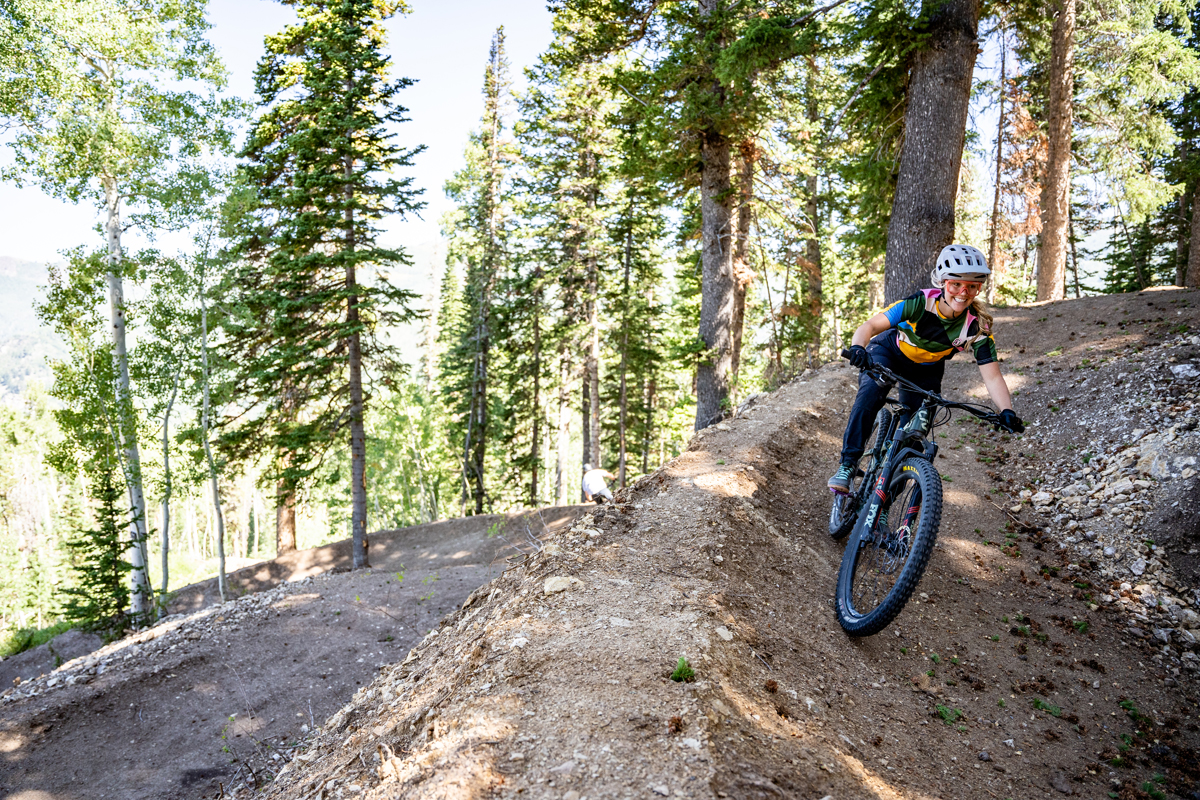
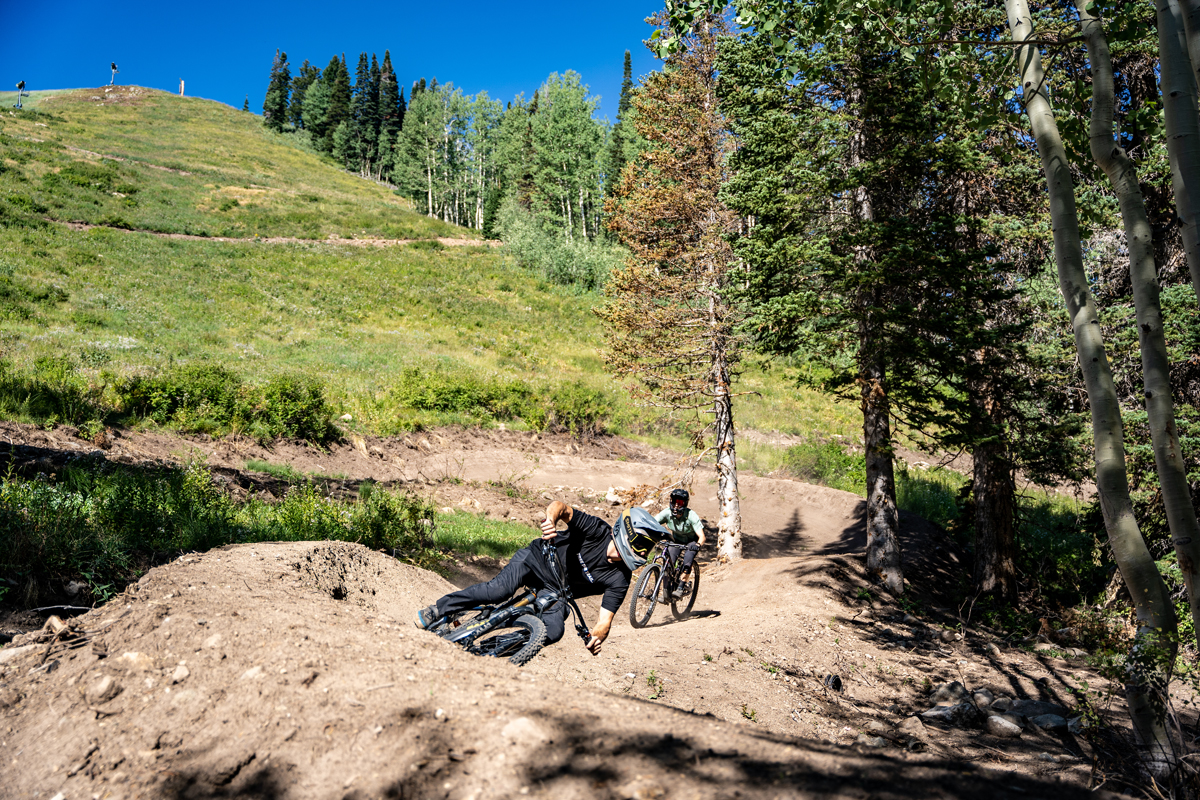
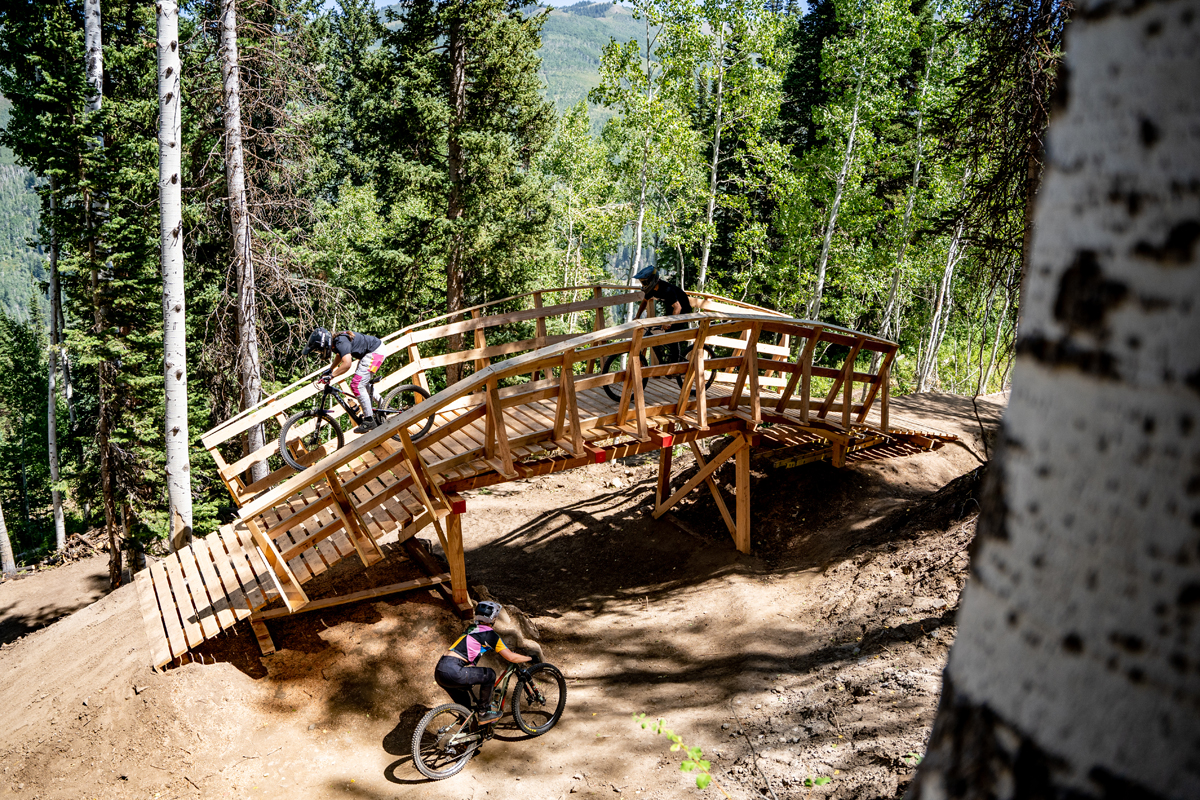
BIG COTTONWOOD CANYON, Utah (September 8, 2023) – The first phase of trails in the new Solitude Bike Park opens this Friday, September 8. Four trails ranging from green circle (easier) to black diamond (most difficult) will be open Friday-Sunday through October 8, conditions permitting.
Scenes from the Solitude Bike Park. Photo courtesy Solitude Mountain ResortScenes from the Solitude Bike Park. Photo courtesy Solitude Mountain ResortScenes from the Solitude Bike Park. Photo courtesy Solitude Mountain Resort
Designed by Gravity Logic, six miles of new downhill trails will consist of two freeride trails, Mother Lode and Cobalt Cruise, and two technical trails, Mine Shaft and Holy Schist. All four of these new trails will be accessed via Moonbeam Express.
“With this initial phase of trails, we really wanted to provide an experience that accommodates riders of all ability levels,” says Solitude Bike Park Manager Tyler Sites, “The Gravity Logic team is known for their attention to detail and exceptional trail work. These four new trails represent the first step in a larger series of downhill mountain bike trails coming to Solitude.”
It should be noted that with limited weekends remaining in the season, Solitude’s lift operations staff will be focusing their efforts on the Eagle Express chairlift upgrade. Moonbeam Express will operate with one bike carrier for every five chairs. By next summer, the resort expects to double this capacity.
Due to construction delays caused by lingering snowpack from the 22/23 winter, some sections of these new trails are currently under construction. While trail crews work to complete the lower section of Cobalt Cruise (blue freeride trail) riders will take a detour via Serenity to return to Moonbeam Express. Technical trails Holy Schist and Mine Shaft will be accessed by temporary connection trails. Mine Shaft will return to Moonbeam Express via a temporary connector as well. Mountain bike rentals and lessons will be available through the end of the season; 23/24 Ikon Pass holders receive 25% off full-day bike tickets and $80 Solitude Bike Park Season Passes.
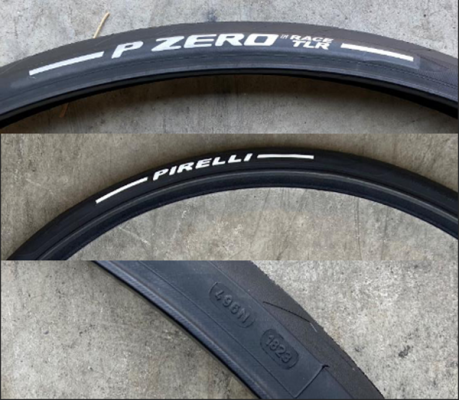
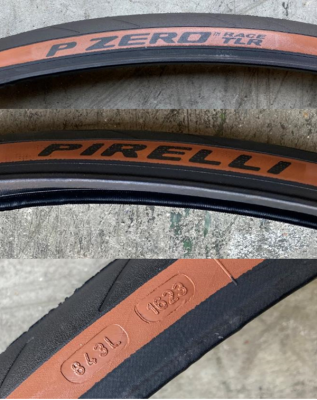
September 7, 2023 — Pirelli and the Consumer Product Safety Comission have recalled certain Pirelli P ZERO Race TLR bicycle tires in the size 28-622. The tires are black and have either yellow, white, red, or gold branding on the sidewalls. The model name, model number, tire ID and production date code can all be found on the sidewalls.
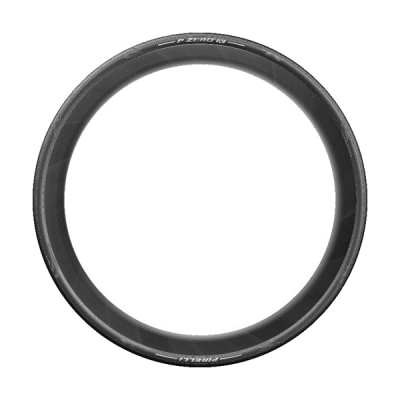
Certain Pirelli Pirelli P ZERO Race TLR Bicycle Tires were recalled on 9-7-23.
Name of Product: Pirelli P ZERO Race TLR Bicycle Tires
Hazard: The tire bead can unseat from the rim and lead to rapid air loss in the tires, resulting in loss of control and posing a fall hazard.
Remedy: Refund, Replace
Recall Date: September 07, 2023
Units: About 14,500 (In addition, about 550 were sold in Canada)
By Erica Tingey — Proper hydration while mountain biking is critical for nutrient and oxygen delivery, organ and tissue function, temperature regulation, joint lubrication, and energy production. Just about every biological reaction in your body requires water! Athletes must take extra care to ensure they get enough water because we lose water through sweating and increased energy demands. I’ve outlined some tips for staying hydrated while mountain biking.
Drink Water Before Your Ride
Drink plenty of fluids throughout the day, and try to drink half a liter (~16 ounces) a couple of hours before your ride. Caffeinated beverages like coffee and tea used to get a bad rap because they were rumored to be dehydrating; however, current evidence suggests this isn’t the case. In fact, caffeine can help promote metabolic processes that produce energy to fuel your ride.
Hydration is especially important when riding in the desert. Photo courtesy Erica Tingey
Bring Enough Water on Your Ride
How much water you need for a ride will depend on many factors, including the length and difficulty of your ride, the ambient temperature, and how much you sweat. A good place to start is to aim for about half a liter (~16 ounces) for cooler weather and up to one liter (~33 ounces) for warmer weather every hour. Take a couple of sips every fifteen minutes or so. After your ride, write down how much you drank (add them to your phone notes, Strava, or a notebook) to help you plan for the next ride.
Some riders determine their approximate sweat rates at various temperatures by weighing themselves on a digital scale before and after a one-hour ride (this is only accurate if you don’t eat, drink, or urinate during the ride). You should aim to replace at least 75% of the water you lose to sweat. You don’t want to add unnecessary weight by bringing far too much water but err on the side of bringing more than less. For longer rides, consider bringing a hydration bladder carried in a backpack or fanny pack.
Replenish Electrolytes
Replenishing electrolytes (sodium, potassium, calcium, and magnesium) is critical—especially for rides that last more than an hour. I like the convenience of pre-measured electrolytes in “Ultima,” which are available at Whole Foods or Amazon.
Signs of Dehydration
Some indicators of losing fluids too rapidly include dizziness, headache, nausea, lack of sweating, dry lips or eyes, thirst, muscle cramps, and a pounding heartbeat. Dehydration can become very serious very quickly. If you think you’re dehydrated, stop and replenish your fluids and electrolytes. Call for help if needed.
Prepare for Emergencies
Running out of water can quickly become an emergency, especially if you are stranded in the backcountry. Consider stashing a lightweight LifeStraw, mini filter, or water treatment tablets in your first-aid kit for greater peace of mind.
Staying hydrated will help you optimize performance so you can focus on having fun on the trails. Stay safe!
About the artist: Leach is a former amateur racer who is still an avid cyclist almost fifty years later. He is widely exhibited and collected throughout the US and his cycling art is collected worldwide.
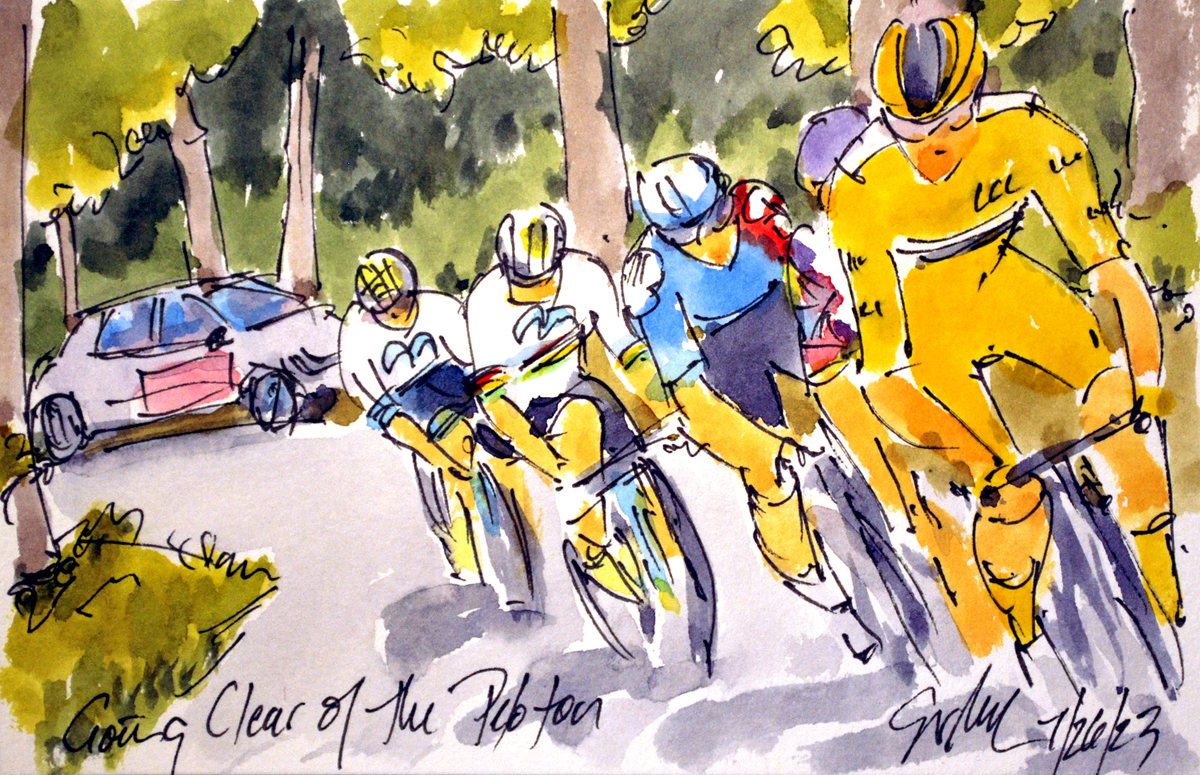
Title of piece: Going Clear of the Peloton
“Going Clear of the Peloton” Bike Art by Greig Leach, greigleach.com
About the piece: From Stage 5 of the 2023 Tour de France Femmes (Onet-le-Château to Albi): Every post-race interview Lotte Kopecky (SD Worx-Protime) swears she is riding in aide of her team leader, Demi Vollering, yet she is still in the Maillot Jaune. With her lead in the Tour de France Femmes slipping away to those in the breakaway up the road, she finally has a dig to get away from the peloton and up to those who are threating her lead. She was quickly marked by Cecilie Uttrup Ludwig (FDJ-Suez) and the duo of Annemiek Van Vleuten and Liane Lippert (Movistar). Collectively, these six (there is a UAE Team ADQ rider mixed in there too) are a number of those that are favored for the overall once the peloton reaches Pau on Sunday. But there is quite a bit of racing left in stage 5 and over the next four days yet to be fought.
Medium: Ink and Watercolors
Brief artist’s statement: All of my artwork is about color and the figure in motion, so cycling became a natural inclusion in what I choose to paint. I began painting cycling in 2012 when watching the Tour de France. I was feeling guilty watching TV in the middle of the day, and my actor wife Bridget Gethins suggested I paint the race and see if I could sell them by posting them on Facebook. That has grown into a cycling blog, Twitter, two books of my cycling art, and being featured during NBC’s coverage of the Tour de France since 2018.
Where can people find or buy your art?: All of my artwork can be seen, and purchased, at my website, www.greigleach.com. The Gallery labeled “2023 Tour de France and Tour de France Femmes” has the work that was created this July. But you can search for your favorite team, rider, or race at the website home page.
Website or social media for your art: In this day and age, one needs to be on many social media platforms. My cycling blog is www.theartofcycling.blogspot.com, I am on twitter @artofcycling, instagram @greigartist, tiktok @artofcycling, and YouTube @artofcycling/Greig
By Sarah Kaufmann — As we approach fall, a common theme for many athletes over the summer is managing a mid-season slump. Most riders who train year-round or nearly year-round reach a point mid-season, when progress seems to stall, and physical and mental challenges feel overwhelming. Here are some of the reasons why a mid-season slump is so common.
After months of dedicated training and racing, the physical fatigue has caught up. Even if you are diligent with recovery days and weeks, the months of accumulated load can catch up.
The months of training can also result in mental fatigue. The pressure of racing and training takes a toll. It can be exhausting to manage work, family, and other outside life stressors alongside a heavy cycling habit.
You see more signs of progress in the first half of the year. But inevitably, those improvements begin to plateau. This plateau often lines up when the physical and mental fatigue coalesce. This can feel demoralizing and add to the mental/emotional strain.
Managing all the training can get monotonous. If you are following a structured program, you may be riding the same areas to perform intervals. Likewise, if you always have a similar block of time to ride, you, again, likely ride the same areas frequently.
Mid-summer heat or rain storms make training challenging. The heat often acts like a governor on your effort and requires more diligent planning around pre-hydrating, in-ride nutrition and hydration, and cooling methods. Summer rain can also impact training times and both weather conditions may force you to modify your ride timing, ride indoors, or skip your rides, all of which can be challenging and demoralizing, as well as add to the mental fatigue.
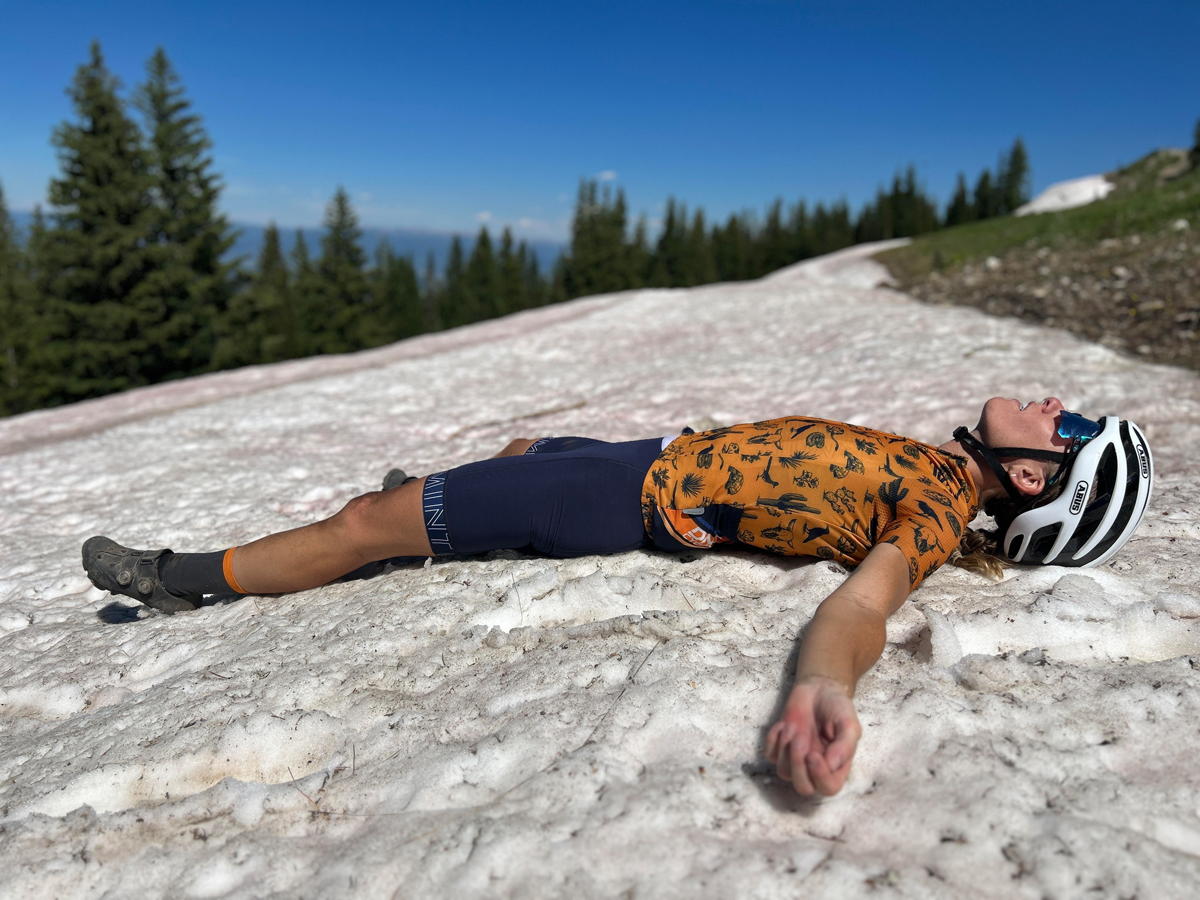
Lauren Zimmer taking a break in a summer snow field. Photo by Brian Zimmer
All of these issues are real and valid. Riders struggle with them every year and if you are or have struggled with a mid-season slump for these or any other reason, know that it’s normal, it happens, and you can get back to feeling good, motivated, and fit again. Here are some ways to overcome these challenges.
If you notice that training is feeling like a chore, instead of fighting through to keep grinding, stop forcing it. Pull back. Take a few days off or take a week. If you struggle with resting, try to fill the time with recovery modalities. Walking (truly walking, not hiking), naps, massage, gentle yoga are all good options. If you still feel in a rut when you get back on your bike you either need more rest or need to change something else. Try eating/drinking more or different fuels/hydration, ride at a different time of day, or ride different routes. Be honest with yourself and listen to your body through this process.
You may need to pull back on structure. If you work with a coach, your coach should be able to recognize this and work in more open, fun rides. Intervals are great for building fitness, but they can be mentally and emotionally draining, especially if you are in a funk. Ride with friends, join group rides, ride gravel or MTB if you typically ride road, mix it up as you can.
If your goal event is still a way out, set some smaller process goals along the way to reignite motivation. Focus on execution items that are within your control.
Set up a meeting with a coach or sports psychologist for some personalized guidance during this phase. They will have a new perspective, can tailor/modify your trainin] g plan, and help you address mental challenges.
Do a double check on your nutrition and hydration to be sure there isn’t an aspect you are overlooking that could be holding you back. If you aren’t sure, seek out a dietician to run through your intake and needs.
Get a full blood panel. Rule out any imbalances, deficiencies, or viruses. Sometimes it’s something going on under the hood.
A mid-season slump is normal and a natural part of the sport. It’s hard to see the other side when you are suffering and deep in a slump. But it does come back around. Understanding the contributing factors and implementing strategies to overcome, cyclists can emerge stronger, more motivated, and well-prepared to finish the season on a high. It’s also a learning opportunity. Experience plays a huge role in cycling success and the more you know about yourself, the better equipped you are at managing the ebbs and flows that will come up again. Embracing rest, setting new goals, seeking support, and incorporating variety into training routines are some of the keys to overcome a mid-season slump and get the most out of your season.
Eligible Utah residents can receive vouchers for select e-bikes in an effort to improve Utah’s air quality
SALT LAKE CITY, Utah (September 1, 2023) — The Utah Clean Air Partnership (UCAIR) and Magnum Bikes are reopening applications for their e-bike incentive program for all Utah residents. The program offers up to $800 off the purchase of select Magnum e-bikes and up to $1,200 off select Magnum cargo e-bikes. For eligible income-qualified residents, these voucher amounts go up to $1,000 and $1,400 respectively.
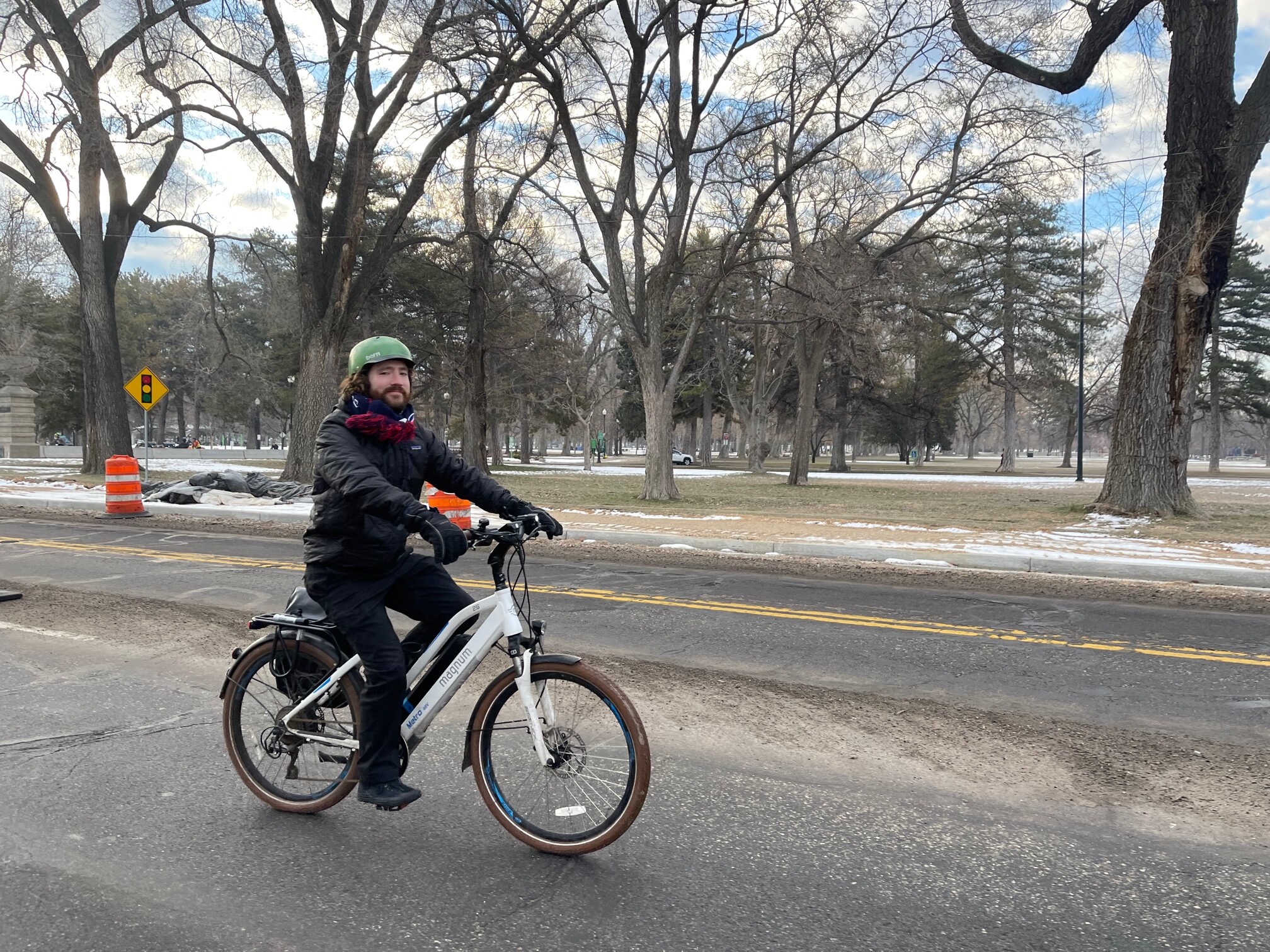
Magnum e-bikes is partnering with UCAIR to provide incentives for e-bike purchase to Salt Lake County residents. Photo by Dave Iltis
Applications originally launched on June 23 to Salt Lake County residents only. Within less than a week, the program received over 1,500 applications, 219 of which were for the income-qualified vouchers.
“We saw overwhelming popularity and success with the program in June. Over 250 participants have already redeemed their vouchers, which means 250 more e-bikes are on the roads instead of cars,” says Kim Frost, UCAIR Executive Director. “We are so excited to reopen the applications to continue the collective effort to improve Utah’s air quality.”
Utah residents must submit an application to receive a Magnum e-bike voucher code. The application link goes live on Friday, September 1 at 12 p.m., and the vouchers are made available on a first-come, first-served basis to the first 1,000 eligible applicants. Applications will close once all 1,000 vouchers have been distributed.
There are two levels of vouchers available: standard and income-qualified. For the standard voucher, all Utah residents age 18 and over can save up to $600 on select commuter e-bikes, $800 on select cruiser e-bikes and $1,200 on select cargo e-bikes. For the income-qualified voucher, Utah residents who meet income-qualified requirements can save up to $800, $1,000 and $1,400 respectively. “Ride Now, Pay Over Time” payment plans with interest as low as 0% are available to pay remaining balances in monthly installments.
As a sustainable transportation option, e-bikes help reduce the reliance on fossil fuel-powered vehicles.
“The electric motors in e-bikes generate zero emissions, which improves air quality while also offering an easier ride compared to traditional bikes,” says Jesse Lapin, Magnum Bikes Chief Operating Officer. “We are so happy that more Utahns will have access to e-bikes and can contribute to cleaner air for all.”
Please visit ucair.org/ebike to apply, explore the different e-bike types and learn more about the incentive program.
Famous 203-mile bicycle race from Logan, Utah, to Jackson, Wyoming, attracts cyclists from across America and foreign lands.
LAYTON, Utah — Like mayflies on the wing drawn to light, Wyoming’s Grand Teton will again be a beacon in early September for bicyclists who want to know just how much pain they can endure.
On September 9 more than 1,500 U.S. and international cyclists will pedal 203 miles from Logan, Utah, to Wyoming’s Jackson Hole Mountain Resort in the 41st annual LoToJa Classic.
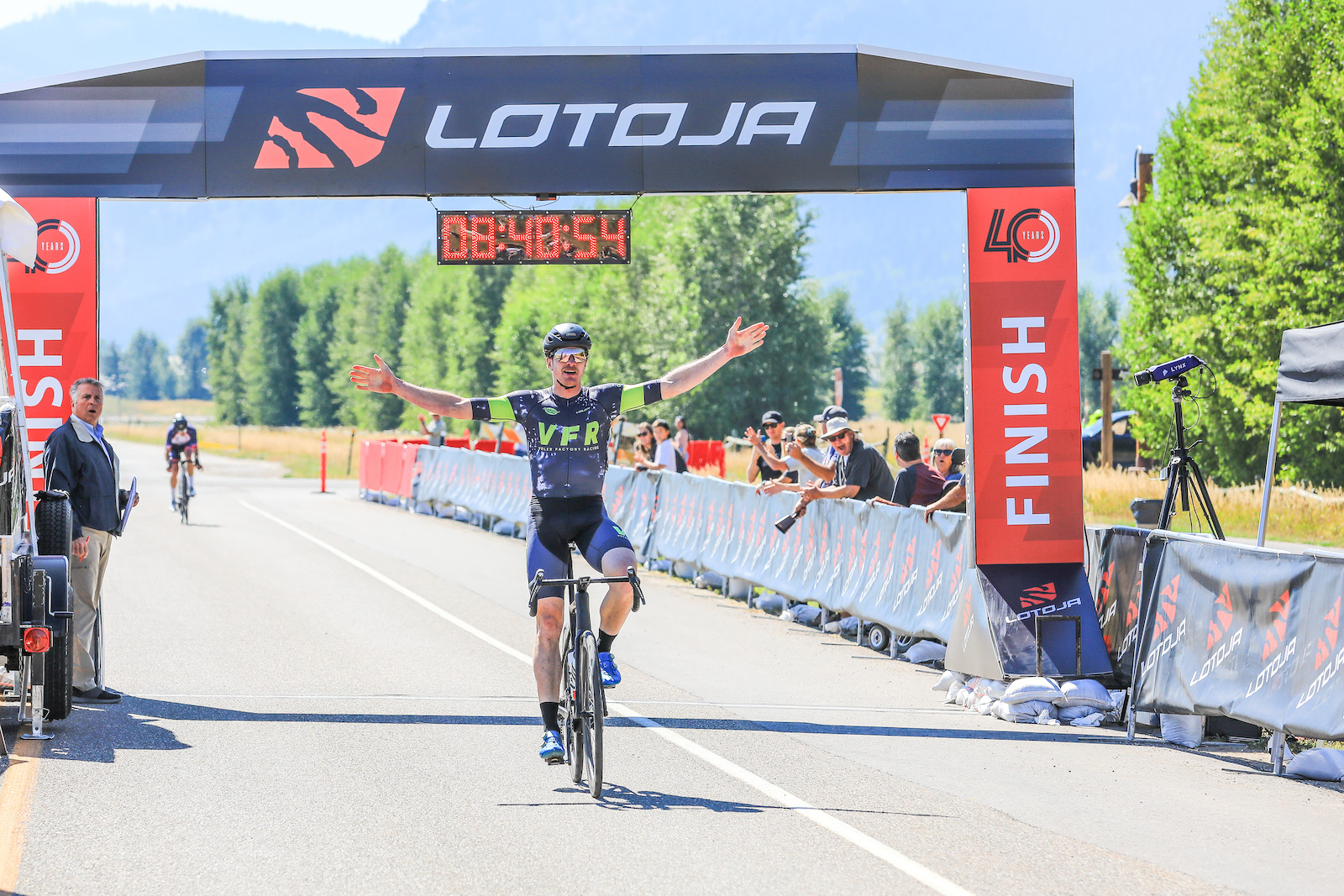
John Borstelmann (Team Voler Factory) solos to the finish at Jackson Hole Mountain Resort to win the Men Pro 123’s in the 2022 LoToJa Classic. He set a time of 8:41:43 in the 203-mile road race from Logan, Utah, to Jackson Hole Mountain Resort. Behind him is Nathan Spratt (Team Hangar 15) who took second. This year’s 41st annual LoToJa Classic will be held on Sept. 9. Photo courtesy of Snake River Photo.
Held every year since 1983, LoToJa’s finish line rewards participants with a poignant view of the 13,776 foot-high Grand Teton after riding 203 miles in a day. The event is one of the most iconic and popular point-to-point bicycle road races in America.
“We’re ready to put on another memorable LoToJa, to give cyclists a day on the bike they’ll always remember,” said Brent Chambers, the event’s race director for the past 25 years. “We’re counting on a spectacular day with ideal weather, and leaves starting to turn with fall colors.”
This year’s race will feature USA Cycling licensed racers, cyclosportive cyclists, relay teams and tandem riders from 38 states, Canada, Great Britain, and Germany. They will start at dawn at Sunrise Cyclery in Logan and ride on roads over flat, rolling, and mountainous terrain through northeastern Utah, southeastern Idaho, and western Wyoming.
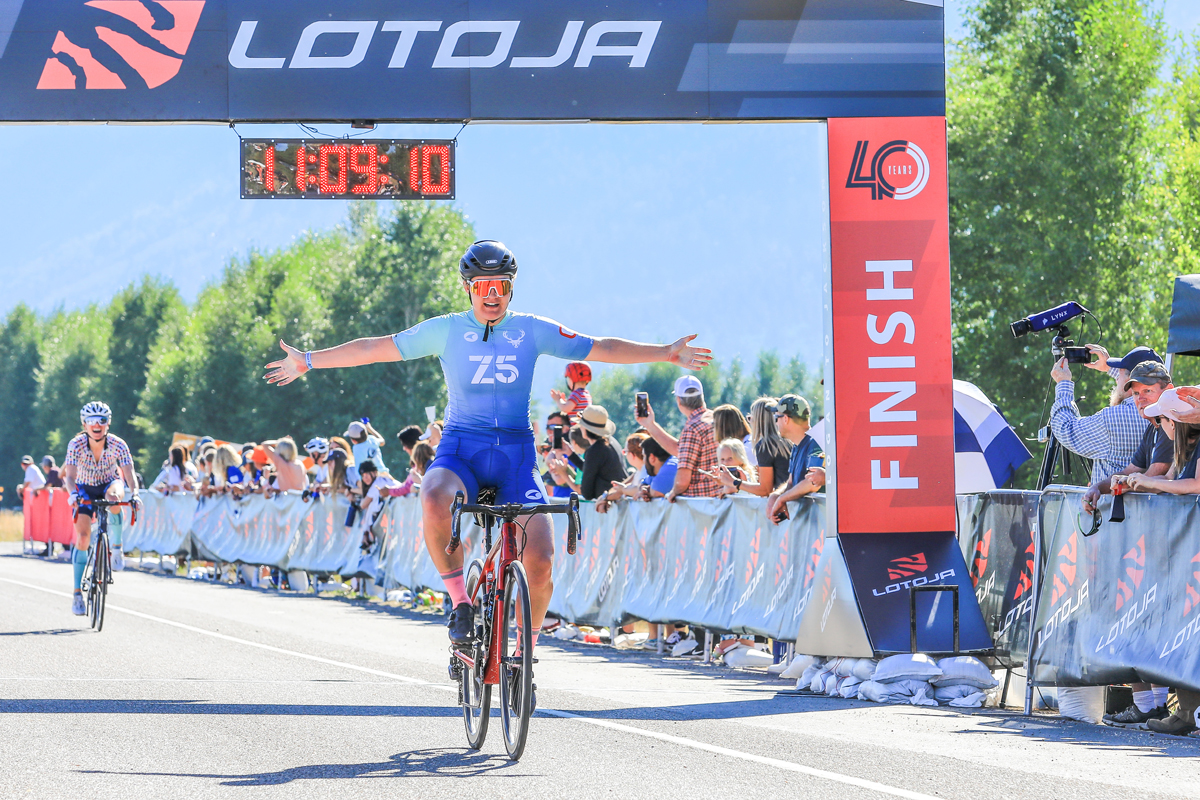
Aileen Pannecoucke (Team Zone 5) celebrates after winning the Women Pro 123’s in the 2022 LoToJa Classic at Jackson Hole Mountain Resort. She set a time of 9:58:00 in the 203-mile road race. Behind her is Hallie Megan French (Team Type II Fun), who won the Women Master’s 35-plus category. This year’s 41st annual LoToJa Classic will be held on Sept. 9. Photo courtesy of Snake River Photo.
The fastest licensed racers reach the finish line at the ski resort around mid-afternoon. The current men’s record is 8:18:29 and the women’s is 9:35:00. But most cyclists take 10 to 13 hours to complete the course.
The fastest licensed riders win cash and/or merchandise. All who complete LoToJa earn a finisher’s medal that commemorates their accomplishment. For many, though, the biggest prize is seeing the Grand Teton and the Teton Range after a long, hard day on the bike.
But seeing “The Grand” is only part of LoToJa’s many visual gifts. The race’s vistas and course both inspire and challenge cyclists’ physical and mental stamina.
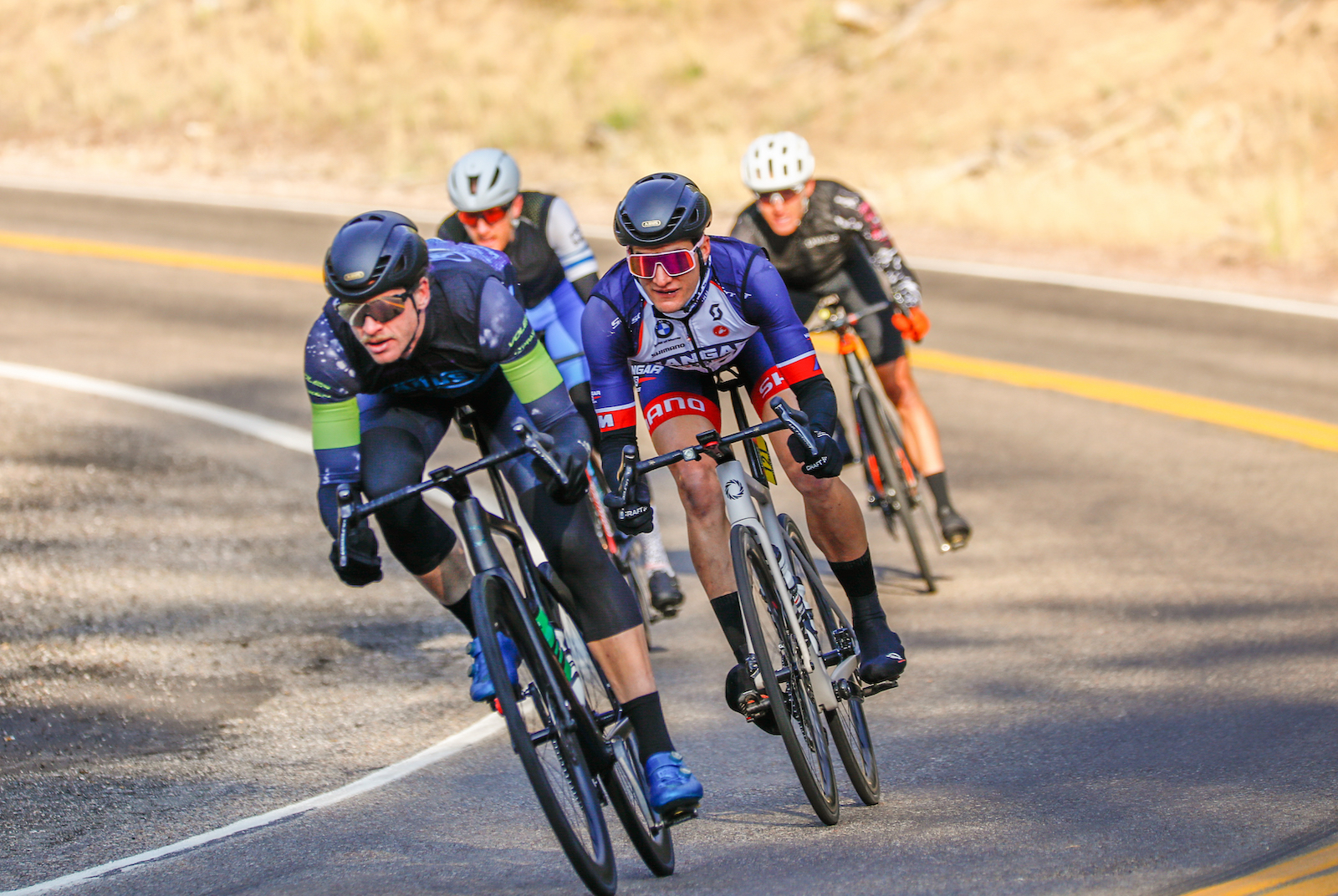
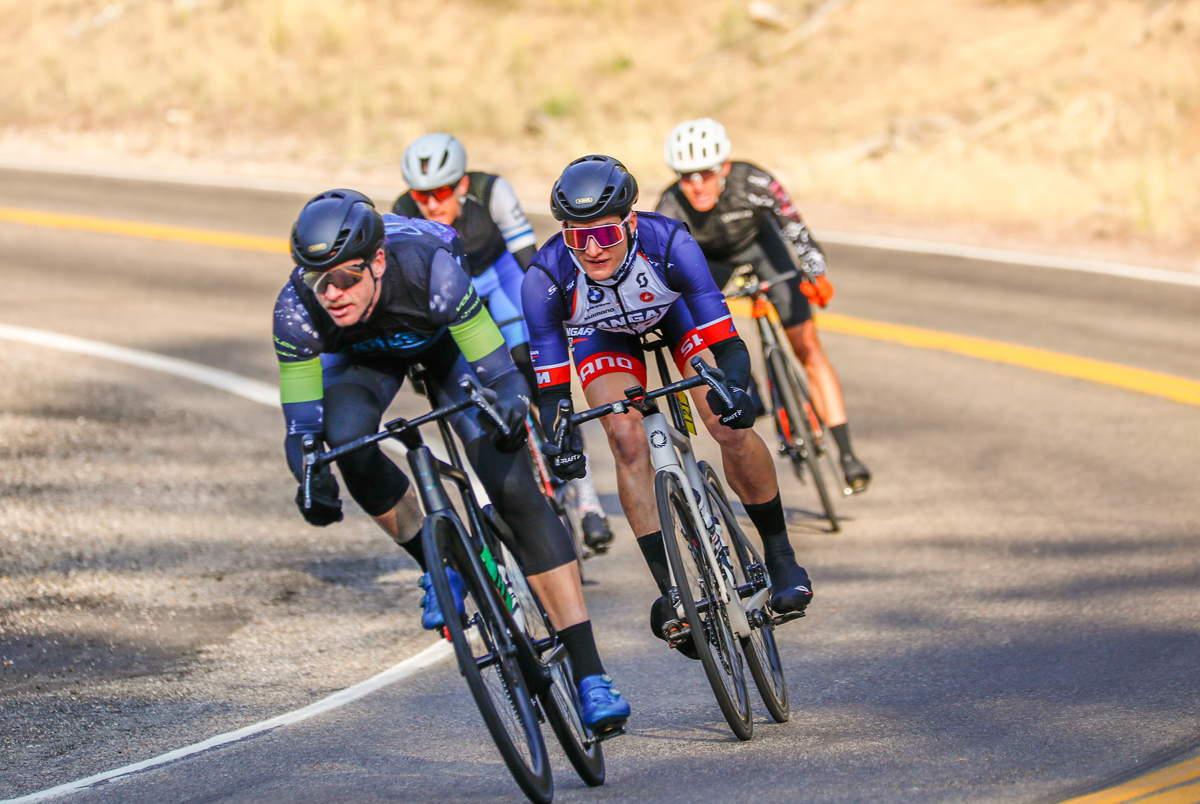
Strawberry descent: 2022 eventual winner John Borstelmann (Team Voler Factory) is closely marked by Marc Spratt (Team Hangar 15) and two other cyclists while descending into Bear Lake Valley from the summit of Strawberry Canyon in the 40th annual LoToJa Classic on Sept. 10. Borstelmann won the Pro Men 123’s and Spratt took fifth. Photo courtesy of Snake River Photo
The course features three mountain passes that total 35 miles and almost 10,000 vertical feet of climbing. Cyclists also roll through Utah’s Cache Valley; Idaho’s Preston and Montpelier; and Wyoming’s Afton, Thayne, Etna, and Alpine in Star Valley. After Alpine, cyclists ride 47 miles up Snake River Canyon and past Hoback Junction to Jackson Hole Mountain Resort.
LoToJa is recognized as the longest, one-day USA Cycling sanctioned road race in America. In its 41st consecutive year, LoToJa is part of a respected league of USAC-sanctioned races that have withstood the test of time, like the 78-year-old Tour of Somerville in New Jersey and the 51-year-old Iron Horse Classic in Durango, Colorado.
Almost there: With the Grand Teton looming in the background, racers cross the Wilson Bridge bike path in the 39th annual LoToJa Classic on Sept. 11, 2021. While crossing the bridge, cyclists have only eight miles left to the finish line in the 203-mile road race from Logan, Utah, to Jackson Hole Mountain Resort. Photo by SnakeRiverPhoto.com
LoToJa’s prestige is fueled by its popularity. Several thousand riders from across the U.S. and other nations register online every April, but less than 2,000 are accepted to keep safety at a premium. LoToJa’s distance, scenery, and finish in Jackson Hole — with Grand Teton National Park and Yellowstone National Park nearby — are all part of its allure.
The event’s commitment to raise funds for worthy causes is also a big draw. Over the years LoToJa has evolved into a major fundraiser for the Huntsman Cancer Foundation and other health-related organizations. More than $2.7 million has been contributed to Huntsman alone by cyclists and sponsors.
LoToJa began in 1983 by two Logan cyclists. They wanted to create a tough and long one-day road race modeled after European professional cycling’s five grand monuments like Paris-Roubaix and Ronde van Vlaanderen. Logan-Jackson was born, and given the acronym, LoToJa.
In that first year, seven cyclists competed and crossed the finish line near downtown Jackson. The winner was Bob VanSlyke of Logan who finished the 186-mile course in nine hours. The race’s distance increased to over 200 miles when the finish line was moved to Jackson Hole Mountain Resort in 1986.
Since then, LoToJa has grown to feature multiple categories for USAC license holders, plus non-licensed cyclosportive cyclists who are either competing against riders within their age group or are just riding for fun. There are also multiple categories for relay and tandem riders.
To further increase cyclists’ safety, the Idaho Transportation Department will restrict eastbound vehicle traffic on state Route 36 north of Preston between Riverdale and Ovid from 6 a.m. to 12 p.m. Eastbound traffic on US-89 between Montpelier and the Wyoming state line will also be restricted from 8 a.m. to 2 p.m.
Motorists traveling on LoToJa’s course on Sept. 9 are asked to use caution when approaching cyclists. Groups consisting of several riders may be present. Cautious passing is advised to ensure safety.
Chambers defined “cautious passing” as slowing down, giving at least three feet of space between the vehicle and cyclist(s), and patiently waiting for oncoming vehicle traffic to clear before pulling around a cyclist or group of cyclists.
Chambers said the race wouldn’t be possible without its approximately 600 volunteers, and cooperation and help from businesses, civic leaders, public safety officials, and communities. Also making it possible are the 140 ham radio operators from the Bridgerland Amateur Radio Club. They provide uninterrupted communication for event staff and cyclist safety from Logan to Jackson.
LoToJa cyclists, support crews, event staff, volunteers, and well-wishers, represent an entourage of more than 4,000 people, Chambers said. Several of the communities through which the race passes organize roadside fundraisers to capitalize on visitors. The host cities of Logan and Jackson also enjoy an economic boost from the race, specifically restaurants and hotels.
According to Chambers, more than 21,000 cyclists have pedaled nearly seven-million miles during the race since it began 41 years ago.
“LoToJa is a unique and honored bicycle race because of its deep history, the landscape it crosses, and all of the people involved, from cyclists to volunteers to sponsors,” he said. “There is no other race like it. For cyclists who make it to the finish line, the feeling of personal victory is a life-changer.”
LoToJa’s route and additional information about the race are available at lotoja.com.
Sarah Max, Griffin Easter, Sam Hansen and Thiago Costa stand on top of the overall QSR podium
KETCHUM, Idaho (September 4, 2023) – Rebecca’s Private Idaho (RPI) celebrated its 11th year with nearly 900 riders on Sunday, September 4. Along with the third stage of the race, riders lined up for three individual single-stage distances; the 102-mile Baked Potato, 56-mile French Fry and 20-mile Tater Tot.
Photo courtesy Rebecca’s Private Idaho.
Mother Nature held off (mostly) and riders were greeted with overcast skies and moderate temps. A few sprinkles throughout the day made for tacky roads and Roubaix-like conditions. It also made for stunning photography.
Photo courtesy Rebecca’s Private Idaho.
Eager to get the 102-mile race started, the pros showed up ready to ride with stage wins and overall titles on the line. Michael Van Den Ham put on quite the performance to be crowned champion of the Queen’s Stage Race by the Queen of Pain herself, while Griffin Easter held on for the overall stage race title.
Photo courtesy Rebecca’s Private Idaho.
On the women’s side, Cecily Decker and Sarah Max marked each other for 99 miles before Decker called upon her alpine racing roots to attack on the final downhill, holding off a hard-charging Max over the final rollers to eke out a stage win.
Photo courtesy Rebecca’s Private Idaho.
Winners of the day and overall were equally gracious with each other, complimenting each others’ abilities and sportsmanship. Michael Van Den Ham remarked that RPI was “the perfect event for families AND for top-notch competition,” while both third-place Baked Potato winner and overall champion Griffin Easter noted the caliber of the competition, the camaraderie-like nature of the week, and that ultimately, the margins of victory were incredibly small which made racing exciting and fun for fans and athletes alike.
Photo courtesy Rebecca’s Private Idaho.
Upon crossing the Baked Potato finish line in second, Max immediately sought out Decker for a grimy hug, then laughing out loud while telling Decker how ridiculously talented she was and shaking her head in disbelief at Decker’s overall game, but most notable, her descending skills.
Photo courtesy Rebecca’s Private Idaho.
Founder of the event, Rebecca Rusch, reflected on the last 11 years of RPI and the power of bikes to affect personal transformation: “I truly believe you grow when you do something hard and you bond when you do it with other people around you. Watching the new connections develop and old friends who only see each other here once a year reconnect means more to me than any podium I have been on. Cycling can change the world, and this is an example of that.”
Women QSR Overall: Sarah Max
Men QSR Overall: Griffin Easter
Non-Binary QSR Overall: Sam Hansen
Men Para-Cycling (upright) QSR Overall: Thiago Costa
By Charles Pekow — The future of federal funding for bicycle projects is not on the ground but up in the air as Congress went into August recess. The Republican-controlled House Appropriations Committee approved a bill for FY 24 severely cutting funding, while the Democratic-controlled Senate counterpart proved more generous. Neither house has scheduled a vote and it’s not clear if anything will be settled by the start of FY 24, Oct. 1.
The House bill would zero out RAISE Grants, while the Senate bill would continue them. The recent round of grants funded $800 million in projects, many of which are designed to improve bicycle safety (see Cycling West’s 2023 Summer issue). The Senate bill would continue the program.
The Senate report would also direct the National Highway Traffic Safety Administration to study how side underride guards on autos might protect bike riders.
RAISE Grants help cities and other municipalities to build bicycle infrastructure, like rural bike paths. Photo by Howard Shafer
Both bills contain some specific earmarks, though. Both bills include $1 million for the Steamboat Springs Workforce Housing Pedestrian and Bicycle Connection Project in Steamboat Springs, CO. The House bill includes $850,000 for a bike/ped bridge over State Highway 83 in Colorado, while the Senate bill would fund $800,0000 for the St. Vrain Multimodal Trail in Boulder County, CO.
Meanwhile, the Senate Energy and Natural Resources Committee approved America’s Outdoor Recreation Act of 2023 (S. 873), which includes a Biking on Long-Distance Trails provision that would create at least 10 bike trails of 80 miles or more on federal land, which could cross boundaries between lands operated by different land management agencies. The trails, however, could not conflict with other uses, such as horseback riding. Federal departments would get two years to collaborate on the projects and would provide maps and trail-identification materials.
In other congressional developments; the Senate Energy and Natural Resources Subcommittee on Public Lands, Forests, and Mining; conducted a hearing on S. 1634, the Colorado Outdoor Recreation and Economy Act, which would restrict bicycling to “designated roads and trails” in the Proposed Williams Fork Mountains Wildlife Conservation Area. Bicycle riding would also be permitted in the Sheep Mountain Special Management Area, which is undeveloped but not designated as wilderness. The lands lie in the Grand Mesa, Uncompahgre, and Gunnison and San Juan National Forests (https://www.congress.gov/bill/118th-congress/senate-bill/1634/text).
Finally, Rep. Melanie Ann Stansbury (D-NM) introduced legislation that would “provide grants for outdoor recreation projects to spur economic development, with a focus on rural communities, and to provide training for rural communities on funding opportunities for outdoor recreation….” The bill must go a long way, though. Stansbury picked up no cosponsors and three committees can consider the bill: Transportation and Infrastructure, Financial Services, and Agriculture.
By Charles Pekow — Climate change is affecting everything, including historic treasures. So, the Advisory Council on Historic Preservation adopted a Policy Statement on Climate Change and Historic Preservation. The council, an independent federal agency created by the National Historic Preservation Act, advises the president and Congress.
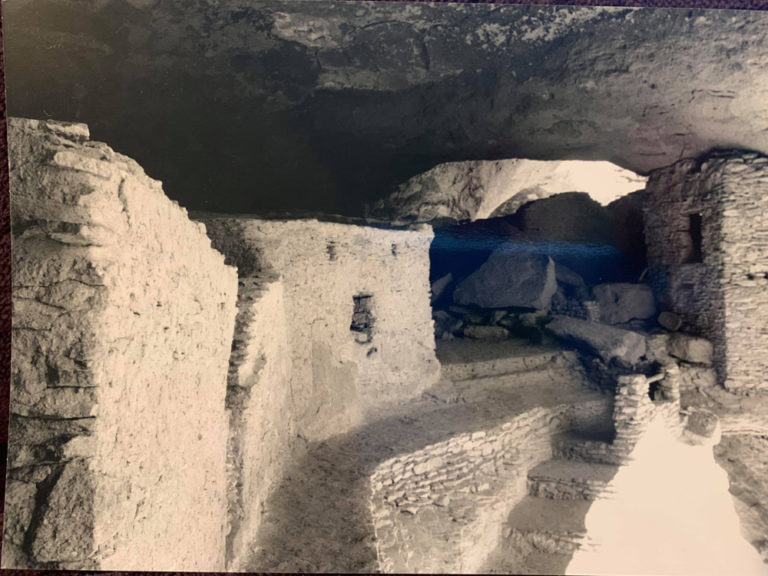
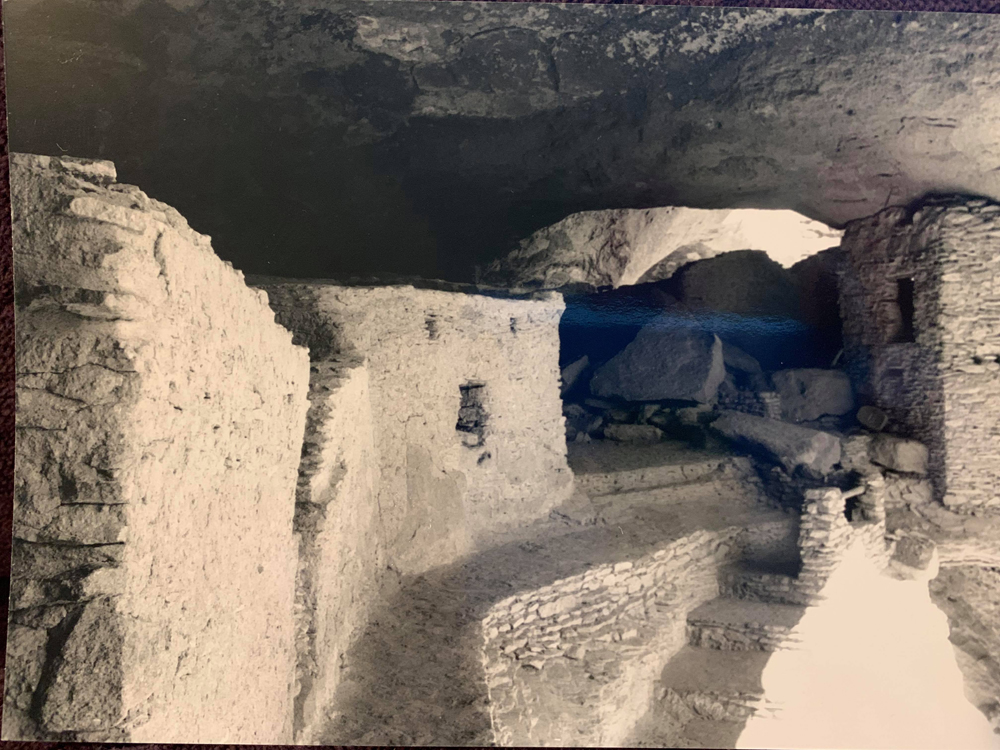
The Gila Cliff Dwellings National Monument (near Silver City, New Mexico) is one site the Advisory Council on Historic Preservation is working to preserve. Photo by Joe Kurmaskie
Its statement lists policy principles to mitigate climate change, including “efficient and effective permitting processes and environmental reviews” for clean energy and climate-friendly transportation infrastructure projects, specifically including “bicycle infrastructure.” It provides no details, however.
Winners Sarah Max (Women), Griffin Easter (Men), Sam Hansen (Non-binary) and Thiago Costa (Men Para Cyclist) come out victorious in today’s time-trial climb to the top of Dollarhide
KETCHUM, Idaho (September 1, 2023) — Kicking off day two of the Queen’s Stage Race, over 100 riders gathered outside the Limelight Hotel for a 20-mile neutral ride to the base of the famed Dollarhide climb. Once at the base, riders lined up for a staggered-start to the four-and-a-half-mile time-trial ascent.
Photo courtesy Rebecca’s Private Idaho
After the individual race against the clock, riders reconvened at the top to cheer on their fellow competitors and enjoy the 20 neutral miles back down to town, with some stopping for a refresh in the Warm Springs Creek hot springs.
Photo courtesy Rebecca’s Private Idaho
The pros showed up ready for action but it was Sarah Max and Griffin Easter who set the winning times for today’s race.
Women: Sarah Max
Men: Griffin Easter
Non-Binary: Thiago Costa
Men Para-Cycling: Sam Hansen
Photo courtesy Rebecca’s Private Idaho
Rebecca Rusch, founder of the event, discussed the magic of this particular day, “This stage of QSR is the essence of the best bike ride in the world. It’s untimed for the first 20 miles, then it’s a super hard uphill time trial—which is the race of truth. It’s you against yourself, but the support between the riders today was incredible. There were so many riders cheering each other on during the grueling climb and then it’s a massive community ride home with a chance to hop in the hot springs on the way. That’s how I designed this day and how I have always envisioned it.”
Photo courtesy Rebecca’s Private Idaho
The notorious event, which celebrates its 11th year, features both a four-day stage race (three of four stages of the Queen’s Stage Race are timed) and a single-day, multi-distance race. To build on the inclusion momentum of past years, the Non-Binary and Para Cycling categories are back and once again thriving. Recognizing these new categories aligns with RPI’s vision of creating a cycling event that welcomes anyone who wants to experience riding in the beautiful Wood River Valley area.
The Dollarhide time trial was the second event of the four-day Queen’s Stage Race (QSR).