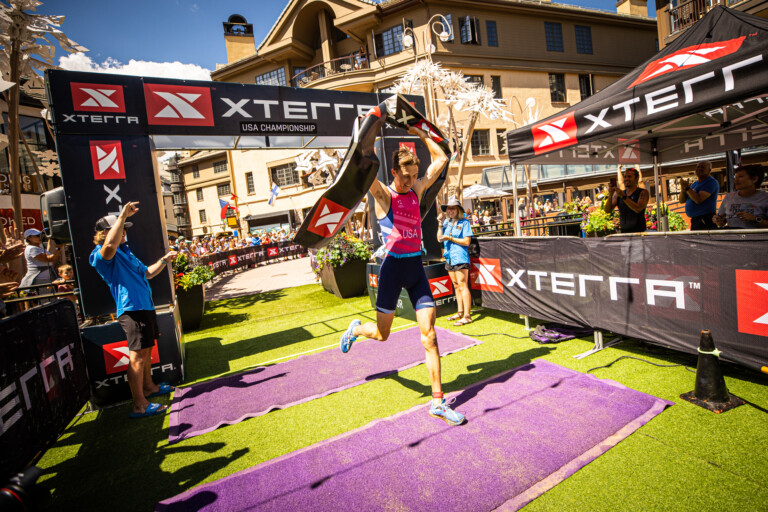
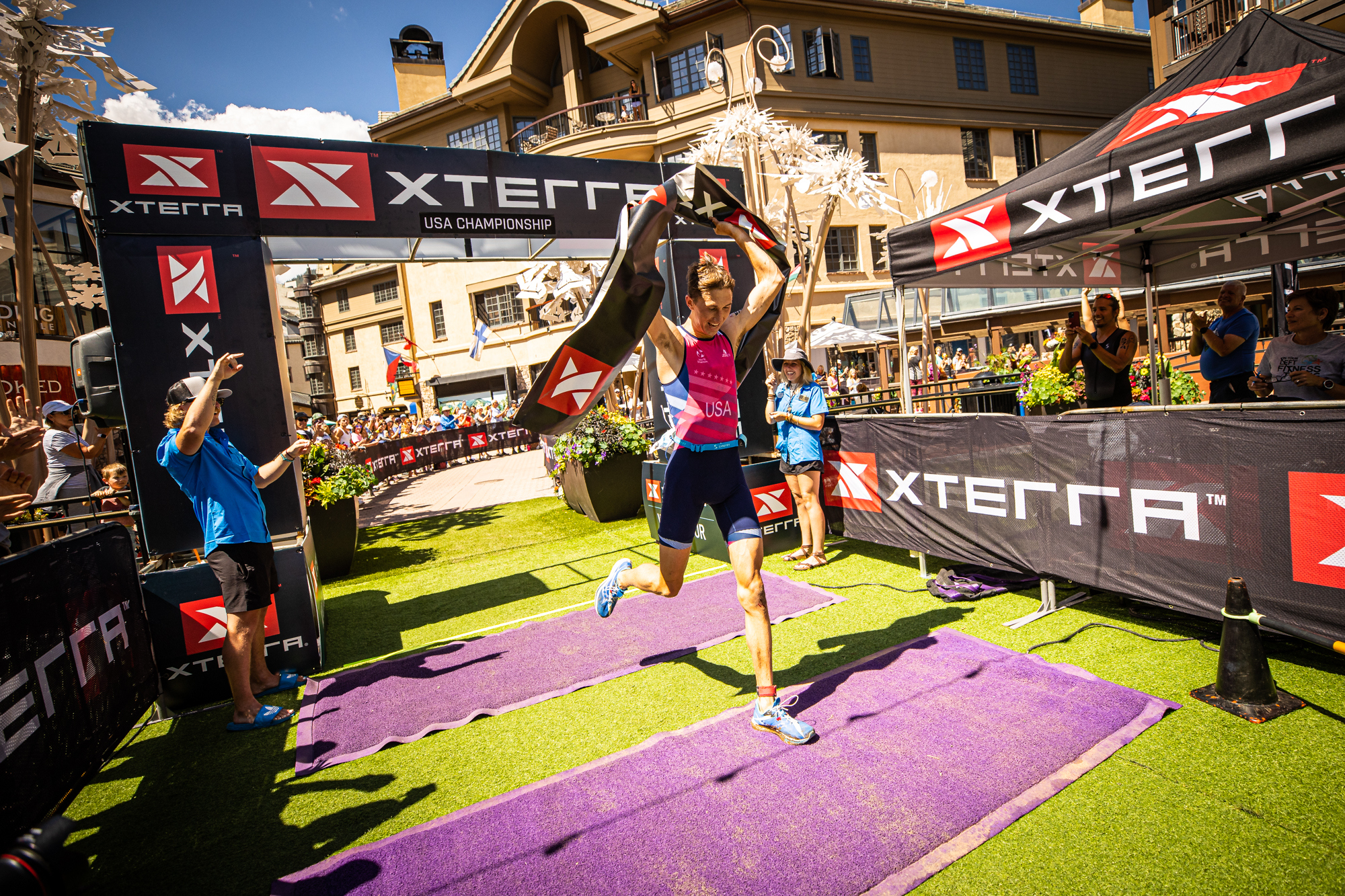
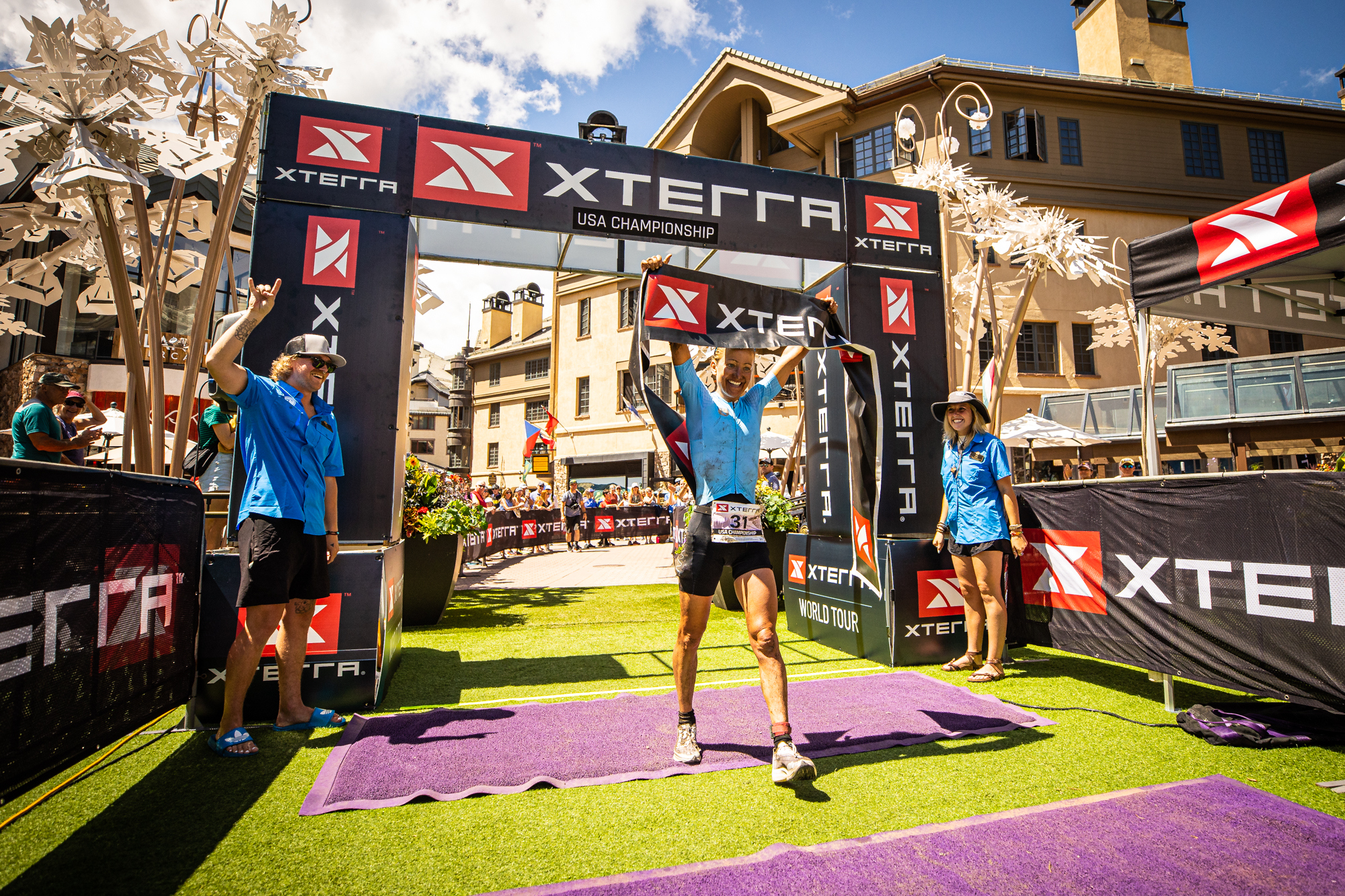
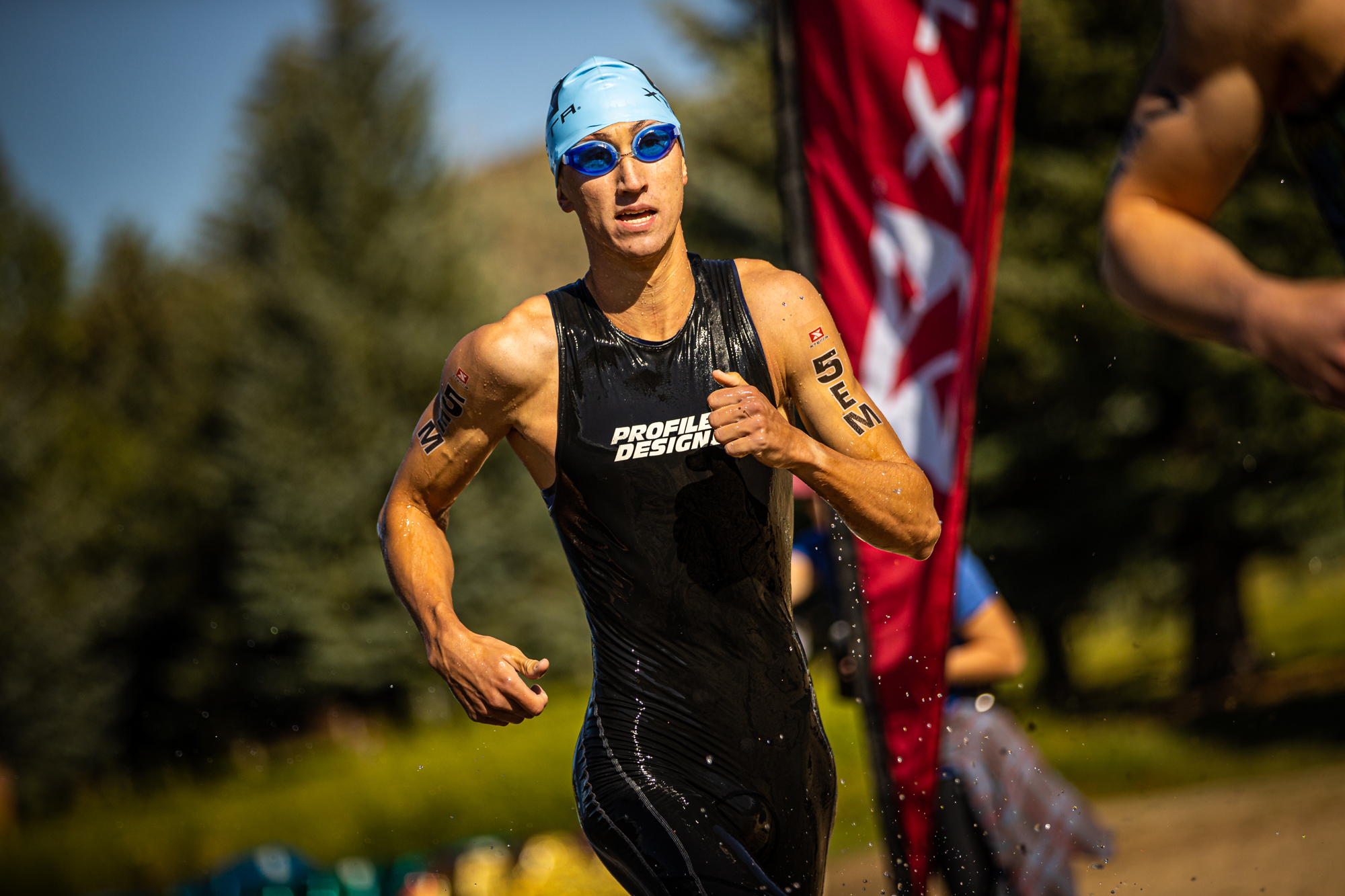
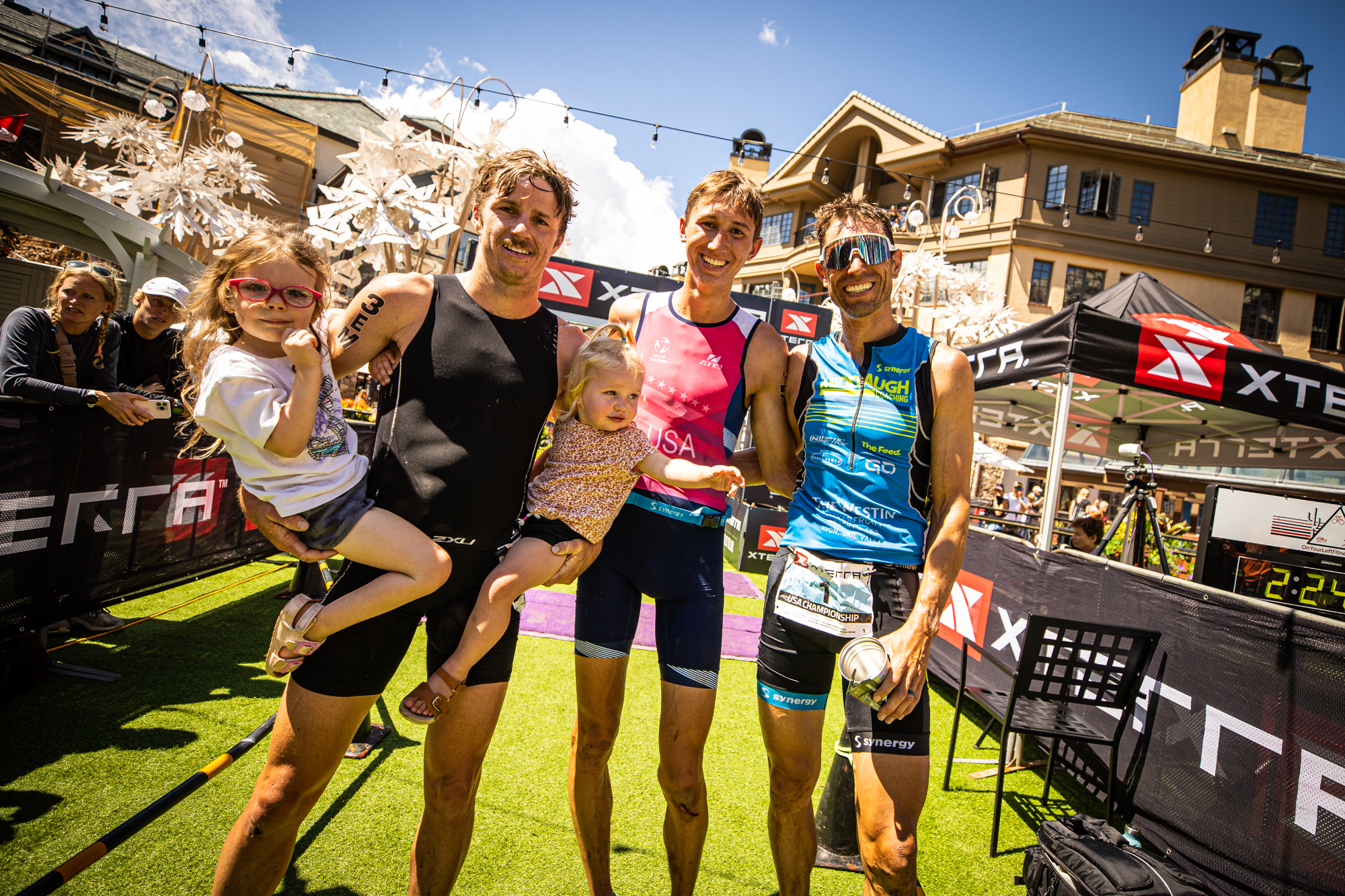
AVON, Colorado (August 26, 2022) — The 22nd annual XTERRA USA Championship off-road triathlon will return to Beaver Creek Resort in conjunction with a community festival at Harry A. Nottingham Park in Avon, Colorado on August 25-27, 2023.
Photo by Jesse Peters/XTERRA
XTERRA will host full-distance, sprint, relay, and beginner-friendly off-road triathlons along with trail runs, demo events, and a variety of activities for the whole family including kid’s races, yard games, exhibitors, food trucks, beer gardens, and live music at the marvelous open air Harry A. Nottingham Park and Performance Pavilion in the heart of Avon.
Photo by Jesse Peters/XTERRA
“It’s an amazing venue, for both its natural beauty and world-class facilities, and the support we receive from the community is incredible,” said Steve Andrus, XTERRA U.S. Tour Manager. “We’re looking forward to building on the partnerships we established last year, and excited about our new date in August which provides us with more opportunities to engage with local partners and deliver a truly exceptional experience for participants.”
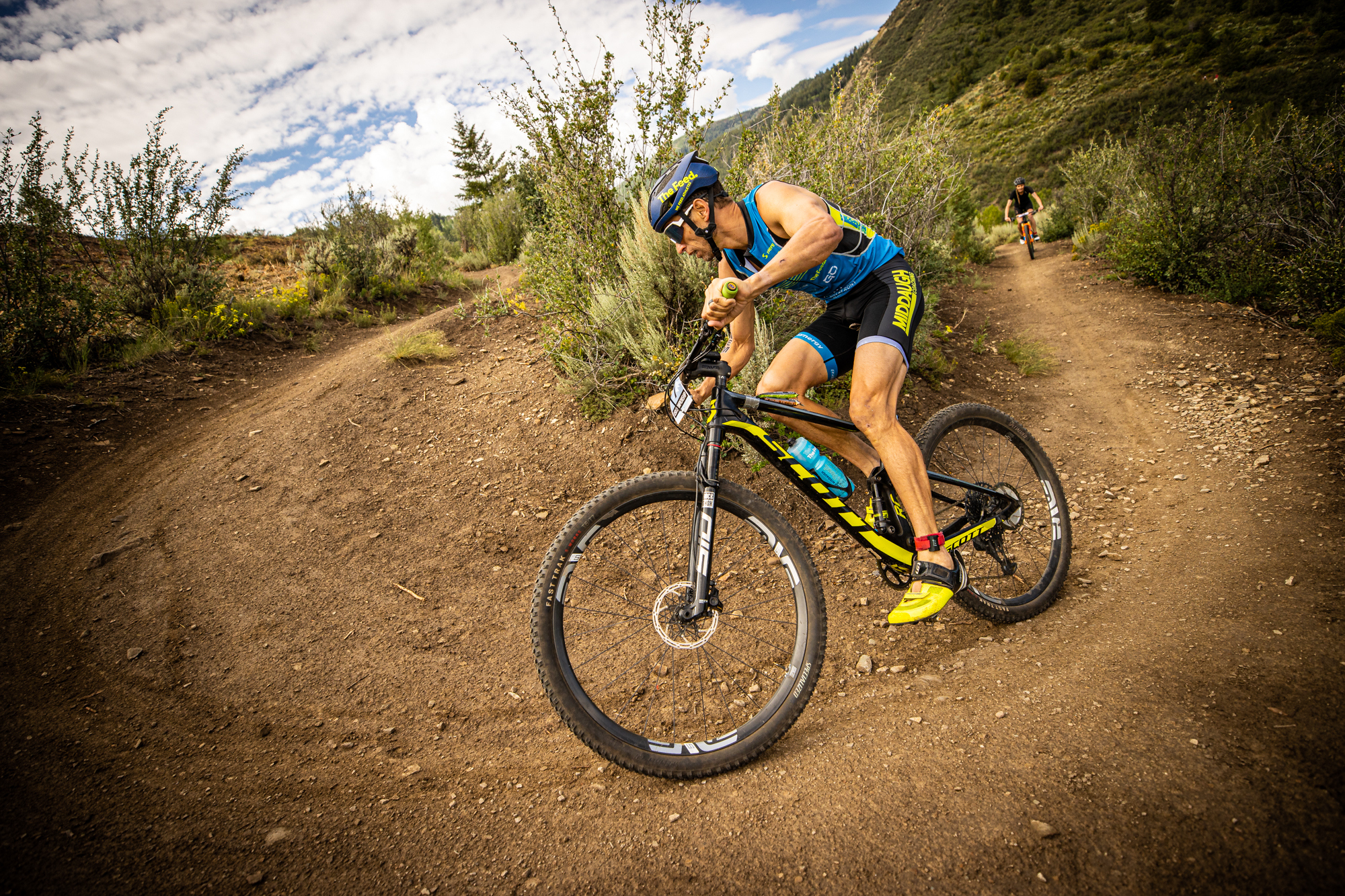
Photo by Jesse Peters/XTERRA
The main event will award $25,000 in prize money to professionals, plus XTERRA USA Championship crowns to age group division winners along with 51 qualifying spots into the 2023 XTERRA World Championship to be held in Trentino, Italy.
Photo by Jesse Peters/XTERRA
While this will be XTERRA’s 14th year of racing at Beaver Creek Resort, it is just the second time XTERRA has hosted its national championship in the Colorado Rockies following 12 seasons at Snowbasin Resort in Utah (2009-2021) and eight years in Incline Village, Nevada (2001-2008).
Photo by Jesse Peters/XTERRA
The challenge starts with a one-mile swim in the cool waters of Nottingham Lake situated at 7,400-feet elevation, follows with a fun, up-and-down, 16-mile mountain bike, and finishes with a six-mile trail run through the aspens and into the village square.
The weekend of events is supported by partners from the Town of Avon, Beaver Creek Resort, US Forest Service, The Cycle Effect, and Walking Mountains Science Center.
“We enjoyed collaborating with XTERRA and their use of Nottingham Lake and Park, and the Performance Pavilion really showcased Avon,” said Danita Dempsey, the Culture, Arts & Special Event Manager for the Town of Avon. “We are thrilled to have them back.”
Cyclists ready to ride America’s longest, one-day sanctioned bicycle race from Logan, Utah, to Jackson, Wyoming
LAYTON, Utah (August 31, 2022) — Held every year since 1983, a renowned Utah bicycle race is about to achieve a milestone.
On Sept. 10 more than 1,500 cyclists will race or ride 203 miles from Logan, Utah, to Wyoming’s Jackson Hole Mountain Resort in the 40th annual LoToJa Classic. The event is one of the most iconic and popular point-to-point cycling road races in America.
“Hitting 40 consecutive years is an impressive accomplishment,” said Brent Chambers, LoToJa’s race director since 1998. “But it’s also humbling. I’m grateful for the race’s four decades — all made possible thanks to tremendous support from cyclists, volunteers, sponsors and the communities LoToJa passes through.”
This year’s race will feature USA Cycling licensed racers, cyclosportive cyclists, relay teams and tandem riders from 38 states, Canada and Denmark. They will start at dawn at Sunrise Cyclery in Logan and ride on scenic back roads for 203 miles across northeastern Utah, southeastern Idaho and western Wyoming.
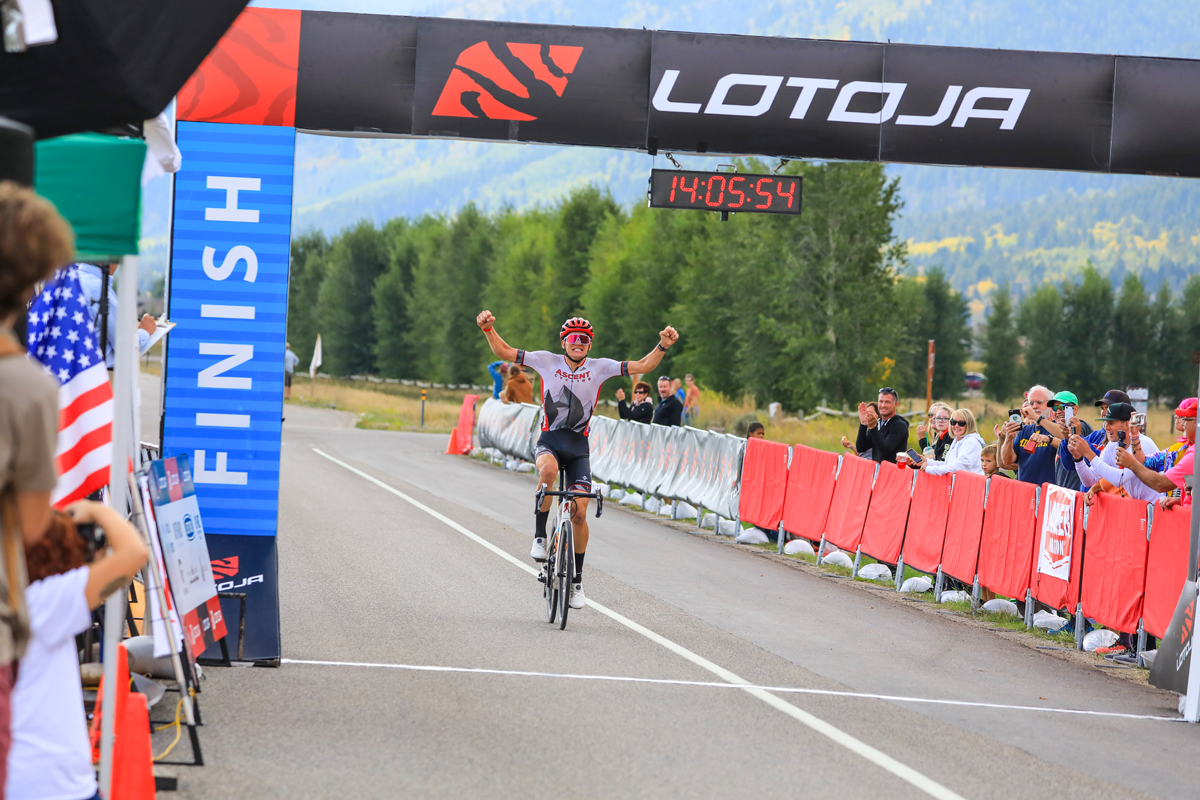
Winner: Nathan Spratt (Team Ascent) solos to the finish line at Jackson Hole Mountain Resort to win the Men Pro 123’s in the 39th annual LoToJa Classic on Sept. 11. The Cat. 2 cyclist from Millcreek, Utah, set a time of 8:31:18 in the 203-mile road race. Photo by SnakeRiverPhoto.com
The fastest licensed racers cross the finish line at the ski resort around mid-afternoon. The current men’s record is 8:18:29 and the women’s is 9:35:00. But most take 10 to 13 hours to complete the course. The fastest licensed riders win cash and/or goods, and all who complete LoToJa earn a finisher’s medal that commemorates their accomplishment.
For many, crossing the finish line with the 13,776 foot-high Grand Teton nearby is the day’s biggest prize.
LoToJa’s vistas and challenging course combine to take cyclists’ breath away and sting the legs. It features three mountain passes that total 35 miles and almost 10,000 vertical feet of climbing. Besides scenic alpine climbs, cyclists also roll through Utah’s Cache Valley; Idaho’s Preston and Montpelier; and Afton, Thayne, Etna and Alpine in Wyoming’s Star Valley. After Alpine, cyclists ride 47 miles up Snake River Canyon and past Hoback Junction to Jackson Hole Mountain Resort.
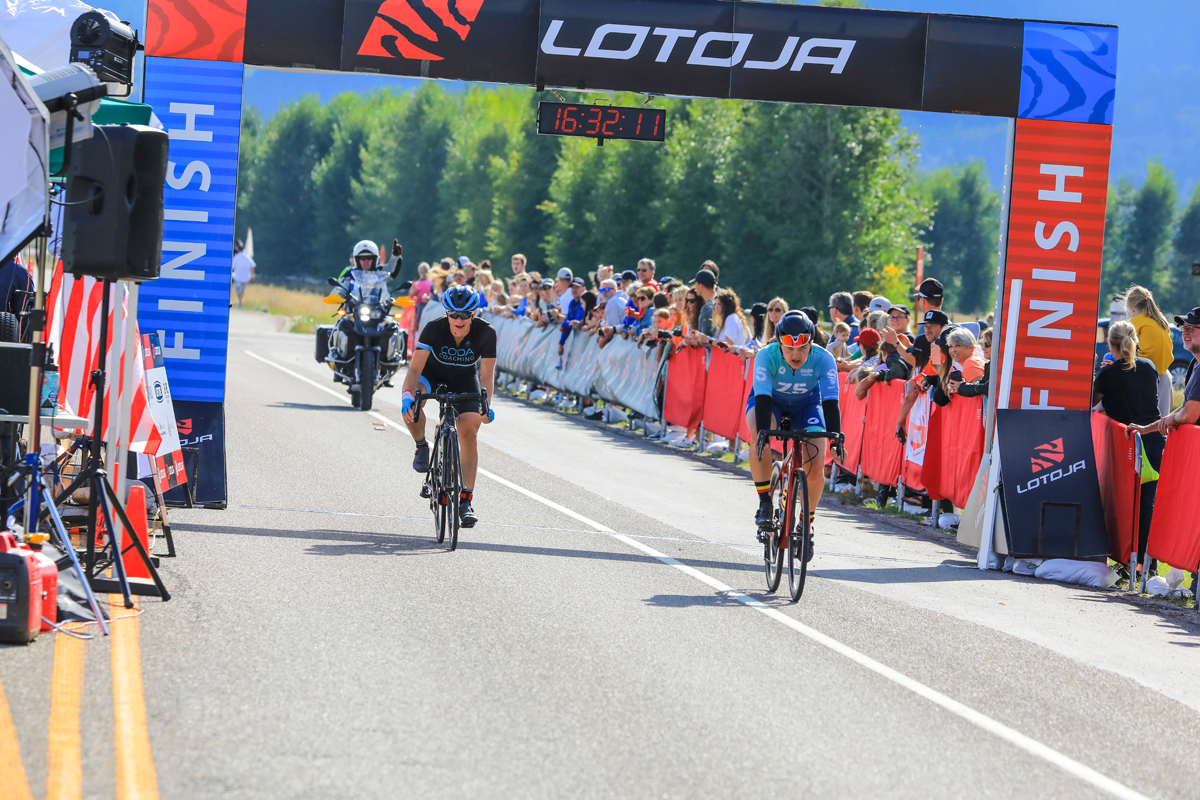
Winner: Cat. 2 Aileen Pannecoucke (right) crosses the line over Cat. 2 Jenny Leiser (Team Coda Coaching) to win the Women Pro 123’s in the LoToJa Classic at Jackson Hole Mountain Resort on Sept. 11. The Cat. 2 cyclist finished with a time of 9:45:36 in the 203-mile road race. Photo by SnakeRiverPhoto.com
During the race’s final 14 miles, the Grand Teton and the Teton Range come into full view. The sight of “The Grand” inspires tired riders toward the finish line.
LoToJa is recognized as the longest, one-day USA Cycling sanctioned road race in America. In its 40th consecutive year, it could be said the race joins a respected league of USAC-sanctioned races that have withstood the test of time, like the 77-year-old Tour of Somerville in New Jersey.
Besides its 203-mile distance and tenure, LoToJa is highly popular. Several thousand riders from across the U.S. and other nations register every April. But less than 2,000 are accepted to keep safety and the quality of the cycling experience high. LoToJa’s distance, scenery and Jackson finish — with Grand Teton National Park and Yellowstone National Park nearby — are all part of its allure.
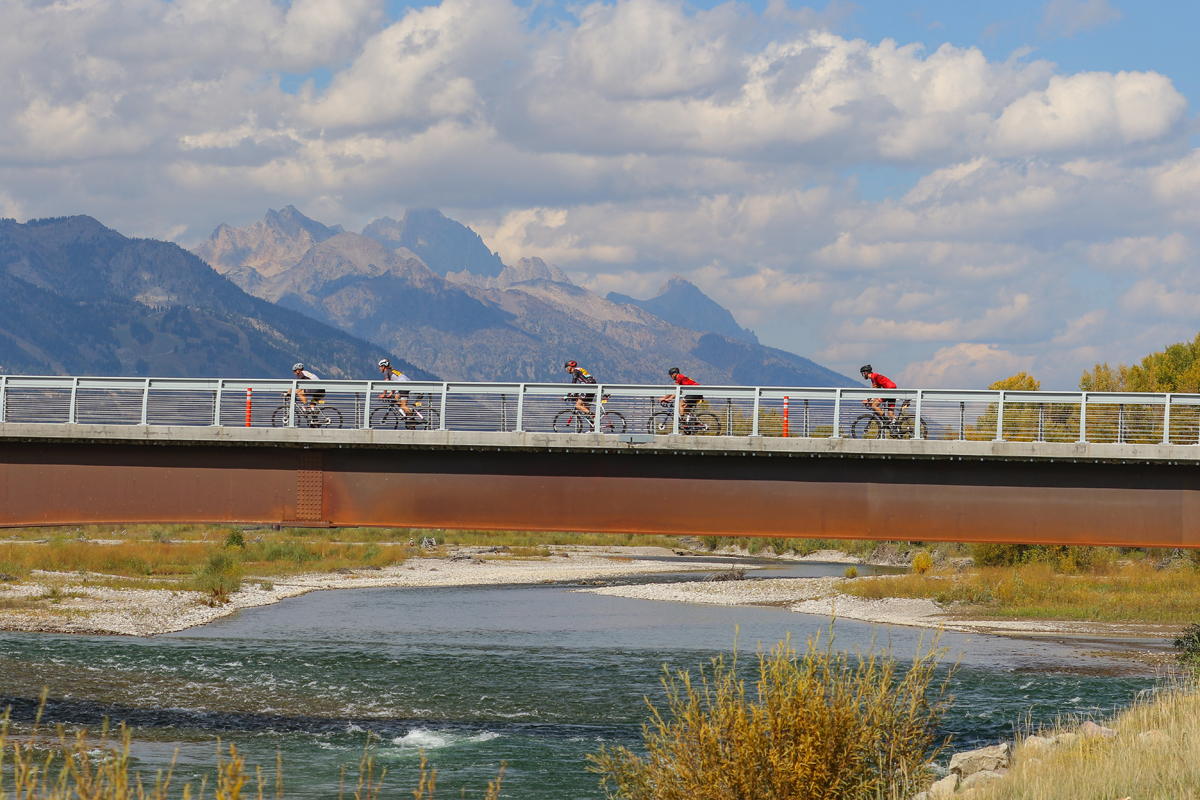
Almost there: With the Grand Teton looming in the background, racers cross the Wilson Bridge bike path in the 39th annual LoToJa Classic on Sept. 11. While crossing the bridge, cyclists have only eight miles left to the finish line in the 203-mile road race from Logan, Utah, to Jackson Hole Mountain Resort. Photo by SnakeRiverPhoto.com
So, too, is the event’s commitment to raise funds for worthy causes. Over the years, LoToJa has evolved into a major fundraiser for the Huntsman Cancer Foundation and other health-related organizations. More than $2.6 million has been contributed to Huntsman alone by cyclists and sponsors.
LoToJa began in 1983 by two Logan cyclists who wanted to create an enduring one-day race in the spirit of professional cycling’s five grand monuments like Paris-Roubaix and Ronde van Vlaanderen. Logan-Jackson was born, and given the acronym, LoToJa.
In that first year, seven cyclists competed and crossed the finish line near downtown Jackson. The winner was Bob VanSlyke of Logan who finished the 186-mile course in nine hours. In 1986 the finish line was moved to Jackson Hole Mountain Resort, which increased the race’s distance to over 200 miles.
Since then, LoToJa has grown to feature multiple categories for USAC license holders, plus non-licensed cyclosportive cyclists who are either competing against riders within their age group, or are just riding for fun. There are also multiple categories for relay and tandem riders.
Chambers said the race wouldn’t be possible without its 600 volunteers, and cooperation and help from businesses, civic leaders, public safety officials and communities. Also making it possible are the 140 Ham radio operators from the Bridgerland Amateur Radio Club. They provide uninterrupted communication throughout LoToJa’s mountainous and remote terrain.
To further increase cyclists’ safety, the Idaho Transportation Department will restrict eastbound vehicle traffic on state Route 36 north of Preston between Riverdale and Ovid from 6 a.m. to 12 p.m. Eastbound traffic on US-89 between Montpelier and the Wyoming state line will also be restricted from 8 a.m. to 2 p.m.
Motorists traveling on LoToJa’s course on Sept. 10 are asked to use caution when approaching cyclists. Groups consisting of several riders may be present. Cautious passing is advised to ensure safety for everyone.
Chambers defined “cautious passing”sd as slowing down, giving at least three feet of space between the vehicle and cyclist(s), and patiently waiting for oncoming vehicle traffic to clear before pulling around a cyclist or group of cyclists.
LoToJa’s riders, support crews, event staff, volunteers and well-wishers, represent an entourage of approximately 3,000 people, Chambers said. Several of the communities through which the race passes organize roadside fundraisers to capitalize on the influx of visitors. The host cities of Logan and Jackson also enjoy an economic boost from the race, specifically restaurants and hotels.
According to Chambers, more than 21,000 cyclists have pedaled nearly 7 million miles during LoToJa since the race began 40 years ago.
“LoToJa continues to be an extraordinary bicycle race because of the landscape it crosses and how it challenges the physical, mental and emotional endurance of every cyclist who rides it,” he said. “Cyclists who cross the finish line feel a deep sense of accomplishment — a personal victory that lasts a lifetime. To organize such an event that gives so much in return brings me a lot of joy.”
LoToJa’s route and additional information about the race are available at lotoja.com.
Program Bridges the Gap Between Local and National Funding for MTB Trails
BOULDER, Colorado (July 12, 2022) — Shimano and the International Mountain Bicycling Association (IMBA) announce mountain bike trail projects have been selected for the current Dig In fundraising period that runs July – September. IMBA Local Partner organizations are utilizing the Dig In platform to raise funds for projects that aim to expand trails and trail access in communities across the US. Each project will unlock a match from Shimano when it reaches $2,000 in online donations. Learn about the Dig In program or view Dig In projects on the IMBA website.To be considered for the program, prospective Dig In projects must take place on public lands and result in substantial increase in access, improved mountain bike experiences, and greater community benefit. Community development, volunteer recruitment, new rider development, youth riding, engaging marginalized community members and furthering diversity, equity, and inclusion are all considered when selecting projects.
“The IMBA team is so impressed by the Q1 2022 round of Dig In projects. They raised more funds than any Dig In round before — all nine projects received a $2,000 match from Shimano, and four met or exceeded their overall fundraising goal as well,” said David Wiens, IMBA Executive Director. “That adds up to amazing progress for more trails close to home!”
During the first quarter of 2022, Dig In successfully raised funds critical to build or revitalize a variety of trail projects, including state park trails, bike parks and skills areas across the US. Since IMBA created Dig in in 2018: 89 applications have led to 32 grants and $501,000 of donations which have been leveraged to become $8.5 million in funding for local trail projects. Detailed planning can unlock critical funding for trail projects – the impact truly speaks for itself.
Summer 2022 Dig In Projects:
Fort Duffield Expansion – West Point, KY
Kentucky Mountain Bike Association (KyMBA) Louisville is raising funds to expand the Fort Duffield trail system by building new trails, adding and maintaining features, and reopening one section of the system. Fort Duffield has a little bit of everything – punchy climbs, steep descents, dirt jumps, scenic views, and a little bit of history. This former Civil War fort right by the Ohio and Salt Rivers has the potential to attract riders from all over the Midwest, spur economic growth in the town of West Point, and provide progression for riders looking to advance their skills.
Diversity in Mountain Biking Clinics – San Rafael, CA
Access4Bikes is working on growing the mountain biking community by offering free clinics to diverse and underserved communities in Marin County. Building on past successful clinics, the organization is doing targeted outreach to help riders of all backgrounds develop their mountain biking skills and learn why their voice matters in advocacy.
Nagel Middle School Bike Park – Anderson Township, OH
Cincinnati Off-Road Alliance (CORA) is raising funds to construct a mountain bike skills park in the Nagel Middle School campus. The skills park will provide an area for students to relieve stress, anxiety, and depression while improving their social and emotional health. The facilities and trail system will allow students to develop bike skills and challenge themselves physically and mentally. The park will also be open to the public outside school hours and serve as a practice site for the local NICA team.
Pine Knob Mountain Bike Park – Russellville, AR
Ozark Off Road Cyclists (OORC) created Pine Knob Mountain Bike Park in response to community demand for less intimidating beginner trails and, for those looking to advance their skills, rad jumps, exciting features, and progressive trails. Considering all the demands, River Valley Ozark Off Road Cyclists determined that a compact, well-designed skills park in the city was warranted to meet the community’s needs. The group found an old unmaintained city park within the city limits, located near an underprivileged community with no other park nearby.
Sapwi Flow Trail – Thousand Oaks, CA
Concerned Off-Road Bicyclists Association (CORBA) and Conejo Recreation and Park District (CRPD) partnered to create The Sapwi Flow Trail Project as an extension of the Sapwi Bike Park. The sense of community is strong at Sapwi, a welcoming space for local riders and visitors from outside the area. The addition of a flow trail will expand and enhance the Sapwi Bike Park experience for everyone and help get more kids on bikes! This bike skills park is open to the public and free for everyone.
Trails at Wiggins Community Center – Anniston, AL
Northeast Alabama Biking Association (NEABA) trail crew wants to expand the trails at Wiggins Community Center. The community center serves a mostly African American population and hosts after school and summer biking programs for kids. The long-range goal is to foster grass roots growth for the City of Anniston NICA team. This grant will fund building additional 2.5 miles of trails. The NEABA Trail Crew already completed a one mile loop that connects the community center with a nearby park.
CAMTB Pathways to Leadership Project (PTLP) – Statewide, California
California Mountain Biking Coalition (CAMTB) is working on statewide awareness and recruiting campaign to significantly increase diversity on the board of directors of California trail advocacy organizations. The Pathways to Leadership Project (PTLP) aims to ensure that the needs and perspectives of underrepresented riders in mountain biking are recognized and prioritized in outdoor advocacy.
Cycling West and Cycling Utah Magazine’s Late Summer 2022 Issue is now available as a free download (18 MB download). Pick up a copy at your favorite Utah, Idaho, Wyoming, Nevada, Montana, Colorado, Arizona, New Mexico, and Northern California bike shop or other location.
All major mountain bike formats united under a combined calendar for the first time to support the growth of the sport.
15 rounds covering 34 races across 10 countries and 3 continents announced for 2023.
ESO Sports and Discovery Sports Events partnering to deliver the UCI’s new vision for mountain bike.
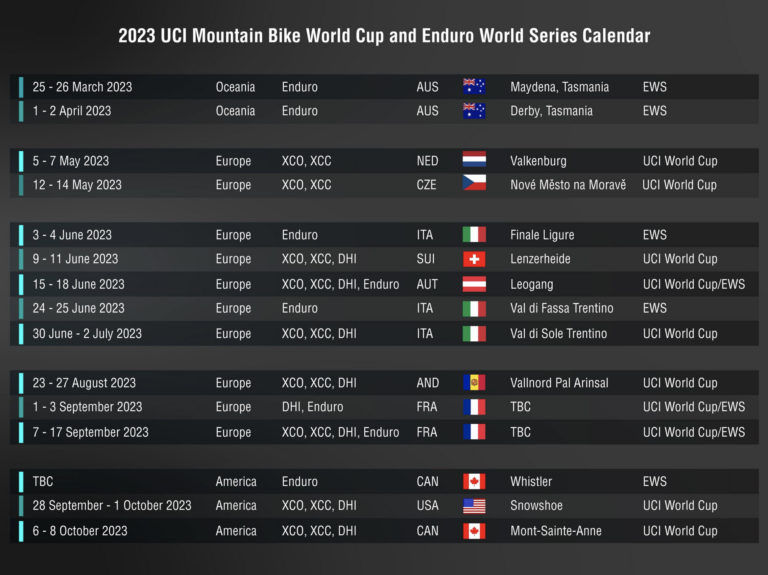
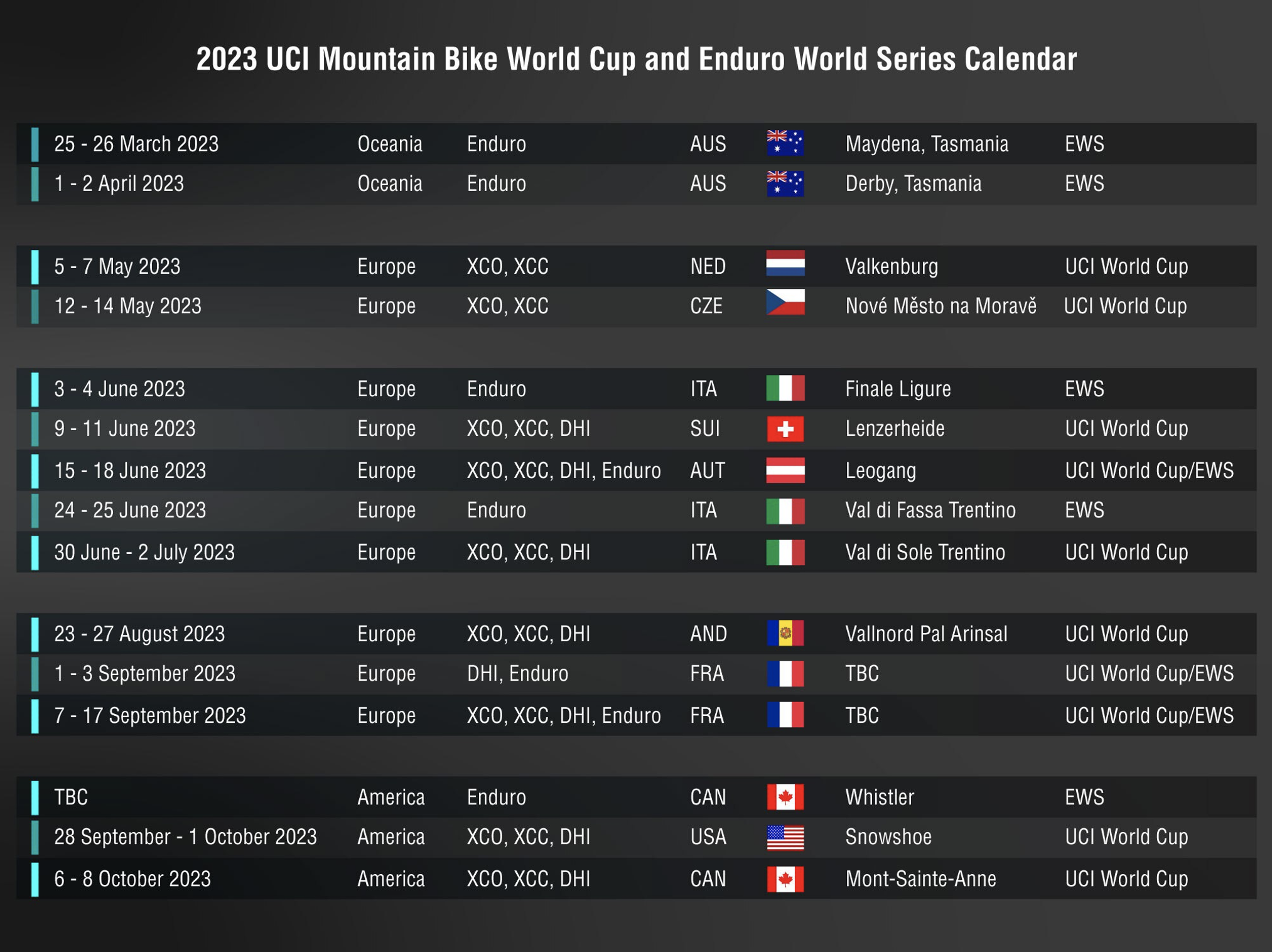
The Union Cycliste Internationale (UCI) and Warner Bros. Discovery (WBD) have unveiled the new calendar for the 2023 UCI Mountain Bike World Cup and Enduro World Series. The plan unifies all major mountain bike formats under one combined calendar for the first time and will take riders to ten countries across three continents.
As mountain bike enters a new era, riders and fans can look forward to cross-country Olympic, cross-country short track, downhill and enduro, aligning for the first time in the history of the sport. Further details around E-mountain bike enduro and cross-country marathon will be released in September 2022. The new-look calendar will see some mountain bike formats sit alongside one another for the first time, racing grouped by location to maximise sustainability and brand new venues making their global debut, while valued sites keep their place in the calendar.
The reinvigorated calendar was developed by the UCI in partnership with ESO Sports and Discovery Sports Events, two of WBD’s specialist sport organisations.
An enhanced and combined calendar to reflect the growth of mountain bike
With 15 rounds covering 34 races organised across the world, the 2023 combined calendar for the UCI Mountain Bike World Cup and Enduro World Series will see action taking place in ten countries across three continents. Cross-country Olympic and cross-country short track each have nine rounds in total, while downhill and enduro each have eight. As well as brand new locations brought into the fold, established venues will welcome new formats onto their trails.
The new structure will reflect the growth of the sport, allowing each of mountain bike’s different formats to flourish, reach new audiences and enhance the experience for fans both on site and watching from home. ESO Sports, the owner and operator of the Enduro World Series (EWS) and in whom WBD recently invested, will drive the project to globally unify mountain bike and elevate it to new levels, in collaboration with the UCI. Discovery Sports Events, the global promoter and event management leader, is extending its relationship with the UCI to help promote the sport in support of further growing its global audience.
UCI President David Lappartient said: “The launch of the 2023 UCI Mountain Bike World Cup and Enduro World Series calendar marks a major step forward in our work to modernise mountain bike, one of our five Olympic disciplines.
“With the integration of enduro, and soon also of cross-country marathon and E-mountain bike enduro to the events of the calendar, which already includes cross-country Olympic, cross-country short track and downhill, the events will take on a new dimension, bringing together even more athletes and fans.
“We also look forward to introducing new hosts for some rounds while welcoming back traditional venues that have been greatly appreciated over the years. The partnership between the UCI and Warner Bros. Discovery will significantly increase the international exposure for mountain bike, allowing the sport to continue to grow globally.”
Chris Ball, CEO of ESO Sports, said: “For the first time all major mountain bike formats align on one calendar, giving teams, athletes and fans new opportunities to experience their favourite racing with no date clashes.
“We’ve done our best to group venues in close geographical proximity to reduce the season’s travel footprint and increase efficiencies for everyone on the tour. We’ll be hosting new event schedules combining formats that have never been combined before, giving riders a unique new experience and using the very best of the terrain available at each location to provide the best racing on the planet, while of course valued race tracks remain in the calendar.
“Calendar classics sprinkled with some new venues – 2023 is going to be an incredibly exciting first step towards our long term plans for mountain bike racing worldwide.”
Racing gets underway in March with an enduro double-header in Tasmania, Australia, first in new venue Maydena, followed by Derby.
Limburg-Valkenburg in the Netherlands makes its UCI Mountain Bike World Cup debut when it kicks off the cross-country season, with classic venue Nové Město na Moravě in the Czech Republic hosting the second round of the cross-country.
The races come thick and fast in June, with enduro heading to its spiritual home in Finale Ligure, Italy, followed by cross-country and downhill in Lenzerheide, Switzerland.
From here it’s on to a huge week of racing in Leogang in Austria as, cross-country, downhill and enduro all take to the region’s famous mountains and converge at the same venue for the first time. Enduro then heads to Val di Fassa Trentino in Italy, while cross-country and downhill make their way to Val di Sole Trentino, Italy.
July and August will see an extended break from racing, allowing the athletes some time to rest and recover mid-season ahead of the 2023 UCI Cycling World Championships which take place in Glasgow and across Scotland (Great Britain) in August.
Racing then picks back up again at the end of August with cross-country and downhill heading to Vallnord Pal Arinsal in Andorra. All mountain bike formats then come together in France.
The final racing block takes place in North America. Snowshoe in the USA will serve as the penultimate round for cross-country and downhill, before the iconic surrounds of Mont-Sainte-Anne in Canada rounds out the season.
A new vision for mountain bike
As the UCI starts to deliver its new vision for the future of mountain bike, the organisation will seek to utilise WBD’s global scale and media platforms, whilst it has begun collaborating with the two WBD specialist organisations. ESO Sports is working in partnership with Discovery Sports Events to deliver the organisation, media production and broadcast, promotion and commercialisation of the UCI Mountain Bike World Cup.
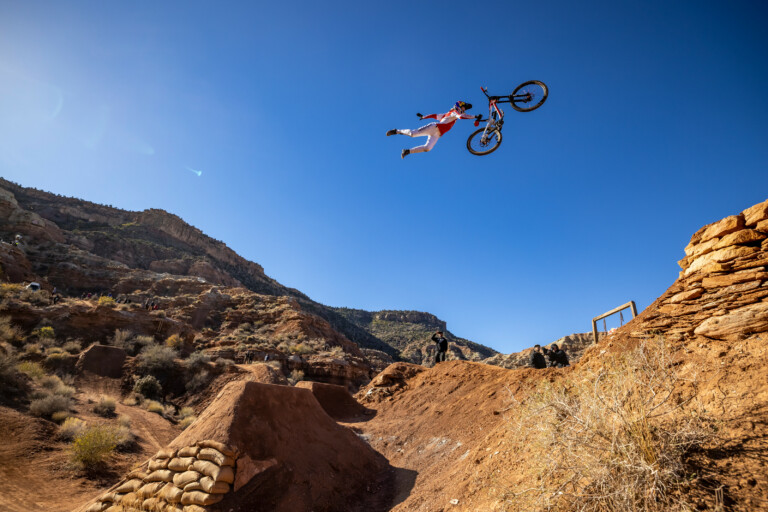
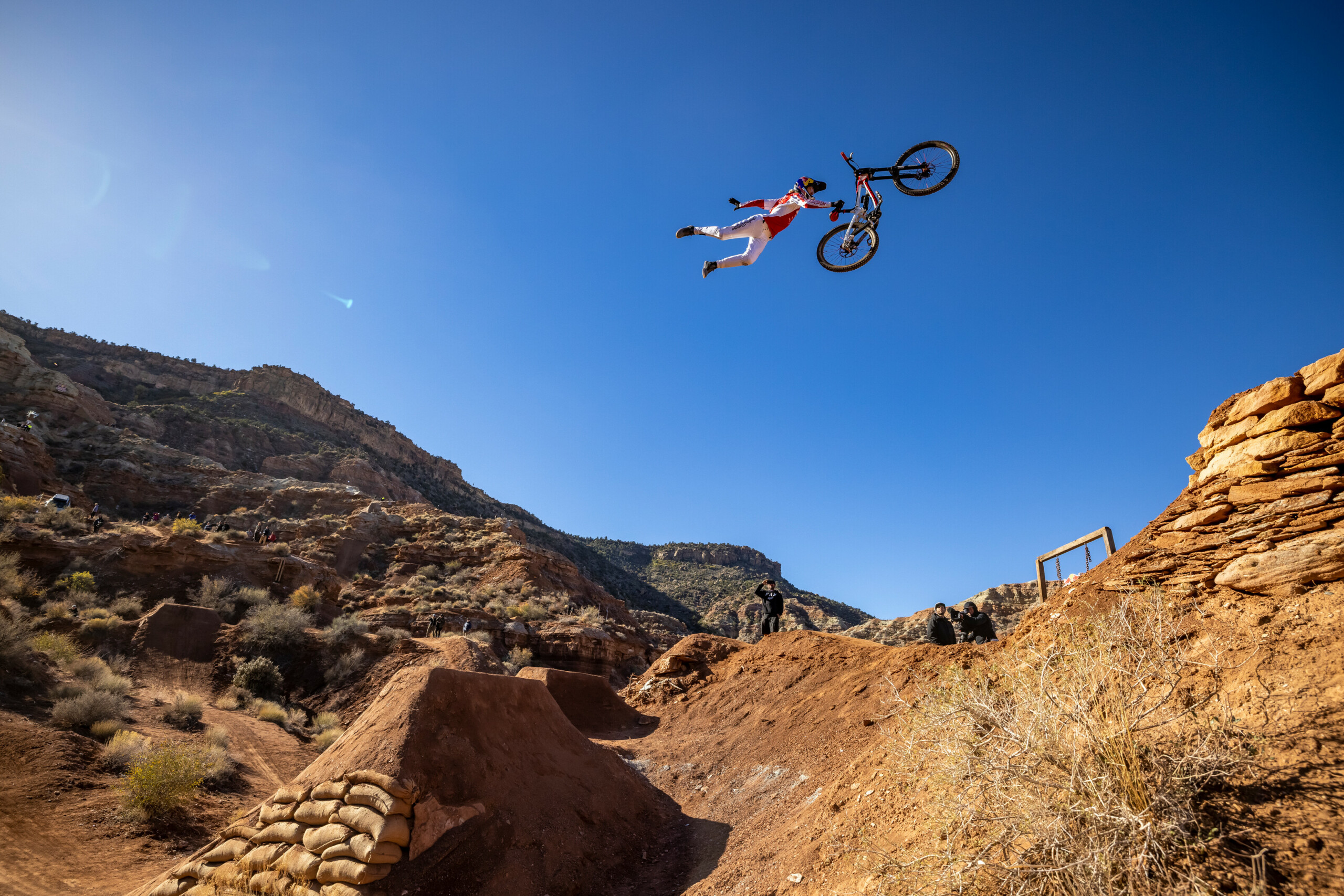
Red Bull Rampage has become the truest test of skill and mental toughness on a mountain bike. Touted as one of the most challenging events in the world, featuring the world’s best athletes and set in one of the most demanding locations on the planet, the event has become the most coveted title in freeride mountain biking.
Tickets are available for purchase for Red Bull Rampage, the premier big-mountain freeride competition being held on Friday, October 21st as of Tuesday, August 30. Those interested in attending the event can purchase General Admission tickets through Eventbrite, here: https://win.gs/RampageTix.
There are two types of General Admission tickets available: the Hike + Bike Pass and the Shuttle Pass. The Hike + Bike Pass allows one person access to the event and requires biking or hiking into the venue via a 2.5-mile dirt road. No shuttle service will be provided for this ticket. The Shuttle Pass allows one person access to the event via shuttle service from the Registration Tent to the entry of the event venue.
For those unable to attend, the event will be streamed live exclusively on ESPN+ in the U.S., and on Red Bull TV in all other countries. In addition, the complete event will be available on-demand on both ESPN+ and Red Bull TV following the competition. Then on October 30th, viewers can also tune-in to a condensed 2.5-hour replay that will air on ESPN.
For further information about event tickets, venue access, wristband pick-up, on-site amenities, and much more, please read the Red Bull Rampage Spectator FAQ.
Gibson, Blunk, and Courtney rounded out the Top-15 in the Women’s race.
LES GETS, France (August 28, 2022) — The U23 Cross-Country and Elite races closed out the 2022 UCI Mountain Bike World Championships in Les Gets. Team USA ended the event with three bronze medals in the Team Relay, Women’s Short Track, and Elite Women’s Cross-Country.
Elite Women’s XCO
After throwing down the fastest lap for the women in the Team Relay, Haley Batten (Park City, Utah; Specialized Factory Racing) knew she was in prime condition for this week of racing. Batten was on fire from the gun. She finished her first lap in fifth place and was in the lead group. Pauline Ferrand Prevot (FRA) gained her lead in the first lap and never looked back. She had a 30-second gap by the first lap and grew her lead to over 2 minutes at one point in the race. From there, it was going to be a fight for silver. Batten was leading out Alessandra Keller (SUI) until lap five then Jolanda Neff (SUI) made contact. She passed on lap four and Batten had the legs on the climbs, but struggled to stay with her on the descents. At that point, Batten had also grown her gap on Keller to 30-seconds solidifying her spot on the podium.
Batten said, “I definitely showed up at my absolute best today and I wanted to win really badly but, you know what, Pauline and Jolanda are some of the best ever, so I think to finish behind them is an honor. I think, more than anything, I’m just proud to be a part of women’s mountain biking right now.”
The rest of Team USA also had a great showing with Courtney, Gibson, and Blunk staying in the Top-15 and fighting for every spot. After a bit of shuffling around throughout the race, Gibson would end up leading the American train across the line in 12th. The United States would once again score second as a team behind Switzerland.
Results
Pauline Ferrand Prevot (FRA) 1:22:08
Jolanda Neff (SUI) +1:35
Haley Batten (Park City, Utah; Specialized Factory Racing) +2:13
Savilia Blunk (Inverness, Calif.; Orange Seal Off-Road Team) +5:46
Kate Courtney (Kentfield, Calif.; SCOTT-SRAM Factory Racing) +6:31
Hannah Otto (Salt Lake City; Pivot Cycles/ DT Swiss) – 1 LAP
Kelsey Urban (Kentfield, Calif.; Team 31: Outride) – 1 LAP
Elite Men’s XCO
Christopher Blevins (Durango, Colo.; Specialized Factory Racing) was close to a World Championship win in Friday’s Short Track and was hoping for redemption in today’s XCO. He was in the lead group for the first lap and a half. By lap three, he pulled out of the race due to injuries sustained on Friday night.
Results
Nino Shurter (SUI) 1:21.13
David Valero Serrano (ESP) +0:09
Luca Braidot (ITA) +0:29
DNF. Christopher Blevins (Durango, Colo.; Specialized Factory Racing)
U23 Men’s XCO
Riley Amos (Durango, Colo.; Trek Factory Racing) and Bjorn Riley (Boulder, Colo.; Team Trek VAUDE) went in as two of the favorites, both landing on U23 World Cup podiums this season. Amos just came off a broken collarbone from the National Championship and was not sure he would race after just getting back on the bike. Amos and Riley grew up racing and traveling together for years and found themselves on each other’s wheels in the middle of the World Championship. Amos had a front row call up and settled into a pace he could control and make no major mistakes. Riley moved his way into the top ten from the start and picked off riders one by one eventually passing Amos. He worked his way up to fifth by the last lap with Amos finishing in eighth.
“I’m super stoked on my result. The race went really well. The start was pretty hectic, but I was able to find my way to the front ten. From there I really just played it pretty strategic and focused on passing people when I could and I really saved my energy on the flats. I managed to get up to fifth place in the end. I’m super stoked on the result. It was just the icing on the cake [for the season], and I could not be happier to get that result. I’m really happy to do it with the USA colors on my back.”
Results
Simone Avondetto (ITA) 1:10:35
Mathis Azzaro (FRA) +0:28
Luca Schatti (SUI) +0:57
Bjorn Riley (Boulder, Colo.; Team Trek VAUDE) +1.36
Robbie Day (Evergreen, Colo.; Bear National Team) +8:45
Brayden Johnson (Littleton, Colo.; Bear National Team) +9.11
U23 Women’s XCO
Madigan Munro (Boulder, Colo.; Trek Factory Racing) put in a major effort from the start to solidify herself in the lead group. She settled in and stayed consistent finishing in the ninth position. Lauren Lackman (Wausau, Wisc.; Rib Mountain Cycles) got caught up in a crash at the start and went out on her first lap in last, out of 57 riders. She went all out and moved her way up to 27th by the end of the first lap. She continued to push it on the climbs and stayed consistent to finish the race in 26th place.
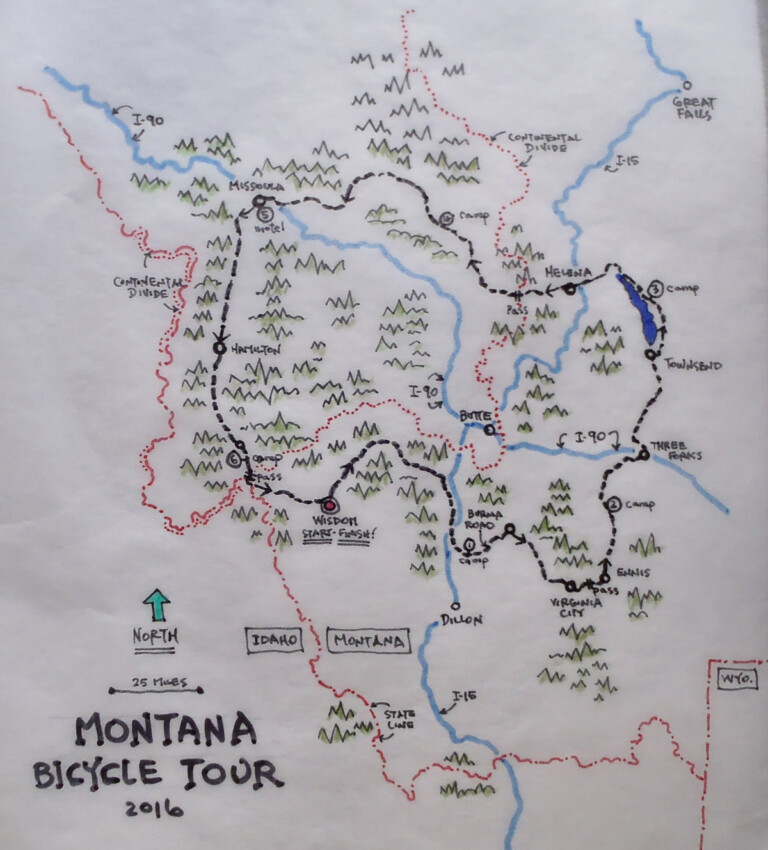
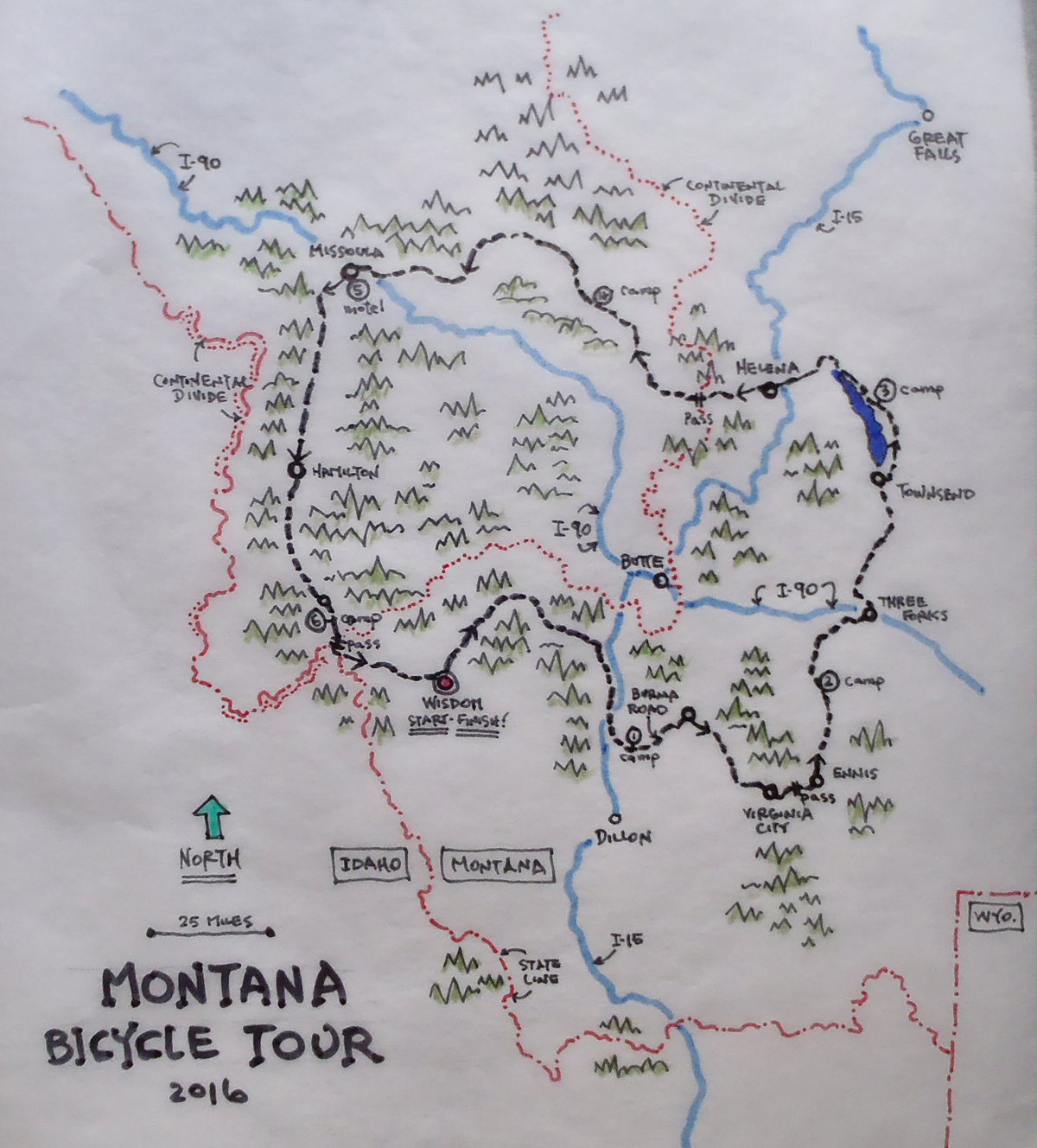
By John Roberson — The following is a description of a recent, seven-day bicycle tour of southwest Montana. It was a self-supported tour on beautifully paved and graded highways and byways, with most nights spent sleeping out under clear Montana skies. Overall riding conditions were excellent, and people I met couldn’t have been nicer. I ate well, and I slept well every night. I had all of the gear I needed, but I never had to pitch a shelter, wear a rain jacket, or filter water from a creek. And I had no flat tires. My bicycle – a 25 year-old Rockhopper – performed magnificently. It was a little hot at times, and I wished a couple of times for a lower gear, but all in all, it was a very fine ride!
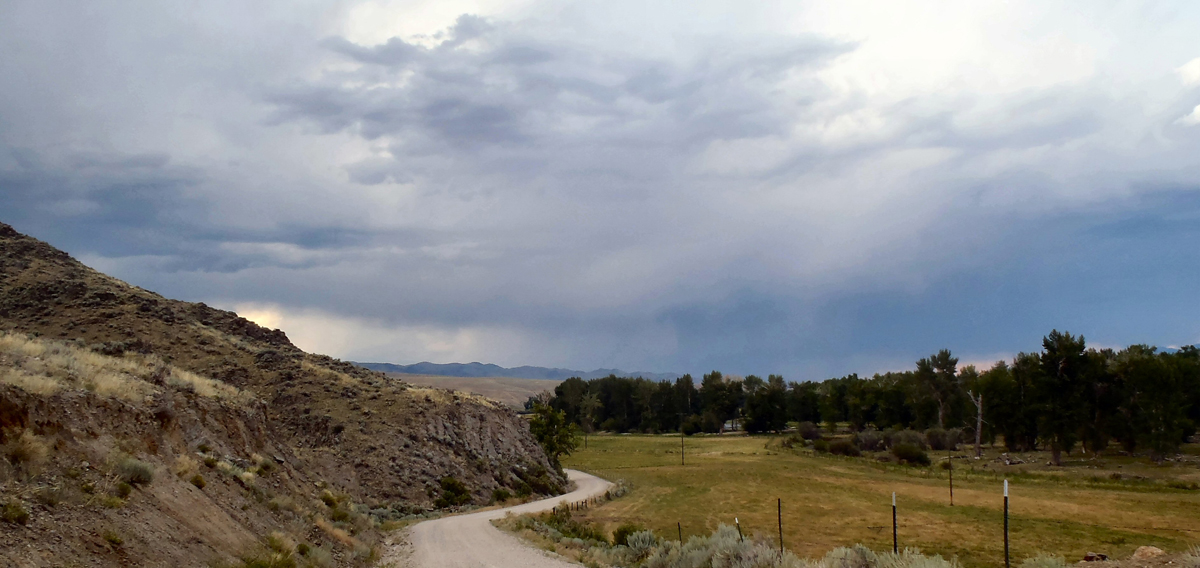
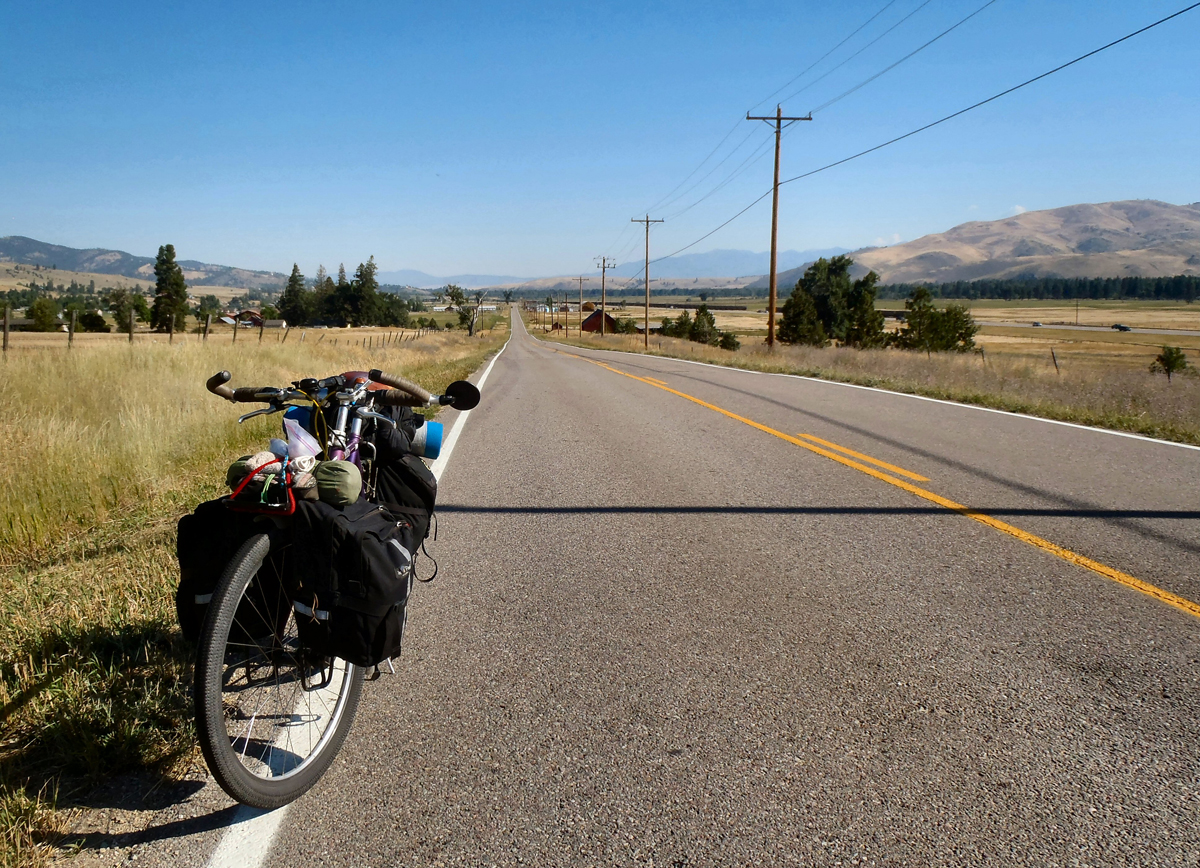
Off of the main roads while bicycle touring in Montana. Photo by John Roberson
Day One – Wisdom to the Burma Road
I awoke one morning in late July to the sounds of birds moving about in the grassy field next to my brother-in-law’s cabin, and a few of the town hounds barking down the street, greeting what appeared to be another beautiful, Montana day. I was in the tiny town of Wisdom, Montana, where I’d spent a very restful night on Brother Bill’s front porch after having driven up from Salt Lake the day before. I was hoping to beat the heat and spend the upcoming week riding the hills and valleys of southwest Montana. I hoped to stretch my legs out and see lots of new sights. I planned to stay on the paved back roads and byways when I could, and I intended to camp out at night. As usual, my bicycle would be carrying everything I thought I might need.
Map of a summer bicycle tour in Montana by John Roberson
I made my very first stop of the morning just a couple of blocks from Bill’s cabin, at a cafe in downtown Wisdom, and it was there that I met my first fellow bicycle tourist. His name was Roger, and he was in the middle of a coast-to-coast ride following one of the Adventure Cycling Association’s well-known bicycle routes (the non-profit ACA is based in Missoula and is a well-known and enthusiastic supporter of bicycle touring in all its forms!). I told Roger that in years past I’d seen many other touring cyclists passing through town, there at the cafe and camped out at the Lion’s Club picnic grounds west of town. Over hotcakes and coffee we shared all sorts of touring stories, about bears and crazy drivers, about the joys of retirement, and where to find water in dry lands. It was a nice way to begin a trip, and although he was headed west and I was headed north, we both agreed that prospects for a great day of riding were good.
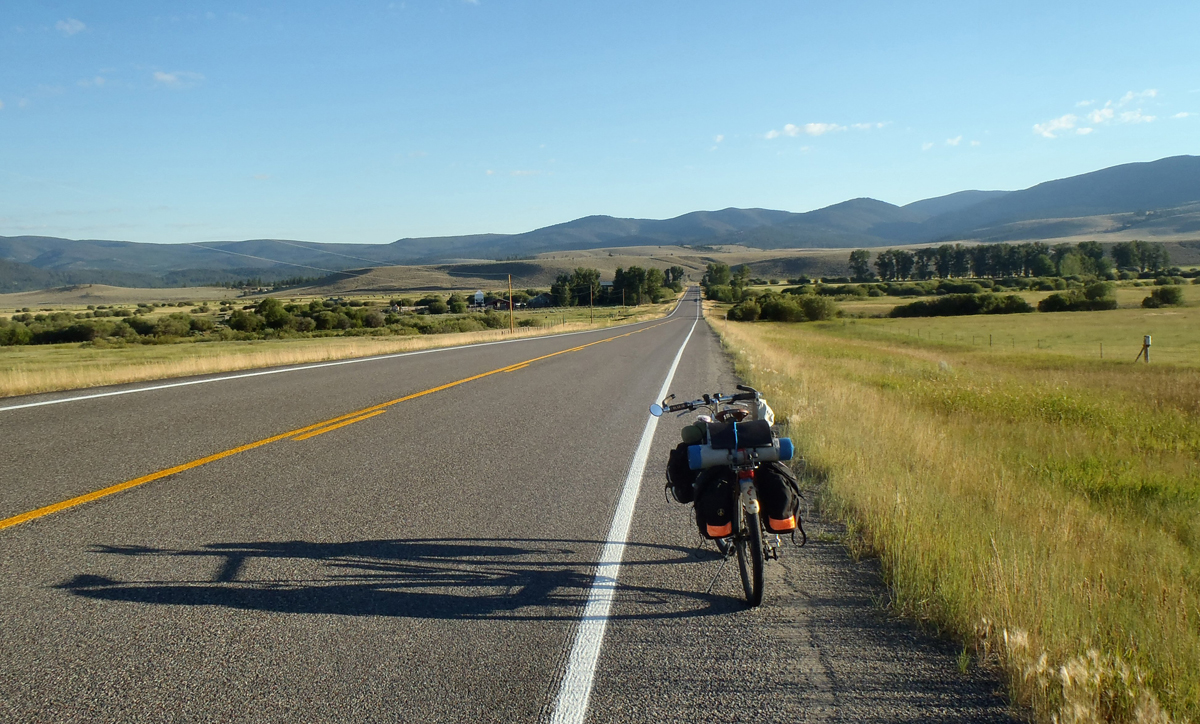
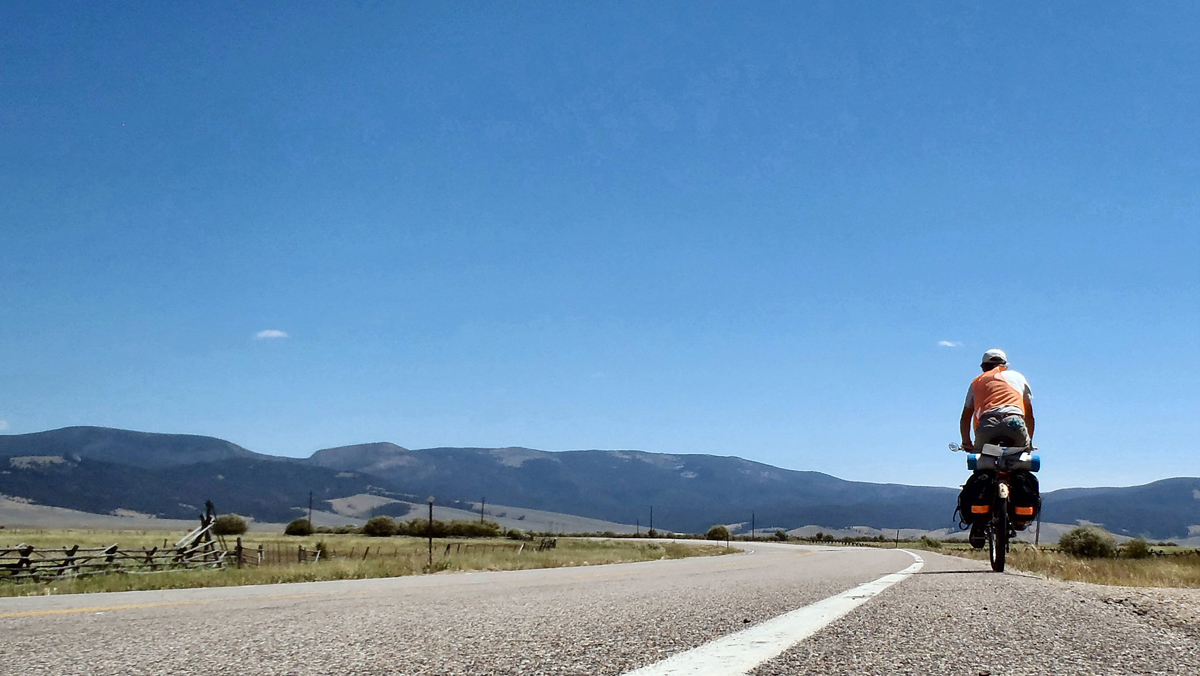
The open road in Montana. Photo by John Roberson
After breakfast I rolled out of Wisdom and spent that first morning on Highway 43, following the Big Hole River as it wound its way north. The highway was quiet and nicely paved and shouldered, and I had the advantage of a bit of tailwind as I put in the first miles of my tour. I passed open meadows and patches of pine forest, and the occasional ranch house or fishing lodge off in the distance. Like other rivers I would ride beside in the days ahead, the Big Hole river was a constant companion that first day, sometimes flowing in close to the road where I could hear the chatter of birds and the gurgle and hum of moving water, and at other times defined only by a line of trees or occasional flash of sunshine on water, out in the middle of the valley. It was all very beautiful.
I spent a leisurely couple of hours riding north, then east and southeast as the river flowed north of the Pioneer Range. I chatted with a group of cyclists at the Wise River store, where I’d stopped for a cold drink. They were a disparate bunch. A couple of riders were, like Roger, carrying full panniers and gear and heading for the Pacific coast. Another pair of bike-packers were travelling super light and had just dropped off the high ridges in order to resupply at the store. They were anxious to get back up into the high country. Everyone seemed to be having a great day!
Highway 43 eventually intersected with Interstate 15, so I turned south, along with the river, and followed the old highway/frontage road for another easy 15 miles or so. At one point I left the frontage road and the busy I-15 corridor and turned east onto a well-graded and quiet ranch access route called the Burma Road. I had lush, river-side ranches off to my right as I cruised through the early evening light, dry hills and coulees to my left, and grand views of the Ruby Range off in the distance to the southeast. It was a delightfully mellow way to finish off a great first day. As the sun dropped below the Pioneer Mountains to the west I found a primitive access road leading up into the hills and followed it to a cozy perch on a hill where I camped for the night.
Day Two – Burma Road to Harrison (almost)
I slept well that first night and was back on the road before the sun had risen too far into the morning sky. The day was shaping up nicely. Montana mornings in July are clear and cool and perfect for riding, and I wanted to put a few easy miles into my day before the sun got to be too fierce. Within an hour of leaving my hilltop camp I had left the Burma Road behind and ridden north on paved Montana Route 41 to the town of Twin Bridges. Twin Bridges is one of many Montana towns where serious fisherfolk come to try the state’s legendary trout streams. It’s at Twin Bridges that the Big Hole, Beaverhead and Ruby rivers come together to form the Jefferson River, which in turn joins the Madison and Gallatin Rivers further downstream to form the might Missouri River.
Bicycle touring in Montana. Photo by John Roberson
After a short break in Twin Bridges I turned east onto Montana highway 287 and began to get back some of the elevation I’d lost during the previous day. I was riding southeast, more or less, climbing gently up the broad valley of the Ruby River and through the small towns of Sheriden and Alder.
Cross-country bicyclists were common along this beautiful stretch of highway, but my contacts with them were limited to hand waves and smiles and an occasional “Good morning!”. Some of the riders seemed less focused on the marvelous scenery to be enjoyed than on the task of getting down the road.
The highway continued east and south and became steeper as it left the valley and began its climb into the foothills separating the Ruby Mountains to the south from the Tobacco Root Mountains to the north. Despite having to slow my pace with the steeper grades of the highway, before the morning ended I had climbed into the celebrated, and very busy, town of Virginia City, Montana.
Virginia City is part of a National Historic District that celebrates the glories of an early period of Montana history (the 1860s) when gold was discovered in nearby Alder Creek. At the time, everyone and his brother rushed in to claim a fortune. The town was such a success that for a time it was the territorial capital of Montana, claiming both the first newspaper and public school in the territory. Many of the town’s original buildings remain, though some have been repurposed in order to serve all the out-of-town visitors that fill the sidewalks on either side of the main street during the travel season. They were out in force on this day. I took in the scene as I enjoyed a cool drink from a convenient “saloon”, then finished the last of what had become a rather arduous climb to the pass. After a refreshing downhill run off the summit to the east, I entered into the lush Madison River Valley and the small town of Ennis, Montana.
Self-portrait on one of the open roads in Montana. Photo by John Roberson
Ennis would prove to be another in a series of peaceful, river valley towns that I would pass through on this trip. Generally, these small towns service the basic needs of the local ranchers and farmers, as well as the passionate fisher-folk who come for the trout, and all the various wanderers who flock to these beautiful river valleys with the same adventurous spirit that led Lewis and Clark to these valleys more than 200 years earlier.
I rolled through Ennis on U.S. 287 and maintained my northerly heading as I continued riding throughout the late afternoon and evening hours. I poked my way up and over a minor pass and watched late afternoon storm clouds build over the Tobacco Root Mountains to the north. I dodged a rattler sunning itself on the highway shoulder, then enjoyed a few easy downhill miles to a highway crossroads at Norris, Montana. I had hoped to find some cooling fluids in Norris, but the only gas station was closed for repair, and the community’s single tavern was shut up tight. My hopes for an end-of-the-day cold drink had to be put off.
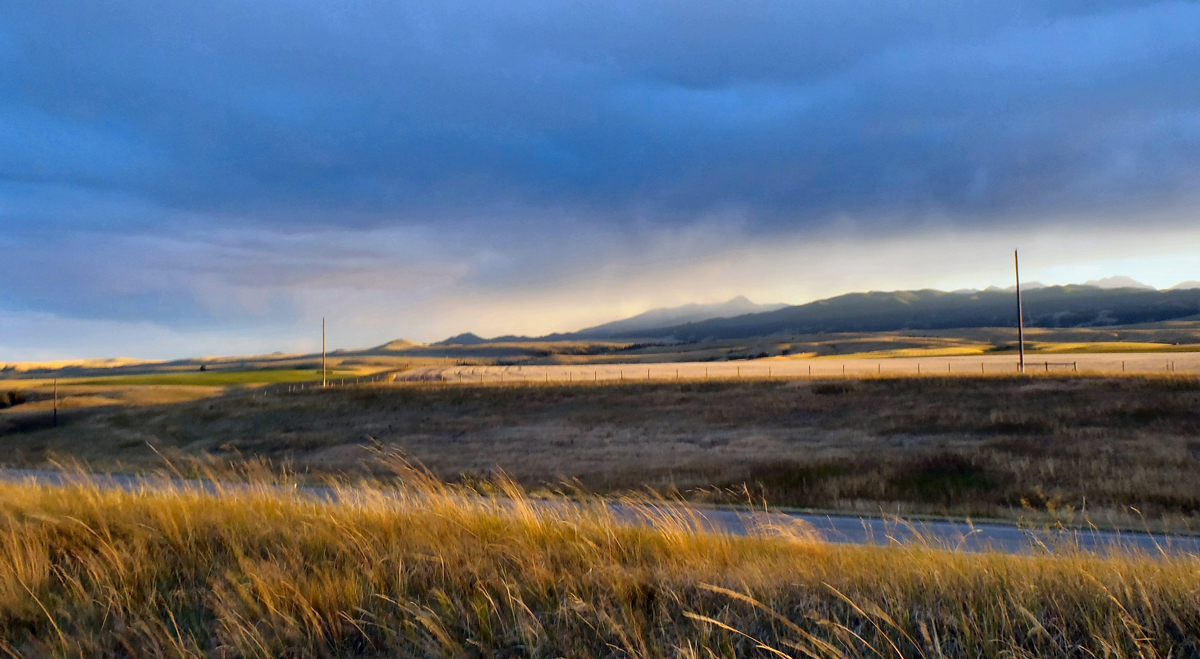
The end of the day. Photo by John Roberson
While I paused in Norris I had a nice chat with a touring bicyclist from Belgium who was heading south to Ennis with a light load and an empty food bag. He said he had counted on resupplying in Norris and at that point was down to nothing. He sounded slightly desperate. I had plenty, so after giving him enough chow to get him through the night, and wishing one another a bon voyage, we parted ways. He rode south and I rode north into the fading sunset light. A few miles north of Norris I found a comfortable camp site at the top of a roadcut along the highway and settled in. A gusty wind blew for a while as I set out my camp and watched the end of the day. Over the mountains, the afternoon storm clouds were breaking up as the day cooled down, and a rich palette of glorious sunset colors filled in the spaces between and below the clouds that remained. For a while it was simply amazing; just another, magnificent Montana sunset, I guess!
Day Three – Harrison to Canyon Ferry Lake
I had a wonderful ride on my third day of touring, from my roadside camp south of Harrison, Montana, and a good 65 miles, as the crow flies, to my evening camp. The sky was especially clear during the morning hours, and the winds were very helpful throughout the day. Clouds built up over the hills during the hot afternoon hours – a regular occurrence during these late July days – and I watched a few rain squalls move across the terrain, both in front and behind me. I dodged the rain, but I relished the shade the clouds sometimes provided and the fresh, wet smells of the newly-moistened countryside.
I had a tasty, sit-down, second breakfast in Harrison where I listened to the local old boys nurse their coffees and gossip with the waitress, then I zoomed up Highway 287 to (and through) Twin Forks, Montana. This is where the Jefferson, Madison and Gallatin rivers come together to form the mighty Missouri. Lewis and Clark passed through here in 1805 and gave the rivers their names, and for their guide, Sacajawea, it was a homecoming, of sorts: she had been kidnapped from the same area a few years before joining up with Lewis and Clark downriver.
The traffic north on Highway 287 – an excellent, higher-volume highway that connects Three Forks and Helena – was pretty heavy, but the day was beautiful, and the riding conditions were first rate. Tailwinds helped me blend in with the flow of traffic, and the shoulders were nice and wide. All in all, it was a pleasant stretch of roadway.
I took a nice, mid-afternoon break in Townsend, a wonderfully well-appointed and shady town, then left busy 287 for a quiet, zig-zaggy backroad that runs through open countryside along the east side of Canyon Ferry Lake/Reservoir (Montana’s third-largest lake and, according to a Townsend local, a favorite iceboat racing spot during those chilly Montana winters).
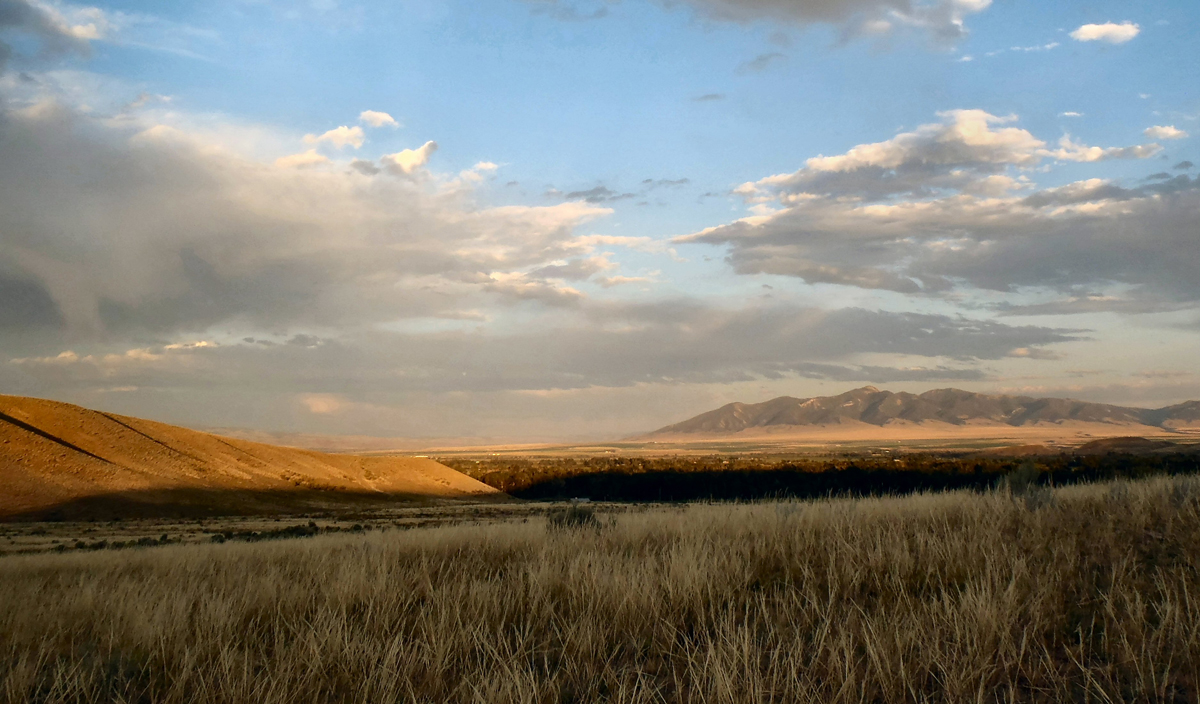
Big Sky Country. Photo by John Roberson
I spent the waning hours of the afternoon cruising easily up the east side of the lake. The traffic was light and the vistas were of the classic, Big Sky variety: expansive, not-too-distant mountain ranges, towering cumulus clouds trailing curtains of rain, deep blue skies, and rich sunset colors. I found a nice place to set out my third camp, on a small rise a quarter mile from the roadway, then fought the breezes from the last of the late afternoon squalls as they broke up over the lake. I enjoyed another glorious sunset, followed by a tasty meal and a star-filled night sky.
Day Four – Canyon Ferry Lake to Highway 141, Near Finn
I really gave my creaky old bones a workout on the fourth day of my tour, riding from my camp on the shores of Canyon Ferry Lake to a skimpy roadside camp at the end of the day. In between I climbed a couple of passes and dodged through the workday traffic of downtown Helena.
I began the sunny morning with a lot of rather nice, up-and-down riding, at the north end of Canyon Ferry Lake. I rode past summer homes and marinas near the reservoir’s dam, which was built back in the early 50’s, and pretty much had the quiet road to myself. As it was, I enjoyed a very quiet, back-door route into the general hubbub of Helena, the capital city of Montana.
I rolled through Helena around mid-morning. I needed a short break, and there was plenty to see, so I replenished my fluids and supplies and took my time cruising through town. As the capital city of Montana, and at one time one of the richest cities in America because of its extensive gold diggings and determined miners, Helena is still a vibrant place, filled with both beautiful Victorian buildings and the commercial trappings of any American freeway community, as well as the remarkably friendly people who seem to populate every Montana town.
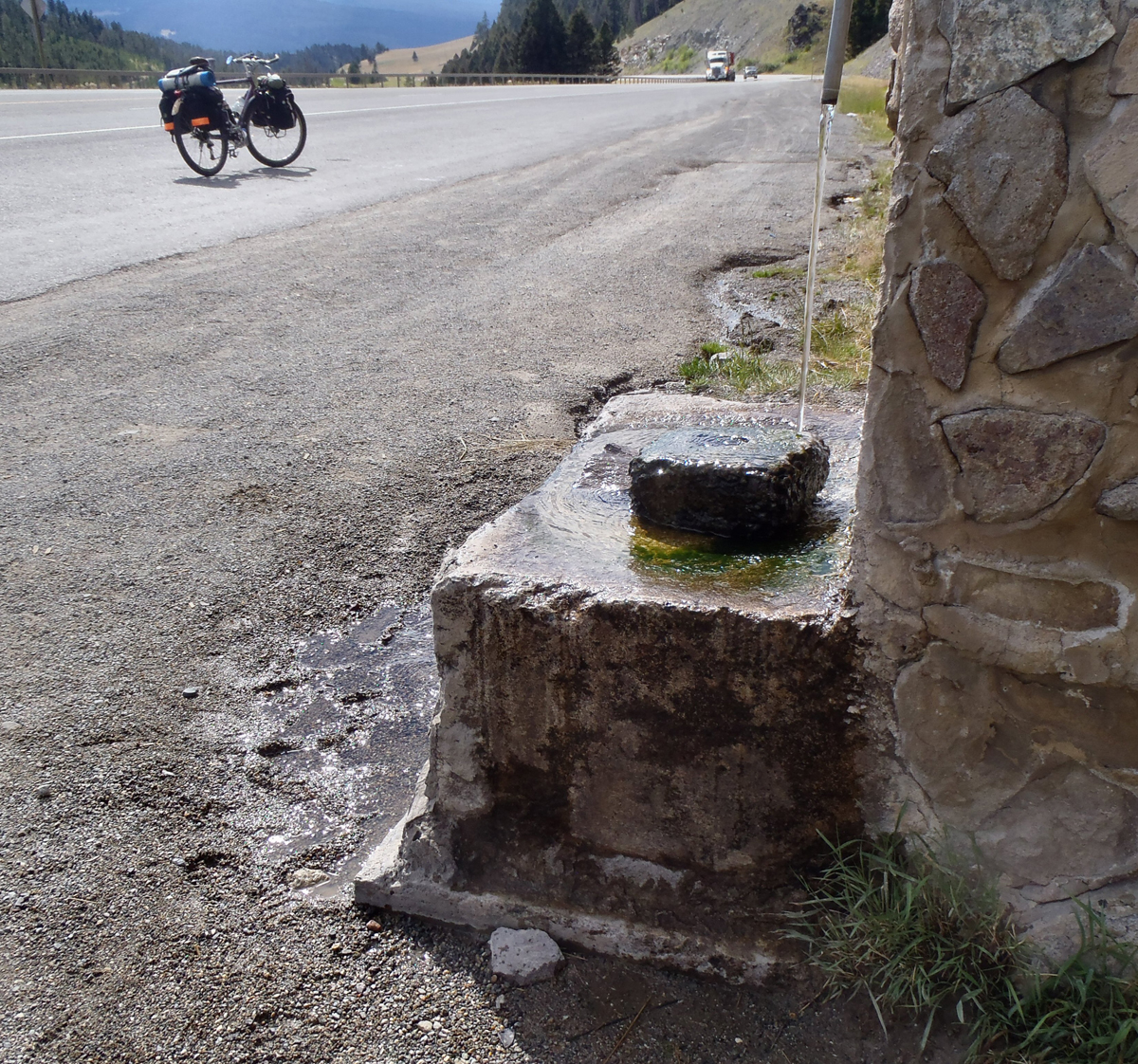
Roadside water while bicycle touring in Montana. Photo by John Roberson
From Helena, I rode west on U.S. Highway 12, a major road connecting Helena to Missoula. I spent a good portion of the middle of my day climbing to MacDonald Pass and the Continental Divide. It was a bit of a grind, to say the least, and I took it slowly, using the route’s excellent shoulders and passing lane, and stopping frequently to cool off in the shade by the side of the road. By mid-afternoon I cleared the pass and found a charming roadside fountain just past the summit. I stopped there to fill my bottles (delicious water!) then coasted for a few miles down the other side of the pass to the town of Elliston, Montana. I took a break in front of an Elliston store and watched the traffic and a couple of trains roll past. Refreshed, I carried on down the busy road into the late-afternoon sunlight, following both the rail line and Route 12 nearly to the town of Avon, where I left the busy highway for what I hoped to be a much quieter backroad, Route 141.
Route 141 was a peaceful two-lane highway that led me up and over a gentle pass and into a modest valley separated by the Garnet Mountains to the west and the wide-ranging hills of a portion of Helena National Forest to the east. My long day was winding down and I found myself truly relaxing for the first time since leaving Helena earlier in the day. The riding was sublime. The early evening light was soothing to my eyes, quiet fields and meadows stretched off towards the hills on either side of the road, and the few slow-moving vehicles that passed me seemed to be enjoying the beauty of the evening as much as I was.
Journal Entry:
“Another highway right-of-way camp. The sun has set and I’m out of sight above the pavement, away from any sign of ranch house or barn. My camp is stretched out at the top of a steep highway cut, on a bit of fairly level, but lumpy, ground, and up against the rusty right-of-way fence. It’s not a bad spot, actually. The views are stunning, and the highway is sure to be quiet tonight. The breezes are just light enough to keep the bugs at bay, but not so brisk as to make running the stove a pain. The nighthawks are swooping and buzzing in the air above me. Water is heating in the kettle as I write, and there’s another delicious Mary Jane’s freeze-dried meal set up to take that hot water. A great way to finish the day.”
Day Five – Highway 141 to Missoula
I awoke early the next morning to classic, summer-in-the-Montana-countryside noises: a couple of Sandhill cranes croaking together down by the creek, an airplane motor way off in the distance, and a few cows in a meadow waiting for someone to notice them. Conditions were as good as it gets as I headed off that morning. The highway was empty, the sky was clear blue, and the air was calm and made fragrant by a delightfully rich mix of animal and plant smells. It was truly, ideal riding.
I spent and hour or two on that quiet highway, following the creek as it made its gentle way down-valley to a point where it joined the much grander Blackfoot River. In the late morning hours I was finally forced to leave the peace and quiet of Route 141 and joined a noticeably busier highway, Route 200.
I spent the rest of my day on 200 as it made its way downriver to the west, and on to the city of Missoula. At times during the long afternoon the highway ran alongside the Blackfoot River, and at other times it left the main river valley to follow one of the main river’s, tributary creeks. As I followed the river’s flow I remembered that I was on the west side of the Continental Divide. I considered the fact that most of the cool, clear water I was seeing in the river and creeks would eventually end up in the Pacific Ocean, by way of the mighty Columbia River.
There were plenty of places to cool my heels along the way, and I took the time to relax whenever I encountered a particularly nice rest spot or convenience store. As the afternoon progressed I rode past the communities of Ovando, Greenough and the turn-off to Seeley Lake (a beautiful route north, to Kalispell and the Flathead Lake area). As both the afternoon and I wore down, I became aware of a gradual increase in traffic, and knew I was getting close to the city of Missoula and the end of my day.
I worked my way through the towns of Bonner and Milltown, east of Missoula, where the Blackfork River becomes the Clark Fork of the Columbia River (the largest river, by volume, in Montana!). As I came to the city’s outskirts I realized that I had entered suddenly into the most urban environment I’d seen since leaving Salt Lake. Traffic was everywhere as people finished their work days and headed home. The day was winding down, for me, too, and I realized that a good camp spot might be tough to find, so I decided to grab a room in a cheap motel on the east end of town.
Day Six – Missoula to Sula
Journal Entry:
“It’s dawn at the Thunderbird Motel in Missoula, a spur-of-the-moment destination chosen at the end of the day yesterday. It was wonderful to be able to clean up and cool off after the buzz and heat of yesterday’s afternoon/evening run down the Blackfoot River into Missoula. The grades and shoulders along the way were decent enough, but the traffic was pretty heavy from mid-day on; working people and travelers, mostly, looking to get off the roads as eagerly as I was.”
Montana’s second largest city was quiet and cool as I set out early to ride through Missoula’s comfortable, neighborhood streets. I had a so-so breakfast at a cafe called Ruby’s, then continued to work my way south and west of town, on Routes 12 and 93.
At the west end of the valley I was delighted to come across a dedicated bicycle and pedestrian pathway. It was a wonderful thing to discover! As the morning and afternoon progressed, I stayed on the pathway, which seemed to connect the outskirts of Missoula to the towns south of the city, and along the Bitterroot River Valley. The path runs parallel to U.S. 93, a very busy highway that also services the communities up and down the long, Bitterroot Valley. I followed the path through Lolo and Florence and Victor, and on up the large town of Hamilton, Montana. Along the way there were places where I left the pathway to check out a piece of old highway, and I often returned to ride 93 itself as it passed through a town’s business district. It was a wonderful way to ride up the Bitterroot River Valley, and the afternoon passed quickly. Both the pathway and the daylight hours of my riding day had pretty much petered out by the time I reached Darby, Montana, where the highway began its real climb out of the river valley and up towards Lost Trail Pass.
I left most of the local, valley traffic behind me and began to climb back up into higher country.
I finished my day a mile or so up the road from the Sula store, in another campsite just above the roadway and on the edge of a small stand of conifers. It was really a very restful spot: the road noises were minimal to non-existent, the ground was level and soft, and the sky was a beautiful mix of both deep blue sky and sunset-colored clouds. I slept like a log!
Day Seven – Sula to Wisdom
Journal Entry:
“The sun’s about to appear in a notch in the far hills. The birds twitter. The cows mooo. The sounds of the river rise to my hillside perch. It’s been an especially fine campsite that included a delicious evening meal, eight solid hours of sleep (despite a short-lived, midnight cacophony of yips and howls from a nearby troupe of coyotes!), and that wonderful visit from the owls at dusk, coming in close enough and bold enough, as they did, to make me just a tad nervous. A magical experience”
I left my Sula campsite with the sun still low to the east and continued my climb up U.S. 93 to the south. I had slept well, and I felt refreshed, so I took my time climbing to Lost Trail Pass. The morning was delightfully cool, and the air seemed unusually still and quiet. I could hear both the sounds of the forest and approaching traffic from a long way off. The day’s travelers hadn’t yet hit the roads in big numbers, so I was able relax and enjoy my surroundings. My low gears worked well, and 93’s shoulders and passing lanes allowed me the opportunity to tack back and forth through the lanes and shoulders, in order to ease the climb.
I cleared the pass around noon and paused to rest there. I was up pretty high, so I figured I’d the let sun warm things up a bit more before I dropped off the pass beyond, back onto the east side of the Continental Divide, and back again into the Big Hole River Valley where I’d begun my tour a week before.
While I waited there at the summit I had a conversation with a very pleasant, older fellow (an easy-going Montanan who had helped me free a small mammal from the depths of a MDOT rubbish bin!). Neither one of seemed to be in any particular hurry. We shared an admiration for Montana highways and byways and for the sights to be seen along the way, and we bemoaned the forces of progress that seemed to be filling in more and more of the world’s pretty places. We expressed a mutual admiration for the writer and native-son, Ivan Doig, and we shared what we knew about the Big Hole National Battlefield site, just down the road. We talked about how tough Chief Joseph and his band of Nez Perce had been when they made their desperate run for Canada back in 1877. In the end, they didn’t make it, and the battlefield site marks one of the band’s worst encounters with U.S. forces. It’s both a beautiful and very sobering place to visit.
The old Montanan and I parted ways there at the summit and I began a long, last descent back into the valley below. The weather was still nearly perfect, and much of the traffic that had finally built up as I approached the summit earlier in the day had continued to follow U.S. 93 as the road dropped into Idaho and on to Salmon, and points south. I was back on peaceful Route 43 again and headed back into Big Hole River country. It was a delightfully easy downhill cruise, and before I knew it, I was back in Wisdom, at the end of another excellent tour.
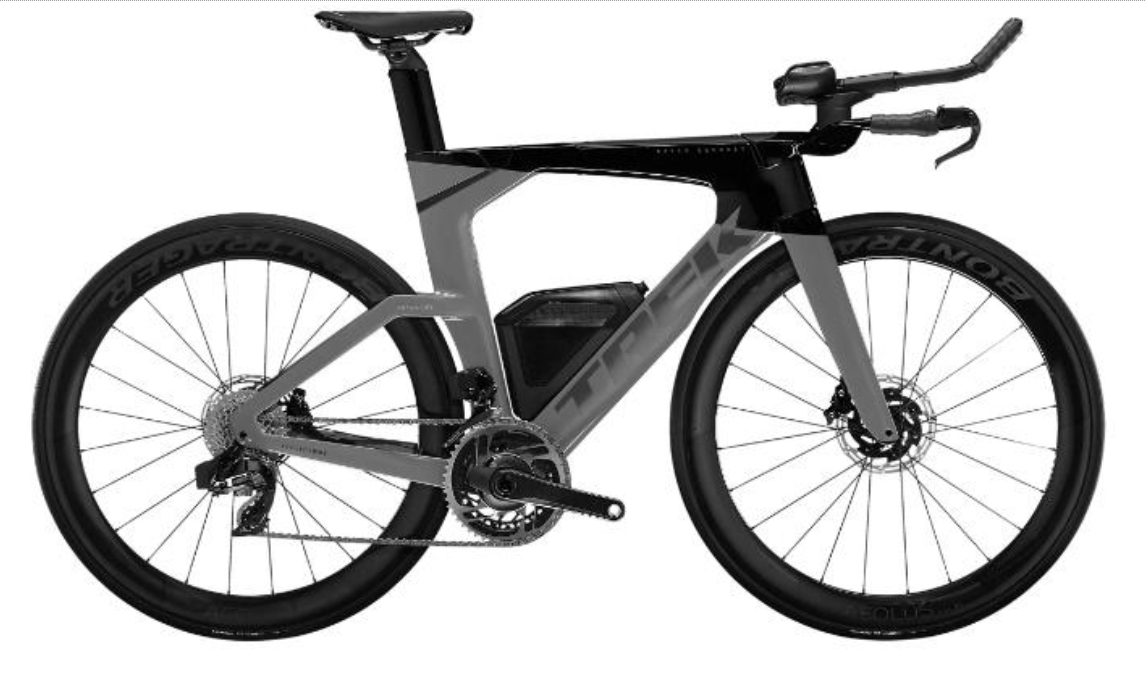
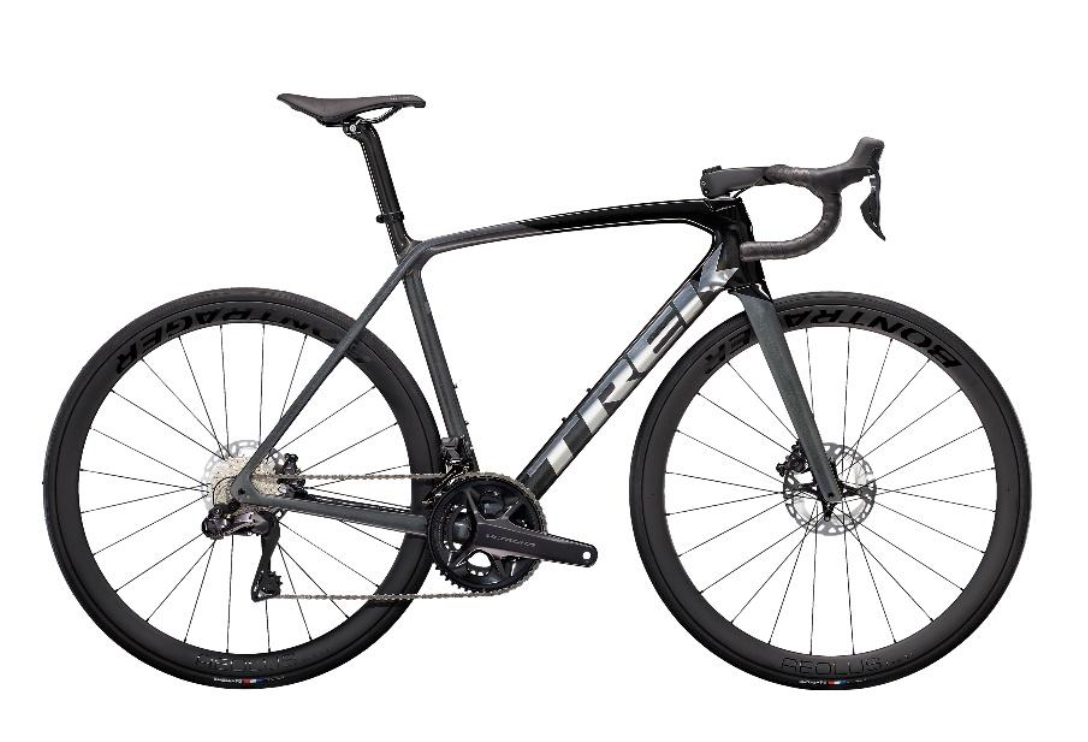
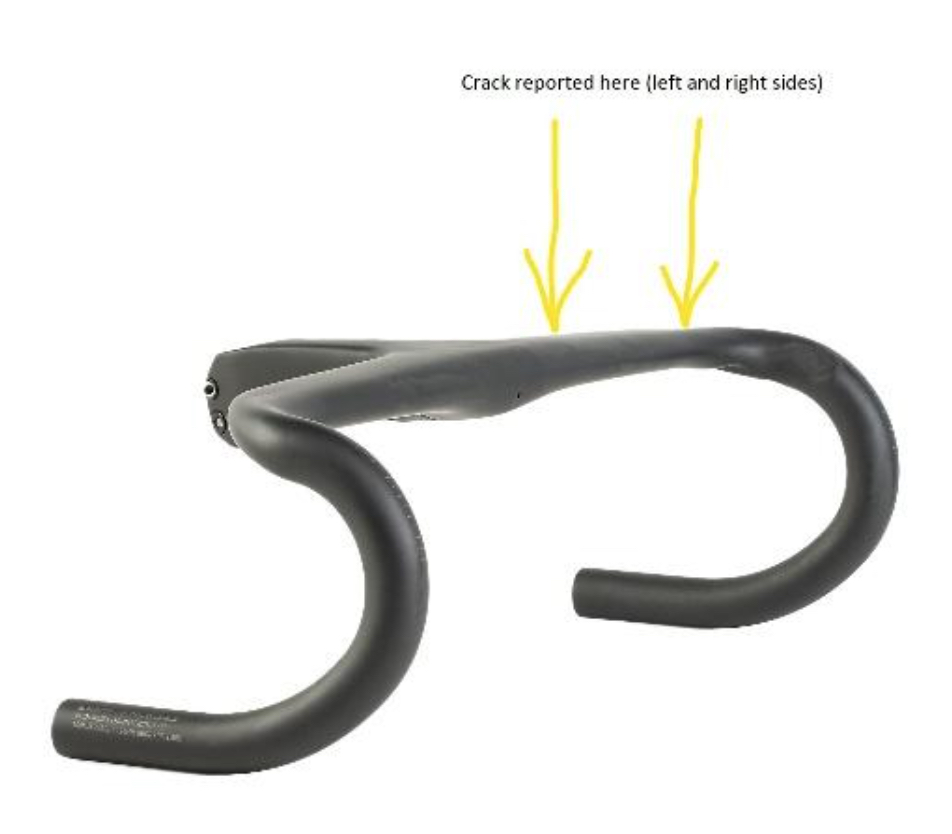
Name of Product: Trek Model Year 2022 Speed Concept SLR and MY 2021-2022 Emonda SLR bicycles and MY 2020-2021-2022 aftermarket Bontrager Aeolus RSL VR-C handlebar/stems
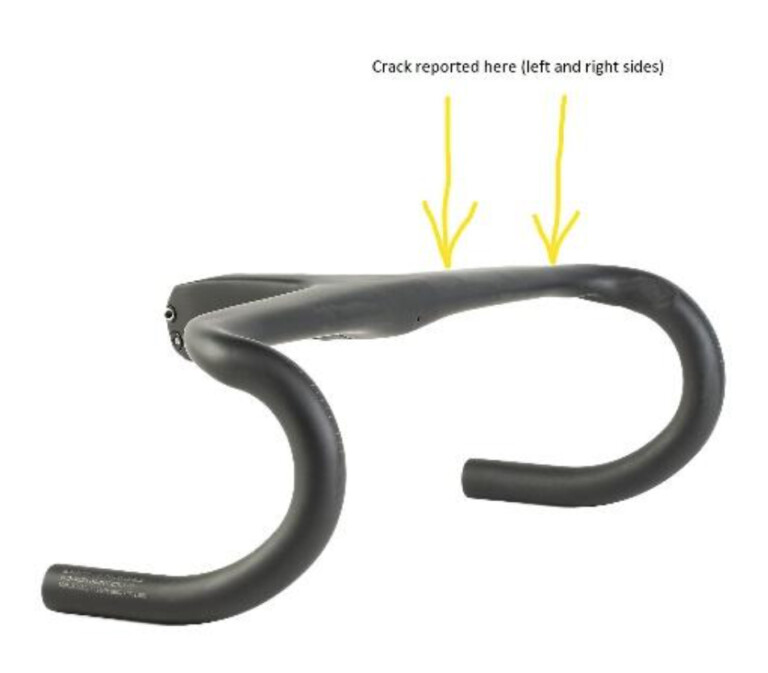
Hazard: The bicycle’s carbon handlebars can crack, posing fall and crash hazards.
Remedy: Replace
Recall Date: August 25, 2022
Units: About 3,200 bicycles/900 aftermarket handlebar stems (In addition, about 530 bicycles/115 aftermarket handlebar/stems in Canada)
Consumer Contact
Trek at 800-373-4594 from 8 a.m. to 6 p.m. CT Monday through Friday or online at https://www.trekbikes.com/us/en_US/company/legal_policies/safety_recalls or www.trekbikes.com and click on Recalls for more information.
Recall Details
Description: This recall involves carbon fiber handlebars installed on MY 22 Speed Concept SLR bicycles and Bontrager Aeolus RSL VR-C handlebar/stems installed on MY 21 and MY 22 Emonda SLR bicycles and distributed in the aftermarket under the same name. Trek is printed on the bicycle’s frame. The following model year bikes are included in this recall:
Remedy: Consumers should immediately stop using the recalled bikes and aftermarket handlebar/stems and contact their local authorized Trek retailer for a free repair.
Incidents/Injuries: Trek has received 37 reports of broken carbon handlebars, including one report of injury involving scrapes and bruises.
Sold At: Bicycle stores nationwide and online at trekbikes.com and other online retailers from May 2020 through June 2022 for between $8,800 and $13,500 for Speed Concept SLR models; from about $6,700 to $13,000 for Emonda SLR models and about $680 for the Bontrager Aeolus RSL VR-C handlebar/stem sold separately.
Manufactured In: Taiwan, Germany and United States (bicycles) and China (handlebars)
Recall number: 22-209
This recall was conducted, voluntarily by the company, under CPSC’s Fast Track Recall process. Fast Track recalls are initiated by firms, who commit to work with CPSC to quickly announce the recall and remedy to protect consumers.
Hernandez, Sierra, and Williams were suspended after the altercation at the end of the Pro Men’s race at the event.
COLORADO SPRINGS, Colorado (August 25, 2022) — USA Cycling announced today the investigation results following the altercation at the Salt Lake Criterium, which occurred on July 16, 2022. As a result of the investigation, Michael Hernandez (Leesburg, Fla.; Best Buddies), Robert Sierra (Miami, Fla.; Best Buddies), and Justin Williams (Pomona, Calif.; L39ION of Los Angeles) all received suspensions.
After the race, USA Cycling immediately began an investigation of the incident, interviewing all three riders. The investigator also reviewed videos of the confrontation and interviewed other witnesses. As a result, the investigator found that all three riders violated USA Cycling rules prohibiting acts of violence among riders and unsportsmanlike conduct.
USA Cycling notified the offending riders of the investigation results and subsequent suspensions on July 25. All three riders were offered reduced sentences if they accepted the investigation results and subsequent suspension and served community service in conjunction with those suspensions. Hernandez and Sierra accepted USA Cycling’s offer, with Sierra accepting a one-month suspension with eight hours of community service, and Hernandez accepting a three-month suspension with sixteen hours of community service. Williams requested a hearing as allowed by USA Cycling’s Policy III. A three-member panel heard Williams’ case and upheld the suspension. Williams then accepted the initial five-month suspension recommended by the investigator beginning on July 25.
“USA Cycling has zero tolerance regarding violence, instigation of violence, and bullying. The behavior at the Salt Lake City Criterium is inexcusable,” said Brendan Quirk, CEO & President of USA Cycling. “We are working with the race organizers of the American Criterium Cup to increase our scrutiny of rider behavior in the peloton, including the use of video replay officials at the event. And while this will allow us to better identify dirty riding in real time, this doesn’t replace the need for riders to show basic respect for each other.”
Top 18 Mountain Bikers in the World Are Invited to Premier Big-Mountain Freeride Competition
VIRGIN, Utah (August 24, 2022) – Eighteen athletes have been invited to the 2022 Red Bull Rampage, the premier big-mountain freeride competition, where they’ll compete to determine the best in the sport. The world’s top mountain bike athletes will descend on Southwestern Utah, marking the 16th edition in the event’s history. Red Bull Rampage is scheduled for October 21st and tickets will go on-sale to the public on Tuesday, August 30th at 9:00 AM PT/12:00 PM ET via the event website.
Jaxson Riddle competes at Red Bull Rampage in Virgin, Utah, USA on 15 October, 2021. // Garth Milan / Red Bull Content Pool // SI202110160069 // Usage for editorial use only //
“Red Bull Rampage is the pinnacle of the freeride mountain biking scene, so it’s exciting to see who I will be competing alongside,” said local Utah competitor and the 2021 Style Award recipient Jaxson Riddle. “After a groundbreaking event last year, myself and the other riders are ready to get back out there and push the sport further than ever.”
The top ten riders from the 2021 competition were automatically pre-qualified for this year’s event, while the other 8 wildcards and 5 alternates were selected by a committee of former Rampage competitors, pro athletes, judges, and industry experts based on competition results and video submissions. Six former winners and three event rookies are among those set to compete, highlighting a blend of seasoned veterans and hungry newcomers ready to leave their mark at the event.
“Competing in Red Bull Rampage has always been a career goal of mine, so I’m stoked to receive this invitation to be on the biggest stage of freeride,” said Dylan Stark, a first-time competitor. “To compete in the pinnacle of the sport alongside all of the riders who push me to be better and further my craft is a huge honor. I’m ready to put together all of my skills and years of training in the desert this year.”
As with all previous editions of Red Bull Rampage, all of the invited participants are male.
Blevins, Parker, Munro, Cioppa, Batten, and Amos land back on the podium after finishing second in 2021.
LES GETS, France (August 24, 2022) — Team USA kicked off the first day of racing at the 2022 UCI Mountain Bike World Championships in Les Gets, France. The Team Relay is always one of the most exciting events at the World Championships bringing the nation together across all age categories. Federations chose their top male and female riders in the Junior, U23, and Elite categories. Each team was made up of six riders who would do one lap each of the XCO World Championships course.
Short Track Word Champion Christopher Blevins (Durango, Colo.; Specialized Factory Racing) started out for Team USA holding the lead for the first half lap. Italy managed to pull ahead, but Blevins still kept him in sight. Junior National Champion Cayden Parker (Hot Springs, Ark.; Bear National Team) went all in. With other teams sending out many of their elite riders, most of the teams were back together by the second lap. France created a significant gap on the front with the chase group consisting of the USA, New Zealand, Italy and Denmark. Madigan Munro (Boulder, Colo.; Trek Factory Racing) started her lap in fourth with 15-seconds to third. The race was on for the final podium spot. France had a mechanical on lap five dropping back to seventh. That would put Bailey Cioppa (Durango, Colo.; Bear National Team) in third as she tapped in Haley Batten (Park City, Utah; Specialized Factory Racing). Batten is no stranger to the Team Relay racing in her third one of her career and charged to tighten up the gap to second. It was all up to Riley Amos (Durango, Colo.; Trek Factory Racing) to keep the team on the podium and he did just that. With one of the fastest laps of the day, Amos finished just 14-seconds back from race winner, Switzerland, and only 8-seconds back from Italy in second place.
The relay is a great opportunity for riders to take the course at speed. Batten said, “It’s good to be back in Les Gets. There are two pretty major climbs when you’re trying to go all out for a lap and its actually quite hard. You think you can just go from the gun start to finish, but there are long climbs and you have to pace yourself pretty well. Then at the top, it’s pretty technical as well. It’s a really great race track. It has everything for a mountain bike athlete. You have to be a talented climber as well as a technical rider. I think going into Sunday, the relay is a great opportunity to test it at speed and with other riders. I think it will be a great race.”
The riders’ favorite part of the relay is the team aspect, which they do not get much of in a sport like mountain biking. Batten said, “The Team Relay is one of my favorite events – the atmosphere, the energy, being a part of a team environment. We aren’t often with USA Cycling at most of the World Cups and its only just the World Championships and the Olympics where you get to be a part of that team environment and energy.”
Blevins has also been a part of many renditions of the Team Relay throughout the years. He commented, “This is my eighth Team Relay which is kind of crazy. I feel kind of old now. It’s always been my favorite event of the season. I think consistency and minimizing mistakes is the ball game here, so I think we had a pretty smooth race. Another medal we are happy with for sure.”
Team USA returned to the podium after a silver medal last year. Since the start of the event in 1999, this marked their fourth podium appearance (2007, 2019, 2021).
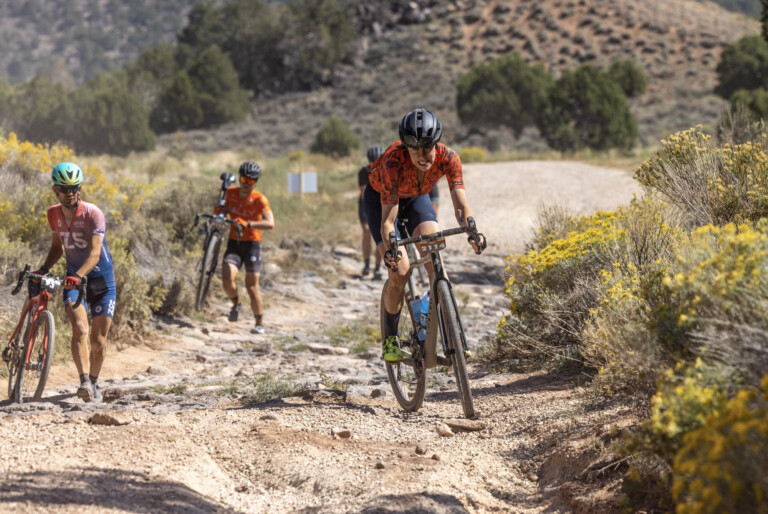
CEDAR CITY, Utah (August 12, 2022) — Monuments of Cycling, a premier cycling events producer, will be bringing its unique ‘unroad’ racing format back to Cedar City to deliver the Third Annual Belgian Waffle Ride, to be held September 23 -24, 2022. Three years ago, The BWR UT was the first ever Belgian Waffle Ride held outside of California. Now it’s become a punctuating moment on the gravel calendar. Along with the Belgian Waffle and Wafer Rides, the accompanying Unroad Cycling Expo will feature live music, a beer garden, lots of waffles, and all sorts of fun that will exemplify the wonderful familial largess of the great state of Utah.
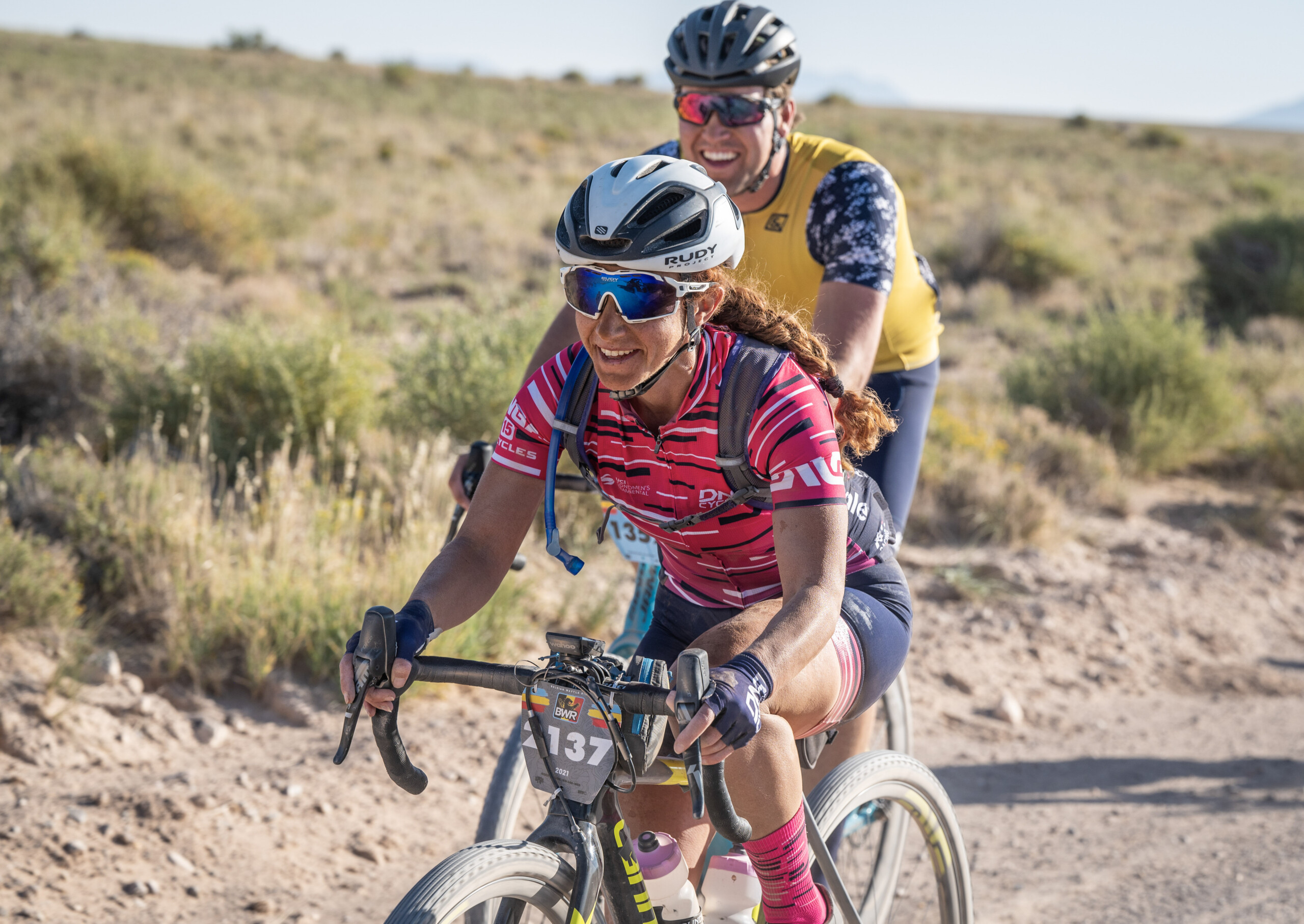
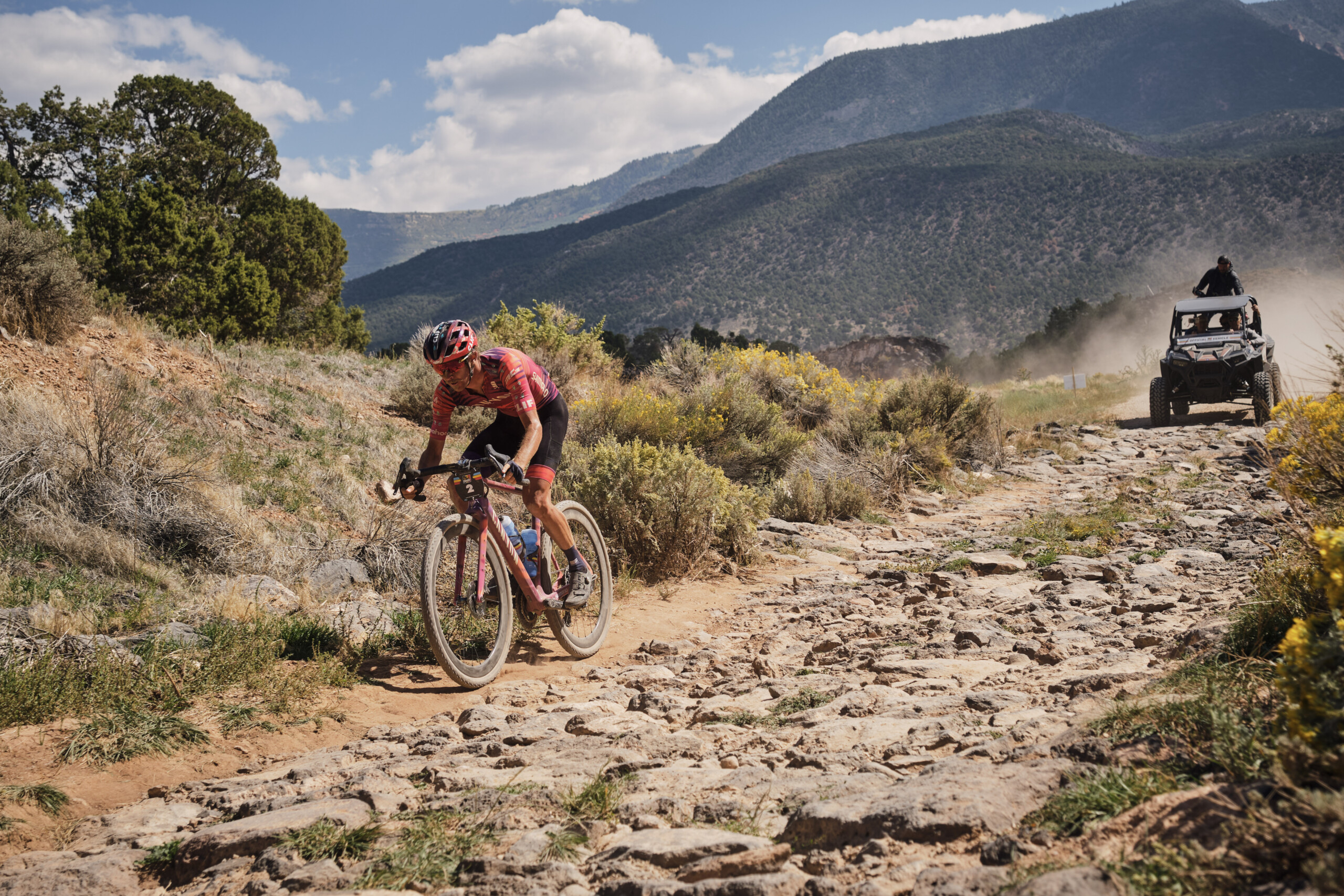
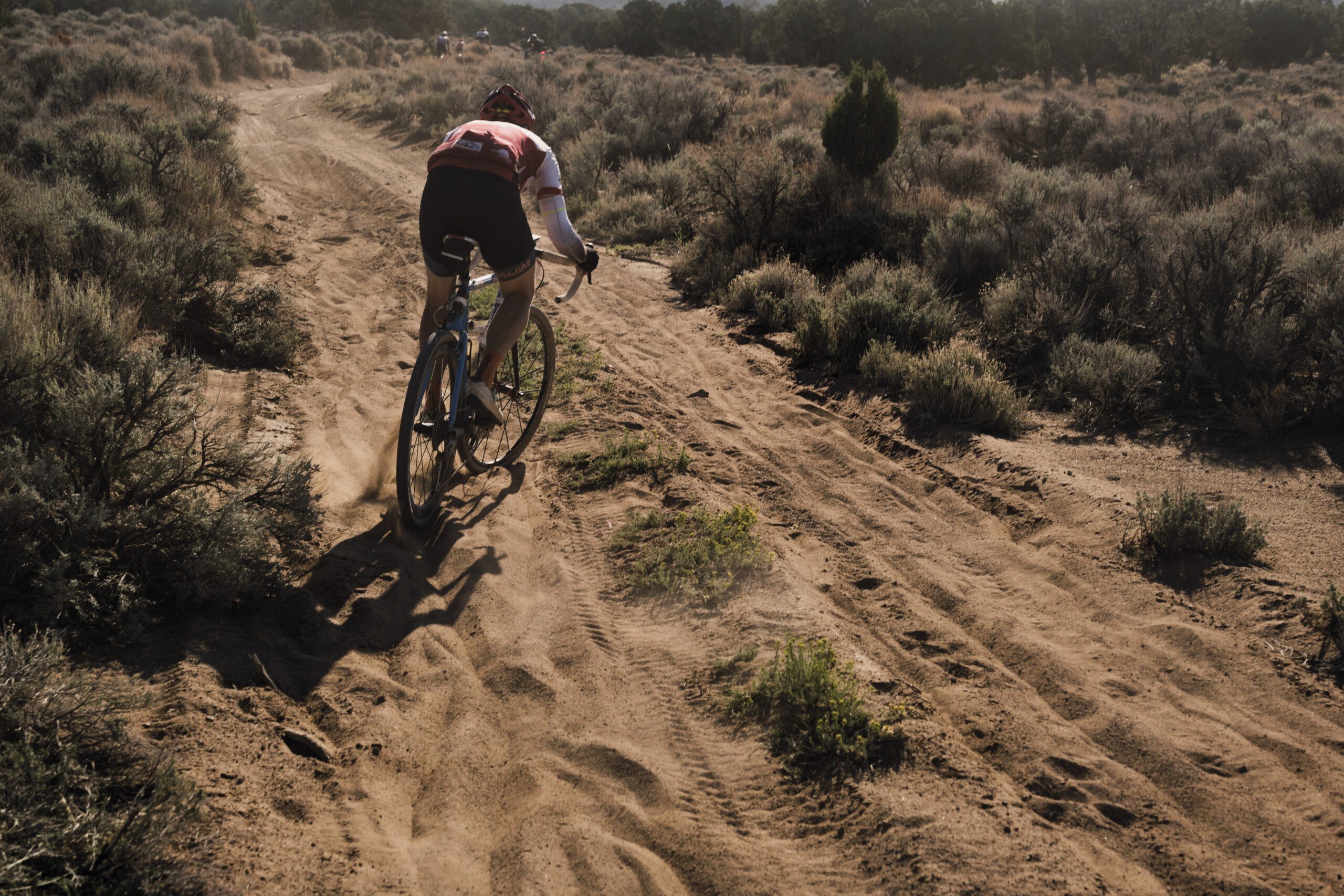
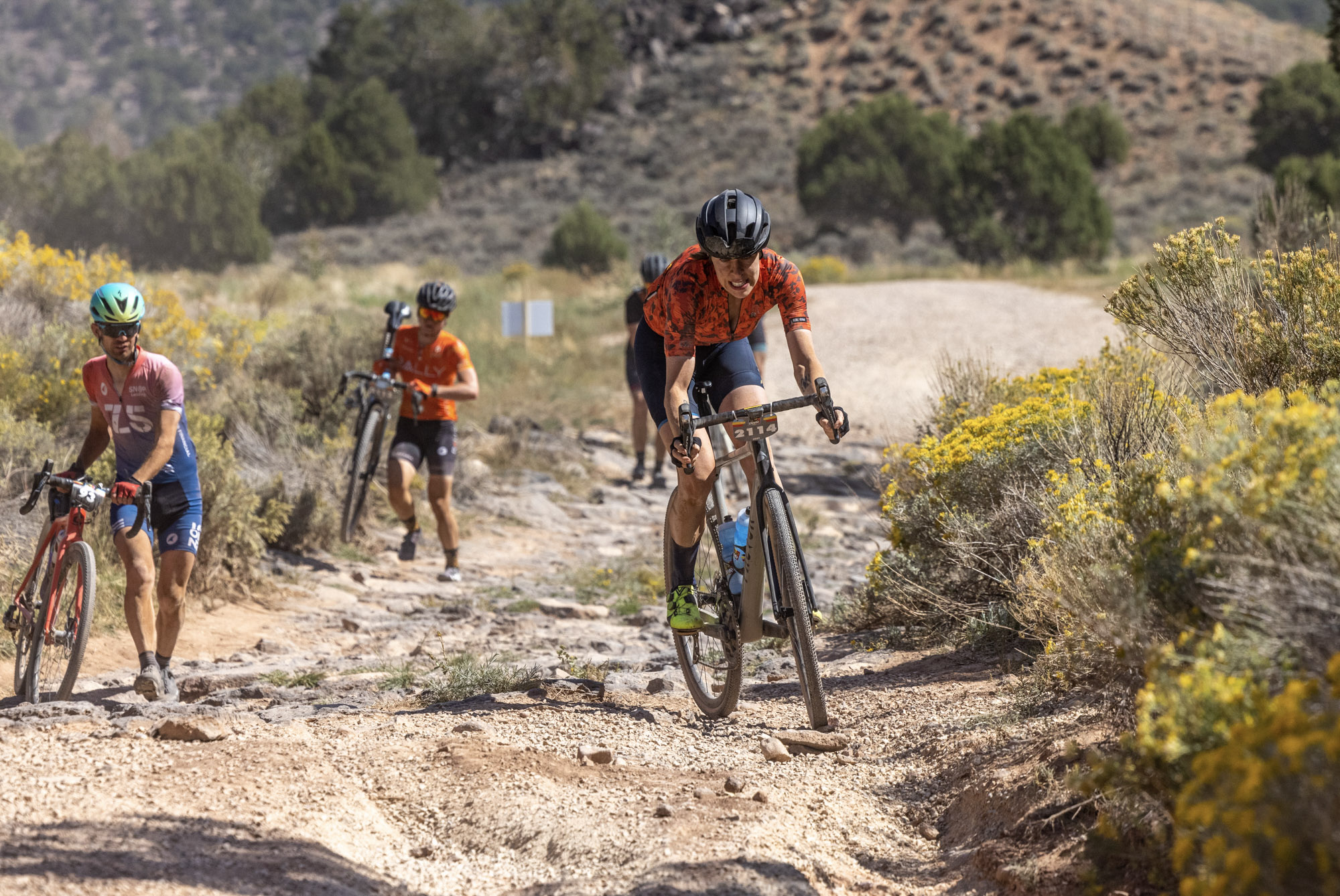
Scenes from the 2021 Belgian Waffle Ride in Cedar City, Utah. Photo courtesy BWR.
Cedar City, in Southwest Utah, has become a popular vacation destination among outdoor enthusiasts, offering many outdoor activities for visitors of all ages. It’s a great place to visit, teeming with natural wonders, exciting history, and gorgeous natural landscapes. Cedar City is a popular tourist destination not only because of the area’s natural beauty but also because it’s a gateway for many pioneers and immigrants in the 1800’s and early 1900’s. Cedar City has proven to be a warm and inviting place to visit and race one’s bike with access to the outdoors, entertainment, and views you can’t find anywhere else. Most importantly, it offers an array of terrain optimal for the BWR style of bike racing, including undulating unroads, gravel, single-track, sand, and rock. And the entire party takes place downtown in Main Street Park.
Scenes from the 2021 Belgian Waffle Ride in Cedar City, Utah. Photo courtesy BWR.
This special fall event, as in the past, will host a deep field of world class unroad, gravel, cyclocross and mountain bike racers from around the world looking to take on the uniquely beautiful and challenging terrain that only Cedar City can offer. The BWR is celebrating 11 years of pedaling perversity in 2022 and this family affair promises to provide professional and amateur cyclists alike the opportunity to ride the most coveted unroads of this spectacular venue, utilizing a myriad of gravel and single-track sectors to connect the best roads of the area for a truly dynamic multi-surface race — the unique complexion of road and unroad dynamics that are hallmarks of the BWR.
Scenes from the 2021 Belgian Waffle Ride in Cedar City, Utah. Photo courtesy BWR.
The NEW course this year features novel sectors that are sure to surprise and delight new and old racers alike. The Three Peaks Recreational Area offers us some incredible new options for flowy single track that laces its way through Juniper and Pinion trees. This Drie Toppen detour, instead of joining the road after the ever-exasperating als stroop een zandheuvel opduwen sector, will allow riders a chance to enjoy 8-miles of well-groomed single-track over granite stones, ladder bridges and decomposed granite trails. It’s fast and fun, and an incredible addition to this year’s course, but not the only one. There’s also a new motocross track feature to allow riders to get their whoops and braps out. Of course, we are offering the most notorious sector, the Tolweg, which comes after Muur van Kanarraberg, to give riders a break from the gravel slogs and mix it up with technical, fun, swooping turns, the likes of which can’t be found anywhere else.
Scenes from the 2021 Belgian Waffle Ride in Cedar City, Utah. Photo courtesy BWR.
“We bring our unique style of unroad racing to Cedar City because it is so different than all the other venues where we host the BWR. It is like the other venues, but with a jubilant juxtaposition of desert and mountain, and thus Cedar City offers limitless possibilities of trails, gravel roads, unroads and mountain bike terrain,” said Michael Marckx, Brooder/Director. “Combined with excessively cheery Utah hospitality, great food, and incredible brews, we are looking forward to providing an experience that participants will revel in again and again.”
Scenes from the 2021 Belgian Waffle Ride in Cedar City, Utah. Photo courtesy BWR.
The BWR, created as an extremely challenging race in the spirit of the great European one-day Spring Classics, is an utterly unique series of races in North America. There will be two distances on offer in Cedar City; the longer Waffle Ride, roughly 132-miles / 212-km, and the more than half-as-long Wafer Ride (80-miles / 128-km) for those looking to get a taste of the glory without the full-time commitment the full Waffle requires.
Scenes from the 2021 Belgian Waffle Ride in Cedar City, Utah. Photo courtesy BWR.
This Utah race, like other BWR’s in California, North Carolina, Michigan, and Kansas, will have a deep field of professional riders and an expansive list of hungry amateur riders drawn to the unparalleled opportunity to race alongside their heroes. The Waffle will be offering prize purse to the top-three riders, both female and male! Racers and event patrons will be treated to Belgian waffles and ales, frites, a variety of other culinary delights, more waffles, and even more beer on race weekend.
Scenes from the 2021 Belgian Waffle Ride in Cedar City, Utah. Photo courtesy BWR.Scenes from the 2021 Belgian Waffle Ride in Cedar City, Utah. Photo courtesy BWR.Scenes from the 2021 Belgian Waffle Ride in Cedar City, Utah. Photo courtesy BWR.
Little Red Riding Hood is one of the Best Women-Only Events in the United States
By Ellen Guthrie & Lia Westermann — There’s a fairy tale called Little Red Riding Hood that most people have read: a little girl wearing a red cloak goes to visit her grandmother, and, on the way, a big bad wolf finds out from the naive girl where she is going. As she picks flowers, he goes to grandma’s house and locks the grandmother in the closet. When the girl gets to grandma’s house, the wolf is dressed up as the grandmother in bed and tries to eat the little girl. Well, Little Red Riding Hood, the bike event, won’t eat anyone up. On the contrary, it feeds everyone a lot of tasty food!
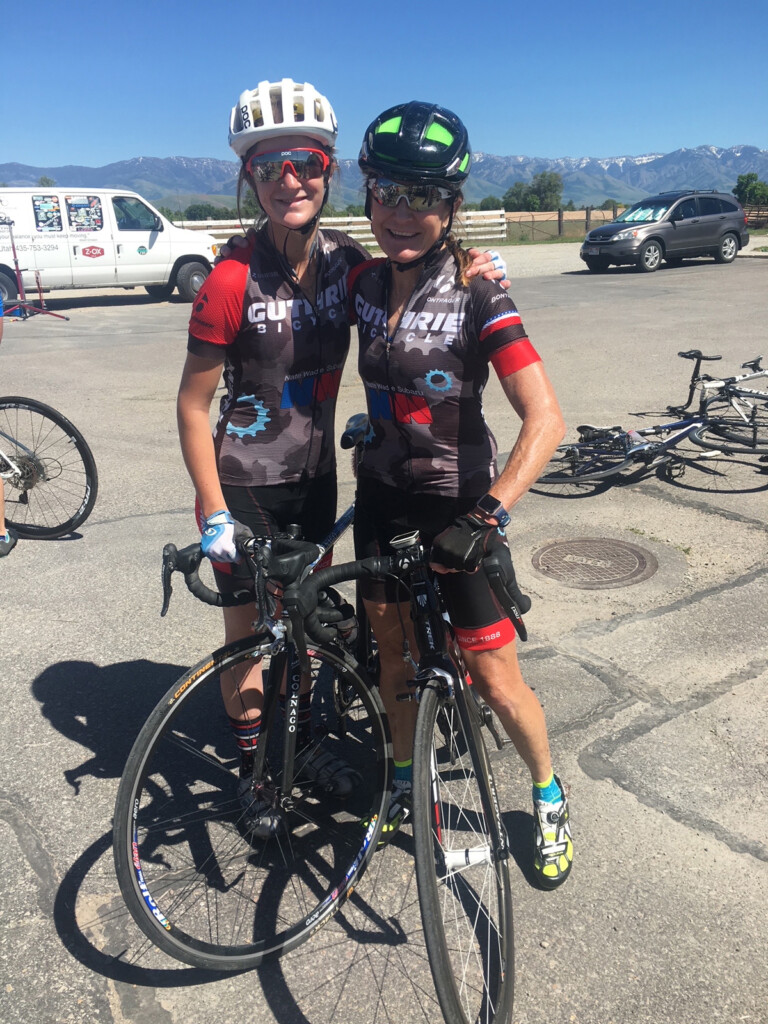
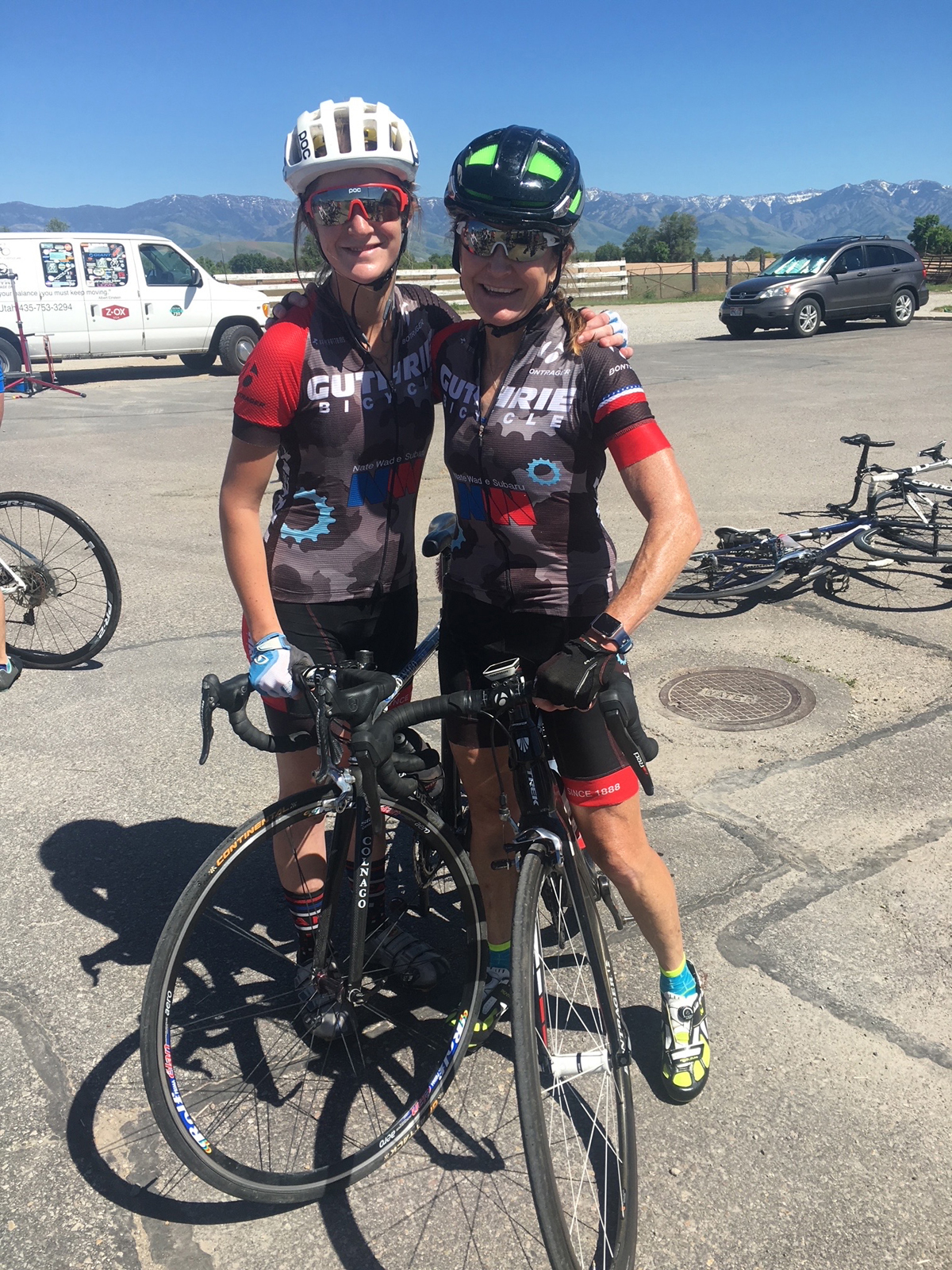
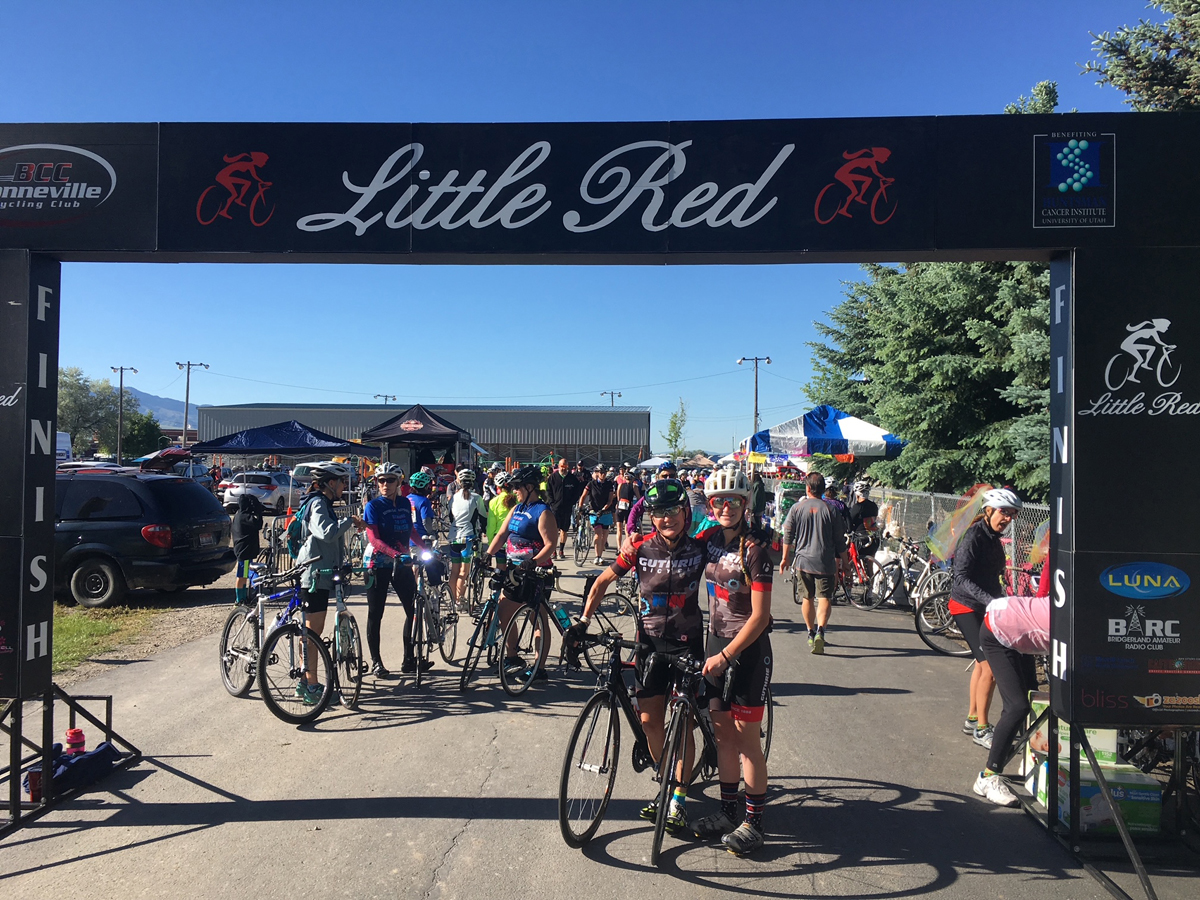
Lia Westermann and Ellen Guthrie at Little Red Riding Hood 2022. Photo courtesy Ellen Guthrie
Little Red Riding Hood is a non-competitive women’s only cycling event held in Cache Valley, Utah. It was started in 1999 by Alice Telford and Sue Schalow and has been held every first weekend of June since 1999 (except for during the peak of Covid). When Little Red was founded, there were only 185 women riding., Over 3,500 women rode in the event in 2022. This event raises money for women’s cancers (specifically breast and ovarian cancer) and a portion of everyone’s fee is donated to the Huntsman Cancer Foundation.
As a women-only event, we have ridden this together as mother (Ellen) and daughter (Lia) for quite a few years. Not only is it a great day on the bike, celebrating women, but it supports a very worthwhile cause. Here’s our perspectives.
Lia: Little Red is a very popular event and attracts female riders all across North America. As such, there is a lottery to get in. The ride is usually on the first Saturday in June, and Friday evening before the event there is a Theme Party (each year there is a different theme, this year’s theme was Ride Into the Wild) with live music, vendors, great food, a costume contest, and lots of decorations! Saturday’s ride ends with a finish line celebration. The celebration starts with cheers at the finish line, a refreshing cool wipe, lime spritz drink and a cute bracelet to commemorate the annual theme. After you finish riding, there’s always a delicious dinner available, an ice cream bar, shopping at the vendor’s tents for unique bike related clothes, gear, and art. There’s also lots of smiling and laughing!
Ellen: There are five separate routes folks can ride. Because there are varying distances, women can choose whatever route they desire. During the ride, one is able to see various types of locomotion: e-bikes, road bikes, mountain bikes, gravel bikes, and even outdoor Elliptical bikes! There are loops that are 17 miles, 30 miles, 45 miles, 70 miles, and 100 miles long. We like to do the 100-mile route. Little Red is fully-supported: there is mechanical support with mechanics at the start/finish and every rest stop, there are well-stocked rest stops throughout each route and lunch is also provided, and there are roving support vehicles to help with flats and mechanical problems. The choices for snacks are truly endless at Little Red! This year there were Oreos with either Nutella or peanut butter topped with a banana, yum. Lia’s favorite snack at the rest stops is a bunch of Red Vines. She usually has a sizeable wad in the pocket of her jersey most of the day!
Ellen Guthrie and Lia Westermann at Little Red Riding Hood 2022. Photo courtesy Ellen Guthrie
Lia: One of my favorite aspects of this event is how many women there are riding and the diversity of all the riders: there are competitive racers, road bikers, mountain bikers, women who don’t compete, women from all over the country, and women who even do this event on outdoor elliptical bikes! Everyone is so friendly, and you end up meeting people from all over the continent. There are women of all sorts of shapes, sizes, and colors, and all women are welcome to do this event. The camaraderie is amazing, and all the ladies are cheering each other on, even if they don’t know one another. Everyone is out there to help each other and make new friends!
I also love doing this event especially because my mom and I have always done it together. She is my biggest role model and I have always looked up to her, not just as an incredible cyclist, but as a person in general. She got me into cycling as a young girl and I feel this event has only made our bond stronger to be able to ride together and celebrate having a great day on bikes together. Each time we do this event we show up early in the morning, and even though I am tired, I am still extremely excited for the day ahead. We get our bikes ready and head over to the venue to get coffee and breakfast. Then we start our 100-mile journey that is Little Red! I always look forward to doing this event every year. The event is very low-stress and low-key, and the aid stops with all the snacks that are supplied make the event even better! All of the routes are relatively flat and easy, and whichever one someone chooses to do, I have no doubt that they will have an incredible and memorable experience, without having to deal with the big bad wolf!
If you would like to learn more or are interested in the lottery to get in, go to www.lrrh.org.