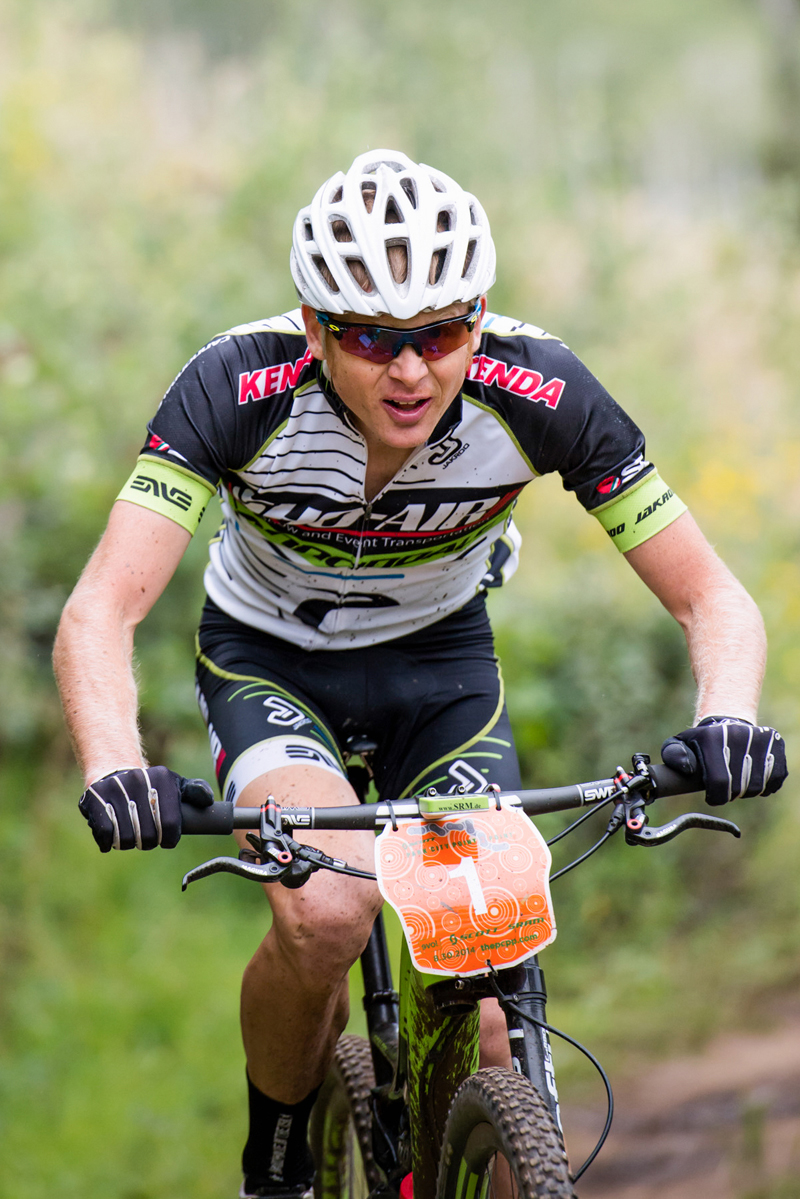
Gina Evans, the longtime race director for Montana’s Butte 100 Mountain Bike Race, is stepping down to move on to new endeavors.
She sent Cycling West a statement about her retirement. The race will continue in 2018 on July 28, 2018. Details are below.
I am retiring from my position as Race Director of the Butte 100 Races, September 15. I have given 11 Months each for the past 11 years to this race and have been instrumental in developing the race to what it is today. The first race had 41 riders and this year we had 350. From humble beginnings and much work come great outcomes.
After 11 years, I am ready for a new challenge. I’ll still be living in Butte owning and running Linked Adventures. I’m also going to be a Field Representative for a research company in Missoula that is developing concussion testing. I have a vested interest in this because of the head injury I suffered during a hit and run on my bike in 2010. I have had previous concussions in my sports career.
I’m forever grateful to my parents Mary and Dave Evans for the amazing support not only in life, but with the Butte 100 Races. They have been helping all 11 years in many facets of the race, not only on race day but weeks leading up.
A most heartfelt thank you to Stephanie Sorini for purchasing the Butte 100 two years ago and now moving forward with the 12th Annual in 2018. I have been assisting with permits and sending inquiries to Stephanie allowing the race to have another awesome successful season. Also, a special thank you to Bob and Gwen Waggoner who owned the race the first nine years. It was Bob who asked me to be Race Director and take his ultimate dream and putting Butte on the map for a national mountain bike race.
Stay tuned to where the next ride will take me. THANK YOU everyone each and every Sponsor, Crew Member, countless numbers of Neon Army Volunteers, those with USFS (Jocelyn Dodge, Dave Sabo) BLM (Brad Colin), and the race Safety Team ( Jefferson Valley EMS, supported by Butte SAR)
It’s all downhill!
July 28, 2018 — Butte 100 Races, tentative, Butte, MT, Continental Divide Trail, Single Track, Big Sky Country, 100 and 50 mile options, and a Sorini 25 mile option, Registration opens January 8, 2018., Stephanie Sorini, 406-490-7632, [email protected]
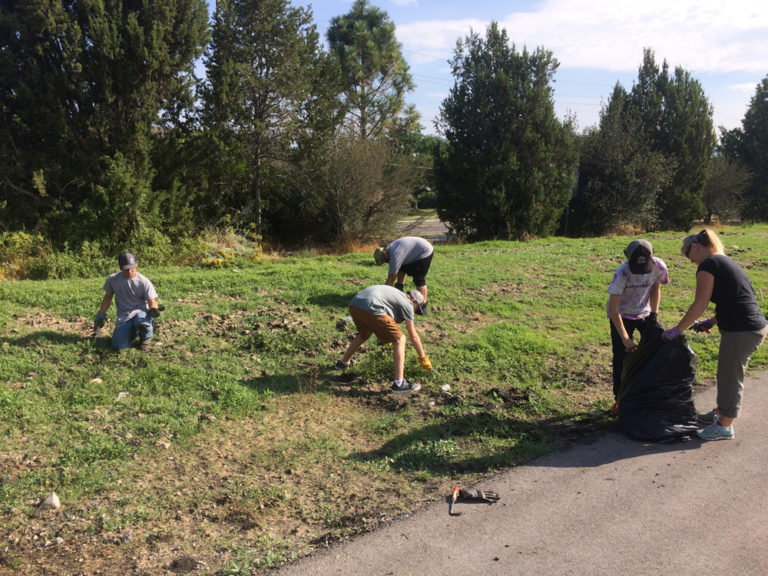
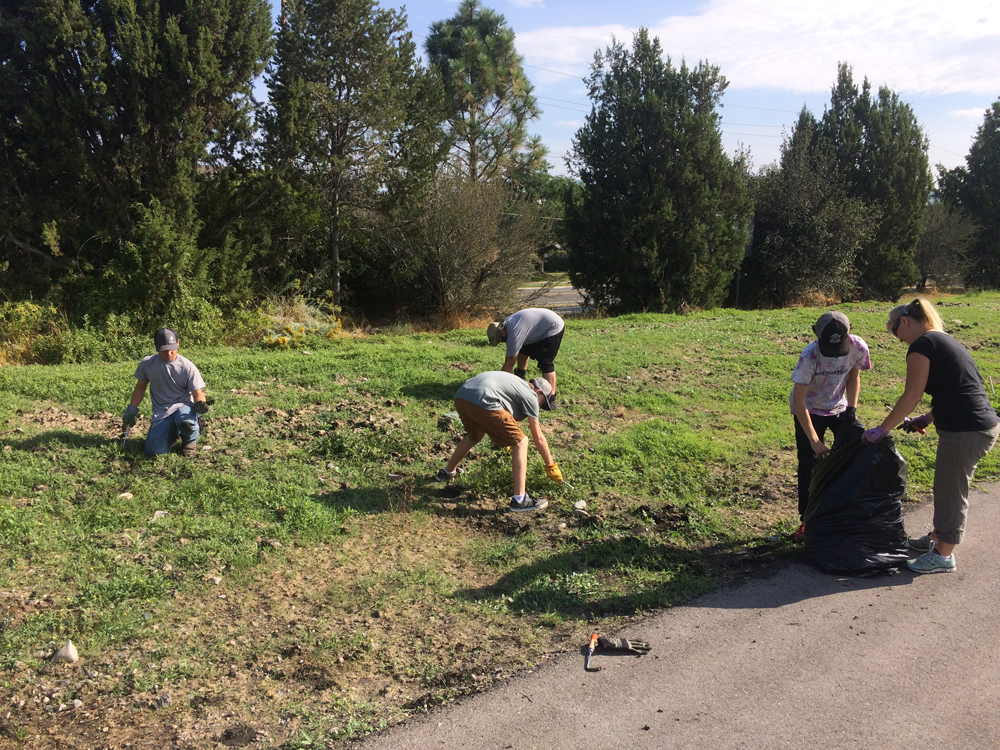
On Saturday, September 9, 2017 volunteers pulled 855 pounds of puncturevine from the Jordan River Parkway and 9-Line Trails in Salt Lake City. The weed is a serious problem for cyclists. Many members of the community showed up, but unfortunately, not that many cyclists. In 2016 Cycling Utah worked to get puncturevine declared a statewide noxious weed. Send us your thoughts as to what more should be done to [email protected]
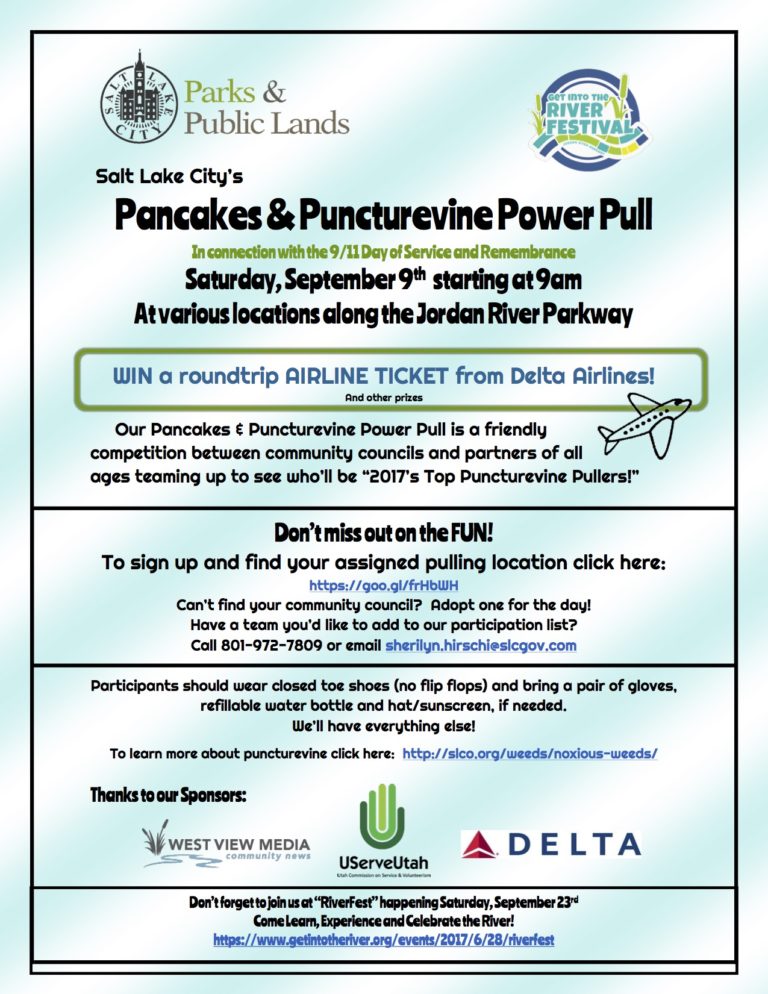
Salt Lake City will be sponsoring a puncturevine pull and breakfast on Saturday September 9, 2017 at various locations on the Jordan River Parkway. Come out and help pull one of cyclists’ worst enemies. Details and locations are here.
Announcement:
Join us for our Pancakes & Puncturevine Power Pull scheduled for Saturday, September 9th starting at 9am.
We’re looking for teams and individuals wanting to join the FUN! Spots are limited, so don’t wait to sign-up!
Did we mention you could WIN a roundtrip AIRLINE TICKET from Delta Airlines!
See attachment for details!
SHERILYN HIRSCHI
Volunteer/Outreach Coordinator
DIVISION of PARKS and PUBLIC LANDS
SALT LAKE CITY CORPORATION
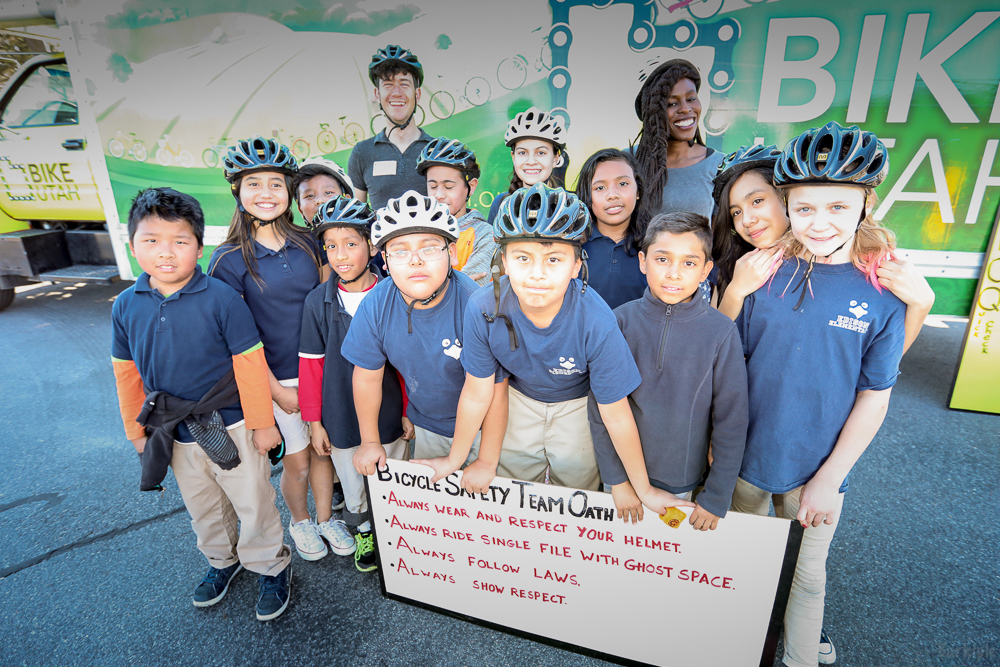
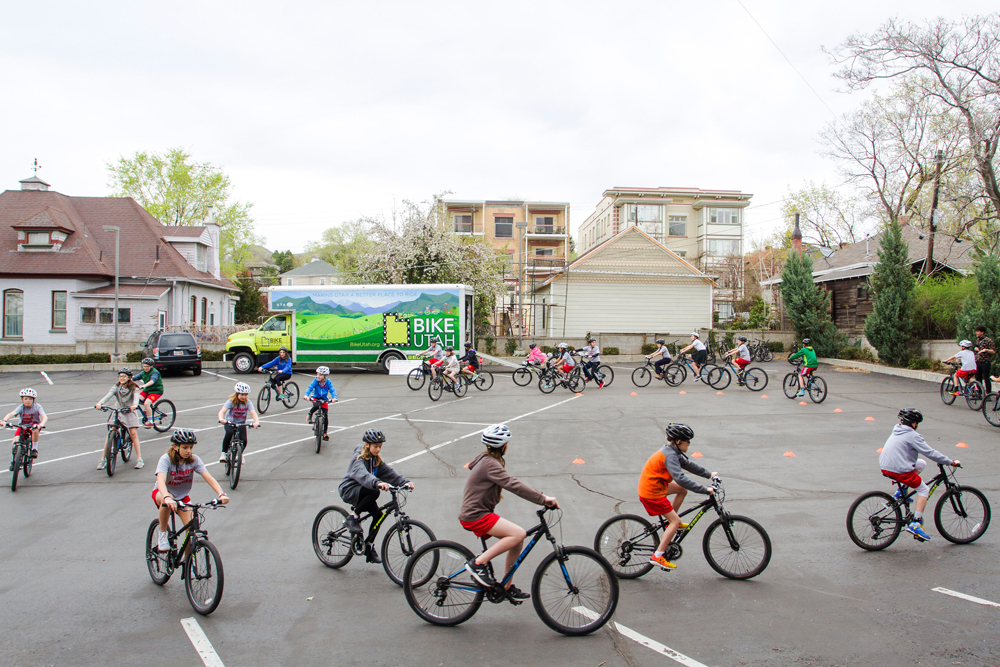
Bike Utah recently wrapped up the first year of their Youth Bicycle Education and Safety Training (BEST) program. This program is a statewide effort to teach kids how to safely and confidently get around by bicycle. The Youth BEST program officially started in September 2016, and is held at schools as a 5-hour, hands-on program for 4th through 7th graders. Over the course of the program, kids learn the benefits of riding a bicycle, the rules of the road, how to adjust and wear a helmet, how to navigate intersections, how to avoid hazards, and how to make sure their bike is in safe working order.
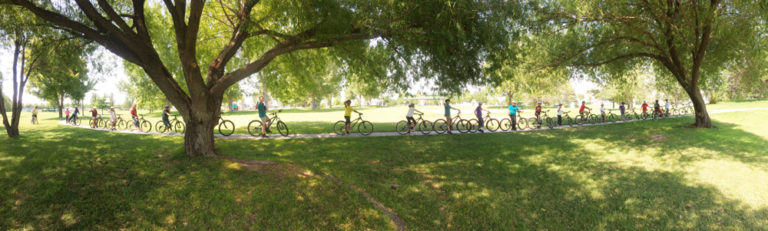
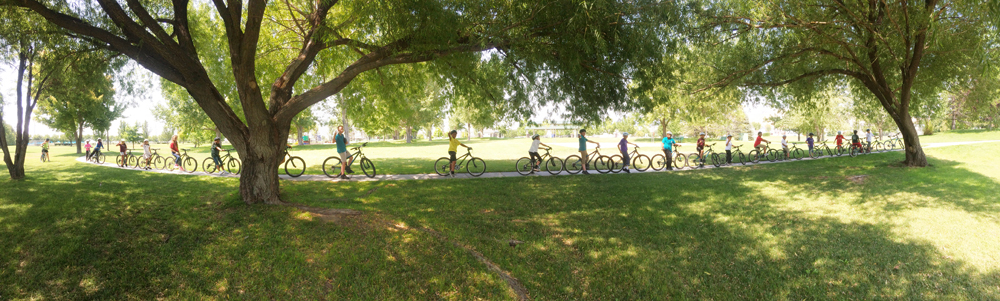
Students at Pacific Heritage Academy out for their community ride. Photo by Bike Utah
Bike Utah secured several grants to fund the program, so it’s free to any school or student wanting to participate. Bike Utah provides trained instructors, bicycles, helmets, and all other necessary equipment to be used during the program. The program is mobile and has the capacity to be implemented at schools in all corners of the state.
Bike Utah has seen outstanding outputs and outcomes through all of their assessments of the program. In year one of the program:
3,053 students (13% of the number of 10-year-olds in Utah) at 44 schools and community organizations have completed the program
77% increase in bicycle safety knowledge after completing the program
145% increase in bicycling and a 65% increase in walking at participating schools
34% increase in parents reporting that their child is interested in bicycling or walking to school
62% of parents reporting that, after their student’s participation in the bicycle education program, there is greater interest in bicycling and walking among other members of their household
“The outcomes from this program have exceeded our expectations,” said Phil Sarnoff, executive director of Bike Utah. “We are seeing program demand from students, schools, and parents. The biggest roadblock to getting more kids bicycling to school is the lack of safe bicycle routes between schools and neighborhoods. Through our program we are educating kids, families, and schools while building community support for better bicycle and walking infrastructure.”
The Youth BEST Program will continue during the 2017-2018 school year. So far more than 30% of the weeks are already scheduled and space is filling up quickly. Schools interested in bringing the Youth BEST program to their school can contact Bike Utah’s Education Director, Jace Burbidge, at [email protected].
Bike Utah received support for year one of the Youth BEST Program from the Utah Department of Transportation – Safe Routes to School Program, Sorenson Legacy Foundation, Wasatch Front Regional Council, Mountainland Association of Governments, Utah Department of Health – EPICC Program, Patagonia, George S. and Dolores Dore Eccles Foundation, Mavic, Trek Bikes, Utah Transit Authority, and Bike Utah members.
More information about the program can be found at bikeutah.org/youth. Donations are also being accepted to sponsor kids to participate in the program. For every $25 contributed, Bike Utah can graduate one student from the Youth BEST Program.
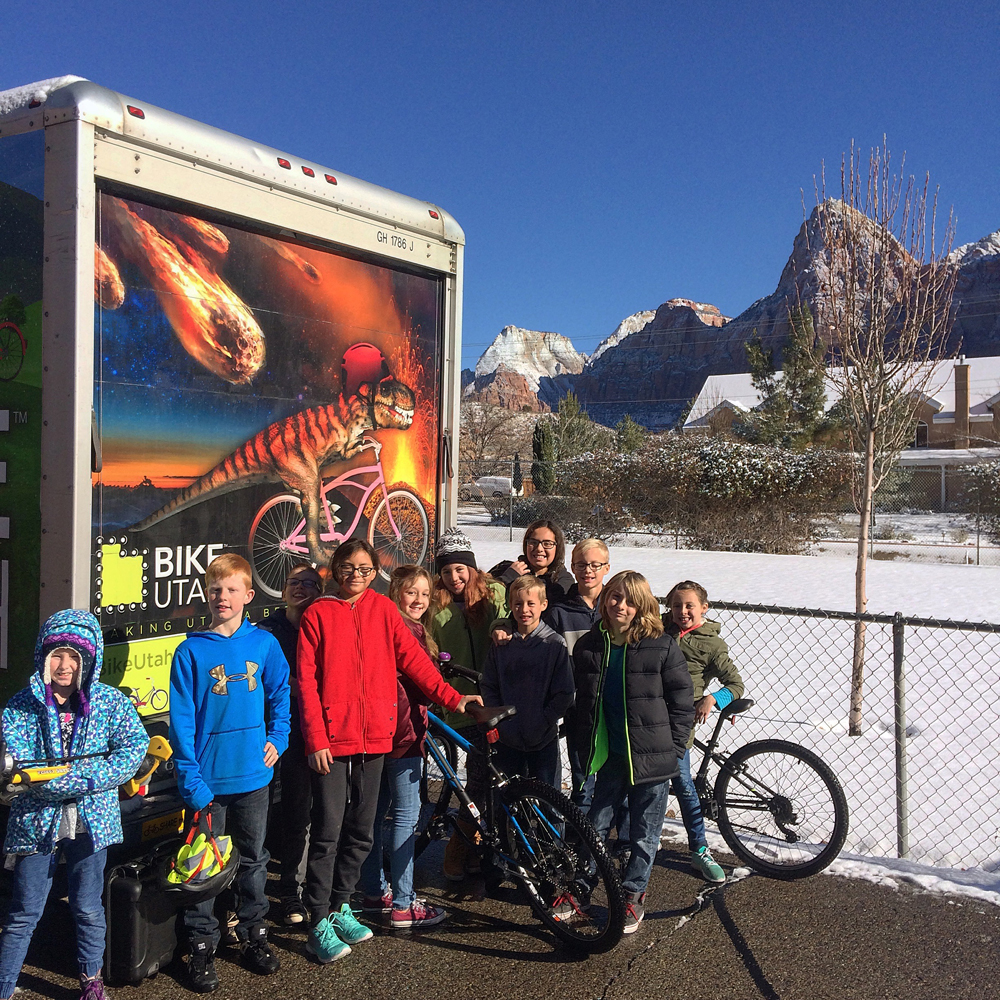
Students in Springdale participate in the Youth BEST Program. Photo by Bike UtahStudents learning the rules of the road. Photo by John Barkiple, SLUG MagazineStudents practice their riding skills. Photo by Monique Beeley, Discover Utah Kids
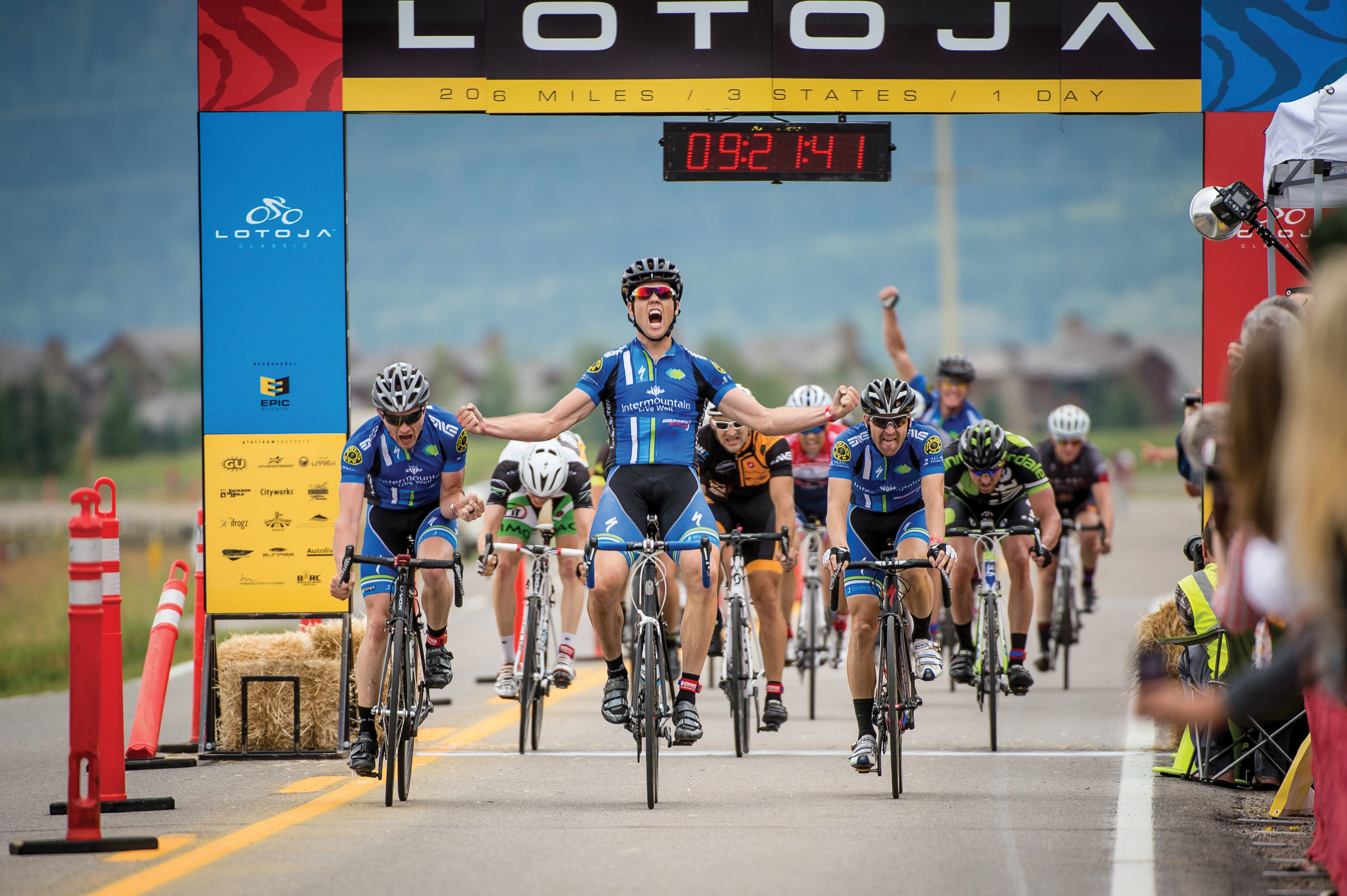
Clinton Mortley leads Intermountain Livewell to a top 3 sweep in the 2013 Lotoja Classic men’s pro/1/2 field. Photo courtesy: Ricky Bangerter.
Nearly 1,500 cyclists ready to line up for America’s longest, one-day sanctioned bicycle race from Logan, Utah to Jackson, Wyoming
Layton, Utah — The 35th annual LoToJa Classic is set for September 9 with 1,500 cyclists registered to race or ride from Logan, Utah to Jackson Hole, Wyoming.
Ridden in one day, the 206-mile course (332 kilometers) begins at Logan’s Sunrise Cyclery and ends nearby the spectacular 13,776 foot-high Grand Teton at Jackson Hole Mountain Resort.
But before seeing the grandeur of the Teton Range and Jackson Hole, cyclists from the U.S. and three foreign countries will experience picturesque county and state roads in northeastern Utah, southeastern Idaho and western Wyoming. Along the way they’ll pass through pastoral Cache Valley, Utah; Preston and Montpelier, Idaho; and the Wyoming communities of Afton, Alpine and Hoback Junction before reaching Jackson Hole.
Plus, cyclists will climb and descend three tough mountain passes totaling nearly 10,000 vertical feet. The first climb of the day to Strawberry Summit is almost 21 miles long. As an added challenge, cyclists will also face about 2 miles of road construction from Evans Road to South Park Loop Road as they near Jackson Hole.
“I’m really excited about this year,” said LoToJa Race Director Brent Chambers. “It’s our 35th anniversary, and event day promises to be remarkable — rain, snow or shine. And if the conditions are right, both the men and women’s course records may fall. I’m always awed by how fast LoToJa’s top men and women riders tackle the 206-mile course.”
Cameron Hoffman of Clearfield, Utah, set the current men’s record of 8:45:38 in 2014. His average speed was over 23 mph. Melinda MacFarlane of Salt Lake City, Utah, holds the current women’s record of 9:35:00. She set it in 2013 with an average speed of approximately 21 mph.
Brent Chambers, Lotoja organizer, readies for the 35th edition of the classic race from Logan, Utah to Jackson, Wyoming. Photo by Dave Iltis
Most of the other cyclists usually take 10 to 13 hours to cross the finish line — with some gritting it out trying to cross the line before the 8:30 p.m. cut-off time. Yet despite the long time in the saddle, many return every year. For 2017, cyclists are coming from 37 states, some as far away as New York, Chambers said. He also noted this year’s LoToJa again attracted cyclists from other countries, like from Canada and the United Kingdom.
In addition to the spectacular scenery and fall colors, LoToJa’s cachet and mystique are two big reasons why so many cyclists return every year.
“It’s more than an item to check off from the bucket list — it’s a life-changer,” Chambers said. “Whether you’re a seasoned racer or a first-timer, finishing LoToJa generates a feeling of personal accomplishment that lasts a lifetime.”
LoToJa began in 1983 by two Logan cyclists who wanted to create an enduring bicycle race modeled after European professional cycling’s legendary grand monuments of Milan-Sam Remo, Ronde van Vlaanderen, Paris-Roubaix, Liege-Bastogne-Liege and the Tour of Lombardy. All of those one-day classics are held on the European continent and each is more than a century old.
In LoToJa’s first year, seven cyclists competed and crossed the finish line near downtown Jackson. The winner was Bob VanSlyke of Logan who finished the 186-mile course in 9 hours. Since then, LoToJa has become one of America’s premier amateur cycling races. It has also become a major fundraiser for the Huntsman Cancer Foundation, Autism Spectrum Disorder Connections, and other medical research foundations. To date, sponsors and participants have contributed almost $2 million for these causes. In addition, LoToJa sponsors local fund-raising groups that assist the event.
LoToJa again features multiple categories for USA Cycling license holders, plus a cyclosportive class, which consists of non-licensed cyclists who are either competing against riders within their age group, or are just riding for fun. A relay race, and categories for tandem riders, are also held.
According to Chambers, LoToJa is the longest one-day bicycle race in America that is sanctioned by USA Cycling, the sport’s governing body. The age of cyclists range from 13 to 79, and the average rider will burn up to 15,000 calories on race day — about a dozen large cheeseburgers with fries.
This year’s race will include over 700 volunteers, along with nearly 150 Ham radio operators from the Bridgerland Amateur Radio Club. They provide uninterrupted communication throughout LoToJa’s mountainous and remote terrain.
Chambers stressed LoToJa wouldn’t be possible without its legion of loyal volunteers and the cooperation and assistance it receives from businesses, civic leaders, public safety officials and community volunteers.
He also emphasized LoToJa’s top goal is to have a safe race for all cyclists, support crews, and volunteers. Motorists traveling LoToJa’s course on Sept. 9 are asked to use caution when approaching cyclists. Groups consisting of up to dozens of riders may be encountered. Motorists are urged to pass carefully and to leave a safe distance between their vehicle, cyclists and other traffic.
To further increase safety on race day, the Idaho Transportation Department will restrict eastbound traffic on state Route 36 north of Preston between Riverdale and Ovid from 7 a.m. to 12:30 p.m. Eastbound traffic on US-89 between Montpelier and the Wyoming state line will also be restricted from 9 a.m. to 2 p.m.
Chambers explained the temporary travel restrictions were started a few years ago because SR-36 and US-89 are filled with eastbound LoToJa cyclists. Motorists are asked to use caution while traveling on these two roadways during LoToJa, and to anticipate encountering groups of cyclists. Cautious passing is advised to ensure safety for everyone.
Chambers defined “cautious passing” as slowing down, giving plenty of space (at least three feet) between the vehicle and cyclist(s), and patiently waiting for oncoming vehicle traffic to clear before pulling around a cyclist or group of cyclists.
LoToJa cyclists, plus their support crews, well-wishers, event staff and volunteers, represent an entourage of approximately 4,000 people. Several of the communities through which LoToJa passes organize roadside fundraisers to capitalize on the influx of visitors. The host cities of Logan and Jackson also enjoy a welcomed economic boost from the race, specifically restaurants and hotels.
It is estimated more than 19,000 cyclists have pedaled over 4 million miles during LoToJa since the race began in 1983. Last year’s oldest male cyclist to finish was 74 years old and the oldest female was 63.
The youngest boy and girl finishers are 13 years old. The average age of a LoToJa participant is 45.
LoToJa’s route and additional information about the race are available at lotoja.com.
The Parkway Pedal travels along the Jordan River Parkway and Legacy Parkway Trails from Farmington to Salt Lake City. Photo by Garrett Jensen, Photo Courtesy Parkway Pedal
The Coldwell Banker Parkway Pedal is a road ride that takes place on Utah’s Legacy Parkway Trail starting in Farmington, on September 9, 2017. The ride raises funds for The Autism Council of Utah. We asked event organizer John Winchester a few questions about the ride.
Cycling West: Tell us about the ride. Where does it start? What are the distance options? What are the courses like for each distance?
Parkway Pedal: The Parkway Pedal is now in its third year as a casual, community-centered ride for all skill levels. The ride will start at 9 a.m. at the Legacy Event Center in Farmington, UT, just west of Station Park. The ride is an out-and-back ride and distance markers will be set up every five miles. We have families that want to ride out a half mile with their kids, and we have riders that want to make the entire 42-mile round trip to North Temple. Last year, a few groups went past Salt Lake and made a 75 mile ride along the Jordan River and Legacy trails. Our goal is to make this ride accessible and enjoyable for all. The purpose of The Parkway Pedal is to bring the community together to get outdoors, enjoy the beauty of the valley, and raise money for a worthy cause.
CW: The ride raises funds for the Autism Council of Utah. Please tell us more about the organization and the importance of their cause.
PP: The Autism Council of Utah is an independent organization founded and operated by parents of Autistic children. The group provides access to resources and responsible information for individuals of all ages who have, or are affected by autism, or related conditions. They also find statewide partnerships to collaborate on special projects, research, and training. It can cost a family with a child on the Autism Spectrum $50,000 or more each year for learning resources, schooling or support and the donations we raise go directly to Utah families in need.
Autism is a brain disorder that primarily affects communication, social skills and behaviors. Many people with autism have little or no eye contact and seem to be uninterested in relationships. The autism spectrum is huge and it affects everybody differently. Children with Autism often times need special learning tools or classes to help them learn to work differently in society.
Today, it is estimated that 1 in every 54 children is diagnosed with autism, making it more common than childhood cancer, juvenile diabetes and pediatric AIDS combined. An estimated 1.5 million individuals in the U.S. and tens of millions worldwide are affected by autism.
There are lots of fun activities after the ride at the SaharaCares Foundation Festival. Photo Courtesy Parkway Pedal
CW: There will be a festival in conjunction with the ride. What sorts of activities will there be?
PP: The first year of the ride, we wanted to have an option for those who didn’t, or couldn’t ride, to still have a chance to support the cause. We had bounce houses, face painting, food trucks, live music, etc. after the ride. It was a lot of extra work and took a lot of volunteer efforts. Last year, we discovered that the SaharaCares Foundation already hosts a huge carnival and it’s also in support of Autism. They have over 3,000 attendees for their carnival and it’s all free of charge – so we support them with volunteers but we let their foundation plan and organize that side of the day. This allows Coldwell Banker to focus on the ride and making sure that everything for the riders is top priority. Register for the ride and at the finish line, there will be 3,000 cheering fans, many of whom will be directly affected by the generous donations of the riders and sponsors.
CW: Is there anything else that you would like to add?
PP:
We have incredible Sponsors including Doug Smith Subaru, Yesco, Axiom Financial, Bingham Cyclery and many local vendors. We will be auctioning four bikes and as well as many other prizes at the carnival. For those who can’t make it out but still want to support the charity, we accept donations at parkwaypedal.com. That being said…this is the year we focus on the riders. We have steadily grown in our first two years, mostly with Coldwell Banker agents, families and staff support, but this is the year we want to see large community support. It’s fun and it’s for a great cause.
Event Details:
September 9 — Coldwell Banker Parkway Pedal, Farmington, UT, A casual ride along the Legacy Parkway to benefit The Autism Council of Utah. Start in Farmington at Legacy Events Center, 151 S. 100 W, Reg. at 8 am, Ride at 9 am, 42, 30, 25, and 10, 5, 1 mile options. After ride Sahara Cares Foundation festival, Chris Jensen, 801-563-7670, 801-940-1447, [email protected], parkwaypedal.com
Part of the trail that will be used for the Race the Rails event in Ely, Nevada on September 9, 2017. Photo courtesy White Pine County Tourism & Recreation Board.
A new and unique experience is on the horizon. Ely, Nevada is home to one of the nation’s largest time capsules, the Nevada Northern Railway. Here you will find coal fired steam engines that are over 100 years old still billowing their plumes of steam as they lumber down the track. Now add beautiful mountain trails and the Loneliest Highway in America, Highway 50, and you have the makings of an epic exhibition bike race that is fun for the whole family!
On September 9, 2017 racers will get the chance to see if they have the steam to beat the train! Both road and mountain bike racer will have the opportunity to test their mettle. Road bikers will begin with a short ride to the entrance of the Robinson Nevada copper mine where they will circle a 240-ton haul truck. On their descent toward Ely, they will find themselves side by side with the giant iron horse. The road bike course spans approximately 25 miles with an elevation gain of 820 feet. Mountain bikers will ride over 11 miles on single and double track trails with an elevation gain of 1400 feet. Registration is $75.00. All racers will receive a race shirt, finisher’s medal, swag bag, BBQ ticket and train ride voucher which may be used to get the racer and their bike to the start line (bike spaces are limited) or on one of the regular train excursions scheduled throughout the weekend. Those wishing to board the train will begin loading at 8:00 am at with an 8:30 departure time scheduled. Race start is at 10:00am from the Keystone Bridge.
The BBQ will take place at the depot beginning at 1:00 p.m. and extra tickets for family and friends are available. A variety of vendors will be open at the depot starting at 10 a.m. There will be a small triathlon for kids beginning at 11:30 a.m.
While you are in the area you won’t want to miss visiting some of the other area attractions. Great Basin National Park and the Lehman Caves, located approximately 68 miles south east, offers beautiful scenic drives and hikes, 60 & 90 minute cave tours and amazing night time sky presentations. Hike, fish, kayak or just relax 13 miles outside of town at Cave Lake State Park or take your time and explore our Outdoor Murals, Renaissance Village, Ely Art Bank, White Pine Public Museum, or the McGill Historical Drug Store. Come join us for a great time for the whole family!
You can register for the race at www.elynevada.net. More information on the area is also available on the website or call the Bristlecone Convention Center at 800-496-9350.
Event details:
September 9 — Race the Rails, Ely, NV, Race the train in Ely! Fun for the whole family! Race a coal fired steam engine that is over 100 years old. The event will accommodate both road and mountain bike riders of all ages., Meg Rhoades, 775-289-3720, 800-496-9350, [email protected], www.elynevada.net
The road to Cave Lake is pretty, and isolated. Photo courtesy White Pine County Tourism & Recreation Board.
By Marcus Kaller – At the August SLCBAC meeting, we started with a training session regarding chip sealing from Leon Barrett, from Salt Lake County, and Becka Rolf, from Salt Lake City. Needless to say, it proved to be quite informative, especially when taking into account the difference in methodology between what the city does and that of the county. The discussions, at times, went into debates on the two methods for chip sealing, which included costs, source of chips, and the overall process. To give you some insight into this, please check the article “Chip Seals and Bicycles – Short-term Pain for Long-term Gain?” from 2013 on cyclingwest.com.
In addition, Helen Peters, the county transportation manager, informed the committee about the UDOT construction project at the intersection of Wasatch Boulevard and Little Cottonwood Canyon Rd (SR-210). The goal of this project is to improve the traffic flow by modifying the alignment of the intersection. It would also accommodate cyclists with bike lanes that allows them to ride either roads, including a dedicated northbound left turn following Wasatch Blvd. Some of the members expressed concerns that the pre-existing traffic lights were being taken out. Construction of this intersection began last month, and more information can be found on the UDOT web site.
With students returning to school this fall, it means that the folks at Bike Utah will be ramping up the Youth Bicycle Education program. And SLCBAC, once again, lend its support to help fund the program. As a reminder, what the Youth Bicycle Education program entails is teaching children on all education levels about bike etiquette and safety. In addition, children may receive free helmets and lights. If you are a parent or teacher who want to encourage students to ride bicycles, please contact Jace Burbidge, the Youth Education Coordinator, at 801-867-5485 or [email protected].
Similarly, we have voted to support the Latina Bike Initiative. Spearheaded by May Romo, from Salt Lake County Health Department, the mission of the initiative is to cultivate bike riding among Latino women and families in Salt Lake County. We hope to get more information for those who are interested.
Our next monthly meeting will be on September 11 in room N4-850, at the Salt Lake County Government Center, 2001 S. State St, beginning at 5:30pm. We hope to see you there. For more information, see bicycle.slco.org
2016 Open Men line-up for the 7AM start. Keegan Swenson (center, was last year’s Champion). Photo by selective-vision.com
By Chris Magerl
In the eight years of the Park City P2P — perhaps the best true singletrack long distance mountain bike race in the country — there have been three men who have been on the top step of the Pro/Open podium.
Young local Keegan Swenson won last year. The year before that it was Utah’s Rob Squire. Before that, it was all Alex Grant. Grant won in 2014, 2013, 2012, 2011, 2010 and the race’s inaugural year, 2009. Six straight. He skipped the 2015 P2P to race the mountain bike World Championships, in Andorra, and in 2016 he was recovering from a shattered heel.
This year had the prospect of all three of the winners lining up together. But it is Swenson’s turn to skip the P2P for MTB Worlds. When the racers roll out in Park City on Labor Day weekend, Swensen may be in Australia.
Alex Grant won the 2014 Park City Point to Point, his sixth in a row. Photo by Angie Harker, Selective-vision.com (find your photos online).
Fret not, there will still be plenty of firepower. In addition to Grant and Squire, Geoff Kabush and Todd Wells will line up in Round Valley on the morning of Saturday, September 2, awaiting the Fruit Loop cannon that signals the start.
Wells, from Durango, Colorado, is a three time Olympian and 15 time national champion in XC, STXC, Marathon and cyclocross. Wells has also won the Leadville 100 three times. Kabush, from British Columbia, Canada, is a three time Canadian Olympian and 10 time Canadian national champion.
Wells was in Utah earlier this summer, racing his first Crusher in the Tushar, where he finished in second place, dropped by Squire on the final climb. Wells has also raced mountain bikes several times in Utah during various USA Cycling national tour events that were an annual Deer Valley summertime staple.
Kabush has also raced those Deer Valley Pro XCT events, and has pedaled many of the trails used for the P2P in industry events run by his current bike sponsor, Scott. This summer has seen Kabush on the podium at gravel events, Enduros, XC races and road races. Last month Kabush won the seven-day offroad BC Bike Race.
Even for experienced P2P riders, the course will offer something new this year. The finish has been moved to Kimball Junction, near the base of the Utah Olympic Park and its iconic ski jumps and bobsled track. Skullcandy will show off its new Kimball Junction home by hosting the finish line party.
“Skullcandy has really stepped up to the plate for us,” said P2P organizer Jay Burke. “The post-race food will be served on their patio with music up on that deck. Skullcandy is a great partner.”
Who will make it first to the new finish? “Squire is riding well and has experience with the course now. He could be hard to beat,” said Burke. “But there is a plethora of possible winners. The Open field is going to be fast and furious!”
On the women’s side, the picture is a bit less clear. As of now, the only returning women’s winner registered is Evelyn Dong. But Marlee Dixon, who has finished second, second, second and third the past four years, will be back. Amanda Carey, Evelyn Dong and Gretchen Reeves have all won the P2P twice. Other riders to watch include Larissa Conners, Ami Stuart, and Emma Maaranen.
The P2P is that rare long MTB race made up of trails you actually want to ride all day long. It is pretty much a link of some of the finest singletrack in Park City, for about 80 miles. It sells out right away, with a race field capped at 380. For riders hoping to get in still, there are always last-minute opportunities. There is a simple buy/sell community found under The Race tab on the P2P website, ThePCPP.com.
The website gives you the race route, as well. It is pretty cool to be in the woods on your bike watching top racers powering up a climb after more than four or five hours of race pace riding. Choose your route wisely and you can have a great ride that intersects but does not overlap with the race route.
Want to go the other way, and avoid the racers all day? The website also has suggestions for that. Check out the Trail Impacts button. Roughly, for the morning you can avoid the race by pedaling in the Canyons area and in the afternoon riding Deer Valley or Round Valley.
The P2P has become a Park City institution, and gives back to several community organizations. The opportunity drawing to benefit the Park City High School MTB team has become a check-in tradition, with eager high school racers offering drawing tickets.
Even if you are not 80 offroad miles strong, you can play an essential role in the P2P. Volunteers are always needed. Volunteer info can be found under The Race tab on the website, ThePCPP.com.
Event Details:
September 2 — Park City Point 2 Point, Park City, UT, A true point 2 point race! Thanks to the plethora of trails in this area, the race will never be on the same trail twice. Over 90% of the race is single-track. 75 miles & 12,000ft of climbing., Jay Burke, 801-330-3214, [email protected], thepcpp.com
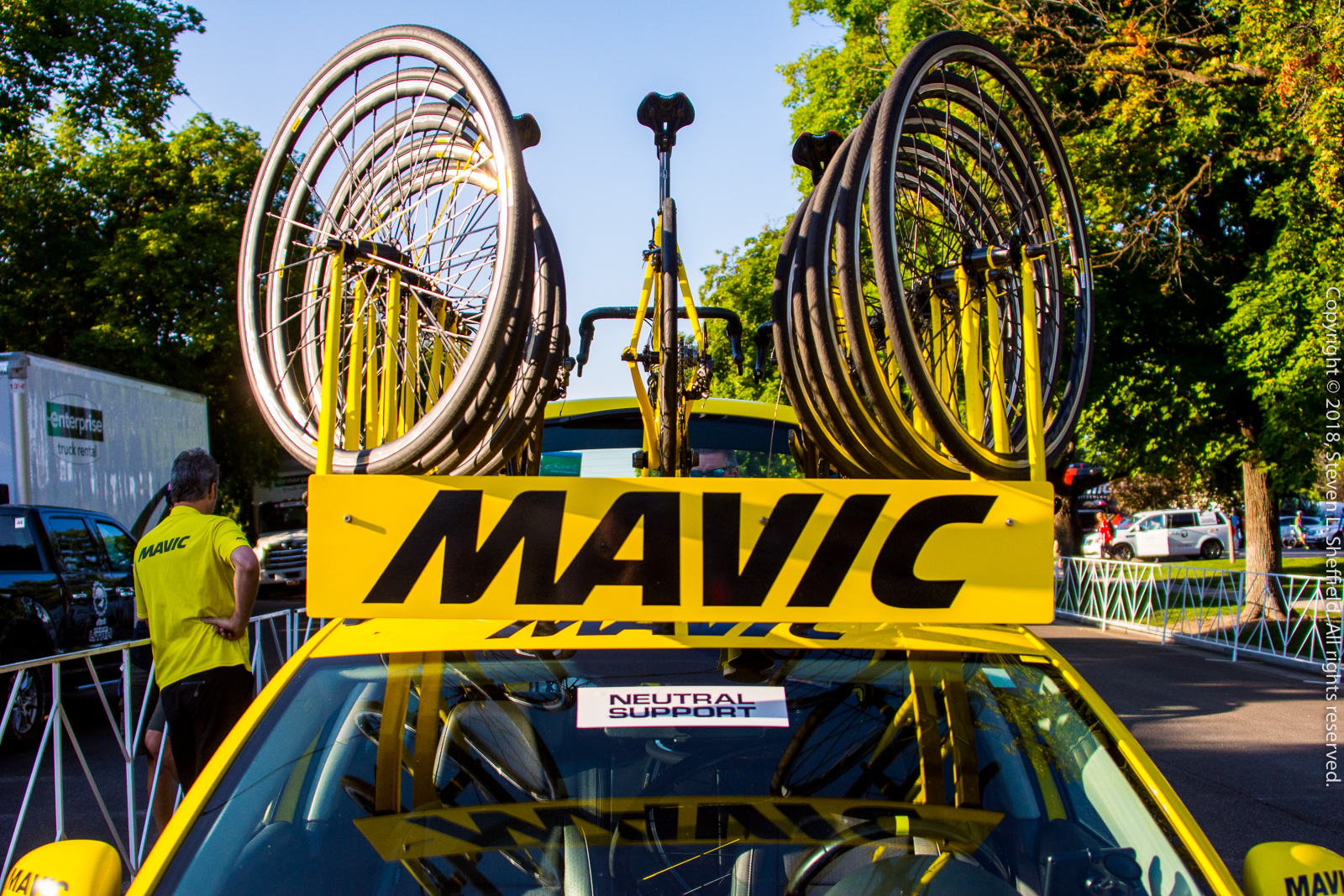
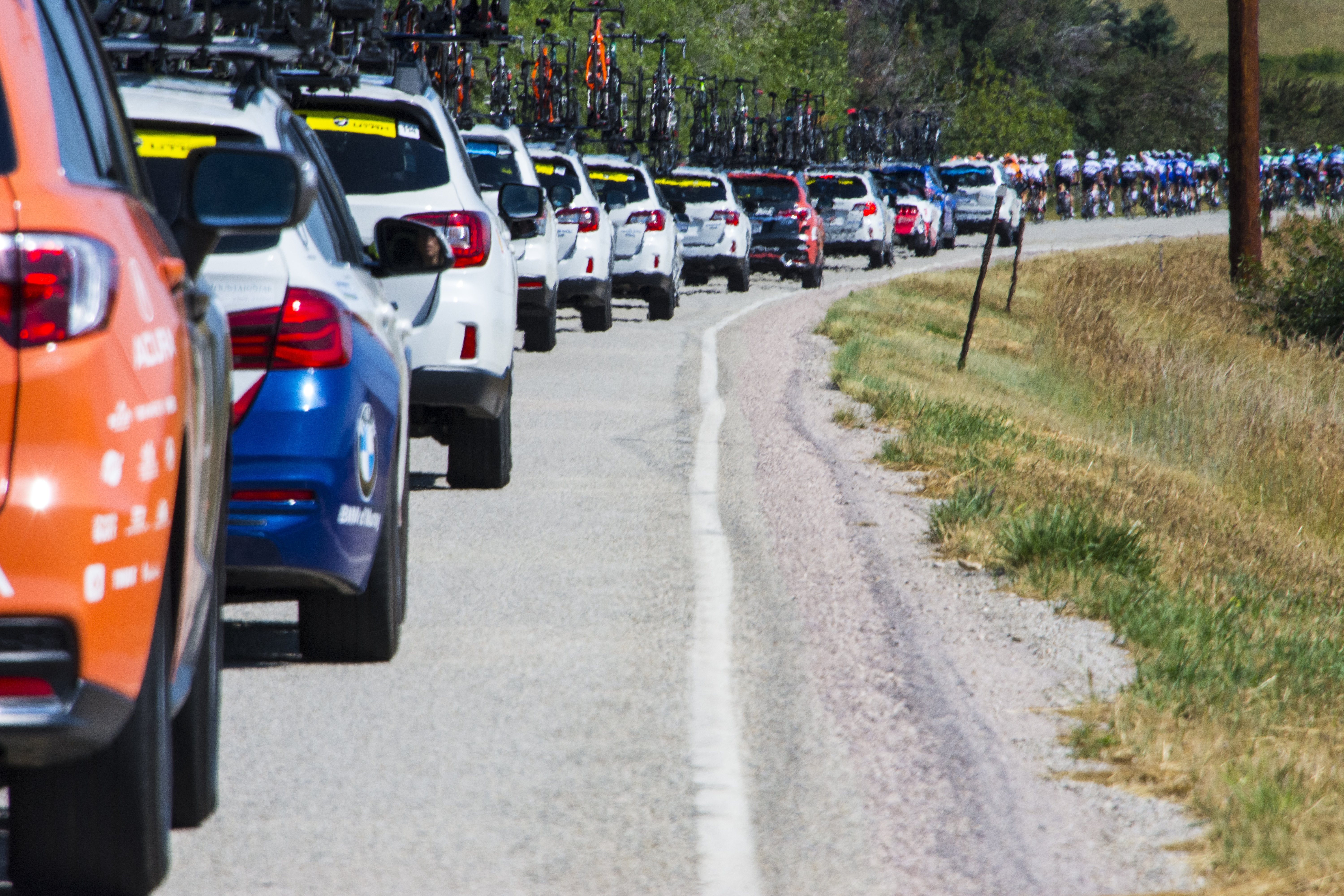
The Mavic Neutral Service Car lined up for its spot in the caravan prior to the start of Stage 1 of the Tour of Utah 2017. Photo by Steven L. Sheffield
“Neutral Service” is a phrase that likely had the father of the Tour de France, Henri Desgrange, turning over in his grave when the first Mavic Neutral Service car became part of the caravan behind the peloton at the 1973 Paris-Nice. In the early years of the Tour, riders were responsible for conducting their own repairs and were forbidden any outside assistance.
Founded in 1889 as Manufacture d’Articles Vélocipédiques Idoux et Chanel, by Charles Idoux and Lucien Chanel, Mavic was long known for their bicycle components and groups, but today are mostly known for their wheels and technical apparel.
So how did that first Mavic Neutral Service vehicle come to join the caravan? It all started the previous year at the Critérium du Dauphiné Libéré, when one team director’s vehicle broke down, and Bruno Gormand (the then-current owner of Mavic) lent the director his own personal car.
Support cars were nothing new, but the ideas of having a fully professional neutral support vehicle, stocked with spare wheels, bikes, and a mechanic with enough tools to effect a wide variety of mid-race mobile repairs was good for racing. When gaps were relatively small from the breakaway to the peloton, the commissaires would call for the Mavic car to come forward to provide support for the riders in the break until the gap opened up enough to call team cars forward.
By 1977, Mavic had become the official Neutral Support partner of the Tour de France. Soon, the yellow Mavic cars became one of the most widely recognized symbols in bike racing, like the maillot jaune or maglia rosa or the red kite flown at 1 km to the finish.
So why yellow? Gormond asked one of the cameramen filming the race for French television what color would stand out best, and the response was yellow and black for contrast.
At most races there will be 2-3 Mavic Neutral Service cars along with 2 motorcycles also providing service when needed.
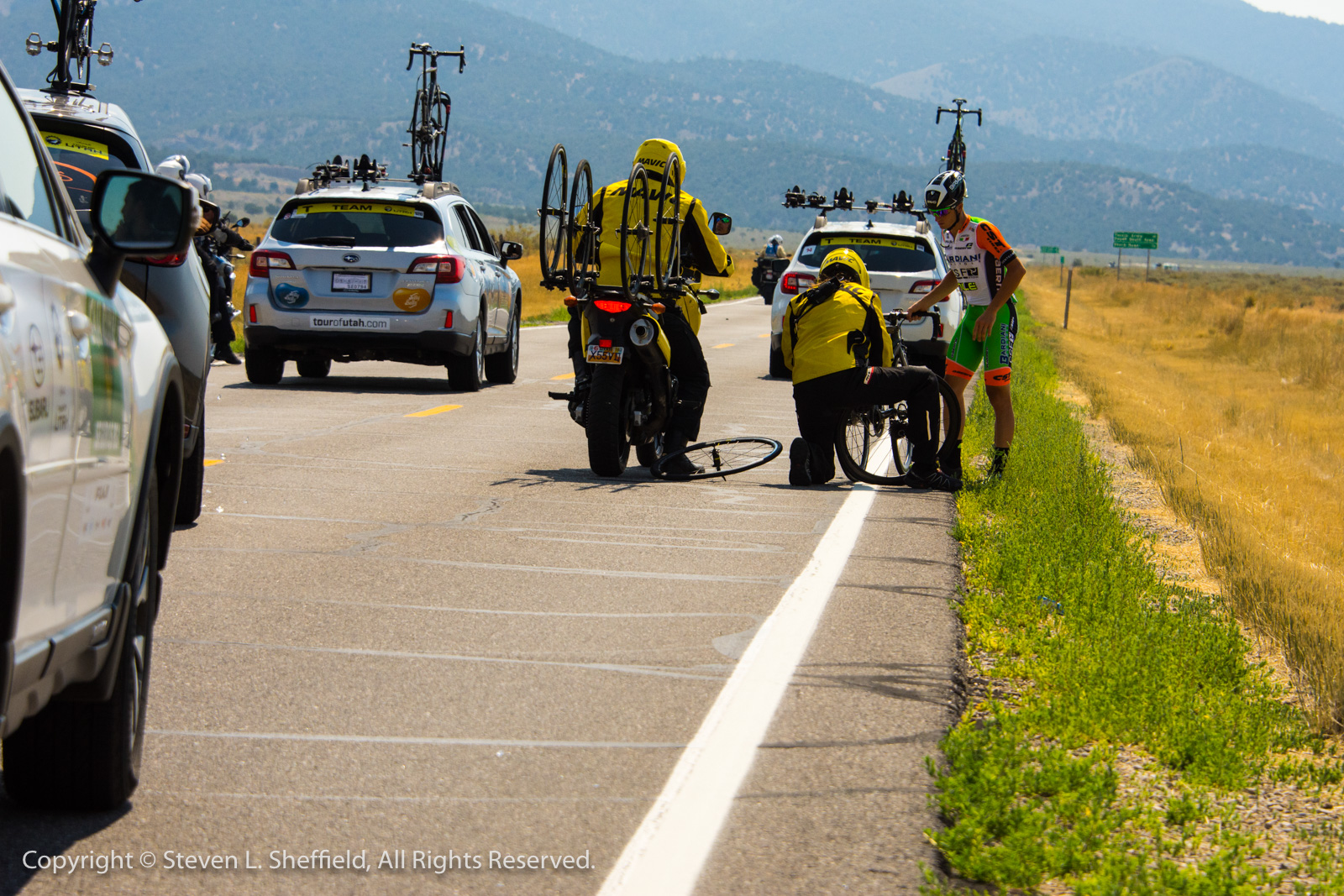
Each car is typically stocked with 4 bikes on the roof, 3 full sets of wheels on the rear, and 1 set of wheels in the car. The mechanic always sits in the right rear passenger seat for quickest and safest egress from the car when service is needed by a rider. Typically, the mechanic will have a full portable tool chest on the rear driver’s side, and often will have the most commonly needed tools in a pouch hanging from the back of the front passenger’s seat.
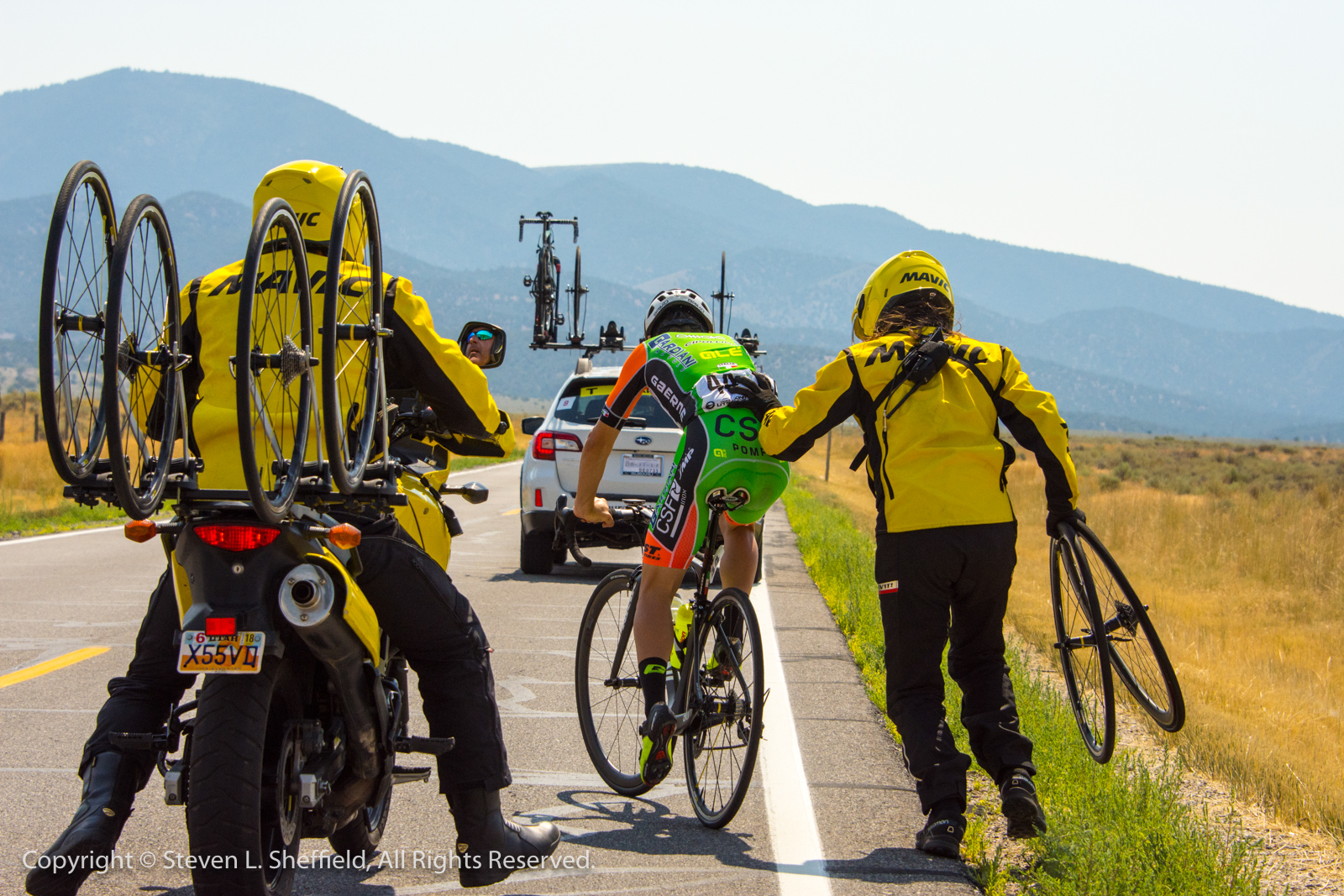
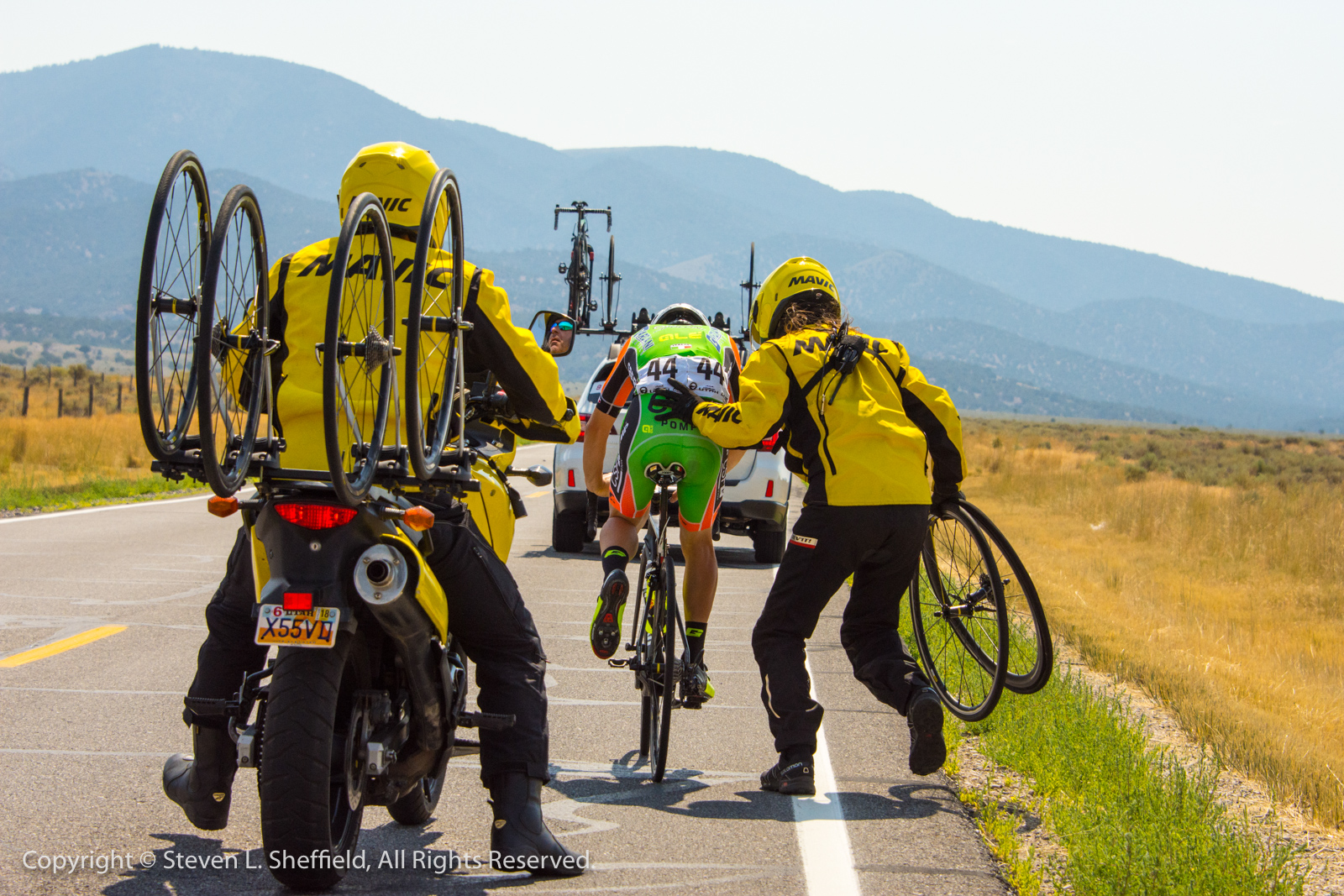
Each motorcycle is typically stocked with 2 sets of wheels mounted to a rack on the rear, while the mechanic riding in the passenger position will carry another set of wheels in his hands, ready to jump off the bike to change a wheel if a rider flats.
While the drivers are often mechanics as well, many of them are also former racers with a high familiarity of how the peloton ebbs and flows, allowing them to successfully navigate the often-chaotic caravan and peloton ballet to get to the front safely when called forward. They will most often be the first car called forward when a break is established, and the last to pull out of the gap if the break is reeled in by the peloton.
On a good day, everything is quiet in the neutral service car except for the crackling of race radio, but they are always there, always ready to jump into action when the need arises.
Since the introduction of a professional neutral service vehicle at the 1973 Paris Nice, other companies have also joined the caravan in a similar position; Vittoria is at most of the races in Italy, and both Shimano and SRAM are becoming more common sightings at races, but Mavic owns the distinction of being the first and the most widely recognized.
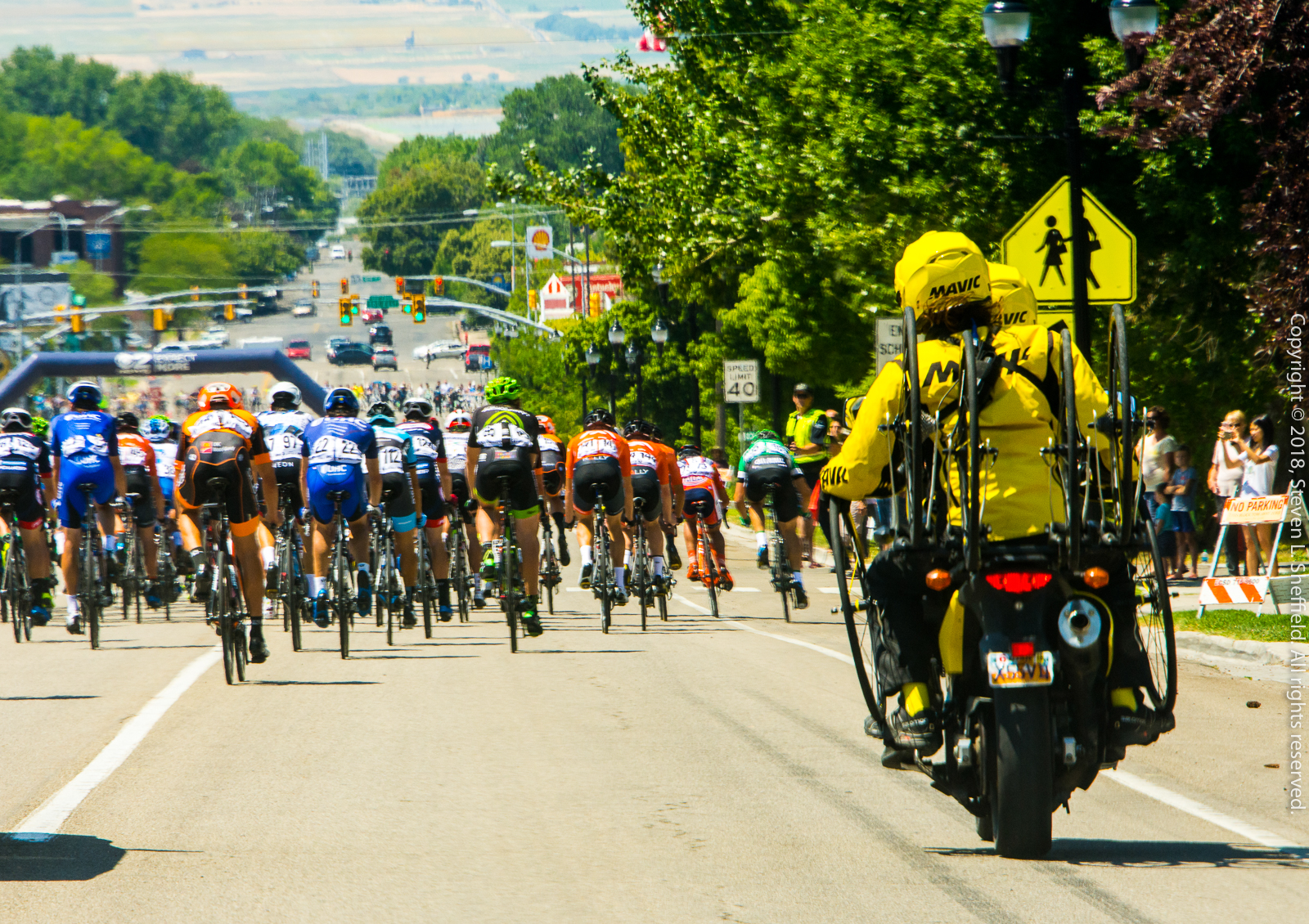
I had the honor of riding with Mavic Neutral Service at the 2017 Tour of Utah for a couple of days. Unfortunately for telling a story, both days were relatively quiet, but I was able to capture some photos of the crew in action, as well as of the race itself from a different perspective, at the rear.
The caravan ballet is a pretty amazing thing to be a part of, especially when it’s happening on a windy canyon road at 60mph on a descent.
Mavic’s current partnership as the official Neutral Support provider began with the 2016 edition of the Larry H. Miller Tour of Utah, and is expected to continue through 2018.
My thanks to Aaron Walker at Mavic USA, which is part of the Amer Sports portfolio of companies based in Ogden, Utah for helping to arrange my time in the cars, and to Nate Field and the rest of his Mavic crew at the Tour of Utah for being such gracious hosts.
When you’re in the caravan, the view doesn’t change a whole lot, unless service is required. Tour of Utah 2017. Photo by Steven L. SheffieldAs the peloton races towards the red kite prior to the first of two finishing circuits, one of the Mavic Neutral Service motorcycles is primed and ready in case anything happens as the roads begin to narrow. Tour of Utah 2017. PC: Steven L. SheffieldA Bardiani rider in the break needs a rear wheel change. Photo by Steven L. SheffieldA little push to get back in the race, Tour of Utah Stage 4, South Jordan to South Jordan. Photo by Steven L. SheffieldAnd back he goes. Tour of Utah Stage 4, South Jordan to South Jordan. Photo by Steven L. Sheffield
The Coldwell Banker Parkway Pedal is a road ride that takes place on Utah’s Legacy Parkway Trail, on September 9, 2017. The ride raises funds for The Autism Council of Utah. We asked event organizer John Winchester a few questions about the ride.
Cycling West: Tell us about the ride. Where does it start? What are the distance options? What are the courses like for each distance?
Parkway Pedal: The Parkway Pedal is now in its third year as a casual, community-centered ride for all skill levels. The ride will start at 9 a.m. at the Legacy Event Center in Farmington, UT, just west of Station Park. The ride is an out-and-back ride and distance markers will be set up every five miles. We have families that want to ride out a half mile with their kids, and we have riders that want to make the entire 42-mile round trip to North Temple. Last year, a few groups went past Salt Lake and made a 75 mile ride along the Jordan River and Legacy trails. Our goal is to make this ride accessible and enjoyable for all. The purpose of The Parkway Pedal is to bring the community together to get outdoors, enjoy the beauty of the valley, and raise money for a worthy cause.
There are lots of fun activities after the ride at the SaharaCares Foundation Festival. Photo Courtesy Parkway Pedal
CW: The ride raises funds for the Autism Council of Utah. Please tell us more about the organization and the importance of their cause.
PP: The Autism Council of Utah is an independent organization founded and operated by parents of Autistic children. The group provides access to resources and responsible information for individuals of all ages who have, or are affected by autism, or related conditions. They also find statewide partnerships to collaborate on special projects, research, and training. It can cost a family with a child on the Autism Spectrum $50,000 or more each year for learning resources, schooling or support and the donations we raise go directly to Utah families in need.
Autism is a brain disorder that primarily affects communication, social skills and behaviors. Many people with autism have little or no eye contact and seem to be uninterested in relationships. The autism spectrum is huge and it affects everybody differently. Children with Autism often times need special learning tools or classes to help them learn to work differently in society.
Today, it is estimated that 1 in every 54 children is diagnosed with autism, making it more common than childhood cancer, juvenile diabetes and pediatric AIDS combined. An estimated 1.5 million individuals in the U.S. and tens of millions worldwide are affected by autism.
The Parkway Pedal travels along the Jordan River Parkway and Legacy Parkway Trails from Farmington to Salt Lake City. Photo by Garrett Jensen, Photo Courtesy Parkway Pedal
CW: There will be a festival in conjunction with the ride. What sorts of activities will there be?
PP: The first year of the ride, we wanted to have an option for those who didn’t, or couldn’t ride, to still have a chance to support the cause. We had bounce houses, face painting, food trucks, live music, etc. after the ride. It was a lot of extra work and took a lot of volunteer efforts. Last year, we discovered that the SaharaCares Foundation already hosts a huge carnival and it’s also in support of Autism. They have over 3,000 attendees for their carnival and it’s all free of charge – so we support them with volunteers but we let their foundation plan and organize that side of the day. This allows Coldwell Banker to focus on the ride and making sure that everything for the riders is top priority. Register for the ride and at the finish line, there will be 3,000 cheering fans, many of whom will be directly affected by the generous donations of the riders and sponsors.
CW: Is there anything else that you would like to add?
PP: We have incredible Sponsors including Doug Smith Subaru, Yesco, Axiom Financial, Bingham Cyclery and many local vendors. We will be auctioning four bikes and as well as many other prizes at the carnival. For those who can’t make it out but still want to support the charity, we accept donations at parkwaypedal.com. That being said…this is the year we focus on the riders. We have steadily grown in our first two years, mostly with Coldwell Banker agents, families and staff support, but this is the year we want to see large community support. It’s fun and it’s for a great cause.
Event Details:
September 9 — Coldwell Banker Parkway Pedal, Farmington, UT, A casual ride along the Legacy Parkway to benefit The Autism Council of Utah. Start in Farmington at Legacy Events Center, 151 S. 100 W, Reg. at 8 am, Ride at 9 am, 42, 30, 25, and 10, 5, 1 mile options. After ride Sahara Cares Foundation festival, Chris Jensen, 801-563-7670, 801-940-1447, [email protected], parkwaypedal.com
Summer weather brings an open road of accessibility to the state Bike Walk Montana is dedicated to improving for bicyclists and pedestrians. Montana is a beautiful state to enjoy by bicycle or foot and Bike Walk Montana is on a mission to make sure everyone has this opportunity. Through the summer months the organization spends numerous hours traveling around the state to meet with communities discussing how to transition into a bicycling and walking focused city that is safe and accessible for everyone. Many rural communities throughout Montana are now embracing all of the positive changes that have come into place with creating a healthier, more desirable place to live and visit.
Bicycle tourists play a healthy role in Montana’s economy. Bike Walk Montana has worked with many rural communities to make accommodations for bicycle tourists in the form of bicycle camps. Bicycle camps are designed to provide bicyclists with amenities such as restrooms, shared cooking areas, shelters, bike lockers, bike maintenance stations, and electricity for recharging. Cities now offering bicycle camps include Glasgow, Anaconda, Stevensville, Boulder, Ovando, Three Forks, with projected camps in Glendive and Thompson Falls. In addition there are four Montana state parks that recently installed bicycle camps; Placid Lake, Salmon Lake, Wayfarers Lake, and Whitefish Lake State Park.
Along with community assistance and promoting bicycle tourism, Bike Walk Montana has been spending the summer teaching a number of Smart Cycling classes, attending planning meetings, reviewing transportation plans, organizing a statewide Safe Passing Awareness Ride, and preparing for the 2018 Bike Walk Summit to be held March 21-23, 2018 in Bozeman, MT. The Bike Walk Summit is designed to bring Montanans together to celebrate bicycling and walking in the state, and brainstorm the direction the state needs to move towards becoming more competitive.
For more information on what Bike Walk Montana is doing for you, please visit BikeWalkMontana.org.
By Chris Magerl — Michael Ray wants to inspire others. To motivate them to work harder. To set goals and accomplish them. Whether in the gym or out on the road on his bike, he is pleased when people thank him for giving them that motivation.
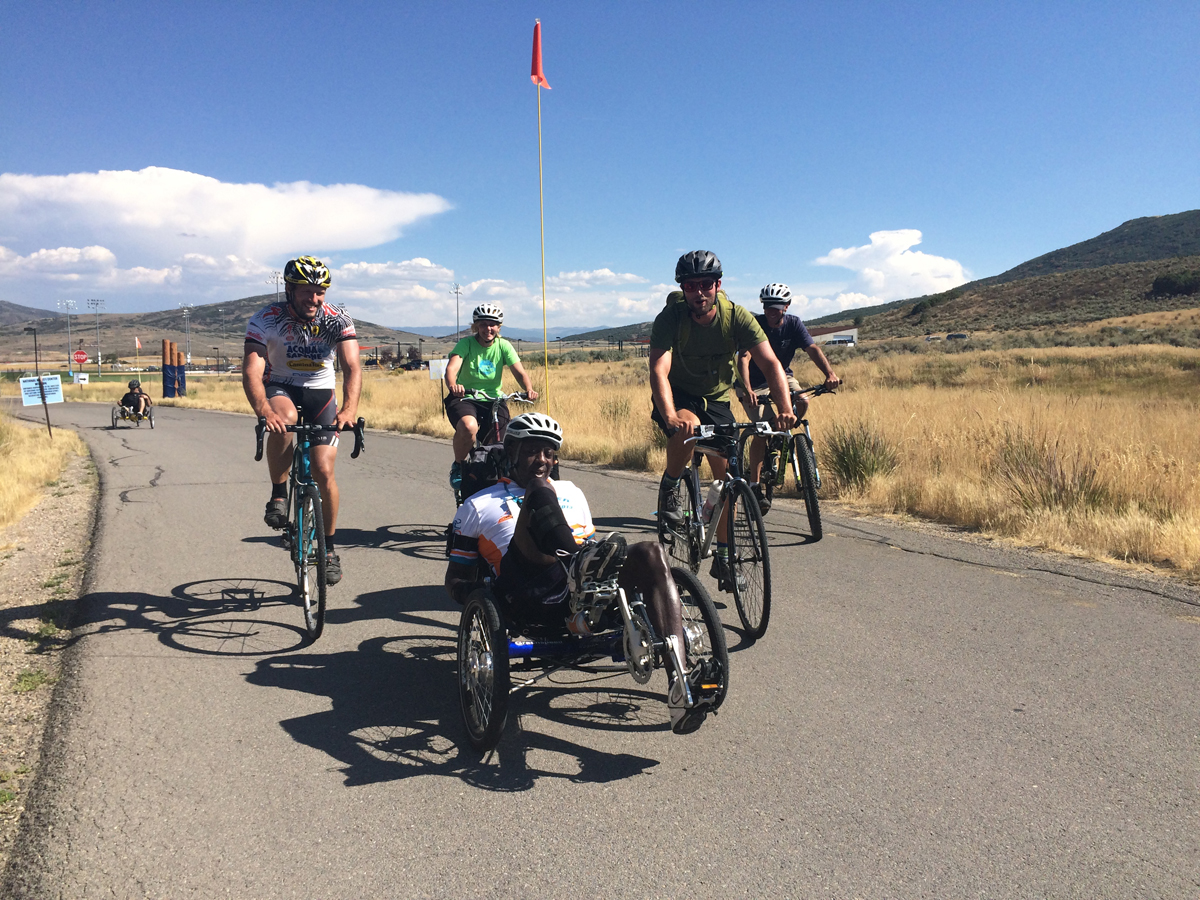
Michael Ray finishing the 52 mile course at the 2016 Summit Challenge surrounded by his ride companions. Reid Wycoff of the National Ability Center is in the white jersey. Ray hopes to cut his time down to 6 hours for 2017. Photo by Dave Iltis
Ray rides pretty much with one functional leg, and virtually no control of the right side of his body. Ray, 50, had a debilitating stroke in 2013. He started cycling at the National Ability Center in Park City in 2015, and that year completed the 18 mile route of the Summit Challenge, the Ability Center bicycle tour. Last year, he did the 52 mile route. Ray was out for 9.5 hours, surrounded by family, coaches and supporters. Pedaling solo in a three-wheeled recumbent, Ray completed the journey around Park City, out to Kamas over a 3.1 mile, 625 foot climb past the Jordanelle overlook (“Grueling,” Ray said) and finished with a 2.8 mile, 529 foot climb up Browns Canyon.
Sure it was challenging, but not crushing. “I don’t think I had a moment that was low,” said Ray.
Ray, who lives in Orem, was an international businessman, doing work in 13 countries, when he had his stroke. He and his wife, Lynette Ray, were aware of the Ability Center after the stroke, but thought it would be too expensive. Ray was unable to work, and everything had changed. Then the mother of another stroke victim told them to ask about financial aid. With that help, the Rays were able to make the Ability Center a part of their life. And the Ability Center changed their life.
The skills and confidence Ray found through the Ability Center has translated into greater independence. The Rays credit motor skills developed through Ability Center programs with helping Ray regain his driver license, an important step toward returning to a life of independence.
Lynette Ray found a special gift in the way the Ability Center incorporated the entire family. She accompanies Ray on almost every Ability Center bike session in the summer. The Rays and their children have spent time all together at the Ability Center. “The winter family camp was a wonderful break for me,” said Lynette Ray, “but as a family, we got to do an activity together. As a family we can participate. I don’t know of any place other that the NAC that does that.”
Ray started at the Ability Center on a tandem recumbent with coach Alex Mendelson. But quickly Ray was able to transition to a solo recumbent, after Mendelson saw that Ray was able to control shifting and braking functions with his left hand (his non-dominant hand pre-stroke), on a bike that was modified to fit Ray’s needs.
The Summit Challenge was not Ray’s idea. “Alex suggested it,” Ray said. Did Ray think it was a good idea? “Absolutely.”
At that first Summit Challenge, Ray had no doubts. “I knew I was going to get home. I relish doing it because I want to accomplish my goals. ”
Mendelson said that completing the first Summit Challenge with Ray was emotional, including the finish where all of the Ray family was waiting to surprise him. “It was monumental,” said Mendelson, who also was quick to add that he was not surprised that Ray completed the ride. “It is just the way he is wired. We set these high goals. He said that he HAS TO do it, not that he wants to do it.”
“None of this is for him,” said Mendelson. “For Michael, his family needs him to get better.”
Ray is not sure who suggested the 52-mile Summit Challenge ride. Perhaps Lynette.
That was a very big jump. The 52-mile route is more than 2.8 times the length, and more than 4 times the vertical, with two very significant climbs.
Mendelson had no doubts about the big step up. “Never. Not even a drop,” said Mendelson. This despite Ray’s longest day on a bike being a 30 mile ride.
“Alex took us out and we rode Browns twice before the event,” said Ray. “They showed us the map and we said OK.”
For this year, Ray is planning to do same 52 mile route for the Summit Challenge, but with the goal of doing it in 6 hours, more than 50 percent faster than last year. In addition to upping his Ability Center cycling training to two days a week in the summer, Ray has been taking part in the Ability Center equestrian program, and has recently been able to stand in the stirrups and control the reigns with his right arm. He is also swimming with the Ability Center.
Ray also rides with the Wasatch Adaptive Sports program one day a week in the summer. He would love to ride on his own on the excellent non-motorized, paved trail system in Utah County, but he does not have his own bike. Recumbents are expensive specialty items that usually cost more than $2,000. For now, Ray has to limit his rides to the Ability Center or Wasatch Adaptive.
Reed Wycoff, another Ability Center coach who trained with Ray last year and rode the final third of the Summit Challenge with him, sees the 6-hour goal as doable. “He is a rider a lot of people here are really impressed with,” said Wycoff. “He puts in the work. And he is already way ahead of where he was last year.”
Before sporting accomplishments, Ray first mentions an essential gain that came from his time at the Ability Center. Talking. The stroke affected Ray’s ability to speak. “They are not in a hurry. They are patient while I find my words,” Ray said of the Ability Center staff. “The Ability Center provided social interaction in a way that is a positive experience.”
Cycling, swimming, horse back riding, completing the Summit Challenge, this gives Ray something to talk about with former business colleagues. It helps them stay engaged in his life.
But riding a bike is not the end goal. “I need the challenges of the course because I want all of the people to know that I am determined to get back to myself, ” said Ray. “I want to go back to work again. Cycling is a step toward getting back to work.”
I have several things cycling through my mind this month. So rather than pick one and devote a full article to it, I have decided to give a little time to all of them. Here goes.
LOTOJA
This September 9th will be the 35th staging of the LOTOJA. The first edition of this epic event took place in 1983. It was the brainchild of David Bern and Jeff Keller who wanted to stage a truly European style one-day classic. So they came up with the idea of racing from Logan, Utah, where David was attending Utah Sate University, to Jackson, Wyoming.
7 people participated in that inaugural event, which expanded to 25 the next year, 52 the third year and 75 the fourth year, 1986, the first year I entered. It continued to grow, but the organization kept changing hands till Brent Chambers took it over in 1998,. Under Brent’s expert direction, it has become the classic it now is.
My wife, Karma, likely rues the day I first signed up to race the LOTOJA. That was 31 years ago, and I have entered it every year since, with only two exceptions. That means every summer has been focused around training for the LOTOJA. Consider the impact on family time and care, yardwork, honey-dos, etc., and you can understand why Karma very likely wishes the LOTOJA and I had never hooked up.
But here is a shout out to Karma, who has supported me, literally and figuratively, at the LOTOJA all but two of those years. No one is more professional at doing LOTOJA support. And I admit it: Her role is the more difficult of the two. I only have to ride and eat. She has to drive all day, timely reach the feed zones, and make certain she gets me the right food. It is more difficult than one would think, and she has it down to a science.
So, this will be my 31st year of participation in the LOTOJA. Two of the previous 30 years I rode as part of a relay team. I have thus ridden it solo 28 times, and only failed to finish 3 times. I don’t say this to brag (well, maybe a little), but simply because, with this year’s edition looming, the LOTOJA has been on my mind. It has been a large part of my cycling experience. And yes, I do take pride in the fact I have had the stamina to participate in and finish the LOTOJA so many times.
Potato Run
With the LOTOJA coming up, I have once again found myself trashing my body as I try to whip it into shape to ride 206 miles in one day. To help with our preparation, a group of us formed a team a couple of years ago, Studs and Former Studs, to ride and train together. My brother and I are the former studs (or at least like to think we used to be studs), while the rest of our team, especially 75-year old Paul Spilker, are the real studs.
This year, we planned out a few rides to check and challenge our progress. We started with the Cache Gran Fondo on July 8th, and will finish up with the Tour of Two States, the name of a former event which used the same course we will follow, on August 12th.
Our midpoint preparation check is what we affectionately call the Potato Run. We begin in Ogden and ride 135 miles north till we reach Pocatello, Idaho. Hence the name, like we are making a run to Pocatello for some spuds. You get the idea. We did this last year, and had a moderate tailwind all the way. While the distance was taxing, and even though it has a deceptively high total elevation gain of over 4000 feet, it was not an overly grueling ride.
So we were looking forward to it again this year. I assured everyone that in the summer the wind is always out of the south in northern Utah and southern Idaho. We would again have the wind at our backs, and our midpoint preparation check would be a success.
I failed miserably. The ride from Ogden to Tremonton went well enough. But as we headed west across the valley at that point to join up with Highway 89, I was dismayed to feel a crosswind blowing from the north. When we made the turn to head north on Highway 89, a mean old north wind blew into our faces.
In truth, it turned out to not be all that bad, but there was a moderate wind nearly all the way. Or so I was told. My body was not cooperating that day, and I had neither the stamina nor the legs for this ride. At about 60 miles, I could tell my legs were going south on me (even though I was headed north), and by the time we hit Malad, I was starting to feel cooked. We made a food stop there, and I hoped to regenerate. But it was wishful thinking
I slowly (very slowly) ground my way to the top of the Malad Pass (mile 85), took advantage of a fairly lengthy downhill to get to 94 miles where I sent everyone else on ahead, and then just gutted out another 6 miles to finish off an even 100. Fully skewered and baked, I was glad to pack it in.
The rest of our team did very well, though the moderate headwind as opposed to the moderate tailwind of a year ago meant much more time in the saddle. Their LOTOJA prep is going well. I am hoping this proves to have just been an off day for me, and that I will bounce back in the next week. Guess I’ll find out at our ride of the Tour of Two States.
But seriously, this is really a great ride for those looking for a long distance challenge. Particularly if you have roots in the northern Utah or southern Idaho soil, as I do being a native of Pocatello, you will thoroughly enjoy the challenge and scenery of this ride.
Le Tour
And finally, Le Tour. I wrote last month about my excitement for the upcoming Tour de France. Now, after spending countless hours as a couch potato enjoying the action of the Tour and the commentary of those famous English bavardeurs, Phil Liggett and Paul Sherwen, I am glad it is over. I have so many other things to catch up which have had to wait while I was glued to my TV.
But what a Tour it was. As usual, it did not go as predicted. While we all acknowledge the myriad things that can happen to upend the race we are expecting, we nevertheless have our expectations. Me included.
I expected the Sky juggernaut to roll over the competition and that Chris Froome would have a stranglehold on the yellow jersey midway through the race. Well, the Sky juggernaut did roll, and thankfully so for Froome. Otherwise, instead of unexpectedly losing the yellow jersey for only a couple of days, he may have eventually lost it for good. Despite his team’s effort, Froome came to the time trial of the penultimate stage with only 29 seconds separating him, Romain Bardet and Rigoberto Uran.
Well, Froome did indeed win the Tour, but neither he nor anyone else felt confident of that till he finally reached the top of the Col d’Izoard just two days ahead of the finish on the Champs Elysées. This was the closest Tour ever coming down to the wire, and something we did not expect.
As for the green sprinters jersey, I and everyone else had already awarded it to Peter Sagan. Not so fast, said the ever vigilant and farcical French UCI commissaires. In what was at best a bit of usual sprint bumping between Sagan and Mark Cavendish, which unfortunately sent Cavendish into the barriers, then onto the tarmac, and finally out of the Tour with a broken shoulder blade, those commissaires found reason, much to everyone else’s surprise and chagrin, to toss Sagan out altogether. So suddenly, two of the Tour’s biggest sprinters were gone, and just as suddenly, Marcel Kittel looked to be the likely winner of the green jersey.
Again, not so fast said Michael Matthews. Though trailing Kittel by over 100 points with only a week to go, Matthews and his Sunweb team put on a real show of force and team work resulting in two sprint wins for Matthews and a boatload of sprint points. Suddenly, Matthews was on the verge of closing his deficit to just 9 points. Unfortunately, at this time Kittel was also suddenly out of the Tour due to stomach issues and a bad crash, and what was shaping up to be a battle royale for the green jersey turned out to be a stroll to Paris in that jersey for Matthews.
Nevertheless, what a Tour for Kittel. Five wins in the first eleven stages. That was incredible.
And finally, lets talk polka dots. I had pegged Rafal Majka to win the climbers jersey. But what a show was put on by Frenchman Warren Barguil. After first taking over this jersey, he went on the attack early on every mountain stage to hunt down points. Not only that, but he stayed with the top guns on those stages, winning two of them, despite those early attacks.
None was more impressive than his victory atop the Col d’Izoard, the last mountain stage of the Tour. It was a brutal climb, and he showed real panache in attacking and, one kilometer before the finish, catching and then dropping the last man of the breakaway that it appeared would not be caught. For the first time in years, the polka dot jersey was won by the best climber of the Tour.
So, far from the predictable Tour we were all expecting, it was a Tour replete with action and drama. It was also a Tour where you could see a new generation of cycling heroes coming forth. It was also a Tour which showed us that Sky and Froome may be very vulnerable next year. Finally, it was a tour well worth the countless hours I spent staring at our TV.
The first annual TrailFest was held at the Ogden Amphitheater just off 25th Street on a glorious Saturday, June 24th. Hundreds of bicycle enthusiasts gathered to visit a wide variety of booths, mix with each other and help celebrate the completion of the Centennial Trail. Cycling Utah had the opportunity to visit with a handful of people who had a significant responsibility of making some major improvements in all phases of cycling throughout Weber County.
Ben Chournos, the owner of Shiftworks Bike Shop and the designer of most of the trails at the popular Ogden Bike Park, has been a tremendous influence on the growth of all areas of bicycling the last four years. Nathan and Kenzie Silberman are part of a committee who operate the Ogden Bike Park while working with the City of Ogden, the parks and recreation department along with the Ogden Trails Committee. One of the key members of the Weber Pathways Board of Directors is Greg Scothern, who is also on the coaching staff of the Ogden High School Mountain Bike Team. Greg’s wife Jenny is associated with GOAL (Get Out And Live), a Foundation founded for the 2002 Winter Olympic Games, designed to recruit volunteers. Ogden Trails Network is a non-profit organization and was represented at the TrailFest by Sunny Hayes. Carla Taylor is an avid mountain bike racer who has worked with Ben Chournos in the development of the Intermediate Mountain Bike Camps, a popular learning source for boys and girls in the intermediate category. These highly qualified mountain bike specialists were kind enough to give this reporter an insight into all-around biking in the Ogden and surrounding area.
Ogden Bike Park
Cycling Utah: Nathan, you have been a significant reason why the Ogden Bike Park has grown the last four years. What has been the attraction for mountain bike riders?
Nathan Silberman: I think the attention to detail and the progressive nature of the park is what attracts a lot of riders to the Ogden Bike Park. There is really nothing comparable to the bike park style trails that we have unless you go all the way to Salt Lake or Park City. Our park is located right on the bench, less than 10 minutes from the Ogden City Offices, making it easily accessible for all. We also maintain the trails every year, especially in the spring and fall. We’ve got good soil that drains fast and stays packed in the summer. We actually get out push brooms and sweep the trails to make them smooth every couple of weeks! The increase of people getting into mountain biking can be seen just by looking at the growth of the local mountain bike teams. For example, Ogden High School had over 150 students on the team. I heard it got to the point that if you missed a practice; you were cut from the team! We at Ogden Bike Park use Facebook to promote things like trail building days and other family friendly events.
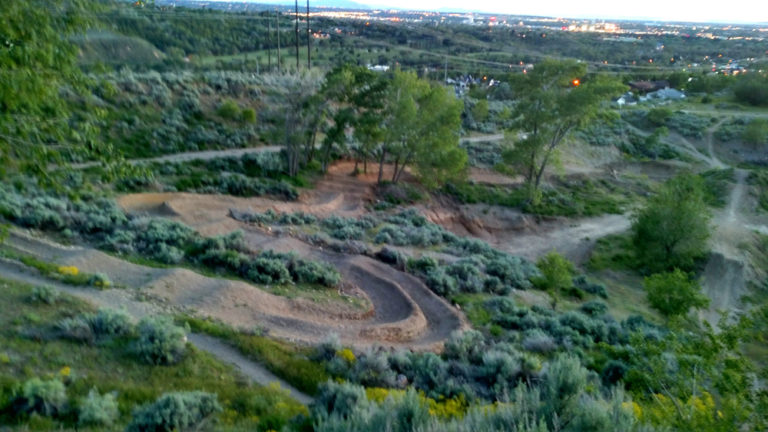
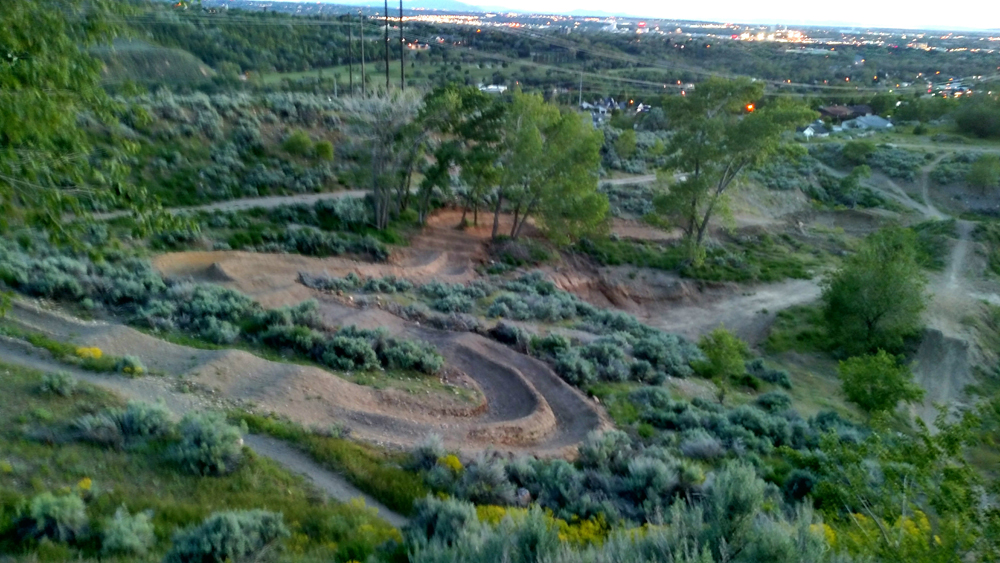
A view of the Ogden Bike Park dual slalom. Photo by Nathan Silberman
Cycling Utah: How are the trails designed so that riders of different levels ride on the trails designed for their ability?
Nathan Silberman: The rating system is just like a ski resort. The green circle designates the easier trails. Those include small obstacles and the basic terrain. Then riders move up to the blue squares, which is intermediate terrain where there are more jumps (no gaps) and they’re a little more aggressive, a little faster. Next, we have the black diamonds where you start to get into technical terrain where handling is more difficult. Riders will find gap jumps that are more technical. We also have double black diamond trails, which is the most difficult terrain you can find. This includes large gaps, drops up to ten feet, and jumps up to 30 and 40 feet. The hardest designed are high-speed trail settings, and we have a few of those in our bike park that we have been working on the last few years.
Cycling Utah: Kenzie and Nathan, has there been an impact on girls taking up the sport of mountain biking?
Kenzie Silberman: Oh yes, many girls learn by riding together. They watch and listen to their friends and before long all of them improve their skills. Actually, there are a lot of clubs and associations with many women riders. As the bicycling community continues to grow, there is a fair share of girls that take up the sport. I know it is a male-dominated sport for the most part but over the last few years there has been a lot of women getting to the pro level, as well as expert and intermediate levels in mountain biking.
Nathan Silberman: We’ve had quite a few female groups come in at the Bike Park and use the park and learn the jumping skills and progress without having to go out and do a big gap jump or something that is too dangerous right off the bat. We offer that progression level so you see where professional riders are using our trails to train themselves for a World Cup or national championship races.
Tips for New Riders at the Ogden Bike Park
Cycling Utah: What are some of the training tips that you pass on to riders that have helped them the most?
Kenzie Silberman: I would say just get on the green trails; it’s a great place to start. I also would start on flat pavement, like the street or a parking lot. Stand in “an attack position” with your feet on the pedals, your elbows bent, standing up over the center of your bike. Pedal around moving your body side to side while your core is upright. That simulates the cornering technique and what we call the bike-body separation. That provides more traction in the dirt when you are going around corners. When you are going down steeper terrain, you think about putting your rear-end over the rear tire. That will make you feel more comfortable on steeper descents. But I think the green line is a great place to start and I always encourage people to try the blue line even on their first day. The blue line is incredibly fun and everybody enjoys that once they get more comfortable. There are a lot of great people up at the park so that if you have questions about technique or the terrain itself, just ask and people will give any advice they can.”
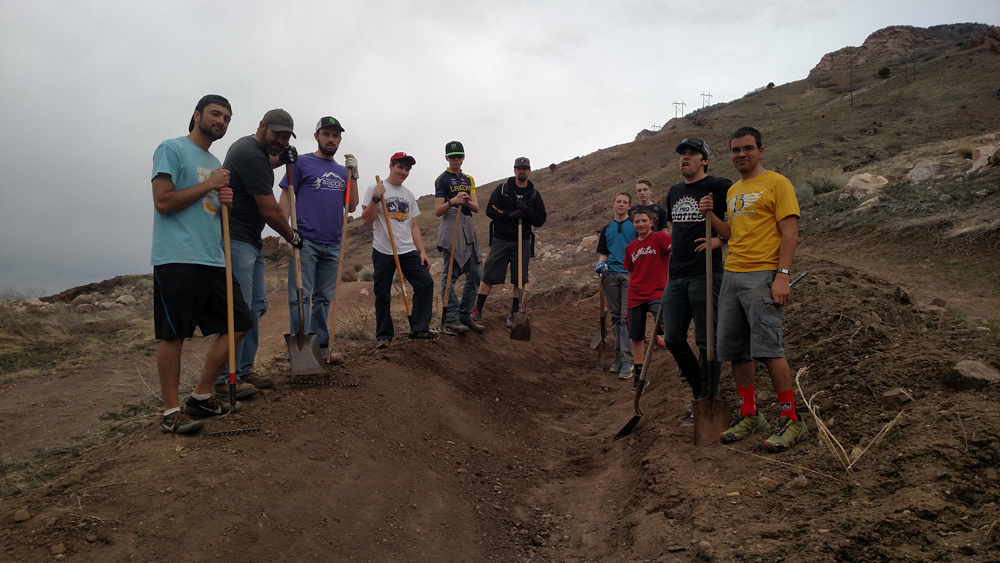
Volunteers working on the green line at the Ogden Bike Park. Photo by Nathan Silberman
Cycling Utah: Good stuff Kenzie. Do you have any other advice for riders unfamiliar with the Bike Park?
Kenzie Silberman: Always wear a helmet at the Ogden Bike Park. There is no unauthorized trail building allowed, for obvious reasons. We expect all riders to respect the terrain. It’s a special place here in Ogden and we want to make it last as long as possible. The land is leased to us from an outside company, so we want to keep it as nice as possible. I would say the Ogden Bike Park is offers everything to anybody who wants to learn how to ride a mountain bike. We have every single kind of terrain you could possible think of from beginner to those with much experience. We’ve had riders from three-year olds on Strider Bikes to people in there 70’s. We have the variety of terrain that will teach you how to progress. For example, we had a member who just started riding about four years ago. He didn’t know how to jump a bike at all. He was very timid at that time. Now, at 44, he can jump a 30-foot table gap. Trust me, there is the possibility for everyone to learn more skills.
More on the Ogden Bike Park
Cycling Utah: Where do most of the riders at the Ogden Bike Park come from? Are they local or do you draw from the entire Wasatch Front?
Nathan Silberman: We have riders from the entire Wasatch Front. Our only direct competition for bike park trails, in terms or jumps and features, is Salt Lake and Park City. There is not much between Salt Lake and Ogden in terms of a bike park and trails. You have a little bit on the Bonneville Shoreline and in Bountiful but I would say we are on par with what Salt Lake is doing. Park City has the lift access regarding the resorts but we are starting to see that in Ogden. Nordic Valley, Snowbasin and Powder Mountain are starting to do lift operations. The sport is getting bigger and bigger.
Cycling Utah: For those unfamiliar with the lay of the land here in Ogden, where is the Bike Park located?
Kenzie Silberman: Very easy to find. Take 12th Street all the way to Harrison, and then take Harrison to Ninth Street. It’s at the top of Ninth St. and Ogden on the east bench. There is a parking lot at the top at Ninth St. and another lot at the bottom at 1350 South. These areas will give you access to the entire park and there are maps at the top and the bottom.
TrailFest and an Overview of Trails in Ogden
Cycling Utah: Greg Scothern, I know you are a member of the Board of Directors for the Weber Pathways. Tell us about biking in Weber County and how it has made such an impact in the community?
Greg Scothern: Yes, I am an ad-hoc member of the Weber Pathways Board of Directors. Weber Pathways is the leading non-profit trail building organization in northern Utah, primarily Weber County.
We are here today to celebrate a pretty big milestone for our trail network. It extends throughout Weber County and we are celebrating the completion of the Centennial Trail. It is the combination of the Ogden River Parkway, the Weber River Parkway, and the Bonneville Shoreline Trail along the east bench. This was a project envisioned 30 years ago by a group of people who wanted to do something specific for the Utah Centennial. They dreamt up this idea of completing a circumnavigational trail loop throughout the entire community. It was an important focus for people in the community who were trails oriented and we had a few champions, Jay Hudson being one of the main people in that group. He stayed in front of local governments to make sure things happened with the trail network. We recently completed a tunnel underneath Skyline Drive on a very busy intersection in South Ogden and the county completed a key road connection. It now completes a 27-mile loop with very few road crossings. There are a couple of places that you go on the road but it is a designated bike route. A little over half of it is paved and you have 6-8 miles of the Bonneville Shoreline Trail included. It’s a great loop and you can go out and cruise for 3-4 hours. It probably has about 1,400 feet elevation gain on the 27-mile route and it’s doable for most people.
Cycling Utah: What made this TrailFest celebration happen and how are the bike trails financed?
Greg Scothern: It’s really exciting. This is our First Annual TrailFest. We wanted to do something to engage the public for four years now. We have done fundraisers and auctions for trail projects but people have trouble paying for the operational funds to keep things going. Most people assume the government finances the production and maintenance of the trails. General fund tax money does not pay for a single foot of trail in Weber County. Funding for trails is all through private donations and pass through. We are fortunate to have a RAMP tax where a lot of the funding comes from a 1/10% sales tax. But that funding is limited each year and requires matching funding from the community to back up those grants. We are fortunate to have a community that is very supportive. A typical paved trail can cost as much as $35-40 a foot to build. We just completed a section of the Pineview Loop Pathway that had very challenging engineering and design issues. It was a quarter mile stretch and it cost $130,000 to get built. It was worth it because it links the two communities of Huntsville and Eden. Natural surface trails, easy digging, natural soil, can be as cheap as $3 a foot but most trails cost somewhere between $8-15 a foot for natural surface trails. We raise the funds, then we partner with the Forest Service, Weber County and other government agencies to make the projects happen. Quite frankly, we are in the business of getting the trails done.
Riders waiting to drop in at the Ogden Bike Park after work. Photo by Nathan Silberman
Cycling Utah: What form of exposure do you use to get the word out about the bike trails?
Greg Scothern: The most effective means of exposure has been Facebook and Instagram. We push those pretty hard. We also send out a quarterly newsletter to all our friends and supporters. We create events like TrailFest here, and we produce about 20,000 trail maps annually. The maps are our number one touch with the public. We produce new maps every year because each year we have made additions to the trails. Riders can download the maps on their phone, and easily locate the trails. These maps are available at all the bike shops as well as outdoors gear shops, hotels and many of the restaurants on 25th Street. They are great resource for information on where people can enjoy riding.
We partnered with Weber County to produce high quality GIS data for all the trails. These link to our electronic version of our maps that riders can download. Download an app called ArcGIS and scan the QR code on the printed map to load the information into the app. That will provide all the information they need: the elevation, the surface, even issues on the trail. It’s a great resource.
Cycling Utah: What are the primary safety issues that you promote?
Greg Scothern: We advocate very heavily for trail etiquette. We explain the proper etiquette to yield to different users of the trails. The majority of our trails are multi-use and we want to keep it that way. The biggest safety issue we promote is reminding people to use their bells on bikes and not to wear ear buds while running, because those with earbuds often cannot hear a biker approaching even if they are ringing a bell. And of course, there is a conflict on trails with those riding horses, but there doesn’t have to be. The mountain bike community has really embraced being courteous. Lately, I have received a lot of feedback from those on horses that the mountain bike community has been paying more attention to doing the right thing.
High School Mountain Biking
Cycling Utah: Tell us about your role in coaching mountain bike riding at the high school level?
Greg Scothern: I am an assistant coach at the Ogden High School mountain bike team. NICA (National Intercollegiate Cycling Association) has done brilliant things to keep kids on bikes. We constantly hammer to the kids to be responsible and make sure you are representing your team and yourself properly. We have this constant influx of kids on trails and there are a lot more kids riding each year. And who could argue with that? But if they’re not safe, they are creating problems on the trails. The message is that you cannot under estimate the importance of safety while you are riding. Such as: spilt up into smaller groups, always yield, and always err on the side of courtesy. Whether someone is riding a bike, walking, hiking, running or a horseman—we all have to get along on the trails.
GOAL Foundation
Cycling Utah: Jenny Scothern, you are affiliated with GOAL. How does that organization enhance cycling?
Jenny Scothern: GOAL (Get Out And Live) Foundation was initiated around the Winter Olympics. It was organized to recruit volunteers for the 2002 Games. It was so successful, it was decided to just keep GOAL going. We like to bring outdoor recreational events to the Ogden area and we provide all the volunteer support for those. We are a 501C3 (non-profit) organization for anything the City of Ogden needs regarding volunteer work. Regarding the sport of cycling, we have supported the USA Collegiate Cycling events, the Tour of Utah, the Master Cycling Events and the Fat Bike races up at Snowbasin. We are contracted by the City of Ogden to produce the Ogden Marathon. For that event alone, we are known for our volunteer support. Annually, there are approximately 1,200 volunteers for the marathon and we have 8,000—9,000 runners each year.
Ogden Bike Park stepdown. Photo by Nathan Silberman
Cycling Utah: What are your primary tasks concerning teaching youngsters and bike camps?
Jenny Scothern: This is our fifth year of GOAL Foundation Mountain Bike Camps. We teach kids from the 3rd grade to the 6th grade — start with beginner mountain bike section and progress to the intermediate level. Many schools in Ogden, Morgan City, and Bonneville have mountain bike teams. At our camps, they are taught with the spirit of NICA. We begin with skills training on pavement, cornering, braking, and shifting. Following that, they go over wood planks. All of that is done before we ever go onto the trails. We use the lower Bonneville Shoreline and the Rainbow Gardens area. The intermediate kids go to the River Bottoms, which is close to Riverdale. We also utilize the Bike Park. Having won the contract has helped us grow the programs. We think the cycling community is amazing and we want to get more kids on bikes and support the high end cycling events.
Ogden Trails Network
Cycling Utah: Sunny Hayes, you are with the Ogden Trails Network. Could you tell us more about the Network?
Sunny Hayes: The Ogden Trail Network is a non-profit organization that falls under Ogden City. The committee members must fill out an application that is approved by the Mayor. There is a lot of talent on this committee: from engineers to the U.S. Forest Service. We basically take care of a lot of bike trails. We are responsible to work with the city and the volunteers. We maintain the trails in Ogden City and we also partner with the Weber Pathways, which has to do with the countywide level.
As others have mentioned, the best way riders can help us is to use a bell, so hikers and others on the trails will know they are coming, All riders must stay on the trails, so they don’t make their own switchbacks. Basically, we expect them to enjoy the trails and leave no trace. We would like to build more trails but we are happy to maintain the ones that we have and connect to other trails. Presently, there are 266 miles of maintained trails and 36 miles of paved trails in Weber County.
Ben Chournos and Ogden Cycling
Cycling Utah: Carla, you are an avid bike rider in the community as well as an instructor with the bike camps. You work directly with Ben Chournos. Tell us about the impact he has made on cycling in the Ogden community?
Carla Taylor: Ben is the owner of Shiftworks Bike Shop here in Ogden, but he helped start the Intermediate Mountain Bike Camps. We were able to take the students to the Bike Park, which Ben helped develop. He has taught the first two years of our intermediate mountain bike classes. He loves to work with bikes, kids, and has volunteered his time. Ben will do an awesome job on any repair work. No matter what kind of bike you have, whether it is new, a clunker out of the shed, he will fix it. If he says it’s safe and fixed properly, than it is just that. He’s the best in the west when it comes to being a bike mechanic. He’s really about customer service. To the bike community, he is very well known and respected. We are happy to know that Ogden is a great community for bicycling.