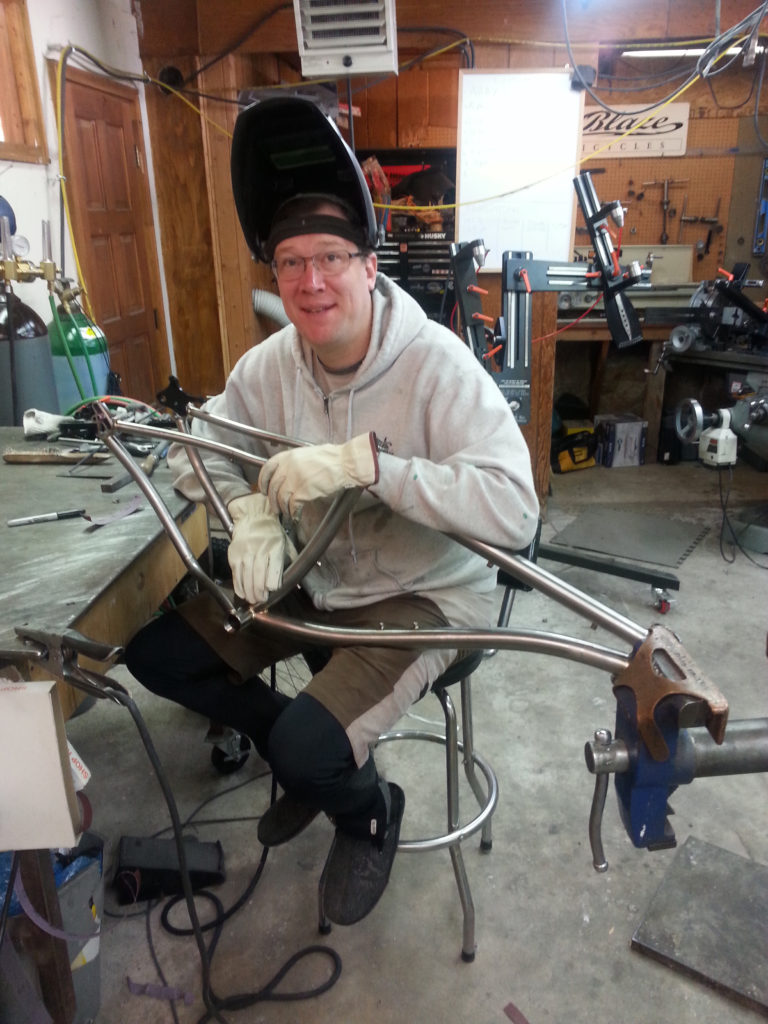
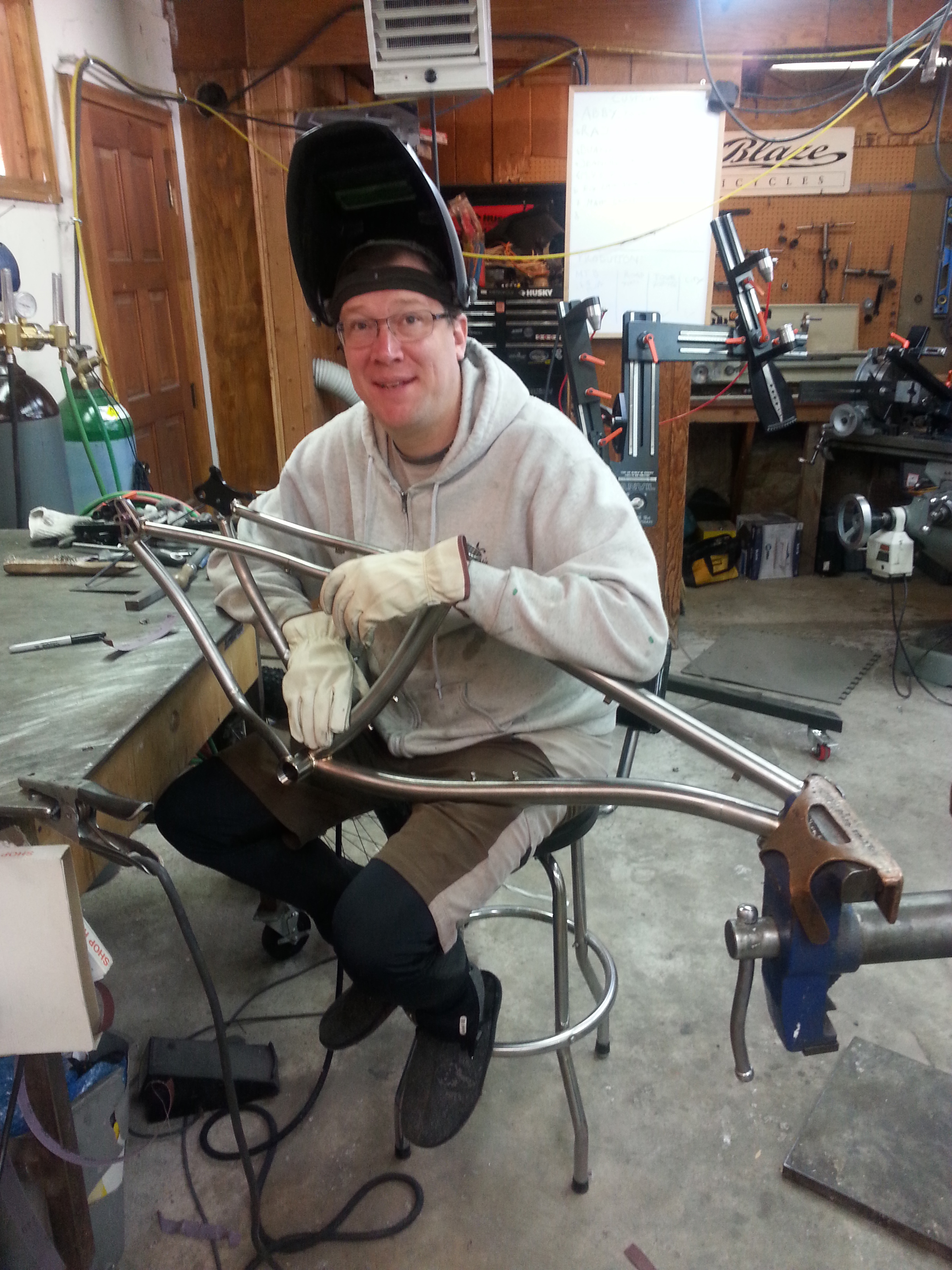
Blaze Bicycles’ Pierre Chastain building bikes to prepare for the North American Handmade Bicycle Show to be held from March 10-12, 2017 in Salt Lake City. Photo courtesy Pierre Chastain
By Dave Iltis February 25, 2017 – The North American Handmade Bicycle Show is coming to Salt Lake City from March 10-12, 2017. The show highlights hand-crafted bicycles, accessory makers, and component suppliers for the artisan bike industry. The 13th Annual show began in 2005 in Houston.
The NAHBS is about the art of the bicycle, “Since 2005, NAHBS has been consistently dedicated to showcasing the talents of individuals around the world whose art form is the bicycle. It continues to aim to be a meeting point-online and in person-for frame builders and cycling enthusiasts, for the sharing of ideas, and the promotion of a special industry with a rich history dating back to 1819,” states the show’s website.
We asked Pierre Chastain of Blaze Bicycles about his participation in the show, he said, “The chance to get together with this many talented craftspeople is really exciting. To see people that are actually making stuff is really unique.” Some of the builders have been around for 30-40 years producing refined designs noted Chastain, “I like seeing what they are doing, I like hanging out with them, I like challenging myself to produce better work.”
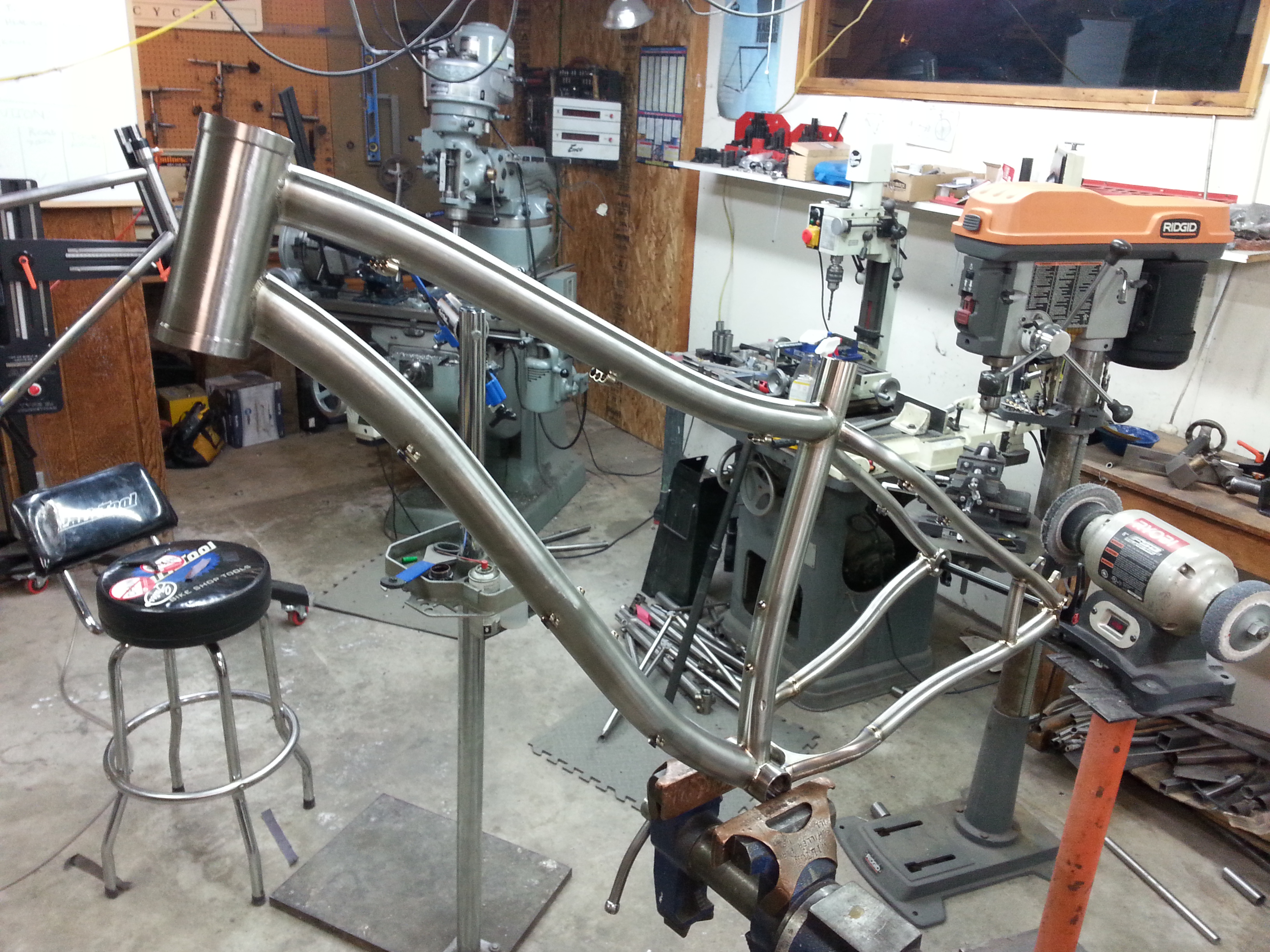
He is building several bikes to get ready for the show, including a fat bike, 29er, 27+, a gravel grinder, and a road bike for people to view. Chastain builds custom tig-welded titanium bikes, and paints or anodizes them himself. His work shop is located in Moab, and he’s also owner of the Bike Fiend, a retail store in Moab. He started building bike frames about 9 years ago. He’s a one man shop, and builds and designs his bikes from the bottom up. Chastain says,“I’m here to provide you guys with bicycles. What makes custom bicycles so damn awesome isn’t the fact that they are bilaminate lugs or this way or that way is that they fit really well. And in my particular case I put focus on having a performance based modern bicycle.” Look for his booth at the show and find out more at blazebicycles.com.
Preview Video:
Over 170 exhibitors will be present, along with national and local bicycling media. Several Utah and Idaho companies will be present including Kelson, Salt Air, Moab’s Blaze Bicycles, EO Gear, Lizard Skins, Rock West Composites, Rotor, Mercury Wheels, Enve, Metier Velo, Reynolds, TRP, and more. Sklar from Montana will be there, as well as Breadwinner Cycles run by former Salt Lake City resident Tony Pereira and Tallerico Cycles run by former Moab resident Johnny Tallerico.
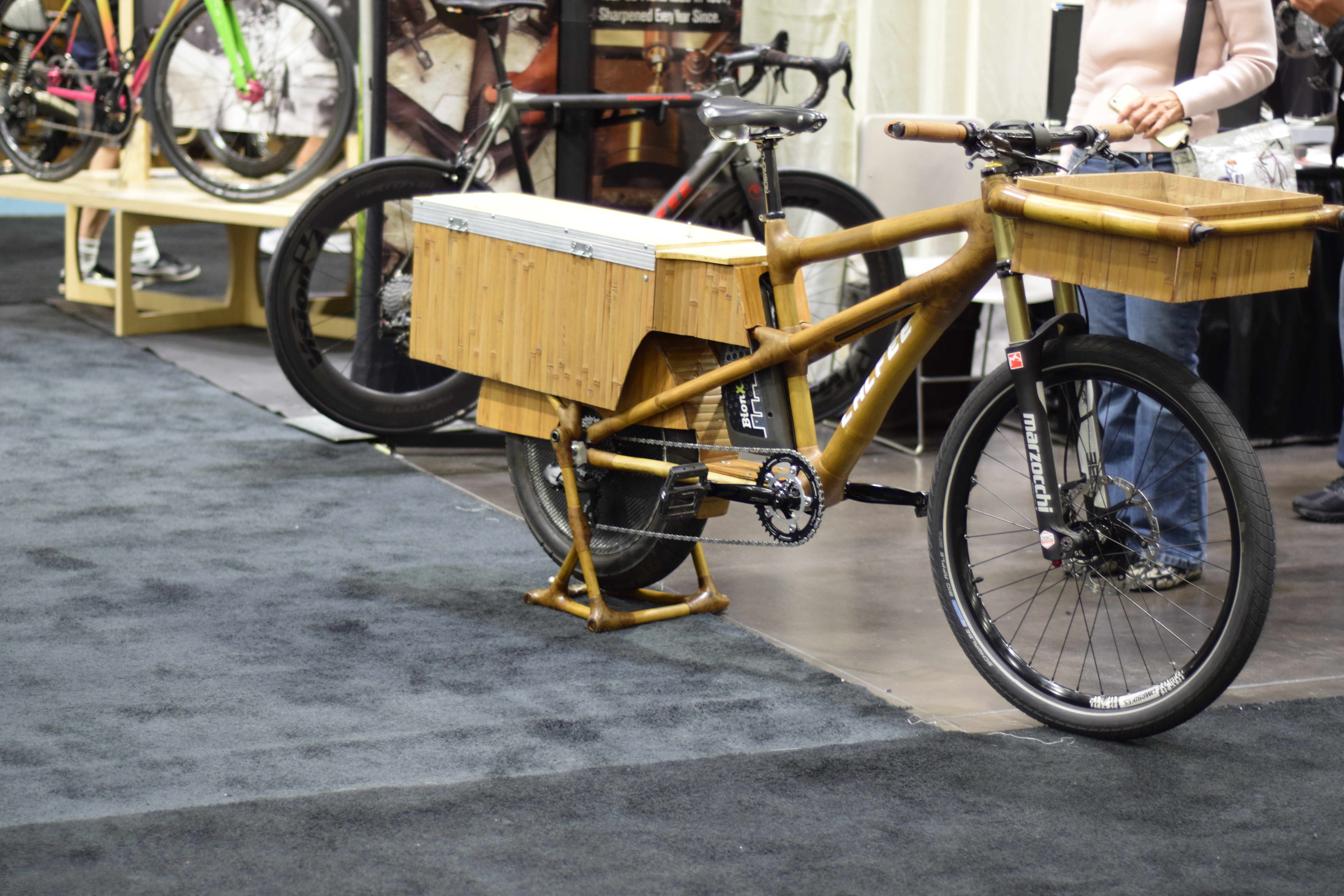
Calfee’s bamboo cargo bike on display at the 2016 NAHBS. Photo by Billy Sinkford
In addition to booths and tables highlighting different custom bike builders, the show will have seminars on professional framebuilding, branding for framebuilders, tubing technology, BikeCad, 3D printing, handbuilt wheels, and showings of the movie “Cheetah, The Nelson Vails Story.”
The show is intended for consumers, bike lovers, the bicycle industry, framebuilders, and anyone that appreciates fine craftsmanship.
The show will be held at the Salt Palace Convention Center, 100 W. Temple, Salt Lake City, UT 84101. Show hours are from 10 am to 6 pm on March 10 and 11th, and from 10 am to 5 pm on March 12. Valet bike parking will be available from the Bicycle Collective.
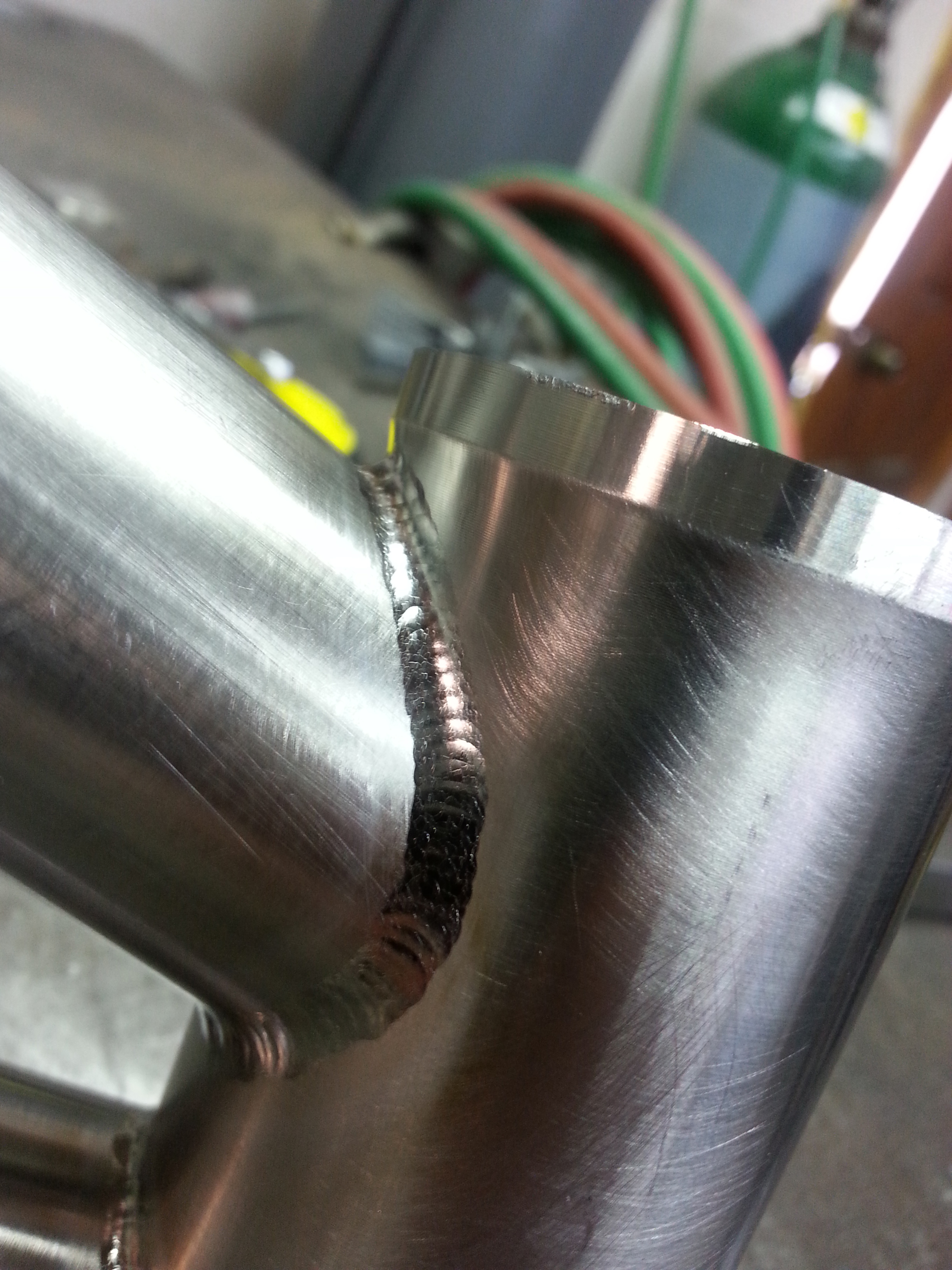
One of Blaze Bicycles frames tht will be on display at the North American Handmade Bicycle Show to be held from March 10-12, 2017 in Salt Lake City. Photo courtesy Pierre ChastainBlaze Bicycles – a fine tig weld on a titanium frame. See it at the North American Handmade Bicycle Show to be held from March 10-12, 2017 in Salt Lake City. Photo courtesy Pierre ChastainOne of Blaze Bicycles frames tht will be on display at the North American Handmade Bicycle Show to be held from March 10-12, 2017 in Salt Lake City. Photo courtesy Pierre Chastain
By Lou Melini — There are 2 recent upgrades that have improved bike commuting to and from the east Canyon Rim area of the new city of Millcreek, Utah. In case you are not familiar with Canyon Rim, it might be easier for me to say that I live just north of the 3300 South REI store. The first upgrade, the Sugarhouse “S” line bike trail, has been in existence for a few years. This has been a major change on how I travel to and from Salt Lake City. The second upgrade, the rebuilding of 2300 East south of I-80 that includes a roundabout, was dedicated in November 2016. The roundabout has made crossing 2300 East by bike much easier.
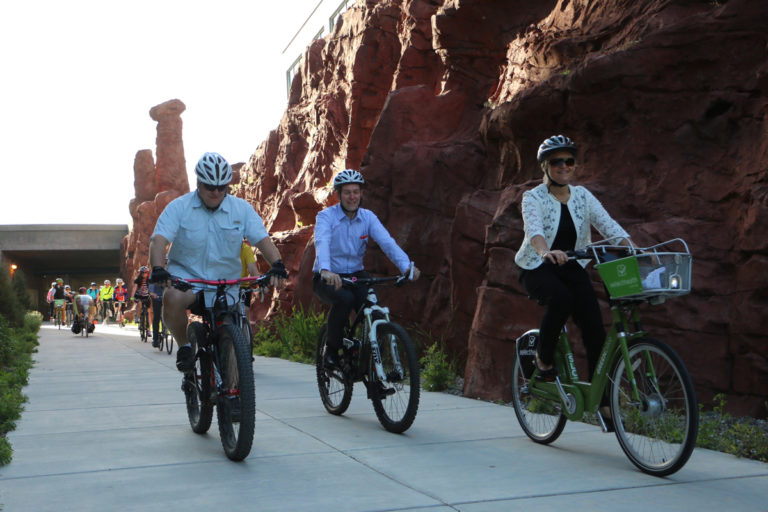
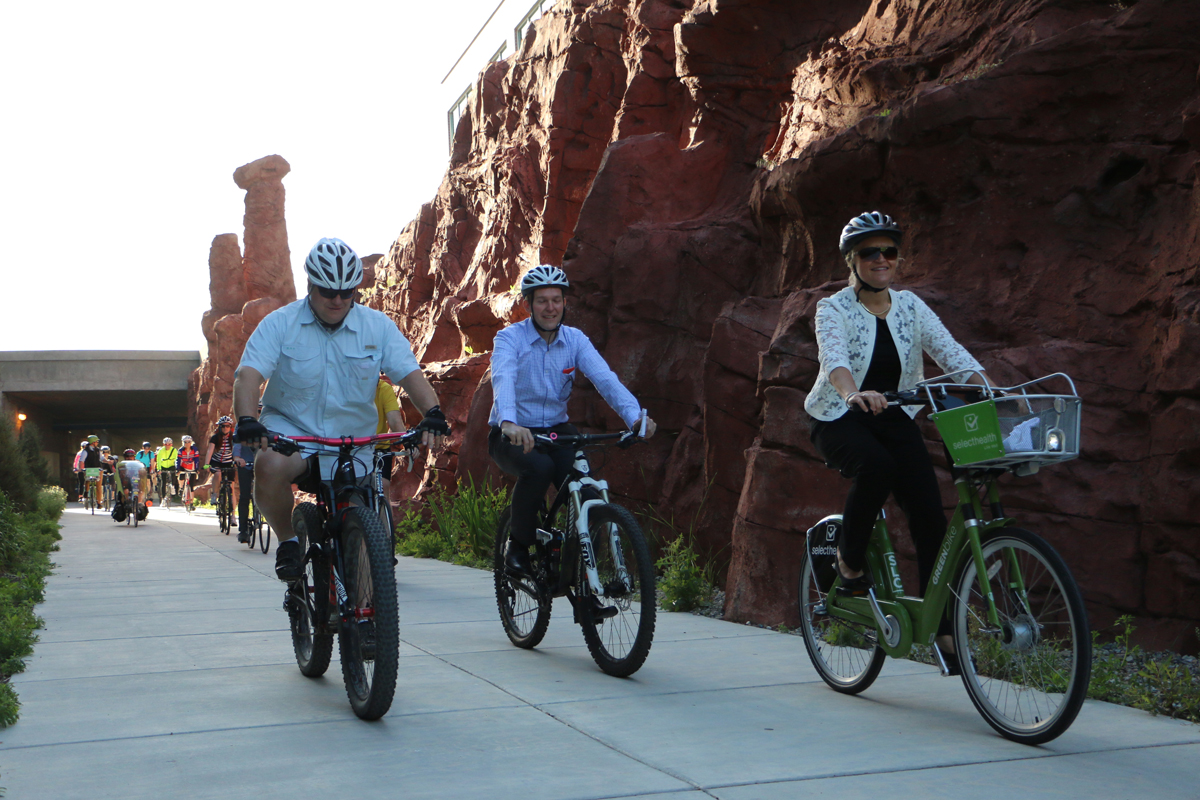
Mayor Biskupski (right) and Mayor McAdams (middle) ride through the relatively new Sugarhouse Draw in the 2016 Mayor’s Bike to Work Day. Photo by Dave Iltis
The Sugarhouse “S” Line
Up until the past couple of years, 2700 South was my primary commuting road to visit my grandson who lives just south of the “S” line between 6th and 7th East. With the opening of the “S” line bikeway, the 1300 East tunnel and the pathway through Sugarhouse Park; riding on 2700 South has become a rare event. During winter snowstorms, the changes that I just mentioned have made my commute so nice that I am sure that drivers of automobiles are envious.
The pathway through Sugarhouse Park is relatively flat. Then there is the tunnel under 13th East on the west side of the park allowing a very convenient crossing of 13th East. In the winter of 2016-2017, the Sugarhouse trail was frequently plowed of snow. Under the blanket of snow is ice, but the good news is that when the sun was out, the ice would melt quicker without the blanket of snow. I increased the size of my commuter tires to 2.35 and ran them at 20-25 psi. This allowed me to traverse the ice at near normal commuting speeds. This may not sound very positive, but it beats dodging snow piles in the street, parked cars in the bike lane surrounded by snow, potholes and the occasional impatient driver on 2700 South.
Once past the tunnel the asphalt bikeway becomes a wide concrete sidewalk through Hidden Hollow. This is a short but bucolic ride until you hit the parking lot for Whole Foods. The sidewalk west of the little wooden bridge in Hidden Hollow is usually cleared of snow. The section between the tunnel and east of the little wooden bridge was not maintained until a week after the holiday storms. I had to walk through this section a couple of times, as the snow was difficult to ride through during that time period. Since that time maintenance on this small section has been spotty, especially just west of the tunnel.
Riding through the small section of Whole Foods parking lot and Wilmington Ave. in Sugarhouse, one needs to pay attention to the numerous cars making turns. After crossing 11th East, I cut through the Zion’s Bank parking lot to get on the start of the “S” line bikeway just before McClelland Ave (1050 East). From there I am off to my grandson’s house or to my volunteer position at the Salt Lake Bike Collective with little interaction with traffic. I could go a bit faster if I took 2700 South, but the ambiance of the trail makes up for any gain in speed on the road. The bikeway is narrow where the train stations are located so slowing down at these locations will occur as well as slowing due to the presence of pedestrians. There are also numerous street crossings, most of which have pedestrian buttons and stop lights to stop car traffic. I have found that I only need to push the buttons at 9th and 7th East and at State Street as the lack of traffic negates the need to push the signal button at the other crossings. Another word of caution is the numerous driveways and a few streets with stop or yield signs. On occasion I have seen these signs ignored, so be alert and don’t assume you will be given the right-of-way. The final word of caution is to be conscious of cars making a right-turn-on-red at Sugarmont Ave. onto 9th East.
One of the biggest surprises that I encountered on the bikeway is that it is maintained year-round! Snow is removed and salt is put on areas with ice. On one day after a snowstorm the streets appeared to have not seen a snowplow, but the “S” line was clear save for a few isolated patches of snow. In warmer months, broken glass and other trash are quickly cleared. I can only assume that this care is done for the customers of the Sugarhouse rail line so I am expecting that this level of service will continue.
My only complaint about the “S” line bikeway is that it is too short. From McClelland to State St. it is a gem that is well used by numerous people. Though well used, I do not find it hampering my commute except for the occasional person that has headphones listening to whatever in the middle of the bikeway and unaware of my attempts to get his/her attention.
When first opened, there was a goathead (puncture vine) problem between Main and State Street that spread to 2nd East. I picked up quite a few when pushing my grandson in a stroller. I have not had a thorn in any tire (bike or otherwise) since 2014, perhaps 2013.
In conclusion, if you live, work, or find yourself needing to be in the Sugarhouse area, you should consider using the “S” line bikeway. It will be well worth the slower ride.
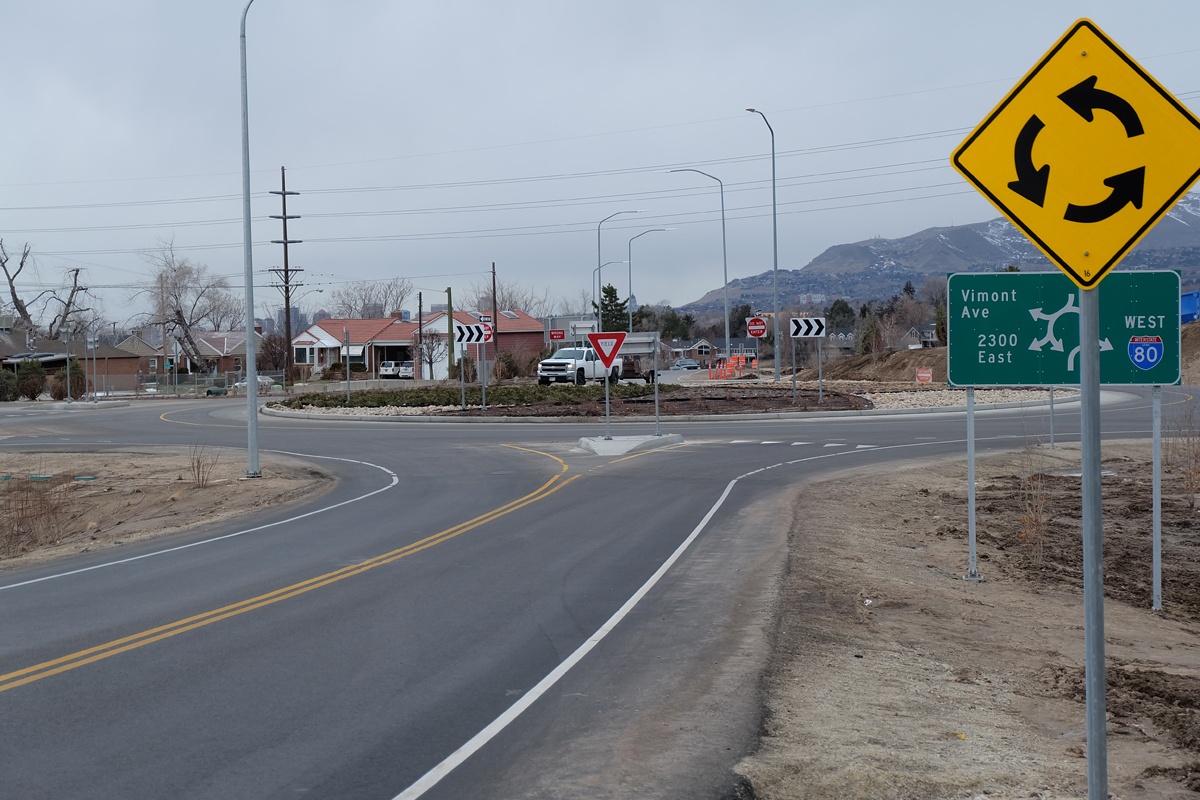
The new roundabout at 2300 E and I-80 in Salt Lake County is better for bikes than before. It will get a tunnel too later this year. Photo by Lou Melini
2300 East Upgrades:
Prior to 2016, 2300 was a street that I crossed frequently but did not ride on. I crossed at either Atkin Ave (2800 South) or the next street to the north, Claybourne Ave. Neither was ideal, but it was manageable. In 2016, it was to change.
Julie and I were gone for 6 months hiking the Appalachian Trail, so we were able to miss all of the construction and orange cones on 2300 East from I-80 to 3900 while it was being rebuilt. Shortly after our arrival home, we were able to experience a new street with bike lanes and a roundabout at the north end. I was a bit anxious that the new road was being oversold for its bike and pedestrian friendly upgrades.
Unfortunately crossing at Atkin and Claybourne Avenues have not changed. Neither is any easier to cross than before. The pedestrian light at Claybourne is the same light as before. The roundabout however has been wonderful and easy to maneuver across.
The benefits of the roundabout are three-fold. First I have 2-single lanes to cross vs. the 3 lanes, that includes the left turn lane, at Claybourne. Secondly there are large, prominently placed yield signs have been erected to alert drivers to yield to traffic within the roundabout. I have had 100% of the drivers yield to me when I am in the circle, even drivers coming off of I-80. At Claybourne, I had about an 80-90% rate of cars stopping when I was crossing, even with the pedestrian light flashing. Perhaps it has since been better, but with the roundabout so easy to cross, I haven’t had a desire to cross at Claybourne. And finally the speed of the cars is a very pedestrian 20 MPH within the roundabout. Even my lead-footed wife drives at that speed within the roundabout. At Claybourne, cars are accelerating off of the roundabout from the north and seem to be at the posted speed limit of 35 coming from the south.
There is a fourth benefit to the roundabout in the winter. Neither Claybourne nor Atkin receive a lot of sun and minimal snowplows, so riding those roads can be a bit icy and dicey. The roundabout is in the sun and is kept clean due to snowplows and the number of cars.
I have heard comments that being on a bike in a roundabout is not a comfortable place to be. This may be true of some roundabouts but at the north end of 2300 East is quite pleasant to navigate. I would recommend that you try it as you pass through Canyon Rim.
If you are still not sure about riding in a roundabout there will be a new bike pathway taking you across 2300 East to 1700 East near Sugarhouse park. A bridge will take you over the off-ramp and a tunnel will take you under the on-ramp just north of the new roundabout. Completion is expected in August.
Editor’s Note: The bicycle commuter column since 2004 has featured individuals that bike commute. With this column I hope to expand the commuter column to include other aspects of bike commuting. The column will continue to include individuals with expansion to include bike routes, commuter bikes and other aspects that will make the column educational and entertaining for the utilitarian use of bicycles. Contact Lou Melini at [email protected] if you have an individual or topic for the column.
The Utah Bike Summit is the statewide bicycle conference. The summit brings together everyday riders, bicycle and trail advocates, representatives from Utah’s bicycle industry, planners, engineers, representatives from Utah’s tourism industry and health fields, and local and state government officials in order to make Utah more bicycle friendly. Regardless of your interest in bicycling (transportation, recreation, road, mountain, commuter), the Utah Bike Summit is for you and all are encouraged to attend.
Utah Bike Summit
March 14, 2017
8:00 a.m. – 3:30 p.m.
Ogden, Utah
Every year we work to bring in great speakers who can help to advance all of the work being done for bicycling in Utah. And this year is no different. Here is a quick overview of some of the great speakers who will be at this year’s summit:
This year’s keynote speaker is Mike Lydon who is an expert on active transportation demonstration and pilot projects, also known as tactical urbanism. These types of projects help communities experience the benefits of new bicycle infrastructure by being able to try it out. Mike will discuss how communities can implement these projects to build public support for permanent installations.
Greg Bell, President and CEO of the Utah Hospital Association as well as past Lieutenant Governor of Utah, will explore the nexus of health, physical activity, and quality of life.
Carlos Braceras, UDOT’s Executive Director, will be giving an update on all of the initiatives being undertaken at the Utah Department of Transportation. His update will be followed by regional breakout sessions where summit attendees can give input on UDOT plans and projects.
Nicole Iroz-Elardo from Urban Design 4 Health in Portland, Oregon will present the results from Utah’s Active Transportation Benefits Study. This study identifies the economic, environmental, and health benefits that bicycling and walking bring to the State of Utah. The results from this study will serve as justification for further investment in active transportation infrastructure
Lynette Carpiet, Editor-in-Chief of Bicycle Retailer and Industry News, and Alex Logemann, State + Local Policy Analyst for PeopleForBikes, will be on two panels addressing bicycle industry trends and strategies for growing all types of bicycling.
Provo Mayor John Curtis and Cameron Diehl, Director of Government Relations for the Utah League of Cities and Towns, will be presenting a session about how to speak to elected officials about bicycling.
There will also be sessions focused on: using crowd-sourcing to inform active transportation efforts; resources for rural communities to develop active transportation networks; and how to get more mountain bike trails built more quickly.
The Utah Bike Summit is an all-day event and registration includes all sessions, networking opportunities, and catered lunch.
Thank you to this year’s summit sponsors: TravelWise, Salt Lake County Bicycle Advisory Committee, Bonneville Cycling Club, SOAR Communications, UTA, Visit Salt Lake, Mercury Wheels, HDR, REI, Amer Sports, Athletic Event Supply, Staker Parson, Wasatch Front Regional Council, Alta Planning + Design, Fehr & Peers, Get Healthy Utah, Parametrix, the Governor’s Office of Outdoor Recreation, Mountainland Association of Governments, Horrocks Engineers, Landmark Design, Clif Bar, Adventure Utah, Cycling Utah, WSP Parsons Brinckerhoff, Salt Lake City Transportation, and the Ogden Bicycle Collective.
The Salt Lake County Bicycle Advisory Committee enters 2017 with a Board full of fresh faces and energy to lead its efforts. Aaron Searle replaces Betsy Byrne as elected chair, while newcomer Kaleb Holt steps into the vice-chair position. The group looks forward to opportunities and development throughout the year to benefit the community and fulfill its role advising County Mayor Ben McAdams in all bicycle-related matters. We encourage the public to attend our meetings held the second Wednesday of each month at the County Government Complex in room N2-800. Complete details and a listing of 2017 meetings can be found at: www.slco.org/bicycle.
As of January, northern Utah has seen more snow than locals have become accustomed to in these drought years. Nevertheless, it is still possible to spot bicyclists at any hour of the day on roads and bike paths. Concerned citizens have repeated the request that city parks and roadways are plowed as well as well-ridden bike paths. With added lanes in the city this has been no small task this season and efforts to clear these paths are appreciated, no matter whoever is leading the charge. As the county’s population continues to grow the number of bicyclists will continue to grow with it. This year is a great year to make a resolution to support bicycling infrastructure and safety throughout the state.
The committee already has an active year planned with the Utah Bike Summit in Ogden this year on March 14th as well as the National Bike Summit in Washington D.C the same month. We expect to build on a successful 2016 and will continue to pursue our mission and goals with partners and assistance from the Mayor’s office. You can help us out by attending meetings, providing valuable feedback through one of our communications channels (Twitter, Facebook, the County website), and linking us to community resources and organizations. Have a cause or organization that you think can benefit from our efforts? Let it be known, attend one of our meetings or ask them to; we will even give them time on our agenda (when possible) to explain themselves and their needs!
Funds are needed to preserve Bonanza Flat between Big Cottonwood Canyon and Park City. Photo by Charlie Sturgis
Bonanza Flat is a key piece of land for Mountain Biking – Funds Needed by March 15 to Purchase and Preserve the Land
By Tom Diegel, Wasatch Backcountry Alliance – February 24, 2017 – If you’re a mountain biker in the Wasatch you’ve undoubtedly ridden Round Valley’s rolling singletrack, Park City, Utah’s aspen-laden alpine trails, and the iconic Wasatch Crest trail. How about having a new and convenient area that is as-yet undeveloped with trails, is twice the size of Round Valley, has all the rolling aspen potential of Park City, and not only potentially alleviates the notorious parking cluster at the Guardsman Pass trailhead but also connects to the new Wasatch Over Wasatch (WOW) trail? What/where is this amazing land located? Enter Bonanza Flat!
Bonanza Flat is the big area that lies below Empire Pass at the top of Park City and to the east of Guardsman Pass where it goes over into Big Cottonwood Canyon. No doubt many riders mounting up for the Crest at the Guardsman trailhead have looked down towards Midway and thought “wow, there’s a lot of great trail potential down there!” and indeed there is. Mountain Trails could have a huge canvas to put in not only a big network of great mountain bike trails but also winter fat bike and Nordic trails. But there’s a big catch: it is currently privately owned and The Community needs to step up to transform this opportunity into reality!
The Wasatch Crest Trailhead at Guardsman Pass is part of the Bonanza Flat parcel. Park City is looking to preserve the land, but needs to raise approximately $3million more out of $35 million total. Photo by Slyfox Moonwillow
Bonanza Flat has long been a target for developers; not only is the gently rolling terrain fairly easy to build on, it’s adjacent to the tony areas of Park City and Deer Valley, and has great views into the Wasatch Back. It also has water rights, which is the golden egg for real estate developers in the local mountains. Talisker – the Canadian company that owns The Canyons and much of Park City Mountain Resort, which it has in turn leased to Vail Resorts – was the owner of this 1350 acre parcel at the top of Big Cottonwood, and had grand plans to develop it a la what they did to The Canyons. Fortunately for The Community, Talisker was unable to develop the land, which went into foreclosure, such that a bank ended up with the land, and now the bank wants to sell it. The agreed-upon price is $38 million, and once The City of Park City (not PCMR) found out it was available, the City immediately put up a $25M bond to the PC voters who overwhelmingly approved it. That leaves a $13M shortfall to be raised. There is a high level of confidence that other local government entities will be able to make up $10M of that deficit, which leaves $3M in question.
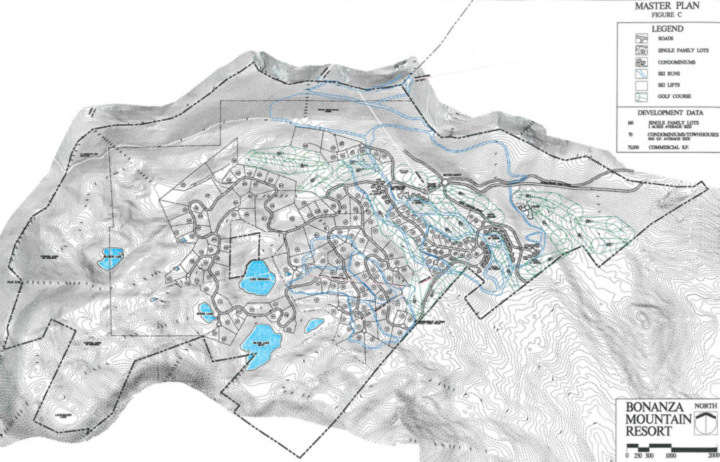
Here is a 2002 image of what a developer planned on putting on the Bonanza Flat parcel:
Utah Open Lands has a long history of purchasing vulnerable lands in Utah and is spearheading a coalition of nine local non profits to get their constituents to make up that $3M difference. In addition to Utah Open Lands, Wasatch Backcountry Alliance, Save Our Canyons, Mountain Trails Foundation, The Nature Conservancy, Summit Land Conservancy, Sierra Club, Friends of Alta and Winter Wildlands Alliance are all rallying their members for donations. Zions Bank recently to donating $100,000 and pledged a $300,000.00 matching grant.
According to Mountain Trails Foundations’ trail master Rick Fournier, Bonanza Flat represents a huge opportunity for new trails. Not only is the rolling terrain almost perfect for a mountain bike park, but it has the opportunity to put this park in as a connection from the Crest and Park City’s trails to the WOW trail, for an unprecedented connection from the Wasatch Front to the Back on killer singletrack. It’s important to note that the existing Crest parking area at Guardsman Pass is within the Bonanza Flat parcel, and though Park City’s developers have generally been good about maintaining trailheads, it’s likely that they will be more focused on creating an “exquisite mountain experience” for wealthy homeowners than they are on improving traffic-challenged trailheads. If the Bonanza Flat area is preserved, Fournier estimates that there will be multiple nearby trailheads with connections to the Crest to disperse the parking load. And if you think that global warming may not necessarily be a hoax perpetrated by the Chinese, note that Park City’s wintertime fat biking and Nordic ski opportunities may need higher elevations to create viable snowy trails, which Mountain Trails is looking forward to generating as well.
The Wasatch has long had a history of private entities generating development plans and fighting against the public that seeks Mountainous open spaces for solace and recreation, etc. With few opportunities for large parcels to be purchased and preserved for public use, this is the best time in recent memory for mountain bikers and others to step up and purchase valuable land that will result in great new trails. The deadline for donations is March 15th, so take the opportunity now to go to Utah Open Lands website (www.savebonanzaflats.org) and create a donation to help preserve land and create new trails!
Funds are needed to preserve Bonanza Flat between Big Cottonwood Canyon and Park City. Photo by Charlie SturgisFunds are needed to preserve Bonanza Flat between Big Cottonwood Canyon and Park City. Photo by Charlie SturgisFunds are needed to preserve Bonanza Flat between Big Cottonwood Canyon and Park City. Photo by Charlie SturgisFunds are needed to preserve Bonanza Flat between Big Cottonwood Canyon and Park City. Photo by Charlie SturgisFunds are needed to preserve Bonanza Flat between Big Cottonwood Canyon and Park City. Photo by Charlie SturgisFunds are needed to preserve Bonanza Flat between Big Cottonwood Canyon and Park City. Photo by Charlie Sturgis
The North American Handmade Bicycle Show is coming to Salt Lake City from March 10-12, 2017.
NAHBS will still be held this year in Utah from March 10-12, 2017
February 21, 2017 – The North American Handmade Bicycle Show, which is coming to Salt Lake City on March 10-12, 2017, announced today in a statement that they would not be returning to Utah after this year’s show unless Utah officials change their policy on public lands. Outdoor Retailer and Interbike also recently removed Utah from consideration for future shows.
Show director Don Walker said, “When we were negotiating the show, Governor Herbert hadn’t begun his assault on public lands. His agenda for the state of Utah has the ability to curtail the recreation of our exhibitors and their customers. If not for signed contracts, booked airfares, hotels and the builders depending on the show taking place, we too would be relocating” said Don Walker, founder of NAHBS. “Our goal is to spotlight frame builders and the cycling industry partners that support them. NAHBS moves the location each year to accommodate the needs of builders across the country. Regardless of our schedule we would not chose to bring the show back to Utah unless serious changes are made by government officials.”
NAHBS also stated, “Unfortunately moving the show this year is not an option. March 10th-12th NAHBS will take place in Salt Lake City and NAHBS look forward to spending time with all the small builders and craftsmen that the show was founded for. We hope that Utah will come support these businesses in light of recent events.”
Utah politicians recently approved resolutions asking the President to rescind the Bear’s Ears National Monument and to shrink the Grand Staircase Escalante National Monument. Outdoor Retailer followed this action by removing Utah from consideration for future shows. Interbike, owned by Emerald Expositions which also owns Outdoor Retailer, followed suit. The estimated impact from these two shows (not including NAHBS) is $66.5 million in direct spending.
Outdoor Retailer to Leave – Public Lands, Bicycling, and Utah’s Economy Suffer As Utah Politicians and National Outdoor Leaders Drop the Ball
Utah Governor Gary Herbert addresses the Outdoor Industry in 2013 upon creating the Outdoor Industry Recreation Vision for Utah. All that seems to be out the window with the 2017 decision by Outdoor Retailer to leave Utah. Photo by Dave Iltis
Editorial, February 19, 2017: The Outdoor Retailer Trade Show and Interbike (both owned by Emerald Expositions) announced on February 16, 2017 that due to lack of support for public lands by the Governor and leaders of the State of Utah that the Outdoor Retailer Show will be leaving Utah; and Interbike, the bicycle industry’s yearly trade show, will no longer consider Utah as an option. Outdoor Industry leaders were particularly angry about the push to rescind the brand new Bear’s Ears National Monument and to sell off public lands. Those issues were a line in the sand that could not be crossed.
Cycling Utah calls for Utah’s politicians and the outdoor industry’s leaders to get back to the table as soon as possible, in person, in Utah, and as soon as possible to negotiate a future that is good for Utah’s public lands, cycling, and the economy and people of Utah. Governor Herbert, Representatives and Senators Stewart, Chaffetz, Love, Bishop, Hatch and Lee, the Utah Legislature, and Mayors Biskupski and McAdams and leaders from the Outdoor Industry Association, Outdoor Retailer, Peter Metcalf, Yvon Chouinard, Patagonia, REI, and Emerald Expositions – need to sit down, look to the future, and resume negotiations.
The Outdoor Industry Association had asked for four items from the Governor: 1. To “revoke any support for the sale or transfer of America’s public lands to the states.” 2. To “cease on any effort to nullify the Antiquities Act, an authority that grants Congress the ability to designate public lands.” 3. To “(halt) any support to rescind the designation of the Bears Ears area as a National Monument.” 4. “That the governor embrace and actively support the outdoor recreation economy’s role in the state by supporting the public lands that provide the backbone of the industry’s sales.”
The Governor did not meet those requests, and Outdoor Retailer made the decision to leave Utah and took Utah off the table as a possible host for the Interbike tradeshow.
What Can You Do?
•Call or Email Governor Gary Herbert and other Utah Politicians. The comment line for Gov. Herbert is 801-538-1000 or https://www.utah.gov/governor/contact/
•Call or email the Outdoor Industry Association 303.444.3353 or [email protected]
•Ask them to resume negotiations.
This debacle is going to cost the state of Utah and Salt Lake City at least $66.5 million in direct spending from the twice yearly trade show plus the opportunity cost of not hosting Interbike ($45 million from Outdoor Retailer and $21.5 million from Interbike). And today, the Salt Lake Tribune reports that Outdoor Retailer was considering adding 2 more shows a year. They also report that the total lost impact to Utah will be $500 million! A strong voice for public lands in Utah disappears. The future of cycling in Utah suffers. The people suffer. No one wins.
The Interbike tradeshow and bicycling are collateral damage, caught up in the fallout over the Outdoor Retailer Show leaving Utah. Interbike is about as large as Outdoor Retailer, and had Emerald Expositions had narrowed their options for the 2018 show to include Salt Lake City (as well as Denver, Las Vegas, and Anaheim). No more. Interbike has been held in Las Vegas for about 20 years. Las Vegas has great accommodations as far as hotel rooms, but has much to be desired for actual bicycling. Because of Utah leaders’ stance on public lands, Interbike will no longer consider Utah and will now likely move to wherever Outdoor Retailer moves too since they can negotiatie a package deal for both events. The best money is on Denver, Colorado as the new location for Outdoor Retailer and Interbike.
Salt Lake City is the perfect location for Interbike. It is the crossroads of the West, with world class mountain biking and road biking nearby. Deer Valley or Park City would be a perfect location for the Outdoor Demo. Salt Lake City has a strong bike culture, and a growing bicycle industry with many bike companies in Salt Lake City, Park City, and nearby Ogden. It has a very strong bicycle retail sector. And, as far as accommodations, the convention center, hotels, and downtown restaurants are well equipped to handle a large show like Interbike.
Utah has been poised to become the bike industry’s leading state. Had Interbike relocated to Utah, it’s probable that a number of new bike companies would have moved their headquarters here. This may still happen with the great work that Ogden, the Governor’s Office of Economic Development, and Park City are doing, But the loss of the Outdoor Retailer show, the lost opportunity of Interbike and the associated negative publicity puts bike industry growth in Utah at risk. It means fewer new voices for cycling, fewer new cyclists, and fewer cycling jobs. The departure of the shows is more than just a departure of dollars – it’s a departure of cycling culture – and an incredibly bad choice for our future.
Many of the companies that attend Outdoor Retailer have looked to Utah as an ideal place to locate their business and retail operations: Black Diamond, Petzl, REI, Patagonia, and Gregory Packs are just a few of the companies who have decided to make Utah their home. Utah’s politicians want to see more ‘local’ control over the land, and more options for extractive mineral industries. Tourism and outdoor recreation bring in big dollars for Utah – $12 billion in consumer spending, 122,400 jobs, $856 million in state tax revenue, and $3.6 billion in wages and salaries according to the Outdoor Industry Association. Cycling Utah estimates bicycling in Utah to contribute in the neighborhood of $500 million in consumer and industry spending along with 2000 to 3000 jobs. Then there are the harder to measure benefits like millions in health savings, better air, and a happier populace. Will Utah lose all of this? No, but the continued growth will be slowed or even reversed. The State of Utah needs to value the economic engine that is the outdoor industry.
The unwillingness of Utah’s politicians to work through this with the outdoor industry is appalling.
The Outdoor Industry Association, Outdoor Retailer, Peter Metcalf, Yvon Chouinard, Patagonia, REI, and Emerald Expositions are responsible for this mess too. They drew a line in the sand with positions and editorials (from Metcalf and Chouinard) on the lack of support by Utah politicians on the Bear’s Ears and sale of public lands. After many years of negotiation and progress, they are leaving, and the game is over.
Utah’s politicians wouldn’t budge. Outdoor Retailer and Interbike will likely move to Colorado, a state with great public lands that has a supportive governor and a supportive outlook. The threat to leave was an awesome political statement, but it’s a once and done action. There’s no going back.
Does Colorado really need the help to preserve public lands? Probably. Voices for preservation are needed everywhere. But Utah arguably needs the voice and leverage of the outdoor industry more than any other state. Is the outdoor industry going to speak out in Utah for the next 20 years? Or are they going to leave with just an editorial or two this year, and silence going in to the future? What are your companies going to do to continue the fight for public lands in Utah? And for bicycling in Utah?
Mayors Biskupski and McAdams of Salt Lake City and Salt Lake County were missing in action too. The Outdoor Retailer show is incredibly important to our local economy. Interbike would have been too. Yet, there was no outcry by the Mayors to keep the show here. No public plea to the Governor or the Legislature. No outcry that the loss of Outdoor Retailer will impact Salt Lake City and Salt Lake County much more than the rest of the state. Our restaurants, hotels, and convention center will suffer. The people who work for those businesses will suffer too. And, we’ll lose future jobs from businesses that won’t locate here because they won’t come to Salt Lake City for the tradeshow and they won’t be exposed to the great public lands, cycling, and outdoor opportunities that Utah has to offer.
Thanks to the short sighted thinking of both the Outdoor Retailer folks, the Governor and other lead politicians in the state of Utah, public lands and the people and businesses who make their living from them will suffer. Utah bicycling will lose out on great things in the future. The economy of Utah will suffer. The people of Utah will suffer. And, the outdoor industry as a whole will be set back. Most importantly, the land and environment will suffer in the long run.
Now please get back to the table and work things out.
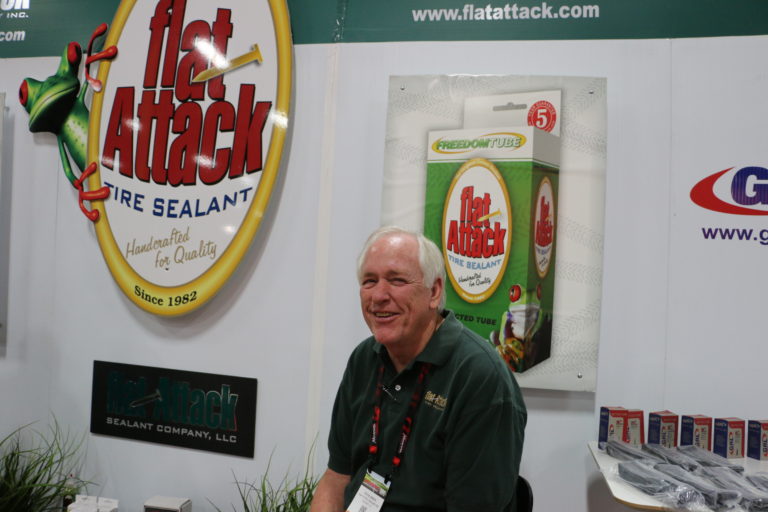
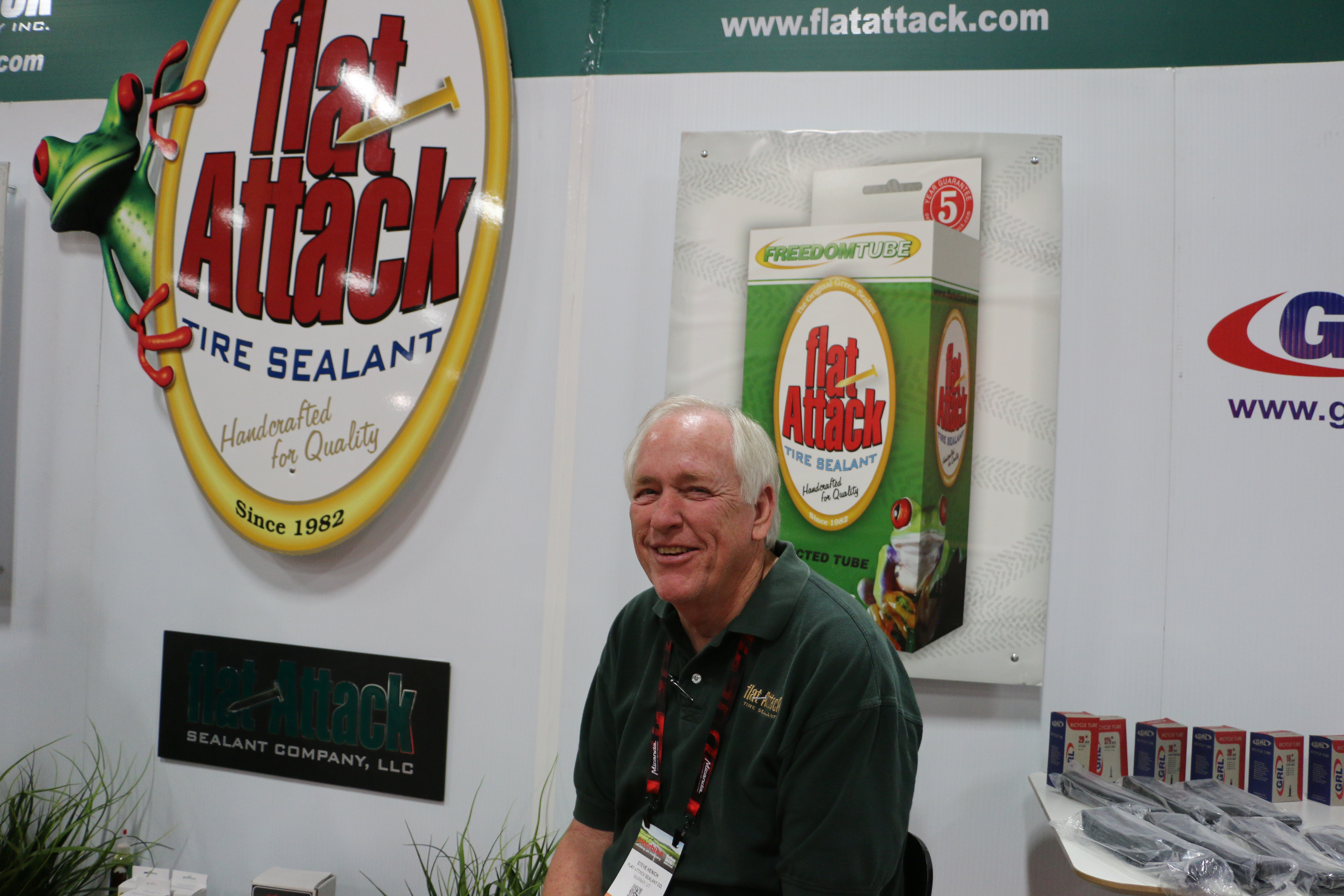
Utah company Flat Attack is one of many exhibitors at Interbike, which today announced that they won’t consider Salt Lake City as an option for future shows due to the State of Utah’s stance on public lands. Photo by Dave Iltis
February 16, 2017 – Interbike today announced that they are removing Salt Lake City from consideration for the relocation of the industry’s trade show. The move comes in response to Governor Herbert’s stance on public lands and the State’s request to revoke the Bear’s Ears National Monument and reduce the size of the Grand Staircase National Monument. The tie between the two is that the show’s owners, Emerald Expositions, also own Outdoor Retailer, the twice annual outdoor industry trade show that has been in Salt Lake City for many years.
Interbike has been looking for a new location starting in 2018, and Utah had been one of the top 4 choices; the other 3 are Las Vegas (where the show currently takes place), Denver, Colorado, and Anaheim, California. A survey was sent to the bicycle industry and bicycle shops this winter. According to a statement made to Bicycle Retailer, Denver and Salt Lake City were the two leading candidates for hosting the trade show in 2018. Hus told Bicycle Retailer, “Denver is in the lead (among retailers). There is the perception that it will be a good place for the show. There is more to the picture that we have to consider when it comes to costs and the outdoor demo and other issues. Denver and Salt Lake City want our business in a big way,” he said.
In a February 16, 2017 press release, Interbike stated:
Today officials from Emerald Expositions (parent company to Interbike and Outdoor Retailer) met via teleconference with Utah Governor Herbert. In light of the outcome of the call today, and the ongoing debate over the issue of public land use, Interbike will not include the state of Utah in the RFP process for future show locations.
“We will continue with the RFP process in the other locations that we’ve been in contact with for Interbike,” said Pat Hus, Vice President of Interbike. “Other than removing Utah from the process, nothing has changed from our standpoint. Interbike is committed to finding the best location for the cycling community, and we hope to have a more definitive direction in approximately 60 days.”
Darrell Denny, EVP Emerald Expositions, further commented: “Emerald Expositions will also not extend the request for proposal to Utah for relocating the Outdoor Retailer tradeshow.”
Visit Salt Lake – the group that books trade shows at the Salt Palace in Salt Lake City, has been working on getting the show to Salt Lake City diligently. Cycling Utah asked Scott Beck about the show prior to today’s announcement about why Interbike should choose Salt Lake City. Beck stated, “Salt Lake is a great place for trade show organizers to do business. InterBike is owned by Emerald Expositions, the same owner of the Outdoor Retailer Markets that stage in Salt Lake each summer and winter. The organizers know Salt Lake, they love the Salt Palace Convention Center and the exhibitors love our right to work state and all that comes with our incredibly accessible airport, and the way our community welcomes conventions (think big fish little pond kind of stuff), combine all of the business reasons with an incredibly bicycle friendly city, Salt Lake becomes a very viable destination for the InterBike trade show.” Beck also said that the show would have contributed at least $18 million in direct spending to Utah’s economy.
Interbike had 22,802 attendees in 2015 and over 1400 brands at the show. With an approximate expenditure of $942 per person by attendees to Utah trade shows, this represents about $21.5 million in direct spending that Utah will potentially lose from just the Interbike show alone. The total between the three shows is approximately $66 million.
Outdoor Retailer has been vocal about the recent stance of Utah’s governmental leadership on public lands. The Governor and Legislature have put forth a resolution to the federal government asking that the new Bear’s Ears National Monument be dissolved. Outdoor Retailer responded today after a teleconference with the Governor with the following statement:
Outdoor Retailer Responds to Meeting with Utah Governor Herbert
Today officials from Outdoor Retailer, Outdoor Industry Association, Patagonia, The North Face and REI met via teleconference with Utah Governor Herbert. In light of the outcome of the call today, Outdoor Retailer will not include the state of Utah in the RFP process for future show locations.
“We are doing the work necessary to procure an alternative location for Outdoor Retailer,” said Marisa Nicholson, show director for Outdoor Retailer. “Though we may wish it different, this is far from a snap of the fingers thing to make happen. Convention centers and hotels are not sitting idle. In every instance at every potential venue, there are hurdles that have to be cleared and that simply cannot be done overnight. We expect that our current proposal process, which we initiated before any of the company withdrawal announcements last week, will take between 60 and 90 days. Salt Lake City has been hospitable to Outdoor Retailer and our industry for the past 20 years, but we are in lockstep with the outdoor community and are working on finding
our new home.”
Darrell Denny, EVP Emerald Expositions, further commented: “Emerald Expositions will also not extend the request for proposal to Utah for relocating the Interbike tradeshow.”
Outdoor Retailer is the only gathering where the entire industry comes together to conduct commerce, share best practices and exchange ideas. There is no other event where the most respected iconic brands and retailers – large, medium and small in size – show up “en force.” Our industry has a unique, maybe even singular, opportunity to coalesce, organize, speak and lay plans to make a difference around public land awareness in such a way that it is not only heard but that it can make a positive difference and we urge you to be part of this movement at Summer Market.
The departure of Outdoor Retailer, along with the removal of Salt Lake as an option for Interbike, will cost Utah at least $66.5 million in direct spending.
According to Pat Hus, show director, the 2017 show will be held in Las Vegas at the Mandalay Bay Convention Center from September 20-23. An announcement on the 2018 show is expected in the next 60 days.
The Great Salt Lake Bike Route is in jeopardy due to the seemingly inevitable move of the prison to the area. Photo by Dave Iltis
February 13, 2017 – The Salt Lake City Bicycle Advisory Committee will hold it’s monthly meeting on February 13, 2017. As part of the agenda, a spokesperson from the new Utah State Prison will be on hand to give a presentation on the I-80 Frontage Road. The road is a crucial recreational route in Salt Lake City, and could be drastically affected by the construction of the new prison, and by the development of the Northwest Quadrant industrial park by Salt Lake City.
Salt Lake City Bicycle Advisory Committee Meeting Agenda for February 13, 2017:
SALT LAKE CITY BICYCLE ADVISORY COMMITTEE
A standing committee of the TRANSPORTATION ADVISORY BOARD
Salt Lake City Transportation Division Office ‐ 349 South 200 East, Suite 150 – P.O. Box 145502
Salt Lake City, Utah 84114-5502
The Committee’s mission is to promote, enhance, preserve and, where necessary, restore physical, social,
political and economic environments in which bicycling is recognized
as an essential element of a clean, healthy, and vital community.
AGENDA
Monday, February 13, 2017
5:00 – 6:30 P.M.
**A draft of the SLC / SLCo bike map will be available for public mark-up
1/2 hr before and 1/2 hr after the meeting. **
Welcome and Introduction of Members and Guests 5:00
Public Comment 5:05
Approval of the Minutes of the January 9, 2017 Meeting 5:10
Outside Connection: UDOT Region 2 – BFIT, Upcoming projects 5:12
Tyler Laing, Region Traffic Engineer
UDOT Corridor Planning & bicycling – Foothill Drive, State Street 5:20
Cris Jones, SLC Transportation
Prison Development & Bicycling 5:40
Merilee Richins, Utah Dep’t of Administrative Services
Education / Enforcement: Bicycle Crash Data & Crash Types 6:00
Dan Bergenthal, SLC Transportation
Connections & Announcements – updates on projects & committees 6:20
Todd – TAB
• Lisa Pascadlo – SLCPD
• Jason S. – McClelland Trail
900 West – Todd, Denise & Shaun
Others?
Quick Follow-ups 6:25
• BAC membership • 600 East
• Transportation Director • Shared lane markings University St.
Cyclists are encouraged to participate and comment on what they’d like to see in regards to cycling on State Street. Come by the workshop and contribute.
Press Release – February 9, 2017
Join Salt Lake City and South Salt Lake communities to discuss a vision for the State Street corridor
Salt Lake City and South Salt Lake residents, employees, students, business owners and area stakeholders are invited to a public workshop and discussion on the future of the State Street corridor.
This hands-on design workshop will kick-off the Life on State Implementation Plan project. Community members will work side-by-side with city planners, police officers, street designers and neighbors to share their ideas for improvements along the State Street. The process is designed to identify short- and long-term strategies to address safety and security, create a sense of place, improve connectivity, and drive economic prosperity on this vital urban thoroughfare.
The Life on State Implementation Plan will study roadway changes and development opportunities for the State Street corridor with the goal of making the roadway a model for sustainable street design, urban design and planning for the region and Utah. It will build on the 2010 Life on State Vision that imagined State Street as Utah’s “great street” from the state Capitol to the city of Draper.
The boundaries of the Life on State Implementation Plan study area are from North Temple to 3300 South and from 300 West to 200 East.
The project is a collaboration of Salt Lake City, South Salt Lake, Salt Lake County, Utah Transit Authority (UTA) and Utah Department of Transportation (UDOT) and is funded through the Transportation and Land Use Connection, a joint partnership program administered by the Wasatch Front Regional Council.
WHAT: Life on State Implementation Plan Public Workshop
WHEN: Thursday, February 9th, from 6 p.m. to 8 p.m.
WHERE: Salt Lake Community College Multipurpose Room, 1575 S. State Street, Salt Lake City
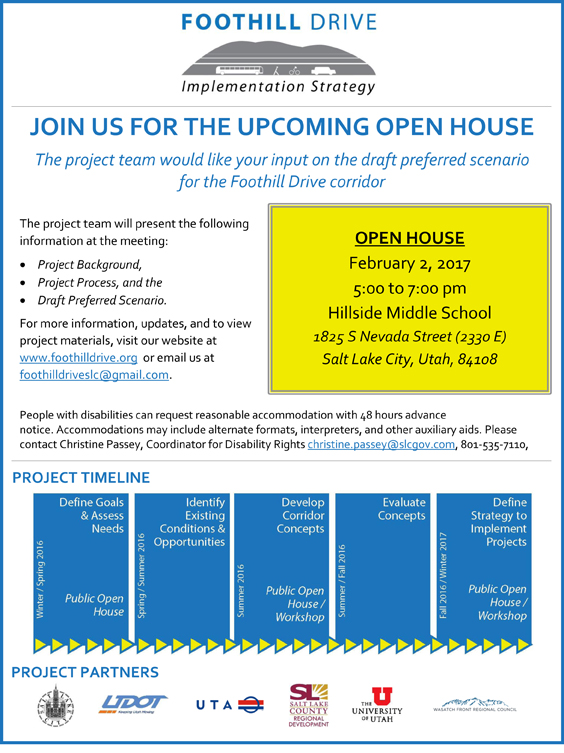
The second Foothill Drive planning open house will be on February 2, 2016 from 5-7 pm at Hillside Middle School 1825 S Nevada Street (2330 East) Salt Lake City, Utah, 84108
February 1, 2017 – Foothill Drive in Salt Lake City is undergoing a major corridor study to reconsider how the roadway will be used in the future. There is an open house scheduled for February 2, 2017 from 5-7 pm at Hillside Middle School, Hillside Middle School 1825 S Nevada Street (2330 East) Salt Lake City, Utah, 84108. The open house will allow cyclists and citizens to comment on the ‘preferred’ scenario.
This will be the second open house in the planning process. In the first open house, 6 scenarios were considered; two of which were bike friendly, and four of which ranged from very bike unfriendly and recommended the status quo to mediocre. The preferred scenario will be an amalgam of the 6 initial scenarios, and was formed by taking into consideration comments received in the previous open house and comment period.
Currently, the roadway is not at all bicycle friendly, and while there are options to travel north-south in the area, they are several blocks out of the way, and not particularly convenient for cyclists. As of 2007, daily traffic average about 45,000 vehicles. While Cycling Utah does not know of any data on counts of cyclists, in our observation, few cyclists use the roadway, some use the sidewalk. This is generally between the VA Hospital and 2100 E. and about 1000 S. The study area runs from Guardsman Way (about 1500 E) to the I-80/Foothill Interchange.
From the project website, the planning process is described as, “The Foothill Drive Implementation Strategy is a partnership among Salt Lake City, the Utah Department of Transportation, Utah Transit Authority, Salt Lake County, University of Utah, and Wasatch Front Regional Council to identify short term and long term strategies to address issues along the Foothill corridor such as traffic congestion, neighborhood connections, safety, and transportation options.”
Basic bicycle: Improvements to 2100 E/2300 E and to Wasatch Drive. And a bike path through Bonneville Golf Course. This option would include no bike improvements on Foothill Drive itself.
Enhanced bicycle: A buffered bike lane or shared use bike path on Foothill Drive.
Major Bicycle: Shared use path on Foothill Drive; raised bike lane on Foothill Drive; Bicycle conflict markings at intersections; Grade separated street crossings.
Following the first open house, survey responses showed that 40.1% of respondents preferred the Basic Bicycle treatment, 30.7% the Enhanced, and 29.2% the Major Bicycle Treatment.
Commentary:
Cyclists are encouraged to attend the open house to comment, or to email comments after the open house concludes. Information on the preferred scenario and how to comment should be on the http://www.foothilldrive.org/ website shortly.
Foothill Drive is currently an awful place to ride a bike. Yet, with destinations such as Foothill Plaza, many housing complexes, churches, the VA Hospital, and the University of Utah, it should be bicycle friendly.
Some simple solutions to achieve this would include narrower lane widths, lower traffic speeds (neither of which tend to reduce traffic throughput), and more transit. Will this study finally lead to a better Foothill? We are not holding our breath. A previous study in 2008 recommended better transit, and essentially the ‘Basic Bicycle’ treatment described above (which is inadequate, and was only partially implemented. When Foothill was repaved a few years ago, no changes occurred, despite the conclusion of the study. UDOT apparently had no interest in improving the corridor. Hopefully this has changed, and this study will not be an exercise in futility.
For cycling to be safer or even possible, cyclists need to comment on the plan. We don’t yet know what the preferred scenario is. When we do, we will try to post our comments here.
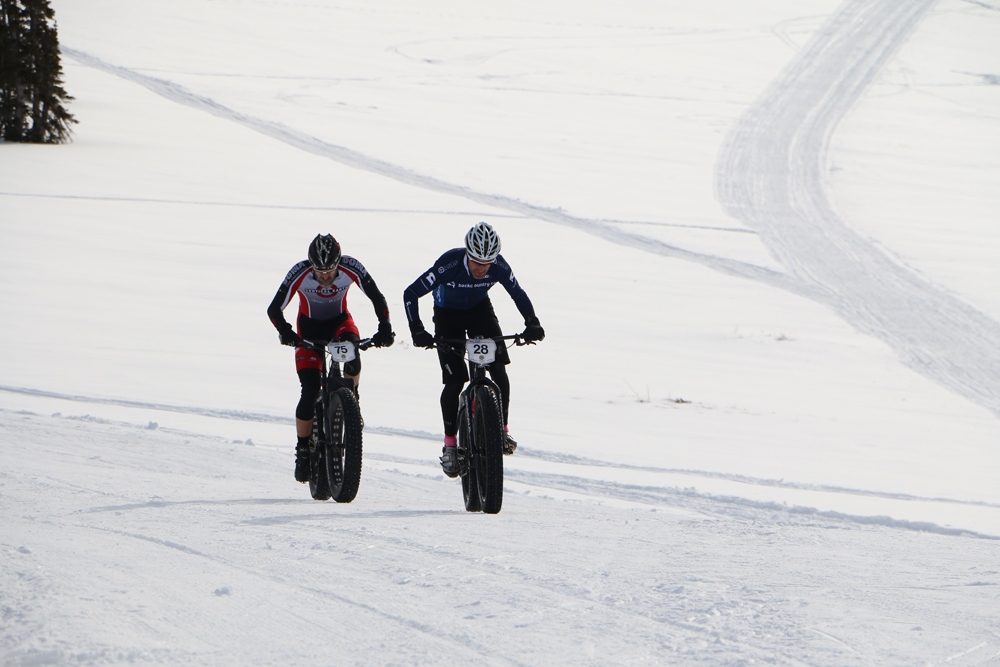
Jason Sager won the 2015 singlespeed national championship in Powder Mountain. In 2017, the Sweaty Yeti brings fat bike racing and a festival to Ogden and Wolf Mountain. Photo by Dave Iltis
Fat Bikers Return to Ogden, Utah for Sweaty Yeti Fat Bike Race
Ogden, Utah (January 30, 2016) – Press Release – Cyclists will return to Ogden to embrace the winter elements at the inaugural Sweaty Yeti Fat Bike Race presented by Borealis in Eden, Utah on February 4, 2017. This event will take amateurs 12.4 miles around Wolf Creek Resort Golf Course and pro/open riders will compete on over 18 miles of flowy, challenging, spectator friendly terrain.
“Athletes, sponsors and spectators had so much fun at the USA Fat Bike National Championships at Powder Mountain the last two years that we decided to produce a fat bike race of our own” stated Visit Ogden CEO, Sara Toliver. “The Sweaty Yeti Fat Bike Race was created out of the requests from past racers to have a fun, affordable and unsanctioned race in the Ogden area.”
Riders will enjoy 360 degree views of the Wasatch Mountain Range, and might even spot the infamous Wasatch Yeti during the race. No previous fat biking experience is needed to compete, just the familiarity of riding a bike and having a good time.
“Biking has quickly grown as an year-round sport and we are thrilled to introduce people to the sport and welcome back fat bike innovators” said Toliver. “We have put a lot of time in developing the ideal course for racers to have a good time while maintaining a competitive edge.”
All races and events are open to the public, with race divisions split into age groups and a select number of pro/open divisions for men and women. The day features pro and amateur races, beer stands, food trucks, live music, a sledding hill and family fun. During the events, spectators can experience the rush of riding a fat bike through free bike demos provided by Borealis and local bike shops. Spectators will also have an opportunity from Rockstar to win a Fat Bike of their own during the event.
In addition to the Sweaty Yeti Fat Bike Race, those looking to beat the winter doldrums can sign up for a 5k snow run taking place at 1:00 pm at Wolf Creek Resort. Racers are welcome to come with running shoes or snowshoes. Registration for the snow run is $25 for adults, $35 week of event and $10 for kids. Registration will include a commemorative t-shirt and swag from our sponsors.
Those who make their way to Ogden for the race can also look forward to the Wasatch Yeti Bash presented by America First Credit Union taking place on Friday, February 3 at the Ogden City Amphitheater. The Bash will take place from 4-8 p.m. and includes a Winter Arts Market by Nurture the Creative Mind, a Community Bike Ride by the GOAL Foundation, Fat Bike Demos provided by Borealis and local bike shops, Yeti Yoga by AndShesDopeToo, Yeti sightings, live entertainment, s’mores, and costumed fun for all ages.
Fat Bike 101
A Fat Bike, also called fatbike, fat-tire bike, or fattie, is an off-road bike with oversized tires, typically 97mm or larger, and rims 66mm or wider. Their voluminous tires are designed for low ground pressure to allow riding on soft unstable terrain such as snow, sand, bogs and mud. Fat biking is similar to mountain biking, and can be ridden in most places year-round.
Event and Registration Information
Amateurs (20K)
$35 pre-registration
$40 day before (Yeti Bash) registration
No day-of registration
Pro elite (30K)
$40 pre-registration
$45 day before (Yeti Bash) registration
No day-of registration
Admission to the event is FREE for spectators. Festival activities include a snow sports expo, free fat bike demos, kids zone, sledding hill, beer and food trucks and a DJ. There is plenty of free parking at the venue and a variety of attractions in the Ogden area for those extending their stay.
Schedule of Events
Friday, Feb. 3: Wasatch Yeti Bash: Winter Festival at the Ogden City Amphitheater. Ogden, Utah
4-8 pm | Wasatch Yeti Bash presented by America First Credit Union
4-8 pm | Winter Arts Market by Nurture the Creative Mind and Winter Sports Expo
4-8 pm |Sweaty Yeti Packet Pickup and Registration
5-5:30pm | Community Fat Bike Ride by the GOAL Foundation, FREE bike demos available
5:30-6pm | Yeti Yoga by AndShesDopeToo
6-9pm | First Friday Art Stroll
*Other activates at the Yeti Bash include Yeti Pub Crawl, DJ, live entertainment, s’mores, interactive activities and more.
Saturday, Feb. 4: Sweaty Yeti Fat Bike Race, Wolf Creek Resort, Eden, Utah
10-2pm | Sweaty Yeti Fat Bike Race Presented by Borealis
10-3pm | Sports Expo, sledding, live music, family activities
Hurricane got 5 new miles of purpose built mountain bike trail in the Quail Lake Reservoir Area, bringing the total to 19 miles thus far.
Rhythm & Blues was the first trail to be built. This advanced trail comes at you fast. So put your saddle down and be ready to ride BMX style!
Rock & Roll was the second trail built. This intermediate trail feels like a circus ride. The trail goes from banked turn to banked turn, up and down, winding around hills and down gullies.
Boy Scout Trails were the third trails built. These advanced trails will challenge your technical riding abilities from all angles. The trails are rocky and have lots of fun natural rock features on the trail, as well as challenging switchbacks.
Lakeside Trail is the newest built trail that we built with an AmeriCorp Team. We carved through some of the most brutal rocky terrain and made numerous rock bridges 6 feet or higher to cross washes. This intermediate ride is flowy with lots of twists and turns.
Twist & Shout
This trail connects north and south parking lots together. We want you to have fun on your way back to the car! This is a novice flowy trail.
How to get there: Take I-15 to exit 16 towards Hurrican. Take State Route nine to 5300W And take a left onto Hwy 318. You can take the first right and follow the Boy Scout signs to the south Parking area or go a little farther and park in the North Parking right off the highway on the left.
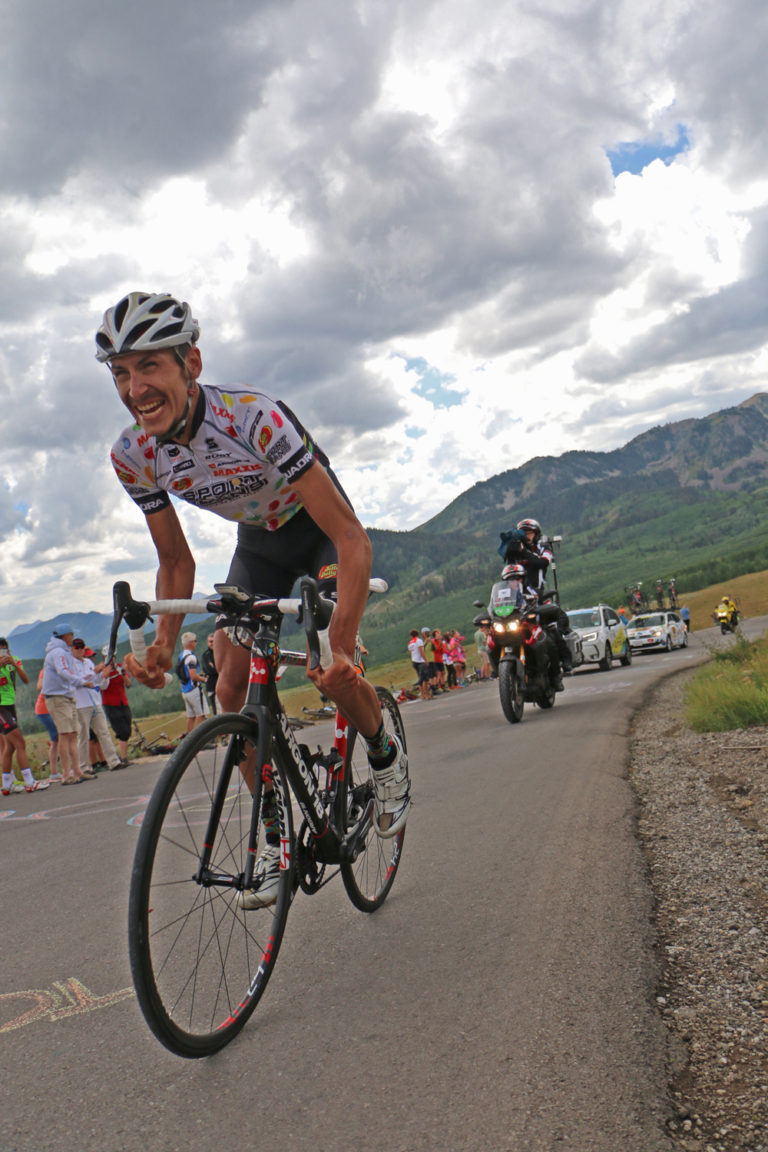
Lachlan Morton crushing the final climb to Empire Pass in stage 7 of the 2016 Tour of Utah. Morton would go on to win the stage and the overall win; reclaiming the lead from Andrew Talansky on the last day of the race. Photo by Dave Iltis
January 11, 2017 – The Larry H. Miller Tour of Utah today announced the host cities for the 2017 edition. The internationally renowned stage race will be held from July 31 – August 6, 2017 in various locations across the state of Utah.
The host cities for 2017 are:
Stage 1 July 31: Logan to Logan.
Stage 2 August 1: Brigham City to Snowbasin Resort.
Stage 3 August 2: Big Cottonwood Canyon individual time trial.
Stage 4 August 3: South Jordan City to South Jordan City.
Stage 5 August 4: Davis County Layton City to Bountiful.
Stage 6 August 5: Heber Valley to Snowbird Resort. Start at Soldier Hollow.
July 31-August 6 — Larry H. Miller Tour of Utah, Various, UT, The Tour of Utah is a UCI 2.HC sanctioned stage race for the top men’s teams in the world. As America’s Toughest Stage Race, the race covers more than 500 miles across Utah, and 52,000 feet of climbing. It is broadcast worldwide on Tour Tracker and is free for spectators., Larry H. Miller Tour of Utah , 801-325-7000, [email protected], tourofutah.com
Beatty, Nevada is located about 100 miles Northwest of Las Vegas on NV State Route 95. The area surrounding the small town is known as the Oasis Valley for its lush natural springs, and is nestled between Death Valley National Park and the Nevada Test Site. The rough and rugged history of the area is full of stories of hardship and determination. It is legendary for two major industries; gold mining and prostitution. Both are now gone.
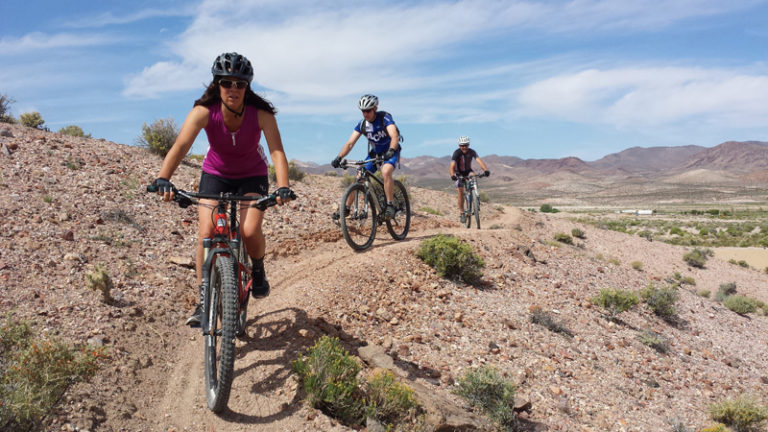
Cimarron Chacon, Thomas Cheney, and Clayton Cheney test out the new Spicer Ranch Trail. Photos by Bryce Pratt, crawlingspider.com
With the end of an era, a local group is determined once again to build Beatty into new legend, as a mountain bike mecca. Not since the making of Moab, has there been a place and a time so right to forge a recreation destination out of the ashes of a busted mining town. Beatty has all the perfect ingredients; pleasant year around temperatures, gorgeous scenery, abundant wildlife, and wide open spaces perfect for building trails.
The non-profit, Trails-OV (OV stands for Oasis Valley), who is spearheading the efforts, has produced a number of wicked awesome trails in just a short time. They broke ground on the first trails Valentine’s Day. The first 7 miles of trail are purpose built for mountain bikes on a private ranch just north of the town center. The Spicer Ranch is a true desert oasis. When you ride any of the 4 trails you will travel pass lush meadows with horses running and fresh ponds with abundant water fowl, you will climb to the top of peaks that overlook the valley and provide far off vista, and you will experience the true sights and sounds of a working ranch.
The trails opened to the public on May 2nd with a boot stomping, gunslinging, romping great time of a grand opening festival. Black Ops helicopters, prostitutes, beer and tacos were among the many things found at the Beatty Beer and Taco Fest Trails Grand Opening Celebration.
The 1st Annual Beatty Beer and Taco Fest was a huge success. The event was free to all who wanted to come and experience a new riding venue. The ranch opened a huge public parking area just in time for the event and camping was free — complete with showers. The festival started with a big cowboy breakfast of pancakes, eggs, and bacon. Mountain bikers from Nevada, Utah and California all gathered in excitement and anticipation for the ribbon cutting and a taste of the fresh dirt.