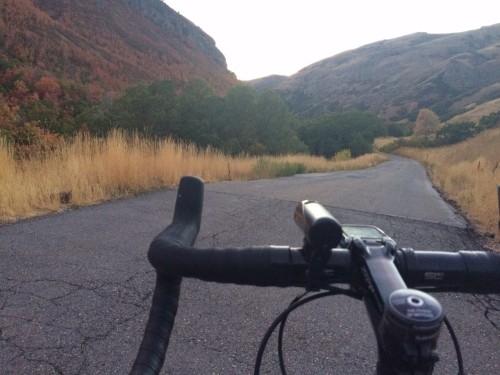
City Creek is a beautiful climb in Salt Lake City that is (mostly) closed to cars. Photo by Dave Iltis
October 21, 2016 – The Salt Lake City Department of Public Utilities announced that City Creek Canyon will be closed to cyclist for the next 9 days due to hunting in the canyon. This in annual closure. The following is statement posted on their Facebook page.
The City Creek Canyon road will be closed to bicycles October 22 through October 30 (2016) during the rifle deer hunt as automobiles will be allowed in the canyon on all days. Pedestrians are still allowed, and only automobiles driven by individuals with hunting permits are allowed. Please note that rifle hunting is only allowed above Site #23, which is about a mile above the water treatment plant.
The canyon is generally open to cyclists year round with some restrictions. From the end of October to the day before the last Monday in May, the canyon is open everyday to cyclists, and closed to cars (except service vehicles). During the summer from the end of May to end of September, the canyon is only open to cycling on odd days, except holidays when it is always closed to cyclists.
Pick up a copy at your favorite bike shop in Utah, Idaho, Wyoming, Nevada, Montana, W. Colorado, N. Arizona or other convenient locations.
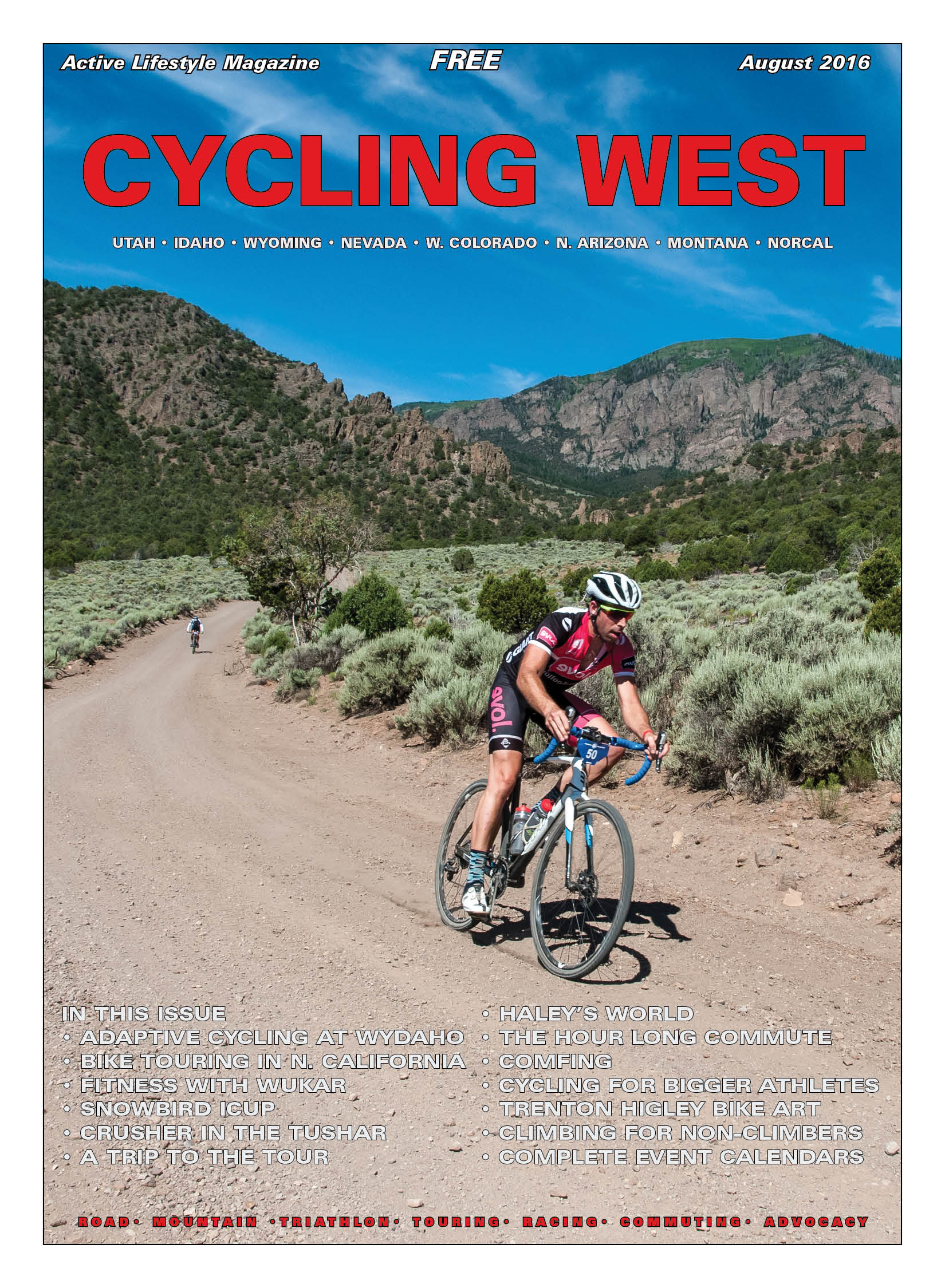
Cover Photo: Josh Whitney of the EVOL Racing Team p/b Breeze Bars rounds a corner in the Crusher in the Tushar race in Beaver, Utah on July 9, 2016. Drew Free is in the background.
Photo by Chris See, christopher-see.photoshelter.com
Inside the August Issue
Going Big For Real – Adaptive Cycling at the Teton Mountain Bike Festival –page – 3
Peter Drinkwater – Embracing the Hour Long Bike Commute –page – 4
The Tour: An Addict’s Wrap –page – 5
SLCBAC News for August 2016 page – 5
Road Biking in Northern California’s Scott Valley –page – 6
Nicole Cooke’s The Breakaway Recounts the Career of One of Britain’s Greatest Cyclists –page – 12
Heubach, Germany on My Way to Worlds –page – 13
$20 Million TIGER Grant Coming to the Wasatch Front for Bikes –page – 14
Mountain Bikes in Wilderness? New Bill Seeks to Allow This –page – 14
Mountain Bike Planning Moving Forward in NW Colorado –page – 14
Event Preview: Ride for the Kids Raises Funds for Make-A-Wish on August 20, 2016 –page – 17
Bike Utah Seeking Elementary and Middle Schools to Participate in Their Youth Bicycle Education and Safety Training Program –page – 17
The Pros and Cons of Recreational Cycling Events –page – 18
Huntsman 140 Raises Over $500,000 for Cancer Research –page – 19
Squire and Tittensor Win the Rage at Snowbird–page – 20
Strength Training For Endurance Athletes –page – 22
Climbing, For the Non-Climber –page – 23
Keep ‘Em Ready to Ride –page – 29
Squire and McCutcheon Crush the Crusher in the Tushar –page – 30
Big Dogs Can’t Run – Training and Riding Tips for Bigger Athletes –page – 32
Clydesdale –What’s in a Name? page – 32
Climbing in Switzerland – A Trip to the 2016 Tour de France –page – 34
Comfing –page – 36
“Sean Kelly” – The Bicycle Art of Trenton Higley –page – 38
Night riding, sure you’ve heard of it, you probably know some people who do it but are you experienced? If you’ve never watched the sun completely set while still being miles from home or lost your bearings on a familiar trail, it’s time to. Sure it’s a cliché but riding at night is like experiencing your favorite routes again for the first time.
With the advancements in battery and LED bulb technology, the cost of getting into a lighting system has dropped significantly. Thankfully, the lumens (light) to dollars ratio has also improved over these many years. Years ago if you wanted to see anything, you had to invest a minimum of $500 in lighting products that barely did the job. These days you can get a 600 lumen light for a measly $100 and get a whopping 2000+ lumens for merely $500. To put this in perspective, you need around 350 lumen just to ride at night, add more lumens as speed increases or when off-roading. With that being said, having 2000 or more lumens is what really makes a night ride, visibility will be at a premium and enjoyment goes hand-in-hand with that.
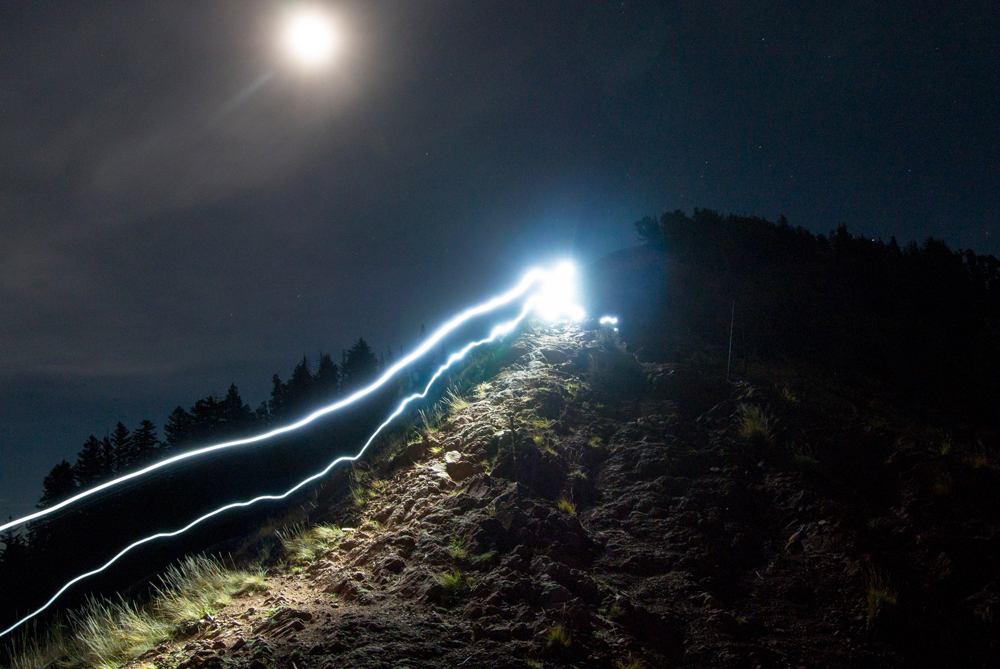
Eric Kramer riding the Spine on the Wasatch Crest Trail in the dark. Photo by Ali Goulet
Recommended light set-up would be to have two lights, one handlebar mounted and one mounted on the helmet. I will usually put my most powerful light on the bars, illuminating the trail or road just in front of my tire and extending forward from there. I would position my helmet light to slightly overlap with the bar light coverage while extending a little bit further.
The advantage of having two lights being, the bar light will generally be lighting the path in front of you while the helmet light will allow you to look through corners and focus in on any obstacles.
When picking a light system, you get what you pay for and what you get with a reputable brand are luminescent consistency, build quality, reliability, warrantee and shut-off warnings…nobody wants an unexpected total lights out scenario while riding. My favorite brand is the California-based Light and Motion.
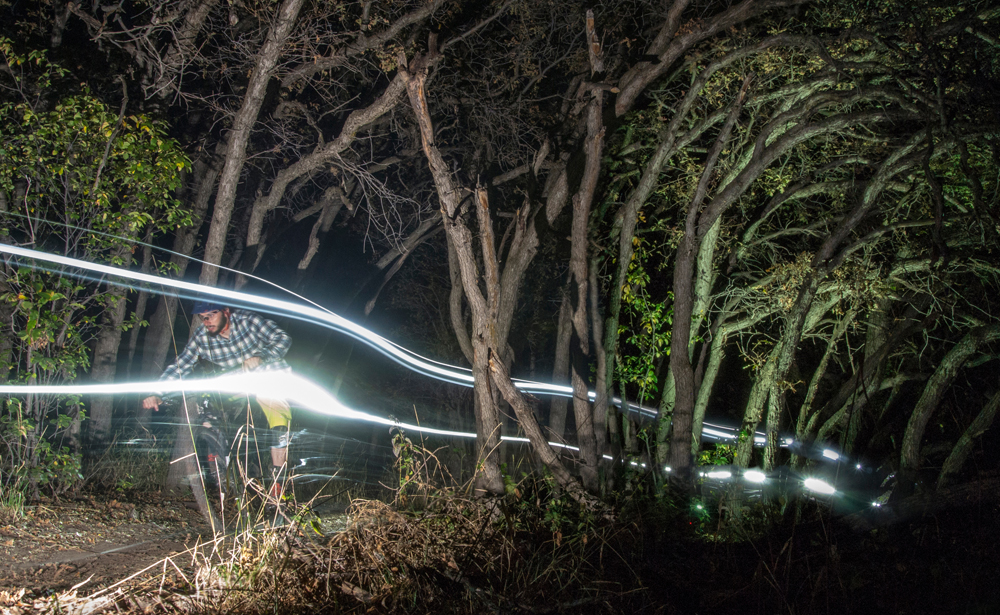
Will uses a dual beam light. Photo by Ali Goulet
A quality lighting system, when properly cared for will give provide years of use without issues. Allowing you all the benefits of riding in the dark. Beyond being downright fun, a lighting system will allow you to take advantage of the times when daylight is at a minimum. Also allowing you to beat the midsummer heat…if you’ve got a little night owl in you. More of an abominable Snowman? Winter is another great time for night riding, many local trails either receive enough foot traffic or are groomed perfect for Fat and Plus tire bikes. Not to mention, snow reflects light, giving you more visibility.
Nighttime is the right time for whatever your bi-wheeled activity is, road biking, fat biking, mountain biking or even regular old urban city biking…after dark even the most mundane daylight paths take on a whole new vibe… So get at light, pedal in the dark, you can thank me later.
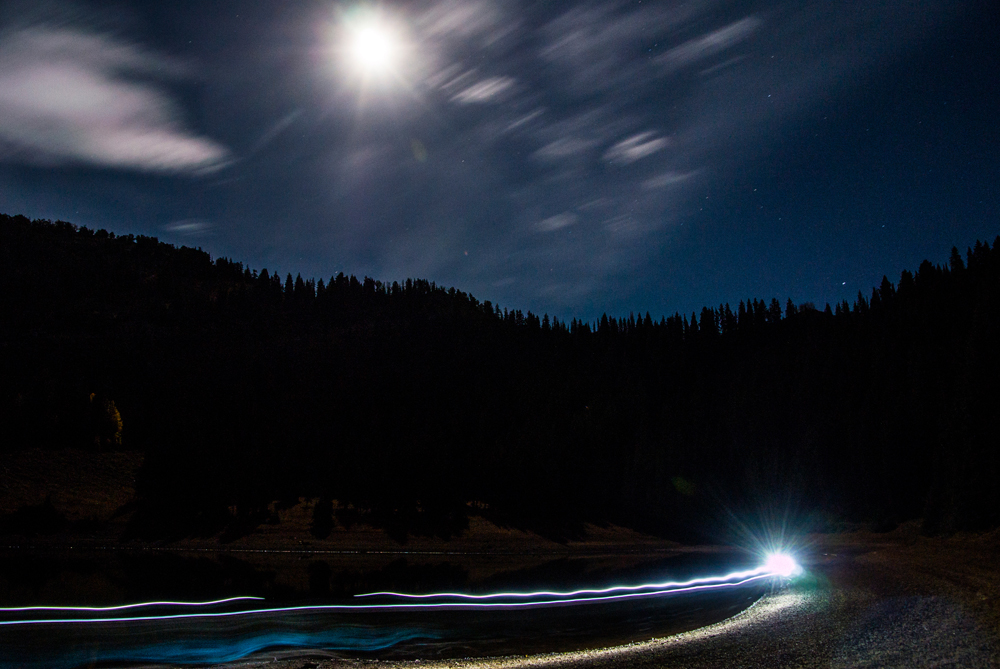
Desolation Lake on a night ride. Photo by Ali Goulet
Night riding tips –
Conservation is key: Set lights to their low settings while climbing, save full power for the technical and descending sections of your ride.
Use the buddy system: Sure you can ride alone but if you get abducted by aliens or mauled by a mountain lion, you’ll want someone to alert the authorities.
Be prepared: You’re not likely to come across others at night, So make sure to pack a jacket if necessary and at least some basic repair necessities.
Extra lighting: If you have a camping headlamp or any other packable lighting you should bring ’em, as your mom always said “better safe than sorry.”
Fall/Winter Layers: Layers are especially important at night, shed layers as activity increases, add layers while resting or descending…as needed to balance sweat vs. temp.
5 Trails for night riding: Most any trail will make for a fun night ride, I do suggest starting with a familiar trail. Here are 5 to consider:
Eric Nelson is a recent transplant to Utah from the Pacific Northwest. He’s a pastor, husband, father of two toddlers, and a cycling racer-turned-commuter.
C.U.: Tell us about your cycling background: When and how did you start cycling?
E.N.: I’ve loved bikes since I was a kid, but I really got into road cycling in my early twenties. I was a broke college student and the thought crossed my mind that I could save a little money if I commuted around town on a bike. I shared this desire with an older guy at my church and he told me he had an old bike in his garage that I could have for free. That was the beginning of my love for road cycling; little did I know how much money that free bike would cost me in the long run when I got hooked on cycling!
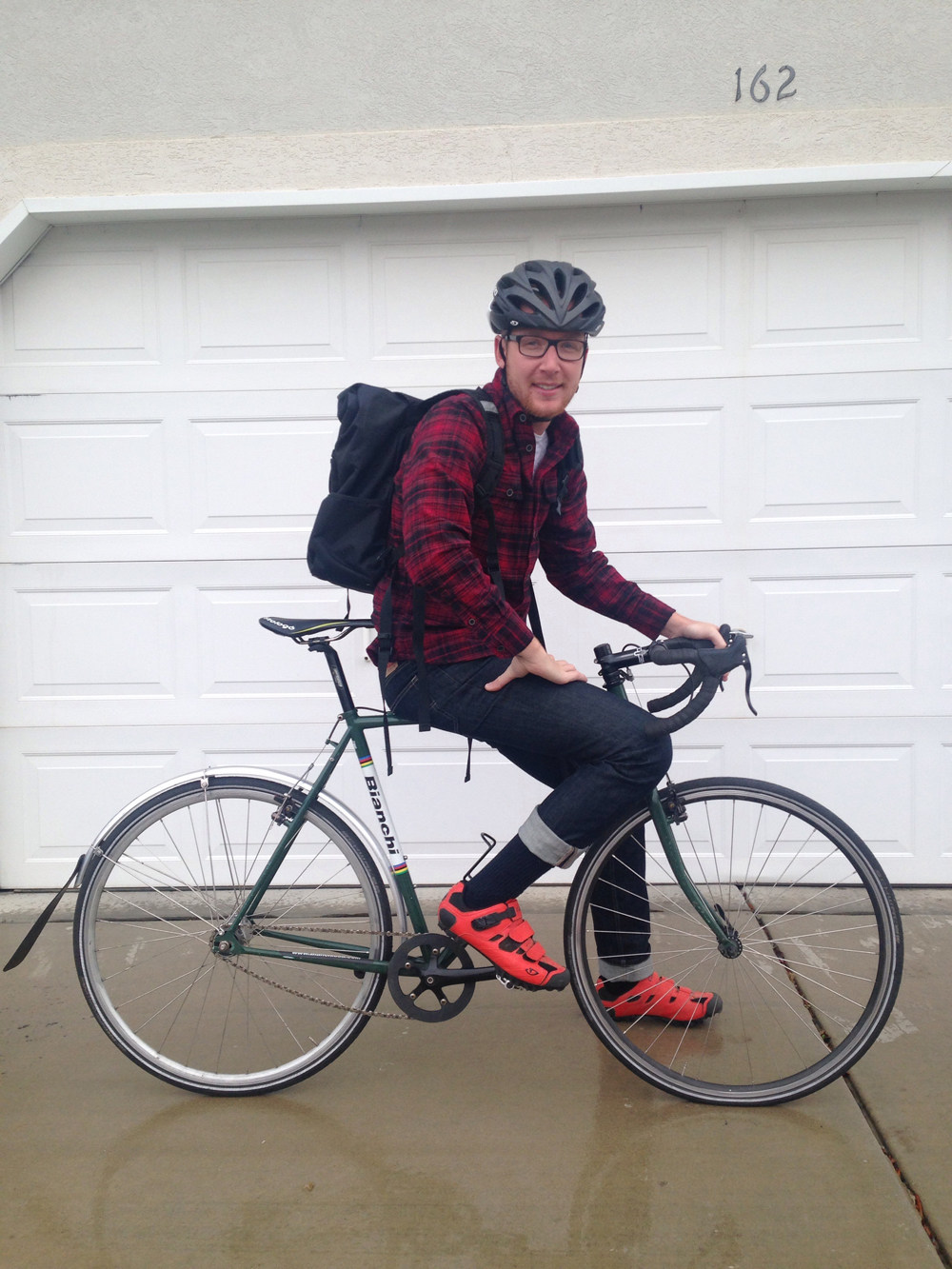
Eric Nelson getting ready to commute to work. Photo by Carissa Nelson
My interest in cycling grew rapidly. First I set a goal for myself to ride to the end of a certain road near my house. I did it and it was a good feeling. So the next day I set another goal for another road. I did it and it was a better feeling. Then I got some spandex – that’s a big step for anyone! Eventually I set more goals for more roads, more climbs, and more miles and the feeling after each of those accomplishments was very satisfying.
Eventually I got the shoes and, yes, I fell over once at a stop sign in front of lots of cars. I then began to fall in love with the gear. I bought a new bike, matching kit, and a new computer. Now I could track my progress and see results significant improvement in my stats and my body. I had more energy, felt healthier, and had met so many great friends along the way. I was hooked. I joined a club and then a team and then started to upgrade through racing categories with a few wins along the way.
I was still riding an entry-level bike at this time. I remember sharing with my uncle, who loves cycling, my new-found love for the sport. He told me, “Life is too short to ride a bad bike.” He helped me upgrade to a full carbon machine and paid for a professional fit. If you haven’t had a pro fit, I highly recommend it. A fit is one of the most effective things you can do to gain comfort and performance on your bike.
C.U.: How did your love for cycling evolve into a commitment to commuting by bike?
E.N.: I started commuting out of necessity. I wanted to ride more, but there often isn’t time to get a road ride in on a work day, so I commute. With two young kids, I can’t stick to a training schedule like I used to. Commuting is my way to get in a good ride, go hard, and maintain a little fitness. I use my commute as a workout. This gives me the training and feel of a weekend training ride without spending extra time away from my family.
C.U.: Tell us a little about your commute.
E.N.: We recently moved from the Pacific Northwest to Lehi, Utah and I have loved the change of scenery, the new roads, the sun, and the mountain climbs. Moving to a new area is hard on a cyclist; in the PNW I knew every road, every stretch of pavement, and every group ride. In my new city, I know very little.
The first time I commuted from Lehi to Draper, I took the frontage road and got passed by more than a dozen semi-trucks. When you’re new to an area, sometimes you have to learn by making mistakes!
On my second Utah commute I discovered another route to work. The good news is it has beautiful views, less traffic, and a wide shoulder. The bad news is it takes me up and over Suncrest mountain with a few miles of 5% uphill grade. I have a significant climb on both directions of my commute; this route adds about 15 minutes more than the frontage road but it’s worth it. In total, it takes me about 45 minutes to get from Lehi to Draper and I get a nice challenging hill climb in twice a day.
This month we are launching a new church campus called South Mountain Community Church in Lehi. That will change my commute significantly. Once the new church opens, rather than commuting up and over Suncrest I’ll take my Bianchi single-speed. This will force me to adapt my training schedule again, but that’s ok. The ability to adapt a training schedule is crucial for most people who have demanding lives outside of cycling. I’ll have to get really creative and really flexible to get midweek rides in. Sometimes I’ll head in early and ride at lunch. Sometimes I get off early and take the long way home. Flexibility and creativity are key to getting in those training miles.
C.U.: How do you deal with the practicalities of a long, tough commute, such as showering and changing clothes?
E.N.: I don’t commute every day; it just isn’t practical given the length of my commute. Some days I have meetings around the city and eating lunch with a guy in spandex is awkward. Just kidding, I leave a pair of shoes, pants, and a few shirts at work that I can wear on bike commute days. This allows me to pack lightly for the ride, with just the essentials in my messenger bag. I usually just change and wash up in the bathroom once I arrive.
One of the benefits of commuting to work is I arrive energized. I find I am more alert and more productive on days I commute.
C.U.: What essentials do you always carry with you?
E.N.: I like to travel light. My office is big enough that I can park my bike inside. I wouldn’t want to leave it out front anyways. If my bike is in good working order before I head out the door, then I shouldn’t expect a large mechanical problem on my commute. I carry a CO2 cartridge, a tire lever, and tube. I always have a backup GU in my saddle bag for the days I didn’t eat right during work and need some extra energy.
C.U.: You said you’re a roadie first and a commuter second. Can you tell us a little more about that?
E.N.: In my mind, a roadie loves to ride hard and fast. They like to suffer up climbs and bomb fast descents. They track their miles, watch their diet, follow pro racing, and maybe even shave their legs. For a roadie, cycling is a way of life. In my mind, commuters aren’t necessarily this committed to all things cycling. So for me, I’m not a commuter at heart. I am a roadie who needs a regular commute to find the time to ride and train. As a Dad with young kids, my commute is a chance to ride hard and fast. By incorporating my commute into my weekly training goals, I can maximize my fitness and my time. Since I commute for fitness, I don’t mind the big effort it takes to get up Suncrest – twice – every day that I ride to work.
C.U.: What is your best advice for a commuter who doesn’t consider themselves a roadie or a cyclist?
E.N.: If you consider yourself a commuter and not a cyclist then you might be missing out on the potential that cycling holds for you. Don’t worry, you can still be a commuter, but I dare you to try out cycling in a different way than just commuting. Rent a MTB, demo a light road bike, challenge yourself up a mountain, or jump into a group ride. Some of the fastest roadies I know were first commuters. For them, commuting was the gateway into new aspects of the joy of cycling.
C.U.: What is your advice for a road cyclist who doesn’t commute?
E.N.: Adding one extra ride a week to your schedule can be very beneficial for your training regimen. Your commute could be a rest day or even an interval day. If you use commuting to throw in one or two more days of riding mid-week, you’ll be free to use your weekend for some big fitness gains. Give bike commuting a shot and see if you start to drop your weekend buddies on that next climb.
C.U.: What bike do you commute on and how did you choose that bike?
E.N.: If my commute is more than a few miles then I commute on my carbon 2015 Cannondale Supersix with the new 11 speed Shimano 105 build. I love Shimano’s new stuff.
I also have a Bianchi San Jose single-speed for shorter commutes. I love the feel of a steel frame and the single-speed is so reliable. It also has full fender mounts and fits large tires. I have raced cyclocross on it before, too.
I go back to that quote from my uncle when I consider a good bike for commuting, “Life is too short to ride a bad bike.” Get a bike that’s fun and inspiring. We need all the help we can get to stay committed, so get something that invites you to ride it often. My Cannondale is the perfect blend of comfort, stiffness, and weight with a geometry that fits my body. When all those elements come together, you know your ride will be a good experience.
I love having options, too. The old rule of thumb for the number of bikes you should have makes sense to me: n + 1 where n stands for the number of bikes you currently have. I am always thinking about what I might get next. If I find myself feeling unmotivated to ride it is nice to be able to take out a mountain bike, ride a single-speed, or enjoy a steel frame. Each bike I have provides a different riding experience and so each bike provides a different kind of fun.
C.U.: The Northwest is known for great cycling opportunities. What has your cycling experience as a recent transplant to Utah been like?
E.N.: There are more people on bikes in Portland than Utah but the cycling culture is different. Portland is full of hipster coffee shops, cycling kits, messenger bags and really expensive handmade cruisers. Utah is full of people who ride their bikes up big mountains. Portland has a culture of cycling while Utah cycles. After all, Utah hosts an incredible pro stage race, I can’t say that about the Northwest.
The Northwest is full of rolling hills and green countryside while Utah has some of the best climbs I’ve ever ridden. Some days in Utah, I miss the mellow options Portland offers and other days, I can’t believe these mountain climbs are in my backyard. I also can’t believe how many people you might see on a weekend going up Emigration or American Fork Canyon. To put it simply: The Northwest leans towards quantity, Utah towards quality.
C.U.: What are you cycling or racing goals for next year?
E.N.: I hope to join a team for next year and try out the Utah racing scene. Utah also offers some pretty epic rides and races like LOTOJA, Crusher in the Tushar, and the Ultimate Challenge. I’d like to train for one these big events.
C.U.: Any, final thoughts for us?
E.N.: My favorite cycling quote is: “It never gets easier you just get stronger.” Think about that while you commute and push yourself to treat your next commute as a training ride.
Cycling has taught me a lot about life. There are low points in life and this quote has given me a healthy perspective into life’s struggles. When you deal with life’s difficult moments remind yourself, “It never gets easier you just get stronger.” Then head out for a ride.
Eric Nelson recently moved to Utah from the Northwest to Pastor South Mountain Community Church’s Lehi Campus. He and his wife Carrisa have been married for six years and have two kids, Nora (3) and Jack (1). He’d love to connect with you and go for a ride.
If you have a suggestion for a commuter profile, have a commuter question, or other comments, please send it to [email protected].
The first rule of cycle commuting is: Always be seen. Only slightly less well-known is: Never ride so far to work that you show up with butt sweat marks. Or, if you do, bring a change of pants.
For the purposes of this article, we will focus on Rule 1.
I’m a cycle commuter – you can learn more about my story in the Commuter Column of the March 2014 issue of Cycling Utah. Like most commuters, I’ve done plenty of riding in the dangerous twilight hours after work. I always ride with lights (see Rule 1) but last winter my husband decided that mere button-cell blinky lights would not suffice. I needed something brighter, bolder, and way more stylish.
Jamie Morningstar and her DIY Handlebar lights. Photo by Stephen Morningstar
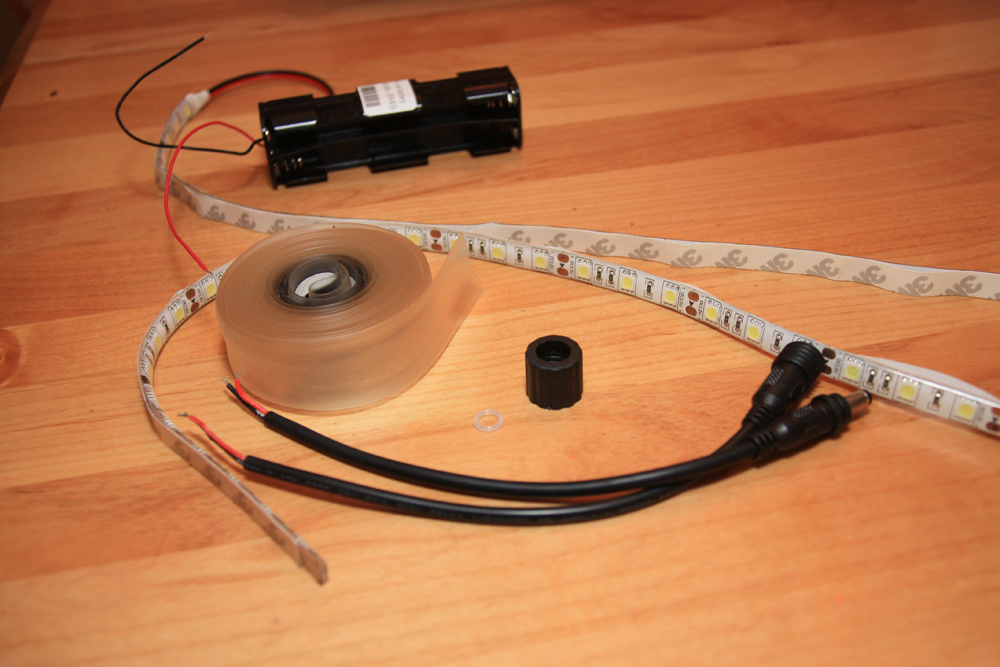
As a result, my Christmas stocking included an LED Bike Handlebar kit from our family’s favorite gizmo supplier, Adafruit (see http://www.adafruit.com/products/933). The kit included 1 meter of LED light strip, a battery pack, and some connectors (Photo 1). My household included one handy husband, one commuter bike, a free afternoon, and an adventuresome spirit. It was go time.
The whole project went off with minimal swearing and ended with a well-lit bike, making it a wildly successful endeavor by the standards of our home. Here’s a quick rundown of our handlebar illumination experience.
Photo 1 – Kit contents plus handlebar tape. Photo by Stephen Morningstar
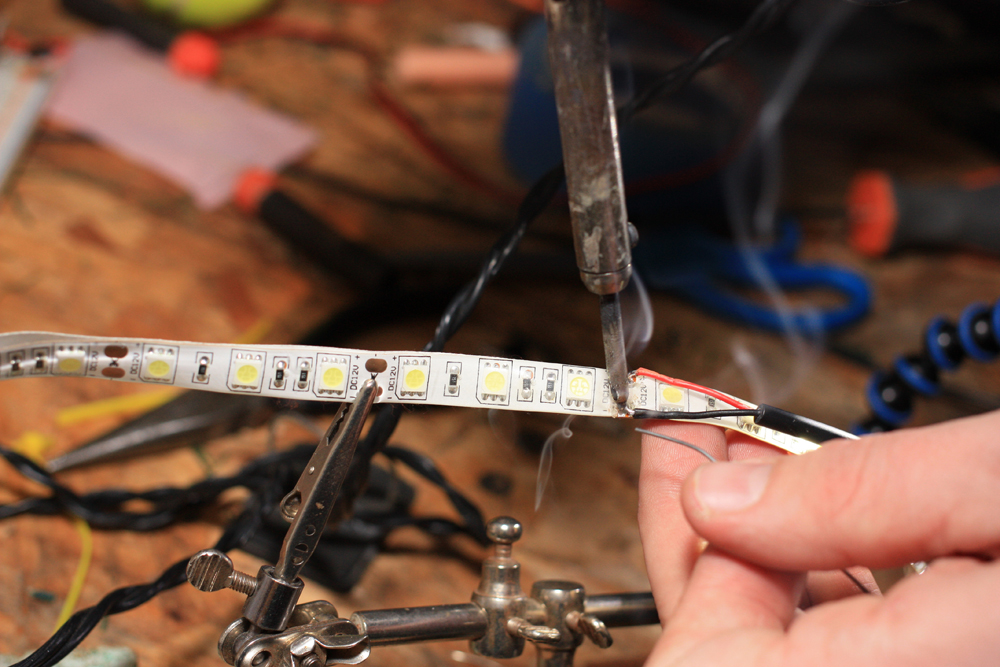
The first phase of the project was all about connecting the batteries to the LED light strip included in the kit. First we had to cut through the clear, weatherproof plastic that covers the LED tape to expose the wire connecting one LED to the next. Next, we had to solder the wires connecting the LEDs in the tape to the battery lead wire (Photo 2). Then we tested the connection by carefully attaching the newly-soldered battery leads to the battery pack. After verifying that all was working as designed we used the kit-supplied shrink tubing to make the connection weatherproof.
Now that the LED tape was prepped it was time to attach it to the handlebars. After removing the old grip tape from my bike, we experimented a bit with light placement. I didn’t want the lights to shine in my eyes and I didn’t want the LED tape to interfere with my grip or feel annoying when my hands were on the brake hoods or drops. After playing around we decided to run the lights straight across the bar, up and around the brake hoods, and then down the front of the drops. This arrangement made for maximum visibility from oncoming traffic without blinding me.
Photo 2 – Connecting the LED tape to the battery wires.Photo by Stephen Morningstar
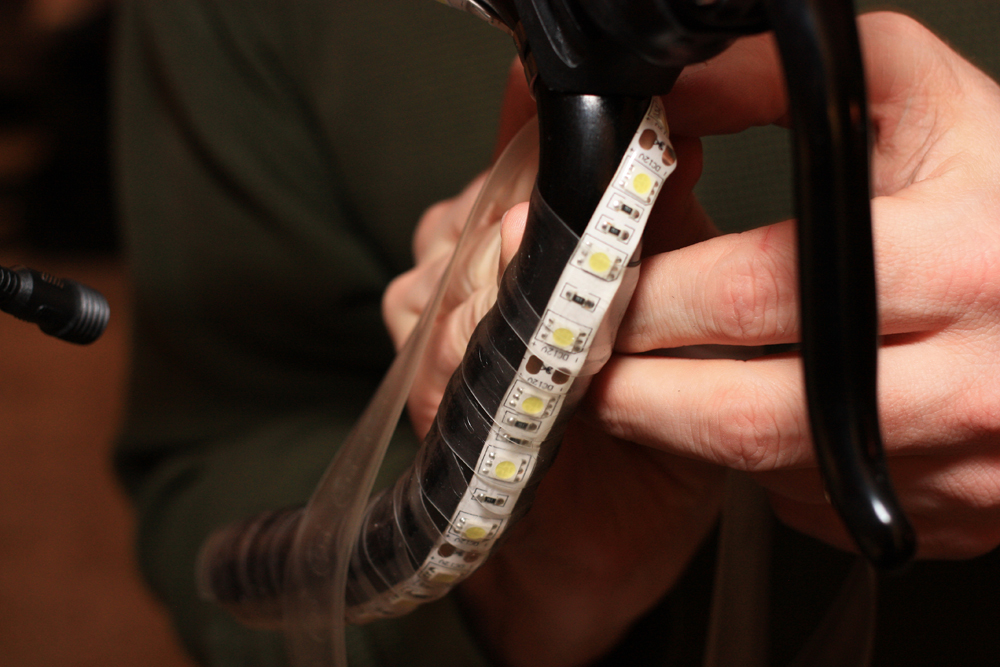
Once we took the adhesive backing off of the LED tape and positioned it on the bars, it was time to wrap the handlebars (Photo 3). There are several different options for transparent handlebar tape in the market. I chose clear Cinelli Jelly Ribbon tape and it’s worked well for me – it’s transparent enough to let the LEDs shine through, is comfortably grippy without being sticky, and has held up well over months of daily riding. For those who really like a padded grip, I think that standard handlebars would have room for both the lights and bar gel pads wrapped under the clear tape.
The last step was to attach the battery pack. For my first few rides I used the AA battery adapter provided by Adafruit with the kit, but I thought the battery pack was clunky and heavy so I upgraded to rechargeable 12V Li-ion batteries that we found on Amazon.com. These batteries only last about 45 minutes in the winter cold, but they’re much smaller and lighter than 8 AA batteries, and the 45 minutes of light I get from each charge is enough time to get me home from work in safety. I still keep the AA adapter around for longer night rides like Antelope by Moonlight, but for daily riding I stick to my little rechargeable battery pack tucked into my bento box.
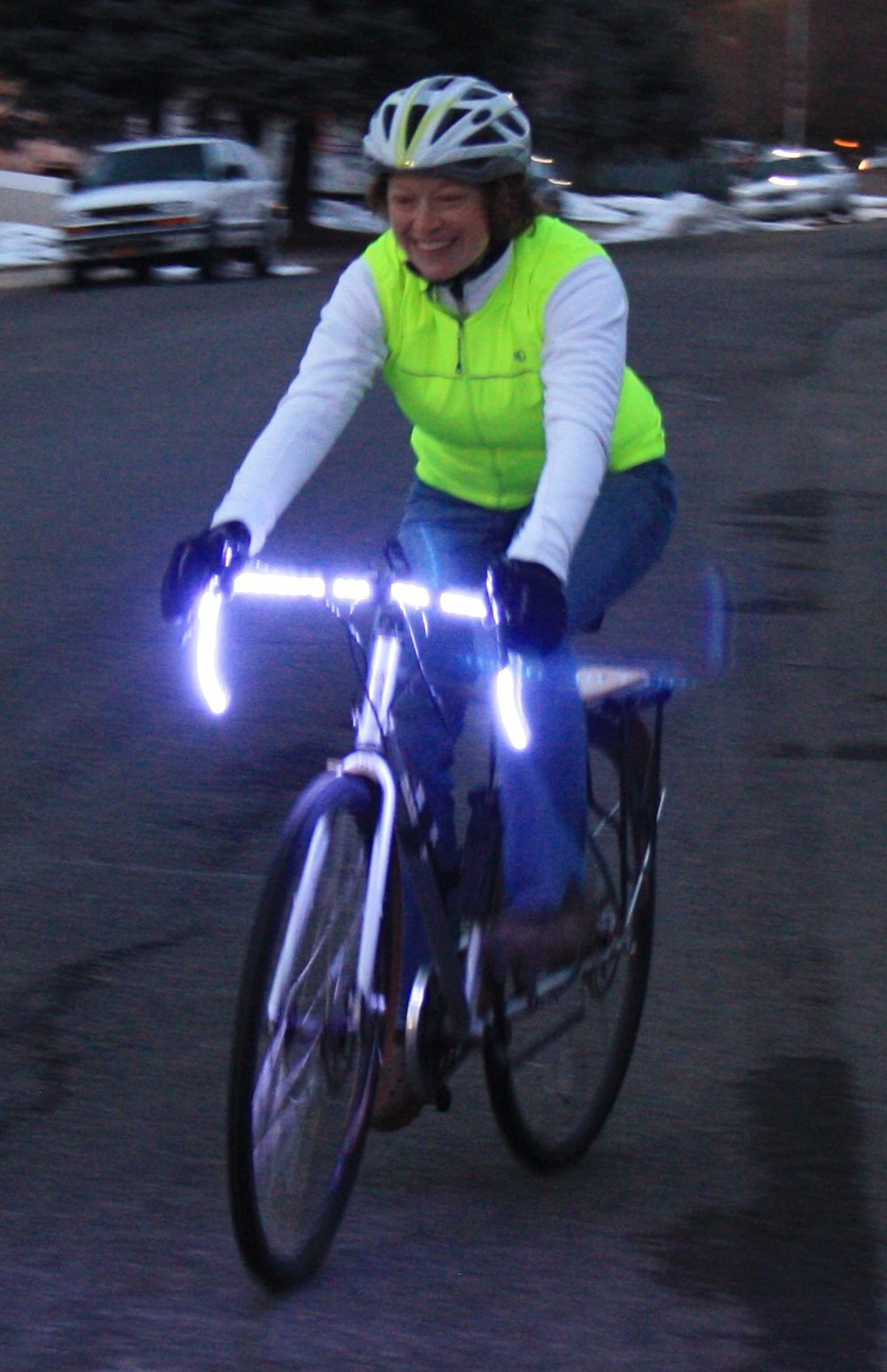
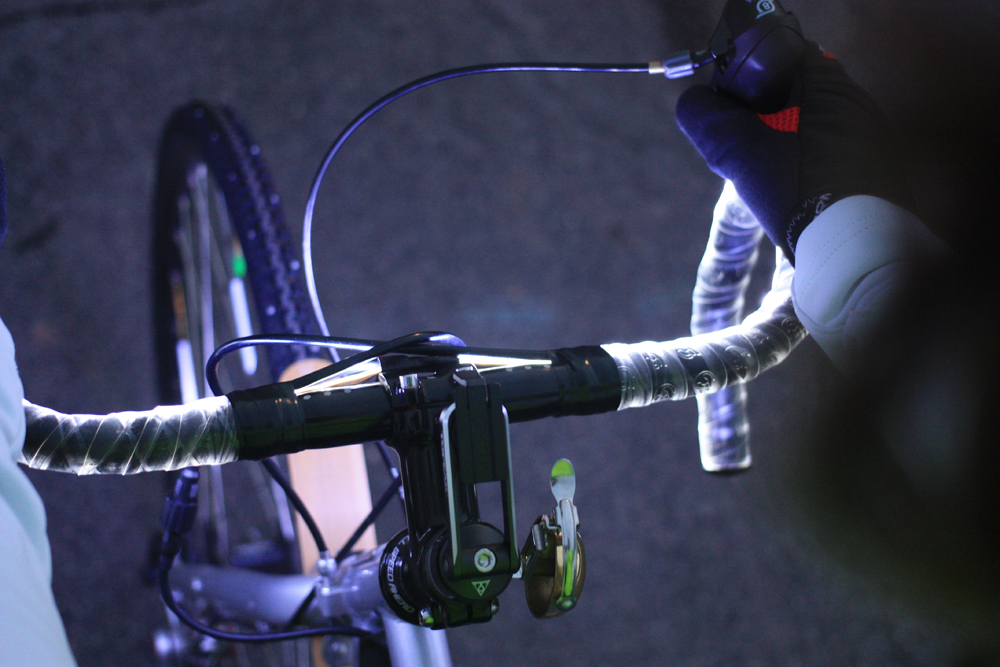
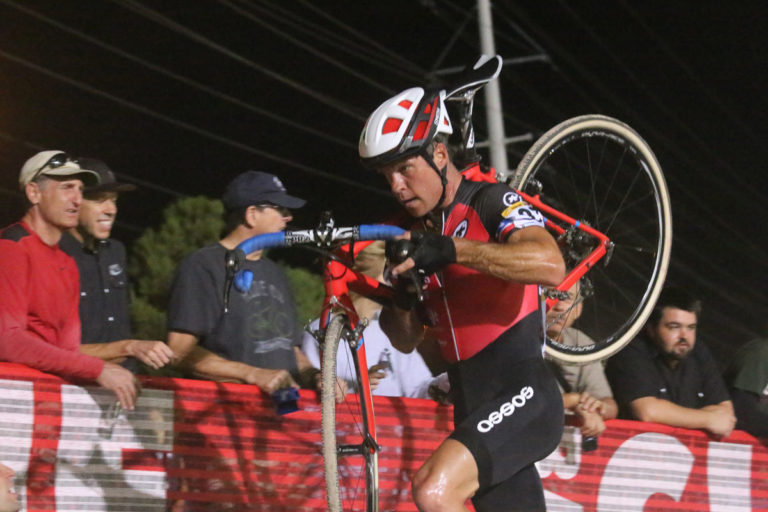
And voila, the job was done and it was time to go outside and play! The view from the rider’s perspective is perfect (Photo 4) – the handlebars glow pleasantly and the lights illuminate the road a bit but the glow is never distracting or annoying to me as I’m riding. And when I have my lights on I am clearly visible to traffic without blinding oncoming drivers (Photo 5).
I’ve been riding with my lights for several months now and have been very pleased with both the look and performance of my handlebar illumination. This was definitely a successful commuter bike upgrade. And I have to admit that while increased safety is the main benefit of my light-up handlebars, the icing on the cake is the big smile on my face time I pass by folks taking a twilight stroll and hear, “Woah, cool lights!”
Project Summary
Supplies needed:
• Adafruit LED Bike Handlebar kit
• Clear grip tape (I used Cinelli Jelly Ribbon Synthetic Road Bicycle Handlebar Tape)
• Heat source for shrink tubing
• Soldering iron
• X-Acto knife
• 8 AA Batteries (or I upgraded to a rechargeable 12V 1800mAh Lithium-ion Battery made for CCTV cameras)
• Bike
• Nerdy friend or significant other who likes to solder (optional)
Total cost: about $75
Increase in visibility and overall awesomeness: awesome
Photo 3 – Wrapping the handlebars. Photo by Stephen Morningstar
Photo 4 – The rider’s view of lit handlebars. Photo by Stephen Morningstar
After successfully hosting the first two years of the USA Cycling Fat Bike National Championships, athletes, spectators and vendors begged the Ogden area to continue to host its own championship-caliber fat bike event. Between the beauty of the course, the tremendous volunteer support and the community enthusiasm, everyone involved wanted to return. The result is the inaugural Sweaty Yeti Fat Bike Race as part of the Wasatch Yeti Bash weekend, February 3-4, 2017.
National Championship athletes loved the epic views from atop Powder Mountain ski resort, but afternoon gusts, high elevation and a particularly brutal course had many asking for a lower elevation course with a bit less climbing and a bit less exposure. Spectators wanted to be able to see more of the race and enjoy additional activities as well. As a result, organizers have created a course downslope from Powder Mountain at Wolf Creek Resort.
The course for February 4th will be comprised of multiple 5k loops on and around groomed trails on the championship-level golf course. Each lap will pass through a rocking festival atmosphere at the clubhouse where there will be a kids zone, sledding, ice skating, product demos, live music and food and beverage offerings, including a beer garden.
Packet pick-up for the Sweaty Yeti race will occur the night before in downtown Ogden at the Wasatch Yeti Bash on Historic 25th Street where athletes, spectators and volunteers will enjoy an outdoor art market, Yeti Yoga, s’mores cooked over open fires, a community bike ride, product demos, vendors, food trucks, a beer garden and thumping music from a DJ.
“Yeti Bash weekend is Ogden’s way of recharging our love of winter after the buzz of the holidays has passed,” said organizer, Sydnie Furton. “It’s more or less the winter version Ogden’s iconic street festivals that occur in the spring, summer and fall.”
Registration for the Sweaty Yeti opens on November 9th and additional details about the weekend’s festivities can be found at yetibash.com.
By Paul Skilbeck – Spectators at the 2016 Clif Bar Cross Vegas UCI Cyclocross World Cup season opener, September 22, were treated to the most exciting bicycle race action yet seen at the Desert Breeze Sports Complex, on an uncharacteristically cool and humid evening that threatened thunderstorms throughout.
The weather may have remained calm, but in both the Elite Men’s and Elite Women’s Telenet World Cup races, on a shorter, tougher 2.8km course, electrifying battles enthralled the spectators.
Elite Men
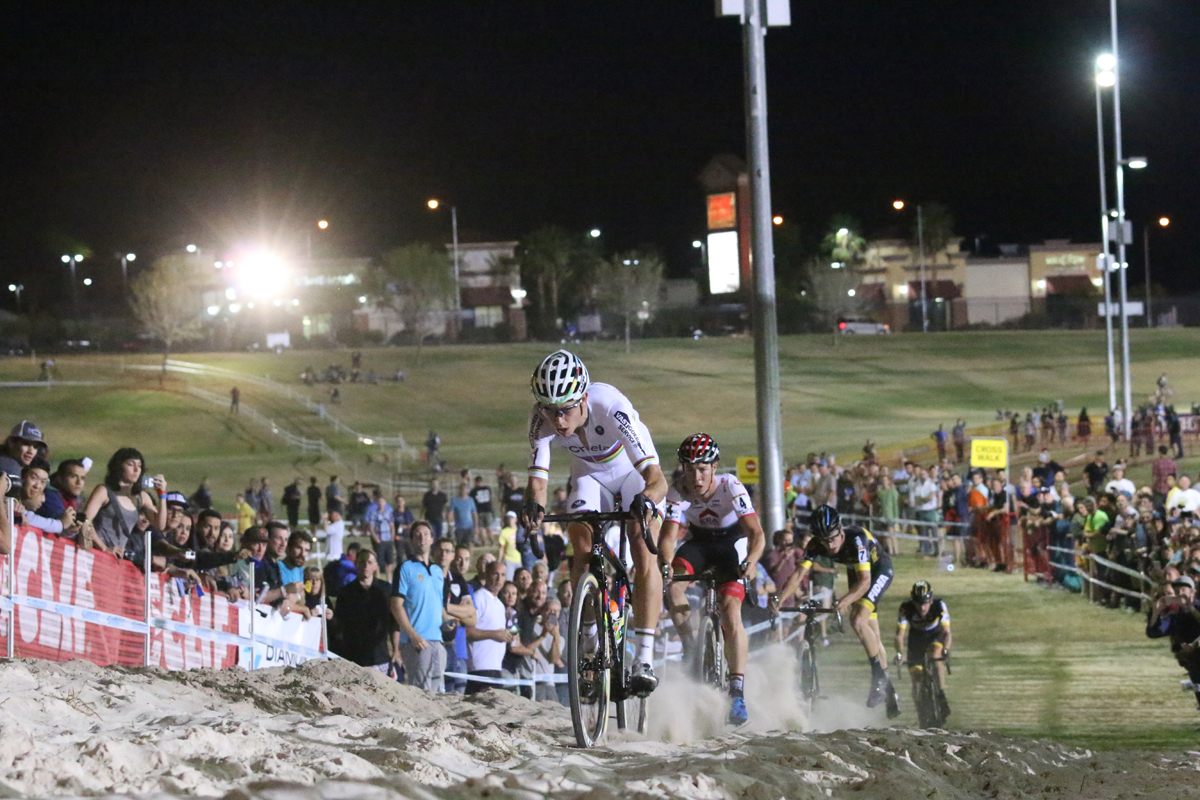
Wout van Aert, the reigning UCI world cup and world champion, was heavily favored going into this race, coming off two consecutive victories at high profile events. He convincingly won the Clif Bar Cross Vegas last year, yet a repeat suddenly looked uncertain when he took a tumble on a stepped run-up early in the race. Michael Vanthourenhout decided to make the most of the opportunity and rode away from the field in a solo move that at one point had him around 20 seconds ahead of van Aert.
Race winner Wout Van Aert shows why he is the world champion as he reels in Michael Vanthorenhout (not shown). Photo by Dave Iltis
“I was not as concentrated as I should have been. It was a stupid crash,” said van Aert, who at the post-race press conference was still suffering pain from that fall. On remounting, his focus turned immediately to regaining control of the race and trackside spectators reported expressions ranging from indignation to anger animating his face.
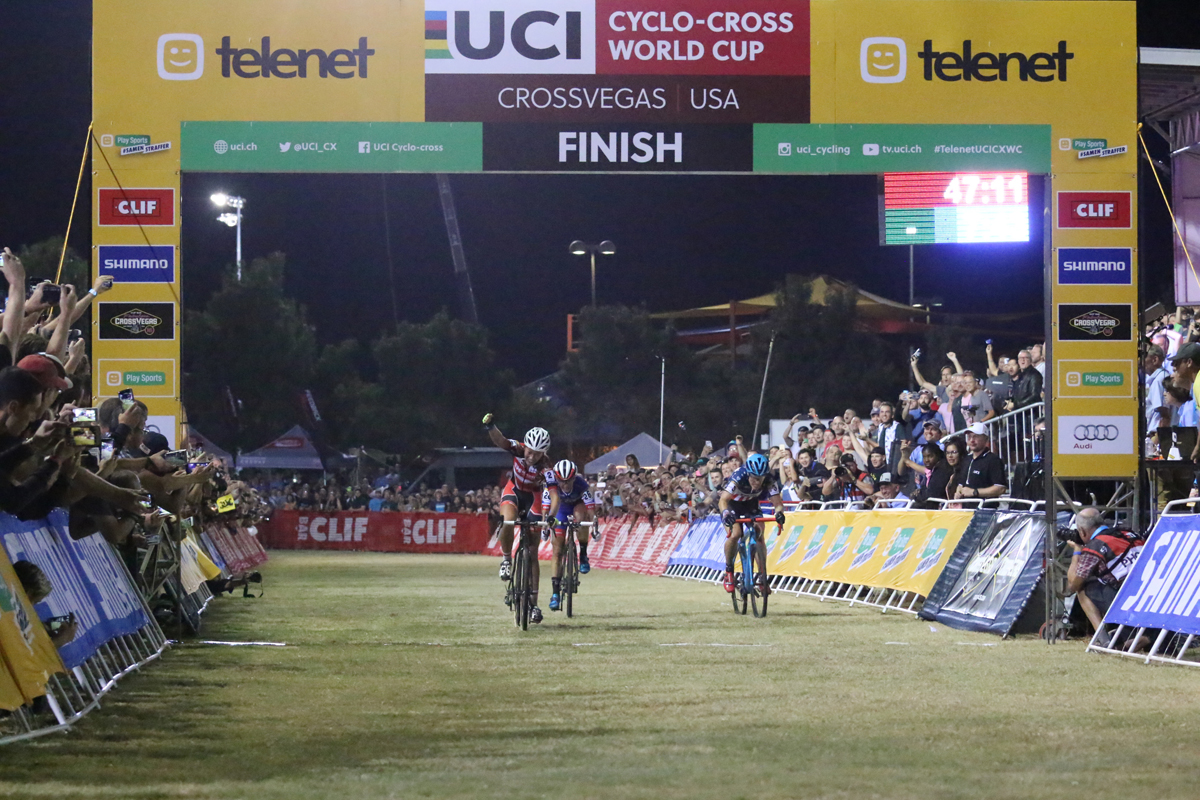
Sophie De Boer takes the sprint win over Katerina Nash and Katie Compton in the 2016 Cross Vegas World Cup. Photo by Dave Iltis
Riding as van Aert put it “on adrenalin,” it was impressive how well he impersonated a maglev train, skimming over the Las Vegas grass as he cut through the deeply talented field with an ease that cannot have brought much joy to those that would seek to match him.
Van Aert soon made it to the head of the chase group and quickly rode clear, still on a mission to rein in the plucky Vanthourenhout. Laurens Sweeck was the only one capable of going with him at this point, and shared some of the work with the world champion.
“When Wout made it up to the front, I realized I had to go with him,” explained Sweeck, who was not willing to squander the opportunity.
Yet once van Aert came up within a few seconds of Vanthourenhout he eased the pace, apparently allowing the hard-charging chasers back into the race. Vanthourenhout was soon absorbed with van Aert briefly going to the front as if to let his compatriot know the game was up, and with names like Toon Aerts, Quinten Hermans, Rob Peeters, Dan Hoeyberghs and Tom Meeusen among a group of 14, the front of the race had a distinctly Belgian feel about it.
Sweeck was doing a lot of the work, but with less than three laps to go van Aert went to the front and attacked on the punishingly steep Hyper Threads staircase, taking only Vanthourenhout and Sweeck with him: apparently the three strongest riders on the night.
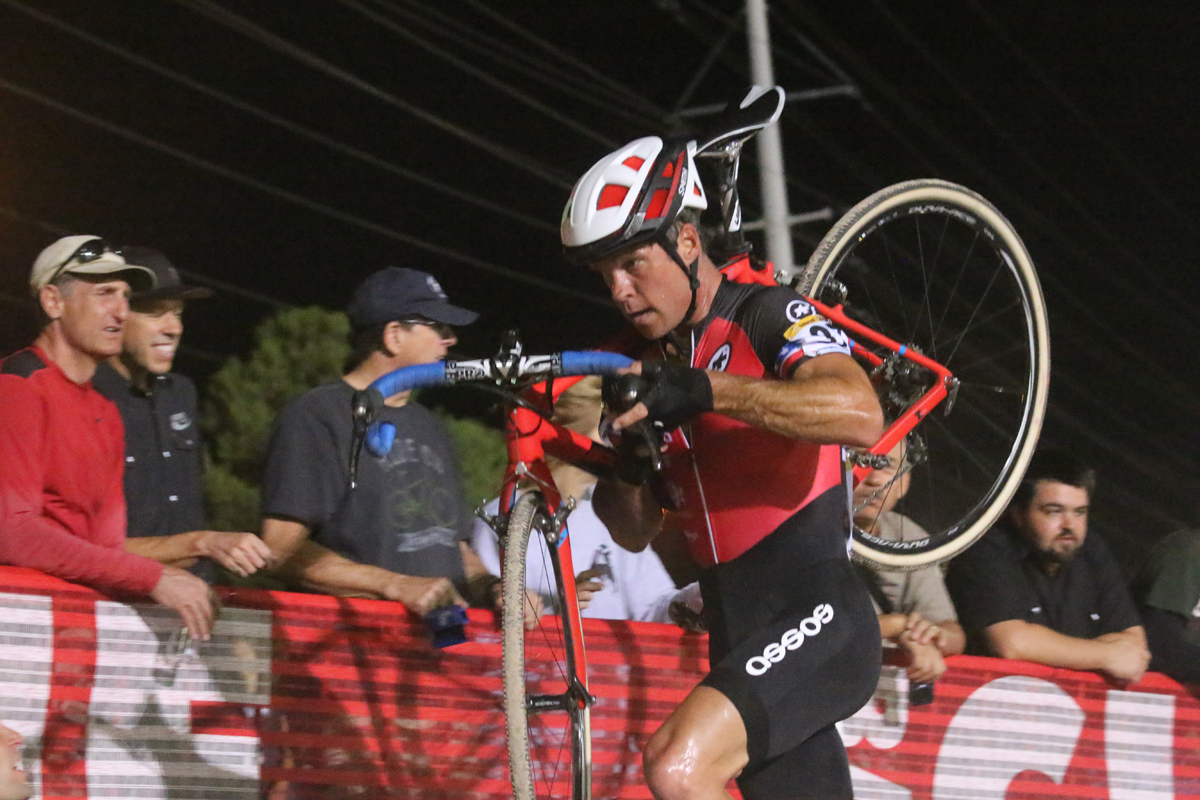
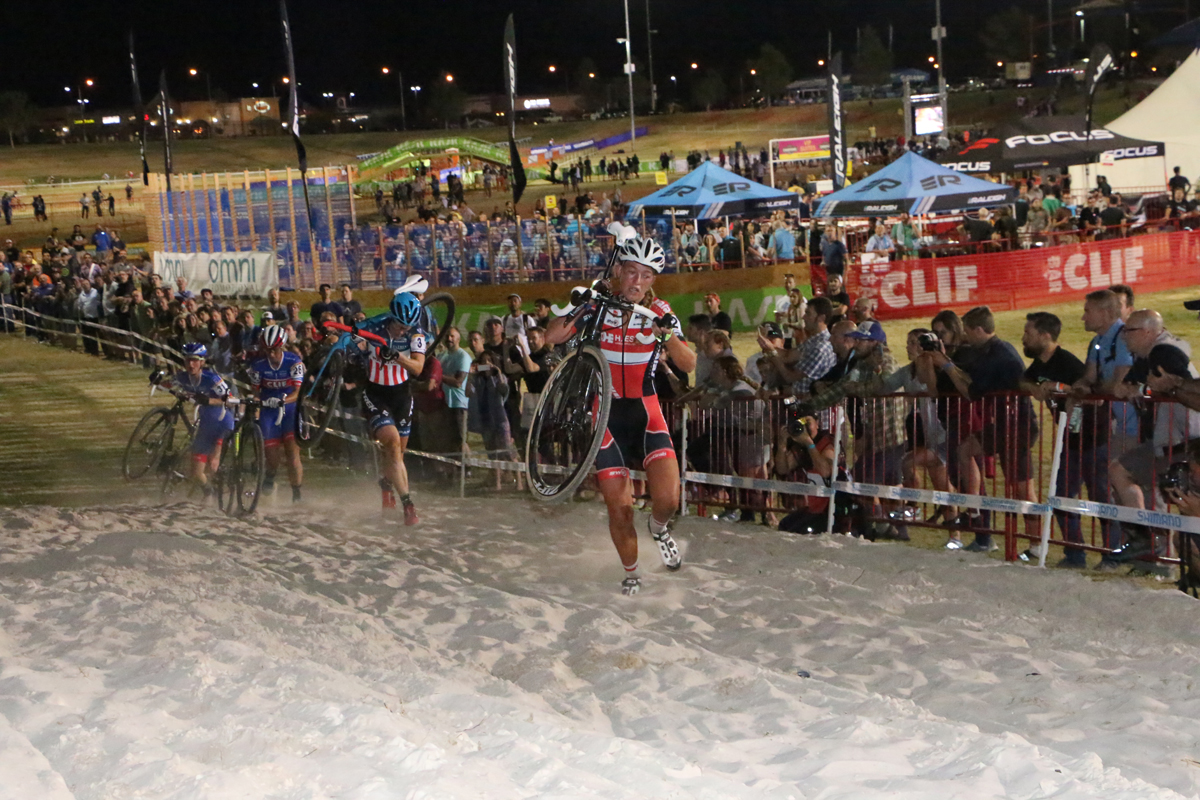
American Jonathan Page runs through the sand pit. Photo by Dave Iltis
Van Aert didn’t stop attacking there. Sprinting into the Diamond Legal Group sandpit, which sloped uphill and awkwardly off-camber, the champion forced open a gap that grew massively when Vanthourenhout made an error, losing both his line and his balance.
From then on the gap opened at a surprisingly fast rate, and van Aert’s closest rivals must be wondering what it’s going to take to beat him this year.
The sandpit saw more attacking action a lap later, where Vanthourenhout opened a small gap over Sweeck and held it to the line.
“I looked back and Laurens was 20 meters behind me, so I just gave it everything, I was confident I could keep that gap,” he said.
Elite Women
Earlier in the evening, the women had brought the vocal crowd to fever pitch with a race of sustained uncertainty, ignited by the first lap attack of Clif Bar rider Catherine Pendrel, which went all the way to a thrilling three-rider sprint.
Pendrel went out so hard and fast that only three riders were in the chase group: two-times world cup winner Katie Compton (Trek), Pendrel’s team-mate Katerina Nash, and Dutch rider Sophie de Boer.
With Compton doing much of the work to slowly reel in Pendrel, and Nash not taking any turns on the front, it might have appeared that Pendrel was working for her team-mate, but Nash later refuted this saying “There’s never a plan! I knew Catharine was strong and she has great endurance. I thought she could do anything, so I just waited in the first few laps to see what happened.”
Sophie De Boer of the Netherlands leads Katie Compton (USA) through the sand pit at the 2016 Cross Vegas World Cup. Photo by Dave Iltis
Compton was confident of catching Pendrel. “II wasn’t worried when Catharine Pendrel was leading. It was too early. When the lead approached 20-25 seconds I decided to shut it down,” she said, and that’s what she did.
After the catch, Pendrel didn’t stay long with the trio that had been chasing her, but these three riders were hard to separate.
On the last lap it seemed that de Boer had come unstuck, when she struggled on the steep Hyper Threads climb, letting a small gap open to her companions. “I thought it was all over when they gapped me, but then I saw them looking at each other and I knew I was faster than them through the sand. I knew I could close the gap.”
De Boer’s reunion with her race-long companions couldn’t be called friendly. She attacked both of them in a determined effort to be first on the tough Focus stairs leading up to the finish straight.
Sophie De Boer takes the sprint win over Katerina Nash and Katie Compton in the 2016 Cross Vegas World Cup. Photo by Dave Iltis
Event organizer Brook Watts had placed these stairs deliberately in an effort to break up any parties that arrived intact for the sprint to the line.
“I thought it was good to be first into the final step. But Sophie punched it by me and got there first. We all had the same idea, I guess,” said Nash after the finish.
For de Boer, those stairs were key. “I know I have an OK sprint, so I thought if I can reach the top of the stairs first, then I had a good chance,” she said. In the charge down the finish straight she never looked like being passed.
“I didn’t know what to expect coming into this race. Last year when I raced here I had OK form, but at the end of the first lap I was dead, I finished I don’t know how far back. So it was hard to have expectations coming here. It is very special to win, and it makes it well worth the trip here,” said de Boer.
It’s hard to imagine that anybody who attended the event disagreed it was well worth the trip. When you see race action like tonight’s, it’s immediately clear why cyclocross is such a popular sport.
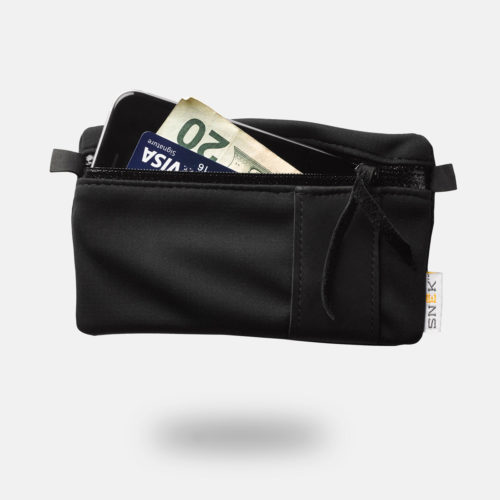
Snēk is a new bike accessory company based in Salt Lake City. Founded by longtime Utah cyclist Johnny Hintze, Snēk (pronounced sneak) are making merino wool winter hats, and two cool new cycling wallets in Ogden and Salt Lake City.
The first of these is a waterproof wallet big enough for your phone, and for cash and cards. The second is just for cash and cards. Both are designed to keep your valuables dry and safe when riding – they are perfect for putting in a jersey pocket.
Snēk’s new cycling wallet is waterproof. Photo courtesy Snēk Cycling
Coming in the future will be a seatbag with a twist. Details aren’t available currently, but look for it in the future.
Johnny has this to say about his company, “Snēk products are products that I want as a cyclist. That’s how this all began. Kind of selfish I guess…”
Johnny had this to say about Snēk’s philosophy, “Snēk Cycling – A brand based upon stylish, simple, and authentic cycling goods. Products born from ideas conjured up during actual rides. Rides as short as the commute to work, and as long as the weekend getaway. Never over thought, but stringent on detail. Brought together by years of cycling experience with a tenacious drive to hand-pick, high-quality materials. Slick and neat – Snēk.”
For the future, their plan is “to keep growing the business. I’ve got ideas for many new products. I’m a cyclist so there are constantly things I think of improving while out on the bike. I mostly just want to make the product for myself. It’s an added bonus that I’m able to sell my products to other cyclists who have the same appreciation for the sport and attention to detail.”
By Charles Pekow – The saga of turning Washington County, UT into a mountain bike mecca is advancing one more chapter. The Bureau of Land Management (BLM) has tentatively agreed upon a framework for developing its land in the area. A year ago, BLM put out for public comment Proposed Resource Management Plans (RMPs) for the Beaver Dam Wash and Red Cliffs National Conservation Areas (NCAs) that listed four options for development of the areas, including expanding mountain bike facilities. (See our previous article at https://www.cyclingwest.com/advocacy/mountain-advocacy/new-mountain-bike-trails-for-washington-county/) President Barack Obama created the two NCAs in 2009. Ever since then, BLM and local mountain bikers have been moving to expand and improve the trail system within them.
In early September, BLM issued an Environmental Impact Statement (https://eplanning.blm.gov/epl-front-office/eplanning/docset_view.do?projectId=64251¤tPageId=90517&documentId=79707) and is giving people until early October to protest if they don’t like the statement or proposed plans, a move required by law. BLM is charged with balancing competing interests, such as recreational use, resource development, and conserving and restoring native species including the Mojave Desert tortoise, which is protected by federal law.
As is custom, a year ago BLM proposed four options for public comment. It combined elements of them into the tentative plan it released Sept. 2. The NCAs lie within the administrative jurisdiction of BLM’s St. George Field Office. After BLM considers and responds to any protests, Governor Gary Herbert gets to review the plans. His review could take two months or more. Next year, BLM will develop an implementation plan and allow further opportunities for public comment.
BLM needs to change its 1999 policy that designates areas as open, limited or closed for mountain biking. The policy no longer conforms to current federal law, which does away with such designations.
The current proposed RMP doesn’t get into a lot of specifics about where trails would go. But it calls for creating travel and recreation plans which “may contain” preparation of biking guides (note the conditional tense; it doesn’t require any. BLM has already developed some). But it does call for designing and building a non-motorized trail system including mountain biking. BLM would design a system that would promote sustainability and keep people from going off trail.
“The RMP (does) not include a lot of information regarding mountain biking because it is an umbrella document that recognizes the importance of all multiple uses of public land, including outdoor recreation and places reasonable restrictions on those activities in the NCAs. Mountain bikers have provided a lot of input in the travel management plan that the BLM is drafting,” says a statement from BLM spokesperson Christian Venhuizen.
“New trails could be constructed in the Primitive Zone if monitoring shows negative impacts to natural and/or cultural resource values from off-trail uses,” the RMP says. The RMP would also allow new trails in the Frontcountry or Backcountry Zones. The plan would also allow scheduled on-road bike races.
“We don’t have any issues (with it). The RMP is a pretty broad-based plan,” says Lukas Brinkerhoff, president of the Dixie Mountain Bike Trails Association (DMBTA). “We are anxious to see these plans signed as that will allow the next step which will be the public release of the travel management plan,” which will include hundreds of miles of mountain biking trails.
“And yes, it really has been seven years,” he says. The saga continues.
I’ve heard that my personal car insurance can pay for my damages if I’m hit by a car on my bike. Is that true? –Justin H., Ogden, Utah.
It is true. If you are hit by a car while riding your bike, there are certain insurance coverages available under your personal car insurance policy, as long as you haven’t waived them. Two critical types of coverage that should NEVER be waived are uninsured motorist coverage and under-insured motorist coverage. Both uninsured and under-insured motorist coverages are available only when the driver of the car carries a majority of responsibility for causing the collision (i.e., the cyclist must be less than 50% at fault). However, another important type of coverage, personal injury protection, is available to cyclists injured in any vehicle collision – regardless of who is at fault.
Uninsured motorist coverage (UM) applies in cases involving a “hit & run,” as well as collisions where the at-fault driver has no insurance. Your own auto insurance carrier offers UM coverage, which will pay for your medical bills, lost time from work, and pain and suffering in these situations. Afterward, your insurance will likely seek reimbursement from the irresponsible driver.
Under-insured motorist coverage (UIM) is important in circumstances where the at-fault driver carries auto insurance, but the insurance limits aren’t high enough to pay for all your damages. For example, a driver turns in front of you and you’re catapulted onto the asphalt, tearing your rotator cuff. Your medical bills after surgery and physical therapy are $45,000, while the driver only had $25,000 insurance limits. In this case, your own UIM coverage can make up the difference.
Personal injury protection (PIP) applies in any bicycle vs. vehicle accident. All vehicles in Utah are required to carry PIP – and that coverage applies to any cyclist hit by a car. PIP benefits include a minimum of $3,000 to cover medical expenses, as well as up to $250 per week for lost time from work due to injuries sustained in the collision. PIP can also cover payment for household services and funeral benefits. The insurance company for the driver in a car vs. bicycle accident will be responsible for the primary PIP benefits listed above. However, once that PIP coverage is exhausted, you can often make a secondary PIP claim under your personal car insurance policy for additional benefits if your PIP limits are higher that the other party’s.
Most people only think about their car insurance when they’re behind the wheel of their own car. As a result, many cyclists don’t realize that if they’re hit while on their bike, the availability of PIP benefits makes seeking immediate medical care much less daunting. And the cyclist’s own UM/UIM coverage can provide much-needed financial protection. Although UM/UIM coverages are optional, we believe all cyclists should consider them mandatory before getting out on the road.
We suggest cyclists carry $5,000-$10,000 in PIP benefits, and $250,000 limits for both UM and UIM, but never less than $100,000 for each. If your policy limits are less, call your insurance agent and make the change before your next ride!
Ken Christensen and Russ Hymas are avid cyclists and Utah attorneys at UtahBicycleLawyers.com. Their legal practice is devoted to helping cyclists injured in collisions with motor vehicles. They are authors of the Utah Bicycle Accident Handbook and are nationally recognized legal experts on cycling laws and safety.
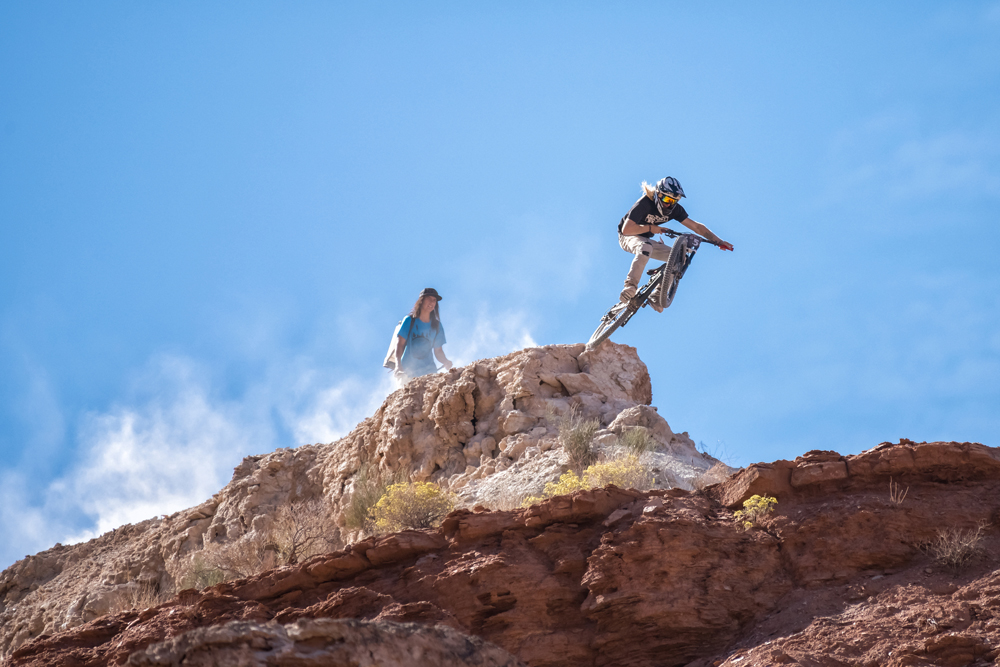
The 2015 or 10th anniversary of Red Bull Rampage was supposed to be a breakthrough year for one Utah local, Jeremy Hottinger.
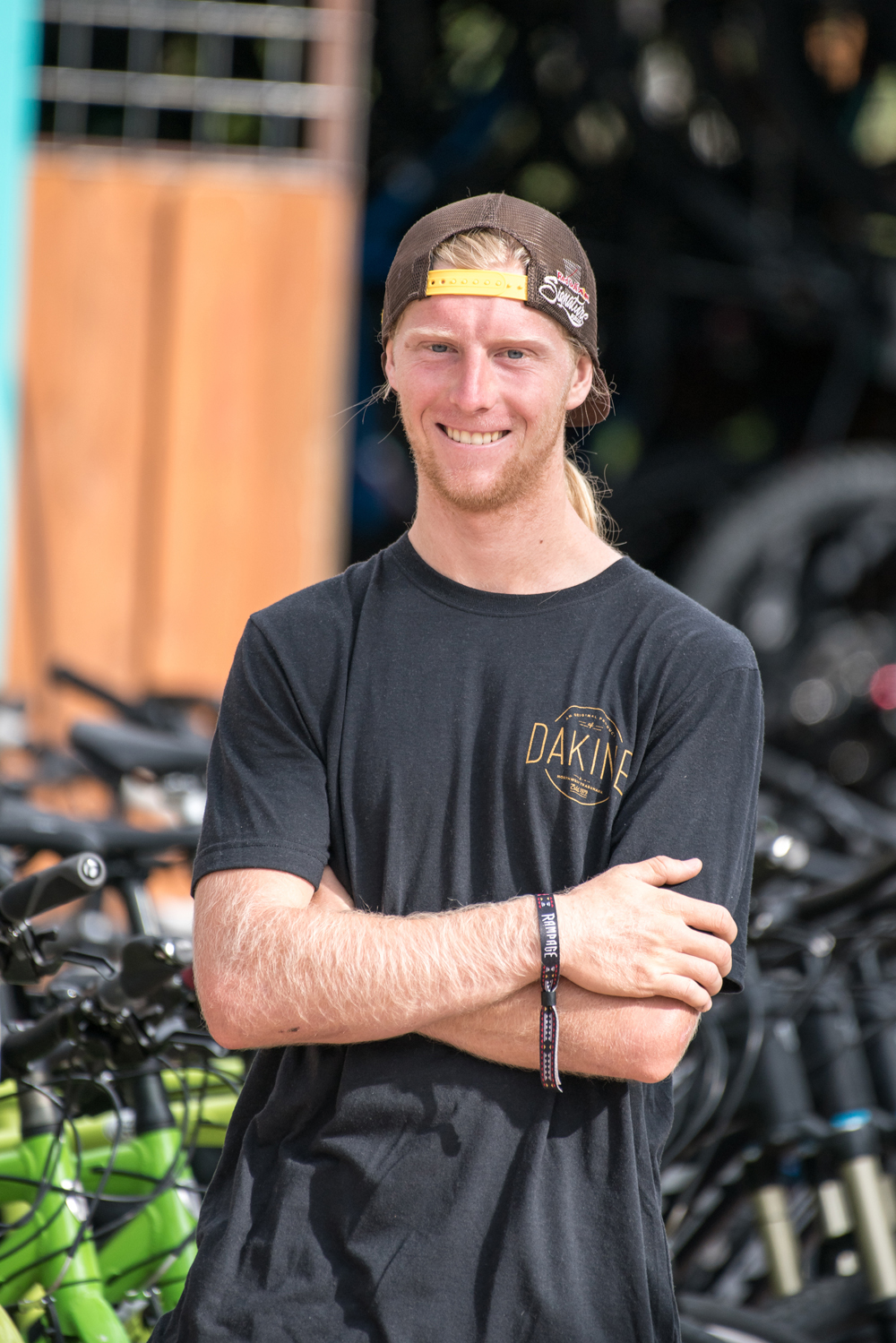
Hailing from Springdale, Utah, where for a number of years he’s worked at Zion Cyclery, Jeremy “Kickstand” Hottinger has long aspired to have a chance at riding with the best on free ride mountain bikes biggest stage.
Since first seeing Rampage when he was 11 years old, Jeremy’s wanted to ride the big show and has been working on the skills to join the circus.
By Fahzure Freeride
Jeremy Hottinger at Zion Cycles. Photo by Rob Norbutt
Jeremy started getting serious about three years ago when the Rampage was held on the other side of the ridge of its current site. As a local, he could ride there, checking out the lines the pros had carved and developing his skills. Last year, a serious campaign was mounted to get Kickstand considered for the Rampage qualifications. Unfortunately, it was a little too late. But, now, Jeremy had a brand and was visible in the freeride community.
For 2015, Kickstand decided to devote himself fully to being a professional freerider in order to achieve a goal he’d been working toward for nearly half his life. And, because freeride mountain biking continues to develop, this included strength training, trick development and riding at speed. Kickstand knew you had to mount a media campaign, as well, and worked closely with photographer and videographer Rob Norbutt to show off his increasing freeride talents. All these efforts were organized around a #letkickstandride campaign. Still, even on the Monday before the main event, Kickstand was a fifth alternate.
Tuesday morning the news came in that Kickstand would get plate number 45, just two days before qualifications he was in. Kickstand quickly mounted an effort to dial-in a line that he had been assisting Wil White with. Bryce Helbing was enlisted as manager/chief bike pusher and several others joined in to assist and dial in the north ridge line.
The north ridgeline is of a lower gradient than most of the Rampage lines, with fewer big drops. However, the north ridge offers an opportunity for many smaller trickable jumps and drops. After two moderate cliff drops mid-way, the line finishes with a 20 out and 25 down drop to the run in for the YT Industries kicker in the lower bowl. Practice Tuesday was devoted to getting the step down to YT kicker dialed and running the beginning, west ridge line, portion a bit. Jeremy described his planned run as “fast and flowy” with a no-footer for Bender and classic style tricks like no handers and tables.
Wednesday was supposed to be a rest day, but about mid-day, anxiety, apprehension and the love of flying your bike kicked in and by noon Jeremy and his crew were at the site. Wednesday Kickstand and Wil focused on the upper west section of the ridge line, which contained a significant kicker gap right along the ridge with a narrow and quick transition. Kickstand’s family and a few special friends made the trek out to the site and watched as Jeremy and the other pros figured out their lines. Later, as the sun was setting, Kickstand rode the ridge cleanly throwing no footers and nasty tables. All that was left was to put together a top to bottom clean run in qualis with a few tricks and some good style.
Bryce trying to keep the dust down while Kickstand (Jeremy Hottinger) drops in. Photo by Rob Norbutt
Thursday morning rolled around and, of course, everyone was anxious. Kickstand and Bryce arrived at the venue early, before 8 o’clock, to roll the west ridge wind-free and dial-in the two ridge line cliff drops. Kickstand hit the west ridge section twice, cleanly, clearing the gap jump with speed. And, now the reminder it’s a wild and semi-controlled event. Two photographers, after being warned to be on the lookout, decided to ascend the north ridge and, just as Jeremy was dropping the second cliff, he struck the lead photographer with camera in hand.
Vital MTB member, aw_gooner, working security on the north ridge saw it this way:
“A few photographers hiked up the ridge past my position. A digger about 50 ft. past called out that a rider was coming down the line. I repeated this to the photographers. As the rider was coming closer we all repeated “rider up” again. The photographers stood below a drop completely unaware. One thing led to another and the rider came over the drop, into the photographer, over the bars and down the side of the ridge.”
The crash sent Jeremy tumbling over a small cliff and onto his shoulder. Fortunately the landing was steep and Jeremy’s injuries are not life-threatening, but the rotator cuff strain made it impossible to ride qualis. Jeremy and his team were clearly dejected, even mustering the energy to stare the event in the face over the next couple of days was difficult. With the support of family, other riders and friends and a good story to tell, Kickstand was able to rekindle the fire by the end of finals on Friday, where he walked around with a desirous look, at home with his fellow freeriders. Jeremy’s dreams are on hold until next year but he wants you to know that despite the premature exit, Rampage, “was an absolutely amazing experience and I enjoyed every moment!” Jeremy can’t wait for 2016 Rampage, knowing that more dreams will come true.
This is how it usually goes: you find yourself staring with total disbelief at a plot of empty space. The brain reels and you ask yourself if you are sure, absolutely sure that you haven’t made some mistake. Of course, you think, I must have left it somewhere else. Just as quickly, however, it dawns on you that there’s no mistake. That empty space that you are looking at is your new reality. That thing you used to call your bike is gone and chances are that you’ll never see it again.
Originally published in cyclingutah online: January 1, 2014
This is the situation that myself and 1.5 million other Americans (according to the National Bike Registry) found themselves in last year. It’s hard for me to speak for all of those people but if they’re anything like me then the next thing that went through their heads was a set of alternate scenarios. Each one played out before me like a wish of how I could reinvent things with a different ending. There is the one where I traveled back in time and realized how woefully inadequate that lock was and put the bike in the basement. There the one where I see, oh yeah, that only an idiot would lock their bike to a wooden porch and again chose to bring my bike indoors. The most replayed pictures in my mind, however, were ones tinged with heroism, justice and more than a little revenge. There I am coming across the thief in the act and I call the authorities in just the nick of time. There’s the one where I’m able to chase down the scallywag and grab him by the scruff of the neck. The adoring bystanders cheer me on and buoy me upon their shoulders whilst the police lead the malnourished drug fiend away in shackles. These are much more appealing images than the real scene, the one where I’m staring at an empty plot of concrete while traffic courses callously by.
The loss of a bike seems to create as much of an emotional void as it does a financial one. I have heard of Irish style wakes held for lost cycles and of people holding onto the memory of a beloved two-wheeler like a member of the family who has gone before. What that misanthrope who ran off with my bicycle and others like him won’t ever understand is that cyclists are in a relationship with their bikes. Think cowboy and horse.
People feel violated enough to quit riding altogether and this risk of theft is a major reason that people cite for not riding a bicycle.
Bike theft is on the rise in Salt Lake and its environs. The downturn of the national economy and increase in population of the Wasatch Front means this will only become a more common issue in Utah. The examples of this trend are unfortunate and one needs look no further than the theft of Mayor Ralph Becker’s bicycle during a 2010 bike summit to see the immediacy of the issue. What a sad footnote to a meeting to make Salt Lake a more velo friendly city and one that really underscores the chilling effect of bike theft on this transportation alternative. Bikes are stolen daily at the University of Utah and according to a KSTU-TV report over 180 bikes were lifted in the first month of classes in 2010. The ease and style with which bikes get us around makes them an attractive target for theft. They are easily transported and may be quickly turned into cash. They’re analogous to a free cab ride to the bank. Most stolen bikes are never recovered and the Internet has provided a hot new venue for the traffic and exchange of stolen bikes and bike parts.
The rise in bike theft is not unfortunately matched by a rise in police attention. They’re simply too busy pursuing the other crimes that come with population growth to get worked up with stolen bikes. When apprehended, most bike thefts nationally are prosecuted as misdemeanor crimes. This is unfortunate for items that may cost much more than a flat screen television.
The thirst for justice in this environment has led cyclists and police to get creative. Salt Lake Police have used bait bicycles locked in public spaces to apprehend would be thieves in the act. A 2007 Seattle Times article discusses a Portland man and his friends who track down his stolen bike and set up an elaborate sting operation. The advent of GPS technology has opened a new phase, at least till the criminals figure it out, of tracking stolen merchandise.
In his article Who Pinched my Ride which appears in the February issue of Outside magazine, author Patrick Symmes discusses the ins and outs of bike theft and the underworld that fuels it. In this piece, Symmes details his long and intimate response to having his own bicycle stolen. He looks into the anatomy of bike theft, which he claims is a much larger social phenomenon than most of us imagine. He notes that for the lowest often drug addicted rungs of society bikes are one of the solvent forms of currency along with cash, drugs, and sex. Bikes are the only one of these that’s left outside barely protected with a crappy cable lock. Symmes rides along with police in various cities who work on recovering stolen bikes and prosecuting the people who steal them. He also visits notorious spots for fencing hot bikes and uses a small GPS unit to monitor and eventually confront a bike thief.
It’s a slippery slope though. How much can we rely on technology to try to avoid these crimes and how ready are we to confront the people who perpetrate them? The power of GPS only works until the crooks know what they are and they will do nothing to protect your Campy Record derailleur.
To make my point about confronting criminals consider the following. Confucius states that “before you embark on a journey of revenge, dig two graves.” If you’ve seen the Italian neorealist film The Bicycle Thief then you can see where the Chinese guy was coming from. In this movie (which is really worth seeing even if you don’t care about bicycles but especially if you do) the main character has his bike stolen and tries to get it back. The police are not much help so he decides to try and find the crook himself. After a lot of walking and even more walking he is able to corner the guy, minus the now sold bike. To make a long story much shorter and without giving too much away about a great film, he comes out of it looking like a real schmuck and is lucky to not get beat up too bad. Fantasizing about confronting thieves may be entertaining, but the reality of confronting someone who is desperate enough to risk arrest for a few hundred dollars or drugs is clearly not a good idea. Even as much as you love your bike, they may have more skin in the game.
I never retrieved my bike. It was stolen in here in Connecticut, the place I currently live but will not call home due to its noted lack of both mountains and deserts. The news of a stolen bike here barely raises a policeman’s shoulders to a shrug and velo theft is one of the only things emulating a growth industry. I am currently riding a second hand Giant mountain bike that formerly belonged to one of the world experts on the microbiota of cockroach guts, no kidding. It’s not fast and it’s not pretty but it gets me around town. Now if I could only stop trying to spot a moss green Surly LHT every time I see another cyclist.
There are, however, occasional happy endings and people do sometimes recover their stolen steeds. I know a woman in New Haven, Connecticut who had her bike ripped off and then found herself riding next to a guy on it during her daily commute. She was able to get the guy to pull over and there was luckily a police officer nearby that she was able to flag down. However, stories like this are not the norm and we should pursue common sense and think defensively in order to protect our steel, titanium, aluminum and carbon fiber friends.
Here are some suggestions:
1. Record the serial number of your frame. A bike registry will do this as well, but having a copy for yourself can cut down on some work.
2. License your bike. In Utah, all municipalities are required to license bikes. While the system is archaic, it does add an extra protection in case your bike is stolen. Bike shops, fire stations, and city business offices usually have licenses available.
3. Throw away your cable lock. Give yourself extra points the farther away you can throw it. Cable locks are easily cut and the protection they offer is merely cosmetic.
4. Google “U lock” and “pen”. The myriad “how to” videos on DIY sites about how the open a barrel (circular) keyed U lock with the cheapest of ball point pens should convince you to spend a little more on a decent lock with a safer key mechanism.
5. U locks with less space within them allow less space for tools and carjacks and are hence somewhat more secure.
6. Take a picture of your bike. You would be surprised how few bike owners have an image of their bicycle. This may come in handy for recovering the property or if you are fortunate enough to make an insurance claim then you will be glad you had it.
7. Leave locks at your destinations. We’ve all seen the piles of abandoned locks that decorate college bike racks. Granted, they don’t make the city any prettier but leaving a lock behind at a place you ride to daily makes them easier to use and will reduce the amount of weight you have to carry. It’s a good thing to think about when you’ve spent a pile of money shaving off ounces here and there only to then carry a multi pound lock around all over town.
8. Take your bike inside with you. Often this is implausible and gets under the skin of bosses, landlords and shop proprietors. If you can though, it’s a great idea. If you have an employer who is bike friendly, speak to them about providing a secure space for bikes. A former employer of mine was kind enough to put a code entry door on an on site bike shed and thus provide a very safe storage area for the staff bike commuters.
9. Use secure storage facilities. Salt lake City has gone the extra mile and installed indoor storage at the Utah Intermodal Hub as well as rentable bike lockers at numerous TRAX stations. This is a great resource and one that many cities are way behind on.
10. Open your mind to the idea that no lock is sufficient. Once you grasp the idea of what the Buddhists call impermanence and non-attachment, you will realize that the idea that any lock can ultimately secure a bicycle is simply wrong. All kidding aside, if you rely on locks alone you should treat your relationship with your bicycle as something transitory.
11. Reconsider the nuts and bolts of quick release. These levers and skewers that make changing our tires and seat position so fast also make it a really simple task to walk off with our seats and wheels. Security bolts make it a somewhat harder task to rip these parts off. Remember that bike theft can happen one part at a time.
12. Register your bike at nationalbikeregistry.com . This will help you recover your bike if it is found by the police or if it turns up at a pawnshop.
13. Think like a crook. When you lock up a bike think about how secure the location is. For example, a high grade U lock will do precious little to protect your bike if it secured to something that can easily be cut unscrewed or unlatched. The classic “D-oh” moment is realizing the bike was locked to a sign that can be pulled out of the ground.
14. Lock your bike in a publicly visible area.
15. Buy a cheap bike. This is the suggestion of David Byrne in his book of bicycle based musing on the American city Bicycle Diaries. Byrne posits that since any bike can be stolen that we as bike riders have to realize this and then buy bikes that can easily be replaced. This is probably the hardest suggestion for us as American cyclists to get our heads around. We can easily tell ourselves that we need to spend >$2000 on a bike that we can ride a couple times a month and then find it hard to convince ourselves that we can perfectly adequate daily ride for a couple hundred dollars. In many parts of the world like Denmark, the Netherlands or China this is the reigning paradigm. The average bike in these places is not light and it is not fast but it does the job. Check out www.copenhagencyclechic.com and convince yourself that you can still look pretty good on a heavy, slow bike.
Most of all continue to ride. The development of a bike friendly place to live comes with people riding in spite of the threats. Just be smart with how you do it.
Editor’s Note: In April, we will have a follow up article on what to do if your bike is stolen.
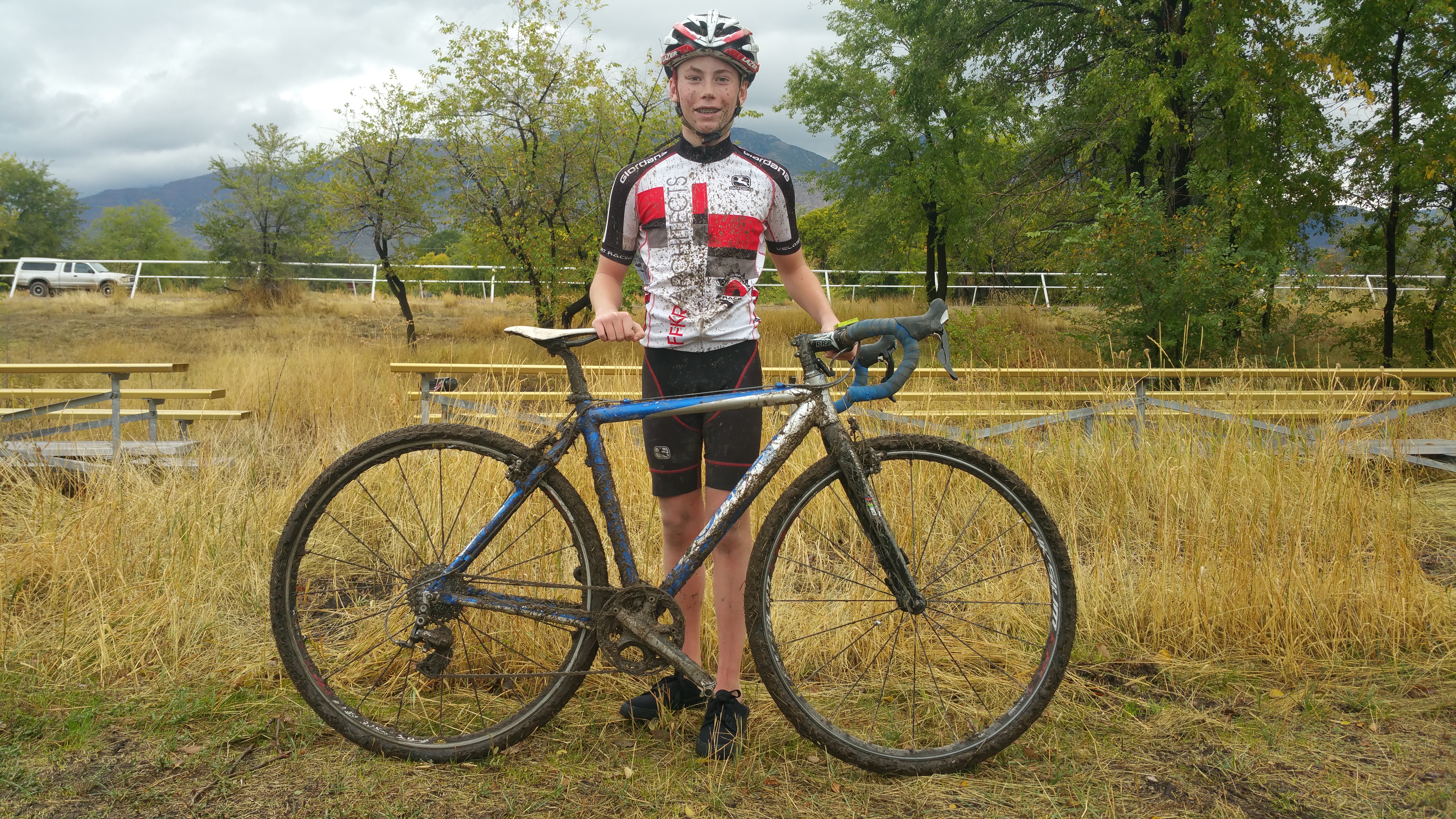
Cycling Utah Editorial: We want to take this opportunity to acknowledge the youthful exuberance of the young bicycle-racer depicted in this photo, Jack Shuckra.
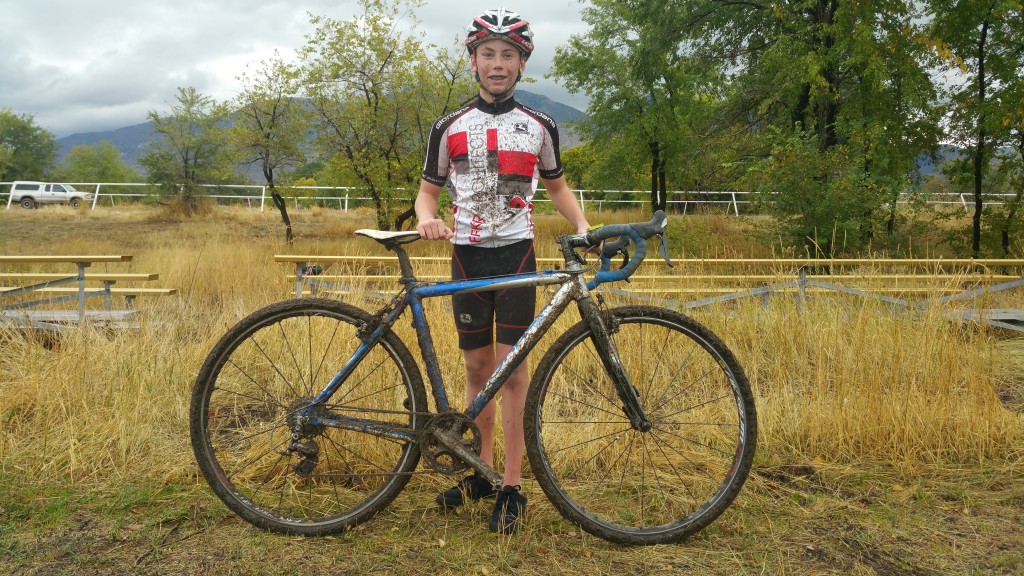
Jack Shuckra with his cyclocross bike after finishing 2nd in the C Group, September 30th, at the Weber Fairground, Ogden, UT
In our opinion, bicycling happens locally. That is not to say that national and international issues are not important. Of course they are.
Bicycling at its core is about personal experience. It doesn’t matter if you’re on the pump track, mountain biking, commuting, track racing, touring, adventure cycling or at the beach on a cruiser. We value bicycling in all forms.
A former executive director of USA Cycling told me once that he was very committed to a “Hero” strategy, role models that inspire.
I think it’s fair to say we’ve had some successes and some failures.
When I started cycling Greg Lemond provide inspiration to millions of bicycling enthusiasts. Little did I know how important of a role bicycling would play in my life.
Bringing this comment back to Jack. Look closely at the photo. Look at his face. Do you see what I mean?
Access to the Provo River Parkway Trail would get improved under a plan awaiting final approval.
The Unita-Wasatch-Cache National Forest Resource Advisory Committee unanimously approved and sent to the forest supervisor a plan to built a steel bike/ped Upper Falls Bridge and Connector Trail to the parkway.
The bridge would connect the parkway with the Upper Falls Picnic Site. The project also involves building an asphalt trail through the picnic area to connect the parkway with Old Provo Canyon Road.
The project prospectus says that the new trail would reduce congestion “by diverting some of the through users of the parkway trail around the often-congested Bridal Veil Falls area and would also ensure access to the upper sections of the Provo River Parkway during times of seasonal closures of the Bridal Veil Falls area due to avalanche, rock fall, and/or high water danger.”
In addition to becoming a new trail access point, the connector would provide emergency access. And it would allow many cyclists to avoid the often-crowded area where people stop to view the falls and cyclists are asked to walk their bikes.
The United States Forest Service (USFS) estimates the project costs to total $231,700. USFS says 311,565 people used the 15-mile trail in 2014, making it one of the most popular places to bike in Utah County.
After taking first at the Swiss Bike Cup in Gränichen, Switzerland, I was purely stoked. It felt good to know that I could be competing at the top, adding extra motivation and excitement for the hard week of training ahead, and I knew there was still lots of fine tuning to do.
By Haley Batten with Mark Deterline
My family and I left Switzerland behind and made our way to the Alps. Pure awe filled the car as we drew near Kappl, Austria. The mountain peaks shot far into the sky, supplying the perfect terrain for challenging workouts, thrilling descents, and jaw dropping views. We settled in for an incredible stay.
Although pure beauty surrounded me and I had epic rids to be planned, I knew I had a demanding week ahead and school work added an extra ball to juggle. Friday marked the last day of my online classes and although I had completed most of my work, lots of tests lay ahead.
Throughout the week I spent my mornings with the perfect training ride, right out our backdoor, adventuring way up the mountains to outstanding views and then descending on technical descents through the trees. On arriving back at our new home, I found myself picking up on school work from the night before and watching my computer screen until dark.
Although it wasn’t nearly as fun as my hours out on the bike, I found that my time outside had a serious positive impact on me mentally. After taxing nights back at home taking test after test, adventuring on two wheels on some of the most incredible terrain I have ever witnessed had a way of centering me once again. Another reason why I love my bike. I executed a lot of structured training on the bike, as well, though it too provided me with an escape into the unbelievable world we live in; riding is a way to reset, so I can sit down once again and give my best effort to schoolwork. Giving my best effort always rewards me with a greater feeling of satisfaction than I ever could have imagined.
And I can tell the hard work is paying off! Next up, I will be traveling back to Germany, where I will prepare for another weekend race in Heubach. Every day is providing me with amazing advents and time is just flying by!
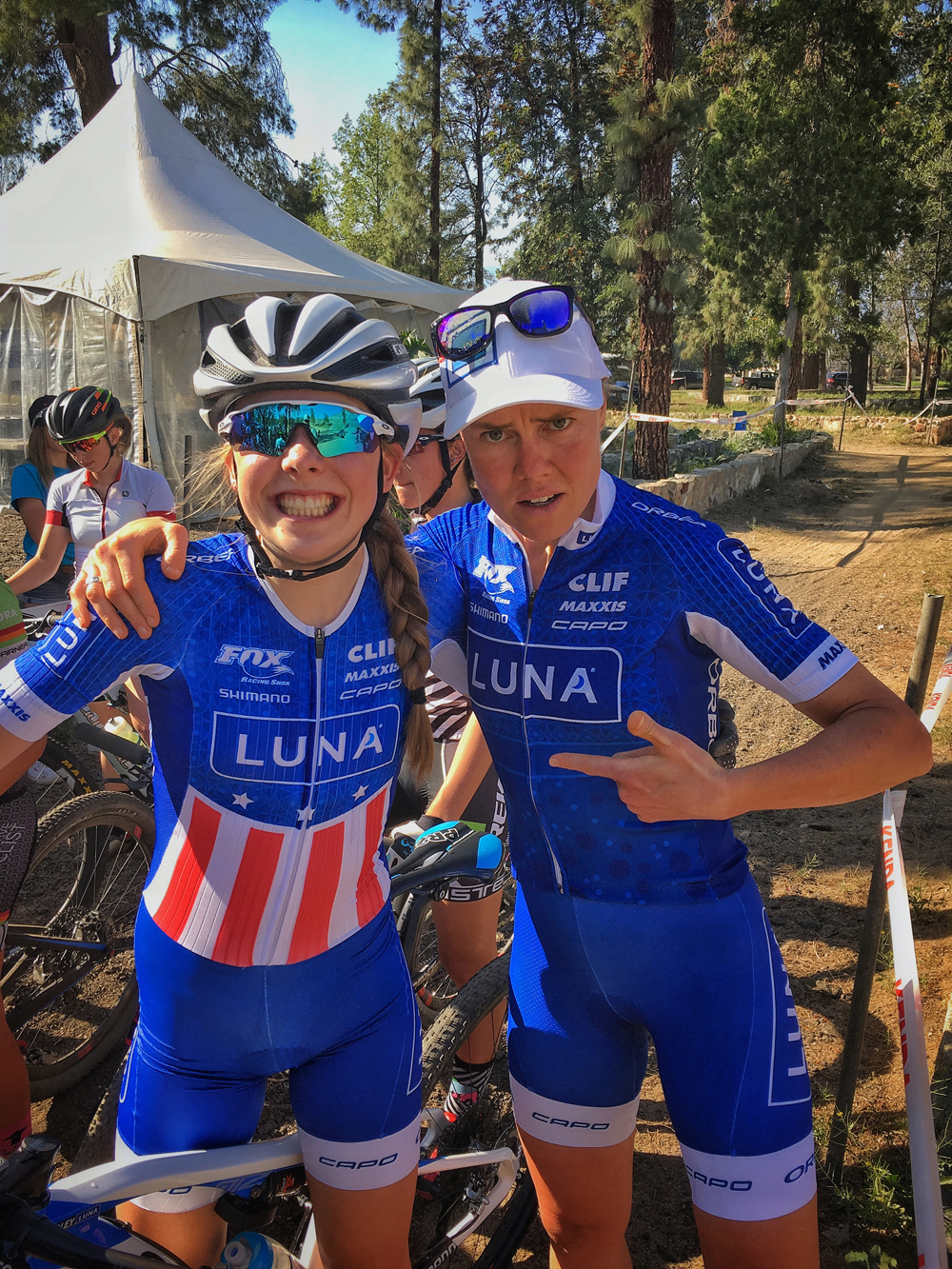
Haley Batten of Park City competes internationally as a member of both the Luna Chix Pro Team and the US National squad, and is an accomplished XC ski racer. She automatically qualified for a berth on USA Cycling’s World Championships Team; UCI “Worlds” will be held June 28-July 3 in Nove Mesto Na Morave, Czech Republic. Other Utah racers who have qualified for the 2016 World Championships are Rachel Anders (Sandy, also competing in the Junior Women category Team Summit-Competitive Cyclist), who is serving as our Worlds correspondent, and Keegan Swenson (Park City, U23 category, Team Cannondale-360fly p/b Sugoi).
Haley’s palmarès
2016 Jr 17-18 winner at Swiss Cup in Gränichen, Switzerlan
2016 Jr 17-18 winner at US XC Pro Tour in Bonelli, CA
2016 Jr 17-18 winner at US XC Pro Tour in Fontana, CA