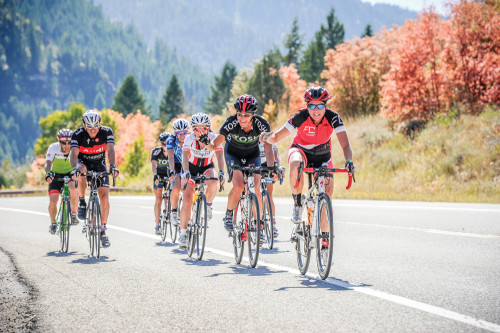
If you build infrastructure, will they come? Will residents of Indian reservations be more inclined to ride bicycles– and advocate for bicycling – if their communities built a more friendly bicycle infrastructure? Or will reservations become more bike-friendly only if residents want it and work for it? And do tribes, state and federal governments and bicycle advocates need to work more closely together to improve cycling conditions for the Native American community? If ever an underserved community could use a hand to promote bike riding, it consists of the Native American one.
A major problem: roads on reservations tend to be in terrible shape and not equipped for bicycling. Congress has made some efforts to help. The Fixing America’s Surface Transportation (FAST) Act signed into law late last year is supposed to make it easier for tribes to get federal transportation money without the added burden of dealing with state transportation departments. Also, FAST created a new $100 million Nationally Significant Federal Lands and Tribal Projects program of grants to build and rehab transportation facilities on federal or tribal land. The Federal Highway Administration (FHWA) hasn’t awarded any grants yet and applicants must follow a set of rules and preferences, but tribes with innovative ideas that include bicycle lanes could get some money. The criteria include improving “critical transportation facilities, including multimodal transportation facilities.” See https://www.fhwa.dot.gov/fastact/factsheets/nsfltpfs.cfm.
The law also calls for a multi-agency study of traffic safety on Indian reservations to be completed within a year. While the report would have to deal with matters such as drunk driving and pedestrian safety, it does not mention bicycling. (The law doesn’t rule out exploring it as part of the study, though.)
Furthermore, the Senate Committee on Indian Affairs approved a bill to relieve road conditions for Indians. The Tribal Infrastructure & Roads Enhancement & Safety (TIRES) Act (S. 1776) contains a variety of administrative measures to speed approval of traffic projects in Indian country and calls for studies on safety. But it says very little about bicycling, as if it’s not important.
The bill does allow for expedited permitting and approval of Tribal Public Safety Projects (federal agencies would have to decide within 75 days maximum on go-aheads). Such projects can include “installation and maintenance of signs, including fluorescent, yellow-green signs, at pedestrian-bicycle crossings and in school zones (and) construction and yellow-green signs at pedestrian-bicycle crossings and in school zones.”
In other words, the bill may allow for quicker approval of bicycle safety markings around schools and at crossings in Indian country. Nothing in the bill would deal with the paucity of bicycle facilities. Its only other consideration of cyclists states that if rural public safety projects include rumble strips or other warning devices, such devices could not interfere with bicycle safety.
The committee approved the bill and it was placed on the Senate calendar for a vote Feb. 29. The full Senate had not acted as of late April, though, and no similar legislation is pending in the House.
The committee did not even conduct a hearing on the bill. A year ago, however, it did hear testimony on the decrepit state of roadways on reservations. The only specific mention of biking came when J. Michael Chavarria, governor of the Pueblo of Santa Clara in New Mexico, stated that a “crucial part of road safety in our area focuses not only our drivers, but on pedestrians and bikers as well.” Chavarria was referring to a two-lane highway where autos zip through his village of about 1,000, putting bike riders at risk.
Chavarria did not elaborate in his testimony but said in an interview that about 14,000 vehicles zip through town daily because Santa Clara lies on the commuter route to Los Alamos National Laboratory. He has been trying, thus far unsuccessfully, to get the State of New Mexico to put in a sidewalk and bikepath. “We have a school crosswalk but folks don’t respect the signage,” Chavarria complains. “We’ve had accidents….People are in a rush to get to work or to get home from work” so drivers will take the shoulder to pass vehicles in front of them.
But overall, the 2015 Senate testimony indicated that tribal roads are hardly the best places for a bike ride. Rick Kirn, a tribal executive board member on the Fort Peck Reservation in Montana, testified that “Of our 211 miles of Bureau of Indian Affairs (BIA)-owned roads, over half are gravel and dirt routes. Thus, the majority of our transportation infrastructure is outdated and in need of upgrade (paving) while the rest of the infrastructure is owned and maintained by the state and county governments which often do not maintain and reconstruct their roads on the reservation with the same diligence as they do elsewhere in the state. When overstressed and under-maintained, our infrastructure gives way, creating safety hazards….” As Kirn alluded to, the mix of responsibility over the roads leads to disorganization, as everyone from BIA to FHWA to state, county, city, tribe and even private operators can own any given stretch.
Big John Smith wears several transportation hats (wish we could say they include a bicycle helmet). He serves as transportation director for the Eastern Shoshone and Northern Arapaho tribes’ Joint Business Council on the Wind River Indian Reservation in central Wyoming as well as Rocky Mountain regional representative on the Tribal Transportation Committee and executive director of the Intertribal Transportation Association. He echoed Kirn’s concern, telling the committee “if your roads are icy and full of dangerous curves and gigantic potholes because you don’t have the money to maintain them and if you don’t have proper signage and wide shoulders, you can educate people until the cows come home. You won’t have safe roads….”
To worsen the situation, not only are many tribal roads not built to accommodate bicycles, thorns from plants along the road easily pop tires and livestock and wildlife get in the way. Towns tend to be spread out and activities concentrated on main roads, which are not the most conducive ones to ride on.
The unique problems of tribes have sometimes fallen beneath the radar of bicycle advocacy groups who have taken up promoting bicycling among other under-represented groups, from those living in high poverty zones to women and even specifically black women. Representatives of the League of American Bicyclists (LAB) expressed sympathy for the idea of helping Indian communities though they said they hadn’t specifically targeted them. Think of LAB’s Women Bike program for instance. Black Girls Do Bike, Inc., has set up dozens of chapters around the country. This correspondent attended LAB’s 2016 Bike Summit and Women’s Forum in Washington, DC as well as ones in most recent years and does not recall seeing an Indian representative.
“I travel the country helping communities become more bicycle friendly,” normally to places trying to achieve or upgrade Bicycle Friendly Community (BFC) status, says Steve Clark, LAB BFC program specialist. “I’ve never gone to a reservation and maybe that’s something I should consider doing.”
Actually, last year, the Jamestown S’Klallam Tribe in Washington state became the first Indian tribe to win Bicycle Friendly Community status. It won Bronze. LAB quoted Annette Nesse, S’Klallam’s chief operations officer, saying that the tribe works with other local communities on matters such as a bikepath that runs through them all.
Many smaller tribes lack the staff resources to pursue available funding and administer programs if they could get a grant, notes Michelle Lieberman, technical assistance project manager for the Safe Routes to School (SRS) National Partnership. They can get overwhelmed dealing with multiple state and federal transportation agencies. “In some cases, they are covering large geographic areas,” she says. She suggests tribes partner with other tribes or neighboring communities, which some have successfully done to get and implement a grant. (In the interview, Chavarria, for instance, indicated he was unaware of funding possibilities such as SRS.)
“I think it is up to all of us to do a little more in terms of understanding that there is a great need for tribal communities in terms of infrastructure and programs to support active transportation,” Lieberman says. It could mean providing technical help to walk them through the grant process.
The partnership has produced a pamphlet outlining the unique challenges to implementing SRS on tribal lands: http://saferoutespartnership.org/resources/fact-sheet/tribal-brief. It suggests incorporating SRS into tribal transportation plans and school health and wellness programs.
A BIA spokesperson in Washington, DC said the national office hasn’t established a policy or program to promote cycling for Native American tribes.
The Bicycle Collective, which refurbishes bicycles and donates them to needy people in Utah, has given 80-90 bicycles to Indian communities, says (former) Executive Director Davey Davis. “Whenever a reservation-based group has contacted us for free bikes, we sent them out. It really depends on if someone is available to transport them,” he says. Demand also has to come from within. “What I’d like to see is a group of people interested in starting a Bicycle Collective branch in a reservation. We’d support that wholeheartedly. We can’t send in employees because we don’t have time.” The collective maintains branches in Salt Lake City, Ogden, Provo and Westminster. “We can’t do it without a group of local people who really want to see it happen,” Davis notes.
It’s happening in a few places. The Navajo Nation’s Division of Natural Resources is trying to set up some bike trails and races, says division Executive Director Bidtah Becker. “We’re still in the beginning stages,” she says. “We’re still working on who, what, where, when.” The nation encompasses more than 27,000 square rural miles in Arizona, Utah and New Mexico.
By Ian Scharine – It has been another busy summer for the Salt Lake County Bicycle Advisory Committee, and as we greet the fall great news has been announced. Scarcely three months have passed since Salt Lake, Weber, Davis and Summit counties applied for a federal Tiger Grant. These types of grants are challenging to attain with only a handful of communities across the country being awarded funding based on their applications. In a fortuitous instance, all parties from Utah were chosen to receive the funding requested. The combined matching funding from Salt Lake and the surrounding counties amounts to approximately $80 million in funding which will be invested over the next several years.
What this means for Salt Lake and its neighboring counties and commuters is that improvements to transportation and infrastructure will now have critically needed funding to develop. As these funds are delegated to public resources and projects, residents can expect improvement of roads, walkways, facilities and Active Transportation options. Additionally, it will be critical for citizens to pay attention to announcements during the next several months regarding public meetings and planning strategy announcements. As recipients of this federal grant money it is important that our county administrators have feedback on how and where it will be spent to best serve citizens.
Another encouraging development was announced by Bike Utah as the school year prepared to open. The Youth Bicycle Education and Safety Training Program will offer an informal approach to reaching out to 5th -7th grade students throughout Salt Lake County. This program has SLCBAC’s support in assisting efforts to contact afterschool programs, PTA organizations and school administration. We believe that it is imperative that future generations realize the potential and benefits bicycles and Active Transportation offer. Bike Utah’s program will target a young demographic to introduce safe and healthy practices in riding and interacting with other traffic on bicycles. If you are involved in school programs or have students at a school and would like to receive training, please contact Bike Utah at [email protected].
Below are the remaining SLCBAC meetings for the 2016 year. The public is encouraged to attend these meetings held on the second Wednesday of each month at the County Government Center. More information can be found on our website at: www.slco.org/bicycle
By Turner C. Bitton – Senator Todd Weiler has served in the Utah State Senate since his appointment in January of 2012. Since that time Senator Weiler has distinguished himself as a unique and enigmatic member of the Utah Senate demonstrating both an independent streak and a commitment to the conservative principles that he has repeatedly cited as a reason for seeking elected office.
Senator Weiler represents district 23 in the Utah State Senate, an area that includes Bountiful, Woods Cross, and Northwestern Salt Lake City. In his time representing district 23 Senator Weiler has proven to be interested and generally supportive of efforts to support cyclists and has supported increased bicycle education programs as well as increased funding for bicycle infrastructure and programs. I recently discussed bicycle issues with Senator Weiler.
Sen. Todd Weiler with his wife Elizabeth. He often brings forward bike bills in the Utah State Senate. Photo courtesy Sen. Weiler
You have a reputation for being a cyclist and supporting cycling issues on Utah’s Capitol Hill. Is it accurate to say so? Can you share your personal experiences with cycling?
Well, I rode 19 miles to work today and I commute by bike to work as much as possible. I enjoy cycling because of the health benefits and I love listening to books or music while I ride. I usually ride along the Legacy Trail and along trails in Kaysville. I used to ride more on streets but have been hit by several cars, no joke! Most of the accidents are fairly minor but a few have had the potential to be more serious. I’m a bit unique in that I ride a mountain bike even when I commute on streets because I like the feel of a mountain bike as opposed to commuter bikes. I like that a mountain bike offers me more control and safety than the thin wheels and tires of a commuter bike, especially given that I’m often riding across loose gravel when I commute by bike.
Have you commuted to Capitol Hill by bike before? If so what route do you take, and what is your motivation for commuting by bicycle?
Yes, during the session I typically don’t ride every day because my schedule during the session is too hectic to allow me to ride every day.
I was actually motivated to start commuting because gas prices skyrocketed and my wife put my bike in a pile headed to be donated to charity and so in a defiant moment, I started commuting. I learned quick that I was out of shape because I missed the FrontRunner train the first time I took a bike. Since then I’ve grown to love cycling and a few years ago I began organizing mountain biking groups on interim days. We’ll go up for a few hours during interim session and ride the trails above the Capitol.
You were on the Woods Cross City Council prior to being a State Senator. As a councilmember, much of your work involved the improvement, repair, and construction of transportation infrastructure. One of the key areas of interest to cyclists are the so-called “Bicycle Networks” that are included in the 2015-2040 Regional Transportation Plan (RTP). How has your role as a State Senator integrated with the work of the Wasatch Front Regional Council and other local governments?
To be honest with you, I was on the Woods Cross City Council from 1999-2003 but I didn’t begin cycling until after that. Much of my planning at the time focused on getting a FrontRunner Station in Woods Cross. At the time, my city council work didn’t involve much work with bicycling as it relates to the WFRC.
I haven’t had a lot of WFRC interaction other than when I was on the board of the ULCT and we pushed for bike paths and trails.
You sponsored SB121 “Electric Assisted Bicycle Amendments” and during the process facilitated dialogue between cycling advocates and the so-called “ebike” industry. During this process several substitutions and changes were made leading many to believe you had balanced different interests in a positive way. Can you share your experience with this effort and provide some insight into what SB121 will do?
I was approached by several stakeholders and we made several amendments and during the process we attempted to balance the various interests and people. I’ve been surprised by the antipathy I’ve gotten from cyclists that are upset by ebike users on trails. I hope that cities with use the categories we created during the session to better implement bike trails and balance the interests of both ebike and traditional cyclists.
I believe that balance is needed in this and other issues. That is what we tried to do with SB121. We attempted to strike a balance with all stakeholders. Ultimately, we want to encourage as many people as possible to get on a bike that works for them and enjoy our state.
At the end of the session, your Bike Utah Clean Air for Kids funding request ultimately did not receive funding because of timeline issues. Do you plan to reintroduce this request?
Most likely yes. I was disappointed that my funding request didn’t pass and believe the program deserves financial support from the legislature.
Lastly, are there any issues or legislation you expect to see in the 2017 session? Do you plan on sponsoring any specific legislation related to cycling? Is there anything you would like to share with your constituents or our readers?
Well, I’ve had 5-6 bikes stolen from me over the past decade so preventing bicycle theft is of particular importance to me. In fact, I had a $1,500 bike stolen from me in Salt Lake City. After it was stolen I started visiting pawn shops to try to find mine. I never did but I did end up purchasing several bikes over the years in the process. Preventing bike theft is important to me and I would welcome the opportunity to address the issue further.
I do expect that Representative Lee Perry and myself will work to allow cyclists to “roll through” a stop sign or stop light if it is safe to do so. This would be similar to yield signs for vehicle and I believe it balances the responsibility of cyclists with our goal of letting people commute in an efficient and timely manner.
Four years ago around this time I finished my first ever mountain bike race, the high school race at Sherwood Hills. I remember being at the start line, excited and nervous and terrified, wondering if it was too late to drop out. I remember recognizing a girl I hadn’t seen since the 3rd grade, Kylee Shaffer, who greeted me like no time had passed. “This is gonna be SO fun!”
I don’t think I considered that first race “fun” until it ended. I hadn’t eaten breakfast, and I bonked so hard after the first lap that I had to walk my bike the last mile just to finish. But none of that mattered afterward; the line was cast and I was hooked.
The next four years I fell more and more in love with mountain biking, and so did a couple thousand other high schoolers. I was on the Cottonwood-Hillcrest-Olympus team my first two years, and my coaches Vic Ream and Bart Gillespie really encouraged me to ride as much as possible. Later it was the never-ending support from Drew and Lucy Jordan on Salt Lake Composite. In tenth grade I joined Summit Bike Club and soon, where before I’d only ride once or twice a summer, now I was riding almost every day.
By my junior year, I realized my circle of friends was a divided one, with mountain bikers on one side, and a few randoms on the other. I noticed my adjectives were now limited to either “rad” or “gnarly”, and I learned to love those awful tan-lines. But most of all, I found a new confidence throughout high school knowing that I had this unique skill that not many others had. I had an amazing sport that I knew I’d keep for life.
Meanwhile the Utah League grew from 300 to 1100 racers in four years, making it the largest league in the nation. I grew, too, in those four years — into a stronger person, both mentally and physically.
I’ve biked through heat, rain and snow, pedaled up peaks and flown back down them. I’ve crashed and bled and been helped back up, and I’ve watched others do the same. At almost every high school race there is some story of a student stopping during their own race to help out a fallen rider. Racing taught me the value of competition and hard work; riding taught me the love of a community and the outdoors.
At the St. George banquet last fall marking the end of my time with the Utah League, I considered avoiding the League’s founder Lori Harward at all costs, because I knew I’d be a sobbing wreck. When I finally did find Lori alone for a few seconds, I hugged her and choked out a thank you that was probably indiscernible. So here it is again Lori, from me and 2000+ high schoolers: thanks for changing lives.
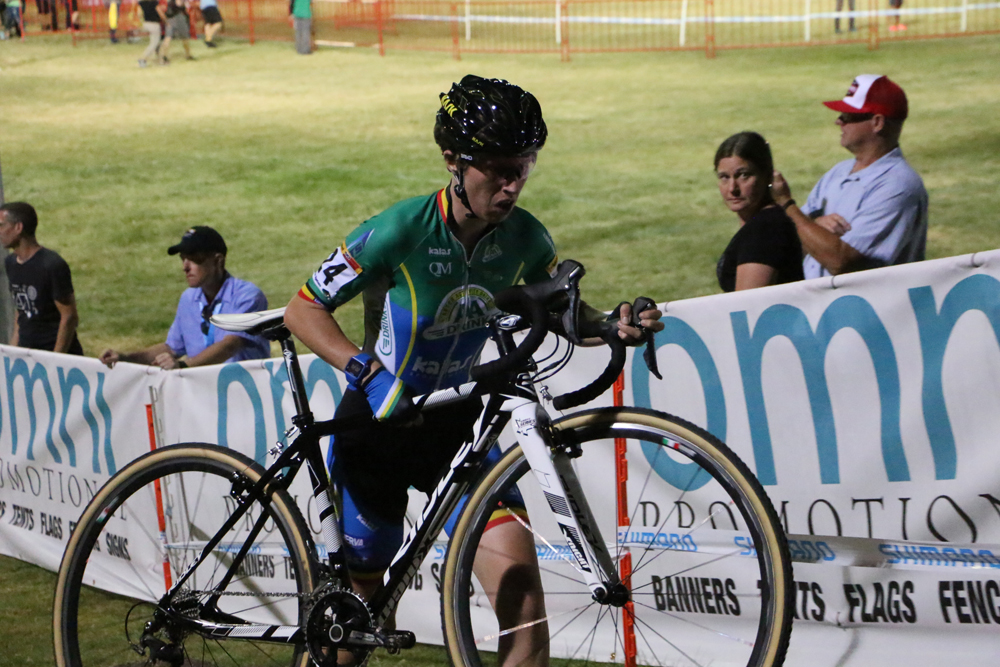
Wout van Aert makes it two while Sophie de Boer makes up for last year
By Paul Skilbeck
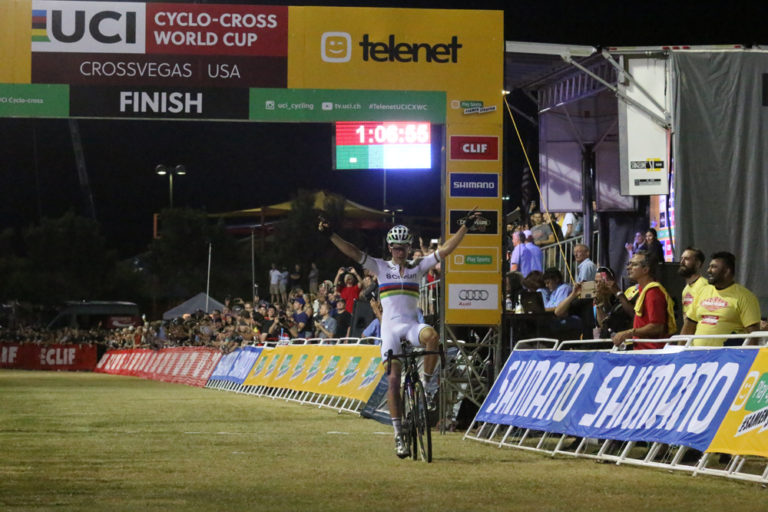
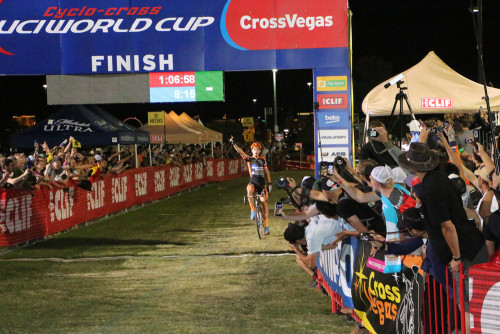
September 22, 2016 – Las Vegas, NV – Spectators at the 2016 Clif Bar Cross Vegas UCI Cyclocross World Cup season opener, September 22, were treated to the most exciting bicycle race action yet seen at the Desert Breeze Sports Complex, on an uncharacteristically cool and humid evening that threatened thunderstorms throughout.
The weather may have remained calm, but in both the Elite Men’s and Elite Women’s Telenet World Cup races, on a shorter, tougher 2.8km course, electrifying battles enthralled the spectators.
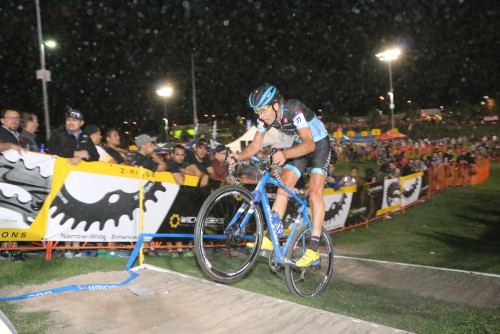
Wout van Aert, the reigning UCI world cup and world champion, was heavily favored going into this race, coming off two consecutive victories at high profile events. He convincingly won the Clif Bar Cross Vegas last year, yet a repeat suddenly looked uncertain when he took a tumble on a stepped run-up early in the race. Michael Vanthourenhout decided to make the most of the opportunity and rode away from the field in a solo move that at one point had him around 20 seconds ahead of van Aert.
“I was not as concentrated as I should have been. It was a stupid crash,” said van Aert, who at the post-race press conference was still suffering pain from that fall. On remounting, his focus turned immediately to regaining control of the race and trackside spectators reported expressions ranging from indignation to anger animating his face.
Utah resident Sofia Gomez Villafane on the stairs at the 2016 Cross Vegas World Cup. Photo by Dave Iltis
Image 1 of 9
Utah resident Sofia Gomez Villafane on the stairs at the 2016 Cross Vegas World Cup. Photo by Dave Iltis
Riding as van Aert put it “on adrenalin,” it was impressive how well he impersonated a maglev train, skimming over the Las Vegas grass as he cut through the deeply talented field with an ease that cannot have brought much joy to those that would seek to match him.
Van Aert soon made it to the head of the chase group and quickly rode clear, still on a mission to rein in the plucky Vanthourenhout. Laurens Sweeck was the only one capable of going with him at this point, and shared some of the work with the world champion.
“When Wout made it up to the front, I realized I had to go with him,” explained Sweeck, who was not willing to squander the opportunity.
Yet once van Aert came up within a few seconds of Vanthourenhout he eased the pace, apparently allowing the hard-charging chasers back into the race. Vanthourenhout was soon absorbed with van Aert briefly going to the front as if to let his compatriot know the game was up, and with names like Toon Aerts, Quinten Hermans, Rob Peeters, Dan Hoeyberghs and Tom Meeusen among a group of 14, the front of the race had a distinctly Belgian feel about it.
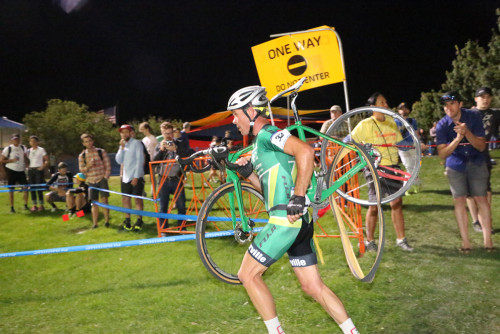
Sweeck was doing a lot of the work, but with less than three laps to go van Aert went to the front and attacked on the punishingly steep Hyper Threads staircase, taking only Vanthourenhout and Sweeck with him: apparently the three strongest riders on the night.
Van Aert didn’t stop attacking there. Sprinting into the Diamond Legal Group sandpit, which sloped uphill and awkwardly off-camber, the champion forced open a gap that grew massively when Vanthourenhout made an error, losing both his line and his balance.
From then on the gap opened at a surprisingly fast rate, and van Aert’s closest rivals must be wondering what it’s going to take to beat him this year.
The sandpit saw more attacking action a lap later, where Vanthourenhout opened a small gap over Sweeck and held it to the line.
“I looked back and Laurens was 20 meters behind me, so I just gave it everything, I was confident I could keep that gap,” he said.
Elite Women
Earlier in the evening, the women had brought the vocal crowd to fever pitch with a race of sustained uncertainty, ignited by the first lap attack of Clif Bar rider Catherine Pendrel, which went all the way to a thrilling three-rider sprint.
Pendrel went out so hard and fast that only three riders were in the chase group: two-times world cup winner Katie Compton (Trek), Pendrel’s team-mate Katerina Nash, and Dutch rider Sophie de Boer.
With Compton doing much of the work to slowly reel in Pendrel, and Nash not taking any turns on the front, it might have appeared that Pendrel was working for her team-mate, but Nash later refuted this saying “There’s never a plan! I knew Catharine was strong and she has great endurance. I thought she could do anything, so I just waited in the first few laps to see what happened.”
Compton was confident of catching Pendrel. “II wasn’t worried when Catharine Pendrel was leading. It was too early. When the lead approached 20-25 seconds I decided to shut it down,” she said, and that’s what she did.
After the catch, Pendrel didn’t stay long with the trio that had been chasing her, but these three riders were hard to separate.
On the last lap it seemed that de Boer had come unstuck, when she struggled on the steep Hyper Threads climb, letting a small gap open to her companions. “I thought it was all over when they gapped me, but then I saw them looking at each other and I knew I was faster than them through the sand. I knew I could close the gap.”
De Boer’s reunion with her race-long companions couldn’t be called friendly. She attacked both of them in a determined effort to be first on the tough Focus stairs leading up to the finish straight.
Event organizer Brook Watts had placed these stairs deliberately in an effort to break up any parties that arrived intact for the sprint to the line.
“I thought it was good to be first into the final step. But Sophie punched it by me and got there first. We all had the same idea, I guess,” said Nash after the finish.
For de Boer, those stairs were key. “I know I have an OK sprint, so I thought if I can reach the top of the stairs first, then I had a good chance,” she said. In the charge down the finish straight she never looked like being passed.
“I didn’t know what to expect coming into this race. Last year when I raced here I had OK form, but at the end of the first lap I was dead, I finished I don’t know how far back. So it was hard to have expectations coming here. It is very special to win, and it makes it well worth the trip here,” said de Boer.
It’s hard to imagine that anybody who attended the event disagreed it was well worth the trip. When you see race action like tonight’s, it’s immediately clear why cyclocross is such a popular sport.
Results:
Elite Men
1 VAN AERT Wout 1:06:53
2 VANTHOURENHOUT Michael +00:23
3 SWEECK Laurens +00:26
29 DRISCOLL James USA +03:58
37 PAGE Jonathan USA +05:18
39 LINDINE Justin USA +05:48
Elite Women
1 DE BOER Sophie NED 0:47:11
2 NASH Katerina CZE LUNA PRO TEAM +00:00
3 COMPTON Katherine USA +00:00
4 MILLER Amanda USA VISIT DALLAS DNA PRO CYCLING +00:19
By Dave Iltis – SRAM’s Force 22 road component set is a winner, especially the brakes! 22 gears are a perfect setup for riding in the West.
There are things you want to notice on your bike – beautiful scenery, other cyclists, cars, how hard the headwind is, or the next hairpin on the climb. And, there are things you don’t want to notice – like pretty much everything on your bike. Your bike should be a smoothly working, integrated machine that you don’t notice at all. SRAM Force 22 has reached that point where you don’t notice it on your bike – it’s just about perfect!
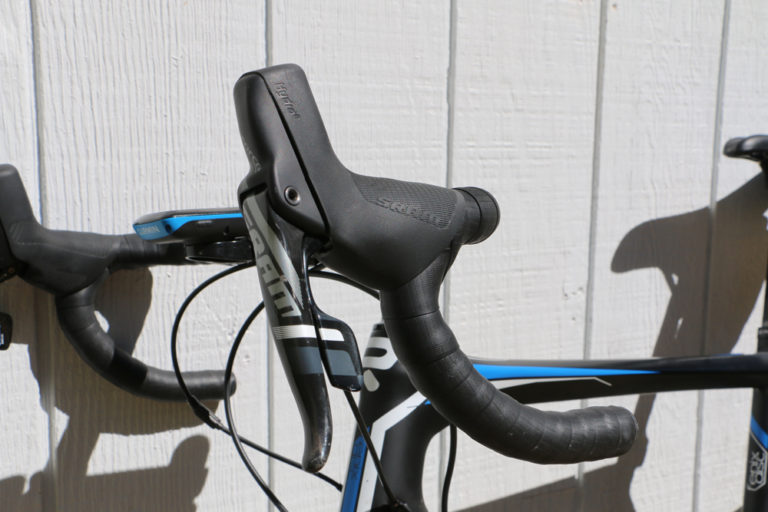
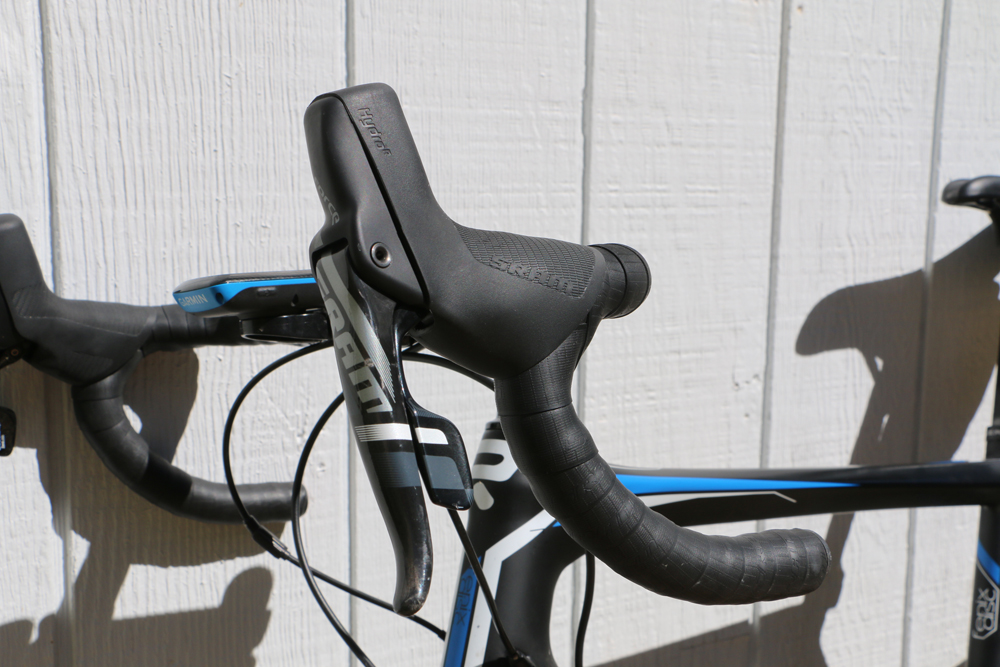
SRAM’s Force Hydro-R disc road levers provide smooth actuation of the brakes and positive and fast shifting. Photo by Dave Iltis
I have been lucky enough to ride Force 22 for the past year. My bike, a Ridley Fenix Disc, is set up with Force 22 throughout. The shifting is smooth and precise – move the DoubleTap levers a little to shift to a harder gear, move it a bit more to shift to an easier gear. The two actuation levels are easy to use, and result in shifting that you just don’t notice – it just works. One feature of the DoubleTap that I really like is that it’s controlled by just the inner lever while the brake lever remains solid and aligned. This gives a feeling of confidence when braking.
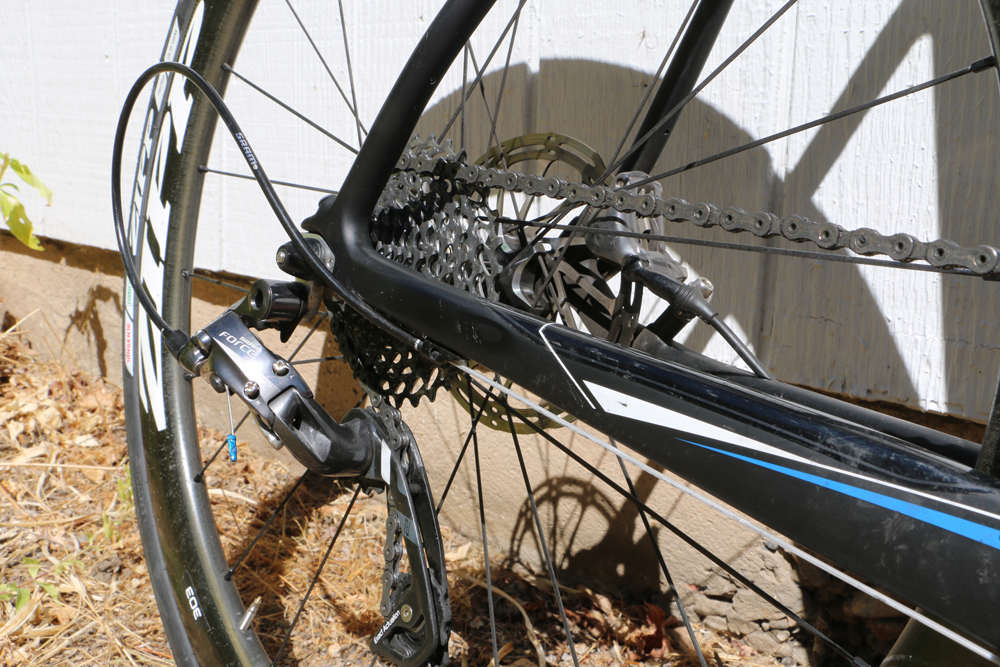
The drivetrain of is set up with Force 22 cranks, SRAM Force 22 mid-cage rear derailleur, an 11-32 cassette, and the Force 22 Yaw derailleur.
The 11-32 cogset and WiFLi rear derailleur make a great combinantion for riding in the West. You can crush the flats and climb the Hors Catégorie canyons. Photo by Dave Iltis
With the drivetrain, there are some key features that make this a great setup for the Western States. The biggest one is that with 11! cogs in the gear range of 11-32 combined with a compact 50-34 set of chainrings up front provides the range you need to not only crush it on the flats and max out speed on the descents, but also to climb the canyons and mountains that are throughout the Rockies, Wasatch, and Sierras. When I raced long ago, I may not have needed the extra gearing (but it would have been great for races like the Iron Horse, or Big Cottonwood Hill Climb), but now it allows me to sit and spin throughout most climbs (yes, I do mix it up and stand and climb too). It is a far and welcome cry from the 39-23 gearing I used to have. The 11 cogs have the following gear set-up: 11-32: 11, 12, 13, 14, 15, 17, 19, 22, 25, 28, 32. As you can see, in the smaller cogs, there is a straight block from 11-15, and smooth steps from there up to 32. For those of you wanting a tighter range, SRAM provides cassettes in 11-25, 11-26, and 11-28. These options notably provide a 16 cog for spinning on the flats. Again, the gearing is something that you just don’t notice, it just works.
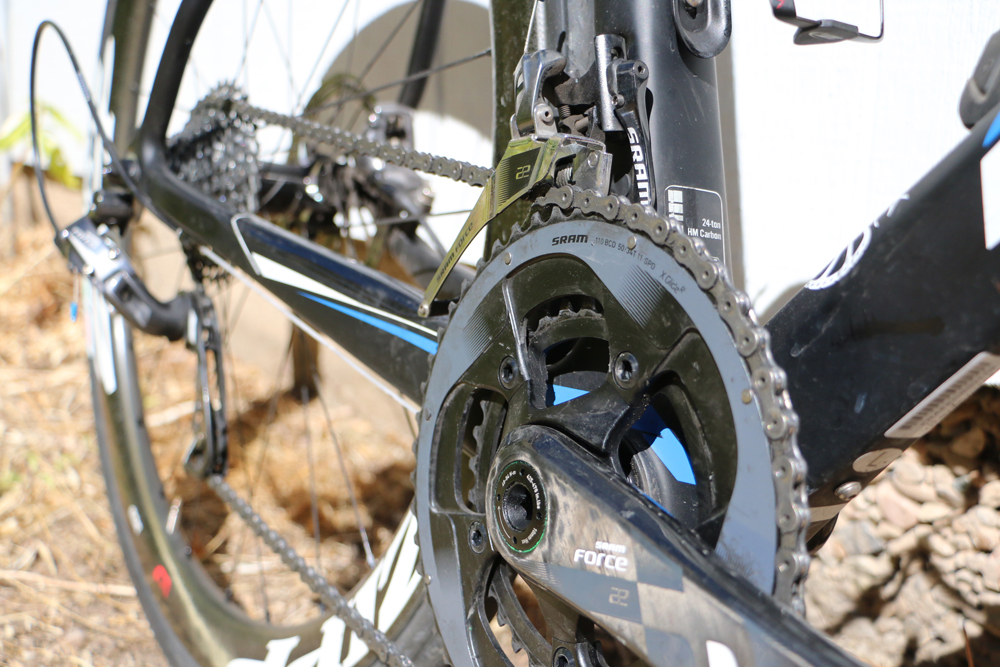
The Force 22 drivetrain works flawlessly. The YAW front derailleur means never having to trim the front derailleur again. Photo by Dave Iltis
The Force 22 front derailleur has ‘Yaw’ technology. This eliminates the need to trim (a small shift so that the chain doesn’t rub) the front derailleur while in the big-big chainring cog combination. Again, this a feature that you don’t notice while riding, it just works.
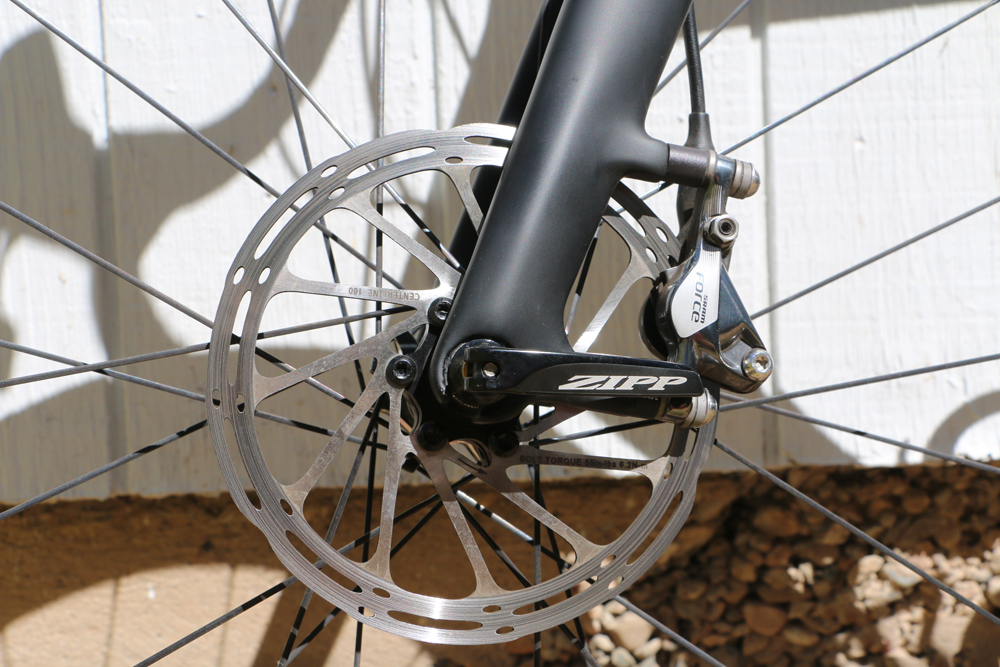
There is something about SRAM Force 22 that you will notice – the brakes. My bike is set up with the Force 22 HRD hydraulic disc brakes. These brakes are by far the best brakes I have used on a road bike. By far. For the last 8 years or so, I have ridden carbon wheels with rim brakes. The bottom line with the rim brake/carbon combination is that it’s hard to stop on long mountain descents, and when the road is wet. This, even with improvements in brake pads. Not so with the SRAM hydraulic disc brakes. Braking on a road bike can now be as positive and strong as on a mountain bike, where hydraulic disc brakes have been around since the mid-90’s and were fully adopted in the 2000’s. What took roadies so long to see the light? No doubt a large part of this is that the engineering that goes into creating a brake/shift/hydraulic reservoir lever is phenomenal. All of that technology needs to be packed into a very small volume. Another large part of the delay is that roadies and especially racing roadies are a cautious bunch that sometimes take awhile to adopt new technologies. Disc brakes weigh a little more, and do have a sharp rotor that some pro cyclists have expressed concern about (after a brief trial this past spring, disc brake use was halted in the pro peloton after an injury that may or may not have been caused by a rotor). Regardless of that, disc brakes are a great choice for almost all road cyclists. They have incredible stopping power in wet and dry weather, and really are only a little heavier than rim brakes.
SRAM’s Force 22 hydraulic disc brakes will make you never want to go back to caliper brakes. They are that good. Photo by Dave Iltis
Another bonus with the SRAM HRD brakes is that they are smooth. The actuation is similar to that of a rim brake, and they are easy to get used to. This means that when you trade up from your existing rim brake, they take almost no time to get used to. Unlike rim brakes, they are very, very powerful and take less force on the lever to slow down. All of this translates into safer and more precise descending, and to better wet weather handling.
Hopefully it is only a matter of time before hydraulic disc brakes are ubiquitous on road bikes, including those in the pro peloton. They truly are a game changer, and SRAM’s version are at the forefront. After riding these, I have no desire to go back to rim brakes. Note that if you want to switch, you will need a disc-compatible frame since they can’t be retrofitted on a frame built for rim brakes.
The brake levers are the main point of contact with your hands and your bike, and so a comfortable ergonomic fit is key. The SRAM levers deliver on that – they feel great, and again, on long rides, they are a part of your bike that you won’t notice – they just work. A couple of key features in the levers are that they have a reach adjustment, which is great for those with smaller hands. Additionally, they are easy to bleed (have your bike shop mechanic do this if you are not an expert), with the bleed valve located just under the brake hood.
SRAM Force 22 is not SRAM’s top of the line group, but it might as well be. This is an awesome setup that anyone from a pro level racer to recreational rider will benefit from using. You will find it spec’ed on many high-end and mid-range bikes. It’s also reasonably priced. All in all, I would highly recommend it, and give it five stars.
Another chapter in the global spread of cycle sport began with emphatic victories for Belgium’s Wout Van Aert and Czech Katerina Nash when 120 Elite cyclists from 20 countries contested the first-ever North American UCI Cyclocross World Cup race, the Clif Bar CrossVegas on September 16, 2015.
It was an auspicious start for World Cup cyclocross in North America. A crowd estimated at over 12,000 showed up to watch the night-time race, the competition was fast, tactical and exciting, and the strong international field of athletes commented on how much they enjoyed racing in front of these noisy, yet non-partisan spectators.
Raleigh Clement rider Jamey Driscoll commented on the depth of the field and the course, “It was so deep. It seemed like the first half seemed easy. But then when they wanted to race big gaps were opening. This surface, even though it’s flat, unless you’ve ridden it, it’s so deceiving how challenging and sapping it is. It’s similar to mud or climbing. The gaps establish on a flat course much faster than you think.” He commented, “Everyone says that the American crowds are way more enthusiastic. They definitely are… Racing a big race on home soil is pretty amazing!”
With desert winds raking the grassy venue for the night-time race, the men’s field formed large, fast-moving groups. “It seems like it’s a really course with a lot of obstacles, but it’s not at all easy. The ground is really heavy. It’s a power course. You have to be pushing hard on the pedals always,” said race winner Van Aert (Vastgoedservice-Golden Palace). Veterans of this venue are familiar with the energy-sapping grass that comprises almost 100% of the 3.3km course. The only respite was a sand pit.
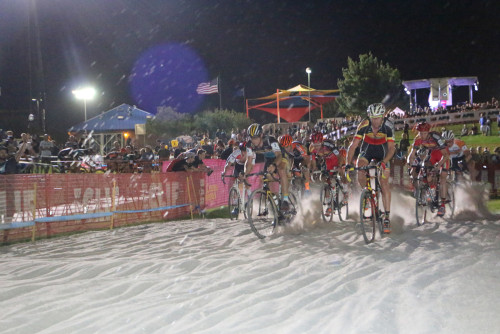
The leaders hit the sand pit in the 2015 CrossVegas World Cup in front of huge crowds. Photo by Dave Iltis
Driscoll had a slow start off the line, getting stuck behind a rider who couldn’t get into their pedal, and then got caught up behind “another half dozen at least crashes in front of me.”
Michael VanThourenhout (Sunweb-Napoleon Games), one of the emergent generation of Belgian and Dutch stars, lit up the race with a third-lap attack, riding away from a huge bunch of fast-moving riders and quickly opened a gap of 30 seconds.
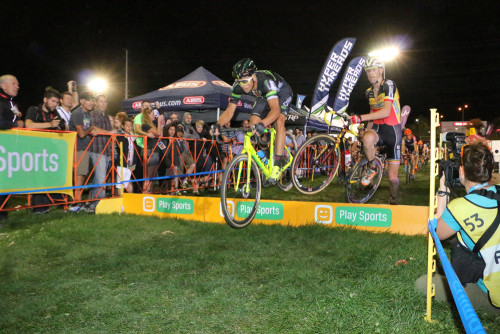
Sven Nijs bunny hops the barriers in the 2015 CrossVegas World Cup. Photo by Dave Iltis
Two-time winner at Cross Vegas, Sven Nys, bided his time for a couple more laps then set off in pursuit with Van Aert. “When I went to the front, I saw it was the right moment, the strongest rider in the peloton was on my wheel, I went, he went with me and we did a time trial to close the gap as soon as possible. It was good to have just the two of us escape from the peloton,” said Nys.
The gap was closed in under a lap and the leading trio stayed together for almost two laps, until Van Aert made his move.
“The hardest part of the course had three climbs close together so I attacked there,” said Van Aert, who quickly opened up a lead with his well-timed effort. “When I was alone in the last two laps it was really hard to keep my pace, and I was happy to see the finish line,” he said.
Race winner Wout Van Aert finishes in front of 12000 fans in the 2015 CrossVegas World Cup. Photo by Dave Iltis
Nys’ move had blown the peloton apart, and US national champion, Jeremy Powers, took advantage. “When Sven went away I had got swarmed and was too far back to go with him, so I had to force my own move, and it was great to be able to do that,” he said. Two riders went with Powers: young Dutch star Lars Van der Haar (Giant-Alpecin), and Belgian veteran Kevin Pauwels (Sunweb-Napoleon Games). Having done much of the work in the early part of this move, Powers was left a little short in the closing meters and had to settle for sixth place, but nonetheless was satisfied with his night’s work.
“It was a different level than years past because the depth of talent in the field was so much greater, and it felt great to be wearing the national champion’s jersey in the first cyclocross world cup in America,” he said.
Jamey Driscoll bunny hops the sand run up in the 2015 CrossVegas World Cup. Photo by Dave IltisUtah rider Jonathan Page runs it home following a tire blow out. Photo by Dave Iltis
Driscoll came in a respectable 28th place at 3:03 back. Utah rider Jonathan Page rolled a tire, and ended up finishing one lap down.
Women’s winner Katarina Nash (Luna) maintains her Czech nationality, but after several years living in the USA, by now Americans regard the San Francisco resident as one of their own.
The women’s race had boiled down to a leading group of five riders: Nash, Italian champion Eva Lechner, Belgian champion Sanne Cant, Georgia Gould (Luna), of the USA, and Canada’s Catherine Pendrel (Luna). Then with 1.5 laps to go Nash made her move.
She sped to a 50-meter gap in very short time, and held onto a lead that was 15 seconds by the finish.
“I never start to think about winning until I cross the finish line,” said Nash, “but I got a gap and then I pushed it really hard and I was happy to see that nobody came back. I’ve been to every Cross Vegas except one, and it was special to win this one that’s the first world cup race in the USA.”
Gould made an effort to go clear of the four-rider group on the last lap, but Lechner’s counter was the move that stuck. And the crowd appreciated her effort. “It was a really good race with a really nice atmosphere. The Americans were really cheering everybody, and I liked it a lot,” Lechner said later.
Belgian champion Sanne Cant had enough left to outsprint her two rivals from the Luna team to claim the third podium spot.
CrossVegas will again be the host of a World Cup in 2017. For details, see CrossVegas.com.
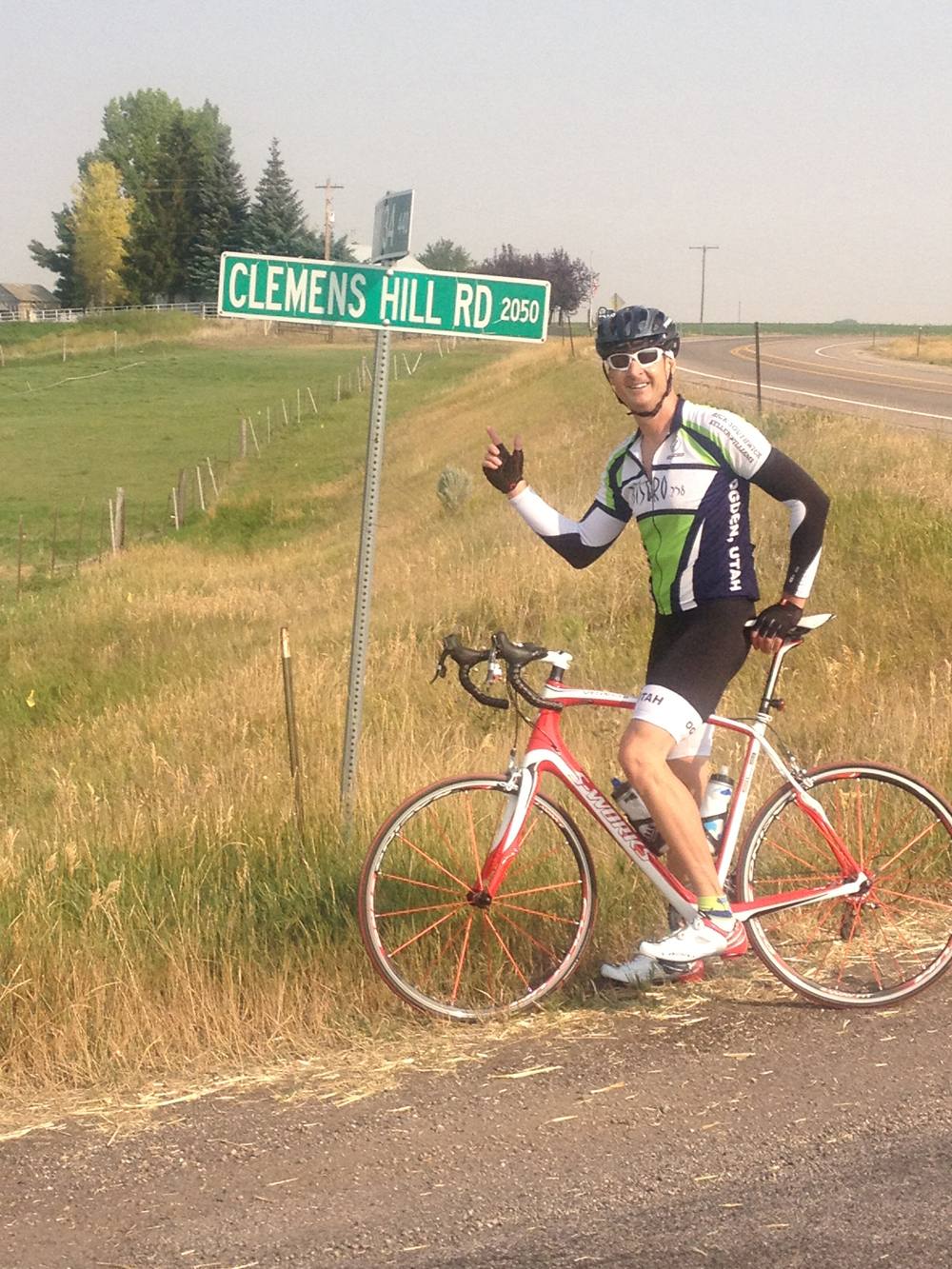
By Turner C. Bitton — Dr. Peter Clemens is a board-certified physician serving patients and the community in Ogden, Utah. He is also a retired Captain of the United States Army Reserves. Peter earned his B.A. degree from Brigham Young University in 1980, after serving a two-year religious service mission in West Germany. In 1986, he graduated from the Kansas City University of Medicine and Biosciences and completed his residency in 1989 at the Truman Medical Center at the University of Missouri – Kansas City. Peter and his wife Tammy are avid hikers and cyclists who cherish their time enjoying the beauty of Northern Utah’s outdoors.
Peter has been a near-daily bicycle commuter for over a decade and his commute has been widely documented by the Standard Examiner. Peter is running for Congress in Utah’s first congressional district. We caught up with Peter to talk about his experience as a commuter and his run for Congress.
You have a reputation for commuting to work by bicycle each day across Weber County. How long is your commute, what route do you take, and what is your motivation for commuting by bicycle?
I feel very strongly about encouraging the public to participate in the creation of alternative means of transportation for them in their daily commute. I’ve been riding my bike, even during the campaign when my schedule will allow it, from my home in North Ogden to my workplace on the campus of Ogden Regional Medical Center where I have worked for the past decade. Surprisingly even though my commute is roughly 30 miles round-trip the time I spend in my commute across town is only 20-30 minutes longer than when I drive my car. In the morning I travel Washington Boulevard south in part because people are frankly more courteous in the early morning than in the evening and I feel safer. In the evening my route is a bit less direct so that I can cycle through more neighborhoods. I have been hit twice in the last 10+ years, which may or may not be the universal experience of most cycling commuters, and therefore I welcome the Mayor Mike Caldwell and Ogden City’s Bicycle Master Plan which will make cycling safer by increasing the number of bike lanes and corridors for commuters and recreational cyclists alike.
You’re running for Congress in Utah’s first district. What is your motivation and how do bicycle issues factor into your agenda and campaign?
I would say that my motivation to ride to work rather than drive comes from three factors, likely the same ones that would be mentioned by most cycling commuters as their reasons as well. I commute for several reasons, the first is the exercise I get while commuting means that I don’t have to take leave of my family in order to build exercise into my schedule. I also commute to reduce congestion on our roads. Each time I commute by bike I’m eliminating a vehicle from the road and reducing air pollution, which is vital to reduce air pollution along the Wasatch Front. Finally, there is the issue of reducing my personal carbon footprint which is a core value for me personally. It also helps that I’m lucky enough to have a shower at work!
As it relates to the campaign I believe that leaders have the responsibility and opportunity to demonstrate leadership in their personal lives. I believe that commuting by bicycle is beneficial to our air quality and as a physician I understand the importance of clean air to our citizenry. Cycling is my way of proving that I’m willing to do my part, not just talk about it.
I’ve wanted to cycle to work with my colleagues for years because it is more fun riding with someone than alone so I’m really looking forward to being in Washington, DC and being able to ride to work with people like Rep. Earl Blumenauer from Oregon who chairs the Congressional Bike Caucus.
Do you plan on joining the Congressional Bike Caucus? Do you plan on sponsoring any legislation specifically related to bicycles if you are elected?
When I am elected I plan on joining the Bike Caucus. Just as importantly I’m trying to support Ogden’s leaders, in particular Mayor Mike Caldwell in all of his cycling initiatives. In addition to joining the Bike Caucus I will push for repairing our country’s aging infrastructure which will certainly help those who commute by cycle immensely. The American Society of Civil Engineers estimates that in 2016 we as a country are $1.44T behind in investing in our country’s infrastructure. Roads, bridges, airports, power grid, and other critical infrastructure are in need of repair and if we don’t act now the gap will grow to a near insurmountable $3.5T or more by 2050. This is of course not a partisan issue and Democrats and Republicans need to act to resolve the issue as quickly as possible. The same infrastructure improvements that motorists depend on is vital to cyclists as well. I look forward to working with anyone in Congress, regardless of party affiliation to resolve this issue, once I’m elected.
One other thing, I doubt that we’re going to be able to afford what we need to do to repair our infrastructure without cutting our healthcare spending. Other industrialized countries in the world spend significantly less than we do but get much better healthcare outcomes. As a physician I am ready to contribute to resolving healthcare and other spending issues.
One of the key areas of interest to cyclists are the so-called “Bicycle Networks” that are included in the 2015-2040 Regional Transportation Plan (RTP). Do you believe that as a Congressional representative you can aid the Wasatch Front Regional Council and local governments in implementing the goals of the RTP? How so?
While much in the RTP is local and state driven, I will absolutely fight for the federal funds necessary to help communities across Utah implement smart transportation initiatives and plans. I’m really excited about what Utah is planning and the tremendous positive impact these plans will have on our air and our economy. As our Mayor Caldwell is fond of saying, “when people get out of their cars they spend more money in our community and have a greater sense of belonging and well-being.”
Do you feel that your background as a commuter cyclist provides a unique perspective and benefit to voters in your district? Speaking specifically of voters concerned about cycling issues, what do you feel distinguishes you as a candidate?
For those reading this, I think it’s quite unique for them to have a candidate that they can support that lives and breathes what they are experiencing in their daily commute, in my case it’s on a bike! I’d love to get the vote of each and every cyclist in the district. I hope that those who can’t cast a vote for me will help in other ways to get me elected to Congress this November and assure you’ll have a strong ally in Washington, DC. For those mountain bikers out there, I am a big supporter of our trails and open spaces in our communities. As they say in cycling, I’m bilingual, that means I ride a mountain bike also. In fact, I’d better wrap this up as I need to hit the trail. See you out there on your bike!
Those interested in learning about Dr. Clemens can visit clemensforcongress.com. For more information about the Congressional Bike Caucus readers should blumenauer.house.gov
Turner C. Bitton is an avid cyclist and serves on the Board of Directors of several organizations and in many volunteer leadership capacities. He lives in Ogden with his husband Chase and their two dogs Charley and Moose.
By Charles Pekow – The entrance to the Moose-Wilson Corridor in Teton National Park may become friendlier for bicyclists. But the rest of the corridor won’t, local bicyclists are complaining. The National Park Service (NPS) issued a Comprehensive Management Plan/Final Environmental Impact Statement (EIS) for the section of the Wyoming park. It calls for adding a bike trail along the entrance road and more trailhead parking. But NPS will probably reject options that would have called for longer bike paths along the corridor. NPS released the plan Sept. 2 after a public comment period that solicited 34,370 responses from across the country and 15 foreign nations. (Almost all the responses consisted of form letters from environmental group members.)
NPS plans to finalize its decision in October. As is customary, it outlined four alternatives, including a preferred one. NPS noted that ecological conditions and use of the area have changed in recent years, necessitating a new management strategy. More people have been bicycling in the area since a shared -use pathway between Gros Ventre River and Moose Junction opened in 2012, for instance. The changes have led to increased conflicts between bicycles and autos. The area in question consists of about 10,300 acres in the southwest corner of the park. NPS is trying to come up with a management plan that will balance environmental and wildlife preservation with recreational use of the park. It wants to limit the number of autos that can enter at any time.
Alternative A, as is standard in these statements, would maintain the status quo, allowing bicycles on roadways when they are clear of snow and ice and in parking lots.
Alternative B would reduce the speed limit from 25 to 20 mph to reduce conflicts between motorists and bicyclists who share the roadways. The alternative would move the Death Canyon Trailhead and build a lot with parking for 60 cars. The plan includes increasing bike parking at popular destinations and more signage.
Alternative C, NPS’ preferred one which it intends to adopt, would do the same as B but but allow parking for 80-90 cars at the Death Canyon Trailhead. It would also call for building a multi-use trail between Moose and the Granite Canyon Entrance. The plan would forbid special events on the pathway and allow for closure during darkness or to manage wildlife. NPS would install a buffer between the roadway and path. The plan calls for a 10-foot wide path but does not specify the width of the buffer.
But bicyclists would have to continue sharing Moose-Wilson Road with drivers if they want to go further north. NPS would pave the unpaved portion of the road, which could make cycling more comfortable. The alternative calls for limiting the number of autos that could enter the area at a time and reserves the right to limit the number of bicycles “(i)f monitoring associated with indicators and thresholds demonstrates an increase in impacts on visitor experience or resources in the corridor due to bicycle use,” a situation that doesn’t currently exist. Under the plan, cyclists would use a separate path from Moose into the park and across an irrigation ditch and would be separated from autos at the entrance, explains Daniel Noon, chief of planning and environmental compliance for Grand Teton.
Alternative D would do the most to expand bicycling facilities, including building a multi-use trail along the entire Moose-Wilson Road. The 7.7-mile road serves as the primary route to popular visitor destinations, including Death Canyon and Granite Canyon trailheads. Such a trail would also connect with other popular destinations and compete a 30-mile loop connecting the towns of Jackson, Moose and Teton Village. Such a trail has been authorized since 2007. The trail would mainly say within 150 feet of the roadway, except when necessary to reroute it for environmental protection. But NPS doesn’t want to build it.
NPS also rejected a suggestion made during the public comment period that it add a one-way climbing lane for bicycles on uphill segments of Moose-Wilson Road (north of the Sawmill Ponds viewing area and within the Laurance S. Rockefeller Preserve) , as bicyclists slow down going uphill. NPS responded that adding the lanes would harm the environment and “historical character of the road,” as well as encourage motorists to park illegally.
“In the preferred option, we didn’t do the longer bike trail primarily because the resource impacts were so significant” Noon explains. “it would affect cultural resources, damage scenery and could lead to more surprise encounters with grizzly bears who could come out of the buffer and surprise folks, he adds.
The recently-released EIS notes that the increased bicycling and other visitor use have led to more interactions with grizzlies, black bears, wolves and moose. Park employees plan to increase education – such as providing info to cyclists at waysides when they enter the park that would warn them to stay 100 feet away from bears and how to ride the roads safety. “We would also close the corridor when grizzly bears are present until they are no longer in the area,” Noon says.
Grand Teton’s press office issued a statement saying work on the plan may begin next year but it could take a decade or more to fully implement “depending on funding and staffing.”
But the plan doesn’t please local bicycle advocates. Jackson-based Friends of Pathways wants the path extended to the preserve. While the preferred alternative lowers the speed limit, paving the road could encourage speeding, the group fears. “Generally the speeds are self limiting because the road is unpaved and winding and potholey. It is inconvenient for cycling” but the conditions keep the traffic slow, says Friends Executive Director Katherine Dowson. “Paving the road may make people go faster.” A lower speed limit won’t help unless NPS enforces it, Dowson warns. ”That will take staff and funding. I don’t know what kind of priority they’ll put on that….A sign just doesn’t do it.”
She also fears that NPS’ plan to limit the number of autos entering the park could strain other local roads. A solution would be to encourage people to ride bikes by increasing facilities for them, the group thinks.
And Molly Breslin, co-founder of Empowered Cycling, a Jackson Hole women’s cycling group, complained that NPS indicated it will include bicyclists and pedestrians when it limits the number of people who can enter the park at any one time. “We hope we get them to reconsider some things,” she says. “Maybe we can get some data next year about how many cyclists are using the roads.” And the scenery leads to distracted driving, increasing the hazards for cyclists, she adds.
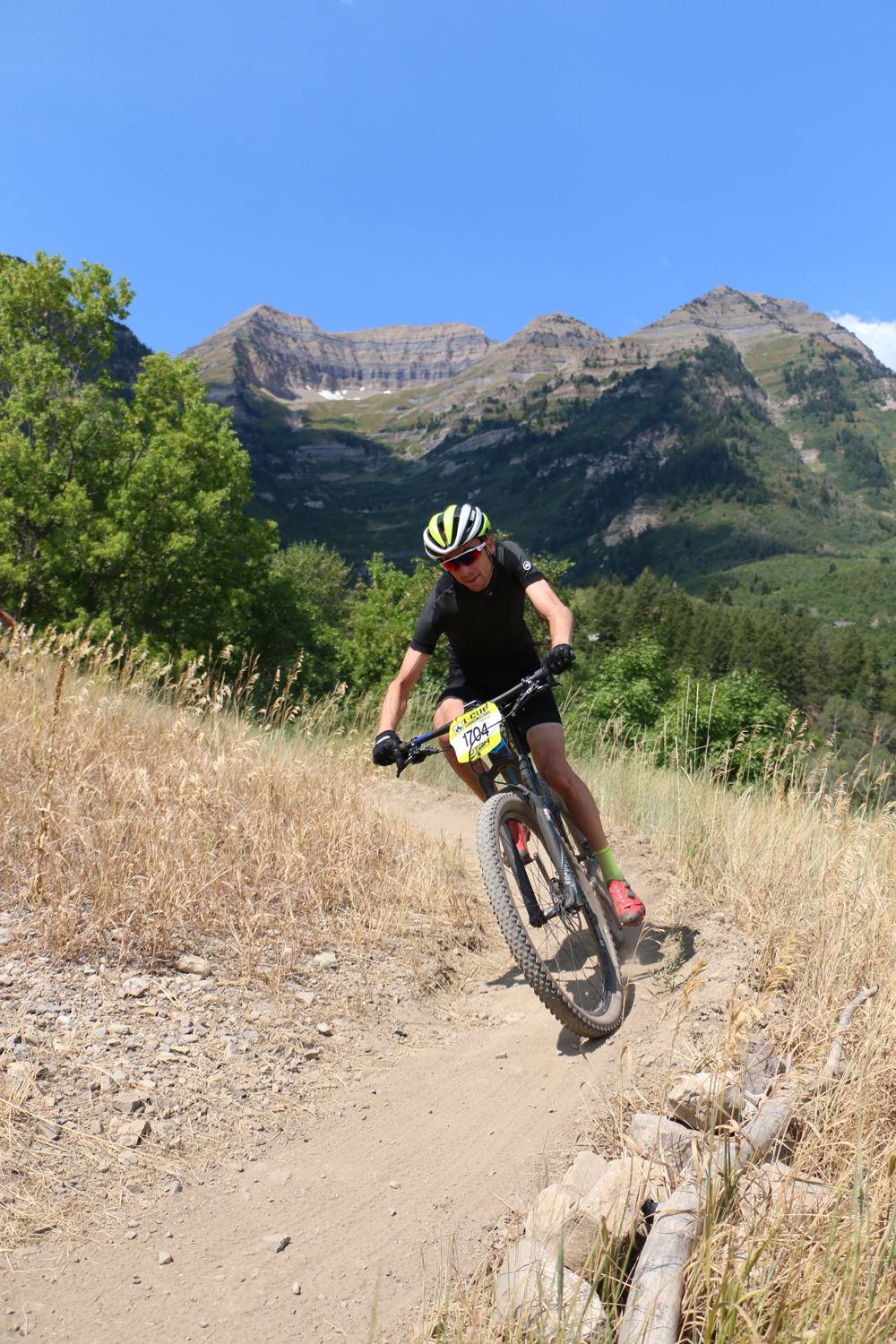
By Nate Gibby — SUNDANCE, UT (August 13, 2016) — In what is beginning to have a familiar sound, Robbie Squire and Nicole Tittensor won the elite men’s and women’s categories respectively of the final X-country race of the Intermountain Cup series on August 13th at Sundance, Utah. The tandem also won the previous Intermountain Cup X-country race at Snowbird in July.
Rob Squire on his way to winning the Sundance Intermountain Cup. Chris Holley shadowed Squire for most of the race until Squire dropped him on the last lap. Photo by Dave Iltis
Holowesk-Citadel racer Squire edged out Chris Holley of Kuhl, Racers Cycle Service by just over one minute, in what turned out to be a battle throughout the entire race. “Holley, gave me a real run for the top step as he was able to close down the gaps I made on the climb throughout the rolling course.” said Squire. “Once I realized that I wasn’t going to be able to lose Chris [Holley] on the climbs, I let him take over at the front where he had to battle the head wind and I could catch somewhat of a draft behind him. Fortunately this plan paid off as I was able to counter attack him for the victory towards the end of the last lap that he led.”
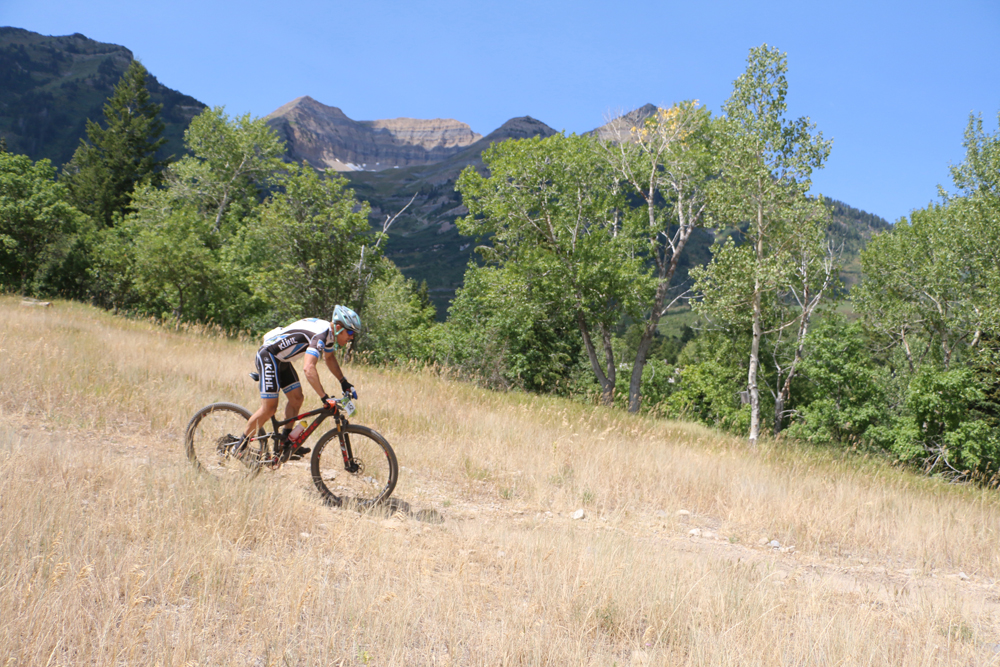
Chris Holley rides under Mount Timpanogos in the 2016 Sundance Intermountain Cup race. Photo by Dave Iltis
On the women’s side, Jans/Scott/Reynolds racer Tittensor dominated by completing the three laps in four and half minutes above KC Holley of Kuhl and Racer’s Cycle Service. “I knew K.C. Holley would be hard to beat,” said Tittensor. “[Sundance] is her ‘home course’ in a way and she knows it very well. I went for the lead going into the single track and my legs felt amazing, so I just kept pushing it from there.”
“(Tittensor) took off from the line, I was able to go with her for a few moments, but it didn’t take long for her to create a gap. It steadily grew throughout the race,” said Holley. “I hoped that my knowledge of the course would work in my favor on the descent, but I never really saw her other than glimpses here and there in the distance.”
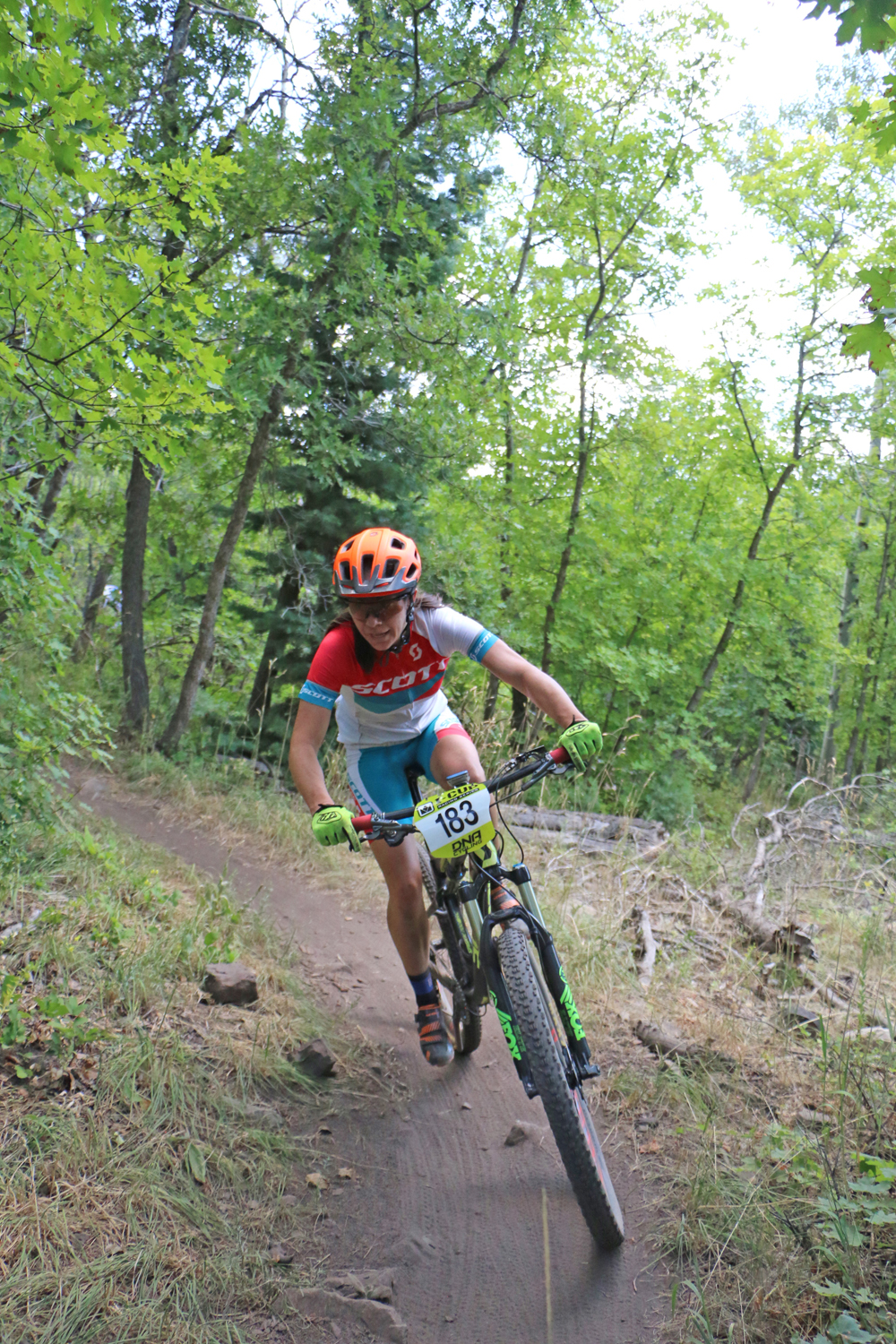
Nicole Tittensor won the women’s pro category at the 2016 Sundance Intermountain Cup. Photo by Dave Iltis
With the majestic Timpanogos looming in the background, the Sundance course is one of the most beautiful backdrops to the race that featured a seven-mile loop with approximately 1,100 feet of vertical climbing per loop. “The Sundance course has the best views of the whole year,” said Tittensor. “It is one of the more technical courses in the Northern Utah races and ends up being one of the longer races of the year as well.”
After what she describes as “years and years of getting beat by some of the fastest girls around,” Tittensor has begun to experience some of the fruits of her persistence. With wins at both the Sundance and Snowbird in the Intermountain Cup X-country series, Tittensor also garnered a top-10 finish at the XC national championships at Mammoth Mountain in July. “Wins don’t happen over night and you have to take many losses before you start being able to go with the top competitors,” she said.
About the I-Cup
Founded in 1991, the Intermountain Cup consists of X-country and endurance MTB races throughout Utah. With seven X-country races of approximately 25 miles and four endurance races of approximately 50 miles, the series covers some of the most pristine and difficult rides in the state. For more information, visit IntermountainCup.com
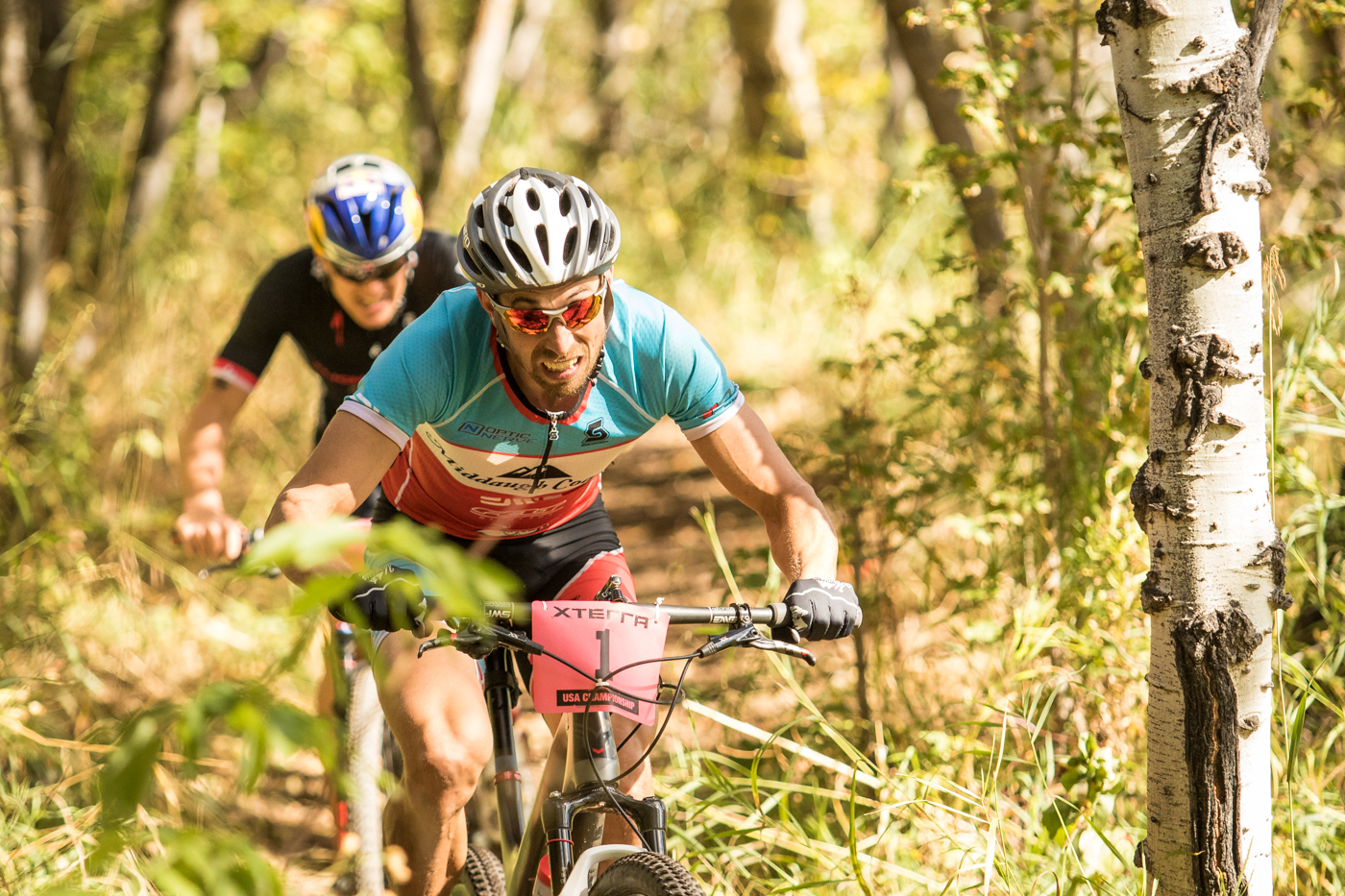
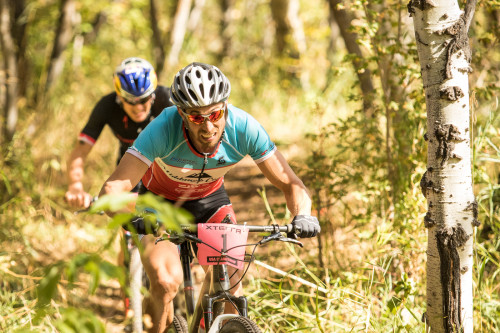
Josiah Middaugh and Braden Currie will compete in the XTERRA Ogden 2016. Photo courtesy of XTERRA.
Championship Event to be Held in Ogden, Utah on September 17, 2016
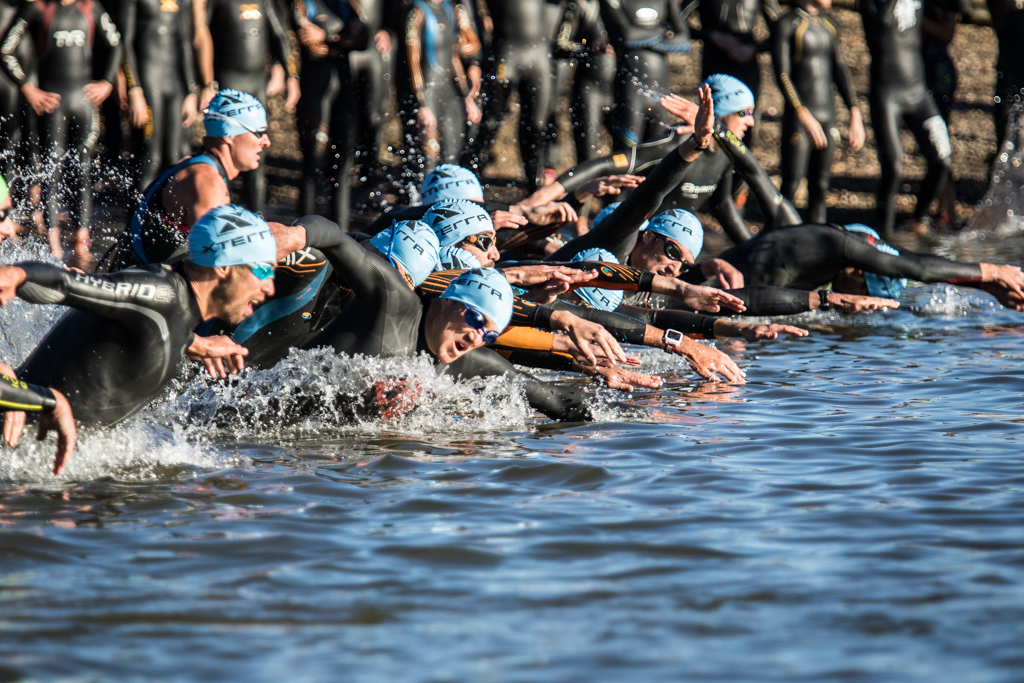
September 13, 2016 – Forty-six of the best off-roaders in the world are in Ogden, Utah for the inaugural XTERRA Pan America Championship race on Saturday. You can follow the elite race live on twitter @xterraoffroad starting at 9am MST on Sept. 17.
WOMEN’S ELITE RACE PREVIEW
Julie Baker, a 39-year-old out of Sonora, California, was asked how it feels to be considered one of the favorites to win the elite women’s race at Saturday’s XTERRA Pan America Championship.
“Wait, I’m one of the favorites??” was her reply.
While it may come as a surprise to Baker, it’s no surprise at all to those who follow the sport nor the women who have raced against her.
Baker won the 30-34 XTERRA National Championship on this course in 2013 and last year finished fourth overall as the top age grouper. A month later she won the amateur XTERRA World Championship and this year, in her elite debut at XTERRA Beaver Creek, she won by nearly two minutes over Pan Am Pro Series leader Suzie Snyder.
Her strength is in the swim. A collegiate water polo star, Baker swam more than one-minute faster than Snyder at Beaver Creek and to put that in perspective, Snyder swam four-minutes faster than the rest of the field at XTERRA Oak Mountain back in May.
“Swimming is definitely my strength so I will try and get some time there,” said Baker. “I keep hoping for someone who is a fast swimmer (but not too fast) so I can draft in the swim.”
It’s unlikely that will happen, unless XTERRA newcomer Amanda Felder fills that role, and what that means is the first women out of the water and on to the bike will be wearing a rather plain looking blue racing kit, in stark contrast to the colorful logo-strewn jerseys of her fellow elites.
“No sponsors yet, so yes, the tri suit is still blue and pristine,” she exclaimed.
Attribute the lack of sponsors to her focus on another profession in the dirt, that of a soil scientist. The Stanford grad has been working on a soil survey of Sequoia and Kings Canyon National Parks for the last couple of years.
“We have one more year of field work scheduled and then a lot of database and manuscript work,” explained Baker, who admits the full-time work has led to some unorthodox training methods.
“I haven’t really had a training plan. Basically my strategy has been to train hard when I’m home, and not worry about it when we’re out working. Sometimes if there’s a good hike at work a couple of the guys and I will race each other up the hill, with packs and tools and all. I like to think of all those rocks and steps with weight on your back as strength training. I also try to do some running when we’re out in the backcountry but the footing is usually pretty bad so it’s hard to go fast.”
The rugged course here in Utah has a similar profile to that of XTERRA Beaver Creek – in terms of altitude and amount of climbing – which bodes well for Baker.
“I like this course a lot and it’s similar in style to Beaver Creek, so it was encouraging to have a strong bike there. I think I was so excited to be in the lead there that I kept pushing a little too much on the bike and then was more tired than I wanted to be for the run. I’ve done a lot more bike to run work this summer, but I think I’m still learning how to train so I hope to keep improving,” she said.
Holding off the rest of the field on the bike and run will be no easy task for Baker, as several of her competitors had breakout seasons in 2016.
Among them is the Kiwi Lizzie Orchard, who was fifth at XTERRA Worlds last year and won the XTERRA Asia-Pacific Championship race in Australia this year. Her strength is on the run and if she is in striking distance at the bike-to-run transition, it could spell trouble for whomever is in front of her.
Then there is Snyder, just a year removed from crushing her pelvis in a pre-ride accident in Mexico, who has four Pan Am Tour wins to her credit this season.
“I’m feeling good, maybe not 100% since I’ve been nursing a back issue for the past few weeks, but at least the pelvis is 100% and that chapter is behind me. It’s been a really long road (which I’m still on) to regain the running fitness I lost due to that injury, but I do think that my swim and bike are stronger than ever and I’m only going to get stronger from now until Worlds.”
Last year’s race here in Utah was a painful one for Snyder, who was still suffering from injures at the time and in the unenviable position of having to finish the race in order to secure her No. 2 spot in the Pro Series.
“I have not erased last year’s memory of this race, I think about it a lot. I actually swam well, and rode fairly well considering I’d been off the bike for the previous six weeks and had to walk 99% of the run. I can’t believe I actually ran some of that first climb with a broken pelvis, but Kara (LaPoint) was right in front of me and I felt like if I could run with her and give her some encouragement and support for a little while, that maybe it would help her finish out the day strong…and that was well worth any pain and discomfort I was feeling at the time.”
It’s a different story for Snyder this year as she can claim the inaugural XTERRA Pan Am Pro Series title with an 11th place finish or better.
“Without Mimi racing (Myriam Guillot-Boisset, who is second in the Pan Am Pro Series) the Tour title win is achievable with much less pressure. It doesn’t change the fact that I still want to win the race outright, but not worrying about the Tour title allows me to stay relaxed and focused on the process of having my own best race. Of course, Mimi would not have been the only threat for the race win; Julie Baker, Lizzie Orchard, Kara LaPoint, Maia Ignatz and Liz Gruber are all strong, capable women who may very well challenge me for it.”
As for her strategy on race day, Snyder said “my personal mantra has always been “race your own race.” It helps me stay focused and in the moment, and not think about who I’m chasing, who might be coming from behind or how much the effort hurts. I feel like I have fun when I’m relaxed and make fewer mistakes, which translates into a faster performance. Overall, I’m just really excited to be leading the Pan Am Tour coming into the Championship, after not knowing if I’d even be able to participate in the Tour this year when the season started. I’m grateful for my health and ability to race and owe my entire support network of family, friends and sponsors a tremendous amount of thanks and gratitude.”
Maia Ignatz had the best showing of her career earlier this season when she finished 2nd behind Snyder at XTERRA Oak Mountain. She is ranked 3rd in the Pan Am Pro Series and is the top returning pro in this year’s field. Saturday’s race is big for both her and Kara LaPoint, currently ranked fourth in the series, as those two battle for the second spot in the final standings. The payout for 2nd is $6,000, 3rd is $3,600. Ignatz is 11 points ahead of LaPoint heading into Saturday’s race.
“I’m feeling really good heading in to Utah, and I’m super excited to race,” said LaPoint. “After such a busy season with a ton of travel, I’ve been home since XTERRA Dominican Republic and it’s been so nice to be able to be in one place and really put in a solid training block. I did have a pretty hard crash last week that injured my knee, so I haven’t been able to do much running yet and it’s still pretty sore, but I’m hopeful that with another week to recover it will be good to go by race day. No big secret tactical strategies…just push hard, be bold, keep believing, stay positive, don’t back down, race with heart and courage, have fun, and finish knowing I left it ALL on the course.”
That would be a good mindset for everybody, including the other women in contention which include three-time XTERRA Brazil Champion Sabrina Gobbo from Sao Paulo, Katharine Carter from Canada, and rookie pro Liz “MacGruber” Gruber – who finished fifth overall here last year and has three age group national titles from Utah in her trophy room.
Bib #/Pan Am Pro Series Rank – Name, Age, Hometown
51/1 – Suzie Snyder – 34 – Reno, Nevada
53/3 – Maia Ignatz – 36 – Boulder, Colorado
54/4 – Kara LaPoint – 29 – Truckee, California
55/5 – Sabrina Gobbo – 39 – Sao Paulo, Brazil
56/7 – Katharine Carter – 29 – Vancouver, BC, Canada
57/8 – Debby Sullivan – 35 – Stafford, Virginia
58/9 – Caroline Colonna – 52 – Taos, New Mexico
59/10 – Rebecca Blatt – 36, Lakewood, Colorado
60/12 – Sarah Graves – 39 – Ballantine, Montana
61/13 – Julie Baker – 40, Sonora, California
62/17 – Liz Gruber – 27, Colorado Springs, Colorado
63/28 – Lisa Leonard – 28 – Aberdeenshire, Scotland
64/36 – Amanda Felder – 34, Del Mar, California
65/NR – Lizzie Orchard – 31 – Auckland, New Zealand
66/NR – Annie Bergen – Kelowna, B.C., Canada
MEN’S ELITE RACE PREVIEW
For Josiah Middaugh, XTERRA has always been about the adventure. In 2016, however, the reigning World Champion may have gotten more than he bargained for.
His adventures started even before his season did when he got caught in a nasty snowstorm on the drive from his home in Eagle-Vail, Colorado to the airport in Denver to catch his flight for XTERRA Costa Rica.
“Had to pull over and wait it out,” he said. “Lucky it cleared enough to get through and make the flight.”
Then on his way out of Costa Rica there was a fire on the runway, followed by a President Obama encounter upon his arrival in Argentina, and a memorable Taxi cab ride with “Kahuna Dave” to another local airport for the jump to San Juan.
On his next trip he and his wife Ingrid found themselves dancing with dozens of Polynesian entertainers directly upon arrival. Then it rained, and rained, and the race turned into one of pure survival … or as Middaugh put it, “the most challenging trail loop I’ve ever done, it was diabolical.”
After the race he took time to swim with manta rays before heading to XTERRA Oak Mountain, where he once broke his knee-cap in a pre-ride, the very next weekend.
In July it was back home to the calm, controlled environment of his hometown in Colorado for XTERRA Beaver Creek, unless of course your wife signs you up for a celebrity dance gala right before the race, and then you get sick.
Later that month he traveled to XTERRA Dominican Republic where he was leading the bike and… “I was having a good time for a while,” he explained. “Then I got a puncture. I tried to plug it. I used my first CO2 to find the hole, but the hole was too big. So I put a tube in and inflated it with my other CO2, but the tube had a hole in it, so then I had nothing. I started running with my bike in one hand and wheel in the other. Rom and Braden went by and didn’t have anything to give me…then finally somebody had a tube. I put that in and then I couldn’t find my axle. It was a half a mile back up the hill. I left the bike and ran up the hill but couldn’t find it. I ran past it, looked everywhere and then finally, found it and ran back to the bike.”
Middaugh went on to post the fastest run of the day to finish fourth.
The next weekend was XTERRA Mexico where he suffered an acute case of appendicitis on the eve of the race on August 6. Organizers drove him two hours from the remote mountain countryside of Tapalpa to the specialist in Guadalajara where he had emergency surgery to remove it.
Through it all Middaugh has kept his incredible sense of humor and big smile, even won a couple races to put him atop the Pan Am Pro Series standings. And while it was not quite the ideal build-up to the XTERRA Pan America Championship, Middaugh says he’s feeling good.
“Like a million bucks…all green and wrinkled,” he joked. “Actually, I’m feeling pretty good and had a couple good weeks of training. It’s a good, deep start list here in Utah with plenty of guys that will be going for it. My plan as always is to race my own race and hang it all out there in all three disciplines. I think I can be within a minute on the swim, but it’s possible Karl Shaw could push the pace of that front pack and some guys might be able to go with him and put a bigger gap on me. I’m really looking forward to the bike but I know from last year that to get to the front I will have to be pushing very hard from the start, and the run could be interesting if there are 4 or 5 guys really close.”
Branden Rakita, who is 5th in the Pan Am Pro Series and a student-of-the-game, is quick to agree with Middaugh’s assessment of how the race might play out.
“It is going to be a very exciting race,” he said. “With the big field it will add a bit of a dynamic that we haven’t seen this year that could affect the standings. There are a number of strong swimmers – Braden Currie, Karl Shaw, Karsten Madsen, Brad Zoller, Felipe Barraza, Matt Lieto, Jean-Phillippe Thibodeau, Rom Akerson – and we should have a good group at the front to push the pace. We will try to get away and a gap could form. Once we are in Wheeler (the first big climb) the group will thin and spread out some, but even if you are in the front group with Josiah Middaugh, Brian Smith, and Sam Long coming up from behind, there is a lot that could still happen to mix things up.”
Last week we heard from Braden Currie, Karsten Madsen, and Matt Lieto (Read it here). This week we caught up with Rom Akerson, Karl Shaw, and Sam Long to get their thoughts…
“I am feeling great, we have had a great tour this year and every race was super fun and challenging,” said Akerson, who won the last two races on the Pan Am Pro Series at XTERRA Dominican Republic and XTERRA Mexico. “I expect to give it my best on Saturday and hope it puts me on the podium. I have been up in Vail for the last two weeks training and thinking about that climb. The goal is always the same, and that’s to WIN. I just need to feel good and make no mistakes.”
For Shaw, who is coming over from Europe, this race is a building block to Maui.
“I will be happy with a top 5 at this race, just four weeks before XTERRA Worlds,” said Shaw, who won XTERRA Costa Rica to start the season. “It’ll be my first time to Utah but my trainer lives here in Salt Lake City and I wanted to do one more tough race before Worlds. After this I will head back to Europe for some more hard training and some races.”
And for Sam Long, the 20-year-old who finished 2nd in his XTERRA debut at Beaver Creek in July, it’s all about the experience.
“Beaver Creek was the first race that I had a major breakthrough and I think I have been able to carry that intensity over,” said Long. “Since then I got second place at 70.3 Calgary (another improvement for me) and have noticed myself believing in what I can do more. I finally find myself believing that I can actually make a living as a professional triathlete and that I have a future in this sport. Also, because of Beaver Creek I can justify more mountain bike training and trail running. This has been awesome. I love being out in the mountains and on the trails. This truly has made life more enjoyable.”
In addition to the race itself, there is also a battle for the top spots in the Pan Am Pro Series that dishes out $60,000 to the top 10 men and women in the final standings.
This is the last of 10 events, and with 342 points Middaugh is the Pan Am Pro Series leader. Karsten Madsen from Canada and Rom Akerson from Costa Rica are close behind with 322 points apiece. Middaugh needs to finish top 3 to secure the crown, however, if (hypothetically speaking) Karsten or Rom win in Utah and Josiah finishes fourth or worse, they could take the title.
“My number one goal is to win the race and the only time I will think about the tour title is if something goes wrong like a flat tire, then I might be forced to do some math,” said Middaugh.
For Akerson and Madsen, a win coupled with a fourth-place finish or worse for Middaugh would give either of them the Pan Am Pro Series title (one of a million potential scenarios) and the second-spot will likely come down to who finishes higher between the two of them.
The battle for fourth is equally close with the Kiwi, Kieran McPherson, currently in fourth place, seven points ahead of Rakita.
“Main goal is top 3 in the race, but top 5 is still a stellar race with how deep the field is,” said Rakita. “If I take care of that then the next goal of getting back to 4th in the series is likely. I need to beat Kieran and have 1 person between us, which makes it difficult.”
Follow it as it unfolds on twitter @xterraoffroad starting at 9am MST.
28/NR – Walter Schafer – 25 – Centennial, Colorado
29/NR – Braden Currie – 29, Wanaka, New Zealand
30/NR – Alex Roberts – 26, Taupo, New Zealand
31/NR – JP Donovan – 29, Incline Village, Nevada
The 2016 XTERRA Pan America Championship weekend is presented by Paul Mitchell, the Utah Sports Commission, and XTERRA TV at Amazon Video. Sponsors include the GOAL Foundation, Snowbasin Resort, Hub 801, Utah Media Group, Outrigger Resorts, Gatorade, PowerBar, XTERRA Travel, U.S. Forest Service, XTERRA Wetsuits, Muscle Milk, XTERRA Fitness, Compex, Optic Nerve Sunglasses, Greenlayer, and XTERRA Boards.
XTERRA TRAIL RUN NATIONALS THIS SUNDAY
Patrick Smyth and Liz Stephen are returning to Snowbasin Resort near Ogden, Utah to defend their Paul Mitchell XTERRA National Championship half-marathon crowns this Sunday.
“I’m coming back because I want to win, and the course is a great mix of brutal climbs and fun, flowy downhills,” said Smyth, who finished 8th at the Olympic Marathon Trials in February.
There are also 48 regional champions from across the country headed to Utah next week for a shot at the Paul Mitchell XTERRA Trail Running National Championship.
One of the perks for winning your division in your region during the regular season is a comp entry into Nationals, and it has proven successful in getting some of the best runners from each region together for a bona-fide championship race in Utah.
As proof, consider this, the men’s 40-44 division regional champions from the Florida Series, Alabama Series, Texas Series, Colorado Series, and Northeast Series will all be on the start line next Sunday.
Here’s a look at all the regional winners on the start list so far, sorted by division …
REGION-DIVISION-NAME-HOMETOWN
SOCAL-F10-14-Natasha Preece-San Diego, CA
ATLANTIC-F20-24-Rachel Marino-Manahawkin, NJ
SOCAL-F25-29-Danielle Casteel-San Diego, CA
SOCAL-F35-39-Tina Weissauer-Topanga, CA
FLORIDA-F35-39-Jeni James-Windermere, FL
ALABAMA-F35-39-Sasha Robertson-Oxford, AL
ARIZONA-F40-44-Angela Caruso-Scottsdale, AZ
SOCAL-F40-44-Shannon Deck-Woodland Hills, CA
TEXAS-F40-44-Stephayne Gibson-San Antonio, TX
COLORADO-F40-44-Allison Simpson-Woodland Park, CO
FLORIDA-F45-49-Ellen Alence-Lithia, FL
FLORIDA-F50-54-Adriana Nieves-Seminole, FL
TEXAS-F50-54-Terry Joy-Austin, TX
FLORIDA-F55-59-Peggy Brinkley-St. Petersburg, FL
ALABAMA-F55-59-Lynn Bolger-Mobile, AL
ARIZONA-F65-69-Ingrid Honzak-Phoenix, AZ
ALABAMA-F65-69-Luvern Blackwood-Trafford, AL
COLORADO-F65-69-Jo May-Houston, TX
SOCAL-M10-14-Adam Mahboubi-Los Angeles, CA
ARIZONA-M25-29-Andy Jeanson-Gilbert, AZ
SOCAL-M25-29-Anthony Fagundes-Fair Oaks, CA
ALABAMA-M25-29-Brad Olzinski-Pelham, AL
ATLANTIC-M25-29-Dillon Shaffer-Belcamp, MD
SOCAL-M30-34-Sean Eosefow-Long Beach, CA
TEXAS-M30-34-Luis Murillo-Houston, TX
TENNESSEE-M30-34-Nathan Helton-Knoxville, TN
ARIZONA-M35-39-Jason Stevens-Waddell, AZ
TENNESSEE-M35-39-Kevin Beshaw-Knoxville, TN
FLORIDA-M40-44-Chris Martin-Windermere, FL
ALABAMA-M40-44-John Gilbert-Birmingham, AL
TEXAS-M40-44-Juan Murillo-Houston, TX
COLORADO-M40-44-Todd Short-Woodland Park, CO
NORTHEAST-M40-44-Simon Edgett-Milford, CT
SOCAL-M45-49-Eric Reed-Vista, CA
THE SWEET SINGLETRACK AT SNOWBASIN
With snowfall still a month or so away (we hope), the changing colors of the fall season and the majestic Wasatch Range surrounding Snowbasin Resort provide the perfect backdrop for the Paul Mitchell XTERRA Trail Running Series season finale.
The elevation and terrain of the Wasatch Mountains make the course breathtaking in more ways than one. Runners can expect to face more than 2,200 feet of total climbing over the 21-kilometer championship course, and the peak of the trail will reach an elevation of approximately 7,300 feet.
Two-time men’s winner Patrick Smyth, who works in computer mapping, said, “This would be a fun course to map. On the course profile I would put an asterisk on the climb right where the false summit is and say “still a lot of burn to go” because you get to the aid station up there and you think you just have to run the ridge and it’s flat and easy-peasy, but it’s not. It’s another grind to the top before you get to the sweet, awesome downhill.”
The hard work to get to the top is worth it!
“I’ve run a lot of trail races all over the world and it’s safe for me to say that this is definitely THE best, funnest, flowiest downhill out there,” said Smyth. “You just zone out and before you know it you’ve knocked out three miles.”
Two-time women’s winner Liz Stephen, an Olympic cross country skier who says she’s really “a runner at heart” was blown away by the course last year.
“It literally couldn’t have been more perfect for running last year, just one of those magical days,” she said. “It’s just a well laid out course. It’s really hard in so many ways but it’s up and then it lets you rest, and it’s flowy and wonderful, and gorgeous.”
There are also 10-kilometer and 5-kilometer races next Sunday which follow much of the same trails as the first half of the 21K course. Sign-up at http://www.xterraplanet.com/trailrun/nationals
World’s leading Off-Road Triathlon & Trail Running Races return to Ogden
XTERRA Ogden opens with a swim in Pineview Reservoir. Photo courtesy of XTERRA Ogden.
September 6, 2016 – HONOLULU, HI – It’s long been said that XTERRA is more than just a race, it’s a lifestyle. Perhaps nowhere is that more evident than in Ogden, Utah where the Mayor, Mike Caldwell, was the founder and race director for the first XTERRA here back in 2004.
Mayor Caldwell and a collection of the most welcoming locals to be found anywhere rallied the entire community to bring off-road triathlon to their hometown more than a decade ago and are themselves everyday XTERRA people. They swim, bike, and run in the mountains, have fun, eat well, laugh, and unpretentiously perpetuate the sports’ motto to “Live More”.
“XTERRA is a unique event for our community that has grown and progressed into a world class event,” said Caldwell. “It is a huge part of our community’s DNA. These athletes and race organizers have become part of our family providing an opportunity for us to form lasting friendships with people from all over the world. Not only do I enjoy the homecoming feel the event brings, it also has great economic impact for Ogden. Our hotels sell out and our restaurants fill up. It is the perfect fit for Ogden, and I look forward to this weekend every year.”
Athletes also look forward to this event every year, and more than one-thousand of the very best amateur and professional triathletes and trail runners have traveled to the Beehive State to battle for the title of XTERRA Champion.
“We love bringing the XTERRA Tribe together in Utah, the energy level is just incredible,” said Janet Clark, president of XTERRA. “Ogden and Snowbasin are simply the best – between the facilities at Snowbasin, the great restaurants and atmosphere along Historic 25th Street in Ogden, and the unbelievably supportive community – we can’t ask for a better venue.”
The main event, the XTERRA Pan America / USA Championship triathlon is the culmination of a series of off-road triathlons spanning South and Central America, Mexico, the Caribbean, Canada, and the U.S.
It starts with a one-mile swim in Pineview Reservoir (4,900-feet elevation), follows with an 18-mile mountain bike leg that climbs more than 3,000-feet to the top of Sardine Peak (7,300-feet elevation), and culminates with a 7-mile trail run featuring another 600-feet of climbing on trails around Snowbasin Resort in the Wasatch Range. There is also a half-distance sprint off-road triathlon and relay-team options.
This year, for the first-time ever, what has historically been an invite-only race just for U.S. citizens racing in the America Tour is now an open to one-and-all. So sign-up and see what XTERRA is all about!
The fastest racers in each five-year age group will be honored as the XTERRA Pan American Champion, and the fastest American in each of those divisions will be celebrated as XTERRA’s U.S. National Champion.
Opening up the race to all comers means one can expect some of the fastest off-roaders from Canada, and all over the world for that matter, to converge on Ogden for a shot at the crown and a chance to race on one of the World Tour’s most challenging and scenic courses. Snowbasin is an ideal spot for off-road tri in the summer time and when the fall colors turn the mountain landscape into a kaleidoscope of colors, it’s spectacular.
Pros will be competing for $80,000 in prize money, and dozens of cameramen will position themselves around Wheeler Canyon and the Wasatch Range to capture all the action for a nationally syndicated one-hour TV show that exposes the beauty of northern Utah to the masses. (Note: The award-winning XTERRA Adventures TV series, XTERRA USA and World Championship broadcasts are available as a video subscription for Prime members on Amazon Video via the Amazon Video app for TV, connected devices including Fire TV, mobile devices and online at Amazon.com/XTERRA).
The triathlons are Saturday, September 17 and on Sunday it’s the trail runners turn on the mountain.
The XTERRA Trail Run National Championship half-marathon features scenic views, technical trails, and big climbs. The half-marathon, plus the 5K and 10K trail runs are open to everyone, and it’s important to note that you don’t have to be fast to join in the fun. For some, it’s just about finishing and that’s okay as XTERRA is all about perpetuating the healthy, active, outdoors lifestyle.
In addition to the races XTERRA will host an expo in downtown Ogden on Friday with free kids races, vendor booths, the Compex recovery trailer, Outrigger Pavilion featuring prize drawings for free Hawaii stays, Hawaii-themed treats and kukui nut bracelet making, and of course the traditional Paul Mitchell hair cut-a-thon for charity.
There is great entertainment to be found at Snowbasin Resort as well highlighted by the spontaneous, ecstatic, and sometimes tear-jerking displays of emotion at the finish line for the races.
This year, experience it for yourself. Have a look at the schedule for places and times, and whether you race or not – join in the fun and excitement of XTERRA. For more info and links to registration visit www.xterrautah.com, or call toll-free to 877-751-8880. Live More!
PRO RACE
The elite’s racing at the XTERRA Pan America Championship are among the best off-road triathletes in the world. The men’s race features reigning XTERRA World Champion Josiah Middaugh from Eagle-Vail, Colorado, Canada’s best off-roader Karsten Madsen, Great Britain’s Karl Shaw, last year’s XTERRA USA and World Championship race runner-up Braden Currie of New Zealand, and Costa Rican great Rom Akerson.
The women’s race is highlighted by American XTERRA Warrior Suzie Snyder, winner of four Pan Am Tour races this season. She will have plenty of competition from the likes of XTERRA Asia-Pacific Tour Champion Lizzie Orchard of New Zealand, Brazilian star Sabrina Gobbo, French stand-out Myriam Guillot-Boisset, rookie pro sensation Julie Baker of the U.S., and nine of the top 10 ranked women in the XTERRA Pan Am Pro Series.
Follow the elite race live on twitter @xterraoffroad starting at 9am on Sept. 17.
The 2016 XTERRA Pan America Championship weekend is presented by Paul Mitchell, the Utah Sports Commission, and XTERRA TV at Amazon Video. Sponsors include the GOAL Foundation, Snowbasin Resort, Hub 801, Utah Media Group, Outrigger Resorts, Gatorade, PowerBar, XTERRA Travel, U.S. Forest Service, XTERRA Wetsuits, Muscle Milk, XTERRA Fitness, Compex, Optic Nerve Sunglasses, Greenlayer, and XTERRA Boards.
About TEAM Unlimited/XTERRA
TEAM Unlimited LLC, founded in 1988, is the Hawaii-based television, events, and marketing company that brought off-road triathlon and trail running to the world under the brand name XTERRA. From a one-off race held on the most remote island chain in the world XTERRA evolved into an endurance sports lifestyle with worldwide appeal. Over the past 20 years XTERRA transcended its status as ‘just a race’ to become a bona-fide way of life for thousands of intrepid athletes as well as an emerging brand in the outdoor industry. In 2016 XTERRA will offer more than 200 off-road triathlons and trail running events in 30+ countries worldwide and produce 10 adventure television shows for international distribution. Learn more at xterrautah.com, xterraplanet.com and xterracontent.com.
XTERRA Pan America Championship and XTERRA Trail Run Nationals Event Schedule
Sept 16-18, 2016 // Ogden/Snowbasin, UT
Friday, September 16
Opening Festivities in downtown Ogden @ Ogden’s Amphitheater Park (corner 25th/Grant)
10-6pm Expo and XTERRA Kids Zone Challenge Stations Open
10-6pm Registration and Packet Pick-up (All events)
12-5pmPaul Mitchell Cut-a-thon, benefit for the Challenged Athlete Foundation
3:00pm XTERRA Regional Champion Introduction
4pm XTERRA Kids Bike Race (free)
5pm XTERRA Kids Sprint (free)
5-6pm XTERRA University, presented by Paul Mitchell – Art of XTERRA
6:00pm XTERRARace Briefing (mandatory for Pan American Championship triathletes)
Saturday, September 17
XTERRA TRIATHLON at Snowbasin Resort
6:30am Shuttle operating from Snowbasin to Port Ramp Marina, Pineview Reservoir
Late packet pickup at Port Ramp Marina, Pineview Reservoir (no registration)
T1 & body marking open for set-up at Port Ramp Marina/T2 open for Set-up at Snowbasin
8:20am Last shuttle from Snowbasin to Port Ramp Marina
9:00amXTERRA Pan American Championship Startat Port Ramp Marina (1.5k swim, 29k mtb, 10k trail run)
9:45am XTERRA Utah Start – Sprint Course at Port Ramp Marina (750m swim, 19k mtb, 5k trail run)
10am-2pm Expo area open at Snowbasin – exhibits, food service
10am-3pm Registration and packet pickup for XTERRA Trail Runs – Nationals, 10K and 5K
10:30-2:30 Paul Mitchell Cut-a-thon – benefit for the Challenged Athletes Foundation
10:40am XTERRA Utah Sprint winner expected at Snowbasin
11:30am Athlete Post-Race meal served in Earl’s Lodge
11:20/11:50am XTERRA Pan American Championship Male/Female Winner Expected
12:00pm XTERRA University, presented by Paul Mitchell – Trail Running
2pm XTERRA Pan American Championship/XTERRA USA Championship/XTERRA Utah Awards Ceremony
2:20pm XTERRA Cut-off at T2
6:30pm XTERRA Dinner and After Party @ Hub801 (3525 Riverdale Road, Ogden). Complimentary entry to XTERRA Pan Am Championship athletes. XTERRA Utah athletes, friends, family welcome. Admission $25.
7:30pm XTERRA Pan American/USA Championship introduction of Champions and race highlight video
Sunday, September 18
XTERRA TRAIL RUNNING at Snowbasin Resort
7:00-8:00am Late Registration and packet pickup
9:00am Paul Mitchell XTERRA Trail Running National Championship Half Marathon Start
9:05am Paul Mitchell XTERRA 5km and 10km Trail Run starts
9:00a-2:00pm Paul Mitchell Cut-a-Thon, a benefit for the Challenged Athletes Foundation
9:20am/9:40a 5km/10km winners expected
10:06/10:19am Men’s and Women’s National Championship male/female winners expected
11:00am XTERRA Kids Sprint (free)
11am/11:45a XTERRA 5km and 10km awards ceremony / XTERRA National Championship race awards ceremony
12-5pm “Blues, Brews and BBQ” at Earl’s Lodge with Folk Hogan (12:30pm) and Jon Wayne & the Pain (4pm)
6:00pm XTERRA After Party at Union Grill in downtown Ogden with Video Highlights
Implementation Plans for Downtown to University of Utah Bike Route Slated to Bypass Pedestrian and Bicycle Master Plan
September 13, 2016 – Regarding the soon to be constructed 300 South Downtown to University of Utah bike route in Salt Lake City: We are pleased to see that the route will be constructed. It will be a great addition to Salt Lake City’s bike route network and an important connection to the most popular commuter destination in the state – The University of Utah. This will help to better the air and health of Salt Lake City.
We are however very dismayed that the plans for 300 S are not following the recently passed Pedestrian and Bicycle Master Plan. The plan calls for this to be a low-stress bike route. The Council also encouraged this, we believe, as part of the funding for the low-stress bikeway network.
Why is Salt Lake City not following the Bike/Ped Master Plan?
A low stress bike route is defined as one of three things: a protected bike lane (like 200 W and 300 S), a buffered bike lane (similar to those on 200 S between 700 E and 900 E), or in very low traffic areas – a neighborhood byway.
The current plans from SLC Transportation for implementing bike lanes on 300 S between 600 E and 1100 E call for regular bike lanes, not low stress lanes. This will reduce the effectiveness of this crucial commuter route.
Further, the recent public outreach for this project showed great support for continuing the protected bike lane eastward. Yet Salt Lake City seems to be ignoring this input.
The protected or at least – buffered bike lanes could easily be installed on this stretch if there were just 2 vehicle traffic lanes (1 each way) and no center turn lane rather than 2 and a center turn lane. This would leave room for parking, and protected or buffered bike lanes.
The protected bike lane on 300 S has been a cycling and retail success. Photo by Dave Iltis
Since 300 S between 600 E and 1100 E is almost exclusively residential, a center turn lane is not needed. Lastly, there should be stop sign installed at 300 S and 800 E to reduce potential accidents at this intersection. A pedestrian activated signal here should be included too. Note that the plans for the bike routes from 1100 E to the University of Utah are great and don’t need to be modified at all.
A recent Salt Lake County survey showed that people feel far safer with buffered bike lanes than with regular ones. Salt Lake City needs to continue to be progressive and in the forefront nationally with its bike way network. Additionally, the 300 S protected bike lane has been a retail success and resulted in increased receipts as well as increased bicycle ridership. In addition, the atmosphere on 300 S is more vibrant and more pleasant, and lower stress for all people using the area.
Additionally, with the recently passed resolution to drastically cut Salt Lake City’s carbon emissions, city planning that puts people on bikes and on foot and in transit first and ahead of cars is imperative in order to meet our goals. Anything less will result in failure.
We ask that Salt Lake City follow the Pedestrian and Bicycle Master Plan and immediately revisit the striping plan and install buffered bike lanes from 600 E to 1100 E on 300 S.
Sorensen celebrates second consecutive LoToJa victory and Kimball gets her wish to cross the line alone to win
[Editor’s Note: All of Ira Sorensen’s USA Cycling results dating back to 2011have been vacated after he tested positive for testosterone at the 2018 edition of LoToJa, and was suspended by USADA]
By David Bern — The top male and female winners of the 34th Annual LoToJa Classic are no strangers to the race’s victory podium.
On Sept. 10, Ira Sorensen (Canyon Bicycles) kept the Men’s Pro 1-2-3 crown that he won last year after yet another decisive sprint over five breakaway companions. His winning time was 8:55:59 — nearly two minutes faster than last year.
Ira Sorensen (Canyon Bicycles) takes the sprint win over Clinton Mortley. Photo by Lucid Images. For race photos, see: lucidraces.com/lotoja
“I really didn’t have any expectations going into this year’s race,” he said. “I decided it would be gravy to win again.”
Although Sorensen, 41, displayed impressive form, perhaps the race of the day belonged to Women’s Pro 1-2-3 winner Marci Kimball (TOSH), who had cancer surgery a year ago and struggled to recover in time for the 2016-racing season.
Mary Emerson (TOSH) finished second in the women’s Pro/1/2/3 field. Photo by Lucid Images. For race photos, see: lucidraces.com/lotoja
Despite her past challenges, Kimball, 38, soloed in to Jackson Hole Mountain Resort with a time of 10:08:10. Her last trip to the top step of LoToJa’s victory podium was in 2013 when she won the Women’s Cat. 4 race.
“It’s rewarding to have it pay off like that after you work so hard for it,” she said.
Sorensen had worked hard too during the year and felt prepared to race LoToJa’s 202 mile/325 kilometer parcours with nearly 10,000 feet/3,048 meters of climbing when he pulled up to the start line in front of Sunrise Cyclery in Logan. What he wasn’t prepared for was the morning low of 42 degrees. Besides his team kit, for extra warmth he only put on arm warmers, extra gloves and stuffed a plastic grocery bag inside his jersey to keep the cold air off his chest.
“I dressed to race,” he said.
But dressing lightly at LoToJa’s usually cold start can make for a frigid couple of hours in the saddle before sunrise. Sorensen immediately felt cold as the combined peloton of Men’s Pro 1-2-3s and Master Men’s 35s got underway in the dark at 6:09 a.m.
He also felt something was wrong. LoToJa’s first few kilometers through Logan are neutralized. The 31 different pelotons that leave in 3-minute intervals are supposed to stay behind their respective neutral vehicles and proceed casually. But for the nearly 50-member bunch Sorensen was in, the ride out of Logan was anything but neutral.
“There was a lot of excitement at the start because the [neutral] truck was going too fast,” he said. “Our group was going way too fast in the dark, which is not a great way to start out a 200 mile race.”
With so many cyclists, and it being too dark to see the road, Sorensen feared a big crash would occur on the way out of town as riders rode fast to stay in contact with the neutral vehicle. And a crash did occur — but in an unexpected way that miraculously didn’t involve cyclists.
While the Pro Men’s 1-2-3 and Master Men’s 35 group sped north on 1000 West, a Logan City motorcop driving alongside the cyclists reportedly did a U-turn away from the peloton. A race official on a motorcycle with a passenger didn’t see the U-turn in time and broadsided into the motorcop. The race official and passenger suffered injuries and were unable to continue. The motorcop was reportedly unhurt.
“It happened right near me,” said Sorensen. “It was crazy. It could have taken out a lot of racers.”
The mishap rattled the group, but was soon forgotten as the racers turned onto Highway 91 from 2500 North and pointed their handlebars north toward Idaho in the dark. Shortly after crossing the Utah/Idaho state line, Coul Hill (Unattached) and Dave Miller (Hoback Sports) jumped and the bunch let them go.
The duo soon had an eight-minute gap. But Sorensen and 10-15 riders, who had dropped the rest of the peloton during the 22-mile climb to Strawberry/Emigration Canyon’s 7,424 foot-high summit (57mi/92km), caught Miller alone with about a mile to the top.
The group stayed together on the descent to Ovid, and Sorensen said no one wanted to work, even though Hill was still off the front. Sorensen and the pack reached the first support crew feed zone at Montpelier (76mi/122km) and then began the nine-mile climb to 6,923 foot-high Geneva Summit (84mi/135km).
“We lost some riders at Montpelier and then on the climb to Geneva,” he said. The pace going up to the summit wasn’t severe, but that changed a few miles later after the descent to Geneva and the group past the U.S. Post Office there.
Sorensen said Darin Goff (Intermountain Livewell) attacked. With teammate and 2013 LoToJa winner Clinton Mortley (Intermountain Livewell) in the pack, and with Hill still several minutes off the front, Sorensen saw Goff’s move as possibly dangerous.
But he didn’t have to chase alone; the group put the hammer down and flew along at 30 mph over the Idaho/Wyoming state line, said Sorensen, to the base of LoToJa’s highest summit: 7,630 foot-high Salt River Pass (106mi/171km), which features a 9-percent pitch during the last two miles.
During the attacks, Mortley got gapped but made it back on before Salt River Pass. Between Geneva and Salt River, Sorensen said, “the cops were all over us this year. I was worried they were going to pull us over [during the attacks] like they did three years ago. It’s impossible to stay single-file through there.”
Except through Logan, Strawberry and Montpelier canyons, LoToJa’s parcours is not closed and all cyclists are required to ride single-file where required.
Goff was caught and Sorensen said the remaining riders mostly rode tempo during the climb up Salt River. Goff dropped back to help Mortley, but the day’s selection had been made with Hill still up the road: Roger Arnell (Team Endurance), Will Hanson (Ski City Cycling), Shaun Johnson (unattached), Goff, Mortley and Sorensen.
“We bombed down off Salt River,” said Sorensen. “I wasn’t worried about Hill. I’ve raced with him a lot … I wasn’t worried about catching him.”
Both Mortley and Goff bridged after the descent and then the six riders caught Hill after Afton (123mi/198km), who had been alone since dropping Miller in Strawberry Canyon.
Sorensen said everyone worked together through Star Valley to Alpine (156mi/251km). No one skipped a turn at the front, not even Hill, despite his long solo break.
But after Alpine, the seven riders began to “put down the punches” on Livewell riders Goff and Mortley, said Sorensen. Before the day began, Sorensen and Hanson, knowing they’d likely be racing against Livewell riders, agreed to work together. They made a similar pact in 2015.
During the attacks, Johnson got dropped and the remaining group of Mortley, Arnell, Hanson, Goff, Hill and Sorensen pushed on to Hoback (178mi/286km). Sorensen noted that Hill worked just as hard as everyone else, which impressed him.
“Everyone stayed together to South Park Loop Road,” he said. “There was no negative racing. We knew the record [of 8:45:38] was gone at that point. Everyone was showing fatigue.”
But fatigue was forgotten after the group crossed the new pedestrian bridge over the Snake River at Wilson with seven miles/11 kilometers to go. Both Mortley and Goff put in a small attack after everyone crossed the Snake River, but their move was quickly neutralized.
Sorensen said small jumps continued on Village Road to Jackson Hole Mountain Resort, but nothing succeeded. Meanwhile, he was getting worried about Goff, who was marking him.
With three kilometers to go, Hill went to the front and pushed hard. At 2 kilometers, Sorensen was behind Arnell and Hanson.
“They were handing it to me on a silver platter,” said Sorensen. “It didn’t make sense, but it was good for me.”
With 500 meters to the line, Sorensen jumped on the right side along the cones and sprinted alone. He held everyone off to the line. Mortley took second at 8:56:00 followed by Arnell (8:56:00), Hanson (8:56:01), Goff (8:56:01) and Hill (8:56:02)
“I didn’t look back and kept my head down to the finish,” Sorensen said. “I didn’t even put my hands up. I wanted to make sure. I didn’t want anyone to come around me.”
He said it felt tremendous to win a second year in a row, especially since it wasn’t expected at the start of the day. But what made it even more joyful were the 20-plus family members who cheered him throughout the day.
“That was so cool to have them there,” Sorensen said. “That kept me motivated. The other riders joked I had better win with all that support.”
He also said he’s motivated to come back next year and try for another win. If he does — and wins — that would be three consecutive Men’s Pro 1-2-3 victories to join an already impressive LoToJa palmares, which include first place as a Cat. 4 in 2011, first place as a Cat. 3-4 in 2012, sixth place in the Pro Men’s 1-2-3s in 2013, and second place in 2014.
And just to think, Sorensen began cycling in 2009 on his wife’s $100 bike to ride with friends and lose weight.
Carrying extra kilos into LoToJa wasn’t a concern for Marci Kimball when she rolled away from the 7:09 a.m. start with 76 other women. In July 2015, doctors found a tumor on her pancreas while checking for a possible hernia.
“Lucky for me, it was caught early,” Kimball said, who started racing six years ago. “It had been there a long time and was growing slowly. It wasn’t a crisis situation, so I went ahead and rode LoToJa last year and had the surgery done in November.”
Despite having cancer, she placed third in the Women’s Pro 1-2-3s. But her fitness took a hit after the tumor was removed. Due to post-surgery complications, she had to go on a no-food diet for three weeks while her pancreas healed. Although she was getting nutrients, she lost a lot of weight and strength.
Her first ride back after surgery didn’t occur until January 2016 and “it was a struggle,” she said. And like many cyclists who feel they are behind in their early-season training schedule, Kimball pushed it too hard, too soon. It wasn’t until months later, and after some coaching, she began to feel OK again.
Kimball rode well throughout the spring and summer, most notably winning the Women’s Masters 35 race at Antelope Island (and placing fourth in the Pro Women’s 1-2-3s afterward), taking second in the Tour of Park City, and being the first woman finisher in the Ultimate Challenge during the Tour of Utah.
Having done so well in those events, she felt “prepared and confident” for LoToJa, especially on the climbs — her specialty. And because sprinting is not, she was determined to see the finish line alone, or at least not from behind a bunch of sprinters.
So when the women’s peloton began the 22-mile climb to the summit of Strawberry/Emigration Canyon, Kimball went to the front and pushed the pace to whittle down the group — especially the sprinters. She dropped everyone and went over the summit alone.
On the descent to Ovid, her teammate Mary Emerson and Cat. 4 rider Summer Dunn (Porcupine Cycling) bridged and the trio worked together to Montpelier.
“We stayed longer at Montpelier than we should,” said Kimball. “The chase group pulled in.”
But more importantly, she lost sight of Summer. Kimball and Emerson began the climb to Geneva. Fearing that Summer was up the road with part of the chase group, Kimball pushed to catch her, which she did about a mile from the summit. Emerson was unable to stay with her teammate’s climbing strength, but Summer dropped her group and bridged to Kimball.
The duo descended Geneva together, crossed the Idaho/Wyoming state line and settled in for the 14-mile flat run to Salt River Pass. But a few miles before the climb, Master Women’s 45 rider Celeste Liljenquist (BloodBathandBeyond) bridged up to them.
“The three of us worked together to the base of Salt River,” said Kimball. “They knew I was going to go for it [to break the Queen of the Mountain]. So I pushed it.”
When she got to the top, her bike computer marked the climb at 15 minutes, 10 seconds. The current women’s record is 16 minutes, 19 seconds. But unfortunately, the race’s timing equipment didn’t record Kimball’s possible record-setting climb, which she didn’t know about until at LoToJa’s award ceremony the next morning.
Kimball descended Salt River Pass alone and pedaled easily across Star Valley. There was an alternating head- and cross-wind, and Summer and Liljenquist finally bridged to Kimball. The three arrived at Afton’s feed zone together, but Kimball and Summer lost Liljenquist there and left alone.
They never saw Liljenquist the rest of the day. Kimball and Summer got to work through Star Valley and on to Jackson Hole Mountain Resort to make sure they didn’t get caught.
“We shared the work and encouraged each other,” Kimball said. “We kept a steady pace and never let up. Thankfully we had a good gap.”
On the last climb before South Park Loop Road, Kimball dropped Summer, but slowed at the top to let her catch back on. Kimball said while they rode together on Village Road toward the finish, Summer said she “wouldn’t contest the sprint.”
“With 2K to go, I just swung wide and took off,” Kimball said. “I didn’t want to take any chances.”
She jubilantly crossed the finish at 10:08:10 to win the Women’s Pro 1-2-3 race. She finished nearly three seconds ahead of Summer, who finished with a time of 10:08:12 and won the Women’s Cat. 4 race. Ten minutes passed before Cat. 4 rider Julie Spears (unattached) came across for second place at 10:18:12 and Cat. 4 rider Jen Kimball (unattached) taking third at 10:18:51.
Fourth place was earned by Krista Smith (Porcupine Cycling) at 10:20:25; fifth place by Amanda Erickson (unattached) 10:25:07; and sixth place by Teresa Parker (Logan Race Club) 10:25:15.
Emerson crossed the line for second place in the Women’s Pro 1-2-3 race with a time of 10:25:00. Emerson and Kimball were the only Women’s Pro 1-2-3 riders who finished. And Liljenquist, who had bridged to Kimball and Summer before Salt River Pass, won the Women’s Masters 45 category with a finishing time of 10:18:52.
“It felt awesome to cross the line,” Kimball said. “I was excited it didn’t come down to a sprint. … I was happy for her [Summer] too. It was fun to ride with her. It’s satisfying to ride together like that and work together all day.”
Kimball added she plans to defend her title in 2017. She said LoToJa is one of her “favorite races and is well run.”
In addition to this year’s Women’s Pro 1-2-3 win, and her 2013 victory as a Cat. 4, Kimball took fourth in last year’s Women’s Pro 1-2-3 race and second in 2014.
More than 1,800 cyclists either raced or rode this year’s LoToJa, which featured 15 licensed and 16 cyclosportive pelotons. Of all those cyclists on the road, LoToJa Race Director Brent Chambers said there were only a handful of reported accidents.
“This was a very smooth year,” he said. “The weather was ideal and it wasn’t as warm as last year, which kept dehydration to a minimum. But another highlight was we only had four cyclists reportedly go down. I’ve never had that few. That’s not to say there weren’t more, but that’s the number that was reported. … We also had a higher than normal number of riders finish.”
Chambers offered kudos to all riders and support crews who participated this year, but stressed the great day everyone enjoyed on Sept. 10 wouldn’t have been possible without the event’s 500 volunteers.
“Without them, LoToJa doesn’t happen,” he said. “They’re the glue that makes it stick, that keeps it all together.”
Next year is LoToJa’s 35th anniversary, and Chambers said plans are already underway to make 2017’s event memorable.
“I’m looking forward to it. It’s going to be an exciting year,” he said. “And pray for nothing but tailwinds.”
2016 LoToJa facts and trivia
LoToJa is the longest one-day USA Cycling sanctioned bicycle race in the United States. The race parcours is 202 miles/325 kilometers and the cyclo sportive parcours is 205 miles/330 kilometers.
LoToJa features almost 9,800 vertical feet/2,987 meters of climbing, most of which occurs in the first 110 miles/177 kilometers.
In a typical year, LoToJa cyclists travel to Logan, Utah for the start from 40 U.S. states and six foreign countries
Most participants finish in 10-12 hours. On average, 80 percent finish. For 2016, 85 percent finished.
The fastest cyclists average over 23 mph/37kph (for finish times less than 9 hours)
It’s estimated up to 15,000 calories are burned by each racing cyclist during LoToJa.
Since 1983, more than 17,000 cyclists have pedaled over 4 million miles/6.43 million kilometers during LoToJa.
LoToJa’s average participant age in 2016 was 45.
The oldest individual finishers: Male: 74; Female: 63
Tandem: Gary Gardiner and John Lauck, Centerville, Utah — 9:05:57 (2014)
Oldest individual category winner:
Male: Larry Peterson, Centerville, Utah, age 72 (Men Master 60+; 2-time consecutive winner, 2015 and 2016)
Female: Celeste Liljenquist, Bountiful, Utah, age 56 (Women Master 45+, 2016 winner with a time of 10:18:52)
LoToJa requires over 500 course volunteers, of which 150 are HAM radio operators providing radio communications and neutral support.
LoToJa has raised over $1.7 million for the Huntsman Cancer Foundation (HCF).
In addition to helping HCF, LoToJa has raised several thousand dollars for ASD Connections, the National Ability Center, Common Ground Outdoor Adventures, Utah High School Cycling League as well as several community organizations and youth groups.
The Women’s Pro/1/2/3 field. Mary Emerson (TOSH) won the women’s race. Photo by Lucid Images – Find more at lucidimagesut.com
LoToJa is America’s longest, one-day sanctioned bicycle race from Logan, Utah to Jackson, Wyoming
Layton, Utah — On Sept. 10 almost 1,800 cyclists will race or ride 206 miles from Logan, Utah to Jackson Hole, Wyoming in the 34th annual LoToJa Classic.
The 206-mile course (332 kilometers) — ridden all in one day — features nearly 10,000 vertical feet of climbing across three mountain passes. Cyclists will start at dawn at Sunrise Cyclery in Logan and cross the finish line hours later at Jackson Hole Mountain Resort with the iconic Grand Teton in view.
But before seeing the grandeur of the Teton Range and Jackson Hole, cyclists from the U.S. and foreign countries will ride on county and state roads in northern Utah, southeastern Idaho and western Wyoming. Along the way they’ll pass through Logan and Cache Valley, Utah; Preston and Montpelier, Idaho; and the Wyoming communities of Afton, Alpine and Hoback Junction.
According to LoToJa Race Director Brent Chambers, everything is in place for another great event. “With the right conditions in terms of wind and temperature, we just may see a new set of course records this year,” he said.
Cameron Hoffman of Clearfield, Utah set the current men’s record of 8:45:38 in 2014. His average speed was over 23 mph. Melinda MacFarlane of Salt Lake City, Utah holds the current women’s record of 9:35:00. She set it in 2013 with an average speed of approximately 21 mph.
Most of the other cyclists usually cross the finish between 10 to 12 hours. Despite LoToJa’s challenge to cyclists’ fitness and courage, many return year after year. Chambers said in 2016 cyclists are coming from 38 states, some as far away as Florida and Hawaii. From outside the U.S., riders are coming from Canada and the Czech Republic — but most are from Utah and other western states.
“The 206-mile course is challenging and the scenery is breathtaking — especially the last 45 miles into Jackson and finishing under the Grand Teton,” Chambers said. “All that has attracted cyclists for 34 years. LoToJa continues to be a life-changer for many cyclists who love the feeling of accomplishment the event creates.”
LoToJa began in 1983 by two Logan cyclists who wanted to create a bicycle race that resembled the difficulty of a one-day European spring classic like Paris-Roubaix, Ronde van Vlaanderen or Liege-Bastogne-Liege.
In that first year, seven cyclists competed and crossed the finish line near downtown Jackson. The winner was Bob VanSlyke of Logan who finished the 186-mile course in 9 hours. Since then, LoToJa has become one of America’s premier amateur cycling races. It has also become a major fundraiser for the Huntsman Cancer Foundation, Autism Spectrum Disorder Connections, and other medical research foundations. To date, sponsors and participants have raised more than $1.7 million for these causes. In addition, LoToJa sponsors local fund-raising groups that assist the event.
This year’s race again serves multiple categories for USA Cycling license holders, plus a cyclosportive class, which consists of non-licensed cyclists who are either competing against riders within their age group, or are just riding for fun. A relay race, and categories for tandem riders, will also be held.
LoToJa is the longest one-day bicycle race in America that is sanctioned by USA Cycling, the sport’s governing body. The age of cyclists range from 13 to 74 (13 to 81 in the relay category), and the average rider will burn up to 15,000 calories on race day — about a dozen large cheeseburgers with fries.
This year’s race will again involve over 500 volunteers. Due to the mountainous and remote terrain, more than 150 volunteer HAM radio operators from the Bridgerland Amateur Radio Club provide communication.
Chambers stressed LoToJa wouldn’t be possible “without the cooperation and assistance it receives from businesses, civic leaders, public safety officials and community volunteers.”
He also emphasized LoToJa’s top goal is to have a safe race for all cyclists, support crews, and volunteers. Motorists traveling LoToJa’s course on Sept. 10 are asked to use caution when approaching cyclists. Groups consisting of up to dozens of riders may be encountered. Motorists are urged to pass carefully and to leave a safe distance between their vehicle, cyclists and other traffic.
To further increase safety, on race day the Idaho Transportation Department will restrict eastbound traffic on Highway 36 north of Preston between Riverdale and Ovid from 7 a.m. to 12:30 p.m. Eastbound traffic on US-89 between Montpelier and the Wyoming state line will also be restricted from 9 a.m. to 2 p.m.
“We started the temporary travel restrictions a few years ago because both highways are filled with eastbound LoToJa cyclists,” said Chambers. “The restrictions have helped tremendously. Motorists are asked to use caution while traveling on these two roadways during LoToJa, and to anticipate encountering groups of cyclists. Cautious passing is advised to ensure safety for everyone.”
Chambers defined “cautious passing” as slowing down, giving plenty of space (at least three feet) between the vehicle and cyclist(s), and patiently waiting for oncoming vehicle traffic to clear before pulling around a cyclist or group of cyclists.
Cyclists who compete in the event, plus their support crews, well wishers, event staff and volunteers, represent an entourage of approximately 4,000 people. Several of the communities through which LoToJa passes organize roadside fundraisers to capitalize on the influx of visitors. The host cities of Logan and Jackson also enjoy a welcomed economic boost from the race, specifically restaurants and hotels.
It’s estimated more than 17,000 cyclists have pedaled over 4 million miles during LoToJa since the race began in 1983. Last year’s oldest male cyclist to finish was 74 years old and the oldest female was 63.
The youngest boy and girl finishers last year were 13 years old. The average age of a LoToJa participant is 45.
LoToJa’s route and additional information about the race are available at www.lotojaclassic.com.